EP0572341B1 - Verfahren und Einheit zur automatischen Analyse der physikalisch-chemischen Parameter einer Stichprobe von Früchten - Google Patents
Verfahren und Einheit zur automatischen Analyse der physikalisch-chemischen Parameter einer Stichprobe von Früchten Download PDFInfo
- Publication number
- EP0572341B1 EP0572341B1 EP19930430006 EP93430006A EP0572341B1 EP 0572341 B1 EP0572341 B1 EP 0572341B1 EP 19930430006 EP19930430006 EP 19930430006 EP 93430006 A EP93430006 A EP 93430006A EP 0572341 B1 EP0572341 B1 EP 0572341B1
- Authority
- EP
- European Patent Office
- Prior art keywords
- fruit
- juice
- turntable
- cup
- computer
- Prior art date
- Legal status (The legal status is an assumption and is not a legal conclusion. Google has not performed a legal analysis and makes no representation as to the accuracy of the status listed.)
- Expired - Lifetime
Links
- 235000013399 edible fruits Nutrition 0.000 title claims description 183
- 238000000034 method Methods 0.000 title claims description 12
- 239000000126 substance Substances 0.000 title claims description 7
- 235000011389 fruit/vegetable juice Nutrition 0.000 claims description 69
- 238000005259 measurement Methods 0.000 claims description 29
- 238000005070 sampling Methods 0.000 claims description 22
- 239000000523 sample Substances 0.000 claims description 18
- 238000005303 weighing Methods 0.000 claims description 16
- 238000004458 analytical method Methods 0.000 claims description 14
- 230000005484 gravity Effects 0.000 claims description 10
- 230000006870 function Effects 0.000 claims description 9
- 230000009471 action Effects 0.000 claims description 8
- 230000035515 penetration Effects 0.000 claims description 8
- 238000000605 extraction Methods 0.000 claims description 6
- 238000003825 pressing Methods 0.000 claims description 5
- 238000010669 acid-base reaction Methods 0.000 claims description 4
- 238000004140 cleaning Methods 0.000 claims description 3
- 230000003100 immobilizing effect Effects 0.000 claims description 3
- 230000002093 peripheral effect Effects 0.000 claims description 3
- FGUUSXIOTUKUDN-IBGZPJMESA-N C1(=CC=CC=C1)N1C2=C(NC([C@H](C1)NC=1OC(=NN=1)C1=CC=CC=C1)=O)C=CC=C2 Chemical compound C1(=CC=CC=C1)N1C2=C(NC([C@H](C1)NC=1OC(=NN=1)C1=CC=CC=C1)=O)C=CC=C2 FGUUSXIOTUKUDN-IBGZPJMESA-N 0.000 claims description 2
- 230000000737 periodic effect Effects 0.000 claims description 2
- 238000012546 transfer Methods 0.000 claims description 2
- 238000011144 upstream manufacturing Methods 0.000 claims description 2
- 230000000149 penetrating effect Effects 0.000 claims 1
- CDBYLPFSWZWCQE-UHFFFAOYSA-L Sodium Carbonate Chemical compound [Na+].[Na+].[O-]C([O-])=O CDBYLPFSWZWCQE-UHFFFAOYSA-L 0.000 description 8
- 238000007542 hardness measurement Methods 0.000 description 8
- 230000008569 process Effects 0.000 description 7
- 238000003306 harvesting Methods 0.000 description 5
- 238000010586 diagram Methods 0.000 description 4
- 235000015203 fruit juice Nutrition 0.000 description 4
- 238000012550 audit Methods 0.000 description 3
- 230000000903 blocking effect Effects 0.000 description 3
- 238000001514 detection method Methods 0.000 description 3
- 238000005520 cutting process Methods 0.000 description 2
- 230000003287 optical effect Effects 0.000 description 2
- 210000000056 organ Anatomy 0.000 description 2
- 230000011514 reflex Effects 0.000 description 2
- 230000006641 stabilisation Effects 0.000 description 2
- 238000011105 stabilization Methods 0.000 description 2
- 238000003860 storage Methods 0.000 description 2
- 238000004448 titration Methods 0.000 description 2
- 244000025254 Cannabis sativa Species 0.000 description 1
- 230000003750 conditioning effect Effects 0.000 description 1
- 230000000694 effects Effects 0.000 description 1
- 235000021183 entrée Nutrition 0.000 description 1
- 238000012994 industrial processing Methods 0.000 description 1
- 235000016709 nutrition Nutrition 0.000 description 1
- 238000012545 processing Methods 0.000 description 1
- 230000000284 resting effect Effects 0.000 description 1
- 239000006188 syrup Substances 0.000 description 1
- 235000020357 syrup Nutrition 0.000 description 1
- 238000012360 testing method Methods 0.000 description 1
- 230000009466 transformation Effects 0.000 description 1
- 238000013519 translation Methods 0.000 description 1
- 235000013311 vegetables Nutrition 0.000 description 1
- 238000005406 washing Methods 0.000 description 1
- 239000002699 waste material Substances 0.000 description 1
Images
Classifications
-
- G—PHYSICS
- G01—MEASURING; TESTING
- G01N—INVESTIGATING OR ANALYSING MATERIALS BY DETERMINING THEIR CHEMICAL OR PHYSICAL PROPERTIES
- G01N35/00—Automatic analysis not limited to methods or materials provided for in any single one of groups G01N1/00 - G01N33/00; Handling materials therefor
- G01N35/02—Automatic analysis not limited to methods or materials provided for in any single one of groups G01N1/00 - G01N33/00; Handling materials therefor using a plurality of sample containers moved by a conveyor system past one or more treatment or analysis stations
- G01N35/025—Automatic analysis not limited to methods or materials provided for in any single one of groups G01N1/00 - G01N33/00; Handling materials therefor using a plurality of sample containers moved by a conveyor system past one or more treatment or analysis stations having a carousel or turntable for reaction cells or cuvettes
-
- G—PHYSICS
- G01—MEASURING; TESTING
- G01N—INVESTIGATING OR ANALYSING MATERIALS BY DETERMINING THEIR CHEMICAL OR PHYSICAL PROPERTIES
- G01N33/00—Investigating or analysing materials by specific methods not covered by groups G01N1/00 - G01N31/00
- G01N33/02—Food
- G01N33/025—Fruits or vegetables
-
- G—PHYSICS
- G01—MEASURING; TESTING
- G01N—INVESTIGATING OR ANALYSING MATERIALS BY DETERMINING THEIR CHEMICAL OR PHYSICAL PROPERTIES
- G01N35/00—Automatic analysis not limited to methods or materials provided for in any single one of groups G01N1/00 - G01N33/00; Handling materials therefor
- G01N2035/00178—Special arrangements of analysers
- G01N2035/00188—Special arrangements of analysers the analyte being in the solid state
-
- G—PHYSICS
- G01—MEASURING; TESTING
- G01N—INVESTIGATING OR ANALYSING MATERIALS BY DETERMINING THEIR CHEMICAL OR PHYSICAL PROPERTIES
- G01N35/00—Automatic analysis not limited to methods or materials provided for in any single one of groups G01N1/00 - G01N33/00; Handling materials therefor
- G01N2035/00178—Special arrangements of analysers
- G01N2035/00207—Handling bulk quantities of analyte
- G01N2035/00217—Handling bulk quantities of analyte involving measurement of weight
-
- G—PHYSICS
- G01—MEASURING; TESTING
- G01N—INVESTIGATING OR ANALYSING MATERIALS BY DETERMINING THEIR CHEMICAL OR PHYSICAL PROPERTIES
- G01N21/00—Investigating or analysing materials by the use of optical means, i.e. using sub-millimetre waves, infrared, visible or ultraviolet light
- G01N21/17—Systems in which incident light is modified in accordance with the properties of the material investigated
- G01N21/41—Refractivity; Phase-affecting properties, e.g. optical path length
- G01N21/4133—Refractometers, e.g. differential
-
- G—PHYSICS
- G01—MEASURING; TESTING
- G01N—INVESTIGATING OR ANALYSING MATERIALS BY DETERMINING THEIR CHEMICAL OR PHYSICAL PROPERTIES
- G01N2203/00—Investigating strength properties of solid materials by application of mechanical stress
- G01N2203/0058—Kind of property studied
- G01N2203/0076—Hardness, compressibility or resistance to crushing
- G01N2203/0078—Hardness, compressibility or resistance to crushing using indentation
Definitions
- the subject of the present invention is a method for analyzing automatically the physico-chemical parameters on a fruit sampling or the like, and a unit for setting work of said process.
- the technical sector of the invention is that of processes and devices including laboratory apparatus for analysis organoleptic qualities of products intended for consumption human.
- Patent EP-A-0 278 636 describes a method of analysis of fodder, grass, fruit or vegetables to determine the value nutritional; the process can be implemented by a unit portable with a microprocessor device.
- the objective of the present invention is to determine on a batch sampling the organoleptic particularities of the fruit or similar, in order to appreciate: the taste quality, the storage possibilities, suitability for processing industrial.
- Said unit comprises a frame and means for controlling the energies necessary for its operation, and further includes a substantially horizontal plate, rotatably mounted on said frame and comprising circular orifices regularly distributed over the perimeter of the plateau, which is sequentially driven by a geared motor, by fraction of a turn corresponding to the arc which separates two orifices, which are smaller in diameter than the fruit, so that the fruit placed on said tray, remain partially engaged in said holes awaiting their analysis.
- said plate adopts an annular shape and is mounted to rotate on rollers mounted at free rotation, on said frame, which plate is subjected to the action centering rollers resting on its peripheral edge and its rotational drive is achieved by a friction roller subjected to the action of elastic means and wedged on the output shaft of said sequential gear motor.
- Said plate includes a detector for the presence of the orifices, associated with a retractable stop finger located on the path of said orifices, which finger has a cross section smaller than that of said holes, to penetrate inside and sequentially stop the table in a precise position.
- Said means for weighing each fruit consists of a fruit presence detector, associated with a retractable dish of a diameter smaller than that of the orifices of the plate, and located on the path of said orifices, which cup is carried by a force sensor connected to said computer and is subjected to the action of means for making it penetrate into said orifices, in order to lift sequentially and in synchronism with the operation of the stage fruit of sampling for weighing.
- Said means for measuring the hardness of the fruits consist of means for immobilizing each fruit sequentially in synchronism with the other organs of the unit, and a penetrometer coupled to a force sensor, connected to said computer, the punch is operated synchronously to penetrate the fruit.
- said means for measure the hardness of fruit consist of a first fixed cup secured to the frame, located above the platform and on the path of orifices, to the right of which successively come to rest orifices of the tray and a second retractable cup, coaxial with said first cup, the concavities of said cups are opposite; said second cup has a diameter less than that of said orifices and is actuated by telescopic means located below said plate, to make it cross in turn said orifices and bring the fruit, whatever its size, in support on said first cup, which has a central hole through which the penetrometer's punch passes.
- Said unit comprises at the right of the axis of the penetrometer a fruit ejector having passed the hardness measuring station, which ejector is parallel to said plate and is located between said plate and said first fixed cup of the penetrometer.
- said telescopic means of the second cup consist of two superimposed cylinders, one of which has for the function of moving said cup to put the fruit in support on said first fixed cup, and the other cylinder of which has function of temporarily immobilizing the cup above said tray, to put the fruit appreciably in the field of action from the ejector and transfer the fruit: from the tray to the audit means of juice extraction.
- the end of the punch of the penetrometer comprises a concavity delimited by a sharp peripheral edge, for cutting the skin of the fruit prior to the penetration of the punch into the fruit flesh.
- Said means for extracting fruit juice are constituted by a press, arranged substantially horizontally and below of said tray, which press has a lateral opening for receive the fruit ejected from the tray.
- said press consists of a cylinder open at its ends, the wall of which has an opening for the introduction of fruit by gravity, in which cylinder is mounted a piston fixed to the movable rod of a double-acting cylinder whose the body is fixed to the frame to move the piston lengthwise of said cylinder, which cylinder is coupled to the movable rod of a jack double-acting, whose body is fixed to the frame and whose rod has for function of pressing the cylinder against an anvil fixed to said frame, and to move it away from it, in order to let gravity drop the dry matter of the fruit after juice extraction, under pressure exerted by said piston on the fruit bearing on the anvil, which anvil is attached a juice flow pipe.
- the juice from said anvil is channeled by a first tubing to pass through a refractometer to measure the sugar level, and then bring the juice to a receiving bin says total collection.
- the unit further comprises upstream of said refractometer a tee, the main tube of which is connected to said first tubing is inclined downstream towards the refractometer and whose tube bypass is located below said main tube and connected to a second tubing leading to a second receiving tank called partial collection, which second tubing includes a first valve located on the side of said tee for collecting, in the closed position of the valve, a sample of the juice from each fruit in the batch and a second valve located downstream of said first valve to collect in closed position of said second valve all samples fruit juice from a sample lot.
- Total and partial harvest reception bins are each carried by a force sensor fixed to said frame and connected audit computer.
- Said unit further includes tubing from the reserve of a base and ending in said second container for receiving partial collection, on which tubing is inserted a connected valve to control means for delivering doses of said base, an agitator and a pH probe connected to said computer.
- Said base metering valve, said agitator and said probe are mounted on a vertically movable arm and actuated by a double-acting cylinder, to immerse the probe and the agitator in said partial collection tank or to extract them from said tank, in order to allow removal of the total harvest and harvest bins partial for their periodic cleaning.
- the result of the invention is the determination of the organoleptic particularities of fruit, by the application of said process implemented by the robotic unit above.
- the proposed equipment makes it possible to generalize analyzes of physico-chemical parameters on a sampling batch, so rigorous and economical. All operations are managed by computer, which also performs all calculations and analysis of results.
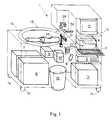
- the robotic unit is consists of a frame 1 mounted on lc rollers, comprising a cabinet computer in which a computer is placed 2, above of it a keyboard 3 and a printer 4, and above the printer, a screen 5. Adjacent to this cabinet is a structure 1b which can form an enclosure and in which are mounted fruit analysis equipment and the means of power unity. At the opposite end at cabinet 1a and at the bottom before find a programmable controller and a control module electrical 6. At the same level and at the rear, a control module tires 7. In the part located between said modules 6/7 and the cabinet there are mounted an electronic refractometer 8 and its electronic module 9, which cabinet also includes the electronics of the various force sensors in the unit robotized and which will be described later.
- soda tank 10 connected to a module "acidity" 11, located at the bottom of the cabinet la, below from computer 2. This module will be described in detail later. Below soda tank 10, is placed a bin 12 in which fall, by gravity, dry fruit waste previously pressed to extract the juice and the effluents of washing.
- a substantially horizontal annular plate 13 comprising means receptors for placing samples of a batch of fruit, for example example between twenty and thirty fruits.
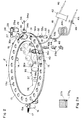
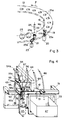
- FIG. 2 to 4 represent with in more detail the different organs that make up the switchgear the robotic unit.
- the fruits are arranged manually on said annular plate 13, which comprises said receiving means constituted by holes 13a regularly distributed in a pitch. These holes 13a are slightly smaller in diameter than most small fruits to be analyzed, for example their diameter is equal to fifty millimeters.
- Said plate 13 is rotatably mounted on bearing rollers 14, for example three in number, and is maintained in placed by centralizing rollers 15, for example three in number, one of which 15a is wedged on the output axis of a geared motor 16 pushed by a spring 17 on the side of the plate and which ensures the slow rotation drive thereof.
- the tray includes a device for detecting and locking in a precise position.
- These means of detection and fixed position locking are for example composed of a detector reflex type optics 18, located on the path of the holes 13a and above of the plate 13, the reflector 18a of which is fixed at the end a blocking latch 19, located coaxially with said detector and below of said tray.
- Said lock 19 is fixed to the end of the movable rod 20a of a double-acting cylinder 20 which has the function clear the lock when the table turns by a fraction of a turn, either a step, and to make it penetrate in a hole 13a for immobilize the platform in a precise position.
- This lock 19 is of a diameter smaller than that of the holes 13a and operates in synchronism with said detector 18.
- the power supply of the geared motor 16 is cut in synchronism with said detector 18 and with a slight delay, so that the inside edge of the hole 13a comes to the end of the race in contact with the latch 19.
- the fruits placed on said tray 13 are weighed by a force sensor 21 on which is mounted, at one end, a cup 22.
- the force sensor 21 is fixed at its other end to the movable rod 23a of a double-acting cylinder 23.
- This assembly is located below the plate 13, so that the detection / blocking 18/19 is downstream of said weighing means 21/22 by relative to the direction of rotation F.
- the cup 22 is located on the path holes 13a.
- a fruit presence detection sensor is mounted 24, for example an optical detector of the reflex type, the reflector 24a is fixed in the bottom of the cup 22.
- the blocking lock 19 stops the plate 13 in a fixed position.
- the jack 23 is actuated and the cup 22 coming into contact with the fruit raises it.
- the cup 22 is of a diameter less than that of the holes 13a of the plate, to pass through said holes during this operation.
- the fruit being separated of the pan is then weighed.
- the weight measurement is entered in the memory of said computer 2.
- the cylinder descends, the fruit is again replaced in hole 13a of the tray.
- the locking bolt 19 is then retracted below the plate 13 and the gear motor 16 is excited to rotate said plate a fraction of a turn, to put the next fruit in the field of the presence detector 24 / 24a.
- 18/24 detectors may well understood to be of any known type, such as optical, capacitive or other.
- Fruit hardness measurement is performed in the next step in synchronism with the weighing of the fruit from the previous item.
- Hardness fruit 25 is measured by means of a penetrometer 26 located on the path of the holes 13a and on a perpendicular axis of the plate 13.
- Said penetrometer 26 consists of a punch 27 whose end 27a (FIG. 2a) forms a concavity delimited by a circular cutting edge 27a 1 , the function of which is to cut the skin of the fruit before entering the flesh.
- Said punch 27 is located above the plate 13 and is fixed to the end of a force sensor 28, itself fixed to the movable rod 29a of a double-acting cylinder 29, which punch is slidably mounted in a hole 30a of a cup 30 for centering the fruit 25, integral with the frame 1 of the robotic unit.
- Said punch 27 is coaxial with a movable cup 31, of a diameter smaller than that of the holes 13a of the plate 13.
- the cup mobile 31 is located below said plate 13 and is mounted on the movable rod 32a of a double-acting cylinder 32, itself actuated by a second cylinder 33 with shorter stroke.
- the jack 32 is fixed to the end of the movable rod 33a of said cylinder 33.
- the fruit hardness measurement process is as follows:
- the fruit 25 wedged in the hole 13a of the plate 13 occurs in synchronism with the previous phases at the vertical of the penetrometer 26.
- the locking bolt 19 stops the plate 13.
- the jack 32 is actuated, the fruit 25 is lifted by the lower cup 31, until it comes into contact with the fixed upper cup 30. It remains inserted between the two cups 30/31 all the time of the hardness measurement.
- the upper cylinder 29 is actuated to lower the punch 27 and make it penetrate into the fruit 25 under a push and on a constant depth.
- the sensor of force 28 measures the force with which the flesh of the fruit opposes penetration and this force is memorized in computer 2. We then deduce the hardness of the fruit by comparison of the force stored and parameters stored in the computer memory 2. Their average is calculated at the end of the sampling batch.
- the upper cylinders 29 and lower 32 are returned to their initial rest position.
- the unit has the right of the axis on which the punch 27 of the penetrometer, an ejector 34 of the fruit 25 having just been tested.
- Said ejector 34 consists of a double-acting cylinder 34a arranged horizontally, parallel to the plate 13, the rod of which mobile carries a push pallet 34b.
- cylinder 33 After memorizing the hardness measurement and after the cylinders 32/29 are returned to their initial position, cylinder 33 is operated to hold the fruit above the pan 13.
- the ejector cylinder 34 is actuated and the fruit is ejected at the interior of the annular tray towards means for extracting the juice fruits.
- Said means consist of a press 35 arranged horizontally below the plate 13 and comprising a cylinder 36 open at both ends and having a side opening 36a reserved in its wall. This opening 36a is located at the part of the cylinder closest to the plate 13. The internal diameter of the cylinder 36 and the diameter of said opening 36a are greater than that of the largest fruits to be analyzed.
- a piston 37 fixed to the rod mobile 38a of a double-acting cylinder 38.
- Said cylinder 38 is coaxial with cylinder 36 and mounted integral with the frame by any known means. His open end 36b located opposite said cylinder 38 is opposite an anvil 39, for example cylindrical, which is coaxial with said cylinder 36, and mounted to the frame of the robotic unit.
- Said press 35 comprises means for bringing together or move the cylinder 36 away from the anvil 39.
- These means consist of a double-acting cylinder 40 fixed to said frame and arranged in parallel and below the cylinder 36. Its movable rod is connected to a lug 36c fixed near the open end 36b and opposite to opening 36a.
- the anvil 39 forms a bowl on its face located opposite the cylinder 36 and has at its lowest point an orifice to which is connected a juice collecting tube 41.
- the fruit 25 After having undergone the hardness measurement, the fruit 25 is ejected from the plate 13 and falls by gravity into the cylinder 36 by said opening 36a.
- the piston cylinder 38 is actuated, the fruit 25 is moved by the piston 37, to the anvil 39 and is then crushed between said piston and the anvil.
- the cylinder 40 is then actuated and resets the cylinder 36 support on the anvil 39 awaiting the next fruit.
- the sugar level of each fruit is measured during the flow of its juice extracted by means of the press 35.
- the tubing 41 is tilted and the juice from the anvil 39 flows by gravity through a refractometer 42, up to the acidity measurement means which will be described later.
- the measurements of the sugar level of each fruit are memorized, then their average is calculated at the end of the sampling batch.
- Definition of the ratio total weight of fruit / total weight of juice requires total collection of the extracted juice.
- the acidity measurement requires a partial collection of the juice of each fruit to limit consumption soda and analysis time.
- the unit comprises an inclined tee 43, for example at 45 °, the main tube 43a of which is connected by its ends with two sections of said tubing 41 and the tube of which bypass 43b which is located below said main tube 43a, is connected to a second flexible tube 44, terminating above a partial collection tank 45 (fig. 4).
- the juice from the refractometer 42 flows through a tube 46 and is collected in another receiving bin 47 (FIG. 4), known as the total collection.
- a solenoid valve 48 of the tube pinching Downstream of the tee 43 is mounted a solenoid valve 48 of the tube pinching. Downstream of said solenoid valve 48, the tubing 44 is wound in a spiral 44a, for example forming three turns.
- the tubing 44 Downstream of said spiral, the tubing 44 comprises a second solenoid valve 49 identical to that 48 above. Spiral 44a constitutes a reserve of juice, when the solenoid valve 49 is closed.
- the solenoid valve 48 is open and the quantity of juice contained in the bypass tube 43b and the tube section 44 flows into the reserve of juice which constitutes the spiral 44a.
- the solenoid valve 48 is closed until the next fruit. At the end of sampling lot, the total collection tank 47 contains almost all juice. The solenoid valve 49 is then opened to discharge in the partial collection tank 45 all the juice contained in the spiral 44a and representing the sum of the calibrated samples of each fruit of said batch.
- the juice reserve device makes it possible to measure the acidity of the batch in progress, while a new batch is introduced in the unit, in view of the sugar content hardness weight measurement ...
- the total weight of juice is equal to the sum of the weights of juice in the two partial harvest 45 and harvest reception bins total 47.
- Weight measurements are carried out by means of force 50/51.
- the tank 45 is mounted on a support 52 fixed to the free end of the force sensor 50, which is fixed by its other end to the frame 1b.
- the tank 47 is mounted on a support frame 53 fixed to the free end of the force sensor 51, the other end of which is attached to said frame 1b.
- the principle used is titration by acid-base reaction.
- the base used is diluted soda.
- the automatic titration device is carried by an arm 54 vertically movable by means of a double-acting cylinder 55 fixed to the frame 1b and whose movable rod 55a is fixed to a lug 54a integral of said arm. This is of course guided in vertical translation by slide means (not shown). It has a first support plate 56 extending horizontally and on which is mounted a gear motor 57 on the output shaft which is wedged the axis 58a of an agitator 58 arranged vertically.
- the plate 56 also carries a pinch solenoid valve tube 59, the tube 60 of which is connected on the one hand; to a soda store (not shown) and on the other hand, at its lower end 60a located below the plate 56 and opposite the partial receiving tank 45.
- the arm 54 also has a vertical extension 54b extending downward, at the end of which is fixed a second plate 61 parallel to said plate 56.
- This second plate 61 wears a probe of pH 62, extending vertically and parallel to the axis of the agitator 58.
- the soda inlet tube 60 and the collection tube 44 partial lead to this plate and slightly exceed it by the underside.
- This suction plate also leads to a suction tube 63, for empty tray 45 at the end of the analysis of a batch and another tube suction 64, to empty the total collection tank 47.
- the axis of the agitator 58 crosses the plate 61.
- the agitator 58, the pH 62 probe and the 44/60/63 tubes are grouped together to present above the receiving tray 45.
- arm 54 In the retracted position of the rod 55a of jack 55, arm 54 is lowered and said tubes 44/60/63, the probe 62 and the agitator 58 are introduced into the container 45.
- the suction tube 64 is introduced in the total collection tank 47.
- the arm stops in the upper position, which has the effect of allowing manually remove the two trays 45/47, to ensure cleaning at the end of the day.
- the arm 54 is in the low position, the rod cylinder 55 is retracted.
- the solenoid valve 59 is closed, and the agitator 58 is stopped.
- the opening of the solenoid valve 59 is modulated to a more and more slowly, as the pH increases.
- the solenoid valve 59 is closed.
- the weight of the solution is then again measured using the force sensor 50, then memorized.
- the agitator 58 is stopped. Acidity is calculated depending on the initial weight of the juice and the amount of soda added to obtain pH 8.2 (value corresponding to the equivalence of the acid-base reaction).
- the two 45/47 tanks are emptied by suction by means of tubes 63/64, which are connected to a convergent / divergent venturi (not shown).
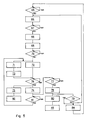
- the operating diagram of the unit is given in the figure 5 in the form of a block diagram.
- the different stations of the robotic unit operate by successive simultaneous phases. So after weighing the first fruit, the next fruit is weighed during the measurement of hardness of the previous fruit. The third fruit is weighed during the hardness measurement of the second fruit, simultaneously with the pressing the first fruit to extract the juice, etc.
- Acidity measurement takes place during the phases previous.
- the fruits of a sampling lot are selected and placed on the annular plate 13 at 65.
Landscapes
- Chemical & Material Sciences (AREA)
- Life Sciences & Earth Sciences (AREA)
- Health & Medical Sciences (AREA)
- Biochemistry (AREA)
- Food Science & Technology (AREA)
- Physics & Mathematics (AREA)
- Analytical Chemistry (AREA)
- Engineering & Computer Science (AREA)
- General Health & Medical Sciences (AREA)
- General Physics & Mathematics (AREA)
- Immunology (AREA)
- Pathology (AREA)
- Medicinal Chemistry (AREA)
- Chemical Kinetics & Catalysis (AREA)
- Sampling And Sample Adjustment (AREA)
- Investigating Or Analysing Materials By Optical Means (AREA)
Claims (17)
- Verfahren zur automatischen Analyse der physikalisch-chemischen Parameter einer Stichprobe von Früchten (25) mittels einer automatisierten Einheit (1), die einen programmierbaren Automaten (6) aufweist, den man mit einem Computer (2) verbindet, gekennzeichnet durch die folgenden Schritte:der Computer (2) gibt die Ergebnisse der Analyse und die organoleptischen Eigenschaften der Früchte an, die bestimmt werden durch:a) die Früchte eines Stichprobenloses werden auf schrittweise vorbeilaufende Aufnahmemitteln (13) aufgebracht;b) jede Frucht dieser Stichprobe wird gewogen (21), und die Meßwerte werden in den Speicher des Computers (2) eingegeben;c) die Härte der Früchte wird gemessen (26), und die Meßwerte werden in den Speicher des Computers (2) eingegeben;d) der Saft wird aus den Früchten der Stichprobe entzogen (35);e) der Gehalt des in den Früchten enthaltenen Zuckers wird mittels eines elektronischen Refraktometers (42) gemessen, und diese Meßwerte werden in den Speicher des Computers (2) eingegeben;f) die Gesamtheit des vorher entzogenen Safts wird gesammelt (47);g) die Gesamtheit des entzogenen Safts wird gewogen, und dieser Meßwert wird in den Speicher des Computers (2) eingegeben;h) parallel zum Schritt f) wird eine Teilmenge des entzogenen Safts gesammelt (44a);i) der Säuregehalt dieser Teilmenge des aus dem Stichprobenlos entzogenen Safts wird durch saure und basische Reaktion gemessen, und dieser Meßwert wird in den Speicher des Computers (2) eingegeben;das Verhältnis Gesamtgewicht der Früchte/Gesamtgewicht des entzogenen Safts,die mittlere Härte der Früchte,den mittleren Zuckergehalt,den mittleren Säuregehalt der Früchte.
- Automatisierte Einheit (1) zur Analyse der physikalischchemischen Parameter einer Stichprobe von Früchten (25), die einen mit einem Computer (2) verbundenen, programmierbaren Automaten (6) und Mittel (7) zur Steuerung der für den Betrieb dieser Einheit notwendigen Energien aufweist, dadurch gekennzeichnet, daß sie in Kombination enthält:und daß die in b), c), e), g) und i) durchgeführten Messungen in den Speicher des Computers (2) eingegeben werden, der diese Meßwerte mit den in seinen Speicher eingegebenen Parametern vergleicht und die Ergebnisse der Analyse und die organoleptischen Eigenschaften der Früchte angibt:a) schrittweise vorbeilaufende Mittel (13) zur Aufnahme der Früchte (25) eines Stichprobenloses;b) Mittel (21, 22) zum Wiegen jeder Frucht der Stichprobe;c) Mittel (26) zur Messung der Härte dieser Früchte;d) Mittel (35), um den Saft dieser Früchte zu entziehen;e) Mittel (42) zur Messung des Zuckergehalts des entzogenen Safts;f) Mittel (46, 47) zum Sammeln der Gesamtheit des entzogenen Safts;g) Mittel (51) zum Wiegen der Gesamtheit des entzogenen Safts;h) Mittel (43, 44a) zum Sammeln einer Teilmenge des entzogenen Safts;i) Mittel (58, 59, 62) zur Messung des Säuregehalts der Teilmenge des Safts, der aus dem Stichprobenlos entzogen wurde,das Verhältnis Gesamtgewicht der Früchte/Gesamtgewicht des entzogenen Safts,die mittlere Härte der Früchte,den mittleren Zuckergehalt,den mittleren Säuregehalt der Früchte.
- Automatisierte Einheit nach Anspruch 2, die ein Gestell (1b) und Mittel (6, 7) zur Steuerung der für den Betrieb der Einheit notwendigen Energien aufweist, dadurch gekennzeichnet, daß sie eine im wesentlichen waagrechte Platte (13) enthält, die drehbar am Gestell (1b) montiert ist und regelmäßig auf dem Umfang der Platte verteilte, kreisförmige Öffnungen (13a) aufweist, wobei die Platte von einem Getriebemotor (16) sequentiell um einen Umdrehungsabschnitt angetrieben wird, der dem zwei Öffnungen (13a) trennenden Kreisbogen entspricht, wobei der Durchmesser der Löcher kleiner ist als der der Früchte (25), so daß die auf der Platte angeordneten Früchte teilweise in die Öffnungen eingeführt bleiben, während sie auf ihre Analyse warten.
- Einheit nach einem beliebigen der Ansprüche 2 und 3, dadurch gekennzeichnet, daß die Platte (13) ringförmig und auf Rollen (14) drehbar montiert ist, die frei drehend auf dem Gestell angeordnet sind, daß die Platte der Einwirkung von Zentrierrollen (15) unterworfen ist, die an ihren Umfangsrand anliegen, und daß ihr Antrieb in Drehbewegung von einem Reibungsrad (15a) bewirkt wird, das der Einwirkung von elastischen Mitteln (17) unterworfen und auf der Ausgangswelle des sequentiellen Getriebemotors (16) befestigt ist.
- Einheit nach einem beliebigen der Ansprüche 3 und 4, dadurch gekennzeichnet, daß die Platte (13) einen Anwesenheitsdetektor (18) für die Öffnungen (13a) besitzt, welcher einem einziehbaren Blockierfinger (19) zugeordnet ist, der sich auf der Strecke der Öffnungen befindet, wobei der Finger einen geringeren Querschnitt aufweist als die Löcher (13a), damit er in sie eindringen und die Platte (13) sequentiell in einer genauen Position anhalten kann.
- Einheit nach einem beliebigen der Ansprüche 2 bis 5, dadurch gekennzeichnet, daß die Mittel zum Wiegen jeder Frucht aus einem Anwesenheitsdetektor (24) für die Früchte bestehen, der einer einziehbaren Schale (22) mit einem kleineren Durchmesser als dem der Öffnungen (13a) der Platte zugeordnet ist und der sich auf der Strecke der Öffnungen befindet, wobei die Schale (22) von einer mit dem Computer (2) verbundenen Kraftmeßsonde (21) getragen wird und der Einwirkung von Mitteln (23) unterworfen ist, die sie in die Öffnungen eindringen lassen, um sequentiell und synchron mit dem Betrieb der Platte (13) eine Frucht der Stichprobe zum Zweck ihres Wiegens anzuheben.
- Einheit nach einem beliebigen der Ansprüche 2 bis 6, dadurch gekennzeichnet, daß die Mittel zur Messung der Härte der Früchte aus Mitteln (30, 31 32) zum sequentiellen Blokkieren jeder Frucht synchron mit den anderen Organen der Einheit und aus einem mit einer mit dem Computer (2) verbundenen Kraftmeßsonde (28) gekoppelten Penetrometer (26) bestehen, dessen Dorn (27) synchron betätigt wird, um in die Frucht einzudringen.
- Einheit nach Anspruch 7, dadurch gekennzeichnet, daß die Mittel zur Messung der Härte der Früchte aus einer ersten, ortsfesten, fest mit dem Gestell (1b) verbundenen Schale (30), die oberhalb der Platte und auf der Strecke der Öffnungen (13a) angeordnet ist, vor der nacheinander die Öffnungen der Platte (13) stehenbleiben, und einer zweiten, einziehbaren Schale (31) koaxial zur ersten Schale (30) bestehen, wobei die konkaven Seiten dieser Schalen (30, 31) einander gegenüberliegen; daß die zweite Schale (31) einen kleineren Durchmesser hat als die Öffnungen (13a) und von Teleskopmitteln (32, 33) betätigt wird, die sich unterhalb der Platte (13) befinden, um sie die Öffnungen (13a) nacheinander durchqueren und die Frucht (25) unabhängig von ihrer Dicke, in Anlage an die erste Schale (30) bringen zu lassen, die ein zentrales Loch (30a) aufweist, das der Dorn (27) des Penetrometers (26) durchdringt.
- Einheit nach einem beliebigen der Ansprüche 2 bis 8, dadurch gekennzeichnet, daß sie im rechten Winkel zur Achse des Penetrometers (26) einen Auswerfer (34) für die Früchte aufweist, die die Härte-Meßstation (26) durchlaufen haben, wobei dieser Auswerfer (34) parallel zur Platte (13) liegt und zwischen der Platte und der ersten, ortsfesten Schale (30) des Penetrometers angeordnet ist.
- Einheit nach einem beliebigen der Ansprüche 8 und 9, dadurch gekennzeichnet, daß die Teleskopmittel der zweiten Schale (31) aus zwei übereinanderliegenden Zylindern (32, 33) bestehen, von denen (32) einer die Funktion hat, die Schale (31) zu bewegen, um die Frucht an die erste, ortsfeste Schale (30) in Anlage zu bringen, und der andere Zylinder (33) zur Aufgabe hat, die Schale (31) kurzzeitig über der Platte (13) anzuhalten, um die Frucht im wesentlichen in das Wirkungsfeld des Auswerfers (34) zu bringen und sie von der Platte (13) zum Mittel (35) für den Saftentzug zu transportieren.
- Einheit nach einem beliebigen der Ansprüche 7 bis 10, dadurch gekennzeichnet, daß das Ende (27a) des Dorns (27) des Penetrometers (26) eine konkave Ausbildung (27a1) besitzt, die von einem zugespitzten peripheren Rand begrenzt wird, um die Haut der Frucht vor dem Eindringen des Dorns in das Fruchtfleisch zu zerschneiden.
- Einheit nach einem beliebigen der Ansprüche 2 bis 11, dadurch gekennzeichnet, daß die Mittel für den Entzug des Safts aus den Früchten aus einer Presse (35) bestehen, die im wesentlichen waagrecht und unterhalb der Platte (13) angeordnet ist, wobei diese Presse eine seitliche Öffnung (36a) aufweist, um die von der Platte (13) ausgeworfenen Früchte (25) aufzunehmen.
- Einheit nach Anspruch 12, dadurch gekennzeichnet, daß die Presse (35) aus einem an seinen Enden offenen Zylinderrohr (36) besteht, dessen Wand eine Öffnung (36a) für die Einführung der Früchte (25) mittels Schwerkraft aufweist, wobei in dieses Zylinderrohr ein Kolben (37) montiert ist, der an der beweglichen Stange (38a) eines Zylinders (38) mit doppelter Wirkung befestigt ist, um den Kolben (37) über die Länge des Zylinderrohrs zu bewegen, wobei das Zylinderrohr (36) an die bewegliche Stange eines Zylinders (40) mit doppelter Wirkung gekoppelt ist, dessen Körper am Gestell (1b) befestigt ist und dessen Stange die Funktion hat, das Zylinderrohr (36) gegen einen am Gestell befestigten Amboß (39) anzulegen und es von diesem zu entfernen, damit die Trockenmasse der Frucht durch Schwerkraft herunterfällt, nachdem der Saft unter dem vom Kolben (37) auf die am Amboß (39) anliegende Frucht ausgeübten Druck entzogen wurde, wobei am Amboß eine Abflußrohrleitung (41) für den Saft befestigt ist.
- Einheit nach einem beliebigen der Ansprüche 2 bis 13, bei der der von diesem Amboß (39) kommende Saft von einer ersten Rohrleitung (41) kanalisiert wird, um zur Messung des Zuckergehalts durch ein Refraktormeter (42) zu fließen, und dann den Saft in ein sogenanntes Gesamtausbeute-Auffanggefäß (47) zu leiten, dadurch gekennzeichnet, daß sie weiter stromaufwärts vor dem Refraktometer (42) eine T-Röhre (43) besitzt, deren mit der ersten Rohrleitung (41) verbundenes Hauptrohr (43a) stromabwärts zum Refraktometer (42) geneigt ist und deren Ableitrohr (43b) sich unterhalb des Hauptrohrs befindet und an eine zweite Rohrleitung (44) angeschlossen ist, die in einem zweiten, sogenannten Teilausbeute-Auffanggefäß mündet, wobei die zweite Rohrleitung (44) ein erstes Ventil (48), das auf der Seite der T-Röhre (43) angeordnet ist, um in der geschlossenen Stellung des Ventils eine Stichprobe des Safts jeder Frucht des Loses aufzunehmen, und ein zweites Ventil (49) aufweist, das stromabwärts hinter dem ersten Ventil angeordnet ist, um in der geschlossenen Stellung dieses zweiten Ventils die Gesamtheit der Stichproben des Safts der Früchte eines Stichprobenloses aufzunehmen.
- Einheit nach Anspruch 14, dadurch gekennzeichnet, daß die Auffanggefäße für die Gesamtausbeute (47) und die Teilausbeute (45) je auf einer Kraftmeßsonde (50, 51) sitzen, die am Gestell befestigt und mit dem Computer (2) verbunden ist.
- Einheit nach einem beliebigen der Ansprüche 14 und 15, dadurch gekennzeichnet, daß sie eine Rohrleitung (60), die aus dem eine Base enthaltenden Tank kommt und in das zweite Auffanggefäß (45) der Teilausbeute mündet, an welcher Rohrleitung ein Ventil (59) eingesetzt ist, das mit Steuermitteln verbunden ist, um in das Gefäß (45) Dosen dieser Base zu liefern, einen Rührer (58) und eine mit dem Computer (2) verbundene pH-Wert-Meßsonde (62) besitzt.
- Einheit nach einem beliebigen der Ansprüche 14 bis 16, dadurch gekennzeichnet, daß das Dosierventil (59) für die Base, der Rührer (58) und die Meßsonde (62) auf einem senkrecht beweglichen und von einem Zylinder (55) mit doppelter Wirkung betätigten Arm (54) angeordnet sind, um die Sonde (62) und den Rührer (58) in das Gefäß (45) für die Teilausbeute einzuführen oder sie daraus zu entfernen, um die Entfernung des Gefäßes (47) für die Gesamtausbeute und des Gefäßes (45) für die Teilausbeute zum Zweck ihrer periodischen Reinigung zu ermöglichen.
Applications Claiming Priority (2)
| Application Number | Priority Date | Filing Date | Title |
|---|---|---|---|
| FR9206802 | 1992-05-29 | ||
| FR9206802A FR2691805B1 (fr) | 1992-05-29 | 1992-05-29 | Procédé et unité pour analyser automatiquement les paramètres physico-chimiques sur un échantillonnage de fruits ou similaire. |
Publications (3)
| Publication Number | Publication Date |
|---|---|
| EP0572341A2 EP0572341A2 (de) | 1993-12-01 |
| EP0572341A3 EP0572341A3 (de) | 1993-12-22 |
| EP0572341B1 true EP0572341B1 (de) | 1998-10-14 |
Family
ID=9430450
Family Applications (1)
| Application Number | Title | Priority Date | Filing Date |
|---|---|---|---|
| EP19930430006 Expired - Lifetime EP0572341B1 (de) | 1992-05-29 | 1993-04-23 | Verfahren und Einheit zur automatischen Analyse der physikalisch-chemischen Parameter einer Stichprobe von Früchten |
Country Status (4)
| Country | Link |
|---|---|
| EP (1) | EP0572341B1 (de) |
| DE (1) | DE69321517T2 (de) |
| ES (1) | ES2124776T3 (de) |
| FR (1) | FR2691805B1 (de) |
Families Citing this family (3)
| Publication number | Priority date | Publication date | Assignee | Title |
|---|---|---|---|---|
| ES2365345B1 (es) * | 2010-01-21 | 2012-06-04 | Cano Marchal Europa, S.L. | Sistema automático de medida del rendimiento graso de aceitunas. |
| US9500633B2 (en) * | 2014-11-18 | 2016-11-22 | Charles L. Mohr | Automated machine and method for fruit testing |
| AU2021396608A1 (en) * | 2020-12-11 | 2023-06-29 | All Citrus S.R.L. | Method, computer program, computer system and assembly for the non-destructive determination of the juice content of juice fruits, as well as the use of this assembly for the quality classification of juice fruits |
Family Cites Families (4)
| Publication number | Priority date | Publication date | Assignee | Title |
|---|---|---|---|---|
| US3773172A (en) * | 1972-03-21 | 1973-11-20 | Research Corp | Blueberry sorter |
| FR2528332B1 (fr) * | 1982-06-11 | 1987-03-06 | Giraud Charles | Dispositif pour selectionner en continu des fruits, en fonction de leur teneur en sucre |
| GB8702734D0 (en) * | 1987-02-06 | 1987-03-11 | Unilever Plc | Analysis |
| DE3720733A1 (de) * | 1987-03-31 | 1988-10-13 | Lufthansa Service Gmbh | Verfahren zur mikrobiologischen untersuchung von proben |
-
1992
- 1992-05-29 FR FR9206802A patent/FR2691805B1/fr not_active Expired - Lifetime
-
1993
- 1993-04-23 ES ES93430006T patent/ES2124776T3/es not_active Expired - Lifetime
- 1993-04-23 EP EP19930430006 patent/EP0572341B1/de not_active Expired - Lifetime
- 1993-04-23 DE DE1993621517 patent/DE69321517T2/de not_active Expired - Fee Related
Also Published As
| Publication number | Publication date |
|---|---|
| EP0572341A2 (de) | 1993-12-01 |
| FR2691805A1 (fr) | 1993-12-03 |
| ES2124776T3 (es) | 1999-02-16 |
| EP0572341A3 (de) | 1993-12-22 |
| DE69321517D1 (de) | 1998-11-19 |
| DE69321517T2 (de) | 1999-03-18 |
| FR2691805B1 (fr) | 1994-11-04 |
Similar Documents
| Publication | Publication Date | Title |
|---|---|---|
| EP1976636B1 (de) | Einheitenküvette zur analyse eines biologischen fluids und automatische vorrichtung zur in-vitro-analyse | |
| BE1001048A5 (fr) | Instrument automatise pour analyse d'echantillon de patient. | |
| EP1086363B1 (de) | Automatische analysevorrichtung, zur feststellung der blutkoagulationszeit anwendbar | |
| FR2478318A1 (fr) | Procede et dispositif pour l'examen d'echantillons biologiques | |
| CH650594A5 (fr) | Dispositif d'alimentation en echantillon pour appareil d'analyse. | |
| CA2889536A1 (fr) | Dispositif d'analyse pour diagnostic in vitro | |
| EP2066261A1 (de) | Gerät zum befüllen von strohhalmen zur künstlichen befruchtung mit samen | |
| EP0187093A1 (de) | Automatischer Regenmesser | |
| CN204078781U (zh) | 一种不对称容器阵列装置 | |
| EP1353155B1 (de) | Verfahren und Vorrichtung zum fortlaufenden Wiegen von Gegenständen und eine entsprechende Einrichtung zum Kalibrieren von zweischaligen Seetieren | |
| EP0572341A2 (de) | Verfahren und Vorrichtung zur automatischen Analyse der physisch-chemischen Parameter einer Probe von Früchten oder ähnlichen | |
| FR2552398A1 (fr) | Machine pour calibrer et emballer automatiquement des fruits ou legumes ronds | |
| CN113418756B (zh) | 一种食品安全谷物采样检测系统 | |
| FR2493683A1 (fr) | Installation de controle d'echantillons de filtres a cigarettes | |
| CN218674295U (zh) | 农产品取样检测装置 | |
| CN211856348U (zh) | 一种农产品质量安全快速无损检测设备 | |
| JP2003232728A (ja) | 計測時間を短縮した成分分析方法並びにこれを実施する成分分析装置 | |
| EP0478467A1 (de) | Einrichtung für Handhabung und Kalibrierung von Artikeln, namentlich Schalentiere und insbesondere Austern | |
| FR2726653A1 (fr) | Dispositif pour la collecte ou la distribution d'echatillons liquides | |
| BE1017642A3 (fr) | Procede de mesure des qualites rheologiques des pates fermentantes ou azymes a base de farine et dispositif pour sa mise en oeuvre. | |
| EP0129630A1 (de) | Einrichtung zum durchgehenden Auswählen von Früchten nach ihrem Zuckergehalt | |
| EP0543722B1 (de) | Verfahren und Vorrichtung zum Messen der Laccase-Aktivität in Most mit Hilfe des Syringaldazin-Tests | |
| FR2522822A1 (fr) | Procede et machine automatique de controle de la qualite bacteriologique d'un liquide contenu dans un recipient | |
| CN112180054B (zh) | 一种果蔬农残快速检测装置 | |
| FR2609168A1 (fr) | Procede et dispositif de dosage d'echantillons liquides |
Legal Events
| Date | Code | Title | Description |
|---|---|---|---|
| PUAI | Public reference made under article 153(3) epc to a published international application that has entered the european phase |
Free format text: ORIGINAL CODE: 0009012 |
|
| PUAL | Search report despatched |
Free format text: ORIGINAL CODE: 0009013 |
|
| AK | Designated contracting states |
Kind code of ref document: A2 Designated state(s): CH DE ES GB IT LI NL |
|
| AK | Designated contracting states |
Kind code of ref document: A3 Designated state(s): CH DE ES GB IT LI NL |
|
| 17P | Request for examination filed |
Effective date: 19940324 |
|
| 17Q | First examination report despatched |
Effective date: 19970218 |
|
| GRAG | Despatch of communication of intention to grant |
Free format text: ORIGINAL CODE: EPIDOS AGRA |
|
| GRAG | Despatch of communication of intention to grant |
Free format text: ORIGINAL CODE: EPIDOS AGRA |
|
| GRAH | Despatch of communication of intention to grant a patent |
Free format text: ORIGINAL CODE: EPIDOS IGRA |
|
| GRAH | Despatch of communication of intention to grant a patent |
Free format text: ORIGINAL CODE: EPIDOS IGRA |
|
| GRAH | Despatch of communication of intention to grant a patent |
Free format text: ORIGINAL CODE: EPIDOS IGRA |
|
| GRAA | (expected) grant |
Free format text: ORIGINAL CODE: 0009210 |
|
| AK | Designated contracting states |
Kind code of ref document: B1 Designated state(s): CH DE ES GB IT LI NL |
|
| REG | Reference to a national code |
Ref country code: CH Ref legal event code: EP |
|
| GBT | Gb: translation of ep patent filed (gb section 77(6)(a)/1977) |
Effective date: 19981023 |
|
| REF | Corresponds to: |
Ref document number: 69321517 Country of ref document: DE Date of ref document: 19981119 |
|
| REG | Reference to a national code |
Ref country code: CH Ref legal event code: NV Representative=s name: BOVARD AG PATENTANWAELTE |
|
| REG | Reference to a national code |
Ref country code: ES Ref legal event code: FG2A Ref document number: 2124776 Country of ref document: ES Kind code of ref document: T3 |
|
| PLBE | No opposition filed within time limit |
Free format text: ORIGINAL CODE: 0009261 |
|
| STAA | Information on the status of an ep patent application or granted ep patent |
Free format text: STATUS: NO OPPOSITION FILED WITHIN TIME LIMIT |
|
| 26N | No opposition filed | ||
| REG | Reference to a national code |
Ref country code: GB Ref legal event code: IF02 |
|
| PGFP | Annual fee paid to national office [announced via postgrant information from national office to epo] |
Ref country code: NL Payment date: 20090318 Year of fee payment: 17 Ref country code: DE Payment date: 20090414 Year of fee payment: 17 |
|
| PGFP | Annual fee paid to national office [announced via postgrant information from national office to epo] |
Ref country code: CH Payment date: 20090415 Year of fee payment: 17 |
|
| PGFP | Annual fee paid to national office [announced via postgrant information from national office to epo] |
Ref country code: GB Payment date: 20090407 Year of fee payment: 17 |
|
| REG | Reference to a national code |
Ref country code: NL Ref legal event code: V1 Effective date: 20101101 |
|
| REG | Reference to a national code |
Ref country code: CH Ref legal event code: PL |
|
| GBPC | Gb: european patent ceased through non-payment of renewal fee |
Effective date: 20100423 |
|
| PG25 | Lapsed in a contracting state [announced via postgrant information from national office to epo] |
Ref country code: NL Free format text: LAPSE BECAUSE OF NON-PAYMENT OF DUE FEES Effective date: 20101101 |
|
| PG25 | Lapsed in a contracting state [announced via postgrant information from national office to epo] |
Ref country code: LI Free format text: LAPSE BECAUSE OF NON-PAYMENT OF DUE FEES Effective date: 20100430 Ref country code: DE Free format text: LAPSE BECAUSE OF NON-PAYMENT OF DUE FEES Effective date: 20101103 Ref country code: CH Free format text: LAPSE BECAUSE OF NON-PAYMENT OF DUE FEES Effective date: 20100430 |
|
| PG25 | Lapsed in a contracting state [announced via postgrant information from national office to epo] |
Ref country code: GB Free format text: LAPSE BECAUSE OF NON-PAYMENT OF DUE FEES Effective date: 20100423 |
|
| PGFP | Annual fee paid to national office [announced via postgrant information from national office to epo] |
Ref country code: ES Payment date: 20110426 Year of fee payment: 19 |
|
| PGFP | Annual fee paid to national office [announced via postgrant information from national office to epo] |
Ref country code: IT Payment date: 20110430 Year of fee payment: 19 |
|
| PG25 | Lapsed in a contracting state [announced via postgrant information from national office to epo] |
Ref country code: IT Free format text: LAPSE BECAUSE OF NON-PAYMENT OF DUE FEES Effective date: 20120423 |
|
| REG | Reference to a national code |
Ref country code: ES Ref legal event code: FD2A Effective date: 20130715 |
|
| PG25 | Lapsed in a contracting state [announced via postgrant information from national office to epo] |
Ref country code: ES Free format text: LAPSE BECAUSE OF NON-PAYMENT OF DUE FEES Effective date: 20120424 |