EP0571514B1 - Esophageal-stomach displacement electrode - Google Patents
Esophageal-stomach displacement electrode Download PDFInfo
- Publication number
- EP0571514B1 EP0571514B1 EP92906527A EP92906527A EP0571514B1 EP 0571514 B1 EP0571514 B1 EP 0571514B1 EP 92906527 A EP92906527 A EP 92906527A EP 92906527 A EP92906527 A EP 92906527A EP 0571514 B1 EP0571514 B1 EP 0571514B1
- Authority
- EP
- European Patent Office
- Prior art keywords
- tube
- stomach
- electrode
- distal end
- esophageal
- Prior art date
- Legal status (The legal status is an assumption and is not a legal conclusion. Google has not performed a legal analysis and makes no representation as to the accuracy of the status listed.)
- Expired - Lifetime
Links
Images


Classifications
-
- A—HUMAN NECESSITIES
- A61—MEDICAL OR VETERINARY SCIENCE; HYGIENE
- A61N—ELECTROTHERAPY; MAGNETOTHERAPY; RADIATION THERAPY; ULTRASOUND THERAPY
- A61N1/00—Electrotherapy; Circuits therefor
- A61N1/02—Details
- A61N1/04—Electrodes
- A61N1/05—Electrodes for implantation or insertion into the body, e.g. heart electrode
- A61N1/0517—Esophageal electrodes
-
- A—HUMAN NECESSITIES
- A61—MEDICAL OR VETERINARY SCIENCE; HYGIENE
- A61N—ELECTROTHERAPY; MAGNETOTHERAPY; RADIATION THERAPY; ULTRASOUND THERAPY
- A61N1/00—Electrotherapy; Circuits therefor
- A61N1/02—Details
- A61N1/04—Electrodes
- A61N1/05—Electrodes for implantation or insertion into the body, e.g. heart electrode
- A61N1/0551—Spinal or peripheral nerve electrodes
Definitions
- This invention relates to esophageal electrodes and, more particularly, comprises such an electrode that may be inserted down a patient's esophagus and into the stomach with a portion of the electrode in contact with the stomach wall in a position most favourable for electrically stimulating the ventricle of the heart in cooperation with an external electrode placed on the patient's chest.
- esophageal electrodes are used for such purposes as defibrillating and pacing the heart as well as for stimulating breathing. Examples of the use of esophageal electrodes in such procedures are shown in several United States patents including Nos. 4574807, 4683890, 4735206 and 4960133. An esophageal electrode may also be used as an ECG pickup. Those patents and applications are herein incorporated by reference. Many of these procedures may be substantially enhanced and facilitated if the electrode is capable of being moved close to the organ of the body being treated such as the ventricles of the heart.
- the technique described in the above identified patents and applications relating to pacing and/or defibrillation may be made more efficient if the electrode is positioned as close to the ventricle of the heart as possible. The closer the electrode is to the ventricle, the less electrical energy is needed to perform the pacing or defibrillating functions, and the more confident the attendant may be that the current flow between the internal and external electrodes is along the desired path.
- One conventional device includes a semi-rigid plastic tube that may be inserted either orally or nasally into the esophagus.
- the tube carries an electrode at its distal end and has a mechanism incorporated into it which enables the user to cause the distal end of the tube to bend and press against the wall of the esophagus.
- the mechanism is of sufficient strength to cause the esophagus to displace under the pushing force of the electrode.
- the tube is crimped so as to define a hinge at the distal region of the tube.
- the mechanism for deflecting the distal end of the tube includes a rigid pin having a cord connected at each end and which is aligned generally parallel to the axis of the tube and positioned at the distal portion thereof in the vicinity of the hinge.
- One core attached to the proximal end of the pin extends out the proximal end of the tube, while the other cord attached to the distal end of the pin extends through a port located distally of the hinge in the tube and re-enters the tube though a second port proximal of the hinge and then extends out the proximal end of the tube.
- an esophageal placement electrode comprising a flexible hollow tube having a longitudinal axis and proximal and distal ends for insertion through an esophagus of a patient into a stomach such that the distal end extends to a region proximate the ventricles of the patient's heart and the proximal end is disposed externally of the patient, an electrode carried by the tube at its distal end, displacement means to enable the distal end of the tube to be deflected with respect to the tube axis so as to position the electrode proximate to a wall of the stomach adjacent to the ventricles of the heart, whereby longitudinal displacement of the tube in a proximal direction displaces the stomach wall to position the electrode immediately adjacent to the ventricles of the heart and a control mechanism located at the proximal end of the tube for controlling operation of the displacement means.
- the present invention is directed to an esophageal-stomach electrode to achieve greater efficiency in the performance of such procedures.
- An esophageal/stomach placement electrode is characterised in that the displacement means includes a hinge in the tube to enable the distal end to be bent back on itself in response to the operation of the control mechanism.
- a thin semi-rigid plastic tube with the electrode on the distal end is used, and is of sufficient length to be passed down the esophagus into the stomach.
- the mechanism incorporated into the tube may enable the user to cause the distal end of the tube to bend back on itself preferably by about 135 degrees from its original position. The user then withdraws the electrode until the bent back section of the distal end impacts on the stomach wall and places the stomach wall toward the heart. This action places the electrode in its operative position closest to the ventricle of the heart so as to co-operate with an external electrode on the chest to impress a pulse upon the heart.
- the bent back section of the distal end also prohibits further withdrawal of the electrode.
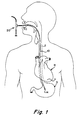
- FIG. 1 the torso and head of a patient are shown along with the patient's heart H, esophagus E and stomach S.
- the stomach is located posterior and spaced from the ventricle V.
- the esophageal-stomach displacement electrode shown extends through the patient's mouth, through the esophagus and into the stomach with its distal end located relatively close to the ventricle V.
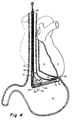
- the present invention enables the distal end of the esophageal-stomach displacement electrode to displace angularly within the stomach and subsequently be pulled slightly back out of the esophagus, or alternatively, further angularly displaced, upwardly into pressurized contact with the stomach wall to position the wall closer than normal to the heart (see FIG. 4) and thereby place the stomach placement electrode in closer proximity to it. This is illustrated in FIGs. 2, 3 and 4.
- the electrode includes a semi-rigid plastic tube 10 made of nylon or other suitable material which may be approximately 508mm (20 inches) long and approximately 4.8mm (3/16-inch) in diameter.
- the tube should be semi-rigid, much like a gastric tube, and be relatively torque free.
- the distal end 12 of the tube carries an electrode 14, preferably spherical in shape and having a stem 16 that fits within the distal end of the tube.
- the electrode may be pressed in place or suitably fastened by other means.
- the electrode 14 is 6.35mm (1/4-inch) in diameter, which just exceeds the diameter of the tube 10 so that the ball will make positive contact with the stomach wall when the distal end 12 of the tube is displaced.
- the distal end 12 may then be further displaced or the complete electrode pulled back out of the esophagus to cause a bulge 50 (FIG. 4) in the stomach wall to place the wall and the electrode 14 closer to heart ventricle V. At this point, the electrode is prevented from further displacement by resistance of the stomach wall.
- the tube 10 is carried by a control mechanism 20 shown in FIG. 4 which is connected to a displacement mechanism 22 disposed in the tube.
- the control mechanism is located at the proximal end of the tube outside the mouth when the osephageal-stomach displacement electrode is placed in the stomach as shown in FIG. 1.
- the tube 10 is crimped as suggested at 26 in FIGS. 2, 3 and 4 so as to form a hinge 27 in the tube, which enables it to bend readily at that point.
- ports 28 and 30 are formed on opposite sides of the hinge 27, each spaced approximately 25.4mm (1 inch) therefrom. While in the embodiment shown, each of the two ports is approximately one inch from the crimp 26, that dimension as well as others given may be varied to suit the particular application, as is more fully described below.
- a rigid pin is disposed in the tube 10 and extends generally parallel to the tube axis.
- the pin may be made of metal, rigid plastic, or any other material having sufficient rigidity to prevent the tube 10 from bending at the crimped area 26 when the pin spans the hinge.
- a pair of cords 34 and 36 are connected to the proximal and distal ends 38 and 40, respectively, of pin 32 and extend proximally in the tube 10 out its proximal end 42 and into the control mechanism 20.
- Cord 34 extends directly from the proximal end of the pin 32 within the tube 10 to the control mechanism 20, while cord 36 extends from the distal end 40 of the pin, out the tube 10 through port 28 and from that point it extends proximally externally of the tube, spanning the crimped portion 26 to the port 30 where the cord reenters the tube 10 and extends in the tube to the control mechanism 20.
- the location of the pin 32 may readily be changed by pulling one or the other of the cords 34 or 36 in a proximal direction.
- Pin 32 is somewhat shorter than the distance between the crimped portion 26 of the tube and the lower port 28. Travel of the pin 32 in the tube 10 in a distal direction is limited by the location of port 28. The size of pin 32 is such that it cannot be drawn through port 28 and, therefore, when the pin 32 reaches its lowermost point and a continued pull is exerted on cord 36, the distal portion of the tube 10 is caused to deflect (in this example approximately 135°) from the position shown in FIG. 2 to that shown in FIG. 3. At this point the tube must still be further deflected or pulled back out of the stomach to place it into pressurized contact with the stomach wall to cause a bulge 50 as shown in FIG. 4.
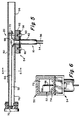
- the control mechanism 20 shown in FIG. 5 is connected to the distal ends of the cords 34 and 36 to operate the displacement mechanism 22 by taking up one cord and playing out the other.
- the control mechanism 20 includes a sleeve 50, rectangular in cross-section in the embodiment shown, and containing a slide 52.
- a bracket 54 is secured to the bottom wall 56 of sleeve 50 and retains the proximal end 42 of tube 10 in place.
- the bracket 54 includes a bar 62 and clamping plate 58 that sandwich the tube end, and the plate 58 is secured to the bar 62 by screws 60.
- the cords 34 and 36 enter the sleeve 50 through a port 64 in bottom wall 56, aligned with the proximal end 42 of the tube 10 when the tube is secured to the bracket 54.
- the proximal ends 66 and 68 of the cords are respectively connected to flanges 70 and 72 carried by the slide 52.
- slide 52 is shown in the position that places the pin 32 in the tube in the position shown in FIG. 2.
- the pin 32 moves to its lowermost position in tube 10 and the tube is deflected, as shown in FIG. 3.
- the slide 52 is generally U-shaped with an opening 74 in its bottom wall 76 that rests upon the bottom wall 56 of sleeve 50, movement of the slide 52 in the sleeve 50 does not in any way interfere with the movement of the cords 34 and 36 in response to displacement of the slide.
- the electrode typically may be used in the following manner. Assume that the electrode is part of a pacing mechanism as shown in Patent No. 4,735,206, supra .
- the tube 10 is inserted into the esophagus either through the mouth or the nasal passage to a depth wherein the electrode 14 is disposed out the lower end of the esophagus into the stomach at a depth sufficient to enable displacement of the tube's distal end 12 to approximately 135 degrees from its straighten or insertion position as shown in FIG. 3.
- the external electrode also forming part of the pacer is mounted on the chest of the patient and the controls, etc. are properly set. In order to reduce the amount of electrical energy required to effect pacing, the operator moves the slide 52 to the right as shown in FIG.
- the present invention provides a very convenient means of enabling an operator to place the esophageal-stomach placement electrode very close to the heart or other organ by means of a noninvasive procedure and thereby reduce the energy required to carry out the particular procedure such as pacing or defibrillation upon the patient.
- a specific embodiment is shown in the drawings, modifications may be made thereof without departing from this invention.
- a pin is shown as applying the bending force to the interior of the tube, other configurations for the device may be employed.
- any structure which will not pass through the lower port 28 and will not interfere with the action of the binge 27 will cause the tube 10 to deflect when the cord attached to it and exiting the tube though the port is tensioned. It should, if necessary, also stiffen the hinge portion of the tube when it is being inserted in the esophagus and stomach.
- the member which applies the bending force must be capable of moving freely in the tube under the operation of the control 20 so as to be readily movable in response to the actuation of the control.
- the tube 10 could, of course, carry more than one electrode. For example, in the earlier patents, supra, a number of spaced contact rings are shown carded by the tube.
Landscapes
- Health & Medical Sciences (AREA)
- Cardiology (AREA)
- Heart & Thoracic Surgery (AREA)
- Engineering & Computer Science (AREA)
- Biomedical Technology (AREA)
- Nuclear Medicine, Radiotherapy & Molecular Imaging (AREA)
- Radiology & Medical Imaging (AREA)
- Life Sciences & Earth Sciences (AREA)
- Animal Behavior & Ethology (AREA)
- General Health & Medical Sciences (AREA)
- Public Health (AREA)
- Veterinary Medicine (AREA)
- Electrotherapy Devices (AREA)
- Measurement And Recording Of Electrical Phenomena And Electrical Characteristics Of The Living Body (AREA)
Applications Claiming Priority (3)
| Application Number | Priority Date | Filing Date | Title |
|---|---|---|---|
| US07/654,227 US5197491A (en) | 1990-09-28 | 1991-02-12 | Esophageal-stomach displacement electrode |
| PCT/US1992/001066 WO1992013593A1 (en) | 1991-02-12 | 1992-02-10 | Esophageal-stomach displacement electrode |
| US654227 | 2003-09-03 |
Publications (3)
| Publication Number | Publication Date |
|---|---|
| EP0571514A1 EP0571514A1 (en) | 1993-12-01 |
| EP0571514A4 EP0571514A4 (en) | 1996-01-03 |
| EP0571514B1 true EP0571514B1 (en) | 2000-04-12 |
Family
ID=24623993
Family Applications (1)
| Application Number | Title | Priority Date | Filing Date |
|---|---|---|---|
| EP92906527A Expired - Lifetime EP0571514B1 (en) | 1991-02-12 | 1992-02-10 | Esophageal-stomach displacement electrode |
Country Status (7)
| Country | Link |
|---|---|
| US (1) | US5197491A (enExample) |
| EP (1) | EP0571514B1 (enExample) |
| JP (1) | JPH06505180A (enExample) |
| CA (1) | CA2103563A1 (enExample) |
| DE (1) | DE69230909T2 (enExample) |
| IL (1) | IL100895A (enExample) |
| WO (1) | WO1992013593A1 (enExample) |
Cited By (1)
| Publication number | Priority date | Publication date | Assignee | Title |
|---|---|---|---|---|
| WO2022106844A1 (en) * | 2020-11-19 | 2022-05-27 | Phagenesis Limited | Devices, systems, and methods for treating disease using electrical stimulation |
Families Citing this family (73)
| Publication number | Priority date | Publication date | Assignee | Title |
|---|---|---|---|---|
| US5360441A (en) | 1992-10-30 | 1994-11-01 | Medtronic, Inc. | Lead with stylet capture member |
| US5626618A (en) * | 1993-09-24 | 1997-05-06 | The Ohio State University | Mechanical adjunct to cardiopulmonary resuscitation (CPR), and an electrical adjunct to defibrillation countershock, cardiac pacing, and cardiac monitoring |
| US6438400B1 (en) | 1993-12-06 | 2002-08-20 | Heska Corporation | Electrode for evaluating cardiac functions via esophagus |
| US6266549B1 (en) | 1993-12-06 | 2001-07-24 | Heska Corporation | Apparatus and method for evaluating cardiac functions |
| US5474533A (en) * | 1994-04-11 | 1995-12-12 | The Ohio State University | Intrathoracic mechanical, electrical and temperature adjunct to cardiopulmonary cerebral resuscitation, shock, head injury, hypothermia and hyperthermia |
| US5716386A (en) * | 1994-06-27 | 1998-02-10 | The Ohio State University | Non-invasive aortic impingement and core and cerebral temperature manipulation |
| GB9422224D0 (en) * | 1994-11-03 | 1994-12-21 | Brain Archibald Ian Jeremy | A laryngeal mask airway device modified to detect and/or stimulate mescle or nerve activity |
| US5556425A (en) * | 1994-11-28 | 1996-09-17 | Brunswick Biomedical Technologies, Inc. | Esophageal/stomach placement electrode |
| US5690691A (en) * | 1996-05-08 | 1997-11-25 | The Center For Innovative Technology | Gastro-intestinal pacemaker having phased multi-point stimulation |
| US6464697B1 (en) * | 1998-02-19 | 2002-10-15 | Curon Medical, Inc. | Stomach and adjoining tissue regions in the esophagus |
| WO1999000057A1 (en) | 1997-06-27 | 1999-01-07 | Michigan Instruments, Inc. | Non-invasive aortic impingement |
| US6740082B2 (en) * | 1998-12-29 | 2004-05-25 | John H. Shadduck | Surgical instruments for treating gastro-esophageal reflux |
| US8666495B2 (en) | 1999-03-05 | 2014-03-04 | Metacure Limited | Gastrointestinal methods and apparatus for use in treating disorders and controlling blood sugar |
| US9101765B2 (en) | 1999-03-05 | 2015-08-11 | Metacure Limited | Non-immediate effects of therapy |
| US8467874B2 (en) * | 2000-04-11 | 2013-06-18 | The Board Of Regents Of The University Of Texas System | Gastrointestinal electrical stimulation |
| AU2001210798A1 (en) | 2000-04-11 | 2001-10-23 | The Board Of Regents Of The University Of Texas System | Gastrointestinal electrical stimulation |
| US6826428B1 (en) | 2000-04-11 | 2004-11-30 | The Board Of Regents Of The University Of Texas System | Gastrointestinal electrical stimulation |
| US8761903B2 (en) * | 2000-10-11 | 2014-06-24 | The Board Of Regents Of The University Of Texas | Gastrointestinal electrical stimulation |
| US7643887B2 (en) * | 2001-05-01 | 2010-01-05 | Intrapace, Inc. | Abdominally implanted stimulator and method |
| US7756582B2 (en) * | 2001-05-01 | 2010-07-13 | Intrapace, Inc. | Gastric stimulation anchor and method |
| US6535764B2 (en) * | 2001-05-01 | 2003-03-18 | Intrapace, Inc. | Gastric treatment and diagnosis device and method |
| US7702394B2 (en) | 2001-05-01 | 2010-04-20 | Intrapace, Inc. | Responsive gastric stimulator |
| US7979127B2 (en) * | 2001-05-01 | 2011-07-12 | Intrapace, Inc. | Digestive organ retention device |
| US7616996B2 (en) * | 2005-09-01 | 2009-11-10 | Intrapace, Inc. | Randomized stimulation of a gastrointestinal organ |
| US7020531B1 (en) | 2001-05-01 | 2006-03-28 | Intrapace, Inc. | Gastric device and suction assisted method for implanting a device on a stomach wall |
| US20080065169A1 (en) * | 2001-05-01 | 2008-03-13 | Intrapace, Inc. | Endoscopic Instrument for Engaging a Device |
| US7747322B2 (en) * | 2001-05-01 | 2010-06-29 | Intrapace, Inc. | Digestive organ retention device |
| US7689284B2 (en) * | 2001-05-01 | 2010-03-30 | Intrapace, Inc. | Pseudounipolar lead for stimulating a digestive organ |
| US20050143784A1 (en) * | 2001-05-01 | 2005-06-30 | Imran Mir A. | Gastrointestinal anchor with optimal surface area |
| US9668690B1 (en) | 2001-05-01 | 2017-06-06 | Intrapace, Inc. | Submucosal gastric implant device and method |
| ATE387891T1 (de) | 2003-01-31 | 2008-03-15 | Smith & Nephew Inc | Knorpelbehandlungssonde |
| US8066700B2 (en) * | 2003-01-31 | 2011-11-29 | Smith & Nephew, Inc. | Cartilage treatment probe |
| US20060070334A1 (en) * | 2004-09-27 | 2006-04-06 | Blue Hen, Llc | Sidewall plank for constructing a trailer and associated trailer sidewall construction |
| WO2006078958A2 (en) * | 2005-01-21 | 2006-07-27 | Virginia Technologies, Inc | Energy efficient therapeutic pulse generator system |
| EP1868679B1 (en) | 2005-02-17 | 2017-05-03 | MetaCure Limited | Non-immediate effects of therapy |
| US20090018606A1 (en) * | 2005-10-12 | 2009-01-15 | Intrapace, Inc. | Methods and Devices for Stimulation of an Organ with the Use of a Transectionally Placed Guide Wire |
| US7509175B2 (en) | 2006-08-03 | 2009-03-24 | Intrapace, Inc. | Method and devices for stimulation of an organ with the use of a transectionally placed guide wire |
| US12343530B2 (en) | 2006-05-18 | 2025-07-01 | Paras Holdings, Llc | Device and implantation system for electrical stimulation of biological systems |
| US9020597B2 (en) | 2008-11-12 | 2015-04-28 | Endostim, Inc. | Device and implantation system for electrical stimulation of biological systems |
| WO2007149588A2 (en) * | 2006-06-23 | 2007-12-27 | Amir Belson | Transesophageal implantation of cardiac electrodes |
| US20080004671A1 (en) * | 2006-06-28 | 2008-01-03 | Alza Corporation | Vagus nerve stimulation via orally delivered apparatus |
| US9724510B2 (en) | 2006-10-09 | 2017-08-08 | Endostim, Inc. | System and methods for electrical stimulation of biological systems |
| US20150224310A1 (en) | 2006-10-09 | 2015-08-13 | Endostim, Inc. | Device and Implantation System for Electrical Stimulation of Biological Systems |
| US11577077B2 (en) | 2006-10-09 | 2023-02-14 | Endostim, Inc. | Systems and methods for electrical stimulation of biological systems |
| US9345879B2 (en) | 2006-10-09 | 2016-05-24 | Endostim, Inc. | Device and implantation system for electrical stimulation of biological systems |
| US20090082827A1 (en) * | 2007-09-26 | 2009-03-26 | Cardiac Pacemakers, Inc. | Hinged anchors for wireless pacing electrodes |
| US20100087706A1 (en) * | 2008-09-30 | 2010-04-08 | Intrapace, Inc. | Lead Access |
| CN102348478A (zh) * | 2009-02-13 | 2012-02-08 | 内测公司 | 具有可移除把手的内镜钳 |
| AU2010232398B2 (en) * | 2009-04-03 | 2015-04-02 | Intrapace, Inc. | Feedback systems and methods for communicating diagnostic and/or treatment signals to enhance obesity treatments |
| US8934975B2 (en) | 2010-02-01 | 2015-01-13 | Metacure Limited | Gastrointestinal electrical therapy |
| DE212011100038U1 (de) | 2010-03-05 | 2012-07-17 | Endostim, Inc. | Vorrichtungs- und Implantationssystem für elektrische Stimulation von biologischen Systemen |
| US11717681B2 (en) | 2010-03-05 | 2023-08-08 | Endostim, Inc. | Systems and methods for treating gastroesophageal reflux disease |
| WO2012045030A2 (en) | 2010-10-01 | 2012-04-05 | Intrapace, Inc. | Feedback systems and methods to enhance obstructive and other obesity treatments, optionally using multiple sensors |
| EP2696792B8 (en) | 2011-04-14 | 2018-05-23 | Endostim, Inc. | Systems for treating gastroesophageal reflux disease |
| EP2744437B1 (en) | 2011-08-19 | 2020-12-09 | Cook Medical Technologies LLC | Ablation cap |
| WO2013028381A1 (en) | 2011-08-19 | 2013-02-28 | Cook Medical Technologies Llc | Cap for attachment to an endoscope |
| WO2013033673A1 (en) | 2011-09-02 | 2013-03-07 | Endostim, Inc. | Endoscopic lead implantation method |
| US9925367B2 (en) | 2011-09-02 | 2018-03-27 | Endostim, Inc. | Laparoscopic lead implantation method |
| CN104736197A (zh) | 2012-08-23 | 2015-06-24 | 恩多斯提姆公司 | 用于生物系统的电刺激的装置和植入系统 |
| US9526570B2 (en) | 2012-10-04 | 2016-12-27 | Cook Medical Technologies Llc | Tissue cutting cap |
| US9498619B2 (en) | 2013-02-26 | 2016-11-22 | Endostim, Inc. | Implantable electrical stimulation leads |
| US20140257240A1 (en) * | 2013-03-08 | 2014-09-11 | Spinal Modulation, Inc. | Articulable introducer sheath |
| WO2015034867A2 (en) | 2013-09-03 | 2015-03-12 | Endostim, Inc. | Methods and systems of electrode polarity switching in electrical stimulation therapy |
| GB2532044A (en) | 2014-11-06 | 2016-05-11 | Phagenesis Ltd | Catheter for recovery of dysphagia |
| EP3220999A2 (en) | 2014-11-17 | 2017-09-27 | Endostim, Inc. | Implantable electro-medical device programmable for improved operational life |
| GB201513989D0 (en) | 2015-08-07 | 2015-09-23 | Phagenesis Ltd | Method of diagnosis of dysphagia |
| GB2544780A (en) | 2015-11-26 | 2017-05-31 | Phagenesis Ltd | Devices and methods for treatment of ventilator associated dysphagia |
| WO2018094207A1 (en) | 2016-11-17 | 2018-05-24 | Endostim, Inc. | Modular stimulation system for the treatment of gastrointestinal disorders |
| US12465761B2 (en) | 2016-11-17 | 2025-11-11 | Endostim, Inc. | Electrical stimulation system for the treatment of gastrointestinal disorders |
| US12053626B2 (en) | 2017-04-06 | 2024-08-06 | Endostim, Inc. | Surface electrodes |
| GB201905156D0 (en) | 2019-04-11 | 2019-05-29 | Phagenesis Ltd | Saftey clasp and garment clip |
| US12491362B2 (en) | 2020-11-20 | 2025-12-09 | Phagenesis Limited | Devices, systems, and methods for treating and preventing disease |
| US11992681B2 (en) | 2020-11-20 | 2024-05-28 | Phagenesis Limited | Devices, systems, and methods for treating disease using electrical stimulation |
Family Cites Families (9)
| Publication number | Priority date | Publication date | Assignee | Title |
|---|---|---|---|---|
| US2022065A (en) * | 1932-07-07 | 1935-11-26 | Frederick C Wappler | Therapeutic applicator device |
| US2729211A (en) * | 1950-07-07 | 1956-01-03 | Peter Josef | Device for examining the condition of the stomach |
| US3516412A (en) * | 1965-08-16 | 1970-06-23 | Electro Catheter Corp | Bipolar electrode having irregularity at inserting end thereof and method of insertion |
| US4351330A (en) * | 1978-01-30 | 1982-09-28 | Scarberry Eugene N | Emergency internal defibrillation |
| US4304239A (en) * | 1980-03-07 | 1981-12-08 | The Kendall Company | Esophageal probe with balloon electrode |
| US4706688A (en) * | 1981-05-18 | 1987-11-17 | Don Michael T Anthony | Non-invasive cardiac device |
| US4574807A (en) * | 1984-03-02 | 1986-03-11 | Carl Hewson | Method and apparatus for pacing the heart employing external and internal electrodes |
| SU1364350A1 (ru) * | 1985-06-05 | 1988-01-07 | Киевский Научно-Исследовательский Институт Нейрохирургии | Зонд |
| US4920980A (en) * | 1987-09-14 | 1990-05-01 | Cordis Corporation | Catheter with controllable tip |
-
1991
- 1991-02-12 US US07/654,227 patent/US5197491A/en not_active Expired - Fee Related
-
1992
- 1992-02-07 IL IL100895A patent/IL100895A/en not_active IP Right Cessation
- 1992-02-10 DE DE69230909T patent/DE69230909T2/de not_active Expired - Fee Related
- 1992-02-10 CA CA002103563A patent/CA2103563A1/en not_active Abandoned
- 1992-02-10 EP EP92906527A patent/EP0571514B1/en not_active Expired - Lifetime
- 1992-02-10 WO PCT/US1992/001066 patent/WO1992013593A1/en not_active Ceased
- 1992-02-10 JP JP4505874A patent/JPH06505180A/ja active Pending
Cited By (2)
| Publication number | Priority date | Publication date | Assignee | Title |
|---|---|---|---|---|
| WO2022106844A1 (en) * | 2020-11-19 | 2022-05-27 | Phagenesis Limited | Devices, systems, and methods for treating disease using electrical stimulation |
| EP4445942A3 (en) * | 2020-11-19 | 2024-12-25 | Phagenesis Limited | Devices for treating disease using electrical stimulation |
Also Published As
| Publication number | Publication date |
|---|---|
| US5197491A (en) | 1993-03-30 |
| CA2103563A1 (en) | 1992-08-13 |
| EP0571514A4 (en) | 1996-01-03 |
| EP0571514A1 (en) | 1993-12-01 |
| DE69230909D1 (de) | 2000-05-18 |
| IL100895A0 (en) | 1992-11-15 |
| WO1992013593A1 (en) | 1992-08-20 |
| IL100895A (en) | 2000-07-16 |
| JPH06505180A (ja) | 1994-06-16 |
| DE69230909T2 (de) | 2000-10-05 |
Similar Documents
| Publication | Publication Date | Title |
|---|---|---|
| US5197491A (en) | Esophageal-stomach displacement electrode | |
| US5170803A (en) | Esophageal displacement electrode | |
| US5556425A (en) | Esophageal/stomach placement electrode | |
| EP0778044B1 (en) | Guidewire unit | |
| US6006137A (en) | Method for single elecrode bi-atrial pacing | |
| US5439006A (en) | Steerable stylet and manipulative handle assembly | |
| US5722425A (en) | Stylet unit | |
| US5824031A (en) | Apparatus and method for deflecting a tip of a lead or catheter | |
| EP0702577B1 (en) | Steerable stylet and manipulative handle assembly | |
| DE69416332T2 (de) | Einführungsstilett für medizinsche kanüle und kanüle | |
| US7381205B2 (en) | Displacement device for a catheter | |
| US4306560A (en) | Suture forming tool for securing an electrode to generally inaccessible body tissue | |
| US6348045B1 (en) | Catheter with distal-end engaging means | |
| EP0473598A1 (en) | Variable stiffness esophageal catheter | |
| EP2244661A2 (en) | Ventricular function assisting devices and methods of use thereof | |
| CN114917016A (zh) | 导管调节手柄及消融系统 | |
| CN214231396U (zh) | 一种配套有双向可调弯鞘管的心内膜心肌活检钳 | |
| JP3460849B2 (ja) | 医療器具 | |
| EP3471819B1 (en) | Lead and conduit placement device and method | |
| EP4563191B1 (en) | Biostimulator transport system having rotationally coupled shafts |
Legal Events
| Date | Code | Title | Description |
|---|---|---|---|
| PUAI | Public reference made under article 153(3) epc to a published international application that has entered the european phase |
Free format text: ORIGINAL CODE: 0009012 |
|
| 17P | Request for examination filed |
Effective date: 19930813 |
|
| AK | Designated contracting states |
Kind code of ref document: A1 Designated state(s): DE FR GB IT |
|
| A4 | Supplementary search report drawn up and despatched |
Effective date: 19951116 |
|
| AK | Designated contracting states |
Kind code of ref document: A4 Designated state(s): DE FR GB IT |
|
| 17Q | First examination report despatched |
Effective date: 19970225 |
|
| GRAG | Despatch of communication of intention to grant |
Free format text: ORIGINAL CODE: EPIDOS AGRA |
|
| GRAG | Despatch of communication of intention to grant |
Free format text: ORIGINAL CODE: EPIDOS AGRA |
|
| GRAH | Despatch of communication of intention to grant a patent |
Free format text: ORIGINAL CODE: EPIDOS IGRA |
|
| GRAH | Despatch of communication of intention to grant a patent |
Free format text: ORIGINAL CODE: EPIDOS IGRA |
|
| GRAA | (expected) grant |
Free format text: ORIGINAL CODE: 0009210 |
|
| AK | Designated contracting states |
Kind code of ref document: B1 Designated state(s): DE FR GB IT |
|
| REF | Corresponds to: |
Ref document number: 69230909 Country of ref document: DE Date of ref document: 20000518 |
|
| ET | Fr: translation filed | ||
| ITF | It: translation for a ep patent filed | ||
| PGFP | Annual fee paid to national office [announced via postgrant information from national office to epo] |
Ref country code: FR Payment date: 20010111 Year of fee payment: 10 |
|
| PGFP | Annual fee paid to national office [announced via postgrant information from national office to epo] |
Ref country code: GB Payment date: 20010118 Year of fee payment: 10 |
|
| PGFP | Annual fee paid to national office [announced via postgrant information from national office to epo] |
Ref country code: DE Payment date: 20010119 Year of fee payment: 10 |
|
| PLBE | No opposition filed within time limit |
Free format text: ORIGINAL CODE: 0009261 |
|
| 26N | No opposition filed | ||
| REG | Reference to a national code |
Ref country code: GB Ref legal event code: IF02 |
|
| PG25 | Lapsed in a contracting state [announced via postgrant information from national office to epo] |
Ref country code: GB Free format text: LAPSE BECAUSE OF NON-PAYMENT OF DUE FEES Effective date: 20020210 |
|
| PG25 | Lapsed in a contracting state [announced via postgrant information from national office to epo] |
Ref country code: DE Free format text: LAPSE BECAUSE OF NON-PAYMENT OF DUE FEES Effective date: 20020903 |
|
| GBPC | Gb: european patent ceased through non-payment of renewal fee |
Effective date: 20020210 |
|
| PG25 | Lapsed in a contracting state [announced via postgrant information from national office to epo] |
Ref country code: FR Free format text: LAPSE BECAUSE OF NON-PAYMENT OF DUE FEES Effective date: 20021031 |
|
| REG | Reference to a national code |
Ref country code: FR Ref legal event code: ST |
|
| PG25 | Lapsed in a contracting state [announced via postgrant information from national office to epo] |
Ref country code: IT Free format text: LAPSE BECAUSE OF NON-PAYMENT OF DUE FEES Effective date: 20050210 |