EP0567364B1 - Procédé d'exploitation d'un clavier tactile capacitif - Google Patents
Procédé d'exploitation d'un clavier tactile capacitif Download PDFInfo
- Publication number
- EP0567364B1 EP0567364B1 EP93400897A EP93400897A EP0567364B1 EP 0567364 B1 EP0567364 B1 EP 0567364B1 EP 93400897 A EP93400897 A EP 93400897A EP 93400897 A EP93400897 A EP 93400897A EP 0567364 B1 EP0567364 B1 EP 0567364B1
- Authority
- EP
- European Patent Office
- Prior art keywords
- capacitive
- state
- keyboard
- selection
- key
- Prior art date
- Legal status (The legal status is an assumption and is not a legal conclusion. Google has not performed a legal analysis and makes no representation as to the accuracy of the status listed.)
- Expired - Lifetime
Links
Images


Classifications
-
- G—PHYSICS
- G06—COMPUTING OR CALCULATING; COUNTING
- G06F—ELECTRIC DIGITAL DATA PROCESSING
- G06F3/00—Input arrangements for transferring data to be processed into a form capable of being handled by the computer; Output arrangements for transferring data from processing unit to output unit, e.g. interface arrangements
- G06F3/01—Input arrangements or combined input and output arrangements for interaction between user and computer
- G06F3/03—Arrangements for converting the position or the displacement of a member into a coded form
- G06F3/041—Digitisers, e.g. for touch screens or touch pads, characterised by the transducing means
- G06F3/044—Digitisers, e.g. for touch screens or touch pads, characterised by the transducing means by capacitive means
Definitions
- the present invention relates to an operating method a capacitive touch keyboard and more particularly such a process in which the operator's finger position on the keyboard and the pressure exerted by this finger, by measures of capacity and effort measures.
- Such keyboards described for example in PATENT ABSTRACTS OF JAPAN, vol. 8, no. 27 (p-252), 02/04/1084 JP 58-182 746 consist of a tactile surface capacitive arranged in front of a display, for example, liquid crystals, and are used to point fingers a particular displayed area. To this end, we determines by position measurements the position of the finger on the surface and we detect through a device of force measurement, consisting for example of gauges constraints, a finger pressure exerted on the area.
- the purpose of the process according to the invention is to allow to use the signals from the tactile surface capacitive and of the force measurement device.
- the implementation of the method according to the invention is based so on two machines operating as master / slave and decoding logic.
- the first PLC is associated with the measuring device capacitive. Its input parameters are of type analog and consist of the values capacitive measured at each cycle for each key of the keyboard, and its output parameters are made up a positive integer characterizing the selected key and a logical parameter defining the state of this touch.
- the second controller is associated with the measuring device of effort. Its input parameter is also of type analog and consisting of the force value measured at each cycle, and its output parameter is the logical parameter defining the validation state.
- the two logical parameters for selection and validation are applied as input to the logic of decoding which provides as output a logical parameter of valid selection.
- the capacitive reference values set are obtained by calculating a weighted average of from at least the previously calculated average and from the capacitive value measured, and the force value of updated reference is the last effort value measured.
- the updated capacitive reference values being obtained by calculating a weighted average from at least minus the previously calculated mean and the value measured capacitive therefore depend not only on current capacitive values measured but also capacitive values measured at least in the cycle previous.
- the weight given to capacitive values common in calculating the capacitive values of reference allows to adjust the sensitivity to drifts and disturbances, particularly of electrical origin.
- the updated reference effort value is constituted by the current effort value which comes to be measured, which is made possible by the fact that this effort value is in any case not day only when the measured capacitive deviations are below the low threshold and that the keyboard is by therefore at rest. This provision allows in particular to get rid of the load factor problem.
- a key can be preselected when its capacitive deviation is above the low threshold, and a key selected if it is already preselected and its capacitive deviation is above the high threshold.
- Measures can also be taken to sort between several keys likely to be preselected, to manage conflicts, and to get rid of keyboard touches.
- the keyboard when the keyboard is at rest or when a key is already preselected, it stays or returns to the state of non-selection if at least two keys have a capacitive deviation above the high threshold.
- the low threshold therefore defines the range of variation of the signal at rest due to various drifts and residual noise. Any signal variation above this threshold is considered to result operator action on the keyboard.
- the high threshold defines the sensitivity of the keyboard i.e. the signal variation characterizing a selection.
- the choice of the high threshold can in particular be made by depending on whether the keyboard is intended to be used with or without glove.
- the state of validation of the keyboard in the second phase when the keyboard is in its preset state or selection confirmed.
- the difference between the force value is calculated measured and a reference force value, the keyboard having at least one state of non validation, a state of pre-validation and a confirmed validation state and state-to-state transitions being determined in comparing the effort deviation to a predetermined threshold.
- the choice of the high threshold defines the pressure necessary to taking into account a validation, and that of the number of delay cycles on validation defines the minimum duration of a selection.
- This calculator consists of a selection automat 2 associated with the touch surface, an automatic validation 3 associated with the force measurement device, and a decoding logic unit 4.
- the touch surface and its capacity and effort measurement devices are of a well known type and therefore will not not described in more detail.
- Automata 2 and 3 being also of known type, only their state diagrams and transitions will be described with reference to Figures 3 and 4.
- PLC 2 receives as input to each cycle n the VCC (i) values, n of the capacitive values of the i keys measured during the cycle.
- the outputs of PLC 2 are constituted by a positive integer representing the number of a key possibly selected and a logical parameter defining the state of this key.
- PLC 3 receives as input at each cycle n the value VEC, n of the effort measured at this cycle.
- the output of this PLC is a logical parameter defining the state of validation of the keyboard.
- the logical parameters of selection state and state of validation are applied at the input of logic unit 4 decoding which provides the logic parameter as an output valid selection.
- the initialization step aims to get rid of inaccuracies resulting from tolerances on the material.
- reference capacitive values of each VCR (i) key and a reference force value VERs are measured during the initialization step when the keyboard is not used and stored. These values constitute the reference values initials for the touchpad and the device effort measurement.
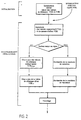
- the operational operation stage is called by an interrupt triggered by a clock, for example every 20 milliseconds.
- Each cycle begins with the acquisition of values capacitive VCC (i) and the force value VEC.
- This automaton makes it possible to integrate the slow drifts of the signal from the touch surface (drift in temperature), smoothing out residual noise, and managing conflicts (simultaneous selection of several keys).
- VCR (i), n (ax VCR (i), n-1 + VCC (i), n) / (a + 1)
- Transition a at least one key i among the keys on the keyboard checks the condition n: ECC (i), n ⁇ Low Threshold or ECC (i), n ⁇ High Threshold and there are no two keys i and j such as: ECC (i), n ⁇ High Threshold and ECC (j), n ⁇ High Threshold
- This transition corresponds to the case where the proximity (case of the low threshold) or the presence (case of the high threshold) of a finger and detected on the touch surface.
- Transition 1 this transition corresponds to the case where all the keys on the keyboard check in cycle n the condition: ECC (i), n ⁇ Low Threshold
- this case corresponds where the keyboard is and remains in the idle state, the automaton being in the NO SELECTION state. Reference values are updated.
- Transition b this transition occurs when the previously preselected key I checks in cycle n the condition: ECC (I), n ⁇ Low Threshold and none of the other keys on the keyboard check the condition: ECC (i), n ⁇ High Threshold or if there are two keys i and j such as ECC (i), n ⁇ High Threshold and ECC (j), n ⁇ High Threshold
- the preset key is returned to the rest state which is the case with example after touching the touchpad.
- Transition c this is the transition corresponding to the case where the preselected key I checks in cycle n the condition: ECC (I), n ⁇ High Threshold
- the I key is then selected.
- the i key becomes the preset key.
- Transition d this transition occurs when the selected key I checks in cycle n the condition: ECC (I), n ⁇ Low Threshold
- the keyboard then returns to the idle state when there when the key is released (the PLC is in the state END OF SELECTION) then confirmation of release (the PLC is in the NO SELECTION state).
- Transition e this is the case where the selected key I checks in cycle n the condition: ECC (I), n ⁇ Low Threshold there is then no release confirmation and the PLC returns to the CONFIRMED SELECTION state.
- This automaton ensures insensitivity to fluctuations in the load factor induced signal at hysteresis presented by the test bodies and with fins various, and allows filtering by confirmation on several validation cycles.
- Transition a this transition occurs when in cycle n the following condition is satisfied: ECE, n ⁇ Threshold
- Transition b this is the case where in cycle n the following condition is satisfied: ECE, n ⁇ Threshold this is the case where the operator has released his support or is not pressing enough to trigger validation.
- the PLC then returns to the NO VALIDATION state.
- the threshold and the number of VALIDATION states are configurable.
Landscapes
- Engineering & Computer Science (AREA)
- General Engineering & Computer Science (AREA)
- Theoretical Computer Science (AREA)
- Human Computer Interaction (AREA)
- Physics & Mathematics (AREA)
- General Physics & Mathematics (AREA)
- Input From Keyboards Or The Like (AREA)
- Electronic Switches (AREA)
Description
- dans une première phase de chaque cycle on mesure la valeur capacitive de chaque touche du clavier et on détermine à partir de ces mesures un état de sélection du clavier,
- dans une deuxième phase du cycle, et pour seulement certains états de sélection du clavier, on prend en compte les mesures d'effort pour déterminer un état de validation du clavier, et
- on décide qu'une sélection valide a eu lieu en fonction de l'état de sélection et de l'état de validation du clavier.
- la figure 1 est un diagramme d'ensemble des moyens permettant la mise en oeuvre de l'invention,
- la figure 2 est un organigramme du séquencement des traitements,
- la figure 3 représente les états et transitions de l'automate de sélection, et
- la figure 4 illustre les états et transitions de l'automate de validation.
ECC(i),n ≥ Seuil Bas ou ECC(i),n ≥ Seuil Haut
et il n'existe pas deux touches i et j telles que :
ECC(i),n ≥ Seuil Haut et ECC(j),n ≥ Seuil Haut
ECC(I),n < Seuil Bas et qu'aucune des autres touches du clavier ne vérifie la condition :
ECC(i),n ≥ Seuil Haut ou s'il existe deux touches i et j telles que
ECC(i), n ≥ Seuil Haut
et
ECC(j), n ≥ Seuil Haut
ECC(I),n ≥ Seuil Haut
Seuil Bas ≤ ECC(I),n < Seuil Haut
la touche I reste la touche présélectionnée. Ce cas est celui où le doigt de l'opérateur reste à proximité de la touche. L'influence du doigt sur la touche n'est toutefois pas suffisante pour confirmer la sélection.
ECC(I),n < Seuil Haut
et si parmi les autres touches du clavier une et une seule vérifie la condition :
ECC(i),n ≥ Seuil Haut
ECC(I),n < Seuil Bas
ECC(I),n ≥ Seuil Bas
il n'y a alors pas confirmation de relâchement et l'automate revient dans l'état SELECTION CONFIRMEE.
VER,n = VEC,n
VER,n = VER, n-1 et le programme calcule un écart courant ECE,n tel que :
ECE,n = VEC,n-VER,n
la logique de l'automate est alors mise en oeuvre.
ECE,n ≥ Seuil
ECE,n < Seuil
ce cas est celui où l'opérateur a relaché son appui ou n'appuie pas suffisamment pour déclencher la validation. L'automate revient alors dans l'état PAS DE VALIDATION.
Claims (13)
- Procédé d'exploitation d'un clavier tactile capacitif, dans lequel on détermine cycliquement la position du doigt de l'opérateur sur le clavier et la pression exercée par ce doigt par des mesures de capacité et des mesures d'effort, caractérisé par le fait que :dans une première phase de chaque cycle, on mesure la valeur capacitive de chaque touche du clavier et on détermine à partir de ces mesures un état de sélection du clavier,dans une deuxième phase du cycle, et pour seulement certains états de sélection du clavier, on prend en compte les mesures d'effort pour déterminer un état de validation du clavier, eton décide qu'une sélection valide a eu lieu en fonction de l'état de sélection et de l'état de validation du clavier.
- Procédé selon la revendication 1, dans lequel on compare chaque valeur capacitive mesurée à une valeur capacitive de référence et, lorsque l'écart capacitif d'une touche est inférieur à un seuil bas prédéterminé, on met à jour la valeur capacitive de référence correspondante.
- Procédé selon la revendication 2, dans lequel les valeurs capacitives de référence mises à jour sont obtenues par calcul d'une moyenne pondérée à partir d'au moins la moyenne précédemment calculée et de la valeur capacitive mesurée.
- Procédé selon l'une quelconque des revendications 1 à 3, dans lequel on compare chaque valeur capacitive mesurée à une valeur capacitive de référence, et, lorsque les écarts capacitifs de toutes les touches sont inférieurs à un seuil bas prédéterminé, on met à jour une valeur de référence d'effort.
- Procédé selon la revendication 4, dans lequel la valeur d'effort de référence mise à jour est la dernière valeur d'effort mesurée.
- Procédé selon l'une quelconque des revendications 1 à 4, dans lequel on calcule les écarts entre les valeurs capacitives mesurées et des valeurs capacitives de référence, le clavier possédant au moins un état de non sélection, un état de présélection et un état de sélection confirmée, et les transitions d'un état à l'autre étant déterminées en comparant les écarts capacitifs à un seuil bas et à un seuil haut.
- Procédé selon la revendication 6, dans lequel une touche est présélectionnée lorsque son écart capacitif est supérieur au seuil bas, et une touche est sélectionnée si elle est déjà présélectionnée et son écart capacitif est supérieur au seuil haut.
- Procédé selon l'une quelconque des revendications 6 et 7 dans lequel, lorsque deux touches ont leur écart capacitif supérieur au seuil bas, seule la touche présentant l'écart capacitif le plus élevé est présélectionnée.
- Procédé selon l'une quelconque des revendications 6 à 8, dans lequel le clavier est mis dans son état de non sélection lorsque l'écart capacitif d'au moins deux touches est supérieur au seuil haut.
- Procédé selon l'une quelconque des revendications 6 à 9, dans lequel une touche est présélectionnée lorsque son écart capacitif est supérieur au seuil haut et qu'une autre touche est présélectionnée, cette dernière retournant à son état de non sélection.
- Procédé selon l'une quelconque des revendications 6 à 10, dans lequel on détermine l'état de validation du clavier dans la deuxième phase, lorsque le clavier est dans son état de présélection ou de sélection confirmée.
- Procédé selon l'une quelconque des revendications 1 à 11, dans lequel on calcule l'écart entre la valeur d'effort mesurée et une valeur d'effort de référence, le clavier possédant au moins un état de non validation, un état de prévalidation et un état de validation confirmée, et les transitions d'un état à l'autre étant déterminées en comparant l'écart d'effort à un seuil prédéterminé.
- Procédé selon la revendication 12, dans lequel le clavier est en état de prévalidation lorsque l'écart d'effort est supérieur au seuil depuis un nombre de cycles inférieur à un nombre prédéterminé, et en état de validation confirmée lorsque l'écart d'effort est supérieur au seuil depuis un nombre de cycles au moins égal à ce nombre.
Applications Claiming Priority (2)
| Application Number | Priority Date | Filing Date | Title |
|---|---|---|---|
| FR9205088 | 1992-04-24 | ||
| FR929205088A FR2690544B1 (fr) | 1992-04-24 | 1992-04-24 | Procede d'exploitation d'un clavier tactile capacitif. |
Publications (2)
| Publication Number | Publication Date |
|---|---|
| EP0567364A1 EP0567364A1 (fr) | 1993-10-27 |
| EP0567364B1 true EP0567364B1 (fr) | 2001-08-29 |
Family
ID=9429240
Family Applications (1)
| Application Number | Title | Priority Date | Filing Date |
|---|---|---|---|
| EP93400897A Expired - Lifetime EP0567364B1 (fr) | 1992-04-24 | 1993-04-06 | Procédé d'exploitation d'un clavier tactile capacitif |
Country Status (4)
| Country | Link |
|---|---|
| US (1) | US5525980A (fr) |
| EP (1) | EP0567364B1 (fr) |
| DE (1) | DE69330659T2 (fr) |
| FR (1) | FR2690544B1 (fr) |
Cited By (2)
| Publication number | Priority date | Publication date | Assignee | Title |
|---|---|---|---|---|
| US7474296B2 (en) | 2002-04-12 | 2009-01-06 | Obermeyer Henry K | Multi-axis joystick and transducer means therefore |
| US9092100B2 (en) | 2011-06-17 | 2015-07-28 | Thales, Inc. | Multitouch touch-sensitive device with multifrequency capacitive detection |
Families Citing this family (24)
| Publication number | Priority date | Publication date | Assignee | Title |
|---|---|---|---|---|
| FR2732135B1 (fr) * | 1995-03-24 | 1997-05-16 | Sextant Avionique | Dispositif de designation tactile a surface capacitive transparente a haute resolution |
| US5914661A (en) * | 1996-01-22 | 1999-06-22 | Raytheon Company | Helmet mounted, laser detection system |
| US6271831B1 (en) | 1997-04-03 | 2001-08-07 | Universal Electronics Inc. | Wireless control and pointer system |
| WO2005055028A2 (fr) * | 2003-12-05 | 2005-06-16 | Rupprecht & Partner | Unite d'entree alphanumerique |
| DE102004029421A1 (de) * | 2004-06-18 | 2006-01-05 | Rohde & Schwarz Gmbh & Co. Kg | Verfahren und Vorrichtung zur Bewertung der Güte eines Signals |
| US8040142B1 (en) | 2006-03-31 | 2011-10-18 | Cypress Semiconductor Corporation | Touch detection techniques for capacitive touch sense systems |
| US8547114B2 (en) | 2006-11-14 | 2013-10-01 | Cypress Semiconductor Corporation | Capacitance to code converter with sigma-delta modulator |
| US8058937B2 (en) | 2007-01-30 | 2011-11-15 | Cypress Semiconductor Corporation | Setting a discharge rate and a charge rate of a relaxation oscillator circuit |
| US8411037B2 (en) * | 2007-06-14 | 2013-04-02 | Microsoft Corporation | Keyboard with touch sensitive zones and corresponding computer user interface |
| US9500686B1 (en) | 2007-06-29 | 2016-11-22 | Cypress Semiconductor Corporation | Capacitance measurement system and methods |
| US8169238B1 (en) | 2007-07-03 | 2012-05-01 | Cypress Semiconductor Corporation | Capacitance to frequency converter |
| US8089289B1 (en) | 2007-07-03 | 2012-01-03 | Cypress Semiconductor Corporation | Capacitive field sensor with sigma-delta modulator |
| US8570053B1 (en) | 2007-07-03 | 2013-10-29 | Cypress Semiconductor Corporation | Capacitive field sensor with sigma-delta modulator |
| US8525798B2 (en) | 2008-01-28 | 2013-09-03 | Cypress Semiconductor Corporation | Touch sensing |
| US8319505B1 (en) | 2008-10-24 | 2012-11-27 | Cypress Semiconductor Corporation | Methods and circuits for measuring mutual and self capacitance |
| US8358142B2 (en) | 2008-02-27 | 2013-01-22 | Cypress Semiconductor Corporation | Methods and circuits for measuring mutual and self capacitance |
| US9104273B1 (en) | 2008-02-29 | 2015-08-11 | Cypress Semiconductor Corporation | Multi-touch sensing method |
| US8321174B1 (en) | 2008-09-26 | 2012-11-27 | Cypress Semiconductor Corporation | System and method to measure capacitance of capacitive sensor array |
| US8723827B2 (en) | 2009-07-28 | 2014-05-13 | Cypress Semiconductor Corporation | Predictive touch surface scanning |
| US20130321322A1 (en) * | 2011-02-25 | 2013-12-05 | Lg Electronics Inc. | Mobile terminal and method of controlling the same |
| FR2998989B1 (fr) | 2012-12-05 | 2015-01-02 | Thales Sa | Dispositif tactile multitouches a detection capacitive multifrequence et barycentrique |
| FR3004824B1 (fr) | 2013-04-19 | 2016-08-19 | Thales Sa | Dispositif tactile multicouches a detection capacitive multifrequence comportant des moyens de detection de panne |
| US9619044B2 (en) * | 2013-09-25 | 2017-04-11 | Google Inc. | Capacitive and resistive-pressure touch-sensitive touchpad |
| JP6416691B2 (ja) * | 2015-05-14 | 2018-10-31 | アルプス電気株式会社 | 入力装置及び入力装置の動作方法 |
Family Cites Families (7)
| Publication number | Priority date | Publication date | Assignee | Title |
|---|---|---|---|---|
| US4211915A (en) * | 1978-12-04 | 1980-07-08 | General Electric Company | Keyboard verification system |
| US4441097A (en) * | 1979-01-29 | 1984-04-03 | Antroy Enterprises, Inc. | Device for controlling a circuit |
| US4340777A (en) * | 1980-12-08 | 1982-07-20 | Bell Telephone Laboratories, Incorporated | Dynamic position locating system |
| JPS58182746A (ja) * | 1982-04-20 | 1983-10-25 | Fujitsu Ltd | タツチ式入力装置 |
| US4550221A (en) * | 1983-10-07 | 1985-10-29 | Scott Mabusth | Touch sensitive control device |
| US5012124A (en) * | 1989-07-24 | 1991-04-30 | Hollaway Jerrell P | Touch sensitive control panel |
| FR2662528B1 (fr) * | 1990-05-25 | 1994-03-11 | Sextant Avionique | Dispositif pour la localisation d'un objet situe a proximite d'une aire de detection et clavier transparent utilisant ledit dispositif. |
-
1992
- 1992-04-24 FR FR929205088A patent/FR2690544B1/fr not_active Expired - Lifetime
-
1993
- 1993-04-06 DE DE69330659T patent/DE69330659T2/de not_active Expired - Lifetime
- 1993-04-06 EP EP93400897A patent/EP0567364B1/fr not_active Expired - Lifetime
- 1993-04-21 US US08/049,345 patent/US5525980A/en not_active Expired - Lifetime
Cited By (4)
| Publication number | Priority date | Publication date | Assignee | Title |
|---|---|---|---|---|
| US7474296B2 (en) | 2002-04-12 | 2009-01-06 | Obermeyer Henry K | Multi-axis joystick and transducer means therefore |
| US8094121B2 (en) | 2002-04-12 | 2012-01-10 | Henry K. Obermeyer | Multi-axis joystick and transducer means therefore |
| US8816962B2 (en) | 2002-04-12 | 2014-08-26 | Henry K. Obermeyer | Multi-axis input apparatus |
| US9092100B2 (en) | 2011-06-17 | 2015-07-28 | Thales, Inc. | Multitouch touch-sensitive device with multifrequency capacitive detection |
Also Published As
| Publication number | Publication date |
|---|---|
| EP0567364A1 (fr) | 1993-10-27 |
| DE69330659D1 (de) | 2001-10-04 |
| FR2690544B1 (fr) | 1994-06-17 |
| US5525980A (en) | 1996-06-11 |
| FR2690544A1 (fr) | 1993-10-29 |
| DE69330659T2 (de) | 2002-05-02 |
Similar Documents
| Publication | Publication Date | Title |
|---|---|---|
| EP0567364A1 (fr) | Procédé d'exploitation d'un clavier tactile capacitif | |
| US8786573B2 (en) | Data input device of electronic device and input control method | |
| BE1020021A3 (fr) | Dispositif a ecran tactile multimode. | |
| EP2956846B1 (fr) | Procédé, appareil et support de stockage pour naviguer dans un écran d'affichage | |
| FR2511796A1 (fr) | Dispositif d'affichage a detection de contact et procede de localisation d'un contact capacitif | |
| WO2013126497A1 (fr) | Dispositifs, méthodes et kits de test pour dosage d'analyte électronique | |
| FR2528194A1 (fr) | Circuit de clavier a balayage avec microprocesseur | |
| US20090234529A1 (en) | Method for Processing Data Based on an Evaluation of Real-Time Measurements of Movements of a User in a Vehicle and Based on Statistical Data on User Interactions With Input Devices in the Vehicle | |
| EP2356550A1 (fr) | Entrée de geste utilisant un dispositif optique d'entrée | |
| EP1690177A1 (fr) | PROCEDE ET DISPOSITIF D&rsquo;INTERFACE HOMME - MACHINE | |
| CN108501875A (zh) | 整车雨刮器控制方法、装置及电子设备 | |
| WO2023180265A1 (fr) | Procédé de gestion d'exécution d'une pluralité de fonctions | |
| WO2010051939A1 (fr) | Dispositif de mesure d'une variation de la capacitance d'une structure capacitive variable | |
| EP2989510B1 (fr) | Procédé de manipulation d'un appareil électronique | |
| EP0740416B1 (fr) | Détecteur de proximité à apprentissage | |
| JPH11325840A (ja) | メタル残膜判定方法およびメタル残膜判定装置 | |
| EP2199896A2 (fr) | Procédés de gestion d'un paramètre affiché dans un objet graphique interactif | |
| FR2714506A1 (fr) | Procédé de gestion de la maintenance d'un véhicule, ordinateur de bord et station de diagnostic associés mettant en Óoeuvre le procédé. | |
| FR2596870A1 (fr) | Procede de mesurage numerique pour l'affichage quasi analogique de valeurs mesurees et dispositif pour la mise en oeuvre de ce procede | |
| EP3479212A1 (fr) | Procédé de commande et interface de commande pour véhicule automobile | |
| WO2013153338A1 (fr) | Génération perfectionnée de commandes dans un équipement à écran tactile | |
| FR2635884A1 (fr) | Dispositif informatique pour l'execution d'un raisonnement flou | |
| US10261606B2 (en) | Electronic assembly with expandable input device | |
| TWI850984B (zh) | 具力感應之觸控板及其力感應方法 | |
| EP3750037B1 (fr) | Systeme et procede de filtrage des commandes d'un systeme multi-ecrans tactiles de vehicule |
Legal Events
| Date | Code | Title | Description |
|---|---|---|---|
| PUAI | Public reference made under article 153(3) epc to a published international application that has entered the european phase |
Free format text: ORIGINAL CODE: 0009012 |
|
| AK | Designated contracting states |
Kind code of ref document: A1 Designated state(s): DE GB IT NL |
|
| 17P | Request for examination filed |
Effective date: 19940415 |
|
| 17Q | First examination report despatched |
Effective date: 19970129 |
|
| APAB | Appeal dossier modified |
Free format text: ORIGINAL CODE: EPIDOS NOAPE |
|
| APAB | Appeal dossier modified |
Free format text: ORIGINAL CODE: EPIDOS NOAPE |
|
| RAP1 | Party data changed (applicant data changed or rights of an application transferred) |
Owner name: SEXTANT AVIONIQUE |
|
| APAD | Appeal reference recorded |
Free format text: ORIGINAL CODE: EPIDOS REFNE |
|
| APAB | Appeal dossier modified |
Free format text: ORIGINAL CODE: EPIDOS NOAPE |
|
| APAB | Appeal dossier modified |
Free format text: ORIGINAL CODE: EPIDOS NOAPE |
|
| RAP3 | Party data changed (applicant data changed or rights of an application transferred) |
Owner name: THOMSON-CSF SEXTANT |
|
| GRAG | Despatch of communication of intention to grant |
Free format text: ORIGINAL CODE: EPIDOS AGRA |
|
| GRAH | Despatch of communication of intention to grant a patent |
Free format text: ORIGINAL CODE: EPIDOS IGRA |
|
| GRAG | Despatch of communication of intention to grant |
Free format text: ORIGINAL CODE: EPIDOS AGRA |
|
| GRAH | Despatch of communication of intention to grant a patent |
Free format text: ORIGINAL CODE: EPIDOS IGRA |
|
| GRAH | Despatch of communication of intention to grant a patent |
Free format text: ORIGINAL CODE: EPIDOS IGRA |
|
| GRAA | (expected) grant |
Free format text: ORIGINAL CODE: 0009210 |
|
| AK | Designated contracting states |
Kind code of ref document: B1 Designated state(s): DE GB IT NL |
|
| REF | Corresponds to: |
Ref document number: 69330659 Country of ref document: DE Date of ref document: 20011004 |
|
| GBT | Gb: translation of ep patent filed (gb section 77(6)(a)/1977) |
Effective date: 20011008 |
|
| REG | Reference to a national code |
Ref country code: GB Ref legal event code: IF02 |
|
| PLBE | No opposition filed within time limit |
Free format text: ORIGINAL CODE: 0009261 |
|
| STAA | Information on the status of an ep patent application or granted ep patent |
Free format text: STATUS: NO OPPOSITION FILED WITHIN TIME LIMIT |
|
| 26N | No opposition filed | ||
| PGFP | Annual fee paid to national office [announced via postgrant information from national office to epo] |
Ref country code: NL Payment date: 20040406 Year of fee payment: 12 |
|
| APAH | Appeal reference modified |
Free format text: ORIGINAL CODE: EPIDOSCREFNO |
|
| PG25 | Lapsed in a contracting state [announced via postgrant information from national office to epo] |
Ref country code: NL Free format text: LAPSE BECAUSE OF NON-PAYMENT OF DUE FEES Effective date: 20051101 |
|
| NLV4 | Nl: lapsed or anulled due to non-payment of the annual fee |
Effective date: 20051101 |
|
| PGFP | Annual fee paid to national office [announced via postgrant information from national office to epo] |
Ref country code: IT Payment date: 20070622 Year of fee payment: 15 |
|
| PG25 | Lapsed in a contracting state [announced via postgrant information from national office to epo] |
Ref country code: IT Free format text: LAPSE BECAUSE OF NON-PAYMENT OF DUE FEES Effective date: 20080406 |
|
| PGFP | Annual fee paid to national office [announced via postgrant information from national office to epo] |
Ref country code: DE Payment date: 20110330 Year of fee payment: 19 |
|
| PGFP | Annual fee paid to national office [announced via postgrant information from national office to epo] |
Ref country code: GB Payment date: 20110406 Year of fee payment: 19 |
|
| GBPC | Gb: european patent ceased through non-payment of renewal fee |
Effective date: 20120406 |
|
| PG25 | Lapsed in a contracting state [announced via postgrant information from national office to epo] |
Ref country code: GB Free format text: LAPSE BECAUSE OF NON-PAYMENT OF DUE FEES Effective date: 20120406 |
|
| REG | Reference to a national code |
Ref country code: DE Ref legal event code: R119 Ref document number: 69330659 Country of ref document: DE Effective date: 20121101 |
|
| PG25 | Lapsed in a contracting state [announced via postgrant information from national office to epo] |
Ref country code: DE Free format text: LAPSE BECAUSE OF NON-PAYMENT OF DUE FEES Effective date: 20121101 |