EP0562894B1 - Procédé de reconnaissance de données circulant sur un réseau de transmission de données et dispositif pour la mise en oeuvre de ce procédé - Google Patents
Procédé de reconnaissance de données circulant sur un réseau de transmission de données et dispositif pour la mise en oeuvre de ce procédé Download PDFInfo
- Publication number
- EP0562894B1 EP0562894B1 EP93400538A EP93400538A EP0562894B1 EP 0562894 B1 EP0562894 B1 EP 0562894B1 EP 93400538 A EP93400538 A EP 93400538A EP 93400538 A EP93400538 A EP 93400538A EP 0562894 B1 EP0562894 B1 EP 0562894B1
- Authority
- EP
- European Patent Office
- Prior art keywords
- address
- multiplet
- low order
- fact
- storing
- Prior art date
- Legal status (The legal status is an assumption and is not a legal conclusion. Google has not performed a legal analysis and makes no representation as to the accuracy of the status listed.)
- Expired - Lifetime
Links
Images

Classifications
-
- G—PHYSICS
- G06—COMPUTING OR CALCULATING; COUNTING
- G06F—ELECTRIC DIGITAL DATA PROCESSING
- G06F15/00—Digital computers in general; Data processing equipment in general
- G06F15/16—Combinations of two or more digital computers each having at least an arithmetic unit, a program unit and a register, e.g. for a simultaneous processing of several programs
- G06F15/161—Computing infrastructure, e.g. computer clusters, blade chassis or hardware partitioning
Definitions
- the present invention relates on the one hand to a method for recognizing data circulating on a data transmission network, consisting in receiving, in a network station, identifiers each consisting of a bit field for recognize if these identifiers are part of the reference identifiers attached to said station and on the other hand to a device for the implementation of this process.
- a data transmission network particularly in an industrial environment (so-called network field for example) includes, with reference to Figure 1, stations interconnected, through communication interfaces, by a line of transmission called bus. Each station must transmit or receive, on the network, data each constituting a frame, that is to say an indivisible set of bits. Each transmitted data corresponds to an identifier which is a bit field or byte to identify this data.
- the identifier which is associated with each data item broadcast on the bus allows each station to determine if this data is intended for it and if so to give information on the service associated with this data. To perform these functions, each of stations has a memory containing all the identifiers which concerned.
- a first known technique consists in incorporating, at each station, a memory which can contain all the possible identifiers. As an indication, this memory will have 2 16 inputs for 16-bit identifiers. It associates, with each identifier concerning the station, the address of the corresponding service description. This technique has the advantage of speed of recognition since the identifier itself constitutes the memory address but it is penalizing in memory space.
- a second known technique consists in performing a dichotomous search in a table of identifiers grouping together the identifiers recognized by the station, arranged in ascending order.
- Dichotomous research consists in determining, by successive comparisons, in which half, then in which quarter, then in which eighth, then in which sixteenth, etc. is the identifier. For a capacity of 2 n identifiers, it is necessary to perform n dichotomous search iterations.
- This technique has the advantage of limiting memory space but requires too long an identification time to guarantee acceptable performance at high speed.
- the object of the present invention is to provide a method and a device for minimizing recognition of identifiers, compared to the known technique of direct search, the memory space occupied and accelerating, compared to the technique of dichotomous research, speed of identification. This technique therefore makes it possible to reduce the identification time, while limiting the memory size.
- the method according to the invention is characterized in that it consists in using a Most significant byte of an identifier received to read in a direct reading table, the size and address of a lookup table containing the least significant bytes reference identifiers of the station, and to perform a dichotomous search in comparing these reference bytes with the least significant byte of the identifier received.
- the direct reading table contains a byte corresponding to the size of the associated dichotomous lookup table and a byte corresponding to the address of this table.
- each dichotomous search table contains the least significant bytes attached to the station and service descriptions correspondents.
- the device comprises means for storing the Most significant byte of the identifier received, means for storing the base address from the direct reading table and to add these values and issue an address corresponding to the sum, to memory.
- the device comprises means for storing the base address of the lookup table and to add this base address to the average value and issue an address corresponding to the sum, to memory.
- the device comprises means for storing the multiplet low weight read in the lookup table and corresponding to the address value mean of said table and means for comparing the least significant byte received and says the least significant byte read.
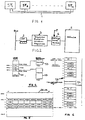
- FIG. 1 shows several stations ST 1 , ST 2 ... ST n intended for exchanging digital data with one another, for example variables and / or messages via a serial data bus 1, of the diffusion type.
- Each station includes, with reference to FIG. 2, a physical interface block 2 which implements the physical layer of the bus and a transmission / reception sequencer block asynchronous 3 which recognizes any data circulating on the bus and which, when identifier is recognized, transmits or receives associated data. It also includes a memory 5 of RAM type and a microprocessor. A block 4 manages the sharing of memory 5, between the station's microprocessor and the transmit-receive block 3.
- the frame broadcast on the serial bus 1 includes an identifier which is composed of two multiplets one of which is the most significant multiplet and the other of which is the multiplet of low weight.
- the identifier has 16 bits and the two bytes are bytes. One is the most significant byte and the other is the least significant byte.
- the identifiers will be distinguished. receipts which are the identifiers present on the bus and received by the station and reference identifiers which are the identifiers attached to the station and stored in memory 5.
- a direct reading table 51 and associated tables 53 for dichotomous research are stored in the RAM memory 5.
- Table 51 (also referenced TAB-IDH in FIG. 4) is used for direct reading of the most significant bytes of the identifiers of and the associated tables 53 (also referenced TIDLi in FIG. 4) are used for dichotomous search for the least significant bytes relating to the same identifiers
- Le number of tables 53 is equal to the number of most significant bytes assigned to identifiers of reference attached to the station.
- Table 51 for reading the most significant bytes directly contains, for each most significant byte (marked IDHi in FIGS. 4 and 5), on the one hand the number of bytes (NBIDL7-0) of the associated table 53 for dichotomous search for the least significant bytes corresponding to this strong byte, on the other hand the address (marked @ IDL19-0 in FIG. 5) of the start of this table 53 and a bit (designated EMPTY) making it possible to know whether, at the entry of table 51 considered, corresponds to a table 53 associated with a dichotomous search for the bytes of low weight.
- table 51 contains the address identified @IDL of table 53 (TIDLi) of the only weight bytes weak (IDLi) used by said station, these bytes being arranged in ascending order.
- Each dichotomous search table 53 for the least significant bytes contains, in referring to FIG. 6), on the one hand the least significant bytes (IDLi -figure 6) of the identifiers and secondly the referral addresses to describe the associated services (AD-DESC).
- FIG. 3 represents the transmission / reception block 3 ensuring the recognition of identifiers received from bus 1.
- Register 7 is connected via a multiplexer to a adder 8.
- This adder 8 is connected to an address bus 22, at 20 bits, which transports the addresses to memory 5.
- Two address registers 13 and 14, 20 bits, intended to contain addresses, are connected to the adder 8
- the address register 13 is loaded in three parts (lower, middle, upper) with the base address from table 53.
- the register Address 14 receives the address of bus 22.
- An address register 6 is loaded by the microprocessor with the base address of the table 51 for direct reading. Its content is intended to be transferred to the adder 8.
- a register 11 is connected at the input to the data bus 20 and at the output to a register 10 called of upper bound working with a register 12 of lower bound.
- the contents of these registers 12 and 10 are intended to be transferred to an adder 15 whose output, halved, via a wired device 16, loops back to the inputs of these registers 12 and 10 and is connected, via a multiplexer, to the input of the adder 8.
- the register 10 upper bound contains a "strong" address from table 53 while register 12 lower bound contains a "weak” address from table 53, the qualifiers "weak” or “strong” referring to the increasing addresses of table 53.
- Block 18 makes it possible to compare the least significant byte of the identifier received and contained in register 17 with the IDL byte read in the TIDL table and contained in register 11.
- Block 19 sequences the commands of the various resources relating to operations identifier searches that have been described above.
- the microprocessor loads register 6 with the address of base of the direct search table 51 (TIDH).
- the strong byte of this received identifier is loaded in register 7.
- the base address of table 51 (TIDH) which is contained in register 6 and the strong byte of the received identifier which is contained in register 7 are added by the adder 8.
- the read accesses in the memory 5, through adder 8, are performed at the address which is the sum of registers 6 and 7, so in table 51.
- the strong byte of the identifier is an address at immediate access.
- the address bus 22 for accessing memory 5 is a 20-bit bus.
- the two least significant bits are zero and the address where the reading in the memory 5 is therefore a multiple of 4.
- the direct reading table 51 has 4 consecutive bytes for each strong byte.
- the first byte (NBIDL) is read at the address defined above (equal to the base address + IDHi) and it corresponds to the size of table 53 for dichotomous byte search weak.
- the read data of this first byte (size) is stored in register 10, via the register 11.
- the address (resulting from the addition mentioned above) is stored in the internal register 14. It is added with a constant equal to 1.
- the result of this new addition is the second address for reading the second byte (including the "Empty” bit) of table 51 (TIDH). This second byte is loaded into register 11 to examine the "empty" state (command generation) and in the lower part of register 13 (bits IDL 3-2).
- Reading of the last 2 bytes is conditioned by the status of the "Empty" bit (second byte -figure 5).
- the station does not recognize any identifier having this strong byte. and the search is complete.
- the following dichotomous search is conditioned by loading, in the register 17, of the least significant byte of the identifier received.
- the lower bound register 12 contains a value 0 while upper bound register 10 contains the value of the number NBIDL low bytes from dichotomous lookup table 53 (i.e. size from this table 53).
- the adder 15 calculates the average MID of the value contained in the lower bound register 12 and the value contained in the upper bound register 10. This MID average value is added to the address basic contained in the register 13, through the adder 8. Reading corresponding performed in memory 5 by data bus 20 is an IDL byte which is stored in register 11.
- MID value calculations, comparisons, loading of registers 10 or 12 continue until the low byte IDL reference byte stored in the table 53 is equal to the value of the weak byte received and stored in register 17 or else until we have reached the maximum number of iterations, linked to the size of the table 53 (TIDL).
- the commands of block 18 trigger the reloading of the terminal register 12 lower or upper bound register 13.
- table 51 and 53 it is possible to use another split of identifiers between the two types of table 51 and 53.
- table 51 with 12 entries for direct addressing on the first 12 bits and tables 53 limited to only quartets useful for last four bits.
- the access time would be shorter than in the described solution previously but the memory size would be greater.
Landscapes
- Engineering & Computer Science (AREA)
- Computer Hardware Design (AREA)
- Physics & Mathematics (AREA)
- General Engineering & Computer Science (AREA)
- Theoretical Computer Science (AREA)
- Mathematical Physics (AREA)
- Software Systems (AREA)
- General Physics & Mathematics (AREA)
- Communication Control (AREA)
- Computer And Data Communications (AREA)
Description
- une mémoire dans laquelle se trouve au moins une table de lecture directe donnant pour chaque multiplet de poids fort reçu, l'adresse et la taille d'une table éventuellement associée de recherche dichotomique contenant les multiplets de poids faible de référence de la station;
- des moyens pour mémoriser le multiplet de poids faible de l'identifieur reçu;
- des moyens pour effectuer une recherche dichotomique du multiplet poids faible reçu dans lesdits multiplets poids faible de référence .
- des moyens pour stocker une valeur d'adresse dite de borne inférieure et une valeur d'adresse dite de borne supérieure et des moyens pour calculer une moyenne de ces valeurs;
- des moyens pour comparer le multiplet de poids faible de la table de recherche qui correspond à la valeur moyenne d'adresse calculée et le multiplet de poids faible de l'identifieur reçu et pour charger la valeur moyenne soit dans les moyens pour stocker une valeur d'adresse dite de borne supérieure soit dans les moyens pour stocker une valeur d'adresse dite de borne inférieure.
- la figure 1 est un schéma de réseau de transmission de données entre stations ;
- la figure 2 est un schéma fonctionnel du dispositif de reconnaissance de données selon l'invention ;
- la figure 3 est un schéma fonctionnel détaillant la figure 2;
- la figure 4 est un schéma de la configuration mémoire ;
- la figure 5 illustre le contenu de la table de lecture directe de la figure 4;
- la figure 6 illustre le contenu d'une des tables de recherche dichotomique des octets faibles des identifieurs.
Claims (10)
- Procédé de reconnaissance de données constituées de bits et circulant sur un réseau de transmission de données, consistant à recevoir, dans une station du réseau, des identifieurs constitués chacun par un champ de bits pour reconnaítre si ces identifieurs font partie des identifieurs de référence attachés à ladite station, caractérisé par le fait qu'il consiste à utiliser un multiplet (IDH) de poids fort d'un identifieur reçu pour lire dans une table de lecture directe (51), la taille et l'adresse d'une table de recherche (53) contenant les multiplets de poids faible des identifieurs de référence de la station, et à effectuer une recherche dichotomique en comparant ces multiplets de référence avec le multiplet de poids faible de l'identifieur reçu.
- Procédé selon la revendication 1, caractérisé par le fait que la table de lecture directe (51) contient un multiplet correspondant à la taille de la table (53) de recherche dichotomique associée et un multiplet correspondant à l'adresse de cette table (53).
- Procédé selon l'une quelconque des revendications précédentes, caractérisé par le fait que chaque table (53) de recherche dichotomique contient les multiplets de poids faible attachés à la station et des descriptifs de service correspondants.
- Procédé selon l'une quelconque des revendications précédentes, caractérisé par le fait que la table de lecture directe (51) contient un bit permettant de déterminer si une table de recherche (53) des multiplets de poids faible est associée à la table de lecture (51).
- Dispositif pour la mise en oeuvre du procédé selon l'une quelconque des revendications précédentes, caractérisé par le fait qu'il comporte:une mémoire (5) dans laquelle se trouve au moins une table de lecture directe (51) donnant pour chaque multiplet de poids fort reçu, l'adresse (@IDL) et la taille (NBIDL) d'une table (53) éventuellement associée de recherche dichotomique contenant les multiplets de poids faible (IDL) de référence de la station;des moyens (17) pour mémoriser le multiplet de poids faible (IDL) de l'identifieur reçu;des moyens (11,18,19,12,10,15,16) pour effectuer une recherche dichotomique du multiplet poids faible reçu dans lesdits multiplets (IDL) poids faible de référence .
- Dispositif selon la revendication 5, caractérisé par le fait qu'il comporte :des moyens (10,12) pour stocker une valeur d'adresse dite de borne inférieure et une valeur d'adresse dite de borne supérieure et des moyens (15,16) pour calculer une moyenne (MID) de ces valeurs;des moyens (11,17,18) pour comparer le multiplet (IDL) de poids faible de la table de recherche (53) qui correspond à la valeur moyenne d'adresse calculée (MID) et le multiplet de poids faible de l'identifieur reçu et pour charger la valeur moyenne (MID) soit dans les moyens (10) pour stocker une valeur d'adresse dite de borne supérieure soit dans les moyens (12) pour stocker une valeur d'adresse dite de borne inférieure.
- Dispositif selon l'une quelconque des revendications 5 ou 6, caractérisé par le fait qu'il comporte des moyens (7) pour stocker le multiplet (IDH) de poids fort de l'identifieur reçu, des moyens (6) pour stocker l'adresse de base de la table de lecture directe (51) et pour additionner ces valeurs et délivrer une adresse correspondant à la somme, à la mémoire (5) .
- Dispositif selon l'une quelconque des revendications 5 à 7, caractérisé par le fait qu'il comporte des moyens (13) pour stocker l'adresse de base (TIDL) de la table de recherche (53) et pour additionner cette adresse de base à la valeur moyenne (MID) et délivrer une adresse correspondant à la somme, à la mémoire (5).
- Dispositif selon l'une quelconque des revendications 5 à 8, caractérisé par le fait qu'il comporte des moyens (11) pour stocker le multiplet de poids faible (IDL) lu dans la table de recherche (53) et correspondant à la valeur d'adresse moyenne de ladite table et des moyens (18) pour comparer le multiplet de poids faible reçu et le dit multiplet de poids faible lu.
- Dispositif selon l'une quelconque des revendications 5 à 9, caractérisé par le fait qu'il comporte des moyens (19) pour séquencer les commandes.
Applications Claiming Priority (2)
| Application Number | Priority Date | Filing Date | Title |
|---|---|---|---|
| FR9203728A FR2689267B1 (fr) | 1992-03-27 | 1992-03-27 | Procede de reconnaissance de donnees circulant sur un reseau de transmission de donnees et dispositif pour la mise en óoeuvre de ce procede. |
| FR9203728 | 1992-03-27 |
Publications (2)
| Publication Number | Publication Date |
|---|---|
| EP0562894A1 EP0562894A1 (fr) | 1993-09-29 |
| EP0562894B1 true EP0562894B1 (fr) | 1999-05-06 |
Family
ID=9428164
Family Applications (1)
| Application Number | Title | Priority Date | Filing Date |
|---|---|---|---|
| EP93400538A Expired - Lifetime EP0562894B1 (fr) | 1992-03-27 | 1993-03-02 | Procédé de reconnaissance de données circulant sur un réseau de transmission de données et dispositif pour la mise en oeuvre de ce procédé |
Country Status (4)
| Country | Link |
|---|---|
| US (1) | US5434799A (fr) |
| EP (1) | EP0562894B1 (fr) |
| DE (1) | DE69324725T2 (fr) |
| FR (1) | FR2689267B1 (fr) |
Families Citing this family (2)
| Publication number | Priority date | Publication date | Assignee | Title |
|---|---|---|---|---|
| JP3449326B2 (ja) | 1999-12-08 | 2003-09-22 | 日本電気株式会社 | データ検索システム及びパケット処理装置並びに制御方法 |
| JP2001308812A (ja) * | 2000-04-24 | 2001-11-02 | Nec Microsystems Ltd | デジタルテレビのTransportStreamの分離処理方法およびその記録媒体 |
Family Cites Families (11)
| Publication number | Priority date | Publication date | Assignee | Title |
|---|---|---|---|---|
| US4413318A (en) * | 1980-11-20 | 1983-11-01 | International Business Machines Corporation | Use of nodes to uniquely identify processes |
| IL66667A (en) * | 1981-10-02 | 1985-06-30 | Hughes Aircraft Co | Method of routing messages between a plurality of data processing units |
| US4870571A (en) * | 1983-05-04 | 1989-09-26 | The Johns Hopkins University | Intercomputer communications based on message broadcasting with receiver selection |
| DE3485163D1 (de) * | 1983-06-29 | 1991-11-21 | Westinghouse Electric Corp | Verteiltes prozesssteuersystem mit mittel und verfahren fuer automatisches datenbank-management von rundfunkinformationen. |
| US4718005A (en) * | 1984-05-03 | 1988-01-05 | International Business Machines Corporation | Distributed control of alias name usage in networks |
| US5133053A (en) * | 1987-02-13 | 1992-07-21 | International Business Machines Corporation | Interprocess communication queue location transparency |
| US5167035A (en) * | 1988-09-08 | 1992-11-24 | Digital Equipment Corporation | Transferring messages between nodes in a network |
| US5077694A (en) * | 1988-12-16 | 1991-12-31 | Pitney Bowes Inc. | Distribution mailing system having a control database for storing mail handling categories common to the databases of selected mailer stations |
| US4930159A (en) * | 1989-01-18 | 1990-05-29 | International Business Machines Corporation | Netbios name authentication |
| US4949337A (en) * | 1989-01-30 | 1990-08-14 | Honeywell Inc. | Token passing communication network including a node which maintains and transmits a list specifying the order in which the token is passed |
| GB2251532B (en) * | 1990-11-16 | 1995-05-03 | Toshiba Kk | Method of allocating identifiers and apparatus for the same |
-
1992
- 1992-03-27 FR FR9203728A patent/FR2689267B1/fr not_active Expired - Fee Related
-
1993
- 1993-03-02 EP EP93400538A patent/EP0562894B1/fr not_active Expired - Lifetime
- 1993-03-02 DE DE69324725T patent/DE69324725T2/de not_active Expired - Lifetime
- 1993-03-26 US US08/037,583 patent/US5434799A/en not_active Expired - Lifetime
Also Published As
| Publication number | Publication date |
|---|---|
| FR2689267B1 (fr) | 1994-05-06 |
| US5434799A (en) | 1995-07-18 |
| FR2689267A1 (fr) | 1993-10-01 |
| DE69324725T2 (de) | 1999-09-02 |
| EP0562894A1 (fr) | 1993-09-29 |
| DE69324725D1 (de) | 1999-06-10 |
Similar Documents
| Publication | Publication Date | Title |
|---|---|---|
| US11616820B2 (en) | Processing files from a mobile device | |
| JP3848983B2 (ja) | データ送信方法、データ等化方法及び装置 | |
| US5424724A (en) | Method and apparatus for enhanced electronic mail distribution | |
| US4688170A (en) | Communications network for communicating with computers provided with disparate protocols | |
| EP2783500A1 (fr) | Procédé de traitement d'une requête dans un réseau de communication centré sur les informations | |
| WO2000062264A2 (fr) | Methode et systeme d'extraction de donnees de plusieurs sources de donnees a l'aide d'une base de donnees recherche-acheminement | |
| CN106487748B (zh) | 数据传输方法、装置及系统 | |
| JPH10336238A (ja) | 情報処理システム、携帯端末、サーバ、及びデータ処理方法 | |
| US5146560A (en) | Apparatus for processing bit streams | |
| WO2002007324A1 (fr) | Dispositif d'emission/reception de donnees numeriques capable de traiter des debits differents, en particulier dans un environnement vdsl | |
| CN110096458B (zh) | 基于神经网络的命名数据网内容存储池数据检索方法 | |
| EP0562894A1 (fr) | Procédé de reconnaissance de données circulant sur un réseau de transmission de données et dispositif pour la mise en oeuvre de ce procédé | |
| CN114040033A (zh) | Ip地址处理方法、系统及存储介质 | |
| CN111404890B (zh) | 流量数据检测方法、系统、存储介质及电子设备 | |
| FR2493646A1 (fr) | Dispositif de synchronisation de donnees numeriques | |
| EP3611623B1 (fr) | Contrôleur mémoire comprenant deux buffers et un selecteur d'un mode de remplissage desdits buffers | |
| US6061333A (en) | Arrangement for configuring a video communication system and method therefor | |
| CN107395678A (zh) | 一种信息管理方法及系统 | |
| CN100473030C (zh) | 一种基于因特网的点对点通讯系统及动态ip地址获取方法 | |
| FR2585909A1 (fr) | Procede de transmission de donnees par paquets a travers un reseau ou une chaine de transmission, et dispositif de mise en oeuvre | |
| JPH08316983A (ja) | 電子メール送付自動宛先判定方法 | |
| FR3106422A1 (fr) | Passerelle de communication de trames de données pour véhicule automobile | |
| EP0191999B1 (fr) | Procédé d'adressage entre une station émettrice d'un message et au moins une station réceptrice dans un réseau de communication et dispositif permettant la mise en oeuvre du procédé | |
| CA1312957C (fr) | Appareil de traitement de trains binaires | |
| CN114090915A (zh) | 适用于前端的离线访问方法、装置及存储介质 |
Legal Events
| Date | Code | Title | Description |
|---|---|---|---|
| PUAI | Public reference made under article 153(3) epc to a published international application that has entered the european phase |
Free format text: ORIGINAL CODE: 0009012 |
|
| 17P | Request for examination filed |
Effective date: 19930308 |
|
| AK | Designated contracting states |
Kind code of ref document: A1 Designated state(s): DE GB IT NL |
|
| RAP1 | Party data changed (applicant data changed or rights of an application transferred) |
Owner name: AEG SCHNEIDER AUTOMATION |
|
| RHK1 | Main classification (correction) |
Ipc: G06F 15/16 |
|
| GRAG | Despatch of communication of intention to grant |
Free format text: ORIGINAL CODE: EPIDOS AGRA |
|
| GRAG | Despatch of communication of intention to grant |
Free format text: ORIGINAL CODE: EPIDOS AGRA |
|
| GRAH | Despatch of communication of intention to grant a patent |
Free format text: ORIGINAL CODE: EPIDOS IGRA |
|
| 17Q | First examination report despatched |
Effective date: 19980916 |
|
| GRAH | Despatch of communication of intention to grant a patent |
Free format text: ORIGINAL CODE: EPIDOS IGRA |
|
| GRAA | (expected) grant |
Free format text: ORIGINAL CODE: 0009210 |
|
| AK | Designated contracting states |
Kind code of ref document: B1 Designated state(s): DE GB IT NL |
|
| PG25 | Lapsed in a contracting state [announced via postgrant information from national office to epo] |
Ref country code: NL Free format text: LAPSE BECAUSE OF FAILURE TO SUBMIT A TRANSLATION OF THE DESCRIPTION OR TO PAY THE FEE WITHIN THE PRESCRIBED TIME-LIMIT Effective date: 19990506 Ref country code: IT Free format text: LAPSE BECAUSE OF FAILURE TO SUBMIT A TRANSLATION OF THE DESCRIPTION OR TO PAY THE FEE WITHIN THE PRE;WARNING: LAPSES OF ITALIAN PATENTS WITH EFFECTIVE DATE BEFORE 2007 MAY HAVE OCCURRED AT ANY TIME BEFORE 2007. THE CORRECT EFFECTIVE DATE MAY BE DIFFERENT FROM THE ONE RECORDED.SCRIBED TIME-LIMIT Effective date: 19990506 Ref country code: GB Free format text: LAPSE BECAUSE OF FAILURE TO SUBMIT A TRANSLATION OF THE DESCRIPTION OR TO PAY THE FEE WITHIN THE PRESCRIBED TIME-LIMIT Effective date: 19990506 |
|
| REF | Corresponds to: |
Ref document number: 69324725 Country of ref document: DE Date of ref document: 19990610 |
|
| GBV | Gb: ep patent (uk) treated as always having been void in accordance with gb section 77(7)/1977 [no translation filed] |
Effective date: 19990506 |
|
| PLBE | No opposition filed within time limit |
Free format text: ORIGINAL CODE: 0009261 |
|
| STAA | Information on the status of an ep patent application or granted ep patent |
Free format text: STATUS: NO OPPOSITION FILED WITHIN TIME LIMIT |
|
| 26N | No opposition filed | ||
| PGFP | Annual fee paid to national office [announced via postgrant information from national office to epo] |
Ref country code: DE Payment date: 20100223 Year of fee payment: 18 |
|
| PG25 | Lapsed in a contracting state [announced via postgrant information from national office to epo] |
Ref country code: DE Free format text: LAPSE BECAUSE OF NON-PAYMENT OF DUE FEES Effective date: 20111001 |
|
| REG | Reference to a national code |
Ref country code: DE Ref legal event code: R119 Ref document number: 69324725 Country of ref document: DE Effective date: 20111001 |