EP0550048B1 - Inorganic ion exchange material and detergent composition - Google Patents
Inorganic ion exchange material and detergent composition Download PDFInfo
- Publication number
- EP0550048B1 EP0550048B1 EP92122071A EP92122071A EP0550048B1 EP 0550048 B1 EP0550048 B1 EP 0550048B1 EP 92122071 A EP92122071 A EP 92122071A EP 92122071 A EP92122071 A EP 92122071A EP 0550048 B1 EP0550048 B1 EP 0550048B1
- Authority
- EP
- European Patent Office
- Prior art keywords
- ion exchange
- exchange material
- group
- weight
- detergent composition
- Prior art date
- Legal status (The legal status is an assumption and is not a legal conclusion. Google has not performed a legal analysis and makes no representation as to the accuracy of the status listed.)
- Expired - Lifetime
Links
- 239000000203 mixture Substances 0.000 title claims description 241
- 239000003599 detergent Substances 0.000 title claims description 221
- 239000000463 material Substances 0.000 title claims description 168
- 238000005342 ion exchange Methods 0.000 title claims description 165
- 229910001410 inorganic ion Inorganic materials 0.000 title description 105
- VYPSYNLAJGMNEJ-UHFFFAOYSA-N Silicium dioxide Chemical compound O=[Si]=O VYPSYNLAJGMNEJ-UHFFFAOYSA-N 0.000 claims description 96
- XLYOFNOQVPJJNP-UHFFFAOYSA-N water Substances O XLYOFNOQVPJJNP-UHFFFAOYSA-N 0.000 claims description 60
- 125000002091 cationic group Chemical group 0.000 claims description 52
- 239000000377 silicon dioxide Substances 0.000 claims description 40
- 229910052906 cristobalite Inorganic materials 0.000 claims description 30
- 229910052681 coesite Inorganic materials 0.000 claims description 29
- 235000012239 silicon dioxide Nutrition 0.000 claims description 29
- 229910052682 stishovite Inorganic materials 0.000 claims description 29
- 229910052905 tridymite Inorganic materials 0.000 claims description 29
- 239000011734 sodium Substances 0.000 claims description 27
- 239000004094 surface-active agent Substances 0.000 claims description 26
- 238000004061 bleaching Methods 0.000 claims description 25
- 102000004190 Enzymes Human genes 0.000 claims description 21
- 108090000790 Enzymes Proteins 0.000 claims description 21
- MHAJPDPJQMAIIY-UHFFFAOYSA-N Hydrogen peroxide Chemical compound OO MHAJPDPJQMAIIY-UHFFFAOYSA-N 0.000 claims description 20
- 229920000642 polymer Polymers 0.000 claims description 20
- 125000004435 hydrogen atom Chemical group [H]* 0.000 claims description 17
- 229910052760 oxygen Inorganic materials 0.000 claims description 17
- 239000012190 activator Substances 0.000 claims description 16
- QVGXLLKOCUKJST-UHFFFAOYSA-N atomic oxygen Chemical compound [O] QVGXLLKOCUKJST-UHFFFAOYSA-N 0.000 claims description 16
- 239000007844 bleaching agent Substances 0.000 claims description 16
- 150000004967 organic peroxy acids Chemical class 0.000 claims description 16
- 239000001301 oxygen Substances 0.000 claims description 16
- 229920001577 copolymer Polymers 0.000 claims description 15
- 239000002736 nonionic surfactant Substances 0.000 claims description 15
- 150000003839 salts Chemical class 0.000 claims description 14
- 229910052783 alkali metal Inorganic materials 0.000 claims description 12
- 239000002243 precursor Substances 0.000 claims description 11
- 150000001340 alkali metals Chemical class 0.000 claims description 10
- 238000001237 Raman spectrum Methods 0.000 claims description 8
- 238000006243 chemical reaction Methods 0.000 claims description 8
- 125000002496 methyl group Chemical group [H]C([H])([H])* 0.000 claims description 8
- KFSLWBXXFJQRDL-UHFFFAOYSA-N Peracetic acid Chemical compound CC(=O)OO KFSLWBXXFJQRDL-UHFFFAOYSA-N 0.000 claims description 6
- 229910052784 alkaline earth metal Inorganic materials 0.000 claims description 5
- 150000001342 alkaline earth metals Chemical class 0.000 claims description 5
- HZAXFHJVJLSVMW-UHFFFAOYSA-N 2-Aminoethan-1-ol Chemical group NCCO HZAXFHJVJLSVMW-UHFFFAOYSA-N 0.000 claims description 4
- 150000008064 anhydrides Chemical group 0.000 claims description 4
- WHOZNOZYMBRCBL-OUKQBFOZSA-N (2E)-2-Tetradecenal Chemical compound CCCCCCCCCCC\C=C\C=O WHOZNOZYMBRCBL-OUKQBFOZSA-N 0.000 claims description 3
- XSVSPKKXQGNHMD-UHFFFAOYSA-N 5-bromo-3-methyl-1,2-thiazole Chemical compound CC=1C=C(Br)SN=1 XSVSPKKXQGNHMD-UHFFFAOYSA-N 0.000 claims description 3
- VTIIJXUACCWYHX-UHFFFAOYSA-L disodium;carboxylatooxy carbonate Chemical compound [Na+].[Na+].[O-]C(=O)OOC([O-])=O VTIIJXUACCWYHX-UHFFFAOYSA-L 0.000 claims description 3
- 125000002887 hydroxy group Chemical group [H]O* 0.000 claims description 3
- 229940044654 phenolsulfonic acid Drugs 0.000 claims description 3
- 239000012418 sodium perborate tetrahydrate Substances 0.000 claims description 3
- 229940045872 sodium percarbonate Drugs 0.000 claims description 3
- IBDSNZLUHYKHQP-UHFFFAOYSA-N sodium;3-oxidodioxaborirane;tetrahydrate Chemical compound O.O.O.O.[Na+].[O-]B1OO1 IBDSNZLUHYKHQP-UHFFFAOYSA-N 0.000 claims description 3
- 238000005406 washing Methods 0.000 description 75
- 239000000843 powder Substances 0.000 description 67
- 230000000052 comparative effect Effects 0.000 description 63
- HEMHJVSKTPXQMS-UHFFFAOYSA-M Sodium hydroxide Chemical compound [OH-].[Na+] HEMHJVSKTPXQMS-UHFFFAOYSA-M 0.000 description 60
- OKTJSMMVPCPJKN-UHFFFAOYSA-N Carbon Chemical compound [C] OKTJSMMVPCPJKN-UHFFFAOYSA-N 0.000 description 58
- 125000000217 alkyl group Chemical group 0.000 description 56
- 229910052799 carbon Inorganic materials 0.000 description 56
- VTYYLEPIZMXCLO-UHFFFAOYSA-L Calcium carbonate Chemical compound [Ca+2].[O-]C([O-])=O VTYYLEPIZMXCLO-UHFFFAOYSA-L 0.000 description 48
- KWYUFKZDYYNOTN-UHFFFAOYSA-M Potassium hydroxide Chemical compound [OH-].[K+] KWYUFKZDYYNOTN-UHFFFAOYSA-M 0.000 description 36
- -1 precipitants Substances 0.000 description 30
- 125000003342 alkenyl group Chemical group 0.000 description 24
- 229910000019 calcium carbonate Inorganic materials 0.000 description 24
- 235000010216 calcium carbonate Nutrition 0.000 description 24
- 239000011575 calcium Substances 0.000 description 21
- CDBYLPFSWZWCQE-UHFFFAOYSA-L Sodium Carbonate Chemical compound [Na+].[Na+].[O-]C([O-])=O CDBYLPFSWZWCQE-UHFFFAOYSA-L 0.000 description 20
- 229940088598 enzyme Drugs 0.000 description 20
- 235000011121 sodium hydroxide Nutrition 0.000 description 20
- NTHWMYGWWRZVTN-UHFFFAOYSA-N sodium silicate Chemical compound [Na+].[Na+].[O-][Si]([O-])=O NTHWMYGWWRZVTN-UHFFFAOYSA-N 0.000 description 20
- HNPSIPDUKPIQMN-UHFFFAOYSA-N dioxosilane;oxo(oxoalumanyloxy)alumane Chemical compound O=[Si]=O.O=[Al]O[Al]=O HNPSIPDUKPIQMN-UHFFFAOYSA-N 0.000 description 18
- 239000000047 product Substances 0.000 description 18
- 239000000126 substance Substances 0.000 description 18
- 239000004365 Protease Substances 0.000 description 17
- 239000004115 Sodium Silicate Substances 0.000 description 17
- 229910021536 Zeolite Inorganic materials 0.000 description 17
- 239000011777 magnesium Substances 0.000 description 17
- 229910052911 sodium silicate Inorganic materials 0.000 description 17
- 239000010457 zeolite Substances 0.000 description 17
- IAYPIBMASNFSPL-UHFFFAOYSA-N Ethylene oxide Chemical compound C1CO1 IAYPIBMASNFSPL-UHFFFAOYSA-N 0.000 description 16
- PXHVJJICTQNCMI-UHFFFAOYSA-N Nickel Chemical compound [Ni] PXHVJJICTQNCMI-UHFFFAOYSA-N 0.000 description 16
- 229940106157 cellulase Drugs 0.000 description 16
- 235000014113 dietary fatty acids Nutrition 0.000 description 16
- 230000000694 effects Effects 0.000 description 16
- 239000004744 fabric Substances 0.000 description 16
- 239000000194 fatty acid Substances 0.000 description 16
- 229930195729 fatty acid Natural products 0.000 description 16
- 238000000034 method Methods 0.000 description 16
- 239000000969 carrier Substances 0.000 description 14
- 150000004665 fatty acids Chemical class 0.000 description 14
- 108010059892 Cellulase Proteins 0.000 description 13
- 102000004157 Hydrolases Human genes 0.000 description 13
- 108090000604 Hydrolases Proteins 0.000 description 13
- 102000035195 Peptidases Human genes 0.000 description 13
- 108091005804 Peptidases Proteins 0.000 description 13
- 150000004760 silicates Chemical class 0.000 description 13
- 239000006185 dispersion Substances 0.000 description 12
- 235000011118 potassium hydroxide Nutrition 0.000 description 12
- 239000000243 solution Substances 0.000 description 12
- 238000001816 cooling Methods 0.000 description 11
- 229910052708 sodium Inorganic materials 0.000 description 11
- 229910000029 sodium carbonate Inorganic materials 0.000 description 11
- 235000017550 sodium carbonate Nutrition 0.000 description 11
- GOOHAUXETOMSMM-UHFFFAOYSA-N Propylene oxide Chemical compound CC1CO1 GOOHAUXETOMSMM-UHFFFAOYSA-N 0.000 description 10
- 239000003795 chemical substances by application Substances 0.000 description 10
- 239000007850 fluorescent dye Substances 0.000 description 10
- 150000002500 ions Chemical group 0.000 description 10
- 239000007858 starting material Substances 0.000 description 10
- 229920003171 Poly (ethylene oxide) Polymers 0.000 description 9
- 150000005215 alkyl ethers Chemical class 0.000 description 9
- 125000002947 alkylene group Chemical group 0.000 description 9
- VTHJTEIRLNZDEV-UHFFFAOYSA-L magnesium dihydroxide Chemical compound [OH-].[OH-].[Mg+2] VTHJTEIRLNZDEV-UHFFFAOYSA-L 0.000 description 9
- 239000000347 magnesium hydroxide Substances 0.000 description 9
- 235000012254 magnesium hydroxide Nutrition 0.000 description 9
- 229910001862 magnesium hydroxide Inorganic materials 0.000 description 9
- 239000000178 monomer Substances 0.000 description 9
- 238000003860 storage Methods 0.000 description 9
- 238000001069 Raman spectroscopy Methods 0.000 description 8
- 229910000323 aluminium silicate Inorganic materials 0.000 description 8
- 229910052791 calcium Inorganic materials 0.000 description 8
- 150000001875 compounds Chemical class 0.000 description 8
- 229910052759 nickel Inorganic materials 0.000 description 8
- 235000019419 proteases Nutrition 0.000 description 8
- KKCBUQHMOMHUOY-UHFFFAOYSA-N Na2O Inorganic materials [O-2].[Na+].[Na+] KKCBUQHMOMHUOY-UHFFFAOYSA-N 0.000 description 7
- 229910019142 PO4 Inorganic materials 0.000 description 7
- WYURNTSHIVDZCO-UHFFFAOYSA-N Tetrahydrofuran Chemical compound C1CCOC1 WYURNTSHIVDZCO-UHFFFAOYSA-N 0.000 description 7
- 239000002253 acid Substances 0.000 description 7
- 239000007864 aqueous solution Substances 0.000 description 7
- 239000003638 chemical reducing agent Substances 0.000 description 7
- 239000007788 liquid Substances 0.000 description 7
- 238000002156 mixing Methods 0.000 description 7
- 239000003921 oil Substances 0.000 description 7
- 235000019198 oils Nutrition 0.000 description 7
- 235000021317 phosphate Nutrition 0.000 description 7
- 239000007787 solid Substances 0.000 description 7
- DGAQECJNVWCQMB-PUAWFVPOSA-M Ilexoside XXIX Chemical compound C[C@@H]1CC[C@@]2(CC[C@@]3(C(=CC[C@H]4[C@]3(CC[C@@H]5[C@@]4(CC[C@@H](C5(C)C)OS(=O)(=O)[O-])C)C)[C@@H]2[C@]1(C)O)C)C(=O)O[C@H]6[C@@H]([C@H]([C@@H]([C@H](O6)CO)O)O)O.[Na+] DGAQECJNVWCQMB-PUAWFVPOSA-M 0.000 description 6
- CPLXHLVBOLITMK-UHFFFAOYSA-N Magnesium oxide Chemical compound [Mg]=O CPLXHLVBOLITMK-UHFFFAOYSA-N 0.000 description 6
- BPQQTUXANYXVAA-UHFFFAOYSA-N Orthosilicate Chemical compound [O-][Si]([O-])([O-])[O-] BPQQTUXANYXVAA-UHFFFAOYSA-N 0.000 description 6
- BGRWYDHXPHLNKA-UHFFFAOYSA-N Tetraacetylethylenediamine Chemical compound CC(=O)N(C(C)=O)CCN(C(C)=O)C(C)=O BGRWYDHXPHLNKA-UHFFFAOYSA-N 0.000 description 6
- 238000007334 copolymerization reaction Methods 0.000 description 6
- RTZKZFJDLAIYFH-UHFFFAOYSA-N ether Substances CCOCC RTZKZFJDLAIYFH-UHFFFAOYSA-N 0.000 description 6
- 229910052610 inosilicate Inorganic materials 0.000 description 6
- 229910052749 magnesium Inorganic materials 0.000 description 6
- 238000002310 reflectometry Methods 0.000 description 6
- 238000003756 stirring Methods 0.000 description 6
- 239000008399 tap water Substances 0.000 description 6
- 235000020679 tap water Nutrition 0.000 description 6
- VZCYOOQTPOCHFL-UHFFFAOYSA-N trans-butenedioic acid Natural products OC(=O)C=CC(O)=O VZCYOOQTPOCHFL-UHFFFAOYSA-N 0.000 description 6
- PEDCQBHIVMGVHV-UHFFFAOYSA-N Glycerine Chemical compound OCC(O)CO PEDCQBHIVMGVHV-UHFFFAOYSA-N 0.000 description 5
- 239000003513 alkali Substances 0.000 description 5
- PNEYBMLMFCGWSK-UHFFFAOYSA-N aluminium oxide Inorganic materials [O-2].[O-2].[O-2].[Al+3].[Al+3] PNEYBMLMFCGWSK-UHFFFAOYSA-N 0.000 description 5
- 239000003093 cationic surfactant Substances 0.000 description 5
- 229910052593 corundum Inorganic materials 0.000 description 5
- 238000004132 cross linking Methods 0.000 description 5
- VZCYOOQTPOCHFL-UPHRSURJSA-N maleic acid Chemical compound OC(=O)\C=C/C(O)=O VZCYOOQTPOCHFL-UPHRSURJSA-N 0.000 description 5
- 229920001296 polysiloxane Polymers 0.000 description 5
- 229910052700 potassium Inorganic materials 0.000 description 5
- 238000002360 preparation method Methods 0.000 description 5
- 239000002002 slurry Substances 0.000 description 5
- 239000001509 sodium citrate Substances 0.000 description 5
- 235000019832 sodium triphosphate Nutrition 0.000 description 5
- 229940038773 trisodium citrate Drugs 0.000 description 5
- 229910001845 yogo sapphire Inorganic materials 0.000 description 5
- 108090001060 Lipase Proteins 0.000 description 4
- 239000004367 Lipase Substances 0.000 description 4
- 102000004882 Lipase Human genes 0.000 description 4
- 244000269722 Thea sinensis Species 0.000 description 4
- 239000000654 additive Substances 0.000 description 4
- 108090000637 alpha-Amylases Proteins 0.000 description 4
- 239000003945 anionic surfactant Substances 0.000 description 4
- OYACROKNLOSFPA-UHFFFAOYSA-N calcium;dioxido(oxo)silane Chemical compound [Ca+2].[O-][Si]([O-])=O OYACROKNLOSFPA-UHFFFAOYSA-N 0.000 description 4
- 230000008859 change Effects 0.000 description 4
- 239000000706 filtrate Substances 0.000 description 4
- IPCSVZSSVZVIGE-UHFFFAOYSA-N hexadecanoic acid Chemical compound CCCCCCCCCCCCCCCC(O)=O IPCSVZSSVZVIGE-UHFFFAOYSA-N 0.000 description 4
- 230000006872 improvement Effects 0.000 description 4
- 239000002563 ionic surfactant Substances 0.000 description 4
- 235000019421 lipase Nutrition 0.000 description 4
- ZLNQQNXFFQJAID-UHFFFAOYSA-L magnesium carbonate Chemical compound [Mg+2].[O-]C([O-])=O ZLNQQNXFFQJAID-UHFFFAOYSA-L 0.000 description 4
- 238000005259 measurement Methods 0.000 description 4
- 239000002245 particle Substances 0.000 description 4
- 150000003013 phosphoric acid derivatives Chemical class 0.000 description 4
- 229910052615 phyllosilicate Inorganic materials 0.000 description 4
- BWHMMNNQKKPAPP-UHFFFAOYSA-L potassium carbonate Chemical compound [K+].[K+].[O-]C([O-])=O BWHMMNNQKKPAPP-UHFFFAOYSA-L 0.000 description 4
- 229910052710 silicon Inorganic materials 0.000 description 4
- 239000010703 silicon Substances 0.000 description 4
- 239000000344 soap Substances 0.000 description 4
- 239000007921 spray Substances 0.000 description 4
- HRXKRNGNAMMEHJ-UHFFFAOYSA-K trisodium citrate Chemical compound [Na+].[Na+].[Na+].[O-]C(=O)CC(O)(CC([O-])=O)C([O-])=O HRXKRNGNAMMEHJ-UHFFFAOYSA-K 0.000 description 4
- WRIDQFICGBMAFQ-UHFFFAOYSA-N (E)-8-Octadecenoic acid Natural products CCCCCCCCCC=CCCCCCCC(O)=O WRIDQFICGBMAFQ-UHFFFAOYSA-N 0.000 description 3
- LQJBNNIYVWPHFW-UHFFFAOYSA-N 20:1omega9c fatty acid Natural products CCCCCCCCCCC=CCCCCCCCC(O)=O LQJBNNIYVWPHFW-UHFFFAOYSA-N 0.000 description 3
- QSBYPNXLFMSGKH-UHFFFAOYSA-N 9-Heptadecensaeure Natural products CCCCCCCC=CCCCCCCCC(O)=O QSBYPNXLFMSGKH-UHFFFAOYSA-N 0.000 description 3
- 239000004382 Amylase Substances 0.000 description 3
- 108010065511 Amylases Proteins 0.000 description 3
- 102000013142 Amylases Human genes 0.000 description 3
- OYPRJOBELJOOCE-UHFFFAOYSA-N Calcium Chemical compound [Ca] OYPRJOBELJOOCE-UHFFFAOYSA-N 0.000 description 3
- ZAMOUSCENKQFHK-UHFFFAOYSA-N Chlorine atom Chemical compound [Cl] ZAMOUSCENKQFHK-UHFFFAOYSA-N 0.000 description 3
- 239000005642 Oleic acid Substances 0.000 description 3
- ZQPPMHVWECSIRJ-UHFFFAOYSA-N Oleic acid Natural products CCCCCCCCC=CCCCCCCCC(O)=O ZQPPMHVWECSIRJ-UHFFFAOYSA-N 0.000 description 3
- ZLMJMSJWJFRBEC-UHFFFAOYSA-N Potassium Chemical compound [K] ZLMJMSJWJFRBEC-UHFFFAOYSA-N 0.000 description 3
- 229910000272 alkali metal oxide Inorganic materials 0.000 description 3
- 235000019418 amylase Nutrition 0.000 description 3
- 150000001450 anions Chemical group 0.000 description 3
- 125000004432 carbon atom Chemical group C* 0.000 description 3
- 150000004649 carbonic acid derivatives Chemical class 0.000 description 3
- 239000000460 chlorine Substances 0.000 description 3
- 229910052801 chlorine Inorganic materials 0.000 description 3
- 230000003247 decreasing effect Effects 0.000 description 3
- 150000004683 dihydrates Chemical class 0.000 description 3
- 150000002170 ethers Chemical class 0.000 description 3
- 238000001914 filtration Methods 0.000 description 3
- 238000005469 granulation Methods 0.000 description 3
- 230000003179 granulation Effects 0.000 description 3
- 238000010438 heat treatment Methods 0.000 description 3
- 230000003301 hydrolyzing effect Effects 0.000 description 3
- 238000001027 hydrothermal synthesis Methods 0.000 description 3
- QXJSBBXBKPUZAA-UHFFFAOYSA-N isooleic acid Natural products CCCCCCCC=CCCCCCCCCC(O)=O QXJSBBXBKPUZAA-UHFFFAOYSA-N 0.000 description 3
- 239000000395 magnesium oxide Substances 0.000 description 3
- 235000012245 magnesium oxide Nutrition 0.000 description 3
- 239000012528 membrane Substances 0.000 description 3
- 229910052680 mordenite Inorganic materials 0.000 description 3
- ZQPPMHVWECSIRJ-KTKRTIGZSA-N oleic acid Chemical compound CCCCCCCC\C=C/CCCCCCCC(O)=O ZQPPMHVWECSIRJ-KTKRTIGZSA-N 0.000 description 3
- 239000010452 phosphate Substances 0.000 description 3
- 229920002503 polyoxyethylene-polyoxypropylene Polymers 0.000 description 3
- 239000011148 porous material Substances 0.000 description 3
- 235000019353 potassium silicate Nutrition 0.000 description 3
- 239000011435 rock Substances 0.000 description 3
- 229910001388 sodium aluminate Inorganic materials 0.000 description 3
- 159000000000 sodium salts Chemical class 0.000 description 3
- 239000002689 soil Substances 0.000 description 3
- 238000001228 spectrum Methods 0.000 description 3
- 239000003760 tallow Substances 0.000 description 3
- 229910052645 tectosilicate Inorganic materials 0.000 description 3
- 235000020138 yakult Nutrition 0.000 description 3
- 241000894006 Bacteria Species 0.000 description 2
- 108010004032 Bromelains Proteins 0.000 description 2
- KAKZBPTYRLMSJV-UHFFFAOYSA-N Butadiene Chemical compound C=CC=C KAKZBPTYRLMSJV-UHFFFAOYSA-N 0.000 description 2
- UXVMQQNJUSDDNG-UHFFFAOYSA-L Calcium chloride Chemical compound [Cl-].[Cl-].[Ca+2] UXVMQQNJUSDDNG-UHFFFAOYSA-L 0.000 description 2
- CURLTUGMZLYLDI-UHFFFAOYSA-N Carbon dioxide Chemical compound O=C=O CURLTUGMZLYLDI-UHFFFAOYSA-N 0.000 description 2
- 229920000742 Cotton Polymers 0.000 description 2
- KCXVZYZYPLLWCC-UHFFFAOYSA-N EDTA Chemical compound OC(=O)CN(CC(O)=O)CCN(CC(O)=O)CC(O)=O KCXVZYZYPLLWCC-UHFFFAOYSA-N 0.000 description 2
- 238000005079 FT-Raman Methods 0.000 description 2
- VZCYOOQTPOCHFL-OWOJBTEDSA-N Fumaric acid Chemical compound OC(=O)\C=C\C(O)=O VZCYOOQTPOCHFL-OWOJBTEDSA-N 0.000 description 2
- 241000233866 Fungi Species 0.000 description 2
- 229910000530 Gallium indium arsenide Inorganic materials 0.000 description 2
- 108010031186 Glycoside Hydrolases Proteins 0.000 description 2
- 102000005744 Glycoside Hydrolases Human genes 0.000 description 2
- RRHGJUQNOFWUDK-UHFFFAOYSA-N Isoprene Chemical compound CC(=C)C=C RRHGJUQNOFWUDK-UHFFFAOYSA-N 0.000 description 2
- FYYHWMGAXLPEAU-UHFFFAOYSA-N Magnesium Chemical compound [Mg] FYYHWMGAXLPEAU-UHFFFAOYSA-N 0.000 description 2
- 235000021314 Palmitic acid Nutrition 0.000 description 2
- PMZURENOXWZQFD-UHFFFAOYSA-L Sodium Sulfate Chemical compound [Na+].[Na+].[O-]S([O-])(=O)=O PMZURENOXWZQFD-UHFFFAOYSA-L 0.000 description 2
- FAPWRFPIFSIZLT-UHFFFAOYSA-M Sodium chloride Chemical compound [Na+].[Cl-] FAPWRFPIFSIZLT-UHFFFAOYSA-M 0.000 description 2
- PPBRXRYQALVLMV-UHFFFAOYSA-N Styrene Chemical compound C=CC1=CC=CC=C1 PPBRXRYQALVLMV-UHFFFAOYSA-N 0.000 description 2
- 235000006468 Thea sinensis Nutrition 0.000 description 2
- XSQUKJJJFZCRTK-UHFFFAOYSA-N Urea Chemical compound NC(N)=O XSQUKJJJFZCRTK-UHFFFAOYSA-N 0.000 description 2
- 239000001083 [(2R,3R,4S,5R)-1,2,4,5-tetraacetyloxy-6-oxohexan-3-yl] acetate Substances 0.000 description 2
- 229910001413 alkali metal ion Inorganic materials 0.000 description 2
- 229910052910 alkali metal silicate Inorganic materials 0.000 description 2
- 229910001420 alkaline earth metal ion Inorganic materials 0.000 description 2
- 150000003973 alkyl amines Chemical class 0.000 description 2
- 102000004139 alpha-Amylases Human genes 0.000 description 2
- 229940024171 alpha-amylase Drugs 0.000 description 2
- 238000004458 analytical method Methods 0.000 description 2
- 125000000129 anionic group Chemical group 0.000 description 2
- 108010019077 beta-Amylase Proteins 0.000 description 2
- 235000020279 black tea Nutrition 0.000 description 2
- 235000019835 bromelain Nutrition 0.000 description 2
- AXCZMVOFGPJBDE-UHFFFAOYSA-L calcium dihydroxide Chemical compound [OH-].[OH-].[Ca+2] AXCZMVOFGPJBDE-UHFFFAOYSA-L 0.000 description 2
- 239000000920 calcium hydroxide Substances 0.000 description 2
- 235000011116 calcium hydroxide Nutrition 0.000 description 2
- 229910001861 calcium hydroxide Inorganic materials 0.000 description 2
- 229910001424 calcium ion Inorganic materials 0.000 description 2
- 239000000378 calcium silicate Substances 0.000 description 2
- 229910052918 calcium silicate Inorganic materials 0.000 description 2
- NWXHSRDXUJENGJ-UHFFFAOYSA-N calcium;magnesium;dioxido(oxo)silane Chemical compound [Mg+2].[Ca+2].[O-][Si]([O-])=O.[O-][Si]([O-])=O NWXHSRDXUJENGJ-UHFFFAOYSA-N 0.000 description 2
- 239000006229 carbon black Substances 0.000 description 2
- HVYWMOMLDIMFJA-DPAQBDIFSA-N cholesterol Chemical compound C1C=C2C[C@@H](O)CC[C@]2(C)[C@@H]2[C@@H]1[C@@H]1CC[C@H]([C@H](C)CCCC(C)C)[C@@]1(C)CC2 HVYWMOMLDIMFJA-DPAQBDIFSA-N 0.000 description 2
- 238000011109 contamination Methods 0.000 description 2
- 229910052637 diopside Inorganic materials 0.000 description 2
- POULHZVOKOAJMA-UHFFFAOYSA-N dodecanoic acid Chemical compound CCCCCCCCCCCC(O)=O POULHZVOKOAJMA-UHFFFAOYSA-N 0.000 description 2
- 239000003792 electrolyte Substances 0.000 description 2
- 150000002148 esters Chemical class 0.000 description 2
- 238000009472 formulation Methods 0.000 description 2
- 235000011187 glycerol Nutrition 0.000 description 2
- 229910052736 halogen Inorganic materials 0.000 description 2
- XLYOFNOQVPJJNP-ZSJDYOACSA-N heavy water Substances [2H]O[2H] XLYOFNOQVPJJNP-ZSJDYOACSA-N 0.000 description 2
- PMYUVOOOQDGQNW-UHFFFAOYSA-N hexasodium;trioxido(trioxidosilyloxy)silane Chemical compound [Na+].[Na+].[Na+].[Na+].[Na+].[Na+].[O-][Si]([O-])([O-])O[Si]([O-])([O-])[O-] PMYUVOOOQDGQNW-UHFFFAOYSA-N 0.000 description 2
- 230000036571 hydration Effects 0.000 description 2
- 238000006703 hydration reaction Methods 0.000 description 2
- 125000002768 hydroxyalkyl group Chemical group 0.000 description 2
- 239000003112 inhibitor Substances 0.000 description 2
- 238000002844 melting Methods 0.000 description 2
- 230000008018 melting Effects 0.000 description 2
- 229910052751 metal Inorganic materials 0.000 description 2
- 239000002184 metal Substances 0.000 description 2
- WQEPLUUGTLDZJY-UHFFFAOYSA-N n-Pentadecanoic acid Natural products CCCCCCCCCCCCCCC(O)=O WQEPLUUGTLDZJY-UHFFFAOYSA-N 0.000 description 2
- 229910021527 natrosilite Inorganic materials 0.000 description 2
- 238000006116 polymerization reaction Methods 0.000 description 2
- 229920000036 polyvinylpyrrolidone Polymers 0.000 description 2
- 239000001267 polyvinylpyrrolidone Substances 0.000 description 2
- 235000013855 polyvinylpyrrolidone Nutrition 0.000 description 2
- 239000011591 potassium Substances 0.000 description 2
- 229910000027 potassium carbonate Inorganic materials 0.000 description 2
- 239000004576 sand Substances 0.000 description 2
- 229920006395 saturated elastomer Polymers 0.000 description 2
- 150000004671 saturated fatty acids Chemical class 0.000 description 2
- 229910052938 sodium sulfate Inorganic materials 0.000 description 2
- 235000011152 sodium sulphate Nutrition 0.000 description 2
- 239000000454 talc Substances 0.000 description 2
- 229910052623 talc Inorganic materials 0.000 description 2
- 235000013616 tea Nutrition 0.000 description 2
- LDHQCZJRKDOVOX-UHFFFAOYSA-N trans-crotonic acid Natural products CC=CC(O)=O LDHQCZJRKDOVOX-UHFFFAOYSA-N 0.000 description 2
- 235000021122 unsaturated fatty acids Nutrition 0.000 description 2
- 239000001124 (E)-prop-1-ene-1,2,3-tricarboxylic acid Substances 0.000 description 1
- UCTWMZQNUQWSLP-VIFPVBQESA-N (R)-adrenaline Chemical compound CNC[C@H](O)C1=CC=C(O)C(O)=C1 UCTWMZQNUQWSLP-VIFPVBQESA-N 0.000 description 1
- FXNDIJDIPNCZQJ-UHFFFAOYSA-N 2,4,4-trimethylpent-1-ene Chemical group CC(=C)CC(C)(C)C FXNDIJDIPNCZQJ-UHFFFAOYSA-N 0.000 description 1
- SMZOUWXMTYCWNB-UHFFFAOYSA-N 2-(2-methoxy-5-methylphenyl)ethanamine Chemical compound COC1=CC=C(C)C=C1CCN SMZOUWXMTYCWNB-UHFFFAOYSA-N 0.000 description 1
- JAHNSTQSQJOJLO-UHFFFAOYSA-N 2-(3-fluorophenyl)-1h-imidazole Chemical compound FC1=CC=CC(C=2NC=CN=2)=C1 JAHNSTQSQJOJLO-UHFFFAOYSA-N 0.000 description 1
- NIXOWILDQLNWCW-UHFFFAOYSA-N 2-Propenoic acid Natural products OC(=O)C=C NIXOWILDQLNWCW-UHFFFAOYSA-N 0.000 description 1
- VBDFPNJHQVMOPA-UHFFFAOYSA-N 2-acetyloxybenzenesulfonic acid Chemical compound CC(=O)OC1=CC=CC=C1S(O)(=O)=O VBDFPNJHQVMOPA-UHFFFAOYSA-N 0.000 description 1
- OOOLSJAKRPYLSA-UHFFFAOYSA-N 2-ethyl-2-phosphonobutanedioic acid Chemical compound CCC(P(O)(O)=O)(C(O)=O)CC(O)=O OOOLSJAKRPYLSA-UHFFFAOYSA-N 0.000 description 1
- FEWFXBUNENSNBQ-UHFFFAOYSA-N 2-hydroxyacrylic acid Chemical compound OC(=C)C(O)=O FEWFXBUNENSNBQ-UHFFFAOYSA-N 0.000 description 1
- 239000005995 Aluminium silicate Substances 0.000 description 1
- 101710099461 Aminopeptidase N Proteins 0.000 description 1
- 102000004400 Aminopeptidases Human genes 0.000 description 1
- 108090000915 Aminopeptidases Proteins 0.000 description 1
- QGZKDVFQNNGYKY-UHFFFAOYSA-O Ammonium Chemical compound [NH4+] QGZKDVFQNNGYKY-UHFFFAOYSA-O 0.000 description 1
- NLZUEZXRPGMBCV-UHFFFAOYSA-N Butylhydroxytoluene Chemical group CC1=CC(C(C)(C)C)=C(O)C(C(C)(C)C)=C1 NLZUEZXRPGMBCV-UHFFFAOYSA-N 0.000 description 1
- BHPQYMZQTOCNFJ-UHFFFAOYSA-N Calcium cation Chemical group [Ca+2] BHPQYMZQTOCNFJ-UHFFFAOYSA-N 0.000 description 1
- 239000004343 Calcium peroxide Substances 0.000 description 1
- YJHDFAAFYNRKQE-UHFFFAOYSA-L Calcofluor White Chemical class [Na+].[Na+].N=1C(NC=2C=C(C(C=CC=3C(=CC(NC=4N=C(N=C(NC=5C=CC=CC=5)N=4)N(CCO)CCO)=CC=3)S([O-])(=O)=O)=CC=2)S([O-])(=O)=O)=NC(N(CCO)CCO)=NC=1NC1=CC=CC=C1 YJHDFAAFYNRKQE-UHFFFAOYSA-L 0.000 description 1
- 108010051152 Carboxylesterase Proteins 0.000 description 1
- 102000013392 Carboxylesterase Human genes 0.000 description 1
- 229920002134 Carboxymethyl cellulose Polymers 0.000 description 1
- 102000000496 Carboxypeptidases A Human genes 0.000 description 1
- 108010080937 Carboxypeptidases A Proteins 0.000 description 1
- 102000003902 Cathepsin C Human genes 0.000 description 1
- 108090000267 Cathepsin C Proteins 0.000 description 1
- 102000003908 Cathepsin D Human genes 0.000 description 1
- 108090000258 Cathepsin D Proteins 0.000 description 1
- 108010084185 Cellulases Proteins 0.000 description 1
- 102000005575 Cellulases Human genes 0.000 description 1
- 108010022172 Chitinases Proteins 0.000 description 1
- 102000012286 Chitinases Human genes 0.000 description 1
- 108090001069 Chymopapain Proteins 0.000 description 1
- 108090000746 Chymosin Proteins 0.000 description 1
- 108090000205 Chymotrypsin C Proteins 0.000 description 1
- 102100039511 Chymotrypsin-C Human genes 0.000 description 1
- 101710140722 Cocoonase Proteins 0.000 description 1
- 108060005980 Collagenase Proteins 0.000 description 1
- 102000029816 Collagenase Human genes 0.000 description 1
- 108010048312 Combizym Proteins 0.000 description 1
- 108010071840 Cytosol nonspecific dipeptidase Proteins 0.000 description 1
- 108010001682 Dextranase Proteins 0.000 description 1
- 241000196324 Embryophyta Species 0.000 description 1
- 101710166469 Endoglucanase Proteins 0.000 description 1
- 108010013369 Enteropeptidase Proteins 0.000 description 1
- 102100029727 Enteropeptidase Human genes 0.000 description 1
- IMROMDMJAWUWLK-UHFFFAOYSA-N Ethenol Chemical compound OC=C IMROMDMJAWUWLK-UHFFFAOYSA-N 0.000 description 1
- DBVJJBKOTRCVKF-UHFFFAOYSA-N Etidronic acid Chemical compound OP(=O)(O)C(O)(C)P(O)(O)=O DBVJJBKOTRCVKF-UHFFFAOYSA-N 0.000 description 1
- 108010088842 Fibrinolysin Proteins 0.000 description 1
- 108090000270 Ficain Proteins 0.000 description 1
- 102000055441 Gastricsin Human genes 0.000 description 1
- 108090001072 Gastricsin Proteins 0.000 description 1
- 108010073178 Glucan 1,4-alpha-Glucosidase Proteins 0.000 description 1
- 102100022624 Glucoamylase Human genes 0.000 description 1
- WHUUTDBJXJRKMK-UHFFFAOYSA-N Glutamic acid Natural products OC(=O)C(N)CCC(O)=O WHUUTDBJXJRKMK-UHFFFAOYSA-N 0.000 description 1
- 101000882911 Hathewaya histolytica Clostripain Proteins 0.000 description 1
- 108010028688 Isoamylase Proteins 0.000 description 1
- 108060005987 Kallikrein Proteins 0.000 description 1
- 102000001399 Kallikrein Human genes 0.000 description 1
- CKLJMWTZIZZHCS-REOHCLBHSA-N L-aspartic acid Chemical compound OC(=O)[C@@H](N)CC(O)=O CKLJMWTZIZZHCS-REOHCLBHSA-N 0.000 description 1
- WHUUTDBJXJRKMK-VKHMYHEASA-N L-glutamic acid Chemical compound OC(=O)[C@@H](N)CCC(O)=O WHUUTDBJXJRKMK-VKHMYHEASA-N 0.000 description 1
- 239000005639 Lauric acid Substances 0.000 description 1
- 101710098554 Lipase B Proteins 0.000 description 1
- 241000322338 Loeseliastrum Species 0.000 description 1
- 241001465754 Metazoa Species 0.000 description 1
- CERQOIWHTDAKMF-UHFFFAOYSA-N Methacrylic acid Chemical compound CC(=C)C(O)=O CERQOIWHTDAKMF-UHFFFAOYSA-N 0.000 description 1
- 108010014251 Muramidase Proteins 0.000 description 1
- 102000016943 Muramidase Human genes 0.000 description 1
- 108010062010 N-Acetylmuramoyl-L-alanine Amidase Proteins 0.000 description 1
- 239000007832 Na2SO4 Substances 0.000 description 1
- 239000000020 Nitrocellulose Substances 0.000 description 1
- 239000004435 Oxo alcohol Substances 0.000 description 1
- 108010067372 Pancreatic elastase Proteins 0.000 description 1
- 102000016387 Pancreatic elastase Human genes 0.000 description 1
- 108090000526 Papain Proteins 0.000 description 1
- 108090000284 Pepsin A Proteins 0.000 description 1
- 102000057297 Pepsin A Human genes 0.000 description 1
- 108090000313 Pepsin B Proteins 0.000 description 1
- CYTYCFOTNPOANT-UHFFFAOYSA-N Perchloroethylene Chemical group ClC(Cl)=C(Cl)Cl CYTYCFOTNPOANT-UHFFFAOYSA-N 0.000 description 1
- 229930182556 Polyacetal Natural products 0.000 description 1
- 239000002202 Polyethylene glycol Substances 0.000 description 1
- 108010059820 Polygalacturonase Proteins 0.000 description 1
- 239000004372 Polyvinyl alcohol Substances 0.000 description 1
- 108010059712 Pronase Proteins 0.000 description 1
- OFOBLEOULBTSOW-UHFFFAOYSA-N Propanedioic acid Natural products OC(=O)CC(O)=O OFOBLEOULBTSOW-UHFFFAOYSA-N 0.000 description 1
- 108090000783 Renin Proteins 0.000 description 1
- 102100028255 Renin Human genes 0.000 description 1
- 108010082455 Sebelipase alfa Proteins 0.000 description 1
- 229920002125 Sokalan® Polymers 0.000 description 1
- 108090000787 Subtilisin Proteins 0.000 description 1
- QAOWNCQODCNURD-UHFFFAOYSA-L Sulfate Chemical compound [O-]S([O-])(=O)=O QAOWNCQODCNURD-UHFFFAOYSA-L 0.000 description 1
- ULUAUXLGCMPNKK-UHFFFAOYSA-N Sulfobutanedioic acid Chemical class OC(=O)CC(C(O)=O)S(O)(=O)=O ULUAUXLGCMPNKK-UHFFFAOYSA-N 0.000 description 1
- LSNNMFCWUKXFEE-UHFFFAOYSA-N Sulfurous acid Chemical compound OS(O)=O LSNNMFCWUKXFEE-UHFFFAOYSA-N 0.000 description 1
- 108090000190 Thrombin Proteins 0.000 description 1
- ISWQCIVKKSOKNN-UHFFFAOYSA-L Tiron Chemical compound [Na+].[Na+].OC1=CC(S([O-])(=O)=O)=CC(S([O-])(=O)=O)=C1O ISWQCIVKKSOKNN-UHFFFAOYSA-L 0.000 description 1
- GSEJCLTVZPLZKY-UHFFFAOYSA-N Triethanolamine Chemical compound OCCN(CCO)CCO GSEJCLTVZPLZKY-UHFFFAOYSA-N 0.000 description 1
- SLINHMUFWFWBMU-UHFFFAOYSA-N Triisopropanolamine Chemical compound CC(O)CN(CC(C)O)CC(C)O SLINHMUFWFWBMU-UHFFFAOYSA-N 0.000 description 1
- 108090000631 Trypsin Proteins 0.000 description 1
- 102000004142 Trypsin Human genes 0.000 description 1
- 108090000435 Urokinase-type plasminogen activator Proteins 0.000 description 1
- 102000003990 Urokinase-type plasminogen activator Human genes 0.000 description 1
- XTXRWKRVRITETP-UHFFFAOYSA-N Vinyl acetate Chemical compound CC(=O)OC=C XTXRWKRVRITETP-UHFFFAOYSA-N 0.000 description 1
- 240000008042 Zea mays Species 0.000 description 1
- 235000005824 Zea mays ssp. parviglumis Nutrition 0.000 description 1
- 235000002017 Zea mays subsp mays Nutrition 0.000 description 1
- UAOKXEHOENRFMP-ZJIFWQFVSA-N [(2r,3r,4s,5r)-2,3,4,5-tetraacetyloxy-6-oxohexyl] acetate Chemical compound CC(=O)OC[C@@H](OC(C)=O)[C@@H](OC(C)=O)[C@H](OC(C)=O)[C@@H](OC(C)=O)C=O UAOKXEHOENRFMP-ZJIFWQFVSA-N 0.000 description 1
- YDONNITUKPKTIG-UHFFFAOYSA-N [Nitrilotris(methylene)]trisphosphonic acid Chemical compound OP(O)(=O)CN(CP(O)(O)=O)CP(O)(O)=O YDONNITUKPKTIG-UHFFFAOYSA-N 0.000 description 1
- DPXJVFZANSGRMM-UHFFFAOYSA-N acetic acid;2,3,4,5,6-pentahydroxyhexanal;sodium Chemical compound [Na].CC(O)=O.OCC(O)C(O)C(O)C(O)C=O DPXJVFZANSGRMM-UHFFFAOYSA-N 0.000 description 1
- 150000007513 acids Chemical class 0.000 description 1
- 229940091181 aconitic acid Drugs 0.000 description 1
- 150000001252 acrylic acid derivatives Chemical class 0.000 description 1
- 230000003213 activating effect Effects 0.000 description 1
- 150000003855 acyl compounds Chemical class 0.000 description 1
- 125000004442 acylamino group Chemical group 0.000 description 1
- 150000001298 alcohols Chemical class 0.000 description 1
- 125000004450 alkenylene group Chemical group 0.000 description 1
- 125000005037 alkyl phenyl group Chemical group 0.000 description 1
- 108010027597 alpha-chymotrypsin Proteins 0.000 description 1
- 229910052782 aluminium Inorganic materials 0.000 description 1
- XAGFODPZIPBFFR-UHFFFAOYSA-N aluminium Chemical group [Al] XAGFODPZIPBFFR-UHFFFAOYSA-N 0.000 description 1
- 235000012211 aluminium silicate Nutrition 0.000 description 1
- 235000001014 amino acid Nutrition 0.000 description 1
- 125000000539 amino acid group Chemical group 0.000 description 1
- 150000001413 amino acids Chemical class 0.000 description 1
- 239000003963 antioxidant agent Substances 0.000 description 1
- 235000003704 aspartic acid Nutrition 0.000 description 1
- 108090000987 aspergillopepsin I Proteins 0.000 description 1
- 235000015278 beef Nutrition 0.000 description 1
- OQFSQFPPLPISGP-UHFFFAOYSA-N beta-carboxyaspartic acid Natural products OC(=O)C(N)C(C(O)=O)C(O)=O OQFSQFPPLPISGP-UHFFFAOYSA-N 0.000 description 1
- 238000005282 brightening Methods 0.000 description 1
- 239000001110 calcium chloride Substances 0.000 description 1
- 229910001628 calcium chloride Inorganic materials 0.000 description 1
- LHJQIRIGXXHNLA-UHFFFAOYSA-N calcium peroxide Chemical compound [Ca+2].[O-][O-] LHJQIRIGXXHNLA-UHFFFAOYSA-N 0.000 description 1
- 235000019402 calcium peroxide Nutrition 0.000 description 1
- 239000004202 carbamide Substances 0.000 description 1
- 239000001569 carbon dioxide Substances 0.000 description 1
- 229910002092 carbon dioxide Inorganic materials 0.000 description 1
- 239000001768 carboxy methyl cellulose Substances 0.000 description 1
- 235000010948 carboxy methyl cellulose Nutrition 0.000 description 1
- 125000004181 carboxyalkyl group Chemical group 0.000 description 1
- 150000007942 carboxylates Chemical class 0.000 description 1
- 150000001732 carboxylic acid derivatives Chemical class 0.000 description 1
- 239000008112 carboxymethyl-cellulose Substances 0.000 description 1
- 229940105329 carboxymethylcellulose Drugs 0.000 description 1
- 238000005341 cation exchange Methods 0.000 description 1
- 238000005119 centrifugation Methods 0.000 description 1
- 239000002738 chelating agent Substances 0.000 description 1
- 239000003153 chemical reaction reagent Substances 0.000 description 1
- 108010025790 chlorophyllase Proteins 0.000 description 1
- 235000012000 cholesterol Nutrition 0.000 description 1
- 229960002976 chymopapain Drugs 0.000 description 1
- 108010057788 chymotrypsin B Proteins 0.000 description 1
- GTZCVFVGUGFEME-IWQZZHSRSA-N cis-aconitic acid Chemical compound OC(=O)C\C(C(O)=O)=C\C(O)=O GTZCVFVGUGFEME-IWQZZHSRSA-N 0.000 description 1
- HNEGQIOMVPPMNR-IHWYPQMZSA-N citraconic acid Chemical compound OC(=O)C(/C)=C\C(O)=O HNEGQIOMVPPMNR-IHWYPQMZSA-N 0.000 description 1
- 229940018557 citraconic acid Drugs 0.000 description 1
- 229960002424 collagenase Drugs 0.000 description 1
- 235000005822 corn Nutrition 0.000 description 1
- 235000012343 cottonseed oil Nutrition 0.000 description 1
- 239000002385 cottonseed oil Substances 0.000 description 1
- 150000001896 cresols Chemical group 0.000 description 1
- LDHQCZJRKDOVOX-NSCUHMNNSA-N crotonic acid Chemical compound C\C=C\C(O)=O LDHQCZJRKDOVOX-NSCUHMNNSA-N 0.000 description 1
- 238000002425 crystallisation Methods 0.000 description 1
- 230000008025 crystallization Effects 0.000 description 1
- 125000002993 cycloalkylene group Chemical group 0.000 description 1
- YPHMISFOHDHNIV-FSZOTQKASA-N cycloheximide Chemical compound C1[C@@H](C)C[C@H](C)C(=O)[C@@H]1[C@H](O)CC1CC(=O)NC(=O)C1 YPHMISFOHDHNIV-FSZOTQKASA-N 0.000 description 1
- ZBCBWPMODOFKDW-UHFFFAOYSA-N diethanolamine Chemical compound OCCNCCO ZBCBWPMODOFKDW-UHFFFAOYSA-N 0.000 description 1
- XPPKVPWEQAFLFU-UHFFFAOYSA-J diphosphate(4-) Chemical compound [O-]P([O-])(=O)OP([O-])([O-])=O XPPKVPWEQAFLFU-UHFFFAOYSA-J 0.000 description 1
- 235000011180 diphosphates Nutrition 0.000 description 1
- 230000008034 disappearance Effects 0.000 description 1
- PMPJQLCPEQFEJW-UHFFFAOYSA-L disodium;2-[2-[4-[4-[2-(2-sulfonatophenyl)ethenyl]phenyl]phenyl]ethenyl]benzenesulfonate Chemical class [Na+].[Na+].[O-]S(=O)(=O)C1=CC=CC=C1C=CC1=CC=C(C=2C=CC(C=CC=3C(=CC=CC=3)S([O-])(=O)=O)=CC=2)C=C1 PMPJQLCPEQFEJW-UHFFFAOYSA-L 0.000 description 1
- TVMXXLUFDNBORP-UHFFFAOYSA-L disodium;5-(4-phenyltriazol-2-yl)-2-[2-[4-(4-phenyltriazol-2-yl)-2-sulfonatophenyl]ethenyl]benzenesulfonate Chemical class [Na+].[Na+].[O-]S(=O)(=O)C1=CC(N2N=C(C=N2)C=2C=CC=CC=2)=CC=C1C=CC(C(=C1)S([O-])(=O)=O)=CC=C1N(N=1)N=CC=1C1=CC=CC=C1 TVMXXLUFDNBORP-UHFFFAOYSA-L 0.000 description 1
- XTYKHCPNKDNILW-UHFFFAOYSA-L disodium;5-[(4-amino-6-anilino-1,3,5-triazin-2-yl)amino]-2-[2-[4-[(4-amino-6-anilino-1,3,5-triazin-2-yl)amino]-2-sulfonatophenyl]ethenyl]benzenesulfonate Chemical class [Na+].[Na+].N=1C(NC=2C=C(C(C=CC=3C(=CC(NC=4N=C(NC=5C=CC=CC=5)N=C(N)N=4)=CC=3)S([O-])(=O)=O)=CC=2)S([O-])(=O)=O)=NC(N)=NC=1NC1=CC=CC=C1 XTYKHCPNKDNILW-UHFFFAOYSA-L 0.000 description 1
- BDYOOAPDMVGPIQ-UHFFFAOYSA-L disodium;5-[(4-anilino-6-methoxy-1,3,5-triazin-2-yl)amino]-2-[2-[4-[(4-anilino-6-methoxy-1,3,5-triazin-2-yl)amino]-2-sulfonatophenyl]ethenyl]benzenesulfonate Chemical class [Na+].[Na+].N=1C(NC=2C=C(C(C=CC=3C(=CC(NC=4N=C(OC)N=C(NC=5C=CC=CC=5)N=4)=CC=3)S([O-])(=O)=O)=CC=2)S([O-])(=O)=O)=NC(OC)=NC=1NC1=CC=CC=C1 BDYOOAPDMVGPIQ-UHFFFAOYSA-L 0.000 description 1
- VUJGKADZTYCLIL-UHFFFAOYSA-L disodium;5-[(4-anilino-6-morpholin-4-yl-1,3,5-triazin-2-yl)amino]-2-[2-[4-[(4-anilino-6-morpholin-4-yl-1,3,5-triazin-2-yl)amino]-2-sulfonatophenyl]ethenyl]benzenesulfonate Chemical class [Na+].[Na+].C=1C=C(C=CC=2C(=CC(NC=3N=C(N=C(NC=4C=CC=CC=4)N=3)N3CCOCC3)=CC=2)S([O-])(=O)=O)C(S(=O)(=O)[O-])=CC=1NC(N=C(N=1)N2CCOCC2)=NC=1NC1=CC=CC=C1 VUJGKADZTYCLIL-UHFFFAOYSA-L 0.000 description 1
- JAYNHQSTZWJYFB-UHFFFAOYSA-L disodium;5-[[4-(4-methylanilino)-6-morpholin-4-yl-1,3,5-triazin-2-yl]amino]-2-[2-[4-[[4-(4-methylanilino)-6-morpholin-4-yl-1,3,5-triazin-2-yl]amino]-2-sulfonatophenyl]ethenyl]benzenesulfonate Chemical class [Na+].[Na+].C1=CC(C)=CC=C1NC1=NC(NC=2C=C(C(C=CC=3C(=CC(NC=4N=C(N=C(NC=5C=CC(C)=CC=5)N=4)N4CCOCC4)=CC=3)S([O-])(=O)=O)=CC=2)S([O-])(=O)=O)=NC(N2CCOCC2)=N1 JAYNHQSTZWJYFB-UHFFFAOYSA-L 0.000 description 1
- HIMNALZNLAOESZ-UHFFFAOYSA-L disodium;5-[[4-anilino-6-(2-hydroxyethylamino)-1,3,5-triazin-2-yl]amino]-2-[2-[4-[[4-anilino-6-(2-hydroxyethylamino)-1,3,5-triazin-2-yl]amino]-2-sulfonatophenyl]ethenyl]benzenesulfonate Chemical class [Na+].[Na+].N=1C(NC=2C=C(C(C=CC=3C(=CC(NC=4N=C(NC=5C=CC=CC=5)N=C(NCCO)N=4)=CC=3)S([O-])(=O)=O)=CC=2)S([O-])(=O)=O)=NC(NCCO)=NC=1NC1=CC=CC=C1 HIMNALZNLAOESZ-UHFFFAOYSA-L 0.000 description 1
- VVYVUOFMPAXVCH-UHFFFAOYSA-L disodium;5-[[4-anilino-6-[2-hydroxyethyl(methyl)amino]-1,3,5-triazin-2-yl]amino]-2-[2-[4-[[4-anilino-6-[2-hydroxyethyl(methyl)amino]-1,3,5-triazin-2-yl]amino]-2-sulfonatophenyl]ethenyl]benzenesulfonate Chemical class [Na+].[Na+].N=1C(NC=2C=C(C(C=CC=3C(=CC(NC=4N=C(N=C(NC=5C=CC=CC=5)N=4)N(C)CCO)=CC=3)S([O-])(=O)=O)=CC=2)S([O-])(=O)=O)=NC(N(CCO)C)=NC=1NC1=CC=CC=C1 VVYVUOFMPAXVCH-UHFFFAOYSA-L 0.000 description 1
- 239000002270 dispersing agent Substances 0.000 description 1
- WBZKQQHYRPRKNJ-UHFFFAOYSA-N disulfurous acid Chemical compound OS(=O)S(O)(=O)=O WBZKQQHYRPRKNJ-UHFFFAOYSA-N 0.000 description 1
- 239000010459 dolomite Substances 0.000 description 1
- 229910000514 dolomite Inorganic materials 0.000 description 1
- 238000001035 drying Methods 0.000 description 1
- DUYCTCQXNHFCSJ-UHFFFAOYSA-N dtpmp Chemical compound OP(=O)(O)CN(CP(O)(O)=O)CCN(CP(O)(=O)O)CCN(CP(O)(O)=O)CP(O)(O)=O DUYCTCQXNHFCSJ-UHFFFAOYSA-N 0.000 description 1
- 239000000975 dye Substances 0.000 description 1
- NFDRPXJGHKJRLJ-UHFFFAOYSA-N edtmp Chemical compound OP(O)(=O)CN(CP(O)(O)=O)CCN(CP(O)(O)=O)CP(O)(O)=O NFDRPXJGHKJRLJ-UHFFFAOYSA-N 0.000 description 1
- 230000008030 elimination Effects 0.000 description 1
- 238000003379 elimination reaction Methods 0.000 description 1
- 239000000839 emulsion Substances 0.000 description 1
- 230000002255 enzymatic effect Effects 0.000 description 1
- 125000001495 ethyl group Chemical group [H]C([H])([H])C([H])([H])* 0.000 description 1
- 229940071106 ethylenediaminetetraacetate Drugs 0.000 description 1
- 238000012851 eutrophication Methods 0.000 description 1
- 230000005284 excitation Effects 0.000 description 1
- 230000001747 exhibiting effect Effects 0.000 description 1
- 108010093305 exopolygalacturonase Proteins 0.000 description 1
- 239000000835 fiber Substances 0.000 description 1
- 229940001501 fibrinolysin Drugs 0.000 description 1
- POTUGHMKJGOKRI-UHFFFAOYSA-N ficin Chemical compound FI=CI=N POTUGHMKJGOKRI-UHFFFAOYSA-N 0.000 description 1
- 235000019836 ficin Nutrition 0.000 description 1
- 239000000796 flavoring agent Substances 0.000 description 1
- 235000013355 food flavoring agent Nutrition 0.000 description 1
- 239000013022 formulation composition Substances 0.000 description 1
- 239000013505 freshwater Substances 0.000 description 1
- 239000001530 fumaric acid Substances 0.000 description 1
- 239000005350 fused silica glass Substances 0.000 description 1
- 239000007789 gas Substances 0.000 description 1
- 239000011521 glass Substances 0.000 description 1
- 235000013922 glutamic acid Nutrition 0.000 description 1
- 239000004220 glutamic acid Substances 0.000 description 1
- 150000002367 halogens Chemical group 0.000 description 1
- 239000008233 hard water Substances 0.000 description 1
- 150000004677 hydrates Chemical class 0.000 description 1
- 150000004678 hydrides Chemical class 0.000 description 1
- 230000007062 hydrolysis Effects 0.000 description 1
- 238000006460 hydrolysis reaction Methods 0.000 description 1
- 238000010335 hydrothermal treatment Methods 0.000 description 1
- 150000004679 hydroxides Chemical class 0.000 description 1
- 230000001771 impaired effect Effects 0.000 description 1
- 238000009616 inductively coupled plasma Methods 0.000 description 1
- 150000002484 inorganic compounds Chemical class 0.000 description 1
- 229910010272 inorganic material Inorganic materials 0.000 description 1
- 229910052500 inorganic mineral Inorganic materials 0.000 description 1
- LDHQCZJRKDOVOX-IHWYPQMZSA-N isocrotonic acid Chemical compound C\C=C/C(O)=O LDHQCZJRKDOVOX-IHWYPQMZSA-N 0.000 description 1
- 229940041615 kanuma Drugs 0.000 description 1
- NLYAJNPCOHFWQQ-UHFFFAOYSA-N kaolin Chemical compound O.O.O=[Al]O[Si](=O)O[Si](=O)O[Al]=O NLYAJNPCOHFWQQ-UHFFFAOYSA-N 0.000 description 1
- 108010059345 keratinase Proteins 0.000 description 1
- 150000002632 lipids Chemical class 0.000 description 1
- 229910052744 lithium Inorganic materials 0.000 description 1
- 230000007774 longterm Effects 0.000 description 1
- 229960000274 lysozyme Drugs 0.000 description 1
- 239000004325 lysozyme Substances 0.000 description 1
- 235000010335 lysozyme Nutrition 0.000 description 1
- 239000001095 magnesium carbonate Substances 0.000 description 1
- 229910000021 magnesium carbonate Inorganic materials 0.000 description 1
- 235000014380 magnesium carbonate Nutrition 0.000 description 1
- 229910001425 magnesium ion Inorganic materials 0.000 description 1
- 239000011976 maleic acid Substances 0.000 description 1
- 150000002689 maleic acids Chemical class 0.000 description 1
- 238000000691 measurement method Methods 0.000 description 1
- 108010003855 mesentericopeptidase Proteins 0.000 description 1
- XJRBAMWJDBPFIM-UHFFFAOYSA-N methyl vinyl ether Chemical compound COC=C XJRBAMWJDBPFIM-UHFFFAOYSA-N 0.000 description 1
- LVHBHZANLOWSRM-UHFFFAOYSA-N methylenebutanedioic acid Natural products OC(=O)CC(=C)C(O)=O LVHBHZANLOWSRM-UHFFFAOYSA-N 0.000 description 1
- 239000010445 mica Substances 0.000 description 1
- 229910052618 mica group Inorganic materials 0.000 description 1
- 238000003801 milling Methods 0.000 description 1
- 235000010755 mineral Nutrition 0.000 description 1
- 239000011707 mineral Substances 0.000 description 1
- MGFYIUFZLHCRTH-UHFFFAOYSA-N nitrilotriacetic acid Chemical compound OC(=O)CN(CC(O)=O)CC(O)=O MGFYIUFZLHCRTH-UHFFFAOYSA-N 0.000 description 1
- 229920001220 nitrocellulos Polymers 0.000 description 1
- 150000007524 organic acids Chemical class 0.000 description 1
- 150000002894 organic compounds Chemical class 0.000 description 1
- 108090000021 oryzin Proteins 0.000 description 1
- 125000005702 oxyalkylene group Chemical group 0.000 description 1
- 125000000963 oxybis(methylene) group Chemical group [H]C([H])(*)OC([H])([H])* 0.000 description 1
- 125000004430 oxygen atom Chemical group O* 0.000 description 1
- 229940055729 papain Drugs 0.000 description 1
- 235000019834 papain Nutrition 0.000 description 1
- 108020004410 pectinesterase Proteins 0.000 description 1
- YWAKXRMUMFPDSH-UHFFFAOYSA-N pentene Chemical compound CCCC=C YWAKXRMUMFPDSH-UHFFFAOYSA-N 0.000 description 1
- 229940111202 pepsin Drugs 0.000 description 1
- 239000002304 perfume Substances 0.000 description 1
- 239000010451 perlite Substances 0.000 description 1
- 235000019362 perlite Nutrition 0.000 description 1
- 125000000843 phenylene group Chemical group C1(=C(C=CC=C1)*)* 0.000 description 1
- NBIIXXVUZAFLBC-UHFFFAOYSA-K phosphate Chemical compound [O-]P([O-])([O-])=O NBIIXXVUZAFLBC-UHFFFAOYSA-K 0.000 description 1
- 229920001495 poly(sodium acrylate) polymer Polymers 0.000 description 1
- 239000004584 polyacrylic acid Substances 0.000 description 1
- 229920001223 polyethylene glycol Polymers 0.000 description 1
- 229920006324 polyoxymethylene Polymers 0.000 description 1
- 229920001451 polypropylene glycol Polymers 0.000 description 1
- 229920002451 polyvinyl alcohol Polymers 0.000 description 1
- XAEFZNCEHLXOMS-UHFFFAOYSA-M potassium benzoate Chemical compound [K+].[O-]C(=O)C1=CC=CC=C1 XAEFZNCEHLXOMS-UHFFFAOYSA-M 0.000 description 1
- 235000015320 potassium carbonate Nutrition 0.000 description 1
- 235000011181 potassium carbonates Nutrition 0.000 description 1
- 239000002244 precipitate Substances 0.000 description 1
- 150000003138 primary alcohols Chemical class 0.000 description 1
- 125000002924 primary amino group Chemical group [H]N([H])* 0.000 description 1
- 230000008569 process Effects 0.000 description 1
- 108090000765 processed proteins & peptides Proteins 0.000 description 1
- 230000009467 reduction Effects 0.000 description 1
- 150000003333 secondary alcohols Chemical class 0.000 description 1
- 239000003352 sequestering agent Substances 0.000 description 1
- 230000021148 sequestering of metal ion Effects 0.000 description 1
- 125000004436 sodium atom Chemical group 0.000 description 1
- 235000011182 sodium carbonates Nutrition 0.000 description 1
- 239000011780 sodium chloride Substances 0.000 description 1
- 235000019795 sodium metasilicate Nutrition 0.000 description 1
- QSKQNALVHFTOQX-UHFFFAOYSA-M sodium nonanoyloxybenzenesulfonate Chemical compound [Na+].CCCCCCCCC(=O)OC1=CC=CC=C1S([O-])(=O)=O QSKQNALVHFTOQX-UHFFFAOYSA-M 0.000 description 1
- PFUVRDFDKPNGAV-UHFFFAOYSA-N sodium peroxide Chemical compound [Na+].[Na+].[O-][O-] PFUVRDFDKPNGAV-UHFFFAOYSA-N 0.000 description 1
- NNMHYFLPFNGQFZ-UHFFFAOYSA-M sodium polyacrylate Chemical compound [Na+].[O-]C(=O)C=C NNMHYFLPFNGQFZ-UHFFFAOYSA-M 0.000 description 1
- 239000003381 stabilizer Substances 0.000 description 1
- 239000000758 substrate Substances 0.000 description 1
- 125000001174 sulfone group Chemical group 0.000 description 1
- 150000003467 sulfuric acid derivatives Chemical class 0.000 description 1
- DHCDFWKWKRSZHF-UHFFFAOYSA-N sulfurothioic S-acid Chemical compound OS(O)(=O)=S DHCDFWKWKRSZHF-UHFFFAOYSA-N 0.000 description 1
- 239000006228 supernatant Substances 0.000 description 1
- 238000003786 synthesis reaction Methods 0.000 description 1
- 239000012085 test solution Substances 0.000 description 1
- 229950011008 tetrachloroethylene Drugs 0.000 description 1
- 229960004072 thrombin Drugs 0.000 description 1
- 238000004448 titration Methods 0.000 description 1
- JOXIMZWYDAKGHI-UHFFFAOYSA-N toluene-4-sulfonic acid Chemical class CC1=CC=C(S(O)(=O)=O)C=C1 JOXIMZWYDAKGHI-UHFFFAOYSA-N 0.000 description 1
- GTZCVFVGUGFEME-UHFFFAOYSA-N trans-aconitic acid Natural products OC(=O)CC(C(O)=O)=CC(O)=O GTZCVFVGUGFEME-UHFFFAOYSA-N 0.000 description 1
- JSPLKZUTYZBBKA-UHFFFAOYSA-N trioxidane Chemical compound OOO JSPLKZUTYZBBKA-UHFFFAOYSA-N 0.000 description 1
- UNXRWKVEANCORM-UHFFFAOYSA-I triphosphate(5-) Chemical compound [O-]P([O-])(=O)OP([O-])(=O)OP([O-])([O-])=O UNXRWKVEANCORM-UHFFFAOYSA-I 0.000 description 1
- 239000012588 trypsin Substances 0.000 description 1
- 150000004670 unsaturated fatty acids Chemical class 0.000 description 1
- 229960005356 urokinase Drugs 0.000 description 1
- ZTWTYVWXUKTLCP-UHFFFAOYSA-N vinylphosphonic acid Chemical compound OP(O)(=O)C=C ZTWTYVWXUKTLCP-UHFFFAOYSA-N 0.000 description 1
- 230000002087 whitening effect Effects 0.000 description 1
Images

Classifications
-
- B—PERFORMING OPERATIONS; TRANSPORTING
- B01—PHYSICAL OR CHEMICAL PROCESSES OR APPARATUS IN GENERAL
- B01J—CHEMICAL OR PHYSICAL PROCESSES, e.g. CATALYSIS OR COLLOID CHEMISTRY; THEIR RELEVANT APPARATUS
- B01J39/00—Cation exchange; Use of material as cation exchangers; Treatment of material for improving the cation exchange properties
- B01J39/08—Use of material as cation exchangers; Treatment of material for improving the cation exchange properties
- B01J39/14—Base exchange silicates, e.g. zeolites
-
- B—PERFORMING OPERATIONS; TRANSPORTING
- B01—PHYSICAL OR CHEMICAL PROCESSES OR APPARATUS IN GENERAL
- B01J—CHEMICAL OR PHYSICAL PROCESSES, e.g. CATALYSIS OR COLLOID CHEMISTRY; THEIR RELEVANT APPARATUS
- B01J39/00—Cation exchange; Use of material as cation exchangers; Treatment of material for improving the cation exchange properties
- B01J39/08—Use of material as cation exchangers; Treatment of material for improving the cation exchange properties
- B01J39/09—Inorganic material
-
- C—CHEMISTRY; METALLURGY
- C01—INORGANIC CHEMISTRY
- C01B—NON-METALLIC ELEMENTS; COMPOUNDS THEREOF; METALLOIDS OR COMPOUNDS THEREOF NOT COVERED BY SUBCLASS C01C
- C01B33/00—Silicon; Compounds thereof
- C01B33/20—Silicates
- C01B33/36—Silicates having base-exchange properties but not having molecular sieve properties
-
- C—CHEMISTRY; METALLURGY
- C11—ANIMAL OR VEGETABLE OILS, FATS, FATTY SUBSTANCES OR WAXES; FATTY ACIDS THEREFROM; DETERGENTS; CANDLES
- C11D—DETERGENT COMPOSITIONS; USE OF SINGLE SUBSTANCES AS DETERGENTS; SOAP OR SOAP-MAKING; RESIN SOAPS; RECOVERY OF GLYCEROL
- C11D3/00—Other compounding ingredients of detergent compositions covered in group C11D1/00
- C11D3/02—Inorganic compounds ; Elemental compounds
- C11D3/12—Water-insoluble compounds
- C11D3/124—Silicon containing, e.g. silica, silex, quartz or glass beads
- C11D3/1246—Silicates, e.g. diatomaceous earth
- C11D3/1253—Layer silicates, e.g. talcum, kaolin, clay, bentonite, smectite, montmorillonite, hectorite or attapulgite
- C11D3/126—Layer silicates, e.g. talcum, kaolin, clay, bentonite, smectite, montmorillonite, hectorite or attapulgite in solid compositions
-
- C—CHEMISTRY; METALLURGY
- C11—ANIMAL OR VEGETABLE OILS, FATS, FATTY SUBSTANCES OR WAXES; FATTY ACIDS THEREFROM; DETERGENTS; CANDLES
- C11D—DETERGENT COMPOSITIONS; USE OF SINGLE SUBSTANCES AS DETERGENTS; SOAP OR SOAP-MAKING; RESIN SOAPS; RECOVERY OF GLYCEROL
- C11D3/00—Other compounding ingredients of detergent compositions covered in group C11D1/00
- C11D3/16—Organic compounds
- C11D3/38—Products with no well-defined composition, e.g. natural products
- C11D3/386—Preparations containing enzymes, e.g. protease or amylase
- C11D3/38636—Preparations containing enzymes, e.g. protease or amylase containing enzymes other than protease, amylase, lipase, cellulase, oxidase or reductase
Definitions
- the present invention relates to an inorganic ion exchange material and a detergent composition containing the same, and more specifically to an inorganic ion exchange material excellent in ion exchange capacity and having anti-solubility in water, and particularly to a detergent composition containing such an inorganic ion exchange material.
- sodium silicate has an ion exchange capacity not less than that of zeolite, its use has been limited, since it is soluble in water.
- a method in which sodium silicate is thermally dehydrated, baked and powdered is disclosed in Japanese Patent Laid-Open No. 239320/1985, and a method in which part of the silicon of sodium silicate is isomorphously replaced with aluminum in a similar manner is disclosed in Japanese Patent Laid-Open No. 93649/1991.
- both methods are faulty in that the obtained anti-solubility is insufficient and the ion exchange capacity is low.
- crystalline calcium silicate alkali hydrates obtained by hydrothermal synthesis are disclosed in Japanese Patent Examined Publication No.
- Crystalline silicates can be structurally classified by their anion form (Friedrich Liebau, "Structural Chemistry of Silicates," Springer-Verlag published in 1985).
- the 4A type zeolite which is a representative inorganic builder represented by the structural formula Na2O ⁇ Al2O3 ⁇ 2SiO2
- the tectosilicate structure wherein Si is partially isomorphously replaced with Al.
- Dimetasilicate (layered silicate), represented by the structural formula Na2O ⁇ 2SiO2 is classified under the phyllosilicate structure.
- metasilicate represented by the structural formula CaO ⁇ MgO ⁇ 2SiO2 ⁇ nH2O (diopside) and the metasilicate such as sodium metasilicate represented by the structural formula Na2O ⁇ SiO2 are classified under the inosilicate (polysilicate) structure.
- crystalline silicates can be classified by the number of Si-crosslinking oxygen atoms (Si-O-Si).
- Si-crosslinking oxygen numbers of 4, 3, 2, 1 and 0 are assigned to the Q4, Q3, Q2, Q1 and Q0 units, respectively (Y. Tsunawaki, N. Iwamoto, T. Hattori and A. Mitsuishi, "J. Non-Cryst. Solids," vol. 44, p.369, 1981).
- Si-crosslinking oxygen number of 4 the tectosilicate structure is formed from the Q4 unit alone.
- Si-crosslinking oxygen number of 3 the phyllosilicate structure is formed from the Q3 unit alone.
- the inosilicate structure is formed from the Q2 unit alone or from the Q2 and Q3 units.
- the silicates formed from at least the Q2 unit such as those defined by the Q2 unit alone and those defined by both Q2 unit and Q3 unit are said to have a chain structure.
- the silicates consisting of the Q3 unit alone are said to have a layered structure. Therefore, these silicates are clearly distinguishable from each other in their structures.
- the above-mentioned silicate compounds can be described as follows: Having the tectosilicate structure formed from the Q4 unit alone, the 4A type zeolite is so low in aqueous dispersibility that its amount in a detergent is limited, though it possesses a high cationic exchange capacity. Layered silicates having the phyllosilicate structure formed from the Q3 unit alone, methods for whose preparation are disclosed in Japanese Patent Laid-Open Nos.
- the present invention essentially relates to:
- Figure 1 shows Raman spectra obtained by Raman spectrometry measurement, wherein (a) is a Raman spectrum of a synthesized inorganic ion exchange material obtained in Example 35; and (b) is that of sodium disilicate (Na2Si2O5) obtained in Comparative Example 1.
- the synthesized inorganic ion exchange material of the present invention has a composition represented by the formula in anhydride form: xM2O ⁇ ySiO2 ⁇ zM'O, and according to the classification by anion form, they are classified under the inosilicate structure and relate to crystalline silicate compounds formed from the Q2 unit alone or from the Q2 and Q3 units. Said another way, the crystalline silicate has a chain structure wherein the ion exchange material contains at least a Q2 unit (see Figure 1 (a)).
- Figure 1 shows an example of Raman spectrum taken using an FT-Raman spectrophotometer (JRS-FT6500 model, produced by JEOL Ltd.; excitation light, YAG laser; wavelength, 1064 nm; detector, InGaAs).
- JRS-FT6500 model produced by JEOL Ltd.
- excitation light YAG laser
- wavelength 1064 nm
- detector InGaAs
- a synthesized inorganic ion exchange material of the present invention (Example 35), which is a crystalline inosilicate compound exhibiting in Figure 1 (a) a scattering peak pattern clearly different from that of a layered silicate (Comparative Example 1) having the phyllosilicate structure shown in Figure 1 (b), wherein the characteristic main scattering peak for the ion exchange material of the present invention appears at least at 970 ⁇ 20 cm ⁇ 1, which is assigned to the Q2 unit.
- a main scattering peak pattern means a peak substantially, clearly defined in the Raman scattering spectrometry in the range of 900 to 1200 cm ⁇ 1.
- the peak assigned to the Q3 unit is observed at 1070 ⁇ 30 cm ⁇ 1.
- the silicate compounds used for the ion exchange materials of the present invention comprises Q2 unit alone or Q2 and Q3 units, in Raman scattering spectra in the range of 900 to 1200 cm ⁇ 1, they have the characteristic main scattering peak alone at 970 ⁇ 20 cm ⁇ 1 or two peaks at 970 ⁇ 20 cm ⁇ 1 and 1070 ⁇ 30 cm ⁇ 1. Also, since it is crystalline, peaks assigned to Q0 and Q1, units do not substantially exist. When it contains Q0 and Q1 units, the cationic exchange capacity is very low.
- the ratio of the scattering peak assigned to the Q2 unit to the scattering peak assigned to the Q3 unit is 0.1 to 100.
- the peak ratio is calculated as the ratio of the peak height at 970 ⁇ 20 cm ⁇ 1 to the peak height at 1070 ⁇ 30 cm ⁇ 1.
- the synthesized inorganic ion exchange material of the present invention has a composition represented by the formula xM2O ⁇ ySiO2 ⁇ zM'O, wherein M represents Na and/or K, and although any one is acceptable with no limitations, a preference is given to the case of using both Na and K, from the viewpoint of the cationic exchange capacity.
- the preferred molar ratio of K/Na is 0.01 to 10.0.
- M' represents Ca and/or Mg, although any one is acceptable with no limitations.
- the preferred molar ratio of Mg/Ca is 0.01 to 10.0.
- y/x is 0.5 to 2.0, preferably 1.0 to 1.8.
- y/x is less than 0.5, the obtained composition has insufficient anti-solubility in water, and when y/x exceeds 2.0, the obtained composition has a low ion exchange capacity, making it insufficient to be used for an inorganic ion exchange material.
- z/x it is 0.005 to 1.0, preferably 0.01 to 0.9, and more preferably 0.01 to 0.58.
- z/x is less than 0.005
- the obtained composition has insufficient anti-solubility
- z/x exceeds 1.0 the obtained composition has a low ion exchange capacity, making it insufficient to be used for an inorganic ion exchange material.
- y/x and z/x have the above relationships.
- xM2O for example, is x'Na2O ⁇ x''K2O as described above, x equals to x' + x''.
- zM'O for example, is z'CaO ⁇ z''MgO, z equals to z' + z''.
- the inorganic ion exchange material of the present invention may be a hydrate, wherein the amount of hydration is normally 0 to 20, when calculated as the molar amount of H2O.
- the inorganic ion exchange material of the present invention is obtained by chemical synthesis, which comprises three components, M2O, SiO2 and M'O, as indicated by the formula thereof. Materials which can be converted as each of these components, therefore, are indispensable as starting materials for producing the inorganic ion exchange material of the present invention.
- known compounds can be appropriately used as starting materials without limitations.
- the M2O component and the M'O component include simple or complex oxides, hydroxides and salts of respective elements; and minerals containing respective elements.
- examples of the starting materials for the M2O component include NaOH, KOH, Na2CO3, K2CO3 and Na2SO4.
- Examples of the starting materials for the M'O component include CaCO3, Ca(OH)2, MgCO3, Mg(OH)2, MgO and dolomite.
- Examples of the starting materials for the SiO2 component include silica, silica sand, cristobalite, kaolin, talc, fused silica and sodium silicate.
- a method of producing the synthesized inorganic ion exchange material may be exemplified by mixing these starting material components in a given amount ratio for the x, y and z values of the desired inorganic ion exchange material, and baking the resulting mixture in a temperature range of normally from 300 to 1300°C, preferably from 500 to 1000°C, more preferably from 600 to 900°C, and crystallizing it.
- Alternative methods may also be exemplified by mixing in the same manner as above, melting the mixture at a temperature of 1100 to 1600°C to yield a glassified product, followed by baking, or melting to produce a water glass and baking it.
- the heating temperature is less than 300°C, the crystallization is insufficient, thereby making the anti-solubility of the resulting inorganic ion exchange material poor, and when it exceeds 1300°C, coarse grains and non-crystalline phases are likely to be formed, thereby decreasing the ion exchange capacity of the resulting inorganic ion exchange material.
- the heating time is normally 0.1 to 24 hours.
- Such baking can normally be carried out in a heating furnace such as an electric furnace or a gas furnace.
- the baked product may be milled as necessary to a given granularity. This milling is achieved using a ball mill, a roller mill or another mechanical mill.
- the synthesized inorganic ion exchange material of the present invention having the structural characteristics as described above can be obtained by these processes.
- the hydrate of the inorganic ion exchange material of the present invention can easily be prepared by a known method without limitations.
- a hydride of an inorganic ion exchange material can be obtained by suspending the anhydride of the above inorganic ion exchange material in ion exchanged water to form a hydrate and dried to yield a powder.
- the inorganic ion exchange material of the present invention or the hydrate thereof thus obtained has an ion exchange capacity of not less than 100 mg CaCO3/g, preferably 200 to 600 mg CaCO3/g.
- ion exchange capacity used herein is a value obtained by the measurement method described below in the Examples, with exception that when the ion exchange capacity is not less than 500 mg CaCO3/g, the amount of the calcium chloride solution is changed from 100 ml to 200 ml.
- the term "anti-solubility" or “anti-solubility in water” relates to the stability in water of the inorganic ion exchange material. Accordingly, when the anti-solubility is insufficient, the stability in water is poor, leading to an increase in the amount of Si dissolved in water.
- the term “anti-solubility is excellent” means that the stability in water of the inorganic ion exchange material is good, leading to a remarkable lowering in the amount of Si dissolved in water.
- the amount of Si dissolved in water is normally not more than 120 mg/g, when calculated as SiO2, preferably not more than 90 mg/g, more preferably not more than 60 mg/g, which can be said to be substantially insoluble in water.
- substantially insoluble in water means stability in water of the chemical structure concerned with the cationic exchange capacity, so that the amount of Si dissolved, when calculated as SiO2, is normally not more than 100 mg/g when a 2 g sample is added to 100 g of ion exchanged water and the mixture is stirred at 25°C for 30 minutes.
- the detergent composition of the present invention containing this inorganic ion exchange material possesses excellent washing performance.
- the detergent composition of the present invention contains at least the above-mentioned inorganic ion exchange material and/or the hydrate thereof, and a surfactant.
- the amount of the above-mentioned inorganic ion exchange material and/or the hydrate thereof is normally 0.5 to 70% by weight, preferably 2 to 60% by weight in the whole composition. When the amount is lower than 0.5% by weight, sufficient effects of the inorganic ion exchange material cannot be achieved in the composition. When it exceeds 70% by weight, the amounts of the other components contained in the detergent are restricted, thereby making the balance of the components poor as a detergent.
- the surfactant used in the present invention is not limitative to particular ones as long as they are those generally used for detergents.
- they may be one or more surfactant selected from the group consisting of anionic surfactants, nonionic surfactants, cationic surfactants and ampholytic surfactants as exemplified below.
- the surfactants can be chosen such that the surfactants of the same kind are chosen, as in the case where a plurality of the cationic surfactants are chosen.
- the surfactants of the different kinds are chosen, as in the case where the cationic surfactant and the nonionic surfactant are respectively chosen.
- anionic surfactants used for the detergent composition are exemplified as follows:
- surfactant nos. (1), (2), (3) or (11) as the main surfactant are preferred.
- anionic surfactants and the nonionic surfactants are particularly preferred to be used as the main surfactant from the viewpoint of concentration of the detergent composition.
- the amount of the above surfactants is preferably 1 to 60% by weight, more preferably 5 to 50% by weight based on the whole composition.
- the amount is less than 1% by weight, the resulting composition fails to show its inherent properties as a detergent, and when it exceeds 60% by weight, the amounts of other components in the detergent composition are restricted, failing to have a good balance of components as a detergent.
- the detergent composition of the present invention contains the inorganic ion exchange material and/or the hydrate thereof, and the surfactants. Besides them, the detergent composition of the present invention may further contain other components, depending upon various purposes.
- the detergent composition comprises:
- the surfactant (a) and the above inorganic ion exchange material and/or the hydrate thereof (b) in the first embodiment are as described above.
- the polymer or copolymer used for the present invention contains the repeat unit represented by the following formula: wherein X1 represents methyl group, a hydrogen atom or COOX3 group; X2 represents methyl group, a hydrogen atom or a hydroxyl group; and X3 represents a hydrogen atom, an alkali metal element, an alkaline earth metal element, NH4 group or ethanolamine group.
- the alkali metals are exemplified by Na, K and Li, and the alkaline earth metals are exemplified by Ca and Mg.
- the polymer or copolymer used for the present invention is synthesized by a polymerisation reaction of, for example, acrylic acid, (anhydrous) maleic acid, methacrylic acid, ⁇ -hydroxyacrylic acid, crotonic acid, isocrotonic acid, or a salt thereof; or a copolymerization reaction of each monomer; or a copolymerization reaction with other polymerizable monomers.
- Examples of the other polymerizable monomers used in this copolymerization include aconitic acid, itaconic acid, citraconic acid, fumaric acid, vinylphosphonic acid, sulfonated maleic acid, diisobutylene, styrene, methyl vinyl ether, ethylene, propylene, isobutylene, pentene, butadiene, isoprene, vinyl acetate (and vinyl alcohol in the case of hydrolysis following copolymerization) and acrylates. These examples are not to be construed as limitative.
- the polymerization reaction can be achieved by known ordinary methods without limitations.
- the polymer or copolymer described above has a weight-average molecular weight of 800 to 1,000,000, preferably 5,000 to 200,000.
- the weight-average molecular weight is less than 800, the effects of the present invention attributable to the polymer cannot be obtained.
- it exceeds 1,000,000 the re-contamination takes place due to the influence of the polymer, thereby hampering the washing performance.
- the copolymerization ratio of the repeating unit of the above formula and the other copolymerizable monomer is not subject to limitation, the copolymerization ratio of [the repeating unit of the above formula]/[the other copolymerizable monomer] is preferably in the range of from 1/100 to 90/10.
- the polymer or copolymer described above is present in an amount of 0.2 to 8% by weight, preferably 1 to 6% by weight based on the whole composition.
- the amount is less than 0.2% by weight, the desired effects of the present invention cannot be obtained.
- it exceeds 8% by weight further addition of the polymer or copolymer to the composition show no significant effects, but merely increases the costs thereof.
- the nonionic powdery detergent composition comprises:
- the nonionic surfactant (a) and the above inorganic ion exchange material and/or the hydrate thereof (b) in the second embodiment are as described above.
- the nonionic surfactant (a) is preferably used in an amount of 12 to 35% by weight.
- the porous oil-absorbing carrier used in the present invention (hereinafter, it may simply be referred to as "oil-absorbing carrier”) has an oil-absorbing capacity of normally not less than 80 ml/100 g, preferably not less than 150 ml/100 g, more preferably not less than 200 ml/100 g.
- oil-absorbing capacity is measured according to JIS K6220.
- the above porous oil-absorbing carriers may preferably be silica derivatives containing silicon, when calculated as SiO2 in an anhydrous state, in an amount of not less than 30% by weight, preferably not less than 40% by weight.
- porous oil-absorbing carriers include amorphous silica, clayey substances and amorphous aluminosilicates.
- amorphous silica derivatives having an average particle diameter of not more than 200 ⁇ m include oil-absorbing carriers commercially available under the tradenames of Tokusil (manufactured by Tokuyama Soda Co., Ltd.), Nipsil (manufactured by Nippon Silica Industries) and Tixolex (Kofran Chemical).
- the solubility which becomes poor in high humidity storage can be further improved. Therefore, the oil-absorbing carriers containing silicon in an amount of not less than 30% by weight, when calculated as SiO2, and giving a water dispersion with a pH of not less than 9 may be preferably used.
- porous oil-absorbing carriers examples include Tokusil AL-1 (manufactured by Tokuyama Soda Co., Ltd.), Nipsil NA (manufactured by Nippon Silica Industries), Carplex #100 (manufactured by Shionogi Pharmacy), Sipernart D10 (Degussa AG), etc.
- the porous oil-absorbing carriers satisfying the above-described requirements are also found in the clayey substances, and examples thereof include sodium mordenite HSZ-640 NAA (manufactured by Tosoh Corporation), etc.
- examples of the amorphous aluminosilicates include commercially available oil-absorbing carriers under the tradename of Tixolex 25 (Kofran Chemical).
- the porous oil-absorbing carriers illustrated above have scarcely any cationic exchange capacity. Therefore, the oil-absorbing carriers having good cationic exchanging are advantageous, since they also act as a builder for the detergent.
- the oil-absorbing carriers having a high oil-absorbency and a high cationic exchange capacity include oil-absorbing amorphous aluminosilicates represented by the following formula: a(Ma2O) ⁇ Al2O3 ⁇ b(SiO2) ⁇ c(H2O) wherein Ma represents an alkali metal atom; and a, b and c each represent the molar number of the respective components, which are usually as follows: 0.7 ⁇ a ⁇ 2.0, 0.8 ⁇ b ⁇ 4, and c is an arbitrary positive number.
- a low-alkali alkali metal aluminate having a molar ratio of Ma2O to Al2O3 (
- the intended product can be advantageously obtained by heat-treating a white slurry of precipitates thus formed at 70 to 100°C, preferably 90 to 100°C, for 10 minutes to 10 hours, preferably not more than 5 hours, followed by filtration, washing and drying.
- the aqueous solution of an alkali metal silicate may be added to the aqueous solution of a low-alkali alkali metal aluminate.
- the oil-absorbing amorphous aluminosilicate carrier having an ion exchange capacity of not less than 100 CaCO3 mg/g and an oil-absorbing capacity of not less than 200 ml/100 g can be easily obtained (refer to Japanese Patent Laid-Open Nos. 191417/1987 and 191419/1987).
- the pH of the dispersion of the oil-absorbing carrier is determined according to JIS K 6220.
- about 5 g of the sample is weighed into a hard Erlenmeyer flask and 100 ml of water free from carbon dioxide is added thereto. The flask is stoppered and shaken for 5 minutes. The liquid thus obtained is used as a test solution to determine the pH by a glass electrode method (JIS Z 8802-7.2.3).
- the detergent composition has a quite high alkalinity or the storage conditions are quite severe, it is preferable to select an oil-absorbing carrier which satisfies the severer condition such that the soluble amount in a 2% aqueous NaOH solution is not more than 0.5 g.
- the porous oil-absorbing carrier contains silicon in an amount of not less than 30% by weight, when calculated as SiO2, and that the soluble amount in the 2% aqueous NaOH solution is not more than 0.5 g.
- an oil-absorbing carrier that when 10 g of the oil-absorbing carrier is dispersed in 100 ml of a 2% aqueous NaOH solution, the dispersion is stirred for 16 hours while the temperature is kept at 25°C, and SiO2 in the filtrate is subjected to colorimetric determination (as for the colorimetric determination, refer to Yukagaku, Vol. 25, p. 156 (1976)), the soluble amount of the oil-absorbing carrier is not more than 0.5 g.
- the oil-absorbing carriers satisfying this condition include sodium mordenite HSZ-640 NAA (manufactured by Tosoh Corporation) and some of the amorphous aluminosilicates represented by the above formula.
- the oil-absorbing carriers include also one wherein the pH of a 5% dispersion thereof is less than 9.0 but the solubility thereof in a 2% aqueous NaOH solution is not more than 0.5 g.
- an oil-absorbing carrier is also within the scope of the present invention.
- Perlite 4159 which is a clayey substance manufactured by Dicalite Orient Co., Ltd., has such properties and is usable as the porous oil-absorbing carrier in the present invention.
- the oil-absorbing carrier described above is incorporated in an amount of 5 to 30% by weight, preferably 5 to 10% by weight, based on the whole composition.
- amount is less than 5% by weight, the occlusion of the nonionic surfactant used in the present invention becomes difficult, and when it exceeds 30% by weight, the amounts of the other components are undesirably restricted.
- carbonates may be added to the above components, if necessary.
- sodium carbonates include heavy sodium carbonate (heavy ash) and light sodium carbonate (light ash). It has an average particle diameter of 10 to 2000 ⁇ m, preferably 100 to 1000 ⁇ m.
- These carbonates are normally incorporated in an amount of 5 to 35% by weight, preferably 5 to 30% by weight, based on the whole composition. When the amount is less than 5% by weight, the resulting composition cannot be said to have sufficient alkaline capacity, and when it exceeds 35% by weight, no further improvements in washing power are observed.
- the third embodiment of the present invention provides a detergent composition suitable for concentration by incorporating the oxygen-based bleaching agent therewith, thereby optimally achieving the performance of the oxygen-based bleaching agent.
- the detergent composition comprises:
- the surfactant (a) and the above inorganic ion exchange material and/or the hydrate thereof (b) in the third embodiment are as described above.
- oxygen-based bleaching agents in the present invention include sodium percarbonate (hydrogen peroxide adduct of sodium carbonate), sodium perborate monohydrate, sodium perborate tetrahydrate, hydrogen peroxide adduct of urea, 4Na2SO4 ⁇ 2H2O2 ⁇ NaCl, sodium peroxide and calcium peroxide.
- sodium percarbonate hydrogen peroxide adduct of sodium carbonate
- sodium perborate monohydrate sodium perborate tetrahydrate
- hydrogen peroxide adduct of urea 4Na2SO4 ⁇ 2H2O2 ⁇ NaCl
- sodium peroxide and calcium peroxide sodium peroxide and calcium peroxide.
- at least one member selected from the group consisting of sodium percarbonate, sodium perborate monohydrate and sodium perborate tetrahydrate are preferred from the viewpoint of storage stability and availability.
- oxygen-based bleaching agents may be coated or used in combination with a stabilizer to maintain the stability of the bleaching agent itself and the product formulated therewith.
- the oxygen-based bleaching agent is contained at normally 0.5 to 40% by weight, preferably 2 to 30% by weight in the whole composition. When the amount is less than 0.5% by weight, sufficient bleaching effects cannot be expected, and when it exceeds 40% by weight, the amounts of the other components contained in the detergent are restricted, failing to have a good balance of the components as a detergent.
- the detergent composition of the present invention may further contain at least one bleaching activator (organic peracid precursor) selected from the group consisting of the following (A), (B) and (C):
- at least one bleaching activator organic peracid precursor selected from the group consisting of the following (A), (B) and (C):
- bleaching activator (A) used for the present invention include organic peracid precursors such as those disclosed in Japanese Patent Laid-Open Nos. 233969/1988, 315666/1988, 68347/1989, 190654/1989 and 17196/1991.
- R1 is a linear or branched alkyl group of carbon number 1 to 18; R2 and R3 independently represent an alkyl group of carbon number 1 to 2; BG represents a binding group; LG represents a leaving group; X ⁇ represents an inorganic or organic counter
- binding group is not particularly subject to limitations, it may be exemplified by alkylene groups, cycloalkylene groups, phenylene or alkylenephenylene groups and oxyalkylene groups (-CH2CH2O-).
- the leaving groups are not particularly limitative, examples thereof include: (m) glycerin residue, (n) sugar derivative residue, (q) -O-R9-SO3 ⁇ , wherein R5 and R6 independently represent an alkyl group; R6 and R7 independently represent a hydrogen atom or an alkyl group; R9 represents an alkylene group or alkenylene group; M1 represents a hydrogen atom or an alkali metal atom; and Y represents a hydrogen atom or a group represented by the following formula: wherein R1, R2, R3 and BG are as defined above.
- X ⁇ represents an inorganic or organic counter ion, but when the leaving group is represented by the following formula, X ⁇ does not exist.
- the binding group is -(CH2)1 ⁇ 12-, particularly -(CH2)1 ⁇ 5
- -the leaving group is represented by the structural formula (a), (b), (c), (d), (f), (g), (m), (n), (o), (p) or (q)
- R5 is a C1 ⁇ 2 alkyl group
- each of R6 and R7 is H or a C1 ⁇ 2 alkyl group
- R8 is a C1 ⁇ 2 alkyl group
- R9 is a C1 ⁇ 3 alkylene group, with a greater preference given to the compound represented by the structural formula (o) or (p).
- the nitrile compound represented by the following formula is also useful as a bleaching activator.
- R' represents an alkyl group of carbon number 1 to 3
- X ⁇ represents an organic or inorganic counter ion
- h represents an integer of 1 to 16.
- bleaching activator (A) particularly desirable ones are those shown by the following formulas: wherein R1 and c are as defined above; e represents an integer of 1 to 10; LG represents a leaving group as defined (o) and (p) above.
- the bleaching activator (B) used for the present invention is an organic peracid precursor which produces an organic peracid upon reaction with hydrogen peroxide wherein the leaving group is phenolsulfonic acid or a salt thereof, and is disclosed, for instance, in Japanese Patent Laid-Open Nos. 22999/1984, 258447/1988 and 31566/1988.
- Typical examples are compounds of the following two structures, which are not to be construed as limitative.
- R10 represents an alkyl group of carbon number 1 to 14; f is an integer of 0 or 1; and M2 represents a hydrogen atom or an alkali metal; and wherein R11 represents an alkyl group of carbon number 1 to 14 or R14-X-Q group, wherein R14 represents an alkyl group of carbon number 1 to 14; and X represents: -O-, Q represents -(CH2) g - or -(OCH2CH2) g -; and g represents an integer of 1 to 11; R12 and R13 independently represents an alkyl group of carbon number 1 to 3; a binding group is usually -(CH2) g -, wherein g is as defined above; f is an integer of 0 or 1; M3 and Z ⁇ may not be present, or when present, M3 is a hydrogen atom or an alkali metal and Z ⁇ represents an anion such as a halogen
- the bleaching activator (C) used for the present invention is an organic peracid precursor which produces a peracetic acid upon reaction with hydrogen peroxide, and is exemplified by tetraacetylethylenediamine (TAED), acetoxybenzenesulfonic acid, tetraacetylglycoluril (TAGU) and glucose pentaacetate (GPAC).
- TAED tetraacetylethylenediamine
- TAGU acetoxybenzenesulfonic acid
- GPAC glucose pentaacetate
- the amount of the bleaching activator described above is normally 0.1 to 15% by weight, preferably 1 to 10% by weight in the whole composition. When the amount is less than 0.1% by weight, no bleaching activating effects are obtained. When it exceeds 15% by weight, further addition of the bleaching activator to the composition shows no significant effects, but merely increases the costs thereof.
- detergents In detergents for clothing items, detergents have recently been formulated with enzymes to decompose and remove the target dirt in the field of the art. However, it has been pointed out that the components of the detergents and the chlorine dissolved in tap water decrease the enzymatic activities.
- the detergent composition comprises:
- the surfactant (a) and the above inorganic ion exchange material and/or the hydrate thereof (b) in the fourth embodiment are as described above.
- the enzymes used for the present invention are enzymes capable of hydrolyzing dirt as a substrate.
- Such hydrolytic enzymes include the following:
- hydrolytic enzymes are exemplified as follows:
- Examples suitable to the present invention include pepsin, pepsin B, rennin, trypsin, chymotrypsin A, chymotrypsin B, elastase, enterokinase, cathepsin C, papain, chymopapain, ficin, thrombin, fibrinolysin, renin, subtilisin, aspergillopeptidase A, collagenase, clostridiopeptidase B, kallikrein, gastrisin, cathepsin D, bromelain, keratinase, chymotrypsin C, pepsin C, cocoonase, aspergillopeptidase B and urokinase.
- Other proteases are carboxypeptidases A and B and aminopeptidase.
- Cellulase, ⁇ -amylase, ⁇ -amylase, isoamylase, pullulanase, glucoamylase, isopertase, lysozyme, pectinase, chitinase, dextranase and others are preferable, with a greater preference given to cellulase, ⁇ -amylase, ⁇ -amylase and pullulanase.
- carboxylate ester hydrolases preferred for the present invention include carboxyl esterase, lipase, pectinesterase and chlorophyllase, and lipase is particularly effective.
- enzymes may be selected from the same type of the enzyme alone, as in the case of selection of two or more proteases. Alternatively, they may be selected from two or more types, as in the case where a protease and an amylase are selected.
- the enzymes used in the present invention may be those widely distributed in animals, plants, bacteria and fungi, and partially purified fraction thereof, which are not construed to be limitative thereto.
- Examples of commercially available enzyme products and manufacturers thereof are as follows: “Alkalase,” “Esperase,” “Sabinase,” “AMG,” “BAN,” “Fungamill,” “Sweetzyme,” “Termamill,” “Lipolase” (Novo Industry, Copenhagen, Denmark); “Maksatase P,” “High-alkaline protease,” “Amylase THC”, “Lipase” (Gist Brocades, N.V., Delft, Holland); “Protease B-400,” “Protease B-4000,” “Protease AP” and “Protease AP 2100” (Schweizerische Ferment A.G., Basel, Switzerland); “CRD-Protease” (Monsanto Company, St.
- Examples of the commercially available cellulases may be as follows:
- enzymes include "Splentase 200L” (tradename, Amano Pharmaceutical Co., Ltd.), “Promozyme” (tradename, NOVO Industry), “Isoamilase” (Reagent, Seikagaku Kogyo), etc.
- proteases include those disclosed in European Patent Publication No. 496361
- cellulase examples include those disclosed in U.S. Patent Nos. 4,822,516 and 4,978,470, and WO8909259, WO9110732 and WO9117243.
- These enzymes may be contained in an amount of normally 0.001 to 10% by weight, preferably 0.005 to 5% by weight, and more preferably 0.01 to 2% by weight. When the amount is less than 0.001% by weight, the effects of the present invention cannot be achieved, and when it exceeds 10% by weight, further addition of the enzymes to the composition shows no significant effects, but merely increases the costs thereof.
- a reducing agent When using such an enzyme, a reducing agent may be contained at 0.01 to 5% by weight based on the whole composition in order to enhance the effects of the enzyme.
- the reducing agent is preferably an inorganic reducing agent, which reduces and removes the residual chlorine dissolved in tap water and should not decrease the enzyme activity.
- the reducing agent used for the present invention is exemplified by sulfurous acid, disulfurous acid, thiosulfuric acid and salts thereof. These reducing agents may be used singly or in combination.
- the amount of these reducing agents is normally 0.01 to 5% by weight, preferably 0.05 to 2% by weight based on the whole composition. When the amount is less than 0.01% by weight, residual chlorine elimination is insufficient. When it exceeds 5% by weight, further addition of the reducing agents to the composition shows no significant effects, but merely increases the costs thereof.
- the detergent compositions which are exemplified by the above-mentioned embodiments of the present invention may incorporate the following various additives appropriately according to various purposes.
- rinsing ability such as good lather removal and disappearance of turbidity at the time of washing and rinsing is required for detergents from the viewpoint of users' convenience.
- the following rinsing agents can be used appropriately in the present invention.
- rinsing agents can be used for this purpose, it is preferable to use at least one member selected from the group consisting of 1) through 3) described below from the viewpoint of the rinsing effects and compatibility with the inorganic ion exchange material.
- the silicones of 1) are exemplified by dimethylsilicone oil, silicone paste, silicone emulsion, organically modified polysiloxane and fluorosilicone oil, with a preference given to those prepared by absorbing them to silica powder.
- the salt of fatty acid of 2) which has a carbon number 8 to 20, may be a salt of any saturated or unsaturated fatty acid, and is exemplified by palm acids based mainly on lauric acid, beef tallow fatty acids based mainly on oleic acid and palm fatty acids.
- the polyoxyethylene polyoxypropylene alkyl ether of 3 which has an alkyl group of carbon number of 8 to 20, with ethylene oxide added thereto in a molar number of 3 to 14 and propylene oxide added thereto in an average molar number of 1 to 14, is a block type polyoxyethylene polyoxypropylene alkyl ether represented by the following formula: RO(C2H4O) a -(C3H6O) b -H
- the linear or branched alkyl group of carbon number 8 to 20 represented by R is exemplified by linear primary alcohols derived from natural materials and synthetic alcohols (primary, secondary) derived from petrochemical derivatives.
- "a” represents a number of 3 to 14. When “a” is less than 3, its solubility is poor. When “a” exceeds 14, the rinsing effects is lowered.
- “b” represents a number of 1 to 14. When “b” exceeds 14, its solubility is poor.
- the amount of the rinsing agent described above is normally 0.02 to 5% by weight, preferably 0.05 to 3% by weight in the whole composition. When the amount is less than 0.02% by weight, no effects for improving rinsing ability are obtained. When it exceeds 5% by weight, no further improvements in rinsing ability are obtained, while turbidity undesirably takes place.
- said fluorescent dye may be a known ordinary fluorescent dye, it is preferable to use an anionic fluorescent dye, particularly an anionic fluorescent dye having a sulfone group. Specifically, it is preferable to use at least one fluorescent dye selected from the group consisting of the following 1) through 10) from the viewpoint of brightening effect of clothing item, price and other factors.
- the detergent composition of the present invention contains an inorganic ion exchange material as described above and/or a hydrate thereof, and a surfactant, and may further incorporate various additives which are normally added to detergents.
- additives are preferably detergent builders.
- Examples of usable detergent builders are the inorganic compounds and/or organic compounds exemplified below.
- detergent builders are crystalline or amorphous aluminosilicates as described below.
- phosphates such as tripolyphosphate and pyrophosphate, aminotri(methylenephosphonic acid), 1-hydroxyethylidene-1,1-diphosphonic acid, ethylenediaminetetra(methylenephosphonic acid), diethylenetriaminepenta(methylenephosphonic acid), salts thereof, salts of phoshonocarboxylic acid such as 2-phosphonobutane-1,2-dicarboxylic acid, salts of amino acid such as aspartic acid or glutamic acid, aminopolyacetates such as nitrilotriacetate and ethylenediaminetetraacetate, polymeric electrolytes such as polyacrylic acid and polyaconitic acid, non-dissociative polymers such as polyethylene glycol, polyvinyl alcohol and polyvinylpyrrolidone, the polyacetal carboxylic acid polymer described in Japanese Patent Laid-Open No.
- salts of organic acid such as diglycollate and oxycarboxylate, and other builders and divalent metal ion sequestering agents; alkali agents or inorganic electrolytes such as silicates, carbonates and sulfates; and re-contamination inhibitors such as the layered silicate described in Japanese Patent Laid-Open No. 227895/1985, polyvinylpyrrolidone and carboxymethyl cellulose.
- the detergent composition of the present invention may also contain caking inhibitors such as p-toluenesulfonates, sulfosuccinates, talc and calcium silicate, antioxidants such as tertiary butylhydroxytoluene and distyrenated cresol, blueing agents, flavoring agents and other substances, all of which may be added according to purposes of use without limitations.
- caking inhibitors such as p-toluenesulfonates, sulfosuccinates, talc and calcium silicate
- antioxidants such as tertiary butylhydroxytoluene and distyrenated cresol
- blueing agents such as tertiary butylhydroxytoluene and distyrenated cresol
- flavoring agents and other substances all of which may be added according to purposes of use without limitations.
- detergent compositions of the present invention containing each of the components described above may be produced by any of the conventionally known methods without limitation.
- Examples of the methods for producing the high density detergent include those disclosed in Japanese Patent Laid-Open Nos. 69897/1986, 69899/1986 and 69900/1986 and EP Publication No. 513824A.
- the detergent composition of the present invention may be used for various uses such as clothing item detergents, tableware detergents, body detergents and metal detergents.
- the inorganic ion exchange material of the present invention is excellent in both cationic exchange capacity and anti-solubility, making it useful to be used for a water softener and alkalinity regulator in detergents.
- the detergent composition of the present invention contains an inorganic ion exchange material which has anti-solubility as well as excellent ion exchange capacity and alkaline capacity, thereby offering excellent washing effects and is suitable for the concentration of detergent.
- the detergent composition of the present invention is also excellent in washing power for dirt.
- the detergent composition of the present invention is excellent in washing power for dirt caused by fatty acids and change in solubility with time owing to the containment of a porous oil-absorbing carrier.
- the detergent composition of the present invention offers high bleaching rates by fully utilizing the performance of an oxygen-based bleaching agent when it is contained therein.
- a 0.1 g sample is accurately weighed and added to 100 ml of a calcium chloride aqueous solution (500 ppm concentration, when calculated as CaCO3), followed by stirring at 25°C for 60 minutes, after which the mixture is filtered using Membrane Filter (made of nitrocellulose; manufactured by Advantech) of 0.2 ⁇ m pore size. 10 ml of the filtrate is assayed for Ca content by an EDTA titration, and the calcium ion exchange capacity (cation exchange capacity) of the sample is calculated from the titer.
- a calcium chloride aqueous solution 500 ppm concentration, when calculated as CaCO3
- Membrane Filter made of nitrocellulose; manufactured by Advantech
- the relative strength ratio Q2/Q3 is calculated by determining the scattering strength of respective peaks of Q2 and Q3 as the peak top value of the peaks appearing at 970 ⁇ 20 cm ⁇ 1 and 1070 ⁇ 30 cm ⁇ 1.
- Inorganic ion exchange materials 2 through 4 are obtained in the same manner as in Example 1 except that the amount of anhydrous calcium carbonate added is changed to provide the compositions shown in Table 1. Also, inorganic ion exchange materials 5 and 6 are obtained in the same manner as in Example 1 except that anhydrous magnesium carbonate is used in the place of the anhydrous calcium carbonate to provide the compositions shown in Table 1. The obtained powders are analyzed for cationic exchange capacity and the amount of Si dissolved. As seen from the results given in Table 1, these powder materials are excellent in both cationic exchange capacity and anti-solubility in the same manner as in the inorganic ion exchange material 1.
- the obtained powder is analyzed for cationic exchange capacity and the amount of Si dissolved. As seen from the results given in Table 1, the powder material is excellent in both cationic exchange capacity and anti-solubility in the same manner as in the inorganic ion exchange material 1.
- An inorganic ion exchange material 8 is obtained in the same manner as in Example 7 except that anhydrous magnesium carbonate is used in the place of the anhydrous calcium carbonate to provide the composition shown in Table 1.
- the obtained powder is analyzed for cationic exchange capacity and the amount of Si dissolved. As seen from the results given in Table 1, the powder material is excellent in both cationic exchange capacity and anti-solubility in the same manner as in the inorganic ion exchange material 1.
- An inorganic ion exchange material 10 is obtained in the same manner as in Example 9 except that the amounts of anhydrous calcium carbonate and magnesium hydroxide added are changed to provide the compositions shown in Table 1.
- the obtained powder is analyzed for cationic exchange capacity and the amount of Si dissolved. As seen from the results given in Table 1, the powder material is excellent in both cationic exchange capacity and anti-solubility in the same manner as in the inorganic ion exchange material 1.
- Inorganic ion exchange materials 11 through 13 are obtained in the same manner as in Example 9 except that 325 mesh-passed silica rock powder (SiO2 purity: 99.9%) and potassium hydroxide are used in the place of the powdery No. 1 sodium silicate and the sodium hydroxide to provide the compositions shown in Table 1.
- the obtained powders are analyzed for cationic exchange capacity and the amount of Si dissolved. As seen from the results given in Table 1, the powder materials are excellent in both cationic exchange capacity and anti-solubility in the same manner as in the inorganic ion exchange material 1.
- Silica rock powder, potassium hydroxide and magnesium hydroxide are mixed in the same manner as in Example 11 to provide the compositions shown in Table 1.
- This mixture is melted at a temperature of 1300°C for 8 hours, followed by rapid cooling to obtain cullets.
- a given amount of each water glass is transferred into a nickel crucible and baked in the air at a temperature of 650°C for 1 hour, followed by rapid cooling.
- the obtained baked product is milled to yield the powders of inorganic ion exchange materials 14 and 15 of the present invention.
- the obtained powders are analyzed for cationic exchange capacity and the amount of Si dissolved. As seen from the results given in Table 1, the powder materials are excellent in both cationic exchange capacity and anti-solubility in the same manner as in the inorganic ion exchange material 1.
- Silica sand (SiO2 purity: 99.7%), potassium hydroxide, anhydrous calcium carbonate and magnesium hydroxide are mixed in the same manner as in Example 11 to provide the compositions shown in Table 1.
- Each of the mixture is melted at a temperature of 1300°C for 20 hours, followed by rapid cooling to obtain a glassified product (cullets).
- cullets To 1 part by weight of the 100 mesh-passed cullets, 4 parts by weight of ion exchange water is added, and a given amount of the mixture is transferred into a nickel crucible and baked in the air at a temperature of 600°C for 2 hours, followed by rapid cooling.
- the obtained baked product is milled to yield inorganic ion exchange materials 16 through 18 of the present invention.
- the obtained powders are analyzed for cationic exchange capacity and the amount of Si dissolved. As seen from the results given in Table 1, the powder materials are excellent in both cationic exchange capacity and anti-solubility in the same manner as in the inorganic ion exchange material 1.
- Inorganic ion exchange materials 19 and 20 are obtained in the same manner as in Example 1 except that potassium hydroxide is used together with the sodium hydroxide and that anhydrous magnesium carbonate is used together with the anhydrous calcium carbonate to provide the compositions shown in Table 1.
- the obtained powders are analyzed for cationic exchange capacity and the amount of Si dissolved. As seen from the results given in Table 1, these powder materials are excellent in both cationic exchange capacity and anti-solubility in the same manner as in the inorganic ion exchange material 1.
- Inorganic ion exchange materials 21 and 22 are obtained in the same manner as in Example 7 except that potassium hydroxide is used together with the sodium hydroxide and that magnesium hydroxide is used together with the anhydrous calcium carbonate to provide the compositions shown in Table 1.
- the obtained powders are analyzed for cationic exchange capacity and the amount of Si dissolved. As seen from the results given in Table 1, these powder materials are excellent in both cationic exchange capacity and anti-solubility in the same manner as in the inorganic ion exchange material 1.
- Inorganic ion exchange materials 23 through 27 are obtained in the same manner as in Example 9 except that potassium hydroxide is used together with the sodium hydroxide to provide the compositions shown in Table 1.
- the obtained powders are analyzed for cationic exchange capacity and the amount of Si dissolved. As seen from the results given in Table 1, these powder materials are excellent in both cationic exchange capacity and anti-solubility in the same manner as in the inorganic ion exchange material 1.
- Inorganic ion exchange materials 28 through 32 are obtained in the same manner as in Example 14 except that sodium hydroxide is used together with the potassium hydroxide and that anhydrous calcium carbonate and magnesium hydroxide are used together therewith to provide the compositions shown in Table 1.
- the obtained powders are analyzed for cationic exchange capacity and the amount of Si dissolved. As seen from the results given in Table 1, these powder materials are excellent in both cationic exchange capacity and anti-solubility in the same manner as in the inorganic ion exchange material 1.
- Inorganic ion exchange materials 33 through 37 are obtained in the same manner as in Example 16 except that sodium hydroxide is used together with the potassium hydroxide and that anhydrous calcium carbonate and magnesium hydroxide are used together therewith to provide the compositions shown in Table 1.
- the obtained powders are analyzed for cationic exchange capacity and the amount of Si dissolved. As seen from the results given in Table 1, these powder materials are excellent in both cationic exchange capacity and anti-solubility in the same manner as in the inorganic ion exchange material 1.
- Figure 1 shows the Raman spectrum of the inorganic ion exchange material obtained in Example 35, in comparison with the spectrum of the sodium disilicate (Na2Si2O5) obtained in Comparative Example 1 described below.
- the inorganic ion exchange material is a substance having a chain structure by the appearance of the characteristic main scattering peak at 970 ⁇ 20 cm ⁇ 1 assigned to the Q2 unit.
- a powder having the composition shown in Table 1 is prepared as an anhydrous product in the same manner as in Example 1. 10 g of the powder is dispersed in 500 ml of an ion exchange water for 1 hour, followed by filtration using a Membrane Filter having a pore size of 0.2 ⁇ m. The residue on the filter is dried at a temperature of 100°C for 16 hours to yield an inorganic ion exchange material 38 in the form of a hydrate. The obtained powder is analyzed for cationic exchange capacity and the amount of Si dissolved. As seen from the results given in Table 1, the powder material is excellent in both cationic exchange capacity and anti-solubility in the same manner as in the inorganic ion exchange material 1.
- 325 mesh-passed silica rock powder and potassium hydroxide are mixed by a V-type mixer to provide the composition shown in Table 1, and a given amount of the mixture is transferred into a nickel crucible and baked in the air at a temperature of 700°C for 1 hour, followed by rapid cooling.
- the obtained baked product is milled to yield a comparative powder material 2.
- this powder material is found to have a cationic exchange capacity of 462 CaCO3 mg/g, it has a poor anti-solubility of 531 SiO2 mg/g as of the amount of Si dissolved for the same reasons as in Comparative Example 1. Therefore, it is insufficient property for a detergent builder.
- No. 1 sodium silicate, potassium hydroxide, anhydrous calcium carbonate and magnesium hydroxide are mixed to provide the composition shown in Table 1.
- a given amount of the mixture is transferred into a nickel crucible and baked in the air at a temperature of 700°C for 1 hour, followed by rapid cooling.
- the obtained baked product is milled to yield a comparative powder material 5.
- this powder is found to be excellent in anti-solubility as demonstrated by the low amount of Si dissolved, it has an insufficient cationic exchange capacity of not more than 200 CaCO3 mg/g for the same reasons as in Comparative Example 4.
- the synthesized inorganic ion exchange materials A through G obtained in the above Examples are used to prepare the detergent compositions of the present invention having the compositions shown in Tables 2 through 8 by the method described below.
- the synthesized inorganic ion exchange materials A through G are, respectively, the synthesized inorganic ion exchange materials obtained in Examples 3, 35, 31, 34, 5, 12 and 38.
- the components other than the synthesized inorganic ion exchange material are prepared as an aqueous slurry of 60% solid content, which is spray dried to yield grains, in which inorganic ion exchange material powder is mixed.
- the components other than the inorganic ion exchange material are prepared as a slurry of 60% solid content, which is spray dried to yield grains, which are granulated in the presence of a corresponding amount of inorganic ion exchange material powder in a mixer granulator.
- the starting material powder is placed in a tumbling mixer granulator and subjected to mixing granulation while gradually introducing a liquid nonionic surfactant.
- Powdery detergent compositions of average grain size of 200 to 500 ⁇ m are thus obtained.
- the comparative detergent compositions having the compositions shown in Tables 2 through 6 are prepared in the same manner as in Detergent Compositions except that Zeolite 4A is used in place of the synthesized inorganic ion exchange material powder, or that the synthesized inorganic ion exchange material powder is omitted.
- the comparative detergent compositions having the compositions shown in Table 7 are prepared in the same manner as in Detergent Compositions 1-46 through 1-68 except that Zeolite 4A or trisodium citrate ⁇ dihydrate is used in place of the synthesized inorganic ion exchange material powder and that the amount of each component is adjusted so as to give a pH equivalent to those of Detergent Compositions 1-46 through 1-68.
- the comparative detergent compositions having the compositions shown in Table 8 are prepared in the same manner as in Detergent Compositions 1-69 through 1-73 except that Zeolite 4A or trisodium citrate ⁇ dihydrate is used in the place of the synthesized inorganic ion exchange material powder and that the amount of each component is adjusted so as to give a pH equivalent to those of Detergent Compositions 1-69 through 1-73.
- Detergent Compositions 1-1 through 1-14 and Comparative Detergent Compositions 1-1 and 1-2 are used to carry out a deterging test under the following conditions:
- Cotton test pieces of 10 cm ⁇ 10 cm stained with oil and fat having the following compositions and trace amounts of carbon black are prepared.
- Cotton seed oil 60% Cholesterol 10% Oleic acid 10% Palmitic acid 10% Liquid and solid paraffins 10%
- the washing test is carried out in the same manner as in Test Example 1 except Detergent Compositions 1-15 through 1-25 and Comparative Detergent Compositions 1-3 and 1-4 are used, and that the deterging conditions are changed as shown below:
- the washing test is carried out in the same manner as in Test Example 1 except that Detergent Compositions 1-26 through 1-38 and Comparative Detergent Compositions 1-5 and 1-6 are used, and that the deterging conditions are changed as shown below:
- the washing test is carried out in the same manner as in Test Example 1 except that Detergent Compositions 1-39 through 1-49 and Comparative Detergent Compositions 1-7 and 1-8 are used, and that the deterging conditions are changed as shown below:
- the washing test is carried out in the same manner as in Test Example 1 except that Detergent Compositions 1-50 through 1-60 and Comparative Detergent Compositions 1-9 and 1-10 are used, and that the deterging conditions are changed as shown below:
- the washing test is carried out in the same manner as in Test Example 1 except that Detergent Compositions 1-61 through 1-68, Detergent Compositions 1-69 through 1-73 and Comparative Detergent Compositions 1-11 through 1-14 are used. The results thereof are shown together with the total amounts of the detergent composition, the used amounts thereof, the degree of concentration and pHs before and after washing in Tables 7 and 8.
- the detergent composition of the present invention offers washing rates equivalent to those obtained using zeolite, a conventional ion exchange material for detergents (Comparative Detergent Compositions 1-1, 1-3, 1-5, 1-7 and 1-9). Also, in comparison with the absence of the synthesized inorganic ion exchange material (Comparative Detergent Compositions 1-2, 1-4, 1-6, 1-8, 1-10), fairly improved washing rates are obtained.
- the synthesized inorganic ion exchange materials A, E, F and G obtained in the above Examples are used to prepare the detergent compositions of the present invention having the compositions shown in Tables 9 through 11 by the method described below.
- the synthesized inorganic ion exchange materials A, E, F and G are, respectively, the synthesized inorganic ion exchange materials obtained in Examples 3, 5, 12 and 38.
- the components other than the synthesized inorganic ion exchange material are prepared as an aqueous slurry of 60% solid amount, which is spray dried to yield grains, which are granulated in the presence of a corresponding amount of inorganic ion exchange material powder in a mixer granulator.
- the starting material powder is placed in a tumbling mixer granulator and subjected to mixing granulation while gradually introducing a liquid nonionic surfactant and an aqueous polymeric solution (about 40% by weight).
- Powdery detergent compositions of average grain size of 200 to 500 ⁇ m are thus obtained.
- the following polymer (copolymer) is used.
- the comparative detergent compositions are prepared in the same manner as in Detergent Compositions except that only the synthesized inorganic ion exchange material powder according to the present invention and the polymer are used at once to provide compositions shown in Tables 8 through 11.
- Comparative Detergent Compositions 2-1 through 2-3 and Comparative Detergent Compositions 2-7 through 2-9 are prepared by granulating in the same manner as in Detergent Compositions 2-1 through 2-6.
- Comparative Detergent Compositions 2-4 through 2-6 are prepared by granulating in the same manner as in Detergent Compositions 2-7 through 2-10.
- Detergent Compositions 2-1 through 2-6 and Comparative Detergent Compositions 2-1 through 2-3 are used to carry out a deterging test under the following conditions:
- “Kanuma sekigyoku soil” for horticultural use is dried at 120°C ⁇ 5°C for 4 hours and then finely pulverized.
- 150 mesh (100 ⁇ m)-passed soil particles are dried at 120°C ⁇ 5°C for 2 hours.
- 150 g of the soil particles is dispersed in 1 liter of tetrachloroethylene.
- a calico #2023 is contacted with the dispersion and brushed. After removal of the dispersion, excessive mud remaining on the cloth is removed (Japanese Patent Laid-Open No. 26473/1980).
- Test pieces having a size of 10 cm ⁇ 10 cm are prepared and subjected to the test.
- the washing test is carried out in the same manner as in Test Example 7 except that Detergent Compositions 2-7 through 2-10 and Comparative Detergent Compositions 2-4 through 2-6 are used, and that the deterging conditions are changed as shown below:
- the washing test is carried out in the same manner as in Test Example 7 except that Detergent Compositions 2-11 through 2-13 and Comparative Detergent Compositions 2-7 through 2-9 are used, and that the deterging conditions are changed as shown below:
- Bal Sodium silicate JIS No. 1
- the detergent compositions of the present invention offer fairly improved washing rates for mud stains, in comparison with the case where neither the synthesized inorganic ion exchange material nor (co)polymer of the present invention is used (Comparative Detergent Compositions 2-3 and 2-6) and the case where the (co)polymer alone of the present invention is not used (Comparative Detergent Compositions 2-1, 2-4 and 2-9).
- Starting material powders including the synthesized inorganic ion exchange materials A, E, F and G obtained in the above Examples and oil-absorbing carriers having the properties shown in Tables 12 and 13, are placed in a batch kneader (Bench Kneader PNV-1 manufactured by Irie Shokai) in amounts according to the detergent composition, and a liquid nonionic surfactant is gradually introduced thereinto to yield a powdery detergent compound of an average grain size of 350 to 450 ⁇ m.
- a surface modifying agent is added in an amount corresponding to the formulation composition to obtain a detergent composition of the present invention (final detergent product) having the composition shown in Tables 14 and 15.
- the pH of the 5% water dispersion and the amount of oil absorbed are determined according to JIS K 6220.
- the amount of the oil-absorbing carrier dissolved in a 2% aqueous NaOH solution is determined by dispersing 10 g of the oil-absorbing carrier in 100 ml of a 2% aqueous NaOH solution, stirring the dispersion for 16 hours while the temperature is kept at 25°C and determining SiO2 in the filtrate by colorimetric determination [as for the colorimetric determination, refer to Yukagaku, Vol. 25, p. 156 (1976)].
- the amount of the oil-absorbing carrier dissolved in the aqueous NaOH solution is calculated from the SiO2 content of the oil-absorbing carrier which is determined by elementary analysis in advance.
- the detergent compositions having the compositions shown in Tables 14 and 15 are prepared in the same manner as in Detergent Compositions described above except that Zeolite 4A is used in place of the synthesized inorganic ion exchange material powder and that the oil-absorbing carrier is omitted.
- Detergent Compositions 3-1 through 3-23 and Comparative Detergent Compositions 3-1 through 3-3 are tested for solubility change upon storage as follows:
- Each powdery detergent composition is placed in a Petri dish and left to stand at 30°C and 50% RH for 3 days, after which a 0.83 g sample is taken and added to 1 liter of tap water at 10°C, followed by stirring with a magnetic stirrer for 10 minutes. The mixture is then filtered through a 200-mesh metal gauze and dried, after which the filtration residue rate (%) is determined. The results are shown in Tables 14 and 15.
- Detergent Compositions 3-1 through 3-23 and Comparative Detergent Compositions 3-1 through 3-3 are used to carry out a deterging test for stains caused by fatty acids under the following conditions:
- Cotton test pieces of 10 cm ⁇ 10 cm stained with paraffins and fatty acids having the following compositions and trace amounts of carbon black are prepared. Oleic acid 20% Palmitic acid 20% Liquid and solid paraffins 60%
- Washing is carried out using a Turgotometer ("Model 400,” manufactured by Ueshima Seisakusho) by washing at a rotational speed of 100 rpm, at a temperature of 35°C for 15 minutes in 8°DH (calcium hard water) water having a detergent concentration of 0.1% by weight, followed by rinsing with tap water for 5 minutes.
- a Turgotometer Model 400, manufactured by Ueshima Seisakusho
- the deterging rate D(%) is calculated in the same manner as in Test Example 1. The results thereof are shown in Tables 14 and 15.
- the detergent compositions of the present invention are excellent in change in solubility with time and washing power for dirt caused by fatty acids.
- the synthesized inorganic ion exchange materials A, E, F and G obtained in the above Examples are used to prepare the detergent compositions of the present invention having the compositions shown in Tables 16 and 17 by the method described below.
- the components other than the synthesized inorganic ion exchange materials and the bleaching components, are prepared as a slurry of 60% solid content, and then spray dried to yield grains, and then granulated in the presence of a corresponding amount of inorganic ion exchange material powder in a mixer granulator, followed by mixing the bleaching agent components and the bleaching activator components thereinto to prepare each detergent powder.
- the starting material powder is placed in a tumbling mixer granulator and subjected to mixing granulation while gradually introducing a liquid nonionic surfactant, followed by mixing the bleaching agent components and the bleaching activator components thereinto to prepare each detergent powder.
- Powdery detergent compositions of average grain size of 200 to 500 ⁇ m are thus obtained.
- the comparative detergent compositions having the compositions shown in Tables 16 and 17 are prepared in the same manner as in Detergent Compositions except that the synthesized inorganic ion exchange material powder is omitted.
- Detergent Compositions 4-1 through 4-18 and Comparative Detergent Compositions 4-1 through 4-9 are used to carry out a deterging test under the following conditions:
- Washing is carried out using a Turgotometer by washing by immersing in tap water having a detergent concentration of 0.42% at a temperature of 20°C with a liquor ratio of 1/12 for 1 hour, followed by washing in tap water having a detergent concentration of 0.083% at a temperature of 20°C and a liquor ratio of 1/60 for 1 hour and 10 minutes.
- the bleaching rate is calculated by measuring reflectivities of the original cloth before the washing and those of the stained cloth before and after the washing in the same manner as in Test Example 1 to evaluate bleaching properties.
- the detergent compositions of the present invention offer higher bleaching rates than in the case where zeolite, a conventional ion exchange material for detergents, is used (Comparative Detergent Compositions 4-1, 4-4, 4-6, 4-8 and 4-9). Also, in comparison with the case where trisodium citrate ⁇ dihydrate is used (Comparative Detergent Compositions 4-2 and 4-5) and the case where no synthesized ion exchange material is used (Comparative Detergent Compositions 4-3 and 4-7), higher bleaching rates are obtained in the present invention.
- Detergent Compositions 5-1 through 5-127 are prepared in the same manner as in each of Detergent Compositions 1-1 through 4-18 described above except that a part of sodium sulfate or sodium carbonate is replaced with arbitrarily chosen components shown below, and the similar tests are carried out. When compared to the case where the arbitrarily chosen components are not contained, the deterging ability of equivalent to or higher than those of Detergent Compositions 1-1 through 4-18 can be achieved.
Landscapes
- Chemical & Material Sciences (AREA)
- Organic Chemistry (AREA)
- Chemical Kinetics & Catalysis (AREA)
- Inorganic Chemistry (AREA)
- Life Sciences & Earth Sciences (AREA)
- Engineering & Computer Science (AREA)
- Oil, Petroleum & Natural Gas (AREA)
- Wood Science & Technology (AREA)
- Detergent Compositions (AREA)
Description
- The present invention relates to an inorganic ion exchange material and a detergent composition containing the same, and more specifically to an inorganic ion exchange material excellent in ion exchange capacity and having anti-solubility in water, and particularly to a detergent composition containing such an inorganic ion exchange material.
- To date, a large number of chelating agents, ion exchange materials, precipitants, dispersants and other substances have been reported to be used for detergent builders. In recent years, the use of tripolyphosphates has decreased, since they can cause eutrophication in closed freshwater areas such as lakes and marshes. Instead, crystalline aluminosilicates, typically those described in Japanese Patent Laid-Open Nos. 12381/1975 and 12805/1976, have been commonly used.
- Although sodium silicate has an ion exchange capacity not less than that of zeolite, its use has been limited, since it is soluble in water. As means for solving this problem, a method in which sodium silicate is thermally dehydrated, baked and powdered is disclosed in Japanese Patent Laid-Open No. 239320/1985, and a method in which part of the silicon of sodium silicate is isomorphously replaced with aluminum in a similar manner is disclosed in Japanese Patent Laid-Open No. 93649/1991. However, both methods are faulty in that the obtained anti-solubility is insufficient and the ion exchange capacity is low. Also, crystalline calcium silicate alkali hydrates obtained by hydrothermal synthesis are disclosed in Japanese Patent Examined Publication No. 59245/1986, but they are substantially unsuitable for detergent builders because of their low ion exchange capacity, though they have sufficient anti-solubility in water. Moreover, because their grain shape is like coarse long fiber or mica, their aqueous dispersibility is low so that the actual ion exchange capacity shows further reduction. Also, the DD-279234A1 publication discloses a crystalline magnesium-containing silicate obtained by hydrothermal synthesis, but a problem exists wherein this silicate is too low in ion exchange capacity to practically serve as a detergent builder.
- Crystalline silicates can be structurally classified by their anion form (Friedrich Liebau, "Structural Chemistry of Silicates," Springer-Verlag published in 1985). For example, the 4A type zeolite, which is a representative inorganic builder represented by the structural formula Na₂O·Al₂O₃·2SiO₂, is classified under the tectosilicate structure, wherein Si is partially isomorphously replaced with Al. Dimetasilicate (layered silicate), represented by the structural formula Na₂O·2SiO₂, is classified under the phyllosilicate structure. Also, the metasilicate represented by the structural formula CaO·MgO·2SiO₂·nH₂O (diopside) and the metasilicate such as sodium metasilicate represented by the structural formula Na₂O·SiO₂ are classified under the inosilicate (polysilicate) structure.
- In more detail, crystalline silicates can be classified by the number of Si-crosslinking oxygen atoms (Si-O-Si). Si-crosslinking oxygen numbers of 4, 3, 2, 1 and 0 are assigned to the Q₄, Q₃, Q₂, Q₁ and Q₀ units, respectively (Y. Tsunawaki, N. Iwamoto, T. Hattori and A. Mitsuishi, "J. Non-Cryst. Solids," vol. 44, p.369, 1981). With an Si-crosslinking oxygen number of 4, the tectosilicate structure is formed from the Q₄ unit alone. With an Si-crosslinking oxygen number of 3, the phyllosilicate structure is formed from the Q₃ unit alone. With an Si-crosslinking oxygen number of 2.0 to 2.5, the inosilicate structure is formed from the Q₂ unit alone or from the Q₂ and Q₃ units. Specifically, the silicates formed from at least the Q₂ unit such as those defined by the Q₂ unit alone and those defined by both Q₂ unit and Q₃ unit are said to have a chain structure. By contrast, the silicates consisting of the Q₃ unit alone are said to have a layered structure. Therefore, these silicates are clearly distinguishable from each other in their structures.
- As viewed as inorganic builders for detergents, the above-mentioned silicate compounds can be described as follows: Having the tectosilicate structure formed from the Q₄ unit alone, the 4A type zeolite is so low in aqueous dispersibility that its amount in a detergent is limited, though it possesses a high cationic exchange capacity. Layered silicates having the phyllosilicate structure formed from the Q₃ unit alone, methods for whose preparation are disclosed in Japanese Patent Laid-Open Nos. 239320/1985 and 93649/1991 as described above, are excellent in aqueous dispersibility because of their hydration property, but they are undesirably highly soluble in water and their cationic exchange capacity is lower than that of the 4A type zeolite. Therefore, these types of silicates do not serve well as builders for detergents. On the other hand, with the inosilicate structure formed from the Q₂ unit alone or from the Q₂ and Q₃ units, diopside exhibits almost no cationic exchange capacity so that it does not serve well as an inorganic builder. Also, there is another type of inosilicate (Na₂O·SiO₂), which has a theoretically high cationic exchange capacity, as a crystalline metasilicate, but its water solubility is extremely high so that its structure is destroyed, which results in an extreme decrease in actual cationic exchange capacity. It is, therefore, unsuitable for use as an inorganic builder.
- As described above, it has been difficult to obtain an inorganic ion exchange material which is excellent in both anti-solubility in water and ion exchange capacity, and the development of such inorganic ion exchange materials having improvement in these properties has been in demand.
- Accordingly, it is an object of the present invention to provide a synthesized inorganic ion exchange material and a hydrate thereof which are excellent in ion exchange capacity and have anti-solubility in water.
- It is another object of the present invention to provide a detergent composition containing the above-mentioned synthesized inorganic ion exchange material.
- Specifically, the present invention essentially relates to:
- (1) A synthesized crystalline ion exchange material having a chain structure and comprising a composition represented by the following formula in anhydride form:
xM₂O·ySiO₂·zM'O,
wherein M represents Na and/or K; M' represents Ca and/or Mg; y/x is 0.5 to 2.0; and z/x is 0.005 to 1.0, said chain structure appearing as a main scattering peak in the Raman spectra at least at 970 ± 20 cm⁻¹ in the range of 900 to 1200 cm⁻¹, or a hydrate thereof. - (2) A detergent composition containing the synthesized crystalline ion exchange material and/or a hydrate thereof as described in (1) above, and a surfactant.
- Figure 1 shows Raman spectra obtained by Raman spectrometry measurement, wherein (a) is a Raman spectrum of a synthesized inorganic ion exchange material obtained in Example 35; and (b) is that of sodium disilicate (Na₂Si₂O₅) obtained in Comparative Example 1.
- The synthesized inorganic ion exchange material of the present invention has a composition represented by the formula in anhydride form: xM₂O·ySiO₂·zM'O, and according to the classification by anion form, they are classified under the inosilicate structure and relate to crystalline silicate compounds formed from the Q₂ unit alone or from the Q₂ and Q₃ units. Said another way, the crystalline silicate has a chain structure wherein the ion exchange material contains at least a Q₂ unit (see Figure 1 (a)).
- Specifically, the presence of the Q₃ and Q₂ units can be confirmed by Raman spectrometry. Figure 1 shows an example of Raman spectrum taken using an FT-Raman spectrophotometer (JRS-FT6500 model, produced by JEOL Ltd.; excitation light, YAG laser; wavelength, 1064 nm; detector, InGaAs). A synthesized inorganic ion exchange material of the present invention (Example 35), which is a crystalline inosilicate compound exhibiting in Figure 1 (a) a scattering peak pattern clearly different from that of a layered silicate (Comparative Example 1) having the phyllosilicate structure shown in Figure 1 (b), wherein the characteristic main scattering peak for the ion exchange material of the present invention appears at least at 970 ± 20 cm⁻¹, which is assigned to the Q₂ unit. Here, a main scattering peak pattern means a peak substantially, clearly defined in the Raman scattering spectrometry in the range of 900 to 1200 cm⁻¹. On the other hand, the peak assigned to the Q₃ unit is observed at 1070 ± 30 cm⁻¹. Since the silicate compounds used for the ion exchange materials of the present invention comprises Q₂ unit alone or Q₂ and Q₃ units, in Raman scattering spectra in the range of 900 to 1200 cm⁻¹, they have the characteristic main scattering peak alone at 970 ± 20 cm⁻¹ or two peaks at 970 ± 20 cm⁻¹ and 1070 ± 30 cm⁻¹. Also, since it is crystalline, peaks assigned to Q₀ and Q₁, units do not substantially exist. When it contains Q₀ and Q₁ units, the cationic exchange capacity is very low. When the compound consists of a Q₂ unit and a Q₃ unit, as shown in Raman scattering spectra obtained by Raman spectrometry measurements described in Examples 1 to 38, the ratio of the scattering peak assigned to the Q₂ unit to the scattering peak assigned to the Q₃ unit is 0.1 to 100. Here, the peak ratio is calculated as the ratio of the peak height at 970 ± 20 cm⁻¹ to the peak height at 1070 ± 30 cm⁻¹.
- Also from the measurements of cationic exchange capacity and the amount of Si dissolved, it is evident that the structural stability in water of the synthesized inorganic ion exchange material of the present invention is high, despite the Q₂ unit structure, owing to the containment of an appropriate amount of Ca and/or Mg ions in the silica network.
- The synthesized inorganic ion exchange material of the present invention has a composition represented by the formula xM₂O·ySiO₂·zM'O, wherein M represents Na and/or K, and although any one is acceptable with no limitations, a preference is given to the case of using both Na and K, from the viewpoint of the cationic exchange capacity. In this case, the preferred molar ratio of K/Na is 0.01 to 10.0.
- M' represents Ca and/or Mg, although any one is acceptable with no limitations. In the case of both Ca and Mg, the preferred molar ratio of Mg/Ca is 0.01 to 10.0.
- With respect to this formula, y/x is 0.5 to 2.0, preferably 1.0 to 1.8. When y/x is less than 0.5, the obtained composition has insufficient anti-solubility in water, and when y/x exceeds 2.0, the obtained composition has a low ion exchange capacity, making it insufficient to be used for an inorganic ion exchange material. With respect to z/x, it is 0.005 to 1.0, preferably 0.01 to 0.9, and more preferably 0.01 to 0.58. When z/x is less than 0.005, the obtained composition has insufficient anti-solubility, and when z/x exceeds 1.0, the obtained composition has a low ion exchange capacity, making it insufficient to be used for an inorganic ion exchange material. With respect to x, y and z, there are no limitations, provided that y/x and z/x have the above relationships. When xM₂O, for example, is x'Na₂O·x''K₂O as described above, x equals to x' + x''. Likewise, when zM'O, for example, is z'CaO·z''MgO, z equals to z' + z''.
- The inorganic ion exchange material of the present invention may be a hydrate, wherein the amount of hydration is normally 0 to 20, when calculated as the molar amount of H₂O.
- The inorganic ion exchange material of the present invention is obtained by chemical synthesis, which comprises three components, M₂O, SiO₂ and M'O, as indicated by the formula thereof. Materials which can be converted as each of these components, therefore, are indispensable as starting materials for producing the inorganic ion exchange material of the present invention. In the present invention, known compounds can be appropriately used as starting materials without limitations. Examples of the M₂O component and the M'O component include simple or complex oxides, hydroxides and salts of respective elements; and minerals containing respective elements. Specifically, examples of the starting materials for the M₂O component include NaOH, KOH, Na₂CO₃, K₂CO₃ and Na₂SO₄. Examples of the starting materials for the M'O component include CaCO₃, Ca(OH)₂, MgCO₃, Mg(OH)₂, MgO and dolomite. Examples of the starting materials for the SiO₂ component include silica, silica sand, cristobalite, kaolin, talc, fused silica and sodium silicate.
- In the present invention, a method of producing the synthesized inorganic ion exchange material may be exemplified by mixing these starting material components in a given amount ratio for the x, y and z values of the desired inorganic ion exchange material, and baking the resulting mixture in a temperature range of normally from 300 to 1300°C, preferably from 500 to 1000°C, more preferably from 600 to 900°C, and crystallizing it. Alternative methods may also be exemplified by mixing in the same manner as above, melting the mixture at a temperature of 1100 to 1600°C to yield a glassified product, followed by baking, or melting to produce a water glass and baking it. In this case, when the heating temperature is less than 300°C, the crystallization is insufficient, thereby making the anti-solubility of the resulting inorganic ion exchange material poor, and when it exceeds 1300°C, coarse grains and non-crystalline phases are likely to be formed, thereby decreasing the ion exchange capacity of the resulting inorganic ion exchange material. The heating time is normally 0.1 to 24 hours. Such baking can normally be carried out in a heating furnace such as an electric furnace or a gas furnace. The baked product may be milled as necessary to a given granularity. This milling is achieved using a ball mill, a roller mill or another mechanical mill.
- The synthesized inorganic ion exchange material of the present invention having the structural characteristics as described above can be obtained by these processes.
- The hydrate of the inorganic ion exchange material of the present invention can easily be prepared by a known method without limitations. For example, a hydride of an inorganic ion exchange material can be obtained by suspending the anhydride of the above inorganic ion exchange material in ion exchanged water to form a hydrate and dried to yield a powder.
- The inorganic ion exchange material of the present invention or the hydrate thereof thus obtained has an ion exchange capacity of not less than 100 mg CaCO₃/g, preferably 200 to 600 mg CaCO₃/g. The term "ion exchange capacity" used herein is a value obtained by the measurement method described below in the Examples, with exception that when the ion exchange capacity is not less than 500 mg CaCO₃/g, the amount of the calcium chloride solution is changed from 100 ml to 200 ml.
- In the present invention, the term "anti-solubility" or "anti-solubility in water" relates to the stability in water of the inorganic ion exchange material.
Accordingly, when the anti-solubility is insufficient, the stability in water is poor, leading to an increase in the amount of Si dissolved in water. By contrast, the term "anti-solubility is excellent" means that the stability in water of the inorganic ion exchange material is good, leading to a remarkable lowering in the amount of Si dissolved in water. - In the present invention, the amount of Si dissolved in water is normally not more than 120 mg/g, when calculated as SiO₂, preferably not more than 90 mg/g, more preferably not more than 60 mg/g, which can be said to be substantially insoluble in water. Here, the term "substantially insoluble in water" means stability in water of the chemical structure concerned with the cationic exchange capacity, so that the amount of Si dissolved, when calculated as SiO₂, is normally not more than 100 mg/g when a 2 g sample is added to 100 g of ion exchanged water and the mixture is stirred at 25°C for 30 minutes.
- Since the inorganic ion exchange material of the present invention possesses excellent ion capturing capacity and stability in water, the detergent composition of the present invention containing this inorganic ion exchange material possesses excellent washing performance.
- The detergent composition of the present invention contains at least the above-mentioned inorganic ion exchange material and/or the hydrate thereof, and a surfactant.
- The amount of the above-mentioned inorganic ion exchange material and/or the hydrate thereof is normally 0.5 to 70% by weight, preferably 2 to 60% by weight in the whole composition. When the amount is lower than 0.5% by weight, sufficient effects of the inorganic ion exchange material cannot be achieved in the composition. When it exceeds 70% by weight, the amounts of the other components contained in the detergent are restricted, thereby making the balance of the components poor as a detergent.
- The surfactant used in the present invention is not limitative to particular ones as long as they are those generally used for detergents. Specifically, they may be one or more surfactant selected from the group consisting of anionic surfactants, nonionic surfactants, cationic surfactants and ampholytic surfactants as exemplified below. For instance, the surfactants can be chosen such that the surfactants of the same kind are chosen, as in the case where a plurality of the cationic surfactants are chosen. Alternatively, the surfactants of the different kinds are chosen, as in the case where the cationic surfactant and the nonionic surfactant are respectively chosen.
- The anionic surfactants used for the detergent composition are exemplified as follows:
- (1) Linear or branched alkylbenzenesulfonates having alkyl groups with an average carbon number of 10 to 16.
- (2) Alkyl or alkenyl ether sulfates having linear or branched alkyl groups or alkenyl groups with an average carbon number of 10 to 20 and having 0.5 to 8 mol on an average of ethylene oxide, propylene oxide, butylene oxide, ethylene oxide/propylene oxide in a ratio of 0.1/9.9 to 9.9/0.1, or ethylene oxide/butylene oxide in a ratio of 0.1/9.9 to 9.9/0.1 added in one molecule.
- (3) Alkyl or alkenyl sulfates having alkyl groups or alkenyl groups with an average carbon number 10 to 20.
- (4) Olefinsulfonates having on an average of 10 to 20 carbon atoms in one molecule.
- (5) Alkanesulfonates having on an average of 10 to 20 carbon atoms in one molecule.
- (6) Saturated or unsaturated fatty acid salts having on an average of 10 to 24 carbon atoms in one molecule.
- (7) Alkyl or alkenyl ether carbonates having alkyl groups or alkenyl groups with an average carbon number of 10 to 20 and having 0.5 to 8 mol on an average of ethylene oxide, propylene oxide, butylene oxide, ethylene oxide/propylene oxide in a ratio of 0.1/9.9 to 9.9/0.1, or ethylene oxide/butylene oxide in a ratio of 0.1/9.9 to 9.9/0.1 added in one molecule.
- (8) α-sulfofatty acid salts or α-sulfofatty acid esters represented by the following formula:

carbon number 1 to 3 or a counter ion; Z represents a counter ion; and R represents an alkyl group or alkenyl group of carbon number 10 to 20.
Examples of the counter ions of the anionic surfactants used herein include alkali metal ions such as sodium and potassium; alkaline earth metal ions such as calcium and magnesium; ammonium ion; and alkanolamines (e.g., monoethanolamine, diethanolamine, triethanolamine, and triisopropanolamine) having 1 to 3 alkanol groups of carbon number 2 or 3. - (9) Amino acid-type surfactants represented by the following formulas:

carbon number 1 to 2; R₃ represents an amino acid residue; and X represents an alkali metal ion or alkaline earth metal ion;


carbon number 1 to 2;

- (10) Phosphate ester surfactants:
No. 1 Alkyl (or alkenyl) acid phosphates represented by the following formula:

No. 2 Alkyl (or alkenyl) phosphates represented by the following formula:

No. 3 Alkyl (or alkenyl) phosphates represented by the following formula:
The nonionic surfactants used for the detergent composition are exemplified as follows: - (11) Polyoxyethylene alkyl (or alkenyl) ethers having alkyl groups or alkenyl groups with an average carbon number 10 to 20 and having 1 to 20 mol of ethylene oxide added.
- (12) Polyoxyethylene alkyl phenyl ethers having alkyl groups with an average carbon number 6 to 12 and having 1 to 20 mol of ethylene oxide added.
- (13) Polyoxypropylene alkyl (or alkenyl) ethers having alkyl groups or alkenyl groups with an average carbon number 10 to 20 and having 1 to 20 mol of propylene oxide added.
- (14) Polyoxybutylene alkyl (or alkenyl) ethers having alkyl groups or alkenyl groups with an average carbon number 10 to 20 and having 1 to 20 mol of butylene oxide added.
- (15) Nonionic surfactants having alkyl groups or alkenyl groups with an average carbon number 10 to 20 and having 1 to 30 mol in total of ethylene oxide and propylene oxide or ethylene oxide and butylene oxide added, the molar ratio of ethylene oxide to propylene oxide or butylene oxide being 0.1/9.9 to 9.9/0.1.
- (16) Higher fatty acid alkanolamides or alkylene oxide adducts thereof represented by the formula:

- (17) Sugar fatty acid esters composed of sugar and fatty acid with an average carbon number 10 to 20.
- (18) Fatty acid glycerine monoesters composed of glycerine and fatty acid with an average carbon number 10 to 20.
- (19) Alkylamine oxides represented by the formula:

carbon number 1 to 3.
Among these nonionic surfactants, a preference is given to the polyoxyethylene alkyl ethers having alkyl groups with an average carbon number 10 to 15 and having 5 to 15 mol of ethylene oxide added, particularly to the polyoxyethylene alkyl ethers having alkyl groups with an average carbon number 12 to 14 and having 6 to 10 mol of ethylene oxide added.
The cationic surfactants used for the detergent composition are exemplified as follows: - (20) Cationic surfactants represented by the following formulas:

carbon number 1 to 5; and X' represents a halogen;

- (21) Alkylamines or alkenylamines represented by the following formula:
R''₁R''₂NH No. 1
wherein R''₁ represents an alkyl group or alkenyl group of carbon number 12 to 26; R''₂ represents an alkyl group ofcarbon number 1 to 7, or an alkyl group or alkenyl group of carbon number 12 to 26;
The ampholytic surfactants used for the detergent composition are exemplified as follows: - (22) Sulfonate-type ampholytic surfactants represented by the following formulas:

carbon number 1 to 4; R₁₃ represents an alkyl group ofcarbon number 1 to 5; and R₁₄ represents an alkylene group or hydroxyalkylene group ofcarbon number 1 to 4;
carbon number 1 to 5; and
- (23) Betaine-type ampholytic surfactants represented by the following formulas:

carbon number 1 to 4; and R₂₃ represents an alkylene group or a hydroxyalkylene group ofcarbon number 1 to 6;

- Among the above surfactants, preferences are given to surfactant nos. (1), (2), (3), (4), (5), (6), (11), (12), (13), (15), (16), No. 2 of (22), and No. 1 of (23).
- Particularly, those containing surfactant nos. (1), (2), (3) or (11) as the main surfactant are preferred.
- Also, the anionic surfactants and the nonionic surfactants are particularly preferred to be used as the main surfactant from the viewpoint of concentration of the detergent composition.
- The amount of the above surfactants is preferably 1 to 60% by weight, more preferably 5 to 50% by weight based on the whole composition. When the amount is less than 1% by weight, the resulting composition fails to show its inherent properties as a detergent, and when it exceeds 60% by weight, the amounts of other components in the detergent composition are restricted, failing to have a good balance of components as a detergent.
- As described above, the detergent composition of the present invention contains the inorganic ion exchange material and/or the hydrate thereof, and the surfactants. Besides them, the detergent composition of the present invention may further contain other components, depending upon various purposes.
- Accordingly, the present invention will be described in detail below by means of the first to the fourth embodiments of the detergent compositions containing various additives as described below.
- Conventionally, in washing at homes, for example, a problem has been pointed out that mud dirt once removed from a washing item during washing sticks back to the washing item, thereby re-contaminating the washing item.
- In the first embodiment, such a problem is eliminated by providing a detergent composition suitable for concentration and excellent in washing power for mud stains.
- In the first embodiment of the present invention, the detergent composition comprises:
- (a) a surfactant;
- (b) the inorganic ion exchange material as described above and/or a hydrate thereof; and
- (c) a polymer or a copolymer having a repeating unit represented by the following formula:

- The surfactant (a) and the above inorganic ion exchange material and/or the hydrate thereof (b) in the first embodiment are as described above.
- The polymer or copolymer used for the present invention contains the repeat unit represented by the following formula:

wherein X₁ represents methyl group, a hydrogen atom or COOX₃ group; X₂ represents methyl group, a hydrogen atom or a hydroxyl group; and X₃ represents a hydrogen atom, an alkali metal element, an alkaline earth metal element, NH₄ group or ethanolamine group. - With respect to the above formula, the alkali metals are exemplified by Na, K and Li, and the alkaline earth metals are exemplified by Ca and Mg.
- The polymer or copolymer used for the present invention is synthesized by a polymerisation reaction of, for example, acrylic acid, (anhydrous) maleic acid, methacrylic acid, α-hydroxyacrylic acid, crotonic acid, isocrotonic acid, or a salt thereof; or a copolymerization reaction of each monomer; or a copolymerization reaction with other polymerizable monomers. Examples of the other polymerizable monomers used in this copolymerization include aconitic acid, itaconic acid, citraconic acid, fumaric acid, vinylphosphonic acid, sulfonated maleic acid, diisobutylene, styrene, methyl vinyl ether, ethylene, propylene, isobutylene, pentene, butadiene, isoprene, vinyl acetate (and vinyl alcohol in the case of hydrolysis following copolymerization) and acrylates. These examples are not to be construed as limitative.
- The polymerization reaction can be achieved by known ordinary methods without limitations.
- In the present invention, the polymer or copolymer described above has a weight-average molecular weight of 800 to 1,000,000, preferably 5,000 to 200,000. When the weight-average molecular weight is less than 800, the effects of the present invention attributable to the polymer cannot be obtained. When it exceeds 1,000,000, the re-contamination takes place due to the influence of the polymer, thereby hampering the washing performance.
- Although the copolymerization ratio of the repeating unit of the above formula and the other copolymerizable monomer is not subject to limitation, the copolymerization ratio of [the repeating unit of the above formula]/[the other copolymerizable monomer] is preferably in the range of from 1/100 to 90/10.
- In the present invention, the polymer or copolymer described above is present in an amount of 0.2 to 8% by weight, preferably 1 to 6% by weight based on the whole composition. When the amount is less than 0.2% by weight, the desired effects of the present invention cannot be obtained. When it exceeds 8% by weight, further addition of the polymer or copolymer to the composition show no significant effects, but merely increases the costs thereof.
- Conventionally, for difficult-to-remove dirt containing skin fat and other fatty acids, lipids and other substances, the addition of a silicate for the purpose of increasing their washing power can reduce their solubility with time in long-term storage in systems containing a large amount of zeolite such as concentrated, highly densified detergents. Thus, there has long been a demand for overcoming this drawback by improving washing performance.
- In the second embodiment, such a problem is eliminated by providing a detergent composition excellent in solubility at the time of use and having improved washing power for dirt caused by fatty acids.
- In the second embodiment of the present invention, the nonionic powdery detergent composition comprises:
- (a) 12 to 50% by weight of a nonionic surfactant;
- (b) 0.5 to 70% by weight of the inorganic ion exchange material as described above and/or a hydrate thereof; and
- (c) 5 to 30% by weight of a porous oil-absorbing carrier having an oil-absorbing capacity of not less than 80 ml/100 g.
- The nonionic surfactant (a) and the above inorganic ion exchange material and/or the hydrate thereof (b) in the second embodiment are as described above. The nonionic surfactant (a) is preferably used in an amount of 12 to 35% by weight.
- The porous oil-absorbing carrier used in the present invention (hereinafter, it may simply be referred to as "oil-absorbing carrier") has an oil-absorbing capacity of normally not less than 80 ml/100 g, preferably not less than 150 ml/100 g, more preferably not less than 200 ml/100 g. Here, the oil-absorbing capacity is measured according to JIS K6220.
- The above porous oil-absorbing carriers may preferably be silica derivatives containing silicon, when calculated as SiO₂ in an anhydrous state, in an amount of not less than 30% by weight, preferably not less than 40% by weight. Examples of such porous oil-absorbing carriers include amorphous silica, clayey substances and amorphous aluminosilicates. Specifically, examples of amorphous silica derivatives having an average particle diameter of not more than 200 µm include oil-absorbing carriers commercially available under the tradenames of Tokusil (manufactured by Tokuyama Soda Co., Ltd.), Nipsil (manufactured by Nippon Silica Industries) and Tixolex (Kofran Chemical).
- Among these silica derivatives, when porous oil-absorbing carriers giving a water dispersion with a pH of not less than 9 are used, the solubility which becomes poor in high humidity storage can be further improved. Therefore, the oil-absorbing carriers containing silicon in an amount of not less than 30% by weight, when calculated as SiO₂, and giving a water dispersion with a pH of not less than 9 may be preferably used. Among these porous oil-absorbing carriers, examples of the amorphous silicas include Tokusil AL-1 (manufactured by Tokuyama Soda Co., Ltd.), Nipsil NA (manufactured by Nippon Silica Industries), Carplex #100 (manufactured by Shionogi Pharmacy), Sipernart D10 (Degussa AG), etc. The porous oil-absorbing carriers satisfying the above-described requirements are also found in the clayey substances, and examples thereof include sodium mordenite HSZ-640 NAA (manufactured by Tosoh Corporation), etc. Examples of the amorphous aluminosilicates include commercially available oil-absorbing carriers under the tradename of Tixolex 25 (Kofran Chemical).
- In general, the porous oil-absorbing carriers illustrated above have scarcely any cationic exchange capacity. Therefore, the oil-absorbing carriers having good cationic exchanging are advantageous, since they also act as a builder for the detergent. Examples of the oil-absorbing carriers having a high oil-absorbency and a high cationic exchange capacity include oil-absorbing amorphous aluminosilicates represented by the following formula:
a(Ma₂O)·Al₂O₃·b(SiO₂)·c(H₂O)
wherein Ma represents an alkali metal atom; and a, b and c each represent the molar number of the respective components, which are usually as follows: 0.7 ≦ a ≦ 2.0, 0.8 ≦ b ≦ 4, and c is an arbitrary positive number. - Particularly preferred are those represented by the following formula:
Na₂O·Al₂O₃·d(SiO₂)·e(H₂O)
wherein d represents a number of 1.8 to 3.2 and e represents a number of 1 to 6. - The amorphous aluminosilicates having a high oil absorbency and a high ion exchange capacity usable in the present invention are prepared by adding an aqueous solution of a low-alkali alkali metal aluminate having a molar ratio of Ma₂O to Al₂O₃ (Ma being an alkali metal) of Ma₂O/Al₂O₃=1.0 to 2.0 and a molar ratio of H₂O to Ma₂O of H₂O/Ma₂O=6.0 to 500 to an aqueous solution of an alkali metal silicate having a molar ratio of SiO₂ to Ma₂O of SiO₂/Ma₂O=1.0 to 4.0 and a molar ratio of H₂O to Ma₂O of H₂O/Ma₂O=12 to 200 under vigorous stirring at 15 to 60°C, preferably 30 to 50°C. The intended product can be advantageously obtained by heat-treating a white slurry of precipitates thus formed at 70 to 100°C, preferably 90 to 100°C, for 10 minutes to 10 hours, preferably not more than 5 hours, followed by filtration, washing and drying. Incidentally, the aqueous solution of an alkali metal silicate may be added to the aqueous solution of a low-alkali alkali metal aluminate.
- By this method, the oil-absorbing amorphous aluminosilicate carrier having an ion exchange capacity of not less than 100 CaCO₃ mg/g and an oil-absorbing capacity of not less than 200 ml/100 g can be easily obtained (refer to Japanese Patent Laid-Open Nos. 191417/1987 and 191419/1987).
- The pH of the dispersion of the oil-absorbing carrier is determined according to JIS K 6220. In particular, about 5 g of the sample is weighed into a hard Erlenmeyer flask and 100 ml of water free from carbon dioxide is added thereto. The flask is stoppered and shaken for 5 minutes. The liquid thus obtained is used as a test solution to determine the pH by a glass electrode method (JIS Z 8802-7.2.3).
- By selecting an oil-absorbing carrier which gives a water dispersion with a pH of not less than 9.0, a nonionic powdery detergent composition with a solubility which does not deteriorate during storage under high humidity conditions can be obtained.
- When the detergent composition has a quite high alkalinity or the storage conditions are quite severe, it is preferable to select an oil-absorbing carrier which satisfies the severer condition such that the soluble amount in a 2% aqueous NaOH solution is not more than 0.5 g. Specifically, it is desired that the porous oil-absorbing carrier contains silicon in an amount of not less than 30% by weight, when calculated as SiO₂, and that the soluble amount in the 2% aqueous NaOH solution is not more than 0.5 g.
- More specifically, it is preferable to select such an oil-absorbing carrier that when 10 g of the oil-absorbing carrier is dispersed in 100 ml of a 2% aqueous NaOH solution, the dispersion is stirred for 16 hours while the temperature is kept at 25°C, and SiO₂ in the filtrate is subjected to colorimetric determination (as for the colorimetric determination, refer to Yukagaku, Vol. 25, p. 156 (1976)), the soluble amount of the oil-absorbing carrier is not more than 0.5 g. The oil-absorbing carriers satisfying this condition include sodium mordenite HSZ-640 NAA (manufactured by Tosoh Corporation) and some of the amorphous aluminosilicates represented by the above formula.
- On the other hand, the oil-absorbing carriers include also one wherein the pH of a 5% dispersion thereof is less than 9.0 but the solubility thereof in a 2% aqueous NaOH solution is not more than 0.5 g. Such an oil-absorbing carrier is also within the scope of the present invention. For example, Perlite 4159, which is a clayey substance manufactured by Dicalite Orient Co., Ltd., has such properties and is usable as the porous oil-absorbing carrier in the present invention.
- The oil-absorbing carrier described above is incorporated in an amount of 5 to 30% by weight, preferably 5 to 10% by weight, based on the whole composition. When the amount is less than 5% by weight, the occlusion of the nonionic surfactant used in the present invention becomes difficult, and when it exceeds 30% by weight, the amounts of the other components are undesirably restricted.
- In the detergent composition of the present invention, carbonates may be added to the above components, if necessary. A preference is given to sodium carbonate and potassium carbonate. Examples of sodium carbonates include heavy sodium carbonate (heavy ash) and light sodium carbonate (light ash). It has an average particle diameter of 10 to 2000 µm, preferably 100 to 1000 µm.
- These carbonates are normally incorporated in an amount of 5 to 35% by weight, preferably 5 to 30% by weight, based on the whole composition. When the amount is less than 5% by weight, the resulting composition cannot be said to have sufficient alkaline capacity, and when it exceeds 35% by weight, no further improvements in washing power are observed.
- Conventionally, it has been a common practice to formulate clothing item detergents for households or professionals with oxygen-based bleaching agents for purposes such as maintaining whiteness of the clothing item, removing stains and other purposes.
- The third embodiment of the present invention provides a detergent composition suitable for concentration by incorporating the oxygen-based bleaching agent therewith, thereby optimally achieving the performance of the oxygen-based bleaching agent.
- In the third embodiment of the present invention, the detergent composition comprises:
- (a) a surfactant;
- (b) the synthesized inorganic ion exchange material as described above and/or a hydrate thereof; and
- (c) an oxygen-based bleaching agent,
- The surfactant (a) and the above inorganic ion exchange material and/or the hydrate thereof (b) in the third embodiment are as described above.
- Examples of oxygen-based bleaching agents in the present invention include sodium percarbonate (hydrogen peroxide adduct of sodium carbonate), sodium perborate monohydrate, sodium perborate tetrahydrate, hydrogen peroxide adduct of urea, 4Na₂SO₄·2H₂O₂·NaCl, sodium peroxide and calcium peroxide. Among these bleaching agents, at least one member selected from the group consisting of sodium percarbonate, sodium perborate monohydrate and sodium perborate tetrahydrate are preferred from the viewpoint of storage stability and availability.
- These oxygen-based bleaching agents may be coated or used in combination with a stabilizer to maintain the stability of the bleaching agent itself and the product formulated therewith.
- The oxygen-based bleaching agent is contained at normally 0.5 to 40% by weight, preferably 2 to 30% by weight in the whole composition. When the amount is less than 0.5% by weight, sufficient bleaching effects cannot be expected, and when it exceeds 40% by weight, the amounts of the other components contained in the detergent are restricted, failing to have a good balance of the components as a detergent.
- When using an oxygen-based bleaching agent, the detergent composition of the present invention may further contain at least one bleaching activator (organic peracid precursor) selected from the group consisting of the following (A), (B) and (C):
- (A) An organic peracid precursor which produces an organic peracid having an N⁺ group upon reaction with hydrogen peroxide.
- (B) An organic peracid precursor which produces an organic peracid upon reaction with hydrogen peroxide wherein the leaving group is phenolsulfonic acid or a salt thereof.
- (C) An organic peracid precursor which produces a peracetic acid upon reaction with hydrogen peroxide.
- Examples of the bleaching activator (A) used for the present invention include organic peracid precursors such as those disclosed in Japanese Patent Laid-Open Nos. 233969/1988, 315666/1988, 68347/1989, 190654/1989 and 17196/1991.
- Such organic peracid precursors are preferably acyl compounds represented by Formula (I):

wherein R₁ is a linear or branched alkyl group ofcarbon number 1 to 18; R₂ and R₃ independently represent an alkyl group ofcarbon number 1 to 2; BG represents a binding group; LG represents a leaving group; X⁻ represents an inorganic or organic counter ion; a and b are

-O-,
or
and
B represents:
-(CH₂)c-, -(OCH₂CH₂)d- or
wherein c is an integer of 1 to 12, preferably 1 to 5; and d is an integer of 1 to 10, preferably 1 to 5. - With respect to Formula (I), although the binding group is not particularly subject to limitations, it may be exemplified by alkylene groups, cycloalkylene groups, phenylene or alkylenephenylene groups and oxyalkylene groups (-CH₂CH₂O-).
- In addition, although the leaving groups are not particularly limitative, examples thereof include:
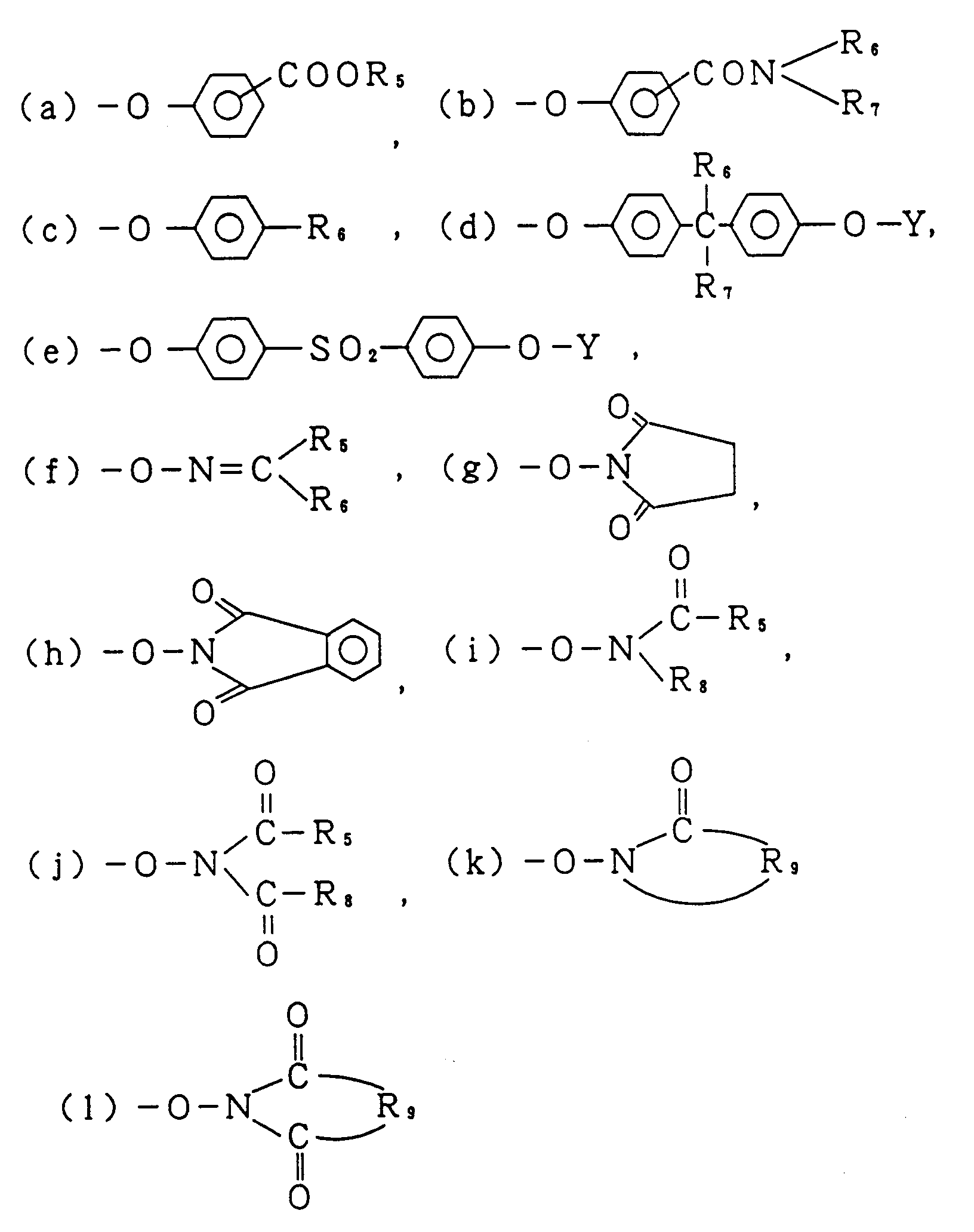
(m) glycerin residue, (n) sugar derivative residue,
(q) -O-R₉-SO₃⁻,
wherein R₅ and R₆ independently represent an alkyl group; R₆ and R₇ independently represent a hydrogen atom or an alkyl group; R₉ represents an alkylene group or alkenylene group; M₁ represents a hydrogen atom or an alkali metal atom; and Y represents a hydrogen atom or a group represented by the following formula:
wherein R₁, R₂, R₃ and BG are as defined above. - In Formula (I), X⁻ represents an inorganic or organic counter ion, but when the leaving group is represented by the following formula, X⁻ does not exist.

With respect to the compounds of Formula (I), a preference is given to those wherein the binding group is -(CH₂)₁₋₁₂-, particularly -(CH₂)₁₋₅, -the leaving group is represented by the structural formula (a), (b), (c), (d), (f), (g), (m), (n), (o), (p) or (q), R₅ is a C₁₋₂ alkyl group, each of R₆ and R₇ is H or a C₁₋₂ alkyl group, R₈ is a C₁₋₂ alkyl group and R₉ is a C₁₋₃ alkylene group, with a greater preference given to the compound represented by the structural formula (o) or (p). - The nitrile compound represented by the following formula is also useful as a bleaching activator.

wherein R' represents an alkyl group ofcarbon number 1 to 3; X⁻ represents an organic or inorganic counter ion; and h represents an integer of 1 to 16. - Among the bleaching activator (A), particularly desirable ones are those shown by the following formulas:


wherein R₁ and c are as defined above; e represents an integer of 1 to 10; LG represents a leaving group as defined (o) and (p) above. - The bleaching activator (B) used for the present invention is an organic peracid precursor which produces an organic peracid upon reaction with hydrogen peroxide wherein the leaving group is phenolsulfonic acid or a salt thereof, and is disclosed, for instance, in Japanese Patent Laid-Open Nos. 22999/1984, 258447/1988 and 31566/1988.
- Typical examples are compounds of the following two structures, which are not to be construed as limitative.

wherein R₁₀ represents an alkyl group ofcarbon number 1 to 14; f is an integer of 0 or 1; and M₂ represents a hydrogen atom or an alkali metal; and
wherein R₁₁ represents an alkyl group ofcarbon number 1 to 14 or R₁₄-X-Q group,
wherein R₁₄ represents an alkyl group ofcarbon number 1 to 14; and X represents:
-O-,
Q represents -(CH₂)g- or -(OCH₂CH₂)g-; and g represents an integer of 1 to 11;
R₁₂ and R₁₃ independently represents an alkyl group ofcarbon number 1 to 3; a binding group is usually -(CH₂)g-, wherein g is as defined above; f is an integer of 0 or 1; M₃ and Z⁻ may not be present, or when present, M₃ is a hydrogen atom or an alkali metal and Z⁻ represents an anion such as a halogen ion. - The bleaching activator (C) used for the present invention is an organic peracid precursor which produces a peracetic acid upon reaction with hydrogen peroxide, and is exemplified by tetraacetylethylenediamine (TAED), acetoxybenzenesulfonic acid, tetraacetylglycoluril (TAGU) and glucose pentaacetate (GPAC).
- The amount of the bleaching activator described above is normally 0.1 to 15% by weight, preferably 1 to 10% by weight in the whole composition. When the amount is less than 0.1% by weight, no bleaching activating effects are obtained. When it exceeds 15% by weight, further addition of the bleaching activator to the composition shows no significant effects, but merely increases the costs thereof.
- In detergents for clothing items, detergents have recently been formulated with enzymes to decompose and remove the target dirt in the field of the art. However, it has been pointed out that the components of the detergents and the chlorine dissolved in tap water decrease the enzymatic activities.
- In the fourth embodiment, such a problem is eliminated by providing a detergent composition excellent in stability of the enzyme during long-time storage and suitable for concentration.
- In the fourth embodiment of the present invention, the detergent composition comprises:
- (a) a surfactant;
- (b) the synthesized inorganic ion exchange material as described above and/or a hydrate thereof; and
- (c) an enzyme.
- The surfactant (a) and the above inorganic ion exchange material and/or the hydrate thereof (b) in the fourth embodiment are as described above.
- The enzymes used for the present invention are enzymes capable of hydrolyzing dirt as a substrate. Such hydrolytic enzymes include the following:
- Carboxylate hydrolase, thiol ester hydrolase, phosphate monoester hydrolase and phosphate diester hydrolase, all of which act on ester linkage; glycoxide hydrolase, which acts on glycoxy compounds; enzymes which hydrolyze N-glycosyl compounds; thioether hydrolase, which acts on ether linkage; α-amino-acyl-peptide hydrolase, peptidyl-amino acid hydrolase, acyl-amino acid hydrolase, dipeptide hydrolase and peptidyl-peptide hydrolase, all of which act on peptide linkage, with a preference given to carboxylate hydrolase, glycoside hydrolase and peptidyl-peptide hydrolase.
- More specifically, the preferred hydrolytic enzymes are exemplified as follows:
- Examples suitable to the present invention include pepsin, pepsin B, rennin, trypsin, chymotrypsin A, chymotrypsin B, elastase, enterokinase, cathepsin C, papain, chymopapain, ficin, thrombin, fibrinolysin, renin, subtilisin, aspergillopeptidase A, collagenase, clostridiopeptidase B, kallikrein, gastrisin, cathepsin D, bromelain, keratinase, chymotrypsin C, pepsin C, cocoonase, aspergillopeptidase B and urokinase. Other proteases are carboxypeptidases A and B and aminopeptidase.
- Cellulase, α-amylase, β-amylase, isoamylase, pullulanase, glucoamylase, isopertase, lysozyme, pectinase, chitinase, dextranase and others are preferable, with a greater preference given to cellulase, α-amylase, β-amylase and pullulanase.
- Examples of carboxylate ester hydrolases preferred for the present invention include carboxyl esterase, lipase, pectinesterase and chlorophyllase, and lipase is particularly effective.
- These enzymes may be selected from the same type of the enzyme alone, as in the case of selection of two or more proteases. Alternatively, they may be selected from two or more types, as in the case where a protease and an amylase are selected.
- The enzymes used in the present invention may be those widely distributed in animals, plants, bacteria and fungi, and partially purified fraction thereof, which are not construed to be limitative thereto.
- Examples of commercially available enzyme products and manufacturers thereof are as follows: "Alkalase," "Esperase," "Sabinase," "AMG," "BAN," "Fungamill," "Sweetzyme," "Termamill," "Lipolase" (Novo Industry, Copenhagen, Denmark); "Maksatase P," "High-alkaline protease," "Amylase THC", "Lipase" (Gist Brocades, N.V., Delft, Holland); "Protease B-400," "Protease B-4000," "Protease AP" and "Protease AP 2100" (Schweizerische Ferment A.G., Basel, Switzerland); "CRD-Protease" (Monsanto Company, St. Louis, Missouri, U.S.A.); "Piocase" (Piopin Corporation, Monticello, Illinois, U.S.A.); "Pronase-P," "Pronase-AS," "Pronase-AF" (Kaken Chemical Co., Ltd., Japan); "Lapidase P-2000" (Lapidas, Secran, France); protease products (Tyler standard sieve, 100% pass 16 mesh and 100% on 150 mesh) (Clington Corn Products (Division of Standard Brands Corp., New York); "Takamine," "Bromelain 1:10," "HT Protease 200," "Enzyme L-W" (obtained from fungi, not from bacteria) (Miles Chemical Company, Elkhart, Ind., U.S.A.); "Rozyme P-11 Conc.," "Pectinol," "Lipase B," "Rozyme PF," "Rozyme J-25" (Rohm & Haas, Philadelphia, U.S.A.); "Ambrozyme 200" (Jack Wolf & Co., Ltd., Subsidiary of Nopco Chemical Company, Newark, N.J., U.S.A.); "ATP 40," "ATP 120," "ATP 160" (Lapidas, Secran, France); "Oripase" (Nagase & Co., Ltd., Japan); "API-21" (Showa Denko K.K.).
- Examples of the commercially available cellulases may be as follows:
- (1) Cellulase AP (Amano Pharmaceutical Co., Ltd.);
- (2) Cellulosin AP (Ueda Chemical Co., Ltd.);
- (3) Cellulosin AC (Ueda Chemical Co., Ltd.);
- (4) Cellulase-Onozuka (Kinki Yakult Seizo Co., Ltd.);
- (5) Pancellase (Kinki Yakult Seizo Co., Ltd.);
- (6) Macerozyme (Kinki Yakult Seizo Co., Ltd.);
- (7) Meicelase (Meiji Seika Kaisha, Ltd.);
- (8) Celluzyme (Nagase Co., Ltd.);
- (9) Soluble sclase (Sankyo Co., Ltd.);
- (10) Sanzyme (Sankyo Co., Ltd.);
- (11) Cellulase A-12-C (Takeda Chemical Industries, Ltd.);
- (12) Toyo-Cellulase (Toyo Jozo Co., Ltd.);
- (13) Driserase (Kyowa Hakko Kogyo Co., Ltd.);
- (14) Luizyme (Luipold Werk);
- (15) Takamine-Cellulase (Chemische Fabrik);
- (16) Wallerstein-Cellulase (Sigma Chemicals);
- (17) Cellulase Type 1 (Sigma Chemicals);
- (18) Cellulase Serva (Serva Laboratory);
- (19) Cellulase 36 (Rohm and Haas);
- (20) Miles Cellulase 4,000 (Miles);
- (21)
R&H Cellulase 35,36,38 conc (Philip Morris); - (22) Combizym (Nysco Laboratory);
- (23) Cellulase (Makor Chemicals);
- (24) Cellucrust (NOVO Industry); and
- (25) Cellulase (Gist-Brocades).
- Other enzymes include "Splentase 200L" (tradename, Amano Pharmaceutical Co., Ltd.), "Promozyme" (tradename, NOVO Industry), "Isoamilase" (Reagent, Seikagaku Kogyo), etc.
- Further, examples of proteases include those disclosed in European Patent Publication No. 496361, and examples of cellulase include those disclosed in U.S. Patent Nos. 4,822,516 and 4,978,470, and WO8909259, WO9110732 and WO9117243.
- These enzymes may be contained in an amount of normally 0.001 to 10% by weight, preferably 0.005 to 5% by weight, and more preferably 0.01 to 2% by weight. When the amount is less than 0.001% by weight, the effects of the present invention cannot be achieved, and when it exceeds 10% by weight, further addition of the enzymes to the composition shows no significant effects, but merely increases the costs thereof.
- When using such an enzyme, a reducing agent may be contained at 0.01 to 5% by weight based on the whole composition in order to enhance the effects of the enzyme. The reducing agent is preferably an inorganic reducing agent, which reduces and removes the residual chlorine dissolved in tap water and should not decrease the enzyme activity.
- The reducing agent used for the present invention is exemplified by sulfurous acid, disulfurous acid, thiosulfuric acid and salts thereof. These reducing agents may be used singly or in combination.
- The amount of these reducing agents is normally 0.01 to 5% by weight, preferably 0.05 to 2% by weight based on the whole composition. When the amount is less than 0.01% by weight, residual chlorine elimination is insufficient. When it exceeds 5% by weight, further addition of the reducing agents to the composition shows no significant effects, but merely increases the costs thereof.
- The detergent compositions which are exemplified by the above-mentioned embodiments of the present invention may incorporate the following various additives appropriately according to various purposes.
- In washing clothing items at homes etc., rinsing ability such as good lather removal and disappearance of turbidity at the time of washing and rinsing is required for detergents from the viewpoint of users' convenience. To improve such rinsing ability, the following rinsing agents can be used appropriately in the present invention.
- Although known ordinary rinsing agents can be used for this purpose, it is preferable to use at least one member selected from the group consisting of 1) through 3) described below from the viewpoint of the rinsing effects and compatibility with the inorganic ion exchange material.
- 1) Silicone
- 2) Salt of fatty acid of carbon number 8 to 20.
- 3) Polyoxyethylene polyoxypropylene alkyl ether having an alkyl group of carbon number 8 to 20, and having ethylene oxide added thereto in a molar number of 3 to 14 and propylene oxide added thereto in an average molar number of 1 to 14.
- The silicones of 1) are exemplified by dimethylsilicone oil, silicone paste, silicone emulsion, organically modified polysiloxane and fluorosilicone oil, with a preference given to those prepared by absorbing them to silica powder.
- The salt of fatty acid of 2), which has a carbon number 8 to 20, may be a salt of any saturated or unsaturated fatty acid, and is exemplified by palm acids based mainly on lauric acid, beef tallow fatty acids based mainly on oleic acid and palm fatty acids.
- The polyoxyethylene polyoxypropylene alkyl ether of 3), which has an alkyl group of carbon number of 8 to 20, with ethylene oxide added thereto in a molar number of 3 to 14 and propylene oxide added thereto in an average molar number of 1 to 14, is a block type polyoxyethylene polyoxypropylene alkyl ether represented by the following formula:
RO(C₂H₄O)a-(C₃H₆O)b-H
- C₂H₄O :
- Ethylene oxide block
- C₃H₆O :
- Propylene oxide block
- With respect to the above formula, the linear or branched alkyl group of carbon number 8 to 20 represented by R is exemplified by linear primary alcohols derived from natural materials and synthetic alcohols (primary, secondary) derived from petrochemical derivatives. "a" represents a number of 3 to 14. When "a" is less than 3, its solubility is poor. When "a" exceeds 14, the rinsing effects is lowered. "b" represents a number of 1 to 14. When "b" exceeds 14, its solubility is poor.
- The amount of the rinsing agent described above is normally 0.02 to 5% by weight, preferably 0.05 to 3% by weight in the whole composition. When the amount is less than 0.02% by weight, no effects for improving rinsing ability are obtained. When it exceeds 5% by weight, no further improvements in rinsing ability are obtained, while turbidity undesirably takes place.
- In detergents for clothing items, it is a common practice to formulate the detergent with a fluorescent dye for the purpose of maintaining whiteness for the laundry. The following fluorescent dyes can be used when it is intended to obtain a detergent offering good tone stability in storage.
- Although said fluorescent dye may be a known ordinary fluorescent dye, it is preferable to use an anionic fluorescent dye, particularly an anionic fluorescent dye having a sulfone group. Specifically, it is preferable to use at least one fluorescent dye selected from the group consisting of the following 1) through 10) from the viewpoint of brightening effect of clothing item, price and other factors.
- 1) 4,4'-Bis[{4-anilino-6-(2-hydroxyethyl)amino-1,3,5-triazin-2-yl}amino]stilbene-2,2'-disulfonic acid disodium salts
- 2) 4,4'-Bis{(4-anilino-6-morpholino-1,3,5-triazin-2-yl)amino}stilbene-2,2'-disulfonic acid disodium salts
- 3) 4,4'-Bis[{4-anilino-6-bis(2-hydroxyethyl)amino-1,3,5-triazin-2-yl}amino]stilbene-2,2'-disulfonic acid disodium salts
- 4) 4,4'-Bis{(4-amino-6-anilino-1,3,5-triazin-2-yl)-amino}stilbene-2,2'-disulfonic acid disodium salts
- 5) 4,4'-Bis[{4-anilino-6-(N-methyl-N-2-hydroxyethylamino)-1,3,5-triazin-2-yl}amino]stilbene-2,2'-disulfonic acid disodium salts
- 6) 4,4'-Bis{(4-anilino-6-methoxy-1,3,5-triazin-2-yl)-amino}stilbene-2,2'-disulfonic acid disodium salts
- 7) 4,4'-Bis{(4-toluidino-6-morpholino-1,3,5-triazin-2-yl)amino}stilbene-2,2'-disulfonic acid disodium salts
- 8) 4,4'-Bis(2-sulfostyryl)biphenyl disodium salts
- 9) 4,4'-Bis(4-phenyl-1,2,3-triazol-2-yl)stilbene-2,2'-disulfonic acid disodium salts
- 10) 4-(2H-naphto[1,2-d]triazol-2-yl)stilbene-2-sulfonic acid sodium salts
- The detergent composition of the present invention contains an inorganic ion exchange material as described above and/or a hydrate thereof, and a surfactant, and may further incorporate various additives which are normally added to detergents. Such additives are preferably detergent builders. Examples of usable detergent builders are the inorganic compounds and/or organic compounds exemplified below.
- Examples of the detergent builders are crystalline or amorphous aluminosilicates as described below.
- (1) Crystalline aluminosilicate salts represented by the following formula:
p(Mb₂O or M''O)·Al₂O₃·qSiO₂·wH₂O
wherein Mb represents an alkali metal atom; M'' represents an alkaline earth metal atom exchangeable with calcium; p, q and w represent mol numbers of the respective components, which generally fall in the ranges of 0.7 ≦ p ≦ 1.5, 0.8 ≦ q ≦ 6 and w is an arbitrary positive number.
Among them, those represented by the following formula are preferred as detergent builders:
Na₂O·Al₂O₃·rSiO₂·w'H₂O
wherein r represents a number of 1.8 to 3.0, and w' represents a number of 1 to 6. - (2) Amorphous aluminosilicate salts represented by the following formula:
tQ₂O·Al₂O₃·uSiO₂·wH₂O
wherein Q represents a sodium atom and/or a potassium atom; t, u and w represent mol numbers of the respective components, which generally fall in the ranges of 0.7 < t ≦ 1.2, 1.6 ≦ q ≦ 2.8 and w is an arbitrary positive number. - Besides them, phosphates such as tripolyphosphate and pyrophosphate, aminotri(methylenephosphonic acid), 1-hydroxyethylidene-1,1-diphosphonic acid, ethylenediaminetetra(methylenephosphonic acid), diethylenetriaminepenta(methylenephosphonic acid), salts thereof, salts of phoshonocarboxylic acid such as 2-phosphonobutane-1,2-dicarboxylic acid, salts of amino acid such as aspartic acid or glutamic acid, aminopolyacetates such as nitrilotriacetate and ethylenediaminetetraacetate, polymeric electrolytes such as polyacrylic acid and polyaconitic acid, non-dissociative polymers such as polyethylene glycol, polyvinyl alcohol and polyvinylpyrrolidone, the polyacetal carboxylic acid polymer described in Japanese Patent Laid-Open No. 52196/1979, salts of organic acid such as diglycollate and oxycarboxylate, and other builders and divalent metal ion sequestering agents; alkali agents or inorganic electrolytes such as silicates, carbonates and sulfates; and re-contamination inhibitors such as the layered silicate described in Japanese Patent Laid-Open No. 227895/1985, polyvinylpyrrolidone and carboxymethyl cellulose.
- The detergent composition of the present invention may also contain caking inhibitors such as p-toluenesulfonates, sulfosuccinates, talc and calcium silicate, antioxidants such as tertiary butylhydroxytoluene and distyrenated cresol, blueing agents, flavoring agents and other substances, all of which may be added according to purposes of use without limitations.
- The detergent compositions of the present invention containing each of the components described above may be produced by any of the conventionally known methods without limitation.
- Examples of the methods for producing the high density detergent include those disclosed in Japanese Patent Laid-Open Nos. 69897/1986, 69899/1986 and 69900/1986 and EP Publication No. 513824A.
- The detergent composition of the present invention may be used for various uses such as clothing item detergents, tableware detergents, body detergents and metal detergents.
- The inorganic ion exchange material of the present invention is excellent in both cationic exchange capacity and anti-solubility, making it useful to be used for a water softener and alkalinity regulator in detergents.
- The detergent composition of the present invention contains an inorganic ion exchange material which has anti-solubility as well as excellent ion exchange capacity and alkaline capacity, thereby offering excellent washing effects and is suitable for the concentration of detergent.
- The detergent composition of the present invention is also excellent in washing power for dirt.
- Moreover, the detergent composition of the present invention is excellent in washing power for dirt caused by fatty acids and change in solubility with time owing to the containment of a porous oil-absorbing carrier.
- Also, the detergent composition of the present invention offers high bleaching rates by fully utilizing the performance of an oxygen-based bleaching agent when it is contained therein.
- The present invention will be further described by means of the following working examples, comparative examples, detergent compositions, comparative detergent compositions and test examples, without intending to restrict the scope of the present invention thereto.
- The measurements shown in Examples and Comparative Examples are obtained as follows:
- A 0.1 g sample is accurately weighed and added to 100 ml of a calcium chloride aqueous solution (500 ppm concentration, when calculated as CaCO₃), followed by stirring at 25°C for 60 minutes, after which the mixture is filtered using Membrane Filter (made of nitrocellulose; manufactured by Advantech) of 0.2 µm pore size. 10 ml of the filtrate is assayed for Ca content by an EDTA titration, and the calcium ion exchange capacity (cation exchange capacity) of the sample is calculated from the titer.
- A 2 g sample is added to 100 g of ion exchanged water, followed by stirring at 25°C for 30 minutes. Centrifugation is then conducted, and the supernatant is filtered through Membrane Filter of 0.2 µm pore size. The Si concentration in the filtrate is determined by inductively coupled plasma (ICP) emission analysis, and the amount of Si dissolved is calculated when calculated as SiO₂.
- In the Raman scattering spectrometry obtained by using the Fourier transform Raman spectrophotometer JSR-FT6500N model (manufactured by JEOL Ltd.; excited beam: YAG laser; wavelength: 1064 nm; detector: InGaAs), the relative strength ratio Q₂/Q₃ is calculated by determining the scattering strength of respective peaks of Q₂ and Q₃ as the peak top value of the peaks appearing at 970 ± 20 cm⁻¹ and 1070 ± 30 cm⁻¹.
- To 100 parts by weight of No. 2 sodium silicate (SiO₂/Na₂O = 2.55; moisture content: 59.9%), 10.4 parts by weight of sodium hydroxide is added, followed by stirring using a homomixer to dissolve the sodium hydroxide. To this solution, 6.3 parts by weight of finely milled anhydrous calcium carbonate is added, and they are mixed by using a homomixer. A given amount of the mixture is transferred into a nickel crucible and baked in the air at a temperature of 700°C for 1 hour, followed by rapid cooling. The obtained baked product is milled to yield an inorganic
ion exchange material 1 of the present invention. As is seen in Table 1, this powder is found to have a high cationic exchange capacity of 303 CaCO₃ mg/g and an excellent antisolubility of 46.0 SiO₂ mg/g as of the amount of Si dissolved. - Inorganic ion exchange materials 2 through 4 are obtained in the same manner as in Example 1 except that the amount of anhydrous calcium carbonate added is changed to provide the compositions shown in Table 1. Also, inorganic ion exchange materials 5 and 6 are obtained in the same manner as in Example 1 except that anhydrous magnesium carbonate is used in the place of the anhydrous calcium carbonate to provide the compositions shown in Table 1. The obtained powders are analyzed for cationic exchange capacity and the amount of Si dissolved. As seen from the results given in Table 1, these powder materials are excellent in both cationic exchange capacity and anti-solubility in the same manner as in the inorganic
ion exchange material 1. - An inorganic ion exchange material 7 is obtained in the same manner as in Example 1 except that No. 1 sodium silicate (SiO₂/Na₂O = 2.14; moisture content: 44.9%) is used in the place of the No. 2 sodium silicate to provide the composition shown in Table 1. The obtained powder is analyzed for cationic exchange capacity and the amount of Si dissolved. As seen from the results given in Table 1, the powder material is excellent in both cationic exchange capacity and anti-solubility in the same manner as in the inorganic
ion exchange material 1. - An inorganic ion exchange material 8 is obtained in the same manner as in Example 7 except that anhydrous magnesium carbonate is used in the place of the anhydrous calcium carbonate to provide the composition shown in Table 1. The obtained powder is analyzed for cationic exchange capacity and the amount of Si dissolved. As seen from the results given in Table 1, the powder material is excellent in both cationic exchange capacity and anti-solubility in the same manner as in the inorganic
ion exchange material 1. - To 100 parts by weight of No. 1 sodium silicate powder (SiO₂/Na₂O = 2.11; moisture content: 22.1%), 1.8 parts by weight of sodium hydroxide, 0.9 parts by weight of anhydrous calcium carbonate and 1.5 parts by weight of magnesium hydroxide are added, and they are mixed by using a ball-mill. A given amount of the mixture is transferred into a nickel crucible and baked in the air at a temperature of 600°C for 1 hour, followed by rapid cooling. The obtained baked product is milled to yield an inorganic ion exchange material 9 of the present invention. The obtained powder is analyzed for cationic exchange capacity and the amount of Si dissolved. As seen from the results given in Table 1, the powder material is excellent in both cationic exchange capacity and anti-solubility in the same manner as in the inorganic
ion exchange material 1. - An inorganic ion exchange material 10 is obtained in the same manner as in Example 9 except that the amounts of anhydrous calcium carbonate and magnesium hydroxide added are changed to provide the compositions shown in Table 1. The obtained powder is analyzed for cationic exchange capacity and the amount of Si dissolved. As seen from the results given in Table 1, the powder material is excellent in both cationic exchange capacity and anti-solubility in the same manner as in the inorganic
ion exchange material 1. - Inorganic ion exchange materials 11 through 13 are obtained in the same manner as in Example 9 except that 325 mesh-passed silica rock powder (SiO₂ purity: 99.9%) and potassium hydroxide are used in the place of the powdery No. 1 sodium silicate and the sodium hydroxide to provide the compositions shown in Table 1. The obtained powders are analyzed for cationic exchange capacity and the amount of Si dissolved. As seen from the results given in Table 1, the powder materials are excellent in both cationic exchange capacity and anti-solubility in the same manner as in the inorganic
ion exchange material 1. - Silica rock powder, potassium hydroxide and magnesium hydroxide are mixed in the same manner as in Example 11 to provide the compositions shown in Table 1. This mixture is melted at a temperature of 1300°C for 8 hours, followed by rapid cooling to obtain cullets. To 1 part by weight of the cullets exceeding 100 mesh, 5 parts by weight of ion exchange water is added, and the mixture is subjected to a hydrothermal treatment at a pressure of 3 kg/cm² for 1 hour using an autoclave to yield water glass. A given amount of each water glass is transferred into a nickel crucible and baked in the air at a temperature of 650°C for 1 hour, followed by rapid cooling. The obtained baked product is milled to yield the powders of inorganic ion exchange materials 14 and 15 of the present invention. The obtained powders are analyzed for cationic exchange capacity and the amount of Si dissolved. As seen from the results given in Table 1, the powder materials are excellent in both cationic exchange capacity and anti-solubility in the same manner as in the inorganic
ion exchange material 1. - Silica sand (SiO₂ purity: 99.7%), potassium hydroxide, anhydrous calcium carbonate and magnesium hydroxide are mixed in the same manner as in Example 11 to provide the compositions shown in Table 1. Each of the mixture is melted at a temperature of 1300°C for 20 hours, followed by rapid cooling to obtain a glassified product (cullets). To 1 part by weight of the 100 mesh-passed cullets, 4 parts by weight of ion exchange water is added, and a given amount of the mixture is transferred into a nickel crucible and baked in the air at a temperature of 600°C for 2 hours, followed by rapid cooling. The obtained baked product is milled to yield inorganic ion exchange materials 16 through 18 of the present invention. The obtained powders are analyzed for cationic exchange capacity and the amount of Si dissolved. As seen from the results given in Table 1, the powder materials are excellent in both cationic exchange capacity and anti-solubility in the same manner as in the inorganic
ion exchange material 1. - Inorganic ion exchange materials 19 and 20 are obtained in the same manner as in Example 1 except that potassium hydroxide is used together with the sodium hydroxide and that anhydrous magnesium carbonate is used together with the anhydrous calcium carbonate to provide the compositions shown in Table 1. The obtained powders are analyzed for cationic exchange capacity and the amount of Si dissolved. As seen from the results given in Table 1, these powder materials are excellent in both cationic exchange capacity and anti-solubility in the same manner as in the inorganic
ion exchange material 1. - Inorganic ion exchange materials 21 and 22 are obtained in the same manner as in Example 7 except that potassium hydroxide is used together with the sodium hydroxide and that magnesium hydroxide is used together with the anhydrous calcium carbonate to provide the compositions shown in Table 1. The obtained powders are analyzed for cationic exchange capacity and the amount of Si dissolved. As seen from the results given in Table 1, these powder materials are excellent in both cationic exchange capacity and anti-solubility in the same manner as in the inorganic
ion exchange material 1. - Inorganic ion exchange materials 23 through 27 are obtained in the same manner as in Example 9 except that potassium hydroxide is used together with the sodium hydroxide to provide the compositions shown in Table 1. The obtained powders are analyzed for cationic exchange capacity and the amount of Si dissolved. As seen from the results given in Table 1, these powder materials are excellent in both cationic exchange capacity and anti-solubility in the same manner as in the inorganic
ion exchange material 1. - Inorganic ion exchange materials 28 through 32 are obtained in the same manner as in Example 14 except that sodium hydroxide is used together with the potassium hydroxide and that anhydrous calcium carbonate and magnesium hydroxide are used together therewith to provide the compositions shown in Table 1. The obtained powders are analyzed for cationic exchange capacity and the amount of Si dissolved. As seen from the results given in Table 1, these powder materials are excellent in both cationic exchange capacity and anti-solubility in the same manner as in the inorganic
ion exchange material 1. - Inorganic ion exchange materials 33 through 37 are obtained in the same manner as in Example 16 except that sodium hydroxide is used together with the potassium hydroxide and that anhydrous calcium carbonate and magnesium hydroxide are used together therewith to provide the compositions shown in Table 1. The obtained powders are analyzed for cationic exchange capacity and the amount of Si dissolved. As seen from the results given in Table 1, these powder materials are excellent in both cationic exchange capacity and anti-solubility in the same manner as in the inorganic
ion exchange material 1. - Figure 1 shows the Raman spectrum of the inorganic ion exchange material obtained in Example 35, in comparison with the spectrum of the sodium disilicate (Na₂Si₂O₅) obtained in Comparative Example 1 described below. As is clear from Figure 1 (a), the inorganic ion exchange material is a substance having a chain structure by the appearance of the characteristic main scattering peak at 970 ± 20 cm⁻¹ assigned to the Q₂ unit.
- A powder having the composition shown in Table 1 is prepared as an anhydrous product in the same manner as in Example 1. 10 g of the powder is dispersed in 500 ml of an ion exchange water for 1 hour, followed by filtration using a Membrane Filter having a pore size of 0.2 µm. The residue on the filter is dried at a temperature of 100°C for 16 hours to yield an inorganic ion exchange material 38 in the form of a hydrate. The obtained powder is analyzed for cationic exchange capacity and the amount of Si dissolved. As seen from the results given in Table 1, the powder material is excellent in both cationic exchange capacity and anti-solubility in the same manner as in the inorganic
ion exchange material 1. - To 100 parts by weight of No. 2 sodium silicate, 4.2 parts by weight of sodium hydroxide is added, and the sodium hydroxide is dissolved by using a homomixer. A given amount of the solution is transferred into a nickel crucible and baked in the air at a temperature of 700°C for 1 hour, followed by rapid cooling. The obtained baked product is milled to yield a
comparative powder material 1. As is seen in Table 1, although this powder material is found to have a cationic exchange capacity of 224 CaCO₃ mg/g, it has a poor anti-solubility of 133 SiO₂ mg/g as of the amount of Si dissolved. The reasons for such poor anti-solubility are presumably that although this powder material has sufficient cationic exchange sites, since the Ca or Mg component having a function for the structural stability is not included in the structure thereof, the solubility becomes high. - 325 mesh-passed silica rock powder and potassium hydroxide are mixed by a V-type mixer to provide the composition shown in Table 1, and a given amount of the mixture is transferred into a nickel crucible and baked in the air at a temperature of 700°C for 1 hour, followed by rapid cooling. The obtained baked product is milled to yield a comparative powder material 2. As is seen from Table 1, although this powder material is found to have a cationic exchange capacity of 462 CaCO₃ mg/g, it has a poor anti-solubility of 531 SiO₂ mg/g as of the amount of Si dissolved for the same reasons as in Comparative Example 1. Therefore, it is insufficient property for a detergent builder.
- To an aqueous solution of No. 2 sodium silicate, potassium hydroxide is added to provide the composition shown in Table 1, and a given amount of the mixture is transferred into a nickel crucible and baked in the air at a temperature of 650°C for 1 hour, followed by rapid cooling. The obtained baked product is milled to yield a comparative powder material 3. As is seen in Table 1, although this powder material is found to have a cationic exchange capacity of 399 CaCO₃ mg/g, it has a poor anti-solubility of 309 SiO₂ mg/g as of the amount of Si dissolved for the same reasons as in Comparative Example 1. Therefore, it is insufficient property for a detergent builder.
- Slaked lime is mixed in an aqueous solution of No. 2 sodium silicate, and this mixture is subjected to hydrothermal synthesis in an autoclave at a pressure of 9 kg/cm² for 20 hours to yield a comparative powder material 4 of the composition shown in Table 1. As is seen in Table 1, although this powder is found to be excellent in anti-solubility as demonstrated by the low amount of Si dissolved, it has an insufficient cationic exchange capacity of not more than 200 CaCO₃ mg/g. The reasons for such an insufficient cationic exchange capacity are presumable that the Ca or Mg component having a function for the structural stability is excessively included in the structure thereof, resulting in a undesirable decrease in the cationic exchange sites, while remarkably decreasing the amount of Si dissolved.
- No. 1 sodium silicate, potassium hydroxide, anhydrous calcium carbonate and magnesium hydroxide are mixed to provide the composition shown in Table 1. A given amount of the mixture is transferred into a nickel crucible and baked in the air at a temperature of 700°C for 1 hour, followed by rapid cooling. The obtained baked product is milled to yield a comparative powder material 5. As is seen in Table 1, although this powder is found to be excellent in anti-solubility as demonstrated by the low amount of Si dissolved, it has an insufficient cationic exchange capacity of not more than 200 CaCO₃ mg/g for the same reasons as in Comparative Example 4.


- The synthesized inorganic ion exchange materials A through G obtained in the above Examples are used to prepare the detergent compositions of the present invention having the compositions shown in Tables 2 through 8 by the method described below. The synthesized inorganic ion exchange materials A through G are, respectively, the synthesized inorganic ion exchange materials obtained in Examples 3, 35, 31, 34, 5, 12 and 38.
- Specifically, for Detergent Compositions 1-1 through 1-14, the components other than the synthesized inorganic ion exchange material are prepared as an aqueous slurry of 60% solid content, which is spray dried to yield grains, in which inorganic ion exchange material powder is mixed. For Detergent Compositions 1-15 through 1-25 and Detergent Compositions 1-39 through 1-68, the components other than the inorganic ion exchange material are prepared as a slurry of 60% solid content, which is spray dried to yield grains, which are granulated in the presence of a corresponding amount of inorganic ion exchange material powder in a mixer granulator. For Detergent Compositions 1-26 through 1-38 and Detergent Compositions 1-69 through 1-73, the starting material powder is placed in a tumbling mixer granulator and subjected to mixing granulation while gradually introducing a liquid nonionic surfactant.
- Powdery detergent compositions of average grain size of 200 to 500 µm are thus obtained.
- The comparative detergent compositions having the compositions shown in Tables 2 through 6 are prepared in the same manner as in Detergent Compositions except that Zeolite 4A is used in place of the synthesized inorganic ion exchange material powder, or that the synthesized inorganic ion exchange material powder is omitted.
- The comparative detergent compositions having the compositions shown in Table 7 are prepared in the same manner as in Detergent Compositions 1-46 through 1-68 except that Zeolite 4A or trisodium citrate·dihydrate is used in place of the synthesized inorganic ion exchange material powder and that the amount of each component is adjusted so as to give a pH equivalent to those of Detergent Compositions 1-46 through 1-68.
- The comparative detergent compositions having the compositions shown in Table 8 are prepared in the same manner as in Detergent Compositions 1-69 through 1-73 except that Zeolite 4A or trisodium citrate·dihydrate is used in the place of the synthesized inorganic ion exchange material powder and that the amount of each component is adjusted so as to give a pH equivalent to those of Detergent Compositions 1-69 through 1-73.
- Detergent Compositions 1-1 through 1-14 and Comparative Detergent Compositions 1-1 and 1-2 are used to carry out a deterging test under the following conditions:
- Cotton test pieces of 10 cm × 10 cm stained with oil and fat having the following compositions and trace amounts of carbon black are prepared.
Cotton seed oil 60% Cholesterol 10% Oleic acid 10% Palmitic acid 10% Liquid and solid paraffins 10% - Washing is carried out using a twin tub type washing machine ("Ginga," manufactured by Toshiba Corporation) by washing at a temperature of 20°C for 10 minutes in 3°DH (Ca/Mg=3/1) water having a detergent concentration of 0.133%; rinsing with running water for 8 minutes.
- Reflectivities of the original cloth before the washing and those of the stained cloth before and after the washing are measured at 550 mµ by means of an automatic recording colorimeter (manufactured by Shimadzu Corporation), and the deterging rate D(%) is calculated by the following equation. The results thereof are shown in Table 2.

L₁: Reflectivity of the stained cloth before washing; and
L₂: Reflectivity of the stained cloth after washing.
- Incidentally, the abbreviations used in Table 2 and hereinafter are as follows:
- LAS-Na:
- Sodium linear alkylbenzene sulfonate;
- AS-Na :
- Sodium alkyl sulfate;
- AOS-Na:
- Sodium α-olefinsulfonate;
- AOS-K :
- Potassium α-olefinsulfonate;
- α-SFE-Na:
- α-Sulfofatty acid methyl ester sodium salt;
- CMC-Na:
- Carboxymethylcellulose sodium salt;
- ES-Na :
- Sodium alkyl ether sulfate;
- TAED :
- Tetraacetylethylenediamine; and
- Bal. :
- Balance.
- The washing test is carried out in the same manner as in Test Example 1 except Detergent Compositions 1-15 through 1-25 and Comparative Detergent Compositions 1-3 and 1-4 are used, and that the deterging conditions are changed as shown below:
- Washing is carried out using a fully automatic washing machine ("Aisaigo," manufactured by Matsushita Electric Industrial Co., Ltd.) by washing in a standard cycle at a temperature of 20°C in 3.5°DH (Ca/Mg=3/1) water having a detergent concentration of 0.0833%. The results thereof are shown together in Table 3.

- The washing test is carried out in the same manner as in Test Example 1 except that Detergent Compositions 1-26 through 1-38 and Comparative Detergent Compositions 1-5 and 1-6 are used, and that the deterging conditions are changed as shown below:
- Washing is carried out using a Turgotometer by washing at a rotational speed of 100 rpm, at a temperature of 20°C for 10 minutes in 3°DH (Ca/Mg=3/1) water having a detergent concentration of 0.0833%. The results thereof are shown together in Table 4.

- The washing test is carried out in the same manner as in Test Example 1 except that Detergent Compositions 1-39 through 1-49 and Comparative Detergent Compositions 1-7 and 1-8 are used, and that the deterging conditions are changed as shown below:
- Washing is carried out using a fully automatic washing machine ("Model LA5580XT," manufactured by Whirlpool, U.S.A.) by washing in a standard cycle at a temperature of 35°C in 8°DH (Ca/Mg=2/1) water having a detergent concentration of 0.1%. The results thereof are shown together in Table 5.
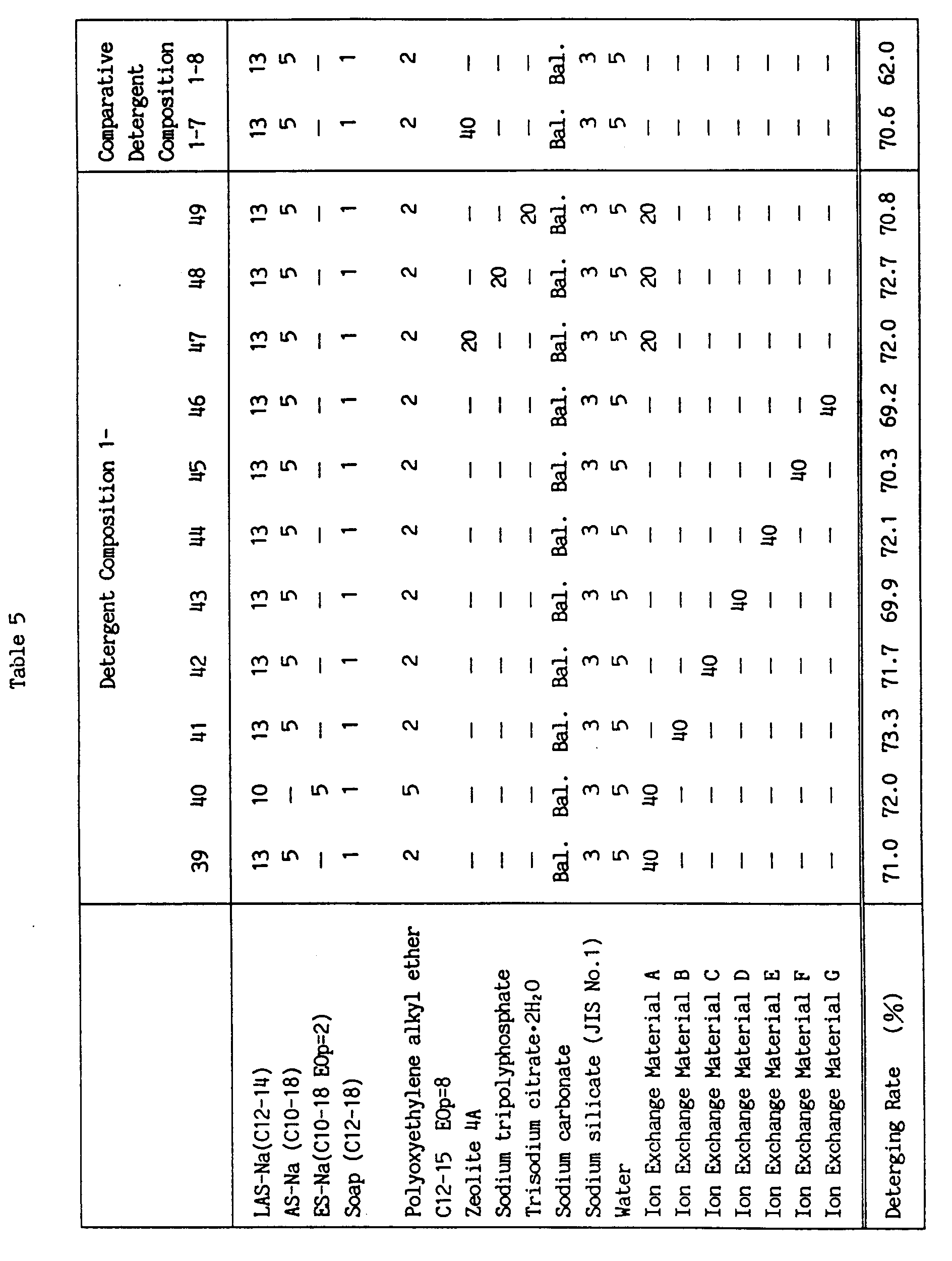
- The washing test is carried out in the same manner as in Test Example 1 except that Detergent Compositions 1-50 through 1-60 and Comparative Detergent Compositions 1-9 and 1-10 are used, and that the deterging conditions are changed as shown below:
- Washing is carried out using a fully automatic washing machine ("WFK4000," manufactured by Bosch, drum-type) by washing in a standard cycle at a temperature of 60°C in 16°DH (Ca/Mg=2/1) water having a detergent concentration of 0.8%. The results thereof are shown together in Table 6.

- The washing test is carried out in the same manner as in Test Example 1 except that Detergent Compositions 1-61 through 1-68, Detergent Compositions 1-69 through 1-73 and Comparative Detergent Compositions 1-11 through 1-14 are used. The results thereof are shown together with the total amounts of the detergent composition, the used amounts thereof, the degree of concentration and pHs before and after washing in Tables 7 and 8.
- In Table 7, in order to clearly distinguish the differences in composition ratios from Detergent Compositions 1-68 and Comparative Detergent Compositions 1-11 and 1-12, whose total amounts on 100 parts by weight, the total amounts of Detergent Compositions 1-61 through 1-67 are 75 parts by weight.
- Similarly, in Table 8, in order to clearly distinguish the differences in composition ratios with Detergent Compositions 1-73 and Comparative Detergent Compositions 1-13 and 1-14, whose total amounts are 100 parts by weight, the total amounts of Detergent Compositions 1-69 through 1-72 are 80 parts by weight.
Table 7 Detergent Composition 1- Comparative Detergent Composition 61 62 63 64 65 66 67 68 1-11 1-12 LAS-Na (C12-14) 25 25 25 25 25 25 25 25 25 25 AS-Na (C12-18) 7 7 7 7 7 7 7 7 7 7 Tallow soap (C12-20) 3 3 3 3 3 3 3 3 3 3 Zeolite 4A - - - - - - - - 30 - Trisodium citrate·2H₂O - - - - - - - - - 30 Ion Exchange Material A 30 - - - - - - 30 - - Ion Exchange Material B - 30 - - - - - - - - Ion Exchange Material C - - 30 - - - - - - - Ion Exchange Material D - - - 30 - - - - - - Ion Exchange Material E - - - - 30 - - - - - Ion Exchange Material F - - - - - 30 - - - - Ion Exchange Material G - - - - - - 30 - - - Sodium carbonate 4 4 4 4 4 4 4 27 27 27 Sodium silicate (JIS No.2) 1 1 1 1 1 1 1 3 3 3 Water 5 5 5 5 5 5 5 5 5 5 Total Amount 75 75 75 75 75 75 75 100 100 100 Used Amount g/30 liter 18.8 18.8 18.8 18.8 18.8 18.8 18.8 25 25 25 Degree of Concentration 1.33 1.33 1.33 1.33 1.33 1.33 1.33 1 1 1 pH before Washing 10.8 10.8 10.8 10.9 10.8 10.7 10.7 10.8 10.6 10.6 pH after Washing 10.2 10.4 10.4 10.4 10.2 10.2 10.2 10.3 9.9 10.0 Deterging Rate (%) 66.9 67.8 66.4 64.8 65.1 65.2 66.0 66.9 65.7 65.2 Table 8 Detergent Composition No. 1- Comparative Detergent Composition 69 70 71 72 73 1-13 1-14 Polyoxyethylene primary alcohol C12 alkyl ether EOp=8 28 25 - 28 28 28 28 Polyoxyethylene secondary alcohol C12-14 alkyl ether EOp=7 - - 28 - - - - Fatty acid diethanolamide (C12-16) - 3 - - - - - Zeolite 4A - - - - - 20 - Sodium tripolyphosphate - - - - - - 20 Trisodium citrate·2H₂O - - - - - - - Sodium carbonate 5 5 5 5 25 25 25 Amorphous silica 20 20 20 20 20 20 20 CMC-Na 2 2 2 2 2 2 2 Water 5 5 5 5 5 5 5 Ion Exchange Material A 20 - - - - - - Ion Exchange Material E - 20 - - - - - Ion Exchange Material F - - 20 - - - - Ion Exchange Material G - - - 20 20 - - Total Amount 80 80 80 80 100 100 100 Used Amount g/30 liter 20 20 20 20 20 25 25 Degree of Concentration 1.25 1.25 1.25 1.25 1 1 1 pH before Washing 10.7 10.7 10.8 10.7 10.8 10.6 10.6 pH after Washing 10.3 10.3 10.4 10.4 10.4 10.1 10.0 Deterging Rate (%) 68.7 67.9 68.9 68.5 68.8 68.4 68.7 - From the results shown in Tables 2 through 8, it is seen that the detergent composition of the present invention offers washing rates equivalent to those obtained using zeolite, a conventional ion exchange material for detergents (Comparative Detergent Compositions 1-1, 1-3, 1-5, 1-7 and 1-9). Also, in comparison with the absence of the synthesized inorganic ion exchange material (Comparative Detergent Compositions 1-2, 1-4, 1-6, 1-8, 1-10), fairly improved washing rates are obtained.
- From the results shown in Tables 7 and 8, it is seen that the detergent compositions of the present invention (Detergent Compositions 1-46 through 1-73) offer equivalent washing performance with lower amounts of use, in comparison with conventional formulations (Comparative Detergent Compositions 1-11 through 1-14). This is because the synthesized inorganic ion exchange material of the present invention is of multiple functions excellent in both ion exchange capacity and alkaline capacity, and because its use makes it possible to obtain an equivalent washing performance with smaller amounts of use than the total amount of the ion exchange material and alkali agent used separately in considerable amounts in conventional formulations.
- The synthesized inorganic ion exchange materials A, E, F and G obtained in the above Examples are used to prepare the detergent compositions of the present invention having the compositions shown in Tables 9 through 11 by the method described below. The synthesized inorganic ion exchange materials A, E, F and G are, respectively, the synthesized inorganic ion exchange materials obtained in Examples 3, 5, 12 and 38.
- Specifically, for Detergent Compositions 2-1 through 2-6 and Detergent Compositions 2-11 through 2-13, the components other than the synthesized inorganic ion exchange material are prepared as an aqueous slurry of 60% solid amount, which is spray dried to yield grains, which are granulated in the presence of a corresponding amount of inorganic ion exchange material powder in a mixer granulator. For Detergent Compositions 2-7 through 2-10, the starting material powder is placed in a tumbling mixer granulator and subjected to mixing granulation while gradually introducing a liquid nonionic surfactant and an aqueous polymeric solution (about 40% by weight).
- Powdery detergent compositions of average grain size of 200 to 500 µm are thus obtained.
- The following polymer (copolymer) is used.
- A:
- Sodium polyacrylate
(weight-average molecular weight: 10,000) - B:
- Sodium salt of maleate/acrylate copolymer
(monomer ratio: 30/70; weight-average molecular weight: 70,000) - C:
- Sodium salt of maleate/isobutylene copolymer
(monomer ratio: 50/50; weight-average molecular weight: 10,000) - D:
- Sodium salt of maleate/methacrylate copolymer
(monomer ratio: 70/30; weight-average molecular weight: 50,000) - E:
- Potassium salt of hydrolyzate of maleate/vinyl acetate copolymer
(monomer ratio: 50/50; weight-average molecular weight: 7,000) - The comparative detergent compositions are prepared in the same manner as in Detergent Compositions except that only the synthesized inorganic ion exchange material powder according to the present invention and the polymer are used at once to provide compositions shown in Tables 8 through 11.
- Specifically, Comparative Detergent Compositions 2-1 through 2-3 and Comparative Detergent Compositions 2-7 through 2-9 are prepared by granulating in the same manner as in Detergent Compositions 2-1 through 2-6. Comparative Detergent Compositions 2-4 through 2-6 are prepared by granulating in the same manner as in Detergent Compositions 2-7 through 2-10.
- Detergent Compositions 2-1 through 2-6 and Comparative Detergent Compositions 2-1 through 2-3 are used to carry out a deterging test under the following conditions:
- "Kanuma sekigyoku soil" for horticultural use is dried at 120°C ± 5°C for 4 hours and then finely pulverized. 150 mesh (100 µm)-passed soil particles are dried at 120°C ± 5°C for 2 hours. 150 g of the soil particles is dispersed in 1 liter of tetrachloroethylene. A calico #2023 is contacted with the dispersion and brushed. After removal of the dispersion, excessive mud remaining on the cloth is removed (Japanese Patent Laid-Open No. 26473/1980).
- Test pieces having a size of 10 cm × 10 cm are prepared and subjected to the test.
- Washing is carried out using a twin tub type washing machine ("Ginga," manufactured by Toshiba Corporation) by washing at a temperature of 20°C for 10 minutes in 3°DH (Ca/Mg=3/1) water having a detergent concentration of 0.0833%; rinsing with running water for 8 minutes.
- Reflectivities of the original cloth before the washing and those of the stained cloth before and after the washing are measured at 460 mµ by means of an automatic recording colorimeter (manufactured by Shimadzu Corporation), and the deterging rate D(%) is calculated in the same manner as in Test Example 1. The results thereof are shown in Table 9.
Table 9 Detergent Composition 2- Comparative Detergent Composition 1 2 3 4 5 6 2-1 2-2 2-3 LAS-Na(C12-14) 25 25 25 16 27 25 25 25 25 AS-Na (C12-18) 7 7 7 - - - 7 7 7 AOS-K (C12-18) - - - 16 - 7 - - - α -SFE Na(C14-18) - - - - 5 - - - - Zeolite 4A - - - - - - - 30 30 Ion Exchange Material A 30 30 30 - - - 30 - - Ion Exchange Material E - - - 30 - - - - - Ion Exchange Material F - - - - 30 - - - - Ion Exchange Material G - - - - - 30 - - - Sodium carbonate Bal. Bal. Bal. Bal. Bal. Bal. Bal. Bal. Bal. Sodium silicate(JIS No. 2) 4 4 4 4 4 4 4 4 4 Polymer A 3 - - 3 3 3 - 3 - Polymer B - 3 - - - - - - - Polymer C - - 3 - - - - - - Water 5 5 5 5 5 5 5 5 5 Deterging Rate (%) 60.1 60.1 60.8 58.9 58.8 59.2 55.5 59.1 54.0 - The washing test is carried out in the same manner as in Test Example 7 except that Detergent Compositions 2-7 through 2-10 and Comparative Detergent Compositions 2-4 through 2-6 are used, and that the deterging conditions are changed as shown below:
- Washing is carried out using a fully automatic washing machine ("Aisaigo," manufactured by Matsushita Electric Industrial Co., Ltd.) by washing in a standard cycle at a temperature of 20°C in 3.5°DH (Ca/Mg=3/1) water having a detergent concentration of 0.0833%. The results thereof are shown together in Table 10.
Table 10 Detergent Composition 2- Comparative Detergent Composition 7 8 9 10 2-4 2-5 2-6 Polyoxyethylene primary alcohol C12 alkyl ether EOp=8 25 25 - 25 25 25 25 Polyoxyethylene synthetic oxoalcohol C11-15 alkyl ether EOp=7 - - 20 - - - - Soap (C12-20) 1 1 0.5 1 1 1 1 Zeolite 4A - - - 10 - 35 35 Ion Exchange Material A 35 35 42 25 35 - - Sodium carbonate Bal. Bal. Bal. Bal. Bal. Bal. Bal Amorphous silica 10 10 8 10 10 10 10 Polymer D 4 - 2 4 - 4 - Polymer E - 4 1 - - - - Water 5 5 5 5 5 5 5 Deterging Rate (%) 60.2 60.0 58.8 59.1 46.2 57.7 46.0 - The washing test is carried out in the same manner as in Test Example 7 except that Detergent Compositions 2-11 through 2-13 and Comparative Detergent Compositions 2-7 through 2-9 are used, and that the deterging conditions are changed as shown below:
- Washing is carried out using a fully automatic washing machine ("Model LA5580XT," manufactured by Whirlpool, U.S.A.) by washing in a standard cycle at a temperature of 35°C in 8°DH (Ca/Mg=2/1) water having a detergent concentration of 0.1%. The results thereof are shown together in Table 11.
Table 11 Detergent Composition 2- Comparative Detergent Composition 11 12 13 2-7 2-8 2-9 LAS-Na 13 13 13 13 13 13 AS-Na 5 5 5 5 5 5 Soap 1 1 1 1 1 1 Polyoxyethylene alkyl ether C12-15 EOp=8 2 2 2 2 2 2 Sodium tripolyphosphate - - 10 40 40 - Sodium carbonate Bal. Bal. Bal. Bal. Bal. Bal Sodium silicate (JIS No. 1) 3 3 3 3 3 3 Water 5 5 5 5 5 5 Ion Exchange Material E 40 40 30 - - 40 Polymer A 2 - 2 2 - - Polymer B - 2 - - - - Deterging Rate (%) 60.2 61.1 61.5 61.8 61.6 57. - As is shown from the above results, the detergent compositions of the present invention offer fairly improved washing rates for mud stains, in comparison with the case where neither the synthesized inorganic ion exchange material nor (co)polymer of the present invention is used (Comparative Detergent Compositions 2-3 and 2-6) and the case where the (co)polymer alone of the present invention is not used (Comparative Detergent Compositions 2-1, 2-4 and 2-9).
- Also, in comparison with the case where zeolite, a conventional ion exchange material for detergents, and the (co)polymer of the present invention are used (Comparative Detergent Compositions 2-2 and 2-5), equivalent or slightly improved washing rates for mud stains are obtained. Also, in comparison with the case where sodium tripolyphosphate, a conventional builder, (Comparative Detergent Compositions 2-7 and 2-8), nearly equivalent washing rates are obtained.
- Starting material powders, including the synthesized inorganic ion exchange materials A, E, F and G obtained in the above Examples and oil-absorbing carriers having the properties shown in Tables 12 and 13, are placed in a batch kneader (Bench Kneader PNV-1 manufactured by Irie Shokai) in amounts according to the detergent composition, and a liquid nonionic surfactant is gradually introduced thereinto to yield a powdery detergent compound of an average grain size of 350 to 450 µm. A surface modifying agent is added in an amount corresponding to the formulation composition to obtain a detergent composition of the present invention (final detergent product) having the composition shown in Tables 14 and 15.
Table 12 Kind pH of 5% Water Dispersion Amount of Absorbed Oil (ml/100g) SiO₂ Content (% by wt.) TOKUSIL AL-1™ (Tokuyama Soda Co., Ltd.) 9.2 255 94 NIPSIL NA™ (Nippon Silica Ind.) 10.2 245 93 TIXOLEX 25™ (Kofran Chemical) 9.8 235 72 CARPLEX # 100™ (Shionogi Pharmacy) 10.4 230 93 SIPERNAT D 10™ (Degussa AG) 10.3 240 98 TOKUSIL NR™ (Tokuyama Soda Co., Ltd.) 5.8 280 94 FLORITE RN™ (Tokuyama Soda Co., Ltd.) 8.1 380 61 TIXOSIL 38™ (Kofran Chemical) 6.5 280 90 Table 13 Kind SiO₂ Content (% by wt.) Amount of Absorbed Oil (ml/100g) pH of 5% Water Dispersion Amount Dissolved in 2% aq. NaOH Soln. (g) PERLITE™ (DICALITE, PERLITE4159 DICALITE ORIENT, Co., LTD.) 72.7 165 7.8 0.01 Na-Mordenite (HSZ-640NAA, Tosoh Corporation) 87.5 110 10.7 0.12 TOKUSIL NR™ (Tokuyama Soda Co., Ltd.) 94 280 5.8 2.35 FLORITE RN™ (Tokuyama Soda Co., Ltd.) 61 380 8.1 2.18 - Here, the pH of the 5% water dispersion and the amount of oil absorbed are determined according to JIS K 6220. Also, the amount of the oil-absorbing carrier dissolved in a 2% aqueous NaOH solution is determined by dispersing 10 g of the oil-absorbing carrier in 100 ml of a 2% aqueous NaOH solution, stirring the dispersion for 16 hours while the temperature is kept at 25°C and determining SiO₂ in the filtrate by colorimetric determination [as for the colorimetric determination, refer to Yukagaku, Vol. 25, p. 156 (1976)]. Namely, the amount of the oil-absorbing carrier dissolved in the aqueous NaOH solution is calculated from the SiO₂ content of the oil-absorbing carrier which is determined by elementary analysis in advance.
- The detergent compositions having the compositions shown in Tables 14 and 15 are prepared in the same manner as in Detergent Compositions described above except that Zeolite 4A is used in place of the synthesized inorganic ion exchange material powder and that the oil-absorbing carrier is omitted.
- Detergent Compositions 3-1 through 3-23 and Comparative Detergent Compositions 3-1 through 3-3 are tested for solubility change upon storage as follows:
- Each powdery detergent composition is placed in a Petri dish and left to stand at 30°C and 50% RH for 3 days, after which a 0.83 g sample is taken and added to 1 liter of tap water at 10°C, followed by stirring with a magnetic stirrer for 10 minutes. The mixture is then filtered through a 200-mesh metal gauze and dried, after which the filtration residue rate (%) is determined. The results are shown in Tables 14 and 15.
- Detergent Compositions 3-1 through 3-23 and Comparative Detergent Compositions 3-1 through 3-3 are used to carry out a deterging test for stains caused by fatty acids under the following conditions:
- Cotton test pieces of 10 cm × 10 cm stained with paraffins and fatty acids having the following compositions and trace amounts of carbon black are prepared.
Oleic acid 20% Palmitic acid 20% Liquid and solid paraffins 60% - Washing is carried out using a Turgotometer ("Model 400," manufactured by Ueshima Seisakusho) by washing at a rotational speed of 100 rpm, at a temperature of 35°C for 15 minutes in 8°DH (calcium hard water) water having a detergent concentration of 0.1% by weight, followed by rinsing with tap water for 5 minutes.
-
- The deterging rate D(%) is calculated in the same manner as in Test Example 1. The results thereof are shown in Tables 14 and 15.


- As is seen from the above results, the detergent compositions of the present invention (Detergent Compositions 3-1 through 3-23) are excellent in change in solubility with time and washing power for dirt caused by fatty acids.
- On the other hand, when zeolite, etc., a conventional ion exchange material for detergents, is used, (Comparative Detergent Compositions 3-2 and 3-3), the change in solubility with time is poorer, though the washing rate is equivalent or slightly lower.
- The synthesized inorganic ion exchange materials A, E, F and G obtained in the above Examples are used to prepare the detergent compositions of the present invention having the compositions shown in Tables 16 and 17 by the method described below.
- Specifically, for Detergent Compositions 4-1 through 4-10, the components, other than the synthesized inorganic ion exchange materials and the bleaching components, are prepared as a slurry of 60% solid content, and then spray dried to yield grains, and then granulated in the presence of a corresponding amount of inorganic ion exchange material powder in a mixer granulator, followed by mixing the bleaching agent components and the bleaching activator components thereinto to prepare each detergent powder. For Detergent Compositions 4-11 through 4-18, the starting material powder is placed in a tumbling mixer granulator and subjected to mixing granulation while gradually introducing a liquid nonionic surfactant, followed by mixing the bleaching agent components and the bleaching activator components thereinto to prepare each detergent powder.
- Powdery detergent compositions of average grain size of 200 to 500 µm are thus obtained.
- The following bleaching activators are used.
-

- Sodium nonanoyloxybenzenesulfonate
-

- Tetraacetylethylenediamine (TAED)
- The comparative detergent compositions having the compositions shown in Tables 16 and 17 are prepared in the same manner as in Detergent Compositions except that the synthesized inorganic ion exchange material powder is omitted.
- Detergent Compositions 4-1 through 4-18 and Comparative Detergent Compositions 4-1 through 4-9 are used to carry out a deterging test under the following conditions:
- To 1 liter of water, 10 tea bags (20 g) produced by Brooke Bond and 50 g of sugar are added, and the mixture is boiled for 10 minutes. The tea bags are then taken out, and the remaining solution is filled up to a total quantity of 1 liter. After cooling, the solution is placed in a vat, and a piece of desized cloth of 10 x 55 cm is immersed therein for 10 seconds for each of the top and back faces, passed through a roller, and kept standing to dryness in air to yield a sample of black-tea-stained cloth.
- Washing is carried out using a Turgotometer by washing by immersing in tap water having a detergent concentration of 0.42% at a temperature of 20°C with a liquor ratio of 1/12 for 1 hour, followed by washing in tap water having a detergent concentration of 0.083% at a temperature of 20°C and a liquor ratio of 1/60 for 1 hour and 10 minutes.
-
- The bleaching rate is calculated by measuring reflectivities of the original cloth before the washing and those of the stained cloth before and after the washing in the same manner as in Test Example 1 to evaluate bleaching properties.
- The results thereof are shown together in Tables 16 and 17.


- As is clear from these results in Tables 16 and 17, the detergent compositions of the present invention (Detergent Compositions 4-1 through 4-18) offer higher bleaching rates than in the case where zeolite, a conventional ion exchange material for detergents, is used (Comparative Detergent Compositions 4-1, 4-4, 4-6, 4-8 and 4-9). Also, in comparison with the case where trisodium citrate·dihydrate is used (Comparative Detergent Compositions 4-2 and 4-5) and the case where no synthesized ion exchange material is used (Comparative Detergent Compositions 4-3 and 4-7), higher bleaching rates are obtained in the present invention.
- Detergent Compositions 5-1 through 5-127 are prepared in the same manner as in each of Detergent Compositions 1-1 through 4-18 described above except that a part of sodium sulfate or sodium carbonate is replaced with arbitrarily chosen components shown below, and the similar tests are carried out. When compared to the case where the arbitrarily chosen components are not contained, the deterging ability of equivalent to or higher than those of Detergent Compositions 1-1 through 4-18 can be achieved.
- In Detergent Compositions 5-1 through 5-127, an excellent enzyme stability during storage can be achieved.
[Arbitrarily Chosen Component] Enzyme Protease ("Savinase™," manufactured by NOVO Nordisk Bioindustry, Ltd.) 0.3% by weight Cellulase ("Alkaline cellulase K" disclosed in EP 265832) 0.8% by weight Amylase ("Termamyl™," manufactured by NOVO Nordisk Bioindustry, Ltd.) 0.05% by weight Lipase ("Lipolase™," manufactured by NOVO Nordisk Bioindustry, Ltd.) 0.05% by weight Florescent dye (DM-type, manufactured by Sumitomo Chemical Co., Ltd.) 0.5% by weight Tallow soap (of carbon number 12 to 18) 1.0% by weight Perfume 0.5% by weight Total 3.2% by weight - The present invention being thus described, it will be obvious that the same may be varied in many ways. Such variations are not to be regarded as a departure from the scope of the invention, and are intended to be included within the scope of the following claims.
Claims (16)
- A synthesized crystalline ion exchange material having a chain structure and comprising a composition represented by the following formula in anhydride form:
xM₂O·ySiO₂·zM'O,
wherein M represents Na and/or K; M' represents Ca and/or Mg; y/x is 0.5 to 2.0; and z/x is 0.005 to 1.0, said chain structure appearing as a main scattering peak in Raman spectra at least at 970 ± 20 cm⁻¹ in the range of 900 to 1200 cm⁻¹. - The synthesized crystalline ion exchange material according to claim 1, wherein said main scattering peak in Raman spectra is present at 970 ± 20 cm⁻¹ alone.
- The synthesized crystalline ion exchange material according to claim 1, wherein said main scattering peak in Raman spectra is present at both 970 ± 20 cm⁻¹ and 1070 ± 30 cm⁻¹.
- The synthesized crystalline ion exchange material according to claim 3, wherein the ratio of a peak height at 970 ± 20 cm⁻¹ to a peak height at 1070 ± 30 cm⁻¹ is 0.1 to 100.
- The synthesized crystalline ion exchange material according to claim 1, having a cationic exchange capacity of 200 to 600 mgCaCO₃/g.
- The synthesized crystalline ion exchange material according to claim 1, wherein the amount of Si dissolved in water is not more than 120 mg/g, when calculated as SiO₂.
- A hydrate of the synthesized crystalline ion exchange material of claims 1 to 6.
- A detergent composition containing the synthesized crystalline ion exchange material of claim 1 and/or a hydrate thereof, and a surfactant.
- The detergent composition according to claim 8, wherein said surfactant is nonionic.
- The detergent composition according to claim 9, comprising:(a) 12 to 50% by weight of the nonionic surfactant;(b) 0.5 to 70% by weight of the synthesized crystalline ion exchange material and/or the hydrate thereof; and(c) 5 to 30% by weight of a porous oil-absorbing carrier having an oil-absorbing capacity of not less than 80 ml/100 g.
- The detergent composition according to claim 8, further containing a polymer or a copolymer having a repeating unit represented by the following formula:

- The detergent composition according to claim 8, further containing 0.5 to 40% by weight of an oxygen-based bleaching agent.
- The detergent composition according to claim 12, wherein said oxygen-based bleaching agent is at least one member selected from the group consisting of sodium percarbonate, sodium perborate monohydrate and sodium perborate tetrahydrate.
- The detergent composition according to claim 12 or 13, further containing a bleaching activator which is at least one member selected from the group consisting of:(A) An organic peracid precursor which produces an organic peracid having an N⁺ group upon reaction with hydrogen peroxide;(B) An organic peracid precursor which produces an organic peracid upon reaction with hydrogen peroxide wherein the leaving group is phenolsulfonic acid or a salt thereof; and(C) An organic peracid precursor which produces a peracetic acid upon reaction with hydrogen peroxide.
- The detergent composition according to claim 8, further containing an enzyme.
- The detergent composition according to claim 8, wherein the surfactant is present in an amount of 1 to 60% by weight, based on the whole composition.
Applications Claiming Priority (33)
| Application Number | Priority Date | Filing Date | Title |
|---|---|---|---|
| JP359272/91 | 1991-12-29 | ||
| JP35927291 | 1991-12-29 | ||
| JP35926991A JP3173837B2 (en) | 1991-12-29 | 1991-12-29 | Inorganic ion exchanger |
| JP35927191 | 1991-12-29 | ||
| JP35927291 | 1991-12-29 | ||
| JP359271/91 | 1991-12-29 | ||
| JP359269/91 | 1991-12-29 | ||
| JP35926991 | 1991-12-29 | ||
| JP35927191 | 1991-12-29 | ||
| JP297851/92 | 1992-10-08 | ||
| JP29784892 | 1992-10-08 | ||
| JP4297848A JP3008141B2 (en) | 1992-10-08 | 1992-10-08 | Detergent composition |
| JP29785092 | 1992-10-08 | ||
| JP297847/92 | 1992-10-08 | ||
| JP29784992 | 1992-10-08 | ||
| JP4297847A JP3005782B2 (en) | 1992-10-08 | 1992-10-08 | Detergent composition |
| JP29784792 | 1992-10-08 | ||
| JP297850/92 | 1992-10-08 | ||
| JP4297849A JP3005880B2 (en) | 1992-10-08 | 1992-10-08 | Nonionic powder detergent composition |
| JP4297845A JP3008140B2 (en) | 1992-10-08 | 1992-10-08 | Detergent composition |
| JP297848/92 | 1992-10-08 | ||
| JP4297850A JP3005881B2 (en) | 1992-10-08 | 1992-10-08 | Detergent composition |
| JP297849/92 | 1992-10-08 | ||
| JP29785192 | 1992-10-08 | ||
| JP297846/92 | 1992-10-08 | ||
| JP29784692 | 1992-10-08 | ||
| JP4297851A JP3005882B2 (en) | 1992-10-08 | 1992-10-08 | Detergent composition |
| JP29784592 | 1992-10-08 | ||
| JP297845/92 | 1992-10-08 | ||
| JP29784692 | 1992-10-08 | ||
| JP32841792 | 1992-11-12 | ||
| JP328417/92 | 1992-11-12 | ||
| JP32841792 | 1992-11-12 |
Publications (3)
| Publication Number | Publication Date |
|---|---|
| EP0550048A1 EP0550048A1 (en) | 1993-07-07 |
| EP0550048B1 true EP0550048B1 (en) | 1996-03-06 |
| EP0550048B2 EP0550048B2 (en) | 1999-07-28 |
Family
ID=27582304
Family Applications (1)
| Application Number | Title | Priority Date | Filing Date |
|---|---|---|---|
| EP92122071A Expired - Lifetime EP0550048B2 (en) | 1991-12-29 | 1992-12-28 | Inorganic ion exchange material and detergent composition |
Country Status (4)
| Country | Link |
|---|---|
| EP (1) | EP0550048B2 (en) |
| DE (1) | DE69208852T3 (en) |
| ES (1) | ES2084916T5 (en) |
| HK (1) | HK41097A (en) |
Families Citing this family (21)
| Publication number | Priority date | Publication date | Assignee | Title |
|---|---|---|---|---|
| US5427711A (en) * | 1991-12-29 | 1995-06-27 | Kao Corporation | Synthesized inorganic ion exchange material and detergent composition containing the same |
| JP2525342B2 (en) * | 1993-06-26 | 1996-08-21 | 花王株式会社 | Synthetic inorganic builder and detergent composition |
| US5618783A (en) * | 1994-03-03 | 1997-04-08 | Kao Corporation | Synthesized inorganic ion exchange material and detergent composition containing the same |
| US5961662A (en) * | 1994-09-13 | 1999-10-05 | Kao Corporation | Washing method and clothes detergent composition |
| USRE38411E1 (en) * | 1994-09-13 | 2004-02-03 | Kao Corporation | Washing method and clothes detergent composition |
| FR2728555B1 (en) * | 1994-12-23 | 1997-01-31 | Rhone Poulenc Chimie | MODIFIED ALKALI METAL SILICATE, PROCESS FOR PREPARING THE SAME, USE THEREOF AS NON-CORROSIVE ALKALIANT AND PROTECTIVE AGENT IN DETERGENT COMPOSITIONS AND DETERGENT COMPOSITIONS |
| ES2150607T3 (en) * | 1995-03-06 | 2000-12-01 | Clariant Gmbh | CRYSTALLINE STRATIFIED SODIUM SILICATE. |
| CN1079370C (en) * | 1995-03-06 | 2002-02-20 | 花王株式会社 | Process for producing crystalline inorganic ion exchange materials |
| JP3337182B2 (en) * | 1995-04-18 | 2002-10-21 | 花王株式会社 | Method for producing crystalline inorganic builder |
| EP0738777B1 (en) * | 1995-04-20 | 2004-04-14 | Kao Corporation | Bleaching detergent composition |
| AUPN538295A0 (en) * | 1995-09-13 | 1995-10-05 | Australian National University, The | Magnesiosilicate cation exchange compounds |
| CZ43199A3 (en) * | 1996-08-09 | 1999-07-14 | The Procter & Gamble Company | Cleaning agent containing pectinesterase enzyme, detergent additive and its use |
| AU712086B2 (en) * | 1997-01-17 | 1999-10-28 | Kao Corporation | Method for producing crystalline inorganic builders |
| DE19756696A1 (en) | 1997-12-19 | 1999-07-01 | Clariant Gmbh | Detergent and cleaning agent components containing layered silicate |
| DE19943551A1 (en) | 1999-09-11 | 2001-03-15 | Clariant Gmbh | Poorly soluble alkali silicate |
| DE19943470A1 (en) | 1999-09-11 | 2001-03-15 | Clariant Gmbh | Crystalline alkali layer silicate |
| DE102008024084A1 (en) * | 2008-05-17 | 2009-11-19 | Clariant International Ltd. | Detergents and cleaners |
| DE102013019269A1 (en) | 2013-11-15 | 2015-06-03 | Weylchem Switzerland Ag | Dishwashing detergent and its use |
| EP3760699A1 (en) | 2019-07-02 | 2021-01-06 | The Procter & Gamble Company | Automatic dishwashing detergent composition |
| EP3862412A1 (en) | 2020-02-04 | 2021-08-11 | The Procter & Gamble Company | Detergent composition |
| CN113061495B (en) * | 2021-03-11 | 2022-09-13 | 山东省食品药品检验研究院 | A cleaning solution for liquid chromatography online filter element and one-way valve |
Family Cites Families (5)
| Publication number | Priority date | Publication date | Assignee | Title |
|---|---|---|---|---|
| US4277457A (en) * | 1978-07-07 | 1981-07-07 | Tokuyama Soda Kabushiki Kaisha | Alkali calcium silicates and process for preparation thereof |
| US4264466A (en) * | 1980-02-14 | 1981-04-28 | The Procter & Gamble Company | Mulls containing chain structure clay suspension aids |
| DD227616A1 (en) * | 1984-08-15 | 1985-09-25 | Univ Halle Wittenberg | SAEURESTABILE MONOSILICAN GRANALIA |
| JP2704421B2 (en) * | 1988-12-27 | 1998-01-26 | 株式会社豊田中央研究所 | Method for producing chain-like horizontal clay mineral |
| DD279243A1 (en) * | 1989-01-06 | 1990-05-30 | Univ Rostock | PROCESS FOR THE PREPARATION OF TETRAHYDRONAPHTHALENDICARBONITRILENE |
-
1992
- 1992-12-28 DE DE69208852T patent/DE69208852T3/en not_active Expired - Fee Related
- 1992-12-28 EP EP92122071A patent/EP0550048B2/en not_active Expired - Lifetime
- 1992-12-28 ES ES92122071T patent/ES2084916T5/en not_active Expired - Lifetime
-
1997
- 1997-04-03 HK HK41097A patent/HK41097A/en not_active IP Right Cessation
Also Published As
| Publication number | Publication date |
|---|---|
| AU3042192A (en) | 1993-07-01 |
| HK41097A (en) | 1997-04-11 |
| AU650189B2 (en) | 1994-06-09 |
| DE69208852D1 (en) | 1996-04-11 |
| ES2084916T3 (en) | 1996-05-16 |
| DE69208852T3 (en) | 1999-12-02 |
| ES2084916T5 (en) | 1999-09-16 |
| EP0550048B2 (en) | 1999-07-28 |
| DE69208852T2 (en) | 1996-10-24 |
| EP0550048A1 (en) | 1993-07-07 |
Similar Documents
| Publication | Publication Date | Title |
|---|---|---|
| US5427711A (en) | Synthesized inorganic ion exchange material and detergent composition containing the same | |
| EP0550048B2 (en) | Inorganic ion exchange material and detergent composition | |
| EP0477974B1 (en) | Nonionic powdery detergent composition | |
| JPS63400A (en) | Softening detergent composition containing amide softener | |
| JP3810854B2 (en) | High density powder detergent composition | |
| JP3810847B2 (en) | High density powder detergent composition | |
| JP2002541303A (en) | Bleach-containing detergent | |
| CA2023529A1 (en) | Dish-washer detergent composition | |
| US7456143B2 (en) | Bleach-containing washing or cleaning agents containing a sulfate/silicate coated percarbonate | |
| WO1994000545A1 (en) | Machine dishwashing composition | |
| EP0516554A2 (en) | Phosphate-containing powdered automatic dishwashing composition with enzymes | |
| AU654009B2 (en) | Phosphate-containing powder automatic dishwashing composition with enzymes | |
| CN102159697A (en) | Washing and cleaning agent | |
| EP0738777A2 (en) | Bleaching detergent composition | |
| JPH08188793A (en) | Detergent composition | |
| US5474699A (en) | Phosphate containing powered automatic dishwashing composition with enzymes | |
| JP3221830B2 (en) | High density granular detergent composition | |
| JPH0610000A (en) | Nonionic powder detergent composition | |
| JP3522893B2 (en) | High density granular detergent composition | |
| US20060281655A1 (en) | Bleaching detergent or cleaning agent | |
| JP3522894B2 (en) | Nonionic high-density granular detergent composition | |
| JP3221831B2 (en) | Nonionic high-density granular detergent composition | |
| JPH10279997A (en) | High density granular detergent composition | |
| JP3694063B2 (en) | Method for producing high-density granular detergent composition | |
| JP3877808B2 (en) | High density granular detergent composition |
Legal Events
| Date | Code | Title | Description |
|---|---|---|---|
| PUAI | Public reference made under article 153(3) epc to a published international application that has entered the european phase |
Free format text: ORIGINAL CODE: 0009012 |
|
| AK | Designated contracting states |
Kind code of ref document: A1 Designated state(s): DE ES FR GB |
|
| 17P | Request for examination filed |
Effective date: 19931014 |
|
| 17Q | First examination report despatched |
Effective date: 19950411 |
|
| GRAA | (expected) grant |
Free format text: ORIGINAL CODE: 0009210 |
|
| AK | Designated contracting states |
Kind code of ref document: B1 Designated state(s): DE ES FR GB |
|
| REF | Corresponds to: |
Ref document number: 69208852 Country of ref document: DE Date of ref document: 19960411 |
|
| REG | Reference to a national code |
Ref country code: ES Ref legal event code: FG2A Ref document number: 2084916 Country of ref document: ES Kind code of ref document: T3 |
|
| ET | Fr: translation filed | ||
| GRAH | Despatch of communication of intention to grant a patent |
Free format text: ORIGINAL CODE: EPIDOS IGRA |
|
| PLBI | Opposition filed |
Free format text: ORIGINAL CODE: 0009260 |
|
| PLBF | Reply of patent proprietor to notice(s) of opposition |
Free format text: ORIGINAL CODE: EPIDOS OBSO |
|
| 26 | Opposition filed |
Opponent name: HOECHST AG Effective date: 19961205 |
|
| PLBF | Reply of patent proprietor to notice(s) of opposition |
Free format text: ORIGINAL CODE: EPIDOS OBSO |
|
| PLBF | Reply of patent proprietor to notice(s) of opposition |
Free format text: ORIGINAL CODE: EPIDOS OBSO |
|
| PLBF | Reply of patent proprietor to notice(s) of opposition |
Free format text: ORIGINAL CODE: EPIDOS OBSO |
|
| PLAB | Opposition data, opponent's data or that of the opponent's representative modified |
Free format text: ORIGINAL CODE: 0009299OPPO |
|
| PLAW | Interlocutory decision in opposition |
Free format text: ORIGINAL CODE: EPIDOS IDOP |
|
| R26 | Opposition filed (corrected) |
Opponent name: CLARIANT GMBH WERK KNAPSACK Effective date: 19961205 |
|
| PLAW | Interlocutory decision in opposition |
Free format text: ORIGINAL CODE: EPIDOS IDOP |
|
| PUAH | Patent maintained in amended form |
Free format text: ORIGINAL CODE: 0009272 |
|
| STAA | Information on the status of an ep patent application or granted ep patent |
Free format text: STATUS: PATENT MAINTAINED AS AMENDED |
|
| 27A | Patent maintained in amended form |
Effective date: 19990728 |
|
| AK | Designated contracting states |
Kind code of ref document: B2 Designated state(s): DE ES FR GB |
|
| ET3 | Fr: translation filed ** decision concerning opposition | ||
| REG | Reference to a national code |
Ref country code: ES Ref legal event code: DC2A Kind code of ref document: T5 Effective date: 19990806 |
|
| REG | Reference to a national code |
Ref country code: GB Ref legal event code: IF02 |
|
| PGFP | Annual fee paid to national office [announced via postgrant information from national office to epo] |
Ref country code: FR Payment date: 20081212 Year of fee payment: 17 Ref country code: ES Payment date: 20090113 Year of fee payment: 17 |
|
| PGFP | Annual fee paid to national office [announced via postgrant information from national office to epo] |
Ref country code: DE Payment date: 20081229 Year of fee payment: 17 |
|
| PGFP | Annual fee paid to national office [announced via postgrant information from national office to epo] |
Ref country code: GB Payment date: 20081224 Year of fee payment: 17 |
|
| GBPC | Gb: european patent ceased through non-payment of renewal fee |
Effective date: 20091228 |
|
| REG | Reference to a national code |
Ref country code: FR Ref legal event code: ST Effective date: 20100831 |
|
| PG25 | Lapsed in a contracting state [announced via postgrant information from national office to epo] |
Ref country code: FR Free format text: LAPSE BECAUSE OF NON-PAYMENT OF DUE FEES Effective date: 20091231 |
|
| PG25 | Lapsed in a contracting state [announced via postgrant information from national office to epo] |
Ref country code: DE Free format text: LAPSE BECAUSE OF NON-PAYMENT OF DUE FEES Effective date: 20100701 |
|
| PG25 | Lapsed in a contracting state [announced via postgrant information from national office to epo] |
Ref country code: GB Free format text: LAPSE BECAUSE OF NON-PAYMENT OF DUE FEES Effective date: 20091228 |
|
| REG | Reference to a national code |
Ref country code: ES Ref legal event code: FD2A Effective date: 20110310 |
|
| PG25 | Lapsed in a contracting state [announced via postgrant information from national office to epo] |
Ref country code: ES Free format text: LAPSE BECAUSE OF NON-PAYMENT OF DUE FEES Effective date: 20110309 |
|
| PG25 | Lapsed in a contracting state [announced via postgrant information from national office to epo] |
Ref country code: ES Free format text: LAPSE BECAUSE OF NON-PAYMENT OF DUE FEES Effective date: 20091229 |