EP0549256A2 - Verfahren zur Justierung von Schriftzeichengewichtung und Konturzeichen - Google Patents
Verfahren zur Justierung von Schriftzeichengewichtung und Konturzeichen Download PDFInfo
- Publication number
- EP0549256A2 EP0549256A2 EP92311500A EP92311500A EP0549256A2 EP 0549256 A2 EP0549256 A2 EP 0549256A2 EP 92311500 A EP92311500 A EP 92311500A EP 92311500 A EP92311500 A EP 92311500A EP 0549256 A2 EP0549256 A2 EP 0549256A2
- Authority
- EP
- European Patent Office
- Prior art keywords
- character
- line
- control point
- segment
- curve segment
- Prior art date
- Legal status (The legal status is an assumption and is not a legal conclusion. Google has not performed a legal analysis and makes no representation as to the accuracy of the status listed.)
- Granted
Links
Images



Classifications
-
- G—PHYSICS
- G06—COMPUTING OR CALCULATING; COUNTING
- G06T—IMAGE DATA PROCESSING OR GENERATION, IN GENERAL
- G06T11/00—Two-dimensional [2D] image generation
- G06T11/20—Drawing from basic elements
- G06T11/23—Drawing from basic elements using straight lines or curves
Definitions
- This invention relates to outline fonts, and more particularly to a method for adjusting the weight of a character of an outline font.
- a font designer desires to modify a particular font (i.e., a typeface at a particular size in a particular style) so that the characters of the font exhibit the same general style, but have a different weight. That is, it is desired to make the characters of the font appear lighter or bolder.
- modifying the weight of characters required adjusting the bit map representation of each character by hand, a difficult, time-consuming task requiring great skill.
- some fonts allow limited changes to weight through the use of a complex system of hints.
- An object of the invention is to provide a quicker, less complex method of adjusting the weight of a character of an outline font.
- a method that adjusts the weight of a character of an outline font to produce an adjusted character, the character and adjusted character being described by collections of control points that guide the drawing of line or curve segments, with each line or curve segment being described by two end control points and each curve segment also being described by at least one middle control point.
- first and second lines are determined for each segment of the character.
- the first line is the line defined by the two end control points of the segment, and the second line is the line parallel to the first line and offset from the first line a predetermined distance in a predetermined direction.
- first intersects are determined for each segment of the character. The first intersects are the intersects between the associated second line and the second lines of adjoining character segments.
- the first intersects are set as the end control points of the associated segment of the adjusted character.
- third and fourth lines and a second intersect are determined for each curve segment of the character.
- the third line is the line defined by one end control point of the character curve segment and the associated end control point of the associated adjusted character curve segment.
- the fourth line is the line defined by the other end control point of the character curve segment and the associated end control point of the associated adjusted character curve segment.
- the second intersect is the intersect between the associated third and fourth lines.
- Fifth and sixth lines are determined for each middle control point of each curve segment of the character.
- the fifth line is the line defined by the middle control point and the second intersect.
- the sixth line is the line that passes through the adjoining end control point of the associated curve segment of the adjusted character and that is parallel to a line defined by the character middle control point and the adjoining character end control point. Finally, an associated middle control point of the associated adjusted character is determined for each middle control point. The associated middle control point is the intersect between the associated fifth and sixth lines.
- the method in accordance with a preferred embodiment of the present invention involves two separate procedures.
- the first procedure either thickens or thins the portions of a character, depending on whether the weight of the character is to be made bolder or lighter, respectively.
- This first procedure typically changes features of the character, such as the width and the type (i.e., height) of the character that should remain unchanged.
- the second procedure corrects for the undesired changes induced by the first procedure.
- FIG 1 there is shown a schematic representation of a character 10 of an outline font.
- Character 10 is a simple, arbitrary shape, chosen to demonstrate the method of the invention, not to duplicate a particular letter of any alphabet.
- Character 10 consists of six segments 12 forming a closed shape.
- Character 10 can be described by any file format supporting outline fonts.
- character 10 is described by a Font Interchange Standard (FIS) file.
- FIS is a character code or format supported by Interpress, which is a document and page description language. FIS is described in detail in a document entitled, "Font Interchange Standard," publication no. XNSS-239007, available from Xerox Corporation, and incorporated herein by reference.
- an FIS file describes a character with respect to a two dimensional Cartesian coordinate system.
- Each FIS file includes two major sections, character masks and character metrics.
- the character metrics section describes the position of a character with respect to other characters in a line of characters (i.e., escapement), and respect to the x-axis (baseline) and y-axis (i.e., ascent, descent, left and right extent).
- the character masks section describes the shape of the character by means of sets of control points that define line or curve segments. Curve segments are represented by conic, Bezier, or B-spline curves, of cubic or higher order. In particular, the curve segments of character 10 are represented in the FIS file character masks file by third order Bezier curves, which require four control points per curve segment. Each control point is specified as a Cartesian (i.e., (x,y)) coordinate.
- the six segments 12 of character 10 are, in series, line segment 12-1, curve segment 12-2, and line segments 12-3, 12-4, 12-5, and 12-6.
- line segment 12-1 is defined by two control points, 14-1 and 14-2, positioned at opposite ends of line segment 12-1.
- curve segment 12-2 is defined by four control points 14, a control point 14-2 positioned at one end of curve 12-2, a control point 14-5 positioned at the opposite end of curve 12-2, and two middle control points 14-3 and 14-4 positioned between end control points 14-2 and 14-5.
- Line segment 12-3 is defined by end control points 14-5 and 14-6
- line segment 12-4 is defined by end control points 14-6 and 14-7
- line segment 12-5 is defined by end control points 14-7 and 14-8
- line segment 12-6 is defined by end control points 14-8 and 14-1.
- the region 16 enclosed by segments 12 is shown as blank for convenience, but character 10 would more likely be printed with region 16 filled in (e.g., solid black).
- the first procedure adjusts the weight of character 10 to form a new character 18 by adjusting control points 14 of the FIS file character masks of character 10 to create the new control points 20 of the character masks of new character 18.
- the method then adjusts the character metrics of character 10 to reflect the changes to character 10 in the character metrics of new character 18.
- the method first determines an adjustment to end control points (i.e., 14-1, 14-2, 14-5 and 14-6), then determines an adjustment to middle control points (i.e., 14-3 and 14-4).
- the first step is to determine end control point lines 22 for each segment 12, as shown in figure 3.
- An end control point line (ECPL) 22 is the line defined by (i.e., through) the two control points 14 at the end of a segment 12.
- the corresponding ECPL 22-1 is colinear with the line segment 12-1, and the line segment 12-1 itself can serve the function of the ECPL 22-1.
- intersections between an ECPL 24 and its two adjoining ECPLs 24 define the new control points 20 on the ends of the segments 26 of the new character 18. With the new control points 20 defined for the ends, the first procedure is complete for line segments, such as line segment 26-1.
- Adjusting the middle control points is a more involved process than adjusting end control points.
- a line 28-1 is defined by one end control point, control point 14-2, of the old segment, segment 12-2 and the associated end control point, control point 20-2, of the new segment, segment 26-2.
- a line 28-2 is defined by control point 14-5 and control point 20-5.
- the intersect 30 of lines 28-1 and 28-2 is then determined.
- Intersect 30 is then used with the middle control points 14 to define lines 32 along which will lie the new middle control points 20, as shown in figure 5:
- Line 32-1 is defined by intersect 30 and control point 14-3
- line 32-2 is defined by intersect 30 and control point 14-4.
- Lines 34 are lines defined by a middle control point 14 and its adjoining end control point 14.
- line 34-1 is defined by end control point 14-2 and middle control point 14-3
- line 34-2 is defined by end control point 14-5 and middle control point 14-4.
- lines 36 are lines parallel to an associated line 34, that also pass through an end control point 20.
- line 36-1 is parallel to line 34-1, and passes through end control point 20-2.
- line 36-2 is parallel to line 34-2, and passes through end control point 20-5.
- the middle control points 20 are then the intersects between the associated line 36 and the associated line 32.
- middle control point 20-3 is the intersect between line 36-1 and line 32-1.
- middle control point 20-4 is the intersect between line 36-2 and line 32-2.
- the new character 18 can be seen to be lighter in weight than the old character 10, while retaining the style of character 10.
- character 18 is also different than character 10 in other, undesirable aspects, particularly with respect to character width, height and vertical position. These side effects of the first procedure are better seen with a more complex character than character 10.
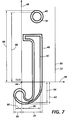
- character 40 a small letter j in Times Roman font. Character 40 has been lightened through use of the first procedure, resulting in character 42. Character 42 is shown overlying character 40 for ease of comparison. Characters 40 and 42 are described relative to an origin 44 of a Cartesian coordinate system having a horizontal x-axis 46 and a vertical y-axis 48, both of which pass through an origin 44. For convenience, in the FIS format the origin 46 is chosen such that the x-axis 46 is aligned with the baseline of the font.
- the actual distance characters 40 and 42 extend in the positive x direction is known as the rightExtent 54 and 56, respectively, and the actual distance characters 40 and 42 extend from their leftmost edges to the y-axis 48 is know as leftExtent 58 and 60, respectively.
- the type of characters 40 and 42 i.e., the height of the characters, expressed as points, e.g., 12 point
- the heights of the characters 40 and 42 measured from the x-axis 36 to their topmost portions are known as ascent 66 and 68, respectively. From figure 7 it can be seen that lightened character 42 differs from character 40 in all the parameters named above, except, of course, escapement.
- the second procedure in the preferred embodiment of the present invention deals with the differences caused by adjusting the weight of the characters.
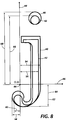
- the first step of the second procedure is to align lightened character 42 with character 40 vertically.
- vertical alignment is achieved by first compensating character 42 for its change in descent (from descent 62 to descent 64), so that the bottom (i.e., lowermost portion) of character 42 aligns with the bottom of character 40.
- One approach to descent alignment is to compare the character metrics of characters 40 and 42, and calculate the difference between the descents 62 and 64. The descent difference could then be applied as an offset to translate the control points of the character masks of character 42.
- control points of character 42 would be translated in the negative y direction by the amount of the difference, an operation that would not effect the x component of each control point.
- the above approach is only calculated for the representative character, capital H, and this difference is applied to the other characters of the font.
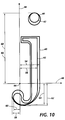
- the lightened character 42 is aligned with character 40 in ascent.
- a first approach is to scale the control points of character 42 by a factor that will give character 42 an ascent 68 equal to the ascent 66 of character 40, changing the character metrics to refect the changes.
- a second approach is to first determine a single scaling factor for all the characters in a font by applying the first approach to the representative character, capital H, Next this scaling factor can be applied to the remaining characters in the font.
- Figure 9 depicts the second approach.
- the scaling factor is applied to the horizontal dimension (i.e., x-axis 46 component of the control points), as well as to the vertical dimension (i.e., y-axis 48 component of the control points) of the character 42, so that the shape of character 42 is maintained.
- the shape of character 42 might be distorted were the scale factor to be applied only to the vertical dimension.
- applying the scaling factor in the horizontal dimension has the undesirable effect of shifting character 42 to the right (i.e., translating the control points along the positive x-axis 46), since most of the character 42, and hence the scaled control points, lie to the right of the y-axis 48.
- a simple method of tracking this horizontal scaling shift is to apply the scaling factor to the escapement of character 40, escapementX 50, to create a new escapement for character 42, escapementX 52.
- escapementX52 will later be returned to the value of escapementX 50, thereby maintaining the escapement between original and lightened fonts.
- character 42 is shifted to the left, the direction opposite to the direction of the undesired shift, by translating its control points by an amount equal to half the difference between escapementXs 50 and 52.
- the necessary adjustments are then made to the character metrics of figure 42 (i.e., the adjusment is made to right and left extents 56 and 58 of character 42).
- the value of escapementX 52 of character 42 is then set to the value of escapementX 50 of character 40.
- aligning characters 40 and 42 in descent would involve raising the control points of character 42 (instead of lowering the control points) the described distance, and aligning characters 40 and 42 in ascent would involve scaling character 42 to be smaller, rather than larger.
- Aligning characters 40 and 42 in width would still involve a horizontal translation of half the escapement change in the direction opposite to the direction of the undesired shift. (However, for a character made bolder rather than lighter, the compensating shift would be to the right, rather than to the left.)
- curve segment 12-2 was a Bezier curve segment
- the method of the invention applies to other types of curve segments as well.
- the method applies equally well to conic curve segments, such as described on pages 219 to 223 of Interpress: The Source Book.
- Conic curve segments typically employ only 3 control points, two endpoints and a single middle point.
- the method can be used with B-spline curves by first converting any segments represented by B-spline curves into four control point Bezier curve segments, as described on pages 226 to 227 of Interpress: The Source Book.
Landscapes
- Physics & Mathematics (AREA)
- General Physics & Mathematics (AREA)
- Engineering & Computer Science (AREA)
- Theoretical Computer Science (AREA)
- Controls And Circuits For Display Device (AREA)
- Image Generation (AREA)
Applications Claiming Priority (2)
| Application Number | Priority Date | Filing Date | Title |
|---|---|---|---|
| US813166 | 1985-12-24 | ||
| US07/813,166 US5280576A (en) | 1991-12-24 | 1991-12-24 | Method of adjusting the weight of a character of an outline font |
Publications (3)
| Publication Number | Publication Date |
|---|---|
| EP0549256A2 true EP0549256A2 (de) | 1993-06-30 |
| EP0549256A3 EP0549256A3 (en) | 1993-11-24 |
| EP0549256B1 EP0549256B1 (de) | 2000-03-15 |
Family
ID=25211639
Family Applications (1)
| Application Number | Title | Priority Date | Filing Date |
|---|---|---|---|
| EP92311500A Expired - Lifetime EP0549256B1 (de) | 1991-12-24 | 1992-12-16 | Verfahren zur Justierung von Schriftzeichengewichtung von Konturzeichen |
Country Status (4)
| Country | Link |
|---|---|
| US (1) | US5280576A (de) |
| EP (1) | EP0549256B1 (de) |
| JP (1) | JP3202377B2 (de) |
| DE (1) | DE69230783T2 (de) |
Cited By (1)
| Publication number | Priority date | Publication date | Assignee | Title |
|---|---|---|---|---|
| EP0657848A3 (de) * | 1993-12-09 | 1996-09-18 | Canon Kk | Verfahren und Vorrichtung zur Generierung von Schriftzeichen. |
Families Citing this family (19)
| Publication number | Priority date | Publication date | Assignee | Title |
|---|---|---|---|---|
| JPH05232926A (ja) * | 1992-02-19 | 1993-09-10 | Brother Ind Ltd | 文字記号発生装置 |
| US5627952A (en) * | 1992-04-29 | 1997-05-06 | Canon Kabushiki Kaisha | Information displaying system which displays combined video and graphics images |
| DE4238547A1 (de) * | 1992-11-14 | 1994-05-19 | Philips Patentverwaltung | Verfahren und Schaltungsanordnung zum Darstellen von Zeichen mit Umrandung |
| TW262547B (de) * | 1992-11-30 | 1995-11-11 | Canon Kk | |
| EP0604685A1 (de) * | 1992-12-28 | 1994-07-06 | Océ-Nederland B.V. | Methode zur Modifizierung des Fettdruckens von Buchstaben |
| US5796409A (en) * | 1993-04-06 | 1998-08-18 | Ecole Polytechnique Federale De Lausanne | Method for producing contrast-controlled grayscale characters |
| JP3394312B2 (ja) * | 1994-02-28 | 2003-04-07 | 富士通株式会社 | 作画装置 |
| JP3483946B2 (ja) * | 1994-08-19 | 2004-01-06 | 三菱電機株式会社 | フォント処理装置及びフォント処理方法 |
| JP3238580B2 (ja) * | 1994-09-14 | 2001-12-17 | シャープ株式会社 | 太め細め文字生成装置 |
| US6366581B1 (en) * | 1997-04-02 | 2002-04-02 | Fujitsu Network Communications, Inc. | Method and apparatus for generating permanent virtual connections using graphical user interface |
| DE19901934C2 (de) * | 1999-01-19 | 2001-07-19 | Heidelberger Druckmasch Ag | Verfahren zur Erzeugung eines Rahmens für grafische Objekte, die durch Bezier-Kurven beschrieben sind |
| US7239318B2 (en) * | 2001-03-23 | 2007-07-03 | Rise Kabushikikaisha | Method and computer software program product for processing characters based on outline font |
| US7187382B2 (en) * | 2004-01-26 | 2007-03-06 | Microsoft Corporation | Iteratively solving constraints in a font-hinting language |
| US7256786B2 (en) * | 2004-05-28 | 2007-08-14 | Microsoft Corporation | Appropriately rendering a graphical object when a corresponding outline has exact or inexact control points |
| US8253742B2 (en) | 2004-05-28 | 2012-08-28 | Microsoft Corporation | Rendering stroke pairs for graphical objects |
| US8464170B2 (en) * | 2005-09-09 | 2013-06-11 | Microsoft Corporation | 2D editing metaphor for 3D graphics |
| US8107729B2 (en) * | 2009-01-26 | 2012-01-31 | Mitsubishi Electric Research Laboratories, Inc. | Method for improving character outlines using multiple alignment zones |
| US8648862B2 (en) | 2010-07-21 | 2014-02-11 | Esko Software Bvba | Method for automatically modifying a graphics feature to comply with a resolution limit |
| AU2014277854A1 (en) | 2014-12-22 | 2016-07-07 | Canon Kabushiki Kaisha | Emboldening of outline fonts |
Family Cites Families (5)
| Publication number | Priority date | Publication date | Assignee | Title |
|---|---|---|---|---|
| US4620287A (en) * | 1983-01-20 | 1986-10-28 | Dicomed Corporation | Method and apparatus for representation of a curve of uniform width |
| JP2790815B2 (ja) * | 1988-08-10 | 1998-08-27 | 株式会社リコー | 画像データ圧縮方法 |
| AU629210B2 (en) * | 1988-10-26 | 1992-10-01 | Sun Microsystems, Inc. | Method and apparatus for minimizing the visual degradation of digital typefaces |
| US5155805A (en) * | 1989-05-08 | 1992-10-13 | Apple Computer, Inc. | Method and apparatus for moving control points in displaying digital typeface on raster output devices |
| JPH0810467B2 (ja) * | 1990-06-14 | 1996-01-31 | ゼロックス コーポレイション | ストロークに相当する輪郭線を迅速に生成する曲線近似方法 |
-
1991
- 1991-12-24 US US07/813,166 patent/US5280576A/en not_active Expired - Fee Related
-
1992
- 1992-12-16 DE DE69230783T patent/DE69230783T2/de not_active Expired - Fee Related
- 1992-12-16 JP JP35501092A patent/JP3202377B2/ja not_active Expired - Fee Related
- 1992-12-16 EP EP92311500A patent/EP0549256B1/de not_active Expired - Lifetime
Cited By (2)
| Publication number | Priority date | Publication date | Assignee | Title |
|---|---|---|---|---|
| EP0657848A3 (de) * | 1993-12-09 | 1996-09-18 | Canon Kk | Verfahren und Vorrichtung zur Generierung von Schriftzeichen. |
| US5959634A (en) * | 1993-12-09 | 1999-09-28 | Canon Kabushiki Kaisha | Character generating system employing thickening or narrowing of characters |
Also Published As
| Publication number | Publication date |
|---|---|
| EP0549256A3 (en) | 1993-11-24 |
| JP3202377B2 (ja) | 2001-08-27 |
| JPH05303374A (ja) | 1993-11-16 |
| DE69230783T2 (de) | 2000-07-27 |
| US5280576A (en) | 1994-01-18 |
| EP0549256B1 (de) | 2000-03-15 |
| DE69230783D1 (de) | 2000-04-20 |
Similar Documents
| Publication | Publication Date | Title |
|---|---|---|
| US5280576A (en) | Method of adjusting the weight of a character of an outline font | |
| EP0117406B1 (de) | Automatische Balancierung und vertikale Justierung von Text und/oder von graphischen Darstellungen | |
| US4608664A (en) | Automatically balancing and vertically justifying a plurality of text/graphics-columns | |
| US5404436A (en) | Computer method and apparatus for converting compressed characters for display in full size | |
| CA2069415C (en) | Method of formatting documents using flexible design models providing controlled copyfit and typeface selection | |
| EP0167838A2 (de) | Verfahren um Schrifttypen mit Skalaänderungen herzustellen | |
| US5768490A (en) | Method for producing visually evenly spaced typographic characters | |
| US7301672B2 (en) | Information processing apparatus and information processing method | |
| US6760029B1 (en) | Generating a glyph | |
| US4928243A (en) | Method and system for printing graphics and text from vector-based computer aided source information | |
| WO1990012386A1 (en) | Method and apparatus for conversion of outline characters to bitmap characters | |
| Smith | Editing and printing music by computer | |
| Rader | Helping naive users create publication quality music scores | |
| EP1093078A2 (de) | Verringerung des Erscheinungsunterschieds zwischen kodierten und nichkodierten Texteinheiten | |
| US5883637A (en) | Kerning method and a typographic apparatus utilizing same | |
| Hamel | Music Printing | |
| JPH032962A (ja) | 文書処理装置 | |
| JPH04280296A (ja) | 輪郭線データ処理装置 | |
| JPH08328537A (ja) | 文字間隔調整装置及び文字間隔調整方法 | |
| EP1048456B1 (de) | Erzeugung einer Glyphe | |
| Ruggles | Paragon, an interactive, extensible, environment for typeface design | |
| JP2670469B2 (ja) | 文書処理方法 | |
| JPS6328660A (ja) | 文書作成装置 | |
| Karow | The URW concept | |
| Azzarello | Text-editing and photocomposing APL publications |
Legal Events
| Date | Code | Title | Description |
|---|---|---|---|
| PUAI | Public reference made under article 153(3) epc to a published international application that has entered the european phase |
Free format text: ORIGINAL CODE: 0009012 |
|
| AK | Designated contracting states |
Kind code of ref document: A2 Designated state(s): DE FR GB |
|
| PUAL | Search report despatched |
Free format text: ORIGINAL CODE: 0009013 |
|
| AK | Designated contracting states |
Kind code of ref document: A3 Designated state(s): DE FR GB |
|
| 17P | Request for examination filed |
Effective date: 19940506 |
|
| GRAG | Despatch of communication of intention to grant |
Free format text: ORIGINAL CODE: EPIDOS AGRA |
|
| GRAG | Despatch of communication of intention to grant |
Free format text: ORIGINAL CODE: EPIDOS AGRA |
|
| GRAH | Despatch of communication of intention to grant a patent |
Free format text: ORIGINAL CODE: EPIDOS IGRA |
|
| RIC1 | Information provided on ipc code assigned before grant |
Free format text: 6G 06T 11/20 A |
|
| 17Q | First examination report despatched |
Effective date: 19990802 |
|
| GRAH | Despatch of communication of intention to grant a patent |
Free format text: ORIGINAL CODE: EPIDOS IGRA |
|
| GRAA | (expected) grant |
Free format text: ORIGINAL CODE: 0009210 |
|
| AK | Designated contracting states |
Kind code of ref document: B1 Designated state(s): DE FR GB |
|
| REF | Corresponds to: |
Ref document number: 69230783 Country of ref document: DE Date of ref document: 20000420 |
|
| ET | Fr: translation filed | ||
| PLBE | No opposition filed within time limit |
Free format text: ORIGINAL CODE: 0009261 |
|
| STAA | Information on the status of an ep patent application or granted ep patent |
Free format text: STATUS: NO OPPOSITION FILED WITHIN TIME LIMIT |
|
| 26N | No opposition filed | ||
| REG | Reference to a national code |
Ref country code: GB Ref legal event code: IF02 |
|
| PGFP | Annual fee paid to national office [announced via postgrant information from national office to epo] |
Ref country code: GB Payment date: 20031210 Year of fee payment: 12 Ref country code: FR Payment date: 20031210 Year of fee payment: 12 |
|
| PGFP | Annual fee paid to national office [announced via postgrant information from national office to epo] |
Ref country code: DE Payment date: 20031229 Year of fee payment: 12 |
|
| PG25 | Lapsed in a contracting state [announced via postgrant information from national office to epo] |
Ref country code: GB Free format text: LAPSE BECAUSE OF NON-PAYMENT OF DUE FEES Effective date: 20041216 |
|
| PG25 | Lapsed in a contracting state [announced via postgrant information from national office to epo] |
Ref country code: DE Free format text: LAPSE BECAUSE OF NON-PAYMENT OF DUE FEES Effective date: 20050701 |
|
| GBPC | Gb: european patent ceased through non-payment of renewal fee |
Effective date: 20041216 |
|
| PG25 | Lapsed in a contracting state [announced via postgrant information from national office to epo] |
Ref country code: FR Free format text: LAPSE BECAUSE OF NON-PAYMENT OF DUE FEES Effective date: 20050831 |
|
| REG | Reference to a national code |
Ref country code: FR Ref legal event code: ST |