EP0548199B1 - Flame retardant brominated styrene-based coatings - Google Patents
Flame retardant brominated styrene-based coatings Download PDFInfo
- Publication number
- EP0548199B1 EP0548199B1 EP91916535A EP91916535A EP0548199B1 EP 0548199 B1 EP0548199 B1 EP 0548199B1 EP 91916535 A EP91916535 A EP 91916535A EP 91916535 A EP91916535 A EP 91916535A EP 0548199 B1 EP0548199 B1 EP 0548199B1
- Authority
- EP
- European Patent Office
- Prior art keywords
- monomer units
- ring
- brominated aromatic
- brominated
- aromatic monomer
- Prior art date
- Legal status (The legal status is an assumption and is not a legal conclusion. Google has not performed a legal analysis and makes no representation as to the accuracy of the status listed.)
- Expired - Lifetime
Links
- 238000000576 coating method Methods 0.000 title claims abstract description 93
- 239000003063 flame retardant Substances 0.000 title claims abstract description 23
- -1 Flame retardant brominated styrene Chemical class 0.000 title abstract description 13
- 239000000178 monomer Substances 0.000 claims abstract description 221
- 229920000126 latex Polymers 0.000 claims abstract description 117
- 125000003118 aryl group Chemical group 0.000 claims abstract description 87
- 239000004816 latex Substances 0.000 claims abstract description 69
- 239000011248 coating agent Substances 0.000 claims abstract description 42
- GDTBXPJZTBHREO-UHFFFAOYSA-N bromine Substances BrBr GDTBXPJZTBHREO-UHFFFAOYSA-N 0.000 claims abstract description 28
- 229910052794 bromium Inorganic materials 0.000 claims abstract description 28
- WKBOTKDWSSQWDR-UHFFFAOYSA-N Bromine atom Chemical compound [Br] WKBOTKDWSSQWDR-UHFFFAOYSA-N 0.000 claims abstract description 26
- RNFJDJUURJAICM-UHFFFAOYSA-N 2,2,4,4,6,6-hexaphenoxy-1,3,5-triaza-2$l^{5},4$l^{5},6$l^{5}-triphosphacyclohexa-1,3,5-triene Chemical compound N=1P(OC=2C=CC=CC=2)(OC=2C=CC=CC=2)=NP(OC=2C=CC=CC=2)(OC=2C=CC=CC=2)=NP=1(OC=1C=CC=CC=1)OC1=CC=CC=C1 RNFJDJUURJAICM-UHFFFAOYSA-N 0.000 claims abstract description 19
- 125000001246 bromo group Chemical class Br* 0.000 claims abstract description 12
- 150000002148 esters Chemical class 0.000 claims abstract description 11
- OFOBLEOULBTSOW-UHFFFAOYSA-N Malonic acid Chemical compound OC(=O)CC(O)=O OFOBLEOULBTSOW-UHFFFAOYSA-N 0.000 claims abstract description 7
- 239000000203 mixture Substances 0.000 claims description 36
- 125000000217 alkyl group Chemical group 0.000 claims description 32
- 239000000463 material Substances 0.000 claims description 27
- 125000004432 carbon atom Chemical group C* 0.000 claims description 21
- 150000001732 carboxylic acid derivatives Chemical class 0.000 claims description 20
- 238000000034 method Methods 0.000 claims description 14
- NIXOWILDQLNWCW-UHFFFAOYSA-M Acrylate Chemical compound [O-]C(=O)C=C NIXOWILDQLNWCW-UHFFFAOYSA-M 0.000 claims description 12
- 239000007788 liquid Substances 0.000 claims description 12
- 239000000758 substrate Substances 0.000 claims description 12
- 239000002253 acid Substances 0.000 claims description 8
- 239000002131 composite material Substances 0.000 claims description 6
- 150000002762 monocarboxylic acid derivatives Chemical class 0.000 claims description 5
- 125000005250 alkyl acrylate group Chemical group 0.000 abstract description 16
- 239000003973 paint Substances 0.000 abstract description 12
- CERQOIWHTDAKMF-UHFFFAOYSA-M Methacrylate Chemical compound CC(=C)C([O-])=O CERQOIWHTDAKMF-UHFFFAOYSA-M 0.000 abstract description 9
- 239000000853 adhesive Substances 0.000 abstract description 9
- 230000001070 adhesive effect Effects 0.000 abstract description 9
- 239000011230 binding agent Substances 0.000 abstract description 9
- 229920001577 copolymer Polymers 0.000 abstract description 8
- 239000000565 sealant Substances 0.000 abstract description 8
- 150000001735 carboxylic acids Chemical class 0.000 abstract description 5
- 229920006395 saturated elastomer Polymers 0.000 abstract description 4
- 230000009477 glass transition Effects 0.000 abstract description 2
- 229920001688 coating polymer Polymers 0.000 abstract 1
- CYLVUSZHVURAOY-UHFFFAOYSA-N 2,2-dibromoethenylbenzene Chemical compound BrC(Br)=CC1=CC=CC=C1 CYLVUSZHVURAOY-UHFFFAOYSA-N 0.000 description 48
- 238000002360 preparation method Methods 0.000 description 33
- GOXQRTZXKQZDDN-UHFFFAOYSA-N 2-Ethylhexyl acrylate Chemical compound CCCCC(CC)COC(=O)C=C GOXQRTZXKQZDDN-UHFFFAOYSA-N 0.000 description 29
- JIGUQPWFLRLWPJ-UHFFFAOYSA-N Ethyl acrylate Chemical compound CCOC(=O)C=C JIGUQPWFLRLWPJ-UHFFFAOYSA-N 0.000 description 26
- PPBRXRYQALVLMV-UHFFFAOYSA-N Styrene Chemical compound C=CC1=CC=CC=C1 PPBRXRYQALVLMV-UHFFFAOYSA-N 0.000 description 26
- PNJWIWWMYCMZRO-UHFFFAOYSA-N pent‐4‐en‐2‐one Natural products CC(=O)CC=C PNJWIWWMYCMZRO-UHFFFAOYSA-N 0.000 description 26
- CERQOIWHTDAKMF-UHFFFAOYSA-N Methacrylic acid Chemical compound CC(=C)C(O)=O CERQOIWHTDAKMF-UHFFFAOYSA-N 0.000 description 23
- XLYOFNOQVPJJNP-UHFFFAOYSA-N water Substances O XLYOFNOQVPJJNP-UHFFFAOYSA-N 0.000 description 21
- CQEYYJKEWSMYFG-UHFFFAOYSA-N butyl acrylate Chemical compound CCCCOC(=O)C=C CQEYYJKEWSMYFG-UHFFFAOYSA-N 0.000 description 20
- 239000007787 solid Substances 0.000 description 20
- 238000006243 chemical reaction Methods 0.000 description 17
- VVQNEPGJFQJSBK-UHFFFAOYSA-N Methyl methacrylate Chemical compound COC(=O)C(C)=C VVQNEPGJFQJSBK-UHFFFAOYSA-N 0.000 description 13
- 229920001897 terpolymer Polymers 0.000 description 12
- 239000004744 fabric Substances 0.000 description 10
- XTXRWKRVRITETP-UHFFFAOYSA-N Vinyl acetate Chemical compound CC(=O)OC=C XTXRWKRVRITETP-UHFFFAOYSA-N 0.000 description 9
- 229920000642 polymer Polymers 0.000 description 9
- PNXMTCDJUBJHQJ-UHFFFAOYSA-N propyl prop-2-enoate Chemical compound CCCOC(=O)C=C PNXMTCDJUBJHQJ-UHFFFAOYSA-N 0.000 description 9
- IJGRMHOSHXDMSA-UHFFFAOYSA-N Atomic nitrogen Chemical compound N#N IJGRMHOSHXDMSA-UHFFFAOYSA-N 0.000 description 8
- NIXOWILDQLNWCW-UHFFFAOYSA-N acrylic acid group Chemical group C(C=C)(=O)O NIXOWILDQLNWCW-UHFFFAOYSA-N 0.000 description 8
- QVGXLLKOCUKJST-UHFFFAOYSA-N atomic oxygen Chemical compound [O] QVGXLLKOCUKJST-UHFFFAOYSA-N 0.000 description 8
- 239000000839 emulsion Substances 0.000 description 8
- 239000001301 oxygen Substances 0.000 description 8
- 229910052760 oxygen Inorganic materials 0.000 description 8
- 230000035484 reaction time Effects 0.000 description 7
- YAJYJWXEWKRTPO-UHFFFAOYSA-N 2,3,3,4,4,5-hexamethylhexane-2-thiol Chemical compound CC(C)C(C)(C)C(C)(C)C(C)(C)S YAJYJWXEWKRTPO-UHFFFAOYSA-N 0.000 description 6
- SMZOUWXMTYCWNB-UHFFFAOYSA-N 2-(2-methoxy-5-methylphenyl)ethanamine Chemical compound COC1=CC=C(C)C=C1CCN SMZOUWXMTYCWNB-UHFFFAOYSA-N 0.000 description 6
- DBMJMQXJHONAFJ-UHFFFAOYSA-M Sodium laurylsulphate Chemical compound [Na+].CCCCCCCCCCCCOS([O-])(=O)=O DBMJMQXJHONAFJ-UHFFFAOYSA-M 0.000 description 6
- XYLMUPLGERFSHI-UHFFFAOYSA-N alpha-Methylstyrene Chemical compound CC(=C)C1=CC=CC=C1 XYLMUPLGERFSHI-UHFFFAOYSA-N 0.000 description 6
- 230000000704 physical effect Effects 0.000 description 6
- USHAGKDGDHPEEY-UHFFFAOYSA-L potassium persulfate Chemical compound [K+].[K+].[O-]S(=O)(=O)OOS([O-])(=O)=O USHAGKDGDHPEEY-UHFFFAOYSA-L 0.000 description 6
- 235000019333 sodium laurylsulphate Nutrition 0.000 description 6
- 239000000126 substance Substances 0.000 description 6
- JLBJTVDPSNHSKJ-UHFFFAOYSA-N 4-Methylstyrene Chemical compound CC1=CC=C(C=C)C=C1 JLBJTVDPSNHSKJ-UHFFFAOYSA-N 0.000 description 5
- 229920002799 BoPET Polymers 0.000 description 5
- 239000005041 Mylar™ Substances 0.000 description 5
- MPMBRWOOISTHJV-UHFFFAOYSA-N but-1-enylbenzene Chemical compound CCC=CC1=CC=CC=C1 MPMBRWOOISTHJV-UHFFFAOYSA-N 0.000 description 5
- UGUYQBMBIJFNRM-UHFFFAOYSA-N but-2-en-2-ylbenzene Chemical compound CC=C(C)C1=CC=CC=C1 UGUYQBMBIJFNRM-UHFFFAOYSA-N 0.000 description 5
- PLPHXVSTHYOUJO-UHFFFAOYSA-N pent-2-en-2-ylbenzene Chemical compound CCC=C(C)C1=CC=CC=C1 PLPHXVSTHYOUJO-UHFFFAOYSA-N 0.000 description 5
- 229920006029 tetra-polymer Polymers 0.000 description 5
- VTYYLEPIZMXCLO-UHFFFAOYSA-L Calcium carbonate Chemical compound [Ca+2].[O-]C([O-])=O VTYYLEPIZMXCLO-UHFFFAOYSA-L 0.000 description 4
- MHAJPDPJQMAIIY-UHFFFAOYSA-N Hydrogen peroxide Chemical compound OO MHAJPDPJQMAIIY-UHFFFAOYSA-N 0.000 description 4
- ADCOVFLJGNWWNZ-UHFFFAOYSA-N antimony trioxide Chemical compound O=[Sb]O[Sb]=O ADCOVFLJGNWWNZ-UHFFFAOYSA-N 0.000 description 4
- 239000008367 deionised water Substances 0.000 description 4
- 229910021641 deionized water Inorganic materials 0.000 description 4
- 230000000694 effects Effects 0.000 description 4
- 229910052757 nitrogen Inorganic materials 0.000 description 4
- 150000003440 styrenes Chemical class 0.000 description 4
- 239000004753 textile Substances 0.000 description 4
- GPRLSGONYQIRFK-MNYXATJNSA-N triton Chemical compound [3H+] GPRLSGONYQIRFK-MNYXATJNSA-N 0.000 description 4
- 125000000391 vinyl group Chemical group [H]C([*])=C([H])[H] 0.000 description 4
- 229940058020 2-amino-2-methyl-1-propanol Drugs 0.000 description 3
- LRDIEHDJWYRVPT-UHFFFAOYSA-N 4-amino-5-hydroxynaphthalene-1-sulfonic acid Chemical compound C1=CC(O)=C2C(N)=CC=C(S(O)(=O)=O)C2=C1 LRDIEHDJWYRVPT-UHFFFAOYSA-N 0.000 description 3
- UHOVQNZJYSORNB-UHFFFAOYSA-N Benzene Chemical group C1=CC=CC=C1 UHOVQNZJYSORNB-UHFFFAOYSA-N 0.000 description 3
- LYCAIKOWRPUZTN-UHFFFAOYSA-N Ethylene glycol Chemical compound OCCO LYCAIKOWRPUZTN-UHFFFAOYSA-N 0.000 description 3
- LRHPLDYGYMQRHN-UHFFFAOYSA-N N-Butanol Chemical compound CCCCO LRHPLDYGYMQRHN-UHFFFAOYSA-N 0.000 description 3
- DWAQJAXMDSEUJJ-UHFFFAOYSA-M Sodium bisulfite Chemical compound [Na+].OS([O-])=O DWAQJAXMDSEUJJ-UHFFFAOYSA-M 0.000 description 3
- HEMHJVSKTPXQMS-UHFFFAOYSA-M Sodium hydroxide Chemical compound [OH-].[Na+] HEMHJVSKTPXQMS-UHFFFAOYSA-M 0.000 description 3
- GWEVSGVZZGPLCZ-UHFFFAOYSA-N Titan oxide Chemical compound O=[Ti]=O GWEVSGVZZGPLCZ-UHFFFAOYSA-N 0.000 description 3
- 239000000654 additive Substances 0.000 description 3
- 230000002411 adverse Effects 0.000 description 3
- CBTVGIZVANVGBH-UHFFFAOYSA-N aminomethyl propanol Chemical compound CC(C)(N)CO CBTVGIZVANVGBH-UHFFFAOYSA-N 0.000 description 3
- 239000006185 dispersion Substances 0.000 description 3
- 239000003995 emulsifying agent Substances 0.000 description 3
- 238000007720 emulsion polymerization reaction Methods 0.000 description 3
- 229910052736 halogen Inorganic materials 0.000 description 3
- 150000002367 halogens Chemical class 0.000 description 3
- 239000003999 initiator Substances 0.000 description 3
- 238000002156 mixing Methods 0.000 description 3
- 229920003023 plastic Polymers 0.000 description 3
- 239000004033 plastic Substances 0.000 description 3
- 229920000728 polyester Polymers 0.000 description 3
- 235000010267 sodium hydrogen sulphite Nutrition 0.000 description 3
- 229920002554 vinyl polymer Polymers 0.000 description 3
- JVPKLOPETWVKQD-UHFFFAOYSA-N 1,2,2-tribromoethenylbenzene Chemical compound BrC(Br)=C(Br)C1=CC=CC=C1 JVPKLOPETWVKQD-UHFFFAOYSA-N 0.000 description 2
- YMOONIIMQBGTDU-UHFFFAOYSA-N 2-bromoethenylbenzene Chemical compound BrC=CC1=CC=CC=C1 YMOONIIMQBGTDU-UHFFFAOYSA-N 0.000 description 2
- NLHHRLWOUZZQLW-UHFFFAOYSA-N Acrylonitrile Chemical compound C=CC#N NLHHRLWOUZZQLW-UHFFFAOYSA-N 0.000 description 2
- KAKZBPTYRLMSJV-UHFFFAOYSA-N Butadiene Chemical compound C=CC=C KAKZBPTYRLMSJV-UHFFFAOYSA-N 0.000 description 2
- IRIAEXORFWYRCZ-UHFFFAOYSA-N Butylbenzyl phthalate Chemical compound CCCCOC(=O)C1=CC=CC=C1C(=O)OCC1=CC=CC=C1 IRIAEXORFWYRCZ-UHFFFAOYSA-N 0.000 description 2
- HEDRZPFGACZZDS-UHFFFAOYSA-N Chloroform Chemical compound ClC(Cl)Cl HEDRZPFGACZZDS-UHFFFAOYSA-N 0.000 description 2
- VZCYOOQTPOCHFL-OWOJBTEDSA-N Fumaric acid Chemical compound OC(=O)\C=C\C(O)=O VZCYOOQTPOCHFL-OWOJBTEDSA-N 0.000 description 2
- BAPJBEWLBFYGME-UHFFFAOYSA-N Methyl acrylate Chemical compound COC(=O)C=C BAPJBEWLBFYGME-UHFFFAOYSA-N 0.000 description 2
- ATUOYWHBWRKTHZ-UHFFFAOYSA-N Propane Chemical compound CCC ATUOYWHBWRKTHZ-UHFFFAOYSA-N 0.000 description 2
- 150000001252 acrylic acid derivatives Chemical class 0.000 description 2
- ROOXNKNUYICQNP-UHFFFAOYSA-N ammonium persulfate Chemical compound [NH4+].[NH4+].[O-]S(=O)(=O)OOS([O-])(=O)=O ROOXNKNUYICQNP-UHFFFAOYSA-N 0.000 description 2
- 229910001870 ammonium persulfate Inorganic materials 0.000 description 2
- 238000013459 approach Methods 0.000 description 2
- 230000008901 benefit Effects 0.000 description 2
- 229910000019 calcium carbonate Inorganic materials 0.000 description 2
- 229910052799 carbon Inorganic materials 0.000 description 2
- 238000010276 construction Methods 0.000 description 2
- 238000005336 cracking Methods 0.000 description 2
- 239000002270 dispersing agent Substances 0.000 description 2
- 238000001035 drying Methods 0.000 description 2
- MEGHWIAOTJPCHQ-UHFFFAOYSA-N ethenyl butanoate Chemical compound CCCC(=O)OC=C MEGHWIAOTJPCHQ-UHFFFAOYSA-N 0.000 description 2
- UIWXSTHGICQLQT-UHFFFAOYSA-N ethenyl propanoate Chemical compound CCC(=O)OC=C UIWXSTHGICQLQT-UHFFFAOYSA-N 0.000 description 2
- SUPCQIBBMFXVTL-UHFFFAOYSA-N ethyl 2-methylprop-2-enoate Chemical compound CCOC(=O)C(C)=C SUPCQIBBMFXVTL-UHFFFAOYSA-N 0.000 description 2
- 230000006872 improvement Effects 0.000 description 2
- 239000004615 ingredient Substances 0.000 description 2
- OKJPEAGHQZHRQV-UHFFFAOYSA-N iodoform Chemical compound IC(I)I OKJPEAGHQZHRQV-UHFFFAOYSA-N 0.000 description 2
- VNWKTOKETHGBQD-UHFFFAOYSA-N methane Chemical compound C VNWKTOKETHGBQD-UHFFFAOYSA-N 0.000 description 2
- 150000002894 organic compounds Chemical class 0.000 description 2
- 230000000485 pigmenting effect Effects 0.000 description 2
- 229920001495 poly(sodium acrylate) polymer Polymers 0.000 description 2
- 229920006267 polyester film Polymers 0.000 description 2
- BOQSSGDQNWEFSX-UHFFFAOYSA-N propan-2-yl 2-methylprop-2-enoate Chemical compound CC(C)OC(=O)C(C)=C BOQSSGDQNWEFSX-UHFFFAOYSA-N 0.000 description 2
- NNMHYFLPFNGQFZ-UHFFFAOYSA-M sodium polyacrylate Chemical compound [Na+].[O-]C(=O)C=C NNMHYFLPFNGQFZ-UHFFFAOYSA-M 0.000 description 2
- 238000006467 substitution reaction Methods 0.000 description 2
- SJMYWORNLPSJQO-UHFFFAOYSA-N tert-butyl 2-methylprop-2-enoate Chemical compound CC(=C)C(=O)OC(C)(C)C SJMYWORNLPSJQO-UHFFFAOYSA-N 0.000 description 2
- 238000012360 testing method Methods 0.000 description 2
- HJUGFYREWKUQJT-UHFFFAOYSA-N tetrabromomethane Chemical compound BrC(Br)(Br)Br HJUGFYREWKUQJT-UHFFFAOYSA-N 0.000 description 2
- VZGDMQKNWNREIO-UHFFFAOYSA-N tetrachloromethane Chemical compound ClC(Cl)(Cl)Cl VZGDMQKNWNREIO-UHFFFAOYSA-N 0.000 description 2
- 239000002562 thickening agent Substances 0.000 description 2
- VZCYOOQTPOCHFL-UHFFFAOYSA-N trans-butenedioic acid Natural products OC(=O)C=CC(O)=O VZCYOOQTPOCHFL-UHFFFAOYSA-N 0.000 description 2
- 238000005303 weighing Methods 0.000 description 2
- JAHNSTQSQJOJLO-UHFFFAOYSA-N 2-(3-fluorophenyl)-1h-imidazole Chemical compound FC1=CC=CC(C=2NC=CN=2)=C1 JAHNSTQSQJOJLO-UHFFFAOYSA-N 0.000 description 1
- OEPOKWHJYJXUGD-UHFFFAOYSA-N 2-(3-phenylmethoxyphenyl)-1,3-thiazole-4-carbaldehyde Chemical compound O=CC1=CSC(C=2C=C(OCC=3C=CC=CC=3)C=CC=2)=N1 OEPOKWHJYJXUGD-UHFFFAOYSA-N 0.000 description 1
- XNWFRZJHXBZDAG-UHFFFAOYSA-N 2-METHOXYETHANOL Chemical compound COCCO XNWFRZJHXBZDAG-UHFFFAOYSA-N 0.000 description 1
- CFVWNXQPGQOHRJ-UHFFFAOYSA-N 2-methylpropyl prop-2-enoate Chemical compound CC(C)COC(=O)C=C CFVWNXQPGQOHRJ-UHFFFAOYSA-N 0.000 description 1
- FIXKCCRANLATRP-UHFFFAOYSA-N 3,5,5-trimethylhexyl prop-2-enoate Chemical compound CC(C)(C)CC(C)CCOC(=O)C=C FIXKCCRANLATRP-UHFFFAOYSA-N 0.000 description 1
- BDMYQVMQTKUZNB-UHFFFAOYSA-N 4-methylpentyl prop-2-enoate Chemical compound CC(C)CCCOC(=O)C=C BDMYQVMQTKUZNB-UHFFFAOYSA-N 0.000 description 1
- BUIZICPOJVBQGZ-UHFFFAOYSA-N 5-methylhexyl prop-2-enoate Chemical compound CC(C)CCCCOC(=O)C=C BUIZICPOJVBQGZ-UHFFFAOYSA-N 0.000 description 1
- DXPPIEDUBFUSEZ-UHFFFAOYSA-N 6-methylheptyl prop-2-enoate Chemical compound CC(C)CCCCCOC(=O)C=C DXPPIEDUBFUSEZ-UHFFFAOYSA-N 0.000 description 1
- CUXGDKOCSSIRKK-UHFFFAOYSA-N 7-methyloctyl prop-2-enoate Chemical class CC(C)CCCCCCOC(=O)C=C CUXGDKOCSSIRKK-UHFFFAOYSA-N 0.000 description 1
- GDOPTJXRTPNYNR-UHFFFAOYSA-N CC1CCCC1 Chemical compound CC1CCCC1 GDOPTJXRTPNYNR-UHFFFAOYSA-N 0.000 description 1
- WGWZCWXGHMCRFN-UHFFFAOYSA-N CC[N](C)(CC1)(N)=C(C2)C2C(C)C=C1N Chemical compound CC[N](C)(CC1)(N)=C(C2)C2C(C)C=C1N WGWZCWXGHMCRFN-UHFFFAOYSA-N 0.000 description 1
- 102100037328 Chitotriosidase-1 Human genes 0.000 description 1
- ZAMOUSCENKQFHK-UHFFFAOYSA-N Chlorine atom Chemical compound [Cl] ZAMOUSCENKQFHK-UHFFFAOYSA-N 0.000 description 1
- 239000004821 Contact adhesive Substances 0.000 description 1
- RWSOTUBLDIXVET-UHFFFAOYSA-N Dihydrogen sulfide Chemical class S RWSOTUBLDIXVET-UHFFFAOYSA-N 0.000 description 1
- LFQSCWFLJHTTHZ-UHFFFAOYSA-N Ethanol Chemical compound CCO LFQSCWFLJHTTHZ-UHFFFAOYSA-N 0.000 description 1
- 101000879661 Homo sapiens Chitotriosidase-1 Proteins 0.000 description 1
- 239000004721 Polyphenylene oxide Substances 0.000 description 1
- 239000004793 Polystyrene Substances 0.000 description 1
- 229920004896 Triton X-405 Polymers 0.000 description 1
- 150000007513 acids Chemical class 0.000 description 1
- XECAHXYUAAWDEL-UHFFFAOYSA-N acrylonitrile butadiene styrene Chemical compound C=CC=C.C=CC#N.C=CC1=CC=CC=C1 XECAHXYUAAWDEL-UHFFFAOYSA-N 0.000 description 1
- 238000013019 agitation Methods 0.000 description 1
- 125000001931 aliphatic group Chemical group 0.000 description 1
- 125000002877 alkyl aryl group Chemical group 0.000 description 1
- 235000019395 ammonium persulphate Nutrition 0.000 description 1
- 125000000129 anionic group Chemical group 0.000 description 1
- 239000002518 antifoaming agent Substances 0.000 description 1
- 239000010425 asbestos Substances 0.000 description 1
- 125000000751 azo group Chemical group [*]N=N[*] 0.000 description 1
- 239000011324 bead Substances 0.000 description 1
- 125000006267 biphenyl group Chemical group 0.000 description 1
- 238000012662 bulk polymerization Methods 0.000 description 1
- WASXTVLPXHRVRH-UHFFFAOYSA-N butyl prop-2-enoate;propan-2-yl prop-2-enoate Chemical compound CC(C)OC(=O)C=C.CCCCOC(=O)C=C WASXTVLPXHRVRH-UHFFFAOYSA-N 0.000 description 1
- 239000003054 catalyst Substances 0.000 description 1
- 125000002091 cationic group Chemical group 0.000 description 1
- 239000004568 cement Substances 0.000 description 1
- 239000012986 chain transfer agent Substances 0.000 description 1
- 239000003795 chemical substances by application Substances 0.000 description 1
- 239000000460 chlorine Substances 0.000 description 1
- 229910052801 chlorine Inorganic materials 0.000 description 1
- 150000001875 compounds Chemical class 0.000 description 1
- 239000004567 concrete Substances 0.000 description 1
- 238000007796 conventional method Methods 0.000 description 1
- 238000001816 cooling Methods 0.000 description 1
- FWLDHHJLVGRRHD-UHFFFAOYSA-N decyl prop-2-enoate Chemical compound CCCCCCCCCCOC(=O)C=C FWLDHHJLVGRRHD-UHFFFAOYSA-N 0.000 description 1
- 230000002939 deleterious effect Effects 0.000 description 1
- 230000001419 dependent effect Effects 0.000 description 1
- 150000008049 diazo compounds Chemical class 0.000 description 1
- 125000001142 dicarboxylic acid group Chemical group 0.000 description 1
- USIUVYZYUHIAEV-UHFFFAOYSA-N diphenyl ether Chemical class C=1C=CC=CC=1OC1=CC=CC=C1 USIUVYZYUHIAEV-UHFFFAOYSA-N 0.000 description 1
- 150000002019 disulfides Chemical class 0.000 description 1
- ZWEDFBKLJILTMC-UHFFFAOYSA-N ethyl 4,4,4-trifluoro-3-hydroxybutanoate Chemical compound CCOC(=O)CC(O)C(F)(F)F ZWEDFBKLJILTMC-UHFFFAOYSA-N 0.000 description 1
- 239000000835 fiber Substances 0.000 description 1
- 239000011152 fibreglass Substances 0.000 description 1
- 239000000945 filler Substances 0.000 description 1
- 238000009472 formulation Methods 0.000 description 1
- 238000010528 free radical solution polymerization reaction Methods 0.000 description 1
- 239000001530 fumaric acid Substances 0.000 description 1
- 239000011521 glass Substances 0.000 description 1
- LNMQRPPRQDGUDR-UHFFFAOYSA-N hexyl prop-2-enoate Chemical compound CCCCCCOC(=O)C=C LNMQRPPRQDGUDR-UHFFFAOYSA-N 0.000 description 1
- 150000002432 hydroperoxides Chemical class 0.000 description 1
- 125000002768 hydroxyalkyl group Chemical group 0.000 description 1
- 238000007654 immersion Methods 0.000 description 1
- 150000002484 inorganic compounds Chemical class 0.000 description 1
- 229910010272 inorganic material Inorganic materials 0.000 description 1
- 238000009413 insulation Methods 0.000 description 1
- 230000010354 integration Effects 0.000 description 1
- 230000002452 interceptive effect Effects 0.000 description 1
- PBOSTUDLECTMNL-UHFFFAOYSA-N lauryl acrylate Chemical compound CCCCCCCCCCCCOC(=O)C=C PBOSTUDLECTMNL-UHFFFAOYSA-N 0.000 description 1
- 229920003008 liquid latex Polymers 0.000 description 1
- VZCYOOQTPOCHFL-UPHRSURJSA-N maleic acid Chemical compound OC(=O)\C=C/C(O)=O VZCYOOQTPOCHFL-UPHRSURJSA-N 0.000 description 1
- 239000011976 maleic acid Substances 0.000 description 1
- 238000004519 manufacturing process Methods 0.000 description 1
- 150000002734 metacrylic acid derivatives Chemical class 0.000 description 1
- 229910044991 metal oxide Chemical class 0.000 description 1
- 125000005395 methacrylic acid group Chemical class 0.000 description 1
- LVHBHZANLOWSRM-UHFFFAOYSA-N methylenebutanedioic acid Natural products OC(=O)CC(=C)C(O)=O LVHBHZANLOWSRM-UHFFFAOYSA-N 0.000 description 1
- 238000013508 migration Methods 0.000 description 1
- 230000005012 migration Effects 0.000 description 1
- 238000012986 modification Methods 0.000 description 1
- 230000004048 modification Effects 0.000 description 1
- MDYPDLBFDATSCF-UHFFFAOYSA-N nonyl prop-2-enoate Chemical compound CCCCCCCCCOC(=O)C=C MDYPDLBFDATSCF-UHFFFAOYSA-N 0.000 description 1
- PKCKEGFHGRMLNH-UHFFFAOYSA-N octan-2-yl prop-2-enoate Chemical compound CCCCCCC(C)OC(=O)C=C PKCKEGFHGRMLNH-UHFFFAOYSA-N 0.000 description 1
- ANISOHQJBAQUQP-UHFFFAOYSA-N octyl prop-2-enoate Chemical compound CCCCCCCCOC(=O)C=C ANISOHQJBAQUQP-UHFFFAOYSA-N 0.000 description 1
- 150000001451 organic peroxides Chemical class 0.000 description 1
- 239000012188 paraffin wax Substances 0.000 description 1
- 239000002245 particle Substances 0.000 description 1
- ULDDEWDFUNBUCM-UHFFFAOYSA-N pentyl prop-2-enoate Chemical compound CCCCCOC(=O)C=C ULDDEWDFUNBUCM-UHFFFAOYSA-N 0.000 description 1
- JRKICGRDRMAZLK-UHFFFAOYSA-L persulfate group Chemical group S(=O)(=O)([O-])OOS(=O)(=O)[O-] JRKICGRDRMAZLK-UHFFFAOYSA-L 0.000 description 1
- 125000001997 phenyl group Chemical group [H]C1=C([H])C([H])=C(*)C([H])=C1[H] 0.000 description 1
- 229920000570 polyether Polymers 0.000 description 1
- 238000006116 polymerization reaction Methods 0.000 description 1
- 230000000379 polymerizing effect Effects 0.000 description 1
- 229920000098 polyolefin Polymers 0.000 description 1
- 229920002223 polystyrene Polymers 0.000 description 1
- 230000000644 propagated effect Effects 0.000 description 1
- 239000001294 propane Substances 0.000 description 1
- 238000010526 radical polymerization reaction Methods 0.000 description 1
- 239000011347 resin Substances 0.000 description 1
- 229920005989 resin Polymers 0.000 description 1
- 239000011342 resin composition Substances 0.000 description 1
- 229910052895 riebeckite Inorganic materials 0.000 description 1
- 150000003839 salts Chemical class 0.000 description 1
- 238000000926 separation method Methods 0.000 description 1
- GCLGEJMYGQKIIW-UHFFFAOYSA-H sodium hexametaphosphate Chemical compound [Na]OP1(=O)OP(=O)(O[Na])OP(=O)(O[Na])OP(=O)(O[Na])OP(=O)(O[Na])OP(=O)(O[Na])O1 GCLGEJMYGQKIIW-UHFFFAOYSA-H 0.000 description 1
- 238000010186 staining Methods 0.000 description 1
- 238000003756 stirring Methods 0.000 description 1
- 229920001909 styrene-acrylic polymer Polymers 0.000 description 1
- 125000003011 styrenyl group Chemical group [H]\C(*)=C(/[H])C1=C([H])C([H])=C([H])C([H])=C1[H] 0.000 description 1
- 239000004094 surface-active agent Substances 0.000 description 1
- 239000000725 suspension Substances 0.000 description 1
- 238000010557 suspension polymerization reaction Methods 0.000 description 1
- 230000008961 swelling Effects 0.000 description 1
- 239000004408 titanium dioxide Substances 0.000 description 1
- OGIDPMRJRNCKJF-UHFFFAOYSA-N titanium oxide Inorganic materials [Ti]=O OGIDPMRJRNCKJF-UHFFFAOYSA-N 0.000 description 1
- 230000001988 toxicity Effects 0.000 description 1
- 231100000419 toxicity Toxicity 0.000 description 1
- 238000012546 transfer Methods 0.000 description 1
- 239000002023 wood Substances 0.000 description 1
Classifications
-
- C—CHEMISTRY; METALLURGY
- C09—DYES; PAINTS; POLISHES; NATURAL RESINS; ADHESIVES; COMPOSITIONS NOT OTHERWISE PROVIDED FOR; APPLICATIONS OF MATERIALS NOT OTHERWISE PROVIDED FOR
- C09D—COATING COMPOSITIONS, e.g. PAINTS, VARNISHES OR LACQUERS; FILLING PASTES; CHEMICAL PAINT OR INK REMOVERS; INKS; CORRECTING FLUIDS; WOODSTAINS; PASTES OR SOLIDS FOR COLOURING OR PRINTING; USE OF MATERIALS THEREFOR
- C09D133/00—Coating compositions based on homopolymers or copolymers of compounds having one or more unsaturated aliphatic radicals, each having only one carbon-to-carbon double bond, and at least one being terminated by only one carboxyl radical, or of salts, anhydrides, esters, amides, imides, or nitriles thereof; Coating compositions based on derivatives of such polymers
- C09D133/04—Homopolymers or copolymers of esters
- C09D133/06—Homopolymers or copolymers of esters of esters containing only carbon, hydrogen and oxygen, the oxygen atom being present only as part of the carboxyl radical
- C09D133/062—Copolymers with monomers not covered by C09D133/06
-
- C—CHEMISTRY; METALLURGY
- C09—DYES; PAINTS; POLISHES; NATURAL RESINS; ADHESIVES; COMPOSITIONS NOT OTHERWISE PROVIDED FOR; APPLICATIONS OF MATERIALS NOT OTHERWISE PROVIDED FOR
- C09D—COATING COMPOSITIONS, e.g. PAINTS, VARNISHES OR LACQUERS; FILLING PASTES; CHEMICAL PAINT OR INK REMOVERS; INKS; CORRECTING FLUIDS; WOODSTAINS; PASTES OR SOLIDS FOR COLOURING OR PRINTING; USE OF MATERIALS THEREFOR
- C09D125/00—Coating compositions based on homopolymers or copolymers of compounds having one or more unsaturated aliphatic radicals, each having only one carbon-to-carbon double bond, and at least one being terminated by an aromatic carbocyclic ring; Coating compositions based on derivatives of such polymers
- C09D125/02—Homopolymers or copolymers of hydrocarbons
-
- C—CHEMISTRY; METALLURGY
- C09—DYES; PAINTS; POLISHES; NATURAL RESINS; ADHESIVES; COMPOSITIONS NOT OTHERWISE PROVIDED FOR; APPLICATIONS OF MATERIALS NOT OTHERWISE PROVIDED FOR
- C09D—COATING COMPOSITIONS, e.g. PAINTS, VARNISHES OR LACQUERS; FILLING PASTES; CHEMICAL PAINT OR INK REMOVERS; INKS; CORRECTING FLUIDS; WOODSTAINS; PASTES OR SOLIDS FOR COLOURING OR PRINTING; USE OF MATERIALS THEREFOR
- C09D125/00—Coating compositions based on homopolymers or copolymers of compounds having one or more unsaturated aliphatic radicals, each having only one carbon-to-carbon double bond, and at least one being terminated by an aromatic carbocyclic ring; Coating compositions based on derivatives of such polymers
- C09D125/18—Homopolymers or copolymers of aromatic monomers containing elements other than carbon and hydrogen
-
- Y—GENERAL TAGGING OF NEW TECHNOLOGICAL DEVELOPMENTS; GENERAL TAGGING OF CROSS-SECTIONAL TECHNOLOGIES SPANNING OVER SEVERAL SECTIONS OF THE IPC; TECHNICAL SUBJECTS COVERED BY FORMER USPC CROSS-REFERENCE ART COLLECTIONS [XRACs] AND DIGESTS
- Y10—TECHNICAL SUBJECTS COVERED BY FORMER USPC
- Y10S—TECHNICAL SUBJECTS COVERED BY FORMER USPC CROSS-REFERENCE ART COLLECTIONS [XRACs] AND DIGESTS
- Y10S428/00—Stock material or miscellaneous articles
- Y10S428/92—Fire or heat protection feature
-
- Y—GENERAL TAGGING OF NEW TECHNOLOGICAL DEVELOPMENTS; GENERAL TAGGING OF CROSS-SECTIONAL TECHNOLOGIES SPANNING OVER SEVERAL SECTIONS OF THE IPC; TECHNICAL SUBJECTS COVERED BY FORMER USPC CROSS-REFERENCE ART COLLECTIONS [XRACs] AND DIGESTS
- Y10—TECHNICAL SUBJECTS COVERED BY FORMER USPC
- Y10S—TECHNICAL SUBJECTS COVERED BY FORMER USPC CROSS-REFERENCE ART COLLECTIONS [XRACs] AND DIGESTS
- Y10S428/00—Stock material or miscellaneous articles
- Y10S428/92—Fire or heat protection feature
- Y10S428/921—Fire or flameproofing
-
- Y—GENERAL TAGGING OF NEW TECHNOLOGICAL DEVELOPMENTS; GENERAL TAGGING OF CROSS-SECTIONAL TECHNOLOGIES SPANNING OVER SEVERAL SECTIONS OF THE IPC; TECHNICAL SUBJECTS COVERED BY FORMER USPC CROSS-REFERENCE ART COLLECTIONS [XRACs] AND DIGESTS
- Y10—TECHNICAL SUBJECTS COVERED BY FORMER USPC
- Y10T—TECHNICAL SUBJECTS COVERED BY FORMER US CLASSIFICATION
- Y10T428/00—Stock material or miscellaneous articles
- Y10T428/31504—Composite [nonstructural laminate]
- Y10T428/31786—Of polyester [e.g., alkyd, etc.]
- Y10T428/31797—Next to addition polymer from unsaturated monomers
-
- Y—GENERAL TAGGING OF NEW TECHNOLOGICAL DEVELOPMENTS; GENERAL TAGGING OF CROSS-SECTIONAL TECHNOLOGIES SPANNING OVER SEVERAL SECTIONS OF THE IPC; TECHNICAL SUBJECTS COVERED BY FORMER USPC CROSS-REFERENCE ART COLLECTIONS [XRACs] AND DIGESTS
- Y10—TECHNICAL SUBJECTS COVERED BY FORMER USPC
- Y10T—TECHNICAL SUBJECTS COVERED BY FORMER US CLASSIFICATION
- Y10T428/00—Stock material or miscellaneous articles
- Y10T428/31504—Composite [nonstructural laminate]
- Y10T428/31855—Of addition polymer from unsaturated monomers
- Y10T428/31909—Next to second addition polymer from unsaturated monomers
- Y10T428/31928—Ester, halide or nitrile of addition polymer
-
- Y—GENERAL TAGGING OF NEW TECHNOLOGICAL DEVELOPMENTS; GENERAL TAGGING OF CROSS-SECTIONAL TECHNOLOGIES SPANNING OVER SEVERAL SECTIONS OF THE IPC; TECHNICAL SUBJECTS COVERED BY FORMER USPC CROSS-REFERENCE ART COLLECTIONS [XRACs] AND DIGESTS
- Y10—TECHNICAL SUBJECTS COVERED BY FORMER USPC
- Y10T—TECHNICAL SUBJECTS COVERED BY FORMER US CLASSIFICATION
- Y10T428/00—Stock material or miscellaneous articles
- Y10T428/31504—Composite [nonstructural laminate]
- Y10T428/31855—Of addition polymer from unsaturated monomers
- Y10T428/31931—Polyene monomer-containing
-
- Y—GENERAL TAGGING OF NEW TECHNOLOGICAL DEVELOPMENTS; GENERAL TAGGING OF CROSS-SECTIONAL TECHNOLOGIES SPANNING OVER SEVERAL SECTIONS OF THE IPC; TECHNICAL SUBJECTS COVERED BY FORMER USPC CROSS-REFERENCE ART COLLECTIONS [XRACs] AND DIGESTS
- Y10—TECHNICAL SUBJECTS COVERED BY FORMER USPC
- Y10T—TECHNICAL SUBJECTS COVERED BY FORMER US CLASSIFICATION
- Y10T428/00—Stock material or miscellaneous articles
- Y10T428/31504—Composite [nonstructural laminate]
- Y10T428/31855—Of addition polymer from unsaturated monomers
- Y10T428/31935—Ester, halide or nitrile of addition polymer
-
- Y—GENERAL TAGGING OF NEW TECHNOLOGICAL DEVELOPMENTS; GENERAL TAGGING OF CROSS-SECTIONAL TECHNOLOGIES SPANNING OVER SEVERAL SECTIONS OF THE IPC; TECHNICAL SUBJECTS COVERED BY FORMER USPC CROSS-REFERENCE ART COLLECTIONS [XRACs] AND DIGESTS
- Y10—TECHNICAL SUBJECTS COVERED BY FORMER USPC
- Y10T—TECHNICAL SUBJECTS COVERED BY FORMER US CLASSIFICATION
- Y10T442/00—Fabric [woven, knitted, or nonwoven textile or cloth, etc.]
- Y10T442/20—Coated or impregnated woven, knit, or nonwoven fabric which is not [a] associated with another preformed layer or fiber layer or, [b] with respect to woven and knit, characterized, respectively, by a particular or differential weave or knit, wherein the coating or impregnation is neither a foamed material nor a free metal or alloy layer
- Y10T442/2631—Coating or impregnation provides heat or fire protection
- Y10T442/2713—Halogen containing
Definitions
- This invention relates to the use of latex compositions as coatings, including backcoatings, sealants, adhesives and the like, and particularly to coatings including ring-halogenated, ethylenically unsaturated aromatic monomers and at least one other monomer.
- Acrylic, styrene-acrylic and vinyl-acrylic latices are commercially used in a variety of coatings. In many coatings applications, the latices used are desired to have flame-retarding properties. This applies in particular where latices are used in textiles, carpeting, paints, clear coatings, adhesives, sealants, caulking, non-woven binders and so on.
- flame retardant additives The usual method by which flame-retardant properties are imparted to latices is the blending-in of flame retardant additives. Many of these flame retardant additives contain bromine, such as brominated diphenyl or diphenyloxide compounds, together with antimony trioxide. However, such flame retardant additives have a major disadvantage in that their use gives rise to problems, such as the generation of strong white pigmenting and settling out effect, and toxicity resulting from the presence of antimony trioxide.
- Liquid compounds have been added to latices as well.
- U.S. Patent No. 3,766,189 teaches the use of liquid chlorinated paraffin in a latex to achieve fire retardancy.
- Drawbacks to the use of liquids include migration from the polymer with time, separation from the liquid latex emulsion, adverse effect upon adhesion, plasticizing, swelling of the latex, and poor water resistance. Salts and other water soluble solids eliminate the problems of settling of solids, but contribute other problems cited as well as generally having an adverse effect upon the stability of the latex emulsion.
- Curable resin compositions containing a basic catalyst and a water solution of polymerized halogen-containing vinyl monomer and other vinyl monomers are disclosed in Japanese Patent No. 56120754-A2, issued to Mitsui Toatsu Chemicals on September 22, 1981.
- the Mitsui patent reports that water based suspensions or emulsions of vinyl polymers have weak resistance to water, cracking and soiling (staining), and that the proposed compositions overcome such shortcomings.
- the Mitsui patent is limited to treatment of water, cracking and soiling properties. No recognition is contained in the Mitsui patent of the preparation of flame retardant latices utilizing brominated vinyl monomers, and the patent fails to disclose percentages of use for such monomers to achieve flame retardancy.
- the patent proposes that the halogen-containing monomer comprise at most 15% by weight of the copolymer, which corresponds to a bromine content in the resin of at most about 6%.
- the Mitsui patent further indicates that it is preferred to have a lower percentage of halogen-containing monomer of at most 10% by weight, corresponding to a bromine content of at most 4%. These percentages are insufficient to provide desirable flame retardancy. In preferring the lower bromine content, the Mitsui patent teaches away from the present invention.
- Bromine-containing plastics are described in European Patent Application No. 79200768.4, filed by Stamicarbon B.V. on December 15, 1979 (published July 9, 1980 as No. 13,052-A1).
- the Stamicarbon application is directed to the preparation of plastic materials, including polyolefins, polystyrene, and copolymers of styrene and butadiene, styrene and acrylonitrile and ABS.
- the plastics of the Stamicarbon application require high levels of bromine, and are described as containing 20-44 weight percent of bromine.
- the coatings of the present invention satisfy these needs, and provide useful fire-retardant fabric backcoatings, paints, adhesives, sealants, caulking, non-woven binders and a variety of other applications.
- latex coatings which comprise copolymers of ring-halogenated, ethylenically-unsaturated aromatic monomers and alkyl acrylate or methacrylate monomers, and which may also include at least one other monomer.
- the halogenated aromatic monomers are present in an amount to provide from 7 to 20 weight percent bromine in the final latex coating.
- the halogenated aromatic monomers include polybrominated monomers, particularly to provide monomers having an average of at least about 1.5 bromines per monomer unit.
- the coatings of the present invention are exemplified by three categories.
- the coatings include ring-brominated aromatic monomer units and second monomer units from alkyl acrylate monomer units, alkyl methacrylate monomer units or combinations thereof.
- the coatings include these first two types of monomer units and further include third monomer units selected from unsaturated esters of saturated carboxylic acids, halogen-free aromatic monomers or unsaturated carboxylic acid monomers.
- the coatings include four monomer units, namely ring-brominated aromatic monomer units, alkyl acrylate and/or alkyl methacrylate monomer units, unsaturated carboxylic acid monomer units, and halogen-free aromatic monomers.
- a further object of the present invention is to provide flame retardant latex coatings which are useful for a wide variety of applications, including fabric backcoatings, paints, adhesives, sealants, caulking, non-woven binders and the like.
- the present invention provides polymer latex coatings having advantageous physical properties making them useful in a wide variety of applications, and which coatings have improved flame retardancy over prior art compositions.
- Past efforts have failed to provide coatings of the described type, while it has now been discovered that the inclusion of ring-brominated aromatic monomer units in polymer latices yields coatings which provide improved flame retardancy without deleterious effects on other physical attributes of the coatings.
- One, two or more monomers may be reacted with, for example, brominated styrene to produce the copolymer coatings of the present invention.
- brominated styrene Proper selection of monomers used in conjunction with the brominated aromatic monomer enables production of flame retardant coatings useful in a wide range of applications.
- coatings is used in a broad sense and is intended to include applications to a substrate both as a laminate or as an interstitial filler. For example, included are uses as textile backcoatings for woven upholstery and draperies, carpet backing, non-woven filter media binders, paints, adhesives, caulks, sealants and the like, applied to the variety of suitable substrates.
- the coatings of the present invention contain a ring-brominated aromatic monomer and at least one other monomer.
- the coatings of the present invention are exemplified by three categories of latex compositions.
- the coatings include ring-brominated aromatic monomer units and units selected from alkyl acrylate monomer units, alkyl methacrylate monomer units or combinations thereof.
- the coatings include these first two types of monomer units and further include third monomer units selected from unsaturated esters of saturated carboxylic acids, halogen-free aromatic monomers or unsaturated carboxylic acid monomers.
- the coatings include four monomer units, namely ring-brominated aromatic monomer units, alkyl acrylate and/or alkyl methacrylate monomer units, unsaturated carboxylic acid monomer units, and halogen-free aromatic monomers.
- Representative ring-halogenated aromatic monomers are styrene, methylstyrene, ⁇ -methylstyrene, ⁇ -methyl methylstyrene, ethylstyrene or ⁇ -methyl ethylstyrene with bromine substitution (mono, di, tri and tetra) in the phenyl nucleus. Mixtures or mixed isomers of the above monomers may also be used.
- the preferred ring-brominated aromatic monomer is polybrominated styrene, with dibromostyrene being most preferred.
- a preferred dibromostyrene material is one available from Great Lakes Chemical Corporation of West Lafayette, Indiana, which material normally contains about 15 percent monobromostyrene and 3 percent tribromostyrene by weight.
- the ring-brominated aromatic monomer is included in the overall latex coating in an amount to provide sufficient bromine to yield the desired flame retardancy.
- the ring-brominated monomer is included in an amount to provide from 7 to 20 percent bromine by weight of the overall composition. More preferably, the ring-brominated monomer is included in an amount to give from 9 to 18 percent bromine by weight.
- the ring-brominated aromatic monomer units include polybrominated units, and that the ring-brominated monomer units include an average of at least about 1.5 bromines per unit. For coatings containing monobrominated forms of the ring-brominated aromatic monomer units, it is preferred that at most about 20% of the ring-brominated aromatic monomer units be monobrominated.
- the latex compositions used for the coatings be readily prepared.
- Highly brominated, ethylenically-unsaturated, aromatic monomers, such as pure tetrabromostyrene, are not liquid at room temperature, and this interferes with the ready preparation of the latices. It is therefore preferred that the ratio of monobrominated and polybrominated monomer units in the latex be such that the corresponding mixture of the unsaturated ring-brominated aromatic monomers is liquid at room temperature.
- a preferred material for use in the preparation of the coatings of the present invention is the previously identified dibromostyrene composition as produced by Great Lakes Chemical Corporation, which composition is liquid at room temperature and comprises a mixture of 15 percent monobromostyrene, 82 percent dibromostyrene and 3 percent tribromostyrene.
- Other mono- and polybrominated aromatic monomer mixtures which are liquid at room temperature are similarly preferred for preparation of the present latex coatings.
- the mixtures preferably include as high an overall percentage of bromine as possible while still being a liquid at room temperature.
- the polymer latex coatings contain the ring-brominated aromatic monomer units (I) and also include alkyl (meth)acrylate monomer units of the formula (II): in which R1 is -H or -CH3, and R3 is an alkyl group of 1 to 20 carbon atoms.
- alkyl (meth)acrylates useful in accordance with the present invention are methyl acrylate, ethyl acrylate, n-propyl acrylate, isopropyl acrylate n-butyl acrylate, isobutyl acrylate, n-amyl acrylate, n-hexyl acrylate, isohexyl acrylate, 2-ethylhexyl acrylate, n-heptyl acrylate, isoheptyl acrylate, 1-methyl-heptyl acrylate, n-octyl acrylate, isoctyl acrylates such as 6-methyl-heptyl acrylate, n-nonyl acrylate, isononyl acrylates such as 3,5,5-trimethylhexyl acrylate, n-decyl acrylate, lauryl acrylate and corresponding alkyl methacrylates and other primary, secondary and tertiary higher
- hydroxy alkyl esters of acrylic acid or methacrylic acid are useful in this invention.
- the preferred monomers are ethyl acrylate, n-propyl acrylate, n-butyl acrylate and 2-ethylhexyl acrylate, and methyl methacrylate.
- the latex coatings comprise the ring-brominated aromatic monomer units and the alkyl acrylate and/or alkyl methacrylate monomer units.
- the ring-brominated aromatic monomer units are preferably present in an amount to provide from 7 to 20 percent, and more preferably from 9 to 18 percent, bromine by weight of the overall coating.
- the ring-brominated aromatic monomer units preferably include an average of at least about 1.5 bromines per unit.
- the coating consists essentially of the ring-brominated aromatic monomer units and the alkyl acrylate/methacrylate monomer units.
- the latex coatings include the ring-brominated aromatic monomer units (I) and the alkyl acrylate/methacrylate monomer units (II), and further include third monomer units of either unsaturated esters of saturated carboxylic acid monomer units (III), non-brominated aromatic monomer units (IV) or carboxylic acid monomer units (V).
- the acid ester monomer units have the formula (III): in which R4 is an alkyl group of 1 to 3 carbon atoms.
- Representative acid ester monomer units include vinyl acetate, vinyl propionate and vinyl butyrate, with vinyl acetate being preferred.
- the non-brominated aromatic monomer units have the formula (IV): in which R1 and R2 are as previously defined.
- Typical halogen-free aromatic monomers are styrene, ⁇ -methylstyrene, methylstyrene, ⁇ -methyl methylstyrene, ethylstyrene and ⁇ -methyl ethylstyrene, with styrene or ⁇ -methylstyrene being preferred.
- the carboxylic acid monomers may be either mono- or dicarboxylic acid units.
- the carboxylic acid monomer units have the formula (V): in which R1 is -H or -CH3.
- Representative ethylenically unsaturated carboxylic acid monomers are acrylic acid, methacrylic acid, itaconic acid, maleic acid and fumaric acid.
- the preferred acids are acrylic and methacrylic acids.
- the coatings consist essentially of the ring-brominated aromatic monomer units (I), the alkyl acrylate/methacrylate monomer units (II), and the third units selected from the group consisting of the acid ester monomer units (III), the non-brominated aromatic monomer units (IV) and the carboxylic acid monomer units (V).
- latex coatings including the ring-brominated aromatic monomer units (I), the alkyl acrylate/methacrylate monomer units (II), non-brominated aromatic monomer units (IV) and carboxylic acid monomer units (V).
- the coatings consist essentially of the ring-brominated aromatic monomer units (I), the alkyl acrylate/methacrylate monomer units (II), the non-brominated aromatic monomer units (IV) and the carboxylic acid monomer units (V).
- the monomer units other than the ring-brominated aromatic monomer units may be included at various percentages.
- the coatings of the present invention may be prepared and applied in accordance with conventional methods.
- the latices are prepared by polymerizing in the emulsion system (water, emulsifier, initiator, and chain transfer agent) 100 parts by weight total monomers in the ratio desired in the coating.
- Techniques for preparation of the latices include solution, bulk, emulsion and suspension polymerization.
- Suitable initiators include the initiators used for free radical polymerization such as organic peroxides, hydroperoxides, azo or diazo compounds, persulfates, redox systems, etc.
- Suitable emulsifiers include anionic, cationic, nonionic or amphoteric emulsifiers.
- Useful chain transfer agents include aliphatic, aryl mercaptans and disulfides, CCl4, CBr4, CHI3 and CHCl3, etc. Among these, mercaptans are preferred.
- Polymerization may be carried out in the presence of air. Faster reactions are observed in the absence of oxygen at temperatures ranging from -30° to 110°C, with preferred temperatures ranging from about 0°C to about 80°C.
- the polymer latices are then applied in conventional fashion to yield fire retardant fabric backcoatings, paints, adhesives, sealants, caulking, non-woven binders, etc. Monomer selection is based upon the final application of the coating. Criteria include the glass transition temperature (Tg), physical properties and chemical resistance desired.
- the flame retardant latices used in the present invention may be admixed with other latex compositions, including non-flame retardant latices, to provide coatings having enhanced properties.
- the combination of the flame retardant latices used herein with other latices will yield coatings having improved flame retardancy.
- the latices of the present invention may then be provided with sufficient levels of bromine to yield the desired levels, such as previously indicated, for the resulting combined latices and coatings. Improvement in properties may also be achieved for coatings from such mixtures with respect to such aspects as adhesion, film forming, chemical resistance and flexibility.
- a series of emulsion polymerizations of dibromostyrene (DBS)/2-ethylhexyl acrylate (2-EHA) were carried out in 8 oz. bottles. All the ingredients (122.50 or 180 parts by weight deionized water, 3 parts sodium dodecyl sulfate, 0.3 parts potassium persulfate, 0.2 parts t-dodecyl mercaptan and 100 parts total monomers in the ratio desired in the polymer) were charged into 8 oz. bottles and flushed well with nitrogen, and then reacted at 50°C to about 45.8 or 36.5% solids in 15 hr.
- DBS dibromostyrene
- EHA ethylhexyl acrylate
- the whole bottle was cooled to room temperature and 3 parts deionized water and 0.18 parts 50% H2O2 added, followed by agitation for 20 minutes.
- the results of these preparations are set forth in Table I.
- the latices perform well in a variety of coating applications, and display improved flame retardancy.
- Examples 1-5 The general procedure of Examples 1-5 was repeated to prepare terpolymer latices which contained 0-30 percent by weight of dibromostyrene (DBS), 15-80 percent by weight of 2-ethylhexyl acrylate (2-EHA) and 10-85 percent by weight of vinyl acetate (VAc). The reaction reached 95-100% conversion at 34.7-36.5% solids in 15-16.25 hr at 50°C, as shown in Table II.
- DBS dibromostyrene
- 2-EHA 2-ethylhexyl acrylate
- VAc vinyl acetate
- good latex compositions are obtained by repetition of the foregoing preparation with replacement of the 2-ethylhexyl acrylate with ethyl acrylate, n-propyl acrylate, n-butyl acrylate and methyl methacrylate, and with replacement of the vinyl acetate with vinyl propionate and vinyl butyrate.
- the latices perform well in a variety of coating applications, and display improved flame retardancy.
- Examples 1-5 The general procedure of Examples 1-5 was repeated to prepare terpolymer latices which contained 0-20 percent by weight of dibromostyrene (DBS), 10-60 percent by weight of 2-ethylhexyl acrylate (2-EHA) and 20-90 percent by weight of styrene (S).
- DBS dibromostyrene
- EHA 2-ethylhexyl acrylate
- S styrene
- the monomers were polymerized to 91-100 percent conversion at 33.2-36.5 percent solids in 15-18.25 hr at 50°C, as indicated in Table III.
- good latex compositions are obtained by repetition of the foregoing preparation with replacement of the 2-ethylhexyl acrylate with ethyl acrylate, n-propyl acrylate, n-butyl acrylate and methyl methacrylate, and with replacement of the styrene with methylstyrene, ⁇ -methylstyrene, ⁇ -methyl methylstyrene, ethylstyrene and ⁇ -methyl ethylstyrene.
- the latices perform well in a variety of coating applications, and display improved flame retardancy.
- Emulsion polymerizations of dibromostyrene (DBS)/ethyl acrylate (EA) or butyl acrylate (BA)/methacrylic acid (MAA) were carried out in 8 oz. bottles.
- the ingredients comprising 103.67 parts by weight deionized water, 3 parts sodium dodecyl sulfate, 0.3 parts potassium persulfate, 0.3 parts sodium bisulfite, with 0.2 parts or without t-dodecyl mercaptan, and 20-30 parts DBS, 0-80 parts EA or BA and 0-8 parts MAA were charged into 8 oz. bottles and flushed well with nitrogen, and then reacted at 50 °C to about 50% solids in 7 hr.
- Examples 18-24 The general procedure of Examples 18-24 was repeated to prepare terpolymer latices which contained 20-25 percent by weight of dibromostyrene (DBS), 0-65 percent by weight of 2-ethylhexyl acrylate (2-EHA) or ethyl acrylate (EA), and 15-23 percent by weight of methyl methacrylate (MMA).
- DBS dibromostyrene
- EHA 2-ethylhexyl acrylate
- EA ethyl acrylate
- MMA methyl methacrylate
- good latex compositions are obtained by repetition of the foregoing preparation with replacement of the 2-EHA or EA with n-propyl acrylate and butyl acrylate, and with replacement of the MMA with ethyl methacrylate, isopropyl methacrylate and t-butyl methacrylate.
- the latices perform well in a variety of coating applications, and display improved flame retardancy.
- Examples 29-30 The general procedure of Examples 29-30 was repeated to prepare tetrapolymer latices which contained 0-30 percent by weight of dibromostyrene (DBS), 55-78 percent by weight of butyl acrylate (BA), 0-43 percent by weight of styrene (S) and 2-3 percent by weight of methacrylic acid (MAA).
- DBS dibromostyrene
- BA butyl acrylate
- MAA methacrylic acid
- the reaction reached 94-97 percent conversion at 43.9-46.2 percent solids at 65°C in 3.67-19.75 hr, as shown in Table VII.
- the product was cooled to 30°C, strained, and the pH adjusted to 9.5 with 2-amino-2-methyl-1-propanol.
- good latex compositions are obtained by repetition of the foregoing preparation with replacement of the butyl acrylate with ethyl acrylate, n-propyl acrylate and 2-ethylhexyl acrylate, with replacement of the styrene with methylstyrene, ⁇ -methylstyrene, ⁇ -methyl methylstyrene, ethylstyrene and ⁇ -methyl ethylstyrene, and with replacement of the methacrylic acid with acrylic acid.
- the latices perform well in a variety of coating applications, and display improved flame retardancy, indicated by an oxygen index of 24.
- ethylenically-unsaturated, ring-brominated aromatic monomers such as methylstyrene, ⁇ -methylstyrene, ⁇ -methyl methylstyrene, ethylstyrene and ⁇ -methyl ethylstyrene (with mono, di, tri and tetra bromine substitution in the benzene ring).
- brominated aromatic monomers including polybrominated units, and especially mixtures which are liquid at room temperature and have an average of at least 1.5 bromines per unit, permit ready preparation of the inventive latices, and yield coatings which have improved flame retardancy and good physical properties and are useful in a variety of coating applications.
- superior flame retardant latex compositions are obtained by preparations according to the earlier Examples with the use of alternate monomers as described previously in the text. The choice of monomers is primarily dependent on the physical properties desired for the resulting latices, and the presence of the ring-brominated aromatic monomer units provides increased flame retardancy for the resultant coatings.
- a latex was prepared by charging to a pressure vessel 180 parts by weight water, 3 parts sodium dodecyl sulfate, and 0.3 parts potassium persulfate. To this mixture was added a blend of 0.2 parts t-dodecyl mercaptan, 10 parts dibromostyrene, 85 parts 2-ethylhexyl acrylate, 5 parts methacrylic acid. The temperature of the sealed vessel was allowed to increase to 50°C and held there for 16 hours while rotating about a horizontal axis.
- the resultant latex emulsion was allowed to cool and was then applied to 100% polyester fabric weighing 6 oz/yd2.
- the treated fabric was dried for one hour at 100°C.
- the dry add-on was 2.8 oz/yd2.
- the coating had good flexibility, high temperature strength and acceptable tackiness.
- the coated fabric was tested for flammability by Motor Vehicle Safety Standard 302 (MVSS-302). The flame failed to burn to the 1-1/2 in. gauge line, resulting in an SE (best) flammability rating.
- a second latex was prepared in an identical manner except that dibromostyrene was omitted.
- Resultant coated fabric prepared similarly burned the full 10 inches beyond the 1-1/2 in. gauge mark when tested by MVSS-302, resulting in an RB (worst) flammability rating.
- a pressure bottle was charged with 122.5 parts by weight water, 3 parts sodium lauryl sulfate and 0.3 parts potassium persulfate.
- HA-24 non-flame retardant acrylic latex binder Rohm & Haas
- 34 parts of the latex composition were blended thoroughly and coated onto a 6 oz/yd2 100% polyester fabric. After drying for 30 minutes at 95°C, the pick up weight was calculated as 5.7 oz/yd2.
- Triton X-207 from Rohm & Haas, Philadelphia, PA
- the monomers consisted of 20 parts dibromostyrene, 55 parts butyl acrylate, 23 parts styrene, and 2 parts methacrylic acid.
- the temperature of the sealed vessel was allowed to reach 65°C and maintained for 4.5 hours while rotating about a horizontal axis.
- the product was then cooled to 30°C, strained, and the pH adjusted to 9.5 with 2-amino-2-methyl-1-propanol.
- An open vessel with continuous high shear mixing was charged with 40 parts by weight water, 0.15 parts antifoaming agents, dispersants and surfactants Tamol 731 (0.4 parts), Triton X-207 (0.28 parts), and Silwet L-7602 (0.28 parts) (Tamol and Triton are products of Rohm and Haas, Silwet is a product of Union Carbide), 0.62 parts sodium polyacrylate thickener, 18 parts titanium dioxide, 28.3 parts calcium carbonate, and 7.34 parts 1-butanol.
- the mixing speed was reduced to lower shear conditions. Fifty (50) parts of latex was added. This was followed by 1.15 parts methyl Cellosolve (Union Carbide), 4.58 parts water, and 2.98 parts sodium polyacrylate thickener.
- the paint produced had good adhesion and film forming characteristics. It was used to coat 1 mil Mylar to a 10 mil wet thickness using a laboratory coating machine. The dry film thickness was 3 mils.
- An analogous paint was produced by the same procedures except that 20 additional parts styrene monomer was used in place of dibromostyrene in preparing the latex.
- the paint film without dibromostyrene has a limiting oxygen index of 22.
- the paint containing dibromostyrene has a limiting oxygen index of 24, a significant improvement in flame retardancy.
- the resultant latex was coated onto 0.5 mil Mylar polyester film.
- the film was dried for two minutes at 150°F. Two pieces of coated polyester film, which were still warm, were pressed together and rolled with a roller, taking care to avoid wrinkling.
- Peel strength was judged to be adequate when the two layers of Mylar had approximately 1 gram per square foot of latex adhesive between them.
- the Mylar latex composite was wrapped loosely around a 4 in. diameter cylinder of fiberglass batt insulation and secured with staples.
- a 3 in. blue methane bunsen burner flame was placed against the lower and side surfaces of the batt/Mylar construction which was positioned at a 45° angle from vertical. There was no observable after-flame when the burner flame was removed after 10-15 seconds of contact.
- the latex composition described in Example 39 was used in a caulk formulation. To 100 parts by weight latex were added 2 parts Triton X-405 (Rohm and Haas, Philadelphia, PA), 23 parts butyl benzyl phthalate, 4 parts Varsol #1 (Exxon), 2.5 parts ethylene glycol, 2 parts Composition T dispersant (Calgon), 120 parts calcium carbonate (2 micron avg. particle size) and 2.5 parts titanium oxide.
- Triton X-405 Rohm and Haas, Philadelphia, PA
- Varsol #1 Exxon
- 2.5 parts ethylene glycol 2 parts Composition T dispersant (Calgon)
- 120 parts calcium carbonate (2 micron avg. particle size) and 2.5 parts titanium oxide was used in a caulk formulation.
- Triton X-405 Rohm and Haas, Philadelphia, PA
- Varsol #1 Exxon
- 2.5 parts ethylene glycol 2 parts Composition T dispersant (Calgon)
- a bead of caulk about 1/4 in. in diameter was placed on a 1/2 in. wide strip of asbestos cement board.
- the caulk was tested for flammability by the Butler chimney test (ASTM D-3014).
- Caulk which was prepared with latex in which styrene was substituted for dibromostyrene had a burn extent greater than 250mm.
- the caulk prepared from latex containing dibromostyrene was significantly superior, and burned between 90 and 100mm.
- This latex emulsion was placed into a tray.
- a non-woven polyester fiber filter medium weighing about 1.25 oz/yd2 was pulled through the latex, assuring complete immersion. Upon drying at 300°F for one minute, the filter media was weighed and found to have a dry pick up of 96%.
- a second sample of latex was prepared substituting 20 parts styrene for dibromostyrene.
- the dry pick up was 71%.
- Both filter media samples were tested for flammability by exposure to a 4 in. high, 1950°F propane flame from a Fisher Burner.
- the filter medium was held 2-1/2 in. over the top of the burner at a 15° angle from horizontal.
Landscapes
- Chemical & Material Sciences (AREA)
- Life Sciences & Earth Sciences (AREA)
- Engineering & Computer Science (AREA)
- Materials Engineering (AREA)
- Wood Science & Technology (AREA)
- Organic Chemistry (AREA)
- Paints Or Removers (AREA)
- Addition Polymer Or Copolymer, Post-Treatments, Or Chemical Modifications (AREA)
- Fireproofing Substances (AREA)
- Compositions Of Macromolecular Compounds (AREA)
- Adhesives Or Adhesive Processes (AREA)
Abstract
Description
- This invention relates to the use of latex compositions as coatings, including backcoatings, sealants, adhesives and the like, and particularly to coatings including ring-halogenated, ethylenically unsaturated aromatic monomers and at least one other monomer.
- Acrylic, styrene-acrylic and vinyl-acrylic latices are commercially used in a variety of coatings. In many coatings applications, the latices used are desired to have flame-retarding properties. This applies in particular where latices are used in textiles, carpeting, paints, clear coatings, adhesives, sealants, caulking, non-woven binders and so on.
- The usual method by which flame-retardant properties are imparted to latices is the blending-in of flame retardant additives. Many of these flame retardant additives contain bromine, such as brominated diphenyl or diphenyloxide compounds, together with antimony trioxide. However, such flame retardant additives have a major disadvantage in that their use gives rise to problems, such as the generation of strong white pigmenting and settling out effect, and toxicity resulting from the presence of antimony trioxide.
- A common approach has been the addition of solid organic and inorganic compounds to latices to confer flame retardancy. U.S. Patent No. 3,877,974 describes the admixture of an aqueous dispersion of a halogenated organic compound and metallic oxide with a polymeric adhesive binder. Although this approach has been shown to provide the desired flame retardancy, many undesirable features are again introduced. Solids ultimately separate from the latex emulsion despite any dispersion techniques employed. The dispersions tend to be high in viscosity and impede application of the latex. Latex coatings become stiffer due to the presence of solids, interfering with the flexibility or "hand" of the latex. In addition, solids tend to have a pigmenting effect which masks or changes the color of the substrate.
- Liquid compounds have been added to latices as well. U.S. Patent No. 3,766,189 teaches the use of liquid chlorinated paraffin in a latex to achieve fire retardancy. Drawbacks to the use of liquids include migration from the polymer with time, separation from the liquid latex emulsion, adverse effect upon adhesion, plasticizing, swelling of the latex, and poor water resistance. Salts and other water soluble solids eliminate the problems of settling of solids, but contribute other problems cited as well as generally having an adverse effect upon the stability of the latex emulsion.
- Chemical integration of monomers into latex polymers to impact flame retardancy has had limited success. Predominantly PVC based latices generally have only a marginal advantage in flammability over non-flame retarded analogs. Addition of more chlorine in the form of vinylidene chloride has been quite limited due to high cost.
- Curable resin compositions containing a basic catalyst and a water solution of polymerized halogen-containing vinyl monomer and other vinyl monomers are disclosed in Japanese Patent No. 56120754-A2, issued to Mitsui Toatsu Chemicals on September 22, 1981. The Mitsui patent reports that water based suspensions or emulsions of vinyl polymers have weak resistance to water, cracking and soiling (staining), and that the proposed compositions overcome such shortcomings. The patent mentions various halogenated vinyl monomers, including brominated monomers, but does not disclose the use of polybrominated monomers.
- Moreover, the Mitsui patent is limited to treatment of water, cracking and soiling properties. No recognition is contained in the Mitsui patent of the preparation of flame retardant latices utilizing brominated vinyl monomers, and the patent fails to disclose percentages of use for such monomers to achieve flame retardancy. The patent proposes that the halogen-containing monomer comprise at most 15% by weight of the copolymer, which corresponds to a bromine content in the resin of at most about 6%. The Mitsui patent further indicates that it is preferred to have a lower percentage of halogen-containing monomer of at most 10% by weight, corresponding to a bromine content of at most 4%. These percentages are insufficient to provide desirable flame retardancy. In preferring the lower bromine content, the Mitsui patent teaches away from the present invention.
- Bromine-containing plastics are described in European Patent Application No. 79200768.4, filed by Stamicarbon B.V. on December 15, 1979 (published July 9, 1980 as No. 13,052-A1). The Stamicarbon application is directed to the preparation of plastic materials, including polyolefins, polystyrene, and copolymers of styrene and butadiene, styrene and acrylonitrile and ABS. The plastics of the Stamicarbon application require high levels of bromine, and are described as containing 20-44 weight percent of bromine.
- There has remained a need for polymer latex coatings which possess desired flame retardant properties. The coatings of the present invention satisfy these needs, and provide useful fire-retardant fabric backcoatings, paints, adhesives, sealants, caulking, non-woven binders and a variety of other applications.
- In accordance with the present invention, there are provided latex coatings which comprise copolymers of ring-halogenated, ethylenically-unsaturated aromatic monomers and alkyl acrylate or methacrylate monomers, and which may also include at least one other monomer. In one aspect, the halogenated aromatic monomers are present in an amount to provide from 7 to 20 weight percent bromine in the final latex coating. In another aspect, the halogenated aromatic monomers include polybrominated monomers, particularly to provide monomers having an average of at least about 1.5 bromines per monomer unit.
- The coatings of the present invention are exemplified by three categories. In a first embodiment, the coatings include ring-brominated aromatic monomer units and second monomer units from alkyl acrylate monomer units, alkyl methacrylate monomer units or combinations thereof. In a second embodiment, the coatings include these first two types of monomer units and further include third monomer units selected from unsaturated esters of saturated carboxylic acids, halogen-free aromatic monomers or unsaturated carboxylic acid monomers. In a third embodiment, the coatings include four monomer units, namely ring-brominated aromatic monomer units, alkyl acrylate and/or alkyl methacrylate monomer units, unsaturated carboxylic acid monomer units, and halogen-free aromatic monomers.
- It is an object of the present invention to provide flame retardant polymer latex coatings which have desirable physical properties.
- A further object of the present invention is to provide flame retardant latex coatings which are useful for a wide variety of applications, including fabric backcoatings, paints, adhesives, sealants, caulking, non-woven binders and the like.
- Further objects and advantages of the present invention will be apparent from the description which follows.
- The present invention provides polymer latex coatings having advantageous physical properties making them useful in a wide variety of applications, and which coatings have improved flame retardancy over prior art compositions. Past efforts have failed to provide coatings of the described type, while it has now been discovered that the inclusion of ring-brominated aromatic monomer units in polymer latices yields coatings which provide improved flame retardancy without deleterious effects on other physical attributes of the coatings.
- One, two or more monomers may be reacted with, for example, brominated styrene to produce the copolymer coatings of the present invention. Proper selection of monomers used in conjunction with the brominated aromatic monomer enables production of flame retardant coatings useful in a wide range of applications. As used herein, the term "coatings" is used in a broad sense and is intended to include applications to a substrate both as a laminate or as an interstitial filler. For example, included are uses as textile backcoatings for woven upholstery and draperies, carpet backing, non-woven filter media binders, paints, adhesives, caulks, sealants and the like, applied to the variety of suitable substrates.
- The coatings of the present invention contain a ring-brominated aromatic monomer and at least one other monomer. The coatings of the present invention are exemplified by three categories of latex compositions. In a first embodiment, the coatings include ring-brominated aromatic monomer units and units selected from alkyl acrylate monomer units, alkyl methacrylate monomer units or combinations thereof. In a second embodiment, the coatings include these first two types of monomer units and further include third monomer units selected from unsaturated esters of saturated carboxylic acids, halogen-free aromatic monomers or unsaturated carboxylic acid monomers. In a third embodiment, the coatings include four monomer units, namely ring-brominated aromatic monomer units, alkyl acrylate and/or alkyl methacrylate monomer units, unsaturated carboxylic acid monomer units, and halogen-free aromatic monomers.
- The present invention employs ring-brominated aromatic monomer units of the formula (I):

in which X = 1 to 4, R₁ is -H or -CH₃, and R₂ is -H or an alkyl group having from 1 to 4 carbon atoms. Representative ring-halogenated aromatic monomers are styrene, methylstyrene, α-methylstyrene, α-methyl methylstyrene, ethylstyrene or α-methyl ethylstyrene with bromine substitution (mono, di, tri and tetra) in the phenyl nucleus. Mixtures or mixed isomers of the above monomers may also be used. As discussed more fully hereafter, the preferred ring-brominated aromatic monomer is polybrominated styrene, with dibromostyrene being most preferred. A preferred dibromostyrene material is one available from Great Lakes Chemical Corporation of West Lafayette, Indiana, which material normally contains about 15 percent monobromostyrene and 3 percent tribromostyrene by weight. - In one aspect of the present invention, the ring-brominated aromatic monomer is included in the overall latex coating in an amount to provide sufficient bromine to yield the desired flame retardancy. In this respect, the ring-brominated monomer is included in an amount to provide from 7 to 20 percent bromine by weight of the overall composition. More preferably, the ring-brominated monomer is included in an amount to give from 9 to 18 percent bromine by weight.
- In another aspect of the invention, it has been determined that it is preferable to utilize polybrominated forms of the ring-brominated aromatic monomer. This minimizes the number of ring-brominated monomer units required to achieve a given bromine weight percent of the overall composition. The use of a lower percentage of ring-brominated monomer units minimizes any adverse impact which such units would otherwise have on the physical properties of the latex coating. It is therefore an aspect of the present invention that the ring-brominated aromatic monomer units include polybrominated units, and that the ring-brominated monomer units include an average of at least about 1.5 bromines per unit. For coatings containing monobrominated forms of the ring-brominated aromatic monomer units, it is preferred that at most about 20% of the ring-brominated aromatic monomer units be monobrominated.
- At the same time, it is desirable that the latex compositions used for the coatings be readily prepared. Highly brominated, ethylenically-unsaturated, aromatic monomers, such as pure tetrabromostyrene, are not liquid at room temperature, and this interferes with the ready preparation of the latices. It is therefore preferred that the ratio of monobrominated and polybrominated monomer units in the latex be such that the corresponding mixture of the unsaturated ring-brominated aromatic monomers is liquid at room temperature. For example, a preferred material for use in the preparation of the coatings of the present invention is the previously identified dibromostyrene composition as produced by Great Lakes Chemical Corporation, which composition is liquid at room temperature and comprises a mixture of 15 percent monobromostyrene, 82 percent dibromostyrene and 3 percent tribromostyrene. Other mono- and polybrominated aromatic monomer mixtures which are liquid at room temperature are similarly preferred for preparation of the present latex coatings. The mixtures preferably include as high an overall percentage of bromine as possible while still being a liquid at room temperature.
- In a first embodiment of the present invention, the polymer latex coatings contain the ring-brominated aromatic monomer units (I) and also include alkyl (meth)acrylate monomer units of the formula (II):

in which R₁ is -H or -CH₃, and R₃ is an alkyl group of 1 to 20 carbon atoms. Representative alkyl (meth)acrylates useful in accordance with the present invention are methyl acrylate, ethyl acrylate, n-propyl acrylate, isopropyl acrylate n-butyl acrylate, isobutyl acrylate, n-amyl acrylate, n-hexyl acrylate, isohexyl acrylate, 2-ethylhexyl acrylate, n-heptyl acrylate, isoheptyl acrylate, 1-methyl-heptyl acrylate, n-octyl acrylate, isoctyl acrylates such as 6-methyl-heptyl acrylate, n-nonyl acrylate, isononyl acrylates such as 3,5,5-trimethylhexyl acrylate, n-decyl acrylate, lauryl acrylate and corresponding alkyl methacrylates and other primary, secondary and tertiary higher alkyl acrylates and methacrylates, where the alkyl radical can vary from 1 to 20 carbon atoms with the preferred species being those having 2 to 10 carbon atoms. In addition, the hydroxy alkyl esters of acrylic acid or methacrylic acid are useful in this invention. The preferred monomers are ethyl acrylate, n-propyl acrylate, n-butyl acrylate and 2-ethylhexyl acrylate, and methyl methacrylate. - In one aspect of the first embodiment of the present invention, the latex coatings comprise the ring-brominated aromatic monomer units and the alkyl acrylate and/or alkyl methacrylate monomer units. As discussed, the ring-brominated aromatic monomer units are preferably present in an amount to provide from 7 to 20 percent, and more preferably from 9 to 18 percent, bromine by weight of the overall coating. Also, the ring-brominated aromatic monomer units preferably include an average of at least about 1.5 bromines per unit. In another aspect of this first embodiment of the inventive coatings, the coating consists essentially of the ring-brominated aromatic monomer units and the alkyl acrylate/methacrylate monomer units.
- In a second embodiment of the present invention, the latex coatings include the ring-brominated aromatic monomer units (I) and the alkyl acrylate/methacrylate monomer units (II), and further include third monomer units of either unsaturated esters of saturated carboxylic acid monomer units (III), non-brominated aromatic monomer units (IV) or carboxylic acid monomer units (V).
- The acid ester monomer units have the formula (III):

in which R₄ is an alkyl group of 1 to 3 carbon atoms. Representative acid ester monomer units include vinyl acetate, vinyl propionate and vinyl butyrate, with vinyl acetate being preferred. - The non-brominated aromatic monomer units have the formula (IV):

in which R₁ and R₂ are as previously defined. Typical halogen-free aromatic monomers are styrene, α-methylstyrene, methylstyrene, α-methyl methylstyrene, ethylstyrene and α-methyl ethylstyrene, with styrene or α-methylstyrene being preferred. - The carboxylic acid monomers may be either mono- or dicarboxylic acid units. In a preferred embodiment, the carboxylic acid monomer units have the formula (V):

in which R₁ is -H or -CH₃. Representative ethylenically unsaturated carboxylic acid monomers are acrylic acid, methacrylic acid, itaconic acid, maleic acid and fumaric acid. The preferred acids are acrylic and methacrylic acids. - Selection of the ring-brominated aromatic monomer units and the alkyl acrylate/methacrylate monomer units are as previously described. In a related aspect of the present invention, the coatings consist essentially of the ring-brominated aromatic monomer units (I), the alkyl acrylate/methacrylate monomer units (II), and the third units selected from the group consisting of the acid ester monomer units (III), the non-brominated aromatic monomer units (IV) and the carboxylic acid monomer units (V).
- In a third embodiment of the present invention, there are provided latex coatings including the ring-brominated aromatic monomer units (I), the alkyl acrylate/methacrylate monomer units (II), non-brominated aromatic monomer units (IV) and carboxylic acid monomer units (V).
- In a related aspect, the coatings consist essentially of the ring-brominated aromatic monomer units (I), the alkyl acrylate/methacrylate monomer units (II), the non-brominated aromatic monomer units (IV) and the carboxylic acid monomer units (V). The monomer units other than the ring-brominated aromatic monomer units may be included at various percentages.
- Advantageously, the coatings of the present invention may be prepared and applied in accordance with conventional methods. For example, the latices are prepared by polymerizing in the emulsion system (water, emulsifier, initiator, and chain transfer agent) 100 parts by weight total monomers in the ratio desired in the coating. Techniques for preparation of the latices include solution, bulk, emulsion and suspension polymerization. Suitable initiators include the initiators used for free radical polymerization such as organic peroxides, hydroperoxides, azo or diazo compounds, persulfates, redox systems, etc. Suitable emulsifiers include anionic, cationic, nonionic or amphoteric emulsifiers. Useful chain transfer agents include aliphatic, aryl mercaptans and disulfides, CCl₄, CBr₄, CHI₃ and CHCl₃, etc. Among these, mercaptans are preferred.
- Polymerization may be carried out in the presence of air. Faster reactions are observed in the absence of oxygen at temperatures ranging from -30° to 110°C, with preferred temperatures ranging from about 0°C to about 80°C.
- The polymer latices are then applied in conventional fashion to yield fire retardant fabric backcoatings, paints, adhesives, sealants, caulking, non-woven binders, etc. Monomer selection is based upon the final application of the coating. Criteria include the glass transition temperature (Tg), physical properties and chemical resistance desired.
- The flame retardant latices used in the present invention may be admixed with other latex compositions, including non-flame retardant latices, to provide coatings having enhanced properties. In particular, the combination of the flame retardant latices used herein with other latices will yield coatings having improved flame retardancy. The latices of the present invention may then be provided with sufficient levels of bromine to yield the desired levels, such as previously indicated, for the resulting combined latices and coatings. Improvement in properties may also be achieved for coatings from such mixtures with respect to such aspects as adhesion, film forming, chemical resistance and flexibility.
- The following Examples are illustrative and not restrictive in nature. Percents indicated are percents by weight unless indicated otherwise.
- A series of emulsion polymerizations of dibromostyrene (DBS)/2-ethylhexyl acrylate (2-EHA) were carried out in 8 oz. bottles. All the ingredients (122.50 or 180 parts by weight deionized water, 3 parts sodium dodecyl sulfate, 0.3 parts potassium persulfate, 0.2 parts t-dodecyl mercaptan and 100 parts total monomers in the ratio desired in the polymer) were charged into 8 oz. bottles and flushed well with nitrogen, and then reacted at 50°C to about 45.8 or 36.5% solids in 15 hr. The whole bottle was cooled to room temperature and 3 parts deionized water and 0.18 parts 50% H₂O₂ added, followed by agitation for 20 minutes. The results of these preparations are set forth in Table I. The latices perform well in a variety of coating applications, and display improved flame retardancy.
TABLE I Preparation of DBS/2-EHA Copolymer Latices Example Monomer Charge DBS/2-EHA Reaction Time, hr Solids % Conversion % 1 34:66 15 45.8 100 2 30:70 15 45.8 100 3 20:80 15 45.8 100 4 15:85 15 36.5 100 5 12:88 15 36.5 100
Excellent latex compositions are similarly obtained by repetition of the foregoing methods with, for example, ethyl acrylate, n-propyl acrylate and n-butyl acrylate. - The general procedure of Examples 1-5 was repeated to prepare terpolymer latices which contained 0-30 percent by weight of dibromostyrene (DBS), 15-80 percent by weight of 2-ethylhexyl acrylate (2-EHA) and 10-85 percent by weight of vinyl acetate (VAc). The reaction reached 95-100% conversion at 34.7-36.5% solids in 15-16.25 hr at 50°C, as shown in Table II. Similarly good latex compositions are obtained by repetition of the foregoing preparation with replacement of the 2-ethylhexyl acrylate with ethyl acrylate, n-propyl acrylate, n-butyl acrylate and methyl methacrylate, and with replacement of the vinyl acetate with vinyl propionate and vinyl butyrate. The latices perform well in a variety of coating applications, and display improved flame retardancy.
TABLE II Preparation of DBS/2-EHA/VAc Terpolymer Latices Example Monomer Charge DBS/2-EHA/VAc Reaction Time, hr Solids % Conversion % 6 30:32:38 15 35.7 98 7 20:60:20 15 34.7 95 8 20:40:40 15 35.7 98 9 20:20:60 15 35.7 98 10 10:80:10 16.25 36.5 100 11 0:15:85 16.25 35.9 98 - The general procedure of Examples 1-5 was repeated to prepare terpolymer latices which contained 0-20 percent by weight of dibromostyrene (DBS), 10-60 percent by weight of 2-ethylhexyl acrylate (2-EHA) and 20-90 percent by weight of styrene (S). The monomers were polymerized to 91-100 percent conversion at 33.2-36.5 percent solids in 15-18.25 hr at 50°C, as indicated in Table III. Similarly good latex compositions are obtained by repetition of the foregoing preparation with replacement of the 2-ethylhexyl acrylate with ethyl acrylate, n-propyl acrylate, n-butyl acrylate and methyl methacrylate, and with replacement of the styrene with methylstyrene, α-methylstyrene, α-methyl methylstyrene, ethylstyrene and α-methyl ethylstyrene. The latices perform well in a variety of coating applications, and display improved flame retardancy.
TABLE III Preparation of DBS/2-EHA/S Terpolymer Latices Example Monomer Charge DBS/2-EHA/S Reaction Time, hr Solids % Conversion % 12 20:60:20 15.58 33.2 91 13 20:40:40 15.58 36.5 100 14 20:20:60 15 35.5 97 15 15:40:45 18.25 36.1 99 16 10:40:50 18.25 36.1 99 17 0:10:90 10.25 36.1 99 - Emulsion polymerizations of dibromostyrene (DBS)/ethyl acrylate (EA) or butyl acrylate (BA)/methacrylic acid (MAA) were carried out in 8 oz. bottles. The ingredients comprising 103.67 parts by weight deionized water, 3 parts sodium dodecyl sulfate, 0.3 parts potassium persulfate, 0.3 parts sodium bisulfite, with 0.2 parts or without t-dodecyl mercaptan, and 20-30 parts DBS, 0-80 parts EA or BA and 0-8 parts MAA were charged into 8 oz. bottles and flushed well with nitrogen, and then reacted at 50 °C to about 50% solids in 7 hr. The whole bottle was cooled to room temperature and neutralized with 1% NaOH to a pH of 7. The results of these preparations are set forth in Table IV. Similarly good latex compositions are obtained by repetition of the foregoing preparation with replacement of the ethyl acrylate or butyl acrylate with n-propyl acrylate and 2-ethylhexyl acrylate, and with replacement of the methacrylic acid with acrylic acid. The latices perform well in a variety of coating applications, and display improved flame retardancy.
TABLE IV Preparation of DBS/EA or BA/MAA Terpolymer Latice Example Monomer Charge DBS/EA/BA/MAA Reaction Time, hr Solids % Conversion % 18 20:78:0:2 7 50 100 19 20:80:0:0 7 50 100 20 30:0:67:3 7 50 100 21 20:0:77:3 7 50 100 22 20:0:76:4 7 50 100 23 20:0:74:6 7 50 100 24 20:0:72:8 7 50 100 - The general procedure of Examples 18-24 was repeated to prepare terpolymer latices which contained 20-25 percent by weight of dibromostyrene (DBS), 0-65 percent by weight of 2-ethylhexyl acrylate (2-EHA) or ethyl acrylate (EA), and 15-23 percent by weight of methyl methacrylate (MMA). The reactions reached 100 percent conversion at 50% solids at 50 °C in 9 hr, as shown in Table V. Similarly good latex compositions are obtained by repetition of the foregoing preparation with replacement of the 2-EHA or EA with n-propyl acrylate and butyl acrylate, and with replacement of the MMA with ethyl methacrylate, isopropyl methacrylate and t-butyl methacrylate. The latices perform well in a variety of coating applications, and display improved flame retardancy.
TABLE V Preparation of DBS/2-EHA or EA/MMA Terpolymer Latices Example Monomer Charge DBS/2-EHA/EA/MMA Reaction Time, hr Solids % Conversion % 25 20:65:0:15 9 50 100 26 20:57:0:23 9 50 100 27 25:0:57:18 9 50 100 28 20:0:57:23 9 50 100 - Preparation of 0-20 percent dibromostyrene (DBS), 65 percent ethyl acrylate (EA), 13-33 percent methyl methacrylate (MMA) and 2 percent methacrylic acid (MAA) tetrapolymer latices was carried out in 8 oz. bottle by the same technique as described in Examples 1-5 except that 7.56 parts alkyl aryl polyether alcohol (Triton X-207 from Rohm & Haas, Philadelphia, PA) was dissolved in 100 parts total monomers and charged into the bottle containing 0.12 parts (NH₄)₂S₂O₈, 0.16 parts NaHSO₃ and 113.51 parts deionized water. The reactions reached 93-95 percent conversion at 45.3-46.3 percent solids at 65°C in 2.5-4.5 hr, as shown in Table VI. The product was cooled to 30°C, strained, and the pH adjusted to 9.5 with 2-amino-2-methyl-1-propanol. Similarly good latex compositions are obtained by repetition of the foregoing preparation with replacement of the ethyl acrylate with 2-ethylhexyl acrylate, n-propyl acrylate and n-butyl acrylate, with replacement of the methyl methacrylate with ethyl methacrylate, isopropyl methacrylate, and t-butyl methacrylate, and with replacement of the methacrylic acid with acrylic acid. The latices perform well in a variety of coating applications, and display improved flame retardancy, indicated by an oxygen index of 25.
TABLE VI Preparation of DBS/EA/MMA/MAA Terpolymer Latices Example Monomer Charge DBS/EA/MMA/MAA Reaction Time, hr Solids % Conversion % Oxygen Index 29 20:65:13:2 4.5 45.3 93 25 30 0:65:33:2 2.5 46.3 95 23 - The general procedure of Examples 29-30 was repeated to prepare tetrapolymer latices which contained 0-30 percent by weight of dibromostyrene (DBS), 55-78 percent by weight of butyl acrylate (BA), 0-43 percent by weight of styrene (S) and 2-3 percent by weight of methacrylic acid (MAA). The reaction reached 94-97 percent conversion at 43.9-46.2 percent solids at 65°C in 3.67-19.75 hr, as shown in Table VII. The product was cooled to 30°C, strained, and the pH adjusted to 9.5 with 2-amino-2-methyl-1-propanol. Similarly good latex compositions are obtained by repetition of the foregoing preparation with replacement of the butyl acrylate with ethyl acrylate, n-propyl acrylate and 2-ethylhexyl acrylate, with replacement of the styrene with methylstyrene, α-methylstyrene, α-methyl methylstyrene, ethylstyrene and α-methyl ethylstyrene, and with replacement of the methacrylic acid with acrylic acid. The latices perform well in a variety of coating applications, and display improved flame retardancy, indicated by an oxygen index of 24.
TABLE VII Preparation of DBS/BA/S/MAA Tetrapolymer Latices Example Monomer Charge DBS/BA/S/MAA Reaction Time, hr Solids % Conversion % Oxygen Index 31 30:67:0:3 17 44.0 97 24 32 20:78:0:2 3.67 43.9 97 -- 33 20:55:23:2 19.75 46.2 95 24 34 0:55:43:2 14 45.8 94 22 - The preparation of related latex compositions as described previously also yields equally advantageous products. For example, in place of dibromostyrene there is used a variety of ethylenically-unsaturated, ring-brominated aromatic monomers such as methylstyrene, α-methylstyrene, α-methyl methylstyrene, ethylstyrene and α-methyl ethylstyrene (with mono, di, tri and tetra bromine substitution in the benzene ring). In particular, brominated aromatic monomers including polybrominated units, and especially mixtures which are liquid at room temperature and have an average of at least 1.5 bromines per unit, permit ready preparation of the inventive latices, and yield coatings which have improved flame retardancy and good physical properties and are useful in a variety of coating applications. Similarly, superior flame retardant latex compositions are obtained by preparations according to the earlier Examples with the use of alternate monomers as described previously in the text. The choice of monomers is primarily dependent on the physical properties desired for the resulting latices, and the presence of the ring-brominated aromatic monomer units provides increased flame retardancy for the resultant coatings.
- A latex was prepared by charging to a pressure vessel 180 parts by weight water, 3 parts sodium dodecyl sulfate, and 0.3 parts potassium persulfate. To this mixture was added a blend of 0.2 parts t-dodecyl mercaptan, 10 parts dibromostyrene, 85 parts 2-ethylhexyl acrylate, 5 parts methacrylic acid. The temperature of the sealed vessel was allowed to increase to 50°C and held there for 16 hours while rotating about a horizontal axis.
- The resultant latex emulsion was allowed to cool and was then applied to 100% polyester fabric weighing 6 oz/yd². The treated fabric was dried for one hour at 100°C. The dry add-on was 2.8 oz/yd².
- The coating had good flexibility, high temperature strength and acceptable tackiness. The coated fabric was tested for flammability by Motor Vehicle Safety Standard 302 (MVSS-302). The flame failed to burn to the 1-1/2 in. gauge line, resulting in an SE (best) flammability rating.
- A second latex was prepared in an identical manner except that dibromostyrene was omitted. Resultant coated fabric prepared similarly burned the full 10 inches beyond the 1-1/2 in. gauge mark when tested by MVSS-302, resulting in an RB (worst) flammability rating.
- A pressure bottle was charged with 122.5 parts by weight water, 3 parts sodium lauryl sulfate and 0.3 parts potassium persulfate.
- To this solution was added 70 parts dibromostyrene, 30 parts 2-ethylhexyl acrylate and 0.2 t-dodecyl mercaptan. The mixture was agitated for 16 hours at 50°C.
- A total of 8.5 parts HA-24 non-flame retardant acrylic latex binder (Rohm & Haas) and 34 parts of the latex composition were blended thoroughly and coated onto a 6 oz/yd² 100% polyester fabric. After drying for 30 minutes at 95°C, the pick up weight was calculated as 5.7 oz/yd².
- When tested by MVSS-302 the coated fabric yielded an SE (best) flammability rating. A fabric coated with only HA-24 latex burned the entire length when tested by MVSS-302 yielding an RB (worst) rating.
- Into a pressure bottle containing 0.12 parts by weight ammonium persulfate, 0.16 parts sodium bisulfite and 113.51 parts water was charged 7.56 parts Triton X-207 (from Rohm & Haas, Philadelphia, PA) dissolved in 100 parts monomers. The monomers consisted of 20 parts dibromostyrene, 55 parts butyl acrylate, 23 parts styrene, and 2 parts methacrylic acid.
- The temperature of the sealed vessel was allowed to reach 65°C and maintained for 4.5 hours while rotating about a horizontal axis. The product was then cooled to 30°C, strained, and the pH adjusted to 9.5 with 2-amino-2-methyl-1-propanol.
- An open vessel with continuous high shear mixing was charged with 40 parts by weight water, 0.15 parts antifoaming agents, dispersants and surfactants Tamol 731 (0.4 parts), Triton X-207 (0.28 parts), and Silwet L-7602 (0.28 parts) (Tamol and Triton are products of Rohm and Haas, Silwet is a product of Union Carbide), 0.62 parts sodium polyacrylate thickener, 18 parts titanium dioxide, 28.3 parts calcium carbonate, and 7.34 parts 1-butanol. The mixing speed was reduced to lower shear conditions. Fifty (50) parts of latex was added. This was followed by 1.15 parts methyl Cellosolve (Union Carbide), 4.58 parts water, and 2.98 parts sodium polyacrylate thickener.
- The paint produced had good adhesion and film forming characteristics. It was used to coat 1 mil Mylar to a 10 mil wet thickness using a laboratory coating machine. The dry film thickness was 3 mils. An analogous paint was produced by the same procedures except that 20 additional parts styrene monomer was used in place of dibromostyrene in preparing the latex.
- Both paints were tested using the limiting oxygen index test (ASTM D-2863) to determine if the small quantity of dibromostyrene had an effect upon flammability. The paint film without dibromostyrene has a limiting oxygen index of 22. The paint containing dibromostyrene has a limiting oxygen index of 24, a significant improvement in flame retardancy.
- To a pressure bottle was charged 125 parts by weight water, 2 parts sodium dodecyl sulfate, 0.2 parts t-dodecyl mercaptan and 0.3 parts potassium persulfate. Upon mixing, 20 parts dibromostyrene, 75 parts ethyl acrylate, 3 parts acrylonitrile, and 2 parts acrylic acid were added. The bottle was sealed under nitrogen. The temperature was maintained at 53°C for 16 hours while rotating about a horizontal axis. After cooling to room temperature, the bottle was opened and 0.15 parts 50% H₂O₂ were added.
- The resultant latex was coated onto 0.5 mil Mylar polyester film. The film was dried for two minutes at 150°F. Two pieces of coated polyester film, which were still warm, were pressed together and rolled with a roller, taking care to avoid wrinkling.
- Peel strength was judged to be adequate when the two layers of Mylar had approximately 1 gram per square foot of latex adhesive between them. The Mylar latex composite was wrapped loosely around a 4 in. diameter cylinder of fiberglass batt insulation and secured with staples. A 3 in. blue methane bunsen burner flame was placed against the lower and side surfaces of the batt/Mylar construction which was positioned at a 45° angle from vertical. There was no observable after-flame when the burner flame was removed after 10-15 seconds of contact.
- A similar construction using latex containing styrene substituted for dibromostyrene was prepared. When the burner flame was removed, flame propagated upward from the point of contact until it was extinguished with a water jet 30-60 seconds later.
- The latex composition described in Example 39 was used in a caulk formulation. To 100 parts by weight latex were added 2 parts Triton X-405 (Rohm and Haas, Philadelphia, PA), 23 parts butyl benzyl phthalate, 4 parts Varsol #1 (Exxon), 2.5 parts ethylene glycol, 2 parts Composition T dispersant (Calgon), 120 parts calcium carbonate (2 micron avg. particle size) and 2.5 parts titanium oxide. The resultant caulk adheres well to a number of substrates, including wood, glass, and concrete.
- A bead of caulk about 1/4 in. in diameter was placed on a 1/2 in. wide strip of asbestos cement board. The caulk was tested for flammability by the Butler chimney test (ASTM D-3014). Caulk which was prepared with latex in which styrene was substituted for dibromostyrene had a burn extent greater than 250mm. The caulk prepared from latex containing dibromostyrene was significantly superior, and burned between 90 and 100mm.
- Into a pressure bottle was charged 122.5 parts by weight water, 1.5 parts sodium dodecyl sulfate, 0.25 parts potassium persulfate, 0.2 parts t-dodecyl mercaptan, 20 parts 2-ethylhexyl acrylate, 60 parts vinyl acetate, and 20 parts dibromostyrene. The bottle was flushed with nitrogen and capped. After 16 hours at 55°C the bottle was cooled to room temperature and 3 parts water and .18 parts hydrogen peroxide were added with stirring.
- This latex emulsion was placed into a tray. A non-woven polyester fiber filter medium weighing about 1.25 oz/yd² was pulled through the latex, assuring complete immersion. Upon drying at 300°F for one minute, the filter media was weighed and found to have a dry pick up of 96%.
- A second sample of latex was prepared substituting 20 parts styrene for dibromostyrene. The dry pick up was 71%. Both filter media samples were tested for flammability by exposure to a 4 in. high, 1950°F propane flame from a Fisher Burner. The filter medium was held 2-1/2 in. over the top of the burner at a 15° angle from horizontal.
- The filter medium which was not bound with latex containing brominated styrene ignited and burned until it was extinguished with a water jet. The extent of burn was greater than 12 in. The filter medium bound with latex containing brominated styrene burned approximately 7-1/4 in. from the burner flame and self extinguished, demonstrating superior flammability resistance.
- While the invention has been described in detail in the foregoing description and its specific Examples, the same is to be considered as illustrative and not restrictive in character. Only the preferred embodiments have been described, and all changes and modifications that come within the spirit of the invention are desired to be protected.
Claims (24)
- A composite material comprising a substrate and a latex coating adhered thereto, comprising the coating being a flame retardant latex material comprising ring-brominated aromatic monomer units of the formula (I):


- The material of claim 1 in which the ring-brominated monomer units are present in an amount to provide from 9 to 18 weight percent bromine.
- The material of claim 1 in which the coating consists essentially of the ring-brominated aromatic monomer units and the alkyl (meth)acrylate monomer units.
- The material of claim 3 in which the ring-brominated monomer units are present in an amount to provide from 9 to 18 weight percent bromine.
- The material of claim 1 in which the coating further comprises third monomer units selected from the group consisting of:(a) acid ester monomer units of the formula (III):
 (b) non-brominated aromatic monomer units of the formula (IV):
 and (c) carboxylic acid monomer units selected from the group consisting of dicarboxylic acid monomer units and monocarboxylic acid monomer units of the formula (V):
- The material of claim 5 in which the ring-brominated monomer units are present in an amount to provide from 9 to 18 weight percent bromine.
- The material of claim 5 in which the coating consists essentially of the ring-brominated aromatic monomer units (I), the alkyl (meth)acrylate monomer units (II) and the third monomer units selected from the group consisting of: (a) acid ester monomer units (III), (b) non-brominated aromatic monomer units (IV) and (c) carboxylic acid monomer units (V).
- The material of claim 7 in which the ring-brominated monomer units are present in an amount to provide from 9 to 18 weight percent bromine.
- The material of claim 1 in which the coating further comprises non-brominated aromatic monomer units of the formula (IV):


- The material of claim 9 in which the ring-brominated monomer units are present in an amount to provide from 9 to 18 weight percent bromine.
- The material of claim 9 in which the coating consists essentially of the ring-brominated aromatic monomer units, the alkyl (meth)acrylate monomer units, the non-brominated aromatic monomer units and the carboxylic acid monomer units.
- The material of claim 11 in which the ring-brominated monomer units are present in an amount to provide from 9 to 18 weight percent bromine.
- A composite material comprising a substrate and a latex coating adhered thereto, comprising the coating being a flame retardant latex material comprising ring-brominated aromatic monomer units of the formula (I):


- The material of claim 13 in which the ring-brominated aromatic monomer units include monobrominated and polybrominated units and in which the ratio of monobrominated and polybrominated units is such that the corresponding mixture of the unsaturated ring-brominated aromatic monomers is liquid at room temperature.
- The material of claim 13 in which the coating consists essentially of the ring-brominated aromatic monomer units and the alkyl (meth)acrylate monomer units.
- The material of claim 13 in which the coating further comprises third monomer units selected from the group consisting of:(a) acid ester monomer units of the formula (III):
 (b) non-brominated aromatic monomer units of the formula (IV):
 and (c) carboxylic acid monomer units selected from the group consisting of dicarboxylic acid monomer units and monocarboxylic acid monomer units of the formula (V):
- The material of claim 16 in which the ring-brominated aromatic monomer units include monobrominated and polybrominated units and in which the ratio of monobrominated and polybrominated units is such that the corresponding mixture of the unsaturated ring-brominated aromatic monomers is liquid at room temperature.
- The material of claim 16 in which the coating consists essentially of the ring-brominated aromatic monomer units (I), the alkyl (meth)acrylate monomer units (II) and the third monomer units selected from the group consisting of: (a) acid ester monomer units (III), (b) non-brominated aromatic monomer units (IV) and (c) carboxylic acid monomer units (V).
- The material of claim 13 in which the coating further comprises non-brominated aromatic monomer units of the formula (IV):
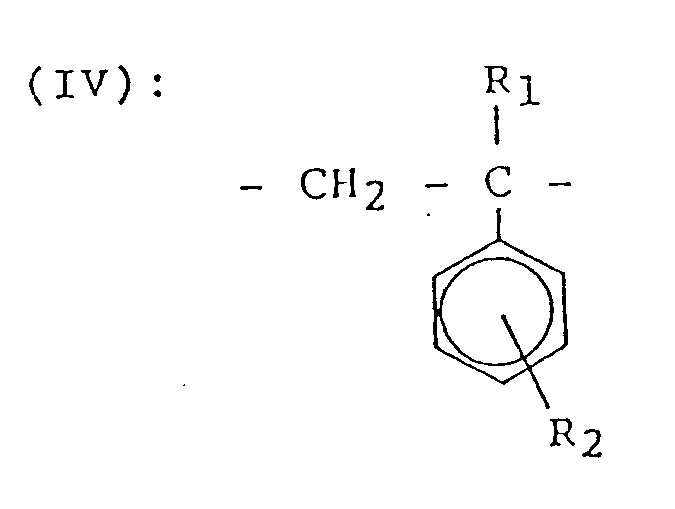

- The material of claim 19 in which the ring-brominated aromatic monomer units include monobrominated and polybrominated units and in which the ratio of monobrominated and polybrominated units is such that the corresponding mixture of the unsaturated ring-brominated aromatic monomers is liquid at room temperature.
- The material of claim 19 in which the coating consists essentially of the ring-brominated aromatic monomer units, the alkyl (meth)acrylate monomer units, the non-brominated aromatic monomer units and the carboxylic acid monomer units.
- A composite material comprising:a. a substrate adapted to be coated; andb. a coating adhered to said substrate, said coating comprising a flame retardant latex material comprising ring-brominated aromatic monomer units of the formula (I):


- Method for preparing a composite material including a substrate and a latex coating adhered thereto, the method comprising adhering to the substrate a flame retardant latex material comprising ring-brominated aromatic monomer units of the formula (I):
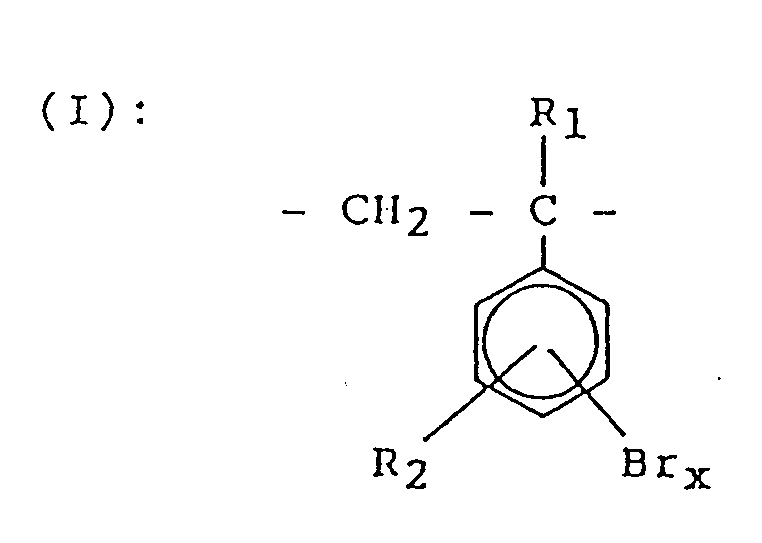

- Method for preparing a composite material including a substrate and a latex coating adhered thereto, the method comprising adhering to the substrate a flame retardant latex coating comprising ring-brominated aromatic monomer units of the formula (I):


Applications Claiming Priority (3)
| Application Number | Priority Date | Filing Date | Title |
|---|---|---|---|
| US57858390A | 1990-09-06 | 1990-09-06 | |
| US578583 | 1990-09-06 | ||
| PCT/US1991/005969 WO1992004417A1 (en) | 1990-09-06 | 1991-08-21 | Flame retardant brominated styrene-based coatings |
Publications (2)
| Publication Number | Publication Date |
|---|---|
| EP0548199A1 EP0548199A1 (en) | 1993-06-30 |
| EP0548199B1 true EP0548199B1 (en) | 1994-11-02 |
Family
ID=24313480
Family Applications (1)
| Application Number | Title | Priority Date | Filing Date |
|---|---|---|---|
| EP91916535A Expired - Lifetime EP0548199B1 (en) | 1990-09-06 | 1991-08-21 | Flame retardant brominated styrene-based coatings |
Country Status (14)
| Country | Link |
|---|---|
| US (1) | US5290636A (en) |
| EP (1) | EP0548199B1 (en) |
| JP (1) | JPH06500816A (en) |
| KR (1) | KR930702458A (en) |
| AT (1) | ATE113644T1 (en) |
| AU (1) | AU651134B2 (en) |
| CA (1) | CA2049856A1 (en) |
| DE (1) | DE69104992T2 (en) |
| ES (1) | ES2063525T3 (en) |
| HK (1) | HK172295A (en) |
| IL (1) | IL99391A (en) |
| MX (1) | MX9100966A (en) |
| TW (1) | TW203089B (en) |
| WO (1) | WO1992004417A1 (en) |
Cited By (2)
| Publication number | Priority date | Publication date | Assignee | Title |
|---|---|---|---|---|
| CN105949908A (en) * | 2016-07-01 | 2016-09-21 | 许宏俊 | Aqueous granite coating |
| CN105968255A (en) * | 2016-06-28 | 2016-09-28 | 合众(佛山)化工有限公司 | Self-flame-resisting type acrylic emulsion and preparation method thereof |
Families Citing this family (9)
| Publication number | Priority date | Publication date | Assignee | Title |
|---|---|---|---|---|
| US6114426A (en) * | 1997-11-20 | 2000-09-05 | Lucent Technologies, Inc. | Pressure-sensitive flame retardant adhesive |
| US6146555A (en) * | 1998-01-19 | 2000-11-14 | Ferro Corporation | Brominated copolymer flame retardant additives having improved color characteristics and related method |
| IL136725A (en) | 2000-06-12 | 2007-08-19 | Bromine Compounds Ltd | Aqueous suspensions of pentabromobenzyl acrylate, their use and process for preparing them |
| US20050054553A1 (en) * | 2003-06-27 | 2005-03-10 | The Procter & Gamble Company | Liquid fabric softening compositions comprising flame retardant |
| JP4851346B2 (en) * | 2004-01-27 | 2012-01-11 | ビー.ジー.・ポリマーズ・エー.・シー.・エー.・リミテッド | Brominated polymers and flame retardant products containing them |
| CN106117406B (en) * | 2016-06-28 | 2019-02-12 | 合众(佛山)化工有限公司 | A kind of self-flame-retardant modifying cinepazid emulsion and preparation method thereof |
| WO2018008018A1 (en) * | 2016-07-03 | 2018-01-11 | Bromine Compounds Ltd. | Bromine-containing copolymers |
| JP2023504902A (en) * | 2019-12-09 | 2023-02-07 | スリーエム イノベイティブ プロパティズ カンパニー | flame retardant pressure sensitive adhesive |
| JP2024081829A (en) * | 2022-12-07 | 2024-06-19 | 株式会社エフコンサルタント | Coating material and coating formation method |
Family Cites Families (10)
| Publication number | Priority date | Publication date | Assignee | Title |
|---|---|---|---|---|
| CA907229A (en) * | 1972-08-08 | E. Mackay James | Flame-resistant latex foam | |
| AU2907271A (en) * | 1970-05-25 | 1972-11-23 | The Dow Chemical Company | Flame resistant latex foam |
| US3766189A (en) * | 1972-10-05 | 1973-10-16 | Sinclair Koppers Co | Fire retardant latex containing chlorinated paraffin wax |
| US3877974A (en) * | 1972-10-25 | 1975-04-15 | White Chemical Corp | Flame retardants for blends of natural and synthetic fibers |
| US4054733A (en) * | 1974-12-19 | 1977-10-18 | The Dow Chemical Company | Ar-halo-ar(t-alkyl)styrenes polymers |
| US4224217A (en) * | 1978-01-05 | 1980-09-23 | The Dow Chemical Company | Combustion resistant aromatic polymers containing char-forming benzyl and/or allyl moieties |
| NL7812461A (en) * | 1978-12-22 | 1980-06-24 | Stamicarbon | THERMOPLASTIC MOLDING MASS. |
| NL7812460A (en) * | 1978-12-22 | 1980-06-24 | Stamicarbon | BOMB-CONTAINING POLYMER AND METHOD FOR PREPARING A BOMB-CONTAINING POLYMER |
| US5227443A (en) * | 1989-12-21 | 1993-07-13 | General Electric Company | Flame retardant polymer with stable polymeric additive |
| JPH06502672A (en) * | 1990-10-31 | 1994-03-24 | グレート・レークス・ケミカル・コーポレーション | Composite material containing flame-retardant brominated styrene-based paint |
-
1991
- 1991-08-21 DE DE69104992T patent/DE69104992T2/en not_active Expired - Fee Related
- 1991-08-21 KR KR1019930700682A patent/KR930702458A/en not_active Withdrawn
- 1991-08-21 AT AT91916535T patent/ATE113644T1/en not_active IP Right Cessation
- 1991-08-21 WO PCT/US1991/005969 patent/WO1992004417A1/en not_active Ceased
- 1991-08-21 ES ES91916535T patent/ES2063525T3/en not_active Expired - Lifetime
- 1991-08-21 EP EP91916535A patent/EP0548199B1/en not_active Expired - Lifetime
- 1991-08-21 JP JP3515119A patent/JPH06500816A/en active Pending
- 1991-08-21 AU AU85061/91A patent/AU651134B2/en not_active Ceased
- 1991-08-26 CA CA002049856A patent/CA2049856A1/en not_active Abandoned
- 1991-09-04 IL IL9939191A patent/IL99391A/en not_active IP Right Cessation
- 1991-09-05 TW TW080107050A patent/TW203089B/zh active
- 1991-09-05 MX MX9100966A patent/MX9100966A/en not_active IP Right Cessation
-
1992
- 1992-04-29 US US07/875,359 patent/US5290636A/en not_active Expired - Fee Related
-
1995
- 1995-11-09 HK HK172295A patent/HK172295A/en unknown
Cited By (2)
| Publication number | Priority date | Publication date | Assignee | Title |
|---|---|---|---|---|
| CN105968255A (en) * | 2016-06-28 | 2016-09-28 | 合众(佛山)化工有限公司 | Self-flame-resisting type acrylic emulsion and preparation method thereof |
| CN105949908A (en) * | 2016-07-01 | 2016-09-21 | 许宏俊 | Aqueous granite coating |
Also Published As
| Publication number | Publication date |
|---|---|
| WO1992004417A1 (en) | 1992-03-19 |
| IL99391A0 (en) | 1992-08-18 |
| EP0548199A1 (en) | 1993-06-30 |
| DE69104992T2 (en) | 1995-03-23 |
| MX9100966A (en) | 1992-05-04 |
| US5290636A (en) | 1994-03-01 |
| IL99391A (en) | 1994-07-31 |
| ATE113644T1 (en) | 1994-11-15 |
| TW203089B (en) | 1993-04-01 |
| ES2063525T3 (en) | 1995-01-01 |
| KR930702458A (en) | 1993-09-09 |
| DE69104992D1 (en) | 1994-12-08 |
| CA2049856A1 (en) | 1992-03-07 |
| HK172295A (en) | 1995-11-17 |
| AU651134B2 (en) | 1994-07-14 |
| JPH06500816A (en) | 1994-01-27 |
| AU8506191A (en) | 1992-03-30 |
Similar Documents
| Publication | Publication Date | Title |
|---|---|---|
| US5100986A (en) | Flame retardant brominated styrene-based coatings | |
| AU651134B2 (en) | Flame retardant brominated styrene-based coatings | |
| US20070145338A1 (en) | Flame retardant polymer emulsion | |
| JP3590457B2 (en) | Method for producing aqueous emulsion | |
| US5438096A (en) | Flame retardant brominated styrene-based latices | |
| US5484839A (en) | Flame retardant brominated styrene graft latex compositions | |
| AU653548B2 (en) | Flame retardant brominated styrene-based latices | |
| US5296306A (en) | Flame retardant brominated styrene graft latex coatings | |
| CA1322069C (en) | Polymeric binder for intumescent coating | |
| JP2003082288A (en) | Antifouling coating composition for wallpaper | |
| JPH02265973A (en) | Water base emulsion of flame-retardancy-providing resin | |
| JPS619490A (en) | Compound | |
| JP2961438B2 (en) | Flame retardant resin emulsion composition | |
| JPH0413746A (en) | Aqueous emulsion of flame retarding resin and production thereof | |
| JPH08506839A (en) | Flame-retardant brominated styrene graft latex composition | |
| Favstritsky et al. | Flame-retardant brominated styrene-based polymers. X. Dibromostyrene grafted latexes | |
| JP2900068B2 (en) | Flame-retardant resin aqueous emulsion composition | |
| JPH04351671A (en) | Flame-retardant resin aqueous emulsion and its manufacturing method |
Legal Events
| Date | Code | Title | Description |
|---|---|---|---|
| PUAI | Public reference made under article 153(3) epc to a published international application that has entered the european phase |
Free format text: ORIGINAL CODE: 0009012 |
|
| 17P | Request for examination filed |
Effective date: 19930304 |
|
| AK | Designated contracting states |
Kind code of ref document: A1 Designated state(s): AT BE CH DE ES FR GB GR IT LI NL |
|
| 17Q | First examination report despatched |
Effective date: 19940214 |
|
| GRAA | (expected) grant |
Free format text: ORIGINAL CODE: 0009210 |
|
| AK | Designated contracting states |
Kind code of ref document: B1 Designated state(s): AT BE CH DE ES FR GB GR IT LI NL |
|
| REF | Corresponds to: |
Ref document number: 113644 Country of ref document: AT Date of ref document: 19941115 Kind code of ref document: T |
|
| ITF | It: translation for a ep patent filed | ||
| REF | Corresponds to: |
Ref document number: 69104992 Country of ref document: DE Date of ref document: 19941208 |
|
| ET | Fr: translation filed | ||
| REG | Reference to a national code |
Ref country code: ES Ref legal event code: FG2A Ref document number: 2063525 Country of ref document: ES Kind code of ref document: T3 |
|
| REG | Reference to a national code |
Ref country code: GR Ref legal event code: FG4A Free format text: 3014026 |
|
| PGFP | Annual fee paid to national office [announced via postgrant information from national office to epo] |
Ref country code: FR Payment date: 19950809 Year of fee payment: 5 |
|
| PGFP | Annual fee paid to national office [announced via postgrant information from national office to epo] |
Ref country code: GB Payment date: 19950810 Year of fee payment: 5 |
|
| PGFP | Annual fee paid to national office [announced via postgrant information from national office to epo] |
Ref country code: AT Payment date: 19950811 Year of fee payment: 5 |
|
| PGFP | Annual fee paid to national office [announced via postgrant information from national office to epo] |
Ref country code: NL Payment date: 19950825 Year of fee payment: 5 |
|
| PGFP | Annual fee paid to national office [announced via postgrant information from national office to epo] |
Ref country code: DE Payment date: 19950828 Year of fee payment: 5 Ref country code: CH Payment date: 19950828 Year of fee payment: 5 |
|
| PGFP | Annual fee paid to national office [announced via postgrant information from national office to epo] |
Ref country code: ES Payment date: 19950830 Year of fee payment: 5 |
|
| PGFP | Annual fee paid to national office [announced via postgrant information from national office to epo] |
Ref country code: GR Payment date: 19950831 Year of fee payment: 5 |
|
| PLBE | No opposition filed within time limit |
Free format text: ORIGINAL CODE: 0009261 |
|
| STAA | Information on the status of an ep patent application or granted ep patent |
Free format text: STATUS: NO OPPOSITION FILED WITHIN TIME LIMIT |
|
| PGFP | Annual fee paid to national office [announced via postgrant information from national office to epo] |
Ref country code: BE Payment date: 19950926 Year of fee payment: 5 |
|
| 26N | No opposition filed | ||
| PG25 | Lapsed in a contracting state [announced via postgrant information from national office to epo] |
Ref country code: GB Effective date: 19960821 Ref country code: AT Effective date: 19960821 |
|
| PG25 | Lapsed in a contracting state [announced via postgrant information from national office to epo] |
Ref country code: ES Free format text: LAPSE BECAUSE OF EXPIRATION OF PROTECTION Effective date: 19960822 |
|
| PG25 | Lapsed in a contracting state [announced via postgrant information from national office to epo] |
Ref country code: LI Effective date: 19960831 Ref country code: CH Effective date: 19960831 Ref country code: BE Effective date: 19960831 |
|
| BERE | Be: lapsed |
Owner name: GREAT LAKES CHEMICAL CORP. Effective date: 19960831 |
|
| PG25 | Lapsed in a contracting state [announced via postgrant information from national office to epo] |
Ref country code: GR Free format text: THE PATENT HAS BEEN ANNULLED BY A DECISION OF A NATIONAL AUTHORITY Effective date: 19970228 |
|
| PG25 | Lapsed in a contracting state [announced via postgrant information from national office to epo] |
Ref country code: NL Effective date: 19970301 |
|
| REG | Reference to a national code |
Ref country code: GR Ref legal event code: MM2A Free format text: 3014026 |
|
| REG | Reference to a national code |
Ref country code: CH Ref legal event code: PL |
|
| GBPC | Gb: european patent ceased through non-payment of renewal fee |
Effective date: 19960821 |
|
| PG25 | Lapsed in a contracting state [announced via postgrant information from national office to epo] |
Ref country code: FR Effective date: 19970430 |
|
| NLV4 | Nl: lapsed or anulled due to non-payment of the annual fee |
Effective date: 19970301 |
|
| PG25 | Lapsed in a contracting state [announced via postgrant information from national office to epo] |
Ref country code: DE Effective date: 19970501 |
|
| REG | Reference to a national code |
Ref country code: FR Ref legal event code: ST |
|
| REG | Reference to a national code |
Ref country code: ES Ref legal event code: FD2A Effective date: 19990601 |
|
| PG25 | Lapsed in a contracting state [announced via postgrant information from national office to epo] |
Ref country code: IT Free format text: LAPSE BECAUSE OF NON-PAYMENT OF DUE FEES Effective date: 20050821 |