EP0545296B1 - Process for producing carbon dioxide clathrate - Google Patents
Process for producing carbon dioxide clathrate Download PDFInfo
- Publication number
- EP0545296B1 EP0545296B1 EP92120251A EP92120251A EP0545296B1 EP 0545296 B1 EP0545296 B1 EP 0545296B1 EP 92120251 A EP92120251 A EP 92120251A EP 92120251 A EP92120251 A EP 92120251A EP 0545296 B1 EP0545296 B1 EP 0545296B1
- Authority
- EP
- European Patent Office
- Prior art keywords
- carbon dioxide
- temperature
- lug
- clathrate
- dioxide clathrate
- Prior art date
- Legal status (The legal status is an assumption and is not a legal conclusion. Google has not performed a legal analysis and makes no representation as to the accuracy of the status listed.)
- Expired - Lifetime
Links
- CURLTUGMZLYLDI-UHFFFAOYSA-N Carbon dioxide Chemical compound O=C=O CURLTUGMZLYLDI-UHFFFAOYSA-N 0.000 title claims description 250
- 239000001569 carbon dioxide Substances 0.000 title claims description 125
- 229910002092 carbon dioxide Inorganic materials 0.000 title claims description 125
- 238000000034 method Methods 0.000 title claims description 12
- 239000007864 aqueous solution Substances 0.000 claims description 34
- XLYOFNOQVPJJNP-UHFFFAOYSA-N water Substances O XLYOFNOQVPJJNP-UHFFFAOYSA-N 0.000 claims description 31
- 239000013535 sea water Substances 0.000 claims description 29
- 238000010438 heat treatment Methods 0.000 claims description 5
- 238000004519 manufacturing process Methods 0.000 description 30
- 239000007789 gas Substances 0.000 description 13
- 238000001816 cooling Methods 0.000 description 9
- 238000000926 separation method Methods 0.000 description 5
- 150000001875 compounds Chemical class 0.000 description 4
- 239000000498 cooling water Substances 0.000 description 3
- 239000007788 liquid Substances 0.000 description 3
- 238000002485 combustion reaction Methods 0.000 description 2
- 239000002803 fossil fuel Substances 0.000 description 2
- 230000002093 peripheral effect Effects 0.000 description 2
- 238000006243 chemical reaction Methods 0.000 description 1
- 239000000567 combustion gas Substances 0.000 description 1
- 239000013078 crystal Substances 0.000 description 1
- 230000003247 decreasing effect Effects 0.000 description 1
- 230000000694 effects Effects 0.000 description 1
- 239000013505 freshwater Substances 0.000 description 1
- VUZPPFZMUPKLLV-UHFFFAOYSA-N methane;hydrate Chemical compound C.O VUZPPFZMUPKLLV-UHFFFAOYSA-N 0.000 description 1
- 239000002244 precipitate Substances 0.000 description 1
- 239000007787 solid Substances 0.000 description 1
- 238000010792 warming Methods 0.000 description 1
Images


Classifications
-
- B—PERFORMING OPERATIONS; TRANSPORTING
- B01—PHYSICAL OR CHEMICAL PROCESSES OR APPARATUS IN GENERAL
- B01D—SEPARATION
- B01D53/00—Separation of gases or vapours; Recovering vapours of volatile solvents from gases; Chemical or biological purification of waste gases, e.g. engine exhaust gases, smoke, fumes, flue gases, aerosols
- B01D53/34—Chemical or biological purification of waste gases
- B01D53/46—Removing components of defined structure
- B01D53/62—Carbon oxides
-
- B—PERFORMING OPERATIONS; TRANSPORTING
- B01—PHYSICAL OR CHEMICAL PROCESSES OR APPARATUS IN GENERAL
- B01J—CHEMICAL OR PHYSICAL PROCESSES, e.g. CATALYSIS OR COLLOID CHEMISTRY; THEIR RELEVANT APPARATUS
- B01J3/00—Processes of utilising sub-atmospheric or super-atmospheric pressure to effect chemical or physical change of matter; Apparatus therefor
- B01J3/04—Pressure vessels, e.g. autoclaves
-
- C—CHEMISTRY; METALLURGY
- C01—INORGANIC CHEMISTRY
- C01B—NON-METALLIC ELEMENTS; COMPOUNDS THEREOF; METALLOIDS OR COMPOUNDS THEREOF NOT COVERED BY SUBCLASS C01C
- C01B32/00—Carbon; Compounds thereof
- C01B32/50—Carbon dioxide
-
- Y—GENERAL TAGGING OF NEW TECHNOLOGICAL DEVELOPMENTS; GENERAL TAGGING OF CROSS-SECTIONAL TECHNOLOGIES SPANNING OVER SEVERAL SECTIONS OF THE IPC; TECHNICAL SUBJECTS COVERED BY FORMER USPC CROSS-REFERENCE ART COLLECTIONS [XRACs] AND DIGESTS
- Y02—TECHNOLOGIES OR APPLICATIONS FOR MITIGATION OR ADAPTATION AGAINST CLIMATE CHANGE
- Y02C—CAPTURE, STORAGE, SEQUESTRATION OR DISPOSAL OF GREENHOUSE GASES [GHG]
- Y02C20/00—Capture or disposal of greenhouse gases
- Y02C20/40—Capture or disposal of greenhouse gases of CO2
-
- Y—GENERAL TAGGING OF NEW TECHNOLOGICAL DEVELOPMENTS; GENERAL TAGGING OF CROSS-SECTIONAL TECHNOLOGIES SPANNING OVER SEVERAL SECTIONS OF THE IPC; TECHNICAL SUBJECTS COVERED BY FORMER USPC CROSS-REFERENCE ART COLLECTIONS [XRACs] AND DIGESTS
- Y02—TECHNOLOGIES OR APPLICATIONS FOR MITIGATION OR ADAPTATION AGAINST CLIMATE CHANGE
- Y02P—CLIMATE CHANGE MITIGATION TECHNOLOGIES IN THE PRODUCTION OR PROCESSING OF GOODS
- Y02P20/00—Technologies relating to chemical industry
- Y02P20/151—Reduction of greenhouse gas [GHG] emissions, e.g. CO2
Definitions
- the present invention relates to a process for producing a carbon dioxide clathrate from carbon dioxide and water or seawater.
- One of the suggested methods Comprises separating and collecting all or a part of the combustion exhaust gas from fossil fuel, forwarding the collected gas to the abyss of the sea, and then precipating a crystalline compound of seawater and the carbon dioxide gas, i.e., a carbon dioxide clathrate.
- Carbon dioxide clathrate is a compound in which carbon dioxide is wrapped in crystallized three-dimensional structure Of water, and it is considered that the compound is produced in accordance with a chemical reaction represented by the formula (1) CO 2 + 5(3/4)H 2 O ⁇ CO 2 ⁇ 5(3/4)H 2 0
- This carbon dioxide clathrate is a compound of carbon dioxide gas, and it is precipitated in the form of a crystalline solid from water.
- carbon dioxide clathrate was produced at a temperature of more than 0°C to 10°C under a pressure of more than 13 atm, but the carbon dioxide clathrate produced in this manner is in the state of sherbet and fine crystals, and it is not easy to separate it from water. Therefore, when thrown to the bottom of the sea, this carbon dioxide clathrate diffuses due to the stream of the seawater which sometimes exists in the depths of the sea. Thus, in order to fix the carbon dioxide gas in the form of carbon dioxide clathrate at a desired position in the depths of the sea, it is necessary that carbon dioxide clathrate precipitates into lumps which cannot drift in the depths of the sea.
- EP-A-429 154 relates to a method and apparatus of fixing carbon dioxide in sea water or fresh water. It involves forming carbon dioxide clathrate at a suitable temperature and pressure, thereafter sinking the clathrate to a depth in the water under conditions such that it does not decompose.
- the clathrate is formed by nozzle devices.
- an object of the present invention is to provide a process for producing carbon dioxide clathrate having a lump diameter large enough to precipitate in a desired abyssal position of the sea without drifting.
- a process for producing carbon dioxide clathrate according to the present invention by which the above-mentioned object can be achieved comprises the step of disposing an aqueous solution portion of water or seawater and a carbon dioxide portion in a reactor so that these portions may come into contact with each other with the interposition of an interface, and positioning, in the aqueous solution portion, a lug, of which the temperature is controllable; the step of adjusting the pressure in the reactor to 131.169 kPa (13 atm) or more and the temperature of the aqueous solution in the aqueous solution portion to a level in the range of more than 5°C to 10°C, and adjusting an interface temperature between the aqueous solution portion and the carbon dioxide portion to a level in the range of more than 10°C to 15°C; the step of meintaining the temperature of the lug at a level in the range of more than 0°C to 5°C to form crystallized carbon dioxide clathrates on the lug; and the step of heating
- the step of forming the clathrate on the lug and the step of separating and dropping the clathrate from the lug can be alternately repeated plural times.
- the positioning of the lug in the aqueous solution can be carried out after the adjustment of the pressure in the reactor, the temperature of the aqueous solution in the aqueous solution portion and the interface temperature.
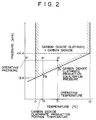
- a carbon dioxide clathrate is produced by reacting water with a carbon dioxide gas dissolved in it or seawater, and production/growth driving force of the carbon dioxide clathrate is directly proportional to a difference between an operating pressure P and a carbon dioxide clathrate production equilibrium pressure P 1 at an operating temperature T 1 , or a difference between the operating pressure P and a carbon dioxide clathrate production equilibrium pressure P 2 at an operating temperature T 2 in Fig. 2. Therefore, in order to rapidly produce and grow the carbon dioxide clathrate, it is necessary to rapidly dissolve the carbon dioxide in an aqueous solution at an interface between the aqueous solution of water or seawater and the carbon dioxide during the production/growth of the carbon dioxide clathrate. For the satisfaction of such a requirement, it is necessary to enlarge the difference between the operating pressure P and the carbon dioxide clathrate production equilibrium pressure P 1 or P 2 at the operating temperature T 1 or T 2 .
- a carbon dioxide clathrate production rate is directly proportional to the difference between the operating pressure and the carbon dioxide clathrate production equilibrium pressure at the operating temperature, and in this case, a proportionality constant depends upon the amount of water or seawater, the structure of an apparatus, the operating temperature and the like.
- the temperature T 2 at a carbon dioxide clathrate production/growth position is dropped to a lower level than the ambient temperature T 1 to establish the carbon dioxide clathrate production/growth position where a difference between the operating pressure P at the position shown in Fig. 2 and the carbon dioxide clathrate production equilibrium pressure P 2 at the operating temperature T 2 is larger than a difference between the operating pressure P in the vicinity of the position and the carbon dioxide clathrate production equilibrium pressure P 1 at the operating temperature T 1 .
- Fig. 3 shows a relation of the carbon dioxide clathrate production rate to the difference between the carbon dioxide clathrate production position temperature and the ambient liquid temperature.
- the carbon dioxide clathrate production rate is directly proportional to a power of the difference between the carbon dioxide clathrate production position temperature and the ambient liquid temperature, and a proportionality constant depends upon the amount of water or seawater, the structure of an apparatus, the operating pressure and the like.
- the pressure in the reactor is adjusted to 131.169 kPa (13 atm) or more which is one of the carbon dioxide clathrate producing conditions and the temperature of water or seawater is adjusted to a level of more than 5°C to 10°C which is the other of the carbon dioxide clathrate producing conditions.
- a lug is disposed in water or seawater and the temperature of the lug is adjusted to a level of more than 0°C to 5°C.
- the reason why the temperature of water or seawater is adjusted to a level of more than 5°C to 10°C is that when the temperature is in excess of 10°C, the carbon dioxide clathrate is not produced any more, and that when the temperature is in excess of 5°C, a difference between the temperature of water or seawater and the temperature of the producing portion (the lug portion) is kept as large as possible to heighten the production rate. When it is 5°C or less, the production process is economically disadvantageous.
- the lug is provided in water or seawater so as to locally produce/grow the carbon dioxide clathrate in water or seawater.
- the cooling of the lug to a temperature of more than 0°C to 5°C is carried out to enlarge a difference between the temperature of the lug and the ambient temperature and to thereby grow the carbon dioxide clathrate as large as possible.
- the temperature of the lug is 0°C or less, ice is formed, together with the carbon dioxide clathrate, which is economically disadvantageous, and when it is in excess of 5°C, the difference between the temperature of the lug and the ambient operating temperature cannot be enlarged.
- the produced carbon dioxide clathrate takes the form of a film, which hinders the carbon dioxide from dissolving in water or seawater. Therefore, in order to grow the carbon dioxide clathrate, it is necessary to prevent the carbon dioxide clathrate from being formed at the interface between water or seawater and the carbon dioxide, Thus, in the present invention, in order to prevent the carbon dioxide clathrate from being formed at the interface between water or seawater and the carbon dioxide, an interface temperature between seawater and the carbon dioxide is to be maintained at a level of more than 10°C to 15°C.
- the reason why the interface temperature is more than 10°C is that when it is more than 10°C, the carbon dioxide clathrate decomposes, and the reason why the interface temperature is not more than 15°C is that when it is in excess of 15°C, a difference between the interface temperature and the temperature of water or seawater is large, which is economically disadvantageous.
- the carbon dioxide clathrate is produced/grown on the lug in water or seawater, and the carbon dioxide clathrate grown on the lug is successively separated therefrom, as described above. Therefore, for this separation, the lug is heated to a temperature of more than 10°C which is the decomposing conditions of the carbon dioxide clathrate, to 30°C.
- the reason why the lug is heated to a temperature of more than 10°C to 30°C is that the carbon dioxide clathrate attached to the lug surface can be decomposed at a temperature of more than 10°C for the purpose of separating the carbon dioxide clathrate from the lug surface, and a lug-temperature of more than 30°C is economically disadvantageous.
- the carbon dioxide clathrate having a lump diameter which permits sinking it to a desired position in the depths of the sea without it being drifted by an abyssal seawater flow.
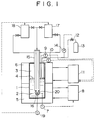
- Fig. 1 is an overall view of a production apparatus for the process for producing a carbon dioxide clathrate regarding one embodiment of the present invention.
- Fig. 2 is a graph of operating pressure and equilibrium pressure in an equilibrium view of the production of the carbon dioxide clathrate regarding one embodiment of the present invention.
- Fig. 3 is a graph showing a relation of a carbon dioxide clathrate production rate to a difference between a carbon dioxide clathrate production portion temperature and an ambient liquid temperature regarding one embodiment of the present invention.
- Fig. 4 is a detail view showing a situation where the carbon dioxide clathrate is separated from a lug regarding one embodiment of the present invention.
- Fig. 5 is an illustrative view showing typical structures of the lug regarding one embodiment of the present invention.
- Fig. 1 shows the whole constitution of a production apparatus for the process for producing a carbon dioxide clathrate regarding one embodiment of the present invention.
- a reactor 1 is filled with an aqueous solution 2 of water or seawater and carbon dioxide 3 so that they may come in contact with each other with the interposition of an interface 4.
- the lower peripheral portion and the upper peripheral portion of the reactor 1 are provided with a jacket 5 for temperature adjustment and a jacket 6 for cooling, respectively, and the interface 4 between the aqueous solution 2 and the carbon dioxide 3 is positioned at a lower portion of the jacket 6 for cooling.
- the jacket 5 for temperature adjustment is controlled by a water temperature adjusting device 8 connected to a water thermometer 7 for measuring the temperature of the aqueous solution 2.
- the jacket 6 for cooling is controlled by a carbon dioxide aqueous solution interface temperature adjusting device 11 connected to a carbon dioxide interface thermometer 9 for measuring the temperature of the carbon dioxide 3 in the vicinity of the interface 4 and to an aqueous solution surface thermometer 10 for measuring the temperature of the aqueous solution 2 in the vicinity of the interface 4.
- the top side of the reactor 1 is connected to a carbon dioxide bomb 13 via a reactor pressure adjusting valve 12, and this reactor pressure adjusting valve 12 is controlled on the basis of the output of a reactor pressure gauge 14 branched off from between the pressure adjusting valve 12 itself and the reactor 1.
- a cooling tube 15 for carbon dioxide clathrate production is inserted into the reactor from the top side thereof and disposed therein, and the lower edge of the cooling tube 15 inserted close to the bottom of the aqueous solution 2 is provided with a lug 16.
- This cooling tube 15 for carbon dioxide clathrate production is connected to a cooler 17 for carbon dioxide clathrate production which forwards a cooling water to control the temperature of the lug 16, and a heating equipment 18 for carbon dioxide clathrate separation which heats the lug 16 at the time of the separation of the carbon dioxide clathrate.
- the cooler 17 for carbon dioxide clathrate production and the heating equipment 18 for carbon dioxide clathrate separation are constituted so as to be controlled on the basis of the output of a lug thermometer 19.
- Fig. 5 (A), (B) and (C) show exemplary structures of the lug 16.
- Fig. 5 (A) shows a cylindrical lug 16A
- Fig. 5 (B) shows a circular-cone-shaped lug 16B
- Fig. 5 (C) shows a hemispherical lug 16C.
- carbon dioxide gas was used, however, this gas may be replaced with liquefied carbon dioxide.
Landscapes
- Chemical & Material Sciences (AREA)
- Organic Chemistry (AREA)
- Chemical Kinetics & Catalysis (AREA)
- Engineering & Computer Science (AREA)
- Environmental & Geological Engineering (AREA)
- Analytical Chemistry (AREA)
- General Chemical & Material Sciences (AREA)
- Oil, Petroleum & Natural Gas (AREA)
- Health & Medical Sciences (AREA)
- Biomedical Technology (AREA)
- Inorganic Chemistry (AREA)
- Carbon And Carbon Compounds (AREA)
- Physical Or Chemical Processes And Apparatus (AREA)
- Treating Waste Gases (AREA)
Description
- The present invention relates to a process for producing a carbon dioxide clathrate from carbon dioxide and water or seawater.
- Due to combustion exhaust gas of fossil fuel discharged into the atmosphere, the concentration of a carbon dioxide gas tends to increase year by year, and the carbon dioxide gas is mentioned as the main cause of a warming phenomenon or hothouse effect of the earth. This problem is taken up as an international theme on a global scale.
- Decreasing the amount of the carbon dioxide gas in the atmosphere is considered to be extremely difficult in practice, but there have been suggested some methods for treating a gas such as a combustion gas discharged from a certain position. One of the suggested methods Comprises separating and collecting all or a part of the combustion exhaust gas from fossil fuel, forwarding the collected gas to the abyss of the sea, and then precipating a crystalline compound of seawater and the carbon dioxide gas, i.e., a carbon dioxide clathrate.
- Carbon dioxide clathrate is a compound in which carbon dioxide is wrapped in crystallized three-dimensional structure Of water, and it is considered that the compound is produced in accordance with a chemical reaction represented by the formula (1)

- This carbon dioxide clathrate is a compound of carbon dioxide gas, and it is precipitated in the form of a crystalline solid from water.
- Previously, carbon dioxide clathrate was produced at a temperature of more than 0°C to 10°C under a pressure of more than 13 atm, but the carbon dioxide clathrate produced in this manner is in the state of sherbet and fine crystals, and it is not easy to separate it from water. Therefore, when thrown to the bottom of the sea, this carbon dioxide clathrate diffuses due to the stream of the seawater which sometimes exists in the depths of the sea. Thus, in order to fix the carbon dioxide gas in the form of carbon dioxide clathrate at a desired position in the depths of the sea, it is necessary that carbon dioxide clathrate precipitates into lumps which cannot drift in the depths of the sea.
- EP-A-429 154 relates to a method and apparatus of fixing carbon dioxide in sea water or fresh water. It involves forming carbon dioxide clathrate at a suitable temperature and pressure, thereafter sinking the clathrate to a depth in the water under conditions such that it does not decompose. The clathrate is formed by nozzle devices.
- In view of such situations, an object of the present invention is to provide a process for producing carbon dioxide clathrate having a lump diameter large enough to precipitate in a desired abyssal position of the sea without drifting.
- A process for producing carbon dioxide clathrate according to the present invention by which the above-mentioned object can be achieved comprises the step of disposing an aqueous solution portion of water or seawater and a carbon dioxide portion in a reactor so that these portions may come into contact with each other with the interposition of an interface, and positioning, in the aqueous solution portion, a lug, of which the temperature is controllable; the step of adjusting the pressure in the reactor to 131.169 kPa (13 atm) or more and the temperature of the aqueous solution in the aqueous solution portion to a level in the range of more than 5°C to 10°C, and adjusting an interface temperature between the aqueous solution portion and the carbon dioxide portion to a level in the range of more than 10°C to 15°C; the step of meintaining the temperature of the lug at a level in the range of more than 0°C to 5°C to form crystallized carbon dioxide clathrates on the lug; and the step of heating the lug to a temperature of more than 10°C to 30°C to separate and drop the crystallized carbon dioxide clathrate from the lug.
- In this case, the step of forming the clathrate on the lug and the step of separating and dropping the clathrate from the lug can be alternately repeated plural times.
- Furthermore, the positioning of the lug in the aqueous solution can be carried out after the adjustment of the pressure in the reactor, the temperature of the aqueous solution in the aqueous solution portion and the interface temperature.
- Now, the present invention will be described in detail.
- A carbon dioxide clathrate is produced by reacting water with a carbon dioxide gas dissolved in it or seawater, and production/growth driving force of the carbon dioxide clathrate is directly proportional to a difference between an operating pressure P and a carbon dioxide clathrate production equilibrium pressure P1 at an operating temperature T1, or a difference between the operating pressure P and a carbon dioxide clathrate production equilibrium pressure P2 at an operating temperature T2 in Fig. 2. Therefore, in order to rapidly produce and grow the carbon dioxide clathrate, it is necessary to rapidly dissolve the carbon dioxide in an aqueous solution at an interface between the aqueous solution of water or seawater and the carbon dioxide during the production/growth of the carbon dioxide clathrate. For the satisfaction of such a requirement, it is necessary to enlarge the difference between the operating pressure P and the carbon dioxide clathrate production equilibrium pressure P1 or P2 at the operating temperature T1 or T2.
- That is, a carbon dioxide clathrate production rate is directly proportional to the difference between the operating pressure and the carbon dioxide clathrate production equilibrium pressure at the operating temperature, and in this case, a proportionality constant depends upon the amount of water or seawater, the structure of an apparatus, the operating temperature and the like.
- Furthermore, in order to produce the carbon dioxide clathrate having a sufficient lump diameter in water or seawater, the temperature T2 at a carbon dioxide clathrate production/growth position is dropped to a lower level than the ambient temperature T1 to establish the carbon dioxide clathrate production/growth position where a difference between the operating pressure P at the position shown in Fig. 2 and the carbon dioxide clathrate production equilibrium pressure P2 at the operating temperature T2 is larger than a difference between the operating pressure P in the vicinity of the position and the carbon dioxide clathrate production equilibrium pressure P1 at the operating temperature T1.
- Fig. 3 shows a relation of the carbon dioxide clathrate production rate to the difference between the carbon dioxide clathrate production position temperature and the ambient liquid temperature. As shown in the same drawing, the carbon dioxide clathrate production rate is directly proportional to a power of the difference between the carbon dioxide clathrate production position temperature and the ambient liquid temperature, and a proportionality constant depends upon the amount of water or seawater, the structure of an apparatus, the operating pressure and the like.
- In the present invention, therefore, in order to produce the carbon dioxide clathrate in water or seawater, the pressure in the reactor is adjusted to 131.169 kPa (13 atm) or more which is one of the carbon dioxide clathrate producing conditions and the temperature of water or seawater is adjusted to a level of more than 5°C to 10°C which is the other of the carbon dioxide clathrate producing conditions. Additionally, in order to grow the carbon dioxide clathrate as large as possible in water or seawater, a lug is disposed in water or seawater and the temperature of the lug is adjusted to a level of more than 0°C to 5°C.
- The reason why the pressure in the reactor is adjusted to 131.169 kPa (13 atm) or more is that the carbon dioxide clathrate can be produced under a pressure of 125.612 kPa (12.4) atm or more, and the reason why an upper limit is not given is that the higher the pressure is, the higher the production rate is.
- The reason why the temperature of water or seawater is adjusted to a level of more than 5°C to 10°C is that when the temperature is in excess of 10°C, the carbon dioxide clathrate is not produced any more, and that when the temperature is in excess of 5°C, a difference between the temperature of water or seawater and the temperature of the producing portion (the lug portion) is kept as large as possible to heighten the production rate. When it is 5°C or less, the production process is economically disadvantageous.
- In the present invention, the lug is provided in water or seawater so as to locally produce/grow the carbon dioxide clathrate in water or seawater. However, the cooling of the lug to a temperature of more than 0°C to 5°C is carried out to enlarge a difference between the temperature of the lug and the ambient temperature and to thereby grow the carbon dioxide clathrate as large as possible. When the temperature of the lug is 0°C or less, ice is formed, together with the carbon dioxide clathrate, which is economically disadvantageous, and when it is in excess of 5°C, the difference between the temperature of the lug and the ambient operating temperature cannot be enlarged.
- In the case that the carbon dioxide clathrate is produced at an interface between water or seawater and the carbon dioxide, the produced carbon dioxide clathrate takes the form of a film, which hinders the carbon dioxide from dissolving in water or seawater. Therefore, in order to grow the carbon dioxide clathrate, it is necessary to prevent the carbon dioxide clathrate from being formed at the interface between water or seawater and the carbon dioxide, Thus, in the present invention, in order to prevent the carbon dioxide clathrate from being formed at the interface between water or seawater and the carbon dioxide, an interface temperature between seawater and the carbon dioxide is to be maintained at a level of more than 10°C to 15°C.
- The reason why the interface temperature is more than 10°C is that when it is more than 10°C, the carbon dioxide clathrate decomposes, and the reason why the interface temperature is not more than 15°C is that when it is in excess of 15°C, a difference between the interface temperature and the temperature of water or seawater is large, which is economically disadvantageous.
- In the present invention, the carbon dioxide clathrate is produced/grown on the lug in water or seawater, and the carbon dioxide clathrate grown on the lug is successively separated therefrom, as described above. Therefore, for this separation, the lug is heated to a temperature of more than 10°C which is the decomposing conditions of the carbon dioxide clathrate, to 30°C.
- The reason why the lug is heated to a temperature of more than 10°C to 30°C is that the carbon dioxide clathrate attached to the lug surface can be decomposed at a temperature of more than 10°C for the purpose of separating the carbon dioxide clathrate from the lug surface, and a lug-temperature of more than 30°C is economically disadvantageous.
- As described above, according to the present invention, there can be produced the carbon dioxide clathrate having a lump diameter which permits sinking it to a desired position in the depths of the sea without it being drifted by an abyssal seawater flow.
- Fig. 1 is an overall view of a production apparatus for the process for producing a carbon dioxide clathrate regarding one embodiment of the present invention.
- Fig. 2 is a graph of operating pressure and equilibrium pressure in an equilibrium view of the production of the carbon dioxide clathrate regarding one embodiment of the present invention.
- Fig. 3 is a graph showing a relation of a carbon dioxide clathrate production rate to a difference between a carbon dioxide clathrate production portion temperature and an ambient liquid temperature regarding one embodiment of the present invention.
- Fig. 4 is a detail view showing a situation where the carbon dioxide clathrate is separated from a lug regarding one embodiment of the present invention.
- Fig. 5 is an illustrative view showing typical structures of the lug regarding one embodiment of the present invention.
- Fig. 1 shows the whole constitution of a production apparatus for the process for producing a carbon dioxide clathrate regarding one embodiment of the present invention. As shown in this drawing, a
reactor 1 is filled with anaqueous solution 2 of water or seawater andcarbon dioxide 3 so that they may come in contact with each other with the interposition of aninterface 4. The lower peripheral portion and the upper peripheral portion of thereactor 1 are provided with ajacket 5 for temperature adjustment and ajacket 6 for cooling, respectively, and theinterface 4 between theaqueous solution 2 and thecarbon dioxide 3 is positioned at a lower portion of thejacket 6 for cooling. Here, thejacket 5 for temperature adjustment is controlled by a water temperature adjustingdevice 8 connected to a water thermometer 7 for measuring the temperature of theaqueous solution 2. Furthermore, thejacket 6 for cooling is controlled by a carbon dioxide aqueous solution interface temperature adjusting device 11 connected to a carbon dioxide interface thermometer 9 for measuring the temperature of thecarbon dioxide 3 in the vicinity of theinterface 4 and to an aqueoussolution surface thermometer 10 for measuring the temperature of theaqueous solution 2 in the vicinity of theinterface 4. - On the other hand, the top side of the
reactor 1 is connected to acarbon dioxide bomb 13 via a reactorpressure adjusting valve 12, and this reactorpressure adjusting valve 12 is controlled on the basis of the output of areactor pressure gauge 14 branched off from between thepressure adjusting valve 12 itself and thereactor 1. - Moreover, a
cooling tube 15 for carbon dioxide clathrate production is inserted into the reactor from the top side thereof and disposed therein, and the lower edge of thecooling tube 15 inserted close to the bottom of theaqueous solution 2 is provided with alug 16. Thiscooling tube 15 for carbon dioxide clathrate production is connected to acooler 17 for carbon dioxide clathrate production which forwards a cooling water to control the temperature of thelug 16, and aheating equipment 18 for carbon dioxide clathrate separation which heats thelug 16 at the time of the separation of the carbon dioxide clathrate. Thecooler 17 for carbon dioxide clathrate production and theheating equipment 18 for carbon dioxide clathrate separation are constituted so as to be controlled on the basis of the output of alug thermometer 19. - Reference will be made to one embodiment for producing the carbon dioxide, clathrate by the use of an apparatus shown in Fig. 1.
- (1) In order to prevent the carbon dioxide clathrate from being produced at the
interface 4 which is an aqueous solution surface between theaqueous solution 2 and thecarbon dioxide 3, the carbon dioxide aqueous solution interface temperature adjusting device 11 is controlled on the basis of the output of the carbon dioxide interface thermometer 9 and the aqueoussolution surface thermometer 10 to adjust the amount of the cooling water which is forwarded to thejacket 6 for cooling the reactor, whereby the temperature of theinterface 4 between theaqueous solution 2 and thecarbon dioxide 3 is adjusted to 10.5°C (in excess of 10°C) which temperature prevents carbon dioxide clathrate from being produced. - (2) In order to produce the carbon dioxide clathrate in the
aqueous solution 2, the pressure in thereactor 1 is adjusted to 40 atm with the carbon dioxide from thecarbon dioxide bomb 13 by controlling the reactorpressure adjusting valve 12 on the basis of the output of thepressure gauge 14 of thereactor 1 which is the carbon dioxide clathrate production apparatus, and the temperature of theaqueous solution 2 is adjusted to 9.5°C by controlling the water temperature adjustingdevice 8 on the basis of the output of the water thermometer 7. - (3) In order to locally produce/grow the carbon dioxide clathrate in the
aqueous solution 2, thelug 16 positioned in theaqueous solution 2 is cooled to 1°C, which is a lower temperature than the temperature of the ambientaqueous solution 2, i.e., 9.5°C, by controlling thecooler 17 for carbon dioxide clathrate production on the basis of the output of thelug thermometer 19, thereby forwarding the cooling water through thecooling tube 15 for carbon dioxide clathrate production. - (4) The above-mentioned paragraphs (1) to (3) were met and a
carbon dioxide clathrate 20 was allowed to grow on thelug 16 in theaqueous solution 2, and as a result, thecarbon dioxide clathrate 20 grew and enlarged within the elapsed time. - (5) Next, in order to separate the
carbon dioxide clathrate 20, grown on thelug 16, theheating equipment 18 for carbon dioxide clathrate separation was controlled on the basis of the output of thelug thermometer 19 to heat thelug 16 to 30°C, so that the carbon dioxide clathrate 20 in contact with the surface of thelug 16 was decomposed and then a remaining portionof the clathrate was separated from the surface of thelug 16.
Fig. 4 shows a situation where thecarbon dioxide clathrate 20 attached on the surface of thelug 16 is separated therefrom. In the same drawing, 20' denotes the carbon dioxide clathrate which has separated and is being precipitated. - (6) Through performing the operations described in the above-mentioned paragraphs (1) to (5), the carbon dioxide clathrate having a lump diameter enough to precipitate on a desired abyssal position of the sea without being drifted by a seawater flow of the abyss could be produced.
- Consequently, when the above-mentioned paragraphs (3) and (5) are alternately repeated under the conditions in which the above-mentioned paragraphs (1) and (2) are met, a plurality of carbon dioxide clathrate lumps can be produced.
- Fig. 5 (A), (B) and (C) show exemplary structures of the
lug 16. Fig. 5 (A) shows acylindrical lug 16A, Fig. 5 (B) shows a circular-cone-shapedlug 16B, and Fig. 5 (C) shows ahemispherical lug 16C. - Needless to say, in the above-mentioned embodiment, carbon dioxide gas was used, however, this gas may be replaced with liquefied carbon dioxide.
Claims (3)
- A process for producing a carbon dioxide clathrate which comprises the step of disposing an aqueous solution portion of water or seawater and a carbon dioxide portion in a reactor so that these portions may come into contact with each other with the interposition of an interface, and positioning, in the aqueous solution portion, a lug, of which the temperature is controllable; the step of adjusting the pressure in the reactor to 131.169 kPa (13 atm) or more and the temperature of the aqueous solution in the aqueous solution portion to a level in the range of more than 5°C to 10°C, and adjusting an interface temperature between the aqueous solution portion and the carbon dioxide portion to a level in the range of more than 10° C to 15° C; the step of maintaining the temperature of the lug at a level in the range of more than 0°C to 5°C to form crystallized carbon dioxide clathrate on the lug; and the step of heating the lug to a temperature of more than 10° C to 30°C to separate and drop the crystallized carbon dioxide clathrate from the lug.
- A process according to claim 1, in which the step of positioning the lug is effected subsequently to the step of adjusting an interface temperature between the aqueous solution portion and the carbon dioxide portion to a level of more than 10° C to 15° C.
- The process according to Claim 1 or 2 wherein the step of forming the crystallized carbon dioxide clathrate on the lug and the step of separating and dropping the crystallized carbon dioxide clathrate from the lug are alternately repeated.
Applications Claiming Priority (2)
| Application Number | Priority Date | Filing Date | Title |
|---|---|---|---|
| JP317735/91 | 1991-12-02 | ||
| JP03317735A JP3095491B2 (en) | 1991-12-02 | 1991-12-02 | Carbon dioxide clathrate generation method |
Publications (2)
| Publication Number | Publication Date |
|---|---|
| EP0545296A1 EP0545296A1 (en) | 1993-06-09 |
| EP0545296B1 true EP0545296B1 (en) | 1997-01-29 |
Family
ID=18091459
Family Applications (1)
| Application Number | Title | Priority Date | Filing Date |
|---|---|---|---|
| EP92120251A Expired - Lifetime EP0545296B1 (en) | 1991-12-02 | 1992-11-27 | Process for producing carbon dioxide clathrate |
Country Status (4)
| Country | Link |
|---|---|
| US (1) | US5362467A (en) |
| EP (1) | EP0545296B1 (en) |
| JP (1) | JP3095491B2 (en) |
| DE (1) | DE69217184T2 (en) |
Families Citing this family (19)
| Publication number | Priority date | Publication date | Assignee | Title |
|---|---|---|---|---|
| US5660603A (en) * | 1995-09-05 | 1997-08-26 | International Process Services, Inc. | Process for separating selected components from multi-component natural gas streams |
| US20040195160A1 (en) * | 1999-07-12 | 2004-10-07 | Marine Desalination Systems, L.L.C. | Hydrate-based reduction of fluid inventories and concentration of aqueous and other water-containing products |
| US6497794B1 (en) | 1999-07-12 | 2002-12-24 | Marine Desalination Systems L.L.C. | Desalination using positively buoyant or negatively buoyant/assisted buoyancy hydrate |
| US6890444B1 (en) | 2003-04-01 | 2005-05-10 | Marine Desalination Systems, L.L.C. | Hydrate formation and growth for hydrate-based desalination by means of enriching water to be treated |
| US6673249B2 (en) | 2000-11-22 | 2004-01-06 | Marine Desalination Systems, L.L.C. | Efficiency water desalination/purification |
| US6475460B1 (en) * | 1999-07-12 | 2002-11-05 | Marine Desalination Systems Llc | Desalination and concomitant carbon dioxide capture yielding liquid carbon dioxide |
| US6565715B1 (en) | 1999-07-12 | 2003-05-20 | Marine Desalination Systems Llc | Land-based desalination using buoyant hydrate |
| US6969467B1 (en) * | 1999-07-12 | 2005-11-29 | Marine Desalination Systems, L.L.C. | Hydrate-based desalination with hydrate-elevating density-driven circulation |
| US6767471B2 (en) * | 1999-07-12 | 2004-07-27 | Marine Desalination Systems, L.L.C. | Hydrate desalination or water purification |
| US6372023B1 (en) | 1999-07-29 | 2002-04-16 | Secretary Of Agency Of Industrial Science And Technology | Method of separating and recovering carbon dioxide from combustion exhausted gas and apparatus therefor |
| US20080072495A1 (en) * | 1999-12-30 | 2008-03-27 | Waycuilis John J | Hydrate formation for gas separation or transport |
| IL153609A0 (en) * | 2000-06-26 | 2003-07-06 | Marine Desalination Sys Llc | Controlled cooling of input water by dissociation of hydrate in an artificially pressurized assisted desalination fractionation apparatus |
| US6576276B1 (en) | 2000-10-25 | 2003-06-10 | The Coca-Cola Company | CO2-hydrate product and method of manufacture thereof |
| US7008544B2 (en) * | 2002-05-08 | 2006-03-07 | Marine Desalination Systems, L.L.C. | Hydrate-based desalination/purification using permeable support member |
| US6797039B2 (en) * | 2002-12-27 | 2004-09-28 | Dwain F. Spencer | Methods and systems for selectively separating CO2 from a multicomponent gaseous stream |
| US7485234B2 (en) * | 2006-06-08 | 2009-02-03 | Marine Desalination Systems, Llc | Hydrate-based desalination using compound permeable restraint panels and vaporization-based cooling |
| US8048309B2 (en) * | 2006-06-08 | 2011-11-01 | Water Generating Systems, LLC | Seawater-based carbon dioxide disposal |
| DE102008064116A1 (en) | 2008-12-19 | 2010-07-01 | Linde Aktiengesellschaft | Process and apparatus for producing clathrate hydrate |
| IT202200020472A1 (en) * | 2022-10-05 | 2024-04-05 | Promete S R L | Process and apparatus for carbon capture and storage of CO2 in the Xerosidryl structure |
Family Cites Families (7)
| Publication number | Priority date | Publication date | Assignee | Title |
|---|---|---|---|---|
| DE594562C (en) * | 1934-03-19 | Hermann Geppert | Process for the production of chemically pure or technically pure, solid carbonic acid hydrates | |
| US4324109A (en) * | 1981-03-10 | 1982-04-13 | Frick Company | Ice-making apparatus with hot gas defrost |
| DK149831C (en) * | 1983-02-11 | 1987-05-25 | Gram Brdr As | PROCEDURE FOR USE BY FREEZING OBJECTS IN CONTAINERS AND APPLIANCES FOR USE IN EXERCISING THE PROCEDURE |
| JPH0229575A (en) * | 1989-06-05 | 1990-01-31 | Fuji Electric Co Ltd | Flowing water type ice making machine |
| JPH02169980A (en) * | 1989-10-25 | 1990-06-29 | Taisei Corp | How to prepare for ice removal in ice making plants |
| DE69015326T2 (en) * | 1989-11-21 | 1995-07-20 | Mitsubishi Heavy Ind Ltd | Method for fixing carbon dioxide and device for treating carbon dioxide. |
| JP3110360U (en) | 2005-01-12 | 2005-06-23 | 哲子 大森 | Footwear and insoles to clean the soles |
-
1991
- 1991-12-02 JP JP03317735A patent/JP3095491B2/en not_active Expired - Fee Related
-
1992
- 1992-11-24 US US07/981,328 patent/US5362467A/en not_active Expired - Fee Related
- 1992-11-27 DE DE69217184T patent/DE69217184T2/en not_active Expired - Fee Related
- 1992-11-27 EP EP92120251A patent/EP0545296B1/en not_active Expired - Lifetime
Also Published As
| Publication number | Publication date |
|---|---|
| US5362467A (en) | 1994-11-08 |
| JP3095491B2 (en) | 2000-10-03 |
| DE69217184D1 (en) | 1997-03-13 |
| DE69217184T2 (en) | 1997-05-15 |
| JPH05146637A (en) | 1993-06-15 |
| EP0545296A1 (en) | 1993-06-09 |
Similar Documents
| Publication | Publication Date | Title |
|---|---|---|
| US5362467A (en) | Process for producing carbon dioxide clathrate | |
| CA2030391C (en) | Method for the fixation of carbon dioxide, apparatus for fixing and disposing carbon dioxide, and apparatus for the treatment of carbon dioxide | |
| KR101419940B1 (en) | Nitride single crystal seed growth in supercritical ammonia with alkali metal ions | |
| Shaw | Kinetics of transport and epitaxial growth of GaAs with a Ga-AsCl3 system | |
| US6743294B2 (en) | Continuous crystal plate growth process and apparatus | |
| WO2004003261A1 (en) | Process for obtaining of bulk monocrystallline gallium-containing nitride | |
| CA2544489A1 (en) | System for extracting natural gas hydrate | |
| US20130015414A1 (en) | AlxGa1-xN Crystal Substrate | |
| Loiacono et al. | Growth of KH2PO4 crystals at constant temperature and supersaturation | |
| Böttcher et al. | Zinc selenide single crystal growth by chemical transport reactions | |
| JP2005060957A (en) | Method for producing mainly methane gas from methane hydrate deposits, and method for measuring mainly methane gas production characteristics using simulated hydrate deposit models | |
| EP1881094A1 (en) | Process for producing group iii element nitride crystal, apparatus for producing group iii element nitride crystal, and group iii element nitride crystal | |
| DE3276378D1 (en) | Hydrothermal crystal growing process | |
| US20090223440A1 (en) | Method of growing GaN crystals from solution | |
| Rajendran et al. | Silicon carbide control in the EFG system | |
| EP1666644A1 (en) | Method for producing crystal of fluoride | |
| JPS538374A (en) | Growing method for single crystal of semiconductor | |
| Plovnick et al. | Preparation and dislocation density determination of large, pure RbMnF3 and KMnF3 single crystals | |
| JP3064138B2 (en) | Method and apparatus for generating carbon dioxide clathrate | |
| JPS5474672A (en) | Gaas vapor phase growth method | |
| JP3004395B2 (en) | CO2 deep sea fixation device | |
| JPH0499312A (en) | Organometallic vapor growth apparatus | |
| JP2003313097A (en) | Group III nitride crystal growth method | |
| JPS60261128A (en) | Molecular-beam crystal growing device | |
| JPH11302097A (en) | Method for growing compound semiconductor crystal |
Legal Events
| Date | Code | Title | Description |
|---|---|---|---|
| PUAI | Public reference made under article 153(3) epc to a published international application that has entered the european phase |
Free format text: ORIGINAL CODE: 0009012 |
|
| AK | Designated contracting states |
Kind code of ref document: A1 Designated state(s): DE FR GB NL |
|
| 17P | Request for examination filed |
Effective date: 19931123 |
|
| 17Q | First examination report despatched |
Effective date: 19951102 |
|
| GRAG | Despatch of communication of intention to grant |
Free format text: ORIGINAL CODE: EPIDOS AGRA |
|
| GRAH | Despatch of communication of intention to grant a patent |
Free format text: ORIGINAL CODE: EPIDOS IGRA |
|
| GRAH | Despatch of communication of intention to grant a patent |
Free format text: ORIGINAL CODE: EPIDOS IGRA |
|
| GRAA | (expected) grant |
Free format text: ORIGINAL CODE: 0009210 |
|
| AK | Designated contracting states |
Kind code of ref document: B1 Designated state(s): DE FR GB NL |
|
| REF | Corresponds to: |
Ref document number: 69217184 Country of ref document: DE Date of ref document: 19970313 |
|
| ET | Fr: translation filed | ||
| PLBE | No opposition filed within time limit |
Free format text: ORIGINAL CODE: 0009261 |
|
| STAA | Information on the status of an ep patent application or granted ep patent |
Free format text: STATUS: NO OPPOSITION FILED WITHIN TIME LIMIT |
|
| 26N | No opposition filed | ||
| REG | Reference to a national code |
Ref country code: GB Ref legal event code: IF02 |
|
| PGFP | Annual fee paid to national office [announced via postgrant information from national office to epo] |
Ref country code: FR Payment date: 20051108 Year of fee payment: 14 |
|
| PGFP | Annual fee paid to national office [announced via postgrant information from national office to epo] |
Ref country code: NL Payment date: 20051115 Year of fee payment: 14 |
|
| PGFP | Annual fee paid to national office [announced via postgrant information from national office to epo] |
Ref country code: GB Payment date: 20051123 Year of fee payment: 14 |
|
| PGFP | Annual fee paid to national office [announced via postgrant information from national office to epo] |
Ref country code: DE Payment date: 20051124 Year of fee payment: 14 |
|
| PG25 | Lapsed in a contracting state [announced via postgrant information from national office to epo] |
Ref country code: NL Free format text: LAPSE BECAUSE OF NON-PAYMENT OF DUE FEES Effective date: 20070601 Ref country code: DE Free format text: LAPSE BECAUSE OF NON-PAYMENT OF DUE FEES Effective date: 20070601 |
|
| GBPC | Gb: european patent ceased through non-payment of renewal fee |
Effective date: 20061127 |
|
| NLV4 | Nl: lapsed or anulled due to non-payment of the annual fee |
Effective date: 20070601 |
|
| REG | Reference to a national code |
Ref country code: FR Ref legal event code: ST Effective date: 20070731 |
|
| PG25 | Lapsed in a contracting state [announced via postgrant information from national office to epo] |
Ref country code: GB Free format text: LAPSE BECAUSE OF NON-PAYMENT OF DUE FEES Effective date: 20061127 |
|
| PG25 | Lapsed in a contracting state [announced via postgrant information from national office to epo] |
Ref country code: FR Free format text: LAPSE BECAUSE OF NON-PAYMENT OF DUE FEES Effective date: 20061130 |