EP0542566B1 - Character recognition method and apparatus thereof - Google Patents
Character recognition method and apparatus thereof Download PDFInfo
- Publication number
- EP0542566B1 EP0542566B1 EP92310386A EP92310386A EP0542566B1 EP 0542566 B1 EP0542566 B1 EP 0542566B1 EP 92310386 A EP92310386 A EP 92310386A EP 92310386 A EP92310386 A EP 92310386A EP 0542566 B1 EP0542566 B1 EP 0542566B1
- Authority
- EP
- European Patent Office
- Prior art keywords
- stroke
- character
- partial
- data
- partial pattern
- Prior art date
- Legal status (The legal status is an assumption and is not a legal conclusion. Google has not performed a legal analysis and makes no representation as to the accuracy of the status listed.)
- Expired - Lifetime
Links
Images


Classifications
-
- G—PHYSICS
- G06—COMPUTING OR CALCULATING; COUNTING
- G06V—IMAGE OR VIDEO RECOGNITION OR UNDERSTANDING
- G06V10/00—Arrangements for image or video recognition or understanding
- G06V10/40—Extraction of image or video features
- G06V10/44—Local feature extraction by analysis of parts of the pattern, e.g. by detecting edges, contours, loops, corners, strokes or intersections; Connectivity analysis, e.g. of connected components
-
- G—PHYSICS
- G06—COMPUTING OR CALCULATING; COUNTING
- G06V—IMAGE OR VIDEO RECOGNITION OR UNDERSTANDING
- G06V10/00—Arrangements for image or video recognition or understanding
- G06V10/20—Image preprocessing
-
- F—MECHANICAL ENGINEERING; LIGHTING; HEATING; WEAPONS; BLASTING
- F02—COMBUSTION ENGINES; HOT-GAS OR COMBUSTION-PRODUCT ENGINE PLANTS
- F02B—INTERNAL-COMBUSTION PISTON ENGINES; COMBUSTION ENGINES IN GENERAL
- F02B75/00—Other engines
- F02B75/02—Engines characterised by their cycles, e.g. six-stroke
- F02B2075/022—Engines characterised by their cycles, e.g. six-stroke having less than six strokes per cycle
- F02B2075/025—Engines characterised by their cycles, e.g. six-stroke having less than six strokes per cycle two
-
- G—PHYSICS
- G06—COMPUTING OR CALCULATING; COUNTING
- G06V—IMAGE OR VIDEO RECOGNITION OR UNDERSTANDING
- G06V30/00—Character recognition; Recognising digital ink; Document-oriented image-based pattern recognition
- G06V30/10—Character recognition
Definitions
- the present invention relates to a character recognition method and apparatus and, more particularly, to a character recognition method and apparatus which perform character recognition at real time based on input strokes of a character image.
- the typical methods for recognizing a character image in a conventional apparatus are as following:
- character recognition apparatus comprising:
- a second aspect of the invention provides a character recognition method comprising the steps of:
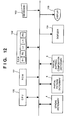
- Fig. 12 is a diagram illustrating a structure of the character recognition apparatus of the present embodiment.
- numeral 100 is a CPU which executes various controls of the character recognition apparatus in accordance with control programs stored in a ROM 101. The control program which is described later is also stored in the ROM 101 and executed under the control of the CPU 100.
- Numeral 102 is a RAM having areas where data are temporary stored when the CPU 100 executes various controls.
- a keyboard 103 inputs various commands and data to the CPU 100.
- Numeral 104 is a digitizer. When a hand-written character image is inputted, strokes of the image are read as a string of coordinates data.
- Numeral 105 is a display which displays the result of recognition of the hand-written character image inputted from the digitizer 104.
- Numeral 4 is a stroke dictionary where a feature stroke number and direction data are paired.
- the feature stroke is data on each of three vectors indicating a direction, which is obtained by dividing a stroke into three, and data on an order that each vector is inputted.
- the feature stroke number is a number which identifies each feature stroke.
- the direction data is data expressing an arrangement (combination) of three vectors indicating directions when each stroke is decomposed to three direction vectors (to be described later in Fig. 5).
- Numeral 6 is a partial pattern dictionary where a partial pattern number and feature stroke data are paired.
- a partial pattern is a pattern comprising a part of the character image or whole character image which is defined by a single or plurality of feature strokes.
- a partial pattern number is a unique number which specifies each partial pattern.
- the feature stroke data is data expressing a partial pattern by feature stroke numbers (to be described later in Fig. 7).
- Numeral 8 is a pattern composition dictionary which stores a number for specifying a character image (character code) and partial patterns comprising a character image in pair (to be described later in detail along with Fig. 8).
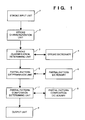
- Fig. 1 is a block diagram illustrating a functional structure
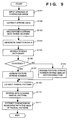
- Fig. 9 is a flowchart illustrating a procedure for a character recognition processing in the character recognition apparatus of the present embodiment.
- each stroke of the character image is extracted at step S102.
- the stroke input unit 1 while a stroke of a hand-written character image is inputted, sampling of coordinates where the pen point touches the input surface is performed at predetermined interval, and coordinates data is thus obtained for each point.
- a set of the coordinates data for the stroke is generated and stored in an area Sn which is reserved in a RAM 102.
- the set of coordinates data for a single stroke stored in the area Sn is referred to as "stroke data”.
- the input unit 1 extracts strokes for a single character image which is inputted from the digitizer 104 and transfers to a stroke characterization unit 2.
- each stroke characterization unit 2 divides each stroke, which is expressed by the set of coordinates data, into three parts and each stroke is expressed by three vectors.
- each direction vector is numbered to indicate one of eight directions as shown in Fig. 2.
- step S101-S104 The processing in the stroke input unit 1 and stroke characterization unit 2 (steps S101-S104) are further described along with Figs. 2-4.
- Fig. 2 is a diagram showing the above-described eight directions which are respectively numbered.
- Fig. 3(a) is a diagram illustrating the processing for a stroke extraction in the stroke input unit 1 when the character " " is inputted, for an example.
- the numbers 1 through 9 indicate the order of making strokes, that is, the input order. In the case of " ", the data on nine strokes are extracted and transferred to the stroke characterization unit 2.
- the stroke characterization unit 2 divides each stroke into three parts in accordance with the stroke data inputted from the stroke input unit 1 so as to be three vectors.
- Each vector attained by dividing the stroke is numbered to indicate a direction as shown in Fig. 2. Accordingly, three vector numbers respectively indicating a direction are given to each stroke.
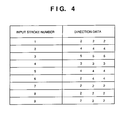
- Fig. 4 is a table of the direction data which is a set of vector numbers for each stroke. These direction data are outputs of the stroke characterization unit 2.
- the stroke dictionary 4 is searched based on the above direction data which is inputted from the stroke characterization unit 2.
- the stroke dictionary 4 stores the direction data and feature stroke number in pair.
- the direction data is converted to the feature stroke number with reference to the stroke dictionary 4 (steps S105, S106, and S107).
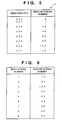
- Fig. 5 illustrates the contents registered in the stroke dictionary 4.
- the stroke dictionary 4 contains the feature stroke numbers of commonly used kanji (Chinese characters) (170 kinds in this embodiment).
- a feature stroke number having the most similar direction data is determined for the inputted stroke (S108). For example, in the case where one of the three vector numbers (direction) are not matched with the direction data in the stroke dictionary 4, a feature stroke number including a vector number which indicates the closest direction to the inputted data is selected. That is, in Fig. 2, the vector indicated by the direction number 4 is closest to the direction numbers 5 and 3.
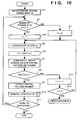
- a partial pattern determination unit 5 of Fig. 1 a single or a plurality of partial pattern numbers which coincide with the partial patterns registered in the partial pattern dictionary 6 are extracted based on the above feature stroke number (S109). The detail of the processing is described later along with the flowchart of Fig. 10.
- Fig. 7 is a data structure of the partial pattern dictionary 6.
- a partial pattern number (partial pattern numbers 71) which is comprised of a combination of at most seven feature stroke numbers (feature stroke data 73) can be registered.
- the data on the partial patterns indicated by numeral 72 are added for convenience sake, but are not actually included by the partial pattern dictionary 6.
- the number of the partial pattern number are arranged in numerical order as 1 ... 32 ... 58 ..., however, the feature stroke data corresponding to these numbers are arranged in the order from the data containing the feature stroke numbers at most.
- the partial pattern number 1 corresponds to the feature stroke data having seven feature stroke numbers such as 40, 40, ..., 102 and the partial pattern number 58 corresponds to the feature stroke data having four feature stroke numbers such as 40, 66, 85, 102.
- the feature stroke data 73 the feature stroke numbers included in each partial pattern are registered in an ascending order regardless of the stroke order.
- the partial patterns " " and “ “ are extracted by the partial pattern discrimination unit 5 and outputted to the partial pattern composition determining unit 7.
- a character code is attained as the result of recognition by searching the partial pattern composition unit 8 with the plurality of partial patterns.
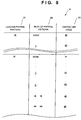
- Fig. 8 is a diagram illustrating an internal structure of the partial pattern composition dictionary 8.
- each partial pattern and character code are expressed by a character pattern, however, they are actually registered in the partial pattern code and code number.
- the leading partial patterns 81 includes a partial pattern which is first extracted from the all partial patterns included in the character image to be recognized by the partial pattern determination unit 5. To increase the speed in searching the dictionary and decrease the capacity of the dictionary, partial patterns are classified based on the leading partial pattern in the dictionary.
- the partial patterns 82 (which are inputted after the leading partial pattern) show a combination of partial patterns which are extracted by the partial pattern determination unit 5.
- a single character image is comprised of a leading partial pattern (81) and other partial patterns (82).
- the character code 83 includes a code expressing a pertinent character comprising the above-described partial patterns. As mentioned above, a code is replaced by a character pattern in Fig. 8. In the partial patterns other than the leading partial pattern, a special code which is not used for the partial pattern numbers is given to "NONE". In this case, it is judged that only the leading partial pattern comprises a single character image and a pertinent character code is given.
- the leading partial patterns 81 of the partial pattern composition dictionary 8 are searched by using the partial pattern (leading partial pattern) which is first extracted by the partial pattern determination unit 5 (step S110).
- the partial patterns (82) which are inputted after the leading partial pattern are searched in an area storing partial patterns which can be combined with the leading pattern.
- the leading partial pattern is " " which is first extracted by the partial pattern discrimination unit 5. Since the other partial pattern is “ ", the character code corresponding to " " is attained in Fig. 8.
- a series of the all feature stroke numbers of inputted character images which are classified and discriminated by the stroke classification determining unit 3 are stored in a feature stroke storage buffer TS.
- the feature stroke storage buffer TS is an area reserved in the RAM 102.
- n feature stroke numbers are extracted from the feature stroke storage buffer TS and stored in an area Ln which is reserved in the RAM 102.
- n feature stroke numbers which are set at step S5 are rearranged in numerical order of the values and set in an area L'n which is reserved in the RAM 102.
- the feature stroke data 73 of the partial pattern dictionary 6 and the area L'n are compared. As shown in Fig. 7, since the partial patterns in the partial pattern dictionary 6 are registered in the order from the partial patterns having the feature stroke numbers at most, only the area which stores the partial patterns comprising n feature stroke numbers can be searched. In this way, the comparison is sequentially performed and if a partial pattern which coincides with the input is found, the processing proceeds to step S9 from S8 and the pertinent partial pattern is transferred to the partial pattern composition determining unit 7.
- step S12 n is subtracted by one in order to reduce the number of stroke. If the result n is negative or zero, it is judged that it is impossible to recognize a partial pattern from step S13. In the case where n is positive, the process returns to step S5 and the above-mentioned processing is repeated. Since a matched partial pattern normally exists from n th to first stroke, the process proceeds to step S9 from S8.
- n strokes from the beginning from the buffer TS are removed in order to remove the strokes corresponding to a partial pattern which has been already attained at step S10.
- the processing of the partial pattern discrimination unit 5 is completed when the feature stoke of the TS is all removed. If remains, the process returns to step S2 from step S11 where the above6described processing is repeated. Thus, all feature strokes are extracted from the inputted character image.
- the partial pattern of the inputted character image is determined by using the partial pattern dictionary 6 and partial pattern composition dictionary 8 and the inputted character image can be recognized stably by determining which partial patterns comprises the inputted character image. Furthermore, since the stroke order in the partial pattern does not have to depend on the order of the input stroke by rearranging the feature stroke numbers in the partial pattern dictionary, the recognition efficiency influenced by changes of the stroke order depending upon a user can be improved. According to the above6mentioned dictionary structure, an inputted character image can be recognized by searching the dictionary in a predetermined area, i.e., in a unit of partial pattern, without searching the all contents of the dictionary, resulting in a high speed character recognition. Even though the kinds of dictionaries are increased, memory size of the dictionary can be reduced in comparison with the conventional recognition method, since the capacity of each dictionary is small.
- the character recognition apparatus 1 of the first embodiment extracts strokes for a character and performs a character recognition on each character one at a time based on feature of the strokes.
- the apparatus of the second embodiment differs from that of the first embodiment in segmentation of the characters which are sequentially inputted.
- the hardware structure of the apparatus in the second embodiment is the same as that of the first embodiment shown in Fig. 12.
- the functional structure of the apparatus in the second embodiment is also the same as that of the first embodiment shown in Fig. 1.
- the processing in the partial pattern composition determining unit 7 is modified in the second embodiment.
- the processing of the first embodiment is that the combination of the partial patterns transferred from the partial pattern determination unit 5 and that of the partial pattern composition dictionary 8 are compared and a matched combination is outputted as the result of recognition.
- the character recognition apparatus which automatically segments inputted characters is provided.
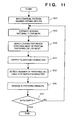
- the character recognition processing in the partial pattern composition determining unit 7 is described along with a flowchart of Fig. 11.
- step S21 all partial pattern numbers which are transferred from the partial pattern determination unit 5 are inputted to a partial pattern composition buffer PS which is an area reserved in the RAM 102.
- the partial pattern number first stored in the buffer PS is extracted. (Suppose that this partial pattern number is "T”.)
- step S23 the partial pattern number T, as a leading partial pattern, is compared with the data in the partial pattern composition dictionary 8. It is searched so as to coincide the partial patterns in the buffer PS following to the leading pattern whose number is T with the rest of partial patterns (82) inputted after the leading partial pattern in the partial pattern composition dictionary 8 at most. That is, the character code representing the character comprising the partial patterns which are registered in the buffer PS at most is searched. The character code which is searched in this way is outputted to the output unit 9 at step S24.
- step S25 the number of the partial pattern numbers which are used at step S24 is detected. If this is N, N partial patterns are removed from the buffer PS in the order of input at step S26. In the buffer PS, a vacancy caused by removing the partial patterns is filled by the following partial patterns.
- step S27 it is judged whether or not all partial patterns are removed from the buffer PS, and if removed, the present processing is completed. If the data remains in the buffer PS, the process returns to step S22 where the above-described processing is repeated.
- an automatic segmentation of the inputted character images is enabled. For example, when “ “, “ “, and “ “ are sequentially inputted, the two characters of kanji, " " and “ " are recognized by the above-described processing.
- the apparatus automatically segments the character images, however, segmentation can be easily operated by a user.
- This can be realized when the arrangement for segmentation which is utilized in a Japanese word processor capable of inputting kana-kanji (Japanese syllabary-Chinese character) is provided, a boundary is indicated, and the search at step S23 is performed while the number of strokes is decreased.
- kana-kanji Japanese syllabary-Chinese character
- stable character recognition can be performed regardless of the input order and the relative changes influenced by input strokes, and automatic segmentation can be performed on the sequentially inputted character images.
- the present invention can be applied to the system comprising either a plurality of units or a single unit. It is needless to say that the present invention can be applied to the case which can be attained by supplying programs which execute the process defined by the present system or invention.
Landscapes
- Engineering & Computer Science (AREA)
- Physics & Mathematics (AREA)
- General Physics & Mathematics (AREA)
- Multimedia (AREA)
- Theoretical Computer Science (AREA)
- Computer Vision & Pattern Recognition (AREA)
- Character Discrimination (AREA)
Applications Claiming Priority (3)
| Application Number | Priority Date | Filing Date | Title |
|---|---|---|---|
| JP299264/91 | 1991-11-14 | ||
| JP29926491 | 1991-11-14 | ||
| JP03299264A JP3105967B2 (ja) | 1991-11-14 | 1991-11-14 | 文字認識方法及び装置 |
Publications (3)
| Publication Number | Publication Date |
|---|---|
| EP0542566A2 EP0542566A2 (en) | 1993-05-19 |
| EP0542566A3 EP0542566A3 (en) | 1993-09-08 |
| EP0542566B1 true EP0542566B1 (en) | 1999-10-06 |
Family
ID=17870290
Family Applications (1)
| Application Number | Title | Priority Date | Filing Date |
|---|---|---|---|
| EP92310386A Expired - Lifetime EP0542566B1 (en) | 1991-11-14 | 1992-11-13 | Character recognition method and apparatus thereof |
Country Status (4)
| Country | Link |
|---|---|
| US (1) | US5579408A (enExample) |
| EP (1) | EP0542566B1 (enExample) |
| JP (1) | JP3105967B2 (enExample) |
| DE (1) | DE69230092T2 (enExample) |
Families Citing this family (30)
| Publication number | Priority date | Publication date | Assignee | Title |
|---|---|---|---|---|
| JP3155577B2 (ja) * | 1991-10-16 | 2001-04-09 | キヤノン株式会社 | 文字認識方法及び装置 |
| US5854855A (en) * | 1994-09-09 | 1998-12-29 | Motorola, Inc. | Method and system using meta-classes and polynomial discriminant functions for handwriting recognition |
| JPH0991380A (ja) | 1995-09-21 | 1997-04-04 | Canon Inc | 情報処理装置及び方法及び記憶媒体 |
| JP3535624B2 (ja) | 1995-09-21 | 2004-06-07 | キヤノン株式会社 | 検索装置及び方法 |
| EP0777375A3 (en) * | 1995-12-05 | 1998-10-14 | Canon Kabushiki Kaisha | Method of and apparatus for network distribution of record data using transmittal symbols hand entered on a transmittal sheet |
| US5982933A (en) * | 1996-01-12 | 1999-11-09 | Canon Kabushiki Kaisha | Information processing method, information processing apparatus, and storage medium |
| JP3744997B2 (ja) * | 1996-01-12 | 2006-02-15 | キヤノン株式会社 | 文字認識装置及びその方法 |
| JPH09319829A (ja) * | 1996-06-03 | 1997-12-12 | Nec Corp | オンライン文字認識装置 |
| US6275611B1 (en) * | 1996-10-17 | 2001-08-14 | Motorola, Inc. | Handwriting recognition device, method and alphabet, with strokes grouped into stroke sub-structures |
| US6370269B1 (en) * | 1997-01-21 | 2002-04-09 | International Business Machines Corporation | Optical character recognition of handwritten or cursive text in multiple languages |
| US6144764A (en) * | 1997-07-02 | 2000-11-07 | Mitsui High-Tec, Inc. | Method and apparatus for on-line handwritten input character recognition and recording medium for executing the method |
| JP3008908B2 (ja) * | 1997-11-10 | 2000-02-14 | 日本電気株式会社 | 文字切り出し装置および文字切り出し方式 |
| US6226403B1 (en) * | 1998-02-09 | 2001-05-01 | Motorola, Inc. | Handwritten character recognition using multi-resolution models |
| US6801659B1 (en) | 1999-01-04 | 2004-10-05 | Zi Technology Corporation Ltd. | Text input system for ideographic and nonideographic languages |
| AU3712600A (en) * | 1999-02-26 | 2000-09-14 | Raf Technology, Inc. | Method and system for identifying a reference region on an image of a dropped-out form |
| WO2001079978A1 (en) * | 2000-04-13 | 2001-10-25 | Qualcomm Incorporated | Method and apparatus for entry of multi-stroke characters |
| US20020057837A1 (en) * | 2000-08-14 | 2002-05-16 | Tim Wilkinson | Portable operating environment for information devices |
| JP4704601B2 (ja) * | 2000-11-01 | 2011-06-15 | 富士通株式会社 | 文字認識方法,プログラム及び記録媒体 |
| FR2827407A1 (fr) * | 2001-07-11 | 2003-01-17 | Timothy Russell Scanlan | Systeme d'ecriture rapide pour les ordinateurs a stylo ou les stylos electroniques |
| US6721452B2 (en) | 2001-09-12 | 2004-04-13 | Auburn University | System and method of handwritten character recognition |
| RU2216767C2 (ru) * | 2001-12-05 | 2003-11-20 | Институт системного анализа | Устройство для управления идентификацией объектов текстовых документов |
| RU2239232C1 (ru) * | 2003-03-13 | 2004-10-27 | ООО Когнитивные технологии | Система управления идентификацией и конвертацией форматов объектов текстовых документов |
| RU2263955C2 (ru) * | 2003-06-03 | 2005-11-10 | ООО "Когнитивные технологии" | Система выявления активности избирателей при проведении региональных и федеральных выборов |
| CN1308889C (zh) * | 2003-11-28 | 2007-04-04 | 佳能株式会社 | 字符识别方法和装置 |
| US20100104189A1 (en) * | 2008-10-23 | 2010-04-29 | Aravamudhan Bharath | Handwriting Identification Method, Program And Electronic Device |
| US8306327B2 (en) | 2008-12-30 | 2012-11-06 | International Business Machines Corporation | Adaptive partial character recognition |
| JP5451665B2 (ja) * | 2011-02-21 | 2014-03-26 | 株式会社デンソーアイティーラボラトリ | 文字入力装置、文字入力方法、及びプログラム |
| US10725650B2 (en) | 2014-03-17 | 2020-07-28 | Kabushiki Kaisha Kawai Gakki Seisakusho | Handwritten music sign recognition device and program |
| JP6437205B2 (ja) * | 2014-03-17 | 2018-12-12 | 株式会社河合楽器製作所 | 手書き音楽記号認識装置及びプログラム |
| CN111195912B (zh) * | 2020-01-08 | 2021-06-15 | 杭州未名信科科技有限公司 | 利用机械臂绘制肖像画的方法、装置、机器人及存储介质 |
Family Cites Families (11)
| Publication number | Priority date | Publication date | Assignee | Title |
|---|---|---|---|---|
| US4162482A (en) * | 1977-12-07 | 1979-07-24 | Burroughs Corporation | Pre-processing and feature extraction system for character recognition |
| US4365235A (en) * | 1980-12-31 | 1982-12-21 | International Business Machines Corporation | Chinese/Kanji on-line recognition system |
| JPS5975375A (ja) * | 1982-10-21 | 1984-04-28 | Sumitomo Electric Ind Ltd | 文字認識装置 |
| US4718102A (en) * | 1983-01-19 | 1988-01-05 | Communication Intelligence Corporation | Process and apparatus involving pattern recognition |
| JPS60217477A (ja) * | 1984-04-12 | 1985-10-31 | Toshiba Corp | 手書き文字認識装置 |
| US4905295A (en) * | 1986-11-13 | 1990-02-27 | Ricoh Company, Ltd. | Code sequence matching method and apparatus |
| US5034989A (en) * | 1987-12-11 | 1991-07-23 | Loh Shiu Chang | On-line handwritten character recognition apparatus with non-ambiguity algorithm |
| EP0325233B1 (en) * | 1988-01-18 | 1994-07-27 | Kabushiki Kaisha Toshiba | Character string recognition system |
| US5058182A (en) * | 1988-05-02 | 1991-10-15 | The Research Foundation Of State Univ. Of New York | Method and apparatus for handwritten character recognition |
| US5187480A (en) * | 1988-09-05 | 1993-02-16 | Allan Garnham | Symbol definition apparatus |
| JPH03175591A (ja) * | 1989-12-05 | 1991-07-30 | Fuji Xerox Co Ltd | 文字認識装置 |
-
1991
- 1991-11-14 JP JP03299264A patent/JP3105967B2/ja not_active Expired - Fee Related
-
1992
- 1992-11-13 DE DE69230092T patent/DE69230092T2/de not_active Expired - Fee Related
- 1992-11-13 EP EP92310386A patent/EP0542566B1/en not_active Expired - Lifetime
-
1995
- 1995-02-06 US US08/384,683 patent/US5579408A/en not_active Expired - Fee Related
Also Published As
| Publication number | Publication date |
|---|---|
| DE69230092T2 (de) | 2000-04-13 |
| JP3105967B2 (ja) | 2000-11-06 |
| EP0542566A3 (en) | 1993-09-08 |
| HK1012104A1 (en) | 1999-07-23 |
| EP0542566A2 (en) | 1993-05-19 |
| US5579408A (en) | 1996-11-26 |
| DE69230092D1 (de) | 1999-11-11 |
| JPH05135207A (ja) | 1993-06-01 |
Similar Documents
| Publication | Publication Date | Title |
|---|---|---|
| US5579408A (en) | Character recognition method and apparatus | |
| KR100411697B1 (ko) | 문자판독방법및주소판독방법 | |
| US4685142A (en) | Method and device for handwritten letter recognition | |
| KR100297482B1 (ko) | 수기입력의문자인식방법및장치 | |
| KR19980018029A (ko) | 문자 인식 장치 | |
| EP1564675B1 (en) | Apparatus and method for searching for digital ink query | |
| Hussain et al. | Nastalique segmentation-based approach for Urdu OCR | |
| US6408091B1 (en) | Information processing method and apparatus with mixing of processing command input strokes and input strokes for patterns | |
| EP0239061B1 (en) | Optical character reader apparatus and optical character reading method | |
| Song et al. | Robust and parallel Uyghur text localization in complex background images | |
| EP0432937B1 (en) | Hand-written character recognition apparatus | |
| HK1012104B (en) | Character recognition method and apparatus thereof | |
| JP3675511B2 (ja) | 手書き文字認識方法及び装置 | |
| JP3376808B2 (ja) | 単語入力装置並びに単語入力方法 | |
| JP3925011B2 (ja) | パターン認識装置及び認識方法 | |
| JP2671985B2 (ja) | 情報認識方法 | |
| JPH06215197A (ja) | 文字認識方法および装置 | |
| JP2851865B2 (ja) | 文字認識装置 | |
| JPH09179935A (ja) | 文字認識装置およびその制御方法 | |
| JP2792063B2 (ja) | 文字認識辞書作成方式 | |
| EP0564826A2 (en) | Resolution of case confusions by majority voting rule in on-line handwriting recognition | |
| JPH0676115A (ja) | 文字認識方法及び装置 | |
| JPS63136286A (ja) | オンライン文字認識方式 | |
| JPH02190987A (ja) | 文字認識装置における照合方式 | |
| KR940001011A (ko) | 문자 인식을 통한 후보 분류 방법 |
Legal Events
| Date | Code | Title | Description |
|---|---|---|---|
| PUAI | Public reference made under article 153(3) epc to a published international application that has entered the european phase |
Free format text: ORIGINAL CODE: 0009012 |
|
| AK | Designated contracting states |
Kind code of ref document: A2 Designated state(s): DE FR GB |
|
| PUAL | Search report despatched |
Free format text: ORIGINAL CODE: 0009013 |
|
| AK | Designated contracting states |
Kind code of ref document: A3 Designated state(s): DE FR GB |
|
| 16A | New documents despatched to applicant after publication of the search report | ||
| 17P | Request for examination filed |
Effective date: 19940124 |
|
| 17Q | First examination report despatched |
Effective date: 19970509 |
|
| GRAG | Despatch of communication of intention to grant |
Free format text: ORIGINAL CODE: EPIDOS AGRA |
|
| GRAG | Despatch of communication of intention to grant |
Free format text: ORIGINAL CODE: EPIDOS AGRA |
|
| GRAH | Despatch of communication of intention to grant a patent |
Free format text: ORIGINAL CODE: EPIDOS IGRA |
|
| GRAH | Despatch of communication of intention to grant a patent |
Free format text: ORIGINAL CODE: EPIDOS IGRA |
|
| GRAA | (expected) grant |
Free format text: ORIGINAL CODE: 0009210 |
|
| AK | Designated contracting states |
Kind code of ref document: B1 Designated state(s): DE FR GB |
|
| ET | Fr: translation filed | ||
| REF | Corresponds to: |
Ref document number: 69230092 Country of ref document: DE Date of ref document: 19991111 |
|
| PLBE | No opposition filed within time limit |
Free format text: ORIGINAL CODE: 0009261 |
|
| 26N | No opposition filed | ||
| REG | Reference to a national code |
Ref country code: GB Ref legal event code: IF02 |
|
| PGFP | Annual fee paid to national office [announced via postgrant information from national office to epo] |
Ref country code: GB Payment date: 20041101 Year of fee payment: 13 |
|
| PGFP | Annual fee paid to national office [announced via postgrant information from national office to epo] |
Ref country code: FR Payment date: 20041126 Year of fee payment: 13 |
|
| PGFP | Annual fee paid to national office [announced via postgrant information from national office to epo] |
Ref country code: DE Payment date: 20050121 Year of fee payment: 13 |
|
| PG25 | Lapsed in a contracting state [announced via postgrant information from national office to epo] |
Ref country code: GB Free format text: LAPSE BECAUSE OF NON-PAYMENT OF DUE FEES Effective date: 20051113 |
|
| PG25 | Lapsed in a contracting state [announced via postgrant information from national office to epo] |
Ref country code: DE Free format text: LAPSE BECAUSE OF NON-PAYMENT OF DUE FEES Effective date: 20060601 |
|
| GBPC | Gb: european patent ceased through non-payment of renewal fee |
Effective date: 20051113 |
|
| PG25 | Lapsed in a contracting state [announced via postgrant information from national office to epo] |
Ref country code: FR Free format text: LAPSE BECAUSE OF NON-PAYMENT OF DUE FEES Effective date: 20060731 |
|
| REG | Reference to a national code |
Ref country code: FR Ref legal event code: ST Effective date: 20060731 |