EP0542226B1 - Paper separating/driving apparatus and its controlling method and automatic teller operating thereon - Google Patents
Paper separating/driving apparatus and its controlling method and automatic teller operating thereon Download PDFInfo
- Publication number
- EP0542226B1 EP0542226B1 EP19920119287 EP92119287A EP0542226B1 EP 0542226 B1 EP0542226 B1 EP 0542226B1 EP 19920119287 EP19920119287 EP 19920119287 EP 92119287 A EP92119287 A EP 92119287A EP 0542226 B1 EP0542226 B1 EP 0542226B1
- Authority
- EP
- European Patent Office
- Prior art keywords
- feeding
- pinching
- sheets
- length
- rollers
- Prior art date
- Legal status (The legal status is an assumption and is not a legal conclusion. Google has not performed a legal analysis and makes no representation as to the accuracy of the status listed.)
- Expired - Lifetime
Links
- 238000000034 method Methods 0.000 title claims description 9
- 230000001276 controlling effect Effects 0.000 claims description 5
- 238000001514 detection method Methods 0.000 claims description 5
- 230000002079 cooperative effect Effects 0.000 claims 1
- 230000033001 locomotion Effects 0.000 claims 1
- 238000010276 construction Methods 0.000 description 6
- 230000006835 compression Effects 0.000 description 1
- 238000007906 compression Methods 0.000 description 1
- 230000001419 dependent effect Effects 0.000 description 1
- 230000001105 regulatory effect Effects 0.000 description 1
Images

Classifications
-
- B—PERFORMING OPERATIONS; TRANSPORTING
- B65—CONVEYING; PACKING; STORING; HANDLING THIN OR FILAMENTARY MATERIAL
- B65H—HANDLING THIN OR FILAMENTARY MATERIAL, e.g. SHEETS, WEBS, CABLES
- B65H5/00—Feeding articles separated from piles; Feeding articles to machines
- B65H5/06—Feeding articles separated from piles; Feeding articles to machines by rollers or balls, e.g. between rollers
- B65H5/062—Feeding articles separated from piles; Feeding articles to machines by rollers or balls, e.g. between rollers between rollers or balls
-
- B—PERFORMING OPERATIONS; TRANSPORTING
- B65—CONVEYING; PACKING; STORING; HANDLING THIN OR FILAMENTARY MATERIAL
- B65H—HANDLING THIN OR FILAMENTARY MATERIAL, e.g. SHEETS, WEBS, CABLES
- B65H2301/00—Handling processes for sheets or webs
- B65H2301/30—Orientation, displacement, position of the handled material
- B65H2301/32—Orientation of handled material
- B65H2301/321—Standing on edge
-
- B—PERFORMING OPERATIONS; TRANSPORTING
- B65—CONVEYING; PACKING; STORING; HANDLING THIN OR FILAMENTARY MATERIAL
- B65H—HANDLING THIN OR FILAMENTARY MATERIAL, e.g. SHEETS, WEBS, CABLES
- B65H2402/00—Constructional details of the handling apparatus
-
- B—PERFORMING OPERATIONS; TRANSPORTING
- B65—CONVEYING; PACKING; STORING; HANDLING THIN OR FILAMENTARY MATERIAL
- B65H—HANDLING THIN OR FILAMENTARY MATERIAL, e.g. SHEETS, WEBS, CABLES
- B65H2701/00—Handled material; Storage means
- B65H2701/10—Handled articles or webs
- B65H2701/19—Specific article or web
- B65H2701/1912—Banknotes, bills and cheques or the like
Definitions
- the present invention relates to a sheet separating and driving or feeding apparatus according to the preamble of claim 1.
- Such an apparatus is known from FR-A-2 388 353.
- the invention further relates to a method of controlling the apparatus and to an automatic teller using the apparatus and method.
- Apparatuses disclosed, for example, in Japanese Utility Model Unexamined Publication No. 63-71140, Japanese Patent Unexamined Publication No. 59-205694, Japanese Utility Model Unexamined Publication No. 3-28129 and others are known hitherto as a paper separating and feeding apparatus comprising pick-up rollers coming into contact with the outer surface of a paper in a stack to provide a driving force periodically to the papers, feed rollers disposed opposite to each other at positions where the driven papers can be pinched therebetween, gate rollers fixed in the feeding direction of the papers, and operating to separate the paper sheets one by one and to feed them to a pass on the rear stage of the outlet.
- the latter problem may bring about a restriction when a common bill carrying pass is obtained in case a plurality of paper (bill) separating and feeding apparatuses are combined like in an automatic teller.
- EP-A-0 294 055 discloses a paper feeding apparatus for a printer comprising a paper feed roller engageable with a topmost sheet in a stack for separating and feeding the sheets towards a platen. Between the feed roller and the platen an auxiliary feed roller being in contact with a pinch roller is provided for engaging a sheet being fed from the paper feed roller to the platen.
- FR-A-2 388 353 discloses a bill dispenser having a pressure roller and and idling pressure roller arranged with respect to a driving roller.
- the pressure roller and the idling pressure roller are always in contact with the driving roller and the idling pressure roller cannot be controlled in accordance with the length of the conveyed bills.
- the object of the invention is to provide a sheet separating and feeding apparatus, a method of controlling the same and an automatic teller using the apparatus and method which are capable of feeding sheets having a large variation of length in feeding direction.
- a variety of sheets with a length in the feeding direction kept within a predetermined range can be fed sheet by sheet securely at every rotation of the feed rollers and carried to a downstream disposed carrying pass. Further, for stopping a drive of papers, a stop operation will not be retarded more than necessary for papers with a big length in feeding direction, therefore an erroneous driving of ensuing papers will never be occur.
- the degree of freedom of a position of the paper pinching point of the carrying pass can be enlarged, and thus the degree of freedom of the construction will largely be enhanced when utilizing this in an automatic teller.
- Fig. 2 is a constructional view of an automatic teller according to one preferred embodiment of the present invention.
- reference characters 1A to 1C denote safes, which are capable of corresponding, as described hereinlater, to bills with the short side length largely varying at all denominations (for example French franc bills having a length at the short side between 50 and 100 mm).
- the safe 1A is packed with bills having a length of 100 mm at the short side
- the safe 1B is packed with bills having a length of 70 mm
- the safe 1C is packed with bills having a length of 50 mm.
- Reference characters 2A to 2C denote separating portions relating to the present invention, and at the time of payment in cash, bills driven from each safe in order by predetermined number are accumulated in an outlet stacker 7 through carrying passes 3A to 3C, 5 and 6 driven by a main motor 4, discharged collectively from an outlet 8 to payment.
- a transfer gate 10 is actuated to allow receiving of such bills into a reject box 12 through a reject carrying pass 11.
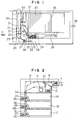
- Fig. 1 shows a safe unit having the safe 1A and the bill separating and feeding apparatus 2A in the automatic teller illustrated in Fig. 2.
- the bill separating and feeding apparatus 2A comprises pick-up rollers 21 coming in contact with bills 20 to be stacked and having the outer peripheries partly constructed of a friction member 31 each, feed rollers 22 having the same diameter as that of the pick-up rollers 21, and having the outer peripheries constructed partly of a friction member 32 each, gate rollers 23 opposite to the feed rollers 22, energized by a compression spring 24, having the outer peripheries constructed of a friction member each, and regulated to run in the driving direction, and first pinch rollers 25 and second pinch rollers 27 which will be described hereinlater.
- Fig. 3 is a side elevational view of a main part viewed in the direction indicated by an arrow A of Fig. 1, indicating a positional relation of the aforementioned pick-up rollers 21, feed rollers 22, gate rollers 23, first pinch rollers 25, second pinch rollers 27 and each friction member provided thereon. Then, Fig. 3 and Fig. 4 indicate a relative positional relation particularly of the feed roller 22, the gate roller 23 and the first pinch roller 25.
- the gate roller 23 is brought into contact with the feed roller 22 on one side where its outer periphery is constructed partly of the friction member 32, and the first pinch roller 25 is brought into contact with the feed roller 22 on another side where its outer periphery is constructed entirely of the friction member 32, thus constructing first pinching and carrying or feeding means.
- the first pinch roller 25 is brought into contact with the feed roller 22 on the side where its outer periphery is constructed entirely of the friction member 32, and is energized by a spring 26 toward the feed roller 22.
- the aforementioned second pinch roller 27 is rotatable about a supporting point 33 serving as a center of rotation, and supported rotatably supported on a lever 28 energized by a spring 34 in clockwise direction in the illustration, and is pushed toward the feed roller 22. That is, the second pinch roller 27 functions as a second pinching and carrying or feeding means, and when the lever 28 is turned counterclockwise in the illustration against the spring 34, it comes away from the feed roller 22, but when the force is removed it is pushed towards the feed roller 22.
- reference characters 9A, 9B, 9C denote driving motors for the safes 1A, 1B, 1C respectively
- a reference numeral 29 denotes a bill pinching start point of the carrying pass 3A
- 35 denotes a bill push plate of the safe 1A
- the push plate 35 pushes the bills 20 to the feed rollers 22 through a spring 36.
- a reference numeral 37 denotes a guide member corresponding to a size (short side length) of the bills 20 in the safe 1A, and as will be described hereinlater, the operation of the lever 28 is controlled by the guide member 37.
- reference numeral 38 indicates the direction in which the safes are moved
- 39 denotes a passage detection sensor for detecting the bills having passed a pinching point of the feed roller 22 and the first pinch roller 25.
- the aforementioned lever 28, spring 34, guide member 37 and other construct an identification part of the length of the bills 20 along the feeding direction, and as will be described hereinlater, the second pinch rollers 27 according to the length of the bills 20 are actuated thereby.
- the safe 1A is constructed to be detachable in the direction indicated by the arrow 38, and the gate rollers 23 and the first pinch rollers 25 are mounted on a lower portion of the safe 1A. That is, the construction is such that the gate rollers 23 and the first pinch rollers 25 are pressed to the feed rollers 22 provided on an apparatus body side by setting the safe 1A on the apparatus body of the present embodiment.
- the construction is such that in case the bills have a length of not less than 75 mm at the short side and the safe 1A is installed, the guide member 37 thrusts the lever 28 on its nose, and detaches the second pinch rollers 27 from the feed rollers 22 to release pinching.
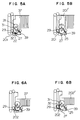
- Figs. 5A and 5B illustrate an operation when the apparatus according to the invention handles the longest bills 201, with a length of 100 mm
- Figs. 6A and 6B illustrate an operation when the apparatus handles the shortest bills 202, with a length of 50 mm
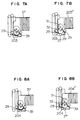
- Figs. 7A and 7B illustrates an operation when bills 203 with a length of 75 mm are handled
- Figs. 8A and 8B illustrate an operation when bills 204 with a length of 70 mm are handled.
- Figs. 5A to 8B Fig. 5A, Fig. 6A, Fig. 7A and Fig. 8A indicate a condition midway of driving
- Fig. 5B, Fig. 6B, Fig. 7B and Fig. 8B indicate a condition when driving is stopped.
- a size and an arrangement of the rollers will be taken up for description. Since one sheet of bill is fed per rotation, the feed rollers 22 and the pick-up roller 21 are 40 mm in diameter so as to have the outer periphery longer than a maximum bill length. Further, a distance from the first pinch roller 25 to the bill pinching start point 29 of the carrying pass 3A is about 70 mm so as to handle the bills 201, 203 not less than 75 mm in length in the state where a pinching force of the second pinch rollers 27 is not working. A distance from the second pinch roller 27 to the pinching start point 29 of the carrying pass 3A is about 45 mm so as to handle the shortest bills 202, with a length of 50 mm.
- Described next is an operation controlling method when the driving operation comes to stop at a predetermined number of sheets to drive after the operation is started.
- a general operation is such that the feed rollers 22 and the pick-up rollers 21 are driven to rotate by the motor 9A, the bills separated and fed sheet by sheet are pinched and carried on the feed rollers 22 and the first pinch rollers 25 only or the second pinch rollers 27 together, and are delivered to the carrying pass 3A at the pinching start point 29.
- Figs. 8A and 8B when handling the bills 202, 204 below 75 mm in length, since the pinching force of the second pinch rollers 27 is ready for working, as described hereinbefore, the number of passing bills is counted on the passage detection sensor 39, and after the time required for rear ends of the bills to pass the pinching point of the second pinch rollers 27 passes from the point in time when passage of the rear ends of the predetermined final bills 201, 203 is detected, the motor 9A is shut down. In this case, an operation for driving the ensuing bills 201', 203' will also not be started.
- one sheet of the bill can securely be driven per rotation of the feed rollers and carried to the carrying pass 3A in case every bills are handled.
- the second pinch rollers 27 can be disposed according to the length of bills, therefore a stop operation for the long bills will not be retarded more than necessary, and the possibility of the ensuing bills being driven can be minimized.
- the above-described embodiment is only to exemplify the present invention, and hence the invention is not necessary limited, needless to say, to the embodiment.
- the invention may be applied not only to the automatic teller but also extensively to other general paper handling apparatuses.
- the identification part comprising lever, guide member and others will be provided to come on a lower side of papers, and may function to control the second paper carrying means according to the length of papers in the feeding direction.
- an advantage inherent therein is that such a paper separating and feeding apparatus is capable of separating and feeding securely even such papers varying largely in length, and also disposing a paper pinching point of a downstream disposed carrying pass with a large degree of freedom, and its controlling method can be realized.
Landscapes
- Engineering & Computer Science (AREA)
- Mechanical Engineering (AREA)
- Sheets, Magazines, And Separation Thereof (AREA)
- Delivering By Means Of Belts And Rollers (AREA)
- Controlling Sheets Or Webs (AREA)
Description
- The present invention relates to a sheet separating and driving or feeding apparatus according to the preamble of claim 1. Such an apparatus is known from FR-A-2 388 353. The invention further relates to a method of controlling the apparatus and to an automatic teller using the apparatus and method.
- Apparatuses disclosed, for example, in Japanese Utility Model Unexamined Publication No. 63-71140, Japanese Patent Unexamined Publication No. 59-205694, Japanese Utility Model Unexamined Publication No. 3-28129 and others are known hitherto as a paper separating and feeding apparatus comprising pick-up rollers coming into contact with the outer surface of a paper in a stack to provide a driving force periodically to the papers, feed rollers disposed opposite to each other at positions where the driven papers can be pinched therebetween, gate rollers fixed in the feeding direction of the papers, and operating to separate the paper sheets one by one and to feed them to a pass on the rear stage of the outlet.
- The prior art apparatuses disclosed in each publication above function only if the sheet length in feeding direction either is constant or varies, within the range of at the most 20 to 30%. However, the handling of sheets varying largely in length by two or three times has not been taken into consideration.
- That is, in known paper separating and feeding apparatuses, a distance from the point whereat papers are pinched on feed rollers and gate rollers to the point whereat papers are pinched in a carrying pass on the rear stage has been set far shorter than the length of the shortest workable papers in the feeding direction. Therefore, for long papers having two or three times the length of the shortest workable papers in the driving direction pick-up rollers and feed rollers must be kept driven for a longer time thus causing an erroneous drive of the ensuing papers.
- In addition, since a distance from the point whereat papers are pinched on the feed rollers and the gate rollers to the point whereat the papers are pinched in a carrying pass on the rear stage must be set far shorter than the shortest length of workable papers in the feeding direction, a problem arises that a degree of freedom of the position of a paper pinching point in a carrying pass on the rear stage is largely restricted.
- The latter problem may bring about a restriction when a common bill carrying pass is obtained in case a plurality of paper (bill) separating and feeding apparatuses are combined like in an automatic teller.
- EP-A-0 294 055 discloses a paper feeding apparatus for a printer comprising a paper feed roller engageable with a topmost sheet in a stack for separating and feeding the sheets towards a platen. Between the feed roller and the platen an auxiliary feed roller being in contact with a pinch roller is provided for engaging a sheet being fed from the paper feed roller to the platen.
- FR-A-2 388 353 discloses a bill dispenser having a pressure roller and and idling pressure roller arranged with respect to a driving roller. The pressure roller and the idling pressure roller are always in contact with the driving roller and the idling pressure roller cannot be controlled in accordance with the length of the conveyed bills.
- The object of the invention is to provide a sheet separating and feeding apparatus, a method of controlling the same and an automatic teller using the apparatus and method which are capable of feeding sheets having a large variation of length in feeding direction.
- This object will be solved by the features of the
independent claims 1, 3 and 5, respectively. - Dependent claims are directed on preferred embodiments of the invention.
- In the sheet separating and feeding apparatus according to the invention, a variety of sheets with a length in the feeding direction kept within a predetermined range can be fed sheet by sheet securely at every rotation of the feed rollers and carried to a downstream disposed carrying pass. Further, for stopping a drive of papers, a stop operation will not be retarded more than necessary for papers with a big length in feeding direction, therefore an erroneous driving of ensuing papers will never be occur.
- Still further, since the distance between the point whereat papers are pinched on the feed rollers and the gate rollers and the point whereat papers are pinched in the downstream disposed carrying pass becomes substantially variable, the degree of freedom of a position of the paper pinching point of the carrying pass can be enlarged, and thus the degree of freedom of the construction will largely be enhanced when utilizing this in an automatic teller.
-
- Fig. 1 is a schematic view of a safe unit including a safe and a bill separating and feeding apparatus used in an automatic teller according to one embodiment of the present invention;
- Fig. 2 is a constructional view of the automatic teller provided with the safe unit of Fig. 1;
- Fig. 3 is a side view of a main part viewed in the direction indicated by an arrow A of Fig. 1;
- Fig. 4 is a perspective view showing a relative positional relation of a feed roller, a gate roller and a first pinch roller;
- Figs. 5A and 5B illustrate a bill separating and feeding apparatus operating with bills having a big length in feeding direction;
- Figs. 6A and 6B illustrate the bill separating and feeding apparatus operating with bills having the shortest length in feeding direction;
- Figs. 7A and 7B illustrate the operation with bills having a shorter length in feeding direction than the bills of Figs. 5A and 5B; and
- Figs. 8A and 8B illustrate the operation with bills having a bigger length in feeding direction than the bills of Figs. 6A and 6B,
- Fig. 2 is a constructional view of an automatic teller according to one preferred embodiment of the present invention. In the illustration, reference characters 1A to 1C denote safes, which are capable of corresponding, as described hereinlater, to bills with the short side length largely varying at all denominations (for example French franc bills having a length at the short side between 50 and 100 mm). Here, let it be assumed that the safe 1A is packed with bills having a length of 100 mm at the short side, the safe 1B is packed with bills having a length of 70 mm, and the safe 1C is packed with bills having a length of 50 mm.
-
Reference characters 2A to 2C denote separating portions relating to the present invention, and at the time of payment in cash, bills driven from each safe in order by predetermined number are accumulated in an outlet stacker 7 through carryingpasses 3A to 3C, 5 and 6 driven by amain motor 4, discharged collectively from an outlet 8 to payment. In this case, if there are reject bills present in the bills driven out as above, then atransfer gate 10 is actuated to allow receiving of such bills into areject box 12 through a reject carrying pass 11. - Fig. 1 shows a safe unit having the safe 1A and the bill separating and feeding
apparatus 2A in the automatic teller illustrated in Fig. 2. The bill separating and feedingapparatus 2A comprises pick-up rollers 21 coming in contact withbills 20 to be stacked and having the outer peripheries partly constructed of afriction member 31 each,feed rollers 22 having the same diameter as that of the pick-up rollers 21, and having the outer peripheries constructed partly of afriction member 32 each,gate rollers 23 opposite to thefeed rollers 22, energized by acompression spring 24, having the outer peripheries constructed of a friction member each, and regulated to run in the driving direction, andfirst pinch rollers 25 andsecond pinch rollers 27 which will be described hereinlater. - Fig. 3 is a side elevational view of a main part viewed in the direction indicated by an arrow A of Fig. 1, indicating a positional relation of the aforementioned pick-
up rollers 21,feed rollers 22,gate rollers 23,first pinch rollers 25,second pinch rollers 27 and each friction member provided thereon. Then, Fig. 3 and Fig. 4 indicate a relative positional relation particularly of thefeed roller 22, thegate roller 23 and thefirst pinch roller 25. As illustrated, thegate roller 23 is brought into contact with thefeed roller 22 on one side where its outer periphery is constructed partly of thefriction member 32, and thefirst pinch roller 25 is brought into contact with thefeed roller 22 on another side where its outer periphery is constructed entirely of thefriction member 32, thus constructing first pinching and carrying or feeding means. - As described above, the
first pinch roller 25 is brought into contact with thefeed roller 22 on the side where its outer periphery is constructed entirely of thefriction member 32, and is energized by aspring 26 toward thefeed roller 22. Then, the aforementionedsecond pinch roller 27 is rotatable about a supportingpoint 33 serving as a center of rotation, and supported rotatably supported on alever 28 energized by a spring 34 in clockwise direction in the illustration, and is pushed toward thefeed roller 22. That is, thesecond pinch roller 27 functions as a second pinching and carrying or feeding means, and when thelever 28 is turned counterclockwise in the illustration against the spring 34, it comes away from thefeed roller 22, but when the force is removed it is pushed towards thefeed roller 22. - In Fig. 2,
reference characters reference numeral 29 denotes a bill pinching start point of thecarrying pass push plate 35 pushes thebills 20 to thefeed rollers 22 through aspring 36. Areference numeral 37 denotes a guide member corresponding to a size (short side length) of thebills 20 in the safe 1A, and as will be described hereinlater, the operation of thelever 28 is controlled by theguide member 37. Further,reference numeral 38 indicates the direction in which the safes are moved, and 39 denotes a passage detection sensor for detecting the bills having passed a pinching point of thefeed roller 22 and thefirst pinch roller 25. - The
aforementioned lever 28, spring 34,guide member 37 and other construct an identification part of the length of thebills 20 along the feeding direction, and as will be described hereinlater, thesecond pinch rollers 27 according to the length of thebills 20 are actuated thereby. Then, as described hereinbefore, the safe 1A is constructed to be detachable in the direction indicated by thearrow 38, and thegate rollers 23 and thefirst pinch rollers 25 are mounted on a lower portion of the safe 1A. That is, the construction is such that thegate rollers 23 and thefirst pinch rollers 25 are pressed to thefeed rollers 22 provided on an apparatus body side by setting the safe 1A on the apparatus body of the present embodiment. Further, in the present embodiment, the construction is such that in case the bills have a length of not less than 75 mm at the short side and the safe 1A is installed, theguide member 37 thrusts thelever 28 on its nose, and detaches thesecond pinch rollers 27 from thefeed rollers 22 to release pinching. - The operation of a bill separating and feeding apparatus 2 of the present embodiment having the construction as mentioned above will be described with reference to Figs. 5A to 8B. In this connection, Figs. 5A and 5B illustrate an operation when the apparatus according to the invention handles the
longest bills 201, with a length of 100 mm, Figs. 6A and 6B illustrate an operation when the apparatus handles theshortest bills 202, with a length of 50 mm, Figs. 7A and 7B illustrates an operation whenbills 203 with a length of 75 mm are handled, and Figs. 8A and 8B illustrate an operation whenbills 204 with a length of 70 mm are handled. Of those illustrations Figs. 5A to 8B, Fig. 5A, Fig. 6A, Fig. 7A and Fig. 8A indicate a condition midway of driving, and Fig. 5B, Fig. 6B, Fig. 7B and Fig. 8B indicate a condition when driving is stopped. - In Figs. 5A to 8B, there is no difference in mechanical construction, however, what is different is that in arrangement, a position of the
aforementioned guide member 37 changes according to the length of bills, and thus no pinching force of thesecond pinch rollers 27 works as illustrated in Figs. 5A and 5B, Figs. 7A and 7B, but a pinching force works in Figs. 6A and 6B, Figs. 8A and 8B. - First, a size and an arrangement of the rollers will be taken up for description. Since one sheet of bill is fed per rotation, the
feed rollers 22 and the pick-uproller 21 are 40 mm in diameter so as to have the outer periphery longer than a maximum bill length. Further, a distance from thefirst pinch roller 25 to the bill pinchingstart point 29 of the carryingpass 3A is about 70 mm so as to handle thebills second pinch rollers 27 is not working. A distance from thesecond pinch roller 27 to the pinchingstart point 29 of the carryingpass 3A is about 45 mm so as to handle theshortest bills 202, with a length of 50 mm. - Described next is an operation controlling method when the driving operation comes to stop at a predetermined number of sheets to drive after the operation is started.
- A general operation is such that the
feed rollers 22 and the pick-uprollers 21 are driven to rotate by themotor 9A, the bills separated and fed sheet by sheet are pinched and carried on thefeed rollers 22 and thefirst pinch rollers 25 only or thesecond pinch rollers 27 together, and are delivered to the carryingpass 3A at the pinchingstart point 29. - First, the case where the
bills second pinch rollers 27 will not work, as described above, for the state where the safe 1A has been set, therefore the number of passing bills is counted on thepassage detection sensor 39, and when a passage of rear ends of the predeterminedfinal bills motor 9A is shut down instantaneously. Thus, thefriction members roller 21 and thefeed roller 22 are not brought into contact with ensuing bills 201' and 203', therefore an operation for feeding these bills will not be started. - Further, as shown in Figs. 6A and 6B, Figs. 8A and 8B, when handling the
bills second pinch rollers 27 is ready for working, as described hereinbefore, the number of passing bills is counted on thepassage detection sensor 39, and after the time required for rear ends of the bills to pass the pinching point of thesecond pinch rollers 27 passes from the point in time when passage of the rear ends of the predeterminedfinal bills motor 9A is shut down. In this case, an operation for driving the ensuing bills 201', 203' will also not be started. - According to the above-described embodiment, from loading bills having a length within the range of 50 to 100 mm at the short side in the three saves and adjusting the
upper guide 37 of the safe 1A properly to cope with lengths of the bills, one sheet of the bill can securely be driven per rotation of the feed rollers and carried to the carryingpass 3A in case every bills are handled. Further, when stopping driving of a predetermined number of bills, thesecond pinch rollers 27 can be disposed according to the length of bills, therefore a stop operation for the long bills will not be retarded more than necessary, and the possibility of the ensuing bills being driven can be minimized. - Then, the above-described embodiment is only to exemplify the present invention, and hence the invention is not necessary limited, needless to say, to the embodiment. For example, the invention may be applied not only to the automatic teller but also extensively to other general paper handling apparatuses.
- Further, subject to being not limited for the height of saves, the identification part comprising lever, guide member and others will be provided to come on a lower side of papers, and may function to control the second paper carrying means according to the length of papers in the feeding direction.
- As described in detail above, according to the present invention, an advantage inherent therein is that such a paper separating and feeding apparatus is capable of separating and feeding securely even such papers varying largely in length, and also disposing a paper pinching point of a downstream disposed carrying pass with a large degree of freedom, and its controlling method can be realized.
- Additionally, since a distance from a paper pinching point of feed rollers and gate rollers to a paper pinching point of the carrying pass on the rear stage becomes variable substantially, a degree of freedom of the position of the paper pinching point of the carrying pass can be amplified, and thus a degree of freedom at the construction will largely be enhanced when utilizing this in an automatic teller.
Claims (7)
- A sheet separating and feeding apparatus comprising:- pick-up rollers (21) for separating stacked sheets,- feed rollers (22) and gate rollers (23) for separating and feeding the sheets fed by said pick-up rollers (21), sheet by sheet, through a cooperative action of said feed rollers (22) with said gate rollers (23),- first pinching and feeding means (25) in the vicinity of the pinching point of said gate rollers (23) and said feed rollers (22), being engaged with said feed rollers (22) and being driven at the same circumferential speed as are said feed rollers (22) for pinching and feeding the sheets to a feeding pass (3A - 3C), said feed rollers (22) being able of feeding a variety of sheets having a length in the feeding direction within a predetermined range, sheet by sheet, at every rotation of said feed rollers (22), and- second pinching and feeding means (27) drivingly engageable with said feed rollers (22) and positioned between the point whereat the sheets are pinched by the first pinching and feeding means (25) and the point whereat the sheets are pinched in said feeding pass (3A - 3C) so that the shortest sheets within said predetermined length range can be pinched and fed by said second pinching and feeding means (27),characterized in that
an actuation means (28, 34, 37) for a selectively controlled actuation of said second pinching and feeding means (27) according to the length of the sheets to be handled is provided. - An apparatus according to claim 1,
characterized in that
a passage detection means (39) for the sheets having passed said first pinching and feeding means (25) is provided, and after a rear end of the predetermined final sheet having passed said first pinching and feeding means (25) is detected by said passage detection means (39), motions of said feed rollers (22) are stopped according to the length of the sheets to be handled. - A method of controlling a sheet separating and feeding apparatus according to claim 1,
characterized in that
said second pinching and feeding means (27) is actuated and non-actuated for pinching and feeding sheets according to the length of the sheets to be handled. - A method according to claim 3,
characterized in that- said second pinching and feeding means (27) is actuated for pinching and feeding the sheets only in case the length in the feeding direction of the sheets to be handled is shorter than the distance from the point whereat the sheets are pinched by said first pinching and feeding means (25) to the point whereat the sheets are pinched in said feeding pass (3A - 3C) and- said second pinching and feeding means (27) is not actuated for pinching and feeding the sheets in case the length in the feeding direction of the sheets to be handled is longer than the distance from the point whereat the sheets are pinched by said first pinching and feeding means (25) to the point whereat the sheets are pinched by said feeding pass (3A - 3C). - An automatic teller in which the sheet separating and feeding apparatus defined in claim 1 is used as a bill separating and feeding apparatus in safes,
characterized in that
an identification part (28, 33) for identifying the length in the feeding directions of the bills contained in the safes is provided on said safes; and when said safes are set on said automatic teller, said second pinching and feeding means (27) is actuated and non-actuated for pinching and feeding the bills by said identification part. - An automatic teller according to claim 5,
characterized in that
said identification part includes a member (28) for detecting a length of said bills in the feeding direction, which is mounted with said second pinching and feeding means (27) and energized to swivel around a supporting point (33). - An automatic teller according to claim 5,
characterized in that
said identification part is located on a lower side of the bills on a counter side of said feeding pass (3A - 3C).
Applications Claiming Priority (2)
| Application Number | Priority Date | Filing Date | Title |
|---|---|---|---|
| JP295576/91 | 1991-11-12 | ||
| JP3295576A JP2929806B2 (en) | 1991-11-12 | 1991-11-12 | Paper sheet separating and feeding device, and automatic cash transaction device using the same |
Publications (2)
| Publication Number | Publication Date |
|---|---|
| EP0542226A1 EP0542226A1 (en) | 1993-05-19 |
| EP0542226B1 true EP0542226B1 (en) | 1996-02-28 |
Family
ID=17822425
Family Applications (1)
| Application Number | Title | Priority Date | Filing Date |
|---|---|---|---|
| EP19920119287 Expired - Lifetime EP0542226B1 (en) | 1991-11-12 | 1992-11-11 | Paper separating/driving apparatus and its controlling method and automatic teller operating thereon |
Country Status (3)
| Country | Link |
|---|---|
| EP (1) | EP0542226B1 (en) |
| JP (1) | JP2929806B2 (en) |
| DE (1) | DE69208593T2 (en) |
Families Citing this family (5)
| Publication number | Priority date | Publication date | Assignee | Title |
|---|---|---|---|---|
| DE4408981C1 (en) * | 1994-03-16 | 1995-06-22 | Siemens Nixdorf Inf Syst | Output unit for coupons with box-shaped coupon container |
| ATE183594T1 (en) * | 1996-06-29 | 1999-09-15 | Scheidt & Bachmann Gmbh | SELF-FILLING STORAGE DEVICE FOR CARD-SHAPED MEDIA |
| GB9618689D0 (en) * | 1996-09-06 | 1996-10-16 | De La Rue Systems Ltd | Sheet dispensing apparatus and cassette |
| ATE252258T1 (en) * | 1997-09-02 | 2003-11-15 | Scheidt & Bachmann Gmbh | STORAGE DEVICE FOR CARD-SHAPED DATA CARRIERS |
| FR2799192B1 (en) * | 1999-10-01 | 2001-11-09 | Poste | DEVICE FOR THE AUTOMATIC DISTRIBUTION OF BANK NOTES OR THE LIKE |
Family Cites Families (4)
| Publication number | Priority date | Publication date | Assignee | Title |
|---|---|---|---|---|
| DE2650564B1 (en) * | 1976-11-04 | 1978-02-16 | Nixdorf Comp Ag | Device for separating receipts, cards and the like, especially banknotes |
| DE2717345C2 (en) * | 1977-04-19 | 1984-10-25 | Nixdorf Computer Ag, 4790 Paderborn | Security issuer |
| GB8422507D0 (en) * | 1984-09-06 | 1984-10-10 | De La Rue Syst | Sheet dispensing method |
| JPS63288837A (en) * | 1987-05-18 | 1988-11-25 | Seiko Epson Corp | Paper feeder |
-
1991
- 1991-11-12 JP JP3295576A patent/JP2929806B2/en not_active Expired - Lifetime
-
1992
- 1992-11-11 DE DE1992608593 patent/DE69208593T2/en not_active Expired - Fee Related
- 1992-11-11 EP EP19920119287 patent/EP0542226B1/en not_active Expired - Lifetime
Also Published As
| Publication number | Publication date |
|---|---|
| DE69208593D1 (en) | 1996-04-04 |
| JPH05132183A (en) | 1993-05-28 |
| DE69208593T2 (en) | 1996-07-11 |
| JP2929806B2 (en) | 1999-08-03 |
| EP0542226A1 (en) | 1993-05-19 |
Similar Documents
| Publication | Publication Date | Title |
|---|---|---|
| EP0132329B1 (en) | Sheet feeding apparatus | |
| CN101456495B (en) | Banknote handling apparatus | |
| EP0393589B1 (en) | Continuous paper let-out apparatus | |
| EP0174009B1 (en) | Cash dispenser | |
| EP0967165B1 (en) | Banknote stacking apparatus | |
| EP0744718B1 (en) | Improvements relating to sheet feeding | |
| EP0174200B1 (en) | Sheet dispensing method and apparatus | |
| JPH0769485A (en) | Sheet processing equipment | |
| EP0793201A2 (en) | Bill handling machine | |
| EP0194139A2 (en) | Assembling sheets into a stack | |
| EP0542226A1 (en) | Paper separating/driving apparatus and its controlling method and automatic teller operating thereon | |
| EP0611718A1 (en) | Sheet stacking apparatus | |
| US4877232A (en) | Paper discharge apparatus | |
| JP3472689B2 (en) | Paper sheet stacking device | |
| JP2000185860A (en) | Paper sheet stacking device | |
| JPH10329962A (en) | Sheet feeder | |
| JPH0718660Y2 (en) | Banknote conveyor | |
| JP3639332B2 (en) | Banknote recognition device | |
| JPS6224340B2 (en) | ||
| JPS61127558A (en) | Sheet accumulating device | |
| JP4038357B2 (en) | Paper sheet stacking device and paper sheet handling device | |
| JP3468863B2 (en) | Media processing device | |
| JPH0312037B2 (en) | ||
| JPH05301646A (en) | Paper sheet separation device | |
| JPH06336375A (en) | Paper handling equipment |
Legal Events
| Date | Code | Title | Description |
|---|---|---|---|
| PUAI | Public reference made under article 153(3) epc to a published international application that has entered the european phase |
Free format text: ORIGINAL CODE: 0009012 |
|
| 17P | Request for examination filed |
Effective date: 19930316 |
|
| AK | Designated contracting states |
Kind code of ref document: A1 Designated state(s): DE FR GB |
|
| 17Q | First examination report despatched |
Effective date: 19930621 |
|
| GRAA | (expected) grant |
Free format text: ORIGINAL CODE: 0009210 |
|
| AK | Designated contracting states |
Kind code of ref document: B1 Designated state(s): DE FR GB |
|
| REF | Corresponds to: |
Ref document number: 69208593 Country of ref document: DE Date of ref document: 19960404 |
|
| ET | Fr: translation filed | ||
| PLBE | No opposition filed within time limit |
Free format text: ORIGINAL CODE: 0009261 |
|
| STAA | Information on the status of an ep patent application or granted ep patent |
Free format text: STATUS: NO OPPOSITION FILED WITHIN TIME LIMIT |
|
| 26N | No opposition filed | ||
| REG | Reference to a national code |
Ref country code: GB Ref legal event code: IF02 |
|
| PGFP | Annual fee paid to national office [announced via postgrant information from national office to epo] |
Ref country code: FR Payment date: 20021023 Year of fee payment: 11 |
|
| PGFP | Annual fee paid to national office [announced via postgrant information from national office to epo] |
Ref country code: GB Payment date: 20021029 Year of fee payment: 11 |
|
| PGFP | Annual fee paid to national office [announced via postgrant information from national office to epo] |
Ref country code: DE Payment date: 20021205 Year of fee payment: 11 |
|
| PG25 | Lapsed in a contracting state [announced via postgrant information from national office to epo] |
Ref country code: GB Free format text: LAPSE BECAUSE OF NON-PAYMENT OF DUE FEES Effective date: 20031111 |
|
| PG25 | Lapsed in a contracting state [announced via postgrant information from national office to epo] |
Ref country code: DE Free format text: LAPSE BECAUSE OF NON-PAYMENT OF DUE FEES Effective date: 20040602 |
|
| GBPC | Gb: european patent ceased through non-payment of renewal fee |
Effective date: 20031111 |
|
| PG25 | Lapsed in a contracting state [announced via postgrant information from national office to epo] |
Ref country code: FR Free format text: LAPSE BECAUSE OF NON-PAYMENT OF DUE FEES Effective date: 20040730 |
|
| REG | Reference to a national code |
Ref country code: FR Ref legal event code: ST |