EP0538246B1 - Pyrethroid formulations of reduced paresthesia - Google Patents
Pyrethroid formulations of reduced paresthesia Download PDFInfo
- Publication number
- EP0538246B1 EP0538246B1 EP90902720A EP90902720A EP0538246B1 EP 0538246 B1 EP0538246 B1 EP 0538246B1 EP 90902720 A EP90902720 A EP 90902720A EP 90902720 A EP90902720 A EP 90902720A EP 0538246 B1 EP0538246 B1 EP 0538246B1
- Authority
- EP
- European Patent Office
- Prior art keywords
- pyrethroid
- process according
- granules
- water
- solid material
- Prior art date
- Legal status (The legal status is an assumption and is not a legal conclusion. Google has not performed a legal analysis and makes no representation as to the accuracy of the status listed.)
- Expired - Lifetime
Links
Classifications
-
- A—HUMAN NECESSITIES
- A01—AGRICULTURE; FORESTRY; ANIMAL HUSBANDRY; HUNTING; TRAPPING; FISHING
- A01N—PRESERVATION OF BODIES OF HUMANS OR ANIMALS OR PLANTS OR PARTS THEREOF; BIOCIDES, e.g. AS DISINFECTANTS, AS PESTICIDES OR AS HERBICIDES; PEST REPELLANTS OR ATTRACTANTS; PLANT GROWTH REGULATORS
- A01N25/00—Biocides, pest repellants or attractants, or plant growth regulators, characterised by their forms, or by their non-active ingredients or by their methods of application, e.g. seed treatment or sequential application; Substances for reducing the noxious effect of the active ingredients to organisms other than pests
- A01N25/32—Ingredients for reducing the noxious effect of the active substances to organisms other than pests, e.g. toxicity reducing compositions, self-destructing compositions
-
- A—HUMAN NECESSITIES
- A01—AGRICULTURE; FORESTRY; ANIMAL HUSBANDRY; HUNTING; TRAPPING; FISHING
- A01N—PRESERVATION OF BODIES OF HUMANS OR ANIMALS OR PLANTS OR PARTS THEREOF; BIOCIDES, e.g. AS DISINFECTANTS, AS PESTICIDES OR AS HERBICIDES; PEST REPELLANTS OR ATTRACTANTS; PLANT GROWTH REGULATORS
- A01N25/00—Biocides, pest repellants or attractants, or plant growth regulators, characterised by their forms, or by their non-active ingredients or by their methods of application, e.g. seed treatment or sequential application; Substances for reducing the noxious effect of the active ingredients to organisms other than pests
- A01N25/12—Powders or granules
Definitions
- This invention relates to pyrethroids, and in particular to formulations of pyrethroids for agricultural use.
- Pyrethroids which are synthetic derivatives of naturally occurring pyrethrins, are well known as insecticidal agents offering the powerful and selective insecticidal action of the pyrethrins without the rapid decomposition which the pyrethrins undergo upon exposure to the environment.
- EP-A 213328 refers to pesticidal compositions made by dissolving pyrethroid insecticides in a mono/poly phenalkyl benzene of a melting point below 0°C and impregnating a granule material.
- the process of the invention involves a further aggregation of the solid material particles in the presence of the oil in water emulsion of the pyrethroid dissolved in the organic phase and additional hydration water in order to form granules in which the pyrethroid is evenly dispersed throughout the granule.
- the present invention is directed to a process for obtaining a solid granular formulation of a pyrethroid insecticide having a reduced tendency to produce paresthesia and having a reduced tendency to form microscopic crystals of the pyrethroid in the formulation which comprises the steps of
- aromatic solvents utilized in the practice of the present invention form organic solutions of the pyrethroids, the organic solutions then incorporated into the formulations, preferably with substantially full retention of the aromatic solvent.
- the aromatic solvent will be one which has a relatively high flash point, generally above about 50°C.
- Preferred solvents are those with flash points of about 50°C to about 200°C, more preferably about 75°C to about 150°C, and most preferably about 90°C to about 125°C.
- the solvent may be a single species or a mixture of species. Mixtures may include those combining different aromatics as well as those combining aromatics with other species such as paraffins and cycloparaffins. Mixtures of C8 aromatics and higher, particularly C10-C15, are particularly useful. among the many examples of such solvents are the various pesticide solvents available commercially, such as AROMATIC 200 and SOLVESSO 200, both products of Exxon Corporation, Houston, Texas.
- pyrethroid and solvent in the solution may vary widely for field application purposes, and the actual proportion is not critical. In certain situations, the proportions may be limited by considerations of economy and efficiency, and the particular type of formulation ultimately prepared. Solubility limits may also exist in some cases. In most applications, weight ratios ranging from about 0.1:1 to about 10:1 (pyrethroid to solvent), will provide the best results. Preferred weight ratios are 0.3:1 to 3:1, with 1:1 to 2:1 particularly preferred for granular formulations.
- granules are of particular interest in the present invention, due to the manner in which they are handled and the manner in which they expose a large surface area of the solution to the environment.
- the solution resides in the open pores of the granules and generally coats the granule surface.
- a wide range of hydratable granular materials may be used, notably attapugite, bentonite, kaolinite, montmorillonite, and pyrophyllite clays, and fuller's earth, calcium carbonate, calcium sulfate and silica.
- Granules thus bearing these solutions are prepared, for example, with a conventional equipment such as rolling pans or mills.
- the solution can be incorporated during formation of the granule itself.
- This method is of particular applicability to granules formed by the use of an agglomerator.
- the pyrethroid is first prepared as an oil-in-water emulsion, the oil phase being the solution of the pyrethroid in the aromatic solvent, containing emulsifiers conventionally used for this purpose.
- the emulsion is then combined with the solid material from which the granule is made plus additional water to aid in the emulsification and to serve as a source for hydrating the solid granule material.
- the additional water may optionally contain an agglomeration accelerator.
- the combined materials are metered at preselected proportions into an agglormerating device, such as the type supplied by Schugi Process Engineers U.S.A., Skillman, New Jersey, which forms the mixture into granules which are dropped directly into a fluid bed dryer which removes the free water.
- the dryer discharges the granules to a vibratory screen which sizes the granules to the desired size range, and the fines are recycled.
- an oil-in-water emulsion is formed by combining the following ingredients in the proportions given: Technical Pyrethroid: x parts by weight TWEEN 40: 77.8 parts by weight SPAN 40: 8.1 parts by weight AROMATIC 200: 246.7 parts by weight Water: to 1000 parts by weight total emulsion where TWEEN 40 and SPAN 40 are emulsifiers (a polyoxyethylene sorbitan monopalmitate and a sorbitan monopalmitate, respectively, supplied by ICI Americas Inc., Wilmington, Delaware), and the amount of pyrethroid (designated x above) is selected to achieve 350 parts by weight of pyrethroid per 1000 parts by weight of the emulsion.
- the feed rate of the free water is approximately 24% of that of the plaster of paris, and the emulsion rate is selected such that the final product after removal of fee moisture (i.e., exclusive of water of hydration) will contain approximately 15 parts by weight of pyrethroid per 1000 parts by weight of the total impregnated granule.
- the particles are sized to -20, +50 mesh, with a bulk density (untamped) of 47-54 lb/ft3 (0.75-0.86 g/cm3).
- This invention is applicable to pyrethroids in general. This covers a wide variety of species, and the invention bears varying degrees of importance depending on the tendency of these species and formulations containing them to induce paresthesia.
- R1 and R2 are independently chloro or trifluoromethyl; R3 is hydrogen or cyano; R4 is methyl or phenyl; X is oxygen; m is zero or one; and n is zero to four.
Landscapes
- Life Sciences & Earth Sciences (AREA)
- General Health & Medical Sciences (AREA)
- Health & Medical Sciences (AREA)
- Toxicology (AREA)
- Pest Control & Pesticides (AREA)
- Plant Pathology (AREA)
- Agronomy & Crop Science (AREA)
- Engineering & Computer Science (AREA)
- Dentistry (AREA)
- Wood Science & Technology (AREA)
- Zoology (AREA)
- Environmental Sciences (AREA)
- Agricultural Chemicals And Associated Chemicals (AREA)
Abstract
Description
- This invention relates to pyrethroids, and in particular to formulations of pyrethroids for agricultural use.
- Pyrethroids, which are synthetic derivatives of naturally occurring pyrethrins, are well known as insecticidal agents offering the powerful and selective insecticidal action of the pyrethrins without the rapid decomposition which the pyrethrins undergo upon exposure to the environment.
- The handling of pyrethroid formulations is known in some cases to provoke an adverse skin reaction. This reaction has been described as a burning, tingling, numbing or prickling sensation, which is most pronounced on regions of the handler's face, unaccompanied by redness or irritation. This paresthesia (or paraesthesia) is generally associated with trace amounts of the pyrethroid being transferred to the handler's face through inadvertent touching by a contaminated hand. The problem is particularly acute in solid formulations (including formulations containing solid phases) such as dusts and granules.
- Attempts to lessen or avoid paresthesia have included the taking of precautions to ensure that containers are tightly sealed against the escape of dust, and the use of facial barrier creams. These measures are not of uniform effectiveness, and require extra care to ensure that they are followed.
- The prior art document EP-A 213328 refers to pesticidal compositions made by dissolving pyrethroid insecticides in a mono/poly phenalkyl benzene of a melting point below 0°C and impregnating a granule material.
- In opposition to this known method, the process of the invention involves a further aggregation of the solid material particles in the presence of the oil in water emulsion of the pyrethroid dissolved in the organic phase and additional hydration water in order to form granules in which the pyrethroid is evenly dispersed throughout the granule.
- It has now been discovered that the tendency of a pyrethroid formulation to produce paresthesia is markedly reduced by the inclusion of certain types of aromatic solvents in the formulation, particularly those aromatic solvents having relatively high flash points. Evidence of the reduced paresthesia is observable directly as well as by a decrease in the tendency of the pyrethroid to form microscopic crystals in the formulation. The pyrethroid is thus dissolved in the aromatic solvent to form an organic solution which is combined with other ingredients commonly used in agricultural formulations, particularly those formulations in which the pyrethroids are commonly used. The solvent may be used in place of the conventional solvents which are normally used in preparing the formulation in accordance with standard procedures.
- The present invention is directed to a process for obtaining a solid granular formulation of a pyrethroid insecticide having a reduced tendency to produce paresthesia and having a reduced tendency to form microscopic crystals of the pyrethroid in the formulation which comprises the steps of
- (a) preparing a solution of the pyrethroid in an aromatic solvent having a flash point above about 50°C,
- (b) admixing the solution with water in the presence of at least one emulsifier to form an oil-in-water emulsion,
- (c) admixing the oil-in-water emulsion with a hydratable solid material and additional water to aid in the emulsification and to serve as a source for hydrating the solid material in an agglomeration device to produce granules, and
- (d) drying the granules.
- The aromatic solvents utilized in the practice of the present invention form organic solutions of the pyrethroids, the organic solutions then incorporated into the formulations, preferably with substantially full retention of the aromatic solvent.
- As stated above, the aromatic solvent will be one which has a relatively high flash point, generally above about 50°C. Preferred solvents are those with flash points of about 50°C to about 200°C, more preferably about 75°C to about 150°C, and most preferably about 90°C to about 125°C. The solvent may be a single species or a mixture of species. Mixtures may include those combining different aromatics as well as those combining aromatics with other species such as paraffins and cycloparaffins. Mixtures of C₈ aromatics and higher, particularly C₁₀-C₁₅, are particularly useful. among the many examples of such solvents are the various pesticide solvents available commercially, such as AROMATIC 200 and SOLVESSO 200, both products of Exxon Corporation, Houston, Texas.
- The relative amounts of pyrethroid and solvent in the solution may vary widely for field application purposes, and the actual proportion is not critical. In certain situations, the proportions may be limited by considerations of economy and efficiency, and the particular type of formulation ultimately prepared. Solubility limits may also exist in some cases. In most applications, weight ratios ranging from about 0.1:1 to about 10:1 (pyrethroid to solvent), will provide the best results. Preferred weight ratios are 0.3:1 to 3:1, with 1:1 to 2:1 particularly preferred for granular formulations.
- Among the various types of formulations, granules are of particular interest in the present invention, due to the manner in which they are handled and the manner in which they expose a large surface area of the solution to the environment. The solution resides in the open pores of the granules and generally coats the granule surface. A wide range of hydratable granular materials may be used, notably attapugite, bentonite, kaolinite, montmorillonite, and pyrophyllite clays, and fuller's earth, calcium carbonate, calcium sulfate and silica.
- Granules thus bearing these solutions are prepared, for example, with a conventional equipment such as rolling pans or mills. The solution can be incorporated during formation of the granule itself. This method is of particular applicability to granules formed by the use of an agglomerator. As an example of this method, the pyrethroid is first prepared as an oil-in-water emulsion, the oil phase being the solution of the pyrethroid in the aromatic solvent, containing emulsifiers conventionally used for this purpose. The emulsion is then combined with the solid material from which the granule is made plus additional water to aid in the emulsification and to serve as a source for hydrating the solid granule material. The additional water may optionally contain an agglomeration accelerator. The combined materials are metered at preselected proportions into an agglormerating device, such as the type supplied by Schugi Process Engineers U.S.A., Skillman, New Jersey, which forms the mixture into granules which are dropped directly into a fluid bed dryer which removes the free water. The dryer discharges the granules to a vibratory screen which sizes the granules to the desired size range, and the fines are recycled.
- In a typical system, an oil-in-water emulsion is formed by combining the following ingredients in the proportions given:
Technical Pyrethroid: x parts by weight TWEEN 40: 77.8 parts by weight SPAN 40: 8.1 parts by weight AROMATIC 200: 246.7 parts by weight Water: to 1000 parts by weight total emulsion
where TWEEN 40 and SPAN 40 are emulsifiers (a polyoxyethylene sorbitan monopalmitate and a sorbitan monopalmitate, respectively, supplied by ICI Americas Inc., Wilmington, Delaware), and the amount of pyrethroid (designated x above) is selected to achieve 350 parts by weight of pyrethroid per 1000 parts by weight of the emulsion. This is combined with free water containing 1.0% by weight K₂SO₄ (agglomeration accelerator), and plaster of paris (calcium sulfate). the feed rate of the free water is approximately 24% of that of the plaster of paris, and the emulsion rate is selected such that the final product after removal of fee moisture (i.e., exclusive of water of hydration) will contain approximately 15 parts by weight of pyrethroid per 1000 parts by weight of the total impregnated granule. The particles are sized to -20, +50 mesh, with a bulk density (untamped) of 47-54 lb/ft³ (0.75-0.86 g/cm³). - This invention is applicable to pyrethroids in general. This covers a wide variety of species, and the invention bears varying degrees of importance depending on the tendency of these species and formulations containing them to induce paresthesia. Examples of pyrethroids to which the invention may be applied are:
allethrin
alphametrin
barthrin
biopermethrin
bioresmethrin
cismethrin
cyclethrin
cyfluthrin
cyhalothrin
cypermethrin
deltamethrin
dimethrin
fenothrin
fenpropanate
fenvalerate
flucythrin
fluvalinate
furethrin
indothrin
permethrin
phthalithrin
resmethrin
tefluthrin
tetramethrin
Pyrethroids of particular interest for the purposes of the present invention are those having the formula
in which
R¹ and R² are independently methyl, halo, or trifluoromethyl;
R³ is hydrogen or cyano;
R⁴ is C₁-C₆ alkyl, C₂-C₆ alkenyl, phenyl or benzyl;
X is oxygen or sulfur;
m is zero or one; and
n is zero to four. - Species of particular interest within the scope of this formula are those in which R¹ and R² are independently chloro or trifluoromethyl; R³ is hydrogen or cyano; R⁴ is methyl or phenyl; X is oxygen; m is zero or one; and n is zero to four. Specific species of particular interest within the formula are:
3-(phenoxyphenyl) methyl (1RS)-cis,trans-3-(2,2-dichloroethenyl)-2,2-dimethyl cyclopropane carboxylate (permethrin):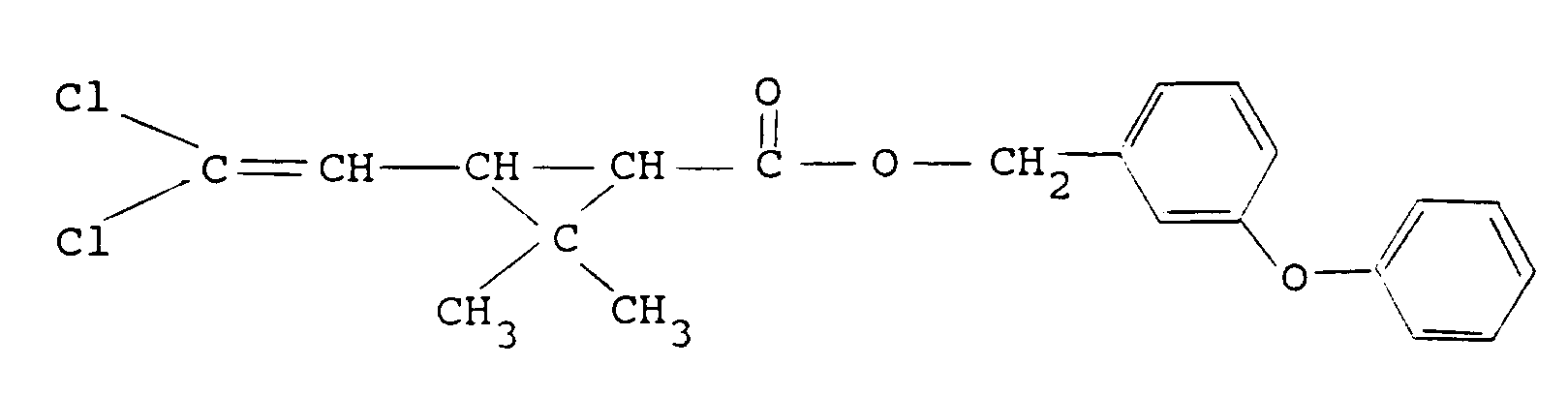
α-cyano-3-phenoxybenzyl (±) cis,trans-3-(2,2-dichlorovinyl)-2,2-dimethyl cyclopropane carboxylate (cypermethrin):
α-cyano-3-phenoxybenzyl (±) cis,trans-3-(2-chloro-2-trifluoromethylvinyl)-2,2-dimethyl cyclopropane carboxylate (cyhalothrin):
2,3,5,6-tetrafluoro-4-methylbenzyl cis-3-(Z-2-chloro-3,3,3-trifluoroprop-1-enyl)-2,2-dimethyl cyclopropane carboxylate (tefluthrin):
Claims (6)
- A process for obtaining a solid granular formulation of a pyrethroid insecticide having a reduced tendency to produce paresthesia and having a reduced tendency to form microscopic crystals of the pyrethroid in the formulation which comprises the steps of(a) preparing a solution of the pyrethroid in an aromatic solvent having a flash point above about 50°C,(b) admixing the solution with water in the presence of at least one emulsifier to form an oil-in-water emulsion,(c) admixing the oil-in-water emulsion with a hydratable solid material and additional water to aid in the emulsification and to serve as a source for hydrating the solid material in an agglomeration device to produce granules, and(d) drying the granules.
- A process according to claim 1 wherein the hydratable solid material is calcium sulphate hemihydrate.
- A process according to claim 1 wherein the pyrethroid insecticide is selected from compounds having the formula

- A process according to claim 3 wherein the compound is 2,3,5,6-tetrafluoro-4-methylbenzyl cis-3-(Z-2-chloro-3,3,3-trifluoroprop-1-enyl)-2,2-dimethylcyclopropane carboxylate.
- A process according to claim 1 the aromatic solvent is one having a flash point of about 90°C to about 125°C.
- A process according to claim 1 wherein the granules are dropped directly from the agglomeration device into a fluid bed drier.
Applications Claiming Priority (3)
| Application Number | Priority Date | Filing Date | Title |
|---|---|---|---|
| US30335789A | 1989-01-30 | 1989-01-30 | |
| US303357 | 1989-01-30 | ||
| PCT/US1990/000575 WO1990008467A1 (en) | 1989-01-30 | 1990-01-26 | Pyrethroid formulations of reduced paresthesia |
Publications (2)
| Publication Number | Publication Date |
|---|---|
| EP0538246A1 EP0538246A1 (en) | 1993-04-28 |
| EP0538246B1 true EP0538246B1 (en) | 1995-02-22 |
Family
ID=23171720
Family Applications (1)
| Application Number | Title | Priority Date | Filing Date |
|---|---|---|---|
| EP90902720A Expired - Lifetime EP0538246B1 (en) | 1989-01-30 | 1990-01-26 | Pyrethroid formulations of reduced paresthesia |
Country Status (8)
| Country | Link |
|---|---|
| EP (1) | EP0538246B1 (en) |
| JP (1) | JP2892498B2 (en) |
| AU (1) | AU621988B2 (en) |
| BR (1) | BR9007041A (en) |
| CA (1) | CA2049965C (en) |
| DE (1) | DE69017234T2 (en) |
| WO (1) | WO1990008467A1 (en) |
| ZA (1) | ZA90629B (en) |
Families Citing this family (7)
| Publication number | Priority date | Publication date | Assignee | Title |
|---|---|---|---|---|
| GB9202060D0 (en) * | 1992-01-31 | 1992-03-18 | Sandoz Ltd | Novel compositions |
| WO1994015468A1 (en) * | 1993-01-04 | 1994-07-21 | Zeneca Limited | Granular pesticide compositions |
| FR2713045B1 (en) * | 1993-12-03 | 1996-08-09 | Roussel Uclaf | Granules emulsifiable in water, their preparation process and their application as pesticides. |
| FR2713954B1 (en) * | 1993-12-22 | 1996-01-12 | Roussel Uclaf | New process for preparing an emulsion or dry or extruded suspoemulsion in the form of granules and granules obtained. |
| US6733802B1 (en) | 1997-12-17 | 2004-05-11 | Fortune Bio-Tech Limited | Natural azadirachtin composition |
| JP6679972B2 (en) | 2016-02-16 | 2020-04-15 | 住友化学株式会社 | Coated pesticide granules |
| GB2551800B (en) | 2016-06-30 | 2020-05-20 | Syngenta Participations Ag | Granular pesticide compositions |
Family Cites Families (8)
| Publication number | Priority date | Publication date | Assignee | Title |
|---|---|---|---|---|
| DE3343092A1 (en) * | 1983-11-29 | 1985-06-05 | Bayer Ag, 5090 Leverkusen | WATER-SOLUBLE PESTICIDAL FORMULATION |
| DE3508643A1 (en) * | 1985-03-12 | 1986-09-18 | Bayer Ag, 5090 Leverkusen | Macroemulsions |
| DE3517707A1 (en) * | 1985-05-17 | 1986-11-20 | Bayer Ag, 5090 Leverkusen | METHOD FOR KEEPING FLIES STABLE AND GRAZING |
| JPH0639362B2 (en) * | 1985-07-29 | 1994-05-25 | 住友化学工業株式会社 | Agrochemical solid formulation |
| DE3529693A1 (en) * | 1985-08-20 | 1987-02-26 | Bayer Ag | METHOD FOR CONTROLLING EKTOPARASITES IN HERDENTED AND SOCIETY LIVING ANIMALS |
| GB8603061D0 (en) * | 1986-02-07 | 1986-03-12 | Wellcome Found | Pesticidal formulations |
| JP2676082B2 (en) * | 1987-12-25 | 1997-11-12 | 住友化学工業株式会社 | Microcapsules for cockroach control |
| HU204969B (en) * | 1988-04-07 | 1992-03-30 | Chinoin Gyogyszer Es Vegyeszet | Plant protective composition against arthropoda suitable for letting out very slight quantity of agent |
-
1990
- 1990-01-26 BR BR909007041A patent/BR9007041A/en not_active IP Right Cessation
- 1990-01-26 DE DE69017234T patent/DE69017234T2/en not_active Expired - Fee Related
- 1990-01-26 EP EP90902720A patent/EP0538246B1/en not_active Expired - Lifetime
- 1990-01-26 CA CA002049965A patent/CA2049965C/en not_active Expired - Fee Related
- 1990-01-26 AU AU50351/90A patent/AU621988B2/en not_active Ceased
- 1990-01-26 JP JP2502909A patent/JP2892498B2/en not_active Expired - Lifetime
- 1990-01-26 WO PCT/US1990/000575 patent/WO1990008467A1/en not_active Ceased
- 1990-01-29 ZA ZA90629A patent/ZA90629B/en unknown
Also Published As
| Publication number | Publication date |
|---|---|
| ZA90629B (en) | 1991-06-26 |
| CA2049965C (en) | 2000-02-29 |
| DE69017234T2 (en) | 1995-06-22 |
| BR9007041A (en) | 1991-11-12 |
| DE69017234D1 (en) | 1995-03-30 |
| CA2049965A1 (en) | 1990-07-31 |
| AU5035190A (en) | 1990-08-24 |
| JPH04503065A (en) | 1992-06-04 |
| WO1990008467A1 (en) | 1990-08-09 |
| EP0538246A1 (en) | 1993-04-28 |
| AU621988B2 (en) | 1992-03-26 |
| JP2892498B2 (en) | 1999-05-17 |
Similar Documents
| Publication | Publication Date | Title |
|---|---|---|
| US5602177A (en) | Formulations of deltamethrin | |
| US4871766A (en) | Oil-in-water pesticidal emulsion | |
| EP0538246B1 (en) | Pyrethroid formulations of reduced paresthesia | |
| JP2000517333A (en) | Pesticide composition | |
| JPH02279604A (en) | Agricultural chemical solid emulsion | |
| US4760084A (en) | Dry pesticidal compositions | |
| US6451332B1 (en) | Pesticidal composition having high pesticidal ingredient vaporization rate method for controlling pests, and method for producing a pesticidal composition | |
| JP2976496B2 (en) | Granular wettable powder | |
| JP3761593B2 (en) | Agrochemical composition | |
| JP3401622B2 (en) | Granulated fertilizer containing prodiamine | |
| JPH08509711A (en) | Solid grain protection formula | |
| JPH03223203A (en) | Tablet or capsule for controlling weed in paddy field | |
| JPS6145961B2 (en) | ||
| US5747054A (en) | Compositions of gypsum pesticide briquets | |
| JP3645920B2 (en) | Water-soluble pesticide granules | |
| JP4198802B2 (en) | Elution-controlled pesticide granule and method for controlling plant pests | |
| JP2003238315A (en) | Improved water applied pesticide composition | |
| JP2970666B2 (en) | Pesticide solid formulation | |
| JP3508203B2 (en) | Granular pesticide composition | |
| JP3787886B2 (en) | Agricultural solid formulation | |
| JP2567926B2 (en) | Anti-solidification agent for agricultural chemicals and non-solidifying pesticide granules containing the anti-solidification agent | |
| JP2879802B2 (en) | Method for producing pesticide granules | |
| JPH05902A (en) | Granular formulation | |
| JP3416969B2 (en) | Insecticidal composition | |
| JPH10182308A (en) | Stabilized liquid preparation and stabilization thereof |
Legal Events
| Date | Code | Title | Description |
|---|---|---|---|
| PUAI | Public reference made under article 153(3) epc to a published international application that has entered the european phase |
Free format text: ORIGINAL CODE: 0009012 |
|
| 17P | Request for examination filed |
Effective date: 19910723 |
|
| AK | Designated contracting states |
Kind code of ref document: A1 Designated state(s): BE DE FR GB IT NL |
|
| 17Q | First examination report despatched |
Effective date: 19931018 |
|
| RAP1 | Party data changed (applicant data changed or rights of an application transferred) |
Owner name: ZENECA INC. |
|
| GRAA | (expected) grant |
Free format text: ORIGINAL CODE: 0009210 |
|
| AK | Designated contracting states |
Kind code of ref document: B1 Designated state(s): BE DE FR GB IT NL |
|
| ITF | It: translation for a ep patent filed | ||
| REF | Corresponds to: |
Ref document number: 69017234 Country of ref document: DE Date of ref document: 19950330 |
|
| RAP2 | Party data changed (patent owner data changed or rights of a patent transferred) |
Owner name: ZENECA INC. |
|
| ET | Fr: translation filed | ||
| NLT2 | Nl: modifications (of names), taken from the european patent patent bulletin |
Owner name: ZENECA INC. TE WILMINGTON, DELAWARE, VER. ST. V. A |
|
| PLBE | No opposition filed within time limit |
Free format text: ORIGINAL CODE: 0009261 |
|
| STAA | Information on the status of an ep patent application or granted ep patent |
Free format text: STATUS: NO OPPOSITION FILED WITHIN TIME LIMIT |
|
| 26N | No opposition filed | ||
| PGFP | Annual fee paid to national office [announced via postgrant information from national office to epo] |
Ref country code: GB Payment date: 19990128 Year of fee payment: 10 |
|
| PGFP | Annual fee paid to national office [announced via postgrant information from national office to epo] |
Ref country code: BE Payment date: 19990324 Year of fee payment: 10 |
|
| PGFP | Annual fee paid to national office [announced via postgrant information from national office to epo] |
Ref country code: DE Payment date: 19991231 Year of fee payment: 11 |
|
| PGFP | Annual fee paid to national office [announced via postgrant information from national office to epo] |
Ref country code: FR Payment date: 20000112 Year of fee payment: 11 |
|
| PG25 | Lapsed in a contracting state [announced via postgrant information from national office to epo] |
Ref country code: GB Free format text: LAPSE BECAUSE OF NON-PAYMENT OF DUE FEES Effective date: 20000126 |
|
| PG25 | Lapsed in a contracting state [announced via postgrant information from national office to epo] |
Ref country code: BE Free format text: LAPSE BECAUSE OF NON-PAYMENT OF DUE FEES Effective date: 20000131 |
|
| PGFP | Annual fee paid to national office [announced via postgrant information from national office to epo] |
Ref country code: NL Payment date: 20000131 Year of fee payment: 11 |
|
| BERE | Be: lapsed |
Owner name: ZENECA INC. Effective date: 20000131 |
|
| NLS | Nl: assignments of ep-patents |
Owner name: ZENECA AG PRODUCTS INC. |
|
| GBPC | Gb: european patent ceased through non-payment of renewal fee |
Effective date: 20000126 |
|
| PG25 | Lapsed in a contracting state [announced via postgrant information from national office to epo] |
Ref country code: NL Free format text: LAPSE BECAUSE OF NON-PAYMENT OF DUE FEES Effective date: 20010801 |
|
| PG25 | Lapsed in a contracting state [announced via postgrant information from national office to epo] |
Ref country code: FR Free format text: LAPSE BECAUSE OF NON-PAYMENT OF DUE FEES Effective date: 20010928 |
|
| NLV4 | Nl: lapsed or anulled due to non-payment of the annual fee |
Effective date: 20010801 |
|
| PG25 | Lapsed in a contracting state [announced via postgrant information from national office to epo] |
Ref country code: DE Free format text: LAPSE BECAUSE OF NON-PAYMENT OF DUE FEES Effective date: 20011101 |
|
| REG | Reference to a national code |
Ref country code: FR Ref legal event code: ST |
|
| PG25 | Lapsed in a contracting state [announced via postgrant information from national office to epo] |
Ref country code: IT Free format text: LAPSE BECAUSE OF NON-PAYMENT OF DUE FEES;WARNING: LAPSES OF ITALIAN PATENTS WITH EFFECTIVE DATE BEFORE 2007 MAY HAVE OCCURRED AT ANY TIME BEFORE 2007. THE CORRECT EFFECTIVE DATE MAY BE DIFFERENT FROM THE ONE RECORDED. Effective date: 20050126 |