EP0537318B1 - New non-hygroscopic mono-ammonium salts - Google Patents
New non-hygroscopic mono-ammonium salts Download PDFInfo
- Publication number
- EP0537318B1 EP0537318B1 EP92909461A EP92909461A EP0537318B1 EP 0537318 B1 EP0537318 B1 EP 0537318B1 EP 92909461 A EP92909461 A EP 92909461A EP 92909461 A EP92909461 A EP 92909461A EP 0537318 B1 EP0537318 B1 EP 0537318B1
- Authority
- EP
- European Patent Office
- Prior art keywords
- salt
- formula
- glycine
- phosphonomethyl
- acid
- Prior art date
- Legal status (The legal status is an assumption and is not a legal conclusion. Google has not performed a legal analysis and makes no representation as to the accuracy of the status listed.)
- Expired - Lifetime
Links
Images



Classifications
-
- C—CHEMISTRY; METALLURGY
- C07—ORGANIC CHEMISTRY
- C07F—ACYCLIC, CARBOCYCLIC OR HETEROCYCLIC COMPOUNDS CONTAINING ELEMENTS OTHER THAN CARBON, HYDROGEN, HALOGEN, OXYGEN, NITROGEN, SULFUR, SELENIUM OR TELLURIUM
- C07F9/00—Compounds containing elements of Groups 5 or 15 of the Periodic Table
- C07F9/02—Phosphorus compounds
- C07F9/28—Phosphorus compounds with one or more P—C bonds
- C07F9/38—Phosphonic acids [RP(=O)(OH)2]; Thiophosphonic acids ; [RP(=X1)(X2H)2(X1, X2 are each independently O, S or Se)]
-
- C—CHEMISTRY; METALLURGY
- C07—ORGANIC CHEMISTRY
- C07K—PEPTIDES
- C07K14/00—Peptides having more than 20 amino acids; Gastrins; Somatostatins; Melanotropins; Derivatives thereof
- C07K14/435—Peptides having more than 20 amino acids; Gastrins; Somatostatins; Melanotropins; Derivatives thereof from animals; from humans
- C07K14/575—Hormones
- C07K14/65—Insulin-like growth factors, i.e. somatomedins, e.g. IGF-1, IGF-2
-
- A—HUMAN NECESSITIES
- A01—AGRICULTURE; FORESTRY; ANIMAL HUSBANDRY; HUNTING; TRAPPING; FISHING
- A01N—PRESERVATION OF BODIES OF HUMANS OR ANIMALS OR PLANTS OR PARTS THEREOF; BIOCIDES, e.g. AS DISINFECTANTS, AS PESTICIDES OR AS HERBICIDES; PEST REPELLANTS OR ATTRACTANTS; PLANT GROWTH REGULATORS
- A01N57/00—Biocides, pest repellants or attractants, or plant growth regulators containing organic phosphorus compounds
- A01N57/18—Biocides, pest repellants or attractants, or plant growth regulators containing organic phosphorus compounds having phosphorus-to-carbon bonds
- A01N57/20—Biocides, pest repellants or attractants, or plant growth regulators containing organic phosphorus compounds having phosphorus-to-carbon bonds containing acyclic or cycloaliphatic radicals
-
- A—HUMAN NECESSITIES
- A61—MEDICAL OR VETERINARY SCIENCE; HYGIENE
- A61P—SPECIFIC THERAPEUTIC ACTIVITY OF CHEMICAL COMPOUNDS OR MEDICINAL PREPARATIONS
- A61P27/00—Drugs for disorders of the senses
- A61P27/02—Ophthalmic agents
-
- C—CHEMISTRY; METALLURGY
- C07—ORGANIC CHEMISTRY
- C07F—ACYCLIC, CARBOCYCLIC OR HETEROCYCLIC COMPOUNDS CONTAINING ELEMENTS OTHER THAN CARBON, HYDROGEN, HALOGEN, OXYGEN, NITROGEN, SULFUR, SELENIUM OR TELLURIUM
- C07F9/00—Compounds containing elements of Groups 5 or 15 of the Periodic Table
- C07F9/02—Phosphorus compounds
- C07F9/28—Phosphorus compounds with one or more P—C bonds
- C07F9/30—Phosphinic acids [R2P(=O)(OH)]; Thiophosphinic acids ; [R2P(=X1)(X2H) (X1, X2 are each independently O, S or Se)]
- C07F9/301—Acyclic saturated acids which can have further substituents on alkyl
-
- C—CHEMISTRY; METALLURGY
- C07—ORGANIC CHEMISTRY
- C07F—ACYCLIC, CARBOCYCLIC OR HETEROCYCLIC COMPOUNDS CONTAINING ELEMENTS OTHER THAN CARBON, HYDROGEN, HALOGEN, OXYGEN, NITROGEN, SULFUR, SELENIUM OR TELLURIUM
- C07F9/00—Compounds containing elements of Groups 5 or 15 of the Periodic Table
- C07F9/02—Phosphorus compounds
- C07F9/28—Phosphorus compounds with one or more P—C bonds
- C07F9/38—Phosphonic acids [RP(=O)(OH)2]; Thiophosphonic acids ; [RP(=X1)(X2H)2(X1, X2 are each independently O, S or Se)]
- C07F9/3804—Phosphonic acids [RP(=O)(OH)2]; Thiophosphonic acids ; [RP(=X1)(X2H)2(X1, X2 are each independently O, S or Se)] not used, see subgroups
- C07F9/3808—Acyclic saturated acids which can have further substituents on alkyl
- C07F9/3813—N-Phosphonomethylglycine; Salts or complexes thereof
-
- A—HUMAN NECESSITIES
- A61—MEDICAL OR VETERINARY SCIENCE; HYGIENE
- A61K—PREPARATIONS FOR MEDICAL, DENTAL OR TOILETRY PURPOSES
- A61K38/00—Medicinal preparations containing peptides
Definitions
- the invention relates to new mono-ammonium salts, their preparation and use as active ingredients of pesticides.
- the invention relates to new solid, non-hygroscopic mono-ammonium salts of general formula I which are substantially free of diammonium-salts of the general formula V, processes for their preparation, pesticide compositions containing the same, as well as preparation and use of said pesticide compositions.
- the salts of general formula I are known as active ingredients of pesticides and their preparation and properties have been described in literature.
- the mono-ammonium salts of general formula I however are never described to appear in other form than as hygroscopic products, which are not resistant against humidity of normal atmosphere so that their application as pesticides was therefore only brought about by dissolving the products in water and selling the product in aqueous solutions.
- aqueous solutions in commerce contain 30 - 50% of the active ingredient as a maximum. Handling of the hygroscopic salts also causes environmental and health-care problems which would be avoided with non-sticky, non-hygroscopic products. The products have mostly acidic character and attack even the material in which they are transported so that greatest care and the proper material for their protection is needed - which all increase the costs of application.
- the most important representatives of the compounds of general formula I are the pesticide ingredients mono-isopropylammonium salt of N-(phosphonomethyl)-glycine and the mono-isopropylammonium salt of (3-amino-3-carboxypropyl)-methane phosphinic acid- however their ammoniumsalts are also important.
- the preparation of the salts is mostly brought about by reacting the acidic partner with the basic partner reactant in aqueous media, (e.g. Hungarian Patent 185.003, Swiss Patent 620.812 and German Patent 2.717.440) though the literature also teaches reaction of the acid with the basic reactant without solvents, whereupon the a mould of surface active agent is added to the reaction mixture and formulation is carried out after cooling of the mixture. /See also Spanish Patent 530.743 where benzene or water are proposed as solvents for a similar method./
- N-(phosphonomethyl)-glycine comprises a water-soluble bag containing the sodium or the potassium salt of N-(phosphonomethyl)-glycine as a wettable powder, which is easy to use.
- the authors of said patent teach, that they were unable to make similar formulations using the mono-isopropylammonium salt of N-(phosphonomethyl)-glycine because of the extreme hygroscopic nature of the mono-isopropylammonium salt.
- the aqueous solution of the mono-isopropylammonium salt of N-(phosphonomethyl)-glycine suitable because the solution dissolves the material of the bag before use.
- Non-hygroscopic means, that when exposed at 25°C to an environment containing 60% humidity no observable uptake of water takes place within 3 weeks or this uptake is less than 0.1%.
- the salts are crystalline, they have melting point ranges that are different from those published before and their water-solubility is somewhat increased as compared with the salts prepared with the known methods.
- Preferred products according to our invention are the solid, non-hygroscopic mono-isopropylammonium salts of N-(phosphonomethyl)-glycine of the ⁇ and/or ⁇ crystal type.
- the ⁇ -crystal-type has a melting point range of 158 - 163°C and the characteristic values of crystal - lattice - levels when measured by way of X-ray-diffraction are as follows: 11.0, 9.06, 5.94, 5.54, 4.13, 3,71, while the characteristic absorption bands obtained by FT-IR-spectroscopy are 1660, 1600,1553, 1545, 1075, 513 and 475 cm -1 .
- solid, non-hygroscopic, crystalline mono-isopropylammonium salts of N-(phosphonomethyl)-glycine of the ⁇ crystal type having a melting point range of 143 - 154°C and the characteristic values of crystal - lattice- planes when measured by way of X-ray-diffraction are as follows: 7.00, 4.47, 3.35, 2.815, while the characteristic absorption bands obtained by FT-IR-spectroscopy are 1645, 1594, 1561, 1541, 1066, 500 and 455 cm -1 .
- the mono-isopropylammonium salt of N-(phosphonomethyl)-glycine can thus appear in two different crystal types which we named ⁇ and ⁇ types. None of these has ever been described as a non-hygroscopic, crystalline product.
- a further preferred product according to our invention is the solid, non-hygroscopic, crystalline (3-amino-3-carboxypropyl)-methane-phosphinic acid mono-isopropylammonium salt having a melting point range of 199 - 203°C, while the characteristic absorption bands obtained by FT-IR-spectroscopy are 1640, 1601, 1530, 1138, 1037, 750 and 471 cm -1 .
- a further subject of our invention is the process for the synthesizing of a solid, non-hygroscopic salt by preparing the mono-ammonium-salt of general formula (I) according to a method known generally for the preparation of salts, whereby - along with avoiding other contaminations - on the course of or after salt-formation the di-ammonium-salt of the general formula (V) is eliminated or its formation is repressed.
- Preferred processes according to our invention comprise the use of the following processes alone or in combination with each other
- Solvents that are suitable for our process are aliphatic alcohols containing 1-6 carbon atoms and/or poly-alcohols and/or aromatic alcohols containing 1-6 alkyl side chains. It is preferable to prepare N-(phosphonomethyl)-glycine - mono-isopropyl-ammonium-salt or - mono-ammonium-salt in the presence of ethanol and/or propanol. Preferred temperature ranges for the method c.) reactions are 0 - 150°C, preferably 20 - 80°C.
- a supposition of how the process might take its course is the following:
- the reaction starts on the surface of the acid particles suspended in the solvent system. Since the acid is two-basic and the amines are present in excess, on the surface of the acid the di-ammonium salts are formed, which - because they are readily soluble in the solvent - quit the surface of the acid particles and dissolve, leaving the surface open to enter into reaction with further amounts of amine.
- the amine or other basic reactant is used up, the remaining dispersed acid and the di-ammonium-salt in solution can enter into an ion-transfer reaction so that the mono-ammonium salt is formed. Since the solubility of the mono-ammonium-salt is very small in the solvent-mixture used, the mono-ammonium salt precipitates continuously.
- alkyl-ammonium salts according to the method c.) one may proceed by applying the alkyl-ammonium salt of the acid of the general formula (VI) which is added to the reaction in solid form or in solution.
- Preferred temperature ranges for the method c.) reactions are 0 - 150°C, preferably 20 - 80°C.
- the salts of the amines are used.
- the salts are generally easier to handle than the amines, which have rather low boiling points.
- Preferable carboxylic acids are for example such as acrylic acid, benzoic acid, acetic acid, formic acid, propionic acid, butyric acid, valeric acid and others.
- the salts may be prepared separately and the isolated salts may be added to the acids of general formula II. However one may also proceed by preparing the salt in solution, and add the solution without isolating the salt after making the proper analytical evaluations.
- a further object of our invention are herbicidal or plant-growth-regulating compositions containing as an active ingredient an effective amount of the crystalline, non-hygroscopic salts of the general formula (I).
- herbicidal or plant-growth-regulating compositions according to our invention which contain as an active ingredient an effective amount of a crystalline, non-hygroscopic (3-amino-3-carboxy-propyl) - methane-phosphinic acid mono-isopropyl - ammonium salt or of the mono-isopropylammonium salt of N-(phosphonomethyl)-glycine of the ⁇ and/or ⁇ crystal type.
- compositions according to our invention include compositions containing as an active ingredient 0.1 to 99.9% of the above salts along with additive and auxiliary products which are used in pesticide industry and/or products which favorably modify the properties of the composition when applied for agricultural use.
- additives As additive and auxiliary products surface active agents reducing surface tension may be used which may be cationic, anionic, non-ionic or amphoteric as well. Further additives include adjuvants, adhesion promoting and decreasing substances, inhibitors of dust and foam formation, promoters of dissolution, solid or liquid vehicle substances, dispersing, colouring agents, products that increase resistance against rain or corrosion, activators and the like.
- auxiliary products are the following:
- compositions may preferably contain special,inorganic or organic nitrogen containing products as additives, such as urea, urea - derivatives or further inorganic salts such as calcium-, sodium-, ammonium- chloride, - sulphate, -phosphate, - borate and the like.
- special,inorganic or organic nitrogen containing products such as urea, urea - derivatives or further inorganic salts such as calcium-, sodium-, ammonium- chloride, - sulphate, -phosphate, - borate and the like.
- parraffine hydrocarbons may contain parraffine hydrocarbons, mineral oil fractions, natural plant oils, organic solvents.
- Inert vehicle products such as diathomic earth, caoline, attapulgit, fuller earth, montmorillonit, bentonite, synthetic silicic acids, thiosulphates and other agents which are adjuvants when using the compositions.
- compositions may take different forms depending of the requirements of use such as pellets, powders, tablets, granules using suitable equipments.
- compositions according to the invention may also include further products which have pesticide or other biological activity per se. These might be insecticides, fungicides herbicides, plant growth regulating agents or chemical fertilizers, trace elements etc.
- Preferable combination partners of this type are e.g. the following:
- a further object of our invention consists in processes for the preparation of a herbicidal or plant - growth regulating compositions by formulating with the methods known for formulating of pesticides 0.1 to 99.9% of an active ingredient according to our invention together with auxiliary products used in pesticide formulation and/or with products which favorably modify the properties of the active ingredients when used including products that have biological properties or are known to be active ingredients of pesticides per se.
- compositions consisting of a bag, which is solid in its dry state, which is made of a water-soluble polymer and which contains the compositions according to our invention.
- Preferred products of this type are those containing the mono-isopropylammonium salt or mono-ammonium-salt of N-(phosphonomethyl)-glycine or the mono-isopropylammonium salt or mono-ammonium-salt of glufosinate.
- the bags used according to the invention are of the size taking 0.1 - 10 kg, preferably 0.5 - 5 kg of the compositions according to the invention. They may preferably be totally filled with the composition of the invention. However some space might be left to facilitate addition of certain substances before use.
- the bags are solid and flexible at the temperature and humidity of the ambience.
- the thickness of the walls amounts to 20 - 100 microns, preferably to 30 - 60 microns and they are welded at at least one side.
- the water-soluble bags used according to our invention as above are known per se.
- the water-soluble polymer applied may be the following:
- the polymer bags according to our invention may contain the mono-ammonium salt of general formula I alone or in form of the compositions as detailed above. They may also contain additional products such as protecting colloids, products to increase density, tyxotropic products, stabilizers etc.
- the bags When using the bags according to our invention the bags are thrown into the required amount of water while stirring intensively.
- the polymer material disappears within about 2 minutes, the herbicide composition dissolves or disperses in the water and the liquid thus obtained can be used in the field as needed.
- a further object of the invention consists in a method to kill unwanted plants or to influence the growth of plants by treating said plants in the field with an effective amount of a herbicidal or plant-qrowth-requlatinq composition according to our invention by way of dispersing the composition on the plants in the form of aqueous or water / organic solvent solutions or dispersions or suspensions.
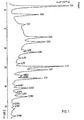
- FIG. 1 to 6 show the following:
- Fiqure 1 X-ray diffraction spectrum of N-(phosphonomethyl)-glycine mono-isopropylammonium salt ⁇ crystal type. Intensity against angle.
- Fiqure 2 X-ray diffraction spectrum of N-(phosphonomethyl)-glycine mono-isopropylammonium salt ⁇ crystal type. Intensity against angle.
- Figure 3 DSC examination of N-(phosphonomethyl)-glycine mono-isopropylammonium salt ⁇ type crystals. Heat flow W/g against temperature °C.
- Figure 4 DSC examination of N-(phosphonomethyl)-glycine mono-isopropylammonium salt ⁇ type crystals. Heat flow W/g against temperature °C.
- Fiqure 5 DSC examination of N-(phosphonomethyl)-glycine mono-isopropylammonium salt ⁇ type and ⁇ type crystals in a mixture of 1:1. Heat flow W/g against temperature °C.
- Figure 6 FT-IR spectrum of N-(phosphonomethyl)-glycine mono-isopropylammonium salt ⁇ type crystals. Absorbance against wave numbers.
- N-(phosphonomethyl)-glycine 50 g (0.3 moles) of N-(phosphonomethyl)-glycine are reacted with 17.5 g (0.3 moles) of isopropylamine in 200 ml of 96% ethanol at room temperature. The mixture is refluxed for half an hour, filtered, concentrated by evaporation and crystallized. 69g (0.3 moles) of crystalline, dried mono-isopropylammonium salt of N-(phosphonomethyl)-glycine are obtained. The product is not hygroscopic, readily soluble in water. Melting range 161 - 163°C. It contains 73.9% N-(phosphonomethyl)-glycine. Yield 99.95%.
- Characteristic absorption bands 1660, 1600, 1553, 1545, 1075, 513, 475, characteristic values of crystal-lattice-planes measured with X-ray diffraction: 11.0, 9.06, 5.94, 5.54, 4.13, 3.71. ( ⁇ type crystals).
- N-(phosphonomethyl)-glycine 100g (0.59 moles) of N-(phosphonomethyl)-glycine are reacted with 35g (0.59 moles) of isopropylamine in 400 ml of absolute ethanol at room temperature. The suspension warms up to 49°C and is then refluxed for half an hour by heating to 78°C. On cooling to room temperature, filtration and drying 129.0 g (0.57 moles) of crystalline mono-isopropylammonium salt of N-(phosphonomethyl)-glycine are obtained. The product is not hygroscopic, readily soluble in water. Mp: 161 - 162°C. It contains 74% N-(phosphonomethyl)-glycine. Yield: 99.86%.
- N-(phosphonomethyl)-glycine content 57.5% 170 g (0.59 moles) of N-(phosphonomethyl)-glycine-di-(mono-isopropylamine)- salt are reacted with 100 g (0.59 moles) of N-(phosphonomethyl)-glycine in 400 ml of ethanol, refluxed for half an hour and the milk-like suspension is filtered on cooling to room temperature. The product obtained is dried to give 269.2 g (1.18 moles) of mono-isopropylammonium salt of N-(phosphonomethyl)-glycine, melting at 158 - 160°C. The product is non-hygroscopic and contains 74% of N-(phosphonomethyl)-glycine.
- Example I.12 The reactants as in Example I.12 are reacted in 70 ml of distilled water, while the i.propylamine is added slowly. The solution obtained is heated for 1 hour at 100°C, cooled to room temperature, the crystals filtered and dried. 228.20 g (1 mole) of the mono-isopropylammmonium salt of N-(phosphonomethyl)-glycine are obtained.
- the product is non-hygroscopic, readily soluble in water, melting range 147 - 153°C. ⁇ type crystals, see Fig 2, 4.
- Example I.12 The product obtained according to Example I.12 is refluxed for 2x0.5 hours in 700 ml of absolute ethanol while heating, cooled at room temperature, filtered and dried. 220g of mono-isopropylammonium salt of N-(phosphonomethyl)-glycine are obtained.
- the product is non-hygroscopic, readily soluble in water, melting range 148 - 154°C. ( ⁇ type crystals)
- N-(phosphonomethyl)-glycine 16.9g (0.1 mole) of N-(phosphonomethyl)-glycine are stirred in 40 ml of water-free ethanol and 11.9g (0.1 mole) of isopropylamine acetate are added, followed by heating to 80°C for 30 minutes. On cooling to room temperature the crystals are filtered, washed with ethanol and dried.
- the crystalline mono-isopropylammonium salt of N-(phosphonomethyl)-glycine is non-hygroscopic, readily soluble in water, melting range 154 - 157°C. ( ⁇ type crystals). Yield 96.6%. It contains 73.8% of N-(phosphonomethyl)-glycine.
- Example 44 The process of Example 44 is repeated with the difference, that 14.87g (0.125 moles) of isopropylamine acetate are used. 21.6g of crystalline mono-isopropylammonium salt of N-(phosphonomethyl)-glycine are obtained. The product is non-hygroscopic, readily soluble in water, melting range 153 - 157°C. ( ⁇ type). Yield 95%. It contains 74.1% of N-(phosphonomethyl)-glycine.
- N-(phosphonomethyl)-glycine 16.9g are stirred in 20 ml of water and 11.9g of isopropylamine acetate are added. The solution gets clear after a while and is then poured on a watch-glass. After evaporation of the water at room temperature while standing 22.8g of crystalline mono-isopropylammonium salt of N-(phosphonomethyl)-glycine are obtained.
- the product is non-hygroscopic, readily soluble in water, melting range 148 - 156°C. ( ⁇ type). It contains 74.1% of N-(phosphonomethyl)-glycine.
- N-(phosphonomethyl)-glycine 16.9g are stirred in 30 ml of methanol and 9.1 g of dimethylamine-formiate are added. On working up as in the above examples 21.31g of crystalline mono-(dimethyl-ammonium)-salt of N-(phosphonomethyl)- glycine are obtained.
- the product is non-hygroscopic, readily soluble in water, melting range 118 - 124°C. It contains 78.3% of N-(phosphonomethyl)-glycine.
- N-(phosphonomethyl)-glycine 16.9g of N-(phosphonomethyl)-glycine are reacted as in Example I.18 with 11.9 g of ethylamine-propionate in 30 ml of isopropanol. 19.9 g of crystalline mono-ethylammonium salt of N-(phosphonomethyl)-glycine are obtained.
- the product is non-hygroscopic, readily soluble in water, melting range 131- 137 °C. Yield 93.1%. It contains 77.9% of N-(phosphonomethyl)-glycine.
- Example I.20 The reaction is carried out as in Example I.20 with the difference, that the water is eliminated by evaporation and the remaining solid, hygroscopic salt is treated as indicated above. 485.6 g of the mono-isopropylammonium salt of N-(phosphonomethyl)-glycine are obtained. Melting range 150 - 155°C, readily soluble in water, non-hygroscopic, Yield:99.9%. Contains 73.8% N-(phosphonomethyl)-glycine.
- Example I.20 The reaction is carried out as in Example I.20 with the difference, that the aqueous solution obtained is dried by evaporation and the remaining solid, hygroscopic salt is treated as indicated above.
- the mono-isopropylammonium salt of N-(phosphonomethyl)-glycine obtained shows the melting range 148 - 152°C, readily soluble in water, non-hygroscopic. Yield:99%. contains 73.9% N-(phosphonomethyl)-glycine.
- the reaction is carried out as described in Example 1.25.
- 2 g of the di-isopropylammonium salt of N-(phosphonomethyl)-glycine are added which makes to precipitate the mono-isopropylammonium salt of N-(phosphonomethyl)-glycine after stirring for 10 minutes.
- the white salt is filtered, extracted with 96% ethanol at room temperature, filtered and dried.
- 480 g of mono-isopropylammonium salt of N-(phosphonomethyl)-glycine are obtained. Melting range 147 - 152°C, readily soluble in water, non-hygroscopic, Yield:99%. Contains 73.6 g of N-(phosphonomethyl)-glycine.
- a mixture of 0.5 g of ethoxylated nonyl-phenol and 2.84 of ethoxylated alkylamine additive material are dissolved in 40 ml of ethanol at room temperature.
- the solution is homogenized after addition of the mono-isopropylammoniumsalt of N-(phosphonomethyl)-glycine prepared according to Example I.2 and the ethanol is evaporated. 63.3 g of a product is obtained, which contains 69.6 % g of N-(phosphonomethyl)-glycine and is non-hygroscopic, readily soluble in water.
- a slurry in 30 ml of ethanol is prepared from the auxiliary materials comprising 1.1 g of ethoxylated nonyl-phenol, 6.39 g of ethoxylated alkyl amine, 12.69 g of ethoxylated fatty amine and 9.28 g of fatty alcohol polyglycole ether, 60 g of the mono-isopropylammonium salt of N-(phosphonomethyl)-glycine prepared according to Example I.3 are added and the slurry is homogenized after addition of 4.4 g of urea. On evaporation of the ethanol 93 g of a product are obtained, containing 47.4% of N-(phosphonomethyl)-glycine, non-hygroscopic and readily soluble in water.
- a slurry in 30 ml of methanol is prepared from the auxiliary materials comprising 1.53 g of ethoxylated nonyl-phenol, 3.89 g of ethoxylated alkyl amine, 7.92 g of ethoxylated fatty amine and 5.97 g of iso-tridekanol polyglycole ether, 60 g of mono-isopropylammonium salt of N-(phosphonomethyl)-glycine prepared according to Example I.1 are added and the slurry is homogenized after addition of a mixture consisting of 2.78 g of potassium chloride, 0.03 g of 1-naphthyl acetic acid and 0.08 g of boric acid. On evaporation of the alcohol 82 g of a product are obtained, containing 53.8% of N-(phosphonomethyl)-glycine, non-hygroscopic and readily soluble in water.
- N-(phosphonomethyl)-glycine mono-isopropyiammonium saltprepared according to Example I.2 are homogenized with a solution of 40 g of auxuliary material Hyspray in 60 ml of ethanol. On evaporation of the alcohol 125 g of a product are obtained which is non-hygroscopic, readily soluble in water and contains 50.4 g of N-(phosphonomethyl)-glycine.
- Example 11 Using the method of Example I.11. with the difference that 10 g of lauropal-x auxiliary product are added to the slurry in surplus. A similar product as in Example 11 is obtained with the same yield.
- Example I.12. Using the method of Example I.12. with the difference that also 50 g of ammonium hydrogen carbonate are added to the slurry, and 50 g of Hyspray are used instead of 30 g. Thus 195 g of a product are obtained which is non-hygroscopic, readily soluble in water, containing 32.3% of N-(phosphonomethyl)-glycine.
- Example II.4 Using the method of Example II.4. with the difference that 80 g of Hyspray and 10 g of lauropal-x are used in 100 ml ethanol with 85 of the mono-isopropylammonium salt of N-(phosphonomethyl)-glycine prepared according to Example I.2, while 70 g of ammonium hydrogen carbonate and 50 g of ammonium sulphate are added to the slurry. 295 g of a product are obtained which is non-hygroscopic, readily soluble in water, containing 21.3% of N-(phosphonomethyl)-glycine.
- Hyspray auxiliary product is 50 g, 100 ml ofethanol,50 g of ammonium hydrogen carbonate and 500 g of ammonium sulphate used. 695 g of a product are obtained which is non-hygroscopic, readily soluble in water, containing 9 % of N-(phosphonomethyl)-glycine.
- auxiliary products 0.2g of ethoxylated nonyl-phenol and 1.2 g of ethoxylated alkylamine are dissolved in 10 ml of ethanol at room temperature.
- the solution is homogenized with 24g (o.l mole) of mono-isopropylammoniumsalt of (3-amino-3-carboxy-propyl)-methane-phosphinic acid, the ethanol is evaporated. 25.3g of a non-hygroscopic product are obtained, which is readily soluble in water containing 71% of the mono-isopropylammonium salt of (3-amino-3-carboxypropyl)-methane-phosphinic acid.
- auxiliary products 0.2g of ethoxylated nonyl-phenol and 7,3 g of ethoxylated fatty acid are admixed with 5 ml of ethanol to give a slurry which is homogenized with 24g (o.1 mole) of the mono-isopropylammoniumsalt of (3-amino-3-carboxy-propyl)-methane-phosphinic acid (prepared according to Example 17, and the ethanol is evaporated.
- 31.4g of a non-hygroscopic product are obtained, which is readily soluble in water and contains 57.6% of the mono-isopropylammoniumsalt of (3-amino-3-carboxy-propyl)-methane-phosphinic acid.
- 0.2g of ethoxylated nonyl-phenol and 1,2 g of ethoxylated alkyl amine are admixed with 8 ml of ethanol to give a slurry which is homogenized with 19.8g (o.1 mole) of the ammonium salt of (3-amino-3-carboxy-propyl)-methane-phosphinic acid (prepared according to Example II.8 and the alcohol is evaporated. 21.lg of a non-hygroscopic product are obtained, which is readily soluble in water and contains 85% of the ammonium salt of (3-amino-3-carboxy-propyl)-methane-phosphinic acid.
- compositions are prepared:
- the water-soluble and wettable or dispergible solid products may be subjected to fine grinding in a mill or other suitable grinding means.
- 1 kg of the compositions prepared according to the Examples above are filled into a bag the size of which is suitable to take the quantity.
- the bag is made of poly-(vinyl-alcohol), which is plastified with a polyvalent alcohol.
- the bag is square shaped and is closed on its three sides. The properties of the powders according to the examples as above are such that it is easy to fill the same into the bags. The bags are then closed by welding.
- Solid glyphosate mono-ipa-salt 70% Ethoxylated-nonyl-phenol 1% Ethoxylated alkylamine 4% Ammonium-sulphate 20% Silicium dioxyde 5%
- Solid glyphosate mono-ipa-salt 40% Ethoxylated-nonyl-phenol 1% Ethoxylated alkylamine 4% Ethoxylated fatty amine 15% Ammonium-sulphate 30% Caoline 10%
- Solid glyphosate mono-ipa-salt 80% ATPLUS 411 19% Polyalkoxylated fatty alcohol 1%
- Table IV illustrates some solubility values of the mono-isopropylammonium salts and di-isopropylammonium salts of N-(phosphonomethyl)-glycine on the basis of which the processes according to our invention can be reduced to practice. All solvents or solvent- mixtures can be used for our processes which show a reasonable solubility - difference between the salts and products that have to be separated.
- compositions formulated according to Examples II.34 or II.36 are disperged in water to give 3g active ingredient liter liquids. 6mg of the active ingredient of each sample were sprayed on 15 day old barley plants, kept in vessels under green house conditions. On the 4th day the clorofil quantity falling on unit quantities of dry substance in the plants was determined. The results are shown in Table VII Table VII Control 9.26 mg/g Example II.9 3.42 mg/g Example II.11 3.43 mg/g
- Example V.1 15 day old bean plants were sprayed with 4.5mg of active ingredient/vessel (1.5ml of the liquid) and the photosynthetic activity was determined on the third day. The result are summarized on Table IX. Table IX Control Example II.9 Example II.11 F 685 340 325 F 556 89 116 0.517 0.062 0.134 2.402 0.404 0.929
Landscapes
- Chemical & Material Sciences (AREA)
- Health & Medical Sciences (AREA)
- Life Sciences & Earth Sciences (AREA)
- Organic Chemistry (AREA)
- General Health & Medical Sciences (AREA)
- Biochemistry (AREA)
- Molecular Biology (AREA)
- Zoology (AREA)
- Engineering & Computer Science (AREA)
- Medicinal Chemistry (AREA)
- Environmental Sciences (AREA)
- Diabetes (AREA)
- Proteomics, Peptides & Aminoacids (AREA)
- Genetics & Genomics (AREA)
- Biophysics (AREA)
- Gastroenterology & Hepatology (AREA)
- Agronomy & Crop Science (AREA)
- Pest Control & Pesticides (AREA)
- Plant Pathology (AREA)
- Dentistry (AREA)
- Wood Science & Technology (AREA)
- Toxicology (AREA)
- Endocrinology (AREA)
- Pharmacology & Pharmacy (AREA)
- Nuclear Medicine, Radiotherapy & Molecular Imaging (AREA)
- Chemical Kinetics & Catalysis (AREA)
- Veterinary Medicine (AREA)
- Ophthalmology & Optometry (AREA)
- Public Health (AREA)
- General Chemical & Material Sciences (AREA)
- Animal Behavior & Ethology (AREA)
- Bioinformatics & Cheminformatics (AREA)
- Agricultural Chemicals And Associated Chemicals (AREA)
- Drying Of Gases (AREA)
- Organic Low-Molecular-Weight Compounds And Preparation Thereof (AREA)
- Pharmaceuticals Containing Other Organic And Inorganic Compounds (AREA)
- Polysaccharides And Polysaccharide Derivatives (AREA)
- Solid-Sorbent Or Filter-Aiding Compositions (AREA)
Abstract
Description
- The invention relates to new mono-ammonium salts, their preparation and use as active ingredients of pesticides.
- More particularly the invention relates to new solid, non-hygroscopic mono-ammonium salts of general formula I which are substantially free of diammonium-salts of the general formula V, processes for their preparation, pesticide compositions containing the same, as well as preparation and use of said pesticide compositions.
- In this specification the meaning of the substituents in the general formulae is always the following:
- R1 stands for hydroxy or alkyl-groups,
- A stands for 1-4 alkyl-amino- or amino-alkyl-groups containing primary or secondary amino-groups, preferably -CH2-NH- or CH(NH2)-CH-groups,
- B stands for ammonium-ion, or alkyl-substituted ammoniumion,
- R2 stands for hydrogen, hydroxyl-, optionally substituted 1-4 alkyl-groups, optionally substituted aryl-group.
- The salts of general formula I are known as active ingredients of pesticides and their preparation and properties have been described in literature. The mono-ammonium salts of general formula I however are never described to appear in other form than as hygroscopic products, which are not resistant against humidity of normal atmosphere so that their application as pesticides was therefore only brought about by dissolving the products in water and selling the product in aqueous solutions.
- The inconvenience of this procedure is clear. It was therefore the aim of our invention to find a method whereby the mono-ammonium salts of general formula I - especially the mono-isopropylammonium salt of N-(phosphonomethyl)-glycine and the mono-isopropylammonium salt of (3-amino-3-carboxy-propyl)-methane phosphinic acid can be obtained in a form wnich is non-hygroscopic, enabling thus the transportation, commercialisation and even the use in solid form, or - when direct use on the field is brought about in aqueous solution - to ensure that the solid can be dissolved before use, bringing thus transportation and storage to reasonable costs as compared with the present situation when aqueous solutions are transported and stored. The aqueous solutions in commerce contain 30 - 50% of the active ingredient as a maximum. Handling of the hygroscopic salts also causes environmental and health-care problems which would be avoided with non-sticky, non-hygroscopic products. The products have mostly acidic character and attack even the material in which they are transported so that greatest care and the proper material for their protection is needed - which all increase the costs of application.
- The most important representatives of the compounds of general formula I are the pesticide ingredients mono-isopropylammonium salt of N-(phosphonomethyl)-glycine and the mono-isopropylammonium salt of (3-amino-3-carboxypropyl)-methane phosphinic acid- however their ammoniumsalts are also important.
- The above salts, their preparation and use was described in several publications such as USP 3.315.675, 3.56.672, 4.405.531, 3.868.407, 4.140.513, 4.315.765, 4.397.676 and HU-Patent 184.601 as well as USP 3.288.846, 4.507.250, 4.147.719, 4.487.724, German Patent 3.312.165, European Patents 249.188, 265.412, 301.391, and Japanese Patents 60.248.190, 02.190.196, 59.181.288.
- Different methods were developed to avoid the consequences mentioned above. Thus different additives were proposed as auxiliary agents to ensure the production of wettable powders and their use /e.g. European Patents 256.942, 352.508,Japanese Patents 01.42.409, 58.18.311, 62.175.407, 62.175.408, and USP 4.405.531. However when used in practice great care has to be taken to protect these powders against humidity, to use up the bags when opened, to store the products under proper conditions etc. - whereby the additional materials do not give the results that are aimed at when used for some time. Another approach of the problem was the suggestion to spray-dry the product /Jap.Pat. 63.10.701/ or again a different one to admix the salt with a solvent and a moulded surface active agent - giving thus a mixture from which the solvent is evaporated and the surface active agent is cooled until solidified, whereupon the solid product is formulated /European Patent 02.06.537/.
- The preparation of the salts is mostly brought about by reacting the acidic partner with the basic partner reactant in aqueous media, (e.g. Hungarian Patent 185.003, Swiss Patent 620.812 and German Patent 2.717.440) though the literature also teaches reaction of the acid with the basic reactant without solvents, whereupon the a mould of surface active agent is added to the reaction mixture and formulation is carried out after cooling of the mixture. /See also Spanish Patent 530.743 where benzene or water are proposed as solvents for a similar method./
- All publications are common - when making any statement about the quality of the products obtained - that they are hygroscopic /e.g. German Patent No.2.717.440, Swiss Patent No.620.812 for the ammonium salt of glufosinate/ and some state that the products are solidified as glassy materials which can be ground in mortars but still are hygroscopic when stored.
- According to Hung. Pat. Appl. 1322/90 a new formulation of N-(phosphonomethyl)-glycine comprises a water-soluble bag containing the sodium or the potassium salt of N-(phosphonomethyl)-glycine as a wettable powder, which is easy to use. The authors of said patent teach, that they were unable to make similar formulations using the mono-isopropylammonium salt of N-(phosphonomethyl)-glycine because of the extreme hygroscopic nature of the mono-isopropylammonium salt. Nor is the aqueous solution of the mono-isopropylammonium salt of N-(phosphonomethyl)-glycine suitable (according to said publication) because the solution dissolves the material of the bag before use.
- When investigating some of the products obtained according to some of the known methods /e.g. when reproducing the processes of European Patent 02.56.608 and Spanish Patent 530.743/ we found that these mono-isopropylammonium salts always contained certain amounts of di-ammonium-salts of general formula V together with acids of general formula II.
- The presence of small amounts of the di-ammonium-salts of the general formula V is not evident from the analysis data of the products obtained by way of classical analysis methods: the content of free acids of general formula II together with the content of di-ammonium-salts of general formula V might give analytical data as a total result which hide the presence of the di-ammonium salts in the products.
- When isolating di-ammonium-salts of general formula V we ascertained that these salts differ considerably from the mono-ammonium salts as regards hygroscopicity so that slight amounts of the di-ammonium-salts influence the hygroscopic properties of such salts dramatically.
- When investigating the N-(phosphonomethyl)-glycine obtained with known methods by means of FT - IR spectroscopy we found that the products always contained the carbonyl valency oscillation bonds of free N-(phosphonomethyl)-glycine at 1717 and 1733 cm-1 wave length and the carboxylate oscillations of the free carboxylate in the N-(phosphonomethyl)-glycine di-isopropylammonium-salt at 1561 and 1633 cm-1. The change of the proportions of these bonds shows the change in the ratio of components. This was shown by preparing standard samples of the mono - and the di-iso-propyl-ammonium salts and taking their calibration spectra.
- It can be seen from the IR spectroscopic data that also glufosinate exists in two different forms of twin-ionic structure. Thus the carboxyl group can appear both in dissociated form at 1640 and 1600 cm-1 and in non-dissociated form at the absorption band at 1733 cm-1 and 1728.
- Care has to be taken when preparing the samples as well. Sometimes the mono-ammonium-salts - which are contaminated with di-ammonium-salts as well as with the free acid - are subject to additional reaction steps when the samples are dissolved before taking the spectra - giving thus results that are not typical for the product before measurement.
- When comparing the spectra obtained with our own methods it is clear that in the products prepared according to our invention the un-dissociated carbonyl group absorption bonds disappear at 1730 cm-1 and the dissociated carboxyl bonds which are characteristic for the salts increase at 1640 and 1600 cm-1.
- When already having the above spectroscopic data the HPLC methods and automatic melting point analytical methods can be used to complete definition of the properties of the new salts.
- "Non-hygroscopic" according to our invention means, that when exposed at 25°C to an environment containing 60% humidity no observable uptake of water takes place within 3 weeks or this uptake is less than 0.1%. The salts are crystalline, they have melting point ranges that are different from those published before and their water-solubility is somewhat increased as compared with the salts prepared with the known methods.
- First objects of our invention are thus non-hygroscopic salts of general formula I.
- Preferred products according to our invention are the solid, non-hygroscopic mono-isopropylammonium salts of N-(phosphonomethyl)-glycine of the α and/or β crystal type.
- The α-crystal-type has a melting point range of 158 - 163°C and the characteristic values of crystal - lattice - levels when measured by way of X-ray-diffraction are as follows: 11.0, 9.06, 5.94, 5.54, 4.13, 3,71, while the characteristic absorption bands obtained by FT-IR-spectroscopy are 1660, 1600,1553, 1545, 1075, 513 and 475 cm-1.
- Other preferred products according to our invention are the solid, non-hygroscopic, crystalline mono-isopropylammonium salts of N-(phosphonomethyl)-glycine of the β crystal type, having a melting point range of 143 - 154°C and the characteristic values of crystal - lattice- planes when measured by way of X-ray-diffraction are as follows: 7.00, 4.47, 3.35, 2.815, while the characteristic absorption bands obtained by FT-IR-spectroscopy are 1645, 1594, 1561, 1541, 1066, 500 and 455 cm-1.
- The mono-isopropylammonium salt of N-(phosphonomethyl)-glycine can thus appear in two different crystal types which we named α and β types. None of these has ever been described as a non-hygroscopic, crystalline product.
- A further preferred product according to our invention is the solid, non-hygroscopic, crystalline (3-amino-3-carboxypropyl)-methane-phosphinic acid mono-isopropylammonium salt having a melting point range of 199 - 203°C, while the characteristic absorption bands obtained by FT-IR-spectroscopy are 1640, 1601, 1530, 1138, 1037, 750 and 471 cm-1.
- A further subject of our invention is the process for the synthesizing of a solid, non-hygroscopic salt by preparing the mono-ammonium-salt of general formula (I) according to a method known generally for the preparation of salts, whereby - along with avoiding other contaminations - on the course of or after salt-formation the di-ammonium-salt of the general formula (V) is eliminated or its formation is repressed.
- Preferred processes according to our invention comprise the use of the following processes alone or in combination with each other
- a.)
reacting the acid of the general formula (II) with a reactant of basic (alkaline) character capable to form the ion B+ -in an organic, polar solvent or in solvent- mixture containing an organic, polar solvent, in which the salt and acid of general formulae (I) and (II) are not, or only slightly soluble, while the reactant of basic character and the di-ammonium-salt of general formula (V) formed as by-product are readily soluble, and optionally the reaction mixture is heated subsequently or - b.)
a di-ammonium-salt of the general formula (V), is reacted with an acid of the general formula (II) under the reaction conditions of the method a) or - c.)
an acid of the general formula (II) is reacted with a salt capable to form the ion B+under the reaction conditions of the method a) or - d.)
a hygroscopic salt of the general formula (I) is extracted with an organic,preferably polar solvent or a solvent-mixture containing an organic, polar solvent, in which the mono-ammonium salt of general formula (I) is insoluble or slightly soluble, while the di-ammonium-salt of general formula (V) is readily soluble or - e.)
eliminating at room temperature in vacuo or with heating from a di-ammonium salt of general formula (V) or from a mono-ammonium salt which is contaminated with such di-ammonium-salt the quantity of the amine containing the B+-ion which is above the mole-equivalent, or - f.)
reacting a salt of the acid of the general formula (II), using the reaction conditions of the a.) method with a reactant which is capable to form the ion B+-and optionally isolating the salt of general formula (I) thus formed preferably by filtration. - When carrying out the above processes it is preferable to use as a starting acid N-(phosphonomethyl)-glycine of formula (III), or (3-amino-3-carboxy-propyl)-methane-phosphinic acid of the formula (IV).
- Solvents that are suitable for our process are aliphatic alcohols containing 1-6 carbon atoms and/or poly-alcohols and/or aromatic alcohols containing 1-6 alkyl side chains. It is preferable to prepare N-(phosphonomethyl)-glycine - mono-isopropyl-ammonium-salt or - mono-ammonium-salt in the presence of ethanol and/or propanol. Preferred temperature ranges for the method c.) reactions are 0 - 150°C, preferably 20 - 80°C.
- According to method a.) it is essential to use the proper solvents that have to be chosen according to our invention. As stated above, it is the solubility tests that have to be performed before such choice is made. It is essential that such solvents have to be used in which the salt of general formula (I) and the acid of general formula (II) are practically insoluble or but slightly soluble, while the reactant of alkaline character and the di-ammonium-salts of general formula (V) are readily soluble.
- A supposition of how the process might take its course is the following: The reaction starts on the surface of the acid particles suspended in the solvent system. Since the acid is two-basic and the amines are present in excess, on the surface of the acid the di-ammonium salts are formed, which - because they are readily soluble in the solvent - quit the surface of the acid particles and dissolve, leaving the surface open to enter into reaction with further amounts of amine. As soon as the amine or other basic reactant is used up, the remaining dispersed acid and the di-ammonium-salt in solution can enter into an ion-transfer reaction so that the mono-ammonium salt is formed. Since the solubility of the mono-ammonium-salt is very small in the solvent-mixture used, the mono-ammonium salt precipitates continuously.
- We have found that polar organic solvents or such solvent mixtures which contain organic polar solvents are suitable for the purpose of method a.) of our invention.
- The above theory is supported with the changes which can be observed when e.g. N-(phosphonomethyl)-glycine is reacted with isopropylamine according to method a.) of our invention:
- When a dispersion of the N-(phosphonomethyl)-glycine in absolute ethanol is made a liquid of strong white colour is obtained. On subsequent addition of isopropylamine the colour gets lighter and - on addition of the whole quantity of isopropyl amine and eventually after heating - the reaction mixture gets clear, almost transparent, followed by precipitation of the mono-ammonium-salt on cooling.
- Once knowing that the above method is suitable for the preparation of the mono-ammonium-salt which is substantially free of the di-ammonium salt, the application of other methods is also possible.
- To investigate the process we prepared the di-ammonium-salt using double amounts of the isopropylamine and made tests concerning this product and its solubility. /see Tables IV and V. We then used this products as starting materials for methods b.) and e.) of our process.
- The above experiments also show why it was not possible to obtain pure mono-ammonium-salts according to the methoas of EP 256 608 and Spanish Patent 530 743: They used solvents in which the di-isoproylammonium salt is not readily soluble and resulting in considerable contamination of the mono-ammonium-salt with both the di-ammonium-salt and the starting acid.
- When using the method c.) it is adventageous to react the acid of general formula (II) with the salt formed with a 1 or 2 basic carboxylic acid of the pK-value of the
range 2,27 to 5,8. The acids may have the general formula (VI). - Thus when preparing alkyl-ammonium salts according to the method c.) one may proceed by applying the alkyl-ammonium salt of the acid of the general formula (VI) which is added to the reaction in solid form or in solution.
- Preferred temperature ranges for the method c.) reactions are 0 - 150°C, preferably 20 - 80°C.
- According to our method c.) the salts of the amines are used. The salts are generally easier to handle than the amines, which have rather low boiling points. Preferable carboxylic acids are for example such as acrylic acid, benzoic acid, acetic acid, formic acid, propionic acid, butyric acid, valeric acid and others.
- The salts may be prepared separately and the isolated salts may be added to the acids of general formula II. However one may also proceed by preparing the salt in solution, and add the solution without isolating the salt after making the proper analytical evaluations.
- The processes according to our invention are simple, they do not need any special equipment, they do not raise environmental problems while leading to the new crystalline mono-ammonium salts according to our invention.
- A further object of our invention are herbicidal or plant-growth-regulating compositions containing as an active ingredient an effective amount of the crystalline, non-hygroscopic salts of the general formula (I).
- Especially important are those herbicidal or plant-growth-regulating compositions according to our invention which contain as an active ingredient an effective amount of a crystalline, non-hygroscopic (3-amino-3-carboxy-propyl) - methane-phosphinic acid mono-isopropyl - ammonium salt or of the mono-isopropylammonium salt of N-(phosphonomethyl)-glycine of the α and/or β crystal type.
- Preferred compositions according to our invention include compositions containing as an active ingredient 0.1 to 99.9% of the above salts along with additive and auxiliary products which are used in pesticide industry and/or products which favorably modify the properties of the composition when applied for agricultural use.
- As additive and auxiliary products surface active agents reducing surface tension may be used which may be cationic, anionic, non-ionic or amphoteric as well. Further additives include adjuvants, adhesion promoting and decreasing substances, inhibitors of dust and foam formation, promoters of dissolution, solid or liquid vehicle substances, dispersing, colouring agents, products that increase resistance against rain or corrosion, activators and the like.
- Preferable auxiliary products are the following:
- water-soluble alkyl-sulphates, alkyl-phosphates,
- alkyl-benzene-sulphonate,
- naphthyl-sulphonates, alkyl-naphthyl-sulphonates,
- sulphatized fatty alcohols, amines, acid amides,
- sulphatized, or sulphonated fatty acid esters,
- sulphonated plant oils,
- alkyl-phenols such as iso-octyl-phenol and nonyl-phenol
- polyoxy-ethylene derivates and hexythal anhydrides
- poly (oxy-ethylene) derivates of mono-(long carbon chain) fatty acid esters
- polyoxy-ethylene-alkyl-ether, polyoxy-ethylene-alkyl-aryl-ethers,
- polyoxy-ethylene-alkyl-aryl-ether formaldehyde condensates,
- polyoxy-ethylene-alkylene-aryl-ethers,
- polyoxy-alkylene-alkyl esters,
- polyoxy-alkylene-sorbital-, sorbitane and glycerol esters,
- polyoxy-alkylene block copolymers,
- polyoxy-alkylene-allyl-sulphonamides,
- polyoxy-alkylene-alkyl-glycerol-esters,
- polyoxy-alkylene-resin esters,
- polyoxy-propylene block copolymers,
- polyoxy-ethylene-oleyl ethers,
- polyoxy-alkylene-alkyl-phenols and mixtures thereof
- polyoxy-alkylene-alkyl-amines such as ethoxylated tallow-amine, ethoxylated olein-amine,
- ethoxylated soy amine, ethoxylated cocoa amine, ethoxylated
- synthetic alkyl-amines, propoxylated amines and mixtures
- polyoxy-alkylene-alkyl and alkyl-aryl-ether-sulphates,
- polyoxy-alkylene styryl-phenyl-ether-sulphates,
- alkyl-naphthalene-formaldehyde condensates,
- alkyl-diphenyl-ether-sulphonates,
- poly-oxy-alkyn-alkyl-phosphates
- polyoxy-alkylene-phenyl-ether-phosphates,
- polyoxy-alkyl-phenol-phosphates,
- polycarboxylates, N-methyl-fatty acid laurides,
- amine-oxydes, such as lauryl-dimethyl-amine-oxyde,
- surface active salts of N-(phosphono-methyl)-glycine e.g. N-(phosphono-methyl-glycine N,N-bis(hydroxy-ethyl-cocusamine salt
- saturated fatty alcohols,
- organic acid esters, lactic acid ethyl ester, dibutyl-phthalate, adipic acid-isopropylester,
- fatty acids, fatty acid salts, fatty acid esters,
- ethyl-oleate, ethyl-stearate, di-n-butyl-adipate,
- lauric acid-hexylester, dipropylene glycole-pelargonate,
- isopropyl-myristate, isopropyl-palmitate, isopropyl-stearate,
- oleic acid, oleylester, oleic acid-dodecyl-ester, polyglyceryl-lauric acid ester,
- capryl/capric acid esters of saturated fatty alcohols,
- glycerol-poly-vinyl-alcohol derivates,
- phospholypides, alkyl-polyglycoside derivates
- methyl-, hidroxy-ethyl-, hydroxy-methyl and other cellulosese derivates
- poly-vinyl derivates,
- lignine sulphonates, polymeric alkyl-naphthaline sulphonates,
- poly-(methylene)-bis- (naphthalene sulphonate), N-methyl-N-(long chain) fatty acid laurates
- quaternary ammonium salts, alkyl-, and alkyl-aryl ammonium halogenides, e.g.10-18 carbon atom alkyl-dimethyl-, alkyl-trimethyl-, alkyl-benzyl-dimethyl-ammonium-chlorides e.g. cetyl-trimethyl-ammonium chloride,
- anionic, cationic, non-ionic, or amphoteric flour- alyphatic wetting agents,
- silicone-copolimer-based surface activants,
- tetraethoxy-silane derivates,
- The compositions may preferably contain special,inorganic or organic nitrogen containing products as additives, such as urea, urea - derivatives or further inorganic salts such as calcium-, sodium-, ammonium- chloride, - sulphate, -phosphate, - borate and the like.
- They also may contain parraffine hydrocarbons, mineral oil fractions, natural plant oils, organic solvents.
- Inert vehicle products such as diathomic earth, caoline, attapulgit, fuller earth, montmorillonit, bentonite, synthetic silicic acids, thiosulphates and other agents which are adjuvants when using the compositions.
- Being solid products the compositions may take different forms depending of the requirements of use such as pellets, powders, tablets, granules using suitable equipments.
- In addition to the above the compositions according to the invention may also include further products which have pesticide or other biological activity per se. These might be insecticides, fungicides herbicides, plant growth regulating agents or chemical fertilizers, trace elements etc.
- Preferable combination partners of this type are e.g. the following:
- 2,4-D = 2,4-dichloro-phenoxy-acetic acid
- endotal = 7-oxobicyclo/2,21/heptene-2,3-dicarboxylic acid
- 2,4,5-T = 2,4,5-trichloro-phenoxy-acetic-acid,
- MCPA = 4-chloro-o-tolyloxy-acetic acid,
- MCPB = 4-(4-chloro-o-tolyloxy)-acetic acid,
- glufosinate = ammonium-/3-amino-3-carboxy-propyl/-methylphosphinate,
- bialafos = dl-homoalanine-4-yl-methyl-phosphinate
- ethephon = 2-chloro-ethane-phoshonic acid,
- mekoprop = 2-/2-methyl-4-chloro-phenoxy-propionic acid,
- pikloram = 4-amino-3,5,6-trichloro-picolic acid,
- benzak = 2,3,6-trichloro-benzoic acid,
- dalapon = 2,2-dichloro-propionic acid,
- dikamba = 3,6-dichloro-o-anis acid,
- dichlorprop = 2-/2,4-dichloro-phenoxy/-propionic acid
- scepter = 2-/4,5-dihydro-4-methyl-4-/1-methyl-ethyl/-5-oxo-1H-imidazole-2-yl-3-quinoline carboxylic acid
- pursuit = 2-[4,5-dihydro-4-methyl-4-/1-methyl-ethyl/-5-oxo-1H-imidazole-2-yl]-5-ethyl-3-pyridine carboxylic acid,
- atrazin = 2-chloro-4-/ethyl-amino/-6-/isopropylamino/-s-triazine
- simazin = 2-chlor-4,6-bis/ethyl-amino/-s-triazine,
- diuran = 3-/3,4-dichloro-phenyl/-1,2-dimethyl-urea,
- linuron = 3-/3,4-dichloro-phenyl/-1-methoxy-1-methyl-urea,
- NES = 1-naphthyl acetic acid,
- orest = 2-[3-{4,6-dimethyl-pyrimidine-2-yl}ureido-sulphonyl]-benzoic acid,
- glean = 1-[2-chloro-phenyl-sulphonyl/-3-/4-methoxy-6-methyl-1,3,5-triazine-2-yl]-urea,
- allin = methyl-2-[{4-methoxy-4-methyl-1,3,5-triazine-2-yl}-amino-carbonyl]-amino-sulphonyl-benzoate,
- klasszik = ethyl-2-[{4-chloro-6-methoxy-pyrimidine-2-yl}-amino]-carbonyl-amino-sulphonyl-benzoate
- fomesafen = 5-[chloro-4-{trifluoro-methyl}-phenoxy]-N-methylsulphonyl/-2-nitrobenzamide,
- oxyflurofen = [2-chloro-1-{3-ethoxy-4-nitro-phenoxy}-4-/trifluoro-methyl]-benzene,
- feroe = [ phenoxaprop-ethyl(+_)ethyl-2,4(-6-chloro-2-benzoxazolyl)-oxy-phenoxy]-propanoate,
- alachlor = 2-chloro-2',6',-diethyl-N-/methoxy-methyl/-acetanilide,
- propachlor = N-isopropyl-2-chloro-acetanilide,
- butachlor = N-/butoxy-methyl/-2,6-diethyl-2-chloroacetanilide,
- metachlor = 2-chloro-2-ethyl-6-methyl-N-/1-methyl-2-methoxyethyl/-acetanilide etc.
- A further object of our invention consists in processes for the preparation of a herbicidal or plant - growth regulating compositions by formulating with the methods known for formulating of pesticides 0.1 to 99.9% of an active ingredient according to our invention together with auxiliary products used in pesticide formulation and/or with products which favorably modify the properties of the active ingredients when used including products that have biological properties or are known to be active ingredients of pesticides per se.
- Further objects of our invention are herbicidal or plant-growth-regulating compositions consisting of a bag, which is solid in its dry state, which is made of a water-soluble polymer and which contains the compositions according to our invention.
- Preferred products of this type are those containing the mono-isopropylammonium salt or mono-ammonium-salt of N-(phosphonomethyl)-glycine or the mono-isopropylammonium salt or mono-ammonium-salt of glufosinate.
- The bags used according to the invention are of the size taking 0.1 - 10 kg, preferably 0.5 - 5 kg of the compositions according to the invention. They may preferably be totally filled with the composition of the invention. However some space might be left to facilitate addition of certain substances before use.
- The bags are solid and flexible at the temperature and humidity of the ambiance. The thickness of the walls amounts to 20 - 100 microns, preferably to 30 - 60 microns and they are welded at at least one side.
- The water-soluble bags used according to our invention as above are known per se. The water-soluble polymer applied may be the following:
- polyvinyl alcohol polymers, especially polyvinyl alcohol polymers plastified with polyvalent alcohols,
- methyl cellulose
- ethylene oxyde copolymers
- polymers of vinyl pyrrolidone or vinyl acetate,
- gelatine, carboxy methyl cellulose, dextrose, hydroxyethyl-cellulose or
- methyl cellulose combined with poylvalent alcohols, such as ethylene glycol, propylene glycol, glycerol, sorbitol and others.
- It might be necessary to protect the bags by putting them into bigger containers or collective packages. These may be made of cheap material such as plastics, cardboard or aluminium. These do not influence safety of the products for the environment because they do not contact the pesticid within the polymer bags according to our invention directly.
- The polymer bags according to our invention may contain the mono-ammonium salt of general formula I alone or in form of the compositions as detailed above. They may also contain additional products such as protecting colloids, products to increase density, tyxotropic products, stabilizers etc.
- When using the bags according to our invention the bags are thrown into the required amount of water while stirring intensively. The polymer material disappears within about 2 minutes, the herbicide composition dissolves or disperses in the water and the liquid thus obtained can be used in the field as needed.
- A further object of the invention consists in a method to kill unwanted plants or to influence the growth of plants by treating said plants in the field with an effective amount of a herbicidal or plant-qrowth-requlatinq composition according to our invention by way of dispersing the composition on the plants in the form of aqueous or water / organic solvent solutions or dispersions or suspensions.
- Figures 1 to 6 show the following:
- Fiqure 1 : X-ray diffraction spectrum of N-(phosphonomethyl)-glycine mono-isopropylammonium salt α crystal type. Intensity against angle.
- Fiqure 2 : X-ray diffraction spectrum of N-(phosphonomethyl)-glycine mono-isopropylammonium salt β crystal type. Intensity against angle.
- Figure 3 : DSC examination of N-(phosphonomethyl)-glycine mono-isopropylammonium salt α type crystals. Heat flow W/g against temperature °C.
- Figure 4 : DSC examination of N-(phosphonomethyl)-glycine mono-isopropylammonium salt β type crystals. Heat flow W/g against temperature °C.
- Fiqure 5 : DSC examination of N-(phosphonomethyl)-glycine mono-isopropylammonium salt α type and β type crystals in a mixture of 1:1. Heat flow W/g against temperature °C.
- Figure 6 : FT-IR spectrum of N-(phosphonomethyl)-glycine mono-isopropylammonium salt α type crystals. Absorbance against wave numbers.
- Details of the invention are given in the Examples by way of illustration and not of limitation.
- 50 g (0.3 moles) of N-(phosphonomethyl)-glycine are reacted with 17.5 g (0.3 moles) of isopropylamine in 200 ml of 96% ethanol at room temperature. The mixture is refluxed for half an hour, filtered, concentrated by evaporation and crystallized. 69g (0.3 moles) of crystalline, dried mono-isopropylammonium salt of N-(phosphonomethyl)-glycine are obtained. The product is not hygroscopic, readily soluble in water. Melting range 161 - 163°C. It contains 73.9% N-(phosphonomethyl)-glycine. Yield 99.95%. Characteristic absorption bands (FT-IR spectroscopy, cm-1) 1660, 1600, 1553, 1545, 1075, 513, 475, characteristic values of crystal-lattice-planes measured with X-ray diffraction: 11.0, 9.06, 5.94, 5.54, 4.13, 3.71. (α type crystals).
- 100g (0.59 moles) of N-(phosphonomethyl)-glycine are reacted with 35g (0.59 moles) of isopropylamine in 400 ml of absolute ethanol at room temperature. The suspension warms up to 49°C and is then refluxed for half an hour by heating to 78°C. On cooling to room temperature, filtration and drying 129.0 g (0.57 moles) of crystalline mono-isopropylammonium salt of N-(phosphonomethyl)-glycine are obtained. The product is not hygroscopic, readily soluble in water. Mp: 161 - 162°C. It contains 74% N-(phosphonomethyl)-glycine. Yield: 99.86%. Characteristic absorption bands /FT-IR spectroscopy, cm-1), 1660, 1600, 1553, 1545, 1075, 513, 475, characteristic values of crystal-lattice-planes measured with X-ray diffraction: 11.0, 9.06, 5.94, 5.54, 4.13, 3.71. (α type crystals)
- Using the method of Example I.2. the following results are obtained :
Ex. amine solvent pmg*-salt g/mp °C yield % pmg content % I.3. isopropyl n.propanol 130.7g 159-160 99.9 74 I.4. isopropyl n.butanol 129.33g 159-160 99.91 74 I.5. isopropyl n.amylalcohol 123.7g 158-159 98.7 73.2 I.6. isopropyl dimethylformamide 115.1g 148-153? 98 73.0 *=N-(phosphonomethyl)-glycine - 200 g (1.18 moles) of N-(phosphonomethyl)-glycine and 140 g (2.37 moles) of isopropylamine are reacted in 600 ml of ethanol and the reaction mixture which warms up to 58°C by reaction heat is further refluxed for half an hour. On cooling, evaporation and filtration 335.8 g (1.17 moles) of the di-(monoisopropylamine)-salt of N-(phosphonomethyl)-glycine are obtained in the form of light crystals. The product is readily soluble in water, mp. 145 - 150°C. N-(phosphonomethyl)-glycine content: 57.5%
170 g (0.59 moles) of N-(phosphonomethyl)-glycine-di-(mono-isopropylamine)- salt are reacted with 100 g (0.59 moles) of N-(phosphonomethyl)-glycine in 400 ml of ethanol, refluxed for half an hour and the milk-like suspension is filtered on cooling to room temperature. The product obtained is dried to give 269.2 g (1.18 moles) of mono-isopropylammonium salt of N-(phosphonomethyl)-glycine, melting at 158 - 160°C. The product is non-hygroscopic and contains 74% of N-(phosphonomethyl)-glycine. - 100 kg of N-(phosphonomethyl)-glycine are added to 400 1 of ethanol in an autoclave vessel of 1 m3. 35 kg of isopropylamine are added under nitrogen athmosphere to the mixture of 20°C while stirring constantly. The mixture warms up to 45°C and is then heated to its boiling point and refluxed for 1 hour. On cooling to 20°C the mono-isopropylammoniumsalt of N-(phosphonomethyl)-glycine is centrifugated, the salt washed with 30 1 of ethanol and dried after repeated centrifugation. The washing is united with the mother layer.
130.1 kg of mono-isopropylammoniumsalt of N-(phosphonomethyl)-glycine are obtained. Contains 74% of N-(phosphonomethyl)-glycine. The product is non-hygroscopic, readily soluble in water. Mp: 153 - 156°C. - 181 g (1 mole) of (3-amino-3-carboxy-propyl)-methanephosphinic acid are reacted with 59g (1.0 mole) of isopropylamine at room temperature in 300 ml of methanol. The mixture is refluxed at 65°C for 30 minutes, cooled, filtered and the crystals are dried to give 232g of mono-isopropylammoniumsalt of (3-amino-3-carboxy-propyl)-methane-phosphinic acid, which is non-hygroscopic, readily soluble in water, melting at 203 - 203.5 C, containing 75% (3-amino-3-carboxy-propyl)-methanephosphinic acid. Yield: 97%
- 181 g (1 mole) of (3-amino-3-carboxy-propyl)-methane-phosphinic acid are reacted with 59g (1.0 mole) of isopropylamine at room temperature in 800 ml of ethanol. The mixture is refluxed for 30 minutes, cooled, filtered and the crystals are dried to give 2352g of mono-isopropylammoniumsalt of (3-amino-3-carboxy-propyl)-methane-phosphinic acid, which is non-hygroscopic, readily soluble in water, melting at 199 - 203°C, containing 74% (3-amino-3-carboxy-propyl)-methane-phosphinic acid. Yield: 98%.
- 181 g (1 mole) of (3-amino-3-carboxy-propyl)-methane-phosphinic acid are reacted at room temperature with 17g (1.0 mole) of ammonia (previously dissolved at 0°C in methanol). The mixture warms up spontaneously to 35°C and is then refluxed at 65°C for 30 minutes, cooled, filtered and the crystals are dried to give 193g of (3-amino-3-carboxy-propyl)-methane-phosphinic acid ammonium salt, which is non-hygroscopic, readily soluble in water, melting at 207 - 209°C, containing 90% of (3-amino-3-carboxy-propyl)-methane-phosphinic acid. Yield: 97.5%
- 169.1 g ( lmole) of 100% N-(phosphonomethyl)-glycine and 59.11g (1 mole) of 100% pure i.propylamine are reacted in 700 ml of absolute ethanol at room temperature. The suspension is refluxed for 30 minutes, cooled to room temperature and filtered. 216.78g (0.95 moles) of the mono-isopropylammmonium salt of N-(phosphonomethyl)-glycine are obtained. The product is crystalline, non-hygroscopic, readily soluble in water, melting at 161 - 163°C. Characteristic absorption bands /FT-IR spectroscopy, cm-1): 1660, 1600, 1553, 1545, 1075, 513, 475, characteristic values of crystal-lattice-planes measured with X-ray diffraction: 11.0, 9.06, 5.94, 5.54, 4.13, 3.71. α-type crystals Fig. 1, 3, 6)
- The reactants as in Example I.12 are reacted in 70 ml of distilled water, while the i.propylamine is added slowly. The solution obtained is heated for 1 hour at 100°C, cooled to room temperature, the crystals filtered and dried. 228.20 g (1 mole) of the mono-isopropylammmonium salt of N-(phosphonomethyl)-glycine are obtained. The product is non-hygroscopic, readily soluble in water, melting range 147 - 153°C. β type crystals, see Fig 2, 4.
- The product obtained according to Example I.12 is refluxed for 2x0.5 hours in 700 ml of absolute ethanol while heating, cooled at room temperature, filtered and dried. 220g of mono-isopropylammonium salt of N-(phosphonomethyl)-glycine are obtained. The product is non-hygroscopic, readily soluble in water, melting range 148 - 154°C. (β type crystals)
- 16.9g (0.1 mole) of N-(phosphonomethyl)-glycine are stirred in 40 ml of water-free ethanol and 11.9g (0.1 mole) of isopropylamine acetate are added, followed by heating to 80°C for 30 minutes. On cooling to room temperature the crystals are filtered, washed with ethanol and dried. The crystalline mono-isopropylammonium salt of N-(phosphonomethyl)-glycine is non-hygroscopic, readily soluble in water, melting range 154 - 157°C. (β type crystals). Yield 96.6%. It contains 73.8% of N-(phosphonomethyl)-glycine.
- The process of Example 44 is repeated with the difference, that 14.87g (0.125 moles) of isopropylamine acetate are used. 21.6g of crystalline mono-isopropylammonium salt of N-(phosphonomethyl)-glycine are obtained. The product is non-hygroscopic, readily soluble in water, melting range 153 - 157°C. (β type). Yield 95%. It contains 74.1% of N-(phosphonomethyl)-glycine.
- 16.9g of N-(phosphonomethyl)-glycine are stirred in 20 ml of water and 11.9g of isopropylamine acetate are added. The solution gets clear after a while and is then poured on a watch-glass. After evaporation of the water at room temperature while standing 22.8g of crystalline mono-isopropylammonium salt of N-(phosphonomethyl)-glycine are obtained. The product is non-hygroscopic, readily soluble in water, melting range 148 - 156°C. (β type). It contains 74.1% of N-(phosphonomethyl)-glycine.
- 16.9g of N-(phosphonomethyl)-glycine are stirred in 30 ml of methanol and 9.1 g of dimethylamine-formiate are added. On working up as in the above examples 21.31g of crystalline mono-(dimethyl-ammonium)-salt of N-(phosphonomethyl)- glycine are obtained. The product is non-hygroscopic, readily soluble in water, melting range 118 - 124°C. It contains 78.3% of N-(phosphonomethyl)-glycine.
- 16.9g of N-(phosphonomethyl)-glycine are reacted as in Example I.18 with 11.9 g of ethylamine-propionate in 30 ml of isopropanol. 19.9 g of crystalline mono-ethylammonium salt of N-(phosphonomethyl)-glycine are obtained. The product is non-hygroscopic, readily soluble in water, melting range 131- 137 °C. Yield 93.1%. It contains 77.9% of N-(phosphonomethyl)-glycine.
- 360 g (2.13 moles) of N-(phosphonomethyl)-glycine are reacted at room temperature with-126 (2.13 moles) of isopropylamine in 100 ml of water. On keeping the mixture obtained below 100°C for 1 hour it is cooled back to room temperature and after standing for 2 hours the precipitate is filtered off. The product is hygroscopic. It is extracted twice by treatment with 200 ml of absolute ethanol each, filtered and dried. 476.0 g of the mono-isopropylammonium salt of N-(phosphonomethyl)-glycine are obtained. Melting range 150 - 154°C, readily soluble in water, non-hygroscopic, Yield: 98%. Contains 74% N-(phosphonomethyl)-glycine.
- The reaction is carried out as in Example I.20 with the difference, that the water is eliminated by evaporation and the remaining solid, hygroscopic salt is treated as indicated above.
485.6 g of the mono-isopropylammonium salt of N-(phosphonomethyl)-glycine are obtained. Melting range 150 - 155°C, readily soluble in water, non-hygroscopic, Yield:99.9%. Contains 73.8% N-(phosphonomethyl)-glycine. - The reaction is carried out as in Example I.20 with the difference, that the aqueous solution obtained is dried by evaporation and the remaining solid, hygroscopic salt is treated as indicated above. The mono-isopropylammonium salt of N-(phosphonomethyl)-glycine obtained shows the melting range 148 - 152°C, readily soluble in water, non-hygroscopic. Yield:99%. contains 73.9% N-(phosphonomethyl)-glycine.
- 360 g (2.13 moles) of N-(phosphonomethyl)-glycine are reacted with 252 g of isopropylamine (4.3 moles) at room temperature in 100 ml of water. 360 g of N-(phosphonomethyl)-glycine are added and the reaction mixture is heated below 100°C for 1 hour. On cooling the precipitate is filtered. The hygroscopic product is extracted twice by treatment with 200 ml of absolute ethanol each, filtered and dried. 962 g of mono-isopropylammonium salt of N-(phosphonomethyl)-glycine are obtained. Melting range 154 - 157°C, readily soluble in water, non-hygroscopic. Yield:99%. Contains 74% N-(phosphonomethyl)-glycine.
- 360 g of N-(phosphonomethyl)-glycine are reacted with 126 g of isopropyl amine at room temperature in 100 ml of water: After precipitating the product by addition of 500 ml of absolute ethanol, the precipitate is dried and ground to give 480 g of the mono-isopropylammonium salt of N-(phosphonomethyl)-glycine. Melting range 148 - 152°C, readily soluble in water, non-hygroscopic, Yield:99%. Contains 73.9 % N-(phosphonomethyl)-glycine.
- After performing the reaction as in Example I.24 and heating the aqueous reaction mixture at 100°C for 1 hour an oily mixture is obtained which is dried in an exsiccator containing phosphorus pentoxyde or calcium chloride at room temperature for 24 hours. Thereafter it is extracted with 96% ethanol , filtered and dried to give 242.5 g of the mono-isopropylammonium salt of N-(phosphonomethyl)-glycine Melting range 154 - 157°C, readily soluble in water, non-hygroscopic, Yield:99%. Contains 74% N-(phosphonomethyl)-glycine.
- The reaction is carried out as described in Example 1.25. To the oily reaction mixture obtained 2 g of the di-isopropylammonium salt of N-(phosphonomethyl)-glycine are added which makes to precipitate the mono-isopropylammonium salt of N-(phosphonomethyl)-glycine after stirring for 10 minutes. The white salt is filtered, extracted with 96% ethanol at room temperature, filtered and dried. 480 g of mono-isopropylammonium salt of N-(phosphonomethyl)-glycine are obtained. Melting range 147 - 152°C, readily soluble in water, non-hygroscopic, Yield:99%. Contains 73.6 g of N-(phosphonomethyl)-glycine.
- A mixture of 0.5 g of ethoxylated nonyl-phenol and 2.84 of ethoxylated alkylamine additive material are dissolved in 40 ml of ethanol at room temperature. The solution is homogenized after addition of the mono-isopropylammoniumsalt of N-(phosphonomethyl)-glycine prepared according to Example I.2 and the ethanol is evaporated. 63.3 g of a product is obtained, which contains 69.6 % g of N-(phosphonomethyl)-glycine and is non-hygroscopic, readily soluble in water.
- A slurry in 30 ml of ethanol is prepared from the auxiliary materials comprising 1.1 g of ethoxylated nonyl-phenol, 6.39 g of ethoxylated alkyl amine, 12.69 g of ethoxylated fatty amine and 9.28 g of fatty alcohol polyglycole ether, 60 g of the mono-isopropylammonium salt of N-(phosphonomethyl)-glycine prepared according to Example I.3 are added and the slurry is homogenized after addition of 4.4 g of urea. On evaporation of the ethanol 93 g of a product are obtained, containing 47.4% of N-(phosphonomethyl)-glycine, non-hygroscopic and readily soluble in water.
- A slurry in 30 ml of methanol is prepared from the auxiliary materials comprising 1.53 g of ethoxylated nonyl-phenol, 3.89 g of ethoxylated alkyl amine, 7.92 g of ethoxylated fatty amine and 5.97 g of iso-tridekanol polyglycole ether, 60 g of mono-isopropylammonium salt of N-(phosphonomethyl)-glycine prepared according to Example I.1 are added and the slurry is homogenized after addition of a mixture consisting of 2.78 g of potassium chloride, 0.03 g of 1-naphthyl acetic acid and 0.08 g of boric acid. On evaporation of the alcohol 82 g of a product are obtained, containing 53.8% of N-(phosphonomethyl)-glycine, non-hygroscopic and readily soluble in water.
- 35 g of N-(phosphonomethyl)-glycine mono-isopropyiammonium saltprepared according to Example I.2 are homogenized with a solution of 40 g of auxuliary material Hyspray in 60 ml of ethanol. On evaporation of the alcohol 125 g of a product are obtained which is non-hygroscopic, readily soluble in water and contains 50.4 g of N-(phosphonomethyl)-glycine.
- Using the method of Example I.11. with the difference that 10 g of lauropal-x auxiliary product are added to the slurry in surplus. A similar product as in Example 11 is obtained with the same yield.
- Using the method of Example I.12. with the difference that also 50 g of ammonium hydrogen carbonate are added to the slurry, and 50 g of Hyspray are used instead of 30 g. Thus 195 g of a product are obtained which is non-hygroscopic, readily soluble in water, containing 32.3% of N-(phosphonomethyl)-glycine.
- Using the method of Example II.4. with the difference that 80 g of Hyspray and 10 g of lauropal-x are used in 100 ml ethanol with 85 of the mono-isopropylammonium salt of N-(phosphonomethyl)-glycine prepared according to Example I.2, while 70 g of ammonium hydrogen carbonate and 50 g of ammonium sulphate are added to the slurry.
295 g of a product are obtained which is non-hygroscopic, readily soluble in water, containing 21.3% of N-(phosphonomethyl)-glycine. - Using the method of Example II7. with the difference that the quantity of Hyspray auxiliary product is 50 g, 100 ml ofethanol,50 g of ammonium hydrogen carbonate and 500 g of ammonium sulphate used. 695 g of a product are obtained which is non-hygroscopic, readily soluble in water, containing 9 % of N-(phosphonomethyl)-glycine.
- The auxiliary products 0.2g of ethoxylated nonyl-phenol and 1.2 g of ethoxylated alkylamine are dissolved in 10 ml of ethanol at room temperature. The solution is homogenized with 24g (o.l mole) of mono-isopropylammoniumsalt of (3-amino-3-carboxy-propyl)-methane-phosphinic acid, the ethanol is evaporated. 25.3g of a non-hygroscopic product are obtained, which is readily soluble in water containing 71% of the mono-isopropylammonium salt of (3-amino-3-carboxypropyl)-methane-phosphinic acid.
- The auxiliary products 0.2g of ethoxylated nonyl-phenol and 7,3 g of ethoxylated fatty acid are admixed with 5 ml of ethanol to give a slurry which is homogenized with 24g (o.1 mole) of the mono-isopropylammoniumsalt of (3-amino-3-carboxy-propyl)-methane-phosphinic acid (prepared according to Example 17, and the ethanol is evaporated. 31.4g of a non-hygroscopic product are obtained, which is readily soluble in water and contains 57.6% of the mono-isopropylammoniumsalt of (3-amino-3-carboxy-propyl)-methane-phosphinic acid.
- 0.2g of ethoxylated nonyl-phenol and 1,2 g of ethoxylated alkyl amine are admixed with 8 ml of ethanol to give a slurry which is homogenized with 19.8g (o.1 mole) of the ammonium salt of (3-amino-3-carboxy-propyl)-methane-phosphinic acid (prepared according to Example II.8 and the alcohol is evaporated. 21.lg of a non-hygroscopic product are obtained, which is readily soluble in water and contains 85% of the ammonium salt of (3-amino-3-carboxy-propyl)-methane-phosphinic acid.
- 0.2g of ethoxylated nonyl-phenol, 1.2 g of ethoxylated alkyl amine and 6 g of ethoxylated fatty amine are admixed with 8 ml of ethanol to give a slurry which is homogenized with 20 g (o.1 mole) of the ammonium salt of (3-amino-3-carboxy-propyl)-methane-phosphinic acid (prepared according to Example I.11). On working as above 26.1 g of a similar product as above are obtained, containing 65% of (3-amino-3-carboxy-propyl)-methanephosphinic acid - which in the following is abbreviated "acmpa".
- Using the above methods the following compositions are prepared:
- If desired the water-soluble and wettable or dispergible solid products may be subjected to fine grinding in a mill or other suitable grinding means.
Example acmpa-salt acmpa-content % auxiliary products % ethox. nonylphenol ethox. fatty amine amm. sulfate polyalkox. fatty alcohol II.13 i.propyl 98 2 II.14 i.propyl 84 1 15 II.15 ammonium 98 2 II.16 ammonium 80 2 18 II.17 i.propyl 84 1 10 5 II.18 ammonium 68 1 10 20 1 -
(3-amino-3-carboxy-propyl)-methane-phosphinic acid i.propylamine salt 33% N-(phosphonomethyl)-glycine i.propylamine salt 65% ethoxylated nonylphenol 1% polyalcoxylated fatty alcohol 1% -


-
(3-amino-3-carboxy-propyl)-methane-phosphinic acid i.propylamine salt 26% N-(phosphonomethyl)-glycine i.propylamine salt 53% ethoxylated nonylphenol 1 % ammonium sulfate 20% -
(3-amino-3-carboxy-propyl)-methane-phosphinic acid ammonium salt 26% N-(phosphonomethyl)-glycine ammonium salt 53% ethoxylated nonylphenol 1 % ammonium sulfate 20% -
(3-amino-3-carboxy-propyl)-methane-phosphinic acid i.propylamine salt 55% ethoxylated fatty amine 18% imazapryl-i.propylamine 27% -
(3-amino-3-carboxy-propyl)-methane-phosphinic acid ammonium salt 55% ethoxylated alkyl phenol 27% imazapryl-ammonium 27% -
(3-amino-3-carboxy-propyl)-methane-phosphinic acid ammonium salt 54% ethoxylated fatty amine 19% imazapryl-ammonium 27% -
(3-amino-3-carboxy-propyl)-methane-phosphinic acid i.propylamine salt 32% ethoxylated alkyl amine 4% 2,2-D-i.propylamine salt ? 64% ethoxylated nonyl phenol 1% -
(3-amino-3-carboxy-propyl)-methane-phosphinic acid i.propylamine salt 30% polyalkoxylated fatty alcohol 20 % Triazine 30% silicium dioxyde 5 % ammonium sulphate 15% -
(3-amino-3-carboxy-propyl)-methane-phosphinic acid ammonium salt 30% polyoxylated fatty alcohol 15 % Triazine 30 % ammonium sulphate 25% -
(3-amino-3-carboxy-propyl)-methane-phosphinic ammonium salt 68& Oxyfluorophen 14% ethoxylated nonyl-phenol 1% polyoxyethylated fatty acid 5% ammonium sulphate 5% silicium dioxyde 5% - 1 kg of the compositions prepared according to the Examples above are filled into a bag the size of which is suitable to take the quantity. The bag is made of poly-(vinyl-alcohol), which is plastified with a polyvalent alcohol. The bag is square shaped and is closed on its three sides. The properties of the powders according to the examples as above are such that it is easy to fill the same into the bags. The bags are then closed by welding.
- When using the above bags - after storing and transfering the same to the place of use - they are thrown into the needed amount of water while stirring intensely . The polymer disappears within 2 minutes while the herbicide composition is dissolved completely or is dispersed in the water to give a composition which can be used directly in the field.
- In the following Examples different water- soluble or water- wettable solid compositions are enumerated. The active ingredient non-hygroscopic mono-isopropylammonium salt of N-(phosphonomethyl)-glycine is always abbreviated "solid glyphosate mono - ipa-salt".
-
Solid glyphosate mono-ipa-salt 98% Ethoxylated nony- phenol 2% -
Solid glyphosate mono-ipa-salt 95% Ethoxylated-nonyl-phenol 1 % Ethoxylated alkylamine 4% -
Solid glyphosate mono-ipa-salt 80% Ethoxylated-nonyl- phenol 2% Ethoxylated fatty amine 18% -
Solid glyphosate mono-ipa-salt 77% Ethoxylated-nonyl-phenol 1% Ethoxylated alkylamine 7% Ethoxylated fatty amine 10% Urea 5% -
Solid glyphosate mono-ipa-salt 60% Ethoxylated-nonyl-phenol 1% Ethoxylated alkylamine 7% Ethoxylated fatty amine 10% Polyalkoxylated fatty alcohol 2% Ammonium- sulphate 20% -
Solid glyphosate mono-ipa- salt 70% Ethoxylated-nonyl-phenol 1 % Ethoxylated alkylamine 4% Ammonium- sulphate 20% Silicium dioxyde 5% -
Solid glyphosate mono-ipa-salt 68.00% Ethoxylated-nonyl-phenol 2.00% Ethoxylated-alkylamine 4.50% Ethoxylated fatty amine 9.60% Isotridecyl alcohol-polyglycolether 7.30% KCl 3.45% 1-naphthyl acetic acid 0.05% Boric acid 0.10% -
Solid glyphosate mono-ipa- salt 50% Isopropylammonium salt of 2,4-D 32% Ethoxylated-nonyl-phenol 1% Ethoxylated- alkylamine 4% Ammonium-sulphate 8% Silicium dioxyde 5% -


-
Solid glyphosate mono-ipa- salt 40% Dimethipine 7% Ethoxylated-nonyl- phenol 2% Sodium- lignine sulphonate 3% Ammonium-sulphate 33% Silicium dioxyde 5 % Caoline 10% -
Solid glyphosate mono-ipa- salt 50 % Oxyfluorphen 4% Ethoxilated-nonyl- phenol 2% Sodium- lignine sulphonate 3% Silicium dioxyde 16 % Caoline 20% -
Solid glyphosate mono-ipa- salt 40% Ethoxylated-nonyl-phenol 1 % Ethoxylated alkylamine 4% Ethoxylated fatty amine 15% Ammonium- sulphate 30 % Caoline 10% -
Solid glyphosate mono-ipa-salt 80% ATPLUS 411 19% Polyalkoxylated fatty alcohol 1% -


-
Solid glyphosate mono-ipa-salt 0.05% Ammonium-sulphate 80.00% Ethoxylated nonyl-phenol 1.00% Ethoxylated fatty amine 18.95% -
Solid glyphosate mono-ipa-salt 99% Ethoxylated nonyl-phenol 1% -
Solid glyphosate mono-ipa-salt 1% Dissovet S 99% -
Solid glyphosate mono-ipa-salt 1% Ammonium- sulphate 70% Ammonium-nitrate 28% Polyalkoylated fatty alcohol 1% -
Solid glyphosate mono-ipa-salt 99.9% Polyalkoxylated fatty alcohol 0.1% - 68g of mono-isopropylammmonium salt of N-(phosphonomethyl)glycine, 3 g of 3,6-dichloro-2-pyridine-2-carbonic acid, 10 g of lignine sulphonic acid potassium salt, 1 g of oleyl-methyltauric acid sodium salt, 4g of polyoxylated nonylphenol, 4 g of polyethane-alkylamide and 10 g of synthetic silicium dioxyde are ground to 7 - 15 micron size. A wettable powder is obtained which contains 50% of N-(phosphonomethyl)-glycine and 17.5% of metribezine, which can be used in the known manner.
- 68 g of mono-isopropylammonium salt of N-(phosphonomethyl)-glycine, 10 g of 2,3-dihydro-5,6-dimethyl-1,4-lithium-1,1,4,4-tetroxyde, 3 g of polyethoxylated nonylphenol, 7 g of polyethoxylated fatty acid amine, 7 g of lignine - sulphonic acid potassium salt and 5 g of synthetic silicium dioxyde are ground to the desired size to give a non-hygroscopic product for agricultural use.
- 68 g of mono-isopropylammonium salt of N-(phosphonomethyl)-glycine, 8.75 g of 4-amino-3-methylmercapto- 6- terc.butyl-1,2,4- triazine, 5 g of lignine-sulphonic acid potassium salt, 5 g of polyethoxylated nonyl-phenol, 1 g of oleyl-methyltauric acid sodium salt and 12.25 g of Aerosil are ground to 7 - 15 micron size. The powder obtained is non-hygroscopic, N-(phosphonomethyl)-glycine content: 50%. It can be used for suspension formulations to be used in agriculture.
- When making formulations for use in the water-soluble bags according to our invention it is necessary to subject the products to the free-flow test in order to clarify whether or not they are suitable for this purpose.
- 100 of the non-hygroscopic salts according to the invention are filled into a funnel having a 2 cm width opening off-take and the period of time is determined which is needed for the product to flow out. For free-flowing powders or such that are considered to have good flowing properties, this has to happen within 10 seconds. Table I shows some results obtained with some products according to our invention
Table I. Example Flowing time (sec) II.31 4.0 II.32 2.0 II.33 4.0 II.34 2.0 II.35 1.5 II.36 2.0 II.37 7.0 II.38 5.0 II.39 5.0 II.40 9.5 II.41 7.2 II.42 4.5 II.43 4.0 II.44 3.0 II.12 5.0 II.13 5.0 - The following samples of different mono-isopropylammonium salts of N-(phosphonomethyl)-glycine were subjected to examination, prepared substantially according to the Examples as indicated:
TABLE II Example solvent used crystal type found I.12 abs. ethanol α I.1 96% ethanol α I.13 water β - methanol/diethyl ether* β *freshly prepared - Method: The tests were performed using an X-ray diffractometer of the HZG-4/C type. Source of irradiation: CoKα 1= 1.79 A° (
Co tube 30 keV 12 mA° Fe filter). Goniometer sensor velocity 1°/minute. The sample holder was made of Al. - The method of preparing the samples and testing were always the same. On the basis of the X-ray-grams the d lettice level values were calculated and their relative intensities were given as indicated in Table III. Some of the X-ray-grams are also shown as Figures 4 and 5.
- It is clear form the results that the samples show two different structures which we designated crystal types α and β respectively as indicated in Table II.


- Table IV illustrates some solubility values of the mono-isopropylammonium salts and di-isopropylammonium salts of N-(phosphonomethyl)-glycine on the basis of which the processes according to our invention can be reduced to practice. All solvents or solvent- mixtures can be used for our processes which show a reasonable solubility - difference between the salts and products that have to be separated.
TABLE IV SOLUBILITY g/liter solvent mono-IPA* salt di-IPA* salt glyphosate** water 1470 1980 12 methanol 56 570 < 0.3 ethanol 0.2 n-propanol 0.7 170 < 0.5 i-propanol < 0.5 n-butanol 0.1 35 benzyl-alcohol 0.5 420 < 0.2 propylene-glycol 184.0 244 < 0. dimethyl formamide 1.8 22 < 0.2 benzene < 0.1 < 0.1 < 0.1 i.propyl amine < 0.1 < 0.1 *= iso-propyl amine **= N-(phosphonomethyl)-glycine - The values given below can be used to evaluate the best solvents to be used in the case of (3-amino-3-carboxy-propyl)-methane phosphinic acid.
TABLE V. SOLUBILITY g/liter (25°C) solvent mono-ammonium salt mono-ipa- salt glufosinate water 2000 1150 99 methanol 14 260 23 ethanol 4 5 9 n-propanol 6 5 9 i- propanol 10 4 12 benzylalcohol 9 300 9 propylene-glycole 9 280 21 dimethyl formamide 10 8 12 benzene - - 7 - The samples were investigated in open containers, at 60% humidity and 25°C. The results are shown in Table VI.
salt days 1 2 7 14 30 90 mono-isopropylammonium salt of N-(phosphonomethyl)-glycine* 0.1% 0.1% 0.1% 0.1% 0.1% 0.1% di-isopropylammonium salt of N-(phosphonomethyl)-glycine)** 13.0% 14.5% 16.1% 18.8% 19.2% 30.9% Appearance:
* the mono-isopropylammonium salt was unchanged after 30 days.
* the di-isopropylammonium salt was sticky and hygroscopic within 1 day and was completely liquid within 14 days. - Compositions formulated according to Examples II.34 or II.36 are disperged in water to give 3g active ingredient liter liquids. 6mg of the active ingredient of each sample were sprayed on 15 day old barley plants, kept in vessels under green house conditions. On the 4th day the clorofil quantity falling on unit quantities of dry substance in the plants was determined. The results are shown in Table VII
Table VII Control 9.26 mg/g Example II.9 3.42 mg/g Example II.11 3.43 mg/g - Growth depression was determined as well. The results are shown in Table VIII.
Table VIII Control 0 Example II.9 8.75 cm Example II.11 8.5 cm - According to the methods of Example V.1. 15 day old bean plants were sprayed with 4.5mg of active ingredient/vessel (1.5ml of the liquid) and the photosynthetic activity was determined on the third day. The result are summarized on Table IX.
Table IX Control Example II.9 Example II.11 F 685 340 325 F 556 89 116 0.517 0.062 0.134 2.402 0.404 0.929
Claims (14)
- Solid, non-hygroscopic monoammonium salts of the general formula I,
 R1 hydroxy or alkyl,A C1-4-alkylamino or C1-4-aminoalkyl groups, containing primary or secondary amino groups, preferably -CH2-NH- or -CH(NH2)-CH2- groups,
andB ammonium or alkyl-substituted ammonium,which are free of diammonium salts of the general formula V,
- The following solid, non-hygroscopic, crystalline mono-ammonium salts according to claim 1:- N-(phosphonomethyl)-glycine monoisopropylammonium salt of α crystal type, having a melting point of 158 to 163 °C, the following values of crystal lattice values measured by X-ray diffraction:
11.0, 9.06, 5.94, 5.54, 4.13 and 3.71 Å, and the following characteristic absorption bands obtained by FT-IR spectroscopy: 1660, 1600, 1553, 1545, 1075, 513 and 475 cm-1;- N-(phosphonomethyl)-glycine monoisopropylammonium salt of β crystal type, having a melting point of 143 to 155 °C, the following values of crystal lattice values measured by X-ray diffraction:
7.00, 4.83, 4.47, 3.35 and 2.815 Å,
and
the following characteristic absorption bands obtained by FT-IR spectroscopy: 1645, 1594, 1561, 1541, 1066, 500 and 455 cm-1;- 3-amino-3-carboxypropylmethane-phosphinic acid mono-isopropylammonium salt, having a melting point of 199 to 203 °C, and the following characteristic absorption bands obtained by FT-IR spectroscopy: 1640, 1601, 1530, 1138, 1037, 750 and 471 cm-1. - Process for the preparation of solid, non-hygroscopic monoammonium salts of the general formula I,
 R1 hydroxy or alkyl,A C1-4-alkylamino or C1-4-aminoalkyl groups containing primary or secondary amino groups, preferably -CH2-NH- or -CH(NH2)-CH2- groups,
andB ammonium or alkyl-substituted ammonium,characterized by
preparing the monoammonium salt of formula I according to any known method and, along with avoiding other contaminations, and- repression of the formation of the corresponding diammonium salt of the general formula V,
during the formation of the monoammonium salt of formula I,
or- elimination of the diammonium salt of formula V during or after the formation of the monoammonium salt of formula I to such an extent that when exposed at 25 °C to an environment of a relative humidity of 60 % no observable uptake of water takes place within 3 weeks, or this uptake is less than 0.1 %. - The process according to claim 3, characterized by the following measures (a) to (f) alone or in combination:(a) Causing an acid of the general formula II,

to react with a basic reactant capable of forming the ion B⊕, wherein B is ammonium or alkyl-substituted ammonium,
in an organic, polar solvent or in a solvent mixture containing an organic, polar solvent, in which the monoammonium salt of formula I and the acid of formula II are insoluble or only slightly soluble, while the basic reactant and the corresponding diammonium salt of formula V formed as a by-product are readily soluble,
and optionally heating the reaction mixture subsequently;(b) causing the diammonium salt of formula V to react with the acid of formula II under the reaction conditions defined under (a);(c) causing an acid of formula II to react with a salt capable of forming the ion B⊕ under the reaction conditions defined under (a);(d) extracting a hygroscopic monoammonium salt of formula I contaminated with the diammonium salt of formula V with an organic, preferably polar solvent or a solvent mixture containing an organic, polar solvent, in which the monoammonium salt of formula I is insoluble or only slightly soluble, while the diammonium salt of formula V is readily soluble,(e) eliminating from a diammonium salt of formula V or from a monoammonium salt contaminated with the diammonium salt of formula V
an equivalent molar amount of the amine containing the ion B⊕
at room temperature in vacuo or with heating, or(f) causing a salt of an acid of formula II to react with a reactant capable of forming the ion B⊕ under the reaction conditions defined under (a),
and optionally isolating the thus obtained mono-ammonium salt of formula I, preferably by filtration. - The process according to claim 3 and/or 4,
characterized in that
N-(phosphonomethyl)-glycine of formula III
3-amino-3-carboxypropylmethane-phosphinic acid of formula IV
- The process according to one or several of claims 3 to 5, characterized in that aliphatic C1-6-alcohols and/or polyalcohols and/or aromatic alcohols containing 1 to 6 alkyl substituents are used as solvents.
- The process according to one or several of claims 3 to 6, characterized in that the N-(phosphonomethyl)-glycine monoisopropylammonium salt or the N-(phosphonomethyl)-glycine monoammonium salt are prepared using ethanol and/or propanol as solvents.
- The process according to claim 4 (c), characterized by causing the acid of formula II to react with a salt of a monobasic or dibasic carboxylic acid having a pK value of 2.27 to 5.58,
preferably of a carboxylic acid of formula VI,
R2-COOH (VI),
wherein R2 stands for hydrogen, vinyl, hydroxy, optionally substituted C1-4-alkyl groups, or an optionally substituted aryl group,
preferably with a trialkylammonium salt of the acid of formula VI, at a temperature of 0 to 150 °C, and preferably at 20 to 80 °C. - The process according to claim 4 (a), characterized in that the N-(phosphonomethyl)-glycine monoisopropylammonium salt of pure α crystal type having a melting point of 158 to 163 °C is prepared from N-(phosphonomethyl)-glycine.
- Herbicidal or plant growth-regulating compositions, characterized in that they contain as active ingredient an effective amount of one or several crystalline, non-hygroscopic monoammonium salts of the general formula I according to claim 1 and/or 2 in an amount of 0.1 to 99.9 % together with additives and auxiliary products used in pesticide industry and/or products which favorably modify the properties of the compositions for agricultural use.
- The compositions according to claim 10, characterized in that they contain further active ingredients which are pesticides per se.
- Solid and preferably flexible bags made of a water-soluble polymer, comprising an active ingredient, characterized in that they contain one or several solid monoammonium salts of formula I according to claims 1 and or 2 or a composition according to claim 10 or 11.
- Process for the preparation of the compositions according to claims 10 and 11 by formulating in a manner known per se one or several active ingredients together with additives and auxiliary products used in pesticide industry and/or products which favorably modify the properties of the compositions for agricultural use, characterized in that the crystalline, non-hygroscopic monoammonium salts of the general formula I according to claims 1 and/or 2 are used in an amount of 0.1 to 99.9 % as active ingredients.
- Method for killing unwanted plants or influencing the growth of plants, characterized by treating the plants with an effective amount of a herbicidal or plant growth-regulating composition according to claim 10 or 11 by dispersing the composition on the plants in the form of aqueous or water/organic solvent solutions or dispersions or suspensions.
Applications Claiming Priority (7)
| Application Number | Priority Date | Filing Date | Title |
|---|---|---|---|
| HU911248A HU214947B (en) | 1991-04-16 | 1991-04-16 | Fitoactive compositions containing nonhygroscopyc glyphosate salts as active ingredients and process for producing of the compositions and their active ingredients |
| HU124891 | 1991-04-16 | ||
| HU912427A HU212802B (en) | 1991-07-19 | 1991-07-19 | Phytoactive sack-like composition containing glyphosate-izopropylamine salt |
| HU242791 | 1991-07-19 | ||
| HU914115A HU214941B (en) | 1991-12-27 | 1991-12-27 | Herbicide compositions containing glufozinate salt and process for producing the active ingredient |
| HU411591 | 1991-12-27 | ||
| PCT/HU1992/000016 WO1992018513A1 (en) | 1991-04-16 | 1992-04-15 | New non-hygroscopic mono-ammonium salts |
Publications (2)
| Publication Number | Publication Date |
|---|---|
| EP0537318A1 EP0537318A1 (en) | 1993-04-21 |
| EP0537318B1 true EP0537318B1 (en) | 1996-06-12 |
Family
ID=27269953
Family Applications (1)
| Application Number | Title | Priority Date | Filing Date |
|---|---|---|---|
| EP92909461A Expired - Lifetime EP0537318B1 (en) | 1991-04-16 | 1992-04-15 | New non-hygroscopic mono-ammonium salts |
Country Status (26)
| Country | Link |
|---|---|
| US (3) | US5324708A (en) |
| EP (1) | EP0537318B1 (en) |
| JP (1) | JP2520218B2 (en) |
| KR (1) | KR960003896B1 (en) |
| AT (1) | ATE139236T1 (en) |
| AU (1) | AU653226B2 (en) |
| BG (1) | BG97162A (en) |
| BR (1) | BR9205234A (en) |
| CA (1) | CA2084663C (en) |
| CZ (1) | CZ366992A3 (en) |
| DE (1) | DE69211473T2 (en) |
| DK (1) | DK0537318T3 (en) |
| ES (1) | ES2089523T3 (en) |
| FI (1) | FI925702A0 (en) |
| GR (1) | GR3021027T3 (en) |
| IE (1) | IE921211A1 (en) |
| IL (1) | IL101539A (en) |
| MX (1) | MX9201731A (en) |
| NO (1) | NO300545B1 (en) |
| PL (1) | PL169534B1 (en) |
| PT (1) | PT100387A (en) |
| RO (1) | RO107950B1 (en) |
| SI (1) | SI9200053A (en) |
| SK (1) | SK366992A3 (en) |
| WO (1) | WO1992018513A1 (en) |
| YU (1) | YU39292A (en) |
Families Citing this family (28)
| Publication number | Priority date | Publication date | Assignee | Title |
|---|---|---|---|---|
| US5580841A (en) * | 1985-05-29 | 1996-12-03 | Zeneca Limited | Solid, phytoactive compositions and method for their preparation |
| US5468720A (en) * | 1993-07-20 | 1995-11-21 | Basf Corporation | High concentrated, solid mepiquat chloride products and processes for making dry form solid mepiquat chloride powder and tablets |
| TW289726B (en) * | 1993-09-17 | 1996-11-01 | Sankyo Co | |
| US5516747A (en) * | 1994-04-18 | 1996-05-14 | Henkel Corporation | Pesticidal surfactant mixtures comprising alkyl polyglycosides and alkyl naphthalene sulfonates |
| US5633397A (en) * | 1995-06-07 | 1997-05-27 | Monsanto Company | Preparation of ammonium glyphosate via a gas-solid reaction system |
| US5614468A (en) * | 1995-06-07 | 1997-03-25 | Monsanto Company | Preparation of ammonium glyphosate using aqueous ammonium hydroxide in a liquid-solid reaction system |
| US5710103A (en) * | 1996-04-03 | 1998-01-20 | Albemarle Corporation | Glyphosate compositions comprising hydrocarbyl dimethyl amine oxide and quaternary ammonium halide |
| US5700760A (en) * | 1996-04-03 | 1997-12-23 | Albemarle Corporation | Herbicidal and plant growth regulant compositions and their use |
| US5783516A (en) * | 1996-06-28 | 1998-07-21 | Albemarle Corporation | Herbicidal and plant growth regulant compositions and their use |
| US5703016A (en) * | 1996-09-30 | 1997-12-30 | Albemarle Corporation | Surfactant composition for use with glyphosate comprising dimethyl amine oxide, polyethoxylated alcohol, and pyridinium halide |
| DE19752552A1 (en) | 1997-11-27 | 1999-06-02 | Hoechst Schering Agrevo Gmbh | Surfactant systems for liquid aqueous preparations |
| PL364886A1 (en) | 1999-07-28 | 2004-12-27 | Monsanto Technology Llc | Process for making a downstream processable ammonium glyphosate paste |
| US6448434B1 (en) | 1999-07-29 | 2002-09-10 | Monsanto Technology Llc | Process for making ammonium glyphosate powder |
| US6599858B1 (en) | 1999-07-29 | 2003-07-29 | Monsanto Technology Llc | Process for making ammonium glyphosate flakes |
| US6734142B2 (en) | 2001-04-23 | 2004-05-11 | Monsanto Technology Llc | Ammonium glyphosate compositions and process for their preparation |
| GB0207438D0 (en) * | 2002-03-28 | 2002-05-08 | Syngenta Ltd | Formulation |
| AU2003268314A1 (en) | 2002-08-31 | 2004-03-19 | William Abraham | Process for the preparation of a dry pesticidal composition containing a dicarbodylate component |
| US20050037924A1 (en) * | 2002-08-31 | 2005-02-17 | Monsanto Technology Llc | Sodium glyphosate compositions and process for their preparation |
| US7223718B2 (en) * | 2005-03-07 | 2007-05-29 | Falcon Lab Llc | Enhanced glyphosate herbicidal concentrates |
| US7429575B2 (en) * | 2006-01-10 | 2008-09-30 | Yu Ruey J | N-(phosphonoalkyl)-amino acids, derivatives thereof and compositions and methods of use |
| BRPI0702341B1 (en) * | 2007-05-16 | 2016-06-14 | Ricardo Amaral Remer | soluble solid glufosinate for pesticide, process for obtaining it and process for controlling agricultural pests |
| KR100924353B1 (en) | 2008-03-28 | 2009-11-02 | 주식회사 하이닉스반도체 | Internal voltage generator |
| US20110071027A1 (en) * | 2009-09-18 | 2011-03-24 | Volker Heide | High strength aqueous glyphosate salt concentrates and methods |
| CN101723973B (en) * | 2009-12-09 | 2012-09-26 | 浙江新安化工集团股份有限公司 | Method for preparing glyphosate dimethylamine salt solid |
| US20110218104A1 (en) * | 2010-03-03 | 2011-09-08 | Auburn University | Biodiesel Solvents in Pesticide Compositions |
| CN106279271A (en) * | 2015-06-01 | 2017-01-04 | 浙江金帆达生化股份有限公司 | A kind of method preparing high content glyphosate isopropyl amine salt |
| CN106995460A (en) * | 2016-01-24 | 2017-08-01 | 浙江新安化工集团股份有限公司 | A kind of new technology for preparing glufosinate-ammonium salt |
| BR112020001172A2 (en) * | 2017-07-18 | 2020-07-28 | Agrimetis, Llc | methods to purify l-glufosinate |
Family Cites Families (47)
| Publication number | Priority date | Publication date | Assignee | Title |
|---|---|---|---|---|
| NL285361A (en) | 1961-11-13 | 1900-01-01 | ||
| US3315675A (en) | 1964-03-10 | 1967-04-25 | Kendall & Co | Diaper having multi-layer and single layer fabric sections with similar warp end count |
| US3536672A (en) | 1968-10-04 | 1970-10-27 | Kyowa Hakko Kogyo Kk | Process for the polymerization of alpha-amino acid - n - carboxy anhydrides using imidazole initiators |
| US3837834A (en) * | 1969-07-22 | 1974-09-24 | Fmc Corp | Plant regulator compositions and method |
| US3799758A (en) * | 1971-08-09 | 1974-03-26 | Monsanto Co | N-phosphonomethyl-glycine phytotoxicant compositions |
| US3868407A (en) | 1973-11-21 | 1975-02-25 | Monsanto Co | Carboxyalkyl esters of n-phosphonomethyl glycine |
| US3929450A (en) * | 1974-06-28 | 1975-12-30 | Monsanto Co | Herbicidal compositions and methods |
| US4405531A (en) | 1975-11-10 | 1983-09-20 | Monsanto Company | Salts of N-phosphonomethylglycine |
| DE2717440C2 (en) | 1976-05-17 | 1984-04-05 | Hoechst Ag, 6230 Frankfurt | Weed control with [(3-amino-3-carboxy) propyl-1] methylphosphinic acid derivatives |
| CH620812A5 (en) | 1976-06-04 | 1980-12-31 | Hoechst Ag | Herbicide |
| US4033896A (en) * | 1976-06-18 | 1977-07-05 | Monsanto Company | Method of corrosion inhibition and compositions therefor |
| ES465139A1 (en) | 1976-12-20 | 1978-10-01 | Monsanto Co | Process for producing N-phosphonomethylglycine salts |
| US4140513A (en) | 1978-01-03 | 1979-02-20 | Monsanto Company | Sodium sesquiglyphosate |
| JPS592361B2 (en) * | 1979-06-27 | 1984-01-18 | 日本原子力研究所 | concentric tubular resistor |
| HU184601B (en) | 1979-07-09 | 1984-09-28 | Alkaloida Vegyeszeti Gyar | Process for producing n-/phosphono-methyl/-glycine |
| US4315765A (en) | 1980-12-04 | 1982-02-16 | Stauffer Chemical Company | Trialkylsulfonium salts of n-phosphonomethylglycine and their use as plant growth regulators and herbicides |
| US4376644A (en) * | 1980-12-04 | 1983-03-15 | Stauffer Chemical Company | Tri-mixed alkylsulfonium salts of N-phosphonomethylglycine and their use as plant growth regulators and herbicides |
| US4431594A (en) * | 1983-01-13 | 1984-02-14 | Stauffer Chemical Company | Method for preparation of salts of N-phosphonomethylglycine |
| WO1983003608A1 (en) * | 1982-04-06 | 1983-10-27 | Stauffer Chemical Co | Tetra-substituted ammonium salt of n-phosphonomethylglycine and their uses as herbicides and plant growth regulants |
| JPS5818311A (en) | 1981-07-28 | 1983-02-02 | Meiji Seika Kaisha Ltd | Herbicide composition |
| US4525202A (en) * | 1981-08-24 | 1985-06-25 | Stauffer Chemical Co. | Phosphonium salts of N-phosphonomethylglycine and their use as herbicides and plant growth regulants |
| US4341549A (en) * | 1981-08-24 | 1982-07-27 | Stauffer Chemical Company | Phosphonium salts of N-phosphonomethylglycine and their use as herbicides and plant growth regulants |
| US4437874A (en) * | 1981-11-25 | 1984-03-20 | Stauffer Chemical Company | Tri-mixed alkylsulfonium salts of N-phosphonomethylgylcine and their use as plant growth regulators and herbicides |
| IL65187A (en) | 1982-03-08 | 1985-03-31 | Geshuri Lab Ltd | N-phosphonomethylglycine derivatives,processes for their preparation and herbicidal compositions containing them |
| IL66824A0 (en) * | 1982-06-25 | 1982-12-31 | Geshuri Lab Ltd | Process for producing n-phosphonomethylglycine derivatives and herbicidal compounds and compositions prepared thereby |
| IL66494A (en) * | 1982-08-08 | 1985-07-31 | Geshuri Lab Ltd | Isothiourea,diisothiourea and diiminourea n-phosphonomethylglycine derivatives and herbicidal compositions containing them |
| US4487724A (en) | 1982-08-23 | 1984-12-11 | Stauffer Chemical Company | Method for preparation of N-phosphonomethylglycine |
| GB8308003D0 (en) | 1983-03-23 | 1983-04-27 | Albright & Wilson | Phosphonates |
| DE3312165A1 (en) | 1983-04-02 | 1984-10-04 | Hoechst Ag, 6230 Frankfurt | METHOD FOR PRODUCING PHOSPHINOTHRICIN |
| GR81600B (en) * | 1983-05-02 | 1984-12-11 | Stauffer Chemical Co | |
| US4464194A (en) * | 1983-05-12 | 1984-08-07 | Stauffer Chemical Company | Mixed alkylsulfonium salts of N-phosphonomethylglycine |
| IL68716A (en) | 1983-05-17 | 1987-03-31 | Geshuri Lab Ltd | Process for producing n-phosphonomethylglycine |
| JPS60248190A (en) | 1984-05-21 | 1985-12-07 | Satoshi Omura | Preparation of phosphinothericin |
| FI86501C (en) | 1985-05-29 | 1992-09-10 | Stauffer Chemical Co | FAST, I HUVUDSAK ICKE-HYGROSKOPISK FYTOAKTIV BLANDNING OCH DESS FRAMSTAELLNINGSFOERFARANDE. |
| US4931080A (en) * | 1985-05-29 | 1990-06-05 | Chan Jimmy H | Solid, phytoactive compositions, methods of use and methods of preparation |
| JPS62175407A (en) | 1986-01-29 | 1987-08-01 | Ishihara Sangyo Kaisha Ltd | Fine granular herbicide |
| JPS62175408A (en) | 1986-01-29 | 1987-08-01 | Ishihara Sangyo Kaisha Ltd | Fine granular herbicide |
| AU599985B2 (en) | 1986-06-09 | 1990-08-02 | Meiji Seika Kaisha Ltd. | New process for the production of L-2-amino-4- (hydroxymethyl-phosphinyl)-butyric acid |
| JPS6341407A (en) | 1986-08-08 | 1988-02-22 | 明治製菓株式会社 | Herbicidal composition |
| DK170456B1 (en) | 1986-08-18 | 1995-09-11 | Stauffer Chemical Co | Process for the preparation of solid phytoactive agents |
| US5047079A (en) * | 1986-08-18 | 1991-09-10 | Ici Americas Inc. | Method of preparation and use of solid, phytoactive compositions |
| DE3777325D1 (en) | 1986-10-24 | 1992-04-16 | Monsanto Co | 2-AMINO-4-PHOSPHONYL BUTTER ACID DERIVATIVES AND PRODUCTION OF 2-AMINO-4-PHOSPHINYL BUTTER ACIDS. |
| DE3724722A1 (en) | 1987-07-25 | 1989-02-16 | Hoechst Ag | IMPROVED METHOD FOR THE ENZYMATIC PRODUCTION OF L-2-AMINO-4-METHYLPHOSPHINOBUTTERIC ACID |
| JPS6442409A (en) | 1987-08-10 | 1989-02-14 | Sumitomo Chemical Co | Herbicidal composition |
| JP2606296B2 (en) | 1988-07-05 | 1997-04-30 | 住友化学工業株式会社 | Herbicidal composition |
| EP0360181A2 (en) * | 1988-09-22 | 1990-03-28 | Hoechst Aktiengesellschaft | Salts of herbicidal acids with long-chain nitrogen bases |
| JPH02190196A (en) | 1989-01-20 | 1990-07-26 | Nissan Chem Ind Ltd | Production of optically active substance using actinomycete belonging to genus nocardia |
-
1992
- 1992-04-09 IL IL10153992A patent/IL101539A/en not_active IP Right Cessation
- 1992-04-14 MX MX9201731A patent/MX9201731A/en not_active IP Right Cessation
- 1992-04-15 WO PCT/HU1992/000016 patent/WO1992018513A1/en not_active Ceased
- 1992-04-15 DE DE69211473T patent/DE69211473T2/en not_active Expired - Fee Related
- 1992-04-15 BR BR9205234A patent/BR9205234A/en not_active Application Discontinuation
- 1992-04-15 AU AU16535/92A patent/AU653226B2/en not_active Ceased
- 1992-04-15 RO RO92-01557A patent/RO107950B1/en unknown
- 1992-04-15 DK DK92909461.3T patent/DK0537318T3/en active
- 1992-04-15 SI SI19929200053A patent/SI9200053A/en unknown
- 1992-04-15 EP EP92909461A patent/EP0537318B1/en not_active Expired - Lifetime
- 1992-04-15 YU YU39292A patent/YU39292A/en unknown
- 1992-04-15 AT AT92909461T patent/ATE139236T1/en not_active IP Right Cessation
- 1992-04-15 PT PT100387A patent/PT100387A/en not_active Application Discontinuation
- 1992-04-15 IE IE121192A patent/IE921211A1/en not_active Application Discontinuation
- 1992-04-15 CA CA002084663A patent/CA2084663C/en not_active Expired - Fee Related
- 1992-04-15 PL PL92297358A patent/PL169534B1/en unknown
- 1992-04-15 ES ES92909461T patent/ES2089523T3/en not_active Expired - Lifetime
- 1992-04-15 KR KR1019920703204A patent/KR960003896B1/en not_active Expired - Fee Related
- 1992-04-15 JP JP4508681A patent/JP2520218B2/en not_active Expired - Lifetime
- 1992-04-16 US US07/869,925 patent/US5324708A/en not_active Expired - Fee Related
- 1992-12-11 BG BG97162A patent/BG97162A/en unknown
- 1992-12-15 FI FI925702A patent/FI925702A0/en unknown
- 1992-12-15 SK SK3669-92A patent/SK366992A3/en unknown
- 1992-12-15 CZ CS923669A patent/CZ366992A3/en unknown
- 1992-12-15 NO NO924856A patent/NO300545B1/en unknown
-
1994
- 1994-02-04 US US08/192,414 patent/US5410075A/en not_active Expired - Fee Related
-
1995
- 1995-04-14 US US08/422,265 patent/US5543562A/en not_active Expired - Fee Related
-
1996
- 1996-09-12 GR GR960402380T patent/GR3021027T3/en unknown
Also Published As
Similar Documents
| Publication | Publication Date | Title |
|---|---|---|
| US5410075A (en) | Non-hygroscopic monoammonium salts of phosphonic and phosphinic acids | |
| LV10102B (en) | New non-hygroscopic mono-ammonium salts | |
| EP0138420B1 (en) | Pharmaceutical compositions containing 1-hydroxypyrid-2-one derivatives | |
| JPS5935919B2 (en) | Method for producing N-phosphonomethylglycine ester | |
| SI9400260A (en) | Fungicidal seeds treatmnet using phosphorous acid or its salt | |
| NO170757B (en) | DRIVE ANCHOR | |
| US3839347A (en) | 1-aminobenzimidazoles | |
| US4098892A (en) | Nicotinamido-s-triazines | |
| US3433622A (en) | Method of defoliating plants with organomercurials | |
| US3433619A (en) | Method of defoliating plants with organomercurials | |
| US3433618A (en) | Method of defoliating plants with organomercurials | |
| US3746531A (en) | N-(2,2-difluoroalkanoyl)-2,3-pyridinediamine compounds | |
| AU600193B2 (en) | Biocidal 4,5-dichloro-1,2-dithiol-3-one composition | |
| LT3194B (en) | Novel unhygroscopic ammonium salts | |
| US3962263A (en) | N-(2,2-difluoroalkanoyl)-2,3-pyridinediamine compounds | |
| US3694483A (en) | Carbamyloxybenzylidenemalononitrile | |
| AU779666B2 (en) | Aqueous suspension pesticide preparation | |
| NO822090L (en) | NEW ACARICID PREPARATION, PROCEDURE FOR ITS MANUFACTURING AND USE. | |
| US3442638A (en) | (2-methoxyethyl) mercuri acetate as a herbicide | |
| JPH02262571A (en) | Benzoisothiazole, preparation thereof, and harmful organism expellant containig same | |
| PL172415B1 (en) | Permanent herbicidal or plant growth regulating composition PL | |
| PL240029B1 (en) | New ionic liquids with 1-alkyl-1-azonia-4-azabicyclo[2.2.2]octane cation and an anion of natural origin, their preparation and use as antifeedants | |
| CS226196B2 (en) | Method of preparing monoamide derivative of terephtalic acid | |
| HU214941B (en) | Herbicide compositions containing glufozinate salt and process for producing the active ingredient | |
| HU214947B (en) | Fitoactive compositions containing nonhygroscopyc glyphosate salts as active ingredients and process for producing of the compositions and their active ingredients |
Legal Events
| Date | Code | Title | Description |
|---|---|---|---|
| PUAI | Public reference made under article 153(3) epc to a published international application that has entered the european phase |
Free format text: ORIGINAL CODE: 0009012 |
|
| 17P | Request for examination filed |
Effective date: 19921130 |
|
| AK | Designated contracting states |
Kind code of ref document: A1 Designated state(s): AT BE CH DE DK ES FR GB GR IT LI LU MC NL SE |
|
| 17Q | First examination report despatched |
Effective date: 19940630 |
|
| RAP1 | Party data changed (applicant data changed or rights of an application transferred) |
Owner name: MONSANTO EUROPE S.A. |
|
| GRAH | Despatch of communication of intention to grant a patent |
Free format text: ORIGINAL CODE: EPIDOS IGRA |
|
| GRAA | (expected) grant |
Free format text: ORIGINAL CODE: 0009210 |
|
| AK | Designated contracting states |
Kind code of ref document: B1 Designated state(s): AT BE CH DE DK ES FR GB GR IT LI LU MC NL SE |
|
| REF | Corresponds to: |
Ref document number: 139236 Country of ref document: AT Date of ref document: 19960615 Kind code of ref document: T |
|
| REG | Reference to a national code |
Ref country code: DK Ref legal event code: T3 |
|
| REF | Corresponds to: |
Ref document number: 69211473 Country of ref document: DE Date of ref document: 19960718 |
|
| ET | Fr: translation filed | ||
| ITF | It: translation for a ep patent filed | ||
| REG | Reference to a national code |
Ref country code: ES Ref legal event code: FG2A Ref document number: 2089523 Country of ref document: ES Kind code of ref document: T3 |
|
| REG | Reference to a national code |
Ref country code: ES Ref legal event code: FG2A Ref document number: 2089523 Country of ref document: ES Kind code of ref document: T3 |
|
| REG | Reference to a national code |
Ref country code: GR Ref legal event code: FG4A Free format text: 3021027 |
|
| PLBE | No opposition filed within time limit |
Free format text: ORIGINAL CODE: 0009261 |
|
| PG25 | Lapsed in a contracting state [announced via postgrant information from national office to epo] |
Ref country code: LU Free format text: LAPSE BECAUSE OF NON-PAYMENT OF DUE FEES Effective date: 19970430 |
|
| 26N | No opposition filed | ||
| PG25 | Lapsed in a contracting state [announced via postgrant information from national office to epo] |
Ref country code: MC Effective date: 19971031 |
|
| PGFP | Annual fee paid to national office [announced via postgrant information from national office to epo] |
Ref country code: BE Payment date: 19990322 Year of fee payment: 8 |
|
| PGFP | Annual fee paid to national office [announced via postgrant information from national office to epo] |
Ref country code: GR Payment date: 19990331 Year of fee payment: 8 Ref country code: DK Payment date: 19990331 Year of fee payment: 8 |
|
| PGFP | Annual fee paid to national office [announced via postgrant information from national office to epo] |
Ref country code: CH Payment date: 19990401 Year of fee payment: 8 |
|
| PGFP | Annual fee paid to national office [announced via postgrant information from national office to epo] |
Ref country code: GB Payment date: 19990406 Year of fee payment: 8 |
|
| PGFP | Annual fee paid to national office [announced via postgrant information from national office to epo] |
Ref country code: SE Payment date: 19990408 Year of fee payment: 8 |
|
| PGFP | Annual fee paid to national office [announced via postgrant information from national office to epo] |
Ref country code: DE Payment date: 19990422 Year of fee payment: 8 |
|
| PGFP | Annual fee paid to national office [announced via postgrant information from national office to epo] |
Ref country code: ES Payment date: 19990423 Year of fee payment: 8 |
|
| PGFP | Annual fee paid to national office [announced via postgrant information from national office to epo] |
Ref country code: AT Payment date: 19990426 Year of fee payment: 8 |
|
| PGFP | Annual fee paid to national office [announced via postgrant information from national office to epo] |
Ref country code: NL Payment date: 19990429 Year of fee payment: 8 |
|
| PG25 | Lapsed in a contracting state [announced via postgrant information from national office to epo] |
Ref country code: GB Free format text: LAPSE BECAUSE OF NON-PAYMENT OF DUE FEES Effective date: 20000415 Ref country code: DK Free format text: LAPSE BECAUSE OF NON-PAYMENT OF DUE FEES Effective date: 20000415 Ref country code: AT Free format text: LAPSE BECAUSE OF NON-PAYMENT OF DUE FEES Effective date: 20000415 |
|
| PG25 | Lapsed in a contracting state [announced via postgrant information from national office to epo] |
Ref country code: SE Free format text: LAPSE BECAUSE OF NON-PAYMENT OF DUE FEES Effective date: 20000416 |
|
| PG25 | Lapsed in a contracting state [announced via postgrant information from national office to epo] |
Ref country code: ES Free format text: THE PATENT HAS BEEN ANNULLED BY A DECISION OF A NATIONAL AUTHORITY Effective date: 20000417 |
|
| PG25 | Lapsed in a contracting state [announced via postgrant information from national office to epo] |
Ref country code: LI Free format text: LAPSE BECAUSE OF NON-PAYMENT OF DUE FEES Effective date: 20000430 Ref country code: GR Free format text: LAPSE BECAUSE OF NON-PAYMENT OF DUE FEES Effective date: 20000430 Ref country code: CH Free format text: LAPSE BECAUSE OF NON-PAYMENT OF DUE FEES Effective date: 20000430 Ref country code: BE Free format text: LAPSE BECAUSE OF NON-PAYMENT OF DUE FEES Effective date: 20000430 |
|
| BERE | Be: lapsed |
Owner name: S.A. MONSANTO EUROPE Effective date: 20000430 |
|
| PG25 | Lapsed in a contracting state [announced via postgrant information from national office to epo] |
Ref country code: NL Free format text: LAPSE BECAUSE OF NON-PAYMENT OF DUE FEES Effective date: 20001101 |
|
| GBPC | Gb: european patent ceased through non-payment of renewal fee |
Effective date: 20000415 |
|
| EUG | Se: european patent has lapsed |
Ref document number: 92909461.3 |
|
| REG | Reference to a national code |
Ref country code: CH Ref legal event code: PL |
|
| NLV4 | Nl: lapsed or anulled due to non-payment of the annual fee |
Effective date: 20001101 |
|
| REG | Reference to a national code |
Ref country code: DK Ref legal event code: EBP |
|
| PG25 | Lapsed in a contracting state [announced via postgrant information from national office to epo] |
Ref country code: DE Free format text: LAPSE BECAUSE OF NON-PAYMENT OF DUE FEES Effective date: 20010201 |
|
| PGFP | Annual fee paid to national office [announced via postgrant information from national office to epo] |
Ref country code: FR Payment date: 20010314 Year of fee payment: 10 |
|
| REG | Reference to a national code |
Ref country code: FR Ref legal event code: ST |
|
| PG25 | Lapsed in a contracting state [announced via postgrant information from national office to epo] |
Ref country code: FR Free format text: THE PATENT HAS BEEN ANNULLED BY A DECISION OF A NATIONAL AUTHORITY Effective date: 20020430 |
|
| REG | Reference to a national code |
Ref country code: ES Ref legal event code: FD2A Effective date: 20020304 |
|
| PG25 | Lapsed in a contracting state [announced via postgrant information from national office to epo] |
Ref country code: IT Free format text: LAPSE BECAUSE OF NON-PAYMENT OF DUE FEES Effective date: 20050415 |