EP0533812B1 - Iron-based powder, component produced therefrom, and method of producing the component - Google Patents
Iron-based powder, component produced therefrom, and method of producing the component Download PDFInfo
- Publication number
- EP0533812B1 EP0533812B1 EP91911997A EP91911997A EP0533812B1 EP 0533812 B1 EP0533812 B1 EP 0533812B1 EP 91911997 A EP91911997 A EP 91911997A EP 91911997 A EP91911997 A EP 91911997A EP 0533812 B1 EP0533812 B1 EP 0533812B1
- Authority
- EP
- European Patent Office
- Prior art keywords
- weight
- powder
- sintering
- iron
- compacting
- Prior art date
- Legal status (The legal status is an assumption and is not a legal conclusion. Google has not performed a legal analysis and makes no representation as to the accuracy of the status listed.)
- Expired - Lifetime
Links
Images


Classifications
-
- B—PERFORMING OPERATIONS; TRANSPORTING
- B22—CASTING; POWDER METALLURGY
- B22F—WORKING METALLIC POWDER; MANUFACTURE OF ARTICLES FROM METALLIC POWDER; MAKING METALLIC POWDER; APPARATUS OR DEVICES SPECIALLY ADAPTED FOR METALLIC POWDER
- B22F1/00—Metallic powder; Treatment of metallic powder, e.g. to facilitate working or to improve properties
-
- C—CHEMISTRY; METALLURGY
- C22—METALLURGY; FERROUS OR NON-FERROUS ALLOYS; TREATMENT OF ALLOYS OR NON-FERROUS METALS
- C22C—ALLOYS
- C22C33/00—Making ferrous alloys
- C22C33/02—Making ferrous alloys by powder metallurgy
- C22C33/0257—Making ferrous alloys by powder metallurgy characterised by the range of the alloying elements
- C22C33/0264—Making ferrous alloys by powder metallurgy characterised by the range of the alloying elements the maximum content of each alloying element not exceeding 5%
-
- C—CHEMISTRY; METALLURGY
- C22—METALLURGY; FERROUS OR NON-FERROUS ALLOYS; TREATMENT OF ALLOYS OR NON-FERROUS METALS
- C22C—ALLOYS
- C22C33/00—Making ferrous alloys
- C22C33/02—Making ferrous alloys by powder metallurgy
- C22C33/0207—Using a mixture of pre-alloyed powders or a master alloy
- C22C33/0214—Using a mixture of pre-alloyed powders or a master alloy comprising P or a phosphorus compound
Definitions
- the present invention relates to an iron-based powder for producing impact-resistant components by powder compacting and sintering.
- the invention also concerns a powder-metallurgically produced component made from this powder. Finally, the invention bears upon a method of powder-metallurgically producing such a component.
- the remaining porosity of sintered powder-metallurgical materials impairs the mechanical properties of the materials, as compared with completely dense materials. This is a result of the pores acting as stress concentrations, as well as reducing the effective volume under stress. Thus, strength, ductility, fatigue strength, macro-hardness etc. in iron-based powder-metallurgical materials decrease as the porosity increases. Impact energy is, however, the property the most adversely affected.
- iron-based powder-metallurgical materials are, to a certain extent, used in components requiring high impact energy. Naturally, this necessitates high precision when manufacturing the components, the effect of the porosity on impact energy being well-known.
- the impact energy of sintered steel may be increased by alloying with Ni, which augments the strength and ductility of the material and, furthermore, causes shrinkage of the material, i.e. a density increase.
- Ni-alloying is especially pronounced when the sintering is carried out at a high temperature, i.e. above 1150°C.
- the high temperature results in a more active sintering and produces rounder pores than do low sintering temperatures.
- the rounder pores also increase the impact energy.
- a more active sintering can be achieved by adding P, which increases strength and ductility, as well as rounds off the pores even at lower sintering temperatures, i.e. below 1150°C.
- the impact energy of sintered materials can be increased by reducing the stress concentration effect of the pores. This can be achieved by liquid-phase sintering, high-temperature sintering, sintering of a ferritic material, double compacting, and by adding alloying elements having a shrinking effect.
- DE-B-2321103 discloses an iron based powder containing 0.5% Mo, 2% Ni, 0.3 %P, rest Fe apart from impurities (mixture D) to produce a phosphorus containing powder which, gives as low tool wear as possible during compacting and small dimensional change during sintering.
- the object of the present invention is, therefore, to provide an iron-based powder which simplifies the processing, yet yields sufficiently impact-resistant components by powder compacting and sintering.
- an iron-based powder which, in addition to Fe, contains Mo and P, and in which the content of other alloying elements is maintained on a low level as defined in claim 1.
- This material is, inter alia, characterised by the fact that sintering even below 1150°C results in an impact energy which is higher than that of today's powder-metallurgical materials sintered at higher temperatures. Further, the material has excellent compressibility and is capable of considerable shrinkage, giving a sintered material of high density. For one and the same density, the material of the invention further has a substantially higher impact energy than today's powder-metallurgical materials.
- the amount of Mo in the material should be 0.3-3.5% by weight, preferably 0.5-2.5% by weight, and the amount of P should be 0.3-0.7% by weight, preferably 0.35-0.65% by weight, most preferably 0.4-0.6% by weight.
- C may be present in a maximum amount of 0.1% by weight, preferably 0.07% by weight. Further, the amount of other alloying elements should not exceed 1% by weight, and preferably not 0.5% by weight.
- This powder can be produced by making a base powder of pure Fe, or Fe and Mo in solid solution. This can be produced either as a water-atomised powder or as a sponge powder. Suitably, the base powder is annealed in a reducing atmosphere to lower the content of impurities. Then, the powder is mixed with P, or Mo and P, and is compacted into the desired shape, whereupon sintering is carried out a temperature which advantageously is below 1150°C.
- a base powder of Fe containing 1.5% by weight of Mo was prepared by water-atomisation. Then, 0.5% by weight of P was added. Test pieces were produced by compacting at a pressure of 4-8 ton/cm2. The test pieces were sintered at 1120°C for 30 min. The resulting densities and impact energies are apparent from the upper curve in Fig. 1, where the compacting pressure in ton/cm2 is the parameter. For instance, an impact energy of 180 J and a density of 7.46 g/cm2 were obtained at a compacting pressure of 8 ton/cm2.
- a powder according to the invention containing 1.5% by weight of Mo and varying amounts of P in the range of 0-0.8% by weight was produced.
- Test pieces were made by compacting at 589 MPa and sintering at 1120°C.
- the resulting impact energy in J is apparent from Fig. 2. As shown therein, a maximum value is achieved at 0.5% by weight of P; good values are obtained in the range of 0.3-0.7% by weight of P; even better values are obtained in the range of 0.35-0.65% by weight of P; and the best values are obtained in the range of 0.4-0.6% by weight of P.
- P is present in the form of a phosphor compound, preferably iron phosphide, e.g. Fe3P.
- the other alloying elements may be of a type not affecting the impact energy adversely, and common in powder metallurgy.
- Cu should not be used at all.
Landscapes
- Chemical & Material Sciences (AREA)
- Engineering & Computer Science (AREA)
- Materials Engineering (AREA)
- Mechanical Engineering (AREA)
- Metallurgy (AREA)
- Organic Chemistry (AREA)
- Powder Metallurgy (AREA)
- Soft Magnetic Materials (AREA)
- Superconductors And Manufacturing Methods Therefor (AREA)
- Hard Magnetic Materials (AREA)
Abstract
Description
- The present invention relates to an iron-based powder for producing impact-resistant components by powder compacting and sintering.
- The invention also concerns a powder-metallurgically produced component made from this powder. Finally, the invention bears upon a method of powder-metallurgically producing such a component.
- The remaining porosity of sintered powder-metallurgical materials impairs the mechanical properties of the materials, as compared with completely dense materials. This is a result of the pores acting as stress concentrations, as well as reducing the effective volume under stress. Thus, strength, ductility, fatigue strength, macro-hardness etc. in iron-based powder-metallurgical materials decrease as the porosity increases. Impact energy is, however, the property the most adversely affected.
- Despite their impaired impact energy, iron-based powder-metallurgical materials are, to a certain extent, used in components requiring high impact energy. Naturally, this necessitates high precision when manufacturing the components, the effect of the porosity on impact energy being well-known.
- The impact energy of sintered steel may be increased by alloying with Ni, which augments the strength and ductility of the material and, furthermore, causes shrinkage of the material, i.e. a density increase. The effect of Ni-alloying is especially pronounced when the sintering is carried out at a high temperature, i.e. above 1150°C. Naturally, the high temperature results in a more active sintering and produces rounder pores than do low sintering temperatures. In addition, the rounder pores also increase the impact energy. Alternatively, a more active sintering can be achieved by adding P, which increases strength and ductility, as well as rounds off the pores even at lower sintering temperatures, i.e. below 1150°C.
- To sum up, the impact energy of sintered materials can be increased by reducing the stress concentration effect of the pores. This can be achieved by liquid-phase sintering, high-temperature sintering, sintering of a ferritic material, double compacting, and by adding alloying elements having a shrinking effect.
- In many cases, however, sufficient impact energy is only achieved with a combination of the above measures, which usually requires extensive and costly processing when using alloying systems known in the powder-metallurgical techniques of today.
- DE-B-2321103 discloses an iron based powder containing 0.5% Mo, 2% Ni, 0.3 %P, rest Fe apart from impurities (mixture D) to produce a phosphorus containing powder which, gives as low tool wear as possible during compacting and small dimensional change during sintering.
- The object of the present invention is, therefore, to provide an iron-based powder which simplifies the processing, yet yields sufficiently impact-resistant components by powder compacting and sintering.
- It is further desired that simple powder compacting as well as sintering can be carried out in a belt furnace, i.e. at temperatures below about 1150°C.
- This object is achieved by an iron-based powder which, in addition to Fe, contains Mo and P, and in which the content of other alloying elements is maintained on a low level as defined in
claim 1. This material is, inter alia, characterised by the fact that sintering even below 1150°C results in an impact energy which is higher than that of today's powder-metallurgical materials sintered at higher temperatures. Further, the material has excellent compressibility and is capable of considerable shrinkage, giving a sintered material of high density. For one and the same density, the material of the invention further has a substantially higher impact energy than today's powder-metallurgical materials. - The amount of Mo in the material should be 0.3-3.5% by weight, preferably 0.5-2.5% by weight, and the amount of P should be 0.3-0.7% by weight, preferably 0.35-0.65% by weight, most preferably 0.4-0.6% by weight. In addition, C may be present in a maximum amount of 0.1% by weight, preferably 0.07% by weight. Further, the amount of other alloying elements should not exceed 1% by weight, and preferably not 0.5% by weight.
- This powder can be produced by making a base powder of pure Fe, or Fe and Mo in solid solution. This can be produced either as a water-atomised powder or as a sponge powder. Suitably, the base powder is annealed in a reducing atmosphere to lower the content of impurities. Then, the powder is mixed with P, or Mo and P, and is compacted into the desired shape, whereupon sintering is carried out a temperature which advantageously is below 1150°C.
- The invention is defined in
claims - A base powder of Fe containing 1.5% by weight of Mo was prepared by water-atomisation. Then, 0.5% by weight of P was added. Test pieces were produced by compacting at a pressure of 4-8 ton/cm². The test pieces were sintered at 1120°C for 30 min. The resulting densities and impact energies are apparent from the upper curve in Fig. 1, where the compacting pressure in ton/cm² is the parameter. For instance, an impact energy of 180 J and a density of 7.46 g/cm² were obtained at a compacting pressure of 8 ton/cm².
- A test piece produced in the manner described above, but without Mo, had a much lower impact energy, as is apparent from the lower curve in Fig. 1.
- At high-temperature sintering, the material shrinks more, which leads to higher density and, consequently, to higher impact energy. This is illustrated by the point A on the upper curve in Fig. 1, which was obtained at a compacting pressure of 6 ton/cm² and by sintering at 1250°C for 30 min.
- It should be observed that the combined addition of P and Mo results in a higher sintered density than does a binary system of Fe and P, even if subjected to double compacting. For one and the same density, the material of the invention further gives a much higher impact energy, which in all probability should be attributed to a more active sintering and a positive interaction between Mo and P.
- A powder according to the invention containing 1.5% by weight of Mo and varying amounts of P in the range of 0-0.8% by weight was produced. Test pieces were made by compacting at 589 MPa and sintering at 1120°C. The resulting impact energy in J is apparent from Fig. 2. As shown therein, a maximum value is achieved at 0.5% by weight of P; good values are obtained in the range of 0.3-0.7% by weight of P; even better values are obtained in the range of 0.35-0.65% by weight of P; and the best values are obtained in the range of 0.4-0.6% by weight of P.
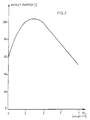
- Similarly, a powder containing 0.5% by weight of P and varying amounts of Mo in the range of 0-4% by weight was produced. Test pieces were produced by compacting at 589 MPa and sintering at 1120°C. The resulting impact energy values are apparent from Fig. 3. As shown therein, 0.3-3.5% by weight of Mo constitutes a useful range, whereas 0.5-2.5% by weight of Mo constitutes a preferred range.
- Very likely, the results obtained are due to the fol-lowing. The addition of P entails that a liquid phase is obtained during sintering at a comparatively low temperature, resulting in a better distribution of P in the material. P diffuses into the iron particles, and, to some extent, austenite is transformed to ferrite, which facilitates the diffusion of Mo. Both P and Mo are ferrite stabilisers, and the transformation to ferrite increases the self-diffusion of Fe. This gives an active sintering, resulting in shrinkage and round pores.
- Suitably, P is present in the form of a phosphor compound, preferably iron phosphide, e.g. Fe₃P.
- The other alloying elements may be of a type not affecting the impact energy adversely, and common in powder metallurgy. As non-restrictive examples, mention may be made of Ni, W, Mn and Cr. Cu should not be used at all.
Claims (10)
- An iron-based powder for producing impact-resistant components by powder compacting and sintering, characterised by containing, in addition to Fe, 0.3-0.7% by weight of P, 0.3-3.5% by weight of Mo, not more than 0.1% by weight of C and not more than 1% by weight of other alloying elements.
- The powder of claim 1, characterised in that the amount of Mo is 0.5-2.5% by weight.
- The powder of claim 1 or 2, characterised in that the amount of P is 0.35-0.65% by weight.
- The powder of claim 1 or 2, characterised in that the amount of P is 0.4-0.6% by weight.
- The powder of any of the claims 1-4, characterised in that P is present in the form of iron phosphide, preferable Fe₃P.
- The powder of any one of claims 1-5, characterised in that the amount of other alloying elements does not exceed 0.5% by weight.
- The powder of any one of claims 1-6, characterised by not containing more than 0.07% by weight of C.
- A method of powder-metallurgically producing impact-resistant steel components, characterised by using iron based powder which, in addition to Fe, contains 0.3-0.7% by weight of P, preferably 0.35-0.65% by weight of P, 0.3-3.5% by weight of Mo, preferably 0.5-2.5% by weight of Mo, not more than 0.1% by weight of C and not more than 1% by weight of other elements; compacting the powder into the desired shape and sintering the compact.
- A powder-metallurgically produced component, characterised by containing, in addition to Fe, 0.3-0.7% by weight of P, 0.3-3.5% by weight of Mo, not more tha 0.1% by weight of C and not more than 1% by weight of other alloying elements.
- Use of a powder for producing impact-resistant components by powder compacting and sintering, characterised in that the powder, in addition to Fe, comprises 0.3-0.7% by weight of P, 0.3-3.5% by weight of Mo, not more than 0.1% by wieght of C and not more than 1% by weight of other alloying elements.
Applications Claiming Priority (3)
| Application Number | Priority Date | Filing Date | Title |
|---|---|---|---|
| SE9002070 | 1990-06-11 | ||
| SE9002070A SE468583B (en) | 1990-06-11 | 1990-06-11 | YEAR-BASED POWDER, SHIPPING STEEL COMPONENTS OF THE POWDER AND WERE MADE TO MANUFACTURE THESE |
| PCT/SE1991/000404 WO1991019582A1 (en) | 1990-06-11 | 1991-06-07 | Iron-based powder, component produced therefrom, and method of producing the component |
Publications (2)
| Publication Number | Publication Date |
|---|---|
| EP0533812A1 EP0533812A1 (en) | 1993-03-31 |
| EP0533812B1 true EP0533812B1 (en) | 1995-08-16 |
Family
ID=20379728
Family Applications (1)
| Application Number | Title | Priority Date | Filing Date |
|---|---|---|---|
| EP91911997A Expired - Lifetime EP0533812B1 (en) | 1990-06-11 | 1991-06-07 | Iron-based powder, component produced therefrom, and method of producing the component |
Country Status (10)
| Country | Link |
|---|---|
| EP (1) | EP0533812B1 (en) |
| JP (1) | JP3280377B2 (en) |
| KR (1) | KR100189234B1 (en) |
| AT (1) | ATE126461T1 (en) |
| BR (1) | BR9106546A (en) |
| CA (1) | CA2084679C (en) |
| DE (1) | DE69112214T2 (en) |
| ES (1) | ES2075961T3 (en) |
| SE (1) | SE468583B (en) |
| WO (1) | WO1991019582A1 (en) |
Families Citing this family (5)
| Publication number | Priority date | Publication date | Assignee | Title |
|---|---|---|---|---|
| DE4331938A1 (en) * | 1993-09-16 | 1995-03-23 | Mannesmann Ag | Molybdenum-containing iron base powder |
| SE9401823D0 (en) * | 1994-05-27 | 1994-05-27 | Hoeganaes Ab | Nickel free iron powder |
| JP4616220B2 (en) * | 2006-07-18 | 2011-01-19 | Jfeテクノリサーチ株式会社 | Method for producing hollow metal body |
| JP4641010B2 (en) * | 2006-07-25 | 2011-03-02 | Jfeテクノリサーチ株式会社 | Hollow metal body |
| KR101867843B1 (en) * | 2010-12-30 | 2018-06-18 | 회가내스 아베 (피유비엘) | Iron based powders for powder injection molding |
Family Cites Families (2)
| Publication number | Priority date | Publication date | Assignee | Title |
|---|---|---|---|---|
| SE372293B (en) * | 1972-05-02 | 1974-12-16 | Hoeganaes Ab | |
| DE2613255C2 (en) * | 1976-03-27 | 1982-07-29 | Robert Bosch Gmbh, 7000 Stuttgart | Use of an iron-molybdenum-nickel sintered alloy with the addition of phosphorus for the production of high-strength workpieces |
-
1990
- 1990-06-11 SE SE9002070A patent/SE468583B/en not_active IP Right Cessation
-
1991
- 1991-06-07 WO PCT/SE1991/000404 patent/WO1991019582A1/en not_active Ceased
- 1991-06-07 DE DE69112214T patent/DE69112214T2/en not_active Expired - Fee Related
- 1991-06-07 ES ES91911997T patent/ES2075961T3/en not_active Expired - Lifetime
- 1991-06-07 AT AT91911997T patent/ATE126461T1/en not_active IP Right Cessation
- 1991-06-07 JP JP51115991A patent/JP3280377B2/en not_active Expired - Fee Related
- 1991-06-07 CA CA002084679A patent/CA2084679C/en not_active Expired - Fee Related
- 1991-06-07 EP EP91911997A patent/EP0533812B1/en not_active Expired - Lifetime
- 1991-06-07 BR BR919106546A patent/BR9106546A/en not_active IP Right Cessation
-
1992
- 1992-12-08 KR KR1019920703140A patent/KR100189234B1/en not_active Expired - Fee Related
Also Published As
| Publication number | Publication date |
|---|---|
| JPH05507967A (en) | 1993-11-11 |
| SE9002070D0 (en) | 1990-06-11 |
| SE468583B (en) | 1993-02-15 |
| EP0533812A1 (en) | 1993-03-31 |
| DE69112214D1 (en) | 1995-09-21 |
| ATE126461T1 (en) | 1995-09-15 |
| KR930700243A (en) | 1993-03-13 |
| WO1991019582A1 (en) | 1991-12-26 |
| JP3280377B2 (en) | 2002-05-13 |
| ES2075961T3 (en) | 1995-10-16 |
| DE69112214T2 (en) | 1996-01-04 |
| BR9106546A (en) | 1993-06-01 |
| KR100189234B1 (en) | 1999-06-01 |
| SE9002070L (en) | 1991-12-12 |
| CA2084679C (en) | 2003-04-01 |
| CA2084679A1 (en) | 1991-12-12 |
Similar Documents
| Publication | Publication Date | Title |
|---|---|---|
| EP0528952B1 (en) | Iron-based powder, component made thereof, and method of making the component | |
| GB2197663A (en) | High density sintered ferrous alloys | |
| CA1337468C (en) | Alloyed steel powder for powder metallurgy | |
| WO1992022395A1 (en) | Iron-based powder composition having good dimensional stability after sintering | |
| EP0787048B1 (en) | Manganese containing materials having high tensile strength | |
| EP0812925B1 (en) | Low alloy steel powders for sinterhardening | |
| GB2325005A (en) | Method of forming a component | |
| US5703304A (en) | Iron-based powder containing chromium, molybdenum and manganese | |
| CA2084679C (en) | Iron-based powder, component produced therefrom, and method of producing the component | |
| US5728238A (en) | Iron based powder, component produced therefrom and method of producing the component | |
| Lal et al. | Effect of phosphorus and silicon addition on the sintered properties of 316L austenitic stainless steel and its composites containing 4 vol% yttria | |
| EP0136169B1 (en) | An alloy steel powder for high strength sintered parts | |
| CA2116361C (en) | Powder-metallurgical composition having good soft magnetic properties | |
| EP0200691B1 (en) | Iron-based powder mixture for a sintered alloy | |
| EP0760724B1 (en) | IRON BASED POWDER CONTAINING Mo, P AND C | |
| CA2165087C (en) | Process for preparing a powder mixture and its use | |
| JPH04165002A (en) | High compressibility cr base alloy steel powder and manufacture of high strength sintered material using it | |
| EP0079320B1 (en) | Chromium-containing iron or steel powder and a process for its manufacture | |
| KR100222162B1 (en) | Iron-based powder composition and method for producing the same having good dimensional stability | |
| Igharo et al. | Sintering of Mixed High Speed Steel and Iron—Phosphorus Powders | |
| Maroli et al. | Properties and microstructure of PM materials pre-alloyed with nickel, molybdenum and chromium | |
| JPH101756A (en) | Ferrous sintered sliding member and its production | |
| WO1994013418A1 (en) | Iron-based powder composition | |
| JPS59166652A (en) | Ferrous sintered body | |
| SK302992A3 (en) | Powder pre-alloy for alloying powdered mixed steels preferably with chromium and a method for producing it |
Legal Events
| Date | Code | Title | Description |
|---|---|---|---|
| PUAI | Public reference made under article 153(3) epc to a published international application that has entered the european phase |
Free format text: ORIGINAL CODE: 0009012 |
|
| 17P | Request for examination filed |
Effective date: 19921203 |
|
| AK | Designated contracting states |
Kind code of ref document: A1 Designated state(s): AT CH DE ES FR GB IT LI |
|
| 17Q | First examination report despatched |
Effective date: 19940120 |
|
| GRAA | (expected) grant |
Free format text: ORIGINAL CODE: 0009210 |
|
| AK | Designated contracting states |
Kind code of ref document: B1 Designated state(s): AT CH DE ES FR GB IT LI |
|
| REF | Corresponds to: |
Ref document number: 126461 Country of ref document: AT Date of ref document: 19950915 Kind code of ref document: T |
|
| REF | Corresponds to: |
Ref document number: 69112214 Country of ref document: DE Date of ref document: 19950921 |
|
| ITF | It: translation for a ep patent filed | ||
| REG | Reference to a national code |
Ref country code: ES Ref legal event code: FG2A Ref document number: 2075961 Country of ref document: ES Kind code of ref document: T3 |
|
| ET | Fr: translation filed | ||
| PLBE | No opposition filed within time limit |
Free format text: ORIGINAL CODE: 0009261 |
|
| STAA | Information on the status of an ep patent application or granted ep patent |
Free format text: STATUS: NO OPPOSITION FILED WITHIN TIME LIMIT |
|
| 26N | No opposition filed | ||
| REG | Reference to a national code |
Ref country code: GB Ref legal event code: IF02 |
|
| PGFP | Annual fee paid to national office [announced via postgrant information from national office to epo] |
Ref country code: AT Payment date: 20070605 Year of fee payment: 17 |
|
| PGFP | Annual fee paid to national office [announced via postgrant information from national office to epo] |
Ref country code: CH Payment date: 20070606 Year of fee payment: 17 |
|
| PGFP | Annual fee paid to national office [announced via postgrant information from national office to epo] |
Ref country code: DE Payment date: 20070607 Year of fee payment: 17 |
|
| PGFP | Annual fee paid to national office [announced via postgrant information from national office to epo] |
Ref country code: ES Payment date: 20070611 Year of fee payment: 17 |
|
| PGFP | Annual fee paid to national office [announced via postgrant information from national office to epo] |
Ref country code: GB Payment date: 20070605 Year of fee payment: 17 |
|
| PGFP | Annual fee paid to national office [announced via postgrant information from national office to epo] |
Ref country code: IT Payment date: 20070608 Year of fee payment: 17 |
|
| PGFP | Annual fee paid to national office [announced via postgrant information from national office to epo] |
Ref country code: FR Payment date: 20070606 Year of fee payment: 17 |
|
| REG | Reference to a national code |
Ref country code: CH Ref legal event code: PL |
|
| GBPC | Gb: european patent ceased through non-payment of renewal fee |
Effective date: 20080607 |
|
| REG | Reference to a national code |
Ref country code: FR Ref legal event code: ST Effective date: 20090228 |
|
| PG25 | Lapsed in a contracting state [announced via postgrant information from national office to epo] |
Ref country code: AT Free format text: LAPSE BECAUSE OF NON-PAYMENT OF DUE FEES Effective date: 20080607 Ref country code: DE Free format text: LAPSE BECAUSE OF NON-PAYMENT OF DUE FEES Effective date: 20090101 |
|
| PG25 | Lapsed in a contracting state [announced via postgrant information from national office to epo] |
Ref country code: CH Free format text: LAPSE BECAUSE OF NON-PAYMENT OF DUE FEES Effective date: 20080630 Ref country code: GB Free format text: LAPSE BECAUSE OF NON-PAYMENT OF DUE FEES Effective date: 20080607 Ref country code: LI Free format text: LAPSE BECAUSE OF NON-PAYMENT OF DUE FEES Effective date: 20080630 |
|
| REG | Reference to a national code |
Ref country code: ES Ref legal event code: FD2A Effective date: 20080609 |
|
| PG25 | Lapsed in a contracting state [announced via postgrant information from national office to epo] |
Ref country code: FR Free format text: LAPSE BECAUSE OF NON-PAYMENT OF DUE FEES Effective date: 20080630 Ref country code: IT Free format text: LAPSE BECAUSE OF NON-PAYMENT OF DUE FEES Effective date: 20080607 |
|
| PG25 | Lapsed in a contracting state [announced via postgrant information from national office to epo] |
Ref country code: ES Free format text: LAPSE BECAUSE OF NON-PAYMENT OF DUE FEES Effective date: 20080609 |