EP0529925A2 - Gerät und Verfahren zur Infrarot-thermischen Durchgangspektrometrie von eingeschlossenen fliessfähigen Materialien - Google Patents
Gerät und Verfahren zur Infrarot-thermischen Durchgangspektrometrie von eingeschlossenen fliessfähigen Materialien Download PDFInfo
- Publication number
- EP0529925A2 EP0529925A2 EP92307556A EP92307556A EP0529925A2 EP 0529925 A2 EP0529925 A2 EP 0529925A2 EP 92307556 A EP92307556 A EP 92307556A EP 92307556 A EP92307556 A EP 92307556A EP 0529925 A2 EP0529925 A2 EP 0529925A2
- Authority
- EP
- European Patent Office
- Prior art keywords
- emission spectrum
- thermal infrared
- infrared emission
- transport system
- infrared
- Prior art date
- Legal status (The legal status is an assumption and is not a legal conclusion. Google has not performed a legal analysis and makes no representation as to the accuracy of the status listed.)
- Withdrawn
Links
Images

Classifications
-
- G—PHYSICS
- G01—MEASURING; TESTING
- G01N—INVESTIGATING OR ANALYSING MATERIALS BY DETERMINING THEIR CHEMICAL OR PHYSICAL PROPERTIES
- G01N25/00—Investigating or analyzing materials by the use of thermal means
- G01N25/72—Investigating presence of flaws
-
- G—PHYSICS
- G01—MEASURING; TESTING
- G01N—INVESTIGATING OR ANALYSING MATERIALS BY DETERMINING THEIR CHEMICAL OR PHYSICAL PROPERTIES
- G01N21/00—Investigating or analysing materials by the use of optical means, i.e. using sub-millimetre waves, infrared, visible or ultraviolet light
- G01N21/62—Systems in which the material investigated is excited whereby it emits light or causes a change in wavelength of the incident light
- G01N21/71—Systems in which the material investigated is excited whereby it emits light or causes a change in wavelength of the incident light thermally excited
-
- G—PHYSICS
- G01—MEASURING; TESTING
- G01J—MEASUREMENT OF INTENSITY, VELOCITY, SPECTRAL CONTENT, POLARISATION, PHASE OR PULSE CHARACTERISTICS OF INFRARED, VISIBLE OR ULTRAVIOLET LIGHT; COLORIMETRY; RADIATION PYROMETRY
- G01J5/00—Radiation pyrometry, e.g. infrared or optical thermometry
- G01J5/60—Radiation pyrometry, e.g. infrared or optical thermometry using determination of colour temperature
- G01J5/601—Radiation pyrometry, e.g. infrared or optical thermometry using determination of colour temperature using spectral scanning
-
- G—PHYSICS
- G01—MEASURING; TESTING
- G01N—INVESTIGATING OR ANALYSING MATERIALS BY DETERMINING THEIR CHEMICAL OR PHYSICAL PROPERTIES
- G01N21/00—Investigating or analysing materials by the use of optical means, i.e. using sub-millimetre waves, infrared, visible or ultraviolet light
- G01N21/17—Systems in which incident light is modified in accordance with the properties of the material investigated
- G01N21/171—Systems in which incident light is modified in accordance with the properties of the material investigated with calorimetric detection, e.g. with thermal lens detection
- G01N2021/1714—Photothermal radiometry with measurement of emission
-
- G—PHYSICS
- G01—MEASURING; TESTING
- G01N—INVESTIGATING OR ANALYSING MATERIALS BY DETERMINING THEIR CHEMICAL OR PHYSICAL PROPERTIES
- G01N21/00—Investigating or analysing materials by the use of optical means, i.e. using sub-millimetre waves, infrared, visible or ultraviolet light
- G01N21/17—Systems in which incident light is modified in accordance with the properties of the material investigated
- G01N2021/178—Methods for obtaining spatial resolution of the property being measured
- G01N2021/1782—In-depth resolution
-
- G—PHYSICS
- G01—MEASURING; TESTING
- G01N—INVESTIGATING OR ANALYSING MATERIALS BY DETERMINING THEIR CHEMICAL OR PHYSICAL PROPERTIES
- G01N21/00—Investigating or analysing materials by the use of optical means, i.e. using sub-millimetre waves, infrared, visible or ultraviolet light
- G01N21/84—Systems specially adapted for particular applications
- G01N21/85—Investigating moving fluids or granular solids
Definitions
- the present invention relates to spectroscopic analysis of materials, and particularly, to non-contact, remote spectroscopic analysis of a quantity of flowable material based on transient thermal infrared emission from the material.
- the flowable material includes liquids, gases, melts representing normally solid materials which have been heated above the melting temperature thereof, powders and pellets and which are enclosed in a transport system such as a container, conduit or the like.
- Spectroscopy is a well known and general method for analyzing materials.
- spectroscopic methods which, in turn, are applicable to certain types of analyses and measurements, and which have advantages and disadvantages.
- transient infrared spectroscopy has been applied to materials wherein a temperature gradient is created at the surface of the analyzed material so that a thin surface layer of the material is hotter or colder than the bulk of the sample material. If the surface is heated, it emits infrared light independent of the bulk of the sample material. Since the surface layer is thin, the spectrum thereof suffers less from the phenomenon of self-absorption that obscures the emission spectra of optically thick materials and can be appropriately detected to provide an indication of characteristics relating to molecular composition of the sample material.
- the surface layer acts as a thin transmission sample and the transmission spectrum which is detected is impressed onto the infrared light passing through the thin surface layer that is spontaneously emitted by the uncooled bulk of the material sample to provide an indication of characteristics relating to molecular composition of the sample material.
- the prior copending applications are generally related to materials which are not enclosed in a transport system such as a container, conduit, or the like.
- Another object of the present invention is to provide an apparatus and method of thermal transient infrared transmission spectroscopy which can be utilized on flowable enclosed materials.
- Another object of the present invention is to provide an apparatus and method for analyzing a flowable material enclosed in a transport system such as a container or the like by transiently generating a temperature differential between a thin surface layer portion and a lower portion sufficient to alter the thermal infrared emission spectrum from the black-body thermal emission spectrum of the material by heating or cooling the thin surface layer portion and by detecting, through an infrared transparent or transmitting portion of the transport system, the altered thermal emission spectrum of the material while the altered thermal emission spectrum is sufficiently free of self-absorption by the material of emitted infrared radiation.
- Another object to the present invention is to provide an apparatus and method as above described wherein the detection and the analyzation can be accomplished generally without physical contact with the material.
- a further object to the present invention is to provide an apparatus and method as above described which can be done remotely from the material being analyzed.
- a further object to the present invention is to provide an apparatus and method as above described which can derive the molecular composition of a material, and various physical and chemical properties of the material that are related to molecular composition.
- Another object to the present invention is to provide an apparatus and method as above described which can be utilized directly on production or processing lines which handle the materials.
- a still further object to the present invention is to provide an apparatus and method as above described which is non-destructive to the material being analyzed.
- a further object to the present invention is to provide an apparatus and method as above described which can also be utilized to analyze either large or small samples of the materials in laboratory settings.
- a still further object to the present invention is to provide an apparatus and method as above described which can be utilized with optically dense materials.
- a further object to the present invention is to provide an apparatus and method as above described which overcomes the spectroscopic problems caused by self-absorption of the emitted radiation from the material being analyzed.
- a further object of the present invention is to provide an apparatus and method as above described which can be utilized for an unknown quantity of flowable material, on both a continuous and non-destructive basis.
- Another object of the present invention is to provide an apparatus and method as above described which can be directly utilized in-process for an unknown quantity of moving material.
- a further object of the present invention is to provide an apparatus and method as above described which is economical, efficient and reliable.
- Another object of the present invention is to provide an apparatus and method as above described which can operate within the extreme and changing conditions of a processing environment for materials, or within a laboratory setting.
- a further object of the invention is to provide an apparatus and method as above described, which can be combined with a computer system to derive information about the materials useful for processing, control, and understanding of the material.
- the present invention provides an apparatus and method for nondestructively analyzing flowable materials enclosed in a transport system by infrared spectroscopy.
- a temperature differential is transiently generated between a thin surface layer portion of the material and a lower or deeper portion of the material sufficient to alter the thermal infrared emission spectrum of the material from the black-body thermal infrared emission spectrum of the material. That is, by heating or cooling a part of the surface of the material, a transient temperature differential is generated between the thin surface layer portion and lower or deeper portion of the material sufficient to alter the thermal infrared emission spectrum of the material from the black-body thermal infrared emission spectrum thereof.
- the altered thermal infrared emission spectrum of the material is detected while the altered thermal infrared emission spectrum is sufficiently free of self-absorption by the material of emitted infrared radiation, prior to the temperature differential propagating into the lower portion of the material to an extent such that the altered thermal infrared emission spectrum is no longer sufficiently free of self-absorption by the material of emitted infrared radiation.
- the altered thermal infrared emission spectrum is detected through an infrared transparent or transmitting portion of the transport system such as a window of a conduit as an infrared spectrum by a spectrometer, for example, and the spectrum contains information on the molecular composition of the material. Thereafter, characteristics relating to the molecular composition of the material may be determined based upon the detected altered thermal infrared emission.
- a heating or cooling source applies energy to a part of the surface of the material to cause transient heating or cooling of the thin surface layer of the material.
- thermal infrared emission from the thin layer is detected through the transparent portion of the transport system and is analyzed by the detector to obtain infrared absorbance spectra of the material utilizing Kirchhoff's law.
- cooling of the thin surface layer of the material superpositioning of the transmission spectrum of the cooled layer on the emission of infrared radiation from the hotter lower portion of material below the cooled layer results in the altered infrared emission which is detected by a detector through the transparent portion of the transport system.
- the bulk of the material i.e., all of the material below the cooled or chilled layer having a depth l
- the bulk or lower portion of the material will emit a black-body spectrum characteristic of the temperature T H .
- the chilled surface layer is optically thin so that l ⁇ 1/ ⁇ , where ⁇ is the absorption coefficient, then the surface layer will emit a negligible amount of infrared as compared to the amount passing through it from the bulk, both because it is thin and because emission intensity is proportional to T4, so that the cooled surface layer will absorb infrared from the bulk emission and altered thermal infrared emission will be detected.
- the cooled or chilled layer will behave in the manner of a sample of thickness, l when placed in an infrared spectrometer whose source is at temperature T H and the emission reaching the spectrometer will be a transmission spectrum of the optically thin cooled layer and will be referred to hereinafter as a "transmission spectrum”.
- the analysis and detection of the transmission spectrum or altered thermal infrared emission is accomplished by a spectrometer and detector which, in preferred embodiments, can be, for example, a cooled HgCdTe infrared detector.
- the detector operates so as to detect the altered thermal infrared emission spectrum of the material which has been altered from the black body thermal infrared emission spectrum of the material as a result of the generation of the temperature differential transiently in the thin surface layer portion by cooling of such thin surface layer portion while the altered thermal infrared emission spectrum is sufficiently free of self-absorption by the material of emitted infrared radiation.
- the detection is effected prior to the temperature differential propagating through the lower or deeper portion of the material to an extent such that the altered thermal infrared emission spectrum is no longer sufficiently free of self-absorption by the material of emitted infrared radiation.
- the detected altered thermal infrared emission spectrum is indicative of characteristics relating to the molecular composition of the material.
- the detector may be controlled by a control arrangement and/or provide an output to a control arrangement including a processor having appropriate software for deriving different characteristics from the detected and selected spectra of the infrared radiation from the material.
- a control arrangement including a processor having appropriate software for deriving different characteristics from the detected and selected spectra of the infrared radiation from the material.
- control arrangement or processor may include appropriate computer memory, storage, and printer or graphic components.
- Fig. 1 is a block diagram arrangement and partial cross-sectional view of an embodiment of the present invention.
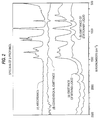
- Fig. 2 is a graphical depiction of observed spectra obtained in accordance with the embodiment of Fig: 1 and conventionally obtained spectra.
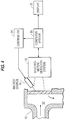
- Fig. 3 is a block diagram arrangement and partial sectional view of another embodiment of the present invention.
- Fig. 4 is a block diagram arrangement and partial sectional view of a further embodiment of the present invention.
- Fig. 1 illustrates an embodiment of the present invention wherein the flowable material 10 to be analyzed in the form of a liquid, a slurry or powder, flows in a transport system 12 such as a container or conduit past a thermally thin, infrared transparent or transmitting portion 14 of the transport system such as a window disposed in a wall of the container or conduit.
- a transport system 12 such as a container or conduit past a thermally thin, infrared transparent or transmitting portion 14 of the transport system such as a window disposed in a wall of the container or conduit.
- An energy source 16 applies either heating or cooling energy to the flowable material for heating or cooling the thin surface layer of the material adjacent the window.
- the energy source 16 may be a hot gas jet or a laser disposed so as to apply the energy to the material through the window 14 in a pulsed or continuous manner.
- the energy source 16 may be a cooling gas jet disposed so as to apply the energy to the material through the window 14.
- a spectrometer/detector system 18 is disposed with respect to the window and having a field of view indicated in dashed line for observing the emission spectrum when heat energy is applied or transmission spectrum when cooling energy is applied to the thin layer through the window. Sample flow prevents the thermally altered thin surface layer which contacts the window 14 from growing so thick that its infrared opacity prevents acquisition of useful spectra.
- collection optics may be used to focus infrared radiation emitted by the flowable material 10 onto the spectrometer/detector system 18 and the system generates an electrical signal as a function of the wavenumber of the emitted radiation.
- a computer system 20 processes the signals from the system 18 in order to obtain the chemical or physical information required.
- the computer system 20 is coupled to a display 22 for displaying desired information including detected spectra by way of a display screen or printer, for example.
- the computer system may also be coupled to a controller 24 for controlling the operation of the energy and/or process parameters, for example.
- Fig. 2 shows spectra of 2-propanol (ordinary rubbing alcohol) obtained in accordance with an embodiment corresponding to Fig. 1.
- Heat was applied utilizing a hot gas jet to the outside surface of a very thin (12 ⁇ m) window of polyethylene in the side of a container containing the 2-propanol as the liquid to be analyzed.
- Polyethylene has very little infrared spectrum of its own and the thinness of the window both reduced its contribution to the observed spectrum and allowed the heat applied to the outside to be readily transmitted to the liquid in the container.
- the bottom two spectra (a) and (b) of Fig. 2 were taken in accordance with the embodiment of Fig. 1 wherein one spectrum (a) represents the spectrum obtained with the alcohol moving or flowing and the other spectrum (b) with the liquid in a stationary state.
- the top spectrum (c) is included for comparison purposes. It was taken conventionally by passing infrared light through a very thin film of the stationary alcohol; it shows the structure a spectroscopist would look for to identify the liquid.
- the nearly flat spectrum (d) was taken by heating up all of the alcohol in the container. The near absence in this spectrum of the structure indicative of 2-propanol is the result of self-absorption.
- the bottom two spectra (a) and (b) have the same structure as the top spectrum (c), although the stronger peaks have all been truncated to approximately the same height. This too is the effect of self-absorption, but in the spectra, in accordance with the present invention, the self-absorption has been reduced to the level that analytically useful structure is present in the spectra.
- the thickness of the heated layer of alcohol that contributes to the spectrum is controlled by speeds of thermal diffusion and convection within the alcohol. When the sample is flowing, the heated layer is actively thinned by a motion much faster than convection.
- the spectrum of the moving liquid suffers from less self-absorption and is the better match to the absorbance spectrum at the top.
- the polyethylene window does contribute a small amount to the spectra in that it is responsible for the peak at 817 cm ⁇ 1 and in part for the peak at 1467 cm ⁇ 1 .
- the rest of the structure in the detected spectra is due to the alcohol. Weak features barely visible in the top spectrum show up much more strongly in the bottom two spectra not because they are intrinsically stronger, but because the strong features are relatively much weaker due to self-absorption.
- Fig. 3 shows an embodiment wherein the fluid 10 flows in the direction indicated by the arrow or past a thick infrared transparent or transmitting window 14' having a convex surface 15 protruding into the flow of the material so as to provide better contact with the material and forming a lens to assist in the gathering of the infrared signal.
- Heat is applied by a tantalum ribbon 16' extending perpendicular to the direction of flow at the upstream edge of the spectrometer field of view (shown by the dashed lines) of the spectrometer/detector system 18 and is held against the inner surface of the window 14' of the transport system 12.
- the heating element could consist of thin films deposited directly on the window within or outside the field of view of the spectrometer.
- a heat exchanger made of small-diameter, thin-walled tubing carrying either hot or cold liquid could be attached to the window.
- Many other small-scale refrigerators or cooling sources e.g., thermoelectric, Joule-Thomson
- the heat or cold sources could be provided on the outside of the window rather than on the inside.
- pellets 10' or the like flowing in the direction of the arrows in a pneumatic transport tube 12' will have substantial momentum.
- a window 14'' is positioned as shown in Fig. 4 so that the pellets are pressed against the window and moderate jet of hot or cold gas from the energy source 16 is applied at the upstream edge of the window to generate the thermal transient.
- the spectrometer/detector system 18 and other system components operate in the manner described above. This arrangement is also applicable to a sample material of two-phase such as a slurry.
- the heating energy source may be a laser as described in the aforementioned copending applications so long as the window of the transport system through which the infrared spectrum is detected also enables passage of the laser beam therethrough to enable heating of the material enclosed in the transport system.
- the spectrometer/detector system operates in the case of flowing material to detect substantially only the transient altered thermal emission of infrared radiation passing through the field of view thereof or in the case of stationary material is controlled to detect the transient altered thermal emission of infrared radiation for a predetermined period of time, for example.
- the computer system enables processing of the signal detected and measured by the spectrometer/detector system to obtain molecular concentrations or other physical or chemical information through correlation techniques as required for any number of different operations such as process control, quality control, analytical chemistry, or non-destructive evaluation application.
- the computer system can also include appropriate computer software and complementary data for deriving different material characteristics from infrared emission spectra. Additionally, the computer system can use appropriate software, displays, complementary data and servo systems to make decisions and send and execute commands based on the infrared spectra for process control, for example.
Landscapes
- Health & Medical Sciences (AREA)
- Physics & Mathematics (AREA)
- Life Sciences & Earth Sciences (AREA)
- Chemical & Material Sciences (AREA)
- Analytical Chemistry (AREA)
- Biochemistry (AREA)
- General Health & Medical Sciences (AREA)
- General Physics & Mathematics (AREA)
- Immunology (AREA)
- Pathology (AREA)
- Nuclear Medicine, Radiotherapy & Molecular Imaging (AREA)
- Investigating Or Analysing Materials By Optical Means (AREA)
Applications Claiming Priority (2)
| Application Number | Priority Date | Filing Date | Title |
|---|---|---|---|
| US07/749,186 US5191215A (en) | 1989-01-13 | 1991-08-23 | Apparatus and method for transient thermal infrared spectrometry of flowable enclosed materials |
| US749186 | 1991-08-23 |
Publications (2)
| Publication Number | Publication Date |
|---|---|
| EP0529925A2 true EP0529925A2 (de) | 1993-03-03 |
| EP0529925A3 EP0529925A3 (en) | 1993-05-19 |
Family
ID=25012643
Family Applications (1)
| Application Number | Title | Priority Date | Filing Date |
|---|---|---|---|
| EP19920307556 Withdrawn EP0529925A3 (en) | 1991-08-23 | 1992-08-19 | Apparatus and method for transient thermal infrared spectrometry of flowable enclosed materials |
Country Status (3)
| Country | Link |
|---|---|
| US (1) | US5191215A (de) |
| EP (1) | EP0529925A3 (de) |
| CA (1) | CA2075760A1 (de) |
Cited By (2)
| Publication number | Priority date | Publication date | Assignee | Title |
|---|---|---|---|---|
| WO1995018368A1 (en) * | 1993-12-30 | 1995-07-06 | Ab Volvo | Method and device for measuring the cleaning capacity of a cleaning bath |
| US11141082B2 (en) | 2008-04-11 | 2021-10-12 | Glucovista Inc. | Method for non-invasive analysis of a substance concentration within a body |
Families Citing this family (15)
| Publication number | Priority date | Publication date | Assignee | Title |
|---|---|---|---|---|
| US5426053A (en) * | 1993-09-21 | 1995-06-20 | Exxon Research And Engineering Company | Optimization of acid strength and total organic carbon in acid processes (C-2644) |
| US6025597A (en) * | 1995-10-17 | 2000-02-15 | Optiscan Biomedical Corporation | Non-invasive infrared absorption spectrometer for measuring glucose or other constituents in a human or other body |
| US6072180A (en) * | 1995-10-17 | 2000-06-06 | Optiscan Biomedical Corporation | Non-invasive infrared absorption spectrometer for the generation and capture of thermal gradient spectra from living tissue |
| US6161028A (en) | 1999-03-10 | 2000-12-12 | Optiscan Biomedical Corporation | Method for determining analyte concentration using periodic temperature modulation and phase detection |
| US5900632A (en) * | 1997-03-12 | 1999-05-04 | Optiscan Biomedical Corporation | Subsurface thermal gradient spectrometry |
| US6002953A (en) * | 1998-05-06 | 1999-12-14 | Optix Lp | Non-invasive IR transmission measurement of analyte in the tympanic membrane |
| US6633771B1 (en) * | 1999-03-10 | 2003-10-14 | Optiscan Biomedical Corporation | Solid-state non-invasive thermal cycling spectrometer |
| US6198949B1 (en) * | 1999-03-10 | 2001-03-06 | Optiscan Biomedical Corporation | Solid-state non-invasive infrared absorption spectrometer for the generation and capture of thermal gradient spectra from living tissue |
| US20020080349A1 (en) * | 2000-12-22 | 2002-06-27 | Armstrong Thomas M. | Sample chamber for use in analytical instrumentation |
| US20030122081A1 (en) * | 2001-10-29 | 2003-07-03 | Roger Herrera | Window assembly |
| EP1487676A2 (de) * | 2002-03-26 | 2004-12-22 | Automotive Systems Laboratory, Inc. | Zweistufige aufblasvorrichtung mit mehreren kammern |
| US7428919B2 (en) * | 2004-08-02 | 2008-09-30 | Young David P | Method and system for evaluating fluid flow through a heat exchanger |
| CA2641694C (en) * | 2006-02-13 | 2016-06-28 | All Protect Llc | Method and system for controlling a vehicle given to a third party |
| US8549318B2 (en) * | 2006-02-13 | 2013-10-01 | Affirmed Technologies, Llc | Method and system for preventing unauthorized use of a vehicle by an operator of the vehicle |
| CN111646474B (zh) * | 2020-06-12 | 2023-06-02 | 将乐三晶新材料有限公司 | 一种熔融液体制备金属硅粉工艺 |
Family Cites Families (6)
| Publication number | Priority date | Publication date | Assignee | Title |
|---|---|---|---|---|
| US3773424A (en) * | 1972-08-24 | 1973-11-20 | Neotec Corp | Device for color measurement of liquids in continuous flow |
| NO164133C (no) * | 1985-07-15 | 1993-10-26 | Svein Otto Kanstad | Framgangsmaate og apparat for karakterisering og kontroll av stoffer, materialer og objekter |
| US4883963A (en) * | 1986-04-28 | 1989-11-28 | Bran+Luebbe Gmbh | Optical analysis method and apparatus having programmable rapid random wavelength access |
| US5075552A (en) * | 1989-01-13 | 1991-12-24 | Iowa State University Research Foundation Inc. | Apparatus and method for transient thermal infrared emission spectrometry |
| JPH03504164A (ja) * | 1989-01-13 | 1991-09-12 | アイオワ・ステイト・ユニバーシティー・リサーチ・ファウンデーション・インコーポレイテッド | 過渡的熱赤外線放射スペクトル光度測定方法及びその装置 |
| EP0465082A3 (en) * | 1990-07-02 | 1992-03-11 | Iowa State University Research Foundation, Inc. | Apparatus and method for transient thermal infrared spectrometry |
-
1991
- 1991-08-23 US US07/749,186 patent/US5191215A/en not_active Expired - Lifetime
-
1992
- 1992-08-11 CA CA002075760A patent/CA2075760A1/en not_active Abandoned
- 1992-08-19 EP EP19920307556 patent/EP0529925A3/en not_active Withdrawn
Cited By (2)
| Publication number | Priority date | Publication date | Assignee | Title |
|---|---|---|---|---|
| WO1995018368A1 (en) * | 1993-12-30 | 1995-07-06 | Ab Volvo | Method and device for measuring the cleaning capacity of a cleaning bath |
| US11141082B2 (en) | 2008-04-11 | 2021-10-12 | Glucovista Inc. | Method for non-invasive analysis of a substance concentration within a body |
Also Published As
| Publication number | Publication date |
|---|---|
| US5191215A (en) | 1993-03-02 |
| EP0529925A3 (en) | 1993-05-19 |
| CA2075760A1 (en) | 1993-02-24 |
Similar Documents
| Publication | Publication Date | Title |
|---|---|---|
| US5191215A (en) | Apparatus and method for transient thermal infrared spectrometry of flowable enclosed materials | |
| US5070242A (en) | Apparatus and method for transient thermal infrared spectrometry | |
| US5141331A (en) | Ultrasonic temperature measurement and uses in optical spectroscopy and calorimetry | |
| KR960012784B1 (ko) | 용융 금속의 중간 생성물 분석을 위한 순간 분광법 및 장치 | |
| US4652755A (en) | Method and apparatus for analyzing particle-containing gaseous suspensions | |
| DeWitt et al. | Theory and practice of radiation thermometry | |
| US4009962A (en) | Emission spectroscopic system having compensation for background radiation | |
| Adams et al. | Phase analysis in solid-sample optoacoustic spectrometry | |
| US4591718A (en) | Photothermal method for in situ microanalysis of the chemical composition of coal samples | |
| Hernandez et al. | Analysis and experimental results of solar-blind temperature measurements in solar furnaces | |
| Yang et al. | A single-photon lidar observes atmospheric clouds at decimeter scales: resolving droplet activation within cloud base | |
| Hartsfield et al. | Establishing temperature from radiance of dynamically compressed metals | |
| Balasubramaniam et al. | Use of liquid crystals as temperature sensors in food processing research | |
| JPH07181135A (ja) | 流動性材料の分析を可能とする装置および方法 | |
| Monier et al. | In situ experimental measurement of temperature field and surface tension during pulsed GMAW | |
| EP0465082A2 (de) | Vorrichtung und Verfahren für kurzzeitige thermische Infrarot-Spectrometrie | |
| CN111207680B (zh) | 分层溶液上层液体厚度检测方法 | |
| Peng et al. | An effective experimental method and apparatus for unsteady water vapor condensation investigation in high speed expansion flow | |
| EP0406399A1 (de) | Vorrichtung und verfahren zur transienten thermischen infrarot-emissionsspektroskopie | |
| McClelland et al. | Apparatus and method for transient thermal infrared spectrometry | |
| Schwiesow | Raman scattering from pollutant gases and air-water interfaces | |
| Znamenskaya et al. | IR-thermography studies of high-speed gas-dynamic flows | |
| CA2045733A1 (en) | Apparatus and method for transient thermal infrared spectrometry | |
| Erickson et al. | Infrared emission spectroscopy of liquid samples with multivariate calibration as a model for process analytical applications | |
| Fell et al. | Peering into the future |
Legal Events
| Date | Code | Title | Description |
|---|---|---|---|
| PUAI | Public reference made under article 153(3) epc to a published international application that has entered the european phase |
Free format text: ORIGINAL CODE: 0009012 |
|
| AK | Designated contracting states |
Kind code of ref document: A2 Designated state(s): DE FR GB |
|
| PUAL | Search report despatched |
Free format text: ORIGINAL CODE: 0009013 |
|
| AK | Designated contracting states |
Kind code of ref document: A3 Designated state(s): DE FR GB |
|
| STAA | Information on the status of an ep patent application or granted ep patent |
Free format text: STATUS: THE APPLICATION HAS BEEN WITHDRAWN |
|
| 18W | Application withdrawn |
Withdrawal date: 19931102 |