EP0528557B1 - Carbon/polymer composite electrode for use in a lithium battery - Google Patents
Carbon/polymer composite electrode for use in a lithium battery Download PDFInfo
- Publication number
- EP0528557B1 EP0528557B1 EP92306899A EP92306899A EP0528557B1 EP 0528557 B1 EP0528557 B1 EP 0528557B1 EP 92306899 A EP92306899 A EP 92306899A EP 92306899 A EP92306899 A EP 92306899A EP 0528557 B1 EP0528557 B1 EP 0528557B1
- Authority
- EP
- European Patent Office
- Prior art keywords
- carbon
- electrode according
- further characterised
- electrode
- amorphous carbon
- Prior art date
- Legal status (The legal status is an assumption and is not a legal conclusion. Google has not performed a legal analysis and makes no representation as to the accuracy of the status listed.)
- Expired - Lifetime
Links
- OKTJSMMVPCPJKN-UHFFFAOYSA-N Carbon Chemical compound [C] OKTJSMMVPCPJKN-UHFFFAOYSA-N 0.000 title claims abstract description 33
- 229920000642 polymer Polymers 0.000 title claims abstract description 25
- 229910052799 carbon Inorganic materials 0.000 title claims abstract description 23
- 239000002131 composite material Substances 0.000 title claims abstract description 22
- 229910052744 lithium Inorganic materials 0.000 title description 17
- WHXSMMKQMYFTQS-UHFFFAOYSA-N Lithium Chemical compound [Li] WHXSMMKQMYFTQS-UHFFFAOYSA-N 0.000 title description 15
- 239000000203 mixture Substances 0.000 claims abstract description 17
- 229910003481 amorphous carbon Inorganic materials 0.000 claims abstract description 16
- 239000003792 electrolyte Substances 0.000 claims abstract description 14
- 239000007788 liquid Substances 0.000 claims abstract description 12
- 239000011159 matrix material Substances 0.000 claims abstract description 12
- -1 alkali metal salt Chemical class 0.000 claims abstract description 11
- 229910052783 alkali metal Inorganic materials 0.000 claims abstract description 9
- HBBGRARXTFLTSG-UHFFFAOYSA-N Lithium ion Chemical compound [Li+] HBBGRARXTFLTSG-UHFFFAOYSA-N 0.000 claims abstract description 7
- 229910001416 lithium ion Inorganic materials 0.000 claims abstract description 7
- 229910032387 LiCoO2 Inorganic materials 0.000 claims abstract description 4
- XHCLAFWTIXFWPH-UHFFFAOYSA-N [O-2].[O-2].[O-2].[O-2].[O-2].[V+5].[V+5] Chemical compound [O-2].[O-2].[O-2].[O-2].[O-2].[V+5].[V+5] XHCLAFWTIXFWPH-UHFFFAOYSA-N 0.000 claims abstract description 4
- 229910001935 vanadium oxide Inorganic materials 0.000 claims abstract description 4
- 239000002904 solvent Substances 0.000 claims description 10
- 229920003171 Poly (ethylene oxide) Polymers 0.000 claims description 9
- RUOJZAUFBMNUDX-UHFFFAOYSA-N propylene carbonate Chemical group CC1COC(=O)O1 RUOJZAUFBMNUDX-UHFFFAOYSA-N 0.000 claims description 7
- 239000002245 particle Substances 0.000 claims description 6
- YEJRWHAVMIAJKC-UHFFFAOYSA-N 4-Butyrolactone Chemical compound O=C1CCCO1 YEJRWHAVMIAJKC-UHFFFAOYSA-N 0.000 claims description 4
- 239000006230 acetylene black Substances 0.000 claims description 4
- 229920001940 conductive polymer Polymers 0.000 claims description 4
- 239000013081 microcrystal Substances 0.000 claims description 3
- WNXJIVFYUVYPPR-UHFFFAOYSA-N 1,3-dioxolane Chemical compound C1COCO1 WNXJIVFYUVYPPR-UHFFFAOYSA-N 0.000 claims description 2
- 239000000178 monomer Substances 0.000 claims description 2
- JWUJQDFVADABEY-UHFFFAOYSA-N 2-methyltetrahydrofuran Chemical compound CC1CCCO1 JWUJQDFVADABEY-UHFFFAOYSA-N 0.000 claims 1
- 239000000010 aprotic solvent Substances 0.000 claims 1
- 230000002687 intercalation Effects 0.000 description 11
- 238000009830 intercalation Methods 0.000 description 11
- 150000001875 compounds Chemical class 0.000 description 10
- 230000005855 radiation Effects 0.000 description 10
- 238000000034 method Methods 0.000 description 8
- 150000003839 salts Chemical class 0.000 description 8
- PXHVJJICTQNCMI-UHFFFAOYSA-N Nickel Chemical compound [Ni] PXHVJJICTQNCMI-UHFFFAOYSA-N 0.000 description 7
- 239000003575 carbonaceous material Substances 0.000 description 6
- 239000011248 coating agent Substances 0.000 description 6
- 238000000576 coating method Methods 0.000 description 6
- 239000002243 precursor Substances 0.000 description 6
- 125000004386 diacrylate group Chemical group 0.000 description 5
- XLYOFNOQVPJJNP-UHFFFAOYSA-N water Substances O XLYOFNOQVPJJNP-UHFFFAOYSA-N 0.000 description 5
- 239000012298 atmosphere Substances 0.000 description 4
- 239000011888 foil Substances 0.000 description 4
- 229910052751 metal Inorganic materials 0.000 description 4
- 239000002184 metal Substances 0.000 description 4
- 229920001223 polyethylene glycol Polymers 0.000 description 4
- WEVYAHXRMPXWCK-UHFFFAOYSA-N Acetonitrile Chemical compound CC#N WEVYAHXRMPXWCK-UHFFFAOYSA-N 0.000 description 3
- 239000004593 Epoxy Substances 0.000 description 3
- 239000002202 Polyethylene glycol Substances 0.000 description 3
- 125000004432 carbon atom Chemical group C* 0.000 description 3
- 239000011231 conductive filler Substances 0.000 description 3
- 239000003431 cross linking reagent Substances 0.000 description 3
- 238000010894 electron beam technology Methods 0.000 description 3
- 229910002804 graphite Inorganic materials 0.000 description 3
- 239000010439 graphite Substances 0.000 description 3
- 239000000463 material Substances 0.000 description 3
- 229910052759 nickel Inorganic materials 0.000 description 3
- DGAQECJNVWCQMB-PUAWFVPOSA-M Ilexoside XXIX Chemical compound C[C@@H]1CC[C@@]2(CC[C@@]3(C(=CC[C@H]4[C@]3(CC[C@@H]5[C@@]4(CC[C@@H](C5(C)C)OS(=O)(=O)[O-])C)C)[C@@H]2[C@]1(C)O)C)C(=O)O[C@H]6[C@@H]([C@H]([C@@H]([C@H](O6)CO)O)O)O.[Na+] DGAQECJNVWCQMB-PUAWFVPOSA-M 0.000 description 2
- WYURNTSHIVDZCO-UHFFFAOYSA-N Tetrahydrofuran Chemical compound C1CCOC1 WYURNTSHIVDZCO-UHFFFAOYSA-N 0.000 description 2
- 150000001252 acrylic acid derivatives Chemical class 0.000 description 2
- 239000011149 active material Substances 0.000 description 2
- 150000001340 alkali metals Chemical class 0.000 description 2
- 230000015572 biosynthetic process Effects 0.000 description 2
- IISBACLAFKSPIT-UHFFFAOYSA-N bisphenol A Chemical compound C=1C=C(O)C=CC=1C(C)(C)C1=CC=C(O)C=C1 IISBACLAFKSPIT-UHFFFAOYSA-N 0.000 description 2
- 239000006229 carbon black Substances 0.000 description 2
- 238000006243 chemical reaction Methods 0.000 description 2
- 229920001577 copolymer Polymers 0.000 description 2
- 230000000875 corresponding effect Effects 0.000 description 2
- QXYJCZRRLLQGCR-UHFFFAOYSA-N dioxomolybdenum Chemical compound O=[Mo]=O QXYJCZRRLLQGCR-UHFFFAOYSA-N 0.000 description 2
- GNTDGMZSJNCJKK-UHFFFAOYSA-N divanadium pentaoxide Chemical compound O=[V](=O)O[V](=O)=O GNTDGMZSJNCJKK-UHFFFAOYSA-N 0.000 description 2
- 125000003700 epoxy group Chemical group 0.000 description 2
- 125000005842 heteroatom Chemical group 0.000 description 2
- 239000003999 initiator Substances 0.000 description 2
- NUJOXMJBOLGQSY-UHFFFAOYSA-N manganese dioxide Chemical compound O=[Mn]=O NUJOXMJBOLGQSY-UHFFFAOYSA-N 0.000 description 2
- 239000002798 polar solvent Substances 0.000 description 2
- 229920000647 polyepoxide Polymers 0.000 description 2
- 239000005518 polymer electrolyte Substances 0.000 description 2
- 150000003254 radicals Chemical class 0.000 description 2
- 229910052702 rhenium Inorganic materials 0.000 description 2
- 229910052708 sodium Inorganic materials 0.000 description 2
- 239000011734 sodium Substances 0.000 description 2
- 239000007787 solid Substances 0.000 description 2
- 239000007784 solid electrolyte Substances 0.000 description 2
- 238000000807 solvent casting Methods 0.000 description 2
- 238000003860 storage Methods 0.000 description 2
- 230000003319 supportive effect Effects 0.000 description 2
- 229920002818 (Hydroxyethyl)methacrylate Polymers 0.000 description 1
- VMCIKMLQXFLKAX-UHFFFAOYSA-N 1-methoxy-2-[2-[2-[2-[2-(2-methoxyethoxy)ethoxy]ethoxy]ethoxy]ethoxy]ethane Chemical compound COCCOCCOCCOCCOCCOCCOC VMCIKMLQXFLKAX-UHFFFAOYSA-N 0.000 description 1
- RQIOWVGTLVTEFX-UHFFFAOYSA-N 1-methoxy-2-[2-[2-[2-[2-[2-(2-methoxyethoxy)ethoxy]ethoxy]ethoxy]ethoxy]ethoxy]ethane Chemical compound COCCOCCOCCOCCOCCOCCOCCOC RQIOWVGTLVTEFX-UHFFFAOYSA-N 0.000 description 1
- OZAIFHULBGXAKX-UHFFFAOYSA-N 2-(2-cyanopropan-2-yldiazenyl)-2-methylpropanenitrile Chemical compound N#CC(C)(C)N=NC(C)(C)C#N OZAIFHULBGXAKX-UHFFFAOYSA-N 0.000 description 1
- SMZOUWXMTYCWNB-UHFFFAOYSA-N 2-(2-methoxy-5-methylphenyl)ethanamine Chemical compound COC1=CC=C(C)C=C1CCN SMZOUWXMTYCWNB-UHFFFAOYSA-N 0.000 description 1
- MTPIZGPBYCHTGQ-UHFFFAOYSA-N 2-[2,2-bis(2-prop-2-enoyloxyethoxymethyl)butoxy]ethyl prop-2-enoate Chemical compound C=CC(=O)OCCOCC(CC)(COCCOC(=O)C=C)COCCOC(=O)C=C MTPIZGPBYCHTGQ-UHFFFAOYSA-N 0.000 description 1
- FWWXYLGCHHIKNY-UHFFFAOYSA-N 2-ethoxyethyl prop-2-enoate Chemical compound CCOCCOC(=O)C=C FWWXYLGCHHIKNY-UHFFFAOYSA-N 0.000 description 1
- HFCUBKYHMMPGBY-UHFFFAOYSA-N 2-methoxyethyl prop-2-enoate Chemical compound COCCOC(=O)C=C HFCUBKYHMMPGBY-UHFFFAOYSA-N 0.000 description 1
- 229910017048 AsF6 Inorganic materials 0.000 description 1
- RYGMFSIKBFXOCR-UHFFFAOYSA-N Copper Chemical compound [Cu] RYGMFSIKBFXOCR-UHFFFAOYSA-N 0.000 description 1
- XTHFKEDIFFGKHM-UHFFFAOYSA-N Dimethoxyethane Chemical compound COCCOC XTHFKEDIFFGKHM-UHFFFAOYSA-N 0.000 description 1
- MYMOFIZGZYHOMD-UHFFFAOYSA-N Dioxygen Chemical compound O=O MYMOFIZGZYHOMD-UHFFFAOYSA-N 0.000 description 1
- PIICEJLVQHRZGT-UHFFFAOYSA-N Ethylenediamine Chemical compound NCCN PIICEJLVQHRZGT-UHFFFAOYSA-N 0.000 description 1
- WOBHKFSMXKNTIM-UHFFFAOYSA-N Hydroxyethyl methacrylate Chemical compound CC(=C)C(=O)OCCO WOBHKFSMXKNTIM-UHFFFAOYSA-N 0.000 description 1
- 229910009778 Li8V6O13 Inorganic materials 0.000 description 1
- 229910015084 LixV3O8 Inorganic materials 0.000 description 1
- CERQOIWHTDAKMF-UHFFFAOYSA-N Methacrylic acid Chemical compound CC(=C)C(O)=O CERQOIWHTDAKMF-UHFFFAOYSA-N 0.000 description 1
- 229910016003 MoS3 Inorganic materials 0.000 description 1
- WHNWPMSKXPGLAX-UHFFFAOYSA-N N-Vinyl-2-pyrrolidone Chemical compound C=CN1CCCC1=O WHNWPMSKXPGLAX-UHFFFAOYSA-N 0.000 description 1
- 239000004698 Polyethylene Substances 0.000 description 1
- 229920002556 Polyethylene Glycol 300 Polymers 0.000 description 1
- 239000004793 Polystyrene Substances 0.000 description 1
- ZLMJMSJWJFRBEC-UHFFFAOYSA-N Potassium Chemical compound [K] ZLMJMSJWJFRBEC-UHFFFAOYSA-N 0.000 description 1
- LCXXNKZQVOXMEH-UHFFFAOYSA-N Tetrahydrofurfuryl methacrylate Chemical compound CC(=C)C(=O)OCC1CCCO1 LCXXNKZQVOXMEH-UHFFFAOYSA-N 0.000 description 1
- 229910003092 TiS2 Inorganic materials 0.000 description 1
- ZJCCRDAZUWHFQH-UHFFFAOYSA-N Trimethylolpropane Chemical compound CCC(CO)(CO)CO ZJCCRDAZUWHFQH-UHFFFAOYSA-N 0.000 description 1
- DAKWPKUUDNSNPN-UHFFFAOYSA-N Trimethylolpropane triacrylate Chemical compound C=CC(=O)OCC(CC)(COC(=O)C=C)COC(=O)C=C DAKWPKUUDNSNPN-UHFFFAOYSA-N 0.000 description 1
- RLTFLELMPUMVEH-UHFFFAOYSA-N [Li+].[O--].[O--].[O--].[V+5] Chemical compound [Li+].[O--].[O--].[O--].[V+5] RLTFLELMPUMVEH-UHFFFAOYSA-N 0.000 description 1
- 238000013019 agitation Methods 0.000 description 1
- 229910001413 alkali metal ion Inorganic materials 0.000 description 1
- 125000000217 alkyl group Chemical group 0.000 description 1
- HSFWRNGVRCDJHI-UHFFFAOYSA-N alpha-acetylene Natural products C#C HSFWRNGVRCDJHI-UHFFFAOYSA-N 0.000 description 1
- 150000001412 amines Chemical class 0.000 description 1
- 150000003863 ammonium salts Chemical class 0.000 description 1
- 125000000129 anionic group Chemical group 0.000 description 1
- 150000001450 anions Chemical class 0.000 description 1
- 238000013459 approach Methods 0.000 description 1
- 239000002585 base Substances 0.000 description 1
- 238000009835 boiling Methods 0.000 description 1
- 229910021386 carbon form Inorganic materials 0.000 description 1
- 239000006182 cathode active material Substances 0.000 description 1
- 239000004020 conductor Substances 0.000 description 1
- 239000011889 copper foil Substances 0.000 description 1
- 229920006037 cross link polymer Polymers 0.000 description 1
- 238000004132 cross linking Methods 0.000 description 1
- 230000001351 cycling effect Effects 0.000 description 1
- 125000000753 cycloalkyl group Chemical group 0.000 description 1
- OIWOHHBRDFKZNC-UHFFFAOYSA-N cyclohexyl 2-methylprop-2-enoate Chemical compound CC(=C)C(=O)OC1CCCCC1 OIWOHHBRDFKZNC-UHFFFAOYSA-N 0.000 description 1
- 229910003460 diamond Inorganic materials 0.000 description 1
- 239000010432 diamond Substances 0.000 description 1
- 238000007599 discharging Methods 0.000 description 1
- 239000006185 dispersion Substances 0.000 description 1
- 125000001033 ether group Chemical group 0.000 description 1
- 150000002170 ethers Chemical class 0.000 description 1
- 238000001125 extrusion Methods 0.000 description 1
- 230000009477 glass transition Effects 0.000 description 1
- 239000008240 homogeneous mixture Substances 0.000 description 1
- 239000001257 hydrogen Substances 0.000 description 1
- 229910052739 hydrogen Inorganic materials 0.000 description 1
- 125000004435 hydrogen atom Chemical group [H]* 0.000 description 1
- 238000003475 lamination Methods 0.000 description 1
- 239000011244 liquid electrolyte Substances 0.000 description 1
- 239000007791 liquid phase Substances 0.000 description 1
- 229910000625 lithium cobalt oxide Inorganic materials 0.000 description 1
- MHCFAGZWMAWTNR-UHFFFAOYSA-M lithium perchlorate Chemical compound [Li+].[O-]Cl(=O)(=O)=O MHCFAGZWMAWTNR-UHFFFAOYSA-M 0.000 description 1
- 229910001486 lithium perchlorate Inorganic materials 0.000 description 1
- 229910003002 lithium salt Inorganic materials 0.000 description 1
- 159000000002 lithium salts Chemical class 0.000 description 1
- 229910001496 lithium tetrafluoroborate Inorganic materials 0.000 description 1
- 229910000686 lithium vanadium oxide Inorganic materials 0.000 description 1
- BFZPBUKRYWOWDV-UHFFFAOYSA-N lithium;oxido(oxo)cobalt Chemical compound [Li+].[O-][Co]=O BFZPBUKRYWOWDV-UHFFFAOYSA-N 0.000 description 1
- 238000004519 manufacturing process Methods 0.000 description 1
- 150000002734 metacrylic acid derivatives Chemical class 0.000 description 1
- 229910021645 metal ion Inorganic materials 0.000 description 1
- 229910044991 metal oxide Inorganic materials 0.000 description 1
- 150000004706 metal oxides Chemical class 0.000 description 1
- 229910052976 metal sulfide Inorganic materials 0.000 description 1
- 238000002156 mixing Methods 0.000 description 1
- TVWWSIKTCILRBF-UHFFFAOYSA-N molybdenum trisulfide Chemical compound S=[Mo](=S)=S TVWWSIKTCILRBF-UHFFFAOYSA-N 0.000 description 1
- 229910052757 nitrogen Inorganic materials 0.000 description 1
- 125000004433 nitrogen atom Chemical group N* 0.000 description 1
- 229910052760 oxygen Inorganic materials 0.000 description 1
- 239000001301 oxygen Substances 0.000 description 1
- 239000012071 phase Substances 0.000 description 1
- 229920001197 polyacetylene Polymers 0.000 description 1
- 229920000058 polyacrylate Polymers 0.000 description 1
- 229920002239 polyacrylonitrile Polymers 0.000 description 1
- 229920000728 polyester Polymers 0.000 description 1
- 229920000573 polyethylene Polymers 0.000 description 1
- 229940068886 polyethylene glycol 300 Drugs 0.000 description 1
- 229920000671 polyethylene glycol diacrylate Polymers 0.000 description 1
- 229920001228 polyisocyanate Polymers 0.000 description 1
- 239000005056 polyisocyanate Substances 0.000 description 1
- 229920000193 polymethacrylate Polymers 0.000 description 1
- 229920002223 polystyrene Polymers 0.000 description 1
- 239000004814 polyurethane Substances 0.000 description 1
- 229920002635 polyurethane Polymers 0.000 description 1
- 229910052700 potassium Inorganic materials 0.000 description 1
- 239000011591 potassium Substances 0.000 description 1
- 150000003138 primary alcohols Chemical class 0.000 description 1
- 238000007342 radical addition reaction Methods 0.000 description 1
- 150000003333 secondary alcohols Chemical class 0.000 description 1
- 150000003346 selenoethers Chemical class 0.000 description 1
- BAZAXWOYCMUHIX-UHFFFAOYSA-M sodium perchlorate Chemical compound [Na+].[O-]Cl(=O)(=O)=O BAZAXWOYCMUHIX-UHFFFAOYSA-M 0.000 description 1
- 229910001488 sodium perchlorate Inorganic materials 0.000 description 1
- 239000011343 solid material Substances 0.000 description 1
- 239000000243 solution Substances 0.000 description 1
- 238000003756 stirring Methods 0.000 description 1
- 239000000758 substrate Substances 0.000 description 1
- MUTNCGKQJGXKEM-UHFFFAOYSA-N tamibarotene Chemical compound C=1C=C2C(C)(C)CCC(C)(C)C2=CC=1NC(=O)C1=CC=C(C(O)=O)C=C1 MUTNCGKQJGXKEM-UHFFFAOYSA-N 0.000 description 1
- ZUHZGEOKBKGPSW-UHFFFAOYSA-N tetraglyme Chemical compound COCCOCCOCCOCCOC ZUHZGEOKBKGPSW-UHFFFAOYSA-N 0.000 description 1
- YLQBMQCUIZJEEH-UHFFFAOYSA-N tetrahydrofuran Natural products C=1C=COC=1 YLQBMQCUIZJEEH-UHFFFAOYSA-N 0.000 description 1
- 150000003568 thioethers Chemical class 0.000 description 1
- 229920002554 vinyl polymer Polymers 0.000 description 1
Classifications
-
- H—ELECTRICITY
- H01—ELECTRIC ELEMENTS
- H01M—PROCESSES OR MEANS, e.g. BATTERIES, FOR THE DIRECT CONVERSION OF CHEMICAL ENERGY INTO ELECTRICAL ENERGY
- H01M10/00—Secondary cells; Manufacture thereof
- H01M10/05—Accumulators with non-aqueous electrolyte
- H01M10/052—Li-accumulators
- H01M10/0525—Rocking-chair batteries, i.e. batteries with lithium insertion or intercalation in both electrodes; Lithium-ion batteries
-
- H—ELECTRICITY
- H01—ELECTRIC ELEMENTS
- H01M—PROCESSES OR MEANS, e.g. BATTERIES, FOR THE DIRECT CONVERSION OF CHEMICAL ENERGY INTO ELECTRICAL ENERGY
- H01M4/00—Electrodes
- H01M4/02—Electrodes composed of, or comprising, active material
-
- H—ELECTRICITY
- H01—ELECTRIC ELEMENTS
- H01M—PROCESSES OR MEANS, e.g. BATTERIES, FOR THE DIRECT CONVERSION OF CHEMICAL ENERGY INTO ELECTRICAL ENERGY
- H01M10/00—Secondary cells; Manufacture thereof
- H01M10/05—Accumulators with non-aqueous electrolyte
- H01M10/056—Accumulators with non-aqueous electrolyte characterised by the materials used as electrolytes, e.g. mixed inorganic/organic electrolytes
- H01M10/0564—Accumulators with non-aqueous electrolyte characterised by the materials used as electrolytes, e.g. mixed inorganic/organic electrolytes the electrolyte being constituted of organic materials only
- H01M10/0565—Polymeric materials, e.g. gel-type or solid-type
-
- H—ELECTRICITY
- H01—ELECTRIC ELEMENTS
- H01M—PROCESSES OR MEANS, e.g. BATTERIES, FOR THE DIRECT CONVERSION OF CHEMICAL ENERGY INTO ELECTRICAL ENERGY
- H01M4/00—Electrodes
- H01M4/02—Electrodes composed of, or comprising, active material
- H01M4/04—Processes of manufacture in general
- H01M4/0438—Processes of manufacture in general by electrochemical processing
- H01M4/044—Activating, forming or electrochemical attack of the supporting material
-
- H—ELECTRICITY
- H01—ELECTRIC ELEMENTS
- H01M—PROCESSES OR MEANS, e.g. BATTERIES, FOR THE DIRECT CONVERSION OF CHEMICAL ENERGY INTO ELECTRICAL ENERGY
- H01M4/00—Electrodes
- H01M4/02—Electrodes composed of, or comprising, active material
- H01M4/04—Processes of manufacture in general
- H01M4/0438—Processes of manufacture in general by electrochemical processing
- H01M4/045—Electrochemical coating; Electrochemical impregnation
-
- H—ELECTRICITY
- H01—ELECTRIC ELEMENTS
- H01M—PROCESSES OR MEANS, e.g. BATTERIES, FOR THE DIRECT CONVERSION OF CHEMICAL ENERGY INTO ELECTRICAL ENERGY
- H01M4/00—Electrodes
- H01M4/02—Electrodes composed of, or comprising, active material
- H01M4/13—Electrodes for accumulators with non-aqueous electrolyte, e.g. for lithium-accumulators; Processes of manufacture thereof
- H01M4/133—Electrodes based on carbonaceous material, e.g. graphite-intercalation compounds or CFx
-
- H—ELECTRICITY
- H01—ELECTRIC ELEMENTS
- H01M—PROCESSES OR MEANS, e.g. BATTERIES, FOR THE DIRECT CONVERSION OF CHEMICAL ENERGY INTO ELECTRICAL ENERGY
- H01M4/00—Electrodes
- H01M4/02—Electrodes composed of, or comprising, active material
- H01M4/36—Selection of substances as active materials, active masses, active liquids
- H01M4/362—Composites
- H01M4/364—Composites as mixtures
-
- H—ELECTRICITY
- H01—ELECTRIC ELEMENTS
- H01M—PROCESSES OR MEANS, e.g. BATTERIES, FOR THE DIRECT CONVERSION OF CHEMICAL ENERGY INTO ELECTRICAL ENERGY
- H01M4/00—Electrodes
- H01M4/02—Electrodes composed of, or comprising, active material
- H01M4/36—Selection of substances as active materials, active masses, active liquids
- H01M4/38—Selection of substances as active materials, active masses, active liquids of elements or alloys
-
- H—ELECTRICITY
- H01—ELECTRIC ELEMENTS
- H01M—PROCESSES OR MEANS, e.g. BATTERIES, FOR THE DIRECT CONVERSION OF CHEMICAL ENERGY INTO ELECTRICAL ENERGY
- H01M4/00—Electrodes
- H01M4/02—Electrodes composed of, or comprising, active material
- H01M4/36—Selection of substances as active materials, active masses, active liquids
- H01M4/38—Selection of substances as active materials, active masses, active liquids of elements or alloys
- H01M4/381—Alkaline or alkaline earth metals elements
-
- H—ELECTRICITY
- H01—ELECTRIC ELEMENTS
- H01M—PROCESSES OR MEANS, e.g. BATTERIES, FOR THE DIRECT CONVERSION OF CHEMICAL ENERGY INTO ELECTRICAL ENERGY
- H01M4/00—Electrodes
- H01M4/02—Electrodes composed of, or comprising, active material
- H01M4/36—Selection of substances as active materials, active masses, active liquids
- H01M4/48—Selection of substances as active materials, active masses, active liquids of inorganic oxides or hydroxides
- H01M4/52—Selection of substances as active materials, active masses, active liquids of inorganic oxides or hydroxides of nickel, cobalt or iron
- H01M4/525—Selection of substances as active materials, active masses, active liquids of inorganic oxides or hydroxides of nickel, cobalt or iron of mixed oxides or hydroxides containing iron, cobalt or nickel for inserting or intercalating light metals, e.g. LiNiO2, LiCoO2 or LiCoOxFy
-
- H—ELECTRICITY
- H01—ELECTRIC ELEMENTS
- H01M—PROCESSES OR MEANS, e.g. BATTERIES, FOR THE DIRECT CONVERSION OF CHEMICAL ENERGY INTO ELECTRICAL ENERGY
- H01M4/00—Electrodes
- H01M4/02—Electrodes composed of, or comprising, active material
- H01M4/36—Selection of substances as active materials, active masses, active liquids
- H01M4/58—Selection of substances as active materials, active masses, active liquids of inorganic compounds other than oxides or hydroxides, e.g. sulfides, selenides, tellurides, halogenides or LiCoFy; of polyanionic structures, e.g. phosphates, silicates or borates
- H01M4/583—Carbonaceous material, e.g. graphite-intercalation compounds or CFx
-
- H—ELECTRICITY
- H01—ELECTRIC ELEMENTS
- H01M—PROCESSES OR MEANS, e.g. BATTERIES, FOR THE DIRECT CONVERSION OF CHEMICAL ENERGY INTO ELECTRICAL ENERGY
- H01M4/00—Electrodes
- H01M4/02—Electrodes composed of, or comprising, active material
- H01M4/36—Selection of substances as active materials, active masses, active liquids
- H01M4/60—Selection of substances as active materials, active masses, active liquids of organic compounds
-
- H—ELECTRICITY
- H01—ELECTRIC ELEMENTS
- H01M—PROCESSES OR MEANS, e.g. BATTERIES, FOR THE DIRECT CONVERSION OF CHEMICAL ENERGY INTO ELECTRICAL ENERGY
- H01M4/00—Electrodes
- H01M4/02—Electrodes composed of, or comprising, active material
- H01M4/36—Selection of substances as active materials, active masses, active liquids
- H01M4/60—Selection of substances as active materials, active masses, active liquids of organic compounds
- H01M4/602—Polymers
-
- H—ELECTRICITY
- H01—ELECTRIC ELEMENTS
- H01M—PROCESSES OR MEANS, e.g. BATTERIES, FOR THE DIRECT CONVERSION OF CHEMICAL ENERGY INTO ELECTRICAL ENERGY
- H01M4/00—Electrodes
- H01M4/02—Electrodes composed of, or comprising, active material
- H01M2004/026—Electrodes composed of, or comprising, active material characterised by the polarity
- H01M2004/027—Negative electrodes
-
- H—ELECTRICITY
- H01—ELECTRIC ELEMENTS
- H01M—PROCESSES OR MEANS, e.g. BATTERIES, FOR THE DIRECT CONVERSION OF CHEMICAL ENERGY INTO ELECTRICAL ENERGY
- H01M2300/00—Electrolytes
- H01M2300/0017—Non-aqueous electrolytes
- H01M2300/0065—Solid electrolytes
- H01M2300/0082—Organic polymers
-
- H—ELECTRICITY
- H01—ELECTRIC ELEMENTS
- H01M—PROCESSES OR MEANS, e.g. BATTERIES, FOR THE DIRECT CONVERSION OF CHEMICAL ENERGY INTO ELECTRICAL ENERGY
- H01M4/00—Electrodes
- H01M4/02—Electrodes composed of, or comprising, active material
- H01M4/04—Processes of manufacture in general
- H01M4/0402—Methods of deposition of the material
- H01M4/0404—Methods of deposition of the material by coating on electrode collectors
-
- H—ELECTRICITY
- H01—ELECTRIC ELEMENTS
- H01M—PROCESSES OR MEANS, e.g. BATTERIES, FOR THE DIRECT CONVERSION OF CHEMICAL ENERGY INTO ELECTRICAL ENERGY
- H01M4/00—Electrodes
- H01M4/02—Electrodes composed of, or comprising, active material
- H01M4/64—Carriers or collectors
- H01M4/66—Selection of materials
- H01M4/661—Metal or alloys, e.g. alloy coatings
-
- Y—GENERAL TAGGING OF NEW TECHNOLOGICAL DEVELOPMENTS; GENERAL TAGGING OF CROSS-SECTIONAL TECHNOLOGIES SPANNING OVER SEVERAL SECTIONS OF THE IPC; TECHNICAL SUBJECTS COVERED BY FORMER USPC CROSS-REFERENCE ART COLLECTIONS [XRACs] AND DIGESTS
- Y02—TECHNOLOGIES OR APPLICATIONS FOR MITIGATION OR ADAPTATION AGAINST CLIMATE CHANGE
- Y02E—REDUCTION OF GREENHOUSE GAS [GHG] EMISSIONS, RELATED TO ENERGY GENERATION, TRANSMISSION OR DISTRIBUTION
- Y02E60/00—Enabling technologies; Technologies with a potential or indirect contribution to GHG emissions mitigation
- Y02E60/10—Energy storage using batteries
Definitions
- the U.S. Patent No. 4,631,810 discloses a method for making an intercalation compound based cathode in which a dispersion of vanadium oxide, acetylene black and polyethylene oxide in acetonitrile is applied to a nickel foil current collector and the solvent removed.
- a dispersion of vanadium oxide, acetylene black and polyethylene oxide in acetonitrile is applied to a nickel foil current collector and the solvent removed.
- such polymers are cross-linked to form a network which is sufficiently rigid to provide physical integrity to the composite electrode as the cell is charged, discharged, and recharged.
- These polymers may be cross-linked in a number of ways.
- U.S. Patent No. 4,357,401 to Andre et al. discloses PEO-PPO copolymers which are cross-linked by ethylene diamine.
- the polymer may be cross-linked by reaction with a cross-linking agent such as a polyisocyanate.
- cross-linked non-conductive supportive polymers examples include epoxies, polyurethanes, polymethacrylates, polyacrylates, polyacrylonitrile, and polystyrene.
- the salt may be used up to an amount which does not exceed its solubility limit in the electrolyte.
- the amount will therefore vary with the nature of the liquid solvent.
- the maximum amount of salt within its solubility limit should be used to maximise the ionic conductivity of the electrolyte. In most applications, about 10 to 60 parts salt may be used per 100 parts of liquid phase.
- the conductive filler in the cathode is usually carbon black.
- Certain conductive polymers (which have a conjugated network of double bonds) such as, for example, polypyrole and polyacetylene may also be used for this purpose.
- the anode may be prepared by coating the mixture on a current collector, such as a metal foil member, and curing the composition.
- a suitable foil is lithium foil or lithium coated on nickel or copper foil or the like.
- the composition can be coated by solvent coating using conventional coating techniques such as a doctor blade, for example, or an extrusion method can be used.
- the anode may be coated to a thickness of about 10 to 100 micrometres typically to about 30 to 60 micrometres.
- an amorphous carbon/polymer composite anode prepared by the aforementioned method is coated with a polymer host network electrolyte as previously described.
- the resulting composite electrode is cured by electron beam radiation.
- a polymer composite cathode is formed by coating a V 6 O 13 /carbon/polymer composite onto a nickel substrate and curing with electron beam radiation.
- the cured composite cathode is lithiated by electrochemical means and laminated onto the anode/electrolyte composite surface.
- the resulting electrochemical cell has an open circuit voltage of about 3 volts and can be cycled between that voltage and 0 volts repeatedly.
- PEGDA polyethylene glycol diacrylate
- TMPEOTA trimethylolpropane ethoxylate triacrylate
- a lithiated composite Li 8 V 6 O 13 , based cathode (1.5 mAh/cm 2 ) was mounted in front of the carbon based composite anode.
- the cell was discharged at current density of 100 mA/cm 2 .
- Approximately 1.4 mAh/cm 2 capacity was observed during the first charge of the carbon based composite anode.
- the anode was discharged at the same current density, and approximately 50-60% of the charge capacity was available. Further cycling shows capacity decrease similar to what was observed in Li/V 6 O 13 cells.
Landscapes
- Chemical & Material Sciences (AREA)
- Chemical Kinetics & Catalysis (AREA)
- Electrochemistry (AREA)
- General Chemical & Material Sciences (AREA)
- Engineering & Computer Science (AREA)
- Manufacturing & Machinery (AREA)
- Composite Materials (AREA)
- Materials Engineering (AREA)
- Inorganic Chemistry (AREA)
- Physics & Mathematics (AREA)
- Condensed Matter Physics & Semiconductors (AREA)
- Dispersion Chemistry (AREA)
- General Physics & Mathematics (AREA)
- Battery Electrode And Active Subsutance (AREA)
- Secondary Cells (AREA)
- Compositions Of Macromolecular Compounds (AREA)
- Hybrid Cells (AREA)
Abstract
Description
- This invention is directed to electrochemical cells and particularly to electrodes used as the negative electrode, or anode, in a rechargeable lithium rocking chair battery.
- Solid-state electrochemical cells are typically constructed from an alkali metal negative electrode (anode), an ionically conducting polymeric electrolyte containing an ionizable alkali metal salt, and a positive electrode (cathode). The cathode is usually formed by preparing a mixture of an active material, a metal salt, a polymeric electrolyte, and a conductive filler such as carbon black, and coating this mixture on a metal foil which functions as a current collector. Electrochemical cells formed in this fashion using lithium metal as the alkali metal anode have found wide use in numerous applications requiring portable battery power, since lithium batteries formed in this manner have a high energy density.
- However, lithium metal is widely considered to be the major source of safety-related problems when lithium batteries are made rechargeable. Charging of such batteries converts lithium ions to metallic lithium, and the presence of metallic lithium in undesirable locations in the battery structure can result in the battery exploding.
- One proposal to overcome this disadvantage is to use an intercalation compound based anode coupled with an intercalation compound based cathode. In electrochemical cells employing such electrodes, the charging and discharging process can be accomplished without the formation of metallic lithium as described below.
- On discharge of such a cell, lithium which is intercalated in the anode is discharged from that electrode into the electrolyte as lithium ions. The corresponding action at the cathode involves the intercalation of lithium ions into the active cathode material. When the resulting discharged cell is subject to charging conditions, the reverse processes occur at the two electrodes; lithium ions are discharged from the cathode and are intercalated into the active material of the anode. This entire process does not involve the formation of metallic lithium at any stage. Batteries made from such electrodes are referred to as "rocking-chair" batteries, since the alkali metal ions transfer back and forth between the anode and cathode. Intercalation electrodes and rocking-chair batteries are known. For example, the U.S. Patent No. 4,631,810 discloses a method for making an intercalation compound based cathode in which a dispersion of vanadium oxide, acetylene black and polyethylene oxide in acetonitrile is applied to a nickel foil current collector and the solvent removed. However, there is a need for alternative approaches to preparing lithium intercalation electrodes.
- A composite electrode is known from EP-A-0404478. A carbonaceous material, of which crystalline graphite is exemplified, is combined with a polymeric electrolyte in three alternative ways. In one case the carbonaceous material and the solid electrolyte are mechanically kneaded. In a second case the solid carbonaceous material is coated with dissolved electrolyte. In a third case the carbonaceous solid material is immersed into a liquid electrolyte solution, a chemical reaction binding the solid electrolyte to the boundary thereof.
- In accordance with the present invention, we provide a carbon/polymer composite electrode characterised in comprising: a polymeric matrix; substantially amorphous carbon, namely carbon which is 80% or more non-crystalline or is microcrystalline in which 80% or more of the carbon microcrystals are in a random arrangement, homogeneously dispersed within and entrapped in said matrix; and, further contained in said matrix, an interpenetrating ionically conducting non-aqueous liquid having an alkali metal salt dissolved therein.
- We have found embodiments of such electrode to be capable of obtaining current densities as high as or higher than 100 mA/cm2 and/or storage capacities as high as or higher than 1.4 mAh/cm2.
- An electrochemical cell in accordance with the invention comprises such an electrode, a polymeric electrolyte and a cathode.
- The polymer and interpenetrating ionically conducting liquid may together represent a polymer-host network electrolyte, such as described in US Patent Nos. 4,925,752 and 4,990413, for example.
- The positive electrode (cathode) may be a lithium intercalation compound based electrode and is preferably lithium vanadium oxide or lithium cobalt oxide.
- Embodiments of electrodes in accordance with the invention can sustain a current density as high or higher than 100 mA/cm2 and have a storage capacity as high as or higher than 1.4 mah/CM2. One unusual feature of electrodes in accordance with the present invention is the use of a substantially amorphous or highly disordered form of carbon. Conventional teachings in the battery art indicated that ordered and crystalline forms of graphite and other ordered and crystalline carbon forms were preferred so as to provide ordered structures into which metal ions could intercalate. In contrast, the carbon used in electrodes in accordance with the present invention is substantially amorphous or highly disordered carbon. For example, the amorphous carbon can be activated carbon, acetylene black, Shawinigan black or the like. By a "substantially amorphous carbon" as used herein is meant a carbon in which at least about 80% or more of the carbon is non-crystalline or is microcrystalline in which at least about 80% of the carbon microcrystals are in a random arrangement. The non-crystalline or the microcrystalline random arrangement of the carbon may be at least about 90% or more. 100% of the carbon may be non-crystalline or have a microcrystalline random arrangement. See Pauling, L. "College Chemistry" (1957) W.H. Freeman & Co., San Francisco or Moeller, T. "Inorganic Chemistry" (1958) J. Wiley & Son, London for a discussion on amorphous or microcrystalline carbon as compared to crystalline carbon, such as graphite and diamond.
- The carbon material in electrodes in accordance with the present invention may have a particle diameter less than about 5mm, preferably less than about 1mm, and may have a surface area greater than about 20 m2/g, preferably greater than 50 m2g.
- The polymeric network, which is interpenetrated by the ionically conducting liquid and which serves as a matrix for holding the amorphous carbon to form a composite electrode, can be formed from a conductive polymer or can be a supportive matrix of a non-conductive polymer.
- Examples of polymers which may be used to form conductive polymeric networks are descnbed in U.S. Patent 4,303,748. These polymers have repeating units containing at least one heteroatom such as an oxygen or nitrogen atom. They can be represented as polymers having the repeating unitwherein R is hydrogen or a group Ra, -CH2ORa, -CH2OReRa, or -CH2N(CH3)2 in which Ra is an alkyl group containing 1 to 16 carbon atoms and preferably 1 to 4 carbon atoms or a cycloalkyl group containing 5 to 8 carbon atoms and Re is an ether group of formula -[CH2-CH2O]p- wherein p is a number from 1 to 100, preferably 1 or 2:

or having the repeating unitwherein R' is Ra or ReRa, as defined above; or having the repeating unit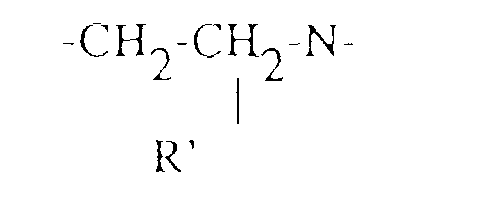 wherein Re and Ra are defined above. Copolymers of the above polymers may also be useful.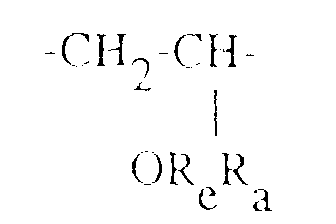
- In examples of our electrodes such polymers are cross-linked to form a network which is sufficiently rigid to provide physical integrity to the composite electrode as the cell is charged, discharged, and recharged. These polymers may be cross-linked in a number of ways. For example, U.S. Patent No. 4,357,401 to Andre et al. discloses PEO-PPO copolymers which are cross-linked by ethylene diamine. Where the polymer includes moieties of primary or secondary alcohols or amines, the polymer may be cross-linked by reaction with a cross-linking agent such as a polyisocyanate. For example, polyethylene oxides may also be cross-linked by using a cross-linking agent such as poly(ethylene glycol) diacrylate and a thermal free radical initiator such as 2,2'-azobis(2-methyl-propionitrile) as described in U. S. Application Serial Nos. 115,492 filed October 30, 1987 and 173,385, filed March 25, 1988, now U.S. patent 4,830,939. See also U. S. Patent No. 3,734,876. Radiation and thermally initiated free radical addition reactions may also be used to form the cross-linked polymeric network.
- A particularly useful group of radiation polymerizable compounds for providing a cross-linked conductive matrix is obtained by reacting a low molecular weight polyethylene glycol with acrylic or methacrylic acid. Also, radiation curable materials, such as, for example, acrylated epoxies, e.g. Bisphenol A Epoxy diacrylate, polyester acrylates, copolymers of glycidl ethers and acrylates or a vinyl compound such as N-vinylpyrrolidone may be used. The latter provides a non-conductive matrix.
- The radiation polymerizable polyethylenically unsaturated compounds may have a molecular weight of about 200 to 2,000 and more preferably 200 to 800. They may be liquid at temperatures less than 30°C. Examples of radiation curable materials include polyethylene glycol-300 diacrylate (average PEO molecular weight about 300), polyethylene glycol-480 diacrylate (average PEO molecular weight about 480) and the corresponding methacrylates.
- It may be desirable to include a radiation curable comonomer in the composition to reduce the glass transition temperature and improve the conductivity of the polymer. Any suitable monoacrylate such as tetrahydrofurfuryl acrylate, tetrahydrofurfuryl methacrylate, methoxypolyethylene glycol monomethacrylate, 2-ethoxyethyl acrylate, 2-methoxyethyl acrylate or cyclohexyl methacrylate may be used for this purpose. Triacrylates such as TMPTA, trimethylolpropane ethoxylated triacrylates (TMPEOTA) or trimethylolpropanepropoxy triacrylate may be used to introduce cross-linking of the polymer. Monoacrylates may be used in an amount of about 5 to 50% by weight based on the total amount of radiation polymerizable material. The triacrylates may be used in amounts of about 2 to 30% by weight on the same basis.
- Examples of cross-linked non-conductive supportive polymers are described in U.S. Patent 4,654,279 and include epoxies, polyurethanes, polymethacrylates, polyacrylates, polyacrylonitrile, and polystyrene.
- The radiation inert liquids which form the ionically conductive liquid interpenetrating phase can be any low volatility aprotic polar solvent capable of dissolving the ionizable alkali metal salt. Suitable solvents may be characterised by a boiling point greater than about 80°C. Low volatility simplifies manufacture and improves shelf life. Representative examples are propylene carbonate, gamma-butyrolactone, 1,3-dioxolane, and 2-2-methyltetrahydrofuran.Less polar solvents having heteroatoms capable of bonding alkali metal cations are also useful. Polyethylene glycol dimethyl ether (PEGDME) is one such example. Glymes such as tetraglyme, hexaglyme, and heptaglyme are also desirable solvents. The liquid may be propylene carbonate.
- Ionizable alkali metal salts include those salts conventionally used in solid state electrochemical cells, such a lithium, sodium, potassium or ammonium salts. Examples are sodium and lithium salts of less mobile anions of weak bases having a large anionic radius. Examples may be selected from the group consisting of I-, Br-,SCN-,C104 -,PF6 -,AsF6 -,CF3COO-,CF3SO3 -, and the like. Examples of such salts include LiClO4, NaClO4, LiF3CSO3, LiBF4 and the like.
- The salt may be used up to an amount which does not exceed its solubility limit in the electrolyte. The amount will therefore vary with the nature of the liquid solvent. As a general rule, the maximum amount of salt within its solubility limit should be used to maximise the ionic conductivity of the electrolyte. In most applications, about 10 to 60 parts salt may be used per 100 parts of liquid phase.
- Intercalation compounds and electronically conductive materials useful in forming the cathode that is used with the anode in an electrochemical cell in accordance with the present invention are well known in the art and include metal oxides, sulfides and selenides. Representative examples of intercalation compounds are V3O8, V6O13, V2O5, MnO2, MoO2, MoS3, Cr3O6, LiCoO2, LixV3O8, TiS2 and the like. The intercalation compound may be a vanadium oxide containing lithium or LiCoO2. The intercalation compound may have a particle size of less than about 1 micrometre but can range up to about 20 micrometres Other examples can be found in the aforementioned references, such as U.S. Patents Nos. 4,925,752 and 4,822,701.
- The conductive filler in the cathode is usually carbon black. Certain conductive polymers (which have a conjugated network of double bonds) such as, for example, polypyrole and polyacetylene may also be used for this purpose.
- To prepare an anode for an embodiment of an electrochemical cell in accordance with the present invention, a mixture of the uncross-linked polymer or the unpolymerized monomer or oligomer and the initiator or cross-linking agent where needed may be prepared and blended with the ionically conducting liquid, the ionizable salt, and the amorphous carbon. Blending is carried out by agitation, for example, or by stirring and the like, such that the particles of the amorphous carbon particles become individually and homogeneously dispersed in the mixture as described above. This may be done in an inert atmosphere at ambient temperatures of about 60°C. Due to the amorphous nature of the carbon, the viscosity of the resulting solution is higher than about 8,000cp (8 N s/m2) at 75°C, and may be higher than about 10,000 cp (10 N s/m2) at 75°C.
- The anode may be prepared by coating the mixture on a current collector, such as a metal foil member, and curing the composition. A suitable foil is lithium foil or lithium coated on nickel or copper foil or the like. The composition can be coated by solvent coating using conventional coating techniques such as a doctor blade, for example, or an extrusion method can be used. The anode may be coated to a thickness of about 10 to 100 micrometres typically to about 30 to 60 micrometres.
- Where a solvent casting technique is used, in addition to the components discussed above, the anode composition will contain a volatile solvent such as tetrahydrofuran. After coating, the solvent is removed if solvent casting method is used, and the composition is cured.
- Anode compositions in accordance with the present invention contain about 10 to 50 parts by weight of the amorphous carbon and preferably from about 25 to about 35 parts, about 0 to 10 parts of a conductive filler, about 0 to 20 parts of an ionizable metal salt, about 45 to 80 parts of an ionically conducting liquid, and about 20 to 55 parts of the cross-linked polymer preferably 25 to 40 parts, per 100 parts of the final polymer electrolyte composition (all parts by weight)
- In one embodiment of an electrochemical cell in accordance with the present invention, an amorphous carbon/polymer composite anode prepared by the aforementioned method is coated with a polymer host network electrolyte as previously described. The resulting composite electrode is cured by electron beam radiation. A polymer composite cathode is formed by coating a V6O13/carbon/polymer composite onto a nickel substrate and curing with electron beam radiation. The cured composite cathode is lithiated by electrochemical means and laminated onto the anode/electrolyte composite surface. The resulting electrochemical cell has an open circuit voltage of about 3 volts and can be cycled between that voltage and 0 volts repeatedly.
- Another embodiment of an electrochemical cell in accordance with the present invention utilizes the amorphous carbon/polymer composite electrode as both the anode and the cathode. The electrodes are prepared as described above and laminated with a polymer host network electrolyte therebetween. Prior to lamination, the electrode to be utilized as the anode is lithiated by electrochemical means. The resulting electrochemical cell has an open circuit voltage of about 1.5 volts and can be cycled between that voltage and 0 volts repeatedly.
- The invention will now be described with reference to the following example.
- Acetylene black (Chevron 100% compress) was dried in vacuum at 100°C for 48 hrs., to a level of water content smaller than 100 ppm. Sixty-two grams of propylene carbonate (PC) of high purity, containing less than 50 ppm of water, was put in a double planetary mixer under inert atmosphere. To this PC, 1.5 g of high molecular weight (MW = 900,000) polyethylene oxide (PEO) containing less than 50 ppm of water was added. The mixer content was then heated to 60°C under an inert atmosphere and stirred at 60 rpm. The PC/PEO mix was stirred for about 0.5 hrs. or until the PEO was completely dissolved. Then 14 g of polyethylene glycol diacrylate (PEGDA), having a MW of 400-600 and a water content less than 50 ppm, and 2.5 g of trimethylolpropane ethoxylate triacrylate (TMPEOTA) of high MW and of water content less than 50 ppm was added and stirred until the mixture is homogenous. To this homogenous mixture, 20 g of the predried carbon material was added. This composite anode precursor mix was stirred for 2 hrs. at 60°C under inert atmosphere so that the amorphous carbon particles became individually and homogeneously dispersed. Due to the nature of the carbon material, the viscosity of the composite anode precursor was higher than 10,000 cp at 75°C. The apparent density of the composite anode precursor was approximately 1.2 g/cm2. Approximately 100 mg of this composite anode precursor was coated as a thin (75-85 mm) uniform layer on a 10 cm2 surface treated nickel current collector of 25 mm thickness. This anode precursor laminate is then either cured through exposure to an electron beam (1-9 Mrad) or overcoated with the polymer electrolyte precursor, then cured by the same means.
- A lithiated composite Li8V6O13, based cathode (1.5 mAh/cm2) was mounted in front of the carbon based composite anode. The cell was discharged at current density of 100 mA/cm2. Approximately 1.4 mAh/cm2 capacity was observed during the first charge of the carbon based composite anode. Subsequent to this first charge of the carbon composite anode, the anode was discharged at the same current density, and approximately 50-60% of the charge capacity was available. Further cycling shows capacity decrease similar to what was observed in Li/V6O13 cells.
Claims (12)
- A carbon/polymer composite electrode comprising: a polymeric matrix; substantially amorphous carbon, namely carbon which is 80% or more non-crystalline or is microcrystalline in which 80% or more of the carbon microcrystals are in a random arrangement, homogeneously dispersed within and entrapped in said matrix; and, further contained in said matrix, an interpenetrating ionically conducting non-aqueous liquid comprising a solvent having an alkali metal salt dissolved therein.
- An electrode according to Claim 1, further characterised in that the substantially amorphous carbon is acetylene black or Shawinigan black.
- An electrode according to Claim 1 or 2, further characterised in that the solvent is a low volatility aprotic solvent.
- An electrode according to Claim 1, 2 or 3, further characterised in that the polymer is a conductive polymer.
- An electrode according to any preceding claim, further characterised in that the polymer is formed at least in part from polyethylene oxide monomers.
- An electrode according to any preceding claim, further characterised in that the solvent is selected from propylene carbonate, gamma-butyrolactone, 1,3-dioxolane, and 2-methyltetrahydrofuran.
- An electrode according to any preceding claim, further characterised in that the substantially amorphous carbon has a surface area greater than about 20m2/g.
- An electrode according to Claim 7, further characterised in that the substantially amorphous carbon has a surface area greater than about 50 m2/g.
- An electrode according to any preceding claim, further characterised in that the substantially amorphous carbon has a particle diameter of less than about 5mm.
- An electrode according to any preceding claim, further characterised in that the electrode contains intercalated lithium ions.
- An electrochemical cell comprising a cathode, a polymeric electrolyte and an anode comprising an electrode according to any of Claims 1 to 10.
- An electrochemical cell according to Claim 11, further characterised in that the cathode is a vanadium oxide composition containing intercalated lithium ions or LiCoO2.
Applications Claiming Priority (2)
| Application Number | Priority Date | Filing Date | Title |
|---|---|---|---|
| US736295 | 1991-07-29 | ||
| US07/736,295 US5219680A (en) | 1991-07-29 | 1991-07-29 | Lithium rocking-chair rechargeable battery and electrode therefor |
Publications (2)
| Publication Number | Publication Date |
|---|---|
| EP0528557A1 EP0528557A1 (en) | 1993-02-24 |
| EP0528557B1 true EP0528557B1 (en) | 1999-11-24 |
Family
ID=24959317
Family Applications (1)
| Application Number | Title | Priority Date | Filing Date |
|---|---|---|---|
| EP92306899A Expired - Lifetime EP0528557B1 (en) | 1991-07-29 | 1992-07-29 | Carbon/polymer composite electrode for use in a lithium battery |
Country Status (11)
| Country | Link |
|---|---|
| US (1) | US5219680A (en) |
| EP (1) | EP0528557B1 (en) |
| JP (1) | JP3153006B2 (en) |
| KR (1) | KR100275602B1 (en) |
| CN (1) | CN1042075C (en) |
| AT (1) | ATE187017T1 (en) |
| CA (1) | CA2074743C (en) |
| DE (1) | DE69230327T2 (en) |
| DK (1) | DK0528557T3 (en) |
| SG (1) | SG72633A1 (en) |
| TW (1) | TW222351B (en) |
Families Citing this family (63)
| Publication number | Priority date | Publication date | Assignee | Title |
|---|---|---|---|---|
| US5512393A (en) * | 1992-07-06 | 1996-04-30 | Nikkiso Company Limited | Vapor-grown and graphitized carbon fibers process for preparing same molded members thereof and composite members thereof |
| US5470357A (en) * | 1993-03-05 | 1995-11-28 | Bell Communications Research, Inc. | Method of making a laminated lithium-ion rechargeable battery cell |
| US5460904A (en) * | 1993-08-23 | 1995-10-24 | Bell Communications Research, Inc. | Electrolyte activatable lithium-ion rechargeable battery cell |
| US5540741A (en) * | 1993-03-05 | 1996-07-30 | Bell Communications Research, Inc. | Lithium secondary battery extraction method |
| US5571634A (en) * | 1993-03-05 | 1996-11-05 | Bell Communications Research, Inc. | Hybrid lithium-ion battery polymer matrix compositions |
| EP0620606B1 (en) * | 1993-03-16 | 1999-06-09 | Furukawa Denchi Kabushiki Kaisha | Electrode for rechargeable battery with nonaqueous electrolyte and process for producing the same |
| US5342710A (en) * | 1993-03-30 | 1994-08-30 | Valence Technology, Inc. | Lakyer for stabilization of lithium anode |
| EP0630064B1 (en) * | 1993-04-28 | 1998-07-15 | Fuji Photo Film Co., Ltd. | Nonaqueous electrolyte-secondary battery |
| US5443601A (en) * | 1993-05-03 | 1995-08-22 | Regents, University Of California | Method for intercalating alkali metal ions into carbon electrodes |
| TW284922B (en) * | 1994-05-10 | 1996-09-01 | Sumitomo Chemical Co | |
| US5545496A (en) * | 1994-07-06 | 1996-08-13 | Chang; On-Kok | Process for producing filament-like vanadium oxide for use in solid state rechargeable electrochemical cells and the use thereof as a cathode in electrochemical cells |
| US5552239A (en) * | 1994-08-29 | 1996-09-03 | Bell Communications Research, Inc. | Rechargeable battery structure and method of making same |
| MX9701383A (en) * | 1994-08-29 | 1997-05-31 | Bell Communications Res | Rechargeable battery structure and method of making same. |
| FR2724490B1 (en) * | 1994-09-09 | 1996-10-25 | Lorraine Carbone | CARBON / POLYMER COMPOSITE ELECTRODE FOR LITHIUM RECHARGEABLE ELECTROCHEMICAL GENERATOR |
| FR2725709A1 (en) * | 1994-10-14 | 1996-04-19 | Centre Nat Rech Scient | New amorphous substd. lithium oxide cpd. |
| JP3717085B2 (en) * | 1994-10-21 | 2005-11-16 | キヤノン株式会社 | Negative electrode for secondary battery, secondary battery having the negative electrode, and method for producing electrode |
| US5558957A (en) * | 1994-10-26 | 1996-09-24 | International Business Machines Corporation | Method for making a thin flexible primary battery for microelectronics applications |
| AU5541996A (en) * | 1995-04-12 | 1996-10-30 | Valence Technology, Inc. | Curable alkane multifunctional acrylates based solid electro lytes and electrolytic cells produced therefrom |
| US5589289A (en) * | 1995-09-27 | 1996-12-31 | Motorola, Inc. | Carbon electrode materials for electrochemical cells and method of making same |
| DE19642878A1 (en) * | 1995-10-31 | 1997-05-07 | Basf Magnetics Holding Gmbh | Electrode materials suitable for electrochemical cells, comprising a fluorine=free polymeric binder and a solid material capable of reversibly taking up or releasing lithium ions |
| WO1997016860A1 (en) * | 1995-11-02 | 1997-05-09 | Danionics A/S | A negative electrode composition for lithium secondary batteries, a method for the production thereof, use of said composition in lithium secondary batteries and lithium secondary batteries containing said negative electrode composition |
| US5759215A (en) * | 1995-11-17 | 1998-06-02 | Masuda; William | Method of preparing electrochemical cells |
| US5584893A (en) * | 1995-11-17 | 1996-12-17 | Valence Technology, Inc. | Method of preparing electrodes for an electrochemical cell |
| US5635151A (en) * | 1995-11-22 | 1997-06-03 | Motorola, Inc. | Carbon electrode materials for lithium battery cells and method of making same |
| CN1042875C (en) * | 1996-01-22 | 1999-04-07 | 中国科学院物理研究所 | Anodes of lithium batteries and manufacture thereof |
| JP3724099B2 (en) * | 1996-02-22 | 2005-12-07 | ソニー株式会社 | Method for producing carbonaceous negative electrode material for non-aqueous electrolyte secondary battery |
| JP3245178B2 (en) * | 1996-03-08 | 2002-01-07 | テルコーディア テクノロジーズ インコーポレイテッド | Method for increasing reversible lithium intercalation capacity at carbon electrode of secondary battery |
| EP1195823A3 (en) * | 1996-03-08 | 2002-08-07 | Valence Technology (Nevada), Inc. | Method for preparing an electrode for a battery |
| JP3578185B2 (en) * | 1996-04-03 | 2004-10-20 | 株式会社ユアサコーポレーション | Thin lithium battery and method of manufacturing the same |
| US6444356B1 (en) | 1996-11-01 | 2002-09-03 | Jackson C. Ma | Lithium battery with secondary battery separator |
| US6066413A (en) * | 1997-03-06 | 2000-05-23 | Telcordia Technologies, Inc. | Method for increasing reversible lithium intercalation capacity in carbon electrode secondary batteries |
| US6165641A (en) * | 1997-05-09 | 2000-12-26 | The United States Of America As Represented By The United States Department Of Energy | Nanodisperse transition metal electrodes (NTME) for electrochemical cells |
| KR100434550B1 (en) * | 1997-07-31 | 2004-09-18 | 삼성전자주식회사 | Composition for composite electrode |
| KR100434556B1 (en) * | 1997-10-31 | 2004-09-18 | 삼성전자주식회사 | Composition for polymer solid electrolyte and manufacturing method of polymer solid electrolyte using the same |
| US6180281B1 (en) | 1997-12-12 | 2001-01-30 | Johnson Research & Development Company, Inc. | Composite separator and electrode |
| US6042965A (en) * | 1997-12-12 | 2000-03-28 | Johnson Research & Development Company, Inc. | Unitary separator and electrode structure and method of manufacturing separator |
| US6099990A (en) * | 1998-03-26 | 2000-08-08 | Motorola, Inc. | Carbon electrode material for electrochemical cells and method of making same |
| US6063899A (en) * | 1998-06-15 | 2000-05-16 | Johnson Manufacturing Llc | Apparatus and method for extracting plasticizer |
| DE19839217C2 (en) * | 1998-08-28 | 2001-02-08 | Fraunhofer Ges Forschung | Pasty masses, layers and layer structures, cells and processes for their production |
| DE19964159B4 (en) | 1998-10-20 | 2005-08-11 | Fraunhofer-Gesellschaft zur Förderung der angewandten Forschung e.V. | Process for producing self-supporting layers or intermediate products lying on a substrate and usable in electrochemical components for this purpose |
| AT409798B (en) * | 1998-11-19 | 2002-11-25 | Hoffmann La Roche | ELECTRODE SYSTEM |
| US6301093B1 (en) * | 1999-01-14 | 2001-10-09 | Honda Giken Kogyo Kabushiki Kaisha | Electrochemical capacitor |
| DE19948548B4 (en) | 1999-04-19 | 2006-04-13 | Fraunhofer-Gesellschaft zur Förderung der angewandten Forschung e.V. | Pasty masses with nanocrystalline materials for electrochemical devices and layers and electrochemical devices made thereof |
| US6506518B1 (en) * | 1999-04-27 | 2003-01-14 | Shin-Kobe Electric Machinery Co., Ltd. | Lithium secondary battery |
| US6132477A (en) * | 1999-05-20 | 2000-10-17 | Telcordia Technologies, Inc. | Method of making laminated polymeric rechargeable battery cells |
| US6223449B1 (en) | 1999-11-18 | 2001-05-01 | Johnson Research & Development Company, Inc. | Apparatus for extracting plasticizer |
| JP3868231B2 (en) * | 2000-07-31 | 2007-01-17 | Jfeケミカル株式会社 | Carbon material, negative electrode for lithium ion secondary battery and lithium ion secondary battery |
| CA2411695A1 (en) | 2002-11-13 | 2004-05-13 | Hydro-Quebec | Electrode covered with a film obtained from an aqueous solution containing a water soluble binder, manufacturing process and usesthereof |
| US20040137327A1 (en) * | 2003-01-13 | 2004-07-15 | Gross Karl J. | Synthesis of carbon/silicon composites |
| JP2005129446A (en) * | 2003-10-27 | 2005-05-19 | Hitachi Ltd | Electrochemical energy storage device |
| US20100119435A1 (en) * | 2005-03-15 | 2010-05-13 | David Herbert Roach | Processes for growing carbon nanotubes in the absence of catalysts |
| WO2006107157A1 (en) * | 2005-04-04 | 2006-10-12 | Lg Chem, Ltd. | Lithium secondary battery containing silicon-based or tin-based anode active material |
| US9865793B2 (en) * | 2005-10-05 | 2018-01-09 | Conceptual Werks Llc | Method of forming a thermally enhanced energy generator |
| US7887944B2 (en) * | 2005-12-21 | 2011-02-15 | General Electric Company | Integrated membrane electrode assembly and method related thereto |
| JP5105765B2 (en) * | 2006-04-20 | 2012-12-26 | Necエナジーデバイス株式会社 | Lithium ion secondary battery |
| DE102007031477A1 (en) | 2007-03-12 | 2008-09-18 | Fraunhofer-Gesellschaft zur Förderung der angewandten Forschung e.V. | Electrolytes for electrochemical devices |
| EP2167228B1 (en) * | 2007-05-09 | 2015-07-08 | California Institute of Technology | Lithium fluoropolymer and fluoro-organic batteries |
| CN101803071B (en) | 2007-07-26 | 2014-09-10 | 株式会社Lg化学 | Electrode active material having core-shell structure |
| CN101246958B (en) * | 2008-03-21 | 2010-08-11 | 成都中科来方能源科技有限公司 | Lithium ion battery and combination electrode used for the same and production method thereof |
| CN101420023B (en) * | 2008-12-11 | 2010-06-09 | 浙江大学 | A kind of electrochemical intercalation/delithiation electrode and preparation method thereof |
| EP2287945A1 (en) | 2009-07-23 | 2011-02-23 | Fraunhofer-Gesellschaft zur Förderung der angewandten Forschung e.V. | Electrodes for electrochemical energy storage devices with optimised output and energy storage |
| US11233268B2 (en) * | 2016-01-27 | 2022-01-25 | The Trustees Of Columbia University In The City Of New York | Alkali metal battery electrodes and related methods |
| JP7060205B2 (en) * | 2016-09-21 | 2022-04-26 | 京東方科技集團股▲ふん▼有限公司 | Thin film transistor, display substrate and display panel having the thin film transistor, and manufacturing method thereof. |
Family Cites Families (31)
| Publication number | Priority date | Publication date | Assignee | Title |
|---|---|---|---|---|
| US3734876A (en) * | 1971-07-06 | 1973-05-22 | Union Carbide Corp | Cross-linked polyalkylene oxide |
| US4041220A (en) * | 1972-08-18 | 1977-08-09 | Agence Nationale De Valorisation De La Recherche (Anvar) | Mixed conductors of graphite, processes for their preparation and their use, notably for the production of electrodes for electrochemical generators, and new electrochemical generators |
| US4194062A (en) * | 1978-07-27 | 1980-03-18 | Bell Telephone Laboratories, Incorporated | Rechargeable dichalcogenide cell |
| FR2442512A1 (en) * | 1978-11-22 | 1980-06-20 | Anvar | NEW ELASTOMERIC MATERIALS WITH ION CONDUCTION |
| FR2485274A1 (en) * | 1980-03-31 | 1981-12-24 | France Etat | SOLID ELECTROLYTE BASED ON ION-CONDUCTION MACROMOLECULAR MATERIAL |
| US4579794A (en) * | 1980-10-22 | 1986-04-01 | Rohm And Haas Company | Stable high drain battery |
| US4304825A (en) * | 1980-11-21 | 1981-12-08 | Bell Telephone Laboratories, Incorporated | Rechargeable battery |
| CA1173900A (en) * | 1982-06-30 | 1984-09-04 | Hydro-Quebec | Composite and flexible anodes for non aqueous lithium cells |
| US4423125A (en) * | 1982-09-13 | 1983-12-27 | Bell Telephone Laboratories, Incorporated | Ambient temperature rechargeable battery |
| JPS59157973A (en) * | 1983-02-24 | 1984-09-07 | Kao Corp | Electrode for secondary battery |
| EP0241650A1 (en) * | 1983-05-19 | 1987-10-21 | Le Carbone Lorraine | Graphite intercalation compounds with improved performance, and electrochemical application of these compounds |
| GB8328022D0 (en) * | 1983-10-19 | 1983-11-23 | Atomic Energy Authority Uk | Solid state cell manufacture |
| JPS61225761A (en) * | 1985-03-30 | 1986-10-07 | Kanebo Ltd | Organic electrolyte battery |
| JPS6290863A (en) * | 1985-05-10 | 1987-04-25 | Asahi Chem Ind Co Ltd | Secondary cell |
| JPS61277157A (en) * | 1985-05-31 | 1986-12-08 | Sanyo Chem Ind Ltd | Secondary cell |
| JPS62259350A (en) * | 1986-05-02 | 1987-11-11 | Showa Denko Kk | Secondary cell |
| US4654279A (en) * | 1986-07-10 | 1987-03-31 | The United States Of America As Represented By The Secretary Of The Navy | Interpenetrating-network polymeric electrolytes |
| EP0260847A1 (en) * | 1986-09-19 | 1988-03-23 | Imperial Chemical Industries Plc | Solid electrolytes |
| US4849311A (en) * | 1986-09-24 | 1989-07-18 | Toa Nenryo Kogyo Kabushiki Kaisha | Immobilized electrolyte membrane |
| JP2630939B2 (en) * | 1986-11-08 | 1997-07-16 | 旭化成工業株式会社 | Non-aqueous secondary battery |
| JPS63193463A (en) * | 1987-02-04 | 1988-08-10 | Toshiba Battery Co Ltd | Nonaqueous solvent secondary battery |
| JP2562601B2 (en) * | 1987-05-30 | 1996-12-11 | 鐘紡株式会社 | Organic electrolyte battery with activated carbon-aniline composite as positive electrode |
| US4814242A (en) * | 1987-10-13 | 1989-03-21 | Allied-Signal Inc. | Elastomeric binders for battery electrodes |
| US4830939B1 (en) * | 1987-10-30 | 1996-10-08 | Mhb Joint Venture | Radiation cured solid electrolytes and electrochemical devices employing the same |
| JP2674793B2 (en) * | 1988-08-31 | 1997-11-12 | ソニー 株式会社 | Non-aqueous electrolyte battery |
| JP2797390B2 (en) * | 1989-04-03 | 1998-09-17 | ソニー株式会社 | Non-aqueous electrolyte secondary battery |
| US4990413A (en) * | 1989-01-18 | 1991-02-05 | Mhb Joint Venture | Composite solid electrolytes and electrochemical devices employing the same |
| US4925752A (en) * | 1989-03-03 | 1990-05-15 | Fauteux Denis G | Solid state electrochemical cell having porous cathode current collector |
| US5028500A (en) * | 1989-05-11 | 1991-07-02 | Moli Energy Limited | Carbonaceous electrodes for lithium cells |
| US5069683A (en) * | 1989-05-11 | 1991-12-03 | Moli Energy Limited | Process of making a rechargeable battery |
| JP2703350B2 (en) * | 1989-06-21 | 1998-01-26 | シャープ株式会社 | Rechargeable battery |
-
1991
- 1991-07-29 US US07/736,295 patent/US5219680A/en not_active Expired - Lifetime
-
1992
- 1992-07-28 KR KR1019920013478A patent/KR100275602B1/en not_active Expired - Fee Related
- 1992-07-28 TW TW081105932A patent/TW222351B/zh active
- 1992-07-28 CA CA002074743A patent/CA2074743C/en not_active Expired - Fee Related
- 1992-07-29 EP EP92306899A patent/EP0528557B1/en not_active Expired - Lifetime
- 1992-07-29 SG SG1996004365A patent/SG72633A1/en unknown
- 1992-07-29 CN CN92109767A patent/CN1042075C/en not_active Expired - Fee Related
- 1992-07-29 DK DK92306899T patent/DK0528557T3/en active
- 1992-07-29 AT AT92306899T patent/ATE187017T1/en not_active IP Right Cessation
- 1992-07-29 DE DE69230327T patent/DE69230327T2/en not_active Expired - Fee Related
- 1992-07-29 JP JP20221292A patent/JP3153006B2/en not_active Expired - Fee Related
Also Published As
| Publication number | Publication date |
|---|---|
| HK1012778A1 (en) | 1999-08-06 |
| KR930003454A (en) | 1993-02-24 |
| DK0528557T3 (en) | 2000-05-22 |
| TW222351B (en) | 1994-04-11 |
| JP3153006B2 (en) | 2001-04-03 |
| DE69230327T2 (en) | 2000-05-25 |
| CN1073302A (en) | 1993-06-16 |
| CA2074743A1 (en) | 1993-01-30 |
| KR100275602B1 (en) | 2000-12-15 |
| CN1042075C (en) | 1999-02-10 |
| JPH05198298A (en) | 1993-08-06 |
| US5219680A (en) | 1993-06-15 |
| DE69230327D1 (en) | 1999-12-30 |
| SG72633A1 (en) | 2000-05-23 |
| ATE187017T1 (en) | 1999-12-15 |
| CA2074743C (en) | 1996-11-26 |
| EP0528557A1 (en) | 1993-02-24 |
Similar Documents
| Publication | Publication Date | Title |
|---|---|---|
| EP0528557B1 (en) | Carbon/polymer composite electrode for use in a lithium battery | |
| JP3202216B2 (en) | High performance solid electrochemical stacked cell | |
| US5366829A (en) | Method of forming an anode material for lithium-containing solid electrochemical cells | |
| KR102024889B1 (en) | Semi-Interpenetrating Polymer Networks Polymer Electrolyte and All-Solid-State Battery comprising The Same | |
| HK1008117B (en) | Cells | |
| EP3955360A1 (en) | Solid electrolyte composite and all-solid-state battery electrode comprising same | |
| US6670075B2 (en) | Lithium polymer secondary cell | |
| JP3500245B2 (en) | Gel-like solid electrolyte secondary battery | |
| US5561007A (en) | Cathode-active material blends of Lix Mn2 O4 and Liy -α-MnO2 | |
| JP2002352799A (en) | Manufacturing method of non-aqueous electrolyte secondary battery | |
| CN1191651C (en) | Polymer gel electrolyte | |
| JPH087881A (en) | Electrode plate for non-aqueous electrolyte secondary battery and manufacturing method thereof | |
| JPWO1993014528A1 (en) | secondary battery | |
| US7919208B2 (en) | Anode active material and battery | |
| JP4157055B2 (en) | Gel polymer electrolyte and lithium secondary battery | |
| JP2021157983A (en) | Lithium ion secondary battery | |
| EP1329976A1 (en) | Lithium secondary cell | |
| JP3298960B2 (en) | Battery | |
| HK1012778B (en) | Carbon/polymer composite electrode for use in a lithium battery | |
| CN1194278A (en) | Polymer electrolyte and lithium-polymer cell using said electrolyte | |
| JP4929573B2 (en) | Coating composition for active material layer, electrode plate for non-aqueous electrolyte secondary battery, and non-aqueous electrolyte secondary battery | |
| JP2004200176A (en) | Lithium-polymer secondary battery | |
| JPH02114446A (en) | Cathode composition containing single dispersion internally added particles | |
| JP3409093B2 (en) | Electrode for secondary battery and battery using the same | |
| JPH09161771A (en) | Non-aqueous electrolyte secondary battery |
Legal Events
| Date | Code | Title | Description |
|---|---|---|---|
| PUAI | Public reference made under article 153(3) epc to a published international application that has entered the european phase |
Free format text: ORIGINAL CODE: 0009012 |
|
| AK | Designated contracting states |
Kind code of ref document: A1 Designated state(s): AT BE CH DE DK ES FR GB GR IT LI LU MC NL PT SE |
|
| 17P | Request for examination filed |
Effective date: 19930324 |
|
| 17Q | First examination report despatched |
Effective date: 19940930 |
|
| GRAG | Despatch of communication of intention to grant |
Free format text: ORIGINAL CODE: EPIDOS AGRA |
|
| GRAG | Despatch of communication of intention to grant |
Free format text: ORIGINAL CODE: EPIDOS AGRA |
|
| GRAH | Despatch of communication of intention to grant a patent |
Free format text: ORIGINAL CODE: EPIDOS IGRA |
|
| GRAH | Despatch of communication of intention to grant a patent |
Free format text: ORIGINAL CODE: EPIDOS IGRA |
|
| GRAA | (expected) grant |
Free format text: ORIGINAL CODE: 0009210 |
|
| AK | Designated contracting states |
Kind code of ref document: B1 Designated state(s): AT BE CH DE DK ES FR GB GR IT LI LU MC NL PT SE |
|
| PG25 | Lapsed in a contracting state [announced via postgrant information from national office to epo] |
Ref country code: SE Free format text: THE PATENT HAS BEEN ANNULLED BY A DECISION OF A NATIONAL AUTHORITY Effective date: 19991124 Ref country code: NL Free format text: LAPSE BECAUSE OF FAILURE TO SUBMIT A TRANSLATION OF THE DESCRIPTION OR TO PAY THE FEE WITHIN THE PRESCRIBED TIME-LIMIT Effective date: 19991124 Ref country code: LI Free format text: LAPSE BECAUSE OF FAILURE TO SUBMIT A TRANSLATION OF THE DESCRIPTION OR TO PAY THE FEE WITHIN THE PRESCRIBED TIME-LIMIT Effective date: 19991124 Ref country code: IT Free format text: LAPSE BECAUSE OF FAILURE TO SUBMIT A TRANSLATION OF THE DESCRIPTION OR TO PAY THE FEE WITHIN THE PRE;WARNING: LAPSES OF ITALIAN PATENTS WITH EFFECTIVE DATE BEFORE 2007 MAY HAVE OCCURRED AT ANY TIME BEFORE 2007. THE CORRECT EFFECTIVE DATE MAY BE DIFFERENT FROM THE ONE RECORDED.SCRIBED TIME-LIMIT Effective date: 19991124 Ref country code: GR Free format text: LAPSE BECAUSE OF NON-PAYMENT OF DUE FEES Effective date: 19991124 Ref country code: ES Free format text: THE PATENT HAS BEEN ANNULLED BY A DECISION OF A NATIONAL AUTHORITY Effective date: 19991124 Ref country code: CH Free format text: LAPSE BECAUSE OF FAILURE TO SUBMIT A TRANSLATION OF THE DESCRIPTION OR TO PAY THE FEE WITHIN THE PRESCRIBED TIME-LIMIT Effective date: 19991124 Ref country code: BE Free format text: LAPSE BECAUSE OF FAILURE TO SUBMIT A TRANSLATION OF THE DESCRIPTION OR TO PAY THE FEE WITHIN THE PRESCRIBED TIME-LIMIT Effective date: 19991124 Ref country code: AT Free format text: LAPSE BECAUSE OF FAILURE TO SUBMIT A TRANSLATION OF THE DESCRIPTION OR TO PAY THE FEE WITHIN THE PRESCRIBED TIME-LIMIT Effective date: 19991124 |
|
| REF | Corresponds to: |
Ref document number: 187017 Country of ref document: AT Date of ref document: 19991215 Kind code of ref document: T |
|
| REG | Reference to a national code |
Ref country code: CH Ref legal event code: EP |
|
| REF | Corresponds to: |
Ref document number: 69230327 Country of ref document: DE Date of ref document: 19991230 |
|
| PG25 | Lapsed in a contracting state [announced via postgrant information from national office to epo] |
Ref country code: PT Free format text: LAPSE BECAUSE OF FAILURE TO SUBMIT A TRANSLATION OF THE DESCRIPTION OR TO PAY THE FEE WITHIN THE PRESCRIBED TIME-LIMIT Effective date: 20000224 |
|
| ET | Fr: translation filed | ||
| NLV1 | Nl: lapsed or annulled due to failure to fulfill the requirements of art. 29p and 29m of the patents act | ||
| REG | Reference to a national code |
Ref country code: DK Ref legal event code: T3 |
|
| REG | Reference to a national code |
Ref country code: CH Ref legal event code: PL |
|
| PG25 | Lapsed in a contracting state [announced via postgrant information from national office to epo] |
Ref country code: LU Free format text: LAPSE BECAUSE OF NON-PAYMENT OF DUE FEES Effective date: 20000729 |
|
| PG25 | Lapsed in a contracting state [announced via postgrant information from national office to epo] |
Ref country code: MC Free format text: THE PATENT HAS BEEN ANNULLED BY A DECISION OF A NATIONAL AUTHORITY Effective date: 20000731 |
|
| PLBI | Opposition filed |
Free format text: ORIGINAL CODE: 0009260 |
|
| PLBQ | Unpublished change to opponent data |
Free format text: ORIGINAL CODE: EPIDOS OPPO |
|
| PLAB | Opposition data, opponent's data or that of the opponent's representative modified |
Free format text: ORIGINAL CODE: 0009299OPPO |
|
| PLBF | Reply of patent proprietor to notice(s) of opposition |
Free format text: ORIGINAL CODE: EPIDOS OBSO |
|
| 26 | Opposition filed |
Opponent name: FRAUNHOFER-GESELLSCHAFT ZUR FOERDERUNG DER ANGEWAN Effective date: 20000824 |
|
| R26 | Opposition filed (corrected) |
Opponent name: FRAUNHOFER-GESELLSCHAFT ZUR FOERDERUNG DER ANGEWAN Effective date: 20000824 |
|
| PLBF | Reply of patent proprietor to notice(s) of opposition |
Free format text: ORIGINAL CODE: EPIDOS OBSO |
|
| PLBF | Reply of patent proprietor to notice(s) of opposition |
Free format text: ORIGINAL CODE: EPIDOS OBSO |
|
| REG | Reference to a national code |
Ref country code: GB Ref legal event code: IF02 |
|
| PGFP | Annual fee paid to national office [announced via postgrant information from national office to epo] |
Ref country code: DK Payment date: 20020711 Year of fee payment: 11 |
|
| PG25 | Lapsed in a contracting state [announced via postgrant information from national office to epo] |
Ref country code: DK Free format text: LAPSE BECAUSE OF NON-PAYMENT OF DUE FEES Effective date: 20030731 |
|
| PGFP | Annual fee paid to national office [announced via postgrant information from national office to epo] |
Ref country code: FR Payment date: 20040720 Year of fee payment: 13 |
|
| PGFP | Annual fee paid to national office [announced via postgrant information from national office to epo] |
Ref country code: GB Payment date: 20040721 Year of fee payment: 13 |
|
| REG | Reference to a national code |
Ref country code: DK Ref legal event code: EBP |
|
| PGFP | Annual fee paid to national office [announced via postgrant information from national office to epo] |
Ref country code: DE Payment date: 20040831 Year of fee payment: 13 |
|
| PLBD | Termination of opposition procedure: decision despatched |
Free format text: ORIGINAL CODE: EPIDOSNOPC1 |
|
| PLBP | Opposition withdrawn |
Free format text: ORIGINAL CODE: 0009264 |
|
| PLBM | Termination of opposition procedure: date of legal effect published |
Free format text: ORIGINAL CODE: 0009276 |
|
| STAA | Information on the status of an ep patent application or granted ep patent |
Free format text: STATUS: OPPOSITION PROCEDURE CLOSED |
|
| 27C | Opposition proceedings terminated |
Effective date: 20050127 |
|
| PG25 | Lapsed in a contracting state [announced via postgrant information from national office to epo] |
Ref country code: GB Free format text: LAPSE BECAUSE OF NON-PAYMENT OF DUE FEES Effective date: 20050729 |
|
| PG25 | Lapsed in a contracting state [announced via postgrant information from national office to epo] |
Ref country code: DE Free format text: LAPSE BECAUSE OF NON-PAYMENT OF DUE FEES Effective date: 20060201 |
|
| GBPC | Gb: european patent ceased through non-payment of renewal fee |
Effective date: 20050729 |
|
| PG25 | Lapsed in a contracting state [announced via postgrant information from national office to epo] |
Ref country code: FR Free format text: LAPSE BECAUSE OF NON-PAYMENT OF DUE FEES Effective date: 20060331 |
|
| REG | Reference to a national code |
Ref country code: FR Ref legal event code: ST Effective date: 20060331 |