EP0526941B1 - Halomagnesium hydrocarbyloxide composition and process for preparation - Google Patents
Halomagnesium hydrocarbyloxide composition and process for preparation Download PDFInfo
- Publication number
- EP0526941B1 EP0526941B1 EP92202317A EP92202317A EP0526941B1 EP 0526941 B1 EP0526941 B1 EP 0526941B1 EP 92202317 A EP92202317 A EP 92202317A EP 92202317 A EP92202317 A EP 92202317A EP 0526941 B1 EP0526941 B1 EP 0526941B1
- Authority
- EP
- European Patent Office
- Prior art keywords
- magnesium
- compound
- ppm
- product
- hydrocarbyloxide
- Prior art date
- Legal status (The legal status is an assumption and is not a legal conclusion. Google has not performed a legal analysis and makes no representation as to the accuracy of the status listed.)
- Expired - Lifetime
Links
Images
Classifications
-
- C—CHEMISTRY; METALLURGY
- C07—ORGANIC CHEMISTRY
- C07F—ACYCLIC, CARBOCYCLIC OR HETEROCYCLIC COMPOUNDS CONTAINING ELEMENTS OTHER THAN CARBON, HYDROGEN, HALOGEN, OXYGEN, NITROGEN, SULFUR, SELENIUM OR TELLURIUM
- C07F3/00—Compounds containing elements of Groups 2 or 12 of the Periodic Table
- C07F3/003—Compounds containing elements of Groups 2 or 12 of the Periodic Table without C-Metal linkages
Definitions
- This invention relates to the problem of preparing support materials useful as components of olefin polymerization catalysts, and the process used to prepare them.
- it relates to the preparation of insoluble catalyst support materials containing magnesium, halide and hydrocarbyloxide in well defined ratios.
- this invention concerns the preparation of substantially pure solid halomagnesium hydrocarbyloxide catalyst support materials with well defined and uniform composition.
- hydrocarbyloxide is intended to cover structures of the formula -OR where R is "hydrocarbyl", i.e., a moiety formed by the removal of hydrogen from a hydrocarbon, e.g. alkyl, aryl and alkylaryl.
- R is "hydrocarbyl", i.e., a moiety formed by the removal of hydrogen from a hydrocarbon, e.g. alkyl, aryl and alkylaryl.
- olefin polymerization catalysts obtained by combining a component comprising magnesium halide and a titanium halide with an activating organoaluminum compound.
- the polymerization activity, stereospecificity, and comonomer incorporation characteristics of such compounds may be manipulated in various ways.
- this is accomplished by controlling the particular composition of the magnesium halide, for instance, by including some alkoxy ligands in the magnesium halide compound, or by halogenating a particular magnesium dialkoxide to prepare the magnesium halide.
- Magnesium halide-supported catalysts for the polymerization of olefins prepared by halogenating a magnesium alkoxide are described in U.S. Patent Nos. 4,400,302 and 4,414,132 to Goodall, et. al., for example. Since the morphology of the polymer is generally controlled by that of the catalyst, much effort has been expended in attempting to control the morphology of such catalysts.
- catalyst components that are prepared in processes employing materials containing magnesium, halide and hydrocarbyloxide can be found in European Patent Publication No. 301,894. This patent document illustrates the preparation of catalyst components with specific useful polymerization characteristics (co-monomer incorporation, polymer crystallinity, etc.) by employing these materials.
- halide is present before the hydrocarbyloxide is formed, and may or may not be present in the desired ratio to magnesium because of the Schlenk equilibrium.
- the halogen ligand source must react with only part of the hydrocarbyloxy ligands present, in order to get the desired product stoichiometry, and the extent of reaction is difficult to control.
- Common concerns in the preparation of insoluble solid materials are the issues of uniformity, purity, and composition.
- Catalyst support materials are substances that may be categorized as either "ionic structures" or "covalent infinite arrays". In these cases it is not always a simple matter to establish the uniformity and purity of a material.
- This invention employs a novel, selective, step-wise, process that exploits a) the high reactivity of magnesium hydrocarbyl groups toward hydrocarbyloxy ligand sources, and b) the difference in reactivity between magnesium hydrocarbyl ligands and magnesium hydrocarbyloxy ligands in reactions with halogen ligand sources to prepare solids of uniform composition and purity with empirical formulae such as XMgOR where, X is halogen and OR is a hydrocarbyloxy group containing from 1 to 20 carbon atoms.
- this novel process permits the preparation of novel solids of uniform composition and purity having empirical formulae: X 2-z Mg(OR) z where 0 ⁇ z ⁇ 2; or X N(2-z) Mg N (OR) Nz where 0 ⁇ z ⁇ 2 and N is a conveniently chosen multiplier to reduce rational numbers to integers, where the ratios of halide to magnesium (N(2-z):N) and alkoxide to magnesium (Nz:N) are not always 1:1.
- the strategy used in regard to the present process is to start with a magnesium compound containing two very reactive groups bound to magnesium, such as hydrocarbyl groups, and introduce the hydrocarbyloxy ligand first.
- a controlled amount of hydrocarbyloxy ligand is bound to the magnesium by introducing an oxygen-containing compound which can react with the reactive groups on the magnesium to produce the desired magnesium hydrocarbyloxy ligand.
- This reaction should be chosen so that the oxygen compound is completely consumed, which will insure that the amount of magnesium hydrocarbyloxy bonds can be precisely controlled.
- the product from this reaction thus contains an amount of a reactive group bound to magnesium, and an amount of less reactive hydrocarbyloxy ligands bound to magnesium.
- a controlled excess of the hydrocarbyloxy ligand may be added in the first step, eqs. (5), (7), as well as a controlled excess of halogenating agent in the second step, eq. (6), (8).
- Examples of reactive groups useful in the initial magnesium compound include C1 ⁇ 20 saturated alkyl groups, C6 ⁇ 20 aryl groups, or C7 ⁇ 20 alkylaryl groups.
- Examples of hydrocarbyloxy groups that could be formed on magnesium include C1 ⁇ 20 alkylalkoxides, C6 ⁇ 20 arylalkoxides, and C7 ⁇ 20 alkylarylalkoxides.
- Examples of compounds suitable for use as the hydrocarbyloxy ligand source include C1 ⁇ 20 saturated alcohols, C6 ⁇ 20 arylalcohols, or C7 ⁇ 20 alkylaryl alcohols.
- Other oxygen-containing organic molecules could also be used, including epoxides, ketones, aldehydes, acetals, carbonates, or orthoformates.
- Other potential halogen donors include organic acid halides such as RC(O)X, chloroformates such as ROC(O)X, acid halides of main group oxygen acids, such as SOX2 and POX3.
- Main group halo compounds such as PX3, PX5, or BX3 could also be used.
- reaction between the hydrocarbyloxy ligand source and the dihydrocarbyl magnesium yield a homogenous solution as a reaction product, and it is preferred that any reaction by-products be easily removed, or else inert in subsequent steps. It is desirable, but not mandatory that the reactivity of the halogen source be such that the hydrocarbylmagnesium hydrocarbyloxide and the halogen source can be mixed without obvious reaction at low temperature, and then brought to a temperature where a controlled reaction occurs. By-products from the halogenation step should be easily removed from the product.
- a soluble dihydrocarbyl magnesium is reacted with alcohol to form hydrocarbyloxy groups and inert saturated or aromatic hydrocarbons to give a soluble product in an inert saturated or aromatic hydrocarbon solvent.
- R hydrocarbyl
- M C, Si, Ge or Sn
- 0 ⁇ x ⁇ 4 a primary saturated alcohol and silicon tetrachloride are used.
- This reaction involves magnesium-ligand reactivity.
- the first step it is critical that the ligands initially bound to magnesium be reactive toward the hydrocarbyloxy ligand source.
- the second step it is critical that the remaining initial ligands be more reactive than the hydrocarbyloxy ligand toward the halogen ligand source.
- the reactivity of the halogen ligand source so that one will be able to supply the desired amount of halogen ligand.
- SiCl4 is able to donate about two Cl groups to magnesium hydrocarbyl compounds.
- Another critical aspect of this invention is the ability of the above strategy to produce a material which detailed chemical characterization shows to be a solid, magnesium, halide and hydrocarbyloxide containing material of uniform composition and purity, and not a mixture of, e.g. MgCl2 and Mg(OR)2 which would merely have the correct average composition.
- Another interesting aspect of this invention is that the selectivity of the reactions, and the flexibility in amounts used, makes it possible to prepare solids of uniform composition and purity with previously unanticipated component ratios: i.e. with Cl:Mg:OEt ratios other than 1:1:1, such as Cl3Mg2(OEt). Consequently, this strategy makes available a whole range of discrete magnesium compounds, with a variety of compositions, that are useful as catalyst supports.
- Example 3 demonstrate the preparation of substances with empirical formulae: ClMgOEt and Cl3Mg2(OEt), respectively.
- Example 6 demonstrates that, when sufficiently selective components are used, intermediate amounts of the components lead to simple mixtures of the possible products. These results are a large improvement over the prior art, where complex mixtures are more typical, substantially pure solids of uniform composition and purity are not obtained.
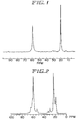
- Fig. 1 illustrates the spectra for ClMg(OEt) made in accordance with the present invention
- Fig. 2 illustrates the distinctly differing spectra, not containing strong narrow absorption peaks, for the type of material claimed to be ClMg(OEt) as made in Example 1 of U.S. Patent No. 4,820,879.
- Example 7A shows that if a physical mixture of MgCl2 and Mg(OEt)2 is prepared, 13C CPMAS NMR can be used to establish that Mg(OEt)2 is present.
- Example 7B shows that 13C CPMAS NMR has sufficient resolution to differentiate between Cl3Mg2OEt, as prepared in Example 5, and Mg(OEt)2.
- Examples 8 through 11 demonstrate use of the present invention to prepare materials containing alkoxy groups containing aryl moieties. While the processes of Examples 9 and 11 have not been optimized and the products formed have not been completely analyzed or purified, the results obtained are sufficient to demonstrate successful use of the invention in making the intended product. In both cases, a ClMgOR compound was formed which had spectral characteristics indicative of a single type of ClMgOR product (versus a mixture of many products as in the prior art) which was spectroscopically distinct from the corresponding Mg(OR)2 compound, thereby ruling out formation of a mixture of MgCl2 and Mg(OR)2.
- Solid state 13C CPMAS and inverse-gated decoupled MAS NMR spectra of this product are dominated by two resonances corresponding to carbons in the ethoxy groups. These resonances accounted for ca. 85% of the signal intensity in the 13C inverse-gated decoupled MAS NMR spectrum. The remaining 15% of signal intensity was shared among several peaks that could be assigned to heptane and/or hydrocarbyl groups bound to silicon.
- 9Si CPMAS NMR showed the presence of silicon compounds of the type: R x Si(OEt) 4-x 0 ⁇ x ⁇ 4.
- the product contained less than 0.2% alkanes by headspace GC analysis and showed only traces of carbon and silicon in 13C and 9Si CPMAS NMR analyses. Acid-base titration showed no basic components. Elemental analysis showed 25.6% Mg and 72.4% Cl (theory: 25.5% Mg, 74.4% Cl). The X-ray powder diffraction pattern of this material matched the known pattern for MgCl2. The product had a surface area of 12 m/g and a median particle size of 12 ⁇ .
- reaction solution was then cooled to -15°C and stirred at 110 rpm. Silicon tetrachloride (31.6 g, 0.19 mole) was then added. No immediate exotherm or reaction was observed. The solution temperature was increased by about 1°C/minute to 58°C where it was held for 16 hours. The reaction mixture was cooled, solids allowed to settle, and the supernate decanted. The solids were then washed with 2 300 ml portions of fresh solvent, collected by decantation and vacuum dried. 33.9 g of solid product were obtained (82% recovery of Mg using a Mg content of 22.4%).
- Elemental analysis showed that this product contained 22.4% Mg and 31.9% Cl along with 5.20% H, 24.35% C.
- the ratio of Cl to Mg was 0.98:1.
- Acid-base titration of this material shows that it contains 9.4 mmoles base/gram solid.
- the ratio of (OEt) groups (total base) to Mg was 1.02 to 1.
- the sum of the Mg, Cl, C and H analyses, added to the amount of oxygen required by the base analysis totals 98.9%.
- reaction solution was then cooled to -15°C and stirred at 110 rpm. Silicon tetrachloride (21.7 g, 0.13 mole) was then added. No immediate exotherm or reaction was observed. The solution temperature was increased by about 1°C/minute to 58°C where it was held for 15 hours. The reaction mixture was cooled, solids allowed to settle, and the supernate decanted. The solids were then washed with 3 300 ml portions of fresh solvent, collected by filtration and vacuum dried.
- the X-ray powder diffraction pattern from this product which was different from that of known materials, showed several lines, the most prominent corresponding to a d-spacing of 9.30 ⁇ .
- the X-ray powder diffraction pattern of this material showed no evidence of MgCl2.
- Elemental analysis showed that this product contained 21.6% Mg and 33.4% Cl along with 5.06% H, 23.41% C.
- the ratio of Cl to Mg was 1.06:1.
- Acid-base titration of this material shows that it contains 9.2 mmoles base/gram solid.
- the ratio of (OEt) groups (total base) to Mg was 1.04 to 1.
- reaction solution was then cooled to -15°C and stirred at 150 rpm. Silicon tetrachloride (39.4 g, 0.23 mole) was then added. No immediate exotherm or reaction was observed. The solution temperature was increased by about 1°C/minute to 60°C where it was held for 12 hours. The reaction mixture was cooled, solids allowed to settle, and the supernate decanted. The solids were then washed with 5 200 ml portions of fresh solvent, collected by filtration and vacuum dried.
- the yield of solid product was 25.3 g (80.1% recovery of Mg using a Mg content of 22.0%).
- Elemental analysis showed that this product contained 22.5% Mg and 49.1% Cl along with 3.40% H, 14.88% C.
- the ratio of Cl to Mg was 1.50:1.
- Acid-base titration of this material shows that it contains 5.12 mmoles base/gram solid.
- the ratio of (OEt) groups (total base) to Mg was 0.55 to 1.
- reaction solution was then cooled to -15°C and stirred at 110 rpm. Silicon tetrachloride (24.9 g, 0.15 mole) was then added. No immediate exotherm or reaction was observed.
- the solution temperature was increased by about 1°C/minute to solvent reflux, where it was held for 2 hours.
- the reaction mixture was cooled, solids allowed to settle, and the supernate decanted. The solids were then washed with 2 300 ml portions of fresh solvent, collected by filtration and vacuum dried.
- the yield of solid product was 26.4 g (80% recovery of Mg using a Mg content of 22.2%).
- Elemental analysis showed that this product contained 22.2% Mg and 36.8% Cl along with 5.05% H, 22.75% C and 0.14% Si.
- the ratio of Cl to Mg was 1.14:1.
- Acid-base titration of this material shows that it contains 7.9 mmoles base/gram solid.
- the ratio of (OEt) groups (total base) to Mg was 0.87:1.
- the resonance pairs are indicative of a dimeric molecular structure, e.g. [Mg(OC6H2(C4H9)2CH3)2]2, which is typical for sterically crowded bis phenoxy magnesium compounds such as this (Inorganic Chemistry, Vol. 27 (1988), pp. 867-870).
- Silicon tetrachloride(13.91 g, 0.082 mole) was added slowly to the reaction mixture.
- the soluble mixture was heated at reflux for 1 hour and then cooled with stirring (400-500 rpm) to room temperature.
- the precipitate was filtered, washed with 100 ml of n-heptane and vacuum dried. 12.6 g of solid colorless solid product were obtained (26% recovery of Mg using a magnesium content of 8.0%).
Landscapes
- Chemical & Material Sciences (AREA)
- Organic Chemistry (AREA)
- Transition And Organic Metals Composition Catalysts For Addition Polymerization (AREA)
Applications Claiming Priority (2)
| Application Number | Priority Date | Filing Date | Title |
|---|---|---|---|
| US741013 | 1991-08-06 | ||
| US07/741,013 US5262573A (en) | 1991-08-06 | 1991-08-06 | Halomagnesium hydrocarbyloxide composition and process for preparation |
Publications (2)
| Publication Number | Publication Date |
|---|---|
| EP0526941A1 EP0526941A1 (en) | 1993-02-10 |
| EP0526941B1 true EP0526941B1 (en) | 1996-03-20 |
Family
ID=24979009
Family Applications (1)
| Application Number | Title | Priority Date | Filing Date |
|---|---|---|---|
| EP92202317A Expired - Lifetime EP0526941B1 (en) | 1991-08-06 | 1992-07-28 | Halomagnesium hydrocarbyloxide composition and process for preparation |
Country Status (5)
| Country | Link |
|---|---|
| US (1) | US5262573A (enExample) |
| EP (1) | EP0526941B1 (enExample) |
| JP (1) | JPH05194537A (enExample) |
| CA (1) | CA2075339C (enExample) |
| DE (1) | DE69209188T2 (enExample) |
Families Citing this family (10)
| Publication number | Priority date | Publication date | Assignee | Title |
|---|---|---|---|---|
| DE4108204A1 (de) * | 1991-03-14 | 1992-09-17 | Schering Ag | Verfahren zur herstellung von alkoxymagnesiumhalogeniden |
| US5457246A (en) * | 1994-08-24 | 1995-10-10 | Ho; Climent | Process and arrangement for recovery of polyol production wastes |
| US5910270A (en) * | 1997-08-19 | 1999-06-08 | Akzo Nobel Nv | Viscosity reduction of organomagnesium solutions |
| EP1042330B1 (en) | 1997-12-23 | 2003-03-12 | Borealis Technology Oy | Product containing magnesium, halogen and alkoxy |
| EP1661917A1 (en) * | 2004-11-26 | 2006-05-31 | Saudi Basic Industries Corporation (Sabic) | Process for the preparation of a catalyst component for the polymerization of an olefin |
| JP5529533B2 (ja) * | 2006-05-24 | 2014-06-25 | サウディ ベーシック インダストリーズ コーポレイション | プロピレン重合のための触媒成分を調製する方法 |
| CN102276635B (zh) * | 2010-06-12 | 2014-05-28 | 中国石油化工股份有限公司 | 一种氯化烷氧基镁的制备方法 |
| US9718902B2 (en) | 2012-12-20 | 2017-08-01 | Saudi Basic Industries Corporation | Process for the polymerization of propylene |
| CN106459285B (zh) | 2014-06-20 | 2019-05-21 | Sabic环球技术有限责任公司 | 用于聚合丙烯的方法 |
| US10106631B2 (en) | 2014-06-20 | 2018-10-23 | Sabic Global Technologies B.V. | Process for the polymerization of propylene |
Family Cites Families (7)
| Publication number | Priority date | Publication date | Assignee | Title |
|---|---|---|---|---|
| DE2941048A1 (de) * | 1979-10-10 | 1981-04-23 | Schering Ag, 1000 Berlin Und 4619 Bergkamen | Verfahren zur herstellung von organomagnesiumalkoxiden |
| CA1275106A (en) * | 1986-04-18 | 1990-10-09 | Vijay Chandrakant Mehta | Hydrocarbyloxy magnesium halides |
| US4792640A (en) * | 1986-04-18 | 1988-12-20 | Lithium Corporation Of America | Hydrocarbyloxy magnesium halides |
| US4727051A (en) * | 1986-12-15 | 1988-02-23 | Stauffer Chemical Company | Production of halide-and alkoxy-containing magnesium compositions |
| US4820879A (en) * | 1987-06-05 | 1989-04-11 | Lithium Corporation Of America | Preparation of hydrocarbyloxy magnesium halides |
| WO1991005608A1 (en) * | 1989-10-16 | 1991-05-02 | Akzo N.V. | Process of making halide/alkoxy-containing magnesium complex |
| US5023385A (en) * | 1990-03-22 | 1991-06-11 | Akzo N.V. | Novel halide-arylalkoxy-containing magnesium compounds |
-
1991
- 1991-08-06 US US07/741,013 patent/US5262573A/en not_active Expired - Lifetime
-
1992
- 1992-07-28 DE DE69209188T patent/DE69209188T2/de not_active Expired - Fee Related
- 1992-07-28 EP EP92202317A patent/EP0526941B1/en not_active Expired - Lifetime
- 1992-08-05 CA CA002075339A patent/CA2075339C/en not_active Expired - Fee Related
- 1992-08-06 JP JP4229376A patent/JPH05194537A/ja active Pending
Also Published As
| Publication number | Publication date |
|---|---|
| EP0526941A1 (en) | 1993-02-10 |
| CA2075339A1 (en) | 1993-02-07 |
| DE69209188T2 (de) | 1996-10-10 |
| JPH05194537A (ja) | 1993-08-03 |
| DE69209188D1 (de) | 1996-04-25 |
| US5262573A (en) | 1993-11-16 |
| CA2075339C (en) | 2002-11-19 |
Similar Documents
| Publication | Publication Date | Title |
|---|---|---|
| Cloke et al. | Zirconium complexes incorporating the new tridentate diamide ligand [(Me3 Si) N {CH2CH2N (SiMe3)} 2] 2–(L); the crystal structures of [Zr (BH4) 2L] and [ZrCl {CH (SiMe3) 2} L] | |
| Aubrecht et al. | Lactide polymerization activity of alkoxide, phenoxide, and amide derivatives of yttrium (III) arylamidinates | |
| EP0038565B1 (en) | Catalyst components and catalysts for the polymerization of alpha-olefins | |
| EP0019312B1 (en) | Olefin polymerization catalyst compositions and a process for the polymerization of olefins employing such compositions | |
| US4124532A (en) | Catalysts for polymerizing olefins | |
| CA1131202A (en) | Catalyst components and catalysts for polymerizing olefins | |
| Rausch et al. | One ligand fits all: lanthanide and actinide sandwich complexes comprising the 1, 4-bis (trimethylsilyl) cyclooctatetraenyl (= COT′′) ligand | |
| US4820672A (en) | Hydrocarbon soluble and insoluble organo magnesium chloride complexes, processes and uses | |
| US5262573A (en) | Halomagnesium hydrocarbyloxide composition and process for preparation | |
| Desmangles et al. | Preparation and characterization of (R2N) 2VCl2 [R= Cy, i-Pr] and its activity as olefin polymerization catalyst | |
| JPS64402B2 (enExample) | ||
| US4120883A (en) | Method for producing an organomagnesium complex | |
| US4792640A (en) | Hydrocarbyloxy magnesium halides | |
| GB2128604A (en) | Aluminium alkoxide derivates | |
| Solov’ev et al. | Novel titanium (IV) complexes with 2, 4-di-tert-butyl-6-(1, 1, 1, 3, 3, 3-hexafluoro-2-hydroxypropan-2-yl) phenol in ethene polymerization | |
| US4820879A (en) | Preparation of hydrocarbyloxy magnesium halides | |
| Sengupta et al. | In situ generation of organocalcium compounds for a calcium-based Grignard-type chemistry | |
| US4325840A (en) | Organomagnesium complexes | |
| Veith et al. | Synthesis and characterisation of novel heterobimetallic halide isopropoxides based on M2 (OPri) 9–(M= Sn, Zr or Ti) anions: crystal and molecular structures of [CdI {Sn2 (OPri) 9}] and [{SnI [Zr2 (OPri) 9]} 2] | |
| EP0621278B1 (en) | Preparation of titanium(III) coordination complexes | |
| Arunasalam et al. | Synthesis, structure and characterisation of magnesium and calcium β-diketonate complexes [Ca3 (tmhd) 6] and [Ca2 (tmhd) 4 (EtOH) 2](Htmhd= 2, 2, 6, 6-tetramethylheptane-3, 5-dione) | |
| Sullivan et al. | Synthesis and reactions of do imido aryl derivatives of chromium, molybdenum, and tungsten. Crystal structures of Cr (NBut) 2 (C6H2Me3-2, 4, 6) 2, Mo (NBut) 2 (C6H3Me2-2, 6) 2, and Cr (NBut) 2 [C (C6H2Me3-2, 4, 6)═ NBut](C6H2Me3-2, 4, 6) | |
| Roha et al. | Low pressure polyethylene catalysts | |
| Rastätter et al. | Bis (amido) cyclodiphosph (III) azane Complexes of Yttrium and the Lanthanides | |
| Sobota et al. | Reactions of TiCl4 with diesters. Crystal structures of [CH2 (CO2Et) 2Cl4Ti] and [C2H4 (CO2CH2CH2OPh) 2Cl4Ti] |
Legal Events
| Date | Code | Title | Description |
|---|---|---|---|
| PUAI | Public reference made under article 153(3) epc to a published international application that has entered the european phase |
Free format text: ORIGINAL CODE: 0009012 |
|
| AK | Designated contracting states |
Kind code of ref document: A1 Designated state(s): BE DE FR GB IT NL |
|
| 17P | Request for examination filed |
Effective date: 19930525 |
|
| RAP1 | Party data changed (applicant data changed or rights of an application transferred) |
Owner name: AKZO NOBEL N.V. |
|
| 17Q | First examination report despatched |
Effective date: 19950731 |
|
| GRAH | Despatch of communication of intention to grant a patent |
Free format text: ORIGINAL CODE: EPIDOS IGRA |
|
| GRAA | (expected) grant |
Free format text: ORIGINAL CODE: 0009210 |
|
| AK | Designated contracting states |
Kind code of ref document: B1 Designated state(s): BE DE FR GB IT NL |
|
| REF | Corresponds to: |
Ref document number: 69209188 Country of ref document: DE Date of ref document: 19960425 |
|
| ET | Fr: translation filed | ||
| ITF | It: translation for a ep patent filed | ||
| PLBE | No opposition filed within time limit |
Free format text: ORIGINAL CODE: 0009261 |
|
| 26N | No opposition filed | ||
| REG | Reference to a national code |
Ref country code: GB Ref legal event code: IF02 |
|
| PGFP | Annual fee paid to national office [announced via postgrant information from national office to epo] |
Ref country code: NL Payment date: 20050629 Year of fee payment: 14 |
|
| PG25 | Lapsed in a contracting state [announced via postgrant information from national office to epo] |
Ref country code: NL Free format text: LAPSE BECAUSE OF NON-PAYMENT OF DUE FEES Effective date: 20070201 |
|
| NLV4 | Nl: lapsed or anulled due to non-payment of the annual fee |
Effective date: 20070201 |
|
| PGFP | Annual fee paid to national office [announced via postgrant information from national office to epo] |
Ref country code: DE Payment date: 20080806 Year of fee payment: 17 |
|
| PGFP | Annual fee paid to national office [announced via postgrant information from national office to epo] |
Ref country code: FR Payment date: 20080729 Year of fee payment: 17 Ref country code: IT Payment date: 20080728 Year of fee payment: 17 |
|
| PGFP | Annual fee paid to national office [announced via postgrant information from national office to epo] |
Ref country code: GB Payment date: 20080729 Year of fee payment: 17 |
|
| PGFP | Annual fee paid to national office [announced via postgrant information from national office to epo] |
Ref country code: BE Payment date: 20080818 Year of fee payment: 17 |
|
| BERE | Be: lapsed |
Owner name: *AKZO NOBEL N.V. Effective date: 20090731 |
|
| GBPC | Gb: european patent ceased through non-payment of renewal fee |
Effective date: 20090728 |
|
| PG25 | Lapsed in a contracting state [announced via postgrant information from national office to epo] |
Ref country code: GB Free format text: LAPSE BECAUSE OF NON-PAYMENT OF DUE FEES Effective date: 20090728 |
|
| PG25 | Lapsed in a contracting state [announced via postgrant information from national office to epo] |
Ref country code: BE Free format text: LAPSE BECAUSE OF NON-PAYMENT OF DUE FEES Effective date: 20090731 Ref country code: DE Free format text: LAPSE BECAUSE OF NON-PAYMENT OF DUE FEES Effective date: 20100202 |
|
| REG | Reference to a national code |
Ref country code: FR Ref legal event code: ST Effective date: 20100930 |
|
| PG25 | Lapsed in a contracting state [announced via postgrant information from national office to epo] |
Ref country code: IT Free format text: LAPSE BECAUSE OF NON-PAYMENT OF DUE FEES Effective date: 20090728 |
|
| PG25 | Lapsed in a contracting state [announced via postgrant information from national office to epo] |
Ref country code: FR Free format text: LAPSE BECAUSE OF NON-PAYMENT OF DUE FEES Effective date: 20100930 |
|
| PG25 | Lapsed in a contracting state [announced via postgrant information from national office to epo] |
Ref country code: FR Free format text: LAPSE BECAUSE OF NON-PAYMENT OF DUE FEES Effective date: 20090731 |