EP0526527B1 - High elongation linear elastic guidewire - Google Patents
High elongation linear elastic guidewire Download PDFInfo
- Publication number
- EP0526527B1 EP0526527B1 EP91908504A EP91908504A EP0526527B1 EP 0526527 B1 EP0526527 B1 EP 0526527B1 EP 91908504 A EP91908504 A EP 91908504A EP 91908504 A EP91908504 A EP 91908504A EP 0526527 B1 EP0526527 B1 EP 0526527B1
- Authority
- EP
- European Patent Office
- Prior art keywords
- guidewire
- alloy
- distal
- diameter
- taper
- Prior art date
- Legal status (The legal status is an assumption and is not a legal conclusion. Google has not performed a legal analysis and makes no representation as to the accuracy of the status listed.)
- Expired - Lifetime
Links
- 229910045601 alloy Inorganic materials 0.000 claims abstract description 76
- 239000000956 alloy Substances 0.000 claims abstract description 76
- 238000000034 method Methods 0.000 claims abstract description 47
- 229910001000 nickel titanium Inorganic materials 0.000 claims abstract description 21
- KHYBPSFKEHXSLX-UHFFFAOYSA-N iminotitanium Chemical compound [Ti]=N KHYBPSFKEHXSLX-UHFFFAOYSA-N 0.000 claims abstract description 20
- 229910000734 martensite Inorganic materials 0.000 claims abstract description 17
- 230000036760 body temperature Effects 0.000 claims abstract description 7
- 239000011248 coating agent Substances 0.000 claims description 18
- 238000000576 coating method Methods 0.000 claims description 18
- 229910052793 cadmium Inorganic materials 0.000 claims description 14
- 238000000227 grinding Methods 0.000 claims description 11
- 229910017535 Cu-Al-Ni Inorganic materials 0.000 claims description 10
- -1 Fe-Ni-Ti-Co Inorganic materials 0.000 claims description 9
- KUNSUQLRTQLHQQ-UHFFFAOYSA-N copper tin Chemical compound [Cu].[Sn] KUNSUQLRTQLHQQ-UHFFFAOYSA-N 0.000 claims description 9
- TVZPLCNGKSPOJA-UHFFFAOYSA-N copper zinc Chemical compound [Cu].[Zn] TVZPLCNGKSPOJA-UHFFFAOYSA-N 0.000 claims description 9
- 239000000203 mixture Substances 0.000 claims description 9
- 229910017755 Cu-Sn Inorganic materials 0.000 claims description 8
- 229910017927 Cu—Sn Inorganic materials 0.000 claims description 8
- 229910002551 Fe-Mn Inorganic materials 0.000 claims description 8
- 229910007610 Zn—Sn Inorganic materials 0.000 claims description 8
- 229910001566 austenite Inorganic materials 0.000 claims description 8
- 229910052697 platinum Inorganic materials 0.000 claims description 8
- 229910002708 Au–Cu Inorganic materials 0.000 claims description 7
- 230000002496 gastric effect Effects 0.000 claims description 7
- 238000010438 heat treatment Methods 0.000 claims description 7
- 229910052725 zinc Inorganic materials 0.000 claims description 7
- 229920000642 polymer Polymers 0.000 claims description 6
- 230000007704 transition Effects 0.000 claims description 6
- 238000010622 cold drawing Methods 0.000 claims description 5
- 229910017518 Cu Zn Inorganic materials 0.000 claims description 4
- 229910017752 Cu-Zn Inorganic materials 0.000 claims description 4
- 229910017943 Cu—Zn Inorganic materials 0.000 claims description 4
- 230000000977 initiatory effect Effects 0.000 claims description 4
- 229910052716 thallium Inorganic materials 0.000 claims description 4
- 230000002965 anti-thrombogenic effect Effects 0.000 claims description 3
- 238000003486 chemical etching Methods 0.000 claims description 3
- 229920001343 polytetrafluoroethylene Polymers 0.000 claims description 3
- 239000004810 polytetrafluoroethylene Substances 0.000 claims description 3
- HTTJABKRGRZYRN-UHFFFAOYSA-N Heparin Chemical compound OC1C(NC(=O)C)C(O)OC(COS(O)(=O)=O)C1OC1C(OS(O)(=O)=O)C(O)C(OC2C(C(OS(O)(=O)=O)C(OC3C(C(O)C(O)C(O3)C(O)=O)OS(O)(=O)=O)C(CO)O2)NS(O)(=O)=O)C(C(O)=O)O1 HTTJABKRGRZYRN-UHFFFAOYSA-N 0.000 claims description 2
- 230000015572 biosynthetic process Effects 0.000 claims description 2
- 239000003795 chemical substances by application Substances 0.000 claims description 2
- 239000012809 cooling fluid Substances 0.000 claims description 2
- 239000003527 fibrinolytic agent Substances 0.000 claims description 2
- 229960002897 heparin Drugs 0.000 claims description 2
- 229920000669 heparin Polymers 0.000 claims description 2
- 229910017773 Cu-Zn-Al Inorganic materials 0.000 claims 4
- 229910004688 Ti-V Inorganic materials 0.000 claims 3
- 229910010968 Ti—V Inorganic materials 0.000 claims 3
- 239000002243 precursor Substances 0.000 abstract description 43
- 238000004519 manufacturing process Methods 0.000 abstract description 4
- 238000003780 insertion Methods 0.000 abstract description 2
- 230000037431 insertion Effects 0.000 abstract description 2
- 239000000463 material Substances 0.000 description 29
- XEEYBQQBJWHFJM-UHFFFAOYSA-N iron Substances [Fe] XEEYBQQBJWHFJM-UHFFFAOYSA-N 0.000 description 8
- 239000010935 stainless steel Substances 0.000 description 8
- 229910001220 stainless steel Inorganic materials 0.000 description 8
- 239000004033 plastic Substances 0.000 description 7
- BASFCYQUMIYNBI-UHFFFAOYSA-N platinum Substances [Pt] BASFCYQUMIYNBI-UHFFFAOYSA-N 0.000 description 7
- 230000001747 exhibiting effect Effects 0.000 description 5
- 238000012360 testing method Methods 0.000 description 5
- 239000011701 zinc Substances 0.000 description 5
- 230000008901 benefit Effects 0.000 description 4
- 230000008859 change Effects 0.000 description 3
- 239000002826 coolant Substances 0.000 description 3
- 239000013013 elastic material Substances 0.000 description 3
- SXKZZFLSYPUIAN-UHFFFAOYSA-N [Cu].[Zn].[Au] Chemical compound [Cu].[Zn].[Au] SXKZZFLSYPUIAN-UHFFFAOYSA-N 0.000 description 2
- 238000002399 angioplasty Methods 0.000 description 2
- 230000005540 biological transmission Effects 0.000 description 2
- 210000004204 blood vessel Anatomy 0.000 description 2
- 229910001092 metal group alloy Inorganic materials 0.000 description 2
- 230000004044 response Effects 0.000 description 2
- 238000009662 stress testing Methods 0.000 description 2
- 239000000126 substance Substances 0.000 description 2
- 230000009466 transformation Effects 0.000 description 2
- 229910000831 Steel Inorganic materials 0.000 description 1
- 229920006362 Teflon® Polymers 0.000 description 1
- 229910004337 Ti-Ni Inorganic materials 0.000 description 1
- 229910011209 Ti—Ni Inorganic materials 0.000 description 1
- 235000010724 Wisteria floribunda Nutrition 0.000 description 1
- PDYXSJSAMVACOH-UHFFFAOYSA-N [Cu].[Zn].[Sn] Chemical compound [Cu].[Zn].[Sn] PDYXSJSAMVACOH-UHFFFAOYSA-N 0.000 description 1
- FFCYCDBKNAJFNJ-UHFFFAOYSA-N [Ti].[Fe].[Co].[Ni] Chemical compound [Ti].[Fe].[Co].[Ni] FFCYCDBKNAJFNJ-UHFFFAOYSA-N 0.000 description 1
- HZEWFHLRYVTOIW-UHFFFAOYSA-N [Ti].[Ni] Chemical compound [Ti].[Ni] HZEWFHLRYVTOIW-UHFFFAOYSA-N 0.000 description 1
- BUUNILCKFRLOQJ-UHFFFAOYSA-N [Ti].[V].[Ni] Chemical compound [Ti].[V].[Ni] BUUNILCKFRLOQJ-UHFFFAOYSA-N 0.000 description 1
- AEKXYPDMHSMNRN-UHFFFAOYSA-N [Xe].[Zn].[Cu] Chemical compound [Xe].[Zn].[Cu] AEKXYPDMHSMNRN-UHFFFAOYSA-N 0.000 description 1
- 238000002583 angiography Methods 0.000 description 1
- 238000005452 bending Methods 0.000 description 1
- 229910052790 beryllium Inorganic materials 0.000 description 1
- ATBAMAFKBVZNFJ-UHFFFAOYSA-N beryllium atom Chemical compound [Be] ATBAMAFKBVZNFJ-UHFFFAOYSA-N 0.000 description 1
- WJCRZORJJRCRAW-UHFFFAOYSA-N cadmium gold Chemical compound [Cd].[Au] WJCRZORJJRCRAW-UHFFFAOYSA-N 0.000 description 1
- NSAODVHAXBZWGW-UHFFFAOYSA-N cadmium silver Chemical compound [Ag].[Cd] NSAODVHAXBZWGW-UHFFFAOYSA-N 0.000 description 1
- 239000000470 constituent Substances 0.000 description 1
- 238000001816 cooling Methods 0.000 description 1
- 238000005516 engineering process Methods 0.000 description 1
- 210000001105 femoral artery Anatomy 0.000 description 1
- 230000006870 function Effects 0.000 description 1
- 229910052742 iron Inorganic materials 0.000 description 1
- OBACEDMBGYVZMP-UHFFFAOYSA-N iron platinum Chemical compound [Fe].[Fe].[Pt] OBACEDMBGYVZMP-UHFFFAOYSA-N 0.000 description 1
- 239000007788 liquid Substances 0.000 description 1
- 229910052751 metal Inorganic materials 0.000 description 1
- 239000002184 metal Substances 0.000 description 1
- HLXZNVUGXRDIFK-UHFFFAOYSA-N nickel titanium Chemical compound [Ti].[Ti].[Ti].[Ti].[Ti].[Ti].[Ti].[Ti].[Ti].[Ti].[Ti].[Ni].[Ni].[Ni].[Ni].[Ni].[Ni].[Ni].[Ni].[Ni].[Ni].[Ni].[Ni].[Ni].[Ni] HLXZNVUGXRDIFK-UHFFFAOYSA-N 0.000 description 1
- 230000008569 process Effects 0.000 description 1
- 238000000926 separation method Methods 0.000 description 1
- 229910001285 shape-memory alloy Inorganic materials 0.000 description 1
- 238000007493 shaping process Methods 0.000 description 1
- 239000010959 steel Substances 0.000 description 1
- 238000003860 storage Methods 0.000 description 1
- 238000005482 strain hardening Methods 0.000 description 1
- 238000000844 transformation Methods 0.000 description 1
- 230000002792 vascular Effects 0.000 description 1
Images

Classifications
-
- A—HUMAN NECESSITIES
- A61—MEDICAL OR VETERINARY SCIENCE; HYGIENE
- A61M—DEVICES FOR INTRODUCING MEDIA INTO, OR ONTO, THE BODY; DEVICES FOR TRANSDUCING BODY MEDIA OR FOR TAKING MEDIA FROM THE BODY; DEVICES FOR PRODUCING OR ENDING SLEEP OR STUPOR
- A61M25/00—Catheters; Hollow probes
- A61M25/01—Introducing, guiding, advancing, emplacing or holding catheters
- A61M25/09—Guide wires
- A61M2025/09108—Methods for making a guide wire
-
- A—HUMAN NECESSITIES
- A61—MEDICAL OR VETERINARY SCIENCE; HYGIENE
- A61M—DEVICES FOR INTRODUCING MEDIA INTO, OR ONTO, THE BODY; DEVICES FOR TRANSDUCING BODY MEDIA OR FOR TAKING MEDIA FROM THE BODY; DEVICES FOR PRODUCING OR ENDING SLEEP OR STUPOR
- A61M25/00—Catheters; Hollow probes
- A61M25/01—Introducing, guiding, advancing, emplacing or holding catheters
- A61M25/09—Guide wires
- A61M2025/09175—Guide wires having specific characteristics at the distal tip
Definitions
- This invention relates to guidewires for navigating internal passageways of a body.
- a guidewire is introduced into a body by a physician, e.g., through a puncture opening.
- the physician manipulates the tip of the guidewire through tortuous aspects of the body's passageways to a site to be treated.
- a catheter or other medical device is advanced over the guidewire to the treatment site and the guidewire is then removed, leaving the catheter in place.
- the guidewire be as small in diameter as possible, particularly in the tip region, but not so small as to create a danger of the tip breaking loose in the body. It is also important that the guidewire be smooth to allow ready advancement and retraction within the passageways; that the distal tip of the guidewire be highly flexible to permit negotiation of difficult turns within the body; that the guidewire be stiff enough axially to be advanced by thrust from the proximal end outside the body without kinking, i.e., turning back upon itself; and that the guidewire have good steerability or torque response. Most prior art guidewires compromise these desired features.
- Fuji Terumo Co. Ltd., EPA 0 141 006 describes a guidewire having at least portions of the body and/or flexible distal end formed of a superelastic metal member, e.g., a specially heat treated Ti-Ni alloy (Nitinol). The end may have a curved tip to aid steering. Because of the high elongation of the superelastic materials, a guidewire which has been previously curvedly deformed can be straightened when being introduced to the body through a needle and then will restore itself to the original curved shape when inserted in a blood vessel.
- a superelastic metal member e.g., a specially heat treated Ti-Ni alloy (Nitinol).
- the end may have a curved tip to aid steering. Because of the high elongation of the superelastic materials, a guidewire which has been previously curvedly deformed can be straightened when being introduced to the body through a needle and then will restore itself to the original curved shape when inserted in
- a guidewire is formed by differentially heat treating a linear material, e.g., an elastic alloy such as an ultra elastic alloy (e.g., Ni-Ti) so that the flexibility increases progressively from the base to the tip.
- a linear material e.g., an elastic alloy such as an ultra elastic alloy (e.g., Ni-Ti)
- the invention features a guidewire, preferably an angiographic guidewire and a method for its manufacture.
- the invention features a guidewire device having a distal portion comprised of a precursor of a superelastic alloy.
- the distal portion has a stress-strain curve exhibiting a yield point without passing through a substantial plateau.
- the distal portion of the guidewire is deformable beyond the yield point to a desired set shape.
- the invention comprehends a guidewire device having a distal portion comprised of an alloy having the composition of a superelastic alloy without exhibiting a phase transition in response to deforming stress and having a linear stress-strain curve extending to a yield point without passing through a substantial plateau in which stress remains substantially constant while strain is varied, the distal alloy portion of said guidewire being deformable beyond said yield point to a desired set shape: such an alloy may be regarded as a "precursor" of a superelastic alloy and will, for convenience, be from time to time referred to as such herein.
- the precursor is in the martensite phase at room temperature to body temperature;
- the precursor is selected from the group consisting of an alloy of In-Tl, Fe-Mn, Ni-Ti, Ag-Cd, Au-Cd, Au-Cu, Cu-Al-Ni, Cu-Au-Zn, Cu-Zn, Cu-Zn-Al, Cu-Zn-Sn, Cu-Zn-Xe, Fe 3 Be, Fe 3 Pt, Ni-Ti-V, Fe-Ni-Ti-Co, and Cu-Sn;
- the alloy is selected from the group consisting of Ni-Ti, Cu-Al-Ni and Cu-Zn-Al; more preferably, the precursor is an alloy of about 55%/45% Ni-Ti; at least part of the distal portion is smaller than an integral portion of the guidewire proximal thereof which is also comprised of the precursor of a superelastic alloy; at least part of the portion formed of the precursor is tapered;
- the guidewire includes
- the invention features a method of forming a guidewire device by providing an element comprised of a precursor of a superelastic alloy, the element having a linear stress-strain curve exhibiting a yield point, without passing through a substantial plateau and reducing the diameter of at least a portion of the element under conditions avoiding substantial heating. Thereafter, the element is incorporated into a guidewire device, with the reduced diameter portion forming part of the distal portion of the guidewire device.
- the distal portion is elastically flexible while being capable of being given a desired permanent set by manual stressing of the distal region beyond its yield point.
- the element is selected from In-Tl, Fe-Mn, Ni-Ti, Ag-Cd, Au-Cd, Au-Cu, Cu-Al-Ni, Cu-Au-Zn, Cu-Zn, Cu-Zn-Al, Cu-Zn-Sn, Cu-Zn-Xe, Fe 3 Be, Fe 3 Pt, Ni-Ti-V, Fe-Ni-Ti-Co, and Cu-Sn; preferably the element is 55%/45% Ni-Ti; the method further includes selecting an element in the martensite phase at room temperature to body temperature and maintaining the martensite phase during the formation of the guidewire; the maintaining includes maintaining the temperature of the element below the transition temperature to the austenite phase; the element is maintained at room temperature; the method includes grinding at least part of the element to a reduced diameter while flooding the element with cooling fluid to control the temperature of the element; the method includes controlling the grinding speed to control the temperature of the element; the temperature during grinding is below 300°F; the temperature during grinding is room
- the invention features a guidewire device comprising, in at least its distal portion, an element consisting of a metal alloy having the elemental composition of a superelastic alloy and at room temperature to body temperature a substantially linear stress strain curve exhibiting a yield point without passing through a substantial plateau.
- the distal portion of the guidewire is deformable beyond the yield point to a desired set shape.
- the alloy is selected from In-Tl, Fe-Mn, Ni-Ti, Ag-Cd, Au-Cd, Au-Cu, Cu-Al-Ni, Cu-Au-Zn, Cu-Zn, Cu-Zn-Al, Cu-Zn-Sn, Cu-Zn-Xe, Fe 3 Be, Fe 3 Pt, Ni-Ti-V, Fe-Ni-Ti-Co, and Cu-Sn.
- the invention features a method of forming a guidewire device by providing an element comprised of an alloy having the composition of a superelastic alloy and at room to body temperature having a linear stress-strain curve exhibiting a yield point without passing through a substantial plateau, the element having initial properties of elasticity and straightness and reducing the diameter of at least a portion of the guidewire under conditions to maintain the initial properties. Thereafter, the element is incorporated into a guidewire device, with the reduced diameter portion forming part of the distal portion of the guidewire device, the distal portion being elastically flexible while being capable of assuming a desired permanent set by application of manual stressing of the distal region beyond its yield point.
- the method includes forming the element by cold drawing to impart the initial properties; the alloy is selected from In-Tl, Fe-Mn, Ni-Ti, Ag-Cd, Au-Cd, Au-Cu, Cu-Al-Ni, Cu-Au-Zn, Cu-Zn, Cu-Zn-Al, Cu-Zn-Sn, Cu-Zn-Xe, Fe 3 Be, Fe 3 Pt, Ni-Ti-V, Fe-Ni-Ti-Co, and Cu-Sn.
- the alloy is selected from In-Tl, Fe-Mn, Ni-Ti, Ag-Cd, Au-Cd, Au-Cu, Cu-Al-Ni, Cu-Au-Zn, Cu-Zn, Cu-Zn-Al, Cu-Zn-Sn, Cu-Zn-Xe, Fe 3 Be, Fe 3 Pt, Ni-Ti-V, Fe-Ni-Ti-Co, and Cu-Sn.
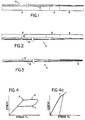
- a guidewire 10 of the invention has an elongated core element 12 formed of a precursor of a superelastic alloy.
- the core 12 includes a proximal body section 14 of constant diameter, a taper 16 and a distal end 18 of constant, smaller diameter than the body section 14.
- the core 12 is formed of a linear elastic precursor of a superelastic (or pseudo-elastic) metal alloy.
- the guidewire core is manufactured from a raw element that is made of the precursor alloy.
- the raw element is made by repeatedly drawing ingots of the precursor alloy without the application of heat (cold drawing).
- the alloy precursors of superelastic alloys are in the martensite crystalline phase at room temperature to body temperature and are linear elastic materials, i.e., they are easily permanently bent (plastically deformed) upon reaching a given stress and strain, known as the yield point, without passing through a substantial plateau.
- Raw elements formed of stress-induced superelastic materials are formed by drawing an ingot of the precursor alloy while simultaneously heating. In the unstressed state at room temperature such superelastic materials occur in the austenite crystalline phase and upon application of stress, exhibit stress-induced austenite-martensite crystalline transformations which produce non-linear elastic behavior. As a result, superelastic materials are able to undergo repeated high strain deformations without plastic deformation. When the deforming stress is removed the strain is recovered and there is little or no permanent or plastic deformation.
- the present invention contemplates guidewires formed of certain special alloys that are highly elastic, i.e. have high strain prior to yield, although typically not as high as the maximum strain of superelastic materials, but are also easily plastically deformable.
- Such alloys are those that are precursors of superelastic alloys, i.e., they have the same chemical constituents as superelastic alloys, but have not been processed to impart the superelastic property.
- FIGs. 4 and 4a schematic stress versus strain curves for a superelastic alloy (Fig. 4) and a super elastic precursor alloy that exhibits linear elastic properties (Fig. 4a) are compared.
- a superelastic alloy as stress is increased, the strain increases to a point (X) where the material undergoes a transformation from the austenite to the martensite phase. Thereafter, stress remains substantially constant while strain is increased, forming a constant stress plateau (P).
- the superelastic material is reversibly deformable. It returns to its original length on curve (Y) as the stress is released. This cycle may occur repeatedly, without appreciable change in dimension or plastic deformation.
- Fig. 4a the schematic stress-strain curve for a superelastic precursor material having linear elastic properties is shown for comparison to Fig. 4.
- the strain in this case increases reversibly to the plastic yield point (Z) without passing through a substantial plateau. At and above the yield point, the material becomes plastically, irreversibly deformed.
- at least the taper 16 or distal end 18 of the core member 12 is a linear elastic material formed of the precursor alloy of a superelastic material.
- a preferred precursor of a superelastic alloy is a nickel-titanium (55%/45%) system (available as Alloy Bu from Ray-Chem Corp., Menlo Park, CA). Precursors of other superelastic alloys may also be used.
- Silver-Cadmium (Ag-Cd), Gold-Cadmium (Au-Cd), Gold-Copper-Zinc (Au-Cu-Zn), Copper-Aluminum-Nickel (Cu-Al-Ni), Copper-Gold-Zinc (Cu-Au-Zn), Copper-Zinc (Cu-Zn), Copper-Zinc-aluminum (Cu-Zn-Al), Copper-Zinc-Tin (Cu-Zn-Sn), Copper-Zinc-Xenon (Cu-Zn-Xe), Iron Beryllium (Fe 3 Be), Iron-Platinum (Fe 3 Pt), Indium-Thallium (In-Tl), iron-maganese (Fe-Mn) Nickel-Titanium-Vanadium (Ni-Ti-V), Iron-Nickel-Titanium-Cobalt (Fe-Ni-Ti-Co) and Copper-Tin (Cu-Sn). See
- core element 12 is typically about 145 cm long or about 450cm long for a GI wire, has a body portion 14 of, e.g., about 0.5 to 7.4 mm (0.020 to 0.029 inch) diameter, and a tip portion 18, e.g., about 0.178 mm (0.007 inch) diameter that is about 2 to 10 cm long, with a smoothly tapering portion 16, e.g., about 7 to 10 cm long, all formed of a superelastic precursor alloy.
- the tapered portion of the wire 12 could also be continuous (not shown) rather than stepped as recited herein above.
- Body portion 14 of the core forms a generally stiffer region for torque transmission while the end section 18 and the tapering portion 16 at the distal end of the guidewire are of relatively greater flexibility due entirely to the reduced diameter.
- GI denotes gastrointestinal.
- the guidewire may include a polymer coating 22, e.g., polytetrafluoroethylene, Teflon (Trademark), disposed over the core 12 to facilitate smooth motion through body lumens.
- a polymer coating e.g., polytetrafluoroethylene, Teflon (Trademark)
- Teflon Teflon
- Other embodiments might include a lubricious coating as described, for example, by Terumo in EP-A-166998.
- An antithrombogenic coating may also be applied.
- a spring coil member 19 may also extend over a portion, such as the distal tip, of the core.
- the spring coil aids in transmission of torque to the distal end when manipulating the proximal portion to navigate tortous lumens.
- the coil is highly flexible, more flexible than the core, so that the coil may easily conform to the shape of the core when curvature is imparted by the physician.
- a radiopaque platinum coil is also preferable since it can facilitate observing and positioning of the element using radioscopic means.
- precursor material could be used for just the tip or taper of the guidewire.
- guidewire 10 can be used, for example, for treatment of vascular ailments.
- a physician inserts the distal end of guidewire 10 into a body lumen 56 such as a blood vessel.
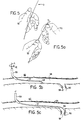
- the distal tip may be preformed manually by the physician (figs. 5-5a) according to his judgement as to the degree and nature of curvature best for the situation.
- the guidewire 10 may be taken from sterile storage and the physician, using his hands 52, 53, can grasp the end and shape the end to have the desired curvature 54 that complements the curvature of a lumen.
- the guidewire 10 for angioplasty is inserted using, for example, the Seldinger technique, through an introducer sheath 59, placed in a limb 60, like the leg, to give access to the lumen 56 such as the femoral artery.
- Axial thrust (arrow A) is applied to the proximal portion to advance the guidewire 10 (Fig. 5b) in the lumen.
- the curved end 54 of guidewire 10 is advanced through e.g, a large body lumen 56 to the desired position near a vessel 58, and steered by rotating body portion 14 (arrow R) to direct curved end 54 to the vessel 58 (Fig. 5c).
- guidewire may be introduced through an endoscope, (not shown), for gastrointestinal procedures, with benefits similar to the above-identified angioplasty procedure).
- a catheter can then be advanced over guidewire 10, and the guidewire removed when catheter is in place.
- the guidewire can negotiate highly tortuous passageways. Because the material is linearly elastic and deformable, the guidewire can be deformed by the physician just prior to entry for optimum shaping for ease of steering the element into a desired curved lumen.
- the guidewires of the present invention are formed of a precursor of a superelastic alloy.
- Guidewires that are substantially straight and capable of high elastic strain are manufactured from raw superelastic precursor element by taking care to prevent heating of the precursor that would result in heat treatment. In the event that excessive heating occurs, when the material is subsequently cooled, the straightness of the element may be lost. It also appears that in some cases the element becomes limp and less springy.
- the precursor alloys when first cold drawn from ingots into raw elements of constant diameter occur in the martensite phase at room temperature (as opposed to the superelastic alloy themselves which are drawn while heating and occur in the austenite phase at room temperature).
- the springiness and straightness in the martensite precursors we believe is a result of the cold drawing process which gives the martensite crystalline structure a preferred orientation.
- the high strain and straightness of the material can be maintained as long as the material is not substantially heated. When excessively heated, the materials pass through a transition to the austenite phase and, after cooling and returning to the martensite phase, the crystalline orientation or work hardening of the martensite which was imparted during the initial cold drawing is lost, leading to a less straight, and sometimes somewhat less spring material.
- the temperature of the raw precursor element is kept below, preferably well below, (e.g., room temperature,) the transition temperature from martensite to austenite during processing of the precursor material when forming guidewires.
- the transition temperature is approximately 149° C (300° F).
- a tapering machine which renders a tapered section by center-less grinding with a friction wheel may be used.
- Such apparatus are available, for example, from Royal Master Corp, Oakland, New Jersey (models TG-12x3 (stepless) or TG-12x4).
- the friction of the grinding wheel against the alloy can lead to a rise of temperature of the material.
- the rotation of the wheel, and the volume of liquid coolant flowing about the wheel and tip must be controlled.
- the rotation is reduced from a typical speed of about 40-50 rpm to about 19 rpm.
- the flow of room temperature coolant is typically half the maximum permitted by the model TG-12x4. Under these conditions, the tip may be ground to a taper without significantly increasing the temperature.
- various operating conditions might be adjusted and controlled to maintain a low temperature during the tapering step. For example, the temperature of the coolant might be reduced or its flow increased.
- tapering methods could also be used, and the temperature of the grinding region controlled.
- tapers by chemical etching or by drawing on an end or both ends of a element.
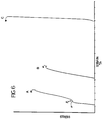
- Fig. 6 stress-strain curves from a stress testing machine for superelastic (curve A), superelastic precursor material (curve B) and a stainless steel element (curve C) are shown.
- the curves measure stress as a function of the percentage of strain for element pieces while drawing an end of the element. Stress testing machines are available from Instron Corp., Canton, MA.
- the percent strain is shown along the ordinate and measured stress along the abscissa.
- curve A the data shown is for a superelastic guidewire (Ni-Ti Alloy-BB, from Raychem Corp.) of about 0.5 mm (0.020 inch) outer diameter, Instron jaw separation 4 inches, speed 50.8 cm (20 inches)/min.
- the strain initially increases substantially linearly with stress up to point (x) at which point, the material transforms from austenite to martensite and stress is relatively constant with increasing strain, plateau (P).
- the path y as in Fig. 4 is not shown since the Instron machine was operated to increase stress until the material failed by pulling apart at point (w)).
- curve B the Instron machine data shown is for a guidewire (0.5 mm) (0.020 inch) made from a linear elastic precursor (Alloy Bu) of the superelastic alloy tested in Fig. 6.
- curve C the data for a stainless steel guidewire (0.5 mm) (0.020 inch) is shown. Both the linear elastic precursor and the stainless steel guidewires show no stress strain plateau indicating a phase change.
- table I the bending angle at the yield point of a guidewire tip for stainless steel, a linear elastic precursor of a superelastic material and a superelastic material are given.
- the elements were tested to determine the point of plastic deformation.
- a sample of element 70 was secured to a table 71 using a C-clamp 72.
- a protactor 73 was used to measure the angle.
- a steel ruler 74 a portion 75 of the element sample was moved in the direction of the arrow 76 until plastic deformation was observed.
- the diameter of the elements is given in mm (inches) in table I.
- the stainless element easily takes a set and yields permanently at the 35° angle, whereas both the precursor of the superelastic and the superelastic were observed to take on only a very slight kink, taken to be an artifact of the test, at a first angle point (55° for precursor alloy and 60° for superelastic alloy BB). After this there occurred a broad range in arc (55-80° for the precursor; 60-150° for the superelastic) through which there was no additional change in permanent deformation until reaching the upper angle number shown in the table. At this point, significant permanent deformation is imparted to the elements.
Landscapes
- Health & Medical Sciences (AREA)
- Life Sciences & Earth Sciences (AREA)
- Biophysics (AREA)
- Pulmonology (AREA)
- Engineering & Computer Science (AREA)
- Anesthesiology (AREA)
- Biomedical Technology (AREA)
- Heart & Thoracic Surgery (AREA)
- Hematology (AREA)
- Animal Behavior & Ethology (AREA)
- General Health & Medical Sciences (AREA)
- Public Health (AREA)
- Veterinary Medicine (AREA)
- Media Introduction/Drainage Providing Device (AREA)
- Materials For Medical Uses (AREA)
Applications Claiming Priority (3)
| Application Number | Priority Date | Filing Date | Title |
|---|---|---|---|
| US507375 | 1983-06-24 | ||
| US50737590A | 1990-04-10 | 1990-04-10 | |
| PCT/US1991/002420 WO1991015152A1 (en) | 1990-04-10 | 1991-04-09 | High elongation linear elastic guidewire |
Publications (3)
| Publication Number | Publication Date |
|---|---|
| EP0526527A1 EP0526527A1 (en) | 1993-02-10 |
| EP0526527A4 EP0526527A4 (en) | 1993-06-30 |
| EP0526527B1 true EP0526527B1 (en) | 1997-07-30 |
Family
ID=24018398
Family Applications (1)
| Application Number | Title | Priority Date | Filing Date |
|---|---|---|---|
| EP91908504A Expired - Lifetime EP0526527B1 (en) | 1990-04-10 | 1991-04-09 | High elongation linear elastic guidewire |
Country Status (5)
| Country | Link |
|---|---|
| EP (1) | EP0526527B1 (enExample) |
| JP (1) | JP3297434B2 (enExample) |
| CA (1) | CA2079480C (enExample) |
| DE (1) | DE69127078T2 (enExample) |
| WO (1) | WO1991015152A1 (enExample) |
Families Citing this family (35)
| Publication number | Priority date | Publication date | Assignee | Title |
|---|---|---|---|---|
| US5341818A (en) * | 1992-12-22 | 1994-08-30 | Advanced Cardiovascular Systems, Inc. | Guidewire with superelastic distal portion |
| US6165292A (en) | 1990-12-18 | 2000-12-26 | Advanced Cardiovascular Systems, Inc. | Superelastic guiding member |
| US6682608B2 (en) | 1990-12-18 | 2004-01-27 | Advanced Cardiovascular Systems, Inc. | Superelastic guiding member |
| US5243996A (en) * | 1992-01-03 | 1993-09-14 | Cook, Incorporated | Small-diameter superelastic wire guide |
| US5437288A (en) * | 1992-09-04 | 1995-08-01 | Mayo Foundation For Medical Education And Research | Flexible catheter guidewire |
| WO1995019800A2 (en) * | 1992-12-22 | 1995-07-27 | Advanced Cardiovascular Systems, Inc. | Guidewire with superelastic distal portion |
| EP0608775B1 (de) * | 1993-01-28 | 2001-03-21 | Angiomed GmbH & Co. Medizintechnik KG | Einstückiges Führungsteil und Verfahren zum Herstellen desselben |
| US5365943A (en) * | 1993-03-12 | 1994-11-22 | C. R. Bard, Inc. | Anatomically matched steerable PTCA guidewire |
| GB9307089D0 (en) * | 1993-04-03 | 1993-05-26 | Shiu Man F | Predilating wire for angioplasty |
| US5772609A (en) * | 1993-05-11 | 1998-06-30 | Target Therapeutics, Inc. | Guidewire with variable flexibility due to polymeric coatings |
| US5749837A (en) * | 1993-05-11 | 1998-05-12 | Target Therapeutics, Inc. | Enhanced lubricity guidewire |
| US7883474B1 (en) | 1993-05-11 | 2011-02-08 | Target Therapeutics, Inc. | Composite braided guidewire |
| US5769796A (en) * | 1993-05-11 | 1998-06-23 | Target Therapeutics, Inc. | Super-elastic composite guidewire |
| US5409015A (en) * | 1993-05-11 | 1995-04-25 | Target Therapeutics, Inc. | Deformable tip super elastic guidewire |
| EP1426071A3 (en) * | 1994-01-14 | 2005-03-23 | Advanced Cardiovascular Systems, Inc. | Guidewire with superelastic distal portion |
| US6139510A (en) * | 1994-05-11 | 2000-10-31 | Target Therapeutics Inc. | Super elastic alloy guidewire |
| US6488637B1 (en) | 1996-04-30 | 2002-12-03 | Target Therapeutics, Inc. | Composite endovascular guidewire |
| US6306105B1 (en) * | 1998-05-14 | 2001-10-23 | Scimed Life Systems, Inc. | High performance coil wire |
| AU765505B2 (en) | 1998-08-19 | 2003-09-18 | Cook Incorporated | Preformed wire guide |
| WO2000021443A1 (en) | 1998-10-09 | 2000-04-20 | Cook Incorporated | Vasoocclusion coil device having a core therein |
| US6217589B1 (en) | 1999-10-27 | 2001-04-17 | Scimed Life Systems, Inc. | Retrieval device made of precursor alloy cable and method of manufacturing |
| CA2462335C (en) * | 2001-10-05 | 2010-12-07 | Boston Scientific Limited | Composite guidewire |
| US6702762B2 (en) * | 2001-12-27 | 2004-03-09 | Advanced Cardiovascular Systems, Inc. | Apparatus and method for joining two guide wire core materials without a hypotube |
| US8071155B2 (en) | 2005-05-05 | 2011-12-06 | Boston Scientific Scimed, Inc. | Medical devices and methods of making the same |
| US7778684B2 (en) | 2005-08-08 | 2010-08-17 | Boston Scientific Scimed, Inc. | MRI resonator system with stent implant |
| FR2932688B1 (fr) * | 2008-06-20 | 2013-01-25 | Ela Medical Sa | Mandrin bi-matiere de guidage d'une sonde en contact avec la paroi du septum |
| EP2135638B1 (fr) * | 2008-06-20 | 2015-03-11 | Ela Medical | Mandrin préformé de guidage d'une sonde en contact avec la paroi du septum |
| EP2275170B1 (fr) | 2009-07-15 | 2012-08-29 | Sorin CRM SAS | Ensemble implantable dans le réseau veineux coronarien, comprenant une sonde de stimulation à vis d'ancrage |
| US9017246B2 (en) | 2010-11-19 | 2015-04-28 | Boston Scientific Scimed, Inc. | Biliary catheter systems including stabilizing members |
| US9724494B2 (en) * | 2011-06-29 | 2017-08-08 | Abbott Cardiovascular Systems, Inc. | Guide wire device including a solderable linear elastic nickel-titanium distal end section and methods of preparation therefor |
| US10335580B2 (en) | 2013-09-30 | 2019-07-02 | Abbott Cardiovascular Systems Inc. | Guidewire with varying properties |
| WO2017132343A1 (en) * | 2016-01-26 | 2017-08-03 | Abbott Cardiovascular Systems Inc. | Guidewire with varying properties |
| US11684759B2 (en) | 2020-01-22 | 2023-06-27 | Abbott Cardiovascular Systems Inc. | Guidewire having varying diameters and method of making |
| JP7689981B2 (ja) * | 2020-10-30 | 2025-06-09 | テルモ株式会社 | ガイドワイヤおよびガイドワイヤの製造方法 |
| JP7759336B2 (ja) * | 2020-10-30 | 2025-10-23 | テルモ株式会社 | ガイドワイヤおよびガイドワイヤの製造方法 |
Family Cites Families (4)
| Publication number | Priority date | Publication date | Assignee | Title |
|---|---|---|---|---|
| US3351463A (en) * | 1965-08-20 | 1967-11-07 | Alexander G Rozner | High strength nickel-base alloys |
| CA1232814A (en) * | 1983-09-16 | 1988-02-16 | Hidetoshi Sakamoto | Guide wire for catheter |
| JPS63171570A (ja) * | 1987-01-07 | 1988-07-15 | テルモ株式会社 | カテ−テル用ガイドワイヤ− |
| US4991602A (en) | 1989-06-27 | 1991-02-12 | Flexmedics Corporation | Flexible guide wire with safety tip |
-
1991
- 1991-04-09 CA CA002079480A patent/CA2079480C/en not_active Expired - Lifetime
- 1991-04-09 JP JP50766291A patent/JP3297434B2/ja not_active Ceased
- 1991-04-09 WO PCT/US1991/002420 patent/WO1991015152A1/en not_active Ceased
- 1991-04-09 DE DE69127078T patent/DE69127078T2/de not_active Expired - Lifetime
- 1991-04-09 EP EP91908504A patent/EP0526527B1/en not_active Expired - Lifetime
Also Published As
| Publication number | Publication date |
|---|---|
| CA2079480C (en) | 2001-11-20 |
| JPH05508559A (ja) | 1993-12-02 |
| EP0526527A1 (en) | 1993-02-10 |
| DE69127078D1 (de) | 1997-09-04 |
| EP0526527A4 (en) | 1993-06-30 |
| DE69127078T2 (de) | 1998-01-22 |
| CA2079480A1 (en) | 1991-10-11 |
| WO1991015152A1 (en) | 1991-10-17 |
| JP3297434B2 (ja) | 2002-07-02 |
Similar Documents
| Publication | Publication Date | Title |
|---|---|---|
| US5238004A (en) | High elongation linear elastic guidewire | |
| CA2079480C (en) | High elongation linear elastic guidewire | |
| EP0491349B1 (en) | Method of manufacturing a Superelastic guiding member | |
| US8728010B2 (en) | Elongate medical device including deformable distal end | |
| US6165292A (en) | Superelastic guiding member | |
| US7258753B2 (en) | Superelastic guiding member | |
| US6287292B1 (en) | Guidewire with a variable stiffness distal portion | |
| US5636641A (en) | High strength member for intracorporeal use | |
| US5341818A (en) | Guidewire with superelastic distal portion | |
| US5980471A (en) | Guidewire with tubular connector | |
| CA2440059C (en) | Total occlusion guidewire device | |
| US20040167440A1 (en) | Multiple diameter guidewire | |
| US20050115624A1 (en) | Composite medical device and method of forming | |
| JP2003516203A (ja) | Niti合金製ガイドワイヤ | |
| JP3725900B2 (ja) | 超弾性遠位部分を有するガイドワイヤ | |
| US8100837B1 (en) | Superelastic guidewire with locally altered properties | |
| WO1995019800A2 (en) | Guidewire with superelastic distal portion | |
| EP1426071A2 (en) | Guidewire with superelastic distal portion | |
| EP4709459A1 (en) | Twisted guidewire |
Legal Events
| Date | Code | Title | Description |
|---|---|---|---|
| PUAI | Public reference made under article 153(3) epc to a published international application that has entered the european phase |
Free format text: ORIGINAL CODE: 0009012 |
|
| 17P | Request for examination filed |
Effective date: 19921009 |
|
| AK | Designated contracting states |
Kind code of ref document: A1 Designated state(s): CH DE DK ES FR GB IT LI SE |
|
| A4 | Supplementary search report drawn up and despatched |
Effective date: 19930517 |
|
| AK | Designated contracting states |
Kind code of ref document: A4 Designated state(s): CH DE DK ES FR GB IT LI SE |
|
| 17Q | First examination report despatched |
Effective date: 19950720 |
|
| GRAG | Despatch of communication of intention to grant |
Free format text: ORIGINAL CODE: EPIDOS AGRA |
|
| RAP1 | Party data changed (applicant data changed or rights of an application transferred) |
Owner name: BOSTON SCIENTIFIC CORPORATION |
|
| RAP3 | Party data changed (applicant data changed or rights of an application transferred) |
Owner name: BOSTON SCIENTIFIC CORPORATION |
|
| GRAH | Despatch of communication of intention to grant a patent |
Free format text: ORIGINAL CODE: EPIDOS IGRA |
|
| GRAH | Despatch of communication of intention to grant a patent |
Free format text: ORIGINAL CODE: EPIDOS IGRA |
|
| GRAA | (expected) grant |
Free format text: ORIGINAL CODE: 0009210 |
|
| AK | Designated contracting states |
Kind code of ref document: B1 Designated state(s): CH DE DK ES FR GB IT LI SE |
|
| PG25 | Lapsed in a contracting state [announced via postgrant information from national office to epo] |
Ref country code: IT Free format text: LAPSE BECAUSE OF FAILURE TO SUBMIT A TRANSLATION OF THE DESCRIPTION OR TO PAY THE FEE WITHIN THE PRE;WARNING: LAPSES OF ITALIAN PATENTS WITH EFFECTIVE DATE BEFORE 2007 MAY HAVE OCCURRED AT ANY TIME BEFORE 2007. THE CORRECT EFFECTIVE DATE MAY BE DIFFERENT FROM THE ONE RECORDED.SCRIBED TIME-LIMIT Effective date: 19970730 Ref country code: LI Free format text: LAPSE BECAUSE OF FAILURE TO SUBMIT A TRANSLATION OF THE DESCRIPTION OR TO PAY THE FEE WITHIN THE PRESCRIBED TIME-LIMIT Effective date: 19970730 Ref country code: CH Free format text: LAPSE BECAUSE OF FAILURE TO SUBMIT A TRANSLATION OF THE DESCRIPTION OR TO PAY THE FEE WITHIN THE PRESCRIBED TIME-LIMIT Effective date: 19970730 Ref country code: ES Free format text: THE PATENT HAS BEEN ANNULLED BY A DECISION OF A NATIONAL AUTHORITY Effective date: 19970730 Ref country code: DK Effective date: 19970730 |
|
| REG | Reference to a national code |
Ref country code: CH Ref legal event code: EP |
|
| REF | Corresponds to: |
Ref document number: 69127078 Country of ref document: DE Date of ref document: 19970904 |
|
| ET | Fr: translation filed | ||
| PG25 | Lapsed in a contracting state [announced via postgrant information from national office to epo] |
Ref country code: SE Effective date: 19971030 |
|
| REG | Reference to a national code |
Ref country code: CH Ref legal event code: PL |
|
| PLBE | No opposition filed within time limit |
Free format text: ORIGINAL CODE: 0009261 |
|
| STAA | Information on the status of an ep patent application or granted ep patent |
Free format text: STATUS: NO OPPOSITION FILED WITHIN TIME LIMIT |
|
| 26N | No opposition filed | ||
| REG | Reference to a national code |
Ref country code: GB Ref legal event code: IF02 |
|
| PGFP | Annual fee paid to national office [announced via postgrant information from national office to epo] |
Ref country code: GB Payment date: 20100312 Year of fee payment: 20 |
|
| PGFP | Annual fee paid to national office [announced via postgrant information from national office to epo] |
Ref country code: FR Payment date: 20100420 Year of fee payment: 20 |
|
| PGFP | Annual fee paid to national office [announced via postgrant information from national office to epo] |
Ref country code: DE Payment date: 20100430 Year of fee payment: 20 |
|
| REG | Reference to a national code |
Ref country code: DE Ref legal event code: R071 Ref document number: 69127078 Country of ref document: DE |
|
| REG | Reference to a national code |
Ref country code: GB Ref legal event code: PE20 Expiry date: 20110408 |
|
| PG25 | Lapsed in a contracting state [announced via postgrant information from national office to epo] |
Ref country code: GB Free format text: LAPSE BECAUSE OF EXPIRATION OF PROTECTION Effective date: 20110408 |
|
| PG25 | Lapsed in a contracting state [announced via postgrant information from national office to epo] |
Ref country code: DE Free format text: LAPSE BECAUSE OF EXPIRATION OF PROTECTION Effective date: 20110409 |