EP0522872B1 - Substoichiometric zirconium nitride coating - Google Patents
Substoichiometric zirconium nitride coating Download PDFInfo
- Publication number
- EP0522872B1 EP0522872B1 EP92306353A EP92306353A EP0522872B1 EP 0522872 B1 EP0522872 B1 EP 0522872B1 EP 92306353 A EP92306353 A EP 92306353A EP 92306353 A EP92306353 A EP 92306353A EP 0522872 B1 EP0522872 B1 EP 0522872B1
- Authority
- EP
- European Patent Office
- Prior art keywords
- coating
- zirconium nitride
- nitrogen
- coated article
- article according
- Prior art date
- Legal status (The legal status is an assumption and is not a legal conclusion. Google has not performed a legal analysis and makes no representation as to the accuracy of the status listed.)
- Expired - Lifetime
Links
- 238000000576 coating method Methods 0.000 title claims abstract description 87
- 239000011248 coating agent Substances 0.000 title claims abstract description 60
- ZVWKZXLXHLZXLS-UHFFFAOYSA-N zirconium nitride Chemical compound [Zr]#N ZVWKZXLXHLZXLS-UHFFFAOYSA-N 0.000 title claims abstract description 28
- IJGRMHOSHXDMSA-UHFFFAOYSA-N Atomic nitrogen Chemical compound N#N IJGRMHOSHXDMSA-UHFFFAOYSA-N 0.000 claims abstract description 74
- 229910052757 nitrogen Inorganic materials 0.000 claims abstract description 36
- 239000000758 substrate Substances 0.000 claims abstract description 23
- XEEYBQQBJWHFJM-UHFFFAOYSA-N Iron Chemical compound [Fe] XEEYBQQBJWHFJM-UHFFFAOYSA-N 0.000 claims description 4
- PXHVJJICTQNCMI-UHFFFAOYSA-N Nickel Chemical compound [Ni] PXHVJJICTQNCMI-UHFFFAOYSA-N 0.000 claims description 4
- RTAQQCXQSZGOHL-UHFFFAOYSA-N Titanium Chemical group [Ti] RTAQQCXQSZGOHL-UHFFFAOYSA-N 0.000 claims description 3
- 239000010936 titanium Substances 0.000 claims description 3
- 229910052719 titanium Inorganic materials 0.000 claims description 3
- 229910001069 Ti alloy Inorganic materials 0.000 claims description 2
- 239000000956 alloy Substances 0.000 claims description 2
- 229910045601 alloy Inorganic materials 0.000 claims description 2
- 239000004411 aluminium Substances 0.000 claims description 2
- XAGFODPZIPBFFR-UHFFFAOYSA-N aluminium Chemical compound [Al] XAGFODPZIPBFFR-UHFFFAOYSA-N 0.000 claims description 2
- 229910052782 aluminium Inorganic materials 0.000 claims description 2
- 239000010941 cobalt Substances 0.000 claims description 2
- 229910017052 cobalt Inorganic materials 0.000 claims description 2
- GUTLYIVDDKVIGB-UHFFFAOYSA-N cobalt atom Chemical compound [Co] GUTLYIVDDKVIGB-UHFFFAOYSA-N 0.000 claims description 2
- 229910052742 iron Inorganic materials 0.000 claims description 2
- 229910052759 nickel Inorganic materials 0.000 claims description 2
- 230000003628 erosive effect Effects 0.000 abstract description 40
- 229910052726 zirconium Inorganic materials 0.000 description 19
- QCWXUUIWCKQGHC-UHFFFAOYSA-N Zirconium Chemical compound [Zr] QCWXUUIWCKQGHC-UHFFFAOYSA-N 0.000 description 18
- 239000002245 particle Substances 0.000 description 18
- 229910008328 ZrNx Inorganic materials 0.000 description 14
- 230000003247 decreasing effect Effects 0.000 description 9
- 239000010410 layer Substances 0.000 description 8
- 239000000463 material Substances 0.000 description 8
- XKRFYHLGVUSROY-UHFFFAOYSA-N argon Substances [Ar] XKRFYHLGVUSROY-UHFFFAOYSA-N 0.000 description 7
- 239000007787 solid Substances 0.000 description 7
- 238000000151 deposition Methods 0.000 description 6
- 239000007789 gas Substances 0.000 description 6
- 239000000203 mixture Substances 0.000 description 6
- PNEYBMLMFCGWSK-UHFFFAOYSA-N aluminium oxide Inorganic materials [O-2].[O-2].[O-2].[Al+3].[Al+3] PNEYBMLMFCGWSK-UHFFFAOYSA-N 0.000 description 5
- 230000008021 deposition Effects 0.000 description 5
- QJGQUHMNIGDVPM-UHFFFAOYSA-N nitrogen group Chemical group [N] QJGQUHMNIGDVPM-UHFFFAOYSA-N 0.000 description 5
- 229910052786 argon Inorganic materials 0.000 description 4
- 150000001875 compounds Chemical class 0.000 description 4
- 150000002500 ions Chemical class 0.000 description 4
- 238000000034 method Methods 0.000 description 4
- VYPSYNLAJGMNEJ-UHFFFAOYSA-N Silicium dioxide Chemical compound O=[Si]=O VYPSYNLAJGMNEJ-UHFFFAOYSA-N 0.000 description 3
- NRTOMJZYCJJWKI-UHFFFAOYSA-N Titanium nitride Chemical compound [Ti]#N NRTOMJZYCJJWKI-UHFFFAOYSA-N 0.000 description 3
- 238000001704 evaporation Methods 0.000 description 3
- 230000007935 neutral effect Effects 0.000 description 3
- -1 zirconium nitrides Chemical class 0.000 description 3
- 230000001427 coherent effect Effects 0.000 description 2
- 230000007423 decrease Effects 0.000 description 2
- 229910001873 dinitrogen Inorganic materials 0.000 description 2
- 230000008020 evaporation Effects 0.000 description 2
- 238000005240 physical vapour deposition Methods 0.000 description 2
- 238000004901 spalling Methods 0.000 description 2
- 241000446313 Lamella Species 0.000 description 1
- UDWPONKAYSRBTJ-UHFFFAOYSA-N [He].[N] Chemical compound [He].[N] UDWPONKAYSRBTJ-UHFFFAOYSA-N 0.000 description 1
- PWKWDCOTNGQLID-UHFFFAOYSA-N [N].[Ar] Chemical compound [N].[Ar] PWKWDCOTNGQLID-UHFFFAOYSA-N 0.000 description 1
- ZKJJMWRFUBITJD-UHFFFAOYSA-N [N].[Kr] Chemical compound [N].[Kr] ZKJJMWRFUBITJD-UHFFFAOYSA-N 0.000 description 1
- TUVQIHHKIZFJTE-UHFFFAOYSA-N [N].[Ne] Chemical compound [N].[Ne] TUVQIHHKIZFJTE-UHFFFAOYSA-N 0.000 description 1
- FFYUGJCEFMSZKN-UHFFFAOYSA-N [N].[Xe] Chemical compound [N].[Xe] FFYUGJCEFMSZKN-UHFFFAOYSA-N 0.000 description 1
- 230000015572 biosynthetic process Effects 0.000 description 1
- 230000015556 catabolic process Effects 0.000 description 1
- 229910010293 ceramic material Inorganic materials 0.000 description 1
- 229910052681 coesite Inorganic materials 0.000 description 1
- 239000000356 contaminant Substances 0.000 description 1
- 238000007796 conventional method Methods 0.000 description 1
- 238000005260 corrosion Methods 0.000 description 1
- 230000007797 corrosion Effects 0.000 description 1
- 229910052593 corundum Inorganic materials 0.000 description 1
- 229910052906 cristobalite Inorganic materials 0.000 description 1
- 238000006731 degradation reaction Methods 0.000 description 1
- 239000000428 dust Substances 0.000 description 1
- 230000000694 effects Effects 0.000 description 1
- 239000011261 inert gas Substances 0.000 description 1
- 238000007733 ion plating Methods 0.000 description 1
- 238000001755 magnetron sputter deposition Methods 0.000 description 1
- 238000004519 manufacturing process Methods 0.000 description 1
- 238000005259 measurement Methods 0.000 description 1
- 150000004767 nitrides Chemical class 0.000 description 1
- 230000003287 optical effect Effects 0.000 description 1
- 239000000843 powder Substances 0.000 description 1
- 230000002028 premature Effects 0.000 description 1
- 239000011241 protective layer Substances 0.000 description 1
- 239000004576 sand Substances 0.000 description 1
- 239000000377 silicon dioxide Substances 0.000 description 1
- 235000012239 silicon dioxide Nutrition 0.000 description 1
- 230000005476 size effect Effects 0.000 description 1
- 238000004611 spectroscopical analysis Methods 0.000 description 1
- 229910052682 stishovite Inorganic materials 0.000 description 1
- 239000000126 substance Substances 0.000 description 1
- 229910052905 tridymite Inorganic materials 0.000 description 1
- 230000004580 weight loss Effects 0.000 description 1
- 229910001845 yogo sapphire Inorganic materials 0.000 description 1
Images


Classifications
-
- C—CHEMISTRY; METALLURGY
- C23—COATING METALLIC MATERIAL; COATING MATERIAL WITH METALLIC MATERIAL; CHEMICAL SURFACE TREATMENT; DIFFUSION TREATMENT OF METALLIC MATERIAL; COATING BY VACUUM EVAPORATION, BY SPUTTERING, BY ION IMPLANTATION OR BY CHEMICAL VAPOUR DEPOSITION, IN GENERAL; INHIBITING CORROSION OF METALLIC MATERIAL OR INCRUSTATION IN GENERAL
- C23C—COATING METALLIC MATERIAL; COATING MATERIAL WITH METALLIC MATERIAL; SURFACE TREATMENT OF METALLIC MATERIAL BY DIFFUSION INTO THE SURFACE, BY CHEMICAL CONVERSION OR SUBSTITUTION; COATING BY VACUUM EVAPORATION, BY SPUTTERING, BY ION IMPLANTATION OR BY CHEMICAL VAPOUR DEPOSITION, IN GENERAL
- C23C30/00—Coating with metallic material characterised only by the composition of the metallic material, i.e. not characterised by the coating process
-
- C—CHEMISTRY; METALLURGY
- C23—COATING METALLIC MATERIAL; COATING MATERIAL WITH METALLIC MATERIAL; CHEMICAL SURFACE TREATMENT; DIFFUSION TREATMENT OF METALLIC MATERIAL; COATING BY VACUUM EVAPORATION, BY SPUTTERING, BY ION IMPLANTATION OR BY CHEMICAL VAPOUR DEPOSITION, IN GENERAL; INHIBITING CORROSION OF METALLIC MATERIAL OR INCRUSTATION IN GENERAL
- C23C—COATING METALLIC MATERIAL; COATING MATERIAL WITH METALLIC MATERIAL; SURFACE TREATMENT OF METALLIC MATERIAL BY DIFFUSION INTO THE SURFACE, BY CHEMICAL CONVERSION OR SUBSTITUTION; COATING BY VACUUM EVAPORATION, BY SPUTTERING, BY ION IMPLANTATION OR BY CHEMICAL VAPOUR DEPOSITION, IN GENERAL
- C23C14/00—Coating by vacuum evaporation, by sputtering or by ion implantation of the coating forming material
- C23C14/06—Coating by vacuum evaporation, by sputtering or by ion implantation of the coating forming material characterised by the coating material
- C23C14/0641—Nitrides
-
- Y—GENERAL TAGGING OF NEW TECHNOLOGICAL DEVELOPMENTS; GENERAL TAGGING OF CROSS-SECTIONAL TECHNOLOGIES SPANNING OVER SEVERAL SECTIONS OF THE IPC; TECHNICAL SUBJECTS COVERED BY FORMER USPC CROSS-REFERENCE ART COLLECTIONS [XRACs] AND DIGESTS
- Y10—TECHNICAL SUBJECTS COVERED BY FORMER USPC
- Y10T—TECHNICAL SUBJECTS COVERED BY FORMER US CLASSIFICATION
- Y10T428/00—Stock material or miscellaneous articles
- Y10T428/26—Web or sheet containing structurally defined element or component, the element or component having a specified physical dimension
- Y10T428/263—Coating layer not in excess of 5 mils thick or equivalent
- Y10T428/264—Up to 3 mils
- Y10T428/265—1 mil or less
Definitions
- the present invention relates to a wear and erosion resistant coating composed of particular zirconium nitrides.
- Resistance against erosion wear is normally related to the hardness of the wear part.
- Some articles are subject to solid particle erosion in which particles of various sizes and hardness are propelled at various angles against the surface of the articles.
- a vehicle or the like for example a vehicle itself or a large container associated with a road vehicle or part of a railroad train
- travelling in the desert during a wind storm will encounter various size solid particles of sand travelling at various velocities hitting the vehicle or the like. If the size of the particles is large and the velocity of the particles is high, the coating on the vehicle or the like could be chipped or pitted. In turbomachines which operate in a dust environment, this solid particle erosion is a severe problem.
- toughness and hardness are the dominant properties controlling the erosion behaviour. Higher hardness is believed to increase erosion resistance at both low and high impingement angles while higher toughness reduces the vulnerability to brittle fracture and markedly increases 90° erosion resistance.
- An erosion resistant coating needs to be simultaneously hard and tough. However, hardness and toughness are generally in opposition in hard materials. Higher hardness is usually associated with greater brittleness. Multilayer hard compound materials have been found to have simultaneously high hardness and high toughness. The high hardness is an inherent property of hard compounds and the high toughness is attributed to the formation of a coherent or partly coherent interface boundary between two different hard compound layers. In ceramic materials, hardness and toughness are typically maximised by a fine-grained microstructure.
- a multilayer coating which has good wear and erosion resistant characteristics, such multilayer coating comprising alternate lamellas layers of a nitride-containing compound in which at least one layer contains at least 2 atomic percent of nitrogen different than the nitrogen contained in an adjacent layer.
- a coated article having a homogeneous substoichiometric zirconium nitride coating deposited on a substrate, in which the atomic percent of nitrogen in the coating is from 41 to 48 percent, the coating having a microhardness of greater than 2200 kg force per square millimetre when using a 0.1 kg load.
- the atomic percent of nitrogen in the substoichiometric zirconium nitride coating could be from about 42% to 45% and most preferably about 43% to 44%.
- the coating of this invention has good wear and corrosion characteristics and should have a crystallize size, measured in the direction perpendicular to (111) diffraction plane, of between about 12 to 24nm, preferably between about 13 to 20 nm.
- the zirconium nitride coating preferably has a microhardness from 2200 to 2600 kilograms force per square millimetre.
- a substoichiometric coating of zirconium nitride shall mean a coating in which the nitrogen content is below 50 atomic percent.
- the nitrogen-containing gas mixture could be argon-nitrogen; krypton-nitrogen; helium-nitrogen; xenon-nitrogen; neon-nitrogen or the like.
- the zirconium nitride coating of the present invention can be deposited by using conventional physical vapour deposition techniques such as arc processes, dc and rf magnetron sputtering, reactive ion plating and the like.
- the substrate could have a zirconium-containing outer surface so that the coating can form a strong bond to the substrate.
- the zirconium-containing outer layer should preferably be from 0.1 to 6.0 ⁇ m (microns) thick, and more preferably from 0.2 to 4.0 ⁇ m (microns) thick.
- the thickness of the zirconium nitride coating of this invention can vary greatly as for example from 1 to 40 ⁇ m (microns) thick while for wear applications the preferred thickness of the coating could be from 1 to 10 ⁇ m (microns) and for erosion applications the coating could be from 8 to 40 ⁇ m (microns).
- the zirconium nitride coating of the present invention is ideally suited for coating substrates such as for example titanium, iron, aluminium, nickel, cobalt and alloys thereof.
- substrates such as for example titanium, iron, aluminium, nickel, cobalt and alloys thereof.
- the substrate could be coated with a zirconium-containing layer prior to depositing the coating of the present invention since the undercoat will effectively provide a better adherence for the coating.
- Zirconium nitride coatings were deposited on titanium alloy substrates using a physical vapour deposition arc evaporation process. Before deposition, the vapour deposition chamber was evacuated to a pressure below 7 x 10 ⁇ 4 Pa and then backfilled with argon to 0.7 Pa. The substrates to be coated were sputter-cleaned with a negative bias of 1 kVdc for between 30 to 60 minutes to remove surface contaminants. Subsequently, a 200 to 350 ampere d.c. arc was activated across a zirconium cathode and a chamber which acts as an anode to evaporate zirconium from the zirconium cathode in an argon and nitrogen environment at an overall pressure about 4 Pa.
- the ionized zirconium vapour reacted with N2 ions and then formed a zirconium nitride coating on the substrate.
- Each coating was formed by adjusting the nitrogen gas flow rates during the deposition. Specifically the nitrogen gas flow was varied from approximately 70 to 90 standard cubic centimetres per minute (sccm) and the total argon gas flow was maintained at about 240 sccm.
- the deposition temperature determined using an optical pyrometer, was between 410°C and 520°C.
- each sample coating was measured by sputtered mass neutral spectrometry.
- the neutral atoms of the coating were sputtered from its surface into plasma by ions which were generated from a low pressure r.f. plasma.
- the neutral atoms were then ionized by energetic electron impact. These ions were subsequently analyzed and detected in a quadrupole mass spectrometer.
- the measured area was in an 8 mm diameter circle and the total sputtered depth was approximately 5 ⁇ m (microns).
- the experimentally observed breadth ( ⁇ ) is comprised of B due to the particle size effect and b resulting from the instrumental broadening, ⁇ - B + b.
- the instrumental broadening, b was determined using ZrN powder with particle size greater than several microns.
- the crystallite size D lll was determined and the results are shown in the Table. This data shows that the crystallite size D lll decreased with decreasing nitrogen content as from 32.5 nm at 50 atomic percent nitrogen to 10.6 nm at 40.5 atomic percent nitrogen.
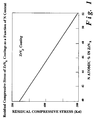
- Residual stresses of the sample ZrN X coatings were determined using the standard sin ⁇ method based on the change in lattice spacings (strain).
- each of the ZrN x sample coatings was metallographically polished before being subjected to microhardness measurements, using a Vickers hardness tester with a load of 0.1 Kg for 15 seconds.
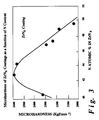
- the data obtained is presented in the Table and shows that the microhardness of ZrN x increased with decreasing nitrogen content from 2037 kilograms force per square millimetre (Kgf mm ⁇ ) at 50 atomic percent N to a maximum of 2588 Kgf mm ⁇ at 43.2 atomic percent N, and then decreased to 2318 Kgf mm ⁇ at 40.5 atomic percent N.
- the ZrN x sample coatings were exposed to 50 microns alumina erosion at both 20° and 90° impingement angles at room temperature. Compressed air with a pressure of 290 kPa (42 psig) was used to deliver alumina particles through a 5 mm diameter alumina nozzle. The nozzle-to-specimen distance was maintained at 10 cm. The amount of alumina particles used for 20° and 90° erosion was 1800 g and 400 g, respectively.
- the relative erosion resistance was calculated by comparing the total weight loss of the substoichiometric ZrN x coatings with that of a stoichiometric ZrN coating, in which the erosion resistance was assumed to be 1 at both 20° and 90° impact angles. The data obtained is presented in the Table and shows that a maximum erosion resistance at 20° and 90° occurred at about 42 to 45 atomic percent N, which corresponds to the region having the combination of maximum microhardness and minimum grain size.
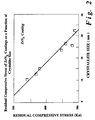
- Figure 2 shows a plot of crystallite size v. residual compressive stress. The smaller crystallite size is believed to more than compensate for the increased stress.
- Figure 3 a plot of microhardness vs. nitrogen content shows that a maximum microhardness occurs between 42 and 45 atomic percent N content.
- Figure 4 shows a plot of erosion resistance vs. nitrogen content in which a maximum erosion resistance appears at N content between 42 and 44 atomic percent.
- Figure 5 shows a plot of erosion resistance vs. crystallite size in which the optimum crystallite size is shown around 15 nm.
- Figure 6 shows a plot of erosion resistance vs. microhardness in which the erosion resistance increases with increasing microhardness.
- Figure 7 shows that the texture coefficient is a function of N concentration in the coating.
- the coating exhibited a combination of ⁇ 111> and ⁇ 311> preferred orientation at N content between 41.5 and 48 atomic percent.
- the most preferred coating has a combination of ⁇ 111> and ⁇ 311> preferred orientation in which ⁇ 311> preferred orientation is dominant over ⁇ 111> preferred orientation.
- microhardness and crystallite size are believed to be the predominant parameters controlling erosion behavior in which the erosion resistance increases with increasing microhardness and with decreasing crystallite size.
- a linear relationship between erosion resistance and microhardness can only be obtained, if one excludes the coating containing 40.5 atomic percent nitrogen (Figure 6).
- the erosion resistance increased with decreasing crystallite size down to 12 nm ( Figure 5). At crystallite size significantly less than 12 nm, when the nitrogen is about 40.5 atomic percent, a marked decrease in erosion resistance was observed.
Landscapes
- Chemical & Material Sciences (AREA)
- Organic Chemistry (AREA)
- Engineering & Computer Science (AREA)
- Materials Engineering (AREA)
- Mechanical Engineering (AREA)
- Metallurgy (AREA)
- Chemical Kinetics & Catalysis (AREA)
- Physical Vapour Deposition (AREA)
- Ceramic Products (AREA)
- Materials For Medical Uses (AREA)
- Chemical Vapour Deposition (AREA)
- Solid-Phase Diffusion Into Metallic Material Surfaces (AREA)
- Glass Compositions (AREA)
- Cutting Tools, Boring Holders, And Turrets (AREA)
Applications Claiming Priority (2)
| Application Number | Priority Date | Filing Date | Title |
|---|---|---|---|
| US07/728,338 US5242753A (en) | 1991-07-11 | 1991-07-11 | Substoichiometric zirconium nitride coating |
| US728338 | 1991-07-11 |
Publications (2)
| Publication Number | Publication Date |
|---|---|
| EP0522872A1 EP0522872A1 (en) | 1993-01-13 |
| EP0522872B1 true EP0522872B1 (en) | 1996-02-28 |
Family
ID=24926443
Family Applications (1)
| Application Number | Title | Priority Date | Filing Date |
|---|---|---|---|
| EP92306353A Expired - Lifetime EP0522872B1 (en) | 1991-07-11 | 1992-07-10 | Substoichiometric zirconium nitride coating |
Country Status (7)
| Country | Link |
|---|---|
| US (1) | US5242753A (enExample) |
| EP (1) | EP0522872B1 (enExample) |
| JP (1) | JP2646313B2 (enExample) |
| AT (1) | ATE134721T1 (enExample) |
| CA (2) | CA2073651C (enExample) |
| DE (1) | DE69208546T2 (enExample) |
| SG (1) | SG47604A1 (enExample) |
Families Citing this family (10)
| Publication number | Priority date | Publication date | Assignee | Title |
|---|---|---|---|---|
| US6062018A (en) * | 1993-04-14 | 2000-05-16 | Adroit Systems, Inc. | Pulse detonation electrical power generation apparatus with water injection |
| US6360423B1 (en) | 1997-12-16 | 2002-03-26 | Clad Metals Llc | Stick resistant coating for cookware |
| US7093340B2 (en) | 1997-12-16 | 2006-08-22 | All-Clad Metalcrafters Llc | Stick resistant ceramic coating for cookware |
| US6871613B2 (en) * | 2003-06-06 | 2005-03-29 | Schulmerich Carillons, Inc. | Tarnish-resistant handbell and its method of manufacture |
| DE10342398B4 (de) * | 2003-09-13 | 2008-05-29 | Schott Ag | Schutzschicht für einen Körper sowie Verfahren zur Herstellung und Verwendung von Schutzschichten |
| US7211338B2 (en) * | 2003-12-19 | 2007-05-01 | Honeywell International, Inc. | Hard, ductile coating system |
| TW201233820A (en) * | 2011-02-08 | 2012-08-16 | Chenming Mold Ind Corp | Ceramic member and manufacturing thereof |
| US9153422B2 (en) | 2011-08-02 | 2015-10-06 | Envaerospace, Inc. | Arc PVD plasma source and method of deposition of nanoimplanted coatings |
| CN114507073B (zh) * | 2020-11-16 | 2025-06-06 | 三菱综合材料电子化成株式会社 | 氮化锆粉末及其制备方法 |
| CN116240491B (zh) * | 2023-03-09 | 2024-05-31 | 广东工业大学 | 一种手术刀涂层及其制备方法和应用 |
Family Cites Families (12)
| Publication number | Priority date | Publication date | Assignee | Title |
|---|---|---|---|---|
| US3900592A (en) * | 1973-07-25 | 1975-08-19 | Airco Inc | Method for coating a substrate to provide a titanium or zirconium nitride or carbide deposit having a hardness gradient which increases outwardly from the substrate |
| JPS51144314A (en) * | 1975-06-09 | 1976-12-11 | Sumitomo Electric Ind Ltd | A super hard alloy part having a coating film containing oxygen |
| SE8300910L (sv) * | 1983-02-18 | 1984-08-19 | Santrade Ltd | Sammansatt kropp bestaende av ett substrat belagt med hart, slitstarkt ytskikt |
| US4428811A (en) * | 1983-04-04 | 1984-01-31 | Borg-Warner Corporation | Rapid rate reactive sputtering of a group IVb metal |
| US4839245A (en) * | 1985-09-30 | 1989-06-13 | Union Carbide Corporation | Zirconium nitride coated article and method for making same |
| US4895765A (en) * | 1985-09-30 | 1990-01-23 | Union Carbide Corporation | Titanium nitride and zirconium nitride coating compositions, coated articles and methods of manufacture |
| US4774151A (en) * | 1986-05-23 | 1988-09-27 | International Business Machines Corporation | Low contact electrical resistant composition, substrates coated therewith, and process for preparing such |
| JPS6317277A (ja) * | 1986-07-08 | 1988-01-25 | 日立金属株式会社 | 硬質層被覆サイアロンセラミツクスおよびその製造方法 |
| JPS63179059A (ja) * | 1986-09-25 | 1988-07-23 | ユニオン・カーバイド・コーポレーシヨン | 窒化ジルコニウムコーテイング付き物品及びその製造方法 |
| CA1333242C (en) * | 1987-10-01 | 1994-11-29 | Gte Valenite Corporation | A1n coated silicon nitride-based cutting tools |
| US4981756A (en) * | 1989-03-21 | 1991-01-01 | Vac-Tec Systems, Inc. | Method for coated surgical instruments and tools |
| EP0418001B1 (en) * | 1989-09-11 | 1996-02-28 | Praxair S.T. Technology, Inc. | Multilayer coating of a nitride-containing compound and its production |
-
1991
- 1991-07-11 US US07/728,338 patent/US5242753A/en not_active Expired - Lifetime
-
1992
- 1992-07-10 AT AT92306353T patent/ATE134721T1/de not_active IP Right Cessation
- 1992-07-10 SG SG1996003091A patent/SG47604A1/en unknown
- 1992-07-10 JP JP4206170A patent/JP2646313B2/ja not_active Expired - Fee Related
- 1992-07-10 EP EP92306353A patent/EP0522872B1/en not_active Expired - Lifetime
- 1992-07-10 CA CA002073651A patent/CA2073651C/en not_active Expired - Fee Related
- 1992-07-10 DE DE69208546T patent/DE69208546T2/de not_active Expired - Fee Related
- 1992-07-10 CA CA002073642A patent/CA2073642C/en not_active Expired - Fee Related
Non-Patent Citations (2)
| Title |
|---|
| APPLIED PHYSICS LETTERS, vol. 49, no. 9, 01 September 1986, New York, NY (US); K. SALMENOJA et al., pp. 505-506 * |
| HARTSTOFFE, Springer-Verlag, 1963, Vienna (AT); pp. 307-308 * |
Also Published As
| Publication number | Publication date |
|---|---|
| CA2073642C (en) | 2001-05-08 |
| SG47604A1 (en) | 1998-04-17 |
| ATE134721T1 (de) | 1996-03-15 |
| JPH05246782A (ja) | 1993-09-24 |
| US5242753A (en) | 1993-09-07 |
| JP2646313B2 (ja) | 1997-08-27 |
| CA2073651A1 (en) | 1993-01-12 |
| CA2073651C (en) | 2000-06-27 |
| DE69208546T2 (de) | 1996-10-24 |
| CA2073642A1 (en) | 1993-01-12 |
| EP0522872A1 (en) | 1993-01-13 |
| DE69208546D1 (de) | 1996-04-04 |
Similar Documents
| Publication | Publication Date | Title |
|---|---|---|
| EP0418001B1 (en) | Multilayer coating of a nitride-containing compound and its production | |
| Zhao et al. | Overall energy model for preferred growth of TiN films during filtered arc deposition | |
| Berger et al. | Low stress TiB2 coatings with improved tribological properties | |
| US5700551A (en) | Layered film made of ultrafine particles and a hard composite material for tools possessing the film | |
| Sue | Development of arc evaporation of non-stoichiometric titanium nitride coatings | |
| KR100236995B1 (ko) | 하드코팅, 하드코팅에 의해 피복되는 공작물 및 하드코팅에 의해 공작물을 피복하는 코팅방법 | |
| AU593292B2 (en) | Formation of titanium nitride or zirconium nitride coatings | |
| CA2155164C (en) | Super hard composite material for tools | |
| Maréchal et al. | Silver thin films deposited by magnetron sputtering | |
| US6554971B2 (en) | PVD coated cutting tool and method of its production | |
| Bertoncello et al. | Tin, Tic and Ti (C, N) film characterization and its relationship to tribological behaviour | |
| US5185211A (en) | Non-stoichiometric titanium nitride coating | |
| EP2201154B1 (en) | Method of producing a layer by arc-evaporation from ceramic cathodes | |
| EP3662093B1 (en) | Coated cutting tool and a process for its manufacture | |
| US5272014A (en) | Wear-resistant coating for substrate and method for applying | |
| Hoang et al. | Properties of TiN films deposited at low temperature in a new plasma‐based deposition system | |
| JPH0588310B2 (enExample) | ||
| US5242753A (en) | Substoichiometric zirconium nitride coating | |
| JP2825521B2 (ja) | 強く負荷される基材のための硬物質保護層およびその製法 | |
| Bobzin et al. | Design of a TiAlON multilayer coating: oxidation stability and deformation behavior | |
| RU2759458C1 (ru) | СПОСОБ ПОЛУЧЕНИЯ МНОГОСЛОЙНОГО ТЕРМОДИНАМИЧЕСКИ СТАБИЛЬНОГО ИЗНОСОСТОЙКОГО ПОКРЫТИЯ (варианты) | |
| CA1302807C (en) | Zirconium nitride coated article and method for making same | |
| Shah et al. | Microstructural characterizations and hardness evaluation of dc reactive magnetron sputtered CrN thin films on stainless steel substrate | |
| Shuangquan et al. | Effects of bias voltage on the structure and mechanical properties of thick CrN coatings deposited by mid-frequency magnetron sputtering | |
| Ai et al. | A study of HCD ion plated titanium nitride films |
Legal Events
| Date | Code | Title | Description |
|---|---|---|---|
| PUAI | Public reference made under article 153(3) epc to a published international application that has entered the european phase |
Free format text: ORIGINAL CODE: 0009012 |
|
| AK | Designated contracting states |
Kind code of ref document: A1 Designated state(s): AT BE CH DE DK ES FR GB GR IT LI LU MC NL PT SE |
|
| RAP1 | Party data changed (applicant data changed or rights of an application transferred) |
Owner name: PRAXAIR S.T. TECHNOLOGY, INC. |
|
| 17P | Request for examination filed |
Effective date: 19930216 |
|
| 17Q | First examination report despatched |
Effective date: 19941107 |
|
| GRAA | (expected) grant |
Free format text: ORIGINAL CODE: 0009210 |
|
| ITF | It: translation for a ep patent filed | ||
| AK | Designated contracting states |
Kind code of ref document: B1 Designated state(s): AT BE CH DE DK ES FR GB GR IT LI LU MC NL PT SE |
|
| PG25 | Lapsed in a contracting state [announced via postgrant information from national office to epo] |
Ref country code: NL Free format text: LAPSE BECAUSE OF FAILURE TO SUBMIT A TRANSLATION OF THE DESCRIPTION OR TO PAY THE FEE WITHIN THE PRESCRIBED TIME-LIMIT Effective date: 19960228 Ref country code: GR Free format text: LAPSE BECAUSE OF FAILURE TO SUBMIT A TRANSLATION OF THE DESCRIPTION OR TO PAY THE FEE WITHIN THE PRESCRIBED TIME-LIMIT Effective date: 19960228 Ref country code: DK Effective date: 19960228 Ref country code: BE Effective date: 19960228 Ref country code: AT Effective date: 19960228 |
|
| REF | Corresponds to: |
Ref document number: 134721 Country of ref document: AT Date of ref document: 19960315 Kind code of ref document: T |
|
| REG | Reference to a national code |
Ref country code: CH Ref legal event code: NV Representative=s name: KIRKER & CIE SA |
|
| REF | Corresponds to: |
Ref document number: 69208546 Country of ref document: DE Date of ref document: 19960404 |
|
| ET | Fr: translation filed | ||
| PG25 | Lapsed in a contracting state [announced via postgrant information from national office to epo] |
Ref country code: PT Effective date: 19960528 |
|
| PG25 | Lapsed in a contracting state [announced via postgrant information from national office to epo] |
Ref country code: ES Free format text: LAPSE BECAUSE OF FAILURE TO SUBMIT A TRANSLATION OF THE DESCRIPTION OR TO PAY THE FEE WITHIN THE PRESCRIBED TIME-LIMIT Effective date: 19960608 |
|
| PG25 | Lapsed in a contracting state [announced via postgrant information from national office to epo] |
Ref country code: SE Effective date: 19960711 |
|
| PG25 | Lapsed in a contracting state [announced via postgrant information from national office to epo] |
Ref country code: LU Free format text: LAPSE BECAUSE OF NON-PAYMENT OF DUE FEES Effective date: 19960731 |
|
| NLV1 | Nl: lapsed or annulled due to failure to fulfill the requirements of art. 29p and 29m of the patents act | ||
| PLBE | No opposition filed within time limit |
Free format text: ORIGINAL CODE: 0009261 |
|
| STAA | Information on the status of an ep patent application or granted ep patent |
Free format text: STATUS: NO OPPOSITION FILED WITHIN TIME LIMIT |
|
| PG25 | Lapsed in a contracting state [announced via postgrant information from national office to epo] |
Ref country code: MC Effective date: 19970131 |
|
| 26N | No opposition filed | ||
| EUG | Se: european patent has lapsed |
Ref document number: 92306353.1 |
|
| PGFP | Annual fee paid to national office [announced via postgrant information from national office to epo] |
Ref country code: ES Payment date: 19970717 Year of fee payment: 6 |
|
| REG | Reference to a national code |
Ref country code: GB Ref legal event code: IF02 |
|
| PGFP | Annual fee paid to national office [announced via postgrant information from national office to epo] |
Ref country code: FR Payment date: 20030718 Year of fee payment: 12 |
|
| PGFP | Annual fee paid to national office [announced via postgrant information from national office to epo] |
Ref country code: CH Payment date: 20030721 Year of fee payment: 12 |
|
| PGFP | Annual fee paid to national office [announced via postgrant information from national office to epo] |
Ref country code: DE Payment date: 20030731 Year of fee payment: 12 |
|
| PGFP | Annual fee paid to national office [announced via postgrant information from national office to epo] |
Ref country code: GB Payment date: 20040707 Year of fee payment: 13 |
|
| PG25 | Lapsed in a contracting state [announced via postgrant information from national office to epo] |
Ref country code: LI Free format text: LAPSE BECAUSE OF NON-PAYMENT OF DUE FEES Effective date: 20040731 Ref country code: CH Free format text: LAPSE BECAUSE OF NON-PAYMENT OF DUE FEES Effective date: 20040731 |
|
| PG25 | Lapsed in a contracting state [announced via postgrant information from national office to epo] |
Ref country code: DE Free format text: LAPSE BECAUSE OF NON-PAYMENT OF DUE FEES Effective date: 20050201 |
|
| REG | Reference to a national code |
Ref country code: CH Ref legal event code: PL |
|
| PG25 | Lapsed in a contracting state [announced via postgrant information from national office to epo] |
Ref country code: FR Free format text: LAPSE BECAUSE OF NON-PAYMENT OF DUE FEES Effective date: 20050331 |
|
| REG | Reference to a national code |
Ref country code: FR Ref legal event code: ST |
|
| PG25 | Lapsed in a contracting state [announced via postgrant information from national office to epo] |
Ref country code: IT Free format text: LAPSE BECAUSE OF NON-PAYMENT OF DUE FEES;WARNING: LAPSES OF ITALIAN PATENTS WITH EFFECTIVE DATE BEFORE 2007 MAY HAVE OCCURRED AT ANY TIME BEFORE 2007. THE CORRECT EFFECTIVE DATE MAY BE DIFFERENT FROM THE ONE RECORDED. Effective date: 20050710 Ref country code: GB Free format text: LAPSE BECAUSE OF NON-PAYMENT OF DUE FEES Effective date: 20050710 |
|
| GBPC | Gb: european patent ceased through non-payment of renewal fee |
Effective date: 20050710 |