EP0517102A1 - Process and compositions for the disinfection of waters - Google Patents
Process and compositions for the disinfection of waters Download PDFInfo
- Publication number
- EP0517102A1 EP0517102A1 EP19920109015 EP92109015A EP0517102A1 EP 0517102 A1 EP0517102 A1 EP 0517102A1 EP 19920109015 EP19920109015 EP 19920109015 EP 92109015 A EP92109015 A EP 92109015A EP 0517102 A1 EP0517102 A1 EP 0517102A1
- Authority
- EP
- European Patent Office
- Prior art keywords
- naocl
- chlorine
- water
- process according
- mixture
- Prior art date
- Legal status (The legal status is an assumption and is not a legal conclusion. Google has not performed a legal analysis and makes no representation as to the accuracy of the status listed.)
- Granted
Links
- 239000000203 mixture Substances 0.000 title claims abstract description 38
- 238000000034 method Methods 0.000 title claims abstract description 27
- 239000003643 water by type Substances 0.000 title claims abstract description 9
- 238000004659 sterilization and disinfection Methods 0.000 title description 5
- 239000000460 chlorine Substances 0.000 claims abstract description 42
- 229910052801 chlorine Inorganic materials 0.000 claims abstract description 40
- ZAMOUSCENKQFHK-UHFFFAOYSA-N Chlorine atom Chemical compound [Cl] ZAMOUSCENKQFHK-UHFFFAOYSA-N 0.000 claims abstract description 39
- 230000001590 oxidative effect Effects 0.000 claims abstract description 23
- 150000003863 ammonium salts Chemical class 0.000 claims abstract description 15
- 239000007800 oxidant agent Substances 0.000 claims abstract description 9
- 244000005700 microbiome Species 0.000 claims abstract description 7
- 238000002156 mixing Methods 0.000 claims abstract description 6
- 230000002147 killing effect Effects 0.000 claims abstract description 3
- SUKJFIGYRHOWBL-UHFFFAOYSA-N sodium hypochlorite Chemical group [Na+].Cl[O-] SUKJFIGYRHOWBL-UHFFFAOYSA-N 0.000 claims description 72
- 229910019093 NaOCl Inorganic materials 0.000 claims description 70
- XLYOFNOQVPJJNP-UHFFFAOYSA-N water Substances O XLYOFNOQVPJJNP-UHFFFAOYSA-N 0.000 claims description 48
- KZBUYRJDOAKODT-UHFFFAOYSA-N Chlorine Chemical compound ClCl KZBUYRJDOAKODT-UHFFFAOYSA-N 0.000 claims description 35
- SWLVFNYSXGMGBS-UHFFFAOYSA-N ammonium bromide Chemical group [NH4+].[Br-] SWLVFNYSXGMGBS-UHFFFAOYSA-N 0.000 claims description 32
- 239000003139 biocide Substances 0.000 claims description 25
- 239000000243 solution Substances 0.000 claims description 11
- 239000005708 Sodium hypochlorite Substances 0.000 claims description 2
- 150000004820 halides Chemical class 0.000 claims description 2
- 239000011259 mixed solution Substances 0.000 claims description 2
- 150000002823 nitrates Chemical class 0.000 claims description 2
- 150000003467 sulfuric acid derivatives Chemical class 0.000 claims description 2
- 239000002243 precursor Substances 0.000 claims 2
- 125000001309 chloro group Chemical group Cl* 0.000 claims 1
- QGZKDVFQNNGYKY-UHFFFAOYSA-N Ammonia Chemical compound N QGZKDVFQNNGYKY-UHFFFAOYSA-N 0.000 description 20
- 230000003115 biocidal effect Effects 0.000 description 14
- NLXLAEXVIDQMFP-UHFFFAOYSA-N Ammonia chloride Chemical compound [NH4+].[Cl-] NLXLAEXVIDQMFP-UHFFFAOYSA-N 0.000 description 11
- QDHHCQZDFGDHMP-UHFFFAOYSA-N Chloramine Chemical class ClN QDHHCQZDFGDHMP-UHFFFAOYSA-N 0.000 description 11
- 235000019270 ammonium chloride Nutrition 0.000 description 10
- 238000001816 cooling Methods 0.000 description 10
- JHJLBTNAGRQEKS-UHFFFAOYSA-M sodium bromide Chemical compound [Na+].[Br-] JHJLBTNAGRQEKS-UHFFFAOYSA-M 0.000 description 10
- 239000011550 stock solution Substances 0.000 description 10
- 238000011065 in-situ storage Methods 0.000 description 8
- 229910021529 ammonia Inorganic materials 0.000 description 7
- 230000012010 growth Effects 0.000 description 7
- 238000004513 sizing Methods 0.000 description 7
- PIEXCQIOSMOEOU-UHFFFAOYSA-N 1-bromo-3-chloro-5,5-dimethylimidazolidine-2,4-dione Chemical compound CC1(C)N(Br)C(=O)N(Cl)C1=O PIEXCQIOSMOEOU-UHFFFAOYSA-N 0.000 description 6
- 229920002472 Starch Polymers 0.000 description 6
- 230000007797 corrosion Effects 0.000 description 6
- 238000005260 corrosion Methods 0.000 description 6
- 235000019698 starch Nutrition 0.000 description 6
- 239000008107 starch Substances 0.000 description 6
- 241000196324 Embryophyta Species 0.000 description 5
- BFNBIHQBYMNNAN-UHFFFAOYSA-N ammonium sulfate Chemical compound N.N.OS(O)(=O)=O BFNBIHQBYMNNAN-UHFFFAOYSA-N 0.000 description 5
- 229910052921 ammonium sulfate Inorganic materials 0.000 description 5
- 235000011130 ammonium sulphate Nutrition 0.000 description 5
- UUIVKBHZENILKB-UHFFFAOYSA-N 2,2-dibromo-2-cyanoacetamide Chemical compound NC(=O)C(Br)(Br)C#N UUIVKBHZENILKB-UHFFFAOYSA-N 0.000 description 4
- 239000000498 cooling water Substances 0.000 description 4
- 230000001771 impaired effect Effects 0.000 description 4
- 230000000813 microbial effect Effects 0.000 description 4
- CRWJEUDFKNYSBX-UHFFFAOYSA-N sodium;hypobromite Chemical compound [Na+].Br[O-] CRWJEUDFKNYSBX-UHFFFAOYSA-N 0.000 description 4
- 239000002351 wastewater Substances 0.000 description 4
- 241000195493 Cryptophyta Species 0.000 description 3
- 229910017717 NH4X Inorganic materials 0.000 description 3
- 239000004480 active ingredient Substances 0.000 description 3
- 230000015572 biosynthetic process Effects 0.000 description 3
- 230000001276 controlling effect Effects 0.000 description 3
- 239000010791 domestic waste Substances 0.000 description 3
- 239000003651 drinking water Substances 0.000 description 3
- 235000020188 drinking water Nutrition 0.000 description 3
- 238000002635 electroconvulsive therapy Methods 0.000 description 3
- 239000003112 inhibitor Substances 0.000 description 3
- 229910000069 nitrogen hydride Inorganic materials 0.000 description 3
- 239000000126 substance Substances 0.000 description 3
- WKBOTKDWSSQWDR-UHFFFAOYSA-N Bromine atom Chemical compound [Br] WKBOTKDWSSQWDR-UHFFFAOYSA-N 0.000 description 2
- 241000207199 Citrus Species 0.000 description 2
- 241000233866 Fungi Species 0.000 description 2
- 241000589774 Pseudomonas sp. Species 0.000 description 2
- 150000001412 amines Chemical class 0.000 description 2
- GDTBXPJZTBHREO-UHFFFAOYSA-N bromine Substances BrBr GDTBXPJZTBHREO-UHFFFAOYSA-N 0.000 description 2
- 229910052794 bromium Inorganic materials 0.000 description 2
- 238000005660 chlorination reaction Methods 0.000 description 2
- 235000020971 citrus fruits Nutrition 0.000 description 2
- 239000012141 concentrate Substances 0.000 description 2
- 230000002550 fecal effect Effects 0.000 description 2
- 235000011389 fruit/vegetable juice Nutrition 0.000 description 2
- WQYVRQLZKVEZGA-UHFFFAOYSA-N hypochlorite Chemical compound Cl[O-] WQYVRQLZKVEZGA-UHFFFAOYSA-N 0.000 description 2
- QWPPOHNGKGFGJK-UHFFFAOYSA-N hypochlorous acid Chemical compound ClO QWPPOHNGKGFGJK-UHFFFAOYSA-N 0.000 description 2
- 238000011534 incubation Methods 0.000 description 2
- 239000004615 ingredient Substances 0.000 description 2
- 230000002401 inhibitory effect Effects 0.000 description 2
- 239000007788 liquid Substances 0.000 description 2
- 238000012545 processing Methods 0.000 description 2
- 230000003134 recirculating effect Effects 0.000 description 2
- 238000010561 standard procedure Methods 0.000 description 2
- VHUUQVKOLVNVRT-UHFFFAOYSA-N Ammonium hydroxide Chemical compound [NH4+].[OH-] VHUUQVKOLVNVRT-UHFFFAOYSA-N 0.000 description 1
- 241000194106 Bacillus mycoides Species 0.000 description 1
- 241000894006 Bacteria Species 0.000 description 1
- OKTJSMMVPCPJKN-UHFFFAOYSA-N Carbon Chemical compound [C] OKTJSMMVPCPJKN-UHFFFAOYSA-N 0.000 description 1
- BVKZGUZCCUSVTD-UHFFFAOYSA-L Carbonate Chemical compound [O-]C([O-])=O BVKZGUZCCUSVTD-UHFFFAOYSA-L 0.000 description 1
- 240000008042 Zea mays Species 0.000 description 1
- 235000005824 Zea mays ssp. parviglumis Nutrition 0.000 description 1
- 235000002017 Zea mays subsp mays Nutrition 0.000 description 1
- 230000006978 adaptation Effects 0.000 description 1
- 239000000654 additive Substances 0.000 description 1
- 230000005791 algae growth Effects 0.000 description 1
- 235000011114 ammonium hydroxide Nutrition 0.000 description 1
- 238000004061 bleaching Methods 0.000 description 1
- 239000007844 bleaching agent Substances 0.000 description 1
- 239000001045 blue dye Substances 0.000 description 1
- 229910052799 carbon Inorganic materials 0.000 description 1
- 150000001768 cations Chemical class 0.000 description 1
- 238000006243 chemical reaction Methods 0.000 description 1
- 235000005822 corn Nutrition 0.000 description 1
- 230000002596 correlated effect Effects 0.000 description 1
- 238000006298 dechlorination reaction Methods 0.000 description 1
- 239000008367 deionised water Substances 0.000 description 1
- 238000010612 desalination reaction Methods 0.000 description 1
- 230000000249 desinfective effect Effects 0.000 description 1
- 238000002474 experimental method Methods 0.000 description 1
- 235000013305 food Nutrition 0.000 description 1
- 230000005484 gravity Effects 0.000 description 1
- CUILPNURFADTPE-UHFFFAOYSA-N hypobromous acid Chemical compound BrO CUILPNURFADTPE-UHFFFAOYSA-N 0.000 description 1
- 239000010842 industrial wastewater Substances 0.000 description 1
- 229920005610 lignin Polymers 0.000 description 1
- 239000000463 material Substances 0.000 description 1
- 238000012986 modification Methods 0.000 description 1
- 230000004048 modification Effects 0.000 description 1
- 150000002825 nitriles Chemical class 0.000 description 1
- 235000015097 nutrients Nutrition 0.000 description 1
- JPMIIZHYYWMHDT-UHFFFAOYSA-N octhilinone Chemical compound CCCCCCCCN1SC=CC1=O JPMIIZHYYWMHDT-UHFFFAOYSA-N 0.000 description 1
- 235000019198 oils Nutrition 0.000 description 1
- 239000011368 organic material Substances 0.000 description 1
- 230000002085 persistent effect Effects 0.000 description 1
- UEZVMMHDMIWARA-UHFFFAOYSA-M phosphonate Chemical compound [O-]P(=O)=O UEZVMMHDMIWARA-UHFFFAOYSA-M 0.000 description 1
- 238000001556 precipitation Methods 0.000 description 1
- 238000002360 preparation method Methods 0.000 description 1
- 239000013055 pulp slurry Substances 0.000 description 1
- 150000003242 quaternary ammonium salts Chemical class 0.000 description 1
- 230000002829 reductive effect Effects 0.000 description 1
- 238000001223 reverse osmosis Methods 0.000 description 1
- 239000002455 scale inhibitor Substances 0.000 description 1
- 239000013535 sea water Substances 0.000 description 1
- 230000035939 shock Effects 0.000 description 1
- 238000003756 stirring Methods 0.000 description 1
- 235000000346 sugar Nutrition 0.000 description 1
- 150000008163 sugars Chemical class 0.000 description 1
- 150000003568 thioethers Chemical class 0.000 description 1
- 238000012546 transfer Methods 0.000 description 1
- 239000002023 wood Substances 0.000 description 1
Classifications
-
- C—CHEMISTRY; METALLURGY
- C02—TREATMENT OF WATER, WASTE WATER, SEWAGE, OR SLUDGE
- C02F—TREATMENT OF WATER, WASTE WATER, SEWAGE, OR SLUDGE
- C02F1/00—Treatment of water, waste water, or sewage
- C02F1/72—Treatment of water, waste water, or sewage by oxidation
- C02F1/76—Treatment of water, waste water, or sewage by oxidation with halogens or compounds of halogens
- C02F1/766—Treatment of water, waste water, or sewage by oxidation with halogens or compounds of halogens by means of halogens other than chlorine or of halogenated compounds containing halogen other than chlorine
-
- A—HUMAN NECESSITIES
- A01—AGRICULTURE; FORESTRY; ANIMAL HUSBANDRY; HUNTING; TRAPPING; FISHING
- A01N—PRESERVATION OF BODIES OF HUMANS OR ANIMALS OR PLANTS OR PARTS THEREOF; BIOCIDES, e.g. AS DISINFECTANTS, AS PESTICIDES OR AS HERBICIDES; PEST REPELLANTS OR ATTRACTANTS; PLANT GROWTH REGULATORS
- A01N59/00—Biocides, pest repellants or attractants, or plant growth regulators containing elements or inorganic compounds
-
- C—CHEMISTRY; METALLURGY
- C02—TREATMENT OF WATER, WASTE WATER, SEWAGE, OR SLUDGE
- C02F—TREATMENT OF WATER, WASTE WATER, SEWAGE, OR SLUDGE
- C02F1/00—Treatment of water, waste water, or sewage
- C02F1/50—Treatment of water, waste water, or sewage by addition or application of a germicide or by oligodynamic treatment
-
- C—CHEMISTRY; METALLURGY
- C02—TREATMENT OF WATER, WASTE WATER, SEWAGE, OR SLUDGE
- C02F—TREATMENT OF WATER, WASTE WATER, SEWAGE, OR SLUDGE
- C02F1/00—Treatment of water, waste water, or sewage
- C02F1/72—Treatment of water, waste water, or sewage by oxidation
-
- C—CHEMISTRY; METALLURGY
- C02—TREATMENT OF WATER, WASTE WATER, SEWAGE, OR SLUDGE
- C02F—TREATMENT OF WATER, WASTE WATER, SEWAGE, OR SLUDGE
- C02F1/00—Treatment of water, waste water, or sewage
- C02F1/72—Treatment of water, waste water, or sewage by oxidation
- C02F1/76—Treatment of water, waste water, or sewage by oxidation with halogens or compounds of halogens
-
- C—CHEMISTRY; METALLURGY
- C02—TREATMENT OF WATER, WASTE WATER, SEWAGE, OR SLUDGE
- C02F—TREATMENT OF WATER, WASTE WATER, SEWAGE, OR SLUDGE
- C02F1/00—Treatment of water, waste water, or sewage
- C02F1/42—Treatment of water, waste water, or sewage by ion-exchange
-
- C—CHEMISTRY; METALLURGY
- C02—TREATMENT OF WATER, WASTE WATER, SEWAGE, OR SLUDGE
- C02F—TREATMENT OF WATER, WASTE WATER, SEWAGE, OR SLUDGE
- C02F2103/00—Nature of the water, waste water, sewage or sludge to be treated
- C02F2103/02—Non-contaminated water, e.g. for industrial water supply
- C02F2103/023—Water in cooling circuits
-
- C—CHEMISTRY; METALLURGY
- C02—TREATMENT OF WATER, WASTE WATER, SEWAGE, OR SLUDGE
- C02F—TREATMENT OF WATER, WASTE WATER, SEWAGE, OR SLUDGE
- C02F2103/00—Nature of the water, waste water, sewage or sludge to be treated
- C02F2103/26—Nature of the water, waste water, sewage or sludge to be treated from the processing of plants or parts thereof
- C02F2103/28—Nature of the water, waste water, sewage or sludge to be treated from the processing of plants or parts thereof from the paper or cellulose industry
-
- C—CHEMISTRY; METALLURGY
- C02—TREATMENT OF WATER, WASTE WATER, SEWAGE, OR SLUDGE
- C02F—TREATMENT OF WATER, WASTE WATER, SEWAGE, OR SLUDGE
- C02F2209/00—Controlling or monitoring parameters in water treatment
- C02F2209/29—Chlorine compounds
-
- C—CHEMISTRY; METALLURGY
- C02—TREATMENT OF WATER, WASTE WATER, SEWAGE, OR SLUDGE
- C02F—TREATMENT OF WATER, WASTE WATER, SEWAGE, OR SLUDGE
- C02F2303/00—Specific treatment goals
- C02F2303/04—Disinfection
-
- C—CHEMISTRY; METALLURGY
- C02—TREATMENT OF WATER, WASTE WATER, SEWAGE, OR SLUDGE
- C02F—TREATMENT OF WATER, WASTE WATER, SEWAGE, OR SLUDGE
- C02F5/00—Softening water; Preventing scale; Adding scale preventatives or scale removers to water, e.g. adding sequestering agents
- C02F5/08—Treatment of water with complexing chemicals or other solubilising agents for softening, scale prevention or scale removal, e.g. adding sequestering agents
-
- Y—GENERAL TAGGING OF NEW TECHNOLOGICAL DEVELOPMENTS; GENERAL TAGGING OF CROSS-SECTIONAL TECHNOLOGIES SPANNING OVER SEVERAL SECTIONS OF THE IPC; TECHNICAL SUBJECTS COVERED BY FORMER USPC CROSS-REFERENCE ART COLLECTIONS [XRACs] AND DIGESTS
- Y02—TECHNOLOGIES OR APPLICATIONS FOR MITIGATION OR ADAPTATION AGAINST CLIMATE CHANGE
- Y02W—CLIMATE CHANGE MITIGATION TECHNOLOGIES RELATED TO WASTEWATER TREATMENT OR WASTE MANAGEMENT
- Y02W10/00—Technologies for wastewater treatment
- Y02W10/30—Wastewater or sewage treatment systems using renewable energies
- Y02W10/37—Wastewater or sewage treatment systems using renewable energies using solar energy
Definitions
- Biological fouling of circulating water is a known and well documented problem. Several factors contribute to the problem and govern its extent: water temperature; water pH; organic and inorganic nutrients either from air drawn into the system or from materials naturally occurring in the water or continuously supplied during plant operation; aerobic/anaerobic conditions; the presence/absence of sunlight, etc.
- Algae, fungi, bacteria, as well as other simple life forms are found in circulating water.
- the types of microorganisms and the extent of microbial growth depend on the water source and on the other factors.
- Biological growth in circulating water can foul pipelines, accelerate corrosion, attack wood, decrease heat transfer, plug filters, cause imperfections in paper sheets; decompose sizing mixtures, and cause many other process interferences.
- Oxidizing biocides including chlorine gas, hypochlorous acid, bromine and other oxidizing biocides are widely used in recirculating water.
- Chlorine demand is defined as the quantity of chlorine that is reduced or otherwise transformed to inert forms of chlorine by substances in the water; and standard methods have been established for measuring it.
- chlorine demand is as measured by procedures outlined in “Standard Methods for the examination of water and waste water,”, 16th edition, Methods ⁇ 409, pages 316-319. The methods are based on applying a specific dose of chlorine to the medium and measuring the residual chlorine left after a given contact time.
- Chlorine-consuming substances include ammonia and amino derivatives; sulfides, cyanides, oxidizable cations, pulp lignins, starch, sugars, oil, water treatment additives like scale and corrosion inhibitors.
- Oxidizing biocides were found to be ineffective in waters containing a high chlorine demand, including heavy slimes. Non-oxidizing biocides are usually recommended for such waters.
- Chlorination of water having a high content of ammonia or other ammino-derivatives results in the formation of chloramines.
- Chloramines are described as poor biocides relative to hypochlorous or hypobromous acid. According to literature, chloramines are slow to react and may be more persistent in water systems (The NALCO water handbook, 1988, PCT/US 89/02730 21.6.1989, Great Lakes Chem. Corp. Wat. Sci. Tech. 20 No 11/12, pp. 385-39, 1988, by M.D. Sobsey et al., National Academy of Science, 1980, Drinking Water and Health, Vol. 2, National Academy Press, Washington, D.C.).
- Chloramination of drinking water occurs when chlorine reacts with small amounts of ammonia either present in or added to the water.
- Chloramines were used to control aftergrowth and biofouling in the surface seawater reverse osmosis plants (Desalination 74, 51-67 (1989) and European Patent Application No. 90108872.4, 11.05.90, for Du Pont de Nemours and Company).
- This patent claims the use of chloramine to inhibit regrowth following dechlorination in liquid process streams containing chlorine degradable organic material, that when in degraded form provides energy and carbon source that is assimilable by microorganisms.
- the chloramine for the process was made in situ by adding NH3 gas, NH4OH, NH4Cl or (NH4)2SO4.
- the sources of chlorine were Cl2 gas, NaOCl, Ca(OCl)2 and electrolytically generated chlorine.
- Chloramines formed in situ during chlorination of cooling water containing ammonia is considered to have no biocidal effect in the treatment of cooling towers, since chloramines are quickly stripped due to their high volatility [G. Holz Warth et al., Water Res. 18(1), 1421-1427 (1984)].
- Ammonium bromide was not mentioned as a possible source for chloramines.
- the usual sources are ammonia, ammonium chloride and ammonium sulfate.
- the process according to the invention comprises mixing two components, one of which is an oxidant, preferably an active chlorine donor and still more preferably sodium hypochlorite, and the other, an ammonium salt, preferably chosen among halides, sulfates and nitrates, and adding the biocidal concentrate immediately to the aqueous system to be treated.
- an oxidant preferably an active chlorine donor and still more preferably sodium hypochlorite
- an ammonium salt preferably chosen among halides, sulfates and nitrates
- the two ingredients are mixed in a specific order, and specifically the oxidant is added to a solution of the ammonium salt.
- the oxidant is NaOCl and is slowly added to a well-mixed solution of the ammonium salt diluted in the range of 0.01% to 2% equimolar to chlorine, preferably until a final concentration of chlorine in the mixture has reached 0.01 - 1% as chlorine. Either batch or continuous formation of the biocidal stock solution is effective.
- the biocidal mixture was found to be more effective than other oxidizing biocides (such as chlorine or bromine) whenever the demand in the water system exceeds 1.8 ppm Cl2 out of 2.0 ppm Cl2 within 60 minutes.
- other oxidizing biocides such as chlorine or bromine
- the mole ratio N/Cl is preferably 1:1. An excess of N may be used.
- the temperature of the water to which the mixture is added can be in the region of 10-60°C.
- the temperature of the solution of ammonium salt should be 10-30°C when NaOCl is added.
- the pH is controlled by the concentration of the NaOCl solution; preferably the pH range should be 8.0-12.5.
- the active ingredient was effective at pH 7 and at pH 8. Some decrease in efficacy was noted at pH 9.
- the biocidal mixture is very effective for shock treatment of fouled systems, even in cases where the water demand is low, and enables the effective daily use of oxidizing biocides.
- a level of 9 mg/l (as chlorine) is sufficient to clean a fouled system.
- the mixture is formed and fed either batchwise or continuously by any suitable means, such as by a liquid metering pump or by gravity.
- the invention comprises the solutions prepared as described above.
- the process according to the invention is compatible with other water treatment chemicals, corrosion and scale inhibitors, etc.
- Example 1 efficacy in buffer at pH-7.5 against Pseudomonas sp.
- Results in Table I indicate higher rates of kill for NaOBr and NaOCl as compared to NH4Br + NaOCl in water with low demand for chlorine.
- Table II shows that pre-mixed (NH4Br + NaOCl) a higher rate of kill as compared to either NaOCl or NaOBr, as the demand for chlorine increases. Efficacy was slightly impaired at pH from 8.0 to 9.0.
- Example 3 Efficacy of NH4Cl + NaOCl in water taken from a citrus juice evaporator: comparison to non-oxidizing biocides
- Results in Table III indicate that a mixture of NH4Cl + NaOCl was more effective than 3 non-oxidizing biocides in water with high demand for chlorine.
- Example 4 Efficacy of oxidizing and non-oxidizing biocides is a starch sizing mixture (paper industry)
- Example 5 Kinetics of kill of various mixtures of ammonium salts mixed with NaOCl in water from a citrus juice evaporator
- Results in Table V show that mixtures of ammonium salts and NaOCl are effective in controlling aerobic and anaerobic microorganisms in water with high demand for chlorine. Control was achieved within 10 minutes. Under these conditions both NaOCl and NaOBr are impaired by the media. The mixture of NH4Br + NaOCl did not leave a measurable residue after 10 minutes, yet it was very effective in reducing viable counts within 10 minutes.
- Example 6 Efficacy of oxidizing biocides in water taken from a paper mill (thick stock of pulp slurry)
- Example 7 Efficacy of a series of biocides in domestic waste containing a high concentration of amines
- Example 8 Efficacy of oxidizing biocides in domestic waste
- Example 9 Efficacy of biocides in the presence of anti-scale and corrosion inhibiting treatment (CWC)
- Example 10 Pre-mixing versus in situ addition of ammonium salts and NaOCl
- Stock mixture of NH4Br + NaOCl was more effective when prepared in water than when prepared in buffer at pH 7.0. When the stock solution was prepared at a high or at a low pH, it was less effective.
- Cooling tower contained volume 1000 m3 Circulation rate 500 m3/h Scale and corrosion inhibitor: CWC: 100 mg/1
- the tower was controlled on low level (0.6 - 1.2 kg/day) of BCDMH feed.
- Use of BCDMH was effective as long as make-ups were softened in ion-exchangers.
- a slug dose of 25 liters NaOCl (10% as Cl2)(+ 4.2 kg NH4Br) was then fed to the cooling tower once in two to three days.
- the cooling tower remained clean, with no apparent growth of biofilm or algae.
- a measurable residue of 0.6 - 0.4 ppm (as total chlorine) was measured in the water 24 and 48 hours after feeding the mixture.
- a daily feed of 3 liters NaOCl (7% as Cl2), mixed with 0.35 kg NH4Br controlled the daily newly formed biofilm as well as the slime and algae growth covering the cooling tower, and left a clean cooling system after three weeks of daily treatment avoiding the need for shock treatment.
- Sizing mixture is recirculated in a size press through a filter (80 microns). Circulation rate: 6 m3/h.
- the sizing mixture had been previously treated with NaOCl (10% as Cl2), which was fed every 8 hours (30 liters per portion). With this treatment, filters had to be washed once every two hours.
Landscapes
- Life Sciences & Earth Sciences (AREA)
- Engineering & Computer Science (AREA)
- Chemical & Material Sciences (AREA)
- Hydrology & Water Resources (AREA)
- Environmental & Geological Engineering (AREA)
- Water Supply & Treatment (AREA)
- Organic Chemistry (AREA)
- Plant Pathology (AREA)
- Wood Science & Technology (AREA)
- Pest Control & Pesticides (AREA)
- Agronomy & Crop Science (AREA)
- Health & Medical Sciences (AREA)
- Dentistry (AREA)
- General Health & Medical Sciences (AREA)
- Inorganic Chemistry (AREA)
- Zoology (AREA)
- Environmental Sciences (AREA)
- Agricultural Chemicals And Associated Chemicals (AREA)
- Treatment Of Water By Oxidation Or Reduction (AREA)
- Water Treatment By Electricity Or Magnetism (AREA)
- Paper (AREA)
- Physical Water Treatments (AREA)
- Apparatus For Disinfection Or Sterilisation (AREA)
Abstract
Description
- Biological fouling of circulating water is a known and well documented problem. Several factors contribute to the problem and govern its extent: water temperature; water pH; organic and inorganic nutrients either from air drawn into the system or from materials naturally occurring in the water or continuously supplied during plant operation; aerobic/anaerobic conditions; the presence/absence of sunlight, etc.
- Algae, fungi, bacteria, as well as other simple life forms are found in circulating water. The types of microorganisms and the extent of microbial growth depend on the water source and on the other factors.
- Biological growth in circulating water can foul pipelines, accelerate corrosion, attack wood, decrease heat transfer, plug filters, cause imperfections in paper sheets; decompose sizing mixtures, and cause many other process interferences.
- Oxidizing biocides including chlorine gas, hypochlorous acid, bromine and other oxidizing biocides are widely used in recirculating water.
- "Chlorine demand" is defined as the quantity of chlorine that is reduced or otherwise transformed to inert forms of chlorine by substances in the water; and standard methods have been established for measuring it. In this specification and claims "chlorine demand" is as measured by procedures outlined in "Standard Methods for the examination of water and waste water,", 16th edition, Methods §409, pages 316-319. The methods are based on applying a specific dose of chlorine to the medium and measuring the residual chlorine left after a given contact time. Chlorine-consuming substances include ammonia and amino derivatives; sulfides, cyanides, oxidizable cations, pulp lignins, starch, sugars, oil, water treatment additives like scale and corrosion inhibitors.
- Microbial growth in the water and in biofilms contribute to the chlorine demand of the water and to the chlorine demand of the system to be treated. Oxidizing biocides were found to be ineffective in waters containing a high chlorine demand, including heavy slimes. Non-oxidizing biocides are usually recommended for such waters.
- Chlorination of water having a high content of ammonia or other ammino-derivatives results in the formation of chloramines. Chloramines are described as poor biocides relative to hypochlorous or hypobromous acid. According to literature, chloramines are slow to react and may be more persistent in water systems (The NALCO water handbook, 1988, PCT/US 89/02730 21.6.1989, Great Lakes Chem. Corp. Wat. Sci. Tech. 20 No 11/12, pp. 385-39, 1988, by M.D. Sobsey et al., National Academy of Science, 1980, Drinking Water and Health, Vol. 2, National Academy Press, Washington, D.C.).
- Chloramination of drinking water occurs when chlorine reacts with small amounts of ammonia either present in or added to the water.
- Traditional chloramination occurs with the addition of free chlorine to the total amount of water for reaction with small amounts of ammonia present in the water, or added to the water in known amounts. Only one reference describes the use of pre-formed monochloramine for the post-disinfection of drinking water (J. Beck et al., Aqua I, 25-33, 1986). In this work, chloramines were formed by mixing ammonium sulfate and hypochlorite solution at a concentration of 1000 ppm; pH was adjusted to 7.5 before the point of dosage to avoid carbonate precipitation.
- Chloramines were used to control aftergrowth and biofouling in the surface seawater reverse osmosis plants (Desalination 74, 51-67 (1989) and European Patent Application No. 90108872.4, 11.05.90, for Du Pont de Nemours and Company). This patent claims the use of chloramine to inhibit regrowth following dechlorination in liquid process streams containing chlorine degradable organic material, that when in degraded form provides energy and carbon source that is assimilable by microorganisms. The chloramine for the process was made in situ by adding NH₃ gas, NH₄OH, NH₄Cl or (NH₄)₂SO₄. The sources of chlorine were Cl₂ gas, NaOCl, Ca(OCl)₂ and electrolytically generated chlorine.
- Chloramines formed in situ during chlorination of cooling water containing ammonia, is considered to have no biocidal effect in the treatment of cooling towers, since chloramines are quickly stripped due to their high volatility [G. Holz Warth et al., Water Res. 18(1), 1421-1427 (1984)].
- The disinfection of highly turbid waste water using chlorine had improved when ammonia was added to the waste water (in situ), when longer contact times were allowed [Atasi Khalil Z. et al.; Proc. Annu. Conf. Am. Water Works Assoc., 1988 (Pt. 2), pp. 1763-1770].
- Ammonium bromide was not mentioned as a possible source for chloramines. The usual sources are ammonia, ammonium chloride and ammonium sulfate.
- Its is a purpose of the invention to provide a process and compositions for killing microorganisms and inhibiting biofouling in waters, especially in cooling waters and aqueous systems having a high chlorine demand waters, and more especially in cooling waters and aqueous systems having a high chlorine demand.
- It is another purpose of the invention to provide such a process and compositions that have a high biocidal effect and a high initial rate of kill in high chlorine demand waters.
- It is further purpose of the invention to provide such a process and compositions the biocidal effect and the properties of which are constant and predetermined.
- Other purposes and advantages of the invention will become apparent as the description proceeds.
- The process according to the invention comprises mixing two components, one of which is an oxidant, preferably an active chlorine donor and still more preferably sodium hypochlorite, and the other, an ammonium salt, preferably chosen among halides, sulfates and nitrates, and adding the biocidal concentrate immediately to the aqueous system to be treated. The frequency, duration and concentration should be determined in each individual case so as to be sufficient to control biofouling.
- Preferably, the two ingredients are mixed in a specific order, and specifically the oxidant is added to a solution of the ammonium salt. In a preferred form of the invention, the oxidant is NaOCl and is slowly added to a well-mixed solution of the ammonium salt diluted in the range of 0.01% to 2% equimolar to chlorine, preferably until a final concentration of chlorine in the mixture has reached 0.01 - 1% as chlorine. Either batch or continuous formation of the biocidal stock solution is effective.
- The biocidal mixture was found to be more effective than other oxidizing biocides (such as chlorine or bromine) whenever the demand in the water system exceeds 1.8 ppm Cl₂ out of 2.0 ppm Cl₂ within 60 minutes.
- The mole ratio N/Cl is preferably 1:1. An excess of N may be used.
- The temperature of the water to which the mixture is added, can be in the region of 10-60°C. The temperature of the solution of ammonium salt should be 10-30°C when NaOCl is added. The pH is controlled by the concentration of the NaOCl solution; preferably the pH range should be 8.0-12.5. The active ingredient was effective at pH 7 and at pH 8. Some decrease in efficacy was noted at pH 9.
- The frequency and duration of treatment and concentrations of active ingredient needed in order to maintain good control of biofouling should be determined in each individual case. However, good control was achieved at a level of 3 mg/l as chlorine (4.2 kg NH₄Br for 1000 m³).
- The biocidal mixture is very effective for shock treatment of fouled systems, even in cases where the water demand is low, and enables the effective daily use of oxidizing biocides. A level of 9 mg/l (as chlorine) is sufficient to clean a fouled system.
- In preferred forms of the invention, the mixture is formed and fed either batchwise or continuously by any suitable means, such as by a liquid metering pump or by gravity.
- The invention comprises the solutions prepared as described above.
- The following are non-limitative examples of possible applications of the process:
Recirculating cool water
Brewery pasteurizer
Air washer
Evaporative cooling water
Scrubbers
Pond and lagoon water
Closed water-cooling systems
Food plant disinfection
Bleaching - pulp and paper
etc. - The process according to the invention is compatible with other water treatment chemicals, corrosion and scale inhibitors, etc.
- Dosage: 1 ppm as Cl₂;
Chlorine demand: 0.1 ppm out of 1 ppm within 20 minutes
NH₄Br + NaOCl: stock concentration: 1000 ppm as Cl₂
Preparation of stock solution: NH₄Br was dissolved in de-ionized water (2761 ppm). NaOCl (2000 ppm as Cl₂) was quickly added dropwise to the ammonium bromide solution while stirring the mixture. The stock solution was used immediately.Table I Biocide Survivors (cfu/ml) after time (minutes) 1 5 10 20 NaOCl 4 x 10⁶ 1 x 10⁵ 4 x 10² 0 NaOCl +NaBr (1:1) 5 x 10³ 4 x 10² 4 x 10 0 NH₄Br + NaOCl (1:1) 6 x 10⁶ 2 x 10⁶ 5 x 10³ 0 Control - - - 9 x 10⁶ - Results in Table I indicate higher rates of kill for NaOBr and NaOCl as compared to NH₄Br + NaOCl in water with low demand for chlorine.
- Examined MO: bacillus mycoides
Dose: 2 ppm as Cl₂
NH₄Br + NaOCl: molar ratio 1:1; stock concentration: 0.5%;
NH₄Br + NaOCl was either pre-mixed or added in situ to the buffer.
Demand: 1.8 ppm out of 2 ppm of Cl₂ within 60 minutes.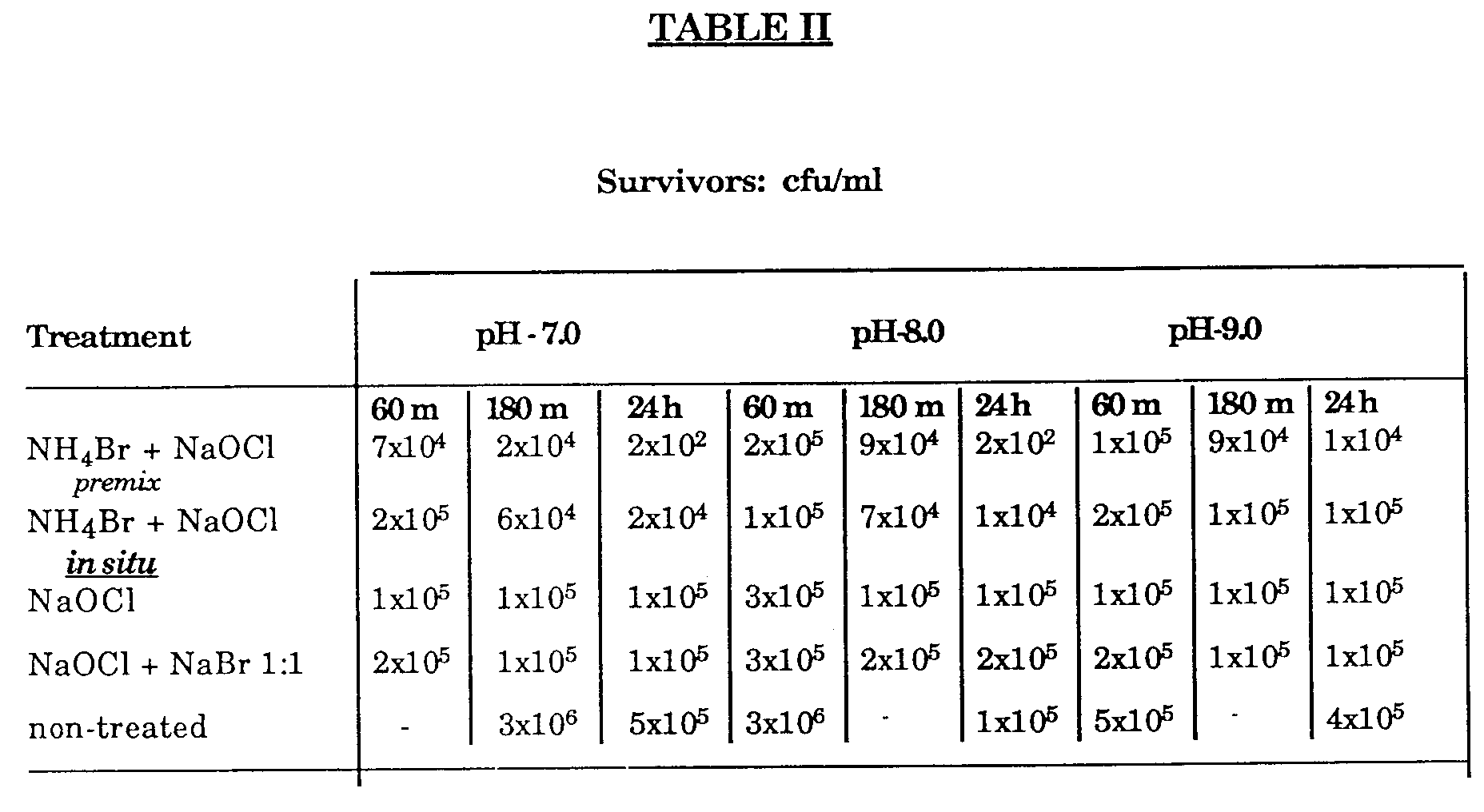
- Table II shows that pre-mixed (NH₄Br + NaOCl) a higher rate of kill as compared to either NaOCl or NaOBr, as the demand for chlorine increases. Efficacy was slightly impaired at pH from 8.0 to 9.0.
- Water demand: higher than 30 ppm of Cl₂ (out of 30 ppm Cl₂) within 60 minutes.
Concentration of stock solution (NH₄Cl + NaOCl): 1000 ppm.
Algicol II is a quaternary ammonium salt.Table III Survivors (cfu/ml) after time (hours) Biocide dose mg/1 1 24 7 days Kathon 30 2 x 10⁶ 7 x 10² 7 x 10² MBT 30 1 x 10⁶ 1 x 10³ 8 x 10² Algicol II 100 5 x 10⁶ 4 x 10⁶ 9 x 10⁶ NH₄Cl+NaOCl 30 0 0 0 Control - 6 x 10⁶ 3 x 10⁷ 1 x 10⁷ - Results in Table III indicate that a mixture of NH₄Cl + NaOCl was more effective than 3 non-oxidizing biocides in water with high demand for chlorine.
- Efficacy was measured at 60°C.
NH₄Br + NaOCl: stock concentration 0.1%.
Dosage: 30 ppm active ingredient.
Incubation temperature 60°C.Table IV Biocide Surviving MOs (cfu/ml) after time (hours) 4 28 48 72 MBT 9x10⁴ 4x10⁴ 2x10⁴ 2x10⁴ NaOCl + NaBr 4x10³ 6x10⁵ 3x10⁵ 3x10⁶ NaOCl 4x10³ 2x10⁶ 3x10⁶ 3x10⁶ NaOCl + NH₄Br 2x10 3 0 0 MIT 2x10⁴ 2x10³ 2x10³ 1x10³ DBNPA 3x10⁴ 2x10⁵ 2x10⁵ 1x10⁵ Control 1x10⁵ 3x10⁵ 8x10⁵ 7x10⁵ - Results in Table IV prove that a mixture of NH₄Br + NaOCl is more effective than other oxidizing and non-oxidizing biocides in a high demand medium.
- Dosage: 30 ppm as Cl₂
Demand: Higher than 30 ppm out of 30 ppm of Cl₂ during 10 minutes.
Stock concentration of NH₄X + NaOCl: 0.1% as Cl₂Table V Biocide residue as Cl₂ free (total) after time (minutes) Surviving MOs after time (minutes); total aerobic (total anaerobic) cfu/ml 10 20 60 10 20 60 NH₄Cl+NaOCl 5(10) 1(2) 0(0) 5x10²(4x10²) 3x10²(2x10²) 1x10²(3) NH₄Br+NaOCl 0(0) 0(0) 0(0) 4x10²(4x10²) 5x10²(4x10²) 5x10²(2x10²) NH₄NO₃+NaOCl 6(9) - 0(0) 4x10²(2x10) 4x10²(7) 8x10(2) NaOCl 0(0) 0(0) 0(0) 2x10⁵(8x10⁴) 2x10⁷(3x10⁶) 1x10⁷(3x10) NaOCl+NaBr 0(0) 0(0) 0(0) 2x10⁷(4x10⁶) 1x10⁷(3x10⁶) 2x10⁷(2x10⁶) CONTROL - - - - - 2x10⁷(6x10⁶) - Results in Table V show that mixtures of ammonium salts and NaOCl are effective in controlling aerobic and anaerobic microorganisms in water with high demand for chlorine. Control was achieved within 10 minutes. Under these conditions both NaOCl and NaOBr are impaired by the media. The mixture of NH₄Br + NaOCl did not leave a measurable residue after 10 minutes, yet it was very effective in reducing viable counts within 10 minutes.
- Dose: 15 mg/1 as Cl₂
Microorganisms were incubated at 37°C (total aerobic viable counts).
Concentration of stock solution: 0.1% as Cl₂.Table VI Biocide Viable counts after time (minutes) 30 cfu(ml 70 25 hours DBNPA 2x10³ 6x10 8x10 NaOCl 6x10³ 2x10³ 1x10⁵ NaOCl+NaBr 1x10⁴ 5x10³ 2x10⁶ NH₄Br+NaOCl 1 0 0 CONTROL 7x10⁶ - 1x10⁷ - Results in Table VI prove higher efficacy for NH₄Br + NaOCl as compared to other oxidizing biocides in this heavily loaded water.
- Contact time: 10 minutes
Dose: 60 ppm as Cl₂
Incubation temperature: 27°C.
Stock concentration: 0.2%
N as NH₃: 50 mg/1; pH: 6.10.Table VII Biocide Residue free (total) as Cl₂ after 10 minutes Surviving MOs (cfu/ml) after 10 minutes aerob. anaer. fungi NaOCl 0.2(1.5) 9x10² 3x10³ 2x10 NH₄Cl+NaOCl 3.0(9.0) 2x10² 4x10² 0 DBNPA 0(0) 2x10⁶ 5x10⁵ 0 Control - 5x10⁷ 1x10⁶ 2x10 - Results in Table VII prove that in the presence of a high NH₃ concentration, NaOCl was less effective than pre-mixed NH₄Cl + NaOCl in controlling microbial growth (in water with high demand for Cl₂); good control was measured after 10 minutes.
- Non-treated domestic waste roughly filtered; contact time: 10 minutes.
Stock concentration: 0.5% as Cl₂.
Dose: 20 ppm as Cl₂Table VIII treatment residue as Cl₂ ppm free (total) Fecal coli cfu/ml total count cfu/ml NaOCl 0(0) 5x10⁵ 6x10⁶ NaOCl+NaBr (1:1) 0(0) 3x10⁵ 7x10⁶ NaOCl+(NH₄)₂SO₄ (1:1) 0.05(0.7) 3x10³ 3x10⁴ non-disinfected 5x10⁵ 1x10⁷ - Results in Table VIII prove that pre-mixing (NH₄)₂SO₄ with NaOCl resulted in lower viable counts of both fecal coli and total count.
- In waste water with high organic load, this disinfection method was superior to disinfecting with either NaOCl or NaOBr.
- Stock concentration: 0.5% as Cl₂
Efficacy against pseudomonas sp.
CWC: 100 mg/1
pH: 9.0
Contact time: 5 hoursTable IX treatment dose mg/1 Survivors in buffer Survivors in CWC (100 mg/1) DBNPA 4 0 4x10⁶ BCDMH 4 0 3x10⁵ NH₄Br+NaOCl 1 0 1x10³ 5 0 2x10 - Results in Table IX prove that in the presence of scale and corrosion inhibitors, efficacy of various biocides was impaired to such an extent that much higher dosages of biocides had to be fed in order to maintain good control. The mixture of NH₄Br+NaOCl was less impaired by CWC and established good microbial and algeal control even in the presence of CWC.
- Water from a corn-processing plant; high demand for Cl₂.
Dose: 12 ppm
NH₄Cl+NaOCl: stock concentration: 1%
NH₄Br+NaOCl: stock concentration: 0.5%
Stock solutions were formed at pH 14.0; 7.0, 4.0 and in water. - For in situ addition: both NH₄X and NaOCl were dissolved at the appropriate pH.

- Results in Table X prove that the efficacy exhibited by mixtures of NH₄X + NaOCl depend on the pH and on the mode of formation of the stock mixture. In situ addition of the two ingredients to water resulted in lower efficacy at any of the examined pH's.
- Stock mixture of NH₄Br + NaOCl was more effective when prepared in water than when prepared in buffer at pH 7.0. When the stock solution was prepared at a high or at a low pH, it was less effective.
- Work was carried out in industrial waste water.
Stock concentrates were prepared in buffer at pH 7.00.
Biocidal dose: 4 ppm as Cl₂.Table XI treatment NH₄Br+NaOCl Survivors cfu/ml total count after time (minutes) 10 60 180 2% 6x10⁴ 1x10⁴ 2x10³ 1% 2x10⁵ 3x10⁴ 3x10⁴ 0.5% 7x10⁴ 2x10⁴ 4x10³ 0.01% 2x10⁶ - 2x10⁶ in situ 5x10⁵ 3x10⁵ 5x10⁵ NaOCl 9x10⁵ - 7x10⁵ Control 1x10⁶ - - - Results in Table XI prove that the efficacy exhibited by the mixtures correlated with the concentration of stock solutions. The highest efficacy was measured with a stock concentration equal to at 0.5% as Cl₂. Similar trends were obtained when the stock solutions were prepared in water rather than in buffer (see Table X) (The high efficacy measured in buffer at a level of 2% as Cl₂ results from the higher pH of this mixture.)
- Cooling tower; contained volume 1000 m³
Circulation rate 500 m³/h
Scale and corrosion inhibitor: CWC: 100 mg/1
The tower was controlled on low level (0.6 - 1.2 kg/day) of BCDMH feed. Use of BCDMH was effective as long as make-ups were softened in ion-exchangers. - When CWC (100 mg/1 of phosphonate) replaced the use of ion-exchangers, much higher dosages of BCDMH (4 - 5 kg/day) did not suffice to prevent biofouling and growth of algae.
- The system was shock-fed with NH₄Br + NaOCl. Overall dosage : 75 liters NaOCl (10%) 12.6 kg NH₄Br: The mixture was fed during 1.5 hours. This shock treatment cleaned the system.
- A slug dose of 25 liters NaOCl (10% as Cl₂)(+ 4.2 kg NH₄Br) was then fed to the cooling tower once in two to three days. The cooling tower remained clean, with no apparent growth of biofilm or algae. A measurable residue of 0.6 - 0.4 ppm (as total chlorine) was measured in the water 24 and 48 hours after feeding the mixture.
- Corn processing plant.
Contained volume: 20 m³
Circulation rate: 300 m³/h
pH: 7.5 - 8.0
Water temperature: 36°C - 57°C
This tower was treated with BCDMH (1.50 - 2.26 kg/day) daily. Due to a very high organic load in the water, growth of biofilm was very fast. Treatment with BCDMH was effective in controlling the daily grown films, but was not effective against heavy slimes which covered the cooling tower. - A daily feed of 3 liters NaOCl (7% as Cl₂), mixed with 0.35 kg NH₄Br controlled the daily newly formed biofilm as well as the slime and algae growth covering the cooling tower, and left a clean cooling system after three weeks of daily treatment avoiding the need for shock treatment.
- Paper mill, starch sizing
Contained volume: 20m³
Flow rate: 8.33m³/h. (6% starch in H₂O),
pH about 8.0
Temperature: 50°C - 70°C. - Sizing mixture is recirculated in a size press through a filter (80 microns). Circulation rate: 6 m³/h. The sizing mixture had been previously treated with NaOCl (10% as Cl₂), which was fed every 8 hours (30 liters per portion). With this treatment, filters had to be washed once every two hours.
- Use of NaOCl was replaced by the use of a mixture of NH₄Br + NaOCl (stock concentration 0.5% as Cl₂).
- Feeding of NaOCl (13 liters of 10% as Cl₂) and NH₄Br (2.5 kg) three times a day (every eight hours) kept the filters in the size press clean; the treatment with NH₄Br+NaOCl was compatible with a blue dye added to the sizing mixture, and did not bleach the blue starch, unlike NaOCl.
- A number of embodiments of the invention have been described for purposes of illustration, but it will be understood that they are not limitative and that the invention can be carried out by persons skilled in the art with many modifications, variations and adaptations, without departing from its spirit and from the scope of the appended claims.
Claims (14)
- Process for killing microorganisms and controlling biofouling in high chlorine demand waters, which comprises mixing two components, one of which is an oxidant and the other an ammonium salt, and adding the mixture immediately to the aqueous system to be treated.
- Process according to claim 1, wherein the oxidant is a chlorine precursor.
- Process according to claim 1, wherein the chlorine precursor is sodium hypochlorite.
- Process according to claim 1, wherein the ammonium salt is chosen among halides, sulfates and nitrates.
- Process according to claim 4, wherein the ammonium salt is ammonium bromide.
- Process according to claim 1, wherein the oxidant is added to a solution of the ammonium salt.
- Process according to claim 6, wherein the oxidant is NaOCl and is added to a well-mixed solution of the ammonium salt diluted in the range of 0.1% to 1% equimolar to chlorine, until a final concentration of chlorine in the mixture has reached 0.1 - 1%.
- Process according to claim 1, wherein the minimal demand of the water is 1.8 ppm out of 2.0 ppm Cl₂ after 60 minutes.
- Process according to claim 1, wherein the mixture is added to the water to be treated at a daily level of at least 2 mg/1 as Cl₂.
- Process according to claim 1, wherein the mole ratio N/Cl in the mixture is 1:1 - 1:3.
- Process according to claim 1, wherein the temperature of the mixture is preferably 10- 30°C.
- Process according to claim 1, wherein the mixture is produced and fed continuously to the water to be treated.
- Solutions for the treatment of high chlorine demand waters, obtained by adding an oxidant to a solution of an ammonium salt.
- Solutions according to claim 13, obtained by adding NaOCl to a solution of an ammonium salt, diluted in the range of 0.01 % to 1 % equimolar to chlorine, until the concentration of the biocides 0.1 % to 1 % as chlorine.
Priority Applications (2)
| Application Number | Priority Date | Filing Date | Title |
|---|---|---|---|
| EP20020080255 EP1293482B1 (en) | 1991-06-03 | 1992-05-29 | Process for the disinfection of waters |
| EP20060117690 EP1734008A3 (en) | 1991-06-03 | 1992-05-29 | Process for the disinfection of waters |
Applications Claiming Priority (2)
| Application Number | Priority Date | Filing Date | Title |
|---|---|---|---|
| IL98352 | 1991-06-03 | ||
| IL9835291A IL98352A (en) | 1991-06-03 | 1991-06-03 | Process and compositions for the disinfection of water |
Related Child Applications (1)
| Application Number | Title | Priority Date | Filing Date |
|---|---|---|---|
| EP20020080255 Division EP1293482B1 (en) | 1991-06-03 | 1992-05-29 | Process for the disinfection of waters |
Publications (2)
| Publication Number | Publication Date |
|---|---|
| EP0517102A1 true EP0517102A1 (en) | 1992-12-09 |
| EP0517102B1 EP0517102B1 (en) | 2003-06-25 |
Family
ID=11062497
Family Applications (3)
| Application Number | Title | Priority Date | Filing Date |
|---|---|---|---|
| EP19920109015 Expired - Lifetime EP0517102B1 (en) | 1991-06-03 | 1992-05-29 | Process and compositions for the disinfection of waters |
| EP20020080255 Revoked EP1293482B1 (en) | 1991-06-03 | 1992-05-29 | Process for the disinfection of waters |
| EP20060117690 Withdrawn EP1734008A3 (en) | 1991-06-03 | 1992-05-29 | Process for the disinfection of waters |
Family Applications After (2)
| Application Number | Title | Priority Date | Filing Date |
|---|---|---|---|
| EP20020080255 Revoked EP1293482B1 (en) | 1991-06-03 | 1992-05-29 | Process for the disinfection of waters |
| EP20060117690 Withdrawn EP1734008A3 (en) | 1991-06-03 | 1992-05-29 | Process for the disinfection of waters |
Country Status (8)
| Country | Link |
|---|---|
| US (5) | US6478973B1 (en) |
| EP (3) | EP0517102B1 (en) |
| JP (5) | JPH05146785A (en) |
| AT (2) | ATE243657T1 (en) |
| DE (2) | DE69233103T2 (en) |
| ES (2) | ES2273967T3 (en) |
| IL (1) | IL98352A (en) |
| ZA (1) | ZA924018B (en) |
Cited By (21)
| Publication number | Priority date | Publication date | Assignee | Title |
|---|---|---|---|---|
| EP0785908A4 (en) * | 1994-10-03 | 1998-02-25 | Weinstock David | METHOD FOR TREATING LIQUIDS TO PREVENT THE GROWTH OF LIVING ORGANISMS |
| EP0888250A4 (en) * | 1996-03-18 | 1999-07-21 | Bio Lab Inc | Water treatment method |
| US6284144B1 (en) | 1998-07-30 | 2001-09-04 | Argad-Eyal Water Treatment Industries Inc. | Water treatment |
| WO2003002467A1 (en) * | 2001-06-29 | 2003-01-09 | Lonza Inc. | Mixtures of halogen-generating biocides, halogen stabilizers and nitrogen containing biocides |
| EP1571128A1 (en) | 2004-03-05 | 2005-09-07 | BK Giulini GmbH | Microbiocide for desinfection of industrial water circulation systems |
| US6998049B1 (en) | 1999-08-06 | 2006-02-14 | Henkel Ecolab Gmbh & Co. Ohg | Method for preventing the formation of biological films |
| US7008545B2 (en) | 2002-08-22 | 2006-03-07 | Hercules Incorporated | Synergistic biocidal mixtures |
| US7052614B2 (en) | 2001-08-06 | 2006-05-30 | A.Y. Laboratories Ltd. | Control of development of biofilms in industrial process water |
| WO2006097578A1 (en) | 2005-03-16 | 2006-09-21 | Bim Kemi Ab | Method of inhibiting the growth of microorganisms |
| EP1734008A3 (en) * | 1991-06-03 | 2008-04-09 | Bromine Compounds Ltd. | Process for the disinfection of waters |
| US7837883B2 (en) * | 2004-01-14 | 2010-11-23 | A. Y Laboratories Ltd. | Biocides and apparatus |
| WO2012025228A1 (en) | 2010-08-25 | 2012-03-01 | Ashland Licensing And Intellectual Property Llc. | Method for increasing the advantages of starch in pulped cellulosic material in the production of paper and paperboard |
| WO2013026578A1 (en) | 2011-08-25 | 2013-02-28 | Ashland Licensing And Intellectual Property Llc | Method for increasing the advantages of strength aids in the production of paper and paperboard |
| WO2013184605A1 (en) * | 2012-06-05 | 2013-12-12 | Buckman Laboratories International, Inc. | Methods of preserving starch in pulp and controlling calcium precipitation and/or scaling |
| WO2014122652A1 (en) | 2013-02-07 | 2014-08-14 | A.Y. Laboratories Ltd. | Method for controlling the production of a biocide |
| US8986606B2 (en) | 2008-05-23 | 2015-03-24 | Kemira Oyj | Chemistry for effective microbe control with reduced gas phase corrosiveness in pulp and paper processing systems |
| DE102013021893A1 (en) | 2013-12-23 | 2015-06-25 | Bk Giulini Gmbh | Process for the treatment of industrial water cycles |
| EP1928246B1 (en) * | 2005-08-26 | 2016-08-24 | Solenis Technologies Cayman, L.P. | A synergistic biocide and process for controlling growth of microorganisms |
| EP3110459A4 (en) * | 2014-02-27 | 2017-08-16 | Bromine Compounds Ltd. | Biocidal composition, preparation and methods of use thereof |
| NO344964B1 (en) * | 2006-12-29 | 2020-08-03 | Nalco Co | PROCEDURE FOR PREPARING A STABLE OXIDIZING BIOCID |
| EP3512814B1 (en) | 2016-09-14 | 2023-11-01 | Acel S.p.A. | Method for the controlled production of monochloramine for sanitizing fluids |
Families Citing this family (50)
| Publication number | Priority date | Publication date | Assignee | Title |
|---|---|---|---|---|
| JP4288866B2 (en) * | 2001-05-18 | 2009-07-01 | 栗田工業株式会社 | Industrial antibacterial methods |
| JP5187928B2 (en) * | 2001-08-01 | 2013-04-24 | 伯東株式会社 | Disinfection method for cooling water and process water |
| US20060231505A1 (en) * | 2002-08-22 | 2006-10-19 | Mayer Michael J | Synergistic biocidal mixtures |
| EP2286845B1 (en) | 2004-03-05 | 2016-11-16 | Gen-Probe Incorporated | Reagents and method for use in deactivating nucleic acids |
| AU2004326202B2 (en) | 2004-12-23 | 2011-11-10 | Albemarle Corporation | Microbiocidal control in the processing of meat-producing four-legged animals |
| KR101314963B1 (en) * | 2005-08-26 | 2013-10-04 | 허큘레스 인코포레이티드 | Method for producing synergistic biocide |
| JP5213299B2 (en) * | 2005-10-11 | 2013-06-19 | ソマール株式会社 | Method and apparatus for adding slime control agent |
| US20070123423A1 (en) * | 2005-11-30 | 2007-05-31 | Cheng Huai N | Solid biocidal compositions and methods of using the same |
| JP2007211080A (en) * | 2006-02-08 | 2007-08-23 | Kawaken Fine Chem Co Ltd | Chlorine-removing agent, method for removing chlorine using the same, and composition containing the same |
| JP4914146B2 (en) * | 2006-08-11 | 2012-04-11 | 株式会社片山化学工業研究所 | Papermaking process water sterilization method |
| JP5348836B2 (en) * | 2006-11-15 | 2013-11-20 | 栗田工業株式会社 | Spot prevention method |
| US20080160104A1 (en) * | 2006-12-28 | 2008-07-03 | Manian Ramesh | Antimicrobial composition |
| US8900641B2 (en) * | 2006-12-28 | 2014-12-02 | Nalco Company | Antimicrobial composition |
| US20090311164A1 (en) * | 2006-12-29 | 2009-12-17 | Amit Gupta | Method for producing a stable oxidizing biocide |
| US9388044B2 (en) | 2006-12-29 | 2016-07-12 | Nalco Company | Methods for the on-site production of chloramine and uses thereof |
| US8747740B2 (en) | 2007-01-25 | 2014-06-10 | Hercules Incorporated | Process and apparatus for generating haloamine biocide |
| JP4730968B2 (en) * | 2007-03-14 | 2011-07-20 | ケイ・アイ化成株式会社 | Method for inhibiting the growth of microorganisms |
| US20080230094A1 (en) * | 2007-03-23 | 2008-09-25 | Buckman Laboratories International, Inc. | Method to inhibit growth of microorganisms in aqueous systems and on substrates using persulfate and a bromide |
| US20080274208A1 (en) | 2007-05-04 | 2008-11-06 | Michael Joseph Unhoch | Water treatment containing DBNPA for use in sanitizing recreational water |
| EP2080739B1 (en) * | 2007-10-04 | 2011-07-06 | Alfred Pohlen | Method for inhibiting the growth of living organisms in freshwater cycles with high chlorine requirements |
| JP5357440B2 (en) * | 2008-04-01 | 2013-12-04 | ソマール株式会社 | Harmful microorganism eradication agent and harmful microorganism eradication method using the same |
| US20110049058A1 (en) * | 2009-08-27 | 2011-03-03 | Unhoch Michael J | Methods and kits for stabilizing oxidizers and sanitizing water |
| EP2480719A1 (en) * | 2009-09-22 | 2012-08-01 | SONOCO Development Inc. | Paperboard containing a biocide and method for making the same |
| JPWO2011065434A1 (en) * | 2009-11-27 | 2013-04-18 | 鶴見曹達株式会社 | Ship ballast water treatment method |
| JP5834018B2 (en) | 2009-12-04 | 2015-12-16 | アルベマール・コーポレーシヨン | Sterilization control in water pipe system |
| DE102011101719A1 (en) | 2011-05-16 | 2012-11-22 | Bk Giulini Gmbh | Process for the biocidal treatment of industrial water systems |
| AU2012316418B2 (en) | 2011-09-30 | 2015-12-24 | Nalco Company | Methods for the on-site production of chloramine and its use thereof |
| CN109303064A (en) | 2011-10-21 | 2019-02-05 | 纳尔科公司 | By using the improved BIOLOGICAL CONTROL of chloro- stabilizer blend |
| US9265259B2 (en) | 2011-10-21 | 2016-02-23 | Nalco Company | Use of sulfamic acid or its salts as stabilizers especially in combination with ammonium salt and/or ammine for bleach or other halogen containing biocides in the paper area |
| CN104471148B (en) * | 2012-06-25 | 2016-08-17 | 株式会社片山化学工业研究所 | Method of making cardboard |
| US9908796B2 (en) * | 2012-10-23 | 2018-03-06 | Ecolab Usa Inc. | Use of oxidizing and non-oxidizing biocides for control of bacteria tolerant to stabilized-oxidant treatment |
| WO2014154946A1 (en) | 2013-03-25 | 2014-10-02 | Kemira Oyj | Biocide formulation and method for treating water |
| CN103739134B (en) * | 2014-01-28 | 2015-02-11 | 四川中洁诺环保科技有限公司 | Method for removing antibiotics in water |
| US9909219B2 (en) * | 2014-04-14 | 2018-03-06 | Ecolab Usa Inc. | Slurry biocide |
| WO2016094591A1 (en) | 2014-12-09 | 2016-06-16 | Miox Corporation | Methods for the direct electrolytic production of stable, high concentration aqueous halosulfamate or halosulfonamide solutions |
| AU2016209602B2 (en) | 2015-01-23 | 2019-07-11 | Albemarle Corporation | Microbiocidal control in the processing of poultry |
| JP6524759B2 (en) * | 2015-04-01 | 2019-06-05 | 栗田工業株式会社 | Method and apparatus for dosing an open circulation cooling water system |
| JP6384968B2 (en) * | 2016-07-25 | 2018-09-05 | 株式会社ピュアソン | How to remove colored mold |
| JP6513151B2 (en) * | 2017-08-10 | 2019-05-15 | 水ing株式会社 | Method and disinfectant for disinfecting ammonia nitrogen containing wastewater |
| JP6490761B2 (en) * | 2017-08-10 | 2019-03-27 | 水ing株式会社 | Disinfection method of wastewater containing ammonia nitrogen |
| JP6970698B2 (en) * | 2017-08-10 | 2021-11-24 | 水ing株式会社 | Disinfection method for ammonia-containing nitrogen-containing wastewater |
| MX2020004328A (en) | 2017-10-18 | 2020-08-03 | Solenis Tech Lp | Compositions exhibiting synergy in biofilm control. |
| BR112020007682B1 (en) | 2017-10-18 | 2024-01-23 | Solenis Technologies, L.P. | METHOD FOR CONTROL AND REMOVE BIOFILM IN CONTACT WITH THE AQUEOUS SYSTEM, AND, COMPOSITION |
| NZ783364A (en) * | 2019-07-01 | 2026-02-27 | A Y Lab Ltd | Method for producing a biocide |
| RU2764683C2 (en) * | 2020-01-23 | 2022-01-19 | Юрий Анатольевич Рахманин | Method for pretreatment of transported waste water |
| CA3167945A1 (en) * | 2020-04-13 | 2021-10-21 | Christopher D. BARON | Methods and systems for controlling bacteria in biofilms |
| EP4142491A4 (en) * | 2020-04-29 | 2025-01-15 | Solenis Technologies, L.P. | METHOD AND APPARATUS FOR CONTROLLING THE PRODUCTION OF A HALOGENOAMINE-BASED BIOCIDE |
| CA3191641A1 (en) | 2020-09-04 | 2022-03-10 | Buckman Laboratories International, Inc. | Predictive systems and methods for proactive intervention in chemical processes |
| KR102357928B1 (en) * | 2021-06-03 | 2022-02-09 | (주)에스에이치에이 | Manufacturing method of Stabilized bromine Solutions, Stabilized bromine Solutions manufactured by the mehtod, and uses thereof for microbiofouling control |
| JP7633701B2 (en) * | 2022-11-02 | 2025-02-20 | 株式会社マツバラ | Disinfectants |
Citations (3)
| Publication number | Priority date | Publication date | Assignee | Title |
|---|---|---|---|---|
| GB1600289A (en) * | 1978-05-31 | 1981-10-14 | Fisons Ltd | Sterilisation of water for nutrient film systems |
| US4872999A (en) * | 1987-07-17 | 1989-10-10 | Nalco Chemical Company | Mixture of halides such as NaOCl and a bromide salt for removal of mussels and barnacles from salt or brackish water |
| EP0403465A1 (en) * | 1989-06-16 | 1990-12-19 | University Of Houston | Biocidal methods for recirculating water systems |
Family Cites Families (28)
| Publication number | Priority date | Publication date | Assignee | Title |
|---|---|---|---|---|
| US1378644A (en) | 1919-09-13 | 1921-05-17 | John C Baker | Process of sterilizing |
| US1413133A (en) * | 1920-06-30 | 1922-04-18 | Purcell Watson | Transmission control |
| US1413153A (en) | 1921-03-18 | 1922-04-18 | Wallace & Tiernan Co Inc | Method of sterilizing water and sewage |
| GB253623A (en) | 1925-03-23 | 1926-06-23 | Charles Henry Hasler Harold | Improvements in the preparation of sterilising agents, germicides and the like |
| US1581115A (en) | 1925-10-03 | 1926-04-20 | United Water Softeners Ltd | Preparation of sterilizing agents, germicides, and the like |
| US2112478A (en) | 1934-05-25 | 1938-03-29 | Snc Lebocey Freres | Knitting machine with rectilinear needle beds |
| US2112476A (en) | 1935-11-02 | 1938-03-29 | Permutit Co | Sterilizing water by chloramines |
| US2443429A (en) | 1947-09-26 | 1948-06-15 | Wallace & Tiernan Inc | Procedure for disinfecting aqueous liquid |
| US3222276A (en) | 1963-02-06 | 1965-12-07 | Great Lakes Chemical Corp | Bromination process |
| US3328294A (en) | 1966-09-19 | 1967-06-27 | Mead Corp | Process for control of micro-organisms in process streams |
| US3683654A (en) * | 1971-01-25 | 1972-08-15 | Combinatie Weslesschelde V O F | Apparatus for calibrating thermostatic switches |
| US3975271A (en) | 1972-02-15 | 1976-08-17 | Bernard Saunier | Process for sterilizing water by the combination of chlorine and another halogen |
| US3799396A (en) | 1972-06-26 | 1974-03-26 | Du Pont | Method for producing a gradient elution |
| DE2235539A1 (en) * | 1972-07-20 | 1974-02-07 | Degussa | PROCEDURES FOR DISINICIATING AND DEALGING OF WATERS AND WATER SYSTEMS |
| JPS5289247A (en) * | 1976-01-21 | 1977-07-26 | Takenaka Komuten Co Ltd | Process for treating foul water |
| JPS54161592A (en) * | 1978-06-13 | 1979-12-21 | Mitsubishi Gas Chem Co Inc | Marine creature adhesion controlling method |
| JPS5613512A (en) | 1979-07-13 | 1981-02-09 | Tdk Corp | Multichannel magnetic head and its manufacture |
| US4767564A (en) * | 1980-02-04 | 1988-08-30 | The United States Of America As Represented By The Secretary Of The Air Force | Chemical composition for the destruction of microfilm products |
| US4431729A (en) * | 1982-08-09 | 1984-02-14 | Polaroid Corporation | Method for preparing photosensitive silver halide emulsions |
| US4566986A (en) * | 1984-08-31 | 1986-01-28 | Waldmann John J | Flocculating agents and processes for making them |
| US4787564A (en) * | 1984-11-23 | 1988-11-29 | Garry Tucker | Rock-crusher shoe |
| US4643835A (en) | 1985-08-28 | 1987-02-17 | Nalco Chemical Company | Asiatic clam control chemical |
| US4935153A (en) | 1988-06-24 | 1990-06-19 | Great Lakes Chemical Corporation | Method for the control of biofouling in recirculating water systems |
| JP2780312B2 (en) * | 1989-03-13 | 1998-07-30 | 日本電気株式会社 | Error detection circuit |
| IL98352A (en) * | 1991-06-03 | 1995-10-31 | Bromine Compounds Ltd | Process and compositions for the disinfection of water |
| EP0785908B1 (en) * | 1994-10-03 | 2001-01-24 | Weinstock, David | Method of treating liquids to inhibit growth of living organisms |
| US5683654A (en) | 1996-03-22 | 1997-11-04 | Nalco Chemical Co | Process to manufacture stabilized alkali or alkaline earth metal hypobromite and uses thereof in water treatment to control microbial fouling |
| US7052614B2 (en) * | 2001-08-06 | 2006-05-30 | A.Y. Laboratories Ltd. | Control of development of biofilms in industrial process water |
-
1991
- 1991-06-03 IL IL9835291A patent/IL98352A/en not_active IP Right Cessation
-
1992
- 1992-05-29 EP EP19920109015 patent/EP0517102B1/en not_active Expired - Lifetime
- 1992-05-29 AT AT92109015T patent/ATE243657T1/en active
- 1992-05-29 DE DE1992633103 patent/DE69233103T2/en not_active Expired - Lifetime
- 1992-05-29 DE DE1992633662 patent/DE69233662T2/en not_active Expired - Lifetime
- 1992-05-29 AT AT02080255T patent/ATE342236T1/en active
- 1992-05-29 EP EP20020080255 patent/EP1293482B1/en not_active Revoked
- 1992-05-29 EP EP20060117690 patent/EP1734008A3/en not_active Withdrawn
- 1992-05-29 ES ES02080255T patent/ES2273967T3/en not_active Expired - Lifetime
- 1992-05-29 ES ES92109015T patent/ES2199934T3/en not_active Expired - Lifetime
- 1992-06-02 JP JP14175892A patent/JPH05146785A/en not_active Ceased
- 1992-06-02 ZA ZA924018A patent/ZA924018B/en unknown
-
1998
- 1998-02-13 US US09/023,984 patent/US6478973B1/en not_active Expired - Lifetime
-
2002
- 2002-04-05 JP JP2002104589A patent/JP2002336868A/en not_active Withdrawn
- 2002-08-23 US US10/226,927 patent/US7067063B2/en not_active Expired - Fee Related
-
2004
- 2004-10-22 JP JP2004308056A patent/JP3740157B2/en not_active Expired - Lifetime
- 2004-12-29 US US11/024,066 patent/US7285224B2/en not_active Expired - Fee Related
-
2005
- 2005-08-04 JP JP2005226979A patent/JP3903058B2/en not_active Expired - Lifetime
-
2006
- 2006-08-21 JP JP2006224607A patent/JP2007021495A/en active Pending
-
2007
- 2007-09-11 US US11/853,426 patent/US7449120B2/en not_active Expired - Fee Related
-
2008
- 2008-10-02 US US12/244,204 patent/US7651622B2/en not_active Expired - Fee Related
Patent Citations (3)
| Publication number | Priority date | Publication date | Assignee | Title |
|---|---|---|---|---|
| GB1600289A (en) * | 1978-05-31 | 1981-10-14 | Fisons Ltd | Sterilisation of water for nutrient film systems |
| US4872999A (en) * | 1987-07-17 | 1989-10-10 | Nalco Chemical Company | Mixture of halides such as NaOCl and a bromide salt for removal of mussels and barnacles from salt or brackish water |
| EP0403465A1 (en) * | 1989-06-16 | 1990-12-19 | University Of Houston | Biocidal methods for recirculating water systems |
Non-Patent Citations (3)
| Title |
|---|
| WORLD PATENTS INDEX Section Ch, Week 7340, Derwent Publications Ltd., London, GB; Class C, AN 73-59227U & SU-A-365 150 (VETERINARY SANITATION) * |
| WORLD PATENTS INDEX Section Ch, Week 7704, Derwent Publications Ltd., London, GB; Class C, AN 77-07043Y & SU-A-72 747 861 (LEND FOOD) 31 January 1972 * |
| WORLD PATENTS INDEX Section Ch, Week 8006, Derwent Publications Ltd., London, GB; Class C, AN 80-09979C & JP-A-54 161 592 (MITSUBISHI GAS CHEM INDUSTRY) 21 December 1979 * |
Cited By (46)
| Publication number | Priority date | Publication date | Assignee | Title |
|---|---|---|---|---|
| EP1734008A3 (en) * | 1991-06-03 | 2008-04-09 | Bromine Compounds Ltd. | Process for the disinfection of waters |
| US6132628A (en) * | 1994-10-02 | 2000-10-17 | A.Y. Laboratories Ltd. | Method of treating liquids to inhibit growth of living organisms |
| US5976386A (en) * | 1994-10-03 | 1999-11-02 | A.Y. Laboratories Ltd. | Method and apparatus for treating liquids to inhibit growth of living organisms |
| EP0785908A4 (en) * | 1994-10-03 | 1998-02-25 | Weinstock David | METHOD FOR TREATING LIQUIDS TO PREVENT THE GROWTH OF LIVING ORGANISMS |
| EP0888250A4 (en) * | 1996-03-18 | 1999-07-21 | Bio Lab Inc | Water treatment method |
| US6284144B1 (en) | 1998-07-30 | 2001-09-04 | Argad-Eyal Water Treatment Industries Inc. | Water treatment |
| US6998049B1 (en) | 1999-08-06 | 2006-02-14 | Henkel Ecolab Gmbh & Co. Ohg | Method for preventing the formation of biological films |
| WO2003002467A1 (en) * | 2001-06-29 | 2003-01-09 | Lonza Inc. | Mixtures of halogen-generating biocides, halogen stabilizers and nitrogen containing biocides |
| US7628929B2 (en) | 2001-08-06 | 2009-12-08 | A.Y. Laboratories Ltd. | Control of development of biofilms in industrial process water |
| US7927496B2 (en) | 2001-08-06 | 2011-04-19 | A.Y. Laboratories Ltd. | Control of development of biofilms in industrial process water |
| US7052614B2 (en) | 2001-08-06 | 2006-05-30 | A.Y. Laboratories Ltd. | Control of development of biofilms in industrial process water |
| US7189329B2 (en) | 2001-08-06 | 2007-03-13 | A.Y. Laboratories Ltd. | Control of development of biofilms in industrial process water |
| US8444858B2 (en) | 2001-08-06 | 2013-05-21 | A.Y. Laboratories Ltd. | Control of development of biofilms in industrial process water |
| US8168072B2 (en) | 2001-08-06 | 2012-05-01 | A.Y. Laboratories Ltd. | Control of development of biofilms in industrial process water |
| EP2202206A1 (en) * | 2001-08-06 | 2010-06-30 | A.Y. Laboratories Ltd. | Control of development of biofilms in industrial process water. |
| EP1425247B1 (en) * | 2001-08-06 | 2011-05-11 | A.Y. Laboratories Ltd. | Control of development of biofilms in industrial process water |
| US7008545B2 (en) | 2002-08-22 | 2006-03-07 | Hercules Incorporated | Synergistic biocidal mixtures |
| US8211318B2 (en) | 2004-01-14 | 2012-07-03 | A. Y. Laboratories Ltd | Biocides and apparatus |
| US7837883B2 (en) * | 2004-01-14 | 2010-11-23 | A. Y Laboratories Ltd. | Biocides and apparatus |
| US9179682B2 (en) | 2004-01-14 | 2015-11-10 | A.Y. Laboratories Ltd. | Biocides and apparatus |
| US9468214B2 (en) | 2004-01-14 | 2016-10-18 | A.Y. Laboratories Ltd. | Biocides and apparatus |
| US8632794B2 (en) | 2004-01-14 | 2014-01-21 | A.Y. Laboratories Ltd. | Biocides and apparatus |
| US8652496B2 (en) | 2004-01-14 | 2014-02-18 | A.Y. Laboratories Ltd. | Biocides and apparatus |
| EP1571128A1 (en) | 2004-03-05 | 2005-09-07 | BK Giulini GmbH | Microbiocide for desinfection of industrial water circulation systems |
| EP1858811A4 (en) * | 2005-03-16 | 2008-12-10 | Bim Kemi Ab | Method of inhibiting the growth of microorganisms |
| WO2006097578A1 (en) | 2005-03-16 | 2006-09-21 | Bim Kemi Ab | Method of inhibiting the growth of microorganisms |
| EP1928246B1 (en) * | 2005-08-26 | 2016-08-24 | Solenis Technologies Cayman, L.P. | A synergistic biocide and process for controlling growth of microorganisms |
| NO344964B1 (en) * | 2006-12-29 | 2020-08-03 | Nalco Co | PROCEDURE FOR PREPARING A STABLE OXIDIZING BIOCID |
| US8986606B2 (en) | 2008-05-23 | 2015-03-24 | Kemira Oyj | Chemistry for effective microbe control with reduced gas phase corrosiveness in pulp and paper processing systems |
| US8758562B2 (en) | 2010-08-25 | 2014-06-24 | Hercules Incorporated | Method for increasing the advantages of starch in pulped cellulosic material in the production of paper and paperboard |
| WO2012025228A1 (en) | 2010-08-25 | 2012-03-01 | Ashland Licensing And Intellectual Property Llc. | Method for increasing the advantages of starch in pulped cellulosic material in the production of paper and paperboard |
| WO2013026578A1 (en) | 2011-08-25 | 2013-02-28 | Ashland Licensing And Intellectual Property Llc | Method for increasing the advantages of strength aids in the production of paper and paperboard |
| US8764942B2 (en) | 2012-06-05 | 2014-07-01 | Buckman Laboratories International, Inc. | Methods of preserving starch in pulp and controlling calcium precipitation and/or scaling |
| EP3556935A1 (en) * | 2012-06-05 | 2019-10-23 | Buckman Laboratories International, Inc. | Methods of preserving starch in pulp |
| EP3556934A1 (en) * | 2012-06-05 | 2019-10-23 | Buckman Laboratories International, Inc. | Methods of controlling calcium precipitation and/or scaling |
| US9347179B2 (en) | 2012-06-05 | 2016-05-24 | Buckman Laboratories International, Inc. | Methods of preserving starch in pulp and controlling calcium precipitation and/or scaling |
| AU2016231513B2 (en) * | 2012-06-05 | 2018-03-08 | Buckman Laboratories International, Inc. | Methods of preserving starch in pulp and controlling calcium precipitation and/or scaling |
| US9091024B2 (en) | 2012-06-05 | 2015-07-28 | Buckman Laboratories International, Inc. | Method to preserve native starch present in pulp in a papermaking process |
| WO2013184605A1 (en) * | 2012-06-05 | 2013-12-12 | Buckman Laboratories International, Inc. | Methods of preserving starch in pulp and controlling calcium precipitation and/or scaling |
| WO2014122652A1 (en) | 2013-02-07 | 2014-08-14 | A.Y. Laboratories Ltd. | Method for controlling the production of a biocide |
| EP3087035B1 (en) | 2013-12-23 | 2017-11-15 | Kurita Water Industries Ltd. | Method for the biocidal treatment of industrial water circuits |
| CN105829250A (en) * | 2013-12-23 | 2016-08-03 | 栗田工业株式会社 | Method for treatment of industrial water circuits using biocides |
| WO2015096892A1 (en) | 2013-12-23 | 2015-07-02 | Bk Giulini Gmbh | Method for treatment of industrial water circuits using biocides |
| DE102013021893A1 (en) | 2013-12-23 | 2015-06-25 | Bk Giulini Gmbh | Process for the treatment of industrial water cycles |
| EP3110459A4 (en) * | 2014-02-27 | 2017-08-16 | Bromine Compounds Ltd. | Biocidal composition, preparation and methods of use thereof |
| EP3512814B1 (en) | 2016-09-14 | 2023-11-01 | Acel S.p.A. | Method for the controlled production of monochloramine for sanitizing fluids |
Also Published As
| Publication number | Publication date |
|---|---|
| JP2002336868A (en) | 2002-11-26 |
| EP0517102B1 (en) | 2003-06-25 |
| EP1734008A2 (en) | 2006-12-20 |
| ATE243657T1 (en) | 2003-07-15 |
| US7067063B2 (en) | 2006-06-27 |
| EP1293482A1 (en) | 2003-03-19 |
| JP3903058B2 (en) | 2007-04-11 |
| DE69233103T2 (en) | 2004-05-06 |
| US7651622B2 (en) | 2010-01-26 |
| DE69233103D1 (en) | 2003-07-31 |
| US20080003305A1 (en) | 2008-01-03 |
| ES2199934T3 (en) | 2004-03-01 |
| EP1293482B1 (en) | 2006-10-11 |
| ES2273967T3 (en) | 2007-05-16 |
| US6478973B1 (en) | 2002-11-12 |
| ZA924018B (en) | 1993-04-28 |
| IL98352A0 (en) | 1992-07-15 |
| ATE342236T1 (en) | 2006-11-15 |
| IL98352A (en) | 1995-10-31 |
| DE69233662D1 (en) | 2006-11-23 |
| JP2005088005A (en) | 2005-04-07 |
| JP3740157B2 (en) | 2006-02-01 |
| US20090107923A1 (en) | 2009-04-30 |
| US7449120B2 (en) | 2008-11-11 |
| US20030132173A1 (en) | 2003-07-17 |
| JP2006051500A (en) | 2006-02-23 |
| JPH05146785A (en) | 1993-06-15 |
| JP2007021495A (en) | 2007-02-01 |
| EP1734008A3 (en) | 2008-04-09 |
| DE69233662T2 (en) | 2007-09-13 |
| US20050194324A1 (en) | 2005-09-08 |
| US7285224B2 (en) | 2007-10-23 |
Similar Documents
| Publication | Publication Date | Title |
|---|---|---|
| EP1293482B1 (en) | Process for the disinfection of waters | |
| US4966716A (en) | Method for the control of biofouling in recirculating water systems | |
| EP1928784B1 (en) | Method and apparatus for producing synergistic biocide | |
| US8613859B2 (en) | Synergistic biocide and process for controlling growth of microoganisms | |
| US4935153A (en) | Method for the control of biofouling in recirculating water systems | |
| EP1928246B1 (en) | A synergistic biocide and process for controlling growth of microorganisms | |
| CN101296862B (en) | Method for producing synergistic biocide | |
| US20260078032A1 (en) | A cyclic process for the efficient generation of chlorine dioxide in dilute solutions | |
| MXPA97009774A (en) | Treatment of water with hydrogen peroxide and a poliuaterary stabilizer of amo | |
| HK1018043A (en) | Stabilized alkali or alkaline earth metal hypobromite and process for its production |
Legal Events
| Date | Code | Title | Description |
|---|---|---|---|
| PUAI | Public reference made under article 153(3) epc to a published international application that has entered the european phase |
Free format text: ORIGINAL CODE: 0009012 |
|
| AK | Designated contracting states |
Kind code of ref document: A1 Designated state(s): AT BE CH DE ES FR GB IT LI NL |
|
| 17P | Request for examination filed |
Effective date: 19930121 |
|
| 17Q | First examination report despatched |
Effective date: 19950130 |
|
| GRAG | Despatch of communication of intention to grant |
Free format text: ORIGINAL CODE: EPIDOS AGRA |
|
| GRAG | Despatch of communication of intention to grant |
Free format text: ORIGINAL CODE: EPIDOS AGRA |
|
| GRAH | Despatch of communication of intention to grant a patent |
Free format text: ORIGINAL CODE: EPIDOS IGRA |
|
| GRAH | Despatch of communication of intention to grant a patent |
Free format text: ORIGINAL CODE: EPIDOS IGRA |
|
| GRAA | (expected) grant |
Free format text: ORIGINAL CODE: 0009210 |
|
| AK | Designated contracting states |
Designated state(s): AT BE CH DE ES FR GB IT LI NL |
|
| REG | Reference to a national code |
Ref country code: GB Ref legal event code: FG4D |
|
| REG | Reference to a national code |
Ref country code: CH Ref legal event code: NV Representative=s name: ISLER & PEDRAZZINI AG Ref country code: CH Ref legal event code: EP |
|
| REF | Corresponds to: |
Ref document number: 69233103 Country of ref document: DE Date of ref document: 20030731 Kind code of ref document: P |
|
| REG | Reference to a national code |
Ref country code: ES Ref legal event code: FG2A Ref document number: 2199934 Country of ref document: ES Kind code of ref document: T3 |
|
| ET | Fr: translation filed | ||
| PLBE | No opposition filed within time limit |
Free format text: ORIGINAL CODE: 0009261 |
|
| STAA | Information on the status of an ep patent application or granted ep patent |
Free format text: STATUS: NO OPPOSITION FILED WITHIN TIME LIMIT |
|
| 26N | No opposition filed |
Effective date: 20040326 |
|
| PGFP | Annual fee paid to national office [announced via postgrant information from national office to epo] |
Ref country code: CH Payment date: 20110331 Year of fee payment: 20 |
|
| PGFP | Annual fee paid to national office [announced via postgrant information from national office to epo] |
Ref country code: ES Payment date: 20110519 Year of fee payment: 20 Ref country code: FR Payment date: 20110615 Year of fee payment: 20 |
|
| PGFP | Annual fee paid to national office [announced via postgrant information from national office to epo] |
Ref country code: GB Payment date: 20110520 Year of fee payment: 20 Ref country code: BE Payment date: 20110511 Year of fee payment: 20 Ref country code: AT Payment date: 20110512 Year of fee payment: 20 Ref country code: NL Payment date: 20110520 Year of fee payment: 20 |
|
| PGFP | Annual fee paid to national office [announced via postgrant information from national office to epo] |
Ref country code: DE Payment date: 20110520 Year of fee payment: 20 Ref country code: IT Payment date: 20110514 Year of fee payment: 20 |
|
| REG | Reference to a national code |
Ref country code: DE Ref legal event code: R071 Ref document number: 69233103 Country of ref document: DE |
|
| REG | Reference to a national code |
Ref country code: DE Ref legal event code: R071 Ref document number: 69233103 Country of ref document: DE Ref country code: NL Ref legal event code: V4 Effective date: 20120529 |
|
| BE20 | Be: patent expired |
Owner name: *BROMINE COMPOUNDS LTD Effective date: 20120529 |
|
| REG | Reference to a national code |
Ref country code: CH Ref legal event code: PL |
|
| REG | Reference to a national code |
Ref country code: GB Ref legal event code: PE20 Expiry date: 20120528 |
|
| PG25 | Lapsed in a contracting state [announced via postgrant information from national office to epo] |
Ref country code: DE Free format text: LAPSE BECAUSE OF EXPIRATION OF PROTECTION Effective date: 20120530 |
|
| PG25 | Lapsed in a contracting state [announced via postgrant information from national office to epo] |
Ref country code: GB Free format text: LAPSE BECAUSE OF EXPIRATION OF PROTECTION Effective date: 20120528 |
|
| REG | Reference to a national code |
Ref country code: AT Ref legal event code: MK07 Ref document number: 243657 Country of ref document: AT Kind code of ref document: T Effective date: 20120529 |
|
| REG | Reference to a national code |
Ref country code: ES Ref legal event code: FD2A Effective date: 20130730 |
|
| PG25 | Lapsed in a contracting state [announced via postgrant information from national office to epo] |
Ref country code: ES Free format text: LAPSE BECAUSE OF EXPIRATION OF PROTECTION Effective date: 20120530 |