EP0513379A1 - 2-arylthiazole derivative and pharmaceutical composition containing the same - Google Patents
2-arylthiazole derivative and pharmaceutical composition containing the same Download PDFInfo
- Publication number
- EP0513379A1 EP0513379A1 EP91920699A EP91920699A EP0513379A1 EP 0513379 A1 EP0513379 A1 EP 0513379A1 EP 91920699 A EP91920699 A EP 91920699A EP 91920699 A EP91920699 A EP 91920699A EP 0513379 A1 EP0513379 A1 EP 0513379A1
- Authority
- EP
- European Patent Office
- Prior art keywords
- group
- substituted
- alkyl
- unsubstituted
- aryl
- Prior art date
- Legal status (The legal status is an assumption and is not a legal conclusion. Google has not performed a legal analysis and makes no representation as to the accuracy of the status listed.)
- Granted
Links
Classifications
-
- C—CHEMISTRY; METALLURGY
- C07—ORGANIC CHEMISTRY
- C07D—HETEROCYCLIC COMPOUNDS
- C07D417/00—Heterocyclic compounds containing two or more hetero rings, at least one ring having nitrogen and sulfur atoms as the only ring hetero atoms, not provided for by group C07D415/00
- C07D417/02—Heterocyclic compounds containing two or more hetero rings, at least one ring having nitrogen and sulfur atoms as the only ring hetero atoms, not provided for by group C07D415/00 containing two hetero rings
- C07D417/04—Heterocyclic compounds containing two or more hetero rings, at least one ring having nitrogen and sulfur atoms as the only ring hetero atoms, not provided for by group C07D415/00 containing two hetero rings directly linked by a ring-member-to-ring-member bond
-
- A—HUMAN NECESSITIES
- A61—MEDICAL OR VETERINARY SCIENCE; HYGIENE
- A61K—PREPARATIONS FOR MEDICAL, DENTAL OR TOILETRY PURPOSES
- A61K31/00—Medicinal preparations containing organic active ingredients
- A61K31/33—Heterocyclic compounds
- A61K31/395—Heterocyclic compounds having nitrogen as a ring hetero atom, e.g. guanethidine or rifamycins
- A61K31/41—Heterocyclic compounds having nitrogen as a ring hetero atom, e.g. guanethidine or rifamycins having five-membered rings with two or more ring hetero atoms, at least one of which being nitrogen, e.g. tetrazole
- A61K31/425—Thiazoles
-
- A—HUMAN NECESSITIES
- A61—MEDICAL OR VETERINARY SCIENCE; HYGIENE
- A61K—PREPARATIONS FOR MEDICAL, DENTAL OR TOILETRY PURPOSES
- A61K31/00—Medicinal preparations containing organic active ingredients
- A61K31/33—Heterocyclic compounds
- A61K31/395—Heterocyclic compounds having nitrogen as a ring hetero atom, e.g. guanethidine or rifamycins
- A61K31/435—Heterocyclic compounds having nitrogen as a ring hetero atom, e.g. guanethidine or rifamycins having six-membered rings with one nitrogen as the only ring hetero atom
- A61K31/44—Non condensed pyridines; Hydrogenated derivatives thereof
-
- A—HUMAN NECESSITIES
- A61—MEDICAL OR VETERINARY SCIENCE; HYGIENE
- A61K—PREPARATIONS FOR MEDICAL, DENTAL OR TOILETRY PURPOSES
- A61K31/00—Medicinal preparations containing organic active ingredients
- A61K31/33—Heterocyclic compounds
- A61K31/395—Heterocyclic compounds having nitrogen as a ring hetero atom, e.g. guanethidine or rifamycins
- A61K31/435—Heterocyclic compounds having nitrogen as a ring hetero atom, e.g. guanethidine or rifamycins having six-membered rings with one nitrogen as the only ring hetero atom
- A61K31/44—Non condensed pyridines; Hydrogenated derivatives thereof
- A61K31/445—Non condensed piperidines, e.g. piperocaine
-
- A—HUMAN NECESSITIES
- A61—MEDICAL OR VETERINARY SCIENCE; HYGIENE
- A61K—PREPARATIONS FOR MEDICAL, DENTAL OR TOILETRY PURPOSES
- A61K31/00—Medicinal preparations containing organic active ingredients
- A61K31/33—Heterocyclic compounds
- A61K31/395—Heterocyclic compounds having nitrogen as a ring hetero atom, e.g. guanethidine or rifamycins
- A61K31/495—Heterocyclic compounds having nitrogen as a ring hetero atom, e.g. guanethidine or rifamycins having six-membered rings with two or more nitrogen atoms as the only ring heteroatoms, e.g. piperazine or tetrazines
-
- A—HUMAN NECESSITIES
- A61—MEDICAL OR VETERINARY SCIENCE; HYGIENE
- A61K—PREPARATIONS FOR MEDICAL, DENTAL OR TOILETRY PURPOSES
- A61K31/00—Medicinal preparations containing organic active ingredients
- A61K31/33—Heterocyclic compounds
- A61K31/395—Heterocyclic compounds having nitrogen as a ring hetero atom, e.g. guanethidine or rifamycins
- A61K31/535—Heterocyclic compounds having nitrogen as a ring hetero atom, e.g. guanethidine or rifamycins having six-membered rings with at least one nitrogen and one oxygen as the ring hetero atoms, e.g. 1,2-oxazines
-
- C—CHEMISTRY; METALLURGY
- C07—ORGANIC CHEMISTRY
- C07D—HETEROCYCLIC COMPOUNDS
- C07D277/00—Heterocyclic compounds containing 1,3-thiazole or hydrogenated 1,3-thiazole rings
- C07D277/02—Heterocyclic compounds containing 1,3-thiazole or hydrogenated 1,3-thiazole rings not condensed with other rings
- C07D277/20—Heterocyclic compounds containing 1,3-thiazole or hydrogenated 1,3-thiazole rings not condensed with other rings having two or three double bonds between ring members or between ring members and non-ring members
- C07D277/32—Heterocyclic compounds containing 1,3-thiazole or hydrogenated 1,3-thiazole rings not condensed with other rings having two or three double bonds between ring members or between ring members and non-ring members with hetero atoms or with carbon atoms having three bonds to hetero atoms with at the most one bond to halogen, e.g. ester or nitrile radicals, directly attached to ring carbon atoms
- C07D277/56—Carbon atoms having three bonds to hetero atoms with at the most one bond to halogen
-
- C—CHEMISTRY; METALLURGY
- C07—ORGANIC CHEMISTRY
- C07D—HETEROCYCLIC COMPOUNDS
- C07D417/00—Heterocyclic compounds containing two or more hetero rings, at least one ring having nitrogen and sulfur atoms as the only ring hetero atoms, not provided for by group C07D415/00
- C07D417/02—Heterocyclic compounds containing two or more hetero rings, at least one ring having nitrogen and sulfur atoms as the only ring hetero atoms, not provided for by group C07D415/00 containing two hetero rings
- C07D417/06—Heterocyclic compounds containing two or more hetero rings, at least one ring having nitrogen and sulfur atoms as the only ring hetero atoms, not provided for by group C07D415/00 containing two hetero rings linked by a carbon chain containing only aliphatic carbon atoms
-
- C—CHEMISTRY; METALLURGY
- C07—ORGANIC CHEMISTRY
- C07D—HETEROCYCLIC COMPOUNDS
- C07D417/00—Heterocyclic compounds containing two or more hetero rings, at least one ring having nitrogen and sulfur atoms as the only ring hetero atoms, not provided for by group C07D415/00
- C07D417/02—Heterocyclic compounds containing two or more hetero rings, at least one ring having nitrogen and sulfur atoms as the only ring hetero atoms, not provided for by group C07D415/00 containing two hetero rings
- C07D417/10—Heterocyclic compounds containing two or more hetero rings, at least one ring having nitrogen and sulfur atoms as the only ring hetero atoms, not provided for by group C07D415/00 containing two hetero rings linked by a carbon chain containing aromatic rings
-
- C—CHEMISTRY; METALLURGY
- C07—ORGANIC CHEMISTRY
- C07D—HETEROCYCLIC COMPOUNDS
- C07D417/00—Heterocyclic compounds containing two or more hetero rings, at least one ring having nitrogen and sulfur atoms as the only ring hetero atoms, not provided for by group C07D415/00
- C07D417/02—Heterocyclic compounds containing two or more hetero rings, at least one ring having nitrogen and sulfur atoms as the only ring hetero atoms, not provided for by group C07D415/00 containing two hetero rings
- C07D417/12—Heterocyclic compounds containing two or more hetero rings, at least one ring having nitrogen and sulfur atoms as the only ring hetero atoms, not provided for by group C07D415/00 containing two hetero rings linked by a chain containing hetero atoms as chain links
Definitions
- the present invention relates to 2-arylthiazole derivatives or their pharmaceutically acceptable salts, and pharmaceutical compositions containing the same, and in particular, to the use thereof for treating gout or hyperuricemia, or diseases associated with a production of interleukin 1.
- colchicine or a non-steroidal anti-inflammatory drug is used during the acute arthritic attack, and an hypouricemic therapy for hyperuricemia is conducted after a remission of the attack.
- the therapeutic agent for hyperuricemia is roughly classified into a uricosuric accelerator and a uricopiesis inhibitor, which can be properly selected depending upon the conditions and severity of diseases. Examples of the former include probenecid and benzbromarone. Allopurinol, which is a structural isomer of hypoxanthine, has long been used as the latter.
- Allopurinol inhibits xanthine oxidase and prevents the formation of uric acid from hypoxanthine and xanthine, to thus lower the serum uric acid level.
- the enzyme inhibitors of this type have been widely studied, using xanthine derivatives in the main, no drug has yet been found to safety requirements, and only allopurinol is applied to alleviate gout.
- Japanese Unexamined Patent Publication (Kokai) Nos. 57-85379 and 59-95272 disclose that isothiazole and a pyrazole derivatives inhibit xanthine oxidase to lower the serum uric acid level in mammal, but to date, none are in use for clinical applications.
- 2-arylthiazole derivatives have been proposede to have various physiological activities such as anti-inflammatory, analgesic, antimicrobial and antitumor activities, and inhibitory activity for prolyle or lysylehydroxylase.
- 2-arylthiazole derivatives are used in the dye art.
- 2-arylthiazole derivatives having a methylcarboxyl group (-CH2COOH or its ester) at the 5- or 4-position of the thiazole ring have found to possess anti-inflammatory or analgesic action, the compounds are studied in the art (see, for example, Spanish Patent No. 499110, GB Patent No.
- 2-arylthiazole derivatives having a carboxyl group, or either an ester or amide group derived from same at a 4- or 5- position in a thiazole ring thereof, for example, A. Benko et al., Chem. Ber. 100 , (1967) 7, 2184-87, discloses 4-methyl-2-phenyl-5-thiazolecarboxylic acid and m -nitro or p -nitro substituted compounds on a phenyl group thereof; DE-A-3026054 or Japanese Examined Patent Publication (Kokoku) No. 63-10701, and Japanese Examined Patent Publication (Kokoku) No.
- 63-10950 disclose 2-phenyl-5-thiazolecarboxylic acid derivatives in which the 2-phenyl moiety has three methoxy groups for antiulcer;
- DE-A-1959307 discloses a variety of dyes prepared from 2-phenyl-5-thiazole carboxylic acid as a starting material;
- DE-A-3141430, DE-A-2125193 and DE-A-2125251 disclose 2-phenyl-5-thiazolecarboxylic acid derivatives in which the 2-phenyl moiety is tri-substituted by nitro, amino and azo groups, as used for dye and synthetic intermediates thereof; US Patent No.
- 3518279 discloses, as used for synthetic intermediates of an insecticide, 2-phenyl-5-thiazolecarboxylic acid derivatives in which the 2-phenyl moiety has substituent(s) such as a halogen atom, lower-alkyl, alkoxyl, alkylamino or acylamino group, and further, has a carboxylic ester residue at a 5-position of same; and DE-C-3002989 discloses 2-phenyl-4-thiazole-carboxylic acid derivatives in which the 2-phenyl moiety has a hydroxyl group at a 2'-position, a hydrogen atom, methyl group, halogen atom, nitro group, amino group or sulfonamide group at a 3'- or 5'-position, and a hydrogen atom, hydroxyl or methyl group at a 4'-position of same, as an inhibitor of prolyle- or lysyle-hydroxylase.
- substituent(s) such as a halogen atom
- each disclosed 2-arylthiazole derivative has a xanthine oxidase inhibitory activity or uric acid-decreasing activity, or an inhibitory activity to production of interleukin 1 or arthritis associated with a production of same.
- the present inventors have made extensive and intensive researches into the provision of a useful compound for a xanthine oxidase inhibitor, from a different viewpoint to that of prior investigations into the inhibitor, and as a result, have accomplished the present invention based upon a finding that some 2-arylthiazole derivatives have a high xanthine oxidase inhibitory activity or uric acid decreasing action, and thus are efficacious against gout or hyperuricemia, and further, have a high inhibitory activity against the production of interleukin 1.
- compositions comprising an effective amount of a 2-arylthiazole derivative having the following formula (I) or pharmaceutically acceptable salt thereof for treating diseases selected from a group consisting of gout or hyperuricemia and diseases associated with a production of interleukin 1, are provided: wherein Ar represents an unsubstituted or substituted pyridyl, thienyl, furyl or naphthyl group, or a group having the following formula (II) wherein R1, R2 and R3, independently of each other, represent a hydrogen or halogen atom, or a nitro, cyano, formyl, C1 ⁇ 4 alkyl or C1 ⁇ 4 haloalkyl group, or a group of OR, S(O) n R and NRR' (wherein n is an integer from 0 to 2, R and R' is independently a hydrogen atom, or an unsubstituted or substituted C1 ⁇ 10 alkyl, aryl, aralkyl
- novel compounds within the 2-arylthiazole derivatives having the formula (I) are provided.
- Ar is an unsubstituted or substituted pyridyl, thienyl, furyl or naphthyl group; or a group represented by the following formula (II) wherein R1, R2 and R3 are as defined above.
- substituents which may have further substituent(s), i.e., pyridyl, thienyl, furyl or naphthyl group; C1 ⁇ 10 alkyl, aryl, aralkyl, alkylcarbonyl, arylcarbonyl or aralkylcarbonyl group; 5- to 7- membered heterocyclic ring; C1 ⁇ 10 alkoxy, aryloxy or aralkyloxy group; and C1 ⁇ 10 alkyl (mono- or di-substituted) amino, aryl (mono- or di-substituted) amino group, on chain or cyclic moiety thereof, are substituted by one or more C1 ⁇ 4 alkyl, halogenated alkyl, carboxyl, alkylcarbonyl, alkyloxy, alkylcarbonyloxy, hydroxyl, mono- or di-substituted alkylamino, amino, nitro, cyano or for
- halogen atom examples include fluorine, chlorine, bromine and iodine atoms, as described above, and chlorine and fluorine are preferred.
- C1 ⁇ 4 alkyl group examples include methyl group, ethyl group, (iso- or n-)propyl group and (iso-, n-, tert- or sec-)butyl group, and a methyl group and a tert-butyl group are preferred.
- C1 ⁇ 4 haloalkyl group examples include a haloalkyl group comprising the above-described halogen atom and alkyl group, and a trifluoromethyl group is preferred.
- C1 ⁇ 10 alkyl group as R, R' and R'' is intended to mean a C1 ⁇ 10 straight-chain or branched aliphatic hydrocarbon residue, cyclic aliphatic hydrocarbon residue or chain-cyclic aliphatic hydrocarbon residue, and examples thereof include methyl, ethyl, n-propyl, iso-propyl, n-butyl, iso-butyl, sec-butyl, tert-butyl, n-pentyl, iso-pentyl, neo-pentyl, n-hexyl, n-octyl, cyclopropyl, cyclobutyl, cyclopentyl, cyclohexyl, cyclopropylmethyl, cyclohexylmethyl, cyclohexylpropyl, methoxyethyl, ethoxyethyl, and the like.
- aryl group examples include aromatic hydrocarbon residues or aromatic heterocyclic ring groups comprising 5- or 6-membered monocyclic or fused ring, for example, phenyl, 1-naphthyl, 2-naphthyl, 2-pyrrolyl, 2-furyl, 2-thienyl, 2-pyridyl, and the like.
- the aralkyl group is a group comprising the above-described lower alkyl or aryl group having a number of constituent atoms of 6 to 10 and aryl group, and examples thereof include lower aralkyl groups such as benzyl, 1-phenylethyl, 1-methyl-1-phenylethyl, 2-phenylethyl, 3-phenylpropyl, cinnamyl, 2-pyrrolylmethyl, furfuryl, thenyl, and the like, and a benzyl group is preferred.
- the alkylcarbonyl group is a group comprising the above-described lower alkyl group and a carbonyl group, and examples thereof include C2 ⁇ 7 lower aliphatic acyl groups such as acetyl, propanoyl, butanoyl, 2-methylpropanoyl, pentanoyl, 2-methylbutanoyl, 3-methylbutanoyl, pivaloyl, hexanoyl, cyclopropylcarbonyl, and the like.
- the arlylcarbonyl group is a group comprising the above-described aryl group and a carbonyl group, and examples thereof include benzoyl, toluoyl, 2-pyrrolcarbonyl, 2-fluoyl, 2-thiophenecarbonyl, and the like.
- the aralkylcarbonyl group is a group comprising the above-described aralkyl group and a carbonyl group, and examples thereof include C5 ⁇ 10 aralkylcarbonyl groups such as phenylacetyl, 3-phenylpropanoyl, 4-phenylbutanoyl, cinnamoyl, 2-pyrrolylacetyl, 2-furylacetyl, 2-thienylacetyl, and the like.
- examples of OR include ethoxy, (n- or iso-)propoxy, (n-, iso-, sec- or tert-)butoxy, pentyloxy, n-hexyloxy, cyclopropylmethyloxy, cyclohexyloxy, phenyloxy, benzyloxy, phenetyloxy, methoxethyloxy, ethoxyethyloxy, acetoxy, propanoyloxy, butanoyloxy, benzoyloxy, and the like.
- examples of the S(0) n R include ethylthio, isopropylthio, isopropylsulfinyl, isopropylsulfonyl, pentylsulfonyl, phenylthio, phenylsulfinyl, phenylsulfonyl, and the like.
- examples of the NRR' include dimethylamino, diethylamino, benzylamino, phenethylamino, and the like, and where R and R' taken together with each other nitrogen atom bonded thereof, represent atoms to form an unsubstituted or substituted 5- to 7-membered heterocyclic ring, examples of the heterocyclic ring include morpholino, 1-pyrrolyl, 1-pyrrolidinyl, piperidino, piperazino, and the like.
- R'' when R'' is a C1 ⁇ 10 alkoxy group of the COR'', R'' is a group comprising the above-described alkyl group and an oxy group, and for example, includes methoxy, ethoxy, (n- or iso-)propoxy, (n-, iso-, sec- or tert-)butoxy, 3-methylbutoxy, 2-ethylbutoxy, pentyloxy, hexyloxyl, 3-methyl-2-butenyloxy, geranyloxy, cyclopentyloxy, cyclohexyloxy, cyclohexyl-C1 ⁇ 4-alkyloxy (e.g., cyclohexylmethyloxy), and the like.
- the aryloxy group comprise the above-described aryl group and an oxy group, and examples thereof include phenoxy, 1-naphthoxy, and the like.
- the aralkyloxy group comprises the above-described aralkyl group and an oxy group, and for example, includes benzyloxy, 1-phenylethoxy, 1-methyl-1-phenylethoxy, and the like.
- the C1 ⁇ 10 alkyl(mono- or di-substituted)amino group comprises the above-described alkyl group and an amino group, and examples thereof include methylamino, ethylamino, dimethylamino, diethylamino groups, and the like.
- the aryl(mono- or di-substituted)amino group comprises the above-described aryl group and an amino group, and examples thereof include phenylamino, methylphenylamino, and the like.
- the aralkyl(mono- or di-substituted)amino group comprises the above-described aralkyl group and an amino group, and examples thereof include benzylamino, methylbenzylamino, and the like.
- Examples of the 5-to 7- membered cyclic-secondary amino group include morphorino, 1-pyrrolyl, 1-pyrrolidino, piperidino, and the like.
- the C1 ⁇ 4 alkyl groups include methyl, ethyl, n-propyl, iso-propyl, n-butyl, iso-butyl, tert-butyl, and the like;
- the C1 ⁇ 5 alkoxycarbonyl group is an alkoxycarbonyl in which the alkyl moiety has the above-described alkyl, and include, for example, methoxycarbonyl, ethoxycarbonyl, (n- or iso-) propoxycarbonyl or (n-, iso-, sec- or tert-)butoxy(or butyloxy)carbonyl;
- the C1 ⁇ 4 alkyl (mono- or di-substituted)aminocarbonyl group includes, for example, methylaminocarbonyl, ethylaminocarbonyl, dimethylaminocarbonyl, and the like.
- the derivatives of the formula (I) used for the object of the invention can form a pharmaceutically acceptable salt together with non-toxic cations which will be described later, for example, sodium, potassium, and the like, or can be provided in the form of prodrug, and these salts and prodrugs can be used in the same manner as a free compound of the formula (I), respectively.
- 2-arylthiazole derivatives having the formula (I) wherein Ar is an unsubstituted or substituted pyridyl, thienyl, furyl or naphthyl group; or a group represented by the following formula (II) wherein at least one group of R1, R2 and R3 is a halogen atom, or a nitro, cyano, formyl or trifluoromethyl group; or a group of OR, S(O) n R and NRR' (wherein n is an integer from 0 to 2, R represents an unsubstituted or substituted C1 ⁇ 10 alkyl, aryl, aralkyl, alkylcarbonyl, arylcarbonyl or aralkylcarbonyl group, R
- the 2-arylthiazole derivatives are of the formula (I), wherein Ar is a group representing the formula (II), and R1 is a halogen atom, or a nitro, cyano, formyl or trifluoromethyl group; R2 is a trifluoromethyl, or a group of OR, S(O) n R or NRR' (wherein n is an integer from 0 to 2, R represents an unsubstituted or substituted C1 ⁇ 10 alkyl, aryl, aralkyl, alkylcarbonyl, arylcarbonyl or aralkylcarbonyl group; R' represents a hydrogen atom, or an unsubstituted or substituted C1 ⁇ 10 alkyl, aryl, aralkyl, alkylcarbonyl, arylcarbonyl or aralkylcarbonyl group; or R and R', taken together with the nitrogen atom bonded thereof, represents atoms to form an unsub
- the 2-arylthiazole derivatives are of the formula (I) wherein, Ar is a group representing the formula (II), and R1 is a m -nitro group, R2 is a group of OR, S(O) n R and NRR' (wherein n is an integer from 0 to 2, R represents an unsubstituted or substituted C1 ⁇ 10 alkyl, aryl, aralkyl, alkylcarbonyl, arylcarbonyl or aralkylcarbonyl group, R' represents a hydrogen atom, or an unsubstituted or substituted C1 ⁇ 10 alkyl, aryl, aralkyl, alkylcarbonyl, arylcarbonyl or aralkylcarbonyl group; or R and R', taken together with the nitrogen atom bonded thereof, represents atoms to form an unsubstituted or substituted 5- to 7- membered heterocyclic ring), and R3 represents a hydrogen atom
- a 2-arylthiazole derivative is selected from a group consisting of compounds having the following formula (I-a): wherein R 1-a is a C2 ⁇ 8 alkoxy group, and R 2-a is a nitro group; R 1-a is a C2 ⁇ 8 alkoxy group, and R 2-a is a trifluoromethyl group; R 1-a is a C2 ⁇ 8 alkoxy group, and R 2-a is a cyano group; R 1-a is a morpholino, 4-N-methyl-piperazine-1-yl or piperidino, and R 2-a is a nitro, trifluoromethyl or cyano group; and R 1-a is an unsubstituted or one or two of methyl, chloro or methoxy substituted benzoyl group, and R 2-a is a hydrogen atom, and a pharmaceutically acceptable salty thereof.
- R 1-a is a C2 ⁇ 8 alkoxy group, and R 2-a is a nitro group
- R 1-a is a C
- a 2-arylthiazole derivative is selected from a group consisting of compounds having the following formula (I-b): wherein R 1-b is a group of OR and SR (wherein R is a C2 ⁇ 8 alkyl group) or a morpholino, 4-N-methyl-piperazine-1-yl or piperidino, R 2-b is a nitro, trifluoromethyl or cyano group, and Y b is a hydrogen atom or a methyl group; and R 1-b is a group of the formula (wherein R 3-b is an unsubstituted or substituted phenyl group, R 4-b is a hydrogen atom, or a C1 ⁇ 3 alkyl group, and Y b is a hydrogen atom or methyl group; and a pharmaceutically acceptable salt thereof.
- R 1-b is a group of OR and SR (wherein R is a C2 ⁇ 8 alkyl group) or a morpholino, 4-N-methyl-piperazine-1-yl
- the compounds can be generally prepare by known procedures as described in Organic Reactions , Vol. 6, 367-409(1951), or Heterocyclic Compounds , Vol. 34, (1978).
- Ar is represented by the formula (II)
- the compounds can be produced by the following process: wherein R1, R2 and R3 are as defined above in connection with the formula (II), Y is as defined above in connection with the formula (I), Hal represents a halogen atom, and R a represents a C1 ⁇ 4 alkyl group.
- a substituted thiobenzamide and an alkyl ester of 2-halogeno-acylacetic acid are directly mixed or reacted with in solvent in the presence or absence of a base at a temperature in the range of room temperature to 200°C, preferably in the range of 50 to 100°C.
- a base include organic bases, such as triethylamine, pyridine and dimethylaminopyridine, and inorganic bases, such as anhydrous potassium carbonate and sodium hydroxide.
- the solvent may be any one as long as it has no adverse effect on the reaction, and examples thereof include hydrocarbons such as benzene, toluene and hexane, ethers such as dioxane and methylcellosolve, alcohols such as ethanol and isopropanol, and N,N-dimethylformamide, dimethylsulfoxide and acetonitrile. Among them, alcohols corresponding to the substituent Ra are preferred.
- the resultant ester derivative is hydrolyzed by a conventional process to provide a corresponding free acid.
- the substituted thiobenzamide derivative is usually produced by adding phosphorus pentasulfide or a lawson reagent (see Bull. Soc. Chim. Belg. 87 , 223 (1978)) from a corresponding benzamide in a solvent such as benzene.
- thiobenzamide is synthesized by adding hydrogen sulfide from a corresponding benzonitrile (see A.E.S. Fairfull et al., J. Chem. Soc. , 1952, 742).
- the addition of thioacetamide in N,N-dimethylformamide saturated with hydrochloric acid followed by heating is preferred from the viewpoint of yield, operating property and economy.
- an ⁇ -haloketone derivative may be allowed to react without isolation of a thioamide derivative or a thiobenzamide derivative.
- the 2-aryl-5-thiazolecarboxylic acid derivative thus produced is converted to a salt thereof with a pharmaceutically acceptable non-toxic cation.
- a pharmaceutically acceptable non-toxic cation examples include alkali metal cations such as Na and K, alkaline earth metal cations such as Mg and Ca, other metal cations used usually, such as Al and Zn and organic bases such as ammonia, triethylamine and pyridine.
- the acid examples include mineral acids such as hydrochloric acid, sulfuric acid and nitric acid and pharmaceutically acceptable organic acids such as acetic acid, benzoic acid, fumaric acid, maleic acid, methanesulfonic acid, toluenesulfonic acid or amino acids such as glycine and alanine.
- mineral acids such as hydrochloric acid, sulfuric acid and nitric acid
- pharmaceutically acceptable organic acids such as acetic acid, benzoic acid, fumaric acid, maleic acid, methanesulfonic acid, toluenesulfonic acid or amino acids such as glycine and alanine.
- the compounds produced in the present invention are provided in the form of oral preparations such as soft capsule, hard capsule, tablet, granule, powder, suspension, solution and syrup, injections, suppositories and external preparations by a conventional method through the use of a suitable excipient or the like.
- excipient examples include vegetable oils (for example, corn oil, cotton seed oil, coconut oil, almond oil, peanut oil, olive oil, and the like), oily esters such as medium-length chain fatty acid glyceride oil, mineral oils, glycerin esters such as tricaprylin, triacetin, and the like, alcohols such as ethanol, and the like, physiological saline, propylene glycol, polyethylene glycol, petrolatum, animal fat and oil, cellulose derivatives (crystalline cellulose, hydroxypropyl cellulose, hydroxypropylmethyl cellulose, methyl cellulose), polyvinyl pyrrolidone, dextrin, lactose, mannitol, sorbitol, starch, and the like.
- vegetable oils for example, corn oil, cotton seed oil, coconut oil, almond oil, peanut oil, olive oil, and the like
- oily esters such as medium-length chain fatty acid glyceride oil, mineral oils, glycerin esters such as tricapryl
- the dose of the active ingredient is usually about 1 to 500 mg/day/person, preferably 10 to 300 mg/day/person, and it is preferred for formulations to be conducted so as to satisfy such a requirement.
- the present inventors have found that the 2-arylthiazole derivatives of the formula (I) have very high xanthine oxidase inhibitory activity and serum uric acid lowering activity against mammals and surprisingly have a strong interleukin 1 (IL-1) production inhibitory activity.
- IL-1 interleukin 1
- IL-1 is known to induce the activation of leucocytes, the sthenia of production of an antibody, the sthenia of production of cytokine and PGE2 from macrophage, the dissolution of bone, the fever, etc., and is considered to participate in chronic rheumatism, osteoarthritis, osteoporosis, tissue rejection, sepsis, toxicogenic shock syndrome, symptoms such as fever and respiratory diseases derived from infection of virus or bacteria (i.e., "influenza"), chronic nephritis, secondary cachexia derived from malignant infection, keloplasty, cicatrization, Crohn's disease, colitis ulcerosa, multiple sclerosis and crisis and evolution of a reverse or other reaction against dialysis.
- the 2-arylthiazole derivatives etc. according to the present invention can be used as a therapeutic agent for gout or hyperuricemia, an interleukin 1 production inhibitor and a therapeutic agent for the above-described chronic inflammatory diseases such as nephritis, hepatitis and arthritis. Further, they can be expected to exhibit, as an interleukin 1 production inhibitor, a therapeutic effect quite different from that of the conventional antifebriles and anti-inflammatory agents and antiinfectants.
- 2-(4-Carboxyphenyl)-4-methyl-5-thiazolecarboxylic acid was prepared from 4-thiocarbamoylbenzoic acid through an ethyl 2-(4-carboxyphenyl)-4-methyl-5-thiazolecarboxylate in the same manner as that of Example 13 (yield: 49%).
- Example 16 100 mg of Ethyl 2-(4-(4-chlorophenylcarbamoyl)phenyl)-4-methyl-5-thiazolecarboxylate produced in Example 16 was methylated with sodium hydride and methyl iodide, and hydrolyzed by a conventional process to give 69 mg of 2-(4-(N-(4-chlorophenyl)-N-methylcarbamoyl)phenyl)-4-methyl-5-thiazolecarboxylic acid (yield: 72%).
- Ethyl 4-hydroxy-2-(4-isopropoxyphenyl)-5-thiazolecarboxylate prepared in Example 22 was methylated with sodium hydride and methyl iodide and hydrolyzed by a conventional process to give 2-(4-isopropoxyphenyl)-4-methoxy-5-thiazolecarboxylic acid (yield: 72%).
- Ethyl 2-(4-chloro-3-nitrophenyl)-4-methyl-5-thiazolecarboxylate was prepared from 3.4 g of 4-chloro-3-nitrobenzaldehyde in the same manner as that of Example 31 (yield: 48%).
- 330 mg of this product was weighed and dissolved in 5 ml of ethanol, 200 mg of anhydrous potassium carbonate and 80 mg of 2-mercaptopropane were added thereto, and the mixture was heated at 80°C for 2 hours. After the completion of the reaction, ethanol was removed by distillation, 20 ml of water was added thereto, and the mixture was extracted twice with 30 ml of ethyl acetate.
- the reaction mixture was neutralized with 30 ml of water and 18 ml of 2 N sodium hydroxide, and the lower layer was separated and dried.
- the lower layer was dissolved in 30 ml of ethanol, 2.11 g of ethyl 2-chloroacetoacetate was added thereto, and the mixture was heated under reflux for 5 hours.
- the precipitated crystal was collected by filtration and recrystallized from ethanol to give 2.38 g of ethyl 4-methyl-2-(4-neopentyloxy-3-nitrophenyl)-5-thiazolecarboxylate (yield: 63%).
- Example 61 350 mg of Ethyl 2-(3-chloro-4-(4-chlorophenylthio)phenyl)-4-methyl-5-thiazolecarboxylate, which was an intermediate in Example 61, was suspended in 5 ml of acetic acid, and 3 ml of 30% aqueous hydrogen peroxide solution was added thereto, followed by stirring for 5 hours.
- the resulting crystal was dissolved in 4 ml of concentrated hydrochloric acid, the solution of 215 mg of sodium nitrite in 3 ml of water was gradually added dropwise thereto with ice cooling, and 30 minutes after the dropwise addition, the reaction mixture was neutralized with 40 ml of aqueous saturated sodium bicarbonate solution.
- 620 mg of cuprous cyanide and 400 mg of potassium cyanide were suspended in 10 ml of water, the suspension was stirred at 70°C, and then ice cooled, and to the suspension was gradually dropwise added the diazonium salt solution with ice cooling. After the completion of the dropwise addition, the reaction mixture was heated to 60°C for one hour, following by extraction with 100 ml of ethyl acetate.
- Test compounds (compounds of Ex. No. listed in Table 1) were dissolved in dimethylsulfoxide and diluted with a 50 mM phosphate buffer to prepare aqueous solutions respectively having predetermined concentrations.
- xanthine and test compounds prepared so as to have various concentrations were added to 3 ml of a phosphate buffer having a pH value of 7.4 and containing 3 mU of xanthine oxidase (derived from a butter milk; available from Sigma Chemical Company).
- a reaction was allowed to proceed at 37°C, and the change in OD at 292 nm based on the formation of uric acid was measured with time through the use of a spectrophotometer U-3200 (manufactured by Hitachi, Limited) to determine the initial reaction rate.
- the inhibition rate was determined by the following equation:
- Test compounds suspended in a 5% gum arabic solution was forcibly administered by oral administration (compounds of Ex. No. of Table 2, dose: 1 mg/kg) to ICR male mice (age: about 7 weeks) (one group: 6 mice) by means of an oral probe. 2 hours after the administration, thoracotomy was conducted under etherization to collect blood from the heart, and serum was removed by a conventional process. The serum uric acid was measured by a biochemical automatic analyzer (Flexigem; Electro-Nucleonics, Inc.) by using a uric acid measurement kit (UA reagent; International Reagent) to determine the percentage of the lowering of uric acid.
- a biochemical automatic analyzer Fexigem; Electro-Nucleonics, Inc.
- U reagent International Reagent
- An emulsion comprising a bovine II type collagen and incomplete Freund's adjuvant in a proportion of 1 : 1 were intradermally injected to Lewis rats (male, about 6 weeks in age) (one group: 8 mice) at the region of the back so that the amount of antigen was 2 mg/rat, thereby inducing arthritis.
- the compound of Ex. No. 35 was suspended in a 5% gum arabic solution, and orally administered 5 times per week in two groups of 10 mg/kg and 50 mg/kg from the sensitized day. Only the gum arabic solution was administered to the control. Then 6 weeks after the sensitization, the percentage increase in the volume of the right foot was measured and expressed in terms of the percentage swelling, and the anti-collagen antibody titer of the serum was measured by the ELISA technique. The results are given in Table 4.
- the compound of the present invention inhibited the swelling of foot-pad depending upon the dose when administered in doses of 100 mg/kg and 50 mg/kg (the percentage inhibitions were respectively 44.1% and 53.4%). Further, the compound of the present invention exhibited a tendency to inhibit the antibody titer of serum anti-collagen involved in the sideration of collagen arthritis in a group of administration in doses of 10 mg/kg and 50 mg/kg.
- the above-described facts suggest that there is a possibility that the compound of the present invention has an anti-arthritic activity and an anti-collagen-antibody is involved in one of the action mechanisms.
- Tablets wherein one tablet had the following composition were prepared.
- Compound prepared in Ex. 31 50 mg Lactose 230 mg Potato starch 80 mg Polyvinyl pyrrolidone 11 mg Magnesium stearate 5 mg 376 mg
- compositions containing a 2-arylthiazole derivative or a pharmaceutically acceptable salt thereof, which is efficacious for a treatment of gout or hyperuricemia are provided. Accordingly, the present invention is applicable to the manufacture of pharmaceutical compositions.
Landscapes
- Chemical & Material Sciences (AREA)
- Organic Chemistry (AREA)
- Health & Medical Sciences (AREA)
- Medicinal Chemistry (AREA)
- Pharmacology & Pharmacy (AREA)
- Epidemiology (AREA)
- Life Sciences & Earth Sciences (AREA)
- Animal Behavior & Ethology (AREA)
- General Health & Medical Sciences (AREA)
- Public Health (AREA)
- Veterinary Medicine (AREA)
- Pharmaceuticals Containing Other Organic And Inorganic Compounds (AREA)
- Plural Heterocyclic Compounds (AREA)
- Thiazole And Isothizaole Compounds (AREA)
- Residential Or Office Buildings (AREA)
Abstract
Description
- The present invention relates to 2-arylthiazole derivatives or their pharmaceutically acceptable salts, and pharmaceutical compositions containing the same, and in particular, to the use thereof for treating gout or hyperuricemia, or diseases associated with a production of interleukin 1.
- It is recognized that human beings among animals, especially adult men, suffer from gout derived from hyperuricemia, including a lesion of renal stroma, blood vessels, urinary caculus, acute arthritis and gouty tophus caused by lithogenesis.
- In the treatment of the gout, colchicine or a non-steroidal anti-inflammatory drug is used during the acute arthritic attack, and an hypouricemic therapy for hyperuricemia is conducted after a remission of the attack. The therapeutic agent for hyperuricemia is roughly classified into a uricosuric accelerator and a uricopiesis inhibitor, which can be properly selected depending upon the conditions and severity of diseases. Examples of the former include probenecid and benzbromarone. Allopurinol, which is a structural isomer of hypoxanthine, has long been used as the latter. Allopurinol inhibits xanthine oxidase and prevents the formation of uric acid from hypoxanthine and xanthine, to thus lower the serum uric acid level. Although the enzyme inhibitors of this type have been widely studied, using xanthine derivatives in the main, no drug has yet been found to safety requirements, and only allopurinol is applied to alleviate gout. Japanese Unexamined Patent Publication (Kokai) Nos. 57-85379 and 59-95272 disclose that isothiazole and a pyrazole derivatives inhibit xanthine oxidase to lower the serum uric acid level in mammal, but to date, none are in use for clinical applications.
- On the other hand, a variety of 2-arylthiazole derivatives, and their synthetic intermediates has been proposede to have various physiological activities such as anti-inflammatory, analgesic, antimicrobial and antitumor activities, and inhibitory activity for prolyle or lysylehydroxylase. Also, it is known that 2-arylthiazole derivatives are used in the dye art. Among the known compounds, 2-arylthiazole derivatives having a methylcarboxyl group (-CH₂COOH or its ester) at the 5- or 4-position of the thiazole ring have found to possess anti-inflammatory or analgesic action, the compounds are studied in the art (see, for example, Spanish Patent No. 499110, GB Patent No. 687981 or Japanese Examined Patent Publication (Kokoku) No. 43-19307, GB Patent No. 1137529 or Japanese Examined Patent Publication (Kokoku) No. 47-41353, GB Patent No. 1145884 or Japanese Examined Patent Publication (Kokoku) No. 49-38267, DE-A-1917432 or Japanese Examined Patent Publication (Kokoku) No. 47-7368, GB Patent No. 1574583, BE Patent No. 888252). In synthetic intermediates or final products of the other physiologically active substances or dyes, there are included 2-arylthiazole derivatives having a carboxyl group, or either an ester or amide group derived from same at a 4- or 5- position in a thiazole ring thereof, for example, A. Benko et al., Chem. Ber. 100, (1967) 7, 2184-87, discloses 4-methyl-2-phenyl-5-thiazolecarboxylic acid and m-nitro or p-nitro substituted compounds on a phenyl group thereof; DE-A-3026054 or Japanese Examined Patent Publication (Kokoku) No. 63-10701, and Japanese Examined Patent Publication (Kokoku) No. 63-10950 disclose 2-phenyl-5-thiazolecarboxylic acid derivatives in which the 2-phenyl moiety has three methoxy groups for antiulcer; DE-A-1959307 discloses a variety of dyes prepared from 2-phenyl-5-thiazole carboxylic acid as a starting material; DE-A-3141430, DE-A-2125193 and DE-A-2125251 disclose 2-phenyl-5-thiazolecarboxylic acid derivatives in which the 2-phenyl moiety is tri-substituted by nitro, amino and azo groups, as used for dye and synthetic intermediates thereof; US Patent No. 3518279 discloses, as used for synthetic intermediates of an insecticide, 2-phenyl-5-thiazolecarboxylic acid derivatives in which the 2-phenyl moiety has substituent(s) such as a halogen atom, lower-alkyl, alkoxyl, alkylamino or acylamino group, and further, has a carboxylic ester residue at a 5-position of same; and DE-C-3002989 discloses 2-phenyl-4-thiazole-carboxylic acid derivatives in which the 2-phenyl moiety has a hydroxyl group at a 2'-position, a hydrogen atom, methyl group, halogen atom, nitro group, amino group or sulfonamide group at a 3'- or 5'-position, and a hydrogen atom, hydroxyl or methyl group at a 4'-position of same, as an inhibitor of prolyle- or lysyle-hydroxylase.
- Furthermore, in a synthetic investigation of thiazole derivatives, 2-aryl-5-thiazolecarboxylic acid derivatives are disclosed as intermediates (for example, Arch. Pharm. (Weinheim) 309 (1976) 2, 128-130).
- Nevertheless, in the prior arts, it is neither described nor suggested that each disclosed 2-arylthiazole derivative has a xanthine oxidase inhibitory activity or uric acid-decreasing activity, or an inhibitory activity to production of interleukin 1 or arthritis associated with a production of same.
- The present inventors have made extensive and intensive researches into the provision of a useful compound for a xanthine oxidase inhibitor, from a different viewpoint to that of prior investigations into the inhibitor, and as a result, have accomplished the present invention based upon a finding that some 2-arylthiazole derivatives have a high xanthine oxidase inhibitory activity or uric acid decreasing action, and thus are efficacious against gout or hyperuricemia, and further, have a high inhibitory activity against the production of interleukin 1.
- Therefore, in accordance with the present invention, pharmaceutical compositions comprising an effective amount of a 2-arylthiazole derivative having the following formula (I) or pharmaceutically acceptable salt thereof for treating diseases selected from a group consisting of gout or hyperuricemia and diseases associated with a production of interleukin 1, are provided:

wherein
Ar represents an unsubstituted or substituted pyridyl, thienyl, furyl or naphthyl group, or a group having the following formula (II)
wherein
R₁, R₂ and R₃, independently of each other, represent a hydrogen or halogen atom, or a nitro, cyano, formyl, C₁₋₄ alkyl or C₁₋₄ haloalkyl group, or a group of OR, S(O)nR and NRR' (wherein n is an integer from 0 to 2, R and R' is independently a hydrogen atom, or an unsubstituted or substituted C₁₋₁₀ alkyl, aryl, aralkyl, alkylcarbonyl, arylcarbonyl or aralkylcarbonyl group; or R and R', taken together with the nitrogen atom bonded thereof, represent atoms to form an unsubstituted or substituted 5- to 7- membered heterocyclic ring); or a group of COR'' (wherein R'' is an unsubstituted or substituted C₁₋₁₀ alkyl, aryl or aralkyl group; a hydroxyl group; an unsubstituted or substituted C₁₋₁₀ alkoxy, aryloxy or aralkyloxy group; an amino group; an unsubstituted or substituted C₁₋₁₀ alkyl (mono- or di-substituted, independently) amino, aryl (mono- or di-substituted, independently) amino or aralkyl (mono- or di-substituted, independently) amino group, or a 5- to 7-membered cyclic amino group);
X represents a hydrogen atom, or a C₁₋₄ alkyl, carboxyl, C₁₋₅ alkoxycarbonyl, carbamoyl or C₁₋₄ alkyl (mono- or di-substituted)aminocarbonyl group; and
Y represents a hydrogen atom, or a C₁₋₄ alkyl, hydroxyl, C₁₋₄ alkoxy, carbamoyl, C₁₋₅ alkoxycarbonyl, carboxylic amide or C₁₋₄ alkyl (mono- or di-substituted) aminocarbonyl group. - Furthermore, in accordance with the present invention, novel compounds within the 2-arylthiazole derivatives having the formula (I) are provided.
- Each group of the 2-arylthiazole derivative according to the present invention is particularly disclosed below.
- Ar is an unsubstituted or substituted pyridyl, thienyl, furyl or naphthyl group; or a group represented by the following formula (II)

wherein
R₁, R₂ and R₃ are as defined above. - According to the above-described definition, substituents which may have further substituent(s), i.e., pyridyl, thienyl, furyl or naphthyl group; C₁₋₁₀ alkyl, aryl, aralkyl, alkylcarbonyl, arylcarbonyl or aralkylcarbonyl group; 5- to 7- membered heterocyclic ring; C₁₋₁₀ alkoxy, aryloxy or aralkyloxy group; and C₁₋₁₀ alkyl (mono- or di-substituted) amino, aryl (mono- or di-substituted) amino group, on chain or cyclic moiety thereof, are substituted by one or more C₁₋₄ alkyl, halogenated alkyl, carboxyl, alkylcarbonyl, alkyloxy, alkylcarbonyloxy, hydroxyl, mono- or di-substituted alkylamino, amino, nitro, cyano or formyl group, or halogen atom (e.g., fluorine, chlorine, bromine, iodine), heterocyclic ring such as 5- to 7- membered cyclic-secondary amino group, etc.. Preferred groups of such substituents are a halogen atom, methyl group, ethyl group, methoxy group and ethoxy group.
- Examples of the halogen atom include fluorine, chlorine, bromine and iodine atoms, as described above, and chlorine and fluorine are preferred. Examples of the C₁₋₄ alkyl group include methyl group, ethyl group, (iso- or n-)propyl group and (iso-, n-, tert- or sec-)butyl group, and a methyl group and a tert-butyl group are preferred. Examples of the C₁₋₄ haloalkyl group include a haloalkyl group comprising the above-described halogen atom and alkyl group, and a trifluoromethyl group is preferred.
- In the present invention, the term "C₁₋₁₀ alkyl group" as R, R' and R'' is intended to mean a C₁₋₁₀ straight-chain or branched aliphatic hydrocarbon residue, cyclic aliphatic hydrocarbon residue or chain-cyclic aliphatic hydrocarbon residue, and examples thereof include methyl, ethyl, n-propyl, iso-propyl, n-butyl, iso-butyl, sec-butyl, tert-butyl, n-pentyl, iso-pentyl, neo-pentyl, n-hexyl, n-octyl, cyclopropyl, cyclobutyl, cyclopentyl, cyclohexyl, cyclopropylmethyl, cyclohexylmethyl, cyclohexylpropyl, methoxyethyl, ethoxyethyl, and the like.
- Examples of the aryl group include aromatic hydrocarbon residues or aromatic heterocyclic ring groups comprising 5- or 6-membered monocyclic or fused ring, for example, phenyl, 1-naphthyl, 2-naphthyl, 2-pyrrolyl, 2-furyl, 2-thienyl, 2-pyridyl, and the like.
- The aralkyl group is a group comprising the above-described lower alkyl or aryl group having a number of constituent atoms of 6 to 10 and aryl group, and examples thereof include lower aralkyl groups such as benzyl, 1-phenylethyl, 1-methyl-1-phenylethyl, 2-phenylethyl, 3-phenylpropyl, cinnamyl, 2-pyrrolylmethyl, furfuryl, thenyl, and the like, and a benzyl group is preferred.
- In the present invention, the alkylcarbonyl group is a group comprising the above-described lower alkyl group and a carbonyl group, and examples thereof include C₂₋₇ lower aliphatic acyl groups such as acetyl, propanoyl, butanoyl, 2-methylpropanoyl, pentanoyl, 2-methylbutanoyl, 3-methylbutanoyl, pivaloyl, hexanoyl, cyclopropylcarbonyl, and the like. The arlylcarbonyl group is a group comprising the above-described aryl group and a carbonyl group, and examples thereof include benzoyl, toluoyl, 2-pyrrolcarbonyl, 2-fluoyl, 2-thiophenecarbonyl, and the like. The aralkylcarbonyl group is a group comprising the above-described aralkyl group and a carbonyl group, and examples thereof include C₅₋₁₀ aralkylcarbonyl groups such as phenylacetyl, 3-phenylpropanoyl, 4-phenylbutanoyl, cinnamoyl, 2-pyrrolylacetyl, 2-furylacetyl, 2-thienylacetyl, and the like.
- According to the above-described definition of R, examples of OR include ethoxy, (n- or iso-)propoxy, (n-, iso-, sec- or tert-)butoxy, pentyloxy, n-hexyloxy, cyclopropylmethyloxy, cyclohexyloxy, phenyloxy, benzyloxy, phenetyloxy, methoxethyloxy, ethoxyethyloxy, acetoxy, propanoyloxy, butanoyloxy, benzoyloxy, and the like.
- According to the above-described definition of R, examples of the S(0)n R include ethylthio, isopropylthio, isopropylsulfinyl, isopropylsulfonyl, pentylsulfonyl, phenylthio, phenylsulfinyl, phenylsulfonyl, and the like.
- According to the above-described definition of R and R', examples of the NRR' include dimethylamino, diethylamino, benzylamino, phenethylamino, and the like, and where R and R' taken together with each other nitrogen atom bonded thereof, represent atoms to form an unsubstituted or substituted 5- to 7-membered heterocyclic ring, examples of the heterocyclic ring include morpholino, 1-pyrrolyl, 1-pyrrolidinyl, piperidino, piperazino, and the like.
- According to the above-described definition of R'', when R'' is a C₁₋₁₀ alkoxy group of the COR'', R'' is a group comprising the above-described alkyl group and an oxy group, and for example, includes methoxy, ethoxy, (n- or iso-)propoxy, (n-, iso-, sec- or tert-)butoxy, 3-methylbutoxy, 2-ethylbutoxy, pentyloxy, hexyloxyl, 3-methyl-2-butenyloxy, geranyloxy, cyclopentyloxy, cyclohexyloxy, cyclohexyl-C₁₋₄-alkyloxy (e.g., cyclohexylmethyloxy), and the like.
- The aryloxy group comprise the above-described aryl group and an oxy group, and examples thereof include phenoxy, 1-naphthoxy, and the like. The aralkyloxy group comprises the above-described aralkyl group and an oxy group, and for example, includes benzyloxy, 1-phenylethoxy, 1-methyl-1-phenylethoxy, and the like. The C₁₋₁₀ alkyl(mono- or di-substituted)amino group comprises the above-described alkyl group and an amino group, and examples thereof include methylamino, ethylamino, dimethylamino, diethylamino groups, and the like. The aryl(mono- or di-substituted)amino group comprises the above-described aryl group and an amino group, and examples thereof include phenylamino, methylphenylamino, and the like. The aralkyl(mono- or di-substituted)amino group comprises the above-described aralkyl group and an amino group, and examples thereof include benzylamino, methylbenzylamino, and the like. Examples of the 5-to 7- membered cyclic-secondary amino group include morphorino, 1-pyrrolyl, 1-pyrrolidino, piperidino, and the like.
- In the X and Y of the formula (I), the C₁₋₄ alkyl groups include methyl, ethyl, n-propyl, iso-propyl, n-butyl, iso-butyl, tert-butyl, and the like; the C₁₋₅ alkoxycarbonyl group is an alkoxycarbonyl in which the alkyl moiety has the above-described alkyl, and include, for example, methoxycarbonyl, ethoxycarbonyl, (n- or iso-) propoxycarbonyl or (n-, iso-, sec- or tert-)butoxy(or butyloxy)carbonyl; and the C₁₋₄ alkyl (mono- or di-substituted)aminocarbonyl group includes, for example, methylaminocarbonyl, ethylaminocarbonyl, dimethylaminocarbonyl, and the like.
- The derivatives of the formula (I) used for the object of the invention, where the above-described substituent is a carboxyl group, can form a pharmaceutically acceptable salt together with non-toxic cations which will be described later, for example, sodium, potassium, and the like, or can be provided in the form of prodrug, and these salts and prodrugs can be used in the same manner as a free compound of the formula (I), respectively.
- In accordance with the present invention, novel compounds within the above-described definition of 2-arylthiazole derivatives having the formula (I), which are not disclosed in known publications and in which each substituent is defined as described below, are provided. Namely, there are provided 2-arylthiazole derivatives having the formula (I):
wherein
Ar is an unsubstituted or substituted pyridyl, thienyl, furyl or naphthyl group; or a group represented by the following formula (II)
wherein
at least one group of R₁, R₂ and R₃ is a halogen atom, or a nitro, cyano, formyl or trifluoromethyl group; or a group of OR, S(O)nR and NRR' (wherein n is an integer from 0 to 2, R represents an unsubstituted or substituted C₁₋₁₀ alkyl, aryl, aralkyl, alkylcarbonyl, arylcarbonyl or aralkylcarbonyl group, R' represents a hydrogen atom, or an unsubstituted or substituted C₁₋₁₀ alkyl, aryl, aralkyl, alkylcarbonyl, arylcarbonyl or aralkylcarbonyl group; or R and R', taken together with the nitrogen atom bonded thereof, represent atoms forming an unsubstituted or substituted 5- to 7- membered heterocyclic ring), or a group of COR'' (wherein R'' represents and unsubstituted or substituted C₁₋₁₀ alkyl, aryl or aralkyl group; a hydroxyl group; an unsubstituted or substituted C₁₋₁₀ alkoxy, aryloxy or aralkyl-oxy group; an amino group; or an unsubstituted or substituted C₁₋₁₀ alkyl(mono- or di-substituted, independently)amino, aryl(mono- or di-substituted, independently)amino or aralkyl(mono- or di-substituted, independently)amino group, or a 5- to 7- membered cyclic amino group);
X represents a hydrogen atom, or a C₁₋₄ alkyl, carboxyl, C₁₋₅ alkoxycarbonyl, carbamoyl or C₁₋₄ alkyl (mono- or di-substituted)aminocarbonyl group; and
Y represents a hydrogen atom, or a C₁₋₄ alkyl, hydroxyl, C₁₋₄ alkoxy, carboxyl, C₁₋₅ alkoxycarbonyl, carbamoyl or C₁₋₄ alkyl(mono- or di-substituted) aminocarbonyl group,
with the proviso that when at least one group of R₁, R₂ and R₃ represents a halogen atom, or a alkoxy, alkyamino or nitro group, at least one group of other two groups represents a group other than hydrogen atom; when at least one group of R₁, R₂ and R₃ is a halogen atom and another group is a hydrogen atom, a remaining group is a group other than the halogen atom, or an alkoxy, alkylamino or acylamino group; and pharmaceutically acceptable salts thereof. - Of these compounds, it is preferably the 2-arylthiazole derivatives are of the formula (I), wherein
Ar is a group representing the formula (II), and R₁ is a halogen atom, or a nitro, cyano, formyl or trifluoromethyl group; R₂ is a trifluoromethyl, or a group of OR, S(O)nR or NRR' (wherein n is an integer from 0 to 2, R represents an unsubstituted or substituted C₁₋₁₀ alkyl, aryl, aralkyl, alkylcarbonyl, arylcarbonyl or aralkylcarbonyl group; R' represents a hydrogen atom, or an unsubstituted or substituted C₁₋₁₀ alkyl, aryl, aralkyl, alkylcarbonyl, arylcarbonyl or aralkylcarbonyl group; or R and R', taken together with the nitrogen atom bonded thereof, represents atoms to form an unsubstituted or substituted 5- to 7- membered heterocyclic ring); and R₃ represents a hydrogen atom or a halogen atom;
X represents a carboxyl, C₁₋₅ alkoxycarbonyl, carbamoyl of C₁₋₄ alkyl(mono- or di-substituted)aminocarbonyl group; and
Y represents a hydrogen atom, or C₁₋₄ alkyl, hydroxyl, C₁₋₄ alkoxy or carboxyl group; and pharmaceutically acceptable salts thereof. - Particularly, it is preferred that the 2-arylthiazole derivatives are of the formula (I) wherein,
Ar is a group representing the formula (II), and R₁ is a m-nitro group, R₂ is a group of OR, S(O)nR and NRR' (wherein n is an integer from 0 to 2, R represents an unsubstituted or substituted C₁₋₁₀ alkyl, aryl, aralkyl, alkylcarbonyl, arylcarbonyl or aralkylcarbonyl group, R' represents a hydrogen atom, or an unsubstituted or substituted C₁₋₁₀ alkyl, aryl, aralkyl, alkylcarbonyl, arylcarbonyl or aralkylcarbonyl group; or R and R', taken together with the nitrogen atom bonded thereof, represents atoms to form an unsubstituted or substituted 5- to 7- membered heterocyclic ring), and R₃ represents a hydrogen atom; or R₁ is a m-halogen atom, or a m-cyano or m-trifluoromethyl group, R₂ is a group of OR, S(O)nR and NRR' (wherein n is an integer from 0 to 2, R represents an unsubstituted or substituted C₁₋₁₀ alkyl, aryl, aralkyl, alkylcarbonyl, arylcarbonyl or aralkylcarbonyl, R' represents a hydrogen atom, or an unsubstituted or substituted C₁₋₁₀ alkyl, aryl, aralkyl, alkylcarbonyl, arylcarbonyl or aralkylcarbonyl group; or R and R', taken together with the nitrogen atom bonded thereof, represents atoms to form an unsubstituted or substituted 5- to 7- membered heterocyclic ring), and R₃ is a hydrogen or halogen atom; or
R₁ is a group of COR'' (wherein R'' represents an unsubstituted or substituted C₁₋₁₀ alkyl, aryl or aralkyl group); X and Y are as defined above, respectively; and pharmaceutically acceptable salts thereof. - Of such derivatives, in particular, it is preferred that a 2-arylthiazole derivative is selected from a group consisting of compounds having the following
formula (I-a):
wherein
R1-a is a C₂₋₈ alkoxy group, and R2-a is a nitro group;
R1-a is a C₂₋₈ alkoxy group, and R2-a is a trifluoromethyl group;
R1-a is a C₂₋₈ alkoxy group, and R2-a is a cyano group;
R1-a is a morpholino, 4-N-methyl-piperazine-1-yl or piperidino, and R2-a is a nitro, trifluoromethyl or cyano group; and
R1-a is an unsubstituted or one or two of methyl, chloro or methoxy substituted benzoyl group, and R2-a is a hydrogen atom, and a pharmaceutically acceptable salty thereof. - Alternatively, it is preferred that a 2-arylthiazole derivative is selected from a group consisting of compounds having the following formula (I-b):

wherein
R1-b is a group of OR and SR (wherein R is a C₂₋₈ alkyl group) or a morpholino, 4-N-methyl-piperazine-1-yl or piperidino, R2-b is a nitro, trifluoromethyl or cyano group, and Yb is a hydrogen atom or a methyl group; and
R1-b is a group of the formula
(wherein R3-b is an unsubstituted or substituted phenyl group, R4-b is a hydrogen atom, or a C₁₋₃ alkyl group, and Yb is a hydrogen atom or methyl group; and a pharmaceutically acceptable salt thereof. - Parts of the compounds hereinbefore set forth are well known in the art, and the novel compounds according to the present invention may be produced as a process of producing the known compound.
- For example, the compounds can be generally prepare by known procedures as described in Organic Reactions, Vol. 6, 367-409(1951), or Heterocyclic Compounds, Vol. 34, (1978). Further, when Ar is represented by the formula (II), the compounds can be produced by the following process:

wherein R₁, R₂ and R₃ are as defined above in connection with the formula (II), Y is as defined above in connection with the formula (I), Hal represents a halogen atom, and Ra represents a C₁₋₄ alkyl group. - Specifically, a substituted thiobenzamide and an alkyl ester of 2-halogeno-acylacetic acid are directly mixed or reacted with in solvent in the presence or absence of a base at a temperature in the range of room temperature to 200°C, preferably in the range of 50 to 100°C. Examples of the base include organic bases, such as triethylamine, pyridine and dimethylaminopyridine, and inorganic bases, such as anhydrous potassium carbonate and sodium hydroxide. The solvent may be any one as long as it has no adverse effect on the reaction, and examples thereof include hydrocarbons such as benzene, toluene and hexane, ethers such as dioxane and methylcellosolve, alcohols such as ethanol and isopropanol, and N,N-dimethylformamide, dimethylsulfoxide and acetonitrile. Among them, alcohols corresponding to the substituent Ra are preferred. The resultant ester derivative is hydrolyzed by a conventional process to provide a corresponding free acid.
- The substituted thiobenzamide derivative is usually produced by adding phosphorus pentasulfide or a lawson reagent (see Bull. Soc. Chim. Belg. 87, 223 (1978)) from a corresponding benzamide in a solvent such as benzene.
- It is also known that thiobenzamide is synthesized by adding hydrogen sulfide from a corresponding benzonitrile (see A.E.S. Fairfull et al., J. Chem. Soc., 1952, 742). Note, the addition of thioacetamide in N,N-dimethylformamide saturated with hydrochloric acid followed by heating (see E.C. Taylor et al., J. Am. Chem. Soc., 82, 2656 (1960)) is preferred from the viewpoint of yield, operating property and economy.
- When a thiazole ring is formed, as described in Organic Synthesis III, 332 (1955) and Japanese Patent No. JP87055, an α-haloketone derivative may be allowed to react without isolation of a thioamide derivative or a thiobenzamide derivative.
- When Ar is represented by a group other than the formula (II), an intended product can be produced in the same manner as that described above.
- If necessary, the 2-aryl-5-thiazolecarboxylic acid derivative thus produced is converted to a salt thereof with a pharmaceutically acceptable non-toxic cation. Examples of this kind of cation include alkali metal cations such as Na and K, alkaline earth metal cations such as Mg and Ca, other metal cations used usually, such as Al and Zn and organic bases such as ammonia, triethylamine and pyridine. When the compounds represented by the formula (I) have an amino group in its molecule, they can be converted to corresponding acid addition salts. Examples of the acid include mineral acids such as hydrochloric acid, sulfuric acid and nitric acid and pharmaceutically acceptable organic acids such as acetic acid, benzoic acid, fumaric acid, maleic acid, methanesulfonic acid, toluenesulfonic acid or amino acids such as glycine and alanine.
- The compounds produced in the present invention are provided in the form of oral preparations such as soft capsule, hard capsule, tablet, granule, powder, suspension, solution and syrup, injections, suppositories and external preparations by a conventional method through the use of a suitable excipient or the like. Examples of the excipient include vegetable oils (for example, corn oil, cotton seed oil, coconut oil, almond oil, peanut oil, olive oil, and the like), oily esters such as medium-length chain fatty acid glyceride oil, mineral oils, glycerin esters such as tricaprylin, triacetin, and the like, alcohols such as ethanol, and the like, physiological saline, propylene glycol, polyethylene glycol, petrolatum, animal fat and oil, cellulose derivatives (crystalline cellulose, hydroxypropyl cellulose, hydroxypropylmethyl cellulose, methyl cellulose), polyvinyl pyrrolidone, dextrin, lactose, mannitol, sorbitol, starch, and the like.
- The dose of the active ingredient is usually about 1 to 500 mg/day/person, preferably 10 to 300 mg/day/person, and it is preferred for formulations to be conducted so as to satisfy such a requirement.
- The present inventors have found that the 2-arylthiazole derivatives of the formula (I) have very high xanthine oxidase inhibitory activity and serum uric acid lowering activity against mammals and surprisingly have a strong interleukin 1 (IL-1) production inhibitory activity. IL-1 is known to induce the activation of leucocytes, the sthenia of production of an antibody, the sthenia of production of cytokine and PGE₂ from macrophage, the dissolution of bone, the fever, etc., and is considered to participate in chronic rheumatism, osteoarthritis, osteoporosis, tissue rejection, sepsis, toxicogenic shock syndrome, symptoms such as fever and respiratory diseases derived from infection of virus or bacteria (i.e., "influenza"), chronic nephritis, secondary cachexia derived from malignant infection, keloplasty, cicatrization, Crohn's disease, colitis ulcerosa, multiple sclerosis and crisis and evolution of a reverse or other reaction against dialysis.
- Therefore, the 2-arylthiazole derivatives etc. according to the present invention can be used as a therapeutic agent for gout or hyperuricemia, an interleukin 1 production inhibitor and a therapeutic agent for the above-described chronic inflammatory diseases such as nephritis, hepatitis and arthritis. Further, they can be expected to exhibit, as an interleukin 1 production inhibitor, a therapeutic effect quite different from that of the conventional antifebriles and anti-inflammatory agents and antiinfectants.
- The following examples only illustrate the present invention and should not be interpreted as a limitation thereof.
- 390 mg of 3-Isopropoxythiobenzamide was dissolved in 5 ml of ethanol, 360 mg of ethyl 2-chloroacetoacetate was added to the solution, and the mixture was heated under reflux for five hours. After the reaction mixture was cooled, it was concentrated and subjected to silica gel chromatography (eluent, hexane: ethyl acetate = 9 : 1) to separate an intended product (490 mg). The resulting oily substance was dissolved in 5 ml of ethanol, 10 ml of a 1 N aqueous sodium hydroxide solution was added, and the mixture was heated at 70°C for one hour. After the completion of the reaction, ethanol was removed by distillation and the residue was neutralized with 1 N hydrochloric acid. The precipitated crystal was collected by filtration and recrystallized from a 50% aqueous ethanol solution to give 358 mg of 2-(3-isopropoxyphenyl)-4-methyl-5-thiazolecarboxylic acid (yield: 65%).
m.p.: 177 - 179°C
¹H-NMR (CDCl₃) δ:
6.95 - 7.55 (m, 4H), 4.65 (m, 1H), 2.81 (s, 3H), 1.37 (d, 6H, J = 6.2 Hz). - The procedures as described in Example 1 were repeated, except that 585 mg of 4-isopropoxythiobenzamide was used instead of 3-isopropoxythiobenzamide, to give 625 mg of 2-(4-isopropoxyphenyl)-4-methyl-5-thiazolecarboxylic acid (yield: 75%).
m.p.: 186 - 188°C
¹H-NMR (CDCl₃) δ:
7.89 (d, 2H, J = 9.0 Hz), 6.94 (d, 2H, J = 9.0 Hz), 4.62 (m, 1H), 2.79 (s, 3H), 1.38 (d, 6H, J = 6.2 Hz). - 730 mg of 3-Nitrothiobenzamide was dissolved in 5 ml of ethanol, 725 mg of ethyl 2-chloroacetoacetate was added to the solution, and the mixture was heated under reflux for 18 hours. After the reaction mixture was cooled, the precipitated crystal was collected by filtration and recrystallized from a mixed solvent consisting of 10 ml of ethanol and 5 ml of ethyl acetate. 800 mg out of 898 mg of the resulting crystal was suspended in 10 ml of ethanol, 10 ml of an aqueous 1 N sodium hydroxide solution was added to the suspension, and the mixture was heated at 70°C for 2 hours. After the completion of the reaction, ethanol was removed by distillation, and the residue was neutralized with 1 N hydrochloric acid. The precipitated crystal was collected by filtration and recrystallized from an aqueous 50% ethanol solution to give 560 mg of 4-methyl-2-(3-nitrophenyl)-5-thiazolecarboxylic acid (yield: 59%).
m.p.: 235 - 236°C
¹H-NMR (DMSO d-6) δ:
8.68 (dd, 1H), 8.35 (dd, 2H), 7.80 (t, 1H), 2.81 (s, 3H). -
- The procedures as described in Example 3 were repeated, except that 730 mg of 4-nitrothiobenzamide was used instead of 3-nitrothiobenzamide, to give 490 mg of 4-methyl-2-(4-nitrophenyl)-5-thiazolecarboxylic acid (yield: 51%).
m.p.: 252 - 253°C
¹H-NMR (DMSO d-6) δ:
8.32 (d, 2H, J = 9.0 Hz), 8.13 (d, 2H, J = 9.0 Hz), 2.82 (s, 3H). - Compounds described in the following Examples were prepared in the same manner as that described above.
- 4-Methyl-2-(3-trifluoromethylphenyl)-5-thiazolecarboxylic acid (yield: 49%).
m.p.: 171 - 172°C
¹H-NMR (CDCl₃) δ:
7.49 - 8.27 (m, 4H), 2.83 (s, 3H). - 4-Methyl-2-(4-trifluoromethylphenyl)-5-thiazolecarboxylic acid (yield: 52%).
m.p.: about 220°C (sublimated)
¹H-NMR (CDCl₃) δ:
8.13 (d, 2H, J = 8.1 Hz), 7.71 (d, 2H, J = 8.1 Hz), 2.80 (s, 3H). - 2-(4-Cyclohexylmethyloxyphenyl)-4-methyl-5-thiazolecarboxylic acid (yield: 88%).
m.p.: 193 - 195°C
¹H-NMR (CDCl₃) δ:
7.89 (d, 2H, J = 8.8 Hz), 6.90 (d, 2H, J = 8.8 Hz), 4.01 (d, 2H, J = 6.2 Hz), 2.76 (s, 3H), 0.75 - 2.05 (m, 11H). - 2-(4-(3-Cyclohexylpropyloxy)phenyl)-4-methyl-5-thiazolecarboxylic acid (yield: 83%).
m.p.: 168 - 169°C
¹H-NMR (CDCl₃) δ:
7.91 (d, 2H, J = 8.8 Hz), 6.93 (d, 2H, J = 8.8 Hz), 3.99 (d, 2H, J = 6.3 Hz), 2.78 (s, 3H), 0.70 - 2.00 (m, 15H). - 2-(4-(4-Chlorobenzyloxy)phenyl)-4-methyl-5-thiazolecarboxylic acid (yield: 79%).
m.p.: 245 - 246°C
¹H-NMR (DMSO d-6) δ:
7.91 (d, 2H, J = 8.8 Hz), 7.46 (s, 4H), 7.12 (d, 2H, J = 8.8 Hz), 5.19 (s, 2H), 2.65 (s, 3H). - 2-(4-(4-Fluorobenzyloxy)phenyl)-4-methyl-5-thiazolecarboxylic acid (yield: 81%).
m.p.: 251 - 252°C
¹H-NMR (DMSO d-6) δ:
7.92 (d, 2H, J = 8.8 Hz), 7.05 - 7.65 (m, 6H, J = 8.8 Hz), 5.17 (s, 2H), 2.66 (s, 3H). - 2-(4-Carboxymethyloxyphenyl)-4-methyl-5-thiazolecarboxylic acid (yield: 79%).
m.p.: 245 - 246°C - 2-(4-(4-Carboxybutyloxy)phenyl)-4-methyl-5-thiazolecarboxylic acid (yield: 82%).
m.p.: 219 - 220°C
¹H-NMR (DMSO d-6) δ:
7.89 (d, 2H, J = 8.8 Hz), 7.03 (d, 2H, J = 8.8 Hz), 4.05 (t, 2H, J = 5.1 Hz), 2.66 (s, 3H), 2.30 (t, 2H, J = 6.5 Hz), 1.55-1.90 (m, 6H) -
- 720 mg of 3-Thiocarbamoylbenzoic acid was suspended in 10 ml of dioxane, 720 mg of ethyl 2-chloroacetoacetate was added thereto, and the mixture was heated at 90°C for 18 hours. After the reaction mixture was cooled, the resulting crystal was collected from the suspension by filtration and recrystallized from 20 ml of ethanol and a small amount of water to give 735 mg of ethyl 2-(3-carboxyphenyl)-4-methyl-5-thiazolecarboxylate (yield: 63%). 290 mg of the crystal was dissolved in 5 ml of 1 N sodium hydroxide, and the mixture was heated at 60°C for one hour. After the completion of the reaction, the reaction mixture was neutralized with 1 N hydrochloric acid. The resulting crystal was collected by filtration and recrystallized from a 80% aqueous ethanol solution to give 258 mg of 2-(3-carboxyphenyl)-4-methyl-5-thiazolecarboxylic acid (yield: 83%).
m.p.: 295 - 296°C
¹H-NMR (DMSO d-6) δ:
8.58 (s, 1H), 8.05 - 8.30 (m, 2H), 7.51 (t, 1H), 2.71 (s, 3H). - 2-(4-Carboxyphenyl)-4-methyl-5-thiazolecarboxylic acid was prepared from 4-thiocarbamoylbenzoic acid through an ethyl 2-(4-carboxyphenyl)-4-methyl-5-thiazolecarboxylate in the same manner as that of Example 13 (yield: 49%).
m.p.: > 300°C
¹H-NMR (DMSO d-6) δ:
8.07 (s, 3H), 2.70 (s, 3H). - 290 mg of Ethyl 2-(3-carboxyphenyl)-4-methyl-5-thiazolecarboxylate was suspended in 2 ml of benzene, 2 ml of thionyl chloride was added to the suspension, and the mixture was heated at 80°C for 3 hours. The reaction mixture was concentrated, and the residue was dissolved in 1,2-dichloroethane. To the solution was added a solution (5 ml) of 250 mg of p-chloroaniline in 1,2-dichloroethane, and 200 mg of triethylamine was added thereto. The mixture was heated at 80°C for 30 minutes and cooled, and 15 ml of 1 N hydrochloric acid was added thereto. The mixture was extracted twice with 30 ml of ethyl acetate. The organic layer was washed with an aqueous sodium bicarbonate solution and an aqueous saturated sodium chloride solution and evaporated to dryness, and the resulting crystal was recrystallized from a 80% aqueous ethanol solution to give 212 mg of ethyl 2-(3-(4-chlorophenylcarbamoyl)phenyl)-4-methyl-5-thiazolecarboxylate. This product was suspended in 3 ml of ethanol, hydrolyzed with 2 ml of a 1N aqueous sodium hydroxide solution and neutralized. The resulting crystal was recrystallized from aqueous ethanol solution to give 162 mg of 2-(3-(4-chlorophenylcarbamoyl)phenyl)-4-methyl-5-thiazolecarboxylic acid (yield: 43%).
m.p.: 246 - 248°C - 175 mg of 2-(4-(4-Chlorophenylcarbamoyl)phenyl)-4-methyl-5-thiazolecarboxylic acid was prepared from 290 mg of ethyl 2-(4-carboxyphenyl)-4-methyl-5-thiazolecarboxylate in the same manner as that of Example 15 (yield: 47%).
m.p.: 276 - 278°C
¹H-NMR (DMSO d-6) δ:
10.47 (s, 1H), 8.10 (s, 4H), 7.83 (d, 2H, J = 8.8 Hz), 7.40 (d, 2H, J = 8.8 Hz), 2.71 (s, 3H). - 100 mg of Ethyl 2-(4-(4-chlorophenylcarbamoyl)phenyl)-4-methyl-5-thiazolecarboxylate produced in Example 16 was methylated with sodium hydride and methyl iodide, and hydrolyzed by a conventional process to give 69 mg of 2-(4-(N-(4-chlorophenyl)-N-methylcarbamoyl)phenyl)-4-methyl-5-thiazolecarboxylic acid (yield: 72%).
m.p.: 210 - 212°C
¹H-HMR (CDCl₃ + CD₃ OD) δ:
7.78 (d, 2H, J = 8.6 Hz), 7.37 (d, 2H, J = 8.6 Hz), 7.21 (d, 2H, J = 9.0 Hz), 7.02 (d, 2H, J = 9.0 Hz), 3.48 (s, 3H), 2.74 (s, 3H). - 2-(4-(N,N-dimethylamino)phenyl)-4-methyl-5-thiazolecarboxylic acid was prepared from 4-(N,N-dimethylamino)thiobenzamide in the same manner as that of Example 1 (yield: 68%).
m.p.: 226 - 231°C
¹H-NMR (DMSO d-6) δ:
7.77 (d, 2H, J = 8.9 Hz), 6.76 (d, 2H, J = 8.9 Hz), 3.00 (s, 6H), 2.62 (s, 3H). - 2-(3-Benzoylphenyl)-4-methyl-5-thiazolecarboxylic acid was prepared from 3-benzoylthiobenzamide in the same manner as that of Example 1 (yield: 57%).
m.p.: 213 - 215°C
¹H-NMR (DMSO d-6) δ:
8.05 - 8.35 (m, 2H), 7.35 - 8.00 (m, 7H), 2.71 (s, 3H). - 2-(4-Benzoylphenyl)-4-methyl-5-thiazolecarboxylic acid was prepared from 4-benzoylthiobenzamide in the same manner as that of Example 1 (yield: 48%).
m.p.: 217 - 218°C
¹H-NMR (DMSO d-6) δ:
8.15 (d, 2H, J = 8.4 Hz), 7.85 (d, 2H, J = 8.4 Hz), 7.45 - 7.90 (m, 5H), 2.71 (s, 3H). -
- 340 mg of 3-Chlorothiobenzamide was dissolved in 10 ml of ethanol, 570 mg of diethyl bromomalonate was added to the solution, and the mixture was heated at 60°C for 2 hours. After the reaction mixture was cooled, and the resulting crystal was collected by filtration and recrystallized from ethanol to give 408 mg of ethyl 2-(3-chlorophenyl)-4-hydroxy-5-thiazolecarboxylate. This product was hydrolyzed by a conventional process to give 306 mg of 2-(3-chlorophenyl)-4-hydroxy-5-thiazolecarboxylic acid (yield: 60%).
m.p.: 107 - 108°C
¹H-NMR (DMSO d-6) δ:
7.65 - 8.00 (m, 2H), 7.30 - 7.45 (m, 2H). - 290 mg of 4-Hydroxy-2-(4-isopropoxyphenyl)-5-thiazolecarboxylic acid was prepared from 390 mg of 4-isopropoxythiobenzamide in the same manner as that of Example 21 (yield: 52%).
m.p.: 126 - 127°C
¹H-NMR (DMSO d-6) δ:
7.99 (d, 2H, J = 9.0 Hz), 7.00 (d, 2H, J = 9.0 Hz), 4.72 (m, 1H, J = 5.9 Hz), 1.42 (d, 6H, J = 5.9 Hz). - Ethyl 4-hydroxy-2-(4-isopropoxyphenyl)-5-thiazolecarboxylate prepared in Example 22 was methylated with sodium hydride and methyl iodide and hydrolyzed by a conventional process to give 2-(4-isopropoxyphenyl)-4-methoxy-5-thiazolecarboxylic acid (yield: 72%).
m.p.: 109 - 110°C
¹H-NMR (DMSO d-6) δ:
7.90 (d, 2H, J = 9.0 Hz), 6.91 (d, 2H, J = 9.0 Hz), 4.68 (m, 1H, J = 5.9 Hz), 4.23 (s, 3H), 4.23 (s, 3H), 1.39 (d, 6H, J = 5.9 Hz). - The following compounds were prepared from corresponding thiobenzamides in the same manner as that of Examples 1 to 4.
- 2-(2-Chloro-5-nitrophenyl)-4-methyl-5-thiazolecarboxylic acid (yield: 66%).
m.p.: 280 - 285°C
¹H-NMR (DMSO d-6) δ:
9.21 (d, 1H, J = 2.7 Hz), 8.11 (dd, 1H, J = 8.9 Hz, J = 2.7 Hz), 7.59 (d, 1H, J = 8.9 Hz), 2.84 (s, 3H). - 2-(3-Acetyl-4-hydroxyphenyl)-4-methyl-5-thiazolecarboxylic acid (yield: 38%).
m.p.: 251 - 253°C
¹H-NMR (DMSO d-6) δ:
8.36 (d, 1H, J = 2.2 Hz), 8.00 (dd, 1H, J = 8.7 Hz, J = 2.2 Hz), 6.96 (d, 1H, J = 8.7 Hz), 2.74 (s, 3H), 3.69 (s, 3H). - 2-(3,5-Bistrifluoromethylphenyl)-4-methyl-5-thiazolecarboxylic acid (yield: 72%).
m.p.: 200°C (sublimated)
¹H-NMR (CDCl₃) δ:
8.42 (s, 2H), 7.97 (s, 1H), 2.85 (s, 3H). - 2-(3,5-Dichlorophenyl)-4-methyl-5-thiazolecarboxylic acid (yield: 77%).
m.p.: 270°C (sublimated)
¹H-NMR (CDCl₃) δ:
8.11 (s, 2H), 7.68 (s, 1H), 2.81 (s, 3H). - 2-(3,5-Dichloro-4-hydroxyphenyl)-4-methyl-5-thiazolecarboxylic acid (yield: 64%).
m.p.: 260°C (sublimated)
¹H-NMR (CDCl₃) δ:
7.81 (s, 2H), 2.71 (s, 3H). - 2-(3,5-Di-t-butyl-4-hydroxyphenyl)-4-methyl-5-thiazolecarboxylic acid (yield: 59%).
m.p.: 261 - 262°C
¹H-NMR (CDCl₃) δ:
7.80 (s, 2H), 5.58 (s, 1H), 2.79 (s, 3H), 1.49 (s, 18H). - 2-(3,5-Dimethyl-4-hydroxyphenyl)-4-methyl-5-thiazolecarboxylic acid (yield: 59%).
m.p.: 256 - 257°C
¹H-NMR (CDCl₃) δ:
7.62 (s, 2H), 2.77 (s, 3H), 2.30 (s, 6H). -
- (1) A mixture of 5.0 g of 4-hydroxy-3-nitrobenzaldehyde with 2.5 g of hydroxylamine hydrochloride and 3.6 g of sodium formate was heated under reflux in 35 ml of formic acid for 5 hours. After the reaction mixture was cooled, water was added thereto. The precipitated crystal was collected by filtration to give 4.3 g of 4-hydroxy-3-nitrobenzonitrile. 3.5 g of thioacetamide was added thereto and the mixture was heated at 80°C for 1 hour in 12 ml of N,N-dimethylformamide saturated with hydrochloric acid. After the completion of the reaction, the reaction mixture was neutralized with 30 ml of water and 18 ml of 2 N sodium hydroxide. The precipitated crystal was collected by filtration and recrystallized from ethanol to give 3.9 g of 4-hydroxy-3-nitrobenzthioamide. This product was dissolved in 30 ml of ethanol, 2.7 g of ethyl 2-chloroacetoacetate was added thereto, and the mixture was heated under reflux for 5 hours. The reaction mixture was cooled, and the precipitated crystal was collected by filtration and recrystallized from ethanol to give 3.4 g of ethyl 2-(4-hydroxy-3-nitrophenyl)-4-methyl-5-thiazolecarboxylate (yield: 37%).
- (2) 200 mg of Ethyl 2-(4-hydroxy-3-nitrophenyl)-4-methyl-5-thiazolecarboxylate prepared in (1) was dissolved in 3 ml of N,N-dimethylformamide, 540 mg of anhydrous potassium carbonate and 440 mg of isopropyl bromide were added thereto, and the mixture was heated at 70°C for 18 hours. After the reaction mixture was cooled, 20 ml of water was added thereto. The mixture was extracted twice with 30 ml of ethyl acetate. The organic layer was washed with a saturated aqueous sodium chloride solution, and the solvent was removed by distillation. The resulting crystal was recrystallized from ethanol to give 172 mg of ethyl 2-(4-isopropoxy-3-nitrophenyl)-4-methyl-5-thiazolecarboxylate. This product was hydrolyzed by a conventional process, and the resulting crystal was recrystallized from a 80% aqueous ethanol solution to give 135 mg of 2-(4-isopropoxy-3-nitrophenyl)-4-methyl-5-thiazolecarboxylic acid (yield: 65%).
- The following compounds were produced in the same manner as that described above.
- 2-(4-Cyclohexylmethyloxy-3-nitrophenyl)-4-methyl-5-thiazolecarboxylic acid (yield: 59%).
m.p.: 228 - 230°C
¹H-NMR (DMSO d-6) δ:
8.45 (d, 1H, J = 2.3 Hz), 8.10 (dd, 1H, J = 8.9 Hz, J = 2.3 Hz), 7.12 (d, 1H, J = 8.9 Hz), 3.96 (d, 2H, J = 5.7 Hz), 2.79 (s, 3H), 0.90 - 2.15 (m, 11H). - 2-(4-Ethoxy-3-nitrophenyl)-4-methyl-5-thiazolecarboxylic acid (yield: 59%).
m.p.: 234 - 236°C
¹H-NMR (DMSO d-6) δ:
8.39 (d, 1H, J = 2.2 Hz), 8.17 (dd, 1H, J = 8.8 Hz, J = 2.2 Hz), 7.46 (d, 1H, J = 8.8 Hz), 4.31 (q, 2H, J = 7.0 Hz), 2.67 (s, 3H), 1.38 (t, 3H, J = 7.0 Hz). - 2-(4-Isobutyloxy-3-nitrophenyl)-4-methyl-5-thiazolecarboxylic acid (yield: 42%).
m.p.: 210 - 212°C
¹H-NMR (CDCl₃) δ:
8.45 (d, 1H, J = 2.2 Hz), 8.11 (dd, 1H, J = 8.8 Hz, J = 2.2 Hz), 7.13 (d, 1H, J = 8.8 Hz), 3.94 (d, 2H, J = 6.8 Hz), 2.80 (s, 3H), 2.00 - 2.35 (m, 1H), 1.17 (d, 6H, J = 6.8 Hz). - 2.9 g of Ethyl 2-(4-chloro-3-nitrophenyl)-4-methyl-5-thiazolecarboxylate was prepared from 3.4 g of 4-chloro-3-nitrobenzaldehyde in the same manner as that of Example 31 (yield: 48%). 330 mg of this product was weighed and dissolved in 5 ml of ethanol, 200 mg of anhydrous potassium carbonate and 80 mg of 2-mercaptopropane were added thereto, and the mixture was heated at 80°C for 2 hours. After the completion of the reaction, ethanol was removed by distillation, 20 ml of water was added thereto, and the mixture was extracted twice with 30 ml of ethyl acetate. After the organic layer was washed with an aqueous saturated sodium chloride solution, the solvent was removed by distillation. The resulting crystal was recrystallized from ethanol to give 213 mg of ethyl 2-(4-isopropylthio-3-nitrophenyl)-4-methyl-5-thiazolecarboxylate. This product was hydrolyzed by a conventional process, and the resulting crystal was recrystallized from ethanol to give 162 mg of 2-(4-isopropylthio-3-nitrophenyl)-4-methyl-5-thiazolecarboxylic acid (yield: 48%).
m.p.: 233 - 235°C
¹H-NMR (DMSO d-6) δ:
8.64 (d, 1H, J = 2.1 Hz), 8.03 (dd, 1H, J = 8.5 Hz, J = 2.1 Hz), 7.44 (d, 1H, J = 8.5 Hz), 3.59 (m, 1H, J = 6.6 Hz), 2.74 (s, 3H), 1.39 (d, 6H, J = 6.6 Hz). - Ethyl 2-(4-chloro-3-nitrophenyl)-4-methyl-5-thiazolecarboxylate was reacted with 4-chlorothiophenol in the same manner as that of Example 35 to give 2-(4-(4-chlrophenyl)thio-3-nitrophenyl)-4-methyl-5-thiazolecarboxylic acid (yield: 65%).
m.p.: 250°C (sublimated)
¹H-NMR (DMSO d-6) δ:
8.74 (d, 1H, J = 2.0 Hz), 8.08 (dd, 1H, J = 8.8 Hz, J = 2.0 Hz), 7.66 (s, 4H), 7.00 (d, 1H, J = 8.8 Hz), 2.68 (s, 3H). - Ethyl 2-(4-chloro-3-nitrophenyl)-4-methyl-5-thiazolecarboxylate in diethylamine was heated in the same manner as that of Example 35 and hydrolyzed to give 2-(4-N,N-diethylamino)-3-nitrophenyl)-4-methyl-5-thiazolecarboxylic acid (yield: 56%).
m.p.: 208 - 210°C
¹H-NMR (DMSO d-6) δ:
8.24 (d, 1H, J = 2.2 Hz), 7.84 (dd, 1H, J = 8.9 Hz, J = 2.2 Hz), 7.02 (d, 1H, J = 8.9 Hz), 3.21 (q, 4H), 2.66 (s, 3H), 1.10 (t. 6H). - Ethyl 2-(4-chloro-3-nitrophenyl)-4-methyl-5-thiazolecarboxylate in pyrrolidine was heated in the same manner as that of Example 37 and hydrolyzed to give 2-(4-morpholino-3-nitrophenyl)-4-methyl-5-thiazolecarboxylic acid (yield: 57%).
m.p.: 218 - 220°C
¹H-NMR (DMSO d-6) δ:
8.26 (d, 1H, J = 2.2 Hz), 7.95 (dd, 1H, J = 9.0 Hz, J = 2.2 Hz), 7.12 (d, 1H, J = 9.0 Hz), 3.05 -3.45 (m, 4H), 2.65 (s, 3H), 1.70 - 2.30 (m, 4H). - Compounds of Examples 39 to 42 were prepared in the same manner as that of Example 31.
- 2-(4-(2-Ethoxyethyloxy)-3-nitrophenyl)-4-methyl-5-thiazolecarboxylic acid (yield: 73%).
m.p.: 197 - 199°C (decomposed)
¹H-NMR (DMSO d-6) δ:
8.45 (d, 1H, J = 2.4 Hz), 8.10 (dd, 1H, J = 8.8 Hz, J = 2.4 Hz), 7.20 (d, 1H, J = 8.8 Hz), 4.35 (t, 2H, J = 4.8 Hz), 3.86 (t, 2H, J = 4.8 Hz), 3.63 (q, 2H, J = 7.0 Hz), 2.79 (s, 3H), 1.23 (t, 3H, J = 7.0 Hz). - 2-(4-Isopentyloxy-3-nitrophenyl)-4-methyl-5-thiazolecarboxylic acid (yield: 68%).
m.p.: 217 - 219°C
¹H-NMR (CDCl₃) δ:
8.41 (d, 1H, J = 2.2 Hz), 8.09 (dd, 1H, J = 8.8 Hz, J = 2.2 Hz), 7.13 (d, 1H, J = 8.8 Hz), 4.20 (t, 2H, J = 6.4 Hz), 2.77 (s, 3H), 1.6 - 2.0 (m, 3H), 0.98 (d, 6H, J = 5.9 Hz). - 2-(4-n-Hexyloxy-3-nitrophenyl)-4-methyl-5-thiazolecarboxylic acid (yield: 62%).
m.p.: 194 - 195°C
¹H-NMR (DMSO-d₆) δ:
8.41 (d, 1H, J = 2.2 Hz), 8.19 (dd, 1H, J = 9.0 Hz, J = 2.2 Hz), 7.47 (d, 1H, J = 9.0 Hz), 4.24 (t, 2H, J = 6.2 Hz), 2.67 (s, 3H), 0.75 - 1.97 (m, 11H). - 2-(4-(2-Ethylbutyloxy)-3-nitrophenyl)-4-methyl-5-thiazolecarboxylic acid (yield: 59%).
m.p.: 230 - 231°C
¹H-NMR (DMSO-d₆) δ:
8.41 (d, 1H, J = 2.0 Hz), 8.19 (dd, 1H, J = 8.8 Hz, J = 2.0 Hz), 7.50 (d, 1H, J = 8.8 Hz), 4.15 (d, 2H, J = 5.7 Hz), 2.68 (s, 3H), 1.1 - 1.9 (m, 5H), 0.91 (t, 6H, J = 6.6 Hz). - 1.83 g of 4-Chloro-3-nitrobenzonitrile and 1.06 g of neopentyl alcohol were dissolved in 10 ml of N,N-dimethylformamide. The solution was cooled to 0°C, and 480 mg of sodium hydride (60% in oil) was gradually added thereto. Then, 30 min after the addition, 13 ml of 1 N hydrochloric acid was added to the mixture, and the precipitated crystal was collected by filtration to give 2.12 g of 4-neopentyloxy-3-nitrobenzonitrile. 1.2 g of thioacetamide was added thereto, and the mixture was heated at 80°C for an hour in N,N-dimethylformamide saturated with hydrochloric acid. After the completion of the reaction, the reaction mixture was neutralized with 30 ml of water and 18 ml of 2 N sodium hydroxide, and the lower layer was separated and dried. The lower layer was dissolved in 30 ml of ethanol, 2.11 g of ethyl 2-chloroacetoacetate was added thereto, and the mixture was heated under reflux for 5 hours. After the reaction mixture was cooled, the precipitated crystal was collected by filtration and recrystallized from ethanol to give 2.38 g of ethyl 4-methyl-2-(4-neopentyloxy-3-nitrophenyl)-5-thiazolecarboxylate (yield: 63%). This product was hydrolyzed by a conventional process, and the resulting crystal was recrystallized from a 80% aqueous ethanol solution to give 1.98 g of 2-(4-neopentyloxy-3-nitrophenyl)-4-methyl-5-thiazolecarboxylic acid (yield: 90%).
m.p.: 242 - 245°C
¹H-NMR (CDCl₃) δ:
8.47 (d, 1H, J = 2.2 Hz), 8.15 (dd, 1H, J = 8.8 Hz, J = 2.3 Hz), 7.12 (d, 1H, J = 8.8 Hz), 3.80 (s, 2H), 2.80 (s, 3H), 1.09 (s, 9H). - As described in Example 37, ethyl 2-(4-chloro-3-nitrophenyl)-4-methyl-5-thiazolecarboxylate was reacted in piperidine, and the resulting ethyl 4-methyl-2-(3-nitro-4-piperidinophenyl)-5-thiazolecarboxylate was hydrolyzed by a conventional process to give 135 mg of 4-methyl-2-(3-nitro-4-piperidinophenyl)-5-thiazolecarboxylic acid (yield: 63%).
m.p.: 249 - 251°C (decomposed)
¹H-NMR (DMSO-d₆) δ:
8.30 (d, 1H, J = 2.2 Hz), 8.01 (dd, 1H, J = 8.8 Hz, J = 2.2 Hz), 7.31 (d, 1H, J = 8.8 Hz), 3.0 - 3.3 (m, 4H), 2.66 (s, 3H), 1.5 - 1.8 (m, 6H). - As described in Example 37, ethyl 2-(4-chloro-3-nitrophenyl)-4-methyl-5-thiazolecarboxylate was reacted in morpholine, and the resulting ethyl 4-methyl-2-(4-morpholino-3-nitrophenyl)-5-thiazolecarboxylate was hydrolyzed by a conventional process to give 4-methyl-2-(4-morpholino-3-nitrophenyl)-5-thiazolecarboxylic acid (yield: 71%).
m.p.: 251 - 252°C
¹H-NMR (DMSO-d₆) δ:
8.35 (d, 1H, J = 2.2 Hz), 8.08 (dd, 1H, J = 8.8 Hz, J = 2.2 Hz), 7.36 (d, 1H, J = 8.8 Hz), 3.6 - 3.9 (m, 4H), 3.0 - 3.3 (m, 4H), 2.67 (s, 3H). - As described in Example 37, ethyl 2-(4-chloro-3-nitrophenyl)-4-methyl-5-thiazolecarboxylate was reacted in 1-methylpiperazine, and the resulting ethyl 4-methyl-2-(4-(4-methylpiperazinyl)-3-nitrophenyl)-5-thiazolecarboxylate was hydrolyzed by a conventional process to give 4-methyl-2-(4-(4-methylpiperazinyl)-3-nitrophenyl)-5-thiazolecarboxylic acid (yield: 58%).
m.p.: 218 - 220°C
¹H-NMR (DMSO-d₆) δ:
8.33 (d, 1H, J = 2.2 Hz), 8.05 (dd, 1H, J = 8.8 Hz, J = 2.2 Hz), 7.37 (d, 1H, J = 8.8 Hz), 2.9 - 3.4 (m, 4H), 2.66 (s, 3H), 2.3 - 2.7 (m, 4H), 2.29 (s, 3H). - 200 mg of Ethyl 2-(4-chloro-3-nitrophenyl)-4-methyl-5-thiazolecarboxylate was suspended in 5 ml of isopropyl alcohol, and 60 mg of sodium hydride (60% in oil) was added thereto at room temperature. After 20 hours of the addition, 20 ml of water was added to the mixture, the precipitated crystal was collected by filtration, and recrystallized from ethanol to give 165 mg of isopropyl 2-(4-isopropoxy-3-nitrophenyl)-4-methyl-5-thiazolecarboxylate (yield: 74%).
m.p.: 91 - 92°C
¹H-NMR (CDCl₃) δ:
8.37 (d, 1H, J = 2.2 Hz), 8.07 (dd, 1H, J = 8.9 Hz, J = 2.2 Hz), 7.15 (d, 1H, J = 8.9 Hz), 5.1 - 5.4 (m, 1H), 4.6 - 4.9 (m, 1H), 2.76 (s, 3H), 1.2 - 1.6 (m, 12H). - 160 mg of Isobutyl 2-(4-isobutyloxy-3-nitrophenyl)-4-methyl-5-thiazolecarboxylate was prepared from 200 mg of ethyl 2-(4-chloro-3-nitrophenyl)-4-methyl-5-thiazolecarboxylate in the same manner as that of Example 47 (yield: 67%).
m.p.: 112 - 113°C
¹H-NMR (CDCl₃) δ:
8.43 (d, 1H, J = 2.2 Hz), 8.10 (dd, 1H, J = 8.8 Hz, J = 2.2 Hz), 7.11 (d, 1H, J = 8.8 Hz), 4.09 (d, 2H, J = 6.6 Hz), 3.93 (d, 2H, J = 6.4 Hz), 2.77 (s, 3H), 1.9 - 2.4 (m, 2H), 0.9 - 2.2 (m, 12H). -
- (1) 5.0 g of Ethyl 2-(4-hydroxy-3-nitrophenyl)-4-methyl-5-thiazolecarboxylate was dissolved in 120 ml of ethanol and 60 ml of ethyl acetate, and 2 ml of concentrated hydrochloride and 500 mg of a 10% palladium/carbon was added thereto, and the mixture was stirred under a hydrogen atmosphere for 24 hours. After the completion of the reaction, methanol and water were added thereto, the mixture was filtered, and the filtrate was concentrated. The resulting crystal was suspended in 25 ml of 2N hydrochloric acid and 25 ml of acetone, and a solution of 1.2 g of sodium nitrite in 8 ml of water was gradually added thereto with ice cooling. Separately, 2.2 g of cuprous chloride was suspended in 15 ml of 2N hydrochloric acid and the diazonium salt solution was gradually added thereto with ice cooling. After the completion of the dropwise addition, the reaction mixture was heated to 60°C, and one hour after the heating, 100 ml of water was added thereto. The precipitated crystal was collected by filtration. This product was purified by silica gel chromatography to give 4.4 g of ethyl 2-(3-chloro-4-hydroxyphenyl)-4-methyl-5-thiazolecarboxylate (yield: 91%).
- (2) 300 mg of the Phenol derivative produced in (1) was suspended in 5 ml of N,N-dimethylformamide, 690 mg of anhydrous potassium carbonate and 550 mg of ethyl bromide were added thereto, and the mixture was stirred at 70°C for 24 hours. After the completion of the reaction, the reaction product was poured into water, and the mixture was extracted with ether. The organic layer was concentrated to give a crystalline product. This product was hydrolyzed by a conventional process and purified by recrystallization to give 230 mg of 2-(3-chloro-4-ethoxyphenyl)-4-methyl-5-thiazolecarboxylic acid (yield: 71%).
- The following compounds were prepared in the same manner as that described above.
- 2-(3-Chloro-4-isopropoxyphenyl)-4-methyl-5-thiazolecarboxylic acid (yield: 65%).
m.p.: 199 - 200°C
¹H-NMR (DMSO-d₆) δ:
7.98 (d, 1H, J = 2.2 Hz) 7.68 (dd, 1H, J = 8.8 Hz, J = 2.2 Hz) 7.26 (d, 1H, J = 8.8 Hz) 4.78 (8, 1H, J = 6.2 Hz) 2.66 (S, 3H) 1.34 (d, 6H, J = 6.2 Hz). - 2-(3-Chloro-4-isobutyloxyphenyl)-4-methyl-5-thiazolecarboxylic acid (yield: 58%).
m.p.: 182 - 183°C
¹H-NMR (DMSO-d₆) δ:
7.98 (d, 1H, J = 2.0 Hz), 7.87 (dd, 1H, J = 8.4 Hz, J = 2.0 Hz), 7.23 (d, 1H, J = 8.4 Hz), 3.92 (d, 2H, J = 6.4 Hz), 2.66 (s, 3H), 1.9 - 2.3 (m, 1H), 1.03 (d, 6H, J = 6.6 Hz). - 2-(3-Chloro-4-isopentyloxyphenyl)-4-methyl-5-thiazolecarboxylic acid (yield: 67%).
m.p.: 165 - 166°C
¹H-NMR (DMSO-d₆) δ:
7.98 (d, 1H, J = 2.0 Hz), 7.88 (dd, 1H, J = 8.6 Hz, J = 2.0 Hz), 7.26 (d, 1H, J = 8.6 Hz), 4.17 (t, 2H, J = 6.4 Hz), 2.66 (s, 3H), 1.5 - 1.9 (m, 3H), 0.96 (d, 6H, J = 5.9 Hz). - 2-(3-Chloro-4-(2-ethylbutyloxy)phenyl)-4-methyl-5-thiazolecarboxylic acid (yield: 62%).
m.p.: 154 - 156°C
¹H-NMR (DMSO-d₆) δ:
7.97 (d, 1H, J = 2.0 Hz), 7.87 (dd, 1H, J = 8.6 Hz, J = 2.0 Hz), 7.26 (d, 1H, J = 8.6 Hz), 4.04 (d, 2H, J = 5.1 Hz), 2.66 (s, 3H), 1.3 - 1.8 (m, 5H), 0.92 (d, 6H, J = 7.0 Hz). - 2-(3-Chloro-4-neopentyloxyphenyl)-4-methyl-5-thiazolecarboxylic acid (yield: 49%).
m.p.: 218 - 220°C
¹H-NMR (DMSO-d₆) δ:
7.98 (d, 1H, J = 2.2 Hz), 7.87 (dd, 1H, J = 8.6 Hz, J = 2.2 Hz), 7.21 (d, 1H, J = 8.6 Hz), 3.79 (s, 2H), 2.66 (s, 3H), 1.05 (m, 9H). - 2-(3-Chloro-4-(2-ethoxyethyloxy)phenyl)-4-methyl-5-thiazolecarboxylic acid (yield: 51%).
m.p.: 147 - 148°C
¹H-NHR (DMSO-d₆) δ:
7.99 (d, 1H, J = 2.2 Hz), 7.88 (dd, 1H, J = 8.6 Hz, J = 2.2 Hz), 7.27 (d, 1H, J = 8.6 Hz), 4.2 - 4.4 (m, 2H), 3.7 - 3.9 (m, 2H), 3.55 (q, 2H, J = 6.8 Hz), 2.66 (s, 3H), 1.14 (t, 3H, J = 6.8 Hz). - 2-(3-Chloro-4-(2-morpholinoethyloxy)phenyl)-4-methyl-5-thiazolecarboxylic acid (yield: 57%).
m.p.: 207 - 209°C
¹H-NMR (DMSO-d₆) δ:
7.98 (d, 1H, J = 2.0 Hz), 7.87 (dd, 1H, J = 8.6 Hz, J = 2.0 Hz), 7.27 (d, 1H, J = 8.6 Hz), 4.27 (t, 2H, J = 5.6 Hz), 3.5 - 3.7 (m, 4H), 2.79 (t, 2H, J = 5.6 Hz), 2.66 (s, 3H), 2.4 - 2.7 (m, 4H). - 2-(3-Chloro-4-(2-piperidinoethyloxy)phenyl)-4-methyl-5-thiazolecarboxylic acid (yield: 49%).
m.p.: 240 - 243°C (decomposed)
¹H-NMR (DMSO-d₆) δ:
7.94 (d, 1H, J = 2.0 Hz), 7.81 (dd, 1H, J = 8.6 Hz, J = 2.0 Hz), 7.25 (d, 1H, J = 8.6 Hz), 4.32 (t, 2H, J = 5.5 Hz), 2.94 (t, 2H, J = 5.5 Hz), 2.66 (s, 3H), 2.5 - 2.8 (m, 4H), 1.3 - 1.8 (m, 6H). - 2-(3-Chloro-4-(4-fluorobenzyloxy)phenyl)-4-methyl-5-thiazolecarboxylic acid (yield: 63%).
m.p.: 260 - 265°C (sublimated)
¹H-NMR (DMSO-d₆) δ:
8.01 (d, 1H, J = 2.2 Hz), 7.90 (dd, 1H, J = 8.6 Hz, J = 2.2 Hz), 7.1 - 7.7 (m, 5H), 5.28 (s, 2H), 2.66 (s, 3H). -
- (1) 4.6 g of Ethyl 2-(4-chloro-3-nitrophenyl)-4-methyl-5-thiazolecarboxylate was prepared from 5.0 g of 4-chloro-3-nitrobenzaldehyde in the same manner as that of Example 31 (yield: 51%). This product was taken up in 10 ml of morpholine, and stirred for 2 hours, to the mixture was added 30 ml of water, and the precipitated crystal was collected by filtration. The resulting crystal was recrystallized from ethanol to give 1.02 g of ethyl 4-methyl-2-(4-morpholino-3-nitrophenyl)-5-thiazolecarboxylate (yield: 89%).
- (2) 1.0 g of Ethyl 4-methyl-2-(4-morpholino-3-nitrophenyl)-5-thiazolecarboxylate thus obtained, was suspended in 80 ml of ethanol, and to the suspension was added 200 mg of 10% palladium/carbon, followed by stirring in a hydrogen atmosphere. After seven hours, the catalyst was removed by filtration, and the filtrate was concentrated to give a crystalline product. The resulting product was suspended in 10 ml of 5N hydrochloric acid and 10 ml of acetone, and to the suspension was gradually added 180 mg of sodium nitrite. Separately, 340 mg of cuprous chloride was suspended in 5 ml of 2N hydrochloric acid, and the diazonium solution was gradually dropwise added thereto with ice cooling. After completion of the dropwise addition, the reaction mixture was heated to 60°C for 30 minutes with stirring, water was added to the reaction mixture, and the precipitated crystal was collected by filtration. This product was purified by silica gel chromatography to give 520 mg of ethyl 2-(3-chloro-4-morpholinophenyl)-4-methyl-5-thiazolecarboxylate. This compound was hydrolyzed by a conventional process. Recrystallisation from acetone-H₂O afforded 240 mg of 2-(3-chloro-4-morpholinophenyl)-4-methyl-5-thiazolecarboxylic acid (yield: 27%).
- The following compounds were prepared in the same manner as that described above.
- 2-(3-Chloro-4-piperidinophenyl)-4-methyl-5-thiazolecarboxylic acid (yield: 19%).
m.p.: 227 - 230°C (decomposed)
¹H-NMR (DMSO-d₆) δ:
7.94 (d, 1H, J = 2.0 Hz), 7.84 (dd, 1H, J = 8.1 Hz, J = 2.0 Hz), 7.19 (d, 1H, J = 8.1 Hz), 2.9 - 3.2 (m, 4H), 2.66 (s, 3H), 1.5 - 1.8 (m, 6H). - 2-(3-Chloro-4-(4-chlorophenylthio)phenyl)-4-methyl-5-thiazolecarboxylic acid (yield: 32%).
m.p.: 238 - 240°C
¹H-NMR (DMSO-d₆) δ:
8.05 (d, 1H, J = 1.8 Hz), 7.80 (dd, 1H, J = 8.4 Hz, J = 1.8 Hz), 7.55 (s, 4H), 6.99 (d, 1H, J = 8.4 Hz), 2.66 (s, 3H). -
- 350 mg of Ethyl 2-(3-chloro-4-(4-chlorophenylthio)phenyl)-4-methyl-5-thiazolecarboxylate, which was an intermediate in Example 61, was suspended in 5 ml of acetic acid, and 3 ml of 30% aqueous hydrogen peroxide solution was added thereto, followed by stirring for 5 hours. After completion of the reaction, water was added to the reaction mixture, the precipitated crystal was collected by filtration, and the product was purified by silica gel chromatography, and hydrolyzed by a conventional process to give 85 mg of 2-(3-chloro-4-(4'-chlorophenylsulfinyl)phenyl)-4-methyl-5-thiazolecarboxylic acid (yield: 26%).
m.p.: 257 - 259°C
¹H-NMR (DMSO-d₆) δ:
8.0 - 8.4 (m, 3H), 7.70 (q, 4H, J = 8.8 Hz), 2.68 (s, 3H). -
- (1) 5.0 g of Ethyl 2-(4-hydroxy-3-nitrophenyl)-4-methyl-5-thiazolecarboxylate was dissolved in 120 ml of ethanol and 60 ml of ethyl acetate, 500 mg of a 10% palladium/carbon was added thereto, and the mixture was stirred in a hydrogen atmosphere at room temperature for 24 hours. After the completion of the reaction, chloroform was added thereto, the mixture was filtered, and the filtrate was concentrated. The resulting crystal was suspended in 2 ml of hydrobromic acid, 10 ml of water and 25 ml of acetone, and a solution of 1.2 g of sodium nitrite in 8 ml of water was gradually added thereto with ice cooling. Separately, 2.2 g of cuprous bromide was suspended in 2 ml of hydrobromic acid and 10 ml of water, and the diazonium salt solution was gradually added dropwise thereto with ice cooling. After the completion of the dropwise addition, the reaction mixture was heated to 60°C, and one hour after the heating, 100 ml of water was added thereto. The precipitated crystal was collected by filtration. This product was purified by silica gel chromatography to give 3.6 g of ethyl 2-(3-bromo-4-hydroxyphenyl)-4-methyl-5-thiazolecarboxylate (yield: 65%).
- (2) 340 mg of the phenol derivative prepared in step (1) was suspended in 5 ml of N,N-dimethylformamide, 690 mg of anhydrous potassium carbonate and 690 mg of isobutyl bromide were added thereto, and the mixture was stirred at 70°C for 24 hours. After the completion of the reaction, the reaction product was poured into water, and the mixture was extracted with ether. The organic layer was concentrated to give a crystalline product. This product was hydrolyzed by a conventional process and purified by recrystallisation to give 310 mg of 2-(3-bromo-4-isobutyloxyphenyl)-4-methyl-5-thiazolecarboxylic acid (yield: 78%).
- The following compounds were prepared in the same manner as that described above.
- 2-(3-Bromo-4-(2-ethoxyethyloxy)phenyl)-4-methyl-5-thiazolecarboxylic acid (yield: 59%).
m.p.: 163 - 164°C
¹H-NMR (DMSO-d₆) δ:
8.14 (d, 1H, J = 2.0 Hz), 7.91 (dd, 1H, J = 8.8 Hz, J = 2.2 Hz), 7.23 (d, 1H, J = 8.8 Hz), 4.2 - 4.4 (m, 2H), 3.7 - 3.9 (m, 2H), 3.56 (q, 2H, J = 7.0 Hz), 2.66 (s, 3H), 1.14 (t, 3H, J = 6.8 Hz). - 2-(3-Bromo-4-(4-chlorophenylthio)phenyl)-4-methyl-5-thiazolecarboxylic acid (yield: 28%).
m.p.: 232 - 234°C
¹H-NMR (DMSO-d₆) δ:
8.20 (d, 1H, J = 1.8 Hz), 7.83 (dd, 1H, J = 8.4 Hz, J = 1.8 Hz), 7.56 (s, 3H), 6.93 (d, 1H, J = 8.4 Hz), 2.66 (s, 3H). - 2-(3-Bromo-4-piperidinophenyl)-4-methyl-5-thiazolecarboxylic acid (yield: 29%).
m.p.: 221 - 224°C (decomposed)
¹H-NMR (DMSO-d₆) δ:
8.11 (d, 1H, J = 2.0 Hz), 7.87 (dd, 1H, J = 8.3 Hz, J = 2.0 Hz), 7.17 (d, 1H, J = 8.3 Hz), 2.8 - 3.2 (m, 4H), 2.66 (s, 3H), 1.5 - 1.9 (m, 6H). - 330 mg of Ethyl 2-(3-amino-4-isobutyloxyphenyl)-4-methyl-5-thiazolecarboxylate was dissolved in 15 ml of methylene chloride, 130 mg of nitronium tetrafluoroborate was added thereto with ice cooling, followed by stirring for 4 hours. The reaction mixture was concentrated, irradiated with a UV lamp at 300 nm for 20 hours and purified by silica gel chromatography to give 175 mg of ethyl 2-(3-fluoro-4-isobutyloxyphenyl)-4-methyl-5-thiazolecarboxylate. This product was hydrolyzed by a conventional process and recrystallized from acetone-water to give 108 mg of 2-(3-fluoro-4-isobutyloxyphenyl)-4-methyl-5-thiazolecarboxylic acid (yield: 35%).
¹H-NMR (DMSO-d₆) δ:
7.6 - 8.0 (m, 2H), 6.8 - 7.0 (m, 1H), 3.83 (d, 2H, J = 6.4 Hz), 2.70 (s, 3H), 2.0 - 2.3 (m, 1H), 1.05 (d, 6H, J = 6.6 Hz). - 3.2 g of Ethyl 2-(3,5-dichloro-4-hydroxyphenyl)-4-methyl-5-thiazolecarboxylate was prepared from 3.8 g of 3,5-dichloro-4-hydroxybenzonitrile in the same manner as that of Example 31 (yield: 48%). 330 mg of this product was weighed and suspended in 5 ml of N,N-dimethylformamide, 700 mg of anhydrous potassium carbonate and 620 mg of isopropyl bromide were added thereto, and the mixture was stirred at 70°C for 24 hours. After the completion of the reaction, the reaction mixture was poured into water and extracted with ether. The organic layer was concentrated to give a crysalline product. This product was hydrolyzed by a conventional process and purified by recrystallization to give 250 mg of 2-(3,5-dichloro-4-isopropoxyphenyl)-4-methyl-5-thiazolecarboxylic acid (yield: 67%).
m.p.: 189 - 191°C
¹H-NMR (DMSO-d₆) δ:
8.03 (s, 2H), 4.66 (q, 1H, J = 6.2 Hz), 2.67 (s, 3H), 1.34 (d, 6H, J = 6.2 Hz). - The following compounds were prepared in the same manner as that described above.
- 2-(3,5-Dichloro-4-isobutyloxyphenyl)-4-methyl-5-thiazolecarboxylic acid (yield: 54%).
m.p.: 220 - 230°C (decomposed)
¹H-NMR (DMSO-d₆) δ:
8.01 (s, 2H), 3.83 (d, 2H, J = 6.2 Hz), 2.67 (s, 3H), 2.0 - 2.3 (m, 1H), 1.05 (d, 6H, J = 6.6 Hz). - 2-(3,5-Dichloro-4-(2-ethylbutyloxy)phenyl)-4-methyl-5-thiazolecarboxylic acid (yield: 69%).
m.p.: 189 - 191°C (decomposed)
¹H-NMR (DMSO-d₆) δ:
8.00 (s, 2H), 3.95 (d, 2H, J = 6.2 Hz), 2.67 (s, 3H), 1.3 - 1.7 (m, 5H), 0.95 (t, 6H, J = 6.8 Hz). -
- 2-(3,5-Dichloro-4-isopentyloxyphenyl)-4-methyl-5-thiazolecarboxylic acid (yield: 59%).
m.p.: 193 - 194°C
¹H-NMR (DMSO-d₆) δ:
8.00 (s, 2H), 4.08 (t, 2H, J = 6.6 Hz), 2.67 (s, 3H), 1.5 - 2.0 (m, 3H), 0.95 (d, 6H, J = 6.2 Hz). - 2-(3,5-Dichloro-4-(2-morpholinoethyloxy)phenyl)-4-methyl-5-thiazolecarboxylic acid (yield: 58%).
m.p.: 238 - 240°C (decomposed)
¹H-NMR (DMSO-d₆) δ:
8.00 (s, 2H), 4.21 (t, 2H, J = 5.7 Hz), 3.4 - 3.6 (m, 4H), 2.79 (t, 2H, J = 5.7 Hz), 2.67 (s, 3H), 2.4 - 2.6 (m, 4H). -
- (1) 3.46 g of Ethyl 2-(4-carboxyphenyl)-4-methyl-5-thiazolecarboxylate was prepared from 5.0 g of 4-cyanobenzoic acid in the same manner as that of Example 31 (yield: 35%).
- (2) 1.0 g of this product was weighed and suspended in 20 ml of benzene, 5 ml of thionyl chloride was added thereto, and a reaction was allowed to react at 80°C for 4 hours. The reaction mixture was evaporated to dryness and again suspended in 30 ml of benzene. 1.15 g of aluminum chloride was added to the suspension, and the mixture was stirred at 60°C for 1 hour. After the completion of the reaction, the reaction product was decomposed with 30 g of ice water and extracted twice with 50 ml of ethyl acetate. The organic layer was washed with an aqueous saturated sodium chloride solution and then concentrated. The resulting crystal was recrystallized from ethanol to give 750 mg of ethyl 2-(4-benzoylphenyl)-4-methyl-5-thiazolecarboxylate. This product was hydrolyzed by a conventional process and recrystallized from ethanol to give 585 mg of 2-(4-benzoylphenyl)-4-methyl-5-thiazolecarboxylic acid (yield: 53%).
- The following compounds were prepared in the same manner as that described above.
- 4-Methyl-2-(4-(4-methylbenzoyl)phenyl)-5-thiazolecarboxylic acid (yield: 21%).
m.p.: 263 - 265°C
¹H-NMR (CDCl₃) δ:
8.14 (d, 2H, J = 8.6 Hz), 7.82 (d, 2H, J = 8.6 Hz), 7.69 (d, 2H, J = 8.4 Hz), 7.38 (d, 2H, J = 8.4 Hz), 2.71 (s, 3H), 2.43 (s, 3H). - 2-(4-(2,4-Dimethylbenzoyl)phenyl)-4-methyl-5-thiazolecarboxylic acid (yield: 21%).
m.p.: 184 - 186°C
¹H-NMR (CDCl₃) δ:
8.07 (d, 2H, J = 8.6 Hz), 7.80 (d, 2H, J = 8.6 Hz), 7.0 - 7.4 (m, 3H), 2.72 (s, 3H), 2.32 (s, 3H), 2.20 (s, 3H). - 1.0 g of Ethyl 2-(4-isopropoxy-3-nitrophenyl)-4-methyl-5-thiazolecarboxylate was dissolved in 20 ml of ethanol and 20 ml of ethyl acetate, 100 mg of a 10% palladium/carbon was added thereto, and the mixture was stirred in a hydrogen atmosphere at room temperature for 24 hours. After completion of the reaction, the catalyst was removed by filtration from the reaction mixture, and the filtrate was concentrated. The resulting crystal was dissolved in 4 ml of concentrated hydrochloric acid, the solution of 215 mg of sodium nitrite in 3 ml of water was gradually added dropwise thereto with ice cooling, and 30 minutes after the dropwise addition, the reaction mixture was neutralized with 40 ml of aqueous saturated sodium bicarbonate solution. Separately, 620 mg of cuprous cyanide and 400 mg of potassium cyanide were suspended in 10 ml of water, the suspension was stirred at 70°C, and then ice cooled, and to the suspension was gradually dropwise added the diazonium salt solution with ice cooling. After the completion of the dropwise addition, the reaction mixture was heated to 60°C for one hour, following by extraction with 100 ml of ethyl acetate. The organic layer was concentrated to give a residue, and the residue was purified by silica gel chromatography to give 400 mg of ethyl 2-(3-cyano-4-isopropoxyphenyl)-4-methyl-5-thiazolecarboxylate (yield: 42%).
- This product was dissolved in 3 ml of ethanol and 4 ml of tetrahydrofuran, 2 ml of 1N sodium hydroxide was added thereto, and hydrolysis effected by heating to 60°C for one hour. The solvent was removed by evaporation, the residue was then neutralized by 1N hydrochloric acid, and the mixture was extracted with ethyl acetate. The organic layer was concentrated to dryness, and the resulting solid was recrystallized from ethanol to give 295 mg of 2-(3-cyano-4-isopropoxyphenyl)-4-methyl-5-thiazolecarboxylic acid (yield: 80%).
m.p.: 220 - 222°C
¹H-NMR (DMSO d-6) δ:
8.24 (d, 1H, J = 2.6 Hz), 8.19 (dd, 1H, J = 9.0 Hz, J = 2.6 Hz), 7.38 (d, 1H, J = 9.0 Hz), 4.89 (m, 1H), 2.67 (s, 3H), 1.38 (d, 6H, J = 5.9 Hz). - The following compounds were prepared in the same manner as that described above.
- 2-(3-Cyano-4-isobutyloxyphenyl)-4-methyl-5-thiazolecarboxylic acid was prepared from ethyl 2-(4-isobutyloxy-3-nitrophenyl)-4-methyl-5-thiazolecarboxylate (yield: 33%).
m.p.: 238 - 239°C (decomposed)
¹H-NMR (CDCl₃) δ:
8.21 (d, 1H, J = 2.3 Hz), 8.11 (dd, 1H, J = 8.9 Hz, J = 2.3 Hz), 7.03 (d, 1H, J = 8.9 Hz), 3.91 (d, 2H, J = 6.6 Hz), 2.80 (s, 3H), 2.21 (m, 1H), 1.10 (d, 6H, J = 6.6 Hz). - 2-(3-Cyano-4-neopentyloxyphenyl)-4-methyl-5-thiazolecarboxylic acid was prepared from ethyl 2-(4-neopentyloxy-3-nitrophenyl)-4-methyl-5-thiazolecarboxylate (yield: 39%).
m.p.: 221 - 236°C
¹H-NMR (CDCl₃) δ:
8.21 (d, 1H, J = 2.3 Hz), 8.11 (dd, 1H, J = 9.0 Hz, J = 2.3 Hz), 7.02 (d, 1H, J = 9.0 Hz), 3.77 (s, 2H), 2.80 (s, 3H), 1.11 (s, 9H). - 2-(3-Cyano-4-isopentyloxyphenyl)-4-methyl-5-thiazolecarboxylic acid was prepared from ethyl 2-(4-isopentyloxy-3-nitrophenyl)-4-methyl-5-thiazolecarboxylate (yield: 29%).
m.p.: 232 - 234°C
¹H-NMR (DMSO d-6) δ:
8.25 (d, 1H, J = 2.0 Hz), 8.20 (dd, 1H, J = 8.9 Hz, J = 2.0 Hz), 7.37 (d, 1H, J = 8.9 Hz), 4.25 (t, 2H, J = 6.5 Hz), 2.67 (s, 3H), 1.6 - 1.9 (m, 3H), 0.98 (d, 6H, J = 6.6 Hz). -
- 2-(3-Cyano-4-(2-ethoxyethyloxy)phenyl)-4-methyl-5-thiazolecarboxylic acid was prepared from ethyl 2-(4-ethoxyethyloxy-3-nitrophenyl)-4-methyl-5-thiazolecarboxylate (yield: 23%).
m.p.: 206 - 207°C
¹H-NMR (DMSO d-6) δ:
8.25 (d, 1H, J = 2.0 Hz), 8.20 (dd, 1H, J = 8.9 Hz, J = 2.0 Hz), 7.38 (d, 1H, J = 8.9 Hz), 4.36 (m, 2H), 3.78 (m, 2H), 3.56 (q, 2H, J = 6.9 Hz), 2.67 (s, 3H), 1.15 (t, 3H, J = 6.9 Hz). - 2-(3-Cyano-4-morpholinophenyl)-4-methyl-5-thiazolecarboxylic acid was prepared from ethyl 4-methyl-2-(4-morpholino-3-nitrophenyl)-5-thiazolecarboxylate (yield: 22%).
m.p.: 252 - 255°C
¹H-NMR (DMSO d-6) δ:
8.12 (d, 1H, J = 2.0 Hz), 8.02 (dd, 1H, J = 8.9 Hz, J = 2.0 Hz), 6.96 (d, 1H, J = 8.9 Hz), 3.84 (m, 4H), 3.27 (m, 4H), 2.70 (s, 3H). - 2-(3-Cyano-4-piperidinophenyl)-4-methyl-5-thiazolecarboxylic acid was prepared from ethyl 4-methyl-2-(3-nitro-4-piperidinophenyl)-5-thiazolecarboxylate (yield: 28%).
m.p.: 230 - 232°C
¹H-NMR (CDCl₃) δ:
8.17 (d, 1H, J = 2.3 Hz), 8.03 (dd, 1H, J = 8.9 Hz, J = 2.3 Hz), 7.03 (d, 1H, J = 8.9 Hz), 3.29 (m, 4H), 2.73 (s, 3H), 1.5 - 1.8 (m, 6H). - 100 mg of Ethyl 2-(3-bromo-4-isobutyloxyphenyl)-4-methyl-5-thiazolecarboxylate, 95 mg of cuprous iodide and 140 mg of sodium trifluoroacetate were suspended in 2 ml of N-methylpyrrolidone, and the mixture was heated in a nitrogen atmosphere at 140°C for 4 hours. After completion of the reaction, the product was extracted with ethyl acetate, and the organic layer was concentrated to give a crude crystal. The resulting crystal was purified by silica gel chromatography to give 80 mg of ethyl 2-(4-isobutyloxy-3-trifluoromethylphenyl)-4-methyl-5-thiazolecarboxylate. The product was hydrolyzed by a conventional process, following by recrystallization from hexane-ether to give 50 mg of 2-(4-isobutyloxy-3-trifluomethylphenyl)-4-methyl-5-thiazolecarboxylic acid (yield: 56%).
m.p.: 208 - 211°C
¹H-NMR (CDCl₃) δ:
8.21 (d, 1H, J = 2.3 Hz), 8.09 (dd, 1H, J = 8.7 Hz, J = 2.3 Hz), 7.03 (d, 1H, J = 8.9 Hz), 3.89 (d, 2H, J = 6.0 Hz), 2.80 (s, 3H), 2.1 - 2.3 (m, 1H), 1.07 (d, 6H, J = 6.6 Hz). - 4-Methyl-2-(4-neopentyloxy-3-trifluoromethylphenyl)-5-thiazolecarboxylic acid was prepared from ethyl 2-(3-bromo-4-neopentyloxyphenyl)-4-methyl-5-thiazolecarboxylate in the same manner as that described in Example 83 (yield: 48%).
m.p.: 203 - 204°C
¹H-NMR (DMSO d-6) δ:
8.15 (m, 2H) 7.33 (d, 1H, J = 8.9 Hz), 3.84 (s, 2H), 2.67 (s, 3H), 1.04 (s, 9H). - 120 mg of Ethyl 2-(3-bromo-4-neopentyloxyphenyl)-4-methyl-5-thiazolecarboxylate, 100 mg of cuprous iodide and 80 mg of lithium iodide were suspended in 2 ml of N-methyl pyrrolidone, and the suspension was heated at 150°C for 4 hours with stirring. After completion of the reaction, the product was extracted with ethyl acetate, and the organic layer was concentrated to give a crude crystal. The resulting crystal was purified by silica gel chromatography to give 95 mg of ethyl 2-(3-iodo-4-neopentyloxyphenyl)-4-methyl-5-thiazolecarboxylate. The product was hydrolyzed by a conventional process, followed by recrystallization from hexane-ether to give 63 mg of 2-(3-iodo-4-neopentyloxyphenyl)-4-methyl-5-thiazolecarboxylic acid (yield: 58%).
m.p.: 194 - 195°C
¹H-NMR (DMSO d-6) δ:
8.42 (d, 1H, J = 2.0 Hz), 7.90 (d, 1H, J = 8.9 Hz, J = 2.0 Hz), 6.80 (d, 1H, J = 8.9 Hz), 3.71 (s, 2H), 2.79 (s, 3H), 1.12 (s, 9H). - 150 mg of Ethyl 2-(4-isobutyloxyphenyl)-4-methyl-5-thiazolecarboxylate were dissolved in 2 ml of dichloromethane and 1.8 ml of titanium tetrachloride (1N in dichloromethane) was added thereto with cooling. Then 15 minutes after the addition, to the solution was dropwise added 0.8 ml of α,α-dichloromethyl ether, and the mixture then stirred at 0°C for one hour, and further, allowed to react at 40°C for 24 hours. The reaction mixture was poured into ice-water, and extracted with ethyl acetate, the organic layer was concentrated, and the resulting residue was purified by silica gel chromatography to give 60 mg of ethyl 2-(3-α,α-dichloromethyl)-4-isobutyloxyphenyl)-4-methyl-5-thiazolecarboxylate. This product was hydrolyzed by a conventional process, followed by recrystallization from hexane ether to give 45 mg of 2-(3-formyl-4-isobutyloxyphenyl)-4-methyl-5-thiazolecarboxylic acid (yield: 22%).
m.p.: 213 - 217°C
¹H-NMR (CDCl₃) δ:
10.53 (s, 1H), 8.50 (br.s, 1H), 8.36 (s, 1H), 7.07 (br.s, 1H), 3.95 (d, 2H, J = 5.6 Hz), 2.86 (s, 3H), 2.1 - 2.2 (m, 1H), 1.02 (d, 6H, J = 6.6 Hz). - According to the process as described above, the following compounds were prepared:

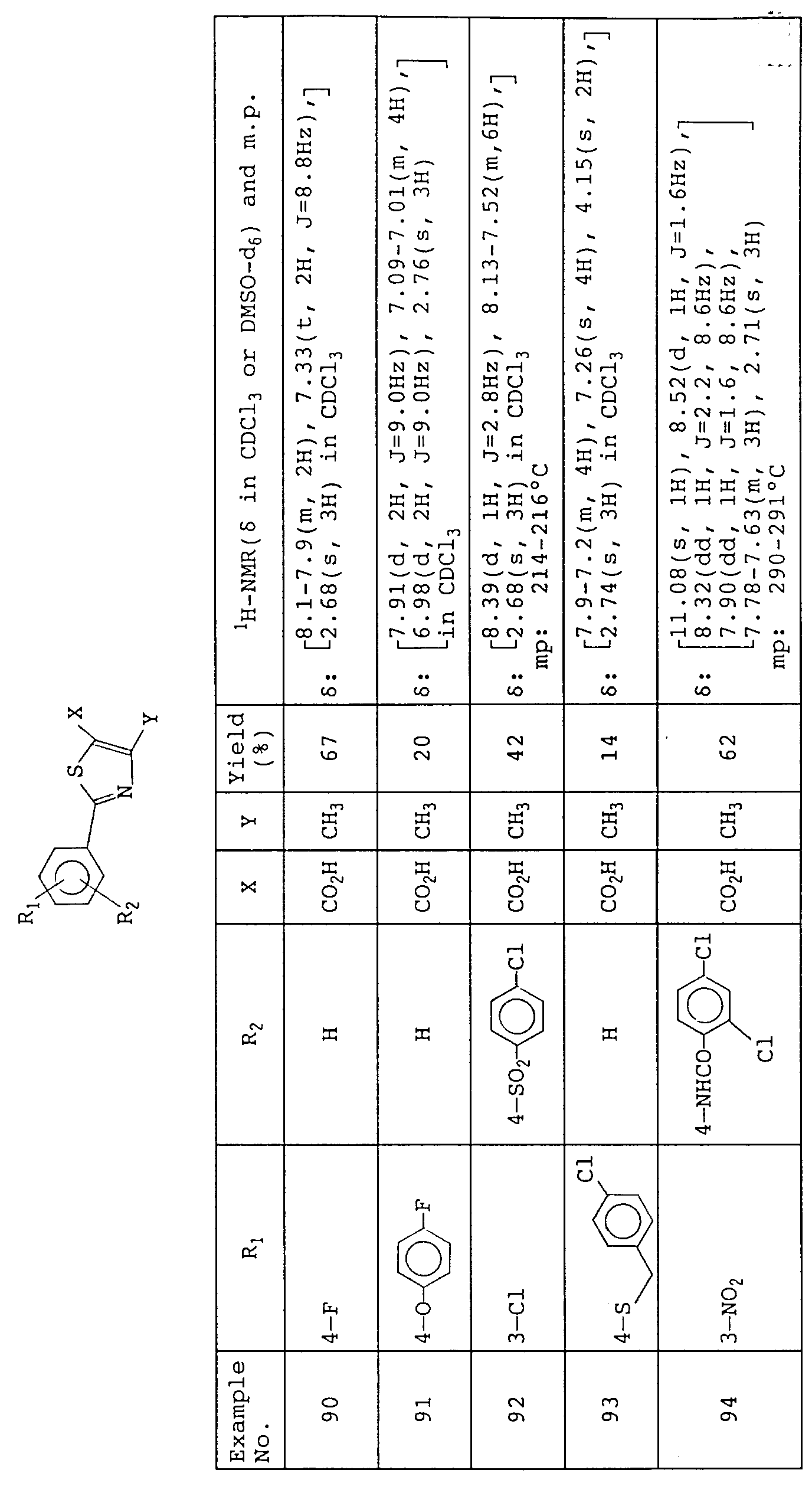


- Test compounds (compounds of Ex. No. listed in Table 1) were dissolved in dimethylsulfoxide and diluted with a 50 mM phosphate buffer to prepare aqueous solutions respectively having predetermined concentrations.
- 45 nmol of xanthine and test compounds prepared so as to have various concentrations were added to 3 ml of a phosphate buffer having a pH value of 7.4 and containing 3 mU of xanthine oxidase (derived from a butter milk; available from Sigma Chemical Company). A reaction was allowed to proceed at 37°C, and the change in OD at 292 nm based on the formation of uric acid was measured with time through the use of a spectrophotometer U-3200 (manufactured by Hitachi, Limited) to determine the initial reaction rate. The inhibition rate was determined by the following equation:

- The inhibition (%) was determined on each test compound prepared according to (1), and the IC₅₀ value on the xanthine oxidase (XOD) inhibition was calculated from the value of inhibition. The results are given in Table 1.


- Test compounds suspended in a 5% gum arabic solution was forcibly administered by oral administration (compounds of Ex. No. of Table 2, dose: 1 mg/kg) to ICR male mice (age: about 7 weeks) (one group: 6 mice) by means of an oral probe. 2 hours after the administration, thoracotomy was conducted under etherization to collect blood from the heart, and serum was removed by a conventional process. The serum uric acid was measured by a biochemical automatic analyzer (Flexigem; Electro-Nucleonics, Inc.) by using a uric acid measurement kit (UA reagent; International Reagent) to determine the percentage of the lowering of uric acid.
- Lowering in uric acid (%)

- The results are given in Table 2.


- 1 ml of a 5% oyster glycogen solution was intra-abdominally administered to a BALB/c mouse (male, 8 weeks in age), and 4 days after the administration, the infiltrated abdominal exuded cells were adhered to a plastic dish for 2 hours, and 1 µg/ml of LPS was allowed to act on macrophage (1 × 10⁶ cells). Interleukin 1 extricated on the supernatant in 24 hours was measured by an ELISA technique. The test compound (compounds of Ex. No. described in Table 3) was prepared so as to have a concentration of 10⁻⁶ M, and the interleukin 1 production inhibitory activity was expressed in terms of the percentage inhibition based on the amount of production of the control. The results are given in Table 3.
Table 3 Example No. Interleukin 1 production inhibitory activity (%) 1 83 5 60 6 38 7 39 11 23 12 42 14 35 15 38 20 65 22 45 26 57 27 43 28 52 40 36 43 39 44 22 45 18 49 48 50 42 52 33 58 19 64 28 67 48 73 65 74 52 75 48 - An emulsion comprising a bovine II type collagen and incomplete Freund's adjuvant in a proportion of 1 : 1 were intradermally injected to Lewis rats (male, about 6 weeks in age) (one group: 8 mice) at the region of the back so that the amount of antigen was 2 mg/rat, thereby inducing arthritis. The compound of Ex. No. 35 was suspended in a 5% gum arabic solution, and orally administered 5 times per week in two groups of 10 mg/kg and 50 mg/kg from the sensitized day. Only the gum arabic solution was administered to the control. Then 6 weeks after the sensitization, the percentage increase in the volume of the right foot was measured and expressed in terms of the percentage swelling, and the anti-collagen antibody titer of the serum was measured by the ELISA technique. The results are given in Table 4.
- As can be seen from Table 5, the compound of the present invention inhibited the swelling of foot-pad depending upon the dose when administered in doses of 100 mg/kg and 50 mg/kg (the percentage inhibitions were respectively 44.1% and 53.4%). Further, the compound of the present invention exhibited a tendency to inhibit the antibody titer of serum anti-collagen involved in the sideration of collagen arthritis in a group of administration in doses of 10 mg/kg and 50 mg/kg. The above-described facts suggest that there is a possibility that the compound of the present invention has an anti-arthritic activity and an anti-collagen-antibody is involved in one of the action mechanisms.
Table 4 Dose (mg/kg) Swelling (%) Antibody titer of anti-collagen (µU/ml) control 45.5 ± 5.1 2.04 ± 0.36 compound of Ex. No. 73 10 25.4 ± 5.3* 1.88 ± 0.20 50 21.2 ± 4.2** 1.68 ± 0.32 Note) *: P < 0.05 **: P < 0.01 - Tablets wherein one tablet had the following composition were prepared.
Compound prepared in Ex. 31 50 mg Lactose 230 mg Potato starch 80 mg Polyvinyl pyrrolidone 11 mg Magnesium stearate 5 mg 376 mg - The compound of the above-described Example, lactose and potato starch were mixed with each other, and a 20% ethanol solution of polyvinyl pyrrolidone was evenly infiltrated into the mixture, passed through a 20 nm mesh sieve, dried at 45°C, and again passed through a 15 nm mesh sieve. The granules thus prepared were mixed with magnesium stearate, and the mixture was compressed into a tablet.
- The pharmaceutical preparation example 2 was repeated, except that the compound prepared in Ex. 69 was used instead of that in Ex. 31.
- In accordance with the present invention, pharmaceutical compositions containing a 2-arylthiazole derivative or a pharmaceutically acceptable salt thereof, which is efficacious for a treatment of gout or hyperuricemia, are provided. Accordingly, the present invention is applicable to the manufacture of pharmaceutical compositions.
m.p.: 211 - 213°C
¹H-NMR (DMSO d-6) δ:
8.37 (d, 1H, J = 2.2 Hz), 8.16 (dd, 1H, J = 9.2 Hz, J = 2.2 Hz), 7.49 (d, 1H, J = 9.2 Hz), 4.93 (m, 1H, J = 6.1 Hz), 2.67 (s, 3H), 1.32 (d, 6H, J = 6.1 Hz).
m.p.: 219 - 220°C
¹H-NMR (DMSO-d₆) δ:
7.96 (d, 1H, J = 2.4 Hz), 7.82 (dd, 1H, J = 8.6 Hz, J = 2.4 Hz), 7.23 (d, 1H, J = 8.6 Hz), 4.20 (q, 2H, J = 7.0 Hz), 2.66 (s, 3H), 1.40 (t, 3H, J = 7.0 Hz).
m.p.: 228- 229°C (decomposed)
¹H-NMR (CDCl₃ + CD₃ OD) δ:
7.89 (d, 1H, J = 2.2 Hz), 7.72 (d, 1H, J = 8.4 Hz, J = 2.2 Hz), 7.05 (d, 1H, J = 8.4 Hz), 3.7 - 3.9 (m, 4H), 2.9 - 3.1 (m, 4H), 2.64 (s, 3H).
m.p.: 200 - 202°C
¹H-NMR (DMSO-d₆) δ:
8.18 (d, 1H, J = 2.2 Hz), 7.88 (dd, 1H, J = 8.6 Hz, J = 2.2 Hz), 7.19 (d, 1H, J = 8.6 Hz), 3.89 (d, 2H, J = 6.4 Hz), 2.66 (s, 3H), 2.0 - 2.3 (m, 1H), 1.03 (d, 6H, J = 6.4 Hz).
m.p.: 217 - 218°C
¹H-NMR (DMSO-d₆) δ:
8.15 (d, 2H, J = 8.4 Hz), 7.85 (d, 2H, J = 8.4 Hz), 7.45 - 7.90 (m, 5H), 2.71 (s, 3H).
Claims (11)
- A pharmaceutical composition comprising an effective amount of 2-arylthiazole derivative having the following formula (I) or a pharmaceutically acceptable salt thereof for treating diseases selected from a group consisting of gout or hyperuricemia and diseases associated with a production of interleukin 1:

Ar represents an unsubstituted or substituted pyridyl, thienyl, furyl or naphthyl group, or a group having the following formula (II)
R₁, R₂ and R₃, independently of each other, represent a hydrogen or halogen atom, or a nitro, cyano, formyl, C₁₋₄ alkyl or C₁₋₄ haloalkyl group, or a group of OR, S(O)nR or NRR' (wherein n is an integer of from 0 to 2, R and R' is independently a hydrogen atom, or an unsubstituted or substituted C₁₋₁₀ alkyl, aryl, aralkyl, alkylcarbonyl, arylcarbonyl or aralkylcarbonyl group; or R and R', taken together with the nitrogen atom bonded thereto, represent atoms forming an unsubstituted or substituted 5- to 7- membered heterocyclic ring); or a group of COR'' (wherein R'' is an unsubstituted or substituted C₁₋₁₀ alkyl, aryl or aralkyl group; a hydroxyl group; an unsubstituted or substituted C₁₋₁₀ alkoxy, aryloxy or aralkyloxy group; an amino group; an unsubstituted or substituted C₁₋₁₀ alkyl (mono- or di-substituted, independently) amino, aryl (mono- or substituted, independently) amino or aralkyl (mono- or di-substituted, independently) amino group, or a 5- to 7-membered cyclic amino group);
X represents a hydrogen atom, or a C₁₋₄ alkyl, carboxyl, C₁₋₅ alkoxycarbonyl, carbamoyl or C₁₋₄ alkyl (mono- or di-substituted) aminocarbonyl group; and
Y represents a hydrogen atom, or a C₁₋₄ alkyl, hydroxyl, C₁₋₄ alkoxy, carboxyl, C₁₋₅ alkoxycarbonyl, carbamoyl or C₁₋₄ alkyl (mono- or di-substituted) aminocarbonyl group. - A pharmaceutical composition in accordance with claim 1, wherein Ar is a group of the formula (II), and at least one group of R₁, R₂ and R₃ is a halogen atom, or a nitro, cyano, formyl or trifluoromethyl group; or a group of OR, S(O)nR or NRR' (wherein n is an integer of from 0 to 2, R is an unsubstituted or substituted C₁₋₁₀ alkyl, aryl, aralkyl, alkylcarbonyl, arylcarbonyl or aralkylcarbonyl group, and R' is a hydrogen atom, or an unsubstituted or substituted C₁₋₁₀ alkyl, aryl, aralkyl, alkylcarbonyl, arylcarbonyl or aralkylcarbonyl group; or R and R', taken together with the nitrogen atom bonded thereto, are atoms forming an unsubstituted or substituted 5- to 7- membered heterocyclic ring), or a group of COR'' (wherein R'' is an unsubstituted or substituted C₁₋₁₀ alkyl, aryl or aralkyl group, a hydroxyl group, an unsubstituted or substituted C₁₋₁₀ alkoxy, aryloxy or aralkyloxy group, an amino group, or an unsubstituted or substituted C₁₋₁₀ alkyl (mono- or di-substituted, independently) amino, aryl (mono- or di-substituted, independently) amino or aralky (mono- or di-substituted, independently) amino group, or a 5- to 7-membered cyclic amino group);
X is a carboxyl, C₁₋₅ alkoxycarbonyl, carbamoyl or C₁₋₄ alkyl (mono- or di-substituted) aminocarbonyl group. - A 2-arylthiazole derivative having the following formula (I), and a pharmaceutically acceptable salt thereof:

Ar is an unsubstituted or substituted pyridyl, thienyl, furyl or naphthyl group; or a group represented by the following formula (II)
at least one group of R₁, R₂ and R₃ is a halogen atom, or a nitro, cyano, formyl or trifluoromethyl group; or a group of OR, S(O)nR and NRR' (wherein n is an integer of from 0 to 2, R represents an unsubstituted or substituted C₁₋₁₀ alkyl, aryl, aralkyl, alkylcarbonyl, arylcarbonyl or aralkylcarbonyl group, R' represents a hydrogen atom, or an unsubstituted or substituted C₁₋₁₀ alkyl, aryl, aralkyl, alkylcarbonyl, arylcarbonyl or aralkylcarbonyl group; or R and R', taken together with the nitrogen atom bonded thereto, represent atoms forming an unsubstituted or substituted 5- to 7-membered heterocyclic ring), or a group of COR'' (wherein R'' represents an unsubstituted or substituted C₁₋₁₀ alkyl, aryl or aralkyl group; a hydroxyl group; an unsubstituted or substituted C₁₋₁₀ alkoxy, aryloxy or aralkyloxy group; an amino group; or an unsubstituted or substituted C₁₋₁₀ alkyl (mono- or di-substituted, independently) amino, aryl (mono- or di-substituted, independently) amino or aralkyl (mono- or di-substituted, independently) amino group, or a 5- to 7- membered cyclic amino group);
X is a hydrogen atom, or a C₁₋₄ alkyl, carboxyl, C₁₋₅ alkoxycarbonyl, carbamoyl or C₁₋₄ alkyl (mono- or di-substituted) aminocarbonyl group; and
Y represents a hydrogen atom, or a C₁₋₄ alkyl, hydroxyl, C₁₋₄ alkoxy, carboxyl, C₁₋₅ alkoxycarbonyl, carbamoyl or C₁₋₄ alkyl (mono- or di- substituted) aminocarbonyl group,
with the proviso that when at least one group of R₁, R₂ and R₃ represents a halogen atom, or a alkoxy, alkyamino or nitro group, at least one group of two other groups represents a group other than a hydrogen atom; when at least one group of R₁, R₂ and R₃ is a halogen atom and another group is a hydrogen atom, a remaining group is a group other than a halogen atom, or an alkoxy, alkylamino or acylamino group. - A 2-arylthiazole derivative of the formula (I) and a pharmaceutically acceptable salt thereof in accordance with claim 3, wherein Ar represents a group of the formula (II), and R₁ is a halogen atom, or a nitro, cyano, formyl or trifluoromethyl group, R₂ is a trifluoromethyl group or a group of OR, S(O)nR and NRR' (wherein n is an integer of from 0 to 2, R represents an unsubstituted or substituted C₁₋₁₀ alkyl, aryl, aralkyl, alkylcarbonyl, arylcarbonyl or aralkylcarbonyl group, R' represents a hydrogen atom, or an unsubstituted or substituted C₁₋₁₀ alkyl, aryl, aralkyl, alkylcarbonyl, arylcarbonyl or aralkylcarbonyl group; or R and R', taken together with the nitrogen atom bonded thereto, represent atoms forming an unsubstituted or substituted 5- to 7-membered heterocyclic ring), and R₃ represents a hydrogen or halogen atom.
- A 2-arylthiazole derivative and a pharmaceutically acceptable salt thereof in accordance with claim 4, wherein X is a carboxyl, C₁₋₅ alkoxycarbonyl, carbamoyl or C₁₋₄ alkyl (mono- or di-substituted) aminocarbonyl group; and
Y is a hydrogen atom, or a C₁₋₄ alkyl, hydroxyl or C₁₋₄ alkoxy group. - A 2-arylthiazole derivative of the formula (I) and a pharmaceutically acceptable salt thereof, in accordance with claim 3 wherein Ar represents a group of the formula (II), and R₁ represents m-nitro or m-cyano group, R₂ represents a group of OR, S(O)n R and NRR' (wherein n is an integer of from 0 to 2, R represents an unsubstituted or substituted C₁₋₁₀ alkyl, aryl, aralkyl, alkylcarbonyl, arylcarbonyl or aralkylcarbonyl group, R' represents a hydrogen atom, or an unsubstituted or substituted C₁₋₁₀ alkyl, aryl, aralkyl, alkylcarbonyl, arylcarbonyl or aralkylcarbonyl group; or R and R', taken together with the nitrogen atom bonded thereto, represent atoms forming an unsubstituted or substituted 5- to 7-membered heterocyclic ring), and R₃ represents a hydrogen atom;
X represents a carboxyl, C₁₋₅ alkoxycarbonyl, carbamoyl or C₁₋₄ alkyl (mono- or di- substituted) aminocarbonyl group; and
Y represents a hydrogen atom, or a C₁₋₄ alkyl, hydroxyl or C₁₋₄ alkoxy gorup. - A 2-arylthiazole derivative of the formula (I) and a pharmaceutically acceptable salt thereof in accordance with claim 3, wherein Ar represents a group of the formula (II), and R¹ represents a m-halogen atom or a m- trifluoromethyl group, R₂ represents a group of OR, S(O)nR and NRR' (wherein n is an integer of from 0 to 2, R represents an unsubstituted or substituted C₁₋₁₀ alkyl, aryl, aralkyl, alkylcarbonyl, arylcarbonyl or aralkylcarbonyl group, R' represents a hydrogen atom, or an unsubstituted or substituted C₁₋₁₀ alkyl, aryl, aralkyl, alkylcarbonyl, arylcarbonyl or aralkylcarbonyl group; or R and R', taken together with the nitrogen atom bonded thereto, represent atoms forming an unsubstituted or substituted 5- to 7- membered heterocyclic ring), and R₃ represents a hydrogen or halogen atom.
- A 2-arylthiazole derivative of the formula (I) and a pharmaceutically acceptable salt thereof in accordance with claim 3, wherein Ar represents a group of the formula (II), and R₁ represents a m-halogen atom, R₂ represents a group of OR, S(O)nR and NRR' (wherein n is an integer of from 0 to 2, R represents an unsubstituted or substituted C₁₋₁₀ alkyl, aryl, aralkyl, alkylcarbonyl, arylcarbonyl or aralkylcarbonyl group, R' represents a hydrogen atom, or an unsubstituted or substituted C₁₋₁₀ alkyl, aryl, aralkyl, alkylcarbonyl, arylcarbonyl or aralkylcarbonyl; or R and R', taken together with the nitrogen atom bonded thereto, represent atoms forming an unsubstituted or substituted 5- to 7- membered heterocyclic ring), and R₃ represents a hydrogen or halogen atom;
X represents a carboxyl, C₁₋₅ alkoxycarbonyl, carbamoyl or C₁₋₄ alkyl (mono- or di-substituted)aminocarbonyl group; and
Y represents a C₁₋₄ alkyl, hydroxyl or C₁₋₅ alkoxy group. - A 2-arylthiazole derivative of the formula (I) and a pharmaceutically acceptable salt thereof in accordance to claim 3, wherein Ar represents a group of the formula (II), and R₁ represents a group of COR'' (wherein R'' represents an unsubstituted or substituted C₁₋₁₀ alkyl, aryl or aralkyl group);
X represents a carboxyl, C₁₋₅ alkoxycarbonyl, carbamoyl or C₁₋₄ alkyl (mono- or di-substituted) aminocarbonyl group; and
Y represents a hydrogen atom, or a C₁₋₄ alkyl, hydroxyl or C₁₋₅ alkoxy group. - A 2-arylthiazole derivative of the following formula (I-a) and a pharmaceutically acceptable salt thereof in accordance with claim 3:

R1-a is a C₂₋₈ alkoxy group and R2-a is a nitro group;
R1-a is a C₂₋₈ alkoxy group and R2-a is a trifluoromethy group;
R1-a is a morpholino, 4-N-methylpiperazine-1-yl or piperidino group and R2-a is a nitro group;
R1-a is a morpholino, 4-N-methylpiperazine-1-yl or piperidino group and R2-a is a cyano group;
R1-a is a C₂₋₈ alkoxy group and R2-a is a cyano group; or
R1-a is an unsubstituted benzoyl group or a benzoyl substituted by one or two of a methyl group, chlorine atom or methoxy group, and R2-a is a hydrogen atom. - An 2-arylthiazole derivative of the following formula (I-b) and a pharmaceutically acceptable salt thereof in accordance with claim 4:

R1-b is a group of OR and SR (wherein R represents a C₂₋₈ alkyl, morpholino, 4-N-methyl piperazine-1-yl or piperidino group; R2-b represents a nitro, trifluoromethyl or cyano group, and Yb represents a hydrogen atom or a methyl group; and
R1-b represents a group of the formula
Applications Claiming Priority (5)
| Application Number | Priority Date | Filing Date | Title |
|---|---|---|---|
| JP330147/90 | 1990-11-30 | ||
| JP33014790 | 1990-11-30 | ||
| JP216586/91 | 1991-08-02 | ||
| JP21658691 | 1991-08-02 | ||
| PCT/JP1991/001670 WO1992009279A1 (en) | 1990-11-30 | 1991-11-29 | 2-arylthiazole derivative and pharmaceutical composition containing the same |
Publications (3)
| Publication Number | Publication Date |
|---|---|
| EP0513379A1 true EP0513379A1 (en) | 1992-11-19 |
| EP0513379A4 EP0513379A4 (en) | 1993-09-01 |
| EP0513379B1 EP0513379B1 (en) | 1996-09-11 |
Family
ID=26521514
Family Applications (1)
| Application Number | Title | Priority Date | Filing Date |
|---|---|---|---|
| EP91920699A Expired - Lifetime EP0513379B1 (en) | 1990-11-30 | 1991-11-29 | 2-arylthiazole derivative and pharmaceutical composition containing the same |
Country Status (13)
| Country | Link |
|---|---|
| US (1) | US5614520A (en) |
| EP (1) | EP0513379B1 (en) |
| JP (1) | JP2725886B2 (en) |
| KR (1) | KR100221041B1 (en) |
| AT (1) | ATE142494T1 (en) |
| AU (1) | AU645867B2 (en) |
| CA (1) | CA2073981C (en) |
| DE (2) | DE122008000051I1 (en) |
| DK (1) | DK0513379T3 (en) |
| ES (1) | ES2092580T3 (en) |
| HU (1) | HU218942B (en) |
| SG (1) | SG86971A1 (en) |
| WO (1) | WO1992009279A1 (en) |
Cited By (46)
| Publication number | Priority date | Publication date | Assignee | Title |
|---|---|---|---|---|
| EP0587378A1 (en) * | 1992-09-09 | 1994-03-16 | Eli Lilly And Company | Prevention of bone resorption |
| EP0779074A4 (en) * | 1995-04-07 | 1999-06-30 | Teijin Ltd | Protective agent for organ or tissue |
| WO2005040121A3 (en) * | 2003-10-16 | 2005-06-23 | Abbott Lab | Amides that inhibit vanilloid receptor subtype 1 (vr1) receptor |
| WO2006103045A1 (en) * | 2005-03-31 | 2006-10-05 | Ucb Pharma S.A. | Compounds comprising an oxazole or thiazole moiety, processes for making them, and their uses |
| US7126004B2 (en) | 1998-08-31 | 2006-10-24 | University Of Florida Research Foundation, Inc. | Thiazoline acid derivatives |
| EP1488790A4 (en) * | 2002-03-28 | 2007-06-20 | Teijin Ltd | Solid preparation containing single crystal form |
| CZ298170B6 (en) * | 1998-06-19 | 2007-07-11 | Teijin Limited | Polymorphous and amorphous modifications of 2-(3-cyano-4-isobutoxyphenyl)-4-methyl-5-thiazolecarboxylic acid and process of their preparation |
| CN100430055C (en) * | 2005-11-11 | 2008-11-05 | 天津泰普药品科技发展有限公司 | Glassy solid solution of 2-(3-cyano-4-isobutoxyphenyl)-4-methyl-5-thiazolecarboxylic acid and polyvinylpyrrolidone and its preparation method |
| EP1932832A4 (en) * | 2005-10-07 | 2009-06-03 | Astellas Pharma Inc | TRIARYLCARBOXYLIC ACID DERIVATIVE |
| EP1783124A4 (en) * | 2004-08-27 | 2009-07-08 | Astellas Pharma Inc | 2-PHENYLTHIOPHENE DERIVATIVE |
| EP2050467A4 (en) * | 2006-07-19 | 2010-09-15 | Nippon Medical School Foundati | THERAPEUTIC AGENT FOR AMYOTROPHIC LATERAL SCLEROSIS |
| EP2266966A1 (en) | 2009-06-11 | 2010-12-29 | Chemo Ibérica, S.A. | A process for the preparation of febuxostat |
| KR20110067135A (en) * | 2008-10-15 | 2011-06-21 | 깃세이 야쿠힌 고교 가부시키가이샤 | Condensed Ring Derivatives and Their Medical Uses |
| WO2011073617A1 (en) | 2009-12-14 | 2011-06-23 | Cipla Limited | Processes for the preparation of febuxostat and salts thereof |
| WO2011141419A1 (en) | 2010-05-10 | 2011-11-17 | Menarini International Operations Luxembourg S.A. | Association of the xanthine oxidase inhibitor febuxostat and metformin and use thereof |
| WO2011141431A1 (en) | 2010-05-10 | 2011-11-17 | Menarini International Operations Luxembourg S.A. | Association of xanthine oxidase inhibitors and angiotensin ii receptor antagonists and use thereof |
| WO2011141381A1 (en) | 2010-05-10 | 2011-11-17 | Menarini International Operations Luxembourg S.A. | Association of xanthine oxidase inhibitors and calcium antagonists and use thereof |
| WO2011141387A1 (en) | 2010-05-10 | 2011-11-17 | Menarini International Operations Luxembourg S.A. | Association of xanthine oxidase inhibitors and statins and use thereof |
| WO2012007487A1 (en) * | 2010-07-13 | 2012-01-19 | Interquim, S.A. | Process for preparing the crystalline form ii of febuxostat |
| WO2012020272A2 (en) | 2010-08-13 | 2012-02-16 | EGIS GYÓGYSZERGYÁR Nyilvánosan Müködö Részvénytársaság | New salts, polymorphs and solvates of a pharmaceutical active ingredient |
| WO2012032528A2 (en) | 2010-09-08 | 2012-03-15 | Natco Pharma Limited | Improved process to prepare ethyl 4-methyl-2-(4-(2-methylpropyloxy)-3-cyanophenyl)-5-thiazolecarboxylate |
| US8278458B2 (en) | 2005-04-04 | 2012-10-02 | University Of Florida Research Foundation, Inc. | Desferrithiocin polyether analogues |
| CN101928259B (en) * | 2009-06-18 | 2012-10-03 | 南京海辰药业有限公司 | 2-arylthiazole derivative and medicament composition thereof |
| WO2012131590A1 (en) | 2011-03-31 | 2012-10-04 | Sandoz Ag | An improved process for preparation of febuxostat and its polymorphic crystalline form c thereof |
| US8324397B2 (en) | 2007-03-15 | 2012-12-04 | University Of Florida Research Foundation, Inc. | Desferrithiocin polyether analogues |
| US8604216B2 (en) | 2003-09-09 | 2013-12-10 | University Of Florida Research Foundation, Inc. | Desferrithiocin derivatives and methods of use thereof |
| US8629278B2 (en) | 2010-06-16 | 2014-01-14 | Ardea Biosciences, Inc. | Thioacetate compounds, compositions and methods of use |
| CN103524456A (en) * | 2013-09-30 | 2014-01-22 | 南京华威医药科技开发有限公司 | Selenazole acid compound and selenazole acid salt |
| CN103936693A (en) * | 2013-01-22 | 2014-07-23 | 沈阳药科大学 | 2-(3-cyano-4-substituted phenyl)-4-methyl-1, 3-selenazole-5-formic acid and formate compounds and preparation method thereof |
| EP2767283A4 (en) * | 2011-10-11 | 2014-09-03 | Univ Osaka | THERAPEUTIC AGENT AND PREVENTIVE AGENT FOR DEMYELING DISEASE |
| EP2808018A4 (en) * | 2012-01-27 | 2015-07-15 | Teijin Pharma Ltd | THERAPEUTIC AGENT FOR DIABETES |
| CN104968662A (en) * | 2013-01-31 | 2015-10-07 | 帝人制药株式会社 | azole derivatives |
| CN104981242A (en) * | 2012-10-23 | 2015-10-14 | 帝人制药株式会社 | Therapeutic or prophylactic agent for tumor lysis syndrome |
| US9212135B2 (en) | 2010-06-16 | 2015-12-15 | Ardea Biosciences, Inc. | Phenylthioacetate compounds, compositions and methods of use |
| WO2015197640A1 (en) * | 2014-06-23 | 2015-12-30 | Dompe' Farmaceutici S.P.A. | 2-aryl-4-hydroxy-1,3-thiazole derivatives useful as trpm8-inhibitors in treatment of neuralgia, pain, copd and asthma |
| US9545445B2 (en) | 2009-06-26 | 2017-01-17 | Teijin Pharma Limited | Therapeutic drug for hypertension or prehypertension |
| CN106536519A (en) * | 2014-07-30 | 2017-03-22 | 帝人制药株式会社 | Crystals of azole derivatives |
| EP3176166A4 (en) * | 2014-07-30 | 2017-06-21 | Teijin Pharma Limited | Azole benzene derivative and crystal thereof |
| EP3144304A4 (en) * | 2014-05-13 | 2017-10-25 | Teijin Pharma Limited | Novel crystalline polymorph of pyridine derivative, and method for producing same |
| US10010535B2 (en) | 2013-11-22 | 2018-07-03 | University Of Florida Research Foundation, Incorporated | Desferrithiocin analogs and uses thereof |
| US10047050B2 (en) | 2011-11-03 | 2018-08-14 | Ardea Biosciences, Inc. | 3,4-di-substituted pyridine compound, methods of using and compositions comprising the same |
| CN108484494A (en) * | 2018-06-15 | 2018-09-04 | 沈阳药科大学 | 2- oxo -1,2- dihydropyridine -4- formic acid compounds |
| CN109069490A (en) * | 2016-02-19 | 2018-12-21 | 国立大学法人鸟取大学 | Antidementia agent or preventive medicine |
| CN109810073A (en) * | 2019-02-28 | 2019-05-28 | 南京海辰药业股份有限公司 | 4- arylthiazole derivative and its pharmaceutical composition |
| US10570104B2 (en) | 2015-04-27 | 2020-02-25 | University Of Florida Research Foundation, Incorporated | Metabolically programmed metal chelators and uses thereof |
| US11931346B2 (en) | 2011-12-16 | 2024-03-19 | University Of Florida Research Foundation, Incorporated | Uses of 4′-desferrithiocin analogs |
Families Citing this family (103)
| Publication number | Priority date | Publication date | Assignee | Title |
|---|---|---|---|---|
| US5294630A (en) * | 1992-07-07 | 1994-03-15 | Eli Lilly And Company | Treatment of inflammatory bowel disease |
| EP0695742A1 (en) | 1994-08-03 | 1996-02-07 | Hoechst Aktiengesellschaft | Fullero azirine derivatives, process for their preparation and use thereof |
| KR970061878A (en) * | 1996-02-23 | 1997-09-12 | 성재갑 | Novel aryl thiazole derivatives, process for their preparation and herbicidal compositions containing the same as active ingredients |
| CA2270661A1 (en) | 1996-10-07 | 1998-04-16 | Lawrence Joseph Heinz | Novel compounds useful as neuro-protective agents |
| US6472387B1 (en) | 1996-10-07 | 2002-10-29 | Eli Lilly And Company | Methods of using compounds as neuro-protective agents |
| ID21775A (en) * | 1996-10-25 | 1999-07-22 | Yoshitomi Pharmaceutical | COMPOUND 1-PHENILPIRAZOL COMPOUNDS AND THE USE OF PHARMACIES |
| AU9575698A (en) | 1997-10-06 | 1999-04-27 | Eli Lilly And Company | Novel compounds useful as neuro-protective agents |
| EP1143951A3 (en) | 1998-09-21 | 2002-02-06 | University Of Florida Research Foundation, Inc. | Antimalarial agents |
| US6410562B1 (en) | 1998-12-18 | 2002-06-25 | Eli Lilly And Company | Hypoglycemic imidazoline compounds |
| US6348324B1 (en) | 1999-01-21 | 2002-02-19 | Hypoguard America Limited | Composition and device for detecting leukocytes in urine |
| US6528652B1 (en) | 1999-01-21 | 2003-03-04 | Chronimed | Composition and device for detecting leukocytes in urine |
| EP1282435A2 (en) * | 2000-05-12 | 2003-02-12 | Immunex Corporation | Interleukin-1 inhibitors in the treatment of diseases |
| DE10106852A1 (en) * | 2001-02-14 | 2002-09-05 | T Luger | Anti-inflammatory compounds |
| JP4917243B2 (en) * | 2001-05-23 | 2012-04-18 | 日本曹達株式会社 | Method for producing thiazole compound |
| US7273866B2 (en) * | 2002-12-20 | 2007-09-25 | Bristol-Myers Squibb Company | 2-aryl thiazole derivatives as KCNQ modulators |
| US6933308B2 (en) * | 2002-12-20 | 2005-08-23 | Bristol-Myers Squibb Company | Aminoalkyl thiazole derivatives as KCNQ modulators |
| US20040122067A1 (en) * | 2002-12-20 | 2004-06-24 | Lin Zhao | Treatment of chronic heart failure |
| EP1609479A4 (en) | 2003-03-13 | 2010-01-20 | Mitsubishi Tanabe Pharma Corp | ONCOGENESIS INHIBITOR |
| US20050027128A1 (en) * | 2003-07-30 | 2005-02-03 | Robbins Timothy A. | Substituted thiazoles |
| US7485657B2 (en) * | 2004-05-12 | 2009-02-03 | Boehringer Ingelheim Pharmaceuticals, Inc. | Anti-cytokine heterocyclic compounds |
| ATE512154T1 (en) * | 2004-06-14 | 2011-06-15 | Nippon Chemiphar Co | CONDENSED PYRIMIDINE DERIVATIVE AND XANTHINE OXIDASINE INHIBITOR |
| DE602005016272D1 (en) * | 2004-08-27 | 2009-10-08 | Astellas Pharma Inc | 2-phenylpyridine derivative |
| JP2008515992A (en) * | 2004-10-13 | 2008-05-15 | ピーティーシー セラピューティクス,インコーポレーテッド | Use of prescribed compounds for the manufacture of medicaments for the prevention / treatment of diseases caused by somatic mutations |
| WO2006121995A2 (en) * | 2005-05-09 | 2006-11-16 | Tap Pharmaceutical Products, Inc. | Methods for treating nephrolithiasis |
| JP2009501721A (en) * | 2005-07-12 | 2009-01-22 | アカディア ファーマシューティカルズ インコーポレイテッド | Compounds with activity at the retinoic acid receptor |
| WO2007019153A2 (en) * | 2005-08-03 | 2007-02-15 | Tap Pharmaceutical Products, Inc. | Methods for treating hypertension |
| CA2623327A1 (en) * | 2005-10-07 | 2007-04-19 | Kissei Pharmaceutical Co., Ltd. | Nitrogenated heterocyclic compound and pharmaceutical composition comprising the same |
| CN1954814A (en) * | 2005-10-26 | 2007-05-02 | 重庆医药工业研究院有限责任公司 | Medical composite with co-action for treating gout and its preparation method |
| KR20080097456A (en) | 2006-02-24 | 2008-11-05 | 아스텔라스세이야쿠 가부시키가이샤 | Treatment or prevention of gastrointestinal ulcers |
| KR101130380B1 (en) * | 2006-06-13 | 2012-04-23 | 상하이 인스티튜트 오브 마테리아 메디카 차이니즈 아카데미 오브 싸이언시즈 | Heterocyclic non-nucleoside compounds, their preparation, pharmaceutical composition and their use as antiviral agents |
| CN101139325B (en) * | 2006-09-07 | 2010-05-12 | 上海医药工业研究院 | 2- (3-cyano-4-isobutoxyphenyl) -4-methyl-5-thiazole formic acid crystal form and preparation method thereof |
| CN101812035B (en) * | 2006-09-07 | 2012-03-21 | 上海医药工业研究院 | 2-(3-cyano-4-isobutoxy phenyl)-4-methyl-5-thiazole formic acid crystal forms and preparation method thereof |
| CA2669935A1 (en) * | 2006-11-13 | 2008-05-29 | Takeda Pharmaceuticals North America, Inc. | Methods for preserving renal function using xanthine oxidoreductase inhibitors |
| US20090124623A1 (en) * | 2006-11-13 | 2009-05-14 | Christopher Lademacher | Methods for preserving and/or increasing renal function using xanthine oxidoreductase inhibitors |
| CN102093309B (en) * | 2006-12-07 | 2012-07-04 | 重庆医药工业研究院有限责任公司 | Novel crystal forms of Febuxostat and preparation method of novel crystal forms |
| CN1970547B (en) * | 2006-12-07 | 2011-04-06 | 重庆医药工业研究院有限责任公司 | Crystal form of febuxostat and preparation method thereof |
| CN102093308B (en) * | 2006-12-07 | 2012-08-29 | 重庆医药工业研究院有限责任公司 | New crystal forms of Febuxostat and preparation methods thereof |
| RU2009131454A (en) * | 2007-01-19 | 2011-02-27 | Такеда Фармасьютикалз Норт Америка, Инк. (Us) | WAYS TO PREVENT OR REDUCE THE NUMBER OF GIT ACUTE EXCHANGE USING Xanthine Oxidoreductase Inhibitors and Anti-Inflammatory Drugs |
| WO2008126772A1 (en) * | 2007-04-05 | 2008-10-23 | Astellas Pharma Inc. | Therapeutic agent for hypertension |
| ES2655466T3 (en) | 2007-08-13 | 2018-02-20 | Monsanto Technology Llc | Compositions and procedures of nematode control |
| JP5580204B2 (en) * | 2008-10-15 | 2014-08-27 | キッセイ薬品工業株式会社 | Biarylisonicotinic acid derivative and pharmaceutical use thereof |
| CN101759656B (en) * | 2008-12-12 | 2013-04-03 | 重庆医药工业研究院有限责任公司 | Febuxostat new crystal forms and preparation method thereof |
| CN101768150B (en) * | 2009-01-05 | 2014-08-06 | 常州市第四制药厂有限公司 | 2-[3-cyano-4-isobutoxyphenyl]-4-methylthiazole-5-carboxylic acid crystal form and preparation method thereof |
| CN101781270B (en) * | 2009-01-20 | 2013-03-27 | 重庆医药工业研究院有限责任公司 | High-purity Febuxostat and preparation method thereof |
| US20100311756A1 (en) * | 2009-01-22 | 2010-12-09 | Takeda Pharmaceuticals North America, Inc. | Methods for delaying the progression of at least one of cardiac hypertrophy, cardiac remodeling or left ventricular function or the onset of heart failure in subjects in need of treatment thereof |
| CN101475541B (en) * | 2009-02-09 | 2011-05-25 | 扬州哈泰克材料有限公司 | Preparation of 4-methyl thiazole-5-carboxyl acid |
| CA2752485C (en) | 2009-02-27 | 2017-01-03 | Teijin Pharma Limited | Process for producing phenyl-substituted heterocyclic derivative through coupling using transition metal catalyst |
| CN101580495A (en) * | 2009-05-25 | 2009-11-18 | 沈阳药科大学 | 5-substituted phenyl-3-isoxazole carboxylic acid and ester compounds, compositions and preparation method thereof |
| ES2448367T3 (en) | 2009-06-09 | 2014-03-13 | Teijin Pharma Limited | Production procedure of benzothioamide derivative substituted in 4 |
| DE202010017868U1 (en) | 2009-06-10 | 2012-11-28 | Teva Pharmaceutical Industries Ltd. | Crystalline forms of febuxostat |
| CN103936689B (en) * | 2009-07-17 | 2016-08-17 | 北京利乐生制药科技有限公司 | 2-[3-cyano-4-isobutoxy phenyl]-4-methylthiazol-5-formic acid crystal forms and preparation method thereof |
| WO2011031409A1 (en) | 2009-09-10 | 2011-03-17 | Teva Pharmaceutical Industries Ltd. | Processes for preparing febuxostat |
| IT1395936B1 (en) * | 2009-09-29 | 2012-11-02 | Dipharma Francis Srl | FEBUXOSTAT SALTS |
| TWI423962B (en) | 2009-10-07 | 2014-01-21 | Lg Life Sciences Ltd | Novel compounds effective as xanthine oxidase inhibitors, method for preparing the same, and pharmaceutical composition containing the same |
| WO2011080651A2 (en) | 2009-12-31 | 2011-07-07 | Ranbaxy Laboratories Limited | Polymorphic forms of febuxostat |
| WO2011101867A2 (en) | 2010-02-19 | 2011-08-25 | Cadila Healthcare Limited | Substantially pure salts of febuxostat and processes for preparation thereof |
| WO2011103439A1 (en) * | 2010-02-19 | 2011-08-25 | Takeda Pharmaceuticals North America, Inc. | Methods for stabilizing joint damage in subjects using xanthine oxidoreductase inhibitors |
| AU2011222462A1 (en) | 2010-03-04 | 2012-09-27 | Ranbaxy Laboratories Limited | Polymorph of 2-[3-cyano-4-(2-methylpropoxy)phenyl]-4-methylthiazole-5-carboxylic acid |
| US8969582B2 (en) | 2010-04-29 | 2015-03-03 | Dr. Reddy's Laboratories Ltd. | Preparation of febuxostat |
| EP2582812B1 (en) | 2010-06-16 | 2018-01-24 | Takeda Pharmaceuticals U.S.A., Inc. | Novel modified release dosage forms of xanthine oxidoreductase inhibitor or xanthine oxidase inhibitors |
| AR082022A1 (en) | 2010-06-25 | 2012-11-07 | Teijin Pharma Ltd | THERAPEUTIC AGENT OF SUSTAINED LIBERATION FOR HYPERTENSION AND RENAL DYSFUNCTION |
| EP2598494B1 (en) * | 2010-07-30 | 2014-11-26 | Ranbaxy Laboratories Limited | Improved process for the preparation of febuxostat |
| EP2610248B1 (en) | 2010-08-27 | 2016-06-08 | Teijin Pharma Limited | Method for producing phenyl-substituted heterocyclic derivative by means of coupling method using a palladium compound |
| JP5978216B2 (en) | 2010-09-10 | 2016-08-24 | タケダ ファーマシューティカルズ ユー.エス.エー. インコーポレイティド | Methods for combination therapy of theophylline and febuxostat |
| WO2012066561A1 (en) | 2010-11-08 | 2012-05-24 | Matrix Laboratories Ltd | An improved process for the preparation of 2-arylthiazole derivatives |
| WO2012073259A1 (en) | 2010-12-02 | 2012-06-07 | Indoco Remedies Limited | Novel process for the preparation of febuxostat |
| WO2012098501A1 (en) | 2011-01-21 | 2012-07-26 | Ranbaxy Laboratories Limited | Febuxostat co-crystals |
| WO2012109573A1 (en) * | 2011-02-11 | 2012-08-16 | Purdue Research Foundation | Substituted thiazoles for use as antiviral agents |
| CN102643249A (en) * | 2011-02-18 | 2012-08-22 | 苏州波锐生物医药科技有限公司 | 2-arylthiazole derivative and medicinal salt and application thereof |
| US20150031732A1 (en) | 2011-04-15 | 2015-01-29 | Ranbaxy Laboratories Limited | Febuxostat solid dispersion |
| WO2012153313A1 (en) | 2011-05-11 | 2012-11-15 | Ranbaxy Laboratories Limited | Pharmaceutical composition of febuxostat |
| WO2012172461A1 (en) | 2011-06-13 | 2012-12-20 | Ranbaxy Laboratories Limited | Pharmaceutical compositions of febuxostat |
| US20140228417A1 (en) * | 2011-10-05 | 2014-08-14 | Mapi Pharma Ltd. | Process and intermediates for the preparation of substituted 2-arylthiazole carboxylic acids |
| AU2012342011A1 (en) * | 2011-11-15 | 2014-06-05 | Mylan Laboratories Ltd | Process for the preparation of Febuxostat polymorphs |
| WO2013088449A1 (en) | 2011-12-16 | 2013-06-20 | Natco Pharma Limited | Stable crystal form of febuxostat and process for the preparation thereof |
| US9585875B2 (en) * | 2011-12-19 | 2017-03-07 | Dompé Farmaceutici S.P.A. | TRPM8 antagonists |
| EP2606888A1 (en) * | 2011-12-19 | 2013-06-26 | Dompe' S.P.A. | Trpm8 antagonists |
| EP2925306A1 (en) | 2012-07-12 | 2015-10-07 | Alembic Pharmaceuticals Limited | Pharmaceutical composition of febuxostat |
| EP2692342A1 (en) | 2012-07-30 | 2014-02-05 | Interquim, S.A. | Process for the preparation of pharmaceutical compositions comprising febuxostat in the form of tablets |
| CN103130744B (en) * | 2012-08-28 | 2014-10-15 | 沈阳药科大学 | Selenazole formic acid formic acid compound and preparation method and application thereof |
| WO2014057461A1 (en) | 2012-10-11 | 2014-04-17 | Ranbaxy Laboratories Limited | Process for the preparation of crystalline form g of febuxostat |
| CN103848798B (en) * | 2012-11-30 | 2016-01-06 | 镇江新元素医药科技有限公司 | 2-aryl selenazoles compound and pharmaceutical composition thereof |
| US8883857B2 (en) | 2012-12-07 | 2014-11-11 | Baylor College Of Medicine | Small molecule xanthine oxidase inhibitors and methods of use |
| CN103333134B (en) * | 2013-03-01 | 2016-02-24 | 沈阳药科大学 | 2-(3-cyano group-4-alkoxyl group) phenyl-4-substituted thiazole-5-formic acid compound, composition and method of making the same and purposes |
| CN104163782A (en) * | 2013-05-17 | 2014-11-26 | 重庆圣华曦药业股份有限公司 | Preparation method of 3,4-substitituted thiobenzamide and application of 3,4-substitituted thiobenzamide in febuxostat synthesis |
| WO2014192977A1 (en) * | 2013-05-31 | 2014-12-04 | 帝人ファーマ株式会社 | Thiazole derivative |
| JP6585044B2 (en) | 2013-08-07 | 2019-10-02 | ファーマシェン エス.エー. | A new method for the preparation of febuxostat |
| CN104418822B (en) * | 2013-08-22 | 2016-12-28 | 南京华威医药科技开发有限公司 | Compound with xanthine oxidase inhibitory activity and application thereof |
| EP2881116A1 (en) | 2013-12-05 | 2015-06-10 | Ranbaxy Laboratories Limited | Febuxostat composition |
| JP2017165653A (en) * | 2014-07-30 | 2017-09-21 | 帝人ファーマ株式会社 | Azole carboxylic acid derivative |
| US20170217948A1 (en) | 2014-07-30 | 2017-08-03 | Teijin Pharma Limited | Xanthine oxidase inhibitor |
| CZ27857U1 (en) | 2014-12-12 | 2015-02-23 | Zentiva, K.S. | Formulation containing febuxostat solid solution |
| US10413546B2 (en) | 2015-02-24 | 2019-09-17 | National University Corporation Tottori University | Drug for preventing and/or treating dementia |
| WO2016160706A1 (en) * | 2015-03-28 | 2016-10-06 | Wisconsin Alumni Research Foundation | Inhibitors of collagen prolyl 4-hydroxylase |
| HUE052608T2 (en) * | 2015-09-02 | 2021-05-28 | Sunshine Lake Pharma Co Ltd | Carboxy substituted (hetero) aromatic ring derivatives and preparation method and uses thereof |
| CN106146419A (en) * | 2016-08-01 | 2016-11-23 | 沈阳药科大学 | Xanthine oxidase inhibitor |
| CN108358866B (en) * | 2017-01-12 | 2021-03-23 | 江西同和药业股份有限公司 | Preparation method of febuxostat intermediate and application of febuxostat intermediate in preparation of febuxostat |
| CN110066258A (en) | 2018-01-23 | 2019-07-30 | 湘北威尔曼制药股份有限公司 | Thiazole -5- formic acid derivates and the preparation method and application thereof |
| US20220288038A1 (en) | 2019-08-21 | 2022-09-15 | The University Of Tokyo | Abcc11 inhibitor |
| CN113024534B (en) * | 2019-12-24 | 2023-03-21 | 武汉光谷亚太医药研究院有限公司 | 2-pyridylthiazole derivatives and use thereof |
| CN115572272B (en) * | 2022-11-15 | 2024-05-07 | 湖北华世通生物医药科技有限公司 | Preparation method of febuxostat and aldehyde ester intermediate thereof |
| KR20250153695A (en) * | 2024-04-17 | 2025-10-27 | 연세대학교 산학협력단 | Novel Derivateves of Febuxostat and a Composition for Preventing or Treating Inflammatory disease Comprising the Same |
| KR20260117867A (en) * | 2025-01-22 | 2026-07-30 | 연세대학교 산학협력단 | Novel Inflammasome Inhibitors and a Composition for Preventing or Treating Hyperuricemia Comprising the Same |
Family Cites Families (21)
| Publication number | Priority date | Publication date | Assignee | Title |
|---|---|---|---|---|
| FR1516777A (en) * | 1966-08-02 | 1968-02-05 | Innothera Lab Sa | Thiazole derivatives as well as thiazolo [4,5-d] pyridazine and their preparation |
| CA962269A (en) * | 1971-05-05 | 1975-02-04 | Uniroyal Ltd. | Thiazoles, and their use as insecticides |
| DE2125193C3 (en) * | 1971-05-21 | 1980-08-14 | Basf Ag, 6700 Ludwigshafen | 4-Nitro-2-thiazolyl-1-aminobenzenes and process for their preparation |
| DE2125251A1 (en) * | 1971-05-21 | 1972-11-30 | Badische Anilin- & Soda-Fabrik Ag, 6700 Ludwigshafen | Monoazo dispersion dyes - contg a thiazolyl substit in 2-position for use on synthetic fibres |
| US3852293A (en) * | 1972-06-21 | 1974-12-03 | Uniroyal Inc | 4-phenyl-2-(3-pyridyl)-thiazole carboxamides |
| US4020080A (en) * | 1974-07-01 | 1977-04-26 | Eastman Kodak Company | Oxadiazolylphenyl aromatic ester compounds and their use as ultraviolet stabilizer in organic compositions |
| US4363813A (en) * | 1979-07-09 | 1982-12-14 | Kureha Kagaku Kogyo Kabushiki Kaisha | 2-(3,4,5-Trimethoxyphenyl)-4,5-disubstituted thiazoles |
| DE3002989A1 (en) * | 1980-01-29 | 1981-07-30 | Hoechst Ag, 6000 Frankfurt | HYDROXYPHENYL-THIAZOLE, -THIAZOLINE AND -THIAZOLIDINE-CARBONIC ACIDS, METHOD FOR THE PRODUCTION THEREOF AND THEIR USE FOR INFLUENCING COLLAGEN METABOLISM |
| US4346094A (en) * | 1980-09-22 | 1982-08-24 | Eli Lilly And Company | 3-Aryl-5-isothiazolecarboxylic acids and related compounds used to lower uric acid levels |
| JPS5772975A (en) * | 1980-10-24 | 1982-05-07 | Kureha Chem Ind Co Ltd | 2-substituted phenylthiazole derviative, and medicine for peptic ulcer containing said derivative as active component |
| DE3141430A1 (en) * | 1981-10-19 | 1983-05-05 | Basf Ag, 6700 Ludwigshafen | Azo dyes substituted by heterocycles |
| US4571402A (en) * | 1982-06-22 | 1986-02-18 | Schering Corporation | Anti-bronchoconstriction 2-(4'-pyridinyl)-thiazole derivatives, composition, and method of use therefor |
| US4528291A (en) * | 1982-06-22 | 1985-07-09 | Schering Corporation | 2-(4'-Pyridinyl)-thiazole compounds and their use in increasing cardiac contractility |
| JPS5925381A (en) * | 1982-06-30 | 1984-02-09 | Hisamitsu Pharmaceut Co Inc | Novel phenylacetic acid derivative |
| JPH0725754B2 (en) * | 1986-01-30 | 1995-03-22 | 富山化学工業株式会社 | Novel thiazole compound or salt thereof |
| JPH01110683A (en) * | 1986-09-27 | 1989-04-27 | Sawai Seiyaku Kk | N-tetrazolyl thiazole carboxamide derivative and use thereof |
| JPS63112572A (en) * | 1986-10-30 | 1988-05-17 | Yamanouchi Pharmaceut Co Ltd | 1(3h)-thiazolone derivative |
| JPS63112574A (en) * | 1986-10-30 | 1988-05-17 | Yamanouchi Pharmaceut Co Ltd | 4-trisubstituted phenyl-2(3h)-thiazolone derivative |
| WO1990009381A1 (en) * | 1989-02-08 | 1990-08-23 | Abbott Laboratories | 4-hydroxythiazoles as 5-lipoxygenase inhibitors |
| JPH02229190A (en) * | 1989-03-02 | 1990-09-11 | Taisho Pharmaceut Co Ltd | Azole derivative |
| US5244867A (en) * | 1989-09-26 | 1993-09-14 | Basf Aktiengesellschaft | Oxazole- and thiazolecarboxamides |
-
1991
- 1991-11-29 CA CA002073981A patent/CA2073981C/en not_active Expired - Lifetime
- 1991-11-29 DE DE122008000051C patent/DE122008000051I1/en active Pending
- 1991-11-29 ES ES91920699T patent/ES2092580T3/en not_active Expired - Lifetime
- 1991-11-29 KR KR1019920701809A patent/KR100221041B1/en not_active Expired - Lifetime
- 1991-11-29 DE DE69122084T patent/DE69122084T2/en not_active Expired - Lifetime
- 1991-11-29 SG SG9603299A patent/SG86971A1/en unknown
- 1991-11-29 HU HU9202265A patent/HU218942B/en unknown
- 1991-11-29 AU AU89522/91A patent/AU645867B2/en not_active Expired
- 1991-11-29 JP JP4500083A patent/JP2725886B2/en not_active Expired - Lifetime
- 1991-11-29 WO PCT/JP1991/001670 patent/WO1992009279A1/en not_active Ceased
- 1991-11-29 AT AT91920699T patent/ATE142494T1/en not_active IP Right Cessation
- 1991-11-29 EP EP91920699A patent/EP0513379B1/en not_active Expired - Lifetime
- 1991-11-29 DK DK91920699.5T patent/DK0513379T3/en active
-
1995
- 1995-01-30 US US08/380,214 patent/US5614520A/en not_active Expired - Lifetime
Cited By (90)
| Publication number | Priority date | Publication date | Assignee | Title |
|---|---|---|---|---|
| EP0587378A1 (en) * | 1992-09-09 | 1994-03-16 | Eli Lilly And Company | Prevention of bone resorption |
| EP0779074A4 (en) * | 1995-04-07 | 1999-06-30 | Teijin Ltd | Protective agent for organ or tissue |
| EP1956015A3 (en) * | 1998-06-19 | 2008-09-17 | Teijin Limited | Polymorph of 2-(3-cyano-4-isobutyloxyphenyl)-4-methyl-5-thiazolecarboxylic acid and method of producing the same |
| CN102659712A (en) * | 1998-06-19 | 2012-09-12 | 帝人制药株式会社 | Polymorphic modifications of 2-(3-cyano-4-isobutyloxyphenyl)-4-methyl-5-thiazole-carboxylic acid and processes for the preparation thereof |
| HRP20120217B1 (en) * | 1998-06-19 | 2019-04-05 | Teijin Pharma Limited | Polymorphic modifications of 2-(3-cyano-4-isobutyloxyphenyl)-4-methyl-5-thiazole-carboxylic acid and processes for the preparation thereof |
| CZ298170B6 (en) * | 1998-06-19 | 2007-07-11 | Teijin Limited | Polymorphous and amorphous modifications of 2-(3-cyano-4-isobutoxyphenyl)-4-methyl-5-thiazolecarboxylic acid and process of their preparation |
| EP2404910A3 (en) * | 1998-06-19 | 2014-10-29 | Teijin Pharma Limited | Polymorphs of 2-(3-cyano-4-Isobutyloxyphenyl)-4-methyl-5-thiazolecarboxylic acid and method of producing the same |
| EP1956015A2 (en) | 1998-06-19 | 2008-08-13 | Teijin Limited | Polymorph of 2-(3-cyano-4-isobutyloxyphenyl)-4-methyl-5-thiazolecarboxylic acid and method of producing the same |
| EP1956014A3 (en) * | 1998-06-19 | 2008-08-20 | Teijin Limited | Polymorphs of 2-(3-cyano-4-isobutyloxyphenyl)-4-methyl-5-thiazolecarboxylic acid and method of producing the same |
| US8008502B2 (en) | 1998-08-31 | 2011-08-30 | University Of Florida Research Foundation, Inc. | Thiazoline acid derivatives |
| US7126004B2 (en) | 1998-08-31 | 2006-10-24 | University Of Florida Research Foundation, Inc. | Thiazoline acid derivatives |
| EP1488790A4 (en) * | 2002-03-28 | 2007-06-20 | Teijin Ltd | Solid preparation containing single crystal form |
| AU2003220909B2 (en) * | 2002-03-28 | 2008-09-18 | Teijin Limited | Solid preparation containing single crystal form |
| US7361676B2 (en) | 2002-03-28 | 2008-04-22 | Teijin Limited | Solid preparation containing single crystal form |
| US8604216B2 (en) | 2003-09-09 | 2013-12-10 | University Of Florida Research Foundation, Inc. | Desferrithiocin derivatives and methods of use thereof |
| US7595332B2 (en) | 2003-10-16 | 2009-09-29 | Abbott Laboratories | Amides that inhibit vanilloid receptor subtype 1 (VR1) |
| WO2005040121A3 (en) * | 2003-10-16 | 2005-06-23 | Abbott Lab | Amides that inhibit vanilloid receptor subtype 1 (vr1) receptor |
| US7037927B2 (en) | 2003-10-16 | 2006-05-02 | Abbott Laboratories | Amides that inhibit vanilloid receptor subtype 1 (VR1) receptor |
| EP1783124A4 (en) * | 2004-08-27 | 2009-07-08 | Astellas Pharma Inc | 2-PHENYLTHIOPHENE DERIVATIVE |
| WO2006103045A1 (en) * | 2005-03-31 | 2006-10-05 | Ucb Pharma S.A. | Compounds comprising an oxazole or thiazole moiety, processes for making them, and their uses |
| US7790720B2 (en) | 2005-03-31 | 2010-09-07 | Ucb Pharma, S.A. | Compounds comprising an oxazole or thiazole moiety, processes for making them, and their uses |
| US8722899B2 (en) | 2005-04-04 | 2014-05-13 | University Of Florida Research Foundation, Inc. | Desferrithiocin polyether analogues |
| US9567309B2 (en) | 2005-04-04 | 2017-02-14 | University Of Florida Research Foundation, Inc. | Desferrithiocin polyether analogues |
| US9096553B2 (en) | 2005-04-04 | 2015-08-04 | University Of Florida Research Foundation, Incorporated | Desferrithiocin polyether analogues |
| US9994535B2 (en) | 2005-04-04 | 2018-06-12 | University Of Florida Foundation, Inc. | Desferrithiocin polyether analogues |
| US8278458B2 (en) | 2005-04-04 | 2012-10-02 | University Of Florida Research Foundation, Inc. | Desferrithiocin polyether analogues |
| EP1932832A4 (en) * | 2005-10-07 | 2009-06-03 | Astellas Pharma Inc | TRIARYLCARBOXYLIC ACID DERIVATIVE |
| US7816558B2 (en) | 2005-10-07 | 2010-10-19 | Astellas Pharma Inc. | Triarylcarboxylic acid derivative |
| CN100430055C (en) * | 2005-11-11 | 2008-11-05 | 天津泰普药品科技发展有限公司 | Glassy solid solution of 2-(3-cyano-4-isobutoxyphenyl)-4-methyl-5-thiazolecarboxylic acid and polyvinylpyrrolidone and its preparation method |
| US8318792B2 (en) | 2006-07-19 | 2012-11-27 | Nippon Medical School Foundation | Therapeutic agent for amyotrophic lateral sclerosis |
| EP2050467A4 (en) * | 2006-07-19 | 2010-09-15 | Nippon Medical School Foundati | THERAPEUTIC AGENT FOR AMYOTROPHIC LATERAL SCLEROSIS |
| US9730917B2 (en) | 2007-03-15 | 2017-08-15 | University Of Florida Research Foundation, Incorporated | Desferrithiocin polyether analogues |
| US9174948B2 (en) | 2007-03-15 | 2015-11-03 | University Of Florida Research Foundation, Inc. | Desferrithiocin polyether analogues |
| US8324397B2 (en) | 2007-03-15 | 2012-12-04 | University Of Florida Research Foundation, Inc. | Desferrithiocin polyether analogues |
| EP2343279A4 (en) * | 2008-10-15 | 2014-08-06 | Kissei Pharmaceutical | FUSED-RING DERIVATIVE AND MEDICAL APPLICATION OF SAME |
| KR20110067135A (en) * | 2008-10-15 | 2011-06-21 | 깃세이 야쿠힌 고교 가부시키가이샤 | Condensed Ring Derivatives and Their Medical Uses |
| EP2266966A1 (en) | 2009-06-11 | 2010-12-29 | Chemo Ibérica, S.A. | A process for the preparation of febuxostat |
| CN101928259B (en) * | 2009-06-18 | 2012-10-03 | 南京海辰药业有限公司 | 2-arylthiazole derivative and medicament composition thereof |
| US9545445B2 (en) | 2009-06-26 | 2017-01-17 | Teijin Pharma Limited | Therapeutic drug for hypertension or prehypertension |
| WO2011073617A1 (en) | 2009-12-14 | 2011-06-23 | Cipla Limited | Processes for the preparation of febuxostat and salts thereof |
| WO2011141387A1 (en) | 2010-05-10 | 2011-11-17 | Menarini International Operations Luxembourg S.A. | Association of xanthine oxidase inhibitors and statins and use thereof |
| WO2011141419A1 (en) | 2010-05-10 | 2011-11-17 | Menarini International Operations Luxembourg S.A. | Association of the xanthine oxidase inhibitor febuxostat and metformin and use thereof |
| WO2011141431A1 (en) | 2010-05-10 | 2011-11-17 | Menarini International Operations Luxembourg S.A. | Association of xanthine oxidase inhibitors and angiotensin ii receptor antagonists and use thereof |
| WO2011141381A1 (en) | 2010-05-10 | 2011-11-17 | Menarini International Operations Luxembourg S.A. | Association of xanthine oxidase inhibitors and calcium antagonists and use thereof |
| US9212135B2 (en) | 2010-06-16 | 2015-12-15 | Ardea Biosciences, Inc. | Phenylthioacetate compounds, compositions and methods of use |
| US10266493B2 (en) | 2010-06-16 | 2019-04-23 | Ardea Biosciences, Inc. | Thioacetate compounds, compositions and methods of use |
| US8629278B2 (en) | 2010-06-16 | 2014-01-14 | Ardea Biosciences, Inc. | Thioacetate compounds, compositions and methods of use |
| WO2012007487A1 (en) * | 2010-07-13 | 2012-01-19 | Interquim, S.A. | Process for preparing the crystalline form ii of febuxostat |
| WO2012020272A3 (en) * | 2010-08-13 | 2012-04-05 | EGIS GYÓGYSZERGYÁR Nyilvánosan Müködö Részvénytársaság | New salts, polymorphs and solvates of febuxostat |
| WO2012020272A2 (en) | 2010-08-13 | 2012-02-16 | EGIS GYÓGYSZERGYÁR Nyilvánosan Müködö Részvénytársaság | New salts, polymorphs and solvates of a pharmaceutical active ingredient |
| WO2012032528A2 (en) | 2010-09-08 | 2012-03-15 | Natco Pharma Limited | Improved process to prepare ethyl 4-methyl-2-(4-(2-methylpropyloxy)-3-cyanophenyl)-5-thiazolecarboxylate |
| WO2012032528A3 (en) * | 2010-09-08 | 2015-10-29 | Natco Pharma Limited | Improved process to prepare ethyl 4-methyl-2-(4-(2-methylpropyloxy)-3-cyanophenyl)-5-thiazolecarboxylate |
| WO2012131590A1 (en) | 2011-03-31 | 2012-10-04 | Sandoz Ag | An improved process for preparation of febuxostat and its polymorphic crystalline form c thereof |
| EP2767283A4 (en) * | 2011-10-11 | 2014-09-03 | Univ Osaka | THERAPEUTIC AGENT AND PREVENTIVE AGENT FOR DEMYELING DISEASE |
| US10047050B2 (en) | 2011-11-03 | 2018-08-14 | Ardea Biosciences, Inc. | 3,4-di-substituted pyridine compound, methods of using and compositions comprising the same |
| US10570095B2 (en) | 2011-11-03 | 2020-02-25 | Ardea Biosciences, Inc. | 3,4-di-substituted pyridine compound, methods of using and compositions comprising the same |
| US11931346B2 (en) | 2011-12-16 | 2024-03-19 | University Of Florida Research Foundation, Incorporated | Uses of 4′-desferrithiocin analogs |
| EP2808018A4 (en) * | 2012-01-27 | 2015-07-15 | Teijin Pharma Ltd | THERAPEUTIC AGENT FOR DIABETES |
| CN104981242A (en) * | 2012-10-23 | 2015-10-14 | 帝人制药株式会社 | Therapeutic or prophylactic agent for tumor lysis syndrome |
| CN103936693A (en) * | 2013-01-22 | 2014-07-23 | 沈阳药科大学 | 2-(3-cyano-4-substituted phenyl)-4-methyl-1, 3-selenazole-5-formic acid and formate compounds and preparation method thereof |
| AU2014213396B2 (en) * | 2013-01-31 | 2017-05-11 | Teijin Limited | Azole benzene derivative |
| US9388174B2 (en) | 2013-01-31 | 2016-07-12 | Teijin Pharma Limited | Azole benzene derivative |
| RU2641891C2 (en) * | 2013-01-31 | 2018-01-23 | Тейдзин Фарма Лимитед | Azole derivatives of benzene |
| CN104968662B (en) * | 2013-01-31 | 2018-03-30 | 帝人制药株式会社 | azole derivatives |
| EP2952513A4 (en) * | 2013-01-31 | 2015-12-09 | Teijin Pharma Ltd | AZOLE AND BENZENE DERIVATIVE |
| CN104968662A (en) * | 2013-01-31 | 2015-10-07 | 帝人制药株式会社 | azole derivatives |
| CN103524456A (en) * | 2013-09-30 | 2014-01-22 | 南京华威医药科技开发有限公司 | Selenazole acid compound and selenazole acid salt |
| US10010535B2 (en) | 2013-11-22 | 2018-07-03 | University Of Florida Research Foundation, Incorporated | Desferrithiocin analogs and uses thereof |
| EP3144304A4 (en) * | 2014-05-13 | 2017-10-25 | Teijin Pharma Limited | Novel crystalline polymorph of pyridine derivative, and method for producing same |
| US11046662B2 (en) | 2014-06-23 | 2021-06-29 | Dompé Farmaceutici S.P.A. | 2-aryl-4-hydroxy-1,3-thiazole derivatives useful as TRPM8-inhibitors in treatment of neuralgia, pain, COPD and asthma |
| WO2015197640A1 (en) * | 2014-06-23 | 2015-12-30 | Dompe' Farmaceutici S.P.A. | 2-aryl-4-hydroxy-1,3-thiazole derivatives useful as trpm8-inhibitors in treatment of neuralgia, pain, copd and asthma |
| US10196368B2 (en) | 2014-06-23 | 2019-02-05 | Dompé Farmaceutici S.P.A. | 2-aryl-4-hydroxy-1,3-thiazole derivatives useful as TRPM8-inhibitors in treatment of neuralgia, pain, COPD and asthma |
| EA034525B1 (en) * | 2014-06-23 | 2020-02-17 | Домпе Фармачеутичи С.П.А. | 2-aryl-4-hydroxy-1,3-thiazole derivatives useful as trpm8-inhibitors in treatment of neuralgia, pain, copd and asthma |
| EP3176165A4 (en) * | 2014-07-30 | 2017-06-07 | Teijin Pharma Limited | Crystal of azole benzene derivative |
| TWI687418B (en) * | 2014-07-30 | 2020-03-11 | 日商帝人製藥股份有限公司 | Crystallization of oxazole derivatives |
| CN106536519B (en) * | 2014-07-30 | 2019-03-29 | 帝人制药株式会社 | Crystals of oxazole derivatives |
| RU2675854C2 (en) * | 2014-07-30 | 2018-12-25 | Тейдзин Фарма Лимитед | Crystal of azole benzene derivative |
| CN106536519A (en) * | 2014-07-30 | 2017-03-22 | 帝人制药株式会社 | Crystals of azole derivatives |
| US10179780B2 (en) | 2014-07-30 | 2019-01-15 | Teijin Pharma Limited | Azole benzene derivative and crystalline form thereof |
| RU2701515C2 (en) * | 2014-07-30 | 2019-09-27 | Тейдзин Фарма Лимитед | Azobenzene derivative and crystalline form thereof |
| EP3176166A4 (en) * | 2014-07-30 | 2017-06-21 | Teijin Pharma Limited | Azole benzene derivative and crystal thereof |
| US9815826B2 (en) | 2014-07-30 | 2017-11-14 | Teijin Pharma Limited | Crystal of azole benzene derivative |
| US10570104B2 (en) | 2015-04-27 | 2020-02-25 | University Of Florida Research Foundation, Incorporated | Metabolically programmed metal chelators and uses thereof |
| TWI752007B (en) * | 2016-02-19 | 2022-01-11 | 中國商上海根乃津藥業科技有限公司 | Dementia treatment or preventive medicine |
| US11344539B2 (en) | 2016-02-19 | 2022-05-31 | National University Corporation Tottori University | Therapeutic or prophylactic drug for dementia |
| CN109069490A (en) * | 2016-02-19 | 2018-12-21 | 国立大学法人鸟取大学 | Antidementia agent or preventive medicine |
| CN108484494A (en) * | 2018-06-15 | 2018-09-04 | 沈阳药科大学 | 2- oxo -1,2- dihydropyridine -4- formic acid compounds |
| CN108484494B (en) * | 2018-06-15 | 2021-07-30 | 沈阳药科大学 | 2-oxo-1,2-dihydropyridine-4-carboxylic acids |
| CN109810073A (en) * | 2019-02-28 | 2019-05-28 | 南京海辰药业股份有限公司 | 4- arylthiazole derivative and its pharmaceutical composition |
| CN109810073B (en) * | 2019-02-28 | 2023-01-06 | 南京海辰药业股份有限公司 | 4-arylthiazole derivatives and pharmaceutical compositions thereof |
Also Published As
| Publication number | Publication date |
|---|---|
| DE69122084D1 (en) | 1996-10-17 |
| ES2092580T3 (en) | 1996-12-01 |
| DK0513379T3 (en) | 1996-09-30 |
| DE122008000051I1 (en) | 2009-02-05 |
| DE69122084T2 (en) | 1997-04-03 |
| CA2073981C (en) | 2002-01-08 |
| AU645867B2 (en) | 1994-01-27 |
| US5614520A (en) | 1997-03-25 |
| SG86971A1 (en) | 2002-03-19 |
| HU218942B (en) | 2001-01-29 |
| EP0513379A4 (en) | 1993-09-01 |
| JP2725886B2 (en) | 1998-03-11 |
| AU8952291A (en) | 1992-06-25 |
| CA2073981A1 (en) | 1992-05-31 |
| KR927003052A (en) | 1992-12-17 |
| HUT63838A (en) | 1993-10-28 |
| HU9202265D0 (en) | 1992-10-28 |
| ATE142494T1 (en) | 1996-09-15 |
| KR100221041B1 (en) | 1999-09-15 |
| EP0513379B1 (en) | 1996-09-11 |
| WO1992009279A1 (en) | 1992-06-11 |
Similar Documents
| Publication | Publication Date | Title |
|---|---|---|
| EP0513379B1 (en) | 2-arylthiazole derivative and pharmaceutical composition containing the same | |
| JPWO1992009279A1 (en) | 2-arylthiazole derivatives and pharmaceutical compositions thereof | |
| JP5297414B2 (en) | Xanthine oxidase inhibitor | |
| WO1997012615A1 (en) | Benzimidazole derivatives as 15-lo inhibitors | |
| WO2001009106A1 (en) | Diamino-1,2,4-triazole-carboxylic and derivatives as gsk-3 inhibitors | |
| JPH10510536A (en) | 2-Substituted 1,2,5-thiadiazolidine-3-one 1,1-dioxides and compositions thereof | |
| JPH035481A (en) | Pyridazinone derivative | |
| US6380229B1 (en) | 2-(N-cyanoimino)thiazolidin-4-one derivatives | |
| KR870001144B1 (en) | Method for preparing tricyclic oxindole carboxamide derivative | |
| HU217116B (en) | Thiazolidine-2,4-dione derivatives, their salts, and process for preparing the compounds and pharmaceutical compositions containing them | |
| US6476059B1 (en) | Use of polycyclic 2-aminothiazole systems for the treatment of obesity | |
| AU763111B2 (en) | Polycyclic 2-amino-thiazole systems, method for the production thereof and medicament containing said compounds | |
| JP3399559B2 (en) | 2-phenyl heterocyclic compound | |
| JPH03106875A (en) | 1-(3-pyridylmethyl)phthalazine derivative | |
| US20030004165A1 (en) | Polyazanaphthalene compounds and pharmaceutical use thereof | |
| MXPA05007847A (en) | Acylaminothiazole derivatives, preparation method thereof and use of same as beta-amyloid peptide production inhibitors. | |
| IE893332L (en) | Prodrugs of antiinflammatory¹3-acyl-2-oxindole-1-carboxamides | |
| WO1989005295A1 (en) | Acyl derivatives of hydroxypyrimidines | |
| CS241476B2 (en) | Method of substituted n-5-tetrazolyl-1-oxo-1h-thiazolo- (3,2-a )pyrimidine-2-carboxamides production | |
| US5468761A (en) | 4-methyl-5-substituted-1,3-oxazoles having anti-inflammatory activity | |
| GB1569238A (en) | 2,5-dihdro-1,2-thiazino(5,6-b)indol-3-carboxamide-1,1-dioxide derivatives | |
| NO840092L (en) | PROCEDURE FOR PREPARING SUBSTITUTED CARBOXY-TIAZOLO (3,2-A) PYRIMIDINE DERIVATIVES | |
| CN111592558B (en) | Heterocyclic compound having uric acid reabsorption inhibiting effect | |
| WO2006016399A1 (en) | Hydroxamic acid derivative and medicine containing the same as active ingredient | |
| JP2024518849A (en) | Quinoline mercaptoacetic acid sulfonamide derivatives, intermediates, pharmaceutical derivatives or formulations, and methods for their preparation and use |
Legal Events
| Date | Code | Title | Description |
|---|---|---|---|
| PUAI | Public reference made under article 153(3) epc to a published international application that has entered the european phase |
Free format text: ORIGINAL CODE: 0009012 |
|
| AK | Designated contracting states |
Kind code of ref document: A1 Designated state(s): AT BE CH DE DK ES FR GB IT LI NL SE |
|
| 17P | Request for examination filed |
Effective date: 19921114 |
|
| A4 | Supplementary search report drawn up and despatched |
Effective date: 19930713 |
|
| AK | Designated contracting states |
Kind code of ref document: A4 Designated state(s): AT BE CH DE DK ES FR GB IT LI NL SE |
|
| 17Q | First examination report despatched |
Effective date: 19940425 |
|
| GRAG | Despatch of communication of intention to grant |
Free format text: ORIGINAL CODE: EPIDOS AGRA |
|
| GRAH | Despatch of communication of intention to grant a patent |
Free format text: ORIGINAL CODE: EPIDOS IGRA |
|
| GRAH | Despatch of communication of intention to grant a patent |
Free format text: ORIGINAL CODE: EPIDOS IGRA |
|
| GRAA | (expected) grant |
Free format text: ORIGINAL CODE: 0009210 |
|
| AK | Designated contracting states |
Kind code of ref document: B1 Designated state(s): AT BE CH DE DK ES FR GB IT LI NL SE |
|
| REF | Corresponds to: |
Ref document number: 142494 Country of ref document: AT Date of ref document: 19960915 Kind code of ref document: T |
|
| REG | Reference to a national code |
Ref country code: DK Ref legal event code: T3 |
|
| REF | Corresponds to: |
Ref document number: 69122084 Country of ref document: DE Date of ref document: 19961017 |
|
| ITF | It: translation for a ep patent filed | ||
| REG | Reference to a national code |
Ref country code: ES Ref legal event code: FG2A Ref document number: 2092580 Country of ref document: ES Kind code of ref document: T3 |
|
| ET | Fr: translation filed | ||
| REG | Reference to a national code |
Ref country code: CH Ref legal event code: NV Representative=s name: BUGNION S.A. |
|
| PLBE | No opposition filed within time limit |
Free format text: ORIGINAL CODE: 0009261 |
|
| STAA | Information on the status of an ep patent application or granted ep patent |
Free format text: STATUS: NO OPPOSITION FILED WITHIN TIME LIMIT |
|
| 26N | No opposition filed | ||
| REG | Reference to a national code |
Ref country code: GB Ref legal event code: IF02 |
|
| REG | Reference to a national code |
Ref country code: GB Ref legal event code: 732E |
|
| REG | Reference to a national code |
Ref country code: CH Ref legal event code: PUE Owner name: TEIJIN PHARMA LIMITED Free format text: TEIJIN LIMITED#6-7, MINAMIHONMACHI 1-CHOME CHUO-KU#OSAKA-SHI OSAKA 541 (JP) -TRANSFER TO- TEIJIN PHARMA LIMITED#1-1 UCHISAIWAICHO 2-CHOME, CHIYODA-KU#TOKYO 100-0011 (JP) |
|
| NLS | Nl: assignments of ep-patents |
Owner name: TEIJIN PHARMA LIMITED Effective date: 20060127 |
|
| REG | Reference to a national code |
Ref country code: ES Ref legal event code: PC2A |
|
| REG | Reference to a national code |
Ref country code: FR Ref legal event code: TP |
|
| REG | Reference to a national code |
Ref country code: FR Ref legal event code: CP Free format text: PRODUCT NAME: FEBUXOSTAT; REGISTRATION NO/DATE: EU/1/08/447/001-004 20080421 Spc suppl protection certif: 08C0040 Filing date: 20081020 |
|
| REG | Reference to a national code |
Ref country code: GB Ref legal event code: CTFF Spc suppl protection certif: SPC/GB08/048 Filing date: 20081020 |
|
| REG | Reference to a national code |
Ref country code: DE Ref legal event code: R065 Ref document number: 69122084 Country of ref document: DE Free format text: PRODUCT NAME: FEBUXOSTAT IN ALLEN DEM SCHUTZ DES GRUNDPATENTS UNTERLIEGENDEN FORMEN, EINSCHLIESSLICH SEINER PHARMAZEUTISCH AKZEPTABLEN SAEUREADDITIONSSALZE; AUTHORISATION NO/DATE: EU/1/08/447 20080421 Spc suppl protection certif: 122008000051 |
|
| REG | Reference to a national code |
Ref country code: FR Ref legal event code: CR Free format text: PRODUCT NAME: FEBUXOSTAT; REGISTRATION NO/DATE IN FRANCE: EU/1/08/447/001 DU 20080421; REGISTRATION NO/DATE AT EEC: EU/1/08/447/001-004 DU 20080421 Spc suppl protection certif: 08C0040 Filing date: 20081020 |
|
| REG | Reference to a national code |
Ref country code: DE Ref legal event code: S120 Ref document number: 69122084 Country of ref document: DE Free format text: PRODUCT NAME: FEBUXOSTAT IN ALLEN DEM SCHUTZ DES GRUNDPATENTS UNTERLIEGENDEN FORMEN, EINSCHLIESSLICH SEINER PHARMAZEUTISCH AKZEPTABLEN SAEUREADDITIONSSALZE; AUTHORISATION NO/DATE: EU/1/08/447 20080421 Spc suppl protection certif: 122008000051 |
|
| REG | Reference to a national code |
Ref country code: FR Ref legal event code: CP |
|
| REG | Reference to a national code |
Ref country code: FR Ref legal event code: RS Spc suppl protection certif: 08C0040 Ref country code: FR Ref legal event code: RS |
|
| REG | Reference to a national code |
Ref country code: DE Ref legal event code: R078 Ref document number: 69122084 Country of ref document: DE Free format text: PRODUCT NAME: FEBUXOSTAT IN ALLEN DEM SCHUTZ DES GRUNDPATENTS UNTERLIEGENDEN FORMEN, EINSCHLIESSLICH SEINER PHARMAZEUTISCH AKZEPTABLEN SAEUREADDITIONSSALZE; AUTHORISATION NO/DATE: EU/1/08/447 20080421 Spc suppl protection certif: 122008000051 |
|
| PGFP | Annual fee paid to national office [announced via postgrant information from national office to epo] |
Ref country code: NL Payment date: 20101030 Year of fee payment: 20 Ref country code: DK Payment date: 20101004 Year of fee payment: 20 Ref country code: AT Payment date: 20101005 Year of fee payment: 20 Ref country code: FR Payment date: 20101123 Year of fee payment: 20 |
|
| PGFP | Annual fee paid to national office [announced via postgrant information from national office to epo] |
Ref country code: CH Payment date: 20101019 Year of fee payment: 20 |
|
| PGFP | Annual fee paid to national office [announced via postgrant information from national office to epo] |
Ref country code: IT Payment date: 20101020 Year of fee payment: 20 Ref country code: GB Payment date: 20101123 Year of fee payment: 20 Ref country code: BE Payment date: 20101019 Year of fee payment: 20 Ref country code: SE Payment date: 20101019 Year of fee payment: 20 |
|
| PGFP | Annual fee paid to national office [announced via postgrant information from national office to epo] |
Ref country code: DE Payment date: 20110128 Year of fee payment: 20 |
|
| PGFP | Annual fee paid to national office [announced via postgrant information from national office to epo] |
Ref country code: ES Payment date: 20101008 Year of fee payment: 20 |
|
| REG | Reference to a national code |
Ref country code: DE Ref legal event code: R071 Ref document number: 69122084 Country of ref document: DE |
|
| BE20 | Be: patent expired |
Owner name: *TEIJIN PHARMA LTD Effective date: 20111129 |
|
| REG | Reference to a national code |
Ref country code: DE Ref legal event code: R071 Ref document number: 69122084 Country of ref document: DE |
|
| REG | Reference to a national code |
Ref country code: NL Ref legal event code: V4 Effective date: 20111129 |
|
| REG | Reference to a national code |
Ref country code: CH Ref legal event code: PL |
|
| REG | Reference to a national code |
Ref country code: DK Ref legal event code: EUP |
|
| REG | Reference to a national code |
Ref country code: GB Ref legal event code: PE20 Expiry date: 20111128 |
|
| REG | Reference to a national code |
Ref country code: SE Ref legal event code: EUG |
|
| PG25 | Lapsed in a contracting state [announced via postgrant information from national office to epo] |
Ref country code: NL Free format text: LAPSE BECAUSE OF EXPIRATION OF PROTECTION Effective date: 20111129 |
|
| REG | Reference to a national code |
Ref country code: AT Ref legal event code: MK07 Ref document number: 142494 Country of ref document: AT Kind code of ref document: T Effective date: 20111129 |
|
| REG | Reference to a national code |
Ref country code: ES Ref legal event code: FD2A Effective date: 20120220 |
|
| PG25 | Lapsed in a contracting state [announced via postgrant information from national office to epo] |
Ref country code: GB Free format text: LAPSE BECAUSE OF EXPIRATION OF PROTECTION Effective date: 20111128 |
|
| PG25 | Lapsed in a contracting state [announced via postgrant information from national office to epo] |
Ref country code: ES Free format text: LAPSE BECAUSE OF EXPIRATION OF PROTECTION Effective date: 20111130 |
|
| PG25 | Lapsed in a contracting state [announced via postgrant information from national office to epo] |
Ref country code: DE Free format text: LAPSE BECAUSE OF EXPIRATION OF PROTECTION Effective date: 20111130 |
|
| REG | Reference to a national code |
Ref country code: GB Ref legal event code: CTFW Free format text: PRODUCT NAME: FEBUXOSTAT; REGISTERED: UK EU/1/08/447/001 20080421; UK EU/1/08/447/002 20080421; UK EU/1/08/447/003 20080421; UK EU/1/08/447/004 20080421 Spc suppl protection certif: SPC/GB08/048 Filing date: 20081020 |