EP0509512B1 - Photosensitive composition for volume hologram recording - Google Patents
Photosensitive composition for volume hologram recording Download PDFInfo
- Publication number
- EP0509512B1 EP0509512B1 EP92106635A EP92106635A EP0509512B1 EP 0509512 B1 EP0509512 B1 EP 0509512B1 EP 92106635 A EP92106635 A EP 92106635A EP 92106635 A EP92106635 A EP 92106635A EP 0509512 B1 EP0509512 B1 EP 0509512B1
- Authority
- EP
- European Patent Office
- Prior art keywords
- light
- composition
- photopolymerization initiator
- hologram
- radical
- Prior art date
- Legal status (The legal status is an assumption and is not a legal conclusion. Google has not performed a legal analysis and makes no representation as to the accuracy of the status listed.)
- Expired - Lifetime
Links
Images

Classifications
-
- G—PHYSICS
- G03—PHOTOGRAPHY; CINEMATOGRAPHY; ANALOGOUS TECHNIQUES USING WAVES OTHER THAN OPTICAL WAVES; ELECTROGRAPHY; HOLOGRAPHY
- G03F—PHOTOMECHANICAL PRODUCTION OF TEXTURED OR PATTERNED SURFACES, e.g. FOR PRINTING, FOR PROCESSING OF SEMICONDUCTOR DEVICES; MATERIALS THEREFOR; ORIGINALS THEREFOR; APPARATUS SPECIALLY ADAPTED THEREFOR
- G03F7/00—Photomechanical, e.g. photolithographic, production of textured or patterned surfaces, e.g. printing surfaces; Materials therefor, e.g. comprising photoresists; Apparatus specially adapted therefor
- G03F7/004—Photosensitive materials
- G03F7/04—Chromates
-
- C—CHEMISTRY; METALLURGY
- C08—ORGANIC MACROMOLECULAR COMPOUNDS; THEIR PREPARATION OR CHEMICAL WORKING-UP; COMPOSITIONS BASED THEREON
- C08F—MACROMOLECULAR COMPOUNDS OBTAINED BY REACTIONS ONLY INVOLVING CARBON-TO-CARBON UNSATURATED BONDS
- C08F2/00—Processes of polymerisation
- C08F2/46—Polymerisation initiated by wave energy or particle radiation
- C08F2/48—Polymerisation initiated by wave energy or particle radiation by ultraviolet or visible light
- C08F2/50—Polymerisation initiated by wave energy or particle radiation by ultraviolet or visible light with sensitising agents
-
- G—PHYSICS
- G03—PHOTOGRAPHY; CINEMATOGRAPHY; ANALOGOUS TECHNIQUES USING WAVES OTHER THAN OPTICAL WAVES; ELECTROGRAPHY; HOLOGRAPHY
- G03F—PHOTOMECHANICAL PRODUCTION OF TEXTURED OR PATTERNED SURFACES, e.g. FOR PRINTING, FOR PROCESSING OF SEMICONDUCTOR DEVICES; MATERIALS THEREFOR; ORIGINALS THEREFOR; APPARATUS SPECIALLY ADAPTED THEREFOR
- G03F7/00—Photomechanical, e.g. photolithographic, production of textured or patterned surfaces, e.g. printing surfaces; Materials therefor, e.g. comprising photoresists; Apparatus specially adapted therefor
- G03F7/0005—Production of optical devices or components in so far as characterised by the lithographic processes or materials used therefor
- G03F7/001—Phase modulating patterns, e.g. refractive index patterns
-
- G—PHYSICS
- G03—PHOTOGRAPHY; CINEMATOGRAPHY; ANALOGOUS TECHNIQUES USING WAVES OTHER THAN OPTICAL WAVES; ELECTROGRAPHY; HOLOGRAPHY
- G03F—PHOTOMECHANICAL PRODUCTION OF TEXTURED OR PATTERNED SURFACES, e.g. FOR PRINTING, FOR PROCESSING OF SEMICONDUCTOR DEVICES; MATERIALS THEREFOR; ORIGINALS THEREFOR; APPARATUS SPECIALLY ADAPTED THEREFOR
- G03F7/00—Photomechanical, e.g. photolithographic, production of textured or patterned surfaces, e.g. printing surfaces; Materials therefor, e.g. comprising photoresists; Apparatus specially adapted therefor
- G03F7/004—Photosensitive materials
- G03F7/027—Non-macromolecular photopolymerisable compounds having carbon-to-carbon double bonds, e.g. ethylenic compounds
- G03F7/028—Non-macromolecular photopolymerisable compounds having carbon-to-carbon double bonds, e.g. ethylenic compounds with photosensitivity-increasing substances, e.g. photoinitiators
- G03F7/029—Inorganic compounds; Onium compounds; Organic compounds having hetero atoms other than oxygen, nitrogen or sulfur
-
- G—PHYSICS
- G03—PHOTOGRAPHY; CINEMATOGRAPHY; ANALOGOUS TECHNIQUES USING WAVES OTHER THAN OPTICAL WAVES; ELECTROGRAPHY; HOLOGRAPHY
- G03F—PHOTOMECHANICAL PRODUCTION OF TEXTURED OR PATTERNED SURFACES, e.g. FOR PRINTING, FOR PROCESSING OF SEMICONDUCTOR DEVICES; MATERIALS THEREFOR; ORIGINALS THEREFOR; APPARATUS SPECIALLY ADAPTED THEREFOR
- G03F7/00—Photomechanical, e.g. photolithographic, production of textured or patterned surfaces, e.g. printing surfaces; Materials therefor, e.g. comprising photoresists; Apparatus specially adapted therefor
- G03F7/004—Photosensitive materials
- G03F7/038—Macromolecular compounds which are rendered insoluble or differentially wettable
-
- G—PHYSICS
- G03—PHOTOGRAPHY; CINEMATOGRAPHY; ANALOGOUS TECHNIQUES USING WAVES OTHER THAN OPTICAL WAVES; ELECTROGRAPHY; HOLOGRAPHY
- G03H—HOLOGRAPHIC PROCESSES OR APPARATUS
- G03H1/00—Holographic processes or apparatus using light, infrared or ultraviolet waves for obtaining holograms or for obtaining an image from them; Details peculiar thereto
- G03H1/02—Details of features involved during the holographic process; Replication of holograms without interference recording
- G03H2001/026—Recording materials or recording processes
-
- G—PHYSICS
- G03—PHOTOGRAPHY; CINEMATOGRAPHY; ANALOGOUS TECHNIQUES USING WAVES OTHER THAN OPTICAL WAVES; ELECTROGRAPHY; HOLOGRAPHY
- G03H—HOLOGRAPHIC PROCESSES OR APPARATUS
- G03H2260/00—Recording materials or recording processes
- G03H2260/12—Photopolymer
Definitions
- the present invention relates to a photosensitive composition for volume hologram recording, and a process for producing a volume hologram using the same. More particularly, it relates to a photosensitive composition for volume hologram recording, which provides a hologram having excellent diffraction efficiency, wavelength selectivity, refractive index modulation, film strength, etc., and a process for producing a volume hologram wherein a hologram can be easily produced using the same.
- a hologram is that in which two lights having the same wavelength (object light and reference light) are allowed to interfere with each other to record the wave front of the objective light as an interference fringe on a photosensitive material.
- the hologram is classified into some kinds according to a recording form of the interference fringe.
- a so-called volume hologram in which the interference fringe is recorded according to the difference of refractive index in the inside of a recording layer has recently been used for applications such as three-dimensional display, optical element, etc. because of its high efficiency and excellent wavelength selectivity.
- the photosensitive material for recording the volume hologram for example, silver halide or gelatin dichromate have hitherto been used in the field of art. However, since these materials require wet development or complicated fixing treatment, it is not suitable to produce the hologram industrially. Further, there is a disadvantage that the recorded image may disappear due to moisture.
- U.S. Patent Nos. 3,658,526 and 3,993,485 suggest to prepare a volume hologram using a photopolymer by a simple dry treatment. Further, a mechanism of forming a hologram using a photopolymer is estimated in Applied Optics, B.L. Booth, Vol. 14, No. 3, pages 593-601 (1975); Applied Optics, W.J. Tomlinson & E.A. Chandross, Vol. 15, No. 2, pages 534-541 (1976) and the like.
- these techniques were inferior to the above prior art in refractive index modulation which is one of important properties.
- U.S. Patent Nos. 4,942,102 and 4,942,112 suggest to improve it by using a non-reactive plasticizer. However, the hologram thus formed is inferior in film strength and the refractive index modulation is not sufficiently improved.
- EP-A-0 425 440 discloses a composition photopolymerizable by UV/VIS lasers which includes a photopolymerizable compound and at least two photoinitiators.
- the polymerizable compounds include organic compounds which contain cationic polymerizable and/or radically polymerizable groups.
- the photopolymerizable compounds may be solid or liquid; however, liquid compounds or mixtures thereof are preferred.
- photointiator mixtures are used which are adapted to the photopolymerizable compounds.
- onium compounds or metallocene salts are useful.
- EP-A-0 188 380 reveals a radiation curable composition which comprises a polymerizable acrylic compound; a polymerizable epoxy-functional silane compound; a free-radical photoinitiator capable of initiating polymerization of said acrylic compound; and a cationic photoinitiator capable of initiating polymerization of the epoxy-functional silane compounds.
- US-A-4 227 978 includes a photohardenable composition comprising a halogenated oligomeric ester; an acrylate or methacrylate monomer; a free-radical generating initiator and a cationic initiator.
- One object of the present invention is to provide a photosensitive composition for volume hologram recording, which provides a hologram having excellent diffraction efficiency, wavelength selectivity, refractive index modulation, film strength, etc.
- Another object of the present invention is to provide a process for producing a volume hologram wherein a hologram can be easily produced using the same.
- Fig 1 is a schematic diagram illustrating a reflection type hologram recording in the first exposure.
- Fig 2 is a schematic diagram illustrating a transmission type hologram recording in the first exposure.
- the present invention refers to the use of a photosensitive composition for volume hologram recording which is used for recording an interference fringe produced by a laser beam or a light having excellent coherence, said composition comprising:
- the present invention also provides a process for producing a volume hologram which comprises irradiating a laser beam or a light having excellent coherence by which a radical photopolymerization initiator composition (c) is sensitized and then irradiating a light having a wavelength which is different from that of the beam or the light having excellent coherence by which a cationic photopolymerization initiator composition (d) is sensitized, to the photosensitive composition for volume hologram recording applied on a substrate.
- a cationic photopolymerization initiator composition which shows "low photosensitivity" to a laser beam or a light having excellent coherence means those in which the maximum DSC value caused by polymerization initiated by said cationic photopolymerization when a thermal analysis is conducted under the following conditions is not more than 500 ⁇ W per 1 mg of a measuring sample, including 0 ⁇ W:
- the cationic polymerizable compound (a) used in the present invention is cationically polymerized by Br ⁇ nsted acid or Rewise acid produced by decomposition of a cationic photopolymerization initiator composition (d) in the composition according to the whole exposure (hereinafter, reffered to as postexposure) after a radical polymerized compound (b) was polymerized by irradiation of a laser beam or a light having excellent coherence (hereinafter, referred to as the first exposure).
- the cationic polymerizable compound (a) those which are liquid at a normal temperature may be used such that polymerization of the radical polymerizable compound (b) is consistently conducted in a composition having comparative low viscosity.
- cationic polymerizable compound (a) for example, there are compounds as described in Chemtech. Oct., J.V. Crivello, page 624, (1980); Japanese Patent Kokai No. 62-149784; Japan Adhesion Society, Vol. 26, No. 5, pages 179-187 (1990) and the like.
- Examples of the cationic polymerizable compound (a) include diglycerol polyglycidyl ether, pentaerythritol polyglycidyl ether, 1,4-bis(2,3-epoxypropoxyperfluoroisopropyl)cyclohexane, sorbitol polyglycidyl ether, trimethylolpropane polyglycidyl ether, resorcin diglycidyl ether, 1,6-hexanediol diglycidyl ether, polyethylene glycol diglycidyl ether, phenyl glycidyl ether, p-t-butylphenyl diglycidyl ether, diglycidyl adipate, diglycidyl o-phthalate, dibromophenyl glycidyl ether, dibromoneopenthyl, glycol diglycidyl ether, 1,2,7,8-diepoxyoctane, 1,
- the radical polymerizable compound (b) used in the present invention may be those containing at least one ethylenically unsaturated double bond in a molecule, preferably. Further, an average refractive index of the radical polymerizable compound (b) is larger than that of the above cationic polymerizable compound (a), and difference is preferably larger than 0.02. When the average refractive index is smaller than that of the compound (a), refractive index modulation becomes insufficient, and it is not preferred.
- radical polymerizable compound (b) examples include acrylamide, methacrylamide, styrene, 2-bromosryrene, phenyl acrylate, 2-pheoxyethyl acrylate, (acryloxyethyl)naphthalene dicarboxylate monoester, methylpheoxyethyl acrylate, nonylphenoxyethyl acrylate, ⁇ -acryloxyetyl hydrogen phthalate, phenoxy polyethylene glycol acrylate, 2,4,6-tribromophenyl acrylate, (2-methacryloxyethyl)diphenate monoester, benzyl acrylate, 2,3-dibromophenyl acrylate, 2-hydroxy-3-phenoxypropyl acrylate, 2-naphthyl acrylate, N-vinylcarbazole, 2-(9-carbazole)ethyl acrylate, triphenylmethyl triacrylate, 2-(tricyclo[5,2,10
- the radical photopolymerization initiator composition (c) used in the present invention may be those in which the above radical polymerizable composition (b) is polymerized by an active radical which is formed by the first exposure for the production of a hologram.
- the radical photopolymerization initiator composition (c) for example, there can be used known compositions described in U.S. Patent Nos. 4,766,055, 4,868,092, 4,965,171, Japanese Patent Kokai Nos. 54-151204, 58-15503, 58-29803, 59-189340, 60-76735, 1-28715, Japanese Patent Application Nos. 3-5569, Proceedings of Conference on Radiation Curing Asia, pages 461-477, 1988 and the like.
- photopolymerization initiator composition used in the present specification means that a sensitizer which is generally an ingredient absorbing a light can be used in combination with an active radical-generating compound or acid-generating compound.
- a color compound e.g. organic dyestuff, etc.
- a colorless and transparent hologram is requested (e.g. using a head up display of car, etc.)
- the cyanine dye is liable to decompose by a light and, therefore, a dye in the hologram is decomposed by standing it under postexposure in the present invention, or a room light or sunlight for several hours or days, which results in no absorption of a visible light to give a colorless and transparent hologram.
- cyanine dye examples include anhydro-3,3'-dicarboxymethyl-9-ethyl-2,2'-thiacarbocyanine betaine, anhydro-3-carboxymethyl-3',9-diethyl-2,2'-thiacarbocyanine-betaine, 3,3',9-triethyl-2,2'-thiacarbocyanine iodide, 3,9-diethyl-3'-carboxymethyl-2,2'-thiacarbocynnine iodide, 3,3',9-triethyl-2,2'-(4,5,4',5'-dibenzo)thiacarbocyanine iodide, 2-[3-(3-ethyl-2-benzothiazolidene)-1-propenyl]-5-[2-(3-ethyl-2-benzothiazolidene)ethylideneimino)-3-ethyl-1,3,5-thiadiazolium
- diaryl iodonium salts as described in Japanese Patent Kokai Nos. 58-29803, 1-287105, Japanese Patent Application No. 3-5569, 2,4,6-substituted-1,3,5-triazines and the like.
- diaryl iodonium salts include chloride, bromide, tetrafluoroborate, hexafluorophosphate, hexafluoroarsenate, hexafluoroantimonate and the like (e.g.
- diphenyliodonium 4,4'-dichlorodiphenyl iodonium, (J-methoxyphenyl)phenyliodonium, (4-octyloxyphenyl)phenyliodonium, 4,4'-dimethoxydiphenyliodonium, 4,4'-ditertiary butyldiphenyliodonium, 3,3'-dinitrodiphenyliodonium, etc.).
- Examples of the above-described 2,4,6-substituted-1,3,5-triazines include 2-methyl-4,6-bis(trichloromethyl)-1,3,5-triazine, 2,4,6-tris(trichloromethyl)-1,3,5-triazine, 2-phenyl-4,6-bis(trichloromethyl)-1,3,5-triazine, 2,4-bis(trichloromethyl)-6-(p-methoxyphenylvinyl)-1,3,5-triazine, 2-(4'-methoxy-1'-naphthyl)-4,6-bis(trichloromethyl)-1,3,5-triazine and the like.
- the cationic photopolymerization initiator composition (d) used in the present invention may be those which show low photosensitivity to the first exposure, which are sensitized with a postexposure irradiating a light having a wavelength which is different from that of the first exposure to form Br ⁇ nsted acid or Lewise acid which polymerizes the above cationic polymerizable compound (a).
- the present invention is characterized in that a cationic polymerizable compound which is liquid at ambient temperature hardly react during polymerizing a radical polymerizable compound by the irradiation of a laser beam or a light having excellent coherence. Thereby, refractive index modulation which is larger in comparison with the prior art can be obtained.
- the cationic photopolymerization initiator composition those in which no cationic polymerizable compound is polymerized during the first exposure is particularly preferred.
- the cationic photopolymerization initiator composition (d) for example, there are those as described in "UV Curing", Science and Technology, pp. 23-76, edited by S. Peter Pappas; A Technology Marketing Publication; and Commemts Inorg. Chem., B. Klingert, M.Riediker and A. Roloff, Vol. 7, No. 3, pp.109-138 (1988), and one or more sorts of them may be used.
- the particularly preferable cationic photopolymerization initiator composition (d) for example, there are diaryliodonium salts, triarylsulfonium salts, iron allene complex and the like.
- diaryliodonium salts in the cationic photopolymerization initiator composition (d) for example, there are tetrafluoroborate, hexafulorophosphate, hexafluoroarsenate and hexafluoroantimonate of iodonium described as to the above radical photopolymerization initiator composition (c).
- the preferred triaryl sulfonium salts for example, there are tetrafluoroborate, hexafluorophosphate, hexafluoroarsenate and hexafluoroantimonate of sulfonium (e.g.
- triphenylsulfonium 4-tertiarybutyltriphenylsulfonium, tris(4-methylphenyl)sulfonium, tris(4-methoxyphenyl)sulfonium, 4-thiophenyltriphenylsulfonium, etc.).
- additives such as polymeric binder, thermopolymerization inhibitor, silane coupling agent, plasticizer, colorant and the like may be used in combination.
- the polymeric binder may be used for improving film-forming properties of the composition before formation of hologram and uniformity of film thickness, or for keeping the interference fringe formed by radical polymerization stable until postexposure.
- the polymeric binder may be those which have good compatibility with the cationic polymerizable compound or radical polymerizable compound, and example thereof include chlorinated polyethylene, polymethyl metacrylate, copolymer of methyl methacrylate with the other acrylic alkyl ester, copolymer of vinyl chloride with acrylonitrile, polyvinyl acetate, polyvinyl alcohol, polyvinyl formal, polyvinyl butyral, polyvinyl pyrrolidone, ethyl cellulose, acetyl cellulose and the like.
- the polymeric binder may contain a reactive group (e.g. cationic polymerizable group, etc.) at the side chain or main chain thereof.
- the amount of the cationic polymerizable compound (a) is preferably 2 to 70 % by weight (particularly 10 to 50 % by weight), the amount of the radical polymerizable compound (b) is preferably 30 to 90 % by weight (particularly 40 to 70 % by weight), the amount of the radical photopolymerization initiator composition (c) is preferably 0.3 to 8 % by weight (particularly 1 to 5 % by weight) and the amount of the cationic photopolymerization initiator composition (d) is preferably 0.3 to 8 % (particularly 1 to 5 %), based on the total weight of the composition.
- the photosensitive composition as used in the present invention may be prepared by a normal method. For example, it can be prepared by formulating the above ingredients (a) to (d) and optional ingredients as they are or formulating them in a solvent (e.g. ketone solvents such as methyl ethyl ketone, acetone, cyclohexanone and the like; ester solvents such as ethyl acetate, butyl acetate, ethylene glycol diacetate and the like; aromatic solvents such as toluene, xylene and the like; cellosolve solvents such as methylcellosolve, ethyl cellosolve, butyl cellosolve and the like; alcohol solvents such as methanol, ethanol, propanol and the like; ether solvents such as tetrahydrofuran, dioxane and the like; halogen solvents such as dichloromethane, chloroform; etc.) and mixing in a dark place, for example,
- a recording layer (2) can be formed by applying the above photosensitive composition on a transparent substrate (e.g. glass sheet (1), polyethylene terephthalate film, polyethylene film, acrylic sheet, etc.) and optionally drying.
- the amount of coating may be appropriately selected, for example, the dry coating weight may be 1 to 50 g/m 2 .
- a protective layer e.g. polyethylene terephthalate film, polyethylene film (3), polypropylene film, etc. is normally provided on this recording layer (2).
- a recording layer (2) is formed between two polyethylene terephthalate films, one of which is subjected to a treatment which enables easy peeling, and one of the films may be peeled off upon use to laminate the surface on an appropriate substrate.
- the composition of the present invention can also be poured between two glass sheets.
- the recording layer (2) thus prepared polymerizes with the above radical polymerizable compound (b) by a laser beam (4) or light having excellent coherence (e.g. a light having a wavelength of 300 to 1200 nm), using a holography exposing apparatus, thereby, an interference fringe is recorded in the inside.
- a diffracted light due to the recorded interference fringe can be obtained at this stage to form a hologram.
- a light as the postexposure by which the cationic photopolymerization initiator composition (d) is sensitized, is irradiated to the whole hologram to obtain a hologram of the present invention.
- the unreacted radical polymerizable compound may be cured, simultaneously. Further, by treating a recording layer with heat or infrared rays before postexposure, diffraction efficiency, peak wavelength or half-value of diffracted light, band width and the like can be changed.
- the above volume hologram can be used for lens, diffraction grating, interference filter, head up display apparatus, general three-dimensional display, binder for optical fiber, optical polarized light device for facsimile, memory material such as ID card, windowpane for building, advertisement medium and the like.
- volume hologram which is superior in diffraction efficiency, wavelength selectivity, defractive index modulation, film strength and the like can be easily produced.
- a predetermined amount of a radical photopolymerization initiator composition (c) and a cationic photopolymerization initiator composition (d) were dissolved or dispersed in ethanol (1.5 g) and to this were added methyl ethyl ketone (0.7 g) and a predetermined amount of a cationic polymerizable compound (a), a radical polymerizable compound (b) and a polymeric binder. Then, the mixture was stirred and filtered to obtain a photosensitive solution. This photosensitive solution was applied on a glass sheet (16cm ⁇ 16cm) using an applicator, followed by drying at 60°C for 5 minutes.
- a polyethylene film (LUPIC LI, manufactured by Tonen Kagaku K.K.) was laminated thereon using a roller for laminating and the resulting sheet was cut into pieces in size of 3cm ⁇ 4cm to form a test sheet.
- the first exposure was normally conducted by a light (514.5 nm) using an argon laser.
- a recording method of a reflection type hologram is shown in Fig 1 and that of a transmission type hologram is shown in Fig 2.
- a light intensity of a light beam at the surface of a test sheet is 3 mw/cm 2 and exposure time is 10 or 30 seconds.
- a light of 15 W low-pressure mercury vapour lamp is irradiated from the polyethylene film side for 5 minutes, as postexposure.
- the diffraction efficiency of a reflection type hologram was determined by measuring a reflection rate of a hologram, using a spectrophotometer UV-2100 (manufactured by Shimazu Seisakusho K.K.) equipped with an intergrating sphere reflector ISR-260.
- the diffraction efficiency of a transmission type hologram was determined by measuring a transmission rate of a hologram, using the above-described spectrophotometer. Further, a film thickness of the part at which diffraction efficiency is determined was determined using a film thickness gauge betascope 850 (manufactured by Fischer Co.).
- the defractive index modulation (half-value of diffraction index change of interference fringe) was determined by calculating from the diffraction efficiency and film thickness thus obtained. The calculation formula described in "Coupled Wave Theory for Thick Hologram Graings", H. Kogelnik, pages 2909-2947 (1969) was used. The value of the diffraction index modulation does not depend upon the film thickness and diffraction index modulation ability of the composition can be compared using this value.
- a reflection type hologram was prepared, using various cationic polymerizable compounds (a).
- a radical polymerizable compound
- AEPM radical photopolymerization initiator composition
- a combination of DYE-1 and DPI ⁇ SbF 6 was used.
- the above-described DPI ⁇ SbF 6 was also used as the cationic photopolymerization initiator composition.
- the first exposure was conducted at 514.5 nm for 10 seconds in all Examples.
- a reflection hologram was prepared using various radical photopolymerization initiator composition (c) and cationic photopolymerization initiator composition (d), according to the same manner as that described in Example 1 except that the first exposure was conducted using a light (488 nm) of an argon laser and the exposure time of Examples 16 and 18 was 30 seconds.
- the amount of each ingredient and evaluation results of the hologram are shown in Table 4. Since DPI ⁇ SbF 6 and DPI ⁇ PF 6 in Examples 14 and 15 can be used for both active radical-generating compound in the radical photopolymerization initiator composition (c) and cationic photopolymerization initiator composition (d), half of the amount were described in both items of the above compositions, respectively.
- a hologram of Example 15 was colored to yellow by a sensitizer DYE-3, and a reflection type hologram which is suitable for practical use was obtained in all Examples.
- Example 2 According to the same manner as that described in Example 1 except that the amount of CAT-1 and AEPM was respectively changed to 100 mg and 1700 mg, a reflection type hologram suitable for practical use was obtained.
- the evaluation results are as follows.
- Example 2 According to the same manner as that described in Example 1 except that DYE-4 was used instead of DYE-1 and a light of 632.8 nm (light intensity of a light beam: 0.15 mW/cm 2 ) was irradiated for 60 seconds using a helium neon laser as the first exposure, a reflection type hologram which can diffract a red light was obtained.
- the determination results are as follows.
Landscapes
- Physics & Mathematics (AREA)
- General Physics & Mathematics (AREA)
- Chemical & Material Sciences (AREA)
- Spectroscopy & Molecular Physics (AREA)
- Medicinal Chemistry (AREA)
- Organic Chemistry (AREA)
- Polymers & Plastics (AREA)
- Health & Medical Sciences (AREA)
- Chemical Kinetics & Catalysis (AREA)
- Inorganic Chemistry (AREA)
- Holo Graphy (AREA)
- Polymerisation Methods In General (AREA)
- Materials For Photolithography (AREA)
Description
- The present invention relates to a photosensitive composition for volume hologram recording, and a process for producing a volume hologram using the same. More particularly, it relates to a photosensitive composition for volume hologram recording, which provides a hologram having excellent diffraction efficiency, wavelength selectivity, refractive index modulation, film strength, etc., and a process for producing a volume hologram wherein a hologram can be easily produced using the same.
- A hologram is that in which two lights having the same wavelength (object light and reference light) are allowed to interfere with each other to record the wave front of the objective light as an interference fringe on a photosensitive material. When the hologram is irradiated by a light having the same condition as that of the original reference light, a diffraction phenomenon due to the interference fringe is arisen, and the same wave front as that of the original object light can be reproduced.
- The hologram is classified into some kinds according to a recording form of the interference fringe. A so-called volume hologram in which the interference fringe is recorded according to the difference of refractive index in the inside of a recording layer has recently been used for applications such as three-dimensional display, optical element, etc. because of its high efficiency and excellent wavelength selectivity.
- As the photosensitive material for recording the volume hologram, for example, silver halide or gelatin dichromate have hitherto been used in the field of art. However, since these materials require wet development or complicated fixing treatment, it is not suitable to produce the hologram industrially. Further, there is a disadvantage that the recorded image may disappear due to moisture.
- In order to solve the above disadvantage, U.S. Patent Nos. 3,658,526 and 3,993,485 suggest to prepare a volume hologram using a photopolymer by a simple dry treatment. Further, a mechanism of forming a hologram using a photopolymer is estimated in Applied Optics, B.L. Booth, Vol. 14, No. 3, pages 593-601 (1975); Applied Optics, W.J. Tomlinson & E.A. Chandross, Vol. 15, No. 2, pages 534-541 (1976) and the like. However, these techniques were inferior to the above prior art in refractive index modulation which is one of important properties. U.S. Patent Nos. 4,942,102 and 4,942,112 suggest to improve it by using a non-reactive plasticizer. However, the hologram thus formed is inferior in film strength and the refractive index modulation is not sufficiently improved.
- EP-A-0 425 440 discloses a composition photopolymerizable by UV/VIS lasers which includes a photopolymerizable compound and at least two photoinitiators. Examples for the polymerizable compounds include organic compounds which contain cationic polymerizable and/or radically polymerizable groups. The photopolymerizable compounds may be solid or liquid; however, liquid compounds or mixtures thereof are preferred. With the above composition, photointiator mixtures are used which are adapted to the photopolymerizable compounds. For cationic polymerizable monomers onium compounds or metallocene salts are useful.
- EP-A-0 188 380 reveals a radiation curable composition which comprises a polymerizable acrylic compound; a polymerizable epoxy-functional silane compound; a free-radical photoinitiator capable of initiating polymerization of said acrylic compound; and a cationic photoinitiator capable of initiating polymerization of the epoxy-functional silane compounds.
- Finally, US-A-4 227 978 includes a photohardenable composition comprising a halogenated oligomeric ester; an acrylate or methacrylate monomer; a free-radical generating initiator and a cationic initiator.
- One object of the present invention is to provide a photosensitive composition for volume hologram recording, which provides a hologram having excellent diffraction efficiency, wavelength selectivity, refractive index modulation, film strength, etc.
- Another object of the present invention is to provide a process for producing a volume hologram wherein a hologram can be easily produced using the same.
- These objects as well as other objects and advantages of the present invention will become apparent to those skilled in the art from the following description with reference to the accompanying drawings.
- Fig 1 is a schematic diagram illustrating a reflection type hologram recording in the first exposure.
- Fig 2 is a schematic diagram illustrating a transmission type hologram recording in the first exposure.
- The present invention refers to the use of a photosensitive composition for volume hologram recording which is used for recording an interference fringe produced by a laser beam or a light having excellent coherence, said composition comprising:
- (a) a cationic polymerizable compound which is liquid at ambient temperature;
- (b) a radical polymerizable compound;
- (c) a radical photopolymerization initiator composition sensitized by a laser beam or a light having excellent coherence which has a specific wavelength to polymerize the ingredient (b); and
- (d) a cationic photopolymerization initiator composition which shows low photosensitivity to the light having a specific wavelength and is sensitized by a light having the other wavelength to polymerize the ingredient (c), wherein an average refractive index of the ingredient (a) is smaller than that of the ingredient (b).
-
- The present invention also provides a process for producing a volume hologram which comprises irradiating a laser beam or a light having excellent coherence by which a radical photopolymerization initiator composition (c) is sensitized and then irradiating a light having a wavelength which is different from that of the beam or the light having excellent coherence by which a cationic photopolymerization initiator composition (d) is sensitized, to the photosensitive composition for volume hologram recording applied on a substrate.
- In the present specification, a cationic photopolymerization initiator composition which shows "low photosensitivity" to a laser beam or a light having excellent coherence means those in which the maximum DSC value caused by polymerization initiated by said cationic photopolymerization when a thermal analysis is conducted under the following conditions is not more than 500 µW per 1 mg of a measuring sample, including 0 µW:
- Apparatus: A differential scanning calorimeter DSC220 and a light source equipment UV-1 (both manufactured by Seiko Denshi Kogyo K.K.) are used in a thermal analysis system SSC5200 ;
- Sample: It is prepared by dissolving the objective cationic photopolymerization initiator composition in a cationic polymerizable compound UVR-6110 (manufactured by Union Carbide Co.) in an amount of 3 % by weight (an organic solvent may be evaporated after the cationic photopolymerization initiator composition is dissolved in a mixture of the organic solvent and the cationic polymerizable compound); and
- Irraditaion: A 200 mJ/cm2 of light containing the same wavelength as a laser beam or a light having excellent coherence is irradiated by UV-1 equipped with an interference filter (band width : 10nm).
-
- The cationic polymerizable compound (a) used in the present invention is cationically polymerized by Brønsted acid or Rewise acid produced by decomposition of a cationic photopolymerization initiator composition (d) in the composition according to the whole exposure (hereinafter, reffered to as postexposure) after a radical polymerized compound (b) was polymerized by irradiation of a laser beam or a light having excellent coherence (hereinafter, referred to as the first exposure). As the cationic polymerizable compound (a), those which are liquid at a normal temperature may be used such that polymerization of the radical polymerizable compound (b) is consistently conducted in a composition having comparative low viscosity. As the cationic polymerizable compound (a), for example, there are compounds as described in Chemtech. Oct., J.V. Crivello, page 624, (1980); Japanese Patent Kokai No. 62-149784; Japan Adhesion Society, Vol. 26, No. 5, pages 179-187 (1990) and the like.
- Examples of the cationic polymerizable compound (a) include diglycerol polyglycidyl ether, pentaerythritol polyglycidyl ether, 1,4-bis(2,3-epoxypropoxyperfluoroisopropyl)cyclohexane, sorbitol polyglycidyl ether, trimethylolpropane polyglycidyl ether, resorcin diglycidyl ether, 1,6-hexanediol diglycidyl ether, polyethylene glycol diglycidyl ether, phenyl glycidyl ether, p-t-butylphenyl diglycidyl ether, diglycidyl adipate, diglycidyl o-phthalate, dibromophenyl glycidyl ether, dibromoneopenthyl, glycol diglycidyl ether, 1,2,7,8-diepoxyoctane, 1,6-dimethylolperfluorohexane glycidyl ether, 4,4'-bis(2,3-epoxypropoxyperfluoroisopropyl)diphenyl ether, 3,4-epoxycyclohexylemethyl-3',4'-epoxycyclohexane carboxylate, 3,4-epoxycyclohexyl oxirane, 1,2,5,6-diepoxy-4,7-methanoperhydroindene, 2-(3,4-epoxycyclohexyl)-3',4'-epoxy-1,3-dioxane-5-spirocyclohexane, 1,2-ethylenedioxy-bis(3,4-epoxycyclohexylmethane) , 4',5'-epoxy-2'-methylcyclohexylmethyl-4,5-epoxy-2-methylcyclohexene carboxylate, ethylene glycol-bis(3,4-epoxycyclohexane carboxylate) , bis(3,4-epoxycyclohexylmethyl)adipate, di-2,3-epoxycyclopentyl ether, vinyl-2-chloroethyl ether, vinyl-n-butyl ether, triethylene glycol divinyl ether, 1,4-cyclohexanedimethanol divinyl ether, trimethylolethane trivinyl ether, vinylglycidyl ether, compounds represented by the formulas:[wherein n is an integer of 1 to 5] and
 [wherein m is 3 or 4, R is ethyl or a hydroxymethyl group and n is as defined above] and the like, and one or more sorts of them may be used.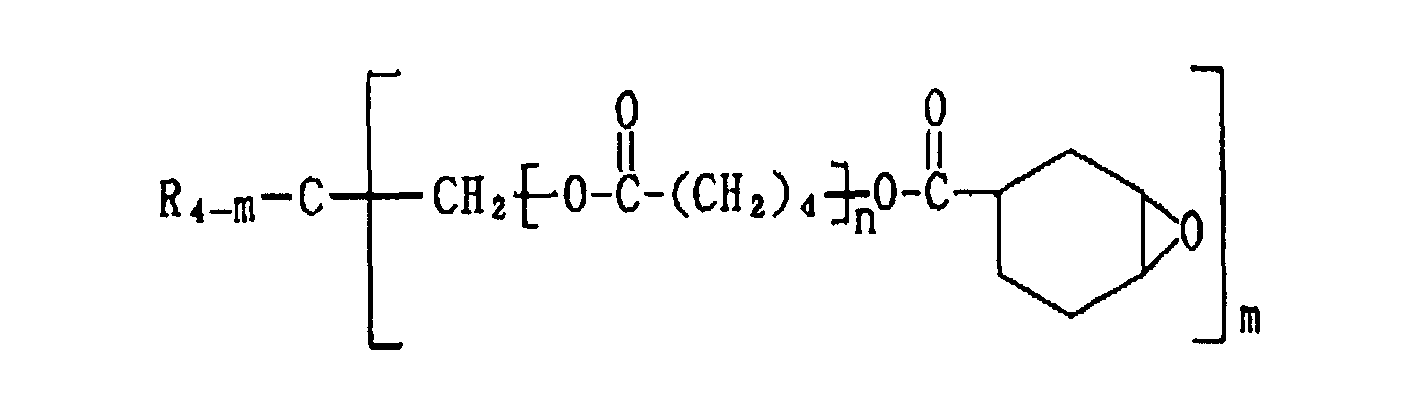
- The radical polymerizable compound (b) used in the present invention may be those containing at least one ethylenically unsaturated double bond in a molecule, preferably. Further, an average refractive index of the radical polymerizable compound (b) is larger than that of the above cationic polymerizable compound (a), and difference is preferably larger than 0.02. When the average refractive index is smaller than that of the compound (a), refractive index modulation becomes insufficient, and it is not preferred. Examples of the radical polymerizable compound (b) include acrylamide, methacrylamide, styrene, 2-bromosryrene, phenyl acrylate, 2-pheoxyethyl acrylate, (acryloxyethyl)naphthalene dicarboxylate monoester, methylpheoxyethyl acrylate, nonylphenoxyethyl acrylate, β-acryloxyetyl hydrogen phthalate, phenoxy polyethylene glycol acrylate, 2,4,6-tribromophenyl acrylate, (2-methacryloxyethyl)diphenate monoester, benzyl acrylate, 2,3-dibromophenyl acrylate, 2-hydroxy-3-phenoxypropyl acrylate, 2-naphthyl acrylate, N-vinylcarbazole, 2-(9-carbazole)ethyl acrylate, triphenylmethyl triacrylate, 2-(tricyclo[5,2,102.6)dibromodecylthio)ethyl acrylate, S-(1-naphthylmethyl)thioacrylate, dicyclopentanyl acrylate, methylene bisacrylamide, polyethylene glycol diacrylate, trimethylpropane triacrylate, pentaerythritol acrylate, (2-acryloxyethyl) (3-acryloxypropyl-2-hydroxy)diphenate, (2-acryloxyethyl) (3-acryloxypropyl-2-hydroxy)2,3-naphthalenedicarboxylate, (2-acryloxyethyl) (3-acryloxypropyl-2-hydroxy)4,5-phenanthrenedicarboxylate diester, dibromoneopenthyl glycol diacrylate, dipentaerythritol hexaacrylate, 1,3-bis-[2-acryloxy-3-(2,4,6-tribromophenoxy)propoxy)benzene, diethylene dithioglycol diacrylate, 2,2-bis(4-acryloxyethoxyphenyl)propane, bis(4-acryloxydiethoxyphenyl)methane, bis(4-acryloxyethoxy-3,5-dibromophenyl)methane, 2,2-bis(4-acryloxyethoxyphenyl)propane, 2,2-bis(4-ocryloxyethoxy-3,5-dibromophenyl)propane, (4-acryloxyethoxyphenyl)sultone, bis-(4-acryloxydiethoxyphenyl)sulfone, bis(4-acryloxypropoxyphenyl)sulfone, bis(4-acryloxyethoxy-3,5-dibromophenyl)sulfone, compounds wherein the above-described acrylate is changed to methacrylate, ethylenically unsaturated double bond-containing compounds having at least two S atoms in a molecule as described in Japanese Patent Kokai Nos. 2-247205 and 2-261808 and the like, and one or more sorts of them may be used.
- The radical photopolymerization initiator composition (c) used in the present invention may be those in which the above radical polymerizable composition (b) is polymerized by an active radical which is formed by the first exposure for the production of a hologram. As the radical photopolymerization initiator composition (c), for example, there can be used known compositions described in U.S. Patent Nos. 4,766,055, 4,868,092, 4,965,171, Japanese Patent Kokai Nos. 54-151204, 58-15503, 58-29803, 59-189340, 60-76735, 1-28715, Japanese Patent Application Nos. 3-5569, Proceedings of Conference on Radiation Curing Asia, pages 461-477, 1988 and the like.
- The term "photopolymerization initiator composition" used in the present specification means that a sensitizer which is generally an ingredient absorbing a light can be used in combination with an active radical-generating compound or acid-generating compound. As the sensitizer in the radical photopolymerization initiator composition, a color compound (e.g. organic dyestuff, etc.) is normally used for absorbing a visible laser light. When a colorless and transparent hologram is requested (e.g. using a head up display of car, etc.), it is preferred to use a cyanine dye as described in Japanese Patent Application No. 58-29803, Japanese Patent Kokai No. 1-287105, Japanese Patent Application No. 3-5569 and the like as the sensitizer. The cyanine dye is liable to decompose by a light and, therefore, a dye in the hologram is decomposed by standing it under postexposure in the present invention, or a room light or sunlight for several hours or days, which results in no absorption of a visible light to give a colorless and transparent hologram. Examples of the cyanine dye include anhydro-3,3'-dicarboxymethyl-9-ethyl-2,2'-thiacarbocyanine betaine, anhydro-3-carboxymethyl-3',9-diethyl-2,2'-thiacarbocyanine-betaine, 3,3',9-triethyl-2,2'-thiacarbocyanine iodide, 3,9-diethyl-3'-carboxymethyl-2,2'-thiacarbocynnine iodide, 3,3',9-triethyl-2,2'-(4,5,4',5'-dibenzo)thiacarbocyanine iodide, 2-[3-(3-ethyl-2-benzothiazolidene)-1-propenyl]-5-[2-(3-ethyl-2-benzothiazolidene)ethylideneimino)-3-ethyl-1,3,5-thiadiazolium iodide, 2-[[3-allyl-4-oxo-5-(3-n-propyl-5,6-dimethyl-2-benzothiazolidene)-ethylidene-thiazolidene)methyl)3-ethyl-4,5-diphenylthiazolinium iodide, 1,1',3,3,3',3'-hexamethyl-2,2'-diphenylthiazolinium iodide, 1,1',3,3,3',3"-hexamethyl-2,2'-indotricarbocyanine iodide, 3,3'-diethyl-2,2'-thiatricarbocyanine perchlorate, anhydro-1-ethyl-4-methoxy-3'-carboxymethyl-5'-chloro-2,2'-quinothiacyanine betaine, anhydro-5,5'-diphenyl-9-ethyl-3,3'-disulfopropyloxacarbocyanine hydroxide triethylamine salt and the like, and one or more sorts of them may be used.
- As the active radical-generating compound which may be used in combination with the cyanine dye, there are diaryl iodonium salts as described in Japanese Patent Kokai Nos. 58-29803, 1-287105, Japanese Patent Application No. 3-5569, 2,4,6-substituted-1,3,5-triazines and the like. When high photosensitivity is requested, it is particularly preferred to use diaryl iodonium salts. Examples of the above diaryl iodonium salts include chloride, bromide, tetrafluoroborate, hexafluorophosphate, hexafluoroarsenate, hexafluoroantimonate and the like (e.g. diphenyliodonium, 4,4'-dichlorodiphenyl iodonium, (J-methoxyphenyl)phenyliodonium, (4-octyloxyphenyl)phenyliodonium, 4,4'-dimethoxydiphenyliodonium, 4,4'-ditertiary butyldiphenyliodonium, 3,3'-dinitrodiphenyliodonium, etc.). Examples of the above-described 2,4,6-substituted-1,3,5-triazines include 2-methyl-4,6-bis(trichloromethyl)-1,3,5-triazine, 2,4,6-tris(trichloromethyl)-1,3,5-triazine, 2-phenyl-4,6-bis(trichloromethyl)-1,3,5-triazine, 2,4-bis(trichloromethyl)-6-(p-methoxyphenylvinyl)-1,3,5-triazine, 2-(4'-methoxy-1'-naphthyl)-4,6-bis(trichloromethyl)-1,3,5-triazine and the like.
- The cationic photopolymerization initiator composition (d) used in the present invention may be those which show low photosensitivity to the first exposure, which are sensitized with a postexposure irradiating a light having a wavelength which is different from that of the first exposure to form Brønsted acid or Lewise acid which polymerizes the above cationic polymerizable compound (a). The present invention is characterized in that a cationic polymerizable compound which is liquid at ambient temperature hardly react during polymerizing a radical polymerizable compound by the irradiation of a laser beam or a light having excellent coherence. Thereby, refractive index modulation which is larger in comparison with the prior art can be obtained. Accordingly, as the cationic photopolymerization initiator composition, those in which no cationic polymerizable compound is polymerized during the first exposure is particularly preferred. As the cationic photopolymerization initiator composition (d), for example, there are those as described in "UV Curing", Science and Technology, pp. 23-76, edited by S. Peter Pappas; A Technology Marketing Publication; and Commemts Inorg. Chem., B. Klingert, M.Riediker and A. Roloff, Vol. 7, No. 3, pp.109-138 (1988), and one or more sorts of them may be used.
- As the particularly preferable cationic photopolymerization initiator composition (d), for example, there are diaryliodonium salts, triarylsulfonium salts, iron allene complex and the like.
- As the preferred diaryliodonium salts in the cationic photopolymerization initiator composition (d), for example, there are tetrafluoroborate, hexafulorophosphate, hexafluoroarsenate and hexafluoroantimonate of iodonium described as to the above radical photopolymerization initiator composition (c). As the preferred triaryl sulfonium salts, for example, there are tetrafluoroborate, hexafluorophosphate, hexafluoroarsenate and hexafluoroantimonate of sulfonium (e.g. triphenylsulfonium, 4-tertiarybutyltriphenylsulfonium, tris(4-methylphenyl)sulfonium, tris(4-methoxyphenyl)sulfonium, 4-thiophenyltriphenylsulfonium, etc.).
- In the photosensitive composition as used in the present invention, if necessary, additives such as polymeric binder, thermopolymerization inhibitor, silane coupling agent, plasticizer, colorant and the like may be used in combination. The polymeric binder may be used for improving film-forming properties of the composition before formation of hologram and uniformity of film thickness, or for keeping the interference fringe formed by radical polymerization stable until postexposure. The polymeric binder may be those which have good compatibility with the cationic polymerizable compound or radical polymerizable compound, and example thereof include chlorinated polyethylene, polymethyl metacrylate, copolymer of methyl methacrylate with the other acrylic alkyl ester, copolymer of vinyl chloride with acrylonitrile, polyvinyl acetate, polyvinyl alcohol, polyvinyl formal, polyvinyl butyral, polyvinyl pyrrolidone, ethyl cellulose, acetyl cellulose and the like. The polymeric binder may contain a reactive group (e.g. cationic polymerizable group, etc.) at the side chain or main chain thereof.
- In the photosensitive composition as used in the present invention, the amount of the cationic polymerizable compound (a) is preferably 2 to 70 % by weight (particularly 10 to 50 % by weight), the amount of the radical polymerizable compound (b) is preferably 30 to 90 % by weight (particularly 40 to 70 % by weight), the amount of the radical photopolymerization initiator composition (c) is preferably 0.3 to 8 % by weight (particularly 1 to 5 % by weight) and the amount of the cationic photopolymerization initiator composition (d) is preferably 0.3 to 8 % (particularly 1 to 5 %), based on the total weight of the composition.
- The photosensitive composition as used in the present invention may be prepared by a normal method. For example, it can be prepared by formulating the above ingredients (a) to (d) and optional ingredients as they are or formulating them in a solvent (e.g. ketone solvents such as methyl ethyl ketone, acetone, cyclohexanone and the like; ester solvents such as ethyl acetate, butyl acetate, ethylene glycol diacetate and the like; aromatic solvents such as toluene, xylene and the like; cellosolve solvents such as methylcellosolve, ethyl cellosolve, butyl cellosolve and the like; alcohol solvents such as methanol, ethanol, propanol and the like; ether solvents such as tetrahydrofuran, dioxane and the like; halogen solvents such as dichloromethane, chloroform; etc.) and mixing in a dark place, for example, using a high speed stirrer.
- In the production of the hologram of the present invention, a recording layer (2) can be formed by applying the above photosensitive composition on a transparent substrate (e.g. glass sheet (1), polyethylene terephthalate film, polyethylene film, acrylic sheet, etc.) and optionally drying. The amount of coating may be appropriately selected, for example, the dry coating weight may be 1 to 50 g/m2. Further, a protective layer (e.g. polyethylene terephthalate film, polyethylene film (3), polypropylene film, etc.) is normally provided on this recording layer (2). In the other method for preparing a three-layer article of which intermediate layer is a recording layer of the composition of the present invention, for example, a recording layer (2) is formed between two polyethylene terephthalate films, one of which is subjected to a treatment which enables easy peeling, and one of the films may be peeled off upon use to laminate the surface on an appropriate substrate. For example, the composition of the present invention can also be poured between two glass sheets.
- The recording layer (2) thus prepared polymerizes with the above radical polymerizable compound (b) by a laser beam (4) or light having excellent coherence (e.g. a light having a wavelength of 300 to 1200 nm), using a holography exposing apparatus, thereby, an interference fringe is recorded in the inside. In the composition as used in the present invention, a diffracted light due to the recorded interference fringe can be obtained at this stage to form a hologram. However, in order to further polymerize the unreacted cationic polymerizable compound (a), a light as the postexposure, by which the cationic photopolymerization initiator composition (d) is sensitized, is irradiated to the whole hologram to obtain a hologram of the present invention. In this case, the unreacted radical polymerizable compound may be cured, simultaneously. Further, by treating a recording layer with heat or infrared rays before postexposure, diffraction efficiency, peak wavelength or half-value of diffracted light, band width and the like can be changed.
- For example, the above volume hologram can be used for lens, diffraction grating, interference filter, head up display apparatus, general three-dimensional display, binder for optical fiber, optical polarized light device for facsimile, memory material such as ID card, windowpane for building, advertisement medium and the like.
- According to the photosensitive composition for volume hologram recording, a volume hologram which is superior in diffraction efficiency, wavelength selectivity, defractive index modulation, film strength and the like can be easily produced.
- The following Examples, Comparative Examples and Reference Examples further illustrate the present invention in detail but are not to be construed to limit the scope thereof.
- By using a photosensitive composition in each Example and Comparative Example described below, a test sheet was made. Then, the test sheet was exposed to obtain each hologram, and determination of physical properties were conducted by the following method.
- A predetermined amount of a radical photopolymerization initiator composition (c) and a cationic photopolymerization initiator composition (d) were dissolved or dispersed in ethanol (1.5 g) and to this were added methyl ethyl ketone (0.7 g) and a predetermined amount of a cationic polymerizable compound (a), a radical polymerizable compound (b) and a polymeric binder. Then, the mixture was stirred and filtered to obtain a photosensitive solution. This photosensitive solution was applied on a glass sheet (16cm × 16cm) using an applicator, followed by drying at 60°C for 5 minutes. Further, a polyethylene film (LUPIC LI, manufactured by Tonen Kagaku K.K.) was laminated thereon using a roller for laminating and the resulting sheet was cut into pieces in size of 3cm × 4cm to form a test sheet.
- The first exposure was normally conducted by a light (514.5 nm) using an argon laser. A recording method of a reflection type hologram is shown in Fig 1 and that of a transmission type hologram is shown in Fig 2. In both cases, a light intensity of a light beam at the surface of a test sheet is 3 mw/cm2 and exposure time is 10 or 30 seconds.
- After completion of the first exposure, a light of 15 W low-pressure mercury vapour lamp is irradiated from the polyethylene film side for 5 minutes, as postexposure.
- The diffraction efficiency of a reflection type hologram was determined by measuring a reflection rate of a hologram, using a spectrophotometer UV-2100 (manufactured by Shimazu Seisakusho K.K.) equipped with an intergrating sphere reflector ISR-260. The diffraction efficiency of a transmission type hologram was determined by measuring a transmission rate of a hologram, using the above-described spectrophotometer. Further, a film thickness of the part at which diffraction efficiency is determined was determined using a film thickness gauge betascope 850 (manufactured by Fischer Co.). The defractive index modulation (half-value of diffraction index change of interference fringe) was determined by calculating from the diffraction efficiency and film thickness thus obtained. The calculation formula described in "Coupled Wave Theory for Thick Hologram Graings", H. Kogelnik, pages 2909-2947 (1969) was used. The value of the diffraction index modulation does not depend upon the film thickness and diffraction index modulation ability of the composition can be compared using this value.
- In order to compare a mechanical strength, a pencil hardness test was conducted as to a part of the hologram.
- In these Examples, a reflection type hologram was prepared, using various cationic polymerizable compounds (a). As the radical polymerizable compound (b), AEPM was used. As the radical photopolymerization initiator composition (c), a combination of DYE-1 and DPI·SbF6 was used. The above-described DPI·SbF6 was also used as the cationic photopolymerization initiator composition. The first exposure was conducted at 514.5 nm for 10 seconds in all Examples.
- The amount of each ingredient and evaluation results of the hologram are shown in Table 1. In all Examples, a transparent reflection type hologram suitable for practical use was obtained.

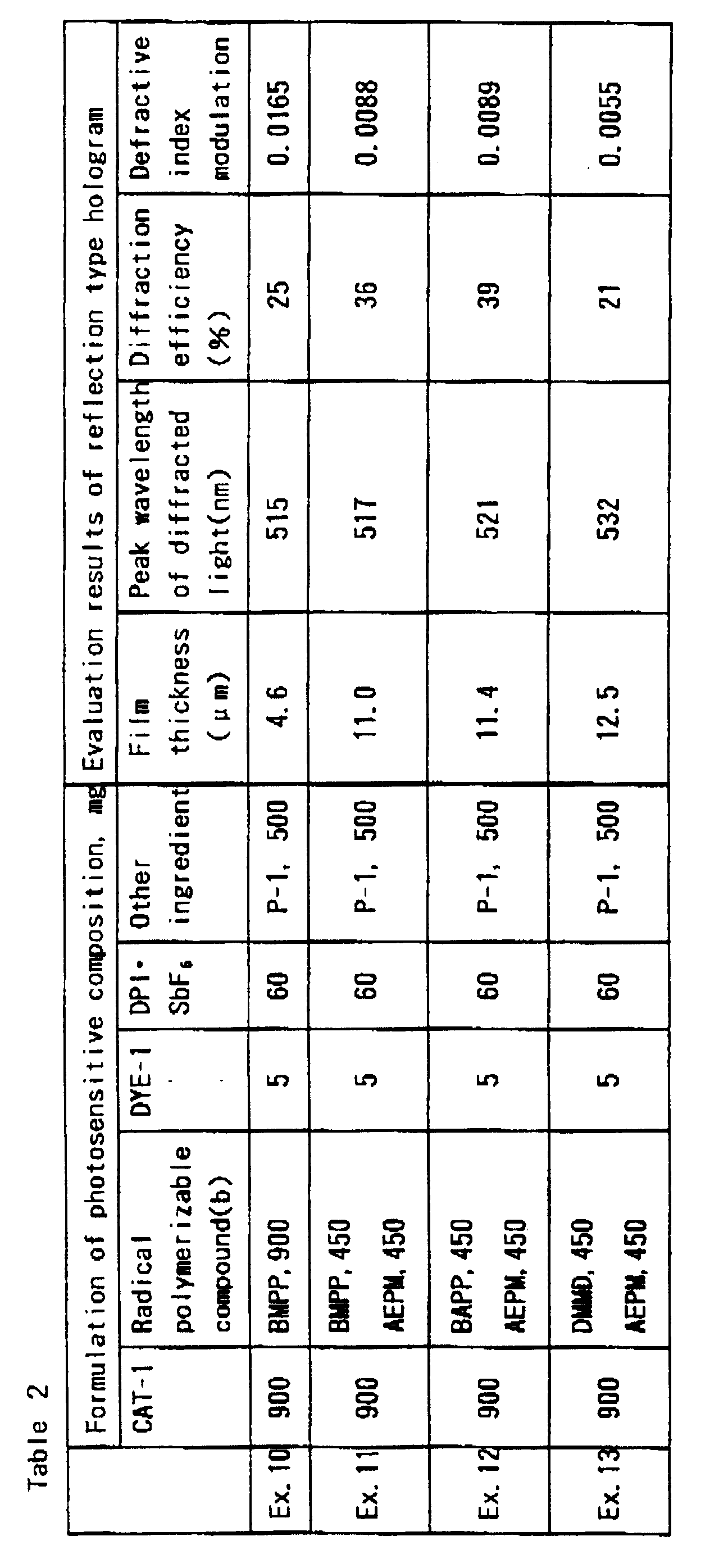
- According to the same manner as that described in Examples 1 to 9 except that CAT-1 is used as the cationic polymerizable compound (a) and a kind and combination of the radical polymerizable compound (b) was changed, a reflection type hologram was prepared.
- The amount of each ingredient and evaluation results of the hologram was shown in Table 2. In all Examples, a transparent reflection type hologram suitable for practical use was obtained.
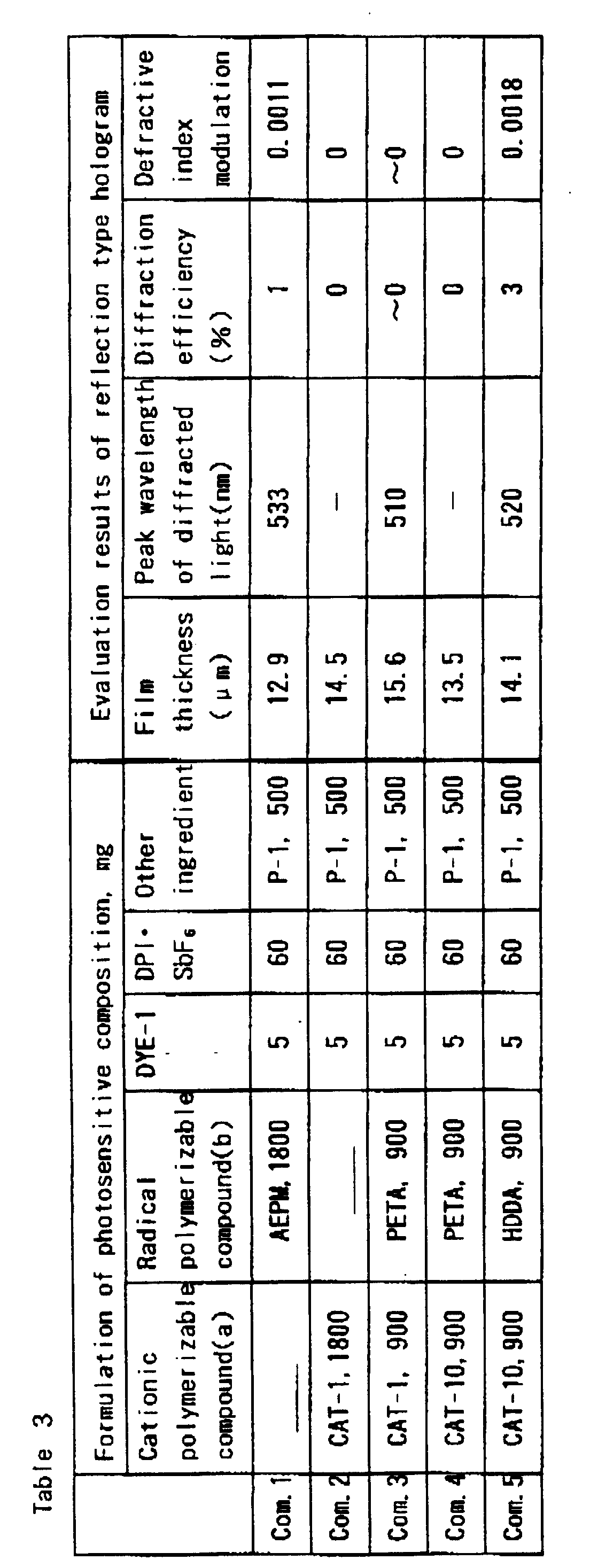
- These are Comparative Examples against the above-described Examples 1 to 13, which show the fact that, when the cationic polymerizable compound (a) and radical polymerizable compound (b) are not used in a proper combination, a reflection type hologram is scarcely obtained, or performances of the resulting hologram is insufficient. The amount of each ingredient and evaluation results of the hologram are shown in Table 3. In the present invention, when the defractive index of the cationic polymerizable compound (a) is larger than that of the radical polymerizable compound (b), as shown in Comparative Examples 3 to 5, the defractive index modulation becomes remarkably inferior. It is considered that the mechanism of the present invention for forming the interference fringe is different from that of E.A. Chandross et al..
- A reflection hologram was prepared using various radical photopolymerization initiator composition (c) and cationic photopolymerization initiator composition (d), according to the same manner as that described in Example 1 except that the first exposure was conducted using a light (488 nm) of an argon laser and the exposure time of Examples 16 and 18 was 30 seconds. The amount of each ingredient and evaluation results of the hologram are shown in Table 4. Since DPI·SbF6 and DPI·PF6 in Examples 14 and 15 can be used for both active radical-generating compound in the radical photopolymerization initiator composition (c) and cationic photopolymerization initiator composition (d), half of the amount were described in both items of the above compositions, respectively. A hologram of Example 15 was colored to yellow by a sensitizer DYE-3, and a reflection type hologram which is suitable for practical use was obtained in all Examples.

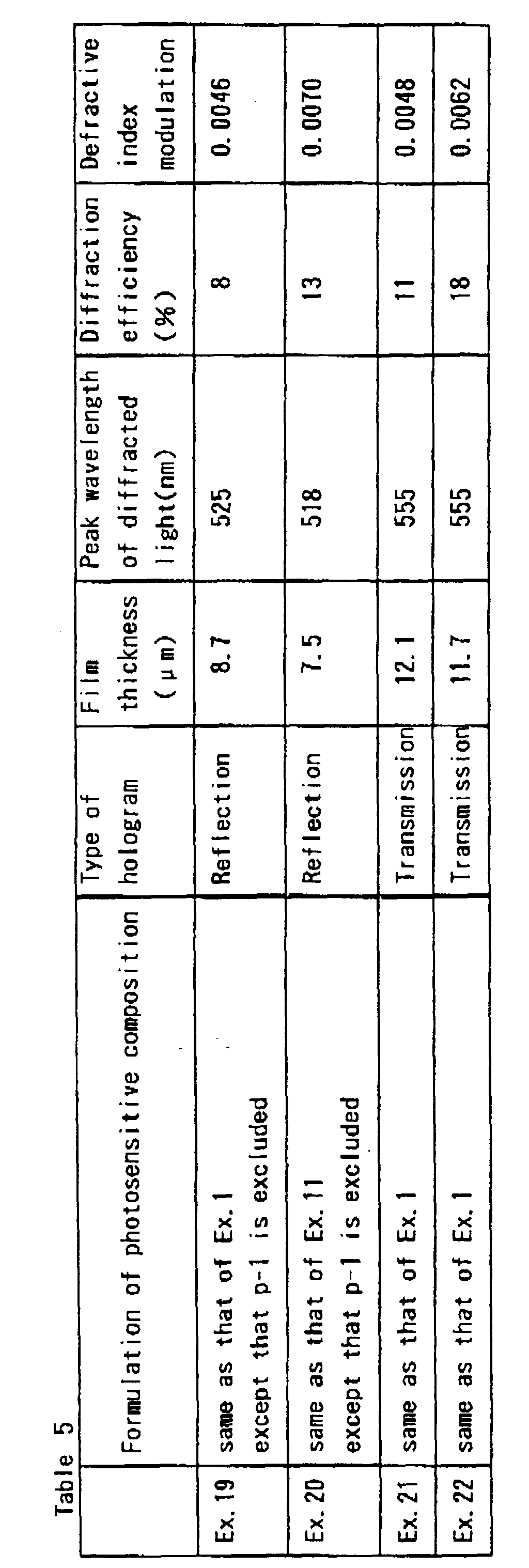
- According to the same manner as that described in Examples 1 and 11 except that no polymeric binder P-1 was used, a reflection type hologram was prepared. The evaluation results of the hologram are shown in Table 5. In these Examples, since a viscosity of the solution becomes smaller than that of the solution wherein a polymeric binder is used, it was slightly difficult to control the film thickness, although refractive index modulation which is the same as that obtained when P-1 was used can be obtained in both Examples.
- In these Examples, a transmission type hologram was prepared. A test sheet which is the same as that used in Examples 1 and 11 was used. The evaluation results of the hologram thus obtained are shown in Table 5. In all Examples, a transmission type hologram suitable for practical use was obtained.
- According to the same manner as that described in Example 1 except that the amount of CAT-1 and AEPM was respectively changed to 100 mg and 1700 mg, a reflection type hologram suitable for practical use was obtained. The evaluation results are as follows.
- Film thickness: 17.1 µm
- Peak wavelength of diffracted light: 510 nm
- Diffraction efficiency: 25%
- Defractive index modulation: 0.0045
- Pencil hardness: 3H
-
- According to the same manner as that described in Example 1 except that DYE-4 was used instead of DYE-1 and a light of 632.8 nm (light intensity of a light beam: 0.15 mW/cm2) was irradiated for 60 seconds using a helium neon laser as the first exposure, a reflection type hologram which can diffract a red light was obtained. The determination results are as follows.
- Film thickness: 17.4 µ
- Peak wavelength of diffracted light: 625 nm
- Diffraction efficiency: 32 %
- Refractive index modulation: 0.0063
-
- The pencil hardness of a hologram obtained in the above Examples 1,11,19,22 and 23 was 3H, and that of a hologram obtained in Example 7 was 2H.
- Further, when DPI·SbF6 and TPS·PF6 used as the cationic photopolymerization initiator composition in the above Examples were subjected to a thermal analysis test, respectively and, as a result, all maximum DSC value was about 0 µW. This value is that from which a DSC value (heat of absorption) obtained when UVR-6110 was tested alone was deducted to get the value caused by photopolymerization.
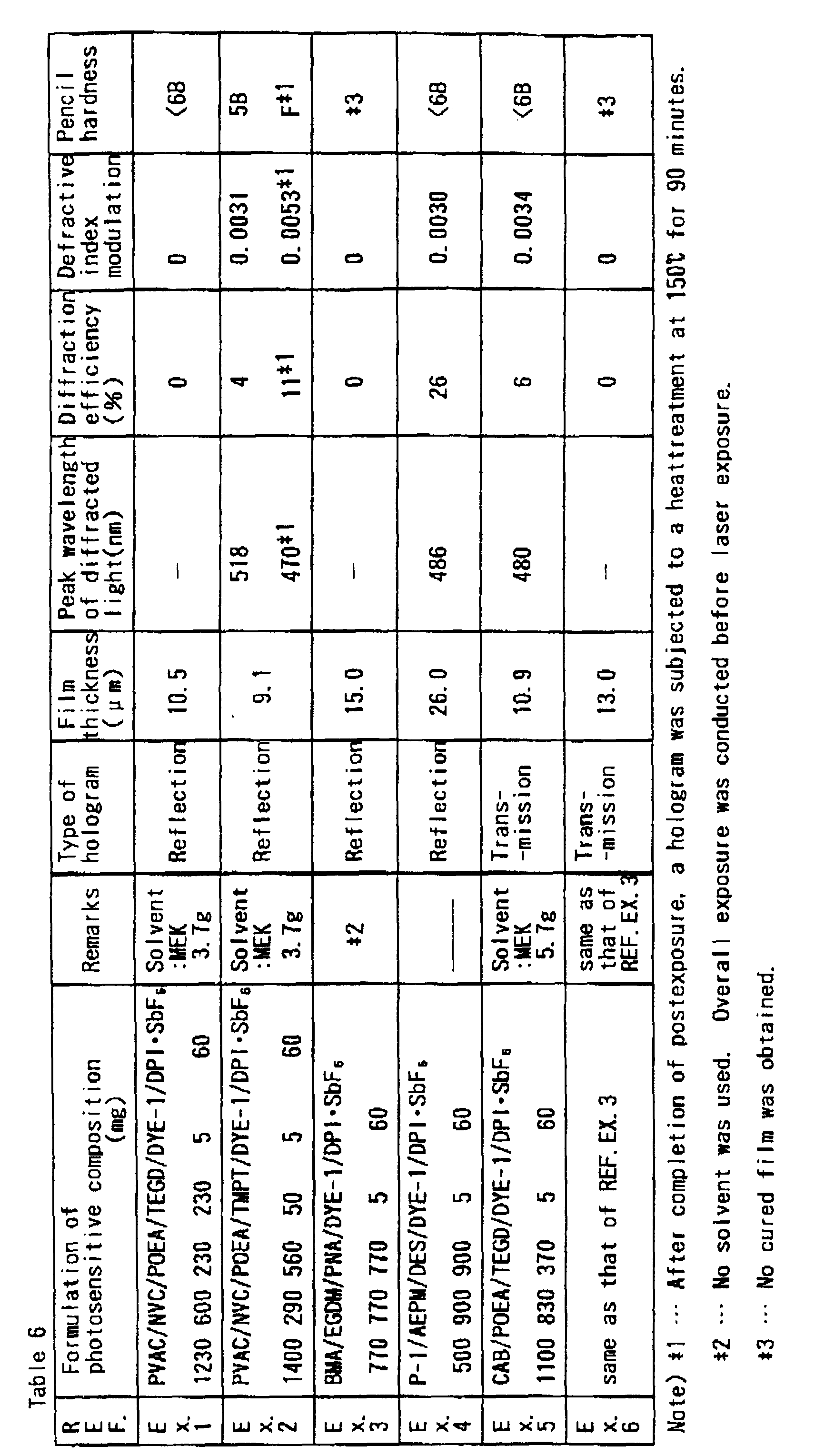
- These are results of a test which was conducted in order to compare a hologram of the present invention with that of the prior art. According to the same manner as that described in Example 1 except some changes mentioned in Table 6, a hologram was prepared. The evaluation results of the hologram are shown in Table 6.
- In Tables 1 to 6, abbreviations used were as follows. A refractive index was measured using an Abbé's refractometer. A refractive index is given in parentheses.
-
- CAT-1 (1.498): 3,4-epoxycyclohexylmethyl-3',4'-epoxycyclohexane carboxylate UVR-6110, manufactured by Union Carbide Co.
- CAT-2 (1.490): Celloxide 2081, manufactured by Daiseru Kagaku K.K.
- CAT-3 (1.485): Celloxide 2083 , manufactured by Daiseru Kagaku K.K.
- CAT-4 (1.501): Epolead GT-300, manufactured by Daiseru Kagaku K.K.
- CAT-5 (1.495): Epolead GT-302, manufactured by Daiseru Kagaku K.K.
- CAT-6 (1.492): Sorbitol polyglycidyl ether, Denacol EX-614B, manufactured by Nagase Kasei Kogyo K.K.
- CAT-7 (1.487): Pentaerythritol polyglycidyl ether, Denacol EX-411, manufactured by Nagase Kasei Kogyo K.K.
- CAT-8 (1.462): Neopentyl glycol diglycidyl ether, Denacol EX-212, manufactured by Nagase Kasei Kogyo K.K.
- CAT-9 (1.468): Celloxide 3000, manufactured by Daiseru Kagaku Kogyo K.K.
- CAT-10 (1.601): Dibromphenyl glycidyl ether, Denacol EX-147, manufactured by Nagase Kasei Kogyo K.K.
-
-
- AEPM (1.539): Bis(4-acryloxydiethoxyphenyl)methane
- BMPP (1.585): 2,2-Bis(3,5-dibromo-4-methacryloxyethoxyphenyl)propane
- BAPP (1.590): 2,2-Bis(3,5-dibromo-4-acryloxyethoxyphenyl)propane
- PETA (1.484): Pentaerythritol tetraacrylate
- HDDA (1.480): 1,6-Hexanediol diacrylate
- DMMD (1.546): (2-Methacryloxyethyl) (3-methacryloxypropyl-2-hydroxy)dipehnate
- NVP: N-vinylcarbazole
- POEA: 2-Phenoxyethyl acrylate
- TMPT: Trimethylolpropane triacrylate
- BMA: n-Butyl methacrylate
- EGDM: Ethylene glycol dimethacrylate
-
-
- DYE-1: 3,9-Diethyl-3'-carboxymethyl-2,2'-thiacarbocyanine iodide
- DYE-2: Anhydro-1-ethyl-4-methoxy-3'-carboxymethyl-5'-chloro-2,2'-quinothiacyanine betain
- DYE-3: 3,3'-Carbonylbis(7-diethylaminocumarin)
- DYE-4: 2-[3-(3-ethyl-2-benzothiazolidene)-1-propenyl)-6-[2-(3-ethyl-2-benzothiazolidene)ethylideneimino]-3-ethyl-1,3,5-thiadiazolium iodide
- NPG: N-Phenylglycine
- BTTB: 3,3',4,4'-Tetra(t-butylperoxycarbonyl)benzophenone
- TCMT: 2,4,6-Tris(trichloromethyl)-1,3,5-triazine
- DPI·Cl: Diphenyliodonium chloride
- DPI·SbF6: Diphenyliodonium hexafluoroantimonate
- TPS·PF6: Triphenylsulfonium hexafluorophosphate
-
-
- P-1: Copolymer of methyl methacrylate/ethyl acrylate/2-hydroxypropyl methacrylate (copolymerization ratio: 88/2/10), Mw:50,000
- PVAC: Polyvinyl acetate (Aldrich. No. 18,948-0)
- CAB: Cellulose acetate butyrate (Aldrich. No.18,096-3)
- TEGD: Triethylene glycol dimethyl ether
- DES: Diethyl sebacate
- PNA: 1-Phenyl naphthalene
-
Claims (6)
- Use of a photosensitive composition for volume hologram recording which is used for recording an interference fringe produced by a laser beam or a light having excellent coherence, as fringes having different refractive index, said composition comprising:(a) a cationic polymerizable compound which is liquid at ambient temperature;(b) a radical polymerizable compound;(c) a radical photopolymerization initiator composition sensitized by a laser beam or a light having excellent coherence which has a specific wavelength to polymerize the ingredient (b); and(d) a cationic photopolymerization initiator composition which shows low photosensitivity to the light having a specific wavelength and is sensitized by a light having the other wavelength to polymerize the ingredient (a), wherein an average refractive index of the ingredient (a) is smaller than that of the ingredient (b).
- The use of the composition according to claim 1, wherein the radical photopolymerization initiator composition contains a photosensitizer and an active radical-generating compound.
- The use of the composition according to claim 2, wherein the sensitizer is cyanine dye.
- The use of the composition according to claim 2, wherein the active radical-generating compound is diaryliodonium salt.
- The use of the composition according to claim 1 which further comprises a polymeric binder.
- A process for producing a volume hologram which comprises irradiating a laser beam or a light having excellent coherence by which a radical photopolymerization initiator composition (c) is sensitized and then irradiating a light having a wavelength which is different from that of the beam or the light having excellent coherence by which a cationic photopolymerization initiator composition (d) is sensitized, to the photosensitive composition for volume hologram recording according to claim 1 applied on a substrate.
Applications Claiming Priority (6)
| Application Number | Priority Date | Filing Date | Title |
|---|---|---|---|
| JP8517791 | 1991-04-17 | ||
| JP8517791 | 1991-04-17 | ||
| JP85177/91 | 1991-04-17 | ||
| JP6702192 | 1992-03-25 | ||
| JP4067021A JP2873126B2 (en) | 1991-04-17 | 1992-03-25 | Photosensitive composition for volume hologram recording |
| JP67021/92 | 1992-03-25 |
Publications (2)
| Publication Number | Publication Date |
|---|---|
| EP0509512A1 EP0509512A1 (en) | 1992-10-21 |
| EP0509512B1 true EP0509512B1 (en) | 1999-08-11 |
Family
ID=26408224
Family Applications (1)
| Application Number | Title | Priority Date | Filing Date |
|---|---|---|---|
| EP92106635A Expired - Lifetime EP0509512B1 (en) | 1991-04-17 | 1992-04-16 | Photosensitive composition for volume hologram recording |
Country Status (6)
| Country | Link |
|---|---|
| US (2) | US5453340A (en) |
| EP (1) | EP0509512B1 (en) |
| JP (1) | JP2873126B2 (en) |
| KR (1) | KR100228929B1 (en) |
| CA (1) | CA2066077A1 (en) |
| DE (1) | DE69229759T2 (en) |
Families Citing this family (151)
| Publication number | Priority date | Publication date | Assignee | Title |
|---|---|---|---|---|
| EP0487086B2 (en) * | 1990-11-22 | 2008-08-13 | Canon Kabushiki Kaisha | Method of preparing volume type phase hologram member using a photosensitive recording medium |
| JP2849021B2 (en) * | 1993-04-12 | 1999-01-20 | 日本ペイント株式会社 | Photosensitive composition for volume hologram recording |
| CA2147657A1 (en) * | 1993-08-25 | 1995-03-02 | Masaru Honda | Filter for liquid crystal display device |
| AU684891B2 (en) * | 1994-03-17 | 1998-01-08 | Toppan Printing Co. Ltd. | Photosensitive recording material, photosensitive recording medium, and process for producing hologram using this photosensitive recording medium |
| JP3075090B2 (en) * | 1994-07-29 | 2000-08-07 | 凸版印刷株式会社 | Hologram photosensitive recording material, hologram photosensitive recording medium, and hologram manufacturing method using the same |
| US5702846A (en) * | 1994-10-03 | 1997-12-30 | Nippon Paint Co. Ltd. | Photosensitive composition for volume hologram recording |
| US5885746A (en) * | 1994-12-29 | 1999-03-23 | Tokyo Ohka Kogyo Co., Ltd. | Photosensitive resin composition, photosensitive printing plate using the same and method of manufacturing printing master plate |
| US5665791A (en) * | 1995-09-21 | 1997-09-09 | Tamarack Storage Devices, Inc. | Photosensitive polymer films and their method of production |
| JP3604700B2 (en) * | 1995-10-06 | 2004-12-22 | ポラロイド コーポレイション | Holographic media and processes |
| US6166834A (en) * | 1996-03-15 | 2000-12-26 | Matsushita Electric Industrial Co., Ltd. | Display apparatus and method for forming hologram suitable for the display apparatus |
| DE59701299D1 (en) * | 1996-07-29 | 2000-04-27 | Ciba Sc Holding Ag | Liquid, radiation-curable composition, especially for stereolithography |
| JP3786480B2 (en) * | 1996-10-14 | 2006-06-14 | Jsr株式会社 | Photocurable resin composition |
| EP0887706A1 (en) * | 1997-06-25 | 1998-12-30 | Wako Pure Chemical Industries, Ltd | Resist composition containing specific cross-linking agent |
| JPH1171363A (en) * | 1997-06-25 | 1999-03-16 | Wako Pure Chem Ind Ltd | Resist composition, pattern forming method using the same, and crosslinking agent for resist agent |
| US6482551B1 (en) * | 1998-03-24 | 2002-11-19 | Inphase Technologies | Optical article and process for forming article |
| EP0961181A1 (en) * | 1998-05-29 | 1999-12-01 | Denso Corporation | Hologram and process for producing hologram |
| US6078713A (en) * | 1998-06-08 | 2000-06-20 | Uv Technology, Inc. | Beam delivery system for curing of photo initiated inks |
| US6322933B1 (en) | 1999-01-12 | 2001-11-27 | Siros Technologies, Inc. | Volumetric track definition for data storage media used to record data by selective alteration of a format hologram |
| US6627354B1 (en) * | 1999-03-01 | 2003-09-30 | Lucent Technologies Inc. | Photorecording medium, process for fabricating medium, and process for holography using medium |
| US6310850B1 (en) | 1999-07-29 | 2001-10-30 | Siros Technologies, Inc. | Method and apparatus for optical data storage and/or retrieval by selective alteration of a holographic storage medium |
| US6512606B1 (en) | 1999-07-29 | 2003-01-28 | Siros Technologies, Inc. | Optical storage media and method for optical data storage via local changes in reflectivity of a format grating |
| US6322931B1 (en) * | 1999-07-29 | 2001-11-27 | Siros Technologies, Inc. | Method and apparatus for optical data storage using non-linear heating by excited state absorption for the alteration of pre-formatted holographic gratings |
| US7074983B2 (en) * | 1999-11-19 | 2006-07-11 | Kirin Beer Kabushiki Kaisha | Transgenic bovine comprising human immunoglobulin loci and producing human immunoglobulin |
| TWI289238B (en) | 2000-01-13 | 2007-11-01 | Fujifilm Corp | Negative resist compositions using for electronic irradiation |
| EP1299770A2 (en) | 2000-06-09 | 2003-04-09 | Dsm N.V. | Resin composition and three-dimensional object |
| US7323275B2 (en) * | 2001-02-09 | 2008-01-29 | Dai Nippon Printing Co., Ltd | Photosensitive composition for volume hologram recording and photosensitive medium for volume hologram recording |
| JP4724941B2 (en) * | 2001-03-30 | 2011-07-13 | 大日本印刷株式会社 | Photosensitive composition for volume hologram recording and photosensitive medium for volume hologram recording |
| US20030206320A1 (en) * | 2002-04-11 | 2003-11-06 | Inphase Technologies, Inc. | Holographic media with a photo-active material for media protection and inhibitor removal |
| WO2003102693A1 (en) | 2002-05-29 | 2003-12-11 | Inphase Technologies, Inc. | High reflective index photoactive compound for optical applications |
| WO2003102959A1 (en) * | 2002-05-29 | 2003-12-11 | Inphase Technologies, Inc. | Holographic data storage media comprising an aluminum salt compound and an asymetric acrylate compound |
| FR2840269B1 (en) * | 2002-05-30 | 2005-01-28 | Plastic Omnium Cie | STYLE PIECE AND MOTOR VEHICLE HAVING SUCH A PIECE OF STYLE |
| AU2003247228A1 (en) * | 2002-06-20 | 2004-01-06 | Dsm Ip Assets B.V. | Compositions comprising a benzophenone photoinitiator |
| JP4344177B2 (en) | 2002-07-12 | 2009-10-14 | 大日本印刷株式会社 | Photosensitive composition for volume hologram recording, photosensitive medium for volume hologram recording, and volume hologram |
| JP4497402B2 (en) * | 2003-02-28 | 2010-07-07 | 大日本印刷株式会社 | Magnetic card |
| JP2004287138A (en) * | 2003-03-24 | 2004-10-14 | Konica Minolta Holdings Inc | Composition for holographic recording, holographic recording medium and its recording method |
| EP1612623A4 (en) * | 2003-04-09 | 2007-04-04 | Konica Minolta Med & Graphic | Holographic recording medium and recording method using the same |
| US7521155B2 (en) * | 2003-06-10 | 2009-04-21 | Dai Nippon Printing Co., Ltd. | Volume hologram layer and volume hologram transfer foil |
| JP4293433B2 (en) * | 2003-07-18 | 2009-07-08 | 大日本印刷株式会社 | Intermediate transfer recording medium |
| EP1510862A3 (en) | 2003-08-25 | 2006-08-09 | Fuji Photo Film Co., Ltd. | Hologram recording method and hologram recording material |
| US7282272B2 (en) * | 2003-09-12 | 2007-10-16 | 3M Innovative Properties Company | Polymerizable compositions comprising nanoparticles |
| US7289202B2 (en) * | 2004-09-10 | 2007-10-30 | 3M Innovative Properties Company | Methods for testing durable optical elements |
| US7074463B2 (en) * | 2003-09-12 | 2006-07-11 | 3M Innovative Properties Company | Durable optical element |
| JP3978729B2 (en) * | 2003-09-26 | 2007-09-19 | 康生 富田 | Hologram recording material composition and hologram recording medium |
| JP4125669B2 (en) * | 2003-12-22 | 2008-07-30 | 大日本印刷株式会社 | Volume hologram manufacturing method |
| US20050147838A1 (en) * | 2003-12-30 | 2005-07-07 | 3M Innovative Properties Company | Polymerizable compositions for optical articles |
| US20050148735A1 (en) * | 2003-12-30 | 2005-07-07 | Olson David B. | Polymerizable composition for optical articles |
| TW200532403A (en) * | 2004-02-24 | 2005-10-01 | Nippon Paint Co Ltd | Volume hologram recording photosensitive composition and its use |
| JP2005309359A (en) | 2004-03-25 | 2005-11-04 | Fuji Photo Film Co Ltd | Hologram recording material, hologram recording method, optical recording medium, three-dimensional display hologram, and holographic optical element |
| JP2005275273A (en) | 2004-03-26 | 2005-10-06 | Fuji Photo Film Co Ltd | Hologram recording material, hologram recording method, and optical recording medium |
| US8071260B1 (en) * | 2004-06-15 | 2011-12-06 | Inphase Technologies, Inc. | Thermoplastic holographic media |
| EP1780610A1 (en) * | 2004-08-18 | 2007-05-02 | Konica Minolta Medical & Graphic, Inc. | Holographic recording medium, holographic recording method and holographic information medium |
| JP4649158B2 (en) | 2004-09-30 | 2011-03-09 | 富士フイルム株式会社 | Hologram recording method |
| KR20070086092A (en) * | 2004-12-14 | 2007-08-27 | 더치 폴리머 인스티튜트 | Porous holographic film |
| JP4257295B2 (en) | 2005-01-07 | 2009-04-22 | 日東電工株式会社 | Photorefractive index modulation polymer composition, hologram recording material, and refractive index control method |
| JP2006195009A (en) | 2005-01-11 | 2006-07-27 | Fuji Photo Film Co Ltd | Hologram recording method, hologram recording device and hologram recording medium |
| JP2008530346A (en) * | 2005-02-17 | 2008-08-07 | スリーエム イノベイティブ プロパティズ カンパニー | Brightness enhancing film comprising a polymerized organic phase having a low glass transition temperature |
| US7326448B2 (en) * | 2005-02-17 | 2008-02-05 | 3M Innovative Properties Company | Polymerizable oligomeric urethane compositions comprising nanoparticles |
| US20060204676A1 (en) | 2005-03-11 | 2006-09-14 | Jones Clinton L | Polymerizable composition comprising low molecular weight organic component |
| WO2006099168A2 (en) * | 2005-03-11 | 2006-09-21 | 3M Innovative Properties Company | Polymerizable compositions comprising nanoparticles |
| JP2006301171A (en) | 2005-04-19 | 2006-11-02 | Fuji Photo Film Co Ltd | Optical recording medium, its manufacturing method, method of recording and reproducing the same |
| US7400445B2 (en) * | 2005-05-31 | 2008-07-15 | 3M Innovative Properties Company | Optical filters for accelerated weathering devices |
| TW200702954A (en) | 2005-07-11 | 2007-01-16 | Toagosei Co Ltd | Volume hologram recording material, the method of processing thereof and the recording medium |
| JP4373383B2 (en) | 2005-08-24 | 2009-11-25 | 富士フイルム株式会社 | Optical recording method, optical recording apparatus, optical recording medium, and optical recording / reproducing method |
| JP2007072192A (en) | 2005-09-07 | 2007-03-22 | Fujifilm Corp | Optical recording medium and manufacturing method thereof |
| US7524590B2 (en) * | 2005-12-07 | 2009-04-28 | General Electric Company | Methods for storing holographic data and articles having enhanced data storage lifetime derived therefrom |
| KR100734298B1 (en) | 2005-12-30 | 2007-07-02 | 삼성전자주식회사 | Pattern recognition type optical memory using light and data processing device for recording / reading data |
| JP2007233143A (en) | 2006-03-02 | 2007-09-13 | Sony Corp | Hologram recording medium |
| EP2000297A1 (en) | 2006-03-24 | 2008-12-10 | Konica Minolta Medical & Graphic, Inc. | Transparent barrier sheet and method for producing transparent barrier sheet |
| WO2007111098A1 (en) | 2006-03-24 | 2007-10-04 | Konica Minolta Medical & Graphic, Inc. | Transparent barrier sheet and method for producing same |
| WO2007111092A1 (en) | 2006-03-24 | 2007-10-04 | Konica Minolta Medical & Graphic, Inc. | Transparent barrier sheet and method for producing transparent barrier sheet |
| WO2007111074A1 (en) | 2006-03-24 | 2007-10-04 | Konica Minolta Medical & Graphic, Inc. | Transparent barrier sheet and method for producing transparent barrier sheet |
| GB0718706D0 (en) | 2007-09-25 | 2007-11-07 | Creative Physics Ltd | Method and apparatus for reducing laser speckle |
| US20070248890A1 (en) * | 2006-04-20 | 2007-10-25 | Inphase Technologies, Inc. | Index Contrasting-Photoactive Polymerizable Materials, and Articles and Methods Using Same |
| EP2058702A1 (en) | 2006-08-25 | 2009-05-13 | National University Corporation The University of Electro - Communications | Photosensitive composition comprising organic-zirconia composite microparticle |
| JP4177867B2 (en) * | 2006-10-30 | 2008-11-05 | 日本ペイント株式会社 | Photosensitive composition for recording volume hologram, recording medium using the same, and method for forming volume hologram |
| CN101622582B (en) * | 2007-02-28 | 2013-08-07 | 大日本印刷株式会社 | Method for producing a volume hologram laminate |
| GB2459823B (en) | 2007-02-28 | 2010-11-17 | Dainippon Printing Co Ltd | Method of producing volume hologram laminate |
| US20080241706A1 (en) * | 2007-03-30 | 2008-10-02 | Industrial Technology Research Institute | Holographic data storage medium and fabrication method thereof |
| US8383295B2 (en) * | 2007-07-24 | 2013-02-26 | Kyoeisha Chemical Co., Ltd. | Composition for holographic recording medium |
| DE102008009332A1 (en) * | 2008-02-14 | 2009-08-20 | Leibniz-Institut Für Neue Materialien Gemeinnützige Gmbh | Optical elements with gradient structure |
| JP5484753B2 (en) * | 2009-03-06 | 2014-05-07 | 新日鉄住金化学株式会社 | Photosensitive material, photosensitive material precursor and method for producing photosensitive material |
| JP5404475B2 (en) * | 2009-03-30 | 2014-01-29 | 富士フイルム株式会社 | Printing plate precursor for laser engraving, printing plate, and method for producing printing plate |
| US11726332B2 (en) | 2009-04-27 | 2023-08-15 | Digilens Inc. | Diffractive projection apparatus |
| US9335604B2 (en) | 2013-12-11 | 2016-05-10 | Milan Momcilo Popovich | Holographic waveguide display |
| JP2009181141A (en) * | 2009-05-18 | 2009-08-13 | Dainippon Printing Co Ltd | Volume hologram layer and volume hologram transfer foil |
| US10795160B1 (en) | 2014-09-25 | 2020-10-06 | Rockwell Collins, Inc. | Systems for and methods of using fold gratings for dual axis expansion |
| US8233204B1 (en) | 2009-09-30 | 2012-07-31 | Rockwell Collins, Inc. | Optical displays |
| US11320571B2 (en) | 2012-11-16 | 2022-05-03 | Rockwell Collins, Inc. | Transparent waveguide display providing upper and lower fields of view with uniform light extraction |
| US11300795B1 (en) | 2009-09-30 | 2022-04-12 | Digilens Inc. | Systems for and methods of using fold gratings coordinated with output couplers for dual axis expansion |
| WO2011054818A2 (en) * | 2009-11-03 | 2011-05-12 | Bayer Materialscience Ag | Novel non-crystallizing methacrylates, production and use thereof |
| US8659826B1 (en) | 2010-02-04 | 2014-02-25 | Rockwell Collins, Inc. | Worn display system and method without requiring real time tracking for boresight precision |
| EP2409849A1 (en) | 2010-07-22 | 2012-01-25 | Sony DADC Austria AG | Combination of a luminescent material with a hologram |
| JP2012047787A (en) * | 2010-08-24 | 2012-03-08 | Daicel Corp | Photosensitive composition for volume hologram recording and method for manufacturing medium |
| US9274349B2 (en) | 2011-04-07 | 2016-03-01 | Digilens Inc. | Laser despeckler based on angular diversity |
| JP5807382B2 (en) * | 2011-05-20 | 2015-11-10 | Tdk株式会社 | Hologram recording material composition and hologram recording medium |
| EP2541343A1 (en) | 2011-06-29 | 2013-01-02 | Sony DADC Austria AG | Hologram and method of forming a hologram |
| JP5803401B2 (en) | 2011-08-05 | 2015-11-04 | Tdk株式会社 | Hologram recording material and hologram recording medium |
| US10670876B2 (en) | 2011-08-24 | 2020-06-02 | Digilens Inc. | Waveguide laser illuminator incorporating a despeckler |
| WO2013027004A1 (en) | 2011-08-24 | 2013-02-28 | Milan Momcilo Popovich | Wearable data display |
| WO2016020630A2 (en) | 2014-08-08 | 2016-02-11 | Milan Momcilo Popovich | Waveguide laser illuminator incorporating a despeckler |
| US9715067B1 (en) | 2011-09-30 | 2017-07-25 | Rockwell Collins, Inc. | Ultra-compact HUD utilizing waveguide pupil expander with surface relief gratings in high refractive index materials |
| US9507150B1 (en) | 2011-09-30 | 2016-11-29 | Rockwell Collins, Inc. | Head up display (HUD) using a bent waveguide assembly |
| US9366864B1 (en) | 2011-09-30 | 2016-06-14 | Rockwell Collins, Inc. | System for and method of displaying information without need for a combiner alignment detector |
| US8634139B1 (en) | 2011-09-30 | 2014-01-21 | Rockwell Collins, Inc. | System for and method of catadioptric collimation in a compact head up display (HUD) |
| EP2590031A1 (en) | 2011-11-03 | 2013-05-08 | Sony DADC Austria AG | Hologram and device comprising a hologram |
| US20150010265A1 (en) | 2012-01-06 | 2015-01-08 | Milan, Momcilo POPOVICH | Contact image sensor using switchable bragg gratings |
| US9523852B1 (en) | 2012-03-28 | 2016-12-20 | Rockwell Collins, Inc. | Micro collimator system and method for a head up display (HUD) |
| CN106125308B (en) | 2012-04-25 | 2019-10-25 | 罗克韦尔柯林斯公司 | Apparatus and method for displaying images |
| MX351109B (en) | 2012-09-17 | 2017-10-02 | Basf Se | Security elements and method for their manufacture. |
| US9933684B2 (en) | 2012-11-16 | 2018-04-03 | Rockwell Collins, Inc. | Transparent waveguide display providing upper and lower fields of view having a specific light output aperture configuration |
| US9674413B1 (en) | 2013-04-17 | 2017-06-06 | Rockwell Collins, Inc. | Vision system and method having improved performance and solar mitigation |
| WO2015015138A1 (en) | 2013-07-31 | 2015-02-05 | Milan Momcilo Popovich | Method and apparatus for contact image sensing |
| US9244281B1 (en) | 2013-09-26 | 2016-01-26 | Rockwell Collins, Inc. | Display system and method using a detached combiner |
| US10732407B1 (en) | 2014-01-10 | 2020-08-04 | Rockwell Collins, Inc. | Near eye head up display system and method with fixed combiner |
| US9519089B1 (en) | 2014-01-30 | 2016-12-13 | Rockwell Collins, Inc. | High performance volume phase gratings |
| US9244280B1 (en) | 2014-03-25 | 2016-01-26 | Rockwell Collins, Inc. | Near eye display system and method for display enhancement or redundancy |
| WO2016020632A1 (en) | 2014-08-08 | 2016-02-11 | Milan Momcilo Popovich | Method for holographic mastering and replication |
| US10241330B2 (en) | 2014-09-19 | 2019-03-26 | Digilens, Inc. | Method and apparatus for generating input images for holographic waveguide displays |
| US10088675B1 (en) | 2015-05-18 | 2018-10-02 | Rockwell Collins, Inc. | Turning light pipe for a pupil expansion system and method |
| US9715110B1 (en) | 2014-09-25 | 2017-07-25 | Rockwell Collins, Inc. | Automotive head up display (HUD) |
| EP3245444B1 (en) | 2015-01-12 | 2021-09-08 | DigiLens Inc. | Environmentally isolated waveguide display |
| US9632226B2 (en) | 2015-02-12 | 2017-04-25 | Digilens Inc. | Waveguide grating device |
| US11366316B2 (en) | 2015-05-18 | 2022-06-21 | Rockwell Collins, Inc. | Head up display (HUD) using a light pipe |
| US10126552B2 (en) | 2015-05-18 | 2018-11-13 | Rockwell Collins, Inc. | Micro collimator system and method for a head up display (HUD) |
| US10247943B1 (en) | 2015-05-18 | 2019-04-02 | Rockwell Collins, Inc. | Head up display (HUD) using a light pipe |
| US10108010B2 (en) | 2015-06-29 | 2018-10-23 | Rockwell Collins, Inc. | System for and method of integrating head up displays and head down displays |
| US10690916B2 (en) | 2015-10-05 | 2020-06-23 | Digilens Inc. | Apparatus for providing waveguide displays with two-dimensional pupil expansion |
| US10598932B1 (en) | 2016-01-06 | 2020-03-24 | Rockwell Collins, Inc. | Head up display for integrating views of conformally mapped symbols and a fixed image source |
| CN108780224B (en) | 2016-03-24 | 2021-08-03 | 迪吉伦斯公司 | Method and apparatus for providing polarization selective holographic waveguide devices |
| WO2017178781A1 (en) | 2016-04-11 | 2017-10-19 | GRANT, Alastair, John | Holographic waveguide apparatus for structured light projection |
| EP3548939A4 (en) | 2016-12-02 | 2020-11-25 | DigiLens Inc. | WAVE GUIDE DEVICE WITH UNIFORM OUTPUT LIGHTING |
| WO2018129398A1 (en) | 2017-01-05 | 2018-07-12 | Digilens, Inc. | Wearable heads up displays |
| US10295824B2 (en) | 2017-01-26 | 2019-05-21 | Rockwell Collins, Inc. | Head up display with an angled light pipe |
| CN111386495B (en) | 2017-10-16 | 2022-12-09 | 迪吉伦斯公司 | System and method for doubling the image resolution of a pixelated display |
| US10914950B2 (en) | 2018-01-08 | 2021-02-09 | Digilens Inc. | Waveguide architectures and related methods of manufacturing |
| KR102745805B1 (en) | 2018-01-08 | 2024-12-20 | 디지렌즈 인코포레이티드. | Method for manufacturing optical waveguide |
| EP3710876A4 (en) | 2018-01-08 | 2022-02-09 | DigiLens Inc. | SYSTEMS AND METHODS OF FABRICATING WAVEGUIDE CELLS |
| US10732569B2 (en) | 2018-01-08 | 2020-08-04 | Digilens Inc. | Systems and methods for high-throughput recording of holographic gratings in waveguide cells |
| US11402801B2 (en) | 2018-07-25 | 2022-08-02 | Digilens Inc. | Systems and methods for fabricating a multilayer optical structure |
| US20200225471A1 (en) | 2019-01-14 | 2020-07-16 | Digilens Inc. | Holographic Waveguide Display with Light Control Layer |
| US20200247017A1 (en) | 2019-02-05 | 2020-08-06 | Digilens Inc. | Methods for Compensating for Optical Surface Nonuniformity |
| CN120405821A (en) | 2019-02-15 | 2025-08-01 | 迪吉伦斯公司 | Method and apparatus for providing holographic waveguide displays using integrated gratings |
| US20220283377A1 (en) | 2019-02-15 | 2022-09-08 | Digilens Inc. | Wide Angle Waveguide Display |
| US20200292745A1 (en) | 2019-03-12 | 2020-09-17 | Digilens Inc. | Holographic Waveguide Backlight and Related Methods of Manufacturing |
| US20200386947A1 (en) | 2019-06-07 | 2020-12-10 | Digilens Inc. | Waveguides Incorporating Transmissive and Reflective Gratings and Related Methods of Manufacturing |
| JP2022543571A (en) | 2019-07-29 | 2022-10-13 | ディジレンズ インコーポレイテッド | Method and Apparatus for Multiplying Image Resolution and Field of View for Pixelated Displays |
| KR102775783B1 (en) | 2019-08-29 | 2025-02-28 | 디지렌즈 인코포레이티드. | Vacuum grid and method for manufacturing the same |
| JP7468544B2 (en) | 2019-11-11 | 2024-04-16 | ソニーグループ株式会社 | Holographic recording composition, holographic recording medium, hologram, and optical device and optical component using the same |
| US12399326B2 (en) | 2021-01-07 | 2025-08-26 | Digilens Inc. | Grating structures for color waveguides |
| US12158612B2 (en) | 2021-03-05 | 2024-12-03 | Digilens Inc. | Evacuated periodic structures and methods of manufacturing |
| CN118661138A (en) | 2021-12-29 | 2024-09-17 | 迪吉伦斯公司 | Method and system for holographic recording using an inverted master |
Family Cites Families (31)
| Publication number | Priority date | Publication date | Assignee | Title |
|---|---|---|---|---|
| BE755251A (en) | 1969-08-25 | 1971-02-25 | Du Pont | HOLOGRAPHIC RECORDING IN PHOTOPOLY-MERISABLE LAYERS |
| DE2214054A1 (en) * | 1972-03-23 | 1973-09-27 | Agfa Gevaert Ag | SENSITIZED ELECTROPHOTOGRAPHIC LAYERS |
| US3993485A (en) | 1975-05-27 | 1976-11-23 | Bell Telephone Laboratories, Incorporated | Photopolymerization process and related devices |
| US4156035A (en) * | 1978-05-09 | 1979-05-22 | W. R. Grace & Co. | Photocurable epoxy-acrylate compositions |
| US4428807A (en) * | 1978-06-30 | 1984-01-31 | The Dow Chemical Company | Composition containing polymerizable entities having oxirane groups and terminal olefinic unsaturation in combination with free-radical and cationic photopolymerizations means |
| US4291114A (en) * | 1978-10-18 | 1981-09-22 | Minnesota Mining And Manufacturing Co. | Imageable, composite-dry transfer sheet and process of using same |
| US4250053A (en) * | 1979-05-21 | 1981-02-10 | Minnesota Mining And Manufacturing Company | Sensitized aromatic iodonium or aromatic sulfonium salt photoinitiator systems |
| US4227978A (en) * | 1979-06-27 | 1980-10-14 | Minnesota Mining And Manufacturing Company | Photohardenable composition |
| US4426431A (en) * | 1982-09-22 | 1984-01-17 | Eastman Kodak Company | Radiation-curable compositions for restorative and/or protective treatment of photographic elements |
| US4588664A (en) * | 1983-08-24 | 1986-05-13 | Polaroid Corporation | Photopolymerizable compositions used in holograms |
| US4717605A (en) * | 1984-05-16 | 1988-01-05 | Merck Patent Gesellschaft Mit Beschrankter Haftung | Radiation curable adhesives |
| US4623676A (en) * | 1985-01-18 | 1986-11-18 | Minnesota Mining And Manufacturing Company | Protective coating for phototools |
| CH678897A5 (en) * | 1986-05-10 | 1991-11-15 | Ciba Geigy Ag | |
| US4743529A (en) * | 1986-11-21 | 1988-05-10 | Eastman Kodak Company | Negative working photoresists responsive to shorter visible wavelengths and novel coated articles |
| US4970129A (en) * | 1986-12-19 | 1990-11-13 | Polaroid Corporation | Holograms |
| US4913990A (en) * | 1987-10-20 | 1990-04-03 | Rallison Richard D | Method of tuning a volume phase recording |
| US4959283A (en) * | 1988-01-15 | 1990-09-25 | E. I. Du Pont De Nemours And Company | Dry film process for altering wavelength response of holograms |
| CA1316725C (en) * | 1988-01-15 | 1993-04-27 | Dalen Eugene Keys | Process of forming reflection holograms in photopolymerizable layers |
| US4950567A (en) * | 1988-01-15 | 1990-08-21 | E. I. Du Pont De Nemours And Company | Holographic optical combiners for head-up displays |
| DE68928521T2 (en) * | 1988-02-19 | 1998-04-16 | Asahi Denka Kogyo Kk | PLASTIC COMPOSITION FOR OPTICAL MODELING |
| JP2538652B2 (en) * | 1988-09-19 | 1996-09-25 | 旭電化工業株式会社 | Resin composition for optical modeling |
| JP2590215B2 (en) * | 1988-07-15 | 1997-03-12 | 旭電化工業株式会社 | Optical molding resin composition |
| JP2604438B2 (en) * | 1988-09-19 | 1997-04-30 | 旭電化工業株式会社 | Optical molding method of resin |
| CA1340758C (en) * | 1988-06-01 | 1999-09-21 | Robert J. Devoe | Energy curable compositions: single component curing agents |
| JP2590230B2 (en) * | 1988-09-13 | 1997-03-12 | 旭電化工業株式会社 | Optical molding resin composition |
| US5098804A (en) * | 1989-01-13 | 1992-03-24 | E. I. Du Pont De Nemours And Company | Multiplexer-demultiplexer for integrated optic circuit |
| US5002855A (en) * | 1989-04-21 | 1991-03-26 | E. I. Du Pont De Nemours And Company | Solid imaging method using multiphasic photohardenable compositions |
| US5213915A (en) * | 1989-05-19 | 1993-05-25 | Agency Of Industrial Science & Technology, Ministry Of International Trade & Industry | Holographic recording material and method for holographic recording |
| EP0425440B1 (en) * | 1989-10-27 | 1994-11-17 | Ciba-Geigy Ag | Method of adjusting the photosensitivity of photopolymerizable compositions |
| US5102924A (en) * | 1990-08-16 | 1992-04-07 | Minnesota Mining And Manufacturing Company | Polymeric mixtures and process therefor |
| EP0487086B2 (en) * | 1990-11-22 | 2008-08-13 | Canon Kabushiki Kaisha | Method of preparing volume type phase hologram member using a photosensitive recording medium |
-
1992
- 1992-03-25 JP JP4067021A patent/JP2873126B2/en not_active Expired - Lifetime
- 1992-04-15 CA CA002066077A patent/CA2066077A1/en not_active Abandoned
- 1992-04-16 KR KR1019920006369A patent/KR100228929B1/en not_active Expired - Lifetime
- 1992-04-16 DE DE69229759T patent/DE69229759T2/en not_active Expired - Lifetime
- 1992-04-16 EP EP92106635A patent/EP0509512B1/en not_active Expired - Lifetime
-
1993
- 1993-11-15 US US08/152,094 patent/US5453340A/en not_active Expired - Lifetime
-
1994
- 1994-10-24 US US08/327,551 patent/US5665494A/en not_active Expired - Lifetime
Also Published As
| Publication number | Publication date |
|---|---|
| DE69229759D1 (en) | 1999-09-16 |
| JPH05107999A (en) | 1993-04-30 |
| US5665494A (en) | 1997-09-09 |
| KR920020266A (en) | 1992-11-20 |
| DE69229759T2 (en) | 1999-12-23 |
| JP2873126B2 (en) | 1999-03-24 |
| US5453340A (en) | 1995-09-26 |
| EP0509512A1 (en) | 1992-10-21 |
| CA2066077A1 (en) | 1992-10-18 |
| KR100228929B1 (en) | 1999-11-01 |
Similar Documents
| Publication | Publication Date | Title |
|---|---|---|
| US5665494A (en) | Photosensitive composition for volume hologram recording | |
| EP0620501B1 (en) | Photosensitive composition for volume hologram recording | |
| US5702846A (en) | Photosensitive composition for volume hologram recording | |
| KR100296083B1 (en) | Method of manufacturing hologram using photosensitive recording material, photosensitive recording medium and this photosensitive recording medium | |
| EP0487086B1 (en) | Volume phase hologram comprising a photosensitive recording medium and method of preparing volume type phase hologram member using same | |
| EP0697631B1 (en) | Photosensitive recording material, photosensitive recording medium, and process for producing hologram using this photosensitive recording medium | |
| JP2003156992A (en) | Photosensitive composition for volume hologram recording and photosensitive medium for volume hologram recording using the same | |
| JP4365494B2 (en) | Photosensitive composition for volume hologram recording and hologram obtained therefrom | |
| JPH08101499A (en) | Photosensitive composition for volume hologram recording, recording medium using the composition and volume hologram forming method | |
| JP3532675B2 (en) | Photosensitive composition for volume hologram recording, recording medium using the same, and method for forming volume hologram | |
| JPH08101501A (en) | Photosensitive composition for three-dimensional hologram recording, recording medium using that and forming method of three-dimensional hologram | |
| JP3532621B2 (en) | Photosensitive composition for volume hologram recording, recording medium using the same, and method for forming volume hologram | |
| JP3075082B2 (en) | Hologram photosensitive recording material, hologram photosensitive recording medium, and hologram manufacturing method using the same | |
| JPH08101502A (en) | Photosensitive composition for three-dimensional hologram recording, recording medium using that and forming method of three-dimensional hologram | |
| JP2003066816A (en) | Photosensitive composition for volume hologram recording and photosensitive medium for volume hologram recording using the same | |
| JPH09106242A (en) | Holographic recording photosensitive resin composition, hologram recording medium, and method for producing hologram using this hologram recording medium | |
| JP4177867B2 (en) | Photosensitive composition for recording volume hologram, recording medium using the same, and method for forming volume hologram | |
| JP3482256B2 (en) | Photosensitive composition for volume hologram recording, recording medium using the same, and method for forming volume hologram | |
| JP3491509B2 (en) | Hologram recording material | |
| JPH11161139A (en) | Hologram recording material | |
| JP3877189B2 (en) | Dry hologram and dry hologram forming method | |
| JPH09179479A (en) | Hologram manufacturing method | |
| JP2005140852A (en) | Photosensitive composition for volume hologram recording and method for producing volume hologram recording medium using the same | |
| JPH117230A (en) | Volume hologram recording medium | |
| JPH04116584A (en) | Composition for hologram recording and recording method |
Legal Events
| Date | Code | Title | Description |
|---|---|---|---|
| PUAI | Public reference made under article 153(3) epc to a published international application that has entered the european phase |
Free format text: ORIGINAL CODE: 0009012 |
|
| AK | Designated contracting states |
Kind code of ref document: A1 Designated state(s): DE FR GB |
|
| 17P | Request for examination filed |
Effective date: 19921207 |
|
| 17Q | First examination report despatched |
Effective date: 19961220 |
|
| GRAG | Despatch of communication of intention to grant |
Free format text: ORIGINAL CODE: EPIDOS AGRA |
|
| GRAG | Despatch of communication of intention to grant |
Free format text: ORIGINAL CODE: EPIDOS AGRA |
|
| GRAH | Despatch of communication of intention to grant a patent |
Free format text: ORIGINAL CODE: EPIDOS IGRA |
|
| GRAH | Despatch of communication of intention to grant a patent |
Free format text: ORIGINAL CODE: EPIDOS IGRA |
|
| GRAA | (expected) grant |
Free format text: ORIGINAL CODE: 0009210 |
|
| AK | Designated contracting states |
Kind code of ref document: B1 Designated state(s): DE FR GB |
|
| REF | Corresponds to: |
Ref document number: 69229759 Country of ref document: DE Date of ref document: 19990916 |
|
| ET | Fr: translation filed | ||
| PLBE | No opposition filed within time limit |
Free format text: ORIGINAL CODE: 0009261 |
|
| STAA | Information on the status of an ep patent application or granted ep patent |
Free format text: STATUS: NO OPPOSITION FILED WITHIN TIME LIMIT |
|
| 26N | No opposition filed | ||
| REG | Reference to a national code |
Ref country code: GB Ref legal event code: IF02 |
|
| PGFP | Annual fee paid to national office [announced via postgrant information from national office to epo] |
Ref country code: FR Payment date: 20060410 Year of fee payment: 15 |
|
| PGFP | Annual fee paid to national office [announced via postgrant information from national office to epo] |
Ref country code: GB Payment date: 20060412 Year of fee payment: 15 |
|
| GBPC | Gb: european patent ceased through non-payment of renewal fee |
Effective date: 20070416 |
|
| PG25 | Lapsed in a contracting state [announced via postgrant information from national office to epo] |
Ref country code: GB Free format text: LAPSE BECAUSE OF NON-PAYMENT OF DUE FEES Effective date: 20070416 |
|
| PG25 | Lapsed in a contracting state [announced via postgrant information from national office to epo] |
Ref country code: FR Free format text: LAPSE BECAUSE OF NON-PAYMENT OF DUE FEES Effective date: 20070430 |
|
| PGFP | Annual fee paid to national office [announced via postgrant information from national office to epo] |
Ref country code: DE Payment date: 20110413 Year of fee payment: 20 |
|
| REG | Reference to a national code |
Ref country code: DE Ref legal event code: R071 Ref document number: 69229759 Country of ref document: DE |
|
| REG | Reference to a national code |
Ref country code: DE Ref legal event code: R071 Ref document number: 69229759 Country of ref document: DE |
|
| PG25 | Lapsed in a contracting state [announced via postgrant information from national office to epo] |
Ref country code: DE Free format text: LAPSE BECAUSE OF EXPIRATION OF PROTECTION Effective date: 20120417 |