EP0505658A1 - Verfahren zum Zugriff auf den Übertragungsweg lokaler Netze - Google Patents
Verfahren zum Zugriff auf den Übertragungsweg lokaler Netze Download PDFInfo
- Publication number
- EP0505658A1 EP0505658A1 EP91810224A EP91810224A EP0505658A1 EP 0505658 A1 EP0505658 A1 EP 0505658A1 EP 91810224 A EP91810224 A EP 91810224A EP 91810224 A EP91810224 A EP 91810224A EP 0505658 A1 EP0505658 A1 EP 0505658A1
- Authority
- EP
- European Patent Office
- Prior art keywords
- node
- slots
- confirm
- count
- gratis
- Prior art date
- Legal status (The legal status is an assumption and is not a legal conclusion. Google has not performed a legal analysis and makes no representation as to the accuracy of the status listed.)
- Granted
Links
Images





Classifications
-
- H—ELECTRICITY
- H04—ELECTRIC COMMUNICATION TECHNIQUE
- H04L—TRANSMISSION OF DIGITAL INFORMATION, e.g. TELEGRAPHIC COMMUNICATION
- H04L12/00—Data switching networks
- H04L12/28—Data switching networks characterised by path configuration, e.g. LAN [Local Area Networks] or WAN [Wide Area Networks]
- H04L12/40—Bus networks
- H04L12/407—Bus networks with decentralised control
- H04L12/417—Bus networks with decentralised control with deterministic access, e.g. token passing
-
- H—ELECTRICITY
- H04—ELECTRIC COMMUNICATION TECHNIQUE
- H04L—TRANSMISSION OF DIGITAL INFORMATION, e.g. TELEGRAPHIC COMMUNICATION
- H04L12/00—Data switching networks
- H04L12/28—Data switching networks characterised by path configuration, e.g. LAN [Local Area Networks] or WAN [Wide Area Networks]
- H04L12/2852—Metropolitan area networks
Definitions
- Present invention is concerned with regulation of access to the transmission capacity in a communication system comprising several nodes and a scheduler interconnected by a transmission medium in which transmitted information sequentialy passes the scheduler and nodes, such as in ring systems or recirculating bus systems.
- the invention is applicable to systems in which data are transmitted by insertion into time slots, and in which reservation for time slots is made upon previous request by nodes.
- EP-A-0'393'293 entitled “Method and Apparatus for Cyclic Reservation Multiple Access in a Communication System”.
- the system described in EP-A-0'393'293 is a dual-bus system in which a reserve command is issued for each of several consecutive cycles by a header station, each node requiring access amends a reservation count in this command, and stores in a local queue the number of slots it requested for that cycle.
- the header station receives the total number of slots requested and checks whether this can be granted.
- the invented system and method have the following advantages: Slot requests can be selectively granted on a node-individual basis, but the scheduler need not know the identities of the nodes involved. Available gratis slots can be used freely to allow maximum utilization of transmision capacity, but when slot reservations are requested by nodes, the previous transmission chances which any node had are considered in the grants.
- the scheduler needs not to collect and keep information on current source-destination patterns of traffic, but can rely on information received in the reserve commands.
- the reservation and confirm signaling needs a very low portion of the transmission capacity, and nodes do not have to make signaling information changes on the fly requiring immediate calculations, but only have to insert or remove reserve and confirm numbers.
- the transmission medium is a closed unidirectional ring (11) to which several nodes or stations (13) which are numbered 1 through K are connected; furthermore, a scheduler S (15) is provided.
- a scheduler S 15
- the invention can also be used in other communication system configurations such as dual-bus systems or similar systems in which information which started at a scheduler or header station, after sequentially passing several nodes, can be recirculated (retransmitted) via a single bus to the initial scheduler (header).
- the basic data transmission format on the transmission ring is a time slot having e.g. a structure as shown in Fig.2 and is called a basic slot (17).
- Each basic slot is a sequence of Atomic Data Units (ADUs).
- ADU is the smallest unit of information which is handled as a whole. It may e.g. consist of 32 bits because the data path and logic units in the circuitry used in the system provide for the handling of 32 parallel bits.
- the basic slot consists of e.g. 16 sequential ADUs which are arranged as a slot header comprising 2 ADUs (19, 21), a data payload comprising 13 ADUs (23), and a trailer consisting of 1 ADU (25).
- the header begins with the start delimiter and further contains various control information.
- the payload just carries the data to be transmitted by the slot.
- the trailer begins with the end delimiter and carries some further control information.
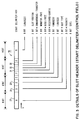
- Fig. 3 shows some more detail of the control information carried in the slot header (first ADU).
- the first eight bits (27) are the start delimiter, as was already mentioned.
- three bits (28) indicate the priority to allow the same types of operations and transmissions to be carried out separately for eight different priority classes.
- Three bits (29) indicate the slot type, i.e. whether the slot is for synchronous information, asynchronous information, etc.
- the next two 2-bit groups are not used in the present example.
- One bit (31) indicates whether the slot is RESERVED or GRATIS (to be explained later)
- a further bit (32) indicates whether the slot is BUSY or FREE (i.e. whether it carries valid data or not).
- Monitor/Bus bit there are a Monitor/Bus bit; a Synchronous-Transfer bit (33); and two bits for indicating first/middle/last/single slot position (for frames using several slots). The last eight bits are unused in present case. The most relevant control bits for the present invention are marked in Fig.3 by an asterisk.
- the structure of the principal data paths in a node are illustrated in Fig.4.
- the node comprises input circuitry 41 and output circuitry 43 connecting it to the incoming and outgoing portions of the transmission ring 11.
- a control 45 evaluates incoming data and the current status of the node to generate control signals for the various portions of the data paths.
- Multiplexer (or switching) circuitry 47 selects one of plural data paths for transferring data to the transmission ring.
- a direct path 49 allows to directly transfer incoming data to the output circuitry (e.g. for synchronous data).
- An insert buffer 51 is provided for temporarily storing arriving data which can be released later to the ring via path 53.
- Local data of the node which have to be transmitted and may be stored in several transmission (output) buffers can be selected by multiplexer circuitry 55 for transfer to the output multiplexer via path 57.
- Incoming data which are to be received by the node can be transferred via a path 59 through a demultiplexer (switching means) 61 to several buffers or local units in the node.
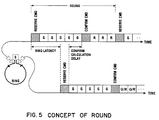
- Fig.5 illustrates how slot reservation and slot marking by the scheduler are organized.
- Cf. also Fig.1, right hand portion A) Reserve and B) Confirm).
- the scheduler releases a Reserve command into which each node requiring slots for data transmission can enter its request (reservation). While the Reserve command circulates on the ring, the scheduler transmits gratis slots which can be used (if free) by any node without previous reservation. When the Reserve command returns to the scheduler, the information is evaluated to determine whether all or only a portion of the slot requests can be granted. Details will be described later.
- the scheduler has finished its calculation, it releases a Confirm command to inform all nodes how many slots were granted and will be reserved for the requesting nodes.
- the scheduler starts to mark slots as reserved; the number of reserved slots corresponds to the total number of confirms given in the Confirm command. Each node will know, from the Confirm command, how many of the reserved slots it may use.
- the scheduler sees free gratis slots, busy gratis slots, and free reserved slots. All gratis slots (either free or busy) passing the scheduler are marked by the scheduler as reserved as long as reservations are required.
- the scheduler maintains a "current length" count CL indicating how many reserved slots have still to be marked in the current round.
- the current length counter CL is decreased for every slot marked from gratis to reserved. Free reserved slots pass the scheduler without counter decrease. Free reserved slots arriving at the scheduler occur when busy reserved slots become free and only the upstream nodes (between scheduler and the node removing the slots) have confirmed reservations.
- the scheduler sends out the next Reserve command.
- the interval between the issuance of two Reserve commands is called a "round". Rounds may be of different lengths, depending on the transmission demands of the nodes. No transmission capacity is wasted during the Reserve command circulation and during confirm calculation because of the transmission of gratis slots during that time.
- the issuance of a next Reserve command in present preferred embodiment is immediately after issuance of the necessary number of reserved slots, any other timing of the Reserve commands is of course possible, as will be explained in the last section (alternatives).
- the scheduler For granting reserved slots to the nodes, the scheduler will issue a Confirm command of exactly the same structure, i.e. having a start flag (SOC), several confirm fields (CON), and an end flag (EOC).
- SOC start flag
- CON confirm fields
- EOC end flag
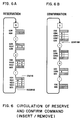
- Fig.6A shows the circulation and growing of one Reserve command.
- Node 1 inserts its reservation (RES1) between the two flags, i.e. a "3" (the second number serves a purpose to be explained later).
- Node 2 which does not require transmission forwards the Reserve command unchanged.
- Node 3 inserts its reservation (RES3) for 4 slots between the last reserve field and the End flag.
- RESi inserts its reservation request (RESi) for 10 slots, and the scheduler receives the accumulate Reserve command train as shown in the bottom of Fig.6A.
- the scheduler knows how many slots each node has requested, and can determine the slots to be granted in the respective round. Details of the algorithm and of the "gratis" slot slot counts with each reserve field will be explained below.
- the scheduler then isses a Confirm command which has the same structure and the same number of fields as the Reserve command: A start flag SOC, followed by several confirm fields CON1, CON3, CONi, and an End flag EOC.
- Each node which previously made a request now extracts the first confirm field from the command and stores the respective number (e.g. a 0 in node 1) and eliminates the respective confirm field from the command.
- the command diminishes during its circulation until only the Start and End flag return to the scheduler which will eliminate them.
- This procedure allows a node-individual handling of requests and grants, without the necessity for the scheduler to identify the nodes involved. Thus, a fine tuning of traffic/grants and a fair handling of all nodes is possible.
- the issued Reserve command consists initially only of two ADUs (start flag ADU, and end flag ADU). When they are inserted, two ADU's of the data stream must be stored (delayed) in an insertion buffer of the scheduler. From now on, the data path in the scheduler becomes longer by two ADUs until that buffer is emptied again.
- Every node having requests will insert its reserve field ADU, requiring that one ADU from the data stream must be stored (delayed) in an insertion buffer of the node. Now, all data is delayed in that node by one ADU until the insertion buffer is emptied again.
- the scheduler receives the Reserve command and can eliminate from its insertion buffer two ADUs (caused by Start/End). All other Reservation ADUs travel further on the medium as idle ADUs (causing a temporary gap).
- the scheduler After processing of the Reserve command, which may take a time corresponding to several slots, the scheduler inserts the Confirm command, delaying incoming slot ADUs correspondingly in its insertion buffer. Apart from Start flag and End flag the amount of ADUs is the same as the gap of idle ADUs currently on the medium.
- Every node which previously made a request removes its confirm field ADU and empties also its insertion buffer.
- a special technique for achieving fairness between nodes is employed. This is based on an evaluation of the gratis slots which a node has used in any round. As can be remembered, the scheduler transmits in each round a number of gratis slots which can be used by any node without reservation. The provision of gratis slots helps to improve system performance, but due to the fact that nodes immediately downstream of the destination nodes more often see gratis slots will introduce unfairness. An accounting of gratis slot usage is introduced by a special technique disclosed herewith for correcting this unfairness. The correction is done by taking into consideration the number of gratis slots a node could use during the previous (reservation) round. Depending on the current source-destination matrix, the nodes have different opportunities to use gratis slots. Therefore, only those nodes which have been penalized by a temporarily unfavorable position must be promoted to obtain their fair throughput share.
- Fig. 7 shows three different counters which are provided in each node.
- the active node receives a confirm field with a Confirm command (i.e. after it had made a reservation request)
- the number will be stored as NC in this counter.
- the node makes a transmission in a reserved slot, it decreases the number NC by one unit. Another reason for decreasing this number is explained below. When a zero is stored in this counter, the node must not use any more reserved slots.
- the node In case that a node still has confirmed reservations when the node has no more data to send, the node changes a free reserved slot into a free gratis slot and decreases its confirmed number of reservations NC by one. This happens when the node had used gratis slots to transmit all or part of its data.
- An additional counter 69 stores a number NG, the count of gratis slots used. This will be utilized for the fairness procedure presently explained. The number is increased by one whenever the node uses a free gratis slot for data transmission. When a Reserve command arrives, the node inserts not only the number NW as reserve count NR for requesting the respective number of slots, but also the number NG as gratis slot count, thus admitting, simultaneously with requesting reserved slots, how many gratis slots it had used in the previous round. Contents of the NG counter is then reset to zero.
- Both numbers i.e. the reserve count and the gratis slot count, are inserted into the same reserve field (ADU) of the Reserve command, as is shown in Fig.6A. How the confirmation is computed from the information (numbers) received by the scheduler with the Reserve command, is disclosed in the next section.
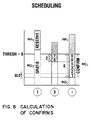
- Fig. 8 schematically shows the computation of the slot grants, i.e. the confirm numbers, in the scheduler.
- Input data for this process are the reserve counts NR and the gratis slot counts NG received with the returning Reserve command, and a threshold value H.
- the scheduler For each involved node, i.e. for each reserve request received with the Reserve command, the scheduler establishes three counts including count values NR i and NR i as received, and a third count NC i .
- Counts NR and NG are initially set to the respective received values, and count NC is reset to zero.
- Slot confirmations are determined in a step-by-step procedure, each step including the following operations:
- FR Free Reserved
- FG Free Gratis
- BR Busy Reserved
- BG Busy Gratis.
- the index "i” indicates a respective priority level for the slot, and the index "s" indicates that the slot is only for synchronous traffic.
- the scheduler will mark its slot reservations respectively. Gratis slots are always asynchronous and have no priority indication.
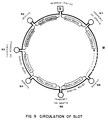
- Each individual slot when travelling around the ring, can assume several states and can be converted many times. This is basically illustrated in Fig.9. A more detailed illustration of the conversions of a travelling slot is given in Figs.10A...10C.
- Fig.9 shows a ring with a scheduler and six nodes N1...N6.
- a free and gratis slot arrives at node N1. This has data to transmit and will use that slot, converting it to busy but leaving the gratis indication.
- the scheduler which still has to mark reserved slots for the current round, converts the slot to reserved (for later use by a node which had previously made a reservation which was confirmed).
- the slot arrives at N2, data have reached their destination and the slot can be set free, but the reserved status will be kept.
- a free but reserved slot arrives at N3 which is assumed to have data for transmssion and to have still a confirmed slot number.
- N3 uses the slot by entering its data, it converts the indications to busy and to gratis (because the confirmed reservation now has been served). Assuming the data were destined for N4, this node will receive them and set the slot to free (gratis remains). Then any node further downstream, e.g. node N5, can use it for transmission of data, setting the indicators to busy but leaving the slot gratis. When the data then reach their destination, e.g. at N6, the slot can again be converted to free and will also remain gratis.
- This history of a slot shows that during a single circulation, one slot may carry independent data several times, e.g. from three sources to three destinations, despite the fact that it was reserved only for one of these transmissions.
- the additional transmissions in gratis slots are taken into account in the reservation process of the next round. This is the reason for the effective and fair operation of the system when present invention is used.
- Figs.10A...10C each show several consecutive circulations of a slot around the ring with various conversions.
- the first Fig.10A shows the principles without considering several classes of slots (all slots being equal).
- Fig.10B shows the slot history when several different priorities are provided (each designated by "i"), where each priority has its own reservation mechanism.
- Fig.10C there is shown a slot history where slots can be designated as either asynchronous (traffic which can be delayed in insertion buffers) or synchronous (traffic which is directly forwarded in each node, cf. Fig.4 and respective text explaining the node structure).
- the figures are time-space diagrams. For this example, it is assumed that the system has seven active nodes N1...N7, each represented by a horizontal line in the drawings. In each drawing, the history of a single slot is shown in several roundtrips each from the scheduler output around the ring back to the scheduler input. Each slot roundtrip is marked in the drawings by "RTn" for reference purposes.
- Fig.10A illustrates the basic slot-type changes of a slot.
- a free gratis slot FG
- FR free reserved
- BG busy gratis
- BR busy reserved
- Node 3 with confirmed reservations uses it and changes it again to busy gratis (BG). It becomes free gratis (FG) at destination node 4. Now two other nodes use the gratis slot consecutively and it passes the scheduler as busy gratis (BG).
- the slot is therefore marked busy reserved (BR) and then becomes free reserved (FR) at node 7 receiving the data. It passes the scheduler unchanged at the beginning of roundtrip 4 because it is reserved already. Node 2 which still has a confirmed reservation but no more data to send (because it had used a gratis slot) converts the slot from reserved (FR) to gratis (FG) so that it can be used by node 3 even if it had no more confirmed reservations.
- Fig.10B the corresponding slot-type changes of a priority slot reservation is shown. It is the same example as in Fig.10B except that now the scheduler sets the priority number i into the slot when it marks a gratis slot as reserved.
- Fig.10C shows slot-type changes for synchronous slot reservations. Note that when the slot is of type synchronous it by-passes insertion buffers. Initially, the considered slot is free gratis (FG). At the begin of roundtrip 1, the scheduler marks it as free reserved synchronous (FR S ). When it is used by node 2 with reservations for synchronous slots the slot type changes to busy gratis synchronous BG S . At the beginning of roundtrip 2, the scheduler makes it busy reserved synchronous BR S . When the data arrive at their removal point (node 2) it is made free reserved synchronous FR S . Then it is again used by node 3 having a synchronous reservation and converted to busy gratis synchronous BG S and later changes (at node 4) to free gratis (FG).
- a node with asynchronous traffic demand makes it busy gratis (BG) and as it passes the scheduler at the beginning of roundtrip 3 the slot is marked as busy reserved with the synchronous-transfer bit set (BRT). This is done because the slot cannot be made synchronous immediately since otherwise it would start to by-pass the insertion buffers. However, when the asynchronous slot becomes free (at node 7), the node changes the slot-type to free reserved synchronous (FR S ).
- slot-type changes are rather simple operations with a linear translation whereby a multiple-input type relates to single-output type.
- the signalling information to be transferred i.e. the reserve counts and gratis slot counts from nodes to scheduler, and the confirm counts from scheduler to nodes, can be conveyed in another manner.
- a signalling section or field could be provided in each normal slot header, and the reservation information would have to be entered into a number of successive slots following the slot carrying the start-of-reserve flag (or start-of-confirm flag respectively).
- the invention cannot only be used in ring-structured communication systems, but also in any other system in which the information is transferred sequentially from node to node and then can return to the scheduler. Examples of such systems were described in above-mentioned European patent applications EP-A-0'388'574 and EP-A-0'393'293.
- a new reserve command is issued as soon as the last slot marked reserved has left the scheduler, i.e. when the length count CL has become zero (assuming that then new reservations will be required anyway).
- other rules for issuing the reserve commands can well be used.
- reserve commands could be issued at reguler intervals, which would mean however that possibly the current length count CL in the scheduler (which indicates how many reserved slots have still to be released because they were confirmed already) would not yet be zero in some instances.
- CL in the scheduler which indicates how many reserved slots have still to be released because they were confirmed already
- the fixed timing of reserve commands should be restricted to situations when the traffic volume is low. It would also be possible to vary this interval in dependence of the number of free gratis slots which pass the scheduler.
- An alternative method would be e.g. to determine the confirm count for each node in dependence of the ratio between the reserve count and the gratis count (thus admitting that a highly active node would be allowed to use relatively more gratis slot. Another possibility is to grant to each requesting node a minimum number of confirms and then deduct the gratis count from the remaining reserve count.
Landscapes
- Engineering & Computer Science (AREA)
- Computer Networks & Wireless Communication (AREA)
- Signal Processing (AREA)
- Small-Scale Networks (AREA)
- Computer And Data Communications (AREA)
Priority Applications (4)
| Application Number | Priority Date | Filing Date | Title |
|---|---|---|---|
| EP91810224A EP0505658B1 (de) | 1991-03-27 | 1991-03-27 | Verfahren zum Zugriff auf den Übertragungsweg lokaler Netze |
| DE69117487T DE69117487T2 (de) | 1991-03-27 | 1991-03-27 | Verfahren zum Zugriff auf den Übertragungsweg lokaler Netze |
| US07/807,344 US5276682A (en) | 1991-03-27 | 1991-12-16 | Medium access technique for LAN systems |
| JP4017481A JPH0754940B2 (ja) | 1991-03-27 | 1992-02-03 | 通信システム及びそれにおける伝送スロットの処理方法 |
Applications Claiming Priority (1)
| Application Number | Priority Date | Filing Date | Title |
|---|---|---|---|
| EP91810224A EP0505658B1 (de) | 1991-03-27 | 1991-03-27 | Verfahren zum Zugriff auf den Übertragungsweg lokaler Netze |
Publications (2)
| Publication Number | Publication Date |
|---|---|
| EP0505658A1 true EP0505658A1 (de) | 1992-09-30 |
| EP0505658B1 EP0505658B1 (de) | 1996-02-28 |
Family
ID=8208833
Family Applications (1)
| Application Number | Title | Priority Date | Filing Date |
|---|---|---|---|
| EP91810224A Expired - Lifetime EP0505658B1 (de) | 1991-03-27 | 1991-03-27 | Verfahren zum Zugriff auf den Übertragungsweg lokaler Netze |
Country Status (4)
| Country | Link |
|---|---|
| US (1) | US5276682A (de) |
| EP (1) | EP0505658B1 (de) |
| JP (1) | JPH0754940B2 (de) |
| DE (1) | DE69117487T2 (de) |
Cited By (4)
| Publication number | Priority date | Publication date | Assignee | Title |
|---|---|---|---|---|
| GB2278258A (en) * | 1993-05-17 | 1994-11-23 | Ibm | Token ring network |
| WO1995011555A1 (en) * | 1993-10-19 | 1995-04-27 | International Business Machines Corporation | Access control system for a multi-channel transmission ring |
| EP0695061A1 (de) * | 1994-07-28 | 1996-01-31 | International Business Machines Corporation | Kanalzuteilungsverfahren für ein Ringnetz |
| WO1996017453A3 (en) * | 1994-12-01 | 1996-08-08 | Philips Electronics Nv | A communication system, a private automatic branch exchange, and a line card |
Families Citing this family (12)
| Publication number | Priority date | Publication date | Assignee | Title |
|---|---|---|---|---|
| GB2276796B (en) * | 1993-04-01 | 1997-12-10 | Sony Corp | Audio data communications |
| US5581703A (en) * | 1993-06-29 | 1996-12-03 | International Business Machines Corporation | Method and apparatus for reserving system resources to assure quality of service |
| US5388097A (en) * | 1993-06-29 | 1995-02-07 | International Business Machines Corporation | System and method for bandwidth reservation for multimedia traffic in communication networks |
| US5432788A (en) * | 1994-03-02 | 1995-07-11 | Digital Equipment Corporation | Scheduling method for a slotted communication medium with multiple but limited number of carriers and independent receiver/transmitter pairs |
| US5542115A (en) | 1994-06-24 | 1996-07-30 | Pioneer Tech Development Limited | Paging method and apparatus |
| US5613073A (en) * | 1994-07-25 | 1997-03-18 | International Business Machines Corporation | Apparatus and method for a buffer reservation system |
| JPH08152976A (ja) * | 1994-11-28 | 1996-06-11 | Fujitsu Ltd | 記憶装置のアクセス方法 |
| US5576702A (en) * | 1995-01-10 | 1996-11-19 | Samoylenko; Stanislav I. | Method and apparatus for fault-tolerant transmission in multi-channel networks |
| US6108338A (en) * | 1995-12-28 | 2000-08-22 | Dynarc Inc. | Method and device for dynamic synchronous transfer mode in a dual ring topology |
| WO1997033409A1 (de) * | 1996-03-08 | 1997-09-12 | Siemens Aktiengesellschaft | Verfahren zur übertragung von datenpaketen vorgebbarer prioritätsklassen im ethernet von einer ersten anordnung zu mindestens einer zweiten anordnung |
| US20010015980A1 (en) * | 1998-04-17 | 2001-08-23 | Dynarc Inc. Dba Dynamic Network Architecture Inc. | Mapping of dynamic synchronous transfer mode network onto an optical network |
| JP2001189736A (ja) * | 1999-12-28 | 2001-07-10 | Fujitsu Ltd | Lanインタフェース装置及びフレーム送受信制御方法 |
Citations (2)
| Publication number | Priority date | Publication date | Assignee | Title |
|---|---|---|---|---|
| WO1986003639A1 (en) * | 1984-12-03 | 1986-06-19 | The University Of Western Australia | Queueing protocol |
| EP0388574A1 (de) * | 1989-03-23 | 1990-09-26 | International Business Machines Corporation | Verfahren und Vorrichtung zum Vielfachzugriff mit verteilten Warteschlangen in einem Kommunikationssystem |
Family Cites Families (7)
| Publication number | Priority date | Publication date | Assignee | Title |
|---|---|---|---|---|
| NL8802884A (nl) * | 1988-11-22 | 1990-06-18 | Philips Nv | Werkwijze en stelsel voor het overdragen van gebufferde datapakketten via een communicatienetwerk. |
| AU623953B2 (en) * | 1988-12-07 | 1992-05-28 | Telstra Corporation Limited | A communications method for a shared-medium communications network |
| DE68918077T2 (de) * | 1989-01-17 | 1995-04-06 | Philips Nv | Verfahren und System zur Übertragung von gepufferten Datenpaketen auf einem Übertragungsnetz. |
| US5001707A (en) * | 1989-11-02 | 1991-03-19 | Northern Telecom Limited | Method of providing reserved bandwidth in a dual bus system |
| US4977557A (en) * | 1989-12-14 | 1990-12-11 | Northern Telecom Limited | Method of providing effective priority access in a dual bus system |
| US5124981A (en) * | 1990-03-09 | 1992-06-23 | International Business Machines Corporation | Access control method for dqdb network |
| DE69116676D1 (de) * | 1991-03-27 | 1996-03-07 | Ibm | Einfüge- und Entfernungssignalisierung in LAN Systemen |
-
1991
- 1991-03-27 DE DE69117487T patent/DE69117487T2/de not_active Expired - Fee Related
- 1991-03-27 EP EP91810224A patent/EP0505658B1/de not_active Expired - Lifetime
- 1991-12-16 US US07/807,344 patent/US5276682A/en not_active Expired - Fee Related
-
1992
- 1992-02-03 JP JP4017481A patent/JPH0754940B2/ja not_active Expired - Fee Related
Patent Citations (2)
| Publication number | Priority date | Publication date | Assignee | Title |
|---|---|---|---|---|
| WO1986003639A1 (en) * | 1984-12-03 | 1986-06-19 | The University Of Western Australia | Queueing protocol |
| EP0388574A1 (de) * | 1989-03-23 | 1990-09-26 | International Business Machines Corporation | Verfahren und Vorrichtung zum Vielfachzugriff mit verteilten Warteschlangen in einem Kommunikationssystem |
Non-Patent Citations (2)
| Title |
|---|
| IEEE COMMUNICATIONS MAGAZINE. vol. 26, no. 4, April 1988, US pages 20 - 28; R.M. NEWMAN ET AL: 'THE QPSX MAN' * |
| IEEE GLOBAL TELECOMMUNICATIONS CONFERENCE vol. 2, November 1989, DALLAS, US pages 1004 - 1011; M.K. KAROL ET AL: 'HIGH PERFORMANCE OPTICAL LOCAL AND METROPOLITAN AREA NETWORK ENHANCEMENTS OF FDDI AND IEEE 802.6 DQDB' * |
Cited By (7)
| Publication number | Priority date | Publication date | Assignee | Title |
|---|---|---|---|---|
| GB2278258A (en) * | 1993-05-17 | 1994-11-23 | Ibm | Token ring network |
| WO1995011555A1 (en) * | 1993-10-19 | 1995-04-27 | International Business Machines Corporation | Access control system for a multi-channel transmission ring |
| US5764392A (en) * | 1993-10-19 | 1998-06-09 | International Business Machines Corporation | Access control system for a multi-channel transmission ring |
| EP0695061A1 (de) * | 1994-07-28 | 1996-01-31 | International Business Machines Corporation | Kanalzuteilungsverfahren für ein Ringnetz |
| WO1996017453A3 (en) * | 1994-12-01 | 1996-08-08 | Philips Electronics Nv | A communication system, a private automatic branch exchange, and a line card |
| US5812548A (en) * | 1994-12-01 | 1998-09-22 | U.S. Philips Corporation | Communication system, a private automatic branch exchange, and a line card |
| CN1083185C (zh) * | 1994-12-01 | 2002-04-17 | 皇家菲利浦电子有限公司 | 通信系统、专用自动小交换机和线路卡 |
Also Published As
| Publication number | Publication date |
|---|---|
| JPH0630007A (ja) | 1994-02-04 |
| DE69117487T2 (de) | 1996-10-02 |
| EP0505658B1 (de) | 1996-02-28 |
| JPH0754940B2 (ja) | 1995-06-07 |
| DE69117487D1 (de) | 1996-04-04 |
| US5276682A (en) | 1994-01-04 |
Similar Documents
| Publication | Publication Date | Title |
|---|---|---|
| EP0505658B1 (de) | Verfahren zum Zugriff auf den Übertragungsweg lokaler Netze | |
| US3988545A (en) | Method of transmitting information and multiplexing device for executing the method | |
| EP0388574B1 (de) | Verfahren und Vorrichtung zum Vielfachzugriff mit verteilten Warteschlangen in einem Kommunikationssystem | |
| US5173898A (en) | Multiple-access control for a communication system with order pad passing | |
| US5229993A (en) | Control of access through local carrier sensing for high data rate networks and control of access of synchronous messages through circulating reservation packets | |
| US5166930A (en) | Data channel scheduling discipline arrangement and method | |
| US5001707A (en) | Method of providing reserved bandwidth in a dual bus system | |
| US3985962A (en) | Method of information transmission with priority scheme in a time-division multiplex communication system comprising a loop line | |
| Hahne et al. | DQDB networks with and without bandwidth balancing | |
| US5210750A (en) | Method and apparatus for distributed queue multiple access in a communication system | |
| Takagi | Application of polling models to computer networks | |
| JP2501695B2 (ja) | 通信ネットワ―クおよびこのネットワ―ク中のバスへのアクセスの制御方法 | |
| CA2007634C (en) | Method and system for transmitting buffered data packets on a communications network | |
| EP0669734A2 (de) | Verfahren und Vorrichtung zur Verwaltung der Übertragung zwischen quotenbasierten Vielfachknoten-Kommunikationssystemen | |
| EP0376597B1 (de) | Paketauswahl für Paketverteilungsanordnungen | |
| EP1302011A1 (de) | Medienzugangssteuerung für isochrone datenpakete in vielfachzugriffsystemen mit trägerkennung | |
| US5214649A (en) | Insert/remove signalling in lan systems | |
| Bahaa-El-Din et al. | Register-insertion: a protocol for the next generation of ring local-area networks | |
| CN113179177B (zh) | 一种解决时间触发报文冲突的调度方法及系统 | |
| CN119172382A (zh) | 一种多同步域间的确定性传输方法 | |
| CN114185841A (zh) | 一种片上网络信用饥饿控制装置 | |
| US20090185490A1 (en) | Method of monitoring traffic in an optical or electronic network with shared resources | |
| Ott et al. | Bandwidth balancing of the register insertion bus (RIB) fiber optic local area network | |
| Ono et al. | Priority based packet reservation demand assignment TDMA system | |
| Ishizaka et al. | A token‐passing scheme in a time‐division multiplexed local area network and its performance evaluation |
Legal Events
| Date | Code | Title | Description |
|---|---|---|---|
| PUAI | Public reference made under article 153(3) epc to a published international application that has entered the european phase |
Free format text: ORIGINAL CODE: 0009012 |
|
| AK | Designated contracting states |
Kind code of ref document: A1 Designated state(s): DE FR GB |
|
| 17P | Request for examination filed |
Effective date: 19930120 |
|
| 17Q | First examination report despatched |
Effective date: 19950412 |
|
| GRAA | (expected) grant |
Free format text: ORIGINAL CODE: 0009210 |
|
| AK | Designated contracting states |
Kind code of ref document: B1 Designated state(s): DE FR GB |
|
| REF | Corresponds to: |
Ref document number: 69117487 Country of ref document: DE Date of ref document: 19960404 |
|
| ET | Fr: translation filed | ||
| PLBE | No opposition filed within time limit |
Free format text: ORIGINAL CODE: 0009261 |
|
| 26N | No opposition filed | ||
| REG | Reference to a national code |
Ref country code: GB Ref legal event code: IF02 |
|
| PGFP | Annual fee paid to national office [announced via postgrant information from national office to epo] |
Ref country code: FR Payment date: 20020318 Year of fee payment: 12 |
|
| PGFP | Annual fee paid to national office [announced via postgrant information from national office to epo] |
Ref country code: DE Payment date: 20030325 Year of fee payment: 13 |
|
| PG25 | Lapsed in a contracting state [announced via postgrant information from national office to epo] |
Ref country code: FR Free format text: LAPSE BECAUSE OF NON-PAYMENT OF DUE FEES Effective date: 20031127 |
|
| REG | Reference to a national code |
Ref country code: FR Ref legal event code: ST |
|
| PGFP | Annual fee paid to national office [announced via postgrant information from national office to epo] |
Ref country code: GB Payment date: 20040301 Year of fee payment: 14 |
|
| PG25 | Lapsed in a contracting state [announced via postgrant information from national office to epo] |
Ref country code: DE Free format text: LAPSE BECAUSE OF NON-PAYMENT OF DUE FEES Effective date: 20041001 |
|
| PG25 | Lapsed in a contracting state [announced via postgrant information from national office to epo] |
Ref country code: GB Free format text: LAPSE BECAUSE OF NON-PAYMENT OF DUE FEES Effective date: 20050327 |
|
| GBPC | Gb: european patent ceased through non-payment of renewal fee |
Effective date: 20050327 |