EP0502993B1 - Verfahren zur herstellung von copolyarylensulfiden mit vermindertem gehalt an disulfidradikalen - Google Patents
Verfahren zur herstellung von copolyarylensulfiden mit vermindertem gehalt an disulfidradikalen Download PDFInfo
- Publication number
- EP0502993B1 EP0502993B1 EP91901345A EP91901345A EP0502993B1 EP 0502993 B1 EP0502993 B1 EP 0502993B1 EP 91901345 A EP91901345 A EP 91901345A EP 91901345 A EP91901345 A EP 91901345A EP 0502993 B1 EP0502993 B1 EP 0502993B1
- Authority
- EP
- European Patent Office
- Prior art keywords
- copoly
- arylene sulfide
- aromatic radical
- unsubstituted aromatic
- range
- Prior art date
- Legal status (The legal status is an assumption and is not a legal conclusion. Google has not performed a legal analysis and makes no representation as to the accuracy of the status listed.)
- Expired - Lifetime
Links
- 229920001577 copolymer Chemical compound 0.000 title claims abstract description 30
- 238000000034 method Methods 0.000 title claims abstract description 19
- 238000002360 preparation method Methods 0.000 title claims abstract description 16
- 230000003247 decreasing effect Effects 0.000 title claims abstract description 15
- 150000001875 compounds Chemical class 0.000 claims abstract description 29
- 239000000155 melt Substances 0.000 claims abstract description 10
- LFMWZTSOMGDDJU-UHFFFAOYSA-N 1,4-diiodobenzene Chemical compound IC1=CC=C(I)C=C1 LFMWZTSOMGDDJU-UHFFFAOYSA-N 0.000 claims description 6
- -1 diiodobiphenyls Chemical class 0.000 claims description 4
- BBOLNFYSRZVALD-UHFFFAOYSA-N 1,2-diiodobenzene Chemical class IC1=CC=CC=C1I BBOLNFYSRZVALD-UHFFFAOYSA-N 0.000 claims description 3
- QQFIQWBUKYSUHM-UHFFFAOYSA-N (2,3-diiodophenyl)-phenylmethanone Chemical class IC1=CC=CC(C(=O)C=2C=CC=CC=2)=C1I QQFIQWBUKYSUHM-UHFFFAOYSA-N 0.000 claims description 2
- UYHYZAYIQAVJCN-UHFFFAOYSA-N 1,2-diiodonaphthalene Chemical class C1=CC=CC2=C(I)C(I)=CC=C21 UYHYZAYIQAVJCN-UHFFFAOYSA-N 0.000 claims description 2
- SFPQFQUXAJOWNF-UHFFFAOYSA-N 1,3-diiodobenzene Chemical compound IC1=CC=CC(I)=C1 SFPQFQUXAJOWNF-UHFFFAOYSA-N 0.000 claims description 2
- KXAMEOPPAQDUTO-UHFFFAOYSA-N 1-(2,3-diiodophenyl)sulfonyl-2,3-diiodobenzene Chemical class IC1=CC=CC(S(=O)(=O)C=2C(=C(I)C=CC=2)I)=C1I KXAMEOPPAQDUTO-UHFFFAOYSA-N 0.000 claims description 2
- AVGQIRXZUNRSAY-UHFFFAOYSA-N 1-iodo-4-(4-iodophenyl)sulfonylbenzene Chemical compound C1=CC(I)=CC=C1S(=O)(=O)C1=CC=C(I)C=C1 AVGQIRXZUNRSAY-UHFFFAOYSA-N 0.000 claims description 2
- JEVDBSPYZIVTGM-UHFFFAOYSA-N 2,6-diiodonaphthalene Chemical compound C1=C(I)C=CC2=CC(I)=CC=C21 JEVDBSPYZIVTGM-UHFFFAOYSA-N 0.000 claims description 2
- HFRHPJJBHNBGBD-UHFFFAOYSA-N bis(4-iodophenyl)methanone Chemical compound C1=CC(I)=CC=C1C(=O)C1=CC=C(I)C=C1 HFRHPJJBHNBGBD-UHFFFAOYSA-N 0.000 claims description 2
- HIPNYJBGYFRVAY-UHFFFAOYSA-N diiodomethylbenzene Chemical class IC(I)C1=CC=CC=C1 HIPNYJBGYFRVAY-UHFFFAOYSA-N 0.000 claims description 2
- 229920000642 polymer Polymers 0.000 description 29
- 238000006243 chemical reaction Methods 0.000 description 17
- 229910052740 iodine Inorganic materials 0.000 description 9
- IJGRMHOSHXDMSA-UHFFFAOYSA-N Atomic nitrogen Chemical compound N#N IJGRMHOSHXDMSA-UHFFFAOYSA-N 0.000 description 8
- ZCYVEMRRCGMTRW-UHFFFAOYSA-N 7553-56-2 Chemical compound [I] ZCYVEMRRCGMTRW-UHFFFAOYSA-N 0.000 description 7
- 239000011630 iodine Substances 0.000 description 7
- 229910052717 sulfur Inorganic materials 0.000 description 7
- NINIDFKCEFEMDL-UHFFFAOYSA-N Sulfur Chemical compound [S] NINIDFKCEFEMDL-UHFFFAOYSA-N 0.000 description 6
- 238000000921 elemental analysis Methods 0.000 description 6
- 239000011593 sulfur Substances 0.000 description 5
- 229910052799 carbon Inorganic materials 0.000 description 4
- 229910052739 hydrogen Inorganic materials 0.000 description 4
- 229910052757 nitrogen Inorganic materials 0.000 description 4
- 230000035484 reaction time Effects 0.000 description 4
- BWGNESOTFCXPMA-UHFFFAOYSA-N Dihydrogen disulfide Chemical compound SS BWGNESOTFCXPMA-UHFFFAOYSA-N 0.000 description 3
- 238000010438 heat treatment Methods 0.000 description 3
- 239000002184 metal Substances 0.000 description 3
- 239000007787 solid Substances 0.000 description 3
- XKRFYHLGVUSROY-UHFFFAOYSA-N Argon Chemical compound [Ar] XKRFYHLGVUSROY-UHFFFAOYSA-N 0.000 description 2
- OKTJSMMVPCPJKN-UHFFFAOYSA-N Carbon Chemical compound [C] OKTJSMMVPCPJKN-UHFFFAOYSA-N 0.000 description 2
- 238000000576 coating method Methods 0.000 description 2
- 238000004821 distillation Methods 0.000 description 2
- 239000001257 hydrogen Substances 0.000 description 2
- 125000004435 hydrogen atom Chemical class [H]* 0.000 description 2
- 238000000465 moulding Methods 0.000 description 2
- 239000000047 product Substances 0.000 description 2
- 229920005989 resin Polymers 0.000 description 2
- 239000011347 resin Substances 0.000 description 2
- 239000007858 starting material Substances 0.000 description 2
- 239000000126 substance Substances 0.000 description 2
- CURLTUGMZLYLDI-UHFFFAOYSA-N Carbon dioxide Chemical compound O=C=O CURLTUGMZLYLDI-UHFFFAOYSA-N 0.000 description 1
- 239000002253 acid Substances 0.000 description 1
- 150000007513 acids Chemical class 0.000 description 1
- 229910052786 argon Inorganic materials 0.000 description 1
- 238000004364 calculation method Methods 0.000 description 1
- 125000004432 carbon atom Chemical group C* 0.000 description 1
- 235000011089 carbon dioxide Nutrition 0.000 description 1
- 230000015556 catabolic process Effects 0.000 description 1
- 239000003054 catalyst Substances 0.000 description 1
- 238000002144 chemical decomposition reaction Methods 0.000 description 1
- 238000001311 chemical methods and process Methods 0.000 description 1
- 239000011248 coating agent Substances 0.000 description 1
- 238000002485 combustion reaction Methods 0.000 description 1
- 239000013065 commercial product Substances 0.000 description 1
- 238000007796 conventional method Methods 0.000 description 1
- 239000002178 crystalline material Substances 0.000 description 1
- 238000006731 degradation reaction Methods 0.000 description 1
- 239000000835 fiber Substances 0.000 description 1
- 229920006158 high molecular weight polymer Polymers 0.000 description 1
- 239000011261 inert gas Substances 0.000 description 1
- 229910052500 inorganic mineral Inorganic materials 0.000 description 1
- 239000007788 liquid Substances 0.000 description 1
- 239000000463 material Substances 0.000 description 1
- 239000011707 mineral Substances 0.000 description 1
- LQNUZADURLCDLV-UHFFFAOYSA-N nitrobenzene Substances [O-][N+](=O)C1=CC=CC=C1 LQNUZADURLCDLV-UHFFFAOYSA-N 0.000 description 1
- 239000003960 organic solvent Substances 0.000 description 1
- 239000004033 plastic Substances 0.000 description 1
- 239000000376 reactant Substances 0.000 description 1
- 238000007711 solidification Methods 0.000 description 1
- 230000008023 solidification Effects 0.000 description 1
- 238000006467 substitution reaction Methods 0.000 description 1
- 229920001169 thermoplastic Polymers 0.000 description 1
- 239000004416 thermosoftening plastic Substances 0.000 description 1
Classifications
-
- C—CHEMISTRY; METALLURGY
- C08—ORGANIC MACROMOLECULAR COMPOUNDS; THEIR PREPARATION OR CHEMICAL WORKING-UP; COMPOSITIONS BASED THEREON
- C08G—MACROMOLECULAR COMPOUNDS OBTAINED OTHERWISE THAN BY REACTIONS ONLY INVOLVING UNSATURATED CARBON-TO-CARBON BONDS
- C08G75/00—Macromolecular compounds obtained by reactions forming a linkage containing sulfur with or without nitrogen, oxygen, or carbon in the main chain of the macromolecule
- C08G75/02—Polythioethers
- C08G75/0204—Polyarylenethioethers
- C08G75/0286—Chemical after-treatment
- C08G75/029—Modification with organic compounds
-
- C—CHEMISTRY; METALLURGY
- C08—ORGANIC MACROMOLECULAR COMPOUNDS; THEIR PREPARATION OR CHEMICAL WORKING-UP; COMPOSITIONS BASED THEREON
- C08G—MACROMOLECULAR COMPOUNDS OBTAINED OTHERWISE THAN BY REACTIONS ONLY INVOLVING UNSATURATED CARBON-TO-CARBON BONDS
- C08G75/00—Macromolecular compounds obtained by reactions forming a linkage containing sulfur with or without nitrogen, oxygen, or carbon in the main chain of the macromolecule
- C08G75/02—Polythioethers
- C08G75/0204—Polyarylenethioethers
- C08G75/025—Preparatory processes
- C08G75/0263—Preparatory processes using elemental sulfur
-
- C—CHEMISTRY; METALLURGY
- C08—ORGANIC MACROMOLECULAR COMPOUNDS; THEIR PREPARATION OR CHEMICAL WORKING-UP; COMPOSITIONS BASED THEREON
- C08G—MACROMOLECULAR COMPOUNDS OBTAINED OTHERWISE THAN BY REACTIONS ONLY INVOLVING UNSATURATED CARBON-TO-CARBON BONDS
- C08G75/00—Macromolecular compounds obtained by reactions forming a linkage containing sulfur with or without nitrogen, oxygen, or carbon in the main chain of the macromolecule
- C08G75/14—Polysulfides
Definitions
- the invention relates to a process for the preparation of a copoly(arylene sulfide) having a decreased amount of disulfide radicals by heating the copoly(arylene sulfide) in the presence of a diiodoaromatic compound.
- Poly(arylene sulfide) resins are thermosetting-thermoplastic polymeric materials with good thermal stability, unusual insolubility, resistance to chemical environments and inherent flame resistance. These resins additionally have good electrical insulative properties which make them ideal for electrical and electronic applications. Their excellent resistance to chemical degradation makes them ideal for use in chemical environments which involve organic solvents and strong mineral acids, such as coatings for pipes, tanks, pumps and other equipment.
- U. S. 4,855,393 discloses a process for preparation of a copoly(arylene sulfide) wherein elemental sulfur is reacted with diiodobenzene.
- U.S. 4,786,713 discloses the copoly(arylene sulfide) resulting from this process.
- This copoly(arylene sulfide) correspond to the structure wherein A is a divalent substituted or unsubstituted aromatic radical, x is in the range of 0.50 to 0.001 and n is at least 200.
- the amount of disulfide radical which corresponds to the formula (-A-S-S-) x is an important feature of this polymer. For certain applications such as film and fiber and even certain molding applications it is desirable that the amount of disulfide radical be in lower part of the range of 0.5 to 0.001.
- One approach to obtaining a polymer with the amount of disulfide radicals in the low range is to prepare the polymer originally with the desired low amount of disulfide radicals. This is often difficult because of the potential for solidification of the molten polymer during its preparation. If the attempt to prepare a polymer with the desired low amount of disulfide radicals is unsuccessful the polymer is of no value for the particular application requiring the low amount of disulfide radicals and must be discarded or used for some other application.
- the process of this invention can be thought of as a process for preparation of a copoly(arylene sulfide) which has a decreased amount of disulfide radicals and corresponds to the structure wherein A is a divalent substituted or unsubstituted aromatic radical, x is in the range of 0.45 to 0, preferably 0.25 to 0, more preferably 0.15 to 0 and even more preferably 0.10 to 0, and n is at least 50, comprising contacting a copoly(arylene sulfide) corresponding to the structure wherein A is a divalent substituted or unsubstituted aromatic radical, x is in the range of 0.50 to 0.01, preferably 0.30 to 0.01, more preferably 0.20 to 0.01 and even more preferably 0.15 to 0.01 and n is at least 25, in the melt phase with a diiodoaromatic compound corresponding to the structure I-A-I wherein A is a divalent substituted or unsubstituted aromatic radical.
- the diiodoaromatic compound which is contacted with the polymer in this invention may be any diiodoaromatic compound but usually is the diiodoaromatic compound which is used to prepare the original copoly(arylene sulfide) and disclosed in the above cited patents.
- the diiodoaromatic compound is selected from the group consisting of diiodobenzenes, diiodonaphthalenes, diiodobiphenyls, diiodotoluenes, diiodophenyl sulfones, and diiodobenzophenones.
- the diiodoaromatic compound is selected from the group consisting of p-diiodobenzene, m-diiodobenzene, p,p'-diiodobiphenyl, 2,6-diiodonaphthalene, (p-iodophenyl) sulfone, and 4,4'-diiodobenzophenone.
- Para-diiodobenzene is a particularly preferred species.
- the reaction between the copoly(arylene sulfide) and the diiodoaromatic compound is carried out in the melt phase by heating the original copoly(arylene sulfide) until it melts and then contacting the molten polymer with the diiodoaromatic compound.
- elemental iodine is produced and evolves from the reaction melt. Removal of the elemental iodine may provide a driving force for completion of the reaction.
- the iodine may be removed by passing a stream of air or an inert gas such as nitrogen or argon over or through the reaction mass at atmospheric or superatmospheric pressure or alternatively by applying a vacuum to the reaction apparatus.
- the elemental iodine may be collected and used as a commercial product or as a reactant for further chemical processes.
- the ratio of the amount of diiodoaromatic compound to the amount of disulfide radicals is an important aspect of this invention.
- the ratio of diiodoaromatic compound to disulfide radical should not exceed two moles of diiodoaromatic compound to one mole of disulfide radical.
- the ratio of diiodoaromatic compound to disulfide radical exceeds one, the molecular weight of the polymer is degraded and the polymer becomes terminated with iodoaryl end-groups.
- the ratio of diiodoaromatic compound to disulfide radicals should be exactly one.
- the ratio cannot be controlled so that it is exactly one it is preferred it be less than one so as to avoid molecular weight degradation and can be as low as 0.1 or more preferably as low as >0.25. This ratio is also influenced by reaction conditions with longer reaction times and temperatures requiring lower ratios. Thus, the ratio can broadly be in the range of 2.0 to 0.1 , preferably in the range of 1.75 to 0.2 and most preferably in the range of 1.5 to 0.25.
- monoiodoaromatic compounds are also within the scope of this invention. If monoiodoaromatic compounds are used the overall chain length of the polymer will be reduced due to the monofunctional nature of the iodoaromatic compound.
- the monoiodo compounds useful are the same as the diiodoaromatic compounds except that only one iodine substitution is present.
- the disulfide content of both the original copoly(arylene sulfide) and the resulting copoly(arylene sulfide) is defined as the amount of sulfur which is excess over one sulfur per repeat unit and can be determined via elemental analysis calculation in which the carbon atoms are set equal to exactly six.
- reaction temperature should be no less than 250°C and no higher than 375°C.
- reaction temperature should not be less than 275°C and no more than 350°C and more preferably from 275°C to 325°C.
- the reaction temperature must in any event be high enough to obtain a melt of the polymer.
- Reaction times may vary considerably. Although in theory an almost infinitely long reaction time could be employed, in practice reactions are carried out for no longer than 8 hours and preferably no longer than 4 hours and more preferably no longer than 2 hours.
- the minimum reaction time will be dictated by the amount of time to achieve reaction of the diiodoaromatic compound and generally is at least 5 min. and preferably at least 10 min.
- the utility of the polymer prepared by the process of this invention depends on the chain length, or value of n.
- n When the value of n is sufficiently low that the polymer is a liquid the polymer can be used as a coating or as a starting material for preparation of a high molecular weight polymer by solid stating or other conventional techniques for molecular weight buildup.
- the value of n is sufficiently high the polymer is a solid it can be used as a molding plastic or as a starting material for preparation of a polymer of even higher molecular weights by solid starting or other conventional means for increasing the molecular weight.
Landscapes
- Chemical & Material Sciences (AREA)
- Health & Medical Sciences (AREA)
- Chemical Kinetics & Catalysis (AREA)
- Medicinal Chemistry (AREA)
- Polymers & Plastics (AREA)
- Organic Chemistry (AREA)
- General Chemical & Material Sciences (AREA)
- Polymers With Sulfur, Phosphorus Or Metals In The Main Chain (AREA)
- Organic Low-Molecular-Weight Compounds And Preparation Thereof (AREA)
- Compositions Of Macromolecular Compounds (AREA)
- Motor Or Generator Cooling System (AREA)
- Motor Or Generator Current Collectors (AREA)
Claims (7)
- Verfahren zur Herstellung eines Copoly(arylensulfids), das eine verminderte Menge Disulfidreste hat und der Struktur

wobei A ein zweiwertiger substituierter oder nicht-substituierter aromatischer Rest ist, x ist im Bereich von 0,45 bis 0 und n ist mindestens 50,
welches die Kontaktierung eines Copoly(arylensulfids) entsprechend der Struktur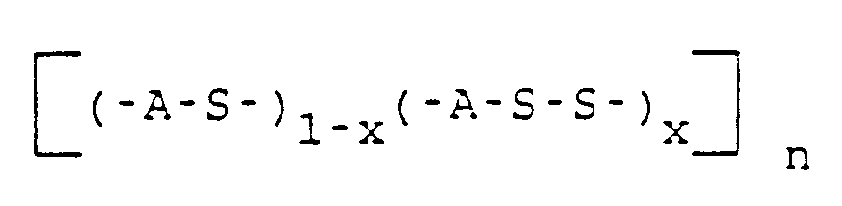
in der Schmelzphase bei einer Temperatur im Bereich von 275-350°C mit einer aromatischen Diiodverbindung der Struktur
I-A-I
wobei A ein Zweiwertiger substituierter oder nicht-substituierter aromatischer Rest ist,
umfaßt. - Verfahren nach Anspruch 1, wobei der zweiwertige aromatische Rest A bereitgestellt wird durch eine Verbindung ausgewählt aus der Gruppe bestehend aus: Diiodbenzole, Diiodnaphthaline, Diiodbiphenyle, Diiodtoluole, Diiodphenylsulfone und Diiodbenzophenone.
- Verfahren nach Anspruch 1, wobei der zweiwertige aromatische Rest A bereitgestellt wird durch eine Verbindung ausgewählt aus der Gruppe bestehend aus: p-Diiodbenzol, m-Diiodbenzol, p,p'-Diiodbiphenyl, 2,6-Diiodnaphthalin, (p-Iodphenyl)Sulfon und 4,4'-Diiodbenzophenon.
- Verfahren nach Anspruch 1, wobei die Temperatur im Bereich von 275-325°C liegt.
- Verfahren nach Anspruch 1 zur Herstellung eines Copoly(arylinsulfids), das eine verminderte Menge Disulfidreste hat und der Struktur

wobei A ein zweiwertiger substituierter oder nicht-substituierter aromatischer Rest ist, x ist im Bereich von 0,25 bis 0 und n ist mindestens 50,
welches das Kontaktieren eines Copoly(arylensulfids) entsprechend der Struktur
in der Schmelzphase mit einer aromatischen Diiodverbindung entsprechend der Struktur
I-A-I
wobei A ein zweiwertiger substituierter oder nicht-substituierter aromatischer Rest ist,
umfaßt. - Verfahren nach Anspruch 1 zur Herstellung eines Copoly(arylensulfids), das eine verminderte Menge Disulfidreste hat und der Struktur

wobei A ein zweiwertiger substituierter oder nicht-substituierter aromatischer Rest ist, x ist im Bereich von 0,15 bis 0 und n ist mindestens 50,
welches das Kontaktieren eines Copoly(arylensulfids), entsprechend der Struktur
in der Schmelzphase mit einer aromatischen Diiodverbindung, entsprechend der Struktur
I-A-I
wobei A ein zweiwertiger substituierter oder nicht-substituierter aromatischer Rest ist,
umfaßt. - Verfahren nach Anspruch 1 zur Herstellung eines Copoly(arylensulfids), das eine verminderte Menge Disulfidreste hat und der Struktur

wobei A ein zweiwertiger substituierter oder nicht-substituierter aromatischer Rest ist, x ist im Bereich von 0,10 bis 0 und n ist mindestens 50,
welches die Kontaktierung eines Copoly(arylensulfids), entsprechend der Struktur
in der Schmelzphase mit einer aromatischen Diiodverbindung, entsprechend der Struktur
I-A-I
wobei A ein zweiwertiger substituierter oder nicht-substituierter aromatischer Rest ist,
umfaßt.
Applications Claiming Priority (3)
| Application Number | Priority Date | Filing Date | Title |
|---|---|---|---|
| US437701 | 1989-11-17 | ||
| US07/437,701 US4977224A (en) | 1989-11-17 | 1989-11-17 | Process for the preparation of copoly(arylene sulfide) having a decreased amount of disulfide radicals |
| PCT/US1990/006601 WO1991008249A1 (en) | 1989-11-17 | 1990-11-13 | Process for the preparation of copoly(arylene sulfide) having a decreased amount of disulfide radicals |
Publications (2)
| Publication Number | Publication Date |
|---|---|
| EP0502993A1 EP0502993A1 (de) | 1992-09-16 |
| EP0502993B1 true EP0502993B1 (de) | 1995-06-07 |
Family
ID=23737522
Family Applications (1)
| Application Number | Title | Priority Date | Filing Date |
|---|---|---|---|
| EP91901345A Expired - Lifetime EP0502993B1 (de) | 1989-11-17 | 1990-11-13 | Verfahren zur herstellung von copolyarylensulfiden mit vermindertem gehalt an disulfidradikalen |
Country Status (11)
| Country | Link |
|---|---|
| US (1) | US4977224A (de) |
| EP (1) | EP0502993B1 (de) |
| JP (1) | JPH05501732A (de) |
| KR (1) | KR927003691A (de) |
| AT (1) | ATE123504T1 (de) |
| CA (1) | CA2068730A1 (de) |
| DE (1) | DE69019985T2 (de) |
| DK (1) | DK0502993T3 (de) |
| ES (1) | ES2073159T3 (de) |
| GR (1) | GR3016986T3 (de) |
| WO (1) | WO1991008249A1 (de) |
Families Citing this family (7)
| Publication number | Priority date | Publication date | Assignee | Title |
|---|---|---|---|---|
| US5155183A (en) * | 1991-04-16 | 1992-10-13 | Eastman Kodak Company | Process for the preparation of copoly(arylene sulfide) having an enhanced rate of crystallization |
| US5155176A (en) * | 1991-05-06 | 1992-10-13 | Eastman Kodak Company | Blends of copoly(arylene sulfide) and polyamide |
| US5256742A (en) * | 1992-10-08 | 1993-10-26 | Phillips Petroleum Company | Preparation of poly(arylene sulfide)s from poly(arylene sulfide disulfide) |
| JPWO2007086519A1 (ja) * | 2006-01-27 | 2009-06-25 | 富士重工業株式会社 | 硫黄含有芳香族ポリマーの製造方法 |
| KR101196415B1 (ko) | 2007-01-04 | 2012-11-02 | 에스케이케미칼주식회사 | 백색도가 높은 폴리아릴렌설파이드 수지 및 이의 제조방법 |
| WO2008082267A1 (en) | 2007-01-05 | 2008-07-10 | Sk Chemicals Co., Ltd. | Method for production of polyarylene sulfide resin with excellent luminosity and the polyarylene sulfide resin |
| KR101750014B1 (ko) * | 2010-05-12 | 2017-06-23 | 에스케이케미칼 주식회사 | 가공성이 우수한 폴리아릴렌 설파이드 및 이의 제조 방법 |
Family Cites Families (7)
| Publication number | Priority date | Publication date | Assignee | Title |
|---|---|---|---|---|
| US3395132A (en) * | 1967-01-23 | 1968-07-30 | Dow Chemical Co | Method for crosslinking polyphenylene sulfide resins |
| US4282347A (en) * | 1979-08-14 | 1981-08-04 | Phillips Petroleum Company | Preparation of branched polymers of arylene sulfide |
| US4350810A (en) * | 1979-08-14 | 1982-09-21 | Phillips Petroleum Company | Preparation of branched chain arylene sulfide polymer |
| DE3421610A1 (de) * | 1984-06-09 | 1985-12-12 | Bayer Ag, 5090 Leverkusen | Verfahren zur herstellung von polyarylensulfiden mit funktionellen endgruppen |
| US4786713A (en) * | 1987-11-06 | 1988-11-22 | Eastman Kodak Company | Copoly(arylene sulfidex-disulfide) |
| US4855393A (en) * | 1988-06-24 | 1989-08-08 | Eastman Kodak Company | Process for the preparation of copoly(arylene sulfide) |
| DE3828058A1 (de) * | 1988-08-18 | 1990-02-22 | Bayer Ag | Hochmolekulare polyarylensulfide, hergestellt aus polyarylensulfiden und dihalogenaromaten |
-
1989
- 1989-11-17 US US07/437,701 patent/US4977224A/en not_active Expired - Fee Related
-
1990
- 1990-11-13 WO PCT/US1990/006601 patent/WO1991008249A1/en not_active Ceased
- 1990-11-13 JP JP3501730A patent/JPH05501732A/ja active Pending
- 1990-11-13 CA CA002068730A patent/CA2068730A1/en not_active Abandoned
- 1990-11-13 AT AT91901345T patent/ATE123504T1/de not_active IP Right Cessation
- 1990-11-13 EP EP91901345A patent/EP0502993B1/de not_active Expired - Lifetime
- 1990-11-13 KR KR1019920701160A patent/KR927003691A/ko not_active Withdrawn
- 1990-11-13 ES ES91901345T patent/ES2073159T3/es not_active Expired - Lifetime
- 1990-11-13 DE DE69019985T patent/DE69019985T2/de not_active Expired - Fee Related
- 1990-11-13 DK DK91901345.8T patent/DK0502993T3/da active
-
1995
- 1995-08-02 GR GR950402102T patent/GR3016986T3/el unknown
Also Published As
| Publication number | Publication date |
|---|---|
| DE69019985T2 (de) | 1995-10-12 |
| ES2073159T3 (es) | 1995-08-01 |
| KR927003691A (ko) | 1992-12-18 |
| US4977224A (en) | 1990-12-11 |
| JPH05501732A (ja) | 1993-04-02 |
| GR3016986T3 (en) | 1995-11-30 |
| EP0502993A1 (de) | 1992-09-16 |
| DK0502993T3 (da) | 1995-07-31 |
| ATE123504T1 (de) | 1995-06-15 |
| DE69019985D1 (de) | 1995-07-13 |
| CA2068730A1 (en) | 1991-05-18 |
| WO1991008249A1 (en) | 1991-06-13 |
Similar Documents
| Publication | Publication Date | Title |
|---|---|---|
| KR920002703B1 (ko) | 폴리(아릴렌 설파이드 케톤)의 제조방법 | |
| EP0226998B1 (de) | Verfahren zur Herstellung von Polyarylensulfid mit hohem Molekulargewicht | |
| US4786713A (en) | Copoly(arylene sulfidex-disulfide) | |
| EP0354133B1 (de) | Verfahren zur Herstellung von Copoly(arylensulfiden) mit endständigen Gruppen | |
| CA1113645A (en) | Aromatic sulfide/sulfone polymer production | |
| WO1989004338A1 (en) | Process for the preparation of copoly(arylene sulfide) | |
| AU628032B2 (en) | Copoly(arylene sulfide) and a process for the preparation thereof | |
| EP0502993B1 (de) | Verfahren zur herstellung von copolyarylensulfiden mit vermindertem gehalt an disulfidradikalen | |
| US4977236A (en) | Terminated copoly(arylene sulfide) of low molecular weight | |
| EP0414779B1 (de) | Verfahren zur herstellung von copolyarylensulfiden mit verwendung eines sauerstoffhaltigen gases | |
| EP0429508A1 (de) | Mischungen aus copoly(arylensulfiden) und polyarylensulfiden | |
| CA2009241A1 (en) | Production of aromatic sulfide/ketone polymers | |
| CA2023863A1 (en) | Process for preparing poly (arylene sulfide sulfone) | |
| EP0388328B1 (de) | Verfahren zur Herstellung von Copolyarylensulfiden | |
| CA1311874C (en) | Process for the preparation of copoly(arylene sulfide) | |
| US5155183A (en) | Process for the preparation of copoly(arylene sulfide) having an enhanced rate of crystallization | |
| CA2079939C (en) | Limiting the amount of water during the polymerization of phenylene sulfide polymers | |
| WO1991009072A1 (en) | Process for the preparation of copoly(arylene sulfide) having an increased amount of disulfide radicals | |
| EP0488268A2 (de) | Entfernung von Wasser durch Entgasung während des Polymerisierens von Polyphenylensulfiden | |
| US5177174A (en) | Branched aromatic sulfide/sulfone polymer production | |
| US5064937A (en) | Copoly(phenylene sulfide) | |
| WO1989011499A1 (en) | Solid-state polymerization process for increasing the molecular weight of copoly(arylene sulfide) |
Legal Events
| Date | Code | Title | Description |
|---|---|---|---|
| PUAI | Public reference made under article 153(3) epc to a published international application that has entered the european phase |
Free format text: ORIGINAL CODE: 0009012 |
|
| 17P | Request for examination filed |
Effective date: 19920605 |
|
| AK | Designated contracting states |
Kind code of ref document: A1 Designated state(s): AT BE CH DE DK ES FR GB GR IT LI LU NL SE |
|
| 17Q | First examination report despatched |
Effective date: 19931105 |
|
| RAP1 | Party data changed (applicant data changed or rights of an application transferred) |
Owner name: EASTMAN CHEMICAL COMPANY |
|
| GRAA | (expected) grant |
Free format text: ORIGINAL CODE: 0009210 |
|
| AK | Designated contracting states |
Kind code of ref document: B1 Designated state(s): AT BE CH DE DK ES FR GB GR IT LI LU NL SE |
|
| PG25 | Lapsed in a contracting state [announced via postgrant information from national office to epo] |
Ref country code: GR Free format text: LAPSE BECAUSE OF FAILURE TO SUBMIT A TRANSLATION OF THE DESCRIPTION OR TO PAY THE FEE WITHIN THE PRESCRIBED TIME-LIMIT Effective date: 19950607 |
|
| REF | Corresponds to: |
Ref document number: 123504 Country of ref document: AT Date of ref document: 19950615 Kind code of ref document: T |
|
| ITF | It: translation for a ep patent filed | ||
| REF | Corresponds to: |
Ref document number: 69019985 Country of ref document: DE Date of ref document: 19950713 |
|
| REG | Reference to a national code |
Ref country code: DK Ref legal event code: T3 |
|
| REG | Reference to a national code |
Ref country code: ES Ref legal event code: FG2A Ref document number: 2073159 Country of ref document: ES Kind code of ref document: T3 |
|
| ET | Fr: translation filed | ||
| REG | Reference to a national code |
Ref country code: GR Ref legal event code: FG4A Free format text: 3016986 |
|
| PG25 | Lapsed in a contracting state [announced via postgrant information from national office to epo] |
Ref country code: GB Effective date: 19951113 Ref country code: DK Effective date: 19951113 Ref country code: AT Effective date: 19951113 |
|
| REG | Reference to a national code |
Ref country code: DK Ref legal event code: EBP |
|
| PG25 | Lapsed in a contracting state [announced via postgrant information from national office to epo] |
Ref country code: SE Effective date: 19951114 Ref country code: ES Free format text: LAPSE BECAUSE OF NON-PAYMENT OF DUE FEES Effective date: 19951114 |
|
| PG25 | Lapsed in a contracting state [announced via postgrant information from national office to epo] |
Ref country code: LU Free format text: LAPSE BECAUSE OF NON-PAYMENT OF DUE FEES Effective date: 19951130 Ref country code: LI Effective date: 19951130 Ref country code: CH Effective date: 19951130 Ref country code: BE Effective date: 19951130 |
|
| PLBE | No opposition filed within time limit |
Free format text: ORIGINAL CODE: 0009261 |
|
| STAA | Information on the status of an ep patent application or granted ep patent |
Free format text: STATUS: NO OPPOSITION FILED WITHIN TIME LIMIT |
|
| 26N | No opposition filed | ||
| BERE | Be: lapsed |
Owner name: EASTMAN CHEMICAL CY Effective date: 19951130 |
|
| PG25 | Lapsed in a contracting state [announced via postgrant information from national office to epo] |
Ref country code: NL Effective date: 19960601 |
|
| GBPC | Gb: european patent ceased through non-payment of renewal fee |
Effective date: 19951113 |
|
| REG | Reference to a national code |
Ref country code: CH Ref legal event code: PL |
|
| PG25 | Lapsed in a contracting state [announced via postgrant information from national office to epo] |
Ref country code: FR Effective date: 19960731 |
|
| REG | Reference to a national code |
Ref country code: GR Ref legal event code: MM2A Free format text: 3016986 |
|
| NLV4 | Nl: lapsed or anulled due to non-payment of the annual fee |
Effective date: 19960601 |
|
| PG25 | Lapsed in a contracting state [announced via postgrant information from national office to epo] |
Ref country code: DE Effective date: 19960801 |
|
| EUG | Se: european patent has lapsed |
Ref document number: 91901345.8 |
|
| REG | Reference to a national code |
Ref country code: FR Ref legal event code: ST |
|
| REG | Reference to a national code |
Ref country code: ES Ref legal event code: FD2A Effective date: 19961213 |
|
| PG25 | Lapsed in a contracting state [announced via postgrant information from national office to epo] |
Ref country code: IT Free format text: LAPSE BECAUSE OF NON-PAYMENT OF DUE FEES;WARNING: LAPSES OF ITALIAN PATENTS WITH EFFECTIVE DATE BEFORE 2007 MAY HAVE OCCURRED AT ANY TIME BEFORE 2007. THE CORRECT EFFECTIVE DATE MAY BE DIFFERENT FROM THE ONE RECORDED. Effective date: 20051113 |