EP0495073B1 - Li, mg and al- methide salts, formulations, electrolytes and batteries formed therefrom - Google Patents
Li, mg and al- methide salts, formulations, electrolytes and batteries formed therefrom Download PDFInfo
- Publication number
- EP0495073B1 EP0495073B1 EP91915060A EP91915060A EP0495073B1 EP 0495073 B1 EP0495073 B1 EP 0495073B1 EP 91915060 A EP91915060 A EP 91915060A EP 91915060 A EP91915060 A EP 91915060A EP 0495073 B1 EP0495073 B1 EP 0495073B1
- Authority
- EP
- European Patent Office
- Prior art keywords
- compound
- carbon atoms
- group
- electrochemical cell
- composition
- Prior art date
- Legal status (The legal status is an assumption and is not a legal conclusion. Google has not performed a legal analysis and makes no representation as to the accuracy of the status listed.)
- Expired - Lifetime
Links
Images
Classifications
-
- H—ELECTRICITY
- H01—ELECTRIC ELEMENTS
- H01M—PROCESSES OR MEANS, e.g. BATTERIES, FOR THE DIRECT CONVERSION OF CHEMICAL ENERGY INTO ELECTRICAL ENERGY
- H01M10/00—Secondary cells; Manufacture thereof
- H01M10/05—Accumulators with non-aqueous electrolyte
- H01M10/052—Li-accumulators
-
- C—CHEMISTRY; METALLURGY
- C07—ORGANIC CHEMISTRY
- C07C—ACYCLIC OR CARBOCYCLIC COMPOUNDS
- C07C205/00—Compounds containing nitro groups bound to a carbon skeleton
- C07C205/45—Compounds containing nitro groups bound to a carbon skeleton the carbon skeleton being further substituted by at least one doubly—bound oxygen atom, not being part of a —CHO group
-
- C—CHEMISTRY; METALLURGY
- C07—ORGANIC CHEMISTRY
- C07C—ACYCLIC OR CARBOCYCLIC COMPOUNDS
- C07C317/00—Sulfones; Sulfoxides
- C07C317/02—Sulfones; Sulfoxides having sulfone or sulfoxide groups bound to acyclic carbon atoms
- C07C317/04—Sulfones; Sulfoxides having sulfone or sulfoxide groups bound to acyclic carbon atoms of an acyclic saturated carbon skeleton
-
- C—CHEMISTRY; METALLURGY
- C07—ORGANIC CHEMISTRY
- C07C—ACYCLIC OR CARBOCYCLIC COMPOUNDS
- C07C49/00—Ketones; Ketenes; Dimeric ketenes; Ketonic chelates
- C07C49/04—Saturated compounds containing keto groups bound to acyclic carbon atoms
- C07C49/16—Saturated compounds containing keto groups bound to acyclic carbon atoms containing halogen
-
- C—CHEMISTRY; METALLURGY
- C07—ORGANIC CHEMISTRY
- C07C—ACYCLIC OR CARBOCYCLIC COMPOUNDS
- C07C49/00—Ketones; Ketenes; Dimeric ketenes; Ketonic chelates
- C07C49/04—Saturated compounds containing keto groups bound to acyclic carbon atoms
- C07C49/16—Saturated compounds containing keto groups bound to acyclic carbon atoms containing halogen
- C07C49/167—Saturated compounds containing keto groups bound to acyclic carbon atoms containing halogen containing only fluorine as halogen
-
- C—CHEMISTRY; METALLURGY
- C07—ORGANIC CHEMISTRY
- C07C—ACYCLIC OR CARBOCYCLIC COMPOUNDS
- C07C49/00—Ketones; Ketenes; Dimeric ketenes; Ketonic chelates
- C07C49/04—Saturated compounds containing keto groups bound to acyclic carbon atoms
- C07C49/185—Saturated compounds containing keto groups bound to acyclic carbon atoms containing —CHO groups
-
- H—ELECTRICITY
- H01—ELECTRIC ELEMENTS
- H01M—PROCESSES OR MEANS, e.g. BATTERIES, FOR THE DIRECT CONVERSION OF CHEMICAL ENERGY INTO ELECTRICAL ENERGY
- H01M10/00—Secondary cells; Manufacture thereof
- H01M10/05—Accumulators with non-aqueous electrolyte
- H01M10/056—Accumulators with non-aqueous electrolyte characterised by the materials used as electrolytes, e.g. mixed inorganic/organic electrolytes
- H01M10/0564—Accumulators with non-aqueous electrolyte characterised by the materials used as electrolytes, e.g. mixed inorganic/organic electrolytes the electrolyte being constituted of organic materials only
- H01M10/0565—Polymeric materials, e.g. gel-type or solid-type
-
- H—ELECTRICITY
- H01—ELECTRIC ELEMENTS
- H01M—PROCESSES OR MEANS, e.g. BATTERIES, FOR THE DIRECT CONVERSION OF CHEMICAL ENERGY INTO ELECTRICAL ENERGY
- H01M6/00—Primary cells; Manufacture thereof
- H01M6/14—Cells with non-aqueous electrolyte
- H01M6/16—Cells with non-aqueous electrolyte with organic electrolyte
- H01M6/162—Cells with non-aqueous electrolyte with organic electrolyte characterised by the electrolyte
- H01M6/166—Cells with non-aqueous electrolyte with organic electrolyte characterised by the electrolyte by the solute
-
- Y—GENERAL TAGGING OF NEW TECHNOLOGICAL DEVELOPMENTS; GENERAL TAGGING OF CROSS-SECTIONAL TECHNOLOGIES SPANNING OVER SEVERAL SECTIONS OF THE IPC; TECHNICAL SUBJECTS COVERED BY FORMER USPC CROSS-REFERENCE ART COLLECTIONS [XRACs] AND DIGESTS
- Y02—TECHNOLOGIES OR APPLICATIONS FOR MITIGATION OR ADAPTATION AGAINST CLIMATE CHANGE
- Y02E—REDUCTION OF GREENHOUSE GAS [GHG] EMISSIONS, RELATED TO ENERGY GENERATION, TRANSMISSION OR DISTRIBUTION
- Y02E60/00—Enabling technologies; Technologies with a potential or indirect contribution to GHG emissions mitigation
- Y02E60/10—Energy storage using batteries
Definitions
- This invention pertains to electrochemical generators employing typically light metal anodes, and more particularly, to electrolyte salts for use in non-aqueous electrolytes employed therein, and to electrochemical cells or batteries employing such electrolytes.
- a battery is an electrochemical generator containing one or more galvanic cells in a finished package.
- Each individual cell is made up of an anode and a cathode made of dissimilar materials and separated by an electrolyte.
- the respective electrodes are connected via an external circuit which includes a device in which useful work is to be done, in the case of a discharging cell, or which is capable of doing work on the cell, for the case of a cell which is being recharged.
- the electrical circuit is completed by the electrolyte, which contains ionic species which transfer charge between the electrodes when the cell is discharging or charging.
- Primary batteries are devices initially assembled with high energy chemical compounds, sold in their charged state, and discarded without being recharged after the stored chemical energy has been withdrawn as electrical energy.
- Secondary batteries are rechargeable devices in which the chemical conditions of the undischarged battery can be restored by applying a current through the cells in the opposite direction from the current flow of the battery in its discharging mode.
- the light atomic weight metals employed in light metal anode electrochemical cells are highly electrochemically reducing materials. Their use precludes the use of water or other weakly proton-donating solvents as well as numerous solvents which decompose or fail to form passivating films upon exposure to the anode.
- Nonaqueous matrices are therefore required in cells employing such light metal anodes.
- Such nonaqueous matrices may be either nonaqueous liquids or certain polymeric materials in which the conductive salts may be included.
- Typical solvents include tetrahydrofuran, 2-methyltetrahydrofuran, ethylene carbonate, propylene carbonate, dioxolane, 4-methyldioxolane, 1,2-dimethoxyethane, sulfolane, -butyrolactone, methylformate, methyl acetate, diethylcarbonate acetonitrile and sulfur dioxide.
- Commonly used polymeric solvents include numerous polyethers and ether-containing polymers.
- U.S. Patent No. 4,505,997 of Armand discloses bis-(perhalogenoacyl or perhalogenosulfonyl) imides of certain metals, for use in battery electrolytes.
- Armand's compounds have the general formula (C n X 2n+1 Y)2N ⁇ M+ in which X is a halogen, n is an integer from 1-4, Y is a CO or SO2 group, and M is an alkali metal, preferably lithium or sodium, and possibly potassium. These materials appear to offer good thermal stability, but their conductivities in nonaqueous matrices are lower than desirable.
- Such improved electrolyte salts, electrolytes, and batteries are subject of the present invention.
- electrochemical cells and batteries having electrolytes formed from conductive salts of improved properties for such applications.
- the electrochemical cells or batteries have anodes which are made of or include metals of typically light atomic weight.
- the salts of the invention in addition to having surprisingly high conductivities, offer the advantages of improved thermal stability, and nonaqueous electrolytes which include these salts possess generally improved conductivities.
- the relatively high electrolyte conductivities presumably result from low ion pairing tendencies of the anions, as a result of reduced negative charge density in the central carbon atom by the three strongly electron withdrawing substituent groups attached thereto. Steric hindrance probably also leads to reduced ion pairing which avoids the resulting degradation in electrolyte performance.
- a related advantage is that the conductive salts of the invention are generally quite soluble in the nonaqueous matrices employed in the electrolytes. For example, LiC(CF3SO2)3 is soluble in CH3CN to at least 5M. The high concentrations of salt which are therefore obtainable in the electrolyte result in low concentration polarization effects during the operation of electrochemical cells containing such electrolytes.
- An exemplary compound of the invention useful as electrolytes in nonaqueous matrices have the formula shown as I below.
- the symbol M n+ indicates an ion of a Li, Mg or Al (metal of typically light atomic weight.)
- the groups Y, Y', and Y'' each may be an ⁇ SO2 or ⁇ CO moiety.
- the groups R and R' are separate halogenated alkyl groups of 1-4 carbon atoms, respectively, or are joined together to constitute a halogenated alkylene radical of from 2-4 carbon atoms linking the groups Y and Y' and forming a ring structure which includes R, R', Y, Y' and the carbon atom to which Y and Y' are attached.
- the group R'' is an alkyl radical of 1-4 carbon atoms, a haloalkyl radical of 1-4 carbon atoms, or a halogenated phenyl group.
- the -Y''-R'' group is replaced by Z, which is an electron-withdrawing substituent selected from the group consisting of -NO2, -CN, -F, and perfluorinated alkyls and aryls containing no more than 8 carbons.
- Z may also be substituent having an assigned Hammet sigma(meta) value greater than +0.4.
- the subscript n is an integer of 1-3 which depends on the identity of metal ion M n+ .
- An electrochemical cell or battery of the invention comprises an anode, a cathode, and a nonaqueous electrolyte which includes an ionizable compound as described above, in contact with the anode and cathode.
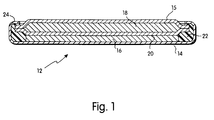
- the present invention contemplates a cell, such as cell 12 of Fig. 1, having within a conductive container 14 and cover 15, an anode 16 and a cathode particle mix 18.
- a separator 20 which includes an electrolyte is placed between the anode and the mix.
- Container 14 is crimped at the edges 24 capturing cover 15 under an insulating gasket 22.
- the cells so formed may be configured for either parallel or series operation.
- the compounds of structural formula I which are useful as the charge carrying material in nonaqueous electrolytes are those in which M n+ is an ion of Li, Mg, or Al. Of these, Mg is preferred, and Li is most preferred.
- the groups Y Y', and Y'' are preferably SO2 moieties.
- the groups R, R', and R'' each preferably contains one or two carbon atoms, with one carbon atom being most preferred. These groups are preferably halogenated with fluorine and chlorine, the most preferred halogen being fluorine, and are preferably perhalogenated.
- the -Y''-R'' group is replaced with Z, which is a strongly electron-withdrawing substituent selected from the group consisting of -NO2, -CN, -F, and perfluorinated alkyls and aryls containing no more than 8 carbons.
- the strongly electron-withdrawing substituent has an assigned Hammett sigma(meta) value greater than +0.4. Reference is made to C.D. Ritchie and W.F. Sager in Prog. Phys. Org. Chem., Vol. 2, p. 323 (1964), for definitions and a partial list of substituents.
- the anode 16 of the electrochemical cell is preferably lithium metal. It may be used as a pure foil, carried on aluminum foil backing or pressed into an expanded metal screen and alloyed with various other metals.
- the lithium may also be intercalated into a host material such as carbon or inorganic and/or organic low potential host materials that are intercalatable.
- the cathodes 18 of the electrochemical cell of the invention are generally particles of an active material bound into a plastic material such as ethylene/proplyene/diene monomer (EPDM) terpolymer, or particles of an active material mixed in a binder of carbon, emulsified Teflon, or both, which is in turn pressed into an expanded metal screen.
- a plastic material such as ethylene/proplyene/diene monomer (EPDM) terpolymer
- EPDM ethylene/proplyene/diene monomer
- Teflon emulsified Teflon
- the active material of the cathode of a primary battery may be any of the commonly employed reducible materials such as MnO2, CuCl2, CoO2, CF x , etc.
- the active material of the cathode of a rechargeable electrochemical cell or battery is generally either a cathodic host material such as TiS2, NbSe3, MnO2, TaS2, MoS3, MoS2, V6O13, V2O5, FeS2, CoO2, Cr3O8 etc. or an organic polymer such as polyaniline or polythiophene.
- discharge involves oxidation of the active metal of the anode, corresponding reduction of the cathodic host material, and neutralization of the charge on the cathode by migration of the ions of anodic material into host planes or channels of the cathodic host material, where they take up residence.
- the metallic ions of the anodic material leave the cathodic host material and return to the anode where they are reduced, and the cathodic host material is reoxidized.
- the preferred cathodic materials of this invention are TiS2 which is a layered (lamellar or planar) compound and various phases, mixed phases and stoichiometries of the oxides of manganese, vanadium, cobalt and nickel.
- the cathode of the electrochemical cell or battery of the invention may include polymeric material and an ionizable compound of the invention to provide the requisite ionic conductivity.
- polymeric active cathode material may contain functionalities which are able to be oxidized and reduced.
- fluorinated sulfonylfluoride materials useful for the synthesis of the compounds of this invention are available from 3M Industrial Chemical Products Division Laboratory, St. Paul, Minnesota. Methylheptafluoropropyl ketone is commercially available from PCR Inc., Gainesville, Florida. Bis-(trifluoromethylsulfonyl)methane employed in the synthesis below is available from 3M.
- This material was prepared substantially according to the method of Turowsky and Seppelt to yield the acidic trisubstituted methane, which was in turn converted to the lithium salt.
- 48 ml (0.144 moles) of 3M methylmagnesium chloride Grignard reagent in THF was added slowly with cooling to 20 g (0.072 moles) of bis-(trifluoromethylsulfonyl)methane in 150 ml of THF, under an argon atmosphere in a glove box.
- a fine white precipitate of (CF3SO2)2C2 ⁇ (MgCl+)2 began to form.
- This slurry was transferred to a Parr bomb, which was sealed and chilled to about -40°C.
- methylmagnesium chloride Grignard reagent is added slowly at room temperature to dimethyl sulfone in THF under an inert atmosphere. The mixture is transferred to a Parr bomb and chilled to about -60°C. One equivalent of perfluoromethylsulfonyl fluoride is added. The bomb is sealed, warmed to about 70°C, held at that temperature for about 48 hours, and occasionally stirred. It is then cooled to room temperature, and the pressure is released. Two equivalents of a weak hindered base are added to remove the more acidic protons of the central carbon. One equivalent of perfluoromethylsulfonyl fluoride is condensed in.
- the bomb is resealed, warmed to 70°C, and held at that temperature for about 48 hours. After the bomb is cooled to room temperature and the pressure released, the resulting solution is acidified to a pH of about 1 with aqueous HCl and extracted three times into ether. The ether is removed under vacuum and the residue is distilled under vacuum and condensed onto a cool surface to obtain the parent acid. Titration with lithium methoxide in anhydrous methanol and removal of solvent yields the desired new lithium salt.
- Trifluoromethylsulfonyl fluoride is reacted with one equivalent of methylmagnesiumbromide Grignard reagent to yield methyl trifluoromethylsulfone, which is in turn treated with one equivalent of a sterically hindered base such as LDA to remove a proton and form the anion of the sulfone.
- a halogenated or fluorinated material containing two terminal sulfonyl fluoride moieties is added to form a disulfone having a terminal sulfonyl fluoride group.
- the resulting anion undergoes ring closure, forming the desired trisubstituted methane.
- the reaction mixture is acidified, the product is extracted into ether, and finally titrated with lithium methoxide in methanol to yield the desired methide salt.
- Pentafluorophenylsulfonyl fluoride is treated with one equivalent of methylmagnesium bromide to yield the expected pentafluorophenylmethyl sulfone. This is then treated with a second equivalent of Grignard reagent and the intermediate which forms is allowed to react with a halogenated or fluorinated alkylsulfonylfluoride to form a disulfone. Treating this further with Grignard reagent and halogenated alkylsulfonyl fluoride produces the desired trisubstituted methane. This is acidified, extracted into ether, and converted to the corresponding lithium salt as before.
- 1,1,1,5,5,5-hexafluoro-2,4-pentanedione is treated with two equivalents of LDA to produce the expected dianion. This is in turn treated with one equivalent of perfluoroacetylfluoride to produce the desired product in crude form.
- the reaction mixture is acidified and the trisubstituted methane product is extracted into ether, sublimed, and subsequently titrated with lithium methoxide in methanol to yield the desired methide salt.
- An unsymmetrical methyl ketone such as methylheptafluoropropyl ketone is treated successively with an equivalent of a hindered base such as LDA then with a halogenated or fluorinated acid halide or fluoride to produce an intermediate ⁇ -diketone.
- a hindered base such as LDA
- a halogenated or fluorinated acid halide or fluoride to produce an intermediate ⁇ -diketone.
- This is again treated with an equivalent of hindered base and a halogenated acid halide to form the desired trisubstituted methane.
- the reaction mixture is subsequently acidified, the product is extracted into ether, and then treated with lithium methoxide in methanol to form the desired lithium methide salt.
- salts of other metals such as Mg, Al are prepared similarly, by titrating the acidic trisubstituted methane with a solution of a basic salt of the metal of interest.
- Nonaqueous titrations in solvents such as methanol are preferred because of the relative ease of solvent removal.
- the reactions can also be carried out in aqueous solution and the desired salts recovered by removal of the water under vacuum and gentle heating.
- a compound of the invention is employed in a battery electrolyte by dissolving it in an appropriate anhydrous solvent to give a conductive solution, and employing this solution as the electrolyte in an electrochemical cell or battery constructed as known to the art.
- the salt is preferably employed at a concentration such that the conductivity of the electrolyte solution is at or near its maximum value, although a wide range of other concentrations will also serve.
- Electrolytes for use in rechargeable or secondary batteries must contain a metal ion of the anode active material.
- the electrolyte will contain anions of the invention, but the cations of the electrolyte salt or salts may under certain circumstances be materials other than the metal ion of the anode active material, provided that the salt or salts employed meet the commonly accepted requirements of primary nonaqueous battery electrolytes. These requirements include, but are not restricted to, providing sufficiently highly conducting electrolyte solutions, having electrolyte solutions which are stable in contact with the anode, and having electrolyte solutions which provide acceptable kinetics of reaction with the cathode during cell discharge.
- Experimental lithium cells were fabricated according to the invention.
- the cells were cathode limited with a cathode capacity of 4.5 mAh/cm2.
- the active material in the cathode was TiS2 and the electrolyte was 1.5 molar LiC(CF3SO2)3 in base-treated tetrahydrofuran.
- a Celgard 2400 separator was used.
- the open circuit voltages of the filled cells were 3.0 volts.
- the experimental cells yielded over twenty discharge-charge cycles with unpurified LiC(CF3SO2)3 indicating viability of the new salt for both primary and secondary applications.
- a cell comprising a Li anode, TiS2 cathode and LiC(CF3SO2)3 in a polymer matrix of poly(bis-(methoxyethoxyethoxide)phosphazene), i.e. MEEP which had a ratio of MEEP monomer to salt of 5-to-1 achieved over thirty-six discharge-charge cycles.
Landscapes
- Chemical & Material Sciences (AREA)
- Organic Chemistry (AREA)
- Electrochemistry (AREA)
- Engineering & Computer Science (AREA)
- Manufacturing & Machinery (AREA)
- Chemical Kinetics & Catalysis (AREA)
- General Chemical & Material Sciences (AREA)
- Dispersion Chemistry (AREA)
- General Physics & Mathematics (AREA)
- Inorganic Chemistry (AREA)
- Physics & Mathematics (AREA)
- Condensed Matter Physics & Semiconductors (AREA)
- Secondary Cells (AREA)
- Primary Cells (AREA)
Abstract
Description
- This invention pertains to electrochemical generators employing typically light metal anodes, and more particularly, to electrolyte salts for use in non-aqueous electrolytes employed therein, and to electrochemical cells or batteries employing such electrolytes.
- This invention was made with government support under Grant No. ISI-8660048 awarded by the National Science Foundation. The government has certain rights in this invention.
- A battery is an electrochemical generator containing one or more galvanic cells in a finished package. Each individual cell is made up of an anode and a cathode made of dissimilar materials and separated by an electrolyte. In operation, the respective electrodes are connected via an external circuit which includes a device in which useful work is to be done, in the case of a discharging cell, or which is capable of doing work on the cell, for the case of a cell which is being recharged. The electrical circuit is completed by the electrolyte, which contains ionic species which transfer charge between the electrodes when the cell is discharging or charging.
- Primary batteries are devices initially assembled with high energy chemical compounds, sold in their charged state, and discarded without being recharged after the stored chemical energy has been withdrawn as electrical energy. Secondary batteries are rechargeable devices in which the chemical conditions of the undischarged battery can be restored by applying a current through the cells in the opposite direction from the current flow of the battery in its discharging mode.
- The light atomic weight metals employed in light metal anode electrochemical cells are highly electrochemically reducing materials. Their use precludes the use of water or other weakly proton-donating solvents as well as numerous solvents which decompose or fail to form passivating films upon exposure to the anode. Nonaqueous matrices are therefore required in cells employing such light metal anodes. Such nonaqueous matrices may be either nonaqueous liquids or certain polymeric materials in which the conductive salts may be included. Typical solvents include tetrahydrofuran, 2-methyltetrahydrofuran, ethylene carbonate, propylene carbonate, dioxolane, 4-methyldioxolane, 1,2-dimethoxyethane, sulfolane, -butyrolactone, methylformate, methyl acetate, diethylcarbonate acetonitrile and sulfur dioxide. Commonly used polymeric solvents include numerous polyethers and ether-containing polymers.
- The ionizable salts employed in nonaqueous electrolytes have generally utilized anions such as BF₄⁻, PF₆⁻, AsF₆⁻, ClO₄⁻, AlCl₄⁻, SbF₆⁻, CF₃SO₃⁻, (CF₃SO₂)₂N⁻, and ⁻B(A)x(A')y where A is alkyl, A' is aryl, and

- U.S. Patent No. 4,505,997 of Armand discloses bis-(perhalogenoacyl or perhalogenosulfonyl) imides of certain metals, for use in battery electrolytes. Armand's compounds have the general formula (CnX2n+1Y)₂N⁻M⁺ in which X is a halogen, n is an integer from 1-4, Y is a CO or SO₂ group, and M is an alkali metal, preferably lithium or sodium, and possibly potassium. These materials appear to offer good thermal stability, but their conductivities in nonaqueous matrices are lower than desirable.
- In a paper by Turowsky and Seppelt published in Inorg. Chem., 27, 2135-2137 (1988), the trisubstituted methane compound (CF₃SO₂)₃CH and four of its salts were disclosed in the context of an attempt to form a stable xenon-carbon bond. In the course of the investigation the K, Rb, Cs, and Ag salts of the tris-(trifluoromethylsulfonyl) methane were prepared. Although the related anion (CF₃SO₂)₂N⁻ had been reported to form a chemical bond to xenon, Turowsky and Seppelt were unsuccessful in achieving a carbon-xenon bond with their compound. The ability of (CF₃SO₂)N⁻ to form Xe-N bonds indicates the nitrogen is quite electrophilic, even though it is the formal site of negative charge, and that the electron density is actually quite delocalized through the anion. Negative charge delocalization is a property shared by the anions of highly conductive Li salts of organic anions. The failure of (CF₃SO₂)₃C⁻ to bond to xenon suggests the central carbon retains greater negative charge density and would suggest that Li(CF₃SO₂)₃ would exhibit low conductivities.
- U.S. Patent No. 4,049,861 of Nozari genetically discloses highly fluorinated aliphatic sulfonic and sulfonylic compounds as catalysts useful in the preparation of abrasion resistant coatings. The compound (CF₃SO₂)₃CH was exemplified in a table, and metal salts of this and related compounds containing highly fluorinated alkyl groups are mentioned. This reference does not teach how to make any of the compounds within its generic disclosure, and does not suggest that such compounds have any other uses besides the catalytic utility disclosed.
- A need exists for improved electrolyte salts for use in electrochemical cells which employ light metal anodes, for electrolytes containing such salts, and for improved batteries containing such electrolytes. Such improved electrolyte salts, electrolytes, and batteries are subject of the present invention.
- According to the present invention electrochemical cells and batteries are provided having electrolytes formed from conductive salts of improved properties for such applications. The electrochemical cells or batteries have anodes which are made of or include metals of typically light atomic weight.
- The salts of the invention in addition to having surprisingly high conductivities, offer the advantages of improved thermal stability, and nonaqueous electrolytes which include these salts possess generally improved conductivities. The relatively high electrolyte conductivities presumably result from low ion pairing tendencies of the anions, as a result of reduced negative charge density in the central carbon atom by the three strongly electron withdrawing substituent groups attached thereto. Steric hindrance probably also leads to reduced ion pairing which avoids the resulting degradation in electrolyte performance. A related advantage is that the conductive salts of the invention are generally quite soluble in the nonaqueous matrices employed in the electrolytes. For example, LiC(CF₃SO₂)₃ is soluble in CH₃CN to at least 5M. The high concentrations of salt which are therefore obtainable in the electrolyte result in low concentration polarization effects during the operation of electrochemical cells containing such electrolytes.
- An exemplary compound of the invention useful as electrolytes in nonaqueous matrices have the formula shown as I below.

In formula I, the symbol Mn+ indicates an ion of a Li, Mg or Al (metal of typically light atomic weight.) The groups Y, Y', and Y'' each may be an 〉SO₂ or 〉CO moiety. The groups R and R' are separate halogenated alkyl groups of 1-4 carbon atoms, respectively, or are joined together to constitute a halogenated alkylene radical of from 2-4 carbon atoms linking the groups Y and Y' and forming a ring structure which includes R, R', Y, Y' and the carbon atom to which Y and Y' are attached. The group R'' is an alkyl radical of 1-4 carbon atoms, a haloalkyl radical of 1-4 carbon atoms, or a halogenated phenyl group. In another exemplary compound, the -Y''-R'' group is replaced by Z, which is an electron-withdrawing substituent selected from the group consisting of -NO₂, -CN, -F, and perfluorinated alkyls and aryls containing no more than 8 carbons. Z may also be substituent having an assigned Hammet sigma(meta) value greater than +0.4. The subscript n is an integer of 1-3 which depends on the identity of metal ion Mn+. - An electrochemical cell or battery of the invention comprises an anode, a cathode, and a nonaqueous electrolyte which includes an ionizable compound as described above, in contact with the anode and cathode.
- The invention will be more completely understood from a consideration of the following detailed description taken in conjunction with the drawing, in which:
- Fig. 1 shows an arrangement of components of a cell utilizing the present invention.
- The present invention contemplates a cell, such as
cell 12 of Fig. 1, having within aconductive container 14 andcover 15, ananode 16 and acathode particle mix 18. Aseparator 20 which includes an electrolyte is placed between the anode and the mix.Container 14 is crimped at theedges 24 capturingcover 15 under aninsulating gasket 22. The cells so formed may be configured for either parallel or series operation. - The salt bearing electrolytes in one exemplary embodiment having the formula:

The compounds of structural formula I which are useful as the charge carrying material in nonaqueous electrolytes are those in which Mn+ is an ion of Li, Mg, or Al. Of these, Mg is preferred, and Li is most preferred. - The groups Y Y', and Y'' are preferably SO₂ moieties.
- The groups R, R', and R'' each preferably contains one or two carbon atoms, with one carbon atom being most preferred. These groups are preferably halogenated with fluorine and chlorine, the most preferred halogen being fluorine, and are preferably perhalogenated.
- In another exemplary compound of the invention useful as a salt-bearing electrolyte, the -Y''-R'' group is replaced with Z, which is a strongly electron-withdrawing substituent selected from the group consisting of -NO₂, -CN, -F, and perfluorinated alkyls and aryls containing no more than 8 carbons. In a further exemplary compound, the strongly electron-withdrawing substituent has an assigned Hammett sigma(meta) value greater than +0.4. Reference is made to C.D. Ritchie and W.F. Sager in Prog. Phys. Org. Chem., Vol. 2, p. 323 (1964), for definitions and a partial list of substituents.
- The
anode 16 of the electrochemical cell is preferably lithium metal. It may be used as a pure foil, carried on aluminum foil backing or pressed into an expanded metal screen and alloyed with various other metals. The lithium may also be intercalated into a host material such as carbon or inorganic and/or organic low potential host materials that are intercalatable. - The
cathodes 18 of the electrochemical cell of the invention are generally particles of an active material bound into a plastic material such as ethylene/proplyene/diene monomer (EPDM) terpolymer, or particles of an active material mixed in a binder of carbon, emulsified Teflon, or both, which is in turn pressed into an expanded metal screen. In polymer electrolyte batteries the polymer electrolyte can act as the active material binder. - The active material of the cathode of a primary battery may be any of the commonly employed reducible materials such as MnO₂, CuCl₂, CoO₂, CFx, etc. The active material of the cathode of a rechargeable electrochemical cell or battery is generally either a cathodic host material such as TiS₂, NbSe₃, MnO₂, TaS₂, MoS₃, MoS₂, V₆O₁₃, V₂O₅, FeS₂, CoO₂, Cr₃O₈ etc. or an organic polymer such as polyaniline or polythiophene.
- In such a rechargeable electrochemical cell or battery, discharge involves oxidation of the active metal of the anode, corresponding reduction of the cathodic host material, and neutralization of the charge on the cathode by migration of the ions of anodic material into host planes or channels of the cathodic host material, where they take up residence. On recharging, the metallic ions of the anodic material leave the cathodic host material and return to the anode where they are reduced, and the cathodic host material is reoxidized.
- The preferred cathodic materials of this invention are TiS₂ which is a layered (lamellar or planar) compound and various phases, mixed phases and stoichiometries of the oxides of manganese, vanadium, cobalt and nickel.
- The cathode of the electrochemical cell or battery of the invention may include polymeric material and an ionizable compound of the invention to provide the requisite ionic conductivity. Alternatively polymeric active cathode material may contain functionalities which are able to be oxidized and reduced.
- A variety of fluorinated sulfonylfluoride materials useful for the synthesis of the compounds of this invention are available from 3M Industrial Chemical Products Division Laboratory, St. Paul, Minnesota. Methylheptafluoropropyl ketone is commercially available from PCR Inc., Gainesville, Florida. Bis-(trifluoromethylsulfonyl)methane employed in the synthesis below is available from 3M.
-

This material was prepared substantially according to the method of Turowsky and Seppelt to yield the acidic trisubstituted methane, which was in turn converted to the lithium salt. 48 ml (0.144 moles) of 3M methylmagnesium chloride Grignard reagent in THF was added slowly with cooling to 20 g (0.072 moles) of bis-(trifluoromethylsulfonyl)methane in 150 ml of THF, under an argon atmosphere in a glove box. Near the end of the Grignard reagent addition step a fine white precipitate of (CF₃SO₂)₂C²⁻(MgCl⁺)₂ began to form. This slurry was transferred to a Parr bomb, which was sealed and chilled to about -40°C. To this was added 16.4 g (0.108 moles) of CF₃SO₂F through a valve, and the apparatus was then hermetically sealed. The bomb was warmed to 70°C, held at this temperature and 120-140 psi for 48 hours, cooled to room temperature, and opened. The solvent and volatiles were removed under vacuum, and the remaining solids were dissolved in water and acidified to a pH of less than 1. The resulting two-phase system was extracted three times with ether, the solvent was removed, and the crude tris(trifluoromethylsulfonyl)methane product was stored in a freezer and subsequently distilled under vacuum at about 70°C and condensed on a cold finger cooled by acetone/dry ice. The resulting purified product was titrated with lithium methoxide in methanol to yield the corresponding lithium salt in 50% yield. Characterization: The melting point = 268°C; ¹³C NMR evaluation in acetone d₆ shows resonances at +123.27 PPM and at +119.08 PPM relative to TMS. The FTIR spectrum is essentially identical to that of the Cs salt. -

One equivalent of methylmagnesium chloride Grignard reagent is added slowly at room temperature to dimethyl sulfone in THF under an inert atmosphere. The mixture is transferred to a Parr bomb and chilled to about -60°C. One equivalent of perfluoromethylsulfonyl fluoride is added. The bomb is sealed, warmed to about 70°C, held at that temperature for about 48 hours, and occasionally stirred. It is then cooled to room temperature, and the pressure is released. Two equivalents of a weak hindered base are added to remove the more acidic protons of the central carbon. One equivalent of perfluoromethylsulfonyl fluoride is condensed in. The bomb is resealed, warmed to 70°C, and held at that temperature for about 48 hours. After the bomb is cooled to room temperature and the pressure released, the resulting solution is acidified to a pH of about 1 with aqueous HCl and extracted three times into ether. The ether is removed under vacuum and the residue is distilled under vacuum and condensed onto a cool surface to obtain the parent acid. Titration with lithium methoxide in anhydrous methanol and removal of solvent yields the desired new lithium salt. -

Trifluoromethylsulfonyl fluoride is reacted with one equivalent of methylmagnesiumbromide Grignard reagent to yield methyl trifluoromethylsulfone, which is in turn treated with one equivalent of a sterically hindered base such as LDA to remove a proton and form the anion of the sulfone. A halogenated or fluorinated material containing two terminal sulfonyl fluoride moieties is added to form a disulfone having a terminal sulfonyl fluoride group. Upon addition of a further equivalent of hindered base to remove one of the protons between the two sulfone moieties, the resulting anion undergoes ring closure, forming the desired trisubstituted methane. The reaction mixture is acidified, the product is extracted into ether, and finally titrated with lithium methoxide in methanol to yield the desired methide salt. -

Pentafluorophenylsulfonyl fluoride is treated with one equivalent of methylmagnesium bromide to yield the expected pentafluorophenylmethyl sulfone. This is then treated with a second equivalent of Grignard reagent and the intermediate which forms is allowed to react with a halogenated or fluorinated alkylsulfonylfluoride to form a disulfone. Treating this further with Grignard reagent and halogenated alkylsulfonyl fluoride produces the desired trisubstituted methane. This is acidified, extracted into ether, and converted to the corresponding lithium salt as before. -

1,1,1,5,5,5-hexafluoro-2,4-pentanedione is treated with two equivalents of LDA to produce the expected dianion. This is in turn treated with one equivalent of perfluoroacetylfluoride to produce the desired product in crude form. The reaction mixture is acidified and the trisubstituted methane product is extracted into ether, sublimed, and subsequently titrated with lithium methoxide in methanol to yield the desired methide salt. -

An unsymmetrical methyl ketone such as methylheptafluoropropyl ketone is treated successively with an equivalent of a hindered base such as LDA then with a halogenated or fluorinated acid halide or fluoride to produce an intermediate β-diketone. This is again treated with an equivalent of hindered base and a halogenated acid halide to form the desired trisubstituted methane. The reaction mixture is subsequently acidified, the product is extracted into ether, and then treated with lithium methoxide in methanol to form the desired lithium methide salt. - Although the above examples illustrate the preparation of a variety of lithium methide salts, salts of other metals such as Mg, Al are prepared similarly, by titrating the acidic trisubstituted methane with a solution of a basic salt of the metal of interest. Nonaqueous titrations in solvents such as methanol are preferred because of the relative ease of solvent removal. However, the reactions can also be carried out in aqueous solution and the desired salts recovered by removal of the water under vacuum and gentle heating.
- A compound of the invention is employed in a battery electrolyte by dissolving it in an appropriate anhydrous solvent to give a conductive solution, and employing this solution as the electrolyte in an electrochemical cell or battery constructed as known to the art. The salt is preferably employed at a concentration such that the conductivity of the electrolyte solution is at or near its maximum value, although a wide range of other concentrations will also serve.
- Electrolytes for use in rechargeable or secondary batteries must contain a metal ion of the anode active material. In the case of primary batteries, the electrolyte will contain anions of the invention, but the cations of the electrolyte salt or salts may under certain circumstances be materials other than the metal ion of the anode active material, provided that the salt or salts employed meet the commonly accepted requirements of primary nonaqueous battery electrolytes. These requirements include, but are not restricted to, providing sufficiently highly conducting electrolyte solutions, having electrolyte solutions which are stable in contact with the anode, and having electrolyte solutions which provide acceptable kinetics of reaction with the cathode during cell discharge.
- Conductivities were measured for three 1.0M lithium salts in tetrahydrofuran at 25°C. The results are presented in the Table below.
Salt Conductivity (Acm⁻¹) LiCF₃SO₃ (Triflate) 6.0x10⁻⁴ LiN(CF₃SO₂)₂ (Imide) 1.0x10⁻² LiC(CF₃SO₂)₃ (Methide) 1.2x10⁻² - Experimental lithium cells were fabricated according to the invention. The cells were cathode limited with a cathode capacity of 4.5 mAh/cm². The active material in the cathode was TiS₂ and the electrolyte was 1.5 molar LiC(CF₃SO₂)₃ in base-treated tetrahydrofuran. A Celgard 2400 separator was used. The open circuit voltages of the filled cells were 3.0 volts. The experimental cells yielded over twenty discharge-charge cycles with unpurified LiC(CF₃SO₂)₃ indicating viability of the new salt for both primary and secondary applications.
- Polymer electrolyte cells were also prepared and tested. A cell comprising a Li anode, TiS₂ cathode and LiC(CF₃SO₂)₃ in a polymer matrix of poly(bis-(methoxyethoxyethoxide)phosphazene), i.e. MEEP which had a ratio of MEEP monomer to salt of 5-to-1 achieved over thirty-six discharge-charge cycles.
Claims (39)
- A compound for use as an electrolyte in an electrochemical cell, this compound having the formula

Y, Y' and Y'' are each selected from the group consisting of 〉SO₂ and 〉CO;
R and R' are separate halogenated alkyl groups of 1-4 carbon atoms, respectively, or are joined together to constitute a unitary halogenated alkylene radical of from 2-4 carbon atoms linking Y and Y' and forming a ring structure which included R, R', Y, Y', and the carbon atom to which Y and Y⁻' are attached; and
R'' is selected from the group consisting of alkyl radicals of 1-4 carbon atoms, haloalkyl radicals of 1-4 carbon atoms, and halogenated phenyl groups. - The compound of claim 1 wherein at least two of Y, Y' and Y'' are 〉SO₂ groups.
- The compound of claim 1 wherein Y, Y' and Y'' are 〉SO₂ groups.
- The compound of claim 1, wherein R and R' contain halogen atoms selected from the group consisting of fluorine and chlorine, and are perhalogenated.
- The compound of claim 1, wherein R, R', and R'' contain halogen atoms selected from the group consisting of fluorine and chlorine.
- The compound of claim 1 wherein R, R', and R'' are perfluorinated.
- The compound of claim 1 wherein R, R', and R'' each contain 1 or 2 carbon atoms.
- The compound of the structure of claim 1, and further being a tris(trifluoromethylsulfonyl)methide salt.
- The compound of the structure of claim 1, and further being lithium tris(trifluoromethylsulfonyl)methide.
- An electrochemical cell, comprising
an anode;
a cathode; and
an electrolyte which comprises a nonaqueous matrix and an ionizable compound, said ionizable compound being in said nonaqueous matrix and having the formula
Mn+ is an ion of a metal selected from the group consisting of Li, Mg, and Al;
Y, Y' and Y'' are each selected from the group consisting of 〉SO₂ and 〉CO;
R and R' are separate halogenated alkyl groups of 1-4 carbon atoms, respectively, or are joined together to constitute a unitary halogenated alkylene radical of from 2-4 carbon atoms linking Y and Y' and forming a ring structure which includes R, R', Y, Y', and the carbon atoms to which Y and Y' are attached;
R'' is selected from the group consisting of alkyl radicals of 1-4 carbon atoms, haloalkyl radicals of 1-4 carbon atoms, and halogenated phenyl groups; and
n is an integer of 1-3 depending on the identity of metal M; said electrolyte contacting both said anode and said cathode. - The electrochemical cell of claim 10 wherein said anode comprises Li⁺.
- The electrochemical cell of claim 10 wherein said cathode comprises polymeric material and said ionizable compound.
- The electrochemical cell of claim 12 wherein said polymeric material included functionalities which may be oxidized and reduced.
- The electrochemical cell of claim 10 wherein said ionizable compound Mn+ is Li⁺.
- The electrochemical cell of claim 10 wherein said ionizable compound at least two of Y, Y', and Y'' are 〉SO₂ groups.
- The electrochemical cell of claim 10 wherein in said ionizable compound, Y, Y' and Y'' are 〉SO₂ groups.
- The electrochemical cell of claim 10 wherein in said ionizable compound, R and R' contain halogen atoms selected from the group consisting of fluorine and chlorine, and are perhalogenated.
- The electrochemical cell of claim 10 wherein in said ionizable compound, R, R', and R'' contain halogen atoms selected from the group consisting of fluorine and chlorine.
- The electrochemical cell of claim 10 wherein in said ionizable compound, R, R' , and R'' are perfluorinated.
- The electrochemical cell of claim 10 wherein in said ionizable compound, R, R', and R'' each contains 1-2 carbon atoms.
- The electrochemical cell of claim 10 wherein the non-aqueous matrix of said electrolyte is a nonaqueous liquid.
- The electrochemical cell of claim 10 wherein the non-aqueous matrix of said electrolyte comprises a polymer.
- The electrochemical cell of claim 10 wherein said ionizable compound comprises a tris(trifluoromethylsulfonyl)-methide salt.
- The electrochemical cell of claim 10 wherein said electrolyte comprises lithium tris(trifluoromethylsulfonyl)-methide.
- A composition for use as an electrolyte, comprising: a nonaqueous matrix; and
an ionizable compound, said ionizable compound being in said nonaqueous matrix and having the formula
Mn+ is an ion of a metal selected from the group consisting of Li, Mg, and Al;
Y, Y' and Y'' are each selected from the group consisting of 〉SO₂ and 〉CO;
R and R' are separate halogenated alkyl groups of 1-4 carbon atoms, respectively, or are joined together to constitute a unitary halogenated alkylene radical of from 2-4 carbon atoms linking Y and Y' and forming a ring structure which includes R, R', Y, Y', and the carbon atom to which Y and Y' are attached;
R'' is selected from the group consisting of alkyl radicals of 1-4 carbon atoms, haloalkyl radicals of 1-4 carbon atoms, and halogenated phenyl groups; and
n is an integer of 1-3 depending on the identity of metal M. - The composition of claim 25 wherein Mn+ is Li⁺.
- The composition of claim 25 further comprising polymeric material and said ionizable compound.
- The composition of claim 27 wherein said polymeric material includes functionalities which may be oxidized and reduced.
- The composition of claim 25 wherein in said ionizable compound at least two of Y, Y' and Y'' are 〉SO₂ groups.
- The composition of claim 25 wherein in said ionizable compound, Y, Y' and Y'' are 〉SO₂ groups.
- The composition of claim 25 wherein in said ionizable compound, R and R' contain halogen atoms selected from the group consisting of fluorine and chlorine, and are perhalogenated.
- The composition of claim 25 wherein in said ionizable compound, R, R' and R'' contain halogen atoms selected from the group consisting of fluorine and chlorine.
- The composition of claim 25 wherein in said ionizable compound, R, R' and R'' are perfluorinated.
- The composition of claim 25 wherein in said ionizable compound, R, R' and R'' each contains 1-2 carbon atoms.
- The composition of claim 25 wherein the nonaqueous matrix of said electrolyte is a nonaqueous liquid.
- The composition of claim 25 wherein the nonaqueous matrix of said electrolyte comprises a polymer.
- The composition of claim 25 wherein said ionizable compound comprises a tris(trifluoromethylsulfonyl)-methide salt.
- The composition according to claim 25 and further being lithium tris(trifluoromethylsulfonyl)-methide.
- A compound having the formula:

Mn+ is an ion of a metal selected from the group consisting of Li, Mg, and Al;
Y and Y' are each selected from the group consisting of 〉SO₂ and 〉CO₂;
R and R' are separate halogenated alkyl groups of 1-4 carbon atoms, respectively, or are joined together to constitute a unitary halogenated alkylene radical of from 2-4 carbon atoms linking Y and Y' and forming a ring structure which includes R, R', Y, Y', and the carbon atom to which Y and Y' are attached;
Z is a strongly electron withdrawing substituent selected from the group consisting of -NO₂, -CN, -F, and perfluorinated alkyls and aryls containing no more than 8 carbons; and n is an integer of 1-3.
Applications Claiming Priority (5)
| Application Number | Priority Date | Filing Date | Title |
|---|---|---|---|
| US56106290A | 1990-08-01 | 1990-08-01 | |
| US561062 | 1990-08-01 | ||
| US726642 | 1991-07-12 | ||
| US07/726,642 US5273840A (en) | 1990-08-01 | 1991-07-12 | Methide salts, formulations, electrolytes and batteries formed therefrom |
| PCT/US1991/005262 WO1992002966A1 (en) | 1990-08-01 | 1991-07-25 | Methide salts, formulations, electrolytes and batteries formed therefrom |
Publications (3)
| Publication Number | Publication Date |
|---|---|
| EP0495073A1 EP0495073A1 (en) | 1992-07-22 |
| EP0495073A4 EP0495073A4 (en) | 1993-02-24 |
| EP0495073B1 true EP0495073B1 (en) | 1995-05-17 |
Family
ID=27072539
Family Applications (1)
| Application Number | Title | Priority Date | Filing Date |
|---|---|---|---|
| EP91915060A Expired - Lifetime EP0495073B1 (en) | 1990-08-01 | 1991-07-25 | Li, mg and al- methide salts, formulations, electrolytes and batteries formed therefrom |
Country Status (7)
| Country | Link |
|---|---|
| US (1) | US5273840A (en) |
| EP (1) | EP0495073B1 (en) |
| JP (1) | JPH05503808A (en) |
| CA (1) | CA2067751C (en) |
| DE (1) | DE69109847T2 (en) |
| IL (1) | IL98959A (en) |
| WO (1) | WO1992002966A1 (en) |
Families Citing this family (82)
| Publication number | Priority date | Publication date | Assignee | Title |
|---|---|---|---|---|
| WO1991020104A1 (en) * | 1990-06-12 | 1991-12-26 | Hitachi Maxell, Ltd. | Organic electrolytic battery |
| FR2683524A1 (en) * | 1991-11-08 | 1993-05-14 | Centre Nat Rech Scient | DERIVATIVES OF BIS (PERFLUOROSULFONYL) METHANES, THEIR METHOD OF PREPARATION, AND THEIR USES. |
| US5352547A (en) * | 1992-08-27 | 1994-10-04 | Hitachi Maxell, Ltd. | Organic electrolytic solution and organic electrolytic solution cell |
| DE4317032A1 (en) * | 1993-05-21 | 1994-11-24 | Varta Batterie | Rechargeable galvanic lithium cell |
| US5411820A (en) * | 1993-06-08 | 1995-05-02 | Valence Technology, Inc. | Solid, glyme-containing electrolytes including ion salt derivatives and electrolytic cells produced therefrom |
| US5486435A (en) * | 1994-01-25 | 1996-01-23 | Hydro-Quebec | Additives for extruding polymer electrolytes |
| US5538812A (en) * | 1994-02-04 | 1996-07-23 | Moltech Corporation | Electrolyte materials containing highly dissociated metal ion salts |
| FR2717612B1 (en) * | 1994-03-21 | 1996-05-31 | Centre Nat Rech Scient | Ionic compound carrying a fluorosulfonyl substituent, its use for the preparation of an ionically conductive material. |
| JP3878206B2 (en) * | 1994-03-21 | 2007-02-07 | サントル・ナショナル・ドゥ・ラ・ルシェルシュ・シャンティフィク | Ionic conductive material with good corrosion resistance |
| US5376210A (en) * | 1994-03-23 | 1994-12-27 | Hydro-Quebec | Peeling aids for LPB electrolytes and method of use |
| US5536278A (en) * | 1994-03-23 | 1996-07-16 | Hydro-Quebec | Process for assembling LPB batteries |
| US5541049A (en) * | 1994-06-30 | 1996-07-30 | Minnesota Mining And Manufacturing Company | Silver halide photographic material having improved antistatic properties |
| US5755985A (en) * | 1994-09-06 | 1998-05-26 | Hydro-Quebec | LPB electrolyte compositions based on mixtures of copolymers and interpenetrated networks |
| US5541235A (en) * | 1995-03-06 | 1996-07-30 | Minnesota Mining And Manufacturing Company | Organic soluble cationic dyes with fluorinated alkylsulfonyl counterions |
| US5514493A (en) * | 1995-03-06 | 1996-05-07 | Minnesota Mining And Manufacturing Company | Perfluoroalkylsulfonates, sulfonimides, and sulfonyl methides, and electrolytes containing them |
| US5874616A (en) * | 1995-03-06 | 1999-02-23 | Minnesota Mining And Manufacturing Company | Preparation of bis (fluoroalkylenesulfonyl) imides and (fluoroalkysulfony) (fluorosulfonyl) imides |
| US5554664A (en) * | 1995-03-06 | 1996-09-10 | Minnesota Mining And Manufacturing Company | Energy-activatable salts with fluorocarbon anions |
| IT1274491B (en) * | 1995-05-12 | 1997-07-17 | Minnesota Mining & Mfg | PHOTOGRAPHIC FILM SHEET COLLECTION DEVICE |
| US5691083A (en) * | 1995-06-07 | 1997-11-25 | Eveready Battery Company, Inc. | Potassium ion additives for voltage control and performance improvement in nonaqueous cells |
| US5827602A (en) * | 1995-06-30 | 1998-10-27 | Covalent Associates Incorporated | Hydrophobic ionic liquids |
| US5691081A (en) * | 1995-09-21 | 1997-11-25 | Minnesota Mining And Manufacturing Company | Battery containing bis(perfluoroalkylsulfonyl)imide and cyclic perfluoroalkylene disulfonylimide salts |
| US5652072A (en) * | 1995-09-21 | 1997-07-29 | Minnesota Mining And Manufacturing Company | Battery containing bis(perfluoroalkylsulfonyl)imide and cyclic perfluoroalkylene disulfonylimide salts |
| US5962546A (en) † | 1996-03-26 | 1999-10-05 | 3M Innovative Properties Company | Cationically polymerizable compositions capable of being coated by electrostatic assistance |
| DE69618019T2 (en) * | 1996-03-26 | 2002-08-01 | Minnesota Mining And Mfg. Co., Saint Paul | CATIONICALLY POLYMERIZABLE COMPOSITIONS THAT CAN BE USED FOR COATING IN AN ELECTROSTATIC METHOD |
| US5980977A (en) * | 1996-12-09 | 1999-11-09 | Pinnacle Research Institute, Inc. | Method of producing high surface area metal oxynitrides as substrates in electrical energy storage |
| JP4823401B2 (en) | 1996-12-30 | 2011-11-24 | イドロ―ケベック | Perfluorinated amide salts and their use as ion-conducting substances |
| WO1999028292A1 (en) * | 1997-12-01 | 1999-06-10 | Acep Inc. | Perfluorynated sulphone salts, and their uses as ionic conduction materials |
| JP4417554B2 (en) * | 1998-03-03 | 2010-02-17 | イー・アイ・デュポン・ドウ・ヌムール・アンド・カンパニー | Highly fluorinated ionomer |
| US6063522A (en) * | 1998-03-24 | 2000-05-16 | 3M Innovative Properties Company | Electrolytes containing mixed fluorochemical/hydrocarbon imide and methide salts |
| US6350545B2 (en) * | 1998-08-25 | 2002-02-26 | 3M Innovative Properties Company | Sulfonylimide compounds |
| US6294289B1 (en) | 1998-08-25 | 2001-09-25 | 3M Innovative Properties Company | Cyano-substituted methide and amide salts |
| WO2000034344A1 (en) | 1998-12-09 | 2000-06-15 | The B.F.Goodrich Company | In mold addition polymerization of norbornene-type monomers using group 10 metal complexes |
| DE19919346A1 (en) * | 1999-04-28 | 2000-11-02 | Merck Patent Gmbh | Process for the purification of methanide electrolytes (I) |
| US6355735B1 (en) | 1999-08-17 | 2002-03-12 | 3M Innovative Properties Company | Semi-interpenetrating polymer network from epoxy monomer and olefin |
| US6372829B1 (en) | 1999-10-06 | 2002-04-16 | 3M Innovative Properties Company | Antistatic composition |
| US6587628B1 (en) | 1999-11-22 | 2003-07-01 | 3M Innovative Properties Company | Optical fiber with improved strength in high humidity/high temperature environments |
| US6592988B1 (en) | 1999-12-29 | 2003-07-15 | 3M Innovative Properties Company | Water-and oil-repellent, antistatic composition |
| US6369242B2 (en) | 2000-03-17 | 2002-04-09 | Roche Vitamins Inc. | Tocopherol manufacture by tris(perfluorohydrocarbylsulphonyl) methane or metal methides thereof |
| EP1180517B1 (en) | 2000-08-18 | 2003-07-30 | Roche Vitamins AG | Process for manufacturing (all-rac)-alpha-tocopherol |
| DE10055811A1 (en) | 2000-11-10 | 2002-05-29 | Merck Patent Gmbh | Tetrakisfluoroalkylborate salts and their use as conductive salts |
| US6518347B1 (en) | 2000-12-27 | 2003-02-11 | 3M Innovative Properties Company | Flame retardant carbonate polymers and use thereof |
| US20030054172A1 (en) * | 2001-05-10 | 2003-03-20 | 3M Innovative Properties Company | Polyoxyalkylene ammonium salts and their use as antistatic agents |
| US7807300B2 (en) * | 2006-01-31 | 2010-10-05 | Medtronic, Inc. | Resistance-stabilizing additives for electrolyte |
| DE10139409A1 (en) * | 2001-08-17 | 2003-02-27 | Merck Patent Gmbh | Polymer electrolytes and their use in galvanic cells |
| US6895156B2 (en) | 2001-10-09 | 2005-05-17 | 3M Innovative Properties Company | Small diameter, high strength optical fiber |
| US6863838B2 (en) * | 2001-10-25 | 2005-03-08 | 3M Innovative Properties Company | Zwitterionic imides |
| US6727386B2 (en) * | 2001-10-25 | 2004-04-27 | 3M Innovative Properties Company | Aromatic imide and aromatic methylidynetrissulfonyl compounds and method of making |
| US6740413B2 (en) | 2001-11-05 | 2004-05-25 | 3M Innovative Properties Company | Antistatic compositions |
| US6924329B2 (en) * | 2001-11-05 | 2005-08-02 | 3M Innovative Properties Company | Water- and oil-repellent, antistatic compositions |
| US6991718B2 (en) * | 2001-11-21 | 2006-01-31 | Sachem, Inc. | Electrochemical process for producing ionic liquids |
| TWI263235B (en) | 2002-04-02 | 2006-10-01 | Nippon Catalytic Chem Ind | Material for electrolytic solutions and use thereof |
| US7750166B2 (en) * | 2002-08-16 | 2010-07-06 | University Of South Alabama | Ionic liquids containing a sulfonate anion |
| WO2004016571A2 (en) | 2002-08-16 | 2004-02-26 | Sachem, Inc. | Lewis acid ionic liquids |
| US6852229B2 (en) * | 2002-10-22 | 2005-02-08 | Exxonmobil Research And Engineering Company | Method for preparing high-purity ionic liquids |
| EP1528580B2 (en) * | 2003-01-15 | 2015-07-01 | Nippon Shokubai Co., Ltd. | Dye-sensitized type solar cell |
| US20040265733A1 (en) * | 2003-06-30 | 2004-12-30 | Houlihan Francis M. | Photoacid generators |
| US7534527B2 (en) * | 2004-09-29 | 2009-05-19 | Skc Power Tech, Inc. | Organic lithium salt electrolytes having enhanced safety for rechargeable batteries and methods of making the same |
| US20070077488A1 (en) * | 2005-10-04 | 2007-04-05 | Kaimin Chen | Power capability of a cathode |
| US8377586B2 (en) * | 2005-10-05 | 2013-02-19 | California Institute Of Technology | Fluoride ion electrochemical cell |
| US7824805B2 (en) * | 2006-01-17 | 2010-11-02 | Medtronic, Inc. | Implantable medical device battery |
| US20070176151A1 (en) * | 2006-01-31 | 2007-08-02 | Kaimin Chen | Electrolyte additive for performance stability of batteries |
| US7820323B1 (en) | 2006-09-07 | 2010-10-26 | The United States Of America As Represented By The Secretary Of The Army | Metal borate synthesis process |
| US7833660B1 (en) | 2006-09-07 | 2010-11-16 | The United States Of America As Represented By The Secretary Of The Army | Fluorohaloborate salts, synthesis and use thereof |
| JP5186910B2 (en) * | 2006-12-20 | 2013-04-24 | セントラル硝子株式会社 | Method for producing tris (perfluoroalkanesulfonyl) methidoate |
| CN101657522B (en) * | 2007-04-13 | 2014-05-07 | 3M创新有限公司 | Antistatic optically clear pressure sensitive adhesive |
| EP2167228B1 (en) * | 2007-05-09 | 2015-07-08 | California Institute of Technology | Lithium fluoropolymer and fluoro-organic batteries |
| WO2011061728A1 (en) | 2009-11-19 | 2011-05-26 | Technion Research & Development Foundation Ltd. | Silicon-air batteries |
| US20110300367A1 (en) | 2010-06-07 | 2011-12-08 | Ching-Kee Chien | Optical Fiber With Photoacid Coating |
| KR101165535B1 (en) * | 2010-10-06 | 2012-07-16 | 삼성에스디아이 주식회사 | Electrolyte for lithium secondary battery and lithium secondary battery comprising the same |
| JP6178317B2 (en) | 2011-09-02 | 2017-08-09 | イー・アイ・デュポン・ドウ・ヌムール・アンド・カンパニーE.I.Du Pont De Nemours And Company | Lithium ion battery |
| CN103959544A (en) | 2011-09-02 | 2014-07-30 | 纳幕尔杜邦公司 | Fluorinated electrolyte compositions |
| US10044066B2 (en) | 2012-06-01 | 2018-08-07 | Solvary SA | Fluorinated electrolyte compositions |
| US10074874B2 (en) | 2012-06-01 | 2018-09-11 | Solvay Sa | Additives to improve electrolyte performance in lithium ion batteries |
| EP2864128A1 (en) | 2012-06-21 | 2015-04-29 | 3M Innovative Properties Company | A static dissipating laser engravable film |
| JP2016519400A (en) | 2013-04-04 | 2016-06-30 | イー・アイ・デュポン・ドウ・ヌムール・アンド・カンパニーE.I.Du Pont De Nemours And Company | Non-aqueous electrolyte composition |
| US9322986B2 (en) | 2013-06-24 | 2016-04-26 | Corning Incorporated | Optical fiber coating for short data network |
| WO2015051141A1 (en) * | 2013-10-04 | 2015-04-09 | E. I. Du Pont De Nemours And Company | Methods for preparation of fluorinated sulfur-containing compounds |
| TWI656111B (en) | 2015-12-31 | 2019-04-11 | Rohm And Haas Electronic Materials Llc | Photoacid generator |
| TWI662364B (en) | 2015-12-31 | 2019-06-11 | Rohm And Haas Electronic Materials Llc | Photoresist composition, coated substrate including the photoresist composition, and method of forming electronic device |
| US10707531B1 (en) | 2016-09-27 | 2020-07-07 | New Dominion Enterprises Inc. | All-inorganic solvents for electrolytes |
| US10910672B2 (en) * | 2016-11-28 | 2021-02-02 | Toyota Motor Engineering & Manufacturing North America, Inc. | High concentration electrolyte for magnesium battery having carboranyl magnesium salt in mixed ether solvent |
| DE102018118278B4 (en) | 2018-07-27 | 2025-02-20 | Novaled Gmbh | Electronic device, display device, method for producing the same and a connection |
Family Cites Families (10)
| Publication number | Priority date | Publication date | Assignee | Title |
|---|---|---|---|---|
| US4049861A (en) * | 1975-03-07 | 1977-09-20 | Minnesota Mining And Manufacturing Company | Abrasion resistant coatings |
| FR2527602A1 (en) * | 1982-06-01 | 1983-12-02 | Anvar | BIS PERHALOGENOACYL- OR SULFONYL- IMIDURES OF ALKALI METALS, THEIR SOLID SOLUTIONS WITH PLASTIC MATERIALS AND THEIR APPLICATION TO THE CONSTITUTION OF CONDUCTIVE ELEMENTS FOR ELECTROCHEMICAL GENERATORS |
| CA1173900A (en) * | 1982-06-30 | 1984-09-04 | Hydro-Quebec | Composite and flexible anodes for non aqueous lithium cells |
| US4758483A (en) * | 1983-03-11 | 1988-07-19 | Societe Nationale Elf Aquitaine | Novel macromolecular material for use in realizing electrolytes and/or electrodes |
| BR8407077A (en) * | 1983-09-20 | 1985-08-13 | Elf Aquitaine | NEW POLYCARBON SULPHECT DERIVATIVES, THEIR PREPARATION AND THEIR APPLICATIONS, ESPECIALLY IN ELECTROCHEMISTRY |
| FR2601017B1 (en) * | 1986-07-02 | 1988-09-23 | Centre Nat Rech Scient | NOVEL COMPOSITIONS BASED ON SILICA DERIVATIVES MODIFIED BY ORGANIC GROUPS, THEIR PREPARATION AND THEIR APPLICATION, IN PARTICULAR AS PROTONIC CONDUCTORS |
| FR2606218A1 (en) * | 1986-10-30 | 1988-05-06 | Elf Aquitaine | NEW IONIC CONDUCTION MATERIAL |
| FR2606216A1 (en) * | 1986-10-30 | 1988-05-06 | Elf Aquitaine | ION CONDUCTION MATERIAL |
| FR2606217B1 (en) * | 1986-10-30 | 1990-12-14 | Elf Aquitaine | NOVEL ION CONDUCTIVE MATERIAL CONSISTING OF A SALT SOLUTION IN A LIQUID ELECTROLYTE |
| US4833048A (en) * | 1988-03-31 | 1989-05-23 | The United States Of America As Represented By The United States Department Of Energy | Metal-sulfur type cell having improved positive electrode |
-
1991
- 1991-07-12 US US07/726,642 patent/US5273840A/en not_active Expired - Fee Related
- 1991-07-25 IL IL9895991A patent/IL98959A/en active IP Right Grant
- 1991-07-25 JP JP3514466A patent/JPH05503808A/en active Pending
- 1991-07-25 CA CA002067751A patent/CA2067751C/en not_active Expired - Fee Related
- 1991-07-25 EP EP91915060A patent/EP0495073B1/en not_active Expired - Lifetime
- 1991-07-25 DE DE69109847T patent/DE69109847T2/en not_active Expired - Fee Related
- 1991-07-25 WO PCT/US1991/005262 patent/WO1992002966A1/en not_active Ceased
Also Published As
| Publication number | Publication date |
|---|---|
| WO1992002966A1 (en) | 1992-02-20 |
| IL98959A0 (en) | 1992-07-15 |
| CA2067751C (en) | 1995-08-29 |
| DE69109847T2 (en) | 1995-12-07 |
| IL98959A (en) | 1996-05-14 |
| EP0495073A4 (en) | 1993-02-24 |
| EP0495073A1 (en) | 1992-07-22 |
| US5273840A (en) | 1993-12-28 |
| JPH05503808A (en) | 1993-06-17 |
| CA2067751A1 (en) | 1992-02-02 |
| DE69109847D1 (en) | 1995-06-22 |
Similar Documents
| Publication | Publication Date | Title |
|---|---|---|
| EP0495073B1 (en) | Li, mg and al- methide salts, formulations, electrolytes and batteries formed therefrom | |
| EP1442489B1 (en) | Non-aqueous electrolytes for lithium electrochemical cells | |
| EP1107951B1 (en) | Homo- or copolymeric material based on sulfonylimides possessing a polymerizable group | |
| KR100532180B1 (en) | Electrolytes Containing Mixed Fluorocarbon/Hydrocarbon Imide and Methide Salts | |
| US9991559B2 (en) | Functionalized ionic liquid electrolytes for lithium ion batteries | |
| US6294289B1 (en) | Cyano-substituted methide and amide salts | |
| EP3391454B1 (en) | Silane-functionalized ionic liquids and electrolytes comprising the same | |
| CN103004007B (en) | Electrical storage device nonaqueous solvent and nonaqueous electrolytic solution and use their electrical storage device, lithium secondary battery and double layer capacitor | |
| US9472831B2 (en) | Lithium-2-methoxy-1,1,2,2-tetrafluoro-ethanesulfonate and use thereof as conductive salt in lithium-based energy accumulators | |
| US11817558B2 (en) | Magnesium salts | |
| CA2321373A1 (en) | Fluorinated sulfonamides as low-flammability solvents for use in electrochemical cells | |
| WO2015051131A1 (en) | Methods for preparation of fluorinated ethers | |
| WO2012049780A1 (en) | Ionic liquid, lithium secondary battery electrolyte comprising the ionic liquid, and lithium secondary battery comprising the electrolyte | |
| JP2004517120A (en) | High boiling point electrolyte solvent | |
| CN102138246A (en) | Non-aqueous solvents and non-aqueous electrolytes for electrical storage devices, electrical storage devices made using them, lithium secondary batteries, and electric double-layer capacitors | |
| KR102611979B1 (en) | Sulfonimide salts for battery applications | |
| KR102651545B1 (en) | Composite membrane for Lithium battery, a cathode for lithium battery, and lithium battery comprising the same | |
| JPS6145564A (en) | Polymethyneimine battery | |
| Srour | Development of an electrolyte based on ionic liquid for lithium ion batteries | |
| PL212193B1 (en) | Application of borate compounds as receptors of anions in polymeric electrolytes and polymeric electrolyte with receptor of anions |
Legal Events
| Date | Code | Title | Description |
|---|---|---|---|
| PUAI | Public reference made under article 153(3) epc to a published international application that has entered the european phase |
Free format text: ORIGINAL CODE: 0009012 |
|
| AK | Designated contracting states |
Kind code of ref document: A1 Designated state(s): DE FR GB |
|
| 17P | Request for examination filed |
Effective date: 19920714 |
|
| A4 | Supplementary search report drawn up and despatched |
Effective date: 19930105 |
|
| AK | Designated contracting states |
Kind code of ref document: A4 Designated state(s): DE FR GB |
|
| 17Q | First examination report despatched |
Effective date: 19940131 |
|
| GRAA | (expected) grant |
Free format text: ORIGINAL CODE: 0009210 |
|
| AK | Designated contracting states |
Kind code of ref document: B1 Designated state(s): DE FR GB |
|
| REF | Corresponds to: |
Ref document number: 69109847 Country of ref document: DE Date of ref document: 19950622 |
|
| ET | Fr: translation filed | ||
| PLBE | No opposition filed within time limit |
Free format text: ORIGINAL CODE: 0009261 |
|
| STAA | Information on the status of an ep patent application or granted ep patent |
Free format text: STATUS: NO OPPOSITION FILED WITHIN TIME LIMIT |
|
| 26N | No opposition filed | ||
| REG | Reference to a national code |
Ref country code: FR Ref legal event code: CA |
|
| PGFP | Annual fee paid to national office [announced via postgrant information from national office to epo] |
Ref country code: GB Payment date: 20010615 Year of fee payment: 11 |
|
| PGFP | Annual fee paid to national office [announced via postgrant information from national office to epo] |
Ref country code: FR Payment date: 20010731 Year of fee payment: 11 |
|
| PGFP | Annual fee paid to national office [announced via postgrant information from national office to epo] |
Ref country code: DE Payment date: 20010928 Year of fee payment: 11 |
|
| REG | Reference to a national code |
Ref country code: GB Ref legal event code: IF02 |
|
| PG25 | Lapsed in a contracting state [announced via postgrant information from national office to epo] |
Ref country code: GB Free format text: LAPSE BECAUSE OF NON-PAYMENT OF DUE FEES Effective date: 20020725 |
|
| PG25 | Lapsed in a contracting state [announced via postgrant information from national office to epo] |
Ref country code: DE Free format text: LAPSE BECAUSE OF NON-PAYMENT OF DUE FEES Effective date: 20030201 |
|
| GBPC | Gb: european patent ceased through non-payment of renewal fee |
Effective date: 20020725 |
|
| PG25 | Lapsed in a contracting state [announced via postgrant information from national office to epo] |
Ref country code: FR Free format text: LAPSE BECAUSE OF NON-PAYMENT OF DUE FEES Effective date: 20030331 |
|
| REG | Reference to a national code |
Ref country code: FR Ref legal event code: ST |