EP0492803A1 - Stabilized halogen containing polymer compositions - Google Patents
Stabilized halogen containing polymer compositions Download PDFInfo
- Publication number
- EP0492803A1 EP0492803A1 EP91310820A EP91310820A EP0492803A1 EP 0492803 A1 EP0492803 A1 EP 0492803A1 EP 91310820 A EP91310820 A EP 91310820A EP 91310820 A EP91310820 A EP 91310820A EP 0492803 A1 EP0492803 A1 EP 0492803A1
- Authority
- EP
- European Patent Office
- Prior art keywords
- sodium
- tin
- poly
- disodium
- phr
- Prior art date
- Legal status (The legal status is an assumption and is not a legal conclusion. Google has not performed a legal analysis and makes no representation as to the accuracy of the status listed.)
- Granted
Links
- 239000000203 mixture Substances 0.000 title claims abstract description 149
- 229920000642 polymer Polymers 0.000 title claims abstract description 70
- 229910052736 halogen Inorganic materials 0.000 title claims abstract description 28
- 150000002367 halogens Chemical class 0.000 title claims abstract description 28
- -1 poly(vinyl halide Chemical class 0.000 claims abstract description 138
- 229920000915 polyvinyl chloride Polymers 0.000 claims abstract description 76
- 239000004800 polyvinyl chloride Substances 0.000 claims abstract description 76
- 229910052751 metal Inorganic materials 0.000 claims abstract description 55
- 239000002184 metal Substances 0.000 claims abstract description 55
- 150000003839 salts Chemical class 0.000 claims abstract description 45
- KYKFCSHPTAVNJD-UHFFFAOYSA-L sodium adipate Chemical compound [Na+].[Na+].[O-]C(=O)CCCCC([O-])=O KYKFCSHPTAVNJD-UHFFFAOYSA-L 0.000 claims abstract description 38
- 235000011049 sodium adipate Nutrition 0.000 claims abstract description 38
- 229920002554 vinyl polymer Polymers 0.000 claims abstract description 25
- 239000003381 stabilizer Substances 0.000 claims description 93
- ATJFFYVFTNAWJD-UHFFFAOYSA-N Tin Chemical compound [Sn] ATJFFYVFTNAWJD-UHFFFAOYSA-N 0.000 claims description 76
- 239000011734 sodium Substances 0.000 claims description 23
- 159000000000 sodium salts Chemical class 0.000 claims description 22
- 239000000463 material Substances 0.000 claims description 17
- 229910052708 sodium Inorganic materials 0.000 claims description 17
- DGAQECJNVWCQMB-PUAWFVPOSA-M Ilexoside XXIX Chemical group C[C@@H]1CC[C@@]2(CC[C@@]3(C(=CC[C@H]4[C@]3(CC[C@@H]5[C@@]4(CC[C@@H](C5(C)C)OS(=O)(=O)[O-])C)C)[C@@H]2[C@]1(C)O)C)C(=O)O[C@H]6[C@@H]([C@H]([C@@H]([C@H](O6)CO)O)O)O.[Na+] DGAQECJNVWCQMB-PUAWFVPOSA-M 0.000 claims description 16
- 239000004014 plasticizer Substances 0.000 claims description 13
- 238000000034 method Methods 0.000 claims description 12
- VZCYOOQTPOCHFL-UHFFFAOYSA-N trans-butenedioic acid Natural products OC(=O)C=CC(O)=O VZCYOOQTPOCHFL-UHFFFAOYSA-N 0.000 claims description 12
- 150000003606 tin compounds Chemical class 0.000 claims description 11
- 125000000217 alkyl group Chemical group 0.000 claims description 10
- GOMCKELMLXHYHH-UHFFFAOYSA-L dipotassium;phthalate Chemical compound [K+].[K+].[O-]C(=O)C1=CC=CC=C1C([O-])=O GOMCKELMLXHYHH-UHFFFAOYSA-L 0.000 claims description 10
- 238000001746 injection moulding Methods 0.000 claims description 9
- VZCYOOQTPOCHFL-UPHRSURJSA-N maleic acid Chemical class OC(=O)\C=C/C(O)=O VZCYOOQTPOCHFL-UPHRSURJSA-N 0.000 claims description 9
- GCHCGDFZHOEXMP-UHFFFAOYSA-L potassium adipate Chemical compound [K+].[K+].[O-]C(=O)CCCCC([O-])=O GCHCGDFZHOEXMP-UHFFFAOYSA-L 0.000 claims description 9
- 230000000087 stabilizing effect Effects 0.000 claims description 9
- OFOBLEOULBTSOW-UHFFFAOYSA-N Propanedioic acid Natural products OC(=O)CC(O)=O OFOBLEOULBTSOW-UHFFFAOYSA-N 0.000 claims description 7
- 229920002125 Sokalan® Polymers 0.000 claims description 7
- 239000011976 maleic acid Substances 0.000 claims description 7
- 230000008569 process Effects 0.000 claims description 7
- WXMKPNITSTVMEF-UHFFFAOYSA-M sodium benzoate Chemical compound [Na+].[O-]C(=O)C1=CC=CC=C1 WXMKPNITSTVMEF-UHFFFAOYSA-M 0.000 claims description 7
- JEJAMASKDTUEBZ-UHFFFAOYSA-N tris(1,1,3-tribromo-2,2-dimethylpropyl) phosphate Chemical compound BrCC(C)(C)C(Br)(Br)OP(=O)(OC(Br)(Br)C(C)(C)CBr)OC(Br)(Br)C(C)(C)CBr JEJAMASKDTUEBZ-UHFFFAOYSA-N 0.000 claims description 7
- LFQSCWFLJHTTHZ-UHFFFAOYSA-N Ethanol Chemical compound CCO LFQSCWFLJHTTHZ-UHFFFAOYSA-N 0.000 claims description 6
- 229920002845 Poly(methacrylic acid) Polymers 0.000 claims description 6
- HQWKKEIVHQXCPI-UHFFFAOYSA-L disodium;phthalate Chemical compound [Na+].[Na+].[O-]C(=O)C1=CC=CC=C1C([O-])=O HQWKKEIVHQXCPI-UHFFFAOYSA-L 0.000 claims description 6
- 229920001519 homopolymer Polymers 0.000 claims description 6
- 229920000058 polyacrylate Polymers 0.000 claims description 6
- 125000000391 vinyl group Chemical group [H]C([*])=C([H])[H] 0.000 claims description 6
- 125000004432 carbon atom Chemical group C* 0.000 claims description 5
- 239000004584 polyacrylic acid Substances 0.000 claims description 5
- 229910052700 potassium Inorganic materials 0.000 claims description 5
- 239000004299 sodium benzoate Substances 0.000 claims description 5
- 235000010234 sodium benzoate Nutrition 0.000 claims description 5
- BYKRNSHANADUFY-UHFFFAOYSA-M sodium octanoate Chemical compound [Na+].CCCCCCCC([O-])=O BYKRNSHANADUFY-UHFFFAOYSA-M 0.000 claims description 5
- GNBVPFITFYNRCN-UHFFFAOYSA-M sodium thioglycolate Chemical compound [Na+].[O-]C(=O)CS GNBVPFITFYNRCN-UHFFFAOYSA-M 0.000 claims description 5
- 229940046307 sodium thioglycolate Drugs 0.000 claims description 5
- ZLMJMSJWJFRBEC-UHFFFAOYSA-N Potassium Chemical compound [K] ZLMJMSJWJFRBEC-UHFFFAOYSA-N 0.000 claims description 4
- IBVHJKDBSOUFSS-SQDRRJMKSA-L disodium;(z)-but-2-enedioate;dihydrate Chemical compound O.O.[Na+].[Na+].[O-]C(=O)\C=C/C([O-])=O IBVHJKDBSOUFSS-SQDRRJMKSA-L 0.000 claims description 4
- 125000002524 organometallic group Chemical group 0.000 claims description 4
- 239000011591 potassium Substances 0.000 claims description 4
- 229940023144 sodium glycolate Drugs 0.000 claims description 4
- UDWXLZLRRVQONG-UHFFFAOYSA-M sodium hexanoate Chemical compound [Na+].CCCCCC([O-])=O UDWXLZLRRVQONG-UHFFFAOYSA-M 0.000 claims description 4
- ZNCPFRVNHGOPAG-UHFFFAOYSA-L sodium oxalate Chemical compound [Na+].[Na+].[O-]C(=O)C([O-])=O ZNCPFRVNHGOPAG-UHFFFAOYSA-L 0.000 claims description 4
- ZPNRBQVNNIDJHX-UHFFFAOYSA-M sodium;3-acetyl-6-methyl-2-oxopyran-4-olate Chemical compound [Na+].CC(=O)C1=C([O-])C=C(C)OC1=O ZPNRBQVNNIDJHX-UHFFFAOYSA-M 0.000 claims description 4
- FIWQZURFGYXCEO-UHFFFAOYSA-M sodium;decanoate Chemical compound [Na+].CCCCCCCCCC([O-])=O FIWQZURFGYXCEO-UHFFFAOYSA-M 0.000 claims description 4
- MUZPXEPSRLGFMT-UHFFFAOYSA-J tetrasodium;benzene-1,2,4,5-tetracarboxylate Chemical compound [Na+].[Na+].[Na+].[Na+].[O-]C(=O)C1=CC(C([O-])=O)=C(C([O-])=O)C=C1C([O-])=O MUZPXEPSRLGFMT-UHFFFAOYSA-J 0.000 claims description 4
- OQKZLYNVEJJJQI-UHFFFAOYSA-K trisodium;benzene-1,2,4-tricarboxylate Chemical compound [Na+].[Na+].[Na+].[O-]C(=O)C1=CC=C(C([O-])=O)C(C([O-])=O)=C1 OQKZLYNVEJJJQI-UHFFFAOYSA-K 0.000 claims description 4
- MFEVGQHCNVXMER-UHFFFAOYSA-L 1,3,2$l^{2}-dioxaplumbetan-4-one Chemical compound [Pb+2].[O-]C([O-])=O MFEVGQHCNVXMER-UHFFFAOYSA-L 0.000 claims description 3
- PWKNBLFSJAVFAB-UHFFFAOYSA-N 1-fluoro-2-nitrobenzene Chemical compound [O-][N+](=O)C1=CC=CC=C1F PWKNBLFSJAVFAB-UHFFFAOYSA-N 0.000 claims description 3
- JTWBYEWVFCYRSF-UHFFFAOYSA-N 2-(6-methylheptyl)butanedioic acid Chemical compound CC(C)CCCCCC(C(O)=O)CC(O)=O JTWBYEWVFCYRSF-UHFFFAOYSA-N 0.000 claims description 3
- 229910000003 Lead carbonate Inorganic materials 0.000 claims description 3
- BPQQTUXANYXVAA-UHFFFAOYSA-N Orthosilicate Chemical compound [O-][Si]([O-])([O-])[O-] BPQQTUXANYXVAA-UHFFFAOYSA-N 0.000 claims description 3
- 229910000464 lead oxide Inorganic materials 0.000 claims description 3
- 239000001608 potassium adipate Substances 0.000 claims description 3
- 235000011051 potassium adipate Nutrition 0.000 claims description 3
- DXIHILNWDOYYCH-UHDJGPCESA-M sodium;(e)-3-phenylprop-2-enoate Chemical compound [Na+].[O-]C(=O)\C=C\C1=CC=CC=C1 DXIHILNWDOYYCH-UHDJGPCESA-M 0.000 claims description 3
- PDGBYPZJHBOOIC-UHFFFAOYSA-M sodium;2-tert-butylbenzoate Chemical compound [Na+].CC(C)(C)C1=CC=CC=C1C([O-])=O PDGBYPZJHBOOIC-UHFFFAOYSA-M 0.000 claims description 3
- OFPUMZBIAWMYSM-UHFFFAOYSA-M sodium;3-methylbenzoate Chemical compound [Na+].CC1=CC=CC(C([O-])=O)=C1 OFPUMZBIAWMYSM-UHFFFAOYSA-M 0.000 claims description 3
- NIXOWILDQLNWCW-UHFFFAOYSA-M Acrylate Chemical compound [O-]C(=O)C=C NIXOWILDQLNWCW-UHFFFAOYSA-M 0.000 claims description 2
- 230000002195 synergetic effect Effects 0.000 claims description 2
- KEQXNNJHMWSZHK-UHFFFAOYSA-L 1,3,2,4$l^{2}-dioxathiaplumbetane 2,2-dioxide Chemical compound [Pb+2].[O-]S([O-])(=O)=O KEQXNNJHMWSZHK-UHFFFAOYSA-L 0.000 claims 1
- 239000005864 Sulphur Substances 0.000 claims 1
- HUTDDBSSHVOYJR-UHFFFAOYSA-H bis[(2-oxo-1,3,2$l^{5},4$l^{2}-dioxaphosphaplumbetan-2-yl)oxy]lead Chemical compound [Pb+2].[Pb+2].[Pb+2].[O-]P([O-])([O-])=O.[O-]P([O-])([O-])=O HUTDDBSSHVOYJR-UHFFFAOYSA-H 0.000 claims 1
- HTUMBQDCCIXGCV-UHFFFAOYSA-N lead oxide Chemical compound [O-2].[Pb+2] HTUMBQDCCIXGCV-UHFFFAOYSA-N 0.000 claims 1
- 238000007493 shaping process Methods 0.000 claims 1
- 125000003178 carboxy group Chemical group [H]OC(*)=O 0.000 abstract description 15
- LSDPWZHWYPCBBB-UHFFFAOYSA-N Methanethiol Chemical compound SC LSDPWZHWYPCBBB-UHFFFAOYSA-N 0.000 abstract description 6
- 150000001732 carboxylic acid derivatives Chemical class 0.000 abstract description 5
- 125000002887 hydroxy group Chemical group [H]O* 0.000 abstract description 4
- WPYMKLBDIGXBTP-UHFFFAOYSA-N benzoic acid Chemical compound OC(=O)C1=CC=CC=C1 WPYMKLBDIGXBTP-UHFFFAOYSA-N 0.000 abstract description 2
- 229910052718 tin Inorganic materials 0.000 description 69
- 239000011135 tin Substances 0.000 description 67
- 150000001875 compounds Chemical class 0.000 description 43
- 230000000052 comparative effect Effects 0.000 description 25
- 239000011347 resin Substances 0.000 description 24
- 229920005989 resin Polymers 0.000 description 24
- 150000002148 esters Chemical class 0.000 description 22
- 239000002253 acid Substances 0.000 description 17
- 229910052717 sulfur Inorganic materials 0.000 description 17
- 239000011593 sulfur Substances 0.000 description 15
- 229910052760 oxygen Inorganic materials 0.000 description 12
- NINIDFKCEFEMDL-UHFFFAOYSA-N Sulfur Chemical group [S] NINIDFKCEFEMDL-UHFFFAOYSA-N 0.000 description 11
- WNLRTRBMVRJNCN-UHFFFAOYSA-N adipic acid Chemical class OC(=O)CCCCC(O)=O WNLRTRBMVRJNCN-UHFFFAOYSA-N 0.000 description 11
- 239000001301 oxygen Substances 0.000 description 11
- VTYYLEPIZMXCLO-UHFFFAOYSA-L Calcium carbonate Chemical compound [Ca+2].[O-]C([O-])=O VTYYLEPIZMXCLO-UHFFFAOYSA-L 0.000 description 10
- GWEVSGVZZGPLCZ-UHFFFAOYSA-N Titan oxide Chemical compound O=[Ti]=O GWEVSGVZZGPLCZ-UHFFFAOYSA-N 0.000 description 10
- 238000009472 formulation Methods 0.000 description 10
- 229920001577 copolymer Polymers 0.000 description 9
- ZUDYLZOBWIAUPC-UHFFFAOYSA-L disodium;pentanedioate Chemical compound [Na+].[Na+].[O-]C(=O)CCCC([O-])=O ZUDYLZOBWIAUPC-UHFFFAOYSA-L 0.000 description 9
- ZDQYSKICYIVCPN-UHFFFAOYSA-L sodium succinate (anhydrous) Chemical compound [Na+].[Na+].[O-]C(=O)CCC([O-])=O ZDQYSKICYIVCPN-UHFFFAOYSA-L 0.000 description 9
- FCSHMCFRCYZTRQ-UHFFFAOYSA-N N,N'-diphenylthiourea Chemical compound C=1C=CC=CC=1NC(=S)NC1=CC=CC=C1 FCSHMCFRCYZTRQ-UHFFFAOYSA-N 0.000 description 8
- QVGXLLKOCUKJST-UHFFFAOYSA-N atomic oxygen Chemical compound [O] QVGXLLKOCUKJST-UHFFFAOYSA-N 0.000 description 8
- 239000012760 heat stabilizer Substances 0.000 description 8
- 150000002739 metals Chemical class 0.000 description 8
- 229910052787 antimony Inorganic materials 0.000 description 7
- WATWJIUSRGPENY-UHFFFAOYSA-N antimony atom Chemical compound [Sb] WATWJIUSRGPENY-UHFFFAOYSA-N 0.000 description 7
- 239000011133 lead Substances 0.000 description 7
- 150000004671 saturated fatty acids Chemical class 0.000 description 7
- 239000004609 Impact Modifier Substances 0.000 description 6
- 239000006057 Non-nutritive feed additive Substances 0.000 description 6
- PPBRXRYQALVLMV-UHFFFAOYSA-N Styrene Chemical compound C=CC1=CC=CC=C1 PPBRXRYQALVLMV-UHFFFAOYSA-N 0.000 description 6
- 239000000654 additive Substances 0.000 description 6
- 229910000019 calcium carbonate Inorganic materials 0.000 description 6
- CJZGTCYPCWQAJB-UHFFFAOYSA-L calcium stearate Chemical compound [Ca+2].CCCCCCCCCCCCCCCCCC([O-])=O.CCCCCCCCCCCCCCCCCC([O-])=O CJZGTCYPCWQAJB-UHFFFAOYSA-L 0.000 description 6
- 235000013539 calcium stearate Nutrition 0.000 description 6
- 230000004927 fusion Effects 0.000 description 6
- 238000002156 mixing Methods 0.000 description 6
- 238000012545 processing Methods 0.000 description 6
- WOSBSWKAYVDFBJ-USGGBSEESA-M sodium;(z)-4-dodecoxy-4-oxobut-2-enoate Chemical compound [Na+].CCCCCCCCCCCCOC(=O)\C=C/C([O-])=O WOSBSWKAYVDFBJ-USGGBSEESA-M 0.000 description 6
- JWBGFOYLIFZLNT-UOQXYWCXSA-M sodium;(z)-4-octoxy-4-oxobut-2-enoate Chemical compound [Na+].CCCCCCCCOC(=O)\C=C/C([O-])=O JWBGFOYLIFZLNT-UOQXYWCXSA-M 0.000 description 6
- RVEZZJVBDQCTEF-UHFFFAOYSA-N sulfenic acid Chemical compound SO RVEZZJVBDQCTEF-UHFFFAOYSA-N 0.000 description 6
- KEAYESYHFKHZAL-UHFFFAOYSA-N Sodium Chemical compound [Na] KEAYESYHFKHZAL-UHFFFAOYSA-N 0.000 description 5
- UCKMPCXJQFINFW-UHFFFAOYSA-N Sulphide Chemical compound [S-2] UCKMPCXJQFINFW-UHFFFAOYSA-N 0.000 description 5
- RTAQQCXQSZGOHL-UHFFFAOYSA-N Titanium Chemical compound [Ti] RTAQQCXQSZGOHL-UHFFFAOYSA-N 0.000 description 5
- 239000001361 adipic acid Substances 0.000 description 5
- 239000008116 calcium stearate Substances 0.000 description 5
- 229910052799 carbon Inorganic materials 0.000 description 5
- 150000007942 carboxylates Chemical class 0.000 description 5
- 230000006866 deterioration Effects 0.000 description 5
- 235000014113 dietary fatty acids Nutrition 0.000 description 5
- BNIILDVGGAEEIG-UHFFFAOYSA-L disodium hydrogen phosphate Chemical compound [Na+].[Na+].OP([O-])([O-])=O BNIILDVGGAEEIG-UHFFFAOYSA-L 0.000 description 5
- 235000019800 disodium phosphate Nutrition 0.000 description 5
- 239000000194 fatty acid Substances 0.000 description 5
- 229930195729 fatty acid Natural products 0.000 description 5
- 239000000155 melt Substances 0.000 description 5
- BQSXVUHKXYLFAR-GMFCBQQYSA-M sodium;(z)-4-decoxy-4-oxobut-2-enoate Chemical compound [Na+].CCCCCCCCCCOC(=O)\C=C/C([O-])=O BQSXVUHKXYLFAR-GMFCBQQYSA-M 0.000 description 5
- BHZLZBVCSBSFQL-NAFXZHHSSA-M sodium;(z)-4-hexoxy-4-oxobut-2-enoate Chemical compound [Na+].CCCCCCOC(=O)\C=C/C([O-])=O BHZLZBVCSBSFQL-NAFXZHHSSA-M 0.000 description 5
- 230000006641 stabilisation Effects 0.000 description 5
- 238000011105 stabilization Methods 0.000 description 5
- 229910052719 titanium Inorganic materials 0.000 description 5
- 239000010936 titanium Substances 0.000 description 5
- FDNBQVCBHKEDOJ-FPLPWBNLSA-N (z)-4-(6-methylheptoxy)-4-oxobut-2-enoic acid Chemical compound CC(C)CCCCCOC(=O)\C=C/C(O)=O FDNBQVCBHKEDOJ-FPLPWBNLSA-N 0.000 description 4
- XEEYBQQBJWHFJM-UHFFFAOYSA-N Iron Chemical compound [Fe] XEEYBQQBJWHFJM-UHFFFAOYSA-N 0.000 description 4
- 230000032683 aging Effects 0.000 description 4
- 125000005907 alkyl ester group Chemical group 0.000 description 4
- BJQHLKABXJIVAM-UHFFFAOYSA-N bis(2-ethylhexyl) phthalate Chemical group CCCCC(CC)COC(=O)C1=CC=CC=C1C(=O)OCC(CC)CCCC BJQHLKABXJIVAM-UHFFFAOYSA-N 0.000 description 4
- 229910052797 bismuth Inorganic materials 0.000 description 4
- JCXGWMGPZLAOME-UHFFFAOYSA-N bismuth atom Chemical compound [Bi] JCXGWMGPZLAOME-UHFFFAOYSA-N 0.000 description 4
- NPAIMXWXWPJRES-UHFFFAOYSA-N butyltin(3+) Chemical compound CCCC[Sn+3] NPAIMXWXWPJRES-UHFFFAOYSA-N 0.000 description 4
- FLAYZGYYOSGYDY-UHFFFAOYSA-L dipotassium;pentanedioate Chemical compound [K+].[K+].[O-]C(=O)CCCC([O-])=O FLAYZGYYOSGYDY-UHFFFAOYSA-L 0.000 description 4
- 229910000397 disodium phosphate Inorganic materials 0.000 description 4
- NCXUIEDQTCQZRK-UHFFFAOYSA-L disodium;decanedioate Chemical compound [Na+].[Na+].[O-]C(=O)CCCCCCCCC([O-])=O NCXUIEDQTCQZRK-UHFFFAOYSA-L 0.000 description 4
- 238000011156 evaluation Methods 0.000 description 4
- 238000002474 experimental method Methods 0.000 description 4
- 238000010438 heat treatment Methods 0.000 description 4
- 239000000314 lubricant Substances 0.000 description 4
- 239000000178 monomer Substances 0.000 description 4
- 230000000737 periodic effect Effects 0.000 description 4
- 229920003023 plastic Polymers 0.000 description 4
- 239000004033 plastic Substances 0.000 description 4
- 239000001488 sodium phosphate Substances 0.000 description 4
- FHXCUCWIRUMWLZ-MKWAYWHRSA-M sodium;(z)-4-butoxy-4-oxobut-2-enoate Chemical compound [Na+].CCCCOC(=O)\C=C/C([O-])=O FHXCUCWIRUMWLZ-MKWAYWHRSA-M 0.000 description 4
- 238000012360 testing method Methods 0.000 description 4
- 239000004408 titanium dioxide Substances 0.000 description 4
- OEPOKWHJYJXUGD-UHFFFAOYSA-N 2-(3-phenylmethoxyphenyl)-1,3-thiazole-4-carbaldehyde Chemical compound O=CC1=CSC(C=2C=C(OCC=3C=CC=CC=3)C=CC=2)=N1 OEPOKWHJYJXUGD-UHFFFAOYSA-N 0.000 description 3
- WHXSMMKQMYFTQS-UHFFFAOYSA-N Lithium Chemical compound [Li] WHXSMMKQMYFTQS-UHFFFAOYSA-N 0.000 description 3
- 229920009204 Methacrylate-butadiene-styrene Polymers 0.000 description 3
- HEMHJVSKTPXQMS-UHFFFAOYSA-M Sodium hydroxide Chemical compound [OH-].[Na+] HEMHJVSKTPXQMS-UHFFFAOYSA-M 0.000 description 3
- XTXRWKRVRITETP-UHFFFAOYSA-N Vinyl acetate Chemical compound CC(=O)OC=C XTXRWKRVRITETP-UHFFFAOYSA-N 0.000 description 3
- 235000011037 adipic acid Nutrition 0.000 description 3
- 150000004703 alkoxides Chemical class 0.000 description 3
- 239000000956 alloy Substances 0.000 description 3
- 229910045601 alloy Inorganic materials 0.000 description 3
- 229910052782 aluminium Inorganic materials 0.000 description 3
- XAGFODPZIPBFFR-UHFFFAOYSA-N aluminium Chemical compound [Al] XAGFODPZIPBFFR-UHFFFAOYSA-N 0.000 description 3
- 125000004429 atom Chemical group 0.000 description 3
- 239000011575 calcium Substances 0.000 description 3
- 238000003490 calendering Methods 0.000 description 3
- 150000001768 cations Chemical class 0.000 description 3
- 229910017052 cobalt Inorganic materials 0.000 description 3
- 239000010941 cobalt Substances 0.000 description 3
- GUTLYIVDDKVIGB-UHFFFAOYSA-N cobalt atom Chemical compound [Co] GUTLYIVDDKVIGB-UHFFFAOYSA-N 0.000 description 3
- 238000000354 decomposition reaction Methods 0.000 description 3
- MSJMDZAOKORVFC-UAIGNFCESA-L disodium maleate Chemical class [Na+].[Na+].[O-]C(=O)\C=C/C([O-])=O MSJMDZAOKORVFC-UAIGNFCESA-L 0.000 description 3
- 229910052744 lithium Inorganic materials 0.000 description 3
- WPBNNNQJVZRUHP-UHFFFAOYSA-L manganese(2+);methyl n-[[2-(methoxycarbonylcarbamothioylamino)phenyl]carbamothioyl]carbamate;n-[2-(sulfidocarbothioylamino)ethyl]carbamodithioate Chemical compound [Mn+2].[S-]C(=S)NCCNC([S-])=S.COC(=O)NC(=S)NC1=CC=CC=C1NC(=S)NC(=O)OC WPBNNNQJVZRUHP-UHFFFAOYSA-L 0.000 description 3
- 238000005259 measurement Methods 0.000 description 3
- 239000012188 paraffin wax Substances 0.000 description 3
- 239000002245 particle Substances 0.000 description 3
- 239000000049 pigment Substances 0.000 description 3
- 229920000193 polymethacrylate Polymers 0.000 description 3
- 239000011342 resin composition Substances 0.000 description 3
- 235000003441 saturated fatty acids Nutrition 0.000 description 3
- RPACBEVZENYWOL-XFULWGLBSA-M sodium;(2r)-2-[6-(4-chlorophenoxy)hexyl]oxirane-2-carboxylate Chemical compound [Na+].C=1C=C(Cl)C=CC=1OCCCCCC[C@]1(C(=O)[O-])CO1 RPACBEVZENYWOL-XFULWGLBSA-M 0.000 description 3
- 230000003068 static effect Effects 0.000 description 3
- 229910052712 strontium Inorganic materials 0.000 description 3
- CIOAGBVUUVVLOB-UHFFFAOYSA-N strontium atom Chemical compound [Sr] CIOAGBVUUVVLOB-UHFFFAOYSA-N 0.000 description 3
- 239000000126 substance Substances 0.000 description 3
- 125000003396 thiol group Chemical group [H]S* 0.000 description 3
- 239000001993 wax Substances 0.000 description 3
- GOXQRTZXKQZDDN-UHFFFAOYSA-N 2-Ethylhexyl acrylate Chemical compound CCCCC(CC)COC(=O)C=C GOXQRTZXKQZDDN-UHFFFAOYSA-N 0.000 description 2
- QDHAMQZZWGKACC-UHFFFAOYSA-N 4-(6-methylheptoxy)-4-oxobutanoic acid Chemical compound CC(C)CCCCCOC(=O)CCC(O)=O QDHAMQZZWGKACC-UHFFFAOYSA-N 0.000 description 2
- RZBBHEJLECUBJT-UHFFFAOYSA-N 6-methylheptyl 2-sulfanylacetate Chemical compound CC(C)CCCCCOC(=O)CS RZBBHEJLECUBJT-UHFFFAOYSA-N 0.000 description 2
- CPELXLSAUQHCOX-UHFFFAOYSA-M Bromide Chemical compound [Br-] CPELXLSAUQHCOX-UHFFFAOYSA-M 0.000 description 2
- KAKZBPTYRLMSJV-UHFFFAOYSA-N Butadiene Chemical compound C=CC=C KAKZBPTYRLMSJV-UHFFFAOYSA-N 0.000 description 2
- OYPRJOBELJOOCE-UHFFFAOYSA-N Calcium Chemical compound [Ca] OYPRJOBELJOOCE-UHFFFAOYSA-N 0.000 description 2
- VEXZGXHMUGYJMC-UHFFFAOYSA-M Chloride anion Chemical compound [Cl-] VEXZGXHMUGYJMC-UHFFFAOYSA-M 0.000 description 2
- QXNVGIXVLWOKEQ-UHFFFAOYSA-N Disodium Chemical class [Na][Na] QXNVGIXVLWOKEQ-UHFFFAOYSA-N 0.000 description 2
- KRHYYFGTRYWZRS-UHFFFAOYSA-M Fluoride anion Chemical compound [F-] KRHYYFGTRYWZRS-UHFFFAOYSA-M 0.000 description 2
- VZCYOOQTPOCHFL-OWOJBTEDSA-N Fumaric acid Chemical compound OC(=O)\C=C\C(O)=O VZCYOOQTPOCHFL-OWOJBTEDSA-N 0.000 description 2
- FYYHWMGAXLPEAU-UHFFFAOYSA-N Magnesium Chemical compound [Mg] FYYHWMGAXLPEAU-UHFFFAOYSA-N 0.000 description 2
- BAPJBEWLBFYGME-UHFFFAOYSA-N Methyl acrylate Chemical compound COC(=O)C=C BAPJBEWLBFYGME-UHFFFAOYSA-N 0.000 description 2
- FKNQFGJONOIPTF-UHFFFAOYSA-N Sodium cation Chemical compound [Na+] FKNQFGJONOIPTF-UHFFFAOYSA-N 0.000 description 2
- BZHJMEDXRYGGRV-UHFFFAOYSA-N Vinyl chloride Chemical compound ClC=C BZHJMEDXRYGGRV-UHFFFAOYSA-N 0.000 description 2
- HCHKCACWOHOZIP-UHFFFAOYSA-N Zinc Chemical compound [Zn] HCHKCACWOHOZIP-UHFFFAOYSA-N 0.000 description 2
- 150000007513 acids Chemical class 0.000 description 2
- 230000000996 additive effect Effects 0.000 description 2
- 229910052788 barium Inorganic materials 0.000 description 2
- DSAJWYNOEDNPEQ-UHFFFAOYSA-N barium atom Chemical compound [Ba] DSAJWYNOEDNPEQ-UHFFFAOYSA-N 0.000 description 2
- LKAVYBZHOYOUSX-UHFFFAOYSA-N buta-1,3-diene;2-methylprop-2-enoic acid;styrene Chemical compound C=CC=C.CC(=C)C(O)=O.C=CC1=CC=CC=C1 LKAVYBZHOYOUSX-UHFFFAOYSA-N 0.000 description 2
- 229910052793 cadmium Inorganic materials 0.000 description 2
- BDOSMKKIYDKNTQ-UHFFFAOYSA-N cadmium atom Chemical compound [Cd] BDOSMKKIYDKNTQ-UHFFFAOYSA-N 0.000 description 2
- 229910052791 calcium Inorganic materials 0.000 description 2
- 150000001735 carboxylic acids Chemical class 0.000 description 2
- 230000008859 change Effects 0.000 description 2
- 239000007795 chemical reaction product Substances 0.000 description 2
- 230000007423 decrease Effects 0.000 description 2
- DOIRQSBPFJWKBE-UHFFFAOYSA-N dibutyl phthalate Chemical compound CCCCOC(=O)C1=CC=CC=C1C(=O)OCCCC DOIRQSBPFJWKBE-UHFFFAOYSA-N 0.000 description 2
- 150000001991 dicarboxylic acids Chemical class 0.000 description 2
- 229940087594 dipotassium adipate Drugs 0.000 description 2
- 238000002845 discoloration Methods 0.000 description 2
- 239000000975 dye Substances 0.000 description 2
- FJKIXWOMBXYWOQ-UHFFFAOYSA-N ethenoxyethane Chemical compound CCOC=C FJKIXWOMBXYWOQ-UHFFFAOYSA-N 0.000 description 2
- 238000001125 extrusion Methods 0.000 description 2
- 150000004665 fatty acids Chemical class 0.000 description 2
- 150000002191 fatty alcohols Chemical class 0.000 description 2
- 239000000835 fiber Substances 0.000 description 2
- 150000004820 halides Chemical class 0.000 description 2
- 125000001183 hydrocarbyl group Chemical group 0.000 description 2
- 229910052739 hydrogen Inorganic materials 0.000 description 2
- 125000004435 hydrogen atom Chemical group [H]* 0.000 description 2
- 239000012433 hydrogen halide Substances 0.000 description 2
- 229910000039 hydrogen halide Inorganic materials 0.000 description 2
- 238000011065 in-situ storage Methods 0.000 description 2
- 230000001965 increasing effect Effects 0.000 description 2
- 239000004615 ingredient Substances 0.000 description 2
- 229910052742 iron Inorganic materials 0.000 description 2
- PIJPYDMVFNTHIP-UHFFFAOYSA-L lead sulfate Chemical compound [PbH4+2].[O-]S([O-])(=O)=O PIJPYDMVFNTHIP-UHFFFAOYSA-L 0.000 description 2
- UMKARVFXJJITLN-UHFFFAOYSA-N lead;phosphorous acid Chemical compound [Pb].OP(O)O UMKARVFXJJITLN-UHFFFAOYSA-N 0.000 description 2
- 229910052749 magnesium Inorganic materials 0.000 description 2
- 239000011777 magnesium Substances 0.000 description 2
- 150000002688 maleic acid derivatives Chemical class 0.000 description 2
- 238000004519 manufacturing process Methods 0.000 description 2
- 238000002844 melting Methods 0.000 description 2
- 230000008018 melting Effects 0.000 description 2
- 238000000465 moulding Methods 0.000 description 2
- 238000006386 neutralization reaction Methods 0.000 description 2
- 125000002347 octyl group Chemical group [H]C([*])([H])C([H])([H])C([H])([H])C([H])([H])C([H])([H])C([H])([H])C([H])([H])C([H])([H])[H] 0.000 description 2
- 150000002902 organometallic compounds Chemical class 0.000 description 2
- YEXPOXQUZXUXJW-UHFFFAOYSA-N oxolead Chemical compound [Pb]=O YEXPOXQUZXUXJW-UHFFFAOYSA-N 0.000 description 2
- 229920003229 poly(methyl methacrylate) Polymers 0.000 description 2
- 229920002959 polymer blend Polymers 0.000 description 2
- 239000004926 polymethyl methacrylate Substances 0.000 description 2
- 239000006077 pvc stabilizer Substances 0.000 description 2
- 230000009467 reduction Effects 0.000 description 2
- 239000000344 soap Substances 0.000 description 2
- 238000012430 stability testing Methods 0.000 description 2
- 238000010998 test method Methods 0.000 description 2
- 229920001169 thermoplastic Polymers 0.000 description 2
- 229920005992 thermoplastic resin Polymers 0.000 description 2
- 239000004416 thermosoftening plastic Substances 0.000 description 2
- XLYOFNOQVPJJNP-UHFFFAOYSA-N water Substances O XLYOFNOQVPJJNP-UHFFFAOYSA-N 0.000 description 2
- 229910052725 zinc Inorganic materials 0.000 description 2
- 239000011701 zinc Substances 0.000 description 2
- 229920002818 (Hydroxyethyl)methacrylate Polymers 0.000 description 1
- LGNZYXDUYIWLQY-NTMALXAHSA-N (z)-2-(6-methylheptyl)but-2-enedioic acid Chemical compound CC(C)CCCCC\C(C(O)=O)=C\C(O)=O LGNZYXDUYIWLQY-NTMALXAHSA-N 0.000 description 1
- ZBBLRPRYYSJUCZ-GRHBHMESSA-L (z)-but-2-enedioate;dibutyltin(2+) Chemical compound [O-]C(=O)\C=C/C([O-])=O.CCCC[Sn+2]CCCC ZBBLRPRYYSJUCZ-GRHBHMESSA-L 0.000 description 1
- DHZCVEDTDMGIHQ-UHFFFAOYSA-N 1-(1-hydroxyethylsulfanyl)ethanol Chemical compound CC(O)SC(C)O DHZCVEDTDMGIHQ-UHFFFAOYSA-N 0.000 description 1
- TXECTBGVEUDNSL-UHFFFAOYSA-N 1-acetyloxyprop-2-enyl acetate Chemical compound CC(=O)OC(C=C)OC(C)=O TXECTBGVEUDNSL-UHFFFAOYSA-N 0.000 description 1
- KUIZKZHDMPERHR-UHFFFAOYSA-N 1-phenylprop-2-en-1-one Chemical compound C=CC(=O)C1=CC=CC=C1 KUIZKZHDMPERHR-UHFFFAOYSA-N 0.000 description 1
- YEVQZPWSVWZAOB-UHFFFAOYSA-N 2-(bromomethyl)-1-iodo-4-(trifluoromethyl)benzene Chemical compound FC(F)(F)C1=CC=C(I)C(CBr)=C1 YEVQZPWSVWZAOB-UHFFFAOYSA-N 0.000 description 1
- OYUNTGBISCIYPW-UHFFFAOYSA-N 2-chloroprop-2-enenitrile Chemical compound ClC(=C)C#N OYUNTGBISCIYPW-UHFFFAOYSA-N 0.000 description 1
- UHBAWOXYQROEIH-UHFFFAOYSA-N 3-chloro-4-(2-chlorobut-3-enoxy)but-1-ene Chemical compound C=CC(Cl)COCC(Cl)C=C UHBAWOXYQROEIH-UHFFFAOYSA-N 0.000 description 1
- BDDLHHRCDSJVKV-UHFFFAOYSA-N 7028-40-2 Chemical compound CC(O)=O.CC(O)=O.CC(O)=O.CC(O)=O BDDLHHRCDSJVKV-UHFFFAOYSA-N 0.000 description 1
- SOGAXMICEFXMKE-UHFFFAOYSA-N Butylmethacrylate Chemical class CCCCOC(=O)C(C)=C SOGAXMICEFXMKE-UHFFFAOYSA-N 0.000 description 1
- YGVRXVJMDQSVQJ-IPEZHVIRSA-L C(CCCCCCCCC)/C(/C(=O)[O-])=C/C(=O)[O-].[Na+].[Na+] Chemical compound C(CCCCCCCCC)/C(/C(=O)[O-])=C/C(=O)[O-].[Na+].[Na+] YGVRXVJMDQSVQJ-IPEZHVIRSA-L 0.000 description 1
- QLBRQQQRHHZTJX-UHFFFAOYSA-N CCC(C(C(O)=O)(C(O)=O)C(O)=O)C(O)=O.[N-2]CC[N-2].[Na+].[Na+].[Na+].[Na+] Chemical compound CCC(C(C(O)=O)(C(O)=O)C(O)=O)C(O)=O.[N-2]CC[N-2].[Na+].[Na+].[Na+].[Na+] QLBRQQQRHHZTJX-UHFFFAOYSA-N 0.000 description 1
- MDNTXXADGNHVHA-UHFFFAOYSA-N CCCC.[Na] Chemical compound CCCC.[Na] MDNTXXADGNHVHA-UHFFFAOYSA-N 0.000 description 1
- SKABKOZWEXUJTB-UHFFFAOYSA-N CCCCCCCCC1SC1CCCCCCC(CCS)C(O)=O Chemical compound CCCCCCCCC1SC1CCCCCCC(CCS)C(O)=O SKABKOZWEXUJTB-UHFFFAOYSA-N 0.000 description 1
- RUYNFDUQZXWWKZ-UHFFFAOYSA-K CCCC[Sn+3].CCCCCCCCC1SC1CCCCCCC(CCS)C([O-])=O.CCCCCCCCC1SC1CCCCCCC(CCS)C([O-])=O.CCCCCCCCC1SC1CCCCCCC(CCS)C([O-])=O Chemical compound CCCC[Sn+3].CCCCCCCCC1SC1CCCCCCC(CCS)C([O-])=O.CCCCCCCCC1SC1CCCCCCC(CCS)C([O-])=O.CCCCCCCCC1SC1CCCCCCC(CCS)C([O-])=O RUYNFDUQZXWWKZ-UHFFFAOYSA-K 0.000 description 1
- OKTJSMMVPCPJKN-UHFFFAOYSA-N Carbon Chemical group [C] OKTJSMMVPCPJKN-UHFFFAOYSA-N 0.000 description 1
- 229920013683 Celanese Polymers 0.000 description 1
- 239000004801 Chlorinated PVC Substances 0.000 description 1
- IEPRKVQEAMIZSS-UHFFFAOYSA-N Di-Et ester-Fumaric acid Natural products CCOC(=O)C=CC(=O)OCC IEPRKVQEAMIZSS-UHFFFAOYSA-N 0.000 description 1
- MQIUGAXCHLFZKX-UHFFFAOYSA-N Di-n-octyl phthalate Natural products CCCCCCCCOC(=O)C1=CC=CC=C1C(=O)OCCCCCCCC MQIUGAXCHLFZKX-UHFFFAOYSA-N 0.000 description 1
- PYGXAGIECVVIOZ-UHFFFAOYSA-N Dibutyl decanedioate Chemical compound CCCCOC(=O)CCCCCCCCC(=O)OCCCC PYGXAGIECVVIOZ-UHFFFAOYSA-N 0.000 description 1
- IEPRKVQEAMIZSS-WAYWQWQTSA-N Diethyl maleate Chemical compound CCOC(=O)\C=C/C(=O)OCC IEPRKVQEAMIZSS-WAYWQWQTSA-N 0.000 description 1
- SNRUBQQJIBEYMU-UHFFFAOYSA-N Dodecane Natural products CCCCCCCCCCCC SNRUBQQJIBEYMU-UHFFFAOYSA-N 0.000 description 1
- VGGSQFUCUMXWEO-UHFFFAOYSA-N Ethene Chemical compound C=C VGGSQFUCUMXWEO-UHFFFAOYSA-N 0.000 description 1
- JIGUQPWFLRLWPJ-UHFFFAOYSA-N Ethyl acrylate Chemical compound CCOC(=O)C=C JIGUQPWFLRLWPJ-UHFFFAOYSA-N 0.000 description 1
- 239000005977 Ethylene Substances 0.000 description 1
- 239000004605 External Lubricant Substances 0.000 description 1
- 229920006385 Geon Polymers 0.000 description 1
- WOBHKFSMXKNTIM-UHFFFAOYSA-N Hydroxyethyl methacrylate Chemical compound CC(=C)C(=O)OCCO WOBHKFSMXKNTIM-UHFFFAOYSA-N 0.000 description 1
- 239000004610 Internal Lubricant Substances 0.000 description 1
- VVQNEPGJFQJSBK-UHFFFAOYSA-N Methyl methacrylate Chemical compound COC(=O)C(C)=C VVQNEPGJFQJSBK-UHFFFAOYSA-N 0.000 description 1
- 229910019142 PO4 Inorganic materials 0.000 description 1
- 239000004698 Polyethylene Substances 0.000 description 1
- 239000004793 Polystyrene Substances 0.000 description 1
- DNIAPMSPPWPWGF-UHFFFAOYSA-N Propylene glycol Chemical class CC(O)CO DNIAPMSPPWPWGF-UHFFFAOYSA-N 0.000 description 1
- UIGDBMYHQVYTGU-UHFFFAOYSA-N SC(COC(CCCCCCCC=C/CCCCCCCC)=O)(S)S.C(CCC)[Sn] Chemical compound SC(COC(CCCCCCCC=C/CCCCCCCC)=O)(S)S.C(CCC)[Sn] UIGDBMYHQVYTGU-UHFFFAOYSA-N 0.000 description 1
- YSMRWXYRXBRSND-UHFFFAOYSA-N TOTP Chemical compound CC1=CC=CC=C1OP(=O)(OC=1C(=CC=CC=1)C)OC1=CC=CC=C1C YSMRWXYRXBRSND-UHFFFAOYSA-N 0.000 description 1
- 239000007983 Tris buffer Substances 0.000 description 1
- QYKIQEUNHZKYBP-UHFFFAOYSA-N Vinyl ether Chemical class C=COC=C QYKIQEUNHZKYBP-UHFFFAOYSA-N 0.000 description 1
- KXQWFAFOORYJLQ-UHFFFAOYSA-J [Na+].[Na+].[Na+].[Na+].[O-]C(=O)CC(C([O-])=O)C(C([O-])=O)CC([O-])=O Chemical compound [Na+].[Na+].[Na+].[Na+].[O-]C(=O)CC(C([O-])=O)C(C([O-])=O)CC([O-])=O KXQWFAFOORYJLQ-UHFFFAOYSA-J 0.000 description 1
- UKLDJPRMSDWDSL-UHFFFAOYSA-L [dibutyl(dodecanoyloxy)stannyl] dodecanoate Chemical compound CCCCCCCCCCCC(=O)O[Sn](CCCC)(CCCC)OC(=O)CCCCCCCCCCC UKLDJPRMSDWDSL-UHFFFAOYSA-L 0.000 description 1
- 150000001252 acrylic acid derivatives Chemical class 0.000 description 1
- NIXOWILDQLNWCW-UHFFFAOYSA-N acrylic acid group Chemical group C(C=C)(=O)O NIXOWILDQLNWCW-UHFFFAOYSA-N 0.000 description 1
- 239000004676 acrylonitrile butadiene styrene Substances 0.000 description 1
- 229920000122 acrylonitrile butadiene styrene Polymers 0.000 description 1
- XECAHXYUAAWDEL-UHFFFAOYSA-N acrylonitrile butadiene styrene Chemical compound C=CC=C.C=CC#N.C=CC1=CC=CC=C1 XECAHXYUAAWDEL-UHFFFAOYSA-N 0.000 description 1
- WNLRTRBMVRJNCN-UHFFFAOYSA-L adipate(2-) Chemical compound [O-]C(=O)CCCCC([O-])=O WNLRTRBMVRJNCN-UHFFFAOYSA-L 0.000 description 1
- 229910052977 alkali metal sulfide Inorganic materials 0.000 description 1
- 125000005250 alkyl acrylate group Chemical group 0.000 description 1
- 125000002947 alkylene group Chemical group 0.000 description 1
- 239000004411 aluminium Substances 0.000 description 1
- 239000003963 antioxidant agent Substances 0.000 description 1
- 235000006708 antioxidants Nutrition 0.000 description 1
- IRERQBUNZFJFGC-UHFFFAOYSA-L azure blue Chemical compound [Na+].[Na+].[Na+].[Na+].[Na+].[Na+].[Na+].[Na+].[Al+3].[Al+3].[Al+3].[Al+3].[Al+3].[Al+3].[S-]S[S-].[O-][Si]([O-])([O-])[O-].[O-][Si]([O-])([O-])[O-].[O-][Si]([O-])([O-])[O-].[O-][Si]([O-])([O-])[O-].[O-][Si]([O-])([O-])[O-].[O-][Si]([O-])([O-])[O-] IRERQBUNZFJFGC-UHFFFAOYSA-L 0.000 description 1
- 230000009286 beneficial effect Effects 0.000 description 1
- 230000015572 biosynthetic process Effects 0.000 description 1
- 229920001400 block copolymer Polymers 0.000 description 1
- ULUQXUIXDRLUGI-ODZAUARKSA-N buta-1,3-diene;(z)-but-2-enedioic acid Chemical compound C=CC=C.OC(=O)\C=C/C(O)=O ULUQXUIXDRLUGI-ODZAUARKSA-N 0.000 description 1
- CQEYYJKEWSMYFG-UHFFFAOYSA-N butyl acrylate Chemical compound CCCCOC(=O)C=C CQEYYJKEWSMYFG-UHFFFAOYSA-N 0.000 description 1
- 125000000484 butyl group Chemical group [H]C([*])([H])C([H])([H])C([H])([H])C([H])([H])[H] 0.000 description 1
- LUZSPGQEISANPO-UHFFFAOYSA-N butyltin Chemical compound CCCC[Sn] LUZSPGQEISANPO-UHFFFAOYSA-N 0.000 description 1
- 150000001721 carbon Chemical group 0.000 description 1
- 230000015556 catabolic process Effects 0.000 description 1
- 150000001785 cerium compounds Chemical class 0.000 description 1
- 239000003795 chemical substances by application Substances 0.000 description 1
- 229920000457 chlorinated polyvinyl chloride Polymers 0.000 description 1
- 239000011248 coating agent Substances 0.000 description 1
- 238000000576 coating method Methods 0.000 description 1
- 239000003086 colorant Substances 0.000 description 1
- 238000013329 compounding Methods 0.000 description 1
- 238000007796 conventional method Methods 0.000 description 1
- 238000004132 cross linking Methods 0.000 description 1
- 230000003247 decreasing effect Effects 0.000 description 1
- 125000002704 decyl group Chemical group [H]C([H])([H])C([H])([H])C([H])([H])C([H])([H])C([H])([H])C([H])([H])C([H])([H])C([H])([H])C([H])([H])C([H])([H])* 0.000 description 1
- 238000006731 degradation reaction Methods 0.000 description 1
- WCRDXYSYPCEIAK-UHFFFAOYSA-N dibutylstannane Chemical compound CCCC[SnH2]CCCC WCRDXYSYPCEIAK-UHFFFAOYSA-N 0.000 description 1
- 239000012975 dibutyltin dilaurate Substances 0.000 description 1
- IEPRKVQEAMIZSS-AATRIKPKSA-N diethyl fumarate Chemical compound CCOC(=O)\C=C\C(=O)OCC IEPRKVQEAMIZSS-AATRIKPKSA-N 0.000 description 1
- YAHBZWSDRFSFOO-UHFFFAOYSA-L dimethyltin(2+);2-(2-ethylhexoxy)-2-oxoethanethiolate Chemical compound CCCCC(CC)COC(=O)CS[Sn](C)(C)SCC(=O)OCC(CC)CCCC YAHBZWSDRFSFOO-UHFFFAOYSA-L 0.000 description 1
- MIMDHDXOBDPUQW-UHFFFAOYSA-N dioctyl decanedioate Chemical compound CCCCCCCCOC(=O)CCCCCCCCC(=O)OCCCCCCCC MIMDHDXOBDPUQW-UHFFFAOYSA-N 0.000 description 1
- VXGIVDFKZKMKQO-UHFFFAOYSA-L dioctyltin isooctylthioglycolate Chemical compound CCCCC(CC)COC(=O)CS[Sn](CCCCCCCC)(CCCCCCCC)SCC(=O)OCC(CC)CCCC VXGIVDFKZKMKQO-UHFFFAOYSA-L 0.000 description 1
- IRRIROGKHMLWEL-OTMFCZTRSA-L disodium;(z)-2-hexylbut-2-enedioate Chemical compound [Na+].[Na+].CCCCCC\C(C([O-])=O)=C\C([O-])=O IRRIROGKHMLWEL-OTMFCZTRSA-L 0.000 description 1
- WNAHIZMDSQCWRP-UHFFFAOYSA-N dodecane-1-thiol Chemical compound CCCCCCCCCCCCS WNAHIZMDSQCWRP-UHFFFAOYSA-N 0.000 description 1
- 125000003438 dodecyl group Chemical group [H]C([H])([H])C([H])([H])C([H])([H])C([H])([H])C([H])([H])C([H])([H])C([H])([H])C([H])([H])C([H])([H])C([H])([H])C([H])([H])C([H])([H])* 0.000 description 1
- 230000008030 elimination Effects 0.000 description 1
- 238000003379 elimination reaction Methods 0.000 description 1
- 230000002708 enhancing effect Effects 0.000 description 1
- NHOGGUYTANYCGQ-UHFFFAOYSA-N ethenoxybenzene Chemical compound C=COC1=CC=CC=C1 NHOGGUYTANYCGQ-UHFFFAOYSA-N 0.000 description 1
- MEGHWIAOTJPCHQ-UHFFFAOYSA-N ethenyl butanoate Chemical compound CCCC(=O)OC=C MEGHWIAOTJPCHQ-UHFFFAOYSA-N 0.000 description 1
- UIWXSTHGICQLQT-UHFFFAOYSA-N ethenyl propanoate Chemical compound CCC(=O)OC=C UIWXSTHGICQLQT-UHFFFAOYSA-N 0.000 description 1
- SUPCQIBBMFXVTL-UHFFFAOYSA-N ethyl 2-methylprop-2-enoate Chemical compound CCOC(=O)C(C)=C SUPCQIBBMFXVTL-UHFFFAOYSA-N 0.000 description 1
- 150000002194 fatty esters Chemical class 0.000 description 1
- 239000000945 filler Substances 0.000 description 1
- 239000003063 flame retardant Substances 0.000 description 1
- 229920000578 graft copolymer Polymers 0.000 description 1
- PBZROIMXDZTJDF-UHFFFAOYSA-N hepta-1,6-dien-4-one Chemical compound C=CCC(=O)CC=C PBZROIMXDZTJDF-UHFFFAOYSA-N 0.000 description 1
- 125000004051 hexyl group Chemical group [H]C([H])([H])C([H])([H])C([H])([H])C([H])([H])C([H])([H])C([H])([H])* 0.000 description 1
- 239000008240 homogeneous mixture Substances 0.000 description 1
- 239000012456 homogeneous solution Substances 0.000 description 1
- 238000013101 initial test Methods 0.000 description 1
- 238000010102 injection blow moulding Methods 0.000 description 1
- 150000002611 lead compounds Chemical class 0.000 description 1
- YJOMWQQKPKLUBO-UHFFFAOYSA-L lead(2+);phthalate Chemical compound [Pb+2].[O-]C(=O)C1=CC=CC=C1C([O-])=O YJOMWQQKPKLUBO-UHFFFAOYSA-L 0.000 description 1
- ONUFRYFLRFLSOM-UHFFFAOYSA-N lead;octadecanoic acid Chemical compound [Pb].CCCCCCCCCCCCCCCCCC(O)=O ONUFRYFLRFLSOM-UHFFFAOYSA-N 0.000 description 1
- 230000014759 maintenance of location Effects 0.000 description 1
- FPYJFEHAWHCUMM-UHFFFAOYSA-N maleic anhydride Chemical compound O=C1OC(=O)C=C1 FPYJFEHAWHCUMM-UHFFFAOYSA-N 0.000 description 1
- 239000011159 matrix material Substances 0.000 description 1
- 150000002736 metal compounds Chemical class 0.000 description 1
- 229910052976 metal sulfide Inorganic materials 0.000 description 1
- AWJZTPWDQYFQPQ-UHFFFAOYSA-N methyl 2-chloroprop-2-enoate Chemical compound COC(=O)C(Cl)=C AWJZTPWDQYFQPQ-UHFFFAOYSA-N 0.000 description 1
- 125000002496 methyl group Chemical group [H]C([H])([H])* 0.000 description 1
- 239000011812 mixed powder Substances 0.000 description 1
- 239000006082 mold release agent Substances 0.000 description 1
- 150000002762 monocarboxylic acid derivatives Chemical class 0.000 description 1
- QIQXTHQIDYTFRH-UHFFFAOYSA-N octadecanoic acid Chemical compound CCCCCCCCCCCCCCCCCC(O)=O QIQXTHQIDYTFRH-UHFFFAOYSA-N 0.000 description 1
- ZMHZSHHZIKJFIR-UHFFFAOYSA-N octyltin Chemical compound CCCCCCCC[Sn] ZMHZSHHZIKJFIR-UHFFFAOYSA-N 0.000 description 1
- 239000003921 oil Substances 0.000 description 1
- 235000019198 oils Nutrition 0.000 description 1
- 150000002894 organic compounds Chemical class 0.000 description 1
- 239000004209 oxidized polyethylene wax Substances 0.000 description 1
- 235000013873 oxidized polyethylene wax Nutrition 0.000 description 1
- 125000004430 oxygen atom Chemical group O* 0.000 description 1
- 238000004806 packaging method and process Methods 0.000 description 1
- 238000005453 pelletization Methods 0.000 description 1
- UCUUFSAXZMGPGH-UHFFFAOYSA-N penta-1,4-dien-3-one Chemical class C=CC(=O)C=C UCUUFSAXZMGPGH-UHFFFAOYSA-N 0.000 description 1
- PNJWIWWMYCMZRO-UHFFFAOYSA-N pent‐4‐en‐2‐one Natural products CC(=O)CC=C PNJWIWWMYCMZRO-UHFFFAOYSA-N 0.000 description 1
- 150000004707 phenolate Chemical class 0.000 description 1
- 235000021317 phosphate Nutrition 0.000 description 1
- 150000003013 phosphoric acid derivatives Chemical class 0.000 description 1
- XNGIFLGASWRNHJ-UHFFFAOYSA-N phthalic acid Chemical class OC(=O)C1=CC=CC=C1C(O)=O XNGIFLGASWRNHJ-UHFFFAOYSA-N 0.000 description 1
- 230000000704 physical effect Effects 0.000 description 1
- 229920001490 poly(butyl methacrylate) polymer Polymers 0.000 description 1
- 229920005646 polycarboxylate Polymers 0.000 description 1
- 150000004291 polyenes Polymers 0.000 description 1
- 229920000573 polyethylene Polymers 0.000 description 1
- 238000006116 polymerization reaction Methods 0.000 description 1
- 229920000098 polyolefin Polymers 0.000 description 1
- 229920001451 polypropylene glycol Polymers 0.000 description 1
- 229920002223 polystyrene Polymers 0.000 description 1
- 239000000843 powder Substances 0.000 description 1
- 238000009725 powder blending Methods 0.000 description 1
- 239000000047 product Substances 0.000 description 1
- 230000000750 progressive effect Effects 0.000 description 1
- QQONPFPTGQHPMA-UHFFFAOYSA-N propylene Natural products CC=C QQONPFPTGQHPMA-UHFFFAOYSA-N 0.000 description 1
- 125000004805 propylene group Chemical group [H]C([H])([H])C([H])([*:1])C([H])([H])[*:2] 0.000 description 1
- 230000002787 reinforcement Effects 0.000 description 1
- 238000012552 review Methods 0.000 description 1
- 238000004904 shortening Methods 0.000 description 1
- 235000012424 soybean oil Nutrition 0.000 description 1
- 239000003549 soybean oil Substances 0.000 description 1
- 241000894007 species Species 0.000 description 1
- 125000004434 sulfur atom Chemical group 0.000 description 1
- 238000003786 synthesis reaction Methods 0.000 description 1
- UEUXEKPTXMALOB-UHFFFAOYSA-J tetrasodium;2-[2-[bis(carboxylatomethyl)amino]ethyl-(carboxylatomethyl)amino]acetate Chemical compound [Na+].[Na+].[Na+].[Na+].[O-]C(=O)CN(CC([O-])=O)CCN(CC([O-])=O)CC([O-])=O UEUXEKPTXMALOB-UHFFFAOYSA-J 0.000 description 1
- 150000003568 thioethers Chemical class 0.000 description 1
- 229910052723 transition metal Inorganic materials 0.000 description 1
- 150000003624 transition metals Chemical class 0.000 description 1
- STCOOQWBFONSKY-UHFFFAOYSA-N tributyl phosphate Chemical compound CCCCOP(=O)(OCCCC)OCCCC STCOOQWBFONSKY-UHFFFAOYSA-N 0.000 description 1
- KOZCZZVUFDCZGG-UHFFFAOYSA-N vinyl benzoate Chemical compound C=COC(=O)C1=CC=CC=C1 KOZCZZVUFDCZGG-UHFFFAOYSA-N 0.000 description 1
- FUSUHKVFWTUUBE-UHFFFAOYSA-N vinyl methyl ketone Natural products CC(=O)C=C FUSUHKVFWTUUBE-UHFFFAOYSA-N 0.000 description 1
Classifications
-
- C—CHEMISTRY; METALLURGY
- C08—ORGANIC MACROMOLECULAR COMPOUNDS; THEIR PREPARATION OR CHEMICAL WORKING-UP; COMPOSITIONS BASED THEREON
- C08L—COMPOSITIONS OF MACROMOLECULAR COMPOUNDS
- C08L27/00—Compositions of homopolymers or copolymers of compounds having one or more unsaturated aliphatic radicals, each having only one carbon-to-carbon double bond, and at least one being terminated by a halogen; Compositions of derivatives of such polymers
-
- C—CHEMISTRY; METALLURGY
- C08—ORGANIC MACROMOLECULAR COMPOUNDS; THEIR PREPARATION OR CHEMICAL WORKING-UP; COMPOSITIONS BASED THEREON
- C08K—Use of inorganic or non-macromolecular organic substances as compounding ingredients
- C08K5/00—Use of organic ingredients
- C08K5/04—Oxygen-containing compounds
- C08K5/09—Carboxylic acids; Metal salts thereof; Anhydrides thereof
- C08K5/098—Metal salts of carboxylic acids
-
- C—CHEMISTRY; METALLURGY
- C08—ORGANIC MACROMOLECULAR COMPOUNDS; THEIR PREPARATION OR CHEMICAL WORKING-UP; COMPOSITIONS BASED THEREON
- C08K—Use of inorganic or non-macromolecular organic substances as compounding ingredients
- C08K5/00—Use of organic ingredients
- C08K5/56—Organo-metallic compounds, i.e. organic compounds containing a metal-to-carbon bond
- C08K5/57—Organo-tin compounds
- C08K5/58—Organo-tin compounds containing sulfur
Definitions
- This invention relates to a stabilized halogencontaining polymer composition, preferably a poly(vinyl halide) composition; more particularly, this invention relates to a poly(vinyl chloride) (PVC) composition comprising a stabilizer and at least one metal salt of a carboxylic acid having at least two carboxyl groups, or an aromatic carboxylic acid having at least one carboxyl group, particularly disodium adipate (DSA).
- PVC poly(vinyl chloride)
- halogen containing polymers and copolymers are thermoplastic in nature, and, therefore, require heating in order to soften them during fabrication operations such as molding, calendering, and extruding.
- the heat with which these polymers are processed is usually in the range of 160° C to 250 °C, and more typically 180°C to 225 °C and is limited in degree and duration by their tendency to deteriorate and decompose. Decomposition of the polymers leads to deterioration of the resultant physical properties of the resin. In addition, a severe darkening in color of the resin results which prohibits its use in lightly colored or transparent articles.
- Vinyl halide polymer compositions typically contain one or more metal-containing heat stabilizers.
- Metal-containing stabilizers include compounds where the metal is lithium, sodium, potassium, magnesium, calcium, zinc, strontium, cadmium, barium, manganese, iron, cobalt, titanium, aluminum, tin, lead, bismuth or antimony, or a mixture of any two or more such metal-containing compounds.
- the use of many of these metal-containing compounds as PVC stabilizers is described in British Patent Specification 1,001,344 and an article by Robert G. Weiler, "Uncommon Metals as Heat Stabilizers for Flexible Vinyl", pages 534-537, Volume 28, Technical Papers, Society of Plastics Engineers, Inc., 1982.
- Organotin compounds particularly those having tin bonded to sulfur, such as those which contain a mercapto group, have been found to be an extremely effective type of stabilizer for halogen containing polymers, such as poly(vinyl chloride) polymers.
- a continuing goal is to develop compositions with equal or better heat stability properties than comparable compositions using organotin stabilizers which are relatively expensive. It is desirable to replace at least a portion of the tin present in a given resin formulation with a less expensive material. It is also desirable to enhance the stabilizing properties of less efficient organotin compounds by addition of inexpensive synergistic additive compounds. Improved stabilized compositions could result in obtaining longer processing times at elevated temperatures and to be able to process resin formulations at higher temperatures.
- Well-known metal-containing heat stabilizers for vinyl halide polymers include compounds of the elements of Groups IIA and IIB of the Periodic Table of the Elements, as well as compounds of tin, lead, bismuth and antimony.
- Conventional well-known heat stabilizers for vinyl chloride polymers are also discussed in Chapter 9 of The Encyclopedia of PVC, edited by L. I. Nass (M. Dekker, New York 1976). Various aspects of the invention are set out in the claims.
- a stabilized halogen containing polymer preferably poly(vinyl halide), and more preferably poly(vinyl chloride) composition.
- the composition comprises a polymeric material having greater than 60 volume percent of the halogen containing polymer.
- the polymeric material can be a rigid polymeric material, or a flexible polymeric material plasticized with a non-chlorinated plasticizer.
- rigid it is meant that the polymer contains substantially no plasticizer.
- flexible it is meant that the polymer contains plasticizer.
- the composition comprises the halogen containing polymer, preferably poly-(vinyl halide), and more preferably a poly(vinyl chloride) homopolymer.
- the composition comprises a metallic based stabilizer, preferably a stabilizer selected from the group consisting of organometallic, metallo-organic, lead carbonate, lead sulfate, lead oxide, lead phosphite, lead silicate, wherein the metal cation of the organometallic, metallo-organic compounds is based on metals selected from the group consisting of metals from Groups la, Ib, Illa, IVa, IVb, Va, Vllb, and VIII, of the Periodic Table of Elements.
- One aspect uses from 0.01 to 10, preferably 0.01 to 5, more preferably 0.1 to 2.0 percent based on the halogen containing polymer of at least one Group la metal carboxylate salt of at least one carboxylic acid or derivative thereof selected from carboxylic acids having at least two carboxyl groups, at least one carboxyl group and at least one hydroxyl group, at least one carboxyl group and at least one mercaptan, and aromatic carboxylic acids or derivatives thereof having at least one carboxyl group, wherein the metal cation of the metal carboxylate salt is based on metals selected from the group consisting of metals from Groups la, Ib, Illa, IVb, Va, Vllb, and VIII, of the Periodic Table of Elements.
- Group la metal carboxylate salts are preferred with disodium adipate most preferred.
- the carboxylate salt is an additional and different material than the stabilizer.
- the composition requires both the stabilizer and the metal carboxylate salt as recited above.
- the metal salt useful in the present invention is preferably selected from the group consisting of monosodium and disodium salts of adipic acid and maleic acid and esters thereof.
- Preferred sodium salts are selected from the group consisting of disodium adipate and monosodium salts of mono esters of adipic acid and maleic acid.
- the esters are preferably alkyl esters of an acid and an alcohol wherein the alcohol has from I to 22 carbon atoms and preferably from 3 to 18 carbon atoms.
- Particularly preferred salts are disodium adipate, sodium hexyl maleate, sodium octyl maleate, sodium decyl maleate and sodium dodecyl maleate, with disodium adipate most preferred.
- the amount of the metal salt is preferably sufficient to attain a Stability Time, as defined below, of at least one minute longer compared to a composition with an equal amount of stabilizer without the sodium salt.
- useful compositions have a Stability Time of at least 6, and more preferably at least 8 minutes.
- the present invention can be viewed as a composition which can achieve equivalent stability with the use of less tin based stabilizer by the use of the above recited sodium salt. It has been found that the amount of metal, preferably tin based stabilizer, can be reduced up to 50 percent based on elemental tin, with equivalent or better stabilization and color retention.
- Tin based stabilizers are preferred in the composition of the present invention and can include organotin stabilisers with preferred stabilizers being mercaptide and mercapto-ester based stabilizers.
- Particularly preferred tin based stabilizers include at least one stabilizer selected from the group consisting of dialkyltin dimercaptide, mercapto-esters, mercapto alkanols, alkyltin carboxylates, and dialkyltin salts of fatty acids and sulfur bridged tin compounds. Most preferred are mixtures of mono and dialkyltin mercaptides and/or mercaptoesters and sulfur bridged tin compounds.
- compositions contain from 0.01 to 5.0, preferably 0.01 to 3.0, more preferably 0.1 to 2.0, and most preferably 0.5 to 1.5 percent by weight (or parts per hundred of resin, i.e., phr) of a tin based stabilizer based on the weight of the polymer.
- a tin based stabilizer based on the weight of the polymer.
- typical compositions contain from 0.005 to 1.0 and preferably 0.005 to 0.5 parts per hundred of tin, based on the halogen containing polymer. More preferably the amount of tin is in the range of from 0.05 to 0.5 parts per hundred of the resin.
- tin based stabilizers While the use of tin based stabilizers is well-known, they are expensive compared to simple metal stabilizers.
- the addition of the sodium salt to the composition of the present invention can reduce the amount of tin required while maintaining or improving stabilized properties.
- halogen containing polymers which exhibit superior melt stabilization are poly(vinyl chloride) and chlorinated poly(vinyl chloride) with rigid poly(vinyl chloride) homopolymers being most preferred.
- the halogen containing polymers can include copolymers with vinyl acetate, vinylidene chloride, styrene, dialkyl fumarate or maleate, or other alkyl esters of mono-olefinic acids, as well as blends and alloys with other thermoplastic resins.
- the halogen containing polymer preferably includes polyvinyl halogen polymer and more preferably the poly(vinyl chloride), although others such as the bromide or fluoride may be used. Also included are halogenated polyolefins.
- the present invention relates to a composition
- a composition comprising a halogen containing polymer, a metal based stabilizer, and a carboxylate salt preferably the sodium salt of adipic or maleic acid, and most preferably disodium adipate.
- halogen containing polymers are vinyl halide polymer compositions including homopolymers of vinyl halide monomers, copolymers of vinyl halide monomers with other monomers and including both block and graft copolymers, and alloys, blends and mixtures of vinyl halide polymers with other polymers.
- Preferred halogen-containing polymers include poly(vinyl halides), preferably poly(vinyl chloride), and copolymers thereof with vinyl acetate, vinylidene chloride, styrene, dialkyl fumarate or maleate, or other alkyl esters of mono-olefinic acids, as well as blends and alloys of vinyl halide polymers with other thermoplastic resins.
- the poly(vinyl halide) polymer used is ordinarily and preferably the chloride, although others such as the bromide or fluoride may be used.
- the preferred polymer is a rigid homopolymer of poly-(vinyl chloride).
- Useful polymers in the composition of the present invention include: copolymers of vinyl chloride with a copolymerizable ethylenically unsaturated monomer such as vinylidene chloride, vinyl acetate, vinyl butyrate, vinyl benzoate, diethyl fumarate, diethyl maleate, other alkyl fumarates and maleates, vinyl propionate, methyl acrylate, 2-ethylhexyl acrylate, butyl acrylate, ethyl acrylate and other alkyl acrylates, methyl methacrylate, ethyl methacrylate, butyl methacrylates, hydroxy-ethyl methacrylate and other alkyl methacrylates, methyl alpha chloroacrylate, styrene, vinyl ethers such as vinyl ethyl ether, vinyl chloroethyl ether, vinyl phenyl ether, vinyl ketones such as vinyl methyl ketone, vinyl phenyl
- Polymer blends include blends of: poly(vinyl chloride) and poly(ethylene), poly(vinyl chloride) and poly-(methyl methacrylate), poly(vinyl chloride) and poly(butyl methacrylate), poly(vinyl chloride) and polystyrene; poly(vinyl chloride) and acrylonitrilebutadiene-styrene copolymer, and poly(vinyl chloride) and poly-(methyl methacrylate).
- Polymer blends useful in the practice of this invention comprise physical blends of at least two distinct polymeric species.
- the composition comprises a matrix or continuous phase of the halogen containing polymer.
- the polymeric material in the composition comprises from 60, more preferably from 75, and yet more preferably from 90 volume percent of the halogen containing polymer.
- the composition of the present invention includes embodiments where the polymeric material is 100 percent of the halogen containing polymer.
- rigid and flexible halogen-containing polymers are considered to be polymer compositions which contain substantially no plasticizer.
- the vinyl halide polymers can be compounded for extrusion, injection molding, blow molding and calendaring, and can be formed into such finished articles as fibers, wire and cable, siding, window profiles, pipe, elbows and other pipe fittings, film, sheets and bottles.
- the vinyl halide polymers can be mixed with other ingredients such as dyes, pigments, flameproofing agents, internal and external lubricants, impact modifiers, and processing aids, and with other additives to prevent, reduce or mask discoloration or deterioration caused by heating, aging, exposure to light or weathering.
- compositions may also be used with flexible halogen containing polymers.
- flexible is considered plasticized consistent with Billmeyer, Jr., supra at page 421.
- the compositions of the present type then include one or more non-chlorinated plasticizers including those referred to in Billmeyer at page 421, and in Modern Plastic Encyclopedia, 1979, McGraw Hill at pages 106, 212 and 685-695, which are useful with halogenated polymers.
- Useful plasticizers include, but are not limited to, phthalate esters, as well as adipates, azelates, phosphates, and epoxidized oil.
- a commonly used plasticizer is di(2-ethylhexyl) phthalate (DOP).
- plasticizers include tricresyl phosphate, dibutyl phthalate, dibutyl sebacate, tributyl phosphate, epoxidized esters, dioctyl phthalate, trioctyl phosphate, dioctyl sebacate and adipate, and various low-molecular weight polymers such as poly(propylene glycol) esters are now widely utilized as plasticizers for the vinyls.
- the plasticizer content varies widely with the end use of the material, but typically is from 10 to 60 percent by weight and preferably about 40.
- compositions can contain one or more metal-containing heat stabilizers.
- Metal-containing stabilizers including compounds where the metal is lithium, sodium, potassium, magnesium, calcium, zinc, strontium, cadmium, barium, manganese, iron, cobalt, titanium, aluminum, tin, lead, bismuth or antimony, or a mixture of any two or more such metal-containing compounds.
- PVC stabilizers The use of many of these metal-containing compounds as PVC stabilizers is described in British Patent Specification 1,001,344 and an article by Robert G. Weiler, "Uncommon Metals as Heat Stabilizers for Flexible Vinyl", pages 534-537, Volume 28, Technical Papers, Society of Plastics Engineers, Inc., 1982.
- the present invention contemplates stabilizers selected from the group consisting of organometallic, metallo-organic compounds wherein the metal in the organic compounds is selected from the periodic groups la, Ib, Illa, IVa, IVb, VA, Vllb, and VIII, lead compounds and cerium compounds.
- the most preferred stabilizers are tin based stabilizers with organotin compounds especially preferred.
- organometallic compounds are compounds wherein there is at least one metal atom bonded to a carbon atom.
- metallo-organic compounds it is meant that the compound contains at least one metal compound indirectly bonded to a carbon through a connecting atom such as sulfur, oxygen or other connecting atoms.
- Useful metallo-organics, soaps and inorganic salts other than tin include, but are not limited to, antimony tris(isooctyl mercaptoate), lead stearate, dibasic lead phthalate, lead carbonate, lead sulfate, lead oxide, lead phosphite, and lead silicate.
- Useful titanium stabilizers are presented in U. S. Patent No. 2,777,826.
- the metal component of said metallo-organic compound can include lithium, sodium, potassium, manganese, cobalt, titanium, aluminium, tin, lead, antimony and mixtures thereof.
- Useful metallo-organic compounds include mono carboxylate salts and phenolates, mercaptides and mercaptoesters of antimony, strontium, titanium, lead, bismuth and mixtures thereof.
- a particularly useful stabilizer is trimercaptide of antimony.
- the organotin compounds represent an especially well-known and widely used class of metal-containing heat stabilizers for vinyl halide polymers. Included within the class of useful organotin compounds are those containing one or more tetravalent tin atoms each of which have at least one direct tin-to- carbon bond. Such compounds are described in U. S. patents and other references.
- the stabilizer used is preferably substantially non-volatile at ordinary temperatures, namely, 180°C, and dispersible in the selected vinyl resin, that is, compatible to the extent that it may be compounded with the resin in compounding operations that are used in this industry.
- a useful class of tin-containing heat stabilizers are compounds containing one or more tetravalent tin atoms which each have at least one direct tin-to-sulfur or tin-to-oxygen bond, that is, which contain a group:
- Organotin compounds include those containing one or more tetravalent tin atoms having at least one direct tin to carbon bond and wherein the remaining valences of the tin atom are satisfied by bonds to either oxygen, sulfur as a residue resulting from removal of the hydrogen atom from the sulfur atom of a mercaptan, mercaptoacid, mercaptoalcohol, mercaptoacid ester or mercapto-alcohol ester or a residue resulting from removal of the hydrogen atom from the oxygen atom of a carboxylic acid or alcohol or halogen acid with the provision that at least one valence site is oxygen or sulfur or mixture thereof.
- Organotin compounds include methyltin mercaptide, butyltin mercaptide, octyltin mercaptide, ester tin mercaptide, and the reaction product of an organotin halide with alkaline metal sulfide and mercaptide, mercaptoacid esters, mercaptoalcohols, or mercaptoalcohol esters or mixtures thereof.
- Other tin compounds include organotin mercaptides, halogen containing sulfur or oxygen bridged organotin mercaptides, alkyltin carboxylates, and organotin alkoxides.
- the organotin compounds include an organotin chloride/organotin mercaptide combination or an alkyl chlorotin carboxylate.
- Tin compounds can be used alone or in combination, in the form of mixtures that react in situ, as described in U. S. Patent No. 3,674,737 to Brecker, in the form of mixtures as described in U. S. Patent No. 4,255,320 to Brecker and as blends as described in U. S. Patent No. 4,576,984 to Bresser et al.
- tin compounds, mixtures, blends and the like referred to above can be used in combination with an organotin halide as disclosed by Larkin in U. S. Patent 3,715,333.
- tin based stabilizers useful herein are well known for their ability to prevent formation of, or react with and neutralize, the hydrogen halide evolved when vinyl halide polymers are heated to processing temperatures.
- the progressive elimination of hydrogen halide from the polymerization chain yields a polyene chain which is believed to be at least partially responsible for the change in viscosity and color that occurs during heating of the polymer.
- Preferred tin compounds are those containing one or more tetravalent tin atom each of which has at least one direct tin-to-sulfur or tin-to-oxygen bond and include the organotin oxides, sulfides, alkoxides, carboxylates, mercaptides, derivatives of mercaptoalcohols and the mercaptoacid and mercaptoalcohol esters. They can be represented by the following formulae:
- Preferred tin-containing compounds include the reaction product of a mono-organotin trihalide, a diorganotin dihalide, or mixture thereof, with an alkali-metal sulfide and one or more of a monocarboxylic acid, a polycarboxylic acid, and more preferably a mercaptan, a mercaptoacid, a mercaptoalcohol, a mercaptoacid ester or a mercaptoalcohol ester.
- More preferred tin stabilizers are bridged mercaptide compounds.
- Preferred sulfur-bridged compounds nominally are represented by the formula
- organotin sulfide typically, organotin sulfide, and organotin mercapto compounds.
- tin stabilizer compounds are sulfide containing tin mercaptide-type stabilizer. These compounds contain
- Examples of the stabilizers which fall under the first category include, sulfide containing mercaptides, such as alkylated tins (the alkyl groups are C-1 to C-18 individually and in combination), mercaptoester tins individually and in combination, and non-alkylated tins.
- sulfide containing mercaptides such as alkylated tins (the alkyl groups are C-1 to C-18 individually and in combination), mercaptoester tins individually and in combination, and non-alkylated tins.
- Useful tin mercaptide type stabilizers include
- tin tetramercaptides such as tin tetra isooctyl mercaptoacetate.
- tin stabilizers are non-sulfur stabilizing compounds where tin is bonded to oxygen. These compounds contain the
- Useful tin compounds in this group include dibutyltin maleate, dibutyltin di(stearyl maleate), and dibutyltin dilaurate.
- Non-sulfur tin compounds which are utilized as excellent stabilizing materials alone, or in combination, are organotin carboxylates, or organotin alkoxides.
- Tin stabilizer compositions of the present invention include combinations of any of the above compounds.
- the compositions can be made by individually mixing the stabilizers together, or to actually form two or more of the above-identified stabilizing compounds together in an in situ chemical synthesis.
- compositions contain from 0.01 to 5.0, preferably 0.01 to 3.0, more preferably 0.1 to 2.0, and most preferably 0.5 to 1.5 percent by weight (or parts per hundred of resin, i.e., phr) of a metal, preferably tin based stabilizer based on the weight of the polymer.
- a metal preferably tin based stabilizer based on the weight of the polymer.
- the tin stabilizer compound performs the function of preventing decomposition of the polymer during the processing procedure.
- the stabilizer allows the polymer itself to be molded, calendered or extruded without any type of discoloration or deterioration of the resin itself.
- a major disadvantage of the use of any of the above-identified organotin stabilizer compositions is the cost associated therewith.
- a reduction of the amount of actual metal, i.e., tin stabilizer, would be extremely beneficial in that it will make the use of such stabilizing compounds or compositions a major cost-saving feature for the user.
- longer term stability of standard amounts of tin stabilizers would also be extremely useful.
- the metal carboxylic salts useful in the present invention contain at least one carboxylic acid or derivative thereof selected from carboxylic acids having at least two carboxyl groups, at least one carboxyl group and at least one hydroxyl group, at least one carboxyl group and at least one mercaptan and aromatic carboxylic acids or derivatives thereof having at least one carboxyl group.
- the metal cation of the metal carboxylic salts is based on metals selected from the group consisting of metals from Groups la, Ib, Illa, IVa, IVb, VA Vllb and VIII, with Group la metal salts preferred.
- Useful salts include the salts of transition metals.
- the salts can be the salts of di or polycarboxylic compounds having 2 to 54 carbons. The most preferred salt is disodium adipate.
- Useful metal salts include the mono metallic and di metallic salts of dicarboxylic acids, mono metallic salts of mono esters of dicarboxylic acids, metal salts of aromatic carboxylic acids having at least one carboxylic group, and metal salts of compounds containing at least one carboxylic group and at least one hydroxyl group or mercaptan group.
- polymeric carboxylates within the above groups.
- Particularly preferred polymeric carboxylate salts are polyacrylate salts including the salts of polyacrylic acid, polymethacrylic acid, as well as partially saponified esters such as partially saponified polyacrylate type polymers including polyacrylate, polymethacrylate, and poly(ethylhexylacrylate) and copolymers of such polymers.
- Useful salts also include compounds having the formula (CH 2 ) n (C0 2 Me) 2 wherein Me is a metal and n can be from 2 to 24, and preferably is from 2 to 18.
- Other preferred salts include sodium butyl maleate, tetra sodium salt of ethylenediamine, tetra sodium butane tetracarboxylate, tetra-acetic acid, poly(butadiene maleic acid sodium salt), sodium isooctyl maleate, sodium isooctyl succinate, sodium hexylmaleate, sodium decylmaleate, sodium dodecylmaleate, disodium adipate, polycarboxylic acid salts, sodium salts of polyacrylates, polyacrylic acid (PAA), polymethacrylic acid (PMA), poly(2-ethylhexyl acrylate (POA), wherein at least 25, and preferably at least 33, more preferably at least 50 mole percent of the carboxyl groups are neutralized, sodium
- Preferred sodium salts are selected from the group consisting of monosodium and disodium salts of adipic and maleic acid and esters thereof.
- the most preferred adipic acid based salt is disodium adipate.
- the preferred salts of maleic acid are monosodium salts of monoesters of maleic acid.
- the esters are preferably alkyl esters of the acid and an alcohol having from 1 to 22 and preferably from 3 to 18 carbon atoms.
- the most preferred ester salts are sodium hexyl maleate, sodium octyl maleate, sodium decyl maleate and sodium dodecyl maleate.
- a particularly preferred composition of the present invention comprises poly(vinyl chloride) or chlorinated poly(vinyl chloride).
- a preferred organotin compound can include alkyl (mercapto)tin and alkyl (mercapto)ester tin compounds in an amount (based on elemental tin) of about 0.1 to 0.8 percent based on the weight of polymer. There is about 0.1 to 0.8 percent based on the weight of the polymer of disodium adipate or a monosodium salt of a monoester including sodium hexyl maleate, sodium octyl maleate, sodium decyl maleate and sodium dodecyl maleate.
- compositions of this invention can also contain one or more conventional additives, including mold release agents, colorants, including dyes and pigments, anti-oxidants, flame-retardants, fibrous and particulate fillers and reinforcements, plasticizers, and the like.
- conventional additives including mold release agents, colorants, including dyes and pigments, anti-oxidants, flame-retardants, fibrous and particulate fillers and reinforcements, plasticizers, and the like.
- compositions are typically physically mixed.
- the components can be mixed in powder blending equipment such as a ribbon blender or Henchel mixer, typically at room temperature. The temperature may rise due to the heat of mixing.
- the mixed composition can then be melt processed such as extruding, pelletizing, injection molding and the like.
- the compositions of this invention can be melt blended in a suitable melt blender such as a screw extruder, or other conventional plasticating devices such as a Brabender R , Banbury mixer, mill or the like.
- the composition can be melt blended at a temperature greater than the melt temperature of the highest melting point polymer.
- the composition is melt blended at a temperature at least 10°C greater than the melt temperature of the highest melting point polymer in the composition, and less than the temperature at which there is significant degradation. More preferably the composition is made by melt blending at from 10°C to 75 C, and yet more preferably 10°C to 30 °C above the melt temperature of the melt temperature of the poly(vinyl chloride) in the composition. Typical temperatures range from 180 to 250 °C.
- compositions can be made into a wide range of useful articles by conventional methods employed in the fabrication of thermoplastic articles, i.e., as molded parts, extruded shapes, e.g., tubing, films, sheets, fibers, laminates and wire coating.
- Molding means forming an article by deforming the blend in the heated plastic state.
- Stability Time can be defined based on a torque measurement using the Brabender R torque rheometer. A sample is put into a sample chamber of the torque rheometer and heats up as the rotors rotates. Initially, a Fusion Time is determined. The Fusion Time is the time for the powder to become molten. The fusion torque is a measure of work at Fusion Time in meter grams. As the sample becomes molten and the viscosity decreases, the torque decreases.
- the sample achieves an Equilibrium Torque at an Equilibrium time (minutes) which remains substantially constant or slightly decreasing.
- the composition remains in the molten state as indicated by the Equilibrium Torque value.
- Stability Time is the time the composition begins to degrade or crosslink as shown by an increase in torque above the Equilibrium Torque value minus the Fusion Time.
- Static stability is determined from milled sheets of the composition.
- a 225 g sample of the composition i.e., PVC composition
- the sample is pressed in a hydraulic press at 375 ° for 5 minutes.
- the pressed sample is put in an oven at a given temperature, i.e., 190 C, and the time the sample darkens is recorded as the static stability.
- the formulations contain 100 parts by weight of poly-(vinyl chloride) manufactured by Shintech, Inc. as SE 650 which is reported to have a K value of 57 when measured according to DIN 53726 test procedure, and an inherent viscosity of 0.68 measured according to ASTM 1243 test procedure.
- Each composition contained 3.0 parts by weight per hundred (phr) of calcium carbonate; 0.3 phr of calcium stearate; 1.5 phr of a commercial PVC lubricant Loxiol 7109 which is sold by Henkel Chemical as 70 weight percent of G-30 (based on a mono fatty acid ester of fatty alcohols) and 30 weight percent of G-70 (based on complex esters of saturated fatty acids); and 1.0 phr of titanium dioxide.
- This composition is useful for injection molding.
- the tin based stabilizer A was used in Control 1.
- Control 2 Example 1-7 and Comparative 1 contained stabilizer B and additionally contained 0.42 phr of dodecyl mercaptan (C12 H25 SH) (DDM).
- Comparative 1 contained stabilizer C and 0.42 phr of DDM. Results are reported on Table 1 below.
- Disodium phosphate (the subject of another of our patent applications) was used in Comparative 1 and resulted in an excellent stability of 12.9.
- Example 1 used disodium adipate in an amount of 1.2 phr, and sufficient B to give 0.12 phr of tin. This resulted in an excellent stability time of 12.3 minutes.
- Examples 2 through 6 used a variety of additives including styrene maleic anhydride sodium salt copolymer in Example 2, sodium octanoate in Example 3, sodium butyl maleate in Example 4, tetra sodium salt of ethylenediamine tetra-acetic acid in Example 5, and tetra sodium butane in Example 6 and Maldene R which is butadiene maleic anhydride copolymer sodium salt in Example 7.
- Example 8 was conducted to illustrate the use of compositions embodying the invention for formulating packaging articles which require clarity.
- Control 3 contained 1.6 part phr of D.
- Example 8 contained 1.0 phr of D plus 1.0 phr of sodium isooctyl maleate (NaIOM).
- Example 9 contained 1.0 phr of D and 1.0 phr of sodium isooctyl succinate (Na IOS).
- Dynamic stability and haze measurements were made. Haze measurements were made according to ASTM D1003-61 (1977) with initial haze value recorded and haze after 7 day exposure to water. The lower the haze value, the clearer the sample. Stability Time was measured according to the method of Example 1.
- Example 8 not only had improved haze results compared to Control 3 but unexpectedly had improved haze results compared to Example 9.
- Stabilized PVC compositions containing conventional additive packages except for stabilizer systems were evaluated using D (1.0 phr) and sodium maleate esters (1.0 phr).
- Controls 4 and 5 contain only stabilizer D (1.6 phr in Control 4 and 1.0 phr in Control 5).
- the maleate esters (hexyl, octyl, decyl and dodecyl) were prepared by heating equal molar amounts of alcohol and maleic anhydride until a homogeneous solution was obtained. The same procedure was used for the other esters. The esters were then treated with sodium hydroxide to form the ester salts.
- Macbeth colorimeter data are summarized in Table 3 with the yellowness Index (YI) measured according to ASTM D1925.
- Example 11 was repeated. Haze tests show that the stabilizer composition of Stabilizer D (1.0 phr) and sodium decyl maleate (1.0 phr) does not haze through 3 weeks of water exposure. Control 6 contained 1.6 phr of D and no sodium salt. The results are summarized in Table 4.
- This Example illustrates the reduction in tin necessary to stabilize a PVC composition with disodium adipate (DSA).
- DSA disodium adipate
- a composition was physically blended containing 250 grams of PVC made by Atochem as RB 8010.
- the composition contained 8 phr of impact modifier, 1 phr of epoxidized soybean oil; 0.6 K-175 and 0.4 K-120 processing aids from Rohm and Haas; 0.6 phr of paraffin wax and 0.4 phr Loxiol G74 (based on complex esters of saturated fatty acids).
- the stability was tested using the roll mill procedure of Examples 10-13. Static stability is the time color of the sample begins to darken. The results are summarized in Table 5.
- compositions containing 2500 g of PVC (as recited in Examples 1-7), lubricants sold by Henkel Chemical as G-70 (a mono fatty acid of fatty alcohol) (11.25 g), G-30 (complex esters of saturated fatty acids) (26.25 g), calcium stearate (7.5 g), calcium carbonate (75 g), Ti0 2 (25 g), and organotin (17 g) mercaptide ester, compound F.
- the amount of tin compound was 0.68 phr (0.15 phr elemental tin).
- the composition contained varying amounts of disodium adipate (DSA).
- DSA disodium adipate
- An injection molding PVC formulation was evaluated.
- a mixed powder composition was supplied by an injection molding company without stabilizer.
- Control 9 contained 1.4 phr of Stabilizer A and had 0.26 phr of elemental tin.
- Control 10 contained 2.7 phr of Stabilizer F and had 0.26 phr of elemental tin.
- Example 23 contained 1.4 phr of F and had 0.42 phr DSA having a particle size of 26 micrometers. DSA was used as a costabilizer. Notched Izod impact strength was tested according to ASTM D256. Each sample was evaluated nine times and hinge (ductile) breaks noted. A ductile break indicates the sample is not brittle. Stability and YI were measured according to previously described procedures. Table 7 below summarizes various tin compounds used and results.
- Example 23 the DSA used had a particle size of 26 ⁇ m in average diameter. Evaluation with particles greater than 74 ⁇ m had poorer impact properties but satisfactory stability and YI. Similar evaluations with disodium phosphate had satisfactory stability and YI but also had poorer Izod impact properties.
- This Example illustrated the use of a bridging sulfide tin mercapto ester "G”.
- the composition contained 100 phr of PVC (2500 grams), 1 phr processing aid, 10 phr Ti0 2 , 1.75 phr Ca Stearate, 5 phr CaC0 3 , 0.15 phr oxidized polyethylene wax, 1.0 phr paraffin wax, 6 phr Durastrength D-200, a modified acrylic impact modifier, 1 phr "G” (0.218 phr elemental tin).
- This composition is useful for extrusion of "vinyl" siding.
- Control 11 contained no sodium salt of the present invention.
- Example 24 contained 0.48 phr of disodium adipate. Results are summarized in Table 8 below.
- polycarboxylic salts include the partially saponified polyacrylates, polyacrylic acid (PAA), polymethacrylic acid (PMA), and poly(2-ethyhexyl acrylate) (POA).
- the molecular weight, mole percent neutralization with sodium cation and phr of the polycarboxylic acid in the composition is summarized in the Tables below. Stability was determined based on stability time in minutes as defined above. The results of each experiment are summarized in Tables 9-12 respectively. In the experiment in Table 12, 1.0 phr of stabilizer C was used rather than 0.5 phr as in Tables 9-11.
- Example 34 and 35 were melt blended composition containing PVC G-86, 1.5 phr of Loxiol, sodium isooctyl maleate (NaIOM) with tin stabilizers C and H. Results are summarized in Table 13 below.
- the compositions were evaluated with the following results summarized in Table 18.
- a formulation was evaluated which contained PVC G-86, 1.5 phr of Loxiol 7109, stabilizer C, and sodium salts (V) and (VI). -1,2,3,4,-tetracarboxylic acid tetrasodium salt
- a composition was prepared using PVC G-86, 1.45 phr of Loxiol 7109, tin stabilizers L and M, and disodium phthalate (VII). Results are summarized on Table 20 below.
- composition was prepared which contained PVC G-86, 1.5 phr of Loxiol 7109, and tin stabilizers K and H, as well as disodium phthalate (VII). Results of stability testing are presented in Table 21 below.
- compositions containing PVC G-86, 1.5 phr of Loxiol, and stabilizers C and L were prepared with a variety of sodium acid salts (V) to (XII) which are:
- the salts were evaluated in accordance with Brabender R stability testing. The testing was conducted as recited above. A sample was removed every two minutes and pressed into the form of a small disc which was examined for color. Results are reported as Time (minutes) to blacken the chip.
- a composition was melt blended which contained PVC G-86, 1.5 phr of Loxiol 7109, stabilizer L and sodium salts, sodium benzoate (XII), and sodium thioglycolate (XIII), having the formula:
- compositions were melt blended which contained PVC G-86, 1.5 phr of Loxiol 7109, stabilizers C & L, and sodium salts
- compositions were melt blended which contained PVC G-86, 1.5 phr of Loxiol, stabilizer C, and acid XVI and XVII, having the following formulas:
- a melt blended composition was prepared which contained PVC G-86, 1.5 phr of Loxiol 7109, and stabilizers L or C and sodium salts (XVI), (XVIII) or (XIX) as follows:
- a composition was melt blended which contained poly(vinyl chloride) PVC 750 made by Shintech having a K value of 59, 1 part of Loxiol 7111 which is a mixture of a simply fatty acid ester and a polymer complex ester of a saturated fatty acid, 2 parts of Metablen P-550 polymethacrylate processing aid, 10 parts of Metablen C-201 methacrylate-butadiene-styrene impact modifier, as recited above, 0.3 parts of Loxiol G-70S which is a polymeric complex ester of a saturated fatty acid, 0.15 parts of A-C 629 polyethylene wax made by Allied-Signal Inc., 0.02 parts of Ultra Marine Toner and sodium salts as from the following group:
- compositions were melt blended containing PVC G-86, 1.5 phr of Loxiol, stabilizer C and a sodium acid salt (XXIV), (XVI) and (XVII) as described.
- Formulations were prepared by melt blending PVC 650A which is made by Shintec and has a K value of 57, 0.45 parts of Loxiol G-70 which is a polymeric complex ester of saturated fatty acid, 1.05 parts of Loxiol G-30 which is a simple fatty ester, 0.3 parts of calcium stearate, 3 parts of calcium carbonate, 1 part of titanium dioxide, and stabilizer F.
- the salts used in the compositions are (XXX), (XXXI) (XXXII) and (IX) which are described below.
- a formulation was prepared by melt blending PV 103EP which is made by B. F. Goodrich and has a K value of 67, 5 parts of Durastrength D-200 which is a modified acrylate impact modifier supplied by Atochem, 2 parts of XL-165 which is paraffin wax lubricants supplied by Hoechst-Celanese, 1.5 parts of calcium stearate, 1 part of Metablen P-501, a polymethacrylate processing aid, which is supplied by Atochem, and stabilizer F.
- the acid salt used was acid salt (XXXIII) which was dipotassium phthalate. Results are summarized in Table 30 below.
- compositions were prepared by melt blending PVC 650A which is a poly(vinyl chloride) made by Shintec having a K value of 57, 0.45 phr of Loxiol G-70 which is a polymeric complex ester of saturated fatty acid, 1.05 parts of G-30 which is Loxiol G-30 a simple fatty acid ester, 0.3 part of calcium stearate, 3 parts of calcium carbonate, 1 part of titanium dioxide and stabilizer E.
- PVC 650A is a poly(vinyl chloride) made by Shintec having a K value of 57, 0.45 phr of Loxiol G-70 which is a polymeric complex ester of saturated fatty acid, 1.05 parts of G-30 which is Loxiol G-30 a simple fatty acid ester, 0.3 part of calcium stearate, 3 parts of calcium carbonate, 1 part of titanium dioxide and stabilizer E.
- PVC 650A is a poly(vinyl chloride) made by Shintec having a K value
- a composition was prepared based on PVC 650A which is PVC made by Shintec having a K value of 57, 0.45 phr of G-70 and 1.05 part phr of G-30 both described above, 0.3 parts of calcium stearates, 3 phr of calcium carbonate, 1 phr of titanium dioxide and disodium adipate as the acid salt.
- PVC 650A is PVC made by Shintec having a K value of 57, 0.45 phr of G-70 and 1.05 part phr of G-30 both described above, 0.3 parts of calcium stearates, 3 phr of calcium carbonate, 1 phr of titanium dioxide and disodium adipate as the acid salt.
- Comparative Examples evaluated poly(vinyl chloride) homopolymer sold as Geon 103EP by B. F. Goodrich having an inherent viscosity of 1.03 measured according to ASTM D-1243-66.
- 100 parts of the PVC resin were stabilized with 3 parts of disodium adipate (DSA).
- DSA disodium adipate
- DSM disodium maleate
- 100 parts of PVC resin were stabilized with 3 parts of stabilizer R.
- the test samples of the materials were mixed and milled by a 2-roll mill at 325 ° F (165°C) for 4 minutes. Chips were prepared and placed in an oven at 375 F F(190 °C). Chips were removed from the oven at various intervals.
- Prior to aging Comparative 4 was brown, Comparative 5 was pink, and Comparative 6 was white.
- Comparative 4 Prior to testing in the oven at 375 ° the disodium adipate Comparative 4 sample was brown, the Comparative 5 sample was pink, and the Comparative 6 sample was white. Little change was observed to Comparative Nos. 4 and 6 over 120 minutes. Comparative 5 darkened slightly. It was suspected the oven was not up to the set temperature. The oven aging was suspect and samples from Comparative 5 and 6 were aged in a different oven at 375 ° C. Comparative 4 was not repeated since it was unsatisfactory without aging. The initial color of Comparatives 5 and 6 were the same as above. Comparative 5 turned brown after 5 minutes and continued to darken until almost black at 120 minutes. Comparative 6 was white at initial testing and became exceedingly more yellow at 90 minutes, and blackened by 120 minutes.
- compositions were prepared based on the PVC resin used in Comparatives 4-6.
- the compositions contained disodium adipate, stabilizer S and XL-165 wax as indicated in Table 33 below.
- the compositions were mixed using a Brabender R torque rheometer at 30 rpm and 200 °C. The time to blacken in minutes was measured.
- the compositions and results are summarized in Table 33.
Landscapes
- Chemical & Material Sciences (AREA)
- Health & Medical Sciences (AREA)
- Chemical Kinetics & Catalysis (AREA)
- Medicinal Chemistry (AREA)
- Polymers & Plastics (AREA)
- Organic Chemistry (AREA)
- Compositions Of Macromolecular Compounds (AREA)
Abstract
Description
- This invention relates to a stabilized halogencontaining polymer composition, preferably a poly(vinyl halide) composition; more particularly, this invention relates to a poly(vinyl chloride) (PVC) composition comprising a stabilizer and at least one metal salt of a carboxylic acid having at least two carboxyl groups, or an aromatic carboxylic acid having at least one carboxyl group, particularly disodium adipate (DSA).
- Many halogen containing polymers and copolymers are thermoplastic in nature, and, therefore, require heating in order to soften them during fabrication operations such as molding, calendering, and extruding. The heat with which these polymers are processed is usually in the range of 160° C to 250 °C, and more typically 180°C to 225 °C and is limited in degree and duration by their tendency to deteriorate and decompose. Decomposition of the polymers leads to deterioration of the resultant physical properties of the resin. In addition, a severe darkening in color of the resin results which prohibits its use in lightly colored or transparent articles. This deterioration and decomposition is a major drawback to the use of poly(vinyl chloride) resins in many applications, and in order to overcome this drawback several products have been proposed as stabilizers for halogen containing vinyl polymers. In general, the stabilizers fall into three main classes, metal soaps, organic chemicals, and organometallic compounds.
- Vinyl halide polymer compositions typically contain one or more metal-containing heat stabilizers. Metal-containing stabilizers include compounds where the metal is lithium, sodium, potassium, magnesium, calcium, zinc, strontium, cadmium, barium, manganese, iron, cobalt, titanium, aluminum, tin, lead, bismuth or antimony, or a mixture of any two or more such metal-containing compounds. The use of many of these metal-containing compounds as PVC stabilizers is described in British Patent Specification 1,001,344 and an article by Robert G. Weiler, "Uncommon Metals as Heat Stabilizers for Flexible Vinyl", pages 534-537, Volume 28, Technical Papers, Society of Plastics Engineers, Inc., 1982.
- Organotin compounds, particularly those having tin bonded to sulfur, such as those which contain a mercapto group, have been found to be an extremely effective type of stabilizer for halogen containing polymers, such as poly(vinyl chloride) polymers. A continuing goal is to develop compositions with equal or better heat stability properties than comparable compositions using organotin stabilizers which are relatively expensive. It is desirable to replace at least a portion of the tin present in a given resin formulation with a less expensive material. It is also desirable to enhance the stabilizing properties of less efficient organotin compounds by addition of inexpensive synergistic additive compounds. Improved stabilized compositions could result in obtaining longer processing times at elevated temperatures and to be able to process resin formulations at higher temperatures.
- It has been characteristic of stabilizing systems that they may not fully prevent the deterioration of resins or polymers, including poly(vinyl chloride), during the period when the resins and stabilizer compositions are heated during processing. During this period, which may be from 5 to 30 minutes or longer, the various ingredients including e.g., pigment, plasticizer, stabilizer, lubricant, etc., may be mixed with the resin and the mixture subjected to the influence of heat and pressure to form a substantially homogeneous mixture. Under these processing conditions (T = 180°C or greater), the resin deteriorates, thereby shortening the period that the resin mixture can be heated.
- In injection molding processes, heated resin compositions are injected into molds. In general, the viscosity of the resin composition drops as temperature increases. Cycle times of injection molding processes could be reduced by increasing the temperature of the resin composition. It would be useful to be able to raise the processing temperatures of injection molding and other processes.
- Well-known metal-containing heat stabilizers for vinyl halide polymers include compounds of the elements of Groups IIA and IIB of the Periodic Table of the Elements, as well as compounds of tin, lead, bismuth and antimony. Conventional well-known heat stabilizers for vinyl chloride polymers are also discussed in Chapter 9 of The Encyclopedia of PVC, edited by L. I. Nass (M. Dekker, New York 1976). Various aspects of the invention are set out in the claims.
- In a general aspect, it relates to a stabilized halogen containing polymer, preferably poly(vinyl halide), and more preferably poly(vinyl chloride) composition. The composition comprises a polymeric material having greater than 60 volume percent of the halogen containing polymer. The polymeric material can be a rigid polymeric material, or a flexible polymeric material plasticized with a non-chlorinated plasticizer. By rigid, it is meant that the polymer contains substantially no plasticizer. By flexible, it is meant that the polymer contains plasticizer. The composition comprises the halogen containing polymer, preferably poly-(vinyl halide), and more preferably a poly(vinyl chloride) homopolymer.
- The composition comprises a metallic based stabilizer, preferably a stabilizer selected from the group consisting of organometallic, metallo-organic, lead carbonate, lead sulfate, lead oxide, lead phosphite, lead silicate, wherein the metal cation of the organometallic, metallo-organic compounds is based on metals selected from the group consisting of metals from Groups la, Ib, Illa, IVa, IVb, Va, Vllb, and VIII, of the Periodic Table of Elements.
- One aspect uses from 0.01 to 10, preferably 0.01 to 5, more preferably 0.1 to 2.0 percent based on the halogen containing polymer of at least one Group la metal carboxylate salt of at least one carboxylic acid or derivative thereof selected from carboxylic acids having at least two carboxyl groups, at least one carboxyl group and at least one hydroxyl group, at least one carboxyl group and at least one mercaptan, and aromatic carboxylic acids or derivatives thereof having at least one carboxyl group, wherein the metal cation of the metal carboxylate salt is based on metals selected from the group consisting of metals from Groups la, Ib, Illa, IVb, Va, Vllb, and VIII, of the Periodic Table of Elements. Group la metal carboxylate salts are preferred with disodium adipate most preferred. For the purpose of the present invention, the carboxylate salt is an additional and different material than the stabilizer. The composition requires both the stabilizer and the metal carboxylate salt as recited above.
- The metal salt useful in the present invention is preferably selected from the group consisting of monosodium and disodium salts of adipic acid and maleic acid and esters thereof. Preferred sodium salts are selected from the group consisting of disodium adipate and monosodium salts of mono esters of adipic acid and maleic acid. The esters are preferably alkyl esters of an acid and an alcohol wherein the alcohol has from I to 22 carbon atoms and preferably from 3 to 18 carbon atoms. Particularly preferred salts are disodium adipate, sodium hexyl maleate, sodium octyl maleate, sodium decyl maleate and sodium dodecyl maleate, with disodium adipate most preferred.
- The amount of the metal salt is preferably sufficient to attain a Stability Time, as defined below, of at least one minute longer compared to a composition with an equal amount of stabilizer without the sodium salt. Preferably, useful compositions have a Stability Time of at least 6, and more preferably at least 8 minutes. Alternatively, the present invention can be viewed as a composition which can achieve equivalent stability with the use of less tin based stabilizer by the use of the above recited sodium salt. It has been found that the amount of metal, preferably tin based stabilizer, can be reduced up to 50 percent based on elemental tin, with equivalent or better stabilization and color retention.
- Tin based stabilizers are preferred in the composition of the present invention and can include organotin stabilisers with preferred stabilizers being mercaptide and mercapto-ester based stabilizers. Particularly preferred tin based stabilizers include at least one stabilizer selected from the group consisting of dialkyltin dimercaptide, mercapto-esters, mercapto alkanols, alkyltin carboxylates, and dialkyltin salts of fatty acids and sulfur bridged tin compounds. Most preferred are mixtures of mono and dialkyltin mercaptides and/or mercaptoesters and sulfur bridged tin compounds.
- Typically, compositions contain from 0.01 to 5.0, preferably 0.01 to 3.0, more preferably 0.1 to 2.0, and most preferably 0.5 to 1.5 percent by weight (or parts per hundred of resin, i.e., phr) of a tin based stabilizer based on the weight of the polymer. Considering the elemental tin in the stabilizer to be the operative material in the tin based stabilizer, such stabilizers can alternatively be based on the weight of the elemental tin in the tin stabilizer. As such, typical compositions contain from 0.005 to 1.0 and preferably 0.005 to 0.5 parts per hundred of tin, based on the halogen containing polymer. More preferably the amount of tin is in the range of from 0.05 to 0.5 parts per hundred of the resin.
- While the use of tin based stabilizers is well-known, they are expensive compared to simple metal stabilizers. The addition of the sodium salt to the composition of the present invention can reduce the amount of tin required while maintaining or improving stabilized properties.
- Preferred halogen containing polymers which exhibit superior melt stabilization are poly(vinyl chloride) and chlorinated poly(vinyl chloride) with rigid poly(vinyl chloride) homopolymers being most preferred. The halogen containing polymers can include copolymers with vinyl acetate, vinylidene chloride, styrene, dialkyl fumarate or maleate, or other alkyl esters of mono-olefinic acids, as well as blends and alloys with other thermoplastic resins. The halogen containing polymer preferably includes polyvinyl halogen polymer and more preferably the poly(vinyl chloride), although others such as the bromide or fluoride may be used. Also included are halogenated polyolefins.
- The present invention relates to a composition comprising a halogen containing polymer, a metal based stabilizer, and a carboxylate salt preferably the sodium salt of adipic or maleic acid, and most preferably disodium adipate.
- In general, halogen containing polymers are vinyl halide polymer compositions including homopolymers of vinyl halide monomers, copolymers of vinyl halide monomers with other monomers and including both block and graft copolymers, and alloys, blends and mixtures of vinyl halide polymers with other polymers.
- Preferred halogen-containing polymers include poly(vinyl halides), preferably poly(vinyl chloride), and copolymers thereof with vinyl acetate, vinylidene chloride, styrene, dialkyl fumarate or maleate, or other alkyl esters of mono-olefinic acids, as well as blends and alloys of vinyl halide polymers with other thermoplastic resins. The poly(vinyl halide) polymer used is ordinarily and preferably the chloride, although others such as the bromide or fluoride may be used. The preferred polymer is a rigid homopolymer of poly-(vinyl chloride).
- Useful polymers in the composition of the present invention include: copolymers of vinyl chloride with a copolymerizable ethylenically unsaturated monomer such as vinylidene chloride, vinyl acetate, vinyl butyrate, vinyl benzoate, diethyl fumarate, diethyl maleate, other alkyl fumarates and maleates, vinyl propionate, methyl acrylate, 2-ethylhexyl acrylate, butyl acrylate, ethyl acrylate and other alkyl acrylates, methyl methacrylate, ethyl methacrylate, butyl methacrylates, hydroxy-ethyl methacrylate and other alkyl methacrylates, methyl alpha chloroacrylate, styrene, vinyl ethers such as vinyl ethyl ether, vinyl chloroethyl ether, vinyl phenyl ether, vinyl ketones such as vinyl methyl ketone, vinyl phenyl ketone, trichloroethylene, 1-fluoro-1-chloro-ethylene, acrylonitrile, chloro-acrylonitrile, allylidene diacetate, chloroallylidene diacetate, and ethylene and propylene.
- Polymer blends include blends of: poly(vinyl chloride) and poly(ethylene), poly(vinyl chloride) and poly-(methyl methacrylate), poly(vinyl chloride) and poly(butyl methacrylate), poly(vinyl chloride) and polystyrene; poly(vinyl chloride) and acrylonitrilebutadiene-styrene copolymer, and poly(vinyl chloride) and poly-(methyl methacrylate).
- Polymer blends useful in the practice of this invention comprise physical blends of at least two distinct polymeric species. The composition comprises a matrix or continuous phase of the halogen containing polymer. Preferably the polymeric material in the composition comprises from 60, more preferably from 75, and yet more preferably from 90 volume percent of the halogen containing polymer. Of course the composition of the present invention includes embodiments where the polymeric material is 100 percent of the halogen containing polymer.
- The benefits of this invention preferably apply to both rigid and flexible halogen-containing polymers. For the purpose of the present disclosure "rigid" polymers are considered to be polymer compositions which contain substantially no plasticizer. Reference is made to Billmeyer, Textbook of Polymer Science, 2d Ed., p. 420, for the accepted definition of the term "rigid". The vinyl halide polymers can be compounded for extrusion, injection molding, blow molding and calendaring, and can be formed into such finished articles as fibers, wire and cable, siding, window profiles, pipe, elbows and other pipe fittings, film, sheets and bottles. The vinyl halide polymers can be mixed with other ingredients such as dyes, pigments, flameproofing agents, internal and external lubricants, impact modifiers, and processing aids, and with other additives to prevent, reduce or mask discoloration or deterioration caused by heating, aging, exposure to light or weathering.
- The composition may also be used with flexible halogen containing polymers. For the purpose of the present disclosure "flexible" is considered plasticized consistent with Billmeyer, Jr., supra at page 421. The compositions of the present type then include one or more non-chlorinated plasticizers including those referred to in Billmeyer at page 421, and in Modern Plastic Encyclopedia, 1979, McGraw Hill at pages 106, 212 and 685-695, which are useful with halogenated polymers. Useful plasticizers include, but are not limited to, phthalate esters, as well as adipates, azelates, phosphates, and epoxidized oil. A commonly used plasticizer is di(2-ethylhexyl) phthalate (DOP). Other useful plasticizers include tricresyl phosphate, dibutyl phthalate, dibutyl sebacate, tributyl phosphate, epoxidized esters, dioctyl phthalate, trioctyl phosphate, dioctyl sebacate and adipate, and various low-molecular weight polymers such as poly(propylene glycol) esters are now widely utilized as plasticizers for the vinyls. The plasticizer content varies widely with the end use of the material, but typically is from 10 to 60 percent by weight and preferably about 40.
- The compositions can contain one or more metal-containing heat stabilizers. Metal-containing stabilizers including compounds where the metal is lithium, sodium, potassium, magnesium, calcium, zinc, strontium, cadmium, barium, manganese, iron, cobalt, titanium, aluminum, tin, lead, bismuth or antimony, or a mixture of any two or more such metal-containing compounds. The use of many of these metal-containing compounds as PVC stabilizers is described in British Patent Specification 1,001,344 and an article by Robert G. Weiler, "Uncommon Metals as Heat Stabilizers for Flexible Vinyl", pages 534-537, Volume 28, Technical Papers, Society of Plastics Engineers, Inc., 1982.
- The present invention contemplates stabilizers selected from the group consisting of organometallic, metallo-organic compounds wherein the metal in the organic compounds is selected from the periodic groups la, Ib, Illa, IVa, IVb, VA, Vllb, and VIII, lead compounds and cerium compounds. The most preferred stabilizers are tin based stabilizers with organotin compounds especially preferred. For the purposes of the present disclosure organometallic compounds are compounds wherein there is at least one metal atom bonded to a carbon atom. By metallo-organic compounds it is meant that the compound contains at least one metal compound indirectly bonded to a carbon through a connecting atom such as sulfur, oxygen or other connecting atoms.
- Useful metallo-organics, soaps and inorganic salts other than tin include, but are not limited to, antimony tris(isooctyl mercaptoate), lead stearate, dibasic lead phthalate, lead carbonate, lead sulfate, lead oxide, lead phosphite, and lead silicate. Useful titanium stabilizers are presented in U. S. Patent No. 2,777,826.
- The metal component of said metallo-organic compound can include lithium, sodium, potassium, manganese, cobalt, titanium, aluminium, tin, lead, antimony and mixtures thereof. Useful metallo-organic compounds include mono carboxylate salts and phenolates, mercaptides and mercaptoesters of antimony, strontium, titanium, lead, bismuth and mixtures thereof. A particularly useful stabilizer is trimercaptide of antimony.
- The organotin compounds represent an especially well-known and widely used class of metal-containing heat stabilizers for vinyl halide polymers. Included within the class of useful organotin compounds are those containing one or more tetravalent tin atoms each of which have at least one direct tin-to- carbon bond. Such compounds are described in U. S. patents and other references. The stabilizer used is preferably substantially non-volatile at ordinary temperatures, namely, 180°C, and dispersible in the selected vinyl resin, that is, compatible to the extent that it may be compounded with the resin in compounding operations that are used in this industry.
- A useful class of tin-containing heat stabilizers are compounds containing one or more tetravalent tin atoms which each have at least one direct tin-to-sulfur or tin-to-oxygen bond, that is, which contain a group:
- or


- Examples of such compounds with tin-to-sulfur bonds are described in U. S. Patent No. 3,764,571, issued to Jennings, and examples of compounds with tin-to-oxygen bonds are described in U. S. Patent No. 3,167,527, to Hechenbleikner et al.
- Organotin compounds include those containing one or more tetravalent tin atoms having at least one direct tin to carbon bond and wherein the remaining valences of the tin atom are satisfied by bonds to either oxygen, sulfur as a residue resulting from removal of the hydrogen atom from the sulfur atom of a mercaptan, mercaptoacid, mercaptoalcohol, mercaptoacid ester or mercapto-alcohol ester or a residue resulting from removal of the hydrogen atom from the oxygen atom of a carboxylic acid or alcohol or halogen acid with the provision that at least one valence site is oxygen or sulfur or mixture thereof. Organotin compounds include methyltin mercaptide, butyltin mercaptide, octyltin mercaptide, ester tin mercaptide, and the reaction product of an organotin halide with alkaline metal sulfide and mercaptide, mercaptoacid esters, mercaptoalcohols, or mercaptoalcohol esters or mixtures thereof. Other tin compounds include organotin mercaptides, halogen containing sulfur or oxygen bridged organotin mercaptides, alkyltin carboxylates, and organotin alkoxides. The organotin compounds include an organotin chloride/organotin mercaptide combination or an alkyl chlorotin carboxylate.
- Tin compounds can be used alone or in combination, in the form of mixtures that react in situ, as described in U. S. Patent No. 3,674,737 to Brecker, in the form of mixtures as described in U. S. Patent No. 4,255,320 to Brecker and as blends as described in U. S. Patent No. 4,576,984 to Bresser et al.
- In addition, the tin compounds, mixtures, blends and the like referred to above can be used in combination with an organotin halide as disclosed by Larkin in U. S. Patent 3,715,333.
- The tin based stabilizers useful herein are well known for their ability to prevent formation of, or react with and neutralize, the hydrogen halide evolved when vinyl halide polymers are heated to processing temperatures. The progressive elimination of hydrogen halide from the polymerization chain ("unzipping") yields a polyene chain which is believed to be at least partially responsible for the change in viscosity and color that occurs during heating of the polymer.
- Preferred tin compounds are those containing one or more tetravalent tin atom each of which has at least one direct tin-to-sulfur or tin-to-oxygen bond and include the organotin oxides, sulfides, alkoxides, carboxylates, mercaptides, derivatives of mercaptoalcohols and the mercaptoacid and mercaptoalcohol esters. They can be represented by the following formulae:
-
- (R4SnZ1.5)x
- (R4)2SnZ
- (R4)aSn(OOCR5)4-a
- (R4)aSn(SR6)4-a
- [(R4)cSn(R6)3-c]2(Z'b)a
- [(R4)aSn]2(OOCR5 COO)4-a
- [(R4 )aSn]2 (ZR9 Z)4-a
- [(R4)aSn]2(ZR9 COO)4-a
- where
- a is 1 or 2;
- x is an integer from 3 to 20, inclusive;
- Z is oxygen or sulfur;
- Z' is oxygen or sulfur;
- b is an integer from 1 to 4 when Z' is sulfur and is 1 when Z' is oxygen;
- c is 1 or 2;
- R4, R5 and R6 each independently is substituted or unsubstituted hydrocarbyl, and R6 additionally can be
- -R7-COOR8 or -R9-OOCRB, (where R7 is C1-C20 alkylene), or R6 can be H;
- R8 is hydrocarbyl; and
- R9 is C2-C20 alkylene.
- Preferred tin-containing compounds include the reaction product of a mono-organotin trihalide, a diorganotin dihalide, or mixture thereof, with an alkali-metal sulfide and one or more of a monocarboxylic acid, a polycarboxylic acid, and more preferably a mercaptan, a mercaptoacid, a mercaptoalcohol, a mercaptoacid ester or a mercaptoalcohol ester.
- More preferred tin stabilizers are bridged mercaptide compounds. Preferred sulfur-bridged compounds nominally are represented by the formula
-

where : - A and A1 are alkyl of 1 to 12 carbon atoms, preferably methyl, butyl and octyl;
- A2, A3, A4 and A5 are lower alkylene having the formula --(CH2)n--
- wherein n is from 1 to 18, with an n of 1 or 2 preferred;
- B and B1 are selected from S and O;
- D, D1, D2 and D3 each, independently are selected from

or
where m is a number from 1 to 8. - Although these compounds are described by the above structure, they often exist in equilibrium mixtures of two or more compounds, typically, organotin sulfide, and organotin mercapto compounds.
- A preferred group of the tin stabilizer compounds are sulfide containing tin mercaptide-type stabilizer. These compounds contain

- Examples of the stabilizers which fall under the first category include, sulfide containing mercaptides, such as alkylated tins (the alkyl groups are C-1 to C-18 individually and in combination), mercaptoester tins individually and in combination, and non-alkylated tins.
- Useful tin mercaptide type stabilizers include
- monobutyltin(isooctylmercaptoacetate)sulfide,
- monobutyltin (dodecylmercaptide)sulfide,
- monobutyltin (mercaptoethyloleate)sulfide,
- monobutyltin trimercaptoethyloleate,
- monobutyltin(hydroxyethylmercaptide)-sulfide,
- monobutyltin (mercaptoethyloleate sulfide,
- dioctyltin bis(isooctylmercaptoacetate), and

where - x = 1 or 2
- y = 1 to 18
- R = alkyl group C1-C12
- R' = alkyl group C1-C1 8
- Also useful are tin tetramercaptides such as tin tetra isooctyl mercaptoacetate.
- Another useful grouping of tin stabilizers are non-sulfur stabilizing compounds where tin is bonded to oxygen. These compounds contain the

- Useful tin compounds in this group include dibutyltin maleate, dibutyltin di(stearyl maleate), and dibutyltin dilaurate.
- Non-sulfur tin compounds which are utilized as excellent stabilizing materials alone, or in combination, are organotin carboxylates, or organotin alkoxides.
- Tin stabilizer compositions of the present invention include combinations of any of the above compounds. The compositions can be made by individually mixing the stabilizers together, or to actually form two or more of the above-identified stabilizing compounds together in an in situ chemical synthesis. Specific examples of useful tin compounds as listed in Japanese Reference 62-23 6846, hereby incorporated by reference.
- Typically, compositions contain from 0.01 to 5.0, preferably 0.01 to 3.0, more preferably 0.1 to 2.0, and most preferably 0.5 to 1.5 percent by weight (or parts per hundred of resin, i.e., phr) of a metal, preferably tin based stabilizer based on the weight of the polymer. Considering the elemental tin in the stabilizer to be the operative material in the tin based stabilizer, such stabilizers can alternatively be based on the weight of the elemental tin in the tin stabilizer. As such, typical compositions contain from 0.005 to 1.0 and preferably 0.005 to 0.5 parts per hundred of tin, based on the halogen containing polymer. More preferably the amount of tin is in the range of from 0.05 to 0.5 parts per hundred of the resin.
- The tin stabilizer compound performs the function of preventing decomposition of the polymer during the processing procedure. The stabilizer allows the polymer itself to be molded, calendered or extruded without any type of discoloration or deterioration of the resin itself.
- A major disadvantage of the use of any of the above-identified organotin stabilizer compositions is the cost associated therewith. A reduction of the amount of actual metal, i.e., tin stabilizer, would be extremely beneficial in that it will make the use of such stabilizing compounds or compositions a major cost-saving feature for the user. In addition, longer term stability of standard amounts of tin stabilizers would also be extremely useful.
- We prefer from 0.01 to 10, preferably 0.1 to 3, more preferably 0.2 to 2.5 percent based on the halogen containing polymer of at least one Group la metallic carboxylate salt. The metal carboxylic salts useful in the present invention contain at least one carboxylic acid or derivative thereof selected from carboxylic acids having at least two carboxyl groups, at least one carboxyl group and at least one hydroxyl group, at least one carboxyl group and at least one mercaptan and aromatic carboxylic acids or derivatives thereof having at least one carboxyl group. The metal cation of the metal carboxylic salts is based on metals selected from the group consisting of metals from Groups la, Ib, Illa, IVa, IVb, VA Vllb and VIII, with Group la metal salts preferred. Useful salts include the salts of transition metals. The salts can be the salts of di or polycarboxylic compounds having 2 to 54 carbons. The most preferred salt is disodium adipate.
- Useful metal salts include the mono metallic and di metallic salts of dicarboxylic acids, mono metallic salts of mono esters of dicarboxylic acids, metal salts of aromatic carboxylic acids having at least one carboxylic group, and metal salts of compounds containing at least one carboxylic group and at least one hydroxyl group or mercaptan group. Also useful are polymeric carboxylates within the above groups. Particularly preferred polymeric carboxylate salts are polyacrylate salts including the salts of polyacrylic acid, polymethacrylic acid, as well as partially saponified esters such as partially saponified polyacrylate type polymers including polyacrylate, polymethacrylate, and poly(ethylhexylacrylate) and copolymers of such polymers.
- Useful salts also include compounds having the formula (CH2)n(C02Me)2 wherein Me is a metal and n can be from 2 to 24, and preferably is from 2 to 18. Other preferred salts include sodium butyl maleate, tetra sodium salt of ethylenediamine, tetra sodium butane tetracarboxylate, tetra-acetic acid, poly(butadiene maleic acid sodium salt), sodium isooctyl maleate, sodium isooctyl succinate, sodium hexylmaleate, sodium decylmaleate, sodium dodecylmaleate, disodium adipate, polycarboxylic acid salts, sodium salts of polyacrylates, polyacrylic acid (PAA), polymethacrylic acid (PMA), poly(2-ethylhexyl acrylate (POA), wherein at least 25, and preferably at least 33, more preferably at least 50 mole percent of the carboxyl groups are neutralized, sodium cinnamate, sodium salts of (CH2)n(C02Na)2 where n is from 2 to 24, and preferably 2 to 10, NaO(O)C-CH2CH(CH2CH = CH-Cs Hi 9 )C02 Na, [NaO(O)C-CH = CH-C(0)0-CH2CH2]2-0,
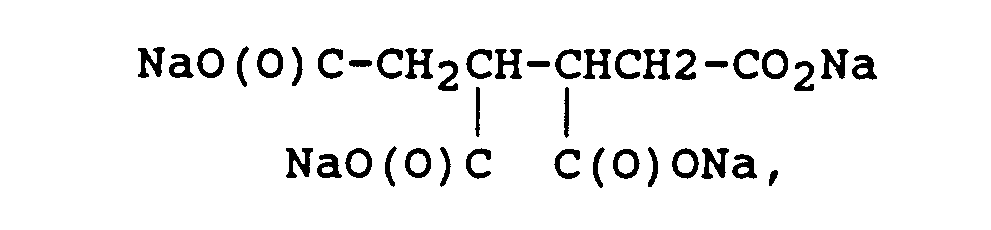
butane-1,2,3,4-tetracarboxylic acid tetrasodium salt, disodium maleate dihydrate, disodium phthalate, 1,2,4-benzenetricarboxylic acid sodium salt, 1,2,4,5-benzenetetracarboxylic acid sodium salt, disodium succinate, disodium terephthalate, disodium oxalate, sodium benzoate, sodium thioglycolate, HS-CH2-C(O)ONa, sodium t-C4H9-C6H4-C(O)ONa, sodium t-butylbenzoate, 3-CH3-C6H4.-C(O)ONa sodium 3-methylbenzoate, disodium glutarate NaO(0)C-(CH2)3-C(0)ONa, sodium glycolate, NaO(O)C-CH2-OH, dipotassium glutarate KO(O)C-(CH2)3-C(O)OK, dipotassium phthalate KO(O)C-(C6H4.)-C(O)OK, sodium hexanoate, sodium octanoate, sodium decanoate, disodium sebacate NaO(O)C-(CH2)8-C(O)ONa, dehydroacetic acid sodium salt, dipotassium adipate, potassium adipate, disodium succinate, dipotassium phthalate, polyacrylic acid 100% Na salt. - Preferred sodium salts are selected from the group consisting of monosodium and disodium salts of adipic and maleic acid and esters thereof. The most preferred adipic acid based salt is disodium adipate. The preferred salts of maleic acid are monosodium salts of monoesters of maleic acid. The esters are preferably alkyl esters of the acid and an alcohol having from 1 to 22 and preferably from 3 to 18 carbon atoms. The most preferred ester salts are sodium hexyl maleate, sodium octyl maleate, sodium decyl maleate and sodium dodecyl maleate.
- A particularly preferred composition of the present invention comprises poly(vinyl chloride) or chlorinated poly(vinyl chloride). A preferred organotin compound, can include alkyl (mercapto)tin and alkyl (mercapto)ester tin compounds in an amount (based on elemental tin) of about 0.1 to 0.8 percent based on the weight of polymer. There is about 0.1 to 0.8 percent based on the weight of the polymer of disodium adipate or a monosodium salt of a monoester including sodium hexyl maleate, sodium octyl maleate, sodium decyl maleate and sodium dodecyl maleate.
- The compositions of this invention can also contain one or more conventional additives, including mold release agents, colorants, including dyes and pigments, anti-oxidants, flame-retardants, fibrous and particulate fillers and reinforcements, plasticizers, and the like.
- The compositions are typically physically mixed. The components can be mixed in powder blending equipment such as a ribbon blender or Henchel mixer, typically at room temperature. The temperature may rise due to the heat of mixing. The mixed composition can then be melt processed such as extruding, pelletizing, injection molding and the like. The compositions of this invention can be melt blended in a suitable melt blender such as a screw extruder, or other conventional plasticating devices such as a BrabenderR, Banbury mixer, mill or the like.
- The composition can be melt blended at a temperature greater than the melt temperature of the highest melting point polymer. Preferably, the composition is melt blended at a temperature at least 10°C greater than the melt temperature of the highest melting point polymer in the composition, and less than the temperature at which there is significant degradation. More preferably the composition is made by melt blending at from 10°C to 75 C, and yet more preferably 10°C to 30 °C above the melt temperature of the melt temperature of the poly(vinyl chloride) in the composition. Typical temperatures range from 180 to 250 °C.
- The compositions can be made into a wide range of useful articles by conventional methods employed in the fabrication of thermoplastic articles, i.e., as molded parts, extruded shapes, e.g., tubing, films, sheets, fibers, laminates and wire coating. "Molding" means forming an article by deforming the blend in the heated plastic state.
- The dynamic stability of the compositions can be monitored with a rheometer, such as a BrabenderR Plasticord rheometer. The performance of the various stabilizer additives is indicated by Stability Time in minutes. Stability Time can be defined based on a torque measurement using the BrabenderR torque rheometer. A sample is put into a sample chamber of the torque rheometer and heats up as the rotors rotates. Initially, a Fusion Time is determined. The Fusion Time is the time for the powder to become molten. The fusion torque is a measure of work at Fusion Time in meter grams. As the sample becomes molten and the viscosity decreases, the torque decreases. The sample achieves an Equilibrium Torque at an Equilibrium time (minutes) which remains substantially constant or slightly decreasing. The composition remains in the molten state as indicated by the Equilibrium Torque value. When the composition begins to crosslink an increase in torque is observed. The term Stability Time is the time the composition begins to degrade or crosslink as shown by an increase in torque above the Equilibrium Torque value minus the Fusion Time.
- Static stability is determined from milled sheets of the composition. Typically, a 225 g sample of the composition, i.e., PVC composition, is kneaded using a 13 inch 2-roll Farrell mill at 325 ° for 5 minutes. The sample is pressed in a hydraulic press at 375 ° for 5 minutes. The pressed sample is put in an oven at a given temperature, i.e., 190 C, and the time the sample darkens is recorded as the static stability.
- The following examples illustrate embodiments of the present invention. The examples should not be construed as limiting the invention. Parts are parts per hundred parts of resin (phr) unless otherwise indicated. Molecular weights are weight average molecular weights unless otherwise indicated.
- Following is a listing of tin based stabilizers used in the Examples.


- Evaluations were conducted initially to study potential salts to determine whether or not metal salts of polycarboxylate could effectively be used to enhance the stabilization properties of tin stabilizing compounds in poly(vinyl chloride) based compositions. The formulations contain 100 parts by weight of poly-(vinyl chloride) manufactured by Shintech, Inc. as SE 650 which is reported to have a K value of 57 when measured according to DIN 53726 test procedure, and an inherent viscosity of 0.68 measured according to ASTM 1243 test procedure. Each composition contained 3.0 parts by weight per hundred (phr) of calcium carbonate; 0.3 phr of calcium stearate; 1.5 phr of a commercial PVC lubricant Loxiol 7109 which is sold by Henkel Chemical as 70 weight percent of G-30 (based on a mono fatty acid ester of fatty alcohols) and 30 weight percent of G-70 (based on complex esters of saturated fatty acids); and 1.0 phr of titanium dioxide. This composition is useful for injection molding.
- Each sample was first physically mixed using a Henschel mixer. The samples were then tested using a BrabenderR torque rheometer at 200 ° C. Rotor speed was initially 60 RPM and then after one minute raised to 120 RPM. A charge of 62 grams was fed to the torque rheometer. Stability was measured as the difference between the time crosslinking begins minus Fusion Time as defined above.
- The tin based stabilizer A was used in Control 1. Control 2, Example 1-7 and Comparative 1 contained stabilizer B and additionally contained 0.42 phr of dodecyl mercaptan (C12 H25 SH) (DDM). Comparative 1 contained stabilizer C and 0.42 phr of DDM. Results are reported on Table 1 below.

- Referring to Table 1 the Control 1 composition stabilized only with the organo tin compound (A) (0.30 phr elemental tin) had a Stability Time of 10.8 minutes. Control 2 contained 0.12 elemental tin (B) phr, and no additional stabilizer. It had a stability time of 8.3 minutes. Disodium phosphate (the subject of another of our patent applications) was used in Comparative 1 and resulted in an excellent stability of 12.9. Example 1 used disodium adipate in an amount of 1.2 phr, and sufficient B to give 0.12 phr of tin. This resulted in an excellent stability time of 12.3 minutes. Examples 2 through 6 used a variety of additives including styrene maleic anhydride sodium salt copolymer in Example 2, sodium octanoate in Example 3, sodium butyl maleate in Example 4, tetra sodium salt of ethylenediamine tetra-acetic acid in Example 5, and tetra sodium butane in Example 6 and MaldeneR which is butadiene maleic anhydride copolymer sodium salt in Example 7. A review of the stability times showed Example 1 to have excellent results suggesting that while Examples 2-7 had similar results to Control 2, more study would be conducted. The results of which are presented below.
- Example 8 was conducted to illustrate the use of compositions embodying the invention for formulating packaging articles which require clarity. Control 3 contained 1.6 part phr of D. Example 8 contained 1.0 phr of D plus 1.0 phr of sodium isooctyl maleate (NaIOM). Example 9 contained 1.0 phr of D and 1.0 phr of sodium isooctyl succinate (Na IOS). Dynamic stability and haze measurements were made. Haze measurements were made according to ASTM D1003-61 (1977) with initial haze value recorded and haze after 7 day exposure to water. The lower the haze value, the clearer the sample. Stability Time was measured according to the method of Example 1.

- Stabilized PVC compositions containing conventional additive packages except for stabilizer systems were evaluated using D (1.0 phr) and sodium maleate esters (1.0 phr). Controls 4 and 5 contain only stabilizer D (1.6 phr in Control 4 and 1.0 phr in Control 5). The maleate esters (hexyl, octyl, decyl and dodecyl) were prepared by heating equal molar amounts of alcohol and maleic anhydride until a homogeneous solution was obtained. The same procedure was used for the other esters. The esters were then treated with sodium hydroxide to form the ester salts. Macbeth colorimeter data are summarized in Table 3 with the yellowness Index (YI) measured according to ASTM D1925. The higher the number, the more yellow the sample. Milled sheets were used to evaluate haze (clarity). 225 gram samples were milled on a 13-inch, 2-roll Farrell mill. The sample was pressed at 375 ° for 5 minutes. Dynamic Stability Time was measured as in Example 1. Results are summarized on Table 3.

- Example 11 was repeated. Haze tests show that the stabilizer composition of Stabilizer D (1.0 phr) and sodium decyl maleate (1.0 phr) does not haze through 3 weeks of water exposure. Control 6 contained 1.6 phr of D and no sodium salt. The results are summarized in Table 4.

- This Example illustrates the reduction in tin necessary to stabilize a PVC composition with disodium adipate (DSA). A composition was physically blended containing 250 grams of PVC made by Atochem as RB 8010. The composition contained 8 phr of impact modifier, 1 phr of epoxidized soybean oil; 0.6 K-175 and 0.4 K-120 processing aids from Rohm and Haas; 0.6 phr of paraffin wax and 0.4 phr Loxiol G74 (based on complex esters of saturated fatty acids). The stability was tested using the roll mill procedure of Examples 10-13. Static stability is the time color of the sample begins to darken. The results are summarized in Table 5.

- Evaluations were conducted using compositions containing 2500 g of PVC (as recited in Examples 1-7), lubricants sold by Henkel Chemical as G-70 (a mono fatty acid of fatty alcohol) (11.25 g), G-30 (complex esters of saturated fatty acids) (26.25 g), calcium stearate (7.5 g), calcium carbonate (75 g), Ti02 (25 g), and organotin (17 g) mercaptide ester, compound F. The amount of tin compound was 0.68 phr (0.15 phr elemental tin). The composition contained varying amounts of disodium adipate (DSA). The PVC formulation was physically mixed and then tested.
- The blends were melt blended using a BrabenderR torque rheometer as indicated in Example 1. Results are summarized in Table 6 below.

- An injection molding PVC formulation was evaluated. A mixed powder composition was supplied by an injection molding company without stabilizer. Control 9 contained 1.4 phr of Stabilizer A and had 0.26 phr of elemental tin. Control 10 contained 2.7 phr of Stabilizer F and had 0.26 phr of elemental tin. Example 23 contained 1.4 phr of F and had 0.42 phr DSA having a particle size of 26 micrometers. DSA was used as a costabilizer. Notched Izod impact strength was tested according to ASTM D256. Each sample was evaluated nine times and hinge (ductile) breaks noted. A ductile break indicates the sample is not brittle. Stability and YI were measured according to previously described procedures. Table 7 below summarizes various tin compounds used and results.

- In Example 23, the DSA used had a particle size of 26 µm in average diameter. Evaluation with particles greater than 74 µm had poorer impact properties but satisfactory stability and YI. Similar evaluations with disodium phosphate had satisfactory stability and YI but also had poorer Izod impact properties.
- This Example illustrated the use of a bridging sulfide tin mercapto ester "G". The composition contained 100 phr of PVC (2500 grams), 1 phr processing aid, 10 phr Ti02, 1.75 phr Ca Stearate, 5 phr CaC03, 0.15 phr oxidized polyethylene wax, 1.0 phr paraffin wax, 6 phr Durastrength D-200, a modified acrylic impact modifier, 1 phr "G" (0.218 phr elemental tin). This composition is useful for extrusion of "vinyl" siding. Control 11 contained no sodium salt of the present invention. Example 24 contained 0.48 phr of disodium adipate. Results are summarized in Table 8 below.

- A series of experiments was conducted to determine whether polycarboxylic salts would be useful to enhance the stabilization of poly(vinyl chloride) compositions. The experiments were conducted using PVC G-86 made by B. F. Goodrich with a K value between 55 and 58. The compositions each contained 1.5 phr of Loxiol as defined in Examples 1-7; 1.5 phr of stabilizer C. The polycarboxylic salts include the partially saponified polyacrylates, polyacrylic acid (PAA), polymethacrylic acid (PMA), and poly(2-ethyhexyl acrylate) (POA). The molecular weight, mole percent neutralization with sodium cation and phr of the polycarboxylic acid in the composition is summarized in the Tables below. Stability was determined based on stability time in minutes as defined above. The results of each experiment are summarized in Tables 9-12 respectively. In the experiment in Table 12, 1.0 phr of stabilizer C was used rather than 0.5 phr as in Tables 9-11.


- The above Examples illustrate that the stability of poly(vinyl chloride) neutralized with stabilizer C which is a tin based compound can be significantly enhanced by the inclusion of the sodium salt of a partially or fully neutralized polycarboxylic acid. Reference is made to Comparative 2 which shows the non-stabilizing enhancing results when a non-neutralized polyacrylic acid was used compared to even neutralization with 16.1 mole percent sodium cation.
- Example 34 and 35 were melt blended composition containing PVC G-86, 1.5 phr of Loxiol, sodium isooctyl maleate (NaIOM) with tin stabilizers C and H. Results are summarized in Table 13 below.

- The use of sodium cinnamate was evaluated in compositions containing PVC G-86, 1.5 phr of Loxiol, the indicated tin stabilizer with results summarized in Table 14.
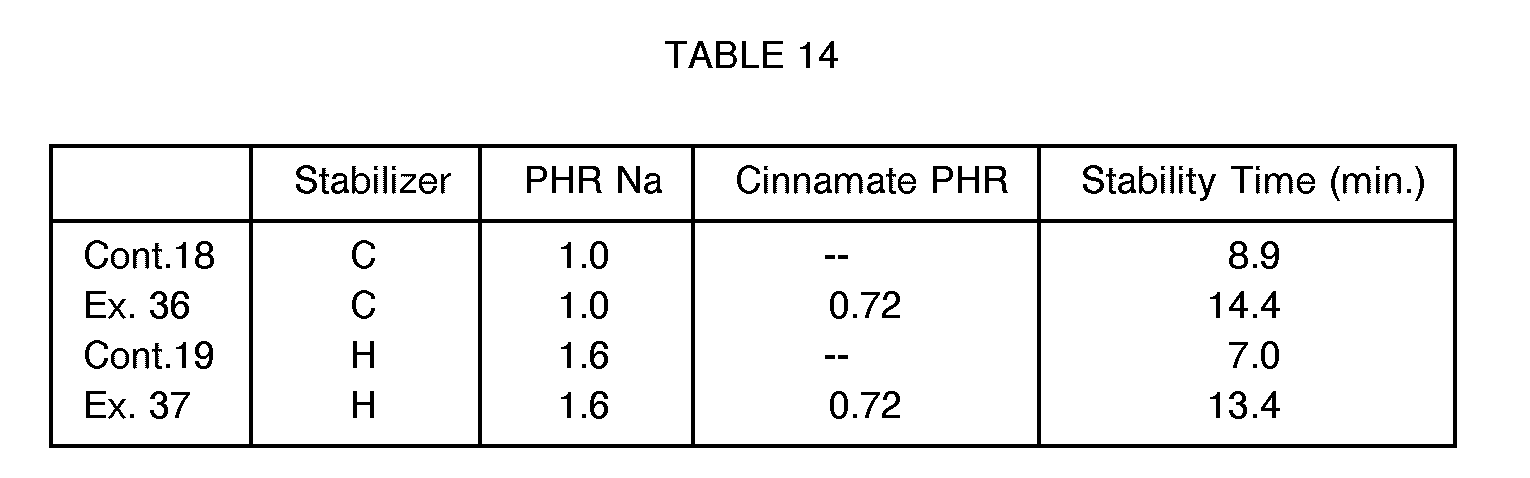
- A formulation containing PVC G-86, 1.5 phr of Loxiol and tin stabilizer C at 1.0 phr and the sodium salts of (CH2)n(C02Na)2 where n - 8 (I) and n = 10 (II). Results are summarized in Table 15.

- A commercially available non-plasticized (rigid) poly(vinyl chloride) composition was evaluated using disodium adipate (DSA) and acid salt (I) as reviewed above in Examples 38 and 39. Results are summarized on Table 16.

- A formulation containing PVC 650 of the type used in Examples 1-7, 2.1 phr of methacrylate butadiene styrene (MBS) based impact modifier supplied by
- Atochem, 2.0 parts phr of methyl methacrylate copolymer as a processing aid supplied by Atochem, 0.4 phr of wax, 1.2 phr of Loxiol G-15 and the listed tin stabilizers were evaluated with acid salts (I) and (II) as defined with regard to Examples 38 and 39 above. Results are summarized in Table 17.

- A composition containing PVC G-86, 1.5 phr of Loxiol 7109, stabilizer H, and the sodium salts NaO(O)-C-CH2CH(CH2CH=CH-C9H19)CO2Na (III) [NaO(O)C-CH=CH-C(O)O-CH2CHCH2]2-O (IV). The compositions were evaluated with the following results summarized in Table 18.

- A formulation was evaluated which contained PVC G-86, 1.5 phr of Loxiol 7109, stabilizer C, and sodium salts (V) and (VI).

-1,2,3,4,-tetracarboxylic acid tetrasodium salt - Results are summarized in Table 19 below.

- A composition was prepared using PVC G-86, 1.45 phr of Loxiol 7109, tin stabilizers L and M, and disodium phthalate (VII). Results are summarized on Table 20 below.

- A composition was prepared which contained PVC G-86, 1.5 phr of Loxiol 7109, and tin stabilizers K and H, as well as disodium phthalate (VII). Results of stability testing are presented in Table 21 below.

- Compositions containing PVC G-86, 1.5 phr of Loxiol, and stabilizers C and L were prepared with a variety of sodium acid salts (V) to (XII) which are:
- 1,2,4-benzenetricarboxylic acid sodium salt (VIII)
- 1,2,4,5-benzenetetracarboxylic acid sodium salt (XXXV)
- Disodium succinate (IX)
- Disodium terephthalate (X)
- Disodium oxalate (Xl)
- Sodium benzoate (XII)
- The salts were evaluated in accordance with BrabenderR stability testing. The testing was conducted as recited above. A sample was removed every two minutes and pressed into the form of a small disc which was examined for color. Results are reported as Time (minutes) to blacken the chip.
- Results are summarized in Table 22 below.

- A composition was melt blended which contained PVC G-86, 1.5 phr of Loxiol 7109, stabilizer L and sodium salts, sodium benzoate (XII), and sodium thioglycolate (XIII), having the formula:
- Sodium benzoate (XII)
- HS-CH2-C(O)ONa (XIII) Sodium thioglycolate
- Results are reported in Table 23 below.

- Compositions were melt blended which contained PVC G-86, 1.5 phr of Loxiol 7109, stabilizers C & L, and sodium salts
- HS-CH2-C(O)ONa (XIII) Sodium thioglycolate
- t-C4 H9-C6 H4-C(O)ONa (XIV) Sodium t-butylbenzoate
- 3-CH3-C6 H4-C(O)ONa (XV) Sodium 3-methyl-benzoate
- Results are summarized in Table 24 below.

- Compositions were melt blended which contained PVC G-86, 1.5 phr of Loxiol, stabilizer C, and acid XVI and XVII, having the following formulas:
- Disodium succinate (IX) NaO(O)C-(CH2)2-C(O)ONa
- Disodium glutarate (XVI) NaO(0)C-(CH2)3-C(0)ONa
- Sodium glycolate (XVII) NaO(O)C-CH2-OH
- The results are summarized in Table 25 below.

- A melt blended composition was prepared which contained PVC G-86, 1.5 phr of Loxiol 7109, and stabilizers L or C and sodium salts (XVI), (XVIII) or (XIX) as follows:
- Disodium glutarate (XVI) NaO(0)C-(CH2)3-C(0)ONa
- Dipotassium glutarate (XVIII) KO(O)C-(CH2)3-C(O)OK
- Dipotassium phthalate (XIX) KO(O)C-(C6H4)-C(O)OK
- The results are summarized in Table 26 which follows.

- A composition was melt blended which contained poly(vinyl chloride) PVC 750 made by Shintech having a K value of 59, 1 part of Loxiol 7111 which is a mixture of a simply fatty acid ester and a polymer complex ester of a saturated fatty acid, 2 parts of Metablen P-550 polymethacrylate processing aid, 10 parts of Metablen C-201 methacrylate-butadiene-styrene impact modifier, as recited above, 0.3 parts of Loxiol G-70S which is a polymeric complex ester of a saturated fatty acid, 0.15 parts of A-C 629 polyethylene wax made by Allied-Signal Inc., 0.02 parts of Ultra Marine Toner and sodium salts as from the following group:
- Sodium Hexyl maleate (XX)
- Sodium octyl maleate (XXI)
- Sodium decyl maleate (XXI)
- Sodium dodecyl maleate (XXIII)
- Sodium isooctyl maleate (XXIV)
- Sodium butyl maleate (XXV)
- Sodium hexanoate (XXVI)
- Sodium octanoate (XXVII)
- Sodium decanoate (XXVIII)
- Sodium isooctylsuccinate (XXIX)
-

- Compositions were melt blended containing PVC G-86, 1.5 phr of Loxiol, stabilizer C and a sodium acid salt (XXIV), (XVI) and (XVII) as described.
- Disodium sebacate (XXIV) NaO(0)C-(CH2)2-C(0)ONa
- Disodium glutarate (XVI) NaO(0)C-(CH2)3-C(0)ONa
- Sodium glycolate (XVII) NaO(O)C-CH2-OH
- The results are summarized in Table 28 below.

- Formulations were prepared by melt blending PVC 650A which is made by Shintec and has a K value of 57, 0.45 parts of Loxiol G-70 which is a polymeric complex ester of saturated fatty acid, 1.05 parts of Loxiol G-30 which is a simple fatty ester, 0.3 parts of calcium stearate, 3 parts of calcium carbonate, 1 part of titanium dioxide, and stabilizer F. The salts used in the compositions are (XXX), (XXXI) (XXXII) and (IX) which are described below.
- Dehydroacetic acid sodium salt (XXX)
- Dipotassium adipate (XXXI)
- Potassium adipate (XXXII)
- The results are summarized in Table 29 below.

- A formulation was prepared by melt blending PV 103EP which is made by B. F. Goodrich and has a K value of 67, 5 parts of Durastrength D-200 which is a modified acrylate impact modifier supplied by Atochem, 2 parts of XL-165 which is paraffin wax lubricants supplied by Hoechst-Celanese, 1.5 parts of calcium stearate, 1 part of Metablen P-501, a polymethacrylate processing aid, which is supplied by Atochem, and stabilizer F. The acid salt used was acid salt (XXXIII) which was dipotassium phthalate. Results are summarized in Table 30 below.

- Compositions were prepared by melt blending PVC 650A which is a poly(vinyl chloride) made by Shintec having a K value of 57, 0.45 phr of Loxiol G-70 which is a polymeric complex ester of saturated fatty acid, 1.05 parts of G-30 which is Loxiol G-30 a simple fatty acid ester, 0.3 part of calcium stearate, 3 parts of calcium carbonate, 1 part of titanium dioxide and stabilizer E. The salts used are
- Disodium adipate (DSA)
- Polyacrylic acid 100% Na salt (XXXIV)
- Molecular weight of 1,000
- Dipotassium phthalate (XXXIII)
- Disodium phthalate (VII)
- Sodium isooctylmaleate (NaIOM)
- Results are summarized in Table 31 below.

- A composition was prepared based on PVC 650A which is PVC made by Shintec having a K value of 57, 0.45 phr of G-70 and 1.05 part phr of G-30 both described above, 0.3 parts of calcium stearates, 3 phr of calcium carbonate, 1 phr of titanium dioxide and disodium adipate as the acid salt. The results are summarized in Table 32 below.

- These Comparative Examples evaluated poly(vinyl chloride) homopolymer sold as Geon 103EP by B. F. Goodrich having an inherent viscosity of 1.03 measured according to ASTM D-1243-66. In Comparative 4, 100 parts of the PVC resin were stabilized with 3 parts of disodium adipate (DSA). In Comparative 5, 100 parts of PVC resin were stabilized with 3 parts of disodium maleate (DSM). In Comparative 6, 100 parts of PVC resin were stabilized with 3 parts of stabilizer R. The test samples of the materials were mixed and milled by a 2-roll mill at 325 ° F (165°C) for 4 minutes. Chips were prepared and placed in an oven at 375 F F(190 °C). Chips were removed from the oven at various intervals. Prior to aging Comparative 4 was brown, Comparative 5 was pink, and Comparative 6 was white.
- Prior to testing in the oven at 375 ° the disodium adipate Comparative 4 sample was brown, the Comparative 5 sample was pink, and the Comparative 6 sample was white. Little change was observed to Comparative Nos. 4 and 6 over 120 minutes. Comparative 5 darkened slightly. It was suspected the oven was not up to the set temperature. The oven aging was suspect and samples from Comparative 5 and 6 were aged in a different oven at 375 ° C. Comparative 4 was not repeated since it was unsatisfactory without aging. The initial color of Comparatives 5 and 6 were the same as above. Comparative 5 turned brown after 5 minutes and continued to darken until almost black at 120 minutes. Comparative 6 was white at initial testing and became exceedingly more yellow at 90 minutes, and blackened by 120 minutes.
- These results showed that disodium adipate, by itself, was unsatisfactory in PVC.
- Compositions were prepared based on the PVC resin used in Comparatives 4-6. The compositions contained disodium adipate, stabilizer S and XL-165 wax as indicated in Table 33 below. The compositions were mixed using a BrabenderR torque rheometer at 30 rpm and 200 °C. The time to blacken in minutes was measured. The compositions and results are summarized in Table 33.

- A study was conducted to compare different stabilizers in chlorinated poly(vinyl chloride) containing an organotin stabilizer at 0.39 parts tin per one hundred parts of resin. The compositions were mixed using a BrabenderR torque rheometer at 60 rpm and 200°C with a 62 gm charge. Samples were taken for yellowness index, as well as stability in minutes, as measured by the time to darken. The compositions and results are reported in Table 34 below in parts per hundred resin (phr).

- The results show DSP had better stabilization properties when used with organotin than DSA which actually shortens stability time in CPVC.
- The controlled composition containing chlorinated poly(vinyl chloride) stabilized with tin alone, had a BrabenderR stability of 17.5 minutes and a yellowness index of 22. The use of disodium phosphate, Comparatives 9 and 11, increased the BrabenderR stability time as well as the time to blacken. Comparatives 9 and 12 show that disodium adipate is not as effective in chlorinated poly(vinyl chloride) as disodium phosphate. This suggests that differences in the polymer can affect the differences in the stability of a stabilized polymer composition.
- While exemplary embodiments of the invention have been described, the true scope of the invention is to be determined from the following claims.
Claims (17)

disodium maleate dihydrate; disodium phthalate; 1,2,4-benzenetricarboxylic acid sodium salt; 1,2,4,5-benzenetetracarboxylic acid sodium salt; disodium terephthalate; disodium oxalate; sodium benzoate; sodium thioglycolate; sodium t-butylbenzoate, sodium 3-methylbenzoate; sodium glycolate; dipotassium phthalate; sodium hexanoate; sodium octanoate; sodium decanoate; sodium isooctylsuccinate; dehydroacetic acid sodium salt; and potassium adipate.
Applications Claiming Priority (2)
| Application Number | Priority Date | Filing Date | Title |
|---|---|---|---|
| US07/634,446 US5100946A (en) | 1990-12-27 | 1990-12-27 | Stabilized halogen containing polymer compositions |
| US634446 | 1990-12-27 |
Publications (2)
| Publication Number | Publication Date |
|---|---|
| EP0492803A1 true EP0492803A1 (en) | 1992-07-01 |
| EP0492803B1 EP0492803B1 (en) | 1996-06-12 |
Family
ID=24543822
Family Applications (1)
| Application Number | Title | Priority Date | Filing Date |
|---|---|---|---|
| EP91310820A Expired - Lifetime EP0492803B1 (en) | 1990-12-27 | 1991-11-25 | Stabilized halogen containing polymer compositions |
Country Status (15)
| Country | Link |
|---|---|
| US (1) | US5100946A (en) |
| EP (1) | EP0492803B1 (en) |
| JP (1) | JPH04304255A (en) |
| KR (1) | KR920012240A (en) |
| CN (1) | CN1062912A (en) |
| AR (1) | AR246977A1 (en) |
| AU (1) | AU645621B2 (en) |
| BR (1) | BR9105570A (en) |
| CA (1) | CA2054908A1 (en) |
| DE (1) | DE69120234T2 (en) |
| ES (1) | ES2090261T3 (en) |
| HK (1) | HK167796A (en) |
| IL (1) | IL99880A0 (en) |
| MX (1) | MX9102850A (en) |
| TW (1) | TW200507B (en) |
Cited By (4)
| Publication number | Priority date | Publication date | Assignee | Title |
|---|---|---|---|---|
| EP2083044A1 (en) | 2008-01-23 | 2009-07-29 | Reagens S.p.A. | Composition for stabilizing halogen-containing polymers |
| WO2011054537A1 (en) | 2009-11-06 | 2011-05-12 | Akdeniz Kimya Sanayi Ve Ticaret A.S. | Sodium fumarate-sodium malonate |
| WO2017068415A1 (en) | 2015-10-23 | 2017-04-27 | Chemson Polymer-Additive Ag | Vinyl chloride polymers and compositions for additive manufacturing |
| WO2017184709A1 (en) * | 2016-04-20 | 2017-10-26 | Rohm And Haas Company | Polyvinyl chloride pipe |
Families Citing this family (28)
| Publication number | Priority date | Publication date | Assignee | Title |
|---|---|---|---|---|
| US5451628A (en) * | 1994-06-01 | 1995-09-19 | Synthetic Products Company | Heat stabilization of PVC compositions containing a mixed metal stabilizer and antimony trioxide |
| FR2732028B1 (en) * | 1995-03-22 | 1997-04-30 | Atochem Elf Sa | PROCESS FOR IMPROVING THE HEAT RESISTANCE OF PVC |
| US6887926B1 (en) | 2001-11-16 | 2005-05-03 | Oatey Co. | Bonding compositions for chlorinated polymers and methods of using the same |
| US20030176544A1 (en) * | 2002-03-15 | 2003-09-18 | Polyone Corporation | Rigid PVC compounding compositions exhibiting weather resistance and PVC degradation resistance in hot sunny climates |
| US7476443B2 (en) * | 2005-09-19 | 2009-01-13 | Kimberly-Clark Worldwide, Inc. | Photo-stable and surface-functionalizable colorant particles |
| CN100422257C (en) * | 2006-03-21 | 2008-10-01 | 中国科学院广州化学研究所 | Application of dicarboxylic acid salt as heat stabilizer for PVC |
| US20090137172A1 (en) * | 2008-12-04 | 2009-05-28 | Lei Huang | Colorant media and articles having photo-stable and surface-functionalizable colorant particles |
| US8614268B2 (en) * | 2009-04-15 | 2013-12-24 | Rohm And Haas Company | Stabilized polymer compositions |
| US8575250B2 (en) | 2009-04-15 | 2013-11-05 | Rohm And Haas Company | Stabilized polymer compositions |
| EP2363431A1 (en) | 2010-02-25 | 2011-09-07 | Reagens S.p.A. | Composition comprising alkali metal carboxylates for stabilizing halogen-containing polymers |
| US8513340B2 (en) | 2010-04-09 | 2013-08-20 | Georgia Gulf Corporation | Method of reducing chatter |
| CN102432958B (en) * | 2010-11-03 | 2014-05-07 | 如皋市中如化工有限公司 | Cold-resistance and flame-retardant level PVC (polyvinyl chloride) cable material |
| WO2012143794A1 (en) | 2011-04-18 | 2012-10-26 | Galata Chemicals Gmbh | Polymer stabilizer system for polymers containing halogen |
| US20140336316A1 (en) * | 2011-11-30 | 2014-11-13 | Rohm And Haas Company | Stabilized polymer compositions |
| CN102733254B (en) * | 2012-07-02 | 2014-10-01 | 川渝中烟工业有限责任公司 | A cigarette paper additive with harm reduction function and its application |
| CN103122109A (en) * | 2013-01-16 | 2013-05-29 | 江苏爱特恩高分子材料有限公司 | PVC (polyvinyl chloride) composite heat stabilizer and application thereof |
| CA2904982C (en) * | 2013-03-15 | 2021-05-11 | Lubrizol Advanced Materials, Inc. | Heavy metal free halogenated polymer compounds |
| CN104710334B (en) * | 2013-12-13 | 2017-01-25 | 湖北南星化工总厂 | Metal thiolate compound for PVC stabilization and preparation method thereof |
| CN104098856A (en) * | 2014-06-27 | 2014-10-15 | 方小超 | Plastic product |
| CN104910555B (en) * | 2015-06-08 | 2017-07-28 | 湖北南星化工总厂 | A kind of dicarboxylic acids alkali metal salt burns the application of inhibitor as zinc |
| TWI799376B (en) * | 2016-04-20 | 2023-04-21 | 美商羅門哈斯公司 | Polyvinyl chloride pipe |
| CN106398038B (en) * | 2016-08-31 | 2018-08-28 | 湖北犇星化工有限责任公司 | A kind of organotin compound stabilizer and preparation method thereof being used to prepare PVC |
| CN111372991B (en) | 2017-09-15 | 2023-11-17 | 吉昂功能材料(东莞)有限公司 | Flame retardant poly (vinyl chloride) composites |
| CN111138671B (en) * | 2018-11-02 | 2021-09-14 | 四川大学 | Metal-organic high molecular compound and preparation method thereof |
| CN115836109B (en) * | 2020-02-24 | 2026-02-06 | Pmc有机金属有限公司 | Alkyl bridged tin-based heat stabilizer for halogenated resin and synthesis and application thereof |
| JP7680849B2 (en) * | 2021-02-05 | 2025-05-21 | 積水化学工業株式会社 | Vinyl chloride resin composition and vinyl chloride resin molded article |
| WO2024203040A1 (en) * | 2023-03-27 | 2024-10-03 | 日本ゼオン株式会社 | Laminate and laminate production method |
| WO2026048796A1 (en) * | 2024-08-29 | 2026-03-05 | 積水化学工業株式会社 | Vinyl chloride-based resin composition, vinyl chloride-based resin fabricated body, stabilizer composition for vinyl chloride-based resin, and method for producing vinyl chloride-based resin composition |
Citations (3)
| Publication number | Priority date | Publication date | Assignee | Title |
|---|---|---|---|---|
| US3644246A (en) * | 1969-12-11 | 1972-02-22 | Pfizer & Co C | Lubricating stabilizers for chlorine-containing polymers |
| FR2292740A1 (en) * | 1974-11-27 | 1976-06-25 | Sekisui Chemical Co Ltd | COMPOSITION OF CHLORINATED RESIN |
| EP0107063A1 (en) * | 1982-09-28 | 1984-05-02 | The B.F. GOODRICH Company | Stabilization of polymers using citrate salts |
Family Cites Families (15)
| Publication number | Priority date | Publication date | Assignee | Title |
|---|---|---|---|---|
| US2564646A (en) * | 1950-02-08 | 1951-08-14 | Argus Chemical Lab Inc | Haze resistant vinyl chloride polymers |
| US2782176A (en) * | 1951-05-14 | 1957-02-19 | Monsanto Chemicals | Halogen containing vinylidene resins stabilized with a mixture of zinc and calcium salts of phenyl carboxylic acids |
| US2777826A (en) * | 1953-06-30 | 1957-01-15 | Harshaw Chem Corp | Vinyl chloride polymers stabilized with metal salts of carboxylic acids mixed with organic titanates |
| US2934507A (en) * | 1954-06-18 | 1960-04-26 | Monsanto Chemicals | Polyvinyl chloride resins stabilized with mixtures of phosphonate esters, epoxy compounds and metallic salts of fatty acids |
| US2894979A (en) * | 1957-08-21 | 1959-07-14 | Pfizer & Co C | Stabilized polycarboxylic acid esters |
| US3054771A (en) * | 1959-08-12 | 1962-09-18 | Du Pont | Stabilizing polyvinyl chloride with terpenes and organometallic carboxylic acid salts |
| US3236793A (en) * | 1961-10-02 | 1966-02-22 | Minnesota Mining & Mfg | Bis(tributyltin) adipate and antifouling compositions comprising same |
| GB1046650A (en) * | 1964-10-20 | 1966-10-26 | Bakelite Xylonite Ltd | Chlorine-containing polymer compositions |
| NL132370C (en) * | 1965-01-22 | 1900-01-01 | ||
| NL133448C (en) * | 1965-05-21 | |||
| US3567581A (en) * | 1968-06-04 | 1971-03-02 | Ca Atomic Energy Ltd | Uranium-silicon fuel elements for a nuclear reactor |
| US3642677A (en) * | 1969-01-10 | 1972-02-15 | Argus Chem | Polyvinyl chloride resin and stabilizer combinations comprising a diorganotin oxide a tetravalent organotin mercaptocarboxylic acid compound and a divalent stannous tin salt |
| US3824210A (en) * | 1972-01-12 | 1974-07-16 | Exxon Research Engineering Co | Organotin salts of hydroxy-substituted alkanoic acids:stabilizers for polyvinyl chloride |
| JPS5263958A (en) * | 1975-11-21 | 1977-05-26 | Kao Corp | Manufacture of resinous molded articles with improved resistance to hy drolysis |
| US4681907A (en) * | 1984-11-20 | 1987-07-21 | Morton Thiokol, Inc. | Stabilizers for halogen-containing organic polymers comprising an organotin mercaptide and a diester of an unsaturated dicarboxylic acid |
-
1990
- 1990-12-27 US US07/634,446 patent/US5100946A/en not_active Expired - Lifetime
-
1991
- 1991-07-03 TW TW080105167A patent/TW200507B/zh active
- 1991-10-28 IL IL99880A patent/IL99880A0/en unknown
- 1991-10-31 AU AU86906/91A patent/AU645621B2/en not_active Ceased
- 1991-11-04 CA CA002054908A patent/CA2054908A1/en not_active Abandoned
- 1991-11-25 DE DE69120234T patent/DE69120234T2/en not_active Expired - Lifetime
- 1991-11-25 EP EP91310820A patent/EP0492803B1/en not_active Expired - Lifetime
- 1991-11-25 ES ES91310820T patent/ES2090261T3/en not_active Expired - Lifetime
- 1991-12-17 AR AR91321420A patent/AR246977A1/en active
- 1991-12-23 BR BR919105570A patent/BR9105570A/en not_active IP Right Cessation
- 1991-12-26 KR KR1019910024327A patent/KR920012240A/en not_active Withdrawn
- 1991-12-27 CN CN91112710A patent/CN1062912A/en active Pending
- 1991-12-27 MX MX9102850A patent/MX9102850A/en unknown
- 1991-12-27 JP JP3358112A patent/JPH04304255A/en active Pending
-
1996
- 1996-09-05 HK HK167796A patent/HK167796A/en not_active IP Right Cessation
Patent Citations (3)
| Publication number | Priority date | Publication date | Assignee | Title |
|---|---|---|---|---|
| US3644246A (en) * | 1969-12-11 | 1972-02-22 | Pfizer & Co C | Lubricating stabilizers for chlorine-containing polymers |
| FR2292740A1 (en) * | 1974-11-27 | 1976-06-25 | Sekisui Chemical Co Ltd | COMPOSITION OF CHLORINATED RESIN |
| EP0107063A1 (en) * | 1982-09-28 | 1984-05-02 | The B.F. GOODRICH Company | Stabilization of polymers using citrate salts |
Non-Patent Citations (2)
| Title |
|---|
| WORLD PATENTS INDEX LATEST Week 8601, Derwent Publications Ltd., London, GB; AN 86-004891 & JP-A-60 233 143 (SANKYO ORG. CHEM. KK) 19 November 1985 * |
| WORLD PATENTS INDEX Week 7450, Derwent Publications Ltd., London, GB; AN 74-86125V & JP-A-49 037 943 (SANKYO ORG. CHEM CO) 9 April 1974 * |
Cited By (11)
| Publication number | Priority date | Publication date | Assignee | Title |
|---|---|---|---|---|
| EP2083044A1 (en) | 2008-01-23 | 2009-07-29 | Reagens S.p.A. | Composition for stabilizing halogen-containing polymers |
| WO2011054537A1 (en) | 2009-11-06 | 2011-05-12 | Akdeniz Kimya Sanayi Ve Ticaret A.S. | Sodium fumarate-sodium malonate |
| WO2017068415A1 (en) | 2015-10-23 | 2017-04-27 | Chemson Polymer-Additive Ag | Vinyl chloride polymers and compositions for additive manufacturing |
| AU2016341523B2 (en) * | 2015-10-23 | 2018-08-02 | Chemson Polymer-Additive Ag | Vinyl chloride polymers and compositions for additive manufacturing |
| US10829629B2 (en) | 2015-10-23 | 2020-11-10 | Chemson Polymer-Additive Ag | Vinyl chloride polymers and compositions for additive manufacturing |
| RU2745215C2 (en) * | 2015-10-23 | 2021-03-22 | Хемсон Полимер-Эддитив Аг | Polyvinyl chlorides and compositions for layer-by-layer synthesis technology |
| AU2016341523C1 (en) * | 2015-10-23 | 2021-05-27 | Chemson Polymer-Additive Ag | Vinyl chloride polymers and compositions for additive manufacturing |
| IL258816B (en) * | 2015-10-23 | 2022-07-01 | Akdeniz Chemson Additives Ag | Vinyl chloride polymers and compositions for additive manufacturing |
| US11542389B2 (en) | 2015-10-23 | 2023-01-03 | Akdeniz Chemson Additives Ag | Vinyl chloride polymers and compositions for additive manufacturing |
| WO2017184709A1 (en) * | 2016-04-20 | 2017-10-26 | Rohm And Haas Company | Polyvinyl chloride pipe |
| AU2017252616B2 (en) * | 2016-04-20 | 2021-11-04 | Rohm And Haas Company | Polyvinyl Chloride pipe |
Also Published As
| Publication number | Publication date |
|---|---|
| JPH04304255A (en) | 1992-10-27 |
| MX9102850A (en) | 1992-06-01 |
| AU8690691A (en) | 1992-07-02 |
| ES2090261T3 (en) | 1996-10-16 |
| AR246977A1 (en) | 1994-10-31 |
| DE69120234D1 (en) | 1996-07-18 |
| DE69120234T2 (en) | 1996-11-07 |
| US5100946A (en) | 1992-03-31 |
| KR920012240A (en) | 1992-07-25 |
| TW200507B (en) | 1993-02-21 |
| BR9105570A (en) | 1992-09-01 |
| HK167796A (en) | 1996-09-13 |
| CN1062912A (en) | 1992-07-22 |
| AU645621B2 (en) | 1994-01-20 |
| IL99880A0 (en) | 1992-08-18 |
| EP0492803B1 (en) | 1996-06-12 |
| CA2054908A1 (en) | 1992-06-28 |
Similar Documents
| Publication | Publication Date | Title |
|---|---|---|
| US5100946A (en) | Stabilized halogen containing polymer compositions | |
| US5324846A (en) | Partial esters of epoxy containing compounds | |
| US4062881A (en) | Sulfide containing tin stabilizers | |
| EP2298835B1 (en) | Stabilized polymer compositions | |
| US4255320A (en) | Mixtures of alkyltin sulfides and alkyltin 2-acyloxyethlymecaptides as stabilizer compositons for polyvinyl chloride resin compositions | |
| US9745450B2 (en) | Stabilizers containing high purity mono-octyltin compounds | |
| US6462116B2 (en) | Combination of an organothio compound and a zinc mercapto ester as a heat stabilizer in PVC processing | |
| US3609120A (en) | Novel chemical compounds and stabilized halogen-containing resins | |
| EP0406349B1 (en) | Improved stabilizers for halogen-containing polymers | |
| US3803083A (en) | New synergistic organotin mercaptocarboxylic acid ester stabilizers | |
| EP0473915A1 (en) | Improved barrier PVC resins, compounds and articles derived therefrom | |
| US4515916A (en) | Stabilizers for halogen containing polymers comprising zinc mercaptoesters, basic inorganic alkali or alkaline earth metal compounds and, substituted dihydropyridines | |
| EP0070092B1 (en) | Stabilising materials for halogen-containing polymers, polymer compositions containing the same and shaped articles formed therefrom | |
| US5340862A (en) | Stabilizers for halogen containing polymers | |
| US4508863A (en) | Stabilization of polyvinyl chloride | |
| EP0068640B1 (en) | Stabilising materials for halogen-containing polymers and polymer compositions containing the same | |
| EP0437886A2 (en) | Stabilizer composition for polymers of vinyl chloride and polymeric compositions containing such compositions | |
| JPH01168747A (en) | Stabilized polymer composition | |
| Sarti et al. | Stabilizers and Lubricants for PVC and CPVC | |
| JPH08208923A (en) | Polyvinyl chloride resin composition | |
| JPH0337578B2 (en) | ||
| JPH10120919A (en) | Halogen-containing resin composition | |
| JPS5949229B2 (en) | Sulfur-containing organotin compounds |
Legal Events
| Date | Code | Title | Description |
|---|---|---|---|
| PUAI | Public reference made under article 153(3) epc to a published international application that has entered the european phase |
Free format text: ORIGINAL CODE: 0009012 |
|
| AK | Designated contracting states |
Kind code of ref document: A1 Designated state(s): DE ES FR GB IT NL SE |
|
| 17P | Request for examination filed |
Effective date: 19921218 |
|
| 17Q | First examination report despatched |
Effective date: 19940726 |
|
| RAP1 | Party data changed (applicant data changed or rights of an application transferred) |
Owner name: ELF ATOCHEM NORTH AMERICA, INC. |
|
| GRAH | Despatch of communication of intention to grant a patent |
Free format text: ORIGINAL CODE: EPIDOS IGRA |
|
| RAP1 | Party data changed (applicant data changed or rights of an application transferred) |
Owner name: ELF ATOCHEM NORTH AMERICA, INC. |
|
| RAP3 | Party data changed (applicant data changed or rights of an application transferred) |
Owner name: ELF ATOCHEM NORTH AMERICA, INC. |
|
| GRAA | (expected) grant |
Free format text: ORIGINAL CODE: 0009210 |
|
| AK | Designated contracting states |
Kind code of ref document: B1 Designated state(s): DE ES FR GB IT NL SE |
|
| ITF | It: translation for a ep patent filed | ||
| REF | Corresponds to: |
Ref document number: 69120234 Country of ref document: DE Date of ref document: 19960718 |
|
| ET | Fr: translation filed | ||
| GRAH | Despatch of communication of intention to grant a patent |
Free format text: ORIGINAL CODE: EPIDOS IGRA |
|
| REG | Reference to a national code |
Ref country code: ES Ref legal event code: FG2A Ref document number: 2090261 Country of ref document: ES Kind code of ref document: T3 |
|
| REG | Reference to a national code |
Ref country code: ES Ref legal event code: FG2A Ref document number: 2090261 Country of ref document: ES Kind code of ref document: T3 |
|
| PLBE | No opposition filed within time limit |
Free format text: ORIGINAL CODE: 0009261 |
|
| STAA | Information on the status of an ep patent application or granted ep patent |
Free format text: STATUS: NO OPPOSITION FILED WITHIN TIME LIMIT |
|
| 26N | No opposition filed | ||
| PGFP | Annual fee paid to national office [announced via postgrant information from national office to epo] |
Ref country code: SE Payment date: 20001016 Year of fee payment: 10 |
|
| REG | Reference to a national code |
Ref country code: FR Ref legal event code: CA Ref country code: FR Ref legal event code: CD |
|
| PG25 | Lapsed in a contracting state [announced via postgrant information from national office to epo] |
Ref country code: SE Free format text: LAPSE BECAUSE OF NON-PAYMENT OF DUE FEES Effective date: 20011126 |
|
| REG | Reference to a national code |
Ref country code: GB Ref legal event code: IF02 |
|
| EUG | Se: european patent has lapsed |
Ref document number: 91310820.5 |
|
| NLT1 | Nl: modifications of names registered in virtue of documents presented to the patent office pursuant to art. 16 a, paragraph 1 |
Owner name: ATOFINA CHEMICALS, INC. Owner name: ARKEMA INC. |
|
| REG | Reference to a national code |
Ref country code: FR Ref legal event code: CD |
|
| PG25 | Lapsed in a contracting state [announced via postgrant information from national office to epo] |
Ref country code: IT Free format text: LAPSE BECAUSE OF NON-PAYMENT OF DUE FEES;WARNING: LAPSES OF ITALIAN PATENTS WITH EFFECTIVE DATE BEFORE 2007 MAY HAVE OCCURRED AT ANY TIME BEFORE 2007. THE CORRECT EFFECTIVE DATE MAY BE DIFFERENT FROM THE ONE RECORDED. Effective date: 20051125 |
|
| REG | Reference to a national code |
Ref country code: GB Ref legal event code: 732E |
|
| NLS | Nl: assignments of ep-patents |
Owner name: REAGENS S.P.A. Effective date: 20060512 |
|
| REG | Reference to a national code |
Ref country code: FR Ref legal event code: TP |
|
| REG | Reference to a national code |
Ref country code: ES Ref legal event code: PC2A |
|
| PGFP | Annual fee paid to national office [announced via postgrant information from national office to epo] |
Ref country code: NL Payment date: 20101014 Year of fee payment: 20 Ref country code: FR Payment date: 20101029 Year of fee payment: 20 |
|
| PGFP | Annual fee paid to national office [announced via postgrant information from national office to epo] |
Ref country code: DE Payment date: 20101015 Year of fee payment: 20 |
|
| PGFP | Annual fee paid to national office [announced via postgrant information from national office to epo] |
Ref country code: GB Payment date: 20101014 Year of fee payment: 20 |
|
| PGFP | Annual fee paid to national office [announced via postgrant information from national office to epo] |
Ref country code: ES Payment date: 20101016 Year of fee payment: 20 |
|
| PGFP | Annual fee paid to national office [announced via postgrant information from national office to epo] |
Ref country code: IT Payment date: 20101018 Year of fee payment: 20 |
|
| PGRI | Patent reinstated in contracting state [announced from national office to epo] |
Ref country code: IT Effective date: 20110616 |
|
| REG | Reference to a national code |
Ref country code: DE Ref legal event code: R071 Ref document number: 69120234 Country of ref document: DE |
|
| REG | Reference to a national code |
Ref country code: DE Ref legal event code: R071 Ref document number: 69120234 Country of ref document: DE |
|
| REG | Reference to a national code |
Ref country code: NL Ref legal event code: V4 Effective date: 20111125 |
|
| REG | Reference to a national code |
Ref country code: GB Ref legal event code: PE20 Expiry date: 20111124 |
|
| PG25 | Lapsed in a contracting state [announced via postgrant information from national office to epo] |
Ref country code: NL Free format text: LAPSE BECAUSE OF EXPIRATION OF PROTECTION Effective date: 20111125 |
|
| PG25 | Lapsed in a contracting state [announced via postgrant information from national office to epo] |
Ref country code: GB Free format text: LAPSE BECAUSE OF EXPIRATION OF PROTECTION Effective date: 20111124 |
|
| REG | Reference to a national code |
Ref country code: ES Ref legal event code: FD2A Effective date: 20120511 |
|
| PG25 | Lapsed in a contracting state [announced via postgrant information from national office to epo] |
Ref country code: ES Free format text: LAPSE BECAUSE OF EXPIRATION OF PROTECTION Effective date: 20111126 |
|
| PG25 | Lapsed in a contracting state [announced via postgrant information from national office to epo] |
Ref country code: DE Free format text: LAPSE BECAUSE OF EXPIRATION OF PROTECTION Effective date: 20111126 |