EP0492178B1 - Naphthoic acid derivative - Google Patents
Naphthoic acid derivative Download PDFInfo
- Publication number
- EP0492178B1 EP0492178B1 EP91120553A EP91120553A EP0492178B1 EP 0492178 B1 EP0492178 B1 EP 0492178B1 EP 91120553 A EP91120553 A EP 91120553A EP 91120553 A EP91120553 A EP 91120553A EP 0492178 B1 EP0492178 B1 EP 0492178B1
- Authority
- EP
- European Patent Office
- Prior art keywords
- group
- ethyl
- compound
- hydrogen atom
- general formula
- Prior art date
- Legal status (The legal status is an assumption and is not a legal conclusion. Google has not performed a legal analysis and makes no representation as to the accuracy of the status listed.)
- Expired - Lifetime
Links
- 0 C*1CCCCC1 Chemical compound C*1CCCCC1 0.000 description 11
- NWVNXDKZIQLBNM-UHFFFAOYSA-N C(C1)NCCN1C(c1ccccc1)c1ccccc1 Chemical compound C(C1)NCCN1C(c1ccccc1)c1ccccc1 NWVNXDKZIQLBNM-UHFFFAOYSA-N 0.000 description 1
- XBPCUCUWBYBCDP-UHFFFAOYSA-N C(CC1)CCC1NC1CCCCC1 Chemical compound C(CC1)CCC1NC1CCCCC1 XBPCUCUWBYBCDP-UHFFFAOYSA-N 0.000 description 1
- XDTMQSROBMDMFD-UHFFFAOYSA-N C1CCCCC1 Chemical compound C1CCCCC1 XDTMQSROBMDMFD-UHFFFAOYSA-N 0.000 description 1
- QRDJCCQTEQVLKC-UHFFFAOYSA-N CC1C(C2)C2CC1 Chemical compound CC1C(C2)C2CC1 QRDJCCQTEQVLKC-UHFFFAOYSA-N 0.000 description 1
- UEPORVPTCYCKAZ-UHFFFAOYSA-N CCCCN(CC1)CCN1C(c1ccccc1)c1ccccc1 Chemical compound CCCCN(CC1)CCN1C(c1ccccc1)c1ccccc1 UEPORVPTCYCKAZ-UHFFFAOYSA-N 0.000 description 1
- QLEIDMAURCRVCX-UHFFFAOYSA-N CCCN1CCNCC1 Chemical compound CCCN1CCNCC1 QLEIDMAURCRVCX-UHFFFAOYSA-N 0.000 description 1
- RUUJPMKWCJJSLY-UHFFFAOYSA-N OC(Cc(c(C1)ccc2)c2OCC2CNCCC2)C1C(O)=O Chemical compound OC(Cc(c(C1)ccc2)c2OCC2CNCCC2)C1C(O)=O RUUJPMKWCJJSLY-UHFFFAOYSA-N 0.000 description 1
- SZVOBJNWBYOVQO-UHFFFAOYSA-O OC(c(cc(CCCC1OCC2C[NH2+]CCC2)c1c1)c1O)=O Chemical compound OC(c(cc(CCCC1OCC2C[NH2+]CCC2)c1c1)c1O)=O SZVOBJNWBYOVQO-UHFFFAOYSA-O 0.000 description 1
- ORKZATPRQQSLDT-UHFFFAOYSA-N SC(c1ccccc1)c1ccccc1 Chemical compound SC(c1ccccc1)c1ccccc1 ORKZATPRQQSLDT-UHFFFAOYSA-N 0.000 description 1
Classifications
-
- C—CHEMISTRY; METALLURGY
- C07—ORGANIC CHEMISTRY
- C07D—HETEROCYCLIC COMPOUNDS
- C07D213/00—Heterocyclic compounds containing six-membered rings, not condensed with other rings, with one nitrogen atom as the only ring hetero atom and three or more double bonds between ring members or between ring members and non-ring members
- C07D213/02—Heterocyclic compounds containing six-membered rings, not condensed with other rings, with one nitrogen atom as the only ring hetero atom and three or more double bonds between ring members or between ring members and non-ring members having three double bonds between ring members or between ring members and non-ring members
- C07D213/04—Heterocyclic compounds containing six-membered rings, not condensed with other rings, with one nitrogen atom as the only ring hetero atom and three or more double bonds between ring members or between ring members and non-ring members having three double bonds between ring members or between ring members and non-ring members having no bond between the ring nitrogen atom and a non-ring member or having only hydrogen or carbon atoms directly attached to the ring nitrogen atom
- C07D213/24—Heterocyclic compounds containing six-membered rings, not condensed with other rings, with one nitrogen atom as the only ring hetero atom and three or more double bonds between ring members or between ring members and non-ring members having three double bonds between ring members or between ring members and non-ring members having no bond between the ring nitrogen atom and a non-ring member or having only hydrogen or carbon atoms directly attached to the ring nitrogen atom with substituted hydrocarbon radicals attached to ring carbon atoms
- C07D213/28—Radicals substituted by singly-bound oxygen or sulphur atoms
- C07D213/30—Oxygen atoms
-
- A—HUMAN NECESSITIES
- A61—MEDICAL OR VETERINARY SCIENCE; HYGIENE
- A61K—PREPARATIONS FOR MEDICAL, DENTAL OR TOILETRY PURPOSES
- A61K31/00—Medicinal preparations containing organic active ingredients
- A61K31/33—Heterocyclic compounds
- A61K31/38—Heterocyclic compounds having sulfur as a ring hetero atom
-
- A—HUMAN NECESSITIES
- A61—MEDICAL OR VETERINARY SCIENCE; HYGIENE
- A61P—SPECIFIC THERAPEUTIC ACTIVITY OF CHEMICAL COMPOUNDS OR MEDICINAL PREPARATIONS
- A61P37/00—Drugs for immunological or allergic disorders
- A61P37/08—Antiallergic agents
-
- A—HUMAN NECESSITIES
- A61—MEDICAL OR VETERINARY SCIENCE; HYGIENE
- A61P—SPECIFIC THERAPEUTIC ACTIVITY OF CHEMICAL COMPOUNDS OR MEDICINAL PREPARATIONS
- A61P43/00—Drugs for specific purposes, not provided for in groups A61P1/00-A61P41/00
-
- C—CHEMISTRY; METALLURGY
- C07—ORGANIC CHEMISTRY
- C07D—HETEROCYCLIC COMPOUNDS
- C07D207/00—Heterocyclic compounds containing five-membered rings not condensed with other rings, with one nitrogen atom as the only ring hetero atom
- C07D207/02—Heterocyclic compounds containing five-membered rings not condensed with other rings, with one nitrogen atom as the only ring hetero atom with only hydrogen or carbon atoms directly attached to the ring nitrogen atom
- C07D207/04—Heterocyclic compounds containing five-membered rings not condensed with other rings, with one nitrogen atom as the only ring hetero atom with only hydrogen or carbon atoms directly attached to the ring nitrogen atom having no double bonds between ring members or between ring members and non-ring members
- C07D207/10—Heterocyclic compounds containing five-membered rings not condensed with other rings, with one nitrogen atom as the only ring hetero atom with only hydrogen or carbon atoms directly attached to the ring nitrogen atom having no double bonds between ring members or between ring members and non-ring members with hetero atoms or with carbon atoms having three bonds to hetero atoms with at the most one bond to halogen, e.g. ester or nitrile radicals, directly attached to ring carbon atoms
- C07D207/12—Oxygen or sulfur atoms
-
- C—CHEMISTRY; METALLURGY
- C07—ORGANIC CHEMISTRY
- C07D—HETEROCYCLIC COMPOUNDS
- C07D211/00—Heterocyclic compounds containing hydrogenated pyridine rings, not condensed with other rings
- C07D211/04—Heterocyclic compounds containing hydrogenated pyridine rings, not condensed with other rings with only hydrogen or carbon atoms directly attached to the ring nitrogen atom
- C07D211/06—Heterocyclic compounds containing hydrogenated pyridine rings, not condensed with other rings with only hydrogen or carbon atoms directly attached to the ring nitrogen atom having no double bonds between ring members or between ring members and non-ring members
- C07D211/36—Heterocyclic compounds containing hydrogenated pyridine rings, not condensed with other rings with only hydrogen or carbon atoms directly attached to the ring nitrogen atom having no double bonds between ring members or between ring members and non-ring members with hetero atoms or with carbon atoms having three bonds to hetero atoms with at the most one bond to halogen, e.g. ester or nitrile radicals, directly attached to ring carbon atoms
- C07D211/40—Oxygen atoms
- C07D211/44—Oxygen atoms attached in position 4
- C07D211/46—Oxygen atoms attached in position 4 having a hydrogen atom as the second substituent in position 4
-
- C—CHEMISTRY; METALLURGY
- C07—ORGANIC CHEMISTRY
- C07D—HETEROCYCLIC COMPOUNDS
- C07D211/00—Heterocyclic compounds containing hydrogenated pyridine rings, not condensed with other rings
- C07D211/04—Heterocyclic compounds containing hydrogenated pyridine rings, not condensed with other rings with only hydrogen or carbon atoms directly attached to the ring nitrogen atom
- C07D211/06—Heterocyclic compounds containing hydrogenated pyridine rings, not condensed with other rings with only hydrogen or carbon atoms directly attached to the ring nitrogen atom having no double bonds between ring members or between ring members and non-ring members
- C07D211/36—Heterocyclic compounds containing hydrogenated pyridine rings, not condensed with other rings with only hydrogen or carbon atoms directly attached to the ring nitrogen atom having no double bonds between ring members or between ring members and non-ring members with hetero atoms or with carbon atoms having three bonds to hetero atoms with at the most one bond to halogen, e.g. ester or nitrile radicals, directly attached to ring carbon atoms
- C07D211/54—Sulfur atoms
-
- C—CHEMISTRY; METALLURGY
- C07—ORGANIC CHEMISTRY
- C07D—HETEROCYCLIC COMPOUNDS
- C07D213/00—Heterocyclic compounds containing six-membered rings, not condensed with other rings, with one nitrogen atom as the only ring hetero atom and three or more double bonds between ring members or between ring members and non-ring members
- C07D213/02—Heterocyclic compounds containing six-membered rings, not condensed with other rings, with one nitrogen atom as the only ring hetero atom and three or more double bonds between ring members or between ring members and non-ring members having three double bonds between ring members or between ring members and non-ring members
- C07D213/04—Heterocyclic compounds containing six-membered rings, not condensed with other rings, with one nitrogen atom as the only ring hetero atom and three or more double bonds between ring members or between ring members and non-ring members having three double bonds between ring members or between ring members and non-ring members having no bond between the ring nitrogen atom and a non-ring member or having only hydrogen or carbon atoms directly attached to the ring nitrogen atom
- C07D213/24—Heterocyclic compounds containing six-membered rings, not condensed with other rings, with one nitrogen atom as the only ring hetero atom and three or more double bonds between ring members or between ring members and non-ring members having three double bonds between ring members or between ring members and non-ring members having no bond between the ring nitrogen atom and a non-ring member or having only hydrogen or carbon atoms directly attached to the ring nitrogen atom with substituted hydrocarbon radicals attached to ring carbon atoms
- C07D213/28—Radicals substituted by singly-bound oxygen or sulphur atoms
- C07D213/32—Sulfur atoms
-
- C—CHEMISTRY; METALLURGY
- C07—ORGANIC CHEMISTRY
- C07D—HETEROCYCLIC COMPOUNDS
- C07D213/00—Heterocyclic compounds containing six-membered rings, not condensed with other rings, with one nitrogen atom as the only ring hetero atom and three or more double bonds between ring members or between ring members and non-ring members
- C07D213/02—Heterocyclic compounds containing six-membered rings, not condensed with other rings, with one nitrogen atom as the only ring hetero atom and three or more double bonds between ring members or between ring members and non-ring members having three double bonds between ring members or between ring members and non-ring members
- C07D213/04—Heterocyclic compounds containing six-membered rings, not condensed with other rings, with one nitrogen atom as the only ring hetero atom and three or more double bonds between ring members or between ring members and non-ring members having three double bonds between ring members or between ring members and non-ring members having no bond between the ring nitrogen atom and a non-ring member or having only hydrogen or carbon atoms directly attached to the ring nitrogen atom
- C07D213/24—Heterocyclic compounds containing six-membered rings, not condensed with other rings, with one nitrogen atom as the only ring hetero atom and three or more double bonds between ring members or between ring members and non-ring members having three double bonds between ring members or between ring members and non-ring members having no bond between the ring nitrogen atom and a non-ring member or having only hydrogen or carbon atoms directly attached to the ring nitrogen atom with substituted hydrocarbon radicals attached to ring carbon atoms
- C07D213/36—Radicals substituted by singly-bound nitrogen atoms
- C07D213/38—Radicals substituted by singly-bound nitrogen atoms having only hydrogen or hydrocarbon radicals attached to the substituent nitrogen atom
-
- C—CHEMISTRY; METALLURGY
- C07—ORGANIC CHEMISTRY
- C07D—HETEROCYCLIC COMPOUNDS
- C07D295/00—Heterocyclic compounds containing polymethylene-imine rings with at least five ring members, 3-azabicyclo [3.2.2] nonane, piperazine, morpholine or thiomorpholine rings, having only hydrogen atoms directly attached to the ring carbon atoms
- C07D295/04—Heterocyclic compounds containing polymethylene-imine rings with at least five ring members, 3-azabicyclo [3.2.2] nonane, piperazine, morpholine or thiomorpholine rings, having only hydrogen atoms directly attached to the ring carbon atoms with substituted hydrocarbon radicals attached to ring nitrogen atoms
- C07D295/12—Heterocyclic compounds containing polymethylene-imine rings with at least five ring members, 3-azabicyclo [3.2.2] nonane, piperazine, morpholine or thiomorpholine rings, having only hydrogen atoms directly attached to the ring carbon atoms with substituted hydrocarbon radicals attached to ring nitrogen atoms substituted by singly or doubly bound nitrogen atoms
-
- C—CHEMISTRY; METALLURGY
- C07—ORGANIC CHEMISTRY
- C07D—HETEROCYCLIC COMPOUNDS
- C07D295/00—Heterocyclic compounds containing polymethylene-imine rings with at least five ring members, 3-azabicyclo [3.2.2] nonane, piperazine, morpholine or thiomorpholine rings, having only hydrogen atoms directly attached to the ring carbon atoms
- C07D295/04—Heterocyclic compounds containing polymethylene-imine rings with at least five ring members, 3-azabicyclo [3.2.2] nonane, piperazine, morpholine or thiomorpholine rings, having only hydrogen atoms directly attached to the ring carbon atoms with substituted hydrocarbon radicals attached to ring nitrogen atoms
- C07D295/12—Heterocyclic compounds containing polymethylene-imine rings with at least five ring members, 3-azabicyclo [3.2.2] nonane, piperazine, morpholine or thiomorpholine rings, having only hydrogen atoms directly attached to the ring carbon atoms with substituted hydrocarbon radicals attached to ring nitrogen atoms substituted by singly or doubly bound nitrogen atoms
- C07D295/125—Heterocyclic compounds containing polymethylene-imine rings with at least five ring members, 3-azabicyclo [3.2.2] nonane, piperazine, morpholine or thiomorpholine rings, having only hydrogen atoms directly attached to the ring carbon atoms with substituted hydrocarbon radicals attached to ring nitrogen atoms substituted by singly or doubly bound nitrogen atoms with the ring nitrogen atoms and the substituent nitrogen atoms attached to the same carbon chain, which is not interrupted by carbocyclic rings
- C07D295/13—Heterocyclic compounds containing polymethylene-imine rings with at least five ring members, 3-azabicyclo [3.2.2] nonane, piperazine, morpholine or thiomorpholine rings, having only hydrogen atoms directly attached to the ring carbon atoms with substituted hydrocarbon radicals attached to ring nitrogen atoms substituted by singly or doubly bound nitrogen atoms with the ring nitrogen atoms and the substituent nitrogen atoms attached to the same carbon chain, which is not interrupted by carbocyclic rings to an acyclic saturated chain
-
- C—CHEMISTRY; METALLURGY
- C07—ORGANIC CHEMISTRY
- C07D—HETEROCYCLIC COMPOUNDS
- C07D307/00—Heterocyclic compounds containing five-membered rings having one oxygen atom as the only ring hetero atom
- C07D307/02—Heterocyclic compounds containing five-membered rings having one oxygen atom as the only ring hetero atom not condensed with other rings
- C07D307/34—Heterocyclic compounds containing five-membered rings having one oxygen atom as the only ring hetero atom not condensed with other rings having two or three double bonds between ring members or between ring members and non-ring members
- C07D307/38—Heterocyclic compounds containing five-membered rings having one oxygen atom as the only ring hetero atom not condensed with other rings having two or three double bonds between ring members or between ring members and non-ring members with substituted hydrocarbon radicals attached to ring carbon atoms
-
- C—CHEMISTRY; METALLURGY
- C07—ORGANIC CHEMISTRY
- C07D—HETEROCYCLIC COMPOUNDS
- C07D317/00—Heterocyclic compounds containing five-membered rings having two oxygen atoms as the only ring hetero atoms
- C07D317/08—Heterocyclic compounds containing five-membered rings having two oxygen atoms as the only ring hetero atoms having the hetero atoms in positions 1 and 3
- C07D317/44—Heterocyclic compounds containing five-membered rings having two oxygen atoms as the only ring hetero atoms having the hetero atoms in positions 1 and 3 ortho- or peri-condensed with carbocyclic rings or ring systems
- C07D317/46—Heterocyclic compounds containing five-membered rings having two oxygen atoms as the only ring hetero atoms having the hetero atoms in positions 1 and 3 ortho- or peri-condensed with carbocyclic rings or ring systems condensed with one six-membered ring
- C07D317/48—Methylenedioxybenzenes or hydrogenated methylenedioxybenzenes, unsubstituted on the hetero ring
- C07D317/50—Methylenedioxybenzenes or hydrogenated methylenedioxybenzenes, unsubstituted on the hetero ring with only hydrogen atoms, hydrocarbon or substituted hydrocarbon radicals, directly attached to atoms of the carbocyclic ring
- C07D317/56—Radicals substituted by sulfur atoms
-
- C—CHEMISTRY; METALLURGY
- C07—ORGANIC CHEMISTRY
- C07D—HETEROCYCLIC COMPOUNDS
- C07D333/00—Heterocyclic compounds containing five-membered rings having one sulfur atom as the only ring hetero atom
- C07D333/02—Heterocyclic compounds containing five-membered rings having one sulfur atom as the only ring hetero atom not condensed with other rings
- C07D333/04—Heterocyclic compounds containing five-membered rings having one sulfur atom as the only ring hetero atom not condensed with other rings not substituted on the ring sulphur atom
- C07D333/06—Heterocyclic compounds containing five-membered rings having one sulfur atom as the only ring hetero atom not condensed with other rings not substituted on the ring sulphur atom with only hydrogen atoms, hydrocarbon or substituted hydrocarbon radicals, directly attached to the ring carbon atoms
- C07D333/14—Radicals substituted by singly bound hetero atoms other than halogen
- C07D333/18—Radicals substituted by singly bound hetero atoms other than halogen by sulfur atoms
-
- C—CHEMISTRY; METALLURGY
- C07—ORGANIC CHEMISTRY
- C07D—HETEROCYCLIC COMPOUNDS
- C07D333/00—Heterocyclic compounds containing five-membered rings having one sulfur atom as the only ring hetero atom
- C07D333/02—Heterocyclic compounds containing five-membered rings having one sulfur atom as the only ring hetero atom not condensed with other rings
- C07D333/04—Heterocyclic compounds containing five-membered rings having one sulfur atom as the only ring hetero atom not condensed with other rings not substituted on the ring sulphur atom
- C07D333/26—Heterocyclic compounds containing five-membered rings having one sulfur atom as the only ring hetero atom not condensed with other rings not substituted on the ring sulphur atom with hetero atoms or with carbon atoms having three bonds to hetero atoms with at the most one bond to halogen, e.g. ester or nitrile radicals, directly attached to ring carbon atoms
- C07D333/28—Halogen atoms
-
- C—CHEMISTRY; METALLURGY
- C07—ORGANIC CHEMISTRY
- C07D—HETEROCYCLIC COMPOUNDS
- C07D401/00—Heterocyclic compounds containing two or more hetero rings, having nitrogen atoms as the only ring hetero atoms, at least one ring being a six-membered ring with only one nitrogen atom
- C07D401/02—Heterocyclic compounds containing two or more hetero rings, having nitrogen atoms as the only ring hetero atoms, at least one ring being a six-membered ring with only one nitrogen atom containing two hetero rings
- C07D401/12—Heterocyclic compounds containing two or more hetero rings, having nitrogen atoms as the only ring hetero atoms, at least one ring being a six-membered ring with only one nitrogen atom containing two hetero rings linked by a chain containing hetero atoms as chain links
Definitions
- the present invention relates to a novel naphthoic acid derivative. More particularly, the present invention relates to a naphthoic acid derivative represented by the following general formula or a salt thereof: wherein one of R 1 and R 2 is a hydrogen atom and the other is a hydroxyl group, a C 1 -C 6 -alkoxy group, a C 2 -C 7 alkanoyloxy group, an aralkyloxy group or a heteroaralkyloxy group, and R 3 is a hydroxyl group, a C 1 -C 6 -alkoxy group or a C 2 -C 7 -alkanoyloxy group;
- the naphthoic acid derivative represented by general formula (I) has a 5-lipoxygenase-inhibiting action and is useful as a drug, particularly as an antiallergic agent.
- EP-A-0 254 627 which is considered to represent the closest state of the art, describes amongst others N-acylaminoalkyl-N'-benzhydryloxyethyl-piperazines, wherein the acyl radical can be an optionally substituted benzoyl rest (see claim 1, and particularly page 8, compound 5). These compounds exhibit antihistaminic activity (see page 2, lines 31, 32) and can be used for treating allergies (see page 4, lines 32-34).
- EP-A-0 221 346 relates to structurally similar amides with lipoxygenase inhibiting properties, useful as antiallergic agents (see page 3, lines 3-6), wherein such replacement of a phenyl by a naphthalenyl rest does not essentially change the biological properties (see pages 19, 21, 26 and 28, Examples 38 and 48).
- the known compounds have, however, a membrane stabilizing action which is not sufficient.
- the present inventors made study in order to solve the above-mentioned problem and found novel naphthoic acid derivative having a naphthalene ring represented by the above general formula (I), which has a plurality of actions, i.e. a 5-lipoxygenase-inhibiting action, a TXA 2 synthesis enzyme-inhibiting action (TXA 2 antagonism), a histamine antagonism and a cell membrane-stabilizing action for histamine-liberating mast cells.
- TXA 2 antagonism a 5-lipoxygenase-inhibiting action
- TXA 2 antagonism TXA 2 antagonism
- histamine antagonism a histamine antagonism
- cell membrane-stabilizing action for histamine-liberating mast cells i.e. a cell membrane-stabilizing action for histamine-liberating mast cells.
- C 1 -C 6 -group as indicated has preferably 4 or less carbon atoms.
- Halogen atom includes a fluorine atom, a chlorine atom, a bromine atom and an iodine atom.
- Alkyl group can be a straight chain or a branched chain. Therefore, “C 1 -C 6 -alkyl group” includes, for example, methyl, ethyl, propyl, isopropyl, butyl, sec-butyl, isobutyl, tert-butyl, pentyl and hexyl.
- aryl group or heteroaromatic group Possible as the substituent on the above aryl group or heteroaromatic group, are a halogen atom, a C 1 -C 6 - alkyl group, a C 1 -C 6 - alkoxy group, a C 1 - C 6 -alkylthio group, a C 1 -C 6 - alkoxy- C 1 -C 6 -alkyl group, a C 2 -C 7 -alkanoyl group, a C 1 -C 6 - alkoxycarbonyl group, a trifluoromethyl group, a carboxyl group, a C 1 -C 6 - alkoxycarbonyl group, a hydroxyl group, a nitro group, a cyano group, an amino group, a phenyl group, an imidazolyl group, an imidazolylmethyl group, an alkylenedioxy group, etc.
- the aryl or heteroaromatic group may
- substituted aryl group and “substituted heteroaromatic group” are 2-chlorothienyl, 3-chlorothienyl, 2-methoxythienyl, 2-hydroxythienyl, 2-aminothienyl, 3-aminothienyl, 2-acetox- ythienyl, 2-(1-imidazolyl)thienyl, 2-methylthienyl, 3-ethylthienyl, 4-acetoxy-3-methoxythienyl, 3-chlorofuryl, 3-bromofuryl, 2-iodofuryl, 3-methoxyfuryl, 3-hydroxyfuryl, 2-acetoxyfuryl, 2-(1-imidazolyl)methylfuryl, 3-trifluorofuryl, 3-methylfuryl, 2-ethylfuryl, 3,4-dimethylfuryl, 3-ethyl-4-methoxyfuryl, pyridyl, 3-fluorop
- Bivalent nitrogen-containing heterocyclic group is a saturated heterocyclic group containing at least 1, preferably 1 to 2 nitrogen atoms in the cycle, and is preferably 4 to 8 membered, particularly 4 to 6 membered.
- Examples of the bivalent nitrogen-containing heterocyclic group are a piperazine-1,4-diyl group
- Alkylene group can be a straight chain or a branched chain and includes, for example, methylene, ethylene, 1,3-propylene, 1,2-propylene, 1,4-butylene, 1,2-butylene, pentamethylene, hexamethylene, heptamethylene and octamethylene.
- R i , R 2 and R 3 may be attached to any position of the naphthalene ring. However, it is generally preferable that R 1 and/or R 2 be at the 5- and/or 7-position and R 3 be at the 3- position.
- one of R 1 and R 2 is a hydrogen atom and the other is a hydroxyl group, a C 1 -C 6 - alkoxy group (particularly, a methoxy group), a C 2 -C 7 - alkanoyloxy group (particularly, an acetyloxy group) or a pyridyl-substituted C 1 -C 6 - alkoxy group (particularly, a pyridylmethyloxy or pyridylethyloxy group).
- R 3 is a hydroxyl group, a C 1 -C 6 - alkoxy group (particularly, a methoxy group) or a C 2 -C 7 - alkanoyloxy group (particularly, an acetyloxy group).
- Examples of the portion of general formula (I) when X is a group and R 6 or R 7 , together with R 4 , forms an alkylene group of 1-3, preferably 1-2 carbon atoms, are a piperazine-1,4-diyl group
- the alkylene group preferably has generally 1-4, preferably 1-2 carbon atoms.
- the alkylene group may be mono-substituted by a substituted or unsubstituted aryl group or a substituted or unsubstituted heteroaromatic group, each of which is the same as or different from Rs.
- substituted or unsubstituted aryl group or the substituted or unsubstituted heteroaromatic group, each represented by Rs are a phenyl group, a naphthyl group, a mono- or dihalophenyl group, a C i -C 6 - alkylphenyl group, a C i -C 6 -alkoxyphenyl group, a C i -C 6 -alkylthiophenyl group, a nitrophenyl group, a cyanophenyl group, a C 1 -C 6 - alkoxycarbonylphenyl group, a C 2 -C 7 - alkanoylphenyl group, a biphenylyl group, a mono- or ditrifluoromethylphenyl group, a methylenedioxyphenyl group, a thienyl group, a halothienyl group, a furyl group and
- Z is particularly preferably -CH 2 -, -CH 2 CH 2 -, or a single bond, where Rg is a phenyl group, a halophenyl group or a pyridyl group.
- X is preferably -CH 2 -, etc.
- R 4 is preferably a hydrogen atom, and q is desirably 0.
- Typical examples of the compound of general formula (I) provided by the present invention are as follows except for those shown in Examples which are described later.
- R 11 is a hydroxyl group, a C 2 -C 7 - alkanoyloxy group or a pyridyl-substituted C 1 -C 6 - alkoxy group;
- the compound of general formula (I) can be present in the form of acid addition salt when the formula (I) compound has an amino group.
- a salt examples include inorganic acid salts such as hydrochloride, hydrobromide, phosphate, sulfate and the like, and organic acid salts such as acetate, propionate, lactate, citrate and the like. Pharmaceutically acceptable acid addition salts are particularly preferable.
- the compound of general formula (I) according to the present invention can be produced, for example, by reacting a carboxylic acid represented by the following general formula: wherein Ri, R 2 , R 3 and q are as defined above, or a reactive derivative thereof with an amine compound represented by the following general formula: wherein R 4 , R s , X, Y, Z, l and m are as defined above.
- the reaction between the carboxylic acid of formula (II) and the amine compound of formula (III) is an amidation reaction and can be conducted generally in the presence of a condensing agent according to an ordinary method.
- a condensing agent there can be used, for example, a carbodiimide reagent such as N,N'-dicyclohexylcarbodiimide (DCC), 1-ethyl-3-(3-dimethylaminopropyl)carbodiimide hydrochloride (WSC) and the like.
- the amount of the amine compound of formula (III) used to the carboxylic acid of formula (II) is not strictly restricted, but is preferably 1-2 moles, particularly 1-1.3 moles per mole of the carboxylic acid of formula (II).
- the reaction is desirably conducted generally in an inert solvent.
- a solvent includes, for example, halogenated hydrocarbons such as dichloromethane, chloroform, carbon tetrachloride and the like; ethers such as diethyl ether, tetrahydrofuran (THF), dimethoxyethane (DME), dioxane and the like; and amides such as dimethylformamide (DMF) and the like. They can be used singly or in admixture.
- the reaction can be conducted generally at 0°C to about 150°C, but preferably at 10-100°C in view of the efficiency.
- the above amidation reaction may be conducted without using any condensing agent, that is, by converting the carboxylic acid of formula (II) to a reactive derivative thereof, for example, an active ester derivative, an acid halide, a mixed acid anhydride or the like and then reacting the reactive derivative with the amine compound of formula (III) in an inert solvent.
- a condensing agent that is, by converting the carboxylic acid of formula (II) to a reactive derivative thereof, for example, an active ester derivative, an acid halide, a mixed acid anhydride or the like and then reacting the reactive derivative with the amine compound of formula (III) in an inert solvent.
- the active ester derivative of the formula (II) carboxylic acid can be produced according to an ordinary method.
- it can be produced by condensing the formula (II) carboxylic acid with an alcohol such as N-hydroxysuccinimide, N-hydroxyphthalimide, 2-nitrophenol, 4-nitrophenol, 2,4-dinitrophenol or the like in the presence of a carbodiimide reagent in an inert solvent.
- the halide of the formula (II) carboxylic acid includes, for example, carboxylic acid chloride and carboxylic acid bromide.
- the acid chloride can be produced according to an ordinary method, for example, by reacting the formula (II) carboxylic acid with a halogenating agent such as thionyl chloride, thionyl bromide, phosphorus pentachloride or the like in an inert solvent.
- the mixed acid anhydride derivative of the formula (II) carboxylic acid can be produced according to an ordinary method, for example, by condensing the formula (II) carboxylic acid with an acid chloride such as ethyl chlorocarbonate, phenyl chlorocarbonate, pyvaloyl chloride, acetyl chloride, benzyl chloride or the like in the presence of a base in an inert solvent.
- an acid chloride such as ethyl chlorocarbonate, phenyl chlorocarbonate, pyvaloyl chloride, acetyl chloride, benzyl chloride or the like in the presence of a base in an inert solvent.
- the reaction of the reactive derivative of the formula (II) carboxylic acid with the formula (III) amine compound can be conducted generally at about -20 °C to about 50 °C, preferably 0-20 °C using 1-2 moles, particularly 1-1.3 moles the formula (III) amine compound per mole of the reactive derivative of the formula (II) carboxylic acid.
- the compound of formula (I) produced by the above amidation reaction can be separated and purified according to a per se known method, for example, colum chromatography, recrystallization, distillation or the like.
- the compound of formula (I) wherein R i , R 2 and/or R 3 is a C 2 -C 7 - alkanoyloxy group can be converted by hydrolysis to a compound of formula (I) wherein the corresponding R i , R 2 and/or R 3 is a hydroxyl group.
- This hydrolysis reaction can be conducted according to an ordinary method, for example, by using a base such as potassium carbonate, sodium carbonate, potassium hydrogencarbonate, sodium hydrogencarbonate or the like in an inert solvent.
- the naphthoic acid derivative of formula (I) having an amino group may be converted to a corresponding acid addition salt by reaction with a pharmaceutically acceptable acid according to an ordinary method.
- the carboxylic acid of formula (II) used as a starting material in the above reaction is known per se. It can be produced according to the method described in Reference Example 1, 2 or 3 which appears later, or a method similar thereto.
- formula (II) carboxylic acid are 3-hydroxy-2-naphthoic acid, 3,5-dihydroxy-2-naphtoic acid, 3,7-dihydroxy-2-naphtoic acid, 3-acetoxy-2-naphtoic acid, 3,5-diacetoxy-2-naphtoic acid, 3,7- diacetoxy-2-naphtoic acid, 5-acetoxy-3-hydroxynaphtoic acid, 3-hydroxy-5-methoxynaphtoic acid, 3-hydroxy-5-(2-pyridylmethyl)naphtoic acid and 3,5-dimethoxy-2-naphtoic acid.
- the formula (III) amine compound can be produced by, for example, the method of the following reaction scheme A or B.
- the amine compound of formula (III) wherein X is a methylene group can be produced from a thiol compound according to the method disclosed in Japanese Patent Application Laid-Open No. 297373/1988.
- Typical examples of the formula (III) amine compound are 2-(3-furfurylmethylthio)ethaneamine, 2-(3- furfurylmethylsulfinyl)ethaneamine, 2-(3-furfurylmethylsulfonyl)ethaneamine, 2-(2-furfurylmethylthio)-ethaneamine, 2-(2-furfurylmethylsulfinyl)ethaneamine, 2-(2-furfurylmethylsulfonyl)ethaneamine, 2-(2-thienyl- methylthio)ethaneamine, 2-(benzhydryl)ethaneamine, (2-4-chlorophenylmethylthio)ethaneamine, 2-(2-pyridyl- methylthio)ethaneamine, 2-(benzhydrylsulfonyl)ethaneamine, 2-(2-pyridyl-phenylmethylthio)ethaneamine, 2- ⁇ 4-(1-imidazolylmethyl)phenylmethyl
- the naphthoic acid derivative of formula (I) provided by the present invention has a 5-lipoxygenase-inhibiting action, a TXA 2 synthetase-inhibiting action (a TXA 2 antagonism), a histamine antagonism and a mast cell-stabilizing action, and is expected to find application as an antiallergic agent.
- Rat basophil leukemia-I cells were suspended in a 50 mM phosphate buffer solution (PBS) of pH 7.0 containing 1 mM of EDTA, 0.1 % of gelatin and 14 ⁇ M of indometacin so that the resulting suspension contained 5x10 7 cels cells/mi.
- the suspension was subjected to an ultrasonic treatment and then to centrifugation (10,OOOG, 20 minutes). The resulting supernatant liquid was used as an enzymatic solution. 10 ⁇ l of a test compound solution was added to 460 ⁇ l of the enzymatic solution and a reaction was conducted at 37°C for 5 minutes.
- PBS phosphate buffer solution
- the radioactivity of 5-hydroxyeicosatetraenoic acid was measured by a liquid scintillation counter (LSC-900 manufactured by Aroka) to determine the ratio of 5-HETE biosynthesis inhibition of test compound-added group to control group, after which there was determined a concentration of test compound at which the activity of 5- lipoxygenase was inhibited by 50 %, i.e. an IC so .
- the test compound was used in a diluted form by dissolving it in dimethyl sulfoxide. The results are shown in Tables 1, 2 and 3 which appear later.
- the cell suspension (50 ⁇ l) was incubated with 50 ⁇ l of a test compound solution at 37°C for 5 minutes, then challenged with anti-egg albumin rat serum (50 ⁇ l, 1:40) and egg albumin (50 ⁇ l, 10 mg/ml) and further incubation was performed for 10 minutes.
- the reaction mixture was ice-cooled to terminate the reaction. Thereafter the number of mast cells undergoing degranulation was assessed under microscope observation to determine the menbrane-stabilizing action of the test compound. The results are shown in Table 1.
- Guinea pigs were sacrificed and the tracheae were isolated. Each trachea was cut open at the center of the tracheal cartilage, and was cut in the vertical direction to separate into individual segments. Three of these segments were combined to form a tracheal chain.
- the tracheal chain was suspended in a Magnus tube filled with a Tyrode's solution (NaCI: 137 mM , KCI: 2.7 mM, CaCI 2 : 1.8 nM, MgCI 2 : 1.1 mM, NaHP0 4 : 0.4 mM, NaHC0 3 : 12.0 mM, glucose: 5.6 mM) kept at 37 °C, while applying a load of 0.5 g.
- a Tyrode's solution NaCI: 137 mM , KCI: 2.7 mM, CaCI 2 : 1.8 nM
- MgCI 2 1.1 mM
- NaHP0 4 0.4 mM
- NaHC0 3 12.
- a mixed gas consisting of 95 % of 0 2 and 5 % of C0 2 was constantly passed through the tube, and the contraction of the smooth muscle was recorded on a polygraph (U-228 manufactured by NIPPON DENKI KAGAKU) via an isotonic transducer (TD-112S manufactured by Nihon Koden). Each test compound was incubated for 5 minutes before the addition of 3x10- 5 M of histamine hydrochloride (a product of Wako Pure Chemical Industries, Ltd.). The results are shown in Table 2.
- Test Example 4 TX synthesis-inhibiting action
- TXA 2 synthetase activity was measured by the use of a thromboxane synthetase kit (Funakoshi: Eldan Tech). That is, 0.97 mg of a human platelet microsome fraction was suspended in 1 ml of a 50 mM tris-0.1 M sodium chloride buffer solution of pH 7.5, and the resulting suspension was ice-cooled. 0.1 M of the suspension was placed in a sample tube and a test compound was added thereto. The resulting mixture was preincubated at 25 ° C exactly for 3 minutes. Thereto was added 2 ⁇ l of an ice-cooled acetone solution containing 0.05 mg/ml of PGH 2 , and the resulting mixture was incubated at 25 ° C exactly for 3 minutes.
- the compound of the present invention has a 5-lipoxygenase-inhibiting action, a TXA 2 synthetase-inhibiting action, a histamine antagonism and a cell membrane-stabilizing action for histamine-release from mast cells, and is expected to find application as a drug for allergoses treatment (an antiallergic agent).
- the compound in using the present compound as an antiallergic agent for treatment of allergosis patients, can be administered to the patients orally, parenterally (intravenous injection, subcutaneous injection, intramuscular injection, etc.) per rectum or topically (inhalation).
- the dose of administration can be varied depending upon the symptom, age, weight, sex, etc. of patient, diagnosis of doctor, the administration route, etc., but the appropriate dose is generally 0.1-9 mg/kg of weight/day, preferably 2-6 mg/kg of weight/day.
- the compound in administration of the compound of the present invention, can be mixed with a pharmaceutically acceptable carrier or dilutent to formulate into various dosage forms such as tablets, capsules, sugar-coated tablets, granules, powder, syrup, injection, suppositories, inhalant and the like.
- the usable carrier or diluent includes lactose, starch, cellulose crystals, calcium carbonate, mannitol, maltose, polyvinylpyrrolidone starch, hydroxypropyl cellulose, ethyl cellulose, carboxymethyl cellulose, gum arabic, etc.
- the title compound was obtained according to the method of Reference Example 2-3, at a yield of 90 %.
- the benzene layer was washed with water and a saturated aqueous sodium chloride solution in this order and dried over anhydrous sodium sulfate. The solvent was removed by distillation. The residue was purified by silica gel chromatography to obtain 4.84 g of N- ⁇ 5-(2-thienylmethylthio)pentylphthalimide at a yield of 80 %.
- N-[2-(2-thienylmethylthio)ethyl]piperazine was treated in the same manner as in Reference Example 7 to obtain the title compound, i.e. N-(2-aminoethyl)-N'-[2-(2-thienylmethylthio)ethyl]piperazine at a yield of 75 %.
- the extract was washed with a saturated aqueous sodium hydrogencarbonate solution and a saturated aqueous sodium chloride solution two times, and dried over anhydrous sodium sulfate solution.
- the solvent was removed by distillation.
- the residue was mixed with 20 ml of acetonitrile.
- the mixture was filtered and the filtrate was subjected to distillation to remove the solvent.
- the residue was purified by silica gel chromatography to obtain 725 mg of the title compound at a yield of 73 %.
- Example 36-39 (example 36 is not covered by the claims)
- Example 2 The compound of Example 2 was reacted in the same manner as in Example 44 to obtain the title compound at a yield of 68 %.
- the components (1), (2), (3) and (4) were mixed.
- the component (5) was added thereto, and kneading was conducted.
- the kneaded product was vacuum-dried at 40 ° C for 16 hours.
- the resulting product was ground and passed through a 16-mesh sieve to obtain granules.
- the component (6) was added to the granules, and the mixture was made into tablets (200 mg per tablet) using a rotary type tablet-manufacturing machine manufactured by Kikusui Seisakusho.
- Tablets were produced in the same manner as in Preparation Example A using the components (1), (2), (3), (4), (5) and (6).
- the tablets were coated with an acetone solution of the component (7) using a bar coater manufactured by FREUND to produce enteric tablets (210 mg per tablet).
- the components (1), (2), (3) and (4) were mixed.
- the component (5) was added thereto, and kneading was conducted.
- the kneaded product was vacuum-dried at 40 ° C for 16 hours.
- the product was ground and passed through a 16-mesh sieve to obtain granules.
- the granules were filled into gelatin No. 3 capsules using a capsule filler manufactured by SANACI of Italia, to produce capsules.
- the components (2), (3), (4), (5) and (6) were dissolved in about half of the component (7) at 80 ° C with stirring.
- the resoluting solution was cooled to 40 C, and the component (1) was dissolved thereinto. Thereto was added the rest of the component (7) to adjust to a final volume.
- the solution was subjected to sterile filtration using an appropriate filter paper to obtain an injection.
Landscapes
- Chemical & Material Sciences (AREA)
- Organic Chemistry (AREA)
- Health & Medical Sciences (AREA)
- Veterinary Medicine (AREA)
- Public Health (AREA)
- Medicinal Chemistry (AREA)
- Pharmacology & Pharmacy (AREA)
- Life Sciences & Earth Sciences (AREA)
- Animal Behavior & Ethology (AREA)
- General Health & Medical Sciences (AREA)
- Engineering & Computer Science (AREA)
- Bioinformatics & Cheminformatics (AREA)
- Chemical Kinetics & Catalysis (AREA)
- General Chemical & Material Sciences (AREA)
- Nuclear Medicine, Radiotherapy & Molecular Imaging (AREA)
- Immunology (AREA)
- Pulmonology (AREA)
- Epidemiology (AREA)
- Pharmaceuticals Containing Other Organic And Inorganic Compounds (AREA)
- Organic Low-Molecular-Weight Compounds And Preparation Thereof (AREA)
- Acyclic And Carbocyclic Compounds In Medicinal Compositions (AREA)
- Pyridine Compounds (AREA)
- Plural Heterocyclic Compounds (AREA)
- Furan Compounds (AREA)
- Heterocyclic Compounds Containing Sulfur Atoms (AREA)
Abstract
Description
- The present invention relates to a novel naphthoic acid derivative. More particularly, the present invention relates to a naphthoic acid derivative represented by the following general formula or a salt thereof:

- R4 is a hydrogen atom or a C1-C6- alkyl group;
- R5 is a substituted or unsubstituted aryl group or a substituted or unsubstituted heteroaromatic group;
- X is a group


- Y is -S(O)p-, - CH2 - , -O- or a single bond;
- Z is a substituted or unsubstituted alkylene group or a single bond;
- I is an integer of 0-4;
- m is an integer of 0-8;
- p is an integer of 0-2; and
- q is 0 or 1.
- a process for producing said naphthoic acid derivative; and applications of said naphthoic acid derivative or
- a salt thereof to pharmaceutical fields, particularly as an antiallergic agent.
- The naphthoic acid derivative represented by general formula (I) has a 5-lipoxygenase-inhibiting action and is useful as a drug, particularly as an antiallergic agent.
- Diseases caused by allergic reaction include bronchial asthma, nasitis, seasonal conjunctivitis, hives, etc. It is known that these diseases are connected with chemical mediators such as histamine, leukotrienes, prostaglandins, thromboxanes (TX's), platelet-activating factor (PAF) and the like, and various antiallergic agents have been developed which act on individual chemical mediators. These anti-allergic agents, however, are not fully satisfactory for treatment of allergosis which is caused by the complicated interaction between chemical mediators. Hence, researches were made in order to find out compounds which can inhibit a plurality of chemical mediators simultaneously and, as a results, amide compounds were proposed (U.S. Patent No. 4673684).
- GB-A-1 316 667, Beilsteins Handbuch der Organischen Chemie, 4th Supplement, vol. 10, second part, 1983, page 1182, Chemistry Letters, 1980, pages 47-50, Chem. Abs., vol. 100, 1984, Abstract 209435y, Chem. Abs., vol. 110, 1989, Abstract 202982x, Chem. Abs., vol. 79, 1973, Abstract 110269q, Chem. Abs., vol. 58, 1963, column 2421 g, EP-A-0 229 391, EP-A-0 254 627, EP-A-0 221 346 and US-A-4 673 684 all relate to compounds which are similar to the compounds described and claimed in this application.
- EP-A-0 254 627, which is considered to represent the closest state of the art, describes amongst others N-acylaminoalkyl-N'-benzhydryloxyethyl-piperazines, wherein the acyl radical can be an optionally substituted benzoyl rest (see claim 1, and particularly page 8, compound 5). These compounds exhibit antihistaminic activity (see page 2, lines 31, 32) and can be used for treating allergies (see page 4, lines 32-34).
- EP-A-0 221 346 relates to structurally similar amides with lipoxygenase inhibiting properties, useful as antiallergic agents (see page 3, lines 3-6), wherein such replacement of a phenyl by a naphthalenyl rest does not essentially change the biological properties (see pages 19, 21, 26 and 28, Examples 38 and 48).
- The known compounds have, however, a membrane stabilizing action which is not sufficient.
- These known amide compounds also have a leukotriene production-suppressing action by the 5- lipoxygenase-inhibiting action and a histamine antagonism, but show no sufficient effect for treatment of allergosis caused by complicated allergic reaction. Therefore, the development of a more effective anti- allergic agent capable of affecting a plurality of chemical mediators simultaneously, is strongly desired.
- The present inventors made study in order to solve the above-mentioned problem and found novel naphthoic acid derivative having a naphthalene ring represented by the above general formula (I), which has a plurality of actions, i.e. a 5-lipoxygenase-inhibiting action, a TXA2 synthesis enzyme-inhibiting action (TXA2 antagonism), a histamine antagonism and a cell membrane-stabilizing action for histamine-liberating mast cells. The present invention has been completed based on the above finding.
- In the present specification and appended claims, the term C1-C6-group as indicated has preferably 4 or less carbon atoms.
- "Halogen atom" includes a fluorine atom, a chlorine atom, a bromine atom and an iodine atom.
- "Alkyl group" can be a straight chain or a branched chain. Therefore, "C1-C6-alkyl group" includes, for example, methyl, ethyl, propyl, isopropyl, butyl, sec-butyl, isobutyl, tert-butyl, pentyl and hexyl.
- "Ci-C6- alkoxy group" is a C1-C6- alkyloxy group in which the C1-C6- alkyl portion has the above meaning. It includes, for example, methoxy, ethoxy, propoxy, isopropoxy, butoxy, tert-butoxy, pentoxy and hexyloxy.
- "C2-C7- alkanoyloxy group" is a (C1-C6- alkyl)-CO-O- group in which the C1-C6- alkyl portion has the above meaning. It includes, for example, acetoxy, propionyloxy and butyryloxy.
- "Hydroxy-C1-C6-alkyl group" is a hydroxyl-substituted C1-C6-alkyl group and includes, for example, hydroxymethyl, 2-hydroxyethyl, 2- or 3-hydroxypropyl, and 4-hydroxybutyl.
- " C1-C6-alkoxy-C1-C6- alkyl group" is a C1-C6-alkoxy-substituted C1-C6- alkyl group in which the C1-C6-alkoxy portion and the C1-C6- alkyl portion each have the above meaning. It includes, for example, methoxymethyl, methoxyethyl, ethoxymethyl, ethoxyethyl, methoxypropyl, propoxymethyl and methoxybutyl.
- " C2-C7-alkanoyloxy-C1-C6- alkyl group" is a C2-C7-alkanoyloxy-substituted C1-C6- alkyl group in which the C2-C7- alkanoyloxy portion and the C1-C6- alkyl portion each have the above meaning. It includes, for example, acetoxymethyl, acetoxyethyl, propionyloxymethyl and propionyloxyethyl.
- "Aralkyloxy group" refers to an aryl-substituted C1-C6- alkoxy group, in which the aryl includes not only carbon ring groups such as phenyl, naphthyl and the like but also hereto ring groups such as pyridyl, imidazolyl, pyrazinyl, furyl, thienyl, pyrrolyl, oxazolyl and the like. Specific examples of the aralkyloxy group includes, for example, benzyloxy, phenethyloxy, phenylpropyloxy, phenylbutyloxy, phenylpentyloxy, phenyl- hexyloxy, 2-pyridylmethyloxy, 3-pyridylmethyloxy, 4-pyridylmethyloxy, 1-imidazolylmethyloxy, 2-pyrazinyl- methyloxy, 2-furylmethyloxy, 3-furylmethyloxy, 2-thienylmethyloxy, 3-thienylmethyloxy, 1-pyrrolylmethyloxy and 2-oxazolylmethyloxy.
- "Aryl group" in the term "substituted or unsubstituted aryl group" can be monocyclic or polycyclic and includes phenyl, naphthyl, etc. "Heteroaromatic group" in the term "substituted or unsubstituted heteroaromatic group" is an aromatic unsaturation-containing heterocyclic group containing at least one, preferably 1-4 heteroatoms selected from nitrogen, oxygen and sulfur atoms, preferably a 5 to 6 membered heterocyclic group, and includes, for example, furyl, thienyl, pyrrolyl, oxazolyl, thiazolyl, imidazolyl, pyridyl and pyrazinyl.
- Possible as the substituent on the above aryl group or heteroaromatic group, are a halogen atom, a C1-C6- alkyl group, a C1-C6- alkoxy group, a C1- C6-alkylthio group, a C1-C6- alkoxy- C1-C6-alkyl group, a C2-C7-alkanoyl group, a C1-C6- alkoxycarbonyl group, a trifluoromethyl group, a carboxyl group, a C1-C6- alkoxycarbonyl group, a hydroxyl group, a nitro group, a cyano group, an amino group, a phenyl group, an imidazolyl group, an imidazolylmethyl group, an alkylenedioxy group, etc. The aryl or heteroaromatic group may have 1-5, particularly 1-2 substituents selected from the above groups.
- Specific examples of "substituted aryl group" and "substituted heteroaromatic group" are 2-chlorothienyl, 3-chlorothienyl, 2-methoxythienyl, 2-hydroxythienyl, 2-aminothienyl, 3-aminothienyl, 2-acetox- ythienyl, 2-(1-imidazolyl)thienyl, 2-methylthienyl, 3-ethylthienyl, 4-acetoxy-3-methoxythienyl, 3-chlorofuryl, 3-bromofuryl, 2-iodofuryl, 3-methoxyfuryl, 3-hydroxyfuryl, 2-acetoxyfuryl, 2-(1-imidazolyl)methylfuryl, 3-trifluorofuryl, 3-methylfuryl, 2-ethylfuryl, 3,4-dimethylfuryl, 3-ethyl-4-methoxyfuryl, pyridyl, 3-fluoropyridyl, 3,4-dichloropyridyl, 3,4-dimethoxypyridyl, 3,4-dihydroxypyridyl, 3-amino-4-hydroxypyridyl, 2-(1-imidazolyl)-methylpyridyl, pyridyl, 2-(1-imidazolyl)pyridyl, 4-(1-imidazolyl)methylpyridyl, 3,4-ditrifluoromethylpyridyl and 4-methylpyridyl.
- "Cycloalkylene group" is a cyclic alkylene group having preferably 3-8, particularly 5-7 carbon atoms, and includes, for example, cyclopropylene

- cyclobutylene

- cyclopentylene

- and cyclohexylene

- cycloheptylene

- cyclobutylene
- "Bivalent nitrogen-containing heterocyclic group" is a saturated heterocyclic group containing at least 1, preferably 1 to 2 nitrogen atoms in the cycle, and is preferably 4 to 8 membered, particularly 4 to 6 membered. Examples of the bivalent nitrogen-containing heterocyclic group are a piperazine-1,4-diyl group

- a piperidine-1,4-diyI group

- a perhydroazepine-1,4-diyl group

- a homopiperazine-1,4-diyl group


- "Alkylene group" can be a straight chain or a branched chain and includes, for example, methylene, ethylene, 1,3-propylene, 1,2-propylene, 1,4-butylene, 1,2-butylene, pentamethylene, hexamethylene, heptamethylene and octamethylene.
- In the above general formula (I), Ri, R2 and R3 may be attached to any position of the naphthalene ring. However, it is generally preferable that R1 and/or R2 be at the 5- and/or 7-position and R3 be at the 3- position. Preferably, one of R1 and R2 is a hydrogen atom and the other is a hydroxyl group, a C1-C6- alkoxy group (particularly, a methoxy group), a C2-C7- alkanoyloxy group (particularly, an acetyloxy group) or a pyridyl-substituted C1-C6- alkoxy group (particularly, a pyridylmethyloxy or pyridylethyloxy group). Also preferably, R3 is a hydroxyl group, a C1-C6- alkoxy group (particularly, a methoxy group) or a C2-C7- alkanoyloxy group (particularly, an acetyloxy group).
- Examples of the


- a piperidine-1,4-diyl group

- a perhydroazepine-1,4-diyl group

- a homopiperazine-1,4-diyl group

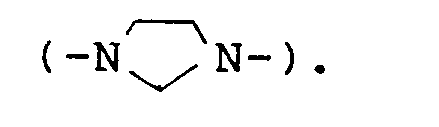


- In the "substituted or unsubstituted alkylene group" represented by Z in general formula (I), the alkylene group preferably has generally 1-4, preferably 1-2 carbon atoms. The alkylene group may be mono-substituted by a substituted or unsubstituted aryl group or a substituted or unsubstituted heteroaromatic group, each of which is the same as or different from Rs.
- Preferable examples of the substituted or unsubstituted aryl group or the substituted or unsubstituted heteroaromatic group, each represented by Rs, are a phenyl group, a naphthyl group, a mono- or dihalophenyl group, a Ci-C6- alkylphenyl group, a Ci-C6-alkoxyphenyl group, a Ci-C6-alkylthiophenyl group, a nitrophenyl group, a cyanophenyl group, a C1-C6- alkoxycarbonylphenyl group, a C2-C7- alkanoylphenyl group, a biphenylyl group, a mono- or ditrifluoromethylphenyl group, a methylenedioxyphenyl group, a thienyl group, a halothienyl group, a furyl group and a pyridyl group.
- However, Z is particularly preferably -CH2-, -CH2CH2-,

- In general formula (I), X is preferably -CH2-,

- Y is -S(O)p-, - CH2 - or -O-. The -S(O)p- is a sulfide group when p is 0, a sulfinyl group when p is 1, and a sulfonyl group when p is 2;
- Y is preferably a sulfinyl group (-S-), -CH2-, -O- or a single bond, and particularly preferably -S-, -O- or a single bond.
- m is preferably 0-4.
- Typical examples of the compound of general formula (I) provided by the present invention are as follows except for those shown in Examples which are described later. N-[2-[4-(Benzhydryloxy)piperidino]-ethyl]-6,7-dihydroxy-2-naphthamide, N-[2-[4-(Benzhydryloxy)piperidino]ethyl]-3-(6,7-dihydroxynaphthoyl)-(E)-propeneamide, N-[2-[4-(Benzhydryloxy)piperidono]ethyl-3-(5,8-dihydroxyanaphthoyl)-(E)-2-pro- peneamide, N-[2-[4-(Benzhydryloxy)piperidino]ethyl]-5,8-dihydroxy-2-naphthamide, N-[2-[4-(Benzhydryloxy)-piperidino]-3-(3,7-dihydroxynaphthoyl)-(E)-2-propeneamide, N-[2-[4-(Benzhydryloxy)piperidino]-3-(3,5-dihydroxynaphthoyl)-(E)-2-propeneamide, N-[2-[4-(Benzhydryloxy)piperidino]ethyl]-6-hydroxy-7-pyridylmethoxy-2-naphthamide, N-[2-[4-(Benzhydryloxy)piperidino]ethyl]-6-hydroxy-7-[2-(pyridyl)ethoxy]-2-naph- thamide, N-[2-[4-(Benzhydryloxy)piperidino]ethyl]-6-hydroxy-7-[3-(pyridyl)propyloxy]-2-naphthamide, N-[2-[4-(Benzhydryloxy)piperidino]ethyl]-6-hydroxy-7-[2-(1-imidazolyl)ethoxy]-2-naphthamide, N-[2-[4-(Benz- hydryloxy)piperidino]ethyl]-3-(6-hydroxy-7-pyridylmethoxynaphthoyl)-(E)-2-propeneamide, N-[2-[4-(Benz- hydryloxy)piperidino]ethyl]-3-[6-hydroxy-7-[2-(limidazolyl)ethoxy]naphthoyl]-(E)-2-propeneamide, N-[2-[4-(Benzhydryloxy)piperidino]ethyl]-8-hydroxy-5-pyridylmethoxy-2-naphthamide, N-[2-[4-(Benzhydryloxy)-piperidino]ethyl]-8-hydroxy-5-[2-(pyridyl)ethoxy]-2-naphthamide, N-[2-[4-(Benzhydryloxy)piperidino]ethyl]-8-hydroxy-5-[3-(pyridyl)propyloxy]-2-naphthamide, N-[2-[4-(Benzhydryloxy)piperidino]ethyl]-8-hydroxy-5-[2-(1-imidazolyl)ethoxy-2-naphthamide, N-[2-[4-Benzhydryloxy)piperidino]ethyl]3-(8-hydroxy-5-pyridylmethox- ynaphthoyl)-(E)-2-propeneamide, N-[2-[4-(Benzhydryloxy)piperidino]ethyl]-3-[8-hydroxy-5-[2-(1-imidazolyl)-ethoxy]naphthoyl]-(E)-2-propeneamide, N-[2-[4-(Benzhydryloxy)piperidino]ethyl]-3-(3-hydroxy-7-pyridylmethoxynaphthoyl)-(E)-2-propeneamide, N-[2-[4-(Benzhydryloxy)piperidino]ethyl]-3-[3-hydroxy-7-[2-(pyridyl)ethoxynaphthoyl]-(E)-2-propeneamide, N-[2-[4-(Benzhydryloxy)piperidino]ethyl]-3-[3-hydroxy-7-[3-(pyridyl)propyloxynaphthoyl]-(E)-2-propeneamide, N-[2-[4-(Benzhydryloxy)piperidino]ethyl]-3-[3-hydroxy-7-[2-(1-imidazolyl)ethoxy] naphthoyl]-(E)-2-propeneamide, N-[2-[4-(Benzhydryloxy)piperidino]ethyl]3-hydroxy-5-[2-(pyridyl)ethoxy]-2-naphthamide, N-[2-[4-(Benzhydryloxy)piperidino]ethyl]-3-hydroxy-5-[3-(pyridyl)-propyloxy]-2-naphthamide, N-[2-[4-(Benzhydryloxy)piperidino]ethyl]-3-hydroxy-5-[2-(1-imidazolyl)ethoxy]-2-naphthamide, N-[2-[4-(Benzhydryloxy)piperidino]ethyl]-3-(3-hydroxy-5-pyridylmethoxynaphthoyl)-(E)-2-pro- peneamide, N-[2-[4-(Benzhydryloxy)piperidino]ethyl]-3-[3-hydroxy-5-[2-(1-imidazolyl)ethoxy]naphthoyl]-(E)-2-propeneamide, N-[2-[methyl-[2-(4-chlorophenyl)-phenylmethoxy]ethyl]aminoethyl]-3-hydroxy-5-pyridylmethoxy-2-naphthamide, N-[2-[methyl[2-[(4-chlorophenyl)-(2-pyridyl)methoxy]ethyl]aminoethyl]-3-hydroxy-5-pyridylmethoxy-2-naphthamide, N-[2-[methyl-[2-[(2-pyridyl)-phenylmethoxy]ethyl]aminoethyl]-3-hydroxy-5-pyridylmethoxy-2-naphthamide, N-[2-[methyl-[3-[(4-chlorophenyl)-(2-pyridyl)methoxy]propyl]aminoethyl]-3-hydroxy-5-pyridylmethoxy-2-naphthamide, N-[3-[4-(benzhydryloxy)piperidino]propyl]-3-hydroxy-5-pyridylmethoxy-2-naphthamide, N-[2-[4-[(2-pyridyl)-phenylmethoxy]piperidino]ethyl]-3-hydroxy-5-pyridylmethoxy-2-naphthamide, N-[2-[4-[(4-chlorophenyl)-(2-pyridyl)methoxy]piperidino]ethyl]-3-hydroxy-5-pyridylmethoxy-2-naphthamide, N-[2-[4-(benzhydryloxy)piperidino]ethyl]-3-hydroxy-5-pyridylmethoxy-2-naphthamide, N-[2-[4-[(2-pyridyl)-phenylmethoxy]homopiperidino]ethyl]-3-hydroxy -5-pyridylmethoxy-2-naphthamide, N-[2-[4-(be- nzhydryloxy)cyclohexylamino]ethyl]-3-hydroxy-5-pyridylmethoxy-2-naphthamide, N-[2-[4-(benzhydrylamino)-cyclohexylamino]ethyl]-3-hydroxy-5-pyridylmethoxy-2-naphthamide, N-[2-[4-(benzhydrylamino)piperidino]-ethyl]-3-hydroxy-5-pyridylmethoxy-2-naphthamide,
- In the compound of the present invention, preferable are those represented by the following formula:
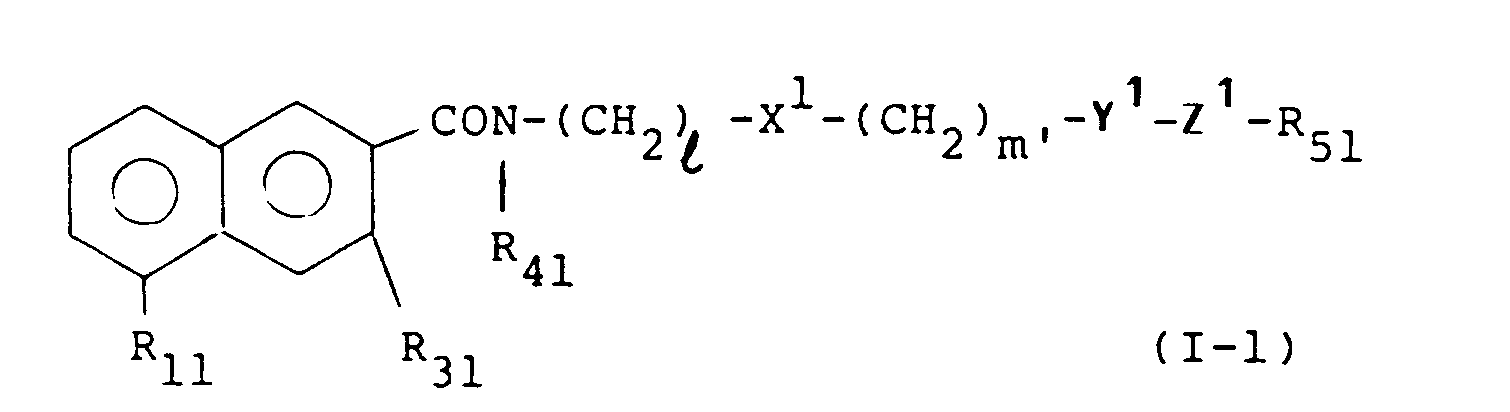
- R31 is a hydroxyl group or a C2-C7- alkanoyloxy group;
- R41 is a hydrogen atom;
- R51 is a phenyl group, a halophenyl group or a thienyl group;
- X1 is

- y1 is -S-, -O- or a single bond;
- Z1 is -CH2- or

- I is an integer of 0-4; and
- m' is an integer of 0-4. Particularly preferable are those compounds of formula (1-1) wherein R11 is a pyridylmethoxy;
- R31 is a hydroxyl group;
- R41 is a hydrogen atom;
- R51 is a phenyl group;
- X1 is

- Y1 is -O- or a single bond;
- Z1 is

- ℓ is 2-4; and
- m' is 0.
- The compound of general formula (I) can be present in the form of acid addition salt when the formula (I) compound has an amino group. Examples of such a salt are inorganic acid salts such as hydrochloride, hydrobromide, phosphate, sulfate and the like, and organic acid salts such as acetate, propionate, lactate, citrate and the like. Pharmaceutically acceptable acid addition salts are particularly preferable.
- The compound of general formula (I) according to the present invention can be produced, for example, by reacting a carboxylic acid represented by the following general formula:


- The reaction between the carboxylic acid of formula (II) and the amine compound of formula (III) is an amidation reaction and can be conducted generally in the presence of a condensing agent according to an ordinary method. As the condensing agent, there can be used, for example, a carbodiimide reagent such as N,N'-dicyclohexylcarbodiimide (DCC), 1-ethyl-3-(3-dimethylaminopropyl)carbodiimide hydrochloride (WSC) and the like.
- The amount of the amine compound of formula (III) used to the carboxylic acid of formula (II) is not strictly restricted, but is preferably 1-2 moles, particularly 1-1.3 moles per mole of the carboxylic acid of formula (II).
- The reaction is desirably conducted generally in an inert solvent. Such a solvent includes, for example, halogenated hydrocarbons such as dichloromethane, chloroform, carbon tetrachloride and the like; ethers such as diethyl ether, tetrahydrofuran (THF), dimethoxyethane (DME), dioxane and the like; and amides such as dimethylformamide (DMF) and the like. They can be used singly or in admixture.
- The reaction can be conducted generally at 0°C to about 150°C, but preferably at 10-100°C in view of the efficiency.
- In the above reaction, it is possible to use N,N-dimethylaminopyridine or the like as a catalyst.
- The above amidation reaction may be conducted without using any condensing agent, that is, by converting the carboxylic acid of formula (II) to a reactive derivative thereof, for example, an active ester derivative, an acid halide, a mixed acid anhydride or the like and then reacting the reactive derivative with the amine compound of formula (III) in an inert solvent.
- The active ester derivative of the formula (II) carboxylic acid can be produced according to an ordinary method. For example, it can be produced by condensing the formula (II) carboxylic acid with an alcohol such as N-hydroxysuccinimide, N-hydroxyphthalimide, 2-nitrophenol, 4-nitrophenol, 2,4-dinitrophenol or the like in the presence of a carbodiimide reagent in an inert solvent.
- The halide of the formula (II) carboxylic acid includes, for example, carboxylic acid chloride and carboxylic acid bromide. The acid chloride can be produced according to an ordinary method, for example, by reacting the formula (II) carboxylic acid with a halogenating agent such as thionyl chloride, thionyl bromide, phosphorus pentachloride or the like in an inert solvent.
- The mixed acid anhydride derivative of the formula (II) carboxylic acid can be produced according to an ordinary method, for example, by condensing the formula (II) carboxylic acid with an acid chloride such as ethyl chlorocarbonate, phenyl chlorocarbonate, pyvaloyl chloride, acetyl chloride, benzyl chloride or the like in the presence of a base in an inert solvent.
- The reaction of the reactive derivative of the formula (II) carboxylic acid with the formula (III) amine compound can be conducted generally at about -20 °C to about 50 °C, preferably 0-20 °C using 1-2 moles, particularly 1-1.3 moles the formula (III) amine compound per mole of the reactive derivative of the formula (II) carboxylic acid.
- The compound of formula (I) produced by the above amidation reaction can be separated and purified according to a per se known method, for example, colum chromatography, recrystallization, distillation or the like.
- The compound of formula (I) wherein Ri, R2 and/or R3 is a C2-C7- alkanoyloxy group, can be converted by hydrolysis to a compound of formula (I) wherein the corresponding Ri, R2 and/or R3 is a hydroxyl group. This hydrolysis reaction can be conducted according to an ordinary method, for example, by using a base such as potassium carbonate, sodium carbonate, potassium hydrogencarbonate, sodium hydrogencarbonate or the like in an inert solvent.
- The naphthoic acid derivative of formula (I) having an amino group may be converted to a corresponding acid addition salt by reaction with a pharmaceutically acceptable acid according to an ordinary method.
- The carboxylic acid of formula (II) used as a starting material in the above reaction, is known per se. It can be produced according to the method described in Reference Example 1, 2 or 3 which appears later, or a method similar thereto.
- Specific examples of the formula (II) carboxylic acid are 3-hydroxy-2-naphthoic acid, 3,5-dihydroxy-2-naphtoic acid, 3,7-dihydroxy-2-naphtoic acid, 3-acetoxy-2-naphtoic acid, 3,5-diacetoxy-2-naphtoic acid, 3,7- diacetoxy-2-naphtoic acid, 5-acetoxy-3-hydroxynaphtoic acid, 3-hydroxy-5-methoxynaphtoic acid, 3-hydroxy-5-(2-pyridylmethyl)naphtoic acid and 3,5-dimethoxy-2-naphtoic acid.
- Meanwhile, the formula (III) amine compound can be produced by, for example, the method of the following reaction scheme A or B.

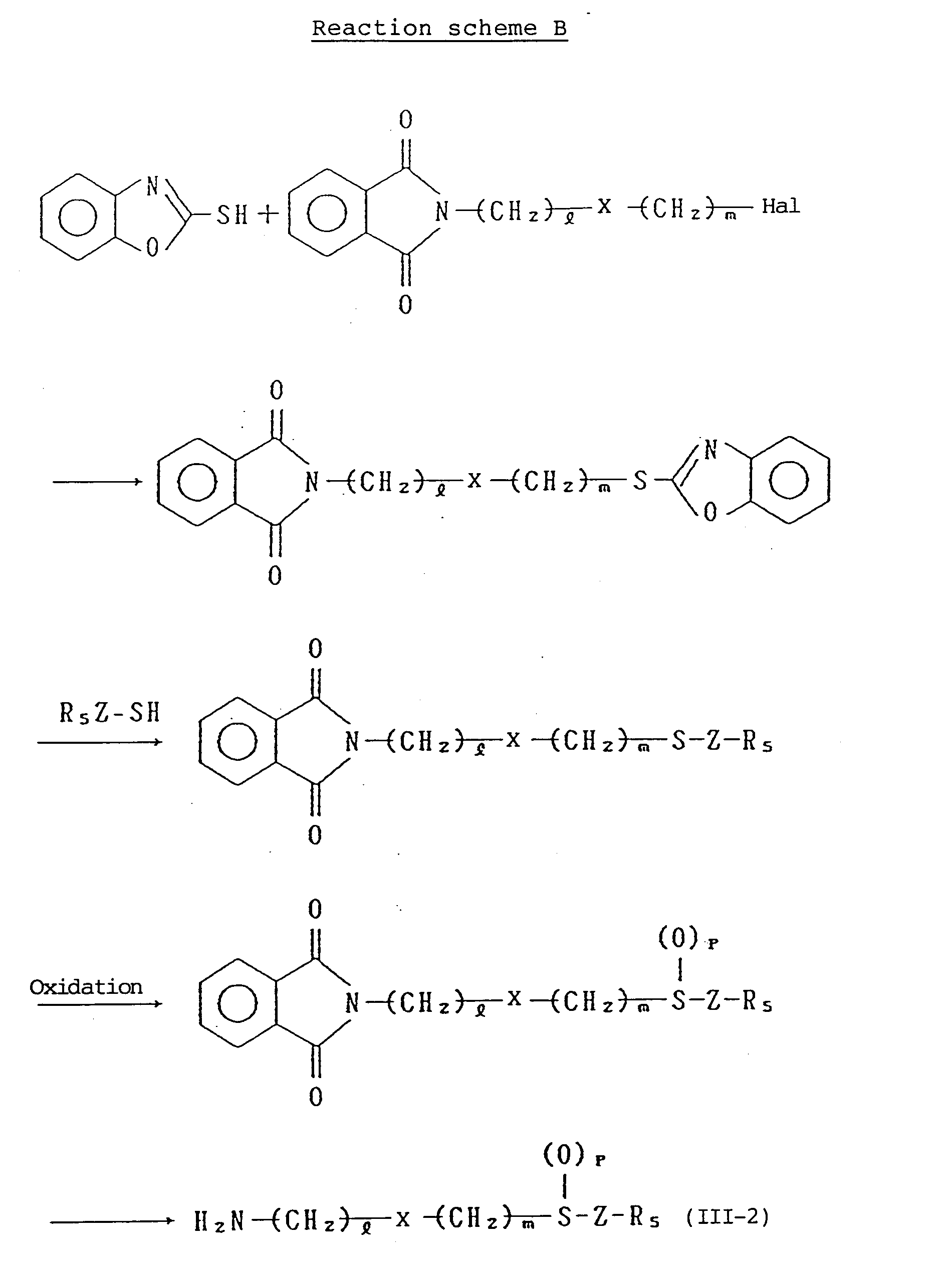
- In the above formulas, Rs, X, Y, Z, ℓ, m and p are as defined above, and Hal is a halogen atom.
- As to the details of the reaction schemes A and B, the descriptions made in Reference Examples 4-8 which appear later, can be referred to.
- The amine compound of formula (III) wherein X is a methylene group, can be produced from a thiol compound according to the method disclosed in Japanese Patent Application Laid-Open No. 297373/1988.
- Typical examples of the formula (III) amine compound are 2-(3-furfurylmethylthio)ethaneamine, 2-(3- furfurylmethylsulfinyl)ethaneamine, 2-(3-furfurylmethylsulfonyl)ethaneamine, 2-(2-furfurylmethylthio)-ethaneamine, 2-(2-furfurylmethylsulfinyl)ethaneamine, 2-(2-furfurylmethylsulfonyl)ethaneamine, 2-(2-thienyl- methylthio)ethaneamine, 2-(benzhydryl)ethaneamine, (2-4-chlorophenylmethylthio)ethaneamine, 2-(2-pyridyl- methylthio)ethaneamine, 2-(benzhydrylsulfonyl)ethaneamine, 2-(2-pyridyl-phenylmethylthio)ethaneamine, 2- {4-(1-imidazolylmethyl)phenylmethylthio}ethaneamine, 5-(2-thienylmethylthio)pentaneamine, 2-{(4-methoxyphenyl-2-thienyl)methylthio}ethaneamine, 2-{4-(1-imidazolyl)phenylmethylthio}ethaneamine, 3-(2-thienyl- methylthio)propaneamine, 3-{3-(2-thienyl)propylthio}propaneamine, 3-{2-(2-thienyl)ethylthio}propaneamine, 2-{2-(2-thienyl)ethylthio}ethaneamine, 4-{3-(2-thienyl)propylthio}butaneamine, 4-(2-thienylmethylthio)-butaneamine, 8-(2-thienylmethylthio)octaneamine, 4-{2-(2-thienyl)thylthiolbutaneamine, 2-(2-pyridylthio)-ethaneamine, 2-(2-pyrimidylthio)ethaneamine, 2-(1-imidazol-2-ylthio)ethaneamine, 1-(2-aminoethyl)-4-{2-(2-thienyl)ethylthiolpiperidine, 1-(2-aminoethyl)-4-diphenyl-methylthiopiperidine, N-(2-aminoethyl)-N'-{2-(2-thienylmethylthio)ethyllpiperazine, 2-[N-methyl-N'-{2-(2-thienylmethylthio)ethyl}amino]ethaneamine, N-(2-aminoethyl)-N'-{2-(diphenyl methylthio)ethyl)piperazine, 4-(2-aminoethyl)-1-{2-(diphenylmethylthio)-ethyllpiperidine, 1-(2-aminoethyl)-4-{2-(diphenylmethylthio)ethyl}homopiperazine, N-(2-aminoethyl)-N'-{2- {4-(1-imidazolylmethyl)phenylmethylthio} ethyl}piperazine, 4-(2-aminoethyl)-1-{2-{4-(1-imidazolylmethyl)-phenylmethylthio}ethyl}piperidine, 1-(2-aminoethyl)-4-{2-{ 4-(1-imidazolylmethyl)phenylmethylthio)-ethyl}homopiperazine, N-{2-(diphenylmethylthio)ethyl}piperazine, 4-{2-(diphenylmethylthio)ethyl}piperidine, N-{2-(diphenylmethylthio)ethyl}homopiperidine, N-{2-{4-(1-imidazolylmethyl}phenyl- methylthio}ethyl}piperazine, 4-{2-{4-(1-imidazolylmethyl) phenylmethylthio}ethyl}piperidine, N-{2-{4-(1-imidazolylmethyl)phenylmethylthio}ethyl} homopiperidine, N-(2-aminoethyl)-N'-{2-{6-(1-imidazolylmethyl)-pyridin-2-yl-methylthio}ethyl}piperazine, 4-(2-aminoethyl)-1-{2-{6-(1-imidazolylmethyl}pyridin-2-yl-methylthio}ethyl}piperidine, 1-(2-aminoethyl)-4-{2-{6-(1-imidazolylmethyl)pyridin-2-yl-methylthio}ethyl}ethyl}homopiperazine, N-(2-aminoetyl)-N'-{2-(2-pyridylphenylmethylthio)ethyl}piperazine, 4-(2-aminoethyl)-1-{2-(2-pyridyl-phenylmethylthio)ethyl}piperidine,1-(2-aminoethyl)-4-{2-(2-pyridylphenyl- methylthio ethyl}homopiperidine, N-{2-(2-pyridylphenylmethylthio)ethyl}piperazine, 4-{2-(2-pyridyl-phenyl- methylthio)ethyllpiperidine, N-{2-(2-pyridyl-phenylmethylthio)ethyl}homopiperidine, N-(2-aminoethyl)-N'-{2- {4-1-imidazolyl)phenylmethylthio}ethyl}piperazine, 4-(2-aminoethyl)-1-{2-{4-(1-imidazolyl)phenyl- methylthio}ethyl}piperidine, 1-(2-aminoethyl)-4-{2-{4-(1-imidazolyl)phenylmethylthio}ethyl}homopiperazine, N-(2-aminoethyl)-N'-{2-(3-pyridylphenylmethylthio)ethyl}piperazine, 4-(2-aminoethyl)-1-{2-(3-pyridylphenyl- methlthio)ethyllpiperidine, 1-(2-aminoethyl)-4-{2-(3-pyridylphenylmethylthio)ethyl)homopiperazine,N-(2-aminoethyl)-N'-{2-{4-(4-chlorophenyl)phenylmethylthio}piperazine, 4-(2-aminoethyl)-1-{2-{4-(4-chlorophenyl)phenylmethylthio}ethyl}piperidine, 1-(2-aminoethyl)-4-{2-{4-(4-chlorophenyl)phenyl- methylthio}ethyl}homopiperazine, N-(2-aminoethyl)-N'-2-{di-(4-chlorophenyl)methylthio}ethyl}piperazine, 4-(2-aminoethyl)-1-{2-{di(4-chlorophenyl)methylthio}ethyl}piperidine, 4-(2-aminoethyl)-1-{2-{di-(4-chlorophenyl)methylthio}ethyl}homopiperazine, 2-(4-benzhydryl-I-piperazinyl)ethaneamine, 2-{4-(2-pyridyl- phenylmethyl)piperazinolethaneamine, 2-{4-(3-pyridyl-phenylmethyl)piperazino}ethaneamine, 2-{4-(4-pyridylphenylmethyl)piperazinolethaneamine and 2-{4-(benzhydryloxy)piperidino}ethaneamine.
- The naphthoic acid derivative of formula (I) provided by the present invention has a 5-lipoxygenase-inhibiting action, a TXA2 synthetase-inhibiting action (a TXA2 antagonism), a histamine antagonism and a mast cell-stabilizing action, and is expected to find application as an antiallergic agent.
- The above pharmacological actions of the present compound can be proven by the following tests.
- Rat basophil leukemia-I cells were suspended in a 50 mM phosphate buffer solution (PBS) of pH 7.0 containing 1 mM of EDTA, 0.1 % of gelatin and 14 µM of indometacin so that the resulting suspension contained 5x10⁷ cels cells/mi. The suspension was subjected to an ultrasonic treatment and then to centrifugation (10,OOOG, 20 minutes). The resulting supernatant liquid was used as an enzymatic solution. 10 µℓ of a test compound solution was added to 460 µℓ of the enzymatic solution and a reaction was conducted at 37°C for 5 minutes. Thereto were added 7.4 KBq of 14C-arachidonic acid and a 100 mM aqueous calcium chloride solution, and a reaction was conducted at 37°C for 10 minutes. The reaction mixture was ice-cooled and then adjusted to pH 3 with 1 N hydrochloric acid to terminate the reaction. Thereafter, extraction with 5 mℓ of chloroform was conducted. The extract was subjected to evaporation to dryness in the presence of nitrogen gas, and the residue was dissolved in a 2 : 1 mixture of chloroform and methanol. The solution was developed by thin-layer chromatography using Kieselgel 60 F2S4, according to the method of Jakschik, B.A. et al. [Biachen. Biophys. Res. Commun. 95, 103 (1980)]. The radioactivity of 5-hydroxyeicosatetraenoic acid (5-HETE) was measured by a liquid scintillation counter (LSC-900 manufactured by Aroka) to determine the ratio of 5-HETE biosynthesis inhibition of test compound-added group to control group, after which there was determined a concentration of test compound at which the activity of 5- lipoxygenase was inhibited by 50 %, i.e. an ICso. The test compound was used in a diluted form by dissolving it in dimethyl sulfoxide. The results are shown in Tables 1, 2 and 3 which appear later.
- This test was conducted according to the method of Schwartz, J. et al. [Int. Arch. Allergy 30, 67 (1966)]. That is, 10 ml each of Hnak's balanced salt solution containing 10 units/m of heparin was administered to rats intraperitoneally. After gentle massage of the abdomen for 2 minutes, peritoneal exudate cells (PEC) were obtained and washed 3 times with PBS containing 0.1 % of bovine serum albumin (BSA). Mast cells in the suspension of PEC were stained with 0.2 % of Neutral Red, and PEC were adjusted to a concentration of 4x10s mast cells/mi using PBS containing 0.1 % of BSA. The cell suspension (50 µℓ) was incubated with 50 µℓ of a test compound solution at 37°C for 5 minutes, then challenged with anti-egg albumin rat serum (50 µℓ, 1:40) and egg albumin (50 µℓ, 10 mg/mℓ) and further incubation was performed for 10 minutes. The reaction mixture was ice-cooled to terminate the reaction. Thereafter the number of mast cells undergoing degranulation was assessed under microscope observation to determine the menbrane-stabilizing action of the test compound. The results are shown in Table 1.

- Guinea pigs were sacrificed and the tracheae were isolated. Each trachea was cut open at the center of the tracheal cartilage, and was cut in the vertical direction to separate into individual segments. Three of these segments were combined to form a tracheal chain. The tracheal chain was suspended in a Magnus tube filled with a Tyrode's solution (NaCI: 137 mM , KCI: 2.7 mM, CaCI2: 1.8 nM, MgCI2: 1.1 mM, NaHP04: 0.4 mM, NaHC03: 12.0 mM, glucose: 5.6 mM) kept at 37 °C, while applying a load of 0.5 g. A mixed gas consisting of 95 % of 02 and 5 % of C02 was constantly passed through the tube, and the contraction of the smooth muscle was recorded on a polygraph (U-228 manufactured by NIPPON DENKI KAGAKU) via an isotonic transducer (TD-112S manufactured by Nihon Koden). Each test compound was incubated for 5 minutes before the addition of 3x10⁻⁵ M of histamine hydrochloride (a product of Wako Pure Chemical Industries, Ltd.). The results are shown in Table 2.

- TXA2 synthetase activity was measured by the use of a thromboxane synthetase kit (Funakoshi: Eldan Tech). That is, 0.97 mg of a human platelet microsome fraction was suspended in 1 ml of a 50 mM tris-0.1 M sodium chloride buffer solution of pH 7.5, and the resulting suspension was ice-cooled. 0.1 M of the suspension was placed in a sample tube and a test compound was added thereto. The resulting mixture was preincubated at 25 ° C exactly for 3 minutes. Thereto was added 2 µl of an ice-cooled acetone solution containing 0.05 mg/ml of PGH2, and the resulting mixture was incubated at 25 ° C exactly for 3 minutes. 10 µl of a 0.25 mM FeC12 solution was added to terminate the reaction. The resulting mixture was allowed to stand at room temperature for 15 minutes and then subjected to centrifugation at 1,000 G at 4°C for 10 minutes. The TXB2 content contained in the supernatant was measured by RIA (thromboxanes B2[3H] RIA Kit: NEN Research Products). The test compound was dissolved in DMSO or distilled water before use. The test was performed in triplicate or quadruplicate assays. The results are shown in Table 3.

- As is clear from the above test results, the compound of the present invention has a 5-lipoxygenase-inhibiting action, a TXA2 synthetase-inhibiting action, a histamine antagonism and a cell membrane-stabilizing action for histamine-release from mast cells, and is expected to find application as a drug for allergoses treatment (an antiallergic agent).
- In using the present compound as an antiallergic agent for treatment of allergosis patients, the compound can be administered to the patients orally, parenterally (intravenous injection, subcutaneous injection, intramuscular injection, etc.) per rectum or topically (inhalation). The dose of administration can be varied depending upon the symptom, age, weight, sex, etc. of patient, diagnosis of doctor, the administration route, etc., but the appropriate dose is generally 0.1-9 mg/kg of weight/day, preferably 2-6 mg/kg of weight/day.
- In administration of the compound of the present invention, the compound can be mixed with a pharmaceutically acceptable carrier or dilutent to formulate into various dosage forms such as tablets, capsules, sugar-coated tablets, granules, powder, syrup, injection, suppositories, inhalant and the like.
- The usable carrier or diluent includes lactose, starch, cellulose crystals, calcium carbonate, mannitol, maltose, polyvinylpyrrolidone starch, hydroxypropyl cellulose, ethyl cellulose, carboxymethyl cellulose, gum arabic, etc.
- The present invention is hereinafter described more specifically by way of Examples, Reference Examples and Preparation Examples.
-

- In 30 ml of pyridine were dissolved 1.14 g (5.6 mM) of 3,5-dihydroxy-2-naphtoic acid and 1.4 g (13.9 mM) of acetic anhydride. The resulting solution was stirred at room temperature overnight to give rise to a reaction. After the completion of the reaction, the solvent was removed under reduced pressure. The residue was dissolved in 100 mℓ of ethyl acetate. The resulting solution was washed with 50 mℓ of a saturated potassium hydrogensulfate solution and two 50 mî portions of a saturated aqueous sodium chloride solution and dried over anhydrous sodium sulfate. The solvent was removed by distillation. The residue was purified by silica gel chromatography (elutant: 5% methanol-dichloromethane) to obtain 1.5 g of the title compound at a yield of 93 %.
-

- 3 g (14.7 mM) of 3,5-dihydroxynaphthoic acid was dissolved in 100 mî of ethanol. Thereto was added 620 mg (1.47 mM) of sodium hydroxide. The mixture was stirred at room temperature for 3 hours to give rise to a reaction. After the completion of the reaction, the solvent was removed under reduced pressure. To the reside were added 100 mî of acetonitrile, 2.57 g (14.7 mM) of benzyl bromide and 500 mg (14.7 mM) of tetra-n-butylammonium hydrogensulfate. The resulting mixture was refluxed overnight with heating, to give rise to a reaction. After the completion of the reaction, the solvent was removed under reduced pressure. The residue was dissolved in ethyl acetate. The resulting solution was washed with a saturated aqueous sodium chloride solution and dried over anhydrous sodium sulfate. The solvent was removed by distillation. The residue was purified by silica gel chromatography to obtain 4.2 g of the title compound at a yield of 97 %.
- 500 mg (1.7 mM) of benzyl 3,5-dihydroxy-naphtoate was dissolved in 100 mℓ of acetonitrile. Thereto were added 434 mg (3.4 mM) of 3-picolyl chloride and 235 mg (1.7 mM) of potassium carbonate. The resulting mixture was stirred for 7 hours to give rise to a reaction. After the completion of the reaction, the solvent was removed under reduced pressure. The reside was dissolved in ethyl acetate. The resulting solution was washed with a saturated aqueous sodium chloride solution and dried over anhydrous sodium sulfate. The solvent was removed by distillation. The residue was purified by silica gel chromatography to obtain 480 mg of the title compound at a yield of 73 %.
- 500 mg (1.3 mM) of the compound obtained above was dissolved in 50 mî of a 10 : 1 mixture of ethanol and water. To the resulting solution was added 72.8 mg (2.6 mM) of potassium hydroxide. The resulting mixture was refluxed for 2 hours with heating, to give rise to a reaction. After the completion of the reaction, the reaction mixture was neutralized with 5 % hydrochloric acid. The solvent was removed under reduced pressure. The residue was placed in water, and the resulting crystals were collected by filtration to obtain 350 mg of the title compound at a yield of 90 %.
-

- 2 g (9.8 mM) of 3,5-dihydroxy-2-naphthoate was dissolved in 50 mî of anhydrous dimethylformamide. Thereto was added 1.5 g (29.4 mM) of sodium hydride. The resulting mixture was stirred for 30 minutes. Then, 4.9 g (34.3 mM) of methyl iodide was added and stirring was conducted overnight to give rise to a reaction. After the completion of the reaction, water was added to the reaction mixture. The solvent was removed under reduced pressure. The residue was dissolved in ethyl acetate. The resulting solution was washed with a saturated aqueous sodium chloride solution and dried over anhydrous sodium sulfate. The solvent was removed by distillation. The residue was purified by silica gel chromatography to obtain 2.35 g of the title compound at a yield of 98 %.
- The title compound was obtained according to the method of Reference Example 2-3, at a yield of 90 %.
-

- 2 g (5.79 mM) of the phthalimide compound was dissolved in 30 mℓ of methanol. Thereto was added 435 mg (8.7 mM) of hydrazine hydrate, and the mixture was refluxed for 1 hour with heating. After cooling, the resulting crystals were collected by filtration and washed with ether. The filtrate and the washings were combined. The solvent was removed by distillation. The residue was mixed with ether. This procedure was repeated until no precipitate was formed, whereby 1.18 g of the title compound, i.e. 5-(2-thienylmethylthio)-pentamine was obtained at a yield of 95 %.
- NMR(o, CDC13); 1.40 - 1.45(2H, m), 1.56 - 1.61(2H, m), 1.71(2H, s), 2.50(2H, t, J=6Hz), 2.69(2H, t, J = 7Hz), 3.92(2H, s), 6.91 - 6.93(2H, m), 7.20(1 H, dd, J = 5Hz, 2Hz)
-

- NMR(δ, DCDℓ3); 1.41(2H, br4-s), 1.72(2H, t, J=6Hz), 2.56(2H, t, J=6Hz), 2.78(2H, t, J=6Hz), 3.93-(2H, s), 6.91 - 6.93(2H, m), 7.20(1 H, dd, J = 6Hz, 2Hz)
-


- 200 mg (0.81 mM) of the compound was dissolved in 10 ml of methanol. Thereto was added a solution of 40 mg (1.0 mM) of sodium hydroxide in 10 ml of water. The mixture was refluxed for 10 hours with heating to give rise to a reaction. After the completion of the reaction, the solvent was removed under reduced pressure. The residue was subjected to extraction with chloroform. The extract was washed with water and a saturated aqueous sodium chloride solution in this order and dried over anhydrous sodium sulfate. The solvent was removed by distillation. The residue was purified by silica gel chromatography to obtain 225 mg of 4-benzhydrylthiopiperidine at a yield of 98 %.
- 227 mg (0.8 mM) of the compound and 262 mg (1.4 mM) of N-(2-bromoethyl)phthalimide were dissolved in 15 ml of methyl ethyl ketone. Thereto were added 220 mg (1.6 mM) of anhydrous potassium carbonate and 226 mg (1.5 mM) of sodium iodide. The mixture was refluxed for 8 hours with heating, to give rise to a reaction. After the completion of the reaction, the solvent was removed under reduced pressure. The residue was subjected to extraction with chloroform. The extract was washed with water and a saturated aqueous sodium chloride solution in this order and dried over anhydrous sodium sulfate. The solvent was removed by distillation. The residue was purified by silica gel chromatography to obtain 237 mg of N-[2-(4-benzhydrylthiopiperidinyl)ethyl]phthalimide at a yield of 65 %.
- The above phthalimide was treated with hydrazine hydrate in the same manner as in Reference Example 4, to obtain the title compound, i.e. 1-(2-aminoethyl)-4-benzhydrylthiopiperidine at a yield of 92 %.
- NMR(o, CDCIa); 1.57 - 1.70(4H, m), 1.84 - 1.90(2H, m), 1.95 - 2.02(2H, m), 2.34(2H, t, J=6Hz), 2.44 - 2.51 (1 H, m), 2.72 - 2.80(2H, m), 5.22(1 H, s), 7.19 - 7.33(6H, m), 7.41 - 7.44(4H, m)
-

- 1 g (3.7 mM) of N-formyl-N'-[2-(2-thienylmethylthio)ethyl]piperazine was dissolved in 10 ml of methanol. Thereto was added a solution of 178 mg (4.4 mM) of sodium hydroxide in 10 ml of water. The mixture was refluxed for 10 hours with heating, to give rise to a reaction. After the completion of the reaction, the solvent was removed under reduced pressure. The residue was subjected to extraction with chloroform. The extract was washed with water and a saturated aqueous sodium chloride solution in this order and dried over anhydrous sodium sulfate. The solvent was removed by distillation. The residue was purified by silica gel chromatography to obtain 800 mg of N-[2-(2-thienylmethylthio)ethyl]piperazine at a yield of 89 %.
- The N-[2-(2-thienylmethylthio)ethyl]piperazine was treated in the same manner as in Reference Example 7 to obtain the title compound, i.e. N-(2-aminoethyl)-N'-[2-(2-thienylmethylthio)ethyl]piperazine at a yield of 75 %.
- NMR(o, CDCl3); 1.63(2H, s), 2.40 - 2.6(14H, m), 2.77(2H, t, J=6Hz), 3.96(2H, s), 6.90 - 6.92(2H, m), 7.20(1 H, d, J-3Hz)
-

- NMR(o, CDCl3); 1.54(2H, br-s), 2.20(3H, s), 2.41 (2H, t, J=6Hz), 2.57 - 2.60(4H, m), 2.74(2H, t, J = 6 Hz), 3.95(2H, s), 6.87 - 6.93(2H, m), 7.20(1 H, dd, J-3Hz, 1 Hz)
-

- IR (cm-1, KBr): 1650, 1770
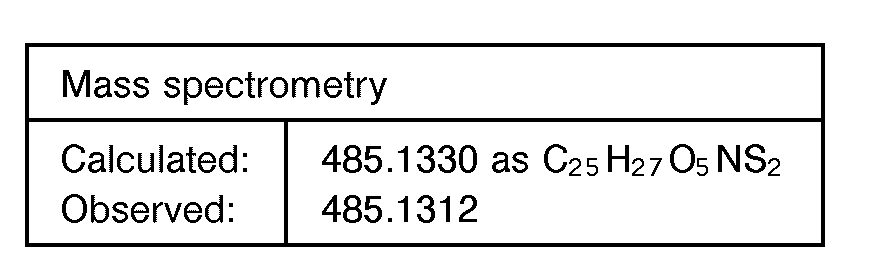
- NMR(δ, CDCl3): 1.45 - 1.53(2H, m), 1.54 - 1.69(2H, m), 2.37(3H, s), 2.46(3H, s), 2.53(2H, t, J=6 Hz), 3.44(2H, dt, J = 6Hz,6Hz), 3.92(2H, s), 6.26(1 H, br-s), 6.87 - 6.92(2H, m), 7.19(1 H, dd, J = 5Hz, 2Hz), 7.35(1 H, d, J = 9Hz), 7.51 (1 H, dd, J = 6Hz, 6Hz), 7.59(1 H, s), 7.78(1 H, d, J = 9Hz), 8.22(1 H, s)
- Reactions between 3,5-diacetoxy-2-naphthoic acid and amine compound were conducted in the same manner as in Example 1 to obtain the following amide derivatives.
-

- Yield: 86%
- IR (cm-1, CHCl3): 1600, 1770

- NMR(δ, CDCl3): 1.89(2H, t, J = 6Hz), 2.36(3H, s), 2.46(3H, s), 2.61 (2H, t, J = 6Hz), 3.53(2H, dt, J = 6Hz, 6Hz), 3.95(2H, s), 6.38(1 H, br-s), 6.85 - 6.88(1 H, m), 7.16(1 H, dd, J = 5Hz, 2Hz), 7.36-(1 H, d, J = 8Hz), 7.51 (1 H, dd, J = 8Hz, 8Hz), 7.59(1 H, s), 7.77(1 H, d, J = 8Hz), 8.17-(1 H, s)
-

- Yield: 75%
- IR(cm-1, CHCl3): 1630, 1770

- NMR(o, CDCl3): 2.94 - 2.61 (8H, m), 2.32(3H, s), 2.46(3H, s), 3.36(2H, br-s), 3.81 (2H, br-s), 3.96-(2H, s), 6.90 - 6.93(2H, m), 7.20 (1 H, dd, J-4Hz, 2Hz), 7.34 (1 H, d, J = 8Hz), 7.51 (1 H, dd, J = 8Hz, 8Hz), 7.66(1 H, s), 7.73(1 H, d, J = 8Hz), 7.81 (1 H, s)
-

- IR (cm-1, CHCl3): 1660, 1770

- NMR(δ, CDCℓ3): 2.54 - 2.70(12H, m), 2.44(3H, s), 3.57(2H, t, J=6Hz), 3.96(2H, s), 6.90 - 6.93(2H, m), 7.20(1 H, dd, J = 3Hz, 2Hz), 7.25 - 7.28(3H, m), 7.53(1 H, br-s), 7.61 (1H, dd, J-5Hz, 2Hz), 7.98(1 H, s)
- Reactions between carboxylic acid compound and amine compound were conducted in the same manner as in Example 4 to obtain the following amide derivatives.
-

- Yield: 73%
- IR (cm-1, KBr): 1660, 1770

- NMR(δ, CDCl3): 1.83 - 1.86(2H, m), 1.99 - 2.02(2H, m), 2.43(3H, s), 2.58 - 2.60(2H, m), 2.80(2H, t, J = 6Hz), 2.90 - 2.96(2H, m), 3.58 - 3.65(4H, m), 5.50(1 H, s), 7.21 - 7.34(13H, m), 7.65(1 H, dd, J = 6Hz, 2Hz), 8.15(1 H, s)
-

- Yield: 70%
- IR (cm-1, CHCl3): 1670, 1780

- NMR(δ, CDCl3): 2.31 (3H, s), 2.45(3H, s), 2.62 - 2.71 (4H, m), 2.74 - 2.77(2H, m), 3.55(2H, dt, J = 6HZ), 3.94(2H, s), 6.83 - 6.87(2H, m), 7.15(1 H, dd, J = 6Hz, 3HZ), 7.24(2H, d, J-5Hz), 7.29-(1 H, s), 7.54(1 H, dd, J = 5Hz, 5Hz), 7.78(1 H, br-s), 8.28(1 H, s)
-

- Yield: 55%
- IR (cm-1, CHCl3): 1660, 1780

- NMR(δ, CDCl3): 1.60 - 1.75(2H, m), 1.92 - 2.01 (2H, m), 2.06 - 2.17(2H, m), 2.44(3H, s), 1.48 - 1.55-(1 H, m) 2.59(2H, 5, J = 6Hz), 2.84 - 2.88(2H, m), 2.51 - 3.54(2H, m), 5.25(1 H, s), 7.20 - 7.34(1 OH, m), 7.42 - 7.45(3H, m), 7.64(1 H, dd, J = 9Hz, 2Hz), 7.94(1 H, s)
-

- Yield: 77 %
- IR (cm-1, CHCl3): 1670, 1780

- NMR(δ, CDCl3): 1.63 - 1.69(2H, m), 1.95 - 2.00(2H, m), 2.14 - 2.21(2H, m), 2.45(3H, s), 2.55 - 2.62 (3H, m), 2.88 - 2.94(2H, m), 3.56(2H, dt, J = 6Hz, 6Hz), 3.73(2H, s), 7.24 - 7.28(5H, m) 7.31 (1 H, s), 7.41 (1 H, br-s), 7.67(1 H, d, J = 7Hz), 7.97(1 H, s)
-

- Yield: 74%
- IR (cm-1, CHCl3): 1660, 1770
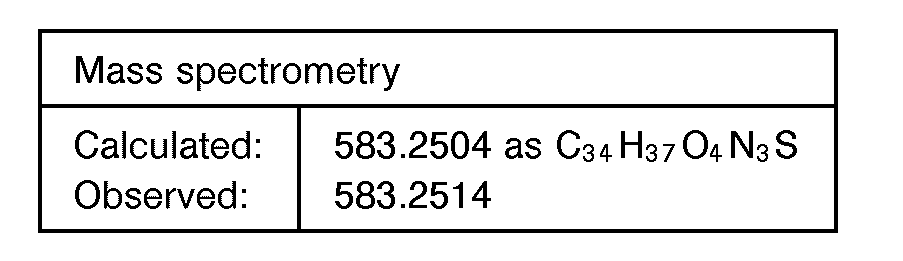
- NMR (δ, CDCl3): 2.44 - 2.60(12H, m), 2.66(2H, t, J = 6Hz), 3.55(2H, dt, J = 5 Hz, 5Hz), 5.22(1H, s), 7.19 - 7.33(8H, m), 7.40 - 7.44(5H, m), 7.65(1 H, d, J = 5Hz), 7.95(1 H, s)
-

- Yield: 66%
- IR (cm-1, CHCl3): 1660, 1770

- NMR(δ, CDCl3): 2.44(3H, s), 2.53 - 2.68(14H, m) 3.55(2H, dt, J=6Hz, 6Hz), 3.87(2H, s), 7.16(1H, dd, J = 6Hz, 6Hz), 7.24 - 7.31 (3H, m), 7.38(1 H, d, J = 8Hz), 7.49(1 H, br-s), 7.62 - 7.68(2H, m), 7.98(1 H, s), 8.51 (1 H, d, J-5 Hz)
-

- Yield: 67 %
- IR (cm-1, CHCl3): 1660, 1780

- NMR(δ, CDCl3): 2.44(3H, s), 2.35 - 2.79(14H, m), 2.77(2H, t, J = 6Hz), 5.33(1H, s), 7.14(1H, ddd, J = 7Hz 5Hz, 2Hz), 7.24 - 7.35(6H, m), 7.44(1 H, dd, J = 6Hz, 1 Hz), 7.48 - 7.50(2H, m), 7.62(1 H, ddd, J = 7Hz, 7Hz, 2Hz), 7.69(1 H, d, J = 5Hz), 7.80(1 H, br-s), 8.01 (1 H, dd, J = 5Hz, 2Hz)
-

- Yield: 65%
- IR (cm-1, CHCl3): 1660, 1770

- NMR(δ, CDCl3): 2.45(3H, s), 2.46 - 2.64(12H, m), 2.72(2H, t, J = 6Hz), 3.60(2H, dt, J = 6Hz, 6Hz), 3.70-(2H, s), 7.23 - 7.29(6H, m), 7.31 (1 H, s), 7.54(1 H, br-s), 7.68(1 H, s), 8.03(1 H, s)
-

- Yield: 62%
- IR (cm-1, CHCl3): 1680, 1780
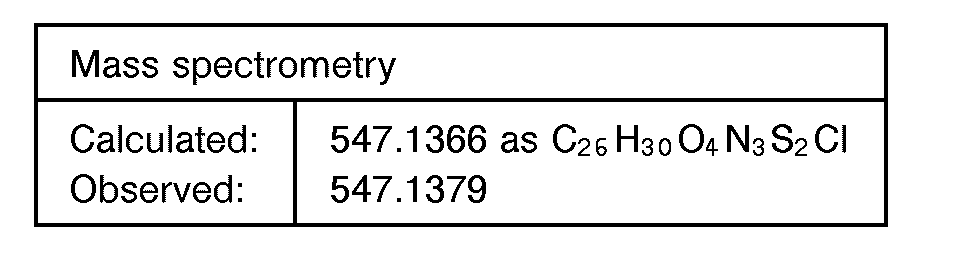
- NMR(δ, CDCl3): 2.45(3H, s), 2.55 - 2.70(12H, m) 2.68(2H, t, J = 6Hz), 2.68(2H, t, J = 6Hz), 3.58(2H, dt, J = 6Hz, 6Hz), 3.85(2H, s), 6.70(2H, m), 7.25 - 7.26(2H, m), 7.29(1 H, s), 2.40(1 H, br- s), 7.64(1 H, d, J = 7Hz), 7.96(1 H, s)
-

- Yield: 53%
- IR (cm-1, CHCl3): 1670, 1780

- NMR(δ, CDCℓ3): 2.45(3H, s), 2.44 - 2.70(12H, m), 2.68(2H, t, J=6Hz), 3.57(2H, dt, J=6Hz, 6Hz), 5.19(1 H, s), 7.23 - 7.38(13H, m), 7.66(1 H, d, J = 7Hz), 7.98(1 H, s)
-

- Yield: 58%
- IR(cm-1, CHCl3): 1670, 1780

- NMR(δ, CDCℓ3): 2.45(3H, s), 2.51 - 2.78(12H, m), 2.76(2H, t, J=6Hz), 3.63(2H, dt, J=6Hz, 6Hz), 5.14(1 H, s), 7.25 - 7.32(9H, m), 7.69(2H, d, J = 8HZ), 8.10(1 H, br-s), 8.56(2H, dd, J = 5Hz, 2 Hz)
-

- Yield: 70%
- IR(cm-1, CHCl3): 1670, 1780

- NMR(δ, CDCl3): 2.45(3H, s), 2.45 - 2.68(12H, m), 2.70(2H, t, J=6Hz), 3.59(2H, dt, J=6Hz, 6Hz), 5.16-(1 H, s), 7.20 - 7.40(11H, m), 7.45(1 H, br-s), 7.70(1 H, d, J = 6 Hz), 7.99(1 H, s)
-

- Yield: 72%
- IR(cm-1, CHCl3): 1670, 1780

- NMR(δ, CDCl3): 2.45(3H, s), 2.60 - 2.72(14H, m), 2.85(2H, t, J=7Hz), 3.12 (2H, t, J=7Hz), 3.59(2H, dt, J = 6Hz, 6Hz), 6.85(1 H, dd, J = 3Hz, 1 Hz, 6.92 - 6.95(1 H, m) 7.14(1 H, dd, J = 6Hz, 2Hz), 7.24 - 7.28(1 H, m), 7.31 (1 H, s), 7.46(1 H, br-s), 7.67(1 H, d, J = 7Hz), 8.00(1 H, s)
-

- Yield: 67 %
- IR(cm-1, CHCl3): 1670, 1780

- NMR(δ, CDCl3): 2.45(3H, s), 2.47 - 2.70(12H, m), 2.68(2H, t, J=6Hz), 3.58(2H, dt, J = 6Hz, 6Hz), 5.43-(1 H, s), 6.90 - 6.96(2H, m), 7.21 (1 H, dd, J = 5Hz, 2Hz), 7.21 - 7.36(4H, m), 7.31 (1 H, s), 7.33(1 H, s), 7.41 - 7.47(3H, m), 7.66(1 H, d, J = 8Hz), 7.98(1 H, s)
-

- Yield: 67 %
- IR(cm-1, KBr): 1670, 1780

- NMR(δ, CDCl3): 2.45(3H, s), 2.49 - 2.67(12H, m), 2.66(2H, t, J = 5Hz), 3.57(2H, t, J = 5Hz), 3.74(2H, s), 7.24 - 7.32(8H, m), 7.41 (1 H, br-s), 7.66(1 H, d, J = 8Hz), 7.97(1 H, s)
-

- IR(cm-1, CHCl3): 1670

- NMR(o, CDCl3): 2.58 - 2.85 (12H, m), 2.83(2H, 5, J = 6Hz), 3.67 - 3.70(2H, m), 3.94(2H, s), 6.51 (1 H, d, J = 6 Hz), 6.87 - 6.91 (2H, m), 7.04(1 H, dd, J = 9Hz, 9HZ), 7.15(1 H, s), 7.18(1 H, dd, J = 5Hz, 1 Hz), 7.31 (1 H, s), 7.69(1 H, s)
- Reactions between carboxylic acid compound and amine compound were conducted in the same manner as in Example 20 to obtain the following amide derivatives.
-

- Yield: 65%
- IR(cm-1, CHCl3): 1660

- NMR(δ, CDCl3): 2.45 - 2.83(12H, m), 2.81 (2H, t, J = 6Hz), 3.66 - 3.68(2H, m), 5.11(1H, s), 6.40(1 H, d, J = 6 Hz), 7.01 (1 H, dd, J = 8Hz, 8Hz), 7.08 - 7.12(2H, m), 7.23 - 7.31 (9H, m), 7.58(1 H, s)
-

- Yield: 74%
- IR (cm-1, CHCl3): 1680

- NMR(δ, CDCl3): 2.47 - 2.80(14H, m), 3.65 - 3.67(2H, m), 5.18(1H, s), 6.40(1H, d, J = 7Hz), 7.00(1H, dd, J = 8Hz, 8Hz), 7.10(1 H, d, J = 8Hz), 7.17 - 7.30(12H, m), 7.38 - 7.41 (4H, m), 7.57-(1 H, s)
-

- Yield: 75%
- IR(cm-1, CHCl3): 1680
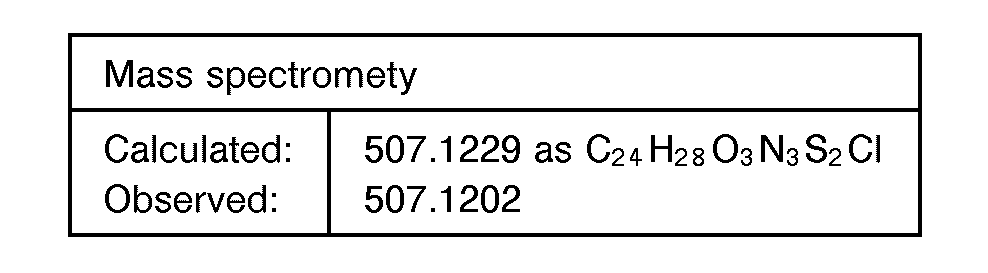
- NMR(δ, CDCl3): 2.57 - 2.83(14H, m), 2.82(2H, t, J=6Hz), 3.70(2H, t, J=6Hz), 3.82(2H, s), 6.46(1H, d, J = 8 Hz), 6.67 - 6.69(2H, m), 7.03(1 H, dd, J = 9Hz, 9Hz), 7.11 - 7.15(2H, m), 7.61 (1 H, s)
-

- Yield: 71 %
- IR(cm-1, CHCl3): 1680
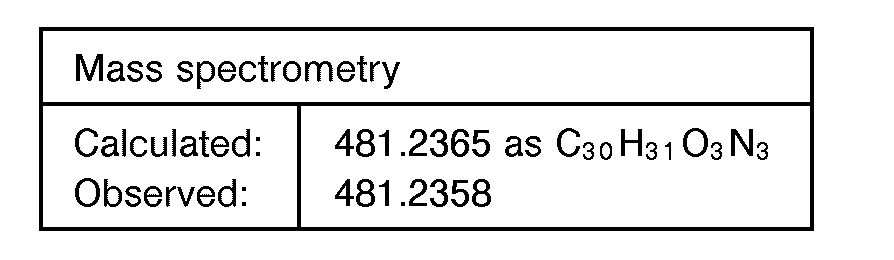
- NMR(δ, CDCl3): 2.58 - 2.88(10H, m), 3.68(2H, br-s), 4.22(1 H, s), 6.40(1 H, d, J = 7Hz), 6.98(1 H, dd, J = 8 Hz, 8Hz), 7.08(1 H, d, J = 8Hz), 7.14 - 7.26(8H, m), 7.40(4H, d, J = 7Hz), 7.60(1 H, s)
-

- Yield: 72%
- IR(cm-1, CHCl3): 1680

- NMR(δ, CDCl3): 2.50 - 2.70(4H, m), 2.72 - 2.86(6H, m), 3.66 - 3.71 (2H, m), 4.47(1 H, s), 6.66(1 H, d, J = 8Hz), 6.99(1 H, dd, J = 8Hz), 7.10 - 7.30(5H, m), 7.45 - 7.55(3H, m), 7.65(2H, ddd, J = 8Hz, 8Hz, 2H), 7.72(1 H, br-s), 7.82(1 H, s), 8.52(1 H, d, J = 6Hz)
-

- Yield: 71 %
- IR(cm-1, CHCl3): 1680

- NMR(δ, CDCl3): 2.48 - 2.70(10H, m), 3.57(2H, t, J=6Hz), 4.40(1 H, s), 6.79 (1H, d, J =8Hz), 7.11 (1 H, dd, J = 8Hz, 8Hz), 7.22(1 H, d, J = 5 Hz), 7.28 - 7.42(5H, m), 7.43(2H, d, J = 8Hz), 7.55-(1 H, s), 7.93(1 H, dd, J = 8Hz, 2Hz), 8.32(1 H, s), 8.37(1 H, dd, J = 5Hz, 3Hz), 8.60(1 H, d, J-2Hz)
-

- Yield: 62%
- IR(cm-1, CHCl3): 1660

- NMR(δ, CDCl3): 2.45 - 2.68(10H, m), 3.58(2H, t, J =6Hz), 4.33(1 H, s), 6.80(1 H, d, J =6Hz), 7.11(1H, dd, J = 8Hz, 8Hz), 7.22(1 H, d, J = 8 Hz), 7.19 - 7.32(4H, m), 7.40(2H, d, J = 7Hz), 7.52-(2H, d, J = 6Hz), 7.56(1 H, s), 8.33(1 H, s), 8.41 (2H, d, J = 6Hz)
-

- Yield: 54%
- IR(cm-1, CHCl3): 1670
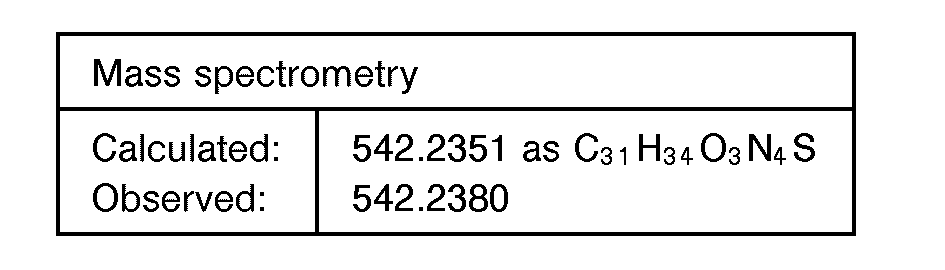
- NMR(δ, CDCl3): 2.52 - 2.77(12H, m), 2.75(2H, t, J =5Hz), 3.64(2H, t, J =5Hz), 5.33(1 H, s), 6.53(1 H, d, J = 6 Hz), 6.99 - 7.08(2H, m), 7.11 - 7.16(1 H, m), 7.21 - 7.32(4H, m), 7.39(1 H, s), 7.44 - 7.48(2H, m), 7.60 - 7.65(2H, m), 8.54(1 H, d, J-3Hz)
-

- Yield: 70%
- IR(cm-1, CHCl3): 1670

- NMR(δ, CDCl3): 2.48 - 2.80(12H, m), 2.78(2H, 5, J =5Hz), 3.67(2H, t, J =5Hz), 5.14(1 H, s), 6.37(1 H, d, J = 7 Hz), 6.98 - 7.10(3H, m), 7.20 - 7.36(10H, m), 7.55(1 H, s)
-

- Yield: 71 %
- IR(cm-1, CHCl3): 1680

- NMR(δ, CDCl3): 2.56 - 2.82(12H, m), 2.80(2H, t, J =6Hz), 3.66(2H, t, J =6Hz), 5.40(1 H, s), 6.43(1 H, d, J = 6 Hz), 6.88 - 6.92(2H, m), 6.99 - 7.14(3H, m), 7.19(1 H, d, J = 2Hz), 7.20 - 7.33(4H, m), 7.43(2H, d, J = 7Hz), 7.59(1 H, s)
-

- Yield: 70%
- IR (cm-1, CHCl3) = 1680

- NMR(δ, CDCl3): 2.53-2.84 (14H,m), 2.82 (2H,t,J=6Hz), 3.71 (2H,s), 6.47 (1H,d,J=7Hz), 7.02 (1 H,dd,J = 8Hz,8Hz), 7.13 (1 H,d,J = 8Hz), 7.11-7.29 (7H,m), 7.65 (1 H,s)
-
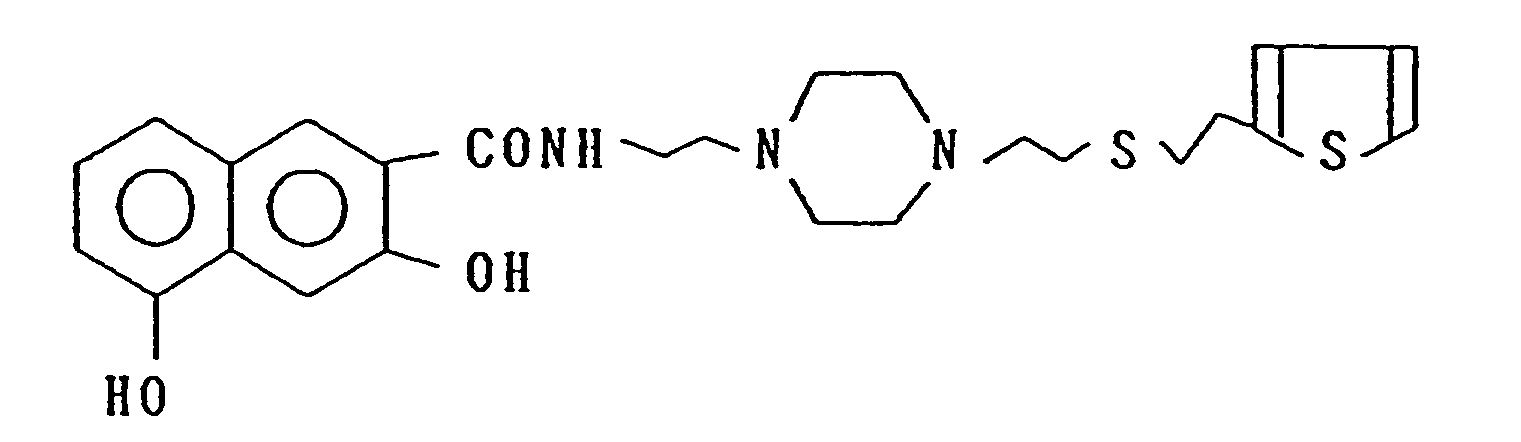
- Yield: 58%
- IR (cm-1, CHCl3) = 1680

- NMR(δ, CDCl3): 2.58-2.85 (16H,m), 3.09 (2H,t,J=8Hz), 3.68 (2H,t,J=6Hz), 6.45 (1H,d,J=8Hz), 6.82 (1H,d,J=3Hz), 6.90-6.92 (1H,m), 7.02 (1H,dd,J =8Hz,8Hz), 7.11-7.15 (3H,m), 7.27 (1 H,s), 7.61 (1 H,s)
-
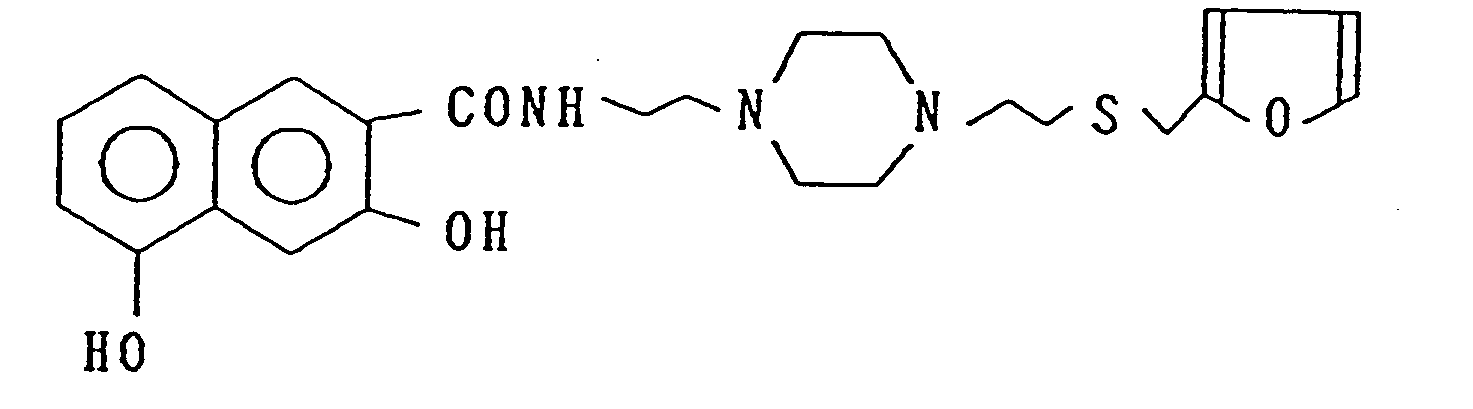
- Yield: 53%
- IR (cm-1, CHCl3) = 1680

- NMR(δ, CDCl3): 2.55-2.83 (14H,m), 3.67-3.75 (2H,m), 3.73 (2H,s), 6.15 (1H,d,J=3Hz), 6.27 (1H,dd,J=3Hz), 6.46 (1H,d,J=8Hz), 7.02 (1H,dd,J=8Hz,8Hz), 7.12 (1H,d,J=8Hz), 7.16 (1 H,br-s), 7.28 (1 H,s), 7.33 (1 H,s), 7.62 (1 H,s)
-

- Yield: 73%
- IR (cm-1, KBr) = 1660

- NMR(δ, CDCl3): 1.86-1.90 (2H,m), 1.97-1.99 (2H,m), 2.57-2.62 (2H,m), 2.83 (2H,t,J=6Hz), 2.94 (2H,t,J = 6Hz), 3.57-3.67 (3H,m), 5.48 (1H,s), 6.40 (1H,d,J=8Hz), 6.97 (1 H,dd,J = 8Hz,8Hz), 7.05 (1 H,d,J = 8Hz), 7.19-7.32 (1 H,m), 7.58 (1 H,s)
-

- IR (cm-1, CHCI3) = 1670

- NMR(δ, CDCl3): 1.88-1.92 (2H,m), 1.98-2.04 (2H,m), 2.45-2.60 (2H,m), 2.79 (2H,t,J=5Hz), 2.95 (2H,t,J = 4Hz), 3.56-3.61 (1 H,m), 3.65-3.69 (2H,m), 5.50 (1 H,s), 6.81 (1 H,dd,J = 9Hz,5Hz), 7.03 (2H,d,J = 4Hz), 7.25-7.33 (11 H,m), 7.65 (1 H,s), 7.75 (1 H,br- s)
- Reactions between carboxylic acid compound and amine compound were conducted in the same manner as in Example 4 to obtain the following amide derivatives.
-

- Yield: 53%
- IR (cm-1, KBr) = 1660

- NMR(δ, CDCl3): 1.78-1.89 (2H,m), 1.98-2.04 (2H,m), 2.33-2.38 (2H,m), 2.68 (2H,t,J=5Hz), 2.88 (2H,t,J = 5Hz), 3.52-3.60 (3H,m), 5.54 (1 H,s), 7.22-7.38 (13H,m), 7.47 (1 H,dd,J = 7Hz,7Hz), 7.67 (1 H,d,J = 8Hz), 7.78 (1 H,d,J = 8Hz), 7.98 (1 H,s)
-

- Yield: 78%
- IR (cm-1, KBr) = 1660

- NMR(δ, CDCl3): 1.78-1.90 (2H,m), 1.98-2.03 (2H,m), 2.25-2.42 (2H,m), 2.40-2.68 (2H,m), 2.87 (2H,t,J = 5Hz), 3.52-3.59 (3H,m), 3.97 (3H,s), 5.53 (1 H,s), 6.79 (2H,d,J = 8Hz), 7.18 (12H,m), 7.59 (1 H,br-s), 7.70 (1 H,s), 7.83 (1 H,s)
-

- Yield: 61 %
- IR (cm-1, KBr) = 1660

- NMR(δ, CDCl3): 2.55-2.68 (14H,m), 3.55-3.58 (2H,m), 3.96 (2H,s), 3.98 (3H,s), 6.80 (1H,d,J=8Hz), 6.90-6.94 (2H,m), 7.19-7.25 (2H,m), 7.35 (2H,d,J = 9Hz), 7.70 (1 H,s), 7.89 (1 H,s)
-

- Yield: 66%
- IR (cm-1, KBr) = 1660

- NMR(δ, CDCl3): 1.63 (1H,br-s), 1.75-1.81 (2H,m), 1.97-2.08 (2H,m), 2.62 (2H,br-s), 2.87-2.88 (2H,m), 3.46-3.63 (2H,m), 4.01 (3H,s), 4.08 (3H,s), 5.54 (1 H,s), 6.86 (1 H,d,J = 8Hz), 7.23-7.35 (11 H,m), 7.48 (1 H,d,J = 8Hz), 7.61 (1 H,s), 8.57 (1 H,br-s), 8.70 (1 H,s)
-

- 591 mg (2.0 mM) of 5-(2-pyridylmethoxy)3-hydroxy-2-naphthoic acid was dissolved in 20 ml of dichloromethane. Thereto were added 235 mg (2.0 mM) of N-hydroxysuccinimide and 422 mg (2.0 mM) of dicyclocarbodiimide. The resulting mixture was stirred at room temperature for 1 hour. Thereto was dropwise added a solution of 620 mg (2.0 mM) of 1-(2-aminoethyl)-4-(benzhydryloxy)-piperidine in 20 ml of dichloromethane. Stirring was conducted at room temperature for 2 hours to give rise to a reaction. After the completion of the reaction, extraction with dichloromethane was conducted. The extract was washed with a saturated aqueous sodium hydrogencarbonate solution and a saturated aqueous sodium chloride solution two times, and dried over anhydrous sodium sulfate. The solvent was removed by distillation. The residue was mixed with 20 ml of acetonitrile. The mixture was filtered, and the filtrate was subjected to distillation to remove the solvent. The residue was purified by silica gel chromatography to obtain 632 mg of the title compound at a yield of 67 %.
- IR (cm-1, KBr) = 1660

- NMR(δ, CDCl3): 1.77-1.82 (2H,m), 1.96-2.03 (2H,m), 2.21-2.35 (2H,m), 2.21-2.35 (2H,m), 2.65 (2H,t,J=6Hz), 2.82-2.89 (2H,m), 3.52-3.58 (3H,m), 5.36 (2H,s), 5.54 (1 H,s), 6.87 (1H,d,J=8Hz), 7.18-7.41 (13H,m), 7.50 (1H,d,J=8Hz), 7.75 (1 H,ddd,J = 8Hz,8Hz,2Hz), 7.84 (1 H,s), 7.93 (1 H,s), 8.61 (1 H,d,J = 6Hz)
- Reactions between carboxylic acid compound and amine compound were conducted in the same manner as in Example 4 to obtain the following amide derivatives.
-

- Yield: 62%
- IR (cm-1 KBr) = 1660

- NMR(δ, CDCl3): 1.74-1.83 (2H,m), 1.90-2.00 (2H,m), 2.17-2.30 (2H,m), 2.62 (2H,t,J=6Hz), 2.80-2.86 (2H,m), 3.39 (2H,t,J = 6Hz), 3.46-3.55 (3H,m), 4.51 (2H,t,J = 6Hz), 5.54 (1 H,s), 6.83 (1 H,d,J = 8Hz), 7.13-7.40 (14H,m), 7.63 (1 H,s), 7.66 (1 H,dd,J = 6Hz,2Hz), 7.85 (1 H,s), 8.56 (1 H,d,J = 5Hz)
-
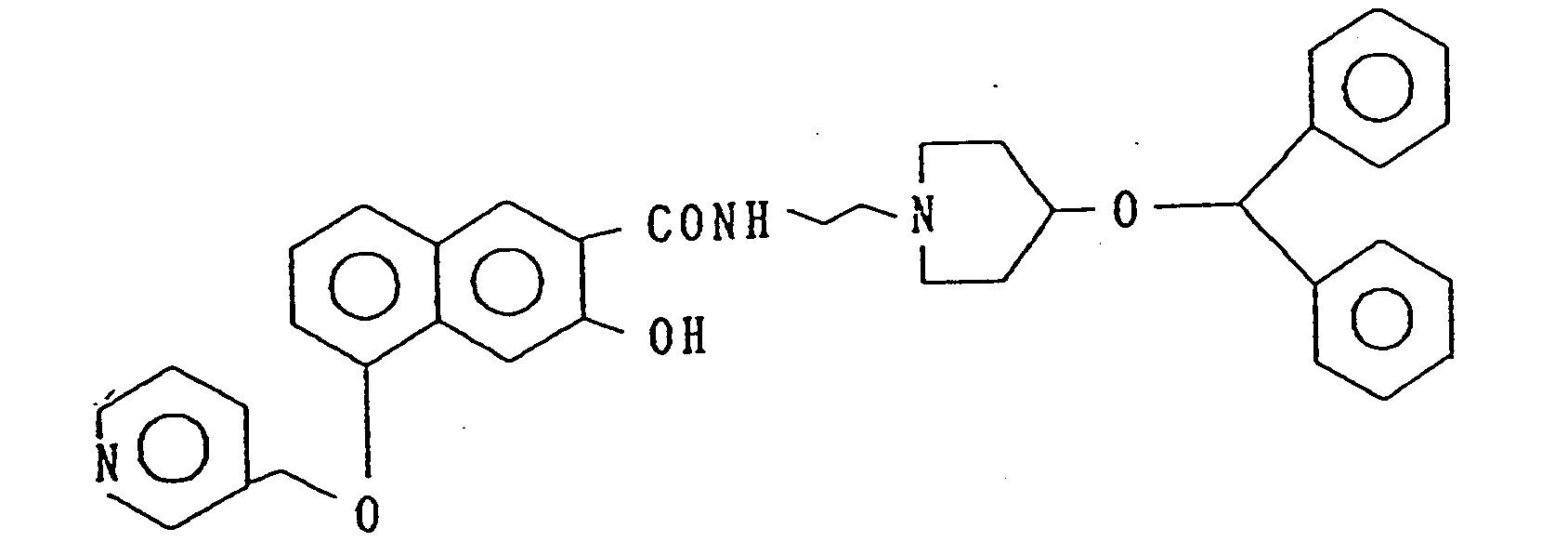
- Yield: 65%
- IR (cm-1, KBr) = 1660

- NMR(δ, CDCl3): 1.70-1.85 (2H,m), 1.92-2.03 (2H,m), 2.18-2.30 (2H,m), 2.63 (2H,t,J=6Hz), 2.81-2.92 (2H,m), 3.37-3.57 (3H,m), 5.23 (2H,s), 5.54 (1 H,s), 6.88 (1H,d,J=7Hz), 7.19-7.42 (14H,m), 7.55 (1H,br-s), 7.71 (1H,s), 7.89 (1H,d,J=7Hz), 7.94 (1H,s), 8.62 (1 H,dd,J = 6Hz,2Hz), 8.74 (1 H,d,J = 2Hz)
-

- Yield: 52%
- IR (cm-1, KBr) = 1660

- NMR(δ, CDCl3): 1.77-1.81 (2H,m), 1.95-2.01 (2H,m), 2.20-2.35 (2H,m), 2.65 (2H,t,J=6Hz), 2.87 (2H,t,J =6Hz), 3.51-3.58 (3H,m), 5.24 (2H,s), 5.54 (1H,s), 6.81 (1H,t,J=8Hz), 7.18-7.37 (12H,m), 7.41 (1H,s), 7.45 (2H,t,J=6Hz), 7.81 (1H,s), 7.94 (1H,s), 8.65 (2H,t,J=6Hz)
-

- IR (cm-1, KBr) = 1660

- NMR(δ, CDCl3): 1.48-1.51 (2H,m), 1.58-1.68 (4H,m), 2.52 (2H,t,J=7Hz), 3.48 (2H,dt,J=6Hz,6Hz), 3.92 (2H,s), 6.65 (1H,br-s), 6.83 (1H,d,J=7Hz), 6.90-6.91 (2H,s), 7.13 (1H,dd,J=7Hz,7Hz), 7.19 (1H,d,J=5Hz,2Hz), 7.33 (1H,d,J=7Hz), 7.62 (1 H,s), 7.91 (1 H,s)
-
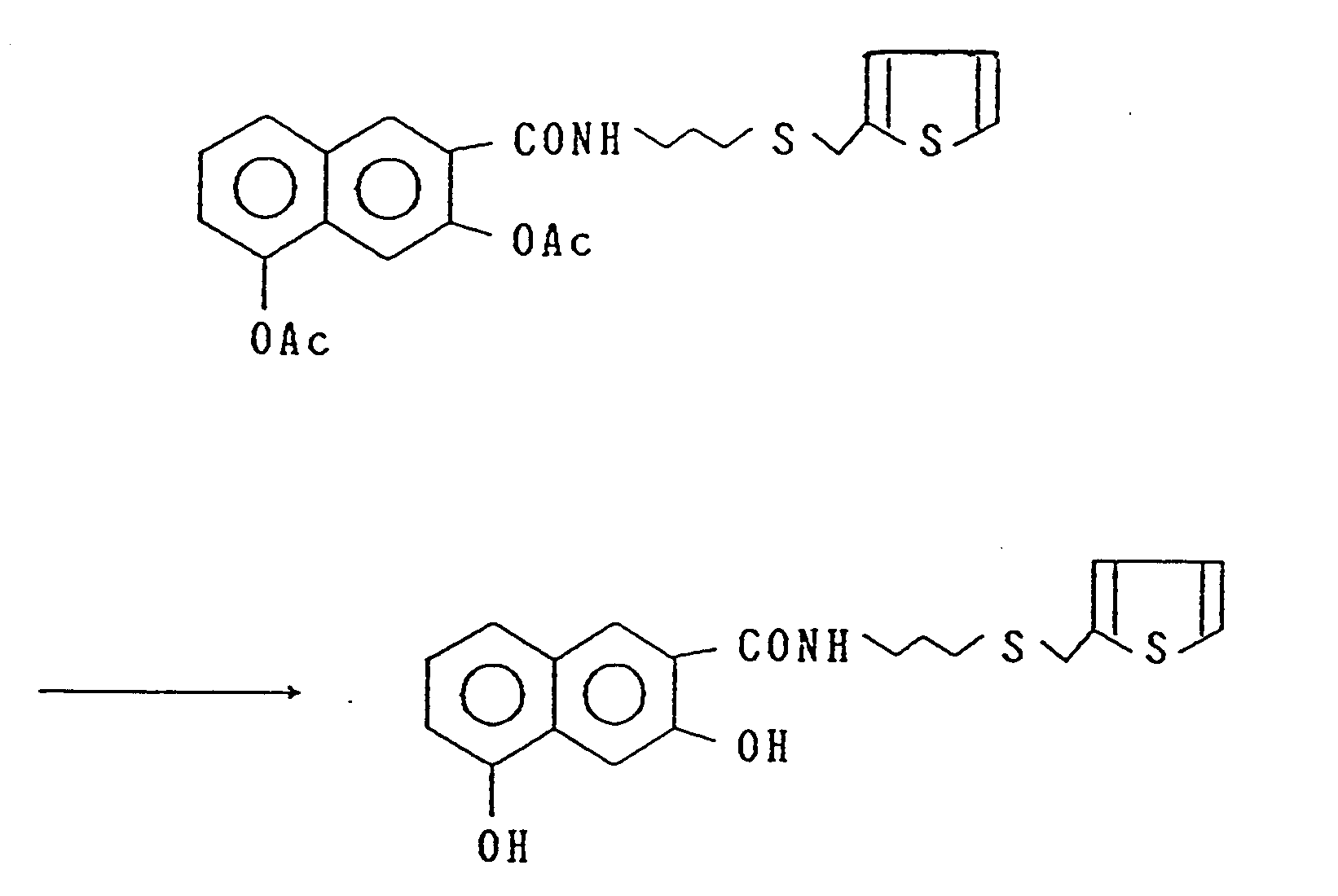
- IR (cm-1, KBr) = 1660

- NMR(δ CDCl3): 1.95 (2H,tt,J=8Hz,8Hz), 2.65 (2H,t,J=8Hz), 3.60 (2H,dt,J=8Hz,8Hz), 3.97 (2H,s), 6.83-6.93 (3H,m), 7.15 (1H,d,J=8Hz), 7.17 (1 H,dd,J = 5Hz,2Hz), 7.62 (1H,s), 7.87 (1H,s)
- The compounds shown in Table 4 were produced in the same manners as in Example 1-45. The properties of these compounds are shown in Table 5.


-

- The compounds shown in Table 6 were produced in the same manner as in Example 72. The properties of these compounds are shown in Table 7.


-

- The components (1), (2), (3) and (4) were mixed. The component (5) was added thereto, and kneading was conducted. The kneaded product was vacuum-dried at 40 ° C for 16 hours.
- The resulting product was ground and passed through a 16-mesh sieve to obtain granules. The component (6) was added to the granules, and the mixture was made into tablets (200 mg per tablet) using a rotary type tablet-manufacturing machine manufactured by Kikusui Seisakusho.
-
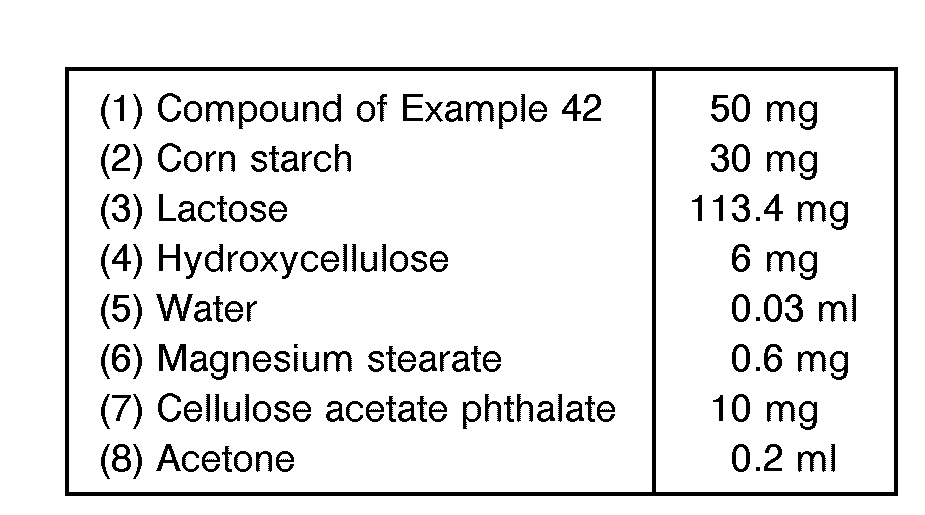
- The tablets were coated with an acetone solution of the component (7) using a bar coater manufactured by FREUND to produce enteric tablets (210 mg per tablet).
-

- The components (1), (2), (3) and (4) were mixed. The component (5) was added thereto, and kneading was conducted. The kneaded product was vacuum-dried at 40 ° C for 16 hours. The product was ground and passed through a 16-mesh sieve to obtain granules. The granules were filled into gelatin No. 3 capsules using a capsule filler manufactured by SANACI of Italia, to produce capsules.
-

Claims (15)


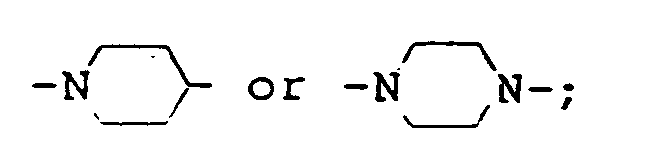

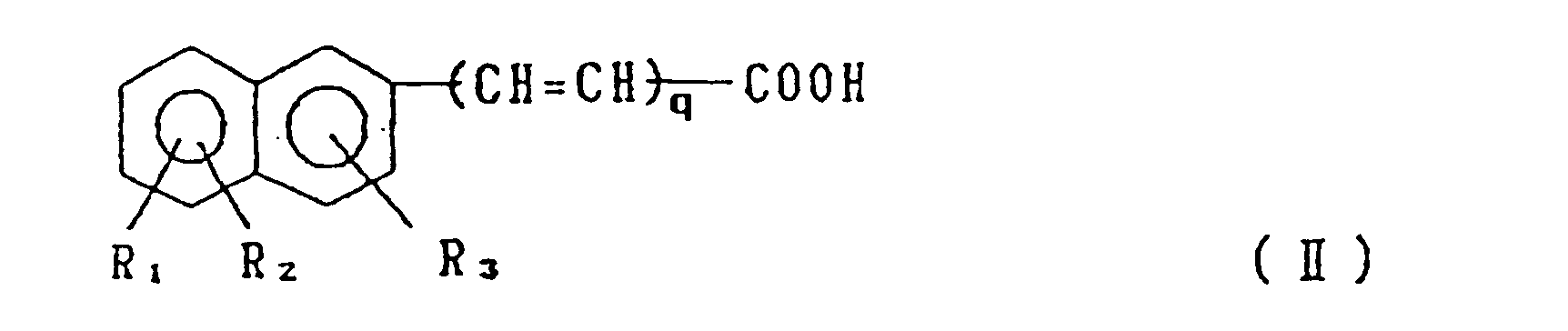

Applications Claiming Priority (2)
| Application Number | Priority Date | Filing Date | Title |
|---|---|---|---|
| JP2330004A JP2671059B2 (en) | 1990-11-30 | 1990-11-30 | Naphthoic acid derivative |
| JP330004/90 | 1990-11-30 |
Publications (3)
| Publication Number | Publication Date |
|---|---|
| EP0492178A2 EP0492178A2 (en) | 1992-07-01 |
| EP0492178A3 EP0492178A3 (en) | 1992-08-05 |
| EP0492178B1 true EP0492178B1 (en) | 1995-10-04 |
Family
ID=18227695
Family Applications (1)
| Application Number | Title | Priority Date | Filing Date |
|---|---|---|---|
| EP91120553A Expired - Lifetime EP0492178B1 (en) | 1990-11-30 | 1991-11-29 | Naphthoic acid derivative |
Country Status (10)
| Country | Link |
|---|---|
| US (1) | US5324728A (en) |
| EP (1) | EP0492178B1 (en) |
| JP (1) | JP2671059B2 (en) |
| KR (1) | KR0141683B1 (en) |
| AT (1) | ATE128710T1 (en) |
| CA (1) | CA2056662C (en) |
| DE (1) | DE69113593T2 (en) |
| DK (1) | DK0492178T3 (en) |
| ES (1) | ES2077777T3 (en) |
| GR (1) | GR3018167T3 (en) |
Families Citing this family (13)
| Publication number | Priority date | Publication date | Assignee | Title |
|---|---|---|---|---|
| US5395835A (en) * | 1994-03-24 | 1995-03-07 | Warner-Lambert Company | Naphthalamides as central nervous system agents |
| CA2178130C (en) * | 1995-06-05 | 2002-04-02 | Hiroshi Ikawa | Method of producing 2-naphthamide derivative, and compounds for producing 2-naphthamide derivative |
| WO1998037077A1 (en) * | 1997-02-24 | 1998-08-27 | Zymogenetics, Inc. | Calcitonin mimetics |
| US6559140B2 (en) * | 2000-03-09 | 2003-05-06 | Abbott Laboratories | Cyclic and bicyclic diamino histamine-3 receptor antagonists |
| JP4550353B2 (en) * | 2002-07-24 | 2010-09-22 | 株式会社医薬分子設計研究所 | Hematopoietic prostaglandin D2 synthase inhibitor |
| US7314875B2 (en) * | 2004-04-13 | 2008-01-01 | Cephalon, Inc. | Tricyclic aromatic and bis-phenyl sulfinyl derivatives |
| US7511077B2 (en) * | 2005-02-09 | 2009-03-31 | Neuromed Pharmaceuticals Ltd. | Diamine calcium channel blockers |
| JP2010510202A (en) | 2006-11-17 | 2010-04-02 | ファイザー株式会社 | Substituted bicyclocarboxamide compounds |
| US7923014B2 (en) * | 2007-02-12 | 2011-04-12 | The Board Of Regents Of The University Of Texas System | Expression and purification of HIP/PAP and uses therefor |
| AU2014225550C1 (en) | 2013-03-08 | 2017-08-17 | The United States Of America, As Represented By The Secretary, Department Of Health And Human Services | Potent and selective inhibitors of monoamine transporters; method of making; and use thereof |
| WO2015150995A1 (en) * | 2014-04-04 | 2015-10-08 | Pfizer Inc. | Bicyclic-fused heteroaryl or aryl compounds and their use as irak4 inhibitors |
| US11365195B2 (en) | 2017-11-13 | 2022-06-21 | The United States Of America, As Represented By The Secretary, Department Of Health And Human Services | Atypical inhibitors of monoamine transporters; method of making; and use thereof |
| WO2021241876A1 (en) * | 2020-05-29 | 2021-12-02 | 재단법인 대구경북첨단의료산업진흥재단 | Carboxamide derivative and pharmaceutical composition comprising same as active ingredient for preventing or treating mental illness |
Citations (3)
| Publication number | Priority date | Publication date | Assignee | Title |
|---|---|---|---|---|
| GB1316667A (en) * | 1969-05-26 | 1973-05-09 | Xerox Corp | Benzobrazanquinone pigments |
| EP0221346A1 (en) * | 1985-10-01 | 1987-05-13 | Warner-Lambert Company | (N-substituted-2-hydroxy) benzamides and N-substituted-2-hydroxy-alpha-oxo-benzeneacetamides and pharmaceutical compositions thereof having activity as modulators of the arachidonic acid cascade |
| EP0229391A1 (en) * | 1985-12-27 | 1987-07-22 | Eisai Co., Ltd. | Piperidine derivate, its use and pharmaceutical composition containing it |
Family Cites Families (11)
| Publication number | Priority date | Publication date | Assignee | Title |
|---|---|---|---|---|
| US3644518A (en) * | 1965-05-24 | 1972-02-22 | Makoto Yoshida | Process for the production of naphthamide derivatives |
| JPS58210055A (en) * | 1982-06-01 | 1983-12-07 | Ricoh Co Ltd | Novel 2-hydroxy-3-naphthoic acid amide derivative |
| FR2531704B1 (en) * | 1982-08-13 | 1985-08-09 | Sanofi Sa | N-SUBSTITUTED AROMATIC ACID (HETERO) AMIDES, THEIR SALTS, PROCESS FOR THEIR PREPARATION AND PHARMACEUTICAL COMPOSITIONS CONTAINING THE SAME |
| JPS5955878A (en) * | 1982-09-24 | 1984-03-31 | Chugai Pharmaceut Co Ltd | Novel phenylpiperazine derivative |
| JPS60139646A (en) * | 1983-12-27 | 1985-07-24 | Otsuka Pharmaceut Factory Inc | Naphthalene derivative |
| US4673684A (en) * | 1984-04-04 | 1987-06-16 | Terumo Corporation | Amide derivatives and 5-lipoxygenase inhibitors containing the same as an active ingredient |
| JPH0660160B2 (en) * | 1985-12-13 | 1994-08-10 | テルモ株式会社 | Amide derivative and antiallergic agent containing the same |
| FR2601366B1 (en) * | 1986-07-10 | 1988-11-25 | Andre Buzas | BENZHYDRYLOXYETHYL-PIPERAZINE DERIVATIVES, PROCESSES FOR OBTAINING SAME AND PHARMACEUTICAL COMPOSITIONS CONTAINING THE SAME. |
| JPS6477A (en) * | 1987-03-24 | 1989-01-05 | Takeda Chem Ind Ltd | 1,4-disubstituted piperazine compound |
| GB8725260D0 (en) * | 1987-10-28 | 1987-12-02 | Lilly Industries Ltd | Organic compounds |
| CA2015949A1 (en) * | 1989-05-22 | 1990-11-22 | Yasuo Ito | Piperidine derivative, method for preparation thereof, and a pharmaceutical composition comprising the same |
-
1990
- 1990-11-30 JP JP2330004A patent/JP2671059B2/en not_active Expired - Fee Related
-
1991
- 1991-11-29 ES ES91120553T patent/ES2077777T3/en not_active Expired - Lifetime
- 1991-11-29 CA CA002056662A patent/CA2056662C/en not_active Expired - Fee Related
- 1991-11-29 DK DK91120553.2T patent/DK0492178T3/en active
- 1991-11-29 AT AT91120553T patent/ATE128710T1/en not_active IP Right Cessation
- 1991-11-29 EP EP91120553A patent/EP0492178B1/en not_active Expired - Lifetime
- 1991-11-29 DE DE69113593T patent/DE69113593T2/en not_active Expired - Fee Related
- 1991-11-30 KR KR91021899A patent/KR0141683B1/en not_active Expired - Fee Related
- 1991-12-02 US US07/801,501 patent/US5324728A/en not_active Expired - Lifetime
-
1995
- 1995-11-22 GR GR950403286T patent/GR3018167T3/en unknown
Patent Citations (3)
| Publication number | Priority date | Publication date | Assignee | Title |
|---|---|---|---|---|
| GB1316667A (en) * | 1969-05-26 | 1973-05-09 | Xerox Corp | Benzobrazanquinone pigments |
| EP0221346A1 (en) * | 1985-10-01 | 1987-05-13 | Warner-Lambert Company | (N-substituted-2-hydroxy) benzamides and N-substituted-2-hydroxy-alpha-oxo-benzeneacetamides and pharmaceutical compositions thereof having activity as modulators of the arachidonic acid cascade |
| EP0229391A1 (en) * | 1985-12-27 | 1987-07-22 | Eisai Co., Ltd. | Piperidine derivate, its use and pharmaceutical composition containing it |
Non-Patent Citations (6)
| Title |
|---|
| Beilsteins Handbuch der Organischen Chemie, 4th Supplement, vol. 10, second part, 1983, page 1182 * |
| Chem. Abs., vol. 100, 1984, abstract 209435y * |
| Chem. Abs., vol. 110, 1989, abstract 202982x * |
| Chem. Abs., vol. 58, 1963, column 2421g * |
| Chem. Abs., vol. 79, 1973, abstract 110269q * |
| Chemistry Letters, 1980, pages 47-50 * |
Also Published As
| Publication number | Publication date |
|---|---|
| CA2056662C (en) | 2000-03-28 |
| ES2077777T3 (en) | 1995-12-01 |
| GR3018167T3 (en) | 1996-02-29 |
| EP0492178A2 (en) | 1992-07-01 |
| JPH04364156A (en) | 1992-12-16 |
| JP2671059B2 (en) | 1997-10-29 |
| EP0492178A3 (en) | 1992-08-05 |
| DE69113593T2 (en) | 1996-03-28 |
| CA2056662A1 (en) | 1992-05-31 |
| DE69113593D1 (en) | 1995-11-09 |
| DK0492178T3 (en) | 1995-11-20 |
| KR920009810A (en) | 1992-06-25 |
| US5324728A (en) | 1994-06-28 |
| KR0141683B1 (en) | 1998-06-01 |
| ATE128710T1 (en) | 1995-10-15 |
Similar Documents
| Publication | Publication Date | Title |
|---|---|---|
| US6953858B2 (en) | HIV protease inhibitors, compositions containing the same, their pharmaceutical uses and materials for their synthesis | |
| US6777414B1 (en) | Nitrogen-containing heterocyclic compounds and benamide compounds and drugs containing the same | |
| US5817822A (en) | Certain alpha-azacycloalkyl substituted arylsulfonamido acetohydroxamic acids | |
| US6737425B1 (en) | N,N-substituted cyclic amine derivatives | |
| US6743788B2 (en) | Carbamate and oxamide compounds | |
| US20040116353A1 (en) | Derivatives of n-(arylsulfonyl)beta-aminoacids comprising a substituted aminomethyl group, the preparation method thereof and the pharmaceutical compositions containing same | |
| JPH09504004A (en) | Amide and urea derivatives for 5HT1D receptor antagonists | |
| EA004673B1 (en) | Non-peptidyl inhibitors of vla-4 dependent cell binding useful in treating inflammatory, autoimmune, and respiratory diseases | |
| RU2265592C2 (en) | DERIVATIVE OF α-AMINOHYDROXAMIC ACID, METHOD FOR ITS PREPARING AND PHARMACEUTICAL COMPOSITION | |
| EP0492178A2 (en) | Naphthoic acid derivative | |
| DE69814800T2 (en) | EPOXYSUCCINAMIDE DERIVATIVES OR THEIR SALTS | |
| EP1414790A1 (en) | Substituted n-acyl aniline derivatives, production and use thereof as medicaments | |
| KR850000676B1 (en) | Process for preparing heterocyclic derivatives | |
| US4579862A (en) | Certain 1H-imidazol-1-yl-1-lower-alkanoic acid derivatives having anti-thrombotic activity | |
| US4801603A (en) | Guanidinobenzoic ester derivative | |
| IE55263B1 (en) | Thiomethylpyridine derivatives,process for the production thereof and medicaments containing them | |
| US5025016A (en) | Pyrimidine-thioalkyl pyridine derivatives, medicaments containing these compounds, and method of treatment | |
| JPH027952B2 (en) | ||
| US4758573A (en) | Heterocyclic group-containing compounds | |
| US5326870A (en) | Substituted sulfonamide derivative and a pharmaceutical composition comprising the same | |
| JPH05148222A (en) | Naphthoic acid derivative | |
| JPH0459754A (en) | Amide derivative | |
| JP2858724B2 (en) | Angiogenesis inhibitor | |
| KR100551944B1 (en) | Novel epoxysuccinamide derivative or salt thereof | |
| JPS6097958A (en) | Amine derivative or its salt, their production and antiulcer agent containing the same |
Legal Events
| Date | Code | Title | Description |
|---|---|---|---|
| PUAI | Public reference made under article 153(3) epc to a published international application that has entered the european phase |
Free format text: ORIGINAL CODE: 0009012 |
|
| PUAL | Search report despatched |
Free format text: ORIGINAL CODE: 0009013 |
|
| AK | Designated contracting states |
Kind code of ref document: A2 Designated state(s): AT BE CH DE DK ES FR GB GR IT LI LU NL SE |
|
| AK | Designated contracting states |
Kind code of ref document: A3 Designated state(s): AT BE CH DE DK ES FR GB GR IT LI LU NL SE |
|
| 17P | Request for examination filed |
Effective date: 19921202 |
|
| 17Q | First examination report despatched |
Effective date: 19931004 |
|
| GRAA | (expected) grant |
Free format text: ORIGINAL CODE: 0009210 |
|
| AK | Designated contracting states |
Kind code of ref document: B1 Designated state(s): AT BE CH DE DK ES FR GB GR IT LI LU NL SE |
|
| REF | Corresponds to: |
Ref document number: 128710 Country of ref document: AT Date of ref document: 19951015 Kind code of ref document: T |
|
| REF | Corresponds to: |
Ref document number: 69113593 Country of ref document: DE Date of ref document: 19951109 |
|
| REG | Reference to a national code |
Ref country code: DK Ref legal event code: T3 |
|
| ITF | It: translation for a ep patent filed | ||
| REG | Reference to a national code |
Ref country code: ES Ref legal event code: FG2A Ref document number: 2077777 Country of ref document: ES Kind code of ref document: T3 |
|
| ET | Fr: translation filed | ||
| REG | Reference to a national code |
Ref country code: GR Ref legal event code: FG4A Free format text: 3018167 |
|
| PLBE | No opposition filed within time limit |
Free format text: ORIGINAL CODE: 0009261 |
|
| STAA | Information on the status of an ep patent application or granted ep patent |
Free format text: STATUS: NO OPPOSITION FILED WITHIN TIME LIMIT |
|
| 26N | No opposition filed | ||
| REG | Reference to a national code |
Ref country code: GB Ref legal event code: IF02 |
|
| PGFP | Annual fee paid to national office [announced via postgrant information from national office to epo] |
Ref country code: CH Payment date: 20081130 Year of fee payment: 18 Ref country code: LU Payment date: 20081203 Year of fee payment: 18 Ref country code: DK Payment date: 20081114 Year of fee payment: 18 Ref country code: NL Payment date: 20081116 Year of fee payment: 18 Ref country code: DE Payment date: 20081127 Year of fee payment: 18 |
|
| PGFP | Annual fee paid to national office [announced via postgrant information from national office to epo] |
Ref country code: ES Payment date: 20081127 Year of fee payment: 18 Ref country code: AT Payment date: 20081112 Year of fee payment: 18 |
|
| PGFP | Annual fee paid to national office [announced via postgrant information from national office to epo] |
Ref country code: BE Payment date: 20081016 Year of fee payment: 18 Ref country code: SE Payment date: 20081107 Year of fee payment: 18 Ref country code: IT Payment date: 20081127 Year of fee payment: 18 |
|
| PGFP | Annual fee paid to national office [announced via postgrant information from national office to epo] |
Ref country code: FR Payment date: 20081112 Year of fee payment: 18 |
|
| PGFP | Annual fee paid to national office [announced via postgrant information from national office to epo] |
Ref country code: GB Payment date: 20081126 Year of fee payment: 18 Ref country code: GR Payment date: 20081017 Year of fee payment: 18 |
|
| BERE | Be: lapsed |
Owner name: *FUJIREBIO INC. Effective date: 20091130 |
|
| REG | Reference to a national code |
Ref country code: NL Ref legal event code: V1 Effective date: 20100601 |
|
| EUG | Se: european patent has lapsed | ||
| REG | Reference to a national code |
Ref country code: CH Ref legal event code: PL |
|
| REG | Reference to a national code |
Ref country code: DK Ref legal event code: EBP |
|
| GBPC | Gb: european patent ceased through non-payment of renewal fee |
Effective date: 20091129 |
|
| REG | Reference to a national code |
Ref country code: FR Ref legal event code: ST Effective date: 20100730 |
|
| PG25 | Lapsed in a contracting state [announced via postgrant information from national office to epo] |
Ref country code: AT Free format text: LAPSE BECAUSE OF NON-PAYMENT OF DUE FEES Effective date: 20091129 |
|
| PG25 | Lapsed in a contracting state [announced via postgrant information from national office to epo] |
Ref country code: CH Free format text: LAPSE BECAUSE OF NON-PAYMENT OF DUE FEES Effective date: 20091130 Ref country code: FR Free format text: LAPSE BECAUSE OF NON-PAYMENT OF DUE FEES Effective date: 20091130 Ref country code: GR Free format text: LAPSE BECAUSE OF NON-PAYMENT OF DUE FEES Effective date: 20100602 Ref country code: LI Free format text: LAPSE BECAUSE OF NON-PAYMENT OF DUE FEES Effective date: 20091130 Ref country code: NL Free format text: LAPSE BECAUSE OF NON-PAYMENT OF DUE FEES Effective date: 20100601 Ref country code: BE Free format text: LAPSE BECAUSE OF NON-PAYMENT OF DUE FEES Effective date: 20091130 |
|
| PG25 | Lapsed in a contracting state [announced via postgrant information from national office to epo] |
Ref country code: DE Free format text: LAPSE BECAUSE OF NON-PAYMENT OF DUE FEES Effective date: 20100601 |
|
| PG25 | Lapsed in a contracting state [announced via postgrant information from national office to epo] |
Ref country code: GB Free format text: LAPSE BECAUSE OF NON-PAYMENT OF DUE FEES Effective date: 20091129 |
|
| PG25 | Lapsed in a contracting state [announced via postgrant information from national office to epo] |
Ref country code: DK Free format text: LAPSE BECAUSE OF NON-PAYMENT OF DUE FEES Effective date: 20091130 |
|
| REG | Reference to a national code |
Ref country code: ES Ref legal event code: FD2A Effective date: 20110325 |
|
| PG25 | Lapsed in a contracting state [announced via postgrant information from national office to epo] |
Ref country code: IT Free format text: LAPSE BECAUSE OF NON-PAYMENT OF DUE FEES Effective date: 20091129 |
|
| PG25 | Lapsed in a contracting state [announced via postgrant information from national office to epo] |
Ref country code: LU Free format text: LAPSE BECAUSE OF NON-PAYMENT OF DUE FEES Effective date: 20091129 |
|
| PG25 | Lapsed in a contracting state [announced via postgrant information from national office to epo] |
Ref country code: SE Free format text: LAPSE BECAUSE OF NON-PAYMENT OF DUE FEES Effective date: 20091130 |
|
| PG25 | Lapsed in a contracting state [announced via postgrant information from national office to epo] |
Ref country code: ES Free format text: LAPSE BECAUSE OF NON-PAYMENT OF DUE FEES Effective date: 20110314 |
|
| PG25 | Lapsed in a contracting state [announced via postgrant information from national office to epo] |
Ref country code: ES Free format text: LAPSE BECAUSE OF NON-PAYMENT OF DUE FEES Effective date: 20091130 |