EP0490665A1 - Biaxially oriented polyester film for magnetic recording media - Google Patents
Biaxially oriented polyester film for magnetic recording media Download PDFInfo
- Publication number
- EP0490665A1 EP0490665A1 EP19910311542 EP91311542A EP0490665A1 EP 0490665 A1 EP0490665 A1 EP 0490665A1 EP 19910311542 EP19910311542 EP 19910311542 EP 91311542 A EP91311542 A EP 91311542A EP 0490665 A1 EP0490665 A1 EP 0490665A1
- Authority
- EP
- European Patent Office
- Prior art keywords
- biaxially oriented
- polyester film
- oriented polyester
- range
- aluminum oxide
- Prior art date
- Legal status (The legal status is an assumption and is not a legal conclusion. Google has not performed a legal analysis and makes no representation as to the accuracy of the status listed.)
- Granted
Links
- 229920006267 polyester film Polymers 0.000 title claims abstract description 62
- 230000005291 magnetic effect Effects 0.000 title claims abstract description 40
- 239000002245 particle Substances 0.000 claims abstract description 79
- TWNQGVIAIRXVLR-UHFFFAOYSA-N oxo(oxoalumanyloxy)alumane Chemical compound O=[Al]O[Al]=O TWNQGVIAIRXVLR-UHFFFAOYSA-N 0.000 claims abstract description 19
- LYCAIKOWRPUZTN-UHFFFAOYSA-N Ethylene glycol Chemical compound OCCO LYCAIKOWRPUZTN-UHFFFAOYSA-N 0.000 claims description 23
- 229920000728 polyester Polymers 0.000 claims description 23
- -1 acryl Chemical group 0.000 claims description 19
- 239000002253 acid Substances 0.000 claims description 12
- 239000013078 crystal Substances 0.000 claims description 8
- 239000010954 inorganic particle Substances 0.000 claims description 8
- 239000011148 porous material Substances 0.000 claims description 8
- VYPSYNLAJGMNEJ-UHFFFAOYSA-N Silicium dioxide Chemical compound O=[Si]=O VYPSYNLAJGMNEJ-UHFFFAOYSA-N 0.000 claims description 7
- 125000003118 aryl group Chemical group 0.000 claims description 7
- VTYYLEPIZMXCLO-UHFFFAOYSA-L Calcium carbonate Chemical compound [Ca+2].[O-]C([O-])=O VTYYLEPIZMXCLO-UHFFFAOYSA-L 0.000 claims description 6
- GWEVSGVZZGPLCZ-UHFFFAOYSA-N Titan oxide Chemical compound O=[Ti]=O GWEVSGVZZGPLCZ-UHFFFAOYSA-N 0.000 claims description 6
- WGCNASOHLSPBMP-UHFFFAOYSA-N hydroxyacetaldehyde Natural products OCC=O WGCNASOHLSPBMP-UHFFFAOYSA-N 0.000 claims description 6
- 229920000642 polymer Polymers 0.000 claims description 5
- OFOBLEOULBTSOW-UHFFFAOYSA-N Malonic acid Chemical compound OC(=O)CC(O)=O OFOBLEOULBTSOW-UHFFFAOYSA-N 0.000 claims description 4
- 239000005995 Aluminium silicate Substances 0.000 claims description 3
- 235000012211 aluminium silicate Nutrition 0.000 claims description 3
- 229910000019 calcium carbonate Inorganic materials 0.000 claims description 3
- 125000004432 carbon atom Chemical group C* 0.000 claims description 3
- NLYAJNPCOHFWQQ-UHFFFAOYSA-N kaolin Chemical compound O.O.O=[Al]O[Si](=O)O[Si](=O)O[Al]=O NLYAJNPCOHFWQQ-UHFFFAOYSA-N 0.000 claims description 3
- 239000000463 material Substances 0.000 claims description 3
- 239000000377 silicon dioxide Substances 0.000 claims description 3
- 235000012239 silicon dioxide Nutrition 0.000 claims description 3
- 239000000454 talc Substances 0.000 claims description 3
- 229910052623 talc Inorganic materials 0.000 claims description 3
- YCKRFDGAMUMZLT-UHFFFAOYSA-N Fluorine atom Chemical compound [F] YCKRFDGAMUMZLT-UHFFFAOYSA-N 0.000 claims description 2
- 239000004642 Polyimide Substances 0.000 claims description 2
- 125000001931 aliphatic group Chemical group 0.000 claims description 2
- 239000011737 fluorine Substances 0.000 claims description 2
- 229910052731 fluorine Inorganic materials 0.000 claims description 2
- 229920001721 polyimide Polymers 0.000 claims description 2
- 229920005990 polystyrene resin Polymers 0.000 claims description 2
- 229920005989 resin Polymers 0.000 claims description 2
- 239000011347 resin Substances 0.000 claims description 2
- 229920002050 silicone resin Polymers 0.000 claims description 2
- OGIDPMRJRNCKJF-UHFFFAOYSA-N titanium oxide Inorganic materials [Ti]=O OGIDPMRJRNCKJF-UHFFFAOYSA-N 0.000 claims description 2
- 238000005299 abrasion Methods 0.000 description 24
- 239000000428 dust Substances 0.000 description 17
- 238000000034 method Methods 0.000 description 14
- 229910052751 metal Inorganic materials 0.000 description 12
- 239000002184 metal Substances 0.000 description 12
- 230000003746 surface roughness Effects 0.000 description 10
- KKEYFWRCBNTPAC-UHFFFAOYSA-N Terephthalic acid Chemical compound OC(=O)C1=CC=C(C(O)=O)C=C1 KKEYFWRCBNTPAC-UHFFFAOYSA-N 0.000 description 6
- 239000011248 coating agent Substances 0.000 description 6
- 238000000576 coating method Methods 0.000 description 6
- 238000005259 measurement Methods 0.000 description 6
- 239000000758 substrate Substances 0.000 description 6
- 238000004519 manufacturing process Methods 0.000 description 5
- 229920000139 polyethylene terephthalate Polymers 0.000 description 5
- 239000005020 polyethylene terephthalate Substances 0.000 description 5
- UQSXHKLRYXJYBZ-UHFFFAOYSA-N Iron oxide Chemical compound [Fe]=O UQSXHKLRYXJYBZ-UHFFFAOYSA-N 0.000 description 4
- 238000009826 distribution Methods 0.000 description 4
- 230000000694 effects Effects 0.000 description 4
- 239000004033 plastic Substances 0.000 description 4
- 229920003023 plastic Polymers 0.000 description 4
- XEKOWRVHYACXOJ-UHFFFAOYSA-N Ethyl acetate Chemical compound CCOC(C)=O XEKOWRVHYACXOJ-UHFFFAOYSA-N 0.000 description 3
- PNEYBMLMFCGWSK-UHFFFAOYSA-N aluminium oxide Inorganic materials [O-2].[O-2].[O-2].[Al+3].[Al+3] PNEYBMLMFCGWSK-UHFFFAOYSA-N 0.000 description 3
- 238000007796 conventional method Methods 0.000 description 3
- 229910052593 corundum Inorganic materials 0.000 description 3
- 238000011156 evaluation Methods 0.000 description 3
- 230000005294 ferromagnetic effect Effects 0.000 description 3
- 229920006324 polyoxymethylene Polymers 0.000 description 3
- 229910001845 yogo sapphire Inorganic materials 0.000 description 3
- 229910006297 γ-Fe2O3 Inorganic materials 0.000 description 3
- ISPYQTSUDJAMAB-UHFFFAOYSA-N 2-chlorophenol Chemical compound OC1=CC=CC=C1Cl ISPYQTSUDJAMAB-UHFFFAOYSA-N 0.000 description 2
- QIGBRXMKCJKVMJ-UHFFFAOYSA-N Hydroquinone Chemical compound OC1=CC=C(O)C=C1 QIGBRXMKCJKVMJ-UHFFFAOYSA-N 0.000 description 2
- 229930182556 Polyacetal Natural products 0.000 description 2
- WNLRTRBMVRJNCN-UHFFFAOYSA-N adipic acid Chemical compound OC(=O)CCCCC(O)=O WNLRTRBMVRJNCN-UHFFFAOYSA-N 0.000 description 2
- ADCOVFLJGNWWNZ-UHFFFAOYSA-N antimony trioxide Chemical compound O=[Sb]O[Sb]=O ADCOVFLJGNWWNZ-UHFFFAOYSA-N 0.000 description 2
- 238000005452 bending Methods 0.000 description 2
- IISBACLAFKSPIT-UHFFFAOYSA-N bisphenol A Chemical compound C=1C=C(O)C=CC=1C(C)(C)C1=CC=C(O)C=C1 IISBACLAFKSPIT-UHFFFAOYSA-N 0.000 description 2
- WERYXYBDKMZEQL-UHFFFAOYSA-N butane-1,4-diol Chemical compound OCCCCO WERYXYBDKMZEQL-UHFFFAOYSA-N 0.000 description 2
- 239000006229 carbon black Substances 0.000 description 2
- 150000001875 compounds Chemical class 0.000 description 2
- 230000001186 cumulative effect Effects 0.000 description 2
- 230000007423 decrease Effects 0.000 description 2
- 230000003247 decreasing effect Effects 0.000 description 2
- WOZVHXUHUFLZGK-UHFFFAOYSA-N dimethyl terephthalate Chemical compound COC(=O)C1=CC=C(C(=O)OC)C=C1 WOZVHXUHUFLZGK-UHFFFAOYSA-N 0.000 description 2
- 239000010419 fine particle Substances 0.000 description 2
- 150000002334 glycols Chemical class 0.000 description 2
- QQVIHTHCMHWDBS-UHFFFAOYSA-N isophthalic acid Chemical compound OC(=O)C1=CC=CC(C(O)=O)=C1 QQVIHTHCMHWDBS-UHFFFAOYSA-N 0.000 description 2
- 239000007788 liquid Substances 0.000 description 2
- 238000002844 melting Methods 0.000 description 2
- 230000008018 melting Effects 0.000 description 2
- 239000008188 pellet Substances 0.000 description 2
- 239000000843 powder Substances 0.000 description 2
- YPFDHNVEDLHUCE-UHFFFAOYSA-N propane-1,3-diol Chemical compound OCCCO YPFDHNVEDLHUCE-UHFFFAOYSA-N 0.000 description 2
- 239000011369 resultant mixture Substances 0.000 description 2
- CXMXRPHRNRROMY-UHFFFAOYSA-N sebacic acid Chemical compound OC(=O)CCCCCCCCC(O)=O CXMXRPHRNRROMY-UHFFFAOYSA-N 0.000 description 2
- 239000010935 stainless steel Substances 0.000 description 2
- 229910001220 stainless steel Inorganic materials 0.000 description 2
- 238000012360 testing method Methods 0.000 description 2
- PXGZQGDTEZPERC-UHFFFAOYSA-N 1,4-cyclohexanedicarboxylic acid Chemical compound OC(=O)C1CCC(C(O)=O)CC1 PXGZQGDTEZPERC-UHFFFAOYSA-N 0.000 description 1
- BXJGUBZTZWCMEX-UHFFFAOYSA-N 2,3-dimethylbenzene-1,4-diol Chemical compound CC1=C(C)C(O)=CC=C1O BXJGUBZTZWCMEX-UHFFFAOYSA-N 0.000 description 1
- FJKROLUGYXJWQN-UHFFFAOYSA-N 4-hydroxybenzoic acid Chemical compound OC(=O)C1=CC=C(O)C=C1 FJKROLUGYXJWQN-UHFFFAOYSA-N 0.000 description 1
- 238000004438 BET method Methods 0.000 description 1
- OYPRJOBELJOOCE-UHFFFAOYSA-N Calcium Chemical compound [Ca] OYPRJOBELJOOCE-UHFFFAOYSA-N 0.000 description 1
- 229910000640 Fe alloy Inorganic materials 0.000 description 1
- 229910001030 Iron–nickel alloy Inorganic materials 0.000 description 1
- WHXSMMKQMYFTQS-UHFFFAOYSA-N Lithium Chemical compound [Li] WHXSMMKQMYFTQS-UHFFFAOYSA-N 0.000 description 1
- 229910017709 Ni Co Inorganic materials 0.000 description 1
- 229910003267 Ni-Co Inorganic materials 0.000 description 1
- 229910003262 Ni‐Co Inorganic materials 0.000 description 1
- ALQSHHUCVQOPAS-UHFFFAOYSA-N Pentane-1,5-diol Chemical compound OCCCCCO ALQSHHUCVQOPAS-UHFFFAOYSA-N 0.000 description 1
- OAICVXFJPJFONN-UHFFFAOYSA-N Phosphorus Chemical compound [P] OAICVXFJPJFONN-UHFFFAOYSA-N 0.000 description 1
- 239000002202 Polyethylene glycol Substances 0.000 description 1
- 229910052775 Thulium Inorganic materials 0.000 description 1
- RTAQQCXQSZGOHL-UHFFFAOYSA-N Titanium Chemical compound [Ti] RTAQQCXQSZGOHL-UHFFFAOYSA-N 0.000 description 1
- 229910021536 Zeolite Inorganic materials 0.000 description 1
- ORLQHILJRHBSAY-UHFFFAOYSA-N [1-(hydroxymethyl)cyclohexyl]methanol Chemical compound OCC1(CO)CCCCC1 ORLQHILJRHBSAY-UHFFFAOYSA-N 0.000 description 1
- 239000000654 additive Substances 0.000 description 1
- 235000011037 adipic acid Nutrition 0.000 description 1
- 239000001361 adipic acid Substances 0.000 description 1
- ARCGXLSVLAOJQL-UHFFFAOYSA-N anhydrous trimellitic acid Natural products OC(=O)C1=CC=C(C(O)=O)C(C(O)=O)=C1 ARCGXLSVLAOJQL-UHFFFAOYSA-N 0.000 description 1
- FNGGVJIEWDRLFV-UHFFFAOYSA-N anthracene-1,2-dicarboxylic acid Chemical compound C1=CC=CC2=CC3=C(C(O)=O)C(C(=O)O)=CC=C3C=C21 FNGGVJIEWDRLFV-UHFFFAOYSA-N 0.000 description 1
- 239000011230 binding agent Substances 0.000 description 1
- 230000015572 biosynthetic process Effects 0.000 description 1
- 229910052791 calcium Inorganic materials 0.000 description 1
- 239000011575 calcium Substances 0.000 description 1
- 238000003490 calendering Methods 0.000 description 1
- 229910052799 carbon Inorganic materials 0.000 description 1
- 239000003054 catalyst Substances 0.000 description 1
- 239000004927 clay Substances 0.000 description 1
- 229910052570 clay Inorganic materials 0.000 description 1
- 239000008199 coating composition Substances 0.000 description 1
- 229910052681 coesite Inorganic materials 0.000 description 1
- 238000001816 cooling Methods 0.000 description 1
- 229920001577 copolymer Polymers 0.000 description 1
- 229910052906 cristobalite Inorganic materials 0.000 description 1
- 238000005520 cutting process Methods 0.000 description 1
- FOTKYAAJKYLFFN-UHFFFAOYSA-N decane-1,10-diol Chemical compound OCCCCCCCCCCO FOTKYAAJKYLFFN-UHFFFAOYSA-N 0.000 description 1
- BTVWZWFKMIUSGS-UHFFFAOYSA-N dimethylethyleneglycol Natural products CC(C)(O)CO BTVWZWFKMIUSGS-UHFFFAOYSA-N 0.000 description 1
- HNPSIPDUKPIQMN-UHFFFAOYSA-N dioxosilane;oxo(oxoalumanyloxy)alumane Chemical compound O=[Si]=O.O=[Al]O[Al]=O HNPSIPDUKPIQMN-UHFFFAOYSA-N 0.000 description 1
- 239000006185 dispersion Substances 0.000 description 1
- 150000002148 esters Chemical class 0.000 description 1
- 230000009477 glass transition Effects 0.000 description 1
- 238000010438 heat treatment Methods 0.000 description 1
- XXMIOPMDWAUFGU-UHFFFAOYSA-N hexane-1,6-diol Chemical compound OCCCCCCO XXMIOPMDWAUFGU-UHFFFAOYSA-N 0.000 description 1
- XEEYBQQBJWHFJM-UHFFFAOYSA-N iron Substances [Fe] XEEYBQQBJWHFJM-UHFFFAOYSA-N 0.000 description 1
- 238000004898 kneading Methods 0.000 description 1
- 229910052744 lithium Inorganic materials 0.000 description 1
- 239000000314 lubricant Substances 0.000 description 1
- ORUIBWPALBXDOA-UHFFFAOYSA-L magnesium fluoride Chemical compound [F-].[F-].[Mg+2] ORUIBWPALBXDOA-UHFFFAOYSA-L 0.000 description 1
- 239000006247 magnetic powder Substances 0.000 description 1
- 229940071125 manganese acetate Drugs 0.000 description 1
- UOGMEBQRZBEZQT-UHFFFAOYSA-L manganese(2+);diacetate Chemical compound [Mn+2].CC([O-])=O.CC([O-])=O UOGMEBQRZBEZQT-UHFFFAOYSA-L 0.000 description 1
- 239000000203 mixture Substances 0.000 description 1
- 229910003465 moissanite Inorganic materials 0.000 description 1
- 238000000465 moulding Methods 0.000 description 1
- KYTZHLUVELPASH-UHFFFAOYSA-N naphthalene-1,2-dicarboxylic acid Chemical compound C1=CC=CC2=C(C(O)=O)C(C(=O)O)=CC=C21 KYTZHLUVELPASH-UHFFFAOYSA-N 0.000 description 1
- RXOHFPCZGPKIRD-UHFFFAOYSA-N naphthalene-2,6-dicarboxylic acid Chemical compound C1=C(C(O)=O)C=CC2=CC(C(=O)O)=CC=C21 RXOHFPCZGPKIRD-UHFFFAOYSA-N 0.000 description 1
- WXZMFSXDPGVJKK-UHFFFAOYSA-N pentaerythritol Chemical group OCC(CO)(CO)CO WXZMFSXDPGVJKK-UHFFFAOYSA-N 0.000 description 1
- 230000000704 physical effect Effects 0.000 description 1
- 229920001515 polyalkylene glycol Polymers 0.000 description 1
- 229920001223 polyethylene glycol Polymers 0.000 description 1
- 239000002685 polymerization catalyst Substances 0.000 description 1
- 238000006116 polymerization reaction Methods 0.000 description 1
- 229920001451 polypropylene glycol Polymers 0.000 description 1
- 230000002265 prevention Effects 0.000 description 1
- 239000011164 primary particle Substances 0.000 description 1
- 238000012545 processing Methods 0.000 description 1
- GHMLBKRAJCXXBS-UHFFFAOYSA-N resorcinol Chemical compound OC1=CC=CC(O)=C1 GHMLBKRAJCXXBS-UHFFFAOYSA-N 0.000 description 1
- 229960001755 resorcinol Drugs 0.000 description 1
- 238000005070 sampling Methods 0.000 description 1
- 238000004062 sedimentation Methods 0.000 description 1
- HBMJWWWQQXIZIP-UHFFFAOYSA-N silicon carbide Chemical compound [Si+]#[C-] HBMJWWWQQXIZIP-UHFFFAOYSA-N 0.000 description 1
- 229910010271 silicon carbide Inorganic materials 0.000 description 1
- 229910052814 silicon oxide Inorganic materials 0.000 description 1
- 239000003381 stabilizer Substances 0.000 description 1
- 229910052682 stishovite Inorganic materials 0.000 description 1
- 239000000126 substance Substances 0.000 description 1
- ISIJQEHRDSCQIU-UHFFFAOYSA-N tert-butyl 2,7-diazaspiro[4.5]decane-7-carboxylate Chemical compound C1N(C(=O)OC(C)(C)C)CCCC11CNCC1 ISIJQEHRDSCQIU-UHFFFAOYSA-N 0.000 description 1
- 239000010936 titanium Substances 0.000 description 1
- 229910052719 titanium Inorganic materials 0.000 description 1
- 239000004408 titanium dioxide Substances 0.000 description 1
- 229910052905 tridymite Inorganic materials 0.000 description 1
- 125000005590 trimellitic acid group Chemical group 0.000 description 1
- 239000010457 zeolite Substances 0.000 description 1
Images


Classifications
-
- C—CHEMISTRY; METALLURGY
- C08—ORGANIC MACROMOLECULAR COMPOUNDS; THEIR PREPARATION OR CHEMICAL WORKING-UP; COMPOSITIONS BASED THEREON
- C08J—WORKING-UP; GENERAL PROCESSES OF COMPOUNDING; AFTER-TREATMENT NOT COVERED BY SUBCLASSES C08B, C08C, C08F, C08G or C08H
- C08J5/00—Manufacture of articles or shaped materials containing macromolecular substances
- C08J5/18—Manufacture of films or sheets
-
- G—PHYSICS
- G11—INFORMATION STORAGE
- G11B—INFORMATION STORAGE BASED ON RELATIVE MOVEMENT BETWEEN RECORD CARRIER AND TRANSDUCER
- G11B5/00—Recording by magnetisation or demagnetisation of a record carrier; Reproducing by magnetic means; Record carriers therefor
- G11B5/62—Record carriers characterised by the selection of the material
- G11B5/73—Base layers, i.e. all non-magnetic layers lying under a lowermost magnetic recording layer, e.g. including any non-magnetic layer in between a first magnetic recording layer and either an underlying substrate or a soft magnetic underlayer
- G11B5/739—Magnetic recording media substrates
- G11B5/73923—Organic polymer substrates
- G11B5/73927—Polyester substrates, e.g. polyethylene terephthalate
- G11B5/73935—Polyester substrates, e.g. polyethylene terephthalate characterised by roughness or surface features, e.g. by added particles
-
- B—PERFORMING OPERATIONS; TRANSPORTING
- B29—WORKING OF PLASTICS; WORKING OF SUBSTANCES IN A PLASTIC STATE IN GENERAL
- B29C—SHAPING OR JOINING OF PLASTICS; SHAPING OF MATERIAL IN A PLASTIC STATE, NOT OTHERWISE PROVIDED FOR; AFTER-TREATMENT OF THE SHAPED PRODUCTS, e.g. REPAIRING
- B29C55/00—Shaping by stretching, e.g. drawing through a die; Apparatus therefor
- B29C55/02—Shaping by stretching, e.g. drawing through a die; Apparatus therefor of plates or sheets
- B29C55/10—Shaping by stretching, e.g. drawing through a die; Apparatus therefor of plates or sheets multiaxial
- B29C55/12—Shaping by stretching, e.g. drawing through a die; Apparatus therefor of plates or sheets multiaxial biaxial
-
- C—CHEMISTRY; METALLURGY
- C08—ORGANIC MACROMOLECULAR COMPOUNDS; THEIR PREPARATION OR CHEMICAL WORKING-UP; COMPOSITIONS BASED THEREON
- C08K—Use of inorganic or non-macromolecular organic substances as compounding ingredients
- C08K3/00—Use of inorganic substances as compounding ingredients
- C08K3/18—Oxygen-containing compounds, e.g. metal carbonyls
- C08K3/20—Oxides; Hydroxides
- C08K3/22—Oxides; Hydroxides of metals
-
- G—PHYSICS
- G11—INFORMATION STORAGE
- G11B—INFORMATION STORAGE BASED ON RELATIVE MOVEMENT BETWEEN RECORD CARRIER AND TRANSDUCER
- G11B5/00—Recording by magnetisation or demagnetisation of a record carrier; Reproducing by magnetic means; Record carriers therefor
- G11B5/62—Record carriers characterised by the selection of the material
- G11B5/73—Base layers, i.e. all non-magnetic layers lying under a lowermost magnetic recording layer, e.g. including any non-magnetic layer in between a first magnetic recording layer and either an underlying substrate or a soft magnetic underlayer
- G11B5/733—Base layers, i.e. all non-magnetic layers lying under a lowermost magnetic recording layer, e.g. including any non-magnetic layer in between a first magnetic recording layer and either an underlying substrate or a soft magnetic underlayer characterised by the addition of non-magnetic particles
-
- G—PHYSICS
- G11—INFORMATION STORAGE
- G11B—INFORMATION STORAGE BASED ON RELATIVE MOVEMENT BETWEEN RECORD CARRIER AND TRANSDUCER
- G11B5/00—Recording by magnetisation or demagnetisation of a record carrier; Reproducing by magnetic means; Record carriers therefor
- G11B5/62—Record carriers characterised by the selection of the material
- G11B5/73—Base layers, i.e. all non-magnetic layers lying under a lowermost magnetic recording layer, e.g. including any non-magnetic layer in between a first magnetic recording layer and either an underlying substrate or a soft magnetic underlayer
- G11B5/739—Magnetic recording media substrates
- G11B5/73923—Organic polymer substrates
- G11B5/73927—Polyester substrates, e.g. polyethylene terephthalate
-
- C—CHEMISTRY; METALLURGY
- C08—ORGANIC MACROMOLECULAR COMPOUNDS; THEIR PREPARATION OR CHEMICAL WORKING-UP; COMPOSITIONS BASED THEREON
- C08J—WORKING-UP; GENERAL PROCESSES OF COMPOUNDING; AFTER-TREATMENT NOT COVERED BY SUBCLASSES C08B, C08C, C08F, C08G or C08H
- C08J2367/00—Characterised by the use of polyesters obtained by reactions forming a carboxylic ester link in the main chain; Derivatives of such polymers
- C08J2367/02—Polyesters derived from dicarboxylic acids and dihydroxy compounds
-
- C—CHEMISTRY; METALLURGY
- C08—ORGANIC MACROMOLECULAR COMPOUNDS; THEIR PREPARATION OR CHEMICAL WORKING-UP; COMPOSITIONS BASED THEREON
- C08K—Use of inorganic or non-macromolecular organic substances as compounding ingredients
- C08K3/00—Use of inorganic substances as compounding ingredients
- C08K3/18—Oxygen-containing compounds, e.g. metal carbonyls
- C08K3/20—Oxides; Hydroxides
- C08K3/22—Oxides; Hydroxides of metals
- C08K2003/2227—Oxides; Hydroxides of metals of aluminium
-
- C—CHEMISTRY; METALLURGY
- C08—ORGANIC MACROMOLECULAR COMPOUNDS; THEIR PREPARATION OR CHEMICAL WORKING-UP; COMPOSITIONS BASED THEREON
- C08K—Use of inorganic or non-macromolecular organic substances as compounding ingredients
- C08K2201/00—Specific properties of additives
- C08K2201/002—Physical properties
- C08K2201/005—Additives being defined by their particle size in general
-
- C—CHEMISTRY; METALLURGY
- C08—ORGANIC MACROMOLECULAR COMPOUNDS; THEIR PREPARATION OR CHEMICAL WORKING-UP; COMPOSITIONS BASED THEREON
- C08K—Use of inorganic or non-macromolecular organic substances as compounding ingredients
- C08K2201/00—Specific properties of additives
- C08K2201/002—Physical properties
- C08K2201/006—Additives being defined by their surface area
-
- Y—GENERAL TAGGING OF NEW TECHNOLOGICAL DEVELOPMENTS; GENERAL TAGGING OF CROSS-SECTIONAL TECHNOLOGIES SPANNING OVER SEVERAL SECTIONS OF THE IPC; TECHNICAL SUBJECTS COVERED BY FORMER USPC CROSS-REFERENCE ART COLLECTIONS [XRACs] AND DIGESTS
- Y10—TECHNICAL SUBJECTS COVERED BY FORMER USPC
- Y10S—TECHNICAL SUBJECTS COVERED BY FORMER USPC CROSS-REFERENCE ART COLLECTIONS [XRACs] AND DIGESTS
- Y10S428/00—Stock material or miscellaneous articles
- Y10S428/90—Magnetic feature
-
- Y—GENERAL TAGGING OF NEW TECHNOLOGICAL DEVELOPMENTS; GENERAL TAGGING OF CROSS-SECTIONAL TECHNOLOGIES SPANNING OVER SEVERAL SECTIONS OF THE IPC; TECHNICAL SUBJECTS COVERED BY FORMER USPC CROSS-REFERENCE ART COLLECTIONS [XRACs] AND DIGESTS
- Y10—TECHNICAL SUBJECTS COVERED BY FORMER USPC
- Y10S—TECHNICAL SUBJECTS COVERED BY FORMER USPC CROSS-REFERENCE ART COLLECTIONS [XRACs] AND DIGESTS
- Y10S428/00—Stock material or miscellaneous articles
- Y10S428/91—Product with molecular orientation
-
- Y—GENERAL TAGGING OF NEW TECHNOLOGICAL DEVELOPMENTS; GENERAL TAGGING OF CROSS-SECTIONAL TECHNOLOGIES SPANNING OVER SEVERAL SECTIONS OF THE IPC; TECHNICAL SUBJECTS COVERED BY FORMER USPC CROSS-REFERENCE ART COLLECTIONS [XRACs] AND DIGESTS
- Y10—TECHNICAL SUBJECTS COVERED BY FORMER USPC
- Y10T—TECHNICAL SUBJECTS COVERED BY FORMER US CLASSIFICATION
- Y10T428/00—Stock material or miscellaneous articles
- Y10T428/25—Web or sheet containing structurally defined element or component and including a second component containing structurally defined particles
- Y10T428/256—Heavy metal or aluminum or compound thereof
-
- Y—GENERAL TAGGING OF NEW TECHNOLOGICAL DEVELOPMENTS; GENERAL TAGGING OF CROSS-SECTIONAL TECHNOLOGIES SPANNING OVER SEVERAL SECTIONS OF THE IPC; TECHNICAL SUBJECTS COVERED BY FORMER USPC CROSS-REFERENCE ART COLLECTIONS [XRACs] AND DIGESTS
- Y10—TECHNICAL SUBJECTS COVERED BY FORMER USPC
- Y10T—TECHNICAL SUBJECTS COVERED BY FORMER US CLASSIFICATION
- Y10T428/00—Stock material or miscellaneous articles
- Y10T428/25—Web or sheet containing structurally defined element or component and including a second component containing structurally defined particles
- Y10T428/256—Heavy metal or aluminum or compound thereof
- Y10T428/257—Iron oxide or aluminum oxide
-
- Y—GENERAL TAGGING OF NEW TECHNOLOGICAL DEVELOPMENTS; GENERAL TAGGING OF CROSS-SECTIONAL TECHNOLOGIES SPANNING OVER SEVERAL SECTIONS OF THE IPC; TECHNICAL SUBJECTS COVERED BY FORMER USPC CROSS-REFERENCE ART COLLECTIONS [XRACs] AND DIGESTS
- Y10—TECHNICAL SUBJECTS COVERED BY FORMER USPC
- Y10T—TECHNICAL SUBJECTS COVERED BY FORMER US CLASSIFICATION
- Y10T428/00—Stock material or miscellaneous articles
- Y10T428/26—Web or sheet containing structurally defined element or component, the element or component having a specified physical dimension
-
- Y—GENERAL TAGGING OF NEW TECHNOLOGICAL DEVELOPMENTS; GENERAL TAGGING OF CROSS-SECTIONAL TECHNOLOGIES SPANNING OVER SEVERAL SECTIONS OF THE IPC; TECHNICAL SUBJECTS COVERED BY FORMER USPC CROSS-REFERENCE ART COLLECTIONS [XRACs] AND DIGESTS
- Y10—TECHNICAL SUBJECTS COVERED BY FORMER USPC
- Y10T—TECHNICAL SUBJECTS COVERED BY FORMER US CLASSIFICATION
- Y10T428/00—Stock material or miscellaneous articles
- Y10T428/26—Web or sheet containing structurally defined element or component, the element or component having a specified physical dimension
- Y10T428/263—Coating layer not in excess of 5 mils thick or equivalent
- Y10T428/264—Up to 3 mils
- Y10T428/265—1 mil or less
-
- Y—GENERAL TAGGING OF NEW TECHNOLOGICAL DEVELOPMENTS; GENERAL TAGGING OF CROSS-SECTIONAL TECHNOLOGIES SPANNING OVER SEVERAL SECTIONS OF THE IPC; TECHNICAL SUBJECTS COVERED BY FORMER USPC CROSS-REFERENCE ART COLLECTIONS [XRACs] AND DIGESTS
- Y10—TECHNICAL SUBJECTS COVERED BY FORMER USPC
- Y10T—TECHNICAL SUBJECTS COVERED BY FORMER US CLASSIFICATION
- Y10T428/00—Stock material or miscellaneous articles
- Y10T428/31504—Composite [nonstructural laminate]
- Y10T428/31786—Of polyester [e.g., alkyd, etc.]
Definitions
- the present invention relates to a biaxially oriented polyester film for magnetic recording media. More specifically, it relates to a biaxially oriented polyester film for magnetic recording media, which is excellent in a variety of performances required of films for magnetic recording media, particularly abrasion resistance and scratch resistance.
- Biaxially oriented polyester films typified by a polyethylene terephthalate film are extensively used for magnetic recording media owing to their excellent physical and chemical properties.
- abrasion dust occurs or the film surface is scratched due to strong friction between a coating roll and the film surface during the formation of a magnetic tape by coating a magnetic layer on a biaxially oriented polyester film.
- abrasion dust or scratch also occurs when the tape is taken into a cassette at a high speed, which might cause drop-out of recorded data.
- U.S. Patent 5,006,589 discloses a polyester film for magnetic recording media which contains 0.05 to 5 % by weight of inactive inorganic particles (A) having a Mohs hardness of 6 or above and an average particle size of 0.005 to 1.0 ⁇ m and 0.01 to 2 % by weight of inactive particles (B) having an average particle size which is greater than that of the particles (A) and in the range of 0.1 to 3.0 ⁇ m, the polyester film having an intrinsic viscosity in the range of 0.52 to 0.65.
- A inactive inorganic particles
- B inactive particles having an average particle size which is greater than that of the particles (A) and in the range of 0.1 to 3.0 ⁇ m
- the polyester film having an intrinsic viscosity in the range of 0.52 to 0.65.
- SiO2, TiO2, Al2O3, SiC, zeolite, sellaite, TiC and titanium black are disclosed. Further, it is described that Al2O3 is particularly preferred, and there are disclosed ⁇ ⁇ , ⁇ ⁇ , ⁇ ⁇ , ⁇ ⁇ , ⁇ ⁇ , ⁇ ⁇ , ⁇ ⁇ and ⁇ ⁇ type Al2O3′s.
- the above polyester film shows an effect on the guide posts employed for reducing in the manufacturing cost.
- a conventional metal guide having a well-finished surface is used, the effect on improvement is insufficient.
- inactive particles having a little greater size than the above inactive inorganic particles (A) are used in combination to overcome scratch caused by a metal guide having a well-finished surface. In this method, however, there is observed an adversary influence that abrasion dust newly occurs.
- a biaxially oriented polyester film for magnetic recording media which comprises:
- Fig. 1 is a schematic view of an apparatus for measuring a running friction coefficient of a biaxially oriented polyester film for magnetic recording media.
- Fig. 2 is a projection distribution curve.
- the polyester which constitutes the biaxially oriented polyester film of the present invention is preferably selected from aromatic polyesters comprising aromatic dicarboxylic acids as a main acid component and aliphatic glycols having 2 to 10 carbon atoms as a main glycol component.
- aromatic polyesters comprising aromatic dicarboxylic acids as a main acid component and aliphatic glycols having 2 to 10 carbon atoms as a main glycol component.
- polyesters which are substantially linear and have film formability in the melt-molding are advantageous.
- aromatic dicarboxylic acids examples include terephthalic acid, naphthalenedicarboxylic acid, isophthalic acid, diphenoxyethanedicarboxylic acid, diphenyldicarboxylic acid, diphenyletherdicarboxylic acid, diphenylsulfonedicarboxylic acid, dipheylketonedicarboxylic acid, anthracenedicarboxylic acid, etc.
- aliphatic glycols examples include polymethylene glycols having 2 to 10 carbon atoms such as ethylene glycol, trimethylene glycol, tetramethylene glycol, pentamethylene glycol, hexamethylene glycol, decamethylene glycol, etc. and alicyclic diols such as cyclohexanedimethanol, etc.
- aromatic polyester preferred are those composed mainly of alkylene terephthalate and/or alkylene naphthalate.
- not more than 20 mol% of the total amount of dicarboxylic acid components may be selected from the above aromatic dicarboxylic acids other than terephthalic acid and/or 2,6-naphthalenedicarboxylic acid, and also may be selected from aliphatic dicarboxylic acids such as adipic acid and sebacic acid and alicyclic dicarboxylic acids such as cyclohexane-1,4-dicarboxylic acid.
- not more than 20 mol% of the total amount of glycol components may be selected from the above glycols other than ethylene glycol, and also may be selected from aromatic diols such as hydroquinone, resorcin and 2,2-bis(4-hydroxyphenyl)propane; aliphatic diols having an aromatic ring such as 1,4-dihydroxydimethylbenzene; and polyalkylene glycols (polyoxyalkylene glycols) such as polyethylene glycol, polypropylene glycol and polytetramethylene glycol.
- aromatic diols such as hydroquinone, resorcin and 2,2-bis(4-hydroxyphenyl)propane
- aliphatic diols having an aromatic ring such as 1,4-dihydroxydimethylbenzene
- polyalkylene glycols polyoxyalkylene glycols
- the polyester used in the present invention also includes polyesters in which not more than 20 mol%, based on the total amount of the dicarboxylic acid component and the oxycarboxylic acid component, of a component derived from an oxycarboxylic acid, e.g., an aromatic oxyacid such as hydroxybenzoic acid or an aliphatic oxyacid such as ⁇ -hydroxycaproic acid is copolymerized or bonded.
- an oxycarboxylic acid e.g., an aromatic oxyacid such as hydroxybenzoic acid or an aliphatic oxyacid such as ⁇ -hydroxycaproic acid is copolymerized or bonded.
- the polyester used in the present invention includes a polyester in which a polycarboxylic acid or a polyhydroxy compound having three or morefunctional groups such as trimellitic acid, pentaerythritol, etc., is copolymerized in such an amount that the resultant polyester is substantially linear, e.g., not more than 2 mol% based on the total amount of acid components.
- polyethylene terephthalate particularly preferred are polyethylene terephthalate, polyethylene-2,6-naphthalate and a copolymer composed of a dicarboxylic acid component of which at least 80 mol% is terephthalic acid and/or 2,6-dinaphthalenedicarboxylic acid and a glycol component of which at least 80 mol% is ethylene glycol.
- polyesters are known per se, and can be produced by a known method.
- polyesters preferably have an inherent viscosity, measured in an o-chlorophenol solution at 35°C, of about 0.4 to about 0.9.
- the biaxially oriented polyester film of the present invention is a product containing ⁇ -aluminum oxide and inert particles having a greater particle diameter than the ⁇ -aluminum oxide in any one of the above-described polyesters.
- the ⁇ -aluminum oxide has an average particle diameter in the range of from 0.02 to 0.3 ⁇ m, preferably in the range of from 0.03 to 0.25 ⁇ m.
- the ⁇ -aluminum oxide has a specific surface area in the range of from 50 to 120 m2/g, preferably in the range of from 60 to 100 m2/g.
- the ⁇ -aluminum oxide further preferably has an entire pore volume in the range of from 0.5 to 1.0 ml/g.
- the entire pore volume is less than 0.5 ml/g, the degree of particles being porous is too small, the affinity of the ⁇ -aluminum oxide to the polyester decreases, and abrasion dust is liable to occur.
- the entire pore volume exceeds 1.0 ml/g, the particles are fragile and liable to crumble when the film is stretched for biaxial orientation, and it is difficult to form relatively large projections having an effect on scratch resistance against a metal guide having a well-finished surface.
- the content of the ⁇ -aluminum oxide in the polyester is 0.05 to 1.0 % by weight, preferably 0.1 to 0.6 % by weight.
- the biaxially oriented polyester film of the present invention further contains inert particles having larger particle diameters than the ⁇ -aluminum oxide.
- the friction coefficient of the film against various guides is high, and not only the film is degraded in resistance to scratch and occurrence of abrasion dust, but also the handling of the film at the film production step is difficult. Further, when the film is used as a base film for magnetic recording media, the film shows poor running properties.
- the inert particles can be selected from inert inorganic particles and inert heat-resistant polymer particles.
- Examples of the material for the inert inorganic particles are silicon dioxide, titanium oxide, talc, kaolin, calcium carbonate and ⁇ ⁇ , ⁇ ⁇ , ⁇ ⁇ , ⁇ ⁇ , ⁇ ⁇ , ⁇ ⁇ or ⁇ ⁇ aluminum oxide.
- inert heat-resistant polymer particles examples include silicone resin particles, crosslinked acryl particles, crosslinked polystyrene resin particles, fluorine resin particles and polyimide particles.
- the above inert particles may be used alone or in combination of two or more.
- the inert particles preferably have an average particle diameter in the range of from 0.2 to 1.2 ⁇ m.
- the inert particles are required to have a particle diameter greater than the ⁇ -aluminum oxide having an average particle diameter of 0.02 to 0.3 ⁇ m.
- the content of the inert particles in the polyester is 0.01 to 1.5 % by weight, preferably 0.05 to 1.5 % by weight, more preferably 0.05 to 1.0 % by weight.
- the ⁇ -aluminum oxide and the inert particles may be incorporated and dispersed in the polyester by a conventional method known in the field of this art.
- the biaxially oriented polyester film of the present invention can be produced, for example, by melt-extruding a polyester at a temperature ranging from the melting point of the polyester (Tm:° C) to (Tm + 70)° C to obtain an unstretched film having an inherent viscosity of 0.35 to 0.9 dl/g, stretching monoaxially (in the width or length direction) the unstretched film at a stretch ratio of 2.5 to 5.0 at a temperature between (Tg - 10)° C and (Tg + 70)° C (Tg stands for the glass transition temperature of the polyester), and then stretching the resultant film at right angles with the above stretching direction (e.g., in the width direction when the unstretched film had been first stretched in the length direction) at a stretch ratio of 2.5 to 5.0 at a temperature between Tg (° C) and (Tg + 70)° C.
- the stretch ratio in terms of an area is 9 to 22, preferably 12 to 22.
- the biaxial stretching may be carried out at the same time
- the resultant biaxially oriented polyester film may be thermally set at a temperature between (Tg + 70)° C and Tm(° C).
- Tg + 70 glass transition temperature
- Tm(° C) glass transition temperature
- the polyethylene terephthalate film be thermally set at a temperature between 190° C and 230° C.
- the time for the thermal setting is, for example, 1 to 60 seconds.
- the biaxially oriented polyester film of the present invention preferably has, on the film surface, projections of which the size, number and distribution are suitable for achievement of the objects of the present invention.
- the projections satisfy the following relationship, -11.4x + 4 ⁇ log y ⁇ -10.0x + 5 in which x is a distance ( ⁇ m) in the height direction from a standard level and y is a number of projections (pieces/mm2) counted when the projections are cut at a height of x, provided that x is in the range of not less than 0.05 ⁇ m and that y is in the range of not less than 30/mm2.
- the biaxially oriented polyester film of the present invention preferably has a running friction coefficient ( ⁇ k) of not more than 0.3.
- the biaxially oriented polyester film of the present invention also preferably has a running friction coefficient increment ( ⁇ ⁇ k) of not more than 0.15.
- the biaxially oriented polyester film of the present invention has a thickness, for example, in the range of from 4 to 100 ⁇ m.
- the biaxially oriented polyester film of the present invention is very useful as a substrate film for magnetic recording media.
- a magnetic recording medium comprising the above biaxially oriented polyester film of the present invention and a magnetic layer formed thereon.
- a biaxially oriented polyester film for magnetic recording media which comprises:
- the above mixed ( ⁇ + ⁇ ) aluminum oxide means aluminum oxide in which each particle includes an ⁇ -type crystal form and a ⁇ -type crystal form, and it does not mean a mixture of ⁇ -type particles and ⁇ -type particles.
- the mixed ( ⁇ + ⁇ ) aluminum oxide preferably has 3 to 30 % by weight of an ⁇ -type crystal form and 70 to 97 % by weight of a ⁇ -type crystal form. More preferably, it has 10 to 25 % by weight of an ⁇ -type crystal form and 75 to 90 % by weight of a ⁇ -type crystal form.
- the mixed ( ⁇ + ⁇ ) aluminum oxide has an average particle diameter of 0.02 to 0.3 ⁇ , preferably 0.03 to 0.25 ⁇ m, and a specific surface area of 50 to 120 m2, preferably 60 to 100 m2/g.
- the mixed ( ⁇ + ⁇ ) aluminum oxide also preferably has an entire pore volume in the range of from 0.5 to 1.0 ml/g.
- the biaxially oriented polyester film using the mixed ( ⁇ + ⁇ ) aluminum oxide, provided by the present invention, is also naturally very useful as a film for magnetic recording media. Therefore, the present invention also provides a magnetic recording medium comprising this biaxially oriented polyester film and a magnetic layer formed thereon.
- a magnetic recording layer may be formed on the biaxially oriented polyester film of the present invention as a substrate by a method in which, for example, a magnetic coating composition is prepared by kneading a magnetic powder such as ferromagnetic iron oxide (e.g., ⁇ -Fe2O3 or Co-containing ⁇ -Fe2O3) or a ferromagnetic metal powder (e.g., pure Fe and an iron alloy such as Fe-Ni or Fe-Ni-Co) with a binder, and coated on the biaxially oriented polyester film (nonmagnetic support).
- a magnetic coating composition is prepared by kneading a magnetic powder such as ferromagnetic iron oxide (e.g., ⁇ -Fe2O3 or Co-containing ⁇ -Fe2O3) or a ferromagnetic metal powder (e.g., pure Fe and an iron alloy such as Fe-Ni or Fe-Ni-Co) with a binder, and coated on the biaxial
- Magnetic recording media having a polyester film as a substrate have found extensive use, for example, in video tapes, audio tapes, computer tapes and floppy discs. In such applications, there has been an increasing demand for high density recording and small sizes, and accordingly, the polyester film as a substrate has been strongly required to have a flat surface, lubricity, excellent handlability and a small thickness.
- Particles were measured for diameters with a centrifugal particle size analyzer (model CP-50 supplied by Shimadzu Corporation), and there was prepared a cumulative curve of particles of individual diameters and their amounts calculated on the basis of the resultant centrifugal sedimentation curve.
- a particle diameter corresponding to a 50 mass percent was read, and the particle diameter value read was defined as an average particle diameter of the particles (see "Particle Size Measuring Technique", pages 242-247, 1975, issued by Nikkan Kogyo Press).
- Particles were measured for a specific surface area and an entire pore volume according to a BET method with Autosorb-1 supplied by Quantachrome Corp.
- a film was measured for a running friction coefficient as follows, using an apparatus shown in Fig. 1.
- numeral 1 indicates an unwinding reel
- numeral 2 indicates a tension controller
- numerals 3, 5, 6, 8, 9 and 11 indicate free rollers
- numeral 4 indicates a tension detector (inlet)
- numeral 10 indicates a tension detector (outlet)
- numeral 12 is a guide roller
- numeral 13 indicates a take-up reel.
- a film was measured for an Ra (centerline average roughness) according to JIS B 0601.
- a chart (film surface roughness curve) was drawn with a needle-contacting type surface roughness tester (SURFCOM 3B supplied by Tokyo Seimitsu Co., Ltd.) with a needle radius of 2 ⁇ m under a load of 0.07 g.
- a portion having a measured length L was taken from the film surface roughness curve in the direction of its center line.
- the value (Ra; ⁇ m) given by the following equation was defined as a surface roughness.
- the measuring length was set at 1.25 mm, and the measurement was made on 8 portions having the measuring length. The three largest measured values were excluded, and Ra was expressed in terms of an average of the remaining five measured values.
- a film was allowed to run 200 m at a contact angle of 30° at a rate of 300 m/minute and at an inlet tension of 50 g. After the film was allowed to run as above, the film was evaluated on abrasion dust adhering to the fixed rod 7 and scratch occurred on the film surface.
- Method C a 6 ⁇ film guide formed of a carbon black-containing polyacetal.
- Method C a 6 ⁇ film guide formed of a carbon black-containing polyacetal.
- a film having a length of 10 m was allowed to run at a rate of 2 m/minute repetitively 50 times.
- the friction coefficient when the film was allowed to run for the first time was taken as ⁇ k1
- the friction coefficient when it was allowed to run for the fiftieth time was taken as ⁇ k50.
- a three-dimensional (stereoscopic) image of a profile of projections on a film surface was formed with a three-dimensional roughness tester (SE-30K, supplied by Kosaka Laboratory Ltd.) under the conditions where the needle diameter was 2 ⁇ mR, the needle pressure was 30 mg, the measurement length was 1 mm, the sampling pitch was 2 ⁇ m, the cutoff was 0.25 mm, the magnification in the vertical direction was 20,000, the magnification in the horizontal direction was 200, and the scanning line number was 150.
- SE-30K three-dimensional roughness tester
- a plane obtained by cutting the above profile with a plane at right angles with the thickness direction of the film so that the total area of cross sections of profiled projections was 70 % of a measured area of the film was taken as a standard level (0 level).
- the number of projections counted when the profile was cut, in parallel with the plane at the standard level, with a plane apart from the plane at the standard level by a distance of x ( ⁇ m) in the height direction of the projections was taken as y (pieces/mm2).
- the numbers y were read by increasing or decreasing x, and a projection distribution curve was prepared by plotting the numbers read to draw a graph.
- Dimethyl terephthalate and ethylene glycol were polymerized according to a conventional method in the presence of manganese acetate as an ester interchange catalyst, antimony trioxide as a polymerization catalyst, phosphorous acid as a stabilizer and additives shown in Table 1 as a lubricant to give polyethylene terephthalate having an inherent viscosity of 0.62 (in o-chlorophenol, at 35° C).
- the pellets of the above polyethylene terephthalate were dried at 170° C for 3 hours, and then fed to an extruder through a hopper.
- the pellets were melted at a melting temperature of 280 to 300° C, and the molten polymer was extruded onto a rotary cooling drum having a surface finish of about 0.3s and a surface temperature of 20° C through a die having a slit of 1 mm in the width to give an unstretched film having a thickness of 200 ⁇ m.
- the above-obtained unstretched film was preliminarily heated to 75° C, and stretched at a stretch ratio of 3.6 between a low-speed roll and a high-speed roll by heating the film with one IR heater having a surface temperature of 900° C and positioned 15 mm above the film.
- the stretched film was cooled rapidly, fed to a stenter and stretched at a stretch ratio of 3.9 in the width direction at 105° C.
- the resultant biaxially oriented film was thermally set at a temperature of 205° C for 5 seconds to give a thermally-set biaxially oriented film having a thickness of 14 ⁇ m.
- part 100 parts by weight (to be abbreviated as "part” hereinafter) of ⁇ -Fe2O3 and the following components were kneaded and dispersed in a ball mill for 12 hours.
- the resultant mixture was further kneaded for 15 to 30 minutes. Further, 7 parts of a 25 % ethyl acetate solution of a triisocyanate compound was added, and the resultant mixture was dispersed at a high velocity under a shear force to prepare a magnetic coating liquid.
- the above-obtained magnetic coating liquid was coated on the above 14 ⁇ m thick polyester film such that the dry coating was 3.5 ⁇ m thick.
- the coated polyester film was subjected to an orientation treatment in a direct current magnetic field, and dried at 100° C.
- the dried coated polyester film was subjected to a calendering treatment, and slit to a width of 1/2 inch to give a magnetic tape having a thickness of 17.5 ⁇ m.
- Table 1 shows the properties of the magnetic tapes obtained in the above manner in each Example.
- the biaxially oriented polyester film of the present invention not only has excellent lubricity as a substrate film for magnetic recording media but also has excellent abrasion resistance and scratch resistance against all of a metal tape guide having a well-finished surface, a metal tape guide having an insufficiently finished surface and a plastic tape guide.
- the biaxially oriented polyester film of the present invention has excellent properties as a substrate film for magnetic recording media.
Landscapes
- Chemical & Material Sciences (AREA)
- Engineering & Computer Science (AREA)
- Medicinal Chemistry (AREA)
- Health & Medical Sciences (AREA)
- Polymers & Plastics (AREA)
- Organic Chemistry (AREA)
- Chemical Kinetics & Catalysis (AREA)
- Manufacturing & Machinery (AREA)
- Mechanical Engineering (AREA)
- Materials Engineering (AREA)
- Manufacture Of Macromolecular Shaped Articles (AREA)
- Magnetic Record Carriers (AREA)
- Compositions Of Macromolecular Compounds (AREA)
- Shaping By String And By Release Of Stress In Plastics And The Like (AREA)
- Paints Or Removers (AREA)
Abstract
- (A) 0.05 to 1.0 % by weight of ϑ -aluminum oxide or mixed (α + γ) aluminum oxide having an average particle diameter in the range of from 0.02 to 0.3 µm and a specific surface area in the range of from 50 to 120 m²/g, and
- (B) 0.01 to 1.5 % by weight of inert particles having an average particle diameter which is in the range of from 0.1 to 1.5 µm and greater than the average particle diameter of the aluminum oxide.
Description
- The present invention relates to a biaxially oriented polyester film for magnetic recording media. More specifically, it relates to a biaxially oriented polyester film for magnetic recording media, which is excellent in a variety of performances required of films for magnetic recording media, particularly abrasion resistance and scratch resistance.
- Biaxially oriented polyester films typified by a polyethylene terephthalate film are extensively used for magnetic recording media owing to their excellent physical and chemical properties.
- In biaxially oriented polyester films, their lubricity and abrasion resistance are crucial factors which influence not only the quality of accomplishment in the manufacturing and processing step but also their product quality.
- When the biaxially oriented polyester film is poor in the above properties, for example, abrasion dust occurs or the film surface is scratched due to strong friction between a coating roll and the film surface during the formation of a magnetic tape by coating a magnetic layer on a biaxially oriented polyester film. Further, when such a magnetic tape is used as a VTR or data cartridge, abrasion dust or scratch also occurs when the tape is taken into a cassette at a high speed, which might cause drop-out of recorded data.
- In the recent VTR cassette field, a metal guide of which the surface finish is insufficient or a plastic guide is sometimes used as a guide post fixedly provided in the cassette with the intention of reducing the manufacturing cost. This guide post has a very rough surface. Therefore, in a conventional method for improvement in lubricity and abrasion resistance, e.g., a method in which inorganic particles of silicon oxide, titanium dioxide, calcium carbonate, talc, clay, calcined kaolin, etc., are incorporated (see Japanese Laid-Open Patent Publication No. 57762/1979), or a method in which fine particles containing calcium, lithium or phosphor are precipitated in the polymerization system (see Japanese Patent Publication No. 32914/1977), the resultant magnetic tape provided with no back coating causes abrasion dust or scratch when the tape is taken into a cassette at a high speed, and recorded data is often dropped out.
- U.S. Patent 5,006,589 discloses a polyester film for magnetic recording media which contains 0.05 to 5 % by weight of inactive inorganic particles (A) having a Mohs hardness of 6 or above and an average particle size of 0.005 to 1.0 µm and 0.01 to 2 % by weight of inactive particles (B) having an average particle size which is greater than that of the particles (A) and in the range of 0.1 to 3.0 µm, the polyester film having an intrinsic viscosity in the range of 0.52 to 0.65.
- As a material for the above inactive inorganic particles (A), SiO₂, TiO₂, Al₂O₃, SiC, zeolite, sellaite, TiC and titanium black are disclosed. Further, it is described that Al₂O₃ is particularly preferred, and there are disclosed α ―, β ―, γ ―,κ ―, ο ―, δ ―, η ―, χ ― and ρ ―type Al₂O₃′s.
- The above polyester film shows an effect on the guide posts employed for reducing in the manufacturing cost. However, when a conventional metal guide having a well-finished surface is used, the effect on improvement is insufficient. There is also a method in which inactive particles having a little greater size than the above inactive inorganic particles (A) are used in combination to overcome scratch caused by a metal guide having a well-finished surface. In this method, however, there is observed an adversary influence that abrasion dust newly occurs.
- It is therefore an object of the present invention to provide a biaxially oriented polyester film for magnetic recording media.
- It is another object of the present invention to provide a biaxially oriented polyester film for magnetic recording media, which is excellent in abrasion resistance and scratch resistance against not only a conventional metal guide having a well-finished surface but also a recent metal guide having a rough surface and a recent plastic guide, and which is also excellent in lubricity.
- The other objects and advantages of the present invention will be apparent from the following description.
- According to the present invention, the above objects and advantages of the present invention are achieved by a biaxially oriented polyester film for magnetic recording media, which comprises:
- (A) 0.05 to 1.0 % by weight of ϑ-aluminum oxide having an average particle diameter in the range of from 0.02 to 0.3 µm and a specific surface area in the range of from 50 to 120 m²/g, and
- (B) 0.01 to 1.5 % by weight of inert particles having an average particle diameter which is in the range of from 0.1 to 1.5 µm and greater than the average particle diameter of the ϑ-aluminum oxide.
- Fig. 1 is a schematic view of an apparatus for measuring a running friction coefficient of a biaxially oriented polyester film for magnetic recording media.
- Fig. 2 is a projection distribution curve.
- The polyester which constitutes the biaxially oriented polyester film of the present invention is preferably selected from aromatic polyesters comprising aromatic dicarboxylic acids as a main acid component and aliphatic glycols having 2 to 10 carbon atoms as a main glycol component. As such a polyester, polyesters which are substantially linear and have film formability in the melt-molding are advantageous.
- Examples of the aromatic dicarboxylic acids are terephthalic acid, naphthalenedicarboxylic acid, isophthalic acid, diphenoxyethanedicarboxylic acid, diphenyldicarboxylic acid, diphenyletherdicarboxylic acid, diphenylsulfonedicarboxylic acid, dipheylketonedicarboxylic acid, anthracenedicarboxylic acid, etc.
- Examples of the aliphatic glycols are polymethylene glycols having 2 to 10 carbon atoms such as ethylene glycol, trimethylene glycol, tetramethylene glycol, pentamethylene glycol, hexamethylene glycol, decamethylene glycol, etc. and alicyclic diols such as cyclohexanedimethanol, etc.
- As an aromatic polyester, preferred are those composed mainly of alkylene terephthalate and/or alkylene naphthalate.
- For the above aromatic polyesters, not more than 20 mol% of the total amount of dicarboxylic acid components may be selected from the above aromatic dicarboxylic acids other than terephthalic acid and/or 2,6-naphthalenedicarboxylic acid, and also may be selected from aliphatic dicarboxylic acids such as adipic acid and sebacic acid and alicyclic dicarboxylic acids such as cyclohexane-1,4-dicarboxylic acid.
- Further, not more than 20 mol% of the total amount of glycol components may be selected from the above glycols other than ethylene glycol, and also may be selected from aromatic diols such as hydroquinone, resorcin and 2,2-bis(4-hydroxyphenyl)propane; aliphatic diols having an aromatic ring such as 1,4-dihydroxydimethylbenzene; and polyalkylene glycols (polyoxyalkylene glycols) such as polyethylene glycol, polypropylene glycol and polytetramethylene glycol.
- The polyester used in the present invention also includes polyesters in which not more than 20 mol%, based on the total amount of the dicarboxylic acid component and the oxycarboxylic acid component, of a component derived from an oxycarboxylic acid, e.g., an aromatic oxyacid such as hydroxybenzoic acid or an aliphatic oxyacid such as ω-hydroxycaproic acid is copolymerized or bonded.
- Further, the polyester used in the present invention includes a polyester in which a polycarboxylic acid or a polyhydroxy compound having three or morefunctional groups such as trimellitic acid, pentaerythritol, etc., is copolymerized in such an amount that the resultant polyester is substantially linear, e.g., not more than 2 mol% based on the total amount of acid components.
- As an aromatic polyester in the present invention, particularly preferred are polyethylene terephthalate, polyethylene-2,6-naphthalate and a copolymer composed of a dicarboxylic acid component of which at least 80 mol% is terephthalic acid and/or 2,6-dinaphthalenedicarboxylic acid and a glycol component of which at least 80 mol% is ethylene glycol.
- The above polyesters are known per se, and can be produced by a known method.
- The above polyesters preferably have an inherent viscosity, measured in an o-chlorophenol solution at 35°C, of about 0.4 to about 0.9.
- The biaxially oriented polyester film of the present invention is a product containing ϑ-aluminum oxide and inert particles having a greater particle diameter than the ϑ-aluminum oxide in any one of the above-described polyesters.
- The ϑ-aluminum oxide has an average particle diameter in the range of from 0.02 to 0.3 µm, preferably in the range of from 0.03 to 0.25 µm.
- When the above average particle diameter is smaller than 0.02 µm, it is impossible to form fine projections required for scratch resistance and prevention of occurrence of abrasion dust. On the other hand, when the average particle diameter is greater than 0.3 µm, agglomerates of primary particles are too large, and abrasion dust is liable to occur.
- The ϑ-aluminum oxide has a specific surface area in the range of from 50 to 120 m²/g, preferably in the range of from 60 to 100 m²/g.
- When the above specific surface area is less than 50 m²/g, the scratch resistance is improved, but abrasion dust is liable to occur, and further, a metal guide having a well-finished surface is frequently injured by the resultant film. On the other hand, when the specific surface area exceeds 120 m²/g, the particle diameter is too small to form sufficient projections, and the scratch resistance is degraded although the occurrence of abrasion dust is decreased.
- The ϑ-aluminum oxide further preferably has an entire pore volume in the range of from 0.5 to 1.0 ml/g.
- When the entire pore volume is less than 0.5 ml/g, the degree of particles being porous is too small, the affinity of the ϑ-aluminum oxide to the polyester decreases, and abrasion dust is liable to occur. When the entire pore volume exceeds 1.0 ml/g, the particles are fragile and liable to crumble when the film is stretched for biaxial orientation, and it is difficult to form relatively large projections having an effect on scratch resistance against a metal guide having a well-finished surface.
- The content of the ϑ-aluminum oxide in the polyester is 0.05 to 1.0 % by weight, preferably 0.1 to 0.6 % by weight.
- When the above content is less than 0.05 % by weight, the effect produced by the fine particles contained decreases. When the above content exceeds 1.0 % by weight, stacking of particles is observed, and abrasion dust is liable to occur.
- The biaxially oriented polyester film of the present invention further contains inert particles having larger particle diameters than the ϑ-aluminum oxide.
- When the above inert particles are absent, the friction coefficient of the film against various guides is high, and not only the film is degraded in resistance to scratch and occurrence of abrasion dust, but also the handling of the film at the film production step is difficult. Further, when the film is used as a base film for magnetic recording media, the film shows poor running properties.
- The inert particles can be selected from inert inorganic particles and inert heat-resistant polymer particles.
- Examples of the material for the inert inorganic particles are silicon dioxide, titanium oxide, talc, kaolin, calcium carbonate and α ―, ϑ ―, δ ―, γ ―, η ―, ρ ―, κ ― or χ ―aluminum oxide.
- Examples of the inert heat-resistant polymer particles are silicone resin particles, crosslinked acryl particles, crosslinked polystyrene resin particles, fluorine resin particles and polyimide particles.
- The above inert particles may be used alone or in combination of two or more.
- The inert particles preferably have an average particle diameter in the range of from 0.2 to 1.2 µm.
- The inert particles are required to have a particle diameter greater than the ϑ-aluminum oxide having an average particle diameter of 0.02 to 0.3 µm. The content of the inert particles in the polyester is 0.01 to 1.5 % by weight, preferably 0.05 to 1.5 % by weight, more preferably 0.05 to 1.0 % by weight.
- The ϑ-aluminum oxide and the inert particles may be incorporated and dispersed in the polyester by a conventional method known in the field of this art.
- The biaxially oriented polyester film of the present invention can be produced, for example, by melt-extruding a polyester at a temperature ranging from the melting point of the polyester (Tm:° C) to (Tm + 70)° C to obtain an unstretched film having an inherent viscosity of 0.35 to 0.9 dl/g, stretching monoaxially (in the width or length direction) the unstretched film at a stretch ratio of 2.5 to 5.0 at a temperature between (Tg - 10)° C and (Tg + 70)° C (Tg stands for the glass transition temperature of the polyester), and then stretching the resultant film at right angles with the above stretching direction (e.g., in the width direction when the unstretched film had been first stretched in the length direction) at a stretch ratio of 2.5 to 5.0 at a temperature between Tg (° C) and (Tg + 70)° C. In this case, the stretch ratio in terms of an area is 9 to 22, preferably 12 to 22. The biaxial stretching may be carried out at the same time or consecutively.
- Further, the resultant biaxially oriented polyester film may be thermally set at a temperature between (Tg + 70)° C and Tm(° C). For example, it is preferred that the polyethylene terephthalate film be thermally set at a temperature between 190° C and 230° C. The time for the thermal setting is, for example, 1 to 60 seconds.
- The biaxially oriented polyester film of the present invention preferably has, on the film surface, projections of which the size, number and distribution are suitable for achievement of the objects of the present invention. For this purpose, the projections satisfy the following relationship,

provided that x is in the range of not less than 0.05 µm and that y is in the range of not less than 30/mm². - The biaxially oriented polyester film of the present invention preferably has a running friction coefficient (µk) of not more than 0.3.
- The biaxially oriented polyester film of the present invention also preferably has a running friction coefficient increment (Δ µk) of not more than 0.15.
- The biaxially oriented polyester film of the present invention has a thickness, for example, in the range of from 4 to 100 µm.
- Having excellent scratch resistance and abrasion resistance against any of a metal guide having a well-finished surface, a metal guide having an insufficiently finished surface and a plastic guide, the biaxially oriented polyester film of the present invention is very useful as a substrate film for magnetic recording media.
- According to the present invention, there is therefore provided a magnetic recording medium comprising the above biaxially oriented polyester film of the present invention and a magnetic layer formed thereon.
- Further, a study of the present inventors has showed that the above objects of the present invention can be similarly achieved also by the use of mixed (α+ γ) aluminum oxide in place of the ϑ-aluminum oxide.
- According to the present invention, therefore, there is also provided a biaxially oriented polyester film for magnetic recording media, which comprises:
- (A)′ 0.05 to 1.0 % by weight of mixed (α+ γ) aluminum oxide having an average particle diameter in the range of from 0.02 to 0.3 µm and a specific surface area in the range of from 50 to 120 m²/g, and
- (B)′ 0.01 to 1.5 % by weight of inert particles having an average particle diameter which is in the range of from 0.1 to 1.5 µm and greater than the average particle diameter of the mixed (α+ γ) aluminum oxide.
- In the above biaxially oriented polyester film, the above mixed (α+ γ) aluminum oxide means aluminum oxide in which each particle includes an α-type crystal form and a γ-type crystal form, and it does not mean a mixture of α-type particles and γ-type particles.
- The mixed (α+ γ) aluminum oxide preferably has 3 to 30 % by weight of an α-type crystal form and 70 to 97 % by weight of a γ-type crystal form. More preferably, it has 10 to 25 % by weight of an α-type crystal form and 75 to 90 % by weight of a γ-type crystal form.
- Similarly to the above ϑ-aluminum oxide, the mixed (α+ γ) aluminum oxide has an average particle diameter of 0.02 to 0.3 µ, preferably 0.03 to 0.25 µm, and a specific surface area of 50 to 120 m², preferably 60 to 100 m²/g.
- The mixed (α+ γ) aluminum oxide also preferably has an entire pore volume in the range of from 0.5 to 1.0 ml/g.
- It should be understood that the previous description of the biaxially oriented polyester film using ϑ-aluminum oxide can be applied to the above biaxially oriented polyester film directly or by replacing the ϑ-aluminum oxide with the mixed (α + γ) aluminum oxide, except for the above description in regard to the mixed (α+ γ) aluminum oxide.
- The biaxially oriented polyester film using the mixed (α+ γ) aluminum oxide, provided by the present invention, is also naturally very useful as a film for magnetic recording media. Therefore, the present invention also provides a magnetic recording medium comprising this biaxially oriented polyester film and a magnetic layer formed thereon.
- In the production of a magnetic recording medium, a magnetic recording layer may be formed on the biaxially oriented polyester film of the present invention as a substrate by a method in which, for example, a magnetic coating composition is prepared by kneading a magnetic powder such as ferromagnetic iron oxide (e.g., γ-Fe₂O₃ or Co-containing γ-Fe₂O₃) or a ferromagnetic metal powder (e.g., pure Fe and an iron alloy such as Fe-Ni or Fe-Ni-Co) with a binder, and coated on the biaxially oriented polyester film (nonmagnetic support). The biaxially oriented polyester film of the present invention is particularly suitable for use in magnet recording media of high quality containing a ferromagnetic iron oxide powder.
- Magnetic recording media having a polyester film as a substrate have found extensive use, for example, in video tapes, audio tapes, computer tapes and floppy discs. In such applications, there has been an increasing demand for high density recording and small sizes, and accordingly, the polyester film as a substrate has been strongly required to have a flat surface, lubricity, excellent handlability and a small thickness.
- The present invention will be further detailed by reference to Examples.
- The physical property values and characteristics in the present specification including Examples were measured or defined as follows.
- Particles were measured for diameters with a centrifugal particle size analyzer (model CP-50 supplied by Shimadzu Corporation), and there was prepared a cumulative curve of particles of individual diameters and their amounts calculated on the basis of the resultant centrifugal sedimentation curve. In the cumulative curve, a particle diameter corresponding to a 50 mass percent was read, and the particle diameter value read was defined as an average particle diameter of the particles (see "Particle Size Measuring Technique", pages 242-247, 1975, issued by Nikkan Kogyo Press).
- Particles were measured for a specific surface area and an entire pore volume according to a BET method with Autosorb-1 supplied by Quantachrome Corp.
- A film was measured for a running friction coefficient as follows, using an apparatus shown in Fig. 1.
- In Fig. 1, numeral 1 indicates an unwinding reel, numeral 2 indicates a tension controller,
numerals numeral 7 indicates a fixed rod made of stainless steel SUS304 (outer diameter 5 mmø, surface roughness Ra = 0.02 µm), numeral 10 indicates a tension detector (outlet), numeral 12 is a guide roller, and numeral 13 indicates a take-up reel. - Under an environment having a temperature of 20° C and a humidity of 60 %, a film cut to a width of 1/2 inch was allowed to run (frictionally) at a rate of 200 cm/minute in a contact with the fixed rod at an angle ϑ = (152/180)πradian (152°). When a tension T₁ at the inlet was adjusted to 35 g with the
tension controller 2, and after the film ran 90 m, an outlet tension (T₂: g) was detected with the outlet tension detector, and the running friction coefficient (µk) was calculated on the basis of the following equation.
- A film was measured for an Ra (centerline average roughness) according to JIS B 0601.
- A chart (film surface roughness curve) was drawn with a needle-contacting type surface roughness tester (SURFCOM 3B supplied by Tokyo Seimitsu Co., Ltd.) with a needle radius of 2 µm under a load of 0.07 g. A portion having a measured length L was taken from the film surface roughness curve in the direction of its center line. The center line of this portion taken was assumed to be X axis and the direction of the longitudinal multiplication, Y axis, and the roughness curve was expressed as Y = f(x). The value (Ra; µm) given by the following equation was defined as a surface roughness.

- In the present invention, the measuring length was set at 1.25 mm, and the measurement was made on 8 portions having the measuring length. The three largest measured values were excluded, and Ra was expressed in terms of an average of the remaining five measured values.
- In the same apparatus as that shown in Fig. 1 and used for the measurement of the running friction coefficient µk, a film was allowed to run 200 m at a contact angle of 30° at a rate of 300 m/minute and at an inlet tension of 50 g. After the film was allowed to run as above, the film was evaluated on abrasion dust adhering to the fixed
rod 7 and scratch occurred on the film surface. - In the above test, the following fixed rods were used:
Method A: a 6 ø film guide made of stainless steel SUS 304 and having a well-finished surface (surface roughness Ra = 0.015 µm).
Method B: a 6 ø film guide prepared by cylindrically bending a SUS sintered plate and having a insufficiently finished surface (surface roughness Ra = 0.15 µm)
Method C: a 6 ø film guide formed of a carbon black-containing polyacetal. -
- A: No abrasion dust was found.
- B: Abrasion dust was slightly found.
- C: Abrasion dust was clearly found.
- D: Abrasion dust heavily adhered.
-
- A: No scratch was found.
- B: 1 to 5 scratches were found.
- C: 6 to 15 scratches were found.
- D: 16 or more scratches were found.
- In the same apparatus as that shown in Fig. 1 and used for the measurement of the running friction coefficient µk, a film was allowed to run on the fixed rod in a running length of 10 m reciprocatively 50 times. After the film was allowed to run as above, the film was evaluated on scratch resistance.
- In the above test, the following fixed rods were used:
Method A: a 6 ø film guide made of SUS 304 and having a well-finished surface (surface roughness Ra = 0.015 µm).
Method B: a 6 ø film guide prepared by cylindrically bending a SUS sintered plate and having a insufficiently finished surface (surface roughness Ra = 0.15 µm)
Method C: a 6 ø film guide formed of a carbon black-containing polyacetal. -
- A: No scratch was found.
- B: 1 to 5 scratches were found.
- C: 6 to 15 scratches were found.
- D: 16 or more scratches were found.
- In the same apparatus as that shown in Fig. 1 and used for the measurement of the running friction coefficient µk, a film having a length of 10 m was allowed to run at a rate of 2 m/minute repetitively 50 times. The friction coefficient when the film was allowed to run for the first time was taken as µk₁, and the friction coefficient when it was allowed to run for the fiftieth time was taken as µk₅₀. And the running friction coefficient increment Δµk was calculated by the following equation.

- A three-dimensional (stereoscopic) image of a profile of projections on a film surface was formed with a three-dimensional roughness tester (SE-30K, supplied by Kosaka Laboratory Ltd.) under the conditions where the needle diameter was 2 µmR, the needle pressure was 30 mg, the measurement length was 1 mm, the sampling pitch was 2 µm, the cutoff was 0.25 mm, the magnification in the vertical direction was 20,000, the magnification in the horizontal direction was 200, and the scanning line number was 150.
- A plane obtained by cutting the above profile with a plane at right angles with the thickness direction of the film so that the total area of cross sections of profiled projections was 70 % of a measured area of the film was taken as a standard level (0 level). The number of projections counted when the profile was cut, in parallel with the plane at the standard level, with a plane apart from the plane at the standard level by a distance of x (µm) in the height direction of the projections was taken as y (pieces/mm²). The numbers y were read by increasing or decreasing x, and a projection distribution curve was prepared by plotting the numbers read to draw a graph.
- Dimethyl terephthalate and ethylene glycol were polymerized according to a conventional method in the presence of manganese acetate as an ester interchange catalyst, antimony trioxide as a polymerization catalyst, phosphorous acid as a stabilizer and additives shown in Table 1 as a lubricant to give polyethylene terephthalate having an inherent viscosity of 0.62 (in o-chlorophenol, at 35° C).
- The pellets of the above polyethylene terephthalate were dried at 170° C for 3 hours, and then fed to an extruder through a hopper. The pellets were melted at a melting temperature of 280 to 300° C, and the molten polymer was extruded onto a rotary cooling drum having a surface finish of about 0.3s and a surface temperature of 20° C through a die having a slit of 1 mm in the width to give an unstretched film having a thickness of 200 µm.
- The above-obtained unstretched film was preliminarily heated to 75° C, and stretched at a stretch ratio of 3.6 between a low-speed roll and a high-speed roll by heating the film with one IR heater having a surface temperature of 900° C and positioned 15 mm above the film. The stretched film was cooled rapidly, fed to a stenter and stretched at a stretch ratio of 3.9 in the width direction at 105° C. The resultant biaxially oriented film was thermally set at a temperature of 205° C for 5 seconds to give a thermally-set biaxially oriented film having a thickness of 14 µm.
- Separately, 100 parts by weight (to be abbreviated as "part" hereinafter) of γ-Fe₂O₃ and the following components were kneaded and dispersed in a ball mill for 12 hours.

- After the dispersion, the following components were added:

- The resultant mixture was further kneaded for 15 to 30 minutes. Further, 7 parts of a 25 % ethyl acetate solution of a triisocyanate compound was added, and the resultant mixture was dispersed at a high velocity under a shear force to prepare a magnetic coating liquid.
- The above-obtained magnetic coating liquid was coated on the above 14 µm thick polyester film such that the dry coating was 3.5 µm thick.
- The coated polyester film was subjected to an orientation treatment in a direct current magnetic field, and dried at 100° C. The dried coated polyester film was subjected to a calendering treatment, and slit to a width of 1/2 inch to give a magnetic tape having a thickness of 17.5 µm.
- Table 1 shows the properties of the magnetic tapes obtained in the above manner in each Example.

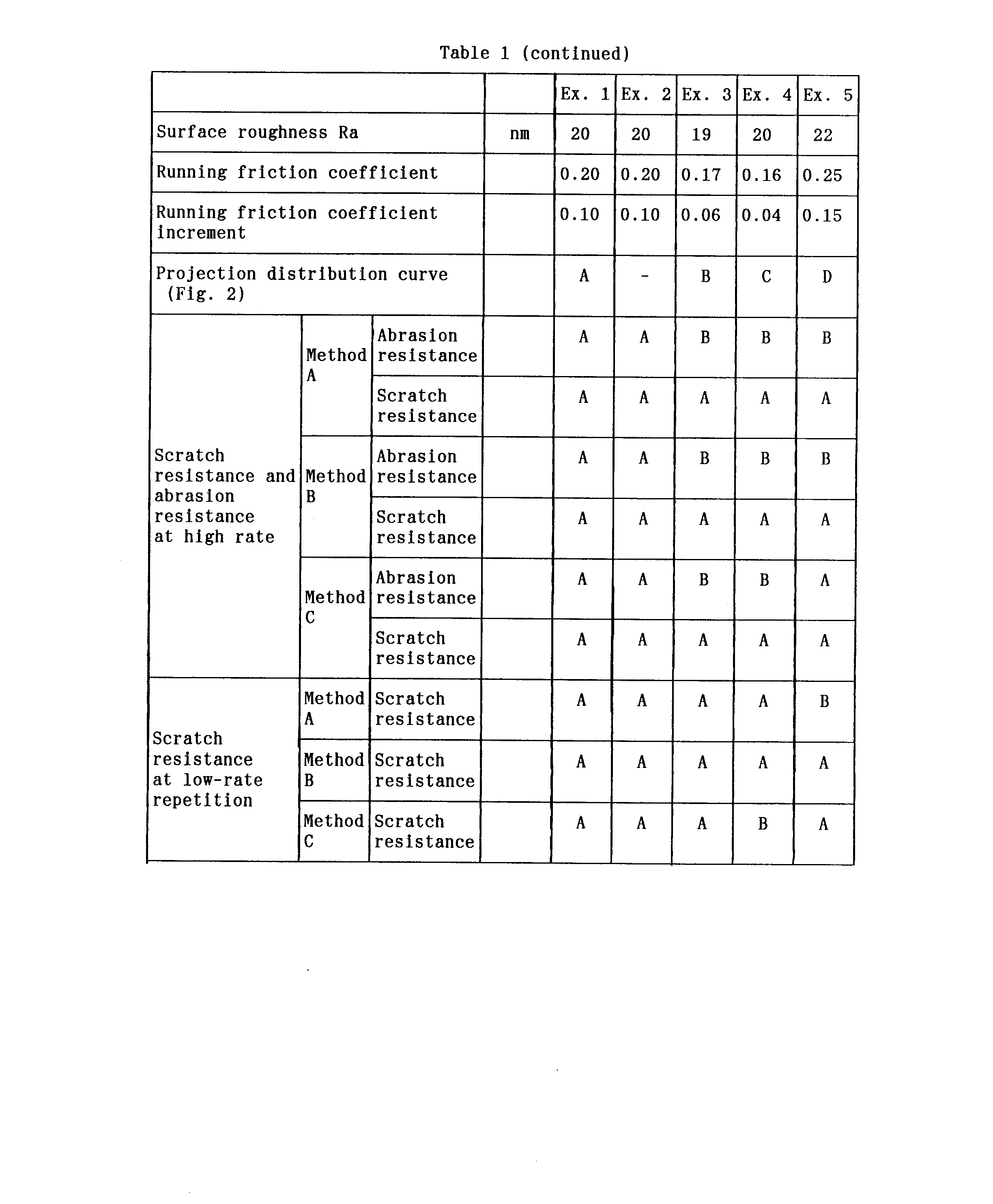
- As is clearly shown in Table 1, the biaxially oriented polyester film of the present invention not only has excellent lubricity as a substrate film for magnetic recording media but also has excellent abrasion resistance and scratch resistance against all of a metal tape guide having a well-finished surface, a metal tape guide having an insufficiently finished surface and a plastic tape guide. The biaxially oriented polyester film of the present invention has excellent properties as a substrate film for magnetic recording media.
Claims (20)
- A biaxially oriented polyester film for magnetic recording media, which comprises:(A) 0.05 to 1.0 % by weight of ϑ-aluminum oxide having an average particle diameter in the range of from 0.02 to 0.3 µm and a specific surface area in the range of from 50 to 120 m²/g, and(B) 0.01 to 1.5 % by weight of inert particles having an average particle diameter which is in the range of from 0.1 to 1.5 µm and greater than the average particle diameter of the ϑ-aluminum oxide.
- The biaxially oriented polyester film of Claim 1, wherein the ϑ-aluminum oxide has an average particle diameter in the range of from 0.03 to 0.25 µm.
- The biaxially oriented polyester film of Claim 1, wherein the ϑ-aluminum oxide has a specific surface area in the range of from 60 to 100 m²/g.
- The biaxially oriented polyester film of Claim 1, wherein the ϑ-aluminum oxide has an entire pore volume in the range of from 0.5 to 1.0 ml/g.
- The biaxially oriented polyester film of Claim 1, wherein the inert particles are inert inorganic particles or inert heat-resistant polymer particles.
- The biaxially oriented polyester film of Claim 5, wherein the inert inorganic particles are formed of a material selected from the group consisting of silicon dioxide, titanium oxide, talc, kaolin, calcium carbonate and α ―, ϑ ―,δ ― , γ ―, η ―, ρ ―, κ ― or χ ―aluminum oxide.
- The biaxially oriented polyester film of Claim 5, wherein the inert heat-resistant polymer particles are selected from the group consisting of silicone resin particles, crosslinked acryl particles, crosslinked polystyrene resin particles, fluorine resin particles and polyimide particles.
- The biaxially oriented polyester film of Claim 1, wherein the inert particles have an average particle diameter in the range of from 0.2 to 1.2 µm.
- The biaxially oriented polyester film of Claim 1, wherein the polyester comprises an aromatic dicarboxylic acid as a main acid component and an aliphatic glycol having 2 to 10 carbon atoms as a main glycol component.
- The biaxially oriented polyester film of Claim 1, which has a running friction coefficient (µk) of not more than 0.3.
- The biaxially oriented polyester film of Claim 1, which has a running friction coefficient increment (Δµk) of not more than 0.15.
- The biaxially oriented polyester film of Claim 1, which has projections satisfying the following relationship,

provided that x is in the range of not less than 0.05 µm and that y is in the range of not less than 30/mm². - The biaxially oriented polyester film of Claim 1, which has a thickness in the range of from 4 to 100 µm.
- A magnetic recording medium comprising the biaxially oriented polyester film recited in Claim 1 and a magnetic layer formed thereon.
- A biaxially oriented polyester film for magnetic recording media, which comprises:(A)′ 0.05 to 1.0 % by weight of mixed (α + γ) aluminum oxide having an average particle diameter in the range of from 0.02 to 0.3 µm and a specific surface area in the range of from 50 to 120 m²/g, and(B)′ 0.01 to 1.5 % by weight of inert particles having an average particle diameter which is in the range of from 0.1 to 1.5 µm and greater than the average particle diameter of the mixed (α + γ) aluminum oxide.
- The biaxially oriented polyester film of Claim 15, wherein the mixed (α + γ) aluminum oxide has an average particle diameter in the range of from 0.03 to 0.25 µm.
- The biaxially oriented polyester film of Claim 15, wherein the mixed (α + γ) aluminum oxide has a specific surface area in the range of from 60 to 100 m²/g.
- The biaxially oriented polyester film of Claim 15, wherein the mixed (α + γ) aluminum oxide has an entire pore volume in the range of from 0.5 to 1.0 ml/g.
- The biaxially oriented polyester film of Claim 15, wherein the mixed (α + γ) aluminum oxide is formed of 3 to 30 % by weight of an α-type crystal form and 70 to 97 % by weight of a γ-type crystal form.
- A magnetic recording medium comprising the biaxially oriented polyester film recited in Claim 15 and a magnetic layer formed thereon.
Applications Claiming Priority (2)
| Application Number | Priority Date | Filing Date | Title |
|---|---|---|---|
| JP41016790A JP2528215B2 (en) | 1990-12-13 | 1990-12-13 | Biaxially oriented polyester film for magnetic recording media |
| JP410167/90 | 1990-12-13 |
Publications (2)
| Publication Number | Publication Date |
|---|---|
| EP0490665A1 true EP0490665A1 (en) | 1992-06-17 |
| EP0490665B1 EP0490665B1 (en) | 1995-10-04 |
Family
ID=18519365
Family Applications (1)
| Application Number | Title | Priority Date | Filing Date |
|---|---|---|---|
| EP19910311542 Expired - Lifetime EP0490665B1 (en) | 1990-12-13 | 1991-12-11 | Biaxially oriented polyester film for magnetic recording media |
Country Status (5)
| Country | Link |
|---|---|
| US (1) | US5252388A (en) |
| EP (1) | EP0490665B1 (en) |
| JP (1) | JP2528215B2 (en) |
| KR (1) | KR0144663B1 (en) |
| DE (1) | DE69113585T2 (en) |
Cited By (27)
| Publication number | Priority date | Publication date | Assignee | Title |
|---|---|---|---|---|
| EP0572224A1 (en) * | 1992-05-27 | 1993-12-01 | Teijin Limited | Biaxially oriented laminated polyester film |
| EP0579121A3 (en) * | 1992-07-13 | 1994-02-16 | Diafoil Hoechst Co Ltd | |
| EP0590570A1 (en) * | 1992-09-29 | 1994-04-06 | Diafoil Hoechst Co., Ltd | Biaxially oriented polyester film for magnetic recording medium |
| EP0609060A1 (en) * | 1993-01-27 | 1994-08-03 | Teijin Limited | Biaxially oriented laminated polyester film and magnetic recording medium having the same as base film |
| US5362571A (en) * | 1994-03-16 | 1994-11-08 | Teijin Limited | Magnetic tape for use in cassette for digital audio tape recorder and biaxially oriented polyester base film therefor |
| EP0811653A3 (en) * | 1996-05-17 | 1998-05-06 | Teijin Limited | Biaxially oriented polyester film |
| US6124031A (en) * | 1992-01-24 | 2000-09-26 | Toray Industries, Inc. | Thermoplastic polyester composition and film made therefrom |
| US6149995A (en) * | 1998-03-25 | 2000-11-21 | Mitsubishi Polyester Film Gmbh | Transparent polyester film with high oxygen barrier, its use and process for its production |
| US6194054B1 (en) | 1997-06-04 | 2001-02-27 | Mitsubishi Polyester Film Gmbh | Biaxially oriented polyester film with high oxygen barrier, its use, and process for its production |
| US6200511B1 (en) | 1998-03-25 | 2001-03-13 | Mitsubishi Polyester Film Gmbh | Polyester film having a high oxygen barrier and improved adhesion to metal layers its use and process for its production |
| US6214440B1 (en) | 1998-10-29 | 2001-04-10 | Mitsubishi Polyester Film Gmbh | Coextruded, biaxially oriented polyester film for metallizing, its use and process for its production |
| US6238782B1 (en) | 1998-09-02 | 2001-05-29 | Mitsubishi Polyester Film Gmbh | Biaxially oriented polyester film having more than one layer |
| US6261663B1 (en) | 1998-04-22 | 2001-07-17 | Mitsubishi Polyster Film Gmbh | Single-layer, biaxially oriented polyester film, its use, and process for its production |
| US6280833B1 (en) | 1998-07-31 | 2001-08-28 | Mitsubishi Polyester Film Gmbh | Biaxially oriented polypropylene film having more than one layer, its use, and process for its production |
| US6291053B1 (en) | 1997-09-23 | 2001-09-18 | Hoechst Diafoil Gmbh | Multilayer biaxially oriented polyester film, and the use thereof, and process for the production thereof |
| US6358604B1 (en) | 1998-07-31 | 2002-03-19 | Mitsubishi Polyester Film Gmbh | Matte, coextruded polyester film, its use and process for its production |
| US6376042B1 (en) | 1998-04-22 | 2002-04-23 | Mitsubishi Polyester Film Gmbh | Biaxially oriented polyester film having more than one layer; its use; and process for its production |
| US6383585B2 (en) | 1998-03-25 | 2002-05-07 | Mitsubishi Polyester Film Gmbh | Sealable polyester film with high oxygen barrier, its use and process for its production |
| US6391410B1 (en) | 1998-03-25 | 2002-05-21 | Mitsubishi Polyester Film, Gmbh | Use of a transparent polyester film as a gas/flavor barrier film |
| US6409862B1 (en) | 1998-08-27 | 2002-06-25 | Mitsubishi Polyester Film Gmbh | Process for producing biaxially oriented PET films and use of the same for SMD-technology film capacitors |
| US6410132B1 (en) | 1998-09-16 | 2002-06-25 | Mitsubishi Polyester Film Gmbh | Biaxially oriented polypropylene film, the use of the film and process for its production |
| US6528144B2 (en) | 1997-09-23 | 2003-03-04 | Hoechst Diafoil Gmbh | Biaxially oriented polyester film, the use thereof, and process for the production thereof |
| US6534169B2 (en) | 1998-03-25 | 2003-03-18 | Mitsubishi Polyester Film Gmbh | Polyester film with a high oxygen barrier, the use of the film and process for its production |
| US6537647B2 (en) | 1998-03-25 | 2003-03-25 | Mitsubishi Polyester Film Gmbh | Polyester film with surface topography matched to the intended use, the use of the film and process for its production |
| US6551686B1 (en) | 1998-04-01 | 2003-04-22 | Mitsubishi Polyester Film Gmbh | Biaxially oriented polyester film having more than one layer, process for its production, and its use as magnetic tape film |
| US6565936B1 (en) | 1998-11-03 | 2003-05-20 | Mitsubishi Polyester Film Gmbh | Film laminate comprising a biaxially oriented polyester film with high oxygen barrier, its use and a process for its production |
| US6946192B2 (en) | 1998-03-25 | 2005-09-20 | Mitsubishi Polyester Film Gmbh | Transparent polyester film with high oxygen barrier and additional functionality, its use and process for its production |
Families Citing this family (12)
| Publication number | Priority date | Publication date | Assignee | Title |
|---|---|---|---|---|
| JP2592709B2 (en) * | 1990-07-05 | 1997-03-19 | 富士写真フイルム株式会社 | Magnetic recording media |
| US5368932A (en) * | 1990-12-13 | 1994-11-29 | Teijin Limited | Biaxially oriented polyester film for magnetic recording media containing theta or mixed alpha plus gamma aluminum oxide and inert organic particles |
| JP2826235B2 (en) * | 1992-08-18 | 1998-11-18 | 富士写真フイルム株式会社 | Magnetic recording media |
| JPH06195672A (en) * | 1992-12-25 | 1994-07-15 | Matsushita Electric Ind Co Ltd | Magnetic recording medium and manufacturing method thereof |
| KR100188038B1 (en) * | 1993-09-14 | 1999-06-01 | 장용균 | Manufacturing method of biaxially oriented polyester film |
| WO1997039876A1 (en) * | 1996-04-19 | 1997-10-30 | Toray Industries, Inc. | Aromatic polyamide film, method of manufacturing the same and magnetic recording medium using the same film |
| KR100548661B1 (en) * | 1997-07-07 | 2006-02-03 | 데이진 가부시키가이샤 | Biaxially Oriented Polyester Film For Magnetic Recording Media |
| DE69818036T2 (en) * | 1997-12-11 | 2004-07-15 | Teijin Ltd. | BIAXIAL-ORIENTED POLYESTER FILM FOR MAGNETIC RECORDING MEDIA |
| EP1086979B1 (en) * | 1998-04-13 | 2004-10-20 | Teijin Limited | Biaxially oriented polyester film for fabrication in lamination with metal plate |
| CN100439429C (en) * | 2003-03-25 | 2008-12-03 | 帝人杜邦菲林日本株式会社 | Antistatic Laminated Polyester Film |
| JP2005085305A (en) * | 2003-09-04 | 2005-03-31 | Fuji Photo Film Co Ltd | Magnetic recording medium |
| IN2014CN04731A (en) * | 2011-12-02 | 2015-09-18 | Toray Industries |
Citations (1)
| Publication number | Priority date | Publication date | Assignee | Title |
|---|---|---|---|---|
| EP0345644A2 (en) * | 1988-06-04 | 1989-12-13 | Diafoil Hoechst Co., Ltd | Polyester film for magnetic recording media |
Family Cites Families (7)
| Publication number | Priority date | Publication date | Assignee | Title |
|---|---|---|---|---|
| JPH01126340A (en) * | 1987-11-11 | 1989-05-18 | Teijin Ltd | Biaxially oriented polyester film |
| JPH0231321A (en) * | 1988-07-21 | 1990-02-01 | Diafoil Co Ltd | Biaxially oriented polyester film for magnetic recording medium |
| JPH02129230A (en) * | 1988-11-08 | 1990-05-17 | Diafoil Co Ltd | Oriented polyester film |
| JPH0781020B2 (en) * | 1988-06-09 | 1995-08-30 | ダイアホイルヘキスト株式会社 | Polyester film for magnetic recording media |
| JPH0684445B2 (en) * | 1988-08-29 | 1994-10-26 | ダイアホイルヘキスト株式会社 | Biaxially oriented polyester film for magnetic recording media |
| JP2856283B2 (en) * | 1989-06-02 | 1999-02-10 | 三菱化学ポリエステルフィルム株式会社 | Biaxially oriented polyester film |
| JPH0639538B2 (en) * | 1989-12-14 | 1994-05-25 | ダイアホイルヘキスト株式会社 | Biaxially oriented polyester film |
-
1990
- 1990-12-13 JP JP41016790A patent/JP2528215B2/en not_active Expired - Fee Related
-
1991
- 1991-12-11 EP EP19910311542 patent/EP0490665B1/en not_active Expired - Lifetime
- 1991-12-11 DE DE69113585T patent/DE69113585T2/en not_active Expired - Lifetime
- 1991-12-13 KR KR1019910022932A patent/KR0144663B1/en not_active Expired - Fee Related
- 1991-12-13 US US07/806,288 patent/US5252388A/en not_active Expired - Lifetime
Patent Citations (1)
| Publication number | Priority date | Publication date | Assignee | Title |
|---|---|---|---|---|
| EP0345644A2 (en) * | 1988-06-04 | 1989-12-13 | Diafoil Hoechst Co., Ltd | Polyester film for magnetic recording media |
Non-Patent Citations (2)
| Title |
|---|
| DATABASE WPIL, no. 89-188 408 DERWENT PUBLICATIONS LTD., London, GB; & JP-A-1 126 340 (TEIJIN K.K.), 18-05-1989. * |
| DATABASE WPIL, no. 90-111 188 DERWENT PUBLICATIONS LTD., London, GB; & JP-A-2 060 937 (DIAFOIL K.K.) 01-03-1990. * |
Cited By (34)
| Publication number | Priority date | Publication date | Assignee | Title |
|---|---|---|---|---|
| US6124031A (en) * | 1992-01-24 | 2000-09-26 | Toray Industries, Inc. | Thermoplastic polyester composition and film made therefrom |
| US5620774A (en) * | 1992-05-27 | 1997-04-15 | Teijin Limited | Biaxially oriented laminated polyester film |
| EP0572224A1 (en) * | 1992-05-27 | 1993-12-01 | Teijin Limited | Biaxially oriented laminated polyester film |
| EP0572224B2 (en) † | 1992-05-27 | 2004-03-10 | Teijin Limited | Biaxially oriented laminated polyester film |
| US5516574A (en) * | 1992-05-27 | 1996-05-14 | Teijin Limited | Biaxially oriented laminated polyester film having different size particles in a layer thereof |
| EP0579121A3 (en) * | 1992-07-13 | 1994-02-16 | Diafoil Hoechst Co Ltd | |
| EP0590570A1 (en) * | 1992-09-29 | 1994-04-06 | Diafoil Hoechst Co., Ltd | Biaxially oriented polyester film for magnetic recording medium |
| US5670236A (en) * | 1992-09-29 | 1997-09-23 | Diafoil Hoechst Company, Ltd. | Biaxially oriented polyester film for magnetic recording medium |
| US5556691A (en) * | 1993-01-27 | 1996-09-17 | Teijin Limited | Biaxially oriented laminated polyester film and magnetic recording medium having the same as base film |
| EP0609060A1 (en) * | 1993-01-27 | 1994-08-03 | Teijin Limited | Biaxially oriented laminated polyester film and magnetic recording medium having the same as base film |
| US5463015A (en) * | 1993-03-16 | 1995-10-31 | Teijin Ltd. | Magnetic tape for use in cassette for digital audio tape recorder and biaxially oriented polyester base film therefor |
| US5439738A (en) * | 1993-03-16 | 1995-08-08 | Teijin Limited | Magnetic tape for use in cassette for digital audio tape recorder and biaxially oriented polyester base film therefor |
| US5362571A (en) * | 1994-03-16 | 1994-11-08 | Teijin Limited | Magnetic tape for use in cassette for digital audio tape recorder and biaxially oriented polyester base film therefor |
| EP0811653A3 (en) * | 1996-05-17 | 1998-05-06 | Teijin Limited | Biaxially oriented polyester film |
| US6194054B1 (en) | 1997-06-04 | 2001-02-27 | Mitsubishi Polyester Film Gmbh | Biaxially oriented polyester film with high oxygen barrier, its use, and process for its production |
| US6291053B1 (en) | 1997-09-23 | 2001-09-18 | Hoechst Diafoil Gmbh | Multilayer biaxially oriented polyester film, and the use thereof, and process for the production thereof |
| US6528144B2 (en) | 1997-09-23 | 2003-03-04 | Hoechst Diafoil Gmbh | Biaxially oriented polyester film, the use thereof, and process for the production thereof |
| US6391410B1 (en) | 1998-03-25 | 2002-05-21 | Mitsubishi Polyester Film, Gmbh | Use of a transparent polyester film as a gas/flavor barrier film |
| US6200511B1 (en) | 1998-03-25 | 2001-03-13 | Mitsubishi Polyester Film Gmbh | Polyester film having a high oxygen barrier and improved adhesion to metal layers its use and process for its production |
| US6946192B2 (en) | 1998-03-25 | 2005-09-20 | Mitsubishi Polyester Film Gmbh | Transparent polyester film with high oxygen barrier and additional functionality, its use and process for its production |
| US6149995A (en) * | 1998-03-25 | 2000-11-21 | Mitsubishi Polyester Film Gmbh | Transparent polyester film with high oxygen barrier, its use and process for its production |
| US6537647B2 (en) | 1998-03-25 | 2003-03-25 | Mitsubishi Polyester Film Gmbh | Polyester film with surface topography matched to the intended use, the use of the film and process for its production |
| US6383585B2 (en) | 1998-03-25 | 2002-05-07 | Mitsubishi Polyester Film Gmbh | Sealable polyester film with high oxygen barrier, its use and process for its production |
| US6534169B2 (en) | 1998-03-25 | 2003-03-18 | Mitsubishi Polyester Film Gmbh | Polyester film with a high oxygen barrier, the use of the film and process for its production |
| US6551686B1 (en) | 1998-04-01 | 2003-04-22 | Mitsubishi Polyester Film Gmbh | Biaxially oriented polyester film having more than one layer, process for its production, and its use as magnetic tape film |
| US6376042B1 (en) | 1998-04-22 | 2002-04-23 | Mitsubishi Polyester Film Gmbh | Biaxially oriented polyester film having more than one layer; its use; and process for its production |
| US6261663B1 (en) | 1998-04-22 | 2001-07-17 | Mitsubishi Polyster Film Gmbh | Single-layer, biaxially oriented polyester film, its use, and process for its production |
| US6358604B1 (en) | 1998-07-31 | 2002-03-19 | Mitsubishi Polyester Film Gmbh | Matte, coextruded polyester film, its use and process for its production |
| US6280833B1 (en) | 1998-07-31 | 2001-08-28 | Mitsubishi Polyester Film Gmbh | Biaxially oriented polypropylene film having more than one layer, its use, and process for its production |
| US6409862B1 (en) | 1998-08-27 | 2002-06-25 | Mitsubishi Polyester Film Gmbh | Process for producing biaxially oriented PET films and use of the same for SMD-technology film capacitors |
| US6238782B1 (en) | 1998-09-02 | 2001-05-29 | Mitsubishi Polyester Film Gmbh | Biaxially oriented polyester film having more than one layer |
| US6410132B1 (en) | 1998-09-16 | 2002-06-25 | Mitsubishi Polyester Film Gmbh | Biaxially oriented polypropylene film, the use of the film and process for its production |
| US6214440B1 (en) | 1998-10-29 | 2001-04-10 | Mitsubishi Polyester Film Gmbh | Coextruded, biaxially oriented polyester film for metallizing, its use and process for its production |
| US6565936B1 (en) | 1998-11-03 | 2003-05-20 | Mitsubishi Polyester Film Gmbh | Film laminate comprising a biaxially oriented polyester film with high oxygen barrier, its use and a process for its production |
Also Published As
| Publication number | Publication date |
|---|---|
| US5252388A (en) | 1993-10-12 |
| DE69113585D1 (en) | 1995-11-09 |
| JPH04216031A (en) | 1992-08-06 |
| EP0490665B1 (en) | 1995-10-04 |
| KR920012213A (en) | 1992-07-25 |
| JP2528215B2 (en) | 1996-08-28 |
| DE69113585T2 (en) | 1996-04-04 |
| KR0144663B1 (en) | 1998-07-15 |
Similar Documents
| Publication | Publication Date | Title |
|---|---|---|
| EP0490665B1 (en) | Biaxially oriented polyester film for magnetic recording media | |
| EP0663286B2 (en) | Biaxially oriented laminated polyester film | |
| EP0609060A1 (en) | Biaxially oriented laminated polyester film and magnetic recording medium having the same as base film | |
| US5270096A (en) | Biaxially oriented polyester film for magnetic recording media | |
| US5368932A (en) | Biaxially oriented polyester film for magnetic recording media containing theta or mixed alpha plus gamma aluminum oxide and inert organic particles | |
| JP3068956B2 (en) | Polyester film | |
| JP3464333B2 (en) | Polyester film for magnetic recording media | |
| EP0616320A1 (en) | Magnetic tape for use in cassette for digital audio tape recorder and biaxially oriented polyester base film therefor | |
| JP3167427B2 (en) | Polyester film | |
| EP0888884B1 (en) | Biaxially oriented laminated polyester film for magnetic recording media | |
| JP2528202B2 (en) | Biaxially oriented polyester film for magnetic recording media | |
| EP0811653B1 (en) | Biaxially oriented polyester film | |
| JP2541683B2 (en) | Biaxially oriented polyester film for magnetic recording media | |
| JPH06157782A (en) | Polyester film | |
| JP2528209B2 (en) | Biaxially oriented polyester film for magnetic recording media | |
| JP2818370B2 (en) | Polyester composition and polyester film | |
| JPH07157639A (en) | Polyester film | |
| JPH06234907A (en) | Polyester film | |
| JPH0618071B2 (en) | Biaxially oriented polyester film for magnetic recording media | |
| JPH06929A (en) | Laminated biaxially oriented polyester film for magnetic recording media | |
| JP2659457B2 (en) | Biaxially oriented polyester film for magnetic recording media | |
| JPH07166034A (en) | Polyester film | |
| JPH0957921A (en) | Laminated film | |
| JPH10751A (en) | Biaxially oriented laminated polyester film for magnetic recording media | |
| JPH09314774A (en) | Biaxially oriented laminated polyester film |
Legal Events
| Date | Code | Title | Description |
|---|---|---|---|
| PUAI | Public reference made under article 153(3) epc to a published international application that has entered the european phase |
Free format text: ORIGINAL CODE: 0009012 |
|
| AK | Designated contracting states |
Kind code of ref document: A1 Designated state(s): DE FR GB NL |
|
| 17P | Request for examination filed |
Effective date: 19921020 |
|
| 17Q | First examination report despatched |
Effective date: 19940531 |
|
| GRAA | (expected) grant |
Free format text: ORIGINAL CODE: 0009210 |
|
| AK | Designated contracting states |
Kind code of ref document: B1 Designated state(s): DE FR GB NL |
|
| ET | Fr: translation filed | ||
| REF | Corresponds to: |
Ref document number: 69113585 Country of ref document: DE Date of ref document: 19951109 |
|
| PLBE | No opposition filed within time limit |
Free format text: ORIGINAL CODE: 0009261 |
|
| STAA | Information on the status of an ep patent application or granted ep patent |
Free format text: STATUS: NO OPPOSITION FILED WITHIN TIME LIMIT |
|
| 26N | No opposition filed | ||
| REG | Reference to a national code |
Ref country code: GB Ref legal event code: IF02 |
|
| PGFP | Annual fee paid to national office [announced via postgrant information from national office to epo] |
Ref country code: NL Payment date: 20091124 Year of fee payment: 19 |
|
| PGFP | Annual fee paid to national office [announced via postgrant information from national office to epo] |
Ref country code: FR Payment date: 20091203 Year of fee payment: 19 Ref country code: GB Payment date: 20091221 Year of fee payment: 19 |
|
| PGFP | Annual fee paid to national office [announced via postgrant information from national office to epo] |
Ref country code: DE Payment date: 20091123 Year of fee payment: 19 |
|
| REG | Reference to a national code |
Ref country code: NL Ref legal event code: V1 Effective date: 20110701 |
|
| GBPC | Gb: european patent ceased through non-payment of renewal fee |
Effective date: 20101211 |
|
| REG | Reference to a national code |
Ref country code: FR Ref legal event code: ST Effective date: 20110831 |
|
| PG25 | Lapsed in a contracting state [announced via postgrant information from national office to epo] |
Ref country code: FR Free format text: LAPSE BECAUSE OF NON-PAYMENT OF DUE FEES Effective date: 20110103 |
|
| REG | Reference to a national code |
Ref country code: DE Ref legal event code: R119 Ref document number: 69113585 Country of ref document: DE Effective date: 20110701 |
|
| PG25 | Lapsed in a contracting state [announced via postgrant information from national office to epo] |
Ref country code: GB Free format text: LAPSE BECAUSE OF NON-PAYMENT OF DUE FEES Effective date: 20101211 Ref country code: DE Free format text: LAPSE BECAUSE OF NON-PAYMENT OF DUE FEES Effective date: 20110701 |
|
| PG25 | Lapsed in a contracting state [announced via postgrant information from national office to epo] |
Ref country code: NL Free format text: LAPSE BECAUSE OF NON-PAYMENT OF DUE FEES Effective date: 20110701 |