EP0488403A2 - Process for the preparation of nitroxyl radicals of sterically hindered amines - Google Patents
Process for the preparation of nitroxyl radicals of sterically hindered amines Download PDFInfo
- Publication number
- EP0488403A2 EP0488403A2 EP91120589A EP91120589A EP0488403A2 EP 0488403 A2 EP0488403 A2 EP 0488403A2 EP 91120589 A EP91120589 A EP 91120589A EP 91120589 A EP91120589 A EP 91120589A EP 0488403 A2 EP0488403 A2 EP 0488403A2
- Authority
- EP
- European Patent Office
- Prior art keywords
- process according
- catalyst
- reaction
- solvent
- pentamethyl
- Prior art date
- Legal status (The legal status is an assumption and is not a legal conclusion. Google has not performed a legal analysis and makes no representation as to the accuracy of the status listed.)
- Granted
Links
Classifications
-
- C—CHEMISTRY; METALLURGY
- C07—ORGANIC CHEMISTRY
- C07D—HETEROCYCLIC COMPOUNDS
- C07D209/00—Heterocyclic compounds containing five-membered rings, condensed with other rings, with one nitrogen atom as the only ring hetero atom
- C07D209/02—Heterocyclic compounds containing five-membered rings, condensed with other rings, with one nitrogen atom as the only ring hetero atom condensed with one carbocyclic ring
- C07D209/44—Iso-indoles; Hydrogenated iso-indoles
-
- C—CHEMISTRY; METALLURGY
- C07—ORGANIC CHEMISTRY
- C07B—GENERAL METHODS OF ORGANIC CHEMISTRY; APPARATUS THEREFOR
- C07B61/00—Other general methods
- C07B61/02—Generation of organic free radicals; Organic free radicals per se
-
- C—CHEMISTRY; METALLURGY
- C07—ORGANIC CHEMISTRY
- C07D—HETEROCYCLIC COMPOUNDS
- C07D207/00—Heterocyclic compounds containing five-membered rings not condensed with other rings, with one nitrogen atom as the only ring hetero atom
- C07D207/46—Heterocyclic compounds containing five-membered rings not condensed with other rings, with one nitrogen atom as the only ring hetero atom with hetero atoms directly attached to the ring nitrogen atom
-
- C—CHEMISTRY; METALLURGY
- C07—ORGANIC CHEMISTRY
- C07D—HETEROCYCLIC COMPOUNDS
- C07D211/00—Heterocyclic compounds containing hydrogenated pyridine rings, not condensed with other rings
- C07D211/92—Heterocyclic compounds containing hydrogenated pyridine rings, not condensed with other rings with a hetero atom directly attached to the ring nitrogen atom
- C07D211/94—Oxygen atom, e.g. piperidine N-oxide
Definitions
- the present invention relates to a process for the preparation of stable nitroxyl radicals of sterically hindered amines.
- radicals are mainly used as stabilizers of organic polymers (P.P. Klemchuk, ACS Symposium, 1985); they are also used as spin labels which can be measured by means of radical detecting equipment.
- the first is based on the oxidation reaction of the above amines with hydrogen peroxide in the presence of tungsten containing catalysts.
- the most suitable catalysts for this purpose are phosphotungstic acid and sodium tungstate.
- the disadvantages of said method mainly reside in the impossibility of recycling the catalytic system and in the necessity of washing the reaction products at the end of the reaction to liberate them from the catalytic system which is liable to impair the activity thereof.
- One object of the present invention is to overcome the above-mentioned disadvantages of the known processes.
- the first aspect of the present invention is a new process for the preparation of nitroxyl radicals of sterically hindered amines, comprising the reaction of said amines with hydrogen peroxide in the presence of a titanium containing catalyst, e.g., titanium dioxide and titanium silicalites.
- a titanium containing catalyst e.g., titanium dioxide and titanium silicalites.
- the present process is simple, economical and makes it possible to recover the catalyst at the end of the reaction and to possibly recycle it.
- titanium silicalites were considered excellent catalysts for the oxidation of olefinic and aromatic hydrocarbons of alkalis and phenols (Perego, Notari "Zeolites: Synthesis, Characterization and Application”; 1988; Catalytical Studies Division, 430 Ferguson Drive; Montain View, California).
- the oxidation products of the secondary amines are hydroxylamines.
- reaction products are just those stable nitroxyl radicals which are used as stabilizers.
- Preferred sterically hindered amines are those which comprise a (e.g. 5- or 6-membered) ring containing the structural unit -C(CH3)2-N-C(CH3)2-.
- Specific examples of such sterically hindered amines are: where R is H or a linear or branched alkyl radical containing from 1 to 6 (e.g. 1 to 3) carbon atoms.
- the synthesis of the nitroxyl radicals can be carried out by adding hydrogen peroxide to the mixture of catalyst and amine which is kept under stirring.
- reaction can be carried out with or without a solvent. If a solvent is used, both water and organic solvents can be employed.
- Organic solvents suitable for this purpose are, e.g., ketones such as acetone and cyclohexanone, halogenated aliphatic hydrocarbons such as dichloroethane and methylene chloride and other similar products, and alcohols such as methanol, ethanol, propanol and (preferably tert.-)butanol.
- ketones such as acetone and cyclohexanone
- halogenated aliphatic hydrocarbons such as dichloroethane and methylene chloride and other similar products
- alcohols such as methanol, ethanol, propanol and (preferably tert.-)butanol.
- the reaction is usually carried out at a temperature ranging from 20 to 100°C even if it is preferred to heat the reaction mixture to a temperature of from 40 to 80°C to accelerate the reaction and to improve the yield.
- the molar quantity of hydrogen peroxide used in the oxidation reaction is from 2 to 4 times the molar quantity of the substrate.
- the quantity of zeolitic catalyst normally used varies from 1 to 10% by weight of the weight of the amine even if, from the point of view of kinetics and cost of the catalyst, it is preferred to use quantities ranging from 4 to 7% of the weight of the amine.
- titanium silicalite corresponding to the general formula X TiO2 (1-X) SiO2 X ranging from 0.0001 to 0.04, preferably from 0.01 to 0.025.
- Titanium silicalites with a defined structure are just as suitable as oxidation catalysts. Titanium silicalite with the ZSM-5 structure (Ti-ZSM-5) is particularly suitable.
- the synthesis of titanium silicalite generally includes, however, the preparation of a reaction mixture containing sources of silicon oxide, titanium oxide and optionally sources of an alkali metal oxide, an organic nitrogen base and water, and having a composition, expressed in terms of the molar ratios of the reagents, within the following ranges: Reagents Molar ratios Preferred molar ratios SiO2/TiO2 5 - 200 35 - 65 OH/SiO2 0.1 - 1.0 0.3 - 0.6 H2/SiO2 20 - 200 60 - 100 Me/SiO2 0.0 - 0.5 0 RN+/SiO2 0.1 - 2.0 0.4 - 1.0 where Me represents an alkali metal ion, preferably Na or K, and RN+ represents the organic cation deriving from the organic nitrogen base.
- Reagents Molar ratios Preferred molar ratios SiO2/TiO2 5 - 200 35 - 65 OH/SiO2 0.1 -
- the source of silicon oxide can be a tetralkyl-ortho-silicate, preferably tetraethyl-ortho-silicate, or quite simply colloidal silica, or the silicate of an alkali metal, preferably of Na or K.
- the source of titanium oxide may be a hydrolyzable titanium compound, preferably chosen from TiCl4, TiOCl2 and Ti(alkoxy)4, preferably Ti(OEt)4.
- a typical organic base is a tetra-alkylammonium hydroxide.
- the mixture of reagents is usually subjected to a hydrothermal treatment in an autoclave at temperatures ranging from 130 to 200°C, under autogenous pressure and over a period of 6 to 30 days, until the crystals of the precursor of the titanium-silicalite have formed; the latter are then separated from the mother liquor, thoroughly washed with water and dried; the precursor of the titanium-silicalite thus obtained, and having in its anhydrous state the following composition: xTiO2 (1-x)SiO2 0.04 (RN+)2O is heated in air, at approximately 550°C, for 1 to 72 hours, in order to completely eliminate the organic nitrogen base.
- the titanium-silicalite thus obtained has the above composition.
- the catalyst may easily be removed, e.g., by filtration, and, as stated previously, can be used again in other reactions with a slight loss of activity (causing a decrease in the rate of the reaction).
- the yields obtained are generally high and depend on the kind of substrate and its sterical hindrance.
- the reaction time usually varies from 3 to 24 hours.
- the product may be recovered by extraction with an organic solvent and then usually purified by crystallization.
- the mixture is kept, under stirring, at a temperature of 65°C for a further 6 hours, the solution being analysed by gas-chromatography every hour.
- the solution is cooled and the catalyst removed by filtration.
- NaCl is added to the filtered solution which is then extracted with two 20 ml portions of petroleum ether (boiling point 58-70°C).
- the ether extracts are combined, dried over Na2SO4 and evaporated to remove the solvent.
- the crystalline product in needle form filtered at room temperature, washed with a small quantity (5 to 10 ml) of cold hexane and then dried under vacuum, has a bright red colour and a melting point of between 36 and 38°C.
- Table 1 shows the percentage of conversion of 2,2,6,6-tetramethyl-piperidine after 6 hours of reaction at the reflux temperature of methanol. TABLE 1 Example No. Number of recycling operations Conversion (%) of 2,2,6,6-tetramethylpiperidine after 6 h of reaction 2 0 98 3 1 92 4 2 87 5 3 80 6 4 65
- Example 7 The same procedure as in example 1 is used, replacing the methanol by an equal amount (30 ml) of water (Example 7), water-acetone 1:1 (Example 8) and tert-butanol (Example 9).
- the mixture is heated to 70°C and 23 g (0.4 m) of 60% (w/w) aqueous H2O2 are then added over a period of 3 hours.
- the reaction mixture is left for 24 hours at said temperature whereafter the solution is analysed by gas-chromatography.
- K2CO3 is added to the filtrate which is then extracted with diethyl ether.
- the ether extract is dried over Na2SO4 and then evaporated.
- Hot hexane is added to the residue which is then separated from the 2,2,6,6-tetramethyl-piperidine-4-ol, crystallized from the hexane, filtered and dried.
- the product thus obtained in 95% yield is in the form of red crystals having a melting point of 72 - 73°C.
- nitroxyl radicals are obtained which are shown in Table 3 with the corresponding yields (in %) after reaction in a solvent composed of a 1:1 by weight mixture of water and methanol at a temperature of 70°C.
Landscapes
- Chemical & Material Sciences (AREA)
- Organic Chemistry (AREA)
- Organic Low-Molecular-Weight Compounds And Preparation Thereof (AREA)
- Catalysts (AREA)
- Hydrogenated Pyridines (AREA)
Abstract
Description
- The present invention relates to a process for the preparation of stable nitroxyl radicals of sterically hindered amines.
- It is known that these radicals are mainly used as stabilizers of organic polymers (P.P. Klemchuk, ACS Symposium, 1985); they are also used as spin labels which can be measured by means of radical detecting equipment.
- There are basically two methods of sythesis known in the art, which can be used industrially. The first is based on the oxidation reaction of the above amines with hydrogen peroxide in the presence of tungsten containing catalysts.
- The most suitable catalysts for this purpose are phosphotungstic acid and sodium tungstate.
- The disadvantages of said method mainly reside in the impossibility of recycling the catalytic system and in the necessity of washing the reaction products at the end of the reaction to liberate them from the catalytic system which is liable to impair the activity thereof.
- Another recent method for obtaining the nitroxyl derivatives of hindered amines (Tetrahedron Letters 29, (37), 4677 (1988)) comprises the reaction of said amines with dimethyldioxirane in the absence of catalysts. However, even if the yield of nitroxyl radicals is considerable, said process is quite costly due to the fact that a non-commercial product is used.
- One object of the present invention, therefore, is to overcome the above-mentioned disadvantages of the known processes.
- More specifically, the first aspect of the present invention is a new process for the preparation of nitroxyl radicals of sterically hindered amines, comprising the reaction of said amines with hydrogen peroxide in the presence of a titanium containing catalyst, e.g., titanium dioxide and titanium silicalites.
- The present process is simple, economical and makes it possible to recover the catalyst at the end of the reaction and to possibly recycle it.
- Originally titanium silicalites were considered excellent catalysts for the oxidation of olefinic and aromatic hydrocarbons of alkalis and phenols (Perego, Notari "Zeolites: Synthesis, Characterization and Application"; 1988; Catalytical Studies Division, 430 Ferguson Drive; Montain View, California).
- Then there were also carried out oxidation reactions of aromatic amines in the presence of zeolites with the formation of diphenyl groups (J. Chem. Soc. Faraday Trans., 71, 1192-1202 (1975)) as well as oxidation reactions of aniline in the presence of titanium silicalites with the formation of azoxybenzene (A. Fujimura, M. Oguri, Y. Kano, M. Uemura, Cat. Symp. Acta, Hokkaido Univ. Japan, July 1989).
- Also known is the oxidation reaction of secondary aliphatic amines with hydrogen peroxide in the presence of titanium silicalites with the formation of hydroxylamine derivatives (European Patent Appl. No. 88 117950.1).
- In this case, the oxidation products of the secondary amines are hydroxylamines.
- However, it has now surprisingly been found that by using sterically hindered amines as substrates, the reaction products are just those stable nitroxyl radicals which are used as stabilizers.
- The oxidation reaction according to the present invention is effected, with high yields, in accordance with the following equation:

- Preferred sterically hindered amines are those which comprise a (e.g. 5- or 6-membered) ring containing the structural unit -C(CH₃)₂-N-C(CH₃)₂-. Specific examples of such sterically hindered amines are:
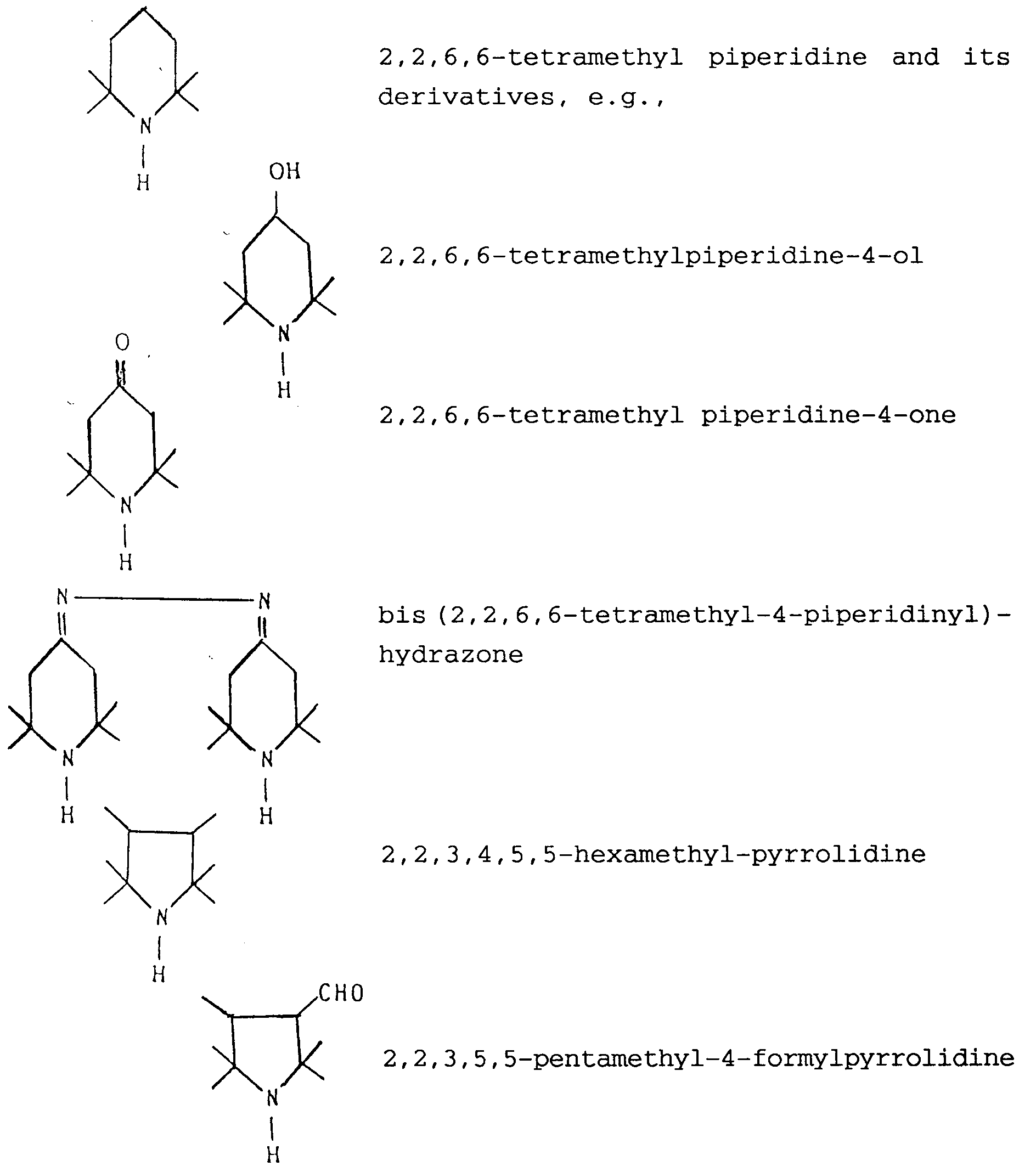
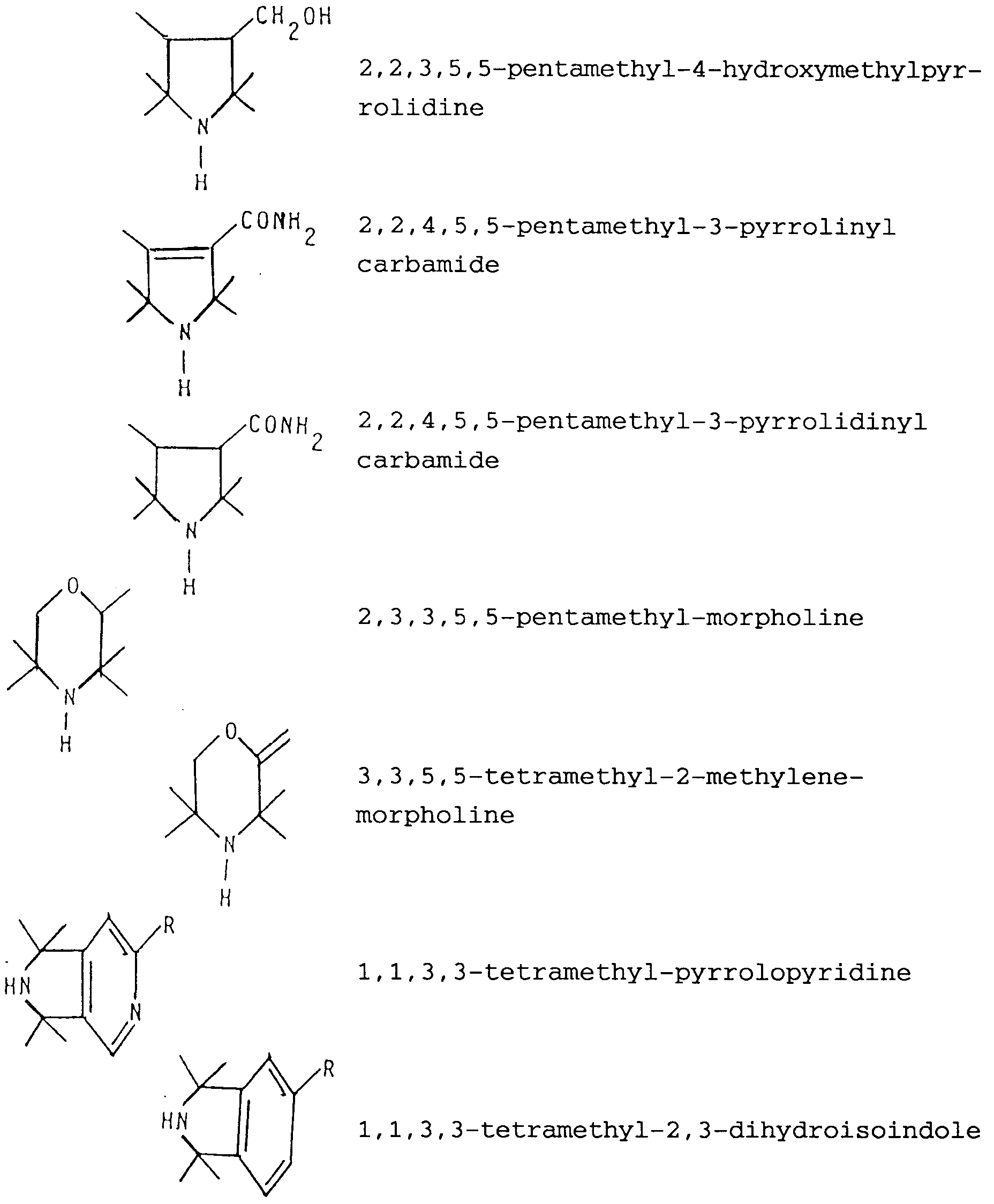
where R is H or a linear or branched alkyl radical containing from 1 to 6 (e.g. 1 to 3) carbon atoms. - The synthesis of the nitroxyl radicals can be carried out by adding hydrogen peroxide to the mixture of catalyst and amine which is kept under stirring.
- The reaction can be carried out with or without a solvent. If a solvent is used, both water and organic solvents can be employed.
- Organic solvents suitable for this purpose are, e.g., ketones such as acetone and cyclohexanone, halogenated aliphatic hydrocarbons such as dichloroethane and methylene chloride and other similar products, and alcohols such as methanol, ethanol, propanol and (preferably tert.-)butanol.
- It is also possible to use mixtures of the above alcohols and water.
- The reaction is usually carried out at a temperature ranging from 20 to 100°C even if it is preferred to heat the reaction mixture to a temperature of from 40 to 80°C to accelerate the reaction and to improve the yield.
- Preferably the molar quantity of hydrogen peroxide used in the oxidation reaction is from 2 to 4 times the molar quantity of the substrate.
- The quantity of zeolitic catalyst normally used varies from 1 to 10% by weight of the weight of the amine even if, from the point of view of kinetics and cost of the catalyst, it is preferred to use quantities ranging from 4 to 7% of the weight of the amine.
- As zeolitic synthetic catalyst containing titanium, it is convenient to use a titanium silicalite corresponding to the general formula
X TiO₂ (1-X) SiO₂
X ranging from 0.0001 to 0.04, preferably from 0.01 to 0.025. - This kind of catalyst and a method for its preparation are described in GB-B-2071071 (US-A-4410105).
- Titanium silicalites with a defined structure are just as suitable as oxidation catalysts. Titanium silicalite with the ZSM-5 structure (Ti-ZSM-5) is particularly suitable.
- The synthesis of titanium silicalite generally includes, however, the preparation of a reaction mixture containing sources of silicon oxide, titanium oxide and optionally sources of an alkali metal oxide, an organic nitrogen base and water, and having a composition, expressed in terms of the molar ratios of the reagents, within the following ranges:
Reagents Molar ratios Preferred molar ratios SiO₂/TiO₂ 5 - 200 35 - 65 OH/SiO₂ 0.1 - 1.0 0.3 - 0.6 H₂/SiO₂ 20 - 200 60 - 100 Me/SiO₂ 0.0 - 0.5 0 RN⁺/SiO₂ 0.1 - 2.0 0.4 - 1.0
where Me represents an alkali metal ion, preferably Na or K, and RN⁺ represents the organic cation deriving from the organic nitrogen base. - The source of silicon oxide can be a tetralkyl-ortho-silicate, preferably tetraethyl-ortho-silicate, or quite simply colloidal silica, or the silicate of an alkali metal, preferably of Na or K.
- The source of titanium oxide may be a hydrolyzable titanium compound, preferably chosen from TiCl₄, TiOCl₂ and Ti(alkoxy)₄, preferably Ti(OEt)₄.
- A typical organic base is a tetra-alkylammonium hydroxide.
- For the preparation of the titanium silicalite, the mixture of reagents is usually subjected to a hydrothermal treatment in an autoclave at temperatures ranging from 130 to 200°C, under autogenous pressure and over a period of 6 to 30 days, until the crystals of the precursor of the titanium-silicalite have formed; the latter are then separated from the mother liquor, thoroughly washed with water and dried; the precursor of the titanium-silicalite thus obtained, and having in its anhydrous state the following composition:
xTiO₂ (1-x)SiO₂ 0.04 (RN⁺)₂O
is heated in air, at approximately 550°C, for 1 to 72 hours, in order to completely eliminate the organic nitrogen base. The titanium-silicalite thus obtained has the above composition. - At the end of the reaction according to the present invention, the catalyst may easily be removed, e.g., by filtration, and, as stated previously, can be used again in other reactions with a slight loss of activity (causing a decrease in the rate of the reaction).
- The yields obtained are generally high and depend on the kind of substrate and its sterical hindrance.
- The reaction time usually varies from 3 to 24 hours.
- At the end of the reaction, after the catalyst has been removed by filtration, the product may be recovered by extraction with an organic solvent and then usually purified by crystallization.
- The following examples are intended to provide a clearer illustration of the present invention without limiting it in any way.
- Preparation of the 2,2,6,6-tetramethyl-piperidinyl-N-oxide radical of formula

10 g (0.071 moles) of 2,2,6,6-tetramethyl piperidine, 0.7 g of titanium silicalite (TS-1) obtained as described in example 1 of GB-B-2071071 and 30 ml of methanol are placed in a flask equipped with thermometer, magnetic stirrer, reflux condenser and dropping funnel. - The mixture, under continuous stirring, is brought to the reflux temperature of the solvent (65°C) and a 30% w/w aqueous solution of H₂O₂ (32.2 g, 0.284 moles) is slowly added over a period of 1 hour.
- The mixture is kept, under stirring, at a temperature of 65°C for a further 6 hours, the solution being analysed by gas-chromatography every hour.
- When the reagent is no longer present, the solution is cooled and the catalyst removed by filtration.
- NaCl is added to the filtered solution which is then extracted with two 20 ml portions of petroleum ether (boiling point 58-70°C).
- The ether extracts are combined, dried over Na₂SO₄ and evaporated to remove the solvent.
- A small quantity of hexane is then added to the residue which is left to crystallize at a temperature of 0°C.
- The crystalline product in needle form, filtered at room temperature, washed with a small quantity (5 to 10 ml) of cold hexane and then dried under vacuum, has a bright red colour and a melting point of between 36 and 38°C.
- Using the above procedure, 10.5 g (94.6% yield) of the product were recovered with the following elemental analysis:
C (%) H (%) N (%) Theoretical 69.2 11.6 8.96 Experimental 69.05 11.55 9.04 - Preparation of the 2,2,6,6-tetramethylpiperidinyl-N-oxide radical
- The following examples demonstrate how the activity of the catalyst varies when it is reused in further reactions.
- The same procedure as in example 1 is used and the catalyst is recycled after filtration.
- Table 1 below shows the percentage of conversion of 2,2,6,6-tetramethyl-piperidine after 6 hours of reaction at the reflux temperature of methanol.
TABLE 1 Example No. Number of recycling operations Conversion (%) of 2,2,6,6-tetramethylpiperidine after 6 h of reaction 2 0 98 3 1 92 4 2 87 5 3 80 6 4 65 -
- The following examples show how the conversion varies in relation to the solvents used.
- The same procedure as in example 1 is used, replacing the methanol by an equal amount (30 ml) of water (Example 7), water-acetone 1:1 (Example 8) and tert-butanol (Example 9).
- Table 2 below shows the conversion after 6 hours of reaction determined by gas-chromatography.
TABLE 2 Example No. T (°C) Conversion (%) after 6 h of reaction 7 80 97 8 60 99 9 80 95 - Preparation of the 2,2,6,6-tetramethyl-piperidine-4-ol-N-oxide radical of formula

15.7 g (0.1 moles) of 2,2,6,6-tetramethylpiperidine-4-ol, 0.8 g of titanium silicalite (TS-1) and 40 ml of solvent consisting of a 1:1 by volume mixture of water-methanol, are placed in a flask equipped with thermometer, magnetic stirrer, reflux condenser and dropping funnel. - The mixture is heated to 70°C and 23 g (0.4 m) of 60% (w/w) aqueous H₂O₂ are then added over a period of 3 hours.
- The reaction mixture is left for 24 hours at said temperature whereafter the solution is analysed by gas-chromatography.
- Upon filtering off the catalyst, K₂CO₃ is added to the filtrate which is then extracted with diethyl ether.
- The ether extract is dried over Na₂SO₄ and then evaporated.
- Hot hexane is added to the residue which is then separated from the 2,2,6,6-tetramethyl-piperidine-4-ol, crystallized from the hexane, filtered and dried.
- The product thus obtained in 95% yield, is in the form of red crystals having a melting point of 72 - 73°C.
- Using the same procedure as in Example 10, nitroxyl radicals are obtained which are shown in Table 3 with the corresponding yields (in %) after reaction in a solvent composed of a 1:1 by weight mixture of water and methanol at a temperature of 70°C.

Claims (10)
- Process for the preparation of nitroxyl radicals of sterically hindered amines, comprising the reaction of said amines with hydrogen peroxide in the presence of a titanium containing catalyst.
- Process according to claim 1, wherein the titanium containing catalyst is a titanium silicalite.
- Process according to claim 1, wherein the titanium containing catalyst is a synthetic zeolite corresponding to the general formula
X.TiO₂(1-X)SiO₂
X being a number of from 0.0001 to 0.04, particularly of from 0.01 to 0.025. - Process according to any one of the preceding claims, wherein the sterically hindered amine is selected from 2,2,6,6-tetramethyl-piperidine, 2,2,6,6-tetramethylpiperidine-4-ol, 2,2,6,6-tetramethylpiperidine-4-one, bis(2,2,6,6,-tetramethyl-4-piperidinyl)-hydrazone, 2,2,3,4,5,5-hexamethyl-pyrrolidine, 2,2,3,5,5-pentamethyl-4-formylpyrrolidine, 2,2,3,5,5-pentamethyl-4-hydroxymethylpyrrolidine, 2,2,3,5,5-pentamethyl-4-pyrrolidinyl carbamide, 2,2,3,5,5-pentamethyl-4-pyrrolinyl carbamide, 2,3,3,5,5-pentamethyl-morpholine, 3,3,5,5-tetramethyl-2-methylene-morpholine, 1,1,3,3-tetramethylpyrrolopyridine of formula


- Process according to any one of the preceding claims, wherein the reaction is carried out in the presence or absence of solvent.
- Process according to any one of the preceding claims, wherein water and/or an organic solvent is used as solvent.
- Process according to claim 6, wherein the solvent is selected from ketones such as acetone and cyclohexanone, halogenated aliphatic hydrocarbons such as dichloroethane and methylene chloride, alcohols such as methanol, ethanol, propanol and butanol, and alcohol-water mixtures.
- Process according to any one of the preceding claims, comprising the addition, under continuous stirring, of hydrogen peroxide to a mixture of catalyst, amine, and solvent, if any, the stirring of the resulting mixture for about 3 to about 24 hours at a temperature of from 20 to 100°C, the removal of the catalyst and the recovery of the desired product by extraction with an organic solvent.
- Process according to any one of the preceding claims, wherein the reaction is carried out at a temperature of from 40 to 80°C.
- Process according to any one of the preceding claims, wherein the molar ratio of hydrogen peroxide to amine ranges from 2:1 to 4:1 and/or the weight ratio of catalyst to amine is from 0.01:1 to 0.1:1.
Applications Claiming Priority (2)
| Application Number | Priority Date | Filing Date | Title |
|---|---|---|---|
| IT02226490A IT1243402B (en) | 1990-11-30 | 1990-11-30 | PROCEDURE FOR THE PREPARATION OF THE NITROSILIC RADICALS OF THE ADMINESTERICALLY IMPEDED. |
| IT2226490 | 1990-11-30 |
Publications (3)
| Publication Number | Publication Date |
|---|---|
| EP0488403A2 true EP0488403A2 (en) | 1992-06-03 |
| EP0488403A3 EP0488403A3 (en) | 1992-09-23 |
| EP0488403B1 EP0488403B1 (en) | 1995-10-25 |
Family
ID=11193853
Family Applications (1)
| Application Number | Title | Priority Date | Filing Date |
|---|---|---|---|
| EP91120589A Expired - Lifetime EP0488403B1 (en) | 1990-11-30 | 1991-11-29 | Process for the preparation of nitroxyl radicals of sterically hindered amines |
Country Status (4)
| Country | Link |
|---|---|
| US (1) | US5218116A (en) |
| EP (1) | EP0488403B1 (en) |
| DE (1) | DE69114106T2 (en) |
| IT (1) | IT1243402B (en) |
Cited By (9)
| Publication number | Priority date | Publication date | Assignee | Title |
|---|---|---|---|---|
| EP0574667A1 (en) * | 1992-06-13 | 1993-12-22 | Hüls Aktiengesellschaft | Process for the preparation of 2,2,6,6-tetramethylpiperidin-N-oxyls, and their 4-substituted derivatives |
| FR2724381A1 (en) * | 1994-09-12 | 1996-03-15 | Gen Electric | PROCESS FOR THE PREPARATION OF 4-HYDROXYETRAORGANOPIPERIDINYLOXY COMPOUNDS |
| EP0703220A1 (en) * | 1994-08-31 | 1996-03-27 | Ciba-Geigy Ag | Process for the preparation of N-oxyl hindered amine esters using tetraalkyl orthotitanate tranesterification catalysts |
| EP0722932A1 (en) * | 1995-01-23 | 1996-07-24 | Koei Chemical Co., Ltd. | Process for preparing tertiary amine-N-oxide |
| US5728872A (en) * | 1994-06-27 | 1998-03-17 | Lutz Riemenschneider | Stabilized acrylic acid compositions |
| US6255448B1 (en) | 1995-02-07 | 2001-07-03 | Atofina | Polymerization in the presence of a β-substituted nitroxide radical |
| US6262179B1 (en) | 1995-02-07 | 2001-07-17 | Atofina | Process for the manufacture of a composition comprising a vinylaromatic polymer and a rubber by polymerization in the presence of a stable free radical |
| US6538141B1 (en) * | 1999-01-08 | 2003-03-25 | Atofina | Method for preparing nitroxides |
| EP1375457A1 (en) * | 2002-06-25 | 2004-01-02 | Bayer Aktiengesellschaft | One-pot process for the preparation of functionalized alkoxyamines |
Families Citing this family (10)
| Publication number | Priority date | Publication date | Assignee | Title |
|---|---|---|---|---|
| DE19520270A1 (en) * | 1995-06-02 | 1996-12-05 | Basf Ag | Process for the preparation of amine oxides |
| DE19622441A1 (en) * | 1996-06-05 | 1997-12-11 | Basf Ag | Process for compressing ethylenically unsaturated monomers |
| JP4714318B2 (en) * | 1998-12-28 | 2011-06-29 | 広栄化学工業株式会社 | Method for producing organic compound having nitroxide free radical |
| US6271382B1 (en) | 1998-12-28 | 2001-08-07 | Koei Chemical Co., Ltd. | Process for producing organic compound having nitroxide free radical |
| FR2788270B1 (en) | 1999-01-08 | 2001-03-16 | Atochem Elf Sa | PROCESS FOR THE PREPARATION OF BETA-PHOSPHORUS NITROXIDE RADIALS |
| US20030091504A1 (en) * | 2001-11-15 | 2003-05-15 | Gary Pasquale | Method for controlling synthesis conditions during molecular sieve synthesis using combinations of quaternary ammonium hydroxides and halides |
| KR101290742B1 (en) * | 2010-04-21 | 2013-07-29 | 한국화학연구원 | Homogeneous catalysts for producing nitroxyl radical containing cyclic secondary amine |
| US20140323734A1 (en) | 2011-12-19 | 2014-10-30 | Rohm And Haas Company | Method for the Preparation of N-Oxyl Hindered Amine Inhibitors |
| CN115974770B (en) * | 2021-10-15 | 2025-08-12 | 中国石油化工股份有限公司 | Method for preparing 2, 6-tetramethyl piperidine nitroxide compound, reaction system and obtained product |
| CN116063224B (en) * | 2021-10-29 | 2025-08-12 | 中国石油化工股份有限公司 | Method for preparing piperidine nitroxide free radical compound |
Family Cites Families (5)
| Publication number | Priority date | Publication date | Assignee | Title |
|---|---|---|---|---|
| US2695301A (en) * | 1952-12-10 | 1954-11-23 | Univ Michigan | 2-(1-methyl) pyrrolidylmethyl benzilate and salts thereof |
| US3534048A (en) * | 1966-06-15 | 1970-10-13 | Sankyo Co | 2,2-dimethyl-4,4,6,6-tetrasubstituted-piperidine-1-oxide derivatives |
| GB1199351A (en) * | 1968-03-06 | 1970-07-22 | Bp Chem Int Ltd | Improvements in the Preparation of Nitroxides |
| US4201721A (en) * | 1976-10-12 | 1980-05-06 | General Electric Company | Catalytic aromatic carbonate process |
| US4792623A (en) * | 1981-12-21 | 1988-12-20 | The Dow Chemical Company | Meta-phenylene-diamines |
-
1990
- 1990-11-30 IT IT02226490A patent/IT1243402B/en active IP Right Grant
-
1991
- 1991-11-29 EP EP91120589A patent/EP0488403B1/en not_active Expired - Lifetime
- 1991-11-29 DE DE69114106T patent/DE69114106T2/en not_active Expired - Fee Related
- 1991-11-29 US US07/800,039 patent/US5218116A/en not_active Expired - Fee Related
Cited By (12)
| Publication number | Priority date | Publication date | Assignee | Title |
|---|---|---|---|---|
| EP0574667A1 (en) * | 1992-06-13 | 1993-12-22 | Hüls Aktiengesellschaft | Process for the preparation of 2,2,6,6-tetramethylpiperidin-N-oxyls, and their 4-substituted derivatives |
| US5416215A (en) * | 1992-06-13 | 1995-05-16 | Huels Aktiengesellschaft | Process to preparing 2,2,6,6-tetra-methylpiperidine-n-oxyl and its 4-position substituted derivatives |
| US5728872A (en) * | 1994-06-27 | 1998-03-17 | Lutz Riemenschneider | Stabilized acrylic acid compositions |
| EP0703220A1 (en) * | 1994-08-31 | 1996-03-27 | Ciba-Geigy Ag | Process for the preparation of N-oxyl hindered amine esters using tetraalkyl orthotitanate tranesterification catalysts |
| US5574163A (en) * | 1994-08-31 | 1996-11-12 | Ciba-Geigy Corporation | Process for the preparation of N-oxyl hindered amine esters |
| FR2724381A1 (en) * | 1994-09-12 | 1996-03-15 | Gen Electric | PROCESS FOR THE PREPARATION OF 4-HYDROXYETRAORGANOPIPERIDINYLOXY COMPOUNDS |
| EP0722932A1 (en) * | 1995-01-23 | 1996-07-24 | Koei Chemical Co., Ltd. | Process for preparing tertiary amine-N-oxide |
| US5668281A (en) * | 1995-01-23 | 1997-09-16 | Koei Chemical Co., Ltd. | Process for preparing tertiary amine-N-oxide |
| US6255448B1 (en) | 1995-02-07 | 2001-07-03 | Atofina | Polymerization in the presence of a β-substituted nitroxide radical |
| US6262179B1 (en) | 1995-02-07 | 2001-07-17 | Atofina | Process for the manufacture of a composition comprising a vinylaromatic polymer and a rubber by polymerization in the presence of a stable free radical |
| US6538141B1 (en) * | 1999-01-08 | 2003-03-25 | Atofina | Method for preparing nitroxides |
| EP1375457A1 (en) * | 2002-06-25 | 2004-01-02 | Bayer Aktiengesellschaft | One-pot process for the preparation of functionalized alkoxyamines |
Also Published As
| Publication number | Publication date |
|---|---|
| DE69114106T2 (en) | 1996-03-21 |
| IT9022264A0 (en) | 1990-11-30 |
| US5218116A (en) | 1993-06-08 |
| EP0488403B1 (en) | 1995-10-25 |
| IT9022264A1 (en) | 1992-05-30 |
| DE69114106D1 (en) | 1995-11-30 |
| IT1243402B (en) | 1994-06-10 |
| EP0488403A3 (en) | 1992-09-23 |
Similar Documents
| Publication | Publication Date | Title |
|---|---|---|
| EP0488403B1 (en) | Process for the preparation of nitroxyl radicals of sterically hindered amines | |
| KR101147592B1 (en) | Process for producing oxime | |
| EP0157738B1 (en) | Process for the preparation of nitroxyls of sterically hindered amines | |
| EP0919531B1 (en) | Process for the oxidation of aromatic compounds to hydroxyaromatic compounds | |
| JPH01149744A (en) | Hydroxylation of phenol and phenol ether | |
| JPS5858332B2 (en) | Manufacturing method of phenol | |
| EP0458216B1 (en) | Method for producing methyl isobutyl ketone | |
| MXPA01004645A (en) | Process for preparing piperidines. | |
| AU767324B2 (en) | Method of producing ketimines | |
| US4257949A (en) | Bisnoraldehyde-22-enamine process | |
| EP0484122B1 (en) | Method for obtaining high-purity cinnamic acid | |
| HU212038B (en) | Catalyst system, process for making thereof and process for olefin polymerization, using thereof | |
| EP1984335B1 (en) | Improved process for the preparation of stable nitroxyl radicals | |
| US3346634A (en) | Process for the preparation of nu-substituted amides of diphenylacetic acid | |
| US5442121A (en) | Process for producing N,N-disubstituted aminophenol | |
| JP4397990B2 (en) | Purification method of 3-alkylflavanonol derivatives | |
| JPS6119624B2 (en) | ||
| JP2003055347A (en) | Method for producing 2,2,6,6-tetramethylpiperidine-N-oxyl compound | |
| US5672719A (en) | Process for the preparation of isobenzofurandiones | |
| JP3443583B2 (en) | Method for producing cis-2,6-dimethylpiperazine | |
| JP2000072737A (en) | Oxime production method | |
| US7745478B2 (en) | Perfected process for the preparation of stable nitroxide radicals | |
| GB2338234A (en) | Finasteride preparation | |
| JPH07278154A (en) | Method for producing hydroxyphenyl propionate | |
| JPH04211656A (en) | Production of n, n'-bis(2,2,6,6-tetramethyl-4-piperidyl) alkanediamine |
Legal Events
| Date | Code | Title | Description |
|---|---|---|---|
| PUAI | Public reference made under article 153(3) epc to a published international application that has entered the european phase |
Free format text: ORIGINAL CODE: 0009012 |
|
| AK | Designated contracting states |
Kind code of ref document: A2 Designated state(s): CH DE FR GB IT LI |
|
| PUAL | Search report despatched |
Free format text: ORIGINAL CODE: 0009013 |
|
| AK | Designated contracting states |
Kind code of ref document: A3 Designated state(s): CH DE FR GB IT LI |
|
| 17P | Request for examination filed |
Effective date: 19930118 |
|
| RAP1 | Party data changed (applicant data changed or rights of an application transferred) |
Owner name: GREAT LAKES CHEMICAL ITALIA S.R.L. |
|
| 17Q | First examination report despatched |
Effective date: 19950209 |
|
| GRAA | (expected) grant |
Free format text: ORIGINAL CODE: 0009210 |
|
| AK | Designated contracting states |
Kind code of ref document: B1 Designated state(s): CH DE FR GB IT LI |
|
| PG25 | Lapsed in a contracting state [announced via postgrant information from national office to epo] |
Ref country code: IT Free format text: LAPSE BECAUSE OF FAILURE TO SUBMIT A TRANSLATION OF THE DESCRIPTION OR TO PAY THE FEE WITHIN THE PRE;WARNING: LAPSES OF ITALIAN PATENTS WITH EFFECTIVE DATE BEFORE 2007 MAY HAVE OCCURRED AT ANY TIME BEFORE 2007. THE CORRECT EFFECTIVE DATE MAY BE DIFFERENT FROM THE ONE RECORDED.SCRIBED TIME-LIMIT Effective date: 19951025 |
|
| ET | Fr: translation filed | ||
| REF | Corresponds to: |
Ref document number: 69114106 Country of ref document: DE Date of ref document: 19951130 |
|
| REG | Reference to a national code |
Ref country code: CH Ref legal event code: NV Representative=s name: KIRKER & CIE SA |
|
| PLBE | No opposition filed within time limit |
Free format text: ORIGINAL CODE: 0009261 |
|
| STAA | Information on the status of an ep patent application or granted ep patent |
Free format text: STATUS: NO OPPOSITION FILED WITHIN TIME LIMIT |
|
| 26N | No opposition filed | ||
| PGFP | Annual fee paid to national office [announced via postgrant information from national office to epo] |
Ref country code: CH Payment date: 19991102 Year of fee payment: 9 Ref country code: DE Payment date: 19991102 Year of fee payment: 9 Ref country code: FR Payment date: 19991102 Year of fee payment: 9 Ref country code: GB Payment date: 19991102 Year of fee payment: 9 |
|
| PG25 | Lapsed in a contracting state [announced via postgrant information from national office to epo] |
Ref country code: GB Free format text: LAPSE BECAUSE OF NON-PAYMENT OF DUE FEES Effective date: 20001129 |
|
| PG25 | Lapsed in a contracting state [announced via postgrant information from national office to epo] |
Ref country code: LI Free format text: LAPSE BECAUSE OF NON-PAYMENT OF DUE FEES Effective date: 20001130 Ref country code: CH Free format text: LAPSE BECAUSE OF NON-PAYMENT OF DUE FEES Effective date: 20001130 |
|
| REG | Reference to a national code |
Ref country code: CH Ref legal event code: PL |
|
| GBPC | Gb: european patent ceased through non-payment of renewal fee |
Effective date: 20001129 |
|
| PG25 | Lapsed in a contracting state [announced via postgrant information from national office to epo] |
Ref country code: FR Free format text: LAPSE BECAUSE OF NON-PAYMENT OF DUE FEES Effective date: 20010731 |
|
| PG25 | Lapsed in a contracting state [announced via postgrant information from national office to epo] |
Ref country code: DE Free format text: LAPSE BECAUSE OF NON-PAYMENT OF DUE FEES Effective date: 20010801 |
|
| REG | Reference to a national code |
Ref country code: FR Ref legal event code: ST |