EP0488021B2 - Elastomere Dreiblock-Copolymerzusammensetzungen und damit hergestellte Gegenstände - Google Patents
Elastomere Dreiblock-Copolymerzusammensetzungen und damit hergestellte Gegenstände Download PDFInfo
- Publication number
- EP0488021B2 EP0488021B2 EP91119703A EP91119703A EP0488021B2 EP 0488021 B2 EP0488021 B2 EP 0488021B2 EP 91119703 A EP91119703 A EP 91119703A EP 91119703 A EP91119703 A EP 91119703A EP 0488021 B2 EP0488021 B2 EP 0488021B2
- Authority
- EP
- European Patent Office
- Prior art keywords
- solution
- weight
- percent
- plasticizer
- block copolymer
- Prior art date
- Legal status (The legal status is an assumption and is not a legal conclusion. Google has not performed a legal analysis and makes no representation as to the accuracy of the status listed.)
- Expired - Lifetime
Links
- 239000000203 mixture Substances 0.000 title claims abstract description 67
- 229920000428 triblock copolymer Polymers 0.000 title abstract description 16
- 239000004014 plasticizer Substances 0.000 claims abstract description 47
- 229920001577 copolymer Polymers 0.000 claims abstract description 46
- 239000002904 solvent Substances 0.000 claims abstract description 25
- 229920005996 polystyrene-poly(ethylene-butylene)-polystyrene Polymers 0.000 claims abstract description 21
- 239000002480 mineral oil Substances 0.000 claims abstract description 18
- 235000010446 mineral oil Nutrition 0.000 claims abstract description 18
- 229920001400 block copolymer Polymers 0.000 claims description 88
- YXFVVABEGXRONW-UHFFFAOYSA-N Toluene Chemical compound CC1=CC=CC=C1 YXFVVABEGXRONW-UHFFFAOYSA-N 0.000 claims description 68
- 229920001971 elastomer Polymers 0.000 claims description 43
- 239000000806 elastomer Substances 0.000 claims description 30
- 229920000642 polymer Polymers 0.000 claims description 28
- 238000000034 method Methods 0.000 claims description 15
- 239000004793 Polystyrene Substances 0.000 claims description 11
- 238000007598 dipping method Methods 0.000 claims description 11
- 239000006193 liquid solution Substances 0.000 claims description 11
- 229920002223 polystyrene Polymers 0.000 claims description 11
- 230000008569 process Effects 0.000 claims description 11
- 239000007787 solid Substances 0.000 claims description 8
- 239000003921 oil Substances 0.000 claims description 7
- 238000002360 preparation method Methods 0.000 claims description 5
- 230000001427 coherent effect Effects 0.000 claims description 3
- 238000001704 evaporation Methods 0.000 claims description 3
- 238000000465 moulding Methods 0.000 claims description 3
- 125000003944 tolyl group Chemical group 0.000 claims 1
- CBENFWSGALASAD-UHFFFAOYSA-N Ozone Chemical compound [O-][O+]=O CBENFWSGALASAD-UHFFFAOYSA-N 0.000 abstract description 11
- 230000001590 oxidative effect Effects 0.000 abstract description 7
- 230000001681 protective effect Effects 0.000 abstract 1
- 230000035882 stress Effects 0.000 description 25
- 239000000047 product Substances 0.000 description 19
- 239000010408 film Substances 0.000 description 15
- 239000005060 rubber Substances 0.000 description 13
- 244000043261 Hevea brasiliensis Species 0.000 description 10
- 238000005336 cracking Methods 0.000 description 10
- 229920003052 natural elastomer Polymers 0.000 description 10
- 229920001194 natural rubber Polymers 0.000 description 10
- 238000012360 testing method Methods 0.000 description 9
- VSKJLJHPAFKHBX-UHFFFAOYSA-N 2-methylbuta-1,3-diene;styrene Chemical compound CC(=C)C=C.C=CC1=CC=CC=C1.C=CC1=CC=CC=C1 VSKJLJHPAFKHBX-UHFFFAOYSA-N 0.000 description 8
- -1 alkene arene Chemical class 0.000 description 7
- 230000007613 environmental effect Effects 0.000 description 7
- 230000006870 function Effects 0.000 description 7
- 239000000463 material Substances 0.000 description 7
- 238000010504 bond cleavage reaction Methods 0.000 description 5
- 230000007017 scission Effects 0.000 description 5
- RRHGJUQNOFWUDK-UHFFFAOYSA-N Isoprene Chemical compound CC(=C)C=C RRHGJUQNOFWUDK-UHFFFAOYSA-N 0.000 description 4
- 238000013459 approach Methods 0.000 description 4
- 239000000839 emulsion Substances 0.000 description 4
- 238000011156 evaluation Methods 0.000 description 4
- 229920006173 natural rubber latex Polymers 0.000 description 4
- 229920001296 polysiloxane Polymers 0.000 description 4
- 238000011084 recovery Methods 0.000 description 4
- 239000010409 thin film Substances 0.000 description 4
- 239000000654 additive Substances 0.000 description 3
- 230000000774 hypoallergenic effect Effects 0.000 description 3
- 238000004519 manufacturing process Methods 0.000 description 3
- 229940127554 medical product Drugs 0.000 description 3
- 239000000523 sample Substances 0.000 description 3
- 238000003860 storage Methods 0.000 description 3
- 229920003051 synthetic elastomer Polymers 0.000 description 3
- 239000005061 synthetic rubber Substances 0.000 description 3
- 206010020751 Hypersensitivity Diseases 0.000 description 2
- 206010070834 Sensitisation Diseases 0.000 description 2
- PPBRXRYQALVLMV-UHFFFAOYSA-N Styrene Chemical compound C=CC1=CC=CC=C1 PPBRXRYQALVLMV-UHFFFAOYSA-N 0.000 description 2
- 241000700605 Viruses Species 0.000 description 2
- 239000003963 antioxidant agent Substances 0.000 description 2
- 230000001112 coagulating effect Effects 0.000 description 2
- 150000001993 dienes Chemical class 0.000 description 2
- 229920001198 elastomeric copolymer Polymers 0.000 description 2
- 239000012530 fluid Substances 0.000 description 2
- 238000009472 formulation Methods 0.000 description 2
- 239000012456 homogeneous solution Substances 0.000 description 2
- 230000007794 irritation Effects 0.000 description 2
- 229920000126 latex Polymers 0.000 description 2
- 239000004816 latex Substances 0.000 description 2
- 239000007788 liquid Substances 0.000 description 2
- 239000000178 monomer Substances 0.000 description 2
- 239000003960 organic solvent Substances 0.000 description 2
- 230000003647 oxidation Effects 0.000 description 2
- 238000007254 oxidation reaction Methods 0.000 description 2
- 239000003973 paint Substances 0.000 description 2
- 239000011342 resin composition Substances 0.000 description 2
- 230000008313 sensitization Effects 0.000 description 2
- 239000003381 stabilizer Substances 0.000 description 2
- 239000000126 substance Substances 0.000 description 2
- XLYOFNOQVPJJNP-UHFFFAOYSA-N water Substances O XLYOFNOQVPJJNP-UHFFFAOYSA-N 0.000 description 2
- 206010067484 Adverse reaction Diseases 0.000 description 1
- 241000894006 Bacteria Species 0.000 description 1
- 239000004215 Carbon black (E152) Substances 0.000 description 1
- 241000700588 Human alphaherpesvirus 1 Species 0.000 description 1
- 241000725303 Human immunodeficiency virus Species 0.000 description 1
- 208000000474 Poliomyelitis Diseases 0.000 description 1
- 230000002411 adverse Effects 0.000 description 1
- 230000006838 adverse reaction Effects 0.000 description 1
- 230000032683 aging Effects 0.000 description 1
- 230000000172 allergic effect Effects 0.000 description 1
- XAGFODPZIPBFFR-UHFFFAOYSA-N aluminium Chemical compound [Al] XAGFODPZIPBFFR-UHFFFAOYSA-N 0.000 description 1
- 229910052782 aluminium Inorganic materials 0.000 description 1
- 238000002399 angioplasty Methods 0.000 description 1
- 238000010171 animal model Methods 0.000 description 1
- 208000010668 atopic eczema Diseases 0.000 description 1
- 230000015572 biosynthetic process Effects 0.000 description 1
- 239000008280 blood Substances 0.000 description 1
- 210000004369 blood Anatomy 0.000 description 1
- 210000004204 blood vessel Anatomy 0.000 description 1
- 238000007664 blowing Methods 0.000 description 1
- 239000004568 cement Substances 0.000 description 1
- 239000003795 chemical substances by application Substances 0.000 description 1
- 230000000052 comparative effect Effects 0.000 description 1
- 239000000306 component Substances 0.000 description 1
- 150000001875 compounds Chemical class 0.000 description 1
- 229940124558 contraceptive agent Drugs 0.000 description 1
- 239000003433 contraceptive agent Substances 0.000 description 1
- 230000007423 decrease Effects 0.000 description 1
- 230000002939 deleterious effect Effects 0.000 description 1
- 239000013536 elastomeric material Substances 0.000 description 1
- 238000001125 extrusion Methods 0.000 description 1
- 239000012467 final product Substances 0.000 description 1
- 239000011521 glass Substances 0.000 description 1
- 230000005484 gravity Effects 0.000 description 1
- 230000036541 health Effects 0.000 description 1
- 229930195733 hydrocarbon Natural products 0.000 description 1
- 150000002430 hydrocarbons Chemical class 0.000 description 1
- 239000012535 impurity Substances 0.000 description 1
- 239000004615 ingredient Substances 0.000 description 1
- 238000005259 measurement Methods 0.000 description 1
- 230000001404 mediated effect Effects 0.000 description 1
- 231100000344 non-irritating Toxicity 0.000 description 1
- 239000002245 particle Substances 0.000 description 1
- 239000013618 particulate matter Substances 0.000 description 1
- 210000003899 penis Anatomy 0.000 description 1
- 239000003208 petroleum Substances 0.000 description 1
- 230000000704 physical effect Effects 0.000 description 1
- 239000004033 plastic Substances 0.000 description 1
- 229920003023 plastic Polymers 0.000 description 1
- 229920002959 polymer blend Polymers 0.000 description 1
- 229910052573 porcelain Inorganic materials 0.000 description 1
- 230000002028 premature Effects 0.000 description 1
- 238000012545 processing Methods 0.000 description 1
- 102000004169 proteins and genes Human genes 0.000 description 1
- 108090000623 proteins and genes Proteins 0.000 description 1
- 230000005855 radiation Effects 0.000 description 1
- 238000012552 review Methods 0.000 description 1
- 230000001235 sensitizing effect Effects 0.000 description 1
- 238000010008 shearing Methods 0.000 description 1
- 229920002379 silicone rubber Polymers 0.000 description 1
- 239000004945 silicone rubber Substances 0.000 description 1
- 239000004094 surface-active agent Substances 0.000 description 1
- 229920006174 synthetic rubber latex Polymers 0.000 description 1
- 229920001169 thermoplastic Polymers 0.000 description 1
- 239000004416 thermosoftening plastic Substances 0.000 description 1
- 210000002700 urine Anatomy 0.000 description 1
- 229920002554 vinyl polymer Polymers 0.000 description 1
- 238000004073 vulcanization Methods 0.000 description 1
Images


Classifications
-
- C—CHEMISTRY; METALLURGY
- C08—ORGANIC MACROMOLECULAR COMPOUNDS; THEIR PREPARATION OR CHEMICAL WORKING-UP; COMPOSITIONS BASED THEREON
- C08L—COMPOSITIONS OF MACROMOLECULAR COMPOUNDS
- C08L53/00—Compositions of block copolymers containing at least one sequence of a polymer obtained by reactions only involving carbon-to-carbon unsaturated bonds; Compositions of derivatives of such polymers
- C08L53/02—Compositions of block copolymers containing at least one sequence of a polymer obtained by reactions only involving carbon-to-carbon unsaturated bonds; Compositions of derivatives of such polymers of vinyl-aromatic monomers and conjugated dienes
-
- Y—GENERAL TAGGING OF NEW TECHNOLOGICAL DEVELOPMENTS; GENERAL TAGGING OF CROSS-SECTIONAL TECHNOLOGIES SPANNING OVER SEVERAL SECTIONS OF THE IPC; TECHNICAL SUBJECTS COVERED BY FORMER USPC CROSS-REFERENCE ART COLLECTIONS [XRACs] AND DIGESTS
- Y10—TECHNICAL SUBJECTS COVERED BY FORMER USPC
- Y10T—TECHNICAL SUBJECTS COVERED BY FORMER US CLASSIFICATION
- Y10T428/00—Stock material or miscellaneous articles
- Y10T428/13—Hollow or container type article [e.g., tube, vase, etc.]
- Y10T428/1352—Polymer or resin containing [i.e., natural or synthetic]
-
- Y—GENERAL TAGGING OF NEW TECHNOLOGICAL DEVELOPMENTS; GENERAL TAGGING OF CROSS-SECTIONAL TECHNOLOGIES SPANNING OVER SEVERAL SECTIONS OF THE IPC; TECHNICAL SUBJECTS COVERED BY FORMER USPC CROSS-REFERENCE ART COLLECTIONS [XRACs] AND DIGESTS
- Y10—TECHNICAL SUBJECTS COVERED BY FORMER USPC
- Y10T—TECHNICAL SUBJECTS COVERED BY FORMER US CLASSIFICATION
- Y10T428/00—Stock material or miscellaneous articles
- Y10T428/13—Hollow or container type article [e.g., tube, vase, etc.]
- Y10T428/1352—Polymer or resin containing [i.e., natural or synthetic]
- Y10T428/1386—Natural or synthetic rubber or rubber-like compound containing
-
- Y—GENERAL TAGGING OF NEW TECHNOLOGICAL DEVELOPMENTS; GENERAL TAGGING OF CROSS-SECTIONAL TECHNOLOGIES SPANNING OVER SEVERAL SECTIONS OF THE IPC; TECHNICAL SUBJECTS COVERED BY FORMER USPC CROSS-REFERENCE ART COLLECTIONS [XRACs] AND DIGESTS
- Y10—TECHNICAL SUBJECTS COVERED BY FORMER USPC
- Y10T—TECHNICAL SUBJECTS COVERED BY FORMER US CLASSIFICATION
- Y10T428/00—Stock material or miscellaneous articles
- Y10T428/13—Hollow or container type article [e.g., tube, vase, etc.]
- Y10T428/1352—Polymer or resin containing [i.e., natural or synthetic]
- Y10T428/1397—Single layer [continuous layer]
-
- Y—GENERAL TAGGING OF NEW TECHNOLOGICAL DEVELOPMENTS; GENERAL TAGGING OF CROSS-SECTIONAL TECHNOLOGIES SPANNING OVER SEVERAL SECTIONS OF THE IPC; TECHNICAL SUBJECTS COVERED BY FORMER USPC CROSS-REFERENCE ART COLLECTIONS [XRACs] AND DIGESTS
- Y10—TECHNICAL SUBJECTS COVERED BY FORMER USPC
- Y10T—TECHNICAL SUBJECTS COVERED BY FORMER US CLASSIFICATION
- Y10T428/00—Stock material or miscellaneous articles
- Y10T428/26—Web or sheet containing structurally defined element or component, the element or component having a specified physical dimension
- Y10T428/269—Web or sheet containing structurally defined element or component, the element or component having a specified physical dimension including synthetic resin or polymer layer or component
Definitions
- This invention is related to the composition of an elastomeric triblock copolymer, and, additionally, to the use of such an elastomeric copolymer to prepare dip-formed articles.
- Thin-walled, extensible articles such as gloves, condoms, and other medical products have long been made from natural rubber.
- such articles are formed from natural rubber latex, a naturally occurring emulsion of rubber and water, with added stabilizing agents and vulcanizing chemicals.
- a form of the appropriate shape previously coated with a coagulating solution in some cases, is dipped into the latex mixture once or several times to build up a layer of the desired thickness.
- the water is allowed to evaporate, leaving a solid rubber film.
- the film must be vulcanized to provide adequate mechanical and physical properties.
- Natural rubber has many advantages in these applications, being strong and highly elastic and having good "tactility" or feeling to the user.
- the good tactility is believed to be a result of its low deformation stress at 10-500 percent elongations and high elastic recovery from these elongations.
- Natural rubber has the shortcoming that the resulting rubber film devices are sometimes prone to having "pinholes" therethrough, often on the order of micrometers in diameter. The pinholes are probably due to minute impurities in the natural latex which are difficult to filter out, and to the fact that the process converts a stable emulsion to a film by coagulating chemicals or heat.
- Natural rubber is also susceptible to rapid attack by ozone which causes scission cracking, as well as to oxidative attack during storage which causes cracking and destroys the physical integrity of the product. Even with these problems, for many applications the pinholes do not prevent the rubber article from having utility, and latex gloves, condoms, and other products are widely used. However, the presence of the pinholes is unacceptable in other applications, as for example where there is any possibility of the presence of the AIDS virus. Natural rubber is also not hypoallergenic due to the residual surfactants, vulcanizing agents, stabilizing agents, antioxidants, or protein materials in the rubber. Persons who are particularly susceptible to irritation or sensitization, or use the rubber products for extended periods of time may experience allergic reactions.
- Synthetic rubber compositions can be dissolved in solvents to form a true solution, so that pinholes are much less likely to be present.
- Available synthetic rubber compositions have various other shortcomings, including unacceptable tactility. While each may meet some of the requirements, the known synthetic compositions do not have the required combination of strength, tactility, resistance to environmental damage, and hypoallergenicity required for many products such as examination and surgical gloves, condoms, and other medical products that are to come into contact with the human body.
- Several synthetic elastomeric systems have provided strength and tactility, but none has solved the problems related to environmental damage and hypoallergenicity required for surgical gloves and condoms.
- the US-A 4 970 259 discloses a composition which is suitable for extrusion blowing to form an elastomeric film.
- the film produced from this composition has a very low modulus, high elongation and excellent elastic recovery.
- the composition comprises: two hydrogenated block compolymers each comprising at least two blocks containing predominantly polymerized alkene arene monomer units and at least one block containing predominantly polymerized conjugated diene monomer units.
- the US-A 4 769 415 discloses a resin composition comprising a block copolymer which comprises an intermediate block of a hydrogenated conjugated diene polymer and terminal blocks of an aromatic vinyl compound polymer which composition comprises:
- the US-A 4 880 878 discloses a thermoplastic blend with the ability to absorb less than 40% of an oil, and having a superior tensile strength that comprises about 80 to about 20 phr of an elastomeric block copolymer having the general configuration A-B-A.
- the present invention provides an elastomeric solution for dipping articles, an elastomeric composition, a process for preparing such dipped articles, and the articles themselves.
- the elastomeric blends have a combination of good strength and elasticity, together with a tactility comparable to natural rubber as shown by low deformation stress at 50-500% elongation and highly elastic recovery.
- Thin goods formed of the elastomers avoid the problem of pinholes, or, alternatively stated, have a high degree of impermeability.
- the elastomeric composition is not prone to scission cracking upon exposure to ozone or cracking upon aging, and is well suited for use in all types of thin goods formed by dipping.
- an elastomer liquid solution consists essentially of a block copolymer component comprising at least two S-EB-S triblock copolymers having different solution viscosity/copolymer concentration values as defined in claim 1, a plasticizer in an amount sufficient to provide tactility in dip formed products made from the composition; and a solvent in an amount sufficient to form a stable solution of the block copolymer component and the plasticizer and to permit dip forming of products from the liquid solution.
- three S-EB-S block copolymers form the block copolymer component, the plasticizer is mineral oil, and the plasticizer is present in an amount sufficient to reduce the deformation stress of the dip formed elastomer to less than about 5.5 MPa (millions of Pascals) at 500 percent elongation.
- the liquid elastomer solution that is used to form thin solid articles has three principal ingredients, the block copolymers, the plasticizer, and the solvent.
- the block copolymers are of the styrene-ethylene/butylene-styrene or S-EB-S type. Block copolymers of this family are inherently strong and of high modulus at intermediate elongations, leading to a rather poor tactility in the final product.
- a plasticizer preferably mineral oil, is added to the S-EB-S block copolymer to improve its tactility and elasticity, and reduce its modulus at intermediate elongations to improve its feel and tactility.
- An optimal balance of these properties, comparable to those of natural rubber, is achieved by using at least two, and preferably three, S-EB-S block copolymers of differing solution viscosity/copolymer concentration relationships in a solvent, in specific relative amounts.
- the solvent dissolves the block copolymers and the plasticizer to form a stable, true solution, rather than a mixture or an emulsion.
- Dipped articles exhibit a greatly reduced tendency to have pinholes when formed from a solution rather than a mixture.
- the amount of solvent must be sufficient to permit preparation of product by dipping procedures.
- a process for the preparation of elastomer articles comprises the steps of furnishing a liquid solution consisting essentially of at least two different S-EB-S block copolymers having different solution viscosity/copolymer concentration values, a sufficient amount of an oil to provide tactility in the dip molded products, and a sufficient amount of a solvent to permit dip molding of products; dipping a form into the solution and withdrawing the form from the solution; and evaporating the solvent from the film on the form, leaving a coherent extensible film on the form.
- the elastomeric block copolymers become physically crosslinked by the time the solid film forms, and no subsequent curing or vulcanizing is necessary.
- the elastomer of the invention is most advantageously used to manufacture relatively thin articles that are to contact the human body during use.
- Such articles are formed by dip forming.
- Such articles include surgical gloves, examination gloves, condoms, dilatation balloons, inflatable cuffs for tracheostomy tubes and other applications, drains, external catheters, rectal catheters, catheter balloons, and instrument covers for probes or other portions of instruments that contact the body.
- These products are substantially free of pinholes and are highly impermeable to small particles, viruses and bacteria. The integrity of the article is maintained even after storage and/or exposure in ultraviolet light, ozone, and oxidizing conditions.
- an elastomer liquid solution consists essentially of a block copolymer component comprising at least two S-EB-S block copolymers, each block copolymer having from about 25 to about 35 percent by weight of polystyrene blocks, the total mass of S-EB-S block copolymers having from about 40 to about 60 percent by weight of a first S-EB-S block copolymer with a solution viscosity of about 6500 cps at 25 percent by weight of copolymer in toluene at 77F, and from about 60 to about 40 percent by weight of a second S-EB-S block copolymer with a solution viscosity of about 2000 cps in toluene at 10 percent weight of polymer in toluene at 77F; a plasticizer in an amount of from about 30 to about 65 parts by weight of the total mass of the S-EB-S block copolymer component; and an organic solvent for the block cop
- an elastomer liquid solution consists essentially of a block copolymer component comprising three S-EB-S block copolymers, each block copolymer having from about 25 to about 35 percent by weight of polystyrene blocks, the total mass of S-EB-S block copolymers having from about 40 to about 60 percent by weight of a first S-EB-S block copolymer having a solution viscosity of about 6500 cps at 25 percent by weight of copolymer in toluene at 77F, from about 15 to about 59 percent by weight of a second S-EB-S block copolymer having a solution viscosity of about 2000 cps in toluene at 10 percent weight of polymer in toluene at 77F, and from about 1 to about 40 percent by weight of a third S-EB-S block copolymer having a solution viscosity of about 1600 cps in toluene at 25 percent weight of polymer
- the polymer base for the elastomer is a styrene-ethylene-butylene-styrene (S-EB-S) block copolymer formed from an ethylene-butylene copolymer central block and styrene end blocks.
- S-EB-S styrene-ethylene-butylene-styrene
- the polystyrene end blocks constitute about 25-35 percent by weight of the total molecule.
- the total molecular weight of the copolymer is typically from about 50,000 to about 300,000.
- the different copolymers have different solution viscosity/copolymer concentration relationships in a selected solvent such as toluene under selected conditions.
- the S-EB-S block copolymer is to be distinguished from other block copolymers that have sometimes been used in synthetic rubber compositions, such as styrene-isoprene-styrene (S-I-S) and styrene-polybutydiene-styrene (S-B-S) block copolymers. It has been known to make thin rubberlike articles from S-I-S and S-B-S block copolymers, see for example, US Patent 3,933,723. The use of these block copolymers eliminates the need for vulcanization of the articles, but the articles are subject to oxidation and ozone damage.
- S-I-S styrene-isoprene-styrene
- S-B-S styrene-polybutydiene-styrene
- S-EB-S block copolymer as distinct from other types, is critical to the success of the present invention, for two reasons.
- elastomers based upon the S-EB-S block elastomeric triblock copolymers are resistant to attack by ozone, or by oxidative conditions, while S-I-S and S-B-S elastomers suffer from rapid cracking, when exposed to ozone, and cracking or hardening under oxidative conditions. Both of the latter copolymers are thus subject to failure even when protected by specific additives such as antiozonants or antioxidants which are deleterious in medical and other applications. The use of such special additives is undesirable, as they may cause allergic reactions in some persons.
- the present elastomeric composition is hypoallergenic and may be contacted with the skin of the user for extended periods of time. Additionally, in spite of the special additives, scission cracking can lead to premature failure by ozone cracking of the articles made from S-I-S and S-B-S compositions, particularly when the articles are stored in a folded condition and then stretched before and during use.
- the mechanical properties of the S-EB-S triblock copolymers can be modified to provide the desirable combination of tensile strength, elasticity, and tactility that is required in some applications.
- S-EB-S elastomeric triblock copolymers have higher tensile strength, lower elastic elongation, and higher stress at 50-500 percent elongation than the S-I-S and S-B-S triblock elastomers.
- individual S-EB-S block copolymers are unacceptable for the applications described herein owing to their unacceptably high stress at low elongations and resulting insufficient tactility.
- the elastomeric properties are ideal for these applications.
- the plasticizer should not swell or solubilize the polystyrene end segments.
- US Patents 4,386,179, 4,481,323, 4,511,354, and 4,613,640 disclose compositions of triblock elastomeric copolymers with 0.1 to 7-10 percent of polysiloxane and 6-60 percent mineral oil.
- the addition of the polysiloxane in this range is essential to obtain marked improvements in surface smoothness that is microscopically characteristic of silicone rubber. This improved surface smoothness is necessary to many medical applications in contact with body tissue and fluids.
- These blends of triblock copolymers, polysiloxane, and mineral oil require formation of the stable triblock copolymer and polysiloxane composition at high temperatures and shearing pressures on the order of 1500-2500 psi (pounds per square inch). It is not practically and commercially possible to form solutions from these compounds, and to dip mold thin elastomeric articles such as gloves and condoms from these compositions.
- the S-EB-S block copolymers are available commercially 'in a range of solution viscosity/copolymer concentration values.
- the solution viscosity/copolymer concentration value is determined by measuring the viscosity of a copolymer that has been previously dissolved in a solvent at a specified level.
- Solution viscosity/copolymer concentration value is a conventional approach for uniquely defining the nature of a block copolymer whose central and end block content has been specified by type and relative amount.
- an S-EB-S block copolymer is uniquely specified by the stated composition of polystyrene end blocks and poly-b-ethylene-butylene central blocks, the relative amount of end blocks and central blocks, and the solution viscosity/copolymer concentration.
- a copolymer is uniquely defined by stating that it is of the S-EB-S type, that the percentage of polystyrene end blocks is, for example, 30 percent by weight of the total copolymer, and that the solution viscosity of a 25 weight percent solution in toluene at 77F is 6500 centipoise.
- the commercially available S-EB-S block copolymers are manufactured in a precise manner so that each of the commercially available materials is closely controlled to meet such standards.
- the S-EB-S block copolymers are mixed with a plasticizer.
- the plasticizer is preferably a mineral oil, which is a refined petroleum napthenic hydrocarbon oil described in Entries 6971 and 6972 of the Merck Index, Eighth Edition.
- the preferred mineral oil has a specific gravity of 0.87 at 77F, a viscosity of 170 centistokes at 77F, and a Hirschler molecular weight of 492.
- the S-EB-S block copolymer is furnished by the manufacturer as a solid.
- the S-EB-S block copolymers and the mineral oil plasticizer are dissolved in a mutual solvent, preferably toluene, to an optimal concentration of S-EB-S.
- a mutual solvent preferably toluene
- Toluene solutions of S-EB-S provide minimal viscosities of concentrated solutions compared to many other solvents.
- a highly concentrated solution improves dip-forming process economics by reducing the amount of solvent that must be processed in a solvent recovery operation.
- the S-EB-S in toluene solution is a true, stable solution, as distinct from a mixture or an emulsion. The process requires attaining such a solution, as by using a high shear mixer and mixing for a sufficient time to reach a homogeneous solution.
- the solution is filtered to remove any fine particulate matter.
- a number of specimens were prepared and tested in order to establish preferred compositions and approaches. In each case, the indicated composition was formulated.
- a test sample was prepared, and evaluated for strength and elongation, and also for tactility. "Tactility" was judged by both objective and subjective standards.
- the objective standard was the deformation stress (modulus) at intermediate elongations. The modulus must be less than about 7.0 MPa at 500 percent elongation, and desirably is less than about 5.5 MPa at 500 percent elongation to satisfy the more stringent requirements of ASTM D3577-88, Type I.
- the objective tactility determinations based upon intermediate modulus were verified by review of "feel" and elasticity of the products by persons familiar with the articles and who use such articles in their professional duties, such as dentists and surgeons. Condoms were also evaluated by persons familiar with their use. These subjective evaluations were considered to be important, because the ultimate standard for acceptable tactility is the product acceptability to users. Each person was asked to give an evaluation of whether the product had the necessary combination of fit, elasticity, and tactility to be acceptable and comfortable as a glove to be worn for extended periods of time, or as a condom. In general, the results of subjective tactility evaluations were consistent with the objective intermediate modulus standard, with only minor differences as will be discussed.
- S-EB-S triblock copolymers have high tensile strengths, but also high values of deformation stress (modulus) at 50-500 percent elongation. These values of deformation stress are much too high for use in many thin-film products such as gloves and condoms.
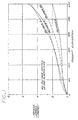
- Figures 1 and 2 present deformation stress as a function of elongation ("modulus" plot) for thin films of several different block copolymers and block copolymer combinations, all having an addition of 62 parts of plasticizer per hundred parts of block copolymer. Results of similar tests of a natural rubber latex composition are included for comparison (latex-D).
- Block copolymer A is an S-EB-S block copolymer having from 25-35 percent by weight polystyrene blocks and a solution viscosity of about 6500 cps at 25 percent by weight of copolymer in toluene at 77F.
- Block copolymer B is an S-EB-S block copolymer having from 25-35 percent by numerical count polystyrene blocks and a solution viscosity of about 2000 cps at 10 percent by weight of copolymer in toluene at 77F.
- Block copolymer C is an S-EB-S block copolymer having from 25-35 percent by weight polystyrene blocks and a solution viscosity of about 1600 cps at 25 percent by weight of copolymer in toluene at 77F Such S-EB-S block copolymers are available commercially.
- the plasticizer is the preferred mineral oil.
- polymer blend D a mixture of 50 percent by weight polymer A , 33 percent by weight polymer B , and 17 percent by weight polymer C
- polymer AB a mixture of 50 weight percent of polymer A and 50 weight percent of polymer B
- Figure 3 presents the ultimate tensile strength of S-EB-S polymer mixes as a function of composition, for a constant 50 weight percent polymer A and varying amounts of polymers B and C , as indicated on the horizontal axis. Also included in the graph are the results of varying the amount of plasticizer from 30 parts per hundred of copolymer to 65 parts per hundred of copolymer.
- Figure 4 presents the deformation stress and 500 percent elongation for the same mixes, in a similar format.
- Standard ASTM D3577-88 for rubber surgical gloves, Standard ASTM D3578-77 for rubber examination gloves, and Standard ASTM D3492-83 for rubber contraceptives (condoms).
- ASTM D3577-88 for rubber surgical gloves
- ASTM D3578-77 for rubber examination gloves
- ASTM D3492-83 for rubber contraceptives (condoms).
- Each of these standards establishes a minimum ultimate tensile strength for the specified product under particular conditions.
- the ASTM line at 24 MPa is that minimum ultimate tensile strength specified for Type I (natural latex) surgical gloves in ASTM D3577-88.
- the ASTM line at 17 MPa is that specified for Type II (Synthetic rubber latex or rubber cement) surgical gloves in ASTM D3577-88 and that specified for condoms in ASTM D3492-83.
- the ASTM line at 21 MPa is that specified for examination gloves in ASTM D3578-77.
- the ASTM standards also establish maximum deformation stress at 500 percent elongation.
- the mechanical properties of the final article should have a tensile strength equal to or greater than that of the appropriate ASTM standard minimum tensile strength, Figure 3, and equal to or less than the appropriate ASTM standard tensile or deformation stress at 500 percent elongation, Figure 4.
- the results of Figures 3-4 establish that particular S-EB-S copolymer blends with specific amounts of plasticizer meet the ASTM standards and can achieve comparable, and in many cases superior, mechanical properties to those of natural latex. This result is significant, because it means that the material of the invention can perform mechanically in a manner comparable or superior to that of natural rubber, while avoiding the shortcomings of natural rubber such as susceptibility to pinholes, oxidative attack, ozone attack, and allergenicity. No other material is known which has all of these features.
- the data represent ultimate tensile strength in Figure 3 and deformation stresses at 500% elongation in Figure 4, measured from the test specimens.
- the data points are connected by lines of constant mineral oil content, as for example the line 20.
- An objective "tactility" line 22 represents the compositions at which the modulus of the elastomer at 500 percent elongation was less than 5.5 MPa.
- the line 22 quantifies the dividing line between those compositions that meet the ASTM D 3577-88 Type I specification and have sufficient tactility, and those which do not. Those compositions lying above the line 22 were judged unacceptable because they have too high a stress at 500% elongation, while those lying below the line 22 would be acceptable.
- the subjective tactility evaluation produced an upper tactility line 26 which is slightly below the line 22, resulting in a more stringent requirement to satisfy users of the products.
- the strength (ultimate tensile stress) of the composition decreases noticeably at the extrema of the ratios of the copolymer components B and C.
- a minimum acceptable strength is represented by the "ASTM" line 24 in Figure 3 for surgical gloves.
- compositions which lie within an area 28 defined by the lines 24 and 26 are acceptable. Most preferably, compositions lying in the upper parts of the region 28 are selected for use, as they have the maximum strength consistent with acceptable tactility. A most preferred composition is indicated by point 30 on Figure 3.
- This S-EB-S triblock copolymer blend has an optimum composition of 50 weight percent polymer A, 40 weight percent Polymer B, and 10 weight percent Polymer C, with 48 parts per hundred of polymer mineral oil plasticizer.
- Single triblock copolymers of the S-EB-S type do not meet the ASTM standard and pass the tactility requirements when samples are prepared by the solution dipping approach. That a combination of two or three S-EB-S copolymers with a plasticizer meets the strength and tactility standards is surprising.
- compositions of a single S-EB-S block copolymer and a plasticizer could meet both the ultimate tensile strength and deformation stress at 500 percent elongation requirements of the ASTM standards.
- Blends of from about 40 to about 60 percent of copolymer A, balance copolymer B totaling 100 percent, plus from about 30 to about 65 parts by weight mineral oil plasticizer met the requirements.
- Conventional practice in the art is to specify compositions as follows. The copolymer is specified on the basis of 100 percent total, and then the plasticizer is specified as additional parts by weight of the weight of the total copolymer mass. This approach is frequently referred to as parts per hundred of rubber, or phr.) In all cases, a sufficient amount of solvent is added to the composition to permit dip forming, as will be discussed subsequently.
- Blends containing three copolymers are even more preferred, because they permit more flexibility in tailoring the properties of the final film to specific product needs and offer improved properties, as seen in the results of Figures 3 and 4.
- Blends of three S-EB-S triblock copolymers having from about 40 to about 60 percent of copolymer A, about 15 to about 59 percent of copolymer B, and about 1 to about 40 percent of copolymer C, with about 30 to about 65 parts by weight of the total copolymer mass of plasticizer, yielded satisfactory mechanical properties.
- the copolymer component is a combination of two or more S-EB-S triblock copolymers.
- the formulations according to the invention are prepared by placing the block copolymers and mineral oil into a high shear mixer such as a Cowles dissolver, adding the solvent, and mixing for a sufficient time to attain a homogeneous solution, typically about one hour.
- the solution is set aside for a period of time, typically several hours, to deaerate.
- Articles including an elastomer glove, depicted in Figure 5, and an elastomer condom, depicted in Figure 6, were prepared from the most preferred composition and from other acceptable compositions.
- a sufficiently large amount of the elastomer solution is prepared in the manner described and placed into a dipping tank, at ambient temperature.
- a commercially available form typically made of aluminum, glass, plastic, or porcelain
- a commercially available form typically made of aluminum, glass, plastic, or porcelain
- the form is dried in a stream of air for a predetermined time to permit the solvent in the thin elastomeric layer to evaporate, at ambient temperature.
- Each dipped and dried layer is about 0.03-0.20 millimeters thick.
- the dipping procedure is repeated as necessary to build up a layer of the required thickness.
- Thin articles prepared according to the dipping process of the invention have thicknesses of from about 0.03 to about 1.0 millimeter, depending upon the thickness per layer and the number of layers. It is difficult to maintain the integrity of layers of less than about 0.03 millimeters thickness. It is difficult to prepare articles more than about 1.0 millimeters thick by dip forming.
- Elastomer gloves and condoms prepared from the most preferred composition and the dipping method just described were tested as follows. Hypoallergenicity was demonstrated using a modified Draize technique first in animal models followed by a human protocol. The human tests screened for both irritation and immune mediated sensitization. The testing demonstrated that the compositions of S-EB-S triblock copolymers and plasticizer was non-irritating and non-sensitizing. Impermeability of the intact elastomer films was substantiated using three different live viruses, polio, HSV-1, and T 7 -bacteriophage, with and without mechanical manipulation of the thin film during testing. The films were found to be impermeable.
- the elastomer of the invention can be used to prepare articles other than gloves and condoms, and no limitation on the type of articles prepared is known.
- Figures 7-12 show examples of some other articles that can be prepared by dip forming the elastomer of the invention.
- Dilatation balloons such as shown in Figure 7, are used in angioplasty procedures.
- the uninflated dilatation balloon is mounted on an instrument and inserted into a blood vessel to the location of a partial or total blockage.
- the dilatation balloon is inflated to compress the blockage outwardly and permit blood to flow again.
- Inflatable cuffs such as shown in Figure 8, are used to hold instruments in place within the body.
- the cuff surrounds the instrument.
- the instrument is inserted into the body through an opening, and then the cuff is inflated to hold the instrument securely in place.
- Drains such as shown in Figure 9, are pieces of tubing extending from within the body to outside the body to permit the draining of fluids from the body.
- External catheters such as shown in Figure 10, are placed over the penis to remove urine.
- Catheter balloons such as shown in Figure 11, are of several types. Generally, however, the catheter balloon functions in a manner somewhat similar to an inflatable cuff. The catheter is inserted into the body with the balloon deflated. When the catheter reaches its intended location, the catheter balloon is inflated.
- Instrument covers such as shown in Figure 12, are also of several types. Generally, some portion of an instrument must be placed into contact with the body for a period of time. The instrument cover covers and protects that portion of the instrument, such as a probe, and prevents it from contacting the body.
- the feature common to these articles of most interest is that they are used in medically related applications where they must be elastomeric and must also contact the body (either externally or internally) for a period of time.
- the elastomer of the present invention is resistant to environmental damage so that the operability of the articles is less subject to adverse environmental influences, and also does not cause allergic or other adverse reaction in the patient or the health care worker.
- the present invention provides an improved elastomer formulation for the preparation of dip-formed articles having properties superior to those previously available.
Landscapes
- Chemical & Material Sciences (AREA)
- Health & Medical Sciences (AREA)
- Chemical Kinetics & Catalysis (AREA)
- Medicinal Chemistry (AREA)
- Polymers & Plastics (AREA)
- Organic Chemistry (AREA)
- Compositions Of Macromolecular Compounds (AREA)
- Materials For Medical Uses (AREA)
- Orthopedics, Nursing, And Contraception (AREA)
- Manufacture Of Macromolecular Shaped Articles (AREA)
- Laminated Bodies (AREA)
- Addition Polymer Or Copolymer, Post-Treatments, Or Chemical Modifications (AREA)
- Moulding By Coating Moulds (AREA)
Claims (15)
- Elastomerer, mittels Tauchen gebildeter Artikel, umfassend eine dünne, feste Schicht in einer Dicke von etwa 0,03 bis etwa 1,0 mm, die aus einem Elastomer hergestellt ist, welches eine Block-Copolymer-Komponente enthält, die wenigstens zwei S-EB-S Block-Copolymere umfasst, die unterschiedliche Lösungs-Viskositäts/Copolymer-Konzentrations-Werte aufweisen, wobei jedes Block-Copolymer etwa 25 bis 35 Gew.-% an Polystyrol-Blöcken aufweist, wobei die Gesamtmasse der S-EB-S Block-Copolymere
etwa 40 bis etwa 60 Gew.-% eines ersten S-EB-S Block-Copolymers mit einer Lösungsviskosität von etwa 6500 cps (= 6,5 m-1 kg-1) bei 25 Gew.-% des Coplymers in Toluol bei 25 °C (77° F) und
etwa 60 bis etwa 40 Gew.-% eines zweiten S-EB-S Block-Copolymers mit einer Lösungsviskosität von etwa 2000 cps (= 2 m-1 kg-1) bei 10 Gew.-% des Polymers in Toluol bei 25 °C (77 °F) und
einen Weichmacher in einer Menge von etwa 30 bis etwa 65 Gewichtsteilen der Gesamtmasse der S-EB-S Block-Copolymer-Komponente aufweist. - Der elastomere Artikel nach Anspruch 1, wobei der Weichmacher in einer Menge vorhanden ist, die ausreichend ist, die Zugbelastung von durch Eintauchen hergestellten Artikeln auf weniger als 5,5 Mpa bei 500 %
Elongation zu reduzieren. - Elastomerer, mittels Tauchen gebildeter Artikel, umfassend eine dünne, feste Schicht in einer Dicke von etwa 0,03 bis etwa 1,0 mm, die aus einem Elastomer hergestellt ist, welches eine Block-Copolymer-Komponente enthält, die drei S-EB-S Block-Copolymere umfasst, wobei jedes Block-Copolymer von etwa 25 bis etwa 35 Gew.-% an Polystyrol-Blöcken aufweist, und die Gesamtmasse der S-EB-S Block-Copolymere
etwa 40 bis 60 Gew.-% eines ersten S-EB-S Block-Copolymers mit einer Lösungsviskosität von etwa 6500 cps (= 6,5 m-1 kg-1) bei 25 Gew.-% des Coplymers in Toluol bei 25 °C (77 °F) und
etwa 15 bis etwa 59 Gew.-% eines zweiten S-EB-S Block-Copolymers mit einer Lösungsviskosität von etwa 2000 cps (= 2 m-1 kg-1) bei 10 Gew.-% des Polymers in Toluol bei 25 °C (77 °F) und
etwa 1 bis etwa 40 Gew.-% eines dritten S-EB-S Block-Copolymers mit einer Lösungsviskosität von etwa 1600 cps (= 1,6 m-1 kg-1) in Toluol bei 25 °C (77 F) und
einen Weichmacher in einer Menge von etwa 30 bis etwa 65 Gewichtsteilen der Gesamtmasse der S-EB-S Block-Copolymer-Komponente aufweist. - Der elastomere Artikel nach Anspruch 1 oder 3, wobei der Weichmacher Mineralöl ist.
- Der elastomere Artikel nach Anspruch 1 oder 3, wobei der Artikel als Handschuh, Kondom, als dehnbarer Ballon, als aufblasbare Manschette, als medizinische Drainagevorrichtung, als externer Katheter, als Katheterballon oder als Instrumentenbedeckung ausgebildet ist.
- Elastomere, flüssige Lösung, im Wesentlichen aus einer Block-Copolymer-Komponente bestehend, die die wenigstens zwei S-EB-S Block-Copolymere nach Anspruch 1 umfasst, einen Weichmacher in ausreichender Menge, um Taktilität von durch Eintauchen gefertigten, aus der Zusammensetzung hergestellten Produkten zu gewährleisten und wobei ein Lösungsmittel in einer Menge vorgesehen ist, die ausreicht, um eine stabile Lösung der Block-Copolymer-Komponente und des Weichmachers zu schaffen und um das Herstellen der Produkte aus der flüssigen Lösung durch Tauchen zu ermöglichen.
- Die Lösung nach Anspruch 6, wobei der Weichmacher Mineralöl ist.
- Die Lösung nach Anspruch 6, wobei die Block-Copolymer-Komponente des Weiteren ein drittes S-EB-S-Copolymer beinhaltet, das einen von demjenigen der beiden anderen S-EB-S-Block-Copolymere verschiedenen Wert für die Lösungs-Viskositäts/Copolymer-Konzentration aufweist.
- Elastomere, flüssige Lösung, im Wesentlichen aus einer Block-Copolymer-Komponente bestehend, die die drei S-EB-S Block-Copolymere nach Anspruch 3 und einen Weichmacher in ausreichender Menge umfasst, um Taktilität von durch Tauchen gefertigten, aus der Zusammensetzung hergestellten Produkten zu gewährleisten, und ein Lösungsmittel in einer Menge, die ausreicht, um eine stabile Lösung der Block-Copolymer-Komponente und des Weichmachers zu schaffen und um das Herstellen der Produkte aus der flüssigen Lösung durch Tauchen zu ermöglichen, wobei der Weichmacher in einer Menge von etwa 30 bis etwa 65 Gewichtsteilen der Gesamtmasse der S-EB-S Block-Copolymer-Komponente vorhanden ist.
- Die Lösung nach Anspruch 9, wobei der Weichmacher in einer Menge vorhanden ist, die ausreichend ist, die Zugbelastung von durch Eintauchen in die Lösung hergestellten Produkten auf weniger als 5,5 Mpa bei 500 % Elongation zu reduzieren.
- Die Lösung nach Anspruch 9, wobei der Weichmacher Mineralöl ist.
- Die Lösung nach Anspruch 9, wobei das Lösungsmittel Toluol ist.
- Verfahren zur Herstellung von elastomeren Artikeln nach Anspruch 1 oder 2, wobei das Verfahren die Schritte umfasst:Zur Verfügung Stellen einer flüssigen Lösung im Wesentlichen aus den wenigstens zwei S-EB-S Block-Copolymeren nach Anspruch 1, eine ausreichende Menge an Öl, um Taktilität der durch Tauchen gebildeten Produkte bereitzustellen, und eine ausreichende Menge an Lösungsmittel, um Formgebung duch Tauchen zu gewährleisten,Tauchen einer Form in die Lösung,Herausziehen der Form aus der Lösung undVerdampfen des Lösungsmittels von dem Film auf der Form, wodurch ein kohärenter dehnbarer Film auf der Form zurückbleibt.
- Verfahren zur Herstellung elastomerer Artikel nach einem der Ansprüche 3 bis 5, wobei das Verfahren die Schritte umfasst:Zur Verfügung Stellen einer flüssigen Lösung, im Wesentlichen bestehend aus den drei S-EB-S Block-Copolymeren nach Anspruch 3, eine ausreichende Menge an Öl, um Taktilität der durch Tauchen gebildeten Produkte gewährleisten, und eine ausreichende Menge an Lösungsmittel, um Formgebung duch Tauchen zu gestatten,Tauchen einer Form in die Lösung,Herausziehen der Form aus der Lösung undVerdampfen des Lösungsmittels von dem Film auf der Form, wodurch ein kohärenter dehnbarer Film auf der Form zurückbleibt.
- Verfahren nach Anspruch 13 oder 14, wobei der Weichmacher Öl in einer Menge von etwa 30 bis etwa 65 Gewichtsteilen der Gesamtmasse an S-EB-S Block-Copolymer-Komponente vorhanden ist.
Applications Claiming Priority (4)
| Application Number | Priority Date | Filing Date | Title |
|---|---|---|---|
| US619218 | 1990-11-28 | ||
| US07/619,218 US5112900A (en) | 1990-11-28 | 1990-11-28 | Elastomeric triblock copolymer compositions and articles made therewith |
| US779725 | 1991-10-23 | ||
| US07/779,725 US5407715A (en) | 1990-11-28 | 1991-10-23 | Elastomeric triblock copolymer compositions and articles made therewith |
Publications (3)
| Publication Number | Publication Date |
|---|---|
| EP0488021A1 EP0488021A1 (de) | 1992-06-03 |
| EP0488021B1 EP0488021B1 (de) | 1996-05-01 |
| EP0488021B2 true EP0488021B2 (de) | 2002-10-30 |
Family
ID=27088455
Family Applications (1)
| Application Number | Title | Priority Date | Filing Date |
|---|---|---|---|
| EP91119703A Expired - Lifetime EP0488021B2 (de) | 1990-11-28 | 1991-11-19 | Elastomere Dreiblock-Copolymerzusammensetzungen und damit hergestellte Gegenstände |
Country Status (8)
| Country | Link |
|---|---|
| US (1) | US5407715A (de) |
| EP (1) | EP0488021B2 (de) |
| JP (1) | JP3253996B2 (de) |
| AT (1) | ATE137522T1 (de) |
| AU (1) | AU659420B2 (de) |
| CA (1) | CA2055931C (de) |
| DE (1) | DE69119200T3 (de) |
| ES (1) | ES2090210T5 (de) |
Families Citing this family (82)
| Publication number | Priority date | Publication date | Assignee | Title |
|---|---|---|---|---|
| CA2134074A1 (en) * | 1993-03-01 | 1994-09-15 | Allegiance Corporation | Sequential copolymer based gloves |
| AU7256194A (en) * | 1993-07-06 | 1995-02-06 | Leo J. Utecht | Personal protection apparatus |
| US5840387A (en) * | 1995-07-28 | 1998-11-24 | Aegis Biosciences L.L.C. | Sulfonated multiblock copolymer and uses therefor |
| NL1001763C2 (nl) * | 1995-11-28 | 1997-05-30 | Cordis Europ | Door stroming geleidbare catheter. |
| US5792531A (en) * | 1996-02-20 | 1998-08-11 | Tactyl Technologies, Inc. | Readily donned, powder free elastomeric article |
| US6730380B2 (en) | 1996-02-20 | 2004-05-04 | Safeskin Corp. | Readily-donned elastomeric articles |
| JP3305725B2 (ja) * | 1996-03-29 | 2002-07-24 | 東京エレクトロン株式会社 | クリーンルーム内で用いられる器具及び装着具 |
| US5900452A (en) | 1996-08-12 | 1999-05-04 | Tactyl Technologies, Inc. | S-EB-S block copolymer/oil aqueous dispersion and its use in forming articles |
| US6054525A (en) * | 1996-09-16 | 2000-04-25 | The University Of Akron | Hypoallergenic natural rubber latex and a process for making the same |
| US5885205A (en) | 1996-10-03 | 1999-03-23 | Kassman; Leon B. | Condom exerting lateral pressure on the penis |
| US6639007B2 (en) * | 1996-11-15 | 2003-10-28 | Tactyl Technologies, Inc. | Elastomeric copolymer compositions and articles made therewith |
| US6221447B1 (en) | 1996-11-18 | 2001-04-24 | Charles S. Munn | Rubber products that shrink due to the application of energy and hypo-allergenic rubbery products |
| CA2227582C (en) * | 1997-01-21 | 2003-12-09 | Eci Medical Technologies Inc. | Thin-walled rubber articles with walls having a relatively low modulus |
| US6072004A (en) * | 1997-12-19 | 2000-06-06 | Shell Oil Company | Thermofusible elastomer compositions |
| US6579940B1 (en) | 1999-10-28 | 2003-06-17 | Edwards Lifesciences Corporation | Thermoplastic elastomeric material as a replacement for natural rubber latex |
| US6306419B1 (en) | 2000-02-23 | 2001-10-23 | Aegis Biosciences, Llc | Medical uses of styrene sulfonate polymers |
| US6613838B1 (en) | 2000-08-30 | 2003-09-02 | Edwards Lifesciences Corporation | Synthetic rubber elastomers as replacements for natural rubber latex |
| US6673871B2 (en) | 2000-12-21 | 2004-01-06 | Kimberly-Clark Worldwide, Inc. | Elastomeric articles made from a synthetic polymer |
| US20030118761A1 (en) * | 2001-12-21 | 2003-06-26 | Kimberly-Clark Worldwide, Inc. | Elastomeric articles having improved chemical resistance |
| US20030124354A1 (en) * | 2001-12-27 | 2003-07-03 | Maris Vistins | Colored high-protective multi-layered polymer coated articles and method of making same |
| US20050177133A1 (en) * | 2002-07-08 | 2005-08-11 | Nielsen Henrik L. | External urinary catheter |
| US7178171B2 (en) | 2002-08-19 | 2007-02-20 | Kimberly-Clark Worldwide, Inc. | Elastomeric gloves having enhanced breathability |
| US7455863B2 (en) * | 2002-11-07 | 2008-11-25 | Smarthealth, Inc. | Flexible elastomer articles and methods of manufacturing |
| US7585526B2 (en) | 2002-11-07 | 2009-09-08 | Smarthealth, Inc. | Flexible elastomer articles and methods of manufacturing |
| US7032251B2 (en) * | 2002-12-10 | 2006-04-25 | Kimberly-Clark Worldwide, Inc. | Crosslinking agent for coated elastomeric articles |
| US6805963B2 (en) * | 2002-12-12 | 2004-10-19 | Kimberly-Clark Worldwide, Inc. | Elastomeric articles with improved damp slip |
| US20040122382A1 (en) * | 2002-12-23 | 2004-06-24 | Kimberly-Clark Worldwide, Inc. | Elastomeric articles with beneficial coating on a surface |
| US6772443B2 (en) | 2002-12-30 | 2004-08-10 | Kimberly-Clark Worldwide, Inc. | Breathable elastomeric glove |
| US20040231028A1 (en) * | 2003-05-22 | 2004-11-25 | Kimberly-Clark Worldwide, Inc. | Readily donned elastomeric article |
| US7041367B2 (en) * | 2003-06-03 | 2006-05-09 | Kimberly-Clark Worldwide, Inc. | Glove having improved donning characteristics |
| US7052642B2 (en) * | 2003-06-11 | 2006-05-30 | Kimberly-Clark Worldwide, Inc. | Composition for forming an elastomeric article |
| US20050031817A1 (en) * | 2003-08-07 | 2005-02-10 | Littleton Kermit R. | Readily donned, powder-free elastomeric article |
| US7776368B2 (en) * | 2003-08-13 | 2010-08-17 | Smarthealth, Inc. | Gloves containing dry powdered aloe and method of manufacturing |
| US20050130522A1 (en) * | 2003-12-11 | 2005-06-16 | Kaiyuan Yang | Fiber reinforced elastomeric article |
| US20050127578A1 (en) * | 2003-12-11 | 2005-06-16 | Triebes Thomas G. | Method of making fiber reinforced elastomeric articles |
| US20050132466A1 (en) * | 2003-12-11 | 2005-06-23 | Kimberly-Clark Worldwide, Inc. | Elastomeric glove coating |
| US20050127552A1 (en) * | 2003-12-11 | 2005-06-16 | Kimberly-Clark Worldwide, Inc. | Method for forming an elastomeric article |
| US7300770B2 (en) * | 2004-12-16 | 2007-11-27 | Kimberly-Clark Worldwide, Inc. | Detection of microbe contamination on elastomeric articles |
| US7399608B2 (en) * | 2003-12-16 | 2008-07-15 | Kimberly-Clark Worldwide, Inc. | Microbial detection and quantification |
| US7282349B2 (en) * | 2003-12-16 | 2007-10-16 | Kimberly-Clark Worldwide, Inc. | Solvatochromatic bacterial detection |
| US20060047083A1 (en) * | 2004-08-30 | 2006-03-02 | Iskender Yilgor | Triblock copolymers and their production methods |
| US20060068138A1 (en) * | 2004-09-29 | 2006-03-30 | Janssen Robert A | Glove donning layer containing particles |
| US7265192B2 (en) * | 2004-11-30 | 2007-09-04 | Kimberly-Clark Worldwide, Inc. | Breathable elastomeric article |
| US20060121170A1 (en) * | 2004-12-06 | 2006-06-08 | Howard David L | Rubbery gels made from vegetable oils |
| US20060143767A1 (en) * | 2004-12-14 | 2006-07-06 | Kaiyuan Yang | Breathable protective articles |
| US7552501B2 (en) * | 2005-04-29 | 2009-06-30 | Kimberly-Clark Worldwide, Inc. | Finger wipe with improved seam structure |
| US7469427B2 (en) * | 2005-06-30 | 2008-12-30 | Kimberly-Clark Worldwide, Inc. | Stretchable and permeable non-woven protective gloves |
| US20070049386A1 (en) * | 2005-08-30 | 2007-03-01 | Henry Jeffery W | Adjusting participant flow rate in water amusement parks |
| US20070048358A1 (en) * | 2005-08-31 | 2007-03-01 | Schorr Phillip A | Antimicrobial substrates |
| US20070048344A1 (en) * | 2005-08-31 | 2007-03-01 | Ali Yahiaoui | Antimicrobial composition |
| US20070048345A1 (en) * | 2005-08-31 | 2007-03-01 | Kimberly-Clark Worldwide, Inc. | Antimicrobial composition |
| US20070048356A1 (en) * | 2005-08-31 | 2007-03-01 | Schorr Phillip A | Antimicrobial treatment of nonwoven materials for infection control |
| US20070083980A1 (en) * | 2005-09-16 | 2007-04-19 | Kimberly-Clark Worldwide, Inc. | Polymer-coated protective garment |
| US7727513B2 (en) * | 2005-12-15 | 2010-06-01 | Kimberly-Clark Worldwide, Inc. | Method for screening for bacterial conjunctivitis |
| GB0606536D0 (en) * | 2006-03-31 | 2006-05-10 | Lrc Products | Polyisoprene condom |
| US7504550B2 (en) * | 2006-08-31 | 2009-03-17 | Kimberly-Clark Worldwide, Inc. | Conductive porous materials |
| US20080054408A1 (en) * | 2006-08-31 | 2008-03-06 | Kimberly-Clark Worldwide, Inc. | Conduction through a flexible substrate in an article |
| US20080057534A1 (en) * | 2006-08-31 | 2008-03-06 | Kimberly-Clark Worldwide, Inc. | Microbe-sensitive indicators and use of the same |
| US20080057693A1 (en) * | 2006-08-31 | 2008-03-06 | Kimberly-Clark Worldwide, Inc. | Electrical conductivity bridge in a conductive multilayer article |
| US20090142275A1 (en) * | 2007-11-29 | 2009-06-04 | Kimberly-Clark Worldwide, Inc. | Wound Suture Capable of Identifying the Presence of Bacteria |
| US20090143516A1 (en) * | 2007-11-30 | 2009-06-04 | Macdonald John Gavin | Thermochromic responsive elastic polymer substrate |
| US7888418B2 (en) * | 2007-12-17 | 2011-02-15 | Toyota Motor Engineering & Manufacturing North America, Inc. | Block copolymer modified vegetable oil and polymer blends and methods of making same |
| WO2010074846A2 (en) * | 2008-12-23 | 2010-07-01 | Exxonmobil Chemical Patents Inc. | Non-hydrogenated styrene block copolymers with improved processing and mechanical properties and methods for making same |
| US7939603B2 (en) * | 2009-05-26 | 2011-05-10 | Regents Of The University Of Minnesota | Polylactide composites and methods of producing the same |
| US20100316820A1 (en) * | 2009-06-16 | 2010-12-16 | Rainer Kolb | Composite Materials Comprising Propylene-Based Polymer Blend Coatings |
| WO2011053406A1 (en) * | 2009-10-29 | 2011-05-05 | Exxonmobil Chemical Patents Inc. | Pressure-sensitive hot melt adhesive compositions |
| JP2011174187A (ja) * | 2010-02-23 | 2011-09-08 | Poly Technology Holding Inc | 単一開口縫接弾性被せ状構造 |
| TWI567443B (zh) | 2010-07-30 | 2017-01-21 | 諾華公司 | 製造上面具有經交聯親水性塗層之聚矽氧水凝膠隱形鏡片的方法,由其獲得之聚矽氧水凝膠隱形鏡片產品及包含其之眼科鏡片產品 |
| KR102024763B1 (ko) | 2011-01-18 | 2019-09-24 | 처치 앤드 드와이트 캄파니 인코포레이티드 | 저탄성률 탄성중합체 조성물 및 이것으로 제조한 물품 |
| US20120325222A1 (en) * | 2011-06-21 | 2012-12-27 | Carr Alesa J | Skin-tone colored condoms |
| SG11201400228WA (en) | 2011-10-12 | 2014-05-29 | Novartis Ag | Method for making uv-absorbing ophthalmic lenses by coating |
| HUE031702T2 (en) | 2012-12-17 | 2017-07-28 | Novartis Ag | A method for producing improved UV absorbing ophthalmic lenses |
| WO2015095157A1 (en) | 2013-12-17 | 2015-06-25 | Novartis Ag | A silicone hydrogel lens with a crosslinked hydrophilic coating |
| MY183678A (en) | 2014-08-26 | 2021-03-08 | Alcon Inc | Method for applying stable coating on silicone hydrogel contact lenses |
| MY184638A (en) | 2015-12-15 | 2021-04-13 | Alcon Inc | Method for applying stable coating on silicone hydrogel contact lenses |
| WO2018194904A1 (en) * | 2017-04-16 | 2018-10-25 | Plamthottam Sebastian S | Dip formable solutions and dispersions and articles made therefrom |
| CN116333351A (zh) | 2017-06-06 | 2023-06-27 | 顶级手套全球私人有限公司 | 交联的苯乙烯型嵌段共聚物 |
| MY201826A (en) | 2017-12-13 | 2024-03-19 | Alcon Inc | Method for producing mps-compatible water gradient contact lenses |
| EP3663355A1 (de) | 2018-12-04 | 2020-06-10 | Top Glove International SDN. BHD. | Vernetztes styrolblockcopolymer |
| MY205671A (en) | 2018-12-10 | 2024-11-05 | Ineo Tech Sdn Bhd | Multilayer synthetic rubber compositions |
| EP4255995A1 (de) | 2020-12-07 | 2023-10-11 | O&M Halyard, Inc. | Feuchtigkeitsspendender und feuchtigkeitsspendender handschuh |
| US20260000138A1 (en) | 2024-06-26 | 2026-01-01 | O&M Halyard, Inc. | Elastomeric Article with Imprinted Pattern on One Side |
Family Cites Families (30)
| Publication number | Priority date | Publication date | Assignee | Title |
|---|---|---|---|---|
| US2133947A (en) * | 1933-10-26 | 1938-10-25 | Boecler Albert | Dipping machine for producing seamless articles from substances in solution |
| US2371883A (en) * | 1943-11-06 | 1945-03-20 | Gammeter | Dipped synthetic rubber article and method of making |
| US2847715A (en) * | 1953-10-14 | 1958-08-19 | Us Rubber Co | Method of producing dipped articles from butyl rubber-polyethylene solutions |
| US3025403A (en) * | 1959-02-11 | 1962-03-13 | Charleston Rubber Company | Seamless article |
| US3059241A (en) * | 1960-05-04 | 1962-10-23 | Seamless Rubber Co | Dipped plastic glove |
| US3225360A (en) * | 1962-01-26 | 1965-12-28 | Charleston Rubber Company | Seamless article |
| US3485787A (en) * | 1963-04-25 | 1969-12-23 | Joseph P Sansonetti | Hydrogenated block copolymer compositions with oil |
| US3286011A (en) * | 1964-03-18 | 1966-11-15 | Us Rubber Co | Method of making gloves |
| US3397265A (en) * | 1967-06-09 | 1968-08-13 | Rubber Products Dev Proprietar | Method of the manufacture of thinwalled articles of rubber or the like |
| US3563244A (en) * | 1968-03-15 | 1971-02-16 | Hajime Moribe | Condoms |
| US3933723A (en) * | 1972-07-05 | 1976-01-20 | Grenness Dr Techn Torbjorn | Synthetic rubber solutions |
| US3830767A (en) * | 1973-05-02 | 1974-08-20 | Shell Oil Co | Block copolymer compositions |
| US3970771A (en) * | 1974-11-25 | 1976-07-20 | Shell Oil Company | Substrate coated with mixed resin primer coat comprising a block copolymer |
| US4061709A (en) * | 1975-06-25 | 1977-12-06 | Dow Corning Corporation | Manufacturing textured gloves of silicone rubber |
| US4039629A (en) * | 1975-09-28 | 1977-08-02 | Shell Oil Company | Block copolymer blends |
| US4006116A (en) * | 1975-11-26 | 1977-02-01 | Shell Oil Company | Block copolymer compositions and articles |
| US4070713A (en) * | 1976-03-17 | 1978-01-31 | Arbrook, Inc. | Medical glove and method |
| US4041103A (en) * | 1976-06-07 | 1977-08-09 | Shell Oil Company | Blends of certain hydrogenated block copolymers |
| US4511354A (en) * | 1980-05-07 | 1985-04-16 | Medical Research Associates, Ltd. | Hydrocarbon block copolymer with dispersed polysiloxane |
| US4481323A (en) * | 1980-05-07 | 1984-11-06 | Medical Research Associates, Ltd. #2 | Hydrocarbon block copolymer with dispersed polysiloxane |
| US4386179A (en) * | 1980-05-07 | 1983-05-31 | Medical Research Associates, Ltd. | Hydrocarbon block copolymer with dispersed polysiloxane |
| US4684490A (en) * | 1983-11-28 | 1987-08-04 | Deseret Medical, Inc. | Process for preparation of polyurethane condoms |
| US4613640A (en) * | 1985-11-13 | 1986-09-23 | Medical Research Associates, Ltd. #2 | Transparent thermoplastic elastomeric compositions and articles produced therefrom |
| US4716183A (en) * | 1985-11-22 | 1987-12-29 | Raychem Corp. | Styrene-diene block copolymer compositions |
| US4742578A (en) * | 1985-12-02 | 1988-05-10 | Seid Arnold S | Penetration-resistant surgical glove |
| CA1309530C (en) * | 1986-07-07 | 1992-10-27 | Glenn Roy Himes | Styrene-ethylene/butylene block copolymer blends with improved oil absorption resistance |
| US4769415A (en) * | 1987-06-09 | 1988-09-06 | Dainippon Plastics Co., Ltd. | Resin composition |
| US4808174A (en) * | 1987-09-08 | 1989-02-28 | Reuben Sorkin | Condom of plastic material |
| US4880878A (en) * | 1987-12-29 | 1989-11-14 | Shell Oil Company | Block copolymer blends with improved oil absorption resistance |
| US4970259A (en) * | 1989-08-16 | 1990-11-13 | Shell Oil Company | Elastomeric film composition |
-
1991
- 1991-10-23 US US07/779,725 patent/US5407715A/en not_active Expired - Lifetime
- 1991-11-19 AT AT91119703T patent/ATE137522T1/de not_active IP Right Cessation
- 1991-11-19 EP EP91119703A patent/EP0488021B2/de not_active Expired - Lifetime
- 1991-11-19 DE DE69119200T patent/DE69119200T3/de not_active Expired - Fee Related
- 1991-11-19 ES ES91119703T patent/ES2090210T5/es not_active Expired - Lifetime
- 1991-11-21 CA CA002055931A patent/CA2055931C/en not_active Expired - Fee Related
- 1991-11-25 JP JP33564291A patent/JP3253996B2/ja not_active Expired - Fee Related
- 1991-11-27 AU AU88220/91A patent/AU659420B2/en not_active Ceased
Also Published As
| Publication number | Publication date |
|---|---|
| DE69119200T3 (de) | 2003-08-21 |
| EP0488021B1 (de) | 1996-05-01 |
| DE69119200T2 (de) | 1997-01-16 |
| EP0488021A1 (de) | 1992-06-03 |
| ES2090210T5 (es) | 2003-04-01 |
| DE69119200D1 (de) | 1996-06-05 |
| JP3253996B2 (ja) | 2002-02-04 |
| ATE137522T1 (de) | 1996-05-15 |
| US5407715A (en) | 1995-04-18 |
| ES2090210T3 (es) | 1996-10-16 |
| JPH0625505A (ja) | 1994-02-01 |
| CA2055931A1 (en) | 1992-05-29 |
| AU659420B2 (en) | 1995-05-18 |
| CA2055931C (en) | 2008-07-15 |
| AU8822091A (en) | 1992-06-04 |
Similar Documents
| Publication | Publication Date | Title |
|---|---|---|
| EP0488021B2 (de) | Elastomere Dreiblock-Copolymerzusammensetzungen und damit hergestellte Gegenstände | |
| US5112900A (en) | Elastomeric triblock copolymer compositions and articles made therewith | |
| US6639007B2 (en) | Elastomeric copolymer compositions and articles made therewith | |
| WO1998021270A9 (en) | Elastomeric copolymer compositions and articles made therewith | |
| US5554673A (en) | Dip molded polyurethane film compositions | |
| US6121366A (en) | Thin-walled rubber articles with walls having a relatively low modulus | |
| US4481323A (en) | Hydrocarbon block copolymer with dispersed polysiloxane | |
| EP1885792B1 (de) | Nitrilkautschukgegenstand mit naturkautschukeigenschaften | |
| US4511354A (en) | Hydrocarbon block copolymer with dispersed polysiloxane | |
| CA2224013C (en) | Surgeon's gloves from neoprene copolymers | |
| US5014361A (en) | Polyurethane elastic glove having improved puncture and tear resistance | |
| US5399400A (en) | Elastomeric articles | |
| CA2470405A1 (en) | Elastomeric articles having improved chemical resistance | |
| US4917850A (en) | Polyurethane elastic glove having improved puncture and tear resistance | |
| AU1311499A (en) | Elastomeric articles from a blend of polychloroprene and acrylonitrile | |
| JP4213118B2 (ja) | 薄肉ポリウレタン物品 | |
| GB2108971A (en) | Thermoplastic elastomeric compositions and inflatable cuffs formed therefrom | |
| JPS6026508B2 (ja) | 分散したポリシロキサンを含有する炭化水素ブロツクコポリマ− | |
| CA2259715A1 (en) | Multi-layered thin-walled powder-free articles |
Legal Events
| Date | Code | Title | Description |
|---|---|---|---|
| PUAI | Public reference made under article 153(3) epc to a published international application that has entered the european phase |
Free format text: ORIGINAL CODE: 0009012 |
|
| AK | Designated contracting states |
Kind code of ref document: A1 Designated state(s): AT BE CH DE DK ES FR GB GR IT LI LU NL SE |
|
| 17P | Request for examination filed |
Effective date: 19921112 |
|
| 17Q | First examination report despatched |
Effective date: 19940530 |
|
| GRAH | Despatch of communication of intention to grant a patent |
Free format text: ORIGINAL CODE: EPIDOS IGRA |
|
| GRAA | (expected) grant |
Free format text: ORIGINAL CODE: 0009210 |
|
| AK | Designated contracting states |
Kind code of ref document: B1 Designated state(s): AT BE CH DE DK ES FR GB GR IT LI LU NL SE |
|
| PG25 | Lapsed in a contracting state [announced via postgrant information from national office to epo] |
Ref country code: NL Free format text: LAPSE BECAUSE OF FAILURE TO SUBMIT A TRANSLATION OF THE DESCRIPTION OR TO PAY THE FEE WITHIN THE PRESCRIBED TIME-LIMIT Effective date: 19960501 Ref country code: GR Free format text: LAPSE BECAUSE OF FAILURE TO SUBMIT A TRANSLATION OF THE DESCRIPTION OR TO PAY THE FEE WITHIN THE PRESCRIBED TIME-LIMIT Effective date: 19960501 Ref country code: DK Effective date: 19960501 |
|
| REF | Corresponds to: |
Ref document number: 137522 Country of ref document: AT Date of ref document: 19960515 Kind code of ref document: T |
|
| REF | Corresponds to: |
Ref document number: 69119200 Country of ref document: DE Date of ref document: 19960605 |
|
| ITF | It: translation for a ep patent filed | ||
| ET | Fr: translation filed | ||
| NLV1 | Nl: lapsed or annulled due to failure to fulfill the requirements of art. 29p and 29m of the patents act | ||
| REG | Reference to a national code |
Ref country code: ES Ref legal event code: FG2A Ref document number: 2090210 Country of ref document: ES Kind code of ref document: T3 |
|
| REG | Reference to a national code |
Ref country code: CH Ref legal event code: NV Representative=s name: PATENTANWAELTE GEORG ROEMPLER UND ALDO ROEMPLER |
|
| REG | Reference to a national code |
Ref country code: ES Ref legal event code: FG2A Ref document number: 2090210 Country of ref document: ES Kind code of ref document: T3 |
|
| PG25 | Lapsed in a contracting state [announced via postgrant information from national office to epo] |
Ref country code: LU Free format text: LAPSE BECAUSE OF NON-PAYMENT OF DUE FEES Effective date: 19961130 |
|
| PLBQ | Unpublished change to opponent data |
Free format text: ORIGINAL CODE: EPIDOS OPPO |
|
| PLBQ | Unpublished change to opponent data |
Free format text: ORIGINAL CODE: EPIDOS OPPO |
|
| PLBI | Opposition filed |
Free format text: ORIGINAL CODE: 0009260 |
|
| PLBF | Reply of patent proprietor to notice(s) of opposition |
Free format text: ORIGINAL CODE: EPIDOS OBSO |
|
| 26 | Opposition filed |
Opponent name: MANFRED SAUER GMBH Effective date: 19970203 Opponent name: SOCIETE HUTCHINSON Effective date: 19970131 |
|
| PLBF | Reply of patent proprietor to notice(s) of opposition |
Free format text: ORIGINAL CODE: EPIDOS OBSO |
|
| RAP2 | Party data changed (patent owner data changed or rights of a patent transferred) |
Owner name: TT ACQUISITION COMPANY |
|
| PLBF | Reply of patent proprietor to notice(s) of opposition |
Free format text: ORIGINAL CODE: EPIDOS OBSO |
|
| PLBF | Reply of patent proprietor to notice(s) of opposition |
Free format text: ORIGINAL CODE: EPIDOS OBSO |
|
| REG | Reference to a national code |
Ref country code: ES Ref legal event code: PC2A |
|
| REG | Reference to a national code |
Ref country code: FR Ref legal event code: TP |
|
| REG | Reference to a national code |
Ref country code: GB Ref legal event code: 732E |
|
| BECN | Be: change of holder's name |
Effective date: 19990104 |
|
| PGFP | Annual fee paid to national office [announced via postgrant information from national office to epo] |
Ref country code: AT Payment date: 20001003 Year of fee payment: 10 |
|
| PGFP | Annual fee paid to national office [announced via postgrant information from national office to epo] |
Ref country code: SE Payment date: 20001103 Year of fee payment: 10 |
|
| RAP2 | Party data changed (patent owner data changed or rights of a patent transferred) |
Owner name: TACTYL TECHNOLOGIES, INC |
|
| PG25 | Lapsed in a contracting state [announced via postgrant information from national office to epo] |
Ref country code: AT Free format text: LAPSE BECAUSE OF NON-PAYMENT OF DUE FEES Effective date: 20011119 |
|
| PG25 | Lapsed in a contracting state [announced via postgrant information from national office to epo] |
Ref country code: SE Free format text: LAPSE BECAUSE OF NON-PAYMENT OF DUE FEES Effective date: 20011120 |
|
| REG | Reference to a national code |
Ref country code: GB Ref legal event code: IF02 |
|
| PLAW | Interlocutory decision in opposition |
Free format text: ORIGINAL CODE: EPIDOS IDOP |
|
| PLAW | Interlocutory decision in opposition |
Free format text: ORIGINAL CODE: EPIDOS IDOP |
|
| EUG | Se: european patent has lapsed |
Ref document number: 91119703.6 |
|
| PUAH | Patent maintained in amended form |
Free format text: ORIGINAL CODE: 0009272 |
|
| STAA | Information on the status of an ep patent application or granted ep patent |
Free format text: STATUS: PATENT MAINTAINED AS AMENDED |
|
| 27A | Patent maintained in amended form |
Effective date: 20021030 |
|
| AK | Designated contracting states |
Kind code of ref document: B2 Designated state(s): AT BE CH DE DK ES FR GB GR IT LI LU NL SE |
|
| REG | Reference to a national code |
Ref country code: CH Ref legal event code: AEN Free format text: AUFRECHTERHALTUNG DES PATENTES IN GEAENDERTER FORM Ref country code: CH Ref legal event code: PUE Owner name: TACTYL TECHNOLOGIES, INC. TRANSFER- TACTYL TECHNOL Ref country code: CH Ref legal event code: NV Representative=s name: PA ALDO ROEMPLER |
|
| REG | Reference to a national code |
Ref country code: CH Ref legal event code: PFA Owner name: TACTYL TECHNOLOGIES, INC Free format text: TACTYL TECHNOLOGIES, INC. (A DELAWARE CORPORATION)#DEL MAR CORPORATE PLAZA 12671 HIGH BLUFF DRIVE#SAN DIEGO/CA 92130 (US) -TRANSFER TO- TACTYL TECHNOLOGIES, INC#1400 HOLCOMB BRIDGE ROAD#ROSWELL/GA 30076 (US) |
|
| ET3 | Fr: translation filed ** decision concerning opposition | ||
| REG | Reference to a national code |
Ref country code: ES Ref legal event code: DC2A Date of ref document: 20021218 Kind code of ref document: T5 |
|
| REG | Reference to a national code |
Ref country code: FR Ref legal event code: CA |
|
| PGFP | Annual fee paid to national office [announced via postgrant information from national office to epo] |
Ref country code: BE Payment date: 20041130 Year of fee payment: 14 |
|
| PGFP | Annual fee paid to national office [announced via postgrant information from national office to epo] |
Ref country code: CH Payment date: 20050107 Year of fee payment: 14 |
|
| REG | Reference to a national code |
Ref country code: FR Ref legal event code: TP |
|
| REG | Reference to a national code |
Ref country code: FR Ref legal event code: TP |
|
| REG | Reference to a national code |
Ref country code: GB Ref legal event code: 732E |
|
| REG | Reference to a national code |
Ref country code: FR Ref legal event code: TP |
|
| REG | Reference to a national code |
Ref country code: ES Ref legal event code: PC2A |
|
| PG25 | Lapsed in a contracting state [announced via postgrant information from national office to epo] |
Ref country code: LI Free format text: LAPSE BECAUSE OF NON-PAYMENT OF DUE FEES Effective date: 20051130 Ref country code: BE Free format text: LAPSE BECAUSE OF NON-PAYMENT OF DUE FEES Effective date: 20051130 Ref country code: CH Free format text: LAPSE BECAUSE OF NON-PAYMENT OF DUE FEES Effective date: 20051130 |
|
| REG | Reference to a national code |
Ref country code: CH Ref legal event code: PL |
|
| BERE | Be: lapsed |
Owner name: *TACTYL TECHNOLOGIES INC. Effective date: 20051130 |
|
| PGFP | Annual fee paid to national office [announced via postgrant information from national office to epo] |
Ref country code: ES Payment date: 20071126 Year of fee payment: 17 Ref country code: DE Payment date: 20071130 Year of fee payment: 17 |
|
| PGFP | Annual fee paid to national office [announced via postgrant information from national office to epo] |
Ref country code: IT Payment date: 20071116 Year of fee payment: 17 |
|
| PGFP | Annual fee paid to national office [announced via postgrant information from national office to epo] |
Ref country code: FR Payment date: 20071105 Year of fee payment: 17 Ref country code: GB Payment date: 20071005 Year of fee payment: 17 |
|
| GBPC | Gb: european patent ceased through non-payment of renewal fee |
Effective date: 20081119 |
|
| PG25 | Lapsed in a contracting state [announced via postgrant information from national office to epo] |
Ref country code: IT Free format text: LAPSE BECAUSE OF NON-PAYMENT OF DUE FEES Effective date: 20081119 |
|
| REG | Reference to a national code |
Ref country code: FR Ref legal event code: ST Effective date: 20090731 |
|
| PG25 | Lapsed in a contracting state [announced via postgrant information from national office to epo] |
Ref country code: DE Free format text: LAPSE BECAUSE OF NON-PAYMENT OF DUE FEES Effective date: 20090603 |
|
| PG25 | Lapsed in a contracting state [announced via postgrant information from national office to epo] |
Ref country code: GB Free format text: LAPSE BECAUSE OF NON-PAYMENT OF DUE FEES Effective date: 20081119 |
|
| REG | Reference to a national code |
Ref country code: ES Ref legal event code: FD2A Effective date: 20081120 |
|
| PG25 | Lapsed in a contracting state [announced via postgrant information from national office to epo] |
Ref country code: ES Free format text: LAPSE BECAUSE OF NON-PAYMENT OF DUE FEES Effective date: 20081120 |
|
| PG25 | Lapsed in a contracting state [announced via postgrant information from national office to epo] |
Ref country code: FR Free format text: LAPSE BECAUSE OF NON-PAYMENT OF DUE FEES Effective date: 20081130 |