EP0487256B1 - Stable sodium percarbonate particle and process for preparing same - Google Patents
Stable sodium percarbonate particle and process for preparing same Download PDFInfo
- Publication number
- EP0487256B1 EP0487256B1 EP91310516A EP91310516A EP0487256B1 EP 0487256 B1 EP0487256 B1 EP 0487256B1 EP 91310516 A EP91310516 A EP 91310516A EP 91310516 A EP91310516 A EP 91310516A EP 0487256 B1 EP0487256 B1 EP 0487256B1
- Authority
- EP
- European Patent Office
- Prior art keywords
- sodium percarbonate
- particle
- borate
- sodium
- weight
- Prior art date
- Legal status (The legal status is an assumption and is not a legal conclusion. Google has not performed a legal analysis and makes no representation as to the accuracy of the status listed.)
- Expired - Lifetime
Links
- VTIIJXUACCWYHX-UHFFFAOYSA-L disodium;carboxylatooxy carbonate Chemical compound [Na+].[Na+].[O-]C(=O)OOC([O-])=O VTIIJXUACCWYHX-UHFFFAOYSA-L 0.000 title claims description 95
- 229940045872 sodium percarbonate Drugs 0.000 title claims description 95
- 239000002245 particle Substances 0.000 title claims description 81
- 238000004519 manufacturing process Methods 0.000 title claims description 6
- BTBUEUYNUDRHOZ-UHFFFAOYSA-N Borate Chemical compound [O-]B([O-])[O-] BTBUEUYNUDRHOZ-UHFFFAOYSA-N 0.000 claims description 37
- NVIFVTYDZMXWGX-UHFFFAOYSA-N sodium metaborate Chemical group [Na+].[O-]B=O NVIFVTYDZMXWGX-UHFFFAOYSA-N 0.000 claims description 19
- 238000000034 method Methods 0.000 claims description 15
- 150000003839 salts Chemical class 0.000 claims description 14
- 239000007864 aqueous solution Substances 0.000 claims description 13
- 239000000203 mixture Substances 0.000 claims description 10
- 239000007788 liquid Substances 0.000 claims description 9
- XLYOFNOQVPJJNP-UHFFFAOYSA-N water Substances O XLYOFNOQVPJJNP-UHFFFAOYSA-N 0.000 claims description 9
- 229910017053 inorganic salt Inorganic materials 0.000 claims description 8
- 235000010339 sodium tetraborate Nutrition 0.000 claims description 8
- 238000001035 drying Methods 0.000 claims description 7
- 238000002156 mixing Methods 0.000 claims description 7
- 239000011148 porous material Substances 0.000 claims description 6
- 239000002994 raw material Substances 0.000 claims description 6
- 229910021538 borax Inorganic materials 0.000 claims description 5
- 239000003352 sequestering agent Substances 0.000 claims description 3
- BSVBQGMMJUBVOD-UHFFFAOYSA-N trisodium borate Chemical compound [Na+].[Na+].[Na+].[O-]B([O-])[O-] BSVBQGMMJUBVOD-UHFFFAOYSA-N 0.000 claims 1
- 239000011248 coating agent Substances 0.000 description 18
- CDBYLPFSWZWCQE-UHFFFAOYSA-L Sodium Carbonate Chemical compound [Na+].[Na+].[O-]C([O-])=O CDBYLPFSWZWCQE-UHFFFAOYSA-L 0.000 description 14
- 230000000149 penetrating effect Effects 0.000 description 12
- 230000000052 comparative effect Effects 0.000 description 9
- 238000000576 coating method Methods 0.000 description 7
- 229910000029 sodium carbonate Inorganic materials 0.000 description 7
- MHAJPDPJQMAIIY-UHFFFAOYSA-N Hydrogen peroxide Chemical compound OO MHAJPDPJQMAIIY-UHFFFAOYSA-N 0.000 description 6
- CSNNHWWHGAXBCP-UHFFFAOYSA-L Magnesium sulfate Chemical compound [Mg+2].[O-][S+2]([O-])([O-])[O-] CSNNHWWHGAXBCP-UHFFFAOYSA-L 0.000 description 6
- KKCBUQHMOMHUOY-UHFFFAOYSA-N Na2O Inorganic materials [O-2].[Na+].[Na+] KKCBUQHMOMHUOY-UHFFFAOYSA-N 0.000 description 6
- QVGXLLKOCUKJST-UHFFFAOYSA-N atomic oxygen Chemical compound [O] QVGXLLKOCUKJST-UHFFFAOYSA-N 0.000 description 6
- 239000001301 oxygen Substances 0.000 description 6
- 229910052760 oxygen Inorganic materials 0.000 description 6
- KCXVZYZYPLLWCC-UHFFFAOYSA-N EDTA Chemical compound OC(=O)CN(CC(O)=O)CCN(CC(O)=O)CC(O)=O KCXVZYZYPLLWCC-UHFFFAOYSA-N 0.000 description 5
- 239000003599 detergent Substances 0.000 description 5
- YKLJGMBLPUQQOI-UHFFFAOYSA-M sodium;oxidooxy(oxo)borane Chemical compound [Na+].[O-]OB=O YKLJGMBLPUQQOI-UHFFFAOYSA-M 0.000 description 5
- 239000004115 Sodium Silicate Substances 0.000 description 4
- 238000001878 scanning electron micrograph Methods 0.000 description 4
- NTHWMYGWWRZVTN-UHFFFAOYSA-N sodium silicate Chemical compound [Na+].[Na+].[O-][Si]([O-])=O NTHWMYGWWRZVTN-UHFFFAOYSA-N 0.000 description 4
- 229910052911 sodium silicate Inorganic materials 0.000 description 4
- 239000004328 sodium tetraborate Substances 0.000 description 4
- JAKYJVJWXKRTSJ-UHFFFAOYSA-N sodium;oxido(oxo)borane;tetrahydrate Chemical compound O.O.O.O.[Na+].[O-]B=O JAKYJVJWXKRTSJ-UHFFFAOYSA-N 0.000 description 4
- 238000004061 bleaching Methods 0.000 description 3
- 239000007844 bleaching agent Substances 0.000 description 3
- KGBXLFKZBHKPEV-UHFFFAOYSA-N boric acid Chemical compound OB(O)O KGBXLFKZBHKPEV-UHFFFAOYSA-N 0.000 description 3
- 239000004327 boric acid Substances 0.000 description 3
- 239000003795 chemical substances by application Substances 0.000 description 3
- 239000002131 composite material Substances 0.000 description 3
- 238000004090 dissolution Methods 0.000 description 3
- 229910052943 magnesium sulfate Inorganic materials 0.000 description 3
- 235000019341 magnesium sulphate Nutrition 0.000 description 3
- 238000011160 research Methods 0.000 description 3
- 229960001922 sodium perborate Drugs 0.000 description 3
- DGAQECJNVWCQMB-PUAWFVPOSA-M Ilexoside XXIX Chemical compound C[C@@H]1CC[C@@]2(CC[C@@]3(C(=CC[C@H]4[C@]3(CC[C@@H]5[C@@]4(CC[C@@H](C5(C)C)OS(=O)(=O)[O-])C)C)[C@@H]2[C@]1(C)O)C)C(=O)O[C@H]6[C@@H]([C@H]([C@@H]([C@H](O6)CO)O)O)O.[Na+] DGAQECJNVWCQMB-PUAWFVPOSA-M 0.000 description 2
- XEEYBQQBJWHFJM-UHFFFAOYSA-N Iron Chemical compound [Fe] XEEYBQQBJWHFJM-UHFFFAOYSA-N 0.000 description 2
- 229910003252 NaBO2 Inorganic materials 0.000 description 2
- BPQQTUXANYXVAA-UHFFFAOYSA-N Orthosilicate Chemical compound [O-][Si]([O-])([O-])[O-] BPQQTUXANYXVAA-UHFFFAOYSA-N 0.000 description 2
- 229910019142 PO4 Inorganic materials 0.000 description 2
- UIIMBOGNXHQVGW-UHFFFAOYSA-M Sodium bicarbonate Chemical compound [Na+].OC([O-])=O UIIMBOGNXHQVGW-UHFFFAOYSA-M 0.000 description 2
- QAOWNCQODCNURD-UHFFFAOYSA-L Sulfate Chemical compound [O-]S([O-])(=O)=O QAOWNCQODCNURD-UHFFFAOYSA-L 0.000 description 2
- 150000001875 compounds Chemical class 0.000 description 2
- 238000000354 decomposition reaction Methods 0.000 description 2
- 229940071106 ethylenediaminetetraacetate Drugs 0.000 description 2
- MGFYIUFZLHCRTH-UHFFFAOYSA-N nitrilotriacetic acid Chemical compound OC(=O)CN(CC(O)=O)CC(O)=O MGFYIUFZLHCRTH-UHFFFAOYSA-N 0.000 description 2
- 230000035515 penetration Effects 0.000 description 2
- NBIIXXVUZAFLBC-UHFFFAOYSA-K phosphate Chemical compound [O-]P([O-])([O-])=O NBIIXXVUZAFLBC-UHFFFAOYSA-K 0.000 description 2
- 239000010452 phosphate Substances 0.000 description 2
- 239000000047 product Substances 0.000 description 2
- 229910052708 sodium Inorganic materials 0.000 description 2
- 239000011734 sodium Substances 0.000 description 2
- PKSSFLLYULKTIU-UHFFFAOYSA-N sodium oxido(oxo)borane dihydrate Chemical compound O.O.[Na+].[O-]B=O PKSSFLLYULKTIU-UHFFFAOYSA-N 0.000 description 2
- 159000000000 sodium salts Chemical class 0.000 description 2
- 230000006641 stabilisation Effects 0.000 description 2
- 238000011105 stabilization Methods 0.000 description 2
- 239000003381 stabilizer Substances 0.000 description 2
- RYGMFSIKBFXOCR-UHFFFAOYSA-N Copper Chemical compound [Cu] RYGMFSIKBFXOCR-UHFFFAOYSA-N 0.000 description 1
- 239000004471 Glycine Substances 0.000 description 1
- WUOZWCIWERXVLY-UHFFFAOYSA-N O.O.O.O.O.[Na+].[Na+].[Na+].[Na+].[Na+].[Na+].[Na+].[Na+].[Na+].[Na+].[Na+].[Na+].[Na+].[Na+].[Na+].[O-]B([O-])[O-].[O-]B([O-])[O-].[O-]B([O-])[O-].[O-]B([O-])[O-].[O-]B([O-])[O-] Chemical compound O.O.O.O.O.[Na+].[Na+].[Na+].[Na+].[Na+].[Na+].[Na+].[Na+].[Na+].[Na+].[Na+].[Na+].[Na+].[Na+].[Na+].[O-]B([O-])[O-].[O-]B([O-])[O-].[O-]B([O-])[O-].[O-]B([O-])[O-].[O-]B([O-])[O-] WUOZWCIWERXVLY-UHFFFAOYSA-N 0.000 description 1
- CPHHUBANEKBJLH-UHFFFAOYSA-N O.O.O.O.[Na+].[Na+].[Na+].[Na+].[Na+].[Na+].[Na+].[Na+].[Na+].[Na+].[Na+].[Na+].[O-]B([O-])[O-].[O-]B([O-])[O-].[O-]B([O-])[O-].[O-]B([O-])[O-] Chemical compound O.O.O.O.[Na+].[Na+].[Na+].[Na+].[Na+].[Na+].[Na+].[Na+].[Na+].[Na+].[Na+].[Na+].[O-]B([O-])[O-].[O-]B([O-])[O-].[O-]B([O-])[O-].[O-]B([O-])[O-] CPHHUBANEKBJLH-UHFFFAOYSA-N 0.000 description 1
- PMZURENOXWZQFD-UHFFFAOYSA-L Sodium Sulfate Chemical compound [Na+].[Na+].[O-]S([O-])(=O)=O PMZURENOXWZQFD-UHFFFAOYSA-L 0.000 description 1
- 239000000654 additive Substances 0.000 description 1
- 229910052784 alkaline earth metal Inorganic materials 0.000 description 1
- -1 alkaline earth metal salt Chemical class 0.000 description 1
- 238000013459 approach Methods 0.000 description 1
- 239000011230 binding agent Substances 0.000 description 1
- 238000006243 chemical reaction Methods 0.000 description 1
- 239000007795 chemical reaction product Substances 0.000 description 1
- 229910017052 cobalt Inorganic materials 0.000 description 1
- 239000010941 cobalt Substances 0.000 description 1
- GUTLYIVDDKVIGB-UHFFFAOYSA-N cobalt atom Chemical compound [Co] GUTLYIVDDKVIGB-UHFFFAOYSA-N 0.000 description 1
- 229910052802 copper Inorganic materials 0.000 description 1
- 239000010949 copper Substances 0.000 description 1
- UQGFMSUEHSUPRD-UHFFFAOYSA-N disodium;3,7-dioxido-2,4,6,8,9-pentaoxa-1,3,5,7-tetraborabicyclo[3.3.1]nonane Chemical compound [Na+].[Na+].O1B([O-])OB2OB([O-])OB1O2 UQGFMSUEHSUPRD-UHFFFAOYSA-N 0.000 description 1
- CDMADVZSLOHIFP-UHFFFAOYSA-N disodium;3,7-dioxido-2,4,6,8,9-pentaoxa-1,3,5,7-tetraborabicyclo[3.3.1]nonane;decahydrate Chemical compound O.O.O.O.O.O.O.O.O.O.[Na+].[Na+].O1B([O-])OB2OB([O-])OB1O2 CDMADVZSLOHIFP-UHFFFAOYSA-N 0.000 description 1
- 239000003344 environmental pollutant Substances 0.000 description 1
- STNGULMWFPMOCE-UHFFFAOYSA-N ethyl 4-butyl-3,5-dimethyl-1h-pyrrole-2-carboxylate Chemical compound CCCCC1=C(C)NC(C(=O)OCC)=C1C STNGULMWFPMOCE-UHFFFAOYSA-N 0.000 description 1
- 239000004744 fabric Substances 0.000 description 1
- 239000007789 gas Substances 0.000 description 1
- XLYOFNOQVPJJNP-ZSJDYOACSA-N heavy water Substances [2H]O[2H] XLYOFNOQVPJJNP-ZSJDYOACSA-N 0.000 description 1
- 230000000977 initiatory effect Effects 0.000 description 1
- 238000011835 investigation Methods 0.000 description 1
- 150000002500 ions Chemical class 0.000 description 1
- 229910052742 iron Inorganic materials 0.000 description 1
- WPBNNNQJVZRUHP-UHFFFAOYSA-L manganese(2+);methyl n-[[2-(methoxycarbonylcarbamothioylamino)phenyl]carbamothioyl]carbamate;n-[2-(sulfidocarbothioylamino)ethyl]carbamodithioate Chemical compound [Mn+2].[S-]C(=S)NCCNC([S-])=S.COC(=O)NC(=S)NC1=CC=CC=C1NC(=S)NC(=O)OC WPBNNNQJVZRUHP-UHFFFAOYSA-L 0.000 description 1
- 239000007800 oxidant agent Substances 0.000 description 1
- 239000004033 plastic Substances 0.000 description 1
- 231100000719 pollutant Toxicity 0.000 description 1
- 239000012286 potassium permanganate Substances 0.000 description 1
- 230000002940 repellent Effects 0.000 description 1
- 239000005871 repellent Substances 0.000 description 1
- 229910000030 sodium bicarbonate Inorganic materials 0.000 description 1
- 235000017557 sodium bicarbonate Nutrition 0.000 description 1
- 229910052938 sodium sulfate Inorganic materials 0.000 description 1
- 235000011152 sodium sulphate Nutrition 0.000 description 1
- 239000011343 solid material Substances 0.000 description 1
- 239000000243 solution Substances 0.000 description 1
- 238000003756 stirring Methods 0.000 description 1
- 239000008399 tap water Substances 0.000 description 1
- 235000020679 tap water Nutrition 0.000 description 1
- 239000012085 test solution Substances 0.000 description 1
- 238000012360 testing method Methods 0.000 description 1
- LEZAYTDLNNEFJT-UHFFFAOYSA-N tetracosasodium octaborate tetrahydrate Chemical compound O.O.O.O.[Na+].[Na+].[Na+].[Na+].[Na+].[Na+].[Na+].[Na+].[Na+].[Na+].[Na+].[Na+].[Na+].[Na+].[Na+].[Na+].[Na+].[Na+].[Na+].[Na+].[Na+].[Na+].[Na+].[Na+].[O-]B([O-])[O-].[O-]B([O-])[O-].[O-]B([O-])[O-].[O-]B([O-])[O-].[O-]B([O-])[O-].[O-]B([O-])[O-].[O-]B([O-])[O-].[O-]B([O-])[O-] LEZAYTDLNNEFJT-UHFFFAOYSA-N 0.000 description 1
- 239000004753 textile Substances 0.000 description 1
- 238000004448 titration Methods 0.000 description 1
- 238000004383 yellowing Methods 0.000 description 1
Images
Classifications
-
- C—CHEMISTRY; METALLURGY
- C01—INORGANIC CHEMISTRY
- C01B—NON-METALLIC ELEMENTS; COMPOUNDS THEREOF; METALLOIDS OR COMPOUNDS THEREOF NOT COVERED BY SUBCLASS C01C
- C01B15/00—Peroxides; Peroxyhydrates; Peroxyacids or salts thereof; Superoxides; Ozonides
- C01B15/055—Peroxyhydrates; Peroxyacids or salts thereof
- C01B15/10—Peroxyhydrates; Peroxyacids or salts thereof containing carbon
- C01B15/106—Stabilisation of the solid compounds, subsequent to the preparation or to the crystallisation, by additives or by coating
Definitions
- This invention relates to a sodium percarbonate particle having excellent stability and also to a process for preparing the same.
- Sodium percarbonate is well-known as a bleaching or oxidizing agent. It is commonly manufactured by the reaction of sodium carbonate with hydrogen peroxide. As its general formula 2Na2CO3 ⁇ 3H2O2 implies, it comprises an addition compound of sodium carbonate with hydrogen peroxide. Although sodium percarbonate is somewhat inferior in bleaching power at ordinary temperature to chlorinated bleaches, it can be used in bleaching textile pieces with colored patterns, does not damage the fabric, and causes no yellowing. These and other advantages have allowed it to enjoy widespread use, alone or in admixture with detergents, as oxygenated bleaching agents for household or business use.
- sodium percarbonate has a serious drawback in that it is rather poor in storage stability as compared with sodium perborate and fairly rapidly loses its available oxygen during storage. Since sodium percarbonate has a very high affinity towards water, it becomes wetted on its surface even with a small amount of moisture and begins decomposing. Iron, copper, manganese, cobalt, and other such ions, if present in the system, accelerate its decomposition, making it less stable than sodium perborate. When sodium percarbonate, alone, is stored in a closed vessel, it proves to be as stable during storage as sodium perborate. When blended with a detergent or left in an open vessel, however, it exhibits inadequate storage stability because of its high hygroscopicity, despite its good solubility.
- Japanese Patent Publication No. 31839/1972 discloses sodium percarbonate surface-coated with sodium perpyrophosphate;
- U.S. Patent No. 3977988 sodium percarbonate surface-coated with a silicate-silicofluoride mixture;
- Japanese Patent Publication No. 5875/1978 sodium percarbonate surface-coated with a silicate-glycine mixture;
- U.S. Patent No. 4105827 sodium percarbonate surface-coated with a crystallized mixed salt consisting of sodium carbonate and either sodium bicarbonate or sodium sulfate;
- U.S. Patent No. 4194025 sodium percarbonate surface-coated with dehydrated sodium perborate and sodium silicate;
- FR-A-2528447 discloses a one-step process in which moist sodium percarbonate particles and hydrated sodium metaborate particles are mixed together and dried.
- the present inventors have made investigations in particular on the stabilization of sodium percarbonate particles. It was presumed in the course of research that, while a sodium percarbonate particle has numerous pores within the particle, the inorganic salt-coated sodium percarbonate particle of the prior art is one coated only on its surface, the coating being so imperfect as to leave minute interstices on the surface so that the particle absorbs moisture through these interstices and disintegrates from the inside thereof. However, absolutely perfect coating of the particle surface with an inorganic salt is next to impossible and, if ever possible, would require a very large amount of the inorganic salt. After further intensive research under the circumstances, the present inventors have found that a sodium percarbonate particle prepared by penetrating and coating a borate to its pores attain exceptionally good stability and have accomplished the present invention on that basis.
- the present invention provides for a stable sodium percarbonate particle which comprises a sodium percarbonate particle and a borate wherein at least the inside of said particle is penetrated and coated with said borate.
- the present invention also provides for a stable sodium percarbonate particle which comprises a sodium percarbonate particle and a borate wherein the inside of said particle is penetrated and coated with said borate and the surface of said particle is coated with said borate, the amount of borate in the stable sodium percarbonate particle being from 0.5 to 10 % by weight of the sodium percarbonate.
- the present invention provides for a process for preparing a stable sodium percarbonate particle which comprises (a) subjecting a sodium percarbonate particle and an aqueous solution of a borate to solid-liquid mixing at a temperature of 35°C or below, (b) drying the resulting mixture and (c), repeating steps (a) and (b) at least once more.
- a stable sodium percarbonate particle of the present invention is at least the inside of the particle is penetrated and coated with a borate.
- a stable sodium percarbonate particle of the present invention is a sodium percarbonate composite comprising sodium percarbonate particle and a borate with which the walls of pores existing in a sodium percarbonate particle are covered and coated.
- the borate according to the invention is preferably a sodium salt of boric acid, especially preferably sodium metaborate.
- a sequestering agent such as ethylenediaminetetraacetate, nitrilotriacetate and a phosphate, and an inorganic salt such as a silicate and a sulfate may be contained in the sodium percarbonate composite together with the borate.
- the amount of the borate is from 0.5 to 10% by weight, preferably from 2 to 8% by weight, based on the weight of sodium percarbonate.
- the sodium percarbonate composite desirably has an average particle diameter of from 100 to 2000 ⁇ m, more desirably from 250 to 1500 ⁇ m.
- the sodium percarbonate particle of the present invention is obtained by treating sodium percarbonate particle with a solution of a borate so that the borate may penetrate into the inside of the particle and drying the resultant so that the borate is left there covering the walls' surface of the pores in the particle.
- a sodium percarbonate obtained by reacting sodium carbonate with hydrogen peroxide in the usual manner and dehydrating the reaction product by the usual method normally contains from 7 to 18% by weight of water, and is known as wet sodium percarbonate.
- a sodium percarbonate prepared by drying the wet sodium percarbonate to a reduced water content is termed dry sodium percarbonate.
- a stable sodium percarbonate particle in accordance with the present invention it is advantageous to use a sodium percarbonate particle dried to a water content of less than 8% by weight. The drying presumably deforms the minute voids or pores to have the shape and size easily penetratable by the aqueous solution of a borate.
- Sodium percarbonate containing less than 8% by weight of water can be commercially obtained and the example of them includes sodium percarbonate manufactured by Nihon Peroxide Co. Ltd. and sodium percarbonate manufactured by Mitsubichi Gas Chemical Co. Ltd..
- the sodium percarbonate as the raw material desirably ranges in average particle diameter from 50 to 2000 ⁇ m.
- the borate used as a penetrating and coating agent according to the process for preparing a stable sodium percarbonate particle of the invention is preferably a sodium salt of boric acid such as sodium tetraborate decahydrate (or borax) (Na2O ⁇ 2B2O3 ⁇ 10H2O or Na2B4O7 ⁇ 10H2O), sodium tetraborate pentahydrate (Na2O ⁇ 2B2O3 ⁇ 5H2O), sodium tetraborate tetrahydrate (Na2O ⁇ 2B2O3 ⁇ 4H2O), sodium tetraborate anhydrate (Na2O ⁇ 2B2O3), sodium octaborate tetrahydrate (Na2O ⁇ 4B2O3 ⁇ 4H2O), sodium pentaborate pentahydrate (Na2O ⁇ 5B2O3 ⁇ 10H2O), sodium metaborate tetrahydrate (NaBO2 ⁇ 4H2O) and sodium metaborate dihydrate (NaBO2
- This agent may contain a sequestering agent, such as ethylenediaminetetraacetate, nitrilotriacetate and a phosphate. It may further contain an inorganic salt such as a silicate and a sulfate. The amount of these additives is preferably 50% and less by weight on the basis of the borate.
- the amount of the borate required for penetration and coating of a sodium percarbonate particle is from 0.5 to 10% by weight, preferably from 2 to 8% by weight, based on the weight of sodium percarbonate.
- the concentration of the borate in aqueous solution as the penetrating and coating agent ranges desirably from 1 to 55% by weight as anhydrous salt, more desirably from 5 to 50% by weight as anhydrous salt and especially desirably from 20 to 50% by weight as anhydrous salt.
- the solid-liquid mixing is performed at a temperature of 35°C or below. If the particle temperature is higher than 50°C, the penetrating and coating agent fails to penetrate satisfactorily upon contact with the particle, because the dissolution rate of the particle surface exceeds the penetration rate of the penetrating and coating agent, resulting in a reduced stability of the sodium percarbonate particle in the invention. At the same time, the penetrating and coating agent tends to act as a binder to thereby increase the average particle diameter of the coated particle above the size desired for the purposes of the invention, thus lowering the solubility of the product.
- the sodium percarbonate particle penetrated and coated with a borate in conformity with the invention is by far the more stable than the conventional sodium percarbonate particle coated with a borate merely on the surface.
- a sodium percarbonate particle with a relatively large particle diameter has been used for added stability, with consequent reduction in the solubility.
- an increased stability is attained with a sodium percarbonate particle of a relatively small diameter. This offers an advantage from the solubility standpoint.
- Example 2 The same procedure of the Example 1 was proceeded except for using an aqueous solution (19% by weight as anhydrous salt) of borax (Na2B4O7 ⁇ 10H2O) (at a liquid temperature of 70°C) as the penetrating and coating agent.
- the amount of the consumed agent was 40.0 g in the first cycle and 24.0 g in the second.
- Example 1 The same procedure of the Example 1 was proceeded except that, in addition to the sodium metaborate, another inorganic salt and/or stabilizer was added to the penetrating and coating agent.
- the penetrating and coating agents employed, and the concentration and the amount of the aqueous solution are listed in Table 1.
- the total amount of the sodium metaborate, another inorganic salt and stabilizer used was 4% by weight as anhydrous salt based on sodium percarbonate as raw material(at a liquid temperature of 70°C).
- the whole amount of the above-described compounds added in the first run was 2.5% by weight and that in the second run was 1.5% by weight.
- Penetrating and coating agent by weight as anhydrous salt
- Amount of aqueous solution added (g) Concentration of the aqueous solution containing penetrating and coating agent (by weight as anhydrous salt) first second 3 sodium metaborate 3% + magnesium sulfate 1% 33.3 20.0 sodium metaborate 22.5% + magnesium sulfate 7.5% 4 sodium metaborate 3% + sodium silicate #2 1% 33.3 20.0 sodium metaborate 22.5% + sodium silicate #2 7.5% 5 sodium metaborate 3.4% + EDTA ⁇ 2Na 0.6% 36.8 22.1 sodium metaborate 23.1% + EDTA ⁇ 2Na 4.1%
- Example 2 The same procedure as described in the Example 1 was carried out except that the temperature of sodium percarbonate was 60°C during mixing (while hot water at 70°C was circulated through a jacket).
- Example 2 The same procedure as described in the Example 1 was carried out except that sodium carbonate (a aqueous solution of 30% by weight as anhydrous salt) was used in place of sodium metaborate.
- the amount of the coating sodium carbonate was 4% by weight as anhydrous salt based on sodium percarbonate as raw material.
- each sodium percarbonate particle obtained had been penetrated and coated both inside and on the outer surface of the particle.
- Each sodium percarbonate particle of Comparative Examples 1 and 2 was coated only on the surface of the particle.
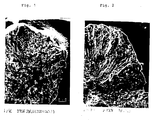
- Fig. 1 is a scanning electron micrograph (magnification 110X) of the structure of a sodium percarbonate particle obtained in Example 1. The particle is penetrated inside and coated on the surface with a metaborate.
- Fig. 2 is a scanning electron micrograph (magnification 110X) of the structure of a sodium percarbonate particle obtained in Comparative Example 1. The borate coating is confined to only the particle surface.
- Table 2 gives the results. Table 2 Sodium percarbonate particle Penetrating and coating agent Avail. resid. O2 rate (%) Dissolution rate (sec) Average particle diameter ( ⁇ m) Example 1 sodium metaborate 99.8 97 585 Example 2 borax 98.0 98 597 Example 3 sodium metaborate + magnesium sulfate 97.8 101 603 Example 4 sodium metaborate + sodium silicate #2 99.0 105 613 Example 5 sodium metaborate + EDTA ⁇ 2Na 98.5 99 600 Comp. Ex. 1 sodium metaborate 83.0 157 812 Comp. Ex. 2 sodium carbonate 46.0 132 798 Untreated sodium percarbonate 31.1 60 495
Landscapes
- Chemical & Material Sciences (AREA)
- Organic Chemistry (AREA)
- Inorganic Chemistry (AREA)
- Detergent Compositions (AREA)
Description
- This invention relates to a sodium percarbonate particle having excellent stability and also to a process for preparing the same.
- Sodium percarbonate is well-known as a bleaching or oxidizing agent. It is commonly manufactured by the reaction of sodium carbonate with hydrogen peroxide. As its general formula 2Na₂CO₃·3H₂O₂ implies, it comprises an addition compound of sodium carbonate with hydrogen peroxide. Although sodium percarbonate is somewhat inferior in bleaching power at ordinary temperature to chlorinated bleaches, it can be used in bleaching textile pieces with colored patterns, does not damage the fabric, and causes no yellowing. These and other advantages have allowed it to enjoy widespread use, alone or in admixture with detergents, as oxygenated bleaching agents for household or business use.
- The reason why an interest is attached to the use of sodium percarbonate in applications such as general detergents and domestic bleaches is that its decomposition products are not pollutants and can be used in whatever way desired without any problem.
- However, sodium percarbonate has a serious drawback in that it is rather poor in storage stability as compared with sodium perborate and fairly rapidly loses its available oxygen during storage. Since sodium percarbonate has a very high affinity towards water, it becomes wetted on its surface even with a small amount of moisture and begins decomposing. Iron, copper, manganese, cobalt, and other such ions, if present in the system, accelerate its decomposition, making it less stable than sodium perborate. When sodium percarbonate, alone, is stored in a closed vessel, it proves to be as stable during storage as sodium perborate. When blended with a detergent or left in an open vessel, however, it exhibits inadequate storage stability because of its high hygroscopicity, despite its good solubility.
- It is therefore desired to provide a sodium percarbonate which does not decompose rapidly upon standing in an open vessel and, when blended with whatever detergent or bleach composition, does not present any storage stability problems.
- Many different researches have been conducted with regard to the stabilization of sodium percarbonate and various approaches have been proposed. Particularly, a large number of proposals have been made with respect to coating the surface of a sodium percarbonate particle with an inorganic matter.
- For instance, Japanese Patent Publication No. 31839/1972 discloses sodium percarbonate surface-coated with sodium perpyrophosphate; U.S. Patent No. 3977988, sodium percarbonate surface-coated with a silicate-silicofluoride mixture; Japanese Patent Publication No. 5875/1978, sodium percarbonate surface-coated with a silicate-glycine mixture; U.S. Patent No. 4105827, sodium percarbonate surface-coated with a crystallized mixed salt consisting of sodium carbonate and either sodium bicarbonate or sodium sulfate; U.S. Patent No. 4194025, sodium percarbonate surface-coated with dehydrated sodium perborate and sodium silicate; U.S. Patent No. 4325933, sodium percarbonate surface-coated with an alkaline earth metal salt; U.S. Patent No. 4156039, sodium percarbonate surface-coated with dehydrated sodium perborate; Japanese Patent Laid-Open No. 193999/1984, sodium percarbonate surface-coated with a borate-silicate mixture; Japanese Patent Laid-Open No. 194000/1984, sodium percarbonate surface-coated with a borate-magnesium compound mixture; Japanese Patent Laid-Open No. 118606/1985, sodium percarbonate surface-coated with a mixture of boric acid or borate and a water repellent agent; and U.S. Patent No. 4526698, sodium percarbonate surface-coated with a borate. These sodium percarbonates coated with inorganic salts are fairly improved in stability but not to a satisfactory extent.
- FR-A-2528447 discloses a one-step process in which moist sodium percarbonate particles and hydrated sodium metaborate particles are mixed together and dried.
- The present inventors have made investigations in particular on the stabilization of sodium percarbonate particles. It was presumed in the course of research that, while a sodium percarbonate particle has numerous pores within the particle, the inorganic salt-coated sodium percarbonate particle of the prior art is one coated only on its surface, the coating being so imperfect as to leave minute interstices on the surface so that the particle absorbs moisture through these interstices and disintegrates from the inside thereof. However, absolutely perfect coating of the particle surface with an inorganic salt is next to impossible and, if ever possible, would require a very large amount of the inorganic salt. After further intensive research under the circumstances, the present inventors have found that a sodium percarbonate particle prepared by penetrating and coating a borate to its pores attain exceptionally good stability and have accomplished the present invention on that basis.
- Accordingly the present invention provides for a stable sodium percarbonate particle which comprises a sodium percarbonate particle and a borate wherein at least the inside of said particle is penetrated and coated with said borate.
- The present invention also provides for a stable sodium percarbonate particle which comprises a sodium percarbonate particle and a borate wherein the inside of said particle is penetrated and coated with said borate and the surface of said particle is coated with said borate, the amount of borate in the stable sodium percarbonate particle being from 0.5 to 10 % by weight of the sodium percarbonate.
- Furtheremore the present invention provides for a process for preparing a stable sodium percarbonate particle which comprises (a) subjecting a sodium percarbonate particle and an aqueous solution of a borate to solid-liquid mixing at a temperature of 35°C or below, (b) drying the resulting mixture and (c), repeating steps (a) and (b) at least once more. Non-limiting Examples of the invention will now be describes in certain instances with reference to the accompanying drawings, in which:
- Fig. 1 is a scanning electron micrograph of the structure of a sodium percarbonate particle obtained in Example 1; and Fig. 2 is a scanning electron micrograph of the structure of a sodium percarbonate particle obtained in Comparative Example 1.
- A stable sodium percarbonate particle of the present invention is at least the inside of the particle is penetrated and coated with a borate. In other words, a stable sodium percarbonate particle of the present invention is a sodium percarbonate composite comprising sodium percarbonate particle and a borate with which the walls of pores existing in a sodium percarbonate particle are covered and coated.
- The borate according to the invention is preferably a sodium salt of boric acid, especially preferably sodium metaborate. A sequestering agent, such as ethylenediaminetetraacetate, nitrilotriacetate and a phosphate, and an inorganic salt such as a silicate and a sulfate may be contained in the sodium percarbonate composite together with the borate.
- The amount of the borate is from 0.5 to 10% by weight, preferably from 2 to 8% by weight, based on the weight of sodium percarbonate.
- The sodium percarbonate composite desirably has an average particle diameter of from 100 to 2000 µm, more desirably from 250 to 1500 µm.
- Namely the sodium percarbonate particle of the present invention is obtained by treating sodium percarbonate particle with a solution of a borate so that the borate may penetrate into the inside of the particle and drying the resultant so that the borate is left there covering the walls' surface of the pores in the particle.
- A sodium percarbonate obtained by reacting sodium carbonate with hydrogen peroxide in the usual manner and dehydrating the reaction product by the usual method normally contains from 7 to 18% by weight of water, and is known as wet sodium percarbonate. A sodium percarbonate prepared by drying the wet sodium percarbonate to a reduced water content is termed dry sodium percarbonate. As the raw material for the manufacture of a penetrated and coated, a stable sodium percarbonate particle in accordance with the present invention, it is advantageous to use a sodium percarbonate particle dried to a water content of less than 8% by weight. The drying presumably deforms the minute voids or pores to have the shape and size easily penetratable by the aqueous solution of a borate. Sodium percarbonate containing less than 8% by weight of water can be commercially obtained and the example of them includes sodium percarbonate manufactured by Nihon Peroxide Co. Ltd. and sodium percarbonate manufactured by Mitsubichi Gas Chemical Co. Ltd..
- The sodium percarbonate as the raw material desirably ranges in average particle diameter from 50 to 2000 µm.
- The borate used as a penetrating and coating agent according to the process for preparing a stable sodium percarbonate particle of the invention is preferably a sodium salt of boric acid such as sodium tetraborate decahydrate (or borax) (Na₂O·2B₂O₃·10H₂O or Na₂B₄O₇·10H₂O), sodium tetraborate pentahydrate (Na₂O·2B₂O₃·5H₂O), sodium tetraborate tetrahydrate (Na₂O·2B₂O₃·4H₂O), sodium tetraborate anhydrate (Na₂O·2B₂O₃), sodium octaborate tetrahydrate (Na₂O·4B₂O₃·4H₂O), sodium pentaborate pentahydrate (Na₂O·5B₂O₃·10H₂O), sodium metaborate tetrahydrate (NaBO₂·4H₂O) and sodium metaborate dihydrate (NaBO₂·2H₂O), especially preferably sodium metaborate dihydrate and sodium metaborate tetrahydrate. This agent may contain a sequestering agent, such as ethylenediaminetetraacetate, nitrilotriacetate and a phosphate. It may further contain an inorganic salt such as a silicate and a sulfate. The amount of these additives is preferably 50% and less by weight on the basis of the borate.
- The amount of the borate required for penetration and coating of a sodium percarbonate particle is from 0.5 to 10% by weight, preferably from 2 to 8% by weight, based on the weight of sodium percarbonate.
- The concentration of the borate in aqueous solution as the penetrating and coating agent ranges desirably from 1 to 55% by weight as anhydrous salt, more desirably from 5 to 50% by weight as anhydrous salt and especially desirably from 20 to 50% by weight as anhydrous salt.
- In order to obtain a sodium percarbonate particle penetrated and coated inside and coated on the surface thereof with a borate, it is necessary to choose a proper solid-liquid mixing temperature depending on the properties of the sodium percarbonate particle used as a raw material and the type and concentration of the borate used.
- It is necessary to repeat the solid-liquid mixing and drying procedures at least twice, preferably two or three times. While the solid-liquid mixing and drying are conducted at the same time, the objective stable sodium percarbonate particle of the invention may not be obtained.
- The solid-liquid mixing is performed at a temperature of 35°C or below. If the particle temperature is higher than 50°C, the penetrating and coating agent fails to penetrate satisfactorily upon contact with the particle, because the dissolution rate of the particle surface exceeds the penetration rate of the penetrating and coating agent, resulting in a reduced stability of the sodium percarbonate particle in the invention. At the same time, the penetrating and coating agent tends to act as a binder to thereby increase the average particle diameter of the coated particle above the size desired for the purposes of the invention, thus lowering the solubility of the product.
- The sodium percarbonate particle penetrated and coated with a borate in conformity with the invention is by far the more stable than the conventional sodium percarbonate particle coated with a borate merely on the surface. Ordinarily, a sodium percarbonate particle with a relatively large particle diameter has been used for added stability, with consequent reduction in the solubility. According to the invention, by contrast, an increased stability is attained with a sodium percarbonate particle of a relatively small diameter. This offers an advantage from the solubility standpoint.
- 400 g of sodium percarbonate (moisture content: 0.5% by weight; average particle diameter: 495 µm) (at a solid material temperature of 20°C) was fed into an agitated mixer ("High-speed mixer FS-GS-15"; mfd. by Fukae Kogyo Co. Ltd.). While the feed was stirred at 300 rpm, 34.9 g of an aqueous solution (28.6% by weight as anhydrous salt) of sodium metaborate tetrahydrate (at a liquid temperature of 70°C) was added thereto dropwise in 3 minutes and then mixed for one minute (with circulation of water at 20°C through a jacket). Next, the mixture was transferred to a fluidized-bed ("STREA-1" type; mfd. by Powrex Co. Ltd.), where it was dried with hot air at 80°C for 10 minutes and then cooled with air at 20°C for 5 minutes. It was returned to the agitated mixer, and the above procedure was repeated. The amount of the aqueous solution containing 28.6% by weight of sodium metaborate tetrahydrate used was 21.0 g.
- The same procedure of the Example 1 was proceeded except for using an aqueous solution (19% by weight as anhydrous salt) of borax (Na₂B₄O₇·10H₂O) (at a liquid temperature of 70°C) as the penetrating and coating agent. The amount of the consumed agent was 40.0 g in the first cycle and 24.0 g in the second.
- The same procedure of the Example 1 was proceeded except that, in addition to the sodium metaborate, another inorganic salt and/or stabilizer was added to the penetrating and coating agent. The penetrating and coating agents employed, and the concentration and the amount of the aqueous solution are listed in Table 1.
- The total amount of the sodium metaborate, another inorganic salt and stabilizer used was 4% by weight as anhydrous salt based on sodium percarbonate as raw material(at a liquid temperature of 70°C). The whole amount of the above-described compounds added in the first run was 2.5% by weight and that in the second run was 1.5% by weight.
Table 1 Example No. Penetrating and coating agent (by weight as anhydrous salt) Amount of aqueous solution added (g) Concentration of the aqueous solution containing penetrating and coating agent (by weight as anhydrous salt) first second 3 sodium metaborate 3% + magnesium sulfate 1% 33.3 20.0 sodium metaborate 22.5% + magnesium sulfate 7.5% 4 sodium metaborate 3% + sodium silicate #2 1% 33.3 20.0 sodium metaborate 22.5% + sodium silicate #2 7.5% 5 sodium metaborate 3.4% + EDTA·2Na 0.6% 36.8 22.1 sodium metaborate 23.1% + EDTA·2Na 4.1% - The same procedure as described in the Example 1 was carried out except that the temperature of sodium percarbonate was 60°C during mixing (while hot water at 70°C was circulated through a jacket).
- The same procedure as described in the Example 1 was carried out except that sodium carbonate (a aqueous solution of 30% by weight as anhydrous salt) was used in place of sodium metaborate. The amount of the coating sodium carbonate was 4% by weight as anhydrous salt based on sodium percarbonate as raw material.
- In the Examples 1 to 5, each sodium percarbonate particle obtained had been penetrated and coated both inside and on the outer surface of the particle. Each sodium percarbonate particle of Comparative Examples 1 and 2 was coated only on the surface of the particle.
- Fig. 1 is a scanning electron micrograph (magnification 110X) of the structure of a sodium percarbonate particle obtained in Example 1. The particle is penetrated inside and coated on the surface with a metaborate. Fig. 2 is a scanning electron micrograph (magnification 110X) of the structure of a sodium percarbonate particle obtained in Comparative Example 1. The borate coating is confined to only the particle surface.
- The sodium percarbonate particles prepared in the Examples and Comparative Examples as above were tested for their storage stability by the following method. The results are given in Table 2.
- 1 g of each sodium percarbonate particles prepared in the Examples and Comparative Examples and 9 g of a phosphorus-free powdered detergent of the composition specified below were placed in a plastic container having a capacity of 50 cc. The container was closed with a lid (which had been pinholed), and the contents were allowed to stand at 40°C and 80% RH (Relative Humidity) for 14 days. The available residual oxygen rate was calculated from the following equation:

- For the determination of available oxygen, the method of titration with 0.1N potassium permanganate was used.

- The solubilities of the sodium percarbonate particles obtained in the above Examples and Comparative Examples were evaluated in the following manner.
- One liter of tap water was poured into a beaker (of 1-liter capacity), into which was thrown 1 g of each sodium percarbonate particles obtained in the above Examples and Comparative Examples, and the feed was stirred at a speed of 200 rpm. The period of time from the initiation of stirring till the point where the test solution no longer underwent a change in electric conductivity was measured and defined as the dissolution time.
- Table 2 gives the results.
Table 2 Sodium percarbonate particle Penetrating and coating agent Avail. resid. O₂ rate (%) Dissolution rate (sec) Average particle diameter (µm) Example 1 sodium metaborate 99.8 97 585 Example 2 borax 98.0 98 597 Example 3 sodium metaborate + magnesium sulfate 97.8 101 603 Example 4 sodium metaborate + sodium silicate #2 99.0 105 613 Example 5 sodium metaborate + EDTA·2Na 98.5 99 600 Comp. Ex. 1 sodium metaborate 83.0 157 812 Comp. Ex. 2 sodium carbonate 46.0 132 798 Untreated sodium percarbonate 31.1 60 495
Claims (11)
- A stable sodium percarbonate particle comprising a porous sodium percarbonate particle in which both the internal surfaces of the pores and the external surface of the particle are coated with a borate, the amount of borate in the stable sodium percarbonate particle being from 0.5 to 10% by weight of the sodium percarbonate.
- The stable sodium percarbonate particle according to claim 1, wherein the borate is a sodium borate.
- The stable sodium percarbonate particle according to claims 1 or 2, wherein the borate is sodium metaborate.
- The stable sodium percarbonate particle according to claims 1 or 2, which has an average particle diameter of from 100µm to 2000µm.
- The stable sodium percarbonate particle according to claim 4, which has an average particle diameter of from 250µm to 1500µm.
- A process for preparing a stable sodium percarbonate particle which comprises (a) subjecting a sodium percarbonate particle and an aqueous solution of a borate to solid-liquid mixing at a temperature of 35°C or below, (b) drying the resulting mixture and (c), repeating steps (a) and (b) at least once more.
- The process according to claim 6, wherein steps (a) and (b) are repeated at least twice more.
- The process according to claim 6, wherein the sodium percarbonate particle is dried to a water content of less than 8% by weight.
- The process according to claim 6, wherein the aqueous solution of a borate contains a sequestering agent and/or an inorganic salt besides borate.
- The process according to claim 6, wherein the concentration of said borate in the aqueous solution is in the range of from 1 to 55% by weight a anhydrous salt.
- The process according to claim 6, wherein said borate is used in amount of from 0.5 to 10% by weight as anhydrous salt based on sodium percarbonate as raw material.
Applications Claiming Priority (2)
| Application Number | Priority Date | Filing Date | Title |
|---|---|---|---|
| JP320057/90 | 1990-11-21 | ||
| JP2320057A JP2636496B2 (en) | 1990-11-21 | 1990-11-21 | Stable sodium percarbonate particles and method for producing the same |
Publications (2)
| Publication Number | Publication Date |
|---|---|
| EP0487256A1 EP0487256A1 (en) | 1992-05-27 |
| EP0487256B1 true EP0487256B1 (en) | 1996-03-06 |
Family
ID=18117239
Family Applications (1)
| Application Number | Title | Priority Date | Filing Date |
|---|---|---|---|
| EP91310516A Expired - Lifetime EP0487256B1 (en) | 1990-11-21 | 1991-11-14 | Stable sodium percarbonate particle and process for preparing same |
Country Status (5)
| Country | Link |
|---|---|
| US (1) | US5366655A (en) |
| EP (1) | EP0487256B1 (en) |
| JP (1) | JP2636496B2 (en) |
| DE (1) | DE69117666T2 (en) |
| ES (1) | ES2085971T3 (en) |
Cited By (1)
| Publication number | Priority date | Publication date | Assignee | Title |
|---|---|---|---|---|
| US6262008B1 (en) | 1997-01-24 | 2001-07-17 | Kemira Chemicals Oy | Stabilized sodium carbonate peroxyhydrate |
Families Citing this family (18)
| Publication number | Priority date | Publication date | Assignee | Title |
|---|---|---|---|---|
| GB9226797D0 (en) * | 1992-12-23 | 1993-02-17 | Solvay Interox Ltd | Process for stabilisng alkali percarbonate particles,particles obtained thereby and washing and/or bleaching compositions containing them |
| DE4306399C2 (en) * | 1993-03-02 | 1995-06-14 | Degussa | Process for the preparation of stabilized sodium percarbonate |
| DE4311944A1 (en) * | 1993-04-10 | 1994-10-13 | Degussa | Coated sodium percarbonate particles, process for their preparation and detergent, cleaning and bleaching compositions containing them |
| EP0623553B1 (en) * | 1993-05-06 | 1997-07-30 | Mitsubishi Gas Chemical Company, Inc. | Stabilized particle of sodium percarbonate |
| US5792738A (en) * | 1993-07-14 | 1998-08-11 | The Procter & Gamble Company | Granular laundry detergent compositions containing stabilised percarbonate bleach particles |
| US5902682A (en) * | 1993-07-17 | 1999-05-11 | Degussa Aktiengesellschaft | Coated sodium percarbonate particles, a process for their preparation and their use |
| GB9324625D0 (en) * | 1993-12-01 | 1994-01-19 | Solvay Interox Ltd | Process for stabilising alkali metal percarbonate |
| GB9326522D0 (en) * | 1993-12-29 | 1994-03-02 | Solvay Interox Ltd | Process for stabilising particulate alkali metal percarbonate |
| IT1270000B (en) * | 1994-09-22 | 1997-04-16 | Solvay Interox | PROCESS FOR THE MANUFACTURE OF PERSAL PARTICLES |
| IT1269999B (en) * | 1994-09-22 | 1997-04-16 | Solvay Interox | PROCEDURE FOR THE PRODUCTION OF COATED PERSAL PARTICLES |
| DE19600018A1 (en) | 1996-01-03 | 1997-07-10 | Henkel Kgaa | Detergent with certain oxidized oligosaccharides |
| DE19606343A1 (en) | 1996-02-21 | 1997-08-28 | Hoechst Ag | Bleach |
| BR9810083A (en) | 1997-06-04 | 2000-08-08 | Procter & Gamble | Detergent enzyme particles having a water-soluble carboxylate barrier layer and compositions including these |
| DE19954959A1 (en) * | 1999-11-16 | 2001-05-17 | Henkel Kgaa | Enveloped particulate peroxo compounds |
| EP1127840A1 (en) * | 2000-02-21 | 2001-08-29 | SOLVAY & Cie (Société Anonyme) | Process for preparing coated alkali metal percarbonate, coated alkaki metal percarbonate obtainable by this process, its use in detergent compositions, and detergent compositions containing it |
| KR100366556B1 (en) | 2000-04-26 | 2003-01-09 | 동양화학공업주식회사 | Granular coated sodium percarbonate and process for preparing them |
| DE10065953A1 (en) * | 2000-12-23 | 2002-07-04 | Degussa | Process for increasing the internal stability of sodium percarbonate |
| EP1728762A1 (en) * | 2005-06-01 | 2006-12-06 | SOLVAY (Société Anonyme) | Coated sodium percarbonate particles, process for their preparation, their use and detergent compositions containing them |
Family Cites Families (5)
| Publication number | Priority date | Publication date | Assignee | Title |
|---|---|---|---|---|
| JPS58118606A (en) * | 1982-01-07 | 1983-07-14 | Nec Corp | Production of optical waveguide |
| JPS58204806A (en) * | 1982-05-20 | 1983-11-29 | Nippon Peroxide Co Ltd | Composition hydrogen peroxide adduct of sodium carbonate |
| JPS5983912A (en) * | 1982-11-04 | 1984-05-15 | Kao Corp | Production of stable sodium percarbonate |
| GB2123044B (en) * | 1982-06-10 | 1986-02-05 | Kao Corp | Bleaching detergent composition |
| JPS58217599A (en) * | 1982-06-10 | 1983-12-17 | 花王株式会社 | Bleaching detergent composition |
-
1990
- 1990-11-21 JP JP2320057A patent/JP2636496B2/en not_active Expired - Fee Related
-
1991
- 1991-11-12 US US07/791,060 patent/US5366655A/en not_active Expired - Lifetime
- 1991-11-14 ES ES91310516T patent/ES2085971T3/en not_active Expired - Lifetime
- 1991-11-14 DE DE69117666T patent/DE69117666T2/en not_active Expired - Lifetime
- 1991-11-14 EP EP91310516A patent/EP0487256B1/en not_active Expired - Lifetime
Cited By (1)
| Publication number | Priority date | Publication date | Assignee | Title |
|---|---|---|---|---|
| US6262008B1 (en) | 1997-01-24 | 2001-07-17 | Kemira Chemicals Oy | Stabilized sodium carbonate peroxyhydrate |
Also Published As
| Publication number | Publication date |
|---|---|
| DE69117666D1 (en) | 1996-04-11 |
| JPH04187508A (en) | 1992-07-06 |
| JP2636496B2 (en) | 1997-07-30 |
| EP0487256A1 (en) | 1992-05-27 |
| US5366655A (en) | 1994-11-22 |
| DE69117666T2 (en) | 1996-10-10 |
| ES2085971T3 (en) | 1996-06-16 |
Similar Documents
| Publication | Publication Date | Title |
|---|---|---|
| EP0487256A1 (en) | Stable sodium percarbonate particle and process for preparing same | |
| US4325933A (en) | Process for stabilization of sodium percarbonate | |
| EP0623553B1 (en) | Stabilized particle of sodium percarbonate | |
| EP0546815B1 (en) | Sodium percarbonate | |
| US3847830A (en) | Stabilizing peroxygen compounds by enveloping in a water-dispersible layer | |
| US3977988A (en) | Stabilized sodium percarbonate and process for preparing same | |
| WO1999064350A1 (en) | Coated sodium percarbonate particles, process for their preparation, their use in detergent compositions and detergent compositions containing them | |
| CA2159991A1 (en) | Encapsulated sodium percarbonate particles, method of producing them, and washing-agent, cleaning-agent and bleaching-agent compositions containing them | |
| JPS61259757A (en) | Manganese bleaching activator | |
| KR100207149B1 (en) | bleach | |
| JPS6125758B2 (en) | ||
| CA2180288A1 (en) | Coated alkali metal peroxo salts and process for producing the same | |
| EP1903098B1 (en) | Coated sodium percarbonate particle | |
| US4120812A (en) | Polyethylene glycol-stabilized peroxygens | |
| EP0550077A1 (en) | Granular laundry bleaching composition | |
| WO2008012155A1 (en) | Coated sodium percarbonate particles | |
| US4008167A (en) | Foaming bleaching composition | |
| US20060148670A1 (en) | Coated sodium percarbonate particles, process for their preparation, their use and detergent compositions containing them | |
| JPH0437119B2 (en) | ||
| JPH0559960B2 (en) | ||
| DE69702757T2 (en) | CYANOPYRIDINE N-OXIDE PEROXIDE FLEACH ACTIVATORS | |
| US4190635A (en) | Processes for preparing sodium percarbonate | |
| JPS59193999A (en) | Bleaching detergent composition | |
| JPS5983912A (en) | Production of stable sodium percarbonate | |
| JP3314526B2 (en) | Method for producing stabilized sodium percarbonate particles |
Legal Events
| Date | Code | Title | Description |
|---|---|---|---|
| PUAI | Public reference made under article 153(3) epc to a published international application that has entered the european phase |
Free format text: ORIGINAL CODE: 0009012 |
|
| AK | Designated contracting states |
Kind code of ref document: A1 Designated state(s): DE ES FR GB IT |
|
| 17P | Request for examination filed |
Effective date: 19920615 |
|
| 17Q | First examination report despatched |
Effective date: 19931104 |
|
| GRAH | Despatch of communication of intention to grant a patent |
Free format text: ORIGINAL CODE: EPIDOS IGRA |
|
| GRAA | (expected) grant |
Free format text: ORIGINAL CODE: 0009210 |
|
| ITF | It: translation for a ep patent filed | ||
| AK | Designated contracting states |
Kind code of ref document: B1 Designated state(s): DE ES FR GB IT |
|
| REF | Corresponds to: |
Ref document number: 69117666 Country of ref document: DE Date of ref document: 19960411 |
|
| ET | Fr: translation filed | ||
| REG | Reference to a national code |
Ref country code: ES Ref legal event code: FG2A Ref document number: 2085971 Country of ref document: ES Kind code of ref document: T3 |
|
| PLBE | No opposition filed within time limit |
Free format text: ORIGINAL CODE: 0009261 |
|
| STAA | Information on the status of an ep patent application or granted ep patent |
Free format text: STATUS: NO OPPOSITION FILED WITHIN TIME LIMIT |
|
| 26N | No opposition filed | ||
| REG | Reference to a national code |
Ref country code: GB Ref legal event code: IF02 |
|
| PGFP | Annual fee paid to national office [announced via postgrant information from national office to epo] |
Ref country code: FR Payment date: 20101123 Year of fee payment: 20 |
|
| PGFP | Annual fee paid to national office [announced via postgrant information from national office to epo] |
Ref country code: DE Payment date: 20101110 Year of fee payment: 20 |
|
| PGFP | Annual fee paid to national office [announced via postgrant information from national office to epo] |
Ref country code: GB Payment date: 20101110 Year of fee payment: 20 Ref country code: IT Payment date: 20101115 Year of fee payment: 20 |
|
| PGFP | Annual fee paid to national office [announced via postgrant information from national office to epo] |
Ref country code: ES Payment date: 20101126 Year of fee payment: 20 |
|
| REG | Reference to a national code |
Ref country code: DE Ref legal event code: R071 Ref document number: 69117666 Country of ref document: DE |
|
| REG | Reference to a national code |
Ref country code: DE Ref legal event code: R071 Ref document number: 69117666 Country of ref document: DE |
|
| REG | Reference to a national code |
Ref country code: GB Ref legal event code: PE20 Expiry date: 20111113 |
|
| REG | Reference to a national code |
Ref country code: ES Ref legal event code: FD2A Effective date: 20120206 |
|
| PG25 | Lapsed in a contracting state [announced via postgrant information from national office to epo] |
Ref country code: GB Free format text: LAPSE BECAUSE OF EXPIRATION OF PROTECTION Effective date: 20111113 |
|
| PG25 | Lapsed in a contracting state [announced via postgrant information from national office to epo] |
Ref country code: ES Free format text: LAPSE BECAUSE OF EXPIRATION OF PROTECTION Effective date: 20111115 |
|
| PG25 | Lapsed in a contracting state [announced via postgrant information from national office to epo] |
Ref country code: DE Free format text: LAPSE BECAUSE OF EXPIRATION OF PROTECTION Effective date: 20111115 |