EP0484398B1 - Cell wall loading of never-dried pulp fibers - Google Patents
Cell wall loading of never-dried pulp fibers Download PDFInfo
- Publication number
- EP0484398B1 EP0484398B1 EP90911505A EP90911505A EP0484398B1 EP 0484398 B1 EP0484398 B1 EP 0484398B1 EP 90911505 A EP90911505 A EP 90911505A EP 90911505 A EP90911505 A EP 90911505A EP 0484398 B1 EP0484398 B1 EP 0484398B1
- Authority
- EP
- European Patent Office
- Prior art keywords
- never
- filled
- dried
- filler
- paper
- Prior art date
- Legal status (The legal status is an assumption and is not a legal conclusion. Google has not performed a legal analysis and makes no representation as to the accuracy of the status listed.)
- Expired - Lifetime
Links
- 239000000835 fiber Substances 0.000 title claims abstract description 166
- 210000002421 cell wall Anatomy 0.000 title claims abstract description 55
- 238000011068 loading method Methods 0.000 title description 15
- 239000000945 filler Substances 0.000 claims abstract description 155
- 238000000034 method Methods 0.000 claims abstract description 120
- 230000008569 process Effects 0.000 claims abstract description 94
- 150000003839 salts Chemical class 0.000 claims abstract description 76
- 239000002244 precipitate Substances 0.000 claims abstract description 35
- 239000011148 porous material Substances 0.000 claims abstract description 33
- 239000000203 mixture Substances 0.000 claims abstract description 23
- 238000004519 manufacturing process Methods 0.000 claims abstract description 6
- 239000000123 paper Substances 0.000 claims description 128
- VTYYLEPIZMXCLO-UHFFFAOYSA-L Calcium carbonate Chemical compound [Ca+2].[O-]C([O-])=O VTYYLEPIZMXCLO-UHFFFAOYSA-L 0.000 claims description 36
- 229910000019 calcium carbonate Inorganic materials 0.000 claims description 18
- 239000011122 softwood Substances 0.000 claims description 16
- 235000010216 calcium carbonate Nutrition 0.000 claims description 10
- 238000001914 filtration Methods 0.000 claims description 10
- 239000011121 hardwood Substances 0.000 claims description 10
- -1 Bi(OH)3 Inorganic materials 0.000 claims description 9
- 239000002655 kraft paper Substances 0.000 claims description 7
- 230000006870 function Effects 0.000 claims description 6
- 230000003993 interaction Effects 0.000 claims description 6
- 229910000008 nickel(II) carbonate Inorganic materials 0.000 claims description 6
- 238000004537 pulping Methods 0.000 claims description 6
- WNROFYMDJYEPJX-UHFFFAOYSA-K aluminium hydroxide Chemical compound [OH-].[OH-].[OH-].[Al+3] WNROFYMDJYEPJX-UHFFFAOYSA-K 0.000 claims description 4
- TZCXTZWJZNENPQ-UHFFFAOYSA-L barium sulfate Chemical compound [Ba+2].[O-]S([O-])(=O)=O TZCXTZWJZNENPQ-UHFFFAOYSA-L 0.000 claims description 4
- 229910000151 chromium(III) phosphate Inorganic materials 0.000 claims description 4
- 238000005406 washing Methods 0.000 claims description 4
- 239000003086 colorant Substances 0.000 claims description 3
- 229910052882 wollastonite Inorganic materials 0.000 claims description 2
- 229910019142 PO4 Inorganic materials 0.000 claims 5
- OSGAYBCDTDRGGQ-UHFFFAOYSA-L calcium sulfate Chemical compound [Ca+2].[O-]S([O-])(=O)=O OSGAYBCDTDRGGQ-UHFFFAOYSA-L 0.000 claims 3
- 229910000152 cobalt phosphate Inorganic materials 0.000 claims 3
- XLYOFNOQVPJJNP-ZSJDYOACSA-N heavy water Substances [2H]O[2H] XLYOFNOQVPJJNP-ZSJDYOACSA-N 0.000 claims 3
- AYJRCSIUFZENHW-UHFFFAOYSA-L barium carbonate Chemical compound [Ba+2].[O-]C([O-])=O AYJRCSIUFZENHW-UHFFFAOYSA-L 0.000 claims 2
- 239000011575 calcium Substances 0.000 claims 2
- JTDNNCYXCFHBGG-UHFFFAOYSA-L tin(ii) iodide Chemical compound I[Sn]I JTDNNCYXCFHBGG-UHFFFAOYSA-L 0.000 claims 2
- QORWJWZARLRLPR-UHFFFAOYSA-H tricalcium bis(phosphate) Chemical compound [Ca+2].[Ca+2].[Ca+2].[O-]P([O-])([O-])=O.[O-]P([O-])([O-])=O QORWJWZARLRLPR-UHFFFAOYSA-H 0.000 claims 2
- 101100283604 Caenorhabditis elegans pigk-1 gene Proteins 0.000 claims 1
- 229910000003 Lead carbonate Inorganic materials 0.000 claims 1
- 229910003383 SrSiO3 Inorganic materials 0.000 claims 1
- 229910011011 Ti(OH)4 Inorganic materials 0.000 claims 1
- 229910007661 ZnSiO3 Inorganic materials 0.000 claims 1
- 229910021502 aluminium hydroxide Inorganic materials 0.000 claims 1
- 229910000147 aluminium phosphate Inorganic materials 0.000 claims 1
- 229910052925 anhydrite Inorganic materials 0.000 claims 1
- RQPZNWPYLFFXCP-UHFFFAOYSA-L barium dihydroxide Chemical compound [OH-].[OH-].[Ba+2] RQPZNWPYLFFXCP-UHFFFAOYSA-L 0.000 claims 1
- WAKZZMMCDILMEF-UHFFFAOYSA-H barium(2+);diphosphate Chemical compound [Ba+2].[Ba+2].[Ba+2].[O-]P([O-])([O-])=O.[O-]P([O-])([O-])=O WAKZZMMCDILMEF-UHFFFAOYSA-H 0.000 claims 1
- 229910000011 cadmium carbonate Inorganic materials 0.000 claims 1
- KOHRTFCSIQIYAE-UHFFFAOYSA-N cadmium;carbonic acid Chemical compound [Cd].OC(O)=O KOHRTFCSIQIYAE-UHFFFAOYSA-N 0.000 claims 1
- AXCZMVOFGPJBDE-UHFFFAOYSA-L calcium dihydroxide Chemical compound [OH-].[OH-].[Ca+2] AXCZMVOFGPJBDE-UHFFFAOYSA-L 0.000 claims 1
- JUNWLZAGQLJVLR-UHFFFAOYSA-J calcium diphosphate Chemical compound [Ca+2].[Ca+2].[O-]P([O-])(=O)OP([O-])([O-])=O JUNWLZAGQLJVLR-UHFFFAOYSA-J 0.000 claims 1
- 239000000920 calcium hydroxide Substances 0.000 claims 1
- 235000011116 calcium hydroxide Nutrition 0.000 claims 1
- 229910001861 calcium hydroxide Inorganic materials 0.000 claims 1
- 239000001506 calcium phosphate Substances 0.000 claims 1
- 229910000389 calcium phosphate Inorganic materials 0.000 claims 1
- 235000011010 calcium phosphates Nutrition 0.000 claims 1
- 239000000378 calcium silicate Substances 0.000 claims 1
- 229910052918 calcium silicate Inorganic materials 0.000 claims 1
- 235000012241 calcium silicate Nutrition 0.000 claims 1
- 239000001175 calcium sulphate Substances 0.000 claims 1
- 235000011132 calcium sulphate Nutrition 0.000 claims 1
- OYACROKNLOSFPA-UHFFFAOYSA-N calcium;dioxido(oxo)silane Chemical compound [Ca+2].[O-][Si]([O-])=O OYACROKNLOSFPA-UHFFFAOYSA-N 0.000 claims 1
- ZJRWDIJRKKXMNW-UHFFFAOYSA-N carbonic acid;cobalt Chemical compound [Co].OC(O)=O ZJRWDIJRKKXMNW-UHFFFAOYSA-N 0.000 claims 1
- ONIOAEVPMYCHKX-UHFFFAOYSA-N carbonic acid;zinc Chemical compound [Zn].OC(O)=O ONIOAEVPMYCHKX-UHFFFAOYSA-N 0.000 claims 1
- 229910000001 cobalt(II) carbonate Inorganic materials 0.000 claims 1
- JJLJMEJHUUYSSY-UHFFFAOYSA-L copper(II) hydroxide Inorganic materials [OH-].[OH-].[Cu+2] JJLJMEJHUUYSSY-UHFFFAOYSA-L 0.000 claims 1
- 229910000153 copper(II) phosphate Inorganic materials 0.000 claims 1
- AEJIMXVJZFYIHN-UHFFFAOYSA-N copper;dihydrate Chemical compound O.O.[Cu] AEJIMXVJZFYIHN-UHFFFAOYSA-N 0.000 claims 1
- 229910052955 covellite Inorganic materials 0.000 claims 1
- 229910000393 dicalcium diphosphate Inorganic materials 0.000 claims 1
- 229910001679 gibbsite Inorganic materials 0.000 claims 1
- RQQRAHKHDFPBMC-UHFFFAOYSA-L lead(ii) iodide Chemical compound I[Pb]I RQQRAHKHDFPBMC-UHFFFAOYSA-L 0.000 claims 1
- 239000001095 magnesium carbonate Substances 0.000 claims 1
- 235000014380 magnesium carbonate Nutrition 0.000 claims 1
- 229910000021 magnesium carbonate Inorganic materials 0.000 claims 1
- ZLNQQNXFFQJAID-UHFFFAOYSA-L magnesium carbonate Chemical compound [Mg+2].[O-]C([O-])=O ZLNQQNXFFQJAID-UHFFFAOYSA-L 0.000 claims 1
- VTHJTEIRLNZDEV-UHFFFAOYSA-L magnesium dihydroxide Chemical compound [OH-].[OH-].[Mg+2] VTHJTEIRLNZDEV-UHFFFAOYSA-L 0.000 claims 1
- 239000000347 magnesium hydroxide Substances 0.000 claims 1
- 235000012254 magnesium hydroxide Nutrition 0.000 claims 1
- 229910001862 magnesium hydroxide Inorganic materials 0.000 claims 1
- 239000011656 manganese carbonate Substances 0.000 claims 1
- 235000006748 manganese carbonate Nutrition 0.000 claims 1
- 229910000016 manganese(II) carbonate Inorganic materials 0.000 claims 1
- YFDLHELOZYVNJE-UHFFFAOYSA-L mercury diiodide Chemical compound I[Hg]I YFDLHELOZYVNJE-UHFFFAOYSA-L 0.000 claims 1
- 239000013225 prussian blue Substances 0.000 claims 1
- 229910000161 silver phosphate Inorganic materials 0.000 claims 1
- 229910052959 stibnite Inorganic materials 0.000 claims 1
- 229910000018 strontium carbonate Inorganic materials 0.000 claims 1
- LEDMRZGFZIAGGB-UHFFFAOYSA-L strontium carbonate Chemical compound [Sr+2].[O-]C([O-])=O LEDMRZGFZIAGGB-UHFFFAOYSA-L 0.000 claims 1
- 229910000391 tricalcium phosphate Inorganic materials 0.000 claims 1
- 235000019731 tricalcium phosphate Nutrition 0.000 claims 1
- KOECRLKKXSXCPB-UHFFFAOYSA-K triiodobismuthane Chemical compound I[Bi](I)I KOECRLKKXSXCPB-UHFFFAOYSA-K 0.000 claims 1
- 239000011667 zinc carbonate Substances 0.000 claims 1
- 235000004416 zinc carbonate Nutrition 0.000 claims 1
- 229910000010 zinc carbonate Inorganic materials 0.000 claims 1
- 229910021511 zinc hydroxide Inorganic materials 0.000 claims 1
- 229910000165 zinc phosphate Inorganic materials 0.000 claims 1
- 229910021512 zirconium (IV) hydroxide Inorganic materials 0.000 claims 1
- 239000000463 material Substances 0.000 abstract description 23
- 238000011065 in-situ storage Methods 0.000 abstract description 15
- 239000000047 product Substances 0.000 abstract description 9
- 229920002678 cellulose Polymers 0.000 abstract description 6
- 239000001913 cellulose Substances 0.000 abstract description 6
- 229920003043 Cellulose fiber Polymers 0.000 abstract description 5
- 239000000243 solution Substances 0.000 description 41
- CDBYLPFSWZWCQE-UHFFFAOYSA-L Sodium Carbonate Chemical compound [Na+].[Na+].[O-]C([O-])=O CDBYLPFSWZWCQE-UHFFFAOYSA-L 0.000 description 20
- PXHVJJICTQNCMI-UHFFFAOYSA-N nickel Substances [Ni] PXHVJJICTQNCMI-UHFFFAOYSA-N 0.000 description 20
- 241001564395 Alnus rubra Species 0.000 description 11
- 238000010009 beating Methods 0.000 description 11
- UXVMQQNJUSDDNG-UHFFFAOYSA-L Calcium chloride Chemical compound [Cl-].[Cl-].[Ca+2] UXVMQQNJUSDDNG-UHFFFAOYSA-L 0.000 description 10
- 239000001110 calcium chloride Substances 0.000 description 10
- 229910001628 calcium chloride Inorganic materials 0.000 description 10
- 235000011148 calcium chloride Nutrition 0.000 description 10
- 230000014759 maintenance of location Effects 0.000 description 10
- 239000002245 particle Substances 0.000 description 10
- 229910000029 sodium carbonate Inorganic materials 0.000 description 10
- 241000609240 Ambelania acida Species 0.000 description 9
- 239000010905 bagasse Substances 0.000 description 9
- 239000010432 diamond Substances 0.000 description 9
- 229910052759 nickel Inorganic materials 0.000 description 9
- 235000017550 sodium carbonate Nutrition 0.000 description 9
- 238000007796 conventional method Methods 0.000 description 8
- 238000001035 drying Methods 0.000 description 8
- 102100031260 Acyl-coenzyme A thioesterase THEM4 Human genes 0.000 description 7
- 101000638510 Homo sapiens Acyl-coenzyme A thioesterase THEM4 Proteins 0.000 description 7
- 241000218657 Picea Species 0.000 description 7
- 239000000049 pigment Substances 0.000 description 7
- HEMHJVSKTPXQMS-UHFFFAOYSA-M Sodium hydroxide Chemical compound [OH-].[Na+] HEMHJVSKTPXQMS-UHFFFAOYSA-M 0.000 description 6
- 230000000694 effects Effects 0.000 description 6
- 229920002873 Polyethylenimine Polymers 0.000 description 5
- 229920001131 Pulp (paper) Polymers 0.000 description 5
- 240000000111 Saccharum officinarum Species 0.000 description 5
- 235000007201 Saccharum officinarum Nutrition 0.000 description 5
- 230000007423 decrease Effects 0.000 description 5
- 238000009826 distribution Methods 0.000 description 5
- XLYOFNOQVPJJNP-UHFFFAOYSA-N water Substances O XLYOFNOQVPJJNP-UHFFFAOYSA-N 0.000 description 5
- 230000008901 benefit Effects 0.000 description 4
- 229910052739 hydrogen Inorganic materials 0.000 description 4
- 239000001257 hydrogen Substances 0.000 description 4
- 239000002002 slurry Substances 0.000 description 4
- 241000196324 Embryophyta Species 0.000 description 3
- 244000166124 Eucalyptus globulus Species 0.000 description 3
- 239000006185 dispersion Substances 0.000 description 3
- 238000002149 energy-dispersive X-ray emission spectroscopy Methods 0.000 description 3
- 238000011049 filling Methods 0.000 description 3
- 238000001556 precipitation Methods 0.000 description 3
- 239000000725 suspension Substances 0.000 description 3
- 229910021591 Copper(I) chloride Inorganic materials 0.000 description 2
- 229910021586 Nickel(II) chloride Inorganic materials 0.000 description 2
- FAPWRFPIFSIZLT-UHFFFAOYSA-M Sodium chloride Chemical compound [Na+].[Cl-] FAPWRFPIFSIZLT-UHFFFAOYSA-M 0.000 description 2
- 240000003021 Tsuga heterophylla Species 0.000 description 2
- 235000008554 Tsuga heterophylla Nutrition 0.000 description 2
- 229920002522 Wood fibre Polymers 0.000 description 2
- 238000013019 agitation Methods 0.000 description 2
- PNEYBMLMFCGWSK-UHFFFAOYSA-N aluminium oxide Inorganic materials [O-2].[O-2].[O-2].[Al+3].[Al+3] PNEYBMLMFCGWSK-UHFFFAOYSA-N 0.000 description 2
- 238000004458 analytical method Methods 0.000 description 2
- 238000013459 approach Methods 0.000 description 2
- 239000007864 aqueous solution Substances 0.000 description 2
- 230000015572 biosynthetic process Effects 0.000 description 2
- 229960000359 chromic chloride Drugs 0.000 description 2
- LJAOOBNHPFKCDR-UHFFFAOYSA-K chromium(3+) trichloride hexahydrate Chemical compound O.O.O.O.O.O.[Cl-].[Cl-].[Cl-].[Cr+3] LJAOOBNHPFKCDR-UHFFFAOYSA-K 0.000 description 2
- 239000011636 chromium(III) chloride Substances 0.000 description 2
- 235000007831 chromium(III) chloride Nutrition 0.000 description 2
- IKZBVTPSNGOVRJ-UHFFFAOYSA-K chromium(iii) phosphate Chemical compound [Cr+3].[O-]P([O-])([O-])=O IKZBVTPSNGOVRJ-UHFFFAOYSA-K 0.000 description 2
- OXBLHERUFWYNTN-UHFFFAOYSA-M copper(I) chloride Chemical compound [Cu]Cl OXBLHERUFWYNTN-UHFFFAOYSA-M 0.000 description 2
- 229940045803 cuprous chloride Drugs 0.000 description 2
- 230000003247 decreasing effect Effects 0.000 description 2
- 239000000428 dust Substances 0.000 description 2
- 229920005610 lignin Polymers 0.000 description 2
- QMMRZOWCJAIUJA-UHFFFAOYSA-L nickel dichloride Chemical compound Cl[Ni]Cl QMMRZOWCJAIUJA-UHFFFAOYSA-L 0.000 description 2
- 230000003287 optical effect Effects 0.000 description 2
- BWHMMNNQKKPAPP-UHFFFAOYSA-L potassium carbonate Chemical compound [K+].[K+].[O-]C([O-])=O BWHMMNNQKKPAPP-UHFFFAOYSA-L 0.000 description 2
- 230000001376 precipitating effect Effects 0.000 description 2
- 239000000376 reactant Substances 0.000 description 2
- 230000002441 reversible effect Effects 0.000 description 2
- 229920006395 saturated elastomer Polymers 0.000 description 2
- 239000007787 solid Substances 0.000 description 2
- 239000002025 wood fiber Substances 0.000 description 2
- 229920002488 Hemicellulose Polymers 0.000 description 1
- DGAQECJNVWCQMB-PUAWFVPOSA-M Ilexoside XXIX Chemical compound C[C@@H]1CC[C@@]2(CC[C@@]3(C(=CC[C@H]4[C@]3(CC[C@@H]5[C@@]4(CC[C@@H](C5(C)C)OS(=O)(=O)[O-])C)C)[C@@H]2[C@]1(C)O)C)C(=O)O[C@H]6[C@@H]([C@H]([C@@H]([C@H](O6)CO)O)O)O.[Na+] DGAQECJNVWCQMB-PUAWFVPOSA-M 0.000 description 1
- 241000446313 Lamella Species 0.000 description 1
- 239000007832 Na2SO4 Substances 0.000 description 1
- NPYPAHLBTDXSSS-UHFFFAOYSA-N Potassium ion Chemical compound [K+] NPYPAHLBTDXSSS-UHFFFAOYSA-N 0.000 description 1
- PMZURENOXWZQFD-UHFFFAOYSA-L Sodium Sulfate Chemical compound [Na+].[Na+].[O-]S([O-])(=O)=O PMZURENOXWZQFD-UHFFFAOYSA-L 0.000 description 1
- FKNQFGJONOIPTF-UHFFFAOYSA-N Sodium cation Chemical compound [Na+] FKNQFGJONOIPTF-UHFFFAOYSA-N 0.000 description 1
- LSNNMFCWUKXFEE-UHFFFAOYSA-N Sulfurous acid Chemical compound OS(O)=O LSNNMFCWUKXFEE-UHFFFAOYSA-N 0.000 description 1
- GWEVSGVZZGPLCZ-UHFFFAOYSA-N Titan oxide Chemical compound O=[Ti]=O GWEVSGVZZGPLCZ-UHFFFAOYSA-N 0.000 description 1
- 230000009471 action Effects 0.000 description 1
- 239000000654 additive Substances 0.000 description 1
- 239000000853 adhesive Substances 0.000 description 1
- 230000001070 adhesive effect Effects 0.000 description 1
- 239000002998 adhesive polymer Substances 0.000 description 1
- 238000005054 agglomeration Methods 0.000 description 1
- 230000002776 aggregation Effects 0.000 description 1
- DIZPMCHEQGEION-UHFFFAOYSA-H aluminium sulfate (anhydrous) Chemical compound [Al+3].[Al+3].[O-]S([O-])(=O)=O.[O-]S([O-])(=O)=O.[O-]S([O-])(=O)=O DIZPMCHEQGEION-UHFFFAOYSA-H 0.000 description 1
- 229910001626 barium chloride Inorganic materials 0.000 description 1
- WDIHJSXYQDMJHN-UHFFFAOYSA-L barium chloride Chemical compound [Cl-].[Cl-].[Ba+2] WDIHJSXYQDMJHN-UHFFFAOYSA-L 0.000 description 1
- 230000004888 barrier function Effects 0.000 description 1
- 239000007767 bonding agent Substances 0.000 description 1
- 239000006227 byproduct Substances 0.000 description 1
- 238000006243 chemical reaction Methods 0.000 description 1
- 230000000052 comparative effect Effects 0.000 description 1
- 239000002131 composite material Substances 0.000 description 1
- 230000003750 conditioning effect Effects 0.000 description 1
- GEZOTWYUIKXWOA-UHFFFAOYSA-L copper;carbonate Chemical compound [Cu+2].[O-]C([O-])=O GEZOTWYUIKXWOA-UHFFFAOYSA-L 0.000 description 1
- 229910052593 corundum Inorganic materials 0.000 description 1
- 230000006735 deficit Effects 0.000 description 1
- 230000001627 detrimental effect Effects 0.000 description 1
- 229910003460 diamond Inorganic materials 0.000 description 1
- 238000005265 energy consumption Methods 0.000 description 1
- 238000002474 experimental method Methods 0.000 description 1
- 238000005429 filling process Methods 0.000 description 1
- 239000000706 filtrate Substances 0.000 description 1
- 239000010419 fine particle Substances 0.000 description 1
- 239000012530 fluid Substances 0.000 description 1
- 229910052500 inorganic mineral Inorganic materials 0.000 description 1
- 230000007246 mechanism Effects 0.000 description 1
- 235000010755 mineral Nutrition 0.000 description 1
- 239000011707 mineral Substances 0.000 description 1
- 230000004048 modification Effects 0.000 description 1
- 238000012986 modification Methods 0.000 description 1
- ZULUUIKRFGGGTL-UHFFFAOYSA-L nickel(ii) carbonate Chemical compound [Ni+2].[O-]C([O-])=O ZULUUIKRFGGGTL-UHFFFAOYSA-L 0.000 description 1
- 238000005457 optimization Methods 0.000 description 1
- 229920002851 polycationic polymer Polymers 0.000 description 1
- 229910000027 potassium carbonate Inorganic materials 0.000 description 1
- 238000002360 preparation method Methods 0.000 description 1
- 239000002994 raw material Substances 0.000 description 1
- 230000000717 retained effect Effects 0.000 description 1
- NXLOLUFNDSBYTP-UHFFFAOYSA-N retene Chemical compound C1=CC=C2C3=CC=C(C(C)C)C=C3C=CC2=C1C NXLOLUFNDSBYTP-UHFFFAOYSA-N 0.000 description 1
- 238000001878 scanning electron micrograph Methods 0.000 description 1
- 238000004513 sizing Methods 0.000 description 1
- 238000002791 soaking Methods 0.000 description 1
- 239000011780 sodium chloride Substances 0.000 description 1
- 235000019795 sodium metasilicate Nutrition 0.000 description 1
- 229910052911 sodium silicate Inorganic materials 0.000 description 1
- 229910052938 sodium sulfate Inorganic materials 0.000 description 1
- 235000011152 sodium sulphate Nutrition 0.000 description 1
- 239000000758 substrate Substances 0.000 description 1
- 230000000153 supplemental effect Effects 0.000 description 1
- 239000008399 tap water Substances 0.000 description 1
- 235000020679 tap water Nutrition 0.000 description 1
- 238000010998 test method Methods 0.000 description 1
- OGIDPMRJRNCKJF-UHFFFAOYSA-N titanium oxide Inorganic materials [Ti]=O OGIDPMRJRNCKJF-UHFFFAOYSA-N 0.000 description 1
- 230000009466 transformation Effects 0.000 description 1
- RYFMWSXOAZQYPI-UHFFFAOYSA-K trisodium phosphate Chemical compound [Na+].[Na+].[Na+].[O-]P([O-])([O-])=O RYFMWSXOAZQYPI-UHFFFAOYSA-K 0.000 description 1
- 238000009736 wetting Methods 0.000 description 1
- 229910001845 yogo sapphire Inorganic materials 0.000 description 1
Images


Classifications
-
- D—TEXTILES; PAPER
- D21—PAPER-MAKING; PRODUCTION OF CELLULOSE
- D21H—PULP COMPOSITIONS; PREPARATION THEREOF NOT COVERED BY SUBCLASSES D21C OR D21D; IMPREGNATING OR COATING OF PAPER; TREATMENT OF FINISHED PAPER NOT COVERED BY CLASS B31 OR SUBCLASS D21G; PAPER NOT OTHERWISE PROVIDED FOR
- D21H17/00—Non-fibrous material added to the pulp, characterised by its constitution; Paper-impregnating material characterised by its constitution
- D21H17/63—Inorganic compounds
- D21H17/70—Inorganic compounds forming new compounds in situ, e.g. within the pulp or paper, by chemical reaction with other substances added separately
-
- D—TEXTILES; PAPER
- D21—PAPER-MAKING; PRODUCTION OF CELLULOSE
- D21C—PRODUCTION OF CELLULOSE BY REMOVING NON-CELLULOSE SUBSTANCES FROM CELLULOSE-CONTAINING MATERIALS; REGENERATION OF PULPING LIQUORS; APPARATUS THEREFOR
- D21C9/00—After-treatment of cellulose pulp, e.g. of wood pulp, or cotton linters ; Treatment of dilute or dewatered pulp or process improvement taking place after obtaining the raw cellulosic material and not provided for elsewhere
- D21C9/001—Modification of pulp properties
- D21C9/002—Modification of pulp properties by chemical means; preparation of dewatered pulp, e.g. in sheet or bulk form, containing special additives
- D21C9/004—Modification of pulp properties by chemical means; preparation of dewatered pulp, e.g. in sheet or bulk form, containing special additives inorganic compounds
-
- D—TEXTILES; PAPER
- D21—PAPER-MAKING; PRODUCTION OF CELLULOSE
- D21H—PULP COMPOSITIONS; PREPARATION THEREOF NOT COVERED BY SUBCLASSES D21C OR D21D; IMPREGNATING OR COATING OF PAPER; TREATMENT OF FINISHED PAPER NOT COVERED BY CLASS B31 OR SUBCLASS D21G; PAPER NOT OTHERWISE PROVIDED FOR
- D21H17/00—Non-fibrous material added to the pulp, characterised by its constitution; Paper-impregnating material characterised by its constitution
- D21H17/63—Inorganic compounds
- D21H17/67—Water-insoluble compounds, e.g. fillers, pigments
- D21H17/675—Oxides, hydroxides or carbonates
Definitions
- This invention relates to a filled pulp fiber and a filled paper composition wherein the filler is an insoluble precipitate predominantly located within the cell wall of never-dried cellulosic pulp fibers.
- the location of the filler within the cell walls determines the resulting filled paper composition having increased strength relative to a corresponding conventionally filled paper containing the same amount of the same filler.
- the present invention also relates to a process for producing a filled pulp fiber and a filled paper composition having increased strength relative to a conventionally filled paper having the same concentration of the same filler material.
- Papermaking processes often use fillers or opaque pigments to confer some desirable characteristics to the paper product and to provide a cost savings for paper raw materials.
- Fillers can increase opacity, brightness and printing properties. Fillers are cheaper substitutes than cellulose fibers and can reduce the total cost of the finished paper product. Moreover, fillers can be dried easier than fibers and reduce energy consumption during the papermaking process.
- paper An essential property of paper for many end uses is its opacity. It is particularly important for printing papers, where it is desirable to have as little as possible of the print on the reverse side of a printed sheet or on a sheet below it be visible through the paper. For printing and other applications, paper must also have a certain degree of brightness, or whiteness. For many paper products, acceptable levels of optical properties can be achieved from the pulp fibers alone. However, in other products, the inherent light-reflective characteristics of the fibers are insufficient to meet consumer demands. In such cases, the papermaker adds a filler.
- a filler consists of fine particles of an insoluble solid, usually of a mineral origin, suspended in a slurry.
- the filler particles confer light-reflectance to the paper and thereby increase both opacity and brightness.
- Adding fillers to paper pulp produces an enhancement of the optical properties of the paper and further produces the advantages of improved smoothness and improved printability. Further, replacing fiber with an inexpensive filler can reduce the cost of the paper.
- filler addition poses some additional problems.
- the mechanical strength of the paper is less than could be expected from the ratio of load-bearing fiber to non-load-bearing filler.
- the mechanical strength of paper can be expressed in terms of burst index, tear index, and tensile index. The usual explanation for this is that some of the filler particles become trapped between fibers, thereby reducing the strength of the fiber-to-fiber hydrogen bonding.
- the hydrogen bonding is the primary source of paper strength.
- filler concentrations are often limited to a maximum of about 10% ash content.
- preflocculated fibers and fillers have been used to increase filler retention and reduce loss of paper strength. Coarser particles of pigment or filler, caused by the preflocculation procedure, are retained more efficiently than the finer particles of pigment. Thus, there is less interference with inter-fiber bonding. This helps improve paper strength. However, paper opacity is reduced with increasing particle size. Moreover, the cost savings associated with the preflocculation technique are insignificant and are offset by additional problems.
- Craig US-A-2,583,548 (“Craig”), describes a process forming a pigmented cellulosic pulp by precipitating pigment "in and around" the fibers.
- dry cellulosic fibers are added to a solution of one reactant, for example, calcium chloride, and the suspension is mechanically worked so as to effect a gelatinizing of the dry fibers.
- a second reactant for example, sodium carbonate, is added so as to effect the precipitation of fine solid particles, such as calcium carbonate.
- the fibers are then washed to remove the soluble by-product (sodium chloride).
- the Craig process has considerable limitations.
- the presence of filler on fiber surfaces and the gelatinizing effect on the fibers are detrimental to paper strength.
- the gelatinised fibers are so severely broken that both the filler precipitate and the gelled fibers form a slurry.
- the Craig process has not achieved commercial success despite its disclosure about 39 years ago.
- the result is an increased retention of filler within the lumen, while removing the hindrance to inter-fiber bonding by removing the filler outside of the fiber lumens.
- the result is increased paper strength for the amount of filler present.
- the lumen-loading technique works best with fibers that have been dried.
- the lumen-loading technique has not proved to be economically or commercially viable.
- the technique requires the manipulation of large volumes of relatively concentrated filler suspensions agitated at high revolutions for prolonged periods of time.
- the lumen-loading technique requires a relatively small particle size filler, such as titanium oxide, which is an expensive filler material.
- the lumen-loading technique will only work for dry softwood fibers having a sufficient number of pit apertures. As the lumens are open at the pits, filler may be lost in the same way that it is introduced. Further, the pores in the cell walls are not filled by the lumen-loading technique.
- An object of the Present invention is a process for the production of filled pulp fiber composition wherein the starting pulp is a never-dried pulp derived from hardwoods, softwoods, annual plants and combinations thereof, by immersing a never-dried pulp having an internal cell wall pore volume while regaining wet after pulping in a first solution wherein the first solution comprises a soluble salt or salts, filtering the immersed never-dried pulp to remove soluble salt from the exterior of the fiber and the lumen, and then reimmersing the never-dried pulp in a second solution wherein the second solution comprises a soluble salt or salts different from the soluble salt or salts of the first solution, and with the proviso that the interaction of the salt or salts from the first solution and the salt or salts from the second solution form an insoluble precipitate that acts as a filler within the cell wall of the never-dried pulp; and filtering and washing the filled never-dried pulp to form the filled pulp fiber.
- the starting pulp is a never-dried pulp
- Another object of the invention is a filled pulp fiber obtainable according to the process of the invention , wherein at least 50% of the filler content is located within the pores of the fiber cell wall.
- the invention further describes a process for the production of filled paper wherein the starting pulp is a never-dried pulp.
- the inventive process comprises producing a filled pulp fiber according to the process of the invention and forming paper with the filled pulp.
- the paper is made by process steps known to those of ordinary skill in the art.
- the pulp can be used directly for papermaking without drying, or dried as filled pulp fibers and later used for papermaking.
- the present invention refers to a filled-paper composition
- a filled-paper composition comprising intact, never-dried cellulose fibers and filler, wherein at least 50% of the filler content is located within the pores or cell wall of the never-dried cellulose fibers.
- the filled paper composition is characterized by having increased strength compared to a corresponding conventionally filled paper containing the same amount of the same filler.
- the filler is formed in situ as an insoluble precipitate in an aqueous system.
- the paper composition may further comprise a coloring agent wherein the coloring agent is a colored precipitate formed in situ that functions as a filler material. Examples of insoluble precipitates that function as filler materials include, for example, calcium carbonate, other precipitates listed in Table 1 herein, and combinations thereof.
- the paper composition is selected from the group consisting of unbleached kraft paper, bleached kraft paper, sulfite pulp (bleached and unbleached) fine printing paper, fine writing paper, and lightweight newsprint paper.
- the present invention includes a filled paper product made from filled, never-dried cellulose pulp fibers which are obtainable by the process of the invention, wherein the filled paper is made directly from the filled, never-dried pulp or the filled, never-dried pulp is made, dried, and later used to make paper.
- the essential steps of the inventive process are as follows:
- the paper can be made directly with the filled, never-dried pulp fibers by conventional procedures.
- the filled, never-dried pulp can be dried and later used for papermaking.
- the filled, never-dried pulp fibers are beaten after filling in the never-dried state or after being once dried. If the unbeaten, filled pulp is dried, the papermaker can control the specifications of the beating process in the papermaking operation.
- the never-dried cellulose pulp can be derived from hardwoods, softwoods, annual plants such as sugarcane (bagasse), and combinations thereof.
- the present invention is able to load a precipitate-type filler material within the cell walls or pores located within the cell walls of never-dried pulp fibers by the internal in situ precipitation of insoluble fillers and pigments.
- None-dried pulp fibers are unique in having relatively large-sized pores located within the interior of the cell wall. These pores collapse when the pulp fiber is dried and are not fully restored by the rewetting of the dried fiber. Therefore, one can optimally precipitate filler material within the cell wall surrounding the lumen only before the fiber is dried.
- filled fibers, filled by the inventive process and dried cannot be refilled by the inventive process.
- Filler materials such as pigments and opaque precipitates, are loaded into the pores of the cell walls of never-dried wood pulp fiber by precipitating the filler material inside the pores. This replaces the fluid content of the pore. Excess filler is washed away from the external surface of the fiber and an insignificant amount, if any, of filler material remains within the lumen of the fiber.
- never-dried pulp fibers are hollow, tubular structures, the fibers develop an extremely large surface area after pulping and retain that large surface area while remaining wet (i.e., never-dried).
- the large surface area within the never-dried fibers is generously available to soluble salts that are precipitated as papermaking fillers. This preserves the bonding ability of the external cellulosic layers and does not affect the strength of the resulting paper.
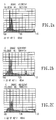
- Figure 1a is a scanning electron micrograph at 2142X magnification showing the surface of filled, never-dried pulp fiber filled according to the inventive process with NiCO3 insoluble precipitate filler.
- Figure 1b is an electron dispersion analysis (EDAX) of the filled fiber showing Ni location and distribution in the cell wall of the fiber.
- EDAX electron dispersion analysis
- Figures 2a, 2b, and 2c are EDAX graphs of Ni (07 box) of a NiCO3-filled, never-dried pulp fiber showing the surface of the fiber, the cell wall of the fiber, and the fiber lumen, respectively. Filler was predominantly present in Figure 2b, indicating the presence of nickel in the cell wall.
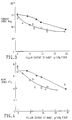
- Figures 3 and 4 illustrate the tensile index and burst index, respectively, of different filler content papers made from never-dried western hemlock pulp (a softwood).
- the filled circles represent paper made from fibers filled by the inventive process, and the open circles or squares represent paper made from fibers filled by a conventional process, as described in Example 1.
- the different symbols represent different batches run on different dates.
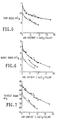
- Figures 5, 6 and 7 illustrate tear index, burst index, and tensile index, respectively, for different filler content papers made from red alder pulp (a hardwood).
- the open circles or squares represent the inventive process with CaCO3 as the filler precipitated in situ , wherein, for the open squares, CaCl2 was the first salt and Na2CO3 was the second salt, and for the open circles, Na2CO3 was the first salt and CaCl2 was the second salt.
- the closed triangles are data from paper made from mixtures of cell wall filled and unfilled fibers in ratios of 1:3, 1:1, and 3:1, respectively.
- the open diamonds are red alder, never-dried pulp fibers filled by the conventional techniques described in Example 1.
- the "x" designation used once-dried red alder pulp, rewetted and filled by the inventive process.
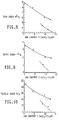
- Figures 8, 9, and 10 illustrate the tear index, burst index, and tensile index, respectively, for different filler content papers made from spruce CTMP pulp (a softwood).
- the open squares represent in situ precipitated, never-dried pulp fibers filled by the inventive process.
- the open circles represent never-dried pulp fibers loaded in a filled paper by a conventional process described in Example 1.
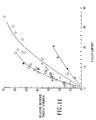
- Figures 11, 12, and 13 illustrate the tear index, burst index, and tensile index, respectively, for different filler content papers made from bagasse pulps (sugarcane).
- the filled squares represent in situ precipitated, never-dried pulp fibers filled by the inventive process, with the filled squares being bleached pulp and the open squares being unbleached pulp.
- the diamonds represent never-dried pulps filled by a conventional process, as described in Example 1, with the filled diamonds being bleached pulp and the open diamonds being unbleached pulp.
- the triangles represent once-dried, bleached pulp filled by the inventive process. The poor results obtained with the once-dried pulps indicate that pores of the never-dried pulp fibers are necessary to be able to fill the cell walls of fibers.
- Figure 14 compares the relative decrease in tensile strength as a function of filler content comparing literature data of the lumen-loading technique (triangles or "x" figures) to never-dried pulps filled by the inventive process using red alder hardwood pulp (open squares), bagasse sugarcane pulp (diamonds), and spruce CTMP softwood pulp (closed circles).
- the pulp obtained is a composite of several hundred concentric lamellae of cellulose microfibils. Each lamella is separated from the others by water-filled spaces (pores) which vary in width from 25 ⁇ 10 ⁇ 10 to about 300 ⁇ 10 ⁇ 10 m (about 25 to about 300 angstroms). The larger spaces are located nearer the periphery, with the narrower spaces located toward the lumen (a central channel of about 10 to about 20 ⁇ m (microns) in width). The spacing of the pores more or less corresponds to the thickness of the lignin in the cellulose wood fiber.
- the pore size generally has a normal log distribution.
- a surprising result of the inventive process is that most of the first solution leaves the fiber lumen when the fiber is filtered between the addition of the first and second solutions. This is because the lumen is more open to the external environment than the pores in the cell wall. Thus, little, if any, filler is precipitated in situ in the lumen.
- the normal log distribution of pore size is a plot of the logarithm of the pore size versus pore frequency.
- the never-dried pulp fiber has a surface area of about 1,000 m2/g. Upon drying, the surface area reduces to about 1 m2/g. Even though the lamellae swell upon rewetting, the rewetted pulp has a surface area of only about 100 m2/g. Thus, upon drying, most of the pores of the never-dried pulp irreversibly collapse.
- the inventive composition and processes depend upon the special properties of the never-dried pulp or its equivalents.
- the never-dried pulp has a large internal surface area of about 1,000 m2/g as a result of the corresponding internal cell wall pore volume of about 1.2 ml/g.
- the internal cell wall pores are substantially lost by collapse during drying. Anything placed within the pores before drying becomes trapped in the pores, as the pores collapse during drying.
- the strength of paper made from such in situ precipitation cell wall-filled fibers is greater than the strength of paper made from the usual (conventional) combination of fibers and the same amount of filler particles added to the fibers, when the filler.
- the conventional mixture of filler and fibers locates the filler between the fibers.
- the abrasive filler will have less contact with the forming wire on the paper machine. This will result in fewer wire changes being needed for the paper machine in a given period of time.
- Another advantage of the inventive process and compositions is that larger amounts of filler are used to form paper and maintain the strength of the resulting paper.
- the paper filler does not require incorporating adhesive polymers to maintain paper strength.
- paper made using the inventive process without adhesive fillers can have larger amounts of filler than conventionally made paper, while retaining equal or superior strength characteristics.
- filler is generally more economical than pulp fibers, the inventive process provides an economic benefit by a lower cost of goods for the finished paper composition.
- it is less energy intensive and more economical to dry filler than to dry fiber.
- reduced energy costs for paper forming will be achieved by reduced drying costs.
- never-dried pulps are filled by consecutively soaking the never-dried pulp in solutions comprising a soluble salt or salts.
- the never-dried pulps are first soaked in a first solution for approximately five minutes or less.
- the first solution comprises a soluble salt or salts and functions to replace the water within the pores in the cell wall and in the lumen with a solution containing the soluble salt or salts of the first solution.
- the never-dried pulp fibers are filtered and washed, which removes the salt or salts from the first solution from the exterior and the lumen of the fibers.
- a second solution containing a different soluble salt or salts is added to the filtered fibers.
- the interaction of the salt or salts from the first solution within the pores of the cell wall of the never-dried pulp fibers and the soluble salt or salts of the second solution forms an insoluble precipitate that falls out of solution within the pores of the cell wall of the never-dried pulp fibers.
- the precipitate within the cell wall of the never-dried pulp fibers acts as a filler.
- the insoluble precipitate acts as paper filler.
- the filled, never-dried pulp fibers are subsequently filtered and washed and used to form paper.
- the filled fibers may be dried and shipped to a papermaking facility as dry lap.
- Pulp fibers are often beaten to certain specifications as part of the papermaking procedure.
- the beating of the pulp fibers occurs before forming the paper.
- the inventive process allows the beating to occur either before or after filling the fibers.
- never-dried pulp fibers can be filled, dried and then beaten before use to form paper.
- the order of the soluble salts in the first or the second solution is not important to the process. What is important is that the salt or salts of the first and second solution be different and that they form an insoluble precipitate upon interaction. Examples of white (opaque) and various colored precipitates are listed in Table 1.
- soluble salts that form an insoluble precipitate include CaCl2 and Na2SiO3, yielding the precipitate CaSiO3 (an opaque white filler); BaCl2 and Na2SO4, yielding BaSO4 (a white opaque filler); and CaCl2 and Na2CO3, forming CaCO3 (opaque white filler). It should be noted that it is possible to replace a sodium cation with a potassium cation in any of the soluble salts.
- green precipitate fillers are NiCO3, formed by the combination of the aqueous salts NiCl2 and Na2CO3; copper carbonate (CuCO3), from cuprous chloride (Cu2Cl2) and sodium carbonate; and chromic phosphate (CrPO4), from chromic chloride (CrCl3) and sodium phosphate (Na3PO4).
- the preferred precipitate filler material is calcium carbonate (CaCO3). Calcium carbonate can be formed, for example, by having one solution of calcium chloride and the other solution of sodium or potassium carbonate. In all of the insoluble precipitates that are formed, the order of use of the soluble salts is not important.
- the concentration of salt or salts in the aqueous solution can vary from about 1% to about 40%, depending upon the solubility of the salt in an aqueous system, the temperature of the process, and the amount of filler desired.
- the concentration of salt or salts in the aqueous solution should be as saturated as the solubility characteristics and the temperature of the process permit so as to maximize the filler content of the resulting filled, never-dried pulp fibers.
- the inventive process allows for the improved retention of mechanical properties of never-dried pulp when the cell wall is loaded with a precipitated filler in situ .
- never-dried pulp was filled with NiCO3, formed from the soluble salts NiCl2 and NaCO3, the nickel precipitate can be visualized by electron dispersion analysis (EDAX).
- Figure 1a shows the location of nickel
- Figure 1b shows the nickel distribution.
- the white dots in Figure 1b represent nickel, and the higher density of the white dots enables the fiber cell wall to be visualized.
- Figures 2a, 2b and 2c show different aspects of a cross section of a never-dried pulp fiber loaded with nickel carbonate filler material by a process described herein.
- Figure 2a shows the surface of the filled, never-dried pulp fibers with essentially zero nickel present in the third box from the right.
- Figure 2b shows a high nickel level strongly above background in a peak in the third box from the right for the cell wall areas of the fibers.
- Figure 2c shows the nickel concentration in the lumen of the filled, never-dried pulp fiber with very little nickel present.
- Paper made from never-dried fibers that have been loaded in the cell wall pores with precipitate-type filler material can be used for a wide variety of applications. The following are some of the widest categories, bearing in mind there are also many specialty products which are produced in smaller quantities.
- Fine papers are a broad class of papers used for printing and writing. Generally, fine papers contain fillers.
- the paper made from cell wall filled, never-dried pulp exhibits less "two-sidedness.” Two-sidedness is due to an unequal distribution of filler across the thickness of the sheet. Further, there is less tendency for the filler to "dust off" from the sheet during the converting processes of wetting and slitting.
- Unbleached kraft pulp is used for paper products such as paper bags and wrapping papers because of its high strength. However, it has a low brightness, thus making it both unattractive and a poor substrate for printing paper. None-dried, unbleached kraft pulp fibers with filled cell walls improve the brightness of the paper produced and less strength is lost from filler loading than with conventional loading techniques and dried pulp fibers.
- This example illustrates a comparison using softwood never-dried pulp from western hemlock, comparing the properties of the paper made from the inventive process and a conventional process.
- the pulp was beaten to 400 CSF before treatment.
- a sample of never-dried pulp (10 g) was dispersed in a 5%, 10%, 20%, or 35% solution of CaCl2 in 500 ml of water.
- the CaCl2-impregnated fibers were collected by filtration under reduced pressure and redispersed in a saturated Na2CO3 solution (1,000 ml). After one hour, the dispersion was filtered into a 76 ⁇ m nominal width of perture (200 mesh)wire screen and then washed with water until the filtrate was clear.
- the conventionally filled pulp had its pH value of 8.0 adjusted using NaOH.
- a retention aid (Reten® 210, Hercules Corp.) was added at various rates (0.226-0.680 kg/ 1000 kg(0.5-1.5 lb/ton) of pulp) to achieve the appropriate retention of the commercial CaCO3 slurry. The time of agitation was one minute.
- Sheets were made with both the conventional, pulp and filler mixes and cell wall loaded, never-dried pulp by using TAPPI standard sheetmaking conditions.
- the filler (CaCO3) content of the sheets was calculated by the ash content, as determined by the standard TAPPI procedure, except that the temperature of the furnace was 575°C.
- Figure 3 shows the effect of filler level on the tensile index for conventional and cell wall loaded, never-dried pulp.
- Figure 4 is a plot of the burst index versus filler concentration in the paper for both types of filled papers. These data demonstrate the superior burst strength values obtained using fibers filled by the inventive process.
- the inventive process allows more filler to be added at the same paper strength or it provides for a higher level of strength at the same concentration of filler.
- Filled paper sells for approximately $ 1,000/1000 kg ($ 1,000/ton) or $ 0.50/0.453 kg ($ 0.50/lb) when pulp costs $ 500/1000 kg ($ 500/ton) and filler costs $ 200/1000 kg ($ 200/ton).
- every additional percent of filler that can be placed in a sheet instead of fiber represents a significant manufacturing cost savings of about $ 3-$ 4/1000kg ($ 3-$ 4/ton) to the papermaker.
- the inventive process does not require a retention aid and thus the formation of the paper can be improved.
- the inventive process improves the strength properties of the resulting paper.
- This example illustrates a comparison of various mechanical properties of paper made with never-dried, cell wall loaded pulps from red alder versus never-dried red alder pulps combined with filler by conventional means versus once-dried red alder pulp fibers filled by the inventive process.
- the never-dried pulps were initially beaten to 400 mL CSF prior to filler loading by either technique.
- the methods used for filling red alder pulps by the inventive process or combining by the conventional techniques are described in Example 1.
- Calcium carbonate was provided as a slurry for the conventional technique or precipitated in situ according to the inventive process.
- the concentration of filler was determined from the ash content.
- Figures 5, 6, and 7 compare the tear index, burst index, and tensile index, respectively, comparing red alder never-dried pulps filled by the inventive process or by the conventional technique.
- the ash content indicates the percent of filler in the paper. Therefore, in each figure it is possible to compare the tear index, burst index, and tensile index of paper made from each type of filled fiber at equivalent filler concentrations.
- the upper line with the higher tear burst or tensile indices is for papers made with fibers filled by the inventive process.
- the squares represent never-dried pulp fibers filled wherein the sequence of solution addition is first calcium chloride followed by sodium carbonate and the circles have the reverse sequence of sodium carbonate followed by calcium chloride.
- the lower line with the X-shaped points represents once-dried pulp fibers filled by the inventive process.
- the lower line with the diamond points represents conventionally loaded, never-dried pulps.
- the strength of the resulting paper was higher for the inventive process using never-dried pulp fibers. Further, the order of addition of the two solutions is not important.
- This example illustrates a comparison of spruce CTMP (chemithermomechanical pulp) never-dried pulp fibers filled by the inventive process or by conventional techniques.
- the never-dried fibers were initially beaten to 400 ml CSF.
- the inventive process and the conventional process used to fill the fibers are described in Example 1.
- Figures 8, 9, and 10 illustrate the tear index, burst index, and tensile index, respectively, of papers made from spruce CTMP never-dried pulp fibers filled by the inventive process and by the conventional technique.
- the inventive process is illustrated by squares and the conventional admixture process by circles.
- a characteristic of spruce CTMP pulp is that the tensile, burst, and tear indices decrease faster with increasing ash contents (i.e., increasing filler contents).
- the paper made from never-dried pulp fibers filled by the inventive process demonstrated increased strength as compared with paper whose fibers were filled by conventional techniques.
- This example compares bagasse pulps derived from sugarcane fibers comparing bleached and unbleached, never-dried pulps filled by the inventive method to bleached pulps that were once dried and filled by the inventive method to conventionally loaded bleached pulps.
- the processes used to make each paper and to combine the fibers and the filler are described in Example 1.
- Figures 11, 12, and 13 illustrate the tear index, burst index, and tensile index, respectively, of each of the three types of paper.
- the squares illustrate the inventive process, wherein the data from paper made from bleached, never-dried pulp fibers are indicated by filled-in squares and unbleached, never-dried pulp fibers by open squares.
- the data from paper made from never-dried bagasse fibers loaded by the conventional process is illustrated by the triangles.
- the data from papers made from bleached, never-dried pulp fibers are shown by closed diamonds and unbleached, never-dried pulp fibers by open diamonds. Paper made from once-dried, bleached pulp and filled by the inventive process is shown by the triangles.
- paper made with never-dried bagasse pulp fibers filled by the inventive process demonstrated superior strength characteristics at each concentration of filler tested.
- FIG. 14 illustrates the relative decrease in tensile strength of paper expressed as a percentage versus the filler content expressed as a percentage with red alder never-dried pulps, bagasse never-dried pulps , and spruce CTMP never-dried pulps filled by the inventive process as compared with lumen-loading techniques using softwoods, as derived from Miller et al. in Proceedings 1983 TAPPI International Paper Physic Conference , Harwichport, p. 237 ("Miller et al.”),and Green et al., Pulp & Paper Canada , 83 :T203 (1982) ("Green et al.”).
- PEI polyethyleneimine
- the open circles indicate red alder never-dried pulps filled by the inventive process
- the open diamonds represent bagasse pulps filled by the inventive process
- the filled circles represent spruce CTMP never-dried pulps filled by the inventive process
- the closed triangles represent the data in Miller et al.
- the X figures represent the data in Green et al.
- This example illustrates how never-dried eucalyptus pulp (a hardwood pulp) can be filled with aluminum hydroxide in situ .
- Eucalyptus pulp was dispersed in a first solution containing the soluble salt aluminum sulfate.
- the first solution contained a saturated concentration of aluminum sulfate at room temperature.
- the first solution was removed after five minutes by filtering the pulp. This also removes the first solution from the pulp lumens.
- a second solution containing 20% (w/v) sodium hydroxide was used to disperse the pulp fibers. This formed aluminum hydroxide precipitates predominantly in the cell wall of the fibers.
- Paper was made from the fibers filled with aluminum hydroxide filler.
- the amount of filler in the paper was 9% as determined by ash content of Al2O3 (alumina).
- This example illustrates the effect of beating filled, never-dried fiber and the effect of different beating conditions.
- Eucalyptus (hardwood) never-dried pulp was filled with CaCO3 by the inventive process as described herein.
- the unbeaten, never-dried pulp had a Canadian Standard Freeness (CSF) of 570 ml.
- CSF Canadian Standard Freeness
- a sample of the filled, never-dried pulp fibers was first beaten for 10,000 revolutions in a PFI mill (beating apparatus). The CSF value was 416 ml.
- the pulp was then formed into a crude first sheet by filtration onto a wire screen.
- the ash content of the first sheet was 43%.
- the pulp was then redispersed in water and refiltered to form a second sheet.
- the ash content of the second sheet was 38%.
- the entire procedure was repeated; except this time the filled, never-dried pulp fibers were first beaten for 20,000 revolutions, as described above.
- the CSF value was 366 ml.
- the first filtered sheet had 46% filler, the second sheet 41% filler, and the third sheet 38% filler. Thus, approximately only 8% filler was located outside of the cell wall even after beating for 20,000 revolutions.
Landscapes
- Chemical & Material Sciences (AREA)
- Chemical Kinetics & Catalysis (AREA)
- General Chemical & Material Sciences (AREA)
- Inorganic Chemistry (AREA)
- Wood Science & Technology (AREA)
- Engineering & Computer Science (AREA)
- Life Sciences & Earth Sciences (AREA)
- Paper (AREA)
- Apparatus Associated With Microorganisms And Enzymes (AREA)
- Dry Formation Of Fiberboard And The Like (AREA)
- Chemical And Physical Treatments For Wood And The Like (AREA)
- Seasonings (AREA)
- Detergent Compositions (AREA)
Abstract
Description
- This invention relates to a filled pulp fiber and a filled paper composition wherein the filler is an insoluble precipitate predominantly located within the cell wall of never-dried cellulosic pulp fibers. The location of the filler within the cell walls determines the resulting filled paper composition having increased strength relative to a corresponding conventionally filled paper containing the same amount of the same filler.
- The present invention also relates to a process for producing a filled pulp fiber and a filled paper composition having increased strength relative to a conventionally filled paper having the same concentration of the same filler material.
- The increasing cost of virgin pulp and the energy associated with its transformation are familiar problems to most papermakers. The boom in hardwoods utilization, the optimization of high-yield pulping processes, and the ongoing conversion to alkaline sizing are only a few examples of many attempts made in recent years to address papermaking problems. The most economically useful approach has been to replace pulp fibers with cheaper filler materials. High-filler papers are also called ultrahigh-ash paper when calcium carbonate (CaCO₃) is the filler. However, the major constraint of ultrahigh-ash paper is an impairment of interfibrillar bonding. This results in decreased paper strength.
- Papermaking processes often use fillers or opaque pigments to confer some desirable characteristics to the paper product and to provide a cost savings for paper raw materials. Fillers can increase opacity, brightness and printing properties. Fillers are cheaper substitutes than cellulose fibers and can reduce the total cost of the finished paper product. Moreover, fillers can be dried easier than fibers and reduce energy consumption during the papermaking process.
- An essential property of paper for many end uses is its opacity. It is particularly important for printing papers, where it is desirable to have as little as possible of the print on the reverse side of a printed sheet or on a sheet below it be visible through the paper. For printing and other applications, paper must also have a certain degree of brightness, or whiteness. For many paper products, acceptable levels of optical properties can be achieved from the pulp fibers alone. However, in other products, the inherent light-reflective characteristics of the fibers are insufficient to meet consumer demands. In such cases, the papermaker adds a filler.
- A filler consists of fine particles of an insoluble solid, usually of a mineral origin, suspended in a slurry. By virtue of the high ratio of surface area to weight (and sometimes high refractive index), the filler particles confer light-reflectance to the paper and thereby increase both opacity and brightness. Adding fillers to paper pulp produces an enhancement of the optical properties of the paper and further produces the advantages of improved smoothness and improved printability. Further, replacing fiber with an inexpensive filler can reduce the cost of the paper. However, filler addition poses some additional problems.
- One problem associated with filler addition is that the mechanical strength of the paper is less than could be expected from the ratio of load-bearing fiber to non-load-bearing filler. The mechanical strength of paper can be expressed in terms of burst index, tear index, and tensile index. The usual explanation for this is that some of the filler particles become trapped between fibers, thereby reducing the strength of the fiber-to-fiber hydrogen bonding. The hydrogen bonding is the primary source of paper strength.
- There exists a practical limit to the amount of filler which can be used. The paper mechanical properties depend primarily upon hydrogen bonding between fibrous elements. Filler accumulates on the external surface of the fibers. Accumulated filler weakens the paper strength. Further, one must use increasing amounts of retention aids to avoid excessive pigment losses through the paper-forming wire. Accordingly, filler concentrations are often limited to a maximum of about 10% ash content.
- Several techniques have been used to try to overcome the problems of decreased strength from increasing filler content. Most approaches have involved filler surface modification, using retention additives, and using supplemental bonding agents. For example, preflocculated fibers and fillers have been used to increase filler retention and reduce loss of paper strength. Coarser particles of pigment or filler, caused by the preflocculation procedure, are retained more efficiently than the finer particles of pigment. Thus, there is less interference with inter-fiber bonding. This helps improve paper strength. However, paper opacity is reduced with increasing particle size. Moreover, the cost savings associated with the preflocculation technique are insignificant and are offset by additional problems.
- Craig, US-A-2,583,548 ("Craig"), describes a process forming a pigmented cellulosic pulp by precipitating pigment "in and around" the fibers. According to Craig, dry cellulosic fibers are added to a solution of one reactant, for example, calcium chloride, and the suspension is mechanically worked so as to effect a gelatinizing of the dry fibers. A second reactant, for example, sodium carbonate, is added so as to effect the precipitation of fine solid particles, such as calcium carbonate. The fibers are then washed to remove the soluble by-product (sodium chloride).
- The Craig process has considerable limitations. The presence of filler on fiber surfaces and the gelatinizing effect on the fibers are detrimental to paper strength. The gelatinised fibers are so severely broken that both the filler precipitate and the gelled fibers form a slurry. Thus, the Craig process has not achieved commercial success despite its disclosure about 39 years ago.
- Another technique is described in US-A-4,510,020. This process has been called the "lumen-loading" process and it involves placing the filler material directly within the lumens of soft wood pulp fibers. "Lumen-loaded" pulp is prepared by vigorously agitating a dry softwood pulp in a concentrated suspension of filler. The action of the agitation encourages the filler to move through transverse pit apertures in the fiber cell walls and into the lumen, where the filler material is adsorbed against the surface of the lumen cavity. Subsequent washing of the lumen-filled pulp fibers rapidly eliminates residual filler from the external surfaces of the fibers but only slowly from the lumen. The result is an increased retention of filler within the lumen, while removing the hindrance to inter-fiber bonding by removing the filler outside of the fiber lumens. The result is increased paper strength for the amount of filler present. The lumen-loading technique works best with fibers that have been dried.
- The lumen-loading technique, however, has not proved to be economically or commercially viable. The technique requires the manipulation of large volumes of relatively concentrated filler suspensions agitated at high revolutions for prolonged periods of time. Further, the lumen-loading technique requires a relatively small particle size filler, such as titanium oxide, which is an expensive filler material. Moreover, the lumen-loading technique will only work for dry softwood fibers having a sufficient number of pit apertures. As the lumens are open at the pits, filler may be lost in the same way that it is introduced. Further, the pores in the cell walls are not filled by the lumen-loading technique.
- Accordingly, there is a need in the art to be able to produce economical paper of high opacity and strength using as much filler material as possible, and to be able to use cellulosic pulp fibers from any source (e.g., softwoods, hardwoods and annual plants, such as sugarcane).
- An object of the Present invention is a process for the production of filled pulp fiber composition wherein the starting pulp is a never-dried pulp derived from hardwoods, softwoods, annual plants and combinations thereof, by immersing a never-dried pulp having an internal cell wall pore volume while regaining wet after pulping in a first solution wherein the first solution comprises a soluble salt or salts, filtering the immersed never-dried pulp to remove soluble salt from the exterior of the fiber and the lumen, and then reimmersing the never-dried pulp in a second solution wherein the second solution comprises a soluble salt or salts different from the soluble salt or salts of the first solution, and with the proviso that the interaction of the salt or salts from the first solution and the salt or salts from the second solution form an insoluble precipitate that acts as a filler within the cell wall of the never-dried pulp; and filtering and washing the filled never-dried pulp to form the filled pulp fiber.
- Preferred embodiments of the process according to the invention are subject-matter of
claims - Another object of the invention is a filled pulp fiber obtainable according to the process of the invention , wherein at least 50% of the filler content is located within the pores of the fiber cell wall.
- The invention further describes a process for the production of filled paper wherein the starting pulp is a never-dried pulp. The inventive process comprises producing a filled pulp fiber according to the process of the invention and forming paper with the filled pulp.
- The paper is made by process steps known to those of ordinary skill in the art. The pulp can be used directly for papermaking without drying, or dried as filled pulp fibers and later used for papermaking.
- The present invention refers to a filled-paper composition comprising intact, never-dried cellulose fibers and filler, wherein at least 50% of the filler content is located within the pores or cell wall of the never-dried cellulose fibers. The filled paper composition is characterized by having increased strength compared to a corresponding conventionally filled paper containing the same amount of the same filler. The filler is formed in situ as an insoluble precipitate in an aqueous system. The paper composition may further comprise a coloring agent wherein the coloring agent is a colored precipitate formed in situ that functions as a filler material. Examples of insoluble precipitates that function as filler materials include, for example, calcium carbonate, other precipitates listed in Table 1 herein, and combinations thereof. The paper composition is selected from the group consisting of unbleached kraft paper, bleached kraft paper, sulfite pulp (bleached and unbleached) fine printing paper, fine writing paper, and lightweight newsprint paper.
- The present invention includes a filled paper product made from filled, never-dried cellulose pulp fibers which are obtainable by the process of the invention, wherein the filled paper is made directly from the filled, never-dried pulp or the filled, never-dried pulp is made, dried, and later used to make paper. The essential steps of the inventive process are as follows:
- 1. Immersing a never-dried pulp having an internal cell wall pore volume while remaining wet after pulping in a first solution wherein the first solution comprises a soluble salt or salts
- 2. filtering the immersed never-dried pulp to remove soluble salt from the exterior of the fiber and the lumen, and then reimmersing the never-dried pulp in a second solution wherein the second solution comprises a soluble salt or salts different from the soluble salt or salts of the first solution, and with the proviso that the interaction of the salt or salts from the first solution and the salt or salts from the second solution form an insoluble precipitate that acts as a filler within the cell wall of the never-dried pulp; and
- 3. filtering and washing the filled never-dried pulp to form the filled pulp fiber.
- The paper can be made directly with the filled, never-dried pulp fibers by conventional procedures. Alternatively, the filled, never-dried pulp can be dried and later used for papermaking.
- In another embodiment, the filled, never-dried pulp fibers are beaten after filling in the never-dried state or after being once dried. If the unbeaten, filled pulp is dried, the papermaker can control the specifications of the beating process in the papermaking operation.
- The never-dried cellulose pulp can be derived from hardwoods, softwoods, annual plants such as sugarcane (bagasse), and combinations thereof.
- The present invention is able to load a precipitate-type filler material within the cell walls or pores located within the cell walls of never-dried pulp fibers by the internal in situ precipitation of insoluble fillers and pigments. Never-dried pulp fibers are unique in having relatively large-sized pores located within the interior of the cell wall. These pores collapse when the pulp fiber is dried and are not fully restored by the rewetting of the dried fiber. Therefore, one can optimally precipitate filler material within the cell wall surrounding the lumen only before the fiber is dried. Similarly, filled fibers, filled by the inventive process and dried, cannot be refilled by the inventive process.
- Filler materials, such as pigments and opaque precipitates, are loaded into the pores of the cell walls of never-dried wood pulp fiber by precipitating the filler material inside the pores. This replaces the fluid content of the pore. Excess filler is washed away from the external surface of the fiber and an insignificant amount, if any, of filler material remains within the lumen of the fiber. As never-dried pulp fibers are hollow, tubular structures, the fibers develop an extremely large surface area after pulping and retain that large surface area while remaining wet (i.e., never-dried). The large surface area within the never-dried fibers is generously available to soluble salts that are precipitated as papermaking fillers. This preserves the bonding ability of the external cellulosic layers and does not affect the strength of the resulting paper.
- Figure 1a is a scanning electron micrograph at 2142X magnification showing the surface of filled, never-dried pulp fiber filled according to the inventive process with NiCO₃ insoluble precipitate filler. Figure 1b is an electron dispersion analysis (EDAX) of the filled fiber showing Ni location and distribution in the cell wall of the fiber.
- Figures 2a, 2b, and 2c are EDAX graphs of Ni (07 box) of a NiCO₃-filled, never-dried pulp fiber showing the surface of the fiber, the cell wall of the fiber, and the fiber lumen, respectively. Filler was predominantly present in Figure 2b, indicating the presence of nickel in the cell wall.
- Figures 3 and 4 illustrate the tensile index and burst index, respectively, of different filler content papers made from never-dried western hemlock pulp (a softwood). The filled circles represent paper made from fibers filled by the inventive process, and the open circles or squares represent paper made from fibers filled by a conventional process, as described in Example 1. The different symbols represent different batches run on different dates.
- Figures 5, 6 and 7 illustrate tear index, burst index, and tensile index, respectively, for different filler content papers made from red alder pulp (a hardwood). The open circles or squares represent the inventive process with CaCO₃ as the filler precipitated in situ, wherein, for the open squares, CaCl₂ was the first salt and Na₂CO₃ was the second salt, and for the open circles, Na₂CO₃ was the first salt and CaCl₂ was the second salt. The closed triangles are data from paper made from mixtures of cell wall filled and unfilled fibers in ratios of 1:3, 1:1, and 3:1, respectively. The open diamonds are red alder, never-dried pulp fibers filled by the conventional techniques described in Example 1. The "x" designation used once-dried red alder pulp, rewetted and filled by the inventive process.
- Figures 8, 9, and 10 illustrate the tear index, burst index, and tensile index, respectively, for different filler content papers made from spruce CTMP pulp (a softwood). The open squares represent in situ precipitated, never-dried pulp fibers filled by the inventive process. The open circles represent never-dried pulp fibers loaded in a filled paper by a conventional process described in Example 1.
- Figures 11, 12, and 13 illustrate the tear index, burst index, and tensile index, respectively, for different filler content papers made from bagasse pulps (sugarcane). The filled squares represent in situ precipitated, never-dried pulp fibers filled by the inventive process, with the filled squares being bleached pulp and the open squares being unbleached pulp. The diamonds represent never-dried pulps filled by a conventional process, as described in Example 1, with the filled diamonds being bleached pulp and the open diamonds being unbleached pulp. The triangles represent once-dried, bleached pulp filled by the inventive process. The poor results obtained with the once-dried pulps indicate that pores of the never-dried pulp fibers are necessary to be able to fill the cell walls of fibers.
- Figure 14 compares the relative decrease in tensile strength as a function of filler content comparing literature data of the lumen-loading technique (triangles or "x" figures) to never-dried pulps filled by the inventive process using red alder hardwood pulp (open squares), bagasse sugarcane pulp (diamonds), and spruce CTMP softwood pulp (closed circles).
- Never-dried pulp is formed by removing the lignin and hemicellulose from cellulose wood fibers during pulping. The pulp obtained is a composite of several hundred concentric lamellae of cellulose microfibils. Each lamella is separated from the others by water-filled spaces (pores) which vary in width from 25·10⁻¹⁰ to about 300·10⁻¹⁰ m (about 25 to about 300 angstroms). The larger spaces are located nearer the periphery, with the narrower spaces located toward the lumen (a central channel of about 10 to about 20 µm (microns) in width). The spacing of the pores more or less corresponds to the thickness of the lignin in the cellulose wood fiber. The pore size generally has a normal log distribution. A surprising result of the inventive process is that most of the first solution leaves the fiber lumen when the fiber is filtered between the addition of the first and second solutions. This is because the lumen is more open to the external environment than the pores in the cell wall. Thus, little, if any, filler is precipitated in situ in the lumen. The normal log distribution of pore size is a plot of the logarithm of the pore size versus pore frequency.
- The never-dried pulp fiber has a surface area of about 1,000 m²/g. Upon drying, the surface area reduces to about 1 m²/g. Even though the lamellae swell upon rewetting, the rewetted pulp has a surface area of only about 100 m²/g. Thus, upon drying, most of the pores of the never-dried pulp irreversibly collapse.
- The inventive composition and processes depend upon the special properties of the never-dried pulp or its equivalents. The never-dried pulp has a large internal surface area of about 1,000 m²/g as a result of the corresponding internal cell wall pore volume of about 1.2 ml/g. The internal cell wall pores are substantially lost by collapse during drying. Anything placed within the pores before drying becomes trapped in the pores, as the pores collapse during drying.
- We have shown that if never-dried pulp is sequentially treated with a first solution containing a soluble salt, such as calcium chloride, and filtered to remove the soluble salt from the exterior of the fiber and the lumen, and then a second soluble salt, such as sodium carbonate, is added, the filler, calcium carbonate, is created within these pores but not within the lumen. This process is appropriate for other filler materials when the filler is an insoluble precipitate formed from the interaction of two or more soluble salts.
- When the filler is located within the cell wall by the in situ process, interference with the hydrogen bonding between fibers is reduced. As a consequence, the strength of paper made from such in situ precipitation cell wall-filled fibers is greater than the strength of paper made from the usual (conventional) combination of fibers and the same amount of filler particles added to the fibers, when the filler. The conventional mixture of filler and fibers locates the filler between the fibers. Furthermore, if the filler is located inside the cell wall of the fiber in the inventive process and compositions, the abrasive filler will have less contact with the forming wire on the paper machine. This will result in fewer wire changes being needed for the paper machine in a given period of time. Moreover, there is a reduced opportunity for filler to dust off from the paper sheet because the filler is located predominantly within the cell wall of the fibers rather than outside of the fibers.
- Another advantage of the inventive process and compositions is that larger amounts of filler are used to form paper and maintain the strength of the resulting paper. The paper filler does not require incorporating adhesive polymers to maintain paper strength. Thus, paper made using the inventive process without adhesive fillers can have larger amounts of filler than conventionally made paper, while retaining equal or superior strength characteristics. Since filler is generally more economical than pulp fibers, the inventive process provides an economic benefit by a lower cost of goods for the finished paper composition. Moreover, it is less energy intensive and more economical to dry filler than to dry fiber. Thus, reduced energy costs for paper forming will be achieved by reduced drying costs.
- The inventive process takes never-dried pulp and precipitates a filler material in situ. In one embodiment, never-dried pulps are filled by consecutively soaking the never-dried pulp in solutions comprising a soluble salt or salts. The never-dried pulps are first soaked in a first solution for approximately five minutes or less. The first solution comprises a soluble salt or salts and functions to replace the water within the pores in the cell wall and in the lumen with a solution containing the soluble salt or salts of the first solution. The never-dried pulp fibers are filtered and washed, which removes the salt or salts from the first solution from the exterior and the lumen of the fibers. A second solution containing a different soluble salt or salts is added to the filtered fibers. The interaction of the salt or salts from the first solution within the pores of the cell wall of the never-dried pulp fibers and the soluble salt or salts of the second solution forms an insoluble precipitate that falls out of solution within the pores of the cell wall of the never-dried pulp fibers. The precipitate within the cell wall of the never-dried pulp fibers acts as a filler. When the fibers are dried or used to make paper and later dried, the insoluble precipitate acts as paper filler. The filled, never-dried pulp fibers are subsequently filtered and washed and used to form paper. Alternatively, the filled fibers may be dried and shipped to a papermaking facility as dry lap.
- Pulp fibers are often beaten to certain specifications as part of the papermaking procedure. The beating of the pulp fibers occurs before forming the paper. The inventive process allows the beating to occur either before or after filling the fibers. Moreover, never-dried pulp fibers can be filled, dried and then beaten before use to form paper.
- The order of the soluble salts in the first or the second solution is not important to the process. What is important is that the salt or salts of the first and second solution be different and that they form an insoluble precipitate upon interaction. Examples of white (opaque) and various colored precipitates are listed in Table 1.


- One of ordinary skill in the art would know which salts would form each precipitate.
- Preferred examples of soluble salts that form an insoluble precipitate include CaCl₂ and Na₂SiO₃, yielding the precipitate CaSiO₃ (an opaque white filler); BaCl₂ and Na₂SO₄, yielding BaSO₄ (a white opaque filler); and CaCl₂ and Na₂CO₃, forming CaCO₃ (opaque white filler). It should be noted that it is possible to replace a sodium cation with a potassium cation in any of the soluble salts. Examples of green precipitate fillers are NiCO₃, formed by the combination of the aqueous salts NiCl₂ and Na₂CO₃; copper carbonate (CuCO₃), from cuprous chloride (Cu₂Cl₂) and sodium carbonate; and chromic phosphate (CrPO₄), from chromic chloride (CrCl₃) and sodium phosphate (Na₃PO₄). The preferred precipitate filler material is calcium carbonate (CaCO₃). Calcium carbonate can be formed, for example, by having one solution of calcium chloride and the other solution of sodium or potassium carbonate. In all of the insoluble precipitates that are formed, the order of use of the soluble salts is not important.
- The concentration of salt or salts in the aqueous solution can vary from about 1% to about 40%, depending upon the solubility of the salt in an aqueous system, the temperature of the process, and the amount of filler desired. Preferably, the concentration of salt or salts in the aqueous solution should be as saturated as the solubility characteristics and the temperature of the process permit so as to maximize the filler content of the resulting filled, never-dried pulp fibers. When using colored or pigmented filler precipitates, it is desirable not to maximize the amount of filler in the cell wall of the never-dried fibers.
- The inventive process allows for the improved retention of mechanical properties of never-dried pulp when the cell wall is loaded with a precipitated filler in situ. When never-dried pulp was filled with NiCO₃, formed from the soluble salts NiCl₂ and NaCO₃, the nickel precipitate can be visualized by electron dispersion analysis (EDAX).
- Loaded, never-dried pulps were washed on a wire screen (net opening width 140 µm; mesh #100) with tap water. Microscopic observation of the washed, never-dried pulp indicated that this procedure was not efficient enough to completely remove excess filler material from around internally filled, never-dried fibers. Handsheet formation, drying, and conditioning were done in accordance with TAPPI standards. See TAPPI official Test Method T 205 om-81 from the American National Standard, April 1982.
- Figure 1a shows the location of nickel, and Figure 1b shows the nickel distribution. The white dots in Figure 1b represent nickel, and the higher density of the white dots enables the fiber cell wall to be visualized. Figures 2a, 2b and 2c show different aspects of a cross section of a never-dried pulp fiber loaded with nickel carbonate filler material by a process described herein. Figure 2a shows the surface of the filled, never-dried pulp fibers with essentially zero nickel present in the third box from the right. Figure 2b shows a high nickel level strongly above background in a peak in the third box from the right for the cell wall areas of the fibers. Figure 2c shows the nickel concentration in the lumen of the filled, never-dried pulp fiber with very little nickel present.
- Paper made from never-dried fibers that have been loaded in the cell wall pores with precipitate-type filler material can be used for a wide variety of applications. The following are some of the widest categories, bearing in mind there are also many specialty products which are produced in smaller quantities.
- Fine papers are a broad class of papers used for printing and writing. Generally, fine papers contain fillers. One advantage of feeding the filled, never-dried pulp fibers, filled within their cell wall to a paper machine used in making fine paper, rather than the usual mixture of separate fiber and filler, is a greater retention of the filler material within the fibers. This leads to better control of properties and cleaner machine operation. In addition to the paper being stronger than a corresponding paper conventionally filled with the same concentration of filler material, the paper made from cell wall filled, never-dried pulp exhibits less "two-sidedness." Two-sidedness is due to an unequal distribution of filler across the thickness of the sheet. Further, there is less tendency for the filler to "dust off" from the sheet during the converting processes of wetting and slitting.
- Unbleached kraft pulp is used for paper products such as paper bags and wrapping papers because of its high strength. However, it has a low brightness, thus making it both unattractive and a poor substrate for printing paper. Never-dried, unbleached kraft pulp fibers with filled cell walls improve the brightness of the paper produced and less strength is lost from filler loading than with conventional loading techniques and dried pulp fibers.
- Most newsprint is currently made from a mixture of mechanical and chemical pulp without filler. There is a demand for such products of lower basis weight (pulp weight per unit area). One of the barriers to achieving substantial decreases in basis weight is that such changes reduce the opacity of the sheet. Filler is not currently added to offset the loss in opacity for various reasons, including the loss of strength it causes in the sheet and the "messiness" it imparts to the papermaking operation. Using cell wall filled, never-dried pulp fibers, the newsprint problems are reduced and newsprint can be made with improved levels of opacity.
- The following examples are set forth to illustrate the inventive method and compositions produced by the inventive method and not to limit the scope of the invention.
- This example illustrates a comparison using softwood never-dried pulp from western hemlock, comparing the properties of the paper made from the inventive process and a conventional process. In each case, the pulp was beaten to 400 CSF before treatment. For the inventive process, a sample of never-dried pulp (10 g) was dispersed in a 5%, 10%, 20%, or 35% solution of CaCl₂ in 500 ml of water. After 30 minutes the CaCl₂-impregnated fibers were collected by filtration under reduced pressure and redispersed in a saturated Na₂CO₃ solution (1,000 ml). After one hour, the dispersion was filtered into a 76µm nominal width of perture (200 mesh)wire screen and then washed with water until the filtrate was clear.
- The never-dried pulps used for the preparation of conventionally loaded papers were also washed over a 76 µm nominal width of perture (200 mesh) wire screen five times at 0.5% consistency.
- The conventionally filled pulp had its pH value of 8.0 adjusted using NaOH. A retention aid (Reten® 210, Hercules Corp.) was added at various rates (0.226-0.680 kg/ 1000 kg(0.5-1.5 lb/ton) of pulp) to achieve the appropriate retention of the commercial CaCO₃ slurry. The time of agitation was one minute.
- Sheets were made with both the conventional, pulp and filler mixes and cell wall loaded, never-dried pulp by using TAPPI standard sheetmaking conditions. The filler (CaCO₃) content of the sheets was calculated by the ash content, as determined by the standard TAPPI procedure, except that the temperature of the furnace was 575°C.
- In Figures 3 and 4, the papers made from the cell wall loaded, never-dried pulp are shown by the closed circles. The papers made by conventional techniques are shown by the open points.
- Figure 3 shows the effect of filler level on the tensile index for conventional and cell wall loaded, never-dried pulp. These data indicate that at equal CaCO₃ filler concentrations, the sheets made with fibers filled by the inventive process have tensile properties superior to those made by a conventional process.
- Similar comparative data are obtained in Figure 4, where the burst strength of the papers is measured. Figure 4 is a plot of the burst index versus filler concentration in the paper for both types of filled papers. These data demonstrate the superior burst strength values obtained using fibers filled by the inventive process.
- These data indicate that at equal levels of filler concentration, the inventive process allows more filler to be added at the same paper strength or it provides for a higher level of strength at the same concentration of filler. Filled paper sells for approximately $ 1,000/1000 kg ($ 1,000/ton) or $ 0.50/0.453 kg ($ 0.50/lb) when pulp costs $ 500/1000 kg ($ 500/ton) and filler costs $ 200/1000 kg ($ 200/ton). Thus, every additional percent of filler that can be placed in a sheet instead of fiber represents a significant manufacturing cost savings of about $ 3-$ 4/1000kg ($ 3-$ 4/ton) to the papermaker. Moreover, the inventive process does not require a retention aid and thus the formation of the paper can be improved. Thus, when using a softwood kraft pulp, the inventive process improves the strength properties of the resulting paper.
- This example illustrates a comparison of various mechanical properties of paper made with never-dried, cell wall loaded pulps from red alder versus never-dried red alder pulps combined with filler by conventional means versus once-dried red alder pulp fibers filled by the inventive process. In each instance, the never-dried pulps were initially beaten to 400 mL CSF prior to filler loading by either technique. The methods used for filling red alder pulps by the inventive process or combining by the conventional techniques are described in Example 1. Calcium carbonate was provided as a slurry for the conventional technique or precipitated in situ according to the inventive process. The concentration of filler was determined from the ash content.
- Figures 5, 6, and 7 compare the tear index, burst index, and tensile index, respectively, comparing red alder never-dried pulps filled by the inventive process or by the conventional technique. In each illustration, the ash content indicates the percent of filler in the paper. Therefore, in each figure it is possible to compare the tear index, burst index, and tensile index of paper made from each type of filled fiber at equivalent filler concentrations.
- In Figures 5, 6, and 7, the upper line with the higher tear burst or tensile indices is for papers made with fibers filled by the inventive process. The squares represent never-dried pulp fibers filled wherein the sequence of solution addition is first calcium chloride followed by sodium carbonate and the circles have the reverse sequence of sodium carbonate followed by calcium chloride. The lower line with the X-shaped points represents once-dried pulp fibers filled by the inventive process. The lower line with the diamond points represents conventionally loaded, never-dried pulps.
- In each instance, the strength of the resulting paper, as measured by tear index, burst index, and tensile index, was higher for the inventive process using never-dried pulp fibers. Further, the order of addition of the two solutions is not important.
- This example illustrates a comparison of spruce CTMP (chemithermomechanical pulp) never-dried pulp fibers filled by the inventive process or by conventional techniques. The never-dried fibers were initially beaten to 400 ml CSF. The inventive process and the conventional process used to fill the fibers are described in Example 1. Figures 8, 9, and 10 illustrate the tear index, burst index, and tensile index, respectively, of papers made from spruce CTMP never-dried pulp fibers filled by the inventive process and by the conventional technique. In each of the three figures, the inventive process is illustrated by squares and the conventional admixture process by circles.
- A characteristic of spruce CTMP pulp is that the tensile, burst, and tear indices decrease faster with increasing ash contents (i.e., increasing filler contents). For each strength parameter, the paper made from never-dried pulp fibers filled by the inventive process demonstrated increased strength as compared with paper whose fibers were filled by conventional techniques.
- This example compares bagasse pulps derived from sugarcane fibers comparing bleached and unbleached, never-dried pulps filled by the inventive method to bleached pulps that were once dried and filled by the inventive method to conventionally loaded bleached pulps. The processes used to make each paper and to combine the fibers and the filler are described in Example 1.
- Figures 11, 12, and 13 illustrate the tear index, burst index, and tensile index, respectively, of each of the three types of paper. The squares illustrate the inventive process, wherein the data from paper made from bleached, never-dried pulp fibers are indicated by filled-in squares and unbleached, never-dried pulp fibers by open squares. The data from paper made from never-dried bagasse fibers loaded by the conventional process is illustrated by the triangles. The data from papers made from bleached, never-dried pulp fibers are shown by closed diamonds and unbleached, never-dried pulp fibers by open diamonds. Paper made from once-dried, bleached pulp and filled by the inventive process is shown by the triangles.
- As shown in Figures 11, 12, and 13, paper made with never-dried bagasse pulp fibers filled by the inventive process demonstrated superior strength characteristics at each concentration of filler tested.
- This example illustrates a comparison of paper tensile strength characteristics when using fibers filled by the inventive process with the lumen-loading process as described in US-A-4,510,020, the disclosure of which is incorporated by reference herein. Figure 14 illustrates the relative decrease in tensile strength of paper expressed as a percentage versus the filler content expressed as a percentage with red alder never-dried pulps, bagasse never-dried pulps , and spruce CTMP never-dried pulps filled by the inventive process as compared with lumen-loading techniques using softwoods, as derived from Miller et al. in Proceedings 1983 TAPPI International Paper Physic Conference, Harwichport, p. 237 ("Miller et al."),and Green et al., Pulp & Paper Canada, 83:T203 (1982) ("Green et al.").
- Larger amounts of filler were loaded within hardwood never-dried pulp fibers using the inventive process when compared with Green et al.'s data for softwoods and similar amounts when compared with the Miller et al. softwoods. However, it should be noted that Miller et al. conducted their experiments with the inclusion of 2% PEI. PEI (polyethyleneimine) is a polycationic polymer which can form ionic bonds between the fibers in paper and acts to strengthen paper. PEI will function to flocculate the very fine filler particles within the lumen. The agglomeration of filler particles into larger masses improves the retention of filler inside the lumen, thus minimizing unloading mechanisms. We were able to achieve almost 40% filler loading with bagasse never-dried pulps, but at the expense of mechanical properties. The relative decrease of tensile strength of the inventive process showed the same pattern as the Green et al. data with softwood fibers. Miller et al.'s attempt showed encouraging results, but the presence of 2% PEI may have added significantly to the strength of the resulting paper.
- In Figure 14 ,the open circles indicate red alder never-dried pulps filled by the inventive process, the open diamonds represent bagasse pulps filled by the inventive process, the filled circles represent spruce CTMP never-dried pulps filled by the inventive process, the closed triangles represent the data in Miller et al., and the X figures represent the data in Green et al.
- This example illustrates how never-dried eucalyptus pulp (a hardwood pulp) can be filled with aluminum hydroxide in situ. Eucalyptus pulp was dispersed in a first solution containing the soluble salt aluminum sulfate. The first solution contained a saturated concentration of aluminum sulfate at room temperature. The first solution was removed after five minutes by filtering the pulp. This also removes the first solution from the pulp lumens.
- A second solution containing 20% (w/v) sodium hydroxide was used to disperse the pulp fibers. This formed aluminum hydroxide precipitates predominantly in the cell wall of the fibers.
- Paper was made from the fibers filled with aluminum hydroxide filler. The amount of filler in the paper was 9% as determined by ash content of Al₂O₃ (alumina).
- This example illustrates the effect of beating filled, never-dried fiber and the effect of different beating conditions. Eucalyptus (hardwood) never-dried pulp was filled with CaCO₃ by the inventive process as described herein. The unbeaten, never-dried pulp had a Canadian Standard Freeness (CSF) of 570 ml. A sample of the filled, never-dried pulp fibers was first beaten for 10,000 revolutions in a PFI mill (beating apparatus). The CSF value was 416 ml. The pulp was then formed into a crude first sheet by filtration onto a wire screen. The ash content of the first sheet was 43%. The pulp was then redispersed in water and refiltered to form a second sheet. The ash content of the second sheet was 38%. This process of redispersion and filtration was repeated three more times. The ash contents of the third, fourth, and fifth sheets were 34%, 36%, and 34%, respectively. Thus, approximately only 7%-9% of the filler was located outside the cell wall, even after beating for 10,000 revolutions. That is, the filler mainly stays in the cell wall during beating.
- The entire procedure was repeated; except this time the filled, never-dried pulp fibers were first beaten for 20,000 revolutions, as described above. The CSF value was 366 ml. The first filtered sheet had 46% filler, the second sheet 41% filler, and the third sheet 38% filler. Thus, approximately only 8% filler was located outside of the cell wall even after beating for 20,000 revolutions.
- Moreover, it is known that the pulp fibers filled by the lumen-loading technique will lose most of the filler upon beating. The inventive filling process, by contrast, does not lose an excessive amount of the filler upon beating.
Claims (9)
- A process for the production of filled pulp fiber composition wherein the starting pulp is a never-dried pulp derived from hardwoods, softwoods, annual plants and combinations thereof,
characterized in
immersing a never-dried pulp having an internal cell wall pore volume while remaining wet after pulping in a first solution wherein the first solution comprises a soluble salt or salts, filtering the immersed never-dried pulp to remove soluble salt from the exterior of the fiber and the lumen, and then reimmersing the never-dried pulp in a second solution wherein the second solution comprises a soluble salt or salts different from the soluble salt or salts of the first solution, and with the proviso that the interaction of the salt or salts from the first solution and the salt or salts from the second solution form an insoluble precipitate that acts as a filler within the cell wall of the never-dried pulp; and filtering and washing the filled never-dried pulp to form the filled pulp fiber. - The process of claim 1 wherein the insoluble precipitate is selected from the group consisting of CaCO₃, AlPO₄, Zn(NH₄)PO₄, Mg(NH₄)PO₄, Ca(BO₂)₂ BiPO₄, MgCO₃, Zr(HPO₄)₂, ZrO(H₂PO₄), Al(OH)₃, Bi(OH)₃, Zn(OH)₂ Ti(OH)₄, Zr(OH)₄, CaSiO₃, BaSO₄, BaSiF₆, Ba(OH)₂, Ba₃(PO₄)₂ Ba₂P₄O₇, BaSiO₃, BaCO₃, BiO₂CO₃, CdCO₃, Ca(BO₂)₂·6H₂O, Ca(OH)₂, Ca₃(PO₄)₂, Ca₂P₂O₇·5H₂O, CaSO₄, PbCO₃, Mg(BO₂)₂·8H₂O, Mg(OH)₂, Mg₃(PO₄)₂, SrCO₃, SrSiO₃, SrSiO₄, Th(OH)₄, ZnCO₃, Zn₃(PO₄)₂·4H₂O, ZnSiO₃, Fe₄[Fe(CN)₆]₃, Fe₃[Fe(CN)₆]₂, Cu₃(PO₄)₂, Cu(OH)₂, CuCO₃Cu(OH)₂, CrPO₄·6H₂O, Hg₂I₂, HgI₂, AgCrO₄, BiI₂, BiI₃, CoCO₃, Co₃(PO₄)₂·8H₂O, Co[Fe(CN)₆]₂, Cu₂Fe(CN)₆·2H₂O, SnI₂, Co₃(PO₄)₂, Mn(NH₄)PO₄, Co₃(PO₄)₂·2H₂O, MnCO₃, CdS, CdMoO₄, BaCrO₄, Sb₂S₃, CaCrO₄·2H₂O, Cu₃[Fe(CN)₆]₂·14H₂O, PbCrO₄, PbI₂, Hg₂CO₃, Mo(PO₃)₆, AgI, Ag₃PO₄, SnS₂, Cr₄(P₂O₇)₃, Cu(BO₂)₂, CuCO₃Cu(OH)₂, Ni(PO₄)₂·8H₂O, NiCO₃, CrPO₄, CuS, and combinations thereof.
- The process of claim 2 wherein the insoluble precipitate is calcium carbonate.
- A filled pulp fiber obtainable according to the process of claim 1, 2 or 3, characterized in that at least 50% of the filler content is located within the pores of the fiber cell wall.
- A filled paper having improved strength comprising a filled pulp fiber according to Claim 4.
- The paper composition according to claim 5
characterized in that
it compises a coloring agent being a colored precipitate that functions as a filler. - A filled paper composition according to claim 5
characterized in that
in an unbleached kraft paper, a bleached kraft paper, a fine printing or writing paper and a lightweight newsprint paper substantially all of the filler is located within the cell wall of the fibers. - A process for the production of filled paper having improved strength comprising producing a filled pulp fiber according to the process of Claim 1, 2 or 3, and forming paper with the filled pulp.
- The process according to claim 8
characterized in that
the insoluble precipitate formed is calcium carbonate, calcium sulphate, calcium phosphate, calcium silicate or combinations of at least one of these.
Applications Claiming Priority (3)
| Application Number | Priority Date | Filing Date | Title |
|---|---|---|---|
| US38499289A | 1989-07-24 | 1989-07-24 | |
| US384992 | 1989-07-24 | ||
| PCT/US1990/004138 WO1991001409A1 (en) | 1989-07-24 | 1990-07-24 | Cell wall loading of never-dried pulp fibers |
Publications (2)
| Publication Number | Publication Date |
|---|---|
| EP0484398A1 EP0484398A1 (en) | 1992-05-13 |
| EP0484398B1 true EP0484398B1 (en) | 1994-09-21 |
Family
ID=23519593
Family Applications (1)
| Application Number | Title | Priority Date | Filing Date |
|---|---|---|---|
| EP90911505A Expired - Lifetime EP0484398B1 (en) | 1989-07-24 | 1990-07-24 | Cell wall loading of never-dried pulp fibers |
Country Status (9)
| Country | Link |
|---|---|
| EP (1) | EP0484398B1 (en) |
| JP (1) | JPH03152295A (en) |
| AT (1) | ATE111988T1 (en) |
| AU (1) | AU6141790A (en) |
| CA (1) | CA2063567C (en) |
| DE (1) | DE69012821T2 (en) |
| FI (1) | FI100196B (en) |
| NO (1) | NO177542C (en) |
| WO (1) | WO1991001409A1 (en) |
Families Citing this family (17)
| Publication number | Priority date | Publication date | Assignee | Title |
|---|---|---|---|---|
| US5223090A (en) * | 1991-03-06 | 1993-06-29 | The United States Of America As Represented By The Secretary Of Agriculture | Method for fiber loading a chemical compound |
| US5275699A (en) * | 1992-10-07 | 1994-01-04 | University Of Washington | Compositions and methods for filling dried cellulosic fibers with an inorganic filler |
| KR19980024075A (en) * | 1996-09-16 | 1998-07-06 | 퀴오그 매뉴엘 | Method of passivating cationic dyes, anionic dyes and pigment dispersions using insoluble metal salts |
| US5928470A (en) * | 1997-11-07 | 1999-07-27 | Kimberly-Clark Worldwide, Inc. | Method for filling and coating cellulose fibers |
| CZ2003959A3 (en) | 2000-10-04 | 2003-09-17 | James Hardie Research Pty. Limited | Fibrous cement composite materials employing lubricated cellulose fibers |
| BR0114423A (en) | 2000-10-04 | 2004-01-20 | James Hardie Pty Ltd | Fiber cement composite materials using cellulose fibers loaded with inorganic and / or organic substances |
| MXPA03003120A (en) | 2000-10-17 | 2003-08-07 | James Hardie Res Pty Ltd | Fiber cement composite material using biocide treated durable cellulose fibers. |
| NZ528310A (en) | 2001-03-09 | 2006-10-27 | James Hardie Int Finance Bv | Fiber reinforced cement composite materials using chemically treated fibers with improved dispersibility |
| EP2010730A4 (en) | 2006-04-12 | 2013-07-17 | Hardie James Technology Ltd | REINFORCED CONSTRUCTION ELEMENT WITH SEALED SURFACE |
| DE102007018726A1 (en) * | 2007-04-20 | 2008-10-23 | Voith Patent Gmbh | Process for forming fillers, especially calcium carbonate in a pulp suspension |
| CN104179069B (en) * | 2014-08-18 | 2016-09-14 | 武汉地质资源环境工业技术研究院有限公司 | The papermaking process that a kind of Plant fiber of suppression decays |
| CN108461784A (en) * | 2016-12-10 | 2018-08-28 | 中国科学院大连化学物理研究所 | A kind of Alkaline Zinc iron liquid galvanic battery |
| US11440214B2 (en) | 2017-04-03 | 2022-09-13 | University Of Maryland, College Park | Flexible wood structures and devices, and methods for fabricating and use thereof |
| US20180356127A1 (en) | 2017-06-09 | 2018-12-13 | University Of Maryland, College Park | Wood-based solar thermal devices, and methods for fabrication and use thereof |
| CA3074600A1 (en) * | 2017-09-15 | 2019-03-21 | University Of Maryland, College Park | Delignified wood materials, and methods for fabricating and use thereof |
| WO2021216663A1 (en) | 2020-04-21 | 2021-10-28 | University Of Maryland, College Park | Extraction of delignified, cellulose-based fibers from natural plant material, and materials incorporating such fibers |
| CN115768947A (en) * | 2020-06-12 | 2023-03-07 | 特种矿物(密执安)有限公司 | Surface mineralized organic fiber and method for its manufacture |
Citations (1)
| Publication number | Priority date | Publication date | Assignee | Title |
|---|---|---|---|---|
| US4510020A (en) * | 1980-06-12 | 1985-04-09 | Pulp And Paper Research Institute Of Canada | Lumen-loaded paper pulp, its production and use |
Family Cites Families (3)
| Publication number | Priority date | Publication date | Assignee | Title |
|---|---|---|---|---|
| US2583548A (en) * | 1948-03-17 | 1952-01-29 | Vanderbilt Co R T | Production of pigmented cellulosic pulp |
| US2599093A (en) * | 1948-03-17 | 1952-06-03 | Vanderbilt Co R T | Pigmented cellulose fiber |
| SE455318B (en) * | 1985-01-15 | 1988-07-04 | Mo Och Domsjoe Ab | SET OF PAPER CONTAINING CLAY OR OTHER FILLERS |
-
1990
- 1990-07-24 AT AT90911505T patent/ATE111988T1/en active
- 1990-07-24 CA CA002063567A patent/CA2063567C/en not_active Expired - Fee Related
- 1990-07-24 DE DE69012821T patent/DE69012821T2/en not_active Expired - Fee Related
- 1990-07-24 EP EP90911505A patent/EP0484398B1/en not_active Expired - Lifetime
- 1990-07-24 JP JP2196040A patent/JPH03152295A/en active Pending
- 1990-07-24 AU AU61417/90A patent/AU6141790A/en not_active Abandoned
- 1990-07-24 WO PCT/US1990/004138 patent/WO1991001409A1/en not_active Ceased
-
1992
- 1992-01-23 FI FI920287A patent/FI100196B/en active
- 1992-01-24 NO NO920327A patent/NO177542C/en not_active IP Right Cessation
Patent Citations (1)
| Publication number | Priority date | Publication date | Assignee | Title |
|---|---|---|---|---|
| US4510020A (en) * | 1980-06-12 | 1985-04-09 | Pulp And Paper Research Institute Of Canada | Lumen-loaded paper pulp, its production and use |
Also Published As
| Publication number | Publication date |
|---|---|
| NO177542B (en) | 1995-06-26 |
| CA2063567A1 (en) | 1991-01-25 |
| CA2063567C (en) | 2000-12-26 |
| EP0484398A1 (en) | 1992-05-13 |
| NO920327L (en) | 1992-01-24 |
| WO1991001409A1 (en) | 1991-02-07 |
| DE69012821T2 (en) | 1995-02-16 |
| NO177542C (en) | 1995-10-04 |
| DE69012821D1 (en) | 1994-10-27 |
| FI100196B (en) | 1997-10-15 |
| NO920327D0 (en) | 1992-01-24 |
| JPH03152295A (en) | 1991-06-28 |
| FI920287A0 (en) | 1992-01-23 |
| ATE111988T1 (en) | 1994-10-15 |
| AU6141790A (en) | 1991-02-22 |
Similar Documents
| Publication | Publication Date | Title |
|---|---|---|
| US5096539A (en) | Cell wall loading of never-dried pulp fibers | |
| EP0484398B1 (en) | Cell wall loading of never-dried pulp fibers | |
| CA1152266A (en) | Lumen-loaded paper pulp, its production and use | |
| EP0690938B1 (en) | A method for fiber loading a chemical compound | |
| KR101920037B1 (en) | Process for the production of nano-fibrillar cellulose suspensions | |
| RU2309212C2 (en) | Bleached mechanical pulp and method for producing the same | |
| AU710308B2 (en) | Acid tolerant calcium carbonate composition and uses therefor | |
| Kumar et al. | FILLER LOADING IN THE LUMEN OR/AND CELL WALL OF FIBERS--A LITERATURE REVIEW. | |
| US6264907B1 (en) | Process for producing silica particles suitable for use as filler for paper | |
| JP4568921B2 (en) | Silica particles, method for producing the same, and silica particle-containing paper | |
| Kumar et al. | ENHANCEMENT OF OPTICAL PROPERTIES OF BAGASSE PULP BY IN-SITU FILLER PRECIPITATION. | |
| EP0772702A1 (en) | Method for preparation of pigmented paper fibers and fiber products | |
| MXPA00004339A (en) | Method for filling and coating cellulose fibers | |
| EP0419206B1 (en) | Vesiculated polymer granules and paper made therefrom | |
| Spruit | The Effect of Internally-Filled Pulp on Recycling | |
| WO2007107179A1 (en) | Method for treating cellulose which contains disruptive vessel cells |
Legal Events
| Date | Code | Title | Description |
|---|---|---|---|
| PUAI | Public reference made under article 153(3) epc to a published international application that has entered the european phase |
Free format text: ORIGINAL CODE: 0009012 |
|
| 17P | Request for examination filed |
Effective date: 19920123 |
|
| AK | Designated contracting states |
Kind code of ref document: A1 Designated state(s): AT DE FR GB NL SE |
|
| 17Q | First examination report despatched |
Effective date: 19920623 |
|
| GRAA | (expected) grant |
Free format text: ORIGINAL CODE: 0009210 |
|
| AK | Designated contracting states |
Kind code of ref document: B1 Designated state(s): AT DE FR GB NL SE |
|
| PG25 | Lapsed in a contracting state [announced via postgrant information from national office to epo] |
Ref country code: NL Effective date: 19940921 Ref country code: AT Effective date: 19940921 |
|
| REF | Corresponds to: |
Ref document number: 111988 Country of ref document: AT Date of ref document: 19941015 Kind code of ref document: T |
|
| REF | Corresponds to: |
Ref document number: 69012821 Country of ref document: DE Date of ref document: 19941027 |
|
| ET | Fr: translation filed | ||
| EAL | Se: european patent in force in sweden |
Ref document number: 90911505.7 |
|
| NLV1 | Nl: lapsed or annulled due to failure to fulfill the requirements of art. 29p and 29m of the patents act | ||
| PLBE | No opposition filed within time limit |
Free format text: ORIGINAL CODE: 0009261 |
|
| STAA | Information on the status of an ep patent application or granted ep patent |
Free format text: STATUS: NO OPPOSITION FILED WITHIN TIME LIMIT |
|
| 26N | No opposition filed | ||
| PGFP | Annual fee paid to national office [announced via postgrant information from national office to epo] |
Ref country code: SE Payment date: 20000705 Year of fee payment: 11 |
|
| PGFP | Annual fee paid to national office [announced via postgrant information from national office to epo] |
Ref country code: FR Payment date: 20000711 Year of fee payment: 11 |
|
| PGFP | Annual fee paid to national office [announced via postgrant information from national office to epo] |
Ref country code: GB Payment date: 20000719 Year of fee payment: 11 |
|
| PGFP | Annual fee paid to national office [announced via postgrant information from national office to epo] |
Ref country code: DE Payment date: 20000724 Year of fee payment: 11 |
|
| PG25 | Lapsed in a contracting state [announced via postgrant information from national office to epo] |
Ref country code: GB Free format text: LAPSE BECAUSE OF NON-PAYMENT OF DUE FEES Effective date: 20010724 |
|
| PG25 | Lapsed in a contracting state [announced via postgrant information from national office to epo] |
Ref country code: SE Free format text: LAPSE BECAUSE OF NON-PAYMENT OF DUE FEES Effective date: 20010725 |
|
| EUG | Se: european patent has lapsed |
Ref document number: 90911505.7 |
|
| GBPC | Gb: european patent ceased through non-payment of renewal fee |
Effective date: 20010724 |
|
| PG25 | Lapsed in a contracting state [announced via postgrant information from national office to epo] |
Ref country code: FR Free format text: LAPSE BECAUSE OF NON-PAYMENT OF DUE FEES Effective date: 20020329 |
|
| PG25 | Lapsed in a contracting state [announced via postgrant information from national office to epo] |
Ref country code: DE Free format text: LAPSE BECAUSE OF NON-PAYMENT OF DUE FEES Effective date: 20020501 |
|
| REG | Reference to a national code |
Ref country code: FR Ref legal event code: ST |