EP0482412B1 - Abrasive product and method of its use - Google Patents
Abrasive product and method of its use Download PDFInfo
- Publication number
- EP0482412B1 EP0482412B1 EP91117055A EP91117055A EP0482412B1 EP 0482412 B1 EP0482412 B1 EP 0482412B1 EP 91117055 A EP91117055 A EP 91117055A EP 91117055 A EP91117055 A EP 91117055A EP 0482412 B1 EP0482412 B1 EP 0482412B1
- Authority
- EP
- European Patent Office
- Prior art keywords
- abrasive
- abrasive product
- tin
- wheel
- fes2
- Prior art date
- Legal status (The legal status is an assumption and is not a legal conclusion. Google has not performed a legal analysis and makes no representation as to the accuracy of the status listed.)
- Expired - Lifetime
Links
- 238000000034 method Methods 0.000 title claims description 11
- ATJFFYVFTNAWJD-UHFFFAOYSA-N Tin Chemical compound [Sn] ATJFFYVFTNAWJD-UHFFFAOYSA-N 0.000 claims description 35
- 239000000203 mixture Substances 0.000 claims description 31
- 239000000945 filler Substances 0.000 claims description 29
- 229910052718 tin Inorganic materials 0.000 claims description 29
- OTYBMLCTZGSZBG-UHFFFAOYSA-L potassium sulfate Chemical compound [K+].[K+].[O-]S([O-])(=O)=O OTYBMLCTZGSZBG-UHFFFAOYSA-L 0.000 claims description 27
- 229910052939 potassium sulfate Inorganic materials 0.000 claims description 27
- NIFIFKQPDTWWGU-UHFFFAOYSA-N pyrite Chemical compound [Fe+2].[S-][S-] NIFIFKQPDTWWGU-UHFFFAOYSA-N 0.000 claims description 27
- 229910052683 pyrite Inorganic materials 0.000 claims description 27
- 229910052960 marcasite Inorganic materials 0.000 claims description 26
- 239000007788 liquid Substances 0.000 claims description 14
- PNEYBMLMFCGWSK-UHFFFAOYSA-N aluminium oxide Inorganic materials [O-2].[O-2].[O-2].[Al+3].[Al+3] PNEYBMLMFCGWSK-UHFFFAOYSA-N 0.000 claims description 13
- 229920001568 phenolic resin Polymers 0.000 claims description 12
- KXGFMDJXCMQABM-UHFFFAOYSA-N 2-methoxy-6-methylphenol Chemical compound [CH]OC1=CC=CC([CH])=C1O KXGFMDJXCMQABM-UHFFFAOYSA-N 0.000 claims description 11
- 239000005011 phenolic resin Substances 0.000 claims description 11
- 239000003082 abrasive agent Substances 0.000 claims description 9
- 229920000620 organic polymer Polymers 0.000 claims description 8
- 239000004014 plasticizer Substances 0.000 claims description 8
- MCMNRKCIXSYSNV-UHFFFAOYSA-N ZrO2 Inorganic materials O=[Zr]=O MCMNRKCIXSYSNV-UHFFFAOYSA-N 0.000 claims description 2
- 239000010432 diamond Substances 0.000 claims description 2
- 229910003460 diamond Inorganic materials 0.000 claims description 2
- 239000002223 garnet Substances 0.000 claims description 2
- HBMJWWWQQXIZIP-UHFFFAOYSA-N silicon carbide Chemical compound [Si+]#[C-] HBMJWWWQQXIZIP-UHFFFAOYSA-N 0.000 claims description 2
- 229910010271 silicon carbide Inorganic materials 0.000 claims description 2
- 229920005989 resin Polymers 0.000 description 11
- 239000011347 resin Substances 0.000 description 11
- 238000005520 cutting process Methods 0.000 description 10
- 239000000463 material Substances 0.000 description 8
- 229910052751 metal Inorganic materials 0.000 description 6
- 239000002184 metal Substances 0.000 description 6
- HYBBIBNJHNGZAN-UHFFFAOYSA-N furfural Chemical compound O=CC1=CC=CO1 HYBBIBNJHNGZAN-UHFFFAOYSA-N 0.000 description 4
- 238000002156 mixing Methods 0.000 description 4
- 239000002245 particle Substances 0.000 description 4
- 239000006061 abrasive grain Substances 0.000 description 3
- 230000000052 comparative effect Effects 0.000 description 3
- ISWSIDIOOBJBQZ-UHFFFAOYSA-N phenol group Chemical group C1(=CC=CC=C1)O ISWSIDIOOBJBQZ-UHFFFAOYSA-N 0.000 description 3
- XFRVVPUIAFSTFO-UHFFFAOYSA-N 1-Tridecanol Chemical compound CCCCCCCCCCCCCO XFRVVPUIAFSTFO-UHFFFAOYSA-N 0.000 description 2
- XEEYBQQBJWHFJM-UHFFFAOYSA-N Iron Chemical compound [Fe] XEEYBQQBJWHFJM-UHFFFAOYSA-N 0.000 description 2
- 229910000831 Steel Inorganic materials 0.000 description 2
- 238000007630 basic procedure Methods 0.000 description 2
- 238000009472 formulation Methods 0.000 description 2
- 239000004615 ingredient Substances 0.000 description 2
- 238000004519 manufacturing process Methods 0.000 description 2
- 150000002739 metals Chemical class 0.000 description 2
- 239000000843 powder Substances 0.000 description 2
- 239000010959 steel Substances 0.000 description 2
- 229940087291 tridecyl alcohol Drugs 0.000 description 2
- CWYNVVGOOAEACU-UHFFFAOYSA-N Fe2+ Chemical compound [Fe+2] CWYNVVGOOAEACU-UHFFFAOYSA-N 0.000 description 1
- 229910020239 KAlF4 Inorganic materials 0.000 description 1
- 239000004642 Polyimide Substances 0.000 description 1
- 229920001800 Shellac Polymers 0.000 description 1
- 239000003513 alkali Substances 0.000 description 1
- 239000000956 alloy Substances 0.000 description 1
- 229910045601 alloy Inorganic materials 0.000 description 1
- 229910052787 antimony Inorganic materials 0.000 description 1
- WATWJIUSRGPENY-UHFFFAOYSA-N antimony atom Chemical compound [Sb] WATWJIUSRGPENY-UHFFFAOYSA-N 0.000 description 1
- 230000015572 biosynthetic process Effects 0.000 description 1
- 229910052797 bismuth Inorganic materials 0.000 description 1
- JCXGWMGPZLAOME-UHFFFAOYSA-N bismuth atom Chemical compound [Bi] JCXGWMGPZLAOME-UHFFFAOYSA-N 0.000 description 1
- 229910052793 cadmium Inorganic materials 0.000 description 1
- BDOSMKKIYDKNTQ-UHFFFAOYSA-N cadmium atom Chemical compound [Cd] BDOSMKKIYDKNTQ-UHFFFAOYSA-N 0.000 description 1
- 239000010960 cold rolled steel Substances 0.000 description 1
- 229910001610 cryolite Inorganic materials 0.000 description 1
- 230000001419 dependent effect Effects 0.000 description 1
- 229920001971 elastomer Polymers 0.000 description 1
- 239000003822 epoxy resin Substances 0.000 description 1
- SLGWESQGEUXWJQ-UHFFFAOYSA-N formaldehyde;phenol Chemical class O=C.OC1=CC=CC=C1 SLGWESQGEUXWJQ-UHFFFAOYSA-N 0.000 description 1
- 238000005755 formation reaction Methods 0.000 description 1
- LNEPOXFFQSENCJ-UHFFFAOYSA-N haloperidol Chemical compound C1CC(O)(C=2C=CC(Cl)=CC=2)CCN1CCCC(=O)C1=CC=C(F)C=C1 LNEPOXFFQSENCJ-UHFFFAOYSA-N 0.000 description 1
- 229910052742 iron Inorganic materials 0.000 description 1
- HTUMBQDCCIXGCV-UHFFFAOYSA-N lead oxide Chemical compound [O-2].[Pb+2] HTUMBQDCCIXGCV-UHFFFAOYSA-N 0.000 description 1
- HWSZZLVAJGOAAY-UHFFFAOYSA-L lead(II) chloride Chemical compound Cl[Pb]Cl HWSZZLVAJGOAAY-UHFFFAOYSA-L 0.000 description 1
- 239000000314 lubricant Substances 0.000 description 1
- 238000002844 melting Methods 0.000 description 1
- 230000008018 melting Effects 0.000 description 1
- 229920003986 novolac Polymers 0.000 description 1
- 239000012188 paraffin wax Substances 0.000 description 1
- 229920000647 polyepoxide Polymers 0.000 description 1
- 229920001225 polyester resin Polymers 0.000 description 1
- 239000004645 polyester resin Substances 0.000 description 1
- 229920001721 polyimide Polymers 0.000 description 1
- 235000011151 potassium sulphates Nutrition 0.000 description 1
- 238000003825 pressing Methods 0.000 description 1
- 239000011028 pyrite Substances 0.000 description 1
- 239000005060 rubber Substances 0.000 description 1
- 239000004208 shellac Substances 0.000 description 1
- ZLGIYFNHBLSMPS-ATJNOEHPSA-N shellac Chemical compound OCCCCCC(O)C(O)CCCCCCCC(O)=O.C1C23[C@H](C(O)=O)CCC2[C@](C)(CO)[C@@H]1C(C(O)=O)=C[C@@H]3O ZLGIYFNHBLSMPS-ATJNOEHPSA-N 0.000 description 1
- 229940113147 shellac Drugs 0.000 description 1
- 235000013874 shellac Nutrition 0.000 description 1
- 229910052959 stibnite Inorganic materials 0.000 description 1
- 239000004575 stone Substances 0.000 description 1
- 230000002195 synergetic effect Effects 0.000 description 1
- 239000011885 synergistic combination Substances 0.000 description 1
Classifications
-
- C—CHEMISTRY; METALLURGY
- C09—DYES; PAINTS; POLISHES; NATURAL RESINS; ADHESIVES; COMPOSITIONS NOT OTHERWISE PROVIDED FOR; APPLICATIONS OF MATERIALS NOT OTHERWISE PROVIDED FOR
- C09K—MATERIALS FOR MISCELLANEOUS APPLICATIONS, NOT PROVIDED FOR ELSEWHERE
- C09K3/00—Materials not provided for elsewhere
- C09K3/14—Anti-slip materials; Abrasives
-
- B—PERFORMING OPERATIONS; TRANSPORTING
- B24—GRINDING; POLISHING
- B24D—TOOLS FOR GRINDING, BUFFING OR SHARPENING
- B24D3/00—Physical features of abrasive bodies, or sheets, e.g. abrasive surfaces of special nature; Abrasive bodies or sheets characterised by their constituents
- B24D3/34—Physical features of abrasive bodies, or sheets, e.g. abrasive surfaces of special nature; Abrasive bodies or sheets characterised by their constituents characterised by additives enhancing special physical properties, e.g. wear resistance, electric conductivity, self-cleaning properties
Definitions
- the present invention is directed to an abrasive product and a method of its use.
- grinding aids of various types may be used to improve the cutting efficiency of resin bonded abrasive grain in grinding wheels and coated abrasives.
- Various combinations of abrasive grain and active filler materials supported in a resin bond have been suggested for improving grinding action of abrasive products and certain combinations have been found to be especially useful for grinding and/or cutting ferrous materials.
- the grinding performance of resin bonded grinding wheels can be significantly improved when active fillers are employed.
- a good active filler can help remove metal more efficiently and reduce the amount of heat generated in the grinding process which results in a decrease in required grinding energy and an increase in grinding wheel life.
- Resin bonded grinding wheels including combinations of alumina and other abrasive grains with finely divided fillers such as cryolite, pyrite or FeS2, KAlF4, K3AlF6, K2SO4,PbCl2, PbO, Sb2S3 and mixtures of these materials are known and used commercially.
- U.S. Patent No. 4,475,926 disclosures a resinoid bonded abrasive article in which the resinoid bond includes 5-80% by volume of an improved active filler.
- the active filler is a mixture of iron pyrites, potassium sulfate, and an alkali halo-ferrate.
- column 1 the patent discloses examples of various known fillers used in grinding wheel formations.
- U.S. Patent No. 2,258,774 discloses an organic bonded abrasive material containing certain low melting point metals such as lead, tin, bismuth, antimony, cadmium or alloys thereof. The metals are taught as being lubricants for the abrasive material.
- the invention provides an abrasive product according to independent claim 1 and a method for improving the grinding performance of an abrasive product according to independent claim 12. Further advantageous features, aspects and details of the invention are evident from the dependent claims, the description and the examples.
- the invention also provides a grinding wheel abrasive composition.
- a resin bonded abrasive material particulary a phenolic resin bonded abrasive material containing active fillers which material is useful in forming an abrasive product such as a grinding wheel.
- a combination of tin, FeS2, and K2SO4 in a resin bonded abrasive grinding wheel results in an improvement in grinding efficiency and quality in relation to prior art materials, particularly those containing only a combination of FeS2 and K2SO4 as active fillers.
- the active fillers are generally present in an amount of up to about 40% by volume of final abrasive product.
- the resin bonded abrasive articles of the present invention generally comprise a polymeric bonding material such as an organic polymer, an abrasive, and an active filler system comprising a synergistic combination of tin, FeS2 and K2SO4.
- the article may also contain conventional mixing aids such as liquid plasticizers.
- Any suitable polymeric bonding material may be used, including simple and modified phenol-formaldehyde resins, epoxy resins, polyester resins, shellac, polyimide, and rubber. It is presently preferred to employ a phenolic resin.
- the organic polymer is generally present in an amount of from about 15% to 40%, more preferably in an amount of from about 18 to 30%, and most preferably from about 20 to 25%, by volume. It is important that the organic polymer content not be so low that the resulting abrasive product lacks sufficient strength for safe use.
- the abrasive material which may be employed includes fused alumina, sintered alumina including such as those described in U.S. Patent Nos. 4,314,827 and 4,623,364, silicon carbide, garnet, flint, fused alumina-zirconia, diamond, and mixtures thereof. Other suitable abrasives may also be used.
- the abrasive is generally present in an amount of from about 30 to 60%, more preferably in an amount of from about 35 to 55%, and most preferably in an amount of from about 40 to 50% by volume.
- the active filler system comprises a mixture of Sn (tin), FeS2, and K2SO4.
- the total filler system is present in an amount of at least about 5 volume %, generally from about 5 to 40%, more preferably of from about 10 to 30%, and most preferably of from about 15 to 25%, by volume.
- the tin portion of the filler system may range from about 2 to 20 volume % of the abrasive article though more preferably it is used in an amount of from about 3 to 10 %.
- the FeS2 is generally present in an amount of from about 2.5 to 10 % and more preferably in an amount of from about 4 to 9%.
- the K2SO4 component of the system generally ranges from about 2.5 to 10 % by volume of the abrasive article and more preferably of about 4 to 9%.
- the three components of the active filler system are used in ratios of tin:FeS2:K2SO4 ranging from about 80:10:10 to 10:45:45.
- Conventional mixing aids which may be used include liquid plasticizers such as tri-decylalcohol, chlorinated paraffins, and furfural. They are generally present in an amount of from about 1 to 10 % by volume of the total composition, preferably from about 2 to 6%. Any other ingredients conventionally incorporated into resin bonded abrasive products may also be incorporated into the products of this invention.
- the abrasive articles will also contain porosity, generally up to about 15 volume %, preferably about 1-10 volume 5, and most preferably about 3-8 volume %.
- An example of a preferred abrasive article according to the present invention contains about 45.6% abrasive; about 22.6 % organic polymer; about 4.6% liquid plasiticizers; and a filler system containing about 8.6% FeS2, about 8.6% K2SO4, about 4.0% tin, and about 6% porosity.
- the abrasive article of the present invention may be manufactured by any suitable process, although it is presently preferred to proceed as set forth hereinbelow.
- the organic polymer which is preferably a phenolic resin is used in both liquid and powder forms.
- the liquid resin is mixed with the tin and the abrasive while the dry powder resin is separately mixed with the other two components of the filler system. Then, the two mixtures are combined along with any liquid plasticizers or other ingredients by conventional means.
- the resulting mixture is measured into a mold set up for pressing a cut off wheel, e.g. a steel mold approximately 16" x 1/8" x 1"* used at about 800 tons** of total force.
- the pressed wheel shape is then cured in an oven at a temperature of about 175°C. following conventional known resinoid bonded wheel manufacturing procedures.
- a 16" x 1/8" x 1" cut-off wheel of the present invention is prepared from 48.2% of a 50:50 mixture of 24 and 30 grit alumina particles as the abrasive; 5.9% liquid phenolic resin; 17.9% powdered phenolic novolac resin; 3.8% of a liquid plasticizer mixture of tridecyl alcohol, chlorinated paraffin, and furfural; and 18.1 % active filler mixture of Sn:FeS2:K2SO4 in a 2:1:1 ratio, i.e. about 9% tin and 4.5% each of FeS2 and K2SO4, and 6.2% porosity.
- the tin is added to the alumina particles after they are mixed with the liquid resin and before a mixture of the other dry components are added.
- the mixture is measured into a steel mold of the appropriate size, subjected to about 800 tons total force, and then cured in an oven at 175°C. in a conventional manner for 34 hours.
- the wheel is referred to as Wheel I below.
- Example II The basic procedure of Example I was repeated on a slightly different abrasive formulation with the primary change being the omission of the tin.
- the wheel contained 48.4% alumina, 5.4% liquid phenolic resin, 18.5% powdered phenolic resin, 3.5% plasticizer mixture, 18.2% active filler mixture, and 6% porosity.
- the FeS2 and the K2SO4 were each used in an amount of 9.1%.
- the wheel is referred to as Wheel A below.
- Example II The basic procedure of Example I was repeated except that the FeS2 and the K2SO4 were omitted from the formulation.
- the specific wheel contained 48.1% alumina, 5.9% liquid phenolic resin, 17.8% powdered phenolic resin, 4.1% plasticizer mixture, 18.1% tin, and 6% porosity.
- the wheel is referred to as Wheel B below.
- Example II A variation of the procedure of Example I is used to produce another wheel containing the three active fillers, but having a reduced level of tin concentrated at the interface between the abrasive and the bond.
- the tin (4%) is coated onto 45.6% alumina particles by first mixing the alumina particles with the liquid phenolic resin and then mixing in the tin to form a homogenous mix.
- the tin-coated abrasive is then processed as in Example I along with 22.5% total phenolic resin, 4.6% of the liquid plasticizer mixture, and 8.6% of each of the FeS2 and the K2SO4.
- the total active filler content is increased to 21.2% but the level of tin is reduced to 4%.
- the wheel which contains 6% porosity is referred to as Wheel II below.
- the four wheels produced above are used for cutting metal and for this purpose are mounted on a Stone M150 hydraulic cut-off machine and are tested cutting 1.5" diameter C1018 cold rolled steel bars. Thirty test runs are made at each of 2.5, 3.5, and 4.5 seconds to complete the cut through the bar at a wheel speed of 12,000 sfpm**.
- MRR is the metal removal rate in cubic inches per minute*
- E is the grinding power in kilowatts
- G-Ratio is the ratio of volume of metal removed to volume of wheel worn away
- E/MRR is the specific grinding energy
- Wheel A with the FeS2 and K2SO4 mixture is hard acting, burning the workpiece severely at both moderate and low cutting rates.
- Example II The procedure of Example I was repeated to produce three different wheels. Wheel IV was made as in Example I. Wheel A was made as in Comparative Example A with a mixture of FeS2 and K2SO4. Wheel A-2 was made of the same composition as A but was oven cured at a temperature of only 160°C. to produce a softer grinding grade version of the prior art wheel. The results of sixty cuts at each cutting rate are shown in Table II.
- Table II shows that Wheel IV of this invention performs with equal durability (G-ratio) at high cut rate as the softer version of Wheel A, i.e. Wheel A-2, but that at lower cut-rates it is substantially freer cutting and as a result achieves significantly higher wheel life and also a lower level of burn.
Landscapes
- Engineering & Computer Science (AREA)
- Mechanical Engineering (AREA)
- Chemical & Material Sciences (AREA)
- Materials Engineering (AREA)
- Organic Chemistry (AREA)
- Polishing Bodies And Polishing Tools (AREA)
Description
- The present invention is directed to an abrasive product and a method of its use.
- It is known that grinding aids of various types may be used to improve the cutting efficiency of resin bonded abrasive grain in grinding wheels and coated abrasives. Various combinations of abrasive grain and active filler materials supported in a resin bond have been suggested for improving grinding action of abrasive products and certain combinations have been found to be especially useful for grinding and/or cutting ferrous materials. It is known that the grinding performance of resin bonded grinding wheels can be significantly improved when active fillers are employed. A good active filler can help remove metal more efficiently and reduce the amount of heat generated in the grinding process which results in a decrease in required grinding energy and an increase in grinding wheel life.
- Resin bonded grinding wheels including combinations of alumina and other abrasive grains with finely divided fillers such as cryolite, pyrite or FeS₂, KAlF₄, K₃AlF₆, K₂SO₄,PbCl₂, PbO, Sb₂S₃ and mixtures of these materials are known and used commercially.
- U.S. Patent No. 4,475,926 disclosures a resinoid bonded abrasive article in which the resinoid bond includes 5-80% by volume of an improved active filler. The active filler is a mixture of iron pyrites, potassium sulfate, and an alkali halo-ferrate. In column 1, the patent discloses examples of various known fillers used in grinding wheel formations.
- U.S. Patent No. 2,258,774 discloses an organic bonded abrasive material containing certain low melting point metals such as lead, tin, bismuth, antimony, cadmium or alloys thereof. The metals are taught as being lubricants for the abrasive material.
- It has been found that certain combinations of fillers provide superior grinding quality when used in mixtures. For example, a mixture of FeS₂ and K₂SO₄ produces a synergistic effect when used in a phenolic bonded cut-off wheel with an alumina abrasive. While grinding wheels containing a mixture of FeS₂ and K₂SO₄ generally perform better than other prior art grinding wheels for many applications, the FeS₂/K₂SO₄ wheel is relatively hard acting and burns the workpiece severly at moderate to low cutting rates.
- An abrasive product, especially a grinding wheel which overcomes these problems is thus needed.
- The invention provides an abrasive product according to independent claim 1 and a method for improving the grinding performance of an abrasive product according to independent claim 12. Further advantageous features, aspects and details of the invention are evident from the dependent claims, the description and the examples.
- The invention also provides a grinding wheel abrasive composition.
- According to the invention, there is provided a resin bonded abrasive material, particulary a phenolic resin bonded abrasive material containing active fillers which material is useful in forming an abrasive product such as a grinding wheel.
- It has now been found that according to the present invention a combination of tin, FeS₂, and K₂SO₄ in a resin bonded abrasive grinding wheel results in an improvement in grinding efficiency and quality in relation to prior art materials, particularly those containing only a combination of FeS₂ and K₂SO₄ as active fillers. The active fillers are generally present in an amount of up to about 40% by volume of final abrasive product.
- The resin bonded abrasive articles of the present invention generally comprise a polymeric bonding material such as an organic polymer, an abrasive, and an active filler system comprising a synergistic combination of tin, FeS₂ and K₂SO₄. The article may also contain conventional mixing aids such as liquid plasticizers.
- Any suitable polymeric bonding material may be used, including simple and modified phenol-formaldehyde resins, epoxy resins, polyester resins, shellac, polyimide, and rubber. It is presently preferred to employ a phenolic resin. The organic polymer is generally present in an amount of from about 15% to 40%, more preferably in an amount of from about 18 to 30%, and most preferably from about 20 to 25%, by volume. It is important that the organic polymer content not be so low that the resulting abrasive product lacks sufficient strength for safe use.
- The abrasive material which may be employed includes fused alumina, sintered alumina including such as those described in U.S. Patent Nos. 4,314,827 and 4,623,364, silicon carbide, garnet, flint, fused alumina-zirconia, diamond, and mixtures thereof. Other suitable abrasives may also be used. The abrasive is generally present in an amount of from about 30 to 60%, more preferably in an amount of from about 35 to 55%, and most preferably in an amount of from about 40 to 50% by volume.
- The active filler system comprises a mixture of Sn (tin), FeS₂, and K₂SO₄. The total filler system is present in an amount of at least about 5 volume %, generally from about 5 to 40%, more preferably of from about 10 to 30%, and most preferably of from about 15 to 25%, by volume. The tin portion of the filler system may range from about 2 to 20 volume % of the abrasive article though more preferably it is used in an amount of from about 3 to 10 %. The FeS₂ is generally present in an amount of from about 2.5 to 10 % and more preferably in an amount of from about 4 to 9%. The K₂SO₄ component of the system generally ranges from about 2.5 to 10 % by volume of the abrasive article and more preferably of about 4 to 9%. Generally, the three components of the active filler system are used in ratios of tin:FeS₂:K₂SO₄ ranging from about 80:10:10 to 10:45:45.
- Conventional mixing aids which may be used include liquid plasticizers such as tri-decylalcohol, chlorinated paraffins, and furfural. They are generally present in an amount of from about 1 to 10 % by volume of the total composition, preferably from about 2 to 6%. Any other ingredients conventionally incorporated into resin bonded abrasive products may also be incorporated into the products of this invention.
- The abrasive articles will also contain porosity, generally up to about 15 volume %, preferably about 1-10 volume 5, and most preferably about 3-8 volume %.
- An example of a preferred abrasive article according to the present invention contains about 45.6% abrasive; about 22.6 % organic polymer; about 4.6% liquid plasiticizers; and a filler system containing about 8.6% FeS₂, about 8.6% K₂SO₄, about 4.0% tin, and about 6% porosity.
- The abrasive article of the present invention may be manufactured by any suitable process, although it is presently preferred to proceed as set forth hereinbelow. The organic polymer which is preferably a phenolic resin is used in both liquid and powder forms. The liquid resin is mixed with the tin and the abrasive while the dry powder resin is separately mixed with the other two components of the filler system. Then, the two mixtures are combined along with any liquid plasticizers or other ingredients by conventional means.
- To form an abrasive article such as a grinding wheel, the resulting mixture is measured into a mold set up for pressing a cut off wheel, e.g. a steel mold approximately 16" x 1/8" x 1"* used at about 800 tons** of total force. The pressed wheel shape is then cured in an oven at a temperature of about 175°C. following conventional known resinoid bonded wheel manufacturing procedures.
* 1 inch = 2.54 cm
**1 ton = 907.19kg - In the following non-limiting examples, all parts and percents are by volume unless otherwise specified.
- A 16" x 1/8" x 1" cut-off wheel of the present invention is prepared from 48.2% of a 50:50 mixture of 24 and 30 grit alumina particles as the abrasive; 5.9% liquid phenolic resin; 17.9% powdered phenolic novolac resin; 3.8% of a liquid plasticizer mixture of tridecyl alcohol, chlorinated paraffin, and furfural; and 18.1 % active filler mixture of Sn:FeS₂:K₂SO₄ in a 2:1:1 ratio, i.e. about 9% tin and 4.5% each of FeS₂ and K₂SO₄, and 6.2% porosity. The tin is added to the alumina particles after they are mixed with the liquid resin and before a mixture of the other dry components are added. The mixture is measured into a steel mold of the appropriate size, subjected to about 800 tons total force, and then cured in an oven at 175°C. in a conventional manner for 34 hours. The wheel is referred to as Wheel I below.
- The basic procedure of Example I was repeated on a slightly different abrasive formulation with the primary change being the omission of the tin. The wheel contained 48.4% alumina, 5.4% liquid phenolic resin, 18.5% powdered phenolic resin, 3.5% plasticizer mixture, 18.2% active filler mixture, and 6% porosity. The FeS₂ and the K₂SO₄ were each used in an amount of 9.1%. The wheel is referred to as Wheel A below.
- The basic procedure of Example I was repeated except that the FeS₂ and the K₂SO₄ were omitted from the formulation. The specific wheel contained 48.1% alumina, 5.9% liquid phenolic resin, 17.8% powdered phenolic resin, 4.1% plasticizer mixture, 18.1% tin, and 6% porosity. The wheel is referred to as Wheel B below.
- A variation of the procedure of Example I is used to produce another wheel containing the three active fillers, but having a reduced level of tin concentrated at the interface between the abrasive and the bond. To accomplish this, the tin (4%) is coated onto 45.6% alumina particles by first mixing the alumina particles with the liquid phenolic resin and then mixing in the tin to form a homogenous mix. The tin-coated abrasive is then processed as in Example I along with 22.5% total phenolic resin, 4.6% of the liquid plasticizer mixture, and 8.6% of each of the FeS₂ and the K₂SO₄. The total active filler content is increased to 21.2% but the level of tin is reduced to 4%. The wheel which contains 6% porosity is referred to as Wheel II below.
- The four wheels produced above are used for cutting metal and for this purpose are mounted on a Stone M150 hydraulic cut-off machine and are tested cutting 1.5" diameter C1018 cold rolled steel bars. Thirty test runs are made at each of 2.5, 3.5, and 4.5 seconds to complete the cut through the bar at a wheel speed of 12,000 sfpm**. The results are shown in Table I wherein MRR is the metal removal rate in cubic inches per minute*, E is the grinding power in kilowatts, G-Ratio is the ratio of volume of metal removed to volume of wheel worn away, E/MRR is the specific grinding energy, and % Burn is the percent workpiece that is burned:

** 1 ft/min. = .305 meters per min.
* 1 cu. inch = 16.39 cu. cm - The results in Table I demonstrate that the addition of tin as a co-active filler in Wheels I and II to a mixture of FeS₂ and K₂SO₄ produces an improved grinding wheel, particularly at moderate to low cutting rates.
- Wheel A with the FeS₂ and K₂SO₄ mixture is hard acting, burning the workpiece severely at both moderate and low cutting rates.
- And when the FeS₂ and K₂SO₄ mixture in Wheel A is replaced by tin as in in Wheel B, the wheel becomes very soft, is much freer cutting, and only burns the workpiece slightly at the lowest cut-rate. The versatility of the tin-filled phenolic wheel is obviously much greater than the mixture of FeS₂ and K₂SO₄, but this occurs at a major loss in wheel life and a high wheel manufacturing cost due to the presence of 18 volume % tin in the wheel. Tin has a very high density (7.3 g/cc) and is a costly (currently $6.50/lb.) material.
- However, when tin is used in combination with the FeS₂ and K₂SO₄ as in Wheel I, there is an increased wheel life compared to Wheel B (tin only) as well as a general improvement in versatility and grinding quality over Wheel A (no tin). And when the amount of tin is reduced to only 4% in Wheel II to reduce the cost of the wheel and much of the tin is placed at the interface between the abrasive and the bond, a lower wheel cost is achieved at essentially no difference in performance. A comparison of the performances of Wheels I and II shows little difference even though I has 9% tin and II only 4%.
- The procedure of Example I was repeated to produce three different wheels. Wheel IV was made as in Example I. Wheel A was made as in Comparative Example A with a mixture of FeS₂ and K₂SO₄. Wheel A-2 was made of the same composition as A but was oven cured at a temperature of only 160°C. to produce a softer grinding grade version of the prior art wheel. The results of sixty cuts at each cutting rate are shown in Table II.
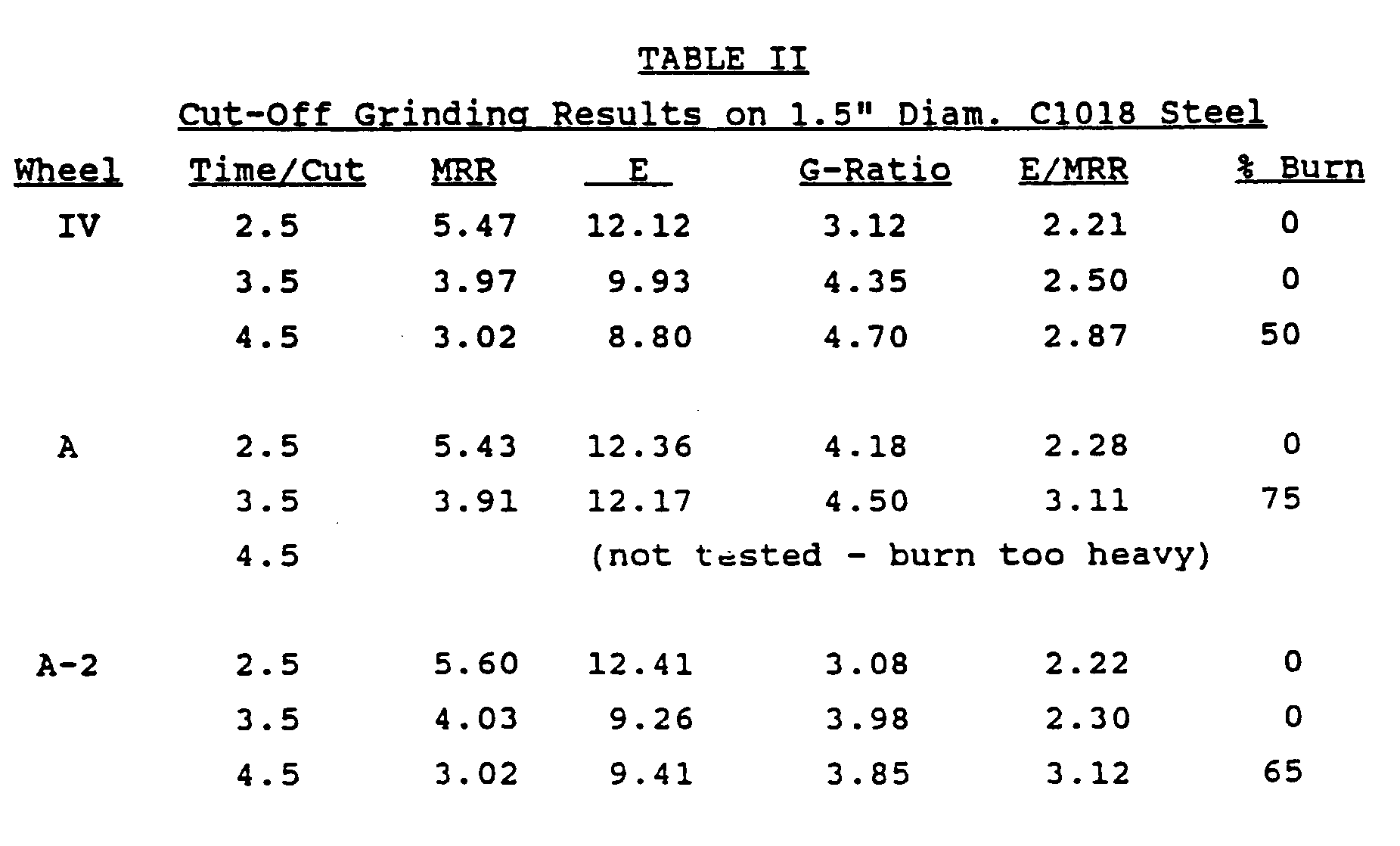
- Table II shows that Wheel IV of this invention performs with equal durability (G-ratio) at high cut rate as the softer version of Wheel A, i.e. Wheel A-2, but that at lower cut-rates it is substantially freer cutting and as a result achieves significantly higher wheel life and also a lower level of burn.
Claims (14)
- An abrasive product comprising an abrasive material, active fillers, and an organic polymer for bonding the abrasive and the active fillers together to form the abrasive product, the active fillers comprising a combination of tin, FeS₂, and K₂SO₄.
- The abrasive product of Claim 1, wherein the active fillers are present in an amount of from 5 to 40% by volume of the abrasive product, preferably in an amount of from 10 to 30% by volume of the abrasive product.
- The abrasive product of Claim 1 or 2, wherein the tin is present in an amount of from 2 to 20% by volume of the abrasive product.
- The abrasive product of one of the preceding claims, wherein the organic polymer comprises a phenolic resin.
- The abrasive product of one of the preceding claims, wherein the abrasive is selected from the group consisting of fused alumina, sintered alumina, silicon carbide, garnet, flint, fused alumina-zirconia, diamond, and mixtures thereof.
- The abrasive product of one of the preceding claims, wherein the abrasive comprises alumina.
- The abrasive product of one of the preceding claims, wherein the tin is coated on the surfaces of the abrasive.
- The abrasive product of one of the preceding claims, wherein the volume ration of tin:FeS₂:K₂SO₄ is from about 10:45:45 to about 80:10:10.
- The abrasive product of one of the preceding claims further containing a liquid plasticizer.
- The abrasive product of one of the preceding claims, wherein the abrasive product is a grinding wheel.
- The abrasive product of one of claims 1 to 9, wherein the abrasive product is a coated abrasive product.
- A method of improving the grinding performance of an abrasive product comprising an abrasive material, active fillers consisting of a mixture of FeS₂ and K₂SO₄, and an organic polymer, the method comprising further incorporating tin as an active filler.
- The method of claim 12, wherein the tin is present in an amount of from 2 to 20% by volume of the abrasive product.
- The method of claim 12 or 13, wherein the volume ratio of tin:FeS₂:K₂SO₄ is from about 10:45:45 to about 80:10:10.
Applications Claiming Priority (2)
| Application Number | Priority Date | Filing Date | Title |
|---|---|---|---|
| US601632 | 1990-10-22 | ||
| US07/601,632 US5061295A (en) | 1990-10-22 | 1990-10-22 | Grinding wheel abrasive composition |
Publications (3)
| Publication Number | Publication Date |
|---|---|
| EP0482412A2 EP0482412A2 (en) | 1992-04-29 |
| EP0482412A3 EP0482412A3 (en) | 1992-07-01 |
| EP0482412B1 true EP0482412B1 (en) | 1995-12-06 |
Family
ID=24408204
Family Applications (1)
| Application Number | Title | Priority Date | Filing Date |
|---|---|---|---|
| EP91117055A Expired - Lifetime EP0482412B1 (en) | 1990-10-22 | 1991-10-07 | Abrasive product and method of its use |
Country Status (6)
| Country | Link |
|---|---|
| US (1) | US5061295A (en) |
| EP (1) | EP0482412B1 (en) |
| JP (1) | JP2950657B2 (en) |
| KR (1) | KR0178404B1 (en) |
| CA (1) | CA2047129C (en) |
| DE (1) | DE69115220T2 (en) |
Families Citing this family (24)
| Publication number | Priority date | Publication date | Assignee | Title |
|---|---|---|---|---|
| US5269821A (en) * | 1992-02-20 | 1993-12-14 | Minnesota Mining And Manufacturing Company | Coatable mixtures including erodable filler agglomerates, methods of preparing same, abrasive articles incorporating cured versions of same, and methods of making said articles |
| US5562745A (en) * | 1994-03-16 | 1996-10-08 | Minnesota Mining And Manufacturing Company | Abrasive articles, methods of making abrasive articles, and methods of using abrasive articles |
| AT402907B (en) * | 1995-10-16 | 1997-09-25 | Chemetall Gmbh | TWO AND THREE METAL SULFIDES AS ACTIVE FILLERS FOR GRINDING BODIES, AND GRINDING BODIES CONTAINING TWO AND / OR THREE METAL SULFIDES |
| JPH11513620A (en) * | 1995-10-20 | 1999-11-24 | ミネソタ・マイニング・アンド・マニュファクチャリング・カンパニー | Abrasive article containing inorganic metal orthophosphate |
| DE69628947D1 (en) * | 1995-10-20 | 2003-08-07 | Minnesota Mining & Mfg | ABRASIVE ARTICLES CONTAINING INORGANIC PHOSPHATES |
| US6270543B1 (en) * | 1997-10-02 | 2001-08-07 | 3M Innovative Properties Company | Abrasive article containing an inorganic metal orthophosphate |
| US6039775A (en) * | 1997-11-03 | 2000-03-21 | 3M Innovative Properties Company | Abrasive article containing a grinding aid and method of making the same |
| CN1061285C (en) * | 1998-01-06 | 2001-01-31 | 梁永辉 | Ultra-thin cutting grinding wheel and production process thereof |
| DE10053858A1 (en) * | 2000-10-30 | 2002-05-08 | Stockhausen Chem Fab Gmbh | Absorbent structure with improved blocking properties |
| DE10161496A1 (en) * | 2001-12-14 | 2003-06-26 | Stockhausen Chem Fab Gmbh | Compacted superabsorber for use, e.g. in hygiene articles, obtained by compaction under pressure of a composition containing synthetic superabsorber particles with a high fines content |
| DE10201783A1 (en) * | 2002-01-17 | 2003-08-21 | Stockhausen Chem Fab Gmbh | Process for the oxidation of unsaturated hydrocarbons |
| DE10212702A1 (en) * | 2002-03-21 | 2003-10-09 | Stockhausen Chem Fab Gmbh | Basic polymer obtained by hydrogenation |
| DE10231356B4 (en) * | 2002-07-11 | 2007-02-15 | Stockhausen Gmbh | Water-absorbing, foam-like polymer structures, process for their preparation, their use and composites made therefrom |
| DE10330960B4 (en) * | 2003-07-08 | 2005-09-08 | Stockhausen Gmbh | Active substance-doped absorbent polymer particles, composition comprising polycondensate matrix and absorbent polymer for release of a wound healing substance |
| KR100537092B1 (en) * | 2003-10-27 | 2005-12-16 | 김동기 | Method of producing an abrasive |
| DE102004035088A1 (en) * | 2004-07-20 | 2006-02-16 | Chemetall Ges.Mbh | Organically bound release or abrasive particles with a functional additive |
| GB2431163A (en) * | 2005-07-11 | 2007-04-18 | Itri Ltd | Friction material and process for the production thereof |
| US8808412B2 (en) | 2006-09-15 | 2014-08-19 | Saint-Gobain Abrasives, Inc. | Microfiber reinforcement for abrasive tools |
| US20120100784A1 (en) * | 2006-09-15 | 2012-04-26 | Saint-Gobain Abrasifs | Microfiber Reinforcement for Abrasive Tools |
| DE102007008288A1 (en) | 2007-02-16 | 2008-08-21 | Evonik Stockhausen Gmbh | Method for testing of stability of laminar suction layer under load, involves fixing suction layer between two fixed areas and moving sample is passed through twice equally |
| KR100841966B1 (en) * | 2007-06-19 | 2008-06-27 | (주)디앤디 디스크산업 | Material composition for manufacturing the cutting wheel and cutting wheel according to the composition |
| EP2177318B1 (en) * | 2009-04-30 | 2014-03-26 | Saint-Gobain Abrasives, Inc. | Abrasive article with improved grain retention and performance |
| TWI541098B (en) * | 2012-06-06 | 2016-07-11 | 聖高拜磨料有限公司 | Small diameter cutting tool |
| US20130337730A1 (en) * | 2012-06-06 | 2013-12-19 | Siddharth Srinivasan | Large diameter cutting tool |
Citations (1)
| Publication number | Priority date | Publication date | Assignee | Title |
|---|---|---|---|---|
| EP0375803A1 (en) * | 1988-12-30 | 1990-07-04 | Tyrolit Schleifmittelwerke Swarovski KG | Abrasive body |
Family Cites Families (9)
| Publication number | Priority date | Publication date | Assignee | Title |
|---|---|---|---|---|
| US3030198A (en) * | 1960-05-18 | 1962-04-17 | Cincinnati Milling Machine Co | Abrasive article |
| US3246970A (en) * | 1963-07-24 | 1966-04-19 | Carborundum Co | Abrasive articles with iron sulfide and potassium aluminum fluoride filler |
| US3942959A (en) | 1967-12-22 | 1976-03-09 | Fabriksaktiebolaget Eka | Multilayered flexible abrasive containing a layer of electroconductive material |
| DE2835543A1 (en) * | 1978-08-14 | 1980-02-28 | Riedel De Haen Ag | NON-TOXIC ACTIVE FILLER IN GRINDING WHEELS |
| AT365552B (en) * | 1980-04-01 | 1982-01-25 | Swarovski Tyrolit Schleif | ABRASIVE BODY WITH ABRASIVE GRAIN, EXAMPLE CORUND |
| CA1188103A (en) * | 1981-03-20 | 1985-06-04 | Richard H. Sioui | Cbn grinding wheel |
| EP0078896A2 (en) * | 1981-11-10 | 1983-05-18 | Norton Company | Abrasive bodies such as grinding wheels |
| US4475926A (en) | 1982-02-25 | 1984-10-09 | Norton Company | Active filler for grinding wheels |
| JPS609660A (en) * | 1983-06-27 | 1985-01-18 | Toshiba Corp | Grinding wheel |
-
1990
- 1990-10-22 US US07/601,632 patent/US5061295A/en not_active Expired - Fee Related
-
1991
- 1991-07-16 CA CA002047129A patent/CA2047129C/en not_active Expired - Fee Related
- 1991-09-11 JP JP3231651A patent/JP2950657B2/en not_active Expired - Lifetime
- 1991-10-07 DE DE69115220T patent/DE69115220T2/en not_active Expired - Fee Related
- 1991-10-07 EP EP91117055A patent/EP0482412B1/en not_active Expired - Lifetime
- 1991-10-21 KR KR1019910018499A patent/KR0178404B1/en not_active Expired - Fee Related
Patent Citations (1)
| Publication number | Priority date | Publication date | Assignee | Title |
|---|---|---|---|---|
| EP0375803A1 (en) * | 1988-12-30 | 1990-07-04 | Tyrolit Schleifmittelwerke Swarovski KG | Abrasive body |
Also Published As
| Publication number | Publication date |
|---|---|
| DE69115220T2 (en) | 1996-06-27 |
| EP0482412A3 (en) | 1992-07-01 |
| JPH04226863A (en) | 1992-08-17 |
| KR920008166A (en) | 1992-05-27 |
| CA2047129C (en) | 1999-03-16 |
| US5061295A (en) | 1991-10-29 |
| KR0178404B1 (en) | 1999-04-01 |
| DE69115220D1 (en) | 1996-01-18 |
| EP0482412A2 (en) | 1992-04-29 |
| CA2047129A1 (en) | 1992-04-23 |
| JP2950657B2 (en) | 1999-09-20 |
Similar Documents
| Publication | Publication Date | Title |
|---|---|---|
| US5061295A (en) | Grinding wheel abrasive composition | |
| US4378233A (en) | Metal bonded grinding wheel containing diamond or CBN abrasive | |
| US4800685A (en) | Alumina bonded abrasive for cast iron | |
| US4475926A (en) | Active filler for grinding wheels | |
| US3203775A (en) | Inorganically bonded abrasive articles | |
| CA2025177C (en) | Abrasive article | |
| EP0552190A1 (en) | Coated abrasive containing erodable agglomerates. | |
| JP2829522B2 (en) | Coated diamond abrasive and its manufacturing method | |
| US3899307A (en) | Resin bonded diamond wheels with copper and silicon carbide fillers | |
| US3574579A (en) | Bronze-iron metal-bonded diamond abrasive articles containing boron nitride particles | |
| US2162600A (en) | Filler for abrasive articles | |
| US4883501A (en) | Alumina bonded abrasive for cast iron | |
| JP3347612B2 (en) | Super abrasive whetstone | |
| JPS5882677A (en) | Super particle grindstone | |
| US3476537A (en) | Abrasive composition with limestone as the porosity-inducing agent | |
| JPH0624700B2 (en) | Vitrified grindstone | |
| GB2136011A (en) | Grinding wheel containing cubic boron nitride | |
| JPH01271177A (en) | Super abrasive grain vitrified bond grinding stone and manufacture thereof | |
| JP2765167B2 (en) | Porous resin-bonded grinding wheel and method for producing the same | |
| JPS64183B2 (en) | ||
| JPH0276681A (en) | Saw blade member containing fine diamond or cubic system boron nitride grain | |
| JPH04250983A (en) | Composite grinding stone for grinding | |
| JP2003094341A (en) | Metal bond super abrasive whetstone | |
| JP3314213B2 (en) | Resinoid grinding wheel and method of manufacturing the same | |
| WO2003043784A1 (en) | Mixture of abrasive particles with different toughness |
Legal Events
| Date | Code | Title | Description |
|---|---|---|---|
| PUAI | Public reference made under article 153(3) epc to a published international application that has entered the european phase |
Free format text: ORIGINAL CODE: 0009012 |
|
| AK | Designated contracting states |
Kind code of ref document: A2 Designated state(s): BE DE GB SE |
|
| PUAL | Search report despatched |
Free format text: ORIGINAL CODE: 0009013 |
|
| AK | Designated contracting states |
Kind code of ref document: A3 Designated state(s): BE DE GB SE |
|
| 17P | Request for examination filed |
Effective date: 19921223 |
|
| 17Q | First examination report despatched |
Effective date: 19940804 |
|
| GRAA | (expected) grant |
Free format text: ORIGINAL CODE: 0009210 |
|
| AK | Designated contracting states |
Kind code of ref document: B1 Designated state(s): BE DE GB SE |
|
| REF | Corresponds to: |
Ref document number: 69115220 Country of ref document: DE Date of ref document: 19960118 |
|
| PLBE | No opposition filed within time limit |
Free format text: ORIGINAL CODE: 0009261 |
|
| STAA | Information on the status of an ep patent application or granted ep patent |
Free format text: STATUS: NO OPPOSITION FILED WITHIN TIME LIMIT |
|
| 26N | No opposition filed | ||
| PGFP | Annual fee paid to national office [announced via postgrant information from national office to epo] |
Ref country code: SE Payment date: 20010920 Year of fee payment: 11 Ref country code: DE Payment date: 20010920 Year of fee payment: 11 |
|
| PGFP | Annual fee paid to national office [announced via postgrant information from national office to epo] |
Ref country code: GB Payment date: 20010921 Year of fee payment: 11 |
|
| PGFP | Annual fee paid to national office [announced via postgrant information from national office to epo] |
Ref country code: BE Payment date: 20011010 Year of fee payment: 11 |
|
| REG | Reference to a national code |
Ref country code: GB Ref legal event code: IF02 |
|
| PG25 | Lapsed in a contracting state [announced via postgrant information from national office to epo] |
Ref country code: GB Free format text: LAPSE BECAUSE OF NON-PAYMENT OF DUE FEES Effective date: 20021007 |
|
| PG25 | Lapsed in a contracting state [announced via postgrant information from national office to epo] |
Ref country code: SE Free format text: LAPSE BECAUSE OF NON-PAYMENT OF DUE FEES Effective date: 20021008 |
|
| PG25 | Lapsed in a contracting state [announced via postgrant information from national office to epo] |
Ref country code: BE Free format text: LAPSE BECAUSE OF NON-PAYMENT OF DUE FEES Effective date: 20021031 |
|
| BERE | Be: lapsed |
Owner name: *NORTON CY Effective date: 20021031 |
|
| PG25 | Lapsed in a contracting state [announced via postgrant information from national office to epo] |
Ref country code: DE Free format text: LAPSE BECAUSE OF NON-PAYMENT OF DUE FEES Effective date: 20030501 |
|
| GBPC | Gb: european patent ceased through non-payment of renewal fee |
Effective date: 20021007 |
|
| EUG | Se: european patent has lapsed |