EP0482000B1 - Herstellung von künstlichen zähnen und kronen - Google Patents
Herstellung von künstlichen zähnen und kronen Download PDFInfo
- Publication number
- EP0482000B1 EP0482000B1 EP90906802A EP90906802A EP0482000B1 EP 0482000 B1 EP0482000 B1 EP 0482000B1 EP 90906802 A EP90906802 A EP 90906802A EP 90906802 A EP90906802 A EP 90906802A EP 0482000 B1 EP0482000 B1 EP 0482000B1
- Authority
- EP
- European Patent Office
- Prior art keywords
- layer
- tooth
- core portion
- blank
- labial
- Prior art date
- Legal status (The legal status is an assumption and is not a legal conclusion. Google has not performed a legal analysis and makes no representation as to the accuracy of the status listed.)
- Expired - Lifetime
Links
- 238000004519 manufacturing process Methods 0.000 title claims abstract description 19
- 239000000463 material Substances 0.000 claims abstract description 66
- 238000000034 method Methods 0.000 claims abstract description 16
- 210000004268 dentin Anatomy 0.000 claims abstract description 13
- 210000003298 dental enamel Anatomy 0.000 claims abstract description 6
- 239000003086 colorant Substances 0.000 claims description 5
- 238000003801 milling Methods 0.000 abstract description 11
- 238000009826 distribution Methods 0.000 abstract description 8
- 239000004033 plastic Substances 0.000 abstract description 4
- 229920003023 plastic Polymers 0.000 abstract description 4
- 238000003754 machining Methods 0.000 abstract 1
- 239000011162 core material Substances 0.000 description 22
- 238000004040 coloring Methods 0.000 description 4
- 210000004763 bicuspid Anatomy 0.000 description 3
- 210000004283 incisor Anatomy 0.000 description 3
- 238000001746 injection moulding Methods 0.000 description 3
- 229910010293 ceramic material Inorganic materials 0.000 description 2
- 238000005516 engineering process Methods 0.000 description 2
- 238000005259 measurement Methods 0.000 description 2
- 241000282465 Canis Species 0.000 description 1
- 229920006397 acrylic thermoplastic Polymers 0.000 description 1
- 239000000919 ceramic Substances 0.000 description 1
- 239000011248 coating agent Substances 0.000 description 1
- 238000000576 coating method Methods 0.000 description 1
- 239000000549 coloured material Substances 0.000 description 1
- 239000002131 composite material Substances 0.000 description 1
- -1 dimelthylacrylates Substances 0.000 description 1
- 239000000945 filler Substances 0.000 description 1
- 239000002184 metal Substances 0.000 description 1
- 239000000203 mixture Substances 0.000 description 1
- 238000000465 moulding Methods 0.000 description 1
- 210000003254 palate Anatomy 0.000 description 1
- 229920003229 poly(methyl methacrylate) Polymers 0.000 description 1
- 229920002635 polyurethane Polymers 0.000 description 1
- 239000004814 polyurethane Substances 0.000 description 1
- 239000000126 substance Substances 0.000 description 1
- 229920002994 synthetic fiber Polymers 0.000 description 1
- ISXSCDLOGDJUNJ-UHFFFAOYSA-N tert-butyl prop-2-enoate Chemical compound CC(C)(C)OC(=O)C=C ISXSCDLOGDJUNJ-UHFFFAOYSA-N 0.000 description 1
- 210000000332 tooth crown Anatomy 0.000 description 1
Images




Classifications
-
- A—HUMAN NECESSITIES
- A61—MEDICAL OR VETERINARY SCIENCE; HYGIENE
- A61C—DENTISTRY; APPARATUS OR METHODS FOR ORAL OR DENTAL HYGIENE
- A61C13/00—Dental prostheses; Making same
- A61C13/08—Artificial teeth; Making same
- A61C13/09—Composite teeth, e.g. front and back section; Multilayer teeth
-
- A—HUMAN NECESSITIES
- A61—MEDICAL OR VETERINARY SCIENCE; HYGIENE
- A61C—DENTISTRY; APPARATUS OR METHODS FOR ORAL OR DENTAL HYGIENE
- A61C13/00—Dental prostheses; Making same
- A61C13/0003—Making bridge-work, inlays, implants or the like
-
- A—HUMAN NECESSITIES
- A61—MEDICAL OR VETERINARY SCIENCE; HYGIENE
- A61C—DENTISTRY; APPARATUS OR METHODS FOR ORAL OR DENTAL HYGIENE
- A61C13/00—Dental prostheses; Making same
- A61C13/0003—Making bridge-work, inlays, implants or the like
- A61C13/0022—Blanks or green, unfinished dental restoration parts
-
- A—HUMAN NECESSITIES
- A61—MEDICAL OR VETERINARY SCIENCE; HYGIENE
- A61C—DENTISTRY; APPARATUS OR METHODS FOR ORAL OR DENTAL HYGIENE
- A61C13/00—Dental prostheses; Making same
- A61C13/08—Artificial teeth; Making same
Definitions
- This invention relates to a method for the manufacture of artificial teeth and crowns with colourings simulating as closely as possible those of real teeth, and to artificial teeth and crowns manufactured by the method.
- crowns There are two main types of artificial teeth, namely crowns and denture teeth.
- Crown are designed to fit a root stump which is left in the gum after the whole top part of the tooth has been removed, while denture teeth are intended to replace teeth which are no longer present.
- Denture teeth are usually attached to a bridge which extends between two teeth or to a plate which is worn against the upper or lower palate.
- Crown teeth or crowns must be custom made because they must correspond at least approximately in shape to the teeth that they replace, and must fit whatever shape of stump is left for the attachment.
- crowns have been cast from a suitable metal which is left in its original colour, so that the contrast with the natural teeth make them quite obvious.
- a more cosmetically acceptable crown is moulded from ceramic material and then surface painted to match the surrounding teeth as closely as possible (see for example EP-A-0 160 797).
- Such crowns and the process by which they are made have a number of disadvantages. For example the process is very labour intensive and the pointed-on colour wears off in time.
- the ceramic materials from which these crowns are made are harder than natural teeth and this often results in accelerated wear of the opposing teeth.
- Teeth are made up of three major layers, namely an interior pulp, a surrounding dentine, and an outer coating of enamel; the enamel and dentine are translucent so that all three layers contribute to the colour which is visible from outside the tooth. The resulting depth and distribution of colour in a natural tooth is very difficult to duplicate.
- a new crown making technology which has recently become available provides a tooth body made from synthetic material, usually plastics, material which is shaped in a computer-controlled milling machine and then surface pointed.
- the process is highly automated and provides great savings in labour, while another benefit is that the hardness of these teeth can be matched more closely to that of natural teeth.
- the problems of surface wear of the painted-on colour and the less natural look of a pointed-on surface are still present.
- Denture teeth generally are not custom made, but instead are provided in a wide assortment of standard shapes, sizes and colours, from which the denture maker may choose. At one time most denture teeth were moulded from homogeneous blocks of ceramic and surface pointed in a manner similar to that described above for crown tooth manufacture. Current technology provides denture teeth which are moulded with a number of internal successive coloured layers, each of the layers contributing to the colour which is visible on the outside of the tooth. This moulding process provides a tooth with a depth and distribution of colour more closely resembling that of a natural tooth, but requires at least three separate moulds for each tooth and would be prohibitivly expensive in a custom process for producing individual crowns.
- a method of manufacturing an artificial tooth of a required colour comprising: providing a blank including a core portion having lingual, labial, mesial, distal, gingival and occlusal sides, the core portion approximating in shape at least at its labial, mesial and distal sides to the shape of a corresponding core portion of the tooth to be manufactured therefrom; reference means on the blank establishing a reference point from which the removal of material from the blank can be determined, characterised by at least one layer of another material or materials overlaying at least the occlusal, labial, mesial and distal surfaces of the core portion; and by selectively removing material from the block to form the tooth and expose at least at the labial, mesial and distal sides the said at least one layer of said another material in a thickness or thicknesses to provide a tooth shaped artificial tooth of the required colour at least at the labial, mesial and distal surfaces thereof.
- a blank for the manufacture of an artificial tooth of a desired colour comprising: a core portion having lingual, labial, mesial, distal gingival and occlusal sides, the core portion approximating in shape at least at its labial, mesial and distal sides to the shape of a corresponding core portion of a tooth to be manufactured therefrom by removal of material from the blank; reference means on the blank establishing a reference point from which the removal of material from the blank can be determined, characterised in that at least one layer of another material or materials overlays at least the occlusal, labial, mesial and distal surfaces of the core portion; and in that the core portion and the at least one other layer together provide at at least the labial, mesial and distal surfaces the required colour for the tooth upon selective removal of material from the block to leave a tooth-shaped artificial tooth.
- the method of the invention preferably makes use of a commercially available system which was developed by La cios Hennson in France for milling teeth from a homogeneous block of plastics material which has the desired milling and wear characteristics.
- this system the patient's teeth are examined to determine the size and shape of the tooth or crown required, the surrounding and opposing teeth being also measured to ensure a correct replacement, these measurements being obtained with an endoscope mounted laser camera.
- the colouring of the surrounding teeth must also be determined so as to be able to make the new tooth match the existing tooth colour as closely as possible,
- the measured parameters obtained from this examination are input into a computer control system which will guide the milling machine to develop the required tooth shape and colour, as will be described below.
- the method employs a blank 20 as shown in Figure 1 comprising a central portion 22 of standard shape, which in this embodiment is cylindrical with the cylindrical axis 24 extending occlusially-gingivally.
- This central portion is provided at its mesial and distal sides with two standard shaped wing portions 26 to form a complete blank as shown in Figure 2, these wing portions constituting means by which the block is held in the milling machine for removal of material therefrom.
- the central portion is provided with mesially, distally extending protrusions 28 about which the wings are moulded, as by injection moulding.
- the central portion is also provided with an occlusially-gingivally extending bore 30 through which the axis 24 posses, the junction of this axis and the bottom surface of the bore constituting a reference point 32 to which all measurements of the milling machine can be referred to ensure the accuracy of the milling operation.
- the central portion 22 is shown in Figure 1 as having a segment cut away to show its interior, and it will be seen that there is a central core portion 34 which approximates in shape, at least at its labial, mesial and distal sides, to the shape of a corresponding core portion of the particular tooth to be manufactured from the blank by removal of material using the computer controlled milling machine.
- the tooth is one of the lower incisors.
- This central portion is overlaid, at least at its occlusial, labial, mesial and distal surfaces by a relatively thin first layer 36 of another material of different colour to the core material.
- the layer 36 is in turn overlaid by a second layer 38 of another material of a different colour from the other two materials, this second layer being made sufficiently thick that it forms the desired cylindrical shape of the central portion 22.
- a blank is readily made by injection-moulding the core and the layers in successive operations.
- the blank is mounted in the milling machine and the tooth shape is now milled therefrom so as to provide at the occlusical, labial, mesial and distal surfaces of the core portion 34 the thicknesses of the layers 36 and 38 such that with their colour and translucency the resulatent incisor tooth will have as closely as possible the desired colour to match the adjoining teeth, without the need to point colour on the external surface, as in the prior art methods.
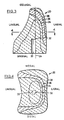
- the cross-section through such a tooth, taken in the occlusal-gingeval extending plane is shown in Figure 3, while the corresponding mesial-distal cross-section is shown in Figure 4.
- the gingeval and lingual surfaces of the tooth are constituted by the material of the shoulder or central core portion 34, so that there is no control of the colour of these two surfaces, but this is immaterial since the gingival surface abuts the tooth stump to which the crown is fastened, and the lingual surface is only seen by someone inspecting the interior of the mouth, such as the prosthodontist.
- the blank preferably is made by injection moulding the different coloured materials one on the other from suitable plastics materials such as acrylics, polyurethanes, dimelthylacrylates, and composites thereof. All three materials of the different layers can be of the same chemical composition, with the exception of the inclusion therein of different fillers to provide the different colours and translucency that are required to provide a suitable range of tooth colours from a single blank. It will usually be necessary to provide a number of different blanks for the full range of replacement teeth that must be provided, owing to differences in size, basic colour and colour distribution. Since the central core portion 34 approximates the basic shape of the tooth to be manufactured, it will be seen that different blanks will also be required for the other tooth shapes present in the human mouth, namely the canines, bicuspids and molars, both upper and lower.
- suitable plastics materials such as acrylics, polyurethanes, dimelthylacrylates, and composites thereof. All three materials of the different layers can be of the same chemical composition, with the exception of the
- Figures 5, 6 and 7 illustrate the manner in which different tooth colours and colour distributions can be achieved from the same basic shoulder or core portion 34 and layers 36 and 38.
- the profile is tilted toward the labial and extends close to the gingival surface, so that the layer 38 is relatively thick at the incisal occlusal surface and the upper port of the labial surface, while the gingival portion of the labial surface is provided by the layers 36 and the core 34.
- the profile in Figures 6 and 7 is more upright and are respectively closer to the occlusal and gingival surfaces, thereby correspondingly varying the thicknesses and thickness distribution of the layers 36 and 38 and the resultant tooth colour and colour distribution.
- the three material layers 34, 36 and 38 can be regarded as corresponding respectively approximately to the pulp, dentine and enamel (incisal material) of the human tooth and their thicknesses and transparency or translucency, particularly of the two layers 36 and 38, can be adjusted to give the equivalent colour (hue) and colour density or saturation (chroma) of the tooth which is replaced by the artificial tooth.
- colour and translucency of the underlying layers contributes more to the colour of the tooth as seen by the observer, as with the pulp, dentine and enamel of natural teeth.
- the hardness of the material is of course chosen to approximate as closely as possible that of the human tooth it replaces, so that its wear characteristic will be similar to that of the adjacent teeth, and its characteristic change of colour with age and wear will also be similar.
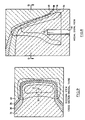
- Figures 8 through 11 show a further development of the invention in which the core 34 is provided, at least overlying its occlusal, labial, mesial and distal surfaces, with three superimposed layers 36, 38 and 40, the last layer 40 being the layer that is extended to form the block of standard external size, which with these embodiments can be rectangular in plan and elevation.
- Figure 8 shows a mesial-distal view of the tooth in an occlusal-gingival plane and it will be seen that the lingual surface is almost entirely within the core 34, except close to the occlusal end.
- FIG. 9 is an occlusal view of Figure 8 taken on the line 9-9 in Figure 8.
- Figure 10 is a similar cross section to Figure 8 of a block intended for the production of a bicuspid tooth crown and showing the profile thereof, while Figure 11 is an occlusal view taken on the line 11-11 in Figure 10.
- the provision of four layers provides even greater flexibility in obtaining the desired tooth colour and colour distribution.
- the colour is sometimes in the industry referred to as the hue, while the value is the gray scale value for a particular colour.
- the colour density or saturation is referred to as the chroma.
- the core material 34 can have its own distinctive colour since it will frequently appear at least at the gingival end of the labial surface, or it can be given the desired dentine or base colour.
- the first layer 36 can instead or in addition be given the base or dentine colour, while the second layer 38 can be an intermediate dentine colour to give the desired wider variation.
- the third layer 40 simulates the incisal material and is coloured appropriately, or in some embodiments can be completely clear, particularly with blanks for the production of anterior teeth.
- the block 22 may measure about 9 cm in the mesial-distal direction, and about 1.2 cm in both the occlusal-gingival and labial-lingual directions.
- the replacement tooth for an upper central incisor typically measures about 9.5mm occlusially-gingivally, about 1.5mm labially-lingually at the occlusal surface, about 6.5mm labially-lingually at the gingival surface, and about 8mm mesially-distally.
- the first layer 36 may have a thickness of about 0.3mm at the labial surface increasing progressively at the occlusal surface to about 0.75mm, and also increasing progressively at the gingival end to about the same.
- the second layer 36 may have a thickness of about 0.2mm at the labial surface increasing progressively to about 0.5mm at the occlusal and gingival ends.
Landscapes
- Health & Medical Sciences (AREA)
- Oral & Maxillofacial Surgery (AREA)
- Dentistry (AREA)
- Epidemiology (AREA)
- Life Sciences & Earth Sciences (AREA)
- Animal Behavior & Ethology (AREA)
- General Health & Medical Sciences (AREA)
- Public Health (AREA)
- Veterinary Medicine (AREA)
- Dental Tools And Instruments Or Auxiliary Dental Instruments (AREA)
- Dental Prosthetics (AREA)
Claims (10)
- Verfahren zur Herstellung eine künstlichen Zahnes mit einer gewünschten Farbe, das umfaßt:
Bereitstellung eines Rohlings (20), der einen Kernbereich (34) mit Zungen-, Lippen-, Mesial-, Distal-, Zahnfleisch- und Zahnreihenschluß-Seiten enthält, wobei der Kernbereich sich in seiner Gestalt mindestens an seinen Lippen-, Mesial- und Distal-Seiten der Gestalt eines entsprechenden Kernbereiches des Zahnes annähert, der aus diesem hergestellt werden soll;
Bezugsmittel (30) auf dem Rohling, die einen Bezugspunkt (33) festlegen, von dem aus die Materialentfernung von dem Rohling festgestellt werden kann,
gekennzeichnet durch mindestens eine Schicht (36, 38, 40) aus einem weiteren Material oder Materialien, die mindestens die Zahnreihenschluß-, Lippen-, Mesial- und Distal-Oberflächen des Kernbereiches überdecken;
und durch
selektive Materialentfernung von dem Block, um den Zahn zu formen, und Auftragen der mindestens einen Schicht des weiteren Materials mindestens auf den Lippen-, Mesial- und Distal-Seiten mit einer Dicke oder Dicken, um einen Zahn bereitzustellen, der künstlich geformt ist, wobei der Zahn mindesten auf seinen Lippen-, Mesial- und Distal-Oberflächen die gewünschte Farbe besitzt. - Verfahren gemäß Anspruch 1, bei dem die mindestens eine andere Schicht aus einem weiteren Material oder Materialien eine erste Schicht (36) eines entsprechenden Materials, das den Kernbereich bedeckt, und eine zweite Schicht (38) eines entsprechenden Materials, das die erste Schicht bedeckt, umfaßt, wobei das Material der ersten Schicht dem Dentinum eines Zahnes und das Material der zweiten Schicht dem Zahnmaterial eines Zahnes gleicht.
- Verfahren gemäß Anspruch 1, bei dem die mindestens eine andere Schicht aus einem weiteren Material eine erste Schicht (36) eines entsprechenden Materials, die den Kernbereich überdeckt, eine zweite Schicht (38) eines entsprechenden Materials, die die erste Schicht überdeckt, und eine dritte Schicht (40) eines entsprechenden Materials, die die zweite Schicht überdeckt, umfaßt, wobei das Material der ersten Schicht dem Dentinum eines Zahnes und das Material der dritten Schicht dem Zahnmaterial eines Zahnes gleichen.
- Verfahren nach einem der Ansprüche 1 bis 3, bei dem das Bezugsmittel für den Rohling eine Bohrung (30) in dem Kernbereich bildet, die sich zu seiner Zahnfleischseite hin öffnet, wobei der Bezugspunkt (32) sich am Boden der Bohrung in dem Kernbereich befindet.
- Rohling (20) zur Herstellung eines künstlichen Zahnes einer gewünschten Farbe, umfassend:
einen Kernbereich (34) mit Zungen-, Lippen-, Mesial-, Distal-, Zahnfleisch- und Zahnreihen-Seiten, wobei sich der Kernbereich in der Gestalt mindestens an seinen Lippen-, Mesial- und Distal-Seiten der Gestalt eines entsprechenden Kernbereiches eines Zahnes annähert, der aus diesem durch Entfernung von Material von dem Rohling hergestellt werden soll;
Bezugsmittel (30) auf dem Rohling, die einen Bezugspunkt (32) festlegen, von dem aus die Materialentfernung von dem Rohling bestimmt werden kann,
gekennzeichnet durch mindestens eine Schicht (36, 38, 40) aus einem weiteren Material oder Materialien, die mindestens die Zahnreihen-, Lippen-, Mesial- und Distal-Oberflächen des Kernbereiches überdecken, wobei der Kernbereich (34) und die mindestens eine andere Schicht (36, 38, 40) gemeinsam an mindestens den Lippen-, Mesial- und Distal-Oberflächen die gewünschte Farbe für den Zahn nach der selektiven Materialentfernung von dem Block bereitstellen, um einen zahnförmigen, künstlichen Zahn zu hinterlassen. - Rohling gemäß Anspruch 5, bei dem die mindestens eine andere Schicht aus einem weiteren Material oder Materialien eine erste Schicht (36) eines entsprechenden Materials, die den Kernbereich überdeckt, und eine zweite Schicht (38) eines entsprechenden Materials, die die erste Schicht überdeckt, umfaßt, wobei das Material der ersten Schicht dem Dentinum eines Zahnes und das Material der zweiten Schicht dem Zahnmaterial eines Zahnes gleichen.
- Rohling gemäß Anspruch 6, bei dem die mindestens eine andere Schicht eine weitere Schicht (40) aus einem Material, das mindestens deren Zahnreihen-, Lippen-, Mesial-, und Distal-Oberflächen überdeckt, und mit einer Gestalt zur Ausbildung eines Blocks mit einer äußeren Standard-Größe und -gestalt besitzt, die ohne Bezug von den Größen und Gestalten des ersten Kernabschnittes (34) und der mindestens einen anderen Schicht (36, 38, 40) sind.
- Rohling gemäß Anspruch 6, bei dem die mindestens eine andere Schicht aus einem weiteren Material eine erste Schicht (36) eines entsprechenden Materials, die den Kernbereich (34) überdeckt, eine zweite Schicht (38) eines entsprechenden Materials, die die erste Schicht überdeckt, und eine dritte Schicht (40) eines entsprechenden Materials, das die zweite Schicht überdeckt, umfaßt, wobei das Material der ersten Schicht dem Dentinum eines Zahnes und das Material der dritten Schicht dem Zahnmaterial eines Zahnes gleichen.
- Rohling gemäß einem der Ansprüche 5 bis 8, bei dem das Bezugsmittel für den Rohling eine Bohrung (30) in dem Kernbereich ist, die sich zu seiner Zahnfleischseite hin öffnet, wobei der Bezugspunkt (32) sich an dem Boden der Bohrung in dem Kernbereich befindet.
- Rohling gemäß einem der Ansprüche 5 bis 9, bei dem die Materialien aller Schichten (36, 38, 40) sich voneinander in der Farbe unterscheiden und die verschiedenen Farben jeweils denen entsprechen, die zur Simulierung des Zahnmarks, des Dentinums und dem Zahnschmelz eines natürlichen Zahnes erwünscht sind.
Applications Claiming Priority (2)
| Application Number | Priority Date | Filing Date | Title |
|---|---|---|---|
| US07/350,964 US4970032A (en) | 1989-05-12 | 1989-05-12 | Processes for the manufacture of artificial teeth and crowns |
| US350964 | 1989-05-12 |
Publications (2)
| Publication Number | Publication Date |
|---|---|
| EP0482000A1 EP0482000A1 (de) | 1992-04-29 |
| EP0482000B1 true EP0482000B1 (de) | 1993-04-21 |
Family
ID=23378983
Family Applications (1)
| Application Number | Title | Priority Date | Filing Date |
|---|---|---|---|
| EP90906802A Expired - Lifetime EP0482000B1 (de) | 1989-05-12 | 1990-05-11 | Herstellung von künstlichen zähnen und kronen |
Country Status (5)
| Country | Link |
|---|---|
| US (1) | US4970032A (de) |
| EP (1) | EP0482000B1 (de) |
| JP (1) | JPH04505113A (de) |
| CA (1) | CA2049326C (de) |
| WO (1) | WO1990013268A1 (de) |
Cited By (1)
| Publication number | Priority date | Publication date | Assignee | Title |
|---|---|---|---|---|
| US10076388B2 (en) | 2013-03-05 | 2018-09-18 | Sirona Dental Systems Gmbh | Method and device for the production of a dental prosthesis part |
Families Citing this family (61)
| Publication number | Priority date | Publication date | Assignee | Title |
|---|---|---|---|---|
| US5125970A (en) * | 1991-01-03 | 1992-06-30 | Klepacki John A | Material and method for colorizing dental prostheses |
| DE4210781C2 (de) * | 1992-04-01 | 1995-04-13 | Rauter Vita Zahnfabrik | Serienmäßig hergestellte Kunstzahnrohlinge |
| US5308243A (en) * | 1992-09-17 | 1994-05-03 | Steven Edward Severy | Method and compositions for producing life-like dental porcelain restorations and dental porcelain restorations so produced |
| US5718585A (en) * | 1995-09-15 | 1998-02-17 | Dentsply Research & Development Corp. | Prosthetic teeth and mold making therefor |
| EP0807422B1 (de) * | 1996-05-17 | 2004-11-03 | Brandestini, Marco, Dr. | Verfahren zur Herstellung dentaler Rekonstruktionen und Rohling zur Durchführung des Verfahrens |
| DE19714178C2 (de) * | 1997-04-07 | 2003-09-18 | Ivoclar Vivadent Ag | Verfahren zur Herstellung eines mehrfarbigen Formkörpers für die Weiterverarbeitung zu einer Zahnrestauration und zugehöriger Formkörper |
| RU2138224C1 (ru) * | 1998-02-18 | 1999-09-27 | Коротков Борис Павлович | Гидродинамический пресс |
| CA2357000A1 (en) * | 1999-01-08 | 2000-07-13 | 3M Innovative Properties Company | Dental mill blanks |
| DE19944130A1 (de) * | 1999-09-15 | 2001-04-12 | Paul Weigl | Verfahren zur automatischen Herstellung von ästhetischem Zahnersatz unter Verwendung von in Farbe, Transluzenz, Helligkeit und/oder Transparenz graduierten Materialblöcken |
| WO2001032093A1 (en) | 1999-11-02 | 2001-05-10 | Jeneric/Pentron Incorporated | Cad/cam blocks in the manufacture of dental materials |
| CA2393212C (en) * | 1999-12-07 | 2009-05-05 | Volker Herold | Method for producing a ceramic dental prosthesis and a high-strength ceramic dental prosthesis produced according thereto |
| US6488503B1 (en) | 1999-12-21 | 2002-12-03 | Dentsply Research & Development Corp. | Prosthetic teeth and method of making therefor |
| US6482284B1 (en) | 2000-08-31 | 2002-11-19 | 3M Innovative Properties Company | Method of making a dental mill blank and support stub assembly |
| US6627248B1 (en) | 2000-11-10 | 2003-09-30 | Jeneric/Pentron Incorporated | Metallization of ceramic restorations |
| US6669875B2 (en) | 2000-12-18 | 2003-12-30 | 3M Innovative Properties Company | Method for making a dental mill blank assembly |
| ES2324658T3 (es) | 2002-12-31 | 2009-08-12 | D4D Technologies Llc. | Sistema digitalizador por laser para aplicaciones dentales. |
| EP1606576A4 (de) | 2003-03-24 | 2006-11-22 | D3D L P | Laserdigitalisierersystem für zahnmedizinische anwendungen |
| AU2004237243B2 (en) | 2003-05-05 | 2010-11-11 | D4D Technologies, Llc | Optical coherence tomography imaging |
| EP1663046A4 (de) | 2003-09-17 | 2011-10-05 | D4D Technologies Llc | Dreidimensionale hochgeschwindigkeits-multileitungs-digitalisierung |
| US8371851B2 (en) | 2004-03-12 | 2013-02-12 | Ivoclar Vivadent Ag | Dental implant abutment |
| US20060194896A1 (en) * | 2004-05-26 | 2006-08-31 | Sun Benjamin J | Low shrinkage dental material and method |
| DE102006010665B4 (de) * | 2006-03-08 | 2008-02-21 | Dentales Service Zentrum Gmbh & Co. Kg | Herstellung von Zahnersatz |
| DE102006040798A1 (de) * | 2006-08-31 | 2008-03-20 | Merz Dental Gmbh | Seitenansatz |
| DE502006009446D1 (de) * | 2006-09-13 | 2011-06-16 | Ivoclar Vivadent Ag | Mehrfarbiger Formkörper |
| EP2099381B1 (de) * | 2006-12-28 | 2017-11-15 | Russell A. Giordano | MEHRFARBIGER Dentalrohling |
| WO2009026943A1 (de) * | 2007-08-27 | 2009-03-05 | Dentales Service Zentrum Gmbh & Co. Kg | Herstellung von zahnersatz |
| CN102098981B (zh) | 2008-07-21 | 2014-05-07 | 维塔假牙制造厂H·劳特有限责任两合公司 | 多孔硅酸盐陶瓷体牙齿修复体及其制备方法 |
| BRPI0915990B8 (pt) * | 2008-07-21 | 2021-06-22 | Vita Zahnfabrik H Rauter Gmbh & Co Kg | membro moldado feito de material de forma estabilizada e método para fabricação do mesmo |
| ES2717613T3 (es) * | 2008-09-16 | 2019-06-24 | Straumann Holding Ag | Pilar con núcleo mínimo |
| EP2163221B1 (de) * | 2008-09-16 | 2017-12-13 | Straumann Holding AG | Dentalimplantat mit Minimalkern |
| WO2010087954A2 (en) | 2009-01-27 | 2010-08-05 | Dentsply International Inc. | Hybrid polymer network compositions for use in dental applications |
| US8521317B2 (en) * | 2009-11-24 | 2013-08-27 | Sirona Dental Systems Gmbh | Systems, methods, apparatuses, and computer-readable storage media for designing and manufacturing prosthetic dental items |
| DE102011118029A1 (de) | 2011-06-20 | 2012-12-20 | Universität Leipzig | Modifizierte antibiotische Peptide mit variabler systemischer Freisetzung |
| US8641938B2 (en) | 2011-09-27 | 2014-02-04 | Cmp Industries Llc | Denture and method and apparatus of making same |
| DE102011116853A1 (de) | 2011-10-25 | 2013-04-25 | Merz Dental Gmbh | Zahnsatzformblock zur Herstllung eines Zahnersatzteils und Verfahren zur Herstellung eines Zahnersatzteils |
| ES2726531T3 (es) * | 2011-11-15 | 2019-10-07 | Kronacher Werkzeugbau Klug Gmbh&Co Kg | Pieza bruta para dientes artificiales con varias capas de color diferentes y procedimiento para su producción |
| WO2013122662A1 (en) * | 2012-02-13 | 2013-08-22 | 3M Innovative Properties Company | Dental milling block containing individualized dental article and process of production |
| CN104244862B (zh) * | 2012-02-27 | 2017-07-21 | 巴伊材料公司 | 牙科产品及其制作方法 |
| CN102579148A (zh) * | 2012-03-05 | 2012-07-18 | 深圳市爱尔创科技有限公司 | 美学全氧化锆修复体的制备方法 |
| IN2014DN09562A (de) * | 2012-05-10 | 2015-07-17 | Renishaw Plc | |
| US9610145B2 (en) * | 2013-03-15 | 2017-04-04 | Cmp Industries Llc | Precision-milled denture teeth and method and devices for making same |
| US9468509B2 (en) | 2013-03-15 | 2016-10-18 | Cmp Industries Llc | Dental crowns and bridges and method of making same |
| BR112016007358A2 (pt) | 2013-10-04 | 2017-08-01 | 3M Innovative Properties Co | bloco bruto para usinagem de próteses dentárias |
| ITMI20132131A1 (it) * | 2013-12-19 | 2015-06-20 | Heraeus Kulzer Gmbh | Procedimento di stratificazione sopra un'interfaccia sagomata per la realizzazione di sovrastrutture di tipo migliorato per protesi e sovrastruttura per protesi dentale realizzata con questo procedimento |
| AT516056B1 (de) | 2015-01-29 | 2016-02-15 | Steger Heinrich | Rohling zur Herstellung eines Zahnersatzes |
| DK3064170T3 (da) | 2015-03-04 | 2021-08-23 | Ivoclar Vivadent Ag | Dentalt proteseråemne og fremgangsmåde til fremstilling af en dental protese |
| JP5927331B1 (ja) | 2015-08-28 | 2016-06-01 | 株式会社松風 | 複数の層を視覚的に認識できる歯科用被切削体 |
| KR102540474B1 (ko) | 2016-02-19 | 2023-06-05 | 소후 인코포레이티드 | 색조 재현성이 높은 다층 구조 치과 절삭 가공용 세라믹스 블랭크 |
| EP3108849B2 (de) | 2016-04-25 | 2025-03-12 | Solventum Intellectual Properties Company | Mehrschichtiger zirkonoxid-kunstzahnrohling und verfahren zur herstellung |
| DE102016119934A1 (de) * | 2016-10-19 | 2018-05-03 | Degudent Gmbh | Verfahren zur Herstellung eines Rohlings, Rohling sowie eine dentale Restauration |
| EP3318218B1 (de) | 2016-11-07 | 2019-09-11 | Shofu Inc. | Dentaler zirkonoxidrohling mit hoher relativer dichte |
| JP6962657B2 (ja) | 2016-11-07 | 2021-11-05 | 株式会社松風 | 高い相対密度を有する多層の歯科用ジルコニアブランク |
| JP7130641B2 (ja) * | 2017-06-14 | 2022-09-05 | クラレノリタケデンタル株式会社 | 歯科用ミルブランク |
| KR102692139B1 (ko) * | 2017-12-26 | 2024-08-05 | 쿠라레 노리타케 덴탈 가부시키가이샤 | 밀 블랭크 및 치과용 보철물, 그리고 그 제조 방법 |
| DE102018103415A1 (de) | 2018-02-15 | 2019-08-22 | Voco Gmbh | Dentale Formkörper mit kontinuierlichem Farbverlauf |
| ES2869674T3 (es) | 2018-07-16 | 2021-10-25 | Ivoclar Vivadent Ag | Pieza en bruto de prótesis dental de una o varias partes y su procedimiento de fabricación |
| EP3597143B1 (de) | 2018-07-16 | 2021-07-07 | Ivoclar Vivadent AG | Dentalprothese |
| CN109758247B (zh) * | 2018-12-28 | 2020-07-28 | 梦核科技(海南洋浦)有限责任公司 | 一种用于烤瓷牙的料块及其加工方法、系统 |
| DE102021106798B4 (de) | 2021-03-19 | 2022-10-06 | Kulzer Gmbh | Verfahren zur Herstellung eines Kunststoffkörpers mit strukturierten Schichten zur Herstellung von Zahnprothesen und Vorrichtung hierfür |
| ES3034141T3 (en) | 2021-08-10 | 2025-08-13 | Ivoclar Vivadent Ag | Dental blank and fabrication of a dental partial denture from a dental blank |
| EP4603056A3 (de) | 2021-08-10 | 2025-10-22 | Ivoclar Vivadent AG | Dentaler rohling und verfahren zur herstellung einer dentalen teilprothese |
Family Cites Families (5)
| Publication number | Priority date | Publication date | Assignee | Title |
|---|---|---|---|---|
| US3126429A (en) * | 1964-03-24 | Method of casting teeth having differently colored layers | ||
| US2514076A (en) * | 1940-07-10 | 1950-07-04 | Myerson Tooth Corp | Method of making teeth from synthetic resins by injection molding |
| US3423829A (en) * | 1965-08-20 | 1969-01-28 | Dentists Supply Co | Tooth structure including means for chemically bonding diverse materials together |
| US4433959A (en) * | 1982-03-24 | 1984-02-28 | Jaff Investment Company | Composite laminate dental veneer containing color systems |
| CH665551A5 (de) * | 1984-03-06 | 1988-05-31 | Werner Hans Dr Med De Moermann | Rohling zur herstellung zahntechnischer formteile. |
-
1989
- 1989-05-12 US US07/350,964 patent/US4970032A/en not_active Expired - Lifetime
-
1990
- 1990-05-11 CA CA002049326A patent/CA2049326C/en not_active Expired - Lifetime
- 1990-05-11 EP EP90906802A patent/EP0482000B1/de not_active Expired - Lifetime
- 1990-05-11 WO PCT/CA1990/000152 patent/WO1990013268A1/en not_active Ceased
- 1990-05-11 JP JP2507145A patent/JPH04505113A/ja active Pending
Cited By (1)
| Publication number | Priority date | Publication date | Assignee | Title |
|---|---|---|---|---|
| US10076388B2 (en) | 2013-03-05 | 2018-09-18 | Sirona Dental Systems Gmbh | Method and device for the production of a dental prosthesis part |
Also Published As
| Publication number | Publication date |
|---|---|
| EP0482000A1 (de) | 1992-04-29 |
| JPH04505113A (ja) | 1992-09-10 |
| WO1990013268A1 (en) | 1990-11-15 |
| US4970032A (en) | 1990-11-13 |
| CA2049326A1 (en) | 1990-11-13 |
| CA2049326C (en) | 2001-08-28 |
Similar Documents
| Publication | Publication Date | Title |
|---|---|---|
| US4970032A (en) | Processes for the manufacture of artificial teeth and crowns | |
| US5151044A (en) | Blanks for the manufacture of artificial teeth and crowns | |
| US8483857B2 (en) | Blank and database of prefabricated partial surfaces of dental prosthetics | |
| JP7186710B2 (ja) | 修復物の構築方法 | |
| JP5401475B2 (ja) | 歯科用インプラントアバットメント | |
| US8403669B2 (en) | Artificial tooth | |
| USRE49008E1 (en) | Method of composing and designing a set of teeth | |
| US10426711B2 (en) | Dental implant framework | |
| US10980618B2 (en) | Dental framework and prosthesis | |
| US20160270886A1 (en) | Dental Framework and Prosthesis | |
| US20200078143A1 (en) | Dental Framework and Prosthesis | |
| WO2002009612A1 (en) | Millable blocks for making dental prostheses, associated dental prostheses and methods of making | |
| CA2592692C (en) | Method and apparatus for selecting non-opacious dental materials | |
| US20060177792A1 (en) | Method and apparatus for selecting non-opacious dental materials | |
| US8545224B2 (en) | Method for improving productivity and personalization for dental prostheses | |
| CA3017503C (en) | Dental framework and prosthesis | |
| US5078598A (en) | Dental shade guide | |
| US11364101B2 (en) | Dental implant framework | |
| JP2013063316A (ja) | 歯科用インプラント修復システム | |
| KR20220117230A (ko) | 인공 치아 요소 내부에 하나 이상의 경계면을 한정하는 방법 | |
| McCullock et al. | Communicating shades: A clinical and technical perspective | |
| DE69001439T2 (de) | Herstellung von kuenstlichen zaehnen und kronen. | |
| Ibbetson | Auxiliary retention and the role of the core in fixed prosthodontics | |
| WO2024028323A1 (en) | Shade guide device, particularly a translucent one, for the dental direct composite restoration of anterior teeth | |
| Maeda et al. | Clinical Application of the DCS Precident CAD/CAM System. |
Legal Events
| Date | Code | Title | Description |
|---|---|---|---|
| PUAI | Public reference made under article 153(3) epc to a published international application that has entered the european phase |
Free format text: ORIGINAL CODE: 0009012 |
|
| 17P | Request for examination filed |
Effective date: 19920220 |
|
| AK | Designated contracting states |
Kind code of ref document: A1 Designated state(s): BE CH DE FR GB LI NL SE |
|
| 17Q | First examination report despatched |
Effective date: 19920616 |
|
| GRAA | (expected) grant |
Free format text: ORIGINAL CODE: 0009210 |
|
| PGFP | Annual fee paid to national office [announced via postgrant information from national office to epo] |
Ref country code: FR Payment date: 19930416 Year of fee payment: 4 |
|
| AK | Designated contracting states |
Kind code of ref document: B1 Designated state(s): BE CH DE FR GB LI NL SE |
|
| PGFP | Annual fee paid to national office [announced via postgrant information from national office to epo] |
Ref country code: SE Payment date: 19930423 Year of fee payment: 4 |
|
| REF | Corresponds to: |
Ref document number: 69001439 Country of ref document: DE Date of ref document: 19930527 |
|
| PGFP | Annual fee paid to national office [announced via postgrant information from national office to epo] |
Ref country code: NL Payment date: 19930531 Year of fee payment: 4 |
|
| PGFP | Annual fee paid to national office [announced via postgrant information from national office to epo] |
Ref country code: BE Payment date: 19930608 Year of fee payment: 4 |
|
| PGFP | Annual fee paid to national office [announced via postgrant information from national office to epo] |
Ref country code: CH Payment date: 19930629 Year of fee payment: 4 |
|
| ET | Fr: translation filed | ||
| PLBE | No opposition filed within time limit |
Free format text: ORIGINAL CODE: 0009261 |
|
| STAA | Information on the status of an ep patent application or granted ep patent |
Free format text: STATUS: NO OPPOSITION FILED WITHIN TIME LIMIT |
|
| 26N | No opposition filed | ||
| PG25 | Lapsed in a contracting state [announced via postgrant information from national office to epo] |
Ref country code: GB Effective date: 19940511 |
|
| PG25 | Lapsed in a contracting state [announced via postgrant information from national office to epo] |
Ref country code: SE Effective date: 19940512 |
|
| PG25 | Lapsed in a contracting state [announced via postgrant information from national office to epo] |
Ref country code: CH Effective date: 19940531 Ref country code: BE Effective date: 19940531 Ref country code: LI Effective date: 19940531 |
|
| BERE | Be: lapsed |
Owner name: ROTSAERT HENRI L Effective date: 19940531 |
|
| PG25 | Lapsed in a contracting state [announced via postgrant information from national office to epo] |
Ref country code: NL Effective date: 19941201 |
|
| GBPC | Gb: european patent ceased through non-payment of renewal fee |
Effective date: 19940511 |
|
| NLV4 | Nl: lapsed or anulled due to non-payment of the annual fee | ||
| EUG | Se: european patent has lapsed |
Ref document number: 90906802.5 Effective date: 19941210 |
|
| PG25 | Lapsed in a contracting state [announced via postgrant information from national office to epo] |
Ref country code: FR Effective date: 19950131 |
|
| REG | Reference to a national code |
Ref country code: CH Ref legal event code: PL |
|
| EUG | Se: european patent has lapsed |
Ref document number: 90906802.5 |
|
| REG | Reference to a national code |
Ref country code: FR Ref legal event code: ST |
|
| PGFP | Annual fee paid to national office [announced via postgrant information from national office to epo] |
Ref country code: DE Payment date: 20090728 Year of fee payment: 20 |
|
| PG25 | Lapsed in a contracting state [announced via postgrant information from national office to epo] |
Ref country code: DE Free format text: LAPSE BECAUSE OF EXPIRATION OF PROTECTION Effective date: 20100511 |