EP0479522A2 - Window panel position regulating assembly - Google Patents
Window panel position regulating assembly Download PDFInfo
- Publication number
- EP0479522A2 EP0479522A2 EP91308925A EP91308925A EP0479522A2 EP 0479522 A2 EP0479522 A2 EP 0479522A2 EP 91308925 A EP91308925 A EP 91308925A EP 91308925 A EP91308925 A EP 91308925A EP 0479522 A2 EP0479522 A2 EP 0479522A2
- Authority
- EP
- European Patent Office
- Prior art keywords
- guide
- window panel
- window
- beltline
- panel
- Prior art date
- Legal status (The legal status is an assumption and is not a legal conclusion. Google has not performed a legal analysis and makes no representation as to the accuracy of the status listed.)
- Granted
Links
Images




Classifications
-
- E—FIXED CONSTRUCTIONS
- E05—LOCKS; KEYS; WINDOW OR DOOR FITTINGS; SAFES
- E05F—DEVICES FOR MOVING WINGS INTO OPEN OR CLOSED POSITION; CHECKS FOR WINGS; WING FITTINGS NOT OTHERWISE PROVIDED FOR, CONCERNED WITH THE FUNCTIONING OF THE WING
- E05F11/00—Man-operated mechanisms for operating wings, including those which also operate the fastening
- E05F11/38—Man-operated mechanisms for operating wings, including those which also operate the fastening for sliding windows, e.g. vehicle windows, to be opened or closed by vertical movement
- E05F11/52—Man-operated mechanisms for operating wings, including those which also operate the fastening for sliding windows, e.g. vehicle windows, to be opened or closed by vertical movement combined with means for producing an additional movement, e.g. a horizontal or a rotary movement
- E05F11/525—Man-operated mechanisms for operating wings, including those which also operate the fastening for sliding windows, e.g. vehicle windows, to be opened or closed by vertical movement combined with means for producing an additional movement, e.g. a horizontal or a rotary movement for vehicle windows
-
- B—PERFORMING OPERATIONS; TRANSPORTING
- B60—VEHICLES IN GENERAL
- B60J—WINDOWS, WINDSCREENS, NON-FIXED ROOFS, DOORS, OR SIMILAR DEVICES FOR VEHICLES; REMOVABLE EXTERNAL PROTECTIVE COVERINGS SPECIALLY ADAPTED FOR VEHICLES
- B60J1/00—Windows; Windscreens; Accessories therefor
- B60J1/08—Windows; Windscreens; Accessories therefor arranged at vehicle sides
- B60J1/12—Windows; Windscreens; Accessories therefor arranged at vehicle sides adjustable
- B60J1/16—Windows; Windscreens; Accessories therefor arranged at vehicle sides adjustable slidable
- B60J1/17—Windows; Windscreens; Accessories therefor arranged at vehicle sides adjustable slidable vertically
-
- B—PERFORMING OPERATIONS; TRANSPORTING
- B60—VEHICLES IN GENERAL
- B60J—WINDOWS, WINDSCREENS, NON-FIXED ROOFS, DOORS, OR SIMILAR DEVICES FOR VEHICLES; REMOVABLE EXTERNAL PROTECTIVE COVERINGS SPECIALLY ADAPTED FOR VEHICLES
- B60J10/00—Sealing arrangements
- B60J10/70—Sealing arrangements specially adapted for windows or windscreens
- B60J10/74—Sealing arrangements specially adapted for windows or windscreens for sliding window panes, e.g. sash guides
- B60J10/75—Sealing arrangements specially adapted for windows or windscreens for sliding window panes, e.g. sash guides for sealing the lower part of the panes
-
- B—PERFORMING OPERATIONS; TRANSPORTING
- B60—VEHICLES IN GENERAL
- B60J—WINDOWS, WINDSCREENS, NON-FIXED ROOFS, DOORS, OR SIMILAR DEVICES FOR VEHICLES; REMOVABLE EXTERNAL PROTECTIVE COVERINGS SPECIALLY ADAPTED FOR VEHICLES
- B60J10/00—Sealing arrangements
- B60J10/70—Sealing arrangements specially adapted for windows or windscreens
- B60J10/74—Sealing arrangements specially adapted for windows or windscreens for sliding window panes, e.g. sash guides
- B60J10/79—Sealing arrangements specially adapted for windows or windscreens for sliding window panes, e.g. sash guides for flush-glass windows, i.e. for windows flush with the vehicle body or the window frame
-
- E—FIXED CONSTRUCTIONS
- E05—LOCKS; KEYS; WINDOW OR DOOR FITTINGS; SAFES
- E05Y—INDEXING SCHEME ASSOCIATED WITH SUBCLASSES E05D AND E05F, RELATING TO CONSTRUCTION ELEMENTS, ELECTRIC CONTROL, POWER SUPPLY, POWER SIGNAL OR TRANSMISSION, USER INTERFACES, MOUNTING OR COUPLING, DETAILS, ACCESSORIES, AUXILIARY OPERATIONS NOT OTHERWISE PROVIDED FOR, APPLICATION THEREOF
- E05Y2900/00—Application of doors, windows, wings or fittings thereof
- E05Y2900/50—Application of doors, windows, wings or fittings thereof for vehicles
- E05Y2900/53—Type of wing
- E05Y2900/55—Windows
Definitions
- the present invention relates to a window panel position regulating and sealing assembly, and more particularly a regulating system for raising and lowering a vehicle window and assuring that the window is perfectly flush and fully sealed with the vehicle exterior on all sides including the lower edge.
- the window pivots basically about its upper edge as the lower edge of the window swings laterally outward.
- Such a system may work relatively well with a constant curvature or with flat or nearly flat glass, since the compression seal used forweatherstripping the window frame can accommodate a small degree of compression or lateral transfer. With the more cylindrically curved windows of the present day vehicles, such systems would prove unsatisfactory.
- U.S. Patent No. 4,788,794 Another system for providing a flush vehicle window is shown in U.S. Patent No. 4,788,794.
- the window is caused to pivot at a position intermediate that of the beltline and the upper edge of the window such that as the window is raised, its lower edges laterally traverses outward to a substantially flush position with the beltline, and the upward edge of the window at its inner surface is caused to traverse laterally inwardly to bear against the weatherstrip seal running longitudinally at the roof panel and vertically downwardly at the front and rear edges of the window to the point of the pivot.
- the pivot point is established by an upper guide pin which rides within a curved track vertically arranged at the front and rear of the door panel.
- a lower guide pin is affixed to the lower edge of the window and as it approaches the fully raised window position is caused to enter in an abruptly curved portion of the track extending outwardly toward the exterior door panel such that the lower portion of the window is translated laterally outwardly in a manner similar to certain of the above- mentioned patents.
- the guide channel is seen to be of fairly expensive construction since the upper guide pin is seen to be riding on a rail and the lower guide pin within a groove, rather than each riding along the same guide surface. It is also subject to disengagement from tolerances and loading of the window. Further, the compression seal provided between the beltline and the pivot point must be deflected more when the window is being moved than when the window is at rest fully closed. Generally, a flexible lip type seal as shown has not proven satisfactory, particularly in cold weather conditions, to accommodate the degree of window movement involved.
- None of the aforementioned systems is seen to provide a window position regulating assembly which will (i) establish a perfectly flush interface between the window and the vehicle exterior at all points about the perimeter of the window, or (ii) provide a reliable full seal about the perimeter of the window, or (iii) provide a simply constructed, economical and highly reliable mechanism for accomplishing these results. They also are limited in the amount of irregular shape of window surface which can be accommodated and the consideration for accommodation in an unframed door (i.e., a hardtop window).
- a vehicle door including an inner door panel and an outer door panel joined together in spaced relation to provide a door cavity therebetween and terminating at the upper edge thereof constituting the beltline in an elongated beltline opening; a window panel adapted to be raised and lowered within said door cavity and through said beltline opening; guide means within said door cavity for guiding said window panel through said beltline opening as the window panel is raised and lowered; said guide means including first and second guide channel members secured to the vehicle door at respective side edge portions of the window panel, respectively; lower guide follower means secured to the lower edge portion of said window panel and operatively associated with said guide means for establishing a fixed travel path for the lower edge of said window panel as the same passes through said beltline opening; upper guide follower means secured to said window panel substantially above said lower edge portion and including a pivot means, and operatively associated with said guide means; at least said first guide channel member comprising a generally tubular channel member having a vertically extending guide slot extending the vertical length
- the preferred embodiments of the invention provide a vehicle door and window assembly wherein the window is perfectly flush at all four sides with the exterior surface of the vehicle.
- a window guide system may also be constructed which includes front and rear guide channels for respectively supporting the front and rear ends of a vehicle side door window such that the lower extremity of the window has a relatively abrupt outward movement adjacent the end of its upward travel thereby bringing the window flush with the side door outer panel in the closed position.
- the guide channel construction supports an upper slide fixed to the approximate mid-point of the window and about which the window pivots during the abrupt outward movement of its lower end.
- the same channel construction also supports a lower guide means affixed to the bottom edge of the window that positions the lower end of the window during its vertical movement and at its abrupt outward movement just prior to reaching the closed position.
- the channel construction at the rear edge of the door receives a lower guide means constituting a set of three rollers.
- One pair of rollers is received within the channel while a third roller is guided along the exterior of its open side so as to move outwardly at a ramp while the upper slide continues upwardly past the ramp and to the upper portion of the channel construction; this construction thus provides a single guide channel for both the upper and lower locations of support of the window.
- the lower guide means constitutes a slide member which need not be supported in the channel until it is funnelled into the guide shortly before the slide is to traverse the ramp.
- the channel construction provides an integrated chamber for containing a tape or cable drive for controlling the lifting and lowering of the window.
- the attachment of the tape or cable drive is to the upper of the two guides at each front and rear guide which allows the bottom of the lowered window to be positioned lower in the door.
- FIG. 1 a motor vehicle, designated generally at 10, of basic design illustrating the aerodynamicenhancement of the vehicle that is provided by a cylindrically curved window 12 that is flush to the exterior of the vehicle.
- a motor vehicle designated generally at 10
- FIG. 2 a motor vehicle, designated generally at 10, of basic design illustrating the aerodynamicenhancement of the vehicle that is provided by a cylindrically curved window 12 that is flush to the exterior of the vehicle.
- Each of the side doors is so equipped.
- blind-curved refers to a window panel which is not only curved in the direction about the horizontal axis of the vehicle being primarily apparent in the front and rear views of the vehicle, but also curved in the third dimension, i.e. about a somewhat vertical axis of the vehicle being primarily apparent in the plan view of the vehicle.
- the window 12 is mounted to the door, generally designated at 14, by upper guide followers 16, 18 and lower guide followers 20, 22 affixed to the window and respectively operatively coupled with a pair of guide channel members 24, 26 at the front and rear edges, respectively, of the door.
- Each guide channel member is affixed to a longitudinally extending reinforcement member 28, which in turn is affixed to the inner door panel 30 to thereby secure the relative position of the guide channel members relative to the overall door assembly.
- the window 12 may be raised and lowered by means of a tape-type window regulator drive including a driving motor 32 which powers a continuous tape (not shown).
- the tape is operatively coupled with the upper guide followers 16 and 18 positioned slightly below the midpoint of the window pane (e.g. preferably one-third the height of the window above the beltline), in a manner described briefly below, to raise or lower the window 12 dependent on the direction of the drive motor 32.
- the window regulator drive forms no part of the present invention and could be of any other construction including a hand crank mechanism.
- a tape-type window regulator drive system is shown in pending U.S. patent application Serial No. 561,856, filed July 30, 1990, entitled “Vehicle Window Regulator Mechanism", assigned to the assignee of the present invention, the disclosure of which is herein incorporated by reference.
- the guide channel members 24 and 26 are identical in most respects. Specifically, the main channel members 34 and 78 are virtually identical as are the respective adjoining seal housing sections 80 and 82. Thus, the primary difference resides in the fact that the front guide channel member 24 includes a second section 36 within which the lower guide follower is received, as described below, which is located to the front of the vehicle. At the rear guide channel, the lower guide follower track is disposed laterally outward from main channel section 78 in the direction of the window and is a part of the main channel section as seen best in Figure 4.
- the front guide channel 24 seen generally in Figure 3 comprises a singular generally cylindrically arced channel member 34 extending the full length to be traversed by the window 12 from a fully raised position as shown to a fully lowered position as shown in phantom line. It is of rectangular cross-section similar to the rear guide channel 26 seen in Figures 7 and 8.
- the upper and lower track guide followers 16 and 20 extend laterally inwardly in the direction of the guide channel member 34.
- Integral with the guide channel member 34 is a second guide channel section 36 extending upwardly to the beltline line and there curving outwardly at 38 towards the beltline.
- a bottom wall portion 40 of channel section 36 is flared outwardly to accommodate receiving the lower guide follower 20.
- slide member 42, 44 At the free end of the upper and lower guide followers 16 and 20 there is fixed a slide member 42, 44, respectively.
- Upper slide member 42 is slidably received within the guide channel member 34
- lower slide member 44 is slidably received within guide channel section 36.
- Guide channel member 34 and guide channel section 36 each include a vertical slot, similar to the rear guide channel 26 seen in Figures 7 and 8, extending from top to bottom on the wall facing the window and outer door panel thereby allowing the guide followers to traverse the vertical extent of each.
- FIG 4 there is shown the arcuate rear guide channel member 26 within the cavity 50 formed by the inner and outer door panels 30 and 46, respectively.
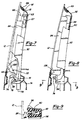
- the window 12 is shown at its fully raised position in solid line and in its fully lowered position in phantom line. Also illustrated is the manner in which it pivots about upper guide follower 18 as the window nears its fully raised position thereby causing the inner surface of the window at its top edge, and side edges to the point that they extend from the top edge to the pivot point, to laterally swing into sealing engagement with the weatherstrip seal 150 at the roof panel and along the front and rear edges of the window to the extent mentioned.
- the rearchan- nel guide member 26 is generally rectangular in cross-section and includes a slot 52 splitting the end wall 54 facing the window and extending its full length.
- the end wall 54 is defined by two inwardly directed flanges 56 and 58, each of which extends toward the interior of the guide at an angle 60 relative to the longitudinal axis of the window as designated by the line 62.
- Angle 60 may range from 15° to 45°, with 30°-35° being preferred.
- the purpose of forming flanges 56, 58 at such an angle is to decrease the force acting thereon in a direction transverse to the window, caused by the wind pulling on the windows at higher vehicle speeds when it is in a partially raised position. This in turn reduces any tendency of the guide channel member to deflect or become permanently deformed.
- the section 64 shown at the inboard edge of the channel guide member is for the purpose of receiving the tape drive mentioned earlier which runs out from the regulating mechanism powered by drive motor 32 for raising and lowering the window.
- the upper channel guide follower 18 includes a slide member 65 pivotally affixed to the laterally innermost end of guide follower support arm 66 by means of a pin 67. It will be noted from Figure 7 that the slide member is tapered at its ends. Channel guide follower support arm 66 extends through the slot 52. At the lower guide follower 22, the laterally innermost end of the support arm 70 is provided with a pair of guide rollers 72 rotatably supported thereon.
- the lower guide follower support arm 70 is generally L-shaped with the main pair of guide rollers 72 being fixed at the elbow of the L-shaped member. At the base there is rotatably affixed thereto a secondary track roller 74.
- the channel guide member includes a section 76 which is integral with the main track but abruptly curved at an obtuse angle toward the outer door panel. Section 76 constitutes a secondary guide channel and is open to the main guide channel 78.
- Both the slide member 65 and rollers 72 are tapered to match the angle 60 of the guide channel flanges 56, 58.
- the guide channel sealing systems, designated 80 for the front guide channel and 82 for the rear guide channel are virtually identical. Therefore, only the sealing system 82 for the rear guide channel will be described. It is shown in Figures 5-9.
- the system includes a vertically extending vane member 84 affixed to the window at a base portion 86 and extending in length from a point just above upper guide follower 18 to a lower point just below lower guide follower 22.
- the vane member 84 is of uniform cross-sectional thickness and extends laterally inwardly.
- Its innermost edge 88 is tapered relative to the inner surface of the window such that it is of minimum width at its top and maximum width at its bottom, as shown in Figure 8.
- the laterally innermost portion of vane member 84 is received within a generally U-shaped elongated hollow seal member 90 of synthetic rubber that is enclosed within a sheet metal housing 92 contiguous with the guide channel member 26 and extending the full length of the vane member 84.
- Sealing ribs 94 extend radially inwardly to impinge upon the outer surfaces of vane member 84 thereby sealing off the inner door cavity 50.
- the rearwardly directed wall of seal housing 92 is flared, as shown at 96 in Figure 9. This allows that the open end of the U-shaped channel is widest at the portion first receiving the vane member 84 as the window is raised, which assists in accurately locating the vane member in the grasp of the sealing ribs 94.
- the slide member 65 at the upper edge of the window will be brought to a position below the section 76.
- its tapered nose portion coupled with its length will cause it to bypass the fork without interruption.
- the secondary track roller 74 will engage the exterior surface of the channel guide member at the initial point at which the secondary track section departs from the main track section as indicated at point 98 in Figure 7, and in phantom line. As it does so, it will draw the main pair of track rollers 72 into the secondary guide track and thereby cause the window 12 to pivot dramatically about the axis of slide member 66, namely, pin 67, toward outer door panel 46.
- the window will have engaged seal member 150 and be positioned exactly flush with the vehicle exterior.
- the engaged portion i.e. locator portion 154, is very stiff such that the seal acts as a fixed pivot point for the window. If necessary, the door panel will flex slightly to allow the window to become flush at the beltline. This lateral transfer of window 12 will continue as the slide member is carried upwardly by the tape drive until it reaches its final raised position whereby the window will be flush with the exterior surfaces of the vehicle framing the window opening.
- the secondary track roller 74 is no longer in engagement with the guide track formed by the exterior wall of the secondary guide member 76.
- secondary track roller 74 In lowering the window, secondary track roller 74 will form no part of the operation since the primary pair of track rollers 72 will descend the slope formed by the forked track until it enters and downwardly traverses the main track 78. Again, as the slide member 66 descends and traverses the open section formed at the join with secondary guide member 76 will continue uninterrupted due to its length and the tapered nose portion.
- the vane member also will pivot about the pivot point formed by the slide member pin 67 such that the lower end of the vane member to the greatest extent will reciprocate within the seal housing 92 while at all times the sealing ribs 94 will remain in engagement with the vane member.
- Figures 10 and 11 show in detail the weatherstrip sealing system extending across the longitudinal extent of the door at the beltline from the front edge to the rear edge, omitted from Figures 3 and 4 for purposes of clarity.
- the sealing system designated generally as 100 comprises three seals of synthetic rubber or the like, namely seal 102 affixed to the inner door panel, seal 104 affixed to the outer door panel, and intermediate seal 106 which is affixed to the window and in sealing engagement with seals 102 and 104 when the window is in the fully raised position as shown in solid line.
- Inner seal 102 includes a main body portion 108 which is U-shaped in cross-section and includes a plurality of longitudinally extending locking ribs 110 which extend inwardly toward the interior of the body portion. Locking ribs 110 are adapted to sealingly grip a downwardly depending flange, which extends from inner door panel 30. To further lock the seal in place, the interior wall 112 of the body portion 108 is slit longitudinally so as to receive the upwardly extending flange 114 of the internal reinforcing member 28.
- seal lip 116 At the outward extent of the seal body portion, there adjoins a laterally outwardly extending seal lip 116 connected to the seal body portion by a flex section or live hinge 118.
- the seal member 102 is an extruded member and the normal unbiased position of the seal lip 116 is that as generally shown in solid line.
- the seal lip 116 When the window is to be lowered to a position as shown in phantom line, the seal lip 116 will be forced to a biased state as shown in phantom line and will remain in intimate contact with the window as the window is lowered.
- Outer seal 104 also includes a main body portion 120, a seal lip 122 joined to the main body portion at flex section or live hinge 124.
- the main body portion is affixed to the outer door panel 46 by bonding or any other suitable means.
- the seal is usually extruded and in its normal unbiased position extends laterally inwardly as shown generally in phantom line.
- the seal lip 122 When the window is raised, the seal lip 122 will be forced upwardly into sealing engagement with the intermediate window seal 106 and be pressed against the uppermost portion of the door panel 46 as shown in solid line.
- seal lip 122 When the window is lowered, seal lip 122 will first resume its normal and biased position and thereafter will be forced downwardly in the position exactly as shown in phantom line in Figure 11.
- Intermediate window seal 106 affixed to the window 12 is generally triangular in cross section. At its base, it includes a hollow bulb 126 projecting outwardly therefrom. One side of the bulb 126 and one portion of the base is affixed to the lower edge of the window. The free end portion of the base together with the adjoining side 128 of the seal constitutes a first seal lip 130 which, when the window is in the fully raised position, provides a seal at the outer door panel with seal 104.
- the remaining side 132 of the triangular cross sectioned intermediate seal defines a sealing surface in sealing engagement with inner door panel seal lip 116. Side 132 of the intermediate seal is cylindrically curved as shown so as to form a line contact across a major portion of the innerseal lip 116.
- seal 106 be of dual durometer wherein the bulb 126 will be relatively soft, in the order of Shore A 30 to 80 durometer to provide a live seal between the window and door panel, whereas the remainder of seal 106 will be quite hard in the order of Shore D 40 to 60 durometer, such that the window bottom edge will always be located precisely flush with the outer door panel when the window is fully raised.
- the lateral distance between the guide channel 26 and window 12 can be adjusted during assembly to assure that the window is initially precisely flush. Suitable adjusting means are shown in U.S. Patent No.
- Figure 12 is an exploded view of continuous weather-strip seal 150 at the upper edge of the window.
- the seal includes a main body portion 152 having a flat based locator portion 154 and a bulbed seal portion 156 at its upper end and a flexible elongated lip portion 158 at its lower end.
- the seal body portion includes a slot along one edge for fitting it over a flange 160 extending outwardly from the vehicle body member and thereby securing it.
- the seal lip member 158 in its uncompressed state, extends radially outwardly from the seal body portion 152 in a manner as shown in phantom line. In the uncompressed state, as the window is lowered, it will be seen that the seal lip in conjunction with the seal body portion forms a channel 162 which functions as a drip rail for catching rain water and precluding it from falling within the interior of the vehicle.
- the seal lip is relatively thin in cross section such that at its juncture with the seal body portion, it defines a flex joint or live hinge.
- the window panel will first engage the seal lip 158 at its outermost extremity thereafter forcing it to bend about the flex joint and come into contact with the window panel along its full length extending from the flex joint to the tip of the seal lip member.
- the window engages the locator portion 154 of the seal member simultaneously as the top edge of the window panel engages the bulbed gap-filling seal portion 156.
- the window is perfectly flush with the exterior of the vehicle.
- the locator portion 154 is of substantially greater hardness than seal portion 156 and lip portion 158.
- the locator portion may be of Shore D 40 to 60 durometer whereas the seal portion 156 and lip portion 158 may be of Shore A 30 to 80 durometer.
- Weatherstrip seal 150 is a continuous seal extending from the top of the window panel downwardly along the front and rear edges thereof, to the beltline.
- the bulbed gap-filling seal portion 170 may be a separate member, as shown in solid line, fixed to vehicle quarter panel 172.
- it may be an integral part of seal 150, as designated 156 in Figure 12, extending from the seal body portion 152 by an intermediate portion of varying length which increases from the top edge of the window down to the beltline of the door.
- the guide channel member 26 and contiguous vertical seal housing 92 are in sealing engagement. From this point upwardly along the front or rear edge of the window, as the case may be, to the upper edge of the window, the seal lip 158 is in sealing engagement with the window. This then provides a second sealing system.
- the first sealing system is that formed by the engagement of the edge of the window with the bulb gap-filling seal portion 170.
- the second sealing system is that provided by the engagement of the inner surface of the window with the seal lip 158.
- the second seal is formed with the guide channel member 26 engaging the seal lip 158 and defining a sealed cavity on the interior surface of the window.
- Such a sealing system is provided by the front and rear guide channel sealing systems 80 and 82, respectively, including the vertically extending vane member 84 and associated seal strip 92 earlier described.
- FIG 13 there is shown in cross-section the detail of the weatherstrip seal 180 and associated window frame for a sedan-type vehicle wherein the frame member 182 extends from the beltline of the door upwardly at both front and rear edges of the door and across the upper longitudinal extent to fully define a window opening.
- the seal body portion 184 as with the previous example shown in Figure 12, includes a seal lip 186 in engagement with the window 12. Further, it includes a second seal portion in the form of a hollow tube 188 contiguous with a locator portion 190 of the main seal body 184 and which is in compressive engagement with the drip rail 192 of the roof panel.
Landscapes
- Engineering & Computer Science (AREA)
- Mechanical Engineering (AREA)
- Window Of Vehicle (AREA)
- Seal Device For Vehicle (AREA)
Abstract
Description
- The present invention relates to a window panel position regulating and sealing assembly, and more particularly a regulating system for raising and lowering a vehicle window and assuring that the window is perfectly flush and fully sealed with the vehicle exterior on all sides including the lower edge.
- In recent years, vehicle window glass has undergone significant evolution and increasingly dramatic styling has brought about the use of cylindrically curved door window panes as a contribution to overall vehicle design. Coupled with this, a redesign effort is being made to provide a flush finish between the window panels and the exterior of the vehicle to further enhance appearance and aerodynamics and to reduce wind noise. For example, as regards the side door windows, it is desired that the window panel be flush with the exterior door panel at the beltline, as well as at the roof panel and pillars, rather than being inset transversely within the framework of the door as in previous years.
- Being flush at these surfaces requires a unique construction of the window position regulating mechanism. It also requires a unique system for sealing the edges of the window panel around the entire framework.
- It is known, for example, to achieve a flush edge condition in a sedan type vehicle having a door frame that has vertical portions to provide front and rear (generally vertically arranged and curved) guide channels secured to the interior door panel, and to provide within each guide channel a plastic guide affixed to the window and in rolling or sliding engagement with the guide channel. For one previous concept, the plastic guide is curved similarly to the window and increases in transverse cross-sectional width from the top of the window to the bottom of the window such that as the window is raised, the lower edge portion of the window will move progressively outward toward the outer door panel and will be nearly flush with the outer door at the beltline at its fully raised position. Such an arrangement is shown in U.S. Patent No. 4,561,211.
- Other systems are known such as shown in U.S. Patent Nos. 2,979,327; 4,575,967; and 4,783,930 for accomplishing a substantially flush condition of the vehicle side door window wherein a slightly cylindrically curved window or flat or nearly flat window is guided by a pair of guide channels fixed within the door panel at the front and rear edges thereof with each guide channel including (at a position just above or just below the beltline) a track or guide channel portion inclined relatively abruptly and outwardly such that when the window reaches its raised position or nearly raised position, the lower edge of the window will be translated laterally outwardly into a substantially flush position at the beltline and at the upper edge of the window with the vehicle exterior. In each case, the window pivots basically about its upper edge as the lower edge of the window swings laterally outward. Such a system may work relatively well with a constant curvature or with flat or nearly flat glass, since the compression seal used forweatherstripping the window frame can accommodate a small degree of compression or lateral transfer. With the more cylindrically curved windows of the present day vehicles, such systems would prove unsatisfactory.
- Yet another substantially flush vehicle door assembly is shown in U.S. Patent No. 4,771,575 which like those mentioned immediately above, causes a window to pivot about its upper edge as the lower edge of the window is laterally transferred to and from the exterior door panel. The means by which the lateral transfer is effected, rather than being dependent upon the shape of the guide track, is accomplished by means of the interior seal affixed to the window sash pipe bearing against the inner weatherstrip seal of the inner door panel and being forced in the outward direction as the window is raised, and conversely when being lowered being forced by the outer door panel seal laterally inwards.
- Another system for providing a flush vehicle window is shown in U.S. Patent No. 4,788,794. As with the present invention, the window is caused to pivot at a position intermediate that of the beltline and the upper edge of the window such that as the window is raised, its lower edges laterally traverses outward to a substantially flush position with the beltline, and the upward edge of the window at its inner surface is caused to traverse laterally inwardly to bear against the weatherstrip seal running longitudinally at the roof panel and vertically downwardly at the front and rear edges of the window to the point of the pivot. The pivot point is established by an upper guide pin which rides within a curved track vertically arranged at the front and rear of the door panel. A lower guide pin is affixed to the lower edge of the window and as it approaches the fully raised window position is caused to enter in an abruptly curved portion of the track extending outwardly toward the exterior door panel such that the lower portion of the window is translated laterally outwardly in a manner similar to certain of the above- mentioned patents.
- Unlike the present invention, the guide channel is seen to be of fairly expensive construction since the upper guide pin is seen to be riding on a rail and the lower guide pin within a groove, rather than each riding along the same guide surface. It is also subject to disengagement from tolerances and loading of the window. Further, the compression seal provided between the beltline and the pivot point must be deflected more when the window is being moved than when the window is at rest fully closed. Generally, a flexible lip type seal as shown has not proven satisfactory, particularly in cold weather conditions, to accommodate the degree of window movement involved.
- None of the aforementioned systems is seen to provide a window position regulating assembly which will (i) establish a perfectly flush interface between the window and the vehicle exterior at all points about the perimeter of the window, or (ii) provide a reliable full seal about the perimeter of the window, or (iii) provide a simply constructed, economical and highly reliable mechanism for accomplishing these results. They also are limited in the amount of irregular shape of window surface which can be accommodated and the consideration for accommodation in an unframed door (i.e., a hardtop window).
- According to a first aspect of the present invention, there is provided a vehicle door including an inner door panel and an outer door panel joined together in spaced relation to provide a door cavity therebetween and terminating at the upper edge thereof constituting the beltline in an elongated beltline opening; a window panel adapted to be raised and lowered within said door cavity and through said beltline opening; guide means within said door cavity for guiding said window panel through said beltline opening as the window panel is raised and lowered; said guide means including first and second guide channel members secured to the vehicle door at respective side edge portions of the window panel, respectively; lower guide follower means secured to the lower edge portion of said window panel and operatively associated with said guide means for establishing a fixed travel path for the lower edge of said window panel as the same passes through said beltline opening; upper guide follower means secured to said window panel substantially above said lower edge portion and including a pivot means, and operatively associated with said guide means; at least said first guide channel member comprising a generally tubular channel member having a vertically extending guide slot extending the vertical length thereof, said slot being disposed nearest said outer door panel; said first channel member comprising a main guide channel section and a secondary guide channel section, said secondary guide channel section including a ramp for laterally transferring the lower edge portion of said window panel; said upper guide follower means comprising a support member fixed near the vertical mid-point of said window panel and extending through said guide slot within said first channel member, and slidably received within said first channel member; said lower guide follower means comprising a lower support member extending through said guide slot within said first channel member, said lower support member including a first guide member at the free end thereof and retained within said first channel member, and a second guide member disposed at the free end thereof exteriorly of said first channel member being adapted to engage and traverse said ramp whereby, as said window panel is elevated to a fully raised position, said second guide member will engage the exterior of said ramp thereby causing said first guide member to be drawn into said secondary guide channel section and cause the lower edge portion of said window panel to be laterally transferred about said pivot means of said upper guide follower means to a position substantially flush with the outer door panel.
- The preferred embodiments of the invention provide a vehicle door and window assembly wherein the window is perfectly flush at all four sides with the exterior surface of the vehicle.
- The can further achieve a vehicle door and window assembly wherein the guide means for raising and lowering the window to its flush position with the exterior vehicle surface is simply, effectively, and economically constructed, does not require a surrounding door frame to accommodate guides and seals and can accommodate more complex window shapes.
- A window guide system may also be constructed which includes front and rear guide channels for respectively supporting the front and rear ends of a vehicle side door window such that the lower extremity of the window has a relatively abrupt outward movement adjacent the end of its upward travel thereby bringing the window flush with the side door outer panel in the closed position. The guide channel construction supports an upper slide fixed to the approximate mid-point of the window and about which the window pivots during the abrupt outward movement of its lower end. The same channel construction also supports a lower guide means affixed to the bottom edge of the window that positions the lower end of the window during its vertical movement and at its abrupt outward movement just prior to reaching the closed position.
- Specifically, the channel construction at the rear edge of the door receives a lower guide means constituting a set of three rollers. One pair of rollers is received within the channel while a third roller is guided along the exterior of its open side so as to move outwardly at a ramp while the upper slide continues upwardly past the ramp and to the upper portion of the channel construction; this construction thus provides a single guide channel for both the upper and lower locations of support of the window. At the front edge of the door, the lower guide means constitutes a slide member which need not be supported in the channel until it is funnelled into the guide shortly before the slide is to traverse the ramp.
- Further, the channel construction provides an integrated chamber for containing a tape or cable drive for controlling the lifting and lowering of the window. The attachment of the tape or cable drive is to the upper of the two guides at each front and rear guide which allows the bottom of the lowered window to be positioned lower in the door.
- The invention will now be described further, by way of example, with reference to the accompanying drawings, in which:
- Figure 1 is a perspective view of a vehicle body illustrating in particular the vehicle side door and window pane for which the present invention is adapted;
- Figure 2 is a side elevation view of the window pane and door assembly showing the window regulating mechanism within the door cavity and from the interior of the vehicle in accordance with the present invention;
- Figure 3 is a sectional view taken substantially along the lines 3-3 of Figure 1;
- Figure 4 is a sectional view taken substantially along the lines 4-4 of Figure 1 and illustrating the rear guide channel assembly in accordance with the present invention;
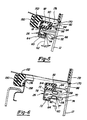
- Figure 5 is a sectional view taken substantially along the lines 5-5 of Figure 4;
- Figure 6 is a sectional view taken substantially along the lines 6-6 of Figure 4;
- Figure 7 is a partial cross-sectional end view of the window regulating mechanism as shown in Figure 4 and particularly illustrating the details of the mid-pivot guide channel assembly at the rear guide channel as viewed from the rear of the vehicle;
- Figure 8 is a partial cross-sectional end view of the window regulating mechanism as shown in Figure 4 and particularly illustrating the details of the vane seal member at the rear guide channel as viewed from the rear of the vehicle;
- Figure 9 is a sectional view taken substantially along the lines 9-9 of Figure 8 and illustrating the manner in which the vane seal member housing is flared to receive the vane seal member;
- Figure 10 is a sectional view taken substantially along the lines 10-10 of Figure 1;
- Figure 11 is an exploded view of the section designated A in Figure 10 and showing the sealing system for sealing the window panel relative to the door at the beltline in accordance with the present invention;
- Figure 12 is an exploded view of the window seal at the roof line as shown by the segment designated B in Figure 4; and
- Figure 13 is a view similar to Figure 10 but illustrating the construction of a weather strip seal for an alternative vehicle body design, namely a sedan model, in accordance with the present invention.
- There is shown in Figure 1 a motor vehicle, designated generally at 10, of basic design illustrating the aerodynamicenhancement of the vehicle that is provided by a cylindrically
curved window 12 that is flush to the exterior of the vehicle. Each of the side doors is so equipped. For purposes of describing the present invention, reference will be made only to the leftfront side door 14 as shown in Figure 2 with the inner door panel removed for purposes of illustrating the window regulating system. - While the description appearing below is limited to a cylindrically curved window, the present invention is equally applicable to a doubly-curved window.
- The term "doubly-curved" refers to a window panel which is not only curved in the direction about the horizontal axis of the vehicle being primarily apparent in the front and rear views of the vehicle, but also curved in the third dimension, i.e. about a somewhat vertical axis of the vehicle being primarily apparent in the plan view of the vehicle.
- An example of a doubly-curved window is shown in U.S. Patent application Serial No. 525,573, filed May 21, 1990 and entitled "Window Panel Position Regulating Assembly", and assigned to the same assignee as the present invention. In particular, the co-pending patent application Serial No. 525,573 discloses a doubly, irregularly-curved window wherein the degree of convexity of the window is not uniform along any axis, the teachings of which are incorporated herein by reference.
- The overall system is seen best in Figures 2-4. The
window 12 is mounted to the door, generally designated at 14, byupper guide followers lower guide followers guide channel members reinforcement member 28, which in turn is affixed to theinner door panel 30 to thereby secure the relative position of the guide channel members relative to the overall door assembly. - The
window 12 may be raised and lowered by means of a tape-type window regulator drive including a driving motor 32 which powers a continuous tape (not shown). The tape is operatively coupled with theupper guide followers window 12 dependent on the direction of the drive motor 32. The window regulator drive forms no part of the present invention and could be of any other construction including a hand crank mechanism. However, for purposes of example, a tape-type window regulator drive system is shown in pending U.S. patent application Serial No. 561,856, filed July 30, 1990, entitled "Vehicle Window Regulator Mechanism", assigned to the assignee of the present invention, the disclosure of which is herein incorporated by reference. - Referring to Figure 2, it will be appreciated that the portions of the
guide channel members - The
guide channel members main channel members seal housing sections guide channel member 24 includes asecond section 36 within which the lower guide follower is received, as described below, which is located to the front of the vehicle. At the rear guide channel, the lower guide follower track is disposed laterally outward frommain channel section 78 in the direction of the window and is a part of the main channel section as seen best in Figure 4. - More specifically, the
front guide channel 24 seen generally in Figure 3 comprises a singular generally cylindrically arcedchannel member 34 extending the full length to be traversed by thewindow 12 from a fully raised position as shown to a fully lowered position as shown in phantom line. It is of rectangular cross-section similar to therear guide channel 26 seen in Figures 7 and 8. The upper and lowertrack guide followers guide channel member 34. Integral with theguide channel member 34 is a secondguide channel section 36 extending upwardly to the beltline line and there curving outwardly at 38 towards the beltline. A bottom wall portion 40 ofchannel section 36 is flared outwardly to accommodate receiving thelower guide follower 20. At the free end of the upper andlower guide followers slide member Upper slide member 42 is slidably received within theguide channel member 34, andlower slide member 44 is slidably received withinguide channel section 36.Guide channel member 34 and guidechannel section 36 each include a vertical slot, similar to therear guide channel 26 seen in Figures 7 and 8, extending from top to bottom on the wall facing the window and outer door panel thereby allowing the guide followers to traverse the vertical extent of each. - For purposes of clarity, the weatherstrip seals affixed to the inner and
outer door panels - In Figure 4, there is shown the arcuate rear
guide channel member 26 within thecavity 50 formed by the inner andouter door panels window 12 is shown at its fully raised position in solid line and in its fully lowered position in phantom line. Also illustrated is the manner in which it pivots aboutupper guide follower 18 as the window nears its fully raised position thereby causing the inner surface of the window at its top edge, and side edges to the point that they extend from the top edge to the pivot point, to laterally swing into sealing engagement with theweatherstrip seal 150 at the roof panel and along the front and rear edges of the window to the extent mentioned. The manner in which upper andlower guide followers guide channel member 26 are the same as that earlier described in connection with the front guide channel member of Figure 3. Again, for purposes of clarity, the weatherstrip seal at the beltline has been excluded as has the vertically extending sealing system shown in detail in Figures 5-9. - Looking particularly at Figures 5-7, the rearchan-
nel guide member 26 is generally rectangular in cross-section and includes a slot 52 splitting theend wall 54 facing the window and extending its full length. Theend wall 54 is defined by two inwardly directedflanges angle 60 relative to the longitudinal axis of the window as designated by theline 62.Angle 60 may range from 15° to 45°, with 30°-35° being preferred. The purpose of formingflanges - The
section 64 shown at the inboard edge of the channel guide member is for the purpose of receiving the tape drive mentioned earlier which runs out from the regulating mechanism powered by drive motor 32 for raising and lowering the window. - The upper
channel guide follower 18 includes aslide member 65 pivotally affixed to the laterally innermost end of guidefollower support arm 66 by means of apin 67. It will be noted from Figure 7 that the slide member is tapered at its ends. Channel guidefollower support arm 66 extends through the slot 52. At thelower guide follower 22, the laterally innermost end of thesupport arm 70 is provided with a pair ofguide rollers 72 rotatably supported thereon. - The lower guide
follower support arm 70 is generally L-shaped with the main pair ofguide rollers 72 being fixed at the elbow of the L-shaped member. At the base there is rotatably affixed thereto asecondary track roller 74. - At the beltline of the
door 14, it will be noted that the channel guide member includes asection 76 which is integral with the main track but abruptly curved at an obtuse angle toward the outer door panel.Section 76 constitutes a secondary guide channel and is open to themain guide channel 78. - Both the
slide member 65 androllers 72 are tapered to match theangle 60 of theguide channel flanges system 82 for the rear guide channel will be described. It is shown in Figures 5-9. The system includes a vertically extendingvane member 84 affixed to the window at abase portion 86 and extending in length from a point just aboveupper guide follower 18 to a lower point just belowlower guide follower 22. In cross-section, as shown in Figures 5 and 6, thevane member 84 is of uniform cross-sectional thickness and extends laterally inwardly. Itsinnermost edge 88 is tapered relative to the inner surface of the window such that it is of minimum width at its top and maximum width at its bottom, as shown in Figure 8. The laterally innermost portion ofvane member 84 is received within a generally U-shaped elongatedhollow seal member 90 of synthetic rubber that is enclosed within asheet metal housing 92 contiguous with theguide channel member 26 and extending the full length of thevane member 84. Sealingribs 94 extend radially inwardly to impinge upon the outer surfaces ofvane member 84 thereby sealing off theinner door cavity 50. - At its lower end, the rearwardly directed wall of
seal housing 92 is flared, as shown at 96 in Figure 9. This allows that the open end of the U-shaped channel is widest at the portion first receiving thevane member 84 as the window is raised, which assists in accurately locating the vane member in the grasp of the sealingribs 94. - In operation, looking at Figure 7, as the window is brought to its fully raised position, the
slide member 65 at the upper edge of the window will be brought to a position below thesection 76. As it slides past the fork in the guide channel member, its tapered nose portion coupled with its length will cause it to bypass the fork without interruption. As the lower guide track member approaches the fork, thesecondary track roller 74 will engage the exterior surface of the channel guide member at the initial point at which the secondary track section departs from the main track section as indicated atpoint 98 in Figure 7, and in phantom line. As it does so, it will draw the main pair oftrack rollers 72 into the secondary guide track and thereby cause thewindow 12 to pivot dramatically about the axis ofslide member 66, namely,pin 67, towardouter door panel 46. At this same time, the window will have engagedseal member 150 and be positioned exactly flush with the vehicle exterior. The engaged portion, i.e.locator portion 154, is very stiff such that the seal acts as a fixed pivot point for the window. If necessary, the door panel will flex slightly to allow the window to become flush at the beltline. This lateral transfer ofwindow 12 will continue as the slide member is carried upwardly by the tape drive until it reaches its final raised position whereby the window will be flush with the exterior surfaces of the vehicle framing the window opening. At this point, it will be noted that thesecondary track roller 74 is no longer in engagement with the guide track formed by the exterior wall of thesecondary guide member 76. - In lowering the window,
secondary track roller 74 will form no part of the operation since the primary pair oftrack rollers 72 will descend the slope formed by the forked track until it enters and downwardly traverses themain track 78. Again, as theslide member 66 descends and traverses the open section formed at the join withsecondary guide member 76 will continue uninterrupted due to its length and the tapered nose portion. - Regarding the operation of the
seal vane member 84 while the window is pivoting to and from its fully closed position, it will be noted that the vane member also will pivot about the pivot point formed by theslide member pin 67 such that the lower end of the vane member to the greatest extent will reciprocate within theseal housing 92 while at all times the sealingribs 94 will remain in engagement with the vane member. - Figures 10 and 11 show in detail the weatherstrip sealing system extending across the longitudinal extent of the door at the beltline from the front edge to the rear edge, omitted from Figures 3 and 4 for purposes of clarity. As seen, the sealing system designated generally as 100 comprises three seals of synthetic rubber or the like, namely seal 102 affixed to the inner door panel, seal 104 affixed to the outer door panel, and
intermediate seal 106 which is affixed to the window and in sealing engagement withseals -
Inner seal 102 includes amain body portion 108 which is U-shaped in cross-section and includes a plurality of longitudinally extending lockingribs 110 which extend inwardly toward the interior of the body portion. Lockingribs 110 are adapted to sealingly grip a downwardly depending flange, which extends frominner door panel 30. To further lock the seal in place, theinterior wall 112 of thebody portion 108 is slit longitudinally so as to receive the upwardly extendingflange 114 of the internal reinforcingmember 28. - At the outward extent of the seal body portion, there adjoins a laterally outwardly extending
seal lip 116 connected to the seal body portion by a flex section orlive hinge 118. Theseal member 102 is an extruded member and the normal unbiased position of theseal lip 116 is that as generally shown in solid line. When the window is to be lowered to a position as shown in phantom line, theseal lip 116 will be forced to a biased state as shown in phantom line and will remain in intimate contact with the window as the window is lowered. -
Outer seal 104 also includes amain body portion 120, aseal lip 122 joined to the main body portion at flex section orlive hinge 124. The main body portion is affixed to theouter door panel 46 by bonding or any other suitable means. The seal is usually extruded and in its normal unbiased position extends laterally inwardly as shown generally in phantom line. When the window is raised, theseal lip 122 will be forced upwardly into sealing engagement with theintermediate window seal 106 and be pressed against the uppermost portion of thedoor panel 46 as shown in solid line. When the window is lowered,seal lip 122 will first resume its normal and biased position and thereafter will be forced downwardly in the position exactly as shown in phantom line in Figure 11. -
Intermediate window seal 106 affixed to thewindow 12 is generally triangular in cross section. At its base, it includes ahollow bulb 126 projecting outwardly therefrom. One side of thebulb 126 and one portion of the base is affixed to the lower edge of the window. The free end portion of the base together with the adjoiningside 128 of the seal constitutes afirst seal lip 130 which, when the window is in the fully raised position, provides a seal at the outer door panel withseal 104. The remaining side 132 of the triangular cross sectioned intermediate seal defines a sealing surface in sealing engagement with inner doorpanel seal lip 116. Side 132 of the intermediate seal is cylindrically curved as shown so as to form a line contact across a major portion of theinnerseal lip 116. By proper selection of the stiffness ofseal lip 130, the seal can provide a stabilising effect for the window in its fully raised position. Specifically, it is preferred thatseal 106 be of dual durometer wherein thebulb 126 will be relatively soft, in the order ofShore A 30 to 80 durometer to provide a live seal between the window and door panel, whereas the remainder ofseal 106 will be quite hard in the order of Shore D 40 to 60 durometer, such that the window bottom edge will always be located precisely flush with the outer door panel when the window is fully raised. To this end, the lateral distance between theguide channel 26 andwindow 12 can be adjusted during assembly to assure that the window is initially precisely flush. Suitable adjusting means are shown in U.S. Patent No. 4,183,178, incorporated herein by reference, which is assigned to the same assignee as the present invention. It will be noted that thebulb 126 together with the seal formed with outer doorpanel seal member 104 forms a dual seal for excluding moisture and air. Further, it will be noted that at every position of the window from fully raised to fully lowered, the inner andouter seal lips - Figure 12 is an exploded view of continuous weather-
strip seal 150 at the upper edge of the window. - The seal includes a
main body portion 152 having a flat basedlocator portion 154 and abulbed seal portion 156 at its upper end and a flexibleelongated lip portion 158 at its lower end. The seal body portion includes a slot along one edge for fitting it over aflange 160 extending outwardly from the vehicle body member and thereby securing it. Theseal lip member 158, in its uncompressed state, extends radially outwardly from theseal body portion 152 in a manner as shown in phantom line. In the uncompressed state, as the window is lowered, it will be seen that the seal lip in conjunction with the seal body portion forms achannel 162 which functions as a drip rail for catching rain water and precluding it from falling within the interior of the vehicle. - The seal lip is relatively thin in cross section such that at its juncture with the seal body portion, it defines a flex joint or live hinge. As the window panel is raised, it will first engage the
seal lip 158 at its outermost extremity thereafter forcing it to bend about the flex joint and come into contact with the window panel along its full length extending from the flex joint to the tip of the seal lip member. Thereafter, the window engages thelocator portion 154 of the seal member simultaneously as the top edge of the window panel engages the bulbed gap-fillingseal portion 156. In this fully raised position, it will be noted the window is perfectly flush with the exterior of the vehicle. To assure this result, thelocator portion 154 is of substantially greater hardness thanseal portion 156 andlip portion 158. For example, the locator portion may be of Shore D 40 to 60 durometer whereas theseal portion 156 andlip portion 158 may be ofShore A 30 to 80 durometer. -
Weatherstrip seal 150 is a continuous seal extending from the top of the window panel downwardly along the front and rear edges thereof, to the beltline. As noted in Figures 5 and 6, the bulbed gap-fillingseal portion 170 may be a separate member, as shown in solid line, fixed tovehicle quarter panel 172. Alternatively, as shown in phantom line it may be an integral part ofseal 150, as designated 156 in Figure 12, extending from theseal body portion 152 by an intermediate portion of varying length which increases from the top edge of the window down to the beltline of the door. - To describe the overall operation of the sealing system for the door, including the window, relative to the door frame, it will be noted from Figure 6 that the
rear end panel 174 of the door engagesseal lip 158 of continuousweatherstrip seal member 150, as such is mounted on the vehicle frame member. Likewise, the window is sealed at its rear edge relative to the vehicle by the compression placed upon the bulbed gap-fillingseal portion 170. - From Figure 5, it is seen that the
guide channel member 26 and contiguousvertical seal housing 92 are in sealing engagement. From this point upwardly along the front or rear edge of the window, as the case may be, to the upper edge of the window, theseal lip 158 is in sealing engagement with the window. This then provides a second sealing system. The first sealing system is that formed by the engagement of the edge of the window with the bulb gap-fillingseal portion 170. The second sealing system is that provided by the engagement of the inner surface of the window with theseal lip 158. At the transition as shown in Figure 5, the second seal is formed with theguide channel member 26 engaging theseal lip 158 and defining a sealed cavity on the interior surface of the window. From this point down to the beltline, there is a need for yet a third sealing system to preclude water and other environmental and contaminant matter from entering thecavity 176. Such a sealing system is provided by the front and rear guidechannel sealing systems vane member 84 and associatedseal strip 92 earlier described. - At Figure 13, there is shown in cross-section the detail of the
weatherstrip seal 180 and associated window frame for a sedan-type vehicle wherein theframe member 182 extends from the beltline of the door upwardly at both front and rear edges of the door and across the upper longitudinal extent to fully define a window opening. Theseal body portion 184 as with the previous example shown in Figure 12, includes aseal lip 186 in engagement with thewindow 12. Further, it includes a second seal portion in the form of ahollow tube 188 contiguous with alocator portion 190 of themain seal body 184 and which is in compressive engagement with thedrip rail 192 of the roof panel.
Claims (13)
Applications Claiming Priority (2)
| Application Number | Priority Date | Filing Date | Title |
|---|---|---|---|
| US07/592,736 US5159781A (en) | 1990-10-04 | 1990-10-04 | Window panel position regulating assembly |
| US592736 | 1990-10-04 |
Publications (3)
| Publication Number | Publication Date |
|---|---|
| EP0479522A2 true EP0479522A2 (en) | 1992-04-08 |
| EP0479522A3 EP0479522A3 (en) | 1992-11-19 |
| EP0479522B1 EP0479522B1 (en) | 1995-11-15 |
Family
ID=24371860
Family Applications (1)
| Application Number | Title | Priority Date | Filing Date |
|---|---|---|---|
| EP91308925A Expired - Lifetime EP0479522B1 (en) | 1990-10-04 | 1991-09-30 | Window panel position regulating assembly |
Country Status (3)
| Country | Link |
|---|---|
| US (1) | US5159781A (en) |
| EP (1) | EP0479522B1 (en) |
| DE (1) | DE69114661T2 (en) |
Cited By (12)
| Publication number | Priority date | Publication date | Assignee | Title |
|---|---|---|---|---|
| DE9307599U1 (en) * | 1993-05-19 | 1993-08-05 | Wilhelm Karmann GmbH, 49084 Osnabrück | Window regulators, especially for convertible vehicles |
| EP0599538A1 (en) * | 1992-11-23 | 1994-06-01 | The Standard Products Company | Belt weatherstrip |
| EP0739770A1 (en) * | 1995-04-26 | 1996-10-30 | The Standard Products Company | Four sided flush sealing system |
| EP0816617A3 (en) * | 1996-07-06 | 1999-05-06 | Saint-Gobain Vitrage | Vertically sliding vehicle window |
| FR2847520A1 (en) * | 2002-11-21 | 2004-05-28 | Wagon Automotive Snc | Doorway for motor vehicle has ramp to control engagement of sealing joint with glazing pane during movement of latter |
| EP1661745A1 (en) * | 2004-11-30 | 2006-05-31 | Wagon Sas | Motor vehicle door with flush glass, corresponding window assembly and motor vehicle |
| US7624537B2 (en) | 2002-11-21 | 2009-12-01 | Wagon Automotive Snc | Door of a motor vehicle with a sliding glass panel, and upper kit for door, corresponding method of manufacturing and vehicle |
| EP1762410A3 (en) * | 2005-09-09 | 2011-01-26 | Wilhelm Karmann GmbH | Device for covering a hood frame opening of a convertible vehicle and a convertible vehicle with such a device |
| US20120025564A1 (en) * | 2010-07-28 | 2012-02-02 | Magna International Inc. | Flush Glass System Module |
| DE102019126504A1 (en) * | 2019-10-01 | 2021-04-01 | Harald Ertl | Flush window pane for a motor vehicle |
| EP4335674A1 (en) * | 2022-09-09 | 2024-03-13 | Nio Technology (Anhui) Co., Ltd | Vehicle door assembly |
| US20240217315A1 (en) * | 2022-12-28 | 2024-07-04 | Rivian Ip Holdings, Llc | Flush droppable glass assembly for a door or tailgate of a vehicle |
Families Citing this family (27)
| Publication number | Priority date | Publication date | Assignee | Title |
|---|---|---|---|---|
| JP2568723Y2 (en) * | 1992-08-28 | 1998-04-15 | 豊田合成株式会社 | Car door glass run |
| DE19504781C1 (en) * | 1995-02-14 | 1996-08-22 | Brose Fahrzeugteile | Window guide for a lowerable spherically curved window in a vehicle door |
| US5647171A (en) * | 1995-12-26 | 1997-07-15 | General Motors Corporation | Hard-top vehicle window regulator system |
| FR2809351B1 (en) * | 2000-05-26 | 2002-10-25 | Btr Sealing Systems France | GASKET FOR OPENING FRAME OF MOTOR VEHICLE |
| ES2223240B1 (en) * | 2002-10-01 | 2006-01-16 | Melchor Daumal Castellon | PERFECTED ELEVALUNAS ASSEMBLY ADAPTED FOR ASSEMBLY IN THE LOCK OF A CAR. |
| US6910730B2 (en) * | 2002-12-25 | 2005-06-28 | Shiroki Corporation | Mounting device for mounting a cable-operated window regulator |
| CA2439861A1 (en) * | 2003-09-05 | 2005-03-05 | Fanotech Enviro Inc. | Non-linear reciprocating packing mechanism for refuse collection vehicle |
| JP5243724B2 (en) * | 2007-03-28 | 2013-07-24 | シロキ工業株式会社 | Inner belt molding mounting structure for vehicle doors |
| DE102010031015A1 (en) * | 2010-07-06 | 2012-01-12 | Brose Fahrzeugteile Gmbh & Co. Kg, Hallstadt | Guide rail for a window regulator and door system for a vehicle door |
| US9567792B1 (en) * | 2011-02-14 | 2017-02-14 | Joseph D Maresh | Cabinet door with retractable panel |
| US8701352B2 (en) * | 2011-09-15 | 2014-04-22 | Ford Global Technologies, Llc | Two-shot secondary seal with clip |
| CN102619448B (en) * | 2012-03-23 | 2014-08-27 | 奇瑞汽车股份有限公司 | Vehicle door reinforcing structure for optimizing offset collision effect |
| JP5846159B2 (en) * | 2013-05-31 | 2016-01-20 | トヨタ自動車株式会社 | Window glass support structure |
| WO2017076513A1 (en) * | 2015-11-02 | 2017-05-11 | Cooper Standard GmbH | Window assembly, and vehicle door and vehicle featuring the window assembly |
| DE102015222472A1 (en) * | 2015-11-13 | 2017-05-18 | Brose Fahrzeugteile Gmbh & Co. Kommanditgesellschaft, Bamberg | Window regulator assembly with clip-on guide elements for a flush-mounted pane concept and assembly method |
| JP6371269B2 (en) * | 2015-11-24 | 2018-08-08 | トヨタ自動車株式会社 | Vehicle door glass lifting structure |
| DE102016200475B3 (en) | 2016-01-15 | 2016-12-15 | Brose Fahrzeugteile Gmbh & Co. Kommanditgesellschaft, Bamberg | Vehicle door assembly with insertion areas on frame-side guide elements for a flush-mounted window concept and assembly method |
| DE102016201106A1 (en) | 2016-01-26 | 2017-07-27 | Brose Fahrzeugteile Gmbh & Co. Kommanditgesellschaft, Bamberg | Window regulator assembly with multi-part window guide element for a flush-mounted window concept and assembly method |
| EP3241697B1 (en) * | 2016-05-02 | 2018-08-01 | Magna Steyr Fahrzeugtechnik AG & Co KG | Window lifter |
| US10179699B1 (en) | 2016-10-18 | 2019-01-15 | ROSCH Logistical Technologies, LlC | Process for selecting an order in an item-on-demand order selection system |
| US10354219B1 (en) | 2016-10-18 | 2019-07-16 | ROSCH Logistical Technologies, LlC | Process for selecting an order in an Item-on-Demand order selection system |
| DE102017112720A1 (en) * | 2017-06-09 | 2018-12-13 | Cqlt Saargummi Technologies S.À.R.L. | sealing arrangement |
| JP7124302B2 (en) * | 2017-11-30 | 2022-08-24 | トヨタ紡織株式会社 | vehicle door |
| DE102019213427A1 (en) * | 2019-09-04 | 2021-03-04 | Psa Automobiles Sa | Window guide for a window pane of a motor vehicle |
| US11851926B1 (en) | 2021-09-23 | 2023-12-26 | Apple Inc. | Panel with pivoting and translational motion |
| US12168902B1 (en) | 2022-06-07 | 2024-12-17 | Apple Inc. | Window |
| EP4735284A1 (en) | 2023-06-30 | 2026-05-06 | Via Fortuna, LLC | Automotive door and window systems, devices, and methods |
Family Cites Families (20)
| Publication number | Priority date | Publication date | Assignee | Title |
|---|---|---|---|---|
| US370502A (en) * | 1887-09-27 | Freight-car door | ||
| US1346268A (en) * | 1918-12-12 | 1920-07-13 | Edward A Smith | Door |
| US2844405A (en) * | 1956-03-14 | 1958-07-22 | John H Roethel | Vehicle window guiding means |
| US2979327A (en) * | 1958-11-17 | 1961-04-11 | Gen Motors Corp | Flush type vehicle window |
| US3514902A (en) * | 1969-02-14 | 1970-06-02 | Orin M Anderson | Top door mechanism for top loading refuse vehicle |
| JPS5823247B2 (en) * | 1975-08-05 | 1983-05-13 | 日産自動車株式会社 | Satsushiless Door Assemblage Window Glass |
| US4241542A (en) * | 1978-10-12 | 1980-12-30 | General Motors Corporation | Vehicle door window assembly |
| IT1128443B (en) * | 1980-05-15 | 1986-05-28 | Sirp Spa | STRUCTURE FOR SUPPORTING AND GUIDING VERTICALALLY MOVABLE CRYSTALS OF MOTOR VEHICLE SIDE WINDOWS |
| US4420906A (en) * | 1981-10-26 | 1983-12-20 | Ferro Manufacturing Corporation | Window regulator |
| US4561211A (en) * | 1983-08-05 | 1985-12-31 | General Motors Corporation | Vehicle door and window assembly |
| GB2150624B (en) * | 1983-11-29 | 1987-02-11 | Talbot Motor | Vehicle window light |
| US4575967A (en) * | 1984-06-22 | 1986-03-18 | Ferro Manufacturing Corporation | Flush glass window regulator |
| JPH0613808B2 (en) * | 1986-02-14 | 1994-02-23 | 株式会社大井製作所 | Window glass switch for automobile |
| JPH0723662B2 (en) * | 1986-02-17 | 1995-03-15 | 日産自動車株式会社 | Window Regulator for Car Wash Door |
| US4783930A (en) * | 1987-08-20 | 1988-11-15 | General Motors Corporation | Vehicle door assembly having flush side glass |
| US4771575A (en) * | 1987-08-21 | 1988-09-20 | General Motors Corporation | Vehicle flush glass door assembly having a bi-pivot living hinge guide means |
| US4788794A (en) * | 1987-10-13 | 1988-12-06 | General Motors Corporation | Four sided flush glass |
| DE3803118A1 (en) * | 1988-02-03 | 1989-08-17 | Porsche Ag | GUIDE DEVICE FOR A WINDOW DISC ADJUSTABLE IN HEIGHT |
| US4932161A (en) * | 1988-11-16 | 1990-06-12 | The Standard Products Company | Four-sided flush glass assembly |
| US4984389A (en) * | 1989-05-02 | 1991-01-15 | Atoma International, A Magna International Company | Automobile door with flush mounted glass |
-
1990
- 1990-10-04 US US07/592,736 patent/US5159781A/en not_active Expired - Fee Related
-
1991
- 1991-09-30 EP EP91308925A patent/EP0479522B1/en not_active Expired - Lifetime
- 1991-09-30 DE DE69114661T patent/DE69114661T2/en not_active Expired - Fee Related
Cited By (16)
| Publication number | Priority date | Publication date | Assignee | Title |
|---|---|---|---|---|
| EP0599538A1 (en) * | 1992-11-23 | 1994-06-01 | The Standard Products Company | Belt weatherstrip |
| DE9307599U1 (en) * | 1993-05-19 | 1993-08-05 | Wilhelm Karmann GmbH, 49084 Osnabrück | Window regulators, especially for convertible vehicles |
| EP0739770A1 (en) * | 1995-04-26 | 1996-10-30 | The Standard Products Company | Four sided flush sealing system |
| EP0816617A3 (en) * | 1996-07-06 | 1999-05-06 | Saint-Gobain Vitrage | Vertically sliding vehicle window |
| FR2847520A1 (en) * | 2002-11-21 | 2004-05-28 | Wagon Automotive Snc | Doorway for motor vehicle has ramp to control engagement of sealing joint with glazing pane during movement of latter |
| US7624537B2 (en) | 2002-11-21 | 2009-12-01 | Wagon Automotive Snc | Door of a motor vehicle with a sliding glass panel, and upper kit for door, corresponding method of manufacturing and vehicle |
| EP1661745A1 (en) * | 2004-11-30 | 2006-05-31 | Wagon Sas | Motor vehicle door with flush glass, corresponding window assembly and motor vehicle |
| FR2878474A1 (en) * | 2004-11-30 | 2006-06-02 | Wagon Sas | MOTOR VEHICLE DOOR WITH FLASHING WINDOW, CORRESPONDING WINDOW AND VEHICLE |
| EP1762410A3 (en) * | 2005-09-09 | 2011-01-26 | Wilhelm Karmann GmbH | Device for covering a hood frame opening of a convertible vehicle and a convertible vehicle with such a device |
| US20120025564A1 (en) * | 2010-07-28 | 2012-02-02 | Magna International Inc. | Flush Glass System Module |
| DE102019126504A1 (en) * | 2019-10-01 | 2021-04-01 | Harald Ertl | Flush window pane for a motor vehicle |
| EP3800078A1 (en) | 2019-10-01 | 2021-04-07 | Harald Ertl | Flush window pane for a motor vehicle |
| EP4335674A1 (en) * | 2022-09-09 | 2024-03-13 | Nio Technology (Anhui) Co., Ltd | Vehicle door assembly |
| WO2024052874A1 (en) * | 2022-09-09 | 2024-03-14 | Nio Technology (Anhui) Co., Ltd. | Vehicle door assembly |
| CN119894700A (en) * | 2022-09-09 | 2025-04-25 | 蔚来汽车科技(安徽)有限公司 | Vehicle door assembly |
| US20240217315A1 (en) * | 2022-12-28 | 2024-07-04 | Rivian Ip Holdings, Llc | Flush droppable glass assembly for a door or tailgate of a vehicle |
Also Published As
| Publication number | Publication date |
|---|---|
| EP0479522B1 (en) | 1995-11-15 |
| DE69114661D1 (en) | 1995-12-21 |
| US5159781A (en) | 1992-11-03 |
| DE69114661T2 (en) | 1996-05-02 |
| EP0479522A3 (en) | 1992-11-19 |
Similar Documents
| Publication | Publication Date | Title |
|---|---|---|
| US5159781A (en) | Window panel position regulating assembly | |
| US5489104A (en) | Sealing arrangement having inflation and suction chambers | |
| EP0068367B1 (en) | Sealing structure for a movable window | |
| US4653230A (en) | Vehicle body structure | |
| US5732509A (en) | Guide and sealing system vehicle window flush with body surface | |
| US4544198A (en) | Automotive vehicle with front and rear sliding doors | |
| EP0087879B1 (en) | Flush-glass window assembly for automotive vehicle | |
| CA2174907C (en) | Four-sided flush sealing system | |
| US4951418A (en) | Glass run molding | |
| US4783930A (en) | Vehicle door assembly having flush side glass | |
| US5311702A (en) | Door seals | |
| GB2251223A (en) | Sliding roof for an automobile | |
| US4550529A (en) | Window stabilizing mechanism | |
| US6659541B1 (en) | Sun roof cover for a roof opening in a motor vehicle roof | |
| US5054238A (en) | Window panel position regulating assembly | |
| US5495693A (en) | Vehicle door assembly | |
| US4342482A (en) | Sliding sunroof with ventilator | |
| US7062880B2 (en) | Stabilizer clip for window assembly | |
| JPS6022198Y2 (en) | automotive glass launch channel | |
| WO1991019070A1 (en) | Architectural fittings such as windows and doors | |
| JPH0840076A (en) | Sunroof frame structure of sunroof | |
| JPS6240814Y2 (en) | ||
| GB2216936A (en) | Glass run molding | |
| JPH03217323A (en) | Sealing device for window of automobile door | |
| US2120824A (en) | Deflector mechanism |
Legal Events
| Date | Code | Title | Description |
|---|---|---|---|
| PUAI | Public reference made under article 153(3) epc to a published international application that has entered the european phase |
Free format text: ORIGINAL CODE: 0009012 |
|
| AK | Designated contracting states |
Kind code of ref document: A2 Designated state(s): DE FR GB |
|
| PUAL | Search report despatched |
Free format text: ORIGINAL CODE: 0009013 |
|
| AK | Designated contracting states |
Kind code of ref document: A3 Designated state(s): DE FR GB |
|
| 17P | Request for examination filed |
Effective date: 19930427 |
|
| 17Q | First examination report despatched |
Effective date: 19940624 |
|
| GRAA | (expected) grant |
Free format text: ORIGINAL CODE: 0009210 |
|
| AK | Designated contracting states |
Kind code of ref document: B1 Designated state(s): DE FR GB |
|
| ET | Fr: translation filed | ||
| REF | Corresponds to: |
Ref document number: 69114661 Country of ref document: DE Date of ref document: 19951221 |
|
| REG | Reference to a national code |
Ref country code: GB Ref legal event code: 746 Effective date: 19960808 |
|
| PLBE | No opposition filed within time limit |
Free format text: ORIGINAL CODE: 0009261 |
|
| STAA | Information on the status of an ep patent application or granted ep patent |
Free format text: STATUS: NO OPPOSITION FILED WITHIN TIME LIMIT |
|
| 26N | No opposition filed | ||
| REG | Reference to a national code |
Ref country code: FR Ref legal event code: D6 |
|
| PGFP | Annual fee paid to national office [announced via postgrant information from national office to epo] |
Ref country code: GB Payment date: 19980814 Year of fee payment: 8 |
|
| PGFP | Annual fee paid to national office [announced via postgrant information from national office to epo] |
Ref country code: DE Payment date: 19980905 Year of fee payment: 8 |
|
| PGFP | Annual fee paid to national office [announced via postgrant information from national office to epo] |
Ref country code: FR Payment date: 19980917 Year of fee payment: 8 |
|
| PG25 | Lapsed in a contracting state [announced via postgrant information from national office to epo] |
Ref country code: GB Free format text: LAPSE BECAUSE OF NON-PAYMENT OF DUE FEES Effective date: 19990930 |
|
| GBPC | Gb: european patent ceased through non-payment of renewal fee |
Effective date: 19990930 |
|
| PG25 | Lapsed in a contracting state [announced via postgrant information from national office to epo] |
Ref country code: FR Free format text: LAPSE BECAUSE OF NON-PAYMENT OF DUE FEES Effective date: 20000531 |
|
| PG25 | Lapsed in a contracting state [announced via postgrant information from national office to epo] |
Ref country code: DE Free format text: LAPSE BECAUSE OF NON-PAYMENT OF DUE FEES Effective date: 20000701 |
|
| REG | Reference to a national code |
Ref country code: FR Ref legal event code: ST |