EP0477902A2 - Process for the preparation of L-Phosphinothricine by a coupled enzymatic reaction - Google Patents
Process for the preparation of L-Phosphinothricine by a coupled enzymatic reaction Download PDFInfo
- Publication number
- EP0477902A2 EP0477902A2 EP91116335A EP91116335A EP0477902A2 EP 0477902 A2 EP0477902 A2 EP 0477902A2 EP 91116335 A EP91116335 A EP 91116335A EP 91116335 A EP91116335 A EP 91116335A EP 0477902 A2 EP0477902 A2 EP 0477902A2
- Authority
- EP
- European Patent Office
- Prior art keywords
- transaminase
- phosphinothricin
- hmpb
- glutamate
- reaction
- Prior art date
- Legal status (The legal status is an assumption and is not a legal conclusion. Google has not performed a legal analysis and makes no representation as to the accuracy of the status listed.)
- Granted
Links
Classifications
-
- C—CHEMISTRY; METALLURGY
- C12—BIOCHEMISTRY; BEER; SPIRITS; WINE; VINEGAR; MICROBIOLOGY; ENZYMOLOGY; MUTATION OR GENETIC ENGINEERING
- C12P—FERMENTATION OR ENZYME-USING PROCESSES TO SYNTHESISE A DESIRED CHEMICAL COMPOUND OR COMPOSITION OR TO SEPARATE OPTICAL ISOMERS FROM A RACEMIC MIXTURE
- C12P13/00—Preparation of nitrogen-containing organic compounds
- C12P13/04—Alpha- or beta- amino acids
- C12P13/14—Glutamic acid; Glutamine
-
- C—CHEMISTRY; METALLURGY
- C12—BIOCHEMISTRY; BEER; SPIRITS; WINE; VINEGAR; MICROBIOLOGY; ENZYMOLOGY; MUTATION OR GENETIC ENGINEERING
- C12P—FERMENTATION OR ENZYME-USING PROCESSES TO SYNTHESISE A DESIRED CHEMICAL COMPOUND OR COMPOSITION OR TO SEPARATE OPTICAL ISOMERS FROM A RACEMIC MIXTURE
- C12P13/00—Preparation of nitrogen-containing organic compounds
- C12P13/04—Alpha- or beta- amino acids
-
- C—CHEMISTRY; METALLURGY
- C12—BIOCHEMISTRY; BEER; SPIRITS; WINE; VINEGAR; MICROBIOLOGY; ENZYMOLOGY; MUTATION OR GENETIC ENGINEERING
- C12P—FERMENTATION OR ENZYME-USING PROCESSES TO SYNTHESISE A DESIRED CHEMICAL COMPOUND OR COMPOSITION OR TO SEPARATE OPTICAL ISOMERS FROM A RACEMIC MIXTURE
- C12P7/00—Preparation of oxygen-containing organic compounds
- C12P7/40—Preparation of oxygen-containing organic compounds containing a carboxyl group including Peroxycarboxylic acids
- C12P7/44—Polycarboxylic acids
- C12P7/46—Dicarboxylic acids having four or less carbon atoms, e.g. fumaric acid, maleic acid
Definitions
- the invention relates to the synthesis of L-2-amino-4- (hydroxymethylphosphinyl) butyric acid (L-phosphinothricin) from 4- (hydroxymethylphosphinyl) -2-oxo-butyric acid (HMPB) by coupling two enzymatic reactions.
- L-phosphinothricin 4- (hydroxymethylphosphinyl) -2-oxo-butyric acid (HMPB)
- phosphinothricin in a coupled enzymatic synthesis is already known from EP 249 188. It describes the conversion of ⁇ -ketoglutarate into glutamate in the presence of the amino donor aspartate and a glutamate / oxaloacetate transaminase (GOT). This reaction is coupled with a further transaminase reaction which converts 4- (hydroxymethylphosphinyl) -2-oxo-butyric acid (HMPB) to L-phosphinothricin in the presence of the amino donor glutamate formed in the first reaction.
- HMPB 4- (hydroxymethylphosphinyl) -2-oxo-butyric acid
- HMPB Glutamate, aspartate and ⁇ -ketoglutarate or their corresponding acids are commercially available substances.
- HMPB can be produced according to EP 30424.
- Transaminase 1 is any enzyme with transaminase activity that can transminute ⁇ -ketoglutarate in the presence of aspartate as an amino donor in glutamate (so-called enzyme with GOT activity).
- a GOT glutamate / oxaloacetate transaminase
- Pyruvate is created, for example, by decarboxylation of oxaloacetate, the transamination product of aspartate.
- transaminases with GOT activity from Escherichia coli ( E. coli ) or from bacteria of the genus Bacillus, which have no pyruvate-specific activity, can be used.
- Transaminase 2 is any enzyme with transaminase activity that can transaminate HMPB to L-phosphinothricin in the presence of glutamate as an amino donor. Such enzymes are given in EP 249 188.
- L-phosphinothricin-specific transaminase from E. coli has no pyruvate-specific activity and can therefore be used with preference.
- the L-phosphinothricin-specific transaminase from E. coli can be enriched, for example, according to A. Schulz (1990).
- whole cells with the respective transaminase activity can also be used for the transamination reactions.
- the enzymes it is it is advantageous to use the enzymes in such a purified manner that no side reactions occur, in particular the transamination of pyruvate to alanine.
- At least one enzyme in particular both, in immobilized form.
- a possible method for immobilizing transaminases is described, for example, by A. Schulz et al. (1990).
- the transamination reactions are generally carried out in a biocompatible buffer, i.e. in a buffer which maintains the pH in a range from 6.5 to 10, preferably 7.5 to 9.0, in particular 7.5 to 8.5 and does not react with the individual reactants.
- a phosphate or Tris buffer in particular a Tris buffer, is preferably selected.
- the molar ratio of aspartate to HMPB is 0.5-1.5 to 1, preferably 0.8-1.2 to 1, in particular equimolar.
- Glutamate or ⁇ -ketoglutarate is added to the reaction mixture in catalytic amounts. In general, the ratio of HMPB to glutamate or ⁇ -ketoglutarate is 0.01-1 to 1, preferably 0.01-0.2 to 1, in particular 0.05-0.2 to 1.
- the reaction batches generally still contain small amounts Amounts of the cofactor pyridoxal phosphate, for example in a concentration of 1-500 ⁇ M, preferably 5-100 ⁇ M.
- the reaction temperature is generally between about 20 and 70 ° C, preferably from 30 to 40 ° C.
- the oxaloacetate formed from the glutamate / oxaloacetate-transaminase reaction is preferably decarboxylated in the presence of polyvalent metal ions (UK Patent Application 2 161 159).
- polyvalent metal ions are, for example, all metal ions listed in the British patent application, preferably Al3+, Mg2+, Mn2+, Fe2+ or Fe3+.
- the product L-phosphinothricin is practically free of natural amino acids and can be separated from the ⁇ -keto acids ⁇ -ketoglutarate and oxaloacetate or pyruvate formed in a single step.
- ⁇ -ketoglutarate or glutamate was not added in excess, but only in very small amounts and likewise aspartate not in excess, but preferably in equimolar amounts based on HMPB, a practically complete conversion of HMPB to L-phosphinothricin was nevertheless observed. This was in no way predictable.
- L-phosphinothricin can be carried out according to known methods, for example by extraction with methyl isobutyl ketone or via a cation exchange chromatography, e.g. with Amberlite IR 120.
- the L-phosphinothricin obtained is generally used as a herbicide in agriculture.
- the following examples are intended to explain the invention in more detail without restricting it in any way.
- E. coli K-12 was cultivated in LB medium (10 g / l tryptone, 5 g / l yeast extract, 10 g / l NaCl) for 15 h at 37 ° C.
- the content of L-phosphinothricin in the different batches after the end of the reaction time was determined using the amino acid analyzer (Biotronic LC 5001).
- the L-phosphinothricin synthesis rates determined therefrom as% conversion are summarized in Table 2.
- the experiments show that the glutamic acid concentration can be reduced to 0.2 times the HMPB or aspartate used without the speed of the L-phosphinothricin synthesis being appreciably impaired.
- the L-phosphinothricin content in the batches was determined at various times during the course of the synthesis reaction by measuring test samples in the amino acid analyzer.
- the course of the L-phosphinothricin synthesis was measured as described in Example 4 and is summarized in Table 4.
- the rate of reaction could be increased significantly by adding manganese chloride. After a reaction time of 24 h, the L-phosphinothricin conversion was about 10% higher than that of the comparison batch without manganese chloride.
- Example 6 The reaction is carried out analogously to Example 10.
- 0.5 ml of immobilized GOT (Example 6) is used instead of the free GOT.
- the composition of the amino acids in the product solution corresponds to that of Example 10.
- the L-PPT content was determined by thin layer chromatography. It is around 80%.
Landscapes
- Organic Chemistry (AREA)
- Chemical & Material Sciences (AREA)
- Engineering & Computer Science (AREA)
- Zoology (AREA)
- Life Sciences & Earth Sciences (AREA)
- Wood Science & Technology (AREA)
- Chemical Kinetics & Catalysis (AREA)
- Microbiology (AREA)
- General Chemical & Material Sciences (AREA)
- Biotechnology (AREA)
- Health & Medical Sciences (AREA)
- Biochemistry (AREA)
- Bioinformatics & Cheminformatics (AREA)
- General Engineering & Computer Science (AREA)
- General Health & Medical Sciences (AREA)
- Genetics & Genomics (AREA)
- Preparation Of Compounds By Using Micro-Organisms (AREA)
- Enzymes And Modification Thereof (AREA)
- Immobilizing And Processing Of Enzymes And Microorganisms (AREA)
Abstract
In einer gekoppelten Enzymreaktion einer Transaminase mit GOT-Aktivität und einer Transaminase mit L-Phosphinothricin-Transaminaseaktivität entsteht Phosphinothricin in nahezu quantitativer Ausbeute und praktisch ohne jegliche Verunreinigung durch eine natürliche Aminosäure, wenn der Aminodonor Glutamat in katalytischen Mengen und der Aminodonor Aspartat in etwa äquimolaren Mengen bezogen auf HMPB eingesetzt wird.In a coupled enzyme reaction of a transaminase with GOT activity and a transaminase with L-phosphinothricin transaminase activity, phosphinothricin is produced in almost quantitative yield and practically without any contamination by a natural amino acid when the amino donor glutamate in catalytic amounts and the amino donor aspartate in approximately equimolar amounts related to HMPB is used.
Description
Die Erfindung betrifft die Synthese von L-2-Amino-4-(hydroxymethylphosphinyl)-buttersäure (L-Phosphinothricin) aus 4-(Hydroxymethylphosphinyl)-2-oxo-buttersäure (HMPB) durch Kopplung zweier enzymatischer Reaktionen.The invention relates to the synthesis of L-2-amino-4- (hydroxymethylphosphinyl) butyric acid (L-phosphinothricin) from 4- (hydroxymethylphosphinyl) -2-oxo-butyric acid (HMPB) by coupling two enzymatic reactions.
Die Herstellung von Phosphinothricin in einer gekoppelten enzymatischen Synthese ist bereits aus der EP 249 188 bekannt. Darin wird die Umsetzung von α-Ketoglutarat in Glutamat in Anwesenheit des Aminodonors Aspartat und einer Glutamat/Oxalacetat-Transaminase (GOT) beschrieben. Diese Umsetzung ist mit einer weiteren Transaminasereaktion gekoppelt, die 4-(Hydroxymethylphosphinyl)-2-oxo-buttersäure (HMPB) zu L-Phosphinothricin in Anwesenheit des in der ersten Reaktion gebildeten Aminodonors Glutamat umsetzt.The production of phosphinothricin in a coupled enzymatic synthesis is already known from EP 249 188. It describes the conversion of α-ketoglutarate into glutamate in the presence of the amino donor aspartate and a glutamate / oxaloacetate transaminase (GOT). This reaction is coupled with a further transaminase reaction which converts 4- (hydroxymethylphosphinyl) -2-oxo-butyric acid (HMPB) to L-phosphinothricin in the presence of the amino donor glutamate formed in the first reaction.
Für einen vollständigen Substratumsatz bei gekoppelten Enzymreaktionen ist es nun wichtig, daß die Gleichgewichtskonstanten der einzelnen Enzymreaktionen voneinander verschieden sind. Bei Transaminierungsreaktionen ist jedoch die Gleichgewichtskonstante in etwa 1,0, so daß das gewünschte Produkt im allgemeinen nur in einer 50-%igen Ausbeute entstehen kann (U.S.-Pat. 4,826,766).For complete substrate conversion in coupled enzyme reactions, it is now important that the equilibrium constants of the individual enzyme reactions are different from one another. In transamination reactions, however, the equilibrium constant is approximately 1.0, so that the desired product can generally only be obtained in a 50% yield (U.S. Pat. 4,826,766).
Um das Gleichgewicht von enzymatischen Reaktionen zugunsten der Produkte zu verschieben, kann man entweder ein Reaktionsprodukt aus dem Gleichgewicht entfernen, oder eine Ausgangssubstanz in molarem Überschuß einsetzen.In order to shift the equilibrium of enzymatic reactions in favor of the products, one can either remove a reaction product from the equilibrium or use a starting substance in molar excess.
Für die genannte Transaminierungsreaktion zur Synthese von L-Phosphinothricin setzt man im allgemeinen den Aminodonor Glutamat in hohem Überschuß ein [A. Schulz et al. (1990) Appl. Environ. Micobiol. 56, 1-6, Nr. 1]. Dies hat jedoch den Nachteil, daß die nicht-proteinogene Aminosäure L-Phosphinothricin von den natürlichen Aminosäuren, wie z.B. Glutamat, nur sehr aufwendig, beispielsweise durch zwei nachfolgende Ionenaustauscher-Chromatographien [A. Schulz et al. (1990) Appl. Environ. Micobiol. 56, 1-6 Nr. 1], abgetrennt werden kann.A large excess of the amino donor glutamate is generally used for the above-mentioned transamination reaction for the synthesis of L-phosphinothricin [A. Schulz et al. (1990) Appl. Environ. Micobiol. 56 , 1-6, No. 1]. However, this has the disadvantage that the non-proteinogenic amino acid L-phosphinothricin from the natural amino acids, such as, for example, glutamate, is only very complex, for example by means of two subsequent ion exchanger chromatographies [A. Schulz et al. (1990) Appl. Environ. Micobiol. 56 , 1-6 No. 1], can be separated.
Alternativ kann man in einem gekoppelten Prozess, an dem eine phosphinothricinspezifische Transaminase und eine GOT beteiligt sind, durch "Recycling" des von der Phosphinothricin-Transaminase verbrauchten Glutamats durch die GOT die Reaktion in Richtung Phosphinothricin-Synthese treiben, da das Reaktionsprodukt der GOT, Oxalacetat, spontan in Anwesenheit zweiwertiger Metallionen zu Pyruvat decarboxyliert und somit aus dem Reaktionsgleichgewicht entfernt wird. Allerdings haben alle bisher beschriebenen GOT's eine Nebenaktivität, die Pyruvat in Anwesenheit von Glutamat in Alanin transaminiert, so daß der Reaktion kontinuierlich NH₄⁺ entzogen wird und die Reaktion bei Einsatz äquimolarer Mengen HMPB und Aminodonor (Glutamat und/oder Aspartat) nicht vollständig zum L-Phosphinothricin ablaufen kann. Zusätzlich wird das entstehende L-Phosphinothricin durch Alanin verunreinigt.Alternatively, in a coupled process involving a phosphinothricin-specific transaminase and a GOT, "recycling" of the glutamate consumed by the phosphinothricin transaminase by the GOT can drive the reaction towards phosphinothricin synthesis, since the reaction product of the GOT, oxaloacetate , spontaneously decarboxylated to pyruvate in the presence of divalent metal ions and thus removed from the reaction equilibrium. However, all GOTs described so far have a side activity which transaminates pyruvate in the presence of glutamate in alanine, so that NH₄⁺ is continuously withdrawn from the reaction and the reaction does not completely form L- when using equimolar amounts of HMPB and amino donor (glutamate and / or aspartate). Phosphinothricin can expire. In addition, the resulting L-phosphinothricin is contaminated by alanine.
Es wurde nun gefunden, daß in einer gekoppelten Enzymreaktion mit einer Transaminase mit GOT-Aktivität und mit einer Transaminase mit L-Phosphinothricin-Transaminaseaktivität Phosphinothricin in nahezu quantitativer Ausbeute und praktisch ohne jegliche Verunreinigung durch eine natürliche Aminosäure entsteht, wenn der Aminodonor Glutamat in katalytischen Mengen und der Aminodonor Aspartat in etwa äquimolaren Mengen bezogen auf HMPB eingesetzt wird.It has now been found that in a coupled enzyme reaction with a transaminase with GOT activity and with a transaminase with L-phosphinothricin transaminase activity, phosphinothricin is produced in almost quantitative yield and practically without any contamination by a natural amino acid when the amino donor glutamate in catalytic amounts and the amino donor aspartate is used in approximately equimolar amounts based on HMPB.
Gegenstand der Erfindung ist daher:
Ein Verfahren zur Herstellung von L-2-Amino-4-(hydroxymethylphosphinyl)-buttersäure (L-Phosphinothricin) der Formel (I)

aus 4-(Hydroxymethylphosphinyl)-2-oxo-buttersäure (HMPB) der Formel (II)

in einer gekoppelten Enzymreaktion bestehend aus folgenden Schritten:
- a) Umsetzung von Aspartat und α-Ketoglutarat in Anwesenheit einer geeigneten Transaminase 1 zu Oxalacetat und Glutamat und
- b) Umsetzung von Glutamat und HMPB der Formel (II) in Anwesenheit einer geeigneten Transaminase 2 zu α-Ketoglutamat und L-Phosphinothricin, das
A process for the preparation of L-2-amino-4- (hydroxymethylphosphinyl) butyric acid (L-phosphinothricin) of the formula (I)
from 4- (hydroxymethylphosphinyl) -2-oxo-butyric acid (HMPB) of the formula (II)
in a coupled enzyme reaction consisting of the following steps:
- a) conversion of aspartate and α-ketoglutarate in the presence of a suitable transaminase 1 to oxaloacetate and glutamate and
- b) conversion of glutamate and HMPB of formula (II) in the presence of a suitable transaminase 2 to α-ketoglutamate and L-phosphinothricin, the
Glutamat, Aspartat und α-Ketoglutarat bzw. ihre korrespondierenden Säuren sind käuflich erhältliche Substanzen. HMPB läßt sich nach EP 30424 herstellen.Glutamate, aspartate and α-ketoglutarate or their corresponding acids are commercially available substances. HMPB can be produced according to EP 30424.
Die Transaminase 1 ist jedes Enzym mit Transaminaseaktivität, das α-Ketoglutarat in Gegenwart von Aspartat als Aminodonor in Glutamat transminieren kann (sogenanntes Enzym mit GOT-Aktivität). Vorzugsweise wird eine GOT (Glutamat/Oxalacetat-Transaminase) verwendet, die Pyruvat nicht zu Alanin transaminieren kann und auf diese Weise das gewünschte Produkt der gekoppelten Reaktion, L-Phosphinothricin, durch eine weitere natürliche Aminosäure nicht verunreinigen würde. Pyruvat entsteht beispielsweise durch Decarboxylierung von Oxalacetat, dem Transaminierungsprodukt von Aspartat.Transaminase 1 is any enzyme with transaminase activity that can transminute α-ketoglutarate in the presence of aspartate as an amino donor in glutamate (so-called enzyme with GOT activity). A GOT (glutamate / oxaloacetate transaminase) is preferably used, which cannot transaminate pyruvate to alanine and in this way would not contaminate the desired product of the coupled reaction, L-phosphinothricin, with another natural amino acid. Pyruvate is created, for example, by decarboxylation of oxaloacetate, the transamination product of aspartate.
Insbesondere können Transaminasen mit GOT-Aktivität, aus Escherichia coli (E. coli) oder aus Bakterien der Gattung Bacillus verwendet werden, die keine pyruvat-spezifische Aktivität haben.In particular, transaminases with GOT activity, from Escherichia coli ( E. coli ) or from bacteria of the genus Bacillus, which have no pyruvate-specific activity, can be used.
Die Transaminase 2 ist jedes Enzym mit Transaminaseaktivität, das HMPB zu L-Phosphinothricin in Gegenwart von Glutamat als Aminodonor transaminieren kann. Derartige Enzyme sind in EP 249 188 angegeben. Vorzugsweise wird als Transaminase 2, analog wie bei der Transaminase 1, eine Transaminase verwendet, die Pyruvat nicht zu Alanin transaminieren kann.Transaminase 2 is any enzyme with transaminase activity that can transaminate HMPB to L-phosphinothricin in the presence of glutamate as an amino donor. Such enzymes are given in EP 249 188. A transaminase, which cannot transaminate pyruvate to alanine, is preferably used as transaminase 2, analogously to transaminase 1.
Insbesondere die L-Phosphinothricin-spezifische Transaminase aus E. coli hat keine pyruvat-spezifische Aktivität und kann daher bevorzugt verwendet werden. Die L-Phosphinothricin-spezifische Transaminase aus E. coli kann beispielsweise nach A. Schulz (1990) angereichert werden.In particular the L-phosphinothricin-specific transaminase from E. coli has no pyruvate-specific activity and can therefore be used with preference. The L-phosphinothricin-specific transaminase from E. coli can be enriched, for example, according to A. Schulz (1990).
Grunsätzlich können für die Transaminierungsreaktionen auch ganze Zellen mit der jeweiligen Transaminaseaktivität, Zellextrakte, teilweise gereinigte Zellextrakte oder gereinigte Enzyme verwendet werden. Es ist jedoch vorteilhaft, die Enzyme soweit gereinigt einzusetzen, daß keine Nebenreaktionen mehr auftreten, insbesondere die Transaminierung von Pyruvat zu Alanin.In principle, whole cells with the respective transaminase activity, cell extracts, partially purified cell extracts or purified enzymes can also be used for the transamination reactions. However, it is it is advantageous to use the enzymes in such a purified manner that no side reactions occur, in particular the transamination of pyruvate to alanine.
Besonders vorteilhaft ist es, mindestens ein Enzym, insbesondere beide, in immobilisierter Form einzusetzen. Ein mögliches Verfahren zur Immobilisierung von Transaminasen wird beispielsweise von A. Schulz et al. (1990) beschrieben.It is particularly advantageous to use at least one enzyme, in particular both, in immobilized form. A possible method for immobilizing transaminases is described, for example, by A. Schulz et al. (1990).
Die Transaminierungsreaktionen werden im allgemeinen in einem biokompatiblen Puffer durchgeführt, d.h. in einem Puffer, der den pH-Wert in einem Bereich von 6,5 bis 10, vorzugsweise 7,5 bis 9,0, insbesondere 7,5 bis 8,5, aufrechterhält und mit den einzelnen Reaktionspartnern nicht reagiert. Vorzugsweise wird ein Phosphat- oder Tris-Puffer, insbesondere ein Tris-Puffer, gewählt. Das molare Verhältnis von Aspartat zu HMPB ist 0,5-1,5 zu 1, vorzugsweise 0,8-1,2 zu 1, insbesondere äquimolar. Glutamat oder α-Ketoglutarat wird in katalytischen Mengen den Reaktionsansatz zugegeben. Im allgemeinen ist das Verhältnis von HMPB zu Glutamat oder α-Ketoglutarat 0,01-1 zu 1, vorzugsweise 0,01-0,2 zu 1, insbesondere 0,05-0,2 zu 1. Die Reaktionsansätze enthalten im allgemeinen noch geringe Mengen des Cofaktors Pyridoxalphosphat, beispielsweise in einer Konzentration von 1-500 µM, vorzugsweise 5-100 µM. Die Reaktionstemperatur liegt im allgemeinen zwischen ca. 20 und 70 °C, vorzugsweise von 30 bis 40 °C.The transamination reactions are generally carried out in a biocompatible buffer, i.e. in a buffer which maintains the pH in a range from 6.5 to 10, preferably 7.5 to 9.0, in particular 7.5 to 8.5 and does not react with the individual reactants. A phosphate or Tris buffer, in particular a Tris buffer, is preferably selected. The molar ratio of aspartate to HMPB is 0.5-1.5 to 1, preferably 0.8-1.2 to 1, in particular equimolar. Glutamate or α-ketoglutarate is added to the reaction mixture in catalytic amounts. In general, the ratio of HMPB to glutamate or α-ketoglutarate is 0.01-1 to 1, preferably 0.01-0.2 to 1, in particular 0.05-0.2 to 1. The reaction batches generally still contain small amounts Amounts of the cofactor pyridoxal phosphate, for example in a concentration of 1-500 µM, preferably 5-100 µM. The reaction temperature is generally between about 20 and 70 ° C, preferably from 30 to 40 ° C.
Zur Steigerung der Ausbeute an L-Phosphinothricin wird vorzugsweise das aus der Glutamat/Oxalacetat-Transaminasereaktion entstandene Oxalacetat in Anwesenheit von mehrwertigen Metallionen decarboxyliert (UK Patent Application 2 161 159). Als mehrwertige Metallionen kommen beispielsweise alle in der britischen Patentanmeldung aufgeführten Metallionen in Frage, vorzugsweise Al³⁺, Mg²⁺, Mn²⁺, Fe²⁺ oder Fe³⁺. Bei dieser bevorzugten Ausführungsform ist es weiterhin von Vorteil, keine Transaminase oder Transaminasefraktion mit einer zusätzlichen pyruvat-spezifischen Aktivität zu verwenden. Die Steigerung der Ausbeute an L-Phosphinothricin durch die Decarboxylierungsreaktion von Oxalacetat bei den angegebenen Reaktionsbedingungen war völlig unerwartet, da nach der UK Patent Application 2 161 159 die höchste Produktausbeute nur mit Aspartat als einzigem Aminodonor in dem Reaktionssystem gefunden wurde.To increase the yield of L-phosphinothricin, the oxaloacetate formed from the glutamate / oxaloacetate-transaminase reaction is preferably decarboxylated in the presence of polyvalent metal ions (UK Patent Application 2 161 159). Possible polyvalent metal ions are, for example, all metal ions listed in the British patent application, preferably Al³⁺, Mg²⁺, Mn²⁺, Fe²⁺ or Fe³⁺. In this preferred embodiment, it is also advantageous not to use a transaminase or transaminase fraction with an additional pyruvate-specific activity. The increase in the yield of L-phosphinothricin by the decarboxylation reaction of oxaloacetate under the specified reaction conditions was completely unexpected, since according to UK Patent Application 2 161 159 the highest product yield was found only with aspartate as the only amino donor in the reaction system.
Durch den praktisch vollständigen Verbrauch der Aminodonatoren Aspartat und Glutamat fällt das Produkt L-Phosphinothricin praktisch frei von natürlichen Aminosäuren an und kann von der gebildeten α-Ketosäuren α-Ketoglutarat und Oxalacetat bzw. Pyruvat in einem einzigen Schritt abgetrennt werden. Obwohl α-Ketoglutarat bzw. Glutamat nicht im Überschuß, sondern nur in sehr geringen Mengen und ebenso Aspartat nicht im Überschuß, sondern vorzugsweise äquimolar bezogen auf HMPB zugesetzt wurden, wurde dennoch eine praktisch vollständige Umsetzung von HMPB zu L-Phosphinothricin beobachtet. Dies war in keiner Weise vorherzusehen.Due to the virtually complete consumption of the aspartate and glutamate amino donors, the product L-phosphinothricin is practically free of natural amino acids and can be separated from the α-keto acids α-ketoglutarate and oxaloacetate or pyruvate formed in a single step. Although α-ketoglutarate or glutamate was not added in excess, but only in very small amounts and likewise aspartate not in excess, but preferably in equimolar amounts based on HMPB, a practically complete conversion of HMPB to L-phosphinothricin was nevertheless observed. This was in no way predictable.
Die Reinigung von L-Phosphinothricin kann nach bekannten Verfahren beispielsweise durch Extraktion mit Methylisobutylketon oder über eine Kationenaustauscherchromatographie, wie z.B. mit Amberlite IR 120, einfach durchgeführt werden.The purification of L-phosphinothricin can be carried out according to known methods, for example by extraction with methyl isobutyl ketone or via a cation exchange chromatography, e.g. with Amberlite IR 120.
Das gewonnene L-Phosphinothricin wird im allgemeinen in der Landwirtschaft als Herbizid eingesetzt. Die anschließenden Beispiele sollen die Erfindung näher erläutern, ohne sie in irgendeiner Weise einzuschränken.The L-phosphinothricin obtained is generally used as a herbicide in agriculture. The following examples are intended to explain the invention in more detail without restricting it in any way.
E. coli K-12 wurde in LB-Medium (10 g/l Trypton, 5 g/l Hefe-Extrakt, 10 g/l NaCl) für 15 h bei 37 °C kultiviert. Die Bakterienzellen wurden durch Zentrifugation für 10 min. bei 5000 g geerntet, zweimal in Phosphatpuffer (10 mM NaPhosphat, pH = 7,0, 10 mM NaCl) gewaschen und anschließend mit einer Konzentration von 100 mg/ml in folgenden Lösungen resuspendiert: E. coli K-12 was cultivated in LB medium (10 g / l tryptone, 5 g / l yeast extract, 10 g / l NaCl) for 15 h at 37 ° C. The bacterial cells were centrifuged for 10 min. harvested at 5000 g, washed twice in phosphate buffer (10 mM Na phosphate, pH = 7.0, 10 mM NaCl) and then resuspended at a concentration of 100 mg / ml in the following solutions:
HMPB: Glutaminsäure : Asparaginsäure = 1 : 1 : 1
100 mM HMPB
100 mM Glutaminsäure
100 mM Asparaginsäure
50 mM Tris/HCl, pH = 8,0.HMPB: glutamic acid: aspartic acid = 1: 1: 1
100 mM HMPB
100 mM glutamic acid
100 mM aspartic acid
50 mM Tris / HCl, pH = 8.0.
HMPB: Glutaminsäure = 1:4
100 mM HMPB
400 mM Glutaminsäure
50 mM Tris/HCl, pH = 8,0.HMPB: glutamic acid = 1: 4
100 mM HMPB
400 mM glutamic acid
50 mM Tris / HCl, pH = 8.0.
Die Zellsuspensionen wurden mit den Reaktionsgemischen bei 37 °C inkubiert. Der Gehalt an L-Phosphinothricin in den Reaktionsansätzen wurde zu verschiedenen Zeiten während des Syntheseverlaufs mit dem Aminosäureanalysator bestimmt. In der Tabelle 1 ist der %-Umsatz an L-Phosphinothricin während des Reaktionsverlaufs für beide Biotransformationsansätze dargestellt. Während bei vierfachem Überschuß des Aminodonors Glutaminsäure (Lösung 2) die L-PPT-Ausbeute 85 % nicht überschritt, konnten bei äquimolarem Einsatz der Aminodonatoren Glutaminsäure und Asparaginsäure (Lösung 1) Umsatzraten von nahezu 100 % erzielt werden.

Reinigung von Glutamat/Oxalacetat Transaminase aus SchweinPurification of pig glutamate / oxaloacetate transaminase
Synthese von L-Phosphinothricin mit gereinigter L-Phosphinothricin-spezifischer Transaminase aus E. coli und GOT aus Schwein bei unterschiedlichen Glutaminsäurekonzentrationen
Die L-Phosphinothricin-spezifische Transaminase (PST) aus E. coli K-12 (siehe EP-A 0 344 683) und die GOT aus Schweineherzen (siehe Beispiel 2) wurden in Phosphatpuffer (2o mM NaPhosphat, pH = 7,0, 0,1 mM Pyridoxalphosphat, 1 mM 2-Ketoglutarat, 5 mM β-Mercaptoethanol) mit einer Konzentration von 1 mg/ml gelöst. Anschließend wurden jeweils die einer Aktivität von 1 unit (= 1 µmol L-Phosphinothricin/min bei PST bzw 1 µmol Glutamat/min. bei GOT) entsprechenden Volumina der beiden Enzyme gemischt und mit folgenden Reaktionslösungen bei 37 °C für 1 h inkubiert:
Alle Reaktionsgemische enthielten
100 mM HMPB
100 mM Asparaginsäure
50 mM Tris/HCl, pH = 8,0
und zusätzlich
Glutaminsäure
- in Versuch 1:
- 100 mM
- in Versuch 2:
- 50 mM
- in Versuch 3:
- 20 mM
- in Versuch 4:
- 10 mM
- in Versuch 5:
- 5 mM
- in Versuch 6:
- -
The L-phosphinothricin-specific transaminase (PST) from E. coli K-12 (see EP-A 0 344 683) and the GOT from pig hearts (see Example 2) were in phosphate buffer (20 mM Na phosphate, pH = 7.0, 0.1 mM pyridoxal phosphate, 1 mM 2-ketoglutarate, 5 mM β-mercaptoethanol) with a concentration of 1 mg / ml. Then were The volumes of the two enzymes corresponding to an activity of 1 unit (= 1 µmol L-phosphinothricin / min for PST or 1 µmol glutamate / min. for GOT) are mixed and incubated with the following reaction solutions at 37 ° C for 1 h:
All reaction mixtures contained
100 mM HMPB
100 mM aspartic acid
50 mM Tris / HCl, pH = 8.0
and additionally
Glutamic acid
- in experiment 1:
- 100 mM
- in experiment 2:
- 50 mM
- in experiment 3:
- 20 mM
- in experiment 4:
- 10 mM
- in experiment 5:
- 5 mM
- in experiment 6:
- -
Der Gehalt an L-Phosphinothricin in den verschiedenen Ansätzen nach Ablauf der Reaktionszeit wurde mit dem Aminosäureanalysator (Biotronic LC 5001) bestimmt. Die daraus als %-Umsatz ermittelten L-Phosphinothricin-Syntheseraten sind in Tabelle 2 zusammengestellt. Die Experimente zeigen, daß die Glutaminsäurekonzentration bis auf das 0,2fache des eingesetzten HMPB bzw. Aspartat erniedrigt werden kann, ohne daß die Geschwindigkeit der L-Phosphinothricin-Synthese nennenswert beeinträchtigt wird.

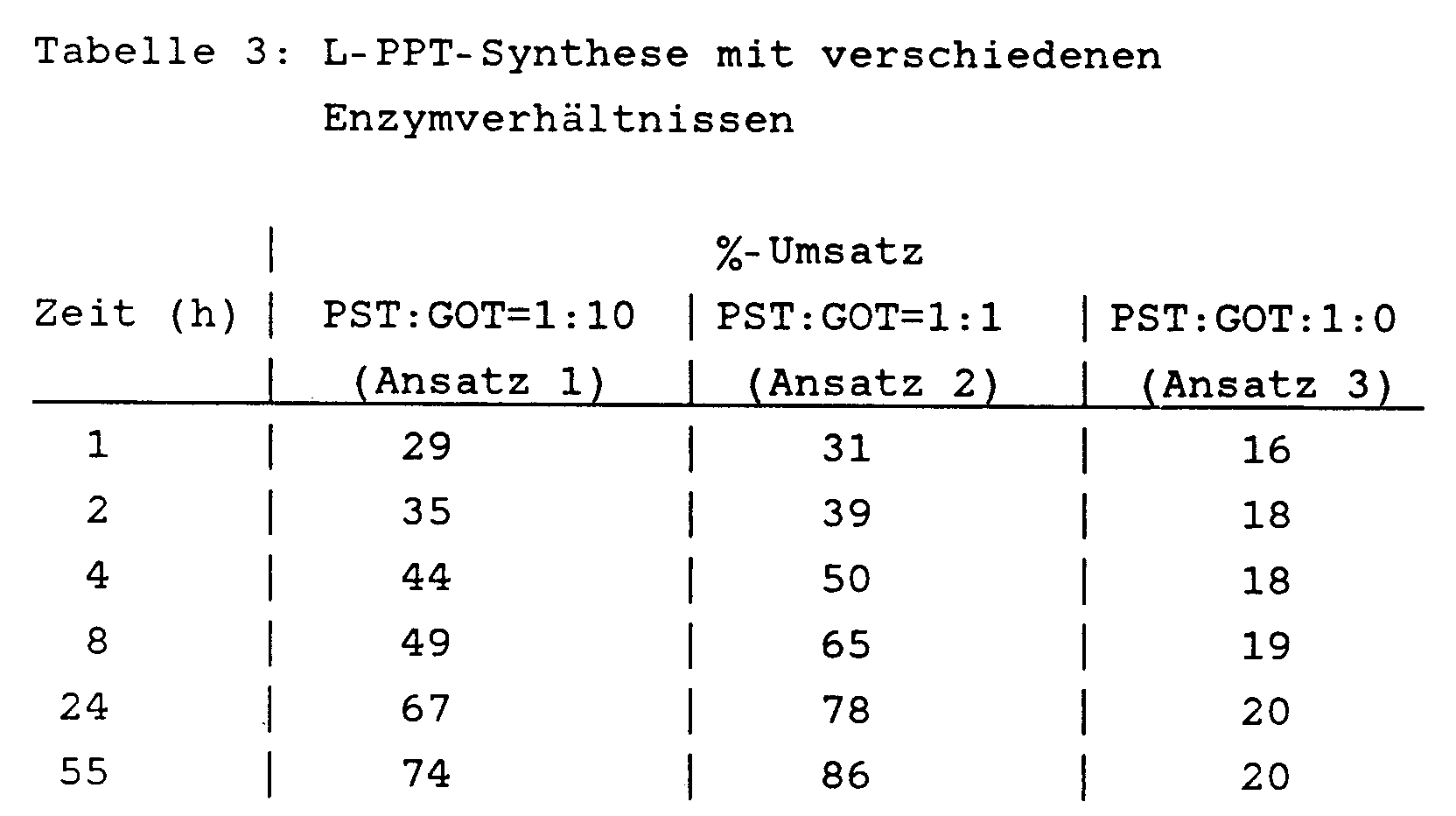
Synthese von L-Phosphinothricin mit gereinigter PST (E. coli) und GOT (Schwein) bei unterschiedlichen EnzymverhältnissenSynthesis of L-phosphinothricin with purified PST ( E. coli ) and GOT (pig) with different enzyme ratios
Die beiden gereinigten Transaminasen wurden wie in Beispiel 3 beschrieben mit einer Reaktionslösung bestehend aus 100 mM HMPB, 20 mM Glutaminsäure, 100 mM Asparaginsäure und 50 mM Tris/HCl, pH = 8,0 bei 37 °C inkubiert. Dabei wurden verschiedene Aktivitätsverhältnisse der beiden Enzyme eingesetzt:
- 1. 1 unit PST/10 units GOT
- 2. 1 unit PST/ 1 unit GOT
- 3. 1 unit PST/ 0 unit GOT
- 1.1 unit PST / 10 units GOT
- 2. 1 unit PST / 1 unit GOT
- 3. 1 unit PST / 0 unit GOT
Der Gehalt an L-Phosphinothricin in den Ansätzen wurde zu verschiedenen Zeitpunkten während des Ablaufs der Synthesereaktion durch Messung von Testproben im Aminosäureanalysator bestimmt. Die daraus ermittelten L-Phosphinothricin-Synthesen sind in der Tabelle 3 dargestellt. Der höchste Umsatz wurde mit dem Enzymverhältnis PST:GOT=1:1 erzielt (Ansatz 2). Ohne Zugabe der GOT (Ansatz 3) betrug die maximal erreichbare PPT-Umsatzrate nur ca. 20 %, da in diesem Fall nur die Glutaminsäure, nicht aber die Asparaginsäure für die Synthese von L-Phosphinothricin genutzt werden kann.
Einfluß von Manganchlorid auf die L-Phosphinothricin-SyntheseInfluence of manganese chloride on L-phosphinothricin synthesis
Die gereinigten Transaminasen wurden wie im Beispiel 3 beschrieben im Verhältnis 1:1 (je 1 unit) gemischt und mit Reaktionslösung (100 mM HMPB, 20 mM Glutaminsäure, 100 mM Asparaginsäure, 50 mM Tris/HCl, pH = 8,0) in Anwesenheit von 1 mM MnCl₂ bzw. ohne MnCl₂ bei 37 °C inkubiert. Der Ablauf der L-Phosphinothricin-Synthese wurde wie in Beispiel 4 beschrieben gemessen und ist in der Tabelle 4 zusammengefaßt. Durch Zugabe von Manganchlorid konnte die Reaktionsgeschwindigkeit deutlich gesteigert werden. Nach 24 h Reaktionszeit lag der L-Phosphinothricin-Umsatz um etwa 10 % über dem des Vergleichsansatzes ohne Manganchlorid.

Immobilisierung der Transaminase "PST" an KieselgelImmobilization of the transaminase "PST" on silica gel
Zu 50 ml PST-Lösung (gereinigte PST aus E. coli, 10 mg Protein/ml Lösung in 0,25 M Kaliumphosphatpuffer, pH 8) gibt man 50 ml aktiviertes Kieselgel (Silanierung und Glutardialdehyd-Aktivierung nach Literatur: K. Mosbach, Methods in Enzymology, Vol. XLIV; Academic Press, New York, 1976, S. 139 u. 140) und läßt unter leichtem Rühren für 3 h reagieren. Anschließend filtriert man den noch feuchten Katalysator und wäscht mit 100 ml 0,25 M Phosphatpuffer, pH 8. Der so hergestellte Biokatalysator kann für die unten beschriebenen Reaktionen eingesetzt werden.To 50 ml PST solution (purified PST from E. coli, 10 mg protein / ml solution in 0.25 M potassium phosphate buffer, pH 8) are added 50 ml activated silica gel (silanation and glutardialdehyde activation according to literature: K. Mosbach, Methods in Enzymology, Vol. XLIV; Academic Press, New York, 1976, pp. 139 u. 140) and allowed to react with gentle stirring for 3 h. The still moist catalyst is then filtered and washed with 100 ml of 0.25 M phosphate buffer, pH 8. The biocatalyst produced in this way can be used for the reactions described below.
Immobilisierung der Transaminase "GOT" an KieselgelImmobilization of the transaminase "GOT" on silica gel
10 ml einer GOT-Lösung (gereinigte GOT aus dem Schwein, 8,4 mg Protein/10 ml Lösung) werden wie in Beispiel 6 beschrieben an 10 ml Kieselgel immobilisiert. Der Biokatalysator kann in dieser Form für die gekoppelte Transaminierung eingesetzt werden.10 ml of a GOT solution (purified GOT from the pig, 8.4 mg protein / 10 ml solution) are immobilized on 10 ml silica gel as described in Example 6. In this form, the biocatalyst can be used for coupled transamination.
Gekoppelte Transaminierung mit immobilisierter PST und immobilisierter GOTCoupled transamination with immobilized PST and immobilized GOT
180 mg (1 mmol) HMPB, 133 mg (1 mmol) L-Asparaginsäure, 29,4 mg (0,2 mmol) L-Glutaminsäure, 10 mg Pyridoxalphosphat und 0,6 g TRIS werden mit dest. Wasser auf 5 g Lösung aufgefüllt und auf pH 8 gestellt. Dazu gibt man 0,5 ml immobilisierte PST (Beispiel 6) sowie 0,5 ml immobilisierte GOT (Beispiel 7) und läßt unter vorsichtigem Rühren bei pH 8 für 48 h bei 26°C reagieren. Die Reaktionsmischung wird per HPLC (Aminosäureanalysator) auf Aminosäuregehalt untersucht.
- Ausbeute (HPLC):
- 0,122 g L-PPT (68 % bezogen auf HMPB)
0,012 g L-Asparaginsäure
0,028 g L-Glutaminsäure
0,025 g L-Alanin
- Yield (HPLC):
- 0.122 g L-PPT (68% based on HMPB)
0.012 g L-aspartic acid
0.028 g L-glutamic acid
0.025 g L-alanine
Gekoppelte Transaminierung mit immobilisierter PST und immobilisierter GOTCoupled transamination with immobilized PST and immobilized GOT
1 g (5,6 mmol) HMPB, 715 mg (5,6 mmol) L-Asparaginsäure, 163 mg (1,1 mmol) L-Glutaminsäure und 10 mg Pyridoxalphosphat werden mit dest. Wasser auf 20 g Lösung aufgefüllt und mit KHCO₃ auf pH 8 gestellt. Nach Zugabe von 1 ml immobilisierter PST (Beispiel 6) und 1 ml GOT (Beispiel 7) läßt man unter leichtem Rühren bei 36°C für 72 h reagieren. Die Produktlösung wird per HPLC (ASA) auf Aminosäuregehalt untersucht.
- Ausbeute (HPLC):
- 0,58 g L-PPT (58 % bezogen auf HMPB)
0,30 g L-Asparaginsäure
0,16 g L-Glutaminsäure
0,02 g L-Alanin
- Yield (HPLC):
- 0.58 g L-PPT (58% based on HMPB)
0.30 g L-aspartic acid
0.16 g L-glutamic acid
0.02 g L-alanine
Gekoppelte Transaminierung mit immobilisierter PST und freier GOTCoupled transamination with immobilized PST and free GOT
180 mg (1 mmol) HMPB, 147 mg (1 mmol) L-Glutaminsäure, 133 mg (1 mmol) L-Asparaginsäure, 10 mg Pyridoxalphosphat und 0,7 g TRIS werden mit dest. Wasser auf 50 g Lösung, pH 8 aufgefüllt und 0,5 ml immobilisierte PST aus der Lösung gemäß Beispiel 6 sowie 42 µl freie GOT aus der gemäß Beispiel 7 hergestellten GOT Lösung zugefügt. Die Umsetzung erfolgt unter vorsichtigem Rühren bei 36°C. Nach 48 h wird der Aminosäuregehalt der Lösung per HPLC (ASA) überprüft.
- Ausbeute (HPLC):
- 0,145 g L-PPT (80 % bezogen auf HMPB)
0,024 g L-Asparaginsäure
0,147 g L-Glutaminsäure
0,003 g L-Alanin
- Yield (HPLC):
- 0.145 g L-PPT (80% based on HMPB)
0.024 g L-aspartic acid
0.147 g L-glutamic acid
0.003 g L-alanine
Gekoppelte Transaminierung mit immobilisierter PST und immobilisierter GOTCoupled transamination with immobilized PST and immobilized GOT
Die Umsetzung wird analog Beispiel 10 durchgeführt. Es wird 0,5 ml immobilisierte GOT (Beispiel 6) anstelle der freien GOT eingesetzt. Die Zusammensetzung der Aminosäuren in der Produktlösung entspricht der von Beispiel 10.The reaction is carried out analogously to Example 10. 0.5 ml of immobilized GOT (Example 6) is used instead of the free GOT. The composition of the amino acids in the product solution corresponds to that of Example 10.
Der L-PPT-Gehalt wurde dünnschichtchromatographisch ermittelt. Er liegt bei ca. 80 %.The L-PPT content was determined by thin layer chromatography. It is around 80%.
Claims (10)


Applications Claiming Priority (2)
| Application Number | Priority Date | Filing Date | Title |
|---|---|---|---|
| DE4030578A DE4030578A1 (en) | 1990-09-27 | 1990-09-27 | PROCESS FOR THE PREPARATION OF L-PHOSPHINOTHRICINE BY A COUPLED ENZYMATIC REACTION |
| DE4030578 | 1990-09-27 |
Publications (3)
| Publication Number | Publication Date |
|---|---|
| EP0477902A2 true EP0477902A2 (en) | 1992-04-01 |
| EP0477902A3 EP0477902A3 (en) | 1993-04-14 |
| EP0477902B1 EP0477902B1 (en) | 1998-02-11 |
Family
ID=6415103
Family Applications (1)
| Application Number | Title | Priority Date | Filing Date |
|---|---|---|---|
| EP91116335A Expired - Lifetime EP0477902B1 (en) | 1990-09-27 | 1991-09-25 | Process for the preparation of L-Phosphinothricine by a coupled enzymatic reaction |
Country Status (6)
| Country | Link |
|---|---|
| US (1) | US6335186B1 (en) |
| EP (1) | EP0477902B1 (en) |
| JP (1) | JP3018261B2 (en) |
| KR (1) | KR100190203B1 (en) |
| DE (2) | DE4030578A1 (en) |
| DK (1) | DK0477902T3 (en) |
Cited By (31)
| Publication number | Priority date | Publication date | Assignee | Title |
|---|---|---|---|---|
| WO2000023609A1 (en) * | 1998-10-19 | 2000-04-27 | Nsc Technologies Llc | Transaminase biotransformation process employing glutamic acid |
| WO2000066760A1 (en) * | 1999-04-30 | 2000-11-09 | Aventis Cropscience Gmbh | Method for producing l-phosphinothricine by enzymatic transamination with aspartate |
| CN109072261A (en) * | 2016-03-02 | 2018-12-21 | 阿格里麦蒂斯有限责任公司 | The method for manufacturing L-glufosinate |
| WO2019020283A1 (en) | 2017-07-27 | 2019-01-31 | Basf Se | Use of herbicidal compositions based on l-glufosinate in tolerant field crops |
| US10912301B2 (en) | 2015-05-11 | 2021-02-09 | Basf Se | Herbicide combinations comprising L-glufosinate and indaziflam |
| WO2021148302A1 (en) | 2020-01-23 | 2021-07-29 | Basf Se | Novel additives for agrochemical formulations |
| WO2021151745A1 (en) | 2020-01-31 | 2021-08-05 | Basf Se | Herbicide combinations comprising glufosinate and oxadiazon |
| WO2021151740A1 (en) | 2020-01-31 | 2021-08-05 | Basf Se | Herbicide combinations comprising glufosinate and sulfentrazone |
| WO2021151753A1 (en) | 2020-01-31 | 2021-08-05 | Basf Se | Herbicide combinations comprising glufosinate and selected ppo inhibitors |
| WO2021151735A1 (en) | 2020-01-31 | 2021-08-05 | Basf Se | Herbicide combinations comprising glufosinate and carfentrazone-ethyl |
| WO2021151733A1 (en) | 2020-01-31 | 2021-08-05 | Basf Se | Herbicide combinations comprising glufosinate and saflufenacil |
| WO2021151739A1 (en) | 2020-01-31 | 2021-08-05 | Basf Se | Herbicide combinations comprising glufosinate and pyraflufen-ethyl |
| WO2021151738A1 (en) | 2020-01-31 | 2021-08-05 | Basf Se | Herbicide combinations comprising glufosinate and epyrifenacil |
| WO2021151744A1 (en) | 2020-01-31 | 2021-08-05 | Basf Se | Herbicide combinations comprising glufosinate and oxyfluorfen |
| WO2021151737A1 (en) | 2020-01-31 | 2021-08-05 | Basf Se | Herbicide combinations comprising glufosinate and flumioxazin |
| WO2021151734A1 (en) | 2020-01-31 | 2021-08-05 | Basf Se | Herbicide combinations comprising glufosinate and flumiclorac-pentyl |
| WO2021151752A1 (en) | 2020-01-31 | 2021-08-05 | Basf Se | Herbicide combinations comprising glufosinate and selected ppo inhibitors |
| WO2021151741A1 (en) | 2020-01-31 | 2021-08-05 | Basf Se | Herbicide combinations comprising glufosinate and tiafenacil |
| WO2021151736A1 (en) | 2020-01-31 | 2021-08-05 | Basf Se | Herbicide combinations comprising glufosinate and fluthiacet-methyl |
| WO2021151743A1 (en) | 2020-01-31 | 2021-08-05 | Basf Se | Herbicide combinations comprising glufosinate and trifludimoxazin |
| WO2022078972A1 (en) | 2020-10-12 | 2022-04-21 | Basf Se | Herbicide combination comprising glufosinate, saflufenacil and trifludimoxazin |
| WO2022090214A1 (en) | 2020-10-27 | 2022-05-05 | Basf Se | Pesticide microemulsion compositions |
| EP4000400A1 (en) | 2020-11-17 | 2022-05-25 | Basf Se | Herbicide combination comprising glufosinate, saflufenacil and trifludimoxazin |
| WO2022167577A1 (en) | 2021-02-05 | 2022-08-11 | Basf Se | Liquid herbicidal compositions |
| WO2022207753A1 (en) | 2021-04-01 | 2022-10-06 | Basf Se | Methods for preparing l-glufosinate |
| WO2022243546A1 (en) | 2021-05-21 | 2022-11-24 | Basf Se | Computer-implemented method for applying a glutamine synthetase inhibitor on an agricultural field |
| WO2023084075A1 (en) | 2021-11-15 | 2023-05-19 | Basf Se | Method for increasing the efficacy of a herbicide |
| EP4338592A1 (en) | 2022-09-15 | 2024-03-20 | Basf Se | Use of compound for improving the efficacy of herbicides |
| WO2024056517A1 (en) | 2022-09-14 | 2024-03-21 | Basf Se | Use of an alkylether sulfate for improving the efficacy of herbicides |
| WO2025061719A1 (en) | 2023-09-21 | 2025-03-27 | Specialty Operations France | Emulsion in water concentrate comprising glufosinate, vlcfa inhibitor and specific surfactants |
| WO2025061721A1 (en) | 2023-09-21 | 2025-03-27 | Specialty Operations France | Herbicidal compositions comprising specific surfactants |
Families Citing this family (4)
| Publication number | Priority date | Publication date | Assignee | Title |
|---|---|---|---|---|
| JPH06245780A (en) * | 1993-02-25 | 1994-09-06 | Meiji Seika Kaisha Ltd | Production of l-2-amino-4-(hydroxymethylphosphinyl)-butyric acid |
| JP5335413B2 (en) * | 2006-03-02 | 2013-11-06 | Meiji Seikaファルマ株式会社 | Method for producing aspartate aminotransferase gene and L-phosphinothricin |
| CN107119084B (en) * | 2017-03-23 | 2019-12-17 | 浙江大学 | A kind of method utilizing transaminase and ethylene synthetase to produce L-glufosinate-ammonium |
| CN115747269B (en) * | 2021-09-02 | 2024-08-27 | 河北威远生物化工有限公司 | Synthesis method of L-glufosinate |
Family Cites Families (4)
| Publication number | Priority date | Publication date | Assignee | Title |
|---|---|---|---|---|
| DE3482982D1 (en) * | 1983-09-01 | 1990-09-20 | Genetics Inst | PRODUCTION OF L-AMINO ACIDS BY TRANSAMINATION. |
| US4826766A (en) * | 1985-09-23 | 1989-05-02 | Genetics Institute, Inc. | Production of amino acids using coupled aminotransferases |
| AU599985B2 (en) * | 1986-06-09 | 1990-08-02 | Meiji Seika Kaisha Ltd. | New process for the production of L-2-amino-4- (hydroxymethyl-phosphinyl)-butyric acid |
| DE3818851A1 (en) | 1988-06-03 | 1989-12-14 | Hoechst Ag | NEW TRANSAMINASE, THEIR MANUFACTURE AND ITS USE |
-
1990
- 1990-09-27 DE DE4030578A patent/DE4030578A1/en not_active Withdrawn
-
1991
- 1991-09-25 EP EP91116335A patent/EP0477902B1/en not_active Expired - Lifetime
- 1991-09-25 DK DK91116335T patent/DK0477902T3/en active
- 1991-09-25 DE DE59108934T patent/DE59108934D1/en not_active Expired - Fee Related
- 1991-09-26 JP JP3247204A patent/JP3018261B2/en not_active Expired - Fee Related
- 1991-09-26 KR KR1019910016748A patent/KR100190203B1/en not_active Expired - Fee Related
-
1995
- 1995-03-22 US US08/408,178 patent/US6335186B1/en not_active Expired - Fee Related
Cited By (38)
| Publication number | Priority date | Publication date | Assignee | Title |
|---|---|---|---|---|
| WO2000023609A1 (en) * | 1998-10-19 | 2000-04-27 | Nsc Technologies Llc | Transaminase biotransformation process employing glutamic acid |
| WO2000066760A1 (en) * | 1999-04-30 | 2000-11-09 | Aventis Cropscience Gmbh | Method for producing l-phosphinothricine by enzymatic transamination with aspartate |
| US6936444B1 (en) | 1999-04-30 | 2005-08-30 | Aventis Cropscience Gmbh | Process for the preparation of L-phosphinothricine by enzymatic transamination with aspartate |
| KR100810169B1 (en) * | 1999-04-30 | 2008-03-06 | 바이엘 크롭사이언스 게엠베하 | Method for preparing L-phosphinothricin by enzymatic amino group transfer using aspartate |
| US10912301B2 (en) | 2015-05-11 | 2021-02-09 | Basf Se | Herbicide combinations comprising L-glufosinate and indaziflam |
| CN109072261A (en) * | 2016-03-02 | 2018-12-21 | 阿格里麦蒂斯有限责任公司 | The method for manufacturing L-glufosinate |
| WO2019020283A1 (en) | 2017-07-27 | 2019-01-31 | Basf Se | Use of herbicidal compositions based on l-glufosinate in tolerant field crops |
| WO2021148302A1 (en) | 2020-01-23 | 2021-07-29 | Basf Se | Novel additives for agrochemical formulations |
| WO2021148304A1 (en) | 2020-01-23 | 2021-07-29 | Basf Se | Ppo formulations containing ether sulfates |
| WO2021148303A1 (en) | 2020-01-23 | 2021-07-29 | Basf Se | Glufosinate formulations containing amines or ammonium salts |
| WO2021151737A1 (en) | 2020-01-31 | 2021-08-05 | Basf Se | Herbicide combinations comprising glufosinate and flumioxazin |
| WO2021151743A1 (en) | 2020-01-31 | 2021-08-05 | Basf Se | Herbicide combinations comprising glufosinate and trifludimoxazin |
| WO2021151753A1 (en) | 2020-01-31 | 2021-08-05 | Basf Se | Herbicide combinations comprising glufosinate and selected ppo inhibitors |
| WO2021151735A1 (en) | 2020-01-31 | 2021-08-05 | Basf Se | Herbicide combinations comprising glufosinate and carfentrazone-ethyl |
| WO2021151733A1 (en) | 2020-01-31 | 2021-08-05 | Basf Se | Herbicide combinations comprising glufosinate and saflufenacil |
| WO2021151739A1 (en) | 2020-01-31 | 2021-08-05 | Basf Se | Herbicide combinations comprising glufosinate and pyraflufen-ethyl |
| WO2021151738A1 (en) | 2020-01-31 | 2021-08-05 | Basf Se | Herbicide combinations comprising glufosinate and epyrifenacil |
| WO2021151744A1 (en) | 2020-01-31 | 2021-08-05 | Basf Se | Herbicide combinations comprising glufosinate and oxyfluorfen |
| WO2021151745A1 (en) | 2020-01-31 | 2021-08-05 | Basf Se | Herbicide combinations comprising glufosinate and oxadiazon |
| WO2021151734A1 (en) | 2020-01-31 | 2021-08-05 | Basf Se | Herbicide combinations comprising glufosinate and flumiclorac-pentyl |
| WO2021151752A1 (en) | 2020-01-31 | 2021-08-05 | Basf Se | Herbicide combinations comprising glufosinate and selected ppo inhibitors |
| WO2021151741A1 (en) | 2020-01-31 | 2021-08-05 | Basf Se | Herbicide combinations comprising glufosinate and tiafenacil |
| WO2021151736A1 (en) | 2020-01-31 | 2021-08-05 | Basf Se | Herbicide combinations comprising glufosinate and fluthiacet-methyl |
| WO2021151740A1 (en) | 2020-01-31 | 2021-08-05 | Basf Se | Herbicide combinations comprising glufosinate and sulfentrazone |
| US12568968B2 (en) | 2020-01-31 | 2026-03-10 | Basf Se | Herbicide combinations comprising glufosinate and epyrifencacil |
| US12557815B2 (en) | 2020-01-31 | 2026-02-24 | Basf Se | Herbicide combinations comprising glufosinate and pyraflufen-ethyl |
| US12550898B2 (en) | 2020-01-31 | 2026-02-17 | Basf Se | Herbicide combinations comprising glufosinate and carfentrazone-ethyl |
| WO2022078972A1 (en) | 2020-10-12 | 2022-04-21 | Basf Se | Herbicide combination comprising glufosinate, saflufenacil and trifludimoxazin |
| WO2022090214A1 (en) | 2020-10-27 | 2022-05-05 | Basf Se | Pesticide microemulsion compositions |
| EP4000400A1 (en) | 2020-11-17 | 2022-05-25 | Basf Se | Herbicide combination comprising glufosinate, saflufenacil and trifludimoxazin |
| WO2022167577A1 (en) | 2021-02-05 | 2022-08-11 | Basf Se | Liquid herbicidal compositions |
| WO2022207753A1 (en) | 2021-04-01 | 2022-10-06 | Basf Se | Methods for preparing l-glufosinate |
| WO2022243546A1 (en) | 2021-05-21 | 2022-11-24 | Basf Se | Computer-implemented method for applying a glutamine synthetase inhibitor on an agricultural field |
| WO2023084075A1 (en) | 2021-11-15 | 2023-05-19 | Basf Se | Method for increasing the efficacy of a herbicide |
| WO2024056517A1 (en) | 2022-09-14 | 2024-03-21 | Basf Se | Use of an alkylether sulfate for improving the efficacy of herbicides |
| EP4338592A1 (en) | 2022-09-15 | 2024-03-20 | Basf Se | Use of compound for improving the efficacy of herbicides |
| WO2025061719A1 (en) | 2023-09-21 | 2025-03-27 | Specialty Operations France | Emulsion in water concentrate comprising glufosinate, vlcfa inhibitor and specific surfactants |
| WO2025061721A1 (en) | 2023-09-21 | 2025-03-27 | Specialty Operations France | Herbicidal compositions comprising specific surfactants |
Also Published As
| Publication number | Publication date |
|---|---|
| EP0477902B1 (en) | 1998-02-11 |
| US6335186B1 (en) | 2002-01-01 |
| KR100190203B1 (en) | 1999-06-01 |
| JPH04248987A (en) | 1992-09-04 |
| DE59108934D1 (en) | 1998-03-19 |
| DK0477902T3 (en) | 1998-09-23 |
| DE4030578A1 (en) | 1992-04-16 |
| KR920006505A (en) | 1992-04-27 |
| JP3018261B2 (en) | 2000-03-13 |
| EP0477902A3 (en) | 1993-04-14 |
Similar Documents
| Publication | Publication Date | Title |
|---|---|---|
| EP0477902B1 (en) | Process for the preparation of L-Phosphinothricine by a coupled enzymatic reaction | |
| DE2700456C2 (en) | ||
| DE69333295T2 (en) | Production of D-pantoic acid and D-pantothenic acid | |
| DE3750523T2 (en) | Process for the preparation of L-2-amino-4- (hydroxymethylphosphinyl) butyric acid. | |
| DE3818851A1 (en) | NEW TRANSAMINASE, THEIR MANUFACTURE AND ITS USE | |
| EP0054897B1 (en) | Process for the enzymatic preparation of l-2-amino-4-methyl-phosphino-butyric acid | |
| DD221905A1 (en) | PROCESS FOR THE PREPARATION OF L (-) - CARNITINE AND ITS DERIVATIVES | |
| US5187093A (en) | Microorganisms useful in the process for the production of l-carnitine | |
| DE68914236T2 (en) | Process for the production of sodium hyaluronate by fermentation. | |
| CH621769A5 (en) | ||
| DE3400574C2 (en) | ||
| DE68926922T2 (en) | Process for the production of L-alpha amino acids | |
| EP0400638A1 (en) | Process for the preparation of D-alpha aminocarboxylic acids | |
| DE69611331T2 (en) | Process for the production of S-phenyl-L-cysteine | |
| DE3500054A1 (en) | METHOD FOR PRODUCING L-PHENYLALANINE | |
| DE69924026T2 (en) | COENZYM FOR THE PREPARATION OF L-CARNITINE | |
| EP0410430B1 (en) | Process for the microbiological discontinual preparation of L-carnitine | |
| GB2161159A (en) | Improved transamination process for producing L-amino acids | |
| EP0301391B1 (en) | Process for the enzymatic production of l-2-amino-4-methyl-phosphinobutyric acid | |
| DE19749480A1 (en) | Process for the production of L-carnitine from crotonobetaine | |
| DE3875370T2 (en) | METHOD FOR TREATING MICROORGANISM CELLS CONTAINING TRIPTOPHANASE, OR THEIR PRODUCTS TREATED. | |
| DE19529211C2 (en) | Process for the preparation of (R) tertiary leucine | |
| KR950005925B1 (en) | Process for producing d-1-tartaric acid | |
| DE4308061A1 (en) | New de-acetylase specific for L-N-acetyl-phosphinothricin | |
| JPS6224076B2 (en) |
Legal Events
| Date | Code | Title | Description |
|---|---|---|---|
| PUAI | Public reference made under article 153(3) epc to a published international application that has entered the european phase |
Free format text: ORIGINAL CODE: 0009012 |
|
| AK | Designated contracting states |
Kind code of ref document: A2 Designated state(s): BE CH DE DK FR GB IT LI NL |
|
| PUAL | Search report despatched |
Free format text: ORIGINAL CODE: 0009013 |
|
| AK | Designated contracting states |
Kind code of ref document: A3 Designated state(s): BE CH DE DK FR GB IT LI NL |
|
| 17P | Request for examination filed |
Effective date: 19931012 |
|
| RAP1 | Party data changed (applicant data changed or rights of an application transferred) |
Owner name: HOECHST SCHERING AGREVO GMBH |
|
| 17Q | First examination report despatched |
Effective date: 19950208 |
|
| GRAG | Despatch of communication of intention to grant |
Free format text: ORIGINAL CODE: EPIDOS AGRA |
|
| GRAG | Despatch of communication of intention to grant |
Free format text: ORIGINAL CODE: EPIDOS AGRA |
|
| GRAH | Despatch of communication of intention to grant a patent |
Free format text: ORIGINAL CODE: EPIDOS IGRA |
|
| GRAH | Despatch of communication of intention to grant a patent |
Free format text: ORIGINAL CODE: EPIDOS IGRA |
|
| GRAA | (expected) grant |
Free format text: ORIGINAL CODE: 0009210 |
|
| AK | Designated contracting states |
Kind code of ref document: B1 Designated state(s): BE CH DE DK FR GB IT LI NL |
|
| REG | Reference to a national code |
Ref country code: CH Ref legal event code: EP |
|
| REF | Corresponds to: |
Ref document number: 59108934 Country of ref document: DE Date of ref document: 19980319 |
|
| ITF | It: translation for a ep patent filed | ||
| GBT | Gb: translation of ep patent filed (gb section 77(6)(a)/1977) |
Effective date: 19980416 |
|
| ET | Fr: translation filed | ||
| REG | Reference to a national code |
Ref country code: DK Ref legal event code: T3 |
|
| PLBE | No opposition filed within time limit |
Free format text: ORIGINAL CODE: 0009261 |
|
| STAA | Information on the status of an ep patent application or granted ep patent |
Free format text: STATUS: NO OPPOSITION FILED WITHIN TIME LIMIT |
|
| 26N | No opposition filed | ||
| REG | Reference to a national code |
Ref country code: GB Ref legal event code: IF02 |
|
| PGFP | Annual fee paid to national office [announced via postgrant information from national office to epo] |
Ref country code: DE Payment date: 20070612 Year of fee payment: 17 |
|
| PGFP | Annual fee paid to national office [announced via postgrant information from national office to epo] |
Ref country code: DK Payment date: 20070914 Year of fee payment: 17 |
|
| PGFP | Annual fee paid to national office [announced via postgrant information from national office to epo] |
Ref country code: CH Payment date: 20070927 Year of fee payment: 17 |
|
| REG | Reference to a national code |
Ref country code: GB Ref legal event code: 732E |
|
| REG | Reference to a national code |
Ref country code: CH Ref legal event code: PUE Owner name: BAYER CROPSCIENCE AG Free format text: HOECHST SCHERING AGREVO GMBH#GERICHTSTRASSE 27#13342 BERLIN (DE) -TRANSFER TO- BAYER CROPSCIENCE AG#ALFRED-NOBEL-STRASSE 50#40789 MONHEIM (DE) Ref country code: CH Ref legal event code: NV Representative=s name: PATENTANWAELTE SCHAAD, BALASS, MENZL & PARTNER AG |
|
| PGFP | Annual fee paid to national office [announced via postgrant information from national office to epo] |
Ref country code: GB Payment date: 20070919 Year of fee payment: 17 |
|
| PGFP | Annual fee paid to national office [announced via postgrant information from national office to epo] |
Ref country code: NL Payment date: 20070903 Year of fee payment: 17 Ref country code: IT Payment date: 20070926 Year of fee payment: 17 |
|
| NLS | Nl: assignments of ep-patents |
Owner name: BAYER CROPSCIENCE AG Effective date: 20071213 |
|
| NLT1 | Nl: modifications of names registered in virtue of documents presented to the patent office pursuant to art. 16 a, paragraph 1 |
Owner name: AVENTIS CROPSCIENCE GMBH |
|
| PGFP | Annual fee paid to national office [announced via postgrant information from national office to epo] |
Ref country code: BE Payment date: 20071120 Year of fee payment: 17 |
|
| PGFP | Annual fee paid to national office [announced via postgrant information from national office to epo] |
Ref country code: FR Payment date: 20070914 Year of fee payment: 17 |
|
| BECA | Be: change of holder's address |
Owner name: *BAYER CROPSCIENCE A.G.ALFRED-NOBEL-STRASSE 50, D- Effective date: 20080520 |
|
| BECH | Be: change of holder |
Owner name: *BAYER CROPSCIENCE A.G. Effective date: 20080520 |
|
| BECN | Be: change of holder's name |
Owner name: *BAYER CROPSCIENCE A.G. Effective date: 20080520 |
|
| REG | Reference to a national code |
Ref country code: FR Ref legal event code: CD Ref country code: FR Ref legal event code: CA Ref country code: FR Ref legal event code: TP |
|
| BERE | Be: lapsed |
Owner name: *BAYER CROPSCIENCE A.G. Effective date: 20080930 |
|
| REG | Reference to a national code |
Ref country code: CH Ref legal event code: PL |
|
| REG | Reference to a national code |
Ref country code: DK Ref legal event code: EBP |
|
| GBPC | Gb: european patent ceased through non-payment of renewal fee |
Effective date: 20080925 |
|
| PG25 | Lapsed in a contracting state [announced via postgrant information from national office to epo] |
Ref country code: NL Free format text: LAPSE BECAUSE OF NON-PAYMENT OF DUE FEES Effective date: 20090401 |
|
| NLV4 | Nl: lapsed or anulled due to non-payment of the annual fee |
Effective date: 20090401 |
|
| REG | Reference to a national code |
Ref country code: FR Ref legal event code: ST Effective date: 20090529 |
|
| PG25 | Lapsed in a contracting state [announced via postgrant information from national office to epo] |
Ref country code: BE Free format text: LAPSE BECAUSE OF NON-PAYMENT OF DUE FEES Effective date: 20080930 |
|
| PG25 | Lapsed in a contracting state [announced via postgrant information from national office to epo] |
Ref country code: IT Free format text: LAPSE BECAUSE OF NON-PAYMENT OF DUE FEES Effective date: 20080925 Ref country code: DE Free format text: LAPSE BECAUSE OF NON-PAYMENT OF DUE FEES Effective date: 20090401 |
|
| PG25 | Lapsed in a contracting state [announced via postgrant information from national office to epo] |
Ref country code: LI Free format text: LAPSE BECAUSE OF NON-PAYMENT OF DUE FEES Effective date: 20080930 Ref country code: CH Free format text: LAPSE BECAUSE OF NON-PAYMENT OF DUE FEES Effective date: 20080930 Ref country code: FR Free format text: LAPSE BECAUSE OF NON-PAYMENT OF DUE FEES Effective date: 20080930 |
|
| PG25 | Lapsed in a contracting state [announced via postgrant information from national office to epo] |
Ref country code: GB Free format text: LAPSE BECAUSE OF NON-PAYMENT OF DUE FEES Effective date: 20080925 |
|
| PG25 | Lapsed in a contracting state [announced via postgrant information from national office to epo] |
Ref country code: DK Free format text: LAPSE BECAUSE OF NON-PAYMENT OF DUE FEES Effective date: 20090331 |