EP0477844B1 - Indole compounds and their use - Google Patents
Indole compounds and their use Download PDFInfo
- Publication number
- EP0477844B1 EP0477844B1 EP91116213A EP91116213A EP0477844B1 EP 0477844 B1 EP0477844 B1 EP 0477844B1 EP 91116213 A EP91116213 A EP 91116213A EP 91116213 A EP91116213 A EP 91116213A EP 0477844 B1 EP0477844 B1 EP 0477844B1
- Authority
- EP
- European Patent Office
- Prior art keywords
- compound
- light
- group
- present
- general formula
- Prior art date
- Legal status (The legal status is an assumption and is not a legal conclusion. Google has not performed a legal analysis and makes no representation as to the accuracy of the status listed.)
- Expired - Lifetime
Links
- 0 **1C(c2ccccc2)=C(C=O)c2c1cccc2 Chemical compound **1C(c2ccccc2)=C(C=O)c2c1cccc2 0.000 description 5
Images


Classifications
-
- G—PHYSICS
- G03—PHOTOGRAPHY; CINEMATOGRAPHY; ANALOGOUS TECHNIQUES USING WAVES OTHER THAN OPTICAL WAVES; ELECTROGRAPHY; HOLOGRAPHY
- G03C—PHOTOSENSITIVE MATERIALS FOR PHOTOGRAPHIC PURPOSES; PHOTOGRAPHIC PROCESSES, e.g. CINE, X-RAY, COLOUR, STEREO-PHOTOGRAPHIC PROCESSES; AUXILIARY PROCESSES IN PHOTOGRAPHY
- G03C1/00—Photosensitive materials
- G03C1/76—Photosensitive materials characterised by the base or auxiliary layers
- G03C1/815—Photosensitive materials characterised by the base or auxiliary layers characterised by means for filtering or absorbing ultraviolet light, e.g. optical bleaching
- G03C1/8155—Organic compounds therefor
-
- A—HUMAN NECESSITIES
- A61—MEDICAL OR VETERINARY SCIENCE; HYGIENE
- A61K—PREPARATIONS FOR MEDICAL, DENTAL OR TOILETRY PURPOSES
- A61K8/00—Cosmetics or similar toiletry preparations
- A61K8/18—Cosmetics or similar toiletry preparations characterised by the composition
- A61K8/30—Cosmetics or similar toiletry preparations characterised by the composition containing organic compounds
- A61K8/49—Cosmetics or similar toiletry preparations characterised by the composition containing organic compounds containing heterocyclic compounds
- A61K8/4906—Cosmetics or similar toiletry preparations characterised by the composition containing organic compounds containing heterocyclic compounds with one nitrogen as the only hetero atom
- A61K8/4913—Cosmetics or similar toiletry preparations characterised by the composition containing organic compounds containing heterocyclic compounds with one nitrogen as the only hetero atom having five membered rings, e.g. pyrrolidone carboxylic acid
- A61K8/492—Cosmetics or similar toiletry preparations characterised by the composition containing organic compounds containing heterocyclic compounds with one nitrogen as the only hetero atom having five membered rings, e.g. pyrrolidone carboxylic acid having condensed rings, e.g. indol
-
- A—HUMAN NECESSITIES
- A61—MEDICAL OR VETERINARY SCIENCE; HYGIENE
- A61Q—SPECIFIC USE OF COSMETICS OR SIMILAR TOILETRY PREPARATIONS
- A61Q17/00—Barrier preparations; Preparations brought into direct contact with the skin for affording protection against external influences, e.g. sunlight, X-rays or other harmful rays, corrosive materials, bacteria or insect stings
- A61Q17/04—Topical preparations for affording protection against sunlight or other radiation; Topical sun tanning preparations
-
- C—CHEMISTRY; METALLURGY
- C07—ORGANIC CHEMISTRY
- C07D—HETEROCYCLIC COMPOUNDS
- C07D209/00—Heterocyclic compounds containing five-membered rings, condensed with other rings, with one nitrogen atom as the only ring hetero atom
- C07D209/02—Heterocyclic compounds containing five-membered rings, condensed with other rings, with one nitrogen atom as the only ring hetero atom condensed with one carbocyclic ring
- C07D209/04—Indoles; Hydrogenated indoles
- C07D209/10—Indoles; Hydrogenated indoles with substituted hydrocarbon radicals attached to carbon atoms of the hetero ring
- C07D209/18—Radicals substituted by carbon atoms having three bonds to hetero atoms with at the most one bond to halogen, e.g. ester or nitrile radicals
-
- C—CHEMISTRY; METALLURGY
- C07—ORGANIC CHEMISTRY
- C07D—HETEROCYCLIC COMPOUNDS
- C07D209/00—Heterocyclic compounds containing five-membered rings, condensed with other rings, with one nitrogen atom as the only ring hetero atom
- C07D209/02—Heterocyclic compounds containing five-membered rings, condensed with other rings, with one nitrogen atom as the only ring hetero atom condensed with one carbocyclic ring
- C07D209/04—Indoles; Hydrogenated indoles
- C07D209/10—Indoles; Hydrogenated indoles with substituted hydrocarbon radicals attached to carbon atoms of the hetero ring
- C07D209/18—Radicals substituted by carbon atoms having three bonds to hetero atoms with at the most one bond to halogen, e.g. ester or nitrile radicals
- C07D209/22—Radicals substituted by carbon atoms having three bonds to hetero atoms with at the most one bond to halogen, e.g. ester or nitrile radicals with an aralkyl radical attached to the ring nitrogen atom
-
- C—CHEMISTRY; METALLURGY
- C07—ORGANIC CHEMISTRY
- C07D—HETEROCYCLIC COMPOUNDS
- C07D209/00—Heterocyclic compounds containing five-membered rings, condensed with other rings, with one nitrogen atom as the only ring hetero atom
- C07D209/02—Heterocyclic compounds containing five-membered rings, condensed with other rings, with one nitrogen atom as the only ring hetero atom condensed with one carbocyclic ring
- C07D209/04—Indoles; Hydrogenated indoles
- C07D209/10—Indoles; Hydrogenated indoles with substituted hydrocarbon radicals attached to carbon atoms of the hetero ring
- C07D209/18—Radicals substituted by carbon atoms having three bonds to hetero atoms with at the most one bond to halogen, e.g. ester or nitrile radicals
- C07D209/24—Radicals substituted by carbon atoms having three bonds to hetero atoms with at the most one bond to halogen, e.g. ester or nitrile radicals with an alkyl or cycloalkyl radical attached to the ring nitrogen atom
-
- C—CHEMISTRY; METALLURGY
- C08—ORGANIC MACROMOLECULAR COMPOUNDS; THEIR PREPARATION OR CHEMICAL WORKING-UP; COMPOSITIONS BASED THEREON
- C08K—Use of inorganic or non-macromolecular organic substances as compounding ingredients
- C08K5/00—Use of organic ingredients
- C08K5/16—Nitrogen-containing compounds
- C08K5/34—Heterocyclic compounds having nitrogen in the ring
- C08K5/3412—Heterocyclic compounds having nitrogen in the ring having one nitrogen atom in the ring
- C08K5/3415—Five-membered rings
- C08K5/3417—Five-membered rings condensed with carbocyclic rings
-
- Y—GENERAL TAGGING OF NEW TECHNOLOGICAL DEVELOPMENTS; GENERAL TAGGING OF CROSS-SECTIONAL TECHNOLOGIES SPANNING OVER SEVERAL SECTIONS OF THE IPC; TECHNICAL SUBJECTS COVERED BY FORMER USPC CROSS-REFERENCE ART COLLECTIONS [XRACs] AND DIGESTS
- Y10—TECHNICAL SUBJECTS COVERED BY FORMER USPC
- Y10S—TECHNICAL SUBJECTS COVERED BY FORMER USPC CROSS-REFERENCE ART COLLECTIONS [XRACs] AND DIGESTS
- Y10S430/00—Radiation imagery chemistry: process, composition, or product thereof
- Y10S430/132—Anti-ultraviolet fading
Definitions
- the present invention relates to novel indole compounds which are quite useful as a UV light absorbing additive or an anti-halation additive for colored resin compositions, resin films, heat-sensitive recording materials, liquid crystal display materials and the like.
- UV light is electromagnetic radiation having a wavelength between about 250 nm and about 400 nm. A number of organic compounds are decomposed or degraded by exposure to the UV light.
- UV light absorbers are generally incorporated into the commercial organic products such as polymeric materials (e.g. natural or synthetic resin and rubber), dyes and cosmetic creams to prevent the degradation of the product such as discoloration, or the suntan of skin.
- polymeric materials e.g. natural or synthetic resin and rubber
- dyes and cosmetic creams to prevent the degradation of the product such as discoloration, or the suntan of skin.
- UV light absorbers have been incorporated into the heat-sensitive materials widely used as heat-sensitive transfer recording materials for recording devices such as facsimiles and printers to improve the light-resistance of the heat-sensitive transfer recording materials.
- the UV light absorbers may also be incorporated into the liquid crystal material widely used as display materials for watches and electric calculators or meters for cars.
- a proposal of a method for improving the light-resistance of the color photographic image using a UV light absorber containing transparent film Therein, the transparent film is superimposed onto the printed surface of the photograph as a protective UV filter layer.
- UV light absorbers examples include salicylates, benzophenones, benzotriazoles, cyanoacrylates and hindered amines. Since many of the compounds are substantially colorless, the incorporation of the UV light absorbers into the products does not affect the transparency or color of the products.
- UV light absorbers Most of these conventional UV light absorbers, however, absorb the UV light of the wavelength ranging between about 290 nm and about 380 nm. There have been no conventional appropriate UV light absorbers which exhibit effective absorptivity in the spectral area ranging between about 380 nm and about 400 nm.
- FR-A-2 152 995 describes photographic materials comprising, for example, an indole compound.
- US-A-4,522,808 relates to a cosmetic composition
- a cosmetic composition comprising a cosmetic vehicle and at least about 0.05 wt.% of a derivative of 2-phenylindole based on the total weight of said composition.
- DE-B-10 10 047 describes the use of fluorescent methine compounds having no dye character as brightening agents wherein, e.g., an N-methyl-2-phenylindole derivative is used.
- US-A-3,109,844 relates to several types of indole derivatives and processes for their preparation.
- the types include 3-indoylsuccinimide and N-substituted derivatives thereof, and 3-(3'-indolyl)pyrrolidine and N-substituted derivatives thereof.
- An object of the present invention is to provide novel UV light absorbing compouns which can preferably be employed in the art of colored molding plastics, resin films, heat-sensitive transfer materials, liquid crystal display materials and color photographs and a method for their production.
- Another object of the present invention is to provide an UV light absorber comprising the abovementioned UV light absorbing compound as an active ingredient, and to provide a resin composition comprising the UV light absorber.
- UV light absorber means an UV light absorbing composition containing at least one UV light absorbing compound such as an indole compound.
- the UV light absorbing compounds having:
- Fig. 1 is a near UV-visible light absorption spectrum of the compound 1 according to the present invention.
- Fig. 2 is a near UV-visible light absorption spectrum of the compound 2 according to the present invention.
- Fig. 3 is a near UV-visible light absorption spectrum of the compound 6 according to the present invention.
- Fig. 4 is a near UV-visible light absorption spectrum of the compound 7 according to the present invention.
- Fig. 5 is a near UV-visible light absorption spectrum of the compound 10 according to the present invention.
- Fig. 6 is a near UV-visible light absorption spectrum of the mixture prepared from compound 1 according to the present invention and benzotriazole UV light absorber at a weight ratio of 1:1.
- Fig. 7 is a near UV-visible light absorption spectrum of the mixture prepared from compound 1 according to the present invention and benzotriazole UV light absorber at a weight ratio of 1:2.
- Fig. 8 is an infrared spectrum of the compound 1 according to the present invention.
- Fig. 9 is an infrared spectrum of the compound 6 according to the present invention.
- Fig. 10 is an infrared spectrum of the compound 10 according to the present invention.
- the UV light absorbing compound according to the present invention is an indole compound of the general formula: wherein R 1 of the general formula I represents a linear or branched alkyl or aralkyl group having 1-12 carbon atoms and R 2 represents -CN or -COOR 3 .
- R 1 of the general formula I is selected from the group consisting of methyl, ethyl, butyl, isobutyl, t-butyl, hexyl, octyl, 2-ethylhexyl, dodecyl and benzyl group.
- R 3 represents an unsubstituted alkyl or aralkyl group having 1-20 carbon atoms or R 3 is selected from the group consisting of R 1 , ⁇ -cyanoethyl, ⁇ -chloroethyl, ethoxypropyl, hydroxyalkyl and alkoxyalkyl group, with the proviso that the indole compound is not a compound of the formula
- the process for producing the indole compound according to the present invention comprises; condensing a compound of the general formula: with a compound of the general formula: NC-CH 2 -R 2 [III] wherein R 1 as well as R 2 represent the groups as defined above respectively.
- Examples of the compound III include malononitrile (NC-CH 2 -CN) and ⁇ -cyanoacetic esters (NC-CH 2 -COOR 3 ), wherein R 3 represents the groups as defined above.
- ⁇ -cyanoacetic ester examples include methyl cyanoacetate, isopropyl cyanoacetate, butyl cyanoacetate, t-butyl cyanoacetate, amyl cyanoacetate, octyl cyanoacetate, esters obtained from cyanoacetic acids and higher alcohols (e.g., undecyl alcohol, dodecyl alcohol, aliphatic alcohols having 13-20 carbon atoms) and benzyl cyanoacetate.
- alcohols e.g., undecyl alcohol, dodecyl alcohol, aliphatic alcohols having 13-20 carbon atoms
- benzyl cyanoacetate examples include methyl cyanoacetate, isopropyl cyanoacetate, butyl cyanoacetate, t-butyl cyanoacetate, amyl cyanoacetate, octyl cyanoacetate, esters obtained from cyanoacetic acids and higher alcohols
- the preferred amount of compound III is the range between 0.9-1.2 equivalent weight based on the amount of compound II.
- the condensation reaction may be carried out at the temperature between 10 °C and the boiling point of an employed solvent over 0.5-20 hours.
- the solvents employed in this reaction include alcohols (e.g., methanol, ethanol) and acetic anhydride. If alcohols are employed as the solvents, bases such as pyridine and triethylamine can be employed as catalysts.
- the compound I according to the present invention is separated and optionally purified from the reaction mixture. The separation and purification is accomplished by means known to those skilled in the art.
- the resulting reaction mixture is poured into a solvent such as water, the precipitated compound I is then separated out from the mixture.
- a solvent such as water
- the compound I according to the present invention may be purified by solvent (e.g. alcohols) washing, but other purification processes such as recrystallization may be employed.
- the starting compound II according to the present invention may be prepared by means known to those in the art.
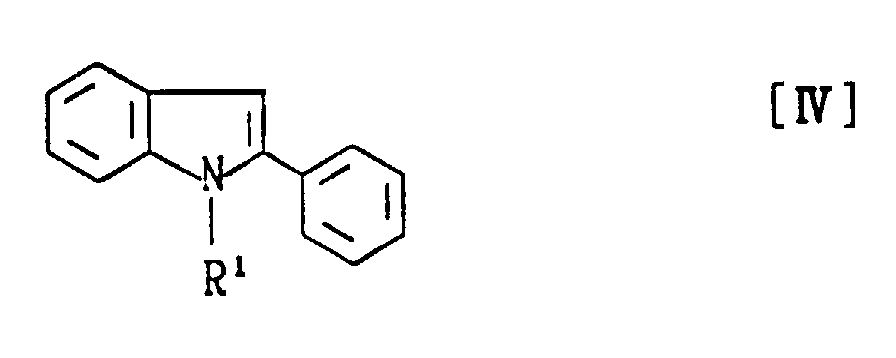
- the compound II is prepared by formylation of the following compound IV dissolved in dimethylformamide in the presence of phosphorus oxychloride (Vilsmeier reaction).
- Another procedure for a preparation of compound I according to the present invention comprises, for example, condensing a compound of the general formula: with compound III to obtain a compound of the general formula: and then, reacting the compound VI with an alkylating or aralkylating agent to obtain an N-alkylated or N-aralkylated compound which is a compound I according to the present invention. If R 3 is hydrogen, compound VI may be treated with an alkylating agent to obtain the derivatives thereof.
- Condensation of compound V with III may be carried out in essentially the same manner as described above.
- N-alkylation or N-aralkylation may be conducted in usual means known to those in the art.
- the alkylating or aralkylating agents include alkyl or aralkyl halides (e.g., methyl iodide and benzyl iodide), dialkyl or diaralkyl sulfuric acids(e.g., dimethyl sulfuric acid and dibenzyl sulfuric acid) and aromatic sulfonates.
- the indole compounds I according to the present invention have the ⁇ max in the spectral range between about 380 nm and about 400 nm. Thus, the long wavelength UV light may effectively be filtered out by the compound I.
- the compounds I according to the present invention are compatible and stable with a wide variety of organic materials such as organic solvents, plastics, resins and waxes, as well as have heat- and light-stability. Therefore, the indole compounds I according to the present invention can preferably be employed as additive for the wide variety of resin compositions.
- the resins employed in these resin compositions include polyvinyl butyrals, ethyl hydroxyethyl cellulose, styrene-maleic anhydride copolymers, methyl methacrylate resins, polyester resins, binders for heat-sensitive transfer material such as wax, plastics for molding, resins for plastic film, polymeric liquid crystals.
- the indole compound I according to the present invention may be employed into an UV light absorbing top layer superimposed over the photographic film, or may be mixed with colored organic materials such as color photographic pigments or dyes, so that the fastness against UV light as well as visible light of the color photographic film is improved.
- the indole compounds I according to the present invention may be combined with the anti-halation dyes employed in the color photographic film so as to prevent the adverse effect which accompanies the exposure of the photographic film.
- the indole compounds I according to the present invention can be employed as UV light absorbing compound for a wide variety of resin compositionsin an amount sufficient to provide a certain level of light resistance to the resin composition. Generally, amounts ranging from about 0.1-10 % by weight and preferably about 0.5-2.0 % by weight based on the solid weight of the composition can be employed. If the content of the compound I is greater than 10 % by weight, a color toning deficiency may occur in colored organic compounds or in a resin composition.
- Other conventional UV light absorbing compounds can be employed in combination with the indole compound I according to the present invention, so as to provide the wider spectral range of absorptivity.
- Other additives such as fluorescent whitening agents or radical scavengers may be incorporated into the resin composition according to the present invention.
- a dye solution was prepared by dissolving 0.10 mol of N-methyl-2-phenyl-3-indolyl aldehyde having the general formula: into 80 ml of ethanol. To this solution were added 0.11 mol of malononitrile, and 0.04 mol (4 parts by weight) of triethylamine. The solution was then heated to reflux, maintained at the temperature over 4 hours, and cooled to the room temperature. The resulting reaction mixture was poured into water to precipitate the condensation product. The precipitated crystals were then filtered off, washed with a little amount of alcohol, and dried to obtain the light-yellow crystals (m.p. 194-196 °C).
- a dye solution was prepared by dissolving 0.10 mol of the following compound: into 70 parts by weight of dimethylformamide. To this solution were then added 23 parts by weight of phosphorus oxychloride under externally cooling. Twelve parts by weight of pyridine were further added to the solution. The resulting solution was then heated to 40 °C, maintained at the temperature over 1 hour and cooled to 20-30 °C. Forty parts by weight of methanol, 35 parts by weight of sodium acetate, and a solution of 6.6 parts by weight (0.1 mol) of malononitrile into 5 parts by weight of methanol were added to the cooled solution. The solution was then heated to 70 °C, maintained at the temperature over I hour, and cooled to room temperature.
- the resulting reaction mixture was poured into water to precipitate the condensation product.
- the precipitated crystals were then filtered off, washed with water, and dried to obtain 28.5 parts by weight of powder product. Recrystallization of the resulting powder from methyl ethyl ketone gave the light-yellow crystals (m.p. 163-165 °C).
- Light-yellow crystals (m.p. 140-142 °C) were obtained in essentially the same manner as described in Example 1 except that ethyl cyanoacetate instead of malononitrile, and 4 hours refluxing were used.
- Light yellow crystals (m.p. 128-133 °C) were obtained in essentially the same manner as described in Example 1 except that benzyl cyanoacetate instead of malononitrile, and 5 hours refluxing were used.
- Fig. 1, 2. 3, 4 and 5 show near UV-visible light absorption spectra of the compoundsl, 2, 6, 7 and 10 respectively.
- Fig. 8, 9 and 10 show infrared spectra of the compoundsl. 6 and 10 respectively.
- This example illustrates the preparation of the light-resistance evaluation laminate samples which are pieces of magenta printed paper coated with the UV light absorbing coating composition according to the present invention.
- a transparent UV light absorbing coating composition was prepared form the following formulation.
- the UV light absorbing coating composition was applied onto a polyethylene terephthalate (PET) film having a thickness of 100 ⁇ m using a bar coater at a final dry coating thickness of about 30 ⁇ m.
- PET polyethylene terephthalate
- the coated PET film was then dried to provide a transfer sheet material consisting of a PET substrate layer and a UV light absorbing transfer coating layer.
- the UV light absorbing transfer coating layer surface of the transfer sheet material was laminated so as to cover the printed magenta pattern.
- the PET substrate layer was then removed to provide a laminate sample A.
- a laminate sample B was prepared in essentially the same manner as described in Example 11, except that the transparent UV light absorbing composition was prepared form the following formulation.
- This example illustrates the evaluation in light-resistance of the laminate samples prepared in Example 11 and Reference Example 2.
- the laminate samples A, B and comparative sample 1 which was a piece of magenta printed paper prepared as described in example 11 (i.e. the comparative sample 1 was not coated with the UV light absorbing coating composition according to the present invention) were irradiated for 20 hours on a long life carbon-arc fadeometer (SUGA TEST INSTRUMENTS Co., Ltd.). Light-resistance of the samples was evaluated by visual inspection of their color change. The results are shown in Table 2. Table 2 Samples Light-resistance A good a) B good comparative 1 fail b) a) No color change was substantially observed. b) High degree of color change was observed.
- This example illustrates that the UV light absorbing compound according to the present invention is compatible with the conventional UV light absorbing compounds having ⁇ of about 300 nm to about 380 nm.
- Fig. 6 and 7 show near UV-visible light absorption spectra of the mixture prepared from compound 1 and benzotriazole UV light absorber (TINUVIN P328, Ciba-Geigy Ltd.) at a weight ratio of 1:1 and 1:2 respectively.
- the wide spectral range in absorption between about 250 nm and about 400 nm was the result of the combination use thereof.
Landscapes
- Chemical & Material Sciences (AREA)
- Organic Chemistry (AREA)
- Health & Medical Sciences (AREA)
- Life Sciences & Earth Sciences (AREA)
- Animal Behavior & Ethology (AREA)
- General Health & Medical Sciences (AREA)
- Public Health (AREA)
- Veterinary Medicine (AREA)
- Materials Engineering (AREA)
- Chemical Kinetics & Catalysis (AREA)
- Epidemiology (AREA)
- Physics & Mathematics (AREA)
- General Physics & Mathematics (AREA)
- Birds (AREA)
- Dermatology (AREA)
- Engineering & Computer Science (AREA)
- Medicinal Chemistry (AREA)
- Polymers & Plastics (AREA)
- Thermal Transfer Or Thermal Recording In General (AREA)
- Indole Compounds (AREA)
- Heat Sensitive Colour Forming Recording (AREA)
- Compositions Of Macromolecular Compounds (AREA)
- Plural Heterocyclic Compounds (AREA)
Description
- The present invention relates to novel indole compounds which are quite useful as a UV light absorbing additive or an anti-halation additive for colored resin compositions, resin films, heat-sensitive recording materials, liquid crystal display materials and the like.
- UV light is electromagnetic radiation having a wavelength between about 250 nm and about 400 nm. A number of organic compounds are decomposed or degraded by exposure to the UV light.
- Then, a wide variety of UV light absorbers are generally incorporated into the commercial organic products such as polymeric materials (e.g. natural or synthetic resin and rubber), dyes and cosmetic creams to prevent the degradation of the product such as discoloration, or the suntan of skin.
- In recent years, UV light absorbers have been incorporated into the heat-sensitive materials widely used as heat-sensitive transfer recording materials for recording devices such as facsimiles and printers to improve the light-resistance of the heat-sensitive transfer recording materials. The UV light absorbers may also be incorporated into the liquid crystal material widely used as display materials for watches and electric calculators or meters for cars. Furthermore, there is a proposal of a method for improving the light-resistance of the color photographic image using a UV light absorber containing transparent film. Therein, the transparent film is superimposed onto the printed surface of the photograph as a protective UV filter layer.
- Examples of conventional UV light absorbers include salicylates, benzophenones, benzotriazoles, cyanoacrylates and hindered amines. Since many of the compounds are substantially colorless, the incorporation of the UV light absorbers into the products does not affect the transparency or color of the products.
- Most of these conventional UV light absorbers, however, absorb the UV light of the wavelength ranging between about 290 nm and about 380 nm. There have been no conventional appropriate UV light absorbers which exhibit effective absorptivity in the spectral area ranging between about 380 nm and about 400 nm.
- FR-A-2 152 995 describes photographic materials comprising, for example, an indole compound.
- US-A-4,522,808 relates to a cosmetic composition comprising a cosmetic vehicle and at least about 0.05 wt.% of a derivative of 2-phenylindole based on the total weight of said composition.
- DE-B-10 10 047 describes the use of fluorescent methine compounds having no dye character as brightening agents wherein, e.g., an N-methyl-2-phenylindole derivative is used.
- US-A-3,109,844 relates to several types of indole derivatives and processes for their preparation. The types include 3-indoylsuccinimide and N-substituted derivatives thereof, and 3-(3'-indolyl)pyrrolidine and N-substituted derivatives thereof.
- An object of the present invention is to provide novel UV light absorbing compouns which can preferably be employed in the art of colored molding plastics, resin films, heat-sensitive transfer materials, liquid crystal display materials and color photographs and a method for their production.
- Another object of the present invention is to provide an UV light absorber comprising the abovementioned UV light absorbing compound as an active ingredient, and to provide a resin composition comprising the UV light absorber.
- In this application. "UV light absorber" means an UV light absorbing composition containing at least one UV light absorbing compound such as an indole compound.
- According to the present invention, the UV light absorbing compounds having:
- a) compatibility with wide variety of the organic materials;
- b) heat-stability (i.e. the UV light absorbing compounds are stable at the thermal molding temperature of the plastic products, or at the thermal transfer temperature of the heat-sensitive transfer recording products);
- c) light-resistance (i.e. the UV light absorbing compounds neither decompose under photoirradiation as radical species which react with other components contained in the commercial products, nor act under photoirradiation as photosensitizers which activate other components contained in the commercial products); and
- d) efficient UV light absorptivity in the long wavelength UV light spectral area (i.e. the UV light absorbing compounds have molecular absorptivity coefficient (ε) greater than 2.5x10⁴ at maximum absorption wavelength (λmax) which exists in the spectral range between about 380 nm and about 400 nm), as well as substantial transparency; are provided.
- Fig. 1 is a near UV-visible light absorption spectrum of the
compound 1 according to the present invention. - Fig. 2 is a near UV-visible light absorption spectrum of the compound 2 according to the present invention.
- Fig. 3 is a near UV-visible light absorption spectrum of the compound 6 according to the present invention.
- Fig. 4 is a near UV-visible light absorption spectrum of the compound 7 according to the present invention.
- Fig. 5 is a near UV-visible light absorption spectrum of the compound 10 according to the present invention.
- Fig. 6 is a near UV-visible light absorption spectrum of the mixture prepared from
compound 1 according to the present invention and benzotriazole UV light absorber at a weight ratio of 1:1. - Fig. 7 is a near UV-visible light absorption spectrum of the mixture prepared from
compound 1 according to the present invention and benzotriazole UV light absorber at a weight ratio of 1:2. - Fig. 8 is an infrared spectrum of the
compound 1 according to the present invention. - Fig. 9 is an infrared spectrum of the compound 6 according to the present invention.
- Fig. 10 is an infrared spectrum of the compound 10 according to the present invention.
- The UV light absorbing compound according to the present invention is an indole compound of the general formula:


- The process for producing the indole compound according to the present invention comprises;
condensing a compound of the general formula:
NC-CH2-R2 [III]
wherein R1 as well as R2 represent the groups as defined above respectively. Examples of the compound III include malononitrile (NC-CH2-CN) and α-cyanoacetic esters (NC-CH2-COOR3), wherein R3 represents the groups as defined above. Examples of the α-cyanoacetic ester include methyl cyanoacetate, isopropyl cyanoacetate, butyl cyanoacetate, t-butyl cyanoacetate, amyl cyanoacetate, octyl cyanoacetate, esters obtained from cyanoacetic acids and higher alcohols (e.g., undecyl alcohol, dodecyl alcohol, aliphatic alcohols having 13-20 carbon atoms) and benzyl cyanoacetate. - In the abovementioned condensation, the preferred amount of compound III is the range between 0.9-1.2 equivalent weight based on the amount of compound II. The condensation reaction may be carried out at the temperature between 10 °C and the boiling point of an employed solvent over 0.5-20 hours. The solvents employed in this reaction include alcohols (e.g., methanol, ethanol) and acetic anhydride. If alcohols are employed as the solvents, bases such as pyridine and triethylamine can be employed as catalysts. After completion of the reaction, the compound I according to the present invention is separated and optionally purified from the reaction mixture. The separation and purification is accomplished by means known to those skilled in the art. For example, the resulting reaction mixture is poured into a solvent such as water, the precipitated compound I is then separated out from the mixture. Generally, the compound I according to the present invention may be purified by solvent (e.g. alcohols) washing, but other purification processes such as recrystallization may be employed.
- The starting compound II according to the present invention may be prepared by means known to those in the art. For example, the compound II is prepared by formylation of the following compound IV dissolved in dimethylformamide in the presence of phosphorus oxychloride (Vilsmeier reaction).
- Another procedure for a preparation of compound I according to the present invention comprises, for example, condensing a compound of the general formula:


- Condensation of compound V with III may be carried out in essentially the same manner as described above. N-alkylation or N-aralkylation may be conducted in usual means known to those in the art. The alkylating or aralkylating agents include alkyl or aralkyl halides (e.g., methyl iodide and benzyl iodide), dialkyl or diaralkyl sulfuric acids(e.g., dimethyl sulfuric acid and dibenzyl sulfuric acid) and aromatic sulfonates.
- The indole compounds I according to the present invention have the λmax in the spectral range between about 380 nm and about 400 nm. Thus, the long wavelength UV light may effectively be filtered out by the compound I. The compounds I according to the present invention are compatible and stable with a wide variety of organic materials such as organic solvents, plastics, resins and waxes, as well as have heat- and light-stability. Therefore, the indole compounds I according to the present invention can preferably be employed as additive for the wide variety of resin compositions.
- The resins employed in these resin compositions include polyvinyl butyrals, ethyl hydroxyethyl cellulose, styrene-maleic anhydride copolymers, methyl methacrylate resins, polyester resins, binders for heat-sensitive transfer material such as wax, plastics for molding, resins for plastic film, polymeric liquid crystals. In the photographic art, the indole compound I according to the present invention may be employed into an UV light absorbing top layer superimposed over the photographic film, or may be mixed with colored organic materials such as color photographic pigments or dyes, so that the fastness against UV light as well as visible light of the color photographic film is improved. The indole compounds I according to the present invention may be combined with the anti-halation dyes employed in the color photographic film so as to prevent the adverse effect which accompanies the exposure of the photographic film.
- The indole compounds I according to the present invention can be employed as UV light absorbing compound for a wide variety of resin compositionsin an amount sufficient to provide a certain level of light resistance to the resin composition. Generally, amounts ranging from about 0.1-10 % by weight and preferably about 0.5-2.0 % by weight based on the solid weight of the composition can be employed. If the content of the compound I is greater than 10 % by weight, a color toning deficiency may occur in colored organic compounds or in a resin composition. Other conventional UV light absorbing compounds can be employed in combination with the indole compound I according to the present invention, so as to provide the wider spectral range of absorptivity. Other additives such as fluorescent whitening agents or radical scavengers may be incorporated into the resin composition according to the present invention.
- The present invention will be more specifically described by the following non-limiting examples, wherein all parts are by weight unless otherwise specified.
- These examples illustrate the preparation of UV light absorbing compounds according to the present invention.
- A dye solution was prepared by dissolving 0.10 mol of N-methyl-2-phenyl-3-indolyl aldehyde having the general formula:

- A dye solution was prepared by dissolving 0.10 mol of the following compound:

- Light yellow crystals were obtained in essentially the same manner as described in Example 1 except that N-butyl-2-phenyl-3-indolyl aldehyde instead of N-methyl-2-phenyl-3-indolyl aldehyde, and 5 hours refluxing were used.
- Light yellow powder was obtained in essentially the same manner as described in Example 1 except that N-(2-ethylhexyl)-2-phenyl-3-indolyl aldehyde instead of N-methyl-2-phenyl-3-indolyl aldehyde, and 5 hours refluxing were used.
- Light yellow crystals were obtained in essentially the same manner as described in Example 1 except that N-benzyl-2-phenyl-3-indolyl aldehyde instead of N-methyl-2-phenyl-3-indolyl aldehyde, and 5 hours refluxing were used.
- Light-yellow crystals (m.p. 140-142 °C) were obtained in essentially the same manner as described in Example 1 except that ethyl cyanoacetate instead of malononitrile, and 4 hours refluxing were used.
- Light yellow crystals were obtained in essentially the same manner as described in Example 1 except that butyl cyanoacetate instead of malononitrile, and 5 hours refluxing were used.
- Light yellow crystals were obtained in essentially the same manner as described in Example 1 except that the combination of N-octyl-2-phenyl-3-indolyl aldehyde with ethyl cyanoacetate instead of N-methyl-2-phenyl-3-indolyl aldehyde with malononitrile, and 5 hours refluxing were used.
- Light yellow crystals were obtained in essentially the same manner as described in Example 1 except that the combination of N-benzyl-2-phenyl-3-indolyl aldehyde with ethyl cyanoacetate instead of N-methyl-2-phenyl-3-indolyl aldehyde with malononitrile. and 5 hours refluxing were used.
- Light yellow crystals (m.p. 128-133 °C) were obtained in essentially the same manner as described in Example 1 except that benzyl cyanoacetate instead of malononitrile, and 5 hours refluxing were used.
- Light yellow crystals were obtained in essentially the same manner as described in Example 1 except that the combination of N-benzyl-2-phenyl-3-indolyl aldehyde with benzyl cyanoacetate instead of N-methyl-2-phenyl-3-indolyl aldehyde with malononitrile, and 5 hours refluxing were used.
- The structures, λ and ε at the λmax of the resulting compounds 1-11 are summarized in the following Table 1.

- Fig. 1, 2. 3, 4 and 5 show near UV-visible light absorption spectra of the compoundsl, 2, 6, 7 and 10 respectively. Fig. 8, 9 and 10 show infrared spectra of the compoundsl. 6 and 10 respectively.
- This example illustrates the preparation of the light-resistance evaluation laminate samples which are pieces of magenta printed paper coated with the UV light absorbing coating composition according to the present invention.
- A transparent UV light absorbing coating composition was prepared form the following formulation.
Components Parts by Weight DIANAL LR-1065a) 100 compound 11 a) 40 % acrylic resin solution in methyl ethyl ketone available from Mitsubishi Rayon Co., Ltd. - The UV light absorbing coating composition was applied onto a polyethylene terephthalate (PET) film having a thickness of 100 µm using a bar coater at a final dry coating thickness of about 30 µm. The coated PET film was then dried to provide a transfer sheet material consisting of a PET substrate layer and a UV light absorbing transfer coating layer.
- On the other hand, the solid printing of magenta onto a piece of paper was carried out using a color ink jet printer.
- Then, onto the printed surface of the paper, the UV light absorbing transfer coating layer surface of the transfer sheet material was laminated so as to cover the printed magenta pattern. The PET substrate layer was then removed to provide a laminate sample A.
- A laminate sample B was prepared in essentially the same manner as described in Example 11, except that the transparent UV light absorbing composition was prepared form the following formulation.
Components Parts by Weight DIANAL LR-1065a) 100 compound 6 0.5 TINUVIN P328b) 0.5 a) 40% acrylic resin solution in methyl ethyl ketone available from Mitsubishi Rayon Co., Ltd. b) UV light absorber available from Ciba-Geigy Ltd. - This example illustrates the evaluation in light-resistance of the laminate samples prepared in Example 11 and Reference Example 2.
- The laminate samples A, B and
comparative sample 1 which was a piece of magenta printed paper prepared as described in example 11 (i.e. thecomparative sample 1 was not coated with the UV light absorbing coating composition according to the present invention) were irradiated for 20 hours on a long life carbon-arc fadeometer (SUGA TEST INSTRUMENTS Co., Ltd.). Light-resistance of the samples was evaluated by visual inspection of their color change. The results are shown in Table 2.Table 2 Samples Light-resistance A gooda) B good comparative 1 failb) a) No color change was substantially observed. b) High degree of color change was observed. - This example illustrates that the UV light absorbing compound according to the present invention is compatible with the conventional UV light absorbing compounds having λ of about 300 nm to about 380 nm.
- Fig. 6 and 7 show near UV-visible light absorption spectra of the mixture prepared from
compound 1 and benzotriazole UV light absorber (TINUVIN P328, Ciba-Geigy Ltd.) at a weight ratio of 1:1 and 1:2 respectively. The wide spectral range in absorption between about 250 nm and about 400 nm was the result of the combination use thereof.
Claims (7)
- An indole compound of the general formula:


- The indole compound according to claim 1, wherein R1 of the general formula I is selected from the group consisting of methyl, ethyl, butyl, isobutyl, t-butyl, hexyl, octyl, 2-ethylhexyl, dodecyl and a benzyl group.
- A process for producing the compound according to claim 1 or 2, comprising:
reacting a compound of the general formula:
NC-CH2-R2 [III]
wherein R1 and R2 represent the groups as defined in claim 1, respectively. - The process according to claim 3 wherein compound III is selected from the group consisting of malononitrile and α-cyanoacetic esters.
- A UV light absorber comprising an indole compound according to claim 1 or 2 as an active ingredient.
- A resin composition comprising the UV light absorber according to claim 5.
- A coating composition comprising the UV light absorber according to claim 5.
Applications Claiming Priority (2)
| Application Number | Priority Date | Filing Date | Title |
|---|---|---|---|
| JP2256036A JP2846091B2 (en) | 1990-09-25 | 1990-09-25 | Indole compounds and their uses |
| JP256036/90 | 1990-09-25 |
Publications (2)
| Publication Number | Publication Date |
|---|---|
| EP0477844A1 EP0477844A1 (en) | 1992-04-01 |
| EP0477844B1 true EP0477844B1 (en) | 1997-01-02 |
Family
ID=17287026
Family Applications (1)
| Application Number | Title | Priority Date | Filing Date |
|---|---|---|---|
| EP91116213A Expired - Lifetime EP0477844B1 (en) | 1990-09-25 | 1991-09-24 | Indole compounds and their use |
Country Status (4)
| Country | Link |
|---|---|
| US (2) | US5296519A (en) |
| EP (1) | EP0477844B1 (en) |
| JP (1) | JP2846091B2 (en) |
| DE (1) | DE69123915T2 (en) |
Families Citing this family (36)
| Publication number | Priority date | Publication date | Assignee | Title |
|---|---|---|---|---|
| JPH08133789A (en) * | 1994-10-31 | 1996-05-28 | Central Glass Co Ltd | Ultraviolet rays absorbing transparent body |
| JPH08133792A (en) * | 1994-10-31 | 1996-05-28 | Central Glass Co Ltd | Heat rays reflecting ultraviolet rays absorbing transparent body |
| JPH08259708A (en) * | 1995-03-27 | 1996-10-08 | Showa Techno Kooto Kk | Polyester film for support lamination |
| US5785766A (en) * | 1996-03-01 | 1998-07-28 | Davis; Ronald O. | Process for the color recovery of vinyl plastics |
| JPH11209392A (en) * | 1998-01-27 | 1999-08-03 | Nippon Paper Industries Co Ltd | Benzotriazole derivative and heat-sensitive recording unit using the same |
| JPH11249293A (en) * | 1998-03-06 | 1999-09-17 | Toray Ind Inc | Photosensitive paste and method for manufacturing plasma display |
| JP2000007873A (en) * | 1998-06-18 | 2000-01-11 | Mitsubishi Rayon Co Ltd | Acrylic resin film |
| US6121221A (en) * | 1999-07-26 | 2000-09-19 | Ronald O. Davis | Kit for cleaning vinyl plastics |
| US7282555B2 (en) | 2004-05-27 | 2007-10-16 | Eastman Chemical Company | Method for incorporating nitrogen containing methine light absorbers in pet and compositions thereof |
| US7541407B2 (en) | 2004-05-27 | 2009-06-02 | Eastman Chemical Company | Process for adding methine UV light absorbers to PET prepared by direct esterification |
| US20050267283A1 (en) * | 2004-05-27 | 2005-12-01 | Weaver Max A | Process for adding nitrogen containing methine light absorbers to poly(ethylene terephthalate) |
| DE102005012056A1 (en) * | 2005-03-16 | 2006-09-28 | Basf Coatings Ag | Multicoat paint systems, process for their preparation and their use in the automotive industry |
| BRPI0907441B1 (en) * | 2008-01-23 | 2020-02-04 | Agc Inc | interlayer film for laminated glass and laminated glass |
| WO2012023616A1 (en) | 2010-08-20 | 2012-02-23 | 積水化学工業株式会社 | Interlayer for laminated glass, and laminated glass |
| JP5650963B2 (en) * | 2010-09-13 | 2015-01-07 | タレックス光学工業株式会社 | Shading lens for protective glasses |
| JP2013054275A (en) * | 2011-09-06 | 2013-03-21 | Nikon-Essilor Co Ltd | Dyed lens and method of manufacturing the same |
| KR101969612B1 (en) | 2011-10-14 | 2019-04-16 | 제이에스알 가부시끼가이샤 | Optical filter, solid state image-capturing device using same, and camera module using same |
| JP6256335B2 (en) | 2012-06-25 | 2018-01-10 | Jsr株式会社 | Optical filter for solid-state imaging device and use thereof |
| WO2015056734A1 (en) | 2013-10-17 | 2015-04-23 | Jsr株式会社 | Optical filter, solid-state image pickup device, and camera module |
| US9966402B2 (en) | 2014-12-04 | 2018-05-08 | Jsr Corporation | Solid-state imaging device |
| JP2016147988A (en) * | 2015-02-13 | 2016-08-18 | 積水化学工業株式会社 | Production method of cut object and adhesive material |
| JP6210180B2 (en) | 2015-07-28 | 2017-10-11 | Jsr株式会社 | Optical filter and ambient light sensor including optical filter |
| KR102671094B1 (en) * | 2015-12-28 | 2024-05-30 | 스미또모 가가꾸 가부시끼가이샤 | Retardation film |
| KR102799874B1 (en) * | 2015-12-28 | 2025-04-23 | 스미또모 가가꾸 가부시끼가이샤 | Optical laminate |
| CN109074763B (en) | 2016-04-27 | 2021-06-15 | 日本瑞翁株式会社 | Film sensor member and method for manufacturing same, circularly polarizing plate and method for manufacturing same, and image display device |
| JP6705699B2 (en) * | 2016-05-25 | 2020-06-03 | 住友化学株式会社 | Light absorbing composition |
| CN112596141B (en) | 2016-06-08 | 2022-11-15 | Jsr株式会社 | Optical filter and optical sensor |
| JP6898026B2 (en) * | 2016-09-30 | 2021-07-07 | ホヤ レンズ タイランド リミテッドHOYA Lens Thailand Ltd | Manufacturing method of spectacle lenses and spectacle lenses |
| KR102436821B1 (en) | 2016-11-30 | 2022-08-26 | 니폰 제온 가부시키가이샤 | Optical laminates, circular polarizers, touch panels and image display devices |
| CN110622044A (en) * | 2017-05-19 | 2019-12-27 | 三井化学株式会社 | Polycarbonate resin lens and polycarbonate resin composition |
| EP3690503B1 (en) * | 2017-09-29 | 2024-04-03 | Sekisui Chemical Co., Ltd. | Glass structure |
| WO2019131544A1 (en) * | 2017-12-25 | 2019-07-04 | 三井化学株式会社 | Indole-based compound, method for producing said compound, and use thereof |
| KR20210008409A (en) * | 2018-06-15 | 2021-01-21 | 미쓰이 가가쿠 가부시키가이샤 | Display device and composition for display device |
| KR102113537B1 (en) * | 2019-01-28 | 2020-05-21 | 코오롱인더스트리 주식회사 | Ultraviolet absorbing encapsulant for light emitting device and light emitting device including the same |
| CN112939842A (en) * | 2021-02-03 | 2021-06-11 | 畅的新材料科技(上海)有限公司 | Synthesis and application of cyanoacrylate ultraviolet blue light absorber |
| KR20240102810A (en) * | 2022-12-26 | 2024-07-03 | 주식회사 엘지화학 | Photosensitive resin composition, photosensitive material comprising same and display device |
Family Cites Families (4)
| Publication number | Priority date | Publication date | Assignee | Title |
|---|---|---|---|---|
| BE555326A (en) * | 1956-03-01 | |||
| US3109844A (en) * | 1959-09-16 | 1963-11-05 | Bristol Myers Co | 3-(3-indolyl) pyrrolidines |
| BE788688A (en) * | 1971-09-17 | 1973-03-12 | Agfa Gevaert Nv | DEVELOPMENT OF PHOTOGRAPHIC MATERIAL AT ELEVATED TEMPERATURE |
| US4522808A (en) * | 1980-08-15 | 1985-06-11 | Societe Anonyme Dite: L'oreal | Anti-sunburn compositions containing 2-phenyl-indole derivatives |
-
1990
- 1990-09-25 JP JP2256036A patent/JP2846091B2/en not_active Expired - Lifetime
-
1991
- 1991-09-24 EP EP91116213A patent/EP0477844B1/en not_active Expired - Lifetime
- 1991-09-24 DE DE69123915T patent/DE69123915T2/en not_active Expired - Lifetime
-
1992
- 1992-06-11 US US07/897,103 patent/US5296519A/en not_active Expired - Lifetime
-
1993
- 1993-12-20 US US08/169,221 patent/US5401438A/en not_active Expired - Lifetime
Non-Patent Citations (1)
| Title |
|---|
| LEHRBUCH DER ORGANISCHEN CHEMIE. H.BEYER, 15/16 ed. 1968, pages 502-504 * |
Also Published As
| Publication number | Publication date |
|---|---|
| EP0477844A1 (en) | 1992-04-01 |
| DE69123915D1 (en) | 1997-02-13 |
| US5296519A (en) | 1994-03-22 |
| JP2846091B2 (en) | 1999-01-13 |
| JPH04134065A (en) | 1992-05-07 |
| US5401438A (en) | 1995-03-28 |
| DE69123915T2 (en) | 1997-05-28 |
Similar Documents
| Publication | Publication Date | Title |
|---|---|---|
| US5296519A (en) | Indole compound and use of the same | |
| EP0640591B1 (en) | Azomethine derivatives as UV light absorbers | |
| US4085062A (en) | N,N'-bis-aromaticformamidines useful as sunscreening agents | |
| US5243052A (en) | Mixed carbonate ester derivatives of quinophthalone dyes and their preparation | |
| WO1990013435A1 (en) | Thermal transfer sheet | |
| CA1118204A (en) | Heat-sensitive recording or copying material | |
| KR970007419B1 (en) | Subliming type dye for thermal transfer printing | |
| US5227499A (en) | Substituted squarylium dyes, and processes and intermediates for the preparation thereof | |
| KR900006303B1 (en) | Photographic materials containing 3-aminoallylidenemalonitrile UV absorbing compounds | |
| JP2856927B2 (en) | Methine dye and transfer method thereof | |
| JP2633086B2 (en) | Squarylium dye | |
| US4814320A (en) | Heat-sensitive recording material | |
| EP4499757A1 (en) | Benzofluoran-based compounds as thermochromic dyes and their use in imaging systems | |
| EP1369862B1 (en) | Polymethine compound and near-infrared absorbing material comprising same | |
| JPH04178646A (en) | Pyrazoloazole azomethine dyestuff | |
| EP1686157A1 (en) | Nonsolvate-form crystal of polymethine compound and process for producing the same | |
| JPH0565424A (en) | Bichromophoric methine dye | |
| EP1826245A1 (en) | Nonsolvated crystals of polymethine compound, process for production thereof and use of the crystals | |
| KR100199563B1 (en) | Colour element for heat-sublimation transfer recording | |
| JPS6334190A (en) | Thermal recording material | |
| KR0177833B1 (en) | Sublimation Pigment | |
| DE3836797C2 (en) | ||
| JPH0366692A (en) | Spirooxazine compounds and photosensitive materials using the compounds | |
| FR2622591A1 (en) | LEUCO DYE AND RECORDING MATERIAL COMPRISING SAME, ESPECIALLY USEFUL AS HEAT OR PRESSURE SENSITIVE SELF-CLEANING SHEET | |
| JPS62153292A (en) | Spirobenzoxazine compounds |
Legal Events
| Date | Code | Title | Description |
|---|---|---|---|
| PUAI | Public reference made under article 153(3) epc to a published international application that has entered the european phase |
Free format text: ORIGINAL CODE: 0009012 |
|
| AK | Designated contracting states |
Kind code of ref document: A1 Designated state(s): CH DE FR GB LI |
|
| 17P | Request for examination filed |
Effective date: 19920930 |
|
| 17Q | First examination report despatched |
Effective date: 19930624 |
|
| GRAH | Despatch of communication of intention to grant a patent |
Free format text: ORIGINAL CODE: EPIDOS IGRA |
|
| GRAH | Despatch of communication of intention to grant a patent |
Free format text: ORIGINAL CODE: EPIDOS IGRA |
|
| GRAA | (expected) grant |
Free format text: ORIGINAL CODE: 0009210 |
|
| AK | Designated contracting states |
Kind code of ref document: B1 Designated state(s): CH DE FR GB LI |
|
| REG | Reference to a national code |
Ref country code: CH Ref legal event code: EP Ref country code: CH Ref legal event code: NV Representative=s name: A. BRAUN, BRAUN, HERITIER, ESCHMANN AG PATENTANWAE |
|
| REF | Corresponds to: |
Ref document number: 69123915 Country of ref document: DE Date of ref document: 19970213 |
|
| ET | Fr: translation filed | ||
| PLBE | No opposition filed within time limit |
Free format text: ORIGINAL CODE: 0009261 |
|
| STAA | Information on the status of an ep patent application or granted ep patent |
Free format text: STATUS: NO OPPOSITION FILED WITHIN TIME LIMIT |
|
| 26N | No opposition filed | ||
| REG | Reference to a national code |
Ref country code: GB Ref legal event code: IF02 |
|
| REG | Reference to a national code |
Ref country code: CH Ref legal event code: PFA Owner name: ORIENT CHEMICAL INDUSTRIES, LTD. Free format text: ORIENT CHEMICAL INDUSTRIES, LTD.#1-7-14, SHINMORI ASAHI-KU#OSAKA-SHI OSAKA-FU (JP) -TRANSFER TO- ORIENT CHEMICAL INDUSTRIES, LTD.#1-7-14, SHINMORI ASAHI-KU#OSAKA-SHI OSAKA-FU (JP) |
|
| PGFP | Annual fee paid to national office [announced via postgrant information from national office to epo] |
Ref country code: CH Payment date: 20100927 Year of fee payment: 20 |
|
| PGFP | Annual fee paid to national office [announced via postgrant information from national office to epo] |
Ref country code: FR Payment date: 20100818 Year of fee payment: 20 |
|
| PGFP | Annual fee paid to national office [announced via postgrant information from national office to epo] |
Ref country code: GB Payment date: 20100927 Year of fee payment: 20 |
|
| PGFP | Annual fee paid to national office [announced via postgrant information from national office to epo] |
Ref country code: DE Payment date: 20101029 Year of fee payment: 20 |
|
| REG | Reference to a national code |
Ref country code: DE Ref legal event code: R071 Ref document number: 69123915 Country of ref document: DE |
|
| REG | Reference to a national code |
Ref country code: DE Ref legal event code: R071 Ref document number: 69123915 Country of ref document: DE |
|
| REG | Reference to a national code |
Ref country code: CH Ref legal event code: PL |
|
| REG | Reference to a national code |
Ref country code: GB Ref legal event code: PE20 Expiry date: 20110923 |
|
| PG25 | Lapsed in a contracting state [announced via postgrant information from national office to epo] |
Ref country code: GB Free format text: LAPSE BECAUSE OF EXPIRATION OF PROTECTION Effective date: 20110923 |
|
| PG25 | Lapsed in a contracting state [announced via postgrant information from national office to epo] |
Ref country code: DE Free format text: LAPSE BECAUSE OF EXPIRATION OF PROTECTION Effective date: 20110925 |