EP0477273B1 - Verfahren und erzeugnisse für die asbestbehandlung - Google Patents
Verfahren und erzeugnisse für die asbestbehandlung Download PDFInfo
- Publication number
- EP0477273B1 EP0477273B1 EP90909946A EP90909946A EP0477273B1 EP 0477273 B1 EP0477273 B1 EP 0477273B1 EP 90909946 A EP90909946 A EP 90909946A EP 90909946 A EP90909946 A EP 90909946A EP 0477273 B1 EP0477273 B1 EP 0477273B1
- Authority
- EP
- European Patent Office
- Prior art keywords
- asbestos
- acid
- solution
- weight
- fluoride ions
- Prior art date
- Legal status (The legal status is an assumption and is not a legal conclusion. Google has not performed a legal analysis and makes no representation as to the accuracy of the status listed.)
- Expired - Lifetime
Links
Images
Classifications
-
- A—HUMAN NECESSITIES
- A62—LIFE-SAVING; FIRE-FIGHTING
- A62D—CHEMICAL MEANS FOR EXTINGUISHING FIRES OR FOR COMBATING OR PROTECTING AGAINST HARMFUL CHEMICAL AGENTS; CHEMICAL MATERIALS FOR USE IN BREATHING APPARATUS
- A62D3/00—Processes for making harmful chemical substances harmless or less harmful, by effecting a chemical change in the substances
- A62D3/30—Processes for making harmful chemical substances harmless or less harmful, by effecting a chemical change in the substances by reacting with chemical agents
- A62D3/35—Processes for making harmful chemical substances harmless or less harmful, by effecting a chemical change in the substances by reacting with chemical agents by hydrolysis
-
- B—PERFORMING OPERATIONS; TRANSPORTING
- B09—DISPOSAL OF SOLID WASTE; RECLAMATION OF CONTAMINATED SOIL
- B09B—DISPOSAL OF SOLID WASTE NOT OTHERWISE PROVIDED FOR
- B09B3/00—Destroying solid waste or transforming solid waste into something useful or harmless
- B09B3/70—Chemical treatment, e.g. pH adjustment or oxidation
-
- A—HUMAN NECESSITIES
- A62—LIFE-SAVING; FIRE-FIGHTING
- A62D—CHEMICAL MEANS FOR EXTINGUISHING FIRES OR FOR COMBATING OR PROTECTING AGAINST HARMFUL CHEMICAL AGENTS; CHEMICAL MATERIALS FOR USE IN BREATHING APPARATUS
- A62D2101/00—Harmful chemical substances made harmless, or less harmful, by effecting chemical change
- A62D2101/40—Inorganic substances
- A62D2101/41—Inorganic fibres, e.g. asbestos
-
- B—PERFORMING OPERATIONS; TRANSPORTING
- B09—DISPOSAL OF SOLID WASTE; RECLAMATION OF CONTAMINATED SOIL
- B09B—DISPOSAL OF SOLID WASTE NOT OTHERWISE PROVIDED FOR
- B09B2101/00—Type of solid waste
- B09B2101/35—Asbestos
Definitions
- the invention relates to a method for abating asbestos in asbestos-containing material, and to a solution for facilitating removal of asbestos-containing material from a surface.
- Asbestos is a commercial term applied to a group of silicate materials which occur in fibrous form.
- the chemical composition of chrysotile asbestos may be represented as: Mg 3 (Si 2 0 5 )(OH) 4 or 3Mg0.2Si0 2 .H 2 0.
- the crystalline structure of chrysotile asbestos consists of alternating layers of silica and magnesium oxide/hydroxide bound to each other through covalently shared oxygen. These layers are transverse to the fiber axis.
- the other varieties of asbestos are silicates of magnesium, iron, calcium, and sodium. These varieties of asbestos belong to the amphibole (straight fiber) group of minerals. About 95% of world production is the chrysotile form of asbestos.
- the metal-micelle asbestos when introduced into a living cell, does not react with cellular iron. Therefore, it is asserted, the reaction that is believed to initiate fibrosis should be blocked and biological hazards associated with exposure of living organisms to asbestos should be reduced.
- US Patent No 3 007 780 discloses a pickling solution for conditioning a titanium or titanium base alloy article which comprises 5-30% of acetic acid and 0.5-17% hydrofluoric acid, the balance being water. Other uses for the solution are not disclosed.
- EP-A-0 372 084 disclose the treatment of asbestos by coating or spraying the surface of an asbestos-containing structure or asbestos wastes with inter alia a mixture of nitric and hydrofluoric acids.
- the asbestos reacts with the treatment agent so that the needles of asbestos become solidified as a massive product.
- US Patent No 3 708 014 discloses removing chrysotile asbestos from a well bore by injecting a solution containing a mixture of hydrochloric and hydrofluoric acids into the well. There is, however, nothing in this reference to suggest that a less aggressive mixture of acids would serve the same purpose.
- GB-A-2 015 979 discloses a method of sealing the surface of an asbestos coating layer to reduce the evolution of asbestos therefrom by applying an aqueous acid solution thereto in order to form a coherent water insoluble surface layer.
- the acid solution hydrolyzes the magnesium oxide (M g 0) units in the crystal structure, thereby destroying the crystal structure and the fibrous nature of the chrysotile asbestos.
- the aqueous solution should have an acid concentration of about 1-25% by weight, preferably about 5-15% by weight.
- weak acid is used herein in its generally understood sense, i.e., an acid is defined as being “weak” if its protolysis reaction with water does not go essentially to completion unless the solution is extremely dilute.
- the method may be used in situ by spraying asbestos-containing materials which are in place, for instance, in a building, with the weak acid solution.
- the weak acid solution Depending on what acid is used, one is able to achieve 90% and preferably greater conversion of the asbestos such that what remains is a non-asbestos material which, however, retains fire retardant properties.
- 90% or more of asbestos is converted in accordance with the method of the present invention, the remaining material no longer has the characteristic asbestos fibrous nature and so is essentially no longer asbestos.
- the asbestos-containing materials preferably receive more than one, e.g., two to six or more, spray applications of an aqueous solution of a weak organic acid, such as trifluoroacetic acid, to achieve a 98% or more conversion of the asbestos.
- a weak organic acid such as trifluoroacetic acid
- the converted material can be left in place and still retain good insulating and fire retardant properties.
- a stabilizing agent which may preferably comprise a resin in combination with a sodium silicate material, is applied to the converted material. The stabilizing agent binds the converted material together and to the substrate and prevents them from becoming airborne.
- the asbestos-containing materials may be sprayed in situ with an aqueous solution containing a weak acid and a source of fluoride ions, such as ammonium fluoride (NH 4 F) or sodium fluoride (NaF).
- aqueous solution should comprise about 1-25%, preferably about 5-15%, by weight of a weak organic acid, and about 1-10%, preferably about 2-8%, by weight of the fluoride ion source.
- the concentration of the acid in the solution is preferably higher than that of the fluoride ion source such that their molar ratio is maintained at greater than one during use.
- a solution containing both a dilute weak acid and a source of fluoride ions attacks asbestos in two ways.
- the acid attacks the MgO layers in the crystal structure of chrysotile asbestos.
- the fluoride ions attack the silica layers, converting them into fluorosilicate.
- Adding fluoride ions to the treatment solution greatly speeds up the rate of conversion of asbestos. It is believed that the fluoride ion increases the rate at which the weak acid diffuses into the magnesia layers. It also makes the solution much more effective in converting forms of asbestos other than chrysotile, such as amosite, which are not attacked very strongly by the weak acid solution alone.
- the treatment of the asbestos-containing material may be performed by immersing asbestos-containing material which has been removed from a substrate, such as, for example, building structural members or pipes, in a solution of the kind described above, preferably with heating and agitation of the solution.
- a substrate such as, for example, building structural members or pipes
- the asbestos-containing material is first wet in situ with the solution one or more times, for instance, by spraying, and then removed while still wet and soaked in the solution, e.g., by immersion, preferably with heating and agitation, until the conversion is complete. Thereafter, the residue may be neutralized and disposed of as a non-hazardous material.
- the asbestos-containing material should be permitted to dry between successive in situ wettings by the treatment solutions.
- the material in cases where the asbestos-containing material is a solid which cannot easily be penetrated with the solution by spraying or immersion, the material can be ground, preferably while immersed in the solution, to expose the asbestos to the solution.
- Treatment solutions according to the invention are defined in Claims 18 and 19. They may comprise an aqueous solution of between about 1-25%, preferably about 5-15%, by weight of a weak organic acid and about 1-10%, preferably about 2-8% by weight of a fluoride ion source.
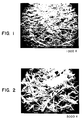
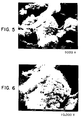
- Figs 1-3 are photomicrographs of untreated chrysotile asbestos fibres at magnifications of 1000X, 5000X, and 10000X respectively.
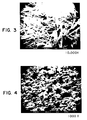
- Figs 4-6 are photomicrographs of chrysotile asbestos after treatment with trifluoroacetic acid at magnifications of 1000X, 5000X, and 10000X respectively.
- While the present invention is primarily intended for the conversion of the chrysotile forms of asbestos to a non-asbestos material, it is also effective, particularly when a source of fluoride ions is included, for the conversion of other forms of asbestos, such as amosite.
- untreated chrysotile asbestos is shown in magnifications ranging from 1000X to 10000X.
- the serpentine fibers characteristic of chrysotile asbestos are clearly evident in these photomicrographs. The harmful effects of these fibers is well documented at this time.
- Asbestos such as is shown in FIGs 1-3 can be treated, for example by spraying or immersion, with a dilute aqueous solution of a weak acid having a concentration of about 1 to 25%, and preferably 5 to 15%, by weight of the weak acid.
- the solution should also contain about 1 to 10%, most preferably about 2 to 8%, by weight of a source of fluoride ions.
- Higher concentrations of weak acid and fluoride ion source may be used but increase expense and materials handling problems, without having been found to provide significant increased benefits.
- the concentrations of the fluoride ion source is further limited by its solubility.
- the weak acid is a weak organic acid having a pH in the range of about 2 to 6.
- acetic acid p-cyanobenzoic acid
- trifluoroacetic acid lactic acid, benzoic acid
- lactic acid benzoic acid
- formic acid trifluoroacetic acid
- trifluoroacetic acid is substantially slower acting than the others, so that it is less preferred.
- Weak acids having lower pH's are normally preferred over ones having higher pH's.
- any water soluble weak acid may be used, particularly any organic weak acid. The reaction rates and other characteristics of particular acids may make them undesirable, however.
- Dilute solutions of organic weak acids are preferred because, in accordance with the invention, they have been found to wet the asbestos-containing materials extremely well, and obviate the need for any separate wetting agent.
- the above weak acids have the following pK a 's: Acid pK a Acetic 4.76 Benzoic 4.21 Lactic 3.86 Formic 3.75 p-cyanobenzoic 3.55 Trifluoroacetic 0.25
- All forms of asbestos are crystalline minerals.
- the conversion process of the invention converts the asbestos to a noncrystalline material, such as a glass, or at least to a material which no longer has more than trace amounts of asbestos crystallinity when measured by currently accepted methods, such as polarizing light microscopy, TEM or X-ray diffraction. Preferably, all traces of asbestos crystallinity are destroyed by the process of the invention.
- the crystalline structure of chrysotile asbestos consists of a polymeric silica backbone interspersed with MgO units.
- MgO units When chrysotile asbestos is wet or immersed by or in a dilute solution containing a weak acid, it is believed that the MgO units are hydrolyzed to Mg(OH) 2 , which is leached out of the structure by the solution while leaving the silica backbone intact. This destroys the original crystalline structure of the chrysotile asbestos.
- the resulting material may comprise fine glass fibers, a particulate or a combination of both. A substantial portion of the asbestos dissolves completely and is believed to form compounds such as fluorosilicic acid.
- Figs 4-6 show chrysotile asbestos at magnifications ranging from 1000X to 10,000X after being immersed in a 5% aqueous solution of trifluoroacetic acid in accordance with one form of the present invention.
- Figs 4-6 show the dramatic differences resulting from treatment of chrysotile asbestos with a dilute weak acid solution. The fibrous nature of asbestos is destroyed and only non-fibrous silica particles remain.
- a wetting agent such as sodium dodecyl sulfate or a non-ionic surfactant such as Surfynol 465, a product sold by the Air Products Company, can be added to the weak acid solution in conventional amounts (e.g., in amounts of about 1% by weight) to increase wetting of the asbestos fibers. Excellent wetting has been achieved in most instances, however, with the application of a weak organic acid solution alone, without an additional wetting agent.
- the asbestos-containing material is to be removed from the building component or other substrate to which it is applied, or if loose asbestos-containing material is to be treated in accordance with the invention, it is frequently preferable to immerse the asbestos-containing material in the weak acid solution to insure complete wetting.
- the solution is preferably agitated, for instance with the use of a propeller-type mixer such as is commonly used in industrial settings, which significantly speeds the conversion of the asbestos.
- the conversion can be further speeded, if desired, by heating the solution. Heating the solution usually has less effect on the conversion rate in spraying operations because the mass and thermal inertia of the material being treated is normally much greater than that of the solution being applied.
- Table 1 sets forth a number of weak organic acids that have been used without the presence of fluoride ions to reduce the crystallinity of chrysotile asbestos. Table 1 also sets forth the degree of reduction in crystallinity of chrysotile fibers which were immersed in the aqueous solution as measured by X-ray diffraction. Table 1 Acid Concentration (in wt.%) Reduction of Crystallinity p-Trifluoromethyl benzoic acid 0.6% ⁇ 10% Acetic acid 5% 30-90% p-Cyanobenzoic acid 1% 90% Trifluoroacetic acid 5% >98% Lactic acid 5% 95%
- the conversions shown in Table 1 take place in periods ranging from 2 days to 4 weeks. In large measure, these long periods of time are required by the slow nature of the reaction, particularly the slow rate at which the weak acids diffuse through the silica layers. Some acids, such as trifluoroacetic acid, react much faster than others and are preferred. In some cases, the slow reaction is due to the difficulty in actually wetting the asbestos fibers contained therein. For example, it is much easier to wet the exposed asbestos fibers in pipe insulation than it is to wet asbestos fibers which are tightly bound to a binder such as, for example, transite board or floor tile.
- a binder such as, for example, transite board or floor tile.
- the asbestos fibers may be subjected to successive sprayings with the weak acid solution.
- the materials can be wet a second and successive times, preferably with about 12 to 24 hours between each application, until the destruction of the asbestos fibers is achieved.
- the number of wettings or sprayings required for complete destruction of the asbestos fiber depends on a variety of factors, such as the amount and porosity of the binder with which the asbestos fibers are mixed, the particular weak acid employed, whether a fluoride ion source is included in the solution, and the type of asbestos fibers being treated.
- the resulting non-fibrous material may be left in place to perform the fireproofing or other function for which the asbestos was originally installed provided it has retained its physical integrity and adheres adequately to the underlying substrate.
- the resulting material is preferably sprayed or washed with a mild alkaline solution, such as of sodium bicarbonate, in order to neutralize any remaining acid in the material. The material is fully neutralized when the pH of a sample placed in water is at 7.
- the material may be stabilized by applying a stabilizing or fixing agent to the material to bind it together.
- the stabilizing agent should contain a resin-like material, such as a latex resin, as a binder. Desirably, the stabilizing agent also contains a sodium silicate material which helps to bind and harden the material.
- the stabilizing agent may also include an alkaline neutralizing material, in which case the neutralizing and stabilizing steps may be combined, so that the need for a separate neutralizing step is obviated.
- One suitable stabilizing agent comprises about 25% by volume N-sodium silicate, 25% by volume acrylic latex (Rohm and Haas), 5% by volume latex (BF Goodrich), 10% by volume alkaline cleaner (Du Bois), 5% by volume water softener (Calgon), 5% by volume wetting and dispersing additive (Byk), and 25% by volume water.
- Other stabilizing agents may include styrene-butadiene or polyvinyl chloride resins. Such resins may be used with or without sodium silicate.
- Yet another stabilizing agent includes a urethane resin and no sodium silicate. The stabilizing agent is applied, preferably by spraying, after the asbestos-containing material has been treated sufficiently to effectively destroy the fibrous asbestos.
- the stabilizing agent typically requires about 4 to 8 hours to cure, depending on the atmospheric humidity. If necessary, for additional fire-retardant characteristics, a layer of non-asbestos-containing fireproofing material can be sprayed over the stabilized material.
- Applicants have found, in accordance with the invention, that the addition of a source of fluoride ions to the treatment solution both dramatically speeds the rate of conversion of the asbestos to a non-fibrous material and makes the process of the invention effective for the conversion of other types of asbestos, such as amosite, to a non-fibrous material.
- the treatment solution of the invention converts the asbestos to a noncrystalline product by the fluoride ions attacking the silica content of the asbestos. To do this it is necessary that the fluoride ions be in an acid environment.
- Suitable fluoride ion sources include, for example, ammonium fluoride (NH 4 F) and alkali metal fluorides (LiF, NaF, KF, CsF).
- NH 4 F ammonium fluoride
- LiF, NaF, KF, CsF alkali metal fluorides
- the fluoride ion especially in weak acid solution, is believed to attack the silica layers and greatly enhances the rate at which the weak acid attacks the MgO units in chrysotile asbestos.
- An important advantage of the treatment solutions of the invention is that they can be handled with only reasonable precautions.
- the rate of reaction is also significantly increased if the asbestos material immersed in the treating solution is stirred or agitated while the treatment continues. Heating the treatment solution to a temperature of, e.g., about 50-85°C, further increases the rate of reaction.
- the asbestos-containing material is removed from the substrate to which it has been applied, preferably while still wet from one or more initial spray applications of the treatment solution of the invention, and digested by immersion in the solution, preferably with heat and agitation, until the asbestos is destroyed.
- the process of the invention may typically include the steps of removing any obstructions, such as interior partitions, ceilings and column covers to expose the suspected asbestos-containing materials, sampling and testing the suspected asbestos-containing materials in accordance with applicable standards to determine its composition and other relevant characteristics, determining an optimum formulation for a treatment solution depending on such composition and characteristics, including the need for a separate wetting agent and suitable types and concentrations of weak acids and fluoride ion sources, providing a sufficient amount of such treatment solution, repeatedly spraying the asbestos-containing material in situ with such solution, or removing the asbestos-containing material from the substrate to which it is applied, preferably while it is still wet from an initial spray application of the solution, and immersing the removed material in a container of such treatment solution, in either case until the fibrous nature of the asbestos is effectively destroyed.
- the surfaces that were coated with such asbestos-containing material are refireproofed by either neutralizing and stabilizing the converted material in situ , or by applying a non-asbestos-containing fireproofing material on such surfaces from which the asbestos has been removed.
- a final light spray application or misting of the treatment solution to the surfaces is desirable to convert any remaining asbestos fibers which have been missed by the removal process.
- the surface be dry before the misting.
- the surfaces are also preferably neutralized by spraying with mild alkaline solutions.
- an additional layer of fireproofing material can be applied over the stabilized material.
- the asbestos abatement process may also be carried out by spraying the asbestos-containing material one or more times with the treatment solution, removing the asbestos-containing material while still wet and disposing of it in a conventional manner.
- the underlying substrate can then be misted with the treatment solution (after drying, if desired), neutralized, and then refireproofed as described above.
- the particular composition of the solution used for the various spray applications, or for an initial spray application and immersion, may be varied if desired, but are referred to herein collectively as a singular solution.
- the concentration of the solution used for the digestion step might preferably be higher than that used for the spray application steps for safety reasons.
- this dust may be dealt with easily and much less expensively by spraying it in situ with the solution of the invention, repeatedly if necessary, in order to convert any asbestos in the dust to a non-fibrous, non-hazardous material. Thereafter the dust may be collected and removed by inexpensive, conventional means, since it no longer contains asbestos.
- the initial generation of the dust during the removal of asbestos-containing material from the underlying substrate is preferably minimized in accordance with the invention by wetting the material with the treatment solution of the invention before removal and by keeping such material wet with such solution while it is removed from the substrate.
- the asbestos-containing materials are collected and digested by immersion in a vat containing the treatment solution preferably with stirring or agitation, it is also often desirable to grind up the asbestos-containing material either before or during immersion. This is particularly in the case when the asbestos-containing material is non-porous and not attacked by the treatment solution. Typical examples of such materials are transite board or pipe and asbestos-containing tiles. In such situations it is necessary to grind up the material to enable the treatment solution to contact the asbestos fibers. In accordance with the invention, this grinding is preferably performed while the material is immersed in or being wet down by the treatment solution in order to prevent the generation of asbestos-containing dust. Often, in such situations, a substantial portion of the material dissolves in the treatment solution, thus reducing the volume of material to be disposed of in a landfill site.
- a dilute solution of a strong acid rather than a weak acid for digesting the asbestos-containing material after it has been sprayed in situ with the weak acid solution and removed from the substrate.
- suitable acids include hydrochloric, sulfuric and nitric acids.
- a fluoride ion source in the solution for the purposes described above.
- the strong acids have the advantage of being faster acting, but have the disadvantage of requiring much more careful handling and a higher potential for causing serious injury or damage if they are mishandled.
- the solution be neutralized and the fluoride ions be tied up in compounds having low solubility in water.
- One way of dealing with the fluoride ions is to merely add sand to the used solution to exhaust the fluoride ions and form fluorosilicates upon neutralization having low solubility in water.
- Neutralization can be accomplished by adding any alkaline species to the used solution. For instance, sodium hydroxide, sodium bicarbonate or calcium hydroxide could be used, with calcium hydroxide having the advantage that it will tend to form calcium fluoride with any remaining fluoride ions, that is very insoluble in water.
- the treatment solution in some situations it is desirable for the treatment solution to contain about 20 to 50% by weight of ethanol in order to increase the rate of evaporation. It should be kept in mind, however, that a treatment solution containing fluoride ion should not be allowed to come into contact with any glass surfaces which would be etched by the fluoride ions.
- Example 1 0.365g of the chrysotile/mineral wool sample of Example 1 was magnetically stirred in 20ml of the solution used in Example 1; no heat was applied. The bulk of the material had obviously dissolved after one hour, but the reaction was continued for three hours. A small amount of solid residue was collected on a 0.2 micron filter; TEM analysis showed no fibers remaining.
- 0.265g of the chrysotile/mineral wool sample was magnetically stirred in an aqueous solution of ten volume percent formic acid (a weaker acid than trifluoroacetic) and five weight percent ammonium fluoride. Stirring at room temperature was continued for three hours, at which time undissolved material was collected on a 0.2 micron filter. TEM analysis of the residue showed a low percentage of fibers which appeared under TEM examination not to be asbestos remaining (estimated at ca. 1-2%).
- chrysotile/mineral wool sample was situated on the raised area of a plastic 4 ounce specimen cup such that any drainage could be removed.
- the sample was treated dropwise with 3.6ml of the solution used in Example 1 over a period of three minutes. Approximately 1.5ml of drainage was removed. The sample was then allowed to dry at ambient temperature. The treatment cycle was then repeated as described a total of ten times, with a minimum of 12 hours between treatments. Since the total amount of residue declined during the treatments, the amount of solution added per cycle was gradually lowered to a final value of 2.0ml.
- the TEM micrographs show that the appearance of the treated fibers differs from untreated fibers, although many of the fibers continued to exhibit chrysotile asbestos SAED patterns. After six treatments, the appearance of the fibers is significantly altered. None of the fibers exhibited SAED patterns. Further treatments continued to lower the total residue remaining, but some fibrous material was still present at ten treatments.
Landscapes
- Health & Medical Sciences (AREA)
- Chemical & Material Sciences (AREA)
- Chemical Kinetics & Catalysis (AREA)
- General Chemical & Material Sciences (AREA)
- General Health & Medical Sciences (AREA)
- Toxicology (AREA)
- Engineering & Computer Science (AREA)
- Environmental & Geological Engineering (AREA)
- Business, Economics & Management (AREA)
- Emergency Management (AREA)
- Processing Of Solid Wastes (AREA)
Claims (21)
- Verfahren zur Verminderung von Asbest in asbesthaltigem Material, welches umfaßt:Eintauchen des asbesthaltigen Materials in eine wässrige Lösung, die jeweils eine Konzentration von mindestens 1 Gew.-% einer ersten schwachen organischen Säure und einer getrennten Fluoridionenquelle aufweist, und ausreichendes Rühren der Lösung und des eingetauchten Materials, damit mindestens 90 % des Asbests im Material in eine asbestfreie Substanz überführt werden.
- Verfahren nach Anspruch 1, wobei die wässrige Lösung bis zu 25 Gew.-% der Säure und bis zu 10 Gew.-% der Fluoridionenquelle enthält.
- Verfahren nach Anspruch 1 oder 2, wobei der Eintauchschritt das Eintauchen des asbesthaltigen Materials in die wässrige Lösung einschließt, deren Gewicht mindestens das Fünffache des Materials beträgt.
- Verfahren nach Anspruch 1, 2 oder 3, wobei das asbesthaltige Material auf einem Träger vorliegt und das Verfahren umfaßt:Besprühen des Materials mit einer wässrigen Lösung einer zweiten schwachen organischen Säure an Ort und Stelle auf dem Träger,Entfernen des Materials vom Träger im feuchten Zustand,
undEintauchen des entfernten Materials in die Lösung der ersten Säure und der getrennten Fluoridionenquelle. - Verfahren nach Anspruch 4, wobei die auf das Material gesprühte Lösung 5 bis 15 Gew.-% der zweiten schwachen Lösung enthält.
- Verfahren nach Anspruch 4, wobei die zweite schwache Säure aus der Gruppe ausgewählt ist, die aus Essigsäure, Trifluoressigsäure, Milchsäure, Ameisensäure und Mischungen und Derivaten davon besteht.
- Verfahren nach Anspruch 4, wobei die Lösung der zweiten schwachen Säure außerdem 2 bis 8 Gew.-% einer getrennten Fluoridionenquelle enthält.
- Verfahren nach einem der vorstehenden Ansprüche, wobei die Fluoridionenquelle aus der Gruppe ausgewählt ist, die aus Ammoniumfluorid, Alkalimetallfluorid, Fluorwasserstoffsäure und Mischungen davon besteht.
- Verfahren nach einem der vorstehenden Ansprüche, wobei die erste schwache Säure einen pKS-Wert zwischen 4,76 und 0,25 hat.
- Verfahren nach Anspruch 1 bis 4, wobei die erste Säure eine organische Säure ist, die aus der Gruppe ausgewählt ist, die aus Essigsäure, Trifluoressigsäure, Milchsäure, Ameisensäure und Mischungen und Derivaten davon besteht.
- Verfahren nach einem der Ansprüche 1 bis 4, das außerdem nach der Umwandlung den Kontakt der asbestfreien Substanz mit einer neutralisierenden Flüssigkeit umfaßt, damit die nichtumgesetzte Säure in der Substanz neutralisiert wird.
- Verfahren nach einem der Ansprüche 1 bis 11, wobei die wässrige Lösung, in die das asbesthaltige Material getaucht wird, mit einem Mischer vom Propellertyp gerührt wird.
- Verfahren nach Anspruch 12, wobei die wässrige Lösung erwärmt wird.
- Verfahren nach Anspruch 13, wobei die wässrige Lösung auf 50 bis 85°C erwärmt wird.
- Verfahren zur Verminderung von asbesthaltigem Material, das auf einem Träger befestigt ist, welches umfaßt:Benetzen des asbesthaltigen Materials mit einer schwachen organischen Säure und einer getrennten Fluoridionenquelle in einer wässrigen Lösung, die eine Konzentration von jeweils mindestens 1 Gew.-% der Säure und der Fluoridionenquelle aufweist, undEntfernen des asbesthaltigen Materials vom Träger, während es mit der Lösung befeuchtet ist.
- Verfahren nach Anspruch 15, das außerdem das Besprühen von Asbeststaub, der während des Schritts zur Entfernung erzeugt wurde, mit einer Lösung umfaßt, die 1 bis 25 Gew.-% einer schwachen Säure und 1 bis 10 Gew.-% einer getrennten Fluoridionenquelle umfaßt.
- Verfahren nach Anspruch 15 oder 16, das außerdem die Schritte des Eintauchens der Materialien in eine Lösung, die mindestens 1 Gew.-% einer Säure und mindestens 1 Gew.-% einer getrennten Fluoridionenquelle umfaßt, und das ausreichend lange Rühren der Lösung und der eingetauchten Materialien umfaßt, damit mindestens 90 % des Asbests in den Materialien in eine asbestfreie Substanz überführt werden.
- Behandlungslösung für die Überführung von Asbest in ein faserfreies Material, die eine wässrige Lösung umfaßt, die 5 bis 25 Gew.-% einer organischen Säure, mindestens 5 Gew.-% einer Fluoridionenquelle, ausgewählt aus der Gruppe von Ammonium- und Alkalimetallfluoriden und Mischungen davon, und Wasser umfaßt.
- Lösung zur Erleichterung der Entfernung von asbesthaltigem Material von einer Oberfläche, auf der das Material befestigt ist, die 1 bis 15 Gew.-% Trifluoressigsäure, 1 bis 10 Gew.-% einer Fluoridionenquelle, ausgewählt aus der Gruppe aus Ammonium- und Alkalimetallfluoriden und Mischungen davon, und Wasser umfaßt.
- Lösung nach Anspruch 18, wobei die Säure aus der Gruppe ausgewählt ist, die aus Essigsäure, Trifluoressigsäure, Milchsäure, Ameisensäure und Mischungen und Derivaten davon besteht.
- Lösung nach Anspruch 18, 19 oder 20, wobei die Lösung 2 bis 18 Gew.-% der Fluoridionenquelle enthält.
Applications Claiming Priority (4)
| Application Number | Priority Date | Filing Date | Title |
|---|---|---|---|
| US366589 | 1989-06-15 | ||
| US07/366,589 US5041277A (en) | 1989-06-15 | 1989-06-15 | Method for treating asbestos |
| US50957190A | 1990-04-13 | 1990-04-13 | |
| US509571 | 1990-04-13 |
Publications (2)
| Publication Number | Publication Date |
|---|---|
| EP0477273A1 EP0477273A1 (de) | 1992-04-01 |
| EP0477273B1 true EP0477273B1 (de) | 1997-10-29 |
Family
ID=23443653
Family Applications (1)
| Application Number | Title | Priority Date | Filing Date |
|---|---|---|---|
| EP90909946A Expired - Lifetime EP0477273B1 (de) | 1989-06-15 | 1990-06-13 | Verfahren und erzeugnisse für die asbestbehandlung |
Country Status (2)
| Country | Link |
|---|---|
| US (1) | US5041277A (de) |
| EP (1) | EP0477273B1 (de) |
Families Citing this family (18)
| Publication number | Priority date | Publication date | Assignee | Title |
|---|---|---|---|---|
| US5258131A (en) * | 1990-04-13 | 1993-11-02 | Austen-Chase Industries Inc. | Products for treating asbestos |
| US5258562A (en) * | 1990-04-13 | 1993-11-02 | Austen-Chase Industries, Inc. | Method for treating asbestos |
| US5439322A (en) * | 1993-11-15 | 1995-08-08 | Barnett; Irvin | Asbestos abatement |
| US5753032A (en) * | 1996-09-27 | 1998-05-19 | W. R. Grace & Co.-Conn. | Composition and method to remove asbestos |
| US5753031A (en) * | 1996-09-27 | 1998-05-19 | W. R. Grace & Co.-Conn. | Composition and method to remove asbestos |
| US5743841A (en) * | 1996-09-27 | 1998-04-28 | W. R. Grace & Co.-Conn. | Foam composition for treating asbestos-containing materials and method of using same |
| US5753033A (en) * | 1996-09-27 | 1998-05-19 | W. R. Grace & Co.-Conn. | Composition and method to remove asbestos |
| US5763738A (en) * | 1996-09-27 | 1998-06-09 | Associated Universities, Inc. | Chemical agents for conversion of chrysotile asbestos into non-hazardous materials |
| US5753034A (en) * | 1996-09-27 | 1998-05-19 | W. R. Grace & Co. -Conn. | Composition and method to remove asbestos |
| US5741358A (en) * | 1996-09-27 | 1998-04-21 | W. R. Grace & Co.-Conn. | Corrosion inhibiting composition for treating asbestos containing materials |
| US5753035A (en) * | 1996-09-27 | 1998-05-19 | W. R. Grace & Co.-Conn. | Composition and method to remove asbestos |
| US6160195A (en) * | 1999-01-22 | 2000-12-12 | Brookhaven Science Associates | Use of reagents to convert chrysotile and amosite asbestos used as insulation or protection for metal surfaces |
| WO2006052859A2 (en) * | 2004-11-08 | 2006-05-18 | 352 East Irvin Avenue Limited Partnership | In-situ treatment of asbestos-containing material |
| US20060106272A1 (en) * | 2004-11-16 | 2006-05-18 | Brown Paul W | In-situ treatment of asbestos-containing material |
| US20060111604A1 (en) * | 2004-11-22 | 2006-05-25 | Leonidas Petrakis | Method for applying asbestos digestion chemical to asbestos-containing materials |
| FR2894166B1 (fr) * | 2005-12-06 | 2008-06-27 | Rhodia Recherches & Tech | Procede de modification de matieres cristallines siliciques |
| JP2008296117A (ja) * | 2007-05-30 | 2008-12-11 | Sumitomo Osaka Cement Co Ltd | アスベストの無害化処理方法及びアスベストの無害化処理水溶液 |
| ITLI20120012A1 (it) * | 2012-10-31 | 2014-05-01 | Paolo Berni | Processo di inertizzazione dell'amianto mediante trattamento fisico chimico, con particolare riferimento ai manufatti in fibrocemento con riutilizzo dei sottoprodotti inerti ottenuti. |
Citations (3)
| Publication number | Priority date | Publication date | Assignee | Title |
|---|---|---|---|---|
| US3708014A (en) * | 1971-06-23 | 1973-01-02 | Phillips Petroleum Co | Hydrochloric acid/hydrofluoric acid treatment to remove asbestos fibers from a well bore |
| US4376673A (en) * | 1981-02-19 | 1983-03-15 | Pennwalt Corporation | Method for etching dental porcelain |
| EP0372084A1 (de) * | 1988-04-30 | 1990-06-13 | Solvay Umweltchemie GmbH | Verfahren zur behandlung von asbest sowie asbestbehandlungsmittel |
Family Cites Families (12)
| Publication number | Priority date | Publication date | Assignee | Title |
|---|---|---|---|---|
| US112650A (en) * | 1871-03-14 | Improvement in treating asbestus and other fibrous minerals | ||
| DE181504C (de) * | ||||
| US1094505A (en) * | 1911-09-01 | 1914-04-28 | Gen Electric | Purification of asbestos. |
| GB356191A (en) * | 1930-05-23 | 1931-08-24 | Conrad Gerard Francois Cavadin | Process for the manufacture of compositions and articles of high thermic resistivityand low specific gravity |
| US3297516A (en) * | 1963-08-28 | 1967-01-10 | Union Carbide Corp | Process for dispersing asbestos |
| CA956849A (en) * | 1972-01-27 | 1974-10-29 | Raymond T. Woodhams | Chemically opening chrysotile asbestos and encapsulating |
| GB2015979A (en) * | 1978-01-17 | 1979-09-19 | Crisp S | Treating asbestos |
| US4401636A (en) * | 1980-01-08 | 1983-08-30 | Flow General, Inc. | Novel metal-micelle asbestos and treatment of asbestos and other silicate minerals to reduce their harmful properties |
| US4347150A (en) * | 1981-06-16 | 1982-08-31 | John Arpin | Penetrating compositions for wet removal of friable insulation materials |
| US4474742A (en) * | 1983-02-17 | 1984-10-02 | Boston Biomedical Research Institute, Inc. | Treatment of asbestos |
| US4693755A (en) * | 1986-06-05 | 1987-09-15 | Erzinger Bradley F | Method and composition for removing asbestos-containing materials |
| CA1325141C (en) * | 1987-07-24 | 1993-12-14 | Pierre Delvaux | Boric acid treated asbestos fiber |
-
1989
- 1989-06-15 US US07/366,589 patent/US5041277A/en not_active Expired - Lifetime
-
1990
- 1990-06-13 EP EP90909946A patent/EP0477273B1/de not_active Expired - Lifetime
Patent Citations (3)
| Publication number | Priority date | Publication date | Assignee | Title |
|---|---|---|---|---|
| US3708014A (en) * | 1971-06-23 | 1973-01-02 | Phillips Petroleum Co | Hydrochloric acid/hydrofluoric acid treatment to remove asbestos fibers from a well bore |
| US4376673A (en) * | 1981-02-19 | 1983-03-15 | Pennwalt Corporation | Method for etching dental porcelain |
| EP0372084A1 (de) * | 1988-04-30 | 1990-06-13 | Solvay Umweltchemie GmbH | Verfahren zur behandlung von asbest sowie asbestbehandlungsmittel |
Also Published As
| Publication number | Publication date |
|---|---|
| EP0477273A1 (de) | 1992-04-01 |
| US5041277A (en) | 1991-08-20 |
Similar Documents
| Publication | Publication Date | Title |
|---|---|---|
| US5516973A (en) | Method for treating asbestos | |
| EP0477273B1 (de) | Verfahren und erzeugnisse für die asbestbehandlung | |
| US5258131A (en) | Products for treating asbestos | |
| CA2060500C (en) | Improved method and products for treating asbestos | |
| EP0946446B1 (de) | Zusammensetzung und methode zur asbestentfernung | |
| CA2266910C (en) | Composition and method to remove asbestos | |
| EP0946447B1 (de) | Zusammensetzung und verfahren zur beseitigung von asbest | |
| WO1998013106A1 (en) | Foam composition for treating asbestos-containing materials and method of using same | |
| US5753034A (en) | Composition and method to remove asbestos | |
| US5753033A (en) | Composition and method to remove asbestos | |
| Block | Composition and method to remove asbestos | |
| HK1023982B (en) | Composition and method to remove asbestos | |
| HK1023981B (en) | Composition and method to remove asbestos | |
| HK1023983B (en) | Composition and method to remove asbestos |
Legal Events
| Date | Code | Title | Description |
|---|---|---|---|
| PUAI | Public reference made under article 153(3) epc to a published international application that has entered the european phase |
Free format text: ORIGINAL CODE: 0009012 |
|
| 17P | Request for examination filed |
Effective date: 19920109 |
|
| AK | Designated contracting states |
Kind code of ref document: A1 Designated state(s): AT BE CH DE DK ES FR GB IT LI LU NL SE |
|
| RBV | Designated contracting states (corrected) |
Designated state(s): DE FR IT NL SE |
|
| 17Q | First examination report despatched |
Effective date: 19940704 |
|
| GRAG | Despatch of communication of intention to grant |
Free format text: ORIGINAL CODE: EPIDOS AGRA |
|
| RBV | Designated contracting states (corrected) |
Designated state(s): DE FR GB IT NL SE |
|
| GRAH | Despatch of communication of intention to grant a patent |
Free format text: ORIGINAL CODE: EPIDOS IGRA |
|
| GRAH | Despatch of communication of intention to grant a patent |
Free format text: ORIGINAL CODE: EPIDOS IGRA |
|
| GRAA | (expected) grant |
Free format text: ORIGINAL CODE: 0009210 |
|
| AK | Designated contracting states |
Kind code of ref document: B1 Designated state(s): DE FR GB IT NL SE |
|
| PG25 | Lapsed in a contracting state [announced via postgrant information from national office to epo] |
Ref country code: IT Free format text: LAPSE BECAUSE OF FAILURE TO SUBMIT A TRANSLATION OF THE DESCRIPTION OR TO PAY THE FEE WITHIN THE PRE;WARNING: LAPSES OF ITALIAN PATENTS WITH EFFECTIVE DATE BEFORE 2007 MAY HAVE OCCURRED AT ANY TIME BEFORE 2007. THE CORRECT EFFECTIVE DATE MAY BE DIFFERENT FROM THE ONE RECORDED.SCRIBED TIME-LIMIT Effective date: 19971029 Ref country code: NL Free format text: LAPSE BECAUSE OF FAILURE TO SUBMIT A TRANSLATION OF THE DESCRIPTION OR TO PAY THE FEE WITHIN THE PRESCRIBED TIME-LIMIT Effective date: 19971029 |
|
| REF | Corresponds to: |
Ref document number: 69031657 Country of ref document: DE Date of ref document: 19971204 |
|
| PG25 | Lapsed in a contracting state [announced via postgrant information from national office to epo] |
Ref country code: SE Effective date: 19980129 |
|
| ET | Fr: translation filed | ||
| NLV1 | Nl: lapsed or annulled due to failure to fulfill the requirements of art. 29p and 29m of the patents act | ||
| PLBE | No opposition filed within time limit |
Free format text: ORIGINAL CODE: 0009261 |
|
| STAA | Information on the status of an ep patent application or granted ep patent |
Free format text: STATUS: NO OPPOSITION FILED WITHIN TIME LIMIT |
|
| 26N | No opposition filed | ||
| REG | Reference to a national code |
Ref country code: FR Ref legal event code: ST |
|
| REG | Reference to a national code |
Ref country code: FR Ref legal event code: RN |
|
| REG | Reference to a national code |
Ref country code: FR Ref legal event code: FC |
|
| REG | Reference to a national code |
Ref country code: GB Ref legal event code: IF02 |
|
| PGFP | Annual fee paid to national office [announced via postgrant information from national office to epo] |
Ref country code: DE Payment date: 20080731 Year of fee payment: 19 |
|
| PGFP | Annual fee paid to national office [announced via postgrant information from national office to epo] |
Ref country code: GB Payment date: 20080704 Year of fee payment: 19 |
|
| PGFP | Annual fee paid to national office [announced via postgrant information from national office to epo] |
Ref country code: FR Payment date: 20090630 Year of fee payment: 20 |
|
| GBPC | Gb: european patent ceased through non-payment of renewal fee |
Effective date: 20090613 |
|
| PG25 | Lapsed in a contracting state [announced via postgrant information from national office to epo] |
Ref country code: GB Free format text: LAPSE BECAUSE OF NON-PAYMENT OF DUE FEES Effective date: 20090613 |
|
| PG25 | Lapsed in a contracting state [announced via postgrant information from national office to epo] |
Ref country code: DE Free format text: LAPSE BECAUSE OF NON-PAYMENT OF DUE FEES Effective date: 20100101 |