EP0475674A2 - Verfahren und Vorrichtung zur Massenspektrometrie - Google Patents
Verfahren und Vorrichtung zur Massenspektrometrie Download PDFInfo
- Publication number
- EP0475674A2 EP0475674A2 EP91308115A EP91308115A EP0475674A2 EP 0475674 A2 EP0475674 A2 EP 0475674A2 EP 91308115 A EP91308115 A EP 91308115A EP 91308115 A EP91308115 A EP 91308115A EP 0475674 A2 EP0475674 A2 EP 0475674A2
- Authority
- EP
- European Patent Office
- Prior art keywords
- generating
- integers
- mass
- max
- sequence
- Prior art date
- Legal status (The legal status is an assumption and is not a legal conclusion. Google has not performed a legal analysis and makes no representation as to the accuracy of the status listed.)
- Withdrawn
Links
- 238000000034 method Methods 0.000 title claims abstract description 29
- 238000004949 mass spectrometry Methods 0.000 title claims abstract description 11
- 150000002500 ions Chemical class 0.000 claims abstract description 56
- 238000004458 analytical method Methods 0.000 claims abstract description 7
- 230000014509 gene expression Effects 0.000 claims description 18
- 238000001228 spectrum Methods 0.000 claims description 10
- 238000006243 chemical reaction Methods 0.000 claims description 6
- 230000004044 response Effects 0.000 claims description 2
- 239000000523 sample Substances 0.000 description 21
- 238000000605 extraction Methods 0.000 description 3
- 230000006698 induction Effects 0.000 description 3
- 230000008569 process Effects 0.000 description 3
- 238000001004 secondary ion mass spectrometry Methods 0.000 description 3
- 239000000126 substance Substances 0.000 description 3
- 230000008901 benefit Effects 0.000 description 2
- 230000008859 change Effects 0.000 description 2
- 238000001514 detection method Methods 0.000 description 2
- 238000001819 mass spectrum Methods 0.000 description 2
- 238000005259 measurement Methods 0.000 description 2
- 239000002245 particle Substances 0.000 description 2
- 238000001518 sector field mass spectrometry Methods 0.000 description 2
- 230000035945 sensitivity Effects 0.000 description 2
- 239000007787 solid Substances 0.000 description 2
- 238000010408 sweeping Methods 0.000 description 2
- 230000001419 dependent effect Effects 0.000 description 1
- 229920005994 diacetyl cellulose Polymers 0.000 description 1
- 230000000694 effects Effects 0.000 description 1
- 238000010849 ion bombardment Methods 0.000 description 1
- 239000007788 liquid Substances 0.000 description 1
- 230000003287 optical effect Effects 0.000 description 1
- 230000009467 reduction Effects 0.000 description 1
- 238000004544 sputter deposition Methods 0.000 description 1
- 230000001131 transforming effect Effects 0.000 description 1
- 238000004804 winding Methods 0.000 description 1
Images
Classifications
-
- H—ELECTRICITY
- H01—ELECTRIC ELEMENTS
- H01J—ELECTRIC DISCHARGE TUBES OR DISCHARGE LAMPS
- H01J49/00—Particle spectrometers or separator tubes
- H01J49/02—Details
- H01J49/022—Circuit arrangements, e.g. for generating deviation currents or voltages ; Components associated with high voltage supply
Definitions
- This invention relates to an improved method and an improved apparatus for the analysis of samples by magnetic sector mass spectrometry.
- Magnetic sector mass spectrometry comprises in outline ionizing a sample, dispersing the resulting sample ions according to their respective masses in a magnetic field, directing and preferably focusing ions in one or more selected mass ranges towards a detector, and detecting the ions as part or all of a mass spectrum.
- High performance magnetic sector mass spectrometers usually additionally comprise an electric sector for selecting or focusing ions according to their energies. The electric sector may be disposed before or after the magnetic sector on the ion flight path according to the requirements of the analysis.
- a spectrum may be recorded by parallel detection, wherein the magnetic field is kept constant and ions of all masses are detected simultaneously by means of a photographic plate, or electronically by a multichannel detector as described in United States Patent No 4785172 for example. While parallel detection is efficient in its use of sample material its performance is limited by such factors as the spatial resolution of the detector array or the sensitivity (and inconvenience) of a photographic plate.
- a spectrum may be recorded serially by varying either the magnetic field strength or the accelerating voltage and detecting ions at a fixed radius. Varying the accelerating voltage gives fast scanning but suffers from a reduction in sensitivity at low voltage which limits its usefulness.
- Alternative methods of electrostatic scanning are described in United States Patents Nos. 4066895, 4171482 and 4672204.
- a spectrum may be recorded by scanning the magnetic field from one extreme value to another over a recording time, or alternatively the field may be switched between parts of the spectrum.
- scanning mode since the mass does not vary linearly with field, it is necessary to vary the field in a non-linear manner with time in order to give an equal time recording each peak. This is described for example by D B Wittry in Proceedings 13th Microbeam Analysis Society 1978 pages 11A to 11D, D B Wittry and G Guo in SIMS II, 1980, pages 199 to 201, and C Merritt et al in Analytical Chemistry 1965, volume 37(8), pages 1037 to 1039.
- the mass peaks are selected by a computer which, operating through a digital to analogue converter (DAC), controls a supply of current to the magnet field coils.
- the field current is at any instant proportional to an integer which is fed by the computer to the DAC.
- DAC digital to analogue converter
- the peaks at low mass are less wide than peaks at high mass, it is necessary to provide a higher density of integer steps per unit mass at low mass than at high mass in order to give an acceptable number of measurement points when scanning through a peak. Conventionally this is achieved by changes in gain and offset voltage for extending and shifting the mass range covered by the DAC output.
- the invention provides a method for the mass spectrometric analysis of a sample comprising the steps of producing ions from said sample, mass analyzing said ions by means of a magnetic sector mass analyzer wherein the magnetic field for the selection of ions is generated by the passage of a magnet current, and controlling said magnet current by means of a digital control signal representing a sequence of integers N, said method being characterized by generating said magnet current as an exponential function of said sequence of integers N.
- exponential function we are not restricted to the choice of base e, base 10 or some other value, we use the term exponential function to cover all of these.
- magnet current may be generated from a power series, or some other function or mathematical routine substantially equivalent to an exponential function.
- the sample ions may be produced by any convenient ionizing process, such as by sputtering or other forms of particle bombardment process, or by chemical or photon induced ionization.
- the method also comprises detecting ions of one or more masses by means of a particle detector. Peaks of different masses may be sequentially detected by generating a sequence of integers and the currents related exponentially thereto.
- the selected masses are preferably selected statically, that is without continuously sweeping or scanning the field over a period of time.
- sequence of integers refers to a sequential set of numerical values from, for example, a digital control means. Any one of these values may be generated at a particular time.
- the invention is not restricted to a sequence of numbers separated by increments of the same amount.
- N min is zero, so that:
- the method may comprise generating a first analogue electrical signal which at any instant is proportional to current value N of the sequence of integers, transforming that signal to a second electrical signal which is exponentially related to the first signal, and generating the magnet current proportionally to the second signal.
- the first electrical signal is a voltage V1 which is proportional to N and lies in a range from from V 1,min to V 1,max
- the signal V1 is generated from the digital control signal by a digital-to-analogue converter (DAC), and an antilogarithmic amplifier is used to generate the signal V2 from V1 according to one of the relationships given above.
- a current source amplifier is then used to generate the magnet current I from V2.
- the method comprises generating a first digital control signal representative of a sequence of integers N, generating a second digital control signal representative of a sequence of integers N2 which are exponentially related to the integers N by the expression N2 ⁇ f(N)/N, where f(N) is an exponential function of N; transmitting the first digital control signal to a first digital to analogue conversion means for generating a first voltage signal V1 proportional to the sequence of integers N; transmitting V1 as a reference voltage to a second digital to analogue conversion means; transmitting the second digital control signal to said second digital to analogue conversion means and generating therefrom an output voltage signal V DAC2 proportional to V1 and to the second sequence of integers N2; deriving a second voltage signal V2 proportional to V DAC2 ; and generating said magnet current proportionally to V2.
- the number N 2,max is the maximum number acceptable to the second DAC ie N 2,max -(2 p -1) where p is the 'order' of the second DAC.
- the step of deriving V2 from V DAC2 preferably comprises adding an offset voltage to V DAC2 to ensure that the magnet current always has a non-zero value and that there is a minimum value for allowing the selection of ions of mass M min , nominally 0.9 Daltons.
- V2 V DAC2 + k4.
- a mass spectrometer for the analysis of a sample comprising means for producing ions from said sample, a magnetic sector for mass analyzing said ions wherein the magnetic field is generated by the passage of a magnet current, and means for generating a digital control signal representative of a sequence of integers for controlling said magnet current, wherein means are provided for generating said magnet current as an exponential function of said sequence of integers.
- N min 0.
- the spectrometer comprises a digital to analogue converter (DAC) for receiving the control signal and for producing a first electrical signal in response thereto, means for generating a second electrical signal with a magnitude exponentially related to the first electrical signal, and a current source for generating the magnet current proportionally to the second electrical signal.
- DAC digital to analogue converter
- the first and second electrical signals are analogue voltages, to be represented respectively herein by the symbols V1 and V2 as introduced above.
- the means for generating the second electrical signal comprises an antilogarithmic (exponential) amplifier, acting as a function generator, which produces V2 from V1 substantially according to:
- the spectrometer comprises means for generating a first digital control signal representative of a sequence of integers N, means for generating a second digital control signal representative of a second sequence of integers N2 exponentially related to the integers N, a first DAC for receiving the first digital signal and for generating a voltage signal V1 proportional thereto; a second DAC for receiving both the second digital signal and the voltage signal V1, for generating an output voltage signal V DAC2 which is substantially proportional to both N2 and V1; and means for generating a voltage signal V2 from V DAC2 .
- the means for generating V2 comprises means for generating and combining an offset voltage with V DAC2 to produce V2.
- N and N2 are generated by means of a computer according to the equations (1) and (8).
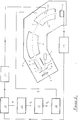
- a magnetic sector mass spectrometer comprises a primary ion source 1 for producing and directing a beam of primary ions 2 through an aperture 3 in an electrode 4 towards a sample 5.
- the impact of the primary ions 2 causes sample 5 to release sample ions 6 which are accelerated by an extraction potential, maintained between sample 5 and electrode 4, towards an extraction aperture 7 in electrode 4.
- the ions 6 pass from aperture 7 along and about a spectrometer axis 8 towards transfer optics 9, which directs the ions to an electrostatic sector 10.
- the sector 10 focuses the ions 6 according to their kinetic energies before transmitting them to an entrance 11 of a magnetic sector analyzer 12.
- the kinetic energy of ions 6 arriving at an entrance 11 of sector 10 is controlled by an accelerating potential difference U a maintained between sample 5 and entrance 11. Typically this potential is in a range from 2kV to 8kV with the entrance 11 at ground potential.
- the extraction electrode 4 may be at ground or a controllably variable potential.
- the magnetic sector analyzer 12 comprises an electromagnet with field coils which generate a field of induction B when energised with a current as will be described. Sample ions entering sector 12 are dispersed by the magnetic field, and ions of substantially equal masses are focused at common points by virtue of the geometry of the sector. Ions of charge q and .
- An electrical signal indicating the number of ions arriving at detector 13 is passed to a data processor 19 which, also receiving a signal from a computer 15 indicative of the selected mass, produces all or part of a mass spectrum.
- the spectrometer includes a Hall probe 20 and an associated controller 21 which may be used to monitor the field in sector 12.
- the probe 20 is used, for example, to monitor the magnetic field at a set value, to calibrate the mass measurements over a range of values, or for feedback control in certain modes of operation of the spectrometer.
- the probe is however not essential to the invention.
- the spectrometer also comprises a vacuum envelope 14 and pumps (not shown) for maintaining high or ultra high vacuum conditions therein.
- the spectrometer also has power supplies, for example for controlling the ion source 1, the potential of sample 5, transfer optics 9, electrostatic sector 10 and detector 13.
- the spectrometer may additionally comprise further ion optical elements, although these are not relevant to the invention and are not described herein.
- the control signal from computer 15 is fed to a digital to analogue converter (DAC) 16 which generates a first voltage signal V1, proportional to N and lying in a range from V 1,min (typically 0 V) to V 1,max (typically 10 V).
- DAC digital to analogue converter
- the signal V1 is then fed to an antilogarithmic (or exponential) amplifier (or function generator) 17 which generates a second voltage signal V2 in a range from V 2,min to V 2,max (typically 10 V) and related to V1 by a transfer function:
- V2 k4 exp (k5V1 - k6): And, if V 1,min is zero:
- the invention is not restricted to the particular form of the expressions, and the principle is not dependent on the choice of base e, base 10 or some other value; we use the term exponential function to cover all of these.
- the choice of base 10 in the practical preferred embodiment is convenient due the availability of electronic components for amplifier 17.
- V2 may be generated from a power series, or some other function or mathematical routine (such as use of an electronically stored table or set of values) which is substantially equivalent to the described exponential function.
- the various electronic components are, in themselves, standard commercially available items operated according to the manufacturer's specifications.
- the DAC 16 is a Sipex SP9380-18 and the amplifier (function generator) 17 is an Analog Devices AD759P.
- Typical mass ranges are 0.9 to 640 Daltons (amu) and 0.9 to 2000 Daltons, as selected by switching between different coil windings on the magnet in magnetic sector analyzer 12.
- V2 0.2121 x 10 (0.167V 1 ) Volts, for 0.9 to 2000 Daltons
- the signal V2 is then fed to an amplifier 18 which generates a current I (in a range up to I max ) which is substantially proportional to V2.
- the current I then energises magnetic sector 12 to generate a magnetic field for the selection of the ions of mass M as required.
- Those ions reaching detector 13 are recorded by a data system 19, which also receives the information of the value of M requested from computer 15. In this way one or more peaks may be analysed, and all or part of a spectrum may be recorded by switching from peak to peak if required.
- the method is putting into effect the basic principle of the invention which is to generate the magnet current as an exponential function of the sequence of integers N.
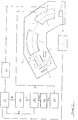
- FIG. 2 there is shown an alternative mass spectrometer according to the invention.
- the components numbered 1 to 15 and 18 to 21 are substantially the same as for the spectrometer of figure 1 and need not be described further (computer 15 here has the additional function of generating a second sequence of integers N2 as will be discussed).
- the spectrometer of figure 2 has a first DAC 22 and a second DAC 23, along with an offset voltage generator 24. Operation of this embodiment of the invention is as follows:
- N N max ln (M/M min ) ln (M max /M min )
- the computer also sends a second integer N2 (in a range from 0 to N 2,max ) to second DAC 23.
- the second DAC 23 acts as an amplifier with a maximum output of V1 and with gain varying according N2.
- V2 V DAC2 + k4 gives:
- this embodiment By generating N and N2 according to the expressions given above (or according to expressions or by routines which are substantially equivalent thereto), and then generating V2 and the current I therefrom as described, this embodiment also gives V2 and I as substantially exponential functions of the sequence of integers N.
- the DACs 22 and 23 are standard commercially available components, typically we use Sipex SP9380-18 operated generally according to the manufacturer's specifications, except that we vary the reference voltage V1 where other applications may employ a fixed reference voltage.
- the offset amplifier 24 is an Analog Devices AD707CQ.
- a magnetic sector mass spectrometer has constant resolution across the mass range, ie the peak width is proportional to the mass of the peak.
- the selected mass is not linearly related to magnet current, in a conventional spectrometer peaks at low mass are scanned by fewer given increments in magnet current than those at higher mass.
- the step in mass dM is made to vary with mass to give a constant number of mass steps per peak across the mass range.
- the present invention uniquely provides peak switching and mass selection across the mass range with constant resolution and a constant number of DAC steps per mass peak.
- the selected masses are selected substantially statically, that is without sweeping or scanning the magnet field over time.
- typical values of resolution R are approximately 40000 for a mass range from 0.9 to 640 Daltons, and approximately 34000 for a mass range from 0.9 to 2000 Daltons.
- the described examples are particularly suitable for analyzing the surface regions of solid samples by the technique known as secondary ion mass spectrometry (SIMS).
- SIMS secondary ion mass spectrometry
- the invention is not restricted to SIMS or other surface analyzers and may also apply in spectrometers with alternative means for producing sample ions.
- the invention may equally be applied in spectrometers for the analysis of gaseous, liquid or solid samples in which sample ions are produced by electron, thermal, chemical or photon induced ionization.
- the invention may be applied to other analyzer geometries such as the spectrometer described by D Schuetzle et al in the Review of Scientific Instruments 1989, volume 60(1), pages 53 to 64 in which the magnetic sector and electric sector are in 'reverse order geometry' compared with the illustrated examples.
- the invention is applicable wherever a magnetic sector analyzer is used in mass spectrometry.
Landscapes
- Chemical & Material Sciences (AREA)
- Analytical Chemistry (AREA)
- Other Investigation Or Analysis Of Materials By Electrical Means (AREA)
- Electron Tubes For Measurement (AREA)
Applications Claiming Priority (2)
| Application Number | Priority Date | Filing Date | Title |
|---|---|---|---|
| GB9019560 | 1990-09-07 | ||
| GB909019560A GB9019560D0 (en) | 1990-09-07 | 1990-09-07 | Method and apparatus for mass spectrometry |
Publications (2)
| Publication Number | Publication Date |
|---|---|
| EP0475674A2 true EP0475674A2 (de) | 1992-03-18 |
| EP0475674A3 EP0475674A3 (en) | 1992-07-22 |
Family
ID=10681832
Family Applications (1)
| Application Number | Title | Priority Date | Filing Date |
|---|---|---|---|
| EP19910308115 Withdrawn EP0475674A3 (en) | 1990-09-07 | 1991-09-04 | Method and apparatus for mass spectrometry |
Country Status (4)
| Country | Link |
|---|---|
| US (1) | US5159194A (de) |
| EP (1) | EP0475674A3 (de) |
| JP (1) | JPH05135737A (de) |
| GB (1) | GB9019560D0 (de) |
Cited By (4)
| Publication number | Priority date | Publication date | Assignee | Title |
|---|---|---|---|---|
| WO2003075308A1 (fr) * | 2002-03-04 | 2003-09-12 | Mikhail Lvovich Troshkov | Spectrometre de masse magnetique multicollecteur |
| RU2456700C1 (ru) * | 2011-06-30 | 2012-07-20 | Вячеслав Данилович Саченко | Статический масс-анализатор ионов |
| RU2487434C1 (ru) * | 2012-01-26 | 2013-07-10 | Общество с ограниченной ответственностью "Люмасс" | Масс-спектральное устройство для быстрого и прямого анализа проб |
| GB2533169A (en) * | 2014-12-12 | 2016-06-15 | Thermo Fisher Scient (Bremen) Gmbh | Control of magnetic sector mass spectrometer magnet |
Families Citing this family (4)
| Publication number | Priority date | Publication date | Assignee | Title |
|---|---|---|---|---|
| JP2003050300A (ja) * | 2001-05-28 | 2003-02-21 | Sei Matsuoka | 価値的情報の送信装置および送信方法 |
| US20050185175A1 (en) * | 2002-07-16 | 2005-08-25 | Canos Avelino C. | Rotary support and apparatus used for the multiple spectroscopic characterisation of samples of solid materials |
| JP2015075348A (ja) * | 2013-10-07 | 2015-04-20 | 株式会社島津製作所 | イオン移動度分光計 |
| LU93151B1 (en) * | 2016-07-15 | 2018-01-23 | Luxembourg Inst Science & Tech List | Hall Probe |
Family Cites Families (6)
| Publication number | Priority date | Publication date | Assignee | Title |
|---|---|---|---|---|
| US3870881A (en) * | 1965-01-07 | 1975-03-11 | Associated Electric Ind | Method of analyzing output signals representing the mass spectrum from a scanning mass spectrometer |
| GB1149426A (en) * | 1966-12-01 | 1969-04-23 | Ass Elect Ind | Improvements relating to mass spectrometry |
| JPS5836464B2 (ja) * | 1975-09-12 | 1983-08-09 | 株式会社島津製作所 | シツリヨウブンセキソウチ |
| FR2376511A1 (fr) * | 1976-12-31 | 1978-07-28 | Cameca | Spectrometre de masse a balayage ultra-rapide |
| FR2544914B1 (fr) * | 1983-04-19 | 1986-02-21 | Cameca | Perfectionnements apportes aux spectrometres de masse |
| US4785172A (en) * | 1986-12-29 | 1988-11-15 | Hughes Aircraft Company | Secondary ion mass spectrometry system and method for focused ion beam with parallel ion detection |
-
1990
- 1990-09-07 GB GB909019560A patent/GB9019560D0/en active Pending
-
1991
- 1991-09-04 EP EP19910308115 patent/EP0475674A3/en not_active Withdrawn
- 1991-09-06 US US07/756,290 patent/US5159194A/en not_active Expired - Fee Related
- 1991-09-06 JP JP3254446A patent/JPH05135737A/ja active Pending
Non-Patent Citations (4)
| Title |
|---|
| INSTRUMENTS AND EXPERIMENTAL TECHNIQUES. vol. 26, no. 4, February 1984, NEW YORK US pages 941 - 943; S A SHOBOTENKO: 'UNIVERSAL DIGITAL-SCANNING GENERATOR FOR MASS SPECTROMETERS' * |
| INTERNATIONAL JOURNAL OF MASS SPECTROMETRY AND ION PROCESSES. vol. 67, 1985, AMSTERDAM NL pages 253 - 265; L W GREEN: 'A VERSATILE LOW-COST AUTOMATION SYSTEM FOR THERMAL IONIZATION MASS SPECTROMETERS' * |
| JOURNAL OF PHYSICS E. SCIENTIFIC INSTRUMENTS. vol. 13, no. 4, April 1980, ISHING, BRISTOL GB pages 365 - 375; J R CHAPMAN: 'COMPUTERISED MASS SPECTROMETRY' * |
| PROCEEDINGS OF THE 13TH MICROBEAM ANALYSIS SOCIETY. 1978. pages 11A-11D D B WITTRY : ' OPTIMIZATION OF RECORDING SECONDARY ION MASS SPECTRA'. * |
Cited By (9)
| Publication number | Priority date | Publication date | Assignee | Title |
|---|---|---|---|---|
| WO2003075308A1 (fr) * | 2002-03-04 | 2003-09-12 | Mikhail Lvovich Troshkov | Spectrometre de masse magnetique multicollecteur |
| RU2231165C2 (ru) * | 2002-03-04 | 2004-06-20 | Трошков Михаил Львович | Многоколлекторный магнитный масс-спектрометр |
| RU2456700C1 (ru) * | 2011-06-30 | 2012-07-20 | Вячеслав Данилович Саченко | Статический масс-анализатор ионов |
| WO2013002683A1 (ru) * | 2011-06-30 | 2013-01-03 | Sachenko Viacheslav Danilovich | Статический масс-анализатор ионов |
| RU2487434C1 (ru) * | 2012-01-26 | 2013-07-10 | Общество с ограниченной ответственностью "Люмасс" | Масс-спектральное устройство для быстрого и прямого анализа проб |
| GB2533169A (en) * | 2014-12-12 | 2016-06-15 | Thermo Fisher Scient (Bremen) Gmbh | Control of magnetic sector mass spectrometer magnet |
| US10176978B2 (en) | 2014-12-12 | 2019-01-08 | Thermo Fisher Scientific (Bremen) Gmbh | Control of magnetic sector mass spectrometer magnet |
| GB2533169B (en) * | 2014-12-12 | 2019-08-07 | Thermo Fisher Scient Bremen Gmbh | Control of magnetic sector mass spectrometer magnet |
| US10685826B2 (en) | 2014-12-12 | 2020-06-16 | Thermo Fisher Scientific (Bremen) Gmbh | Control of magnetic sector mass spectrometer magnet |
Also Published As
| Publication number | Publication date |
|---|---|
| US5159194A (en) | 1992-10-27 |
| GB9019560D0 (en) | 1990-10-24 |
| JPH05135737A (ja) | 1993-06-01 |
| EP0475674A3 (en) | 1992-07-22 |
Similar Documents
| Publication | Publication Date | Title |
|---|---|---|
| EP0425658B1 (de) | Verfahren und vorrichtung zur erzeugung eines beliebigen erregungsspektrums für fourier-transformationsmassspektrometrie | |
| US4761545A (en) | Tailored excitation for trapped ion mass spectrometry | |
| US7047144B2 (en) | Ion detection in mass spectrometry with extended dynamic range | |
| US20160071709A1 (en) | Apparatus and Methods for Controlling Miniaturized Arrays of Ion Traps | |
| EP0559202B1 (de) | Sekundärionenmassenspektrometer zur Analyse positiv und negativ geladener Ionen | |
| Heikkila et al. | The soft particle spectrometer in the ISIS‐I satellite | |
| US3819941A (en) | Mass dependent ion microscope having an array of small mass filters | |
| EP0475674A2 (de) | Verfahren und Vorrichtung zur Massenspektrometrie | |
| WO2019082294A1 (ja) | 質量分析装置及び質量分析方法 | |
| EP0883894B1 (de) | Betriebsverfahren für eine ionenfalle | |
| CA1048163A (en) | Process and apparatus for the elementary and chemical analysis of a sample by spectrum analysis of the energy of the secondary electrons | |
| US6600154B1 (en) | Ion filling control in ion trap mass spectrometers | |
| Nier | Small general purpose double focusing mass spectrometer | |
| Boyd et al. | A new linked scan for reversed geometry mass spectrometers | |
| US6596991B1 (en) | Isotopomer mass spectrometer | |
| US3602709A (en) | Mass analyzer including magnetic field control means | |
| Nighan et al. | Low energy electron collision phenomena in HgBr2 | |
| US3230362A (en) | Bakeable mass spectrometer with means to precisely align the ion source, analyzer and detector subassemblies | |
| SU574172A3 (ru) | Спектрометр ионного рассе ни | |
| US3298275A (en) | Comparison signal circuit for measuring intensity of spectral lines | |
| Campana et al. | Application of dynamic emittance matching to secondary ion mass spectrometry | |
| Christie et al. | A new high-resolution mass spectrometer with partial second-order double focusing | |
| Schweikhard et al. | Excitation and detection of ICR modes for control and analysis of a multicomponent plasma | |
| Erskine | Electron energy analyzers | |
| JPH08111203A (ja) | 高分解能質量分析計 |
Legal Events
| Date | Code | Title | Description |
|---|---|---|---|
| PUAI | Public reference made under article 153(3) epc to a published international application that has entered the european phase |
Free format text: ORIGINAL CODE: 0009012 |
|
| AK | Designated contracting states |
Kind code of ref document: A2 Designated state(s): BE DE FR GB IT |
|
| PUAL | Search report despatched |
Free format text: ORIGINAL CODE: 0009013 |
|
| AK | Designated contracting states |
Kind code of ref document: A3 Designated state(s): BE DE FR GB IT |
|
| RAP1 | Party data changed (applicant data changed or rights of an application transferred) |
Owner name: FISONS PLC |
|
| STAA | Information on the status of an ep patent application or granted ep patent |
Free format text: STATUS: THE APPLICATION IS DEEMED TO BE WITHDRAWN |
|
| 18D | Application deemed to be withdrawn |
Effective date: 19930222 |