EP0473487B1 - Ecrans thermiques à hautes performances - Google Patents
Ecrans thermiques à hautes performances Download PDFInfo
- Publication number
- EP0473487B1 EP0473487B1 EP91402210A EP91402210A EP0473487B1 EP 0473487 B1 EP0473487 B1 EP 0473487B1 EP 91402210 A EP91402210 A EP 91402210A EP 91402210 A EP91402210 A EP 91402210A EP 0473487 B1 EP0473487 B1 EP 0473487B1
- Authority
- EP
- European Patent Office
- Prior art keywords
- layers
- screen according
- mat
- silicone
- fabric
- Prior art date
- Legal status (The legal status is an assumption and is not a legal conclusion. Google has not performed a legal analysis and makes no representation as to the accuracy of the status listed.)
- Expired - Lifetime
Links
- 229920001296 polysiloxane Polymers 0.000 claims description 30
- 239000004744 fabric Substances 0.000 claims description 23
- 230000004224 protection Effects 0.000 claims description 5
- 229920002239 polyacrylonitrile Polymers 0.000 claims description 4
- 239000000853 adhesive Substances 0.000 claims 1
- 230000001070 adhesive effect Effects 0.000 claims 1
- 239000000126 substance Substances 0.000 claims 1
- 239000010410 layer Substances 0.000 description 30
- 239000000835 fiber Substances 0.000 description 8
- VYPSYNLAJGMNEJ-UHFFFAOYSA-N Silicium dioxide Chemical group O=[Si]=O VYPSYNLAJGMNEJ-UHFFFAOYSA-N 0.000 description 5
- 239000000463 material Substances 0.000 description 5
- 238000005470 impregnation Methods 0.000 description 3
- RNFJDJUURJAICM-UHFFFAOYSA-N 2,2,4,4,6,6-hexaphenoxy-1,3,5-triaza-2$l^{5},4$l^{5},6$l^{5}-triphosphacyclohexa-1,3,5-triene Chemical compound N=1P(OC=2C=CC=CC=2)(OC=2C=CC=CC=2)=NP(OC=2C=CC=CC=2)(OC=2C=CC=CC=2)=NP=1(OC=1C=CC=CC=1)OC1=CC=CC=C1 RNFJDJUURJAICM-UHFFFAOYSA-N 0.000 description 2
- 239000004760 aramid Substances 0.000 description 2
- 229920006231 aramid fiber Polymers 0.000 description 2
- 230000004888 barrier function Effects 0.000 description 2
- 239000003063 flame retardant Substances 0.000 description 2
- 239000007789 gas Substances 0.000 description 2
- 239000003292 glue Substances 0.000 description 2
- 238000000465 moulding Methods 0.000 description 2
- 230000001681 protective effect Effects 0.000 description 2
- 239000000377 silicon dioxide Substances 0.000 description 2
- 239000002344 surface layer Substances 0.000 description 2
- 238000010521 absorption reaction Methods 0.000 description 1
- 230000016571 aggressive behavior Effects 0.000 description 1
- 239000000919 ceramic Substances 0.000 description 1
- 238000002485 combustion reaction Methods 0.000 description 1
- 238000000354 decomposition reaction Methods 0.000 description 1
- 230000000694 effects Effects 0.000 description 1
- 238000009429 electrical wiring Methods 0.000 description 1
- 238000009413 insulation Methods 0.000 description 1
- 238000000034 method Methods 0.000 description 1
- 230000035515 penetration Effects 0.000 description 1
- 230000002093 peripheral effect Effects 0.000 description 1
- 229920002050 silicone resin Polymers 0.000 description 1
- 238000002791 soaking Methods 0.000 description 1
- 238000005507 spraying Methods 0.000 description 1
- 238000009941 weaving Methods 0.000 description 1
- 239000002759 woven fabric Substances 0.000 description 1
Images
Classifications
-
- B—PERFORMING OPERATIONS; TRANSPORTING
- B32—LAYERED PRODUCTS
- B32B—LAYERED PRODUCTS, i.e. PRODUCTS BUILT-UP OF STRATA OF FLAT OR NON-FLAT, e.g. CELLULAR OR HONEYCOMB, FORM
- B32B5/00—Layered products characterised by the non- homogeneity or physical structure, i.e. comprising a fibrous, filamentary, particulate or foam layer; Layered products characterised by having a layer differing constitutionally or physically in different parts
- B32B5/22—Layered products characterised by the non- homogeneity or physical structure, i.e. comprising a fibrous, filamentary, particulate or foam layer; Layered products characterised by having a layer differing constitutionally or physically in different parts characterised by the presence of two or more layers which are next to each other and are fibrous, filamentary, formed of particles or foamed
- B32B5/24—Layered products characterised by the non- homogeneity or physical structure, i.e. comprising a fibrous, filamentary, particulate or foam layer; Layered products characterised by having a layer differing constitutionally or physically in different parts characterised by the presence of two or more layers which are next to each other and are fibrous, filamentary, formed of particles or foamed one layer being a fibrous or filamentary layer
- B32B5/26—Layered products characterised by the non- homogeneity or physical structure, i.e. comprising a fibrous, filamentary, particulate or foam layer; Layered products characterised by having a layer differing constitutionally or physically in different parts characterised by the presence of two or more layers which are next to each other and are fibrous, filamentary, formed of particles or foamed one layer being a fibrous or filamentary layer another layer next to it also being fibrous or filamentary
-
- A—HUMAN NECESSITIES
- A62—LIFE-SAVING; FIRE-FIGHTING
- A62C—FIRE-FIGHTING
- A62C8/00—Hand tools or accessories specially adapted for fire-fighting, e.g. tool boxes
- A62C8/08—Shields
-
- B—PERFORMING OPERATIONS; TRANSPORTING
- B32—LAYERED PRODUCTS
- B32B—LAYERED PRODUCTS, i.e. PRODUCTS BUILT-UP OF STRATA OF FLAT OR NON-FLAT, e.g. CELLULAR OR HONEYCOMB, FORM
- B32B5/00—Layered products characterised by the non- homogeneity or physical structure, i.e. comprising a fibrous, filamentary, particulate or foam layer; Layered products characterised by having a layer differing constitutionally or physically in different parts
- B32B5/02—Layered products characterised by the non- homogeneity or physical structure, i.e. comprising a fibrous, filamentary, particulate or foam layer; Layered products characterised by having a layer differing constitutionally or physically in different parts characterised by structural features of a fibrous or filamentary layer
- B32B5/06—Layered products characterised by the non- homogeneity or physical structure, i.e. comprising a fibrous, filamentary, particulate or foam layer; Layered products characterised by having a layer differing constitutionally or physically in different parts characterised by structural features of a fibrous or filamentary layer characterised by a fibrous or filamentary layer mechanically connected, e.g. by needling to another layer, e.g. of fibres, of paper
-
- B—PERFORMING OPERATIONS; TRANSPORTING
- B32—LAYERED PRODUCTS
- B32B—LAYERED PRODUCTS, i.e. PRODUCTS BUILT-UP OF STRATA OF FLAT OR NON-FLAT, e.g. CELLULAR OR HONEYCOMB, FORM
- B32B7/00—Layered products characterised by the relation between layers; Layered products characterised by the relative orientation of features between layers, or by the relative values of a measurable parameter between layers, i.e. products comprising layers having different physical, chemical or physicochemical properties; Layered products characterised by the interconnection of layers
- B32B7/04—Interconnection of layers
- B32B7/12—Interconnection of layers using interposed adhesives or interposed materials with bonding properties
-
- B—PERFORMING OPERATIONS; TRANSPORTING
- B32—LAYERED PRODUCTS
- B32B—LAYERED PRODUCTS, i.e. PRODUCTS BUILT-UP OF STRATA OF FLAT OR NON-FLAT, e.g. CELLULAR OR HONEYCOMB, FORM
- B32B9/00—Layered products comprising a layer of a particular substance not covered by groups B32B11/00 - B32B29/00
- B32B9/04—Layered products comprising a layer of a particular substance not covered by groups B32B11/00 - B32B29/00 comprising such particular substance as the main or only constituent of a layer, which is next to another layer of the same or of a different material
- B32B9/047—Layered products comprising a layer of a particular substance not covered by groups B32B11/00 - B32B29/00 comprising such particular substance as the main or only constituent of a layer, which is next to another layer of the same or of a different material made of fibres or filaments
-
- B—PERFORMING OPERATIONS; TRANSPORTING
- B32—LAYERED PRODUCTS
- B32B—LAYERED PRODUCTS, i.e. PRODUCTS BUILT-UP OF STRATA OF FLAT OR NON-FLAT, e.g. CELLULAR OR HONEYCOMB, FORM
- B32B2260/00—Layered product comprising an impregnated, embedded, or bonded layer wherein the layer comprises an impregnation, embedding, or binder material
- B32B2260/02—Composition of the impregnated, bonded or embedded layer
- B32B2260/021—Fibrous or filamentary layer
- B32B2260/023—Two or more layers
-
- B—PERFORMING OPERATIONS; TRANSPORTING
- B32—LAYERED PRODUCTS
- B32B—LAYERED PRODUCTS, i.e. PRODUCTS BUILT-UP OF STRATA OF FLAT OR NON-FLAT, e.g. CELLULAR OR HONEYCOMB, FORM
- B32B2307/00—Properties of the layers or laminate
- B32B2307/30—Properties of the layers or laminate having particular thermal properties
- B32B2307/306—Resistant to heat
- B32B2307/3065—Flame resistant or retardant, fire resistant or retardant
Definitions
- the present invention relates to high performance thermal screens, flexible or rigid, particularly suitable for providing protection in the event of fire.
- flame retardant fabrics made of carbonized oxidized organic fibers and capable of strongly absorbing the infrared heat flow of a fire.
- Such fabrics are preferably of the mesh type and said organic fibers can be based on polyacrylonitrile.
- Other fibers, such as aramid fibers, are provided to facilitate weaving.
- Such fabrics are for example manufactured and sold, under the trade name MONTSEGUR, by the cios Ariégeoise de Bonneterie, 09300 MONTFERRIER, FRANCE.
- the object of the present invention is to produce high performance heat shields taking advantage of the properties of absorption of the heat flow of the flame-retardant fabrics mentioned above.
- the heat shield in particular for protection against a fire, is characterized in that it is made of a sheet material comprising a mattress formed by the superposition of a plurality of layers of woven fabrics made of carbonized oxidized polyacrylonitrile fibers, in that the face of said mattress facing said fire is covered with a layer of pure silicone and in that the face of said mattress facing away from said fire is covered with a layer of endothermic charged silicone.
- a particularly effective thermal barrier is obtained.
- said layer of pure silicone directed towards the hot source (fire), decomposes under the effect of thermal aggression, the decomposition of the silicone absorbing calories first and then leaving a silica residue which obstructs the mesh of fabric layers, which constitutes a barrier against the penetration of hot gases.
- the endothermic charged silicone layer facing away from the fire, absorbs calories.
- test pieces were produced, each comprising five superposed layers of the same fabric made of carbonizable oxidized organic fibers.
- the first of the test pieces is coated with pure silicone, while, for the second test piece, one of its faces is covered with pure silicone and the other with endothermic charged silicone. Then, each test piece was subjected to the action of a flame at 1100 ° C., the face of pure silicone of the second test piece being turned towards said flame.
- the temperature of the face of the mattress opposite the flame reaches 250 ° C., in 2 minutes and fifty-four seconds for the first test piece, and in 4.5 minutes for the second test piece. It can therefore be seen that, in the second test tube, the layer of endothermic charged silicone placed on the face of the mattress opposite to the flame absorbs calories, while the layer of pure silicone oriented towards the flame makes it possible to delay the combustion of the material.
- the endothermic charged silicone is of the type described in document FR-A-2 632 866.
- the layers of fabric intended to be directed towards the hot source are advantageously impregnated with pure silicone, while those intended to be directed on the opposite side are preferably impregnated with endothermic charged silicone.
- Such silicone impregnations can also be used to secure the successive layers of tissue.
- a refractory wire silicon for example
- a combustible wire or using dots of glue (for example silicone-based).
- glue for example silicone-based
- one or more layers of a refractory fabric of silica or ceramic can be incorporated into said mattress, preferably on the surface thereof.
- Fabrics made of carbonizable oxidized organic fibers are flexible in themselves. It is therefore the same for the mattress obtained by the superposition of a plurality of layers of such fabrics.
- the degree of flexibility of the screen according to the present invention can be adjusted. Indeed, the flexibility of this screen depends on the thickness of said silicone layers and on the number of layers of fabric of the mattress undergoing impregnation. Thus, according to the invention, it is possible to obtain a screen whose flexibility - and therefore rigidity - is suitable for the desired application.
- the screen of the invention any desired shape, for example the shape of the shell or cover adapting to the outline of objects or devices to be protected.
- thermal screens in the form of flexible covers adapting to the very varied forms of objects or equipment, flexible strips which can be wound around pipes or electrical wiring, hoods. flexible or rigid adapted in shape to particular devices, etc ...
- the mass of the heat shields according to the invention is relatively low, so that they are particularly - although not exclusively - suitable for use in aeronautical or space applications. They then make it possible in particular to maintain vital equipment at temperatures of the order of 100 ° C to 200 ° C for several minutes, even in the case of fires producing flames whose temperature is of the order of 1000 to 1100 ° C.
- the screen according to the present invention in addition to its high thermal protection properties and its low mass, is easy to handle and possibly cut to adapt its outline to that of an object to be protected or even to obtain bands.
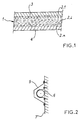
- FIG. 1 represents, in enlarged schematic section, a particular, but preferred, embodiment of a screen according to the present invention.
- Figure 2 shows a particular use of the screen according to the present invention.
- Each layer 2.i is for example made of the fabric "MONTSEGUR", quality 7010, mentioned above and comprising 30% of aramid fibers and 70% of oxidized and carbonizable polyacrylonitrile fibers.
- the layers 2.i are linked together by dots of glue (not shown).
- the mattress 1 On the side intended to be turned towards a hot source, for example a fire, the mattress 1 is covered with a layer 3 of pure silicone, impregnating the adjacent surface layers 2.i of said mattress 1. Likewise, on the side intended to be opposite said hot spring, the mattress is covered with a layer 4 of endothermic charged silicone, also impregnating the corresponding adjacent surface layers of said mattress 1.
- the endothermic charged silicone is for example that described in French patent FR-A-2 632 866.
- Layers 3 and 4 can be applied to mattress 1 by any known process, such as molding, soaking, spraying, etc. They can cover the peripheral edges (not shown) of the mattress 1.
- the screen When the screen is flexible, it can constitute protective covers. It can also be cut into strips to serve as helical protections for elongated objects, such as pipes or cables.
- FIG. 2 there is shown schematically in section such a cover 5 protecting an item of equipment 6, carried by a wall 7.
Landscapes
- Health & Medical Sciences (AREA)
- Public Health (AREA)
- Business, Economics & Management (AREA)
- Emergency Management (AREA)
- Engineering & Computer Science (AREA)
- Ceramic Engineering (AREA)
- Laminated Bodies (AREA)
Description
- La présente invention concerne les écrans thermiques à hautes performances, souples ou rigides, particulièrement appropriés à assurer des protections en cas d'incendie.
- On connaît déjà, par exemple par le document GB-A-2 191 792, des tissus pare-flamme réalisés en fibres organiques oxydées carbonisables et capables d'absorber fortement le flux thermique infrarouge d'un incendie. De tels tissus sont de préférence du type à mailles et lesdites fibres organiques peuvent être à base de polyacrylonitrile. D'autres fibres, telles que des fibres aramides, sont prévues pour faciliter le tissage. De tels tissus sont par exemple fabriqués et vendus, sous le nom commercial MONTSEGUR, par la Société Ariégeoise de Bonneterie, 09300 MONTFERRIER, FRANCE.
- Par ailleurs, par les documents EP-A-0 079 808 et US-A-4 397 910, on connaît des produits résistant à de hautes températures et constitués de nappes superposées imprégnées ou recouvertes d'une résine de silicone.
- L'objet de la présente invention est de réaliser des écrans thermiques à hautes performances mettant à profit les propriétés d'absorption du flux thermique des tissus pare-flamme mentionnés ci-dessus.
- A cette fin, selon l'invention, l'écran thermique, notamment pour la protection contre un incendie, est caractérisé en ce qu'il est réalisé en une matière en feuille comportant un matelas constitué par la superposition d'une pluralité de couches de tissus en fibres à base de polyacrylonitrile oxydées carbonisables, en ce que la face dudit matelas dirigée vers ledit incendie est recouverte d'une couche de silicone pur et en ce que la face dudit matelas dirigée à l'opposé dudit incendie est recouverte d'une couche de silicone chargé endothermique.
- Ainsi, grâce à l'invention, on obtient une barrière thermique particulièrement efficace. En effet, ladite couche de silicone pur, dirigée vers la source chaude (incendie), se décompose sous l'effet de l'agression thermique, la décomposition du silicone absorbant d'abord des calories et laissant ensuite un résidu de silice qui obstrue les mailles des couches de tissu, ce qui constitue une barrière contre la pénétration des gaz chauds. De plus, la couche de silicone chargé endothermique, dirigée à l'opposé de l'incendie, absorbe les calories.
- Pour illustrer l'efficacité de la coopération de la couche de silicone pur et de la couche de silicone chargé endothermique, on a réalisé deux éprouvettes plates, comportant chacune cinq couches superposées du même tissu en fibres organiques oxydées carbonisables. La première des éprouvettes est enrobée de silicone pur, tandis que, pour la seconde éprouvette, une de ses faces est recouverte de silicone pur et l'autre de silicone chargé endothermique. Ensuite, on a soumis chaque éprouvette à l'action d'une flamme à 1100°C, la face de silicone pur de la seconde éprouvette étant tournée vers ladite flamme.
- On constate que la température de la face du matelas opposée à la flamme atteint 250°C, en 2 minutes et cinquante-quatre secondes pour la première éprouvette, et en 4,5 minutes pour la seconde éprouvette. On voit donc que, dans la seconde éprouvette, la couche de silicone chargé endothermique disposée sur la face du matelas opposée à la flamme absorbe les calories, tandis que la couche de silicone pur orientée vers la flamme permet de retarder la combustion de la matière.
- De préférence, le silicone chargé endothermique est du type de celui décrit dans le document FR-A-2 632 866.
- Pour améliorer encore les propriétés d'isolation thermique de la matière conforme à la présente invention, il est possible d'imprégner --par tout moyen connu-- au moins certaines couches de tissu du matelas avec du silicone pur ou chargé. Dans ce cas, les couches de tissu destinées à être dirigées vers la source chaude sont avantageusement imprégnées de silicone pur, tandis que celles destinées à être dirigées du côté opposé sont de préférence imprégnées de silicone chargé endothermique.
- De telles imprégnations de silicone peuvent servir de plus à la solidarisation des couches de tissus successives. Toutefois, en tant que de besoin, il est possible de solidariser entre elles au moins certaines des couches de tissus par piqûre dans l'épaisseur du matelas à l'aide d'un fil réfractaire (silice par exemple) ou d'un fil combustible ou à l'aide de points de colle (par exemple à base de silicone). On remarquera toutefois que chaque point de piqûre constitue un couloir de passage pour les gaz chauds et que la solidarisation des couches de tissu par piqûre peut ne pas être appropriée pour certaines applications.
- Eventuellement, une ou plusieurs couches d'un tissu réfractaire de silice ou de céramique peut être incorporée audit matelas, de préférence en surface de celui-ci.
- Les tissus en fibres organiques oxydées carbonisables sont souples en eux-mêmes. Il en est donc de même du matelas obtenu par la superposition d'une pluralité de couches de tels tissus.
- Cependant, grâce aux couches de silicone recouvrant les faces dudit matelas et aux imprégnations des couches de tissus du matelas, on peut régler le degré de souplesse de l'écran conforme à la présente invention. En effet, la souplesse de cet écran dépend de l'épaisseur desdites couches de silicone et du nombre des couches de tissus du matelas subissant une imprégnation. Ainsi, selon l'invention, on peut obtenir un écran dont la souplesse --et donc la rigidité-- est appropriée à l'application recherchée.
- Par ailleurs, éventuellement, on peut par moulage donner à l'écran de l'invention toute forme désirée, par exemple la forme de coque ou de capot s'adaptant au contour d'objets ou de dispositifs à protéger.
- Ainsi, grâce à l'invention, on peut réaliser des écrans thermiques en forme de couvertures souples s'adaptant aux formes très variées d'objets ou d'équipements, de bandes souples pouvant être enroulées autour de tuyauteries ou de câblages électriques, de capots souples ou rigides adaptés en forme à des dispositifs particuliers, etc...
- La masse des écrans thermiques conformes à l'invention est relativement peu élevée, de sorte que ceux-ci sont particulièrement --quoique non exclusivement-- appropriés à être utilisés dans des applications aéronautiques ou spatiales. Ils permettent alors notamment de maintenir les équipements vitaux à des températures de l'ordre de 100°C à 200°C pendant plusieurs minutes, même dans le cas d'incendies produisant des flammes dont la température est de l'ordre de 1000 à 1100°C.
- On remarquera que l'écran conforme à la présente invention, outre ses propriétés élevées de protection thermique et sa masse peu élevée, est facile à manipuler et éventuellement à découper pour adapter son contour à celui d'un objet à protéger ou encore pour obtenir des bandes.
- Les figures du dessin annexé feront bien comprendre comment l'invention peut être réalisée.
- La figure 1 représente, en coupe schématique agrandie, un mode de réalisation particulier, mais préférentiel, d'un écran conforme à la présente invention.
- La figure 2 représente une utilisation particulière de l'écran conforme à la présente invention.
- L'écran de matière en feuille, conforme à l'invention et représenté schématiquement sur la figure 1, comporte un matelas 1 constitué par la superposition et la solidarisation d'une pluralité n (par exemple n = 15) de couches 2.1, ..., 2.i, ..., 2.n en tissus de fibres organiques oxydées carbonisables.
- Chaque couche 2.i est par exemple réalisée dans le tissu "MONTSEGUR", qualité 7010, mentionné ci-dessus et comportant 30% de fibres d'aramide et 70% de fibres de polyacrylonitrile oxydées et carbonisables. Les couches 2.i sont liées entre elles par des points de colle (non représentées).
- Du côté destiné à être tourné vers une source chaude, par exemple un incendie, le matelas 1 est recouvert d'une couche 3 de silicone pur, imprégnant les couches superficielles adjacentes 2.i dudit matelas 1. De même, du côté destiné à être opposé à ladite source chaude, le matelas est recouvert d'une couche 4 de silicone chargé endothermique, imprégnant également les couches superficielles adjacentes correspondantes dudit matelas 1. Le silicone chargé endothermique est par exemple celui décrit dans le brevet français FR-A-2 632 866.
- Les couches 3 et 4 peuvent être appliquées au matelas 1 par tout processus connu, tel que moulage, trempage, pulvérisation, etc... Elles peuvent recouvrir les bords périphériques (non représentés) du matelas 1.
- Ainsi, conformément à l'invention, il est possible de réaliser de écrans de matière en feuille plus ou moins souples, en fonction du nombre de couches de tissus 2.i imprégnées par le silicone.
- Lorsque l'écran est souple, il peut constituer des couvertures de protection. Il peut également être découpé en bandes pour servir de protections hélicoïdales d'objets allongés, tels que tuyauteries ou câbles.
- Lorsque l'écran est rigide après durcissement du silicone, il peut être élaboré dans un moule à la forme de capots de protection. Sur la figure 2, on a représenté schématiquement en coupe un tel capot 5 protégeant un équipement 6, porté par une paroi 7.
Claims (11)
- Ecran thermique, notamment pour la protection contre un incendie, comprenant
des tissus de fibres organiques oxydées carbonisables à base de polyacrylonitrile, caractérisé en ce qu' il est réalisé en une matière en feuille comportant un matelas (1) constitué par la superposition d' une pluralité de couches (2.i) desdits tissus, en ce qu' une face dudit matelas est recouverte d' une couche de silicone pur (3) et en ce que l'autre face dudit matelas est recouverte d' une couche de silicone chargé endothermique (4)''. - Ecran selon la revendication 1,
caractérisé en ce qu'au moins certaines couches de tissu dudit matelas sont imprégnées avec du silicone pur. - Ecran selon la revendication 2,
caractérisé en ce que certaines desdites couches de tissu dudit matelas sont imprégnées avec du silicone chargé endothermique. - Ecran selon l'une des revendications 1 à 3,
caractérisé en ce qu'au moins certaines des couches de tissu dudit matelas sont solidarisées les unes des autres par des points de piqûre. - Ecran selon l'une des revendications 1 à 4,
caractérisé en ce qu'au moins certaines des couches de tissu dudit matelas sont solidarisées les unes des autres par des points de colle. - Ecran selon l'une des revendications 1 à 5,
caractérisé en ce qu'au moins une couche d'un tissu réfractaire est incorporée audit matelas. - Ecran selon l'une des revendications 1 à 6,
caractérisé en ce qu'il est souple. - Ecran selon l'une des revendications 1 à 6,
caractérisé en ce qu'il est rigide. - Ecran selon l'une des revendications 1 à 7,
caractérisé en ce qu'il se présente sous la forme d'une couverture. - Ecran selon l'une des revendications 1 à 7,
caractérisé en ce qu'il se présente sous la forme de bandes. - Ecran selon l'une des revendications 1 à 8,
caractérisé en ce qu'il se présente sous la forme d'un capot moulé (5).
Applications Claiming Priority (2)
| Application Number | Priority Date | Filing Date | Title |
|---|---|---|---|
| FR909010518A FR2666048B1 (fr) | 1990-08-21 | 1990-08-21 | Matiere en feuille pour la realisation d'ecrans thermiques a hautes performances et ecrans thermiques ainsi realises. |
| FR9010518 | 1990-08-21 |
Publications (2)
| Publication Number | Publication Date |
|---|---|
| EP0473487A1 EP0473487A1 (fr) | 1992-03-04 |
| EP0473487B1 true EP0473487B1 (fr) | 1994-01-05 |
Family
ID=9399763
Family Applications (1)
| Application Number | Title | Priority Date | Filing Date |
|---|---|---|---|
| EP91402210A Expired - Lifetime EP0473487B1 (fr) | 1990-08-21 | 1991-08-08 | Ecrans thermiques à hautes performances |
Country Status (6)
| Country | Link |
|---|---|
| EP (1) | EP0473487B1 (fr) |
| JP (1) | JPH04234639A (fr) |
| CA (1) | CA2048593A1 (fr) |
| DE (1) | DE69100932T2 (fr) |
| ES (1) | ES2049096T3 (fr) |
| FR (1) | FR2666048B1 (fr) |
Families Citing this family (2)
| Publication number | Priority date | Publication date | Assignee | Title |
|---|---|---|---|---|
| WO2005105219A1 (fr) * | 2004-04-27 | 2005-11-10 | Andreas Peter Hoffmann | Materiau flexible, ressemblant au textile et absorbant les liquides utilise en tant que protection ignifuge et/ou calorifuge dans des applications stationnaires ou mobiles |
| US9630031B2 (en) | 2006-03-29 | 2017-04-25 | Chapman Thermal Products, Inc. | Lightweight protective fabrics and clothing for protection against hot or corrosive materials |
Citations (2)
| Publication number | Priority date | Publication date | Assignee | Title |
|---|---|---|---|---|
| GB2191792A (en) * | 1986-06-18 | 1987-12-23 | Tba Industrial Products Ltd | Woven fabric |
| FR2632866A1 (fr) * | 1988-06-16 | 1989-12-22 | Aerospatiale | Materiau de protection d'un element en cas d'incendie |
Family Cites Families (7)
| Publication number | Priority date | Publication date | Assignee | Title |
|---|---|---|---|---|
| GB1577771A (en) * | 1977-04-25 | 1980-10-29 | Coors Porcelain Co | Resilient heat-resistant laminated composite |
| US4342803A (en) * | 1980-10-14 | 1982-08-03 | Owens-Illinois, Inc. | Heat-resistant vacuum pad and method of making same |
| JPS5876730U (ja) * | 1981-11-18 | 1983-05-24 | 市川毛織株式会社 | アルミ押出プレス機の後面設備用耐熱パツト |
| US4397910A (en) * | 1982-06-02 | 1983-08-09 | Westinghouse Electric Corp. | Light weight high temperature polyester laminates useful as lubricating rub strips |
| US4618522A (en) * | 1983-12-19 | 1986-10-21 | General Electric Company | Organosiloxane fabric coating compositions |
| JPS6155268A (ja) * | 1984-08-22 | 1986-03-19 | 帝国繊維株式会社 | 耐炎加工布 |
| EP0355193A1 (fr) * | 1988-08-25 | 1990-02-28 | Rex-Patent Graf von Rex KG | Utilisation de matériau composite fibreux, élastique et bloquant le feu pour le rembourrage |
-
1990
- 1990-08-21 FR FR909010518A patent/FR2666048B1/fr not_active Expired - Fee Related
-
1991
- 1991-08-07 CA CA002048593A patent/CA2048593A1/fr not_active Abandoned
- 1991-08-08 DE DE69100932T patent/DE69100932T2/de not_active Expired - Fee Related
- 1991-08-08 EP EP91402210A patent/EP0473487B1/fr not_active Expired - Lifetime
- 1991-08-08 ES ES91402210T patent/ES2049096T3/es not_active Expired - Lifetime
- 1991-08-15 JP JP3205105A patent/JPH04234639A/ja active Pending
Patent Citations (2)
| Publication number | Priority date | Publication date | Assignee | Title |
|---|---|---|---|---|
| GB2191792A (en) * | 1986-06-18 | 1987-12-23 | Tba Industrial Products Ltd | Woven fabric |
| FR2632866A1 (fr) * | 1988-06-16 | 1989-12-22 | Aerospatiale | Materiau de protection d'un element en cas d'incendie |
Also Published As
| Publication number | Publication date |
|---|---|
| CA2048593A1 (fr) | 1992-02-22 |
| DE69100932D1 (de) | 1994-02-17 |
| ES2049096T3 (es) | 1994-04-01 |
| DE69100932T2 (de) | 1994-05-19 |
| FR2666048A1 (fr) | 1992-02-28 |
| EP0473487A1 (fr) | 1992-03-04 |
| JPH04234639A (ja) | 1992-08-24 |
| FR2666048B1 (fr) | 1994-10-14 |
Similar Documents
| Publication | Publication Date | Title |
|---|---|---|
| EP1129633B1 (fr) | Barrière isolante thermique antifeu, procédé de fabrication d'une telle barrière, vêtement comprenant au moins une telle barrière en tant qu'isolant interne. | |
| US4401707A (en) | Composite heat protective fabric | |
| FR2777496A1 (fr) | Procede d'obtention, reparation ou reconstruction d'un objet avec une piece ou materiau composite | |
| FR2846202A1 (fr) | Textile composite anti-feu impermeable comprenant un reseau de fibres floquees | |
| FR2625793A1 (fr) | Bloc d'isolation thermique | |
| EP0877892B1 (fr) | Manchon reflechissant la chaleur | |
| EP0576321B1 (fr) | Dispositif de protection antifeu en matériau souple endothermique | |
| EP0820326B1 (fr) | Dispositif souple ayant des proprietes coupe-feu | |
| EP0473487A1 (fr) | Ecrans thermiques à hautes performances | |
| EP0612540B1 (fr) | Dispositif souple ayant des propriétés coupe-feu | |
| FR2792349A1 (fr) | Isolant phonique et thermique | |
| EP3799935B1 (fr) | Couverture intumescente de protection au feu | |
| EP2865933B1 (fr) | Procédé de pose d'une garniture de protection thermique | |
| WO2000017460B1 (fr) | Materiau complexe destine notamment a l'isolation thermique | |
| EP1916021A1 (fr) | Couverture antifeu | |
| EP0230831B1 (fr) | Matériau directement applicable pour servir d'écran de protection ou de dissipation thermique | |
| JP7187357B2 (ja) | 車両外装用吸音材 | |
| FR2753654A1 (fr) | Materiau composite notamment pour gainage de faisceaux electriques | |
| FR2682710A1 (fr) | Panneau coupe-feu, pare-flamme et de protection contre les impacts. | |
| CA2218411C (fr) | Dispositif souple ayant des proprietes coupe-feu | |
| FR3161011A1 (fr) | Structure d’isolation thermique résistante au feu | |
| EP3497183B1 (fr) | Piece souple a proprietes coupe-feu | |
| EP1110225B1 (fr) | Gaine de protection thermique pour un faisceau de cables electriques | |
| FR2846200A1 (fr) | Textile composite anti-feu impermeable comprenant un reseau de fils en relief | |
| FR3020563A3 (fr) | Coussin de siege retardateur de flamme |
Legal Events
| Date | Code | Title | Description |
|---|---|---|---|
| PUAI | Public reference made under article 153(3) epc to a published international application that has entered the european phase |
Free format text: ORIGINAL CODE: 0009012 |
|
| AK | Designated contracting states |
Kind code of ref document: A1 Designated state(s): BE DE ES GB IT NL |
|
| 17P | Request for examination filed |
Effective date: 19920317 |
|
| 17Q | First examination report despatched |
Effective date: 19920603 |
|
| GRAA | (expected) grant |
Free format text: ORIGINAL CODE: 0009210 |
|
| AK | Designated contracting states |
Kind code of ref document: B1 Designated state(s): BE DE ES GB IT NL |
|
| GBT | Gb: translation of ep patent filed (gb section 77(6)(a)/1977) |
Effective date: 19940114 |
|
| REF | Corresponds to: |
Ref document number: 69100932 Country of ref document: DE Date of ref document: 19940217 |
|
| ITF | It: translation for a ep patent filed | ||
| REG | Reference to a national code |
Ref country code: ES Ref legal event code: FG2A Ref document number: 2049096 Country of ref document: ES Kind code of ref document: T3 |
|
| PLBE | No opposition filed within time limit |
Free format text: ORIGINAL CODE: 0009261 |
|
| STAA | Information on the status of an ep patent application or granted ep patent |
Free format text: STATUS: NO OPPOSITION FILED WITHIN TIME LIMIT |
|
| 26N | No opposition filed | ||
| PGFP | Annual fee paid to national office [announced via postgrant information from national office to epo] |
Ref country code: DE Payment date: 20000728 Year of fee payment: 10 |
|
| PGFP | Annual fee paid to national office [announced via postgrant information from national office to epo] |
Ref country code: GB Payment date: 20000802 Year of fee payment: 10 |
|
| PGFP | Annual fee paid to national office [announced via postgrant information from national office to epo] |
Ref country code: BE Payment date: 20000816 Year of fee payment: 10 |
|
| PGFP | Annual fee paid to national office [announced via postgrant information from national office to epo] |
Ref country code: ES Payment date: 20000823 Year of fee payment: 10 |
|
| PGFP | Annual fee paid to national office [announced via postgrant information from national office to epo] |
Ref country code: NL Payment date: 20000831 Year of fee payment: 10 |
|
| PG25 | Lapsed in a contracting state [announced via postgrant information from national office to epo] |
Ref country code: GB Free format text: LAPSE BECAUSE OF NON-PAYMENT OF DUE FEES Effective date: 20010808 |
|
| PG25 | Lapsed in a contracting state [announced via postgrant information from national office to epo] |
Ref country code: ES Free format text: LAPSE BECAUSE OF NON-PAYMENT OF DUE FEES Effective date: 20010809 |
|
| PG25 | Lapsed in a contracting state [announced via postgrant information from national office to epo] |
Ref country code: BE Free format text: LAPSE BECAUSE OF NON-PAYMENT OF DUE FEES Effective date: 20010831 |
|
| BERE | Be: lapsed |
Owner name: AEROSPATIALE SOC. NATIONALE INDUSTRIELLE Effective date: 20010831 |
|
| PG25 | Lapsed in a contracting state [announced via postgrant information from national office to epo] |
Ref country code: NL Free format text: LAPSE BECAUSE OF NON-PAYMENT OF DUE FEES Effective date: 20020301 |
|
| GBPC | Gb: european patent ceased through non-payment of renewal fee |
Effective date: 20010808 |
|
| NLV4 | Nl: lapsed or anulled due to non-payment of the annual fee |
Effective date: 20020301 |
|
| PG25 | Lapsed in a contracting state [announced via postgrant information from national office to epo] |
Ref country code: DE Free format text: LAPSE BECAUSE OF NON-PAYMENT OF DUE FEES Effective date: 20020501 |
|
| REG | Reference to a national code |
Ref country code: ES Ref legal event code: FD2A Effective date: 20020911 |
|
| PG25 | Lapsed in a contracting state [announced via postgrant information from national office to epo] |
Ref country code: IT Free format text: LAPSE BECAUSE OF NON-PAYMENT OF DUE FEES;WARNING: LAPSES OF ITALIAN PATENTS WITH EFFECTIVE DATE BEFORE 2007 MAY HAVE OCCURRED AT ANY TIME BEFORE 2007. THE CORRECT EFFECTIVE DATE MAY BE DIFFERENT FROM THE ONE RECORDED. Effective date: 20050808 |