EP0472385A2 - Schutz von Pflanzen gegen Insekten und anderem kriechendem Ungeziefer - Google Patents
Schutz von Pflanzen gegen Insekten und anderem kriechendem Ungeziefer Download PDFInfo
- Publication number
- EP0472385A2 EP0472385A2 EP91307610A EP91307610A EP0472385A2 EP 0472385 A2 EP0472385 A2 EP 0472385A2 EP 91307610 A EP91307610 A EP 91307610A EP 91307610 A EP91307610 A EP 91307610A EP 0472385 A2 EP0472385 A2 EP 0472385A2
- Authority
- EP
- European Patent Office
- Prior art keywords
- barrier
- crawling
- pathway
- obstacle
- tree
- Prior art date
- Legal status (The legal status is an assumption and is not a legal conclusion. Google has not performed a legal analysis and makes no representation as to the accuracy of the status listed.)
- Withdrawn
Links
- 230000009193 crawling Effects 0.000 title claims abstract description 100
- 241000607479 Yersinia pestis Species 0.000 title claims abstract description 80
- 241000238631 Hexapoda Species 0.000 title abstract description 84
- 230000004888 barrier function Effects 0.000 claims abstract description 116
- 239000005667 attractant Substances 0.000 claims abstract description 22
- 230000031902 chemoattractant activity Effects 0.000 claims abstract description 22
- 230000037361 pathway Effects 0.000 claims description 32
- 230000033001 locomotion Effects 0.000 claims description 12
- 230000002319 phototactic effect Effects 0.000 claims description 12
- 239000000945 filler Substances 0.000 claims description 4
- 230000000903 blocking effect Effects 0.000 claims 3
- 235000021178 picnic Nutrition 0.000 abstract description 2
- 241000196324 Embryophyta Species 0.000 description 38
- 230000004044 response Effects 0.000 description 25
- 239000003016 pheromone Substances 0.000 description 16
- 235000013305 food Nutrition 0.000 description 13
- 238000000034 method Methods 0.000 description 11
- 230000002431 foraging effect Effects 0.000 description 8
- 231100000614 poison Toxicity 0.000 description 7
- 239000002574 poison Substances 0.000 description 6
- 230000029305 taxis Effects 0.000 description 6
- 239000007767 bonding agent Substances 0.000 description 4
- 230000000694 effects Effects 0.000 description 4
- 239000000463 material Substances 0.000 description 4
- 230000007246 mechanism Effects 0.000 description 4
- 239000000126 substance Substances 0.000 description 4
- 235000008331 Pinus X rigitaeda Nutrition 0.000 description 3
- 241000018646 Pinus brutia Species 0.000 description 3
- 235000011613 Pinus brutia Nutrition 0.000 description 3
- 238000010521 absorption reaction Methods 0.000 description 3
- 238000013459 approach Methods 0.000 description 3
- 238000000149 argon plasma sintering Methods 0.000 description 3
- 230000006854 communication Effects 0.000 description 3
- 230000008520 organization Effects 0.000 description 3
- XLYOFNOQVPJJNP-UHFFFAOYSA-N water Substances O XLYOFNOQVPJJNP-UHFFFAOYSA-N 0.000 description 3
- 230000002238 attenuated effect Effects 0.000 description 2
- 238000004891 communication Methods 0.000 description 2
- 235000013399 edible fruits Nutrition 0.000 description 2
- 230000007613 environmental effect Effects 0.000 description 2
- 239000000203 mixture Substances 0.000 description 2
- 230000004048 modification Effects 0.000 description 2
- 238000012986 modification Methods 0.000 description 2
- 230000002093 peripheral effect Effects 0.000 description 2
- 230000002787 reinforcement Effects 0.000 description 2
- 238000001228 spectrum Methods 0.000 description 2
- 238000002211 ultraviolet spectrum Methods 0.000 description 2
- 244000025254 Cannabis sativa Species 0.000 description 1
- PEDCQBHIVMGVHV-UHFFFAOYSA-N Glycerine Chemical compound OCC(O)CO PEDCQBHIVMGVHV-UHFFFAOYSA-N 0.000 description 1
- 206010061217 Infestation Diseases 0.000 description 1
- 241001124569 Lycaenidae Species 0.000 description 1
- 239000000853 adhesive Substances 0.000 description 1
- 230000001070 adhesive effect Effects 0.000 description 1
- 230000002411 adverse Effects 0.000 description 1
- 238000007664 blowing Methods 0.000 description 1
- 238000005352 clarification Methods 0.000 description 1
- 230000000052 comparative effect Effects 0.000 description 1
- 230000008021 deposition Effects 0.000 description 1
- 238000013461 design Methods 0.000 description 1
- 230000003467 diminishing effect Effects 0.000 description 1
- 230000006870 function Effects 0.000 description 1
- 239000000499 gel Substances 0.000 description 1
- 230000005484 gravity Effects 0.000 description 1
- 238000009434 installation Methods 0.000 description 1
- 239000007788 liquid Substances 0.000 description 1
- 238000004519 manufacturing process Methods 0.000 description 1
- 239000002184 metal Substances 0.000 description 1
- 230000003287 optical effect Effects 0.000 description 1
- 230000007096 poisonous effect Effects 0.000 description 1
- 230000003389 potentiating effect Effects 0.000 description 1
- 230000008786 sensory perception of smell Effects 0.000 description 1
- 239000007787 solid Substances 0.000 description 1
- 239000007921 spray Substances 0.000 description 1
- 230000000638 stimulation Effects 0.000 description 1
- 230000000007 visual effect Effects 0.000 description 1
Images


Classifications
-
- A—HUMAN NECESSITIES
- A01—AGRICULTURE; FORESTRY; ANIMAL HUSBANDRY; HUNTING; TRAPPING; FISHING
- A01M—CATCHING, TRAPPING OR SCARING OF ANIMALS; APPARATUS FOR THE DESTRUCTION OF NOXIOUS ANIMALS OR NOXIOUS PLANTS
- A01M29/00—Scaring or repelling devices, e.g. bird-scaring apparatus
- A01M29/30—Scaring or repelling devices, e.g. bird-scaring apparatus preventing or obstructing access or passage, e.g. by means of barriers, spikes, cords, obstacles or sprinkled water
- A01M29/34—Scaring or repelling devices, e.g. bird-scaring apparatus preventing or obstructing access or passage, e.g. by means of barriers, spikes, cords, obstacles or sprinkled water specially adapted for insects
-
- A—HUMAN NECESSITIES
- A01—AGRICULTURE; FORESTRY; ANIMAL HUSBANDRY; HUNTING; TRAPPING; FISHING
- A01G—HORTICULTURE; CULTIVATION OF VEGETABLES, FLOWERS, RICE, FRUIT, VINES, HOPS OR SEAWEED; FORESTRY; WATERING
- A01G13/00—Protection of plants
- A01G13/10—Devices for affording protection against animals, birds or other pests
- A01G13/105—Protective devices against slugs, snails, crawling insects or other climbing animals
-
- A—HUMAN NECESSITIES
- A01—AGRICULTURE; FORESTRY; ANIMAL HUSBANDRY; HUNTING; TRAPPING; FISHING
- A01K—ANIMAL HUSBANDRY; AVICULTURE; APICULTURE; PISCICULTURE; FISHING; REARING OR BREEDING ANIMALS, NOT OTHERWISE PROVIDED FOR; NEW BREEDS OF ANIMALS
- A01K5/00—Feeding devices for stock or game ; Feeding wagons; Feeding stacks
- A01K5/01—Feed troughs; Feed pails
- A01K5/0114—Pet food dispensers; Pet food trays
- A01K5/0142—Pet food dispensers; Pet food trays with means for preventing other animals or insects from eating
-
- A—HUMAN NECESSITIES
- A01—AGRICULTURE; FORESTRY; ANIMAL HUSBANDRY; HUNTING; TRAPPING; FISHING
- A01M—CATCHING, TRAPPING OR SCARING OF ANIMALS; APPARATUS FOR THE DESTRUCTION OF NOXIOUS ANIMALS OR NOXIOUS PLANTS
- A01M1/00—Stationary means for catching or killing insects
- A01M1/14—Catching by adhesive surfaces
- A01M1/18—Adhesive bands or coatings for trees
-
- A—HUMAN NECESSITIES
- A01—AGRICULTURE; FORESTRY; ANIMAL HUSBANDRY; HUNTING; TRAPPING; FISHING
- A01M—CATCHING, TRAPPING OR SCARING OF ANIMALS; APPARATUS FOR THE DESTRUCTION OF NOXIOUS ANIMALS OR NOXIOUS PLANTS
- A01M1/00—Stationary means for catching or killing insects
- A01M1/24—Arrangements connected with buildings, doors, windows, or the like
-
- E—FIXED CONSTRUCTIONS
- E04—BUILDING
- E04B—GENERAL BUILDING CONSTRUCTIONS; WALLS, e.g. PARTITIONS; ROOFS; FLOORS; CEILINGS; INSULATION OR OTHER PROTECTION OF BUILDINGS
- E04B1/00—Constructions in general; Structures which are not restricted either to walls, e.g. partitions, or floors or ceilings or roofs
- E04B1/62—Insulation or other protection; Elements or use of specified material therefor
- E04B1/72—Pest control
-
- A—HUMAN NECESSITIES
- A01—AGRICULTURE; FORESTRY; ANIMAL HUSBANDRY; HUNTING; TRAPPING; FISHING
- A01M—CATCHING, TRAPPING OR SCARING OF ANIMALS; APPARATUS FOR THE DESTRUCTION OF NOXIOUS ANIMALS OR NOXIOUS PLANTS
- A01M2200/00—Kind of animal
- A01M2200/01—Insects
- A01M2200/011—Crawling insects
Definitions
- the present invention relates to a method and apparatus for preventing access to plants, trees, or tables or susceptible sections of plants or trees by crawling insects or other crawling pests. More particularly, this invention relates to a method and apparatus for preventing crawling insects or other crawling pests from crawling to attractant supporting sections of structures such as a table or a flower pot support by imposing a barrier which will disrupt the pests' navigation and orientation mechanisms. The invention further relates to a method and apparatus for preventing crawling insects or other crawling pests from gaining access to susceptible sections of plants, trees or tables.
- the most common method for preventing crawling insects or other crawling pests from damaging plants or trees is to apply chemicals which may be poisonous to or around the plants or trees.
- chemicals may have adverse environmental impacts and may not be suitable for use with plants or tree products which will eventually become foodstuffs. Additionally, the effective period of such chemicals is usually limited necessitating repeated application of chemicals.
- This barrier has members arranged in a particular manner which prevent crawling insects and other crawling pests from reaching the table, the plant, the food stuff growing on a tree, a plant, the attractant support mechanism or the susceptible area of a plant or tree in the case of an accessible plant or tree.
- an assembly which may be manufactured as an integral part of or securely bonded to an attractant support structure, or may be secured to a plant or tree between a susceptible area of the plant or tree and a section of the plant or tree to which crawling insects or other crawling pests may have access.
- the assembly includes an inner wall which provides a pathway leading from the lower part of the support and/or plant toward an upper edge of the inner wall.
- a physical obstacle wall extends downward from the upper edge and cooperates with the inner wall to provide multiple -tactic, stereokinetic, elevation topographic, electrical impulse sensing, heat sensing, olfactory sensing and ultraviolet light barriers.
- FIGURE 1 is an illustration of an embodiment of a crawling pest barrier which is secured to the trunk of a tree to prevent crawling pests from gaining access to the trunk, leafy, fruit bearing, or nut bearing sections of the tree.
- FIGURE 2 is an illustration of an embodiment of a plant table having a crawling insect or other crawling pest barriers attached to legs of the table to prevent crawling pests from gaining access to the top of the table.
- FIGURE 3 is an illustration of another embodiment of a plant table having a crawling insects barrier attached to the outer edge of the table to prevent crawling pests from gaining access to the top of the table.
- FIGURE 4 is an illustration of an embodiment of a flower pot holder having a crawling insects barrier.
- FIGURE 5 is a cross-sectional side view of the flower pot holder of FIGURE 4.
- FIGURE 6 is a cross-sectional side view of a barrier according to the present invention showing interference with light rays 51, 53.
- FIGURE 7 is a cross-sectional side view of a portion of a barrier according to the present invention showing interference with ultraviolet light 121.
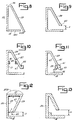
- FIGURE 8 is a cross-sectional side view of an another embodiment of a barrier according to the present invention.
- FIGURE 9 is a cross-sectional side view of an alternate embodiment of a barrier according to the present invention.
- FIGURE 10 is a cross-sectional side view of a barrier according to the present invention showing interior and exterior moats.
- FIGURE 11 is a cross-sectional side view of a barrier according to the present invention showing multiple physical obstacles.
- FIGURE 12 is a cross-sectional side view of a barrier according to the present invention.
- FIGURE 13 is a cross-sectional side view of a barrier according to the present invention.
- a preclusion barrier 10 surrounds the trunk of a tree for preventing insects or other crawling pests from reaching the trunk, leaves, fruit bearing, and/or nut bearing canopy of the tree.
- the barrier is of a size to closely conform to the outer surface of the tree trunk and to prevent passage of insects or other crawling pests between barrier 10 and the tree.
- the barrier is secured to the tree by conventional means fixing the barrier at a distance above the ground sufficient to prevent circumvention of the barrier through debris which may be deposited at the base of the tree.
- a filler or bonding agent may be applied between the barrier 10 and the tree to prevent crawling insects from traveling between the barrier inner wall and the tree.
- an attractant supporting structure such as a plant table 16 includes a flat top surface for supporting flower pots, potted plants or edible material.
- a structure may be used in greenhouses, in plant shops, picnic tables, etc.
- Leg guard barriers 12 are secured to each of legs 14, for preventing crawling pests from reaching the top surface of structure 16.
- Leg barriers 12 are affixed to legs 14 at a distance above the floor or ground to prevent circumvention of the barrier by articles which may be placed against the legs 14 of structure 16.
- a filler or bonding agent may be applied between barriers 12 and legs 14 if necessary to prevent insects from crawling between the inner wall of the barrier and the leg.
- an attractant supporting structure 22 includes a top guard barrier 24 located at the peripheral edge of the top of structure 22.
- Top guard barrier 24 may be manufactured as an integral part of the top of structure 22 or may be manufactured as a separate item which is affixed to the peripheral edge of the structure top.
- Structure top barrier 24 forms a continuous loop following the entire periphery of the top of structure 22.
- a flower pot 26 includes a holder or guard 28 which carries a barrier 38 located at the periphery of the guard.
- flower pot guard 28 includes a base support 42 which supports flower pot 26.
- Flower pot guard 28 has a physical barrier 38 formed at the periphery of the flower pot guard.
- Flower pot guard 28 has ridges 32 extending from support base 42 of flower pot guard 28.
- a water hole 44 is formed in the bottom of the flower pot allowing water to run through the pot and collect in guard 28.
- a plurality of circular ridges 32 are formed on base support 42 and serve to support flower pot 26. Pot 26 may merely rest on ridges 32 and need not be fixed thereto.
- FIGs 1 through 5 illustrate embodiments of a crawling pest preclusion barrier adapted to prevent damage or infestation to plants, trees, or edible items by crawling pests.
- the present invention may be understood from a description of the structure and function common to all embodiments of the invention.
- a barrier 15 is shown which may be used as barriers 10, 12, 24, 38.
- Barrier 15 includes an outer obstacle wall 39, which cooperates with a side wall 20 to form a partially enclosed barrier area 45, which prevents crawling insects and other crawling pests from gaining access to outer surface 41 of obstacle wall 39.
- a plate member 18 extends from side wall 20 generally in the direction of obstacle wall 39. Plate member 18 approaches obstacle wall 39 to a distance not less than X.
- Barrier 15 is positioned such that crawling pests must first encounter barrier 15 at plate member 18.
- Distance X is of sufficient magnitude to prevent the crawling pests from physically reaching obstacle wall 39 from plate member 18.
- Surfaces 18A, 18B, 17A and 17 provide a first pathway which is the sole pathway for crawling pests to reach the protected plant, plant section, tree, or attractant.
- the first pathway leads to a second pathway formed by surfaces 35a, 47, 42 and 41.
- the first and second pathways connect in tandem and form a pathway which must be used by the crawling pest to reach the ridge 35 and subsequently, the attractant supporting section of the structure or the susceptible region of the plant, tree, or attractant supporting structure.
- the spacing between inside surface 47 of the outer obstacle wall 39 and the outer surface 17 of side wall 20, must not be too small. As shown in Figure 6, surface 47 is spaced from surface 17 by a maximum distance Z, and a minimum distance Y. Distance Z must be as large or larger than X, so that the crawling pest will be required to travel between the two surfaces 47 and it as it makes its upward climb along surface 17.
- the crawling pest must travel at least between top surface 17A and point 113 before it can reach over to surface 47 of outer obstacle wall 39. This distance from top surface 17A to point 113 must be sufficient to draw the crawling pest into the barrier area 45 between walls 20 and 39 so that one or more of the following conditions occur: 1) the crawling pests' -tactic responses will be confused, 2) the insect elevation topographic sensing capabilities become disoriented, 3) the insect electrical impulse sensing (seeking) capabilities become less effective, 4) the insect heat sensing (seeking) capabilities become less effective, 5) the intensity of the ultraviolet light becomes insufficient for navigation and orientation purposes by the crawling pest, and 6) the insect olfactory sensing capabilities will become confused.
- point 113 should be approximately one and one-half inches from top surface 17A of plate member 18 if the barrier is installed with plate member 18 in a horizontal position.
- this distance will vary with the angle of the installation with respect to the horizontal as well as the distance the device is mounted above ground.
- the crawling pest preclusion barrier is installed in one or more of the support structure, plant, or tree regions shown in Figures 1, 2, 3, 4 and 5.
- the barrier 15 1) creates a mechanical barrier or maze which disturbs or disorients the crawling pests foraging activity; 2) increases the crawling pests Area Restricted Search (ARS) time caking homing orientation more time consuming for a forager that may have reached the barrier; 3) disrupts communication among crawling pests during the organization phase of the cooperative search and foraging; 4) creates an open space (X) that exceeds the combined body and leg length of the crawling pest to be precluded which a) prevents the pest from "pulling itself up" from plate 18 onto wall 39, and b) prevent circumventing the barrier by the building of a structure by the crawling pest; 5) disrupts the trail pheromones of various crawling pests that may have reached the attractant supporting structure region of a structure or susceptible region of a plant or tree which is protected by the barrier, and may have jumped from obstacle wall 39
- Crawling insects or other crawling pests search for food, shelter or other desired objects in several modes: Area Restricted Search, olfaction, heat sensing (seeking) capabilities, electrical impulse sensing (seeking) capabilities, trail pheromones, visual cues and numerous sensorial modalities.
- Crawling insects or other crawling pests may initially locate food or other some other objective by some combination of Area Restricted Search, vision, odor, heat sensing and/or electrical sensing modes in combination with the highly developed internal topographic map developed using multiple sensorial modalities and polarized or unpolarized ultraviolet light from natural or artificial sources.
- a trail pheromone may be deposited by the successful forager as it returns to home (nest). Some portion of an insect's colony may follow the trail pheromone to the source of the food or other objective.
- the mechanical barriers of the present invention disrupt and/or disorient the crawling pests' foraging activities.
- Crawling insects may have -tactic responses.
- a taxis is a reflexive or orientation movement by insects in relation to a source of stimulation.
- Example taxes are photo (light), thigmo (contact, especially with a solid object), geo (gravity), etc. Taxes may be used individually (one at a time), concurrently (more than one at a time), serially (one after another), and most taxes may be either positive or negative. Insects may switch taxes rapidly and they may switch from positive to negative or vice versa, rapidly. The use of taxes by insects may vary with either or both the environmental states and/or current states of the insect.
- obstacle wall 39 shades the outer surface 17 of the pest preclusion device side wall 20 and barrier area 45 from light rays, as represented by light rays 51 and 53 in Figure 6. As shown in Figure 6, a shadow 55 appears on member 18, 20 and pathway 17a beneath obstacle wall 39.
- the intensity of light within barrier area 45 is typically lower than the intensity of light outside the barrier due to the shading of light by wall 39.
- the insect If the insect is currently utilizing only its positive phototactic response mode, that is, it prefers to move toward light rather than away from light, as the insect moves along pathway 17A of plate member 18, it moves into the shadow 55 ( Figure 6) cast by obstacle wall 39.
- the shadow deters the insect from entering the barrier area 45 between the obstacle wall and side walls 20.
- the insect if the insect begins to climb the outer,surface or pathway 17 of outer wall 20 to enter the barrier area 45, the insect approaches a progressively darker area within the barrier area 45.
- the insects' response tendency may be to make a positive phototactic choice and exit barrier area 45 back towards the light.
- the insect does not retreat back down outer surface 17, it will climb outer surface 17 of side wall 20 towards ridge 35.
- surface 35A it places itself in a position where all choices of further movement are positively phototactic.
- barrier area 45 would disorient or disrupt foraging and search activity. If the insect is currently or serially utilizing other tactic response modes, the disorientation/disruption would become more severe. For example, if the objective was initially located through olfactory senses, the insect would utilize, among other, the geotactic response mode to establish an elevation topographic reference point.
- the insect was concurrently operating in a negative thigmotactic response mode, it would not climb surface 17 of side wall 20 when it was encountered. If it switched to a positive thigmotactic response mode, it would climb surface 17 of side wall 20. As it climbed surface 17, the olfactory responses would diminish as it entered barrier area 45. Since it was previously operating either concurrently or serially in a geotactic response mode, it would receive conflicting stimuli. That is, the olfactory modality indicated the presence of a food supply or other objective. As the insect climbs surface 17 to approach the area which the olfactory sense identified, the geotactic response mode would provide positive reinforcement while the olfactory modality would provide negative reinforcement. The result would be disorientation of the insect.
- the insect would then switch -tactic responses to provide clarification. For example, it could switch to positive and/or negative phototactic response modes. If it were positive, and switched to a negative phototactic response, it would again become disoriented when it reached surface 35A. When all choices of movement would be phototactically positive. If it switched to a positive phototactic response mode, at that point, it would most likely return from its original direction back down surface 17. Barrier area 45 effectively disorients the insects' combined sensorial modalities, and -tactic responses. The insects' heat sensing (seeking) responses and the electrical impulse sensing (seeking) responses would be affected similarly to the olfactory responses.
- insects utilize the ultraviolet portion of the light spectrum for navigation and orientation with respect to food, water, shelter and other objectives of importance.
- Ultraviolet light sources may be natural or artificial and are used by insects twenty-four hours a day in any type of weather, unless the insects are under a barrier that effectively blocks ultraviolet light, such as metal.
- Barrier area 45 attenuates the intensity of the ultraviolet spectrum by absorption, reflection and light scattering. The ultraviolet spectrum loses its ability to provide navigation and orientation cues when it drops below a specified intensity level.
- Barrier area 45 effectively attenuates the ultraviolet light so that insects become disoriented when it is no longer effective for orientation or navigation. When disorientation occurs, the insect attempts to remove itself from barrier area 45 in order to regain the ultraviolet navigation and orientation spectrum.
- the point at which the insect loses its ability to navigate by ultraviolet light is variable, depending on: 1) the intensity of the ultraviolet light source (e.g., sun's ultraviolet is more intense than moon's ultraviolet source), 2) the color and composition of plate member 18, pathway 17 and 17A, 3) the coarseness or smoothness of pathway 17 and pathway 17A and plate member 18 and 4) the color, composition and material of the insect preclusion barrier.
- the intensity of the ultraviolet light source e.g., sun's ultraviolet is more intense than moon's ultraviolet source
- the color and composition of plate member 18, pathway 17 and 17A e.g., 3) the coarseness or smoothness of pathway 17 and pathway 17A and plate member 18 and 4) the color, composition and material of the insect preclusion barrier.
- Each of these four factors affect the degree of absorption, reflection and light scattering of ultraviolet light. Therefore, point 113 in Figure 7 should be located at a point where the ultraviolet light has attenuated to a level sufficient to confuse the insects' navigation and orientation systems.
- ray 121 representative of ultraviolet light of a certain intensity radiates as shown by arrows into barrier area 45.
- the intensity of ray 121 is represented by its thickness.
- Point D the intensity of the ultraviolet light ray 121 is attenuated due to: 1) absorption; 2) light scattering; and 3) reflection.
- Point D is the location of point 113 in Figure 6.
- Stereokinesis is an undirected movement which occurs when a crawling insect encounters an orthogonal surface such as sidewall 20 or the interior ridge surface 35A.
- the response mode of the insect when it encounters a circular or straight surface which is orthogonal to its direction of movement is that it chooses to follow the new surface structure rather than climb the route of the vertical wall.
- the stereokinetic response mode effect in conjunction with the disruption of the -tactic response modes and disruption and attenuation of the ultraviolet light sources used for navigation produce disorientation in the insect.
- the preceding illustration may be expanded to the extent of the statistical permutations of the combined sensorial modalities, -tactic responses, stereokinetic movements of the insect, and the degree of attenuation of the ultraviolet light used by the insects to navigate and to orient itself.
- a search mode used by crawling insects is Area Restricted Search (ARS).
- ARS Area Restricted Search
- Trail pheromones are specific scents used as a communication method to indicate the presence of a food or other objective that is desired by the rest of the colony. A portion of the colony subsequently follows the trail pheromone.
- the volatile characteristic of the deposited trail pheromones will produce three affects: a weaker odor (trail pheromone) signifying an unimportant food or objective source; no odor (pheromone) indicating no food or objective source; and/or a trail pheromone that, when compared to the trail pheromones of other foragers which have discovered an objective at approximately the same tice, is comparatively uninteresting with respect to locating the objective source.
- Disruption of the communication process described above during the organization phase of cooperative search and foraging is known to be very dysfunctional to successfully accessing an objective source by a colony of crawling insects.
- the organization phase refers to the recruiting of harvesters by the foragers.
- distance X is greater than the combined length of the legs and body of a crawling pest.
- the crawling pest is prevented from pulling itself up from plate member 18 to obstacle wall 39.
- a crawling pest may begin to deposit a trail pheromone on surface 41 of obstacle wall 39 as it leaves the desired objective.
- the insect reaches the bottom of obstacle wall 39 ( Figures 6 and 7); it may elect to "jump" to upper surface 17A of plate member 18.
- the trail pheromone will not be continuous.
- the forager will return to home and a portion of the colony will follow the trail pheromone to the point of discontinuity.
- the insects' access to the objective will be precluded because a continuous trail of pheromone does not exist.
- insects may use air borne scents to discover food, once the insect is within barrier area 45 between obstacle wall 39 and side wall 20, scent from the food is not as potent thereby creating confusion to this sensorial capability.
- the scent travels around obstacle wall 39 and enters the barrier area 45 from the plate member or outside. This directs the insect to return to pathway 17A and to exist barrier area 45 rather than continuing the food search within the barrier area.
- insect poison or repellant may be placed on either or both of the inside surfaces 47 and 17 of the barrier area. Additional repellant may be placed in barrier area 45.
- the poison and/or repellant may be of several types: spray, liquid, gel, or adhesive.
- Figure 8 represents another embodiment of the present invention which may be optical for some applications.
- the barrier is positioned around a plant, tree or structure which is not in a protected structure and which may be subjected to blowing leaves, pine needles or other debris.
- the opening to barrier area 45 is sheltered by obstacle wall 39 diminishing the possibility of debris entering or becoming lodged within the entrance to barrier area 45.
- the dimension X and the functioning of this embodiment of the present invention is as described above.
- Figure 9 illustrates an embodiment of the present invention including an offset or thickened portion 43, for making an insect preclusion device more durable.
- the distance X that the lower edge of the outer obstacle wall 39 is above upper surface 17A of plate member 18 is as described above.
- the distance should be sufficient to prevent deposition of foreign materials (such as leaves, pine needles, etc.) that would provide a bridge for insects to circumvent the barrier.
- the bottom of the outer obstacle wall 39 should be established at approximately 3/4 of an inch above upper surface 17A, that is a height such that the insect cannot pull itself up on to wall 39.
- Figure 10 illustrates an embodiment of the present invention which is adapted to retain poison or repellant within the barrier.
- Receptacles 81 and 83 on surfaces 17 and 47 respectively provide locations at which poison or repellant may be placed.
- a port 87 may be provided through outer obstacle wall 39 to provide a means for replenishing poison or repellant in receptacles 81 and 83. Additional repellant or poison may be placed in receptacle 85 formed at the lowest extent of surface 41.
- Figure 11 illustrates another embodiment in which additional physical obstacles 59, 60 and 61 may be secured to obstacle wall 39.
- the additional obstacles 59, 60, 61 cooperate with obstacle wall 39 in order to provide additional barrier areas 63 and 65 for providing additional barriers operating in a similar manner to that previously described for barrier area 45.
- Figure 12 is another codification.
- Upper device lip 37 is elongated in such a manner that obstacle wall 39 extends downwardly and inwardly toward support wall 20.
- Barrier area 45 operates in a previously described manner, however, the horizontal distance X occurs at the lowest point of obstacle wall 39.
- Upper device lip 37B may also be constructed in a nonlinear method as illustrated by the dotted line. This modification may be used if the device is to be installed in positions or locations in which there is a likelihood that foreign objects (such as leaves, weeds, grass, pine needles, etc.) may lodge between any portion of plate member 18 and obstacle wall 39.
- foreign objects such as leaves, weeds, grass, pine needles, etc.
- the deposit of such foreign objects would provide a "bridge" which would allow crawling insects or other crawling pests to bypass barrier area 45 and thereby gain access to the attractant supporting section of the structure or the susceptible area of the plant or tree.
- the maximum distance Z will determine the length which upper device lip 37 or 37B will be elongated and thereby establishing the distance between inner surface 47 and outer surface 49.
- the purpose of the modification is to increase the difficulty with which the effectiveness of the invention may be reduced by fallen or windblown foreign objects.
- FIG. 13 illustrates another alternate embodiment of the present invention.
- Plate member 18 may be attached to support member 20 by attachment methods including friction, use of slotted grooves, use of bonding agents , any attachment method, or any combination of the preceding attachment methods.
- plate 18 may be removed and the length of obstacle wall 39 extended in such a manner as to provide an adequately dense shadow within the barrier area 45. This attentuates ultra-violet light sufficiently to disorient the insect and serves to disrupt the insect's phototactic, ultraviolet orientation, and other orientation-navigation systems.
- the extent to which obstacle wall 39 is lengthened depends upon the amount and the direction of light. For example, if obstacle member 39 is located where little light reaches barrier area 45, plate member 18 may be removed. However, where direct or indirect light comes from beneath area 45 then disc member 18 is needed.
- Crawling insect or other crawling pest preclusion barriers as shown and described for Figures 6 through 13 may be used as barriers 10, 12, 24, 28, 38, as shown in Figures 1 through 5.
- sidewall 20 When used as a tree guard as illustrated in Figure 1, sidewall 20 must conform to the trunk of the tree to preclude a crawling insect or other crawling pest from passing between side wall 20 and the tree. Plate member 18 and obstacle wall 39 would extend away from the trunk of the tree to which the barrier is applied.
- the barrier must be fabricated of a material sufficiently compliant to continuously conform to the trunk of the tree around the circumference of the trunk of the tree. A filler or bonding agent normally would be applied between the device and the tree so that no openings would exist between the tree and the barrier device.
- the barrier may be manufactured in 3 or 4 pieces, for example, which will snap or slide together to form the unit.
- the barrier may be formed of one molded piece.
Landscapes
- Life Sciences & Earth Sciences (AREA)
- Pest Control & Pesticides (AREA)
- Environmental Sciences (AREA)
- Engineering & Computer Science (AREA)
- Insects & Arthropods (AREA)
- Zoology (AREA)
- Birds (AREA)
- Wood Science & Technology (AREA)
- Biodiversity & Conservation Biology (AREA)
- Architecture (AREA)
- Plant Pathology (AREA)
- Forests & Forestry (AREA)
- Health & Medical Sciences (AREA)
- General Health & Medical Sciences (AREA)
- Toxicology (AREA)
- Physics & Mathematics (AREA)
- Ecology (AREA)
- Electromagnetism (AREA)
- Civil Engineering (AREA)
- Structural Engineering (AREA)
- Animal Husbandry (AREA)
- Catching Or Destruction (AREA)
Applications Claiming Priority (2)
| Application Number | Priority Date | Filing Date | Title |
|---|---|---|---|
| US570339 | 1990-08-21 | ||
| US07/570,339 US5353556A (en) | 1986-10-02 | 1990-08-21 | Method and apparatus for preventing crawling insects or other crawling pests from gaining access to plants |
Publications (2)
| Publication Number | Publication Date |
|---|---|
| EP0472385A2 true EP0472385A2 (de) | 1992-02-26 |
| EP0472385A3 EP0472385A3 (de) | 1992-03-11 |
Family
ID=24279265
Family Applications (1)
| Application Number | Title | Priority Date | Filing Date |
|---|---|---|---|
| EP19910307610 Withdrawn EP0472385A3 (de) | 1990-08-21 | 1991-08-19 | Schutz von Pflanzen gegen Insekten und anderem kriechendem Ungeziefer |
Country Status (5)
| Country | Link |
|---|---|
| US (1) | US5353556A (de) |
| EP (1) | EP0472385A3 (de) |
| BR (1) | BR9103588A (de) |
| MX (1) | MX9100737A (de) |
| ZA (1) | ZA916593B (de) |
Cited By (3)
| Publication number | Priority date | Publication date | Assignee | Title |
|---|---|---|---|---|
| DE4321511A1 (de) * | 1993-06-29 | 1994-03-10 | Erich Kannenberg | Baum-Schutz-Glocke ( B S G ) |
| US6058661A (en) * | 1986-10-02 | 2000-05-09 | Hand; Herbert H. | Method and apparatus for preventing crawling insects and other crawling pests gaining access to sources of water |
| CN110402916A (zh) * | 2018-04-27 | 2019-11-05 | 谢福鑫 | 蚂蚁防治器 |
Families Citing this family (22)
| Publication number | Priority date | Publication date | Assignee | Title |
|---|---|---|---|---|
| US5768821A (en) * | 1996-09-12 | 1998-06-23 | Currey; James D. | Protected platform for hunters |
| US6230435B1 (en) | 1998-10-26 | 2001-05-15 | Philipp And Doris Washburn, Trustees Of The Washburn Family Trust | Tree trunk barrier for pest control |
| US6553726B1 (en) | 1999-06-18 | 2003-04-29 | University Of Florida | Barrier against crawling arthropods |
| USD428781S (en) * | 1999-10-01 | 2000-08-01 | Paul D Tanner | Tree and plant protector |
| US6837008B2 (en) | 2000-02-09 | 2005-01-04 | University Of Florida | Device for impeding a route of travel of crawling arthropods |
| US6378242B1 (en) | 2000-05-11 | 2002-04-30 | University Of Florida | Coaster for shielding against crawling arthropods |
| US20060025545A1 (en) * | 2002-09-20 | 2006-02-02 | Patrick Brant | Polymer production at supercritical conditions |
| US20050005502A1 (en) * | 2003-05-27 | 2005-01-13 | Envirometrics Systems Inc. | Insect barrier permitting downward travel of insects |
| US20050076559A1 (en) * | 2003-09-22 | 2005-04-14 | Susan Davis | Mechanical means pest repellant and plant shield |
| US20050246990A1 (en) * | 2004-04-09 | 2005-11-10 | Geska Edward J | Insulated wall system with metal studs and fire retardant walls |
| US20080022588A1 (en) * | 2006-07-25 | 2008-01-31 | Tijerina Derek S | Tree ring |
| CN101715293A (zh) * | 2007-04-26 | 2010-05-26 | 哈里斯·查理斯·E.·C. | 爬行昆虫障碍装置及相应方法 |
| US20120096759A1 (en) * | 2009-06-29 | 2012-04-26 | Barbara Biggs | Insect infestation reduction method |
| KR101848927B1 (ko) * | 2011-11-11 | 2018-05-28 | 엘지전자 주식회사 | 냉장고 |
| US9320316B2 (en) | 2013-03-14 | 2016-04-26 | Under Armour, Inc. | 3D zonal compression shoe |
| US20150013617A1 (en) * | 2013-05-17 | 2015-01-15 | Henry Joseph Rideout | Pest barrier |
| US11653641B2 (en) | 2015-02-06 | 2023-05-23 | University Of Florida Research Foundation, Inc. | Furniture protector against bed bugs and other crawling insects |
| US10542728B2 (en) * | 2016-04-04 | 2020-01-28 | Timothy Joe Young | Wildlife feeder varmint shield |
| USD934515S1 (en) * | 2020-12-09 | 2021-10-26 | Just Fur Love, LLC | Clamp for mounting an animal guard |
| US11707024B1 (en) * | 2022-04-12 | 2023-07-25 | Carl Cooper | Rubber tree rain guard seal assembly |
| US20240099292A1 (en) * | 2022-09-28 | 2024-03-28 | Zachary Kops | Modular Insect Barrier Device |
| JP7753469B1 (ja) * | 2024-08-14 | 2025-10-14 | 重貴 長澤 | 自律移動型小型生物からの室内への侵入を防止する器具 |
Family Cites Families (54)
| Publication number | Priority date | Publication date | Assignee | Title |
|---|---|---|---|---|
| US481311A (en) * | 1892-08-23 | Fruit-tree protector | ||
| US46298A (en) * | 1865-02-07 | Improvement in tree-protectors | ||
| US57937A (en) * | 1866-09-11 | Improvement in tree-protectors | ||
| US44238A (en) * | 1864-09-13 | Tree-protector | ||
| US42A (en) * | 1836-10-08 | Hanging lamp | ||
| US49453A (en) * | 1865-08-15 | Improved tree-protector | ||
| US2772476A (en) * | 1956-12-04 | Variable grip and adjustable multiple fur slicer | ||
| US479980A (en) * | 1892-08-02 | Caster | ||
| US784684A (en) * | 1904-02-08 | 1905-03-14 | Adolf Karisen | Device for protecting trees. |
| US1221999A (en) * | 1915-08-31 | 1917-04-10 | Richard F Kreiter | Insect-guard. |
| US1335845A (en) * | 1918-11-12 | 1920-04-06 | Frank A Tranchant | Insect-trap |
| US1496720A (en) * | 1923-02-08 | 1924-06-03 | Marsico Vincenzo | Tree protector |
| US1579534A (en) * | 1923-02-12 | 1926-04-06 | Louis R Hibbard | Tree protector |
| US2012651A (en) * | 1934-10-04 | 1935-08-27 | Herbert S Beall | Insect trapping and exterminating device |
| CH184811A (fr) * | 1935-10-05 | 1936-06-30 | Mayor Paul | Dispositif pour empêcher un animal d'escalader une colonne. |
| BE421085A (de) * | 1936-04-18 | |||
| US2092659A (en) * | 1936-08-20 | 1937-09-07 | Albert C Stone | Termite shield |
| US2112229A (en) * | 1936-10-10 | 1938-03-29 | Chas S Brock | Vermin trapping and exterminating device |
| US2138182A (en) * | 1937-03-06 | 1938-11-29 | Lipthrott Henry Clinton | Building structure |
| US2149495A (en) * | 1937-12-23 | 1939-03-07 | Clifford B Barnard | Wall construction |
| US2139225A (en) * | 1938-02-10 | 1938-12-06 | Newton P Easling | Termite repellent |
| US2150891A (en) * | 1938-06-24 | 1939-03-14 | James D Tennison | Termite shield |
| US2165500A (en) * | 1938-07-22 | 1939-07-11 | Donald M Muirhead | Shielding structure against insects |
| US2191811A (en) * | 1939-05-02 | 1940-02-27 | Sr Charles R Trampier | Food and water dish for animals |
| US2242266A (en) * | 1940-02-21 | 1941-05-20 | Timber Engineering Co | Termite shield connector |
| US2253541A (en) * | 1940-04-03 | 1941-08-26 | Arvil J Torbett | Tree cup |
| US2258317A (en) * | 1940-05-14 | 1941-10-07 | Forrest G Clipper | Antproof dome |
| US2315989A (en) * | 1940-08-07 | 1943-04-06 | Alfred A Tennison | Termite shield |
| US2554086A (en) * | 1949-02-24 | 1951-05-22 | Clarence F Block | Pet feeder |
| US2584301A (en) * | 1949-11-21 | 1952-02-05 | Sinclair Ind Inc | Moated dog feeder |
| US2677350A (en) * | 1951-11-30 | 1954-05-04 | Marion T Prestidge | Antproof animal food tray |
| US2746201A (en) * | 1953-01-23 | 1956-05-22 | Albert B Warrell | Insect guard for trees |
| US2796042A (en) * | 1956-03-12 | 1957-06-18 | Gene W Sidwell | Bathing device for birds |
| US2813509A (en) * | 1956-08-28 | 1957-11-19 | August C Bruno | Animal feeding device |
| US3147739A (en) * | 1962-07-31 | 1964-09-08 | John K Shaheen | Feeding device |
| US3195510A (en) * | 1964-06-01 | 1965-07-20 | Albert A Berustein | Insect protected bird and animal feeder |
| US3441003A (en) * | 1966-09-29 | 1969-04-29 | Virgil R Du Mond | Animal and pet food bowl |
| US3664304A (en) * | 1969-11-19 | 1972-05-23 | Allie F Carter | Chick feeder |
| US3995595A (en) * | 1974-04-15 | 1976-12-07 | Williams Robert W | Animal feed device containing an insecticidal cartridge |
| US4098018A (en) * | 1976-07-30 | 1978-07-04 | The Raymond Lee Organization, Inc. | Insect trap attachable to a tree |
| US4128080A (en) * | 1977-04-06 | 1978-12-05 | Haney C Rex | Animal feeder |
| FR2453952A1 (fr) * | 1979-02-20 | 1980-11-07 | Roux Marcel | Dispositif applicable a une construction fixe pour son traitement preventif permanent contre les termites |
| CA1144369A (en) * | 1979-03-02 | 1983-04-12 | Alan R. Davies | Traps and trapping techniques |
| US4328636A (en) * | 1980-06-30 | 1982-05-11 | Johnson Richard D | Device for insect control and method |
| US4357905A (en) * | 1981-09-14 | 1982-11-09 | Louis E. Hay | Moated pet feeder |
| US4399772A (en) * | 1982-02-08 | 1983-08-23 | Salinas Rufus C | Animal feeder |
| US4428325A (en) * | 1982-05-28 | 1984-01-31 | Koch Charlotte M | Feeding bowl and liner therefor |
| US4471562A (en) * | 1982-09-03 | 1984-09-18 | Milton Brucker | Snail protective device |
| US4691664A (en) * | 1986-02-05 | 1987-09-08 | The Cool Water Corporation | Pet receptacle |
| US4800845A (en) * | 1986-08-15 | 1989-01-31 | Budd Louise T | Disposable pet food dish |
| US4905629A (en) * | 1986-10-02 | 1990-03-06 | Hand Herbert H | Method and apparatus for preventing crawling insects or other crawling pests from entering the food area of an animal feeding bowl |
| US5287648A (en) * | 1986-10-02 | 1994-02-22 | Hand Herbert H | Electrical support structure and method and apparatus for preventing crawling insects or other crawling pests from entering electrical devices mounted on support structures above ground |
| US4784086A (en) * | 1986-10-02 | 1988-11-15 | Hand Herbert H | Method and apparatus for preventing insects from entering the food area of an animal feeding bowl |
| US4756116A (en) * | 1987-11-02 | 1988-07-12 | Cutter John W | Snail barrier |
-
1990
- 1990-08-21 US US07/570,339 patent/US5353556A/en not_active Expired - Fee Related
-
1991
- 1991-08-19 EP EP19910307610 patent/EP0472385A3/de not_active Withdrawn
- 1991-08-20 ZA ZA916593A patent/ZA916593B/xx unknown
- 1991-08-20 MX MX9100737A patent/MX9100737A/es not_active IP Right Cessation
- 1991-08-21 BR BR919103588A patent/BR9103588A/pt not_active IP Right Cessation
Cited By (3)
| Publication number | Priority date | Publication date | Assignee | Title |
|---|---|---|---|---|
| US6058661A (en) * | 1986-10-02 | 2000-05-09 | Hand; Herbert H. | Method and apparatus for preventing crawling insects and other crawling pests gaining access to sources of water |
| DE4321511A1 (de) * | 1993-06-29 | 1994-03-10 | Erich Kannenberg | Baum-Schutz-Glocke ( B S G ) |
| CN110402916A (zh) * | 2018-04-27 | 2019-11-05 | 谢福鑫 | 蚂蚁防治器 |
Also Published As
| Publication number | Publication date |
|---|---|
| ZA916593B (en) | 1993-04-28 |
| BR9103588A (pt) | 1992-05-12 |
| MX9100737A (es) | 1992-04-01 |
| US5353556A (en) | 1994-10-11 |
| EP0472385A3 (de) | 1992-03-11 |
Similar Documents
| Publication | Publication Date | Title |
|---|---|---|
| US5353556A (en) | Method and apparatus for preventing crawling insects or other crawling pests from gaining access to plants | |
| US5303523A (en) | Pest preventer for location on a structural foundation support or a structure supporting a food source | |
| US4784086A (en) | Method and apparatus for preventing insects from entering the food area of an animal feeding bowl | |
| US5097641A (en) | Method and apparatus for preventing termites, crawling insects or other crawling pests from entering residential structures, commercial structures and industrial structures | |
| US5148626A (en) | Insect barrier and deterrent device | |
| US4905629A (en) | Method and apparatus for preventing crawling insects or other crawling pests from entering the food area of an animal feeding bowl | |
| US4319423A (en) | Barrier structure for controlling ground crawling, non-burrowing insects | |
| US5339563A (en) | Non-toxic insect capture and killing apparatus | |
| US5287648A (en) | Electrical support structure and method and apparatus for preventing crawling insects or other crawling pests from entering electrical devices mounted on support structures above ground | |
| US6192621B1 (en) | Garden pest control device | |
| US5379545A (en) | Animal repellent device | |
| CA2200007C (en) | Portable trench barrier for insect pests in agriculture | |
| EP2377394B1 (de) | Verbesserte Ameisenfalle | |
| US4471562A (en) | Snail protective device | |
| US20030074832A1 (en) | Replenishable pest control apparatus | |
| US20210051864A1 (en) | Insect Barrier Strip for Tree Trunks | |
| WO2000024248A9 (en) | Tree trunk barrier for pest control | |
| US20060248782A1 (en) | Mosquito breeding trap and method for eliminating mosquitoes | |
| US4505065A (en) | Insect trap | |
| US5622001A (en) | Slug and snail trap | |
| US5440833A (en) | Insect protection barrier combination | |
| KR20080100664A (ko) | 유해동물 포획 장치 | |
| US6058661A (en) | Method and apparatus for preventing crawling insects and other crawling pests gaining access to sources of water | |
| US5157866A (en) | Earwig collector | |
| US10076108B2 (en) | Insect trap apparatuses and methods of using the same |
Legal Events
| Date | Code | Title | Description |
|---|---|---|---|
| PUAI | Public reference made under article 153(3) epc to a published international application that has entered the european phase |
Free format text: ORIGINAL CODE: 0009012 |
|
| PUAL | Search report despatched |
Free format text: ORIGINAL CODE: 0009013 |
|
| AK | Designated contracting states |
Kind code of ref document: A2 Designated state(s): ES FR GR IT |
|
| AK | Designated contracting states |
Kind code of ref document: A3 Designated state(s): ES FR GR IT |
|
| STAA | Information on the status of an ep patent application or granted ep patent |
Free format text: STATUS: THE APPLICATION IS DEEMED TO BE WITHDRAWN |
|
| 18D | Application deemed to be withdrawn |
Effective date: 19920912 |