EP0471252B1 - N-Alkyl-N-(meth)acryloyloxyalkylcarboxamide aromatischer Carbonsäuren und aromatischer Carbonsäureanhydride sowie Adhäsive enthaltend diese Verbindungen - Google Patents
N-Alkyl-N-(meth)acryloyloxyalkylcarboxamide aromatischer Carbonsäuren und aromatischer Carbonsäureanhydride sowie Adhäsive enthaltend diese Verbindungen Download PDFInfo
- Publication number
- EP0471252B1 EP0471252B1 EP91113021A EP91113021A EP0471252B1 EP 0471252 B1 EP0471252 B1 EP 0471252B1 EP 91113021 A EP91113021 A EP 91113021A EP 91113021 A EP91113021 A EP 91113021A EP 0471252 B1 EP0471252 B1 EP 0471252B1
- Authority
- EP
- European Patent Office
- Prior art keywords
- meth
- denotes
- alkyl
- formula
- acid
- Prior art date
- Legal status (The legal status is an assumption and is not a legal conclusion. Google has not performed a legal analysis and makes no representation as to the accuracy of the status listed.)
- Expired - Lifetime
Links
- 239000000853 adhesive Substances 0.000 title claims abstract description 22
- 230000001070 adhesive effect Effects 0.000 title claims abstract description 22
- -1 aromatic carboxylic acids Chemical class 0.000 title abstract description 55
- 150000001875 compounds Chemical class 0.000 title abstract description 12
- 239000000203 mixture Substances 0.000 claims abstract description 24
- 238000002360 preparation method Methods 0.000 claims abstract description 21
- 239000000126 substance Substances 0.000 claims abstract description 9
- 238000009472 formulation Methods 0.000 claims abstract 6
- 125000000896 monocarboxylic acid group Chemical group 0.000 claims description 28
- XLYOFNOQVPJJNP-UHFFFAOYSA-N water Substances O XLYOFNOQVPJJNP-UHFFFAOYSA-N 0.000 claims description 28
- 238000006467 substitution reaction Methods 0.000 claims description 26
- UFHFLCQGNIYNRP-UHFFFAOYSA-N Hydrogen Chemical compound [H][H] UFHFLCQGNIYNRP-UHFFFAOYSA-N 0.000 claims description 25
- 229910052739 hydrogen Inorganic materials 0.000 claims description 25
- 125000002496 methyl group Chemical group [H]C([H])([H])* 0.000 claims description 25
- 150000008064 anhydrides Chemical group 0.000 claims description 20
- 239000001257 hydrogen Substances 0.000 claims description 15
- 239000000463 material Substances 0.000 claims description 13
- 238000000034 method Methods 0.000 claims description 12
- 150000001412 amines Chemical class 0.000 claims description 11
- 239000003999 initiator Substances 0.000 claims description 9
- CERQOIWHTDAKMF-UHFFFAOYSA-N Methacrylic acid Chemical compound CC(=C)C(O)=O CERQOIWHTDAKMF-UHFFFAOYSA-N 0.000 claims description 8
- 239000002904 solvent Substances 0.000 claims description 8
- 150000003857 carboxamides Chemical class 0.000 claims description 7
- 230000008569 process Effects 0.000 claims description 7
- 230000003750 conditioning effect Effects 0.000 claims description 6
- 239000000460 chlorine Substances 0.000 claims description 5
- 239000007788 liquid Substances 0.000 claims description 5
- 239000003960 organic solvent Substances 0.000 claims description 5
- 125000001997 phenyl group Chemical group [H]C1=C([H])C([H])=C(*)C([H])=C1[H] 0.000 claims description 4
- ZAMOUSCENKQFHK-UHFFFAOYSA-N Chlorine atom Chemical compound [Cl] ZAMOUSCENKQFHK-UHFFFAOYSA-N 0.000 claims description 3
- 125000006159 dianhydride group Chemical group 0.000 claims description 3
- 125000004989 dicarbonyl group Chemical group 0.000 claims description 3
- 230000008439 repair process Effects 0.000 claims description 3
- 239000002639 bone cement Substances 0.000 claims description 2
- 229910052801 chlorine Inorganic materials 0.000 claims description 2
- 125000001624 naphthyl group Chemical group 0.000 claims 2
- 239000003795 chemical substances by application Substances 0.000 claims 1
- 230000003081 coactivator Effects 0.000 claims 1
- 238000004132 cross linking Methods 0.000 claims 1
- 125000002887 hydroxy group Chemical group [H]O* 0.000 claims 1
- WPYMKLBDIGXBTP-UHFFFAOYSA-N benzoic acid Chemical compound OC(=O)C1=CC=CC=C1 WPYMKLBDIGXBTP-UHFFFAOYSA-N 0.000 abstract description 3
- YMWUJEATGCHHMB-UHFFFAOYSA-N Dichloromethane Chemical compound ClCCl YMWUJEATGCHHMB-UHFFFAOYSA-N 0.000 description 42
- 239000000243 solution Substances 0.000 description 18
- 210000004268 dentin Anatomy 0.000 description 17
- HEDRZPFGACZZDS-MICDWDOJSA-N Trichloro(2H)methane Chemical compound [2H]C(Cl)(Cl)Cl HEDRZPFGACZZDS-MICDWDOJSA-N 0.000 description 16
- CYIDZMCFTVVTJO-UHFFFAOYSA-N pyromellitic acid Chemical compound OC(=O)C1=CC(C(O)=O)=C(C(O)=O)C=C1C(O)=O CYIDZMCFTVVTJO-UHFFFAOYSA-N 0.000 description 16
- ZMANZCXQSJIPKH-UHFFFAOYSA-N Triethylamine Chemical compound CCN(CC)CC ZMANZCXQSJIPKH-UHFFFAOYSA-N 0.000 description 15
- 125000006519 CCH3 Chemical group 0.000 description 12
- WYURNTSHIVDZCO-UHFFFAOYSA-N Tetrahydrofuran Chemical compound C1CCOC1 WYURNTSHIVDZCO-UHFFFAOYSA-N 0.000 description 12
- 125000000391 vinyl group Chemical group [H]C([*])=C([H])[H] 0.000 description 12
- 229920002554 vinyl polymer Polymers 0.000 description 12
- 0 CC(N(*)*OC(C(*)=C)=O)=O Chemical compound CC(N(*)*OC(C(*)=C)=O)=O 0.000 description 10
- 125000000999 tert-butyl group Chemical group [H]C([H])([H])C(*)(C([H])([H])[H])C([H])([H])[H] 0.000 description 10
- ZMXDDKWLCZADIW-UHFFFAOYSA-N N,N-Dimethylformamide Chemical compound CN(C)C=O ZMXDDKWLCZADIW-UHFFFAOYSA-N 0.000 description 9
- 229920003023 plastic Polymers 0.000 description 9
- 239000004033 plastic Substances 0.000 description 9
- 150000003254 radicals Chemical class 0.000 description 9
- 239000002253 acid Substances 0.000 description 8
- UJMDYLWCYJJYMO-UHFFFAOYSA-N benzene-1,2,3-tricarboxylic acid Chemical class OC(=O)C1=CC=CC(C(O)=O)=C1C(O)=O UJMDYLWCYJJYMO-UHFFFAOYSA-N 0.000 description 8
- 230000007062 hydrolysis Effects 0.000 description 8
- 238000006460 hydrolysis reaction Methods 0.000 description 8
- 150000001555 benzenes Chemical class 0.000 description 7
- 238000006243 chemical reaction Methods 0.000 description 7
- 238000011049 filling Methods 0.000 description 7
- 239000000047 product Substances 0.000 description 7
- 239000007787 solid Substances 0.000 description 7
- 238000003756 stirring Methods 0.000 description 7
- VNQXSTWCDUXYEZ-UHFFFAOYSA-N 1,7,7-trimethylbicyclo[2.2.1]heptane-2,3-dione Chemical compound C1CC2(C)C(=O)C(=O)C1C2(C)C VNQXSTWCDUXYEZ-UHFFFAOYSA-N 0.000 description 6
- CSCPPACGZOOCGX-UHFFFAOYSA-N Acetone Chemical compound CC(C)=O CSCPPACGZOOCGX-UHFFFAOYSA-N 0.000 description 6
- LFQSCWFLJHTTHZ-UHFFFAOYSA-N Ethanol Chemical compound CCO LFQSCWFLJHTTHZ-UHFFFAOYSA-N 0.000 description 6
- XEKOWRVHYACXOJ-UHFFFAOYSA-N Ethyl acetate Chemical compound CCOC(C)=O XEKOWRVHYACXOJ-UHFFFAOYSA-N 0.000 description 6
- PEDCQBHIVMGVHV-UHFFFAOYSA-N Glycerine Chemical compound OCC(O)CO PEDCQBHIVMGVHV-UHFFFAOYSA-N 0.000 description 6
- NBIIXXVUZAFLBC-UHFFFAOYSA-N Phosphoric acid Chemical compound OP(O)(O)=O NBIIXXVUZAFLBC-UHFFFAOYSA-N 0.000 description 6
- QAOWNCQODCNURD-UHFFFAOYSA-N Sulfuric acid Chemical compound OS(O)(=O)=O QAOWNCQODCNURD-UHFFFAOYSA-N 0.000 description 6
- 150000007513 acids Chemical class 0.000 description 6
- 229930006711 bornane-2,3-dione Natural products 0.000 description 6
- KRKNYBCHXYNGOX-UHFFFAOYSA-N citric acid Chemical compound OC(=O)CC(O)(C(O)=O)CC(O)=O KRKNYBCHXYNGOX-UHFFFAOYSA-N 0.000 description 6
- 150000002790 naphthalenes Chemical class 0.000 description 6
- YLQBMQCUIZJEEH-UHFFFAOYSA-N tetrahydrofuran Natural products C=1C=COC=1 YLQBMQCUIZJEEH-UHFFFAOYSA-N 0.000 description 6
- 238000005160 1H NMR spectroscopy Methods 0.000 description 5
- 238000005481 NMR spectroscopy Methods 0.000 description 5
- 125000003118 aryl group Chemical group 0.000 description 5
- 229910052799 carbon Inorganic materials 0.000 description 5
- 125000004432 carbon atom Chemical group C* 0.000 description 5
- 210000003298 dental enamel Anatomy 0.000 description 5
- 238000002844 melting Methods 0.000 description 5
- 230000008018 melting Effects 0.000 description 5
- VEXZGXHMUGYJMC-UHFFFAOYSA-M Chloride anion Chemical compound [Cl-] VEXZGXHMUGYJMC-UHFFFAOYSA-M 0.000 description 4
- HEDRZPFGACZZDS-UHFFFAOYSA-N Chloroform Chemical compound ClC(Cl)Cl HEDRZPFGACZZDS-UHFFFAOYSA-N 0.000 description 4
- DHMQDGOQFOQNFH-UHFFFAOYSA-N Glycine Chemical compound NCC(O)=O DHMQDGOQFOQNFH-UHFFFAOYSA-N 0.000 description 4
- UFWIBTONFRDIAS-UHFFFAOYSA-N Naphthalene Chemical compound C1=CC=CC2=CC=CC=C21 UFWIBTONFRDIAS-UHFFFAOYSA-N 0.000 description 4
- LCTONWCANYUPML-UHFFFAOYSA-N Pyruvic acid Chemical compound CC(=O)C(O)=O LCTONWCANYUPML-UHFFFAOYSA-N 0.000 description 4
- CDBYLPFSWZWCQE-UHFFFAOYSA-L Sodium Carbonate Chemical compound [Na+].[Na+].[O-]C([O-])=O CDBYLPFSWZWCQE-UHFFFAOYSA-L 0.000 description 4
- 239000002318 adhesion promoter Substances 0.000 description 4
- 150000002148 esters Chemical class 0.000 description 4
- 238000004992 fast atom bombardment mass spectroscopy Methods 0.000 description 4
- 229910052736 halogen Inorganic materials 0.000 description 4
- 150000002367 halogens Chemical class 0.000 description 4
- VLDPXPPHXDGHEW-UHFFFAOYSA-N 1-chloro-2-dichlorophosphoryloxybenzene Chemical compound ClC1=CC=CC=C1OP(Cl)(Cl)=O VLDPXPPHXDGHEW-UHFFFAOYSA-N 0.000 description 3
- BEWCNXNIQCLWHP-UHFFFAOYSA-N 2-(tert-butylamino)ethyl 2-methylprop-2-enoate Chemical compound CC(=C)C(=O)OCCNC(C)(C)C BEWCNXNIQCLWHP-UHFFFAOYSA-N 0.000 description 3
- ZWEHNKRNPOVVGH-UHFFFAOYSA-N 2-Butanone Chemical compound CCC(C)=O ZWEHNKRNPOVVGH-UHFFFAOYSA-N 0.000 description 3
- JXCDTORYGUGXIJ-UHFFFAOYSA-N 2-hydroxyethyl 2-methylprop-2-enoate;pentanedial Chemical compound O=CCCCC=O.CC(=C)C(=O)OCCO JXCDTORYGUGXIJ-UHFFFAOYSA-N 0.000 description 3
- QTBSBXVTEAMEQO-UHFFFAOYSA-N Acetic acid Chemical compound CC(O)=O QTBSBXVTEAMEQO-UHFFFAOYSA-N 0.000 description 3
- WFDIJRYMOXRFFG-UHFFFAOYSA-N Acetic anhydride Chemical compound CC(=O)OC(C)=O WFDIJRYMOXRFFG-UHFFFAOYSA-N 0.000 description 3
- NIXOWILDQLNWCW-UHFFFAOYSA-N Acrylic acid Chemical compound OC(=O)C=C NIXOWILDQLNWCW-UHFFFAOYSA-N 0.000 description 3
- UHOVQNZJYSORNB-UHFFFAOYSA-N Benzene Chemical compound C1=CC=CC=C1 UHOVQNZJYSORNB-UHFFFAOYSA-N 0.000 description 3
- RTZKZFJDLAIYFH-UHFFFAOYSA-N Diethyl ether Chemical compound CCOCC RTZKZFJDLAIYFH-UHFFFAOYSA-N 0.000 description 3
- 241000428456 Gluma Species 0.000 description 3
- OKKJLVBELUTLKV-UHFFFAOYSA-N Methanol Chemical compound OC OKKJLVBELUTLKV-UHFFFAOYSA-N 0.000 description 3
- CTQNGGLPUBDAKN-UHFFFAOYSA-N O-Xylene Chemical compound CC1=CC=CC=C1C CTQNGGLPUBDAKN-UHFFFAOYSA-N 0.000 description 3
- MUBZPKHOEPUJKR-UHFFFAOYSA-N Oxalic acid Chemical compound OC(=O)C(O)=O MUBZPKHOEPUJKR-UHFFFAOYSA-N 0.000 description 3
- KWYUFKZDYYNOTN-UHFFFAOYSA-M Potassium hydroxide Chemical compound [OH-].[K+] KWYUFKZDYYNOTN-UHFFFAOYSA-M 0.000 description 3
- ONIBWKKTOPOVIA-UHFFFAOYSA-N Proline Natural products OC(=O)C1CCCN1 ONIBWKKTOPOVIA-UHFFFAOYSA-N 0.000 description 3
- YXFVVABEGXRONW-UHFFFAOYSA-N Toluene Chemical compound CC1=CC=CC=C1 YXFVVABEGXRONW-UHFFFAOYSA-N 0.000 description 3
- 125000001931 aliphatic group Chemical group 0.000 description 3
- 229910000147 aluminium phosphate Inorganic materials 0.000 description 3
- 239000008346 aqueous phase Substances 0.000 description 3
- 125000000484 butyl group Chemical group [H]C([*])([H])C([H])([H])C([H])([H])C([H])([H])[H] 0.000 description 3
- 150000004649 carbonic acid derivatives Chemical class 0.000 description 3
- 239000007795 chemical reaction product Substances 0.000 description 3
- 238000004140 cleaning Methods 0.000 description 3
- 239000005548 dental material Substances 0.000 description 3
- 238000001035 drying Methods 0.000 description 3
- 150000002431 hydrogen Chemical class 0.000 description 3
- 239000000178 monomer Substances 0.000 description 3
- 150000007530 organic bases Chemical class 0.000 description 3
- 239000012074 organic phase Substances 0.000 description 3
- 239000012071 phase Substances 0.000 description 3
- 229920003229 poly(methyl methacrylate) Polymers 0.000 description 3
- 238000006116 polymerization reaction Methods 0.000 description 3
- 239000004926 polymethyl methacrylate Substances 0.000 description 3
- 125000002924 primary amino group Chemical group [H]N([H])* 0.000 description 3
- CMHHITPYCHHOGT-UHFFFAOYSA-N tributylborane Chemical compound CCCCB(CCCC)CCCC CMHHITPYCHHOGT-UHFFFAOYSA-N 0.000 description 3
- ARCGXLSVLAOJQL-UHFFFAOYSA-N trimellitic acid Chemical compound OC(=O)C1=CC=C(C(O)=O)C(C(O)=O)=C1 ARCGXLSVLAOJQL-UHFFFAOYSA-N 0.000 description 3
- SRPWOOOHEPICQU-UHFFFAOYSA-N trimellitic anhydride Chemical compound OC(=O)C1=CC=C2C(=O)OC(=O)C2=C1 SRPWOOOHEPICQU-UHFFFAOYSA-N 0.000 description 3
- 239000008096 xylene Substances 0.000 description 3
- NIXOWILDQLNWCW-UHFFFAOYSA-M Acrylate Chemical compound [O-]C(=O)C=C NIXOWILDQLNWCW-UHFFFAOYSA-M 0.000 description 2
- BVKZGUZCCUSVTD-UHFFFAOYSA-M Bicarbonate Chemical class OC([O-])=O BVKZGUZCCUSVTD-UHFFFAOYSA-M 0.000 description 2
- NLZUEZXRPGMBCV-UHFFFAOYSA-N Butylhydroxytoluene Chemical compound CC1=CC(C(C)(C)C)=C(O)C(C(C)(C)C)=C1 NLZUEZXRPGMBCV-UHFFFAOYSA-N 0.000 description 2
- 239000004215 Carbon black (E152) Substances 0.000 description 2
- 102000008186 Collagen Human genes 0.000 description 2
- 108010035532 Collagen Proteins 0.000 description 2
- 229920000742 Cotton Polymers 0.000 description 2
- IAZDPXIOMUYVGZ-WFGJKAKNSA-N Dimethyl sulfoxide Chemical compound [2H]C([2H])([2H])S(=O)C([2H])([2H])[2H] IAZDPXIOMUYVGZ-WFGJKAKNSA-N 0.000 description 2
- KCXVZYZYPLLWCC-UHFFFAOYSA-N EDTA Chemical compound OC(=O)CN(CC(O)=O)CCN(CC(O)=O)CC(O)=O KCXVZYZYPLLWCC-UHFFFAOYSA-N 0.000 description 2
- 239000004471 Glycine Substances 0.000 description 2
- DGAQECJNVWCQMB-PUAWFVPOSA-M Ilexoside XXIX Chemical compound C[C@@H]1CC[C@@]2(CC[C@@]3(C(=CC[C@H]4[C@]3(CC[C@@H]5[C@@]4(CC[C@@H](C5(C)C)OS(=O)(=O)[O-])C)C)[C@@H]2[C@]1(C)O)C)C(=O)O[C@H]6[C@@H]([C@H]([C@@H]([C@H](O6)CO)O)O)O.[Na+] DGAQECJNVWCQMB-PUAWFVPOSA-M 0.000 description 2
- KFZMGEQAYNKOFK-UHFFFAOYSA-N Isopropanol Chemical compound CC(C)O KFZMGEQAYNKOFK-UHFFFAOYSA-N 0.000 description 2
- VVQNEPGJFQJSBK-UHFFFAOYSA-N Methyl methacrylate Chemical compound COC(=O)C(C)=C VVQNEPGJFQJSBK-UHFFFAOYSA-N 0.000 description 2
- BZLVMXJERCGZMT-UHFFFAOYSA-N Methyl tert-butyl ether Chemical compound COC(C)(C)C BZLVMXJERCGZMT-UHFFFAOYSA-N 0.000 description 2
- NPKSPKHJBVJUKB-UHFFFAOYSA-N N-phenylglycine Chemical compound OC(=O)CNC1=CC=CC=C1 NPKSPKHJBVJUKB-UHFFFAOYSA-N 0.000 description 2
- AMFGWXWBFGVCKG-UHFFFAOYSA-N Panavia opaque Chemical compound C1=CC(OCC(O)COC(=O)C(=C)C)=CC=C1C(C)(C)C1=CC=C(OCC(O)COC(=O)C(C)=C)C=C1 AMFGWXWBFGVCKG-UHFFFAOYSA-N 0.000 description 2
- JUJWROOIHBZHMG-UHFFFAOYSA-N Pyridine Chemical compound C1=CC=NC=C1 JUJWROOIHBZHMG-UHFFFAOYSA-N 0.000 description 2
- 239000004809 Teflon Substances 0.000 description 2
- 229920006362 Teflon® Polymers 0.000 description 2
- KKEYFWRCBNTPAC-UHFFFAOYSA-N Terephthalic acid Chemical compound OC(=O)C1=CC=C(C(O)=O)C=C1 KKEYFWRCBNTPAC-UHFFFAOYSA-N 0.000 description 2
- 150000001252 acrylic acid derivatives Chemical class 0.000 description 2
- 239000000654 additive Substances 0.000 description 2
- 239000000010 aprotic solvent Substances 0.000 description 2
- HNYOPLTXPVRDBG-UHFFFAOYSA-N barbituric acid Chemical compound O=C1CC(=O)NC(=O)N1 HNYOPLTXPVRDBG-UHFFFAOYSA-N 0.000 description 2
- ISAOCJYIOMOJEB-UHFFFAOYSA-N benzoin Chemical compound C=1C=CC=CC=1C(O)C(=O)C1=CC=CC=C1 ISAOCJYIOMOJEB-UHFFFAOYSA-N 0.000 description 2
- 230000015572 biosynthetic process Effects 0.000 description 2
- BVKZGUZCCUSVTD-UHFFFAOYSA-N carbonic acid Chemical class OC(O)=O BVKZGUZCCUSVTD-UHFFFAOYSA-N 0.000 description 2
- 125000002843 carboxylic acid group Chemical group 0.000 description 2
- 229920001436 collagen Polymers 0.000 description 2
- 239000013065 commercial product Substances 0.000 description 2
- 238000001816 cooling Methods 0.000 description 2
- 230000018044 dehydration Effects 0.000 description 2
- 238000006297 dehydration reaction Methods 0.000 description 2
- HCFPRFJJTHMING-UHFFFAOYSA-N ethane-1,2-diamine;hydron;chloride Chemical compound [Cl-].NCC[NH3+] HCFPRFJJTHMING-UHFFFAOYSA-N 0.000 description 2
- 239000000945 filler Substances 0.000 description 2
- 239000000706 filtrate Substances 0.000 description 2
- 229930195733 hydrocarbon Natural products 0.000 description 2
- 125000004356 hydroxy functional group Chemical group O* 0.000 description 2
- 125000004464 hydroxyphenyl group Chemical group 0.000 description 2
- 150000007529 inorganic bases Chemical class 0.000 description 2
- 125000000959 isobutyl group Chemical group [H]C([H])([H])C([H])(C([H])([H])[H])C([H])([H])* 0.000 description 2
- 238000002955 isolation Methods 0.000 description 2
- 229910052751 metal Inorganic materials 0.000 description 2
- 239000002184 metal Chemical class 0.000 description 2
- CVRPVRHBAOPDIG-UHFFFAOYSA-N methyl 2-methylprop-2-enoate;2-(2-methylprop-2-enoyloxy)ethyl 1,3-dioxo-2-benzofuran-5-carboxylate Chemical compound COC(=O)C(C)=C.CC(=C)C(=O)OCCOC(=O)C1=CC=C2C(=O)OC(=O)C2=C1 CVRPVRHBAOPDIG-UHFFFAOYSA-N 0.000 description 2
- 238000002156 mixing Methods 0.000 description 2
- 210000000214 mouth Anatomy 0.000 description 2
- KVQQRFDIKYXJTJ-UHFFFAOYSA-N naphthalene-1,2,3-tricarboxylic acid Chemical compound C1=CC=C2C(C(O)=O)=C(C(O)=O)C(C(=O)O)=CC2=C1 KVQQRFDIKYXJTJ-UHFFFAOYSA-N 0.000 description 2
- 150000002847 norbornane derivatives Chemical class 0.000 description 2
- RZXMPPFPUUCRFN-UHFFFAOYSA-N p-toluidine Chemical compound CC1=CC=C(N)C=C1 RZXMPPFPUUCRFN-UHFFFAOYSA-N 0.000 description 2
- 239000008188 pellet Substances 0.000 description 2
- TZMFJUDUGYTVRY-UHFFFAOYSA-N pentane-2,3-dione Chemical compound CCC(=O)C(C)=O TZMFJUDUGYTVRY-UHFFFAOYSA-N 0.000 description 2
- 229940107700 pyruvic acid Drugs 0.000 description 2
- 238000010526 radical polymerization reaction Methods 0.000 description 2
- 229910000029 sodium carbonate Inorganic materials 0.000 description 2
- HEMHJVSKTPXQMS-UHFFFAOYSA-M sodium hydroxide Inorganic materials [OH-].[Na+] HEMHJVSKTPXQMS-UHFFFAOYSA-M 0.000 description 2
- MTCFGRXMJLQNBG-REOHCLBHSA-N (2S)-2-Amino-3-hydroxypropansäure Chemical compound OC[C@H](N)C(O)=O MTCFGRXMJLQNBG-REOHCLBHSA-N 0.000 description 1
- QZNNVYOVQUKYSC-JEDNCBNOSA-N (2s)-2-amino-3-(1h-imidazol-5-yl)propanoic acid;hydron;chloride Chemical compound Cl.OC(=O)[C@@H](N)CC1=CN=CN1 QZNNVYOVQUKYSC-JEDNCBNOSA-N 0.000 description 1
- XKZZNHPZEPVUQK-JEDNCBNOSA-N (2s)-2-amino-4-methylpentanoic acid;hydron;chloride Chemical compound Cl.CC(C)C[C@H](N)C(O)=O XKZZNHPZEPVUQK-JEDNCBNOSA-N 0.000 description 1
- BJEPYKJPYRNKOW-REOHCLBHSA-N (S)-malic acid Chemical compound OC(=O)[C@@H](O)CC(O)=O BJEPYKJPYRNKOW-REOHCLBHSA-N 0.000 description 1
- RYHBNJHYFVUHQT-UHFFFAOYSA-N 1,4-Dioxane Chemical compound C1COCCO1 RYHBNJHYFVUHQT-UHFFFAOYSA-N 0.000 description 1
- KJNYEWTXPWPZKE-UHFFFAOYSA-N 2-(dimethylamino)benzenesulfonamide Chemical class CN(C)C1=CC=CC=C1S(N)(=O)=O KJNYEWTXPWPZKE-UHFFFAOYSA-N 0.000 description 1
- LBLYYCQCTBFVLH-UHFFFAOYSA-N 2-Methylbenzenesulfonic acid Chemical compound CC1=CC=CC=C1S(O)(=O)=O LBLYYCQCTBFVLH-UHFFFAOYSA-N 0.000 description 1
- HWSSEYVMGDIFMH-UHFFFAOYSA-N 2-[2-[2-(2-methylprop-2-enoyloxy)ethoxy]ethoxy]ethyl 2-methylprop-2-enoate Chemical compound CC(=C)C(=O)OCCOCCOCCOC(=O)C(C)=C HWSSEYVMGDIFMH-UHFFFAOYSA-N 0.000 description 1
- BQZJOQXSCSZQPS-UHFFFAOYSA-N 2-methoxy-1,2-diphenylethanone Chemical compound C=1C=CC=CC=1C(OC)C(=O)C1=CC=CC=C1 BQZJOQXSCSZQPS-UHFFFAOYSA-N 0.000 description 1
- YYVYAPXYZVYDHN-UHFFFAOYSA-N 9,10-phenanthroquinone Chemical compound C1=CC=C2C(=O)C(=O)C3=CC=CC=C3C2=C1 YYVYAPXYZVYDHN-UHFFFAOYSA-N 0.000 description 1
- 239000004475 Arginine Substances 0.000 description 1
- DCXYFEDJOCDNAF-UHFFFAOYSA-N Asparagine Natural products OC(=O)C(N)CC(N)=O DCXYFEDJOCDNAF-UHFFFAOYSA-N 0.000 description 1
- LVRCEUVOXCJYSV-UHFFFAOYSA-N CN(C)S(=O)=O Chemical compound CN(C)S(=O)=O LVRCEUVOXCJYSV-UHFFFAOYSA-N 0.000 description 1
- OEZDVCJZKPGIBU-UHFFFAOYSA-N C[IH][NH+]([O-])O[NH+](N1[NH+]([O-])O[NH+]1[O-])[O-] Chemical compound C[IH][NH+]([O-])O[NH+](N1[NH+]([O-])O[NH+]1[O-])[O-] OEZDVCJZKPGIBU-UHFFFAOYSA-N 0.000 description 1
- BVKZGUZCCUSVTD-UHFFFAOYSA-L Carbonate Chemical compound [O-]C([O-])=O BVKZGUZCCUSVTD-UHFFFAOYSA-L 0.000 description 1
- QDHHCQZDFGDHMP-UHFFFAOYSA-N Chloramine Chemical compound ClN QDHHCQZDFGDHMP-UHFFFAOYSA-N 0.000 description 1
- FEWJPZIEWOKRBE-JCYAYHJZSA-N Dextrotartaric acid Chemical compound OC(=O)[C@H](O)[C@@H](O)C(O)=O FEWJPZIEWOKRBE-JCYAYHJZSA-N 0.000 description 1
- QSJXEFYPDANLFS-UHFFFAOYSA-N Diacetyl Chemical group CC(=O)C(C)=O QSJXEFYPDANLFS-UHFFFAOYSA-N 0.000 description 1
- 239000004593 Epoxy Substances 0.000 description 1
- JOYRKODLDBILNP-UHFFFAOYSA-N Ethyl urethane Chemical compound CCOC(N)=O JOYRKODLDBILNP-UHFFFAOYSA-N 0.000 description 1
- WSFSSNUMVMOOMR-UHFFFAOYSA-N Formaldehyde Chemical compound O=C WSFSSNUMVMOOMR-UHFFFAOYSA-N 0.000 description 1
- VEXZGXHMUGYJMC-UHFFFAOYSA-N Hydrochloric acid Chemical compound Cl VEXZGXHMUGYJMC-UHFFFAOYSA-N 0.000 description 1
- XUJNEKJLAYXESH-REOHCLBHSA-N L-Cysteine Chemical compound SC[C@H](N)C(O)=O XUJNEKJLAYXESH-REOHCLBHSA-N 0.000 description 1
- ONIBWKKTOPOVIA-BYPYZUCNSA-N L-Proline Chemical compound OC(=O)[C@@H]1CCCN1 ONIBWKKTOPOVIA-BYPYZUCNSA-N 0.000 description 1
- QNAYBMKLOCPYGJ-REOHCLBHSA-N L-alanine Chemical compound C[C@H](N)C(O)=O QNAYBMKLOCPYGJ-REOHCLBHSA-N 0.000 description 1
- ODKSFYDXXFIFQN-BYPYZUCNSA-P L-argininium(2+) Chemical compound NC(=[NH2+])NCCC[C@H]([NH3+])C(O)=O ODKSFYDXXFIFQN-BYPYZUCNSA-P 0.000 description 1
- DCXYFEDJOCDNAF-REOHCLBHSA-N L-asparagine Chemical compound OC(=O)[C@@H](N)CC(N)=O DCXYFEDJOCDNAF-REOHCLBHSA-N 0.000 description 1
- ZDXPYRJPNDTMRX-VKHMYHEASA-N L-glutamine Chemical compound OC(=O)[C@@H](N)CCC(N)=O ZDXPYRJPNDTMRX-VKHMYHEASA-N 0.000 description 1
- HNDVDQJCIGZPNO-YFKPBYRVSA-N L-histidine Chemical compound OC(=O)[C@@H](N)CC1=CN=CN1 HNDVDQJCIGZPNO-YFKPBYRVSA-N 0.000 description 1
- AGPKZVBTJJNPAG-WHFBIAKZSA-N L-isoleucine Chemical compound CC[C@H](C)[C@H](N)C(O)=O AGPKZVBTJJNPAG-WHFBIAKZSA-N 0.000 description 1
- ROHFNLRQFUQHCH-YFKPBYRVSA-N L-leucine Chemical compound CC(C)C[C@H](N)C(O)=O ROHFNLRQFUQHCH-YFKPBYRVSA-N 0.000 description 1
- KDXKERNSBIXSRK-YFKPBYRVSA-N L-lysine Chemical compound NCCCC[C@H](N)C(O)=O KDXKERNSBIXSRK-YFKPBYRVSA-N 0.000 description 1
- FFEARJCKVFRZRR-BYPYZUCNSA-N L-methionine Chemical compound CSCC[C@H](N)C(O)=O FFEARJCKVFRZRR-BYPYZUCNSA-N 0.000 description 1
- COLNVLDHVKWLRT-QMMMGPOBSA-N L-phenylalanine Chemical compound OC(=O)[C@@H](N)CC1=CC=CC=C1 COLNVLDHVKWLRT-QMMMGPOBSA-N 0.000 description 1
- AYFVYJQAPQTCCC-GBXIJSLDSA-N L-threonine Chemical compound C[C@@H](O)[C@H](N)C(O)=O AYFVYJQAPQTCCC-GBXIJSLDSA-N 0.000 description 1
- QIVBCDIJIAJPQS-VIFPVBQESA-N L-tryptophane Chemical compound C1=CC=C2C(C[C@H](N)C(O)=O)=CNC2=C1 QIVBCDIJIAJPQS-VIFPVBQESA-N 0.000 description 1
- KZSNJWFQEVHDMF-BYPYZUCNSA-N L-valine Chemical compound CC(C)[C@H](N)C(O)=O KZSNJWFQEVHDMF-BYPYZUCNSA-N 0.000 description 1
- ROHFNLRQFUQHCH-UHFFFAOYSA-N Leucine Natural products CC(C)CC(N)C(O)=O ROHFNLRQFUQHCH-UHFFFAOYSA-N 0.000 description 1
- KDXKERNSBIXSRK-UHFFFAOYSA-N Lysine Natural products NCCCCC(N)C(O)=O KDXKERNSBIXSRK-UHFFFAOYSA-N 0.000 description 1
- 239000004472 Lysine Substances 0.000 description 1
- FXHOOIRPVKKKFG-UHFFFAOYSA-N N,N-Dimethylacetamide Chemical compound CN(C)C(C)=O FXHOOIRPVKKKFG-UHFFFAOYSA-N 0.000 description 1
- AFBPFSWMIHJQDM-UHFFFAOYSA-N N-methyl-N-phenylamine Natural products CNC1=CC=CC=C1 AFBPFSWMIHJQDM-UHFFFAOYSA-N 0.000 description 1
- 229930192627 Naphthoquinone Natural products 0.000 description 1
- GRYLNZFGIOXLOG-UHFFFAOYSA-N Nitric acid Chemical compound O[N+]([O-])=O GRYLNZFGIOXLOG-UHFFFAOYSA-N 0.000 description 1
- ZLMJMSJWJFRBEC-UHFFFAOYSA-N Potassium Chemical compound [K] ZLMJMSJWJFRBEC-UHFFFAOYSA-N 0.000 description 1
- MTCFGRXMJLQNBG-UHFFFAOYSA-N Serine Natural products OCC(N)C(O)=O MTCFGRXMJLQNBG-UHFFFAOYSA-N 0.000 description 1
- 244000028419 Styrax benzoin Species 0.000 description 1
- 235000000126 Styrax benzoin Nutrition 0.000 description 1
- 235000008411 Sumatra benzointree Nutrition 0.000 description 1
- FEWJPZIEWOKRBE-UHFFFAOYSA-N Tartaric acid Natural products [H+].[H+].[O-]C(=O)C(O)C(O)C([O-])=O FEWJPZIEWOKRBE-UHFFFAOYSA-N 0.000 description 1
- AYFVYJQAPQTCCC-UHFFFAOYSA-N Threonine Natural products CC(O)C(N)C(O)=O AYFVYJQAPQTCCC-UHFFFAOYSA-N 0.000 description 1
- 239000004473 Threonine Substances 0.000 description 1
- QIVBCDIJIAJPQS-UHFFFAOYSA-N Tryptophan Natural products C1=CC=C2C(CC(N)C(O)=O)=CNC2=C1 QIVBCDIJIAJPQS-UHFFFAOYSA-N 0.000 description 1
- KZSNJWFQEVHDMF-UHFFFAOYSA-N Valine Natural products CC(C)C(N)C(O)=O KZSNJWFQEVHDMF-UHFFFAOYSA-N 0.000 description 1
- OCBFFGCSTGGPSQ-UHFFFAOYSA-N [CH2]CC Chemical compound [CH2]CC OCBFFGCSTGGPSQ-UHFFFAOYSA-N 0.000 description 1
- 235000011054 acetic acid Nutrition 0.000 description 1
- KXKVLQRXCPHEJC-UHFFFAOYSA-N acetic acid trimethyl ester Natural products COC(C)=O KXKVLQRXCPHEJC-UHFFFAOYSA-N 0.000 description 1
- 230000002378 acidificating effect Effects 0.000 description 1
- 125000003647 acryloyl group Chemical group O=C([*])C([H])=C([H])[H] 0.000 description 1
- 230000009471 action Effects 0.000 description 1
- 230000004913 activation Effects 0.000 description 1
- 230000006978 adaptation Effects 0.000 description 1
- 235000004279 alanine Nutrition 0.000 description 1
- 150000001298 alcohols Chemical class 0.000 description 1
- 125000000217 alkyl group Chemical group 0.000 description 1
- BJEPYKJPYRNKOW-UHFFFAOYSA-N alpha-hydroxysuccinic acid Natural products OC(=O)C(O)CC(O)=O BJEPYKJPYRNKOW-UHFFFAOYSA-N 0.000 description 1
- 150000001408 amides Chemical class 0.000 description 1
- 150000001450 anions Chemical class 0.000 description 1
- ODKSFYDXXFIFQN-UHFFFAOYSA-N arginine Natural products OC(=O)C(N)CCCNC(N)=N ODKSFYDXXFIFQN-UHFFFAOYSA-N 0.000 description 1
- 150000005840 aryl radicals Chemical class 0.000 description 1
- 235000009582 asparagine Nutrition 0.000 description 1
- 229960001230 asparagine Drugs 0.000 description 1
- LFYJSSARVMHQJB-QIXNEVBVSA-N bakuchiol Chemical compound CC(C)=CCC[C@@](C)(C=C)\C=C\C1=CC=C(O)C=C1 LFYJSSARVMHQJB-QIXNEVBVSA-N 0.000 description 1
- WURBFLDFSFBTLW-UHFFFAOYSA-N benzil Chemical compound C=1C=CC=CC=1C(=O)C(=O)C1=CC=CC=C1 WURBFLDFSFBTLW-UHFFFAOYSA-N 0.000 description 1
- 229960002130 benzoin Drugs 0.000 description 1
- 239000000560 biocompatible material Substances 0.000 description 1
- ZYTYCJCQGXUMPI-UHFFFAOYSA-N butane-1,4-diamine;hydrobromide Chemical compound Br.NCCCCN ZYTYCJCQGXUMPI-UHFFFAOYSA-N 0.000 description 1
- 125000002915 carbonyl group Chemical group [*:2]C([*:1])=O 0.000 description 1
- 125000003178 carboxy group Chemical group [H]OC(*)=O 0.000 description 1
- 150000001732 carboxylic acid derivatives Chemical class 0.000 description 1
- 230000001143 conditioned effect Effects 0.000 description 1
- 239000000470 constituent Substances 0.000 description 1
- 125000004122 cyclic group Chemical group 0.000 description 1
- XUJNEKJLAYXESH-UHFFFAOYSA-N cysteine Natural products SCC(N)C(O)=O XUJNEKJLAYXESH-UHFFFAOYSA-N 0.000 description 1
- 235000018417 cysteine Nutrition 0.000 description 1
- 239000008367 deionised water Substances 0.000 description 1
- 229910021641 deionized water Inorganic materials 0.000 description 1
- 208000002925 dental caries Diseases 0.000 description 1
- 150000004985 diamines Chemical class 0.000 description 1
- 239000010432 diamond Substances 0.000 description 1
- 125000005442 diisocyanate group Chemical group 0.000 description 1
- 239000006185 dispersion Substances 0.000 description 1
- 239000003822 epoxy resin Substances 0.000 description 1
- 230000032050 esterification Effects 0.000 description 1
- 238000005886 esterification reaction Methods 0.000 description 1
- 238000005530 etching Methods 0.000 description 1
- 125000001495 ethyl group Chemical group [H]C([H])([H])C([H])([H])* 0.000 description 1
- 238000000605 extraction Methods 0.000 description 1
- ZDXPYRJPNDTMRX-UHFFFAOYSA-N glutamine Natural products OC(=O)C(N)CCC(N)=O ZDXPYRJPNDTMRX-UHFFFAOYSA-N 0.000 description 1
- 238000000227 grinding Methods 0.000 description 1
- 235000019382 gum benzoic Nutrition 0.000 description 1
- 238000010438 heat treatment Methods 0.000 description 1
- HNDVDQJCIGZPNO-UHFFFAOYSA-N histidine Natural products OC(=O)C(N)CC1=CN=CN1 HNDVDQJCIGZPNO-UHFFFAOYSA-N 0.000 description 1
- 230000003301 hydrolyzing effect Effects 0.000 description 1
- 239000005457 ice water Substances 0.000 description 1
- 238000002329 infrared spectrum Methods 0.000 description 1
- 239000003112 inhibitor Substances 0.000 description 1
- 150000002500 ions Chemical class 0.000 description 1
- 230000000622 irritating effect Effects 0.000 description 1
- AGPKZVBTJJNPAG-UHFFFAOYSA-N isoleucine Natural products CCC(C)C(N)C(O)=O AGPKZVBTJJNPAG-UHFFFAOYSA-N 0.000 description 1
- 229960000310 isoleucine Drugs 0.000 description 1
- QQVIHTHCMHWDBS-UHFFFAOYSA-N isophthalic acid Chemical compound OC(=O)C1=CC=CC(C(O)=O)=C1 QQVIHTHCMHWDBS-UHFFFAOYSA-N 0.000 description 1
- 125000001449 isopropyl group Chemical group [H]C([H])([H])C([H])(*)C([H])([H])[H] 0.000 description 1
- 239000004611 light stabiliser Substances 0.000 description 1
- 239000001630 malic acid Substances 0.000 description 1
- 235000011090 malic acid Nutrition 0.000 description 1
- 229910000000 metal hydroxide Inorganic materials 0.000 description 1
- 150000004692 metal hydroxides Chemical class 0.000 description 1
- 125000005397 methacrylic acid ester group Chemical group 0.000 description 1
- 229930182817 methionine Natural products 0.000 description 1
- GYVGXEWAOAAJEU-UHFFFAOYSA-N n,n,4-trimethylaniline Chemical compound CN(C)C1=CC=C(C)C=C1 GYVGXEWAOAAJEU-UHFFFAOYSA-N 0.000 description 1
- DIAIBWNEUYXDNL-UHFFFAOYSA-N n,n-dihexylhexan-1-amine Chemical compound CCCCCCN(CCCCCC)CCCCCC DIAIBWNEUYXDNL-UHFFFAOYSA-N 0.000 description 1
- DDHQTWZKAJOZQL-UHFFFAOYSA-N naphthalene-1,4,5-tricarboxylic acid Chemical compound C1=CC=C2C(C(=O)O)=CC=C(C(O)=O)C2=C1C(O)=O DDHQTWZKAJOZQL-UHFFFAOYSA-N 0.000 description 1
- DOBFTMLCEYUAQC-UHFFFAOYSA-N naphthalene-2,3,6,7-tetracarboxylic acid Chemical compound OC(=O)C1=C(C(O)=O)C=C2C=C(C(O)=O)C(C(=O)O)=CC2=C1 DOBFTMLCEYUAQC-UHFFFAOYSA-N 0.000 description 1
- YTVNOVQHSGMMOV-UHFFFAOYSA-N naphthalenetetracarboxylic dianhydride Chemical compound C1=CC(C(=O)OC2=O)=C3C2=CC=C2C(=O)OC(=O)C1=C32 YTVNOVQHSGMMOV-UHFFFAOYSA-N 0.000 description 1
- 150000002791 naphthoquinones Chemical class 0.000 description 1
- 210000005036 nerve Anatomy 0.000 description 1
- 229910017604 nitric acid Inorganic materials 0.000 description 1
- 231100000252 nontoxic Toxicity 0.000 description 1
- 230000003000 nontoxic effect Effects 0.000 description 1
- 235000006408 oxalic acid Nutrition 0.000 description 1
- 230000020477 pH reduction Effects 0.000 description 1
- 229920002866 paraformaldehyde Polymers 0.000 description 1
- COLNVLDHVKWLRT-UHFFFAOYSA-N phenylalanine Natural products OC(=O)C(N)CC1=CC=CC=C1 COLNVLDHVKWLRT-UHFFFAOYSA-N 0.000 description 1
- 239000002504 physiological saline solution Substances 0.000 description 1
- 229920000768 polyamine Polymers 0.000 description 1
- 229920000647 polyepoxide Polymers 0.000 description 1
- 229920001223 polyethylene glycol Polymers 0.000 description 1
- 239000004848 polyfunctional curative Substances 0.000 description 1
- 239000003505 polymerization initiator Substances 0.000 description 1
- 229920005862 polyol Polymers 0.000 description 1
- 150000003077 polyols Chemical class 0.000 description 1
- 150000007519 polyprotic acids Polymers 0.000 description 1
- 229910052700 potassium Inorganic materials 0.000 description 1
- 239000011591 potassium Substances 0.000 description 1
- 239000002244 precipitate Substances 0.000 description 1
- BDERNNFJNOPAEC-UHFFFAOYSA-N propan-1-ol Chemical compound CCCO BDERNNFJNOPAEC-UHFFFAOYSA-N 0.000 description 1
- 125000001436 propyl group Chemical group [H]C([*])([H])C([H])([H])C([H])([H])[H] 0.000 description 1
- 125000006239 protecting group Chemical group 0.000 description 1
- UMJSCPRVCHMLSP-UHFFFAOYSA-N pyridine Natural products COC1=CC=CN=C1 UMJSCPRVCHMLSP-UHFFFAOYSA-N 0.000 description 1
- 150000004053 quinones Chemical class 0.000 description 1
- 239000011541 reaction mixture Substances 0.000 description 1
- 238000010992 reflux Methods 0.000 description 1
- 239000011347 resin Substances 0.000 description 1
- 229920005989 resin Polymers 0.000 description 1
- 150000003839 salts Chemical class 0.000 description 1
- 238000000926 separation method Methods 0.000 description 1
- 229910052708 sodium Inorganic materials 0.000 description 1
- 239000011734 sodium Substances 0.000 description 1
- 230000006641 stabilisation Effects 0.000 description 1
- 238000011105 stabilization Methods 0.000 description 1
- 239000003381 stabilizer Substances 0.000 description 1
- 230000000087 stabilizing effect Effects 0.000 description 1
- 125000001424 substituent group Chemical group 0.000 description 1
- 239000000725 suspension Substances 0.000 description 1
- 238000003786 synthesis reaction Methods 0.000 description 1
- 239000011975 tartaric acid Substances 0.000 description 1
- 235000002906 tartaric acid Nutrition 0.000 description 1
- 125000005270 trialkylamine group Chemical group 0.000 description 1
- 239000004474 valine Substances 0.000 description 1
- 238000010792 warming Methods 0.000 description 1
- 238000001238 wet grinding Methods 0.000 description 1
Classifications
-
- C—CHEMISTRY; METALLURGY
- C07—ORGANIC CHEMISTRY
- C07D—HETEROCYCLIC COMPOUNDS
- C07D307/00—Heterocyclic compounds containing five-membered rings having one oxygen atom as the only ring hetero atom
- C07D307/77—Heterocyclic compounds containing five-membered rings having one oxygen atom as the only ring hetero atom ortho- or peri-condensed with carbocyclic rings or ring systems
- C07D307/87—Benzo [c] furans; Hydrogenated benzo [c] furans
- C07D307/89—Benzo [c] furans; Hydrogenated benzo [c] furans with two oxygen atoms directly attached in positions 1 and 3
-
- C—CHEMISTRY; METALLURGY
- C07—ORGANIC CHEMISTRY
- C07C—ACYCLIC OR CARBOCYCLIC COMPOUNDS
- C07C233/00—Carboxylic acid amides
- C07C233/64—Carboxylic acid amides having carbon atoms of carboxamide groups bound to carbon atoms of six-membered aromatic rings
- C07C233/67—Carboxylic acid amides having carbon atoms of carboxamide groups bound to carbon atoms of six-membered aromatic rings having the nitrogen atom of at least one of the carboxamide groups bound to a carbon atom of a hydrocarbon radical substituted by singly-bound oxygen atoms
- C07C233/68—Carboxylic acid amides having carbon atoms of carboxamide groups bound to carbon atoms of six-membered aromatic rings having the nitrogen atom of at least one of the carboxamide groups bound to a carbon atom of a hydrocarbon radical substituted by singly-bound oxygen atoms with the substituted hydrocarbon radical bound to the nitrogen atom of the carboxamide group by an acyclic carbon atom
- C07C233/69—Carboxylic acid amides having carbon atoms of carboxamide groups bound to carbon atoms of six-membered aromatic rings having the nitrogen atom of at least one of the carboxamide groups bound to a carbon atom of a hydrocarbon radical substituted by singly-bound oxygen atoms with the substituted hydrocarbon radical bound to the nitrogen atom of the carboxamide group by an acyclic carbon atom of an acyclic saturated carbon skeleton
-
- Y—GENERAL TAGGING OF NEW TECHNOLOGICAL DEVELOPMENTS; GENERAL TAGGING OF CROSS-SECTIONAL TECHNOLOGIES SPANNING OVER SEVERAL SECTIONS OF THE IPC; TECHNICAL SUBJECTS COVERED BY FORMER USPC CROSS-REFERENCE ART COLLECTIONS [XRACs] AND DIGESTS
- Y10—TECHNICAL SUBJECTS COVERED BY FORMER USPC
- Y10S—TECHNICAL SUBJECTS COVERED BY FORMER USPC CROSS-REFERENCE ART COLLECTIONS [XRACs] AND DIGESTS
- Y10S526/00—Synthetic resins or natural rubbers -- part of the class 520 series
- Y10S526/936—Physiological use, e.g. pharmaceutical, veterinary, dental
Definitions
- the invention relates to new N-alkyl-N- (meth) acryloyloxyalkylcarboxamides of aromatic carboxylic acids and aromatic carboxylic anhydrides, their preparation and preparations of these compounds for use as adhesives for the treatment of hard tooth substance.
- a particularly serious problem in conservative dentistry is the permanent, gap-free bonding of plastic filling materials with the hard tooth substance (dentin and tooth enamel).
- hardening, polymeric materials are used as filling materials for tooth repairs.
- Fillings based on acrylate, which shrink during curing and thus contribute to the formation of marginal gaps, are generally preferred as hardening, polymeric materials.
- US 4, 148, 988 are used as adhesion promoters for fillings in the dental field Substance mixtures of trimellitic acid 4-methacryloyloxyethyl ester (4-MET) or trimellitic anhydride 4-methacryloyloxyethyl ester (4-META) with ethylenically unsaturated monomers and radical initiators.
- a commercial product based on 4-META Superbond from Sun Medical
- MMA methyl methacrylate
- PMMA polymethyl methacrylate
- TB partially oxidized tri-n-butylborane
- the pyromellitic acid di-2-methacryloyloxyethyl ester has been described as a monomer related to the 4-META for use in dental adhesion promoters (RL Bowen et al, J. Dent. Res. 61 , 9 (1982) 1070-1076), which is also used in a commercial product (tenure from Den Mat).
- the use of this product is also described as complicated in the above reference, since the dentin must be treated with a surface-active comonomer in an additional step before the adhesion promoter is applied. This product, too, cannot guarantee fillings free of marginal gaps.
- a divalent aliphatic C2-C6 radical generally means a divalent, straight-chain or branched hydrocarbon radical having 2 to 6, preferably 2 or 3, carbon atoms. Examples include the following divalent aliphatic radicals: butanediyl, dimethylethanediyl, pentanediyl, neopentanediyl, hexanediyl, 2,3-dimethylbutanediyl, methylethanediyl, propanediyl, ethanediyl. Preferred divalent radicals are ethanediyl and propanediyl.
- N-alkyl-N- (meth) acryloyloxyalkylcarboxamides may be mentioned in particular:
- trimellitic acid derivatives 1,2,4-benzenetricarboxylic acid anhydride chloride and 1,2,4-benzenetricarboxylic acid anhydride the literature-known hemimellitic acid derivatives 1,2,3-benzenetricarboxylic acid anhydride (Beilstein Volume H / 18, p. 468, 4th edition. Springer Verlag 1934) and 1,2,3-benzenetricarboxylic acid anhydride chloride (US 3, 920, 667) or that of Harashima et. al. (Dental Materials Journal 7 (1988) 142) prepared naphthalene tricarboxylic acid derivatives 1,2,6-, 2,3,6- and 1,4,5-naphthalene tricarboxylic acid anhydride chloride used.
- dianhydrides of the formula (VI) Tetracarboxylic acid dianhydride which is formed simply by dehydration from the known naphthalene-2,3,6,7-tetracarboxylic acid (Chiba et al, Chem. Lett. 11 (1988) 1933-1936).
- Aminoalkyl (meth) acrylic acid esters of the formula (VII) are commercially available or can be prepared in a known manner by esterification of alkanolamines, optionally using protective groups for the amino function.
- Suitable organic solvents for the process according to the invention are aprotic solvents such as dioxane, tetrahydrofuran, N, N-dimethylformamide, N, N-dimethylacetamide, dimethylsulfonamide and acetone. Toluene and diethyl ether are particularly suitable. Xylene, methylene chloride, chloroform and methyl tert-butyl ether are particularly preferred.
- a suitable temperature range for the reaction of amine VII is between -30 and 110 ° C. This reaction is preferably carried out between -10 and 50 ° C and particularly preferably between -5 and 30 ° C.
- inorganic or organic bases can additionally be used.
- Preferred inorganic bases are the weakly basic carbonates and hydrogen carbonates of sodium and potassium.
- Preferred organic bases are tert. Amines, with triethylamine and pyridine being particularly preferred.
- the bases are used in an equimolar to five-fold molar amount with respect to the anhydride of the formula (V) or (VI) used, a 2 to 3-fold molar excess being preferred. In this way, the organic bases also act as solubilizers.
- the anhydrides obtained in the above process are hydrolyzed at temperatures between 5 and 100 ° C. and preferably between 20 and 50 ° C. This can be done either after isolation of the anhydrides of the general formula (I) or without isolation by direct hydrolysis of the reaction mixture.
- water is added in an equimolar amount, but preferably in a ten-fold molar amount. It is a special feature of the process according to the invention that it can be advantageous that the water added does not have to be miscible with the solvent used for the reaction. Hydrolysis in a two-phase mixture in particular is preferred since the most reactive anhydride group, but not the amide and ester bonds in the compound (I) according to the invention, is specifically attacked.
- the water can also be added in a smaller amount than the equimolar amount or the addition of water can also be dispensed with entirely. This is the case if carbonates or hydrogen carbonates were previously used in the reaction between anhydrides (V) or (VI) and the amine (VII). In the course of this reaction, the carbonates and bicarbonates release water of reaction which causes the intended hydrolysis of the anhydride group.
- the hydrolysis described here can also be catalyzed by the targeted addition of acids, especially sulfuric acid, phosphoric acid, toluenesulfonic acid or acidic ion exchangers, or by adding bases such as sodium and potassium hydroxide, carbonate or hydrogen carbonate.
- acids especially sulfuric acid, phosphoric acid, toluenesulfonic acid or acidic ion exchangers
- bases such as sodium and potassium hydroxide, carbonate or hydrogen carbonate.
- a general synthesis is described below to illustrate the process according to the invention.
- the amine (VII) is added dropwise to a solution of anhydride (V) and an excess of base in an organic solvent at room temperature and then stirred at elevated temperature until until the amine (VII) has been consumed according to the IR control.
- An excess of water is then added and the corresponding mixture is stirred vigorously at an elevated temperature until no more anhydride bands are visible in the IR spectrum of the batch.
- the resulting product according to the invention can be extracted as an anion into an alkaline aqueous phase and can be obtained therefrom after acidification.
- the aromatic carboxylic acid obtained after hydrolysis can also be returned to the corresponding anhydride by heating with acetic anhydride in an organic, aprotic solvent. In this way, the anhydrides are obtained in particularly good purity.
- the preparations according to the invention of the new N-alkyl-N- (meth) acryloyloxyalkylcarboxamides (I) contain, in addition to these carboxamides, a solvent and, if appropriate, initiators, coactivators and (meth) acrylic acid esters which can form crosslinks.
- a solvent and, if appropriate, initiators, coactivators and (meth) acrylic acid esters which can form crosslinks.
- mixtures of various carboxamides (I) according to the invention can also be used in the preparations according to the invention.
- the solvents in the form of the preparations according to the invention should dissolve the components and, depending on the application, should be non-toxic.
- Water and volatile organic solvents such as methanol, ethanol, propanol, isopropanol, acetone, methyl ethyl ketone, methyl or ethyl acetate or tetrahydrofuran may be mentioned.
- 10 to 1000 parts by weight, preferably 50 to 300 parts by weight, of the solvent, based on the carboxamides (I) are used. Mixtures of these solvents can also be particularly preferred, aqueous mixtures being very particularly preferred.
- Initiators in the context of the present invention are radical formers which trigger free-radical polymerization.
- Photoinitiators which trigger free-radical polymerization under the action of light for example UV light, visible light or laser light, are preferred.
- photo polymerization initiators are known per se (Houben Weyl, Methods of Organic Chemistry, Volume E 20, page 80 ff, Georg Thieme Verlag Stuttgart, 1987). They are preferably mono- or dicarbonyl compounds, such as benzoin and its derivatives, in particular benzoin methyl ether, benzil and benzene derivatives, for example 4,4-oxidibenzil and other dicarbonyl compounds, such as diacetyl, 2,3-pentanedione and ⁇ -diketo derivatives of norbornane and substituted norbornanes, Metal carbonyls such as penta-carbonylmanganese or quinones such as 9,10-phenanthrenequinone and naphthoquinone. Camphorquinone is particularly preferred.
- the preparations according to the invention generally contain 0.01 to 2 parts by weight, preferably 0.1 to 0.5 parts by weight, of the initiator, based on 1 part by weight of the carboxamide (I).
- the initiator in the adhesive component can also be dispensed with entirely.
- Known accelerators are, for example, amines such as p-toluidine, dimethyl-p-toluidine, trialkylamines such as trihexylamine, polyamines such as N, N, N ', N'-tetraalkylalkylene diamine, barbituric acid and dialkyl barbituric acid. Dimethylaminobenzenesulfonamides corresponding to DE-A-31 35 113 are particularly preferred.
- the coactivators are generally used in an amount of 0.02 to 4% by weight, preferably 0.2 to 1% by weight, based on the amount of polymerizable compounds.
- compositions according to the invention are (meth) acrylic esters which can form crosslinks.
- (Meth) acrylic acid esters that can form crosslinks generally contain 2 or more polymerizable active double bonds in the molecule.
- Epoxy (meth) acrylates and urethane (meth) acrylates are particularly preferred.
- the so-called bis-GMA of the formula is particularly preferred as the methacrylic acid ester
- mixtures of the various (meth) acrylic acid esters which can form crosslinks For example, mixtures of 20 to 70 parts by weight of bis-GMA and 30 to 80 parts by weight of triethylene glycol dimethacrylate may be mentioned.
- the adhesive components according to this invention can further contain up to 10 parts by weight of conventional additives such as stabilizers, inhibitors and light stabilizers.
- conventional additives such as stabilizers, inhibitors and light stabilizers.
- the preparations according to the invention can be prepared by mixing the carboxamide (I), the solvent and the initiator and optionally the other components by vigorous stirring.
- the preparations according to the invention can be used as an adhesive component for the treatment of hard tooth substance and as an adhesive in bone cement.
- amphoteric amino compounds may be mentioned, for example:
- the conditioning liquid can also contain substances from the group of polyethylene glycols and metal hydroxides.
- the polybasic acids listed above can also be used as partial metal salts, as long as free acid functions remain.
- Conditioning liquids which contain at least one of the acids from the group of pyruvic acid, ethylenediaminetetraacetic acid and citric acid and, if appropriate, an amphoteric amino compound from the group of glycine, N-phenylglycine and prolin are particularly preferred.
- preparations according to the invention can be used, for example, as follows:
- the conditioning liquid is first applied with a little wait, left to act for a short time (for example 60 seconds), the tooth material is rinsed with water and dried in an air stream. Then the preparation according to the invention is applied, for example with a small brush, in a thin layer and dried in an air stream.
- the actual filler for example plastic fillers customary in the dental field (K. Eichner, "Dental Materials and their Processing", Vol. 2, pp. 135ff, Weghig Verlag, 5th ed. 1985) is applied.
- the dichloromethane solution obtained contained the desired product (VIII) and could be used directly for the hydrolysis.
- aqueous phase was extracted with dichloromethane and the combined organic phases after drying and stabilization with 350 mg of 2,6-di-tert-butylcresol to 284.60 g (78% of theory) of a beige solid of a mixture of the two isomers (XIII ) and (XIV) of the benzenetricarboxylic acid mono (N-tert.butyl-N-methacryloyloxyethylamides).
- the adhesives according to the invention are produced by intensive mixing of the constituents listed in the following examples.
- the effectiveness and suitability of the adhesives is checked by determining the shear bond strength on dentine.
- Human teeth that are used for max. were stored in 1% chloramine solution three months after extraction. Before being used in the test, the teeth are stored in physiological saline for at least three and at most ten days after thorough cleaning under running water. The day before use in the binding test, the teeth are individually lying on an approximal side with epoxy resin (®LEKUTHERM X 20, hardener T 3) embedded in cylindrical rubber molds with a diameter of 25 mm and a height of 12 mm.
- epoxy resin ®LEKUTHERM X 20, hardener T 3
- the teeth are ground by wet grinding on SiC papers with grain sizes 240, 320, 400 and finally 600 to such an extent that a sufficiently large dentin surface close to the enamel is exposed for connecting a plastic cylinder with a 3.5 mm diameter.
- the conditioning solution ®GLUMA 1 Cleanser is rubbed with a cotton pellet for 30 seconds Apply motion, rinse with water and dry before applying the adhesive with a brush, leave on the surface for 30 seconds and then carefully dry in a stream of compressed air. Then a drop of ®GLUMA 4 Sealer is applied and blown into a thin layer with compressed air.
- the sample pretreated in this way is clamped in a clamping device under a divisible Teflon mold with a cylindrical holder 3.5 mm wide and 1 mm high. Then the plastic filling material ®PEKAFILL (U) is filled into the cylindrical shape with a syringe, covered with an O2-impermeable strip and activated with the polymerization light ®TRANSLUX CL (Kulzer) for 60 seconds under the light outlet. Immediately afterwards, the sample is removed from the holder. The Teflon mold is removed and the sample is stored for 15 minutes in water at 23 ° C.
- the shear bond strength on dentin is the quotient of the pressure force and the contact area on the tooth and is determined in each case on 5 samples and given as their mean value and standard deviation.
- the dentin side of the separated samples is inspected in the reflected light microscope.
- cavities are prepared and filled in extracted teeth with a history as in Example 11.
- the adaptation of the filling material at the edge of the cavity is determined as a measure of the effectiveness.
- the extracted teeth are wet-ground on an undamaged aproximal side on SiC paper with grain sizes 240, 320, 400 and 600 until a sufficiently large dentin surface is exposed to accommodate an approx. 3 mm wide cylindrical cavity.
- the cavity is filled with standard dental preparation diamonds medium grain with plenty of water cooling to a depth of approx. 1.5 mm, then rinsed with water and dried. With a soaked cotton pellet, as in the previous example, the cavity is cleaned for 30 seconds, then washed out and dried before the adhesive is brushed on, left for 30 seconds and finally dried. Then the ®GLUMA 4 Sealer is applied. The excess is carefully removed with compressed air before the plastic filling material ®PEKAFILL (U) is filled into the cavity with a syringe.
- ®PEKAFILL U
- the excess is covered with an O2-impermeable strip before activation (60 seconds) with the ®TRANSLUX CL light curing unit (Kulzer).
- the filled tooth is kept in water at 23 ° C. for 15 minutes.
- the excess is then removed by grinding on damp SiC paper of 400 and 600 grit. Approx. 0.1 mm of the cavity height is removed.
- the tooth, rinsed with water, is dried in an air stream and immediately inspected in a reflected-light microscope at 500x magnification.
- the maximum width of any marginal gap that may be present is measured using a screw eyepiece micrometer.
- the mean, maximum gap width of 5 fillings is given as a measured value.
- the microscopic examination of the individual tooth was completed in less than 10 minutes in all cases. This ensured that the measured marginal gaps were not caused by dehydration of the dentin or their width was affected.
- the shear bond strength was formally determined to be 12.1 ⁇ 3.5 N / mm2, whereby, as mentioned above, the fracture occurred in dentin or plastic, meaning that no adhesive failure could be achieved.
Landscapes
- Chemical & Material Sciences (AREA)
- Organic Chemistry (AREA)
- Organic Low-Molecular-Weight Compounds And Preparation Thereof (AREA)
- Addition Polymer Or Copolymer, Post-Treatments, Or Chemical Modifications (AREA)
- Dental Preparations (AREA)
- Adhesives Or Adhesive Processes (AREA)
Description
- Die Erfindung betrifft neue N-Alkyl-N-(meth)acryloyloxyalkylcarboxamide aromatischer Carbonsäuren und aromatischer Carbonsäureanhydride, ihre Herstellung sowie Zubereitungen dieser Verbindungen zur Verwendung als Adhäsive zur Behandlung von Zahnhartsubstanz.
- Ein besonders gravierendes Problem in der konservierenden Zahnheilkunde besteht in der dauerhaften, randspaltfreien Verklebung von Kunststoff-Füllungsmaterialien mit der Zahnhartsubstanz (Dentin und Zahnschmelz). Im Dentalbereich werden härtende, polymere Materialien als Füllungsmaterialien bei Zahnreparaturen verwendet. Als härtende, polymere Materialien werden im allgemeinen Füllungen auf Acrylatbasis bevorzugt, die während der Aushärtung schrumpfen und so zur Randspaltbildung beitragen.
- Diese polymeren Füllungen haben weiterhin den Nachteil, daß sie schlecht am Dentin haften bleiben. Um dieses Problem zu lösen, hat man bisher teilweise Unterschneidungen am Zahnbein vorgenommen; dazu war es erforderlich, über den angegriffenen Bereich hinaus beachtliche Mengen an frischem Dentin zu entfernen. Nach einer anderen Methode ätzt man das Dentin und die Schmelzoberfläche mit Säuren, wie z.B. Phosphorsäure, an und nimmt dann die Füllung vor. Abgesehen davon, daß die Säure eine Reizwirkung im Mundbereich ausübt, dringt sie auch leicht durch die Dentinkanäle in den Zahn und schädigt den Nerv (Pulpa). Als Haftvermittler für Füllungen im Dentalbereich werden in der US 4, 148, 988 Substanzgemische von Trimellitsäure-4-methacryloyloxyethylester (4-MET) oder Trimellitsäureanhydrid-4-methacryloyloxyethylester (4-META) mit ethylenisch ungesättigten Monomeren und Radikalinitiatoren beschrieben. Ein sich aus dem 4-META aufbauendes Handelsprodukt (Superbond von Sun Medical) muß zum Erhalt der applikationsfertigen Form mit Methylmethacrylat (MMA), Polymethylmethacrylat (PMMA) und teilweise oxidiertem Tri-n-butylboran (TBB) abgemischt werden (MMA-4-META-TBB-Resin / Y.-S. Kuo, Proc. Natl. Sci., Counc ROC (B) Vol. 8, No. 2 (1984), 187 - 192). Ähnlich kompliziert aufgebaute Anmischungen des 4-METAs werden auch beschrieben unter Zusatz eines polyfunktionellen (Meth)acrylates (EP 266 220). Entsprechende Anmischungen mit isomeren Naphthalintricarbonsäureanhydrid-methacryloyloxyethylestern (4-MENTA) sind ebenfalls bekannt (I. Harashima et al, Dental Materials Journal 7, 2 (1988) 141 - 150). Zwar führt die DOS 3510962 aus, daß eine Chloroform-Lösung des 4-MENTAs auch ohne weitere Zusätze verwendet werden kann, jedoch ist dann ein zusätzlicher Arbeitsschritt notwendig, um MMA, PMMA und TBB nachträglich zu applizieren. Alle diese Haftvermittler sind nicht in der Lage, randspaltfreie Füllungen zu erzeugen; auch ein optimiertes, photochemisch initiiertes Adhäsiv auf Basis von 4-META ergab sowohl im Schmelz- als auch im Dentinbereich einer Kunststoff-Füllung Randspalten (K. Nagata et al, Journal of Biomedical Materials Research 18 (1984) 1089 - 1103). An anderer Stelle wurde als weitere Behinderung bei der Verwendung des 4-META-haltigen Superbonds darauf hingewiesen, daß Schmelz- und Dentinbereiche ein und derselben Kavität mit verschiedenen Ätz- bzw. Reinigungslösungen behandelt werden müssen (Dirass Report E 9 - 4, Biocompatible Materials for the Oral Cavity, Dia Research Institute Inc., 1987).
- Mit dem Pyromellithsäure-di-2-methacryloyloxyethylester (PMDM) wurde ein mit dem 4-META verwandtes Monomer zur Verwendung in dentalen Haftvermittlern beschrieben (R.L. Bowen et al, J. Dent. Res. 61, 9 (1982) 1070 - 1076), das ebenfalls in einem Handelsprodukt eingesetzt wird (Tenure von Den Mat). Auch die Anwendung dieses Produktes wird in obiger Literaturstelle als kompliziert beschrieben, da das Dentin vor Applikation des Haftvermittlers in einem zusätzlichen Arbeitsschritt mit einem oberflächenaktiven Comonomer behandelt werden muß. Auch dieses Produkt vermag keine randspaltfreien Füllungen zu gewährleisten.
- Es wurde nun gefunden, daß sich mit Hilfe der neuen N-Alkyl-N-(meth)acryloyloxyalkylcarboxamide aromatischer Carbonsäuren und aromatischer Carbonsäureanhydride (I) Adhäsive zur Behandlung der Zahnhartsubstanz formulieren lassen, die bei einfacher Zusammensetzung und einfacher Handhabung randspaltfreie Verklebungen ermöglichen.
- Die neuen Verbindungen entsprechen der Formel (I)

in der - X
- für N-Alkyl-N-(meth)acryloyloxyalkylcarboxamid der Formel
- R₁
- Wasserstoff oder Methyl bedeutet,
- R₂
- einen zweiwertiger aliphatischer Rest (C₂-C₆) bedeutet und
- R₃
- einen einwertiger aliphatischer Rest (C₁-C₄) bedeutet,
- Y
- für COOH steht,
wobei nachbarständige Gruppen Y auch zu einer Anhydridgruppe
- Z
- für H, X, oder, sofern Y COOH bedeutet, für Y steht und
- Ph
- für einen drei- oder vierfach substituierten Benzolring (1,2,3-/1,2,4- oder 1,2,4,5-Substitution) oder einen drei- oder vierfach substituierten Naphthalinring (1,2,6-/1,4,5-/2,3,6-/1,4,5,8- oder 2,3,6,7-Substitution) steht.
- Die unterschiedlichen Substituenten, Alkyl- und Arylreste der erfindungsgemäßen N-Alkyl-N-(meth)acryloyloxyalkylcarboxamide im Rahmen der allgemeinen Formel (I) haben im allgemeinen die folgende Bedeutung:
- Ein zweiwertiger aliphatischer C₂-C₆-Rest (R₂) bedeutet im allgemeinen einen zweiwertigen, geradkettigen oder verzweigten Kohlenwasserstoffrest mit 2 bis 6, bevorzugt 2 oder 3 Kohlenstoffatomen. Beispielsweise seien die folgenden zweiwertigen aliphatischen Reste genannt: Butandiyl, Dimethylethandiyl, Pentandiyl, Neopentandiyl, Hexandiyl, 2,3-Dimethylbutandiyl, Methylethandiyl, Propandiyl, Ethandiyl. Bevorzugt werden als zweiwertige Reste Ethandiyl und Propandiyl.
- Ein einwertiger aliphatischer C₁-C₄-Rest (R₃) bedeutet im allgemeinen einen geradkettigen oder verzweigten Kohlenwasserstoffrest mit 1 bis 4, bevorzugt 3 oder 4, Kohlenstoffatomen. Beispielsweise seien die folgenden Alkylreste genannt: Methyl, Ethyl, Propyl, Isopropyl, Butyl, Isobutyl, tert. Butyl. Insbesondere bevorzugt werden tert. Butyl und Isobutyl.
- Z
- im Rahmen der allgemeinen Formel (I) bedeutet Wasserstoff (H) oder N-Alkyl-N-(meth)acryloyloxyalkylcarboxamid der Formel

- Y
- kann außer für COOH auch für eine Anhydridgruppe stehen, sofern die beiden enthaltenen Reste Y sich nachbarständig an einem Aromaten gebunden befinden. Als nachbarständig gelten hierbei ortho-Positionen in Benzol- oder Naphthalin-Kernen und die α-Positionen (1,8- bzw. 4,5-Substitution) in Naphthalin-Kernen.
- Ph
- bedeutet einen durch X und Y dreifach in 1,2,3- bzw. 1,2,4-Stellung oder durch X, Y und Z vierfach in 1,2,4,5-Stellung substituierten Benzol-Kern oder einen durch X und Y dreifach in 1,2,6-, 1,4,5- bzw. 2,3,6-Stellung oder durch X, Y und Z vierfach in 2,3,6,7- bzw. 1,4,5,8-Stellung substituierten Naphthalin-Kern.
- Im Rahmen der Formel (I) bevorzugte Verbindungen entsprechen der Formel (II)

in der - R₁
- Wasserstoff oder Methyl bedeutet,
- R₂
- einen zweiwertigen aliphatischen Rest (C₂-C₆) bedeutet,
- R₃
- einen einwertigen aliphatischen Rest (C₁-C₄) bedeutet,
- Z'
- Wasserstoff oder COOH bedeutet
- Ph
- für einen drei- oder vierfach substituierten Benzolring (1,2,3-/1,2,4- oder 1,2,4,5-Substitution) oder einen drei- oder vierfach substituierten Naphthalinring (1,2,6-/1,4,5-/2,3,6-/1,4,5,8- oder 2,3,6,7-Substitution)
- Eine weitere bevorzugte Gruppe von Verbindungen der Formel (I) entspricht der Formel (III)

in der - R₁
- Wasserstoff oder Methyl bedeutet,
- R₂
- einen zweiwertigen aliphatischen Rest (C₂-C₆) bedeutet,
- R₃
- einen einwertigen aliphatischen Rest (C₁-C₄) bedeutet,
- Z'
- Wasserstoff oder COOH bedeutet
- Ph
- für einen drei- oder vierfach substituierten Benzolring (1,2,3-/1,2,4- oder 1,2,4,5-Substitution) oder einen drei- oder vierfach substituierten Naphthalinring (1,2,6-/1,4,5-/2,3,6-/1,4,5,8- oder 2,3,6,7-Substitution)
- Eine besonders bevorzugte Gruppe von Verbindungen der Formel (I) entspricht der Formel (IV)

in der - R₁
- Wasserstoff oder Methyl bedeutet,
- R₂
- einen zweiwertigen aliphatischen Rest (C₂-C₆) bedeutet,
- R₃
- einen einwertigen aliphatischen Rest (C₁-C₄) bedeutet,
- Z'
- Wasserstoff oder COOH bedeutet
- Ph
- für einen drei- oder vierfach substituierten Benzolring (1,2,3-/1,2,4- oder 1,2,4,5-Substitution) oder einen drei- oder vierfach substituierten Naphthalinring (1,2,6-/1,4,5-/2,3,6-/1,4,5,8- oder 2,3,6,7-Substitution)
- Im einzelnen seien beispielsweise die folgenden N-Alkyl-N-(meth)acryloyloxyalkylcarboxamide genannt:


- Es wurde weiterhin ein Verfahren zur Herstellung von N-Alkyl-N(meth)acryloyloxyalkylcarboxamiden aromatischer Carbonsäuren und aromatischer Carbonsäureanhydride der Formel (I) gefunden, das dadurch gekennzeichnet ist, daß man
- Monoanhydride der Formel (V)

oder Dianhydride der Formel (VI)
worin - A
- Hydroxy (OH) oder Chlor (Cl) bedeutet und
- Ph
- für einen drei- oder vierfach substituierten Benzolring (1,2,3-/1,2,4- oder 1,2,4,5-Substitution) oder einen drei- oder vierfach substituierten Naphthalinring (1,2,6- 1,4,5- 2,3,6- 1,4,5,8- oder 2,3,6,7-Substitution)
- R₁
- Wasserstoff oder Methyl bedeutet,
- R₂
- einen zweiwertiger aliphatischer Rest (C₂-C₆) bedeutet und
- R₃
- einen einwertiger aliphatischer Rest (C₁-C₄) bedeutet,
- Als Monoanhydride der Formel (V) werden in das erfindungsgemäße Verfahren bevorzugt die käuflichen Trimellitsäure-Derivate 1,2,4-Benzoltricarbonsäureanhydridchlorid und 1,2,4-Benzoltricarbonsäureanhydrid, die literaturbekannten Hemimellitsäure-Derivate 1,2,3-Benzoltricarbonsäureanhydrid (Beilstein Band H/18, S. 468, 4. Aufl. Springer Verlag 1934) und 1,2,3-Benzoltricarbonsäureanhydridchlorid (US 3, 920, 667) bzw. die von Harashima et. al. (Dental Materials Journal 7 (1988) 142) hergestellten Naphthalintricarbonsäure-Derivate 1,2,6-, 2,3,6- und 1,4,5-Naphthalintricarbonsäureanhydridchlorid eingesetzt.
- Als Dianhydride der Formel (VI) seien bevorzugt die käuflichen Verbindungen Benzol-1,2,4,5-tetracarbonsäuredianhydrid (Pyromellitsäuredianhydrid) und Naphthalin-1,4,5,8-tetracarbonsäuredianhydrid bzw. das Naphthalin-2,3,6,7-tetracarbonsäuredianhydrid, welches sich einfach durch Dehydratisierung aus der bekannten Naphthalin-2,3,6,7-tetracarbonsäure (Chiba et al, Chem. Lett. 11 (1988) 1933 - 1936) bildet, genannt.
- Aminoalkyl(meth)acrylsäureester der Formel (VII) sind handelsüblich oder können in bekannter Weise durch Veresterung von Alkanolaminen gegebenenfalls unter Verwendung von Schutzgruppen für die Aminofunktion hergestellt werden.
- Geeignete organische Lösungsmittel für das erfindungsgemäße Verfahren sind aprotische Lösungsmittel wie Dioxan, Tetrahydrofuran, N,N-Dimethylformamid, N,N-Dimethylacetamid, Dimethylsulfonamid und Aceton. Bevorzugt geeignet sind Toluol und Diethylether. Besonders bevorzugt sind Xylol, Methylenchlorid, Chloroform und Methyl-tert.butylether.
- Ein geeigneter Temperaturbereich zur Umsetzung des Amines VII liegt zwischen -30 und 110°C. Bevorzugt wird diese Reaktion zwischen -10 und 50°C und besonders bevorzugt zwischen -5 und 30°C durchgeführt. Beim erfindungsgemäßen Verfahren können zusätzlich anorganische oder organische Basen verwendet werden.
- Bevorzugte anorganische Basen sind die schwach basischen Carbonate und Hydrogencarbonate des Natrium und Kaliums. Bevorzugte organische Basen sind tert. Amine, wobei Triethylamin und Pyridin insbesondere bevorzugt sind. Die Basen werden bezüglich des eingesetzten Anhydrides der Formel (V) bzw. (VI) in einer äquimolaren bis fünffach molaren Menge eingesetzt, wobei ein 2- bis 3-facher molarer Überschuß bevorzugt ist. Die organischen Basen wirken auf diese Weise zusätzlich lösungsvermittelnd. Es kann allerdings auch vorteilhaft sein, das erfindungsgemäße Verfahren in einer übersättigten Lösung des Anhydrides (V) bzw. (VI), d.h. in einer Dispersion durchzuführen, da das Reaktionsprodukt besser löslich ist als das Anhydrid und infolgedessen das Anhydrid mit fortschreitender Reaktion gelöst wird. Zur Herstellung der Derivate mit benachbarten Carbonsäuregruppen der allgemeinen Formel (I) werden die im obigen Prozeß erhaltenen Anhydride bei Temperaturen zwischen 5 und 100°C und bevorzugt zwischen 20 und 50°C hydrolysiert. Dies kann sowohl nach Isolierung der Anhydride der allgemeinen Formel (I) geschehen, oder auch ohne Isolierung durch direkte Hydrolyse des Reaktionsansatzes. Zur Durchführung dieser Hydrolyse wird Wasser in äquimolarer, bevorzugt jedoch in über zehnfach molarer Menge zugegeben. Es ist ein besonderes Kennzeichen des erfindungsgemäßen Verfahrens, daß es vorteilhaft sein kann, daß das zugesetzte Wasser mit dem verwendeten Lösungsmittel der Reaktion nicht mischbar sein muß. Gerade die Hydrolyse im Zweiphasengemisch ist bevorzugt, da hierbei gezielt die reaktivste Anhydridgruppe, nicht jedoch die Amid- und Esterbindungen in der erfindungsgemäßen Verbindung (I) angegriffen wird.
- In einer besonderen Ausführungsform des erfindungsgemäßen Verfahrens kann das Wasser auch in einer geringeren als der äquimolaren Menge zugesetzt werden bzw. auf die Wasserzugabe auch ganz verzichtet werden. Dies ist dann der Fall, wenn zuvor Carbonate oder Hydrogencarbonate bei der Reaktion zwischen Anhydriden (V) bzw. (VI) und dem Amin (VII) verwendet wurden. Im Verlaufe dieser Reaktion setzen die Carbonate und Hydrogencarbonate Reaktionswasser frei, das die beabsichtigte Hydrolyse der Anhydridgruppe bedingt.
- Die hier beschriebene Hydrolyse kann zudem durch gezielte Zugabe von Säuren, vor allem Schwefelsäure, Phosphorsäure, Toluolsulfonsäure oder sauren Ionenaustauschern, bzw. durch Zugabe von Basen wie Natrium- und Kalium-Hydroxid, -Carbonat oder -Hydrogencarbonat katalysiert werden.
- Zur Veranschaulichung des erfindungsgemäßen Verfahrens sei im folgenden eine allgemeine Synthese beschrieben. Zu einer Lösung aus Anhydrid (V) und einem Basen-Überschuß in einem organischen Lösungsmittel wird bei Raumtemperatur das Amin (VII) getropft und anschließend bei erhöhter Temperatur so lange gerührt, bis das Amin (VII) laut IR-Kontrolle verbraucht ist. Es wird dann Wasser im Überschuß zugegeben und die entsprechende Mischung bei erhöhter Temperatur so lange kräftig durchgerührt, bis im IR-Spektrum des Ansatzes keine Anhydridbanden mehr sichtbar sind. Das entstandene erfindungsgemäße Produkt läßt sich als Anion in eine alkalische wäßrige Phase extrahieren und aus dieser nach Ansäuern gewinnen.
- Die nach Hydrolyse erhaltene aromatische Carbonsäure läßt sich für den Fall, daß sie nachbarständige Carbonsäuregruppen enthält, auch durch Erhitzen mit Essigsäureanhydrid in einem organischen, aprotischen Lösungsmittel in das entsprechende Anhydrid zurückführen. Die Anhydride werden auf diese Weise in besonders guter Reinheit erhalten.
- Die erfindungsgemäßen Zubereitungen der neuen N-Alkyl-N-(meth)acryloyloxyalkylcarboxamide (I) enthalten neben diesen Carboxamiden ein Lösungsmittel und gegebenenfalls Initiatoren, Coaktivatoren und (Meth)acrylsäureester, die Vernetzungen ausbilden können. Insbesondere können auch Gemische verschiedener erfindungsgemäßer Carboxamide (I) in den erfindungsgemäßen Zubereitungen eingesetzt werden.
- Die Lösungsmittel im Rahmen der erfindungsgemäßen Zubereitungen sollen die Komponenten lösen und sollen, durch die Anwendung bedingt, untoxisch sein. Bevorzugt seien Wasser und flüchtige organische Lösungsmittel wie Methanol, Ethanol, Propanol, Isopropanol, Aceton, Methylethylketon, Essigsäuremethyl- oder -ethylester bzw. Tetrahydrofuran genannt. Im allgemeinen setzt man 10 bis 1000 Gew.-Teile, bevorzugt 50 bis 300 Gew.-Teile des Lösungsmittels, bezogen auf die Carboxamide (I) ein. Insbesondere bevorzugt können auch Mischungen dieser Lösungsmittel sein, wobei wäßrige Mischungen ganz besonders bevorzugt sind.
- Initiatoren im Rahmen der vorliegenden Erfindung sind Radikalbildner, die eine radikalische Polymerisation auslösen. Bevorzugt sind Fotoinitiatoren, die unter der Einwirkung von Licht, beispielsweise UV-Licht, sichtbarem Licht oder Laserlicht, eine radikalische Polymerisation auslösen.
- Die sogenannten Fotopolymerisationsinitiatoren sind an sich bekannt (Houben Weyl, Methoden der organischen Chemie, Band E 20, Seite 80 ff, Georg Thieme Verlag Stuttgart, 1987). Vorzugsweise handelt es sich um Mono- oder Dicarbonylverbindungen, wie Benzoin und dessen Derivate, insbesondere Benzoinmethylether, Benzil und Benzilderivate, beispielsweise 4,4-Oxidibenzil und andere Dicarbonylverbindungen wie Diacetyl, 2,3-Pentandion und α-Diketoderivate des Norbornans und substituierter Norbornane, Metallcarbonyle wie Penta-carbonylmangan oder Chinone wie 9,10-Phenanthrenchinon und Naphthochinon. Besonders bevorzugt ist Campherchinon.
- Die erfindungsgemäßen Zubereitungen enthalten im allgemeinen 0,01 bis 2 Gew.-Teile, bevorzugt 0,1 bis 0,5 Gew.-Teile des Initiators, bezogen auf 1 Gew.-Teil des Carboxamids (I).
- Enthält eines der mit der erfindungsgemäßen Adhäsivkomponente im Kontakt stehenden Fügeteile bereits einen Initiator der beschriebenen Art, kann auf den Initiator in der Adhäsivkomponente auch ganz verzichtet werden.
- Es kann vorteilhaft sein, den erfindungsgemäßen Zubereitungen Coaktivatoren zuzusetzen, die die Polymerisationsreaktion beschleunigen. Bekannte Beschleuniger sind beispielsweise Amine wie p-Toluidin, Dimethyl-p-toluidin, Trialkylamine wie Trihexylamin, Polyamine wie N,N,N',N'-Tetraalkylalkylendiamin, Barbitursäure und Dialkylbarbitursäure. Besonders bevorzugt sind Dimethylaminobenzolsulfonamide entsprechend DE-A-31 35 113.
- Die Coaktivatoren werden im allgemeinen in einer Menge von 0,02 bis 4 Gew.-%, bevorzugt 0,2 bis 1 Gew.-%, bezogen auf die Menge an polymerisierbaren Verbindungen, eingesetzt.
- Als weitere Komponenten für die erfindungsgemäßen Zusammensetzungen kommen (Meth)-acrylsäureester, die Vernetzungen ausbilden können, in Frage. (Meth)acrylsäureester, die Vernetzungen ausbilden können, enthalten im allgemeinen 2 oder mehr polymerisierbare aktive Doppelbindungen im Molekül. Bevorzugt seien Ester der (Meth)-acrylsäure mit 2- bis 5-wertigen Alkoholen mit 2 bis 30 Kohlenstoffatomen genannt. Besonders bevorzugt werden Epoxid(meth)acrylate und Urethan(meth)acrylate.
- Beispielsweise seien (Meth)-acrylsäureester der Formel

in der - A
- einen geradkettigen, verzweigten, cyclischen, aliphatischen, aromatischen oder gemischt aliphatisch-aromatischen Rest mit 2 bis 25 C-Atomen, der durch -O- oder NH-Brücken unterbrochen und mit Hydroxy, Oxy, Carboxy, Amino oder Halogen substituiert sein kann,
- R
- H oder Methyl bedeutet und
- n
- für eine ganze Zahl von 2 bis 8, vorzugsweise 2 bis 4, steht,
- Vorzugsweise seien Verbindungen der folgenden Formeln genannt:


wobei a eine Zahl von 1 bis 4 bedeuted


wobei a eine Zahl von 1 bis 4 bedeuted,




in der ortho-, meta- oder para-Form

worin R für
steht. - Außerdem seien Derivate des Tricyclodecans (EP-A 0 023 686) und Umsetzungsprodukte aus Polyolen, Diisocyanaten und Hydroxyalkylmethacrylaten (DE-A 37 03 120, DE-A 37 03 080 und DE-A 37 03 130) genannt. Beispielsweise seien die folgenden Monomeren genannt:


c=1.225 (statistischer Mittelwert für 4 Ketten)


c=1.225 (statistischer Mittelwert für 4 Ketten)
c=1.225 (statistischer Mittelwert für 4 Ketten)


c=1.225 (statistischer Mittelwert für 4 Ketten)
c=1.225 (statistischer Mittelwert für 4 Ketten)

- Als Methacrylsäureester besonders bevorzugt wird das sogenannte Bis-GMA der Formel
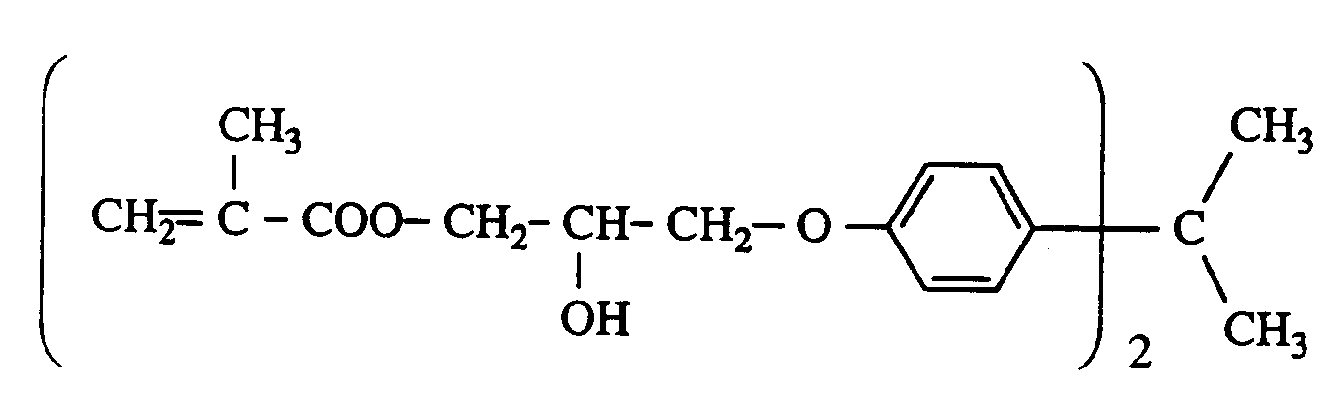
- Selbstverständlich ist es möglich, Mischungen der verschiedenen (Meth)acrylsäureester, die Vernetzungen ausbilden können, einzusetzen. Beispielsweise seien Mischungen von 20 bis 70 Gew.Teilen Bis-GMA und 30 bis 80 Gew.-Teilen Triethylenglykoldimethacrylat genannt.
- Die Adhäsivkomponenten gemäß dieser Erfindung können weiterhin bis zu 10 Gew.-Teilen üblicher Zusätze wie Stabilisatoren, Inhibitoren und Lichtschutzmittel enthalten. Der erfindungsgemäßen Zubereitungen können hergestellt werden, indem man das Carboxamid (I), das Lösungsmittel und den Initiator und gegebenenfalls die anderen Komponenten durch kräftiges Rühren mischt.
- Die erfindungsgemäßen Zubereitungen können als Adhäsivkomponente zur Behandlung von Zahnhartsubstanz und als Klebemittel in Knochenzement verwendet werden.
- In einer besonderen Ausführungsform konditioniert man das kollagenhaltige Material vor der Behandlung mit der erfindungsgemäßen Zubereitung mit einer Flüssigkeit mit einem pH-Wert im Bereich von 0,1 bis 3,5. Diese enthält im allgemeinen Säuren mit einem pKs-Wert kleiner als 5 und gegebenenfalls eine amphotere Aminoverbindung mit einem pKs-Wert im Bereich von 9,0 bis 10,6 und einem pKB-Wert im Bereich von 11,5 bis 12,5. Folgende Säuren können z.B. in der Konditionierflüssigkeit enthalten sein: Phosphorsäure, Salpetersäure, Brenztraubensäure, Zitronensäure, Oxalsäure, Ethylendiamintetraessigsäure, Essigsäure, Weinsäure, Äpfelsäure. Als amphotere Aminoverbindungen seien vorzugsweise Verbindungen der Formel

in der - R₄
- für eine Carboxylgruppe steht,
- R₅
- Wasserstoff, gegebenenfalls durch Hydroxy, Thio, Methylthio, Carboxy, Amino, Phenyl, Hydroxy-phenyl oder die Gruppen
- R₆
- Wasserstoff oder Phenyl bedeutet und
- R₄
- für Wasserstoff steht,
- R₅
- für die Gruppe
― B ―NH₃D
- B
- für einen zweibindigen Alkylenrest mit 1 bis 6 Kohlenstoffatomen und
- D
- für Halogen steht, und
- R₆
- Wasserstoff bedeutet, genannt.
- Beispielsweise seien die folgenden amphoteren Aminoverbindungen genannt:
- Glycin, Serin, Threonin, Cystein, Thyrosin, Asparagin, Glutamin, Alanin, Valin, Leucin, Isoleucin, Prolin, Methionin, Phenylalanin, Tryptophan, Lysin, Arginin, Histidin, N-Phenylglycin, Ethylendiaminhydrochlorid, Ethylendiaminhydrobromid, Propylendiaminhydrochlorid, Propylendiaminhydrobromid, Butylendiaminhydrochlorid, Butylendiaminhydrobromid, Leucinhydrochlorid und Histidinhydrochlorid. Weiterhin kann die Konditionierflüssigkeit Stoffe aus der Gruppe der Polyethylenglykole und Metallhydroxide enthalten. Insbesondere können die oben aufgeführten mehrbasigen Säuren auch als teilweise Metallsalze eingesetzt werden, solange freie Säurefunktionen verbleiben.
- Konditionierflüssigkeiten, die mindestens eine der Säuren aus der Gruppe der Brenztraubensäure, Ethylendiamintetraessigsäure und Zitronensäure sowie gegebenenfalls eine amphotere Aminoverbindung aus der Gruppe des Glycins, N-Phenylglycins und Prolins enthalten, sind besonders bevorzugt.
- Die Anwendung der erfindungsgemäßen Zubereitungen kann beispielsweise wie folgt durchgeführt werden:
- Bei einer Zahnreperatur trägt man beispielsweise nach einer mechanischen Reinigung des kollagenhaltigen Zahnmaterials zuerst die Konditionierflüssigkeit mit etwas Warte auf, läßt eine kurze Zeit (beispielsweise 60 Sekunden) einwirken, spült das Zahnmaterial mit Wasser und trocknet es im Luftstrom. Dann trägt man die erfindungsgemäße Zubereitung beispielsweise mit einem Kleinen Pinsel in einer dünnen Schicht auf und trocknet im Luftstrom. Nach der erfindungsgemäßen Behandlung trägt man die eigentliche Füllmasse, beispielsweise im Dentalbereich übliche Kunststoffüllungsmassen (K. Eichner, "Zahnärztliche Werkstoffe und ihre Verarbeitung", Bd. 2, S. 135ff, Hüthig Verlag, 5. Aufl. 1985) auf.
- Trimellitsäure-N-tert.butyl-N-methacryloyloxyethyl-amidanhydrid (VIII)
- Zu einer Lösung aus 210.57 g (1.000 mol) Benzoltricarbonsäureanhydridchlorid in 650 ml trockenem Dichlormethan und 202,38 g (2.000 mol) trockenem Triethylamin wurde bei -5°C unter Rühren eine Lösung von 185.27 g (1.000 mol) N-tert.-Butyl-2-aminoethylmethacrylat in 250 ml trockenem Dichlormethan getropft. Nach dreistündigem Rühren bei Raumtemperatur wurde der ausgefallene helle Feststoff abgesaugt, das Filtrat wäßrig extrahiert und getrocknet.
- Die erhaltene Dichlormethan-Lösung enthielt das gewünschte Produkt (VIII) und konnte direkt zur Hydrolyse eingesetzt werden.
- Nach Zusatz von 200 mg 2,6-Di-tert.butylkresol läßt sich die erhaltene Lösung zu 280,31 g (78 % d. Th.) eines gelblichen Feststoffes an Trimellitsäure-N-tert.-butyl-N-methacryloyloxyethylamidanhydrid (VIII) einengen.
- Schmelzpunkt: 58°C
- IR (KBr):
- ν = 2960, 1860, 1783, 1720, 1640, 1380, 1240, 1195, 1150, 930, 889 cm⁻¹.
- ¹H-NMR
- (CDCl₃, 200 MHz): δ = 1,59 (s, 9 H, C(CH₃)₃), 1,87 (bs, 3 H, = CCH₃), 3,65 (t, J = 6,3 Hz, 2 H, NCH₂), 4,16 (t, J = 6,3 Hz, 2 H, OCH₂), 5,64, 6,03(2 bs, je 1 H, vinyl.-H), 7,95 (m, 3 H, arom. H) ppm.
- Trimellitsäure-N-tert.butyl-N-methacryloyloxyethylamid (IX)
- 700 ml der Dichlormethanlösung aus Beispiel 1 enthaltend 218.03 g (0.607 mol) des Anhydrides (VIII) wurden mit 200 ml Wasser versetzt und 22 Stunden bei 41°C unter kräftigem Rühren zum Rückfluß erhitzt. Nach Trocknen und Stabilisieren der organischen Phase mit 100 mg 2,6-Di-tert.butylkresol konnte diese zu 181.00 g (79 % d.Th.) eines hellen hochviskosen Öles von Trimellitsäure-N-tert.butyl-N-methacryloyloxyethylamid (IX) eingeengt werden. Das erhaltene Öl erstarrte beim Abkühlen und ließ sich weiter reinigen, indem man es aus einer Dichlormethanlösung mit wäßriger Natriumcarbonatlösung extrahierte, die wäßrige Phase mit verdünnter Salzsäure ansäuerte und das Produkt (IX) in eine Dichlormethanphase zurück extrahierte. Schmelzpunkt: 74°C
- IR (KBr):
- ν= 3500-2500, 2950, 1720, 1630, 1600, 1400, 1365, 1290, 1192, 1158 cm⁻¹.
- ¹H-NMR
- (CDCl₃, 200 MHz): δ = 1,58 (s, 9 H, C(CH₃)₃), 1,90 (bs, 3 H, = CCH₃), 3,65 (t, J = 6,0 Hz, 2 H, NCH₂), 4,13 (t, J = 6,0 Hz, 2 H, OCH₂), 5,61, 6,05 (2 m, je 1 H, vinyl.-H), 7,52 (m, 3 H, arom.-H, COOH), 7,82 (m, 1 H, arom. H) ppm.
- MS (70 eV-silyliert): m/z = 506 (M-CH₃), 435 (M-C₃H₅COOH),
379 (M-C₃H₅COOH-C₄H₈),
147 (Me₃Si-O-SiMe₂),
73 (TMS⁺), 69 (C₃H₅-C≡O⁺), 57 (C₄H₉⁺). - Pyromellitsäure-1,4-di(N-tert.butyl-N-methacryloyloxyethylamid) (X)
Pyromellitsäure-1,3-di(N-tert.butyl-N-methacryloyloxyethylamid) (XI) - Unter starkem Rühren wurde bei Raumtemperatur zu einer Suspension aus 218.12 g (1.000 mol) Pyromellitsäuredianhydrid, 750 ml trockenem Dichlormethan und 505.95 g (5.000 mol) trockenem Triethylamin eine Lösung von 370.54 g (2.000 mol) N-tert.Butyl-2-aminoethylmethacrylat in 370 ml trockenem Dichlormethan getropft. Hierbei entstand unter leichter Erwärmung eine braune Lösung, die eine Stunde lang bei 41°C gerührt, in 1 l Wasser eingegossen und mit halbkonzentrierter Schwefelsäure angesäuert wurde.
- Nach Abtrennung des ausgefallenen Feststoffes wurde die Dichlormethanphase wäßrig extrahiert, getrocknet und zu 314.70 g (53 % d. Th.) eines beigefarbenen Feststoffes eines Gemisches der para- und meta-Isomeren (X) und (XI) des Pyromellitsäuredi(N-tert.butyl-N-methacryloyloxyethylamids) eingeengt. Durch Aufnehmen des erhaltenen Produktes in wäßriger Natriumcarbonatlösung, Extraktion mit Methylenchlorid und erneutes Ausfällen mit halbkonzentrierter Schwefelsäure wurde ein gereinigter weißer Feststoff erhalten.
- Schmelzpunkt: 121°C
- IR (KBr) :
- ν= 3400-2500, 1715, 1618, 1411, 1405, 1360, 1330, 1300, 1213, 1172, 1131, 955, 780 cm⁻¹.
- ¹H-NMR
- (CDCl₃, 200 MHz): δ = 1,57 (s, 18 H, C(CH₃)₃), 1,86 (bs, 6 H, = CCH₃), 3,45 (m, 4 H, NCH₂), 4,12 (m, 4 H, OCH₂), 5,53, 5,98 (2 m, je 2 H, vinyl.-H), 7,89 (bs, 2 H, COOH), 8,41 (s, 2H, arom.-H) ppm.
- FAB-MS (Glycerin-DMF): m/z =
- 589 ([M+H]⁺)
587 ([M-H]⁻). - Pyromellitsäure-(N-tert.butyl-N-methacryloyloxyethylamid) (XII)
- Eine Mischung aus 218.12 g (1.000 mol) Pyromellitsäuredianhydrid, 171.50 g (1.200 mol) Triethylamin und 2200 ml Xylol wurde bei Raumtemperatur unter Rühren mit einer Lösung von 185.27 g (1.000 mol) N-tert.Butyl-2-aminoethylmethacrylat in 250 ml Xylol versetzt und eine Stunde lang auf 50°C erwärmt. Der Ansatz wurde filtriert und das Filtrat in Eiswasser eingegossen und zur Hydrolyse mit halbkonzentrierter Schwefelsäure angesäuert und 30 Minuten verrührt. Der ausgefallene Niederschlag wurde abgesaugt und aus Essigsäureethylester zu 232.05 g (etwa 55 % d. Th.) eines weißen Feststoffes umkristallisiert, der neben dem Pyromellitsäure-(N-tert.butyl-N-methacryloyloxyethylamid) (XII) eine kleinere Menge der doppelten Umsetzungsprodukte (X) und (XI) des Beispieles 3 enthielt.
- Schmelzpunkt: 215°C
- IR (KBr):
- ν= 3500-2500, 1710, 1605, 1400, 1345, 1316, 1282, 1194, 1153, 932, 752 cm⁻¹.
- ¹H-NMR
- (d₆-DMSO, 200 MHz): δ = 1.49 (s, 9H, C(CH₃)₃), 1.78 (bs, = C-CH₃), 3.44 (m, 2 H, NCH₂), 4.06 (m, 2 H, OCH₂), 5.61, 5.89 (2 m, je 1 H, vinyl.-H), 7.62, 8.29(2 s, je 1 H, arom. H), 8.40 (bs, 3 H, COOH) ppm.
- FAB-MS (Glycerin-DMF): m/z =
- 422 ([M+H]⁺),
420 ([M-H]⁻). - Benzol-1,3-dicarbonsäure-4-(carbonsäure-N-tert.butyl-N-methacryloyloxyethylamid) (XIII)
Benzol-1,4-dicarbonsäure-5-(carbonsäure-N-tert.butyl-N-methacryloyloxyethylamid) (XIV) - Zu einer Mischung aus 192.13 g (1.000 mol) Benzoltricarbonsäureanhydrid, 500 ml trockenem Dichlormethan und 303.57 g (3.000 mol) trockenem Triethylamin wurde bei Raumtemperatur unter Rühren eine Lösung von 185.27 g (1.000 mol) N-tert.-Butyl-2-aminoethylmethacrylat in 250 ml Dichlormethan getropft. Nach vierstündigem Rühren bei 41°C wurde der Ansatz in 3 l Wasser gegossen, mit halbkonzentrierter Schwefelsäure angesäuert und die organische Phase abgetrennt. Die wäßrige Phase wurde mit Dichlormethan extrahiert und die vereinigten organischen Phasen nach Trocknung und Stabilisierung mit 350 mg 2,6-Di-tert.-butylkresol zu 284.60 g (78 % d. Th.) eines beigefarbenen Feststoffes eines Gemisches der beiden Isomeren (XIII) und (XIV) des Benzoltricarbonsäuremono(N-tert.butyl-N-methacryloyloxyethylamides) eingeengt.
- Schmelzpunkt: 71°C
- IR (KBr):
- ν= 3400-2400, 1700, 1610, 1370, 1283, 1161, 1040, 1010, 932, 752 cm-1.
- ¹H-NMR
- (CDCl₃, 200 MHz): für XIII: δ = 1.58 (bs, 9 H, C(CH₃)₃, 1.82 (bs, 3 H, =CCH₃), 3.32 (m, 2 H, NCH₂), 4.51 (m, 2 H, OCH₂), 5.49, 5.95(2 m, je 1 H, vinyl.-H), 7.1 (m, 2 H, COOH), 8.15, 8.75 (m, 3 H, arom. H) ppm.
- (Herstellung der Zubereitungen zur Verwendung als Adhäsiv)
- Die erfindungsgemäßen Adhäsive werden durch intensives Vermischen der in folgenden Beispielen aufgeführten Bestandteile erzeugt.
-
- 37.5 g
- Wasser
- 50.0 g
- Tetrahydrofuran
- 12.5 g
- Trimellitsäure-N-tert.butyl-N-methacryloyloxyethylamid (IX) gemäß Beispiel 2
- 0.02 g
- Campherchinon
-
- 27.3 g
- Wasser
- 63.6 g
- Tetrahydrofuran
- 9.1 g
- Trimellitsäure-N-tert.butyl-N-methacryloyloxyethylamidanhydrid (VIII) gemäß Beispiel 1
- 0.02 g
- Campherchinon
-
- 40.0 g
- Wasser
- 48.0 g
- Tetrahydrofuran
- 8.4 g
- Trimellitsäure-N-tert.butyl-N-methacryloyloyxethylamid (IX) gemäß Beispiel 2
- 3.6 g
- Trimellitsäure-N-tert.butyl-N-methacryloyloxyethylamidandhydrid (VIII) gemäß Beispiel 1
- 0.02 g
- Campherchinon
-
- 93.7 g
- Ethanol
- 6.3 g
- Pyromellitsäuredi(N-tert.butyl-N-methacryloyloxyethylamid) (p-und m-Isomere (X) und (XI) gemäß Beispiel 3)
- 0.01 g
- Campherchinon
-
- 43.5 g
- Wasser
- 43.5 g
- Tetrahydrofuran
- 9.5 g
- Pyromellitsäure-(N-tert.butyl-N-methacryloyloxyethylamid) (XII) gemäß Beispiel 4
- 3.5 g
- Pyromellitsäuredi(N-tert.butyl-N-methacryloyloxyethylamid) (p- und m-Isomere (X) und (XI) gemäß Beispiel 3)
- 0.02 g
- Campherchinon
- Die Wirksamkeit und Eignung der Adhäsive (Beispiele 6 - 10) wird überprüft durch Bestimmung der Scherbindungsfestigkeit auf Dentin. Es werden menschliche Zähne benutzt, die für max. drei Monate nach der Extraktion in 1% Chloraminlösung aufbewahrt waren. Vor der Verwendung im Test werden die Zähne nach sorgfältiger Reinigung unter fließendem Wasser für mindestens drei und höchstens zehn Tage in physiologischer Kochsalzlösung gelagert. Am Tage vor der Verwendung im Bindungstest werden die Zähne einzeln auf einer Approximalseite liegend mit Epoxidharz (®LEKUTHERM X 20, Härter T 3) in zylindrische Gummiformen von 25 mm Durchmesser und 12 mm Höhe eingebettet. Die Zähne werden durch Naßschleifen auf SiC-Papieren der Körnungen 240, 320, 400 und schließlich 600 soweit beschliffen, daß eine ausreichend große schmelznahe Dentinfläche zur Anbindung eines Kunststoffzylinders mit 3,5 mm Durchmesser freiliegend. Nach Abspülen mit entionisiertem Wasser und Trocknung im Luftstrom wird 30 Sekunden lang die Konditionierlösung ®GLUMA 1 Cleanser mit einem Wattepellet unter reibender Bewegung aufgetragen, mit Wasser abgespült und getrocknet, bevor das Adhäsiv mit einem Pinsel aufgetragen, 30 Sekunden auf der Oberfläche belassen und dann im Druckluftstrom vorsichtig getrocknet wird. Anschließend wird ein Tropfen ®GLUMA 4 Sealer aufgetragen und mit Druckluft zu einer dünnen Schicht verblasen. Die so vorbehandelte Probe wird in einer Einspannvorrichtung unter einer teilbaren Teflonform mit einer zylindrischen 3,5 mm weiten und 1 mm hohen Aufnahme festgeklemmt. Danach wird das Kunststoff-Füllungsmaterial ®PEKAFILL (U) mit einer Spritze in die zylindrische Form eingefüllt, mit einem O₂-undurchlässigen Strip abgedeckt und mit der Polymerisationsleuchte ®TRANSLUX CL (Kulzer) unter der aufliegenden Lichtaustrittsöffnung 60 Sekunden lang aktiviert. Unmittelbar im Anschluß daran wird die Probe aus der Halterung entfernt. Die Teflonform wird abgenommen und die Probe wird für 15 Minuten in 23°C warmem Wasser gelagert bis zur Einleitung der Scherbelastung, die mit Hilfe eines Druckstempels parallel zu und dicht an der Oberfläche des eingebetteten Zahnes unter einer Vorschubgeschwindigkeit von 1 mm/Minute bis zur Abtrennung erfolgt. Die Scherbindungsfestigkeit an Dentin ist der Quotient aus Druckkraft und Kontaktareal am Zahn und wird jeweils an 5 Proben bestimmt und als deren Mittelwert und Standardabweichung angegeben.
- Zur Beurteilung der Frakturursache wird die Dentinseite der getrennten Proben im Auflichtmikroskop inspiziert.
- Zur Simulation der klinischen Anwendung von Adhäsiven und Kunststoff-Füllungsmaterialien werden in extrahierten Zähnen mit einer Vorgeschichte wie in Beispiel 11 Kavitäten präpariert und gefüllt. Als Maß für die Wirksamkeit wird die Adaption des Füllungsmaterials am Kavitätenrand bestimmt.
- Die extrahierten Zähne werden auf einer unbeschädigten Aproximalseite auf SiC-Papier der Körnungen 240, 320, 400 und 600 naß beschliffen bis eine ausreichend große Dentinfläche zur Aufnahme einer ca. 3 mm weiten zylindrischen Kavität freiliegt. Die Kavität wird mit üblichen, zahnärztlichen Präparationsdiamanten mittlerer Körnung unter reichlich Wasserkühlung bis zu einer Tiefe von ca. 1,5 mm präpariert, dann mit Wasser ausgespült und getrocknet. Mit einem getränkten Wattepellet wird wie im vorhergegangenen Beispiel 30 Sekunden lang die Kavität gereinigt, dann ausgewaschen und getrocknet bevor das Adhäsiv aufgepinselt, für 30 Sekunden belassen und schließlich getrocknet wird. Anschließend wird der ®GLUMA 4 Sealer aufgebracht. Mit Druckluft wird vorsichtig der Überschuß entfernt bevor das Kunststoff-Füllungsmaterial ®PEKAFILL (U) mit einer Spritze in die Kavität eingefüllt wird. Der Überschuß wird mit einem O₂-undurchlässigem Strip vor Aktivierung (60 Sekunden) mit dem Lichtpolymerisationsgerät ®TRANSLUX CL (Kulzer) abgedeckt. Unmittelbar nach der Polymerisation wird der gefüllte Zahn für 15 Minuten in 23°C warmem Wasser aufbewahrt. Im Anschluß daran wird der Überschuß durch Schleifen auf feuchtem SiC-Papier der Körnungen 400 und 600 entfernt. Dabei werden ca. 0,1 mm von der Kavitätenhöhe abgetragen. Der mit Wasser abgespülte Zahn wird im Luftstrom getrocknet und sofort im Auflichmikroskop bei 500-facher Vergrößerung inspiziert. Die maximale Breite eines etwa vorhandenen Randspaltes wird mit Hilfe eines Schraubenokularmikrometers vermessen. Die mittlere, maximale Spaltbreite von je 5 Füllungen wird als Meßwert angegeben. Die mikroskopische Untersuchung des einzelnen Zahnes war in allen Fällen in weniger als 10 Minuten abgeschlossen. Damit wurde sichergestellt, daß die gemessenen Randspalten nicht durch Dehydrierung des Dentins entstanden oder in ihrer Breite beeinflußt waren.
- Mit dem in Beispielen 11 und 12 beschriebenen Anwendungstest ließ sich die gute Wirksamkeit der Zubereitung gemäß der Beispiele 6 bis 10 nachweisen.
- Bei der lichtmikroskopischen Beurteilung der Frakturursache wurden vielfach Kohäsivfrakturen im Dentin oder im Kunststoff beobachtet, d.h. die mit den erfindungsgemäßen Adhäsivkomponenten erzeugten Verklebungen waren fester als die verklebten Fügeteile selbst. Dies zeigt die gute Leistungsfähigkeit der erfindungsgemäßen Adhäsivkomponenten.
- Mit der Zubereitung gemäß Beispiel 6 wurden nach der beschriebenen Methode sogar ausschließlich randspaltfreie Füllungen erhalten. Die Scherbindungsfestigkeit wurde formal zu 12.1 ± 3.5 N/mm² bestimmt, wobei wie oben erwähnt die Fraktur im Dentin oder Kunststoff erfolgte, also kein adhäsives Versagen erreichbar war.

steht, worin
(Meth)acryloyl-Derivate im Rahmen der vorliegenden Verbindung sind Derivate der Acrylsäure und der Methacrylsäure.
und
steht.
und
steht.
und
steht.
steht
in einem organischen Lösungsmittel zwischen -30 und 110°C gegebenenfalls in Gegenwart einer Base
mit einem Amin der (VII)

in der
umsetzt und
gegebenenfalls das erhaltene Produkt mit Wasser zwischen 5 und 100°C hydrolysiert.
bedeutet,
genannt.

substituierter Niederalkylrest,
wobei die Reste R₄ und R₆ durch einen Propylrest verbunden sein können, oder in der
in der
MS (70eV): m/z = 344 (M-CH₃), 273 (M-C₃H₅COOH), 217 (M-C₃H₅COOH-C₄H₈)

69 (C₃H₅-C≡O⁺), 57' (C₄H₉⁺).
für XIV : δ = 1.43 (s, 9 H, C(CH₃)₃), 1.8 (bs, 3 H, =CCH₃), 3.48 (m, 2 H, NCH₂), 4.1 (m, 2 H, OCH₂), 5.44, 6.03 (2 m, je 1 H, vinyl.-H), 7.1 (m, 2 H, COOH), 8.0 - 8.6 (m, 3 H, arom. H) ppm.
Claims (9)
- Verfahren zur Herstellung von N-Alkyl-N-(meth)acryloyloxyalkylcarboxamiden der Formel (I)
 X für N-Alkyl-N-(meth)acryloyloxyalkylcarboxamid der Formel
R₁ Wasserstoff oder Methyl bedeutet,
R₂ ein zweiwertiger aliphatischer Rest (C₂-C₆) bedeutet und
R₃ ein einwertiger aliphatischer Rest (C₁-C₄) bedeutet,Y für COOH steht, wobei nachbarständige Gruppen Y auch zu einer Anhydridgruppe (-CO-O-CO-) verknüpft sein können,Z für H, X oder, sofern Y COOH bedeutet, für Y steht undPh für einen drei- oder vierfach substituierten Benzolring (1,2,3-/1,2,4- oder 1,2,4,5-Substitution) oder einen drei- oder vierfach substituierten Naphthalinring (1,2,6-/1,4,5-/2,3,6-/1,4,5,8- oder 2,3,6,7-Substitution)steht, dadurch gekennzeichnet, daß man Monoanhydride der Formel (V)
 A Hydroxy (OH) oder Chlor (Cl) bedeutet undPh für einen drei- oder vierfach substituierten Benzolring (1,2,3-/1,2,4- oder 1,2,4,5-Substitution) oder einen drei- oder vierfach substituierten Naphthalring (1,2,6-/1,4,5-/2,3,6-/1,4,5,8- oder 2,3,6,7-Substitution)steht
in einem organischen Lösungsmittel zwischen -30 und 110°C gegebenenfalls in Gegenwart einer Base mit einem Amin der Formel (VII) R₁ Wasserstoff oder Methyl,R₂ einen zweiwertigen aliphatischen Rest (C₂-C₆) undR₃ einen einwertigen aliphatischen Rest (C₁-C₄) bedeutet,umsetzt und das erhaltene Produkt gegebenenfalls mit Wasser zwischen 5 und 100°C hydrolysiert.
Applications Claiming Priority (4)
| Application Number | Priority Date | Filing Date | Title |
|---|---|---|---|
| DE4025784 | 1990-08-15 | ||
| DE4025784 | 1990-08-15 | ||
| DE4039440 | 1990-12-11 | ||
| DE4039440A DE4039440A1 (de) | 1990-08-15 | 1990-12-11 | N-alkyl-n-(meth)acryloyloxyalkylcarboxamide aromatischer carbonsaeuren und aromatischer carbonsaeureanhydride sowie adhaesive enthaltend diese verbindungen |
Publications (2)
| Publication Number | Publication Date |
|---|---|
| EP0471252A1 EP0471252A1 (de) | 1992-02-19 |
| EP0471252B1 true EP0471252B1 (de) | 1994-03-30 |
Family
ID=25895921
Family Applications (1)
| Application Number | Title | Priority Date | Filing Date |
|---|---|---|---|
| EP91113021A Expired - Lifetime EP0471252B1 (de) | 1990-08-15 | 1991-08-02 | N-Alkyl-N-(meth)acryloyloxyalkylcarboxamide aromatischer Carbonsäuren und aromatischer Carbonsäureanhydride sowie Adhäsive enthaltend diese Verbindungen |
Country Status (9)
| Country | Link |
|---|---|
| US (2) | US5241081A (de) |
| EP (1) | EP0471252B1 (de) |
| JP (1) | JPH04261146A (de) |
| AT (1) | ATE103587T1 (de) |
| DE (2) | DE4039440A1 (de) |
| DK (1) | DK0471252T3 (de) |
| ES (1) | ES2063416T3 (de) |
| IE (1) | IE65352B1 (de) |
| PT (1) | PT98660A (de) |
Cited By (2)
| Publication number | Priority date | Publication date | Assignee | Title |
|---|---|---|---|---|
| US5760101A (en) * | 1995-07-10 | 1998-06-02 | Heraeus Kulzer Gmbh | Derivatives of aromatic carboxylic acids from aromatic carboxylic acid anhydrides and hydroxy(meth) acrylates and formulations thereof |
| US5808104A (en) * | 1995-07-10 | 1998-09-15 | Heraeus Kulzer Gmbh | Polymerizable aromatic carboxylic acids and carboxylic acid anhydrides with cyclic carbonate groups and formulations thereof |
Families Citing this family (6)
| Publication number | Priority date | Publication date | Assignee | Title |
|---|---|---|---|---|
| US5338773A (en) * | 1993-04-19 | 1994-08-16 | Dentsply Research & Development Corp. | Dental composition and method |
| DE19525033A1 (de) * | 1995-07-10 | 1997-01-16 | Heraeus Kulzer Gmbh | Polymerisierbare aromatische Carbonsäuren und Carbonsäureanhydride mit cyclischen Carbonatgruppen, sowie Adhäsive enthaltend diese Verbindungen |
| DE19608316C2 (de) * | 1996-02-22 | 2000-11-09 | Ivoclar Ag Schaan | Funktionalisierte bicyclische (Meth)acrylate, Verfahren zu deren Herstellung und deren Verwendung #### |
| US6177534B1 (en) | 1997-12-23 | 2001-01-23 | The United States Of America As Represented By The Secretary Of Commerce | Silylated resins and the synthesis thereof |
| US6147137A (en) * | 1998-09-10 | 2000-11-14 | Jeneric/Pentron Incorporated | Dental primer and adhesive |
| US20250101241A1 (en) * | 2021-11-17 | 2025-03-27 | Kj Chemicals Corporation | Active energy ray curable composition |
Family Cites Families (4)
| Publication number | Priority date | Publication date | Assignee | Title |
|---|---|---|---|---|
| US4148988A (en) * | 1977-06-28 | 1979-04-10 | Mitsui Petrochemical Industries Ltd. | Curable composition |
| JPS60202873A (ja) * | 1984-03-27 | 1985-10-14 | G C Dental Ind Corp | (メタ)アクリロキシアルキルナフタレントリカルボン酸無水物 |
| KR950003688B1 (ko) * | 1986-10-30 | 1995-04-17 | 미쓰이세끼유 가가꾸 고오교오 가부시끼가이샤 | 경화성 조성물 |
| US4964911A (en) * | 1987-10-13 | 1990-10-23 | Den-Mat Corporation | Adhesive bonding of acrylic resins, especially in dentistry |
-
1990
- 1990-12-11 DE DE4039440A patent/DE4039440A1/de not_active Withdrawn
-
1991
- 1991-08-02 DK DK91113021.9T patent/DK0471252T3/da active
- 1991-08-02 ES ES91113021T patent/ES2063416T3/es not_active Expired - Lifetime
- 1991-08-02 AT AT91113021T patent/ATE103587T1/de not_active IP Right Cessation
- 1991-08-02 EP EP91113021A patent/EP0471252B1/de not_active Expired - Lifetime
- 1991-08-02 DE DE91113021T patent/DE59101267D1/de not_active Expired - Fee Related
- 1991-08-07 JP JP3221228A patent/JPH04261146A/ja active Pending
- 1991-08-09 US US07/743,535 patent/US5241081A/en not_active Expired - Fee Related
- 1991-08-13 PT PT98660A patent/PT98660A/pt not_active Application Discontinuation
- 1991-08-14 IE IE288291A patent/IE65352B1/en not_active IP Right Cessation
-
1992
- 1992-06-25 US US07/906,202 patent/US5294646A/en not_active Expired - Fee Related
Cited By (2)
| Publication number | Priority date | Publication date | Assignee | Title |
|---|---|---|---|---|
| US5760101A (en) * | 1995-07-10 | 1998-06-02 | Heraeus Kulzer Gmbh | Derivatives of aromatic carboxylic acids from aromatic carboxylic acid anhydrides and hydroxy(meth) acrylates and formulations thereof |
| US5808104A (en) * | 1995-07-10 | 1998-09-15 | Heraeus Kulzer Gmbh | Polymerizable aromatic carboxylic acids and carboxylic acid anhydrides with cyclic carbonate groups and formulations thereof |
Also Published As
| Publication number | Publication date |
|---|---|
| US5241081A (en) | 1993-08-31 |
| US5294646A (en) | 1994-03-15 |
| IE65352B1 (en) | 1995-10-18 |
| IE912882A1 (en) | 1992-02-26 |
| JPH04261146A (ja) | 1992-09-17 |
| ES2063416T3 (es) | 1995-01-01 |
| ATE103587T1 (de) | 1994-04-15 |
| DK0471252T3 (da) | 1994-08-01 |
| DE4039440A1 (de) | 1992-02-27 |
| PT98660A (pt) | 1992-06-30 |
| EP0471252A1 (de) | 1992-02-19 |
| DE59101267D1 (de) | 1994-05-05 |
Similar Documents
| Publication | Publication Date | Title |
|---|---|---|
| EP0201031B1 (de) | (Meth)-Acrylsäureester und ihre Verwendung | |
| EP0394787B1 (de) | Zubereitungen enthaltend Carbonamidgruppen enthaltende (Meth)acrylsäureester, zur Anwendung als Adhäsivkomponenten zur Behandlung kollagenhaltiger Materialien in der Medizin, sowie Herstellung dieser Zubereitungen | |
| EP0499923B1 (de) | Dentaladhäsive | |
| EP1296634B1 (de) | Phosphonsäuren enthaltendes dentalmaterial | |
| EP0471252A1 (de) | N-Alkyl-N-(meth)acryloyloxyalkylcarboxamide aromatischer Carbonsäuren und aromatischer Carbonsäureanhydride sowie Adhäsive enthaltend diese Verbindungen | |
| EP0794952B1 (de) | Polymerisierbare aromatische carbonsäuren und carbonsäureanhydride mit cyclischen carbonatgruppen sowie zubereitungen, enthaltend diese verbindungen | |
| DE3913940A1 (de) | N-formyl-n'-((meth)acryloyloxyalkyl)piperazin und n-formyl-n'-((meth)acryloylaminoalkyl)piperazin, adhaesivkomponenten zur behandlung kollagenhaltiger materialien, enthaltend diese verbindungen, sowie herstellung und anwendung dieser adhaesivkomponenten | |
| EP1721949B1 (de) | Haftverbessernde Additive für polymerisierbare Zusammensetzungen | |
| EP2065363B1 (de) | Dentalmaterialien auf der Basis von Alkylendiamin-N,N,N',N'-tetraessigsäure-(meth)acrylamiden | |
| EP0531802B1 (de) | Adhäsivkomponente zur Restaurierung der Zahnhartsubstanz | |
| DE102008006717B4 (de) | Polymerisierbare Phosphonsäurederivate und Klebstoffzusammensetzungen enthaltend dieselben | |
| EP0418684B1 (de) | Alkandiyl-bis-carbonamide, Adhäsivkomponenten zur Behandlung kollagenhaltiger Materialien zur Anwendung in der Medizin, enthaltend diese Verbindungen | |
| DE19525031A1 (de) | Derivate aromatischer Carbonsäuren, aromatische Carbonsäureanhydride und Hydroxy(meth)acrylaten sowie Adhäsive, enthaltend diese Verbindungen | |
| EP0355562B1 (de) | Adhäsivkomponente zur Behandlung kollagenhaltiger Materialien | |
| EP1681283B1 (de) | Hydrolysestabile Monomere mit Säuregruppen | |
| US5808104A (en) | Polymerizable aromatic carboxylic acids and carboxylic acid anhydrides with cyclic carbonate groups and formulations thereof | |
| EP0361033A2 (de) | Beschichtungsmittel für kollagenhaltige Materialien | |
| EP0441187A2 (de) | Carbonsäure-(meth)acryloylaminoalkylester in Adhäsivkomponenten zur Behandlung kollagenhaltiger Materialien | |
| DE19544670A1 (de) | Verfahren zur Herstellung oligomerer Kondensationsprodukte aromatischer Tricarbonsäuren und Epoxy(meth)acrylaten |
Legal Events
| Date | Code | Title | Description |
|---|---|---|---|
| PUAI | Public reference made under article 153(3) epc to a published international application that has entered the european phase |
Free format text: ORIGINAL CODE: 0009012 |
|
| AK | Designated contracting states |
Kind code of ref document: A1 Designated state(s): AT BE CH DE DK ES FR GB GR IT LI LU NL SE |
|
| 17P | Request for examination filed |
Effective date: 19920318 |
|
| 17Q | First examination report despatched |
Effective date: 19930910 |
|
| GRAA | (expected) grant |
Free format text: ORIGINAL CODE: 0009210 |
|
| AK | Designated contracting states |
Kind code of ref document: B1 Designated state(s): AT BE CH DE DK ES FR GB GR IT LI LU NL SE |
|
| REF | Corresponds to: |
Ref document number: 103587 Country of ref document: AT Date of ref document: 19940415 Kind code of ref document: T |
|
| REF | Corresponds to: |
Ref document number: 59101267 Country of ref document: DE Date of ref document: 19940505 |
|
| GBT | Gb: translation of ep patent filed (gb section 77(6)(a)/1977) |
Effective date: 19940415 |
|
| ITF | It: translation for a ep patent filed | ||
| ET | Fr: translation filed | ||
| REG | Reference to a national code |
Ref country code: GR Ref legal event code: FG4A Free format text: 3011762 |
|
| REG | Reference to a national code |
Ref country code: DK Ref legal event code: T3 |
|
| REG | Reference to a national code |
Ref country code: ES Ref legal event code: FG2A Ref document number: 2063416 Country of ref document: ES Kind code of ref document: T3 |
|
| EAL | Se: european patent in force in sweden |
Ref document number: 91113021.9 |
|
| PLBE | No opposition filed within time limit |
Free format text: ORIGINAL CODE: 0009261 |
|
| STAA | Information on the status of an ep patent application or granted ep patent |
Free format text: STATUS: NO OPPOSITION FILED WITHIN TIME LIMIT |
|
| 26N | No opposition filed | ||
| PGFP | Annual fee paid to national office [announced via postgrant information from national office to epo] |
Ref country code: GR Payment date: 19960124 Year of fee payment: 6 |
|
| PGFP | Annual fee paid to national office [announced via postgrant information from national office to epo] |
Ref country code: FR Payment date: 19960130 Year of fee payment: 6 |
|
| NLS | Nl: assignments of ep-patents |
Owner name: HERAEUS KULZER GMBH |
|
| REG | Reference to a national code |
Ref country code: CH Ref legal event code: PUE Owner name: BAYER AKTIENGESELLSCHAFT TRANSFER- HERAEUS KULZER |
|
| PGFP | Annual fee paid to national office [announced via postgrant information from national office to epo] |
Ref country code: AT Payment date: 19960701 Year of fee payment: 6 |
|
| PGFP | Annual fee paid to national office [announced via postgrant information from national office to epo] |
Ref country code: CH Payment date: 19960716 Year of fee payment: 6 |
|
| PGFP | Annual fee paid to national office [announced via postgrant information from national office to epo] |
Ref country code: DE Payment date: 19960731 Year of fee payment: 6 |
|
| PGFP | Annual fee paid to national office [announced via postgrant information from national office to epo] |
Ref country code: SE Payment date: 19960805 Year of fee payment: 6 |
|
| PGFP | Annual fee paid to national office [announced via postgrant information from national office to epo] |
Ref country code: ES Payment date: 19960807 Year of fee payment: 6 |
|
| PGFP | Annual fee paid to national office [announced via postgrant information from national office to epo] |
Ref country code: BE Payment date: 19960814 Year of fee payment: 6 |
|
| PGFP | Annual fee paid to national office [announced via postgrant information from national office to epo] |
Ref country code: NL Payment date: 19960831 Year of fee payment: 6 |
|
| PGFP | Annual fee paid to national office [announced via postgrant information from national office to epo] |
Ref country code: GB Payment date: 19960905 Year of fee payment: 6 |
|
| PGFP | Annual fee paid to national office [announced via postgrant information from national office to epo] |
Ref country code: LU Payment date: 19961001 Year of fee payment: 6 |
|
| REG | Reference to a national code |
Ref country code: FR Ref legal event code: TP |
|
| REG | Reference to a national code |
Ref country code: GB Ref legal event code: 732E |
|
| REG | Reference to a national code |
Ref country code: ES Ref legal event code: PC2A |
|
| PG25 | Lapsed in a contracting state [announced via postgrant information from national office to epo] |
Ref country code: LU Free format text: LAPSE BECAUSE OF NON-PAYMENT OF DUE FEES Effective date: 19970802 Ref country code: GB Free format text: LAPSE BECAUSE OF NON-PAYMENT OF DUE FEES Effective date: 19970802 Ref country code: AT Free format text: LAPSE BECAUSE OF NON-PAYMENT OF DUE FEES Effective date: 19970802 |
|
| PG25 | Lapsed in a contracting state [announced via postgrant information from national office to epo] |
Ref country code: SE Free format text: LAPSE BECAUSE OF NON-PAYMENT OF DUE FEES Effective date: 19970803 Ref country code: ES Free format text: LAPSE BECAUSE OF NON-PAYMENT OF DUE FEES Effective date: 19970803 |
|
| PGFP | Annual fee paid to national office [announced via postgrant information from national office to epo] |
Ref country code: DK Payment date: 19970805 Year of fee payment: 7 |
|
| PG25 | Lapsed in a contracting state [announced via postgrant information from national office to epo] |
Ref country code: LI Free format text: LAPSE BECAUSE OF NON-PAYMENT OF DUE FEES Effective date: 19970831 Ref country code: GR Free format text: LAPSE BECAUSE OF NON-PAYMENT OF DUE FEES Effective date: 19970831 Ref country code: CH Free format text: LAPSE BECAUSE OF NON-PAYMENT OF DUE FEES Effective date: 19970831 Ref country code: BE Free format text: LAPSE BECAUSE OF NON-PAYMENT OF DUE FEES Effective date: 19970831 |
|
| BERE | Be: lapsed |
Owner name: HERAEUS KULZER G.M.B.H. & CO. K.G. Effective date: 19970831 |
|
| PG25 | Lapsed in a contracting state [announced via postgrant information from national office to epo] |
Ref country code: NL Free format text: LAPSE BECAUSE OF NON-PAYMENT OF DUE FEES Effective date: 19980301 |
|
| GBPC | Gb: european patent ceased through non-payment of renewal fee |
Effective date: 19970802 |
|
| REG | Reference to a national code |
Ref country code: CH Ref legal event code: PL |
|
| PG25 | Lapsed in a contracting state [announced via postgrant information from national office to epo] |
Ref country code: FR Free format text: LAPSE BECAUSE OF NON-PAYMENT OF DUE FEES Effective date: 19980430 |
|
| PG25 | Lapsed in a contracting state [announced via postgrant information from national office to epo] |
Ref country code: DE Free format text: LAPSE BECAUSE OF NON-PAYMENT OF DUE FEES Effective date: 19980501 |
|
| EUG | Se: european patent has lapsed |
Ref document number: 91113021.9 |
|
| NLV4 | Nl: lapsed or anulled due to non-payment of the annual fee |
Effective date: 19980301 |
|
| REG | Reference to a national code |
Ref country code: FR Ref legal event code: ST |
|
| PG25 | Lapsed in a contracting state [announced via postgrant information from national office to epo] |
Ref country code: DK Free format text: LAPSE BECAUSE OF NON-PAYMENT OF DUE FEES Effective date: 19980802 |
|
| REG | Reference to a national code |
Ref country code: DK Ref legal event code: EBP |
|
| REG | Reference to a national code |
Ref country code: ES Ref legal event code: FD2A Effective date: 19980910 |
|
| PG25 | Lapsed in a contracting state [announced via postgrant information from national office to epo] |
Ref country code: IT Free format text: LAPSE BECAUSE OF NON-PAYMENT OF DUE FEES;WARNING: LAPSES OF ITALIAN PATENTS WITH EFFECTIVE DATE BEFORE 2007 MAY HAVE OCCURRED AT ANY TIME BEFORE 2007. THE CORRECT EFFECTIVE DATE MAY BE DIFFERENT FROM THE ONE RECORDED. Effective date: 20050802 |