EP0471109A1 - Manufacturing process for grooved substrates and multilayer structure - Google Patents
Manufacturing process for grooved substrates and multilayer structure Download PDFInfo
- Publication number
- EP0471109A1 EP0471109A1 EP90115758A EP90115758A EP0471109A1 EP 0471109 A1 EP0471109 A1 EP 0471109A1 EP 90115758 A EP90115758 A EP 90115758A EP 90115758 A EP90115758 A EP 90115758A EP 0471109 A1 EP0471109 A1 EP 0471109A1
- Authority
- EP
- European Patent Office
- Prior art keywords
- layer
- structured
- accordance
- substrate
- grooves
- Prior art date
- Legal status (The legal status is an assumption and is not a legal conclusion. Google has not performed a legal analysis and makes no representation as to the accuracy of the status listed.)
- Granted
Links
Images



Classifications
-
- B—PERFORMING OPERATIONS; TRANSPORTING
- B29—WORKING OF PLASTICS; WORKING OF SUBSTANCES IN A PLASTIC STATE IN GENERAL
- B29D—PRODUCING PARTICULAR ARTICLES FROM PLASTICS OR FROM SUBSTANCES IN A PLASTIC STATE
- B29D17/00—Producing carriers of records containing fine grooves or impressions, e.g. disc records for needle playback, cylinder records; Producing record discs from master stencils
- B29D17/005—Producing optically read record carriers, e.g. optical discs
-
- G—PHYSICS
- G11—INFORMATION STORAGE
- G11B—INFORMATION STORAGE BASED ON RELATIVE MOVEMENT BETWEEN RECORD CARRIER AND TRANSDUCER
- G11B7/00—Recording or reproducing by optical means, e.g. recording using a thermal beam of optical radiation by modifying optical properties or the physical structure, reproducing using an optical beam at lower power by sensing optical properties; Record carriers therefor
- G11B7/24—Record carriers characterised by shape, structure or physical properties, or by the selection of the material
- G11B7/241—Record carriers characterised by shape, structure or physical properties, or by the selection of the material characterised by the selection of the material
-
- G—PHYSICS
- G11—INFORMATION STORAGE
- G11B—INFORMATION STORAGE BASED ON RELATIVE MOVEMENT BETWEEN RECORD CARRIER AND TRANSDUCER
- G11B7/00—Recording or reproducing by optical means, e.g. recording using a thermal beam of optical radiation by modifying optical properties or the physical structure, reproducing using an optical beam at lower power by sensing optical properties; Record carriers therefor
- G11B7/24—Record carriers characterised by shape, structure or physical properties, or by the selection of the material
- G11B7/26—Apparatus or processes specially adapted for the manufacture of record carriers
Definitions
- the present invention relates to a process for manufacturing a grooved substrate and to a multilayer structure.
- the grooved substrate and the multilayer structure are especially suitable for optical disks.
- Microstructuring of thin dielectric layers or processes for manufacturing grooved substrates are needed in the whole data processing technology.
- Applications are to be found not only in the semiconductor and packaging technology but also in integrated optics technology, in the storage technology, e.g. for data communications, for magnetic disks and especially for optical disks.
- the high storage density of optical disks is achieved by using beam diameters of approximately 1 ⁇ m.
- the information is recorded at a predetermined position and read out from a predetermined position. Therefore the beam position needs to be accurately controlled by the use of guide addresses or guide signals.
- These typically are microscopic grooves, which in conjunction with a sensing mechanism and a servo system operating upon the optical beam serve to guide the beam in the correct direction during recording and reading operations.
- Various methods for forming the grooves on the optical disk have been proposed.
- PCT/EP88/00479 describes a hot stamping process for forming the tracking grooves directly in the glass surface of an optical disk.
- the glass substrate is heated in excess of the softening point of the glass types used, typically higher than 600°C.
- the temperature of the heated stamp should preferably be lower than the transformation temperature of the glass type used, typically 380 - 450°C.
- the microstructure on the heated stamper deforms the surface of the glass substrate resulting in a corresponding microstructure on the surface of the glass substrate, which, when separated from the stamper and cooled in a controlled manner, gives the desired surface microstructure on the glass substrate.
- Microstructures formed on the surface of the glass substrate using the hot stamping process as described above conform to the microstructure on the stamper across the area of the substrate surface, but, for example, the glass may flow into a deep groove in the stamper to give a shallow protrusion on the substrate surface. Since for reasons of economy and product cost reduction it is desired to re-use the stamper a number of times the hot stamping process needs the selection of appropriate stamping conditions and coating materials for the glass layer to enable a single stamper to be used repeatedly without sticking problems.
- the high temperatures applied to the glass substrate during hot stamping processes e.g.higher than 600°C, may cause the deformation of the glass substrate.
- the method for manufacturing substrates having a large number of fine grooves thereon as described in US-A-4 810 547 comprises applying a solution containing at least one organometal compound and a thickening agent onto a body of substrate to form a film having plasticity, impressing in the surface of the film formed on the substrate with a mold and calcining the film to solidify the same.
- a similar method is claimed in the unexamined Japanese patent application JP 62 102 445.
- grooved substrates and structures When used for optical disks grooved substrates and structures should have a high refractive index and a high signal to noise ratio in addition to the aready mentioned properties. This normally is achieved by producing a multilayer structure on a grooved substrate, as described by Takahashi et al. in "High quality magneto-optical disk", SPIE Vol.695 Optical Mass Data Storage II (1986).
- Another major object of the present invention is to enhance the refractive index and the signal to noise ratio of the grooved substrate especially when used for optical disks.
- a further object of the present invention is to provide a manufacturing process which ensures the re-use of the stamper and which is quite simple and economic.
- a multilayer structure comprising a substrate with plane, unstructured surfaces, a structured glasslike layer provided on one surface of said substrate, wherein said glasslike layer contains grooves in the layer surface not adjacent to said substrate, a dielectric layer disposed on said structured glasslike layer, a magneto-optic layer disposed on said dielectric layer, a reflector layer disposed on said magneto-optic layer and a passivation layer disposed on said reflector layer, wherein said dielectric layer, said magneto-optic layer, said reflector layer and possibly said passivation layer contain the grooves of said structured glasslike layer.
- This multilayer structure and other grooved substrates may be manufactured according to a process comprising the steps of spin coating of a supporting plate with dissolved material, forming a soft layer on said supporting plate, stamping grooves into said soft layer with a stamp, wherein said stamp shows the negative image of the structure to be transmitted to said soft layer thus forming a structured soft layer, hardening of said structured soft layer to transform said structured soft layer into a hard, structured layer, wherein said hardening is accomplished by thermal treatment, wherein said dissolved material contains at least one polymeric organometal compound.
- a supporting plate is spin-coated with dissolved material forming a soft layer on the supporting plate.
- the dissolved material contains controlling compounds and polymeric organometal compounds.
- the controlling compounds control the viscosity of the layer during the following process steps. Especially the spin-on time, the number of revolutions per minute during the spin-on step, the transportation time to the stamp and the time delay until the stamping step is carried out are to be adjusted carefully.
- the controlling compounds comprise ethylene glycol.
- the structured layer is hardened and transformed into a hard structured layer.
- the polymeric organometal compounds comprise polymer siloxane [RxSiOy]n or silsesquioxane, polymeric titanate [TiO2]n and polymer silicates [SiO2]n like phosphosilicates or phosphosiloxane. These materials consist of long molecule chains containing reactive silanolgroups with a high silicon portion.
- the soft structured layer is transformed into a hard, SiO2-like layer.
- thermo gravimetric analysis information about the weight loss of the organometal compounds during the hardening Step may be obtained.
- the weight loss depends on the hardening temperature and the atmosphere.
- ACCUGLASS 204 (trademark of Allied-Signal Inc., Milpitas, CA), containing polymer siloxane as organometal compound, shows a continuous weight loss in the temperature range from 50°C to about 480°C. In air the weight loss is as small as about 13% and in nitrogen atmosphere it is even lower with about 7%. Very low weight losses are shown by ACCUGLASS x11 series with 5% (+/- 1 %).
- the process as claimed leads to less volume shrinkage and thus higher exactness in accepting and keeping the form of the stamp, resulting in grooved substrates with extremely high dimensional stability, sharp edges of the grooves and exact transfer of the stamper image to the substrate, avoiding blisters or cracks in the grooved film.
- the stamping is carried out at room temperature and at low stamping pressure, preferably at about 1 to 6 bar in an isobaric press. These conditions avoid breakage of the stamper plate by foreign particles and the deformation of the microstructure of the stamper.
- the stamp is preferably coated with a thin carbon layer of preferably about 0.4 ⁇ m to prevent it from sticking to the structured soft layer.
- Other coating materials tested like silicon, siliconoxide, siliconnitride, nickel or tungsten lead to a close sticking of the stamp to the structured soft layer.
- the typical adhesion shown by the plane and parallel surfaces of the stamp and the structured layer in intimate contact after the stamping step may be overcome by a special treatment without applying external forces.
- Heating up the stamp to about 130°C assures the uniform detachment of the stamp and the integrity of the grooved structures as well as of the stamp itself.
- small amounts of solvent of the structured layer evaporize forming a sort of gaseous bolster between the coated stamp and the structured layer.
- This detachment mechanism is supported by the different thermal expansion coefficients of the coated stamp and the structured layer.
- a mixture of 1 g ethylene glycole and 30 g Accuglas 204 is spun on the cleaned glass substrate within 10 s at 1500 rpm.
- a stamping pressure of about 6 bar the desired structure is stamped into the spun-on layer with a carbon coated stamp within 3 minutes.
- the structured layer and the stamp adhering to it are heated up to about 130°C.
- the stamp detaches from the grooved substrate more or less automatically, it pops up, without applying external forces.
- the following thermal treatment at about 400°C during about 1 hour transforms the structured soft layer into a hard, transparent layer showing good adhesion to the glass substrate underneath.
- Fig. 1C and Fig. 1D show both a part of the surface of an embodiment.
- the grooves have been stamped after air drying of the spun-on soft layer.
- a prebake and cure step were applied to the soft layer after the stamping step.
- Fig. 2 is a schematic diagram showing the cross-section of a state of the art grooved structure for optical disks.
- the grooves 2 are provided in the substrate 1 itself and the layers forming the complete structure are disposed on the grooved substrate. These four layers consist of a dielectric layer 3 of about 50 nm, thickness, a magneto-optic layer 4 of about 35 nm thickness, a reflector layer 5 of about 60 nm thickness and a passivation layer 6 of about 100 nm thickness.
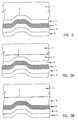
- Fig. 3A is a schematic diagram showing the cross-section of one embodiment of the present invention.
- a silicon dioxide layer 7 is disposed on the plane surface of the unstructured substrate 1 and the grooves 2 are provided in the surface of the silicon dioxide layer 7 not adjacent to the unstructured substrate 1.
- the four layers completing the structure are disposed on the grooved silicon dioxide layer 7.
- Four layers are provided with the same specification and in the same sequence as described above in connection with Fig. 2.
- Fig. 3B is the same diagram as in Fig. 3A showing another embodiment in which a dielectric layer 8 is disposed on the plane surface of an unstructured substrate 11.
- the grooves 2 are provided in the surface of the dielectric layer 8 not adjacent to the unstructured substrate 11.
- the dielectric layer 8 contains various combinations of the oxides SiO2, La2O3, PbO and TiO2 and replaces the dielectric layer structure of the embodiment of Fig. 3A consisting of a SiO2-layer and an AlN-layer.
- the refractive index D and the signal-to-noise ratio (SNR) of the structure are enhanced in dependence of the thickness d of the dielectric layer. This is of special importance when the structure is used for optical disks. Receiving these results with only one dielectric layer using the above described composition additionally reduces the complexity of the manufacturing process and the process costs.
- a magneto-optic layer 4 Three layers, a magneto-optic layer 4, a reflector layer 5 and a passivation layer 6 are completing the structure and are disposed on the grooved dielectric layer 8. These three layers have the same specification and are disposed in the same sequence as described above in connection with Fig. 2.
- Fig. 3C shows the cross-section of an embodiment with two multilayer structures attached to each other, e.g.by glueing, allowing at the same time the use of both sides of the structure to read or write information.
- An adhesive layer 9 sandwiched between protective layers 10 links the two multilayer structures.
- 3A and 3B may be manufactured following the process steps of the invention: Spin coating of a supporting plate (1) with dissolved material forming a soft layer (7) on said supporting plate (1), stamping grooves (2) into said soft layer with a stamp, wherein said stamp shows the negative image of the structure to be transmitted to said soft layer (7), thus forming a structured soft layer (7), hardening of said structured soft layer (7) to transform said structured soft layer (7) into a hard, structured layer (7), wherein said hardening is accomplished by thermal treatment, wherein said dissolved material further contains controlling compounds which control the viscosity of said layer during the process steps of spin coating and of stamping grooves, wherein said controlling compounds comprise ethylene glycol.
Landscapes
- Engineering & Computer Science (AREA)
- Manufacturing & Machinery (AREA)
- Mechanical Engineering (AREA)
- Manufacturing Optical Record Carriers (AREA)
- Diffracting Gratings Or Hologram Optical Elements (AREA)
- Application Of Or Painting With Fluid Materials (AREA)
- Casting Or Compression Moulding Of Plastics Or The Like (AREA)
Abstract
Description
- The present invention relates to a process for manufacturing a grooved substrate and to a multilayer structure. The grooved substrate and the multilayer structure are especially suitable for optical disks.
- Microstructuring of thin dielectric layers or processes for manufacturing grooved substrates are needed in the whole data processing technology. Applications are to be found not only in the semiconductor and packaging technology but also in integrated optics technology, in the storage technology, e.g. for data communications, for magnetic disks and especially for optical disks. The high storage density of optical disks is achieved by using beam diameters of approximately 1 µm. The information is recorded at a predetermined position and read out from a predetermined position. Therefore the beam position needs to be accurately controlled by the use of guide addresses or guide signals. These typically are microscopic grooves, which in conjunction with a sensing mechanism and a servo system operating upon the optical beam serve to guide the beam in the correct direction during recording and reading operations. Various methods for forming the grooves on the optical disk have been proposed.
- PCT/EP88/00479 describes a hot stamping process for forming the tracking grooves directly in the glass surface of an optical disk. According to this method the glass substrate is heated in excess of the softening point of the glass types used, typically higher than 600°C. The temperature of the heated stamp should preferably be lower than the transformation temperature of the glass type used, typically 380 - 450°C. The microstructure on the heated stamper deforms the surface of the glass substrate resulting in a corresponding microstructure on the surface of the glass substrate, which, when separated from the stamper and cooled in a controlled manner, gives the desired surface microstructure on the glass substrate. Microstructures formed on the surface of the glass substrate using the hot stamping process as described above conform to the microstructure on the stamper across the area of the substrate surface, but, for example, the glass may flow into a deep groove in the stamper to give a shallow protrusion on the substrate surface. Since for reasons of economy and product cost reduction it is desired to re-use the stamper a number of times the hot stamping process needs the selection of appropriate stamping conditions and coating materials for the glass layer to enable a single stamper to be used repeatedly without sticking problems. The high temperatures applied to the glass substrate during hot stamping processes, e.g.higher than 600°C, may cause the deformation of the glass substrate.
- The method for manufacturing substrates having a large number of fine grooves thereon as described in US-A-4 810 547 comprises applying a solution containing at least one organometal compound and a thickening agent onto a body of substrate to form a film having plasticity, impressing in the surface of the film formed on the substrate with a mold and calcining the film to solidify the same. A similar method is claimed in the unexamined Japanese patent application JP 62 102 445.
- These methods provide advantages in that the resulting film has a shrinkage lower than that of gel films as for example used in PCT/GB88/01080 and seldom causes cracks and/or warpage due to nonuniform drying rate since the organometal compound is formed in a film on the substrate body.
- When used for optical disks grooved substrates and structures should have a high refractive index and a high signal to noise ratio in addition to the aready mentioned properties. This normally is achieved by producing a multilayer structure on a grooved substrate, as described by Takahashi et al. in "High quality magneto-optical disk", SPIE Vol.695 Optical Mass Data Storage II (1986).
- There has been a strong need for substrates with fine grooves, especially for optical disks, which do not show the various disadvantages afore mentioned and which, on the contrary, have an extremely high dimensional stability and reliability as well as a high productivity in their manufacturing process. Thus it is a principical object of the present invention to provide a new grooved substrate with extremely high dimensional stability, sharp edges of the grooves and exact transfer of the stamper image to the substrate.
- Another major object of the present invention is to enhance the refractive index and the signal to noise ratio of the grooved substrate especially when used for optical disks.
- It is another object of the present invention to avoid blisters or cracks in the grooved film.
- A further object of the present invention is to provide a manufacturing process which ensures the re-use of the stamper and which is quite simple and economic.
- The above mentioned and other objects of the present invention are achieved by providing a multilayer structure comprising a substrate with plane, unstructured surfaces, a structured glasslike layer provided on one surface of said substrate, wherein said glasslike layer contains grooves in the layer surface not adjacent to said substrate, a dielectric layer disposed on said structured glasslike layer, a magneto-optic layer disposed on said dielectric layer, a reflector layer disposed on said magneto-optic layer and a passivation layer disposed on said reflector layer, wherein said dielectric layer, said magneto-optic layer, said reflector layer and possibly said passivation layer contain the grooves of said structured glasslike layer.
- This multilayer structure and other grooved substrates may be manufactured according to a process comprising the steps of spin coating of a supporting plate with dissolved material, forming a soft layer on said supporting plate, stamping grooves into said soft layer with a stamp, wherein said stamp shows the negative image of the structure to be transmitted to said soft layer thus forming a structured soft layer, hardening of said structured soft layer to transform said structured soft layer into a hard, structured layer, wherein said hardening is accomplished by thermal treatment, wherein said dissolved material contains at least one polymeric organometal compound.
- Further developments are laid down in
subclaims 2 to 7. Ways of carrying out the invention are described in more detail below with reference to the drawing which illustrates only specific embodiments and in which - Fig. 1A
- shows a part of the surface of an embodiment of a grooved substrate with a magnification factor of 5000;
- Fig. 1B
- shows a part of the surface of the same embodiment; due to a magnification factor of 20.000 the fine grooves with their sharp edges may be seen;
- Fig. 1C and Fig. 1D
- show both a part of the surface of an embodiment with a magnification factor of 10.000;
- Fig. 2
- is a schematic diagram showing the cross-section of a state of the art grooved structure for optical disks;
- Fig. 3A
- is a schematic diagram showing the cross-section of one embodiment of the present invention;
- Fig. 3B
- is the same diagram as in Fig. 3A showing another embodiment,
- Fig. 3C
- is a schematic diagram showing the cross-section of one embodiment with two multilayer structures attached to each other and
- Fig. 4
- is a diagram explaining the enhancement of signal-to-noise ratio and refractive index dependent on the dielectric layer thickness.
- Referring now to Figs. 1A and 1B the surface of a grooved substrate with stamped fine grooves of 1 µm in width and 70 nm in depth with their sharp edges are clearly to be seen. To produce a substrate with fine grooves a supporting plate is spin-coated with dissolved material forming a soft layer on the supporting plate. The dissolved material contains controlling compounds and polymeric organometal compounds. The controlling compounds control the viscosity of the layer during the following process steps. Especially the spin-on time, the number of revolutions per minute during the spin-on step, the transportation time to the stamp and the time delay until the stamping step is carried out are to be adjusted carefully. The controlling compounds comprise ethylene glycol. Grooves are stamped in the soft layer with a stamp showing the negative image of the structure to be transmitted to the soft layer. By thermal treatment the structured layer is hardened and transformed into a hard structured layer. In accordance with the invention the polymeric organometal compounds comprise polymer siloxane [RxSiOy]n or silsesquioxane, polymeric titanate [TiO₂]n and polymer silicates [SiO₂]n like phosphosilicates or phosphosiloxane. These materials consist of long molecule chains containing reactive silanolgroups with a high silicon portion. During the hardening step the soft structured layer is transformed into a hard, SiO₂-like layer. This transformation takes place accompanied by volume reduction due to polycondensation and thermodegradation effects:


The use of dissolved material containing already polymerized organometal compounds with a high Si content decreases the volume reduction considerably. This effect may be intensified by lowering the portion of solvent in the controlling compounds. By carefully chosing the amount of solvent the drying speed of the spun-on dissolved material is controlled. A high moisture content of the soft layer to be structurized will cause the destruction of the grooved structure during the separation of the stamp. Using an ethylene glycol portion of about 30% results in a drying speed reduction without affecting the accurateness of the replication. Similar solvents like glycerine also reduce the drying speed but cause micro bubbles in the structured layer leading to poorly defined edges. With a thermo gravimetric analysis information about the weight loss of the organometal compounds during the hardening Step may be obtained. The weight loss depends on the hardening temperature and the atmosphere. ACCUGLASS 204 (trademark of Allied-Signal Inc., Milpitas, CA), containing polymer siloxane as organometal compound, shows a continuous weight loss in the temperature range from 50°C to about 480°C. In air the weight loss is as small as about 13% and in nitrogen atmosphere it is even lower with about 7%. Very low weight losses are shown by ACCUGLASS x11 series with 5% (+/- 1 %). Thus the process as claimed leads to less volume shrinkage and thus higher exactness in accepting and keeping the form of the stamp, resulting in grooved substrates with extremely high dimensional stability, sharp edges of the grooves and exact transfer of the stamper image to the substrate, avoiding blisters or cracks in the grooved film. - The stamping is carried out at room temperature and at low stamping pressure, preferably at about 1 to 6 bar in an isobaric press. These conditions avoid breakage of the stamper plate by foreign particles and the deformation of the microstructure of the stamper. The stamp is preferably coated with a thin carbon layer of preferably about 0.4 µm to prevent it from sticking to the structured soft layer. Other coating materials tested like silicon, siliconoxide, siliconnitride, nickel or tungsten lead to a close sticking of the stamp to the structured soft layer. The typical adhesion shown by the plane and parallel surfaces of the stamp and the structured layer in intimate contact after the stamping step may be overcome by a special treatment without applying external forces. Heating up the stamp to about 130°C assures the uniform detachment of the stamp and the integrity of the grooved structures as well as of the stamp itself. During this thermal treatment small amounts of solvent of the structured layer evaporize forming a sort of gaseous bolster between the coated stamp and the structured layer. This detachment mechanism is supported by the different thermal expansion coefficients of the coated stamp and the structured layer. Thus after, if necessary, a simple cleaning procedure the stamp may be reused leading to a considerable reduction of the manufacturing costs.
- To achieve grooves of 1 µm in width and 70nm in depth a mixture of 1 g ethylene glycole and 30 g Accuglas 204 is spun on the cleaned glass substrate within 10 s at 1500 rpm. At a stamping pressure of about 6 bar the desired structure is stamped into the spun-on layer with a carbon coated stamp within 3 minutes. Then the structured layer and the stamp adhering to it are heated up to about 130°C. After approximately 4 to 5 minutes the stamp detaches from the grooved substrate more or less automatically, it pops up, without applying external forces. The following thermal treatment at about 400°C during about 1 hour transforms the structured soft layer into a hard, transparent layer showing good adhesion to the glass substrate underneath. In another experiment a mixture of 1g ethylene glycole and 30g ACCUGLASS 310 is spun on the glass substrate within 70s at 1500 rpm and stamping is carried out at a stamping pressure of 3 bar within 2.5 minutes. Excellent results were obtained showing very fine grooves in the hardened structured layer with widths of 0.4 µm and below.
- Fig. 1C and Fig. 1D show both a part of the surface of an embodiment. In Fig. 1C the grooves have been stamped after air drying of the spun-on soft layer. In Fig. 1D a prebake and cure step were applied to the soft layer after the stamping step. There can be seen no differenc in the sharpness of the grooves of Fig. 1C and Fig. 1D. Due to the high Si content in the polymerized organometal compounds of the dissolved material forming the soft layer this layer already shows a high dimensional stability before the thermal treatment of the hardening step. The volume shrinkage of the structured soft layer thus is low and this leads to a high exactness of the stamper image shown by the grooved film.
- Fig. 2 is a schematic diagram showing the cross-section of a state of the art grooved structure for optical disks. The
grooves 2 are provided in thesubstrate 1 itself and the layers forming the complete structure are disposed on the grooved substrate. These four layers consist of adielectric layer 3 of about 50 nm, thickness, a magneto-optic layer 4 of about 35 nm thickness, areflector layer 5 of about 60 nm thickness and apassivation layer 6 of about 100 nm thickness. - Fig. 3A is a schematic diagram showing the cross-section of one embodiment of the present invention. In this embodiment a
silicon dioxide layer 7 is disposed on the plane surface of theunstructured substrate 1 and thegrooves 2 are provided in the surface of thesilicon dioxide layer 7 not adjacent to theunstructured substrate 1. The four layers completing the structure are disposed on the groovedsilicon dioxide layer 7. Four layers are provided with the same specification and in the same sequence as described above in connection with Fig. 2. - Fig. 3B is the same diagram as in Fig. 3A showing another embodiment in which a
dielectric layer 8 is disposed on the plane surface of anunstructured substrate 11. Thegrooves 2 are provided in the surface of thedielectric layer 8 not adjacent to theunstructured substrate 11. Thedielectric layer 8 contains various combinations of the oxides SiO₂, La₂O₃, PbO and TiO₂ and replaces the dielectric layer structure of the embodiment of Fig. 3A consisting of a SiO₂-layer and an AlN-layer. - The refractive index D and the signal-to-noise ratio (SNR) of the structure are enhanced in dependence of the thickness d of the dielectric layer. This is of special importance when the structure is used for optical disks. Receiving these results with only one dielectric layer using the above described composition additionally reduces the complexity of the manufacturing process and the process costs.
- Three layers, a magneto-
optic layer 4, areflector layer 5 and apassivation layer 6 are completing the structure and are disposed on the grooveddielectric layer 8. These three layers have the same specification and are disposed in the same sequence as described above in connection with Fig. 2. - Fig. 3C shows the cross-section of an embodiment with two multilayer structures attached to each other, e.g.by glueing, allowing at the same time the use of both sides of the structure to read or write information. An
adhesive layer 9 sandwiched betweenprotective layers 10 links the two multilayer structures. - The enhancement of the signal-to-noise ratio and the refractive index in dependence of the thickness of the dielectric layer is shown in Fig. 4 published in "Antireflection Structures for Magneto-Optic Recording", OSA Technical Digest Series, Vol.10, p.138-9, 1987. The grooves in the embodiments described in Fig. 3A and 3B may be manufactured following the process steps of the invention:
Spin coating of a supporting plate (1) with dissolved material forming a soft layer (7) on said supporting plate (1), stamping grooves (2) into said soft layer with a stamp, wherein said stamp shows the negative image of the structure to be transmitted to said soft layer (7), thus forming a structured soft layer (7), hardening of said structured soft layer (7) to transform said structured soft layer (7) into a hard, structured layer (7), wherein said hardening is accomplished by thermal treatment,
wherein said dissolved material further contains controlling compounds which control the viscosity of said layer during the process steps of spin coating and of stamping grooves, wherein said controlling compounds comprise ethylene glycol. - To those skilled in the art it will be obvious that this process to manufacture grooves in a substrate could equally be well adapted to other articles which have a microstructure which must be accurately formed on the surface of plate like diffraction gratings or fresnel lenses.
Claims (13)
- Process for manufacturing a grooved substrate especially for optical disks comprising- spin coating of a supporting plate (1) with dissolved material forming a soft layer (7) on said supporting plate (1)- stamping grooves (2) into said soft layer with a stamp wherein said stamp shows the negative image of the structure to be transmitted to said soft layer (7) thus forming a structured soft layer (7)- hardening of said structured soft layer (7) to transform said structured soft layer (7) into a hard structured layer (7) wherein said hardening is accomplished by thermal treatmentcharacterized in that said dissolved material contains polymeric organometal compounds, wherein said organometal compounds comprise polymer siloxan and/or polymer silicates.
- Process in accordance with claim 1 wherein said dissolved material further contains controlling compounds which control the viscosity of said layer during the process steps of spin coating and of stamping grooves, wherein said controlling compounds comprise ethylene glycol.
- Process in accordance with claim 1 or 2 wherein said stamping is carried out at room temperature.
- Process in accordance with anyone of the preceding claims wherein said stamping is carried out at low stamping pressure, preferably at about 6 bar.
- Process in accordance with anyone of the preceding claims wherein said stamp is coated with a thin carbon layer which preferably has a thickness of about 0.4 µm.
- Process in accordance with anyone of the preceding claims wherein said stamp is separated after completion of the stamping process by thermal treatment carried out at about 130°C without applying external forces.
- Process in accordance with anyone of the preceding claims wherein said hardening by thermal treatment is carried out at about 400°C during about 1 hour.
- Multilayer structure especially for optical disks comprising- a substrate (1) with plane, unstructured surfaces- a structured glasslike layer (7) provided on one surface of said substrate (1)
wherein said glasslike layer (7) contains grooves (2) in the layer surface not adjacent to said substrate (1),- a dielectric layer (3) disposed on said structured glasslike layer (7)- a magneto-optic layer (4) disposed on said dielectric layer (3),- a reflector layer (5) disposed on said magneto-optic layer (4) and- a passivation layer (6) disposed on said reflector layer (5),
wherein said dielectric layer (3), said magneto-optic layer (4), said reflector layer (5) and possibly said passivation layer (6) contain the grooves (2) of said structured glasslike layer (7) and
wherein said structure is preferably manufactured following the process steps in accordance with anyone of the preceding claims 1 to 7. - Multilayer structure especially for optical disks comprising- a substrate (11) with plane, unstructured, parallel surfaces- a structured dielectric layer (8) provided on one surface of said substrate (11)
wherein said dielectric layer (8) contains grooves (2) in the layer surface not adjacent to said substrate (11)- a magneto-optic layer (4) disposed on said dielectric layer (8)- a reflector layer (5) disposed on said magneto-optic layer (4) and- a passivation layer (6) disposed on said reflector layer (5),
wherein said magneto-optic layer (4), said reflector layer (5) and possibly said passivation layer (6) contain the grooves (2) of said structured dielectric layer (8) and
wherein said structure is preferably manufactured following the process steps in accordance with anyone of the preceding claims 1 to 7. - Multilayer structure especially for optical disks in accordance with claim 9 wherein said structured dielectric layer (8) contains various combinations of the oxides SiO₂, La₂O₃, PbO and TiO₂, preferably SiO₂, La₂O₃ and PbO.
- Multilayer structure especially for optical disks in accordance with anyone of claims 8 to 10 wherein said magneto-optic layer (4) is made of materials comprising mixtures of rare earth elements and transition elements like TbFeCo, TBFe, GdFe, TbGdFe, GdTbCo, TbFeCo, NdFeCo or NdTbFeCo, said reflector layer (5) contains Al, Cr, Ag or Au and said passivation layer (6) contains one or more components out of the group of AlN, SiO₂, ZrO₂, Al₂O₃ ,TiO₂, TaO₂ and Si₃N₄.
- Multilayer structure especially for optical disks comprising two multilayer structures in accordance with claim 8 or 9 wherein said two multilayer structures are attached to each other.
- Optical storage system characterized in that said optical storage system contains a multilayer structure as set forth in one or more of the claims 8 to 12.
Priority Applications (6)
| Application Number | Priority Date | Filing Date | Title |
|---|---|---|---|
| DE69031802T DE69031802T2 (en) | 1990-08-17 | 1990-08-17 | Process for the production of grooved substrates |
| EP90115758A EP0471109B1 (en) | 1990-08-17 | 1990-08-17 | Manufacturing process for grooved substrates |
| JP3201130A JP2758288B2 (en) | 1990-08-17 | 1991-07-17 | Manufacturing method of grooved substrate and multilayer structure |
| CA002049261A CA2049261A1 (en) | 1990-08-17 | 1991-08-15 | Manufacturing process for grooved substrates and multilayer structure |
| KR1019910014143A KR950007444B1 (en) | 1990-08-17 | 1991-08-16 | Grooved substrate manufacturing process, multilayer structure and optical storage system |
| US08/311,296 US5498445A (en) | 1990-08-17 | 1994-09-23 | Manufacturing process for grooved substrates and multilayer structure |
Applications Claiming Priority (1)
| Application Number | Priority Date | Filing Date | Title |
|---|---|---|---|
| EP90115758A EP0471109B1 (en) | 1990-08-17 | 1990-08-17 | Manufacturing process for grooved substrates |
Publications (2)
| Publication Number | Publication Date |
|---|---|
| EP0471109A1 true EP0471109A1 (en) | 1992-02-19 |
| EP0471109B1 EP0471109B1 (en) | 1997-12-10 |
Family
ID=8204344
Family Applications (1)
| Application Number | Title | Priority Date | Filing Date |
|---|---|---|---|
| EP90115758A Expired - Lifetime EP0471109B1 (en) | 1990-08-17 | 1990-08-17 | Manufacturing process for grooved substrates |
Country Status (6)
| Country | Link |
|---|---|
| US (1) | US5498445A (en) |
| EP (1) | EP0471109B1 (en) |
| JP (1) | JP2758288B2 (en) |
| KR (1) | KR950007444B1 (en) |
| CA (1) | CA2049261A1 (en) |
| DE (1) | DE69031802T2 (en) |
Families Citing this family (6)
| Publication number | Priority date | Publication date | Assignee | Title |
|---|---|---|---|---|
| US6555236B1 (en) | 1999-07-07 | 2003-04-29 | Nippon Sheet Glass Company, Ltd. | Articles having an uneven surface and production process therefor |
| US6479122B2 (en) * | 2000-12-29 | 2002-11-12 | Itrix Corporation | Glass substrate for an optical disk and a manufacturing method thereof |
| US6730617B2 (en) | 2002-04-24 | 2004-05-04 | Ibm | Method of fabricating one or more tiers of an integrated circuit |
| FR2893610B1 (en) * | 2005-11-23 | 2008-07-18 | Saint Gobain | SURFACE STRUCTURING METHOD OF A GLASS PRODUCT, A STRUCTURED SURFACE GLASS PRODUCT, AND USES |
| CN101632125A (en) * | 2007-03-14 | 2010-01-20 | 松下电器产业株式会社 | Process for producing multilayered information recording medium, signal transfer substrate, and process for producing the signal transfer substrate |
| US8015970B2 (en) * | 2007-07-26 | 2011-09-13 | 3M Innovative Properties Company | Respirator, welding helmet, or face shield that has low surface energy hard-coat lens |
Citations (1)
| Publication number | Priority date | Publication date | Assignee | Title |
|---|---|---|---|---|
| US4810547A (en) * | 1986-03-26 | 1989-03-07 | Nippon Sheet Glass Co., Ltd. | Substrate with fine grooves and method for manufacturing the same |
Family Cites Families (11)
| Publication number | Priority date | Publication date | Assignee | Title |
|---|---|---|---|---|
| JPS6070537A (en) * | 1983-09-27 | 1985-04-22 | Ricoh Co Ltd | Optical information carrier and its production |
| EP0181941B1 (en) * | 1984-05-07 | 1990-01-24 | TDK Corporation | Optical recording medium |
| JPS61131251A (en) * | 1984-11-29 | 1986-06-18 | Matsushita Electric Ind Co Ltd | Optical disk substrate |
| US4801499A (en) * | 1985-01-24 | 1989-01-31 | Seiko Epson Corporation | Optical recording medium |
| US4800112A (en) * | 1986-04-10 | 1989-01-24 | Seiko Epson Corporation | Optical recording medium |
| US5156941A (en) * | 1986-06-17 | 1992-10-20 | Kyodo Printing Co., Ltd. | Method of producing an optical or magneto-optical recording card and transfer type optical or magneto-optical recording medium |
| CA1324213C (en) * | 1987-06-26 | 1993-11-09 | Yoshimitsu Kobayashi | Magnetooptical recording media |
| JP2720435B2 (en) * | 1987-07-08 | 1998-03-04 | 日本板硝子株式会社 | Grooved substrate |
| JPH01204243A (en) * | 1988-02-09 | 1989-08-16 | Mitsubishi Kasei Corp | Magneto-optical recording medium |
| JP2538972B2 (en) * | 1988-03-11 | 1996-10-02 | 株式会社東芝 | Optical disc substrate manufacturing method |
| US5188863A (en) * | 1989-06-30 | 1993-02-23 | E. I. Du Pont De Nemours And Company | Direct effect master/stamper for optical recording |
-
1990
- 1990-08-17 EP EP90115758A patent/EP0471109B1/en not_active Expired - Lifetime
- 1990-08-17 DE DE69031802T patent/DE69031802T2/en not_active Expired - Fee Related
-
1991
- 1991-07-17 JP JP3201130A patent/JP2758288B2/en not_active Expired - Lifetime
- 1991-08-15 CA CA002049261A patent/CA2049261A1/en not_active Abandoned
- 1991-08-16 KR KR1019910014143A patent/KR950007444B1/en not_active Expired - Fee Related
-
1994
- 1994-09-23 US US08/311,296 patent/US5498445A/en not_active Expired - Fee Related
Patent Citations (1)
| Publication number | Priority date | Publication date | Assignee | Title |
|---|---|---|---|---|
| US4810547A (en) * | 1986-03-26 | 1989-03-07 | Nippon Sheet Glass Co., Ltd. | Substrate with fine grooves and method for manufacturing the same |
Also Published As
| Publication number | Publication date |
|---|---|
| EP0471109B1 (en) | 1997-12-10 |
| DE69031802D1 (en) | 1998-01-22 |
| KR950007444B1 (en) | 1995-07-11 |
| KR920005083A (en) | 1992-03-28 |
| JP2758288B2 (en) | 1998-05-28 |
| CA2049261A1 (en) | 1992-02-18 |
| JPH04232629A (en) | 1992-08-20 |
| US5498445A (en) | 1996-03-12 |
| DE69031802T2 (en) | 1998-06-25 |
Similar Documents
| Publication | Publication Date | Title |
|---|---|---|
| US4619804A (en) | Fabricating optical record media | |
| CA1066411A (en) | Video disc and method of making the same | |
| KR960032325A (en) | Optical recording medium and manufacturing method thereof | |
| PT85804A (en) | PROCESS FOR THE PREPARATION OF POLYMERIC SUBSTRATES RIGID FOR OPTICAL DISCS AND OPTICAL DISCS OBTAINED FROM THESE SUBSTRATES | |
| KR100284728B1 (en) | Optical disk manufacturing method and optical disk by this manufacturing method | |
| EP0471109B1 (en) | Manufacturing process for grooved substrates | |
| EP0335172B1 (en) | Mold for cast molding of substrate for information recording medium, method for preparing substrate for information recording medium and method for preparing information recording medium by use thereof | |
| EP0240752B1 (en) | Erasable optical disk having an improved optically transparent substrate | |
| JPS61184743A (en) | Optical recording medium | |
| JPH04372741A (en) | Production of 2p substrate of both side type | |
| JP2693950B2 (en) | Substrate molding method for optical disk | |
| Matsuda et al. | Optical disk substrate fabricated by the sol-gel method | |
| JPS62143243A (en) | optical disk | |
| JPS62140256A (en) | Optical record carrier and its manufacturing method | |
| JPS60217544A (en) | Manufacture of test disk for digital signal reproduction | |
| JPS61273760A (en) | Manufacture of photomagnetic disk | |
| JPH02118930A (en) | optical recording medium | |
| JPS58110220A (en) | Manufacture of substrate for optical disc recording medium | |
| EP0323225A2 (en) | Cast molding die and process for producing information recording medium using the same | |
| JPS63181140A (en) | Production of optical recording medium | |
| JPH03155921A (en) | Roll stamper manufacturing method and forming roll | |
| JPH0973675A (en) | Production of substrate for magneto-optical recording medium and substrate for magneto-optical recording medium formed by using this process | |
| JPS5998331A (en) | Optical disk substrate | |
| JPS61188756A (en) | Manufacture of information carrier disc | |
| JPH01150101A (en) | optical disc board |
Legal Events
| Date | Code | Title | Description |
|---|---|---|---|
| PUAI | Public reference made under article 153(3) epc to a published international application that has entered the european phase |
Free format text: ORIGINAL CODE: 0009012 |
|
| AK | Designated contracting states |
Kind code of ref document: A1 Designated state(s): DE FR GB IT |
|
| 17P | Request for examination filed |
Effective date: 19920619 |
|
| 17Q | First examination report despatched |
Effective date: 19950314 |
|
| GRAG | Despatch of communication of intention to grant |
Free format text: ORIGINAL CODE: EPIDOS AGRA |
|
| GRAH | Despatch of communication of intention to grant a patent |
Free format text: ORIGINAL CODE: EPIDOS IGRA |
|
| GRAH | Despatch of communication of intention to grant a patent |
Free format text: ORIGINAL CODE: EPIDOS IGRA |
|
| GRAA | (expected) grant |
Free format text: ORIGINAL CODE: 0009210 |
|
| AK | Designated contracting states |
Kind code of ref document: B1 Designated state(s): DE FR GB IT |
|
| PG25 | Lapsed in a contracting state [announced via postgrant information from national office to epo] |
Ref country code: IT Free format text: LAPSE BECAUSE OF FAILURE TO SUBMIT A TRANSLATION OF THE DESCRIPTION OR TO PAY THE FEE WITHIN THE PRE;WARNING: LAPSES OF ITALIAN PATENTS WITH EFFECTIVE DATE BEFORE 2007 MAY HAVE OCCURRED AT ANY TIME BEFORE 2007. THE CORRECT EFFECTIVE DATE MAY BE DIFFERENT FROM THE ONE RECORDED.SCRIBED TIME-LIMIT Effective date: 19971210 |
|
| REF | Corresponds to: |
Ref document number: 69031802 Country of ref document: DE Date of ref document: 19980122 |
|
| ET | Fr: translation filed | ||
| PLBE | No opposition filed within time limit |
Free format text: ORIGINAL CODE: 0009261 |
|
| STAA | Information on the status of an ep patent application or granted ep patent |
Free format text: STATUS: NO OPPOSITION FILED WITHIN TIME LIMIT |
|
| 26N | No opposition filed | ||
| PGFP | Annual fee paid to national office [announced via postgrant information from national office to epo] |
Ref country code: FR Payment date: 19990817 Year of fee payment: 10 |
|
| PG25 | Lapsed in a contracting state [announced via postgrant information from national office to epo] |
Ref country code: FR Free format text: LAPSE BECAUSE OF NON-PAYMENT OF DUE FEES Effective date: 20010430 |
|
| REG | Reference to a national code |
Ref country code: FR Ref legal event code: ST |
|
| PGFP | Annual fee paid to national office [announced via postgrant information from national office to epo] |
Ref country code: GB Payment date: 20010801 Year of fee payment: 12 |
|
| PGFP | Annual fee paid to national office [announced via postgrant information from national office to epo] |
Ref country code: DE Payment date: 20010821 Year of fee payment: 12 |
|
| REG | Reference to a national code |
Ref country code: GB Ref legal event code: IF02 |
|
| PG25 | Lapsed in a contracting state [announced via postgrant information from national office to epo] |
Ref country code: GB Free format text: LAPSE BECAUSE OF NON-PAYMENT OF DUE FEES Effective date: 20020817 |
|
| PG25 | Lapsed in a contracting state [announced via postgrant information from national office to epo] |
Ref country code: DE Free format text: LAPSE BECAUSE OF NON-PAYMENT OF DUE FEES Effective date: 20030301 |
|
| GBPC | Gb: european patent ceased through non-payment of renewal fee |
Effective date: 20020817 |