EP0469303A2 - Verzögerungsausgleichsemulation für phasenmodulierte hochgeschwindigkeitsdirekte digitale Synthese - Google Patents
Verzögerungsausgleichsemulation für phasenmodulierte hochgeschwindigkeitsdirekte digitale Synthese Download PDFInfo
- Publication number
- EP0469303A2 EP0469303A2 EP91110675A EP91110675A EP0469303A2 EP 0469303 A2 EP0469303 A2 EP 0469303A2 EP 91110675 A EP91110675 A EP 91110675A EP 91110675 A EP91110675 A EP 91110675A EP 0469303 A2 EP0469303 A2 EP 0469303A2
- Authority
- EP
- European Patent Office
- Prior art keywords
- accumulator
- series
- multiplexer
- input
- data
- Prior art date
- Legal status (The legal status is an assumption and is not a legal conclusion. Google has not performed a legal analysis and makes no representation as to the accuracy of the status listed.)
- Withdrawn
Links
Images




Classifications
-
- G—PHYSICS
- G06—COMPUTING OR CALCULATING; COUNTING
- G06F—ELECTRIC DIGITAL DATA PROCESSING
- G06F7/00—Methods or arrangements for processing data by operating upon the order or content of the data handled
- G06F7/38—Methods or arrangements for performing computations using exclusively denominational number representation, e.g. using binary, ternary, decimal representation
- G06F7/48—Methods or arrangements for performing computations using exclusively denominational number representation, e.g. using binary, ternary, decimal representation using non-contact-making devices, e.g. tube, solid state device; using unspecified devices
- G06F7/50—Adding; Subtracting
- G06F7/505—Adding; Subtracting in bit-parallel fashion, i.e. having a different digit-handling circuit for each denomination
- G06F7/509—Adding; Subtracting in bit-parallel fashion, i.e. having a different digit-handling circuit for each denomination for multiple operands, e.g. digital integrators
- G06F7/5095—Adding; Subtracting in bit-parallel fashion, i.e. having a different digit-handling circuit for each denomination for multiple operands, e.g. digital integrators word-serial, i.e. with an accumulator-register
-
- G—PHYSICS
- G06—COMPUTING OR CALCULATING; COUNTING
- G06F—ELECTRIC DIGITAL DATA PROCESSING
- G06F1/00—Details not covered by groups G06F3/00 - G06F13/00 and G06F21/00
- G06F1/02—Digital function generators
- G06F1/03—Digital function generators working, at least partly, by table look-up
- G06F1/0321—Waveform generators, i.e. devices for generating periodical functions of time, e.g. direct digital synthesizers
- G06F1/0328—Waveform generators, i.e. devices for generating periodical functions of time, e.g. direct digital synthesizers in which the phase increment is adjustable, e.g. by using an adder-accumulator
- G06F1/0335—Waveform generators, i.e. devices for generating periodical functions of time, e.g. direct digital synthesizers in which the phase increment is adjustable, e.g. by using an adder-accumulator the phase increment itself being a composed function of two or more variables, e.g. frequency and phase
-
- H—ELECTRICITY
- H04—ELECTRIC COMMUNICATION TECHNIQUE
- H04L—TRANSMISSION OF DIGITAL INFORMATION, e.g. TELEGRAPHIC COMMUNICATION
- H04L27/00—Modulated-carrier systems
- H04L27/18—Phase-modulated carrier systems, i.e. using phase-shift keying
- H04L27/20—Modulator circuits; Transmitter circuits
- H04L27/2032—Modulator circuits; Transmitter circuits for discrete phase modulation, e.g. in which the phase of the carrier is modulated in a nominally instantaneous manner
- H04L27/2092—Modulator circuits; Transmitter circuits for discrete phase modulation, e.g. in which the phase of the carrier is modulated in a nominally instantaneous manner with digital generation of the modulated carrier (does not include the modulation of a digitally generated carrier)
-
- G—PHYSICS
- G06—COMPUTING OR CALCULATING; COUNTING
- G06F—ELECTRIC DIGITAL DATA PROCESSING
- G06F2207/00—Indexing scheme relating to methods or arrangements for processing data by operating upon the order or content of the data handled
- G06F2207/38—Indexing scheme relating to groups G06F7/38 - G06F7/575
- G06F2207/3804—Details
- G06F2207/386—Special constructional features
- G06F2207/388—Skewing
-
- G—PHYSICS
- G06—COMPUTING OR CALCULATING; COUNTING
- G06F—ELECTRIC DIGITAL DATA PROCESSING
- G06F2207/00—Indexing scheme relating to methods or arrangements for processing data by operating upon the order or content of the data handled
- G06F2207/38—Indexing scheme relating to groups G06F7/38 - G06F7/575
- G06F2207/3804—Details
- G06F2207/386—Special constructional features
- G06F2207/3884—Pipelining
-
- G—PHYSICS
- G06—COMPUTING OR CALCULATING; COUNTING
- G06F—ELECTRIC DIGITAL DATA PROCESSING
- G06F2207/00—Indexing scheme relating to methods or arrangements for processing data by operating upon the order or content of the data handled
- G06F2207/38—Indexing scheme relating to groups G06F7/38 - G06F7/575
- G06F2207/3804—Details
- G06F2207/386—Special constructional features
- G06F2207/3896—Bit slicing
Definitions
- This invention relates to input delay equalization in pipelined accumulator systems and, more particularly, to input delay equalization emulation in high speed, phase modulated direct digital synthesis (DDS) systems.
- DDS phase modulated direct digital synthesis
- the output sum bits from each stage must be delayed through as many register elements as there are pipelined stages between the most significant stage and the particular stage of concern. After this "delay equalization", the sum can be used to address a ROM, RAM or other suitable memory block that stores digitized values of a sine, cosine, or other waveform. Data retrieved from the memory block may be used in various ways, for example to drive D/A circuitry to form an analog output waveform.
- an increment value of the accumulator must be changed regularly.
- a loadable down counter and multiplexer arrangement have been used to regularly change the accumulator increment.
- one 2:1 multiplexer is provided for each bit of the accumulator.
- One input of each multiplexer receives a corresponding bit of a NEW C word (C for Complete phase increment or accumulation value), while the other input of each multiplexer receives a corresponding bit of a NEW D word (D for Delta phase increment or phase modulated value).
- phase modulated mode each time the counter completes a predetermined "repeat value" number of counts, corresponding to an offset, all of the multiplexers are switched from sourcing NEW C bits to sourcing NEW D bits for one clock cycle, and then switched back to sourcing NEW C.
- the present invention includes a radical departure from traditional equalization techniques, which results in a reduced flip-flop count equal to (Q * N) + N and simultaneously provides a superior method for regularly changing the increment value (phase modulation) at high speeds.
- the number of flip-flops required is reduced from 156 to 36, a 77% improvement. Reducing the number of flip-flops reduces component count and therefore device area and power consumption, and alleviates clock distribution difficulties. Significant performance improvements are made possible, and the available chip area in an integrated circuit embodiment of the invention can be utilized, for example, to increase ROM size.
- the equalization methods and circuits disclosed are applicable to virtually any pipelined accumulator application.
- accumulator input delay circuitry includes a series of switch blocks, each switch block corresponding to a respective stage of the accumulator, for providing selected increment data to the corresponding stage. For example, to provide increment data to an N stage accumulator, each stage having Q bits, would require N switch blocks, each switch block having Q bit positions.
- Each switch block includes a multiplexer and a flip flop for each bit position.
- the multiplexer output is connected to the flip-flop data input, for storing data selected by the multiplexer.
- the flip-flop output terminal is coupled to the corresponding accumulator input bit position to provide increment data, as more fully described below.
- a binary word representing new increment data is partitioned to form a first ordered series of N groups of bits, each group having Q bits, so each group corresponds to a respective stage of the accumulator.
- a binary word representing a phase modulation increment is similarly partitioned, although NEW D may have only M groups of Q bits, where M is a nonzero integer less than or equal to N. In other words, the phase modulation increment need not have the full resolution of the accumulator.
- the NEW C and NEW D bits are coupled to respective inputs to the multiplexers in corresponding bit positions. Additionally, the flip-flop output terminals are coupled to respective inputs to the corresponding multiplexers. Accordingly, each multiplexer can select one of a NEW C bit, a NEW D bit, or a Q previous bit.
- the multiplexer can be placed in one of two modes, responsive to a binary Mode signal.
- a first mode mode signal deactivated
- the choice of output is NEW C or Q Previous. This mode is used for non-phase modulated operation.
- mode signal activated the choice of output is NEW D or NEW C. This mode is used for phase modulation.
- a serial shift register has each of its output terminals coupled to a respective one of the switch blocks to provide a binary select signal, to control the multiplexers within each switch block as a group, whereas all of the multiplexers are controlled by a common Mode signal.
- Non-phase modulated operation in the new architecture includes sourcing an accumulator increment (NEW C), deactivating the Mode signal, and sending a pulse propagating synchronously down the shift register, successively sourcing the NEW C value in each switch block when the pulse is present and the current value when the pulse is absent. The accumulator will then successively add the increment onto itself. This mode can be used to initialize operations to either a "0" NEW C value or some other NEW C constant.
- Phase modulated operation includes sourcing an accumulator increment (NEW C), a phase modulation increment (NEW D), and a predetermined Repeat Value.
- the Mode signal is activated, and when the counter reaches its Terminal Count, a pulse is sent down the shift register.
- the pulse successively causes each shift register output to change state, thereby switching the multiplexers in each switch block to source bits of NEW D, and then switch back to the NEW C value after the pulse passes. In this manner, each bit of the phase increment word is delayed by the correct number of clock cycles before it is input to the accumulator, without requiring an array of flip-flops.
- FIG. 1 is a functional block diagram of a traditional pipelined DDS system.
- the DDS system employs a fully equalized pipelined accumulator 40, having N stages and Q bits per stage, for a total of N * Q accumulator bits.
- a multiplexer array 32 includes N * Q 2:1 multiplexers for selecting one of two input data words. The selected input data word is provided to the accumulator 40 over a path 42 as an increment value.
- An accumulator clock signal is provided to the accumulator at 44.
- the accumulator provides output data along a path 46 to address a ROM or RAM 50.
- the ROM or RAM provides data at output 52 which may be used, for example, to drive D/A converter circuitry for synthesizing a waveform previously stored in the ROM or RAM.
- a first input data word, NEW D, is provided over a path 34 as one data input to the multiplexer array 32.
- NEW D consists of N * Q bits and represents a new phase modulation increment value.
- a second input data word, NEW C, is provided over a path 36 as the other data input to the multiplexer array.
- NEW C also consists of N * Q bits, and represents a new increment value.
- a conventional loadable down counter 20 is provided for counting accumulator clock cycles.
- a predetermined Repeat Value is loaded into the counter 20 via input 28.
- the control inputs to all of the N * Q multiplexers in array 32 are coupled to receive a Terminal Count signal from the counter 20 along path 30.
- the multiplexer array 32 selects the NEW C input word.
- the accumulator increments by the NEW C value in response to each clock cycle.
- the Terminal Count signal is asserted to switch the multiplexers to select sourcing NEW D for one clock cycle, and then switched back to sourcing NEW C.
- the accumulator output data thus "jumps" by the value of NEW D. This jump in the ROM or RAM address effects phase modulation of the synthesized waveform.
- the accumulator 40 includes a pipelined accumulator section 54, input delay equalization section 56, and output delay equalization section 58. Each of these sections will be described in turn.
- the accumulator section 54 consists of a series of accumulator blocks, for example accumulator block 70, arranged in a vertical column in the figure. Each accumulator block corresponds to a respective stage of the accumulator. For example, a first accumulator block 59 corresponds to accumulator stage number 1. A second accumulator block 62 corresponds to stage number 2, and so on, so that accumulator block 70 corresponds to accumulator stage N. A carry output terminal of each accumulator block is coupled to a carry input to the next more significant block, for example, along path 60. Because the accumulator is pipelined, the input data or increment word provided to the increment input terminal 42 (FIG. 1) must be equalized with respect to the pipelined accumulator. This is accomplished in the prior art by the input delay equalization section 56, described next.
- the input delay equalization section 56 consists of a triangular array of registers, for example register 80, each register having Q flip-flop circuits, where Q is the number of bits per accumulator stage.
- One register 72 is provided to delay the increment data to accumulator stage 1 by one clock cycle.
- Two registers 74,76 are provided to delay the increment data to stage 2 by two clock cycles, and so on.
- N registers represented by registers 80, 82, and 84, are provided to delay the increment data to stage N by N clock cycles.
- the foregoing circuitry adds bits of the increment word into corresponding stages of the pipelined accumulator at appropriate times according to their binary significance. This alignment would be unnecessary if the increment value were always a constant. However, it is necessary to change the increment value in order to change the frequency of the resulting waveform. To maintain valid accumulator data during the transition, the new increment value is moved into the pipelined through the delay circuitry described.
- FIG. 2 includes an output delay equalization section 58.
- the output delay circuitry is essentially identical to the input delay equalization circuitry, inverted so that the low order bits receive a maximum delay while the most significant bits receive the minimum delay.
- Output bits from pipelined stage N i.e. from accumulator block 70, are provided to the inputs of a register 88 for one clock cycle delay.
- output bits of pipelined stage N-1 are provided to a first register 90 and a second register 92, to provide a two clock cycle delay, and so on.
- the first stage output bits thus are propagated through a series of N registers, represented by registers 100, 102 and 104 to provide a delay equal to N clock periods.
- the outputs of all of the output equalization registers thus can be concatenated to form a coherent sum. The sum can be used to address a ROM or RAM block that stores digitized values of a predetermined waveform.
- FIG. 3 is a block diagram of a new, fully equalized pipelined DDS system according to the present invention.
- the new system of FIG. 3 provides the same function as the system of FIGS. 1 and 2.
- the new system offers several important advantages over the prior art, however, as will become apparent below.
- the new system includes a loadable down counter 110, similar to the counter 20 described above.
- the Terminal Count signal from the new counter 110 need only drive a single output load (path 112), whereas counter 20 (FIG. 1) drives N * Q loads.
- the new counter thus has reduced fan-out circuitry.
- An OR logic gate 114 is connected to receive the Terminal Count signal at one input terminal and a "load new increment" signal, provided by a host system, at the other input terminal.
- the logic OR signal is coupled over path 128 to new pipelined accumulator circuitry 120 to indicate change increment or phase modulate.
- the new circuitry 120 provides output data for addressing a ROM or RAM 50, to provide data 52 to synthesize a predetermined waveform.
- the new accumulator circuitry 120 includes a first input terminal 122 for receiving a phase modulation value (NEW D); a second input terminal 124 for receiving an increment value (NEW C); and a mode input terminal 126 for receiving a binary Mode signal to switch between a normal mode and a phase modulate mode, as more fully described below.
- NW D phase modulation value
- NW C increment value
- mode input terminal 126 for receiving a binary Mode signal to switch between a normal mode and a phase modulate mode, as more fully described below.
- FIG. 4 is a schematic diagram showing in greater detail the new accumulator circuitry 120.
- the pipelined accumulator is partitioned, as before, into a series of N pipelined stages, each stage having Q bit positions.
- Each accumulator stage is implemented in a corresponding accumulator block, for example, accumulator block 122 in stage 1 and accumulator block 124 in stage N.
- the accumulator block circuitry is essentially identical to that shown in FIG. 2.
- FIG. 4 also includes an output delay equalization section 126, similar to the prior art, so it will not be described further.
- the new input circuitry includes a series of switch blocks, for example switch block 130 at pipelined stage 1 and switch block 132 at pipelined stage N. Each switch block has Q-bit output port, coupled to a corresponding accumulator input port, to provide increment data to one stage of the accumulator. For example, switch block 130 provides increment data to accumulator block 122 (stage 1) and switch block 130N provides increment data to accumulator block 124 (stage N).
- Each switch block has a first input port, for example input port 144 to block 130N, for receiving corresponding bits of a first binary word (NEW C) representing a predetermined new frequency increment value.
- NEW C is partitioned to form an ordered series of N groups of bits, each group having a number of bits Q equal to the pipelined stage size. Each group of bits is provided to the first input port of a respective one of the switch blocks.
- Each switch block also includes a second input port, for example port 145, for receiving bits of a second binary word NEW D, representing a predetermined phase modulation increment value.
- NEW D similarly is partitioned to form an ordered series of N groups of Q bits per group. Each group of bits is provided to the second input port of a respective one of the switch blocks.
- NEW D may consist of fewer than N groups of bits, as further discussed below with regard to an example of an operative design, in which case the NEW D bits are provided only to the switch blocks corresponding to the most significant stages of the accumulator.
- Each switch block 130, 130N selects data for input to the corresponding accumulator block, in the normal or non-modulation mode of operation, responsive to the state of a binary select signal, provided to each switch block at a respective select input terminal, for example input terminal 146.
- the switch blocks 130 through 130N together provide a constant increment value to the accumulator.
- An N-bit serial shift register 140 is formed of a series of N flip-flop circuits, for example flip-flop 142 at stage 1 and flip-flop 142N at stage N. Interconnection and details of flip-flop circuits arranged to form a shift register is known so it need not be described further.
- the Q output terminal of each flip-flop circuit is connected to a select input (e.g. 146 in stage N) of a respective one of the switch blocks (e.g. 130N) to provide the corresponding binary select signal.
- Clock inputs to the flip-flop circuits are coupled to receive the accumulator clock signal.
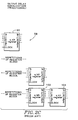
- FIG. 5A is a schematic diagram showing details of an individual switch block 130.
- the switch block includes Q replications of a circuit that comprises a multiplexer coupled to a flip-flop circuit.
- a first multiplexer 131 has an output terminal 132 coupled to the D input terminal of a flip-flop circuit 134.
- Each multiplexer has a select input terminal (e.g. 133) for receiving a binary select signal and a mode input terminal (e.g. 134) for receiving a binary mode signal.
- the select and mode input signals control the multiplexer to select one of four inputs.
- the selected input is coupled to the output terminal (e.g. 133) in accordance with the truth table shown in FIG. 5B.
- the select input terminals within each switch block are connected together to receive a select signal for controlling all of the multiplexers within the switch block. All of the mode input terminals throughout all of the switch blocks are coupled to receive a common mode signal, discussed below. Additionally, the clock input terminals to all the flip-flop circuits throughout the switch blocks are coupled to receive a common clock signal. Because the select and mode input signals, and flip-flop clock signals, are common to a given switch block, it is useful to consider all of the multiplexer/flip-flop circuits within one switch block in parallel, as follows.
- Each multiplexer has a first input terminal (e.g. 136) for receiving a corresponding phase modulation data bit (labeled NEW D). The first input terminals of all the multiplexers within a given switch block together form the first switch block input port, Q bits wide. Similarly, each multiplexer has a second input terminal (e.g. 138) for receiving a corresponding increment data bit (labeled NEW C). The second input terminals of all the multiplexers within a given switch block together form the second switch block input port, also Q bits wide.
- the multiplexer output terminals (e.g. 133) within a switch block together form a multiplexer output port.
- the D inputs to the flip-flop circuits within a switch block together form a data port.
- the multiplexer output port is coupled to the data port.
- the Q output terminals of the flip-flop circuits together form a Q output port.
- the multiplexer output port, data port and Q output port are each Q bits wide.
- the flip-flop clock inputs (e.g. 135) are coupled to receive the accumulator clock signal.
- Each flip-flop Q output terminal is coupled along a feedback path (e.g. 137) to a third input terminal of the corresponding multiplexer.
- the Q output port is coupled to a third multiplexer input port.
- shift register 140 is coupled to the series of switch blocks 130 through 130N to provide a series of N binary select signals.
- each shift register Q output terminal e.g. node 147 in stage N-1
- All bits of the shift register can be cleared to control the switch blocks accordingly.
- the multiplexers source either Q Previous from the second input port, for constant frequency operation, or NEW C from the first input port to change to a new increment, as indicated in the truth table of FIG. 5B.
- each switch block multiplexer (and ergo the switch block) can source a selected one of three inputs -- Q previous, NEW C and NEW D.
- the mode signal is low (0) and the select signals are all low (0), so each multiplexer sources the previously stored Q output. See the first row of the truth table.
- the accumulator simply increments by the previously stored increment value responsive to each clock cycle. For the select signals to be low, the shift register is cleared.
- the mode signal remains low, and the select signals must be sequentially asserted (high), so that each of the switch blocks successively switches to sourcing the NEW C at the appropriate time, in ascending order of binary significance. See the second row of the truth table of FIG. 5B. To do so, a one bit (logic high) is input to the least significant stage (Isb) of the shift register (node 141). On the next clock cycle, the Isb Q output terminal provides a one (logic high) as the select signal to be asserted to switch the multiplexer to sourcing a NEW C value. This is done sequentially through the switch blocks, as described above, to change to the NEW C increment value.
- the Mode signal is asserted high (1) for phase modulation operation, as follows. While the select signal is low, each multiplexer sources NEW C, a predetermined increment value. When the select signal goes high, the selected multiplexer sources NEW D, a phase modulation increment value. Each switch block is selected sequentially, to coherently enter the phase modulation increment, while the nonselected switch blocks continue to source NEW C. In other words, the nonselected switch blocks switch back to sourcing the NEW C value after the shift register pulse passes.
- the values of NEW C, NEW D, and Repeat Value can be changed to produce the normal ranges of DDS frequency and phase modulation typical of traditional systems.
- FIGS. 6-9 are CAD diagrams illustrating one example of an operative circuit that embodies the invention, designed for implementation in a production gallium arsenide digital integrated circuit.
- the example employs a 24-bit accumulator, partitioned into 12 stages.
- the circuitry includes provision for 12-bit phase modulation.
- the accumulator includes a block 122, representing the least significant stage.
- Block 122 receives inputs A(0) A(1) and appropriate clock signals, and provides output data signals AC_Q(0) and AC_Q(1 ) and a carry output CO(1) for input to the next stage.
- Window 160 represents the next 10 more significant stages of the accumulator.
- block 124 represents the most significant stage of the accumulator.
- Block 124 receives input signals A(22) and A(23) and a carry input signal CO(11) from window 160, and provides data output signals AC_Q(22) and AC_Q(23).
- Accumulator clock signals are provided by circuitry represented by blocks 165 and 166. The accumulator clock signal circuitry is conventional and therefore not described further.
- a loadable down counter and related circuitry are represented by block 162.
- the down counter receives an externally-provided input signal, designated LP_CNT(6:0), and provides a terminal count signal TC as one of its output signals. Additional detail of the counter is discussed below with regard to FIG. 7.
- the input block 164 also receives the mode signal, designated PM(23:12). Only 12 bits are required, as only the switch blocks that implement the NEW D data (12 bits) require the mode signal, as further explained below.
- the input block 164 also receives 36 clock signals CKARG(36:0), further discussed below.
- the input circuitry block 140 provides coherent input data A(23:0) to the accumulator. Details of block 164 are discussed below with regard to FIG. 8.
- Block 150 provides reset signals RAC(34:0) for resetting the accumulator.
- the accumulator output signals AC_Q(21:12) are provided to conventional output delay equalization circuitry, represented by block 170, similar to that described in the background of the invention section above. Only the high order bits used to form a memory address need be equalized.
- the equalization block 170 provides coherent output data signals ACC(11:0) which can be used, for example, to address a RAM.
- block 162 includes a loadable down counter, here represented by a window 180, and related circuitry.
- the window circuitry includes input gating 182 coupled to a D-type flip-flop circuit 188.
- the input gating 182 of each stage receives a respective bit of the initial count LP_CNT(I), a data bit Q(I) from the next least significant stage, and a done signal DONE(I) indicating that the counter reached the final state.
- the done signal high state gates the initial count bit to the flip-flop D input for loading the counter, whereas DONE low gates the Q(I) data bit to the flip-flop to continue counting.
- An array of OR logic gates 190 provides a one (high) input to a flip-flop circuit 194 only when all of counter output signals NQ(1:7) are low, indicating that the counter has reached a terminal count.
- a Q output terminal of flip-flop 194 is buffered to provide the input signals DONE(0:6) to the counter 180, and to provide a DUN_B signal.
- the DUN - B signal clocks a one into a flip-flop circuit 198.
- a Q output terminal of flip-flop 198 provides the terminal count signal TC to the host processor.
- Flip-flop 198 also has reset input gating 199 arranged for handshaking with the processor (ACK TC).
- Another flip-flop circuit 220 receives the done signal (DUN), and responsive thereto clocks a logic one (YHI) to its Q output terminal. The logic one is gated to provide a signal LD_LP for initializing the shift register, described next.
- a 12-bit shift register is represented by a window 210.
- the window represents 12 replications of the circuitry within the window, here a flip-flop circuit 212.
- Each flip-flop Q output terminal is connected to the next stage D input terminal (SS(J)), so that the flip-flops together form a shift register.
- the high order CKARG clock signals (input at node 220) thus become shift register clock signals SRCK(J) to clock flip-flops 212.
- Window 230 represents circuitry to provide the phase modulation switch block functions.
- the window circuit includes a 4:1 multiplexer circuit 232 having its output terminal (Y) coupled to the D input of a flip-flop circuit 234.
- Each multiplexer 232 input receives a respective bit of the NEW D word PHS_D(J), a respective bit of the NEW C word PHS_C(J) (coupled to two inputs), and the previous Q output bit, provided along a feedback path 236.
- the multiplexer is controlled by a mode signal PM(J), provided by the host processor, and a select signal SSP2(J) (the shift register output signals).
- the select shift register (window 210), phase modulation switch blocks (window 230) and simplified switch blocks (window 240) are all driven by clock signal CKARG(36:0) so they operate synchronously. Window 240 provides output bits Q(0:11) over path 245, which concatenate with output signals Q-(12:23) from window 230, to form output bits Q-(23:0) at node 246 for input to the accumulator.
- a 4:1 multiplexer 250 provides an initial bit SS-(0) for loading the least significant stage of the shift register.
- the multiplexer 250 is controlled by a load command signal LD_LP and the shift register Isb output SS_B(1 to load a zero into the shift register when the Isb already has a one output signal, and to load a one, and only a single one, into the shift register when the down counter signals a terminal count (DONE(6) is high) and the load command signal is asserted.
- this load command enables repetitive phase modulation mode.
- the additional circuitry 252 provides for reset, clock synchronization, and the like as will be familiar to those skilled in the art.
- FIG. 9 the example of an operative integrated circuit design shown in part in FIG. 6 further includes an on-board ROM 260, for lookup of a predetermined waveform.
- An output multiplexer/register array 264 provides for selecting either ROM output data, or address data for addressing an external RAM. Additional detail of the output circuitry is not material here and, in any event, will be apparent to those skilled in the art.
- FIG. 10 is a simulation plot of amplitude versus time, depicting a waveform generated by simulating operation of the design of FIGS. 6-9.
- the plot shows a single full cycle of a sine waveform, followed by repetitive phase modulation of 180 degrees.
- the down counter load value is 55.
Landscapes
- Engineering & Computer Science (AREA)
- General Physics & Mathematics (AREA)
- Theoretical Computer Science (AREA)
- Physics & Mathematics (AREA)
- Mathematical Analysis (AREA)
- Computational Mathematics (AREA)
- Pure & Applied Mathematics (AREA)
- General Engineering & Computer Science (AREA)
- Signal Processing (AREA)
- Computing Systems (AREA)
- Mathematical Optimization (AREA)
- Computer Networks & Wireless Communication (AREA)
- Digital Transmission Methods That Use Modulated Carrier Waves (AREA)
- Time-Division Multiplex Systems (AREA)
- Synchronisation In Digital Transmission Systems (AREA)
Applications Claiming Priority (2)
| Application Number | Priority Date | Filing Date | Title |
|---|---|---|---|
| US559795 | 1990-07-30 | ||
| US07/559,795 US5140540A (en) | 1990-07-30 | 1990-07-30 | Delay equalization emulation for high speed phase modulated direct digital synthesis |
Publications (2)
| Publication Number | Publication Date |
|---|---|
| EP0469303A2 true EP0469303A2 (de) | 1992-02-05 |
| EP0469303A3 EP0469303A3 (en) | 1993-02-24 |
Family
ID=24235056
Family Applications (1)
| Application Number | Title | Priority Date | Filing Date |
|---|---|---|---|
| EP19910110675 Withdrawn EP0469303A3 (en) | 1990-07-30 | 1991-06-27 | Delay equalization emulation for high speed phase modulated direct digital synthesis |
Country Status (3)
| Country | Link |
|---|---|
| US (1) | US5140540A (de) |
| EP (1) | EP0469303A3 (de) |
| JP (1) | JPH04234235A (de) |
Cited By (2)
| Publication number | Priority date | Publication date | Assignee | Title |
|---|---|---|---|---|
| GB2270447A (en) * | 1989-08-14 | 1994-03-09 | Interdigital Tech Corp | A digital intermediate frequency chip in a subscriber unit for a wireless digital communication system |
| US5644602A (en) * | 1989-08-14 | 1997-07-01 | Interdigital Technology Corporation | Direct digital frequency synthesizer for use in a subscriber unit of a wireless digital communication system |
Families Citing this family (2)
| Publication number | Priority date | Publication date | Assignee | Title |
|---|---|---|---|---|
| BR9302419A (pt) * | 1992-06-24 | 1994-01-11 | Motorola Inc | Aparelho e processo para fornecer multiplos sinais de saida,e processo para programar o aparelho |
| US6518801B1 (en) * | 1999-08-05 | 2003-02-11 | Agere Systems Inc. | Alias suppression method for 1-bit precision direct digital synthesizer |
Family Cites Families (4)
| Publication number | Priority date | Publication date | Assignee | Title |
|---|---|---|---|---|
| FR2341983A1 (fr) * | 1976-02-20 | 1977-09-16 | Thomson Csf | Generateur de signal electrique sinusoidal module en frequence ou en phase par methode numerique |
| CH636485A5 (en) * | 1978-06-26 | 1983-05-31 | Landis & Gyr Ag | Signal generator for generating sinusoidal output signals with predetermined mutual phase angle, and use thereof as three-phase generator for calibrating electricity meters |
| US4796004A (en) * | 1986-02-14 | 1989-01-03 | General Instrument Corp. | Integrated analog-to-digital converter |
| US4958310A (en) * | 1987-11-19 | 1990-09-18 | Goldberg Bar Giora | Digital frequency synthesizer having multiple processing paths |
-
1990
- 1990-07-30 US US07/559,795 patent/US5140540A/en not_active Expired - Fee Related
-
1991
- 1991-06-27 EP EP19910110675 patent/EP0469303A3/en not_active Withdrawn
- 1991-07-24 JP JP3184501A patent/JPH04234235A/ja active Pending
Cited By (9)
| Publication number | Priority date | Publication date | Assignee | Title |
|---|---|---|---|---|
| GB2270447A (en) * | 1989-08-14 | 1994-03-09 | Interdigital Tech Corp | A digital intermediate frequency chip in a subscriber unit for a wireless digital communication system |
| GB2270447B (en) * | 1989-08-14 | 1994-05-25 | Interdigital Tech Corp | A subscriber unit |
| US5644602A (en) * | 1989-08-14 | 1997-07-01 | Interdigital Technology Corporation | Direct digital frequency synthesizer for use in a subscriber unit of a wireless digital communication system |
| US5694430A (en) * | 1989-08-14 | 1997-12-02 | Interdigital Technology Corporation | Subscriber unit for wireless digital subscriber communication system |
| US5859883A (en) * | 1989-08-14 | 1999-01-12 | Interdigital Technology Corporation | Subscriber unit for wireless digital subscriber communication system |
| US6078629A (en) * | 1989-08-14 | 2000-06-20 | Interdigital Technology Corporation | Digital synthesizer |
| US6449317B1 (en) | 1989-08-14 | 2002-09-10 | Interdigital Technology Corporation | Digital synthesizer |
| US6587516B2 (en) | 1989-08-14 | 2003-07-01 | Interdigital Technology Corporation | Subscriber unit producing a modulated digital frequency |
| US6724851B2 (en) | 1989-08-14 | 2004-04-20 | David Norton Critchlow | FIR chip for use in a wireless subscriber unit |
Also Published As
| Publication number | Publication date |
|---|---|
| EP0469303A3 (en) | 1993-02-24 |
| US5140540A (en) | 1992-08-18 |
| JPH04234235A (ja) | 1992-08-21 |
Similar Documents
| Publication | Publication Date | Title |
|---|---|---|
| EP0047440B1 (de) | Schiebeschaltung | |
| US5448186A (en) | Field-programmable gate array | |
| US5295174A (en) | Shifting circuit and shift register | |
| US5016226A (en) | Apparatus for generating a data stream | |
| US6031401A (en) | Clock waveform synthesizer | |
| EP0390310A3 (de) | Datenverdichter | |
| JP3540844B2 (ja) | 半導体集積回路 | |
| US5140540A (en) | Delay equalization emulation for high speed phase modulated direct digital synthesis | |
| US5787273A (en) | Multiple parallel identical finite state machines which share combinatorial logic | |
| US5627795A (en) | Timing generating device | |
| JPS6364413A (ja) | 逐次近似レジスタ | |
| EP0361806A2 (de) | Zeitverzögerungsschaltung mit variabler Länge | |
| US4970676A (en) | Digital word-serial multiplier circuitry | |
| US5465222A (en) | Barrel shifter or multiply/divide IC structure | |
| US6839783B2 (en) | Programmable state machine interface | |
| US4069478A (en) | Binary to binary coded decimal converter | |
| US6252527B1 (en) | Interface unit for serial-to-parallel conversion and/or parallel-to-serial conversion | |
| US5392229A (en) | Graphics processing apparatus with video memory for storing graphics data | |
| US5321733A (en) | Counter circuit using Johnson-type counter and applied circuit including the same | |
| US5404564A (en) | High speed data train generating system with no restriction on length of generated data train | |
| WO2002017071A1 (en) | A configurable register file with multi-range shift register support | |
| WO1993020501A1 (en) | Integer-based 18-bit rgb to 5-bit gray scale conversion device and method therefor | |
| JP2909218B2 (ja) | 半導体試験装置用周期発生器 | |
| JP3043533B2 (ja) | シフトレジスタ回路 | |
| US6314156B1 (en) | Space-efficient multi-cycle barrel shifter circuit |
Legal Events
| Date | Code | Title | Description |
|---|---|---|---|
| PUAI | Public reference made under article 153(3) epc to a published international application that has entered the european phase |
Free format text: ORIGINAL CODE: 0009012 |
|
| AK | Designated contracting states |
Kind code of ref document: A2 Designated state(s): DE FR GB NL |
|
| PUAL | Search report despatched |
Free format text: ORIGINAL CODE: 0009013 |
|
| AK | Designated contracting states |
Kind code of ref document: A3 Designated state(s): DE FR GB NL |
|
| STAA | Information on the status of an ep patent application or granted ep patent |
Free format text: STATUS: THE APPLICATION IS DEEMED TO BE WITHDRAWN |
|
| 18D | Application deemed to be withdrawn |
Effective date: 19940102 |