EP0464846A1 - Imide derivatives, and their production and use - Google Patents
Imide derivatives, and their production and use Download PDFInfo
- Publication number
- EP0464846A1 EP0464846A1 EP91111223A EP91111223A EP0464846A1 EP 0464846 A1 EP0464846 A1 EP 0464846A1 EP 91111223 A EP91111223 A EP 91111223A EP 91111223 A EP91111223 A EP 91111223A EP 0464846 A1 EP0464846 A1 EP 0464846A1
- Authority
- EP
- European Patent Office
- Prior art keywords
- group
- compound
- formula
- lower alkyl
- hydrocarbon ring
- Prior art date
- Legal status (The legal status is an assumption and is not a legal conclusion. Google has not performed a legal analysis and makes no representation as to the accuracy of the status listed.)
- Granted
Links
- 0 N*(CC1)CC*1ON Chemical compound N*(CC1)CC*1ON 0.000 description 3
Classifications
-
- C—CHEMISTRY; METALLURGY
- C07—ORGANIC CHEMISTRY
- C07D—HETEROCYCLIC COMPOUNDS
- C07D209/00—Heterocyclic compounds containing five-membered rings, condensed with other rings, with one nitrogen atom as the only ring hetero atom
- C07D209/02—Heterocyclic compounds containing five-membered rings, condensed with other rings, with one nitrogen atom as the only ring hetero atom condensed with one carbocyclic ring
- C07D209/44—Iso-indoles; Hydrogenated iso-indoles
- C07D209/48—Iso-indoles; Hydrogenated iso-indoles with oxygen atoms in positions 1 and 3, e.g. phthalimide
-
- A—HUMAN NECESSITIES
- A61—MEDICAL OR VETERINARY SCIENCE; HYGIENE
- A61P—SPECIFIC THERAPEUTIC ACTIVITY OF CHEMICAL COMPOUNDS OR MEDICINAL PREPARATIONS
- A61P25/00—Drugs for disorders of the nervous system
- A61P25/18—Antipsychotics, i.e. neuroleptics; Drugs for mania or schizophrenia
-
- A—HUMAN NECESSITIES
- A61—MEDICAL OR VETERINARY SCIENCE; HYGIENE
- A61P—SPECIFIC THERAPEUTIC ACTIVITY OF CHEMICAL COMPOUNDS OR MEDICINAL PREPARATIONS
- A61P25/00—Drugs for disorders of the nervous system
- A61P25/20—Hypnotics; Sedatives
-
- C—CHEMISTRY; METALLURGY
- C07—ORGANIC CHEMISTRY
- C07D—HETEROCYCLIC COMPOUNDS
- C07D275/00—Heterocyclic compounds containing 1,2-thiazole or hydrogenated 1,2-thiazole rings
- C07D275/04—Heterocyclic compounds containing 1,2-thiazole or hydrogenated 1,2-thiazole rings condensed with carbocyclic rings or ring systems
- C07D275/06—Heterocyclic compounds containing 1,2-thiazole or hydrogenated 1,2-thiazole rings condensed with carbocyclic rings or ring systems with hetero atoms directly attached to the ring sulfur atom
-
- C—CHEMISTRY; METALLURGY
- C07—ORGANIC CHEMISTRY
- C07D—HETEROCYCLIC COMPOUNDS
- C07D401/00—Heterocyclic compounds containing two or more hetero rings, having nitrogen atoms as the only ring hetero atoms, at least one ring being a six-membered ring with only one nitrogen atom
- C07D401/02—Heterocyclic compounds containing two or more hetero rings, having nitrogen atoms as the only ring hetero atoms, at least one ring being a six-membered ring with only one nitrogen atom containing two hetero rings
- C07D401/08—Heterocyclic compounds containing two or more hetero rings, having nitrogen atoms as the only ring hetero atoms, at least one ring being a six-membered ring with only one nitrogen atom containing two hetero rings linked by a carbon chain containing alicyclic rings
-
- C—CHEMISTRY; METALLURGY
- C07—ORGANIC CHEMISTRY
- C07D—HETEROCYCLIC COMPOUNDS
- C07D401/00—Heterocyclic compounds containing two or more hetero rings, having nitrogen atoms as the only ring hetero atoms, at least one ring being a six-membered ring with only one nitrogen atom
- C07D401/02—Heterocyclic compounds containing two or more hetero rings, having nitrogen atoms as the only ring hetero atoms, at least one ring being a six-membered ring with only one nitrogen atom containing two hetero rings
- C07D401/12—Heterocyclic compounds containing two or more hetero rings, having nitrogen atoms as the only ring hetero atoms, at least one ring being a six-membered ring with only one nitrogen atom containing two hetero rings linked by a chain containing hetero atoms as chain links
-
- C—CHEMISTRY; METALLURGY
- C07—ORGANIC CHEMISTRY
- C07D—HETEROCYCLIC COMPOUNDS
- C07D403/00—Heterocyclic compounds containing two or more hetero rings, having nitrogen atoms as the only ring hetero atoms, not provided for by group C07D401/00
- C07D403/02—Heterocyclic compounds containing two or more hetero rings, having nitrogen atoms as the only ring hetero atoms, not provided for by group C07D401/00 containing two hetero rings
- C07D403/12—Heterocyclic compounds containing two or more hetero rings, having nitrogen atoms as the only ring hetero atoms, not provided for by group C07D401/00 containing two hetero rings linked by a chain containing hetero atoms as chain links
-
- C—CHEMISTRY; METALLURGY
- C07—ORGANIC CHEMISTRY
- C07D—HETEROCYCLIC COMPOUNDS
- C07D405/00—Heterocyclic compounds containing both one or more hetero rings having oxygen atoms as the only ring hetero atoms, and one or more rings having nitrogen as the only ring hetero atom
- C07D405/02—Heterocyclic compounds containing both one or more hetero rings having oxygen atoms as the only ring hetero atoms, and one or more rings having nitrogen as the only ring hetero atom containing two hetero rings
- C07D405/12—Heterocyclic compounds containing both one or more hetero rings having oxygen atoms as the only ring hetero atoms, and one or more rings having nitrogen as the only ring hetero atom containing two hetero rings linked by a chain containing hetero atoms as chain links
-
- C—CHEMISTRY; METALLURGY
- C07—ORGANIC CHEMISTRY
- C07D—HETEROCYCLIC COMPOUNDS
- C07D413/00—Heterocyclic compounds containing two or more hetero rings, at least one ring having nitrogen and oxygen atoms as the only ring hetero atoms
- C07D413/02—Heterocyclic compounds containing two or more hetero rings, at least one ring having nitrogen and oxygen atoms as the only ring hetero atoms containing two hetero rings
- C07D413/10—Heterocyclic compounds containing two or more hetero rings, at least one ring having nitrogen and oxygen atoms as the only ring hetero atoms containing two hetero rings linked by a carbon chain containing aromatic rings
-
- C—CHEMISTRY; METALLURGY
- C07—ORGANIC CHEMISTRY
- C07D—HETEROCYCLIC COMPOUNDS
- C07D413/00—Heterocyclic compounds containing two or more hetero rings, at least one ring having nitrogen and oxygen atoms as the only ring hetero atoms
- C07D413/02—Heterocyclic compounds containing two or more hetero rings, at least one ring having nitrogen and oxygen atoms as the only ring hetero atoms containing two hetero rings
- C07D413/12—Heterocyclic compounds containing two or more hetero rings, at least one ring having nitrogen and oxygen atoms as the only ring hetero atoms containing two hetero rings linked by a chain containing hetero atoms as chain links
-
- C—CHEMISTRY; METALLURGY
- C07—ORGANIC CHEMISTRY
- C07D—HETEROCYCLIC COMPOUNDS
- C07D417/00—Heterocyclic compounds containing two or more hetero rings, at least one ring having nitrogen and sulfur atoms as the only ring hetero atoms, not provided for by group C07D415/00
- C07D417/02—Heterocyclic compounds containing two or more hetero rings, at least one ring having nitrogen and sulfur atoms as the only ring hetero atoms, not provided for by group C07D415/00 containing two hetero rings
- C07D417/12—Heterocyclic compounds containing two or more hetero rings, at least one ring having nitrogen and sulfur atoms as the only ring hetero atoms, not provided for by group C07D415/00 containing two hetero rings linked by a chain containing hetero atoms as chain links
-
- C—CHEMISTRY; METALLURGY
- C07—ORGANIC CHEMISTRY
- C07D—HETEROCYCLIC COMPOUNDS
- C07D493/00—Heterocyclic compounds containing oxygen atoms as the only ring hetero atoms in the condensed system
- C07D493/02—Heterocyclic compounds containing oxygen atoms as the only ring hetero atoms in the condensed system in which the condensed system contains two hetero rings
- C07D493/08—Bridged systems
Definitions
- the present invention relates to imide derivatives, and their production and use. More particularly, it relates to novel imide compounds and their acid addition salts, and their production processes and their use as antipsycotic agents (neuroleptic agents, anti-anxiety agents), especially for therapy of schizophrenia, senile insanity, manic-depressive psychosis and neurosis.
- Conventional antipsychotic agents are generally accompanied by a central or peripheral system side effect such as extrapyramidal motor disturbance (e.g. Parkinsonism) and depression of blood pressure (e.g. orthostatic hypotension) and produce a great problem on clinic (e.g. L.S. Goodman et al.: The Pharmacological Basis of Therapeutics, New York, p. 387 (1985); Gendai Iryo (Modern Medical Therapy), 22 , p. 22 (1990)).
- extrapyramidal motor disturbance e.g. Parkinsonism
- depression of blood pressure e.g. orthostatic hypotension
- the problem underlying the present invention is to provide an excellent psychotic agent suppressed in the above side effect as generally observed on the conventional antipsychotic agents.
- This problem could be solved on the basis of the finding that imide compounds wherein the imide portion and the piperazine or piperidine ring are bonded with intervention of an alkylene chain comprising a non-aromatic hydrocarbon ring therein show the desired pharmacological action. Any imide compound wherein the alkylene chain present between the imide portion and the piperazine or piperidine ring comprises a non-aromatic hydrocarbon ring has never been known.
- the present invention relates to imide compounds of the formula: wherein Z is a group of the formula: in which B is a carbonyl group or a sulfonyl group, R1, R2, R3 and R4 are each a hydrogen atom or a lower alkyl group, or R1 and R2 or R1 and R3 may be combined together to make a non-aromatic hydrocarbon ring or R1 and R3 may be combined together to make an aromatic ring, said non-aromatic hydrocarbon ring being optionally bridged with a lower alkylene group or an oxygen atom therein and said aromatic hydrocarbon ring, said non-aromatic hydrocarbon ring and said lower alkylene group being each optionally substituted with at least one lower alkyl, and n is an integer of 0 or 1; D is a group of the formula: -(CH2) p -A-(CH2) q - in which A is a non-aromatic hydrocarbon ring optionally bridged with a lower alkylene
- lower is intended to mean generally a group having not more than 8 carbon atoms, particularly not more than 5 carbon atoms, unless otherwise specified.
- the term “lower alkyl” includes an alkyl group preferably having not more than 4 carbon atoms (e.g. methyl, ethyl, propyl, 2-propyl, butyl).
- the term “lower alkoxy” covers an alkoxy group preferably having not more than 4 carbon atoms (e.g. methoxy, ethoxy, propoxy, 2-propoxy, butoxy).
- lower alkylene covers an alkylene group preferably having not more than 3 carbon atoms (e.g. methylene, ethylene, trimethylene).
- halogen includes chlorine, bromine, iodine and fluorine.
- the non-aromatic hydrocarbon ring includes particularly the one having not more than 7 carbon atoms such as a cycloalkane ring having not more than 7 carbon atoms or a cycloalkene ring having not more than 7 carbon atoms.
- a cycloalkane ring having not more than 7 carbon atoms
- a cycloalkene ring having not more than 7 carbon atoms.
- Examples of the cycloalkane ring include cyclopropane, cyclobutane, cyclopentane, cyclohexane and cycloheptane.
- Examples of the cycloalkene ring are cyclopentene, cyclohexene and cycloheptene.
- the non-aromatic hydrocarbon ring bridged with a lower alkylene group or an oxygen atom may be, for instance, the one having not more than 10 ring carbon atoms and includes specifically bicyclo[1.1.1]pentane, bicyclo[2.1.1]hexane, bicyclo[2.1.1]hex-2-ene, bicyclo[2.2.1]heptane, bicyclo[2.2.1]hept-2-ene, bicyclo[2.2.2]octane, bicyclo[2.2.2]oct-2-ene, bicyclo[4.1.1]octane, bicyclo[4.1.1]oct-2-ene, bicyclo[4.1.1]oct-3-ene, bicyclo[3.2.1]octane, bicyclo[3.2.1]oct-2-ene, bicyclo[3.2.1]oct-3-ene, bicyclo[3.2.1]oct-6-ene, bicyclo[3.2.2]nonane, bicycl
- the aromatic ring may be, for instance, any one having not more than 10 carbon atoms, of which specific examples are benzene and naphthalene.
- the non-aromatic hydrocarbon ring represented by the symbol A may be bonded to the alkylene chains present on its both sides, i.e. -(CH2) p - and -(CH2) q -, at the 1- and 1-positions, the 1- and 2-positions, the 1- and 3-positions or the 1- and 4-positions.
- the aromatic group represented by the symbol Ar may be e.g. monocyclic or bicyclic and has usually not more than 10 carbon atoms, and its specific examples are phenyl and naphthyl.
- the heterocyclic aromatic group represented by the symbol Ar may be also e.g. monocyclic or bicyclic.
- the monocyclic heterocyclic aromatic group may be the one, for instance, having not more than 6 carbon atoms and not more than 4 hetero atoms chosen from nitrogen, oxygen and sulfur, and its specific examples are pyridyl, pyrimidinyl, thiazolyl, oxazolyl, isoxazolyl, isothiazolyl, furyl and imidazolyl.
- the bicyclic heterocyclic aromatic group may be the one, for instance, having not more than 10 carbon atoms and not more than 5 hetero atoms chosen from nitrogen, oxygen and sulfur, and its specific examples are a benzologous condensed ring group (e.g. benzisothiazolyl, benzisoxazolyl, benzofuryl, quinolyl, isoquinolyl, indolyl, indazolyl, benzimidazolyl, benzoxazolyl), naphthyridinyl, pteridinyl, thienofuryl, imidazothiophenyl and imidazofuryl.
- a benzologous condensed ring group e.g. benzisothiazolyl, benzisoxazolyl, benzofuryl, quinolyl, isoquinolyl, indolyl, indazolyl, benzimidazolyl, benzoxazolyl
- the present invention covers the acid addition salt formed between the imide compound (I) and an organic or inorganic acid.
- the inorganic acid are hydrochloric acid, hydrobromic acid, hydroiodic acid and sulfuric acid
- examples of the organic acid are acetic acid, oxalic acid, citric acid, malic acid, tartaric acid, maleic acid and fumaric acid.
- the imide compound (I) can have stereo and optical isomers, and this invention involves these isomers or their mixtures as well.
- a bicyclic heterocyclic aromatic group a naphthyl group, a benzoyl group, a phenoxy group, a phenylthio group or a biphenylmethylidene group, these groups being optionally substituted with at least one of lower alkyl, lower alkoxy and halogen.
- a benzologous condensed ring group a naphthyl group, a benzoyl group, a phenoxy group or a phenylthio group, these groups being optionally substituted with at least one of lower alkyl, lower alkoxy and halogen.
- benzisothiazolyl benzisoxazolyl
- indazolyl indolyl
- benzoyl phenoxy and phenylthio, which are optionally substituted with at least one of lower alkyl, lower alkoxy and halogen.
- R16 and R17 are each a hydrogen atom or a lower alkyl group, or they may be taken together to make a saturated hydrocarbon ring, preferably a cycloalkane ring having not more than 7 carbon atoms (e.g. cyclopropane, cyclobutane, cyclopentane, cyclohexane, cycloheptane) and R4 and B are each as defined above, and wherein B is as defined above.
- R16 and R17 are each a hydrogen atom or a lower alkyl group, or they may be taken together to make a saturated hydrocarbon ring, preferably a cycloalkane ring having not more than 7 carbon atoms (e.g. cyclopropane, cyclobutane, cyclopentane, cyclohexane, cycloheptane) and R4 and B are each as defined above, and wherein B is as defined above.
- More preferred examples of the group represented by the symbol Z are those of the following formulas: wherein L' is -CH2-CH2- and E, R5 and B are each as defined above, wherein L', E, R5 and B are each as defined above, wherein R 6' , R 7' , R 8' , R 9' , R 10' , R 11' , R 12' , R 13' , R 14' and R 15' are each a hydrogen atom or a lower alkyl and B is as defined above; wherein R4, R16, R17 and B are each as defined above, and wherein B is as defined above.
- the imide compounds (I) of the invention are obtainable by various procedures, of which typical examples are as shown below.
- the imide compound (I) is obtainable according to the following scheme: wherein A, G, Ar and Z are each as defined above and R18 and R19 are each a hydroxy group or a lower alkoxy group, or they may be taken together to represent an oxygen atom, X is a leaving group such as halogen, lower alkylsulfonyloxy (e.g. methanesulfonyloxy), arylsulfonyloxy (e.g. p-toluenesulfonyloxy, benzenesulfonyloxy) and l and m are each an integer of 0 or 1.
- the compound (II) is reduced to give the compound (III).
- the reduction may be carried out by treatment with a reducing agent (e.g. LiAlH4, NaBH4, Ca(BH4)2, LiAlH2(OCH2CH2OCH3)2) in an inert solvent at a temperature of 0°C to the reflux temperature of the reaction mixture to give the compound (III).
- a reducing agent e.g. LiAlH4, NaBH4, Ca(BH4)2, LiAlH2(OCH2CH2OCH3)
- the reducing agent is usually employed in an amount of about 1 to 10 mol to one mol of the compound (II).
- the inert solvent there may be used an ethereal solvent such as diethyl ether or tetrahydrofuran.
- the hydroxy groups in the compound (III) are then converted respectively into leaving groups to give the compound (IV).
- the leaving group is a halogen atom (e.g. chlorine, bromine)
- the conversion may be carried out by reacting the compound (III) with thionyl halide (e.g. thionyl chloride, thionyl bromide), optionally in the presence of a base (e.g. pyridine).
- a base e.g. pyridine
- This reaction is preferably performed in a solvent (e.g. pyridine, tetrahydrofuran, dichloromethane) at a temperature of about 0 to 30°C.
- the molar proportion of the compound (III) and thionyl halide may be usually about 1 : 2 - 4.
- the conversion may be effected by reacting the compound (III) with a sulfonyl halide such as alkylsulfonyl halide (e.g. methanesulfonyl chloride) or arylsulfonyl halide (e.g. p-toluenesulfonyl chloride, benzenesulfonyl chloride), optionally in the presence of a base (e.g. triethylamine).
- a solvent e.g.
- the compound (IV) is then reacted with the compound (V) to give the compound (VI).
- the reaction may be carried out in the presence of a base (e.g. potassium carbonate, sodium carbonate) in a solvent such as alcohol (e.g. methanol, ethanol, propanol, 2-propanol, butanol), acetonitrile or dimethylformamide at a temperature around the boiling point of the solvent.
- a base e.g. potassium carbonate, sodium carbonate
- a solvent such as alcohol (e.g. methanol, ethanol, propanol, 2-propanol, butanol)
- acetonitrile or dimethylformamide e.g. acetonitrile or dimethylformamide
- the compound (VI) is then reacted with the compound (VII) to give the compound (I-a).
- This reaction is carried out optionally in the presence of a catalyst and a base (e.g. potassium carbonate, sodium carbonate, sodium hydride, potassium hydride) in an aromatic solvent (e.g. toluene, xylene, chlorobenzene) at a temperature around the boiling point of the solvent.
- a catalyst e.g. potassium carbonate, sodium carbonate, sodium hydride, potassium hydride
- an aromatic solvent e.g. toluene, xylene, chlorobenzene
- a crown ether such as dibenzo-18-crown-6-ether may be used, and its amount is normally from about 0.1 to 10 % by weight based on the compound (VI).
- the molar proportion of the compound (VI) and the compound (VII) to be used is usually about 1 : 1 - 1.5.
- the compound (IV) is reacted with the compound (VII) in the presence of a base such as an inorganic base (e.g. potassium carbonate, sodium carbonate, sodium hydride, potassium hydride) to give the compound (VIII).
- a base such as an inorganic base (e.g. potassium carbonate, sodium carbonate, sodium hydride, potassium hydride)
- the reaction is usually carried out in a solvent (e.g. alcohol, dimethylformamide, acetonitrile), optionally in the coexistence of a reaction aid such as an alkali metal iodide (e.g. potassium iodide, sodium iodide), at a temperature around the boiling point of the solvent.
- the amounts of the base, the reaction aid and the compound (VII) may be respectively from about 1 to 2 mol, from about 0.1 to 1 mol and from about 0.1 to 1 mol to one mol of the compound (IV).
- the compound (VIII) is then reacted with the compound (V) in the presence of a base (e.g. potassium carbonate, sodium carbonate, sodium hydride, potassium hydride) to give the compound (I-a).
- a base e.g. potassium carbonate, sodium carbonate, sodium hydride, potassium hydride
- the reaction is normally carried out in a solvent (e.g. alcohol, dimethylformamide, acetonitrile), optionally in the coexistence of a reaction aid such as an alkali metal iodide (e.g. potassium iodide, sodium iodide), at a temperature around the boiling point of the solvent.
- the amounts of the base and the reaction aid may be respectively from about 1 to 2 mol and from about 0.1 to 1 mol to one mol of the compound (VIII).
- the molar proportion of the compound (VIII) and the compound (V) may be usually about 1 : 1 - 1.5.
- the imide compound (I) is further obtainable according to the following scheme: wherein R1, R2, R3, R4, n, p, q, D, A, B, X and Z are each as defined above and R20 is a protective group for hydroxy (e.g. benzyl, halogen, methoxy or nitro-substituted benzyl, methoxymethyl, methoxyethoxymethyl, tetrahydrofuranyl).
- R1, R2, R3, R4, n, p, q, D, A, B, X and Z are each as defined above and R20 is a protective group for hydroxy (e.g. benzyl, halogen, methoxy or nitro-substituted benzyl, methoxymethyl, methoxyethoxymethyl, tetrahydrofuranyl).
- the compound (IX) is converted into the compound (X) by application of a per se conventional protection procedure (g.g. T.W. Greene: "Protective Group in Organic Synthesis", John Willey & Sons, pages 10-39 (1981)) to the former.
- a per se conventional protection procedure g.g. T.W. Greene: "Protective Group in Organic Synthesis", John Willey & Sons, pages 10-39 (1981)
- the protective group for hydroxy thus introduced are benzyl, substituted benzyl (e.g. halogen-, methoxy- or nitro-substituted benzyl), methoxymethyl, methoxyethoxymethyl and tetrahydrofuryl.
- the compound (X) is then subjected to oxidation, oximation (i.e. oxime formation) and reduction in this order to give the compound (XI).
- the oxidation may be carried out by reacting the compound (X) with an oxidizing agent such as chromic acid or its salt (e.g. chromic anhydride, bichromic acid).
- the oximation may be carried out by reacting the oxidized product with hydroxylamine in an alcohol at a temperature of about 0 to 30°C. Hydroxylamine is normally used in an amount of about 1 to 2 mol to one mol of the compound (X).
- the reduction may be carried out by reacting the oximated product with a reducing agent (e.g.
- lithium aluminum hydride inert solvent (e.g. diethyl ether or tetrahydrofuran) at a temperature around the boiling point of the solvent.
- the amount of the reducing agent is usually from about 1 to 10 mol to one mol of the compound (X).
- the compound (XI) thus obtained is reacted with the compound (XII) in a solvent (e.g. pyridine, toluene, xylene, chlorobenzene) at a temperature around the boiling point of the solvent to give the compound (XIII).
- a solvent e.g. pyridine, toluene, xylene, chlorobenzene
- the amount of the compound (XII) is ordinarily from about 1 to 3 mol to 1 mol of the compound (XI).
- the compound (XIII) is then subjected to elimination of the protecting group by a per se conventional procedure (e.g. T.W. Greene: "Protective group in organic synthesis", John Wiley & Sons, pages 10-39 (1981)) to give the compound (XIV).
- a per se conventional procedure e.g. T.W. Greene: "Protective group in organic synthesis", John Wiley & Sons, pages 10-39 (1981)
- Conversion of the compound (XIV) into the compound (XV) is accomplished by introductin of a leaving group into the former.
- the leaving group is halogen (e.g. chlorine, bromine)
- the compound (XIV) may be reacted with thionyl halide (e.g. thionyl chloride, thionyl bromide) in the presence of a base (e.g. pyridine) in a solvent (e.g. pyridine, tetrahydrofuran, dichloromethane) at a temperature of about 0 to 30°C.
- a base e.g. pyridine
- solvent e.g. pyridine, tetrahydrofuran, dichloromethane
- the amount of the thionyl halide is normally from about 2 to 4 mol to 1 mole of the compound (XIV).
- the compound (XIV) is reacted with a sulfonyl halide such as alkylsulfonyl halide (e.g. methanesulfonyl chloride) or arylsulfonyl halide (e.g. benzenesulfonyl chloride, p-toluenesulfonyl chloride) in the presence of a base (e.g. triethylamine).
- a solvent e.g. pyridine, tetrahydrofuran, dichloromethane, chloroform
- the amount of the sulfonyl halide is normally from about 2 to 4 mol to one mol of the compound (XIV).
- the compound (XV) thus produced is reacted with the compound (V) in the presence of a base in the coexistence of a reaction aid to give the compound (I).
- the reaction is normally performed in a solvent (e.g. alcohol, dimethylformamide, acetonitrile) at a temperature around the boiling point of the solvent.
- a solvent e.g. alcohol, dimethylformamide, acetonitrile
- the base there may be used an inorganic base (e.g. potassium carbonate, sodium carbonate, sodium hydride, potassium hydride).
- an alkali metal iodide e.g. potassium iodide, sodium iodide
- the amounts of the base, the reaction aid and the compound (V) are respectively from about 1 to 2 mol, from about 0.1 to 1 mol and from about 1 to 1.5 mol to one mol of the compound (XV).
- the compound (XI) is reacted with the compound (XVI) in the presence of a base in a solvent (e.g. alcohol, diglyme, toluene, chlorobenzene) at a temperature around the boiling point of the solvent to give the compound (XVII).
- a base e.g. alcohol, diglyme, toluene, chlorobenzene
- an inorganic base e.g. potassium carbonate, sodium carbonate
- the compound (XVI) is used ordinarily in an amount of about 1 to 1.5 mol to one mol of the compound (XI).
- the compound (XVII) is subjected to elimination of the protecting group by a per se conventional procedure (e.g. T.W. Greene: "Protective Group in Organic Synthesis", John Wiley & Sons, pages 10-39 (1981)) to give the compound (XVIII).
- a per se conventional procedure e.g. T.W. Greene: "Protective Group in Organic Synthesis", John Wiley & Sons, pages 10-39 (1981)
- the compound (XVIII) is reacted with thionyl halide (e.g. thionyl chloride, thionyl bromide), optionally in the presence of a base (e.g. pyridine).
- thionyl halide e.g. thionyl chloride, thionyl bromide
- a base e.g. pyridine
- the reaction is normally carried out in a solvent (e.g. pyridine, tetrahydrofuran, dichloromethane) at a temperature of about 0 to 30°C.
- the amount of the thionyl halide may be from about 2 to 4 mol to 1 mol of the compound (XVIII).
- the compound (XVIII) is reacted with a sulfonyl halide such as an alkylsulfonyl halide (e.g. methanesulfonyl chloride) or an arylsulfonyl chloride (e.g. p-toluenesulfonyl chloride, benzenesulfonyl chloride), optionally in the presence of a base (e.g. triethylamine).
- a solvent e.g. pyridine, tetrahydrofuran, dichloromethane, chloroform
- the amount of the sulfonyl halide may be from about 2 to 4 mol to one mol of the compound (XVIII).
- the compound (XIX) is reacted with the compound (VII) in the presence of a base (e.g. potassium carbonate, sodium carbonate, sodium hydride, potassium hydride) in a solvent (e.g. alcohol, acetonitrile, dimethylformamide) at a temperature around the boiling point of the solvent to give the compound (I).
- a base e.g. potassium carbonate, sodium carbonate, sodium hydride, potassium hydride
- a solvent e.g. alcohol, acetonitrile, dimethylformamide
- the products in Procedures (a) to (d), i.e. the compounds (I) and (I-a), may be each purified by a per se conventional procedure such as recrystallization from a suitable solvent (e.g. alcohol, diethyl ether, ethyl acetate, hexane) or chromatography on a column of silica gel. It is also possible to convert the products into their acid addition salts and then purify by recrystallization from a proper solvent (e.g. acetone, diethyl ether, alcohol).
- a suitable solvent e.g. alcohol, diethyl ether, ethyl acetate, hexane
- chromatography e.g. silica gel
- a proper solvent e.g. acetone, diethyl ether, alcohol
- a protective group is benzyl, substituted benzyl (e.g. halogen-, methoxy- or nitro-substituted benzyl) or methoxymethyl
- the starting compound into which the protective group is to be introduced may be reacted with a protective group-introducing reagent such as benzyl halide, substituted benzyl halide or methoxymethyl halide in the presence of a basic substance such as an alkali metal hydride (e.g. sodium hydride, potassium hydride) or an organic base (e.g.
- the amount of the protective group-introducing reagent may be from about 1 to 2 mol to one mol of the starting compound.
- Elimination of the protective group may be also carried out by a per se conventional procedure.
- the protective group is benzyl or substituted benzyl
- the elimination may be effected by hydrogenation using a noble metal catalyst (e.g. Pd-C, PtO, Pt-C) under a hydrogen pressure of 1 to 3 atm.
- a noble metal catalyst e.g. Pd-C, PtO, Pt-C
- the protective group is benzyl, substituted benzyl or methoxymethyl
- the elimination may be accomplished by treatment with a strong acid (e.g. CF3COOH, HBr, HBr-CH3COOH).
- Optical resolution of the compound (I) can be accomplished by dissolving in an inert solvent (e.g. acetonitrile, alcohol), adding an optically active acid thereto to form the optically active salt between the compound (I) and the acid, precipitating the formed salt, collecting the precipitated salt and treating the collected salt with a base to make the optically active compound (I) in a free form.
- an inert solvent e.g. acetonitrile, alcohol
- optically active acid there may be used, for instance, L-tartaric acid, D-tartaric acid, D-camphanic acid, L-mandelic acid, L-pyroglutamic acid, D-10-CSA (D-10-camphor-sulfonic acid), D-quinic acid, L-malic acid and dibenzoyl-L-tartaric acid, among which preferred are L-tartaric acid and D-tartaric acid.
- the temperature at which the salt formation is to be carried out and the salt formation may be effected within a wide range from room temperature to the refluxing temperature of the reaction system. For enhancement of the optical purity, however, it is favored that the reaction system is once heated to the refluxing temperature.
- the mixture Before collection of the precipitated salt by filtration, the mixture may be once cooled so as to increase the yield.
- the amount of the optically active acid as the resolving agent may be from 0.5 to 2.0 equivalents, preferably around one equivalent, to the substrate.
- the collected salt may be recrystallized from a proper solvent such as alcohol to give the optically active salt with a higher purity.
- the thus obtained salt may be treated with a base to release an optical isomer of the compound (I) in a free form.
- the imide compound (I) or its pharmaceutically acceptable salt may be used as such, but it is usually formulated into a pharmaceutical preparation such as tablets, capsules, syrups, suspensions, solutions, emulsions and suppositories by a per se conventional procedure.
- a pharmaceutical preparation such as tablets, capsules, syrups, suspensions, solutions, emulsions and suppositories by a per se conventional procedure.
- parenteral or non-parenteral administration e.g. oral administration, intravenous administration, rectal administration
- an appropriate preparation form may be employed.
- the imide compound (I) or its pharmaceutically acceptable salt may be combined, if necessary, with any suitable additive(s) such as carriers, diluents, fillers, binders and stabilizers.
- pharmaceutically acceptable buffers, solubilizers, isotonizers and other additives may be incorporated therein.
- the dosage of the imide compound (I) or its pharmaceutically acceptable salt varies greatly with the symptom, age and weight of the patient, the dosage form, the administration mode and the like, it may be generally given to an adult at a daily dose of from about 1 to 1000 mg, preferably from about 5 to 100 mg, in case of oral administration and at a daily dose of from about 0.1 to 100 mg, preferably from about 0.3 to 50 mg, in case of intraveous injection. Said dose may be applied in a single time or dividedly in two or more times.
- the imide compound (I) and its pharmaceutically acceptable salts exert a significant antipsychotic activity. Yet, they are very weak in side effects as observed on the conventional neuroleptic drugs.
- This assay is therefore to examine an affinity of the test compound to dopamine D2 receptor in membrane fractions of corpus striatum taken out from rat brain according to the method as described in T. Kuno et al: J.Neurochem., 41 , 841 (1983).
- Fresh corpus striatum taken out from rat brain is homogenized in a 30-fold volume of Tris-HCl buffer solution (pH, 7.4; 0.05 M) and centrifuged (31,360 x g) for 10 minutes to give the membrane fractions, which are washed with the same volume of the buffer solution twice to give the membrane fractions for assay.
- the membrane fractions as above obtained are incubated at 37°C for 30 minutes in a buffer solution comprising [3H] raclopride (0.45 nM), sodium chloride (120 mM), 1 mM magnesium chloride, 5 mM potassium chloride, 2 mM calcium chloride, Tris-HCl (pH, 7.4; 50 mM), 0.01 % ascorbic acid, 1 mM pargyline and the test compound (10 ⁇ 9 to 10 ⁇ 5 M).
- the membrane fractions are collected through a Whatman GF/B glass filter and number of [3H] raclopride bound to membranes is measured by the aid of a liquid scintillation counter.
- Number of [3H] raclopride binding specific to the D2 receptor in a designed concentration of the test compound is calculated according to the following equation and the IC50 and Ki are determined on the basis of a hill plot according to the method as described in Life Sci., 23 , 1781 - 1784 (1978).
- Haloperidol is used as control.
- antipsychotic activity e.g. inhibition of [3H] raclopride binding to D2 receptors
- concentration of 0.01 ⁇ M the concentration of 0.01 ⁇ M is observed, of which the results are shown in Table 3.
- Table 3 Compound No. Antipsychotic activity (% inhibition) 101 60 106 90 107 71 161 24 163 11
- This activity is examined through the anti-climbing behavior test, i.e. the test for suppressing the climbing behavior induced by apomorphine in mice.
- a designed amount of the test compound is orally administered to several groups of ddY strain male mice (bodyweight, 20 to 25 g; one group, 5 mice), and each of the animals is placed in an individual column cage of 12 cm in diameter and 14 cm in height having metal poles (each pole, 2 mm in diameter) vertically installed and arranged along the periphery with intervals of 1 cm.
- apomorphine 1.0 mg/kg
- evaluation is made on the basis of the following criteria [P. Protais et al.: Psychopharmacology, 50 , 1 - 6 (1976)]:
- Inhibition percentage of climbing behavior per each dose is calculated by the following equation, and ED50 (50 % suppressive dose) is determined thereon:
- the catalepsy inducing activity which is the typical central nervous system side-effect, i.e. extra-pyramidal side-effect, on clinical use of the psychotic drug, is observed.
- test compounds A designated amount of the test compounds is orally administered to male mice, and one hour later a pair of forepaws are forcedly hanged on an iron pipe (diameter, 2.5 mm) horizontally set at a height of 5 cm. At least one cataleptic state of more than 30 second per three trials is regarded as positive. The results are shown in Table 5.
- ⁇ 1 adrenergic receptor inherent to the antipsychotic drug has a correlation with cardiovascular organ side-effect such as ortho-static hypotension
- a ptosis inducing test is conducted to evaluate the ⁇ 1-receptor blocking acivity.
- the designated compound is orally administered to mice and after one hour blepharoptosis is scored, of which the results are shown in Table 6.
- the above pharmacological data support that the imide derivatives (I) and their acid addition salts according to the invention show an excellent antipsychotic activity. Further, the efficacy ratio of the antipsychotic activity (i.e antiapomorphine activity) to the side-effect induction reveals that they have least central and peripheral nervous system side-effects in comparison with the conventional drugs.
- trans-1,2-cyclohexanedicarboxylic acid anhydride (1) (7.71 g; 50 mmol) in diethyl ether (150 ml) is dropwise added, and the resultant mixture is allowed to react at room temperature for 3 hours and then heated under reflux for 2 hours. After cooling, wet ether is dropwise added to the reaction mixture, followed by addition of water. The organic layer is collected by decantation, followed by concentration to give trans-1,2-bis(hydroxymethyl)cyclohexane (2) (5.1 g).
- trans-1,2-cyclohexanedicarboxylic acid (5) (118.18 g; 0.687 mol) in tetrahydrofuran (2 liters) is dropwise added under reflux, and the resultant mixture is allowed to react under reflux for 3 hours. After completion of the reaction, the reaction mixture is cooled, and wet tetrahydrofuran and ether are dropwise added thereto, followed by filtraion. The filtrate is concentrated under reduced pressure to give trans-1,2-bis(hydroxymethyl)cyclohexane (2) (71.86 g).
- Example 1-(b) The mother liquor after collection of the first crystals by filtration in Example 1-(b) is concentrated under reduced pressure, followed by addition of dichloromethane (500 ml) and aqueous sodium bicarbonate (200 ml). The organic layer is washed with aqueous sodium bicarbonate and aqueous sodium chloride (500 ml) two times in order, dried and concentrated under reduced pressure. To the residue, methanol (3300 ml) and D-tartaric acid (20.2 g) are added, and the resultant mixture is stirred under reflux, followed by cooling. Stirring is continued at 20 to 30°C for 2 hours, and precipitated crystals are collected and dried under reduced pressure to give crystals (88.0 g).
Landscapes
- Chemical & Material Sciences (AREA)
- Organic Chemistry (AREA)
- Health & Medical Sciences (AREA)
- Engineering & Computer Science (AREA)
- Bioinformatics & Cheminformatics (AREA)
- Life Sciences & Earth Sciences (AREA)
- General Health & Medical Sciences (AREA)
- Neurology (AREA)
- Neurosurgery (AREA)
- Chemical Kinetics & Catalysis (AREA)
- General Chemical & Material Sciences (AREA)
- Medicinal Chemistry (AREA)
- Nuclear Medicine, Radiotherapy & Molecular Imaging (AREA)
- Pharmacology & Pharmacy (AREA)
- Veterinary Medicine (AREA)
- Animal Behavior & Ethology (AREA)
- Biomedical Technology (AREA)
- Public Health (AREA)
- Psychiatry (AREA)
- Anesthesiology (AREA)
- Pharmaceuticals Containing Other Organic And Inorganic Compounds (AREA)
- Indole Compounds (AREA)
- Plural Heterocyclic Compounds (AREA)
- Other In-Based Heterocyclic Compounds (AREA)
- Nitrogen Condensed Heterocyclic Rings (AREA)
- Pyrrole Compounds (AREA)
- Macromolecular Compounds Obtained By Forming Nitrogen-Containing Linkages In General (AREA)
- Nitrogen And Oxygen Or Sulfur-Condensed Heterocyclic Ring Systems (AREA)
- Hydrogenated Pyridines (AREA)
Abstract

wherein
Z is a group of the formula:

in which B is a carbonyl group or a sulfonyl group, R¹, R², R³ and R⁴ are each a hydrogen atom or a lower alkyl group, or R¹ and R² or R¹ and R³ may be combined together to make a non-aromatic hydrocarbon ring or R¹ and R³ may be combined together to make an aromatic ring, said non-aromatic hydrocarbon ring being optionally bridged with a lower alkylene group or an oxygen atom therein and said aromatic ring, said non-aromatic hydrocarbon ring and said lower alkylene group being each optionally substituted with at least one lower alkyl, and n is an integer of 0 or 1;
D is a group of the formula:
-(CH₂)p-A-(CH₂)q-
in which A is a non-aromatic hydrocarbon ring optionally bridged with a lower alkylene group or an oxygen atom, said non-aromatic hydrocarbon ring and said lower alkylene group being each optionally substituted with at least one lower alkyl, and p and q are each an integer of 0, 1 or 2; and
Ar is an aromatic group, a heterocyclic aromatic group, a benzoyl group, a phenoxy group or a phenylthio group and G is

or Ar is a biphenylmethylidene group and G is
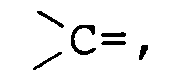
all of the above groups being each optionally substituted with at least one of lower alkyl, lower alkoxy and halogen; and its acid addition salts, useful as an antipsycotic agent.
Description
- The present invention relates to imide derivatives, and their production and use. More particularly, it relates to novel imide compounds and their acid addition salts, and their production processes and their use as antipsycotic agents (neuroleptic agents, anti-anxiety agents), especially for therapy of schizophrenia, senile insanity, manic-depressive psychosis and neurosis.
- There are known some imide compounds having an antipsycotic activity, of which typical examples are as follows:


- These conventional imide compounds are characteristic in that the imide portion and the piperazine or piperidine ring are bonded together with intervention of a straight alkylene chain.
- Conventional antipsychotic agents are generally accompanied by a central or peripheral system side effect such as extrapyramidal motor disturbance (e.g. Parkinsonism) and depression of blood pressure (e.g. orthostatic hypotension) and produce a great problem on clinic (e.g. L.S. Goodman et al.: The Pharmacological Basis of Therapeutics, New York, p. 387 (1985); Gendai Iryo (Modern Medical Therapy), 22, p. 22 (1990)).
- The problem underlying the present invention is to provide an excellent psychotic agent suppressed in the above side effect as generally observed on the conventional antipsychotic agents. This problem could be solved on the basis of the finding that imide compounds wherein the imide portion and the piperazine or piperidine ring are bonded with intervention of an alkylene chain comprising a non-aromatic hydrocarbon ring therein show the desired pharmacological action. Any imide compound wherein the alkylene chain present between the imide portion and the piperazine or piperidine ring comprises a non-aromatic hydrocarbon ring has never been known.
- Accordingly, the present invention relates to imide compounds of the formula:

wherein
Z is a group of the formula: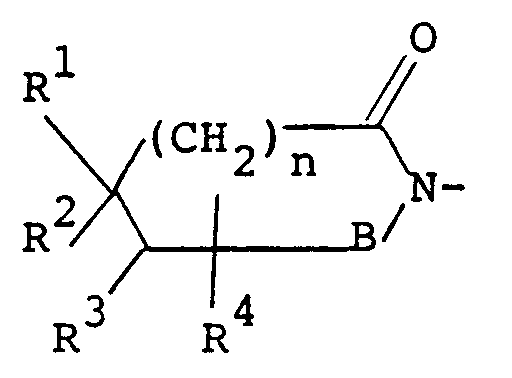
in which B is a carbonyl group or a sulfonyl group, R¹, R², R³ and R⁴ are each a hydrogen atom or a lower alkyl group, or R¹ and R² or R¹ and R³ may be combined together to make a non-aromatic hydrocarbon ring or R¹ and R³ may be combined together to make an aromatic ring, said non-aromatic hydrocarbon ring being optionally bridged with a lower alkylene group or an oxygen atom therein and said aromatic hydrocarbon ring, said non-aromatic hydrocarbon ring and said lower alkylene group being each optionally substituted with at least one lower alkyl, and n is an integer of 0 or 1;
D is a group of the formula:
-(CH₂)p-A-(CH₂)q-
in which A is a non-aromatic hydrocarbon ring optionally bridged with a lower alkylene group or an oxygen atom, said non-aromatic hydrocarbon ring and said lower alkylene group being each optionally substituted with at least one lower alkyl, and p and q are each an integer of 0, 1 or 2; and
Ar is an aromatic group, a heterocyclic aromatic group, a benzoyl group, a phenoxy group or a phenylthio group and G is
or Ar is a biphenylmethylidene group and G is
all of the above groups being each optionally substituted with at least one of lower alkyl, lower alkoxy and halogen;
and its acid addition salts. - In the above significances, the term "lower" is intended to mean generally a group having not more than 8 carbon atoms, particularly not more than 5 carbon atoms, unless otherwise specified. The term "lower alkyl" includes an alkyl group preferably having not more than 4 carbon atoms (e.g. methyl, ethyl, propyl, 2-propyl, butyl). The term "lower alkoxy" covers an alkoxy group preferably having not more than 4 carbon atoms (e.g. methoxy, ethoxy, propoxy, 2-propoxy, butoxy). The term "lower alkylene" covers an alkylene group preferably having not more than 3 carbon atoms (e.g. methylene, ethylene, trimethylene). The term "halogen" includes chlorine, bromine, iodine and fluorine.
- The non-aromatic hydrocarbon ring includes particularly the one having not more than 7 carbon atoms such as a cycloalkane ring having not more than 7 carbon atoms or a cycloalkene ring having not more than 7 carbon atoms. Examples of the cycloalkane ring include cyclopropane, cyclobutane, cyclopentane, cyclohexane and cycloheptane. Examples of the cycloalkene ring are cyclopentene, cyclohexene and cycloheptene.
- The non-aromatic hydrocarbon ring bridged with a lower alkylene group or an oxygen atom may be, for instance, the one having not more than 10 ring carbon atoms and includes specifically bicyclo[1.1.1]pentane, bicyclo[2.1.1]hexane, bicyclo[2.1.1]hex-2-ene, bicyclo[2.2.1]heptane, bicyclo[2.2.1]hept-2-ene, bicyclo[2.2.2]octane, bicyclo[2.2.2]oct-2-ene, bicyclo[4.1.1]octane, bicyclo[4.1.1]oct-2-ene, bicyclo[4.1.1]oct-3-ene, bicyclo[3.2.1]octane, bicyclo[3.2.1]oct-2-ene, bicyclo[3.2.1]oct-3-ene, bicyclo[3.2.1]oct-6-ene, bicyclo[3.2.2]nonane, bicyclo[3.2.2]non-2-ene, bicyclo[3.2.2]non-3-ene, bicyclo[3.2.2]non-6-ene, 2-oxabicyclo[1.1.1]butane, 2-oxabicyclo[2.1.1]pentane, 2-oxabicyclo[2.1.1]pent-4-ene, 7-oxabicyclo[2.2.1]hexane, 7-oxabicyclo[2.2.1]hex-2-ene, 7-oxabicyclo[4.1.1]heptane, 7-oxabicyclo[4.1.1]hept-2-ene, 7-oxabicyclo[4.1.1]hept-3-ene, 8-oxabicyclo[3.2.1]heptane, 8-oxabicyclo[3.2.1]hept-2-ene, 8-oxabicyclo[3.2.1]hept-3-ene and 8-oxabicyclo[3.2.1]hept-6-ene.
- The aromatic ring may be, for instance, any one having not more than 10 carbon atoms, of which specific examples are benzene and naphthalene.
- The non-aromatic hydrocarbon ring represented by the symbol A may be bonded to the alkylene chains present on its both sides, i.e. -(CH₂)p- and -(CH₂)q-, at the 1- and 1-positions, the 1- and 2-positions, the 1- and 3-positions or the 1- and 4-positions.
- The aromatic group represented by the symbol Ar may be e.g. monocyclic or bicyclic and has usually not more than 10 carbon atoms, and its specific examples are phenyl and naphthyl. The heterocyclic aromatic group represented by the symbol Ar may be also e.g. monocyclic or bicyclic. The monocyclic heterocyclic aromatic group may be the one, for instance, having not more than 6 carbon atoms and not more than 4 hetero atoms chosen from nitrogen, oxygen and sulfur, and its specific examples are pyridyl, pyrimidinyl, thiazolyl, oxazolyl, isoxazolyl, isothiazolyl, furyl and imidazolyl. The bicyclic heterocyclic aromatic group may be the one, for instance, having not more than 10 carbon atoms and not more than 5 hetero atoms chosen from nitrogen, oxygen and sulfur, and its specific examples are a benzologous condensed ring group (e.g. benzisothiazolyl, benzisoxazolyl, benzofuryl, quinolyl, isoquinolyl, indolyl, indazolyl, benzimidazolyl, benzoxazolyl), naphthyridinyl, pteridinyl, thienofuryl, imidazothiophenyl and imidazofuryl.
- The present invention covers the acid addition salt formed between the imide compound (I) and an organic or inorganic acid. Examples of the inorganic acid are hydrochloric acid, hydrobromic acid, hydroiodic acid and sulfuric acid, and examples of the organic acid are acetic acid, oxalic acid, citric acid, malic acid, tartaric acid, maleic acid and fumaric acid.
- The imide compound (I) can have stereo and optical isomers, and this invention involves these isomers or their mixtures as well.
- Among various groups represented by the symbol Ar, preferred are a bicyclic heterocyclic aromatic group, a naphthyl group, a benzoyl group, a phenoxy group, a phenylthio group or a biphenylmethylidene group, these groups being optionally substituted with at least one of lower alkyl, lower alkoxy and halogen. More preferred are a benzologous condensed ring group, a naphthyl group, a benzoyl group, a phenoxy group or a phenylthio group, these groups being optionally substituted with at least one of lower alkyl, lower alkoxy and halogen. The most preferred are benzisothiazolyl, benzisoxazolyl, indazolyl, indolyl, benzoyl, phenoxy and phenylthio, which are optionally substituted with at least one of lower alkyl, lower alkoxy and halogen.
- Preferred examples of the group represented by the symbol Z are those of the following formulas:

wherein L is -CH₂-CH₂- or -CH=CH-, E is a lower alkylene group optionally subsituted with lower alkyl or an oxygen atom, R⁵ is a hydrogen atom or a lower alkyl group and B is a carbonyl group or a sulfonyl group,
wherein L, E, R⁵ and B are each as defined above,
wherein R⁶, R⁷, R⁸, R⁹, R¹⁰, R¹¹, R¹², R¹³, R¹⁴ and R¹⁵ are each a hydrogen atom or a lower alkyl group, or two of those present at the neighbouring positions each other may be combined together to make a bond (i.e. forming a double bond between said two positions) and B is as defined above;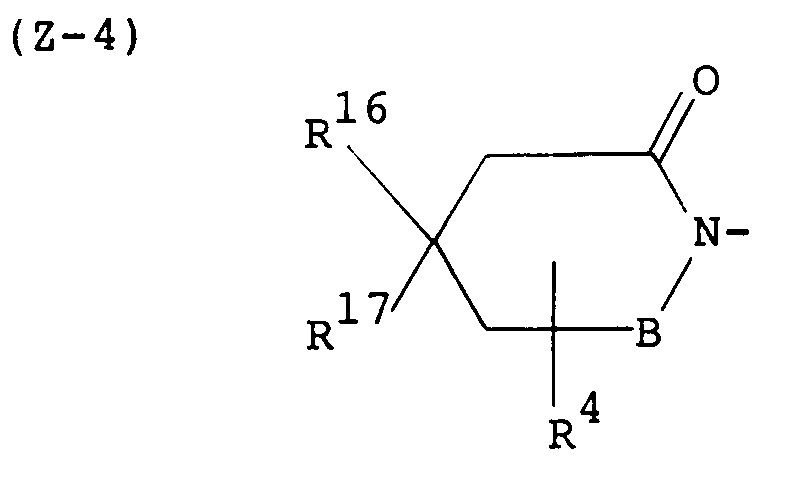
wherein R¹⁶ and R¹⁷ are each a hydrogen atom or a lower alkyl group, or they may be taken together to make a saturated hydrocarbon ring, preferably a cycloalkane ring having not more than 7 carbon atoms (e.g. cyclopropane, cyclobutane, cyclopentane, cyclohexane, cycloheptane) and R⁴ and B are each as defined above, and
wherein B is as defined above. - More preferred examples of the group represented by the symbol Z are those of the following formulas:
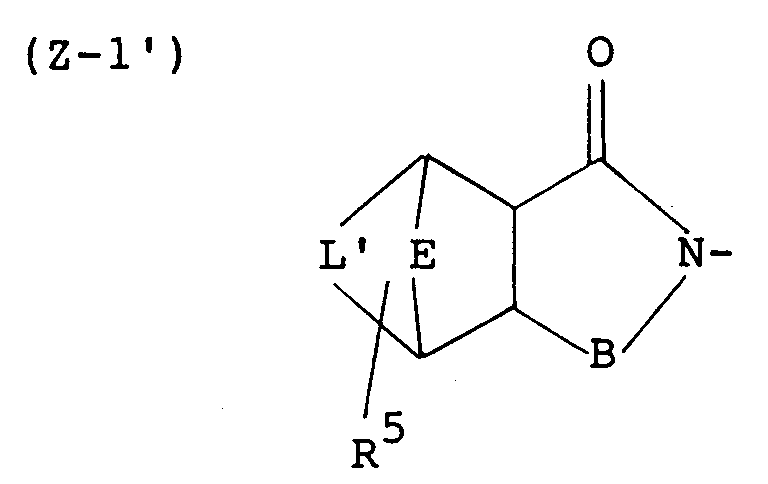
wherein L' is -CH₂-CH₂- and E, R⁵ and B are each as defined above,
wherein L', E, R⁵ and B are each as defined above,
wherein R6', R7', R8', R9', R10', R11', R12', R13', R14' and R15' are each a hydrogen atom or a lower alkyl and B is as defined above;
wherein R⁴, R¹⁶, R¹⁷ and B are each as defined above, and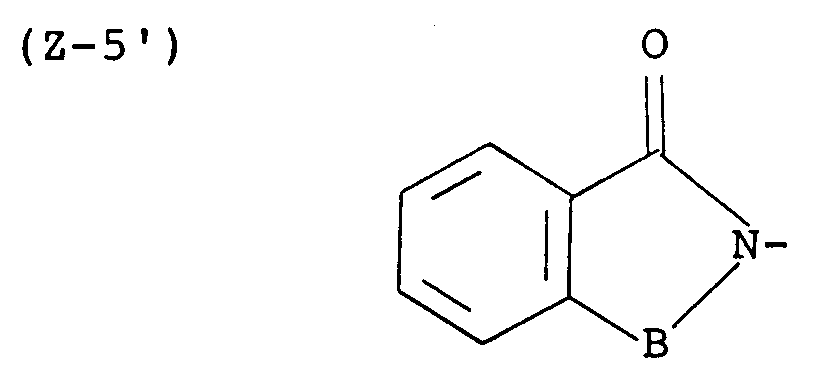
wherein B is as defined above. - The imide compounds (I) of the invention are obtainable by various procedures, of which typical examples are as shown below.
- Procedure (a):-
The imide compound (I) is obtainable according to the following scheme:
wherein A, G, Ar and Z are each as defined above and R¹⁸ and R¹⁹ are each a hydroxy group or a lower alkoxy group, or they may be taken together to represent an oxygen atom, X is a leaving group such as halogen, lower alkylsulfonyloxy (e.g. methanesulfonyloxy), arylsulfonyloxy (e.g. p-toluenesulfonyloxy, benzenesulfonyloxy) and l and m are each an integer of 0 or 1. - Namely, the compound (II) is reduced to give the compound (III). The reduction may be carried out by treatment with a reducing agent (e.g. LiAlH₄, NaBH₄, Ca(BH₄)₂, LiAlH₂(OCH₂CH₂OCH₃)₂) in an inert solvent at a temperature of 0°C to the reflux temperature of the reaction mixture to give the compound (III). The reducing agent is usually employed in an amount of about 1 to 10 mol to one mol of the compound (II). As the inert solvent, there may be used an ethereal solvent such as diethyl ether or tetrahydrofuran.
- The hydroxy groups in the compound (III) are then converted respectively into leaving groups to give the compound (IV). When the leaving group is a halogen atom (e.g. chlorine, bromine), the conversion may be carried out by reacting the compound (III) with thionyl halide (e.g. thionyl chloride, thionyl bromide), optionally in the presence of a base (e.g. pyridine). This reaction is preferably performed in a solvent (e.g. pyridine, tetrahydrofuran, dichloromethane) at a temperature of about 0 to 30°C. The molar proportion of the compound (III) and thionyl halide may be usually about 1 : 2 - 4.
- When the leaving group is sulfonyloxy, the conversion may be effected by reacting the compound (III) with a sulfonyl halide such as alkylsulfonyl halide (e.g. methanesulfonyl chloride) or arylsulfonyl halide (e.g. p-toluenesulfonyl chloride, benzenesulfonyl chloride), optionally in the presence of a base (e.g. triethylamine). This reaction is favorably perfomred in a solvent (e.g. pyridine, tetrahydrofuran, dichloromethane, chloroform) at a temperature of about 0 to 30°C. The molar proportion of the compound (III) and the sulfonyl halide is usually about 1 : 2 - 4.
- The compound (IV) is then reacted with the compound (V) to give the compound (VI). The reaction may be carried out in the presence of a base (e.g. potassium carbonate, sodium carbonate) in a solvent such as alcohol (e.g. methanol, ethanol, propanol, 2-propanol, butanol), acetonitrile or dimethylformamide at a temperature around the boiling point of the solvent. The base and the compound (V) may be used respectively in amounts of about 0.5 to 2 mol and of about 1 to 1.5 mol to one mol of the compound (IV).
- The compound (VI) is then reacted with the compound (VII) to give the compound (I-a). This reaction is carried out optionally in the presence of a catalyst and a base (e.g. potassium carbonate, sodium carbonate, sodium hydride, potassium hydride) in an aromatic solvent (e.g. toluene, xylene, chlorobenzene) at a temperature around the boiling point of the solvent. As the catalyst, a crown ether such as dibenzo-18-crown-6-ether may be used, and its amount is normally from about 0.1 to 10 % by weight based on the compound (VI). The molar proportion of the compound (VI) and the compound (VII) to be used is usually about 1 : 1 - 1.5.
- Procedure (b):-
The imide compound (I) is also produced according to the following scheme:
wherein X, A, Z, l and m are each as defined above. - The compound (IV) is reacted with the compound (VII) in the presence of a base such as an inorganic base (e.g. potassium carbonate, sodium carbonate, sodium hydride, potassium hydride) to give the compound (VIII). The reaction is usually carried out in a solvent (e.g. alcohol, dimethylformamide, acetonitrile), optionally in the coexistence of a reaction aid such as an alkali metal iodide (e.g. potassium iodide, sodium iodide), at a temperature around the boiling point of the solvent. The amounts of the base, the reaction aid and the compound (VII) may be respectively from about 1 to 2 mol, from about 0.1 to 1 mol and from about 0.1 to 1 mol to one mol of the compound (IV).
- The compound (VIII) is then reacted with the compound (V) in the presence of a base (e.g. potassium carbonate, sodium carbonate, sodium hydride, potassium hydride) to give the compound (I-a). The reaction is normally carried out in a solvent (e.g. alcohol, dimethylformamide, acetonitrile), optionally in the coexistence of a reaction aid such as an alkali metal iodide (e.g. potassium iodide, sodium iodide), at a temperature around the boiling point of the solvent. The amounts of the base and the reaction aid may be respectively from about 1 to 2 mol and from about 0.1 to 1 mol to one mol of the compound (VIII). The molar proportion of the compound (VIII) and the compound (V) may be usually about 1 : 1 - 1.5.
- Procedure (c):-
The imide compound (I) is further obtainable according to the following scheme:

wherein R¹, R², R³, R⁴, n, p, q, D, A, B, X and Z are each as defined above and R²⁰ is a protective group for hydroxy (e.g. benzyl, halogen, methoxy or nitro-substituted benzyl, methoxymethyl, methoxyethoxymethyl, tetrahydrofuranyl). - The compound (IX) is converted into the compound (X) by application of a per se conventional protection procedure (g.g. T.W. Greene: "Protective Group in Organic Synthesis", John Willey & Sons, pages 10-39 (1981)) to the former. Examples of the protective group for hydroxy thus introduced are benzyl, substituted benzyl (e.g. halogen-, methoxy- or nitro-substituted benzyl), methoxymethyl, methoxyethoxymethyl and tetrahydrofuryl.
- The compound (X) is then subjected to oxidation, oximation (i.e. oxime formation) and reduction in this order to give the compound (XI). The oxidation may be carried out by reacting the compound (X) with an oxidizing agent such as chromic acid or its salt (e.g. chromic anhydride, bichromic acid). The oximation may be carried out by reacting the oxidized product with hydroxylamine in an alcohol at a temperature of about 0 to 30°C. Hydroxylamine is normally used in an amount of about 1 to 2 mol to one mol of the compound (X). The reduction may be carried out by reacting the oximated product with a reducing agent (e.g. lithium aluminum hydride) in an inert solvent (e.g. diethyl ether or tetrahydrofuran) at a temperature around the boiling point of the solvent. The amount of the reducing agent is usually from about 1 to 10 mol to one mol of the compound (X).
- The compound (XI) thus obtained is reacted with the compound (XII) in a solvent (e.g. pyridine, toluene, xylene, chlorobenzene) at a temperature around the boiling point of the solvent to give the compound (XIII). The amount of the compound (XII) is ordinarily from about 1 to 3 mol to 1 mol of the compound (XI).
- The compound (XIII) is then subjected to elimination of the protecting group by a per se conventional procedure (e.g. T.W. Greene: "Protective group in organic synthesis", John Wiley & Sons, pages 10-39 (1981)) to give the compound (XIV).
- Conversion of the compound (XIV) into the compound (XV) is accomplished by introductin of a leaving group into the former. When the leaving group is halogen (e.g. chlorine, bromine), the compound (XIV) may be reacted with thionyl halide (e.g. thionyl chloride, thionyl bromide) in the presence of a base (e.g. pyridine) in a solvent (e.g. pyridine, tetrahydrofuran, dichloromethane) at a temperature of about 0 to 30°C. The amount of the thionyl halide is normally from about 2 to 4 mol to 1 mole of the compound (XIV).
- When the leaving group is sulfonyloxy, the compound (XIV) is reacted with a sulfonyl halide such as alkylsulfonyl halide (e.g. methanesulfonyl chloride) or arylsulfonyl halide (e.g. benzenesulfonyl chloride, p-toluenesulfonyl chloride) in the presence of a base (e.g. triethylamine). This reaction is usually carried out in a solvent (e.g. pyridine, tetrahydrofuran, dichloromethane, chloroform) at a temperature of about 0 to 30°C. The amount of the sulfonyl halide is normally from about 2 to 4 mol to one mol of the compound (XIV).
- The compound (XV) thus produced is reacted with the compound (V) in the presence of a base in the coexistence of a reaction aid to give the compound (I). The reaction is normally performed in a solvent (e.g. alcohol, dimethylformamide, acetonitrile) at a temperature around the boiling point of the solvent. As the base, there may be used an inorganic base (e.g. potassium carbonate, sodium carbonate, sodium hydride, potassium hydride). As the reaction aid, an alkali metal iodide (e.g. potassium iodide, sodium iodide) is usable. The amounts of the base, the reaction aid and the compound (V) are respectively from about 1 to 2 mol, from about 0.1 to 1 mol and from about 1 to 1.5 mol to one mol of the compound (XV).
- Procedure (d):-
The imide compound (I) is further obtainable according to the following scheme: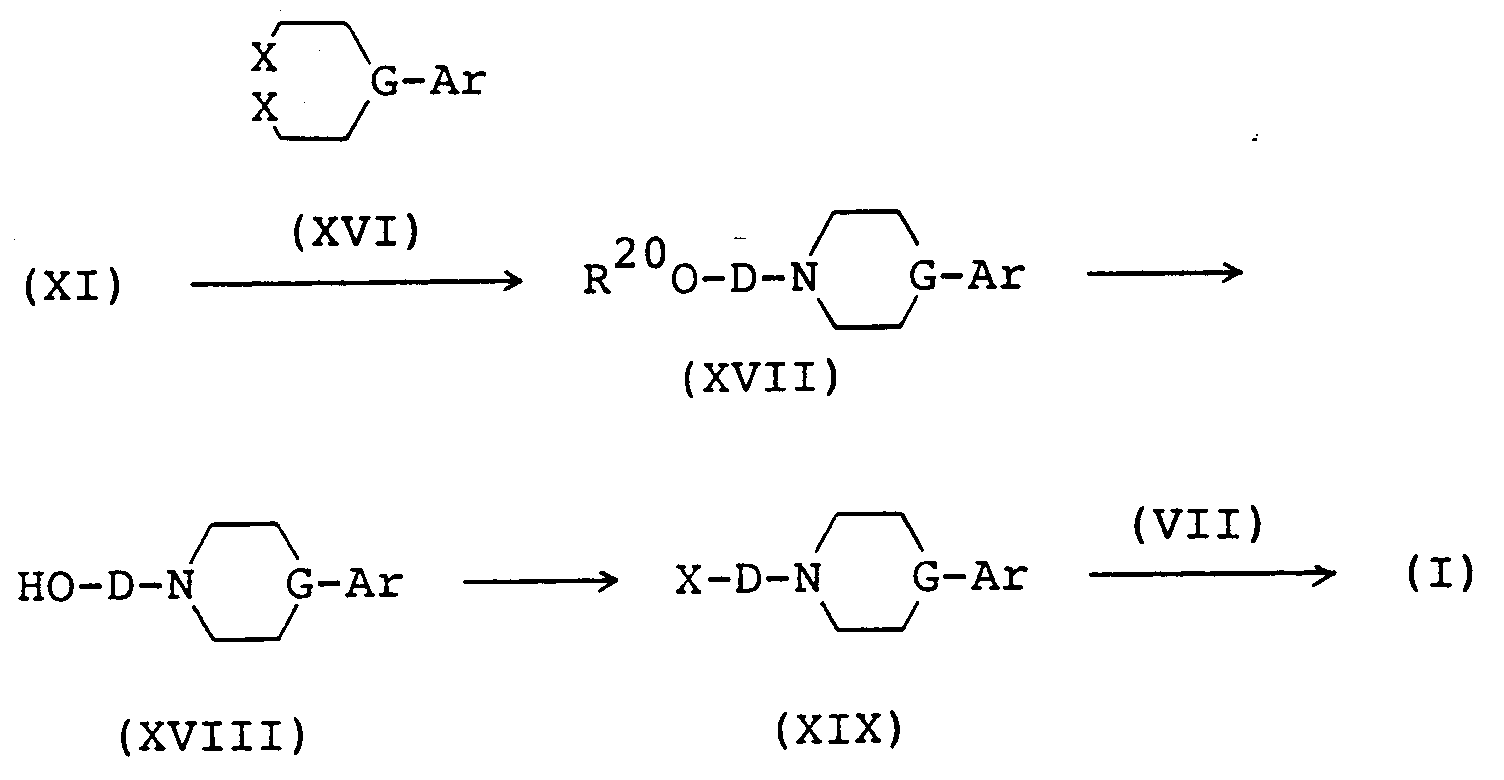
wherein R²⁰, D, G, X and Ar are each as defined above. - The compound (XI) is reacted with the compound (XVI) in the presence of a base in a solvent (e.g. alcohol, diglyme, toluene, chlorobenzene) at a temperature around the boiling point of the solvent to give the compound (XVII). As the base, there may be used an inorganic base (e.g. potassium carbonate, sodium carbonate), and its amount is normally from about 1 to 2 mol to one mol of the compound (XI). The compound (XVI) is used ordinarily in an amount of about 1 to 1.5 mol to one mol of the compound (XI).
- The compound (XVII) is subjected to elimination of the protecting group by a per se conventional procedure (e.g. T.W. Greene: "Protective Group in Organic Synthesis", John Wiley & Sons, pages 10-39 (1981)) to give the compound (XVIII).
- Introduction of a leaving group into the compound (XVIII) affords the compound (XIX). When the leaving group is halogen (e.g. chlorine, bromine), the compound (XVIII) is reacted with thionyl halide (e.g. thionyl chloride, thionyl bromide), optionally in the presence of a base (e.g. pyridine). The reaction is normally carried out in a solvent (e.g. pyridine, tetrahydrofuran, dichloromethane) at a temperature of about 0 to 30°C. The amount of the thionyl halide may be from about 2 to 4 mol to 1 mol of the compound (XVIII).
- When the leaving group is sulfonyloxy, the compound (XVIII) is reacted with a sulfonyl halide such as an alkylsulfonyl halide (e.g. methanesulfonyl chloride) or an arylsulfonyl chloride (e.g. p-toluenesulfonyl chloride, benzenesulfonyl chloride), optionally in the presence of a base (e.g. triethylamine). The reaction is normally carried out in a solvent (e.g. pyridine, tetrahydrofuran, dichloromethane, chloroform) at a temperature of about 0 to 30°C. The amount of the sulfonyl halide may be from about 2 to 4 mol to one mol of the compound (XVIII).
- The compound (XIX) is reacted with the compound (VII) in the presence of a base (e.g. potassium carbonate, sodium carbonate, sodium hydride, potassium hydride) in a solvent (e.g. alcohol, acetonitrile, dimethylformamide) at a temperature around the boiling point of the solvent to give the compound (I). The amounts of the base and the compound (VII) may be respectively from about 0.5 to 2 mol and from about 1 to 1.5 mol to 1 mol of the compound (XIX).
- The products in Procedures (a) to (d), i.e. the compounds (I) and (I-a), may be each purified by a per se conventional procedure such as recrystallization from a suitable solvent (e.g. alcohol, diethyl ether, ethyl acetate, hexane) or chromatography on a column of silica gel. It is also possible to convert the products into their acid addition salts and then purify by recrystallization from a proper solvent (e.g. acetone, diethyl ether, alcohol).
- Throughout Procedures (a) to (d), the introduction of a protective group is accomplished by a per se conventional procedure. When, for instance, the protective group is benzyl, substituted benzyl (e.g. halogen-, methoxy- or nitro-substituted benzyl) or methoxymethyl, the starting compound into which the protective group is to be introduced may be reacted with a protective group-introducing reagent such as benzyl halide, substituted benzyl halide or methoxymethyl halide in the presence of a basic substance such as an alkali metal hydride (e.g. sodium hydride, potassium hydride) or an organic base (e.g. triethylamine, dimethylaminopyridine) in an organic solvent (e.g. tetrahydrofuran, dimethylformamide) at a temperature of about -10 to 30°C. The amount of the protective group-introducing reagent may be from about 1 to 2 mol to one mol of the starting compound.
- Elimination of the protective group may be also carried out by a per se conventional procedure. When, for instance, the protective group is benzyl or substituted benzyl, the elimination may be effected by hydrogenation using a noble metal catalyst (e.g. Pd-C, PtO, Pt-C) under a hydrogen pressure of 1 to 3 atm. When the protective group is benzyl, substituted benzyl or methoxymethyl, the elimination may be accomplished by treatment with a strong acid (e.g. CF₃COOH, HBr, HBr-CH₃COOH).
- Optical resolution of the compound (I) can be accomplished by dissolving in an inert solvent (e.g. acetonitrile, alcohol), adding an optically active acid thereto to form the optically active salt between the compound (I) and the acid, precipitating the formed salt, collecting the precipitated salt and treating the collected salt with a base to make the optically active compound (I) in a free form.
- As the optically active acid, there may be used, for instance, L-tartaric acid, D-tartaric acid, D-camphanic acid, L-mandelic acid, L-pyroglutamic acid, D-10-CSA (D-10-camphor-sulfonic acid), D-quinic acid, L-malic acid and dibenzoyl-L-tartaric acid, among which preferred are L-tartaric acid and D-tartaric acid. No particular limitation is present on the temperature at which the salt formation is to be carried out, and the salt formation may be effected within a wide range from room temperature to the refluxing temperature of the reaction system. For enhancement of the optical purity, however, it is favored that the reaction system is once heated to the refluxing temperature. Before collection of the precipitated salt by filtration, the mixture may be once cooled so as to increase the yield. The amount of the optically active acid as the resolving agent may be from 0.5 to 2.0 equivalents, preferably around one equivalent, to the substrate. When desired, the collected salt may be recrystallized from a proper solvent such as alcohol to give the optically active salt with a higher purity. The thus obtained salt may be treated with a base to release an optical isomer of the compound (I) in a free form.
- For the therapeutic use as an antipsychotic agent, the imide compound (I) or its pharmaceutically acceptable salt may be used as such, but it is usually formulated into a pharmaceutical preparation such as tablets, capsules, syrups, suspensions, solutions, emulsions and suppositories by a per se conventional procedure. Depending upon the administration route such as parenteral or non-parenteral administration (e.g. oral administration, intravenous administration, rectal administration), an appropriate preparation form may be employed. In order to make said pharmaceutical preparation, the imide compound (I) or its pharmaceutically acceptable salt may be combined, if necessary, with any suitable additive(s) such as carriers, diluents, fillers, binders and stabilizers. In case of an injectionable prepartion, pharmaceutically acceptable buffers, solubilizers, isotonizers and other additives may be incorporated therein.
- While the dosage of the imide compound (I) or its pharmaceutically acceptable salt varies greatly with the symptom, age and weight of the patient, the dosage form, the administration mode and the like, it may be generally given to an adult at a daily dose of from about 1 to 1000 mg, preferably from about 5 to 100 mg, in case of oral administration and at a daily dose of from about 0.1 to 100 mg, preferably from about 0.3 to 50 mg, in case of intraveous injection. Said dose may be applied in a single time or dividedly in two or more times.
- As stated above, the imide compound (I) and its pharmaceutically acceptable salts exert a significant antipsychotic activity. Yet, they are very weak in side effects as observed on the conventional neuroleptic drugs.
- The above facts are well evidenced by the pharmacological test data as set forth below.
- It is known that there is a correlation between the antipsychotic activity and the dopamine D₂ receptor binding activity. This assay is therefore to examine an affinity of the test compound to dopamine D₂ receptor in membrane fractions of corpus striatum taken out from rat brain according to the method as described in T. Kuno et al: J.Neurochem., 41, 841 (1983).
- Fresh corpus striatum taken out from rat brain is homogenized in a 30-fold volume of Tris-HCl buffer solution (pH, 7.4; 0.05 M) and centrifuged (31,360 x g) for 10 minutes to give the membrane fractions, which are washed with the same volume of the buffer solution twice to give the membrane fractions for assay.
- The membrane fractions as above obtained (containing 5 mg of protein) are incubated at 37°C for 30 minutes in a buffer solution comprising [³H] raclopride (0.45 nM), sodium chloride (120 mM), 1 mM magnesium chloride, 5 mM potassium chloride, 2 mM calcium chloride, Tris-HCl (pH, 7.4; 50 mM), 0.01 % ascorbic acid, 1 mM pargyline and the test compound (10⁻⁹ to 10⁻⁵ M). Upon termination of the reaction, the membrane fractions are collected through a Whatman GF/B glass filter and number of [³H] raclopride bound to membranes is measured by the aid of a liquid scintillation counter. Number of [³H] raclopride binding specific to the D₂ receptor in a designed concentration of the test compound is calculated according to the following equation and the IC₅₀ and Ki are determined on the basis of a hill plot according to the method as described in Life Sci., 23, 1781 - 1784 (1978). As the representative antipyhchotic drug, Haloperidol is used as control.




- S :
- concentration of [³H] raclopride on assay
- KD:
- dissociation constant of [³H] raclopride
- The results are shown in Table 2.

- Further, the antipsychotic activity (e.g. inhibition of [³H] raclopride binding to D₂ receptors) of the designated compound at the concentration of 0.01 µM is observed, of which the results are shown in Table 3.
Table 3 Compound No. Antipsychotic activity (% inhibition) 101 60 106 90 107 71 161 24 163 11 - This activity is examined through the anti-climbing behavior test, i.e. the test for suppressing the climbing behavior induced by apomorphine in mice.
- A designed amount of the test compound is orally administered to several groups of ddY strain male mice (bodyweight, 20 to 25 g; one group, 5 mice), and each of the animals is placed in an individual column cage of 12 cm in diameter and 14 cm in height having metal poles (each pole, 2 mm in diameter) vertically installed and arranged along the periphery with intervals of 1 cm. After 60 minutes, apomorphine (1.0 mg/kg) is subcutaneously injected, and the behavior is observed during 10 to 20 minutes. Evaluation is made on the basis of the following criteria [P. Protais et al.: Psychopharmacology, 50, 1 - 6 (1976)]:

- Inhibition percentage of climbing behavior per each dose is calculated by the following equation, and ED₅₀ (50 % suppressive dose) is determined thereon:

- The results are shown in Table 4 in which the representative psychotic-drugs such as Haloperidol and Chlorpromazine are used for control.

- The catalepsy inducing activity, which is the typical central nervous system side-effect, i.e. extra-pyramidal side-effect, on clinical use of the psychotic drug, is observed.
- A designated amount of the test compounds is orally administered to male mice, and one hour later a pair of forepaws are forcedly hanged on an iron pipe (diameter, 2.5 mm) horizontally set at a height of 5 cm. At least one cataleptic state of more than 30 second per three trials is regarded as positive. The results are shown in Table 5.

- Since the blocking activity of α₁ adrenergic receptor inherent to the antipsychotic drug has a correlation with cardiovascular organ side-effect such as ortho-static hypotension, a ptosis inducing test is conducted to evaluate the α₁-receptor blocking acivity.
- The designated compound is orally administered to mice and after one hour blepharoptosis is scored, of which the results are shown in Table 6.

- The above pharmacological data support that the imide derivatives (I) and their acid addition salts according to the invention show an excellent antipsychotic activity. Further, the efficacy ratio of the antipsychotic activity (i.e antiapomorphine activity) to the side-effect induction reveals that they have least central and peripheral nervous system side-effects in comparison with the conventional drugs.
- Practical and presently preferred embodiments of the invention are illustratively shown in the following Examples wherein the abbreviations have the following meanings: Ms, methanesulfonyl; Et, ethyl; Ph, phenyl.
- Production of trans-3a,7a-octahydroisoindolium-2-spiro-1'-[4'-(1,2-benzisothiazol-3-yl)]piperazine methanesulfonate (Compound No. 201):-

- To a mixture of lithium aluminum hydride (2.85 g; 75 mmol) and diethyl ether (50 ml), a solution of trans-1,2-cyclohexanedicarboxylic acid anhydride (1) (7.71 g; 50 mmol) in diethyl ether (150 ml) is dropwise added, and the resultant mixture is allowed to react at room temperature for 3 hours and then heated under reflux for 2 hours. After cooling, wet ether is dropwise added to the reaction mixture, followed by addition of water. The organic layer is collected by decantation, followed by concentration to give trans-1,2-bis(hydroxymethyl)cyclohexane (2) (5.1 g).
- The thus obtained compound (2) (5.1 g; 35.4 mmol) is dissolved in triethylamine (10.37 g; 103 mmol) and acetonitrile (127 ml), and methanesulfonyl chloride (8.13 g; 71 mmol) is dropwise added thereto under ice-cooling. The resultant mixture is ice-cooled for 1 hour and allowed to react at room temperature for 3 hours. The reaction mixture is washed with water, dried and concentrated, followed by addition of diethyl ether. Precipitated crystals are collected by filtration to give trans-1,2-bis(methanesulfonyloxymethyl)cyclohexane (3) (5.4 g).
- A mixture of the compound (3) (3.06 g; 10.2 mmol), 3-(1-piperazinyl-1,2-benzisothiazole (4) (2.19 g; 10 mmol), sodium carbonate (1.05 g; 10 mmol) and acetonitrile (45 ml) is refluxed for 23 hours. The reaction mixture is filtered while hot, and the filtrate is concentrated to give the objective compound (Compound No. 201) (4.3 g). m.p., 220 - 225°C.
- Production of trans-1,2-bis(methanesulfonyloxymethyl)cyclohexane (3):-

- To a mixture of lithium aluminum hydride (52.22 g; 1.374 mol) and tetrahydrofuran (500 ml), a solution of trans-1,2-cyclohexanedicarboxylic acid (5) (118.18 g; 0.687 mol) in tetrahydrofuran (2 liters) is dropwise added under reflux, and the resultant mixture is allowed to react under reflux for 3 hours. After completion of the reaction, the reaction mixture is cooled, and wet tetrahydrofuran and ether are dropwise added thereto, followed by filtraion. The filtrate is concentrated under reduced pressure to give trans-1,2-bis(hydroxymethyl)cyclohexane (2) (71.86 g).
- To a solution of the compound (2) (71.86 g; 0.499 mol) and triethylamine (151.21 g; 1.497 mol) in chloroform (1 liter), methanesulfonyl chloride (114.27 g; 0.998 mol) is dropwise added under ice-cooling, and the resultant mixture is stirred at room temperature for 6 hours. The reaction mixture is washed with water, dried and concentrated under reduced pressure. Diethyl ether is added to the residue for crystallization, and the precipitated crystals are collected to give trans-1,2-bis(methanesulfonyloxymethyl)cyclohexane (3) (88.57 g).
- Production of N-[(2-chloromethyl)cyclopropylmethyl]cyclohexane-1,2-dicarboximide (Compound No. 202):-


- To a mixture of lithium aluminum hydride (6.65 g; 175 mmol) and diethyl ether (1000 ml), a solution of diethyl 1,2-cyclopropanedicarboxylate (6) (25.0 g; 134 mmol) in diethyl ether (250 ml) is dropwise added, and the resultant mixture is refluxed for 5 hours, followed by cooling. Wet ether is dropwise added to the reaction mixture, followed by addition of water. The organic layer is collected by decantation and dried. Concentration under reduced pressure gives 1,2-bis(hydroxymethyl)cyclopropane (7) (24.8 g).
- To a solution of the compound (7) (3.0 g; 29.4 mmol) in pyridine (4.64 g), thionyl chloride (10.5 g; 88.2 mmol) is dropwise added, and the resultant mixture is stirred at a temperature of 0 to 5°C for 30 minutes and at room temperature for 2 hours. The reaction mixture is concentrated, and to the residue diethyl ether and ethyl acetate (1 : 1) are added. After filtration of insoluble materials, the filtrate is concentrated to give 1.2-bis(chloromethyl)cyclopropane (8) (2.51 g).
- ¹H-NMR (CDCl₃) δ: 0.75 (2H, m), 1.25 (2H, m), 3.45 (4H, m).
- A mixture of the compound (8) (0.3 g; 2.2 mmol), cyclohexane-1,2-dicarboximide (253) (66 mg; 0.43 mmol), potassium carbonate (0.3 g; 2.2 mmol), potassium iodide (0.3 g; 1.8 mmol) and acetonitrile (20 ml) is refluxed for 5 hours, and the reaction mixture is, after cooling, concentrated under reduced pressure. Chloroform is added to the residue, which is washed with water, dried, concentrated under reduced pressure and chromatographed on a silica gel column to give the objective compound (Compound No. 202) (0.11 g).
- ¹H-NMR (CDCl₃) δ: 0.60 (2H, m), 0.95 (2H, m), 1.45 (4H, m), 1.85 (4H, m), 2.85 (2H, m), 3.20 (2H, m), 3.55 (2H, m).
- Production of N-(3-methanesulfonyloxymethylcyclohexyl)bicyclo[2.2.1]heptane-2-exo-3-exo-dicarboximide (Compound No. 203):-


- 50 % Sodium hydride (5.77 g; 120 mmol) is washed with n-hexane, and dimethylformamide (50 ml) is added thereto. To the resultant mixture, 3-hydroxymethylcyclohexanol (9) (10.0 g; 76.8 mmol) is dropwise added under ice-cooling, and then benzyl bromide (13.15 g; 76.8 mmol) is dropwise added thereto under ice-cooling. The resulting mixture is stirred at a temperature of 0 to 10°C for 5 hours. The reaction mixture is poured into ice-water, extracted with toluene. The organic layer is washed with water, dried and concentrated under reduced pressure. The residue is chromatographed on a silica gel column to give 3-benzyloxymethylcyclohexanol (10) (9.55 g).
- ¹H-NMR (CDCl₃) δ: 0.8 - 2.1 (9H, m), 3.35 (2H, s), 3.60 (1H, m), 4.50 (2H, s), 7.35 (5H, m).
- To a solution of the compound (10) (4.9 g; 22.2 mmol) in acetone (90 ml), Jones reagent (chromic anhydride acid-sulfuric acid) (0.07 mol) is dropwise added, and the resultant mixture is stirred at a temperature of 0 to 10°C for 2 hours. Methanol is dropwise added to the reaction mixture, which is poured into ice-water and extracted with chloroform. The extract is washed with water, dried and concentrated under reduced pressure. The residue is chromatographed on a silica gel column to give 3-benzyloxymethylcyclohexanone (11).
- ¹H-NMR (CDCl₃) δ: 1.15 - 2.50 (9H, m), 3.38 (2H, d), 4.50 (2H, s), 7.30 (5H, m).
- To a solution of the compound (11) (1.0 g; 4.6 mmol) in ethanol (25 ml), sodium acetate (0.754 g; 9.2 mmol) and hydroxylamine hydrochloride (0.384 g; 5.5 mmol) are added, and the resultant mixture is stirred at room temperature for 3 hours. The reaction mixture is poured into ice-water, extracted with chloroform, washed with water and dried. After concentration under reduced pressure, the residue is chromatographed on a silica gel column to give 3-benzyloxymethylcyclohexanone oxime (12) (0.8 g).
- ¹H-NMR (CDCl₃) δ: 1.2 - 1.55 (2H, m), 1.65 - 2.15 (5H, m), 2.45 (1H, m), 3.25 (1H, m), 3.38 (2H, m), 4.50 (2H, s), 7.30 (5H, m).
- To a solution of the compound (12) (0.75 g; 3.2 mmol) in diethyl ether (30 ml), lithium aluminum hydride (0.75 g; 20 mmol) is added, and the resultant mixture is refluxed for 3 hours. After cooling, wet ether is dropwise added to the reaction mixture, and the organic layer is collected by decantation and dried, followed by concentration under reduced pressure to give 3-benzyloxymethylcyclohexylamine (13) (0.61 g).
- ¹H-NMR (CDCl₃) δ: 0.8 - 2.2 (9H, m), 3.15 (1H, s), 3.20 (1H, s), 3.35 (2H, m), 4.50 (2H, s), 7.30 (5H, m).
- To a solution of the compound (13) (0.57 g; 2.6 mmol) in pyridine (30 ml), bicyclo[2.2.1]hept-5-ene-2-exo-3-exo-dicarboxylic acid anhydride (14) (854 mg; 5.2 mmol) is added, and the resultant mixture is refluxed for 7 hours. Pyridine is removed under reduced pressure, and chloroform is added to the residue and washed with water. The thus obtained residue is chromatographed on a silica gel column and further on a silica gel thin layer to give N-(3-benzyloxymethylcyclohexyl)bicyclo[2.2.1]hept-5-ene-2-exo-3-exo-dicarboximide (15) (0.23 g).
- ¹H-NMR (CDCl₃) δ: 0.9 - 2.45 (11H, m), 2.60 (2H, s), 3.25 (2H, s), 3. 30 - 3.52 (2H, m), 4.00 (1H, m), 4.55 - 4.65 (2H, m), 6.30 (2H, s), 7.30 (5H, m).
- To a solution of the compound (15) (0.21 g; 57.5 mmol) in methanol (10 ml), one drop of conc. hydrochloric acid and 10 % palladium-carbon (210 mg) are added at room temperature to perform catalytic reduction. After completion of the reaction, the catalyst is removed. Removal of methanol under reduced pressure gives N-(3-hydroxymethylcyclohexyl)bicyclo[2.2.1]hept-2-exo-3-exo-dicarboximide (16) quantitatively.
- ¹H-NMR (CDCl₃) δ: 0.9 - 2.25 (15H, m), 2.55 (2H, s), 2.70 (2H, s), 3.68 (2H, brs), 4.08 (1H, brs).
- To a solution of the compound (16) (133 mg; 0.61 mmol) in pyridine (5 ml), methanesulfonyl chloride (82.4 mg; 0.92 mmol) is dropwise added under ice-cooling, and the resultant mixture is stirred at room temperature for 1.5 hours. Pyridine is removed under reduced pressure, and chloroform is added to the residue and washed with water. The chloroform solution is dried and concentrated under reduced pressure to give the objective compound (Compound No. 203).
- ¹H-NMR (CDCl₃) δ: 1.0 - 2.2 (15H, m), 2.55 (2H, s), 2.70 (2H, s), 3.00 (3H, s), 4.02 (3H, m).
- Production of Compound No. 204:-


- To a mixture of lithium aluminum hydride (11.86 g; 0.312 mol) and diethyl ether (300 ml), a solution of trans-1,2-bis(chlorocarbonyl)cyclobutane (17) (18.90 g; 0.104 mol) in diethyl ether (200 ml) is dropwise added under reflux, and the resultant mixture is refluxed for 3 hours. After cooling, wet tetrahydrofuran is dropwise added to the reaction mixture, followed by filtration. The filtrate is concentrated under reduced pressure to give trans-1,2-bis(hydroxymethyl)cyclobutane (18) (8.76 g).
- To a solution of the compound (18) (8.50 g; 0.0733 mol) and triethylamine (22.20 g; 0.22 mol) in chloroform (100 ml), methanesulfonyl chloride (16.79 g; 0.147 mol) is dropwise added under ice-cooling, and the resultant mixture is stirred for 7 hours at room temperature. The reaction mixture is washed with water, dried and concentrated under reduced pressure to give trans-1,2-bis(methanesulfonyloxymethyl)cyclobutane (19) (18.50 g). m.p., 60 to 62°C (crystallized from ether).
- A mixture of the compound (19) (10.00 g; 0.0368 mol), 3-(1-piperazinyl)-1,2-benzisothiazole (4) (7.25 g; 0.0331 mol), sodium carbonate (3.90 g; 0.0368 mol) and acetonitrile (300 ml) is refluxed for 13 hours, and the reaction mixture is cooled, followed by filtration. The filtrate is concentrated under reduced pressure and chromatographed on a silica gel column to give the objective compound (Compound No. 204) (2.84 g).
- ¹H-NMR (CDCl₃) δ: 1.5 - 2.15 (4H, m), 2.3 - 2.69 (8H, m), 3.02 (3H, s), 3.54 (4H, t, J = 5 Hz), 4.25 (2H, d, J = 5.6 Hz), 7.32 - 7.50 (2H, m), 7.83 - 7.92 (2H, m).
- Production of Compound No. 205:-

- A mixture of 3-(1-piperazinyl)-1,2-benzisothiazole (4) (12.7 g; 0.058 mol), 1,4-cyclohexanedione monoethylene ketal (20) (10 g; 0.064 mol), p-toluenesulfonic acid (0.55 g; 0.0029 mol) and toluene (200 ml) is refluxed for 7 hours, and potassium carbonate (0.8 g; 0.0058 mol) is added thereto at room temperature. The resultant mixture is stirred for 1 hour and concentrated under reduced pressure. To the residue tetrahydrofuran (250 ml), methanol (20 ml) and sodium borohydride (2.19 g; 0.058 mol) are added, followed by stirring at room temperature for 15 hours. The reaction mixture is concentrated under reduced pressure, followed by addition of chloroform. The resultant solution is washed with water and dried. The solution is concentrated under reduced pressure and chromatographed on a silica gel column to give the compound (21) (1.57 g). m.p., 105 to 106°C.
- A solution of the compound (21) (2.5 g; 0.007 mol) in 1N hydrochloric acid (20 ml) and tetrahydrofuran (20 ml) is refluxed for 10 hours, and the reaction mixture is concentrated under reduced pressure. The residue is made alkali with aqueous potassium carbonate, extracted with ethyl acetate, dried and concentrated under reduced pressure to give the compound (22) (2.06 g).
- To a solution of the compound (22) (2 g; 0.0063 mol) in methanol (200 ml), sodium borohydride (0.24 g; 0.0063 mol) is added under ice-cooling, followed by stirring for 30 minutes. The reaction mixture is concentrated under reduced pressure, followed by addition of water and extraction with ethyl acetate. The extract is dried and concentrated under reduced pressure to give the objective compound (Compound No. 205). m.p., 155 to 160°C.
- ¹H-NMR (CDCl₃) δ: 1.2 - 2.1 (9H, m), 2.3 - 2.45 (1H, m), 2.7 - 2.85 (4H, m), 3.5 - 3.7 (5H, m), 7.32 - 7.5 (2H, m), 7.81 (1H, d, J = 8 Hz), 7.91 (1H, d, J = 8 Hz).
- In the same manner as in Reference Examples 1 to 5, the compounds as shown in Table 7 are obtainable.


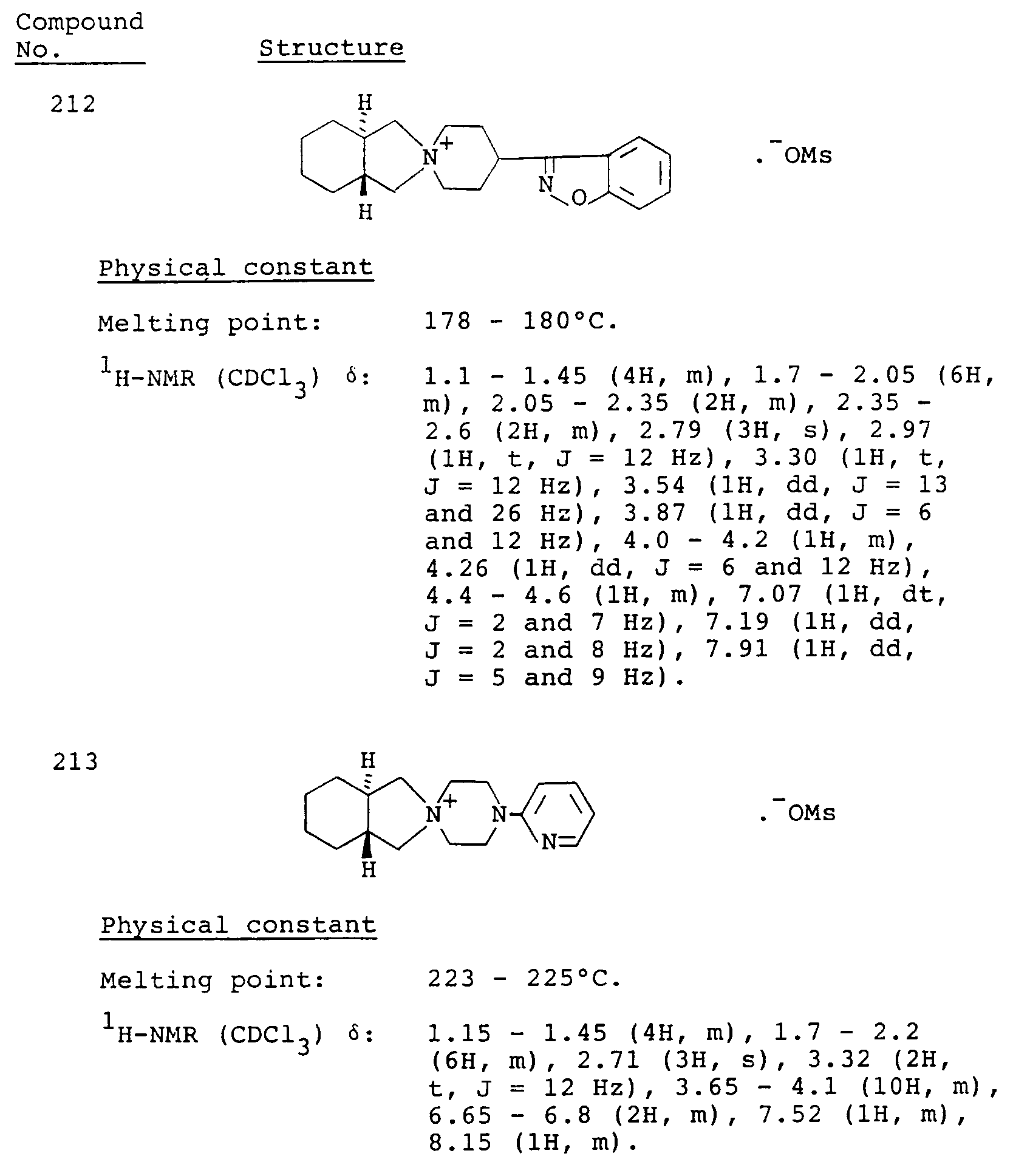


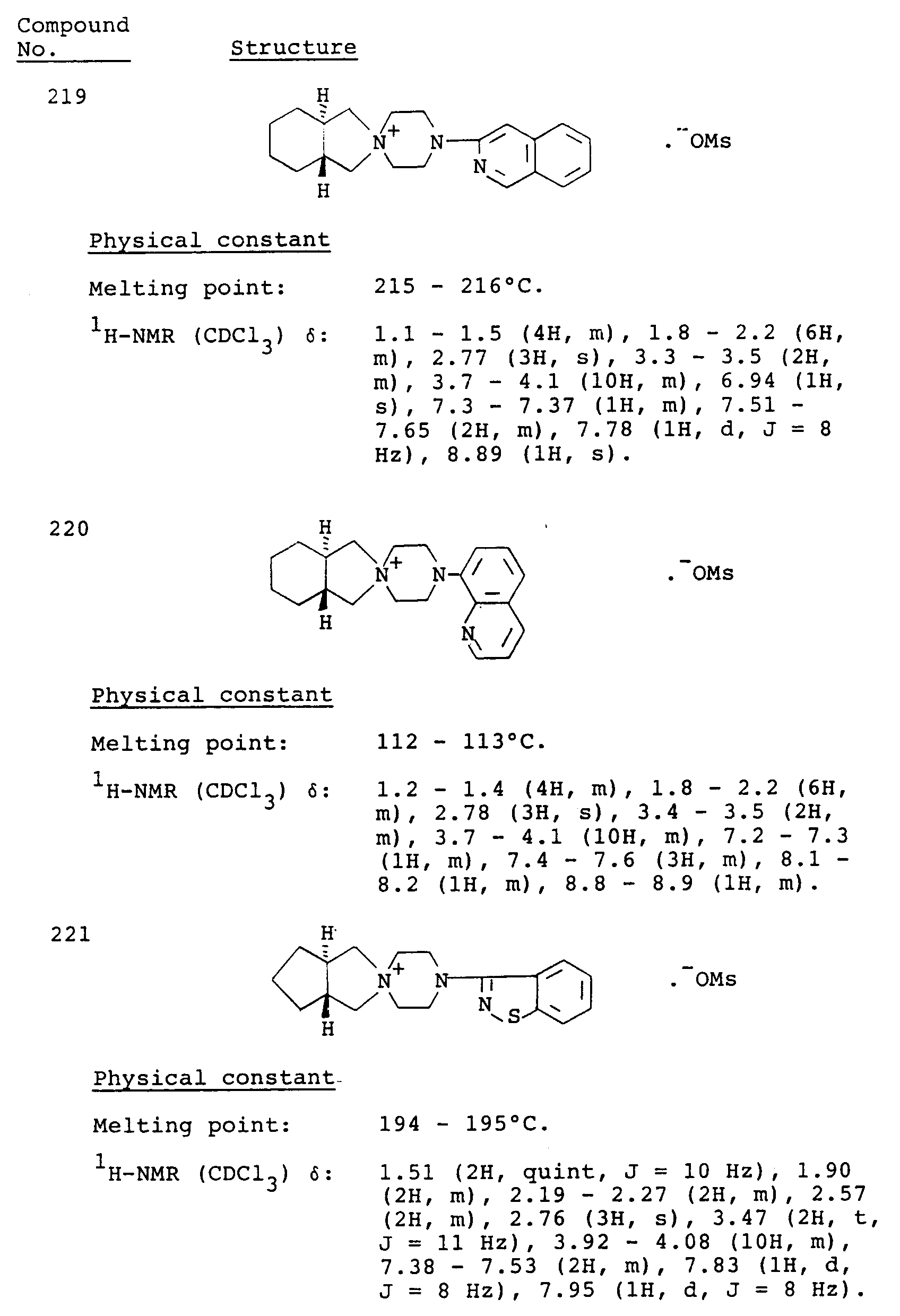


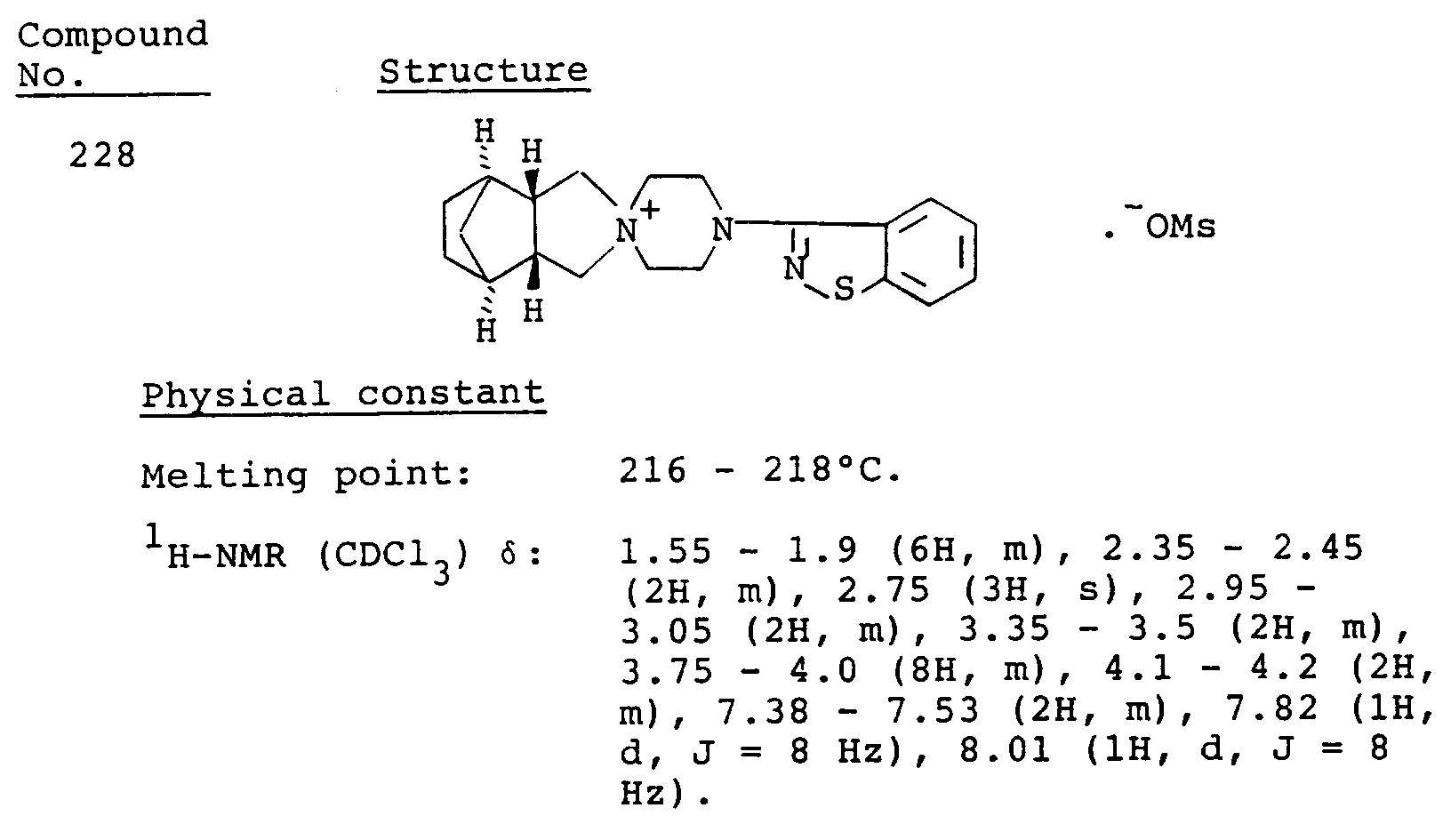
- According to the methods as described in JP-A-63-83085, J.Med.Chem., 28, 761 - 769 (1985) or ibid., 32, 1024 - 1033 (1989), the compounds as shown in Table 8 are obtained.


- Production of Compound No. 101:-

- A mixture of the compound (201) (1.44 g; 3.4 mmol), bicyclo[2.2.1]heptane-2-exo-3-exo-dicarboximide (251) (0.84 g; 5.1 mmol), potassium carbonate (0.68 g; 5.0 mmol), dibenzo-18-crown-6-ether (4 mg; 0.01 mmol) and xylene (20 ml) is refluxed for 16 hours, followed by removal of the solvent. The residue is chromatographed on a silica gel column and treated with hydrogen chloride-2-propanol to give the objective compound (Compound No. 101) in the form of hydrochloride. m.p., 215 to 217°C.
- A mixture of the compound No. 101 in the free form (145.0 g) and methanol (1350 ml) is heated at 60°C, and a solution of L-tartaric acid (44.4 g) in methanol (100 ml) is dropwise added thereto, and the resultant mixture is refluxed for 30 minutes. After allowing to cool to 20 to 30°C, the reaction mixture is stirred for 2 hours, and precipitated crystals are collected by filtration and dried under reduced pressure. The resulting crystals (103.5 g) are recrystallized from methanol two times to give a (+)-isomer of Compound No. 101 in the form of L-tartrate, i.e. Compound No. 102, (71.3 g). m.p., 129°C. [α]

- The mother liquor after collection of the first crystals by filtration in Example 1-(b) is concentrated under reduced pressure, followed by addition of dichloromethane (500 ml) and aqueous sodium bicarbonate (200 ml). The organic layer is washed with aqueous sodium bicarbonate and aqueous sodium chloride (500 ml) two times in order, dried and concentrated under reduced pressure. To the residue, methanol (3300 ml) and D-tartaric acid (20.2 g) are added, and the resultant mixture is stirred under reflux, followed by cooling. Stirring is continued at 20 to 30°C for 2 hours, and precipitated crystals are collected and dried under reduced pressure to give crystals (88.0 g). The thus obtained crystals are recrystallized from methanol to give a (-)-isomer of Compound No. 101 in the form of D-tartrate, i.e. Compound No. 103, (67.5 g). m.p., 129°C. [α]

- A solution of Compound No. 102 (70.0 g) as obtained in Example 1-(b) in chloroform (500 ml) is washed with aqueous sodium bicarbonate (200 ml) two times and aqueous sodium chloride two times in order, dried and concentrated under reduced pressure. To the residue, acetone (270 ml) and 13.7 % 2-propanol solution of hydrogen chloride (31.9 g) are added, and the mixture is stirred at 20 to 30°C for 2 hours. Precipitated crystals are collected by filtration and dried under reduced pressure to give a (+)-isomer of Compound No. 101 in the form of hydrochloride, i.e. Compound No. 104, (55.9 g). m.p., 268°C. [α]

- Compound No. 103 as obtained in Example 1-(c) (65.0 g) is treated in the same manner as in Example 1-(d) to give a (-)-isomer of Compound No. 101 in the form of hydrochloride, i.e. Compound No. 105. m.p., 268°C. [α]

- Production of Compound No. 106:-


- A solution of the compound (203) (90 mg; 0.25 mmol), sodium carbonate (90 mg; 0.85 mmol) and 3-(1-piperazinyl)-1,2-benzisothiazole (4) (180 mg; 0.82 mmol) in acetonitrile (5 ml) is refluxed for 30 hours. After removal of the solvent, chloroform is added to the reaction mixture. The resultant solution is washed with water, dried and concentrated. The residue is chromatographed on a silica gel column to give the objective compound (Compound No. 106).
- ¹H-NMR (CDCl₃) δ: 0.9 - 2.0 (14H, m), 2.05 - 2.35 (3H, m), 2.55 (2H, s), 2.65 (4H, brs), 2.75 (2H, s), 3.55 (4H, brs), 4.00 (1H, m), 7.33 - 7.50 (2H, m), 7.80 (1H, d, J = 8 Hz), 7.90 (1H, d, J = 8 Hz).
- Production of Compound No. 107:-

- A mixture of the compound (202) (0.1 g; 0.39 mmol), 3-(1-piperazinyl)-1,2-benzisothiazole (4) (0.129 g; 0.58 mmol), potassium carbonate (0.1 g; 0.72 mmol), potassium iodide (0.1 g; 0.60 mmol) and acetonitrile (5 ml) is refluxed for 5.5 hours. The reaction mixture is concentrated under reduced pressure, and chloroform is added to the residue, which is washed with water, dried and concentrated under reduced pressure. The residue is chromatographed on a silica gel thin layer to give the objective compound (Compound No. 107) in the form of hydrochloride. m.p., 207°C.
- Production of Compound No. 108:-

- A solution of the compound (204) (1.18 g; 0.0030 mol), bicyclo[2.2.1]heptane-2-exo-3-exo-dicarboximide (251) (0.49 g); 0.0030 mol), potassium carbonate (0.41 g; 0.0030 mol) and dibenzo-18-crown-6-ether (10 mg) in xylene (30 ml) is refluxed for 20 hours. The reaction mixture is filtered, and the filtrate is concentrated under reduced pressure. The residue is chromatographed on a silica gel column and treated with hydrogen chloride-2-propanol to give the objective compound (Compound No. 108) in the form of hydrochloride. m.p., 208 to 210°C.
- ¹H-NMR (CDCl₃) δ: 1.08 - 2.1 (10H, m), 2.2 - 2.68 (12H, m), 3.5 - 3.6 (6H, m), 7.30 - 7.48 (2H, m), 7.80 (1H, d, J = 8.3 Hz), 7.90 (1H, d, J = 8.3 Hz).
- Production of Compound No. 109:-

- A mixture of the compound (201) (0.46 g; 0.0011 mol), the compound (252) (0.20 g; 0.00099 mol), potassium carbonate (0.14 g; 0.0011 mol), dibenzo-18-crown-6-ether (1 mg) and dimethylformamide (5 ml) is refluxed for 6 hours, followed by concentration under reduced pressure. The residue is chromatographed on a silica gel column to give the objective compound (Compound No. 109).
- ¹H-NMR (CDCl₃) δ: 0.95 - 1.9 (15H, m), 2.1 - 2.3 (2H, m), 2.5 - 2.7 (5H, m), 2.9 (2H, brs), 3.33 (0.5H, dd, J = 10 and 14.6 Hz), 3.42 (0.5H, dd, J = 10 and 14.2 Hz), 4.12 (0.5H, dd, J = 4.6 and 14.2 Hz), 4.2 (0.5H, dd, J = 4.6 and 14.6 Hz), 7.27 - 7.49 (2H, m), 7.80 (1H, d, J = 8 Hz), 7.91 (1H, d, J = 8 Hz).
- EI-MS m/e: 528.
- Production of Compound No. 110:-
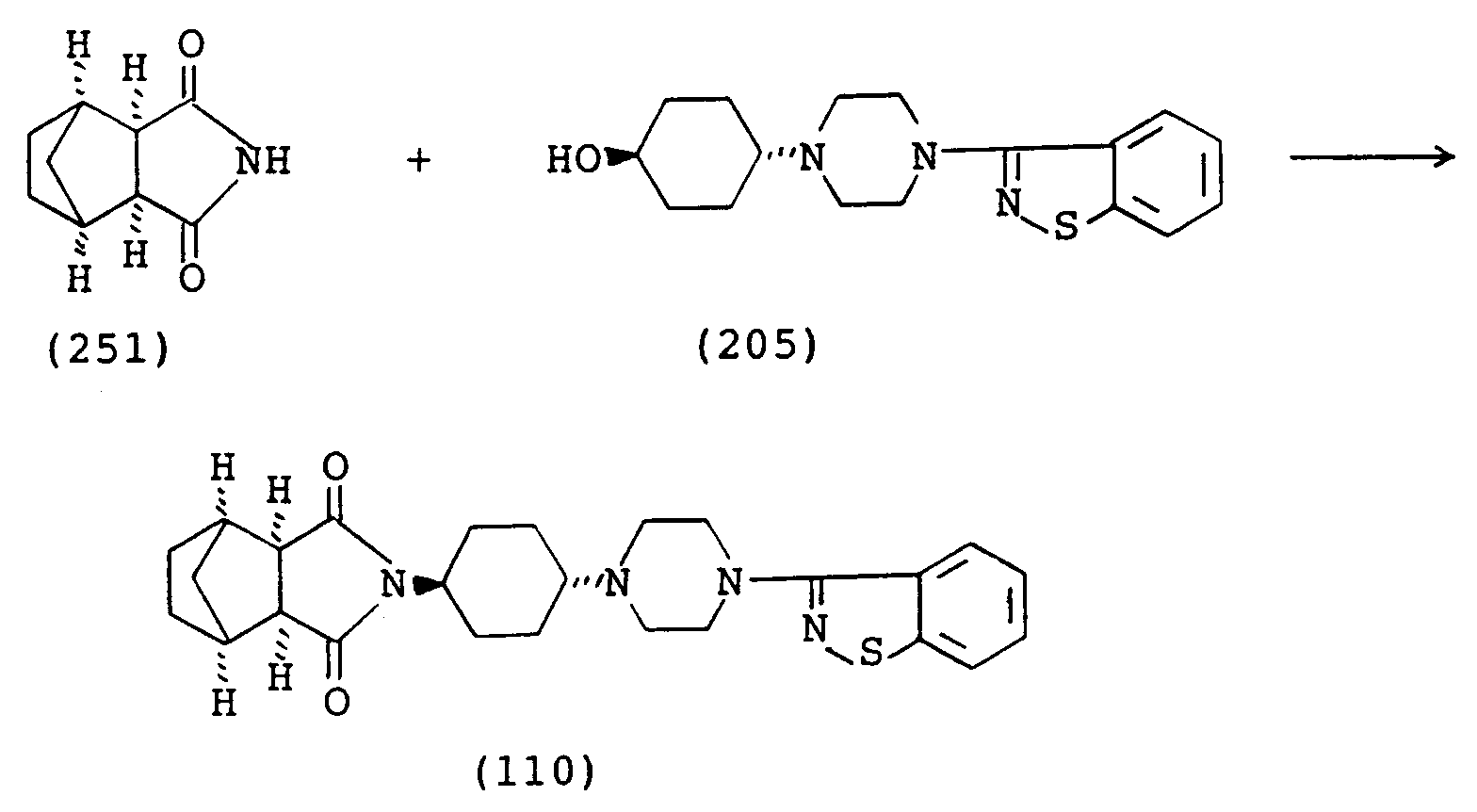
- To a solution of the compound (205) (0.7 g; 2.2 mmol), bicyclo[2.2.1]heptane-2-exo-3-exo-dicarboximide (251) (0.73 g; 4.4 mmol) and triphenylphosphine (0.69 g; 2.6 mmol) in tetrahydrofuran (50 ml), a solution of diethyl azodicarboxylate (0.11 g; 2.6 mmol) in tetrahydrofuran (10 ml) is dropwise added at room temperature, followed by stirring at the same temperature for 3 hours. The reaction mixture is concentrated under reduced pressure, and the residue is chromatographed on a silica gel column to give the objective compound (Compound No. 110). m.p., 200 to 201°C.
- ¹H-NMR (CDCl₃) δ: 1.05 - 1.7 (10H, m), 2.05 - 2.25 (2H, m), 2.25 - 2.35 (1H, m), 2.5 - 2.75 (10H, m), 3.5 - 3.7 (4H, m), 3.95 - 4.1 (1H, m), 7.32 - 7.49 (2H, m), 7.81 (1H, d, J = 8 Hz), 7.92 (1H, d, J = 8 Hz).
- Production of Compound No. 111:-

- A mixture of cyclohexane-1,2-dicarboximide (253) (2 g; 0.013 mol), trans-1,2-bis(methanesulfonyloxymethyl)cyclohexane (3) (5.88 g; 0.02 mol), potassium carbonate (1.8 g; 0.013 mol) and acetonitrile (50 ml) is refluxed for 2.5 hours. To the reaction mixture, there is added 6-fluoro-3-(4-piperidinyl)-1H-indazole (268) (4.39 g; 0.02 mol), and the mixture is refluxed for additional 6 hours. The reaction mixture is filtered, and the filtrate is concentrated under reduced pressure. The residue is chromatographed on a silica gel column and treated with hydrogen chloride-2-propanol to give the objective compound (Compound No. 111) in the form of hydrochloride. m.p., 169 to 170°C.
- ¹H-NMR (CDCl₃) δ: 1.0 - 2.2 (25H, m), 2.5 - 2.6 (1H, m), 2.8 - 2.9 (2H, m), 2.9 - 3.1 (3H, m), 3.2 - 3.4 (1H, m), 3.96 (1H, dd, J = 4 and 13 Hz), 6.85 - 6.93 (1H, m), 7.07 (1H, dd, J = 2 and 9 Hz), 7.71 (1H, dd, J = 5 and 9 Hz), 9.78 (1H, brs).
- In the same manner as in Examples 1 to 7, the compounds as shown in Table 9 are obtained. The physical constants of these compounds are given in Table 10.


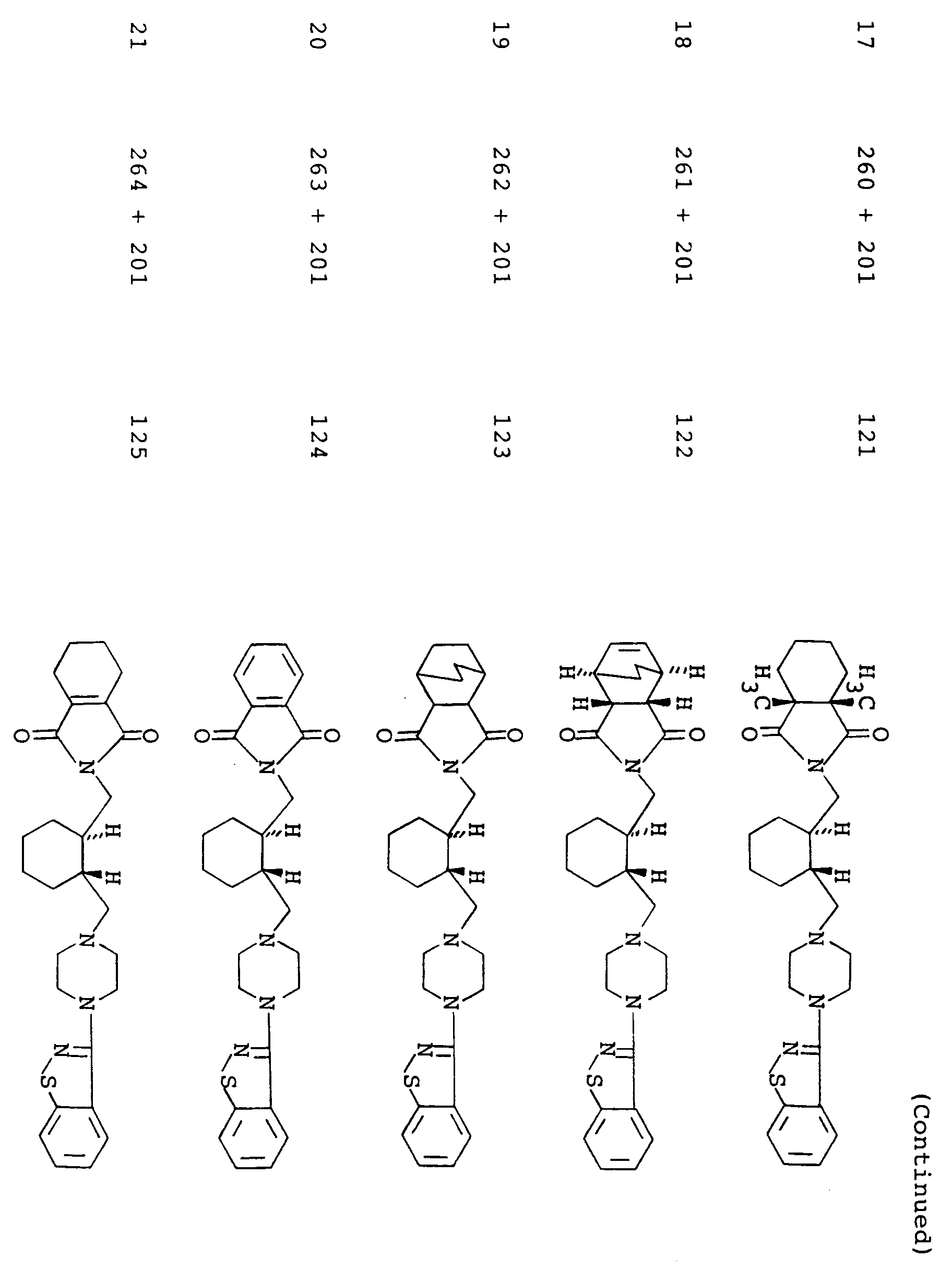


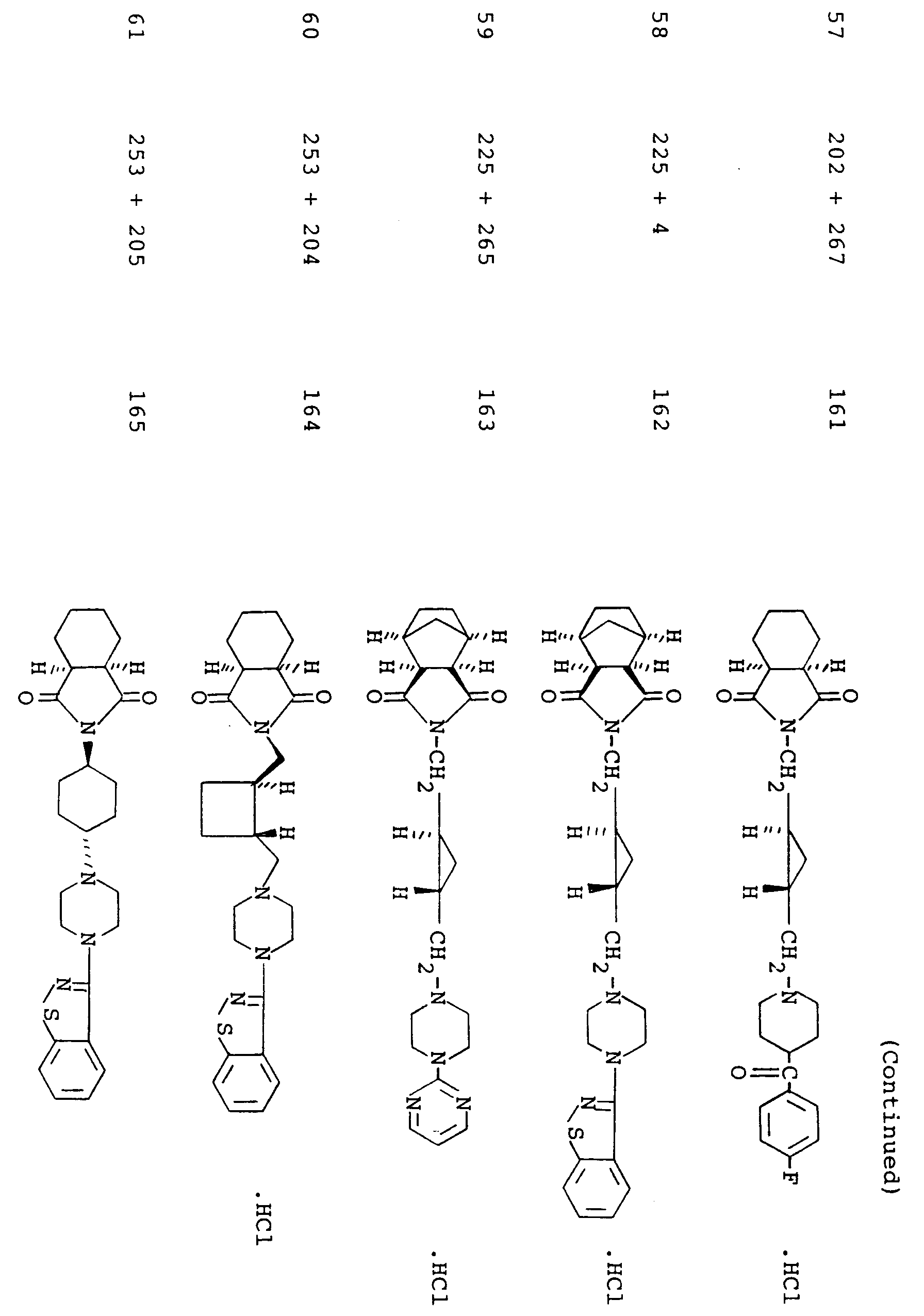
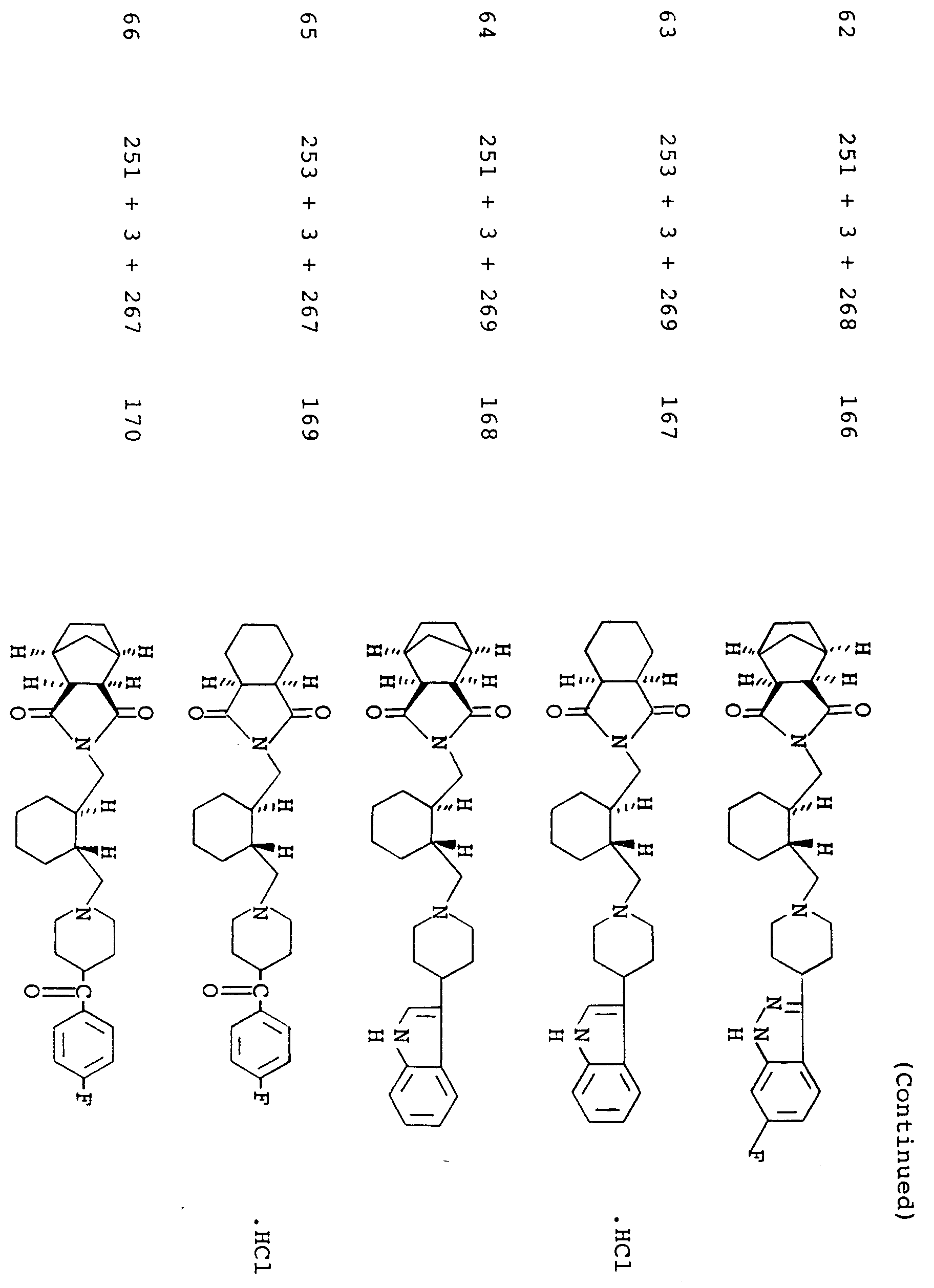


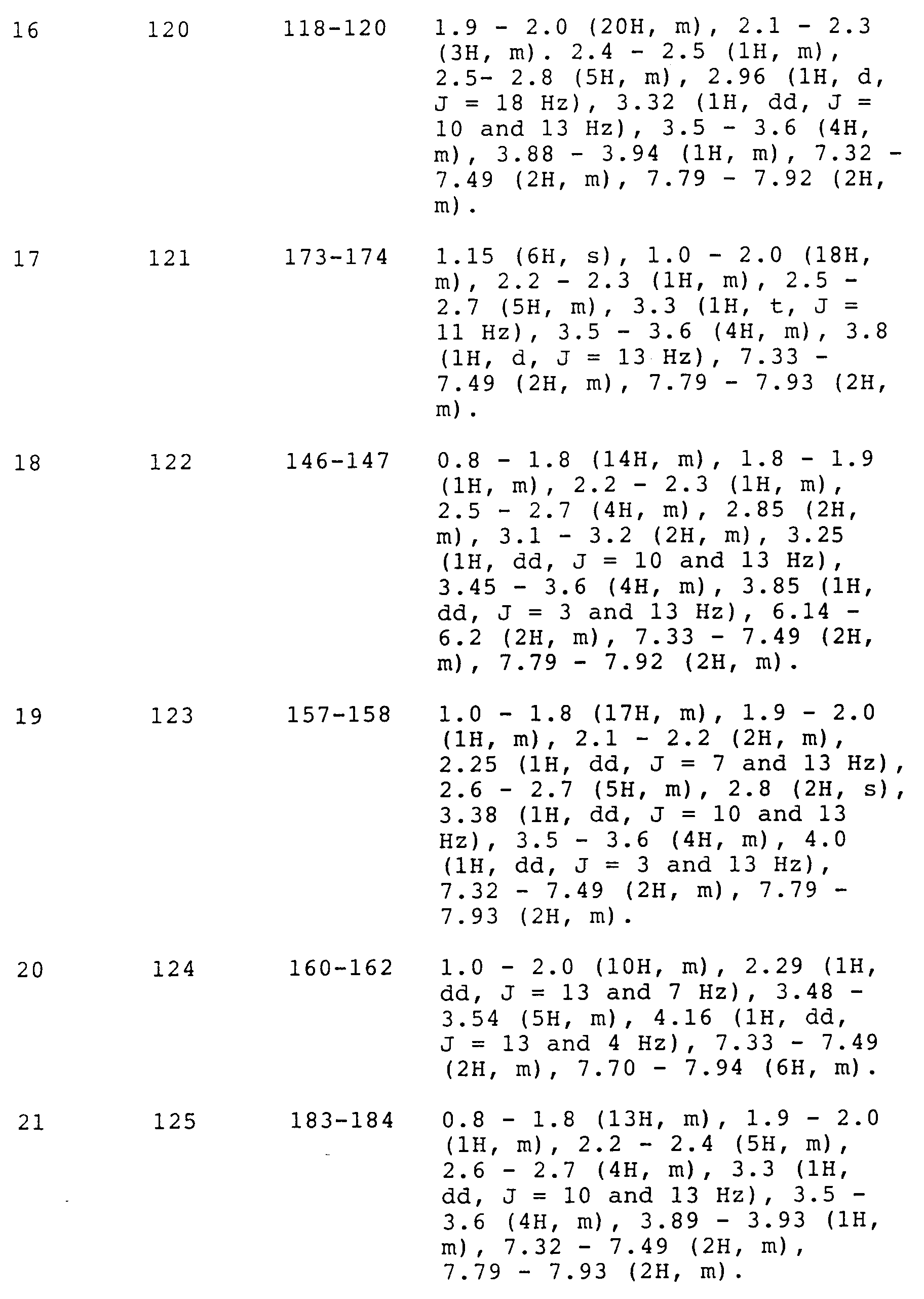


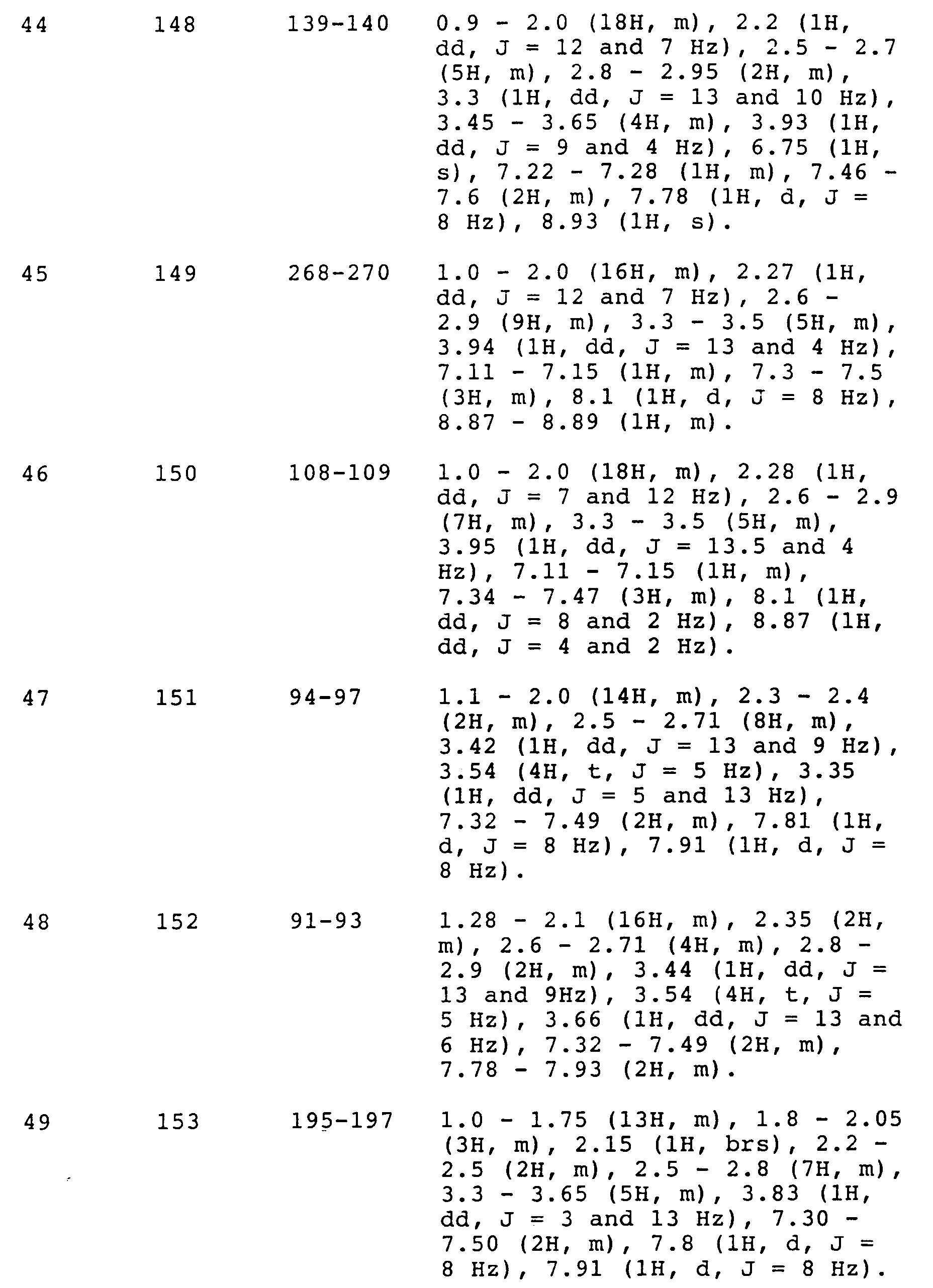


Claims (11)
- An imide compound of the formula:

Z is a group of the formula:
D is a group of the formula:
-(CH₂)p-A-(CH₂)q-
in which A is a non-aromatic hydrocarbon ring optionally bridged with a lower alkylene group or an oxygen atom, said non-aromatic hydrocarbon ring and said lower alkylene group being each optionally substituted with at least one lower alkyl, and p and q are each an integer of 0, 1 or 2; and
Ar is an aromatic group, a heterocyclic aromatic group, a benzoyl group, a phenoxy group or a phenylthio group and G is

and its acid addition salts. - The imide compound according to claim 1, wherein Ar is a bicyclic heterocyclic aromatic group, a naphthyl group, a benzoyl group, a phenoxy group or a phenylthio group and G is


- The imide compound according to claim 1, wherein Ar is a bicyclic heterocyclic aromatic group, of which one ring is a benzene ring, a naphthyl group, a benzoyl group, a phenoxy group or a phenylthio group, all of the above groups being each optionally substituted with at least one of lower alkyl, lower alkoxy and halogen, and G is

- The imide compound according to claim 1, wherein Z is one of the following formulas:


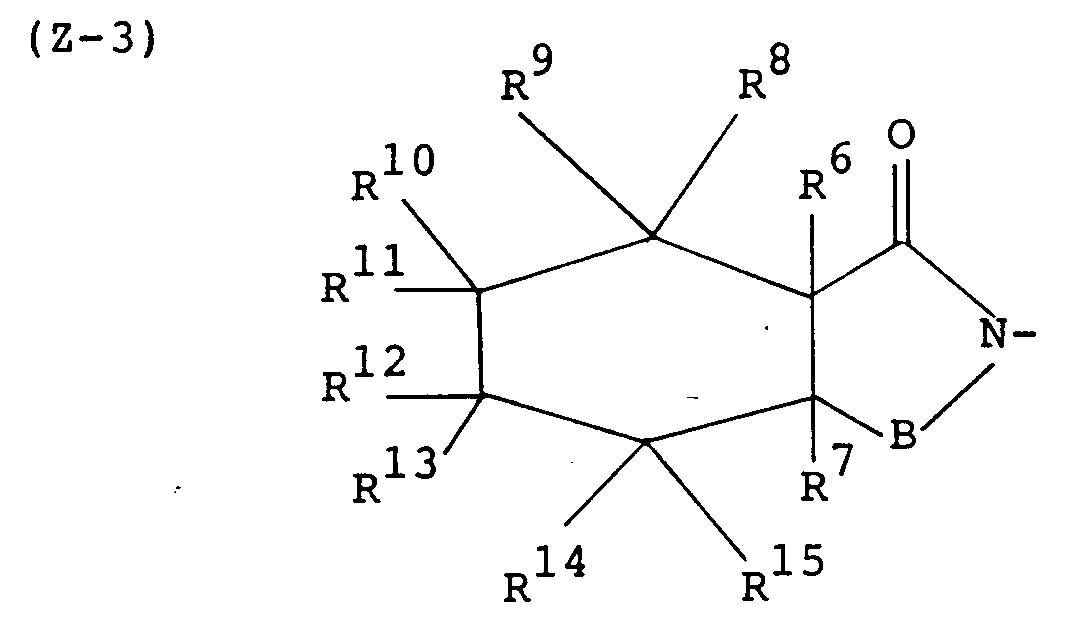


- A process for preparing the imide compound according to claim 1, which comprises:(a) reacting a compound of the formula:

Z-H
wherein Z is as defined in claim 1 to give a compound of the formula: (b) reacting a compound of the formula:
Z-CH₂-(CH₂)₁-A-(CH₂)m-CH₂X
wherein A, X, Z, l and m are each as defined in claim 1 with a compound of the formula:
 (c) reacting a compound of the formula:
Z-D-X
wherein D, X and Z are each as defined in claim 1 with a compound of the formula:
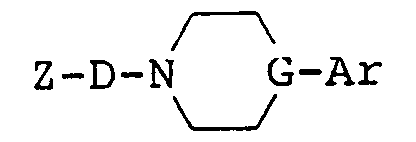 (d) reacting a compound of the formula:
Z-H
wherein Z is as defined in claim 1 to give a compound of the formula:
- A pharmaceutical composition which comprises as an active ingredient a pharmaceutically effective amount of the imide compound according to claim 1, and a pharmaceutically acceptable inert carrier or diluent.
- The composition according to claim 6 which has an antipsychotic activity.
- The composition according to claim 6 which has a neuroleptic activity.
- Use of the compound according to claim 1 for preparation of a pharmaceutical composition.
- Use according to claim 9 wherein the composition has an antipsychotic acitivity.
- Use according to claim 9 wherein the composition has a neuroleptic activity.
Applications Claiming Priority (2)
| Application Number | Priority Date | Filing Date | Title |
|---|---|---|---|
| JP18027190 | 1990-07-06 | ||
| JP180271/90 | 1990-07-06 |
Publications (2)
| Publication Number | Publication Date |
|---|---|
| EP0464846A1 true EP0464846A1 (en) | 1992-01-08 |
| EP0464846B1 EP0464846B1 (en) | 1998-04-22 |
Family
ID=16080314
Family Applications (1)
| Application Number | Title | Priority Date | Filing Date |
|---|---|---|---|
| EP91111223A Expired - Lifetime EP0464846B1 (en) | 1990-07-06 | 1991-07-05 | Imide derivatives, and their production and use |
Country Status (9)
| Country | Link |
|---|---|
| US (2) | US5532372A (en) |
| EP (1) | EP0464846B1 (en) |
| JP (1) | JP2800953B2 (en) |
| AT (1) | ATE165359T1 (en) |
| CA (1) | CA2046429C (en) |
| DE (2) | DE69129282T4 (en) |
| DK (1) | DK0464846T3 (en) |
| ES (1) | ES2115599T3 (en) |
| GR (1) | GR3026697T3 (en) |
Cited By (26)
| Publication number | Priority date | Publication date | Assignee | Title |
|---|---|---|---|---|
| WO1993016073A1 (en) * | 1992-02-12 | 1993-08-19 | The Wellcome Foundation Limited | Piperazine and piperidine derivatives, and their use as antipsychotics |
| US5550130A (en) * | 1989-05-19 | 1996-08-27 | Hoechst-Roussel Pharmaceuticals, Inc. | 1-[(1,4-benzodioxanyl)alkyl]-4-(heteroaryl)piperidines and related compounds and their therapeutic utility |
| US5561128A (en) * | 1989-05-19 | 1996-10-01 | Hoechst-Roussel Pharmaceuticals, Inc. | N-[(4-(heteroaryl)-1-piperidinyl)alkyl]-10,11-dihydro-5H-dibenz[B,F]azepines and related compounds and their therapeutic utility |
| US5658911A (en) * | 1989-05-19 | 1997-08-19 | Hoechst Marion Roussel, Inc. | Heteroarylpiperidines, and their use as antipsychotics and analgetics |
| US6274593B1 (en) | 1997-05-01 | 2001-08-14 | Smithkline Beecham P.L.C. | Substituted tetrahydro isoquinolines as modulators of dopamine D3 receptors |
| US6414154B1 (en) | 1998-05-20 | 2002-07-02 | Smithkline Beecham P.L.C. | Tetraisoquinoline derivatives as modulators of dopamine D3 receptors |
| WO2004017973A1 (en) * | 2002-08-22 | 2004-03-04 | Sumitomo Pharmaceuticals Company, Limited | Remedy for integration dysfunction syndrome |
| WO2008124030A1 (en) | 2007-04-04 | 2008-10-16 | Merck & Co., Inc. | Therapeutic agents |
| WO2011002103A3 (en) * | 2009-07-02 | 2011-04-28 | Dainippon Sumitomo Pharma Co., Ltd. | A cycloalkane derivative |
| US20110263847A1 (en) * | 2010-04-26 | 2011-10-27 | Dainippon Sumitomo Pharma Co, Ltd. | Process of a quaternary ammonium salt |
| KR101113630B1 (en) * | 2003-06-23 | 2012-02-13 | 다이닛본 스미토모 세이야꾸 가부시끼가이샤 | Therapeutic agent for senile dementia |
| US8258139B2 (en) | 2010-11-08 | 2012-09-04 | Dainippon Sumitomo Pharma Co., Ltd. | Method of treatment for mental disorders |
| US8283352B2 (en) * | 2005-06-13 | 2012-10-09 | Dainippon Sumitomo Pharma Co., Ltd. | Solubilization preparation |
| CN102731512A (en) * | 2011-04-12 | 2012-10-17 | 天津药物研究院 | Preparation method of lurasidone intermediate and lurasidone |
| CN102746289A (en) * | 2012-04-28 | 2012-10-24 | 上海医药工业研究院 | Preparation method for lurasidone hydrochloride |
| WO2012107890A3 (en) * | 2011-02-10 | 2012-11-01 | Ranbaxy Laboratories Limited | Crystal forms of lurasidone chlorhydrate |
| WO2013014665A1 (en) * | 2011-07-28 | 2013-01-31 | Mapi Pharma Ltd. | Intermediate compounds and process for the preparation of lurasidone and salts thereof |
| CN102911169A (en) * | 2011-08-02 | 2013-02-06 | 上海医药工业研究院 | Method for preparing lurasidone |
| EP2563791A4 (en) * | 2010-04-26 | 2013-05-29 | Dainippon Sumitomo Pharma Co | PROCESS FOR A QUATERNARY AMMONIA SALT USING A PHOSPHATE |
| CN103130795A (en) * | 2011-12-02 | 2013-06-05 | 苏州二叶制药有限公司 | Lurasidone HCl crystal A and purpose thereof |
| US8835438B2 (en) | 2004-02-20 | 2014-09-16 | Sumitomo Dainippon Pharma Co., Ltd. | Method of treating memory/learning dysfunctions caused by schizophrenia with lurasidone |
| CN104394866A (en) * | 2012-04-26 | 2015-03-04 | 大日本住友制药株式会社 | Medicament for treating mental and behavioural disorders |
| WO2015081920A1 (en) | 2013-12-06 | 2015-06-11 | Zentiva, K.S. | Process for preparing lurasidone and intermediate thereof |
| US9409899B2 (en) | 2012-02-13 | 2016-08-09 | Cadila Healthcare Limited | Process for preparing benzisothiazol-3-yl-piperazin-1-yl-methyl-cyclo hexylmethanisoindol-1,3-dione and its intermediates |
| WO2023135528A1 (en) | 2022-01-11 | 2023-07-20 | Suven Life Sciences Limited | Heteroalicyclic derivatives and their use in the treatment of cns disorders |
| US12304906B2 (en) | 2019-12-24 | 2025-05-20 | Zhejiang Huahai Pharmaceutical Co., Ltd. | Method for preparing lurasidone hydrochloride |
Families Citing this family (73)
| Publication number | Priority date | Publication date | Assignee | Title |
|---|---|---|---|---|
| TW421649B (en) * | 1995-01-31 | 2001-02-11 | Janssen Pharmaceutica Nv | 4-(1H-indol-1yl)-1-piperidinyl derivatives |
| US5795909A (en) * | 1996-05-22 | 1998-08-18 | Neuromedica, Inc. | DHA-pharmaceutical agent conjugates of taxanes |
| US6576636B2 (en) * | 1996-05-22 | 2003-06-10 | Protarga, Inc. | Method of treating a liver disorder with fatty acid-antiviral agent conjugates |
| JPH10204012A (en) * | 1997-01-24 | 1998-08-04 | Daicel Chem Ind Ltd | 3-hydroxymethyl cycloalkanol and its production |
| US6225444B1 (en) | 1998-02-10 | 2001-05-01 | Protarga, Inc. | Neuroprotective peptides and uses thereof |
| US7235583B1 (en) * | 1999-03-09 | 2007-06-26 | Luitpold Pharmaceuticals, Inc., | Fatty acid-anticancer conjugates and uses thereof |
| JP2004509072A (en) * | 2000-06-28 | 2004-03-25 | ブリストル−マイヤーズ スクイブ カンパニー | Selective androgen receptor modulators and methods for their identification, design and use |
| US20040077605A1 (en) | 2001-06-20 | 2004-04-22 | Salvati Mark E. | Fused heterocyclic succinimide compounds and analogs thereof, modulators of nuclear hormone receptor function |
| US7001911B2 (en) * | 2000-06-28 | 2006-02-21 | Bristol-Myers Squibb Company | Fused cyclic modulators of nuclear hormone receptor function |
| EP1854798A3 (en) * | 2000-09-19 | 2007-11-28 | Bristol-Myers Squibb Company | Fused heterocyclic succinimide compounds and analogs thereof, modulators of nuclear hormone receptor function |
| JP4868695B2 (en) | 2000-09-22 | 2012-02-01 | 大日本住友製薬株式会社 | Oral preparation with good disintegration |
| US20040087548A1 (en) * | 2001-02-27 | 2004-05-06 | Salvati Mark E. | Fused cyclic succinimide compounds and analogs thereof, modulators of nuclear hormone receptor function |
| US8552054B2 (en) | 2001-03-23 | 2013-10-08 | Luitpold Pharmaceuticals, Inc. | Fatty amine drug conjugates |
| JP4634694B2 (en) * | 2001-03-23 | 2011-02-16 | ルイトポルド・ファーマシューティカルズ・インコーポレーテッド | Fatty alcohol drug complex |
| AU2002364082A1 (en) * | 2001-12-19 | 2003-07-09 | Bristol-Myers Squibb Company | Fused heterocyclic compounds and analogs thereof: modulators of nuclear hormone receptor function |
| JP3977162B2 (en) * | 2002-06-21 | 2007-09-19 | 株式会社バンダイナムコゲームス | Character information management device, program, and information storage medium |
| JP4610485B2 (en) * | 2003-07-29 | 2011-01-12 | 大日本住友製薬株式会社 | Method for producing imide compound |
| KR100578104B1 (en) * | 2003-12-16 | 2006-05-10 | 한국과학기술원 | Formation method of cobalt disilicide epi layer using cobalt-nitrogen thin film |
| JP4708012B2 (en) * | 2004-12-15 | 2011-06-22 | 大日本住友製薬株式会社 | Method for producing quaternary ammonium salt |
| JP2006169154A (en) * | 2004-12-15 | 2006-06-29 | Sumitomo Chemical Co Ltd | Method for producing quaternary ammonium salt |
| JP4799892B2 (en) * | 2005-03-31 | 2011-10-26 | 住友化学株式会社 | Cyclohexane derivative and method for producing the same |
| DK1884242T3 (en) * | 2005-05-26 | 2013-05-06 | Dainippon Sumitomo Pharma Co | PHARMACEUTICAL COMPOSITION COMPREHENSIVE LURASIDON |
| US20090076027A1 (en) * | 2007-09-17 | 2009-03-19 | Protia, Llc | Deuterium-enriched lurasidone |
| JP5401327B2 (en) | 2008-02-11 | 2014-01-29 | 大日本住友製薬株式会社 | Tablets with improved dissolution |
| US20110124659A1 (en) * | 2009-11-17 | 2011-05-26 | Dainippon Sumitomo Pharma Co., Ltd. | Cycloalkane derivative |
| JP5317939B2 (en) * | 2009-12-02 | 2013-10-16 | 住友化学株式会社 | Method for producing alcohol compound |
| WO2011093522A1 (en) * | 2010-01-28 | 2011-08-04 | Dainippon Sumitomo Pharma Co., Ltd. | A cycloalkane derivative |
| US8735397B2 (en) | 2010-03-29 | 2014-05-27 | Vanderbilt University | Method for treating schizophrenia and related diseases |
| CN107595771A (en) * | 2010-10-18 | 2018-01-19 | 大日本住友制药株式会社 | Injectable sustained release preparation |
| DK3034079T3 (en) | 2010-11-15 | 2018-02-05 | Agenebio Inc | PYRIDAZINE DERIVATIVES, COMPOSITIONS AND PROCEDURES FOR TREATING COGNITIVE WEAKNESS |
| WO2012123858A1 (en) | 2011-03-14 | 2012-09-20 | Ranbaxy Laboratories Limited | Amorphous lurasidone hydrochloride |
| US9034867B2 (en) | 2011-03-18 | 2015-05-19 | Alkermes Pharma Ireland Limited | Pharmaceutical compositions comprising sorbitan esters |
| CA2831703A1 (en) | 2011-04-01 | 2012-10-04 | Ranbaxy Laboratories Limited | Process for the preparation of an antipsychotic agent |
| US9433620B2 (en) | 2011-05-13 | 2016-09-06 | Cadila Healthcare Limited | Pharmaceutical compositions of lurasidone |
| WO2013030722A1 (en) | 2011-08-26 | 2013-03-07 | Ranbaxy Laboratories Limited | Crystalline lurasidone hydrochloride |
| CN103130794B (en) * | 2011-12-02 | 2016-06-22 | 苏州二叶制药有限公司 | The preparation method of the crystal A of Lurasidone keto hydrochloride |
| JP6219918B2 (en) * | 2012-03-19 | 2017-10-25 | アルカームス ファーマ アイルランド リミテッド | Pharmaceutical composition comprising glycerol ester |
| WO2013142198A1 (en) | 2012-03-19 | 2013-09-26 | Alkermes Pharma Ireland Limited | Pharmaaceutical compositions comprising fatty acid esters |
| WO2013142205A1 (en) | 2012-03-19 | 2013-09-26 | Alkermes Pharma Ireland Limited | Pharmaceutical compositions comprising benzyl alcohol |
| CN103360383B (en) * | 2012-04-11 | 2016-07-06 | 上海医药工业研究院 | Crystal form B of Lurasidone HCl and preparation method thereof |
| CN103450172A (en) * | 2012-05-30 | 2013-12-18 | 广州药源生物医药科技有限公司 | Preparation method of antipsychotic drug lurasidone |
| WO2013190455A2 (en) * | 2012-06-18 | 2013-12-27 | Shasun Pharmaceuticals Limited | Process for the preparation of lurasidone hydrochloride |
| US9580414B2 (en) * | 2012-07-18 | 2017-02-28 | Shasun Pharmaceuticals Limited | Salts and hydrates of antipsychotics |
| WO2014037886A1 (en) | 2012-09-04 | 2014-03-13 | Ranbaxy Laboratories Limited | Process for the preparation of lurasidone hydrochloride |
| EP3718536A1 (en) | 2012-09-19 | 2020-10-07 | Alkermes Pharma Ireland Limited | Pharmaceutical compositions having improved storage stability |
| CN102827157A (en) * | 2012-09-20 | 2012-12-19 | 北京哈三联科技股份有限公司 | Method for preparing lurasidone |
| WO2014064714A2 (en) * | 2012-10-22 | 2014-05-01 | Glenmark Pharmaceuticals Limited; Glenmark Generics Limited | Process for preparation of lurasidone hydrochloride |
| WO2014078568A1 (en) | 2012-11-14 | 2014-05-22 | The Johns Hopkins University | Methods and compositions for treating schizophrenia |
| CN103864774B (en) * | 2012-12-14 | 2016-09-28 | 成都弘达药业有限公司 | A kind of preparation method of Lurasidone |
| WO2014102808A1 (en) | 2012-12-25 | 2014-07-03 | Lee Pharma Limited | A process for preparation of trans (lr,2r)-cyclo hexane 1, 2-dicarboxylic acid |
| WO2014102834A2 (en) * | 2012-12-31 | 2014-07-03 | Hetero Research Foundation | Process for lurasidone |
| ITMI20130262A1 (en) * | 2013-02-22 | 2014-08-23 | Edmond Pharma Srl | PROCEDURE FOR THE PREPARATION OF CHLORIDATED LURASIDONE |
| CN109705112A (en) * | 2013-03-06 | 2019-05-03 | 江苏恩华药业股份有限公司 | The preparation method of the novel crystal forms of Lurasidone HCl |
| CN104513182A (en) * | 2013-10-08 | 2015-04-15 | 无锡万全医药技术有限公司 | Method for preparing (1R,2R)-1,2-cyclohexanedimethanol disulfonate |
| ITMI20131737A1 (en) | 2013-10-17 | 2015-04-18 | Procos Spa | PROCESS FOR THE INDUSTRIAL SYNTHESIS OF LURASIDONE |
| CN112409363B (en) | 2013-12-20 | 2023-11-14 | 艾吉因生物股份有限公司 | Benzodiazepine derivatives, compositions and methods for the treatment of cognitive impairment |
| EP3119399A4 (en) | 2014-03-20 | 2017-09-27 | Alkermes Pharma Ireland Limited | Aripiprazole formulations having increased injection speeds |
| CA2951917C (en) | 2014-06-16 | 2019-09-24 | Johnson Matthey Public Limited Company | Processes for making alkylated arylpiperazine and alkylated arylpiperidine compounds including novel intermediates |
| WO2016012898A1 (en) | 2014-07-25 | 2016-01-28 | Lupin Limited | Oral pharmaceutical composition of lurasidone |
| WO2016059649A1 (en) | 2014-10-14 | 2016-04-21 | Jubilant Generics Limited (Formerly Jubilant Life Sciences Division) | An improved process for the preparation of lurasidone hydrochloride |
| CN113185508A (en) * | 2015-04-21 | 2021-07-30 | 上海医药集团股份有限公司 | Method for preparing lurasidone with high purity and high yield |
| WO2016205739A1 (en) | 2015-06-19 | 2016-12-22 | Belew Mekonnen | Benzodiazepine derivatives, compositions, and methods for treating cognitive impairment |
| WO2018015915A1 (en) | 2016-07-22 | 2018-01-25 | Cadila Healthcare Limited | A parenteral controlled release composition of an atypical antipsychotic agent |
| US20180170941A1 (en) | 2016-12-19 | 2018-06-21 | Agenebio, Inc. | Benzodiazepine derivatives, compositions, and methods for treating cognitive impairment |
| US11505555B2 (en) | 2016-12-19 | 2022-11-22 | Agenebio, Inc. | Benzodiazepine derivatives, compositions, and methods for treating cognitive impairment |
| CN110114063B (en) | 2017-01-06 | 2022-01-11 | 广东东阳光药业有限公司 | Lurasidone solid dispersion and preparation method thereof |
| JPWO2019167977A1 (en) | 2018-02-28 | 2021-02-04 | 大日本住友製薬株式会社 | Aqueous suspension type pharmaceutical preparation |
| SG11202008233WA (en) | 2018-02-28 | 2020-09-29 | Sumitomo Dainippon Pharma Co Ltd | Aqueous suspension pharmaceutical preparation with controlled dissolution |
| CA3092335A1 (en) | 2018-03-05 | 2019-09-12 | Alkermes Pharma Ireland Limited | Aripiprazole dosing strategy |
| BR112020026062B1 (en) | 2018-06-19 | 2023-04-04 | Agenebio, Inc | COMPOUNDS DERIVATIVES OF BENZODIAZEPINE OR A PHARMACEUTICALLY ACCEPTABLE SALT, ISOMER OR COMBINATION THEREOF, PHARMACEUTICAL COMPOSITION COMPRISING THEM AND USES THEREOF FOR THE TREATMENT OF COGNITIVE IMPAIRMENT, BRAIN CANCER AND PSYCHOSIS OF PARKINSON'S DISEASE |
| US20240132513A1 (en) | 2022-08-19 | 2024-04-25 | Agenebio, Inc. | Benzazepine derivatives, compositions, and methods for treating cognitive impairment |
| CN117285530B (en) * | 2023-08-03 | 2026-01-16 | 迪嘉药业集团股份有限公司 | A novel method for preparing lurasidone hydrochloride |
| WO2026089567A1 (en) * | 2024-10-25 | 2026-04-30 | 주식회사 비보존 | Heterocyclic compound and use thereof |
Citations (5)
| Publication number | Priority date | Publication date | Assignee | Title |
|---|---|---|---|---|
| EP0009465A1 (en) * | 1978-09-20 | 1980-04-02 | Ciba-Geigy Ag | N-(1-(4-amino-2-quinazolinyl)-3 or 4-piperidyl lactames, process for their preparation and pharmaceutical compositions containing them |
| DE3422411A1 (en) * | 1983-06-27 | 1985-01-03 | Sandoz-Patent-GmbH, 7850 Lörrach | SPIROSUCCINIMIDES, THEIR PRODUCTION AND USE |
| EP0196096A2 (en) * | 1985-03-27 | 1986-10-01 | Sumitomo Pharmaceuticals Company, Limited | Imide derivatives, their production and use |
| EP0261688A1 (en) * | 1986-09-26 | 1988-03-30 | Sumitomo Pharmaceuticals Company, Limited | Imide derivatives, and their production and use |
| EP0314098A2 (en) * | 1987-10-26 | 1989-05-03 | Sumitomo Pharmaceuticals Company, Limited | Imide derivatives, their production and use |
Family Cites Families (8)
| Publication number | Priority date | Publication date | Assignee | Title |
|---|---|---|---|---|
| FR2421900A1 (en) * | 1977-03-17 | 1979-11-02 | Sauba Lab | PIPERAZINO-3-INDOLES, THEIR PREPARATION PROCESS AND THEIR THERAPEUTIC APPLICATIONS |
| US4355037A (en) * | 1981-11-12 | 1982-10-19 | Hoechst-Roussel Pharmaceuticals | 3-(4-Piperidyl)-1,2-benzisoxales |
| US4411901A (en) * | 1981-12-23 | 1983-10-25 | Mead Johnson & Company | Benzisothiazole and benzisoxazole piperazine derivatives |
| US4507303A (en) * | 1981-12-22 | 1985-03-26 | Sumitomo Chemical Company, Limited | Succinimide derivatives, compositions and method of use |
| JPS5976059A (en) * | 1982-10-21 | 1984-04-28 | Sumitomo Chem Co Ltd | Cyclic imide derivative and its acid addition salt |
| US4590196A (en) * | 1984-08-23 | 1986-05-20 | Bristol-Myers Company | Analgesic 1,2-benzisothiazol-3-ylpiperazine derivatives |
| JPS61238784A (en) * | 1985-04-17 | 1986-10-24 | Sumitomo Seiyaku Kk | Succinimide derivative and its acid adduct |
| US4656173A (en) * | 1985-04-24 | 1987-04-07 | Bristol-Myers Company | Antipsychotic benzisothiazole S-oxide compound |
-
1991
- 1991-06-27 JP JP3183640A patent/JP2800953B2/en not_active Expired - Lifetime
- 1991-07-05 CA CA002046429A patent/CA2046429C/en not_active Expired - Lifetime
- 1991-07-05 DE DE69129282T patent/DE69129282T4/en not_active Expired - Lifetime
- 1991-07-05 AT AT91111223T patent/ATE165359T1/en not_active IP Right Cessation
- 1991-07-05 DE DE69129282A patent/DE69129282D1/en not_active Expired - Lifetime
- 1991-07-05 EP EP91111223A patent/EP0464846B1/en not_active Expired - Lifetime
- 1991-07-05 DK DK91111223T patent/DK0464846T3/en active
- 1991-07-05 ES ES91111223T patent/ES2115599T3/en not_active Expired - Lifetime
-
1993
- 1993-08-30 US US08/113,320 patent/US5532372A/en not_active Expired - Lifetime
-
1996
- 1996-04-18 US US08/634,738 patent/US5780632A/en not_active Expired - Lifetime
-
1998
- 1998-04-23 GR GR980400561T patent/GR3026697T3/en unknown
Patent Citations (6)
| Publication number | Priority date | Publication date | Assignee | Title |
|---|---|---|---|---|
| EP0009465A1 (en) * | 1978-09-20 | 1980-04-02 | Ciba-Geigy Ag | N-(1-(4-amino-2-quinazolinyl)-3 or 4-piperidyl lactames, process for their preparation and pharmaceutical compositions containing them |
| DE3422411A1 (en) * | 1983-06-27 | 1985-01-03 | Sandoz-Patent-GmbH, 7850 Lörrach | SPIROSUCCINIMIDES, THEIR PRODUCTION AND USE |
| EP0196096A2 (en) * | 1985-03-27 | 1986-10-01 | Sumitomo Pharmaceuticals Company, Limited | Imide derivatives, their production and use |
| US4745117A (en) * | 1985-03-27 | 1988-05-17 | Sumitomo Pharmaceuticals Company, Limited | Imide derivatives and compositions for use as antipsychotic agents |
| EP0261688A1 (en) * | 1986-09-26 | 1988-03-30 | Sumitomo Pharmaceuticals Company, Limited | Imide derivatives, and their production and use |
| EP0314098A2 (en) * | 1987-10-26 | 1989-05-03 | Sumitomo Pharmaceuticals Company, Limited | Imide derivatives, their production and use |
Non-Patent Citations (1)
| Title |
|---|
| CHEMICAL ABSTRACTS, vol. 78, No. 9, March 5, 1973, Columbus, Ohio, USA GRUNDSTROM, KERSTIN et al. "Cyclopropane analogs to acetylenic oxotremorine antagonists" page 498, column 2, abstract -No. 58 177q * |
Cited By (114)
| Publication number | Priority date | Publication date | Assignee | Title |
|---|---|---|---|---|
| US5977113A (en) * | 1989-05-19 | 1999-11-02 | Hoechst Marion Roussel, Inc. | 4-heteroaryl-1-piperazine alkylamines and their therapeutic utility |
| US5571814A (en) * | 1989-05-19 | 1996-11-05 | Hoechst-Roussel Pharmaceuticals, Inc. | N-[(4-heteroaryl-1-pyrrolidinyl)alkyl]phthalimides and related compounds and their therapeutic utility |
| US5552414A (en) * | 1989-05-19 | 1996-09-03 | Hoechst-Roussel Pharmaceuticals, Inc. | 1-(1H-indolyloxyalkyl)-4-(heteroaryl) piperidines and related compounds useful as antipsychotics and analgesics |
| US5554614A (en) * | 1989-05-19 | 1996-09-10 | Hoechst-Roussel Pharmaceuticals, Inc. | 2-[(4-heteroaryl-1-piperazinyl)alkyl]-1,3-dioxanes and related compounds and their therapeutic utility |
| US5556858A (en) * | 1989-05-19 | 1996-09-17 | Hoechst-Roussel Pharmaceuticals, Inc. | Cis-2-[(4-heteroaryl-1-piperazinyl)alkyl] hexahydro-1H-isoindole-1,3 (2H)-diones and related compounds and their therapeutic utility |
| US5559117A (en) * | 1989-05-19 | 1996-09-24 | Hoechst-Roussel Pharmaceuticals, Inc. | N-[(4-heteroaryl-1-piperazinyl) alkyl]-2-Benoxazolinines and related compounds and their therapeutic utility |
| US5559116A (en) * | 1989-05-19 | 1996-09-24 | Hoechst-Roussel Pharmaceuticals, Inc. | N-[(4-heteroaryl-1-piperazinyl) alkyl]-1H-benz[de]isoquinoline-1,3 (2H-)-diones and related compounds and their therapeutic utility |
| US5559126A (en) * | 1989-05-19 | 1996-09-24 | Hoechst-Roussel Pharmaceuticals, Inc. | 1-[(1,4-benodioxanyl)alkyl]-4-(heteroaryl)piperidines and related compounds and their therapeutic utility |
| US5561128A (en) * | 1989-05-19 | 1996-10-01 | Hoechst-Roussel Pharmaceuticals, Inc. | N-[(4-(heteroaryl)-1-piperidinyl)alkyl]-10,11-dihydro-5H-dibenz[B,F]azepines and related compounds and their therapeutic utility |
| US5569653A (en) * | 1989-05-19 | 1996-10-29 | Hoechst-Roussel Pharmaceuticals, Inc. | N-[(4-(heteroaryl)-1-pyrrolidinyl)alkyl]-10,11-dihydro-5H-dibenz[B,F]azepines and related compounds and their therapeutic utility |
| US5998417A (en) * | 1989-05-19 | 1999-12-07 | Hoechst Marion Roussel, Inc. | N-[(4-heteroaryl-1-piperazinyl) alkyl]phthalimides and related compounds and their therapeutic utility |
| US5571828A (en) * | 1989-05-19 | 1996-11-05 | Hoechst-Roussel Pharmaceuticals, Inc. | N-[(3-heteroaryl-1-pyrrolidinyl)alkyl]-2,3-napthalimides and related compounds and their therapeutic utility |
| US5574032A (en) * | 1989-05-19 | 1996-11-12 | Hoechst-Roussel Pharmaceuticals, Inc. | N-[(4-(heteroaryl)-1-piperazinyl)alkyl]-10,11-dihydro-5H-dibenz[BFS]azepines and related compounds and their therapeutic utility |
| US5578624A (en) * | 1989-05-19 | 1996-11-26 | Hoechst-Roussel Pharmaceuticals, Inc. | Heteroarylpyrrolidines and their use as antipsychotics and analgesics |
| US5578605A (en) * | 1989-05-19 | 1996-11-26 | Hoechst-Roussel Pharmaceuticals, Inc. | N-[(4-heteroaryl)-1-piperidinyl)alkyl]-1,2,3,4-tetrahydroquinolines and related compounds and their therapeutic utility |
| US5580875A (en) * | 1989-05-19 | 1996-12-03 | Hoechst-Roussel Pharmaceuticals, Inc. | 1-[(2-pyrimidinyloxy)alkyl]-3-(heteroaryl)pyrrolidines and related compounds and therapeutic utility |
| US5580890A (en) * | 1989-05-19 | 1996-12-03 | Hoechst-Roussel Pharmaceuticals, Inc. | Heteroarylpyrrolidines and their use as antipsychotics and analgesics |
| US5580891A (en) * | 1989-05-19 | 1996-12-03 | Hoechst-Roussel Pharmaceuticals, Inc. | N-[heteroaryl-1-pyrrolidinyl)alkyl]-2-benoxazolinones and related compounds and their therapeutic utility |
| US5580886A (en) * | 1989-05-19 | 1996-12-03 | Hoechst-Roussel Pharmaceuticals, Inc. | Cis-2-[(4-heteroaryl-1-piperidinyl)alkyl]hexahydro-1H-isoindole-1,3(2H)-diones and related compounds and their therapeutic utility |
| US5580887A (en) * | 1989-05-19 | 1996-12-03 | Hoechst-Roussel Pharmaceuticals, Inc. | 1- (arylthioalkyl , arylaminoalkyl or arylmethylenealkyl) -4- (heteroaryl) piperidines and related compounds useful as anti-psychotics and analgesics |
| US5580879A (en) * | 1989-05-19 | 1996-12-03 | Hoechst-Roussel Pharmaceuticals, Inc. | N-[(4-heteroaryl-1-pyrrolidinyl)alkyl]-1H-benz[DE]isoquinoline-1;3(2H)-diones and related compounds and their therapeutic utility |
| US5583145A (en) * | 1989-05-19 | 1996-12-10 | Hoechst-Rousell Pharmaceuticals, Inc. | 1-(arylthioalkyl, arylaminoalkyl, or arylmethylenealkyl)-4-(heteroaryl)piperazines and related compounds useful as antipsychotics and analgesics |
| US5589494A (en) * | 1989-05-19 | 1996-12-31 | Hoechst-Roussel Pharmaceuticals, Inc. | 2-[(3-heteroaryl-1-pyrrolidinyl)alkyl]-1,3-dioxanes and related compounds and their therapeutic utility |
| US5589495A (en) * | 1989-05-19 | 1996-12-31 | Hoechst Marion Roussel, Inc. | 2-[(3-heteroaryl-1-pyrrolidinyl)alkyl]-1,3- indandiones and related compounds and their therapeutic utility |
| US5589488A (en) * | 1989-05-19 | 1996-12-31 | Hoechst-Roussel Pharmaceuticals, Inc. | N-[(4-heteroaryl-1-piperidinyl)alkyl]-2-benzoxazolinones and related compounds and their therapeutic utility |
| US5591745A (en) * | 1989-05-19 | 1997-01-07 | Hoechst-Roussel Pharmaceuticals, Inc. | (4-heteroaryl)-1-[(2,3-dihydro-1H-isoindol-2-yl)alkyl] piperidines and related compounds and their therapeutic utility |
| US5593995A (en) * | 1989-05-19 | 1997-01-14 | Hoechst-Roussel Pharmaceuticals, Inc. | 2-[(4-heteroaryl-1-piperazinyl)alkyl]-1,3-indandiones and related compounds and their therapeutic utility |
| US5597842A (en) * | 1989-05-19 | 1997-01-28 | Hoechst-Roussel Pharmaceuticals, Inc. | 3-heteroaryl-1-pyrrolidinealkanols and derivatives thereof and their therapeutic utility |
| US5599821A (en) * | 1989-05-19 | 1997-02-04 | Hoechst-Roussel Pharmaceuticals, Inc. | 4-heteroaryl-1-piperidinealkylamines and derivatives thereof and their therapeutic utility |
| US5607945A (en) * | 1989-05-19 | 1997-03-04 | Hoechst-Roussel Pharmaceuticals, Inc. | N-[(4-(heteroaryl)-1-piperidinyl)alkyl]-1,2,3,4-tetrahydroisoquinolines and related compounds and their therapeutic utility |
| US5612343A (en) * | 1989-05-19 | 1997-03-18 | Hoechst Marion Roussel, Inc. | N-[(4-heteroaryl-1-piperazinyl)alkyl]-2,3-naphthalimides and related compounds and their therapeutic utility |
| US5614543A (en) * | 1989-05-19 | 1997-03-25 | Hoechst Marion Roussel, Inc. | 1-(aryloxyalkyl)-3- (heteroaryl) pyrrolidines and related compounds useful as antipsychotics and analgesics |
| US5624927A (en) * | 1989-05-19 | 1997-04-29 | Hoechst Marion Roussel, Inc. | N-[4-(heteroaryl)-1-piperazinyl)alkyl]-1,2,3,4-tetrahydroisoquinolines and n-[4(heteroaryl)-1-piperazinyl)alkyl]-1,2,3,4-tetrahydroisoquinolines, related compounds and their therapeutic utility |
| US5629326A (en) * | 1989-05-19 | 1997-05-13 | Hoechst-Marion-Roussel, Inc. | 4-(heteroaryl)-1-[(2,3-dihydro-1H-indol-1-yl)alkyl]piperidines and related compounds and their therapeutic utility |
| US5637710A (en) * | 1989-05-19 | 1997-06-10 | Hoechst Marion Roussel, Inc. | Intermediate compounds in the synthesis of heteroarylpiperidines and piperazines |
| US5639764A (en) * | 1989-05-19 | 1997-06-17 | Hoechst-Marion-Roussel, Inc. | 2-[(4-heteroaryl)-1-piperidinyl)alkyl]-1,3-indandiones and related compound and their therapeutic utility |
| US5646161A (en) * | 1989-05-19 | 1997-07-08 | Hoechst-Marion-Roussel, Inc. | Heteroarylpyrrolidines and their use as antipsychotics and analgesics |
| US5648363A (en) * | 1989-05-19 | 1997-07-15 | Hoechst Marion Roussel, Inc. | N-[(4-heteroaryl-1-piperidinyl)alkyl]-1H-benz[de]isoquinoline-1,3(2H) - diones and related compounds and their therapeutic utility |
| US5652241A (en) * | 1989-05-19 | 1997-07-29 | Hoechst Marion Roussel, Inc. | 4-(heteroaryl)-1-[(2,3-dihydro-1-indol-1-yl)alkyl]piperadines and related compounds and their therapeutic utility |
| US5654319A (en) * | 1989-05-19 | 1997-08-05 | Hoechst Marion Roussel, Inc. | N-[(4-heteroaryl-1-piperidinyl)alkyl]-2,3-naphthalimides and related compounds and their therapeutic utility |
| US5658911A (en) * | 1989-05-19 | 1997-08-19 | Hoechst Marion Roussel, Inc. | Heteroarylpiperidines, and their use as antipsychotics and analgetics |
| US5663449A (en) * | 1989-05-19 | 1997-09-02 | Hoechst Marion Roussel, Inc. | Intermediate compounds in the synthesis of heteroarylpiperidines, pyrrolidines and piperazines |
| US5776963A (en) * | 1989-05-19 | 1998-07-07 | Hoechst Marion Roussel, Inc. | 3-(heteroaryl)-1- (2,3-dihydro-1h-isoindol-2-yl)alkyl!pyrrolidines and 3-(heteroaryl)-1- (2,3-dihydro-1h-indol-1-yl)alkyl!pyrrolidines and related compounds and their therapeutic untility |
| US5811435A (en) * | 1989-05-19 | 1998-09-22 | Hoechst Marion Russel, Inc. | 2- (4-heteroaryl-1-piperidinyl)alkyl!-1,3-dioxanes and related compounds and their therapeutic utility |
| US5811430A (en) * | 1989-05-19 | 1998-09-22 | Hoechst Marion Roussel, Inc. | 1 (2-pyrimidinyloxy) alkyl!-4- (heteroaryl) Piperidines and related compounds and their therapeutic utility |
| US5840727A (en) * | 1989-05-19 | 1998-11-24 | Hoechst Marion Roussel Inc | (4-heteroaryl)-1- (2,3-dihydro-1H-isoindol-2-yl) alkyl! piperazines and related compounds and their therapeutic utility |
| US5843949A (en) * | 1989-05-19 | 1998-12-01 | Hoechst Marion Roussel, Inc. | 1-(1H-indolyloxyalkyl)-4-(heteroaryl)piperazines and related compounds useful as antipsychotics and analgesics |
| US5843977A (en) * | 1989-05-19 | 1998-12-01 | Hoechst Marion Rosueel, Inc. | (3-heteroaryl-1-pyrrolidinyl) alkoxy!-3,4-dihydro-1(2H)-naphthalenones and related compounds and their therapeutic utility |
| US5854243A (en) * | 1989-05-19 | 1998-12-29 | Hoechst-Roussel Pharmaceuticals, Inc. | 3-heteroaryl-1-pyrrolidinealkylthiols and derivatives thereof and their therapeutic utility |
| US5854263A (en) * | 1989-05-19 | 1998-12-29 | Hoechst Marion Roussel, Inc. | 1- (1,4-benzodioxanyl)alkyl!-3-(heteroaryl) pyrrolidines and related compounds and their therapeutic utility |
| US6001834A (en) * | 1989-05-19 | 1999-12-14 | Hoechst-Roussel Pharmaceuticals, Inc. | [(4-heteroaryl-1-piperazinyl)alkoxy]-3,4-dihydro-1(2h)-naphthalenones and related compounds and their therapeutic utility |
| US5889035A (en) * | 1989-05-19 | 1999-03-30 | Hoechst Marion Roussel, Inc. | 1-(Arylthioalkyl, arylaminoalkyl or arylmethylenealkyl)-3-(heteroaryl) pyrrolidines and related compounds useful as antipsychotics and analgesics |
| US5889004A (en) * | 1989-05-19 | 1999-03-30 | Hoechst Marion Roussel, Inc. | 4-heteroaryl-1-piperazinealkylthiols and derivatives thereof and their therapeutic utility |
| US5919798A (en) * | 1989-05-19 | 1999-07-06 | Hoechst Marion Roussel, Inc. | 4-heteroaryl-1-piperidinealkanols and derivatives thereof and their therapeutic utility |
| US5965546A (en) * | 1989-05-19 | 1999-10-12 | Hoechst Marion Roussel, Inc. | 1-[(2-pyrimidinyloxy)alkyl]4-(heteroaryl)piperazines and related compounds and their therapeutic utility |
| US5977140A (en) * | 1989-05-19 | 1999-11-02 | Hoechst Marion Roussel, Inc. | N-[(4-Heteroaryl-1-Piperidinyl)Alkly] Phthalimides and related compounds and their therapeutic utility |
| US5874435A (en) * | 1989-05-19 | 1999-02-23 | Hoechst Marion Roussel, Inc. | 4-heteroaryl-1-piperazinealkanols and derivatives thereof and their therapeutic utility |
| US5550130A (en) * | 1989-05-19 | 1996-08-27 | Hoechst-Roussel Pharmaceuticals, Inc. | 1-[(1,4-benzodioxanyl)alkyl]-4-(heteroaryl)piperidines and related compounds and their therapeutic utility |
| USRE39265E1 (en) | 1989-05-19 | 2006-09-05 | Aventis Pharmaceuticals Inc. | Heteroarylpiperidines, and their use as antipsychotics and analgetics |
| US6043240A (en) * | 1989-05-19 | 2000-03-28 | Hoechst Marion Roussel, Inc. | 3-heteroaryl-1-pyrrolidinealkylamines and derivatives thereof and their therapeutic utility |
| US6110938A (en) * | 1989-05-19 | 2000-08-29 | Hoescht Marion Roussel, Inc. | 1-(arylthioalkyl, arylaminoalkyl or arylmethylenealkyl)-4-(heteroaryl)piperidines and related compounds useful as antipsychotics and analgesics |
| US6140345A (en) * | 1989-05-19 | 2000-10-31 | Aventis Pharmaceuticals Inc. | 1-(aryloxyalkyl)-4-(heteroaryl)piperidines and related compounds useful as antipsychotics and analgesics |
| USRE37029E1 (en) * | 1989-05-19 | 2001-01-23 | Aventis Pharmaceuticals Inc. | N-[(3-heteroaryl-1-pyrrolidinyl)-alkyl]phthalimides and related compounds and their therapeutic utility |
| USRE39198E1 (en) | 1989-05-19 | 2006-07-18 | Aventis Pharmaceuticals Inc. | Heteroarylpiperidines, pyrrolidines and piperazines and their use as antipsychotics and analgesics |
| USRE37729E1 (en) | 1989-05-19 | 2002-06-04 | Aventis Pharmaceuticals Inc. | 4-Heteroaryl-1-piperidinealkylamines and derivatives thereof and their therapeutic utility |
| USRE37478E1 (en) | 1989-05-19 | 2001-12-18 | Aventis Pharmaceuticals, Inc. | 1-(arylthioalkyl, arylaminoalkyl, or arylmethylenealkyl)-4-(heteroaryl)piperazines and related compounds useful as antipsychotics and analgesics |
| WO1993016073A1 (en) * | 1992-02-12 | 1993-08-19 | The Wellcome Foundation Limited | Piperazine and piperidine derivatives, and their use as antipsychotics |
| US6420390B1 (en) | 1993-10-28 | 2002-07-16 | Aventis Pharmaceuticals Inc. | Heteroarylpiperidines and their use as antipsychotics |
| US6251907B1 (en) | 1993-10-28 | 2001-06-26 | Aventis Pharmaceuticals Inc. | 1-(aryloxyalkyl)-4-(heteroaryl) piperazines and related compounds useful as antipsychotics and analgesics |
| US6274593B1 (en) | 1997-05-01 | 2001-08-14 | Smithkline Beecham P.L.C. | Substituted tetrahydro isoquinolines as modulators of dopamine D3 receptors |
| US6414154B1 (en) | 1998-05-20 | 2002-07-02 | Smithkline Beecham P.L.C. | Tetraisoquinoline derivatives as modulators of dopamine D3 receptors |
| WO2004017973A1 (en) * | 2002-08-22 | 2004-03-04 | Sumitomo Pharmaceuticals Company, Limited | Remedy for integration dysfunction syndrome |
| US9815827B2 (en) | 2002-08-22 | 2017-11-14 | Sumitomo Dainippon Pharma Co., Ltd. | Agent for treatment of schizophrenia |
| EP1944030A1 (en) * | 2002-08-22 | 2008-07-16 | Dainippon Sumitomo Pharma Co., Ltd. | Agent for treatment of schizophrenia |
| EP2295061A1 (en) * | 2002-08-22 | 2011-03-16 | Dainippon Sumitomo Pharma Co., Ltd. | Agent for treatment of schizophrenia |
| US9174975B2 (en) | 2002-08-22 | 2015-11-03 | Sumitomo Dainippon Pharma Co., Ltd | Remedy for integration dysfunction syndrome |
| US8148379B2 (en) | 2003-06-23 | 2012-04-03 | Dainippon Sumitomo Pharma Co., Ltd. | Therapeutic agent for senile dementia |
| US8552000B2 (en) | 2003-06-23 | 2013-10-08 | Dainippon Sumitomo Pharma Co., Ltd. | Therapeutic agent for senile dementia |
| KR101113630B1 (en) * | 2003-06-23 | 2012-02-13 | 다이닛본 스미토모 세이야꾸 가부시끼가이샤 | Therapeutic agent for senile dementia |
| US8835438B2 (en) | 2004-02-20 | 2014-09-16 | Sumitomo Dainippon Pharma Co., Ltd. | Method of treating memory/learning dysfunctions caused by schizophrenia with lurasidone |
| US8283352B2 (en) * | 2005-06-13 | 2012-10-09 | Dainippon Sumitomo Pharma Co., Ltd. | Solubilization preparation |
| CN101675046B (en) * | 2007-04-04 | 2013-02-06 | 默沙东公司 | Therapeutic agents |
| US8410111B2 (en) | 2007-04-04 | 2013-04-02 | Merck Sharp & Dohme Corp. | Hexahydro-1H-4,7-methanoisoindole-1,3-dione compounds |
| US8252799B2 (en) | 2007-04-04 | 2012-08-28 | Merck Sharp & Dohme Corp. | Hexahydro-1H-4,7-methanoisoindole-1,3-dione compounds |
| US9867821B2 (en) | 2007-04-04 | 2018-01-16 | Sumitomo Dainippon Pharma Co., Ltd. | Hexahydro-1H-4,7-methanoisoindole-1,3-dione compounds |
| AU2008236705B2 (en) * | 2007-04-04 | 2014-01-23 | Merck Sharp & Dohme Corp. | Therapeutic agents |
| WO2008124030A1 (en) | 2007-04-04 | 2008-10-16 | Merck & Co., Inc. | Therapeutic agents |
| WO2011002103A3 (en) * | 2009-07-02 | 2011-04-28 | Dainippon Sumitomo Pharma Co., Ltd. | A cycloalkane derivative |
| EP2563790A4 (en) * | 2010-04-26 | 2014-02-19 | Dainippon Sumitomo Pharma Co | PROCESS FOR THE PREPARATION OF A QUATERNARY AMMONIUM SALT |
| US20110263847A1 (en) * | 2010-04-26 | 2011-10-27 | Dainippon Sumitomo Pharma Co, Ltd. | Process of a quaternary ammonium salt |
| EP2563791A4 (en) * | 2010-04-26 | 2013-05-29 | Dainippon Sumitomo Pharma Co | PROCESS FOR A QUATERNARY AMMONIA SALT USING A PHOSPHATE |
| US8586737B2 (en) | 2010-04-26 | 2013-11-19 | Dainippon Sumitomo Pharma Co., Ltd. | Process of a quaternary ammonium salt using phosphate |
| US8921551B2 (en) | 2010-04-26 | 2014-12-30 | Sumitomo Dainippon Pharma Co., Ltd. | Process of a quaternary ammonium salt |
| US9309255B2 (en) | 2010-04-26 | 2016-04-12 | Sumitomo Dainippon Pharma Co., Ltd. | Process of a quaternary ammonium salt |
| US9827242B2 (en) | 2010-11-08 | 2017-11-28 | Sumitomo Dainippon Pharma Co., Ltd. | Method of treatment for mental disorders |
| US8258139B2 (en) | 2010-11-08 | 2012-09-04 | Dainippon Sumitomo Pharma Co., Ltd. | Method of treatment for mental disorders |
| US10098875B2 (en) | 2010-11-08 | 2018-10-16 | Sumitomo Dainippon Pharma Co., Ltd. | Method of treatment for mental disorders |
| US9259423B2 (en) | 2010-11-08 | 2016-02-16 | Sumitomo Dainippon Pharma Co., Ltd. | Method of treatment for mental disorders |
| WO2012107890A3 (en) * | 2011-02-10 | 2012-11-01 | Ranbaxy Laboratories Limited | Crystal forms of lurasidone chlorhydrate |
| CN102731512A (en) * | 2011-04-12 | 2012-10-17 | 天津药物研究院 | Preparation method of lurasidone intermediate and lurasidone |
| CN102731512B (en) * | 2011-04-12 | 2015-04-22 | 天津药物研究院 | Preparation method of lurasidone intermediate and lurasidone |
| US8981095B2 (en) | 2011-07-28 | 2015-03-17 | Mapi Pharma Ltd. | Intermediate compounds and process for the preparation of lurasidone and salts thereof |
| WO2013014665A1 (en) * | 2011-07-28 | 2013-01-31 | Mapi Pharma Ltd. | Intermediate compounds and process for the preparation of lurasidone and salts thereof |
| CN102911169B (en) * | 2011-08-02 | 2015-05-06 | 上海医药工业研究院 | Method for preparing lurasidone |
| CN102911169A (en) * | 2011-08-02 | 2013-02-06 | 上海医药工业研究院 | Method for preparing lurasidone |
| CN103130795A (en) * | 2011-12-02 | 2013-06-05 | 苏州二叶制药有限公司 | Lurasidone HCl crystal A and purpose thereof |
| US9409899B2 (en) | 2012-02-13 | 2016-08-09 | Cadila Healthcare Limited | Process for preparing benzisothiazol-3-yl-piperazin-1-yl-methyl-cyclo hexylmethanisoindol-1,3-dione and its intermediates |
| CN104394866A (en) * | 2012-04-26 | 2015-03-04 | 大日本住友制药株式会社 | Medicament for treating mental and behavioural disorders |
| CN102746289B (en) * | 2012-04-28 | 2016-06-08 | 上海医药工业研究院 | The preparation method of a kind of lurasidone hydrochloride |
| CN102746289A (en) * | 2012-04-28 | 2012-10-24 | 上海医药工业研究院 | Preparation method for lurasidone hydrochloride |
| WO2015081920A1 (en) | 2013-12-06 | 2015-06-11 | Zentiva, K.S. | Process for preparing lurasidone and intermediate thereof |
| US12304906B2 (en) | 2019-12-24 | 2025-05-20 | Zhejiang Huahai Pharmaceutical Co., Ltd. | Method for preparing lurasidone hydrochloride |
| WO2023135528A1 (en) | 2022-01-11 | 2023-07-20 | Suven Life Sciences Limited | Heteroalicyclic derivatives and their use in the treatment of cns disorders |
| US12391698B2 (en) | 2022-01-11 | 2025-08-19 | Suven Life Sciences Limited | Substituted piperidines and piperazines and methods for the treatment of CNS disorders |
Also Published As
| Publication number | Publication date |
|---|---|
| DE69129282T4 (en) | 2011-01-13 |
| CA2046429A1 (en) | 1992-01-07 |
| CA2046429C (en) | 2003-09-16 |
| ES2115599T3 (en) | 1998-07-01 |
| GR3026697T3 (en) | 1998-07-31 |
| EP0464846B1 (en) | 1998-04-22 |
| US5532372A (en) | 1996-07-02 |
| DK0464846T3 (en) | 1998-11-30 |
| ATE165359T1 (en) | 1998-05-15 |
| DE69129282D1 (en) | 1998-05-28 |
| JP2800953B2 (en) | 1998-09-21 |
| DE69129282T2 (en) | 1998-08-20 |
| JPH0517440A (en) | 1993-01-26 |
| US5780632A (en) | 1998-07-14 |
Similar Documents
| Publication | Publication Date | Title |
|---|---|---|
| EP0464846B1 (en) | Imide derivatives, and their production and use | |
| EP0196096B1 (en) | Imide derivatives, their production and use | |
| EP0261688B1 (en) | Imide derivatives, and their production and use | |
| JP3948744B2 (en) | Novel lactam derivatives | |
| US5017573A (en) | Indazole-3-carboxylic acid derivatives | |
| JPH02500910A (en) | Benzo[5,6]cycloheptapyridines, compositions and methods of use | |
| MXPA02003175A (en) | Piperazine derivatives as 5 ht1b antagonists. | |
| JPWO1996014297A1 (en) | Novel lactam derivatives | |
| IE63836B1 (en) | Neuroprotective 3-piperidino-4-hydroxychroman derivatives | |
| EP1163226B1 (en) | Polysubstituted 6-phenylphenanthridines with pde-iv inhibiting activity | |
| EP0314098B1 (en) | Imide derivatives, their production and use | |
| JPH02138266A (en) | 6-phenyl-3-(piperazinylalkyl)-2,4(1H,3H)-pyrimidinedione derivative | |
| JP3775823B2 (en) | Novel imide derivatives | |
| JPH07119214B2 (en) | Tricyclic cyclic amines as novel cholinesterase inhibitors | |
| EP1730112B1 (en) | 3-((hetero)arylsulfonyl)-8'[ (aminoalkyl)oxy]quinolines as 5-ht6 receptor antagonists for the treatment of cns disorders | |
| JP4659984B2 (en) | 3-Tetrahydropyridin-4-ylindoles for the treatment of mental disorders | |
| AU705431B2 (en) | Indanylpiperidines as melatonergic agents | |
| JP3140155B2 (en) | N, N'-disubstituted amide derivatives | |
| CN115594673A (en) | Estrogen receptor modulators and uses thereof | |
| JP3953560B2 (en) | New imide derivatives | |
| JPS6383067A (en) | Novel succinic imide derivative | |
| JPS63132887A (en) | Novel imide derivative | |
| JPH01199967A (en) | Novel imide derivative | |
| JPS6183172A (en) | Dibenzo (b,f) (1,5) oxazocine derivative, its preparation, and pharmaceutical containing said derivative as active component | |
| JPH045277A (en) | 4,5,6,7-tetrahydrobenzimidazole derivative |
Legal Events
| Date | Code | Title | Description |
|---|---|---|---|
| PUAI | Public reference made under article 153(3) epc to a published international application that has entered the european phase |
Free format text: ORIGINAL CODE: 0009012 |
|
| AK | Designated contracting states |
Kind code of ref document: A1 Designated state(s): AT BE CH DE DK ES FR GB GR IT LI LU NL SE |
|
| 17P | Request for examination filed |
Effective date: 19920228 |
|
| 17Q | First examination report despatched |
Effective date: 19941102 |
|
| GRAG | Despatch of communication of intention to grant |
Free format text: ORIGINAL CODE: EPIDOS AGRA |
|
| GRAH | Despatch of communication of intention to grant a patent |
Free format text: ORIGINAL CODE: EPIDOS IGRA |
|
| GRAH | Despatch of communication of intention to grant a patent |
Free format text: ORIGINAL CODE: EPIDOS IGRA |
|
| GRAA | (expected) grant |
Free format text: ORIGINAL CODE: 0009210 |
|
| AK | Designated contracting states |
Kind code of ref document: B1 Designated state(s): AT BE CH DE DK ES FR GB GR IT LI LU NL SE |
|
| REF | Corresponds to: |
Ref document number: 165359 Country of ref document: AT Date of ref document: 19980515 Kind code of ref document: T |
|
| ITF | It: translation for a ep patent filed | ||
| REG | Reference to a national code |
Ref country code: CH Ref legal event code: EP |
|
| REF | Corresponds to: |
Ref document number: 69129282 Country of ref document: DE Date of ref document: 19980528 |
|
| REG | Reference to a national code |
Ref country code: ES Ref legal event code: FG2A Ref document number: 2115599 Country of ref document: ES Kind code of ref document: T3 |
|
| REG | Reference to a national code |
Ref country code: CH Ref legal event code: NV Representative=s name: A. BRAUN, BRAUN, HERITIER, ESCHMANN AG PATENTANWAE |
|
| ET | Fr: translation filed | ||
| REG | Reference to a national code |
Ref country code: DK Ref legal event code: T3 |
|
| PLBE | No opposition filed within time limit |
Free format text: ORIGINAL CODE: 0009261 |
|
| STAA | Information on the status of an ep patent application or granted ep patent |
Free format text: STATUS: NO OPPOSITION FILED WITHIN TIME LIMIT |
|
| 26N | No opposition filed | ||
| REG | Reference to a national code |
Ref country code: GB Ref legal event code: IF02 |
|
| REG | Reference to a national code |
Ref country code: GB Ref legal event code: 732E |
|
| REG | Reference to a national code |
Ref country code: CH Ref legal event code: PFA Owner name: DAINIPPON SUMITOMO PHARMA CO., LTD. Free format text: DAINIPPON PHARMACEUTICAL CO., LTD.#6-8, DOSHO-MACHI 2-CHOME CHUO-KU#OSAKA-SHI (JP) -TRANSFER TO- DAINIPPON SUMITOMO PHARMA CO., LTD.#6-8, DOSHO-MACHI 2-CHOME CHUO-KU OSAKA-SHI#OSAKA-FU (JP) Ref country code: CH Ref legal event code: PUE Owner name: DAINIPPON PHARMACEUTICAL CO., LTD. Free format text: SUMITOMO PHARMACEUTICALS COMPANY, LIMITED#2-8, DOSHOMACHI 2-CHOME, CHUO-KU#OSAKA 541 (JP) -TRANSFER TO- DAINIPPON PHARMACEUTICAL CO., LTD.#6-8, DOSHO-MACHI 2-CHOME CHUO-KU#OSAKA-SHI (JP) |
|
| NLS | Nl: assignments of ep-patents |
Owner name: DAINIPPON PHARMACEUTICAL CO. LTD. Effective date: 20060131 |
|
| NLT1 | Nl: modifications of names registered in virtue of documents presented to the patent office pursuant to art. 16 a, paragraph 1 |
Owner name: DAINIPPON SUMITOMO PHARMA CO. LTD. |
|
| REG | Reference to a national code |
Ref country code: FR Ref legal event code: TP |
|
| BECN | Be: change of holder's name |
Owner name: *DAINIPPON SUMITOMO PHARMA CO. LTD Effective date: 20060314 |
|
| REG | Reference to a national code |
Ref country code: CH Ref legal event code: PFA Owner name: DAINIPPON SUMITOMO PHARMA CO., LTD. Free format text: DAINIPPON SUMITOMO PHARMA CO., LTD.#6-8, DOSHO-MACHI 2-CHOME CHUO-KU OSAKA-SHI#OSAKA-FU (JP) -TRANSFER TO- DAINIPPON SUMITOMO PHARMA CO., LTD.#6-8, DOSHO-MACHI 2-CHOME CHUO-KU OSAKA-SHI#OSAKA-FU (JP) |
|
| PGFP | Annual fee paid to national office [announced via postgrant information from national office to epo] |
Ref country code: FR Payment date: 20100617 Year of fee payment: 20 Ref country code: ES Payment date: 20100616 Year of fee payment: 20 |
|
| PGFP | Annual fee paid to national office [announced via postgrant information from national office to epo] |
Ref country code: NL Payment date: 20100730 Year of fee payment: 20 Ref country code: CH Payment date: 20100723 Year of fee payment: 20 Ref country code: BE Payment date: 20100626 Year of fee payment: 20 |
|
| PGFP | Annual fee paid to national office [announced via postgrant information from national office to epo] |
Ref country code: SE Payment date: 20100715 Year of fee payment: 20 Ref country code: LU Payment date: 20100716 Year of fee payment: 20 Ref country code: IT Payment date: 20100717 Year of fee payment: 20 Ref country code: DE Payment date: 20100830 Year of fee payment: 20 Ref country code: AT Payment date: 20100727 Year of fee payment: 20 |
|
| PGFP | Annual fee paid to national office [announced via postgrant information from national office to epo] |
Ref country code: GB Payment date: 20100804 Year of fee payment: 20 Ref country code: GR Payment date: 20100607 Year of fee payment: 20 |
|
| PGFP | Annual fee paid to national office [announced via postgrant information from national office to epo] |
Ref country code: DK Payment date: 20100712 Year of fee payment: 20 |
|
| REG | Reference to a national code |
Ref country code: DE Ref legal event code: R071 Ref document number: 69129282 Country of ref document: DE |
|
| REG | Reference to a national code |
Ref country code: DE Ref legal event code: R071 Ref document number: 69129282 Country of ref document: DE |
|
| REG | Reference to a national code |
Ref country code: NL Ref legal event code: V4 Effective date: 20110705 |
|
| REG | Reference to a national code |
Ref country code: CH Ref legal event code: PL |
|
| REG | Reference to a national code |
Ref country code: DK Ref legal event code: EUP |
|
| REG | Reference to a national code |
Ref country code: GB Ref legal event code: PE20 Expiry date: 20110704 |
|
| BE20 | Be: patent expired |
Owner name: *DAINIPPON SUMITOMO PHARMA CO. LTD Effective date: 20110705 |
|
| REG | Reference to a national code |
Ref country code: SE Ref legal event code: EUG |
|
| PG25 | Lapsed in a contracting state [announced via postgrant information from national office to epo] |
Ref country code: GB Free format text: LAPSE BECAUSE OF EXPIRATION OF PROTECTION Effective date: 20110704 |
|
| PG25 | Lapsed in a contracting state [announced via postgrant information from national office to epo] |
Ref country code: NL Free format text: LAPSE BECAUSE OF EXPIRATION OF PROTECTION Effective date: 20110705 |
|
| REG | Reference to a national code |
Ref country code: ES Ref legal event code: FD2A Effective date: 20120110 |
|
| PG25 | Lapsed in a contracting state [announced via postgrant information from national office to epo] |
Ref country code: ES Free format text: LAPSE BECAUSE OF EXPIRATION OF PROTECTION Effective date: 20110706 |
|
| PG25 | Lapsed in a contracting state [announced via postgrant information from national office to epo] |
Ref country code: DE Free format text: LAPSE BECAUSE OF EXPIRATION OF PROTECTION Effective date: 20110706 |