EP0463875B1 - Motorcycle radial tyre - Google Patents
Motorcycle radial tyre Download PDFInfo
- Publication number
- EP0463875B1 EP0463875B1 EP91305814A EP91305814A EP0463875B1 EP 0463875 B1 EP0463875 B1 EP 0463875B1 EP 91305814 A EP91305814 A EP 91305814A EP 91305814 A EP91305814 A EP 91305814A EP 0463875 B1 EP0463875 B1 EP 0463875B1
- Authority
- EP
- European Patent Office
- Prior art keywords
- ply
- tyre
- breaker
- cords
- width
- Prior art date
- Legal status (The legal status is an assumption and is not a legal conclusion. Google has not performed a legal analysis and makes no representation as to the accuracy of the status listed.)
- Expired - Lifetime
Links
- 239000011324 bead Substances 0.000 claims description 16
- 239000000835 fiber Substances 0.000 claims description 12
- 239000004677 Nylon Substances 0.000 claims description 9
- 239000004760 aramid Substances 0.000 claims description 9
- 229920003235 aromatic polyamide Polymers 0.000 claims description 9
- 229920001778 nylon Polymers 0.000 claims description 9
- 238000004804 winding Methods 0.000 claims description 7
- 239000004744 fabric Substances 0.000 claims description 3
- 238000010276 construction Methods 0.000 description 5
- 238000000926 separation method Methods 0.000 description 5
- 229920000728 polyester Polymers 0.000 description 3
- 230000002787 reinforcement Effects 0.000 description 3
- 229920000297 Rayon Polymers 0.000 description 2
- 229910000831 Steel Inorganic materials 0.000 description 2
- 239000000463 material Substances 0.000 description 2
- 239000002964 rayon Substances 0.000 description 2
- 239000010959 steel Substances 0.000 description 2
- 238000006073 displacement reaction Methods 0.000 description 1
- 238000000034 method Methods 0.000 description 1
Images

Classifications
-
- B—PERFORMING OPERATIONS; TRANSPORTING
- B60—VEHICLES IN GENERAL
- B60C—VEHICLE TYRES; TYRE INFLATION; TYRE CHANGING; CONNECTING VALVES TO INFLATABLE ELASTIC BODIES IN GENERAL; DEVICES OR ARRANGEMENTS RELATED TO TYRES
- B60C9/00—Reinforcements or ply arrangement of pneumatic tyres
- B60C9/18—Structure or arrangement of belts or breakers, crown-reinforcing or cushioning layers
- B60C9/26—Folded plies
-
- B—PERFORMING OPERATIONS; TRANSPORTING
- B60—VEHICLES IN GENERAL
- B60C—VEHICLE TYRES; TYRE INFLATION; TYRE CHANGING; CONNECTING VALVES TO INFLATABLE ELASTIC BODIES IN GENERAL; DEVICES OR ARRANGEMENTS RELATED TO TYRES
- B60C9/00—Reinforcements or ply arrangement of pneumatic tyres
- B60C9/18—Structure or arrangement of belts or breakers, crown-reinforcing or cushioning layers
- B60C9/20—Structure or arrangement of belts or breakers, crown-reinforcing or cushioning layers built-up from rubberised plies each having all cords arranged substantially parallel
- B60C9/22—Structure or arrangement of belts or breakers, crown-reinforcing or cushioning layers built-up from rubberised plies each having all cords arranged substantially parallel the plies being arranged with all cords disposed along the circumference of the tyre
- B60C9/2204—Structure or arrangement of belts or breakers, crown-reinforcing or cushioning layers built-up from rubberised plies each having all cords arranged substantially parallel the plies being arranged with all cords disposed along the circumference of the tyre obtained by circumferentially narrow strip winding
-
- Y—GENERAL TAGGING OF NEW TECHNOLOGICAL DEVELOPMENTS; GENERAL TAGGING OF CROSS-SECTIONAL TECHNOLOGIES SPANNING OVER SEVERAL SECTIONS OF THE IPC; TECHNICAL SUBJECTS COVERED BY FORMER USPC CROSS-REFERENCE ART COLLECTIONS [XRACs] AND DIGESTS
- Y10—TECHNICAL SUBJECTS COVERED BY FORMER USPC
- Y10T—TECHNICAL SUBJECTS COVERED BY FORMER US CLASSIFICATION
- Y10T152/00—Resilient tires and wheels
- Y10T152/10—Tires, resilient
- Y10T152/10495—Pneumatic tire or inner tube
- Y10T152/10765—Characterized by belt or breaker structure
- Y10T152/10783—Reinforcing plies made up from wound narrow ribbons
-
- Y—GENERAL TAGGING OF NEW TECHNOLOGICAL DEVELOPMENTS; GENERAL TAGGING OF CROSS-SECTIONAL TECHNOLOGIES SPANNING OVER SEVERAL SECTIONS OF THE IPC; TECHNICAL SUBJECTS COVERED BY FORMER USPC CROSS-REFERENCE ART COLLECTIONS [XRACs] AND DIGESTS
- Y10—TECHNICAL SUBJECTS COVERED BY FORMER USPC
- Y10T—TECHNICAL SUBJECTS COVERED BY FORMER US CLASSIFICATION
- Y10T152/00—Resilient tires and wheels
- Y10T152/10—Tires, resilient
- Y10T152/10495—Pneumatic tire or inner tube
- Y10T152/10765—Characterized by belt or breaker structure
- Y10T152/1081—Breaker or belt characterized by the chemical composition or physical properties of elastomer or the like
Definitions
- the present invention relates to a motorcycle radial tyre, in which cornering performance, directional stability during straight running, durability, and the like are improved.
- a radial ply tyre has been used widely in motorcycles.
- Such a radial tyre is generally provided with belt reinforcements radially outside the carcass.
- a conventional belt structure comprises a breaker (a), positioned on the carcass (c) and a band (b) disposed radially outside the breaker.
- Each is formed by winding full width tyre fabric, around the tyre and the band has an overlap joint.
- tyre uniformity, tread wear resistance, stability during high speed straight running and high speed cornering, and the like such a belt construction is not good enough for motorcycle tyres for high speed use, especially for large sized heavy motorcycles.
- a know tyre comprising the features of the preamble of claim 1 is known, e.g. from EP-A-0 361 871.
- an object of the present invention to provide a motorcycle radial tyre in which high speed durability, running stability during high speed straight running and also high speed cornering and the like are improved.
- a motorcycle radial tyre comprises a tread curved so that the maximum cross section width of the tyre lies between the tread edges, a carcass having at least one ply of nylon fibre cords extending between bead of the tyre and turned up around bead cores disposed one in each bead, a belt disposed radially outside the carcass and comprising a breaker and a band, the breaker comprising a first ply disposed adjacently to the carcass and a second ply disposed radially outside the first ply, the first and second breaker plies comprising parallel cords of aromatic polyamide inclined with respect to the tyre equator so that the first ply cords cross the second ply cords, the edges of the first breaker ply being folded back upon the second breaker ply so that a space is provided between the axially inner edges of the folded portions, the band having a width of not more than 0.7 times the tread width
- a motorcycle radial tyre 1 has a tread portion 2, a pair of axially spaced bead portions 4 and a pair of sidewalls 3 extending therebetween.
- the aspect ratio of the tyre (cross section height H/cross section width W) is between 0.5 and 0.7.
- a pair of bead cores 5 are provided disposed one in each bead portion 4, and a carcass 6 extends between the bead portions 4 and is turned up around the bead cores 5 from the axially inside to outside thereof.
- a belt reinforcement is provided comprising a breaker 7 a disposed in the tread portion and radially outside the carcass 6 and a band 9 is disposed radially outside the breaker.
- a a rubber bead apex 10 is disposed in each bead portion 4 extending radially outwardly and taperingly from the bead core 5.
- the tread portion 2 is curved so that the tread surface has a single radius of curvature.
- the tread surface extends axially outwardly from the tyre equator C towards both sides thereof so that the maximum cross section width W of the tyre lies between the edges E1 and E2 of the tread.
- the radius R of the curvature of the tread face is 0.54 to 0.85 times the tread width TW.
- the carcass 6 comprises at least one ply, in this embodiment two plies of cords arranged radially of the tyre at an angle of 85 to 90 degrees with respect to the tyre equator C.
- organic fibre cords e.g. nylon, polyester, aromatic polyamide or the like can be used.
- nylon fibre cords are used.
- the radial height Ht of the turned up portion 6t of the carcass 6 measured from the bead base line is larger than the radial height Hs of the tread edge E1, E2 measured from the bead base line, and the radially outer edge of the carcass turned up portion is secured between the breaker edge portion and the main portion of the carcass, whereby ply separation failure starting from the carcass ply edge is prevented and the sidewalls are effectively reinforced.
- the breaker 7 comprises a first ply 11 disposed on the outside of the carcass 6 and a second ply 12 disposed radially outside the first ply.
- Each ply is made of rubberised parallel cords laid at an angle of 15 to 25 degrees with respect to the tyre equator C so that the cords thereof cross the cords of the adjacent ply.
- edges of the radially inner first ply 11 are folded back upon the radially outer second ply 11 so as to wrap the edges F of the second ply 12.
- organin fibre cords e.g. nylon, rayon, polyester, aromatic polyamide or the like or steel cords can be used.
- aromatic polyamide fibre cords are used for the radially inner and outer plies.
- the width L1 of the first breaker ply 11 measured between the edges BE in the axial direction of the tyre, is 0.85 to 0.95 times the tread width TW.
- the axial width LW of the folded portion 11B between the edges G and BE is 0.15 to 0.30 times the tread width TW, and between the axially inner edges G a space is left.
- the folded portion 11B is positioned in the ground contacting region when the motorcycle is leaned over during cornering.
- the width L2 of the second ply 12 measured between the edges F in the axial direction of the tyre is 0.75 to 0.90 times the tread width TW, and less than the fist ply width L1.
- the radially outer edge of the carcass turned up portion 6t is located.
- the band 9 comprises two plies 14 and 15 of spiral cords 21.
- organic fibre cords for example nylon, rayon, aromatic polyamide, polyester or the like are used.
- nylon cords are used.
- the width BW of the band 9 is not more than 0.7 times the tread width TW.
- Each ply is formed by winding a ribbon 20 as shown in Figs.3 and 4.
- one cord or several parallel cords 21 are embedded in rubber 22 along the longitudinal direction thereof.
- the ribbon 20 is wound spirally around the breaker 11 continously from a point H1 to a point H2 which points are respectively located in the above-mentioned folded portions 11B.
- the inner ply 14 is therefore, made of at least one spiral cord which is continuous from one edge to the other edge.
- the width L3 of the overlap of the inner band ply 14 and the folded portion 11B is 10 to 30 mm.
- the ribbons are wound from points located axially outwards of the above-mentioned points H1 and H2 to the tyre equator C so that the winding direction in one half portion on one side of the tyre equator is the reverse to that in the remaining half portion on the other side of the tyre equator.
- the outer ply 15 is accordingly wider than the inner ply 14.
- the outermost ply 15 is provided with a cord arrangement which is symmetrical with respect to the equator, and in a half portion on each side of the tyre equator at least one cord extends spirally and continuously from the tyre equator to the edge.
- the band cord angle is not more than 5 degrees with respect to the tyre equator C.
- edges 20a are preferably overlapped as shown in Fig.4.
- Test tyres of size 170.60R17 including Example tyre having a belt construction shown in Fig.1 and a Reference tyre having the prior art belt construction shown in Fig.5 were prepared and the following tests were made.
- the specifications of the test tyres and test results are given in Table 1.
- a motorcycle fitted with the test tyre was run on a straight course at a speed of 260 km/hr and on a 400m radius course at a speed of 220 km/hr and road grip was evaluated by a test driver.
- results are indicated by an index based on the assumption that the reference tyre is 100. The larger the value, the better the performance.
- results are indicated by an index based on the assumption that the reference tyre is 100. The larger the value, the better the performance.
- the running speed at which the tread was broken was measured under the above-mentioned normal pressure and maximum tyre load both specified in JIS, while increasing the running speed every 20 minutes in 10 km/hr steps from an initial speed of 200 km/hr.
- the tyres of the invention may endure high speed running at 280 to 300 km/hr.
- the inner band ply 14 may have a cord arrangement which is symmetrical with respect to the tyre equator like the outermost ply,
- the inner band ply 14 may have a conventional construction formed by winding a full width rubberised fabric in which plural cords are embedded parallel to each other, instead of the above-mentioned narrow width ribbon.
- the same material cords i.e., aromatic polyamide fibre cords are used in the inner and outer breaker plies. It is however, possible to use different material cords.
- steel cords may be used in the radially outer ply 12 and aromatic polyamide fibre cords in the radially inner ply 11.
- the breaker is preferably provided between the inner folded ply and the outer cut-end ply with a difference in rigidity by setting properties as follows:
- the cords of the inner ply 11 haven an initial modulus of elasticity of 300 to 6000 Kgf/sq.mm, preferably 300 to 4500 kgf/sq.mm.
- the 100% modulus of the topping rubber for the inner ply 11 is 30 to 48 kgf/sq.cm, preferably not more than 45 kgf/sq.cm.
- the cords of the outer ply 12 have an initial modulus of elasticity larger than that of the inner ply cords, and more than 4500 kgf/sq.mm.
- the 100% modulus of the topping rubber for the outer ply 12 is larger than that of the inner ply, and 48 to 55 kgf/sq.cm.
- the number of cord twists in the aromatic polyamide fibre cord is not less thin 40 turn/10cm.
- the motorcycle radial tyre of the present invention has a breaker ply with edge portions folded back so as to provide a space between the axially inner edges of the folded portions, and a jointless band extending over the space to cover the axially inner edge of each folded portion.
- the tread is provided in the shoulder regions with a larger reinforcement in comparison with the central region to increase the chamber trust.
- a directional stability during high speed straight running and a running stability and road grip during high speed cornering are improved.
- the breaker is prevented from separation failure at the breaker edges, and durability is effectively improved.
- the radially outermost belt ply has a cord arrangement which is symmetrical with respect to the tyre equatorial plane, the directional stability during straight running is further improved.
- the present invention is suitably applied to tyres for large size motorcycles with a displacement of 750cc or more, especially rear tyres for high speed use.
Landscapes
- Engineering & Computer Science (AREA)
- Mechanical Engineering (AREA)
- Tires In General (AREA)
Description
- The present invention relates to a motorcycle radial tyre, in which cornering performance, directional stability during straight running, durability, and the like are improved.
- Recently, a radial ply tyre has been used widely in motorcycles. Such a radial tyre is generally provided with belt reinforcements radially outside the carcass. As shown in Fig.5, a conventional belt structure comprises a breaker (a), positioned on the carcass (c) and a band (b) disposed radially outside the breaker. Each is formed by winding full width tyre fabric, around the tyre and the band has an overlap joint. As to high speed durability, tyre uniformity, tread wear resistance, stability during high speed straight running and high speed cornering, and the like, such a belt construction is not good enough for motorcycle tyres for high speed use, especially for large sized heavy motorcycles.
- A know tyre comprising the features of the preamble of claim 1 is known, e.g. from EP-A-0 361 871.
- It is therefore, an object of the present invention to provide a motorcycle radial tyre in which high speed durability, running stability during high speed straight running and also high speed cornering and the like are improved.
- According to one aspect of the present invention a motorcycle radial tyre comprises a tread curved so that the maximum cross section width of the tyre lies between the tread edges, a carcass having at least one ply of nylon fibre cords extending between bead of the tyre and turned up around bead cores disposed one in each bead, a belt disposed radially outside the carcass and comprising a breaker and a band, the breaker comprising a first ply disposed adjacently to the carcass and a second ply disposed radially outside the first ply, the first and second breaker plies comprising parallel cords of aromatic polyamide inclined with respect to the tyre equator so that the first ply cords cross the second ply cords, the edges of the first breaker ply being folded back upon the second breaker ply so that a space is provided between the axially inner edges of the folded portions, the band having a width of not more than 0.7 times the tread width being disposed radially outside the breaker to extend over said space and overlap each folded portion of the breaker ply by a width of 10 to 30mm, the band comprising a ply of nylon fibre cords wound spirally at an angle of not more than 5 degrees with respect to the tyre equator to form the radially outermost belt ply, said radially outermost belt ply having a symmetrical cord arrangement with respect to the tyre equator.
- Embodiments of the present invention will now be described in detail in conjunction with the accompanying drawings, in which:
- Fig.1 is a cross sectional view of a tyre of the present invention;
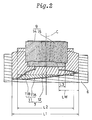
- Fig.2 is a developed plan view of the belt in Fig.1;
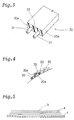
- Fig.3 is a part perspective view of a ribbon of rubber in which band cords are embedded;
- Fig.4 is a cross sectional view explaining a band cord winding method; and
- Fig.5 is a schematic cross sectional view showing a conventional belt structure.
- In the Figures a motorcycle radial tyre 1 has a
tread portion 2, a pair of axially spacedbead portions 4 and a pair ofsidewalls 3 extending therebetween. - The aspect ratio of the tyre (cross section height H/cross section width W) is between 0.5 and 0.7.
- A pair of
bead cores 5 are provided disposed one in eachbead portion 4, and acarcass 6 extends between thebead portions 4 and is turned up around thebead cores 5 from the axially inside to outside thereof. A belt reinforcement is provided comprising a breaker 7 a disposed in the tread portion and radially outside thecarcass 6 and aband 9 is disposed radially outside the breaker. A arubber bead apex 10 is disposed in eachbead portion 4 extending radially outwardly and taperingly from thebead core 5. - The
tread portion 2 is curved so that the tread surface has a single radius of curvature. - The tread surface extends axially outwardly from the tyre equator C towards both sides thereof so that the maximum cross section width W of the tyre lies between the edges E1 and E2 of the tread.
- The radius R of the curvature of the tread face is 0.54 to 0.85 times the tread width TW.
- The
carcass 6 comprises at least one ply, in this embodiment two plies of cords arranged radially of the tyre at an angle of 85 to 90 degrees with respect to the tyre equator C. - For the carcass cords, organic fibre cords, e.g. nylon, polyester, aromatic polyamide or the like can be used. In this embodiment nylon fibre cords are used.
- The radial height Ht of the turned up
portion 6t of thecarcass 6 measured from the bead base line is larger than the radial height Hs of the tread edge E1, E2 measured from the bead base line, and the radially outer edge of the carcass turned up portion is secured between the breaker edge portion and the main portion of the carcass, whereby ply separation failure starting from the carcass ply edge is prevented and the sidewalls are effectively reinforced. - The
breaker 7 comprises afirst ply 11 disposed on the outside of thecarcass 6 and asecond ply 12 disposed radially outside the first ply. - Each ply is made of rubberised parallel cords laid at an angle of 15 to 25 degrees with respect to the tyre equator C so that the cords thereof cross the cords of the adjacent ply.
- The edges of the radially inner
first ply 11 are folded back upon the radially outersecond ply 11 so as to wrap the edges F of thesecond ply 12. - For the breaker cords, organin fibre cords, e.g. nylon, rayon, polyester, aromatic polyamide or the like or steel cords can be used.
- In this embodiments, aromatic polyamide fibre cords are used for the radially inner and outer plies.
- The width L1 of the
first breaker ply 11 measured between the edges BE in the axial direction of the tyre, is 0.85 to 0.95 times the tread width TW. - In the
first ply 11, the axial width LW of the foldedportion 11B between the edges G and BE is 0.15 to 0.30 times the tread width TW, and between the axially inner edges G a space is left. - By setting the width of the folded
portions 11B as explained above, the foldedportion 11B is positioned in the ground contacting region when the motorcycle is leaned over during cornering. - The width L2 of the
second ply 12 measured between the edges F in the axial direction of the tyre is 0.75 to 0.90 times the tread width TW, and less than the fist ply width L1. - Between the first breaker ply edge and the second breaker ply edge, the radially outer edge of the carcass turned up
portion 6t is located. - The
band 9 comprises twoplies spiral cords 21. - For the
band cords 21, organic fibre cords, for example nylon, rayon, aromatic polyamide, polyester or the like are used. - Preferably, and in this embodiment, nylon cords are used. The width BW of the
band 9 is not more than 0.7 times the tread width TW. - Each ply is formed by winding a
ribbon 20 as shown in Figs.3 and 4. - In the
ribbon 20, one cord or severalparallel cords 21 are embedded inrubber 22 along the longitudinal direction thereof. - To make the
inner ply 14, theribbon 20 is wound spirally around thebreaker 11 continously from a point H1 to a point H2 which points are respectively located in the above-mentioned foldedportions 11B. - The
inner ply 14 is therefore, made of at least one spiral cord which is continuous from one edge to the other edge. - The width L3 of the overlap of the
inner band ply 14 and the foldedportion 11B is 10 to 30 mm. - To make the
outermost ply 15, tworibbons 20 are used. - The ribbons are wound from points located axially outwards of the above-mentioned points H1 and H2 to the tyre equator C so that the winding direction in one half portion on one side of the tyre equator is the reverse to that in the remaining half portion on the other side of the tyre equator.
- The
outer ply 15 is accordingly wider than theinner ply 14. Theoutermost ply 15 is provided with a cord arrangement which is symmetrical with respect to the equator, and in a half portion on each side of the tyre equator at least one cord extends spirally and continuously from the tyre equator to the edge. - The band cord angle is not more than 5 degrees with respect to the tyre equator C.
- In order to prevent looseness of the
ribbon 20 during winding, theedges 20a are preferably overlapped as shown in Fig.4. - Test tyres of size 170.60R17 including Example tyre having a belt construction shown in Fig.1 and a Reference tyre having the prior art belt construction shown in Fig.5 were prepared and the following tests were made. The specifications of the test tyres and test results are given in Table 1.

- A motorcycle fitted with the test tyre was run on a straight course at a speed of 260 km/hr and on a 400m radius course at a speed of 220 km/hr and road grip was evaluated by a test driver.
- The results are indicated by an index based on the assumption that the reference tyre is 100. The larger the value, the better the performance.
- In the above-mentioned test run on a 400m radius course, the cornering stability was evaluated by the test driver.
- The results are indicated by an index based on the assumption that the reference tyre is 100. The larger the value, the better the performance.
- Using a drum tester, the total running distance to separation failure at a speed of 65 km/hr under normal pressure specified in JIS and at a 150% load of the maximum load also specified in JIS, was measured as the resistance to ply separation.
- Using a drum tester, the running speed at which the tread was broken was measured under the above-mentioned normal pressure and maximum tyre load both specified in JIS, while increasing the running speed every 20 minutes in 10 km/hr steps from an initial speed of 200 km/hr.
- It was confirmed that the tyres of the invention may endure high speed running at 280 to 300 km/hr.
- In the present invention, the inner band ply 14 may have a cord arrangement which is symmetrical with respect to the tyre equator like the outermost ply,
- Further, the inner band ply 14 may have a conventional construction formed by winding a full width rubberised fabric in which plural cords are embedded parallel to each other, instead of the above-mentioned narrow width ribbon.
- In the above-mentioned embodiment, the same material cords, i.e., aromatic polyamide fibre cords are used in the inner and outer breaker plies. It is however, possible to use different material cords. For example, steel cords may be used in the radially
outer ply 12 and aromatic polyamide fibre cords in the radiallyinner ply 11. In this case, the breaker is preferably provided between the inner folded ply and the outer cut-end ply with a difference in rigidity by setting properties as follows: - The cords of the
inner ply 11 haven an initial modulus of elasticity of 300 to 6000 Kgf/sq.mm, preferably 300 to 4500 kgf/sq.mm. - The 100% modulus of the topping rubber for the
inner ply 11 is 30 to 48 kgf/sq.cm, preferably not more than 45 kgf/sq.cm. - The cords of the
outer ply 12 have an initial modulus of elasticity larger than that of the inner ply cords, and more than 4500 kgf/sq.mm. - The 100% modulus of the topping rubber for the
outer ply 12 is larger than that of the inner ply, and 48 to 55 kgf/sq.cm. - The number of cord twists in the aromatic polyamide fibre cord is not less thin 40 turn/10cm.
- As described above, the motorcycle radial tyre of the present invention, has a breaker ply with edge portions folded back so as to provide a space between the axially inner edges of the folded portions, and a jointless band extending over the space to cover the axially inner edge of each folded portion.
- Therefore, the tread is provided in the shoulder regions with a larger reinforcement in comparison with the central region to increase the chamber trust. As a result, a directional stability during high speed straight running and a running stability and road grip during high speed cornering are improved.
- Further, for the folded-edge construction, the breaker is prevented from separation failure at the breaker edges, and durability is effectively improved.
- As the radially outermost belt ply has a cord arrangement which is symmetrical with respect to the tyre equatorial plane, the directional stability during straight running is further improved.
- The present invention is suitably applied to tyres for large size motorcycles with a displacement of 750cc or more, especially rear tyres for high speed use.
Claims (6)
- A motorcycle radial tyre comprising a tread (2) curved so that the maximum cross section width (TW(W)) of the tyre lies between the tread edges (E1,E2), a carcass (6) having at least one ply of nylon fibre cords extending between bead (4) of the tyre and turned up around bead cores (5) disposed one in each bead (4), a belt disposed radially outside the carcass (6) and comprising a breaker (7) and a band (9), the breaker (7) comprising a first ply (11) disposed adjacently to the carcass and a second ply (12) disposed radially outside the first ply (11), the first and second breaker plies (11,12) comprising parallel cords of aromatic polyamide inclined with respect to the tyre equator so that the first ply cords cross the second ply cords, the edges (11B) of the first breaker ply (11) being folded back upon the second breaker ply (12) so that a space is provided between the axially inner edges (G) of the folded portions, characterized by the band (9) having a width of not more than 0.7 times the tread width being disposed radially outside the breaker (7) to extend over said space and overlap each folded portion (11B) of the breaker ply by a width of 10 to 30mm, the band (9) comprising a ply of nylon fibre cords wound spirally at an angle of not more than 5 degrees with respect to the tyre equator to form the radially outermost belt ply, said radially outermost belt ply having a symmetrical cord arrangement with respect to the tyre equator.
- A tyre according to claim 1 characterised in that the aspect ratio of the tyre is 0.5 to 0.7.
- A tyre according to claim 1 or 2, characterised in that the turned up portions (6t) of the carcass (6) are extended radially outwardly into the tread portion so that the radially outer edges (F) thereof are secured between the breaker edge portions and the main portion of the carcass (6).
- A tyre according to any of claims 1 to 3, characterised in that the axial width (L1) of the first breaker ply (11) is 0.85 to 0.95 times the tread width (TW(W)), and the axial width LW of the folded portions (11B) of the first breaker ply (11) is 0.15 to 0.30 times the tread width.
- A tyre according to any of claims 1 to 4, characterised in that in the radially outermost belt ply, the cord winding direction in a half portion on one side of the tyre equator is the reverse of that in the remaining half portion on the other side of the tyre equator.
- A tyre according to any of claims 1 to 5, characterised in that the band (9) includes a rubberised tyre fabric ply of parallel cords disposed radially inside said spiral cord ply.
Applications Claiming Priority (2)
| Application Number | Priority Date | Filing Date | Title |
|---|---|---|---|
| JP169622/90 | 1990-06-27 | ||
| JP16962290 | 1990-06-27 |
Publications (3)
| Publication Number | Publication Date |
|---|---|
| EP0463875A2 EP0463875A2 (en) | 1992-01-02 |
| EP0463875A3 EP0463875A3 (en) | 1992-05-13 |
| EP0463875B1 true EP0463875B1 (en) | 1995-04-12 |
Family
ID=15889918
Family Applications (1)
| Application Number | Title | Priority Date | Filing Date |
|---|---|---|---|
| EP91305814A Expired - Lifetime EP0463875B1 (en) | 1990-06-27 | 1991-06-27 | Motorcycle radial tyre |
Country Status (3)
| Country | Link |
|---|---|
| US (1) | US5441093A (en) |
| EP (1) | EP0463875B1 (en) |
| DE (1) | DE69108796T2 (en) |
Families Citing this family (23)
| Publication number | Priority date | Publication date | Assignee | Title |
|---|---|---|---|---|
| DE9103118U1 (en) * | 1991-03-15 | 1992-04-16 | Uniroyal Englebert Reifen GmbH, 5100 Aachen | Pneumatic vehicle tires |
| US5407701A (en) * | 1993-05-14 | 1995-04-18 | The Goodyear Tire & Rubber Company | Cords for pneumatic tires and process for making them |
| JPH07186615A (en) * | 1993-12-28 | 1995-07-25 | Sumitomo Rubber Ind Ltd | Pneumatic radial tires for passenger cars |
| GB9615685D0 (en) * | 1996-07-25 | 1996-09-04 | Sumitomo Rubber Ind | Motor-cycle radial tyre |
| GB9620967D0 (en) * | 1996-10-08 | 1996-11-27 | Sumitomo Rubber Ind | Motor-cycle race tyre |
| FR2765151A1 (en) * | 1997-06-26 | 1999-01-01 | Michelin & Cie | TOP FRAME FOR RADIAL TIRES |
| GB9716276D0 (en) * | 1997-08-02 | 1997-10-08 | Sumitomo Rubber Ind | Motor-cycle radial tyre |
| JP2001039113A (en) * | 1999-05-21 | 2001-02-13 | Bridgestone Corp | Pneumatic tire |
| GB9917595D0 (en) * | 1999-07-28 | 1999-09-29 | Sumitomo Rubber Ind | Motor-cycle radial tyre |
| JP2001130218A (en) * | 1999-11-02 | 2001-05-15 | Sumitomo Rubber Ind Ltd | Radial tires for motorcycles |
| JP2002001833A (en) * | 2000-06-26 | 2002-01-08 | Sumitomo Rubber Ind Ltd | Method of forming band of pneumatic tire |
| JP2002059707A (en) * | 2000-08-23 | 2002-02-26 | Bridgestone Corp | Pneumatic tire and manufacturing method for pneumatic tire |
| JP4137701B2 (en) * | 2003-05-28 | 2008-08-20 | 住友ゴム工業株式会社 | Motorcycle tires |
| JP4156450B2 (en) * | 2003-06-16 | 2008-09-24 | 住友ゴム工業株式会社 | Motorcycle tires |
| EP1894749B1 (en) * | 2005-05-31 | 2010-07-14 | Bridgestone Corporation | Pneumatic tire |
| JP4912668B2 (en) * | 2005-11-10 | 2012-04-11 | 住友ゴム工業株式会社 | Pneumatic tires for motorcycles |
| FR2924979B1 (en) * | 2007-12-18 | 2011-05-06 | Michelin Soc Tech | PNEUMATIC RADIAL ALLEGE |
| FR2924978B1 (en) | 2007-12-18 | 2011-06-10 | Michelin Soc Tech | ALLEGE PNEUMATIC COMPRISING A NON-RADIAL CARCASS STRUCTURE |
| JP6200360B2 (en) * | 2014-03-25 | 2017-09-20 | 住友ゴム工業株式会社 | Method for manufacturing motorcycle tire |
| JP6825309B2 (en) * | 2016-11-04 | 2021-02-03 | 住友ゴム工業株式会社 | Tires and tricycles equipped with them |
| JP6834437B2 (en) * | 2016-12-09 | 2021-02-24 | 住友ゴム工業株式会社 | Motorcycle tires |
| JP6859821B2 (en) * | 2017-04-14 | 2021-04-14 | 住友ゴム工業株式会社 | Tires for two-wheeled vehicles |
| JP7615633B2 (en) * | 2020-11-25 | 2025-01-17 | 住友ゴム工業株式会社 | Motorcycle tires |
Family Cites Families (14)
| Publication number | Priority date | Publication date | Assignee | Title |
|---|---|---|---|---|
| IT991332B (en) * | 1973-07-23 | 1975-07-30 | Pirelli | IMPROVEMENT OF INTERMEDIATE STRUCTURES FOR RADIAL TIRES |
| GB1487426A (en) * | 1974-09-17 | 1977-09-28 | Bekaert Sa Nv | Reinforcement of vehicle tyres |
| JPS5820503A (en) * | 1981-07-29 | 1983-02-07 | Bridgestone Corp | Pneumatic radial tire for motorcycle |
| JPS6112409A (en) * | 1984-06-29 | 1986-01-20 | Yokohama Rubber Co Ltd:The | Aired radial tire for passenger car |
| JPS6185203A (en) * | 1984-10-02 | 1986-04-30 | Bridgestone Corp | Pneumatic radial tire for motorcycle |
| US5176770A (en) * | 1984-10-02 | 1993-01-05 | Bridgestone Corporation | Pneumatic belted tires for motorcycles |
| JPS6452505A (en) * | 1987-08-21 | 1989-02-28 | Sumitomo Rubber Ind | Tire for motorbicycle |
| JPH01190502A (en) * | 1988-01-26 | 1989-07-31 | Sumitomo Rubber Ind Ltd | Radial tire for motorcycle |
| JPH0288307A (en) * | 1988-09-26 | 1990-03-28 | Sumitomo Rubber Ind Ltd | Radial tire for motorcycle |
| EP0364291B1 (en) * | 1988-10-14 | 1994-12-21 | Bridgestone Corporation | Radial tire for aircraft |
| US4989658A (en) * | 1989-06-09 | 1991-02-05 | The Goodyear Tire & Rubber Company | Belt overlay structure for pneumatic tires comprising a single ribbon wrapped about the belt structure |
| EP0453294B1 (en) * | 1990-04-18 | 1995-07-05 | Sumitomo Rubber Industries Limited | Belted radial tyre for motorcycle and belt making method |
| JPH045110A (en) * | 1990-04-20 | 1992-01-09 | Sumitomo Rubber Ind Ltd | Radial tire for motorcycle |
| JPH0415103A (en) * | 1990-05-07 | 1992-01-20 | Sumitomo Rubber Ind Ltd | Radial tire for motorcycle |
-
1991
- 1991-06-27 EP EP91305814A patent/EP0463875B1/en not_active Expired - Lifetime
- 1991-06-27 DE DE69108796T patent/DE69108796T2/en not_active Expired - Fee Related
-
1994
- 1994-04-26 US US08/233,720 patent/US5441093A/en not_active Expired - Lifetime
Also Published As
| Publication number | Publication date |
|---|---|
| US5441093A (en) | 1995-08-15 |
| EP0463875A3 (en) | 1992-05-13 |
| DE69108796T2 (en) | 1995-08-24 |
| DE69108796D1 (en) | 1995-05-18 |
| EP0463875A2 (en) | 1992-01-02 |
Similar Documents
| Publication | Publication Date | Title |
|---|---|---|
| EP0463875A2 (en) | Motorcycle radial tyre | |
| EP0484075B1 (en) | Motorcycle radial tyre | |
| EP0790143B1 (en) | Pneumatic radial tyre | |
| US5415216A (en) | Passenger radial tire including bead reinforcement | |
| US5213642A (en) | Vehicle tire including a breaker reinforcement layer comprising overlapping bandage strips | |
| EP0628435B1 (en) | Pneumatic motorcycle tyre | |
| EP0595653B1 (en) | Pneumatic tyre | |
| US5200006A (en) | Pneumatic tire with uniform ground pressure at the tread face | |
| US5404924A (en) | Motorcycle tire with spirally wound belt | |
| EP0542567B1 (en) | Pneumatic tyre | |
| EP0565339B1 (en) | A motorcycle tyre | |
| US5201969A (en) | Radial tire for heavy duty vehicle including a folded belt layer | |
| US6058997A (en) | Pneumatic radial tire having at least two zigzag belt layers | |
| EP0456438B1 (en) | Radial tyre for motorcycle | |
| EP1097824A2 (en) | Radial tyre for motorcycle | |
| EP0488734B1 (en) | Pneumatic radial tires for passenger cars | |
| EP0472425B1 (en) | Radial tyre | |
| EP0361871B1 (en) | A radial tyre for motor cycle | |
| EP0549311A1 (en) | Motorcycle radial tyre | |
| EP0465188B2 (en) | Passenger radial tyre | |
| JP3076514B2 (en) | Pneumatic radial tire | |
| US5445203A (en) | Radial tire with even wear at tread shoulders | |
| US6296031B1 (en) | Pneumatic radial tire including a plurality of carcass plies with specified fold back portions | |
| EP0779163B1 (en) | Motorcycle tyre | |
| EP0477016B1 (en) | Motorcycle radial tyre |
Legal Events
| Date | Code | Title | Description |
|---|---|---|---|
| PUAI | Public reference made under article 153(3) epc to a published international application that has entered the european phase |
Free format text: ORIGINAL CODE: 0009012 |
|
| AK | Designated contracting states |
Kind code of ref document: A2 Designated state(s): DE FR GB |
|
| PUAL | Search report despatched |
Free format text: ORIGINAL CODE: 0009013 |
|
| AK | Designated contracting states |
Kind code of ref document: A3 Designated state(s): DE FR GB |
|
| 17P | Request for examination filed |
Effective date: 19920612 |
|
| 17Q | First examination report despatched |
Effective date: 19931125 |
|
| GRAA | (expected) grant |
Free format text: ORIGINAL CODE: 0009210 |
|
| AK | Designated contracting states |
Kind code of ref document: B1 Designated state(s): DE FR GB |
|
| REF | Corresponds to: |
Ref document number: 69108796 Country of ref document: DE Date of ref document: 19950518 |
|
| ET | Fr: translation filed | ||
| PLBE | No opposition filed within time limit |
Free format text: ORIGINAL CODE: 0009261 |
|
| STAA | Information on the status of an ep patent application or granted ep patent |
Free format text: STATUS: NO OPPOSITION FILED WITHIN TIME LIMIT |
|
| 26N | No opposition filed | ||
| REG | Reference to a national code |
Ref country code: GB Ref legal event code: IF02 |
|
| PGFP | Annual fee paid to national office [announced via postgrant information from national office to epo] |
Ref country code: DE Payment date: 20070621 Year of fee payment: 17 |
|
| PGFP | Annual fee paid to national office [announced via postgrant information from national office to epo] |
Ref country code: GB Payment date: 20070627 Year of fee payment: 17 |
|
| PGFP | Annual fee paid to national office [announced via postgrant information from national office to epo] |
Ref country code: FR Payment date: 20080617 Year of fee payment: 18 |
|
| GBPC | Gb: european patent ceased through non-payment of renewal fee |
Effective date: 20080627 |
|
| PG25 | Lapsed in a contracting state [announced via postgrant information from national office to epo] |
Ref country code: DE Free format text: LAPSE BECAUSE OF NON-PAYMENT OF DUE FEES Effective date: 20090101 |
|
| PG25 | Lapsed in a contracting state [announced via postgrant information from national office to epo] |
Ref country code: GB Free format text: LAPSE BECAUSE OF NON-PAYMENT OF DUE FEES Effective date: 20080627 |
|
| REG | Reference to a national code |
Ref country code: FR Ref legal event code: ST Effective date: 20100226 |
|
| PG25 | Lapsed in a contracting state [announced via postgrant information from national office to epo] |
Ref country code: FR Free format text: LAPSE BECAUSE OF NON-PAYMENT OF DUE FEES Effective date: 20090630 |