EP0458322B1 - Doppelwandige feuerbeständige Leitung - Google Patents
Doppelwandige feuerbeständige Leitung Download PDFInfo
- Publication number
- EP0458322B1 EP0458322B1 EP91108330A EP91108330A EP0458322B1 EP 0458322 B1 EP0458322 B1 EP 0458322B1 EP 91108330 A EP91108330 A EP 91108330A EP 91108330 A EP91108330 A EP 91108330A EP 0458322 B1 EP0458322 B1 EP 0458322B1
- Authority
- EP
- European Patent Office
- Prior art keywords
- resin
- duct
- layers
- composite structure
- fire
- Prior art date
- Legal status (The legal status is an assumption and is not a legal conclusion. Google has not performed a legal analysis and makes no representation as to the accuracy of the status listed.)
- Expired - Lifetime
Links
Images



Classifications
-
- B—PERFORMING OPERATIONS; TRANSPORTING
- B29—WORKING OF PLASTICS; WORKING OF SUBSTANCES IN A PLASTIC STATE IN GENERAL
- B29C—SHAPING OR JOINING OF PLASTICS; SHAPING OF MATERIAL IN A PLASTIC STATE, NOT OTHERWISE PROVIDED FOR; AFTER-TREATMENT OF THE SHAPED PRODUCTS, e.g. REPAIRING
- B29C53/00—Shaping by bending, folding, twisting, straightening or flattening; Apparatus therefor
- B29C53/80—Component parts, details or accessories; Auxiliary operations
- B29C53/8008—Component parts, details or accessories; Auxiliary operations specially adapted for winding and joining
- B29C53/8066—Impregnating
- B29C53/8075—Impregnating on the forming surfaces
-
- B—PERFORMING OPERATIONS; TRANSPORTING
- B32—LAYERED PRODUCTS
- B32B—LAYERED PRODUCTS, i.e. PRODUCTS BUILT-UP OF STRATA OF FLAT OR NON-FLAT, e.g. CELLULAR OR HONEYCOMB, FORM
- B32B27/00—Layered products comprising a layer of synthetic resin
- B32B27/06—Layered products comprising a layer of synthetic resin as the main or only constituent of a layer, which is next to another layer of the same or of a different material
- B32B27/08—Layered products comprising a layer of synthetic resin as the main or only constituent of a layer, which is next to another layer of the same or of a different material of synthetic resin
-
- B—PERFORMING OPERATIONS; TRANSPORTING
- B32—LAYERED PRODUCTS
- B32B—LAYERED PRODUCTS, i.e. PRODUCTS BUILT-UP OF STRATA OF FLAT OR NON-FLAT, e.g. CELLULAR OR HONEYCOMB, FORM
- B32B27/00—Layered products comprising a layer of synthetic resin
- B32B27/04—Layered products comprising a layer of synthetic resin as impregnant, bonding, or embedding substance
-
- F—MECHANICAL ENGINEERING; LIGHTING; HEATING; WEAPONS; BLASTING
- F16—ENGINEERING ELEMENTS AND UNITS; GENERAL MEASURES FOR PRODUCING AND MAINTAINING EFFECTIVE FUNCTIONING OF MACHINES OR INSTALLATIONS; THERMAL INSULATION IN GENERAL
- F16L—PIPES; JOINTS OR FITTINGS FOR PIPES; SUPPORTS FOR PIPES, CABLES OR PROTECTIVE TUBING; MEANS FOR THERMAL INSULATION IN GENERAL
- F16L57/00—Protection of pipes or objects of similar shape against external or internal damage or wear
- F16L57/04—Protection of pipes or objects of similar shape against external or internal damage or wear against fire or other external sources of extreme heat
-
- F—MECHANICAL ENGINEERING; LIGHTING; HEATING; WEAPONS; BLASTING
- F16—ENGINEERING ELEMENTS AND UNITS; GENERAL MEASURES FOR PRODUCING AND MAINTAINING EFFECTIVE FUNCTIONING OF MACHINES OR INSTALLATIONS; THERMAL INSULATION IN GENERAL
- F16L—PIPES; JOINTS OR FITTINGS FOR PIPES; SUPPORTS FOR PIPES, CABLES OR PROTECTIVE TUBING; MEANS FOR THERMAL INSULATION IN GENERAL
- F16L58/00—Protection of pipes or pipe fittings against corrosion or incrustation
- F16L58/02—Protection of pipes or pipe fittings against corrosion or incrustation by means of internal or external coatings
- F16L58/04—Coatings characterised by the materials used
- F16L58/10—Coatings characterised by the materials used by rubber or plastics
- F16L58/1009—Coatings characterised by the materials used by rubber or plastics the coating being placed inside the pipe
-
- B—PERFORMING OPERATIONS; TRANSPORTING
- B32—LAYERED PRODUCTS
- B32B—LAYERED PRODUCTS, i.e. PRODUCTS BUILT-UP OF STRATA OF FLAT OR NON-FLAT, e.g. CELLULAR OR HONEYCOMB, FORM
- B32B2262/00—Composition or structural features of fibres which form a fibrous or filamentary layer or are present as additives
- B32B2262/10—Inorganic fibres
- B32B2262/101—Glass fibres
-
- B—PERFORMING OPERATIONS; TRANSPORTING
- B32—LAYERED PRODUCTS
- B32B—LAYERED PRODUCTS, i.e. PRODUCTS BUILT-UP OF STRATA OF FLAT OR NON-FLAT, e.g. CELLULAR OR HONEYCOMB, FORM
- B32B2262/00—Composition or structural features of fibres which form a fibrous or filamentary layer or are present as additives
- B32B2262/10—Inorganic fibres
- B32B2262/106—Carbon fibres, e.g. graphite fibres
-
- B—PERFORMING OPERATIONS; TRANSPORTING
- B32—LAYERED PRODUCTS
- B32B—LAYERED PRODUCTS, i.e. PRODUCTS BUILT-UP OF STRATA OF FLAT OR NON-FLAT, e.g. CELLULAR OR HONEYCOMB, FORM
- B32B2305/00—Condition, form or state of the layers or laminate
- B32B2305/07—Parts immersed or impregnated in a matrix
-
- B—PERFORMING OPERATIONS; TRANSPORTING
- B32—LAYERED PRODUCTS
- B32B—LAYERED PRODUCTS, i.e. PRODUCTS BUILT-UP OF STRATA OF FLAT OR NON-FLAT, e.g. CELLULAR OR HONEYCOMB, FORM
- B32B2307/00—Properties of the layers or laminate
- B32B2307/30—Properties of the layers or laminate having particular thermal properties
- B32B2307/306—Resistant to heat
- B32B2307/3065—Flame resistant or retardant, fire resistant or retardant
-
- B—PERFORMING OPERATIONS; TRANSPORTING
- B32—LAYERED PRODUCTS
- B32B—LAYERED PRODUCTS, i.e. PRODUCTS BUILT-UP OF STRATA OF FLAT OR NON-FLAT, e.g. CELLULAR OR HONEYCOMB, FORM
- B32B2307/00—Properties of the layers or laminate
- B32B2307/70—Other properties
- B32B2307/714—Inert, i.e. inert to chemical degradation, corrosion
-
- Y—GENERAL TAGGING OF NEW TECHNOLOGICAL DEVELOPMENTS; GENERAL TAGGING OF CROSS-SECTIONAL TECHNOLOGIES SPANNING OVER SEVERAL SECTIONS OF THE IPC; TECHNICAL SUBJECTS COVERED BY FORMER USPC CROSS-REFERENCE ART COLLECTIONS [XRACs] AND DIGESTS
- Y10—TECHNICAL SUBJECTS COVERED BY FORMER USPC
- Y10S—TECHNICAL SUBJECTS COVERED BY FORMER USPC CROSS-REFERENCE ART COLLECTIONS [XRACs] AND DIGESTS
- Y10S138/00—Pipes and tubular conduits
- Y10S138/06—Corrosion
-
- Y—GENERAL TAGGING OF NEW TECHNOLOGICAL DEVELOPMENTS; GENERAL TAGGING OF CROSS-SECTIONAL TECHNOLOGIES SPANNING OVER SEVERAL SECTIONS OF THE IPC; TECHNICAL SUBJECTS COVERED BY FORMER USPC CROSS-REFERENCE ART COLLECTIONS [XRACs] AND DIGESTS
- Y10—TECHNICAL SUBJECTS COVERED BY FORMER USPC
- Y10S—TECHNICAL SUBJECTS COVERED BY FORMER USPC CROSS-REFERENCE ART COLLECTIONS [XRACs] AND DIGESTS
- Y10S428/00—Stock material or miscellaneous articles
- Y10S428/92—Fire or heat protection feature
-
- Y—GENERAL TAGGING OF NEW TECHNOLOGICAL DEVELOPMENTS; GENERAL TAGGING OF CROSS-SECTIONAL TECHNOLOGIES SPANNING OVER SEVERAL SECTIONS OF THE IPC; TECHNICAL SUBJECTS COVERED BY FORMER USPC CROSS-REFERENCE ART COLLECTIONS [XRACs] AND DIGESTS
- Y10—TECHNICAL SUBJECTS COVERED BY FORMER USPC
- Y10S—TECHNICAL SUBJECTS COVERED BY FORMER USPC CROSS-REFERENCE ART COLLECTIONS [XRACs] AND DIGESTS
- Y10S428/00—Stock material or miscellaneous articles
- Y10S428/92—Fire or heat protection feature
- Y10S428/921—Fire or flameproofing
-
- Y—GENERAL TAGGING OF NEW TECHNOLOGICAL DEVELOPMENTS; GENERAL TAGGING OF CROSS-SECTIONAL TECHNOLOGIES SPANNING OVER SEVERAL SECTIONS OF THE IPC; TECHNICAL SUBJECTS COVERED BY FORMER USPC CROSS-REFERENCE ART COLLECTIONS [XRACs] AND DIGESTS
- Y10—TECHNICAL SUBJECTS COVERED BY FORMER USPC
- Y10T—TECHNICAL SUBJECTS COVERED BY FORMER US CLASSIFICATION
- Y10T428/00—Stock material or miscellaneous articles
- Y10T428/13—Hollow or container type article [e.g., tube, vase, etc.]
- Y10T428/131—Glass, ceramic, or sintered, fused, fired, or calcined metal oxide or metal carbide containing [e.g., porcelain, brick, cement, etc.]
- Y10T428/1314—Contains fabric, fiber particle, or filament made of glass, ceramic, or sintered, fused, fired, or calcined metal oxide, or metal carbide or other inorganic compound [e.g., fiber glass, mineral fiber, sand, etc.]
-
- Y—GENERAL TAGGING OF NEW TECHNOLOGICAL DEVELOPMENTS; GENERAL TAGGING OF CROSS-SECTIONAL TECHNOLOGIES SPANNING OVER SEVERAL SECTIONS OF THE IPC; TECHNICAL SUBJECTS COVERED BY FORMER USPC CROSS-REFERENCE ART COLLECTIONS [XRACs] AND DIGESTS
- Y10—TECHNICAL SUBJECTS COVERED BY FORMER USPC
- Y10T—TECHNICAL SUBJECTS COVERED BY FORMER US CLASSIFICATION
- Y10T428/00—Stock material or miscellaneous articles
- Y10T428/13—Hollow or container type article [e.g., tube, vase, etc.]
- Y10T428/131—Glass, ceramic, or sintered, fused, fired, or calcined metal oxide or metal carbide containing [e.g., porcelain, brick, cement, etc.]
- Y10T428/1317—Multilayer [continuous layer]
-
- Y—GENERAL TAGGING OF NEW TECHNOLOGICAL DEVELOPMENTS; GENERAL TAGGING OF CROSS-SECTIONAL TECHNOLOGIES SPANNING OVER SEVERAL SECTIONS OF THE IPC; TECHNICAL SUBJECTS COVERED BY FORMER USPC CROSS-REFERENCE ART COLLECTIONS [XRACs] AND DIGESTS
- Y10—TECHNICAL SUBJECTS COVERED BY FORMER USPC
- Y10T—TECHNICAL SUBJECTS COVERED BY FORMER US CLASSIFICATION
- Y10T428/00—Stock material or miscellaneous articles
- Y10T428/13—Hollow or container type article [e.g., tube, vase, etc.]
- Y10T428/1352—Polymer or resin containing [i.e., natural or synthetic]
-
- Y—GENERAL TAGGING OF NEW TECHNOLOGICAL DEVELOPMENTS; GENERAL TAGGING OF CROSS-SECTIONAL TECHNOLOGIES SPANNING OVER SEVERAL SECTIONS OF THE IPC; TECHNICAL SUBJECTS COVERED BY FORMER USPC CROSS-REFERENCE ART COLLECTIONS [XRACs] AND DIGESTS
- Y10—TECHNICAL SUBJECTS COVERED BY FORMER USPC
- Y10T—TECHNICAL SUBJECTS COVERED BY FORMER US CLASSIFICATION
- Y10T428/00—Stock material or miscellaneous articles
- Y10T428/13—Hollow or container type article [e.g., tube, vase, etc.]
- Y10T428/1352—Polymer or resin containing [i.e., natural or synthetic]
- Y10T428/1362—Textile, fabric, cloth, or pile containing [e.g., web, net, woven, knitted, mesh, nonwoven, matted, etc.]
-
- Y—GENERAL TAGGING OF NEW TECHNOLOGICAL DEVELOPMENTS; GENERAL TAGGING OF CROSS-SECTIONAL TECHNOLOGIES SPANNING OVER SEVERAL SECTIONS OF THE IPC; TECHNICAL SUBJECTS COVERED BY FORMER USPC CROSS-REFERENCE ART COLLECTIONS [XRACs] AND DIGESTS
- Y10—TECHNICAL SUBJECTS COVERED BY FORMER USPC
- Y10T—TECHNICAL SUBJECTS COVERED BY FORMER US CLASSIFICATION
- Y10T428/00—Stock material or miscellaneous articles
- Y10T428/13—Hollow or container type article [e.g., tube, vase, etc.]
- Y10T428/1352—Polymer or resin containing [i.e., natural or synthetic]
- Y10T428/1362—Textile, fabric, cloth, or pile containing [e.g., web, net, woven, knitted, mesh, nonwoven, matted, etc.]
- Y10T428/1366—Textile, fabric, cloth, or pile is sandwiched between two distinct layers of material unlike the textile, fabric, cloth, or pile layer
-
- Y—GENERAL TAGGING OF NEW TECHNOLOGICAL DEVELOPMENTS; GENERAL TAGGING OF CROSS-SECTIONAL TECHNOLOGIES SPANNING OVER SEVERAL SECTIONS OF THE IPC; TECHNICAL SUBJECTS COVERED BY FORMER USPC CROSS-REFERENCE ART COLLECTIONS [XRACs] AND DIGESTS
- Y10—TECHNICAL SUBJECTS COVERED BY FORMER USPC
- Y10T—TECHNICAL SUBJECTS COVERED BY FORMER US CLASSIFICATION
- Y10T428/00—Stock material or miscellaneous articles
- Y10T428/13—Hollow or container type article [e.g., tube, vase, etc.]
- Y10T428/1352—Polymer or resin containing [i.e., natural or synthetic]
- Y10T428/1372—Randomly noninterengaged or randomly contacting fibers, filaments, particles, or flakes
-
- Y—GENERAL TAGGING OF NEW TECHNOLOGICAL DEVELOPMENTS; GENERAL TAGGING OF CROSS-SECTIONAL TECHNOLOGIES SPANNING OVER SEVERAL SECTIONS OF THE IPC; TECHNICAL SUBJECTS COVERED BY FORMER USPC CROSS-REFERENCE ART COLLECTIONS [XRACs] AND DIGESTS
- Y10—TECHNICAL SUBJECTS COVERED BY FORMER USPC
- Y10T—TECHNICAL SUBJECTS COVERED BY FORMER US CLASSIFICATION
- Y10T428/00—Stock material or miscellaneous articles
- Y10T428/13—Hollow or container type article [e.g., tube, vase, etc.]
- Y10T428/1352—Polymer or resin containing [i.e., natural or synthetic]
- Y10T428/139—Open-ended, self-supporting conduit, cylinder, or tube-type article
- Y10T428/1393—Multilayer [continuous layer]
-
- Y—GENERAL TAGGING OF NEW TECHNOLOGICAL DEVELOPMENTS; GENERAL TAGGING OF CROSS-SECTIONAL TECHNOLOGIES SPANNING OVER SEVERAL SECTIONS OF THE IPC; TECHNICAL SUBJECTS COVERED BY FORMER USPC CROSS-REFERENCE ART COLLECTIONS [XRACs] AND DIGESTS
- Y10—TECHNICAL SUBJECTS COVERED BY FORMER USPC
- Y10T—TECHNICAL SUBJECTS COVERED BY FORMER US CLASSIFICATION
- Y10T428/00—Stock material or miscellaneous articles
- Y10T428/29—Coated or structually defined flake, particle, cell, strand, strand portion, rod, filament, macroscopic fiber or mass thereof
- Y10T428/2913—Rod, strand, filament or fiber
- Y10T428/2933—Coated or with bond, impregnation or core
- Y10T428/2936—Wound or wrapped core or coating [i.e., spiral or helical]
-
- Y—GENERAL TAGGING OF NEW TECHNOLOGICAL DEVELOPMENTS; GENERAL TAGGING OF CROSS-SECTIONAL TECHNOLOGIES SPANNING OVER SEVERAL SECTIONS OF THE IPC; TECHNICAL SUBJECTS COVERED BY FORMER USPC CROSS-REFERENCE ART COLLECTIONS [XRACs] AND DIGESTS
- Y10—TECHNICAL SUBJECTS COVERED BY FORMER USPC
- Y10T—TECHNICAL SUBJECTS COVERED BY FORMER US CLASSIFICATION
- Y10T428/00—Stock material or miscellaneous articles
- Y10T428/30—Self-sustaining carbon mass or layer with impregnant or other layer
Definitions
- This invention relates to fume ducts and a method for making such ducts which are both resistant to deleterious or corrosive chemicals and which are also fire resistant.
- Ductwork for corrosive vapor exhaust systems is used extensively in many diverse industries which utilize chemicals to process raw materials or perform manufacturing procedures such as the semiconductor industry, the plating industry, the pharmaceutical industry and numerous other industries.
- Waste water treatment plants also use corrosive chemicals such as chlorine, and caustics, such as sodium hydroxide or sodium hypochlorite in processing sewage, as well as other chemicals.
- Many research and development labs, and college science buildings also use a great variety of chemicals in conducting experiments in varied fields such as biochemistry, genetics, geological uses, or general chemistry and physics. These chemicals are used for various types of processes or tools, many of which expose personnel in the work environment to hazardous materials. For worker safety, the vapors from these chemicals must be exhausted through air ducts to remove potential contaminants from the work place.
- Some duct installations can be very large, consisting of many thousands of feet of ductwork which may be manifolded and connected to multiple exhaust fans. Because of the wide diversity of the chemicals used, for various industries, it is exceedingly difficult to provide a single material for ductwork construction which can handle all the chemical exposures which the ducts may face.
- a great variety of materials have been used heretofore to fabricate fume exhaust ductwork, such as black steel, galvanized steel or stainless steel as well as plastic materials such as polyvinylchloride, polypropylene, coated metals and fiberglass reinforced plastic. In the last forty years the trend in the use of materials has been away from metals or coated metals and toward the use of plastics, the most popular being FRP (fiberglass reinforced plastics).
- fire-retardant The plastics industry often refers to certain classes of materials as "fire-retardant". Commonly these incorporate fillers, heat sinks, such as aluminum trihydrate, and most commonly, halogenated resin systems which complex with antimony or boron compounds. The latter function as free radical traps, thereby depriving the surface fuel of oxygen, and interfering with combustion.
- aldehydes used in conjunction with resorcinol, or phenol/resorcinol combinations can be used to effect cure of the resin.
- An excess of aldehydes to the hydroxyl radicals contained within the mix is necessary.
- Paraformaldehyde, furfuraldehyde, or other aldehydes can be used alone or in combination with various types of phenol/resorcinol mixes.
- No one duct material can resist all chemicals used in a wide variety of industries.
- Certain classes of resins have enhanced properties and resistance to certain families of chemicals.
- polyesters generally have good resistance to acids and to some degree, on caustics; they generally do not have good resistance to solvents, particularly halocarbons.
- Epoxies generally have good resistance to caustics and solvents, but do not have the best resistance to strong mineral acids.
- Other materials such as polyvinylchloride, polypropylene, and other materials exhibit the same characteristics, i.e. good resistance to some chemicals, poor resistance to others.
- a primary object of the present invention is to solve the aforesaid problem and provide a fume exhaust duct that has both good chemical resistance and good fire resistance characteristics.
- Another object of the invention is to provide a method for manufacturing a fume duct which has both good chemical resistance and good fire resistance characteristics.
- the present invention is directed to a composite plastic duct structure, capable of passing the FM Nr. 4922 Duct test, comprising:
- a composite fume duct which has an inner liner of chemically resistant material covered by and integral with an outer layer of fire retardant material.
- the nominal wall thickness of the duct inner liner is in the range from 0.76 to 1.78 mm (30 mils. to 70 mils.) but for most applications the liner thickness should be around 1.25 mm (50 mils.). This limits the amount of potential fuel in the duct while maintaining the necessary chemical resistant barrier.
- the inner layer is comprised of a layer of fabric material such as fiber glass which is saturated with a chemically resistant resin such as a halogenated vinyl ester.
- the outer layer which covers the inner layer is similarly comprised of fabric or fiberglass material which is combined with resorcinol or phenol resorcinol type fire retardant resin.
- the additional layers of glass saturated with PRF resins provide the necessary structural strength in relation to duct diameters which may vary from 3.2 to 9.6 mm (1/8 inch to 3/8 inch) thick overall.
- the dual layer duct is formed utilizing a series of method steps which include first coating a mandrel tool with a first chemically resistant resin and then wrapping the mandrel with successive layers of fabric material which is saturated with the first resin. Directly over the first layer the outer fire retardant layer is formed by applying successive layers of a suitable fabric material saturated with the fire retardant resin. The composite two layer duct structure is then allowed to cure and harden before being removed from the mandrel.
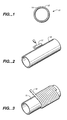
- Fig. 1 is a view in cross-section of a multilayer fume duct embodying principles of the present invention.
- Figs. 2-6 are a series of diagrammatic views in perspective illustrating various steps used for manufacturing the duct shown in Fig. 1.
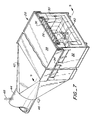
- Fig. 7 is a view in perspective showing an ASTM "Tunnel Test" apparatus.
- Fig. 8 is an end view of the ASTM test apparatus of Fig. 7.
- Fig. 9 is a side elevation view in section of the ASTM test apparatus taken along line 9-9 of Fig. 7.
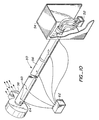
- Fig. 10 is a view in perspective of a testing apparatus developed by Factory Mutual Research for testing fume ducts.
- Fig. 1 shows a cross-section of a duct 10 embodying principles of the present invention which comprises an outer fire resistant layer 12 and a concentric inner layer 14 that is resistant to many vaporized chemicals. Both of the layers are made of a resin impregnated material in accordance with method steps which are described below.
- the duct 10 may be made with various diametral sizes, generally in the range of 5.1 to 213.4 cm (2 inches to 84 inches) of a tubular form and preferably with an overall combined thickness for both layers 12 and 14 ranging from 3.2 to 9.6 mm (125 mils. to 375 mils.). For most ducts having a standard diameter of 30 cm (12 inches), the combined thickness is preferably around 3.2 mm (125 mils.).
- the inner layer or liner 14 preferably has a thickness of around 1.25 mm (50 mils.) for several reasons. First of all, even the best of resin systems when combined with a material such as fiberglass, pose porosity problems. However, by using a liner thickness of 1.25 mm (50 mils.), any porosity of the liner will be eliminated. Secondly, to provide a liner thickness much greater than 1.25 mm (50 mils.) tends to increase the quantity or mass of potential fuel and thus increase potential fire problems. Both of these problems are alleviated by restricting the liner thickness to approximately 1.25 mm (50 mils.) or at most 1.8 mm (70 mils.) for any diameter of duct.
- each layer 12 and 14 is comprised of a fabric material such as fiberglass which is impregnated with a resin that is cured and hardened to form a rigid structure.
- halogenated chemically resistant resins which are known and commercially available may be described by their generic names, as follows: (1) halogenated Vinyl Esters; (2) Chlorendic Anhydrides; (3) halogenated Bisphenol Fumarates ; and (4) halogenated Isophthalic Polyester.
- halogenated vinyl esters are the type most preferred for products according to the present invention.
- the outer layer of the duct 10 is made using a fire retardant resin of PRF type comprised of phenol-resorcinol with an excess of aldehydes, as previously described.
- Ductwork made with these PRF resins are not only approved by Factory Mutual Research for use without sprinklers, but they are also listed by Underwriters Laboratories under their UL-181 test protocol. Part of this latter test protocol is reliance on the ASTM E-84 tunnel Test. In those tunnel tests, the flame spread rating of the duct material using the present resins is 5, and the smoke development rating is zero. This duct provided the background and an available source for material that obviously had superior fire resistance. The next problem was how to achieve superior chemical resistance in the previously developed fire-retardant duct. In accordance with the present invention, the answer is to combine the chemical resistant liner 14 with the fire resistant casing 12.
- Figs. 2-6 a series of steps for making a composite double layer duct 10 having a diameter of 30 cm (12 inches) is shown diagrammatically.
- a mold or tool 16 such as a mandrel of approximately 30 cm (12") O.D. is mounted on a machine and rotated.
- the mandrel is coated with a layer of the selected chemically resistant resin, preferably with a roller applicator 17.
- a layer 18 of organic veil or fiber glass material preferably provided in a 15 cm (6 inch) width and saturated with the treated vinylester resin is applied to the coated mandrel in a helical pattern.
- Additional resin 19 is applied to the first layer, for example by suitable liquid dispensing device 20, as shown in step 3 (Fig. 4). Now, steps 2 and 3 are repeated as steps 4 and 5 to add more layers of veil.
- a layer of 44.3 cm 3 (1-1/2 ounce) random glass mat 22 is now also applied and wetted out with the chemically resistant resin. These layers are rolled out completely to make sure that all layers of glass or organic veil material are thoroughly saturated with the resin. Thereafter, an extra layer of random glass mat may be applied to the wetted surfaces of the prior layers of glass; however this additional glass mat is not wetted out completely with the vinylester resin, nor is it rolled out. This technique is known as “dry” final glass or the "wet-on-dry” system. The mass of the precatalyzed vinylester resin is allowed to cure. This latter curing step is not necessary, and a process known as "wet-on-wet” may be used, as explained more fully below.
- step 6 construction proceeds in step 6 (Fig. 5) to form the outer layer 12 by applying additional layers 24 of glass, random glass mat, woven roving, boat cloth, filament winding, or organic veils as subsequent layers of glass in order to achieve the appropriate wall thicknesses required, based on the predetermined dimensions of the duct.
- PRF resins 25 are all saturated with PRF resins 25 using various ratios of resorcinol, with or without included phenol, and aldehyde sources such as, but not limited to paraformaldehyde, furfuraldehyde or a formaldehyde/methanol mixture comprised of about 55% liquid formaldehyde, about 35% methanol, and about 10% methoxymethanol and available commercially as Methyl-Formcel.
- the PRF resins may be applied with suitable dispensing apparatus 20.
- the outer layers of fabric are preferably applied by helical winding as described with smoothing done by fiber glass rollers 17 (Fig. 6).
- the PRF resin/glass overlays 12 of the casing When the PRF resin/glass overlays 12 of the casing occurs, it prevents exposure of the vinylester glass layers 14 to air. This then prevents air inhibition of cure of the underlying mass of vinylester/glass/organic veil matrix. Such a method of fabrication avoids the problem of air inhibition and lack of cure of the ester resin in the inner layer 14 for the overall composite 10.
- the liner materials 18 consisting of organic or inorganic veils and a layer of mat are wetted out with the liner resin system.
- a layer of dry random glass mat is placed on top of the last layer of glass impregnated with the chemical resistant liner resin.
- the fire-resistant resin is applied directly over the wetted liner material, using a second layer of random glass mat, plus additional glass materials. This is the preferred method because, contrary to expectations, there appears to be a chemical bonding between the dissimilar resin systems and peel strength is increased at least two-fold. In addition, the chemical resistance of the liner is not diminished as would be expected.
- a piece of candidate material 26 0.60 m (20") wide by 7.63 m (25 feet) long is installed in a test tunnel or chamber resting against the "ceiling" of the tunnel.
- the elongated chamber is lined with fire brick 30 covered by sheet steel 32 and has vision panels 34 along its length to facilitate viewing of the specimen material during tests.
- the specimen material is maintained adjacent an insulating block 36 which is held in place by a removable steel cover 38.
- a gas burner 40 is provided at the tunnel entrance. The opposite end of the tunnel is connected through a reducer section 42 to a draft chamber duct 44.
- a gas flame from below impinges on the test material for approximately the first 1.68 m (5-1/2 feet) of the material.
- the speed with which the test sample will burn is calibrated on a time basis, and compared against cement asbestos board, which has a flame spread rate of zero. It is also compared against red oak lumber, which burns the total length of the tunnel; this establishes a flame spread rating of 100.
- plastic materials are tested against the norms of the cement asbestos board and the red oak lumber to determine their relative flame spread rate. Depending upon the plastic used, flame spread rates of plastics can range from 10 to 1500, the latter being almost explosive in nature.
- the same ASTM E-84 tunnel test device has the capability of evaluating the smoke generation of a substitute plastic product against the norms of the cement asbestos and red oak wood.
- a photoelectric cell 46 measures the degree of obscurity created by the smoke generated from the candidate sample material. This cell 46 is located at a window on one side of the duct 44 while a light source 48 is provided at the opposite side.
- the cement asbestos board generates no smoke that is visible to the photoelectric cell and has a rating of zero; the quantity of smoke generated by the red oak lumber is arbitrarily established at 100.
- An automatic device consisting of a pen and a chart (not shown) connected to the photoelectric device can translate the relative obscurity of smoke to an area relationship on the chart. In this manner, the amount of smoke given off quantitatively for the specific time period of the test can be measured.
- the FM test utilizes an apparatus 50 as shown in Fig. 10.
- a flame from a pan of heptane 52 is generated within an enclosure 54 and pulled into one end of a 30 cm (12") round by 732 cm (24 feet) long duct 56.
- an exhaust fan 58 sucks the flame into the duct 56, which simulates an exhaust duct system.
- a series of thermocouples 60 are spaced apart along the duct 56 and are connected to a recorder 62.
- the test is a go/no-go criteria. To pass the test, the duct may not burn from one end to the other in a period of 15 minutes; and a thermocouple sensor near the fan end may not register 540°C (1000°F).
- a sight hole 64 located 7 m (23 feet) from the fire end should not exhibit any flame. If the non-metallic duct cannot pass this criteria, then the non-metallic ductwork must have sprinklers installed on their interior by Factory Mutual standards.
- the interior surfaces of the duct were kept flooded with these chemicals for a period of time. Microscopic examination was made at the end of the test on the interior surfaces to seek evidence of defect or deterioration.
- a method was devised to determine if any bleeding occurred through the wall of the composite structure. Chemical reagents were analyzed for changes in state. The chemical resistance tests produced satisfactory results, i.e. no chemical degradation of duct structure.
- the product 10 having outer and inner layers 12 and 14 was evaluated for fire resistance capabilities. A number of products were fabricated for this purpose.
- the fire source was placed at the base of a 4.55 m (15 feet) vertical section of duct. This, in turn, was connected to a 90° elbow, and an additional 7.32 m (24 feet) of horizontal duct was used prior to the connection to the fan.
- the same test result parameters pertained to this type of test i.e. the fire should not progress to the fan inlet; fire should not be seen near the fan inlet; and the temperature near the fan inlet should not rise to 540°C (1000°F). The test was conducted for 15 minutes.
- the Factory Mutual test protocol requires an increase in fan velocity from 18.3 km (600 feet) per minute to 61 km (2000 feet) per minute at the end of the 15-minute fire test. In this test, the additional high velocity was maintained for a period of 10 minutes. The purpose of this is to determine whether or not the ductwork will collapse under the increased negative pressure caused by the higher velocity.
- the advantage in a duct in not doing so, is that it may receive a special rating by Factory Mutual as a smoke removal duct. In the event of a fire, the exhaust duct will remain serviceable to remove smoke from a piece of equipment to which the duct is connected. This can be exceedingly important in clean room environments where it is important to remove as much smoke as possible.
- the ducts 10 according to the present invention when tested by Factory Mutual procedure as described, passed both test (sprinkler and smoke removal) standards.
Landscapes
- Engineering & Computer Science (AREA)
- General Engineering & Computer Science (AREA)
- Mechanical Engineering (AREA)
- Laminated Bodies (AREA)
- Rigid Pipes And Flexible Pipes (AREA)
- Moulding By Coating Moulds (AREA)
- Duct Arrangements (AREA)
- Lining Or Joining Of Plastics Or The Like (AREA)
Claims (22)
- Verbundkunststoffleitungsstruktur, welche den Leitungstest FM Nr. 4922 erfüllt, umfassend:I.(i) eine innere Schicht aus einem Stoffmaterial, das mit einem chemisch und/oder gegen Korrosion resistenten Material, bestehend aus einem oder mehreren halogenierten Harzen, ausgewählt aus(a) halogenierten Vinylestern,(b) Chlorendicanhydriden,(c) halogenierten Bisphenolfumaraten,(d) halogenierten Isophthalpolyestern, bis zur Sättigung imprägniert ist,(ii) wobei die innere Schicht eine Dicke im Bereich von 0,76 bis 1,78 mm (30 bis 70 mils) hat,II.(i) eine äußere Schicht aus Stoffmaterial, das mit einem feuerbeständigen Harzmaterial, bestehend aus einem Resorcin/Aldehydharz oder einem Phenol/Resorcin/Aldehydharz, bis zur Sättigung imprägniert ist,(ii) wobei die äußere Schicht eine Dicke im Bereich von 3,2 bis 9,6 mm (1/8 bis 3/8 Zoll) hat.
- Verbundstruktur nach Anspruch 1, bei welcher die innere Schicht mit halogenierten Bisphenolfumaraten imprägniert ist.
- Verbundstruktur nach Anspruch 1, bei welcher die innere Schicht mit halogenierten Vinylesterharzen imprägniert ist.
- Verbundstruktur nach Anspruch 1, bei welcher die Aldehyde Paraformaldehyd einschließen.
- Verbundstruktur nach Anspruch 1, bei welcher die Aldehyde Furfuraldehyd einschließen.
- Verbundstruktur nach Anspruch 1, bei welcher die Aldehyde Formaldehyd/Methanolmischungen einschließen.
- Verbundstruktur nach einem der Ansprüche 1 - 6, bei welcher kolloidales Antimonpentoxid als ein synergistischer Stoff mit dem halogenierten Harz, welches das Material der inneren Schicht bildet, verwendet wird.
- Verbundstruktur nach einem der Ansprüche 1 - 7, bei welcher die mit den Harzsystemen imprägnierten Stoffmaterialien aus mit Glasfaser verstärkten Kunststoffmaterialien bestehen.
- Verbundstruktur nach einem der Ansprüche 1 - 7, bei welcher die mit diesen Harzmaterialien imprägnierten Stoffmaterialien Graphit- oder Kohlefasern einschließen.
- Verbundstruktur nach einem der Ansprüche 1 - 7, bei welcher die mit diesen Harzsystemen imprägnierten Stoffmaterialien Keramikfasern einschließen.
- Verbundstruktur nach einem der Ansprüche 1 - 6, bei welcher zusätzlich eine Viskositätsregelung durch die Verwendung von durch thermische Zersetzung hergestelltem Siliziumdioxid erreicht wird.
- Verbundstruktur nach einem der Ansprüche 1 - 6, bei welcher zusätzlich eine Viskositätsregelung durch die Verwendung von Fullererde erreicht wird.
- Verbundstruktur nach einem der Ansprüche 1 - 6, bei welcher zusätzlich eine Viskositätsregelung durch die Verwendung von Aceton, Ketonen oder halogenierten oder nichthalogenierten Alkoholen erreicht wird.
- Verbundstruktur nach Anspruch 1, bei welcher Silane zur Erzielung der Haftung zwischen dem Harz und der Fasermatrix verwendet werden.
- Verfahren zur Herstellung einer Verbundleitungsstruktur zum Leiten von Luft und Gasen, welche eine innere Schicht aus chemisch resistentem Material und eine äußere Schicht aus feuerbeständigem Material, beide wie in Anspruch 1 definiert, besitzt, wobei das Verfahren die Stufen umfaßt von:Bereitstellen eines länglichen zylindrischen Dorns,Beschichten dieses Dorns mit einer Schicht von chemisch resistentem Harz,Umwickeln dieses Dorns mit aufeinander folgenden inneren Schichten aus Stoffmaterial und Sättigen dieser inneren Schichten mit zusätzlichem chemisch resistentem Harz,Rollen dieser inneren Schichten zur Bildung einer inneren Auskleidung von gleichförmiger Dicke, frei von Luftbläschen,Auftragen zusätzlicher äußerer Schichten aus Stoffmaterial direkt über diese ersten Schichten und Sättigen dieser zweiten Schichten mit einem feuerbeständigen RF-(Resorcin-Formaldehyd)- oder PRF-(Phenol-Resorcin-Formaldehyd)-Harz zur Bildung eines äußeren Mantels rings um dieses innere Auskleidungsmaterial,Zusammenpressen dieser äußeren Schichten zur Entfernung von irgendwelchen Luftbläschen, undAushärten dieser äußeren Schichten, so daß sie mit dieser inneren Auskleidung eine Einheit bilden.
- Verfahren nach Anspruch 15, bei welchem diese inneren Auskleidungsschichten naß aufgetragen werden und aushärten gelassen werden, bevor diese äußeren Schichten und feuerfeste Harze zur Bildung dieses äußeren Mantels aufgetragen werden.
- Verfahren nach Anspruch 15, bei welchem diese inneren Schichten naß aufgetragen werden und diese äußeren Schichten, welche diesen Mantel mit diesem feuerbeständigen Harzmaterial bilden, unmittelbar anschließend aufgetragen werden, während diese inneren Schichten noch naß sind.
- Verfahren nach Anspruch 15, bei welchem die gesamte kombinierte Dicke dieser inneren Auskleidung in dem Bereich von 0,76 bis 1,78 mm (30 mils bis 70 mils) liegt.
- Verfahren nach Anspruch 18, bei welchem die Wanddicke des Gesamtverbundes zwischen 3,18 und 9,53 mm (1/8 Zoll und 3/8 Zoll) liegt.
- Verfahren nach Anspruch 15, bei welchem statt eines länglichen zylindrischen Dorns ein Werkzeug von quadratischer, rechteckiger oder einer anderen unregelmäßigen Gestalt benutzt werden kann.
- Verfahren nach Anspruch 15, bei welchem diese Stoffmaterialien für diese inneren und äußeren Schichten statistische Glasmatten, gewebte Rovings und Einzelfadenwicklungen umfassen.
- Verfahren nach Anspruch 21, bei welchem diese Stoffmaterialien für die innere Schicht organische oder anorganische Oberflächenvliesmaterialien umfassen.
Applications Claiming Priority (2)
| Application Number | Priority Date | Filing Date | Title |
|---|---|---|---|
| US07/528,803 US5298299A (en) | 1990-05-24 | 1990-05-24 | Double wall fire proof duct |
| US528803 | 1990-05-24 |
Publications (3)
| Publication Number | Publication Date |
|---|---|
| EP0458322A2 EP0458322A2 (de) | 1991-11-27 |
| EP0458322A3 EP0458322A3 (en) | 1992-05-13 |
| EP0458322B1 true EP0458322B1 (de) | 2001-08-16 |
Family
ID=24107249
Family Applications (1)
| Application Number | Title | Priority Date | Filing Date |
|---|---|---|---|
| EP91108330A Expired - Lifetime EP0458322B1 (de) | 1990-05-24 | 1991-05-23 | Doppelwandige feuerbeständige Leitung |
Country Status (8)
| Country | Link |
|---|---|
| US (2) | US5298299A (de) |
| EP (1) | EP0458322B1 (de) |
| JP (1) | JPH078547B2 (de) |
| AT (1) | ATE204233T1 (de) |
| CA (1) | CA2042986C (de) |
| DE (1) | DE69132684T2 (de) |
| DK (1) | DK0458322T3 (de) |
| ES (1) | ES2159276T3 (de) |
Families Citing this family (45)
| Publication number | Priority date | Publication date | Assignee | Title |
|---|---|---|---|---|
| WO1994025791A1 (en) * | 1993-05-03 | 1994-11-10 | Ameron | Fire-resistant structural member and method of production |
| US5549949A (en) * | 1995-03-31 | 1996-08-27 | Williams; Douglas | Fume duct circumferential joint sealant |
| US5981629A (en) * | 1995-03-31 | 1999-11-09 | Cork; Michael S. | Epoxy system for bonding to unsanded polymer-coated fiberglass surfaces |
| US5799705A (en) * | 1995-10-25 | 1998-09-01 | Ameron International Corporation | Fire resistant pipe |
| US5944060A (en) * | 1995-12-26 | 1999-08-31 | Boeing North American, Inc. | Composite duct system |
| US5725920A (en) * | 1996-05-06 | 1998-03-10 | Ameron International Corporation | Fiber-reinforced resin pipe having improved impact resistance |
| US5731527A (en) * | 1996-09-20 | 1998-03-24 | Micro Motion, Inc. | Coriolis flowmeters using fibers and anisotropic material to control selected vibrational flowmeter characteristics |
| JPH11201338A (ja) * | 1998-01-07 | 1999-07-30 | Mesco Inc | 送水用パイプ |
| US6207241B1 (en) * | 1998-02-09 | 2001-03-27 | Jeh Mody | Corrosion and fire resistant composite conduits and method of making |
| US6491259B1 (en) * | 1998-05-11 | 2002-12-10 | Lockheed Martin Corporation | Halogenated composites for oxygen systems |
| US5961154A (en) * | 1998-09-16 | 1999-10-05 | Williams; Douglas | Fume duct joint with clamping collar |
| US6526841B1 (en) * | 1999-08-02 | 2003-03-04 | Pemstar, Inc. | Environmental test chamber and a carrier for use therein |
| US6315004B1 (en) | 2000-06-26 | 2001-11-13 | Ats Products, Inc. | Electrostatic charge neutralizing fume duct |
| US6561229B2 (en) | 2000-06-26 | 2003-05-13 | Raymond L. Wellman | Electrostatic charge neutralizing fume duct with continuous carbon fiber |
| US6409229B1 (en) * | 2000-11-13 | 2002-06-25 | Lawrence E. Shea | Plastic pipe and duct joint connections |
| US6386110B1 (en) * | 2000-12-11 | 2002-05-14 | The United States Of America As Represented By The Secretary Of The Navy | Deforming charge assembly and method of making same |
| WO2002087211A2 (en) * | 2001-04-25 | 2002-10-31 | Pemstar, Inc. | Hard drive test fixture |
| US6763853B1 (en) * | 2002-03-01 | 2004-07-20 | Rsb Pipe Corporation, Inc. | Lightweight conduit |
| US20030226635A1 (en) * | 2002-06-07 | 2003-12-11 | Fish Elson B. | Aeroslide bearing cylinder |
| US7980762B2 (en) * | 2002-06-07 | 2011-07-19 | Polygon Company | Hybrid bearing cylinder |
| US20040058112A1 (en) * | 2002-09-25 | 2004-03-25 | Ats Products, Inc. | Method for making tubular articles |
| US20040145091A1 (en) * | 2003-01-15 | 2004-07-29 | Willig John T | Composite urethane pipe and method of forming same |
| US20040161563A1 (en) * | 2003-02-19 | 2004-08-19 | Wellman Raymond L. | Slip collar for joining fume duct sections |
| US7232101B2 (en) * | 2003-11-26 | 2007-06-19 | Pemstar, Inc. | Hard drive test fixture |
| US7323509B2 (en) * | 2004-03-23 | 2008-01-29 | General Dynamics Armament And Technical Products, Inc. | Fire-resistant structural composite material |
| US20050225338A1 (en) * | 2004-03-31 | 2005-10-13 | Sands Richard L | Hard drive test fixture |
| US12024913B2 (en) * | 2005-02-07 | 2024-07-02 | RS Technolgies Inc. | Method of modular pole construction and modular pole assembly |
| US7488010B2 (en) * | 2005-04-12 | 2009-02-10 | Ats Products, Inc. | Flange assembly |
| DE202005014586U1 (de) * | 2005-09-14 | 2007-02-01 | Aquatherm Besitzgesellschaft Mbh | Sprinklerrohr |
| US7498511B1 (en) * | 2005-11-22 | 2009-03-03 | Securus, Inc. | Pipe hanger |
| US20080102240A1 (en) * | 2006-10-27 | 2008-05-01 | Covalence Specialty Materials Corp. | Polymeric composite adhesive tape |
| US7918081B2 (en) * | 2006-12-19 | 2011-04-05 | United Technologies Corporation | Flame prevention device |
| US20090056960A1 (en) * | 2007-02-20 | 2009-03-05 | Jack Canady | Warehouse Zoned Sprinkler System |
| US20100112885A1 (en) * | 2008-11-03 | 2010-05-06 | Joseph Loyd Vandiver | High performance liner for power plant emissions systems |
| EP2705290A4 (de) * | 2011-05-05 | 2014-11-05 | Pipelion Pty Ltd | Brandschutzmittel und antistatisches rohr damit |
| DE102011075981A1 (de) * | 2011-05-17 | 2012-11-22 | Siemens Ag | Fahrzeug mit Textilkanal |
| US20150102037A1 (en) * | 2011-12-05 | 2015-04-16 | Francesco Nettis | Single-layer composite pressure vessel |
| KR101430078B1 (ko) * | 2012-02-16 | 2014-08-14 | 주식회사 동일씨앤이 | 복합 다층 구조체 및 이의 제조방법 |
| CN107652793B (zh) | 2017-09-28 | 2021-01-19 | 常州百思通复合材料有限公司 | 一种洁净室用排气或排气排烟管道及其制造方法 |
| AU2019203399B2 (en) * | 2018-05-21 | 2020-12-24 | Price Holyoake (NZ) Limited | Fire Damper |
| US11739640B2 (en) * | 2018-12-03 | 2023-08-29 | Novinium, Llc | Hose for providing an emergency fresh air supply to an underground vault after an explosion |
| JP7096278B2 (ja) * | 2020-03-18 | 2022-07-05 | 帝人フロンティア株式会社 | 送風ダクト |
| US12338941B2 (en) * | 2020-12-04 | 2025-06-24 | Bayou Holdco, Inc. | Molding system for insulated pipe |
| US20230304282A1 (en) * | 2022-03-25 | 2023-09-28 | Flexible Technologies, Inc. | Class 1 flexible uninsulated duct with polymer core and surrounding fire resistant barrier layer and method of use |
| CN117231815B (zh) * | 2023-08-23 | 2026-02-06 | 江苏誉朔新材料科技有限公司 | 一种耐火型排烟风管及其制备方法 |
Citations (1)
| Publication number | Priority date | Publication date | Assignee | Title |
|---|---|---|---|---|
| US5202189A (en) * | 1987-07-30 | 1993-04-13 | Shea Lawrence E | Fire-resistant reinforced plastic material and articles and methods for their manufacture based on resorcinol novolacs |
Family Cites Families (16)
| Publication number | Priority date | Publication date | Assignee | Title |
|---|---|---|---|---|
| US2467999A (en) * | 1944-06-23 | 1949-04-19 | Gustin Bacon Mfg Co | Composite pipe |
| US2614058A (en) * | 1948-06-03 | 1952-10-14 | Richard J Francis | Methods of forming reinforced hollow plastic articles |
| GB810473A (en) * | 1954-07-15 | 1959-03-18 | Francis Ferdinand Jaray | Fluid-confining structures |
| US3379591A (en) * | 1961-06-22 | 1968-04-23 | Richard C. Bradley | Filament winding of tubular articles with incorporation of cut lengths of roving during winding |
| FR1495535A (fr) * | 1966-07-29 | 1967-09-22 | Ferodo Sa | Perfectionnements aux profilés de construction et autres applications, et procédé d'obtention de tels profilés |
| US3891489A (en) * | 1969-11-24 | 1975-06-24 | Ameron Inc | Pressure cure method of making resin pipe |
| US3728187A (en) * | 1970-10-26 | 1973-04-17 | A Martin | Method of applying alternate layers of plastic foam and glass fibers to a metal tube |
| US3718161A (en) * | 1971-06-23 | 1973-02-27 | Youngstown Sheet And Tube Co | Crack-resistant pipe |
| US4076873A (en) * | 1974-07-29 | 1978-02-28 | Shea Lawrence E | Resorcinol-aldehyde resins used to bind reinforcing materials such as glass fibers in shaped object form |
| US4107127A (en) * | 1974-07-29 | 1978-08-15 | Shea Lawrence E | Fire-resistant synthetic resin composition and method |
| US4053447A (en) * | 1974-07-29 | 1977-10-11 | Shea Lawrence E | Synthetic resin composition-method and product |
| USH219H (en) * | 1984-02-06 | 1987-02-03 | The United States Of America As Represented By The Secretary Of The Army | Layered construction of composite interceptor motor cases, etc. |
| US4769437A (en) * | 1986-12-22 | 1988-09-06 | Blount David H | Process for the production of phenolic resins |
| NO167687C (no) * | 1987-01-29 | 1991-11-27 | Eb Norsk Kabel As | Fremgangsmaate og anordning ved hovedsakelig roer- eller slangeformede brannbeskyttede gjenstander. |
| EP0291639A1 (de) * | 1987-02-25 | 1988-11-23 | Phillips Petroleum Company | Thermoplastisches Verbundrohr mit harzreichem Innenteil und Verfahren zu seiner Herstellung |
| JPS6449638A (en) * | 1987-08-20 | 1989-02-27 | Hitachi Chemical Co Ltd | Fire retardant electrical laminated-sheet |
-
1990
- 1990-05-24 US US07/528,803 patent/US5298299A/en not_active Expired - Lifetime
-
1991
- 1991-05-21 CA CA002042986A patent/CA2042986C/en not_active Expired - Fee Related
- 1991-05-23 AT AT91108330T patent/ATE204233T1/de not_active IP Right Cessation
- 1991-05-23 DK DK91108330T patent/DK0458322T3/da active
- 1991-05-23 DE DE69132684T patent/DE69132684T2/de not_active Expired - Fee Related
- 1991-05-23 EP EP91108330A patent/EP0458322B1/de not_active Expired - Lifetime
- 1991-05-23 ES ES91108330T patent/ES2159276T3/es not_active Expired - Lifetime
- 1991-05-24 JP JP3148097A patent/JPH078547B2/ja not_active Expired - Lifetime
-
1993
- 1993-02-08 US US08/015,254 patent/US5383994A/en not_active Expired - Lifetime
Patent Citations (1)
| Publication number | Priority date | Publication date | Assignee | Title |
|---|---|---|---|---|
| US5202189A (en) * | 1987-07-30 | 1993-04-13 | Shea Lawrence E | Fire-resistant reinforced plastic material and articles and methods for their manufacture based on resorcinol novolacs |
Non-Patent Citations (1)
| Title |
|---|
| ROBERT B. WILLIAMSON: "Advances in Assessment Methods for Fire Safety", FIRE SAFETY JOURNAL, vol. 20, 1993, pages 15 - 38 * |
Also Published As
| Publication number | Publication date |
|---|---|
| ATE204233T1 (de) | 2001-09-15 |
| DE69132684T2 (de) | 2002-06-13 |
| DK0458322T3 (da) | 2001-11-05 |
| CA2042986C (en) | 2001-10-30 |
| ES2159276T3 (es) | 2001-10-01 |
| EP0458322A3 (en) | 1992-05-13 |
| JPH04232043A (ja) | 1992-08-20 |
| US5298299A (en) | 1994-03-29 |
| DE69132684D1 (de) | 2001-09-20 |
| EP0458322A2 (de) | 1991-11-27 |
| US5383994A (en) | 1995-01-24 |
| CA2042986A1 (en) | 1991-11-25 |
| JPH078547B2 (ja) | 1995-02-01 |
Similar Documents
| Publication | Publication Date | Title |
|---|---|---|
| US5298299A (en) | Double wall fire proof duct | |
| US20080280126A1 (en) | Open-Celled Foam Having Flam-Retardant and Oleophobic/Hydrophobic Properties and a Process for Producing It | |
| US4076873A (en) | Resorcinol-aldehyde resins used to bind reinforcing materials such as glass fibers in shaped object form | |
| US4053447A (en) | Synthetic resin composition-method and product | |
| EP0270372B1 (de) | Leichtes, schallschützendes und feuerfestes Material und Verfahren | |
| CN102582093B (zh) | 不饱和聚酯纤维增强玻璃微珠板的制造方法 | |
| JPH04504135A (ja) | 発泡性防炎塗料材料 | |
| JP2005517788A (ja) | 難燃性ポリマー複合体及び製造方法 | |
| US4107127A (en) | Fire-resistant synthetic resin composition and method | |
| WO2007102080A2 (en) | Intumescent coatings | |
| Wu et al. | High thermal resistant fireproof and waterproof aluminum dihydrogen phosphate‐expanded perlite composite thermal insulation board | |
| KR101947743B1 (ko) | 반도체 제조공장의 배기가스 덕트 및 배관용 다층 구조를 갖는 불연성 섬유강화플라스틱(frp)의 제조방법 | |
| US6207241B1 (en) | Corrosion and fire resistant composite conduits and method of making | |
| KR102084263B1 (ko) | 내식성 및 난연성이 우수한 배기덕트 및 그 제조방법 | |
| CN221668554U (zh) | 一种耐高温抗压阻燃电缆 | |
| KR20160131499A (ko) | 질석보드 제조방법 | |
| McCaa et al. | Interlaboratory comparison of the apparent thermal conductivity of a fibrous batt and four loose-fill insulations | |
| JPH0648848A (ja) | 不燃複合材料構造物およびその製造方法 | |
| KR860002059B1 (ko) | 건축용 섬유판 | |
| Dembsey et al. | The effect of ignition source exposure and specimen configuration on the fire growth characteristics of a combustible interior finish material | |
| Tewarson et al. | Materials specifications, standards, and testing | |
| KR102258690B1 (ko) | 내열 및 불연 특성을 갖는 불연소재, 그 제조 방법, 이를 포함하는 건축 내장재, 보온재, 흡음재 및 단열재 | |
| Yakhyayev et al. | IMPROVING THE FIRE RESISTANCE OF WOODEN STRUCTURES BY A COMBINED METHOD. | |
| KR860002058B1 (ko) | 건축용 섬유판 | |
| Hojo et al. | Corrosion Resistance of Polymers, Polymer Blends and Composites in Liquid |
Legal Events
| Date | Code | Title | Description |
|---|---|---|---|
| PUAI | Public reference made under article 153(3) epc to a published international application that has entered the european phase |
Free format text: ORIGINAL CODE: 0009012 |
|
| AK | Designated contracting states |
Kind code of ref document: A2 Designated state(s): AT BE CH DE DK ES FR GB GR IT LI LU NL SE |
|
| PUAL | Search report despatched |
Free format text: ORIGINAL CODE: 0009013 |
|
| AK | Designated contracting states |
Kind code of ref document: A3 Designated state(s): AT BE CH DE DK ES FR GB GR IT LI LU NL SE |
|
| 17P | Request for examination filed |
Effective date: 19921102 |
|
| RAP1 | Party data changed (applicant data changed or rights of an application transferred) |
Owner name: SHEA TECHNOLOGY |
|
| 17Q | First examination report despatched |
Effective date: 19960326 |
|
| GRAG | Despatch of communication of intention to grant |
Free format text: ORIGINAL CODE: EPIDOS AGRA |
|
| GRAG | Despatch of communication of intention to grant |
Free format text: ORIGINAL CODE: EPIDOS AGRA |
|
| GRAG | Despatch of communication of intention to grant |
Free format text: ORIGINAL CODE: EPIDOS AGRA |
|
| GRAH | Despatch of communication of intention to grant a patent |
Free format text: ORIGINAL CODE: EPIDOS IGRA |
|
| GRAH | Despatch of communication of intention to grant a patent |
Free format text: ORIGINAL CODE: EPIDOS IGRA |
|
| GRAA | (expected) grant |
Free format text: ORIGINAL CODE: 0009210 |
|
| AK | Designated contracting states |
Kind code of ref document: B1 Designated state(s): AT BE CH DE DK ES FR GB GR IT LI LU NL SE |
|
| REF | Corresponds to: |
Ref document number: 204233 Country of ref document: AT Date of ref document: 20010915 Kind code of ref document: T |
|
| REG | Reference to a national code |
Ref country code: CH Ref legal event code: NV Representative=s name: KIRKER & CIE SA Ref country code: CH Ref legal event code: EP |
|
| ITF | It: translation for a ep patent filed | ||
| REF | Corresponds to: |
Ref document number: 69132684 Country of ref document: DE Date of ref document: 20010920 |
|
| REG | Reference to a national code |
Ref country code: ES Ref legal event code: FG2A Ref document number: 2159276 Country of ref document: ES Kind code of ref document: T3 |
|
| REG | Reference to a national code |
Ref country code: DK Ref legal event code: T3 |
|
| ET | Fr: translation filed | ||
| PG25 | Lapsed in a contracting state [announced via postgrant information from national office to epo] |
Ref country code: GR Free format text: LAPSE BECAUSE OF FAILURE TO SUBMIT A TRANSLATION OF THE DESCRIPTION OR TO PAY THE FEE WITHIN THE PRESCRIBED TIME-LIMIT Effective date: 20011117 |
|
| REG | Reference to a national code |
Ref country code: GB Ref legal event code: IF02 |
|
| PGFP | Annual fee paid to national office [announced via postgrant information from national office to epo] |
Ref country code: FR Payment date: 20020508 Year of fee payment: 12 |
|
| PGFP | Annual fee paid to national office [announced via postgrant information from national office to epo] |
Ref country code: AT Payment date: 20020513 Year of fee payment: 12 |
|
| PGFP | Annual fee paid to national office [announced via postgrant information from national office to epo] |
Ref country code: GB Payment date: 20020522 Year of fee payment: 12 |
|
| PG25 | Lapsed in a contracting state [announced via postgrant information from national office to epo] |
Ref country code: LU Free format text: LAPSE BECAUSE OF NON-PAYMENT OF DUE FEES Effective date: 20020523 |
|
| PGFP | Annual fee paid to national office [announced via postgrant information from national office to epo] |
Ref country code: SE Payment date: 20020528 Year of fee payment: 12 |
|
| PGFP | Annual fee paid to national office [announced via postgrant information from national office to epo] |
Ref country code: DE Payment date: 20020529 Year of fee payment: 12 |
|
| PGFP | Annual fee paid to national office [announced via postgrant information from national office to epo] |
Ref country code: ES Payment date: 20020530 Year of fee payment: 12 |
|
| PG25 | Lapsed in a contracting state [announced via postgrant information from national office to epo] |
Ref country code: LI Free format text: LAPSE BECAUSE OF NON-PAYMENT OF DUE FEES Effective date: 20020531 Ref country code: DK Free format text: LAPSE BECAUSE OF NON-PAYMENT OF DUE FEES Effective date: 20020531 Ref country code: CH Free format text: LAPSE BECAUSE OF NON-PAYMENT OF DUE FEES Effective date: 20020531 Ref country code: BE Free format text: LAPSE BECAUSE OF NON-PAYMENT OF DUE FEES Effective date: 20020531 |
|
| PLBE | No opposition filed within time limit |
Free format text: ORIGINAL CODE: 0009261 |
|
| STAA | Information on the status of an ep patent application or granted ep patent |
Free format text: STATUS: NO OPPOSITION FILED WITHIN TIME LIMIT |
|
| 26N | No opposition filed | ||
| PG25 | Lapsed in a contracting state [announced via postgrant information from national office to epo] |
Ref country code: NL Free format text: LAPSE BECAUSE OF NON-PAYMENT OF DUE FEES Effective date: 20021201 |
|
| REG | Reference to a national code |
Ref country code: DK Ref legal event code: EBP |
|
| REG | Reference to a national code |
Ref country code: CH Ref legal event code: PL |
|
| NLV4 | Nl: lapsed or anulled due to non-payment of the annual fee |
Effective date: 20021201 |
|
| PG25 | Lapsed in a contracting state [announced via postgrant information from national office to epo] |
Ref country code: GB Free format text: LAPSE BECAUSE OF NON-PAYMENT OF DUE FEES Effective date: 20030523 Ref country code: AT Free format text: LAPSE BECAUSE OF NON-PAYMENT OF DUE FEES Effective date: 20030523 |
|
| PG25 | Lapsed in a contracting state [announced via postgrant information from national office to epo] |
Ref country code: SE Free format text: LAPSE BECAUSE OF NON-PAYMENT OF DUE FEES Effective date: 20030524 Ref country code: ES Free format text: LAPSE BECAUSE OF NON-PAYMENT OF DUE FEES Effective date: 20030524 |
|
| PG25 | Lapsed in a contracting state [announced via postgrant information from national office to epo] |
Ref country code: DE Free format text: LAPSE BECAUSE OF NON-PAYMENT OF DUE FEES Effective date: 20031202 |
|
| EUG | Se: european patent has lapsed | ||
| GBPC | Gb: european patent ceased through non-payment of renewal fee |
Effective date: 20030523 |
|
| PG25 | Lapsed in a contracting state [announced via postgrant information from national office to epo] |
Ref country code: FR Free format text: LAPSE BECAUSE OF NON-PAYMENT OF DUE FEES Effective date: 20040130 |
|
| REG | Reference to a national code |
Ref country code: FR Ref legal event code: ST |
|
| REG | Reference to a national code |
Ref country code: ES Ref legal event code: FD2A Effective date: 20030524 |
|
| PG25 | Lapsed in a contracting state [announced via postgrant information from national office to epo] |
Ref country code: IT Free format text: LAPSE BECAUSE OF NON-PAYMENT OF DUE FEES;WARNING: LAPSES OF ITALIAN PATENTS WITH EFFECTIVE DATE BEFORE 2007 MAY HAVE OCCURRED AT ANY TIME BEFORE 2007. THE CORRECT EFFECTIVE DATE MAY BE DIFFERENT FROM THE ONE RECORDED. Effective date: 20050523 |