EP0456835B1 - Quinazoline-3-alkanoic acid derivative, salt thereof, and production thereof - Google Patents
Quinazoline-3-alkanoic acid derivative, salt thereof, and production thereof Download PDFInfo
- Publication number
- EP0456835B1 EP0456835B1 EP91900052A EP91900052A EP0456835B1 EP 0456835 B1 EP0456835 B1 EP 0456835B1 EP 91900052 A EP91900052 A EP 91900052A EP 91900052 A EP91900052 A EP 91900052A EP 0456835 B1 EP0456835 B1 EP 0456835B1
- Authority
- EP
- European Patent Office
- Prior art keywords
- group
- general formula
- quinazoline
- compounds represented
- carbon atoms
- Prior art date
- Legal status (The legal status is an assumption and is not a legal conclusion. Google has not performed a legal analysis and makes no representation as to the accuracy of the status listed.)
- Expired - Lifetime
Links
- 0 CC(C=C1)(C=CC(N(*N)C(N2[*+])=O)=C1C2=O)N Chemical compound CC(C=C1)(C=CC(N(*N)C(N2[*+])=O)=C1C2=O)N 0.000 description 3
Classifications
-
- C—CHEMISTRY; METALLURGY
- C07—ORGANIC CHEMISTRY
- C07D—HETEROCYCLIC COMPOUNDS
- C07D231/00—Heterocyclic compounds containing 1,2-diazole or hydrogenated 1,2-diazole rings
- C07D231/02—Heterocyclic compounds containing 1,2-diazole or hydrogenated 1,2-diazole rings not condensed with other rings
- C07D231/10—Heterocyclic compounds containing 1,2-diazole or hydrogenated 1,2-diazole rings not condensed with other rings having two or three double bonds between ring members or between ring members and non-ring members
- C07D231/12—Heterocyclic compounds containing 1,2-diazole or hydrogenated 1,2-diazole rings not condensed with other rings having two or three double bonds between ring members or between ring members and non-ring members with only hydrogen atoms, hydrocarbon or substituted hydrocarbon radicals, directly attached to ring carbon atoms
-
- A—HUMAN NECESSITIES
- A61—MEDICAL OR VETERINARY SCIENCE; HYGIENE
- A61P—SPECIFIC THERAPEUTIC ACTIVITY OF CHEMICAL COMPOUNDS OR MEDICINAL PREPARATIONS
- A61P3/00—Drugs for disorders of the metabolism
- A61P3/08—Drugs for disorders of the metabolism for glucose homeostasis
-
- A—HUMAN NECESSITIES
- A61—MEDICAL OR VETERINARY SCIENCE; HYGIENE
- A61P—SPECIFIC THERAPEUTIC ACTIVITY OF CHEMICAL COMPOUNDS OR MEDICINAL PREPARATIONS
- A61P3/00—Drugs for disorders of the metabolism
- A61P3/08—Drugs for disorders of the metabolism for glucose homeostasis
- A61P3/10—Drugs for disorders of the metabolism for glucose homeostasis for hyperglycaemia, e.g. antidiabetics
-
- A—HUMAN NECESSITIES
- A61—MEDICAL OR VETERINARY SCIENCE; HYGIENE
- A61P—SPECIFIC THERAPEUTIC ACTIVITY OF CHEMICAL COMPOUNDS OR MEDICINAL PREPARATIONS
- A61P43/00—Drugs for specific purposes, not provided for in groups A61P1/00-A61P41/00
-
- A—HUMAN NECESSITIES
- A61—MEDICAL OR VETERINARY SCIENCE; HYGIENE
- A61P—SPECIFIC THERAPEUTIC ACTIVITY OF CHEMICAL COMPOUNDS OR MEDICINAL PREPARATIONS
- A61P7/00—Drugs for disorders of the blood or the extracellular fluid
- A61P7/02—Antithrombotic agents; Anticoagulants; Platelet aggregation inhibitors
-
- C—CHEMISTRY; METALLURGY
- C07—ORGANIC CHEMISTRY
- C07D—HETEROCYCLIC COMPOUNDS
- C07D233/00—Heterocyclic compounds containing 1,3-diazole or hydrogenated 1,3-diazole rings, not condensed with other rings
- C07D233/54—Heterocyclic compounds containing 1,3-diazole or hydrogenated 1,3-diazole rings, not condensed with other rings having two double bonds between ring members or between ring members and non-ring members
- C07D233/56—Heterocyclic compounds containing 1,3-diazole or hydrogenated 1,3-diazole rings, not condensed with other rings having two double bonds between ring members or between ring members and non-ring members with only hydrogen atoms or radicals containing only hydrogen and carbon atoms, attached to ring carbon atoms
-
- C—CHEMISTRY; METALLURGY
- C07—ORGANIC CHEMISTRY
- C07D—HETEROCYCLIC COMPOUNDS
- C07D239/00—Heterocyclic compounds containing 1,3-diazine or hydrogenated 1,3-diazine rings
- C07D239/70—Heterocyclic compounds containing 1,3-diazine or hydrogenated 1,3-diazine rings condensed with carbocyclic rings or ring systems
- C07D239/72—Quinazolines; Hydrogenated quinazolines
- C07D239/78—Quinazolines; Hydrogenated quinazolines with hetero atoms directly attached in position 2
- C07D239/80—Oxygen atoms
-
- C—CHEMISTRY; METALLURGY
- C07—ORGANIC CHEMISTRY
- C07D—HETEROCYCLIC COMPOUNDS
- C07D239/00—Heterocyclic compounds containing 1,3-diazine or hydrogenated 1,3-diazine rings
- C07D239/70—Heterocyclic compounds containing 1,3-diazine or hydrogenated 1,3-diazine rings condensed with carbocyclic rings or ring systems
- C07D239/72—Quinazolines; Hydrogenated quinazolines
- C07D239/95—Quinazolines; Hydrogenated quinazolines with hetero atoms directly attached in positions 2 and 4
-
- C—CHEMISTRY; METALLURGY
- C07—ORGANIC CHEMISTRY
- C07D—HETEROCYCLIC COMPOUNDS
- C07D239/00—Heterocyclic compounds containing 1,3-diazine or hydrogenated 1,3-diazine rings
- C07D239/70—Heterocyclic compounds containing 1,3-diazine or hydrogenated 1,3-diazine rings condensed with carbocyclic rings or ring systems
- C07D239/72—Quinazolines; Hydrogenated quinazolines
- C07D239/95—Quinazolines; Hydrogenated quinazolines with hetero atoms directly attached in positions 2 and 4
- C07D239/96—Two oxygen atoms
-
- C—CHEMISTRY; METALLURGY
- C07—ORGANIC CHEMISTRY
- C07D—HETEROCYCLIC COMPOUNDS
- C07D249/00—Heterocyclic compounds containing five-membered rings having three nitrogen atoms as the only ring hetero atoms
- C07D249/02—Heterocyclic compounds containing five-membered rings having three nitrogen atoms as the only ring hetero atoms not condensed with other rings
- C07D249/08—1,2,4-Triazoles; Hydrogenated 1,2,4-triazoles
-
- C—CHEMISTRY; METALLURGY
- C07—ORGANIC CHEMISTRY
- C07D—HETEROCYCLIC COMPOUNDS
- C07D401/00—Heterocyclic compounds containing two or more hetero rings, having nitrogen atoms as the only ring hetero atoms, at least one ring being a six-membered ring with only one nitrogen atom
- C07D401/02—Heterocyclic compounds containing two or more hetero rings, having nitrogen atoms as the only ring hetero atoms, at least one ring being a six-membered ring with only one nitrogen atom containing two hetero rings
- C07D401/06—Heterocyclic compounds containing two or more hetero rings, having nitrogen atoms as the only ring hetero atoms, at least one ring being a six-membered ring with only one nitrogen atom containing two hetero rings linked by a carbon chain containing only aliphatic carbon atoms
-
- C—CHEMISTRY; METALLURGY
- C07—ORGANIC CHEMISTRY
- C07D—HETEROCYCLIC COMPOUNDS
- C07D403/00—Heterocyclic compounds containing two or more hetero rings, having nitrogen atoms as the only ring hetero atoms, not provided for by group C07D401/00
- C07D403/02—Heterocyclic compounds containing two or more hetero rings, having nitrogen atoms as the only ring hetero atoms, not provided for by group C07D401/00 containing two hetero rings
- C07D403/04—Heterocyclic compounds containing two or more hetero rings, having nitrogen atoms as the only ring hetero atoms, not provided for by group C07D401/00 containing two hetero rings directly linked by a ring-member-to-ring-member bond
-
- C—CHEMISTRY; METALLURGY
- C07—ORGANIC CHEMISTRY
- C07D—HETEROCYCLIC COMPOUNDS
- C07D405/00—Heterocyclic compounds containing both one or more hetero rings having oxygen atoms as the only ring hetero atoms, and one or more rings having nitrogen as the only ring hetero atom
- C07D405/02—Heterocyclic compounds containing both one or more hetero rings having oxygen atoms as the only ring hetero atoms, and one or more rings having nitrogen as the only ring hetero atom containing two hetero rings
- C07D405/06—Heterocyclic compounds containing both one or more hetero rings having oxygen atoms as the only ring hetero atoms, and one or more rings having nitrogen as the only ring hetero atom containing two hetero rings linked by a carbon chain containing only aliphatic carbon atoms
-
- C—CHEMISTRY; METALLURGY
- C07—ORGANIC CHEMISTRY
- C07D—HETEROCYCLIC COMPOUNDS
- C07D409/00—Heterocyclic compounds containing two or more hetero rings, at least one ring having sulfur atoms as the only ring hetero atoms
- C07D409/02—Heterocyclic compounds containing two or more hetero rings, at least one ring having sulfur atoms as the only ring hetero atoms containing two hetero rings
- C07D409/06—Heterocyclic compounds containing two or more hetero rings, at least one ring having sulfur atoms as the only ring hetero atoms containing two hetero rings linked by a carbon chain containing only aliphatic carbon atoms
-
- C—CHEMISTRY; METALLURGY
- C07—ORGANIC CHEMISTRY
- C07D—HETEROCYCLIC COMPOUNDS
- C07D413/00—Heterocyclic compounds containing two or more hetero rings, at least one ring having nitrogen and oxygen atoms as the only ring hetero atoms
- C07D413/02—Heterocyclic compounds containing two or more hetero rings, at least one ring having nitrogen and oxygen atoms as the only ring hetero atoms containing two hetero rings
- C07D413/06—Heterocyclic compounds containing two or more hetero rings, at least one ring having nitrogen and oxygen atoms as the only ring hetero atoms containing two hetero rings linked by a carbon chain containing only aliphatic carbon atoms
-
- Y—GENERAL TAGGING OF NEW TECHNOLOGICAL DEVELOPMENTS; GENERAL TAGGING OF CROSS-SECTIONAL TECHNOLOGIES SPANNING OVER SEVERAL SECTIONS OF THE IPC; TECHNICAL SUBJECTS COVERED BY FORMER USPC CROSS-REFERENCE ART COLLECTIONS [XRACs] AND DIGESTS
- Y02—TECHNOLOGIES OR APPLICATIONS FOR MITIGATION OR ADAPTATION AGAINST CLIMATE CHANGE
- Y02P—CLIMATE CHANGE MITIGATION TECHNOLOGIES IN THE PRODUCTION OR PROCESSING OF GOODS
- Y02P20/00—Technologies relating to chemical industry
- Y02P20/50—Improvements relating to the production of bulk chemicals
- Y02P20/55—Design of synthesis routes, e.g. reducing the use of auxiliary or protecting groups
Definitions
- the present invention relates to novel quinazoline-3-alkanoic acid derivatives having inhibitory effects on platelet aggregation and aldose reductase activity, their salts, their preparation processes and medicinal drugs containing them.
- the purpose of the invention is to provide useful compounds as medicinal drugs having excellent inhibitory effect on aldose reductase together with strong inhibitory effect on platelet aggregation.
- quinazoline-3-alkanoic acid derivatives represented by a general formula (I) wherein R is hydrogen or a protecting group for the carboxyl group, R1 is a phenyl group which may be substituted by one to three of lower alkyl group having 1 to 6 carbon atoms, lower alkoxy group having 1 to 3 carbon atoms, halogen, trifluoromethyl group, carboxyethylene group or ethoxycarbonylethylene group, R and R3 which are identical or different from each other, each represents hydrogen, halogen, lower alkyl group having 1 to 6 carbon atoms, lower alkoxy group having 1 to 3 carbon atoms, aralkyl group, nitro group, imidazolyl group, imidazolylmethyl group or (R4 and R5 which are identical or different from each other, each represents hydrogen or lower alkyl group having 1 to 6 carbon atoms, or are connected with each other to form a five- or six-member
- lower alkyl shown in the invention, straight chain or branched one with carbon atoms of 1 to 6 such as methyl, ethyl, n-propyl or isopropyl can be mentioned.
- lower alkoxy one with carbon atoms of 1 to 3 such as methoxy, ethoxy, n-propoxy or isopropoxy can be mentioned.
- halogen fluorine, chlorine, bromine or iodine can be mentioned.
- heterocycle means a saturated or unsaturated, monocyclic or polycyclic heterocyclic group capable of containing one or more oxygens, sulfurs and nitrogens and, for example, pyridyl, imidazolyl, thienyl, or isoxazolyl, can be mentioned.
- protecting group for carboxyl group lower alkyl, alkyl bearing phenyl group which may be substituted, alkoxyalkyl, hydroxyalkyl, tetrahydrofuranyl, tetrahydropyranyl or pivaloyloxymethyl can be mentioned.
- "Eliminating group” shown by Z is halogen (e.g. chlorine, bromine or iodine) or substituted sulfonyloxy (e.g. methanesulfonyloxy or benzenesulfonyloxy) or hydroxy and preferable one is halogen.
- halogen e.g. chlorine, bromine or iodine
- substituted sulfonyloxy e.g. methanesulfonyloxy or benzenesulfonyloxy
- salts can include salts with inorganic acids (e.g. hydrochloric acid or sulfuric acid) or with organic acids (e.g. p-toluenesulfonic acid or acetic acid).
- inorganic acids e.g. hydrochloric acid or sulfuric acid
- organic acids e.g. p-toluenesulfonic acid or acetic acid
- novel quinazoline-3-alkanoic acid derivatives and their salts according to the invention have conspicuous hindering activity on aldose reductase and are useful drugs for the therapy and the prevention of complication of diabetes mellitus.
- the compounds of the invention have excellent inhibitory effect on platelet aggregation and are also useful for the therapy of disorders of cerebral circulatory system, disease of arterial system, thrombosis, cardiac disease, ischemic fit and vascular disorders accompanied with diabetes mellitus.
- Enzyme aldose reductase was partially purified from lens of rat and the inhibitory effect of the inventive compounds was determined using the method of Hyman et al (Hyman et al; J. Biol. Chem. 240 , 877 (1965)).
- the IC50 value (drug concentration for inhibiting 50 % of enzyme activity) of the inventive compounds was 10 ⁇ 7 to 10 ⁇ 9M showing excellent inhibitory effect on aldose reductase.
- the IC50 value drug concentration for inhibiting 50 % of platelet aggregation was 10 ⁇ 5 to 10 ⁇ 7M showing excellent inhibitory effect on platelet aggregation.
Landscapes
- Organic Chemistry (AREA)
- Chemical & Material Sciences (AREA)
- Health & Medical Sciences (AREA)
- Diabetes (AREA)
- General Chemical & Material Sciences (AREA)
- Public Health (AREA)
- Medicinal Chemistry (AREA)
- Nuclear Medicine, Radiotherapy & Molecular Imaging (AREA)
- Chemical Kinetics & Catalysis (AREA)
- Pharmacology & Pharmacy (AREA)
- Life Sciences & Earth Sciences (AREA)
- Animal Behavior & Ethology (AREA)
- General Health & Medical Sciences (AREA)
- Engineering & Computer Science (AREA)
- Veterinary Medicine (AREA)
- Bioinformatics & Cheminformatics (AREA)
- Hematology (AREA)
- Emergency Medicine (AREA)
- Endocrinology (AREA)
- Obesity (AREA)
- Pharmaceuticals Containing Other Organic And Inorganic Compounds (AREA)
- Plural Heterocyclic Compounds (AREA)
Abstract
Description
- The present invention relates to novel quinazoline-3-alkanoic acid derivatives having inhibitory effects on platelet aggregation and aldose reductase activity, their salts, their preparation processes and medicinal drugs containing them.
- Recently, it has been made clear that the platelets and the arachidonic acid metabolites play an important role for the origin of thrombotic diseases such as cardiac infarction and the prevention therefrom, and the development of useful drugs therefor such as inhibitory agent of platelet aggregation is expected. On the other hand, with the diabetic neuropathy and complications of diabetes mellitus, the participation of aldose reductase has been made clear, thus the inhibition of the activity of aldose reductase will be connected with the therapy and the prevention of complications originating from diabetes mellitus.
- Chem. Abs. 107, 1987 Abs. No. 16819k discloses quinazoline-3-alkanoic acid derivatives having anticonvulsant activity. However, in said derivatives, the substituent in 1-position cannot be a benzyl group.
- Compounds having inhibitory effect on platelet aggregation or compounds having inhibitory effect on aldose reductase are widely searched separately. For example, the fact that quinazoline-1-alkanoic acid derivatives have the inhibitory effect on aldose reductase is disclosed in Japanese Unexamined Patent Publication No. Sho 62-96476, No. Hei 1-125322 and No. Hei 1-131164, but these compounds have no inhibitory effect on platelet aggregation. The quinazoline-3-alkanoic acid derivatives of the invention are novel compounds, and any prior art to allow to presume that the compounds of the invention have both the inhibitory effect on platelet aggregation and the inhibitory effect on aldose reductase cannot be found.
- The purpose of the invention is to provide useful compounds as medicinal drugs having excellent inhibitory effect on aldose reductase together with strong inhibitory effect on platelet aggregation.
- As a result of diligent studies to solve such problem, the inventors have found that quinazoline-3-alkanoic acid derivatives represented by a general formula (I)


Ethyl 6-(2,4-dichlorobenzyloxy)-1-(2,4-dichlorophenyl)methyl-1,4-dihydro-2,4-dioxo-3(2H)quinazoline acetate and 6-(2,4-dichlorobenzyloxy)-1-(2,4-dichlorophenyl)methyl-1,4-dihydro-2,4-dioxo-3(2H)quinazoline acetic acid or their salts have excellent inhibitory effect on platelet aggregation and strong inhibitory effect on aldose reductase, leading to the completion of the invention. - As "lower alkyl" shown in the invention, straight chain or branched one with carbon atoms of 1 to 6 such as methyl, ethyl, n-propyl or isopropyl can be mentioned. As "lower alkoxy", one with carbon atoms of 1 to 3 such as methoxy, ethoxy, n-propoxy or isopropoxy can be mentioned. As "halogen", fluorine, chlorine, bromine or iodine can be mentioned.
- As "five-membered or six-membered heterocycle combined R⁴ and R⁵ one another, which may contain additional hetero atoms", for example, pyrrolidinyl, piperidino, morpholino, thiazolidyl or imidazolyl can be mentioned. "Heterocycle" means a saturated or unsaturated, monocyclic or polycyclic heterocyclic group capable of containing one or more oxygens, sulfurs and nitrogens and, for example, pyridyl, imidazolyl, thienyl, or isoxazolyl, can be mentioned. As the "protecting group for carboxyl group", lower alkyl, alkyl bearing phenyl group which may be substituted, alkoxyalkyl, hydroxyalkyl, tetrahydrofuranyl, tetrahydropyranyl or pivaloyloxymethyl can be mentioned. "Eliminating group" shown by Z is halogen (e.g. chlorine, bromine or iodine) or substituted sulfonyloxy (e.g. methanesulfonyloxy or benzenesulfonyloxy) or hydroxy and preferable one is halogen. "Their salts" in the invention mean salts permissible as medicinal drugs and salts with cations such as sodium, potassium, calcium or magnesium. Moreover, some ones among the compounds of the invention show amphoteric property. In such cases, their salts can include salts with inorganic acids (e.g. hydrochloric acid or sulfuric acid) or with organic acids (e.g. p-toluenesulfonic acid or acetic acid).
- According to the invention, compounds of the general formula [I] can be prepared through the processes shown below.
-
-
1-a) Compounds represented by the general formula [I] can be obtained by reacting compounds represented by the general formula [II]
R¹-CH₂-Z [III]
[wherein Z indicates an eliminating group and R¹, is as described above],
in the presence of a suitable base. This reaction can be conducted advantageously in a solvent such as ethanol, dimethylformamide or dimethyl sulfoxide and in the presence of alkali metal hydride such as, for example, sodium hydride, lower alkoxide such as, for example, sodium ethoxide, alkali metal hydroxide such as, for example, sodium hydroxide, alkali metal carbonate such as, for exmaple, potassium carbonate or organic base such as, for example, pyridine, triethylamine or the like as a base. At this time, adding of catalytic amount to equimolar amount of alkali metal iodide such as sodium iodide is advantageous in order to promote the reaction. The reaction temperature is made to be within a range of 50 to 120 °C and the reaction completes in 2 to 10 hours.
Parts of the raw material compounds represented by the general formula [II] are publicly known, but they can be svnthesized advantageously through the process below.
Namely, they can be obtained by heating compounds represented by a general formula [XIX] with N, N'-carbonyldiimidazole at 80 to 160 °C in a solvent such as dimethylformamide or dioxane or without solvent. -
1-b) Also, compounds of the general formula [I] can be obtained by reacting compounds represented by the general formula [IV]
Z-(CH₂)n-COOR [V]
[wherein R, n and Z are as described above],
in the presence of a suitable base.
This reaction can be conducted advantageously in a solvent such as ethanol, dimethylformamide or dimethyl sulfoxide and in the presence of said alkali metal hydride, lower alkoxide, alkali metal hydroxide, alkali metal carbonate or organic base as a base. In this case, sodium hydride or potassium carbonate is preferable. At this time, adding of alkali metal iodide is advantageous in order to promote the reaction.
The raw material compounds represented by the general formula [IV] are publicly known in part, but they can be syntherized through the process below.
Namely, they can be obtained by heating compounds represented by a general formula [XX] with N,N'-carbonyldiimidazole at 80 to 150 °C in a solvent such as dimethylformamide or dioxane or without solvent.
- 1-c) Compounds of the general formula [I] can be obtained by heating compounds represented by a general formula [VI]

- 2) Compounds, wherein R is hydrogen in the general formula [I], can be obtained by hydrolyzing the ester type protecting group for carboxylic acid. This hydrolysis can be conducted in the presence of base or acid. Preferable bases are alkali metal hydroxides (e.g. sodium hydroxide or potassium hydroxide) and the hydrolysis is carried out within a temperature range from room temperature to the boiling point of the solvent. As the acids, organic acids such as, for example, formic acid, acetic acid, propionic acid or benzenesulfonic acid, inorganic acids such as, for example, hydrochloric acid, hydrobromic acid or sufuric acid, or their mixtures can be used. This reaction is usually performed under heating using an excess amount of acid.
In both cases, as the reaction solvent, water, acetone, methanol, ethanol, propanol or dimethylformamide is used.- 3) Compounds represented by the general formula [VIII]

can be obtained by reacting compounds represented by a general formula [IX]
which are obtainable by the methods under 1-a) to c) and 2) aforementioned, with a suitable sulfide. As the sulfides to be used for this reaction, for example, Lawesson's reagent or phosphorus pentasulfide can be mentioned.
This reaction is conducted usually under nonaqueous concitions and in a common solvent being inert to the reaction such as chloroform, methylene chloride, dioxane, carbon disulfide, benzene or toluene, using not less than equimol, preferably two to five times moles of said sulfide. The reaction temperature is within a range from room temperature to 120 °C and the reaction completes by continuing for 1 to 5 hours. - 4) Moreover, compounds, R indicating a protecting group for carboxyl group in the general formula [I], can be obtained by reacting compounds represented by a general formula [X]

with compounds represented by a general formula [XI]
R'-Z [XI]
[wherein R' indicates a protecting group for carboxyl group and Z is as described above],
in the presence of a suitable base. As the bases to be used for this reaction, alkali metals such as, for example, lithium or sodium, alkali metal hydrides such as, for example, sodium hydride, alkali metal hydroxides such as, for example, sodium hydroxide or potassium hydroxide, alkali metal carbonates such as, for example, sodium carbonate or potassium carbonate, alkali metal alkoxides such as, for example, sodium methoxide and organic bases such as, for example, triethylamine and pyridine can be mentioned. Usually, this reaction is conducted in a solvent being inert to the reaction such as acetone, dimethylformamide or chloroform within a range from room temperature to 120 °C and it completes in 30 minutes to 2 hours.
Compounds, wherein R indicates a protecting group for the carboxyl group in the general formula [I], can also be obtained by reacting reactive derivatives of compounds represented by the general formula [X] with compounds represented by a general formula [XII]
R'-OH [XII]
[wherein R' is as described above].
For example, they can be obtained by reacting reactive derivatives of [X], for example, acid halides, with lower alcohol such as methanol or ethanol, aralkyl alcohol such as, for example, benzyl alcohol, hydroxy lower alcohol such as, for example, ethylene glycol or methoxyethyl alcohol , in which hydroxyl group may be substituted, in an aprotic solvent such as, for example, chloroform, tetrahydrofuran or dimethylformamide or without solvent. - 5) Compounds represented by a general formula [XIII]

can be obtained by condensing imidazole with compounds represented by a general formula [XV]
which are obtained by halogenation of compounds represented by general formula [XIV]
with halogenating agent such as chlorine, bromine or N-chlorosuccinimide.
The halogenation can be usually conducted advantageously in a solvent such as carbon tetrachloride, acetic acid or chloroform, using peroxide such as benzoyl peroxide or under the irradiation of light. The reaction is made within temperature range from room temperature to the boiling point of the solvent and it completes in 2 to 6 hours. The condensation with imidazole can be achieved by heating at 80 to 120 °C in a solvent such as dioxane, dimethylformamide or dimethylacetamide in the presence of a suitable base. As the bases, alkali metal carbonates such as potassium carbonate or sodium carbonate, or imidazole itself are desirable. - 6) Compounds represented by a general formula [XVI]

can be obtained by reacting compounds represented by a general formula [XVIII]
which are obtainable by heating compounds represented by a general formula [XVII]
with equimole or more N,N¹-carbonyldiimidazole at 100 to 160 °C in dioxane or dimethylformamide or without solvent, with compounds represented by a general formula [III]
R¹-CH₂-Z [III]
[wherein R¹ and Z are as described above],
under similar conditions to 1-a).
Compounds represented by the general formula [XVII] can be obtained by condensing 4,5-difluoroisatoic anhydride with aminoalkanic acid or its ester (e.g. glycine, 2-aminopropionic acid or alanine, their ester derivatives and their salts).
This reaction is conducted within a temperature range from room temperature to 70 °C in ethanol, dioxane or mixtures of these solvents with water in the presence of a suitable base (e.g. potassium carbonate, sodium carbonate, triethylamine, piperidine or pyridine).
The compounds obtainable through the processes as above can be isolated and purified by publicly known separating and purifying means, for example, by solvent extraction, recrystallization or chromatography.
When salts of compounds represented by the general formula [I], which are pharmaceutically permissible, are further required, they can be obtained by reacting with base coexisting cation such as, for example, sodium hydroxide or potassium hydroxide, inorganic acid such as, for example, hydrochloric acid or sulfuric acid, or organic acid such as, for example, fumaric acid or oxalic acid according to usual methods. Best embodiment for putting the invention into practice.
The preparation examples and the examples of the invention will be described to illustrate the invention in more detail.
- 1-c) Compounds of the general formula [I] can be obtained by heating compounds represented by a general formula [VI]
- Into a mixed liquor of 160 ml of dioxane with 40 ml of water were dissolved 10.5 g of glycine ethyl ester hydrochloride, and 11.9 g of 6-chloro-2H-3,1-benzoxazine-2,4(1H)-dione were added. To this were added dropwise 8.1 g of triethylamine at room temperature under stirring, and the mixture was stirred for 30 minutes. After stirring further for 1 hour, dioxane was distilled off and 100 ml of water were added. The deposits were collected by filtration, washed with water and dried. Then, these were recrystallized from carbon tetrachloride to obtain 11.0 g of title compound. m.p. 108 - 110 °C
Elemental analysis (%) as C₁₁H₁₃ClN₂O₃ Calculated C: 51.47 H: 5.10 N: 10.92 Observed C: 51.27 H: 5.08 N: 10.88 - Into 35 ml of dioxane were dissolved 27.6 g of compound of Referential example 1, and, after added 35 g of N,N'-carbonyldiimidazole, the mixture was heated to 150 °C. After distilled off dioxane, the reaction mixture was heated further for 20 minutes under stirring. After cooling, methanol was added and the crystals deposited were collected by filtration and dried. They were recrystallized from dioxane to obtain 28.6 g of title compound. m.p. 214.0 - 215.0 °C
Elemental analysis (%) as C₁₂H₁₁ClN₂O₄ Calculated C: 50.98 H: 3.92 N: 9.91 Observed C: 50.68 H: 3.84 N: 9.88 - In 400 ml of concentrated aqueous ammonia, 14.4 g of 1-(4-chlorophenylmethyl)-2H-3,1-benzoxazine-2,4(1H)-dione were heated to 100 °C and stirred for 3 hours. After cooling, the crystals were collected by filtration, washed with water and dried. They were recrystallized from ethanol to obtain 8.6 g of title compound. m.p. 138 - 139 °C
- In 10 ml of dioxane, 3.5 g of compound of Referential example 3 and 4.4 g of N,N'-carbonyldiimidazol were heated to 150 °C. After distilled off dioxane, the reaction mixture was heated further for 30 minutes under stirring. After cooling, it was permeated with methanol and the crystals deposited were collected by filtration and dried. They were recrystallized from dioxane to obtain 30 g of title compound. m.p. 217 - 218 °C
Elemental analysis (%) as C₁₅H₁₁ClN₂O₂ Calculated C: 62.83 H: 3.87 N: 9.77 Observed C: 62.88 H: 3.70 N: 9.75 - Into a mixed liquor of 150 ml of dioxane with 30 ml of water were dissolved 5.0 g of 1-(2,4-dichlorophenyl)methyl-6-methoxy-2H-3,1-benzoxazine-2,4(1H)-dione, and 2.4 g of glycine ethyl ester hydrochloride were added and further 1.9 g of triethylamine were added dropwise. The mixture was refluxed for 3 hours. After cooling, solvent was distilled off, water was added, and the reaction mixture was extracted with ethyl acetate. It was dried and the solvent was distilled off to obtain 4.7 g of title compound as an oily product.
- Into a mixed liquor of 280 ml of dioxane with 70 ml of water were dissolved 19 g of glycine ethyl ester hydrochloride, and 21.7 g of 6,7-difluoro-2H-3,1-benzoxazine-2,4(1H)-dione were added and 14.7 g of triethylamine were added dropwise at room temperature under stirring. After stirring further for 30 minutes, the mixture was heated to 70 °C and stirred for 1,5 hours. Dioxane was distilled off, 150 ml of water were added, then the crystals deposited were collected by filtration, washed with water, and dried. They were recrystallized from ethyl acetate to obtain 20 g of title compound. m.p. 147 °C
Elemental analysis (%) as C₁₁H₁₂F₂N₂O₃ Calculated C: 51.16 H: 4.69 N: 10.85 Observed C: 50.78 H: 4.31 N: 10.36 - Into 30 ml of dimethylformamide were suspended 0.34 g of sodium hydride (60 %), and 2.00 g of 6-chloro-1,4-dihydro-2,4-dioxo-3(2H)-quinazolineacetate were added. After stirring for 10 minutes at room temperature, 1.25 g of 2-chlorobenzyl chloride were added and the mixture was stirred for 20 minutes at room temperature and further for 1 hour at 70 °C. After cooling, the reaction mixture was poured into water and the deposits were collected by filtration. They were recrystallized from ethanol to obtain 0.78 g of title compound. m.p. 137 - 138 °C
Elemental analysis (%) as C₁₉H₁₆Cl₂N₂O₄ Calculated C: 56.03 H: 3.96 N: 6.88 Observed C: 56.12 H: 3.88 N: 6.77 - Into 250 ml of dried dimethylformamide were dissolved 10 g of ethyl 6-chloro-1,4-dihydro-2,4-dioxo-3(2H)-quinazolineacetate, and 4.86 g of potassium carbonate were added and 10.40 g of 4-bromo-2-fluorobenzyl bromide were added under stirring. After stirring for 1 hour at 60 °C, the reaction mixture was poured into 400 ml of ice water and the crystals were collected by filtration. They were recrystallized from ethanol to obtain 12.0 g of title compound. m.p. 145 - 146 °C
Elemental analysis (%) as C₁₉H₁₅BrFN₂O₄ Calculated C: 48.59 H: 3.22 N: 5.96 Observed C: 48.54 H: 3.18 N: 5.96 - Following compounds were obtained through similar processes to Example 1 and 2.


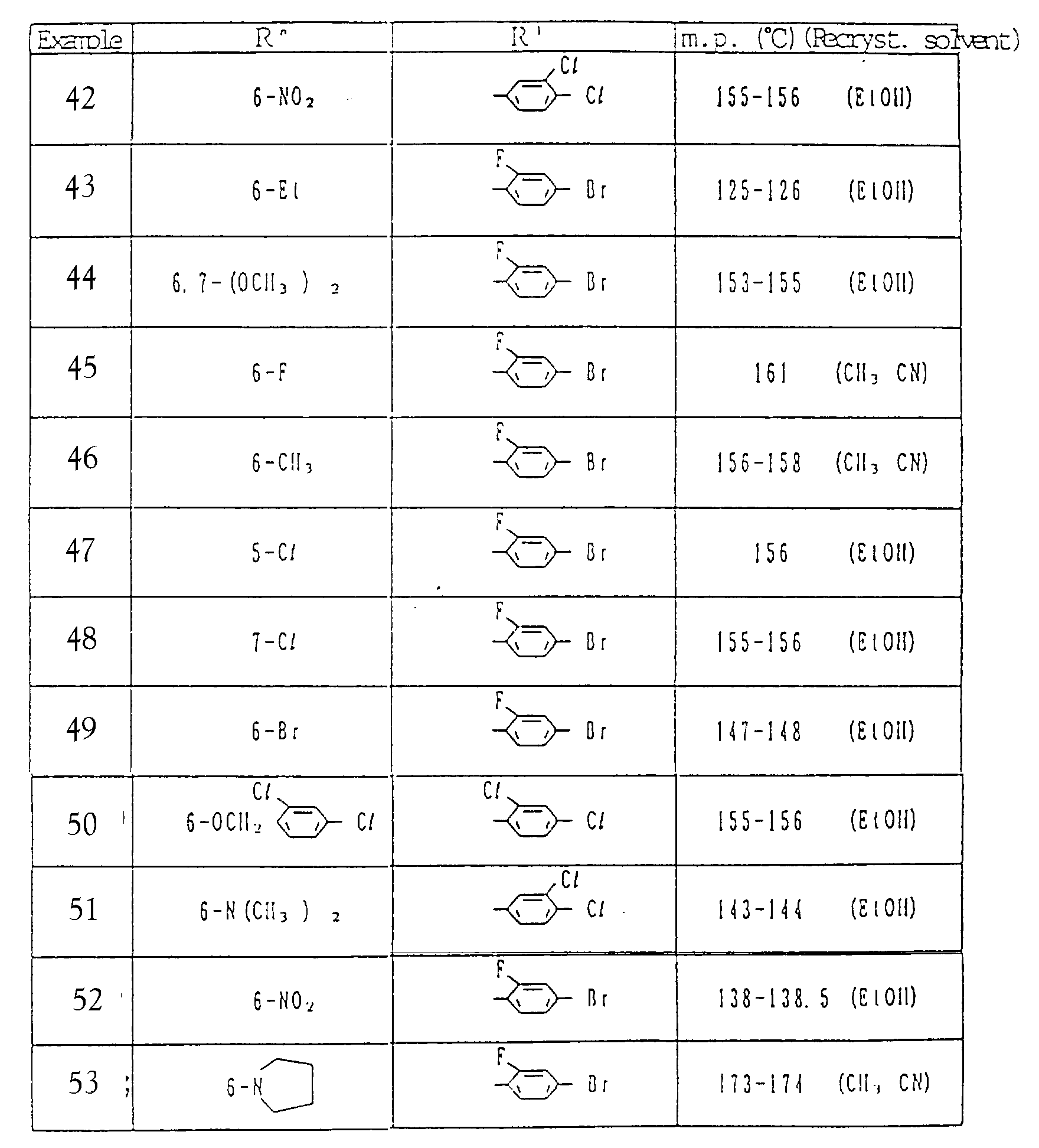

- Into 20 ml of dried dimethylformamide were suspended 0.24 g of sodium hydride, and, after added 1.43 g of 1-(4-chlorophenyl)-methyl-3H-quinazoline-2,4-dione to this, the mixture was stirred for 15 minutes. Thereafter, 0.92 g of ethyl bromoacetate were further added dropwise and the mixture was stirred for 2 hours at room temperature. After cooling by allowing to stand, the reaction mixture was poured into 500 ml of water and the deposits were collected by filtration. They were recrystallized from ethanol to obtain 1.29 g of title compound. m.p. 138 - 139 °C
Elemental analysis (%) as C₁₉H₁₇ClN₂O₄ Calculated C: 61.21 H: 4.60 N: 7.52 Observed C: 61.12 H: 4.45 N: 7.48 - Following compounds were obtained through similar process to Example 61.


- Into 280 ml of concentrated hydrochloric acid and 140 ml of acetic acid were suspended 18.0 g of ethyl 1-(4-bromo-2-fluorophenyl)methyl-6-chloro-1,4-dihydro-2,4-dioxo-3(2H)-quinazolineacetate, and, after added 1 ml of concentrated sulfuric acid, the mixture was refluxed for 3 hours, After cooling, the reaction liquor was poured into 600 ml of ice water and the deposits were collected by filtration. They were recrystallized from ethanol to obtain 15,0 g of title compound. m.p. 189 °C
Elemental analysis (%) as C₁₇H₁₁BrClFN₂O₄ Calculated C: 46.23 H: 2.51 N: 6.34 Observed C: 46.28 H: 2.39 N: 6.30 - Into 50 ml of ethanol were dissolved 1.59 g of ethyl 6-chloro-1-(4-fluorophenyl)methyl-1,4-dihydro-2,4-dioxo-3(2H)-quinazolineacetate, and after added 5 ml of aqueous solution containing 0.30 g of potassium hydroxide, the mixture was refluxed for 1 hour. After cooling by allowing to stand, ethanol was distilled off and the residue was dissolved by adding 30 ml of water, acidified with concentrated hydrochloric acid, and the deposits were collected by filtration. They were recrystallized from acetonitrile to obtain 0.75 g of title compound. m.p. 211 - 212 °C
Elemental analysis (%) as C₁₇H₁₂ClFN₂O₄ Calculated C: 56.28 H: 3.34 N: 7.72 Observed C: 56.26 H: 3.29 N: 7.68 - Following compounds were obtained through similar processes to Example 85 and 86.


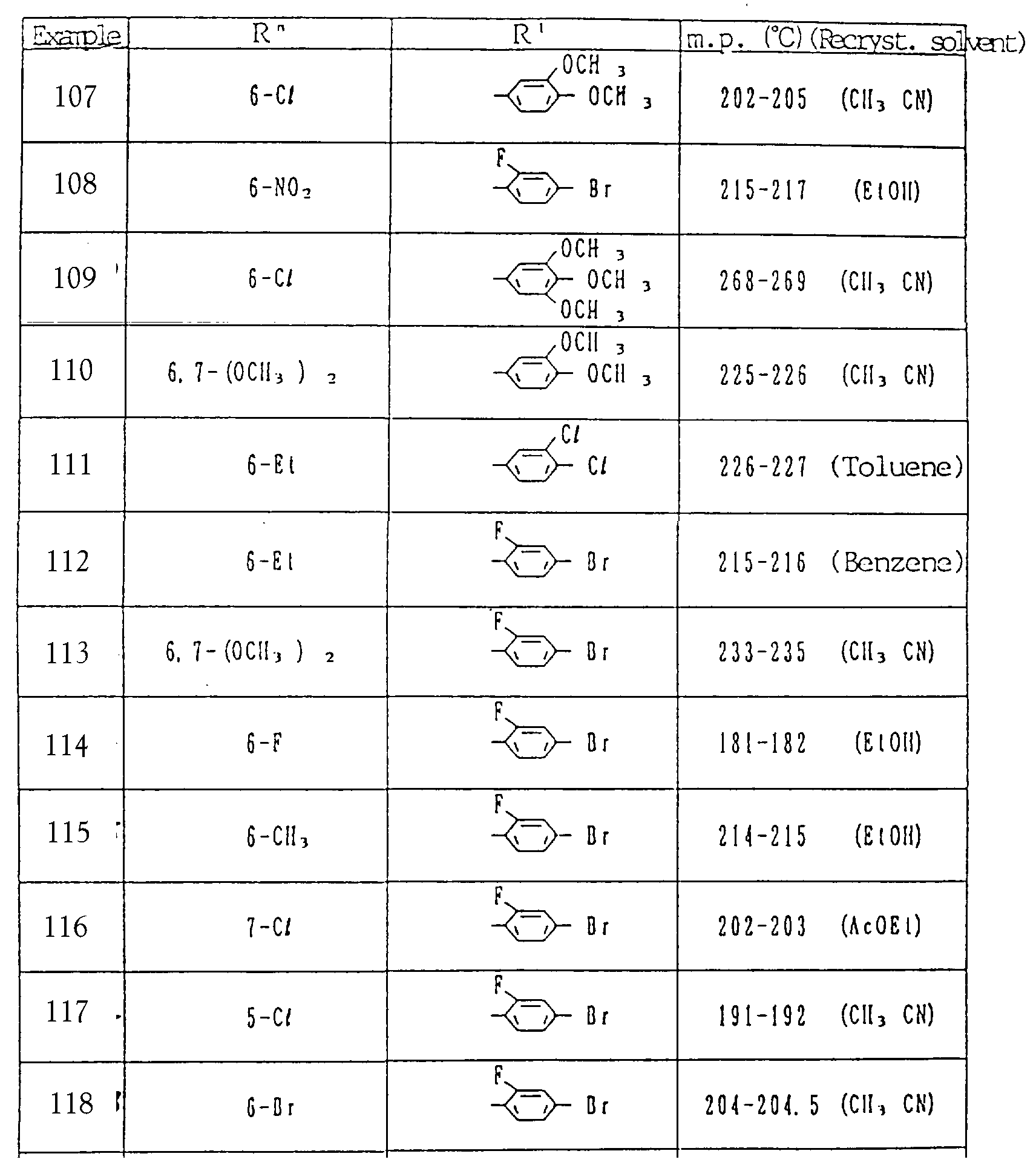


- Into 10 ml of dried dimethylformamide were suspended 60 mg of sodium hydride (60 %), and, to this was added dropwise a solution dissolved 500 mg of 6-chloro-1-(2,4-dichlorophenyl)-methyl-1,4-dihydro-2,4-dioxo-3(2H)-quinazolineacetic acid into 3 ml of dried dimethylformamide under stirring. After stirring the mixture for 30 minutes at room temperature, 160 mg of ethylene bromohydrin were added and the mixture was stirred for 4 hours at 110 °C. After cooling by allowing to stand, the reaction mixture was poured into 200 ml of water and acidified with hydrochloric acid, which was extracted with ethyl acetate. After dried over anhydrous magnesium sulfate, solvent was distilled off and the residue was recrystallized from ethanol to obtain 300 mg of title compound. m.p. 167 - 168 °C
Elemental analysis (%) as C₁₉H₁₅Cl₃N₂O₅ Calculated C: 49.86 H: 3.30 N: 6.12 Observed C: 49.88 H: 3.21 N: 6.16 - Following compound was synthesized through similar process to Example 151.
- Pivaloyloxymethyl 6-chloro-1-(3,4-dichlorophenyl)methyl-1,4-dihydro-2,4-dioxo-3(2H)-quinazolineacetate. m.p. 125 - 126 °C (EtOH)
- Into 100 ml of toluene were dissolved 3.80 g of ethyl 1-(2,4-dichlorophenyl)methyl-1,4-dihydro-2,4-dioxo-3(2H)-quinazolineacetate, and 5.70 g of Lawesson's reagent were added. After refluxed for 7 hours and 30 minutes, 1.90 g of Lawesson's reagent were further added and, after refluxed for 5 hours, solvent was distilled off. To the residue were added 10 ml of ethanol for washing, then it was further recrystallized from ethanol to obtain 2.80 g of title compound. m.p. 138 - 139 °C
Elemental analysis as C₁₉H₁₆Cl₂N₂O₃S Calculated C: 53.91 H: 3.81 N: 6.62 Observed C: 53.98 H: 3.76 N: 6.61 - Following compounds were synthesized through similar process to Example 153.
- Ethyl 1-(4-bromo-2-fluorophenyl)methyl-1,4-dihydro-2-oxo-4-thioxo-3(2H)-quinazolineacetate. m.p. 109 - 110 °C (EtOH)
- Ethyl 1-(4-bromo-2-fluorophenyl)methyl-6-chloro-1,4-dihydro-2-oxo-4-thioxo-3(2H)-quinazolineacetate. m.p. 89 - 90 °C (EtOH)
- Ethyl 1-(3,4-dichlorophenyl)methyl-1,4-dihydro-6-methyl-2-oxo-4-thioxo-3(2H)-quinazolineacetate. m.p. 175.5 - 177 °C (EtOH)
- Ethyl 1-(3,4-dichlorophenyl)methyl-1,4-dihydro-2-oxo-4-thioxo-3(2H)-quinazolineacetate. m.p. 128 - 129 °C (EtOH)
- Into 10 ml of acetic acid were dissolved 500 mg of ethyl 1-(2,4-dichlorophenyl)methyl-1,4-dihydro-2-oxo-4-thioxo-3(2H)-quinazolineacetate, and, after added 3 ml of concentrated hydrochloric acid and then 0.5 ml of concentrated sulfuric acid, the mixture was refluxed for 1 hour. After cooling by allowing to stand, the reaction mixture was poured into 200 ml of water and the deposits were collected by filtration. They were recrystallized from acetic acid to obtain 300 mg of title compound. m.p. 220 - 221 °C
Elemental analysis as C₁₇H₁₂Cl₂N₂O₃S Calculated C: 51.66 H: 3.06 N: 7.09 Observed C: 51.90 H: 3.05 N: 7.02 - Following compounds were synthesized through similar process to Example 158.
- 1-(4-Bromo-2-fluorophenyl)methyl-1,4-dihydro-2-oxo-4-thioxo-3(2H)-quinazolineacetic acid. m.p. 269 - 270.5 °C (EtOH)
- 1-(4-Bromo-2-fluorophenyl)methyl-6-chloro-1,4-dihydro-2-oxo-4-thioxo-3(2H)-quinazolineacetic acid. m.p. 249.5 - 250.5 °C (AcOEt)
- 1-(3,4-Dichlorophenyl)methyl-1,4-dihydro-2-oxo-4-thioxo-3(2H)-quinazolineacetic acid. m.p. 237 - 238 °C (CH₃CN)
- Into 10 ml of dioxane were dissolved 5.2 g of ethyl (2-((2,4-dichlorophenyl)methyl)amino-5-methoxybenzoyl)aminoacetate and 6.2 g of N,N'-carbonyldiimidazole, and the solution was heated to 140 to 150 °C. After distilled off dioxane, the mixture was further heated for 15 minutes at 140 °C. After cooling, ethanol was added and the crystalline substances were collected by filtration. They were recrystallized from ethanol to obtain 2.8 g of title compound. m.p. 167 - 168 °C
Elemental analysis (%) as C₂₀H₁₈Cl₂N₂O₅ Calculated C: 54.94 H: 4.15 N: 6.41 Observed C: 54.93 H: 4.11 N: 6.34 - In 30 ml of carbon tetrachloride were refluxed 3.5 g of ethyl 1-(3,4-dichlorophenyl)methyl-1,4-dihydro-2,4-dioxo-6-methyl-3(2H)-quinazolineacetate, 1.66 g of N-bromosuccinimide and calalytic amount of benzoyl peroxide for 2 hours.
- The insolubles were filtered off and the filtrate was concentrated. Ether was added to the residue for crystallization and the crystals thus obtained were recrystallized from acetonitrile to obtain 2.0 g of ethyl 6-bromomethyl-1-(3,4-dichlorophenyl)methyl-1,4-dihydro-2,4-dioxo-3(2H)-quinazolineacetate. m.p. 128 - 129 °C
- In 30 ml of dimethylformamide were stirred 1.90 g of above bromo compound, 0.28 g of imidazole and 0.53 g of potassium carbonate for 1.5 hours at 100 °C. After cooling by allowing stand, the reaction mixture was poured into 500 ml of water and the crystals deposited were collected by filtration. They were purified by means of silica gel column chromatography (developing solvent, chloroform:methanol=10:1) and recrystallized from acetonitrile to obtain 0.33 g of title compound. m.p. 201 - 202 °C
Elemental analysis (%) as C₂₃H₂₀Cl₂N₄O₄ Calculated C: 56.68 H: 4.14 N: 11.50 Observed C: 56.57 H: 4.02 N: 11.26 - In 1.6 ml of lN aqueous solution of sodium hydroxide and 20 ml of ethanol were refluxed 0.71 g of ethyl 1-(3,4-dichlorophenyl)methyl-1,4-dihydro-2,4-dioxo-6-imidazolylmethyl-3(2H)-quinazolineacetate for 1 hour. Ethanol was distilled off and the reaction mixture was neutralized with 3N hydrochloric acid. The crystals deposited were collected by filtration, washed with water and dried. They were recrystallized from acetic acid to obtain 0.50 g of title compound. m.p. 243 - 244 °C


- A mixture of 20.0 g of ethyl (2-amino-4,5-difluorobenzoyl)-aminoacetate, 25.1 g of N,N'-carbonyldiimidazole and 35 ml of dioxane was heated to 150 °C and, after distilled off dioxane, the mixture was heated for 1 hour. After cooling by allowing to stand, the crystals obtained were washed with methanol and recrystallized from dimethylformamide to obtain 13.8 g of title compound. m.p. 276 - 278 °C
Elemental analysis (%) as C₁₅H₁₃FN₄O₄ Calculated C: 54.22 H; 3.94 N: 16.86 Observed C: 54.03 H: 3.98 N: 16.74 - Into 50 ml of dimethylformamide were dissolved 2.33 g of ethyl 1,4-dihydro-2,4-dioxo-6-fluoro-7-imidazolyl-3(2H)-quinazolineacetate, and, after added 0.97 g of potassium carbonate and 1.51 g of 2,4-dichlorobenzyl chloride, the mixture was stirred for 5 hours at 100 °C. After cooling by allowing to stand, the reaction mixture was poured into 500 ml of water and the deposits were collected by filtration. They were recrystallized from ethanol to obtain 2.25 g of title compound. m.p. 192 - 193 °C
Elemental analysis (%) as C₂₂H₁₇Cl₂FN₄O₄ Calculated C: 53.78 H: 3.49 N: 11.40 Observed C: 53.62 H: 3.54 N; 11.30 - Following compounds were synthesized through similar process to Example 165.
- Ethyl 1,4-dihydro-2,4-dioxo-6-fluoro-7-imidazolyl-1-((4-trifluoromethyl)phenyl)methyl-3(2H)-quinazolineacetate. m.p. 132 - 133 °C (Et₂O)
- Ethyl 1-(3,4-dichlorophenyl)methyl-1,4-dihydro-2,4-dioxo-6-fluoro-7-imidazolyl-3(2H)-quinazolineacetate. m.p. 129 - 130 °C (EtOH)
- Into 50 ml of ethanol were dissolved 2.0 g of ethyl 1-(2,4-dichlorophenyl)methyl-1,4-dihydro-2,4-dioxo-6-fluoro-7-imidazolyl-3(2H)-quinazolineacetate, and, after added 4.5 ml of lN aqueous solution of sodium hydroxide, the mixture was refluxed for 1.5 hours. Ethanol was distilled off, water was added, pH was made to be 5 with 3N hydrochloric acid, and the deposits were collected by filtration. They were recrystallized from dioxane to obtain 930 mg of title compound. m.p. 188 - 189 °C


- Following compounds were synthesized through similar process to Example 168.
- 1,4-Dihydro-2,4-dioxo-6-fluoro-7-imidazolyl-1-((4-trifluoromethyl)phenyl)methyl-3(2H)-quinazolineacetic acid. m.p. 245 - 246 °C (dioxane)
- 1-(3,4-Dichlorophenyl)methyl-1,4-dihydro-2,4-dioxo-6-fluoro-7-imidazolyl-3(2H)-quinazolineacetic acid. m.p. 251 - 253 °C (dioxane)
- The novel quinazoline-3-alkanoic acid derivatives and their salts according to the invention have conspicuous hindering activity on aldose reductase and are useful drugs for the therapy and the prevention of complication of diabetes mellitus. Moreover, the compounds of the invention have excellent inhibitory effect on platelet aggregation and are also useful for the therapy of disorders of cerebral circulatory system, disease of arterial system, thrombosis, cardiac disease, ischemic fit and vascular disorders accompanied with diabetes mellitus.
- Enzyme aldose reductase was partially purified from lens of rat and the inhibitory effect of the inventive compounds was determined using the method of Hyman et al (Hyman et al; J. Biol. Chem. 240, 877 (1965)). The IC₅₀ value (drug concentration for inhibiting 50 % of enzyme activity) of the inventive compounds was 10⁻⁷ to 10⁻⁹M showing excellent inhibitory effect on aldose reductase.
- Using citric acid-excess platelet plasma of rabbit, the aggregation caused by arachidonic acid was measured with aggregometer. The IC₅₀ value (drug concentration for inhibiting 50 % of platelet aggregation) was 10⁻⁵ to 10⁻⁷M showing excellent inhibitory effect on platelet aggregation.
Claims (9)
- Quinazoline-3-alkanoic acid derivatives represented by the general formula (I)


- A process for preparing the quinazoline-3-alkanoic acid derivatives or their salts according to claim 1, characterized in that (a) compounds represented by the general formula (II)

R¹-CH₂-Z [III]
wherein Z is an eliminating group and R¹ is as defined in claim 1, or (b) compounds represented by the general formula (IV)
Z-(CH₂)n-COOR [V]
wherein Z is an eliminating group and Rand n are as defined in claim 1, or (c) compounds represented by the general formula (VI)
- A process for preparing the quinazoline-3-alkanoic acid derivatives or their salts according to claim 1, wherein R is a hydrogen atom, characterized in that compounds represented by the general formula (VII)

- A process for preparing the quinazoline-3-alkanoic acid derivatives or their salts according to claim 1, wherein X is a thiocarbonyl group, characterized in that compounds represented by the general formula (IX)

- A process for preparing the quinazoline-3-alkanoic acid derivatives or their salts according to claim 1, wherein R is a protecting group for the carboxyl group, characterized in that compounds represented by the general formula (X)

R'-Z [XI]
wherein R' is a protecting group for the carboxyl group and Z is an eliminating group, in the presence of a suitable base, or, after produced reactive derivatives of carboxylic acid once, then they are reacted with compounds represented by the general formula (XII)
R'-OH [XII]
wherein R' is as described above. - A process for preparing the quinazoline-3-alkanoic acid derivatives or their salts according to claim 1, wherein R is an imidazolylmethyl group, R³ is hydrogen, halogen or lower alkoxy group having 1 to 3 carbon atoms and X is a carbonyl group, characterized in that with quinazoline-3-alkanoic acid derivatives represented by the general formula (XIV)

a halogenating agent is reacted to obtain compounds represented by the general formula (XV)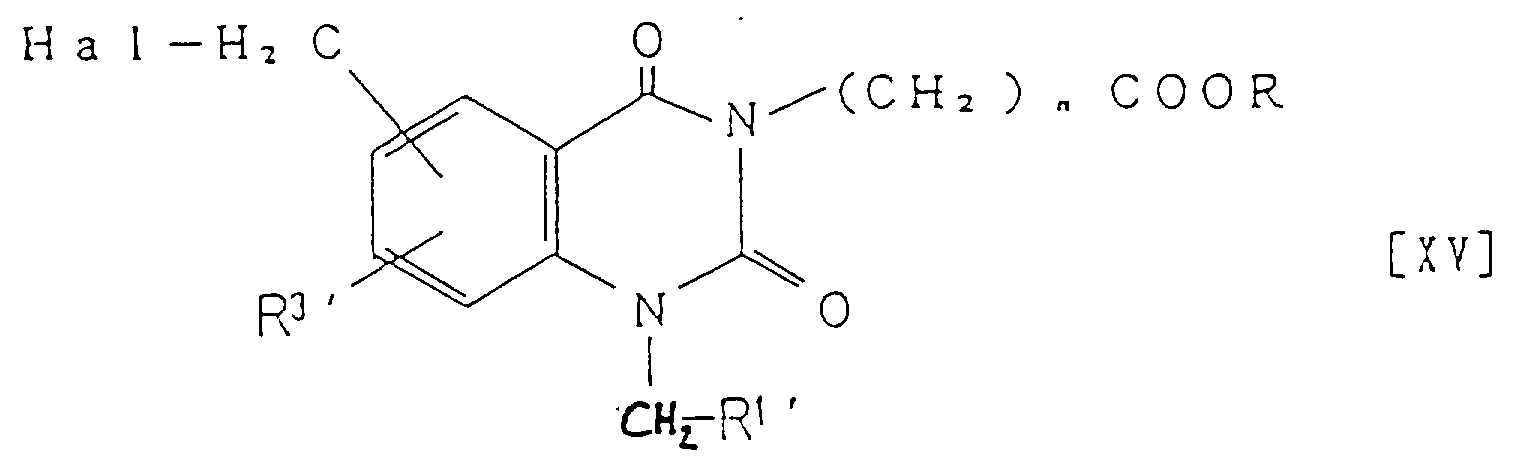
- A process for preparing the quinazoline-3-alkanoic acid derivatives or their salts according to claim 1, wherein R is an imidazolyl group, R³ is hydrogen, halogen, lower alkyl group having 1 to 6 carbon atoms, lower alkoxy group having 1 to 3 carbon atoms, aralkyl group or nitro group, and X is a carbonyl group, characterized in that compounds represented by the general formula (XVII)


and then they are reacted with compounds represented by the general formula (III)
R¹-CH₂-Z [III]
wherein Z is an eliminating group and R¹ is as defined in claim 1. - An inhibitor of platelet aggregation consisting of at least one kind of quinazoline-3-alkanoic acid derivatives represented by the general formula (I) or their salts, as defined in claim 1 as effective ingredient(s).
- An inhibitory agent on aldose reductase consisting of at least one kind of quinazoline-3-alkanoic acid derivatives represented by the general formula (I) or their salts as defined in claim 1 as effective ingredient(s).
Applications Claiming Priority (3)
| Application Number | Priority Date | Filing Date | Title |
|---|---|---|---|
| JP321097/89 | 1989-12-11 | ||
| JP1321097A JPH0747582B2 (en) | 1989-12-11 | 1989-12-11 | Quinazoline-3-alkanoic acid derivative and its salt and process for producing the same |
| PCT/JP1990/001600 WO1991009024A1 (en) | 1989-12-11 | 1990-12-10 | Quinazoline-3-alkanoic acid derivative, salt thereof, and production thereof |
Publications (3)
| Publication Number | Publication Date |
|---|---|
| EP0456835A1 EP0456835A1 (en) | 1991-11-21 |
| EP0456835A4 EP0456835A4 (en) | 1992-06-03 |
| EP0456835B1 true EP0456835B1 (en) | 1996-05-15 |
Family
ID=18128787
Family Applications (1)
| Application Number | Title | Priority Date | Filing Date |
|---|---|---|---|
| EP91900052A Expired - Lifetime EP0456835B1 (en) | 1989-12-11 | 1990-12-10 | Quinazoline-3-alkanoic acid derivative, salt thereof, and production thereof |
Country Status (10)
| Country | Link |
|---|---|
| US (1) | US5234928A (en) |
| EP (1) | EP0456835B1 (en) |
| JP (1) | JPH0747582B2 (en) |
| KR (1) | KR960012196B1 (en) |
| AU (1) | AU640194B2 (en) |
| CA (1) | CA2046603A1 (en) |
| DE (1) | DE69027021T2 (en) |
| ES (1) | ES2087991T3 (en) |
| HU (1) | HU207999B (en) |
| WO (1) | WO1991009024A1 (en) |
Cited By (10)
| Publication number | Priority date | Publication date | Assignee | Title |
|---|---|---|---|---|
| US5403836A (en) * | 1991-10-18 | 1995-04-04 | Genentech, Inc. | Benzazepine platelet aggregation inhibitors having specificity for the GPIIb IIIa receptor |
| US5618843A (en) * | 1993-07-22 | 1997-04-08 | Eli Lilly And Company | Glycoprotein IIb/IIIa antagonists |
| US5663166A (en) * | 1991-10-18 | 1997-09-02 | Genentech, Inc. | Nonpeptidyl integrin inhibitors having specificity for the GPIIb IIIa receptor |
| US5693637A (en) * | 1993-12-07 | 1997-12-02 | Basf Aktiengesellschaft | Bicycle derivatives, their preparation and use |
| US5756738A (en) * | 1995-11-14 | 1998-05-26 | Sumitomo Chemical Company, Limited | Process for producing 1-substituted tetrahydroquinazolines |
| US5994542A (en) * | 1995-11-14 | 1999-11-30 | Sumitomo Chemical Company, Limited | Process for producing 1-substituted tetrahydroquinazolines |
| US6020362A (en) * | 1993-07-22 | 2000-02-01 | Eli Lilly And Company | Glycoprotein IIB IIIA antagonists |
| US6137002A (en) * | 1993-07-22 | 2000-10-24 | Eli Lilly And Company | Glycoprotein IIb/IIIa antagonists |
| US6448269B1 (en) | 1993-07-22 | 2002-09-10 | Eli Lilly And Company | Glycoprotein IIb/IIIa antagonists |
| US8586292B2 (en) | 2002-12-06 | 2013-11-19 | Sibaji Sarkar | Methods for identifying compounds for treatment of thrombotic condition |
Families Citing this family (15)
| Publication number | Priority date | Publication date | Assignee | Title |
|---|---|---|---|---|
| AU2436792A (en) * | 1991-08-16 | 1993-03-16 | Merck & Co., Inc. | Quinazoline derivatives as inhibitors of hiv reverse transcriptase |
| IL102764A0 (en) * | 1991-08-16 | 1993-01-31 | Merck & Co Inc | Quinazoline derivatives,and pharmaceutical compositions containing them |
| DE19724983A1 (en) * | 1997-06-13 | 1998-12-17 | Basf Ag | Process for the preparation of quinazoline dions on solid phase and their use |
| EP1198231A1 (en) | 1999-07-21 | 2002-04-24 | American Home Products Corporation | Bicyclic antagonists selective for the(alpha)v(beta)3 integrin |
| US7439249B2 (en) * | 2002-12-31 | 2008-10-21 | Vertex Pharmaceuticals Incorporated | Inhibitors of phosphatases |
| EP1583747A2 (en) * | 2002-12-31 | 2005-10-12 | Vertex Pharmaceuticals Incorporated | Inhibitors of phosphatases |
| TW200911755A (en) | 2007-04-19 | 2009-03-16 | Astellas Pharma Inc | Bicyclic heterocyclic compounds |
| JP5634263B2 (en) * | 2007-08-16 | 2014-12-03 | ベーリンガー インゲルハイム インターナショナル ゲゼルシャフト ミット ベシュレンクテル ハフツング | Quinazolinedione chymase inhibitor |
| CA2911818A1 (en) | 2013-05-10 | 2014-11-13 | Nimbus Apollo, Inc. | Acc inhibitors and uses thereof |
| CA2911932A1 (en) | 2013-05-10 | 2014-11-13 | Nimbus Apollo, Inc. | Acc inhibitors and uses thereof |
| MX2015015417A (en) | 2013-05-10 | 2016-06-21 | Nimbus Apollo Inc | Acc inhibitors and uses thereof. |
| CN105358155A (en) | 2013-05-10 | 2016-02-24 | 尼普斯阿波罗有限公司 | Acc inhibitors and uses thereof |
| WO2015003879A1 (en) * | 2013-07-08 | 2015-01-15 | Syngenta Participations Ag | Microbiocidal heterobicylic derivatives |
| CN104119344B (en) * | 2014-05-30 | 2017-06-06 | 上海天慈生物谷生物工程有限公司 | The method that one kind prepares the glyoxalidine of 6,7 dichloro- 1,5 simultaneously [2,1 b] quinazoline 2 (3H) ketone |
| CN115785004B (en) * | 2022-11-30 | 2025-03-11 | 盐城工学院 | A carboxyl-substituted quinoxalinone derivative and its preparation method and application |
Citations (1)
| Publication number | Priority date | Publication date | Assignee | Title |
|---|---|---|---|---|
| JPS5795966A (en) * | 1980-12-04 | 1982-06-15 | Sumitomo Chem Co Ltd | Novel 2(1h)-quinazolinone derivative |
Family Cites Families (4)
| Publication number | Priority date | Publication date | Assignee | Title |
|---|---|---|---|---|
| DE277687C (en) * | 1911-03-11 | 1914-09-04 | Stanzwerk Oberscheden Juenemann & Co | Method and device for sterilizing milk |
| US4556739A (en) * | 1983-09-29 | 1985-12-03 | Ortho Pharmaceutical Corporation | 3,4-Dialkoxy-2-alkylcarbonyl analino compounds |
| US4931440A (en) * | 1987-07-29 | 1990-06-05 | Fujisawa Pharmaceutical Company, Ltd. | Uricosuric composition |
| JP2621460B2 (en) * | 1988-02-29 | 1997-06-18 | 藤沢薬品工業株式会社 | Diuretics or antihypertensives |
-
1989
- 1989-12-11 JP JP1321097A patent/JPH0747582B2/en not_active Expired - Lifetime
-
1990
- 1990-12-10 EP EP91900052A patent/EP0456835B1/en not_active Expired - Lifetime
- 1990-12-10 HU HU912399A patent/HU207999B/en not_active IP Right Cessation
- 1990-12-10 ES ES91900052T patent/ES2087991T3/en not_active Expired - Lifetime
- 1990-12-10 KR KR1019910700811A patent/KR960012196B1/en not_active Expired - Fee Related
- 1990-12-10 AU AU68905/91A patent/AU640194B2/en not_active Ceased
- 1990-12-10 WO PCT/JP1990/001600 patent/WO1991009024A1/en not_active Ceased
- 1990-12-10 DE DE69027021T patent/DE69027021T2/en not_active Expired - Fee Related
- 1990-12-10 CA CA002046603A patent/CA2046603A1/en not_active Abandoned
- 1990-12-10 US US07/721,610 patent/US5234928A/en not_active Expired - Fee Related
Patent Citations (1)
| Publication number | Priority date | Publication date | Assignee | Title |
|---|---|---|---|---|
| JPS5795966A (en) * | 1980-12-04 | 1982-06-15 | Sumitomo Chem Co Ltd | Novel 2(1h)-quinazolinone derivative |
Non-Patent Citations (1)
| Title |
|---|
| FR; F. BILLON et al.: "Aldose reductase inhibition by 2,4-oxo and thioxo derivatives of 1,2,3,4-tetrahydroquinazoline" * |
Cited By (13)
| Publication number | Priority date | Publication date | Assignee | Title |
|---|---|---|---|---|
| US5674865A (en) * | 1991-10-18 | 1997-10-07 | Genentech, Inc. | Nonpeptidyl integrin inhibitors having specificity for the GPIIb IIIa |
| US5403836A (en) * | 1991-10-18 | 1995-04-04 | Genentech, Inc. | Benzazepine platelet aggregation inhibitors having specificity for the GPIIb IIIa receptor |
| US5663166A (en) * | 1991-10-18 | 1997-09-02 | Genentech, Inc. | Nonpeptidyl integrin inhibitors having specificity for the GPIIb IIIa receptor |
| US5674863A (en) * | 1991-10-18 | 1997-10-07 | Genentech, Inc. | Nonpeptidyl integrin inhibitors having specificity for the GPIIb IIIa receptor |
| US6137002A (en) * | 1993-07-22 | 2000-10-24 | Eli Lilly And Company | Glycoprotein IIb/IIIa antagonists |
| US6020362A (en) * | 1993-07-22 | 2000-02-01 | Eli Lilly And Company | Glycoprotein IIB IIIA antagonists |
| US5618843A (en) * | 1993-07-22 | 1997-04-08 | Eli Lilly And Company | Glycoprotein IIb/IIIa antagonists |
| US6448269B1 (en) | 1993-07-22 | 2002-09-10 | Eli Lilly And Company | Glycoprotein IIb/IIIa antagonists |
| US6472405B1 (en) | 1993-07-22 | 2002-10-29 | Eli Lilly And Company | Glycoprotein IIB/IIIA antagonists |
| US5693637A (en) * | 1993-12-07 | 1997-12-02 | Basf Aktiengesellschaft | Bicycle derivatives, their preparation and use |
| US5756738A (en) * | 1995-11-14 | 1998-05-26 | Sumitomo Chemical Company, Limited | Process for producing 1-substituted tetrahydroquinazolines |
| US5994542A (en) * | 1995-11-14 | 1999-11-30 | Sumitomo Chemical Company, Limited | Process for producing 1-substituted tetrahydroquinazolines |
| US8586292B2 (en) | 2002-12-06 | 2013-11-19 | Sibaji Sarkar | Methods for identifying compounds for treatment of thrombotic condition |
Also Published As
| Publication number | Publication date |
|---|---|
| HU207999B (en) | 1993-07-28 |
| HUT58304A (en) | 1992-02-28 |
| DE69027021T2 (en) | 1997-01-02 |
| KR920701174A (en) | 1992-08-11 |
| ES2087991T3 (en) | 1996-08-01 |
| JPH0747582B2 (en) | 1995-05-24 |
| DE69027021D1 (en) | 1996-06-20 |
| CA2046603A1 (en) | 1991-06-12 |
| AU6890591A (en) | 1991-07-18 |
| AU640194B2 (en) | 1993-08-19 |
| KR960012196B1 (en) | 1996-09-16 |
| WO1991009024A1 (en) | 1991-06-27 |
| US5234928A (en) | 1993-08-10 |
| JPH03181469A (en) | 1991-08-07 |
| EP0456835A4 (en) | 1992-06-03 |
| EP0456835A1 (en) | 1991-11-21 |
Similar Documents
| Publication | Publication Date | Title |
|---|---|---|
| EP0456835A1 (en) | Quinazoline-3-alkanoic acid derivative, salt thereof, and production thereof | |
| US5104890A (en) | Benzopyran derivatives and processes for preparation thereof | |
| CA2081836C (en) | Aromatic amidine derivatives and salts thereof | |
| HU190408B (en) | Process for producing pharmaceutical preparations comprising new benzimidazole-derivatives | |
| US20070093483A1 (en) | Use of derivatives of 2, 4-dihydro-[1,2,4] triazole-3-thione as inhibitors of the enzyme myeloperoxidase (mpo) | |
| CZ295580B6 (en) | Quinoline and quinazoline compounds, process and intermediates for their preparation, their use and pharmaceutical compositions based thereon | |
| HU206709B (en) | Process for producing new 3-/4-/1-substituted-4-piperazinyl/-butyl/-4-thiazolidinone derivatives and pharmaceutical compositions containing them | |
| US4861780A (en) | 4(3H)-quinazolinone derivatives and pharmaceutical compositions | |
| WO2004014384A2 (en) | Cyclic compounds containing zinc binding groups as matrix metalloproteinase inhibitors | |
| HU217907B (en) | Quinoline or quinazoline derivatives, a process for preparing the compounds, and pharmaceutical compositions containing the compounds | |
| CS235334B2 (en) | Method of 1,4-dihydropyridines production | |
| KR100204697B1 (en) | Triazolylated tertiary amine compound or salt thereof | |
| CZ20031813A3 (en) | Chemical process and novel intermediates | |
| JP2860689B2 (en) | Pyrimidine derivatives | |
| US4829069A (en) | 4-Thioquinazoline derivatives as antiulcer agents | |
| US4064244A (en) | Organic compounds | |
| JP2883995B2 (en) | Piperidine derivative and intermediate for producing the same | |
| US4833144A (en) | 2-Alkylsulfinyl-4(3H)-quinazolinone derivatives and pharmaceutical compositions | |
| US4757078A (en) | Cyclic aryl hydroxamic acids, derivatives thereof and method of use as anti-allergy agents | |
| US5112841A (en) | Imidazole derivatives and antiepileptics comprising said imidazole derivatives as effective ingredients | |
| US4397849A (en) | Benzothiazine derivatives | |
| JP2860688B2 (en) | Indole derivatives | |
| JPS62174062A (en) | 1,5-benzodiazepine derivative and production thereof | |
| CA2035988A1 (en) | Imidazole compounds, processes for their preparation, pharmaceuticals based on these compounds and some intermediaes | |
| HU204796B (en) | Process for producing benzimidazole derivatives |
Legal Events
| Date | Code | Title | Description |
|---|---|---|---|
| PUAI | Public reference made under article 153(3) epc to a published international application that has entered the european phase |
Free format text: ORIGINAL CODE: 0009012 |
|
| AK | Designated contracting states |
Kind code of ref document: A1 Designated state(s): BE CH DE ES FR GB IT LI NL SE |
|
| 17P | Request for examination filed |
Effective date: 19911219 |
|
| A4 | Supplementary search report drawn up and despatched |
Effective date: 19920421 |
|
| AK | Designated contracting states |
Kind code of ref document: A4 Designated state(s): BE CH DE ES FR GB IT LI NL SE |
|
| 17Q | First examination report despatched |
Effective date: 19940908 |
|
| GRAH | Despatch of communication of intention to grant a patent |
Free format text: ORIGINAL CODE: EPIDOS IGRA |
|
| GRAA | (expected) grant |
Free format text: ORIGINAL CODE: 0009210 |
|
| AK | Designated contracting states |
Kind code of ref document: B1 Designated state(s): BE CH DE ES FR GB IT LI NL SE |
|
| REF | Corresponds to: |
Ref document number: 69027021 Country of ref document: DE Date of ref document: 19960620 |
|
| ET | Fr: translation filed | ||
| REG | Reference to a national code |
Ref country code: ES Ref legal event code: BA2A Ref document number: 2087991 Country of ref document: ES Kind code of ref document: T3 |
|
| ITF | It: translation for a ep patent filed | ||
| REG | Reference to a national code |
Ref country code: ES Ref legal event code: FG2A Ref document number: 2087991 Country of ref document: ES Kind code of ref document: T3 |
|
| PLBE | No opposition filed within time limit |
Free format text: ORIGINAL CODE: 0009261 |
|
| STAA | Information on the status of an ep patent application or granted ep patent |
Free format text: STATUS: NO OPPOSITION FILED WITHIN TIME LIMIT |
|
| 26N | No opposition filed | ||
| PGFP | Annual fee paid to national office [announced via postgrant information from national office to epo] |
Ref country code: CH Payment date: 19981210 Year of fee payment: 9 |
|
| PGFP | Annual fee paid to national office [announced via postgrant information from national office to epo] |
Ref country code: GB Payment date: 19981211 Year of fee payment: 9 |
|
| PGFP | Annual fee paid to national office [announced via postgrant information from national office to epo] |
Ref country code: ES Payment date: 19981214 Year of fee payment: 9 |
|
| PGFP | Annual fee paid to national office [announced via postgrant information from national office to epo] |
Ref country code: FR Payment date: 19981215 Year of fee payment: 9 |
|
| PGFP | Annual fee paid to national office [announced via postgrant information from national office to epo] |
Ref country code: BE Payment date: 19981216 Year of fee payment: 9 |
|
| PGFP | Annual fee paid to national office [announced via postgrant information from national office to epo] |
Ref country code: DE Payment date: 19981222 Year of fee payment: 9 |
|
| PGFP | Annual fee paid to national office [announced via postgrant information from national office to epo] |
Ref country code: SE Payment date: 19981223 Year of fee payment: 9 |
|
| PGFP | Annual fee paid to national office [announced via postgrant information from national office to epo] |
Ref country code: NL Payment date: 19981231 Year of fee payment: 9 |
|
| PG25 | Lapsed in a contracting state [announced via postgrant information from national office to epo] |
Ref country code: GB Free format text: LAPSE BECAUSE OF NON-PAYMENT OF DUE FEES Effective date: 19991210 |
|
| PG25 | Lapsed in a contracting state [announced via postgrant information from national office to epo] |
Ref country code: SE Free format text: LAPSE BECAUSE OF NON-PAYMENT OF DUE FEES Effective date: 19991211 |
|
| PG25 | Lapsed in a contracting state [announced via postgrant information from national office to epo] |
Ref country code: LI Free format text: LAPSE BECAUSE OF NON-PAYMENT OF DUE FEES Effective date: 19991231 Ref country code: CH Free format text: LAPSE BECAUSE OF NON-PAYMENT OF DUE FEES Effective date: 19991231 Ref country code: BE Free format text: LAPSE BECAUSE OF NON-PAYMENT OF DUE FEES Effective date: 19991231 |
|
| BERE | Be: lapsed |
Owner name: KYORIN PHARMACEUTICAL CO. LTD Effective date: 19991231 |
|
| PG25 | Lapsed in a contracting state [announced via postgrant information from national office to epo] |
Ref country code: NL Free format text: LAPSE BECAUSE OF NON-PAYMENT OF DUE FEES Effective date: 20000701 |
|
| GBPC | Gb: european patent ceased through non-payment of renewal fee |
Effective date: 19991210 |
|
| EUG | Se: european patent has lapsed |
Ref document number: 91900052.1 |
|
| PG25 | Lapsed in a contracting state [announced via postgrant information from national office to epo] |
Ref country code: FR Free format text: LAPSE BECAUSE OF NON-PAYMENT OF DUE FEES Effective date: 20000831 |
|
| NLV4 | Nl: lapsed or anulled due to non-payment of the annual fee |
Effective date: 20000701 |
|
| PG25 | Lapsed in a contracting state [announced via postgrant information from national office to epo] |
Ref country code: DE Free format text: LAPSE BECAUSE OF NON-PAYMENT OF DUE FEES Effective date: 20001003 |
|
| REG | Reference to a national code |
Ref country code: FR Ref legal event code: ST |
|
| PG25 | Lapsed in a contracting state [announced via postgrant information from national office to epo] |
Ref country code: ES Free format text: LAPSE BECAUSE OF NON-PAYMENT OF DUE FEES Effective date: 20001211 |
|
| REG | Reference to a national code |
Ref country code: ES Ref legal event code: FD2A Effective date: 20010113 |
|
| PG25 | Lapsed in a contracting state [announced via postgrant information from national office to epo] |
Ref country code: IT Free format text: LAPSE BECAUSE OF NON-PAYMENT OF DUE FEES;WARNING: LAPSES OF ITALIAN PATENTS WITH EFFECTIVE DATE BEFORE 2007 MAY HAVE OCCURRED AT ANY TIME BEFORE 2007. THE CORRECT EFFECTIVE DATE MAY BE DIFFERENT FROM THE ONE RECORDED. Effective date: 20051210 |