EP0454437B1 - Oxygen absorbent composition and method of preserving article with same - Google Patents
Oxygen absorbent composition and method of preserving article with same Download PDFInfo
- Publication number
- EP0454437B1 EP0454437B1 EP91303682A EP91303682A EP0454437B1 EP 0454437 B1 EP0454437 B1 EP 0454437B1 EP 91303682 A EP91303682 A EP 91303682A EP 91303682 A EP91303682 A EP 91303682A EP 0454437 B1 EP0454437 B1 EP 0454437B1
- Authority
- EP
- European Patent Office
- Prior art keywords
- oxygen
- parcel
- oxygen absorbent
- gas
- day
- Prior art date
- Legal status (The legal status is an assumption and is not a legal conclusion. Google has not performed a legal analysis and makes no representation as to the accuracy of the status listed.)
- Expired - Lifetime
Links
- 239000001301 oxygen Substances 0.000 title claims description 281
- 229910052760 oxygen Inorganic materials 0.000 title claims description 281
- QVGXLLKOCUKJST-UHFFFAOYSA-N atomic oxygen Chemical compound [O] QVGXLLKOCUKJST-UHFFFAOYSA-N 0.000 title claims description 279
- 239000002250 absorbent Substances 0.000 title claims description 154
- 230000002745 absorbent Effects 0.000 title claims description 154
- 239000000203 mixture Substances 0.000 title claims description 119
- 238000000034 method Methods 0.000 title claims description 108
- 238000012856 packing Methods 0.000 claims description 136
- 239000000463 material Substances 0.000 claims description 130
- 239000000126 substance Substances 0.000 claims description 69
- -1 unsaturated fatty acid compound Chemical class 0.000 claims description 63
- 239000000428 dust Substances 0.000 claims description 56
- 239000000853 adhesive Substances 0.000 claims description 42
- 230000001070 adhesive effect Effects 0.000 claims description 42
- 239000003795 chemical substances by application Substances 0.000 claims description 30
- 230000003647 oxidation Effects 0.000 claims description 26
- 238000007254 oxidation reaction Methods 0.000 claims description 26
- 230000035699 permeability Effects 0.000 claims description 23
- 229920000642 polymer Polymers 0.000 claims description 21
- 235000021122 unsaturated fatty acids Nutrition 0.000 claims description 18
- 239000004215 Carbon black (E152) Substances 0.000 claims description 17
- 229930195733 hydrocarbon Natural products 0.000 claims description 17
- 150000002430 hydrocarbons Chemical class 0.000 claims description 17
- 238000001179 sorption measurement Methods 0.000 claims description 17
- 238000007789 sealing Methods 0.000 claims description 11
- 239000012790 adhesive layer Substances 0.000 claims description 5
- 238000003860 storage Methods 0.000 claims description 3
- 239000000843 powder Substances 0.000 description 59
- 238000004321 preservation Methods 0.000 description 53
- XLYOFNOQVPJJNP-UHFFFAOYSA-N water Substances O XLYOFNOQVPJJNP-UHFFFAOYSA-N 0.000 description 46
- 238000010521 absorption reaction Methods 0.000 description 45
- 229910052751 metal Inorganic materials 0.000 description 43
- 239000002184 metal Substances 0.000 description 43
- 239000004698 Polyethylene Substances 0.000 description 40
- 230000000052 comparative effect Effects 0.000 description 40
- 229920000573 polyethylene Polymers 0.000 description 40
- JEIPFZHSYJVQDO-UHFFFAOYSA-N iron(III) oxide Inorganic materials O=[Fe]O[Fe]=O JEIPFZHSYJVQDO-UHFFFAOYSA-N 0.000 description 32
- 230000008859 change Effects 0.000 description 24
- 239000002274 desiccant Substances 0.000 description 22
- 239000007789 gas Substances 0.000 description 22
- 239000000123 paper Substances 0.000 description 21
- QTBSBXVTEAMEQO-UHFFFAOYSA-N Acetic acid Chemical compound CC(O)=O QTBSBXVTEAMEQO-UHFFFAOYSA-N 0.000 description 20
- IJGRMHOSHXDMSA-UHFFFAOYSA-N Atomic nitrogen Chemical compound N#N IJGRMHOSHXDMSA-UHFFFAOYSA-N 0.000 description 17
- 239000003921 oil Substances 0.000 description 17
- 235000019198 oils Nutrition 0.000 description 17
- 239000004065 semiconductor Substances 0.000 description 17
- XEEYBQQBJWHFJM-UHFFFAOYSA-N Iron Chemical compound [Fe] XEEYBQQBJWHFJM-UHFFFAOYSA-N 0.000 description 15
- YXFVVABEGXRONW-UHFFFAOYSA-N Toluene Chemical compound CC1=CC=CC=C1 YXFVVABEGXRONW-UHFFFAOYSA-N 0.000 description 15
- 239000002585 base Substances 0.000 description 15
- 239000012298 atmosphere Substances 0.000 description 14
- 238000004519 manufacturing process Methods 0.000 description 14
- 239000004743 Polypropylene Substances 0.000 description 13
- 229920001155 polypropylene Polymers 0.000 description 13
- 229920005989 resin Polymers 0.000 description 13
- 239000011347 resin Substances 0.000 description 13
- 230000000694 effects Effects 0.000 description 12
- 238000002360 preparation method Methods 0.000 description 12
- 230000002378 acidificating effect Effects 0.000 description 11
- 230000003449 preventive effect Effects 0.000 description 11
- 229920002050 silicone resin Polymers 0.000 description 11
- OKTJSMMVPCPJKN-UHFFFAOYSA-N Carbon Chemical compound [C] OKTJSMMVPCPJKN-UHFFFAOYSA-N 0.000 description 10
- 229910000881 Cu alloy Inorganic materials 0.000 description 10
- UFHFLCQGNIYNRP-UHFFFAOYSA-N Hydrogen Chemical compound [H][H] UFHFLCQGNIYNRP-UHFFFAOYSA-N 0.000 description 10
- 239000004677 Nylon Substances 0.000 description 10
- 230000015572 biosynthetic process Effects 0.000 description 10
- 235000014113 dietary fatty acids Nutrition 0.000 description 10
- 239000000194 fatty acid Substances 0.000 description 10
- 229930195729 fatty acid Natural products 0.000 description 10
- 239000001257 hydrogen Substances 0.000 description 10
- 229910052739 hydrogen Inorganic materials 0.000 description 10
- 239000003112 inhibitor Substances 0.000 description 10
- 229920001778 nylon Polymers 0.000 description 10
- 239000002904 solvent Substances 0.000 description 10
- RYGMFSIKBFXOCR-UHFFFAOYSA-N Copper Chemical compound [Cu] RYGMFSIKBFXOCR-UHFFFAOYSA-N 0.000 description 9
- 230000007547 defect Effects 0.000 description 9
- 229910001873 dinitrogen Inorganic materials 0.000 description 9
- 239000010410 layer Substances 0.000 description 9
- 238000006467 substitution reaction Methods 0.000 description 9
- XKRFYHLGVUSROY-UHFFFAOYSA-N Argon Chemical compound [Ar] XKRFYHLGVUSROY-UHFFFAOYSA-N 0.000 description 8
- PEDCQBHIVMGVHV-UHFFFAOYSA-N Glycerine Chemical compound OCC(O)CO PEDCQBHIVMGVHV-UHFFFAOYSA-N 0.000 description 8
- VYPSYNLAJGMNEJ-UHFFFAOYSA-N Silicium dioxide Chemical compound O=[Si]=O VYPSYNLAJGMNEJ-UHFFFAOYSA-N 0.000 description 8
- 239000003463 adsorbent Substances 0.000 description 8
- 239000011248 coating agent Substances 0.000 description 8
- 238000000576 coating method Methods 0.000 description 8
- 150000001875 compounds Chemical class 0.000 description 8
- 238000002845 discoloration Methods 0.000 description 8
- 150000004665 fatty acids Chemical class 0.000 description 8
- 150000002739 metals Chemical class 0.000 description 8
- 239000011369 resultant mixture Substances 0.000 description 8
- 229910052782 aluminium Inorganic materials 0.000 description 7
- XAGFODPZIPBFFR-UHFFFAOYSA-N aluminium Chemical compound [Al] XAGFODPZIPBFFR-UHFFFAOYSA-N 0.000 description 7
- 239000003054 catalyst Substances 0.000 description 7
- 238000011109 contamination Methods 0.000 description 7
- 239000002655 kraft paper Substances 0.000 description 7
- 239000011148 porous material Substances 0.000 description 7
- 239000000741 silica gel Substances 0.000 description 7
- 229910002027 silica gel Inorganic materials 0.000 description 7
- 229910021536 Zeolite Inorganic materials 0.000 description 6
- 230000006378 damage Effects 0.000 description 6
- 230000006866 deterioration Effects 0.000 description 6
- HNPSIPDUKPIQMN-UHFFFAOYSA-N dioxosilane;oxo(oxoalumanyloxy)alumane Chemical compound O=[Si]=O.O=[Al]O[Al]=O HNPSIPDUKPIQMN-UHFFFAOYSA-N 0.000 description 6
- 239000003814 drug Substances 0.000 description 6
- 239000011261 inert gas Substances 0.000 description 6
- 229920000728 polyester Polymers 0.000 description 6
- 238000005406 washing Methods 0.000 description 6
- 239000010457 zeolite Substances 0.000 description 6
- BQCADISMDOOEFD-UHFFFAOYSA-N Silver Chemical compound [Ag] BQCADISMDOOEFD-UHFFFAOYSA-N 0.000 description 5
- 239000007864 aqueous solution Substances 0.000 description 5
- ODINCKMPIJJUCX-UHFFFAOYSA-N calcium oxide Inorganic materials [Ca]=O ODINCKMPIJJUCX-UHFFFAOYSA-N 0.000 description 5
- 150000002148 esters Chemical class 0.000 description 5
- 238000010030 laminating Methods 0.000 description 5
- 239000004745 nonwoven fabric Substances 0.000 description 5
- 230000002265 prevention Effects 0.000 description 5
- 229920003002 synthetic resin Polymers 0.000 description 5
- 239000000057 synthetic resin Substances 0.000 description 5
- 239000003784 tall oil Substances 0.000 description 5
- OEPOKWHJYJXUGD-UHFFFAOYSA-N 2-(3-phenylmethoxyphenyl)-1,3-thiazole-4-carbaldehyde Chemical compound O=CC1=CSC(C=2C=C(OCC=3C=CC=CC=3)C=CC=2)=N1 OEPOKWHJYJXUGD-UHFFFAOYSA-N 0.000 description 4
- CIWBSHSKHKDKBQ-JLAZNSOCSA-N Ascorbic acid Chemical compound OC[C@H](O)[C@H]1OC(=O)C(O)=C1O CIWBSHSKHKDKBQ-JLAZNSOCSA-N 0.000 description 4
- MHAJPDPJQMAIIY-UHFFFAOYSA-N Hydrogen peroxide Chemical compound OO MHAJPDPJQMAIIY-UHFFFAOYSA-N 0.000 description 4
- RRHGJUQNOFWUDK-UHFFFAOYSA-N Isoprene Chemical compound CC(=C)C=C RRHGJUQNOFWUDK-UHFFFAOYSA-N 0.000 description 4
- 229920001328 Polyvinylidene chloride Polymers 0.000 description 4
- 229920002125 Sokalan® Polymers 0.000 description 4
- QAOWNCQODCNURD-UHFFFAOYSA-N Sulfuric acid Chemical compound OS(O)(=O)=O QAOWNCQODCNURD-UHFFFAOYSA-N 0.000 description 4
- GSEJCLTVZPLZKY-UHFFFAOYSA-N Triethanolamine Chemical compound OCCN(CCO)CCO GSEJCLTVZPLZKY-UHFFFAOYSA-N 0.000 description 4
- 229910052786 argon Inorganic materials 0.000 description 4
- HQABUPZFAYXKJW-UHFFFAOYSA-N butan-1-amine Chemical compound CCCCN HQABUPZFAYXKJW-UHFFFAOYSA-N 0.000 description 4
- 239000000292 calcium oxide Substances 0.000 description 4
- 235000012255 calcium oxide Nutrition 0.000 description 4
- NEHMKBQYUWJMIP-UHFFFAOYSA-N chloromethane Chemical compound ClC NEHMKBQYUWJMIP-UHFFFAOYSA-N 0.000 description 4
- 239000004927 clay Substances 0.000 description 4
- 239000002131 composite material Substances 0.000 description 4
- 238000007796 conventional method Methods 0.000 description 4
- 230000003247 decreasing effect Effects 0.000 description 4
- 239000004744 fabric Substances 0.000 description 4
- 230000004927 fusion Effects 0.000 description 4
- 235000011187 glycerol Nutrition 0.000 description 4
- PCHJSUWPFVWCPO-UHFFFAOYSA-N gold Chemical compound [Au] PCHJSUWPFVWCPO-UHFFFAOYSA-N 0.000 description 4
- 229910052737 gold Inorganic materials 0.000 description 4
- 239000010931 gold Substances 0.000 description 4
- 229910052742 iron Inorganic materials 0.000 description 4
- 239000007788 liquid Substances 0.000 description 4
- 229910052757 nitrogen Inorganic materials 0.000 description 4
- 229910001562 pearlite Inorganic materials 0.000 description 4
- 229920000058 polyacrylate Polymers 0.000 description 4
- 239000004584 polyacrylic acid Substances 0.000 description 4
- 229920001296 polysiloxane Polymers 0.000 description 4
- 239000005033 polyvinylidene chloride Substances 0.000 description 4
- 230000009467 reduction Effects 0.000 description 4
- 150000003839 salts Chemical class 0.000 description 4
- 239000007787 solid Substances 0.000 description 4
- 239000000243 solution Substances 0.000 description 4
- 239000000758 substrate Substances 0.000 description 4
- 229910052723 transition metal Inorganic materials 0.000 description 4
- 150000004670 unsaturated fatty acids Chemical class 0.000 description 4
- 239000002023 wood Substances 0.000 description 4
- RWSOTUBLDIXVET-UHFFFAOYSA-N Dihydrogen sulfide Chemical compound S RWSOTUBLDIXVET-UHFFFAOYSA-N 0.000 description 3
- LFQSCWFLJHTTHZ-UHFFFAOYSA-N Ethanol Chemical compound CCO LFQSCWFLJHTTHZ-UHFFFAOYSA-N 0.000 description 3
- 229910045601 alloy Inorganic materials 0.000 description 3
- 239000000956 alloy Substances 0.000 description 3
- 230000004075 alteration Effects 0.000 description 3
- 150000001412 amines Chemical class 0.000 description 3
- 239000010775 animal oil Substances 0.000 description 3
- 125000000484 butyl group Chemical group [H]C([*])([H])C([H])([H])C([H])([H])C([H])([H])[H] 0.000 description 3
- AXCZMVOFGPJBDE-UHFFFAOYSA-L calcium dihydroxide Chemical compound [OH-].[OH-].[Ca+2] AXCZMVOFGPJBDE-UHFFFAOYSA-L 0.000 description 3
- 239000000920 calcium hydroxide Substances 0.000 description 3
- 235000011116 calcium hydroxide Nutrition 0.000 description 3
- 229910001861 calcium hydroxide Inorganic materials 0.000 description 3
- BRPQOXSCLDDYGP-UHFFFAOYSA-N calcium oxide Chemical compound [O-2].[Ca+2] BRPQOXSCLDDYGP-UHFFFAOYSA-N 0.000 description 3
- 229910052799 carbon Inorganic materials 0.000 description 3
- 150000001868 cobalt Chemical class 0.000 description 3
- 229920001577 copolymer Polymers 0.000 description 3
- 229910052802 copper Inorganic materials 0.000 description 3
- 239000010949 copper Substances 0.000 description 3
- 238000005336 cracking Methods 0.000 description 3
- 239000000975 dye Substances 0.000 description 3
- 239000002657 fibrous material Substances 0.000 description 3
- 229910000037 hydrogen sulfide Inorganic materials 0.000 description 3
- 230000002401 inhibitory effect Effects 0.000 description 3
- 238000005259 measurement Methods 0.000 description 3
- 150000002894 organic compounds Chemical class 0.000 description 3
- 230000001590 oxidative effect Effects 0.000 description 3
- 238000010422 painting Methods 0.000 description 3
- 239000010773 plant oil Substances 0.000 description 3
- 229910000679 solder Inorganic materials 0.000 description 3
- 238000005477 sputtering target Methods 0.000 description 3
- OYHQOLUKZRVURQ-NTGFUMLPSA-N (9Z,12Z)-9,10,12,13-tetratritiooctadeca-9,12-dienoic acid Chemical compound C(CCCCCCC\C(=C(/C\C(=C(/CCCCC)\[3H])\[3H])\[3H])\[3H])(=O)O OYHQOLUKZRVURQ-NTGFUMLPSA-N 0.000 description 2
- ZSDGHWLLLGYAJV-AHEHSYJASA-N 2-[(E)-[(E)-3-[1-(2-nitrophenyl)pyrrol-2-yl]prop-2-enylidene]amino]guanidine Chemical compound NC(N)=N\N=C\C=C\C1=CC=CN1C1=CC=CC=C1[N+]([O-])=O ZSDGHWLLLGYAJV-AHEHSYJASA-N 0.000 description 2
- ONPGOSVDVDPBCY-CQSZACIVSA-N 6-amino-5-[(1r)-1-(2,6-dichloro-3-fluorophenyl)ethoxy]-n-[4-(4-methylpiperazine-1-carbonyl)phenyl]pyridazine-3-carboxamide Chemical compound O([C@H](C)C=1C(=C(F)C=CC=1Cl)Cl)C(C(=NN=1)N)=CC=1C(=O)NC(C=C1)=CC=C1C(=O)N1CCN(C)CC1 ONPGOSVDVDPBCY-CQSZACIVSA-N 0.000 description 2
- 229920002799 BoPET Polymers 0.000 description 2
- KAKZBPTYRLMSJV-UHFFFAOYSA-N Butadiene Chemical compound C=CC=C KAKZBPTYRLMSJV-UHFFFAOYSA-N 0.000 description 2
- CURLTUGMZLYLDI-UHFFFAOYSA-N Carbon dioxide Chemical compound O=C=O CURLTUGMZLYLDI-UHFFFAOYSA-N 0.000 description 2
- ZAMOUSCENKQFHK-UHFFFAOYSA-N Chlorine atom Chemical compound [Cl] ZAMOUSCENKQFHK-UHFFFAOYSA-N 0.000 description 2
- 108010010803 Gelatin Proteins 0.000 description 2
- 244000043261 Hevea brasiliensis Species 0.000 description 2
- PXHVJJICTQNCMI-UHFFFAOYSA-N Nickel Chemical compound [Ni] PXHVJJICTQNCMI-UHFFFAOYSA-N 0.000 description 2
- 239000005062 Polybutadiene Substances 0.000 description 2
- 239000002202 Polyethylene glycol Substances 0.000 description 2
- 239000004793 Polystyrene Substances 0.000 description 2
- 229920001131 Pulp (paper) Polymers 0.000 description 2
- NINIDFKCEFEMDL-UHFFFAOYSA-N Sulfur Chemical compound [S] NINIDFKCEFEMDL-UHFFFAOYSA-N 0.000 description 2
- ATJFFYVFTNAWJD-UHFFFAOYSA-N Tin Chemical compound [Sn] ATJFFYVFTNAWJD-UHFFFAOYSA-N 0.000 description 2
- BZHJMEDXRYGGRV-UHFFFAOYSA-N Vinyl chloride Chemical compound ClC=C BZHJMEDXRYGGRV-UHFFFAOYSA-N 0.000 description 2
- 239000002253 acid Substances 0.000 description 2
- 229910052784 alkaline earth metal Inorganic materials 0.000 description 2
- 150000001342 alkaline earth metals Chemical class 0.000 description 2
- PNEYBMLMFCGWSK-UHFFFAOYSA-N aluminium oxide Inorganic materials [O-2].[O-2].[O-2].[Al+3].[Al+3] PNEYBMLMFCGWSK-UHFFFAOYSA-N 0.000 description 2
- 239000003963 antioxidant agent Substances 0.000 description 2
- 230000003078 antioxidant effect Effects 0.000 description 2
- 235000006708 antioxidants Nutrition 0.000 description 2
- YZXBAPSDXZZRGB-DOFZRALJSA-N arachidonic acid Chemical compound CCCCC\C=C/C\C=C/C\C=C/C\C=C/CCCC(O)=O YZXBAPSDXZZRGB-DOFZRALJSA-N 0.000 description 2
- 235000010323 ascorbic acid Nutrition 0.000 description 2
- 229960005070 ascorbic acid Drugs 0.000 description 2
- 239000011668 ascorbic acid Substances 0.000 description 2
- 125000004432 carbon atom Chemical group C* 0.000 description 2
- 235000011089 carbon dioxide Nutrition 0.000 description 2
- 239000011203 carbon fibre reinforced carbon Substances 0.000 description 2
- 230000015556 catabolic process Effects 0.000 description 2
- YCIMNLLNPGFGHC-UHFFFAOYSA-N catechol Chemical compound OC1=CC=CC=C1O YCIMNLLNPGFGHC-UHFFFAOYSA-N 0.000 description 2
- 239000000460 chlorine Substances 0.000 description 2
- 229910052801 chlorine Inorganic materials 0.000 description 2
- 239000011247 coating layer Substances 0.000 description 2
- 238000006731 degradation reaction Methods 0.000 description 2
- 238000000151 deposition Methods 0.000 description 2
- 230000008021 deposition Effects 0.000 description 2
- 238000001035 drying Methods 0.000 description 2
- 229920001971 elastomer Polymers 0.000 description 2
- 230000005611 electricity Effects 0.000 description 2
- 230000007613 environmental effect Effects 0.000 description 2
- HNRMPXKDFBEGFZ-UHFFFAOYSA-N ethyl trimethyl methane Natural products CCC(C)(C)C HNRMPXKDFBEGFZ-UHFFFAOYSA-N 0.000 description 2
- 238000001704 evaporation Methods 0.000 description 2
- 235000013305 food Nutrition 0.000 description 2
- 239000008273 gelatin Substances 0.000 description 2
- 229920000159 gelatin Polymers 0.000 description 2
- 235000019322 gelatine Nutrition 0.000 description 2
- 235000011852 gelatine desserts Nutrition 0.000 description 2
- 125000002887 hydroxy group Chemical group [H]O* 0.000 description 2
- 230000007774 longterm Effects 0.000 description 2
- 229940050176 methyl chloride Drugs 0.000 description 2
- 239000000178 monomer Substances 0.000 description 2
- 229920003052 natural elastomer Polymers 0.000 description 2
- 229920001194 natural rubber Polymers 0.000 description 2
- 150000002926 oxygen Chemical class 0.000 description 2
- IJTNSXPMYKJZPR-UHFFFAOYSA-N parinaric acid Chemical compound CCC=CC=CC=CC=CCCCCCCCC(O)=O IJTNSXPMYKJZPR-UHFFFAOYSA-N 0.000 description 2
- 239000002245 particle Substances 0.000 description 2
- 150000002978 peroxides Chemical class 0.000 description 2
- 230000000704 physical effect Effects 0.000 description 2
- 239000002985 plastic film Substances 0.000 description 2
- 229920006255 plastic film Polymers 0.000 description 2
- 229920002587 poly(1,3-butadiene) polymer Polymers 0.000 description 2
- 229920001200 poly(ethylene-vinyl acetate) Polymers 0.000 description 2
- 229920002857 polybutadiene Polymers 0.000 description 2
- 229920001223 polyethylene glycol Polymers 0.000 description 2
- 229920002223 polystyrene Polymers 0.000 description 2
- 230000008569 process Effects 0.000 description 2
- 230000001681 protective effect Effects 0.000 description 2
- 229910052761 rare earth metal Inorganic materials 0.000 description 2
- 150000002910 rare earth metals Chemical class 0.000 description 2
- 239000005060 rubber Substances 0.000 description 2
- 229920002545 silicone oil Polymers 0.000 description 2
- 229910052709 silver Inorganic materials 0.000 description 2
- 239000004332 silver Substances 0.000 description 2
- 239000003549 soybean oil Substances 0.000 description 2
- 235000012424 soybean oil Nutrition 0.000 description 2
- 239000010935 stainless steel Substances 0.000 description 2
- 229910001220 stainless steel Inorganic materials 0.000 description 2
- 230000003068 static effect Effects 0.000 description 2
- 239000011593 sulfur Substances 0.000 description 2
- 229910052717 sulfur Inorganic materials 0.000 description 2
- 150000003464 sulfur compounds Chemical class 0.000 description 2
- 230000008961 swelling Effects 0.000 description 2
- 230000005068 transpiration Effects 0.000 description 2
- 238000003809 water extraction Methods 0.000 description 2
- BIIBYWQGRFWQKM-JVVROLKMSA-N (2S)-N-[4-(cyclopropylamino)-3,4-dioxo-1-[(3S)-2-oxopyrrolidin-3-yl]butan-2-yl]-2-[[(E)-3-(2,4-dichlorophenyl)prop-2-enoyl]amino]-4,4-dimethylpentanamide Chemical compound CC(C)(C)C[C@@H](C(NC(C[C@H](CCN1)C1=O)C(C(NC1CC1)=O)=O)=O)NC(/C=C/C(C=CC(Cl)=C1)=C1Cl)=O BIIBYWQGRFWQKM-JVVROLKMSA-N 0.000 description 1
- NYNZQNWKBKUAII-KBXCAEBGSA-N (3s)-n-[5-[(2r)-2-(2,5-difluorophenyl)pyrrolidin-1-yl]pyrazolo[1,5-a]pyrimidin-3-yl]-3-hydroxypyrrolidine-1-carboxamide Chemical compound C1[C@@H](O)CCN1C(=O)NC1=C2N=C(N3[C@H](CCC3)C=3C(=CC=C(F)C=3)F)C=CN2N=C1 NYNZQNWKBKUAII-KBXCAEBGSA-N 0.000 description 1
- YYGNTYWPHWGJRM-UHFFFAOYSA-N (6E,10E,14E,18E)-2,6,10,15,19,23-hexamethyltetracosa-2,6,10,14,18,22-hexaene Chemical compound CC(C)=CCCC(C)=CCCC(C)=CCCC=C(C)CCC=C(C)CCC=C(C)C YYGNTYWPHWGJRM-UHFFFAOYSA-N 0.000 description 1
- PMJHHCWVYXUKFD-SNAWJCMRSA-N (E)-1,3-pentadiene Chemical compound C\C=C\C=C PMJHHCWVYXUKFD-SNAWJCMRSA-N 0.000 description 1
- WRIDQFICGBMAFQ-UHFFFAOYSA-N (E)-8-Octadecenoic acid Natural products CCCCCCCCCC=CCCCCCCC(O)=O WRIDQFICGBMAFQ-UHFFFAOYSA-N 0.000 description 1
- LCFFREMLXLZNHE-GBOLQPHISA-N (e)-2-[(3r)-3-[4-amino-3-(2-fluoro-4-phenoxyphenyl)pyrazolo[3,4-d]pyrimidin-1-yl]piperidine-1-carbonyl]-4-methyl-4-[4-(oxetan-3-yl)piperazin-1-yl]pent-2-enenitrile Chemical compound C12=C(N)N=CN=C2N([C@@H]2CCCN(C2)C(=O)C(/C#N)=C/C(C)(C)N2CCN(CC2)C2COC2)N=C1C(C(=C1)F)=CC=C1OC1=CC=CC=C1 LCFFREMLXLZNHE-GBOLQPHISA-N 0.000 description 1
- AJDIZQLSFPQPEY-UHFFFAOYSA-N 1,1,2-Trichlorotrifluoroethane Chemical compound FC(F)(Cl)C(F)(Cl)Cl AJDIZQLSFPQPEY-UHFFFAOYSA-N 0.000 description 1
- KDDPNNXAZURUGP-UHFFFAOYSA-N 2-[2-(3,4-dichlorophenyl)-3-[2-(piperidin-3-ylamino)pyrimidin-4-yl]imidazol-4-yl]acetonitrile Chemical compound ClC=1C=C(C=CC=1Cl)C=1N(C(=CN=1)CC#N)C1=NC(=NC=C1)NC1CNCCC1 KDDPNNXAZURUGP-UHFFFAOYSA-N 0.000 description 1
- BWSQKOKULIALEW-UHFFFAOYSA-N 2-[2-[4-fluoro-3-(trifluoromethyl)phenyl]-3-[2-(piperidin-3-ylamino)pyrimidin-4-yl]imidazol-4-yl]acetonitrile Chemical compound FC1=C(C=C(C=C1)C=1N(C(=CN=1)CC#N)C1=NC(=NC=C1)NC1CNCCC1)C(F)(F)F BWSQKOKULIALEW-UHFFFAOYSA-N 0.000 description 1
- TXIPVVLKTCCGPA-UHFFFAOYSA-N 2-[3-[2-[[1-(cyclopropanecarbonyl)piperidin-3-yl]amino]pyrimidin-4-yl]-2-quinolin-2-ylimidazol-4-yl]acetonitrile Chemical compound C1(CC1)C(=O)N1CC(CCC1)NC1=NC=CC(=N1)N1C(=NC=C1CC#N)C1=NC2=CC=CC=C2C=C1 TXIPVVLKTCCGPA-UHFFFAOYSA-N 0.000 description 1
- LHASZEBEQGPCFM-CJFMBICVSA-N 2-amino-4-[(1r)-1-[[(6r)-6-[(5-chloro-2-methoxyphenyl)methyl]-7-oxo-3-(phenoxyamino)-5,6-dihydro-2h-1,4-diazepine-1-carbonyl]amino]propyl]benzoic acid Chemical compound C([C@@H]1CNC(CN(C1=O)C(=O)N[C@H](CC)C=1C=C(N)C(C(O)=O)=CC=1)=NOC=1C=CC=CC=1)C1=CC(Cl)=CC=C1OC LHASZEBEQGPCFM-CJFMBICVSA-N 0.000 description 1
- LQJBNNIYVWPHFW-UHFFFAOYSA-N 20:1omega9c fatty acid Natural products CCCCCCCCCCC=CCCCCCCCC(O)=O LQJBNNIYVWPHFW-UHFFFAOYSA-N 0.000 description 1
- BVGDAZBTIVRTGO-UONOGXRCSA-N 3-[(1r)-1-(2,6-dichloro-3-fluorophenyl)ethoxy]-5-[4-methoxy-6-[(2s)-2-methylpiperazin-1-yl]pyridin-3-yl]pyridin-2-amine Chemical compound C1([C@@H](C)OC=2C(N)=NC=C(C=2)C2=CN=C(C=C2OC)N2[C@H](CNCC2)C)=C(Cl)C=CC(F)=C1Cl BVGDAZBTIVRTGO-UONOGXRCSA-N 0.000 description 1
- UXHQLGLGLZKHTC-CUNXSJBXSA-N 4-[(3s,3ar)-3-cyclopentyl-7-(4-hydroxypiperidine-1-carbonyl)-3,3a,4,5-tetrahydropyrazolo[3,4-f]quinolin-2-yl]-2-chlorobenzonitrile Chemical compound C1CC(O)CCN1C(=O)C1=CC=C(C=2[C@@H]([C@H](C3CCCC3)N(N=2)C=2C=C(Cl)C(C#N)=CC=2)CC2)C2=N1 UXHQLGLGLZKHTC-CUNXSJBXSA-N 0.000 description 1
- QSBYPNXLFMSGKH-UHFFFAOYSA-N 9-Heptadecensaeure Natural products CCCCCCCC=CCCCCCCCC(O)=O QSBYPNXLFMSGKH-UHFFFAOYSA-N 0.000 description 1
- 239000005995 Aluminium silicate Substances 0.000 description 1
- 101100352919 Caenorhabditis elegans ppm-2 gene Proteins 0.000 description 1
- OYPRJOBELJOOCE-UHFFFAOYSA-N Calcium Chemical compound [Ca] OYPRJOBELJOOCE-UHFFFAOYSA-N 0.000 description 1
- 229920000049 Carbon (fiber) Polymers 0.000 description 1
- 229920000298 Cellophane Polymers 0.000 description 1
- VEXZGXHMUGYJMC-UHFFFAOYSA-M Chloride anion Chemical compound [Cl-] VEXZGXHMUGYJMC-UHFFFAOYSA-M 0.000 description 1
- VYZAMTAEIAYCRO-UHFFFAOYSA-N Chromium Chemical compound [Cr] VYZAMTAEIAYCRO-UHFFFAOYSA-N 0.000 description 1
- 229910000640 Fe alloy Inorganic materials 0.000 description 1
- 235000010469 Glycine max Nutrition 0.000 description 1
- 244000068988 Glycine max Species 0.000 description 1
- 229910001030 Iron–nickel alloy Inorganic materials 0.000 description 1
- 239000005909 Kieselgur Substances 0.000 description 1
- 229910002651 NO3 Inorganic materials 0.000 description 1
- NHNBFGGVMKEFGY-UHFFFAOYSA-N Nitrate Chemical compound [O-][N+]([O-])=O NHNBFGGVMKEFGY-UHFFFAOYSA-N 0.000 description 1
- 239000005642 Oleic acid Substances 0.000 description 1
- ZQPPMHVWECSIRJ-UHFFFAOYSA-N Oleic acid Natural products CCCCCCCCC=CCCCCCCCC(O)=O ZQPPMHVWECSIRJ-UHFFFAOYSA-N 0.000 description 1
- 239000004952 Polyamide Substances 0.000 description 1
- 229920002873 Polyethylenimine Polymers 0.000 description 1
- 239000004372 Polyvinyl alcohol Substances 0.000 description 1
- 229910000831 Steel Inorganic materials 0.000 description 1
- QAOWNCQODCNURD-UHFFFAOYSA-L Sulfate Chemical compound [O-]S([O-])(=O)=O QAOWNCQODCNURD-UHFFFAOYSA-L 0.000 description 1
- BHEOSNUKNHRBNM-UHFFFAOYSA-N Tetramethylsqualene Natural products CC(=C)C(C)CCC(=C)C(C)CCC(C)=CCCC=C(C)CCC(C)C(=C)CCC(C)C(C)=C BHEOSNUKNHRBNM-UHFFFAOYSA-N 0.000 description 1
- ZJCCRDAZUWHFQH-UHFFFAOYSA-N Trimethylolpropane Chemical compound CCC(CO)(CO)CO ZJCCRDAZUWHFQH-UHFFFAOYSA-N 0.000 description 1
- 239000004775 Tyvek Substances 0.000 description 1
- 229920000690 Tyvek Polymers 0.000 description 1
- XTXRWKRVRITETP-UHFFFAOYSA-N Vinyl acetate Chemical compound CC(=O)OC=C XTXRWKRVRITETP-UHFFFAOYSA-N 0.000 description 1
- MCRWZBYTLVCCJJ-DKALBXGISA-N [(1s,3r)-3-[[(3s,4s)-3-methoxyoxan-4-yl]amino]-1-propan-2-ylcyclopentyl]-[(1s,4s)-5-[6-(trifluoromethyl)pyrimidin-4-yl]-2,5-diazabicyclo[2.2.1]heptan-2-yl]methanone Chemical compound C([C@]1(N(C[C@]2([H])C1)C(=O)[C@@]1(C[C@@H](CC1)N[C@@H]1[C@@H](COCC1)OC)C(C)C)[H])N2C1=CC(C(F)(F)F)=NC=N1 MCRWZBYTLVCCJJ-DKALBXGISA-N 0.000 description 1
- 229910052783 alkali metal Inorganic materials 0.000 description 1
- 150000001340 alkali metals Chemical class 0.000 description 1
- IJTNSXPMYKJZPR-WVRBZULHSA-N alpha-parinaric acid Natural products CCC=C/C=C/C=C/C=CCCCCCCCC(=O)O IJTNSXPMYKJZPR-WVRBZULHSA-N 0.000 description 1
- 235000012211 aluminium silicate Nutrition 0.000 description 1
- 125000003277 amino group Chemical group 0.000 description 1
- 229940114079 arachidonic acid Drugs 0.000 description 1
- 235000021342 arachidonic acid Nutrition 0.000 description 1
- MTAZNLWOLGHBHU-UHFFFAOYSA-N butadiene-styrene rubber Chemical compound C=CC=C.C=CC1=CC=CC=C1 MTAZNLWOLGHBHU-UHFFFAOYSA-N 0.000 description 1
- 229910052791 calcium Inorganic materials 0.000 description 1
- 239000011575 calcium Substances 0.000 description 1
- 239000004917 carbon fiber Substances 0.000 description 1
- 150000004649 carbonic acid derivatives Chemical class 0.000 description 1
- 239000003638 chemical reducing agent Substances 0.000 description 1
- 229910052804 chromium Inorganic materials 0.000 description 1
- 239000011651 chromium Substances 0.000 description 1
- 229910052570 clay Inorganic materials 0.000 description 1
- 239000000701 coagulant Substances 0.000 description 1
- 229910017052 cobalt Inorganic materials 0.000 description 1
- 239000010941 cobalt Substances 0.000 description 1
- GUTLYIVDDKVIGB-UHFFFAOYSA-N cobalt atom Chemical compound [Co] GUTLYIVDDKVIGB-UHFFFAOYSA-N 0.000 description 1
- 238000009833 condensation Methods 0.000 description 1
- 230000005494 condensation Effects 0.000 description 1
- 230000007797 corrosion Effects 0.000 description 1
- 238000005260 corrosion Methods 0.000 description 1
- 238000000354 decomposition reaction Methods 0.000 description 1
- 239000000539 dimer Substances 0.000 description 1
- GRWZHXKQBITJKP-UHFFFAOYSA-L dithionite(2-) Chemical compound [O-]S(=O)S([O-])=O GRWZHXKQBITJKP-UHFFFAOYSA-L 0.000 description 1
- PRAKJMSDJKAYCZ-UHFFFAOYSA-N dodecahydrosqualene Natural products CC(C)CCCC(C)CCCC(C)CCCCC(C)CCCC(C)CCCC(C)C PRAKJMSDJKAYCZ-UHFFFAOYSA-N 0.000 description 1
- 238000005516 engineering process Methods 0.000 description 1
- 238000003912 environmental pollution Methods 0.000 description 1
- 239000005038 ethylene vinyl acetate Substances 0.000 description 1
- 230000003631 expected effect Effects 0.000 description 1
- 238000005562 fading Methods 0.000 description 1
- 239000003925 fat Substances 0.000 description 1
- 235000019197 fats Nutrition 0.000 description 1
- 238000011049 filling Methods 0.000 description 1
- 238000007667 floating Methods 0.000 description 1
- 239000011888 foil Substances 0.000 description 1
- 125000002485 formyl group Chemical group [H]C(*)=O 0.000 description 1
- 238000005469 granulation Methods 0.000 description 1
- 230000003179 granulation Effects 0.000 description 1
- 238000010438 heat treatment Methods 0.000 description 1
- 150000004679 hydroxides Chemical class 0.000 description 1
- 230000006872 improvement Effects 0.000 description 1
- 239000004615 ingredient Substances 0.000 description 1
- 239000003999 initiator Substances 0.000 description 1
- 239000011256 inorganic filler Substances 0.000 description 1
- 229910003475 inorganic filler Inorganic materials 0.000 description 1
- 150000002505 iron Chemical class 0.000 description 1
- QXJSBBXBKPUZAA-UHFFFAOYSA-N isooleic acid Natural products CCCCCCCC=CCCCCCCCCC(O)=O QXJSBBXBKPUZAA-UHFFFAOYSA-N 0.000 description 1
- NLYAJNPCOHFWQQ-UHFFFAOYSA-N kaolin Chemical compound O.O.O=[Al]O[Si](=O)O[Si](=O)O[Al]=O NLYAJNPCOHFWQQ-UHFFFAOYSA-N 0.000 description 1
- 239000005001 laminate film Substances 0.000 description 1
- 229920001684 low density polyethylene Polymers 0.000 description 1
- 239000004702 low-density polyethylene Substances 0.000 description 1
- 239000010721 machine oil Substances 0.000 description 1
- 239000000395 magnesium oxide Substances 0.000 description 1
- CPLXHLVBOLITMK-UHFFFAOYSA-N magnesium oxide Inorganic materials [Mg]=O CPLXHLVBOLITMK-UHFFFAOYSA-N 0.000 description 1
- AXZKOIWUVFPNLO-UHFFFAOYSA-N magnesium;oxygen(2-) Chemical compound [O-2].[Mg+2] AXZKOIWUVFPNLO-UHFFFAOYSA-N 0.000 description 1
- 239000002075 main ingredient Substances 0.000 description 1
- WSFSSNUMVMOOMR-NJFSPNSNSA-N methanone Chemical compound O=[14CH2] WSFSSNUMVMOOMR-NJFSPNSNSA-N 0.000 description 1
- 238000002156 mixing Methods 0.000 description 1
- 238000000465 moulding Methods 0.000 description 1
- GUOONOJYWQOJJP-DCMFLLSESA-N n-[(2s,3r)-3-hydroxy-1-phenyl-4-[[3-(trifluoromethoxy)phenyl]methylamino]butan-2-yl]-3-[methyl(methylsulfonyl)amino]-5-[(2r)-2-(4-methyl-1,3-thiazol-2-yl)pyrrolidine-1-carbonyl]benzamide Chemical compound C1([C@H]2CCCN2C(=O)C=2C=C(C=C(C=2)N(C)S(C)(=O)=O)C(=O)N[C@@H](CC=2C=CC=CC=2)[C@H](O)CNCC=2C=C(OC(F)(F)F)C=CC=2)=NC(C)=CS1 GUOONOJYWQOJJP-DCMFLLSESA-N 0.000 description 1
- SLCVBVWXLSEKPL-UHFFFAOYSA-N neopentyl glycol Chemical compound OCC(C)(C)CO SLCVBVWXLSEKPL-UHFFFAOYSA-N 0.000 description 1
- 230000003472 neutralizing effect Effects 0.000 description 1
- 229910052759 nickel Inorganic materials 0.000 description 1
- ZQPPMHVWECSIRJ-KTKRTIGZSA-N oleic acid Chemical compound CCCCCCCC\C=C/CCCCCCCC(O)=O ZQPPMHVWECSIRJ-KTKRTIGZSA-N 0.000 description 1
- 235000021313 oleic acid Nutrition 0.000 description 1
- 238000004806 packaging method and process Methods 0.000 description 1
- 239000003973 paint Substances 0.000 description 1
- 239000000049 pigment Substances 0.000 description 1
- PMJHHCWVYXUKFD-UHFFFAOYSA-N piperylene Natural products CC=CC=C PMJHHCWVYXUKFD-UHFFFAOYSA-N 0.000 description 1
- 229920003023 plastic Polymers 0.000 description 1
- 239000004033 plastic Substances 0.000 description 1
- 238000007747 plating Methods 0.000 description 1
- 238000005498 polishing Methods 0.000 description 1
- 229920001084 poly(chloroprene) Polymers 0.000 description 1
- 229920002647 polyamide Polymers 0.000 description 1
- 239000004417 polycarbonate Substances 0.000 description 1
- 229920000515 polycarbonate Polymers 0.000 description 1
- 229920000139 polyethylene terephthalate Polymers 0.000 description 1
- 229920000098 polyolefin Polymers 0.000 description 1
- 229920005672 polyolefin resin Polymers 0.000 description 1
- 229920001451 polypropylene glycol Polymers 0.000 description 1
- 229920002635 polyurethane Polymers 0.000 description 1
- 239000004814 polyurethane Substances 0.000 description 1
- 229920002451 polyvinyl alcohol Polymers 0.000 description 1
- 239000004800 polyvinyl chloride Substances 0.000 description 1
- 229920000915 polyvinyl chloride Polymers 0.000 description 1
- 235000013324 preserved food Nutrition 0.000 description 1
- 238000007639 printing Methods 0.000 description 1
- 230000002829 reductive effect Effects 0.000 description 1
- 239000012744 reinforcing agent Substances 0.000 description 1
- WBHHMMIMDMUBKC-XLNAKTSKSA-N ricinelaidic acid Chemical compound CCCCCC[C@@H](O)C\C=C\CCCCCCCC(O)=O WBHHMMIMDMUBKC-XLNAKTSKSA-N 0.000 description 1
- 229960003656 ricinoleic acid Drugs 0.000 description 1
- FEUQNCSVHBHROZ-UHFFFAOYSA-N ricinoleic acid Natural products CCCCCCC(O[Si](C)(C)C)CC=CCCCCCCCC(=O)OC FEUQNCSVHBHROZ-UHFFFAOYSA-N 0.000 description 1
- 238000005096 rolling process Methods 0.000 description 1
- 229920006395 saturated elastomer Polymers 0.000 description 1
- 230000009291 secondary effect Effects 0.000 description 1
- OEBIHOVSAMBXIB-SJKOYZFVSA-N selitrectinib Chemical compound C[C@@H]1CCC2=NC=C(F)C=C2[C@H]2CCCN2C2=NC3=C(C=NN3C=C2)C(=O)N1 OEBIHOVSAMBXIB-SJKOYZFVSA-N 0.000 description 1
- 238000004513 sizing Methods 0.000 description 1
- 230000002269 spontaneous effect Effects 0.000 description 1
- 229940031439 squalene Drugs 0.000 description 1
- TUHBEKDERLKLEC-UHFFFAOYSA-N squalene Natural products CC(=CCCC(=CCCC(=CCCC=C(/C)CCC=C(/C)CC=C(C)C)C)C)C TUHBEKDERLKLEC-UHFFFAOYSA-N 0.000 description 1
- 230000000087 stabilizing effect Effects 0.000 description 1
- 239000010959 steel Substances 0.000 description 1
- 125000001424 substituent group Chemical group 0.000 description 1
- 150000005846 sugar alcohols Polymers 0.000 description 1
- 229920003051 synthetic elastomer Polymers 0.000 description 1
- 229920002994 synthetic fiber Polymers 0.000 description 1
- 239000012209 synthetic fiber Substances 0.000 description 1
- 239000005061 synthetic rubber Substances 0.000 description 1
- 239000005028 tinplate Substances 0.000 description 1
- 238000012546 transfer Methods 0.000 description 1
- 150000003623 transition metal compounds Chemical class 0.000 description 1
- 150000003624 transition metals Chemical class 0.000 description 1
- CYRMSUTZVYGINF-UHFFFAOYSA-N trichlorofluoromethane Chemical compound FC(Cl)(Cl)Cl CYRMSUTZVYGINF-UHFFFAOYSA-N 0.000 description 1
- 229940029284 trichlorofluoromethane Drugs 0.000 description 1
- UFTFJSFQGQCHQW-UHFFFAOYSA-N triformin Chemical compound O=COCC(OC=O)COC=O UFTFJSFQGQCHQW-UHFFFAOYSA-N 0.000 description 1
- QXJQHYBHAIHNGG-UHFFFAOYSA-N trimethylolethane Chemical compound OCC(C)(CO)CO QXJQHYBHAIHNGG-UHFFFAOYSA-N 0.000 description 1
- XOOUIPVCVHRTMJ-UHFFFAOYSA-L zinc stearate Chemical compound [Zn+2].CCCCCCCCCCCCCCCCCC([O-])=O.CCCCCCCCCCCCCCCCCC([O-])=O XOOUIPVCVHRTMJ-UHFFFAOYSA-L 0.000 description 1
Images



Classifications
-
- B—PERFORMING OPERATIONS; TRANSPORTING
- B32—LAYERED PRODUCTS
- B32B—LAYERED PRODUCTS, i.e. PRODUCTS BUILT-UP OF STRATA OF FLAT OR NON-FLAT, e.g. CELLULAR OR HONEYCOMB, FORM
- B32B7/00—Layered products characterised by the relation between layers; Layered products characterised by the relative orientation of features between layers, or by the relative values of a measurable parameter between layers, i.e. products comprising layers having different physical, chemical or physicochemical properties; Layered products characterised by the interconnection of layers
- B32B7/04—Interconnection of layers
- B32B7/12—Interconnection of layers using interposed adhesives or interposed materials with bonding properties
-
- A—HUMAN NECESSITIES
- A23—FOODS OR FOODSTUFFS; TREATMENT THEREOF, NOT COVERED BY OTHER CLASSES
- A23B—PRESERVATION OF FOODS, FOODSTUFFS OR NON-ALCOHOLIC BEVERAGES; CHEMICAL RIPENING OF FRUIT OR VEGETABLES
- A23B2/00—Preservation of foods or foodstuffs, in general
- A23B2/70—Preservation of foods or foodstuffs, in general by treatment with chemicals
- A23B2/704—Preservation of foods or foodstuffs, in general by treatment with chemicals in the form of gases, e.g. fumigation; Compositions or apparatus therefor
- A23B2/708—Preservation of foods or foodstuffs, in general by treatment with chemicals in the form of gases, e.g. fumigation; Compositions or apparatus therefor in a controlled atmosphere, e.g. partial vacuum, comprising only CO2, N2, O2 or H2O
- A23B2/712—Preservation of foods or foodstuffs, in general by treatment with chemicals in the form of gases, e.g. fumigation; Compositions or apparatus therefor in a controlled atmosphere, e.g. partial vacuum, comprising only CO2, N2, O2 or H2O in which an absorbent is placed or used
- A23B2/717—Oxygen absorbent
-
- B—PERFORMING OPERATIONS; TRANSPORTING
- B01—PHYSICAL OR CHEMICAL PROCESSES OR APPARATUS IN GENERAL
- B01J—CHEMICAL OR PHYSICAL PROCESSES, e.g. CATALYSIS OR COLLOID CHEMISTRY; THEIR RELEVANT APPARATUS
- B01J20/00—Solid sorbent compositions or filter aid compositions; Sorbents for chromatography; Processes for preparing, regenerating or reactivating thereof
- B01J20/22—Solid sorbent compositions or filter aid compositions; Sorbents for chromatography; Processes for preparing, regenerating or reactivating thereof comprising organic material
-
- A—HUMAN NECESSITIES
- A23—FOODS OR FOODSTUFFS; TREATMENT THEREOF, NOT COVERED BY OTHER CLASSES
- A23B—PRESERVATION OF FOODS, FOODSTUFFS OR NON-ALCOHOLIC BEVERAGES; CHEMICAL RIPENING OF FRUIT OR VEGETABLES
- A23B2/00—Preservation of foods or foodstuffs, in general
- A23B2/70—Preservation of foods or foodstuffs, in general by treatment with chemicals
- A23B2/725—Preservation of foods or foodstuffs, in general by treatment with chemicals in the form of liquids or solids
- A23B2/729—Organic compounds; Microorganisms; Enzymes
- A23B2/742—Organic compounds containing oxygen
-
- B—PERFORMING OPERATIONS; TRANSPORTING
- B32—LAYERED PRODUCTS
- B32B—LAYERED PRODUCTS, i.e. PRODUCTS BUILT-UP OF STRATA OF FLAT OR NON-FLAT, e.g. CELLULAR OR HONEYCOMB, FORM
- B32B27/00—Layered products comprising a layer of synthetic resin
- B32B27/18—Layered products comprising a layer of synthetic resin characterised by the use of special additives
-
- B—PERFORMING OPERATIONS; TRANSPORTING
- B65—CONVEYING; PACKING; STORING; HANDLING THIN OR FILAMENTARY MATERIAL
- B65D—CONTAINERS FOR STORAGE OR TRANSPORT OF ARTICLES OR MATERIALS, e.g. BAGS, BARRELS, BOTTLES, BOXES, CANS, CARTONS, CRATES, DRUMS, JARS, TANKS, HOPPERS, FORWARDING CONTAINERS; ACCESSORIES, CLOSURES, OR FITTINGS THEREFOR; PACKAGING ELEMENTS; PACKAGES
- B65D81/00—Containers, packaging elements, or packages, for contents presenting particular transport or storage problems, or adapted to be used for non-packaging purposes after removal of contents
- B65D81/24—Adaptations for preventing deterioration or decay of contents; Applications to the container or packaging material of food preservatives, fungicides, pesticides or animal repellants
- B65D81/26—Adaptations for preventing deterioration or decay of contents; Applications to the container or packaging material of food preservatives, fungicides, pesticides or animal repellants with provision for draining away, or absorbing, or removing by ventilation, fluids, e.g. exuded by contents; Applications of corrosion inhibitors or desiccators
- B65D81/266—Adaptations for preventing deterioration or decay of contents; Applications to the container or packaging material of food preservatives, fungicides, pesticides or animal repellants with provision for draining away, or absorbing, or removing by ventilation, fluids, e.g. exuded by contents; Applications of corrosion inhibitors or desiccators for absorbing gases, e.g. oxygen absorbers or desiccants
- B65D81/268—Adaptations for preventing deterioration or decay of contents; Applications to the container or packaging material of food preservatives, fungicides, pesticides or animal repellants with provision for draining away, or absorbing, or removing by ventilation, fluids, e.g. exuded by contents; Applications of corrosion inhibitors or desiccators for absorbing gases, e.g. oxygen absorbers or desiccants the absorber being enclosed in a small pack, e.g. bag, included in the package
-
- F—MECHANICAL ENGINEERING; LIGHTING; HEATING; WEAPONS; BLASTING
- F16—ENGINEERING ELEMENTS AND UNITS; GENERAL MEASURES FOR PRODUCING AND MAINTAINING EFFECTIVE FUNCTIONING OF MACHINES OR INSTALLATIONS; THERMAL INSULATION IN GENERAL
- F16C—SHAFTS; FLEXIBLE SHAFTS; ELEMENTS OR CRANKSHAFT MECHANISMS; ROTARY BODIES OTHER THAN GEARING ELEMENTS; BEARINGS
- F16C41/00—Other accessories, e.g. devices integrated in the bearing not relating to the bearing function as such
- F16C41/04—Preventing damage to bearings during storage or transport thereof or when otherwise out of use
-
- B—PERFORMING OPERATIONS; TRANSPORTING
- B32—LAYERED PRODUCTS
- B32B—LAYERED PRODUCTS, i.e. PRODUCTS BUILT-UP OF STRATA OF FLAT OR NON-FLAT, e.g. CELLULAR OR HONEYCOMB, FORM
- B32B2307/00—Properties of the layers or laminate
- B32B2307/70—Other properties
- B32B2307/724—Permeability to gases, adsorption
- B32B2307/7242—Non-permeable
-
- B—PERFORMING OPERATIONS; TRANSPORTING
- B32—LAYERED PRODUCTS
- B32B—LAYERED PRODUCTS, i.e. PRODUCTS BUILT-UP OF STRATA OF FLAT OR NON-FLAT, e.g. CELLULAR OR HONEYCOMB, FORM
- B32B2439/00—Containers; Receptacles
Definitions
- This invention relates to an oxygen absorbent composition which can absorb water, oxygen, acidic substances, etc., and optionally, which can also adjust humidity.
- This invention relates to an oxygen absorbent parcel formed by enclosing the above oxygen absorbent composition in a gas-permeable packing material which is impermeable to fine dust or capable of protecting the article preserved from fine dust.
- this invention provides a method for use of the above oxygen absorbent parcel to suitably preserve metals, metal products, electronic products, electronic parts and components, dried foods, medicaments, photographs, ancient documents, pictures, and pressed flowers.
- Japanese Patent Publication No. 040880/1987 proposes a method using oxygen absorbents containing catechol, ascorbic acid and a metal powder as essential ingredients.
- this method has a defect in that since these oxygen absorbents require a water content to absorb oxygen, a metal, when preserved, causes rust on its surface or an article preserved absorbs humidity due to transpiration of co-present water.
- Japanese Patent Publication Kokai No. 15378/1981 proposes a method using an oxygen absorbent and a desiccant in combination. In this method, however, a water content is transferred from the oxygen absorbent to the desiccant, and the oxygen absorption is terminated before required or the drying function is deteriorated.
- Japanese Patent Publications Kokai Nos. 155641/1981, 198962/1988, 67252/1989 and 285973/1986 propose oxygen absorbents which require no water content to absorb oxygen, i.e. oxygen absorbents containing an unsaturated fatty acid compound as a main ingredient. Since, however, the oxygen absorption rate and capability of these oxygen absorbents are low, it is required to increase the amount of an oxygen absorbent composition in order to achieve sufficient oxygen absorption, and when an article is preserved in a container for a long period of time, the oxygen concentration in the container sometimes gradually increases due to the article preserved and oxygen and water which have penetrated the container to some extent. Therefore, the expected effect on preservation has limits.
- Japanese Patent Publication Kokai No. 198962/1988 discloses a method for adjusting the oxygen concentration inside a sealed system to not more than 0.1% by means of a small gas-permeable parcel containing an oxygen absorbent which requires no water content for oxygen absorption and a desiccant.
- the above method is preferably usable to preserve metal products and semiconductor devices since the humidity inside the sealed system can be decreased considerably.
- a composition having rust-preventing activity such as silica gel or volatile rust preventive, in a gas-permeable packing material, enclose the resultant parcel and an article together in a container and seal the container.
- fine powders adhere to a surface of this rust preventive parcel when the parcel is produced or when the composition is enclosed in a packing material, and the fine powders contaminate an article preserved or cause a short electrical circuit.
- a rust preventive When a rust preventive is exposed to the atmosphere for a long period time before enclosing it in a container together with an article and sealing the container, various defects arise. For example, the performance of the rust preventive is degraded, or it is impossible to sufficiently prevent water or an acidic substance from forming rust.
- a packing material formed of a laminate of paper and a porous plastic film is used as a gas-permeable packing material.
- dust floating in air adheres to a surface of the packing material under the attraction of static electricity of the packing material. It is undesirable to use such a rust preventive parcel as it is in order to preserve electronic parts and products, parts for semiconductor devices in particular, and materials for manufacturing semiconductor devices, since these articles preserved are contaminated, an electrical short circuit is formed, or rust is formed in circuits.
- Japanese Patent Publication Kokai No. 55075/1988 proposes an double-packed oxygen absorbent parcel formed by packing an oxygen absorbent parcel with a gas-permeable bag of a plastic film having pores measuring 0.2 to 2 mm in diameter. Since, however, diameters of the pores are large, dust of the oxygen absorbent composition passes through the pores, and the contamination with the dust cannot be prevented.
- a photograph is widely and generally used to convey an image as information.
- substances constituting a photograph change with time, and it has been difficult to preserve a fixed image in an as-fixed state for a long period of time.
- Japanese Patent Publication Kokai Nos. 88256/1986 and 167836/1989 disclose a method for preserving photosensitive materials with an antioxidant (specifically, an inert gas and/or an oxygen absorbent) and/or a desiccant. This method may be taken into consideration as it is in order to preserve a photograph for a long period of time. However, the defects of this method are as follows:
- a bearing for a rotor (to be simply referred to as "bearing” hereinafter) is mainly manufactured from a bearing steel, and packed and stored after rust-preventive oil is applied on it. Thereafter, a manufacturer of precision machines and electronic machines and components carries out steps of removal of the rust-preventive oil, application of machine oil, assembly, etc.
- the bearing When a manufacturer manufactures a bearing as a part and delivers it to another manufacturer, the bearing is coated with rust-preventive oil or immersed in rust-preventive oil in order to prevent rust formation during the delivery from one manufacture to another and storage at a warehouse. Since, however, the rust-preventive oil is unnecessary or a hindrance at the assembly time, a washing step for removal thereof is required.
- the above washing step uses an organohalogen-containing solvent such as Freon, trihaloethane, or trihalomethane, and these solvents destroy the environment. It is therefore desired to reduce the use amount thereof.
- organohalogen-containing solvent such as Freon, trihaloethane, or trihalomethane
- a bearing which is required to have precisely rolling properties is affected due to inclusion of a foreign matter (dust) in a rust-preventive oil.
- a foreign matter dust
- a large amount of an ultrapure solvent is required to wash such foreign matter off and remove it.
- a copper powder, silver powder, iron powder, rare earth metals, lead, tin and a powder of these are mainly used as a material for a sintered part of a machine and electronic machine and component, magnetic substance, solder, electrically conductive paste, etc.
- a carbon powder is sintered and used as a magnetic substance, heat-resistant part, etc. These powders are easily oxidized when exposed in air, which oxidation causes undesirable results such as a decrease in strength of a sintered part, a decrease in magnetic density, a decrease in solder adhesion and insulating properties, etc.
- Such a conventional method for preserving powders being oxidized has a limitation in preservation, and there are some highly active powders which cannot be preserved by this method.
- a manufacture for these powders being oxidized having a problem in preservation is required to manufacture such powders only after receipt of an order due to difficulty in preservation, and the manufacturer is required to have excess facilities and labor force.
- a user is also required to be punctual for a delivery term and strictly observe the time for use.
- Japanese Patent Publication Kokai No. 139370/1989 proposes a method in which nitrogen gas is substituted for air in a container.
- This method has the following defects.
- a special apparatus is required for gas substitution, it is difficult to carry out efficient gas substitution in a container, it is difficult to achieve the object of this method even if a large amount of nitrogen gas is used, and the like.
- Japanese Patent Publication Kokai No. 139380/1989 proposes a method using nitrogen gas substitution and a desiccant in combination. However, this method also has the same defects as those in above (1).
- the humidity inside the system increases due to water which has penetrated through a packing material, and the presence of the desiccant alone is not sufficient to prevent water on a metal surface from forming dew due to a drastic change in temperature and humidity during the transportation.
- This invention discloses an oxygen absorbent composition which contains, as essential components, a linear hydrocarbon polymer having one or more unsaturated groups but no carboxylic groups and an oxidation promoter and which optionally contains an unsaturated fatty acid compound, a basic substance and/or an absorption substance.
- an oxygen absorbent parcel formed by packing the oxygen absorbent composition with a gas-permeable material; and a method for preserving an article by using the oxygen absorbent parcel.
- This invention also discloses an oxygen absorbent composition imparted with a humidity adjusting function by further incorporating a humidity adjusting agent having a viscosity, at 20 to 50°C, of not more than 10 Pa.S (104 cp) and an equilibrum relative humidity of not more than 70% into the above oxygen absorbent composition of this invention; and an oxygen absorbent parcel formed by packing this oxygen absorbent composition with a gas-permeable packing material.
- this invention discloses a parcel formed by attaching an adhesive layer of an adhesive sheet comprising an adhesive and a sheet on a surface of the above oxygen absorbent parcel of this invention; and an oxygen absorbent double-packed parcel formed by packing the oxygen absorbent parcel of this invention with a gas-permeable packing material impermeable to fine dust, i.e. a gas-permeable packing material having a water vapor permeability of not less than 1 g/m2 ⁇ day, an oxygen permeation rate of not less than 9.87 x 10 ⁇ 3 cm3/m2.day.Pa (1,000 ml/m2.atm.day) and a capturing efficiency of not less than 50% for dust having a size of not less than 0.3 »m.
- a gas-permeable packing material impermeable to fine dust i.e. a gas-permeable packing material having a water vapor permeability of not less than 1 g/m2 ⁇ day, an oxygen permeation rate of not less than 9.87 x 10 ⁇ 3 cm3/m2.
- This invention discloses a method of simply and securely preserving a photograph, a bearing, a powder being oxidized, metal or a product including a metal by means of an oxygen absorbent parcel of this invention.
- the oxygen absorbent composition of this invention does not necessitate water for an oxygen absorption reaction, has a high oxygen absorption rate and exhibits a remarkably high oxygen absorption capability as compared with conventional oxygen absorbents. Therefore, the oxygen absorbent composition of this invention is suitably usable for the preservation of articles which are badly affected by the presence of water or require an optimum range of humidity for the preservation thereof, such as metals, metal products, electronic products, electronic parts, dry food, medicaments, photographs, ancient documents, paintings, pressed flowers, etc., and produces a secure effect on the preservation thereof for a long period of time.
- the oxygen absorbent composition containing the oxygen absorbent composition of this invention and the humidity adjusting agent of this invention produces a high effect, particularly, on the preservation of medicaments, photographs, ancient documents, paintings, etc.
- the parcel formed by attaching an adhesive sheet on a surface of the oxygen absorbent parcel of this invention, and the oxygen absorbent double-packed parcel formed by further packing the oxygen absorbent parcel of this invention with a gas-permeable packing material impermeable to fine dust are most preferred for the prevention of rust on electronic products and parts including a semiconductor, etc., in particular.
- Fig. 1 and Fig. 2 each show one embodiment of a gas-permeable packing material (2) used in this invention.
- Fig. 3 shows one embodiment in which an adhesive sheet is attached to a gas-permeable packing material (2).
- Fig. 4 shows one embodiment of a single-packed parcel formed by packing an oxygen absorbent composition.
- Fig. 5 shows one embodiment of a double-packed parcel formed by packing a single-packed parcel with a gas-permeable packing material.
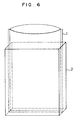
- Fig. 6 shows one embodiment in which no powder being oxidized is contained in a container having a gas-barrier properties.
- Fig. 7 shows one embodiment in which a powder being oxidized and an oxygen absorbent parcel are contained in an inside bag which is placed in a container having gas-barrier properties.
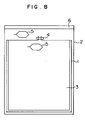
- Fig. 8 shows one embodiment in which a powder being oxidized and an oxygen absorbent parcel which are enclosed in an inside bag are enclosed in a container having gas-barrier properties together with another parcel.
- This invention basically relates on an oxygen absorbent composition which contains, as essential components, a linear hydrocarbon polymer having one or more unsaturated group or a mixture of a linear hydrocarbon polymer having one or more unsaturated group with an unsaturated fatty acid compound (to be sometimes referred to as "main component” hereinafter) and an oxidation promoter and which optionally contains a basic substance and/or an adsorption substance; and this invention also relates to a composition comprising this oxygen absorbent composition and a substance having a humidity adjusting function; and an oxygen absorbent parcel formed by packing any of these composition with a gas permeable packing material or a gas-permeable packing material impermeable to fine dust or capable of protecting an article from fine dust.
- a linear hydrocarbon polymer having one or more unsaturated group or a mixture of a linear hydrocarbon polymer having one or more unsaturated group with an unsaturated fatty acid compound to be sometimes referred to as "main component” hereinafter
- an oxidation promoter which optionally contains
- the oxygen absorbent composition of this invention exhibits a preservation effect by absorbing oxygen, water and an acidic substance.
- This composition contains, as essential components, a main component to absorb oxygen and a substance to promote oxygen absorption and optionally contains at least one of an adsorbent, a basic substance and a carrier. And, a heat inhibitor may be further incorporated as required.
- the substance to promote oxygen absorption is mainly selected from various catalysts, and also selected from an adsorbent, a basic substance, a carrier, etc. In addition, an adsorbent sometimes works as a carrier as well.
- the linear hydrocarbon polymer having an unsaturated group or the mixture of a linear hydrocarbon polymer having an unsaturated group with an unsaturated fatty acid compound is a main component.
- the linear hydrocarbon polymer having one or more unsaturated groups means a polymer having at least 10 carbon atoms and at least one carbon-carbon double bond and a derivative thereof.
- the viscosity and molecular weight thereof are not specially limited.
- this polymer may be specifically selected from a polymer of isoprene, butadiene, 1,3-pentadiene, or the like, squalene, etc.
- the unsaturated fatty acid compound used as an optional component in this invention is a fatty acid compound having at least 10 carbon atoms and a carbon-carbon double bond, and it is selected from an unsaturated fatty acid and a salt or ester thereof.
- the unsaturated fatty acid compound is not necessarily a pure substance, and the unsaturated fatty acid and the salt or ester thereof may contain a substituent such as a hydroxyl group, formyl group, etc.
- Examples of the unsaturated fatty acid and compound thereof are oleic acid, linoleic acid, linoleic acid, arachidonic acid, parinaric acid, dimer acid, and ricinoleic acid, fats and oils containing triglyceride thereof, esters thereof, and transition metal salts thereof. Transition metal salts of unsaturated fatty acids can be also used as a catalyst.
- the oxidation promoter in this invention means a catalyst to accelerate the oxygen absorption rate of the linear hydrocarbon polymer having one or more unsaturated groups which is a main component, and the catalyst is specifically selected from transition metals such as cobalt, chromium, copper, nickel, etc., and compounds thereof.
- transition metals such as cobalt, chromium, copper, nickel, etc.
- the compounds thereof include inorganic salts such as sulfate, chloride, nitrate,etc., organic acid salts such as fatty acid salt, a complex of an amine compound and a radical initiator.
- the transition metal compound is preferably that which can be homogeneously mixed with the linear hydrocarbon polymer having one or more unsaturated group or preferably also with the unsaturated fatty acid compound, such as a variety of saturated or unsaturated acid salts, complexes, etc.
- the basic substance in this invention is a substance which adsorbs an acidic substance generated due to the absorption of oxygen by the linear hydrocarbon polymer having one or more unsaturated group or the unsaturated fatty acid compound and an acidic substance being present in the system or diffusing from outside the system into the system through a preserving container and absorbs water.
- the basic substance is specifically selected from oxides, hydroxides, carbonates, organic acid salts and amine compounds of alkali metals and alkaline earth metals. Oxides of alkaline earth metals are preferred, and calcium oxide and magnesium oxide which absorb both an acidic substance and water are particularly preferred.
- the adsorption substance in this invention is a substance to adsorb a decomposition substance formed by the absorption of oxygen by the linear hydrocarbon polymer having one or more unsaturated group or the unsaturated fatty acid compound or water.
- the adsorption substance carries the linear hydrocarbon polymer having one or more unsaturated group or the unsaturated fatty acid compound and increases an oxygen contact area to increase the oxygen absorption rate.
- the adsorption substance carries each component of the composition to improve fluidity of particles of the composition as a whole and it hence makes it easier to produce and pack the composition.
- the adsorption substance is specifically selected from silica gel, activated clay, diatomaceous earth, zeolite, activated carbon, and pearlite.
- composition of this invention may contain a carrier and a heat inhibitor as required.
- the carrier is that which carries a main component to retain a form of the composition on one hand and increases an oxygen contact area to increase the oxygen absorption rate on the other hand.
- the carrier is selected from paper formed of pulp, nonwoven fabric formed of an olefin resin such as polyethylene, particulates such as silica gel, activated clay, zeolite, and pearlite.
- the carrier is used in such a manner that a main component of the oxygen absorbent composition of this invention is immersed in the carrier or mixed with the carrier.
- the heat inhibitor is a substance which is added to prevent exothermic heat and spontaneous ignition of a large quantity of parcels when the parcels are exposed to the atmosphere.
- the heat inhibitor is a solid at a temperature between 10°C and 50°C and it is liquefied and fluidized at a temperature between higher than 50°C and 230°C.
- the present oxygen absorbent composition is not specially limited as far as it contains, as essential components, a linear hydrocarbon polymer having one or more unsaturated groups but no carboxylic groups and an oxidation promoter.
- the present oxygen absorbent composition is classified into a composition-1 containing a main component of this invention, an oxidation promoter, a basic substance and adsorption substance, a composition-2 containing a main component of this invention, an oxidation promoter, a basic substance, an adsorption substance and a heat inhibitor, a composition-3 containing a main component of this invention, an oxidation promoter, a basic substance, an adsorption substance and a carrier, a composition-4 containing a main component of this invention, an oxidation promoter and a basic substance, a composition-5 containing a main component of this invention, and an oxidation promoter and an and an adsorption substance.
- the composition-1 which is granular powder is preferred in view of oxygen absorption performance
- the composition-3 which is inferential
- composition-1 and the composition-2 can be pressed into a tablet form.
- these compositions are prepared by a method which comprises adding an oxidation promoter to a main component of this invention, allowing an adsorption substance to carry the mixture, and covering a surface of the resultant composition with a basic substance and/or a heat inhibitor, a granulation method which comprises preparing preliminary mixtures each of which consists some of a main component of this invention, an oxidation promoter, a basic substance, an adsorption substance and a heat inhibitor, and granulating these mixtures while these mixtures are homogeneously blended, and a method which comprises placing a sheet (I) formed by adding an oxidation promoter to a main component of this invention and impregnating the resultant mixture into a carrier and a sheet (II) formed by impregnating a liquid organic substance and/or an amine compound into a carrier one on the other and forming the resultant combined sheets into one sheet.
- a method which comprises adding an oxidation promoter to a main component of this invention, allowing an adsorption substance
- the weight ratio of the oxygen absorbent composition of this invention is as follows. Per 100 parts by weight of a main component of this invention, the amount of the oxidation promoter is 0.01 to 75 parts by weight, that of the basic substance is 0.1 to 1,000 parts by weight, that of the adsorption substance is 50 to 2,000 parts by weight, that of the carrier is 100 to 5,000 parts by weight, and the that of the heat inhibitor is 0.5 to 100 parts by weight.
- composition of these is packed in a gas-permeable packing material, and used by enclosing the resultant parcel in a container together with an article and sealing the container.
- the humidity adjusting agent used in this invention is that which keeps an optimum relative humidity inside the system.
- the humidity adjusting agent of this invention is a substance which has a viscosity, at a temperature between 20°C and 50°C, of not more than 10 Pa.S (104 cp) and an equilibrium relative humidity of not more than 70%, and which adjusts the relative humidity inside the sealed system enclosing the parcel packed with the oxygen absorbent composition and an article to an optimum humidity within 20 to 70%.
- the "equilibrium relative humidity” means a relative humidity attained after a sufficient time during which an equilibrium is obtained in a closed system having a predetermined temperature while the humidity adjusting agent, air, etc., are present.
- the humidity adjusting agent used in this invention is an aqueous solution of a water-soluble organic compound.
- the water-soluble compound is a compound freely mixable with water, and specifically selected from compounds having a hydroxyl group, an amino group or both of these such as trimethylol propane, glycerin, polyethylene glycol, and amines such as triethanolamine, tripropanol amine, etc., and the like, although it shall not be limited to these compounds.
- the form of the humidity adjusting agent used in this invention is not specially limited. In view of handling in practical use, a humidity adjusting agent impregnated into a carrier is desirable.
- the carrier into which the humidity adjusting agent is to be impregnated is selected from paper, cloth, nonwoven fabric, porous adsorbents such as silica gel, activated alumina, zeolite, activated clay, and pearlite.
- the humidity adjusting agent may be used in the form of a gas-permeable small bag in which the carrier-supported humidity adjusting agent is enclosed alone, in the form of a gas-permeable small bag in which the carrier-supported humidity adjusting agent is enclosed together with the oxygen absorbent composition or in some other form.
- the amount of the carrier-supported humidity adjusting agent is to be suitably selected depending upon an article to be preserved.
- the amount of the carrier-supported humidity adjusting agent per 100 parts by weight of the oxygen absorbent composition is 0.1 to 10 parts by weight.
- the form of a combination of the oxygen absorbent composition with the carrier-supported humidity adjusting agent may be freely selected. In view of ease in handling, however, a solid or sheet form is preferred, and is view of an actual use, a gas-permeable small bag in which the combination is enclosed in preferred.
- the process for preparing or packing the oxygen absorbent composition of this invention is not specially limited.
- the preparation or packing process is carried out by a method in which an oxidation promoter is added to a main component of this invention, then, an adsorption substance is allowed to support the resultant mixture, a primary powder is prepared by covering a surface of the supported mixture with a basic substance and/or a heat inhibitor, another primary powder is separately prepared by allowing a carrier to support a humidity adjusting agent, these primary powders are respectively weighed and mixed, and the mixture is packed in a gas-permeable packing material; a method in which the above primary powders are separately packed in gas-permeable packing materials, or a method in which an oxidation promoter and a humidity adjusting agent are added to a main component of this invention, an adsorption substance is allowed to support the resultant mixture, a basic substance and/or a heat inhibitor are/is allowed to covered a surface of the supported mixture to form a primary powder, and the primary powder is weighed and then packed
- the oxygen absorbent composition of this invention is generally packed in a gas-permeable packing material.
- this invention proposes a method in which a surface of a parcel packed with an oxygen absorbent composition be covered with an adhesive layer comprising an adhesive and a sheet by attaching the adhesive layer to the surface before it is used for the preservation of a semiconductor, etc.
- the adhesive layer is attached to the surface of the oxygen absorbent parcel and peeled before use, whereby no fine dust is brought into a packing container enclosing an article.
- This method produces a secondary effect that the oxygen absorption performance is not degraded even if the oxygen absorbent parcel is exposed to atmosphere before use, and the oxygen absorbent parcel exhibits its full performance when used.
- the adhesive sheet of this invention is attached to a surface of the oxygen absorbent parcel in an adhesion strength of 1 to 103 g/20 mm width. When this adhesion strength is too high, the parcel is broken. When it is too low, the adhesive sheet is easily peeled off during the transportation and practically unusable.
- the adhesive sheet is prepared by coating an adhesive on a substrate at a rate of 5 to 500 g/m2.
- the adhesive is selected from a rubber-containing adhesive formed mainly of natural rubber or synthetic rubber, an adhesive containing polystyrene as a main component, an adhesive containing polyacrylic acid ester as a main component, etc.
- the substrate is selected from polypropylene, polyester, polyvinyl chloride or cellophane film, Japanese paper, kraft pulp paper, cloth, etc.
- the adhesive sheet has an oxygen permeation rate of not more than 3 x 9.87 x 10 ⁇ 3 cm3 /m2.day.Pa (1000 ml/m2.atm.day) and a humidity permeability of not more than 300 g/m2 ⁇ day.
- the gas-permeable packing material is selected from those having a Gurley method gas permeability of 10 to 105 S/100 cm3 (seconds/100 ml) a humidity permeability of 1 to 500 g/m2.day and an oxygen permeation rate of 2.96 x 10 ⁇ 2 to 4.93 x 10 cm3/m2.day.Pa (3 x 10³ to 5 x 10⁶ ml/m2.day.atm.
- the packing material is formed of a base sheet which comprises a fibrous material or a fibrous material and an adhesive and which has a basic weight of 10 to 150 g/m2.
- the fibrous material is at least one member selected from natural pulps such as kraft pulp, chemical pulp, etc., synthetic fibers of plastics such as nylon, polyethylene, polypropylene, etc., carbon fibers, and the like.
- the adhesive is selected from natural rubber, butadiene-styrene rubber, chloroprene rubber, and acrylate polymer, polyurethane, vinyl acetate, polyvinyl alcohol, and the like.
- At least one of a sizing agent, a pigment, a coagulant, a basic substance, inorganic fillers such as kaolin and adhesives such as polyacrylic acid ester, polyethyleneimide, etc., a mixture of at least two of these may be incorporated into the above sheet as required.
- the gas-permeable packing material is formed by attaching other material to the above base sheet or by coating or covering the base sheet with other material.
- Embodiments of the gas-permeable packing material are as follows.
- the gas-permeable packing materials B and C are particularly preferred since their humidity permeability is higher than their oxygen permeation rate, the degree of peroxide permeation is low, no fine powder passes through them, and they show good detectability from the adhesive sheet.
- a reinforcing agent (cloth, etc.) may be attached between the base film and the low-softening point film.
- the method for attaching the oxygen absorbent parcel and the adhesive sheet to each other is not specially limited.
- a gas-permeable material and an adhesive sheet are attached under a load by passing them through a pair of rolls.
- the oxygen absorbent composition is weighed out, and packed in a packing material, to which the above adhesive sheet is attached, by means of a forming, filling and closing machine for three sided or four sided seal flexible package, a blister packaging machine, or the like with the low-softening point resin film inside.
- the use of the above gas-permeable packing material can prevent volatilization of peroxide which is generated when oxygen is absorbed and affects the rust prevention effect.
- the oxygen absorbent parcel of this invention is used as a rust preventive for the preservation of electronic products and electronic parts, semiconductors in particular, the oxygen absorbent parcel is further packed with the gas-permeable packing material (2) to form a double-packed parcel.
- the gas permeable packing material (2) is a packing material having an oxygen permeation rate of not less than 9.87 x 10 ⁇ 3 cm3/m2.day.Pa (1,000 ml/m2.atm.day), a humidity permeability of not less than 1 g/m2.day and a 0.3 um dust capturing efficiency of not less than 50%, or a packing material having an oxygen permeation rate of not less than 9.87 x 10 ⁇ 3 cm3/m2.day.Pa (1,000 ml/m2.atm.day), a humidity permeability of not less than 1 g/m2 ⁇ day and having no pore on an outer surface of the resultant parcel.
- the parcel shows a dust number of not more than 5 x 10⁴/10 x 10 cm2 on the parcel surface.
- the gas-permeable packing material (2) is used to doubly pack the oxygen absorbent parcel, whereby a double-packed parcel free from adherence and passage of dust is obtained.
- the gas-permeable packing material (2) are a packing material (2)-A (see Fig. 1) which is formed by laminating a low-softening point porous film, formed of polyethylene, a copolymer of a polyacrylic acid and polyethylene, or the like, on a microporous film having an oxygen permeation rate of not less than 9.87 x 10 ⁇ 3 cm3 /m2.day.Pa (1,000 ml/m2.atm.day), a humidity permeability of not less than 1 g/m2 ⁇ day and a 3 »m dust capturing efficiency of not less than 50%, and a packing material having no pore (2)-B (see Fig.
- a low-softening point porous film formed of polyethylene, a copolymer of polyacrylic acid and polyethylene, or the like, on one surface of a base material selected from paper or synthetic paper of natural pulp or synthetic pulp, nonwoven fabric prepared by a method (example: Tyvek supplied by du Pont), a microporous film, etc., and laminating an oxygen-permeable resin such as a silicone resin, polybutadiene, or the like on the other surface of the base material.
- a base material selected from paper or synthetic paper of natural pulp or synthetic pulp, nonwoven fabric prepared by a method (example: Tyvek supplied by du Pont), a microporous film, etc.
- the oxygen absorbent parcel is packed in the gas-permeable packing material (2) with the low-softening point film inside by a sealing method using a hot plate, ultrasonic irradiation-induced hot pressure, etc.
- the packing method itself is not specially limited as far as the packing is possible.
- the dust is removed by a method which comprises neutralizing and removing static electricity generated by electric discharge to float it and absorbing it, a method which comprises applying an ultrasonic wave to dust to float it and absorbing it, a method which comprises bringing dust into contact with an adhesive-coated roll to make the dust stick to the roll, a method which comprises attaching an adhesive sheet formed by arranging an adhesive on a surface of a substrate such as paper, a film, etc., to the gas-permeable packing material (2) and peeling the adhesive sheet, or some other methods.
- an adhesive sheet formed by coating an adhesive on a substrate such as paper, a film, etc. is attached to the gas-permeable packing material (2) (see Fig. 3), the oxygen absorbent composition is packed in the gas-permeable packing material (2) with the adhesive sheet attached, and the adhesive sheet is peeled off immediately before the resultant double-packed parcel is enclosed in the system together with an article.
- dust remaining on the surface of the parcel from which the adhesive sheet has been peeled off may be removed by one of the above-described methods.
- the oxygen absorbent double-packed parcel with the adhesive sheet attached to its surface limits permeation of oxygen and water to a graft extent and inhibits degradation of rust prevention performance, and it can be allowed to stand under atmosphere for a long period of time.
- the site for this packing is isolated from the site for the preparation of the oxygen absorbent parcel, and nitrogen gas or air in which the number of dust having a size of 0.3 »m is not more than 3 x 10⁴/28.3 dm3 (1 cubic foot) is introduced into its working atmosphere.
- This invention also provides a method for preserving a photograph, which comprises enclosing the oxygen absorbent parcel of this invention and a photograph, or the oxygen absorbent parcel of this invention, a humidity adjusting agent having an equilibriums relative humidity of 10 to 70% and a photograph with a packing material having an oxygen permeation rate, at 25°C, of not more than 10cm3/m2.atm.day (10 ml/m2.atm/day) and a humidity permeability, at 25°C of not more than 10 g/m2.day.
- Specific examples of the object to be preserved are a photosensitive material not exposed, a positive or negative image developed and fixed, and a photograph fixed on a photographic paper.
- the packing material has an oxygen permeation rate, at 25°C, of not more than 10 cm3/m2.atm.day (10 ml/m2.atm.day) and a humidity permeability, at 25°C, of not more than 10 g/m2 ⁇ day (a material having such properties will be simply referred to as "packing material” hereinafter).
- packing material such as stretched PP/PE, polyvinylidene chloride-coated stretched nylon/PE, polyvinylidene chloride-coated polyester/PE, polyvinylidene chloride-coated stretched nylon/ evaporation-deposited aluminum/PE, etc., are preferred.
- Such a packing material is specifically selected from a metal can having an air-tight structure, a multilayer film (three or more layers) having a basic structure of a thermocompression-bonded resin layer/thin metal film/protective resin layer, and the like, in particular, stainless steel is preferred for a metal can, and a multilayer film formed of low-density polyethylene (PE) or polypropylene (PP) as a thermocompression bonded resin layer, aluminum or an alloy thereof as a thin metal layer and stretched nylon or polyester as a protective resin layer is preferred as such.
- PE low-density polyethylene
- PP polypropylene
- the humidity adjusting agent used in this invention may be an aqueous solution of a water-soluble organic compound.
- the water-soluble organic compound is that which can be freely mixed with water, and specifically selected from polyethylene glycol, polypropylene glycol, amines such as triethanolamine and tripropanolamine, polyhydric alcohols such as trimethylpropane, trimethylolethane, glycerin and neopentyl glycol, and the like.
- the above humidity adjusting agent is generally supported on a carrier.
- the carrier is specifically selected from paper, cloth, nonwoven fabric, and porous adsorbents such as activated alumina, zeolite, activated clay, pearlite, etc.
- the humidity in the system is in the range of RH of 10% to RH of 50%, preferably RH of 20% to RH of 40% so as to prevent fusion of gelatin caused when the humidity is too high, physical destruction such as cracking, peeling, etc., caused when the humidity is too low and biological destruction caused due to mold.
- the oxygen absorbent parcel plays a leading role to maintain the oxygen concentration inside the system at not more than 0.1% for a long piriod and prevent oxygen-induced discoloration of photograph-constituting materials.
- oxygen absorbents outside the scope of this invention, such as iron powder-containing, ascorbic acid-containing or dithionite-containing absorbents, water is required for oxygen absorption, and preservation at a high humidity is therefore inevitable. These requirements are the cases for occurrence of mold and contract of a base film, and dyestuffs are changed in properties due to hydrogen and sulfurous dioxide gas formed.
- a method of preserving a bearing which comprises enclosing the oxygen absorbent parcel and the bearing in a container having gas-barrier properties.
- bearings to be preserved are those from which it is always required to remove oil and dirt before use since the oil and dirt affect not only a bearing but also other parts located around it, i.e. a rotor bearing for electronic machines and components, etc.
- the oxygen absorbent parcel used for the preservation of a bearing is formed by packing an oxygen absorbent composition which contains, as essential component, a linear hydrocarbon polymer having an unsaturated group or a mixture of a linear hydrocarbon polymer having an unsaturated group with an unsaturated fatty acid compound and an oxidation promoter and which optionally contains a basic substance and/or an adsorption substance with a gas-permeable packing material having an oxygen permeation rate of not less than 9.87 x 10 ⁇ 3 cm3/m2 day.Pa (1,000 ml/m2.atm.day).
- This gas-permeable packing material is not specially limited with regard to its constitution and material.
- Such a gas-permeable packing material is selected from a film, a sheet and a laminate prepared by laminating a film on a base material such as paper or nonwoven fabric.
- the oxygen absorbent parcel is produced by enclosing the composition in this gas-permeable packing material and bonding sides of the gas-permeable packing material by a heat-seal method, etc.
- the parcel produced above may be further packed with a gas-permeable packing material having an oxygen permeation rate of not less than 9.87 x 10 ⁇ 3 cm3/m2.day.Pa (1000 ml/m2.atm.day), a humidity permeability of not less than 1 g/m2 ⁇ day and a capturing efficiency of not less than 50% for dust having a size of not less than 0.3 »m when air is introduced.
- a gas-permeable packing material having an oxygen permeation rate of not less than 9.87 x 10 ⁇ 3 cm3/m2.day.Pa (1000 ml/m2.atm.day), a humidity permeability of not less than 1 g/m2 ⁇ day and a capturing efficiency of not less than 50% for dust having a size of not less than 0.3 »m when air is introduced.
- the form of the parcel is not specially limited, and may be selected from the forms of a pouch, sheet, blister package, etc.
- the container having gas-barrier properties in this invention has an oxygen permeability, per a volume of 100 cm3 (ml), of not more than 10 cm3/day (ml/day), preferably not more than 5 cm3/day (ml/day), and a humidity permeation rate of not more than 10 g/day, preferably not more than 5 g/day, and the form and material thereof are not specially limited.
- One example is a container made of a synthetic resin or metal.
- Such a container is suitably selected from a metal can of iron, a tin plate, stainless steel or aluminum, a case formed of a synthetic resin such as polyethylene, polypropylene, nylon, polyester, vinyl chloride, polystyrene, polycarbonate, or the like, and a bag formed of a composite film prepared by laminating some of materials such as vinyl chloride, vinylidene chloride, aluminum foil, evaporated aluminum, nylon polyethylene, polypropylene, polyester, etc., and sealed by a heat sealing method of the like.
- a metal can of iron, a tin plate, stainless steel or aluminum a case formed of a synthetic resin such as polyethylene, polypropylene, nylon, polyester, vinyl chloride, polystyrene, polycarbonate, or the like
- a bag formed of a composite film prepared by laminating some of materials such as vinyl chloride, vinylidene chloride, aluminum foil, evaporated aluminum, nylon polyethylene, polypropylene, polyester, etc., and sealed by a heat
- a packing may be provided between its body and lid.
- the method for enclosing the oxygen absorbent parcel in such a container together with a bearing is not specially limited.
- a container is provided with a reception portion for the oxygen absorbent parcel and the oxygen absorbent parcel is enclosed separately from a bearing; a bearing is wrapped in paper or a synthetic resin film and the oxygen absorbent parcel is placed in contact with an outer surface of the wrapped bearing; and the like.
- an inert gas such as nitrogen, argon, or the like is sometimes substituted for air in the container. Further, the pressure inside the container may be reduced.
- a method for preserving a powder being oxidized which comprises enclosing the oxygen absorbent parcel and the powder being oxidized in a container having gas-barrier properties and sealing the container.
- the powder being oxidized to be preserved is that which is oxidized with oxygen
- the method of this invention is applicable to any powder having an oxygen absorption rate of not less than 0.01 cm3.O2/g.month (0.01 ml.O2/g.month) without any special limitation.
- powders to which the method of this invention is preferably applied to are metal or carbon powders having a grain size of not more than 5 mm.
- powders mainly used as a material for a sintered part of machines and electronic parts are powders mainly used as a material for a sintered part of machines and electronic parts, a magnetic substance, a solder, an electrically conductive paste, etc., such as a copper powder, silver powder, iron powder, a powder of a rare earth metal, lead or tin, a powder of an alloy of these metals (to be simply referred to as "metal powder” hereinafter) and carbon powders as a material for a magnetic substance and a heat-resistant part.
- metal powder carbon powders as a material for a magnetic substance and a heat-resistant part.
- the oxygen absorbent parcel and the container having gas-barrier properties are same as those used in the above method for preserving a bearing.
- a powder being oxidized is preserved by a method (1) in which a container is provided with a reception portion for said parcel, or a method (2) in which the powder being oxidized is packed in a film of a synthetic resin such as polyethylene, polypropylene permeable to water and oxygen and the oxygen absorbent parcel is placed in container by arranging inside and/or outside of the above powder being oxidized package.
- a method (2) in which the degree of inclusion of powder in a sealed portion is low and airtightness of a container can be easily maintained.
- a method of preserving a metal or a product containing a metal which comprises enclosing the oxygen absorbent parcel and natural pulp and the metal or the product containing a metal in a container having gas-barrier properties and sealing the container.
- Examples of the metal or product containing a metal as an object to be preserved in this invention are a shadow mask made of iron, copper alloy, a lead frame, etc., and the lead frame is a typical example.
- the "lead frame” is that which is bonded to an IC chip, formed by (physically and chemically) polishing a surface of a shaped copper alloy, and partly plated with silver and gold.
- the natural pulp used in this invention is that which prevents dew condensation by absorbing superfluous water before dew is formed on a metal surface in the packed system due to a sudden change in ambient temperature and humidity.
- the natural pulp is not specially limited, and is selected from kraft pulp, thermomechanical pulp, etc. Preferred is pulp which is extracted to give water having pH of 4 to 10 and a sulfur and chlorine content of not more than 100 ppm and which has a water content of not more than 12%. More preferred is pulp which is extracted to give water having pH of 5.5 to 8.5 and a sulfur and chlorine content of not more than 50 ppm and which has a water content of not more than 6%.
- the form of the pulp is not specially limited, and yet, it is preferably sheet-like. This sheet has a basis weight of 20 to 300 g/square meter, and used in a manner that it is placed between metals or it wraps a metal.
- the oxygen absorbent parcel and container having gas-barrier properties are the same as those used for the above method for preserving a bearing.
- 0.2 Gram of a catalyst was dissolved or suspended in 1.0 g of a linear hydrocarbon polymer having unsaturated group or a mixture of a linear hydrocarbon polymer having unsaturated group with an unsaturated fatty acid compound, and the resultant mixture was impregnated into 5 g of a particulate adsorbent. Then, 0.5 g of slaked lime was added to the allowed to cover a surface of the particulate adsorbent to form a granular composition.
- Table 1 shows components of the composition, a time required to attain 0.1% of oxygen, a maximum oxygen absorption amount and a change in oxygen concentration within a system with time.
- composition prepared in each of Examples 1 to 10 and 2.5 g of granular calcium oxide were packed with a 70 x 70 mm packing material coated with a silicone resin with a porous polyethylene surface thereof inside, and the resultant parcels were heat sealed on sides.
- composition sheet (I) and composition sheet (II) obtained in Example 11 were placed on the other of them. Then the resulting sheets (I) and (II) was packed with a 70 x 70 mm packing material coated with a silicone resin on the surface.
- the packing material used for this parcel was prepared as follows. 100 Parts of a silicone resin monomer (SD7328, supplied by Toray Silicone, toluene solution having a resin content 30%) and 0.6 part of a catalyst (SRX212, supplied by Toray Silicone) were in 500 parts of toluene, the resultant solution was coated on a wood free paper having a basis weight of 50 g/m2 at a rate of 20 g/m2 (resin content 1 g/m2) and the silicone resin was polymerized at 140°C for 1 minute.
- a silicone resin monomer SD7328, supplied by Toray Silicone, toluene solution having a resin content 30%
- SRX212 supplied by Toray Silicone
- Porous polyethylene (Pore B type, supplied by Shin-Nippon Aruku Co., Ltd.) was laminated on that surface of the wood free paper which was opposite to the surface coated with the silicone resin, and the resultant laminate was sealed on sides with this polyethylene surface inside under heat pressure at 140°C, 1.42 x 10⁶ Pa (15 kg/cm2) for 3 seconds. (Definition of oxygen absorption rate and method of measurement thereof)
- Example 1 The parcel obtained in comparative Example 1 and a parcel formed by packing 3 g of a silica gel (A-type) with the same packing material as that in Example 1 were together measured for an oxygen absorption rate, a maximum oxygen absorption amount and a change of oxygen concentration in a system with time in the same manner as in Example 1. Table 3 shows the results.
- a porous polyethylene (B-type, supplied by Shin-Nippon Aruku Co., Ltd.) was pressed on a pure white roll paper sheet (basis weight 50 g/m2) under a pressure of 4.90 x 10⁵ Pa (5 kg/cm2), and the paper sheet and the porous polyethylene were laminated on each other by passing them between a paper-side hot roll (temperature 200°C) and a porous polyethylene-side roll (temperature 100°C).
- silicone resin monomer SD7328, toluene solution having a resin content of 30%, supplied by Toray Silicone
- SRX212 a catalyst supplied by Toray Silicone
- a porous polyethylene (B-type, supplied by Shin-Nippon Aruku Co., Ltd.) was laminated on that surface of the wood free paper which was opposite to the resin-coated surface.
- the adhesive sheet attached to the packing material was peeled off, and then, the packing material was measured for an oxygen permeation rate, humidity permeability and a dust number. Table 4 shows the result.
- the methods for measurement of the oxygen permeation rate, humidity permeability and dust number are as follows.
- a porous polyethylene (B-type, supplied by Shin-Nippon Aruku Co., Ltd.) was laminated on a microporous film (GTAFL9504, 0.3 »m dust capturing efficiency of 67%, supplied by Japan Gore-Tax Co., Ltd.).
- the gas-permeable packing material (1) prepared in Example 14 in a size of 140 x 70 mm was doubled over on itself with the porous polyethylene surface inside, 2.5 g of the oxygen absorbent composition and 2.5 g of granular calcium oxide were enclosed therebetween, and the above-mentioned doubled packing material was heat-sealed on sides to form a 70 x 70 mm parcel (to be referred to as "single-packed parcel" hereinafter).
- the packing materials prepared in Examples 15 and 16 were passed on a butyl polyacrylate-coated adhesive roll to remove dust and doubled over on themselves with the porous polyethylene surface inside. Under atmosphere into which air having a dust number of not more than 5,000 per cubic feet was introduced, the parcel prepared in Example 19 or 20 was enclosed in each of the above packing materials and the above packing materials were heat-sealed to form double-packed parcels.
- Example 22 Application to sputtering target
- the adhesive sheet was peeled off from the double-packed parcel prepared in Example 21, and then, the double-packed parcel and a sputtering target (diameter 300 mm) composed of evaporating aluminum, which was an IC wiring element to be fitted into a semiconductor device, were enclosed in a vinylidene chloride 2 »m/stretched nylon 15 »m/polyethylene 50 »m bag (500 x 500 mm).
- the bag was sealed and stored at 25°C at RH of 60% for 3 months not to show that discoloration caused by rust formation of a copper plate fixing the evaporating aluminum of the sputtering target was used to produce IC, it was free from any contamination of IC by dust and usable under a good condition.
- Example 22 was repeated except that the double-packed parcel obtained in Example 21 and used in Example 22 was replaced with the parcel obtained in Example 19 or 20.
- contamination of the interior of a deposition chamber by dust was extreme, and it took more than 12 hours to remove dust by argon gas substitution, which caused a large loss on the IC production.
- Example 22 was repeated except that the double-packed parcel obtained in Example 21 and used in Example 22 was replaced with a double-packed parcel formed by packing the single-packed parcel prepared in Example 19 or 20 with a PET 12 »m/PE 30 »m film having openings (average opening diameter 2 mm, opening ratio 15%)/pure white paper (50 g/m2)/PE 50 »m film having openings (average opening diameter 2 mm, opening ratio 15%) laminated gas-permeable packing material in the same manner as in Example 21.
- IC contamination of the interior of a deposition chamber by dust was extreme, and it took more than 10 hours to remove dust by argon gas substitution, which caused a large loss on the IC production.
- Example 21 and Comparative Example 7 and 8 One each of the parcels prepared in Example 21 and Comparative Example 7 and 8 was beaten in cleaned pure air flowing at a rate of 3 lit./min., and the number of dust having a size of not less than 0.3 »m was counted with a counter (model 208L, supplied by Met One Co.). The number obtained was taken as a number of dust adhering to a surface of each parcel. Table 9 shows the results.
- a desicant parcel was prepared by packing 2.5 g of silica gel with the same material as that in Example 26 in the same manner as in Example 26. With this desiccant parcel in place of the oxygen absorbent parcel, a change of each of gas concentrations with time was measured in the same manner as in Example 26. Table 16 shows the results.
- a bearing (material: SVJ-2) coated with a rust-preventive oil (NP-9) was degreased by washing it twice with each of toluene, ethanol and Freon 113 and drying it, whereby a bearing as-manufactured was obtained.
- each bag size: 170 x 300 mm, oxygen permeation rate of 3.94 x 10 ⁇ 5 cm3/m2.day.Pa (4ml/m2.atm.day), humidity permeation rate of 0.2 g/m2.day) of KON/PE together with the oxygen absorbent parcel-1, -2 and -3 prepared in Example 26, and the each bag was sealed.
- the sealed bag enclosing this bearing was stored under atmosphere having a temperature of 25°C and a relative humidity of 50% for 1 day, and the oxygen concentration inside the bag was checked and found to be not more than 0.01%. Thereafter, the bag was stored under atmosphere having a temperature of 35°C and a relative humidity of 95%, and the surface of the bearing so preserved and a change of each oxygen concentration in inner system with time was observed. Table 17 and Table 18 show the results.
- Example 27 With the desiccant parcel prepared in Comparative Example 9 in place of the oxygen absorbent parcel prepared in Example 27, a bearing treated in the same manner as in Example 27 was enclosed in the same manner as in Example 27. A bag enclosing the bearing was sealed and stored in the same manner as in Example 27, and the surface of the bearing preserved and a change of each oxygen concentration in inner system with time was observed. Table 17 and Table 18 show the results.
- Example 27 The same bearing as that used in Example 27 was enclosed in the same manner as in Comparative Example 10 except that nitrogen gas was substituted for air in a KON/PE bag until the oxygen concentration became 0.7% when he bag was sealed.
- the bag was sealed and stored in the same manner as in Comparative Example 10, and the surface of the bearing preserved and a change of each oxygen concentration in inner system with time was observed.
- Table 17 and Table 18 show the results.
- Example 28 A copper powder was enclosed in the same manner as in Example 28 except that the desiccant parcel prepared in Comparative Example 9 was used in place of the parcel prepared in Example 26.
- the resultant double-packed bag was sealed and stored in the same manner as in Example 28, and a hydrogen reduction loss of the copper powder and an oxygen concentration inside the bag was measured in the same manner as in Example 28. Table 19 shows the results.
- a copper powder was enclosed in the same manner as in Comparative Example 12 except that nitrogen gas was substituted in the bag for air until the oxygen concentration became 0.7% when the KON/PE bag was sealed.
- the resultant double-packed bag was sealed and stored in the same manner as in Comparative Example 12, and a hydrogen reduction loss of the copper powder and an oxygen concentration inside the bag were measured in the same manner as in Example 28. Table 19 shows the results.
- Example 28 A powder being oxidized was preserved in the same manner as in Example 28 except that the parcel prepared in Example 26 was not used.
- a hydrogen reduction loss of the powder being oxidized and an oxygen concentration inside the bag were measured in the same manner as in Example 28. Table 19 shows the results.
- Zinc stearate was added to each of the powders being oxidized rate of 0.7% preserved in Examples 28 to 33, and then, 10 g of each mixture was put into a molding vessel having a diameter of 5 mm and press-shaped under a load of 5 t.
- the resultant shaped tablets were sintered with a nitrogen/hydrogen mixture gas having a nitrogen/hydrogen mixing ratio of 1/3 by heating them, for 30 minutes, to 1,000°C when the shaped tablets were formed of a copper or silver powder, to 1,150°C when the shaped tablets were formed of an iron powder or to 1,200°C when the shaped tablet was a carbon powder.
- the resultant sintered tablets were measured for a density (lengthwise) and a tensile strength. Table 20 shows the results.
- a copper alloy thin plate (thickness 1.27 x width 62 x length 200 mm) was punched out with a press machine and its surface was etched with an aqueous solution containing sulfuric acid and hydrogen peroxide to form a lead frame. Gold was attached to an IC chip-attaching site of the lead frame. Hundred-fifty lead frames in total were prepared in the same manner, and every 50 lead frames ware bundled. These three bundles were packed with a polypropylene film, and further packed with a sheet formed of natural pulp (trade name NS-150, water extraction pH 7, water content 3%, basis weight 150 g/m2, width 300 mm, length 400 mm, supplied by Hokuyo Seishi) to form one package.
- NS-150 water extraction pH 7, water content 3%, basis weight 150 g/m2
- the above package was enclosed in a case (width 70 x length 200 x height 50 mm) formed of polypropylene together with the oxygen absorbent parcel-1, -2 and -3 prepared in Example 26, the cases were packed in a KON/PE bag *size 170 x 300 mm), and the bags were sealed. These sealed bags packing the lead frames were stored under a temperature of 25°C and a relative humidity of 50% for one day, and the oxygen concentration inside the bags were checked and found to be not more than 0.01%. Thereafter, the bag was stored for periods of several cycles, each cycle consisting of storage under a temperature of 50°C and a relative humidity of 95% for 2 days and under a temperature of 0°C and a relative humidity of 100% for 5 days. The copper alloy surface of each lead frame preserved above was observed. Table 21 shows the results. Table 22 and Table 23 show humidity and oxygen concentration change with time of inside the bag.
- Oxygen absorbent parcels-1, -2 and -3 prepared in Example 26 in the same method as in Example 40 excluding that natural pulp is not used were packed and sealed together with lead frames. They were stored in the same method and conditions as in Example 40. The copper alloy surface of lead frame after preservation was observed. Tables 21, 22 and 23 show the results.
- Lead frames were packed in the same manner as in Example 40 except that the desiccant parcel prepared in Comparative Example 9 was used in place of the oxygen absorbent parcel prepared in Example 26.
- the lead frames so-packed were stored in the same manner as in Example 40 and under the same conditions as those in Example 40, and the copper alloy surface of each lead frame and a humidity and oxygen concentration change with time of inside of the bag was observed. Tables 21, 22 and 23 show the results.
- Lead frames were packed and preserved in the same manner as in Comparative Example 18 except that, when the case was enclosed in the bag, nitrogen gas was substituted for air in the bag until the oxygen concentration became 2.7%.
- the copper alloy surface of each lead frame preserved was observed. Table 21 shows the results.
- Figs. 22 and 23 shows a change in humidity and oxygen concentration in the system with time.
- Table 21 Parcel 7th day 14th day 30th day 60th day 90th day Example-40 1 - - - - - 2 - - - - - 3 - - - - - - Example-41 1 - - - - - -Note 2) 2 - - - - - - 3 - - - - - - Comparative Example-18 - ++ ++++ ++++++ ++++ Comparative Example-19 - ++ ++++++++++++++++++++++++ Note 1: State of discoloration on alloy surface - : No discoloration + : Slightly discolored ++ : Slightly discolored, more than half of surface area +++ : Densely discolored, more than half of surface area ++++ : Densely discolored, nearly entire surface Note 2: A trace of dew was observed on the metallic surface,
- a copper alloy thin plate (thickness 1.27 x width 62 x length 200 mm) was punched out with a press machine and its surface was etched with an aqueous solution containing sulfuric acid and hydrogen peroxide to form a lead frame. Gold was attached to an IC chip-attaching site of the lead frame. Hundred-fifty lead frames in total were prepared in the same manner, and every 50 lead frames were bundled. The resultant three bundles were packed with a polypropylene film, and further packed with a sheet formed of natural pulp (trade name NS-150, water extraction pH 7, water content 3%, basis weight 150 g/m2, width 300 mm, length 400 mm, supplied by Hokuyo Seishi) to form one package.
- NS-150 water extraction pH 7, water content 3%, basis weight 150 g/m2
- the above package was enclosed in a case (width 70 x length 200 x height 50 mm) formed of polypropylene together with the oxygen absorbent parcel-3 prepared in Example 26, the case was packed in a KON/PE bag (size 170 x 300 mm), and the bas was sealed.
- This sealed bag packing the lead frames was stored under atmosphere having a temperature of 30°C and a relative humidity of 50% for 1 day, and the oxygen concentration inside the bag was checked and found to be not more than 0.01%. Thereafter, the bag was transported from Singapore to Japan by a vessel by taking 1 month. The copper alloy surface of each of the lead frames transported was observed to show that the lead frames were under a good preservation conditions without any discoloration which was to be caused by dew formation and rust on the surface.
- Lead frames were enclosed in the same manner as in Example 41 except that the desiccant parcel prepared in Comparative Example 9 was used in place of the oxygen absorbent parcel used in Example 40.
- the resultant bag was sealed and stored in the same manner as in Example 41, and the copper alloy surface of each lead frame was observed to show that the color on the entire surface was changed to dark blue and some portions of the surface showed dot-like dew formation. Thus, the lead frames were under an unusable condition.
- Lead frames were enclosed and preserved in the same manner as in Comparative Example 20 except that, when the case was packed and sealed in a bag, nitrogen gas was substituted for air in the bag until the oxygen concentration became 2.7%.
- the surface of each lead frame preserved was observed to show that the color on the entire surface was changed to dark blue and some portions of the surface showed dot-like dew formation.
- the oxygen absorbent composition of this invention exhibits a higher oxygen absorption rate and a higher maximum oxygen absorption amount than conventional compositions, and remarkably improves the effect on preservation of articles.
- the parcel formed by packing the oxygen absorbent composition with a gas-permeable packing material, provided by this invention, is suitably usable for the preservation of metals, metal products, electronic products, electronic parts and components, dry food, medicaments, photographs, ancient documents, drawings, pressed flowers, and the like.
- the composition containing the oxygen absorbent composition and a humidity adjusting agent in combination is capable of adjusting the humidity of a preservation system to an optimum one for preservation, free from occurrence of hydrogen and hydrogen sulfide, and capable of removing undesirable substances present in a sealed bag or container in which an article is enclosed, e.g. acidic substances such as sulfur compound,s etc., and reducing substances such as formaldehyde, etc., by absorbing them.
- the method of producing the effects of the oxygen absorbent composition of this invention and the parcel thereof is very simple, i.e. all that is necessary therefor is to enclose an article and the oxygen absorbent composition parcel of this invention in a bag or container having gas-barrier properties and seal the bag or container. Thus, no large-scale apparatus or equipment for preservation is required.
- the parcel formed by packing a composition containing the oxygen absorbent composition of this invention and a humidity adjusting agent in combination with a gas-permeable packing material is suitably usable for the preservation of ancient manuscripts and documents, photographs, magnetic tapes, specimens, medicaments, etc.
- the parcel formed by attaching an adhesive sheet on a surface of the parcel formed by packing the oxygen absorbent composition of this invention with a gas-permeable packing material is free from deterioration in performance since air is shut off before the use of the parcel, and it is easy to handle. Further, the adhesive sheet is peeled off when the parcel is used, whereby dust adhering to the parcel surface is transferred to the adhesive sheet side and removed. The volatilization of gases to be produced at an oxygen absorption time is a little. Therefore, the present parcel is suitably usable for the preservation of semiconductors and semiconductor parts.
- the double-packed parcel formed by packing the oxygen absorbent composition of this invention with a gas-permeable packing material and further packing the resultant parcel with another gas-permeable packing material (2) is free from a short circuit and rust in an electric circuit, which are formed due to contamination of an article by dust, since little dust sticks to the parcel surface. Therefore, the present double-packed parcel is the most suitable for the preservation of electronic parts and electronic products, in particular, parts, for semiconductors and materials for the production of semiconductors.
- the parcel formed by the oxygen absorbent composition with a gas-permeable packing material can be applied to the preservation of a variety of articles.
- the oxygen absorbent composition of this invention continues an oxygen absorption reaction even when the humidity of a photograph preservation system is kept low by means of a humidity adjusting agent, since water is not necessary for the oxygen absorption and the maximum oxygen absorption amount is high. It is therefore made possible to preserve photographs for a longer period of time. In no case are dyestuffs altered by a trace amount of hydrogen or sulfur compounds, and the present composition is hence desirably usable.
- a humidity adjusting agent in combination, the method of preserving a photograph, provided by this invention, exhibits a function of maintaining a constant humidity required for the preservation of a photograph as well as a function of preserving a photograph.
- the method of preserving a photograph overcomes the above defects of conventional techniques, makes it possible to simply and easily preserve a photograph in the absence of oxygen at a constant low humidity, and makes it possible to prevent deterioration and physical degradation of an original image texture simply and at a low cost.
- the method for producing the effects of this invention is very simple. That is, all that is necessary is to enclose a photograph and the oxygen absorbent parcel of this invention, a combination of said parcel with a humidity adjusting agent or a substance which has both an oxygen absorbent function and a humidity adjusting function in a suitable packing material and seal it.
- the oxygen absorbent parcel of this invention and a bearing are enclosed in a container having gas-barrier properties and the container is sealed, whereby the oxygen absorbent composition of this invention inhibits formation of rust on the bearing by absorbing water and oxygen in the container and further absorbing water, oxygen and acidic gases permeating from atmosphere outside the container.
- manufacturer can carry out planned production of bearings, transport bearings over the seas or from overseas and simplify the preservation method. Further, users can enjoy merits that they can save a washing labor and decrease an amount of a washing solvent.
- the preservation method of this invention is particularly suitable for users engaged in the fields of precision machines, electronic machines and devices, etc., where a rust-preventive oil applied to bearings is disadvantageous.
- the present preservation method can reduce an amount of a solvent, one of pollution sources, and is valuable if considered from a global point of view.
- the oxygen absorbent parcel of this invention and a powder being oxidized are enclosed in a container having gas-barrier properties and the container is sealed, whereby the oxygen absorbent composition of this invention makes it possible to inhibit oxidation and alteration of the powder being oxidized, improve the strength of a shaped and sintered body and prevent deterioration of magnetic density by absorbing water and oxygen in the container and absorbing and completely eliminating water, oxygen and acidic gases permeating from atmosphere outside the container, which preservation method has not been possible by conventional techniques.
- the present preservation method is simple and has merits that a powder being oxidized can be preserved longer, and a manufacturer can provide products stable in quality, carry out planned production instead of production after receipt of an order and ship products abroad by a vessel.
- the metal or the product containing a metal are enclosed in a container having gas-barrier properties together with the oxygen absorbent parcel of this invention and the container is sealed, it is made possible to achieve the preservation that prior techniques could not achieve by preventing dew formation and inhibiting rust formation in spite of a sudden change in preservation conditions (temperature and humidity) during the transportation by air or vessel.
- preservation conditions temperature and humidity
- Such an improvement in the preservation makes it possible to manufacture a metal and products containing a metal such as a lead frame, a shadow mask, etc., according to a plan and perfectly preserve them without causing rust on the metal even when they are transported from overseas.
Landscapes
- Engineering & Computer Science (AREA)
- Chemical & Material Sciences (AREA)
- Food Science & Technology (AREA)
- Life Sciences & Earth Sciences (AREA)
- Mechanical Engineering (AREA)
- Polymers & Plastics (AREA)
- Zoology (AREA)
- Wood Science & Technology (AREA)
- General Engineering & Computer Science (AREA)
- Analytical Chemistry (AREA)
- Organic Chemistry (AREA)
- Chemical Kinetics & Catalysis (AREA)
- Packages (AREA)
- Food Preservation Except Freezing, Refrigeration, And Drying (AREA)
- Solid-Sorbent Or Filter-Aiding Compositions (AREA)
Description
- This invention relates to an oxygen absorbent composition which can absorb water, oxygen, acidic substances, etc., and optionally, which can also adjust humidity. This invention relates to an oxygen absorbent parcel formed by enclosing the above oxygen absorbent composition in a gas-permeable packing material which is impermeable to fine dust or capable of protecting the article preserved from fine dust.
- Further, this invention provides a method for use of the above oxygen absorbent parcel to suitably preserve metals, metal products, electronic products, electronic parts and components, dried foods, medicaments, photographs, ancient documents, pictures, and pressed flowers.
- Japanese Patent Publication No. 040880/1987 proposes a method using oxygen absorbents containing catechol, ascorbic acid and a metal powder as essential ingredients. However, this method has a defect in that since these oxygen absorbents require a water content to absorb oxygen, a metal, when preserved, causes rust on its surface or an article preserved absorbs humidity due to transpiration of co-present water. In order to prevent this transpiration of a water content, Japanese Patent Publication Kokai No. 15378/1981 proposes a method using an oxygen absorbent and a desiccant in combination. In this method, however, a water content is transferred from the oxygen absorbent to the desiccant, and the oxygen absorption is terminated before required or the drying function is deteriorated.
- As a method to overcome the above defects of the oxygen absorbent, Japanese Patent Publications Kokai Nos. 155641/1981, 198962/1988, 67252/1989 and 285973/1986 propose oxygen absorbents which require no water content to absorb oxygen, i.e. oxygen absorbents containing an unsaturated fatty acid compound as a main ingredient. Since, however, the oxygen absorption rate and capability of these oxygen absorbents are low, it is required to increase the amount of an oxygen absorbent composition in order to achieve sufficient oxygen absorption, and when an article is preserved in a container for a long period of time, the oxygen concentration in the container sometimes gradually increases due to the article preserved and oxygen and water which have penetrated the container to some extent. Therefore, the expected effect on preservation has limits.
- It is the first object of this invention to increase the oxygen absorption rate and oxygen absorption capability (maximum oxygen absorption) of the above oxygen absorbent composition and provide fields of article preservation technologies with an oxygen absorbent composition which can secure preservation of an article as long as possible in as small an amount as possible.
- In preservation of paintings, calligraphic works, antiques and photographs, it is conventional practice to enclose these articles and a desiccant together in a container and seal the container, since humidity is considered to have a bad influence. When these articles are preserved for a long period of time, however, a satisfactory effect is not always obtained, and undesirable phenomena such as color fading and "cracking" are found.
- In order to overcome the above defects, Japanese Patent Publication Kokai No. 198962/1988 discloses a method for adjusting the oxygen concentration inside a sealed system to not more than 0.1% by means of a small gas-permeable parcel containing an oxygen absorbent which requires no water content for oxygen absorption and a desiccant.
- The above method is preferably usable to preserve metal products and semiconductor devices since the humidity inside the sealed system can be decreased considerably. However, it is difficult to apply this method to the preservation of articles which undergo a chemical change or biological deterioration due to the presence of oxygen and which undergo physical fracture due to an influence of water (e.g. cracking and peeling when the articles are dried excessively or swelling and fusion when too much an amount of water is present).
- Examples of such articles are ancient documents, ancient books, photographs, specimens, medicaments, magnetic tapes, etc. No good methods have been available, or it has been difficult, to preserve these articles well.
- It is the second object of this invention to provide an oxygen absorbent composition which can easily maintain any degree of humidity optimum for preserving an article and which absorbs oxygen or an acidic substance inside a system.
- For rust prevention of metals, metal products, electronic products, electronic parts and components, etc., during the preservation thereof, it has been attempted to enclose a composition having rust-preventing activity such as silica gel or volatile rust preventive, in a gas-permeable packing material, enclose the resultant parcel and an article together in a container and seal the container.
- However, fine powders adhere to a surface of this rust preventive parcel when the parcel is produced or when the composition is enclosed in a packing material, and the fine powders contaminate an article preserved or cause a short electrical circuit.
- When a rust preventive is exposed to the atmosphere for a long period time before enclosing it in a container together with an article and sealing the container, various defects arise. For example, the performance of the rust preventive is degraded, or it is impossible to sufficiently prevent water or an acidic substance from forming rust.
- It is the third object of this invention to develop a rust preventive parcel which has a surface devoid of fine powders, which exhibits performance undegradable even if exposed to the atmosphere before use, and which sufficiently prevents water and an acidic substance from forming rust, and to use such a rust preventive parcel to preserve electronic parts, electronic products, semiconductor parts and semiconductors.
- When a parcel packed with a rust-preventive composition is used to preserve electronic parts and products, parts for semiconductor devices in particular, and materials for manufacturing semiconductor devices, a packing material formed of a laminate of paper and a porous plastic film is used as a gas-permeable packing material. However, when this packing material is used to pack a rust-preventive composition, dust floating in air adheres to a surface of the packing material under the attraction of static electricity of the packing material. It is undesirable to use such a rust preventive parcel as it is in order to preserve electronic parts and products, parts for semiconductor devices in particular, and materials for manufacturing semiconductor devices, since these articles preserved are contaminated, an electrical short circuit is formed, or rust is formed in circuits.
- Meanwhile, Japanese Patent Publication Kokai No. 55075/1988 proposes an double-packed oxygen absorbent parcel formed by packing an oxygen absorbent parcel with a gas-permeable bag of a plastic film having pores measuring 0.2 to 2 mm in diameter. Since, however, diameters of the pores are large, dust of the oxygen absorbent composition passes through the pores, and the contamination with the dust cannot be prevented.
- It is the fourth object of this invention to provide a parcel of which the packing material has a surface free from adherence of dust and prevents dust of a composition from passing through.
- A photograph is widely and generally used to convey an image as information. However, substances constituting a photograph change with time, and it has been difficult to preserve a fixed image in an as-fixed state for a long period of time.
- When a photograph is preserved under atmosphere having a high humidity, mold occurs in the gelatin layer used as a material, the base film contracts due to oxidation of a dyestuff or a change in humidity, or a dyestuff alters in properties due to a reducing substance present in air.
- There is a method for preserving a photograph not by stabilizing photograph-constituting materials but by controlling an environment.
- Japanese Patent Publication Kokai Nos. 88256/1986 and 167836/1989 disclose a method for preserving photosensitive materials with an antioxidant (specifically, an inert gas and/or an oxygen absorbent) and/or a desiccant. This method may be taken into consideration as it is in order to preserve a photograph for a long period of time. However, the defects of this method are as follows:
- (1) When an inert gas is used as an antioxidant, it is impossible to reduce an oxygen concentration inside the system preserving a photograph to a degree in which photograph-constituting substances do not undergo oxidation. Further, this method cannot be utilized easily since an apparatus for substituting an inert gas is required.
- (2) A sealing method keeping an oxygen absorbent inside the system has an effect that an oxygen concentration can be decreased until photograph-constituting substances are not oxidized. However, water contained in an oxygen absorbent is sometimes transferred to a film inside the system to cause physical destruction such as fusion between the film and a packing material. Further, in an iron-containing oxygen absorbent generally used, the absorbent absorbs oxygen and hydrogen is generated although its amount is small. Due to this dyestuff are altered in properties and preservation of a photograph is affected.
- (3) In a sealing method keeping a desiccant inside the system, an alteration of a photograph is slowed since the humidity inside the system is decreased. However, a desiccant is not capable of inhibiting oxidation of photograph-constituting substances. Therefore, this method only has an effect of inhibiting occurrence of mold from the viewpoint of long term preservation, and cannot be applied in order to secure an image. Further, when the humidity inside the system is decreased excessively with a strong desiccant, physical destruction of photograph-constituting substances such as a crack and peel may arise. It is therefore required to determine a suitable amount of the desiccant, and such determination is difficult.
- (4) In a method using an oxygen absorbent and desiccant in combination, water is essential for an oxygen absorption reaction, and the water is transferred to the desiccant to terminate the oxygen absorption reaction during a short period of time. In some cases, oxygen remains in the system. It is therefore very risky to employ such a method for long-term preservation.
- It is the fifth object of this invention to preserve a photograph as it is for a long period of time by a simple method in which the photograph is enclosed in a container together with an oxygen absorbent and a desiccant.
- A bearing for a rotor (to be simply referred to as "bearing" hereinafter) is mainly manufactured from a bearing steel, and packed and stored after rust-preventive oil is applied on it. Thereafter, a manufacturer of precision machines and electronic machines and components carries out steps of removal of the rust-preventive oil, application of machine oil, assembly, etc.
- When a manufacturer manufactures a bearing as a part and delivers it to another manufacturer, the bearing is coated with rust-preventive oil or immersed in rust-preventive oil in order to prevent rust formation during the delivery from one manufacture to another and storage at a warehouse. Since, however, the rust-preventive oil is unnecessary or a hindrance at the assembly time, a washing step for removal thereof is required.
- It is troublesome to carry out steps of applying a coating which is unnecessary or a hindrance for a future operation and removing the coating at a later time. It is naturally desirable to do away with such steps.
- Further, the above washing step uses an organohalogen-containing solvent such as Freon, trihaloethane, or trihalomethane, and these solvents destroy the environment. It is therefore desired to reduce the use amount thereof.
- A bearing which is required to have precisely rolling properties is affected due to inclusion of a foreign matter (dust) in a rust-preventive oil. In particular, in the case of a bearing for a precision machine and electronic machine and components, a large amount of an ultrapure solvent is required to wash such foreign matter off and remove it.
- As explained above, when a preservation method using a rust-preventive oil is employed, it is necessary to remove the rust-preventive oil and dust contained in the rust-preventive oil. When oil and dust have a bad influence on not only a bearing but also other parts in a precision machine and a electronic machine and component in particular, it is indispensable to remove the oil and dust before use, and for this reason, complicated working and the use of a large amount of a solvent are required. As a result, the product price increases and the solvent causes environmental contamination.
- It is the sixth object of this invention to provide a method for preserving a bearing, which can be put to practical use even without using any rust-preventive oil.
- A copper powder, silver powder, iron powder, rare earth metals, lead, tin and a powder of these (to be simply referred to as "a metal powder" hereinafter) are mainly used as a material for a sintered part of a machine and electronic machine and component, magnetic substance, solder, electrically conductive paste, etc. A carbon powder is sintered and used as a magnetic substance, heat-resistant part, etc. These powders are easily oxidized when exposed in air, which oxidation causes undesirable results such as a decrease in strength of a sintered part, a decrease in magnetic density, a decrease in solder adhesion and insulating properties, etc. Therefore, the oxidation of these powders is conventionally prevented by a method of substituting an inert gas such as nitrogen, or argon, for oxygen in a container (to be referred to as "gas substitution method" hereinafter), a method of enclosing them in a container together with a desiccant and sealing the container, a method of immersing them in an animal or plant oil, silicone oil, or some other methods.
- However, in the gas substitution method, it is difficult to completely substitute an inert gas for oxygen and water among powder particles, and the preservability is deteriorated due to oxygen and water which have permeated a packing material. A highly active powder undergoes oxidation even in the absence of water.
- In a method of immersing them in an animal or plant oil or silicone oil, no desired strength is obtained when a powder is shaped under pressure and sintered. Hence, it is necessary to wash the animal or plant oil off with a solvent. The use of a large amount of the solvent deteriorates a working environment and affects natural environment. Organohalogen-containing solvents such as a Freon compound, e.g. trichlorofluoromethane, trihaloethane, trihalomethane, etc., used for the above washing cause environmental destruction, and it is therefore desired to decrease them.
- Such a conventional method for preserving powders being oxidized has a limitation in preservation, and there are some highly active powders which cannot be preserved by this method. A manufacture for these powders being oxidized having a problem in preservation is required to manufacture such powders only after receipt of an order due to difficulty in preservation, and the manufacturer is required to have excess facilities and labor force. A user is also required to be punctual for a delivery term and strictly observe the time for use. These make steps, other documentation, etc., complicated uselessly and cause a useless increase in a cost.
- It is the seventh object of this invention to develop a technique which can overcome the above defects of conventional methods and permit preservation of powders being oxidized simply and securely.
- When a shadow mask formed of iron, a lead frame formed by plating a part or entire surface of an iron or iron-nickel alloy sheet with silver or gold, and the like are exposed to air, rust is formed on the surface thereof, and disadvantageously, problems such as contamination with dust, a decrease in solder-adhesion to a printing board, etc., arise. In particular, dew is formed due to a drastic change in temperature and humidity during the transportation abroad by air, and formation of rust is promoted. The following methods have been proposed to prevent the rust formation.
- Japanese Patent Publication Kokai No. 139370/1989 proposes a method in which nitrogen gas is substituted for air in a container. This method, however, has the following defects. A special apparatus is required for gas substitution, it is difficult to carry out efficient gas substitution in a container, it is difficult to achieve the object of this method even if a large amount of nitrogen gas is used, and the like.
- Japanese Patent Publication Kokai No. 139380/1989 proposes a method using nitrogen gas substitution and a desiccant in combination. However, this method also has the same defects as those in above (1).
- And, the humidity inside the system increases due to water which has penetrated through a packing material, and the presence of the desiccant alone is not sufficient to prevent water on a metal surface from forming dew due to a drastic change in temperature and humidity during the transportation.
- It is the eighth object of this invention to make it possible to transport metals and products including metals abroad without causing rust and with keeping them intact.
- This invention discloses an oxygen absorbent composition which contains, as essential components, a linear hydrocarbon polymer having one or more unsaturated groups but no carboxylic groups and an oxidation promoter and which optionally contains an unsaturated fatty acid compound, a basic substance and/or an absorption substance. There is also disclosed an oxygen absorbent parcel formed by packing the oxygen absorbent composition with a gas-permeable material; and a method for preserving an article by using the oxygen absorbent parcel.
- This invention also discloses an oxygen absorbent composition imparted with a humidity adjusting function by further incorporating a humidity adjusting agent having a viscosity, at 20 to 50°C, of not more than 10 Pa.S (10⁴ cp) and an equilibrum relative humidity of not more than 70% into the above oxygen absorbent composition of this invention; and an oxygen absorbent parcel formed by packing this oxygen absorbent composition with a gas-permeable packing material.
- Further, this invention discloses a parcel formed by attaching an adhesive layer of an adhesive sheet comprising an adhesive and a sheet on a surface of the above oxygen absorbent parcel of this invention; and an oxygen absorbent double-packed parcel formed by packing the oxygen absorbent parcel of this invention with a gas-permeable packing material impermeable to fine dust, i.e. a gas-permeable packing material having a water vapor permeability of not less than 1 g/m²·day, an oxygen permeation rate of not less than 9.87 x 10⁻³ cm³/m².day.Pa (1,000 ml/m².atm.day) and a capturing efficiency of not less than 50% for dust having a size of not less than 0.3 »m.
- This invention discloses a method of simply and securely preserving a photograph, a bearing, a powder being oxidized, metal or a product including a metal by means of an oxygen absorbent parcel of this invention.
- The oxygen absorbent composition of this invention does not necessitate water for an oxygen absorption reaction, has a high oxygen absorption rate and exhibits a remarkably high oxygen absorption capability as compared with conventional oxygen absorbents. Therefore, the oxygen absorbent composition of this invention is suitably usable for the preservation of articles which are badly affected by the presence of water or require an optimum range of humidity for the preservation thereof, such as metals, metal products, electronic products, electronic parts, dry food, medicaments, photographs, ancient documents, paintings, pressed flowers, etc., and produces a secure effect on the preservation thereof for a long period of time.
- The oxygen absorbent composition containing the oxygen absorbent composition of this invention and the humidity adjusting agent of this invention produces a high effect, particularly, on the preservation of medicaments, photographs, ancient documents, paintings, etc.
- The parcel formed by attaching an adhesive sheet on a surface of the oxygen absorbent parcel of this invention, and the oxygen absorbent double-packed parcel formed by further packing the oxygen absorbent parcel of this invention with a gas-permeable packing material impermeable to fine dust are most preferred for the prevention of rust on electronic products and parts including a semiconductor, etc., in particular.
- Fig. 1 and Fig. 2 each show one embodiment of a gas-permeable packing material (2) used in this invention.
- Fig. 3 shows one embodiment in which an adhesive sheet is attached to a gas-permeable packing material (2).
- Fig. 4 shows one embodiment of a single-packed parcel formed by packing an oxygen absorbent composition.
- Fig. 5 shows one embodiment of a double-packed parcel formed by packing a single-packed parcel with a gas-permeable packing material.
- Fig. 6 shows one embodiment in which no powder being oxidized is contained in a container having a gas-barrier properties.
- Fig. 7 shows one embodiment in which a powder being oxidized and an oxygen absorbent parcel are contained in an inside bag which is placed in a container having gas-barrier properties.
- Fig. 8 shows one embodiment in which a powder being oxidized and an oxygen absorbent parcel which are enclosed in an inside bag are enclosed in a container having gas-barrier properties together with another parcel.
- This invention basically relates on an oxygen absorbent composition which contains, as essential components, a linear hydrocarbon polymer having one or more unsaturated group or a mixture of a linear hydrocarbon polymer having one or more unsaturated group with an unsaturated fatty acid compound (to be sometimes referred to as "main component" hereinafter) and an oxidation promoter and which optionally contains a basic substance and/or an adsorption substance; and this invention also relates to a composition comprising this oxygen absorbent composition and a substance having a humidity adjusting function; and an oxygen absorbent parcel formed by packing any of these composition with a gas permeable packing material or a gas-permeable packing material impermeable to fine dust or capable of protecting an article from fine dust.
- The oxygen absorbent composition of this invention exhibits a preservation effect by absorbing oxygen, water and an acidic substance. This composition contains, as essential components, a main component to absorb oxygen and a substance to promote oxygen absorption and optionally contains at least one of an adsorbent, a basic substance and a carrier. And, a heat inhibitor may be further incorporated as required. The substance to promote oxygen absorption is mainly selected from various catalysts, and also selected from an adsorbent, a basic substance, a carrier, etc. In addition, an adsorbent sometimes works as a carrier as well.
- In this invention, the linear hydrocarbon polymer having an unsaturated group or the mixture of a linear hydrocarbon polymer having an unsaturated group with an unsaturated fatty acid compound is a main component. The linear hydrocarbon polymer having one or more unsaturated groups means a polymer having at least 10 carbon atoms and at least one carbon-carbon double bond and a derivative thereof. The viscosity and molecular weight thereof are not specially limited. For example, this polymer may be specifically selected from a polymer of isoprene, butadiene, 1,3-pentadiene, or the like, squalene, etc.
- The unsaturated fatty acid compound used as an optional component in this invention is a fatty acid compound having at least 10 carbon atoms and a carbon-carbon double bond, and it is selected from an unsaturated fatty acid and a salt or ester thereof. The unsaturated fatty acid compound is not necessarily a pure substance, and the unsaturated fatty acid and the salt or ester thereof may contain a substituent such as a hydroxyl group, formyl group, etc.
- Examples of the unsaturated fatty acid and compound thereof are oleic acid, linoleic acid, linoleic acid, arachidonic acid, parinaric acid, dimer acid, and ricinoleic acid, fats and oils containing triglyceride thereof, esters thereof, and transition metal salts thereof. Transition metal salts of unsaturated fatty acids can be also used as a catalyst.
- The oxidation promoter in this invention means a catalyst to accelerate the oxygen absorption rate of the linear hydrocarbon polymer having one or more unsaturated groups which is a main component, and the catalyst is specifically selected from transition metals such as cobalt, chromium, copper, nickel, etc., and compounds thereof. The compounds thereof include inorganic salts such as sulfate, chloride, nitrate,etc., organic acid salts such as fatty acid salt, a complex of an amine compound and a radical initiator.
- The transition metal compound is preferably that which can be homogeneously mixed with the linear hydrocarbon polymer having one or more unsaturated group or preferably also with the unsaturated fatty acid compound, such as a variety of saturated or unsaturated acid salts, complexes, etc.
- The basic substance in this invention is a substance which adsorbs an acidic substance generated due to the absorption of oxygen by the linear hydrocarbon polymer having one or more unsaturated group or the unsaturated fatty acid compound and an acidic substance being present in the system or diffusing from outside the system into the system through a preserving container and absorbs water. The basic substance is specifically selected from oxides, hydroxides, carbonates, organic acid salts and amine compounds of alkali metals and alkaline earth metals. Oxides of alkaline earth metals are preferred, and calcium oxide and magnesium oxide which absorb both an acidic substance and water are particularly preferred.
- The adsorption substance in this invention is a substance to adsorb a decomposition substance formed by the absorption of oxygen by the linear hydrocarbon polymer having one or more unsaturated group or the unsaturated fatty acid compound or water. In addition to this function, the adsorption substance carries the linear hydrocarbon polymer having one or more unsaturated group or the unsaturated fatty acid compound and increases an oxygen contact area to increase the oxygen absorption rate. Further, the adsorption substance carries each component of the composition to improve fluidity of particles of the composition as a whole and it hence makes it easier to produce and pack the composition. The adsorption substance is specifically selected from silica gel, activated clay, diatomaceous earth, zeolite, activated carbon, and pearlite.
- The composition of this invention may contain a carrier and a heat inhibitor as required.
- The carrier is that which carries a main component to retain a form of the composition on one hand and increases an oxygen contact area to increase the oxygen absorption rate on the other hand. Specifically, the carrier is selected from paper formed of pulp, nonwoven fabric formed of an olefin resin such as polyethylene, particulates such as silica gel, activated clay, zeolite, and pearlite. The carrier is used in such a manner that a main component of the oxygen absorbent composition of this invention is immersed in the carrier or mixed with the carrier.
- The heat inhibitor is a substance which is added to prevent exothermic heat and spontaneous ignition of a large quantity of parcels when the parcels are exposed to the atmosphere. The heat inhibitor is a solid at a temperature between 10°C and 50°C and it is liquefied and fluidized at a temperature between higher than 50°C and 230°C.
- The present oxygen absorbent composition is not specially limited as far as it contains, as essential components, a linear hydrocarbon polymer having one or more unsaturated groups but no carboxylic groups and an oxidation promoter. In general, the present oxygen absorbent composition is classified into a composition-1 containing a main component of this invention, an oxidation promoter, a basic substance and adsorption substance, a composition-2 containing a main component of this invention, an oxidation promoter, a basic substance, an adsorption substance and a heat inhibitor, a composition-3 containing a main component of this invention, an oxidation promoter, a basic substance, an adsorption substance and a carrier, a composition-4 containing a main component of this invention, an oxidation promoter and a basic substance, a composition-5 containing a main component of this invention, and an oxidation promoter and an and an adsorption substance. In particular, the composition-1 which is granular powder is preferred in view of oxygen absorption performance, and the composition-3 which is in a sheet form is preferred since no dust is generated.
- Further, the composition-1 and the composition-2 can be pressed into a tablet form.
- The process for the preparation of these compositions is not specially limited. In general, these compositions are prepared by a method which comprises adding an oxidation promoter to a main component of this invention, allowing an adsorption substance to carry the mixture, and covering a surface of the resultant composition with a basic substance and/or a heat inhibitor, a granulation method which comprises preparing preliminary mixtures each of which consists some of a main component of this invention, an oxidation promoter, a basic substance, an adsorption substance and a heat inhibitor, and granulating these mixtures while these mixtures are homogeneously blended, and a method which comprises placing a sheet (I) formed by adding an oxidation promoter to a main component of this invention and impregnating the resultant mixture into a carrier and a sheet (II) formed by impregnating a liquid organic substance and/or an amine compound into a carrier one on the other and forming the resultant combined sheets into one sheet.
- The weight ratio of the oxygen absorbent composition of this invention is as follows. Per 100 parts by weight of a main component of this invention, the amount of the oxidation promoter is 0.01 to 75 parts by weight, that of the basic substance is 0.1 to 1,000 parts by weight, that of the adsorption substance is 50 to 2,000 parts by weight, that of the carrier is 100 to 5,000 parts by weight, and the that of the heat inhibitor is 0.5 to 100 parts by weight.
- The composition of these is packed in a gas-permeable packing material, and used by enclosing the resultant parcel in a container together with an article and sealing the container.
- The humidity adjusting agent used in this invention is that which keeps an optimum relative humidity inside the system.
- The humidity adjusting agent of this invention is a substance which has a viscosity, at a temperature between 20°C and 50°C, of not more than 10 Pa.S (10⁴ cp) and an equilibrium relative humidity of not more than 70%, and which adjusts the relative humidity inside the sealed system enclosing the parcel packed with the oxygen absorbent composition and an article to an optimum humidity within 20 to 70%.
- In addition, the "equilibrium relative humidity" means a relative humidity attained after a sufficient time during which an equilibrium is obtained in a closed system having a predetermined temperature while the humidity adjusting agent, air, etc., are present.
- The humidity adjusting agent used in this invention is an aqueous solution of a water-soluble organic compound. The water-soluble compound is a compound freely mixable with water, and specifically selected from compounds having a hydroxyl group, an amino group or both of these such as trimethylol propane, glycerin, polyethylene glycol, and amines such as triethanolamine, tripropanol amine, etc., and the like, although it shall not be limited to these compounds.
- The form of the humidity adjusting agent used in this invention is not specially limited. In view of handling in practical use, a humidity adjusting agent impregnated into a carrier is desirable.
- The carrier into which the humidity adjusting agent is to be impregnated is selected from paper, cloth, nonwoven fabric, porous adsorbents such as silica gel, activated alumina, zeolite, activated clay, and pearlite.
- Further, the humidity adjusting agent may be used in the form of a gas-permeable small bag in which the carrier-supported humidity adjusting agent is enclosed alone, in the form of a gas-permeable small bag in which the carrier-supported humidity adjusting agent is enclosed together with the oxygen absorbent composition or in some other form.
- The amount of the carrier-supported humidity adjusting agent is to be suitably selected depending upon an article to be preserved. In general, the amount of the carrier-supported humidity adjusting agent per 100 parts by weight of the oxygen absorbent composition is 0.1 to 10 parts by weight.
- The form of a combination of the oxygen absorbent composition with the carrier-supported humidity adjusting agent may be freely selected. In view of ease in handling, however, a solid or sheet form is preferred, and is view of an actual use, a gas-permeable small bag in which the combination is enclosed in preferred.
- The process for preparing or packing the oxygen absorbent composition of this invention is not specially limited. The preparation or packing process is carried out by a method in which an oxidation promoter is added to a main component of this invention, then, an adsorption substance is allowed to support the resultant mixture, a primary powder is prepared by covering a surface of the supported mixture with a basic substance and/or a heat inhibitor, another primary powder is separately prepared by allowing a carrier to support a humidity adjusting agent, these primary powders are respectively weighed and mixed, and the mixture is packed in a gas-permeable packing material; a method in which the above primary powders are separately packed in gas-permeable packing materials, or a method in which an oxidation promoter and a humidity adjusting agent are added to a main component of this invention, an adsorption substance is allowed to support the resultant mixture, a basic substance and/or a heat inhibitor are/is allowed to covered a surface of the supported mixture to form a primary powder, and the primary powder is weighed and then packed in a gas-permeable packing material at a packing time, or a method an oxidation promoter and a humidity adjusting agent are added to a main component of this invention, then, an adsorption substance is allowed to support the resultant mixture to form a sheet, and the sheet is packed in a gas-permeable packing material.
- The oxygen absorbent composition of this invention is generally packed in a gas-permeable packing material. However, when it is used as a rust preventive for the preservation of electronic products and electronic parts, semiconductors in particular, it is required to avoid bringing various-size dust attached to a surface of a parcel packed with an oxygen absorbent composition into a preservation system. For this purpose, this invention proposes a method in which a surface of a parcel packed with an oxygen absorbent composition be covered with an adhesive layer comprising an adhesive and a sheet by attaching the adhesive layer to the surface before it is used for the preservation of a semiconductor, etc.
- That is, the adhesive layer is attached to the surface of the oxygen absorbent parcel and peeled before use, whereby no fine dust is brought into a packing container enclosing an article. This method produces a secondary effect that the oxygen absorption performance is not degraded even if the oxygen absorbent parcel is exposed to atmosphere before use, and the oxygen absorbent parcel exhibits its full performance when used.
- The adhesive sheet of this invention is attached to a surface of the oxygen absorbent parcel in an adhesion strength of 1 to 10³ g/20 mm width. When this adhesion strength is too high, the parcel is broken. When it is too low, the adhesive sheet is easily peeled off during the transportation and practically unusable. The adhesive sheet is prepared by coating an adhesive on a substrate at a rate of 5 to 500 g/m². The adhesive is selected from a rubber-containing adhesive formed mainly of natural rubber or synthetic rubber, an adhesive containing polystyrene as a main component, an adhesive containing polyacrylic acid ester as a main component, etc. The substrate is selected from polypropylene, polyester, polyvinyl chloride or cellophane film, Japanese paper, kraft pulp paper, cloth, etc. The adhesive sheet has an oxygen permeation rate of not more than 3 x 9.87 x 10⁻³ cm³ /m².day.Pa (1000 ml/m².atm.day) and a humidity permeability of not more than 300 g/m²·day.
- When the oxygen absorbent parcel of this invention is used as a rust preventive for the preservation of electronic products and electronic parts, semiconductors in particular, the gas-permeable packing material is selected from those having a Gurley method gas permeability of 10 to 10⁵ S/100 cm³ (seconds/100 ml) a humidity permeability of 1 to 500 g/m².day and an oxygen permeation rate of 2.96 x 10⁻² to 4.93 x 10 cm³/m².day.Pa (3 x 10³ to 5 x 10⁶ ml/m².day.atm.
- The packing material is formed of a base sheet which comprises a fibrous material or a fibrous material and an adhesive and which has a basic weight of 10 to 150 g/m². The fibrous material is at least one member selected from natural pulps such as kraft pulp, chemical pulp, etc., synthetic fibers of plastics such as nylon, polyethylene, polypropylene, etc., carbon fibers, and the like. The adhesive is selected from natural rubber, butadiene-styrene rubber, chloroprene rubber, and acrylate polymer, polyurethane, vinyl acetate, polyvinyl alcohol, and the like.
- At least one of a sizing agent, a pigment, a coagulant, a basic substance, inorganic fillers such as kaolin and adhesives such as polyacrylic acid ester, polyethyleneimide, etc., a mixture of at least two of these may be incorporated into the above sheet as required.
- The gas-permeable packing material is formed by attaching other material to the above base sheet or by coating or covering the base sheet with other material. Embodiments of the gas-permeable packing material are as follows.
- (1) A gas-permeable packing material having a Gurley method gas permeability of 10 to 10⁵ S/100 cm³ (seconds/100 ml) and a humidity permeability of 1 to 500 g/m².day (to be referred to as "gas-permeable packing material A" in some cases hereinafter).
This gas-permeable packing material may be that which is formed by attaching a low-softening point porous film to one surface of a base film and attaching a laminate porous film to the other surface of the base film. The "low-softening point porous film" is a film being formed of a polyolefin such as polyethylene and polypropylene or a polyethylene-vinyl acetate copolymer and having porous. This low-softening point porous film has a thickness of 5 to 100 »m, a porosity of 0.1 to 50% and a pore diameter of 0.1 to 10 mm. The "laminate porous film" is a composite film which is formed by attaching a high-softening point film such as a film of polyamide, polyester, or the like and a low-softening point film to each other and which has a thickness of 5 to 100 »m, a porosity of 0.1 to 50% and a pore diameter of 0.1 to 10 mm. - (2) A gas-permeable packing material having an oxygen permeation rate of 2.96 x 10⁻² to 4.93 x 10 cm³/m².day.Pa (3 x 10³ to 5 x 10⁶ ml/m².day.atm) and a humidity permeability of 1 to 500 g/m².day (to be referred to as "gas-permeable packing material B" in some cases hereinafter).
An example of this gas-permeable packing material is that which is formed by attaching a low-softening point porous film to one surface of a base film and attaching or coating an oxygen-permeable film or an oxygen-permeable coating layer to/on the other surface of the base film. The oxygen-permeable film or coating layer has an oxygen permeation rate of 2.96 x 10⁻² to 4.93 x 10 cm³/m². day.Pa ( 3 x 10³ to 5 x 10⁶ ml/m².day.atm). The material therefor is selected from a silicone resin, a copolymer of a silicone resin and other resin, polyethylene, a ethylene-vinyl acetate copolymer, polybutadiene, etc. - (3) Another gas-permeable packing material is that which is formed by attaching a low-softening point porous film to one surface of a base film and attaching a low-softening paint porous resin layer/oxygen-permeable film to the other surface of the base film (to be referred to as "gas-permeable packing material C" in some cases hereinafter). The "low softening point resin porous layer/oxygen-permeable film" means a laminate film formed of a low-softening point porous film and an oxygen-permeable film. It has a thickness of 0.1 to 100 »m and an oxygen permeation rate of 2.96 x 10⁻² to 4.93 x 10 cm³/m².day.Pa (3 x 10³to 5 x 10⁶ ml/m².day.atm).
- Of the above embodiments, the gas-permeable packing materials B and C are particularly preferred since their humidity permeability is higher than their oxygen permeation rate, the degree of peroxide permeation is low, no fine powder passes through them, and they show good detectability from the adhesive sheet.
- In the above embodiments, a reinforcing agent (cloth, etc.) may be attached between the base film and the low-softening point film.
- The method for attaching the oxygen absorbent parcel and the adhesive sheet to each other is not specially limited. In general, when the packing material is produced, a gas-permeable material and an adhesive sheet are attached under a load by passing them through a pair of rolls.
- The oxygen absorbent composition is weighed out, and packed in a packing material, to which the above adhesive sheet is attached, by means of a forming, filling and closing machine for three sided or four sided seal flexible package, a blister packaging machine, or the like with the low-softening point resin film inside.
- The use of the above gas-permeable packing material can prevent volatilization of peroxide which is generated when oxygen is absorbed and affects the rust prevention effect.
- When the oxygen absorbent parcel of this invention is used as a rust preventive for the preservation of electronic products and electronic parts, semiconductors in particular, the oxygen absorbent parcel is further packed with the gas-permeable packing material (2) to form a double-packed parcel.
- In the double-packed parcel of this invention, the gas permeable packing material (2) is a packing material having an oxygen permeation rate of not less than 9.87 x 10⁻³ cm³/m².day.Pa (1,000 ml/m².atm.day), a humidity permeability of not less than 1 g/m².day and a 0.3 um dust capturing efficiency of not less than 50%, or a packing material having an oxygen permeation rate of not less than 9.87 x 10⁻³ cm³/m².day.Pa (1,000 ml/m².atm.day), a humidity permeability of not less than 1 g/m²·day and having no pore on an outer surface of the resultant parcel. When the parcel is formed, it shows a dust number of not more than 5 x 10⁴/10 x 10 cm² on the parcel surface.
- The gas-permeable packing material (2) is used to doubly pack the oxygen absorbent parcel, whereby a double-packed parcel free from adherence and passage of dust is obtained.
- Specific examples of the gas-permeable packing material (2) are a packing material (2)-A (see Fig. 1) which is formed by laminating a low-softening point porous film, formed of polyethylene, a copolymer of a polyacrylic acid and polyethylene, or the like, on a microporous film having an oxygen permeation rate of not less than 9.87 x 10⁻³ cm³ /m².day.Pa (1,000 ml/m².atm.day), a humidity permeability of not less than 1 g/m²·day and a 3 »m dust capturing efficiency of not less than 50%, and a packing material having no pore (2)-B (see Fig. 2) which is formed by laminating a low-softening point porous film, formed of polyethylene, a copolymer of polyacrylic acid and polyethylene, or the like, on one surface of a base material selected from paper or synthetic paper of natural pulp or synthetic pulp, nonwoven fabric prepared by a method (example: Tyvek supplied by du Pont), a microporous film, etc., and laminating an oxygen-permeable resin such as a silicone resin, polybutadiene, or the like on the other surface of the base material.
- In the method of packing the oxygen absorbent parcel with the gas-permeable packing material (2), the oxygen absorbent parcel is packed in the gas-permeable packing material (2) with the low-softening point film inside by a sealing method using a hot plate, ultrasonic irradiation-induced hot pressure, etc. However, the packing method itself is not specially limited as far as the packing is possible.
- Before the above packing is carried out, dust sticking to that surface of the gas-permeable packing material (2) which is opposite to the low-softening point film side is removed such that the number of dust having a size of 0.3 »m or more is not more than 5 x 10⁴/10 x 10 cm², preferably not more than 1 x 10⁴/10 x 10 cm². The dust is removed by a method which comprises neutralizing and removing static electricity generated by electric discharge to float it and absorbing it, a method which comprises applying an ultrasonic wave to dust to float it and absorbing it, a method which comprises bringing dust into contact with an adhesive-coated roll to make the dust stick to the roll, a method which comprises attaching an adhesive sheet formed by arranging an adhesive on a surface of a substrate such as paper, a film, etc., to the gas-permeable packing material (2) and peeling the adhesive sheet, or some other methods.
- Further, in some cases, an adhesive sheet formed by coating an adhesive on a substrate such as paper, a film, etc., is attached to the gas-permeable packing material (2) (see Fig. 3), the oxygen absorbent composition is packed in the gas-permeable packing material (2) with the adhesive sheet attached, and the adhesive sheet is peeled off immediately before the resultant double-packed parcel is enclosed in the system together with an article. When necessary, dust remaining on the surface of the parcel from which the adhesive sheet has been peeled off may be removed by one of the above-described methods. In addition, the oxygen absorbent double-packed parcel with the adhesive sheet attached to its surface limits permeation of oxygen and water to a graft extent and inhibits degradation of rust prevention performance, and it can be allowed to stand under atmosphere for a long period of time.
- When the oxygen absorbent parcel is packed in the gas-permeable packing material (2) from which dust has been removed by one of the above methods, the site for this packing is isolated from the site for the preparation of the oxygen absorbent parcel, and nitrogen gas or air in which the number of dust having a size of 0.3 »m is not more than 3 x 10⁴/28.3 dm³ (1 cubic foot) is introduced into its working atmosphere.
- This invention also provides a method for preserving a photograph, which comprises enclosing the oxygen absorbent parcel of this invention and a photograph, or the oxygen absorbent parcel of this invention, a humidity adjusting agent having an equilibriums relative humidity of 10 to 70% and a photograph with a packing material having an oxygen permeation rate, at 25°C, of not more than 10cm³/m².atm.day (10 ml/m².atm/day) and a humidity permeability, at 25°C of not more than 10 g/m².day.
- Specific examples of the object to be preserved are a photosensitive material not exposed, a positive or negative image developed and fixed, and a photograph fixed on a photographic paper.
- In this invention, the packing material has an oxygen permeation rate, at 25°C, of not more than 10 cm³/m².atm.day (10 ml/m².atm.day) and a humidity permeability, at 25°C, of not more than 10 g/m²·day (a material having such properties will be simply referred to as "packing material" hereinafter). When the preservation for about half a year is required, packing materials such as stretched PP/PE, polyvinylidene chloride-coated stretched nylon/PE, polyvinylidene chloride-coated polyester/PE, polyvinylidene chloride-coated stretched nylon/ evaporation-deposited aluminum/PE, etc., are preferred.
- In particular, when a negative or positive image, a movie film, an important picture taken in the past, etc., are required to be preserved for one year or more without unsealing them, a packing material of which the oxygen permeation rate and water vapor permeability are substantially zero is preferred. Such a packing material is specifically selected from a metal can having an air-tight structure, a multilayer film (three or more layers) having a basic structure of a thermocompression-bonded resin layer/thin metal film/protective resin layer, and the like, in particular, stainless steel is preferred for a metal can, and a multilayer film formed of low-density polyethylene (PE) or polypropylene (PP) as a thermocompression bonded resin layer, aluminum or an alloy thereof as a thin metal layer and stretched nylon or polyester as a protective resin layer is preferred as such.
- The humidity adjusting agent used in this invention may be an aqueous solution of a water-soluble organic compound. The water-soluble organic compound is that which can be freely mixed with water, and specifically selected from polyethylene glycol, polypropylene glycol, amines such as triethanolamine and tripropanolamine, polyhydric alcohols such as trimethylpropane, trimethylolethane, glycerin and neopentyl glycol, and the like.
- The above humidity adjusting agent is generally supported on a carrier.
- The carrier is specifically selected from paper, cloth, nonwoven fabric, and porous adsorbents such as activated alumina, zeolite, activated clay, pearlite, etc.
- The humidity in the system, defined by the humidity adjusting agent, is in the range of RH of 10% to RH of 50%, preferably RH of 20% to RH of 40% so as to prevent fusion of gelatin caused when the humidity is too high, physical destruction such as cracking, peeling, etc., caused when the humidity is too low and biological destruction caused due to mold.
- In the method of preservation of a photograph, provided by this invention, the oxygen absorbent parcel plays a leading role to maintain the oxygen concentration inside the system at not more than 0.1% for a long piriod and prevent oxygen-induced discoloration of photograph-constituting materials.
- In the use of oxygen absorbents outside the scope of this invention, such as iron powder-containing, ascorbic acid-containing or dithionite-containing absorbents, water is required for oxygen absorption, and preservation at a high humidity is therefore inevitable. These requirements are the cases for occurrence of mold and contract of a base film, and dyestuffs are changed in properties due to hydrogen and sulfurous dioxide gas formed.
- According to this invention, there is provided a method of preserving a bearing, which comprises enclosing the oxygen absorbent parcel and the bearing in a container having gas-barrier properties.
- In this invention, the size, form, material and use of the bearing to be preserved are not critical. Bearings to be preserved, as an object, are those from which it is always required to remove oil and dirt before use since the oil and dirt affect not only a bearing but also other parts located around it, i.e. a rotor bearing for electronic machines and components, etc.
- The oxygen absorbent parcel used for the preservation of a bearing is formed by packing an oxygen absorbent composition which contains, as essential component, a linear hydrocarbon polymer having an unsaturated group or a mixture of a linear hydrocarbon polymer having an unsaturated group with an unsaturated fatty acid compound and an oxidation promoter and which optionally contains a basic substance and/or an adsorption substance with a gas-permeable packing material having an oxygen permeation rate of not less than 9.87 x 10⁻³ cm³/m² day.Pa (1,000 ml/m².atm.day). This gas-permeable packing material is not specially limited with regard to its constitution and material.
- Such a gas-permeable packing material is selected from a film, a sheet and a laminate prepared by laminating a film on a base material such as paper or nonwoven fabric.
- The oxygen absorbent parcel is produced by enclosing the composition in this gas-permeable packing material and bonding sides of the gas-permeable packing material by a heat-seal method, etc.
- The parcel produced above may be further packed with a gas-permeable packing material having an oxygen permeation rate of not less than 9.87 x 10⁻³ cm³/m².day.Pa (1000 ml/m².atm.day), a humidity permeability of not less than 1 g/m²·day and a capturing efficiency of not less than 50% for dust having a size of not less than 0.3 »m when air is introduced.
- The form of the parcel is not specially limited, and may be selected from the forms of a pouch, sheet, blister package, etc.
- The container having gas-barrier properties in this invention has an oxygen permeability, per a volume of 100 cm³ (ml), of not more than 10 cm³/day (ml/day), preferably not more than 5 cm³/day (ml/day), and a humidity permeation rate of not more than 10 g/day, preferably not more than 5 g/day, and the form and material thereof are not specially limited. One example is a container made of a synthetic resin or metal.
- Such a container is suitably selected from a metal can of iron, a tin plate, stainless steel or aluminum, a case formed of a synthetic resin such as polyethylene, polypropylene, nylon, polyester, vinyl chloride, polystyrene, polycarbonate, or the like, and a bag formed of a composite film prepared by laminating some of materials such as vinyl chloride, vinylidene chloride, aluminum foil, evaporated aluminum, nylon polyethylene, polypropylene, polyester, etc., and sealed by a heat sealing method of the like.
- In order to improve the gas-barrier properties of a metal can and a case formed of a synthetic resin, a packing may be provided between its body and lid.
- The method for enclosing the oxygen absorbent parcel in such a container together with a bearing is not specially limited.
- For example, there are some methods in which a container is provided with a reception portion for the oxygen absorbent parcel and the oxygen absorbent parcel is enclosed separately from a bearing; a bearing is wrapped in paper or a synthetic resin film and the oxygen absorbent parcel is placed in contact with an outer surface of the wrapped bearing; and the like.
- When a container enclosing a bearing and the oxygen absorbent parcel is sealed, an inert gas such as nitrogen, argon, or the like is sometimes substituted for air in the container. Further, the pressure inside the container may be reduced.
- According to this invention, there is provided a method for preserving a powder being oxidized, which comprises enclosing the oxygen absorbent parcel and the powder being oxidized in a container having gas-barrier properties and sealing the container.
- In this invention, the powder being oxidized to be preserved is that which is oxidized with oxygen, and the method of this invention is applicable to any powder having an oxygen absorption rate of not less than 0.01 cm³.O₂/g.month (0.01 ml.O₂/g.month) without any special limitation.
Examples of powders to which the method of this invention is preferably applied to are metal or carbon powders having a grain size of not more than 5 mm. Specific examples of such powders are powders mainly used as a material for a sintered part of machines and electronic parts, a magnetic substance, a solder, an electrically conductive paste, etc., such as a copper powder, silver powder, iron powder, a powder of a rare earth metal, lead or tin, a powder of an alloy of these metals (to be simply referred to as "metal powder" hereinafter) and carbon powders as a material for a magnetic substance and a heat-resistant part. - The oxygen absorbent parcel and the container having gas-barrier properties are same as those used in the above method for preserving a bearing.
- The form when a powder being oxidized is preserved by enclosing the oxygen absorbent parcel and the powder being oxidized in a container and sealing the container is not specially limited. Preferably, a powder being oxidized is preserved by a method (1) in which a container is provided with a reception portion for said parcel, or a method (2) in which the powder being oxidized is packed in a film of a synthetic resin such as polyethylene, polypropylene permeable to water and oxygen and the oxygen absorbent parcel is placed in container by arranging inside and/or outside of the above powder being oxidized package. Particularly preferred is the method (2) in which the degree of inclusion of powder in a sealed portion is low and airtightness of a container can be easily maintained.
- According to this invention, there is provided a method of preserving a metal or a product containing a metal, which comprises enclosing the oxygen absorbent parcel and natural pulp and the metal or the product containing a metal in a container having gas-barrier properties and sealing the container.
- Examples of the metal or product containing a metal as an object to be preserved in this invention are a shadow mask made of iron, copper alloy, a lead frame, etc., and the lead frame is a typical example. The "lead frame" is that which is bonded to an IC chip, formed by (physically and chemically) polishing a surface of a shaped copper alloy, and partly plated with silver and gold.
- The natural pulp used in this invention is that which prevents dew condensation by absorbing superfluous water before dew is formed on a metal surface in the packed system due to a sudden change in ambient temperature and humidity. The natural pulp is not specially limited, and is selected from kraft pulp, thermomechanical pulp, etc. Preferred is pulp which is extracted to give water having pH of 4 to 10 and a sulfur and chlorine content of not more than 100 ppm and which has a water content of not more than 12%. More preferred is pulp which is extracted to give water having pH of 5.5 to 8.5 and a sulfur and chlorine content of not more than 50 ppm and which has a water content of not more than 6%. The form of the pulp is not specially limited, and yet, it is preferably sheet-like. This sheet has a basis weight of 20 to 300 g/square meter, and used in a manner that it is placed between metals or it wraps a metal.
- The oxygen absorbent parcel and container having gas-barrier properties are the same as those used for the above method for preserving a bearing.
- This invention will be explained more specifically below by reference to Examples.
- 0.2 Gram of a catalyst was dissolved or suspended in 1.0 g of a linear hydrocarbon polymer having unsaturated group or a mixture of a linear hydrocarbon polymer having unsaturated group with an unsaturated fatty acid compound, and the resultant mixture was impregnated into 5 g of a particulate adsorbent. Then, 0.5 g of slaked lime was added to the allowed to cover a surface of the particulate adsorbent to form a granular composition. Table 1 shows components of the composition, a time required to attain 0.1% of oxygen, a maximum oxygen absorption amount and a change in oxygen concentration within a system with time.
- 0.5 Gram of an isoprene polymer (molecular weight 5,000), a mixture liquid of 0.5 g of soybean oil fatty acid with an unsaturated fatty acid transition metal salt, a powdery basic substance and a powdery adsorbent were homogeneously mixed with a cutter mixer. The resultant mixture was allowed to stand at 25°C for 10 minutes to change itself into a solid mass. The solid mass was pulverized with a granular to form a granular composition having a size of about 3 mm. Table 2 shows components of this composition, a time required to attain 0.1% of oxygen, a maximum oxygen absorption amount and a change in oxygen concentration within a system with time.
- 0.3 Gram of cobalt salt of tall oil fatty acid was added to a mixture of 0.5 g of a butadiene polymer with 0.5 g of tall oil fatty acid, and the resultant mixture was impregnated into a 5 x 5 cm kraft pulp sheet having a basis weight of 100 g/m² to form a sheet (I). A mixture liquid of 0.7 g of glycerin (for use in dynamite) with 0.1 g of triethanolamine was impregnated into 5 x 5 cm kraft pulp sheet having a basis weight of 100 g/m² to form a sheet (II). Table 2 shows a time required to attain 0.1% of oxygen, a maximum oxygen absorption amount and a change in oxygen concentration within a system with time with regard to this sheet-like composition.
- The composition prepared in each of Examples 1 to 10 and 2.5 g of granular calcium oxide were packed with a 70 x 70 mm packing material coated with a silicone resin with a porous polyethylene surface thereof inside, and the resultant parcels were heat sealed on sides.
- Either one of the composition sheet (I) and composition sheet (II) obtained in Example 11 was placed on the other of them. Then the resulting sheets (I) and (II) was packed with a 70 x 70 mm packing material coated with a silicone resin on the surface.
- The packing material used for this parcel was prepared as follows. 100 Parts of a silicone resin monomer (SD7328, supplied by Toray Silicone, toluene solution having a resin content 30%) and 0.6 part of a catalyst (SRX212, supplied by Toray Silicone) were in 500 parts of toluene, the resultant solution was coated on a wood free paper having a basis weight of 50 g/m² at a rate of 20 g/m² (resin content 1 g/m²) and the silicone resin was polymerized at 140°C for 1 minute.
- Porous polyethylene (Pore B type, supplied by Shin-Nippon Aruku Co., Ltd.) was laminated on that surface of the wood free paper which was opposite to the surface coated with the silicone resin, and the resultant laminate was sealed on sides with this polyethylene surface inside under heat pressure at 140°C, 1.42 x 10⁶ Pa (15 kg/cm²) for 3 seconds. (Definition of oxygen absorption rate and method of measurement thereof)
- One parcel was enclosed in 15 x 20 cm bag formed of a vinylidene chloride-coated stretched nylon/polyethylene composite film together with 250 cm³ (ml) of air, and the bag is sealed and stored at 25°C. A change of the oxygen concentration inside the bag with time was measured, and a time required to attain an oxygen concentration of 0.1% was determined and considered to be an oxygen absorption rate. Tables 1, 2 and 3 show the results. After the oxygen concentration of 0.1% was attained, the gas was still preserved at a temperature of 40°C and RH of 100% to measure a change of oxygen concentration in the system with time. Tables 1, 2 and 3 show the results.
- One parcel was enclosed in a 40 x 50 cm bag formed of a vinylidene chloride-coated stretched nylon/polyethylene composite film together with 3,000 cm³ (ml) of air, and the bag was sealed and stored at 25°C. An oxygen absorption amount determined on the basis of a decrease in the oxygen concentration within the bag after one month was taken as a maximum oxygen absorption amount. Tables 1, 2 and 3 show the results.
- 0.2 Gram of a 10% calcium aqueous solution was homogeneously mixed with a mixture of 1 g of a 60-mesh or smaller reduced iron powder with 1 g of powdered activated carbon to obtain an oxygen-absorbing composition. This composition was packed with the same packing material as that in Examples 1 to 7 in the same manner as in Examples 1 to 7 to prepare a parcel of an oxygen absorbent composition. This parcel was measured for an oxygen absorption rate, a maximum oxygen absorption amount and a change of oxygen concentration in a system with time in the same manner as in Examples 1 to 7. Table 3 shows the results.
- The parcel obtained in comparative Example 1 and a parcel formed by packing 3 g of a silica gel (A-type) with the same packing material as that in Example 1 were together measured for an oxygen absorption rate, a maximum oxygen absorption amount and a change of oxygen concentration in a system with time in the same manner as in Example 1. Table 3 shows the results.
- 0.2 Gram of cobalt salt of soybean fatty acid was dissolved in 1.0 g of tall oil fatty acid, and the resultant mixture was impregnated into 5 g of a particulate zeolite. 0.5 Gram of slaked lime was allowed to cover a surface of the zeolite to prepare a granular composition. This composition was packed with the same packing material as that in Examples 1 to 7 in the same manner as in Examples 1 to 7 to give an oxygen absorbent parcel. This parcel was measured for an oxygen absorption rate, a maximum oxygen absorption amount and a change of oxygen concentration in a system with time in the same manner as in Example 1. Table 3 shows the results.


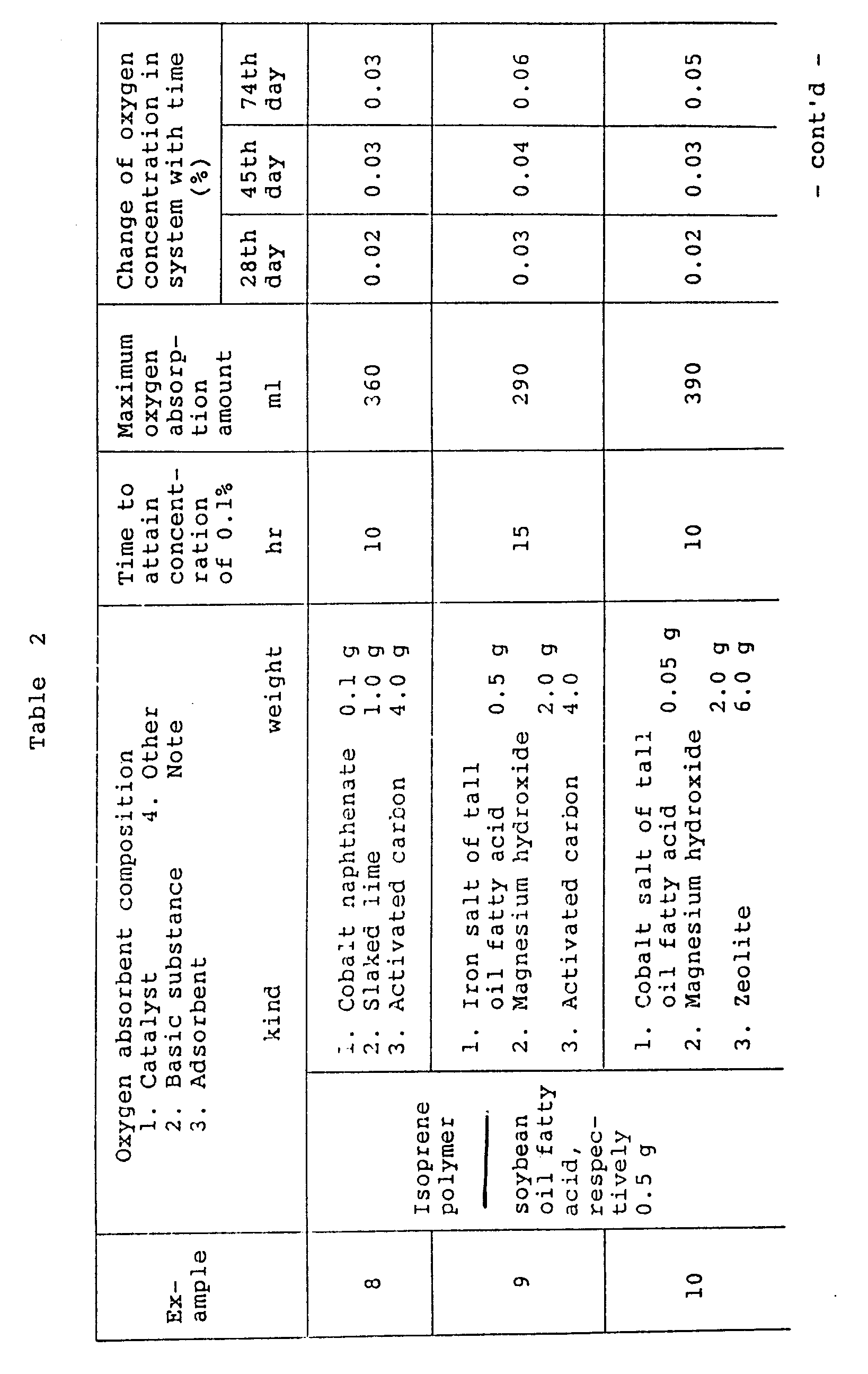


- A porous polyethylene (B-type, supplied by Shin-Nippon Aruku Co., Ltd.) was pressed on a pure white roll paper sheet (basis weight 50 g/m²) under a pressure of 4.90 x 10⁵ Pa (5 kg/cm²), and the paper sheet and the porous polyethylene were laminated on each other by passing them between a paper-side hot roll (temperature 200°C) and a porous polyethylene-side roll (temperature 100°C).
- 100 Parts of a silicone resin monomer (SD7328, toluene solution having a resin content of 30%, supplied by Toray Silicone) was dissolved in 500 parts of toluene together with 0.6 part of a catalyst (SRX212, supplied by Toray Silicone), and the resultant solution was coated on wood free paper (basis weight 50 g/m²) at a rate of 20 g/m². The silicone resin was polymerized at 140°C for 1 minute.
- A porous polyethylene (B-type, supplied by Shin-Nippon Aruku Co., Ltd.) was laminated on that surface of the wood free paper which was opposite to the resin-coated surface. An adhesive sheet formed by coating 13 g/m² of butyl polyacrylate on a PET film (thickness 12 »m) was attached to the silicone resin-coated surface to form a packing material. The adhesive sheet attached to the packing material was peeled off, and then, the packing material was measured for an oxygen permeation rate, humidity permeability and a dust number. Table 4 shows the result.
Table 4 Physical property value Oxygen permeation rate 4.15 cm³/m².day.Pa (42 x 10⁴ ml/m².Atm.Day) Humidity permeability 50 g/m²·Day Dust number 4500/10 x 10 cm² - The methods for measurement of the oxygen permeation rate, humidity permeability and dust number are as follows.
- ASTM D1434 (50 RH, 23°C)
- ASTM E96-E (90 RH)
- The same method as that described in Example 13 was employed.
- A porous polyethylene (B-type, supplied by Shin-Nippon Aruku Co., Ltd.) was laminated on a microporous film (GTAFL9504, 0.3 »m dust capturing efficiency of 67%, supplied by Japan Gore-Tax Co., Ltd.). An adhesive sheet formed by coating 13 g/m² of butyl polyacrylate on a PET film (thickness 12 »m) was attached to the microporous film surface of the resultant laminate to form a packing material. The adhesive sheet was peeled off, and then, the packing material was measured for an oxygen permeation rate, humidity permeability and dust number. Table 5 shows the results.
Table 5 Physical property value Oxygen permeation rate 2.47 x 10 cm³/m².day.Pa (25 x 10⁵ ml/m².atm.day) Humidity permeability 150 g/m²·Day Dust number 4300/10 x 10 cm² - 0.3 Gram of cobalt salt of tall oil fatty acid was added to a mixture of 0.5 g of a butadiene polymer with 0.5 g of tall oil fatty acid. The mixture was impregnated into a 5 x 5 cm kraft pulp sheet having a basis weight of 100 g/m² to form a sheet (I) . Further, a mixture liquid of 0.7 g of glycerin (for use in dynamite) with 0.1 g of triethanolamine was impregnated into 5 x 5 cm kraft pulp sheet having a basis weight of 100 g/m² to form a sheet (II).
- The gas-permeable packing material (1) prepared in Example 14 in a size of 140 x 70 mm was doubled over on itself with the porous polyethylene surface inside, 2.5 g of the oxygen absorbent composition and 2.5 g of granular calcium oxide were enclosed therebetween, and the above-mentioned doubled packing material was heat-sealed on sides to form a 70 x 70 mm parcel (to be referred to as "single-packed parcel" hereinafter).
- The gas-permeable packing material (1) prepared in Example 14, in a size of 140 x 70 mm, was doubled over on itself with the porous polyethylene surface inside, the oxygen absorbent sheets (I) and (II) prepared in Example 18 were enclosed therebetween, and the above-mentioned doubled packing material was heat-sealed on sides to form a 70 x 70 mm parcel (to be referred to as "single-packed parcel" hereinafter).
- The packing materials prepared in Examples 15 and 16, in a size of 80 x 160 mm, were passed on a butyl polyacrylate-coated adhesive roll to remove dust and doubled over on themselves with the porous polyethylene surface inside. Under atmosphere into which air having a dust number of not more than 5,000 per cubic feet was introduced, the parcel prepared in Example 19 or 20 was enclosed in each of the above packing materials and the above packing materials were heat-sealed to form double-packed parcels.
- The adhesive sheet was peeled off from the double-packed parcel prepared in Example 21, and then, the double-packed parcel and a sputtering target (diameter 300 mm) composed of evaporating aluminum, which was an IC wiring element to be fitted into a semiconductor device, were enclosed in a
vinylidene chloride 2 »m/stretched nylon 15 »m/polyethylene 50 »m bag (500 x 500 mm). The bag was sealed and stored at 25°C at RH of 60% for 3 months not to show that discoloration caused by rust formation of a copper plate fixing the evaporating aluminum of the sputtering target was used to produce IC, it was free from any contamination of IC by dust and usable under a good condition. - Example 22 was repeated except that the double-packed parcel obtained in Example 21 and used in Example 22 was replaced with the parcel obtained in Example 19 or 20. When IC was produced, contamination of the interior of a deposition chamber by dust was extreme, and it took more than 12 hours to remove dust by argon gas substitution, which caused a large loss on the IC production.
- Example 22 was repeated except that the double-packed parcel obtained in Example 21 and used in Example 22 was replaced with a double-packed parcel formed by packing the single-packed parcel prepared in Example 19 or 20 with a PET 12 »m/PE 30 »m film having openings (
average opening diameter 2 mm, opening ratio 15%)/pure white paper (50 g/m²)/PE 50 »m film having openings (average opening diameter 2 mm, opening ratio 15%) laminated gas-permeable packing material in the same manner as in Example 21. When IC was produced, contamination of the interior of a deposition chamber by dust was extreme, and it took more than 10 hours to remove dust by argon gas substitution, which caused a large loss on the IC production. - One each of the parcels prepared in Example 21 and Comparative Example 7 and 8 was beaten in cleaned pure air flowing at a rate of 3 lit./min., and the number of dust having a size of not less than 0.3 »m was counted with a counter (model 208L, supplied by Met One Co.). The number obtained was taken as a number of dust adhering to a surface of each parcel. Table 9 shows the results.

- 1 Gram of an iron salt of soybean oil fatty acid, 0.2 g of slaked lime and 1.5 g of powdered activated carbon were mixed with a cutter mixer and allowed to stand still at 25°C for 10 minutes to form a mass. The mass was pulverized to obtain a granular composition. 2.7 Grams of this composition and 2.5 g of silica gel were separately weighed out, and charged into a small bag of gas-permeable packing material (paper/porous polyethylene) (size: 5 x 7.5 cm). The small bag was heat-sealed on sides to obtain an oxygen absorbent parcel-1. 2.5 Grams of the composition that was prepared in Examples 1 and 3 and 2.5 g of quick lime were chared into small bag of gas permeable packing material (size: 6 x 7 cm). The small bags were heat-sealed on sides to obtain oxygen absorbent particles-2 and -3. These oxygen absorbent parcels were enclosed, together with 250 ml of air containing various gases, in a polyvinylidene chloride-coated stretched nylon/polyethylene (KON/PE) bag (size 15 x 24 cm). This bag was sealed and stored under atmosphere having a temperature of 35°C and a relative humidity of 80%, and measured for a change of each of gas in concentration with time. Table 16 shows the results.
- A desicant parcel was prepared by packing 2.5 g of silica gel with the same material as that in Example 26 in the same manner as in Example 26. With this desiccant parcel in place of the oxygen absorbent parcel, a change of each of gas concentrations with time was measured in the same manner as in Example 26. Table 16 shows the results.
Table 16 Contained gas Biginning 1st day 14th day 30th day Example 26 Oxygen 20.6% 0.1% or less 0.1% or less 0.1% or less Carbonic acid gas 0.52% 0.1% or less 0.1% or less 0.1% or less Acetic acid 195 ppm 1 ppm or less 1 ppm or less 1 ppm or less Hydrogen sulfide 210 ppm 1 ppm or less 1 ppm or less 1 ppm or less Methyl chloride 225 ppm 1 ppm or less 1 ppm or less 1 ppm or less Butylamine 189 ppm 1 ppm or less 1 ppm or less 1 ppm or less Comparative Example 9 Oxygen 20.6% 20.6% 20.6% 20.6% Carbonic acid gas 0.82% 0.81% 0.1% or less 0.1% or less Acetic acid 207 ppm 5 ppm 1 ppm or less 1 ppm or less Hydrogen sulfide 197 ppm 3 ppm 1 ppm or less 1 ppm or less Methyl chloride 215 ppm 129 ppm 3 ppm 2 ppm Butylamine 207 ppm 104 ppm 7 ppm 6 ppm - A bearing (material: SVJ-2) coated with a rust-preventive oil (NP-9) was degreased by washing it twice with each of toluene, ethanol and Freon 113 and drying it, whereby a bearing as-manufactured was obtained.
- The three bearings were individually enclosed in each bag (size: 170 x 300 mm, oxygen permeation rate of 3.94 x 10⁻⁵ cm³/m².day.Pa (4ml/m².atm.day), humidity permeation rate of 0.2 g/m².day) of KON/PE together with the oxygen absorbent parcel-1, -2 and -3 prepared in Example 26, and the each bag was sealed.
- The sealed bag enclosing this bearing was stored under atmosphere having a temperature of 25°C and a relative humidity of 50% for 1 day, and the oxygen concentration inside the bag was checked and found to be not more than 0.01%. Thereafter, the bag was stored under atmosphere having a temperature of 35°C and a relative humidity of 95%, and the surface of the bearing so preserved and a change of each oxygen concentration in inner system with time was observed. Table 17 and Table 18 show the results.
- With the desiccant parcel prepared in Comparative Example 9 in place of the oxygen absorbent parcel prepared in Example 27, a bearing treated in the same manner as in Example 27 was enclosed in the same manner as in Example 27. A bag enclosing the bearing was sealed and stored in the same manner as in Example 27, and the surface of the bearing preserved and a change of each oxygen concentration in inner system with time was observed. Table 17 and Table 18 show the results.
- The same bearing as that used in Example 27 was enclosed in the same manner as in Comparative Example 10 except that nitrogen gas was substituted for air in a KON/PE bag until the oxygen concentration became 0.7% when he bag was sealed. The bag was sealed and stored in the same manner as in Comparative Example 10, and the surface of the bearing preserved and a change of each oxygen concentration in inner system with time was observed. Table 17 and Table 18 show the results.
Table 17 State of discoloration on bearing surface 1st day 12th day 22th day 30th day 60nd day 90th day Example-27 Parcel-1 AA AA AA A A B Parcel-2 AA AA AA AA A A Parcel-3 AA AA AA AA AA AA Comparative Example-10 A B C C C C Comparative Example 11 C D D D D D Note 1. State of discoloration on bearing surface
AA No discoloration
A Slightly discolored, slight partly
B Slightly discolored, more than half of surface area
C Densely discolored, more than half of surface area
D Densely discolored, nearly entire surface
- One kilograms or 0.2 kg of one of various powders being oxidized was enclosed individually in each inner bag (size 150 x 330 mm) of a 40 » polyethylene film together with the oxigen absorbent parcels-1, -2 and -3 prepared in Example 26, and rubber-banded to close them. The inner bags were then put into each outer bag (size 170 x 300 mm) of KON/PE, and the outer bags were heat-sealed to close them. These sealed double-packed bag enclosing the oxidizing powder was stored under a temperature of 25°C and a relative humidity of 50% for 1 day, and the oxygen concentration inside the bags were checked and found to be not more than 0.01%. Therefore, the bags were stored under a temperature of 35°C and a relative humidity of 95% for 3 months, and a hydrogen reduction loss of the oxidizing powder and an oxygen concentration inside the bags were measured. Table 19 shows the results.
- A copper powder was enclosed in the same manner as in Example 28 except that the desiccant parcel prepared in Comparative Example 9 was used in place of the parcel prepared in Example 26. The resultant double-packed bag was sealed and stored in the same manner as in Example 28, and a hydrogen reduction loss of the copper powder and an oxygen concentration inside the bag was measured in the same manner as in Example 28. Table 19 shows the results.
- A copper powder was enclosed in the same manner as in Comparative Example 12 except that nitrogen gas was substituted in the bag for air until the oxygen concentration became 0.7% when the KON/PE bag was sealed. The resultant double-packed bag was sealed and stored in the same manner as in Comparative Example 12, and a hydrogen reduction loss of the copper powder and an oxygen concentration inside the bag were measured in the same manner as in Example 28. Table 19 shows the results.
- A powder being oxidized was preserved in the same manner as in Example 28 except that the parcel prepared in Example 26 was not used. A hydrogen reduction loss of the powder being oxidized and an oxygen concentration inside the bag were measured in the same manner as in Example 28. Table 19 shows the results.


- Zinc stearate was added to each of the powders being oxidized rate of 0.7% preserved in Examples 28 to 33, and then, 10 g of each mixture was put into a molding vessel having a diameter of 5 mm and press-shaped under a load of 5 t. The resultant shaped tablets were sintered with a nitrogen/hydrogen mixture gas having a nitrogen/hydrogen mixing ratio of 1/3 by heating them, for 30 minutes, to 1,000°C when the shaped tablets were formed of a copper or silver powder, to 1,150°C when the shaped tablets were formed of an iron powder or to 1,200°C when the shaped tablet was a carbon powder. The resultant sintered tablets were measured for a density (lengthwise) and a tensile strength. Table 20 shows the results.
- The powder being oxidized preserved in Comparative Examples 12 to 14 were shaped and sintered in the same manner as in Examples 34 to 35, and the resultant sintered tablets were measured for a density (lengthwise) and a tensile strength. Table 20 also shows the results.
Table 20 No. Oxidizing powder Sintered density g/cc Tensile strength kg/mm² Example 34 Example-28 8.18 7 35 Example-29 8.15 6 36 Example-30 6.92 14 37 Example-31 6.86 14 38 Example-32 7.53 6 39 Example-33 2.15 3 Comparative Example 15 Comparative Example-12 7.89 4 16 Comparative Example-13 7.96 5 17 Comparative Example-14 7.63 3 - A copper alloy thin plate (thickness 1.27 x width 62 x length 200 mm) was punched out with a press machine and its surface was etched with an aqueous solution containing sulfuric acid and hydrogen peroxide to form a lead frame. Gold was attached to an IC chip-attaching site of the lead frame. Hundred-fifty lead frames in total were prepared in the same manner, and every 50 lead frames ware bundled. These three bundles were packed with a polypropylene film, and further packed with a sheet formed of natural pulp (trade name NS-150, water extraction pH 7,
water content 3%, basis weight 150 g/m², width 300 mm, length 400 mm, supplied by Hokuyo Seishi) to form one package. - The above package was enclosed in a case (width 70 x length 200 x
height 50 mm) formed of polypropylene together with the oxygen absorbent parcel-1, -2 and -3 prepared in Example 26, the cases were packed in a KON/PE bag *size 170 x 300 mm), and the bags were sealed. These sealed bags packing the lead frames were stored under a temperature of 25°C and a relative humidity of 50% for one day, and the oxygen concentration inside the bags were checked and found to be not more than 0.01%. Thereafter, the bag was stored for periods of several cycles, each cycle consisting of storage under a temperature of 50°C and a relative humidity of 95% for 2 days and under a temperature of 0°C and a relative humidity of 100% for 5 days. The copper alloy surface of each lead frame preserved above was observed. Table 21 shows the results. Table 22 and Table 23 show humidity and oxygen concentration change with time of inside the bag. - Oxygen absorbent parcels-1, -2 and -3 prepared in Example 26 in the same method as in Example 40 excluding that natural pulp is not used were packed and sealed together with lead frames. They were stored in the same method and conditions as in Example 40. The copper alloy surface of lead frame after preservation was observed. Tables 21, 22 and 23 show the results.
- Lead frames were packed in the same manner as in Example 40 except that the desiccant parcel prepared in Comparative Example 9 was used in place of the oxygen absorbent parcel prepared in Example 26. The lead frames so-packed were stored in the same manner as in Example 40 and under the same conditions as those in Example 40, and the copper alloy surface of each lead frame and a humidity and oxygen concentration change with time of inside of the bag was observed. Tables 21, 22 and 23 show the results.
- Lead frames were packed and preserved in the same manner as in Comparative Example 18 except that, when the case was enclosed in the bag, nitrogen gas was substituted for air in the bag until the oxygen concentration became 2.7%. The copper alloy surface of each lead frame preserved was observed. Table 21 shows the results.
- Figs. 22 and 23 shows a change in humidity and oxygen concentration in the system with time.
Table 21 Parcel 7th day 14th day 30th day 60th day 90th day Example-40 1 - - - - - 2 - - - - - 3 - - - - - Example-41 1 - - - - -Note 2) 2 - - - - - 3 - - - - - Comparative Example-18 - ++ ++++ ++++ ++++ Comparative Example-19 - ++ ++++ ++++ ++++ Note 1: State of discoloration on alloy surface
- : No discoloration
+ : Slightly discolored
++ : Slightly discolored, more than half of surface area
+++ : Densely discolored, more than half of surface area
++++ : Densely discolored, nearly entire surface
Note 2: A trace of dew was observed on the metallic surface, but remarkable discolor was not observedTable 22 Preservation day and humidity in the system, RH % Parcel 7th day 14th day 30th day 60th day 90th day Example-40 1 2 7 15 25 46 2 3 6 17 27 47 3 2 7 14 24 44 Example-41 1 3 11 21 32 57 2 2 9 17 25 44 3 2 8 15 24 43 Comparative Example-18 3 19 42 66 89 Comparative Example-19 2 17 41 65 90 
- A copper alloy thin plate (thickness 1.27 x width 62 x length 200 mm) was punched out with a press machine and its surface was etched with an aqueous solution containing sulfuric acid and hydrogen peroxide to form a lead frame. Gold was attached to an IC chip-attaching site of the lead frame. Hundred-fifty lead frames in total were prepared in the same manner, and every 50 lead frames were bundled. The resultant three bundles were packed with a polypropylene film, and further packed with a sheet formed of natural pulp (trade name NS-150, water extraction pH 7,
water content 3%, basis weight 150 g/m², width 300 mm, length 400 mm, supplied by Hokuyo Seishi) to form one package. - The above package was enclosed in a case (width 70 x length 200 x
height 50 mm) formed of polypropylene together with the oxygen absorbent parcel-3 prepared in Example 26, the case was packed in a KON/PE bag (size 170 x 300 mm), and the bas was sealed. This sealed bag packing the lead frames was stored under atmosphere having a temperature of 30°C and a relative humidity of 50% for 1 day, and the oxygen concentration inside the bag was checked and found to be not more than 0.01%. Thereafter, the bag was transported from Singapore to Japan by a vessel by taking 1 month. The copper alloy surface of each of the lead frames transported was observed to show that the lead frames were under a good preservation conditions without any discoloration which was to be caused by dew formation and rust on the surface. - Lead frames were enclosed in the same manner as in Example 41 except that the desiccant parcel prepared in Comparative Example 9 was used in place of the oxygen absorbent parcel used in Example 40. The resultant bag was sealed and stored in the same manner as in Example 41, and the copper alloy surface of each lead frame was observed to show that the color on the entire surface was changed to dark blue and some portions of the surface showed dot-like dew formation. Thus, the lead frames were under an unusable condition.
- Lead frames were enclosed and preserved in the same manner as in Comparative Example 20 except that, when the case was packed and sealed in a bag, nitrogen gas was substituted for air in the bag until the oxygen concentration became 2.7%. The surface of each lead frame preserved was observed to show that the color on the entire surface was changed to dark blue and some portions of the surface showed dot-like dew formation.
- The oxygen absorbent composition of this invention exhibits a higher oxygen absorption rate and a higher maximum oxygen absorption amount than conventional compositions, and remarkably improves the effect on preservation of articles. The parcel formed by packing the oxygen absorbent composition with a gas-permeable packing material, provided by this invention, is suitably usable for the preservation of metals, metal products, electronic products, electronic parts and components, dry food, medicaments, photographs, ancient documents, drawings, pressed flowers, and the like. When the oxygen absorbent composition parcel of this invention is used as a rust preventive in particular, a large effect on rust prevention can be expected.
- The composition containing the oxygen absorbent composition and a humidity adjusting agent in combination, provided by this invention, is capable of adjusting the humidity of a preservation system to an optimum one for preservation, free from occurrence of hydrogen and hydrogen sulfide, and capable of removing undesirable substances present in a sealed bag or container in which an article is enclosed, e.g. acidic substances such as sulfur compound,s etc., and reducing substances such as formaldehyde, etc., by absorbing them.
- In a system in which the parcel formed by packing a combination of the oxygen absorbent composition with a humidity adjusting agent, provided by this invention, with a gas-permeable packing material is enclosed in a sealed container together with an article, property alteration, deterioration and corrosion of the article can be prevented, and a crack due to dryness and rust and swelling due to high humidity can be prevented.
- Further, the method of producing the effects of the oxygen absorbent composition of this invention and the parcel thereof is very simple, i.e. all that is necessary therefor is to enclose an article and the oxygen absorbent composition parcel of this invention in a bag or container having gas-barrier properties and seal the bag or container. Thus, no large-scale apparatus or equipment for preservation is required.
- The parcel formed by packing a composition containing the oxygen absorbent composition of this invention and a humidity adjusting agent in combination with a gas-permeable packing material is suitably usable for the preservation of ancient manuscripts and documents, photographs, magnetic tapes, specimens, medicaments, etc.
- The parcel formed by attaching an adhesive sheet on a surface of the parcel formed by packing the oxygen absorbent composition of this invention with a gas-permeable packing material is free from deterioration in performance since air is shut off before the use of the parcel, and it is easy to handle. Further, the adhesive sheet is peeled off when the parcel is used, whereby dust adhering to the parcel surface is transferred to the adhesive sheet side and removed. The volatilization of gases to be produced at an oxygen absorption time is a little. Therefore, the present parcel is suitably usable for the preservation of semiconductors and semiconductor parts.
- The double-packed parcel formed by packing the oxygen absorbent composition of this invention with a gas-permeable packing material and further packing the resultant parcel with another gas-permeable packing material (2) is free from a short circuit and rust in an electric circuit, which are formed due to contamination of an article by dust, since little dust sticks to the parcel surface. Therefore, the present double-packed parcel is the most suitable for the preservation of electronic parts and electronic products, in particular, parts, for semiconductors and materials for the production of semiconductors.
- The parcel formed by the oxygen absorbent composition with a gas-permeable packing material can be applied to the preservation of a variety of articles.
- Differing from conventional oxygen absorbents, the oxygen absorbent composition of this invention continues an oxygen absorption reaction even when the humidity of a photograph preservation system is kept low by means of a humidity adjusting agent, since water is not necessary for the oxygen absorption and the maximum oxygen absorption amount is high. It is therefore made possible to preserve photographs for a longer period of time. In no case are dyestuffs altered by a trace amount of hydrogen or sulfur compounds, and the present composition is hence desirably usable. Using a humidity adjusting agent in combination, the method of preserving a photograph, provided by this invention, exhibits a function of maintaining a constant humidity required for the preservation of a photograph as well as a function of preserving a photograph.
- Conventionally available preservation methods such as a method utilizing a low temperature and a low humidity, which is costly and ineffective, and a method using an oxygen absorbent and a desiccant in combination, in which an oxygen absorption reaction is terminated during the preservation, are in complete. Further, a conventional preservation method using an oxygen absorbent sometimes causes critical physical destruction such as fusion of a photograph onto a preserving bag, etc., due to water transfer, although deterioration of an image can be prevented.
- The method of preserving a photograph, provided by this invention, overcomes the above defects of conventional techniques, makes it possible to simply and easily preserve a photograph in the absence of oxygen at a constant low humidity, and makes it possible to prevent deterioration and physical degradation of an original image texture simply and at a low cost.
- The method for producing the effects of this invention is very simple. That is, all that is necessary is to enclose a photograph and the oxygen absorbent parcel of this invention, a combination of said parcel with a humidity adjusting agent or a substance which has both an oxygen absorbent function and a humidity adjusting function in a suitable packing material and seal it.
- In the method of preserving a bearing, the oxygen absorbent parcel of this invention and a bearing are enclosed in a container having gas-barrier properties and the container is sealed, whereby the oxygen absorbent composition of this invention inhibits formation of rust on the bearing by absorbing water and oxygen in the container and further absorbing water, oxygen and acidic gases permeating from atmosphere outside the container.
- When the method of preserving a bearing, provided by this invention, is employed, manufacturer can carry out planned production of bearings, transport bearings over the seas or from overseas and simplify the preservation method. Further, users can enjoy merits that they can save a washing labor and decrease an amount of a washing solvent.
- The preservation method of this invention is particularly suitable for users engaged in the fields of precision machines, electronic machines and devices, etc., where a rust-preventive oil applied to bearings is disadvantageous.
- In these times when there is a warning of environmental pollution, the present preservation method can reduce an amount of a solvent, one of pollution sources, and is valuable if considered from a global point of view.
- In the method of preserving a powder being oxidized, the oxygen absorbent parcel of this invention and a powder being oxidized are enclosed in a container having gas-barrier properties and the container is sealed, whereby the oxygen absorbent composition of this invention makes it possible to inhibit oxidation and alteration of the powder being oxidized, improve the strength of a shaped and sintered body and prevent deterioration of magnetic density by absorbing water and oxygen in the container and absorbing and completely eliminating water, oxygen and acidic gases permeating from atmosphere outside the container, which preservation method has not been possible by conventional techniques.
- The present preservation method is simple and has merits that a powder being oxidized can be preserved longer, and a manufacturer can provide products stable in quality, carry out planned production instead of production after receipt of an order and ship products abroad by a vessel.
- In the method of preserving a metal or a product containing a metal, the metal or the product containing a metal are enclosed in a container having gas-barrier properties together with the oxygen absorbent parcel of this invention and the container is sealed, it is made possible to achieve the preservation that prior techniques could not achieve by preventing dew formation and inhibiting rust formation in spite of a sudden change in preservation conditions (temperature and humidity) during the transportation by air or vessel. Such an improvement in the preservation makes it possible to manufacture a metal and products containing a metal such as a lead frame, a shadow mask, etc., according to a plan and perfectly preserve them without causing rust on the metal even when they are transported from overseas.
Claims (8)
- An oxygen absorbent composition containing as a main component a linear hydrocarbon polymer having one or more unsaturated groups but no carboxylic groups and an oxidation promoter as essential components.
- A composition according to claim 1 also containing an unsaturated fatty acid compound.
- A composition according to either of claims 1 and 2 also containing a basic substance and/or an adsorption substance.
- An oxygen absorbent composition according to any one of claims 1 to 3 which further comprises a humidity adjusting agent having a viscosity, at 20 to 50°C, of not more than 10 Pa.s (10⁴ cp) and an equilibrium relative humidity of not more than 70%, the equilibrium relative humidity of an entire system of enclosing the oxygyen absorbent composition being 20 to 70%.
- An oxygen absorbent parcel formed by packing the oxygen absorbent composition recited in any one of claims 1 to 4 with a gas-permeable packing material.
- A parcel formed by attaching the adhesive layer of an adhesive sheet comprising an adhesive and a sheet to a surface of the oxygen absorbent parcel recited in claim 5.
- A double-packed oxygen absorbent parcel formed by packing the oxygen absorbent parcel recited in claim 5 with a gas-permeable packing material having a humidity permeability of not less than 1 g/m².day, an oxygen permeation rate of not less than 9.87 x 10⁻³cm³/m².day.Pa (1,000 ml/m².atm.day) and a dust capturing ratio of not less than 50% for dust having a size of not less than 0.3 m».
- A method for preserving an article from oxidation during storage, which comprises enclosing the article and an oxygen absorbent parcel recited in any one of preceding claims 5 to 7 in a container having a gas-barrier property and sealing the container.
Applications Claiming Priority (16)
| Application Number | Priority Date | Filing Date | Title |
|---|---|---|---|
| JP02107358A JP3104238B2 (en) | 1990-04-25 | 1990-04-25 | anti-rust |
| JP107358/90 | 1990-04-25 | ||
| JP134111/90 | 1990-05-25 | ||
| JP02134111A JP3134291B2 (en) | 1990-05-25 | 1990-05-25 | Oxygen absorbing composition |
| JP19920990A JP2864687B2 (en) | 1990-07-30 | 1990-07-30 | Double package and its packaging method |
| JP199209/90 | 1990-07-30 | ||
| JP2213677A JP3038836B2 (en) | 1990-08-14 | 1990-08-14 | Long-term storage of photos |
| JP213677/90 | 1990-08-14 | ||
| JP213678/90 | 1990-08-14 | ||
| JP2213678A JP3018430B2 (en) | 1990-08-14 | 1990-08-14 | Oxygen absorber composition |
| JP3012368A JP3028966B2 (en) | 1991-01-10 | 1991-01-10 | How to save bearings for rotating parts |
| JP12368/91 | 1991-01-10 | ||
| JP3048611A JPH04268085A (en) | 1991-02-22 | 1991-02-22 | Method for preserving oxidizable powder |
| JP48611/91 | 1991-02-22 | ||
| JP85933/91 | 1991-03-27 | ||
| JP3085933A JPH04297588A (en) | 1991-03-27 | 1991-03-27 | Storage methods and forms of metals and products containing metals |
Publications (2)
| Publication Number | Publication Date |
|---|---|
| EP0454437A1 EP0454437A1 (en) | 1991-10-30 |
| EP0454437B1 true EP0454437B1 (en) | 1995-03-15 |
Family
ID=27571719
Family Applications (1)
| Application Number | Title | Priority Date | Filing Date |
|---|---|---|---|
| EP91303682A Expired - Lifetime EP0454437B1 (en) | 1990-04-25 | 1991-04-24 | Oxygen absorbent composition and method of preserving article with same |
Country Status (4)
| Country | Link |
|---|---|
| EP (1) | EP0454437B1 (en) |
| KR (1) | KR0148802B1 (en) |
| DE (1) | DE69108088T2 (en) |
| MY (2) | MY131565A (en) |
Families Citing this family (15)
| Publication number | Priority date | Publication date | Assignee | Title |
|---|---|---|---|---|
| MY110342A (en) * | 1992-06-02 | 1998-04-30 | Mitsubishi Gas Chemical Co | A method of bonding a metal by solder |
| US5310497A (en) * | 1992-10-01 | 1994-05-10 | W. R. Grace & Co.-Conn. | Oxygen scavenging compositions for low temperature use |
| TW268913B (en) * | 1993-08-30 | 1996-01-21 | Mitsubishi Gas Chemical Co | |
| NZ272780A (en) * | 1994-08-23 | 1998-02-26 | Grace W R & Co | Food package comprising an oxygen-sensitive article enclosed in polymeric film |
| ZA958727B (en) * | 1994-10-19 | 1996-05-22 | Grace W R & Co | Oxygen scavenging composition |
| US5778638A (en) * | 1996-03-06 | 1998-07-14 | Mitsubishi Gas Chemical Company, Inc. | Process for preserving solder paste |
| US6057013A (en) * | 1996-03-07 | 2000-05-02 | Chevron Chemical Company | Oxygen scavenging system including a by-product neutralizing material |
| SG79938A1 (en) * | 1996-04-16 | 2001-04-17 | Mitsubishi Gas Chemical Co | Noble metal-plated article, ornamental jewellery and methods for storage thereof |
| JP3026549B2 (en) * | 1996-05-02 | 2000-03-27 | ダイナボット株式会社 | Manufacturing method of chromatography immunoanalyzer |
| SG125044A1 (en) * | 1996-10-14 | 2006-09-29 | Mitsubishi Gas Chemical Co | Oxygen absorption composition |
| WO1999012829A1 (en) * | 1997-09-09 | 1999-03-18 | Peterson Scanproof Aktiebolag | Packaging material |
| US20020037377A1 (en) | 1998-02-03 | 2002-03-28 | Schmidt Steven L. | Enhanced oxygen-scavenging polymers, and packaging made therefrom |
| EP4355115A4 (en) * | 2021-06-18 | 2025-05-07 | Desiccare, Inc. | OXYGEN ABSORBING COVERING ELEMENT AND METHOD FOR MANUFACTURING THE SAME |
| CN115193243A (en) * | 2022-05-23 | 2022-10-18 | 南京天华科技开发有限责任公司 | Self-balancing oxygen inhalation composition for medicine bagging, and preparation device and preparation method thereof |
| KR102760077B1 (en) * | 2023-10-19 | 2025-01-24 | 율촌화학 주식회사 | Encapsulant for organic electronic device and organic electronic device comprising the same |
Family Cites Families (3)
| Publication number | Priority date | Publication date | Assignee | Title |
|---|---|---|---|---|
| KR890005278B1 (en) * | 1983-01-28 | 1989-12-20 | 미쓰비시가스가가꾸 가부시끼 가이샤 | Oxygen absorbent packet |
| WO1986007077A1 (en) * | 1985-05-23 | 1986-12-04 | Institut Mekhaniki Metallopolimernykh Sistem Akade | Anticorrosive material |
| US4908151A (en) * | 1987-02-14 | 1990-03-13 | Mitsubishi Gas Chemical Co., Inc. | Oxygen absorbent |
-
1991
- 1991-04-22 MY MYPI94002739A patent/MY131565A/en unknown
- 1991-04-22 MY MYPI91000654A patent/MY106162A/en unknown
- 1991-04-24 DE DE69108088T patent/DE69108088T2/en not_active Expired - Lifetime
- 1991-04-24 EP EP91303682A patent/EP0454437B1/en not_active Expired - Lifetime
- 1991-04-25 KR KR1019910006706A patent/KR0148802B1/en not_active Expired - Fee Related
Also Published As
| Publication number | Publication date |
|---|---|
| DE69108088D1 (en) | 1995-04-20 |
| KR0148802B1 (en) | 1998-10-15 |
| KR910018076A (en) | 1991-11-30 |
| EP0454437A1 (en) | 1991-10-30 |
| MY131565A (en) | 2007-08-30 |
| DE69108088T2 (en) | 1995-10-05 |
| MY106162A (en) | 1995-03-31 |
Similar Documents
| Publication | Publication Date | Title |
|---|---|---|
| US5286407A (en) | Oxygen absorbent composition and method of preserving article with same | |
| EP0454437B1 (en) | Oxygen absorbent composition and method of preserving article with same | |
| EP0567529B1 (en) | Oxygen-absorbing label | |
| EP0835685B1 (en) | Oxygen absorption composition | |
| EP0424855B1 (en) | Inhibitor parcel and method for preserving electronic devices or electronic parts | |
| US5667863A (en) | Oxygen-absorbing label | |
| US5686161A (en) | Moisture-sensitive label | |
| JPS5915014B2 (en) | Oxygen absorbing pack that generates carbon dioxide gas and has high oxygen absorption capacity | |
| EP0888719A2 (en) | Oxygen-absorbing component, oxygen-absorbent package and oxygen-absorbing multilayerd body containing same | |
| EP1689826A1 (en) | Oxygen scavenger for low moisture environment and methods of using the same | |
| JPH10113555A (en) | Oxygen absorbing composition | |
| EP0574161B1 (en) | A method of bonding a metal by solder | |
| US5866070A (en) | Method for preserving adhesive tape and method for preserving article using the same | |
| JPH04268085A (en) | Method for preserving oxidizable powder | |
| JPH08310565A (en) | Deoxidizing packaging method that uses dehumidifying agent together | |
| JPH04297588A (en) | Storage methods and forms of metals and products containing metals | |
| JP3028966B2 (en) | How to save bearings for rotating parts | |
| JP3134291B2 (en) | Oxygen absorbing composition | |
| JPS632648B2 (en) | ||
| JP2850405B2 (en) | How to store semiconductors or semiconductor components | |
| CA2011748C (en) | Method of preventing after-ripening or aging of fruit and vegetables | |
| JPH08276963A (en) | Adhesive tape and method of storing articles using the same | |
| JP3121489B2 (en) | Formulation of gas phase corrosion inhibitor and desiccant | |
| JP2864687B2 (en) | Double package and its packaging method | |
| JPH04100537A (en) | Oxygen absorber composition |
Legal Events
| Date | Code | Title | Description |
|---|---|---|---|
| PUAI | Public reference made under article 153(3) epc to a published international application that has entered the european phase |
Free format text: ORIGINAL CODE: 0009012 |
|
| AK | Designated contracting states |
Kind code of ref document: A1 Designated state(s): DE FR GB IT |
|
| 17P | Request for examination filed |
Effective date: 19920212 |
|
| 17Q | First examination report despatched |
Effective date: 19920710 |
|
| GRAA | (expected) grant |
Free format text: ORIGINAL CODE: 0009210 |
|
| AK | Designated contracting states |
Kind code of ref document: B1 Designated state(s): DE FR GB IT |
|
| ITF | It: translation for a ep patent filed | ||
| REF | Corresponds to: |
Ref document number: 69108088 Country of ref document: DE Date of ref document: 19950420 |
|
| ET | Fr: translation filed | ||
| PLBE | No opposition filed within time limit |
Free format text: ORIGINAL CODE: 0009261 |
|
| STAA | Information on the status of an ep patent application or granted ep patent |
Free format text: STATUS: NO OPPOSITION FILED WITHIN TIME LIMIT |
|
| 26N | No opposition filed | ||
| REG | Reference to a national code |
Ref country code: GB Ref legal event code: IF02 |
|
| PG25 | Lapsed in a contracting state [announced via postgrant information from national office to epo] |
Ref country code: IT Free format text: LAPSE BECAUSE OF NON-PAYMENT OF DUE FEES;WARNING: LAPSES OF ITALIAN PATENTS WITH EFFECTIVE DATE BEFORE 2007 MAY HAVE OCCURRED AT ANY TIME BEFORE 2007. THE CORRECT EFFECTIVE DATE MAY BE DIFFERENT FROM THE ONE RECORDED. Effective date: 20050424 |
|
| PGFP | Annual fee paid to national office [announced via postgrant information from national office to epo] |
Ref country code: GB Payment date: 20100325 Year of fee payment: 20 |
|
| PGFP | Annual fee paid to national office [announced via postgrant information from national office to epo] |
Ref country code: FR Payment date: 20100521 Year of fee payment: 20 |
|
| PGFP | Annual fee paid to national office [announced via postgrant information from national office to epo] |
Ref country code: DE Payment date: 20100430 Year of fee payment: 20 |
|
| REG | Reference to a national code |
Ref country code: DE Ref legal event code: R071 Ref document number: 69108088 Country of ref document: DE |
|
| REG | Reference to a national code |
Ref country code: GB Ref legal event code: PE20 Expiry date: 20110423 |
|
| PG25 | Lapsed in a contracting state [announced via postgrant information from national office to epo] |
Ref country code: GB Free format text: LAPSE BECAUSE OF EXPIRATION OF PROTECTION Effective date: 20110423 |
|
| PG25 | Lapsed in a contracting state [announced via postgrant information from national office to epo] |
Ref country code: DE Free format text: LAPSE BECAUSE OF EXPIRATION OF PROTECTION Effective date: 20110424 |