EP0454222A1 - Use of sepiolite in manufacturing processes of fiber reinforced products containing mica. - Google Patents
Use of sepiolite in manufacturing processes of fiber reinforced products containing mica. Download PDFInfo
- Publication number
- EP0454222A1 EP0454222A1 EP19910200903 EP91200903A EP0454222A1 EP 0454222 A1 EP0454222 A1 EP 0454222A1 EP 19910200903 EP19910200903 EP 19910200903 EP 91200903 A EP91200903 A EP 91200903A EP 0454222 A1 EP0454222 A1 EP 0454222A1
- Authority
- EP
- European Patent Office
- Prior art keywords
- sepiolite
- mica
- fibers
- manufacturing processes
- products reinforced
- Prior art date
- Legal status (The legal status is an assumption and is not a legal conclusion. Google has not performed a legal analysis and makes no representation as to the accuracy of the status listed.)
- Granted
Links
Classifications
-
- C—CHEMISTRY; METALLURGY
- C04—CEMENTS; CONCRETE; ARTIFICIAL STONE; CERAMICS; REFRACTORIES
- C04B—LIME, MAGNESIA; SLAG; CEMENTS; COMPOSITIONS THEREOF, e.g. MORTARS, CONCRETE OR LIKE BUILDING MATERIALS; ARTIFICIAL STONE; CERAMICS; REFRACTORIES; TREATMENT OF NATURAL STONE
- C04B28/00—Compositions of mortars, concrete or artificial stone, containing inorganic binders or the reaction product of an inorganic and an organic binder, e.g. polycarboxylate cements
- C04B28/02—Compositions of mortars, concrete or artificial stone, containing inorganic binders or the reaction product of an inorganic and an organic binder, e.g. polycarboxylate cements containing hydraulic cements other than calcium sulfates
-
- C—CHEMISTRY; METALLURGY
- C04—CEMENTS; CONCRETE; ARTIFICIAL STONE; CERAMICS; REFRACTORIES
- C04B—LIME, MAGNESIA; SLAG; CEMENTS; COMPOSITIONS THEREOF, e.g. MORTARS, CONCRETE OR LIKE BUILDING MATERIALS; ARTIFICIAL STONE; CERAMICS; REFRACTORIES; TREATMENT OF NATURAL STONE
- C04B14/00—Use of inorganic materials as fillers, e.g. pigments, for mortars, concrete or artificial stone; Treatment of inorganic materials specially adapted to enhance their filling properties in mortars, concrete or artificial stone
- C04B14/02—Granular materials, e.g. microballoons
- C04B14/04—Silica-rich materials; Silicates
- C04B14/042—Magnesium silicates, e.g. talc, sepiolite
-
- C—CHEMISTRY; METALLURGY
- C04—CEMENTS; CONCRETE; ARTIFICIAL STONE; CERAMICS; REFRACTORIES
- C04B—LIME, MAGNESIA; SLAG; CEMENTS; COMPOSITIONS THEREOF, e.g. MORTARS, CONCRETE OR LIKE BUILDING MATERIALS; ARTIFICIAL STONE; CERAMICS; REFRACTORIES; TREATMENT OF NATURAL STONE
- C04B2111/00—Mortars, concrete or artificial stone or mixtures to prepare them, characterised by specific function, property or use
- C04B2111/10—Compositions or ingredients thereof characterised by the absence or the very low content of a specific material
- C04B2111/12—Absence of mineral fibres, e.g. asbestos
-
- Y—GENERAL TAGGING OF NEW TECHNOLOGICAL DEVELOPMENTS; GENERAL TAGGING OF CROSS-SECTIONAL TECHNOLOGIES SPANNING OVER SEVERAL SECTIONS OF THE IPC; TECHNICAL SUBJECTS COVERED BY FORMER USPC CROSS-REFERENCE ART COLLECTIONS [XRACs] AND DIGESTS
- Y02—TECHNOLOGIES OR APPLICATIONS FOR MITIGATION OR ADAPTATION AGAINST CLIMATE CHANGE
- Y02W—CLIMATE CHANGE MITIGATION TECHNOLOGIES RELATED TO WASTEWATER TREATMENT OR WASTE MANAGEMENT
- Y02W30/00—Technologies for solid waste management
- Y02W30/50—Reuse, recycling or recovery technologies
- Y02W30/91—Use of waste materials as fillers for mortars or concrete
Definitions
- the present invention refers to the use of sepiolite in the manufacturing of products reinforced with mica-containing fibers and, in particular, of products that have an inorganic binder matrix that hardens in water, such as for example Portland cement or aluminous cement, calcium silicate, for the purpose of substantially improving the interlaminar adhesion and homogeneity of the sheets.
- the normal manufacturing process of the products reinforced with fibers is the elimination of water of an aqueous slurry of an inorganic binder capable of hardening in water that contains reinforcing fibers, and subsequently the setting of the agglomerant in the material, once the water has been eliminated, either letting it react in environmental conditions, or subjecting it to an autoclave process or else subjecting it to another moderate heating process.
- an aqueous pulp is prepared with a solids concentration normally between 4 and 20 % and then this pulp is transferred to some tanks with rotary cylindric filters.
- the rotary filter collects the product reinforced with fibers and transfers it to the felt of an endless conveyor belt, forming a fine sheet.
- the felt passes over vacuum tanks that drain the water and finally transfer the sheets to a forming cylinder or mandrel.
- the sheets winds up continuously until a plate of the required thickness is formed. It is cut axially and the formed sheet is separated. If a corrugated sheet is desired, the smooth sheet obtained is adequately molded. Finally the inorganic binder is set.
- asbestos-free products are obtained by using synthetic organic fibers, such as polyacrylonitrile, polyvinyl alcohol, polyproylene, polyamide or polyester fibers or inorganic fibers such as alkali-resistant fiberglass or wollastonite.
- synthetic organic fibers such as polyacrylonitrile, polyvinyl alcohol, polyproylene, polyamide or polyester fibers
- inorganic fibers such as alkali-resistant fiberglass or wollastonite.
- these fibers do not have the capacity that asbestos fibers have for forming a reticle or mesh that retains the fine particles of the inorganic agglomerant during the water elimination process or filtering of the slurry.
- cellulose pulp with a degree of refining from 20o to 70o in the Shopper Riegler scale is included in the composition of retention fibers capable of forming this reticle, for example.
- Other types of retention fibers such as synthetic pulps of polyolefins such as fibrillated polypropylene can also be used.
- process aids such as aluminum sulfate and dispersing agents such as, for example, polyacrylamides may be used.
- sheets reinforced with fibers thus manufactured, have serious problems of dimensional instability or a tendency to crack on the surface or on the edges, when they are used in climates characterised by sudden temperature and/or humidity changes.
- the dimensional instability can be reduced to acceptable limits or even eliminated, by adding mica, a relative cheap mineral product, to the aqueous slurry that is fed to the Hatzcheck machine or any other machine used to for the sheets of product reinforced with fibers.
- the mica makes it possible to solve the problem of cracking and offers good results in the case of manufacturing smooth sheets, use thereof also causes problems which have not yet been solved.
- the greatest problem is the reduction of interlaminar adhesion in the plates of products reinforced with fibers produced by the Hatzchek process.
- the smooth or corrugated sheets are made up of a group of sheets which are formed upon winding the sheet that the felt upon the forming cylinder collects and when the desired thickness is obtained, the same are automatically cut.
- the formed plates subsequently pass to the molding step in order to obtain the corrugated sheets.
- the sheets are transferred to the molding step, or else they are piled up in the case of smooth plates, by means of a suction system that lifts up the plate.
- sepiolite likewise, improves the uniformity and quality of the surfaces of the plates of the products reinforced with fibers, thus obtaining sheets with a more homogeneous surface, a particularly important characteristic for smooth painted plates, in which painting emphasizes the irregularities of the surface.
- sepiolite likewise, improves the mechanical resistance of the plates of product reinforced with fibers and their corss-breaking strength, upon reducing the orientation of the reinforcing fibers and improving the interlaminar adhesion.
- the present invention refers to the use of sepiolite, and more specifically to rheological grade sepiolite, in the manufacturing processes of products reinforced with mica-containing fibers, said processes comprising the following steps:
- the present invention is characterized by adding sepiolite to the initial aqueous slurry in concentrations such that in the finished product, the amount of sepiolite is from 0.1 to 10 %.
- a specially suitable sepiolite product is rheological grade sepiolite obtained as is described in patent EP 85200094-4 or Patent Esp.
- 535317, 534891 and 534838 which is characterized by containing more than 50 % sepiolite, a particle size smaller than 25 micra and a viscosity in water at 6 % solids concentration, higher than 5,000 cP (Brookfield, 5 rpm 25o C.)
- the specific surface of this product is higher than 120 m2/g and it may reach 340 m2/g (N2, BET.)
- the dimensions of the sepiolite fibers vary between 0.2 and 2 ⁇ m long, 100-300 ⁇ wide and 50-100 ⁇ thick.
- the generally used reinforcing fibers are selected from among asbestos, cellulose, polyamide, polypropylene, polyester, polyvinyl alchohol, polyacrlonitrile and acrylic fibers.
- the retention fibers are selected from among asbestos, cellulose pulp (long or short fiber with a Shopper-Riegler degree of refining of 20-70o C.), cotton or highly fibrillated polypropylene fibers.
- Mica for example, muscovite, phlogopite or biotite, is normally used in a percentage of at least 0.25 % by weight of solids of the slurry and up to a maximum of 20 %, and preferably between 0.5-10 % by weight.
- the particularly preferred concentration range is between 0.5-3 %.
- the solids concentration of the slurry is between 5 and 50 %.
- Rheological grade sepiolite can be added to the initial slurry in powder form or else previously dispersed in water in a high shear stirrer, for example, paddle stirrers, hydropulpers, turbomixers or recirculatory mixers, until a slurry with a solids concentration between 1 and 20 % is obtained.
- a high shear stirrer for example, paddle stirrers, hydropulpers, turbomixers or recirculatory mixers
- organic dispersing agents such as cationic, anionic or non-ionic polyacrylamides
- anionic polyacrylamides in a concentration based on the solids between 0.001 and 0.015 % are preferably used.
- organic fibers such as MMMF or wollastonite, are used in amounts, based on the solids between 0.2 and 4 %.
- Corrugated sheets of products reinforced with fibers with the composition indicated in table I were manufactured, using sepiolite in one case and in the other, a colloidal filler, microsilica.
- a 15 % slurry was prepared and it was fed into a conventional Hatzchek machine and the sheet thus formed with a thickness of 6.2 mm. was corrugated in the normal way.
- the corrugated sheets were cured at room temperature for 28 days obtaining sheets with a density greater than 1,100 kg/m3 and with the properties indicated in table I.
- Fiber-reinforced cement sheets were manufactured with the composition indicated in table III, using rheological grade sepiolite as opposed to conventional micronized sepiolite and microsilica.
- the slurries were prepared at a concentration of 6 % of solids and were fed into a conventional Hatzchek machine with two rotary filters, to obtain sheets with a thickness of 6.2 mm. using a pressure of 2 kg/cm2. The sheets were cured at room temperature for 28 days. Table III summarises the relative efficacy of recovery of fines and the final properties of the sheets.
- rheological grade sepiolite makes it possible to obtain a better efficacy of fines recovery, improving at the same time the flexural strengths in perpendicular and in parallel direction to the functioning of the Hatzcheck machine. It is noteworthy that these improvements are observed upon using half the concentration of rheological grade sepiolite than that of microsilica. Likewise, it is observed that adding rheological grade sepiolite makes it possible to reduce the density of the product without affecting the strength which makes it possible to obtain a larger number of sheets per weight unit, making the process more profitable.
- Rheological grade sepiolite makes it possible to obtain some more outstanding improvements in fibrocement sheets than the ones obtained with conventional sepiolite, even using a lower concentration. In no case was delamination of the sheets obtained with rheological grade sepiolite observed.
- This example illustrates the effect of the pressure of formation of the sheet on the properties of sheets obtained by using rheological grade sepiolite and microsilica.
- Formulations were prepared just as is described in example 4, using 2.5 % of rheological grade sepiolite in comparison with 5 % microsilica, and using pressures of formation of plates of 3 and 4 kg/cm2. The characteristics of the sheets obtained are shown in tables IV and V.
Landscapes
- Chemical & Material Sciences (AREA)
- Engineering & Computer Science (AREA)
- Ceramic Engineering (AREA)
- Organic Chemistry (AREA)
- Materials Engineering (AREA)
- Structural Engineering (AREA)
- Civil Engineering (AREA)
- Chemical Kinetics & Catalysis (AREA)
- Inorganic Chemistry (AREA)
- Silicates, Zeolites, And Molecular Sieves (AREA)
- Curing Cements, Concrete, And Artificial Stone (AREA)
- Paper (AREA)
- Artificial Filaments (AREA)
Abstract
These processes comprise the following steps:
(a) preparation of an aqueous slurry of inorganic binder, reinforcing fibers, retention fibers, mica, inorganic additives to improve the filtration, flocculants or dispersing agents and, optionally other conventional additives; (b) wet shaping of the articles by previous elimination of water; (c) curing of the shaped articles.
Description
- The present invention refers to the use of sepiolite in the manufacturing of products reinforced with mica-containing fibers and, in particular, of products that have an inorganic binder matrix that hardens in water, such as for example Portland cement or aluminous cement, calcium silicate, for the purpose of substantially improving the interlaminar adhesion and homogeneity of the sheets.
- The normal manufacturing process of the products reinforced with fibers, such as smooth or corrugated sheets, is the elimination of water of an aqueous slurry of an inorganic binder capable of hardening in water that contains reinforcing fibers, and subsequently the setting of the agglomerant in the material, once the water has been eliminated, either letting it react in environmental conditions, or subjecting it to an autoclave process or else subjecting it to another moderate heating process.
- Although there are different manufacturing processes of products reinforced with fibers, such as the Hatzcheck-Mazza process and the Magnani process, the one used the most is the Hatzchek process.
- In the Hatzchek process an aqueous pulp is prepared with a solids concentration normally between 4 and 20 % and then this pulp is transferred to some tanks with rotary cylindric filters. The rotary filter collects the product reinforced with fibers and transfers it to the felt of an endless conveyor belt, forming a fine sheet. The felt passes over vacuum tanks that drain the water and finally transfer the sheets to a forming cylinder or mandrel. The sheets winds up continuously until a plate of the required thickness is formed. It is cut axially and the formed sheet is separated. If a corrugated sheet is desired, the smooth sheet obtained is adequately molded. Finally the inorganic binder is set.
- Up until 10 years ago the fibers used were normally asbestos fibers, however, these fibers are being abandoned due to the danger that they represent for health when they are not used with proper care. In place thereof, asbestos-free products are obtained by using synthetic organic fibers, such as polyacrylonitrile, polyvinyl alcohol, polyproylene, polyamide or polyester fibers or inorganic fibers such as alkali-resistant fiberglass or wollastonite. However these fibers do not have the capacity that asbestos fibers have for forming a reticle or mesh that retains the fine particles of the inorganic agglomerant during the water elimination process or filtering of the slurry. For this reason, cellulose pulp with a degree of refining from 20º to 70º in the Shopper Riegler scale is included in the composition of retention fibers capable of forming this reticle, for example. Other types of retention fibers such as synthetic pulps of polyolefins such as fibrillated polypropylene can also be used.
- Likewise, process aids such as aluminum sulfate and dispersing agents such as, for example, polyacrylamides may be used.
- However, sheets reinforced with fibers, thus manufactured, have serious problems of dimensional instability or a tendency to crack on the surface or on the edges, when they are used in climates characterised by sudden temperature and/or humidity changes.
- In these cases, the dimensional instability can be reduced to acceptable limits or even eliminated, by adding mica, a relative cheap mineral product, to the aqueous slurry that is fed to the Hatzcheck machine or any other machine used to for the sheets of product reinforced with fibers.
- However, although the mica makes it possible to solve the problem of cracking and offers good results in the case of manufacturing smooth sheets, use thereof also causes problems which have not yet been solved. The greatest problem is the reduction of interlaminar adhesion in the plates of products reinforced with fibers produced by the Hatzchek process. In this process, the smooth or corrugated sheets are made up of a group of sheets which are formed upon winding the sheet that the felt upon the forming cylinder collects and when the desired thickness is obtained, the same are automatically cut. The formed plates subsequently pass to the molding step in order to obtain the corrugated sheets. During this process the sheets are transferred to the molding step, or else they are piled up in the case of smooth plates, by means of a suction system that lifts up the plate. If the interlaminar adhesion is not good, as happens when mica is used, the separation of the wet sheets that form the sheet during the corrugation process is produced, thus, the plate is rejected by the production line or else there is partial delamination that results in problems when the plate is corrugated or the smooth sheets are piled up. This increase of rejected plates leads to a reduction of production and a price increase of the final product.
- The problems caused by the use of mica described above can be solved by using sepiolite.
- Surprisingly, it has been discovered that sepiolite and more specifically rheological grade sepiolite , aside from improving the homogenisation of the fibers and the cement in the initial slurry, improves the retention of fine particles and controls the drainage of the wet sheet during the manufacturing process in mixtures without mica, just as is described in European patent application 0252210. This makes it possible to substantially solve the problems of delamination in the manufacturing of corrugated sheets with best dimensional stability that are produced when mica is used in the formulation of products reinforced with fibers to eliminate cracking. The use of sepiolite, likewise, improves the uniformity and quality of the surfaces of the plates of the products reinforced with fibers, thus obtaining sheets with a more homogeneous surface, a particularly important characteristic for smooth painted plates, in which painting emphasizes the irregularities of the surface.
- The use of sepiolite, likewise, improves the mechanical resistance of the plates of product reinforced with fibers and their corss-breaking strength, upon reducing the orientation of the reinforcing fibers and improving the interlaminar adhesion.
- The present invention, as has already been indicated above, refers to the use of sepiolite, and more specifically to rheological grade sepiolite, in the manufacturing processes of products reinforced with mica-containing fibers, said processes comprising the following steps:
- a) Preparation of an aqueous slurry of the following components: (1) an inorganic binder that hardens in water, such as Portland cement, aluminous cement or calcium silicate; (2) reinforcing fibers; (3) retention fibers; (4) inorganic additives to improve filtration, flocculants or dispersing agents and, in general, any additive normally used in these products; (5) mica;
- b) wet shaping of the articles by previous elimination of water;
- c) curing of the shaped articles.
- Specifically, the present invention is characterized by adding sepiolite to the initial aqueous slurry in concentrations such that in the finished product, the amount of sepiolite is from 0.1 to 10 %. A specially suitable sepiolite product is rheological grade sepiolite obtained as is described in patent EP 85200094-4 or Patent Esp. 535317, 534891 and 534838 which is characterized by containing more than 50 % sepiolite, a particle size smaller than 25 micra and a viscosity in water at 6 % solids concentration, higher than 5,000 cP (Brookfield, 5 rpm 25º C.) The specific surface of this product is higher than 120 m²/g and it may reach 340 m²/g (N₂, BET.) The dimensions of the sepiolite fibers vary between 0.2 and 2 µm long, 100-300 Å wide and 50-100 Å thick.
- The generally used reinforcing fibers are selected from among asbestos, cellulose, polyamide, polypropylene, polyester, polyvinyl alchohol, polyacrlonitrile and acrylic fibers. For their part, the retention fibers are selected from among asbestos, cellulose pulp (long or short fiber with a Shopper-Riegler degree of refining of 20-70º C.), cotton or highly fibrillated polypropylene fibers.
- Mica, for example, muscovite, phlogopite or biotite, is normally used in a percentage of at least 0.25 % by weight of solids of the slurry and up to a maximum of 20 %, and preferably between 0.5-10 % by weight. The particularly preferred concentration range is between 0.5-3 %.
- Generally, the solids concentration of the slurry is between 5 and 50 %.
- Rheological grade sepiolite can be added to the initial slurry in powder form or else previously dispersed in water in a high shear stirrer, for example, paddle stirrers, hydropulpers, turbomixers or recirculatory mixers, until a slurry with a solids concentration between 1 and 20 % is obtained. For the preparation of this prior dispersion of sepiolite polyphosphate type dispersing agents or organic dispersing agents such as cationic, anionic or non-ionic polyacrylamides may be used, for the purpose of dispersing the clay. Generally, anionic polyacrylamides in a concentration based on the solids between 0.001 and 0.015 % are preferably used. Besides, and for the purpose of improving filtration, organic fibers such as MMMF or wollastonite, are used in amounts, based on the solids between 0.2 and 4 %.
- The invention in the most concrete and specific manner is illustrated in the following examples. However, said examples must not be considered as restrictive of the scope of the invention, which is determined exclusively by the enclosed set of claims.
- Corrugated sheets of products reinforced with fibers with the composition indicated in table I were manufactured, using sepiolite in one case and in the other, a colloidal filler, microsilica.
- A 15 % slurry was prepared and it was fed into a conventional Hatzchek machine and the sheet thus formed with a thickness of 6.2 mm. was corrugated in the normal way. The corrugated sheets were cured at room temperature for 28 days obtaining sheets with a density greater than 1,100 kg/m³ and with the properties indicated in table I.

-
- These examples illustrate the effect of the sepiolite/mica ratio on the properties of the corrugated sheets prepared as is described in example 1.

- Fiber-reinforced cement sheets were manufactured with the composition indicated in table III, using rheological grade sepiolite as opposed to conventional micronized sepiolite and microsilica.
- The slurries were prepared at a concentration of 6 % of solids and were fed into a conventional Hatzchek machine with two rotary filters, to obtain sheets with a thickness of 6.2 mm. using a pressure of 2 kg/cm². The sheets were cured at room temperature for 28 days. Table III summarises the relative efficacy of recovery of fines and the final properties of the sheets.

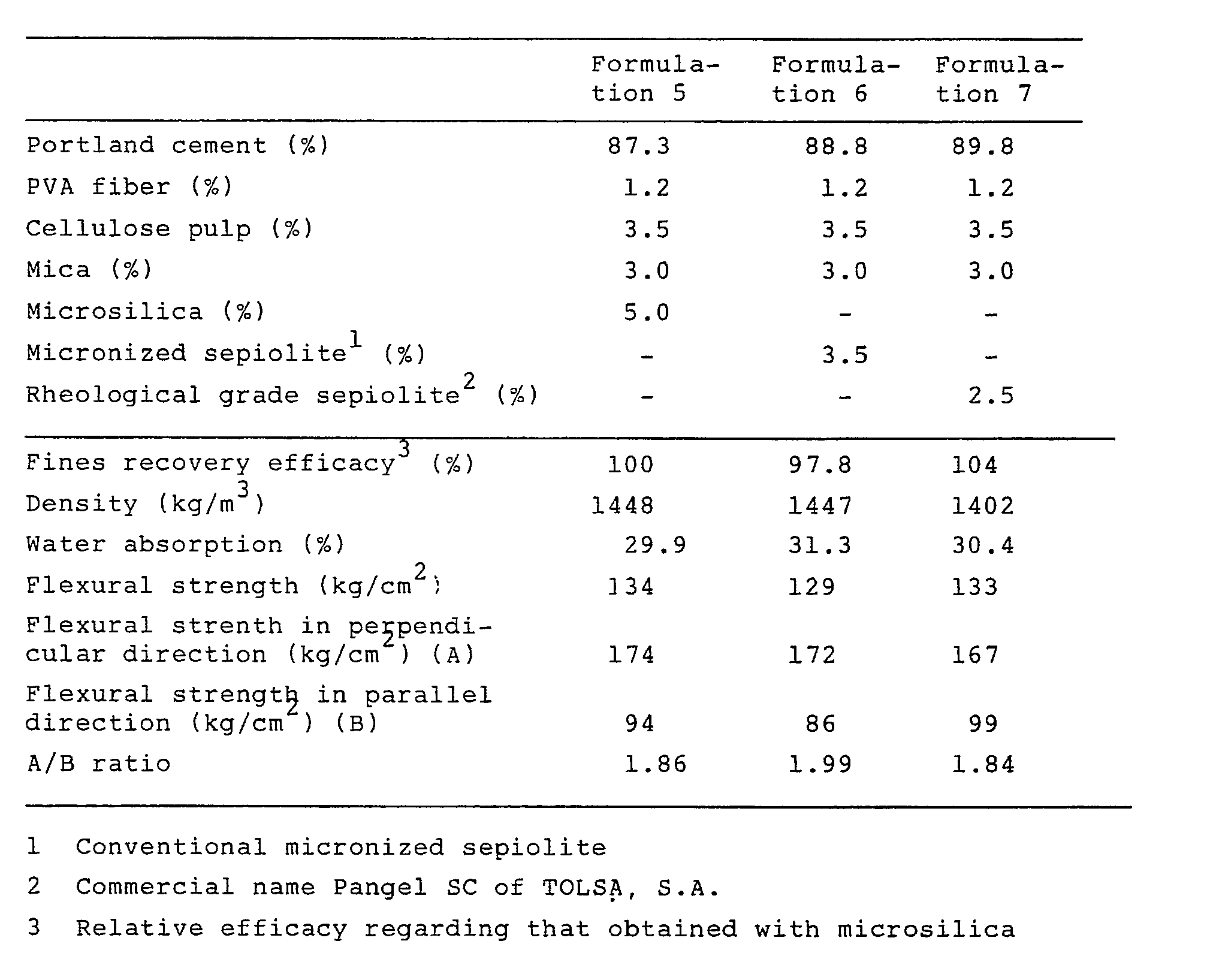
- The use of rheological grade sepiolite makes it possible to obtain a better efficacy of fines recovery, improving at the same time the flexural strengths in perpendicular and in parallel direction to the functioning of the Hatzcheck machine. It is noteworthy that these improvements are observed upon using half the concentration of rheological grade sepiolite than that of microsilica. Likewise, it is observed that adding rheological grade sepiolite makes it possible to reduce the density of the product without affecting the strength which makes it possible to obtain a larger number of sheets per weight unit, making the process more profitable.
- Rheological grade sepiolite makes it possible to obtain some more outstanding improvements in fibrocement sheets than the ones obtained with conventional sepiolite, even using a lower concentration. In no case was delamination of the sheets obtained with rheological grade sepiolite observed.
- This example illustrates the effect of the pressure of formation of the sheet on the properties of sheets obtained by using rheological grade sepiolite and microsilica.
- Formulations were prepared just as is described in example 4, using 2.5 % of rheological grade sepiolite in comparison with 5 % microsilica, and using pressures of formation of plates of 3 and 4 kg/cm². The characteristics of the sheets obtained are shown in tables IV and V.

- It is observed that upon increasing the pressure of formation of the sheet, the strength of the sheets obtained with sepiolite significantly increases more than the strength of the sheets with microsilica, reducing at the same time the ratio of the strengths in parallel direction and cross strength and reducing the water absorption, which results in some better characteristics of the final sheet.
Claims (14)
- Use of sepiolite in manufacturing processes of products reinforced with mica-containing fibers, said processes comprising the following steps:a) preparation of an aqueous slurry of inorganic binder, reinforcing fibers, retention fibers, mica, inorganic additives to improve filtration, flocculants or dispersing agents and optionally other conventional additives;b) wet shaping of the articles by previous elimination of water;c) curing of the shaped articles;characterized said use by the adding of rheological grade sepiolite to the initial aqueous slurry in concentrations such that, in the finished product, the sepiolite concentration is from 0.1 to 10%.
- Use of sepiolite in manufacturing processes of products reinforced with mica-containing fibers, according to claim 1, characterized because the article is shaped as a corrugated sheet.
- Use of sepiolite in manufacturing processes of products reinforced with mica-containing fibers, according to claim 1, characterized because the solids concentration of the slurry is between 0.25 and 20 %.
- Use of sepiolite in manufacturing processes of products reinforced with mica-containing fibers, according to claim 1, characterized because the reinforcing fibers are of cellulose, polyamide, polypropylene, polyester, polyvinyl alcohol, polyacrylonitrile or acrylics.
- Use of sepiolite in manufacturing processes of products reinforced with mica-containing fibers, according to claim 1, characterized because the reinforcing fibers are made up of propylene fabrics.
- Use of sepiolite in manufacturing processes of products reinforced with mica-containing fibers, according to claim 1, characterized because the retention fibers are long fiber or short fiber cellulose pulp with a Hopper-Riegler degree of refining of 20-70º and whose concentration is higher than 0.5 % of the solids of the slurry.
- Use of sepiolite in manufacturing processes of products reinforced with mica-containing fiber, according to claim 1, characterised because the retention fibers are cotton pulp or highly fibrillated polyproylene fibers.
- Use of sepiolite in manufacturing processes of products reinforced with mica-containing fibers, according to claim 1, characterized becuase the inorganic binder is Portland cement, aluminous cement, another type of hydraulic cement or calcium silicate.
- Use of sepiolite in manufacturing processes of products reinforced with mica-containing fiber, according to claims 1 to 8, characterized because the rheological grade sepiolite is added to the initial slurry in powder form.
- Use of sepiolite in manufacturing processes of products reinforced with mica-containing fibers, according to claims 1 to 8, characterized because the rheological grade sepiolite is added to the initial slurry previously dispersed in water using a high shear stirrer, paddle stirrer, hydropulper, hydrodisintegrator or in a recirculating mixer and with a solid concentration between 1 and 20 %.
- Use of sepiolite in manufacturing processes of products reinforced with mica-containing fibers, according to claims 1 to 8 and 10, characterized because in the previous dispersion of rheological grade sepiolite polyphosphate type dispersing agents or organic dispersing agents such as cationic, anionic or nonzionic polyacrylamides are used to facilitate the dispersion of the clay.
- Use of sepiolite in manufacturing processes of products reinforced with mica-containing fibers, according to claim 1 to 11, characterized because in the initial slurry anionic polyacrylamides are added in a concentration between 0.001 and 0.015 % based on the solids of the formulation.
- Use of sepiolite in manufacturing processes of products reinforced with mica-containing fibers, according to claims 1 to 12, characterized because organic fibers, MMMF or wollastonite are used to improve the filtration and in amounts based on solids comprised between 0.2 and 4%.
- Use of sepiolite in manufacturing processes of products reinforced with mica-containig fibers, according to claims 1 to 13, characterized because the density of the corrugated sheet is higher than 1,100 kg/m³.
Applications Claiming Priority (2)
| Application Number | Priority Date | Filing Date | Title |
|---|---|---|---|
| ES9001149 | 1990-04-24 | ||
| ES9001149A ES2019559A6 (en) | 1990-04-24 | 1990-04-24 | IMPROVEMENTS INTRODUCED IN THE MANUFACTURING PROCESSES OF PRODUCTS REINFORCED WITH FIBERS CONTAINING MICA. |
Publications (2)
| Publication Number | Publication Date |
|---|---|
| EP0454222A1 true EP0454222A1 (en) | 1991-10-30 |
| EP0454222B1 EP0454222B1 (en) | 1996-01-03 |
Family
ID=8267003
Family Applications (1)
| Application Number | Title | Priority Date | Filing Date |
|---|---|---|---|
| EP19910200903 Expired - Lifetime EP0454222B1 (en) | 1990-04-24 | 1991-04-17 | Use of sepiolite in manufacturing processes of fiber reinforced products containing mica. |
Country Status (8)
| Country | Link |
|---|---|
| EP (1) | EP0454222B1 (en) |
| JP (1) | JPH0747501B2 (en) |
| AT (1) | ATE132470T1 (en) |
| DE (1) | DE69115975T2 (en) |
| DK (1) | DK0454222T3 (en) |
| ES (1) | ES2019559A6 (en) |
| FI (1) | FI911962L (en) |
| GR (1) | GR3019348T3 (en) |
Cited By (11)
| Publication number | Priority date | Publication date | Assignee | Title |
|---|---|---|---|---|
| US6572696B1 (en) * | 1998-05-12 | 2003-06-03 | Tolsa, S.A. | Technological additive for agglomerating projectable building materials and utilization of the additive in projected mortars and concretes |
| EP2006323A1 (en) | 2007-06-22 | 2008-12-24 | E.I. Du Pont De Nemours And Company | Process for the production of polyester nanocomposites |
| WO2010107790A1 (en) | 2009-03-17 | 2010-09-23 | E. I. Du Pont De Nemours And Company | Articles made from co-polymer based polyimide and their uses in high temperature glass handling applications |
| WO2010107802A1 (en) | 2009-03-17 | 2010-09-23 | E. I. Du Pont De Nemours And Company | Co-polymer based polyimide articles and their uses in an aircraft |
| WO2010107797A1 (en) | 2009-03-17 | 2010-09-23 | E. I. Du Pont De Nemours And Company | Co-polymer based polyimide articles and their uses in high temperature applications |
| US7829493B2 (en) | 2003-10-15 | 2010-11-09 | Tolsa, S.A. | Method of preparing metallic nanoparticles and materials thus obtained |
| WO2011008511A1 (en) | 2009-06-29 | 2011-01-20 | E. I. Du Pont De Nemours And Company | Process for the production of polyester nanocomposites and shaped articles made thereof |
| WO2011155947A1 (en) | 2010-06-11 | 2011-12-15 | E. I. Du Pont De Nemours And Company | Creep-resistant composite structures and processes for their preparation |
| WO2012018422A1 (en) | 2010-08-03 | 2012-02-09 | Ferro Corporation | Polymer composite foams |
| WO2013020972A2 (en) | 2011-08-08 | 2013-02-14 | Acciona Infraestructuras, S.A. | Process for the preparation of an additive comprising supported and dispersed tio2 particles |
| WO2013093139A1 (en) | 2011-12-21 | 2013-06-27 | Tolsa, S.A. | Method for obtaining hierarchically ordered inorganic phosphate structures on phyllosilicates |
Families Citing this family (13)
| Publication number | Priority date | Publication date | Assignee | Title |
|---|---|---|---|---|
| JP4667998B2 (en) * | 2004-08-11 | 2011-04-13 | 株式会社クラレ | Non-asbestos hydraulic paperboard |
| WO2006016565A1 (en) * | 2004-08-11 | 2006-02-16 | Kuraray Co., Ltd. | Non-asbestos plate formed by hydraulic sheeting |
| US20060205856A1 (en) | 2004-12-22 | 2006-09-14 | Williamson David T | Compositions of polyesters and sepiolite-type clays |
| JP2007204313A (en) * | 2006-02-01 | 2007-08-16 | Union Kasei Kk | Fibrous mixture and method of manufacturing the same |
| US7858687B2 (en) | 2008-07-30 | 2010-12-28 | E.I. Du Pont De Nemours And Company | Polyimide resins for high temperature wear applications |
| US8324304B2 (en) | 2008-07-30 | 2012-12-04 | E I Du Pont De Nemours And Company | Polyimide resins for high temperature wear applications |
| US8357743B2 (en) | 2009-06-29 | 2013-01-22 | E I Du Pont De Nemours And Company | Process for making polyester nanocomposites |
| JP5596956B2 (en) * | 2009-10-15 | 2014-09-24 | 住友ゴム工業株式会社 | Rubber composition for tire and pneumatic tire |
| CN101864691B (en) * | 2010-06-11 | 2012-01-11 | 成都新柯力化工科技有限公司 | Environment-friendly paper and preparation method thereof |
| JP5654361B2 (en) * | 2011-01-11 | 2015-01-14 | 住友ゴム工業株式会社 | Method for producing rubber composition for tire and pneumatic tire |
| JP5687658B2 (en) | 2012-06-01 | 2015-03-18 | 住友ゴム工業株式会社 | Pneumatic tire |
| JP7009753B2 (en) | 2017-03-16 | 2022-01-26 | 住友ゴム工業株式会社 | Pneumatic tires |
| CN113321474B (en) * | 2021-07-21 | 2023-03-17 | 四川佰汇混凝土工程有限公司 | Anti-seepage sprayed concrete |
Citations (2)
| Publication number | Priority date | Publication date | Assignee | Title |
|---|---|---|---|---|
| US4370167A (en) * | 1982-03-15 | 1983-01-25 | National Gypsum Company | Asbestos-free drywall joint compound utilizing sepiolite clay as asbestos substitute |
| EP0252210A2 (en) * | 1986-07-04 | 1988-01-13 | Tolsa S.A. | Process for manufacture of fibre reinforced concrete articles |
-
1990
- 1990-04-24 ES ES9001149A patent/ES2019559A6/en not_active Expired - Fee Related
-
1991
- 1991-04-17 AT AT91200903T patent/ATE132470T1/en not_active IP Right Cessation
- 1991-04-17 DK DK91200903T patent/DK0454222T3/en active
- 1991-04-17 EP EP19910200903 patent/EP0454222B1/en not_active Expired - Lifetime
- 1991-04-17 DE DE69115975T patent/DE69115975T2/en not_active Expired - Fee Related
- 1991-04-23 FI FI911962A patent/FI911962L/en not_active Application Discontinuation
- 1991-04-23 JP JP9210691A patent/JPH0747501B2/en not_active Expired - Lifetime
-
1996
- 1996-03-19 GR GR960400743T patent/GR3019348T3/en unknown
Patent Citations (2)
| Publication number | Priority date | Publication date | Assignee | Title |
|---|---|---|---|---|
| US4370167A (en) * | 1982-03-15 | 1983-01-25 | National Gypsum Company | Asbestos-free drywall joint compound utilizing sepiolite clay as asbestos substitute |
| EP0252210A2 (en) * | 1986-07-04 | 1988-01-13 | Tolsa S.A. | Process for manufacture of fibre reinforced concrete articles |
Cited By (12)
| Publication number | Priority date | Publication date | Assignee | Title |
|---|---|---|---|---|
| US6572696B1 (en) * | 1998-05-12 | 2003-06-03 | Tolsa, S.A. | Technological additive for agglomerating projectable building materials and utilization of the additive in projected mortars and concretes |
| US7829493B2 (en) | 2003-10-15 | 2010-11-09 | Tolsa, S.A. | Method of preparing metallic nanoparticles and materials thus obtained |
| US7910511B2 (en) | 2003-10-15 | 2011-03-22 | Tolsa, S.A. | Method of preparing metallic nanoparticles and materials thus obtained |
| EP2006323A1 (en) | 2007-06-22 | 2008-12-24 | E.I. Du Pont De Nemours And Company | Process for the production of polyester nanocomposites |
| WO2010107790A1 (en) | 2009-03-17 | 2010-09-23 | E. I. Du Pont De Nemours And Company | Articles made from co-polymer based polyimide and their uses in high temperature glass handling applications |
| WO2010107802A1 (en) | 2009-03-17 | 2010-09-23 | E. I. Du Pont De Nemours And Company | Co-polymer based polyimide articles and their uses in an aircraft |
| WO2010107797A1 (en) | 2009-03-17 | 2010-09-23 | E. I. Du Pont De Nemours And Company | Co-polymer based polyimide articles and their uses in high temperature applications |
| WO2011008511A1 (en) | 2009-06-29 | 2011-01-20 | E. I. Du Pont De Nemours And Company | Process for the production of polyester nanocomposites and shaped articles made thereof |
| WO2011155947A1 (en) | 2010-06-11 | 2011-12-15 | E. I. Du Pont De Nemours And Company | Creep-resistant composite structures and processes for their preparation |
| WO2012018422A1 (en) | 2010-08-03 | 2012-02-09 | Ferro Corporation | Polymer composite foams |
| WO2013020972A2 (en) | 2011-08-08 | 2013-02-14 | Acciona Infraestructuras, S.A. | Process for the preparation of an additive comprising supported and dispersed tio2 particles |
| WO2013093139A1 (en) | 2011-12-21 | 2013-06-27 | Tolsa, S.A. | Method for obtaining hierarchically ordered inorganic phosphate structures on phyllosilicates |
Also Published As
| Publication number | Publication date |
|---|---|
| DE69115975D1 (en) | 1996-02-15 |
| EP0454222B1 (en) | 1996-01-03 |
| DK0454222T3 (en) | 1996-04-29 |
| GR3019348T3 (en) | 1996-06-30 |
| FI911962A7 (en) | 1991-10-25 |
| ATE132470T1 (en) | 1996-01-15 |
| ES2019559A6 (en) | 1991-06-16 |
| JPH0747501B2 (en) | 1995-05-24 |
| FI911962A0 (en) | 1991-04-23 |
| FI911962L (en) | 1991-10-25 |
| JPH0597488A (en) | 1993-04-20 |
| DE69115975T2 (en) | 1996-08-29 |
Similar Documents
| Publication | Publication Date | Title |
|---|---|---|
| EP0454222B1 (en) | Use of sepiolite in manufacturing processes of fiber reinforced products containing mica. | |
| FI76394C (en) | Process for the production of porous, mineral fibers containing paper, with the process of making paper and using the covered board for plasterboard building boards | |
| EP0127960A1 (en) | A process for the manufacture of autoclaved fibre-reinforced shaped articles | |
| DE60000552T2 (en) | Process for producing an inorganic molded body | |
| KR20030084956A (en) | A composite product | |
| CN1863750A (en) | Plate-shaped coagulant product and its preparation method | |
| EP0047158B1 (en) | A process for the manufacture of fibre reinforced shaped articles | |
| CN1104613A (en) | Manufacture of lightweight fibre-cement slab | |
| US3985610A (en) | Water-resistant asbestos-cement | |
| EP0406354B1 (en) | Composite fiberboard and process of manufacture | |
| EP3625185A1 (en) | Cellulose filaments reinforced cement composite board and method for the manufacture of the same | |
| US3095346A (en) | Method of producing shaped asbestoscement articles | |
| KR100328266B1 (en) | Non-asbestos slate and method of preparing the same | |
| EP0015538B1 (en) | A glass-fiber-reinforced cement panel and a process for its manufacture | |
| KR100277508B1 (en) | Polymer concrete triple centrifugal force pipe and its manufacturing method | |
| JPH0891907A (en) | Manufacturing method of fiber reinforced cement board | |
| JP2823050B2 (en) | Method for producing fiber-reinforced hydraulic inorganic molded article | |
| CA1199455A (en) | Process for preparing cement-asbestos based manufactured articles by using fibrils of synthetic polymers endowed with a high superficial area, and products therefrom derived | |
| JPH0558703A (en) | Manufacturing method of fiber reinforced cement board | |
| JPH04139044A (en) | Cement composition | |
| JP2023538092A (en) | High solids holding capacity method for fiber cement production, high solids holding capacity use and production method, and fiber cement article | |
| JPH08208307A (en) | Production of woody fiber-cement board by wet paper making method | |
| DE2064251A1 (en) | Hydraulic binder | |
| JP2002028919A (en) | Manufacturing method of ceramic building materials | |
| JP2000159560A (en) | Production of inorganic board |
Legal Events
| Date | Code | Title | Description |
|---|---|---|---|
| PUAI | Public reference made under article 153(3) epc to a published international application that has entered the european phase |
Free format text: ORIGINAL CODE: 0009012 |
|
| AK | Designated contracting states |
Kind code of ref document: A1 Designated state(s): AT BE CH DE DK FR GB GR IT LI LU NL SE |
|
| 17P | Request for examination filed |
Effective date: 19920429 |
|
| 17Q | First examination report despatched |
Effective date: 19940606 |
|
| GRAA | (expected) grant |
Free format text: ORIGINAL CODE: 0009210 |
|
| AK | Designated contracting states |
Kind code of ref document: B1 Designated state(s): AT BE CH DE DK FR GB GR IT LI LU NL SE |
|
| REF | Corresponds to: |
Ref document number: 132470 Country of ref document: AT Date of ref document: 19960115 Kind code of ref document: T |
|
| REF | Corresponds to: |
Ref document number: 69115975 Country of ref document: DE Date of ref document: 19960215 |
|
| ITF | It: translation for a ep patent filed | ||
| REG | Reference to a national code |
Ref country code: CH Ref legal event code: NV Representative=s name: ISLER & PEDRAZZINI AG PATENTANWAELTE |
|
| ET | Fr: translation filed | ||
| REG | Reference to a national code |
Ref country code: DK Ref legal event code: T3 |
|
| REG | Reference to a national code |
Ref country code: GR Ref legal event code: FG4A Free format text: 3019348 |
|
| PLBE | No opposition filed within time limit |
Free format text: ORIGINAL CODE: 0009261 |
|
| STAA | Information on the status of an ep patent application or granted ep patent |
Free format text: STATUS: NO OPPOSITION FILED WITHIN TIME LIMIT |
|
| 26N | No opposition filed | ||
| PGFP | Annual fee paid to national office [announced via postgrant information from national office to epo] |
Ref country code: GR Payment date: 19970317 Year of fee payment: 7 |
|
| PGFP | Annual fee paid to national office [announced via postgrant information from national office to epo] |
Ref country code: FR Payment date: 19980330 Year of fee payment: 8 |
|
| PGFP | Annual fee paid to national office [announced via postgrant information from national office to epo] |
Ref country code: CH Payment date: 19980407 Year of fee payment: 8 |
|
| PGFP | Annual fee paid to national office [announced via postgrant information from national office to epo] |
Ref country code: GB Payment date: 19980408 Year of fee payment: 8 |
|
| PGFP | Annual fee paid to national office [announced via postgrant information from national office to epo] |
Ref country code: AT Payment date: 19980409 Year of fee payment: 8 |
|
| PGFP | Annual fee paid to national office [announced via postgrant information from national office to epo] |
Ref country code: BE Payment date: 19980416 Year of fee payment: 8 |
|
| PGFP | Annual fee paid to national office [announced via postgrant information from national office to epo] |
Ref country code: DK Payment date: 19980417 Year of fee payment: 8 |
|
| PGFP | Annual fee paid to national office [announced via postgrant information from national office to epo] |
Ref country code: NL Payment date: 19980430 Year of fee payment: 8 |
|
| PGFP | Annual fee paid to national office [announced via postgrant information from national office to epo] |
Ref country code: LU Payment date: 19980504 Year of fee payment: 8 |
|
| PGFP | Annual fee paid to national office [announced via postgrant information from national office to epo] |
Ref country code: SE Payment date: 19980527 Year of fee payment: 8 |
|
| PGFP | Annual fee paid to national office [announced via postgrant information from national office to epo] |
Ref country code: DE Payment date: 19980528 Year of fee payment: 8 |
|
| PG25 | Lapsed in a contracting state [announced via postgrant information from national office to epo] |
Ref country code: LU Free format text: LAPSE BECAUSE OF NON-PAYMENT OF DUE FEES Effective date: 19990417 Ref country code: GB Free format text: LAPSE BECAUSE OF NON-PAYMENT OF DUE FEES Effective date: 19990417 Ref country code: AT Free format text: LAPSE BECAUSE OF NON-PAYMENT OF DUE FEES Effective date: 19990417 |
|
| PG25 | Lapsed in a contracting state [announced via postgrant information from national office to epo] |
Ref country code: SE Free format text: LAPSE BECAUSE OF NON-PAYMENT OF DUE FEES Effective date: 19990418 |
|
| PG25 | Lapsed in a contracting state [announced via postgrant information from national office to epo] |
Ref country code: LI Free format text: LAPSE BECAUSE OF NON-PAYMENT OF DUE FEES Effective date: 19990430 Ref country code: GR Free format text: LAPSE BECAUSE OF NON-PAYMENT OF DUE FEES Effective date: 19990430 Ref country code: DK Free format text: LAPSE BECAUSE OF NON-PAYMENT OF DUE FEES Effective date: 19990430 Ref country code: CH Free format text: LAPSE BECAUSE OF NON-PAYMENT OF DUE FEES Effective date: 19990430 Ref country code: BE Free format text: LAPSE BECAUSE OF NON-PAYMENT OF DUE FEES Effective date: 19990430 |
|
| BERE | Be: lapsed |
Owner name: S.A. TOLSA Effective date: 19990430 |
|
| PG25 | Lapsed in a contracting state [announced via postgrant information from national office to epo] |
Ref country code: NL Free format text: LAPSE BECAUSE OF NON-PAYMENT OF DUE FEES Effective date: 19991101 |
|
| GBPC | Gb: european patent ceased through non-payment of renewal fee |
Effective date: 19990417 |
|
| REG | Reference to a national code |
Ref country code: CH Ref legal event code: PL |
|
| PG25 | Lapsed in a contracting state [announced via postgrant information from national office to epo] |
Ref country code: FR Free format text: LAPSE BECAUSE OF NON-PAYMENT OF DUE FEES Effective date: 19991231 |
|
| NLV4 | Nl: lapsed or anulled due to non-payment of the annual fee |
Effective date: 19991101 |
|
| EUG | Se: european patent has lapsed |
Ref document number: 91200903.2 |
|
| REG | Reference to a national code |
Ref country code: FR Ref legal event code: ST |
|
| PG25 | Lapsed in a contracting state [announced via postgrant information from national office to epo] |
Ref country code: DE Free format text: LAPSE BECAUSE OF NON-PAYMENT OF DUE FEES Effective date: 20000201 |
|
| REG | Reference to a national code |
Ref country code: DK Ref legal event code: EBP |
|
| PG25 | Lapsed in a contracting state [announced via postgrant information from national office to epo] |
Ref country code: IT Free format text: LAPSE BECAUSE OF NON-PAYMENT OF DUE FEES;WARNING: LAPSES OF ITALIAN PATENTS WITH EFFECTIVE DATE BEFORE 2007 MAY HAVE OCCURRED AT ANY TIME BEFORE 2007. THE CORRECT EFFECTIVE DATE MAY BE DIFFERENT FROM THE ONE RECORDED. Effective date: 20050417 |