EP0452596A1 - Hybridization probes derived from the spacer region between the 16S and 23S rRNA genes for the detection of non-viral microorganisms - Google Patents
Hybridization probes derived from the spacer region between the 16S and 23S rRNA genes for the detection of non-viral microorganisms Download PDFInfo
- Publication number
- EP0452596A1 EP0452596A1 EP90401054A EP90401054A EP0452596A1 EP 0452596 A1 EP0452596 A1 EP 0452596A1 EP 90401054 A EP90401054 A EP 90401054A EP 90401054 A EP90401054 A EP 90401054A EP 0452596 A1 EP0452596 A1 EP 0452596A1
- Authority
- EP
- European Patent Office
- Prior art keywords
- hybridization
- probes
- probe
- strains
- detecting
- Prior art date
- Legal status (The legal status is an assumption and is not a legal conclusion. Google has not performed a legal analysis and makes no representation as to the accuracy of the status listed.)
- Withdrawn
Links
- 239000000523 sample Substances 0.000 title claims abstract description 280
- 125000006850 spacer group Chemical group 0.000 title claims abstract description 109
- 108700022487 rRNA Genes Proteins 0.000 title claims abstract description 55
- 230000003612 virological effect Effects 0.000 title claims abstract description 8
- 238000009396 hybridization Methods 0.000 title claims description 146
- 238000001514 detection method Methods 0.000 title claims description 28
- 244000005700 microbiome Species 0.000 title description 9
- 108091034117 Oligonucleotide Proteins 0.000 claims abstract description 40
- JLCPHMBAVCMARE-UHFFFAOYSA-N [3-[[3-[[3-[[3-[[3-[[3-[[3-[[3-[[3-[[3-[[3-[[5-(2-amino-6-oxo-1H-purin-9-yl)-3-[[3-[[3-[[3-[[3-[[3-[[5-(2-amino-6-oxo-1H-purin-9-yl)-3-[[5-(2-amino-6-oxo-1H-purin-9-yl)-3-hydroxyoxolan-2-yl]methoxy-hydroxyphosphoryl]oxyoxolan-2-yl]methoxy-hydroxyphosphoryl]oxy-5-(5-methyl-2,4-dioxopyrimidin-1-yl)oxolan-2-yl]methoxy-hydroxyphosphoryl]oxy-5-(6-aminopurin-9-yl)oxolan-2-yl]methoxy-hydroxyphosphoryl]oxy-5-(6-aminopurin-9-yl)oxolan-2-yl]methoxy-hydroxyphosphoryl]oxy-5-(6-aminopurin-9-yl)oxolan-2-yl]methoxy-hydroxyphosphoryl]oxy-5-(6-aminopurin-9-yl)oxolan-2-yl]methoxy-hydroxyphosphoryl]oxyoxolan-2-yl]methoxy-hydroxyphosphoryl]oxy-5-(5-methyl-2,4-dioxopyrimidin-1-yl)oxolan-2-yl]methoxy-hydroxyphosphoryl]oxy-5-(4-amino-2-oxopyrimidin-1-yl)oxolan-2-yl]methoxy-hydroxyphosphoryl]oxy-5-(5-methyl-2,4-dioxopyrimidin-1-yl)oxolan-2-yl]methoxy-hydroxyphosphoryl]oxy-5-(5-methyl-2,4-dioxopyrimidin-1-yl)oxolan-2-yl]methoxy-hydroxyphosphoryl]oxy-5-(6-aminopurin-9-yl)oxolan-2-yl]methoxy-hydroxyphosphoryl]oxy-5-(6-aminopurin-9-yl)oxolan-2-yl]methoxy-hydroxyphosphoryl]oxy-5-(4-amino-2-oxopyrimidin-1-yl)oxolan-2-yl]methoxy-hydroxyphosphoryl]oxy-5-(4-amino-2-oxopyrimidin-1-yl)oxolan-2-yl]methoxy-hydroxyphosphoryl]oxy-5-(4-amino-2-oxopyrimidin-1-yl)oxolan-2-yl]methoxy-hydroxyphosphoryl]oxy-5-(6-aminopurin-9-yl)oxolan-2-yl]methoxy-hydroxyphosphoryl]oxy-5-(4-amino-2-oxopyrimidin-1-yl)oxolan-2-yl]methyl [5-(6-aminopurin-9-yl)-2-(hydroxymethyl)oxolan-3-yl] hydrogen phosphate Polymers Cc1cn(C2CC(OP(O)(=O)OCC3OC(CC3OP(O)(=O)OCC3OC(CC3O)n3cnc4c3nc(N)[nH]c4=O)n3cnc4c3nc(N)[nH]c4=O)C(COP(O)(=O)OC3CC(OC3COP(O)(=O)OC3CC(OC3COP(O)(=O)OC3CC(OC3COP(O)(=O)OC3CC(OC3COP(O)(=O)OC3CC(OC3COP(O)(=O)OC3CC(OC3COP(O)(=O)OC3CC(OC3COP(O)(=O)OC3CC(OC3COP(O)(=O)OC3CC(OC3COP(O)(=O)OC3CC(OC3COP(O)(=O)OC3CC(OC3COP(O)(=O)OC3CC(OC3COP(O)(=O)OC3CC(OC3COP(O)(=O)OC3CC(OC3COP(O)(=O)OC3CC(OC3COP(O)(=O)OC3CC(OC3COP(O)(=O)OC3CC(OC3CO)n3cnc4c(N)ncnc34)n3ccc(N)nc3=O)n3cnc4c(N)ncnc34)n3ccc(N)nc3=O)n3ccc(N)nc3=O)n3ccc(N)nc3=O)n3cnc4c(N)ncnc34)n3cnc4c(N)ncnc34)n3cc(C)c(=O)[nH]c3=O)n3cc(C)c(=O)[nH]c3=O)n3ccc(N)nc3=O)n3cc(C)c(=O)[nH]c3=O)n3cnc4c3nc(N)[nH]c4=O)n3cnc4c(N)ncnc34)n3cnc4c(N)ncnc34)n3cnc4c(N)ncnc34)n3cnc4c(N)ncnc34)O2)c(=O)[nH]c1=O JLCPHMBAVCMARE-UHFFFAOYSA-N 0.000 claims abstract description 32
- 241000894006 Bacteria Species 0.000 claims abstract description 13
- 150000007523 nucleic acids Chemical class 0.000 claims description 102
- 108020004414 DNA Proteins 0.000 claims description 96
- 102000039446 nucleic acids Human genes 0.000 claims description 85
- 108020004707 nucleic acids Proteins 0.000 claims description 85
- 238000000034 method Methods 0.000 claims description 77
- 108091032973 (ribonucleotides)n+m Proteins 0.000 claims description 68
- 125000003729 nucleotide group Chemical group 0.000 claims description 58
- 239000002773 nucleotide Substances 0.000 claims description 57
- 241000588650 Neisseria meningitidis Species 0.000 claims description 55
- 241000588652 Neisseria gonorrhoeae Species 0.000 claims description 53
- 241000588655 Moraxella catarrhalis Species 0.000 claims description 52
- 230000008569 process Effects 0.000 claims description 52
- 241000588832 Bordetella pertussis Species 0.000 claims description 50
- ZHNUHDYFZUAESO-UHFFFAOYSA-N Formamide Chemical compound NC=O ZHNUHDYFZUAESO-UHFFFAOYSA-N 0.000 claims description 46
- 241000606834 [Haemophilus] ducreyi Species 0.000 claims description 44
- 239000012472 biological sample Substances 0.000 claims description 43
- 108090000623 proteins and genes Proteins 0.000 claims description 39
- 239000000872 buffer Substances 0.000 claims description 32
- 102000040650 (ribonucleotides)n+m Human genes 0.000 claims description 31
- 238000003752 polymerase chain reaction Methods 0.000 claims description 21
- FAPWRFPIFSIZLT-UHFFFAOYSA-M Sodium chloride Chemical compound [Na+].[Cl-] FAPWRFPIFSIZLT-UHFFFAOYSA-M 0.000 claims description 20
- 238000006243 chemical reaction Methods 0.000 claims description 20
- 230000000295 complement effect Effects 0.000 claims description 20
- 230000003321 amplification Effects 0.000 claims description 19
- 238000003199 nucleic acid amplification method Methods 0.000 claims description 19
- 239000008363 phosphate buffer Substances 0.000 claims description 16
- 238000004925 denaturation Methods 0.000 claims description 13
- 230000036425 denaturation Effects 0.000 claims description 13
- 238000003556 assay Methods 0.000 claims description 12
- 230000008685 targeting Effects 0.000 claims description 12
- 239000011780 sodium chloride Substances 0.000 claims description 10
- 239000001509 sodium citrate Substances 0.000 claims description 10
- NLJMYIDDQXHKNR-UHFFFAOYSA-K sodium citrate Chemical compound O.O.[Na+].[Na+].[Na+].[O-]C(=O)CC(O)(CC([O-])=O)C([O-])=O NLJMYIDDQXHKNR-UHFFFAOYSA-K 0.000 claims description 10
- 108020004465 16S ribosomal RNA Proteins 0.000 claims description 9
- 241000972773 Aulopiformes Species 0.000 claims description 9
- 108091003079 Bovine Serum Albumin Proteins 0.000 claims description 9
- 229920001917 Ficoll Polymers 0.000 claims description 9
- 229940098773 bovine serum albumin Drugs 0.000 claims description 9
- 239000001267 polyvinylpyrrolidone Substances 0.000 claims description 9
- 229920000036 polyvinylpyrrolidone Polymers 0.000 claims description 9
- 235000013855 polyvinylpyrrolidone Nutrition 0.000 claims description 9
- 235000019515 salmon Nutrition 0.000 claims description 9
- 238000005406 washing Methods 0.000 claims description 9
- 108020004566 Transfer RNA Proteins 0.000 claims description 7
- 238000000338 in vitro Methods 0.000 claims description 7
- 108020004635 Complementary DNA Proteins 0.000 claims description 6
- 108020004394 Complementary RNA Proteins 0.000 claims description 6
- 238000010804 cDNA synthesis Methods 0.000 claims description 6
- 239000002299 complementary DNA Substances 0.000 claims description 6
- 239000003184 complementary RNA Substances 0.000 claims description 6
- 201000005702 Pertussis Diseases 0.000 claims description 5
- 108010076504 Protein Sorting Signals Proteins 0.000 claims description 5
- 102000053602 DNA Human genes 0.000 description 49
- 239000012634 fragment Substances 0.000 description 36
- 108091028043 Nucleic acid sequence Proteins 0.000 description 19
- 241000894007 species Species 0.000 description 18
- 230000001580 bacterial effect Effects 0.000 description 16
- QPKGRLIYJGBKJL-UHFFFAOYSA-N 5-(dimethylsulfamoyl)-n-(5-methyl-1,3-thiazol-2-yl)-2-pyrrolidin-1-ylbenzamide Chemical compound N=1C=C(C)SC=1NC(=O)C1=CC(S(=O)(=O)N(C)C)=CC=C1N1CCCC1 QPKGRLIYJGBKJL-UHFFFAOYSA-N 0.000 description 11
- 102000004169 proteins and genes Human genes 0.000 description 11
- 239000003298 DNA probe Substances 0.000 description 10
- 210000004027 cell Anatomy 0.000 description 10
- 238000010367 cloning Methods 0.000 description 9
- FZRPRRCXGGAZEW-HSZRJFAPSA-N (2r)-n-(6-aminohexyl)-1-tridecanoylpiperidine-2-carboxamide Chemical compound CCCCCCCCCCCCC(=O)N1CCCC[C@@H]1C(=O)NCCCCCCN FZRPRRCXGGAZEW-HSZRJFAPSA-N 0.000 description 8
- 239000013615 primer Substances 0.000 description 8
- 238000012360 testing method Methods 0.000 description 8
- 108020004711 Nucleic Acid Probes Proteins 0.000 description 7
- 230000004069 differentiation Effects 0.000 description 7
- 239000002853 nucleic acid probe Substances 0.000 description 7
- 230000002285 radioactive effect Effects 0.000 description 7
- 238000002864 sequence alignment Methods 0.000 description 7
- 239000000243 solution Substances 0.000 description 7
- 239000000126 substance Substances 0.000 description 7
- 108020003215 DNA Probes Proteins 0.000 description 6
- 238000003745 diagnosis Methods 0.000 description 6
- 239000000203 mixture Substances 0.000 description 6
- 241000588779 Bordetella bronchiseptica Species 0.000 description 5
- 108020005187 Oligonucleotide Probes Proteins 0.000 description 5
- 238000013459 approach Methods 0.000 description 5
- 238000011161 development Methods 0.000 description 5
- 238000002372 labelling Methods 0.000 description 5
- 239000002751 oligonucleotide probe Substances 0.000 description 5
- 239000013600 plasmid vector Substances 0.000 description 5
- 108010008286 DNA nucleotidylexotransferase Proteins 0.000 description 4
- 102100029764 DNA-directed DNA/RNA polymerase mu Human genes 0.000 description 4
- 102000004190 Enzymes Human genes 0.000 description 4
- 108090000790 Enzymes Proteins 0.000 description 4
- 241000206602 Eukaryota Species 0.000 description 4
- 241000588653 Neisseria Species 0.000 description 4
- 230000015572 biosynthetic process Effects 0.000 description 4
- 239000007788 liquid Substances 0.000 description 4
- 230000004048 modification Effects 0.000 description 4
- 238000012986 modification Methods 0.000 description 4
- 239000002243 precursor Substances 0.000 description 4
- 238000011895 specific detection Methods 0.000 description 4
- 241000588807 Bordetella Species 0.000 description 3
- 241000588780 Bordetella parapertussis Species 0.000 description 3
- 108010021757 Polynucleotide 5'-Hydroxyl-Kinase Proteins 0.000 description 3
- 102000008422 Polynucleotide 5'-hydroxyl-kinase Human genes 0.000 description 3
- 108020001027 Ribosomal DNA Proteins 0.000 description 3
- 238000007796 conventional method Methods 0.000 description 3
- 239000013612 plasmid Substances 0.000 description 3
- 239000008057 potassium phosphate buffer Substances 0.000 description 3
- 238000012545 processing Methods 0.000 description 3
- 238000000163 radioactive labelling Methods 0.000 description 3
- 239000000700 radioactive tracer Substances 0.000 description 3
- 230000035945 sensitivity Effects 0.000 description 3
- 238000012163 sequencing technique Methods 0.000 description 3
- 238000003786 synthesis reaction Methods 0.000 description 3
- 108020005075 5S Ribosomal RNA Proteins 0.000 description 2
- IAZDPXIOMUYVGZ-UHFFFAOYSA-N Dimethylsulphoxide Chemical compound CS(C)=O IAZDPXIOMUYVGZ-UHFFFAOYSA-N 0.000 description 2
- 241000588724 Escherichia coli Species 0.000 description 2
- NYHBQMYGNKIUIF-UUOKFMHZSA-N Guanosine Chemical compound C1=NC=2C(=O)NC(N)=NC=2N1[C@@H]1O[C@H](CO)[C@@H](O)[C@H]1O NYHBQMYGNKIUIF-UUOKFMHZSA-N 0.000 description 2
- 241000606790 Haemophilus Species 0.000 description 2
- 241000222722 Leishmania <genus> Species 0.000 description 2
- 241000588630 Moraxella nonliquefaciens Species 0.000 description 2
- 101710163270 Nuclease Proteins 0.000 description 2
- 239000004677 Nylon Substances 0.000 description 2
- ISWSIDIOOBJBQZ-UHFFFAOYSA-N Phenol Chemical compound OC1=CC=CC=C1 ISWSIDIOOBJBQZ-UHFFFAOYSA-N 0.000 description 2
- IQFYYKKMVGJFEH-XLPZGREQSA-N Thymidine Chemical compound O=C1NC(=O)C(C)=CN1[C@@H]1O[C@H](CO)[C@@H](O)C1 IQFYYKKMVGJFEH-XLPZGREQSA-N 0.000 description 2
- XSQUKJJJFZCRTK-UHFFFAOYSA-N Urea Chemical compound NC(N)=O XSQUKJJJFZCRTK-UHFFFAOYSA-N 0.000 description 2
- OIRDTQYFTABQOQ-KQYNXXCUSA-N adenosine Chemical compound C1=NC=2C(N)=NC=NC=2N1[C@@H]1O[C@H](CO)[C@@H](O)[C@H]1O OIRDTQYFTABQOQ-KQYNXXCUSA-N 0.000 description 2
- 230000008901 benefit Effects 0.000 description 2
- 230000015556 catabolic process Effects 0.000 description 2
- 201000004308 chancroid Diseases 0.000 description 2
- 239000003153 chemical reaction reagent Substances 0.000 description 2
- 239000013599 cloning vector Substances 0.000 description 2
- 230000008878 coupling Effects 0.000 description 2
- 238000010168 coupling process Methods 0.000 description 2
- 238000005859 coupling reaction Methods 0.000 description 2
- 238000006731 degradation reaction Methods 0.000 description 2
- 231100000676 disease causative agent Toxicity 0.000 description 2
- 229940079593 drug Drugs 0.000 description 2
- 239000003814 drug Substances 0.000 description 2
- 238000006911 enzymatic reaction Methods 0.000 description 2
- 208000015181 infectious disease Diseases 0.000 description 2
- 238000003771 laboratory diagnosis Methods 0.000 description 2
- 239000000463 material Substances 0.000 description 2
- 239000012528 membrane Substances 0.000 description 2
- 229920001778 nylon Polymers 0.000 description 2
- 108091008146 restriction endonucleases Proteins 0.000 description 2
- 210000003705 ribosome Anatomy 0.000 description 2
- 238000012216 screening Methods 0.000 description 2
- 239000000758 substrate Substances 0.000 description 2
- UHDGCWIWMRVCDJ-UHFFFAOYSA-N 1-beta-D-Xylofuranosyl-NH-Cytosine Natural products O=C1N=C(N)C=CN1C1C(O)C(O)C(CO)O1 UHDGCWIWMRVCDJ-UHFFFAOYSA-N 0.000 description 1
- 108020004565 5.8S Ribosomal RNA Proteins 0.000 description 1
- 241000588624 Acinetobacter calcoaceticus Species 0.000 description 1
- 241000606801 Actinobacillus lignieresii Species 0.000 description 1
- 241000606749 Aggregatibacter actinomycetemcomitans Species 0.000 description 1
- 241000606828 Aggregatibacter aphrophilus Species 0.000 description 1
- DWRXFEITVBNRMK-UHFFFAOYSA-N Beta-D-1-Arabinofuranosylthymine Natural products O=C1NC(=O)C(C)=CN1C1C(O)C(O)C(CO)O1 DWRXFEITVBNRMK-UHFFFAOYSA-N 0.000 description 1
- 239000002126 C01EB10 - Adenosine Substances 0.000 description 1
- 241000589876 Campylobacter Species 0.000 description 1
- 241000589875 Campylobacter jejuni Species 0.000 description 1
- 241001112695 Clostridiales Species 0.000 description 1
- 108091033380 Coding strand Proteins 0.000 description 1
- 241000589518 Comamonas testosteroni Species 0.000 description 1
- MIKUYHXYGGJMLM-GIMIYPNGSA-N Crotonoside Natural products C1=NC2=C(N)NC(=O)N=C2N1[C@H]1O[C@@H](CO)[C@H](O)[C@@H]1O MIKUYHXYGGJMLM-GIMIYPNGSA-N 0.000 description 1
- UHDGCWIWMRVCDJ-PSQAKQOGSA-N Cytidine Natural products O=C1N=C(N)C=CN1[C@@H]1[C@@H](O)[C@@H](O)[C@H](CO)O1 UHDGCWIWMRVCDJ-PSQAKQOGSA-N 0.000 description 1
- NYHBQMYGNKIUIF-UHFFFAOYSA-N D-guanosine Natural products C1=2NC(N)=NC(=O)C=2N=CN1C1OC(CO)C(O)C1O NYHBQMYGNKIUIF-UHFFFAOYSA-N 0.000 description 1
- 239000003155 DNA primer Substances 0.000 description 1
- 108010093099 Endoribonucleases Proteins 0.000 description 1
- 102000002494 Endoribonucleases Human genes 0.000 description 1
- 241001522878 Escherichia coli B Species 0.000 description 1
- 241001288713 Escherichia coli MC1061 Species 0.000 description 1
- 102000004678 Exoribonucleases Human genes 0.000 description 1
- 108010002700 Exoribonucleases Proteins 0.000 description 1
- 108010000916 Fimbriae Proteins Proteins 0.000 description 1
- 241000233866 Fungi Species 0.000 description 1
- 206010018612 Gonorrhoea Diseases 0.000 description 1
- 241000606768 Haemophilus influenzae Species 0.000 description 1
- 241000606831 Histophilus somni Species 0.000 description 1
- 229930010555 Inosine Natural products 0.000 description 1
- UGQMRVRMYYASKQ-KQYNXXCUSA-N Inosine Chemical compound O[C@@H]1[C@H](O)[C@@H](CO)O[C@H]1N1C2=NC=NC(O)=C2N=C1 UGQMRVRMYYASKQ-KQYNXXCUSA-N 0.000 description 1
- 102000003960 Ligases Human genes 0.000 description 1
- 108090000364 Ligases Proteins 0.000 description 1
- 201000009906 Meningitis Diseases 0.000 description 1
- 241001478292 Moraxella caviae Species 0.000 description 1
- 239000000020 Nitrocellulose Substances 0.000 description 1
- 241000293016 Oligella urethralis Species 0.000 description 1
- 208000012868 Overgrowth Diseases 0.000 description 1
- 241000606860 Pasteurella Species 0.000 description 1
- 241000606856 Pasteurella multocida Species 0.000 description 1
- 102000004160 Phosphoric Monoester Hydrolases Human genes 0.000 description 1
- 108090000608 Phosphoric Monoester Hydrolases Proteins 0.000 description 1
- 239000002202 Polyethylene glycol Substances 0.000 description 1
- 206010036790 Productive cough Diseases 0.000 description 1
- 108020004511 Recombinant DNA Proteins 0.000 description 1
- 108091028664 Ribonucleotide Proteins 0.000 description 1
- 240000004808 Saccharomyces cerevisiae Species 0.000 description 1
- 238000002105 Southern blotting Methods 0.000 description 1
- ISAKRJDGNUQOIC-UHFFFAOYSA-N Uracil Chemical group O=C1C=CNC(=O)N1 ISAKRJDGNUQOIC-UHFFFAOYSA-N 0.000 description 1
- 239000002253 acid Substances 0.000 description 1
- 150000007513 acids Chemical class 0.000 description 1
- 229960005305 adenosine Drugs 0.000 description 1
- 239000011543 agarose gel Substances 0.000 description 1
- 239000000427 antigen Substances 0.000 description 1
- 102000036639 antigens Human genes 0.000 description 1
- 108091007433 antigens Proteins 0.000 description 1
- 238000003491 array Methods 0.000 description 1
- 238000000376 autoradiography Methods 0.000 description 1
- IQFYYKKMVGJFEH-UHFFFAOYSA-N beta-L-thymidine Natural products O=C1NC(=O)C(C)=CN1C1OC(CO)C(O)C1 IQFYYKKMVGJFEH-UHFFFAOYSA-N 0.000 description 1
- 210000004369 blood Anatomy 0.000 description 1
- 239000008280 blood Substances 0.000 description 1
- 239000007853 buffer solution Substances 0.000 description 1
- 239000004202 carbamide Substances 0.000 description 1
- 108091092356 cellular DNA Proteins 0.000 description 1
- 108091092328 cellular RNA Proteins 0.000 description 1
- 241000902900 cellular organisms Species 0.000 description 1
- 239000001913 cellulose Substances 0.000 description 1
- 229920002678 cellulose Polymers 0.000 description 1
- 238000012512 characterization method Methods 0.000 description 1
- 238000007385 chemical modification Methods 0.000 description 1
- 210000003763 chloroplast Anatomy 0.000 description 1
- 238000004587 chromatography analysis Methods 0.000 description 1
- 239000013611 chromosomal DNA Substances 0.000 description 1
- 238000003776 cleavage reaction Methods 0.000 description 1
- -1 co-enzyme Proteins 0.000 description 1
- 108091036078 conserved sequence Proteins 0.000 description 1
- 230000009260 cross reactivity Effects 0.000 description 1
- UHDGCWIWMRVCDJ-ZAKLUEHWSA-N cytidine Chemical compound O=C1N=C(N)C=CN1[C@H]1[C@H](O)[C@@H](O)[C@H](CO)O1 UHDGCWIWMRVCDJ-ZAKLUEHWSA-N 0.000 description 1
- 230000009089 cytolysis Effects 0.000 description 1
- 239000005547 deoxyribonucleotide Substances 0.000 description 1
- 125000002637 deoxyribonucleotide group Chemical group 0.000 description 1
- 230000030609 dephosphorylation Effects 0.000 description 1
- 238000006209 dephosphorylation reaction Methods 0.000 description 1
- 229960000633 dextran sulfate Drugs 0.000 description 1
- 238000002405 diagnostic procedure Methods 0.000 description 1
- 230000029087 digestion Effects 0.000 description 1
- SHIBSTMRCDJXLN-KCZCNTNESA-N digoxigenin Chemical compound C1([C@@H]2[C@@]3([C@@](CC2)(O)[C@H]2[C@@H]([C@@]4(C)CC[C@H](O)C[C@H]4CC2)C[C@H]3O)C)=CC(=O)OC1 SHIBSTMRCDJXLN-KCZCNTNESA-N 0.000 description 1
- 201000010099 disease Diseases 0.000 description 1
- 208000037265 diseases, disorders, signs and symptoms Diseases 0.000 description 1
- 238000006073 displacement reaction Methods 0.000 description 1
- 238000010494 dissociation reaction Methods 0.000 description 1
- 230000005593 dissociations Effects 0.000 description 1
- 230000008030 elimination Effects 0.000 description 1
- 238000003379 elimination reaction Methods 0.000 description 1
- 238000005516 engineering process Methods 0.000 description 1
- 230000007613 environmental effect Effects 0.000 description 1
- 230000002255 enzymatic effect Effects 0.000 description 1
- 230000001747 exhibiting effect Effects 0.000 description 1
- 230000002349 favourable effect Effects 0.000 description 1
- 238000005194 fractionation Methods 0.000 description 1
- 208000001786 gonorrhea Diseases 0.000 description 1
- 229940029575 guanosine Drugs 0.000 description 1
- 229940047650 haemophilus influenzae Drugs 0.000 description 1
- 210000005260 human cell Anatomy 0.000 description 1
- 244000052637 human pathogen Species 0.000 description 1
- 229910052588 hydroxylapatite Inorganic materials 0.000 description 1
- 230000001900 immune effect Effects 0.000 description 1
- 238000011081 inoculation Methods 0.000 description 1
- 229960003786 inosine Drugs 0.000 description 1
- 238000011835 investigation Methods 0.000 description 1
- 230000026045 iodination Effects 0.000 description 1
- 238000006192 iodination reaction Methods 0.000 description 1
- 239000003446 ligand Substances 0.000 description 1
- 230000031700 light absorption Effects 0.000 description 1
- 239000011159 matrix material Substances 0.000 description 1
- 210000003470 mitochondria Anatomy 0.000 description 1
- 210000000214 mouth Anatomy 0.000 description 1
- 229920001220 nitrocellulos Polymers 0.000 description 1
- 102000042567 non-coding RNA Human genes 0.000 description 1
- 238000007899 nucleic acid hybridization Methods 0.000 description 1
- 229940051027 pasteurella multocida Drugs 0.000 description 1
- 244000052769 pathogen Species 0.000 description 1
- 230000001717 pathogenic effect Effects 0.000 description 1
- XYJRXVWERLGGKC-UHFFFAOYSA-D pentacalcium;hydroxide;triphosphate Chemical compound [OH-].[Ca+2].[Ca+2].[Ca+2].[Ca+2].[Ca+2].[O-]P([O-])([O-])=O.[O-]P([O-])([O-])=O.[O-]P([O-])([O-])=O XYJRXVWERLGGKC-UHFFFAOYSA-D 0.000 description 1
- 235000020030 perry Nutrition 0.000 description 1
- 230000000704 physical effect Effects 0.000 description 1
- 229920001223 polyethylene glycol Polymers 0.000 description 1
- 230000001124 posttranscriptional effect Effects 0.000 description 1
- 238000002360 preparation method Methods 0.000 description 1
- 230000005180 public health Effects 0.000 description 1
- 210000004915 pus Anatomy 0.000 description 1
- 239000000376 reactant Substances 0.000 description 1
- 238000011084 recovery Methods 0.000 description 1
- 238000004153 renaturation Methods 0.000 description 1
- 210000002345 respiratory system Anatomy 0.000 description 1
- 238000012552 review Methods 0.000 description 1
- 239000002336 ribonucleotide Substances 0.000 description 1
- 125000002652 ribonucleotide group Chemical group 0.000 description 1
- 108020004418 ribosomal RNA Proteins 0.000 description 1
- 229920002477 rna polymer Polymers 0.000 description 1
- 230000007017 scission Effects 0.000 description 1
- 238000010187 selection method Methods 0.000 description 1
- 238000000926 separation method Methods 0.000 description 1
- 239000007790 solid phase Substances 0.000 description 1
- 208000024794 sputum Diseases 0.000 description 1
- 210000003802 sputum Anatomy 0.000 description 1
- 230000002194 synthesizing effect Effects 0.000 description 1
- 229940104230 thymidine Drugs 0.000 description 1
- 210000002700 urine Anatomy 0.000 description 1
Images


Classifications
-
- C—CHEMISTRY; METALLURGY
- C12—BIOCHEMISTRY; BEER; SPIRITS; WINE; VINEGAR; MICROBIOLOGY; ENZYMOLOGY; MUTATION OR GENETIC ENGINEERING
- C12Q—MEASURING OR TESTING PROCESSES INVOLVING ENZYMES, NUCLEIC ACIDS OR MICROORGANISMS; COMPOSITIONS OR TEST PAPERS THEREFOR; PROCESSES OF PREPARING SUCH COMPOSITIONS; CONDITION-RESPONSIVE CONTROL IN MICROBIOLOGICAL OR ENZYMOLOGICAL PROCESSES
- C12Q1/00—Measuring or testing processes involving enzymes, nucleic acids or microorganisms; Compositions therefor; Processes of preparing such compositions
- C12Q1/68—Measuring or testing processes involving enzymes, nucleic acids or microorganisms; Compositions therefor; Processes of preparing such compositions involving nucleic acids
- C12Q1/6876—Nucleic acid products used in the analysis of nucleic acids, e.g. primers or probes
- C12Q1/6888—Nucleic acid products used in the analysis of nucleic acids, e.g. primers or probes for detection or identification of organisms
-
- C—CHEMISTRY; METALLURGY
- C12—BIOCHEMISTRY; BEER; SPIRITS; WINE; VINEGAR; MICROBIOLOGY; ENZYMOLOGY; MUTATION OR GENETIC ENGINEERING
- C12Q—MEASURING OR TESTING PROCESSES INVOLVING ENZYMES, NUCLEIC ACIDS OR MICROORGANISMS; COMPOSITIONS OR TEST PAPERS THEREFOR; PROCESSES OF PREPARING SUCH COMPOSITIONS; CONDITION-RESPONSIVE CONTROL IN MICROBIOLOGICAL OR ENZYMOLOGICAL PROCESSES
- C12Q1/00—Measuring or testing processes involving enzymes, nucleic acids or microorganisms; Compositions therefor; Processes of preparing such compositions
- C12Q1/68—Measuring or testing processes involving enzymes, nucleic acids or microorganisms; Compositions therefor; Processes of preparing such compositions involving nucleic acids
- C12Q1/6876—Nucleic acid products used in the analysis of nucleic acids, e.g. primers or probes
- C12Q1/6888—Nucleic acid products used in the analysis of nucleic acids, e.g. primers or probes for detection or identification of organisms
- C12Q1/689—Nucleic acid products used in the analysis of nucleic acids, e.g. primers or probes for detection or identification of organisms for bacteria
Definitions
- the invention relates to nucleic acid probes derived from the spacer region between the ribosomal ribonucleic acid (rRNA) gene, particularly between the 16S and 23S rRNA genes, to be used for the specific detection of non-viral organisms in a biological sample by a hybridization procedure.
- rRNA ribosomal ribonucleic acid
- nucleic acid probes can, for instance be total genomic deoxyribonucleic acid (DNA), plasmids, riboprobes or synthetic oligonucleotides and these probes may target the genomic DNA or messenger or stable RNA species present in biological samples.
- DNA total genomic deoxyribonucleic acid
- plasmids plasmids
- riboprobes riboprobes
- synthetic oligonucleotides may target the genomic DNA or messenger or stable RNA species present in biological samples.
- Oligonucleotides can be rapidly synthesized in great amount, using chemical methods, have a long shelf-life, and are easily purified and labeled.
- the probes used should be highly specific (i.e. they should not cross-react with nucleic acids from other organisms) and highly sensitive (i.e. most, if not all, strains of the organism to be detected should react with the probe).
- the preferred target sequences should have the following characteristics :
- the 16S or 23S rRNA genes are quite often used for probe development since sequences can easily be obtained using described methods and it is known that variable regions exist within these highly conserved genes which can be used for species specific detection. However, for certain organisms it may not be possible to derive highly specific and sensitive probes from the 16S and 23S rRNA genes for instance because their evolutionary nucleic acid sequence conservation is too high. Another consequence of the conserved character of these genes is that the differentiation of two organisms is often based on one or a few mismatches only in the target sequence which puts constraints on the stringency of the hybridization. A slight deviation from these conditions may result in misidentification.
- RNA cistrons Each cellular organism possesses ribosomal RNA cistrons since its transcripts are essential for the function of ribosomes and the synthesis of proteins.
- the genes are present in multiple copies in the genome.
- the 16S rRNA gene also called small subunit rRNA (srRNA)
- srRNA small subunit rRNA
- 23S rRNA also called large subunit rRNA(lrRNA)
- the 5S rRNA gene is located at the 3' end of the cistron.
- the 16S, 23S and 5S genes are separated by spacer regions in which transfer RNA (tRNA) genes and signal sequences involved in post-transcriptional processing may be found.
- RNA cistron is transcribed as one precursor RNA molecule. This primary transcript is further processed by endo- and exoribonucleases to its mature products. As a consequence, spacer region sequences are not exclusively present in the genome of the organism but also in precursor RNA molecules and processing products. The structure and processing of eubacterial rRNA cistrons is discussed in detail in the following reference : GEGENHEIMER and APIRION, Microbiol. Rev. 45 : 502-541, 1981.
- nucleic acid sequence of the spacer region of only a very limited number of eukaryotic or prokaryotic organisms is available from the literature (e.g. YOUNG et al., J. Biol. Chem. 254 : 3264-3271, 1979; and MARTENS et al., System. Appl. Microbiol. 9: 224-230, 1987.). From these data no reliable estimation of the nucleic acid sequence conservation can be made and consequently nothing can be concluded concerning the suitability of the spacer region for the selection of specific probes.
- hybridization probes derived from the spacer region between the 16S and 23S rRNA genes for the detection of microorganisms in a biological sample have not yet been described. Neither it is known for the corresponding spacer region between the small and large subunit rRNA genes of eukaryotes.
- the aim of the invention is to provide species specific probes derived from the spacer region between rRNA genes for a particular organism such as a bacterial species.
- Another object of the invention is to provide for DNA probes derived from the 16S-23S rRNA spacer region for the detection of Neisseria gonorrhoeae , Neisseria meningitidis , Branhamella catarrhalis , Haemophilus ducreyi and Bordetella pertussis strains.
- Another object of the invention is to provide DNA probes derived from the 16S-23S rRNA gene spacer region for the detection of Neisseria gonorrhoeae , Neisseria meningitidis , Branhamella catarrhalis , Haemophilus ducreyi and Bordetella pertussis strains in a biological sample by a hybridization test such as a dot-spot, a strand-displacement, a competition, or a sandwich hybridization test.
- Still another object of the invention is to provide probes and a simple method for the in vitro diagnosis of Neisseria gonorrhoeae , Neisseria meningitidis , Branhamella catarrhalis , Haemophilus ducreyi and Bordetella pertussis strains.
- the invention relates to a probe consisting of at least about 15 oligonucleotides of the spacer region between rRNA genes of a non viral organism, particularly prokaryotic organism and more particularly bacteria.
- the invention relates more particularly to a probe consisting from about 15 oligonucleotides to about the maximum number of oligonucleotides of the spacer region, and more preferably from about 15 to about 100 oligonucleotides of the spacer region between the rRNA genes, particularly between 16S and 23S rRNA genes of a non viral organism, particularly prokaryotic organisms, and more particularly bacteria.
- spacer region designates the spacer region between rRNA genes and more particularly between the 16S and 23S rRNA genes.
- the invention relates to a probe for use in a hybridization assay, liable to be obtained in the process which comprises constructing an oligonucleotide that is sufficiently complementary to hybridize to a sequence of the spacer region between rRNA genes selected to be unique to non-viral organisms, particularly prokaryotic organisms, more particularly bacteria, sought to be detected, said sequence of the spacer region between rRNA genes being selected
- the invention relates particularly to a probe wherein the spacer region between rRNA genes is the spacer region between the 16S rRNA gene and the 23S rRNA gene.
- the spacer regions of several microorganisms were cloned, sequenced and compared as will be outlined later herein.
- the comparison revealed that the nucleic acid sequence of the spacer region is of a semi conserved nature, as compared to rRNA genes, which are highly conserved. Hence the spacer region might be better suited for probe development than the rRNA genes itself.
- the figures 1 and 2 illustrate that there is a high degree of sequence homology between highly related organisms (such as highly related strains from the same genospecies). Somewhat related organisms as shown in figure 3 and 7. A total lack of significant sequence homology (except for the tRNA sequences) could be demonstrated between distantly related species, as shown in figures 4 to 6.
- homology values in % sequence homology
- 16S rRNA sequences of different strains (16S hom) are compared with the corresponding homology values of the spacer regions (spacer hom).
- the homology values (16S hom and spacer hom.) were calculated using the PC gene software supplied by Intelligentics Inc. and Genofit SA (release 6.01/April 20, 1989). Between brackets the total number of nucleotides compared is given. The results clearly show that the spacer region is less conserved than the 16S rRNA molecule.
- the target of the probes derived from the spacer region between the 16S and 23S rRNA gene is the genomic DNA and the precursor RNA molecules present in the cells to be detected.
- the detection of the precursor RNA molecules is advantageous since these molecules are single stranded and may be present in multiple copies.
- DNA molecules are much more refractory to enzymatical degradation than RNA molecules. Hence DNA targeting is preferred when biological samples cannot be processed and/or stored adequately to prevent RNA degradation prior to hybridization.
- probes derived from the 16S - 23S rRNA spacer regions lies in target detection after enzymatical amplification using the polymerase chain reaction (PCR).
- the spacer region of many microorganisms can for instance be enzymatically amplified using the same primers allocated in a conversed region of the 3' end and the 5' end of the 16S and the 23S rRNA genes respectively.
- spacer regions of many organisms can be amplified, if preferred simultaneously, using the same reagents and protocol and afterwards the amplified fragment can be detected using a probe which specifically targets the spacer region of the organism of interest.
- the spacer region is flanked by conserved sequences the cloning and sequencing of this region with the aid of the PCR technique is simple, and the same protocol can be applied to a great variety of organisms.
- sequences of the spacer regions are obtained by enzymatical amplification of rRNA genes using conserved primers allocated in the 16S or 23S rRNA. Examples of basic primer-pairs which can be used for the amplification of fragments spanning the spacer region are :
- the amplified fragment can be cloned as such or as two sub-fragments after digestion with a restriction-enzyme recognizing a unique restriction-site.
- a strategy for cloning PCR products in M13 has been described by Medlin et al. (Gene 71 :491-499, 1988).
- the same strategy can be used for cloning in a plasmid vector.
- the basic primers are extended at their 5' end with a nucleotide sequence comprising an unique restriction site, enabling directional cloning of the fragment.
- the spacer region can be sequenced using the dideoxy chain termination method.
- sequence information is more rapidly obtained when the sequencing reactions are performed directly on PCR fragments without cloning, the sequence information generated from cloned fragments is more accurate and complete.
- cloned gene fragments can easily be purified in great amounts, which results in clearly readable sequencing ladders. Since one mismatch in the probe-sequence may result in useless probes, accuracy is highly preferred over the speed of obtaining sequences.
- nucleotide sequence comparison of the spacer region of the organism for which a probe is desired with the spacer region of the closest neighbour is the preferred way to infer specific probe sequences.
- the closest neighbour means the taxon which is known to be most closely related in terms of DNA homology and which has to be differentiated from the organism of interest.
- the closest neighbour may be extremely highly related to the organism of interest, exhibiting more than 75% degree of binding, or may be rather distantly related showing no significant percentage of DNA homology.
- degree of binding values are insignificant below about 30%; in solid phase DNA:DNA hybridization methods DNA homologies become insignificant between 10 to 20% degree of binding.
- the selection of the specific probes can be done by trial and error. In that case, for each particular organism a specific probe region, which may be located anywhere in the spacer region, has to be defined experimentally. Only few areas in the spacer regions, such as tRNA genes or signal sequences, can in certain instances, be excluded a priori as probe regions. However, since 16S-23S rRNA spacer regions in general are small -- usually not longer than 700 bp -- good probe sequence can be readily found without extensive screening.
- the "shortened" spacer region obtained by deleting the tRNA gene and the signal sequence can be of about 500 pb.
- a biological sample is meant a specimen such as a clinical sample (pus, sputum, blood, urine, etc.), a environmental sample, bacterial colonies, contaminated or pure cultures, purified nucleic acid, etc... in which the target sequence of interest is sought.
- rRNA gene spacer region derived refers to the fact that the probes concerned hybridize with sequences located in the spacer region between ribosomal RNA genes normally present in the genome or transcript RNA molecules, no matter whether said probes are themselves formed of DNA or RNA fragments, or whether they consist of cloned fragments (in the case of DNA) or of synthetic oligonucleotides.
- a hybridization probe of the invention for detecting Neisseria gonorrhoeae strains contains :
- a hybridization probe of the invention for detecting Neisseria meningitidis strains contains :
- a hybridization probe of the invention for detecting Branhamella catarrhalis strains contains :
- a hybridization probe of the invention for detecting Haemophilus ducreyi strains contains :
- a hybridization probe of the invention for detecting Bordetella pertussis strains contains :
- target is meant a sequence complementary to any of the sequences of groups NGI1, NMI1, NMI2, NMI3, NMI4, BCI1, HDI1 and BPI1 as herein before defined.
- the probe of the invention would comprise nucleic acid elongations on either side or both of said above defined sequences -- e.g. nucleic acid fragments of cloning vector or linker fragments resulting from the cleavage of said probe out of said cloning vector -- it is understood that such elongations should be selected such as to avoid the possibility that they could themselves hybridize with any other corresponding complementary nucleic acid sequence outside of the above target in a DNA of any micro-organism likely to be tested by the process of this invention as later defined. Such hybridization would be of a parasitical nature and reduce the specificity of the probe.
- Preferred probes consist of nucleic acid fragments formed of any of the sequences of the groups above defined, said fragments containing from 15 to the maximum number of nucleotides of the relevant nucleic acid sequence.
- probe of group 'X' -- with 'X' from NGI1, NMI1, NMI2, NMI3, NMI4, NMI5, BCI1, HDI1 and BPI1 -- it should be understood that such probe has a sequence included in one of the nucleic acids belonging to that group as defined above or further defined hereafter.
- nucleotide refers indistinctly to ribonucleotides and deoxyribonucleotides and modified nucleotides such as inosine unless otherwise specified.
- the expression “nucleotides” also encompasses those which further comprise modification groups, e.g. chemical modification groups which do not affect their hybridization capabilities fundamentally. Such modification groups aim, for instance, at facilitating their coupling, either directly or indirectly, with suitable markers or labels for the subsequent detection of the probes so marked or labeled particularly in their hybridization products with the relevant RNA or DNA strand, e.g. that or those initially contained in a biological sample together with other DNA(s) and/or RNA(s).
- modification groups e.g. chemical modification groups which do not affect their hybridization capabilities fundamentally.
- Such modification groups aim, for instance, at facilitating their coupling, either directly or indirectly, with suitable markers or labels for the subsequent detection of the probes so marked or labeled particularly in their hybridization products with the relevant RNA or DNA strand,
- modification groups are recognizable by antibodies which, in turn, can be recognized specifically by other antibodies, carrying a suitable enzymatic or fluorescent or chemiluminescent label. Possible labeling procedures will further be exemplified later herein.
- the invention also relates to probes having any of the sequences defined above and in which some nucleotides are different, provided that the different nucleotide(s) do(es) not alter the specificity of the probes defined above.
- Some probes may consist of one of the nucleic acids belonging to any of the groups which are set forth above or of part thereof, said probes however including nucleotidic elongation on either sides thereof to the extent that such elongations do not alter the specificity of said probes with the genetic material of Neisseria gonorrhoeae , Neisseria meningitidis , Haemophilus ducreyi , Bordetella pertussis or Branhamella catarrhalis .
- the invention thus provides for probes which are either replicas (those designated by numbers followed by "IC” or "ICR”) in terms of nucleotide sequence of sequences contained in the RNAs or DNAs of most Neisseria gonorrhoeae , Neisseria meningitidis , Haemophilus ducreyi , Bordetella pertussis or Branhamella catarrhalis with occasionally a few insignificant differences in nucleotide sequences or formed of sequences, those designated by bare numbers or by numbers followed by "R”, complementary to sequences included in the natural DNAs or RNAs of Neisseria gonorrhoeae , Neisseria meningitidis , Haemophilus ducreyi , Bordetella pertussis or Branhamella catarrhalis .
- the target sequences in the DNAs concerned consist in any of the following successive sequences present in most, if not all, Neisseria gonorrhoeae , Neisseria meningitidis , Haemophilus ducreyi , Bordetella pertussis or Branhamella catarrhalis strains, subject to possible insignificant natural differences from one strain to another, whereby such natural differences are not likely to affect the hybridization specificity of the probes of this invention with such targets :
- the probes according to the invention can be formed by cloning of recombinant plasmids containing inserts including the corresponding nucleotide sequences, if need be cleaving the latter out from the cloned plasmids upon using the adequate nucleases and recovering them, e.g. by fractionation according to molecular weights.
- the probes according to the invention can also be synthesized chemically, for instance by the conventional phospho-triester method.
- the invention also relates to a process for detecting Neisseria gonorrhoeae , Neisseria meningitidis , Haemophilus ducreyi , Bordetella pertussis or Branhamella catarrhalis strains in a biological sample, wherein said process comprises contacting said biological sample in which the nucleic acids (DNAs and RNAs) have been made accessible to hybridization, if need be under suitable denaturation conditions, with a probe of the invention under conditions enabling hybridization between the probe and complementary nucleic acids of the strains, which may be present in the sample, and detecting the hybrids possibly formed.
- nucleic acids DNAs and RNAs
- the process of the invention enables to discriminate Neisseria gonorrhoeae , Neisseria meningitidis , Haemophilus ducreyi , Bordetella pertussis or Branhamella catarrhalis from most other organism such as yeast, fungi, protozoa, other bacterial strains, human cells which are liable to the be present in the sample in which the organisms of interest are sought.
- the process relates to the detection of Neisseria gonorrhoeae , Neisseria meningitidis , Haemophilus ducreyi , Bordetella pertussis or Branhamella catarrhalis strains being directly in the sample of after the strain has been cultured.
- the detection of a hybrid can be interpreted as meaning that an infection due to Neisseria gonorrhoeae , Neisseria meningitidis , Branhamella catarrhalis , Haemophilus ducreyi , or Bordetella pertussis was present in the biological sample, when any of the probes of groups NGI1, NMI1, NMI2, NMI3, NMI4, NMI5, BCI1, HDI1 and BPI1 is being used respectively.
- the probes used are the ones hybridizing both with DNA globally and RNA of the Neisseria gonorrhoeae , Neisseria meningitidis , Bordetella pertussis , Haemophilus ducreyi or Branhamella catarrhalis strains, which may be present in the biological sample.
- hybridization conditions can be monitored relying upon several parameters, e.g. hybridization temperature, the nature and concentration of the components of the media, and the temperature under which the hybrids formed are washed.
- the hybridization and wash temperature is limited in upper value, according to the probe (its nucleic acid composition, kind and length) and the maximum hybridization or wash temperature of the probes described herein is about 30°C to 55°C. At higher temperatures duplexing competes with the dissociation (or denaturation) of the hybrid formed between the probe and the target.
- a preferred wash medium contains about 3 x SSC, 25 mM phosphate buffer pH 7.1 and 20% deionized formamide.
- Other hybridization or wash media can be used as well.
- temperatures at which the probes can be used to obtain the required specificity should be changed according to known relationships, such as those described in the following reference : B.D. HAMES and S.J. HIGGINS, (eds.). Nucleic acid hybridization. A practical approach, IRL Press, Oxford, U.K., 1985.
- DNA:DNA hybrids are less stable then RNA:DNA or RNA:RNA hybrids.
- hybridization conditions should be adapted accordingly to achieve specific detection.
- the process for detecting Neisseria gonorrhoeae , Neisseria meningitidis , Bordetella pertussis , Haemophilus ducreyi or Branhamella catarrhalis strains generally, according to the invention can be carried out by suitably adjusting the hybridization temperature to a value at which hybridization is specific, and in such a case washing under more stringent conditions is not necessary.
- the hybridization temperature needs not necessarily be adjusted to the value at which hybridization is specific and in particular can be lower than the temperature at which hybridization is specific, provided washing is carried out at a temperature corresponding to the value at which hybridization is specific.
- the hybridization temperature and/or the wash temperature is suitably adjusted to about 50°C, the media being those above defined.
- the hybridization temperature and/or the wash temperature is suitably adjusted to about 45°C, the media being those above defined.
- the hybridization temperature and/or the wash temperature is suitably adjusted to about 45°C, the media being those above defined.
- the hybridization temperature and/or the wash temperature is suitably adjusted to about 40°C, the media being those above defined.
- the hybridization temperature and/or the wash temperature is suitably adjusted to about 48°C, the media being those above defined.
- the hybridization temperature and/or the wash temperature is suitably adjusted to about 58°C, the media being those above defined.
- the hybridization temperature and/or the wash temperature is suitably adjusted to about 30°C, the media being those above defined.
- the hybridization temperature and/or the wash temperature is suitably adjusted to about 55°C, the media being those above defined.
- the hybridization temperature and/or the wash temperature is suitably adjusted to about 40°C, the media being those above defined.
- the invention further relates to a kit for detecting specifically Neisseria meningitidis strains containing :
- the invention further relates to a kit for detecting specifically Neisseria gonorrhoeae strains containing :
- the invention further relates to a kit for detecting specifically Branhamella catarrhalis strains containing :
- the invention further relates to a kit for detecting specifically Haemophilus ducreyi strains containing :
- the invention further relates to a kit for detecting specifically Bordetella pertussis strains containing :
- the probes of the invention can be used in a sandwich hybridization system which enhances the specificity of a nucleic acid probe based assay.
- the principle and the use of sandwich hybridizations in a nucleic acid probe based assay have been already described (e.g.: DUNN and HASSEL, Cell 12 : 23-36; 1977; RANKI et al., Gene, 21 : 77-85; 1983).
- sandwich hybridizations are advantageous with respect to a higher signal to noise ratio.
- sandwich hybridizations can enhance the specificity of a nucleic acid probe based assay.
- a sandwich hybridization assay indeed maximizes the specificity of a nucleic acid probe based test when using two probes recognizing two different nucleic acid stretches of one and the same organism.
- the only demands which must be met are that both probes (i) hybridize to the same nucleic acid molecule of the target organism and (ii) do not hybridize to the same non-target organisms.
- the sandwich hybridization system can be described as follows : Probe n° I hybridizes to nucleic acid from organisms A and B (not with C); Probe n° II hybridizes to nucleic acid from organisms A and C (not with B).
- both probes hybridize to the target nucleic acid, a detectable signal will be generated only if nucleic acid from organism A is present in the sample. It is obvious that if one of the probes is specific for the organism to be detected, the other probe can be composed of any specific or non-specific sequence provided that it hybridizes to the same target molecule than the first probe.
- the probes of the invention groups NGI1, NMI1, NMI2, NMI3, NMI4, NMI5, BCI1, HDI1, and BPI1 -- can be used in a sandwich hybridization assay which is specific for Haemophilus ducreyi , Branhamella catarrhalis , Neisseria gonorrhoeae , Neisseria meningitidis or Bordetella pertussis respectively in combination with another, non-specific or specific, probe hybridizing to the same target molecule.
- the probes can be added simultaneously or not, to the biological sample in which the target DNA or RNA is sought.
- the invention also relates to a kit for sandwich hybridization assay, for the detection in vitro of Neisseria gonorrhoeae , Neisseria meningitidis , Bordetella pertussis , Haemophilus ducreyi or Branhamella catarrhalis strains in a biological sample, said kit containing :
- the probes of the invention can be used also in a competition hybridization protocol.
- the target molecule competes with the hybrid-formation between a specific probe and its complement. The more target is present, the lower the amount of hybrid formed between the probe and its complement. A positive signal, which indicates that the specific target was present, is seen by a decrease in hybridization reaction as compared to a system to which no target was added.
- the specific oligonucleotide probe conveniently labeled, is hybridized with the target molecule.
- the mixture is transferred to a recipient (e.g. a microtiter dish well) in which a oligonucleotide complementary to the specific probe is fixed and the hybridization is continued. After washing the hybrids between the complementary oligonucleotide and the probe are measured, preferably quantitatively, according to the label used.
- oligonucleotides of the invention can be used either as amplification primers in the polymerase chain reaction technique (PCR; Mullis and Faloona, Methods in Enzymology 155 :335- , 1987.) to generate specific enzymatically amplified fragments and/or as probes to detect fragments amplified between bracketing oligonucleotide primers.
- PCR polymerase chain reaction technique
- the specificity of a PCR-assisted hybridization assay can be controlled at different levels.
- the amplification process or the detection process or both can be specific. The latter case, giving the highest specificity, is preferred. Such a highly specific PCR-assisted test can be developed using the probes of the invention.
- a non-specific amplification process using conserved primers bracketing the detection-probes of the invention, coupled to a specific detection, might be advantageous in order to standardize the amplification process in such a way that it can be used for a great variety of organisms.
- Amplification primers to be used in a standardized amplification process can be found in the conserved region of the 16S and 23S rRNA gene flanking the spacer region (see example 1).
- the number of specific probes for the organisms of interest which can be derived from the spacer regions is not limited to the probes described in this text.
- the probes of the invention are advantageously labeled. Any conventional label can be used.
- the probes can be labeled by means of radioactive tracers such as 32P, 35S, 125I, 3H and 14C.
- the radioactive labeling can be carried out according to any conventional method such as terminal labeling at the 3' or 5' position with the use of a radio-labeled nucleotide, a polynucleotide kinase (with or without dephosphorylation by a phosphatase), a terminal transferase, or a ligase (according to the extremity to be labeled).
- a radio-labeled nucleotide a polynucleotide kinase (with or without dephosphorylation by a phosphatase), a terminal transferase, or a ligase (according to the extremity to be labeled).
- One of the probes of the invention can be the matrix for the synthesis of a chain consisting of several radioactive nucleotides or of several radioactive and non radioactive nucleotides.
- the probes of the invention can also be prepared by a chemical synthesis using one or several radioactive nucleotides. Another method for radioactive labeling is a chemical iodination of the probes of the invention which leads to the binding of several 125I atoms on the probes.
- one of the probes of the invention is made radioactive to be used for hybridization with a non radioactive RNA or DNA
- the method of detecting hybridization will depend on the radioactive tracer used. Generally, autoradiography, liquid scintillation, gamma counting or any other conventional method enabling one to detect an ionizing ray issued by the radioactive tracer can be used.
- Non radioactive labeling can also be used by associating the probes of the invention with residues having : immunological properties (e.g. antigen or hapten) a specific affinity for some reagents (e.g. ligand) properties providing a detectable enzymatic reaction (e.g. enzyme, co-enzyme, enzyme substrate or substrate taking part in an enzymatic reaction) or physical properties such as fluorescence or emission or absorption of light at any wave length.
- immunological properties e.g. antigen or hapten
- some reagents e.g. ligand
- a detectable enzymatic reaction e.g. enzyme, co-enzyme, enzyme substrate or substrate taking part in an enzymatic reaction
- physical properties such as fluorescence or emission or absorption of light at any wave length.
- Antibodies which specifically detect the hybrids formed by the probe and the target can also be used.
- a non-radioactive label can be provided when chemically synthesizing a probe of the invention, the adenosine, guanosine, cytidine, thymidine and uracyl residues, thereof being liable to be coupled to other chemical residues enabling the detection of the probe or the hybrids formed between the probe and a complementary DNA or RNA fragment.
- nucleotidic sequence of the probe when modified by coupling one or more nucleotides to other chemical residues would be the same as the nucleotide sequence of one of the probes of the invention.
- the invention also relates to processes for detecting by hybridization RNA and/or DNA with the probes of the invention, which have been labeled and can be detected as described above.
- conventional methods of hybridization can be used.
- the RNA and/or DNA of these cells is made accessible by partial or total lysis of the cells, using chemical or physical processes, and contacted with one or several probes of the invention which can be detected.
- This contact can be carried out on an appropriate support such as a nitrocellulose, cellulose, or nylon filter in a liquid medium or in solution.
- This contact can take place under sub-optimal, optimal conditions or under restrictive conditions (i.e. conditions enabling hybrid formation only if the sequences are perfectly homologous on a length of molecule).
- Such conditions include temperature, concentration of reactants, the presence of substances lowering the optimal temperature of pairing of nucleic acids (e.g. formamide, dimethylsulfoxide and urea) and the presence of substances apparently lowering the reaction volume and/or accelerating hybrid formation (e.g. dextran sulfate, polyethyleneglycol or phenol).
- probe of the invention which has not hybridized can be carried out by washing with a buffer solution of appropriate ionic strength and at an appropriate temperature, with or without treatment with S1 nuclease or any other enzyme digesting single strand DNA or RNA but not digesting DNA-RNA hybrids or double strand DNA.
- the hybrids of the probe of the invention paired to the cellular DNA or RNA fragments can be separated from the rest of the liquid medium in different ways, e.g. by chromatography over hydroxyapatite.
- the hybridized probes are detected by means of the label on the probe.
- one of the probes of the invention is contacted with the DNA fragments under the conditions enabling hybridization and after the time necessary to get to the end of the hybridization, the non-hybridized fragments are separated from the hybridized fragments and the label is detected as it has been described above for the detection of the cells.
- the different probes of the invention can also be contained in recombinant DNA enabling their cloning, if the presence of a heterologous DNA is not a nuisance for the specificity of the probes in the encompassed uses.
- the 5'-end is proximal to the 16S rRNA gene, the 3'-end proximal to the 23S rRNA gene.
- Fig.1 the nucleic acid sequence alignment of the 16S rRNA proximal end of the spacer region between the 16S and 23S rRNA gene of Neisseria gonorrhoeae strains NCTC 8375 (top line) and ITM 4367 (bottom line) is shown.
- Fig.2 the nucleic acid sequence alignment of the spacer region between the 16S and 23S rRNA of Bordetella pertussis ATCC 10380 (top line) and Bordetella bronchiseptica NCTC 452 (bottom line) is shown.
- Fig.3 the nucleic acid sequence alignment of the spacer region between the 16S and 23S rRNA of Neisseria meningitidis NCTC 10025 (top line) and Neisseria gonorrhoeae NCTC 8375 (bottom line) is shown.
- Fig.4 the nucleic acid sequence alignment of the spacer region between the 16S and 23S rRNA of Neisseria gonorrhoeae NCTC 8375 (top line) and Bordetella pertussis ATCC 10380 (bottom line) is shown.
- Fig.5 the nucleic acid sequence alignment of the spacer region between the 16S and 23S rRNA of Branhamella catarrhalis ITM 4197 (top line) and Neisseria gonorrhoeae NCTC 8375 (bottom line) is shown.
- Fig.6 the nucleic acid sequence alignment of the spacer region between the 16S and 23S rRNA of Haemophilus ducreyi CIP 542 (top line) and Escherichia coli (bottom line) is shown.
- Fig. 7 the nucleic acid sequence alignment of the spacer region between the 16S and 23S rRNA of Branhamella catarrhalis ITM 4197 (top line) and Moraxella nonliquefaciens ATCC 19975 (bottom line) is shown.
- strains used can be obtained at the respective culture collections :
- the examples hereafter relate to the preparation of the probes of the invention and the experimental results with respect to the specificity and sensitivity of the probes.
- the following organisms of clinical relevance were studied : Neisseria gonorrhoeae , Neisseria meningitidis , Bordetella pertussis , Haemophilus ducreyi and Branhamella catarrhalis .
- Neisseria meningitidis and Neisseria gonorrhoeae both are important human pathogens, responsible for meningitis and gonorrhea respectively. These organisms are extremely highly related and their differentiations from each other and other Neisseria species is error-prone. DNA probes specific for Neisseria meningitidis and Neisseria gonorrhoeae may aid in the correct differentiation between both Neisseria species and may be used for direct detection of these species in clinical samples.
- the sequence of the spacer region between the 16S and 23S rRNA gene of the type strains of Neisseria gonorrhoeae and Neisseria meningitidis was determined using cloned material originating from a PCR-fragment spanning the spacer region. The alignment of both sequences, shown in Fig. 3, revealed several potential probe sequences.
- oligonucleotide probes (NMI3 and NGI1 for the detection of Neisseria meningitidis and Neisseria gonorrhoeae respectively) were chemically synthesized: These oligonucleotides were 32P-labeled at their 5'ends using polynucleotide kinase or tailed at their 3'ends with digoxigeninated UTP using terminal transferase and used as hybridization probes. As target dot-spotted denatured genomical DNA of a great number of Neisseria meningitidis and Neisseria gonorrhoeae strains from different locations and several strains of other bacterial taxa was used.
- the hybridization-mixture was either 3 x SSC, 25 mM potassium phosphate buffer, pH 7, deionized formamide (20%, v/v), Ficoll (0.02%, w/v), bovine serum albumin (0.02%, w/v), polyvinylpyrrolidone (0.02%, w/v) and sheared, denatured salmon sperm DNA (0.1 mg ml-1) or the solution given in the protocol sheet of the DNA labeling and detection kit nonradioactive (Boehringer Mannheim) except that 3 x SSC (1 x SSC is : 0.15 M NaCl, 0.015 M sodium citrate, pH 7.0) in stead of 5 x SSC was used and formamide was added up to 20% (v/v).
- the wash-solution contained 3 x SSC, 20% formamide and 25 mM phosphate buffer pH 7.1.
- hybridization results are summarized in the table below.
- the hybridization- and wash-temperature for each probe is indicated between parenthesis. All probes tested proved to be highly specific and highly sensitive for Neisseria gonorrhoeae (probe NGI1) or Neisseria meningitidis (probes NMI1, NMI2 and NMI3).
- the specificity of the detection with probes NMI3 and NGI3 was also checked after enzymatical amplification of the spacer regions with the following amplification primers : located at the 3' end of the 16S rRNA gene and the 5' end of the 23S rRNA gene respectively.
- Hundred nanogram of genomical DNA of a strain of Neisseria gonorrhoeae , Neisseria meningitidis , Haemophilus ducreyi , Bordetella pertussis and Branhamella catarrhalis was used in the PCR reaction. After amplification, 1/10 of the yield was loaded on an agarose gel, electrophoresed and blotted on a nylon membrane.
- the membrane was consecutively hybridized with the probes NGI1 and NMI3.
- Bordetella pertussis is the causative agent of whooping cough. Due to vaccination-programs the disease has become a minor problem in the industrialized countries.
- Bordetella pertussis Bordetella para pertussis and Bordetella bronchiseptica
- KLOOS KLOOS et al., Int.J.Syst. Bacteriol. 31 : 173-176, 1981; DE LEY et al., Int. J. Syst. Bacteriol. 36 : 405-414, 1986
- This genotypical relationship is also reflected in many other characteristics of these bacteria making their phenotypical differentiation tedious.
- ribosomal RNA gene of the following strains were enzymatically amplified and cloned in a plasmid vector : Bordetella pertussis ATCC 10380, Bordetella parapertussis NCTC 5952 (type strain), and Bordetella bronchiseptica NCTC 452 (type strain).
- the cloned fragments of the different species were partially sequenced using the dideoxy chain termination method and their sequences were compared.
- the oligonucleotide probe was chemically synthesized and labeled with digoxigenine - UTP using terminal transferase.
- the results obtained with dot-spotted denatured genomical DNA as target are summarized in the table below.
- the hybridization-mixture was as described in the protocol sheet of the DNA labeling and detection kit nonradioactive (Boehringer Mannheim) except that 3 x SSC (1 x SSC is : 0.15 M NaCl, 0.015 M sodium citrate, pH 7.0) instead of 5 x SSC was used and formamide was added up to 20% (v/v).
- the wash-solution contained 3 x SSC, 20% formamide and 25 mM phosphate buffer pH 7.1.
- the hybridization and wash temperature was 55°C.
- Branhamella catarrhalis also known as Moraxella catarrhalis or Neisseria catarrhalis , is a fastidious, biochemically rather inert bacterium. Recently its important pathogenic potential was recognized. Branhamella catarrhalis seems to be frequently involved in serious infections of the respiratory tract (HAGER et al., Rev. Infect. Dis. 9 : 1140-1149, 1987). The diagnosis of Branhamella catarrhalis requires culture of the organism, which may be hampered by overgrowth by less fastidious micro-organisms, and a battery of phenotypical tests to distinguish this organisms from commensals, such as Neisseria species, present in the oral cavity.
- the phenotypical test are inconclusive about the identity of the presumptive Branhamella catarrhalis isolate, since there only are a limited number of tests which differentiate Branhamella catarrhalis from phenotypical similar bacteria (RIOU and GUIBOURDENCHE, Drugs 31 [suppl.3] : 1-6, 1986).
- the use of a DNA probe based assay may considerably simplify the laboratory diagnosis of Branhamella catarrhalis .
- rRNA gene of Branhamella catarrhalis ITG 4197 was enzymatically amplified by the polymerase chain reaction technique and cloned in a plasmid vector. The fragment spanning the 16S-23S rRNA spacer region was subsequently sequenced by the dideoxy chain termination technique. The sequence is shown in Fig. 7 (top line). From the sequence data the following oligonucleotide was selected and chemically synthesized :
- the oligonucleotide was 32P-labeled at its 5' end with polynucleotide kinase and used as a hybridization probe.
- target dot-spotted denatured genomical DNA of 31 Branhamella catarrhalis strains from different locations and 19 strains of other bacterial taxa was used.
- the hybridization-mixture was either 3 x SSC (1 x SSC is : 0.15 M NaCl, 0.015 M sodium citrate, pH 7.0), 25 mM potassium phosphate buffer, pH 7, deionized formamide (20%, v/v), Ficoll (0.02%, w/v), bovine serum albumin (0.02%, w/v), polyvinylpyrrolidone (0.02%, w/v) and sheared, denatured salmon sperm DNA (0.1 mg ml-1).
- the wash-solution contained 3 x SSC, 20% formamide and 25 mM phosphate buffer pH 7.1.
- the hybridization and wash temperature was 30°C.
- probe BCI1 hybridized to all Branhamella catarrhalis strains.
- Haemophilus ducreyi the causative agent of chancroid, is a fastidious Gram-negative bacterium.
- the culture of this organism is both difficult and insensitive; yet it still is the method of choice for the diagnosis of Haemophilus ducreyi infections.
- the use of highly specific probes may obviate the culture and increase the sensitivity of the diagnosis.
- Cloned DNA-probes for Haemophilus ducreyi showing weak cross-reactivity with other Haemophilus and Pasteurella species, and targeting genes coding for proteins were described by PARSONS et al. (J. Clin. Microbiol. 27 : 1441-1445, 1989).
- Part of the rRNA gene of the type strain of Haemophilus ducreyi CIP 542 was enzymatically amplified by the polymerase chain reaction and cloned in a plasmid vector.
- the sequence of the spacer region between the 16S and 23S rRNA gene was obtained by the dideoxy chain termination technique. From the nucleic acid sequence the following oligonucleotide was selected and chemically synthesized :
- the oligonucleotide was 32P-labeled at its 5' ends or tailed at its 3' ends with digoxigeninated UTP using terminal transferase and used as a hybridization probe.
- the hybridization-mixture was either 3 x SSC, 25 mM potassium phosphate buffer, pH 7, deionized formamide (20%, v/v), Ficoll (0.02%, w/v), bovine serum albumin (0.02%, w/v), polyvinylpyrrolidone (0.02%, w/v) and sheared, denatured salmon sperm DNA (0.1 mg ml-1) or the solution given in the protocol sheet of the DNA labeling and detection kit nonradioactive (Boehringer Mannheim) except that 3 x SSC (1 x SSC is : 0.15 M NaCl, 0.015 M sodium citrate, pH 7.0) in stead of 5 x SSC was used and formamide was added up to 20% (v/v).
- the wash-solution contained 3 x SSC, 20% formamide and 25 mM phosphate buffer pH 7.1.
- the hybridization and wash temperature was 40°C.
- the non- Haemophilus ducreyi strains tested were : Escherichia coli MC 1061 Escherichia coli B Actinobacillus actinomycetemcomitans NCTC 9710 Actinobacillus lignieresii NCTC 4189 Haemophilus aphrophilus NCTC 5906 Haemophilus influenzae NCTC 8143 Histophilus ovis HIM 896-7 Pasteurella multocida NCTC 10322 Branhamella catarrhalis ITM 4197 Comamonas testosteroni ATCC 17407 Oligella urethralis LMG 6227 Neisseria gonorrhoeae ITM 4437 Campylobacter jejuni CCUG 11284 Acinetobacter calcoaceticus ATCC 23055 Unidentified strain ITM 3565
Landscapes
- Chemical & Material Sciences (AREA)
- Life Sciences & Earth Sciences (AREA)
- Analytical Chemistry (AREA)
- Proteomics, Peptides & Aminoacids (AREA)
- Organic Chemistry (AREA)
- Health & Medical Sciences (AREA)
- Wood Science & Technology (AREA)
- Engineering & Computer Science (AREA)
- Zoology (AREA)
- Microbiology (AREA)
- Bioinformatics & Cheminformatics (AREA)
- Molecular Biology (AREA)
- Physics & Mathematics (AREA)
- Immunology (AREA)
- Biotechnology (AREA)
- Biochemistry (AREA)
- Biophysics (AREA)
- General Engineering & Computer Science (AREA)
- General Health & Medical Sciences (AREA)
- Genetics & Genomics (AREA)
- Measuring Or Testing Involving Enzymes Or Micro-Organisms (AREA)
- Delivering By Means Of Belts And Rollers (AREA)
- Separation, Sorting, Adjustment, Or Bending Of Sheets To Be Conveyed (AREA)
- Sheets, Magazines, And Separation Thereof (AREA)
Abstract
The invention relates to a probe consisting of at least about 15 oligonucleotides of the spacer region between rRNA genes of a non viral organism, particularly prokaryotic organism and more particularly bacteria, and preferably from about 15 oligonucleotides to about the maximum number of oligonucleotides of the spacer region and more preferably from about 15 to about 100 oligonucleotides.
Description
- The invention relates to nucleic acid probes derived from the spacer region between the ribosomal ribonucleic acid (rRNA) gene, particularly between the 16S and 23S rRNA genes, to be used for the specific detection of non-viral organisms in a biological sample by a hybridization procedure.
- Although much progress has been made in the last decade, for many microorganisms the diagnostic procedures currently in use are still laborious, nonsensitive and aspecific. Many of these pitfalls can be overcome by using nucleic acid probes. These nucleic acid probes can, for instance be total genomic deoxyribonucleic acid (DNA), plasmids, riboprobes or synthetic oligonucleotides and these probes may target the genomic DNA or messenger or stable RNA species present in biological samples. Although not necessary, the use of synthetic oligonucleotides is preferred. Oligonucleotides can be rapidly synthesized in great amount, using chemical methods, have a long shelf-life, and are easily purified and labeled.
- For a reliable diagnosis of microorganisms using the DNA-probe technology the probes used should be highly specific (i.e. they should not cross-react with nucleic acids from other organisms) and highly sensitive (i.e. most, if not all, strains of the organism to be detected should react with the probe). Hence, the preferred target sequences should have the following characteristics :
- (i) The sequence should be present in the genome of each strain of the organism concerned.
- (ii) The evolutionary diversity of the sequence should be such that on one hand there is sufficient sequence-diversity to allow differentiation of the species concerned from other closely related species, and on the other hand, sufficient sequence-conservation to allow the detection of all strains of the species concerned with the probe used.
- Species-specific probes have been described for a great number of organisms. For a recent review see Tenover, Clin. Microbiol. Rev. 1 : 82-101, 1988.
- However, it is not obvious from which gene in the genome specific probe sequences can be derived. In probe development often large selection procedures have to be followed to obtain fragments which at last turn out to be specific for the organism under investigation (KOROLIK et al., J. Gen. Microbiol. 134: 521-529, 1988; GRIMONT et al., J. Clin. Microbiol. 21: 431-437, 1985; WELCHER et al., Nucl. Acids Res. 14: 10027-10044, 1986; DONEGAN et al., Mol. Cell. Probes 3 : 13-26, 1989; BEAULIEU and ROY, Abstract nr D249, Abstracts of the Annual Meeting of the American Society for Microbiology, 1989). Most often the function or identity of the gene from which the specific fragment derives is not known and the screening procedure has to be blindly repeated each time another specific probe is wanted. The precise identification of a gene which meets the criteria listed above and which is ubiquitous present would obviate the need for time consuming and tedious selections.
- The 16S or 23S rRNA genes are quite often used for probe development since sequences can easily be obtained using described methods and it is known that variable regions exist within these highly conserved genes which can be used for species specific detection. However, for certain organisms it may not be possible to derive highly specific and sensitive probes from the 16S and 23S rRNA genes for instance because their evolutionary nucleic acid sequence conservation is too high. Another consequence of the conserved character of these genes is that the differentiation of two organisms is often based on one or a few mismatches only in the target sequence which puts constraints on the stringency of the hybridization. A slight deviation from these conditions may result in misidentification.
- Therefore the characterization of a ubiquitous gene which allow the development of species specific probes for most organisms including those for which it was not possible to infer specific from the 16S and 23S rRNA genes, and which preferably have a broader stringency-range, would be extremely advantageous.
- Each cellular organism possesses ribosomal RNA cistrons since its transcripts are essential for the function of ribosomes and the synthesis of proteins. In general the genes are present in multiple copies in the genome. In eubacteria the 16S rRNA gene [also called small subunit rRNA (srRNA)] is found at the 5' end of the rRNA cistron, followed by the 23S rRNA [also called large subunit rRNA(lrRNA)]. The 5S rRNA gene is located at the 3' end of the cistron. The 16S, 23S and 5S genes are separated by spacer regions in which transfer RNA (tRNA) genes and signal sequences involved in post-transcriptional processing may be found. At first the rRNA cistron is transcribed as one precursor RNA molecule. This primary transcript is further processed by endo- and exoribonucleases to its mature products. As a consequence, spacer region sequences are not exclusively present in the genome of the organism but also in precursor RNA molecules and processing products. The structure and processing of eubacterial rRNA cistrons is discussed in detail in the following reference : GEGENHEIMER and APIRION, Microbiol. Rev. 45 : 502-541, 1981.
- The situation in nuclear genomes of eukaryotes somewhat differs in that a 5.8S RNA gene is located between the srRNA and lrRNA and 5S rRNA genes are arranged in separate long tandem arrays (PERRY, Annu. Rev. Biochem. 45 : 605-629, 1976; LONG and DAWID, Annu. Rev. Biochem. 49 : 727-764, 1980.). However, rRNA cistrons in the mitochondria or chloroplasts of eukaryotic organisms are prokaryotic in nature (BORST and GRIVELL, Nature 290 : 443-444, 1981).
- The nucleic acid sequence of the spacer region of only a very limited number of eukaryotic or prokaryotic organisms is available from the literature (e.g. YOUNG et al., J. Biol. Chem. 254 : 3264-3271, 1979; and MARTENS et al., System. Appl. Microbiol. 9: 224-230, 1987.). From these data no reliable estimation of the nucleic acid sequence conservation can be made and consequently nothing can be concluded concerning the suitability of the spacer region for the selection of specific probes.
- More precisely, concerning prokaryotes, hybridization probes derived from the spacer region between the 16S and 23S rRNA genes for the detection of microorganisms in a biological sample have not yet been described. Neither it is known for the corresponding spacer region between the small and large subunit rRNA genes of eukaryotes.
- As far as eukaryotes are concerned, the use of a cloned fragment from a ribosomal gene spacer has been described in a taxonomical study on Leishmania (Ramirez and Guevara, Mol. Bioch. Parasitol. 22: 177-183, 1987). However, the region used as well as as the approach of the study are no teaching, for the man skilled in the art, to use a probe derived from the spacer region between the small rRNA and large rRNA genes, particularly for the following reasons :
- (i) the ribosomal genes spacer used by Ramirez and Guevara, is not the spacer region between the srRNA and lrRNA, but refers to the sequence present between two adjacent rRNA cistrons; such spacers are only found in eukaryotes between repeating units of rRNA cistrons and are not related to the internal spacer in between the srRNA and lrRNA genes;
- (ii) the differentiation between Leishmania taxa using the gene spacer fragment is achieved by comparing restriction fragment patterns;
the fragment used is not specific; hence, differentiation with the fragment using a simple hybridization protocol without resorting to Southern-Blot analysis is not possible. - No evidence is presented that highly specific probes can be found in that ribosomal gene spacer.
- Thus, the aim of the invention is to provide species specific probes derived from the spacer region between rRNA genes for a particular organism such as a bacterial species.
- Another object of the invention is to provide for DNA probes derived from the 16S-23S rRNA spacer region for the detection of Neisseria gonorrhoeae, Neisseria meningitidis, Branhamella catarrhalis, Haemophilus ducreyi and Bordetella pertussis strains.
- Still, another object of the invention is to provide DNA probes derived from the 16S-23S rRNA gene spacer region for the detection of Neisseria gonorrhoeae, Neisseria meningitidis, Branhamella catarrhalis, Haemophilus ducreyi and Bordetella pertussis strains in a biological sample by a hybridization test such as a dot-spot, a strand-displacement, a competition, or a sandwich hybridization test.
- Still another object of the invention is to provide probes and a simple method for the in vitro diagnosis of Neisseria gonorrhoeae, Neisseria meningitidis, Branhamella catarrhalis, Haemophilus ducreyi and Bordetella pertussis strains.
- The invention relates to a probe consisting of at least about 15 oligonucleotides of the spacer region between rRNA genes of a non viral organism, particularly prokaryotic organism and more particularly bacteria.
- The invention relates more particularly to a probe consisting from about 15 oligonucleotides to about the maximum number of oligonucleotides of the spacer region, and more preferably from about 15 to about 100 oligonucleotides of the spacer region between the rRNA genes, particularly between 16S and 23S rRNA genes of a non viral organism, particularly prokaryotic organisms, and more particularly bacteria.
- In the following, the expression "spacer region" designates the spacer region between rRNA genes and more particularly between the 16S and 23S rRNA genes.
- The invention relates to a probe for use in a hybridization assay, liable to be obtained in the process which comprises constructing an oligonucleotide that is sufficiently complementary to hybridize to a sequence of the spacer region between rRNA genes selected to be unique to non-viral organisms, particularly prokaryotic organisms, more particularly bacteria, sought to be detected, said sequence of the spacer region between rRNA genes being selected
- either by
- * comparing the nucleotide sequence of the spacer region between the rRNA genes of the sought organism with the nucleotide sequence of the spacer region between the rRNA genes of the closest neighbours,
- * selecting a sequence of about at least 15 oligonucleotides, and preferably from about 15 to about the maximum number of oligonucleotides of the spacer region and more preferably from about 15 to about 100 oligonucleotides, of the spacer region between rRNA genes of the sought organism which presents at least one mismatch with the spacer region between the rRNA genes of at least one of the closest neighbours,
- or by
- * deleting, in the spacer region of the organism to be sought, the tRNA genes and possibly the signal sequences, to obtain a shortened spacer region and
- * determining by trial and error a specific nucleotide sequence of at least about 15 oligonucleotides, and preferably from about 15 to about the maximum number of oligonucleotides of the spacer region and more preferably from about 15 to about 100 oligonucleotides, from the shortened spacer region, said sequence being able to hybridize specifically with the nucleic acids (DNA and/or RNAs) of the sought organism.
- The invention relates particularly to a probe wherein the spacer region between rRNA genes is the spacer region between the 16S rRNA gene and the 23S rRNA gene.
- The spacer regions of several microorganisms were cloned, sequenced and compared as will be outlined later herein. The comparison revealed that the nucleic acid sequence of the spacer region is of a semi conserved nature, as compared to rRNA genes, which are highly conserved. Hence the spacer region might be better suited for probe development than the rRNA genes itself. The figures 1 and 2 illustrate that there is a high degree of sequence homology between highly related organisms (such as highly related strains from the same genospecies). Somewhat related organisms as shown in figure 3 and 7. A total lack of significant sequence homology (except for the tRNA sequences) could be demonstrated between distantly related species, as shown in figures 4 to 6.
- In the table below, homology values (in % sequence homology) of 16S rRNA sequences of different strains (16S hom) are compared with the corresponding homology values of the spacer regions (spacer hom). The homology values (16S hom and spacer hom.) were calculated using the PC gene software supplied by Intelligentics Inc. and Genofit SA (release 6.01/April 20, 1989). Between brackets the total number of nucleotides compared is given. The results clearly show that the spacer region is less conserved than the 16S rRNA molecule.
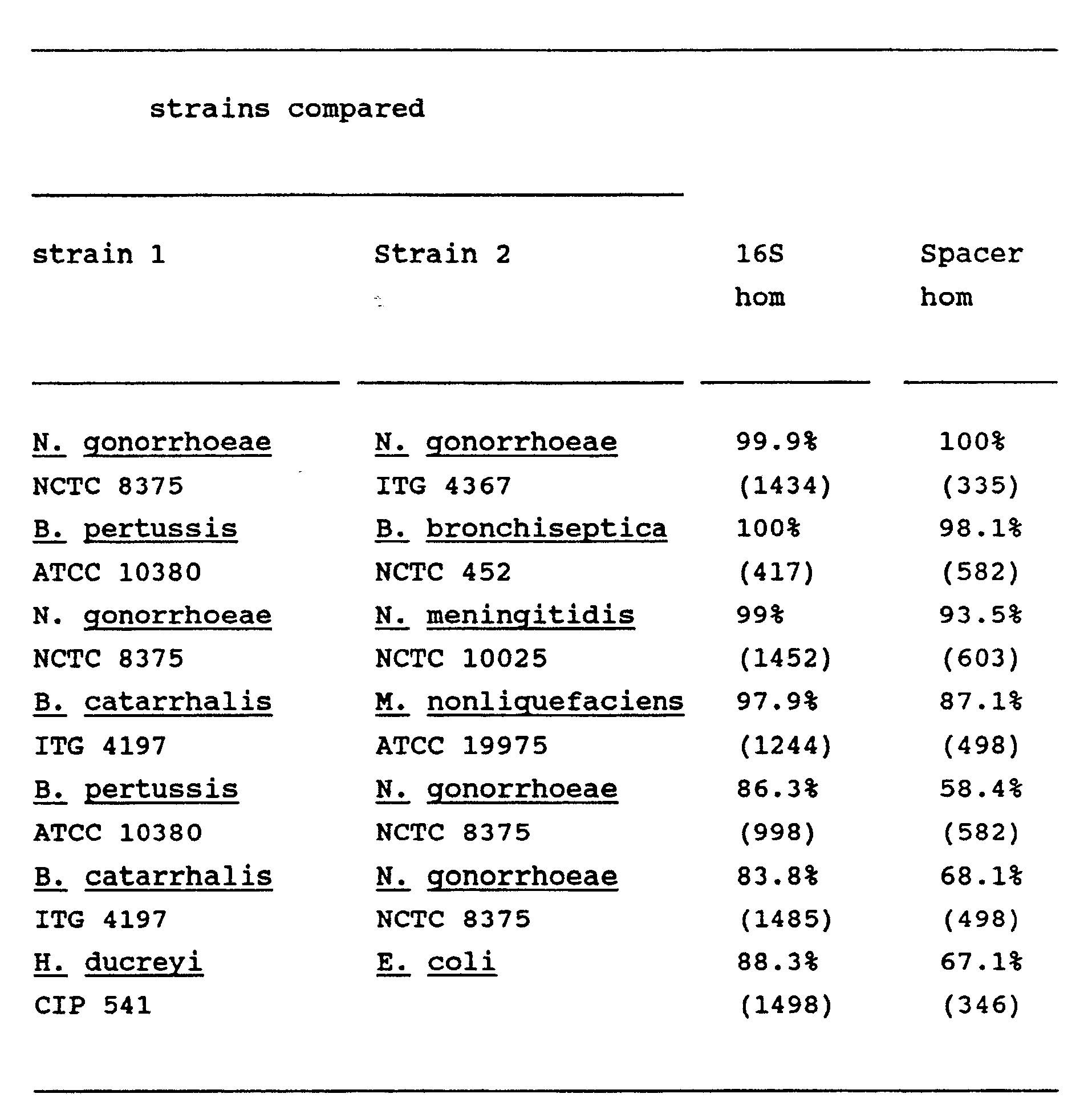
- As a result, highly species-specific and sensitive probes could be inferred from the spacer region sequence of the relevant pathogenic species under study i.e. Neisseria gonorrhoeae, Neisseria meningitidis, Branhamella catarrhalis, Haemophilus ducreyi and Bordetella pertussis. It was even so that for the species Neisseria meningitidis and Bordetella pertussis for which highly specific probes could not be found in the 16S and/or 23S rRNA molecules, valuable probes could be derived from the spacer region.
- It is very likely that specific probes for other species than those described herein (e.g. Campylobacter species, other Haemophilus species, etc. ...) can be inferred from spacer region sequences as well.
- The target of the probes derived from the spacer region between the 16S and 23S rRNA gene is the genomic DNA and the precursor RNA molecules present in the cells to be detected. The detection of the precursor RNA molecules is advantageous since these molecules are single stranded and may be present in multiple copies. On the other hand DNA molecules are much more refractory to enzymatical degradation than RNA molecules. Hence DNA targeting is preferred when biological samples cannot be processed and/or stored adequately to prevent RNA degradation prior to hybridization.
- Another particular advantage of probes derived from the 16S - 23S rRNA spacer regions lies in target detection after enzymatical amplification using the polymerase chain reaction (PCR). The spacer region of many microorganisms can for instance be enzymatically amplified using the same primers allocated in a conversed region of the 3' end and the 5' end of the 16S and the 23S rRNA genes respectively. Taking advantage of the highly conversed character of the rRNA genes, spacer regions of many organisms can be amplified, if preferred simultaneously, using the same reagents and protocol and afterwards the amplified fragment can be detected using a probe which specifically targets the spacer region of the organism of interest.
- Since the spacer region is flanked by conserved sequences the cloning and sequencing of this region with the aid of the PCR technique is simple, and the same protocol can be applied to a great variety of organisms. Hence the sequences of the spacer regions are obtained by enzymatical amplification of rRNA genes using conserved primers allocated in the 16S or 23S rRNA. Examples of basic primer-pairs which can be used for the amplification of fragments spanning the spacer region are :

- The amplified fragment can be cloned as such or as two sub-fragments after digestion with a restriction-enzyme recognizing a unique restriction-site. A strategy for cloning PCR products in M13 has been described by Medlin et al. (Gene 71:491-499, 1988).
- The same strategy can be used for cloning in a plasmid vector. In this approach the basic primers are extended at their 5' end with a nucleotide sequence comprising an unique restriction site, enabling directional cloning of the fragment. After cloning in a plasmid vector the spacer region can be sequenced using the dideoxy chain termination method.
- This approach is considerably less tedious and time-consuming than the conventional cloning procedures using genomic banks or selected restriction endonuclease fragments.
- Although sequence information is more rapidly obtained when the sequencing reactions are performed directly on PCR fragments without cloning, the sequence information generated from cloned fragments is more accurate and complete. In contrast to PCR fragments, cloned gene fragments can easily be purified in great amounts, which results in clearly readable sequencing ladders. Since one mismatch in the probe-sequence may result in useless probes, accuracy is highly preferred over the speed of obtaining sequences.
- Taking into account the ease of obtaining spacer sequences with the approach outlined above, nucleotide sequence comparison of the spacer region of the organism for which a probe is desired with the spacer region of the closest neighbour, is the preferred way to infer specific probe sequences.
- The closest neighbour means the taxon which is known to be most closely related in terms of DNA homology and which has to be differentiated from the organism of interest.
- Depending on the taxonomical position of the organism of interest, the closest neighbour may be extremely highly related to the organism of interest, exhibiting more than 75% degree of binding, or may be rather distantly related showing no significant percentage of DNA homology. In the initial renaturation rate method degree of binding values are insignificant below about 30%; in solid phase DNA:DNA hybridization methods DNA homologies become insignificant between 10 to 20% degree of binding.
- However, when the nucleotide sequences of the closest neighbors from which the organism of interest has to be differentiated, are not available, the selection of the specific probes can be done by trial and error. In that case, for each particular organism a specific probe region, which may be located anywhere in the spacer region, has to be defined experimentally. Only few areas in the spacer regions, such as tRNA genes or signal sequences, can in certain instances, be excluded a priori as probe regions. However, since 16S-23S rRNA spacer regions in general are small -- usually not longer than 700 bp -- good probe sequence can be readily found without extensive screening.
- By way of example, for a spacer region between the 16S and 23S rRNA gene of 700 bp, the "shortened" spacer region obtained by deleting the tRNA gene and the signal sequence can be of about 500 pb.
- With a "biological sample" is meant a specimen such as a clinical sample (pus, sputum, blood, urine, etc.), a environmental sample, bacterial colonies, contaminated or pure cultures, purified nucleic acid, etc... in which the target sequence of interest is sought.
- "rRNA gene spacer region derived" as used herein, refers to the fact that the probes concerned hybridize with sequences located in the spacer region between ribosomal RNA genes normally present in the genome or transcript RNA molecules, no matter whether said probes are themselves formed of DNA or RNA fragments, or whether they consist of cloned fragments (in the case of DNA) or of synthetic oligonucleotides.
- A hybridization probe of the invention for detecting Neisseria gonorrhoeae strains contains :
- either a sequence belonging to a nucleic acid selected from the following group of nucleic acids and which includes itself of from 15 to the maximum number of nucleotides of the selected nucleic acid,
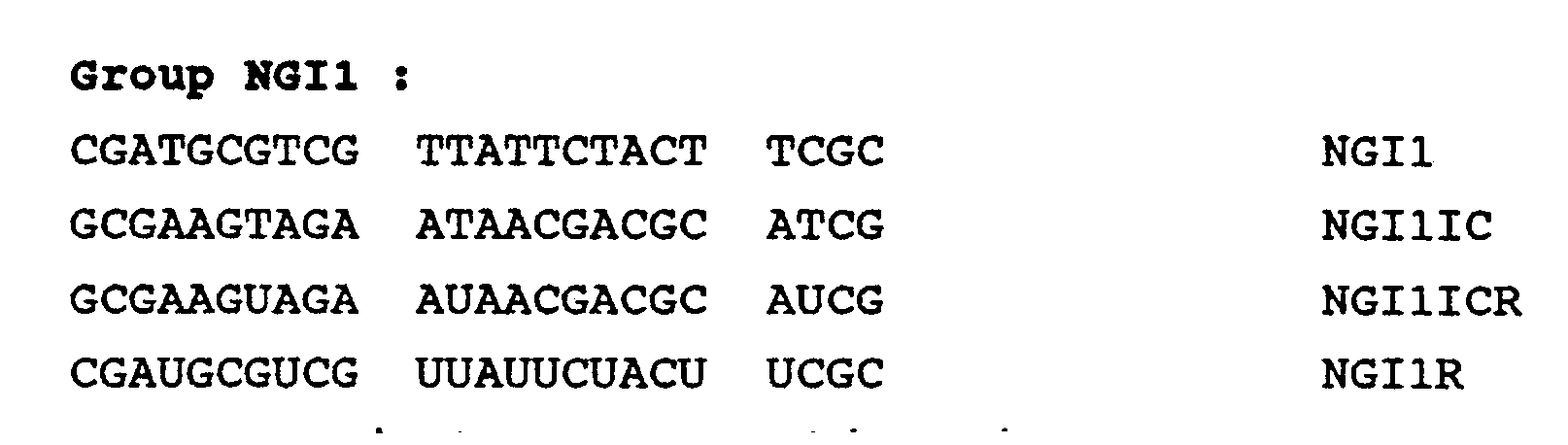
- or a variant sequence which differs from any of the preceding sequences
- · either by addition to or removal from any of their respective extremities of one or several nucleotides,
- · or changing within any of said sequences of one or more nucleotides,
- · or both,
- A hybridization probe of the invention for detecting Neisseria meningitidis strains contains :
- either a sequence belonging to a nucleic acid selected from the following group of nucleic acids and which includes itself of from 15 to the maximum number of nucleotides of the selected nucleic acid,

- or a variant sequence which differs from any of the preceding sequences
- · either by addition to or removal from any of their respective extremities of one or several nucleotides,
- · or changing within any of said sequences of one or more nucleotides,
- · or both,
- A hybridization probe of the invention for detecting Branhamella catarrhalis strains contains :
- either a sequence belonging to a nucleic acid selected from the following group of nucleic acids and which includes itself of from 15 to the maximum number of nucleotides of the selected nucleic acid,

- or a variant sequence which differs from any of the preceding sequences
- · either by addition to or removal from any of their respective extremities of one or several nucleotides,
- · or changing within any of said sequences of one or more nucleotides,
- · or both,
- A hybridization probe of the invention for detecting Haemophilus ducreyi strains contains :
- either a sequence belonging to a nucleic acid selected from the following group of nucleic acids and which includes itself of from 15 to the maximum number of nucleotides of the selected nucleic acid,

- or a variant sequence which differs from any of the preceding sequences
- · either by addition to or removal from any of their respective extremities of one or several nucleotides,
- · or changing within any of said sequences of one or more nucleotides,
- · or both,
- A hybridization probe of the invention for detecting Bordetella pertussis strains contains :
- either a sequence belonging to a nucleic acid selected from the following group of nucleic acids and which includes itself of from 15 to the maximum number of nucleotides of the selected nucleic acid,

- or a variant sequence which differs from any of the preceding sequences
- · either by addition to or removal from any of their respective extremities of one or several nucleotides,
- · or changing within any of said sequences of one or more nucleotides,
- · or both,
- In the sequences given in groups NGI1, NMI1, NMI2, NMI3, NMI4, NMI5, BCI1, HDI1 and BPI1, the letters mean the following nucleotides :
- A :
- Adenylic residue
- C :
- Cytidylic residue
- G :
- Guanidylic residue
- T :
- Thymidylic residue
- U :
- Uracylic residue
- Under the expression "target" is meant a sequence complementary to any of the sequences of groups NGI1, NMI1, NMI2, NMI3, NMI4, BCI1, HDI1 and BPI1 as herein before defined.
- This in case where the probe of the invention would comprise nucleic acid elongations on either side or both of said above defined sequences -- e.g. nucleic acid fragments of cloning vector or linker fragments resulting from the cleavage of said probe out of said cloning vector -- it is understood that such elongations should be selected such as to avoid the possibility that they could themselves hybridize with any other corresponding complementary nucleic acid sequence outside of the above target in a DNA of any micro-organism likely to be tested by the process of this invention as later defined. Such hybridization would be of a parasitical nature and reduce the specificity of the probe. Preferred probes consist of nucleic acid fragments formed of any of the sequences of the groups above defined, said fragments containing from 15 to the maximum number of nucleotides of the relevant nucleic acid sequence.
- It is understood that in the above nucleotide sequences (and in the other ones referred to hereafter), the left end of the formulae always corresponds to a 5' extremity and the right end to a 3' extremity of the sequence concerned.
- When reference is further made therein to a "probe of group 'X'" -- with 'X' from NGI1, NMI1, NMI2, NMI3, NMI4, NMI5, BCI1, HDI1 and BPI1 -- it should be understood that such probe has a sequence included in one of the nucleic acids belonging to that group as defined above or further defined hereafter.
- It is also understood that the word "nucleotide" as used herein refers indistinctly to ribonucleotides and deoxyribonucleotides and modified nucleotides such as inosine unless otherwise specified. The expression "nucleotides" also encompasses those which further comprise modification groups, e.g. chemical modification groups which do not affect their hybridization capabilities fundamentally. Such modification groups aim, for instance, at facilitating their coupling, either directly or indirectly, with suitable markers or labels for the subsequent detection of the probes so marked or labeled particularly in their hybridization products with the relevant RNA or DNA strand, e.g. that or those initially contained in a biological sample together with other DNA(s) and/or RNA(s).
- For instance, such modification groups are recognizable by antibodies which, in turn, can be recognized specifically by other antibodies, carrying a suitable enzymatic or fluorescent or chemiluminescent label. Possible labeling procedures will further be exemplified later herein.
The invention also relates to probes having any of the sequences defined above and in which some nucleotides are different, provided that the different nucleotide(s) do(es) not alter the specificity of the probes defined above. Some probes may consist of one of the nucleic acids belonging to any of the groups which are set forth above or of part thereof, said probes however including nucleotidic elongation on either sides thereof to the extent that such elongations do not alter the specificity of said probes with the genetic material of Neisseria gonorrhoeae, Neisseria meningitidis, Haemophilus ducreyi, Bordetella pertussis or Branhamella catarrhalis. - The invention thus provides for probes which are either replicas (those designated by numbers followed by "IC" or "ICR") in terms of nucleotide sequence of sequences contained in the RNAs or DNAs of most Neisseria gonorrhoeae, Neisseria meningitidis, Haemophilus ducreyi, Bordetella pertussis or Branhamella catarrhalis with occasionally a few insignificant differences in nucleotide sequences or formed of sequences, those designated by bare numbers or by numbers followed by "R", complementary to sequences included in the natural DNAs or RNAs of Neisseria gonorrhoeae, Neisseria meningitidis, Haemophilus ducreyi, Bordetella pertussis or Branhamella catarrhalis.
- More particularly, it should be appreciated that the target sequences in the DNAs concerned consist in any of the following successive sequences present in most, if not all, Neisseria gonorrhoeae, Neisseria meningitidis, Haemophilus ducreyi, Bordetella pertussis or Branhamella catarrhalis strains, subject to possible insignificant natural differences from one strain to another, whereby such natural differences are not likely to affect the hybridization specificity of the probes of this invention with such targets :

- The probes according to the invention can be formed by cloning of recombinant plasmids containing inserts including the corresponding nucleotide sequences, if need be cleaving the latter out from the cloned plasmids upon using the adequate nucleases and recovering them, e.g. by fractionation according to molecular weights. The probes according to the invention can also be synthesized chemically, for instance by the conventional phospho-triester method.
- The invention also relates to a process for detecting Neisseria gonorrhoeae, Neisseria meningitidis, Haemophilus ducreyi, Bordetella pertussis or Branhamella catarrhalis strains in a biological sample, wherein said process comprises contacting said biological sample in which the nucleic acids (DNAs and RNAs) have been made accessible to hybridization, if need be under suitable denaturation conditions, with a probe of the invention under conditions enabling hybridization between the probe and complementary nucleic acids of the strains, which may be present in the sample, and detecting the hybrids possibly formed.
- The process of the invention enables to discriminate Neisseria gonorrhoeae, Neisseria meningitidis, Haemophilus ducreyi, Bordetella pertussis or Branhamella catarrhalis from most other organism such as yeast, fungi, protozoa, other bacterial strains, human cells which are liable to the be present in the sample in which the organisms of interest are sought. The process relates to the detection of Neisseria gonorrhoeae, Neisseria meningitidis, Haemophilus ducreyi, Bordetella pertussis or Branhamella catarrhalis strains being directly in the sample of after the strain has been cultured.
- The detection of a hybrid can be interpreted as meaning that an infection due to Neisseria gonorrhoeae, Neisseria meningitidis, Branhamella catarrhalis, Haemophilus ducreyi, or Bordetella pertussis was present in the biological sample, when any of the probes of groups NGI1, NMI1, NMI2, NMI3, NMI4, NMI5, BCI1, HDI1 and BPI1 is being used respectively.
- According to an advantageous embodiment of the invention, in the process for detecting Neisseria gonorrhoeae, Neisseria meningitidis, Bordetella pertussis, Haemophilus ducreyi or Branhamella catarrhalis strains, the probes used are the ones hybridizing both with DNA globally and RNA of the Neisseria gonorrhoeae, Neisseria meningitidis, Bordetella pertussis, Haemophilus ducreyi or Branhamella catarrhalis strains, which may be present in the biological sample.
- The hybridization conditions can be monitored relying upon several parameters, e.g. hybridization temperature, the nature and concentration of the components of the media, and the temperature under which the hybrids formed are washed.
- The hybridization and wash temperature is limited in upper value, according to the probe (its nucleic acid composition, kind and length) and the maximum hybridization or wash temperature of the probes described herein is about 30°C to 55°C. At higher temperatures duplexing competes with the dissociation (or denaturation) of the hybrid formed between the probe and the target.
- A preferred hybridization medium contains about 3 x SSC (1 x SSC = 0.15 M NaCl, 0.015 M sodium citrate, pH 7.0), about 25 mM of phosphate buffer pH 7.1, and 20% deionized formamide, 0.02% ficoll, 0.02% bovine serum albumin, 0.02% polyvinylpyrrolidone and about 0.1 mg/ml sheared denatured salmon sperm DNA.
- A preferred wash medium contains about 3 x SSC, 25 mM phosphate buffer pH 7.1 and 20% deionized formamide. Other hybridization or wash media can be used as well.
- However, when modifications are introduced, be it either in the probes or in the media, the temperatures at which the probes can be used to obtain the required specificity, should be changed according to known relationships, such as those described in the following reference : B.D. HAMES and S.J. HIGGINS, (eds.). Nucleic acid hybridization. A practical approach, IRL Press, Oxford, U.K., 1985.
- In this respect it should also be noted that, in general, DNA:DNA hybrids are less stable then RNA:DNA or RNA:RNA hybrids. Depending on the nature of the hybrid to be detected the hybridization conditions should be adapted accordingly to achieve specific detection.
- The process for detecting Neisseria gonorrhoeae, Neisseria meningitidis, Bordetella pertussis, Haemophilus ducreyi or Branhamella catarrhalis strains generally, according to the invention can be carried out by suitably adjusting the hybridization temperature to a value at which hybridization is specific, and in such a case washing under more stringent conditions is not necessary.
- According to another embodiment of the process of the invention, the hybridization temperature needs not necessarily be adjusted to the value at which hybridization is specific and in particular can be lower than the temperature at which hybridization is specific, provided washing is carried out at a temperature corresponding to the value at which hybridization is specific.
- In a process embodiment for detecting Neisseria gonorrhoeae strains (and for distinguishing them from other bacterial taxa) with a probe of group NGI1, the hybridization temperature and/or the wash temperature is suitably adjusted to about 50°C, the media being those above defined.
- In a process embodiment for detecting Neisseria meningitidis strains (and for distinguishing them from other bacterial taxa) with a probe of group NMI1, the hybridization temperature and/or the wash temperature is suitably adjusted to about 45°C, the media being those above defined.
- In a process embodiment for detecting Neisseria meningitidis strains (and for distinguishing them from other bacterial taxa) with a probe of group NMI2, the hybridization temperature and/or the wash temperature is suitably adjusted to about 45°C, the media being those above defined.
- In a process embodiment for detecting Neisseria meningitidis strains (and for distinguishing them from other bacterial taxa) with a probe of group NMI3, the hybridization temperature and/or the wash temperature is suitably adjusted to about 40°C, the media being those above defined.
- In a process embodiment for detecting Neisseria meningitidis strains (and for distinguishing them from other bacterial taxa) with a probe of group NMI4, the hybridization temperature and/or the wash temperature is suitably adjusted to about 48°C, the media being those above defined.
- In a process embodiment for detecting Neisseria meningitidis strains (and for distinguishing them from other bacterial taxa) with a probe of group NMI5, the hybridization temperature and/or the wash temperature is suitably adjusted to about 58°C, the media being those above defined.
- In a process embodiment for detecting Branhamella catarrhalis strains (and for distinguishing them from other bacterial taxa) with a probe of group BCI1, the hybridization temperature and/or the wash temperature is suitably adjusted to about 30°C, the media being those above defined.
- In a process embodiment for detecting Bordetella pertussis strains (and for distinguishing them from other bacterial taxa) with a probe of group BPI1, the hybridization temperature and/or the wash temperature is suitably adjusted to about 55°C, the media being those above defined.
- In a process embodiment for detecting Haemophilus ducreyi strains (and for distinguishing them from other bacterial taxa) with a probe of group HDI1, the hybridization temperature and/or the wash temperature is suitably adjusted to about 40°C, the media being those above defined.
- The invention further relates to a kit for detecting specifically Neisseria meningitidis strains containing :
- a probe specific for Neisseria meningitidis i.e. a probe of group NMI1, NMI2, NMI3, NMI4 or NMI5;
- the buffer or components necessary for producing the buffer enabling an hybridization reaction between these probes and only the DNAs and/or RNAs of a strain of Neisseria meningitidis to be carried out,
- when appropriate means for detecting the hybrids resulting from the proceeding hybridization.
- The invention further relates to a kit for detecting specifically Neisseria gonorrhoeae strains containing :
- a probe specific for Neisseria gonorrhoeae i.e. a probe of group NGI1;
- the buffer or components necessary for producing the buffer enabling an hybridization reaction between these probes and only the DNAs and/or RNAs of a strain of Neisseria gonorrhoeae to be carried out,
- when appropriate means for detecting the hybrids resulting from the proceeding hybridization.
- The invention further relates to a kit for detecting specifically Branhamella catarrhalis strains containing :
- at least one probe selected among any of those that are specific for Branhamella catarrhalis as above defined, i.e. a probe of group BCI1;
- the buffer or components necessary for producing the buffer enabling an hybridization reaction between these probes and only the DNAs and/or RNAs of a strain of Branhamella catarrhalis to be carried out,
- when appropriate means for detecting the hybrids resulting from the proceeding hybridization.
- The invention further relates to a kit for detecting specifically Haemophilus ducreyi strains containing :
- at least one probe selected among any of those that are specific for Haemophilus ducreyi as above defined, i.e. a probe of group HDI1;
- the buffer or components necessary for producing the buffer enabling an hybridization reaction between these probes and only the DNAs and/or RNAs of a strain of Haemophilus ducreyi to be carried out,
- when appropriate means for detecting the hybrids resulting from the proceeding hybridization.
- The invention further relates to a kit for detecting specifically Bordetella pertussis strains containing :
- at least one probe selected among any of those that are specific for Bordetella pertussis as above defined, i.e. a probe of group BPI1;
- the buffer or components necessary for producing the buffer enabling an hybridization reaction between these probes and only the DNAs and/or RNAs of a strain of Bordetella pertussis to be carried out,
- when appropriate means for detecting the hybrids resulting from the proceeding hybridization.
- The probes of the invention can be used in a sandwich hybridization system which enhances the specificity of a nucleic acid probe based assay. The principle and the use of sandwich hybridizations in a nucleic acid probe based assay have been already described (e.g.: DUNN and HASSEL, Cell 12 : 23-36; 1977; RANKI et al., Gene, 21: 77-85; 1983). Although direct hybridization assays have favorable kinetics, sandwich hybridizations are advantageous with respect to a higher signal to noise ratio. Moreover sandwich hybridizations can enhance the specificity of a nucleic acid probe based assay.
- If properly designed, a sandwich hybridization assay indeed maximizes the specificity of a nucleic acid probe based test when using two probes recognizing two different nucleic acid stretches of one and the same organism. The only demands which must be met are that both probes (i) hybridize to the same nucleic acid molecule of the target organism and (ii) do not hybridize to the same non-target organisms.
- For two given probes I and II, the sandwich hybridization system can be described as follows :
Probe n° I hybridizes to nucleic acid from organisms A and B (not with C);
Probe n° II hybridizes to nucleic acid from organisms A and C (not with B). - Since it is absolutely required that both probes hybridize to the target nucleic acid, a detectable signal will be generated only if nucleic acid from organism A is present in the sample. It is obvious that if one of the probes is specific for the organism to be detected, the other probe can be composed of any specific or non-specific sequence provided that it hybridizes to the same target molecule than the first probe.
- The probes of the invention -- groups NGI1, NMI1, NMI2, NMI3, NMI4, NMI5, BCI1, HDI1, and BPI1 -- can be used in a sandwich hybridization assay which is specific for Haemophilus ducreyi, Branhamella catarrhalis, Neisseria gonorrhoeae, Neisseria meningitidis or Bordetella pertussis respectively in combination with another, non-specific or specific, probe hybridizing to the same target molecule.
- In the sandwich hybridization process the probes can be added simultaneously or not, to the biological sample in which the target DNA or RNA is sought.
- The invention also relates to a kit for sandwich hybridization assay, for the detection in vitro of Neisseria gonorrhoeae, Neisseria meningitidis, Bordetella pertussis , Haemophilus ducreyi or Branhamella catarrhalis strains in a biological sample, said kit containing :
- at least one of the probes or one of the combinations of probes specific for the organisms of interest as above defined,
- the buffer or components necessary for producing the buffer enabling hybridization reaction between these probes and the DNAs and/or RNAs of a strain of Neisseria gonorrhoeae, Neisseria meningitidis, Bordetella pertussis , Haemophilus ducreyi or Branhamella catarrhalis to be carried out,
- when appropriate means for detecting the hybrids resulting from the preceding hybridization.
- The probes of the invention can be used also in a competition hybridization protocol.
- In a competition hybridization the target molecule competes with the hybrid-formation between a specific probe and its complement. The more target is present, the lower the amount of hybrid formed between the probe and its complement. A positive signal, which indicates that the specific target was present, is seen by a decrease in hybridization reaction as compared to a system to which no target was added. In a particular embodiment the specific oligonucleotide probe, conveniently labeled, is hybridized with the target molecule. Next, the mixture is transferred to a recipient (e.g. a microtiter dish well) in which a oligonucleotide complementary to the specific probe is fixed and the hybridization is continued. After washing the hybrids between the complementary oligonucleotide and the probe are measured, preferably quantitatively, according to the label used.
- The oligonucleotides of the invention can be used either as amplification primers in the polymerase chain reaction technique (PCR; Mullis and Faloona, Methods in Enzymology 155 :335- , 1987.) to generate specific enzymatically amplified fragments and/or as probes to detect fragments amplified between bracketing oligonucleotide primers.
- The specificity of a PCR-assisted hybridization assay can be controlled at different levels.
- The amplification process or the detection process or both can be specific. The latter case, giving the highest specificity, is preferred. Such a highly specific PCR-assisted test can be developed using the probes of the invention.
- However, in some occurrences, a non-specific amplification process, using conserved primers bracketing the detection-probes of the invention, coupled to a specific detection, might be advantageous in order to standardize the amplification process in such a way that it can be used for a great variety of organisms. Amplification primers to be used in a standardized amplification process can be found in the conserved region of the 16S and 23S rRNA gene flanking the spacer region (see example 1).
- In most of the cases the number of specific probes for the organisms of interest which can be derived from the spacer regions is not limited to the probes described in this text.
- For most organisms only one probe is described to demonstrate the feasibility of spacer regions for the development of highly specific and sensitive probes for a variety of bacteria. The only exception is Bordetella pertussis for which only one particular region (from nucleotide 271 to 299 in the Bordetella pertussis sequence; Fig. 2, top line) of the spacer region has a specific sequence. However, from the spacer region sequence of Bordetella pertussis probes may be devised which can be valuable in the simultaneous detection of highly related Bordetella species. Probes which detect Bordetella species other than Bordetella pertussis, may also be deduced from the sequences disclosed in Fig. 2. Likewise, potentially specific probes for Moraxella nonliquefaciens may be inferred from the spacer-region sequence shown in Fig. 7.
- The probes of the invention are advantageously labeled. Any conventional label can be used. The probes can be labeled by means of radioactive tracers such as ³²P, ³⁵S, ¹²⁵I, ³H and ¹⁴C.
- The radioactive labeling can be carried out according to any conventional method such as terminal labeling at the 3' or 5' position with the use of a radio-labeled nucleotide, a polynucleotide kinase (with or without dephosphorylation by a phosphatase), a terminal transferase, or a ligase (according to the extremity to be labeled). One of the probes of the invention can be the matrix for the synthesis of a chain consisting of several radioactive nucleotides or of several radioactive and non radioactive nucleotides.
- The probes of the invention can also be prepared by a chemical synthesis using one or several radioactive nucleotides. Another method for radioactive labeling is a chemical iodination of the probes of the invention which leads to the binding of several ¹²⁵I atoms on the probes.
- If one of the probes of the invention is made radioactive to be used for hybridization with a non radioactive RNA or DNA, the method of detecting hybridization will depend on the radioactive tracer used. Generally, autoradiography, liquid scintillation, gamma counting or any other conventional method enabling one to detect an ionizing ray issued by the radioactive tracer can be used.
- Non radioactive labeling can also be used by associating the probes of the invention with residues having : immunological properties (e.g. antigen or hapten) a specific affinity for some reagents (e.g. ligand) properties providing a detectable enzymatic reaction (e.g. enzyme, co-enzyme, enzyme substrate or substrate taking part in an enzymatic reaction) or physical properties such as fluorescence or emission or absorption of light at any wave length. Antibodies which specifically detect the hybrids formed by the probe and the target can also be used.
- A non-radioactive label can be provided when chemically synthesizing a probe of the invention, the adenosine, guanosine, cytidine, thymidine and uracyl residues, thereof being liable to be coupled to other chemical residues enabling the detection of the probe or the hybrids formed between the probe and a complementary DNA or RNA fragment.
- However, the nucleotidic sequence of the probe when modified by coupling one or more nucleotides to other chemical residues, would be the same as the nucleotide sequence of one of the probes of the invention.
- The invention also relates to processes for detecting by hybridization RNA and/or DNA with the probes of the invention, which have been labeled and can be detected as described above. In this regard, conventional methods of hybridization can be used.
- For detecting cells coming from or being themselves living organisms, the RNA and/or DNA of these cells if need be, is made accessible by partial or total lysis of the cells, using chemical or physical processes, and contacted with one or several probes of the invention which can be detected. This contact can be carried out on an appropriate support such as a nitrocellulose, cellulose, or nylon filter in a liquid medium or in solution. This contact can take place under sub-optimal, optimal conditions or under restrictive conditions (i.e. conditions enabling hybrid formation only if the sequences are perfectly homologous on a length of molecule). Such conditions include temperature, concentration of reactants, the presence of substances lowering the optimal temperature of pairing of nucleic acids (e.g. formamide, dimethylsulfoxide and urea) and the presence of substances apparently lowering the reaction volume and/or accelerating hybrid formation (e.g. dextran sulfate, polyethyleneglycol or phenol).
- The elimination of probe of the invention which has not hybridized can be carried out by washing with a buffer solution of appropriate ionic strength and at an appropriate temperature, with or without treatment with S1 nuclease or any other enzyme digesting single strand DNA or RNA but not digesting DNA-RNA hybrids or double strand DNA.
- In a liquid medium, the hybrids of the probe of the invention paired to the cellular DNA or RNA fragments can be separated from the rest of the liquid medium in different ways, e.g. by chromatography over hydroxyapatite.
- Then the hybridized probes are detected by means of the label on the probe.
- In order to target the chromosomal DNA fragments, after treating RNA by one or several enzymes and denaturation of DNA fragments (i.e. separation of both chains), one of the probes of the invention is contacted with the DNA fragments under the conditions enabling hybridization and after the time necessary to get to the end of the hybridization, the non-hybridized fragments are separated from the hybridized fragments and the label is detected as it has been described above for the detection of the cells.
- Generally speaking, the different probes of the invention can also be contained in recombinant DNA enabling their cloning, if the presence of a heterologous DNA is not a nuisance for the specificity of the probes in the encompassed uses.
- In Fig.1 to 7 alignments of spacer regions (completely or partially sequenced) found in various microorganisms are shown. Matches and gaps are indicated by ":" and "-" respectively. For all sequences the noncoding strand is shown in its 5'-3' orientation.
- The 5'-end is proximal to the 16S rRNA gene, the 3'-end proximal to the 23S rRNA gene.
- In Fig.1 the nucleic acid sequence alignment of the 16S rRNA proximal end of the spacer region between the 16S and 23S rRNA gene of Neisseria gonorrhoeae strains NCTC 8375 (top line) and ITM 4367 (bottom line) is shown.
- In Fig.2 the nucleic acid sequence alignment of the spacer region between the 16S and 23S rRNA of Bordetella pertussis ATCC 10380 (top line) and Bordetella bronchiseptica NCTC 452 (bottom line) is shown.
- In Fig.3 the nucleic acid sequence alignment of the spacer region between the 16S and 23S rRNA of Neisseria meningitidis NCTC 10025 (top line) and Neisseria gonorrhoeae NCTC 8375 (bottom line) is shown.
- In Fig.4 the nucleic acid sequence alignment of the spacer region between the 16S and 23S rRNA of Neisseria gonorrhoeae NCTC 8375 (top line) and Bordetella pertussis ATCC 10380 (bottom line) is shown.
- In Fig.5 the nucleic acid sequence alignment of the spacer region between the 16S and 23S rRNA of Branhamella catarrhalis ITM 4197 (top line) and Neisseria gonorrhoeae NCTC 8375 (bottom line) is shown.
- In Fig.6 the nucleic acid sequence alignment of the spacer region between the 16S and 23S rRNA of Haemophilus ducreyi CIP 542 (top line) and Escherichia coli (bottom line) is shown.
- In Fig. 7 the nucleic acid sequence alignment of the spacer region between the 16S and 23S rRNA of Branhamella catarrhalis ITM 4197 (top line) and Moraxella nonliquefaciens ATCC 19975 (bottom line) is shown.
- It is to be pointed out that each nucleic acid sequence of the spacer region between the 16S and 23S rRNA genes of respectively each organism referred to in figures 1 to 7 (except the one of E. coli) is new.
- The strains used can be obtained at the respective culture collections :
- ATCC :
- American Type Culture Collection, Rockville, Md., USA.
- CIP :
- Collection de l'Institut Pasteur, Paris, France.
- ITM :
- Institute of Tropical Medicine, Antwerp, Belgium.
- NCTC :
- National Collection of Type Cultures, Central Public Health Laboratory, London, United Kingdom.
- The examples hereafter relate to the preparation of the probes of the invention and the experimental results with respect to the specificity and sensitivity of the probes. The following organisms of clinical relevance were studied : Neisseria gonorrhoeae, Neisseria meningitidis, Bordetella pertussis, Haemophilus ducreyi and Branhamella catarrhalis.
- The examples illustrate that species specific and highly sensitive probes could readily be found in the spacer region of all organisms studied. Moreover it is shown that probes could be constructed from this region for organisms for which no species specific and highly sensitive probe could be found in the 16S and/or 23S rRNA molecule.
- The methods used are essentially the same as described by ROSSAU et al., J. Gen. Microbiol.; 135 : 1735-1745, 1989; or in the European patent application n° 8940/045.3 unless otherwise stated. All methods used, except the enzymatical amplification of rRNA gene fragments, are currently known to people skilled in the art. The enzymatical amplification of rRNA gene fragments spanning the 16S-23S rRNA spacer region were obtained by the polymerase chain reaction technique (PCR) performed according to the recommendations given in the "Gene Amp" kit of Perkin Elmer Cetus. As PCR primers oligonucleotides corresponding to conserved or semi-conserved regions in the rRNA molecules were used.
- Neisseria meningitidis and Neisseria gonorrhoeae both are important human pathogens, responsible for meningitis and gonorrhea respectively. These organisms are extremely highly related and their differentiations from each other and other Neisseria species is error-prone. DNA probes specific for Neisseria meningitidis and Neisseria gonorrhoeae may aid in the correct differentiation between both Neisseria species and may be used for direct detection of these species in clinical samples.
- A number of DNA probes have been described for the detection of Neisseria gonorrhoeae (European Patent Application nr 0272 009 and 0337 896; URDEA et al., Clin. Chem. 35 : 1571-1575, 1989; TOTTEN et al., J. Infect. Dis. 148 : 462-471, 1989; DONEGAN et al., Mol. Cell. Probes 3 : 13-26, 1989; KOLBERG et al., Mol. Cell. Probes 3 : 59-72, 1989.). However, some of these probes were found to cross-react with non-Neisseria gonorrhoeae strains or were not highly sensitive. None of these probes were derived from the 16S-23S rRNA spacer region.
- A DNA probe which detects Neisseria meningitidis strains has also been described (KOLBERG et al., Mol. Cell. Probes 3 : 59-72, 1989). This probe, devised from the pilin gene of Neisseria gonorrhoeae, was neither highly specific nor highly sensitive for Neisseria meningitidis.
- The sequence of the spacer region between the 16S and 23S rRNA gene of the type strains of Neisseria gonorrhoeae and Neisseria meningitidis was determined using cloned material originating from a PCR-fragment spanning the spacer region. The alignment of both sequences, shown in Fig. 3, revealed several potential probe sequences.
- An unexpected inserted sequence of about 60 basepairs was detected in the spacer region of the Neisseria meningitidis strain. Oligonucleotides with the following sequences were derived from this inserted sequence :

- Also in another area of the spacer region (from basepairs 365 to 386 in the Neisseria meningitidis sequence in Fig. 3) a substantial degree of mismatch was revealed between Neisseria meningitidis and Neisseria gonorrhoeae. From this area two oligonucleotide probes (NMI3 and NGI1 for the detection of Neisseria meningitidis and Neisseria gonorrhoeae respectively) were chemically synthesized:

These oligonucleotides were ³²P-labeled at their 5'ends using polynucleotide kinase or tailed at their 3'ends with digoxigeninated UTP using terminal transferase and used as hybridization probes. As target dot-spotted denatured genomical DNA of a great number of Neisseria meningitidis and Neisseria gonorrhoeae strains from different locations and several strains of other bacterial taxa was used. - The hybridization-mixture was either 3 x SSC, 25 mM potassium phosphate buffer, pH 7, deionized formamide (20%, v/v), Ficoll (0.02%, w/v), bovine serum albumin (0.02%, w/v), polyvinylpyrrolidone (0.02%, w/v) and sheared, denatured salmon sperm DNA (0.1 mg ml-1) or the solution given in the protocol sheet of the DNA labeling and detection kit nonradioactive (Boehringer Mannheim) except that 3 x SSC (1 x SSC is : 0.15 M NaCl, 0.015 M sodium citrate, pH 7.0) in stead of 5 x SSC was used and formamide was added up to 20% (v/v). The wash-solution contained 3 x SSC, 20% formamide and 25 mM phosphate buffer pH 7.1.
- The hybridization results are summarized in the table below. The hybridization- and wash-temperature for each probe is indicated between parenthesis. All probes tested proved to be highly specific and highly sensitive for Neisseria gonorrhoeae (probe NGI1) or Neisseria meningitidis (probes NMI1, NMI2 and NMI3).

- The specificity of the detection with probes NMI3 and NGI3 was also checked after enzymatical amplification of the spacer regions with the following amplification primers :

located at the 3' end of the 16S rRNA gene and the 5' end of the 23S rRNA gene respectively. Hundred nanogram of genomical DNA of a strain of Neisseria gonorrhoeae, Neisseria meningitidis, Haemophilus ducreyi, Bordetella pertussis and Branhamella catarrhalis was used in the PCR reaction. After amplification, 1/10 of the yield was loaded on an agarose gel, electrophoresed and blotted on a nylon membrane. - The membrane was consecutively hybridized with the probes NGI1 and NMI3.
- Significant hybridization signals could only be detected in lanes where Neisseria gonorrhoeae or Neisseria meningitidis material was present when NGI1 or NMI3 were used as probes respectively.
- Bordetella pertussis is the causative agent of whooping cough. Due to vaccination-programs the disease has become a minor problem in the industrialized countries.
- However, in third-world countries pertussis is a leading cause of childhood mortality.
- Strains of three Bordetella species (Bordetella pertussis, Bordetella parapertussis and Bordetella bronchiseptica) are extremely highly related (KLOOS et al., Int.J.Syst. Bacteriol. 31 : 173-176, 1981; DE LEY et al., Int. J. Syst. Bacteriol. 36 : 405-414, 1986) and should be considered as belonging to one genospecies. This genotypical relationship is also reflected in many other characteristics of these bacteria making their phenotypical differentiation tedious.
- Clinical signs of pertussis often are atypical and laboratory diagnosis is needed. As yet, no sensitive, specific and rapid test exists. Culture still is the method of choice, but recovery rates are low and the results usually are available only 3 to 7 days after inoculation (FRIEDMAN, Clin. Microbiol. Rev. 4 : 365-376, 1988; HALPERIN et al., J. Clin. Microbiol. 27 : 752-757, 1989). A DNA-probe based assay may greatly improve the diagnosis of Bordetella pertussis infections.
- Probes for the detection of Bordetella pertussis are described in the literature (PARK et al., FEMS Microbiol. Lett. 52 : 19-24, 1988; McPHEAT and McNALLY, J. Gen. Microbiol. 133 : 323-330, 1987 and FEMS Microbiol. Lett. 41 : 357-360, 1987; McLAFFERTY et al., Abstracts of the Annual Meeting of the American Society for Microbiology C-168, 1986, and C-322, 1987.). The probe described by McLAFFERTY et al. (1986 and 1987) is not highly specific. For the other probes described the data presented are to scanty to infer the degree of specificity and sensitivity.
- Part of the ribosomal RNA gene of the following strains were enzymatically amplified and cloned in a plasmid vector : Bordetella pertussis ATCC 10380, Bordetella parapertussis NCTC 5952 (type strain), and Bordetella bronchiseptica NCTC 452 (type strain). The cloned fragments of the different species were partially sequenced using the dideoxy chain termination method and their sequences were compared. The sequences information of the 16S rRNA gene which came available, indicated that no species specific probes could be devised (ROSSAU et al., unpublished). However, as shown in the alignment in Fig. 2, a non-homologous area (from basepairs 271 to about 300) was found in the spacer region between the 16S and 23S rRNA genes of the Bordetella pertussis and the Bordetella bronchiseptica strain.
- The sequence of the spacer region of the Bordetella parapertussis strain was virtually identical to the Bordetella bronchiseptica sequence (ROSSAU et al., unpublished).
- From the area between
nucleotide 271 and 295 in the spacer region of Bordetella pertussis a oligonucleotide probe with the following sequence was derived :
- The oligonucleotide probe was chemically synthesized and labeled with digoxigenine - UTP using terminal transferase. The results obtained with dot-spotted denatured genomical DNA as target are summarized in the table below.

- Under the conditions used the probe BPI1 proved to be 100% specific and 100% sensitive for Bordetella pertussis.
- The hybridization-mixture was as described in the protocol sheet of the DNA labeling and detection kit nonradioactive (Boehringer Mannheim) except that 3 x SSC (1 x SSC is : 0.15 M NaCl, 0.015 M sodium citrate, pH 7.0) instead of 5 x SSC was used and formamide was added up to 20% (v/v). The wash-solution contained 3 x SSC, 20% formamide and 25 mM phosphate buffer pH 7.1. The hybridization and wash temperature was 55°C.
- Branhamella catarrhalis, also known as Moraxella catarrhalis or Neisseria catarrhalis, is a fastidious, biochemically rather inert bacterium. Recently its important pathogenic potential was recognized. Branhamella catarrhalis seems to be frequently involved in serious infections of the respiratory tract (HAGER et al., Rev. Infect. Dis. 9 : 1140-1149, 1987). The diagnosis of Branhamella catarrhalis requires culture of the organism, which may be hampered by overgrowth by less fastidious micro-organisms, and a battery of phenotypical tests to distinguish this organisms from commensals, such as Neisseria species, present in the oral cavity.
- In some occurrences the phenotypical test are inconclusive about the identity of the presumptive Branhamella catarrhalis isolate, since there only are a limited number of tests which differentiate Branhamella catarrhalis from phenotypical similar bacteria (RIOU and GUIBOURDENCHE, Drugs 31 [suppl.3] : 1-6, 1986). The use of a DNA probe based assay may considerably simplify the laboratory diagnosis of Branhamella catarrhalis. A DNA probe for Branhamella catarrhalis derived from an unspecified DNA fragment and which cross-hybridized with DNA from Neisseria caviae was described by BEAULIEU and ROY (Abstracts of the Annual Meeting of the American Society for Microbiology, Abstract nr D-249, 1989).
- Part of the rRNA gene of Branhamella catarrhalis ITG 4197 was enzymatically amplified by the polymerase chain reaction technique and cloned in a plasmid vector. The fragment spanning the 16S-23S rRNA spacer region was subsequently sequenced by the dideoxy chain termination technique. The sequence is shown in Fig. 7 (top line). From the sequence data the following oligonucleotide was selected and chemically synthesized :

- The oligonucleotide was ³²P-labeled at its 5' end with polynucleotide kinase and used as a hybridization probe. As target dot-spotted denatured genomical DNA of 31 Branhamella catarrhalis strains from different locations and 19 strains of other bacterial taxa was used.
- The hybridization-mixture was either 3 x SSC (1 x SSC is : 0.15 M NaCl, 0.015 M sodium citrate, pH 7.0), 25 mM potassium phosphate buffer, pH 7, deionized formamide (20%, v/v), Ficoll (0.02%, w/v), bovine serum albumin (0.02%, w/v), polyvinylpyrrolidone (0.02%, w/v) and sheared, denatured salmon sperm DNA (0.1 mg ml-1). The wash-solution contained 3 x SSC, 20% formamide and 25 mM phosphate buffer pH 7.1. The hybridization and wash temperature was 30°C.
- Under the conditions used probe BCI1 hybridized to all Branhamella catarrhalis strains.
- None of the strains tested belonging to other bacterial species gave a significant hybridization signal with the probe.
- The non-Branhamella catarrhalis strains tested are :
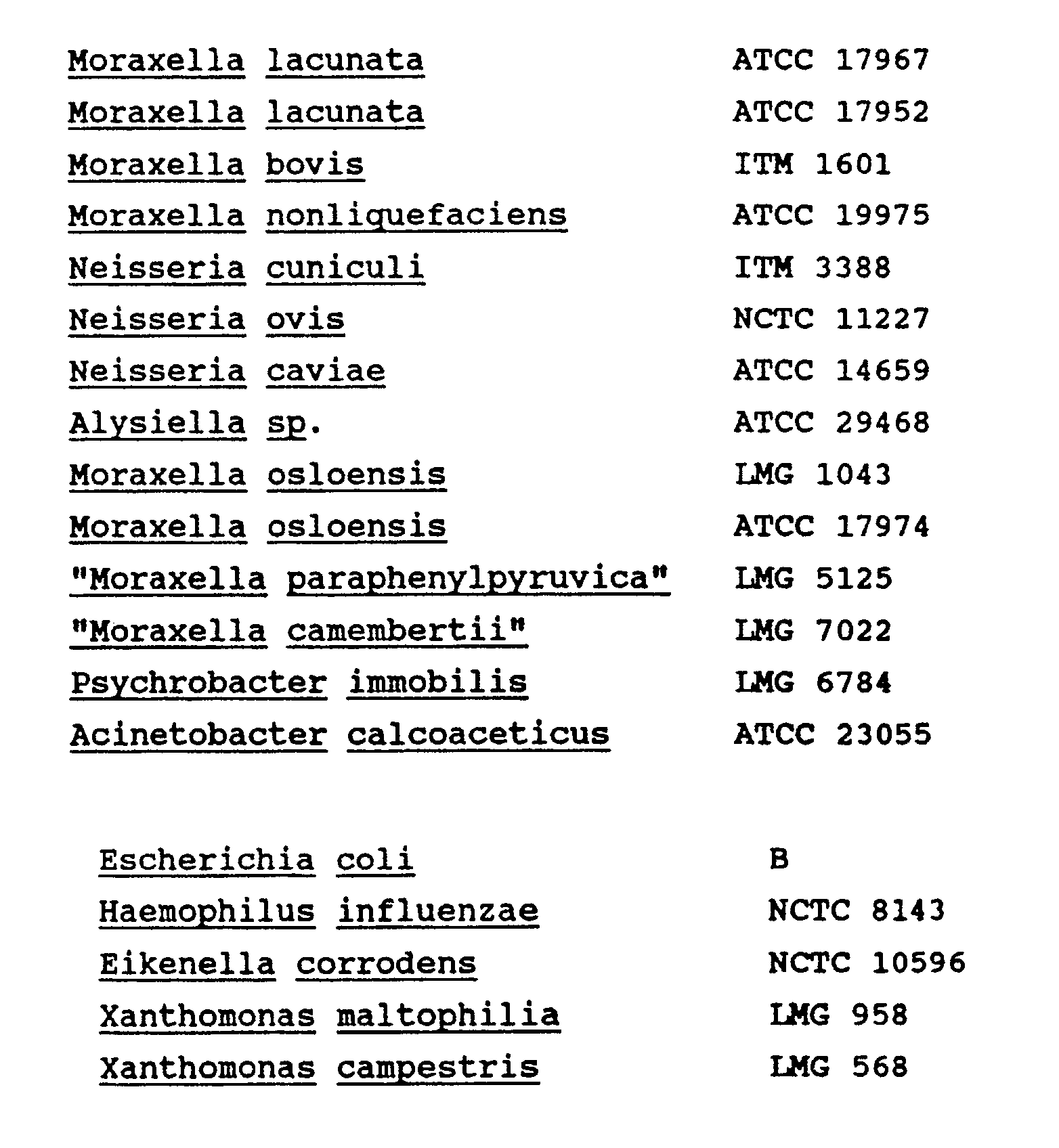
- Haemophilus ducreyi, the causative agent of chancroid, is a fastidious Gram-negative bacterium. The culture of this organism is both difficult and insensitive; yet it still is the method of choice for the diagnosis of Haemophilus ducreyi infections. The use of highly specific probes may obviate the culture and increase the sensitivity of the diagnosis. Cloned DNA-probes for Haemophilus ducreyi, showing weak cross-reactivity with other Haemophilus and Pasteurella species, and targeting genes coding for proteins were described by PARSONS et al. (J. Clin. Microbiol. 27 : 1441-1445, 1989).
- Part of the rRNA gene of the type strain of
Haemophilus ducreyi CIP 542 was enzymatically amplified by the polymerase chain reaction and cloned in a plasmid vector. - The sequence of the spacer region between the 16S and 23S rRNA gene was obtained by the dideoxy chain termination technique. From the nucleic acid sequence the following oligonucleotide was selected and chemically synthesized :

- The oligonucleotide was ³²P-labeled at its 5' ends or tailed at its 3' ends with digoxigeninated UTP using terminal transferase and used as a hybridization probe.
- As target dot-spotted denatured genomical DNA of 41 Haemophilus ducreyi strains from different locations and several strains of other bacterial taxa was used. The oligonucleotide probe hybridized exclusively to all Haemophilus ducreyi strains tested.
- The hybridization-mixture was either 3 x SSC, 25 mM potassium phosphate buffer, pH 7, deionized formamide (20%, v/v), Ficoll (0.02%, w/v), bovine serum albumin (0.02%, w/v), polyvinylpyrrolidone (0.02%, w/v) and sheared, denatured salmon sperm DNA (0.1 mg ml-1) or the solution given in the protocol sheet of the DNA labeling and detection kit nonradioactive (Boehringer Mannheim) except that 3 x SSC (1 x SSC is : 0.15 M NaCl, 0.015 M sodium citrate, pH 7.0) in stead of 5 x SSC was used and formamide was added up to 20% (v/v). The wash-solution contained 3 x SSC, 20% formamide and 25 mM phosphate buffer pH 7.1. The hybridization and wash temperature was 40°C.
- The non-Haemophilus ducreyi strains tested were :
Escherichia coli MC 1061
Escherichia coli B
Actinobacillus actinomycetemcomitans NCTC 9710
Actinobacillus lignieresii NCTC 4189
Haemophilus aphrophilus NCTC 5906
Haemophilus influenzae NCTC 8143
Histophilus ovis HIM 896-7
Pasteurella multocida NCTC 10322
Branhamella catarrhalis ITM 4197
Comamonas testosteroni ATCC 17407
Oligella urethralis LMG 6227
Neisseria gonorrhoeae ITM 4437
Campylobacter jejuni CCUG 11284
Acinetobacter calcoaceticus ATCC 23055
Unidentified strain ITM 3565
yet provided that in any of the above circumstances said probe still hybridizes with the same RNA or DNA target as the corresponding unmodified sequence.
yet provided that in any of the above circumstances said probe still hybridizes with the same RNA or DNA target as the corresponding unmodified sequence.
yet provided that in any of the above circumstances said probe still hybridizes with the same RNA or DNA target as the corresponding unmodified sequence.
yet provided that in any of the above circumstances said probe still hybridizes with the same RNA or DNA target as the corresponding unmodified sequence.
Claims (28)
- Probe consisting of at least about 15 oligonucleotides of the spacer region between rRNA genes of a non viral organism, particularly prokaryotic organism and more particularly bacteria, and preferably from about 15 oligonucleotides to about the maximum number of oligonucleotides of the spacer region and more preferably from about 15 to about 100 oligonucleotides.
- Probe according to claim 1, for use in a hybridization assay, liable to be obtained in the process which comprises constructing an oligonucleotide that is sufficiently complementary to hybridize to a sequence of the spacer region between rRNA genes, particularly the spacer region between the 16S rRNA gene and the 23S rRNA gene, selected to be unique to non-viral organisms, particularly prokaryotic organisms, more particularly bacteria, sought to be detected, said sequence of the spacer region between rRNA genes being selected- either by* comparing the nucleotide sequence of the spacer region between the rRNA genes of the sought organism with the nucleotide sequence of the spacer region between the rRNA genes of the closest neighbours,* selecting a sequence of at least 15 oligonucleotides, and preferably from about 15 to about the maximum number of oligonucleotides of the spacer region, and more preferably from about 15 to about 100 oligonucleotides of the spacer region between rRNA genes of the sought organism which presents at least one mismatch with the spacer region between the rRNA genes of at least one of the closest neighbours,- or by* deleting, in the spacer region between the rRNA genes of the organism to be sought, the tRNA genes and possibly the signal sequences, to obtain a shortened spacer region and* determining by trial and error a specific nucleotide sequence of at least about 15 oligonucleotides, and preferably from about 15 to about the maximum number of oligonucleotides of the spacer region, and more preferably from about 15 to about 100 oligonucleotides, from the shortened spacer region, said sequence being able to hybridize specifically with the nucleic acids (DNA and/or RNAs) of the sought organism.
- Probe according to anyone of claims 1 or 2, containing- either a sequence belonging to a nucleic acid selected from the following group of nucleic acids and which includes itself of from 15 to the maximum number of nucleotides of the selected nucleic acid :

 - or a variant sequence which distinguishes of any of the preceding sequences :yet provided that in any of the above circumstances said probe still hybridizes with the same RNA or DNA target as the corresponding unmodified sequence.* either by addition to or removal from any of their respective extremities of one or several nucleotides;* or changing within any of said sequences of one or more nucleotides;* or both;
 - Probe for detecting one or more Neisseria gonorrhoeae strains, containing :- either a sequence belonging to a nucleic acid selected from the following group of nucleic acids and which includes itself of from 15 to the maximum number of nucleotides of the selected nucleic acid :
 - or a variant sequence which distinguishes of any of the preceding sequences :yet provided that in any of the above circumstances said probe still hybridizes with the same RNA or DNA target as the corresponding unmodified sequence.* either by addition to or removal from any of their respective extremities of one or several nucleotides;* or changing within any of said sequences of one or more nucleotides;* or both;
 - Process for detecting Neisseria gonorrhoeae strains in a biological sample, wherein said process comprises contacting said biological sample in which the nucleic acids (DNAs and/or RNAs) of the strains have been made accessible to hybridization, if need be, under suitable denaturation conditions, said nucleic acid to be detected being possibly amplified using the polymerase chain reaction, particularly in which at least one of the probes of claim 4 is used as amplification primer,
with a probe according to anyone of claim 4 under conditions enabling hybridization between the probe and complementary nucleic acids of the Neisseria gonorrhoeae strains, which may be present in the sample, and detecting the hybrids possibly formed, particularly with a probe hybridizing both DNA and RNA of Neisseria gonorrhoeae strain which may be present in the biological sample. - Process for detecting Neisseria gonorrhoeae, in a biological sample, according to claim 5, wherein:
the hybridization medium contains about 3 x SSC,
(SSC = 0.15 M NaCl, 0.015 M sodium citrate, pH 7.0) about 25 mM of phosphate buffer pH 7.1, 20% deionized formamide, 0.02% ficoll, 0.02% bovine serum albumin, 0.02% polyvinylpyrrolidone, and about 0.1 mg/ml sheared, denatured salmon sperm DNA,
and/or
wash medium contains about 3 x SSC, 25 mM phosphate buffer pH 7.1, and 20% deionized formamide and wherein the probe used is anyone of the probes of claim 4, the hybridization temperature being suitable adjusted to the range of about 50°C and/or the wash temperature to the range of about 50°C,
and particularly wherein said target sequence and the corresponding relevant hybridization temperature (HT) and wash temperature (WT) respectively are as follows:
GCGAAGTAGA ATAACGACGC ATCG
HT and/or WT : 50 °C. - Process for detecting Neisseria gonorrhoeae strains from other organisms, wherein said process comprises contacting said biological sample, in which the nucleic acids (DNAs and/or RNAs) have been made accessible to hybridization, if need be, under suitable denaturation conditions, with two probes, targeting the same nucleic acid molecule, and of which at least one is specific for Neisseria gonorrhoeae and which is selected from any one of the probes of claim 4, whenever required under hybridization and washing conditions adjusted such as to ensure specific hybridization with complementary nucleic acids of the Neisseria gonorrhoeae strains, which may be present in the sample, yet not with complementary DNA or RNA of other organisms and detecting the hybrids possibly formed.
- Kit for the detection in vitro of a large number, preferably all Neisseria gonorrhoeae strains in a biological sample, said kit containing :
either- at least one probe selected among any of those according to claim 4;- the buffer or components necessary for producing the buffer enabling hybridization reaction between these probes and the DNAs and/or RNAs of a large number, preferably all strains of Neisseria gonorrhoeae to be carried out;- when appropriate means for detecting the hybrids resulting from the preceding hybridization,or- at least two probes, targeting the same nucleic acid molecule, and of which at least one is specific for Neisseria gonorrhoeae and which is selected from any one of the probes of claim 4,- the buffer or components necessary for producing the buffer enabling hybridization reaction between these probes and the DNAs and/or RNAs of a strain of Neisseria gonorrhoeae to be carried out,- when appropriate means for detecting the hybrids resulting from the preceding hybridization. - Probe for detecting one or more Neisseria meningitidis strains, containing :- either a sequence belonging to a nucleic acid selected from the following group of nucleic acids and which includes itself of from 15 to the maximum number of nucleotides of the selected nucleic acid :
 - or a variant sequence which distinguishes of any of the preceding sequences :yet provided that in any of the above circumstances said probe still hybridizes with the same RNA or DNA target as the corresponding unmodified sequence.* either by addition to or removal from any of their respective extremities of one or several nucleotides;* or changing within any of said sequences of one or more nucleotides;* or both;
 - Process for detecting Neisseria meningitidis strains in a biological sample, wherein said process comprises contacting said biological sample in which the nucleic acids (DNAs and/or RNAs) of the strains have been made accessible to hybridization, if need be, under suitable denaturation conditions, said nucleic acid to be detected being possibly amplified using the polymerase chain reaction, particularly in which at least one of the probes of claim 9 is used as amplification primer,
with a probe according to any one of claim 9 under conditions enabling hybridization between the probe and complementary nucleic acids of the Neisseria meningitidis strains, which may be present in the sample, and detecting the hybrids possibly formed particularly with a probe hybridizing both DNA and RNA of Neisseria meningitidis strain which may be present in the biological sample. - Process for detecting Neisseria meningitidis, in a biological sample, according to claim 10, wherein:
the hybridization medium contains about 3 x SSC,
(SSC = 0.15 M NaCl, 0.015 M sodium citrate, pH 7.0) about 25 mM of phosphate buffer pH 7.1, 20% deionised formamide, 0.02% ficoll, 0.02% bovine serum albumin, 0.02% polyvinylpyrrolidone, and about 0.1 mg/ml sheared, denatured salmon sperm DNA,
and/or
wash medium contains about 3 x SSC, 25 mM phosphate buffer pH 7.1, and 20% deionized formamide and wherein the probe used is anyone of the probes of claim 10, the hybridization temperature being suitable adjusted to the range of about 40 to 58°C and/or the wash temperature to the range of about 40 to 58°C,
and particularly, wherein said target sequence and the corresponding relevant hybridization temperature (HT) and wash temperature (WT) respectively are as follows:
- Process for detecting Neisseria meningitidis strains from other organisms, wherein said process comprises contacting said biological sample, in which the nucleic acids (DNAs and/or RNAs) have been made accessible to hybridization, if need be, under suitable denaturation conditions, with two probes, targeting the same nucleic acid molecule, and of which at least one is specific for Neisseria meningitidis and which is selected from any one of the probes of claim 9, whenever required under hybridization and washing conditions adjusted such as to ensure specific hybridization with complementary nucleic acids of the Neisseria meningitidis strains, which may be present in the sample, yet not with complementary DNA or RNA of other organisms and detecting the hybrids possibly formed.
- Kit for the detection in vitro of a large number, preferably all Neisseria meningitidis strains in a biological sample, said kit containing :
either- at least one probe selected among any of those according to claim 9;- the buffer or components necessary for producing the buffer enabling hybridization reaction between these probes and the DNAs and/or RNAs of a large number, preferably all strains of Neisseria meningitidis to be carried out;- when appropriate means for detecting the hybrids resulting from the preceding hybridization,or- at least two probes, targeting the same nucleic acid molecule, and of which at least one is specific for Neisseria meningitidis and which is selected from any one of the probes of claim 9,- the buffer or components necessary for producing the buffer enabling hybridization reaction between these probes and the DNAs and/or RNAs of a strain of Neisseria meningitidis to be carried out,- when appropriate means for detecting the hybrids resulting from the preceding hybridization. - Probe for detecting one or more Haemophilus ducreyi strains, containing :- either a sequence belonging to a nucleic acid selected from the following group of nucleic acids and which includes itself of from 15 to the maximum number of nucleotides of the selected nucleic acid :
 - or a variant sequence which distinguishes of any of the preceding sequences :yet provided that in any of the above circumstances said probe still hybridizes with the same RNA or DNA target as the corresponding unmodified sequence.* either by addition to or removal from any of their respective extremities of one or several nucleotides;* or changing within any of said sequences of one or more nucleotides;* or both;
 - Process for detecting Haemophilus ducreyi strains in a biological sample, wherein said process comprises contacting said biological sample in which the nucleic acids (DNAs and/or RNAs) of the strains have been made accessible to hybridization, if need be, under suitable denaturation conditions, said nucleic acid to be detected being possibly amplified using the polymerase chain reaction, particularly in which at least one of the probes of claim 14 is used as amplification primer,
with a probe according to any one of claim 14 under conditions enabling hybridization between the probe and complementary nucleic acids of the Haemophilus ducreyi strains, which may be present in the sample, and detecting the hybrids possibly formed,
particularly with a probe hybridizing both DNA and RNA of Haemophilus ducreyi strain which may be present in the biological sample. - Process for detecting Haemophilus ducreyi, in a biological sample, according to anyone of claim 15, wherein :
the hybridization medium contains about 3 x SSC,
(SSC = 0.15 M NaCl, 0.015 M sodium citrate, pH 7.0) about 25 mM of phosphate buffer pH 7.1, 20% deionized formamide, 0.02% ficoll, 0.02% bovine serum albumin, 0.02% polyvinylpyrrolidone, and about 0.1 mg/ml sheared, denatured salmon sperm DNA,
and/or
wash medium contains about 3 x SSC, 25 mM phosphate buffer pH 7.1, and 20% deionized formamide and wherein the probe used is anyone of the probes of claim 14, the hybridization temperature being suitable adjusted to the range of about 40°C and/or the wash temperature to the range of about 40°C,
and particularly, wherein said target sequence and the corresponding relevant hybridization temperature (HT) and wash temperature (WT) respectively are as follows:
CAATATGCCT CGCGCATAAT AA
HT and/or WT : 40 °C. - Process for detecting Haemophilus ducreyi strains from other organisms, wherein said process comprises contacting said biological sample, in which the nucleic acids (DNAs and/or RNAs) have been made accessible to hybridization, if need be, under suitable denaturation conditions, with two probes, targeting the same nucleic acid molecule, and of which at least one is specific for Haemophilus ducreyi and which is selected from any one of the probes of claim 22, whenever required under hybridization and washing conditions adjusted such as to ensure specific hybridization with complementary nucleic acids of the Haemophilus ducreyi strains, which may be present in the sample, yet not with complementary DNA or RNA of other organisms and detecting the hybrids possibly formed.
- Kit for the detection in vitro of a large number, preferably all Haemophilus ducreyi strains in a biological sample, said kit containing :
either- at least one probe selected among any of those according to claim 14;- the buffer or components necessary for producing the buffer enabling hybridization reaction between these probes and the DNAs and/or RNAs of a large number, preferably all strains of Haemophilus ducreyi to be carried out;- when appropriate means for detecting the hybrids resulting from the preceding hybridization,or- at least two probes, targeting the same nucleic acid molecule, and of which at least one is specific for Haemophilus ducreyi and which is selected from any one of the probes of claim 14,- the buffer or components necessary for producing the buffer enabling hybridization reaction between these probes and the DNAs and/or RNAs of a strain of Haemophilus ducreyi to be carried out,- when appropriate means for detecting the hybrids resulting from the preceding hybridization. - Probe for detecting one or more Branhamella catarrhalis strains, containing :- either a sequence belonging to a nucleic acid selected from the following group of nucleic acids and which includes itself of from 15 to the maximum number of nucleotides of the selected nucleic acid :
 - or a variant sequence which distinguishes of any of the preceding sequences :yet provided that in any of the above circumstances said probe still hybridizes with the same RNA or DNA target as the corresponding unmodified sequence.* either by addition to or removal from any of their respective extremities of one or several nucleotides;* or changing within any of said sequences of one or more nucleotides;* or both;
 - Process for detecting Branhamella catarrhalis strains in a biological sample, wherein said process comprises contacting said biological sample in which the nucleic acids (DNAs and/or RNAs) of the strains have been made accessible to hybridization, if need be, under suitable denaturation conditions, said nucleic acid to be detected being possibly amplified using the polymerase chain reaction, particularly in which at least one of the probes of claim 19 is used as amplification primer, with a probe according to any one of claim 31 under conditions enabling hybridization between the probe and complementary nucleic acids of the Branhamella catarrhalis strains, which may be present in the sample, and detecting the hybrids possibly formed, particularly with a probe hybridizing both DNA and RNA of Branhamella catarrhalis strain which may be present in the biological sample.
- Process for detecting Branhamella catarrhalis, in a biological sample, according to claim 20, wherein :
the hybridization medium contains about 3 x SSC,
(SSC = 0.15 M NaCl, 0.015 M sodium citrate, pH 7.0) about 25 mM of phosphate buffer pH 7.1, 20% deionized formamide, 0.02% ficoll, 0.02% bovine serum albumin, 0.02% polyvinylpyrrolidone, and about 0.1 mg/ml sheared, denatured salmon sperm DNA,
and/or
wash medium contains about 3 x SSC, 25 mM phosphate buffer pH 7.1, and 20% deionized formamide and wherein the probe used is anyone of the probes of claim 19, the hybridization temperature being suitable adjusted to the range of about 30°C and/or the wash temperature to the range of about 30°C,
and particularly, wherein said target sequence and the corresponding relevant hybridization temperature (HT) and wash temperature (WT) respectively are as follows:
CTTTGGTAAG ATGTTTAA
HT and/or WT : 30°C. - Process for detecting Branhamella catarrhalis strains from other organisms, wherein said process comprises contacting said biological sample, in which the nucleic acids (DNAs and/or RNAs) have been made accessible to hybridization, if need be, under suitable denaturation conditions, with two probes, targeting the same nucleic acid molecule, and of which at least one is specific for Branhamella catarrhalis and which is selected from any one of the probes of claim 19, whenever required under hybridization and washing conditions adjusted such as to ensure specific hybridization with complementary nucleic acids of the Branhamella catarrhalis strains, which may be present in the sample, yet not with complementary DNA or RNA of other organisms and detecting the hybrids possibly formed.
- Kit for the detection in vitro of a large number, preferably all Branhamella catarrhalis strains in a biological sample, said kit containing :
either- at least one probe selected among any of those according to claim 19;- the buffer or components necessary for producing the buffer enabling hybridization reaction between these probes and the DNAs and/or RNAs of a large number, preferably all strains of Branhamella catarrhalis to be carried out;- when appropriate means for detecting the hybrids resulting from the preceding hybridization,or- at least two probes, targeting the same nucleic acid molecule, and of which at least one is specific for Branhamella catarrhalis and which is selected from any one of the probes of claim 19,- the buffer or components necessary for producing the buffer enabling hybridization reaction between these probes and the DNAs and/or RNAs of a strain of Branhamella catarrhalis to be carried out,- when appropriate means for detecting the hybrids resulting from the preceding hybridization. - Probe for detecting one or more Bordetella pertussis strains, containing :- either a sequence belonging to a nucleic acid selected from the following group of nucleic acids and which includes itself of from 15 to the maximum number of nucleotides of the selected nucleic acid :
 - or a variant sequence which distinguishes of any of the preceding sequences :yet provided that in any of the above circumstances said probe still hybridizes with the same RNA or DNA target as the corresponding unmodified sequence.* either by addition to or removal from any of their respective extremities of one or several nucleotides;* or changing within any of said sequences of one or more nucleotides;* or both;
 - Process for detecting Bordetella pertussis strains in a biological sample, wherein said process comprises contacting said biological sample in which the nucleic acids (DNAs and/or RNAs) of the strains have been made accessible to hybridization, if need be, under suitable denaturation conditions, said nucleic acid to be detected being possibly amplified using the polymerase chain reaction, particularly in which at least one of the probes of claim 24 is used as amplification primer,
with a probe according to any one of claim 24 under conditions enabling hybridization between the probe and complementary nucleic acids of the Bordetella pertussis strains, which may be present in the sample, and detecting the hybrids possibly formed, particularly with a probe hybridizing both DNA and RNA of Bordetella pertussis strain which may be present in the biological sample. - Process for detecting Bordetella pertussis, in a biological sample, according to claim 24, wherein:
the hybridization medium contains about 3 x SSC,
(SSC = 0.15 M NaCl, 0.015 M sodium citrate, pH 7.0) about 25 mM of phosphate buffer pH 7.1, 20% deionized formamide, 0.02% ficoll, 0.02% bovine serum albumin, 0.02% polyvinylpyrrolidone, and about 0.1 mg/ml sheared, denatured salmon sperm DNA,
and/or
wash medium contains about 3 x SSC, 25 mM phosphate buffer pH 7.1, and 20% deionized formamide and wherein the probe used is anyone of the probes of claim 40, the hybridization temperature being suitable adjusted to the range of about 55°C and/or the wash temperature to the range of about 55°C,
and particularly, wherein said target sequence and the corresponding relevant hybridization temperature (HT) and wash temperature (WT) respectively are as follows:
AAGCCTGTCC AGAGGATGGG TGTGG
HT and/or WT : 55°C. - Process for detecting Bordetella pertussis strains from other organisms, wherein said process comprises contacting said biological sample, in which the nucleic acids (DNAs and/or RNAs) have been made accessible to hybridization, if need be, under suitable denaturation conditions, with two probes, targeting the same nucleic acid molecule, and of which at least one is specific for Bordetella pertussis and which is selected from any one of the probes of claim 24, whenever required under hybridization and washing conditions adjusted such as to ensure specific hybridization with complementary nucleic acids of the Bordetella pertussis strains, which may be present in the sample, yet not with complementary DNA or RNA of other organisms and detecting the hybrids possibly formed.
- Kit for the detection in vitro of a large number, preferably all Bordatella pertussis strains in a biological sample, said kit containing :
either- at least one probe selected among any of those according to claim 24;- the buffer or components necessary for producing the buffer enabling hybridization reaction between these probes and the DNAs and/or RNAs of a large number, preferably all strains of Bordetella pertussis to be carried out;- when appropriate means for detecting the hybrids resulting from the preceding hybridization,or- at least two probes, targeting the same nucleic acid molecule, and of which at least one is specific for Bordetella pertussis and which is selected from any one of the probes of claim 24,- the buffer or components necessary for producing the buffer enabling hybridization reaction between these probes and the DNAs and/or RNAs of a strain of Bordetella pertussis to be carried out,- when appropriate means for detecting the hybrids resulting from the preceding hybridization.
Priority Applications (17)
| Application Number | Priority Date | Filing Date | Title |
|---|---|---|---|
| EP90401054A EP0452596A1 (en) | 1990-04-18 | 1990-04-18 | Hybridization probes derived from the spacer region between the 16S and 23S rRNA genes for the detection of non-viral microorganisms |
| EP91908755A EP0525095B2 (en) | 1990-04-18 | 1991-04-18 | HYBRIDIZATION PROBES DERIVED FROM THE SPACER REGION BETWEEN THE 16S AND 23S rRNA GENES FOR THE DETECTION OF NON-VIRAL MICROORGANISMS |
| HU9203267A HU217804B (en) | 1990-04-18 | 1991-04-18 | Hybridization probes originating from "spacer" region between 16s and 23s rrna genes, suitable for detecting non viral microorganisms |
| PCT/EP1991/000743 WO1991016454A1 (en) | 1990-04-18 | 1991-04-18 | Hybridization probes derived from the spacer region between the 16s and 23s rrna genes for the detection of non-viral microorganisms |
| JP03508127A JP3109599B2 (en) | 1990-04-18 | 1991-04-18 | Hybridization probe for detecting non-viral microorganisms derived from spacer region between 16S and 23S rRNA genes |
| AU77550/91A AU658143B2 (en) | 1990-04-18 | 1991-04-18 | Hybridization probes derived from the spacer region between the 16S and 23S rRNA genes for the detection of non-viral microorganisms |
| CA002080812A CA2080812C (en) | 1990-04-18 | 1991-04-18 | Hybridization probes derived from the spacer region between the 16s and 23s rrna genes for the detection of non-viral microorganisms |
| AT91908755T ATE128189T1 (en) | 1990-04-18 | 1991-04-18 | HYBRIDIZATION PROBE OF THE DISTANCE BETWEEN THE 16S AND 23S RNA GENES AND DETECTION OF NON-VIRAL MICROORGANISMS. |
| ES91908755T ES2080945T5 (en) | 1990-04-18 | 1991-04-18 | HYBRIDIZATION PROBES DERIVED FROM THE SPACING REGION BETWEEN GENES 16S AND 23S OF ARNR FOR THE DETECTION OF NON-VIRIC MICROORGANISMS. |
| DE69113261T DE69113261T3 (en) | 1990-04-18 | 1991-04-18 | HYBRIDIZING PRObes FROM THE DISTANCE BETWEEN THE 16S AND 23S RNA GENES AND DETECTION OF NON-VIRAL MICROORGANISMS. |
| DK91908755T DK0525095T4 (en) | 1990-04-18 | 1991-04-18 | Hybridization probes derived from the spacer region between 16S and 23S rRNA genes to detect non-viral microorganisms |
| US08/412,614 US5536638A (en) | 1990-04-18 | 1995-03-29 | Hybridization probes derived from the spacer region between the 16S and 23S rRNA genes for the detection of Neisseria gonorrhoeae |
| GR950403524T GR3018388T3 (en) | 1990-04-18 | 1995-12-13 | HYBRIDIZATION PROBES DERIVED FROM THE SPACER REGION BETWEEN THE 16S AND 23S rRNA GENES FOR THE DETECTION OF NON-VIRAL MICROORGANISMS. |
| US08/635,761 US5945282A (en) | 1990-04-18 | 1996-04-22 | Hybridization probes derived from the spacer region between the 16S and 23S rRNA genes for the detection of non-viral microorganisms |
| US09/312,520 US6277577B1 (en) | 1990-04-18 | 1999-05-14 | Hybridization probes derived from the spacer region between the 16s and 23s rRNA genes for the detection of non-viral microorganisms |
| US09/863,086 US6656689B2 (en) | 1990-04-18 | 2001-05-22 | Hybridization probes derived from the spacer region between the 16S and 23S rRNA genes for the detection of non-viral microorganisms |
| US10/672,238 US20040053320A1 (en) | 1990-04-18 | 2003-09-25 | Hybridization probes derived from the spacer region between the 16S and 23S rRNA genes for the detection of non-viral microorganisms |
Applications Claiming Priority (1)
| Application Number | Priority Date | Filing Date | Title |
|---|---|---|---|
| EP90401054A EP0452596A1 (en) | 1990-04-18 | 1990-04-18 | Hybridization probes derived from the spacer region between the 16S and 23S rRNA genes for the detection of non-viral microorganisms |
Publications (1)
| Publication Number | Publication Date |
|---|---|
| EP0452596A1 true EP0452596A1 (en) | 1991-10-23 |
Family
ID=8205701
Family Applications (2)
| Application Number | Title | Priority Date | Filing Date |
|---|---|---|---|
| EP90401054A Withdrawn EP0452596A1 (en) | 1990-04-18 | 1990-04-18 | Hybridization probes derived from the spacer region between the 16S and 23S rRNA genes for the detection of non-viral microorganisms |
| EP91908755A Expired - Lifetime EP0525095B2 (en) | 1990-04-18 | 1991-04-18 | HYBRIDIZATION PROBES DERIVED FROM THE SPACER REGION BETWEEN THE 16S AND 23S rRNA GENES FOR THE DETECTION OF NON-VIRAL MICROORGANISMS |
Family Applications After (1)
| Application Number | Title | Priority Date | Filing Date |
|---|---|---|---|
| EP91908755A Expired - Lifetime EP0525095B2 (en) | 1990-04-18 | 1991-04-18 | HYBRIDIZATION PROBES DERIVED FROM THE SPACER REGION BETWEEN THE 16S AND 23S rRNA GENES FOR THE DETECTION OF NON-VIRAL MICROORGANISMS |
Country Status (12)
| Country | Link |
|---|---|
| US (4) | US5945282A (en) |
| EP (2) | EP0452596A1 (en) |
| JP (1) | JP3109599B2 (en) |
| AT (1) | ATE128189T1 (en) |
| AU (1) | AU658143B2 (en) |
| CA (1) | CA2080812C (en) |
| DE (1) | DE69113261T3 (en) |
| DK (1) | DK0525095T4 (en) |
| ES (1) | ES2080945T5 (en) |
| GR (1) | GR3018388T3 (en) |
| HU (1) | HU217804B (en) |
| WO (1) | WO1991016454A1 (en) |
Cited By (15)
| Publication number | Priority date | Publication date | Assignee | Title |
|---|---|---|---|---|
| EP0574852A3 (en) * | 1992-06-17 | 1994-07-13 | Boehringer Mannheim Gmbh | Specific detection of neisseria gonorrhoeae |
| EP0687737A1 (en) * | 1994-05-16 | 1995-12-20 | F. Hoffmann-La Roche AG | Detection of herpes simplex virus, treponema pallidum and haemophilus ducreyi |
| WO1996000298A1 (en) * | 1994-06-24 | 1996-01-04 | Innogenetics N.V. | Simultaneous detection, identification and differentiation of eubacterial taxa using a hybridization assay |
| WO1996019585A1 (en) * | 1994-12-20 | 1996-06-27 | Heidelberg Repatriation Hospital | Typing of microorganisms |
| WO1997009448A1 (en) * | 1995-09-07 | 1997-03-13 | Oulutech Oy | Method for determining lactic acid bacterial species |
| WO1996041017A3 (en) * | 1995-06-07 | 1997-05-15 | Gen Probe Inc | Nucleic acid probes and amplification oligonucleotides for neisseria species |
| FR2751000A1 (en) * | 1996-07-12 | 1998-01-16 | Inst Nat Sante Rech Med | SPECIFIC DNA FROM NEISSERIA MENINGITIDIS BACTERIA, PROCESSES FOR OBTAINING THEM AND BIOLOGICAL APPLICATIONS |
| EP0823485A1 (en) * | 1996-08-08 | 1998-02-11 | Roche Diagnostics GmbH | Process for amplification of Neisseria gonorrhoeae nucleic acid sequences |
| EP0826778A1 (en) * | 1996-09-03 | 1998-03-04 | Peter Kaufmann | Oligonucleotide probes for the detection of bifidobacteria |
| US5849488A (en) * | 1996-02-27 | 1998-12-15 | Oulutech Ltd. | DNA-sequence-based diagnosis of mastitis from a milk sample |
| US5945282A (en) * | 1990-04-18 | 1999-08-31 | N.V. Innogenetics S.A. | Hybridization probes derived from the spacer region between the 16S and 23S rRNA genes for the detection of non-viral microorganisms |
| US6100027A (en) * | 1995-06-07 | 2000-08-08 | Gen-Probe Incorporated | Nucleic acid probes and amplification oligonucleotides for Neisseria species |
| WO2004053155A1 (en) | 2002-12-06 | 2004-06-24 | Roche Diagniostics Gmbh | Multiplex assay detection of pathogenic organisms |
| US7718361B2 (en) | 2002-12-06 | 2010-05-18 | Roche Molecular Systems, Inc. | Quantitative test for bacterial pathogens |
| EP2345746A1 (en) * | 1996-11-04 | 2011-07-20 | Geneohm Sciences Canada Inc. | Species-specific, genus-specific and universal DNA probes and amplification primers to rapidly detect and identify common bacterial and fungal pathogens and associated antibiotic resistance genes from clinical specimens for diagnosis in microbiology laboratories |
Families Citing this family (32)
| Publication number | Priority date | Publication date | Assignee | Title |
|---|---|---|---|---|
| JP3107904B2 (en) | 1992-04-07 | 2000-11-13 | 寳酒造株式会社 | Lactobacillus bacteria detection method |
| US6001564A (en) * | 1994-09-12 | 1999-12-14 | Infectio Diagnostic, Inc. | Species specific and universal DNA probes and amplification primers to rapidly detect and identify common bacterial pathogens and associated antibiotic resistance genes from clinical specimens for routine diagnosis in microbiology laboratories |
| US20020055101A1 (en) | 1995-09-11 | 2002-05-09 | Michel G. Bergeron | Specific and universal probes and amplification primers to rapidly detect and identify common bacterial pathogens and antibiotic resistance genes from clinical specimens for routine diagnosis in microbiology laboratories |
| US20030049636A1 (en) | 1999-05-03 | 2003-03-13 | Bergeron Michel G. | Species-specific, genus-specific and universal DNA probes and amplification primers to rapidly detect and identify common bacterial and fungal pathogens and associated antibiotic resistance genes from clinical specimens for diagnosis in microbiology laboratories |
| US20100267012A1 (en) | 1997-11-04 | 2010-10-21 | Bergeron Michel G | Highly conserved genes and their use to generate probes and primers for detection of microorganisms |
| US6465638B2 (en) | 1997-06-25 | 2002-10-15 | Ortho-Clinical Diagnostics, Inc. | Multiplexed PCR assay for detecting disseminated Mycobacterium avium complex infection |
| CA2338015A1 (en) * | 1998-08-11 | 2000-02-24 | Asahi Breweries, Ltd. | Genes for detecting bacteria and a method for detecting bacteria by using the genes |
| US6821770B1 (en) | 1999-05-03 | 2004-11-23 | Gen-Probe Incorporated | Polynucleotide matrix-based method of identifying microorganisms |
| CA2937907C (en) | 1999-09-28 | 2017-08-22 | Geneohm Sciences Canada Inc. | Nucleic acids, methods and kits for the detection of campylobacter |
| US20030134293A1 (en) * | 1999-11-16 | 2003-07-17 | Zhiping Liu | Method for rapid and accurate identification of microorganisms |
| US6261785B1 (en) | 2000-07-27 | 2001-07-17 | Becton, Dickinson And Company | Amplification and detection of Bordetella pertussis |
| US7833779B2 (en) * | 2001-07-25 | 2010-11-16 | Jivan Biologies Inc. | Methods and systems for polynucleotide detection |
| KR100431586B1 (en) * | 2002-03-25 | 2004-05-17 | 학교법인 한양학원 | Method for detecting toxin-producing microcystis |
| US8383342B2 (en) | 2002-04-24 | 2013-02-26 | The University Of North Carolina At Greensboro | Compositions, products, methods and systems to monitor water and other ecosystems |
| US9126165B1 (en) | 2002-04-24 | 2015-09-08 | The University Of North Carolina At Greensboro | Nucleic acid arrays to monitor water and other ecosystems |
| US8048623B1 (en) | 2002-04-24 | 2011-11-01 | The University Of North Carolina At Greensboro | Compositions, products, methods and systems to monitor water and other ecosystems |
| WO2005017488A2 (en) * | 2003-01-23 | 2005-02-24 | Science Applications International Corporation | Method and system for identifying biological entities in biological and environmental samples |
| JP2004290171A (en) * | 2003-02-07 | 2004-10-21 | Akira Hiraishi | Molecular biological identification technique of microorganism |
| US20050017981A1 (en) * | 2003-03-17 | 2005-01-27 | Jonathan Bingham | Methods of representing gene product sequences and expression |
| US20060099618A1 (en) * | 2004-09-30 | 2006-05-11 | Innogenetics, N.V. | Detection, identification and differentiation of Serratia species using the spacer region |
| US20070048764A1 (en) * | 2005-08-23 | 2007-03-01 | Jonathan Bingham | Indicator polynucleotide controls |
| RU2348695C2 (en) | 2006-05-23 | 2009-03-10 | Закрытое акционерное общество "Молекулярно-медицинские технологии" | Differentiating and specific oligonucleotids for dna sequence identification for infection agents in biological materials, method of species identification of infection agents, biochip and method implementation kit |
| DE102006062250A1 (en) * | 2006-12-22 | 2008-06-26 | Roland Saur-Brosch | Use of a composition of minerals and / or vitamins and optionally acetogenic and / or butyrogenic bacteria for oral or rectal administration for the treatment and prevention of abdominal discomfort |
| CN101627133A (en) * | 2007-01-08 | 2010-01-13 | 株式会社美迪基尼斯 | DNA chip for the detection of Staphylococcus aureus |
| US20100167956A1 (en) * | 2007-01-08 | 2010-07-01 | Medigenes Co., Ltd. | Dna chip for detection of escherichia coli |
| ITMI20071410A1 (en) * | 2007-07-13 | 2009-01-14 | Univ Firenze | TEST IN MOLECULAR BIOLOGY ON BIOLOGICAL SAMPLES FOR DIAGNOSIS AND TYPES OF GERMS CAUSE OF INVASIVE DISEASES |
| US8835104B2 (en) * | 2007-12-20 | 2014-09-16 | Fenwal, Inc. | Medium and methods for the storage of platelets |
| CA2758687A1 (en) * | 2008-11-14 | 2010-05-20 | Gen-Probe Incorporated | Compositions, kits and methods for detection of campylobacter nucleic acid |
| WO2012139017A1 (en) | 2011-04-07 | 2012-10-11 | Fenwal, Inc. | Automated methods and systems for providing platelet concentrates with reduced residual plasma volumes and storage media for such platelet concentrates |
| CN106442997A (en) * | 2015-12-14 | 2017-02-22 | 广西大学 | Double-antibody sandwich enzyme-linked immunosorbent assay kit for detection of Streptococcus agalactiae |
| CN116254351A (en) * | 2022-08-08 | 2023-06-13 | 领航基因科技(杭州)有限公司 | Kit for Simultaneous Detection of Viridans Streptococcus, β-hemolytic Streptococcus and Streptococcus pneumoniae |
| CN118441074A (en) * | 2024-05-17 | 2024-08-06 | 伯杰(青岛)医疗科技有限公司 | Chlamydia typing method based on 16SrRNA-23SrRNA connecting region |
Citations (3)
| Publication number | Priority date | Publication date | Assignee | Title |
|---|---|---|---|---|
| EP0307270A1 (en) * | 1987-08-14 | 1989-03-15 | Institut Pasteur | Bacterial diagnostic probe |
| EP0337896A1 (en) * | 1988-04-15 | 1989-10-18 | N.V. Innogenetics S.A. | Hybridization probes for detecting neisseria strains |
| EP0395292A2 (en) * | 1989-04-20 | 1990-10-31 | Thomas Gerard Barry | Generation of specific probes for target nucleotide sequences |
Family Cites Families (11)
| Publication number | Priority date | Publication date | Assignee | Title |
|---|---|---|---|---|
| US5723597A (en) * | 1983-01-10 | 1998-03-03 | Gen-Probe Incorporated | Ribosomal nucleic acid probes for detecting organisms or groups of organisms |
| US5288611A (en) * | 1983-01-10 | 1994-02-22 | Gen-Probe Incorporated | Method for detecting, identifying, and quantitating organisms and viruses |
| US4900659A (en) * | 1986-01-30 | 1990-02-13 | Enzo Biochem, Inc. | Nucleotide sequence composition and method for detection of Neisseria gonorrhoeae and method for screening for a nucleotide sequence that is specific for a genetically distinct group |
| FR2596774B1 (en) * | 1986-04-04 | 1988-07-22 | Pasteur Institut | OLIGONUCLEOTIDE PROBES AND METHODS FOR HYBRIDIZED DETECTION OF NUCLEIC ACIDS FROM BACTERIA AND OTHER LIVING BEINGS |
| AU1045588A (en) | 1986-11-21 | 1988-06-16 | Stanley Hochfeld | Device for opening a wrapped roll of coins |
| FI883482A0 (en) * | 1986-11-24 | 1988-07-22 | Gen Probe Inc | NUCLEIN SYRASE FOR DETECTING OCH / ELLER QUANTITATIVE BESTAEMNING AV ORGANISM AV ORGANISM AV ICKE-VIRALT URSPRUNG. |
| US5536638A (en) * | 1990-04-18 | 1996-07-16 | N.V. Innogenetics S.A. | Hybridization probes derived from the spacer region between the 16S and 23S rRNA genes for the detection of Neisseria gonorrhoeae |
| EP0452596A1 (en) * | 1990-04-18 | 1991-10-23 | N.V. Innogenetics S.A. | Hybridization probes derived from the spacer region between the 16S and 23S rRNA genes for the detection of non-viral microorganisms |
| DE4219821A1 (en) * | 1992-06-17 | 1993-12-23 | Boehringer Mannheim Gmbh | Specific detection of Neisseria gonorrhoeae |
| EP1091004B1 (en) * | 1994-06-24 | 2009-02-25 | Innogenetics N.V. | Simultaneous detection, identification and differentiation of Mycobacterium species using a hybridization assay |
| WO1996019585A1 (en) * | 1994-12-20 | 1996-06-27 | Heidelberg Repatriation Hospital | Typing of microorganisms |
-
1990
- 1990-04-18 EP EP90401054A patent/EP0452596A1/en not_active Withdrawn
-
1991
- 1991-04-18 HU HU9203267A patent/HU217804B/en unknown
- 1991-04-18 JP JP03508127A patent/JP3109599B2/en not_active Expired - Lifetime
- 1991-04-18 AT AT91908755T patent/ATE128189T1/en not_active IP Right Cessation
- 1991-04-18 ES ES91908755T patent/ES2080945T5/en not_active Expired - Lifetime
- 1991-04-18 EP EP91908755A patent/EP0525095B2/en not_active Expired - Lifetime
- 1991-04-18 AU AU77550/91A patent/AU658143B2/en not_active Expired
- 1991-04-18 CA CA002080812A patent/CA2080812C/en not_active Expired - Lifetime
- 1991-04-18 DK DK91908755T patent/DK0525095T4/en active
- 1991-04-18 DE DE69113261T patent/DE69113261T3/en not_active Expired - Lifetime
- 1991-04-18 WO PCT/EP1991/000743 patent/WO1991016454A1/en not_active Ceased
-
1995
- 1995-12-13 GR GR950403524T patent/GR3018388T3/en unknown
-
1996
- 1996-04-22 US US08/635,761 patent/US5945282A/en not_active Expired - Lifetime
-
1999
- 1999-05-14 US US09/312,520 patent/US6277577B1/en not_active Expired - Fee Related
-
2001
- 2001-05-22 US US09/863,086 patent/US6656689B2/en not_active Expired - Fee Related
-
2003
- 2003-09-25 US US10/672,238 patent/US20040053320A1/en not_active Abandoned
Patent Citations (3)
| Publication number | Priority date | Publication date | Assignee | Title |
|---|---|---|---|---|
| EP0307270A1 (en) * | 1987-08-14 | 1989-03-15 | Institut Pasteur | Bacterial diagnostic probe |
| EP0337896A1 (en) * | 1988-04-15 | 1989-10-18 | N.V. Innogenetics S.A. | Hybridization probes for detecting neisseria strains |
| EP0395292A2 (en) * | 1989-04-20 | 1990-10-31 | Thomas Gerard Barry | Generation of specific probes for target nucleotide sequences |
Non-Patent Citations (4)
| Title |
|---|
| BIOLOGICAL ABSTRACTS, vol. 83, November 1987, abstract no. 104704, Philadelphia, PA, US; M. VERMA et al.: "Phylogenetic implication of heterogenecity of the nontranscribed spacer of ribosomal DNA repeating melt in various Neurospore and related fungal species", & CURR. GENET. 11(4): 309-314. 1987 * |
| CHEMICAL ABSTRACTS, vol. 109, September 1988, page 391, abstract no. 89552w, Columbus, Ohio, US; W.B. EVANS et al.: "The use of DNA probes for taxonomic study of Dictyostelium wild isolates", & GENETICS 1988, 119(3), 561-9 * |
| CHEMICAL ABSTRACTS, vol. 112, March 1990, page 224, abstract no. 93063s, Columbus, Ohio, US; R.A. TORRES et al.: "Species and genus specificity of the intergenic spacer (IGS) in the ribosomal RNA genes of Cucurbitaceae", & BIOSCI 1989, 44(11-12) 1029-34 * |
| CHEMICAL ABSTRACTS, vol. 112, May 1990, page 217, abstract no. 173511b, Columbus, Ohio, US; G. HIDE et al.: "The identification of Trypanosoma brucei subspecies using repetitive DNA sequences", & MOL. BIOCHEM. PARASITOL. 1990, 39(2), 213-25 * |
Cited By (34)
| Publication number | Priority date | Publication date | Assignee | Title |
|---|---|---|---|---|
| US5945282A (en) * | 1990-04-18 | 1999-08-31 | N.V. Innogenetics S.A. | Hybridization probes derived from the spacer region between the 16S and 23S rRNA genes for the detection of non-viral microorganisms |
| US6277577B1 (en) | 1990-04-18 | 2001-08-21 | N.V. Innogenetics S.A. | Hybridization probes derived from the spacer region between the 16s and 23s rRNA genes for the detection of non-viral microorganisms |
| US6656689B2 (en) | 1990-04-18 | 2003-12-02 | N.V. Innogenetics S.A. | Hybridization probes derived from the spacer region between the 16S and 23S rRNA genes for the detection of non-viral microorganisms |
| EP0574852A3 (en) * | 1992-06-17 | 1994-07-13 | Boehringer Mannheim Gmbh | Specific detection of neisseria gonorrhoeae |
| US5378606A (en) * | 1992-06-17 | 1995-01-03 | Boehringer Mannheim Gmbh | Specific detection of Neisseria gonorrhoeae |
| US5508168A (en) * | 1994-05-16 | 1996-04-16 | Hoffmann-La Roche Inc. | Methods and reagents for the detection of herpes simplex virus, treponema pallidum, and haemophilus ducreyi |
| EP0687737A1 (en) * | 1994-05-16 | 1995-12-20 | F. Hoffmann-La Roche AG | Detection of herpes simplex virus, treponema pallidum and haemophilus ducreyi |
| US7390623B2 (en) | 1994-06-24 | 2008-06-24 | Innogenetics N.V. | Detection and identification of staphylococcus aureus and epidermidis using the 16S-23S rRNA spacer |
| US6811978B2 (en) | 1994-06-24 | 2004-11-02 | Innogenetics N.V. | Detection and identification of pseudomonas species using the 16S-23S rRNA spacer |
| EP1091004A3 (en) * | 1994-06-24 | 2001-04-18 | Innogenetics N.V. | Simultaneous detection, identification and differentiation of Eubacterial taxa using a hybridization assay |
| US6312903B1 (en) | 1994-06-24 | 2001-11-06 | Innogenetics N.V. | Simulataneous detection, identification and differentiation of eubacterial taxa using a hybridization assay |
| WO1996000298A1 (en) * | 1994-06-24 | 1996-01-04 | Innogenetics N.V. | Simultaneous detection, identification and differentiation of eubacterial taxa using a hybridization assay |
| EP1098006A1 (en) * | 1994-06-24 | 2001-05-09 | Innogenetics N.V. | Simultaneous detection, identification and differentiation of eubacterial taxa using a hybridization assay |
| EP1098007A1 (en) * | 1994-06-24 | 2001-05-09 | Innogenetics N.V. | Simultaneous detection, identification and differentiation of Eubacterial taxa using a hybridization assay |
| EP1088899A3 (en) * | 1994-06-24 | 2001-05-02 | N.V. Innogenetics S.A. | Simultaneous detection, identification and differentiation of Eubacterial taxa using a hybridization assay |
| US6025132A (en) * | 1994-06-24 | 2000-02-15 | Innogenetics N.V. | Probes targeted to rRNA spacer regions, methods and kits for using said probes, for the detection of respiratory tract pathogens |
| WO1996019585A1 (en) * | 1994-12-20 | 1996-06-27 | Heidelberg Repatriation Hospital | Typing of microorganisms |
| EP0747489A3 (en) * | 1995-06-07 | 1997-05-21 | Gen Probe Inc | Nucleic acid probes and amplification oligonucleotides to detect Neisseria species |
| US6100027A (en) * | 1995-06-07 | 2000-08-08 | Gen-Probe Incorporated | Nucleic acid probes and amplification oligonucleotides for Neisseria species |
| US6541201B1 (en) | 1995-06-07 | 2003-04-01 | Gen-Probe Incorporated | Hybridization assay probes and methods for detecting the presence of neisseria meningitiidis subtypes A, C and L in a sample |
| WO1996041017A3 (en) * | 1995-06-07 | 1997-05-15 | Gen Probe Inc | Nucleic acid probes and amplification oligonucleotides for neisseria species |
| WO1997009448A1 (en) * | 1995-09-07 | 1997-03-13 | Oulutech Oy | Method for determining lactic acid bacterial species |
| US5849488A (en) * | 1996-02-27 | 1998-12-15 | Oulutech Ltd. | DNA-sequence-based diagnosis of mastitis from a milk sample |
| US7368556B2 (en) | 1996-07-12 | 2008-05-06 | Institut National De La Sante Et De La Recherche Medicale (Inserm) | DNA and proteins or peptides specific of bacteria of the Neisseria meningitidis species, methods for obtaining them and biological applications thereof |
| WO1998002547A3 (en) * | 1996-07-12 | 1998-04-09 | Inst Nat Sante Rech Med | Dna and specific proteins or peptides of the neisseria meningitidis species bacteria, method for obtaining them and their biological applications |
| US8357791B2 (en) | 1996-07-12 | 2013-01-22 | Institut National De La Sante Et De La Recherche Medicale (Inserm) | DNA and proteins or peptides specific of bacteria of the Neisseria meningitidis species, methods for obtaining them and biological applications thereof |
| FR2751000A1 (en) * | 1996-07-12 | 1998-01-16 | Inst Nat Sante Rech Med | SPECIFIC DNA FROM NEISSERIA MENINGITIDIS BACTERIA, PROCESSES FOR OBTAINING THEM AND BIOLOGICAL APPLICATIONS |
| US7029845B2 (en) | 1996-07-12 | 2006-04-18 | Institut National De La Sante Et De La Recherche Medicale (I.N.S.E.R.M.) | DNAs and proteins or peptides specific to bacteria of the species Neisseria meningitidis, processes for obtaining them and their biological uses |
| EP0823485A1 (en) * | 1996-08-08 | 1998-02-11 | Roche Diagnostics GmbH | Process for amplification of Neisseria gonorrhoeae nucleic acid sequences |
| EP0826778A1 (en) * | 1996-09-03 | 1998-03-04 | Peter Kaufmann | Oligonucleotide probes for the detection of bifidobacteria |
| WO1998010093A1 (en) * | 1996-09-03 | 1998-03-12 | Peter Kaufmann | Oligonucleotide probes for the detection of bifidobacteria |
| EP2345746A1 (en) * | 1996-11-04 | 2011-07-20 | Geneohm Sciences Canada Inc. | Species-specific, genus-specific and universal DNA probes and amplification primers to rapidly detect and identify common bacterial and fungal pathogens and associated antibiotic resistance genes from clinical specimens for diagnosis in microbiology laboratories |
| WO2004053155A1 (en) | 2002-12-06 | 2004-06-24 | Roche Diagniostics Gmbh | Multiplex assay detection of pathogenic organisms |
| US7718361B2 (en) | 2002-12-06 | 2010-05-18 | Roche Molecular Systems, Inc. | Quantitative test for bacterial pathogens |
Also Published As
| Publication number | Publication date |
|---|---|
| US6277577B1 (en) | 2001-08-21 |
| US20020048762A1 (en) | 2002-04-25 |
| HUT63463A (en) | 1993-08-30 |
| JP3109599B2 (en) | 2000-11-20 |
| EP0525095B1 (en) | 1995-09-20 |
| EP0525095A1 (en) | 1993-02-03 |
| CA2080812C (en) | 2007-06-05 |
| WO1991016454A1 (en) | 1991-10-31 |
| DE69113261T2 (en) | 1996-06-13 |
| AU658143B2 (en) | 1995-04-06 |
| HU217804B (en) | 2000-04-28 |
| ES2080945T5 (en) | 2003-02-01 |
| AU7755091A (en) | 1991-11-11 |
| EP0525095B2 (en) | 2002-07-10 |
| JPH05504889A (en) | 1993-07-29 |
| ATE128189T1 (en) | 1995-10-15 |
| DE69113261T3 (en) | 2003-03-13 |
| US6656689B2 (en) | 2003-12-02 |
| DE69113261D1 (en) | 1995-10-26 |
| US5945282A (en) | 1999-08-31 |
| DK0525095T3 (en) | 1996-02-12 |
| ES2080945T3 (en) | 1996-02-16 |
| GR3018388T3 (en) | 1996-03-31 |
| DK0525095T4 (en) | 2002-10-28 |
| US20040053320A1 (en) | 2004-03-18 |
| CA2080812A1 (en) | 1991-10-19 |
Similar Documents
| Publication | Publication Date | Title |
|---|---|---|
| EP0525095B1 (en) | HYBRIDIZATION PROBES DERIVED FROM THE SPACER REGION BETWEEN THE 16S AND 23S rRNA GENES FOR THE DETECTION OF NON-VIRAL MICROORGANISMS | |
| EP0337896B1 (en) | Hybridization probes for detecting neisseria strains | |
| US5536638A (en) | Hybridization probes derived from the spacer region between the 16S and 23S rRNA genes for the detection of Neisseria gonorrhoeae | |
| EP0709467A2 (en) | Compositions and methods for the detection of chlamydia trachomatis | |
| WO2010133257A1 (en) | Method for detection and identification of bacterial strains belonging to the classes escherichia coli, salmonella, campylobacter and listeria | |
| EP1176213B1 (en) | Amplification and detection of legionella pneumophila nucleic acids | |
| EP1560929B1 (en) | Polynucleotides for the amplification and detection of chlamydia trachomatis and neisseria gonorrhoeae | |
| US20040110129A1 (en) | Multiplex hybridization system for identification of pathogenic mycobacterium and method of use | |
| WO1991011531A1 (en) | Hybridization probes for the detection of branhamella catarrhalis strains | |
| EP1565573B1 (en) | Nucleic acid probes and broad-range primers from regions in topoisomerase genes, and methods in which they are used | |
| EP1176215B1 (en) | Amplification and detection of mycoplasma pneumoniae | |
| CA2150986C (en) | Oligonucleotide primers and probes for detection of bacteria | |
| WO2005028679A2 (en) | Method and kit for identifying vancomycin-resistant enterococcus | |
| US5721097A (en) | Hybridization probes for the detection of branhamella catarrhalis strains | |
| KR20000064350A (en) | Materials and methods for detecting fungi | |
| EP1725681A2 (en) | Assay for detecting and identifying micro-organisms | |
| EP0747489A2 (en) | Nucleic acid probes and amplification oligonucleotides for Neisseria species | |
| EP0439968A1 (en) | Hybridization probes for the detection of haemophilus ducreyi strains | |
| FI115637B (en) | Diagnostic Method for Detection and Identification of Bacteria Causing Respiratory Infections and Primer Mixture for Use in the Method | |
| JP2004344065A (en) | Oligonucleotides and method for detecting Mycobacterium tuberculosis complex using the same | |
| JP2006158220A (en) | Oligonucleotide primers for detection of Mycoplasma pneumoniae | |
| EP1529848A1 (en) | Substances, sequences and methods for identifying epidemic methicillin resistant Staphylococcus aureus strains | |
| JP2004033090A (en) | Method for detecting vibrio vulnificus |
Legal Events
| Date | Code | Title | Description |
|---|---|---|---|
| PUAI | Public reference made under article 153(3) epc to a published international application that has entered the european phase |
Free format text: ORIGINAL CODE: 0009012 |
|
| AK | Designated contracting states |
Kind code of ref document: A1 Designated state(s): AT BE CH DE DK ES FR GB GR IT LI LU NL SE |
|
| 17P | Request for examination filed |
Effective date: 19911004 |
|
| STAA | Information on the status of an ep patent application or granted ep patent |
Free format text: STATUS: THE APPLICATION IS DEEMED TO BE WITHDRAWN |
|
| 18D | Application deemed to be withdrawn |
Effective date: 19931101 |